Tag: topic-link-auto

  • Dear Abby | Man has always enjoyed smooth silk on his skin

    DEAR ABBY: Since I was a small boy, silk fabric has always made me feel “safe.” I remember wearing tights in the bathroom in front of the mirror or under my pajamas. Throughout the years, if nobody was around after work, I continued, but not around my wife, kids or now grandkids. I don’t know why I enjoy them now in my 50s. Is this OK, or is something wrong with me? Am I missing one can in my six-pack?

    — SMOOTH AS SILK IN VIRGINIA

    DEAR SMOOTH: I don’t think you are missing anything in your six-pack or anywhere else. Men have been known to wear silk tights because it helps them stay warmer in cold weather. They have also been known to do it because it feels good next to their skin.

    I wish you had mentioned why you felt it was necessary to smuggle this past your wife all these years, because there is nothing shameful about it. (Perhaps if you discuss it with her, she will tell you she wasn’t fooled but never mentioned it because you didn’t seem eager to talk.)

    ** ** **

    DEAR ABBY: Yesterday, my wife and I went out to the cemetery to lay some flowers for her brother and father, who passed away many years ago. After we were finished and on our way out, I stopped for a few minutes to check on my first wife’s crypt before returning to the car. When she asked what I had been doing, I told her I was making sure the plastic flowers were still there. My wife was surprised that I still check on her crypt because she had been gone for more than 16 years.

    I married my second and current wife 15 years ago. It was a wonderful marriage — until now. She said her feelings were hurt that I was still checking out the crypt. She asked me how often I do it, and I told her twice a year. She’s now upset with me. Was I wrong to pay my respects? My parents’ crypts are nearby, and I check on theirs as well.

    — STILL CARE IN THE WEST

    DEAR STILL CARE: Your wife is being childish, and I hope you will point that out to her. Much as she might wish otherwise, you came to her with a history. (You were, I assume, happily married before your first wife’s death.) Tell “Number Two” that checking on your deceased wife’s crypt isn’t a threat to her unless she chooses to make it so, and that Dear Abby suggests she knock it off before she damages a good thing.

    ** ** **

    DEAR ABBY: My wife threatens to divorce me in most every situation in which I drink alcohol. The context doesn’t matter. Should I divorce her or try to work out another solution?

    — THREATENED IN CALIFORNIA

    DEAR THREATENED: The first thing to do is understand why your wife feels as strongly as she does about your drinking. Does she have a family history in which alcohol played a role? Does your personality change when you drink socially? How much are you drinking on a daily basis? Are other relationships affected by your drinking? Once you have the answer to these questions, you can decide which is more important to you — the drinking or the marriage.

  • AI is reshaping childhood. Here are the risks and benefits parents should know about, according to CHOP researchers.

    AI is reshaping childhood. Here are the risks and benefits parents should know about, according to CHOP researchers.

    Artificial intelligence presents a mixed bag of risks and benefits for children that vary by age, according to Children’s Hospital of Philadelphia researchers who reviewed dozens of academic studies on the emerging technology.

    For young children, an AI chatbot could help with language development, yet it could also distort their perceptions of social interactions.

    For adolescents, the technology could help with career exploration, but its record of inappropriate responses to mental health matters raises concerns.

    The researchers summarized the current evidence on generative AI — tools that imitate human intelligence to produce content in the form of text, audio, images, or videos — in a review article published Wednesday in the medical journal Pediatrics. They reviewed 55 published works largely released in the last five years, including nearly three dozen peer-reviewed studies and a mix of news articles, blog posts, and pending legislation.

    They separated the potential effects across early childhood (ages 0 to 5), middle childhood (6 to 11), and adolescence (12 and older) to lay out the considerations for families.

    Guidance for parents on how AI might reshape childhood remains limited, despite its rapid spread into children’s learning and play, said Robert Grundmeier, a primary care pediatrician at the Children’s Hospital of Philadelphia and the lead author.

    Nearly two-thirds of teens use chatbots, like ChatGPT or Gemini, with 28% doing so daily, according to a Pew Research Center survey last year. They are using the tools for everything from searching for information to getting help on homework and having a digital companion to chat with.

    “Our children are getting exposed to AI at incredibly young ages, well before they have a smartphone,” Grundmeier said.

    The article was what’s called a “state-of-the-art review,” meaning it covers a topic that is rapidly changing, and for which there’s not yet a lot of rigorous research, he said.

    He hopes other researchers will dig deeper into the area “so that we can actually start to, in the future, make some concrete recommendations about best practices.”

    The Inquirer spoke with Grundmeier about what parents should know about children’s use of generative AI in a conversation lightly edited for clarity and length.

    Robert Grundmeier is a pediatrician at CHOP and lead author on the recent article
    What are the takeaways of your review?

    There’s a lot of opportunity, clearly in the educational domain, in helping to really creatively tailor and customize educational materials.

    One of the biggest concerns that came up had to do with the reliance on artificial intelligence as a companionship tool. You can interact with it in a way that you might a friend. And there are some nice things about that, in terms of being able to explore ideas in a non-judgmental way. But I think there’s a tremendous concern, especially from a child development perspective, that children could learn incorrect mental models of human interaction.

    How might interacting with AI differ?

    AI tools are typically designed to promote engagement. While a human might challenge your ideas and push back — friends do it all the time — an AI tool is typically a little less likely to push back and challenge you in a way that might make you unhappy with the interaction.

    There’s more nuance in the human interaction.

    What are the potential risks and benefits of AI in early childhood?

    There’s a lot of opportunity for creativity, storytelling, and supporting language development that could be a really nice benefit of AI in preschool-aged children. The concern regarding incorrect mental models and not correctly understanding what a human interaction is meant to be like is really most notable, however, in this age category.

    It’s really essential that a parent always remains involved in any AI interactions, looking at the output from AI alongside their child, and preferably pre-screening what’s being generated to make sure their young child is not accidentally exposed to any harmful content.

    What about for school-age children?

    There’s a lot more opportunity to personalize education to people’s different learning styles.

    But similarly, there are definitely school rules that have to be followed on the appropriate use of AI. To the extent parents can start to promote an idea of AI literacy and make sure that their child is not handing over their learning to the AI, then I think there’s a lot of good opportunity there.

    We want to promote skill development, not cause people to have their skills atrophy because they’re relying on the AI to do their homework.

    What are the considerations for adolescents?

    There are social interaction concerns. We reference some of the news related to problems with teenagers using AI tools as a companion or a friend. In particular, there was some research that showed that AI tools may respond very inappropriately to questions about mental health topics, including suicide. There really needs to be a lot of guardrail development on the part of the AI vendors to make sure that teenagers do not have harmful interactions with AI.

    What are potential benefits of adolescents using AI?

    AI is here to stay as part of our futures and our professional careers. To the extent that AI literacy can be supported in the adolescent age group, so that they can enter the workforce as a professional who knows how to use AI appropriately, I think that’s a worthwhile educational effort.

    It can also be a valuable tool for career exploration and college choice. There’s a lot of information about different colleges and career paths, and AI tools are good at summarizing, synthesizing, and interpreting something in light of what you might say are your priorities.

    Is there anything that you feel is still uncertain or needs to be clarified through future research?

    The manner of interacting with AI keeps changing. For example, various household ambient AI tools (devices that passively listen to us) have been in existence for a while, but now the types of interaction have become much more complicated. We need to understand what are safe and effective ways to use these tools in the household in a way that’s supportive of child development.

    Another category of research that is really important is developing guardrails, evaluating them, and making sure that they’re adapted appropriately for different age stages.

    As a pediatrician, what have you been hearing about AI from parents?

    I was chatting with the family of an elementary school-aged child about school performance, and the mom indicated some difficulties supporting his reading comprehension. They had discovered, with support from his school, that they could use AI tools to create reading comprehension paragraphs that they could practice with at home to help their child learn how to really focus on their reading. I thought that was actually a fantastic example.

    What I’m struck by is really the creativity that families are approaching this with. There’s a lot of good opportunity there, as long as we pay attention to the risks and make sure guardrails are in place appropriately.

  • Sixers blown off the court by the Spurs in a 131-91 home loss

    Sixers blown off the court by the Spurs in a 131-91 home loss

    Dylan Harper scored 22 points and Victor Wembanyama needed only 10 to help the San Antonio Spurs bounce back from their first loss in 12 games and rout the 76ers 131-91 on Tuesday night.

    The Spurs hit 18 three-pointers and wrapped their annual rodeo road trip with a 5-1 record. They had won 11 straight games overall before they lost Sunday to the New York Knicks.

    There were no worries in Philly about a losing streak. San Antonio never trailed and led by 49 points at the end of the third quarter.

    Devin Vassell hit six three-pointers and scored 22 points for the Spurs.

    Tyrese Maxey scored 21 points for the Sixers. They scored only 11 points total in the third quarter.

    The Sixers played again without Joel Embiid as he sat out the second of a scheduled three straight games with a strained right oblique. The 76ers were also without the suspended Paul George and Kelly Oubre Jr. (illness), which left them undermanned and greatly overwhelmed from tip against the superior Spurs.

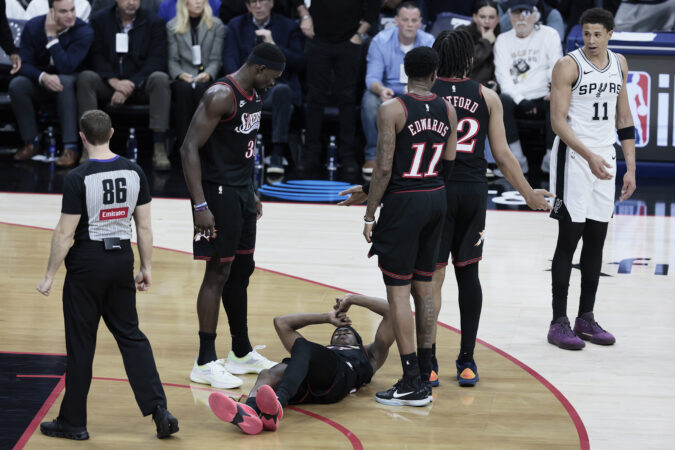
    The Sixers lost VJ Edgecombe after he had a hard landing on his back on a three-point attempt in the first half.

    The Spurs put on a show in front of Bob Costas, Doug Collins and more familiar broadcasters as part of a throwback night for NBC’s NBA coverage.

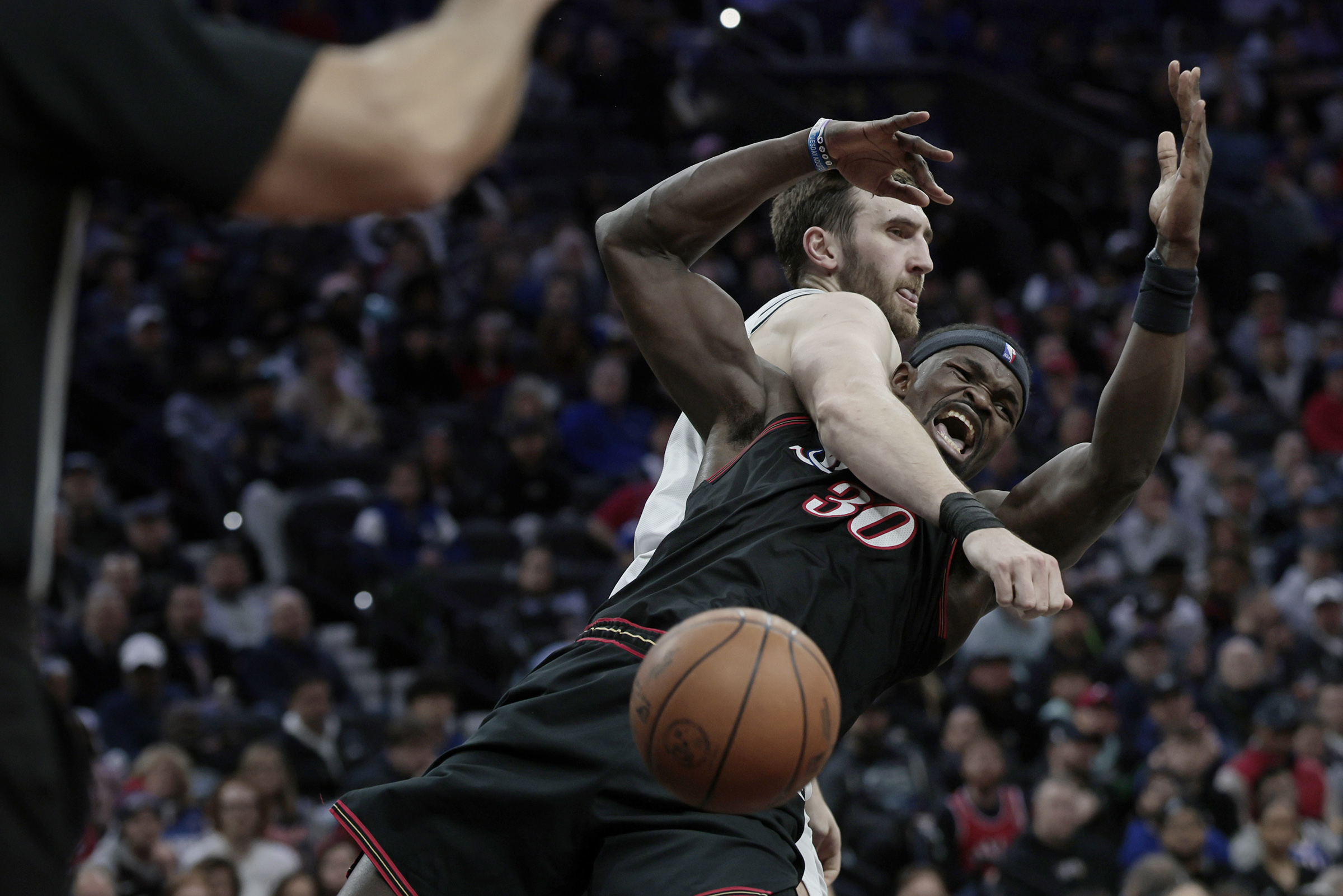
    Sixers’ Adem Bona (right) and Spurs’ Luke Kornet battle for the ball in the first half of Tuesday’s game.

    The Sixers would like to throw this one back.

    Carter Bryant buried a three for to push San Antonio’s lead to 60-36 in the first half and the Sixers were booed off the court headed into a timeout. Harper scored 14 points in the half to take a 78-53 lead — all done without forward Harrison Barnes, who had his 364 consecutive games played streak end when he woke up from a nap with a sore ankle.

    The Sixers host the Utah Jazz on Wednesday (7:30 p.m., NBCSP) for the second night of a back-to-back.

  • Johan Rojas’ potential PED suspension leaves Phillies no choice but to act (again)

    Johan Rojas’ potential PED suspension leaves Phillies no choice but to act (again)

    The news that is coming down the pipe wouldn’t be a huge deal for some teams.

    The Phillies are not one of those teams.

    Johan Rojas might be a third-string center fielder who forces you to play with an eight-man batting order, but he is a man without an obvious replacement right now. The Phillies are going to need to figure one out soon, assuming the formality of the 25-year-old’s pending appeal of an 80-game performance-enhancing drug suspension that an Inquirer source says he faces.

    Bryan De La Cruz? The 29-year-old nonroster invitee offers enough of a profile at the plate to suspend disbelief. But he hasn’t played center field in the big leagues since 2023, and even then, he did it in only seven games.

    Dylan Moore? He played a couple of innings in center field last season but has only 105 in a seven-year big league career as a utility man. The 33-year-old nonroster invitee would make some sense as the third option in any given game. But it’s a stretch to think he’d make sense as a long-term sub.

    Or, there is Pedro León, a 27-year-old who went 2-for-20 with 10 strikeouts in 2024 for the Astros. Houston waived him in November.

    There aren’t any other options on the spring training roster, unless you count Edmundo Sosa in an emergency.

    There is a reason the Phillies traded for Harrison Bader last July. It’s the same reason they were open to re-signing him early in an offseason that ended with him settling for a two-year, $20.5 million contract with the Giants. The Phillies are thin on center fielders and right-handed hitters, and even thinner on guys with both skill sets.

    It’s a shame the Bader situation played out as it did. The Phillies’ offseason would look a lot different if they’d been able to sign him to something like a two-year, $25 million extension before he exercised his end of a mutual opt-out. There would have been more than enough at-bats to go around between righties Bader and Adolis García and lefties Brandon Marsh and Justin Crawford, as well as a better combination of depth and platoon ability. And if Bader came at the price of García going elsewhere, no worries. You can get a right-handed-hitting corner outfielder easier than you can a right-handed-hitting center fielder, and a lot of them cost less than García’s $10 million for the same amount of cross-your-fingers-and-pray.

    Alas, here we are. It would betray a misunderstanding of the inner workings of the business of baseball to interpret Bader’s contract with the Giants as an unwillingness to match by the Phillies. They moved on and he moved on, and nobody would be thinking twice if the Mets didn’t offer an outlandish contract to Bo Bichette. None of that matters now.

    The Phillies don’t have a choice but to scour the earth for someone who at least looks like a center fielder when you squint. Marsh has never played in more than 135 games in a big league season, which is 135 more than Crawford has ever played. That’s not a comfortable situation. The only unsigned free agent of note is Manuel Margot, who would leave everyone pining for Rojas.

    Keep in mind, Rojas appeared in 71 games last season. At the start of that season, the organization’s depth chart looked pretty much as it does now. If you’d forgotten Rojas got that much playing time, it’s because he didn’t offer a lot to remember him by.

    Johan Rojas’ .569 OPS last season ranked among the bottom 10% of MLB hitters with at least 170 plate appearances.

    His .569 OPS ranked among the bottom 10% of MLB hitters with at least 170 plate appearances. He is one of only three center fielders out of 46 total to have an OPS lower than .600 while garnering at least 500 plate appearances over the last two seasons. His average exit velocity ranks second to last.

    That would lead to an obvious question, if we hadn’t already covered the answer. Why did Rojas get so many at-bats? Because the Phillies didn’t have any better options. Sure, some wishful thinking factored in, as did an overemphasis on center-field defense. The math is a little more complicated than subtracting the surplus doubles a better defender robs from the surplus doubles a better hitter would have given you at the plate. But the fundamental logic holds, and Rojas failed it. Reality is, the Phillies were a better team last season with Rojas on the bench and Marsh in center field, even against lefties.

    You can argue that they are no worse off for losing Rojas. It might be true, to a certain extent. Moore and De La Cruz could be as good as it gets unless someone shakes loose on cutdown day (local product Chas McCormick is in camp with the Cubs on a minor league contract). If finding a center fielder was easy, we wouldn’t be having this conversation.

  • High-tech snowplows and AI help cities clean up from big storms

    High-tech snowplows and AI help cities clean up from big storms

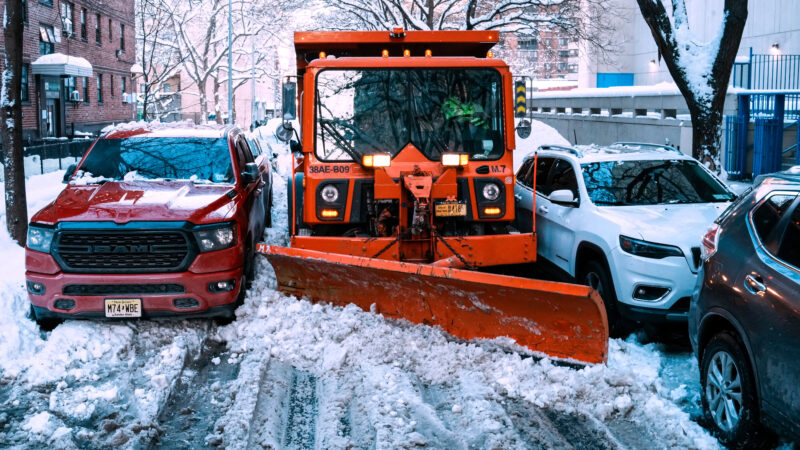
    Residents of Syracuse, N.Y. — America’s snowiest city — once barraged a service hotline with street neglect complaints during blizzards, even if plows had passed two hours earlier but the work was hidden by fresh snow.

    Now public trust seems to be rising as Syracuse and other cities across the U.S. integrate upgrades such as video monitoring, GPS mapping and artificial intelligence into snow operations that once relied almost entirely on manual planning.

    Syracuse was one of the first to revamp the way it deploys its snowplows, and complaint calls have dropped by 30% under the new system, said Conor Muldoon, the city’s chief innovation officer.

    “People will look out their window and say, ‘Hey, you guys are doing a terrible job,’” Muldoon said. “And we can point to a public map and say, ‘Here’s all the breadcrumbs for when that plow was there.’”

    Snowier than usual in the U.S. snow capital

    Each winter, Syracuse averages 126 inches (3.2 meters) of snow, more than any other U.S. city of at least 100,000 people. Even before the blizzard that pounded the Northeast last week, the city had already surpassed its typical average due to a record 2-foot (60-centimeter) accumulation on one day in late December.

    With a goal of clearing every street within 24 hours after a storm, Syracuse partnered in 2021 with San Francisco-based Samsara to put live GPS tracking and dashcams on city fleet vehicles including snowplows. Integrated with GIS mapping software, the system allows officials to monitor live video and plow locations in real time.

    While residents can’t access live feeds, they can view a public map that updates every 5 minutes to show which roads have been cleared.

    Samsara started incorporating AI into its products in 2019. This winter, for the first time, it has provided customers with footage from other cameras within its large network, helping officials better understand conditions on a street even when no worker is there.

    Kiren Sekar, the company’s chief product officer, cited an example of needing to dispatch the closest plow for a snow emergency in Plainwell, Michigan.

    “Rather than having to sift through a list of vehicles, it can actually figure this out: ‘We’ve got Trevor in vehicle 203, 15 minutes away,’” Sekar said.

    New York City’s approach

    Samsara partners with communities of various sizes to upgrade their snowplow systems, but the nation’s largest city — New York City — developed its own.

    Its tracking program known as BladeRunner monitors snow removal equipment (including garbage trucks with plows attached) while a human in a command center — not AI — analyzes the GPS data. The city is exploring AI in the future to process the thousands of 311 calls and online service requests it can get in a single day.

    The other way the big city’s approach differs from its upstate neighbor of Syracuse is that each plow runs a specific route during storms, ensuring main and side streets get essentially the same treatment.

    “So what it does is allow equity,” said Joshua Goodman, deputy commissioner at the city’s Department of Sanitation.

    Typically 99% of the city’s roads will be plowed within the first four hours after a moderate snowfall under ideal conditions, but Goodman said it didn’t quite meet that mark during last week’s historic storm.

    Cutting costs and insurance claims

    With U.S. cities and states spending upward of $4 billion each year on snow operations, the new technology also helps assure roads aren’t overplowed or oversalted, which can cause environmental damage.

    Fayetteville, Ark., launched a public-facing snow removal map for the first time this winter. It reported improvements in plowing time, labor costs and fuel savings, despite enduring about double the snow from a year ago.

    “This is the first year some roads have ever been treated or plowed, and that goes right back to being able to see where we need to go and if we’ve been there,” said Ross Jackson Jr., the city’s fleet operations manager.

    The township of Edison, N.J., reduced its spending on salt and brine by 35% and its insurance payouts by 60%, thanks to video that helped prove plow drivers usually weren’t at fault when the vehicles collided with another motorist’s car.

    Video installed on snowplows in Iowa helped demonstrate that all but one of 12 snowplow accidents in a single day were the other driver’s fault, said Craig Bargfrede, the state’s winter operations administrator.

    “How can you not see this big orange truck with flashing lights ahead of you?” he said. “Boom, they just drive right into us.”

    Kalamazoo County was the first county in Michigan to employ turn-by-turn navigation to dispatch snowplows during a storm. Rusty McClain, assistant general superintendent of its road commission, called it a huge improvement in efficiency.

    “The old-school way of doing it, that bird’s-eye view of where everyone needs to go to plow, was just in a large book with paper maps,” McClain said. “You’d have to pull over, find the page you’re looking for, call somebody on the phone and ask if they have plowed that area.”

  • The Flyers helped renovate the home of a Northeast Philly teen battling leukemia. He’s ‘gobsmacked.’

    The Flyers helped renovate the home of a Northeast Philly teen battling leukemia. He’s ‘gobsmacked.’

    One word would describe 19-year-old Ethan Ruiz’s reaction to his newly renovated home: “Gobsmacked.”

    “I don’t know how you turn what was here before into such a large space,” Ruiz said. “I guess it involved knocking down walls, but seeing it in its full extent — completely open. I love the open-air design of everything.”

    Ruiz was the 10th recipient of the Building Hope for Kids grant, an initiative in which Flyers Charities and Michael’s Way partner to renovate homes for children battling cancer.

    The initiative led to Ruiz’s home in Northeast Philadelphia being renovated to create a more comfortable, accessible, and uplifting space as he continues treatment for his leukemia diagnosis.

    “Every year we work with St. Christopher’s Hospital,” said Blair Listino, chair of Flyers Charities and an alternate governor of the Flyers who is the chief financial and administrative officer for Comcast Spectacor. “We work with social workers there who select a family that they think it would make a very big impact on in their lives to have a new home.

    “This is the 10th house we’ve done and we’ve worked with a lot of organizations day in and day out. There’s different organizations here who’ve helped with the house. IKEA donated all the furniture. Sprouts [Farmers Market] stocked the kitchen. And we have Rheem who did the HVAC system for us.”

    The basement at newly renovated home for 19-year old Ethan Ruiz and his mom features a home gym.

    In 2025, Flyers Charities increased its financial contribution to the initiative to $100,000 due to the increased cost of building materials and the success of previous home renovations.

    Flyers Charities financially supports Michael’s Way, a local nonprofit whose mission is to improve the lives of children with pediatric cancer, for the project while the wives and girlfriends of Flyers players act as interior designers for the house.

    Ethan and his mother, Yomayra Carrer, were surprised with the news in October. Construction began in January with Flyers Charities and wives and girlfriends working alongside Fastrack Construction and IKEA to complete a full-scale renovation.

    The renovation includes a new HVAC system, a new roof for long-term structural security, engineered hardwood flooring to reduce dust and allergens, new cabinetry, a home gym, walk-in closet, and new tile.

    When asked what his favorite part of the renovation was, Ruiz said: “My room.”

    Ruiz’s room was decorated with forest green walls, featured a gaming setup in the corner, and personalized with some of his favorite items — including a “Ghost of Yotei” poster, and album artwork from Tyler, the Creator’s “Chromakopia.”

    One of the masterminds behind Ruiz’s room was Alex Sanheim, Travis Sanheim’s wife.

    Ethan Ruiz’s newly renovated bedroom was decorated with forest green walls, featured a gaming setup in the corner, and personalized with some of his favorite items — including a “Ghost of Yotei” poster, and Tyler, the Creator’s “Chromakopia” album artwork.

    “It’s tough to design something for someone else and still hope it’s exactly what they envisioned,” Alex Sanheim said. “And by his reaction, I think we nailed it. It was to be green and moody and have a gaming [setup]. I think the space works for him to enjoy gaming between school. Everything now, it’s just completely different.

    “It truly wouldn’t be possible without every single person. I just truly don’t think that we give enough credit to everyone because it takes a village for sure.”

    After getting to know the family, the Flyers’ wives and girlfriends took both Ruiz and Carrer’s interests in consideration to make their vision come to life. For instance, plants were something Carrer loved to have in her home. Going into the renovation, she was a little worried she would have no place for them.

    “From my exact sitting position [in the living room], I can count like six of them,” Ruiz said.

    Little did Ruiz know, he missed an entire cabinet of four additional plants to his right. Although the plants were a must have, for Carrer, the kitchen was the main star of the house — but it may take some time getting used to.

    “I don’t know if I’m just like of a different tax bracket, so I don’t know this, but like, I didn’t even know that ovens could come in — dude, there’s two. And it’s split into one big one,” Ruiz said.

    Carrer added: “We’re going to figure it out.”

    Flyers Travis Sanheim (left) and Owen Tippett attended the unveiling of Ethan Ruiz and Yomayra Carrer’s renovated home on Tuesday.

    When asked what would be the first thing they make in their new kitchen, they responded: “Empanadas.”

    Despite the rainy conditions Tuesday, Gritty and Flyers players Jamie Drysdale, Bobby Brink, Owen Tippett, and Sean Couturier were there to witness the big reveal.

    “Oh, they did a great job,” Couturier said. “I would probably let them redo our house altogether. They did an amazing job. Everything kind of fit together and I’m sure they’re happy with the end result.”

    For the Ruiz family, the renovation was a dream come true.

    “The way that I saw all the wives show up, the contractors, I know how stressful it was,” Carrer said. “But they were like, ‘No, this is something we want to do. We do it with joy in our hearts.’ So, to me it’s like they will forever be in my prayers. The contractors, the wives, the Flyers, Michael’s Way. It’s been a long journey, but it’s a beautiful one.”

  • Owen Tippett’s fashion sense has put the NHL and fans on notice. The Flyers also might need him to fill a Travis Konency-sized void.

    Owen Tippett’s fashion sense has put the NHL and fans on notice. The Flyers also might need him to fill a Travis Konency-sized void.

    Owen Tippett isn’t on Twitter these days. He has dropped some social media platforms that he didn’t feel were necessary or healthy for his mental space.

    But he had heard through the grapevine about the artwork; he just hadn’t seen it yet.

    “That’s unreal,” he said, almost in shock when shown the drawing of himself from the weekend. “Unreal,” he said, covering his agape mouth with his hand, still in shock. “Wow. That’s sick.”

    On Saturday, the Flyers’ social media accounts had a picture of Tippett in his game-day fit, sporting a Kith sweater, baggy black jeans, and sunglasses. Local sports artist Dhwani Saraiya, who designed the Flyers’ opening night T-shirt, tweeted, “fit was so fire I had to draw it.” And the Edison, N.J., native did.

    Tippett, who has popped up in Annie O’Donnell’s rapid-fire NHL fit reviews on Instagram for his style, followed that up with a Canadian tuxedo, fittingly in Toronto, on Monday. The two-piece set, also from Kith, was ordered just a few days earlier and arrived on his doorstep on Saturday before making the round on social media, notably on the NHL’s platforms.

    (Editor’s note: The Canadian tuxedo ended up in O’Donnell’s latest fit review that dropped right after this story was published, stating: “This is the coolest Canadian tuxedo I have ever seen in my life.”)

    This is the first year the players are not required to wear suits or business attire.

    “I think when we found out we weren’t going to have a dress code, I think my wife had a little bit more fun with it than I did,” Ontario native Tippett said of his wife, Taylor. “Kind of got me out of my comfort zone a little bit, which is fine, from what I’m used to wearing, but yeah, I’ve had fun with it.”

    Now, this isn’t a fashion story, but it’s about the old-fashioned mantra: “If you look good, you feel good.”

    It’s about goalie Dan Vladař noting that the Flyers had swagger in the room on Saturday.

    It’s about the Flyers feeling good on the ice, having won three straight for the first time since around Thanksgiving, and back in the playoff picture.

    And it’s about the forwards, notably Tippett, who was promoted to the top line on Monday, needing to step up with Travis Konecny’s status up in the air. Konecny, who leads the team in goals (23), assists (34), and points (57), missed his second game of the season on Monday with an upper-body injury.

    “Yeah, he’s a huge part of our team, both on the ice and in the locker room,” Tippett said. “Obviously, it’s a big, big role to fill. But I think I’ve said it a couple of times this year with [Tyson Foerster] going down and [Rodrigo Ābols] going down, and there’s been a few guys in here who have kind of missed games or missed some time.

    “We all have to step up collectively.”

    Coach Rick Tocchet said on Tuesday that he is hopeful Konecny can play Thursday when the Utah Mammoth visit Xfinity Mobile Arena (7 p.m., NBCSP). But if not, his absence will test the team’s depth. The expectation is that Tippett will remain on the top line with Trevor Zegras and Christian Dvorak.

    According to Natural Stat Trick, in the Flyers’ 3-2 shootout win against the Maple Leafs, when the trio was on the ice at five-on-five, the Flyers had 10 shot attempts, five shots on goal, two scoring chances, and 57.15% of the expected goal share.

    Owen Tippett has discussed the need to complement Flyers center Trevor Zegras (46).

    “Obviously, it’s different with everyone you play with,” Tippett said of his game style. “I think the biggest thing [Monday] night was, obviously, making the simple plays and not trying to overcomplicate things. I know they play an offensive line, and when Trevor has the puck, he can create a lot, so it’s more just kind of give him space, but also support him at the same time.”

    Tippett, Dvorak, and Zegras also played together at the beginning of the season, beginning in Game 2 against the Carolina Hurricanes, and Tippett has spent the second-most time with Zegras and Dvorak this season, trailing only Konecny.

    Among the Flyers’ seven line combinations that have played at least 100 minutes together, Money Puck has the line ranked No. 2 in minutes (196.5), expected goals for (8.8), and expected goals against (8.7). Although shot attempts, shots on goal, scoring chances, and high-danger chances are almost even with what they give up — but above 50% — according to Natural Stat Trick, when they are on the ice at five-on-five, the Flyers have outscored the opposition 13-8. That’s the number that counts.

    “Played with them a little bit at the start of the year,” Tippett said, “but it’s been a decent stretch since I’ve played with them. So, a little bit of chemistry was already there, but just trying to keep things simple and communicate as much as we can on the bench and on the ice.”

    Tippett is sitting on 19 goals for the season, one shy of reaching the 20-goal mark for the fourth straight year.

    “Yeah, I did,” Tocchet said when asked if he liked Tippett with that pair. “He had some speed. I thought there were some moments there [that if he had] one inch or two inches, he would have been gone. So he had a game where I thought he could add to that line.”

    Breakaways

    Defenseman Nick Seeler did not participate in practice on Tuesday after leaving Monday’s game late in the second period with a lower-body injury. Seen limping after the game, Tocchet said he is also a game-time decision. … Dvorak and defenseman Rasmus Ristolainen also did not skate, but Tocchet said they had maintenance days. Ristolainen’s name has been prominent in trade chatter, but there is currently nothing imminent, The Inquirer has learned. Offers should start picking up soon with the trade deadline on Friday at 3 p.m.

  • Source: Phillies outfielder Johan Rojas faces 80-game suspension for failed drug test

    Source: Phillies outfielder Johan Rojas faces 80-game suspension for failed drug test

    Phillies outfielder Johan Rojas tested positive for a performance-enhancing drug and is facing an 80-game suspension by Major League Baseball, a league source confirmed Tuesday.

    Rojas will appeal the test result, the source said.

    Phillies officials said Tuesday that MLB hasn’t contacted the team about Rojas’ status, although manager Rob Thomson said he was aware of reporter Wilber Sánchez’s post over the weekend that Rojas had failed a drug test.

    Rojas was at the Phillies’ spring training complex on Tuesday but did not speak with the media. Officials from MLB, the MLB Players’ Association, and Rojas’ agent, Rafa Nieves, declined to comment.

    Rojas was scheduled to play for the Dominican Republic in the upcoming World Baseball Classic but didn’t join the team in Miami over the weekend. D.R. general manager Nelson Cruz announced Monday that Rojas withdrew from the tournament for “personal reasons,” adding that the outfielder could explain himself at a later time.

    The Phillies’ outfield depth would be diminished by a suspension to Rojas. Brandon Marsh, rookie Justin Crawford, and Adolis García are locked into outfield spots along with Otto Kemp, who hasn’t been a full-time outfielder.

    Rojas was vying with veteran utility man Dylan Moore and fellow outfielders Pedro León and Bryan De La Cruz for the final spot on the bench. Rojas and León are on the 40-man roster. Moore and De La Cruz are nonroster invitees to camp, although Moore is due a $100,000 retention bonus to go to the minors if the Phillies don’t add him to the 26-man roster five days before opening day.

    Rojas, 25, is regarded as an elite defender in center field but hasn’t produced much at the plate since an impressive 59-game debut as a rookie in 2023. He batted .224 with a .569 OPS in 172 plate appearances last season and got optioned to triple A midway through the year.

    Among 316 players with at least 500 plate appearances since the beginning of the 2024 season, Rojas ranks 308th with a .591 OPS.

    It’s unclear whether Rojas will continue to play in Grapefruit League games during his appeal.

  • Kelly Oubre Jr. will miss Sixers’ game vs. Spurs with an illness

    Kelly Oubre Jr. will miss Sixers’ game vs. Spurs with an illness

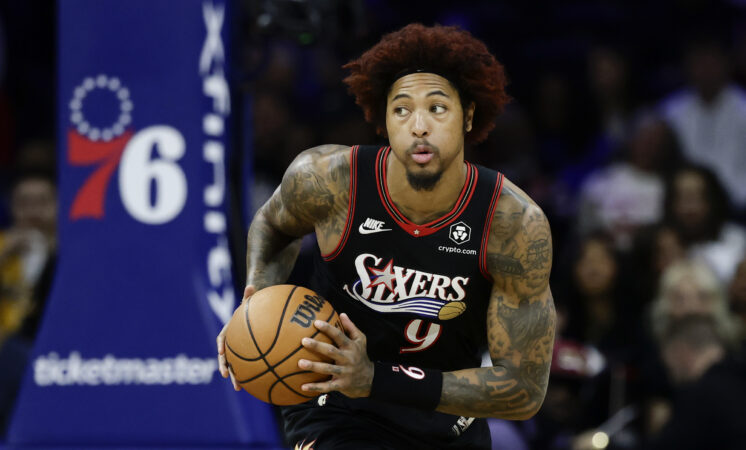
    Kelly Oubre Jr. will miss the 76ers’ home game Tuesday against the San Antonio Spurs with an illness, per the NBA’s injury report.

    Oubre, a starting wing, has been enjoying one of the best seasons of his 11-year NBA career. He is averaging 14.3 points, 4.7 rebounds, and 1.3 steals in 38 games, while often taking a challenging perimeter defensive assignment. He has increased his three-point shooting to 37.2%.

    Without Oubre, combo guard Quentin Grimes will slide into the starting lineup. Second-year wing Justin Edwards will “for sure” reenter the rotation, coach Nick Nurse said during his pregame news conference.

    The Sixers also will play against the 43-17 Spurs without Joel Embiid (oblique) and Paul George (suspension).

  • Philly brings the noise to mark the 100-day countdown before kickoff of the FIFA World Cup

    Philly brings the noise to mark the 100-day countdown before kickoff of the FIFA World Cup

    The World Cup is just 100 days away.

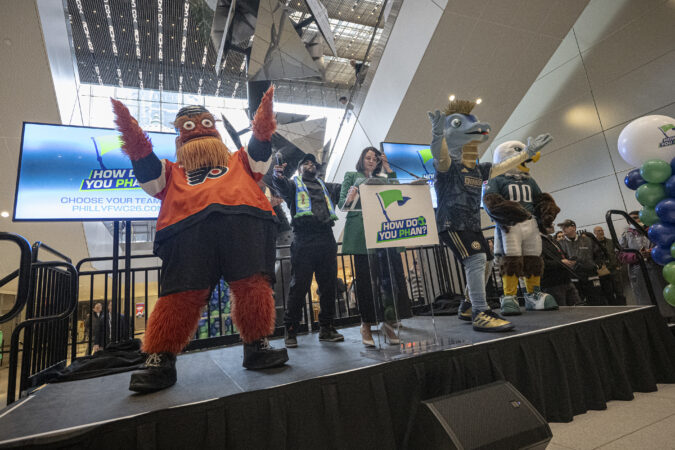
    On Tuesday, Philadelphia Soccer 2026, in conjunction with the city, officially launched the “How do you Phan?” campaign at the Comcast Technology Center Concourse to commemorate the milestone.

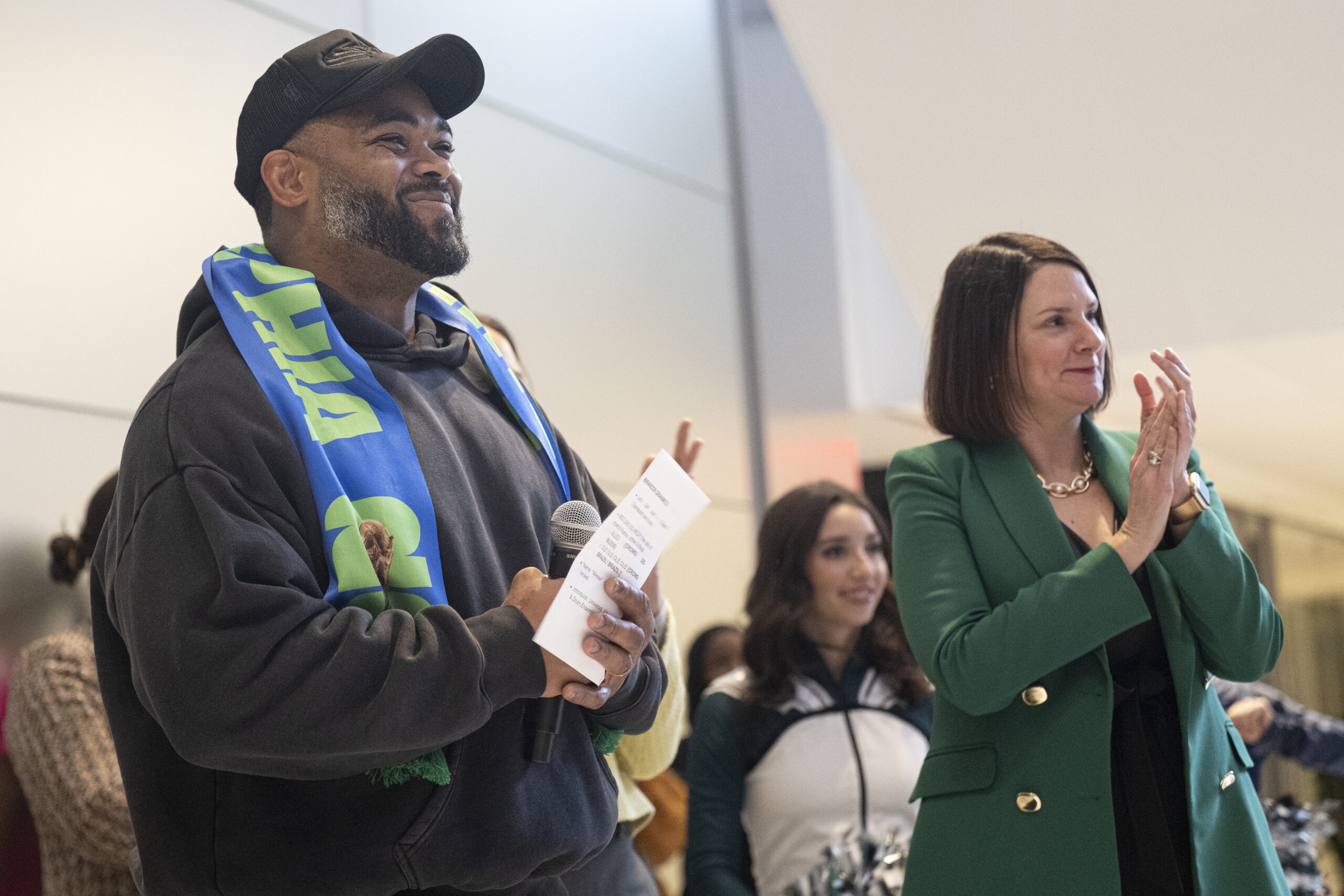
    The event, emceed by Eagles defensive end Brandon Graham, featured performances by the Universal African Dance and Drum group — along with appearances by Philadelphia mascots Swoop, Gritty, and Phang.

    “Let’s get an E-A-G-L-E-S Eagles real quick,” Graham said to open the event. “We’ve got a hundred days till the World Cup comes to our city. I hope y’all are all ready. Today, we got to get hype, this is a big event.”

    International drummers and dancers perform during a rally celebrating 100 days until the 2026 FIFA World Cup on Tuesday at the Comcast Center.

    Ready to be a fan?

    Hundreds of fans stood in line to receive free merchandise — including shirts, hats, flags, and commemorative miniature posters — before remarks from Michelle Singer, co-chair of Philadelphia Soccer 2026 and Meg Kane, the chief executive for the Philadelphia Soccer 2026 host committee.

    “This is exactly the kind of energy the world will experience when they come [to] Philadelphia this summer,” Singer said to an excited crowd. “As co-chair of Philadelphia Soccer 2026, I have the great privilege of working alongside an amazing team across the city and throughout Pennsylvania to prepare for one of the largest global events in the world.

    “We know six matches will be hosted at the Linc will have a tremendous impact on our city. But what makes the World Cup even more powerful is the opportunity to showcase who we are as a city.”

    After Philadelphia Soccer 2026 live premiered their “How Do You Phan” campaign video, Kane highlighted the eight known teams set to compete in Philadelphia — Brazil, France, Croatia, Ghana, Côte d’Ivoire, Ecuador, Haiti, and Curaçao — and encouraged fans to embrace each country’s culture, food, and even football chants.

    Kane, who helped plan Philadelphia’s Papal visit in 2015, directed the crowd to Philadelphia Soccer 2026’s website for recently released “tool kits” that teach Philadelphians how to be fans of the incoming teams.

    “We need to get ready in Philly,” Kane said. “We need to have a rooting interest. We love when we are watching a sporting event, and we want a winner. Like we’re rooting for someone. A great story, a great player, a great team. We have done it for all of our teams.

    The Flyers, the Sixers, the Union, the Eagles, the Phillies — we’ve done it all. We brought the bedlam to the bank. We have shown everything about our sports passion and our fandom and that’s why today, it’s about bringing our energy to the global stage.”

    Eagles defensive Brandon Graham (left) stands alongside Meg Kane, host city executive and CEO of Philadelphia Soccer 2026, in Tuesday’s pep rally celebrating 100 days until the 2026 FIFA World Cup.

    Man of the people

    If you are unfamiliar with soccer, the sport, don’t worry — so is Graham.

    After the event, Graham stuck around briefly to take photos and talk with fans, mentioning his partial favoritism for the Ivory Coast (Côte d’Ivoire) national team, but also admitting his unfamiliarity with the sport.

    “No,” he said when questioned on if he grew up a fan of soccer. “Just played FIFA on the game, that’s as close as I got.”

    Despite his unfamiliarity, Graham is still excited to learn what is in store for this summer.

    “I came to the [Premier League matches] when it was at the Linc,” Graham said. “That was cool, and now, I can’t wait to see what it’s all about.”

    Next steps

    There is still plenty to do before the first kickoff of World Cup matches in Philly, when Ivory Coast opens what will be the first of five group stage games against Ecuador on June 14 (7 p.m., FS1).

    Philadelphia Soccer 2026 and the city of Philadelphia are still ironing out safety and transportation plans, according to Kane, while simultaneously working with FIFA to get Lincoln Financial Field up to shape ahead of the games,

    On top of it all, Philadelphia Soccer 2026 is looking to announce updates regarding their free Fan Festival, set to be hosted at Lemon Hill in Philadelphia’s Brewerytown neighborhood, in the coming weeks.

    A rendering of what Philadelphia’s World Cup fan fest site at Lemon Hill Park is expected to look like.

    “The Lemon Hill and FIFA fan festival is a key component of our planning,” Kane said. “So really focused on that and getting ready to hopefully make some announcements about what people can expect at Lemon Hill in the coming weeks. It’s going to be an incredible event. It’s going to be one of those spectacular, unexpected moments of the tournament for people who live here and for visitors alike.”

    According to Kane, the city plans to invest $5.2 million into the park ahead of the World Cup, which will be partially spent on ADA accessible ramps, better lighting, paved walkways, and an improved playground noted as “quality of life improvements.”

    “I think that one of the things that has been so incredibly heartening and productive around the planning is that the city really leaned in with Philadelphia soccer 2026 around community engagement and hearing from the community about their concerns,” Kane said. “But also, their hopes for the park. It is a beautiful park, and one that has not necessarily been invested in over the last 40 years. So for us, it’s exciting that we’re able to put some preliminary infrastructure in that is going to allow us to host this festival there.”