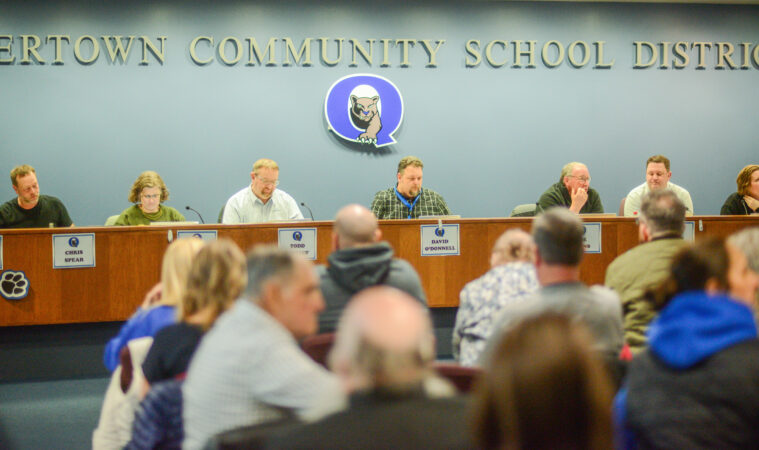
Addressing the board before the vote, Ryan Wieand, the president of Quakertown’s teachers union, said that selecting the next superintendent “is not simply about filling a position at this point. It’s about restoring trust.”
Wieand said the superintendent’s job “demands presence, visibility, and leadership that requires showing up, and not just for social media photo ops.”
The district “can’t be led effectively by someone who is absent more often than not,” Wieand said. “Our next superintendent needs to be 100% invested in Quakertown every single day,” and not view the job as “a stepping stone to another destination.”
He called Hoffman the best candidate for the job, praising her loyalty to the district and “true accountability.”
Friedman could not immediately be reached for comment Wednesday.
A man has been arrested in connection with two shootings last year that left one person dead and another hospitalized.
Nasir Brooks, 24, turned himself in to the Philadelphia Police Department on Tuesday for the killing of 23-year-old Hasan Mason. Brooks allegedly fatally shot Mason near Broad Street and Packer Avenue in October and shot another 23-year-old that same day in front of the Chickie’s and Pete’s nearby, police say.
Police previously arrested Abou Keita, 22, a month after the shooting, charging him with murder, attempted murder, aggravated assault, and other offenses in relation to the Oct. 9 shooting.
The shooting unfolded just after 6:10 p.m., when police responded to reports near Packer Avenue and Broad Street. What they found on scene was an Audi sedan filled with 15 bullet holes just south of the intersection, police said.
Police found Mason lying on Broad Street just north of the intersection with multiple gunshot wounds. He was taken to Thomas Jefferson University Hospital, where he was pronounced dead.
The other 23-year-old, who police have not identified, was found in front of the Chickie’s & Pete’s near the sports complex on Packer Avenue, with gunshot wounds to the torso. He was taken to Penn Presbyterian Medical Center, where he was placed in stable condition.
Tyrese Maxey tried to explain to rookie teammate VJ Edgecombe that, in matching up against the towering Victor Wembanyama, “TV don’t do him justice.”
Yet Edgecombe still needed to experience life against the 7-foot-4 San Antonio Spurs superstar for himself. Edgecombe, a typically fearless athlete, got an early taste when he attempted to drive into the paint and visibly hesitated, as if uttering a massive “nope!” with Wembanyama lurking at the rim.
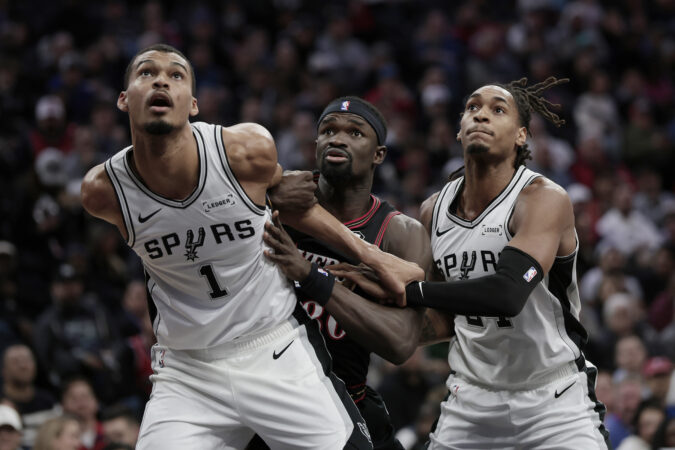
Wembanyama’s presence contributed to the 76ers’ early deficit in a 131-91 loss Tuesday night at Xfinity Mobile Arena. It again exposed the Sixers’ center conundrum without star Joel Embiid, who missed a second consecutive game with an oblique strain. And the game got so out of hand that Wembanyama only needed to play 24 minutes, 7 seconds, yet still stuffed the box score with 10 points on 3-of-5 shooting, eight rebounds, four assists, six blocks, and three steals.
So what does it feel like to (try to) face Wembanyama, anyway?
Wembanyama was different the instant he entered the NBA as the first overall draft pick of the 2023 draft, with that height and wingspan blended with athleticism and blossoming skill on both ends of the floor. Sixers starting forward Dominick Barlow, who spent his first two NBA seasons with San Antonio, described a then-rookie Wembanyama as “phenomenal” and already “one of the best I’ve ever been around.”
Now in his third season, Wembanyama has developed into an MVP candidate and Defensive Player of the Year front-runner for the surging Spurs (44-17), who have won 12 of their past 13 games and look like NBA Finals contenders.
The 22-year-old delivered highlights, despite limited minutes in Tuesday’s nationally televised matchup, including a spinning dunk while rolling to the basket. Even when the Sixers (33-28) pulled off a positive play against him — when Edgecombe (who later left the game with back soreness) swiped the ball from Wembanyama’s grasp and sent a slick pass to Maxey for a finish in transition — Wembanyama came right back with an emphatic alley-oop dunk.
And Wembanyama quickly torched fill-in starting center Andre Drummond, who lasted less than six minutes of game action and was a stunning minus-14.
In the game’s first minute, Wembanyama stuffed the typically imposing 6-foot-10 Drummond at the rim. Drummond then picked up two fouls in eight seconds, sending him to the bench for the remainder of the first quarter. Drummond missed all four of his three-point attempts and finished 1 of 7 from the floor.
When asked what makes Wembanyama special besides his physical stature, Drummond said, “Especially when you have that type of stardom, you can kind of do whatever you want.”
“He gets touched, he gets a foul call,” Drummond said. “That’s not an excuse. You’ve got to find ways to stop those types of players.”
The early whistles on Drummond meant the Sixers needed to turn to Bona, whose priority was to not commit any “dumb fouls,” he said. Though the second-year big man performed admirably in his first stint (four points, two rebounds) and then started the second half, the game unraveled too quickly for that to register. He finished with six points and six rebounds in 22:09.
Beyond those center matchups, there were subtle (and glaring) ways Wembanyama impacted a Sixers offense that shot 34.7% from the floor and 10 of 42 from three-point range.
They entered Tuesday hoping to draw on their experience with opposing centers leaving Barlow free outside the three-point arc, which Wembanyama often does against nonshooters to remain near the basket. Coach Nick Nurse believed his team did a “decent job finding shots” early, though creating those looks via kick-out passes required patience as seconds ticked off the shot clock.
Maxey added that the Sixers needed to “just live with certain shots,” particularly in the corner. The rare instances in which Maxey did get Wembanyama to switch onto guarding him, Maxey got to the rim because “the paint is wide-open.” But when Wembanyama lingered in the middle, it allowed opposing guards such as Stephon Castle — a dynamite defender in his own right — to pressure Maxey aggressively.
Maxey compared the approach to Embiid’s defensive prime, when the Sixers’ perimeter players felt free to ramp up their on-ball intensity because of the anchor behind them.
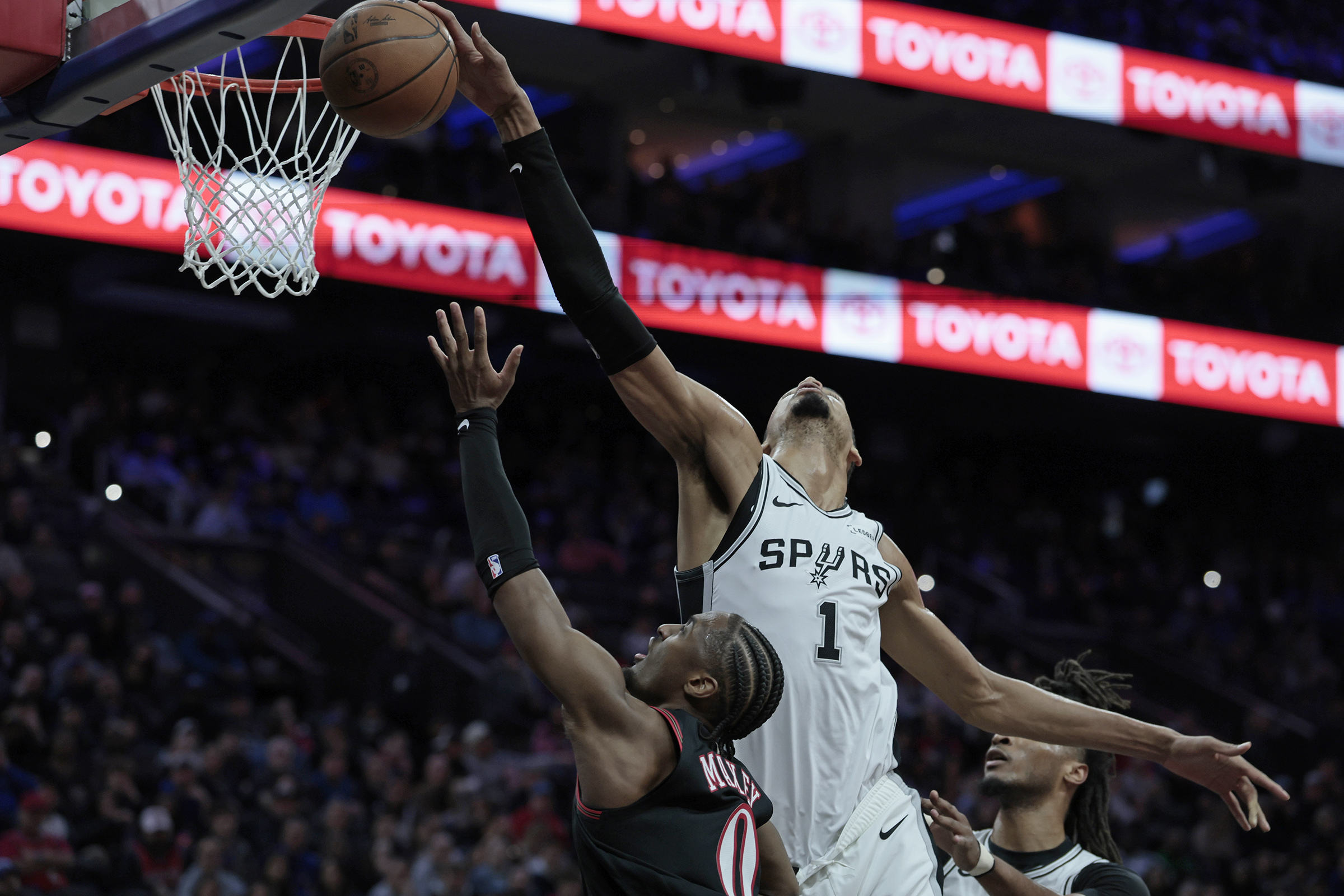
The Spurs’ Victor Wembanyama blocks a shot (one of six on the night) by Tyrese Maxey.
“It took [the Spurs] a couple years to kind of learn that and kind of figure out how to build a defensive system around [Wembanyama],” said Maxey, who finished with 21 points on 8-of-19 shooting and eight rebounds. “And they have, and it makes them better. …
“What [the guards] want you to do is try to go by them, and they know they got Wemby down there. That’s a good strategy.”
Nurse most lamented the Sixers’ dreadful second quarter when his team “didn’t do anything very well” and offered “no resistance defensively.” The Spurs scored 46 points on 73.9% shooting from the field, while the Sixers went 1 of 9 from long range and committed five turnovers.
It’s why the score was lopsided by halftime. And why Wembanyama could watch from the bench by the 4:21 mark of the third quarter, his night complete.
The Sixers will see Wembanyama again on April 6 when they visit San Antonio, Texas, for a matchup that could be crucial in determining playoff seeding in a tight middle of the Eastern Conference.
And now their full roster knows what it feels like to face the towering MVP candidate in real life, since, per Maxey, watching him on television does not do him justice.
“It probably takes a little bit to get used to,” Nurse said, “to figure out what you’re going to do.”
A glance at the clock told me that I had only five more minutes to finish examining my patient in his early 60s.
During my family medicine rotation at a primary care clinic affiliated with Cooper Medical School of Rowan University, where I am training to become a physician, we are usually allotted 20 minutes for a standard patient checkup. In that time, I have to cover a patient’s medical history, review their medications, conduct a physical exam, and discuss test results.
I had little time for conversation about my patient’s bloodwork, where a few numbers popped up as concerning. His total cholesterol and LDL (harmful cholesterol) had climbed sharply since his last visit. I entered the values into a cardiovascular risk calculator, a routine step in deciding whether to start medication. My patient also smoked and had a family history of heart disease.
The calculation assessed his 10-year risk of heart attack or stroke as near 20%. That’s well above the 7.5% risk threshold where we typically recommend starting treatment.
I explained the results and encouraged my patient to consider starting a statin to lower his cholesterol.
He shook his head. “I Googled it. I wasn’t too pleased with the side effects. What good is preventing heart disease if I get muscle breakdown? There are doctors online saying they’re overprescribed,” he told me.
I walked him through the evidence. Yes, muscle pain can happen, and in rare cases, more serious muscle injury. I urged him to look past fears of rare side effects, but he wasn’t convinced. “It sounds like the medication lowers the risk of some things and raises the risk of others,” he said.
Conversations like this reveal how medical misinformation enters routine care decisions. It starts with an article read online, a TikTok video about side effects, a social media thread questioning whether doctors overprescribe. Over time, this incomplete information reshapes how patients weigh risk. Like my patient, some end up fearing rare complications more than than the threat posed by common diseases.
The consequences extend to issues like vaccine hesitancy. Unsubstantiated fears of side effects and debunked links to autism have led many parents to forgo routine immunizations. We are already seeing the results in rising outbreaks of preventable diseases like measles.
In medical school, I have seen that doctors rarely can promise certainty. My profession pieces together evidence and offers guidance based on what is most likely to happen, not what is guaranteed. We talk in terms of risk and percentages.
That nuance can feel unsatisfying, especially when someone else — a friend, family member, influencer — is making bold, confident claims about hidden harms. In high-stakes situations, it’s easy to mistake that confidence for competence.
To earn this patient’s trust, I needed a different playbook. As my allotted minutes for his visit ran out, I stepped out of the exam room to briefly to discuss his case with my attending physician. We re-entered the room together, and the experienced doctor showed me a different approach.
He didn’t start talking about statistics. Instead, he listened carefully and acknowledged the patient’s concerns. Yes, muscle symptoms can happen. No medication is completely without risk.
Then he reframed the conversation. What would a heart attack mean for your life? What is most important to you?
The tone in the room shifted. The discussion stopped being about whether the internet was right or wrong and became about values and tradeoffs. Neither of us was trying to “win” the argument. We wanted to show our interest in the patient.
Misinformation is best addressed with transparency and a willingness to acknowledge uncertainty and meet patients where they are. These conversations take time, but are necessary.
Misinformation doesn’t disappear if we ignore it, overwhelm it with data, or lean on whatever authority we think comes with a white coat. It goes away when patients feel heard, when risks and benefits are explained plainly, and when trust is built one conversation at a time.
Ian Millstein is a rising fourth-year medical student at Cooper Medical School of Rowan University, currently pursuing an MPH in Health Management at the Harvard T.H. Chan School of Public Health.
From the retro opening to the “Roundball Rock” theme to the 1990s-style graphics, everything NBC put together was pitch perfect. Even the retro scorebug captured the feel of NBC’s heyday covering the league in the 1990s and early 2000s, though back then the network didn’t keep the score on the screen out of fear of driving viewers away during blowouts like Tuesday night.
ROUNDBALL ROCK INTO BOB COSTAS CALLING PLAY-BY-PLAY! Feels like the old days. 👏
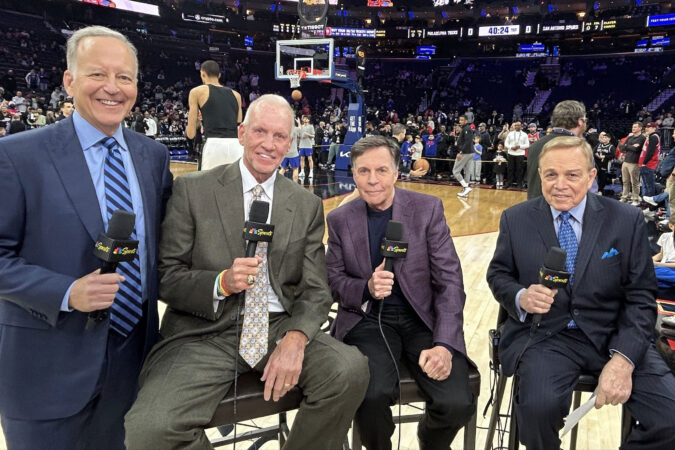
In their first season broadcasting NBA games since 2002, NBC assembled a who’s who of former talent for Tuesday’s broadcast. Bob Costas, calling his first NBA game in 24 years, ably weaved back and forth from nostalgia to the action on the court, at least until the Spurs put the game out of reach in the third quarter.
“It’s been nothing but pain for the Sixers tonight,” Costas said alongside longtime NBA analysts and former coaches Mike Fratello and Doug Collins.
Costas also managed to squeeze the line “Two great Dicks” into the broadcast, referencing famed sportscaster Dick Enberg and former NBC Sports chairman Dick Ebersol.
“Two great Richards,” Costas jokingly added.
Bob Costas knew right away what happened when he paid tribute to "two great Dicks" at NBC in Dick Ebersol and Dick Enberg during the Spurs blowout over the 76ers.
Initially, NBC planned to bring back Marv Albert, but the iconic NBA announcer had some health issues related to his voice and was unable to participate.
Former NBC host and reporter Ahmad Rashad (who once played a preseason game for the Sixers alongside Charles Barkley) also wasn’t part of the broadcast. It’s not clear why Rashad wasn’t in South Philly alongside his former colleagues Tuesday night, but Costas gave him a special shoutout during the broadcast.
“One of my favorite people I ever worked with in any sport,” Costas said. “Great company, terrific sense of humor. A lifelong friend.”
The connections past and present were everywhere. Sixers point guard Kyle Lowry, among the few players on the court old enough to have watched the NBA in the 1990s, was drafted by NBC analyst Mike Fratello when he was still head coach of the Memphis Grizzlies in 2006.
Heading into halftime, Spurs point guard Dylan Harper was interviewed by longtime NBC reporter Jim Gray, who interviewed Harper’s father, five-time NBA champion Ron Harper, many times over the years.
“It really is Throwback Tuesday now,” Costas joked during the broadcast. “We’re now talking to the sons of guys we covered.”
Doug Collins should be calling more NBA games
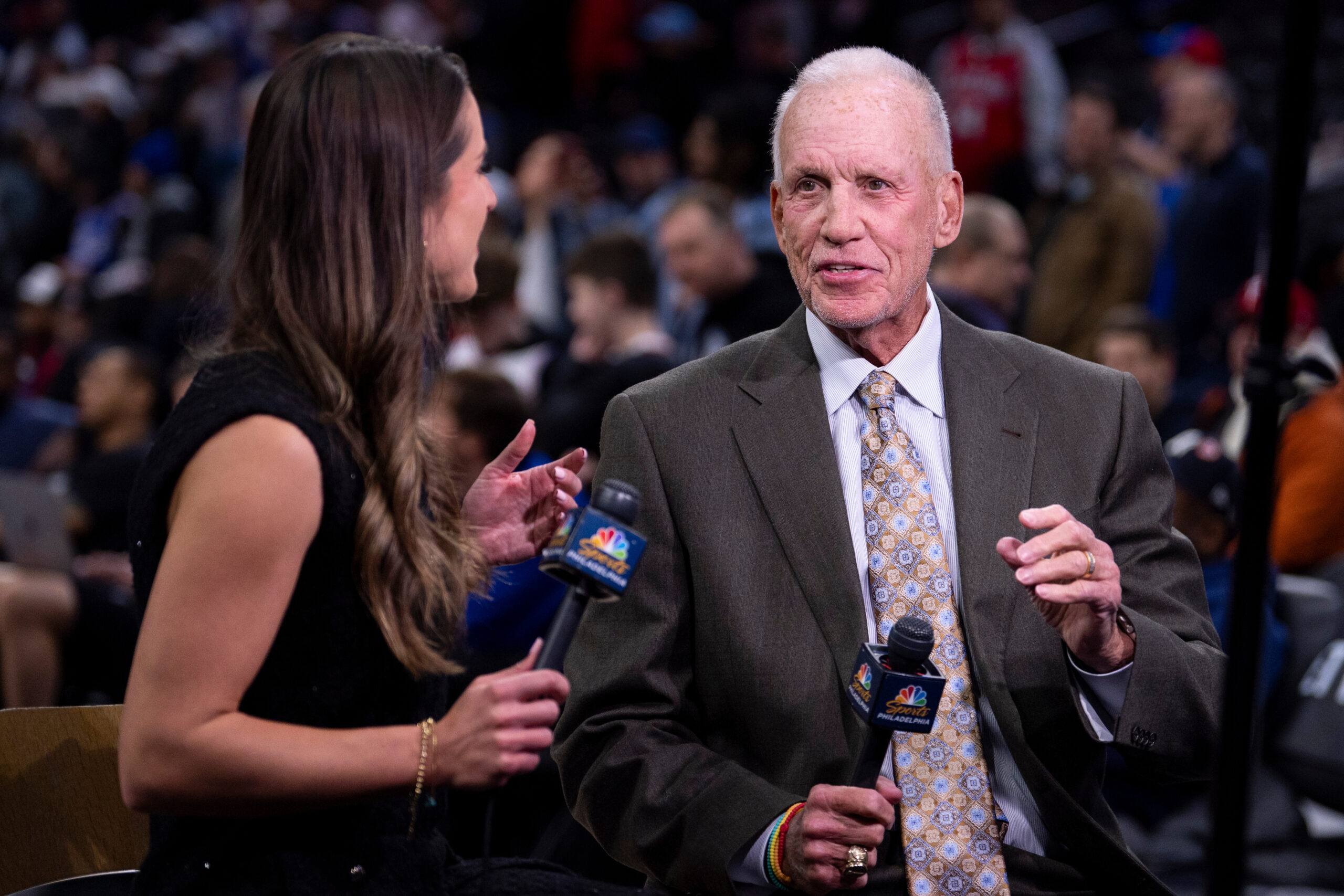
Doug Collins speacks to NBC Sports Philadelphia’s Ashlyn Sullivan ahead of Tuesday’s Sixers-Spurs game.
As far as the nuts and bolts of the broadcast, Collins was on top of things all night. In the first quarter, the former Sixers player and head coach quickly pointed out after a Wembanyama block it was the 24th game this season he’s had at least three blocks, leading the NBA.
Later in the first half, when Costas mentioned the Thunder as one of the few teams that might challenge the Spurs in the playoffs, Collins quickly noted San Antonio won four of their five games against Oklahoma City this season.
During the second half, with the game well out of reach for the Sixers, Collins recalled back to his own coaching days trying to get thrown out of a game he could no longer watch.
“One of the old-time referees ran by the bench, stopped me, and said, ‘Listen, I know what your doing. You’re trying to get thrown out. You’re going to stay here and watch the same crap I’m watching,’” Collins recalled. “I couldn’t even get thrown out!”
In recent years, Collins has divided his time between homes in Arizona and West Chester, where he’s able to watch his grandchildren play basketball. Collins said he’d love to come back and call more games, but some health issues with his feet and legs have held him back.
Interestingly, a lot of Sixers fans probably missed NBC’s throwback coverage, since NBC Sports Philadelphia’s broadcast was a strictly 21st century production featuring regular announcers Kate Scott and Alaa Abdelnaby. But most viewers probably changed the channel by the third quarter anyway.
Scott and Abdelnaby will be back Wednesday to call the Sixers’ game against the Utah Jazz at 7:30 p.m. on NBC Sports Philadelphia.
Sixers standings
Eastern Conference
window.addEventListener(“message”,function(a){if(void 0!==a.data[“datawrapper-height”]){var e=document.querySelectorAll(“iframe”);for(var t in a.data[“datawrapper-height”])for(var r,i=0;r=e[i];i++)if(r.contentWindow===a.source){var d=a.data[“datawrapper-height”][t]+”px”;r.style.height=d}}});
Upcoming Sixers TV schedule
Wednesday: Jazz at Sixers, 7:30 p.m. (NBC Sports Philadelphia)
Saturday: Sixers at Hawks, 6 p.m. (NBC Sports Philadelphia, NBA TV)
Monday: Sixers at Cavaliers, 7 p.m. (NBC Sports Philadelphia)
Tuesday, March 10: Grizzlies at Sixers, 7 p.m. (NBC Sports Philadelphia)
Thursday, March 12: Sixers at Pistons, 7 p.m. (Amazon Prime Video)
Saturday, March 14: Nets at Sixers, 1 p.m. (NBC Sports Philadelphia)
Sunday, March 15: Trail Blazers at Sixers, 6 p.m. (NBC Sports Philadelphia)
It can be seen as frivolous or hurtful, and not typically encouraged.
Still, “there seems to be something about it that makes people a little bit giddy, or excited to be gossiping,” says Rebecca Greenbaum, a professor at Rutgers University School of Management and Labor Relations.
In a recent study, Greenbaum and co-authors focused on the role of gossiping in the workplace. They found that talking about the boss behind their back can present a benefit: bonding among colleagues, and more cooperation. Their findings were recently published in the Journal of Business Ethics.
The study surveyed hundreds of participants who were asked to report if they had gossiped about the boss that day and how they acted afterward. Colleagues of some of the participants were also surveyed.
The study results show that on days when employees talked about the boss, they were likely to experience negative feelings such as guilt or shame, and avoid the boss. After gossiping, employees also reported feeling more of a sense of belonging with their colleagues.
“It doesn’t necessarily mean we’re saying ‘go out and gossip’ because we want you to feel closer to one another,” said Greenbaum. “It’s just that it provides one explanation for why people probably do engage in gossip, because they are getting this benefit from feeling closer to one another.”
This conversation has been edited for length and clarity.
What role has gossip typically played in the workplace? Is it positive? Negative?
In most of the research [until now] … oftentimes it was just looked at more negatively, or it was [discussed] much more in terms of being the victim of gossip. So if I found out someone was speaking poorly about me, how would I feel? I would probably feel angry. I’d feel hurt, I’d feel sad.
But where [we] really took this in a different direction was focusing much more on the person engaging in the gossip. From that standpoint, not as much research had been done in terms of how people react to their own behavior. So for example, do people really see it as bad? That was one thing we were curious about.
What do you hope people will take away from the study?
Keep in mind the boss is someone who can give you rewards, they can punish you — so it’s a little bit more high-stakes to talk badly about a boss compared to maybe just you talking bad[ly] about a coworker or neighbor or something like that.
We have these emotional reactions sometimes because they serve to protect us. So if you feel … shame and guilt, [for example], it’s telling you that you need to course correct.
We not only need to protect ourselves individually, but we have this relational need that has to do with our survival too. When people gossip, and then they respond to that gossip by feeling emotionally closer, and like they belong with their group a bit more, that can also facilitate a person’s sense of survival.
If you have this common enemy, like a boss who’s a jerk to you and he’s mean, sometimes it can feel even better for your sense of belonging to gossip about him.
Why does it matter if colleagues feel connected to one another?
Oftentimes people have to engage in teamwork. You need to cooperate, collaborate, come up with creative ideas together, advance some type of project. Even if you aren’t necessarily working together, there’s another big aspect of what we do in organizations, which is not engaging in counterproductive behaviors towards one another. [A colleague might say], “I have a kid at home who’s sick, I was supposed to give this presentation. Can you give it?” If we feel closer with one another, we might be more willing to cooperate with some of those requests that come our way.
What if you and colleagues like the boss? How do you build that sense of bonding?
If we have leaders who are good to us, we’re more willing to help them out. There’s basically a role modeling effect where people within the workforce end up treating each other with more dignity and respect too. So if you have a good boss, that’s actually the best scenario, because you don’t have to gossip and experience some of those negative types of emotions.
Are there any other benefits of having a bad boss?
I’m asked about this a lot, because I’ve been studying dysfunctional leadership for so long. I know there’s some research out there that shows that, for example, if you do have an abusive boss — that boss who might yell at you, ridicule you, tell you you’re stupid, whatever it may be — sometimes it can get people behaving better, performing better, but it’s short-lived.
COLUSA, Calif. — Early on, Jean Franklin got some career advice she followed religiously: “Pay yourself first.” So she did, socking away hundreds of thousands of dollars in retirement savings by the time she became a stay-at-home mom at age 41.
She and her husband, Charles, a former high school teacher who goes by Chaz, planned to retire comfortably in the three-bedroom house where they raised their kids about 60 miles northwest of Sacramento.
But early last year, the 63-year-old became unsteady on her feet. One morning in May, she woke up with slurred speech and landed in the hospital, then rapidly lost the ability to move the right side of her body.
In August, as doctors continued to puzzle over a possible diagnosis, the couple received a notice saying that on Jan. 1 their combined healthcare premium payments through the state insurance exchange would shoot up from $540 a month to $3,899 a month. The reason: Federal enhanced premium subsidies expiring at the end of last year would no longer offset their payment.
They immediately canceled a monthlong cruise they’d been planning with friends and looked through their retirement accounts.
“Now, instead of thinking about where we can go in our retirement, we’re asking the question, ‘Are we still going to be able to stay where we are because of the healthcare costs?’” said Chaz, who retired in 2021 at age 59.
Then they received more bad news. In October, at the age of 63, Jean was diagnosed with ALS, a debilitating disease that will eventually leave her unable to speak, swallow, or breathe on her own. But Jean’s condition allowed her to enroll in Medicare, the federal health insurance program that covers adults 65 and older and people with disabilities. The diagnosis saved them roughly $1,600 a month in premiums — little comfort as Jean lost her ability to walk, bathe, and dress herself.
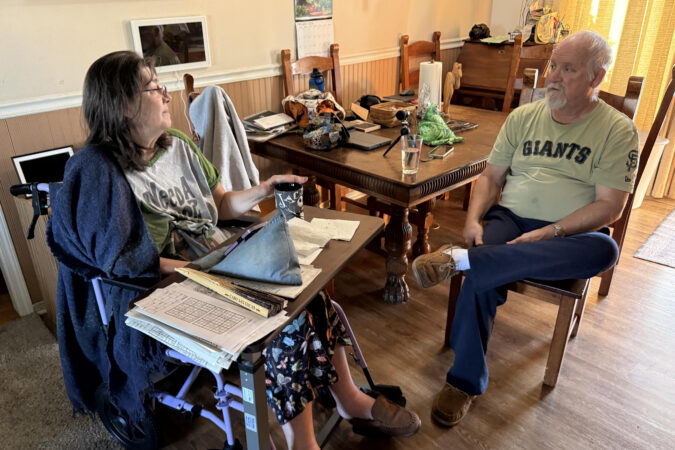
“It’s kind of morbid that, because of my diagnosis, I got put on Medicare right away, so at least we don’t have to pay that out-of-pocket,” Jean said, sitting in a wheelchair in her living room, a quilt draped over her legs to guard against the intense chills she now often gets. “We’re not going to get buried under this.”
Yet the premiums for Chaz’s plan and her Medicare remain a significant strain on their finances. The $2,300 a month they now owe, which includes roughly $342 in premium payments for Jean’s Medicare supplemental insurance, is higher than their monthly mortgage and eats up more than a quarter of their budget.
The Franklins are among the 22 million people across the nation facing greater financial pressure after Congress chose not to extend 2021 enhanced federal subsidies. That assistance helped more than double enrollment in Obamacare plans to over 24 million.
The Congressional Budget Office estimated in 2024 that, without an extension of the tax credits, the number of uninsured Americans would climb by 2.2 million this year alone. As of January, nationwide enrollment in ACA plans was down about 1.2 million year over year, though experts say it could be months before the full effects of rising premiums are known, as people miss payments and lose coverage.
The groups hit hardest will be early retirees, middle-income earners, and people living in high-cost states, said Stacey Pogue, a senior research fellow at the Center on Health Insurance Reforms at Georgetown University. The Franklins are all three.
“They fell off what we call a subsidy cliff,” Pogue said. “It’s very, very shocking, the amount that a person would have to absorb.”
That’s because the expanded tax credits made the biggest difference for people nearing retirement age who sat just above previous income eligibility thresholds, Pogue said. People such as the Franklins, who likely wouldn’t have qualified for financial help before expanded credits were implemented, are now losing that support at a time when insurers have responded to the uncertainty by dramatically raising rates.
Roughly half of people who were expected to lose eligibility for premium tax credits were ages 50 to 64, according to an analysis by KFF, a health information nonprofit that includes KFF Health News.
Republicans who opposed the extension have said the premium assistance went directly to insurance companies rather than consumers, incentivizing fraud and wasteful coverage. They also say the enhanced subsidies, which had no upper income limit for eligibility, were far too generous in capping premium payments at 8.5% of income, no matter how much an enrollee made.
“Most Americans would agree that taxpayers should not be subsidizing the health insurance of someone making $250,000,” U.S. Rep. Ken Calvert, a California Republican who voted against an extension in January, wrote in an Orange County Register op-ed. “I cannot accept the simple extension of a program that will line the pockets of insurers and is riddled with fraud at the expense of the American taxpayer.”
Patient advocates say the premium increases and expiration of subsidies have forced people into difficult choices. “The young people who are healthy are the first to say, I’m going to roll the dice” and forgo coverage, said Rebecca Kirch, executive vice president of policy and programs at the National Patient Advocate Foundation. “Those who are remaining in the system — because they have no choice — are holding off care, they’re holding off their meds, they’re going without necessary food.”
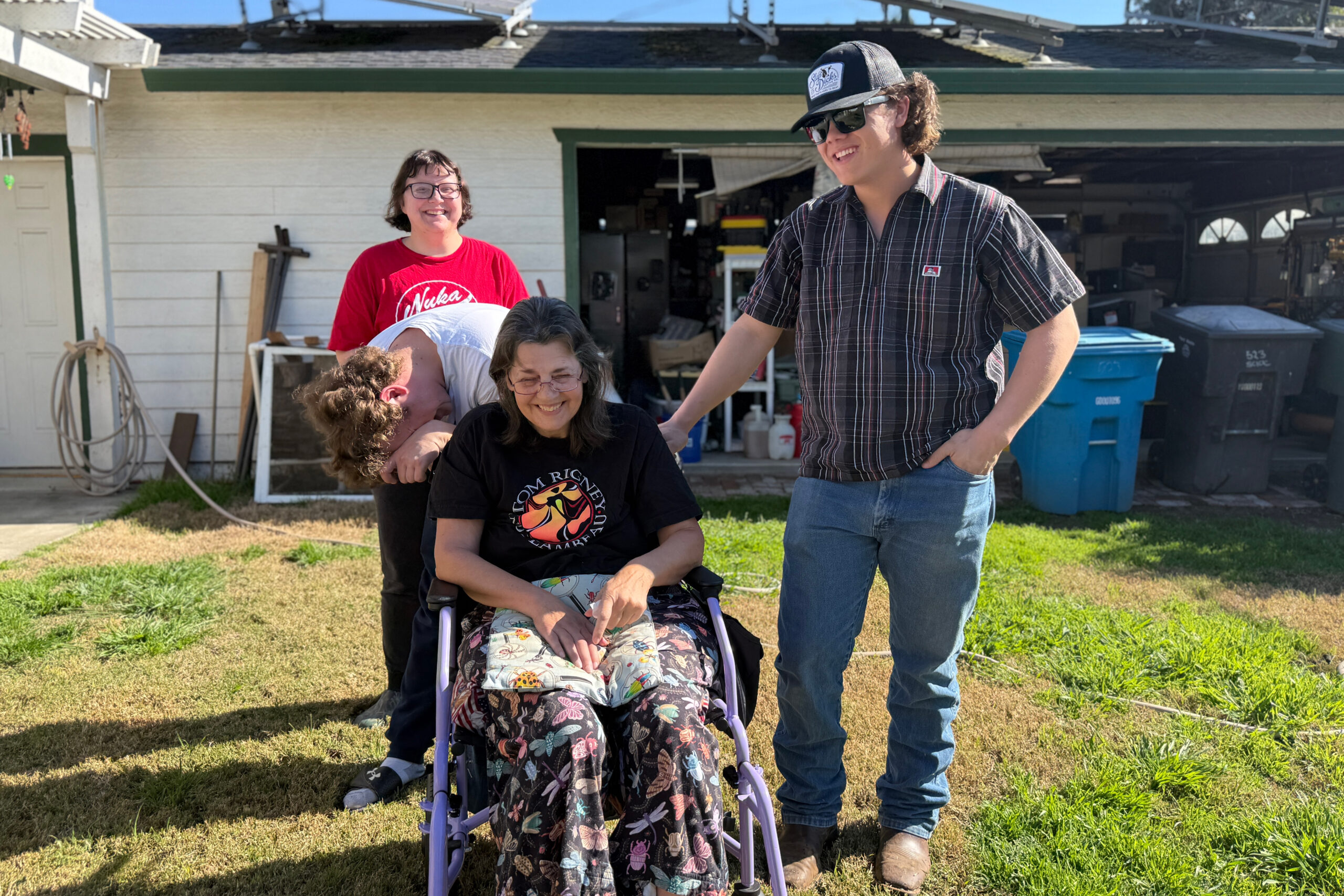
Jean Franklin, center, laughs with her sons, Louis (right) and Charlie, and Charlie’s girlfriend, Masha Billingsley. Charlie and Louis have helped their mother get dressed and get in and out of her wheelchair since she was diagnosed with ALS last year. (Christine Mai-Duc/KFF Health News)
While the Franklins are getting by, they have relied on their sons to pay for a motorized recliner to assist with lifting Jean and a handicap van to transport her. Chaz, who broke a tooth a year ago, delayed fixing it because a crown would cost him $1,000.
This year, the couple will draw $36,000 more than they had anticipated from their retirement savings, most of it to cover Chaz’s insurance premiums.
“I have a nest egg,” Chaz said. “But there’s a lot of people around here who don’t.”
For a while, he was outraged.
“I wish Congress would get off their butts and solve this issue,” said Chaz, who is a registered Republican but blames both sides of the aisle. “You’re so busy bickering over stupid crap and it’s both parties pointing fingers and blaming. Where was this discussion two years ago?”
Now, Chaz said, he’s focused on making Jean, his wife of 27 years, as comfortable as possible.
Before she got sick, they did practically everything together — hiking, traveling, tai chi, amateur photography, and bug-hunting. One of her favorite specimens was the rain beetle, a fuzzy scarab-like insect that can’t feed as an adult, relying solely on fat stores from its larval stages.
In the mornings, Chaz and their sons, Charlie and Louis, take turns lifting Jean, dressing her, and helping her use the bathroom. It’ll be fodder for the counselor, she jokes to her sons, when they inevitably need therapy later in life.
Most days, Jean’s outdoor adventures rarely extend beyond being wheeled to her back patio, where she loves to watch their backyard chickens bobble around. Chaz’s stubbornness makes him a great patient advocate. Charlie always seems to know exactly when she needs a big hug, and Louis tells jokes that can still make her snort with laughter.
“I don’t know what I would do without my boys making me laugh,” she said.
In December, Chaz will turn 65, old enough to qualify for Medicare himself. “After this year — knock on wood — we should be OK,” Jean said, before pausing and shooting her husband a wry smile.
“Well, you’re gonna be OK.”
KFF Health News is a national newsroom that produces in-depth journalism about health issues and is one of the core operating programs at KFF — the independent source for health policy research, polling, and journalism.
George Ball stood at the W. Atlee Burpee & Co. booth at the Philadelphia Flower show last week and lifted the company’s artfully designed 150th anniversary seed collection from a wooden rack.
Ball, 74, traced a finger down the list of nine packets of “Historic Breakthroughs” and told stories about some of them: Iceberg lettuce (1894). Big Boy tomatoes (1949). Snowbird sugar snap peas (1978).
Golden Bantam sweet corn (1902) wasn’t an instant hit, Ball noted, despite its sweet, buttery flavor. Americans were accustomed to white corn.
“This is the first yellow sweet corn. Before that, yellow corn was hog feed. The kernels were hard,” Ball said. “This yellow corn was a totally new taste. It’s delicious. But for two years, nobody bought it because to them it was hog feed.”
Only when an assistant coined the phrase “Looks like butter, tastes like butter” did the variety take off.
Burpee’s display at this year’s Philadelphia Flower Show highlighted the brand’s historical roots.
Burpee has been rooted in the Philadelphia area since its founding by W. Atlee Burpee in 1876. Now, more than a century later, having once teetered on the brink, it’s again thriving and positioned for the future with seed, plant, and product sales in big box stores and online.
“We’re celebrating our 150th” and still selling those same seeds, Ball said.
Regrowing Burpee
When Ball came to buy Burpee in the 1980s, the company was in serious financial trouble, and its staying power was anything but certain.
“Burpee was going to be padlocked,” Ball recounted. It had fallen 240 days behind on payments, some of which were owed to his family’s company, Ball Horticultural.
Ball had become president of PanAmerican Seed, a Ball Horticultural company, by the mid-1980s and was breeding plants in Costa Rica. When he returned to the United States, he read a story in the Wall Street Journal that industry giant Burpee was teetering.
Sensing an opportunity, Ball moved to buy the historic brand for a fraction of its value, or as he phrased it, for “kind of a poem.”
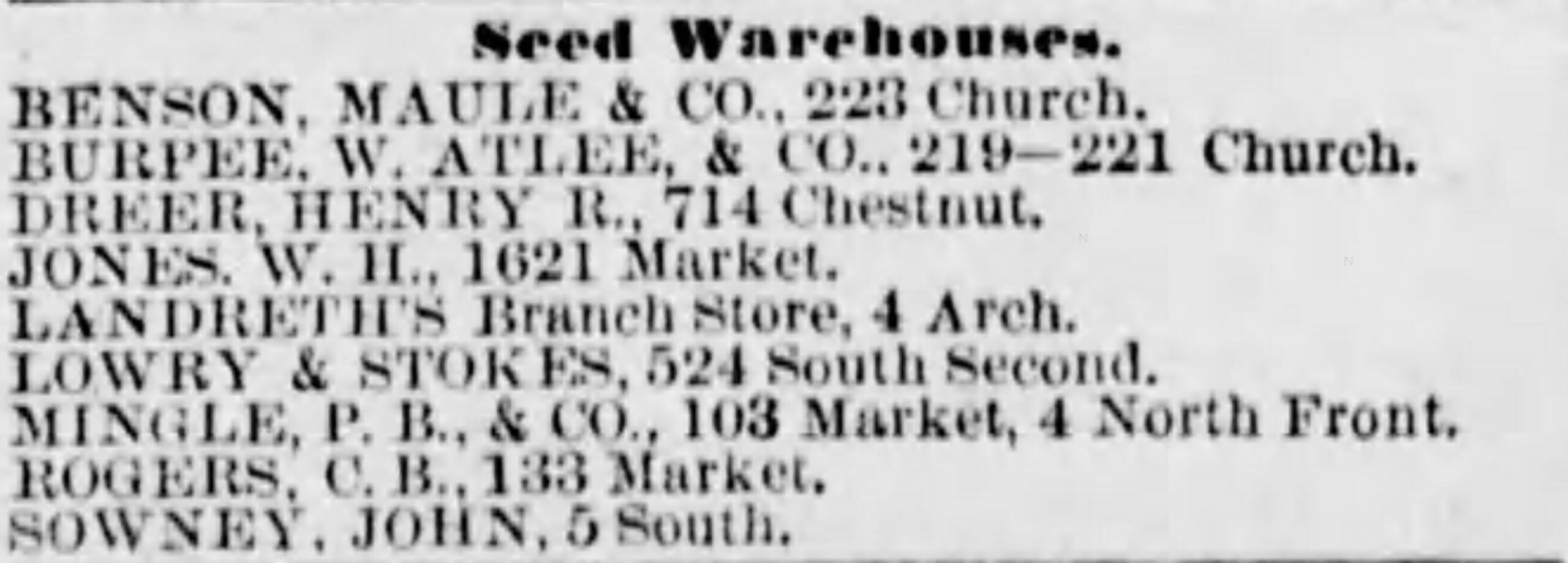
More than a century before that,W. Atlee Burpee, scion of a prominent Philadelphia medical family, started his seed company in 1876, the same year he visited the Centennial Exposition in Philadelphia. It featured robust agricultural and horticultural displays. By 1881, a notice for the company’s Old City warehouse appeared in The Inquirer.
The first mention of W. Atlee Burpee & Co. in The Philadelphia Inquirer on Jan. 3, 1881.
Burpee seized on the emerging power of mail-order catalogs — the era’s version of the internet — and the catalog became a rural household staple since most of his customers were originally farmers.
In 1888, Burpee bought a farm on New Britain Road in Doylestown. He named it Fordhook and transformed it into the company’s experimental garden and began conducting thousands of seed trials. The 60-acre property still opens to the public once a year.
Burpee died in 1915, leaving the business to his 22-year-old son, David, who expanded the company’s flower offerings and cemented a reputation for innovation. The company soon found a market for its seeds with home gardeners.
Christopher DeMairo, a former archivist for the Smithsonian Institution and the author of a book on the history of Burpee, calls W. Atlee Burpee, “a really fascinating man, and one of the most prolific businessmen in American history.”
DeMairo credits David Burpee as a visionary who steered the company through the turbulent 20th century when many competitors went bankrupt. Under David’s leadership, Burpee pushed hard on innovation, pioneering hybrid vegetables through controlled pollination experiments.
“Even if you may not know Burpee now, your ancestors certainly did,” DeMairo said. “It is still really important when you think of where agriculture and gardening are today.”
In 1970, David Burpee sold to General Foods, and the corporate headquarters moved from Philadelphia to Warminster, where it remains.
Eventually, ownership passed to a private equity firm,and the company fell into financial trouble.
Then Ball, who views himself as a turnaround specialist, stepped in to save Burpee,officially becoming its sole owner in 1991. He’s run the companyever since and still lives at Fordhook Farm.
The Creekbed Garden at Fordhook Farm in Doylestown in 2024. The seed barn is second building from the right.
“I was very interested in the basic virtues and values of life,” Ball said, and felt that the nursery business fit with that essence.
DeMairo, the archivist, believes the founding Burpee family would be relieved to know the company is privately held by Ball, who has no plans to sell.
“I can almost say for a fact that both David and Atlee would be very happy to know that the company is in the hands of a true gardener,” DeMairo said, “and not a boardroom.”
Burpee today
Under Ball’s leadership, Burpee expanded into retail aisles and into the digital age.
When COVID-19 hit in 2020, Burpeeexperienced a surge in demand, CEO Jamie Mattikow said, and the companyhas retained much of that momentum.
He declined to share financial details or an employee count. But, he said, consumers spent $242 million on Burpee products last year, a 120% jump from 2019. Growth, he added, is in the “mid-single digits.”
“Fortunately, seeds have proven to be a recession-resistant type of category,” Mattikow said, “so the growth is pretty steady.”
Burpee president and CEO Jamie Mattikow (left) with owner George Ball at the Burpee Seed display at this year’s Philadelphia Flower Show.
Burpee has long focused on home gardeners. Its products appear in major chains including Walmart, Target, Home Depot, and Tractor Supply.
Mattikow describes Burpee as a full-service “gardening company” rather than simply a seed supplier, offering live plants and supplies like soil and cages. Online sales through Burpee.com and Amazon continue to expand.
The company also maintains a niche business sellingseeds to small growers who supply farmers markets and restaurants.
The company has leveraged social media to reach younger customers. It has about 725,000 followers across Meta’s Facebook and Instagram platforms, and offers advice such as “the easiest tomatoes to grow for beginner gardeners.”
Burpee relies on its own horticulturists and traditional seed breeders to adapt to changing customer preferences.
For example, a seven-year breeding process resulted in the company’s new line of “garden sown” tomatoes and peppers — seeds hardy enough to be planted in ground after the last frost, bypassing indoor tray-starting.
That painstaking breeding process has been with the company since the beginning. In his history of Burpee, DeMairo cites a Life magazine article describing the painstaking work behind developing seed varieties.
The company, the article noted, “hired 60 girls from Vassar, Smith, Bryn Mawr and other colleges to spend the summer with tweezers and brushes” to control pollination and create new hybrids.
Mattikow said Burpee faces typical challenges such as supply chain issues, tough competition, and tariffs.
“We do a great balance of holding on to a loyal base of customers, and every year we bring in new customers,” Mattikow said.
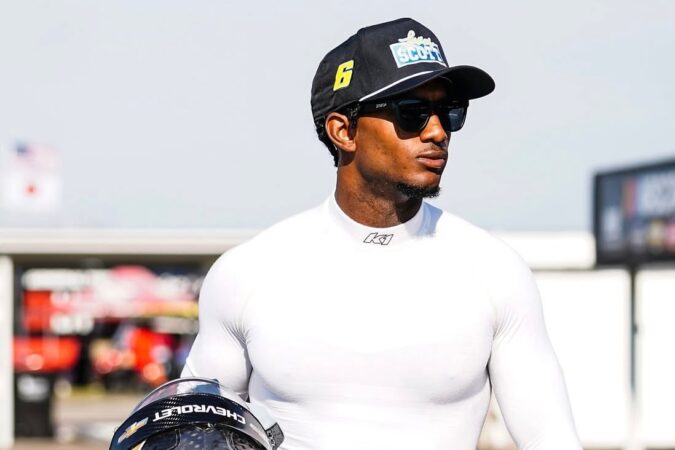
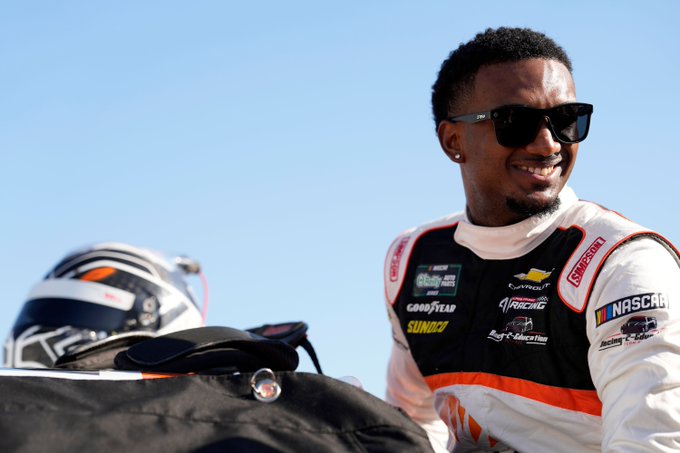
Racing has always been in Lavar Scott’s DNA, stemming from the auto repair shop in Carneys Point, N.J., that his grandfather, Wayne Scott Sr., founded in 1978.
His older brother, mother Sonia, aunts and uncles, and even Wayne all raced growing up, mostly in drag racing. Scott began his racing journey when he was 5 years old on dirt tracks across Pennsylvania and Delaware. In trying to follow his older brother’s footsteps, Scott quickly developed an affinity for the sport, one that would lead to him becoming one of just a handful of Black NASCAR drivers.
“I just raced all my life and fell in love with the sport, just from the fact that when we show up to the racetrack when I was younger, show up with the cars that my grandfather worked on, helped build, and it was a family effort, family team,” Scott told The Inquirer recently. “We [would] drive to the racetrack together, and then doing that and winning races like that, you don’t find that other type of love and I guess gratitude for something like in any other sport that I played.”
Lavar Scott (center) shown with his grandfather and mother after winning a race during his childhood.
Scott raced on dirt tracks until he was 14. When he turned 15, he transitioned to racing on asphalt tracks to try and seriously pursue a career in racing, which meant moving to Charlotte, N.C., to make that happen.
From those humble beginnings, Scott, now 22, has risen quickly. Six years ago, he was accepted into the NASCAR Drive for Diversity program and is working his way toward racing at the highest level. Last month, Scott began his first year racing full-time in the NASCAR O’Reilly Auto Parts Series, the second-tier of the sport.
“[I] became really good, worked hard at it, had a chance to move down south at 16 to become part of the NASCAR diversity program and be a part of Rev Racing,” Scott said. “I raced for Rev for five years throughout the ranks of late models, ARCA legends, [and] just had a really good few years with them. I was rookie of the year in 2024 in the ARCA [Menards Series].
“It all comes from racing back at home in the Pennsylvania area. We used to race there three times a week. It was a full-time job really as a kid racing. And that’s what got me to this point, was doing it consistently.”
Scott, whose racing journey will bring him back to the area later this year, is just the third active Black driver in the sport. He joins NASCAR star Bubba Wallace and fellow O’Reilly Auto Parts Series driver Rajah Caruth, who went through NASCAR’s Drive for Diversity program with Scott. The two have continued their friendship on and off the track, and leaned on one another as they try to grow the sport.
“I think me and Rajah go through so many things and we kind of battle it together,” Scott said. “We’re really in a team a little bit, trying to change the whole dynamic of motorsports and bring more of us alike in the sport.
“And it’s so good to have someone like him to do it with, because Rajah is a not only a great driver, but he’s a great person. … I really connect with [him], aside from just being a professional athlete together. He’s not just a teammate or just a friend, like he’s someone that we really going through this stuff together and figuring out, and it’s really cool.”
And as he’s continued to level up, he’s also started to give back.
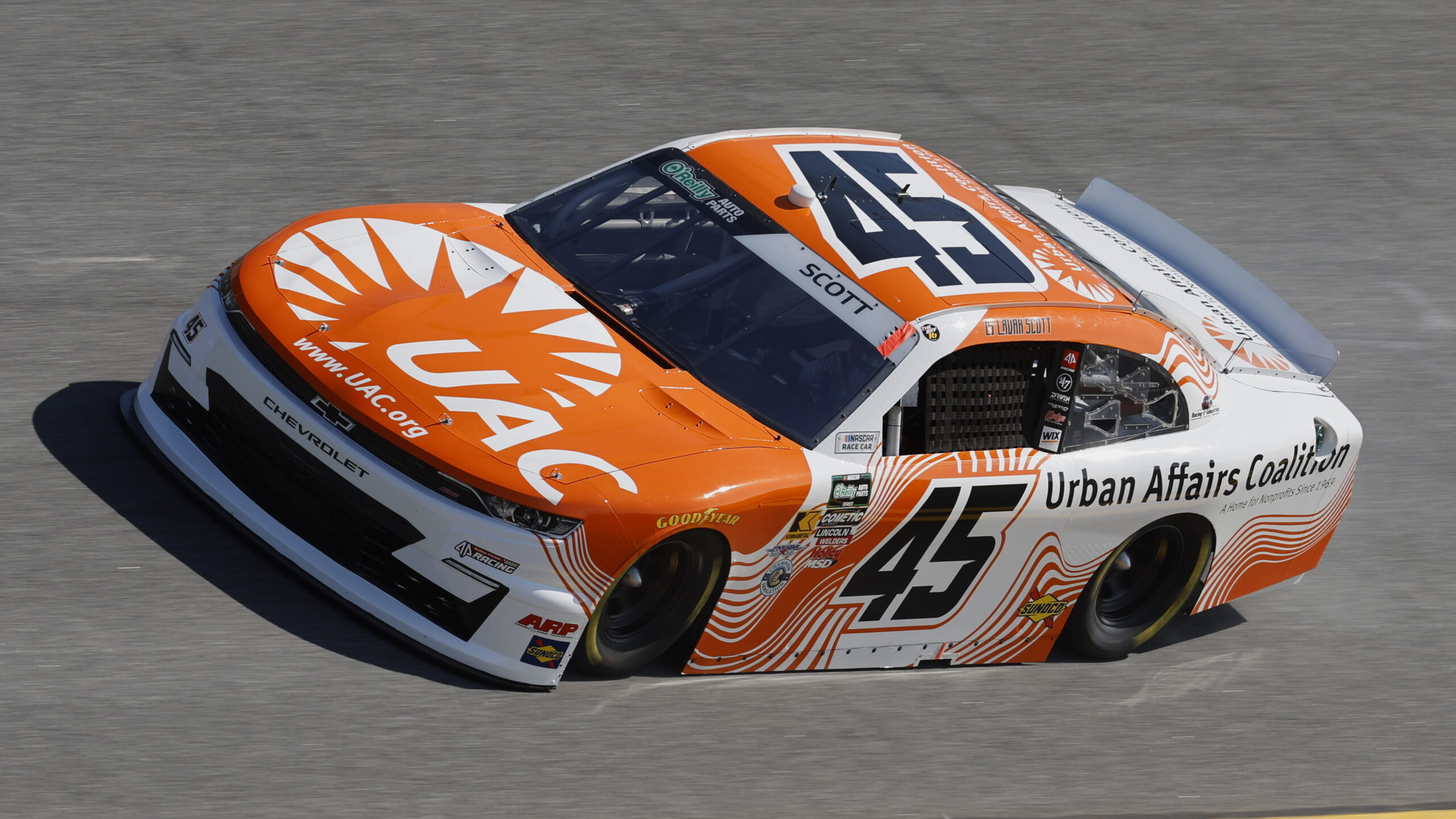
Scott, who races with Alpha Prime Racing, entered a partnership with Philadelphia-based Urban Affairs Coalition last fall, a nonprofit which aims to “unite government, business, neighborhoods, and community leaders to improve the quality of life, build wealth, and solve emerging issues in urban communities.”
Through this partnership, UAC is launching Team Racing-2-Education, with the goal of introducing young people to careers in engineering, data analytics, automotive tech, and media production within motorsports.
Lavar Scott’s No. 45 car is decorated with the logo of the Philly-based nonprofit Urban Affairs Coalition.
“Lavar represents the dreams of every kid. He represents the opportunity that every kid should have. And ultimately, we are in the business of changing and saving lives and making dreams come true through the nonprofit sector,” said Arun Prabhakaran, the president of the UAC. “The partnership really arose around this idea of, ‘How do we create enough visibility for a story like this to be able to change the way that America thinks about motorsports?’ They should think about motorsports, and see, ‘I could become a petrochemical engineer.’ They should see, ‘I could become a designer and design cool looking race cars.’”
And while Scott is behind the wheel of his own car, he is also a perfect example, having gone from “a 5-year-old who was racing on a dirt track to arguably one of the most decorated motor sports athletes and NASCAR athletes in the region’s history,” Prabhakaran added.
For Scott, he sees the local interest, but hopes the partnership can open more eyes to the many motorsport jobs that don’t involve making a series of left-hand turns.
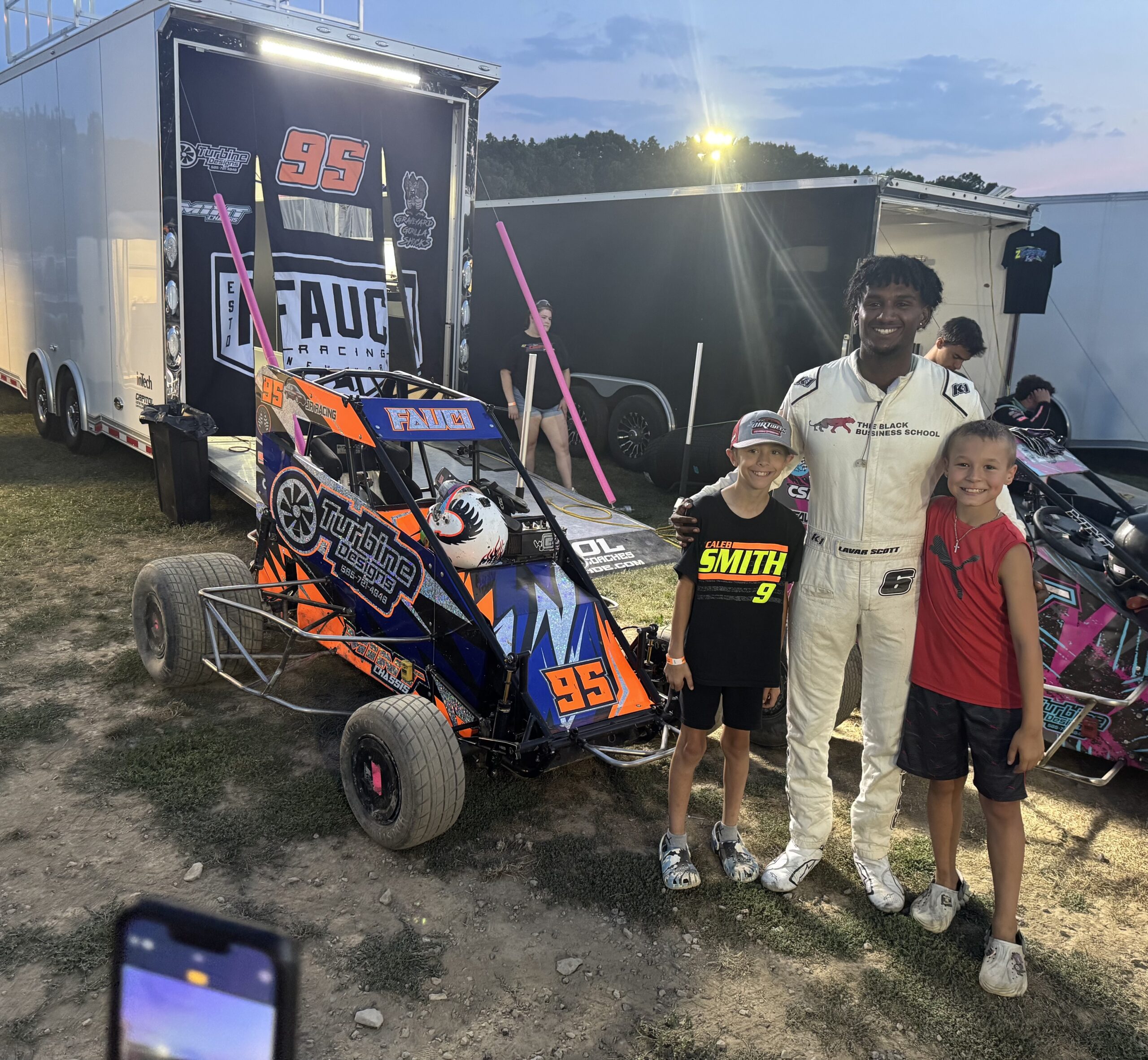
Lavar Scott shown with young fans after winning at the Limerock Dirt Speedway in New York last August.
“I know in the Philadelphia market, there is so much interest in motorsports, but I want to expose more and make it more known to people,” Scott said. “I think anything you want to do … happens in motorsports, whether it’s like a designer, somebody working with tires, shock guys, social media.
“Every avenue that you can take in this world applies to motorsports in some way or form.”
When will Lavar Scott compete near Philadelphia?
Scott’s debut season in the NASCAR O’Reilly Auto Parts Series began at the Daytona 500 in Florida on Feb. 14, where he finished 16th. But that was his third overall race in NASCAR’s second-tier series.
Scott made his debut at Dover Motor Speedway in Dover, last July, finishing 28th in the formerly named Xfinity Series, and raced again in September at the Xfinity Series at World Wide Technology in Madison, Ill., where he finished 19th.
The South Jersey native finished 28th at Atlanta Motor Speedway two weeks ago and finished 22nd at the Circuit of the Americas this past weekend, which is just outside of Austin, Texas.
South Jersey’s Lavar Scott shown before the Daytona 500 in February.
He will compete at Dover Motor Speedway this season on May 16 and will race at Pocono Raceway on June 13. Scott is looking forward to being close to home for both tracks, with Pocono being less than two hours from his hometown and Dover just under an hour from where he grew up.
“Dover and Pocono, they’re fun tracks. Dover more so fits my driving style. It’s kind of really aggressive,” Scott said. “I like tracks like that where really a lot of it depends on the driver. And then Pocono, racing out in Pa. again, it’s always cool. It’s a big track. It’s definitely error dependent, so you got to be smart there. …
“It’s a lot around those weekends that matter to me and make it more than — I won’t say other weekends — but it’s an emphasis, and I definitely have those weekends circled on the calendar.”
A Florida developer who is building data centers in Pennsylvania. A Chicago crypto trader whose company was sued by the Biden administration. And a Southwestern Pennsylvania coal magnate whose firm received a permit from state regulators last year to expand operations — and is now seeking approval to open a new mine.
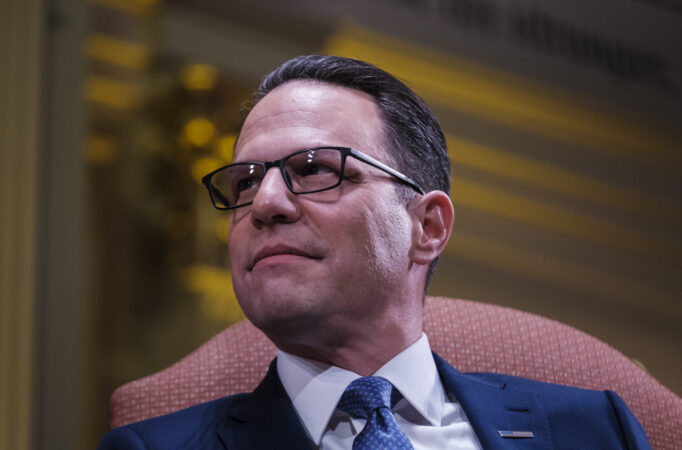
Shapiro’s gubernatorial campaign raised at least $8.5 million last year from nearly 240 CEOs, founders, business owners, and other top executives, according to an Inquirer analysis of campaign-finance records that were made public last month.
That includes the single biggest donation to the campaign: $2.5 million from billionaire and former New York City Mayor Michael Bloomberg. Shapiro’s haul from top executives represents 50.8% of the $16.8 million he raised from donors who listed their occupation in campaign finance filings.
window.addEventListener(“message”,function(a){if(void 0!==a.data[“datawrapper-height”]){var e=document.querySelectorAll(“iframe”);for(var t in a.data[“datawrapper-height”])for(var r,i=0;r=e[i];i++)if(r.contentWindow===a.source){var d=a.data[“datawrapper-height”][t]+”px”;r.style.height=d}}});
During his first three years in office, Shapiro, 52, has sought to build a profile as a pragmatic, business-friendly governor, focusing on speeding the permitting process and promoting economic development through government grants and tax breaks.
At the same time, the governor has proven adept at raising campaign cash from people who have business interests before state government in Harrisburg. Those include a skill game developer who staved off a major policy defeat this year and a waste coal power plant owner who gave $100,000 to Shapiro two days before the governor pulled out of a multistate program that requires such facilities to pay for their greenhouse gas emissions.
It’s a contrast with the rising populism on both the left and right, marked by a “Fighting Oligarchy” tour by progressive leaders and the MAGA movement’s deep suspicion of elites.
It’s not unusual for corporate executives to make contributions to candidates from both parties. But the practice could invite scrutiny for Shapiro in a White House run — particularly among voters and activists who are dismayed by the role of money in politics.
“We are concerned about any elected leaders taking monetary donations from corporate interests, regardless of who they are,” said Ashley Funk, executive director of the Mountain Watershed Association, a nonprofit that opposes a Shapiro donor’s coal mining expansion.
“I think that it influences decision-making,” she said.
‘The speed of business’
For now, Shapiro’s pledge to make Pennsylvania’s government run “at the speed of business” appears to have won over many executives, helping him build a massive fundraising advantage in his reelection bid. Shapiro raised $23.2 million overall in 2025, compared with the $1.5 million reported by his likely Republican opponent, State Treasurer Stacy Garrity.
“I’ve long admired the way the commonwealth approaches economic development and innovation, and I have deep respect for Gov. Shapiro’s leadership,” said Bob Clark, executive chairman and founder of Clayco, a Chicago-based real estate and construction firm that is redeveloping a site at the industrial hub known as the Bellwether District in South Philadelphia.
Clark gave Shapiro’s campaign $100,000 last year. “I consider him both a trusted colleague and an effective leader,” he said.
In recent weeks, the governor has celebrated pledges by pharmaceutical companies to invest billions of dollars in new facilities in Montgomery County and the Lehigh Valley, secured with tens of millions of dollars in state incentives. And last year, Amazon said it would spend $20 billion in Pennsylvania to build two new artificial intelligence data centers, in what officials called the single largest private investment in state history.
Shapiro’s allies say he stands up to big business, too, highlighting how he successfully prodded PJM Interconnection LLC — the Valley Forge-based regional electric grid operator whose voting members largely consist of companies in the electricity industry — to impose and extend a price cap. He has also received support from organized labor.
Shapiro argues that the way to restore faith in institutions is not by railing against billionaires but by showing that the government can fix real problems — “get s— done,” in his parlance.
Garrity, the Republican state treasurer, says Shapiro’s actions don’t live up to the hype.
“Liberal national donors may be investing in Josh Shapiro’s political vanity project, but hardworking Pennsylvanians are seeing nothing in return,” she said in a statement.
Garrity received nearly $380,000 from more than 60 CEOs and other top business executives. That figure represents about 41% of her contributions from donors who listed their occupation in campaign-finance filings.
Shapiro’s campaign said his coalition is “reflective of a governor who is delivering for all Pennsylvanians — and of a campaign that is fighting to win up and down the ballot.”
window.addEventListener(“message”,function(a){if(void 0!==a.data[“datawrapper-height”]){var e=document.querySelectorAll(“iframe”);for(var t in a.data[“datawrapper-height”])for(var r,i=0;r=e[i];i++)if(r.contentWindow===a.source){var d=a.data[“datawrapper-height”][t]+”px”;r.style.height=d}}});
The governor has “focused on growing our economy and creating jobs, and he has delivered — creating tens of thousands of jobs, winning major deals, and building the only growing economy in the Northeast,” campaign spokesperson Manuel Bonder said in a statement.
Shapiro highlighted one such deal in July, when he appeared alongside executives at defense contractor Rhoads Industries at the Navy Yard in South Philly to announce the firm’s $100 million plan to build a new manufacturing facility, create 450 jobs, and boost production of submarine parts.
“One of the things that Rhoads is known to do is get things done. … We want to turn out product; we want to turn it around; we want to get it done,” president Mike Rhoads said.
Looking toward Shapiro, he said, “Somebody standing to my left has the kind of same attitude.”
Gov. Josh Shapiro (right) with Rhoads Industries CEO Dan Rhoads in July 2025 at the Navy Yard.
Taking his turn at a lectern that read “Rebuilding America’s Fleet,” Shapiro said Rhoads’ investment — with help from the state — would “ensure the future of submarine manufacturing, shipbuilding, and all things important to securing our freedom is going to run right through the Philadelphia Shipyard.”
Three months later, in October, CEO Dan Rhoads contributed $10,000 to Shapiro’s campaign — the single largest donation he made to a candidate for state office in the last decade, records show. Rhoads did not respond to requests for comment.
Data centers and ‘skill games’
Shapiro donors’ business interests include everything from data center construction to state regulation of slot machine-style games and approvals for a nuclear reactor.
Dan Hilferty, CEO of Philadelphia-based Comcast Spectacor — which owns the Flyers and the Xfinity Mobile Arena in South Philly — gave $40,000. A political action committee affiliated with parent company Comcast also gave $50,000. Comcast Spectacor and the 76ers are building a new arena at the South Philadelphia sports complex, and Shapiro last year did not rule out offering state incentives. Hilferty, a former CEO of Independence Blue Cross, previously gave Shapiro’s campaigns $27,500 over the last decade. Other Comcast Spectacor executives contributed about $95,000 during that period.
Top executives at Pace-O-Matic, the Georgia-based developer of so-called skill games that have proliferated across convenience stores and bars, gave $50,000. Operators for Skill, a PAC affiliated with the firm, contributed $10,000. The company successfully fended off a push in 2025 by Shapiro and lawmakers to tax the games at a level the industry considered too high. The governor has renewed a push to regulate the games, which some Philadelphia lawmakers say they would prefer to see banned. Pace-O-Matic contributes to both parties and remains “committed to fighting for fair regulation and taxation of Pennsylvania skill games,” said Mike Barley, chief public affairs officer for Pace-O-Matic.
Joseph Dominguez, president of Baltimore-based Constellation Energy, gave $25,000. The company is seeking to restart a nuclear reactor at Three Mile Island, just outside Harrisburg, and needs state and federal approvals. The plant would supply power to Microsoft to support the tech company’s data centers. “Constellation executives contribute to policymakers on both sides of the aisle who, like Gov. Shapiro, prioritize results and pragmatic solutions over politics,” a company spokesperson said.
Brian Patten, CEO of Next Generation Land Co. LLC, gave $10,000. He is a Florida data center developer who says he is pursuing projects in Pennsylvania. Data centers that power companies’ cloud storage and computing needs have drawn backlash across the U.S. over fears of rising electricity rates. In his February budget address, Shapiro said he wants data centers to supply their own energy and pay for any new generation they need. He has also said the U.S. needs to win the AI race against China.
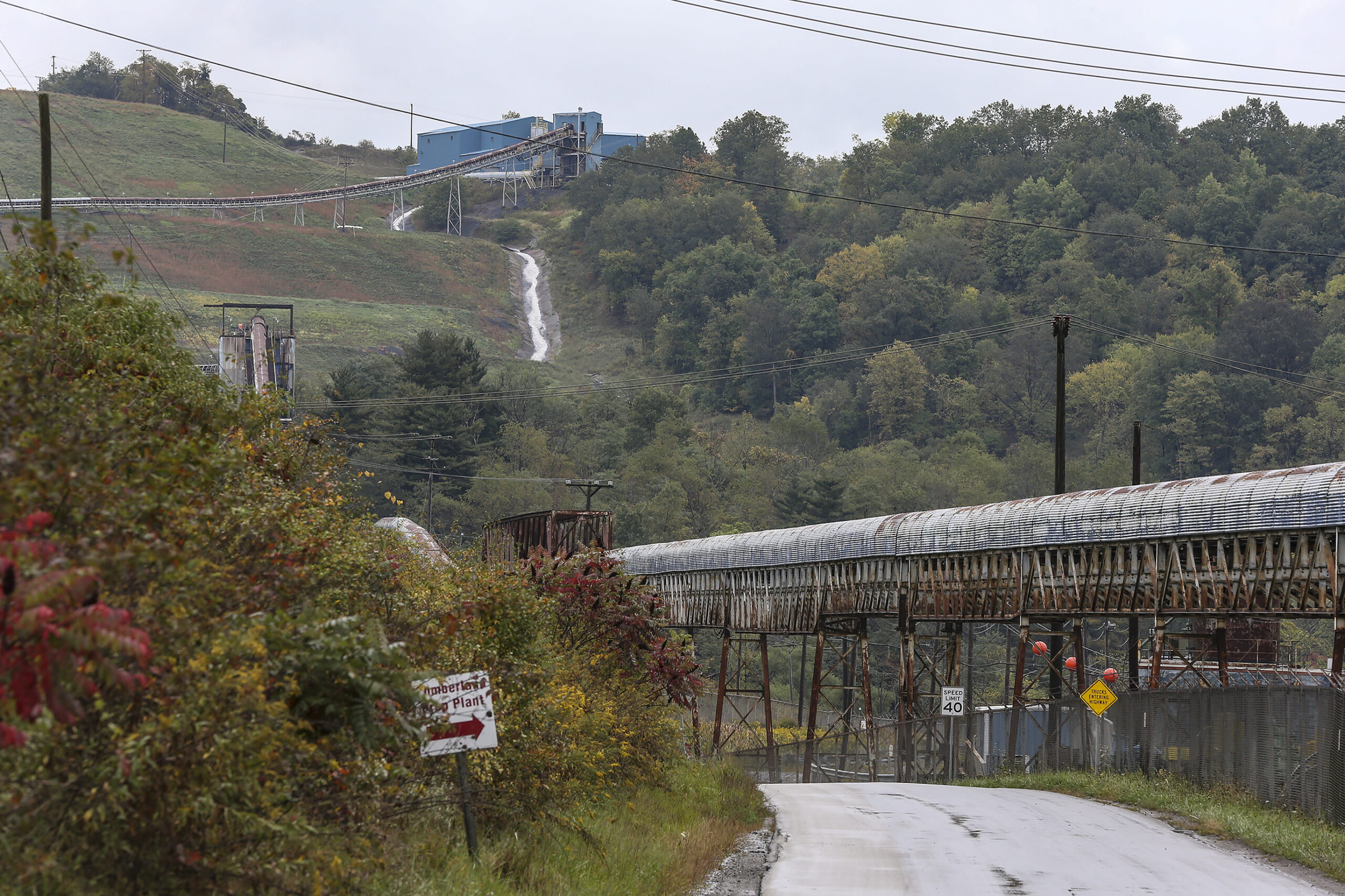
Justin Thompson, CEO of Iron Senergy, a coal operator, gave $10,000. His firm owns the Cumberland Mine in Greene County. When Pennsylvania applied to the U.S. Environmental Protection Agency for a $400 million grant, it mentioned several firms — including Iron Senergy — that could use the money for decarbonization projects, the Pittsburgh Post-Gazette reported in 2024. The EPA awarded the grant, and the Pennsylvania Department of Environmental Protection is tasked with administering it. The state is now reviewing applications, which it says are confidential.
The Cumberland Coal Mine in Greene County seen in 2020.
Local and national donors
Shapiro drew on a mix of executives from local and national firms. In Pennsylvania, he raised money from health system CEOs (Joseph Cacchione of Thomas Jefferson University, $10,000), bankers (Richard J. Green of Philly-based Firstrust Bank, $125,000), and a home remodeler (Asher Raphael of Power Home Remodeling in Chester, $100,000). Josh Kopelman — founder of First Round Capital and chairman emeritus of The Inquirer’s board of directors — and his wife, Rena, each gave $50,000.
There were private equity investors (San Francisco billionaire John Pritzker, cousin of Illinois Gov. JB Pritzker, $50,000), Hollywood producers (Jimmy Miller of talent management and production firm Mosaic, $75,000), professional sports team owners (telecom billionaire Robert Hale, minority owner of the Boston Celtics, $50,000), and a Massachusetts sports betting executive (Jason Robins of DraftKings, $10,000).
For his part, Bloomberg is “a big fan of Gov. Shapiro and a big believer in his leadership, and thinks he’s done a great job for Pennsylvania,” adviser Howard Wolfson told Axios.
At least one donor had ties to President Donald Trump, whom Shapiro often criticizes.
Don Wilson Jr., CEO of Chicago-based trading firm DRW Holdings LLC, gave $10,000 to Shapiro in September.
The Securities and Exchange Commission filed civil charges against a unit of Wilson’s firm while President Joe Biden, a Democrat, was in office. The SEC accused it of operating as an unregistered cryptocurrency dealer.
Biden-era regulators said that firms were dodging that rule by claiming crypto was a commodity, not a security. The enforcers argued this exposed investors to extra risks associated with digital currencies.
Then last March, a couple of months after Trump took office, the new administration dropped the charges against Wilson’s firm. Nine weeks later, Wilson invested $100 million into a Trump bitcoin project, the Financial Times reported.
The company told the newspaper it engages in a “variety of strategies in the crypto ecosystem” and saw value in holding bitcoin. “This transaction was viewed purely through that lens,” it said.
Trump denies having conflicts of interest.
That didn’t stop the Democratic National Committee from flagging the news on its “CORRUPTION WATCH” page.
The Trump administration, the Democrats’ post said, “now appears to be engaged in blatant pay-to-play politics.”
Power plants and coal mines
Among corporate executives, two of the eight biggest donors to Shapiro’s campaign last year were the father-and-son owners of privately held Robindale Energy Services, which owns about 20 companies involved in waste coal reclamation, power generation, mining, and logistics. Robindale’s assets include multiple power plants fueled by waste products from abandoned coal mines.
CEO Scott Kroh and his son Judson, the Latrobe-based company’s president, gave a total of $271,000.
That included a $100,000 contribution from Scott Kroh two days before Shapiro signed the annual budget, which came after a monthslong stalemate. The deal with Senate Republicans included language pulling the state out of the Regional Greenhouse Gas Initiative, a multistate effort to generate cleaner power that Robindale had vocally opposed.
Robindale’s executives did not respond to requests for comment.
In June 2023, Judson Kroh spoke out against RGGI at a public hearing, telling Pennsylvania lawmakers that Robindale’s power plants have enough capacity to power 500,000 homes. “Our main concern is you’ll see a significant decrease in power exports out of the state due to RGGI, as well as a significant decrease in coal production,” Kroh said.
Other energy industry firms, Republican lawmakers, and building trades unions have also long opposed the initiative, which requires power plants to buy allowances to cover their carbon emissions. They call it a job killer and an electricity tax. Environmental groups say it has reduced pollution and led to investments in clean energy in other states.
Shapiro had for years expressed concerns about the greenhouse gas initiative, which Pennsylvania joined under his predecessor but never implemented due to litigation. Shapiro said in 2021 during his first run for governor that “it’s not clear to me” that the program protected jobs, addressed climate change, or ensured energy reliability.
The Kroh family donated a total of $55,000 to his 2022 campaign and $21,000 the following year. Judson Kroh was among the more than 300 people who served on Shapiro’s transition team.
Many of Robindale’s operations are regulated by the state, and the company spent $150,000 lobbying state government officials last year, records show. Company executives in recent years have largely donated to Republicans in Harrisburg, though they have also supported some Democrats, including Shapiro.
window.addEventListener(“message”,function(a){if(void 0!==a.data[“datawrapper-height”]){var e=document.querySelectorAll(“iframe”);for(var t in a.data[“datawrapper-height”])for(var r,i=0;r=e[i];i++)if(r.contentWindow===a.source){var d=a.data[“datawrapper-height”][t]+”px”;r.style.height=d}}});
In addition to its power generation business, Robindale owns coal mines that are subject to state inspections and oversight. When two people died in a Somerset County mine operated by subsidiary LCT Energy, DEP required the company to update its safety protocols. The deaths in 2022 and 2023 came during a time in which there were 20 coal mining fatalities nationwide, according to federal data.
Johnstown-based LCT is currently expanding.
About 30 miles west of Maple Springs, LCT opened another mine in 2018 in Westmoreland County called Rustic Ridge 1, which produces 600,000 tons of coal a year.
The state renewed the permit for the 2,800-acre underground mine in January last year, and from that month through March, the Kroh family donated $70,000 to Shapiro’s campaign.
In April, after a yearslong review, the Pennsylvania Department of Environmental Protection approved a permit authorizing LCT to expand its operations there, adding 1,400 acres under the Pennsylvania Turnpike — the equivalent of 93 Lincoln Financial Fields. The permit allows LCT to mine coal up to 600 feet underground. The company sells the coal for production of steel.
The nonprofit Mountain Watershed Association is appealing the DEP’s approval to the Pennsylvania Environmental Hearing Board — whose judges are appointed by the governor, subject to confirmation by the state Senate — arguing that the expansion could harm groundwater and streams.
Others say the mine supports jobs and helps the local economy. Before opening, the company said in 2014 that it would invest $50 million to develop the mine, according to local news reports.
The state budget Shapiro signed in November expanded a program for expedited permitting involving approvals from the DEP, which reviews 40,000 permits a year. Introduced in 2024, the program is currently available for eligible permits such as air quality, dam safety, and oil and gas erosion and sediment control.
The budget legislation — cheered by Shapiro and GOP lawmakers — added more permit types, including one for mining, “which DEP is in the process of adding to the program,” a department spokesperson said.
Funk — the executive director of the watershed association, which has spent millions of dollars over the last 30 years repairing the environmental damage of legacy coal mining — said she is concerned the Krohs’ political giving “might be having an influence over Shapiro and his administration as we work to permit some of Robindale’s projects such as LCT Energy.”
Shapiro says permitting reform reflects his governing ethos.
“When you think about getting stuff done … it requires focus and speed,” he said in December at a National Governors Association event. “We’ve gotta be speedier as a country.”