Tag: topic-link-auto

  • In efforts to disrupt ICE, the whistle has become an instrument of choice

    In efforts to disrupt ICE, the whistle has become an instrument of choice

    The eastern sky is aglow with dawn streaks of orange when the cry of a whistle sounds outside of ICE headquarters in Philadelphia.

    The noise pierces amid an improvised orchestra of protest, as chanting demonstrators shake tambourines, rattle jingle sticks, and beat drums ― one person banged on a kitchen colander ― to create a clamor that makes it challenging to concentrate.

    That’s part of the goal of the weekly “Noise Demo” organized by No ICE Philly to raise awareness among morning commuters but also to try to disrupt the work of Immigration and Customs Enforcement agents at the Eighth and Cherry Street office.

    “We’re interrupting them,” said a protest leader who asked to be identified only as a member of No ICE Philly out of fear of repercussion from the government.

    For advocacy groups here and across the county, the whistle has become both a tool and symbol of the anti-ICE movement.

    On the streets, it’s the means to alert neighbors and warn immigrants when ICE arrives on the block, and to try to distract and confuse officers who may already be operating in an unfamiliar neighborhood.

    A blast from a standard pea whistle can carry half a mile, and the sound from a specialized emergency whistle can travel a mile or more, depending on conditions.

    ICE officials in Philadelphia said last week they had nothing to add on the noise demonstrations or on the use of whistles, beyond what the agency had already said: “Your whistles won’t stop or hinder ICE from arresting criminal illegal alien sex abusers, murderers, gang members, and more,” the agency told Minnesota protesters on social media.

    In November, President Donald Trump issued a ban ― so far blocked by the courts ― on creating “loud or unusual noises” at federal facilities in the U.S. That hasn’t slowed No ICE Philly, which gathers to make noise on Mondays, though the snowfall pushed a recent action to Thursday.

    “Maybe,” said activist Huston West, who blasted a steady beat on his whistle as ICE officers arrived at work on Thursday, “it makes them think about their life choices.”
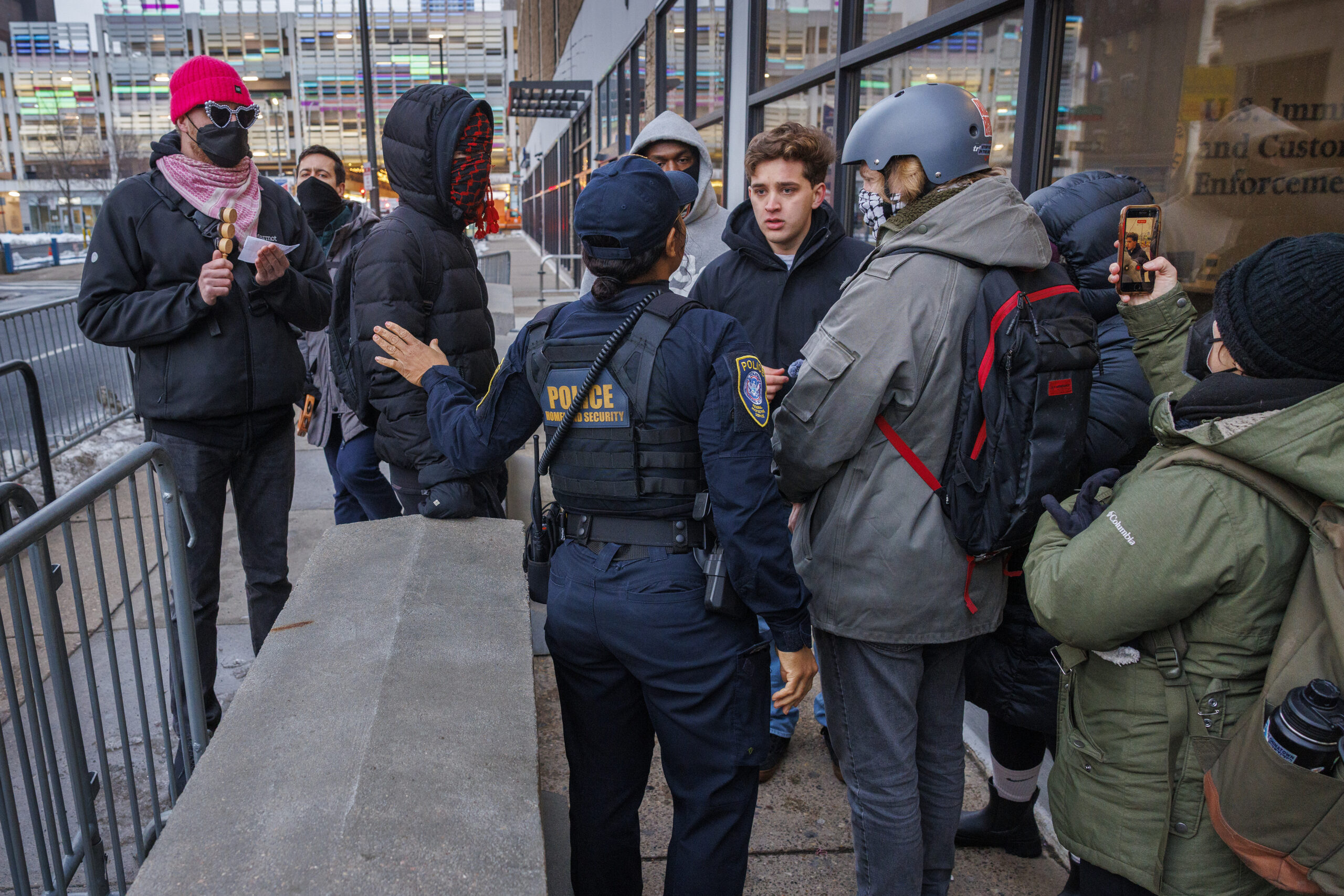
    A man who tried to confront demonstrators is engaged by a Homeland Security officer during a No Ice Philly “Noise Demo” outside the U.S. Immigration and Customs Enforcement office at 114 N. Eighth Street in Center City.

    Why have whistles become so popular among immigration protesters?

    Many reasons.

    Whistles are light, portable, reliable ― and cheap, about 20 cents each when bought in bulk. They don’t need batteries or recharging, have no buttons or controls. Everyone knows how to make it work.

    “There’s not much more shrill or penetrating than the sound of a whistle,” said Temple University professor Ralph Young, who studies protest and dissent.

    To him, protesters’ use of whistles carries symbolism, summoning images of referees calling penalties during sports events. Maybe the activists are saying ICE has broken the rules or needs to stop.

    “Like throwing a penalty flag,” he said, “against ICE agents who they deem are acting unlawfully.”

    The whistle ranks among the oldest human inventions, the first ones crafted from bone, wood, or clay, used for hunting, signaling, and religious rites.

    Englishman Joseph Hudson is considered the inventor of the modern pea whistle ― the tiny ball in the air chamber produces the trill ― in the 1880s. He created the Metropolitan Police whistle for British bobbies and the Acme Thunderer for soccer referees, who to that point had waved handkerchiefs to signal fouls.

    Today, hundreds of thousands of whistles have been distributed to ICE protesters around the country ― more than 150,000 sent from Chicago alone, according to the Chicago Sun-Times.

    In Minneapolis, activists have used 3D printers to crank out supplies. In Philadelphia, whistles have been given out by the handful at organizing meetings. Temple Beth Zion-Beth Israel ordered 300 whistles for distribution, so neighbors can quickly signal that ICE is present and warn immigrants to seek safety.

    “The big orange ones are the best,” Rachel Monk wrote in the Progressive, in an essay that proclaimed 2025 the Year of the Whistle. “I don’t leave my apartment without mine.”

    In Maryland last month, the Washington County commissioners shut down a public meeting when protesters blew whistles to condemn the board’s support for turning a warehouse into an immigration detention facility, the Baltimore Banner reported. And in Arizona, a state senator introduced a bill to outlaw the use of whistles to warn neighbors of ICE, seeking to create a new state crime called “unlawful alerting.”
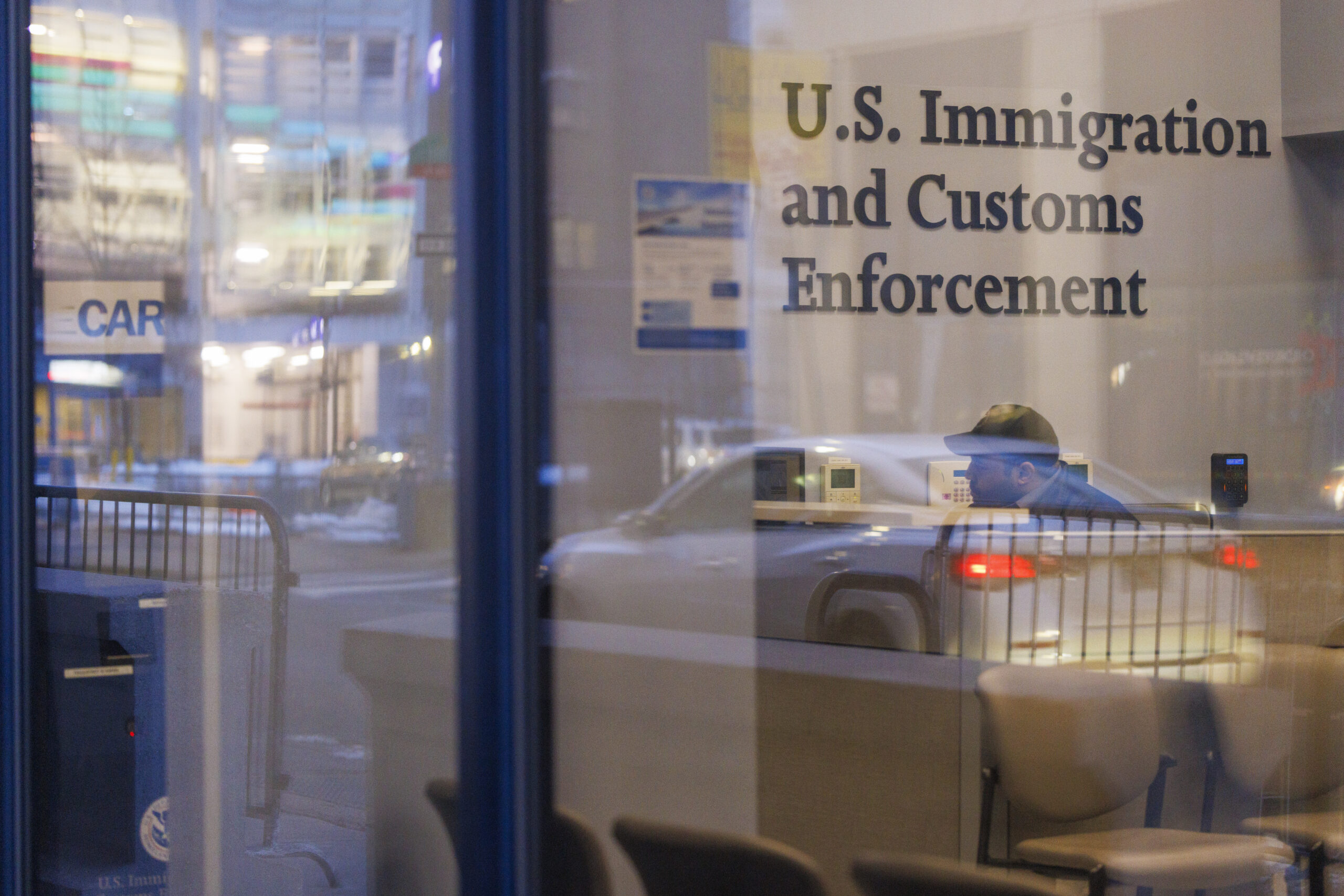
    The interior lobby of U.S. Immigration and Customs Enforcement at 114 N. Eighth St. in Center City.

    The Trump administration wants to ban loud noises outside federal facilities, a move widely seen as an effort to halt protests at ICE offices. A federal judge in Oregon temporarily blocked the restrictions, saying they said could violate the First Amendment by criminalizing free speech.

    But even among pro-immigration activists, not everyone sees whistles as consistently beneficial.

    Some think the noise adds to the confusion at the scenes of ICE arrests, increasing fear and anxiety among families during what are already tense and sometimes violent encounters.

    New Sanctuary Movement of Philadelphia, a major advocacy organization, has begun talking to other groups about finding alternatives to whistles, said co-director Blanca Pacheco.

    Yes, she said, it’s important that arrests not be permitted to be carried out in silence. But “what is the kind of noise that people can come up with that is supportive, instead of adding to the trauma?”

    Not all in immigrant communities understand the purpose of the whistles, she said. And for those who have survived war or torture the noise can be triggering.

    One option may be that people could shout, “ICE is here!” Perhaps two or three people on a block could be designated to blow whistles, rather than everyone at once. Even singing could work, she said.

    “I think that Chicago and Minnesota and other places that have used the whistles had to come up with tactics and strategy very quickly,” said Pacheco, who noted Philadelphia is not in that position. “We can learn from other places what has worked and what has not. I think whistles can be used in some scenarios, not all the scenarios.”

    Outside the ICE office on Thursday, two ICE agents heading into the building jawed with demonstrators who yelled at them to quit their jobs. Whistle calls and drum beats continued on, toward an 8 a.m. conclusion.

    “ICE operates from the very early morning into early afternoon,” said the demonstration leader who declined to give his name. “We just want to make sure that we’re here when they’re here.”

  • When schools close, families deserve real choices

    When schools close, families deserve real choices

    The announcement that the Philadelphia School District will close additional schools because of budget shortfalls is devastating, but sadly not surprising.

    For years, many Philadelphia parents have watched neighborhood schools struggle with declining enrollment, financial strain, safety concerns, and disappointing academic outcomes. Now, families are told their children must move again, often with little say in where they go.

    We can — and must — do better.

    When schools close, students who have already faced instability pay the highest price. Parents scramble to rearrange transportation and childcare. Children lose trusted teachers and friendships. Communities lose institutions that once anchored them. Families deserve more than reassignment letters and uncertainty. They deserve meaningful options.

    Two solutions are within reach: Lifeline Scholarships for Pennsylvania and the federal program, the Educational Choice for Children Act (ECCA). These programs would allow funding to follow Pennsylvania students to schools that meet their needs. These scholarships would give parents — not bureaucracies — the ability to choose a safe, effective learning environment, whether that is a public charter school, private school, faith-based school, or specialized program tailored to a child’s needs.

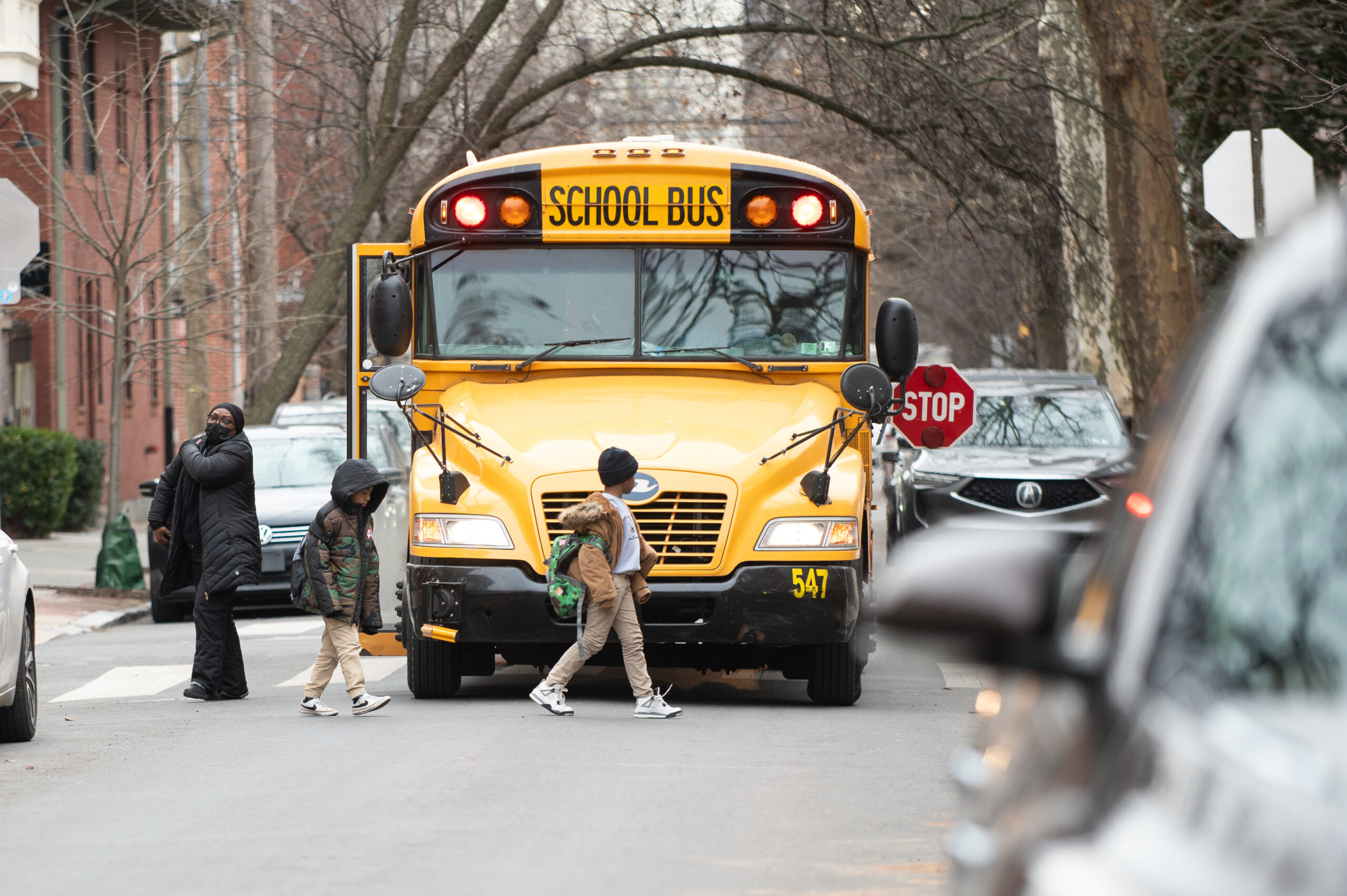
    Students get off the bus at Laura W. Waring elementary school in Spring Garden last month. The school is set to close in 2027.

    Gov. Josh Shapiro has the opportunity to act, and he needs to opt in now. By supporting Lifeline Scholarships and opting Pennsylvania into federal education choice programs like ECCA, the state could help families immediately. These are education dollars intended for children. Allowing them to follow students would give parents real leverage and real hope.

    Other states are already moving forward. In Texas and Florida, tens of thousands of families are applying for scholarships that open doors to schools better suited to their children. Reports from Texas show more than 80,000 applications from families seeking alternatives. These parents are not abandoning public education; they are seeking opportunity where it exists.

    Critics argue that school choice harms public schools. But forcing families to remain in schools that are unsafe or chronically underperforming harms children. Choice introduces accountability. When families have options, schools must improve to keep students. Competition can spark innovation, encourage responsiveness, and reward excellence.

    This is not about politics or ideology. It is about fairness.

    Every parent wants the same basic things: a safe school, strong teachers, and a chance for their child to succeed. For too many Philadelphia families, those expectations remain unmet. School closures make that reality even more urgent. Lifeline Scholarships and federal education choice programs like ECCA could offer stability in a time of upheaval.

    Philadelphia parents and community leaders should make their voices heard. Contact your legislators. Write to Gov. Shapiro. Ask Pennsylvania to adopt policies that put students first and give families the freedom to choose schools that work for their children.

    Our children cannot wait another decade for incremental change. When schools close, families need solutions — not promises. These solutions are already working for families in many states across the country; why not in Pennsylvania?

    Janine Yass is an education philanthropist and founder of the Yass Prize for Sustainable, Transformational, Outstanding and Permissionless Education.

  • It’s not just about schools. It’s about neighborhoods.

    It’s not just about schools. It’s about neighborhoods.

    Reginald Streater, president of the Philadelphia Board of Education, opened his testimony before City Council last month by introducing himself as “Reggie from Germantown,” a graduate of two district schools that no longer exist. Germantown High and Leeds Middle both closed. He knows what it means to lose a building. He’s also voting to close 20 more.

    The conflict playing out in Philadelphia isn’t only about schools. It’s about the fact that the school district and City Council have different responsibilities for the same places, and the new facilities plan brings that conflict into sharp focus.

    On Jan. 22, Superintendent Tony B. Watlington Sr. released a facilities master plan proposing to close 20 schools, colocate six, and modernize 159 others. On Feb. 26, he presented an amended final plan to the Board of Education, which was updated from 20 school closures to 18. Russell Conwell Middle School and Motivation High School were removed from the closure list.

    The district has lost 15,000 students in a decade, carries 300 buildings, many of them 75 years and older, and runs some schools with more than 1,000 empty seats, while others are overcrowded. Concentrating students means Advanced Placement courses in every high school, algebra for every eighth grader, and real career and technical pathways. The current spread of half-empty buildings makes all of that impossible to deliver consistently or fairly.

    The facilities plan is doing exactly what it was designed to do. The trouble is that everything it was not designed to do.

    A Philadelphia neighborhood school isn’t just one institution. It’s four, sharing an address. There’s the instructional platform: courses, teachers, schedules, the district’s domain. There’s the civic anchor: the building that signals to a neighborhood that its children count, and they belong. There’s the distribution node: where meals are served, where social workers operate, and where there is, most days, someone watching. And there’s the pathway to the future: where a counselor knows a family by name, where a student learns there’s a college or a trade or a life beyond the block.

    In places like Kensington, schools have absorbed those responsibilities over time.

    When that school building closes, all of those other things close with it. Some of those functions were formal educational programs. Others accumulated because families had nowhere else to go for them. The school became the place where paperwork was explained, problems were addressed and solved, and someone always knew which door to knock on next.

    City Council doesn’t get to vote on the facilities plan, but it funds roughly 40% of the district’s $2 billion budget. Councilmember Jimmy Harrity, an at-large member who lives in Kensington, decried that lack of input, but said that “the budget’s coming, and we will be looking.” Council President Kenyatta Johnson has signaled he’s willing to hold up city funding entirely.

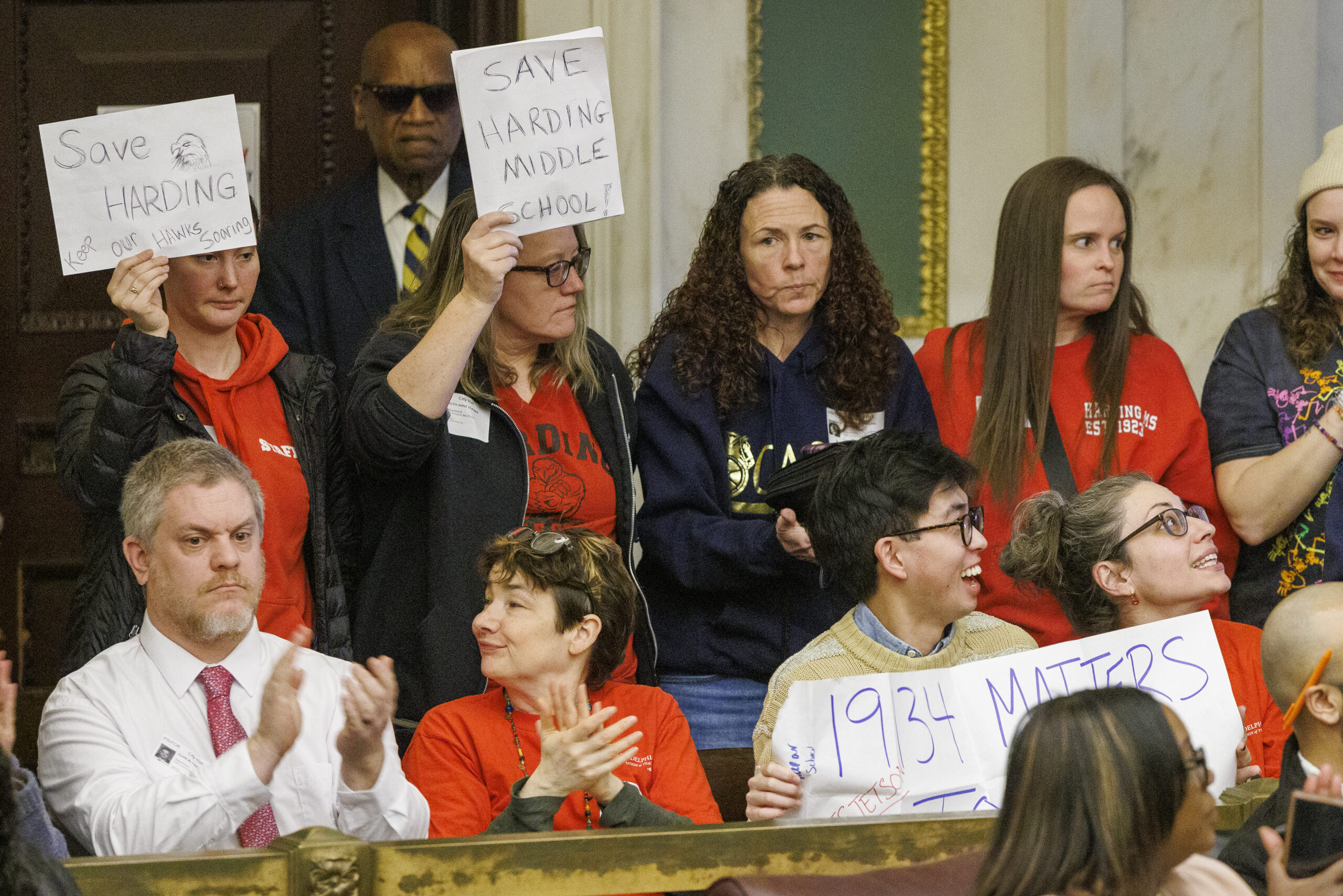
    Supporters of Harding Middle School protest at a City Council hearing with school board members earlier this month.

    Residents and families filled the chamber. Parents stood along the walls long after seats ran out, some holding infants, others carrying school backpacks. The hearing lasted hours.

    The debate sounded like a disagreement about the plan, but it was really a disagreement about who is responsible for what the plan leaves behind.

    What closes with a school building is not limited to instruction. Council’s budget is the instrument for the functions the facilities plan does not govern: housing investment, community infrastructure, colocated services, and neighborhood anchors that exist independent of school enrollment.

    The district held 47 public listening sessions and surveyed more than 13,000 people before releasing this plan. The fight at City Hall last month wasn’t because communities weren’t heard. It’s because what they described was a loss that the facilities plan was never designed to address. That’s not a failure of process. It’s a mismatch of jurisdiction.

    The district’s plan answers an educational question. What replaces the neighborhood functions housed in those buildings is a civic one.

    That answer does not sit with the school district.

    Amanda Soskin is a Philadelphia resident and consultant who writes about neighborhoods and civic infrastructure at Neighborhood Fundamentals.

  • Philadelphia Ballet’s 2026-27 season brings the fireworks for America’s 250th birthday

    Philadelphia Ballet’s 2026-27 season brings the fireworks for America’s 250th birthday

    The United States is celebrating its Semiquincentennial this year, and Philadelphia Ballet will be bringing the fireworks in its 2026-27 season opener, the company announced Tuesday.

    Instead of commissioning new work, the company is leaning into American classics and other favorites, while also finally establishing a home for itself on North Broad Street.

    The season will open Oct. 8-11 with a celebratory, all-Americana program called “Stars and Stripes Forever.” It will include Jerome Robbins’ Fancy Free, the concert version of George Balanchine’s Who Cares?, Eliot Feld’s Variations on ‘America,’ and Balanchine’s Stars and Stripes.

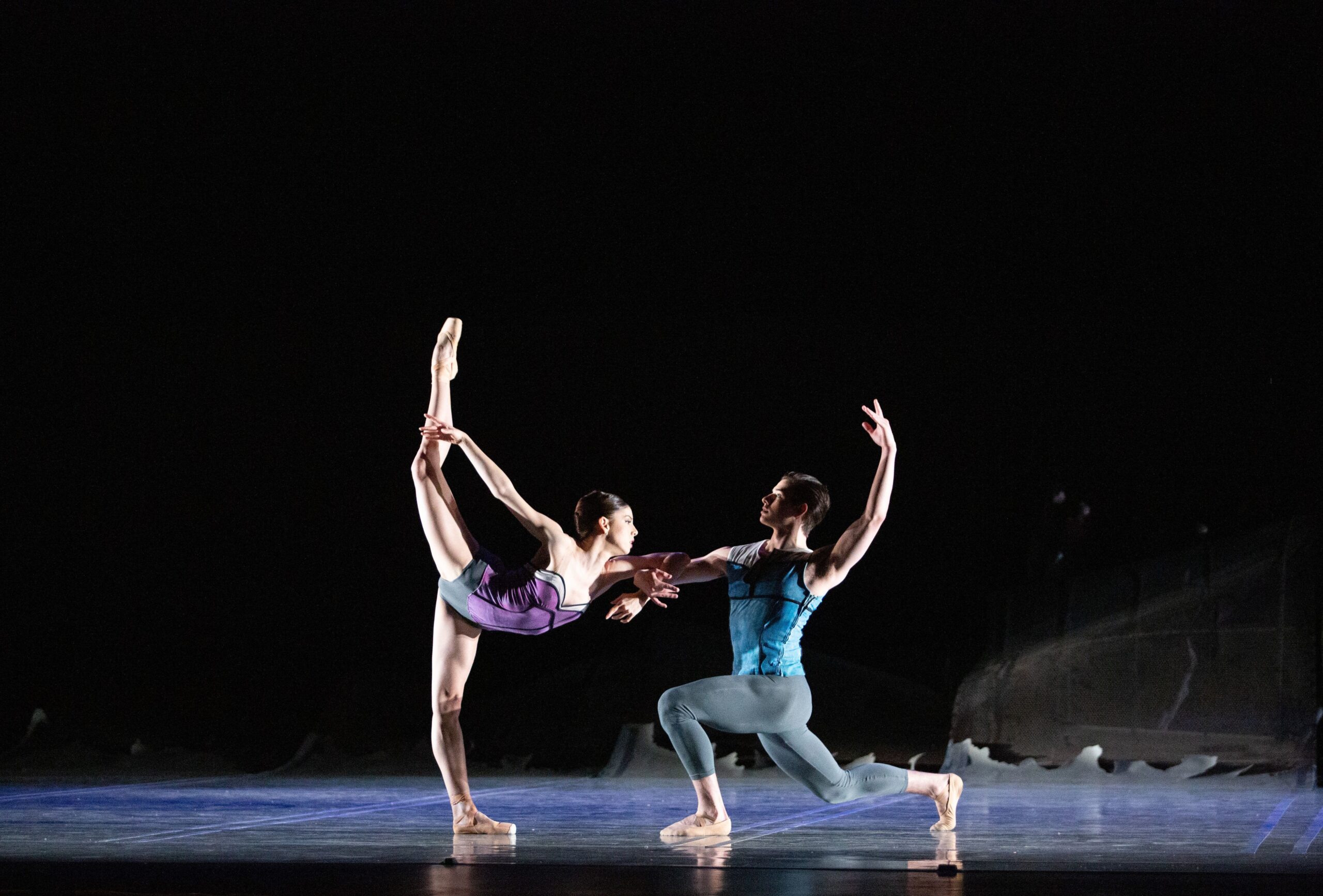
    Pennsylvania Ballet dancers Dayesi Torriente and Sterling Baca in Christopher Wheeldon’s “DGV.”

    The ballet returns to the Academy of Music the following week with a mixed repertory bill on Oct. 15-18. That program will feature Christopher Wheeldon’s DGV: Danse à Grande Vitesse, Wayne McGregor’s Chroma, and Twyla Tharp’s In the Upper Room.

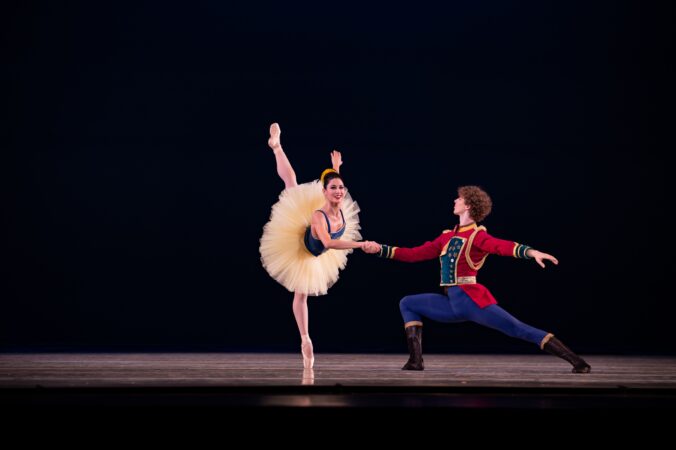
    December will, of course, see the return of George Balanchine’s The Nutcracker, which will take place Dec. 4-31.

    Next year’s spring will be devoted to full-length story ballets.

    On March 4-14, Philadelphia Ballet will bring back Ben Stevenson’s Cinderella.

    Mayara Piñeiro as Kitri and Etienne Díaz as Basilio in Philadelphia Ballet’s “Don Quixote.”

    And the season will wrap up April 29-May 9 with the return of artistic director Angel Corella’s Don Quixote.

    The company is also finally expecting to open its new home on North Broad Street. The Philadelphia Ballet Center for Dance is planning its opening in September. Along with studios, offices, space for its wardrobe team, and two wellness centers (one for company dancers, another for ballet students), it will include a black-box theater and gathering space called the Barbara Weisberger Dance Innovation Lab, named after the company’s late founder.

  • Letters to the Editor | March 3, 2026

    Letters to the Editor | March 3, 2026

    Iraq 2003 redux

    Has Iran been developing nuclear bombs? Almost certainly. The detection by the International Atomic Energy Agency of uranium 235 enriched to 60% in recent years proves that. There is no known peaceful use for large quantities of such highly enriched uranium. Many of Iran’s nuclear facilities have been damaged or destroyed, but we do not know what others may be undiscovered and still functional.

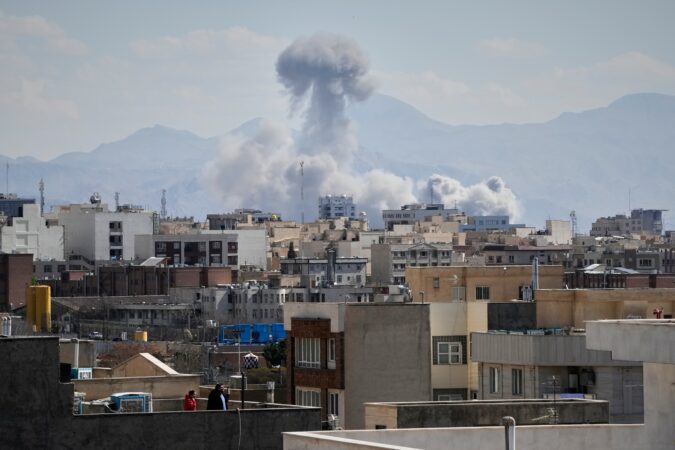
    Now, President Donald Trump has joined Israel in an all-out war against Iran. This is the Iraq War of 2003 all over again: Create a boogeyman and get public opinion on board. There is little doubt Trump will press ahead with this operation for who knows how long — he will not want to be seen as backing down and weak — the U.S. and the rest of the world be damned.

    Sam Goldwasser, Bala Cynwyd, samslaser@gmail.com

    Boys to men?

    In a recent article by the Associated Press, Defense Secretary Pete Hegseth is quoted as complaining about so-called woke changes to Scouting America’s policies. He argued that the organization, formerly known as Boy Scouts of America, should return to its roots as “a group that develops boys into men.” I am an old and gray Eagle Scout and the product of one of the most traditional scouting programs anywhere. So believe me when I say: Mr. Hegseth doesn’t have a clue.

    Scouting has never existed simply to “develop boys into men.” It has always existed to teach and practice the unchanging principles of the “Scout Oath and Law.” They are summarized in the first words of the Scout Oath: “On my honor, I will do my best.” In other words, I am a person of integrity, and I will do the right thing regardless of what anyone else is doing. That’s not Mr. Hegseth’s principle — just ask Sen. Mark Kelly — but it is scouting’s unchanging principle.

    The rest is program. Our scouting programs change, or rather evolve, to meet the realities of the day. Otherwise, we are not doing our promised best to teach principles in the here and now. And that would be much worse than even Mr. Hegseth’s uninformed nostalgic exercise.

    Jim Matthews, Wayne

    A time and a place

    I believe the awarding of the Medal of Honor to two of our nation’s bravest warriors during the State of the Union address was entirely inappropriate. Those men deserved a presentation where they would be the center of attention rather than a sideshow to the president’s speech.

    The president politicized the event to cast himself in a positive light. Those valiant service members should have been recognized with a more respectable, personal, and honorable ceremony.

    Ken Biles, Douglassville

    Deadly distraction

    Donald Trump has unconstitutionally launched yet another attack without addressing the American people or securing the approval of Congress. He says he bombed Iran to stop it from using its nuclear arsenal. Didn’t he say eight months ago that we had totally “obliterated” its nuclear capabilities? And Congress? Trump’s Republican minions just follow his lead — it’s a complete disgrace to our democracy. This attack on Iran is simply a distraction from the Jeffrey Epstein files, environmental regulations being rescinded, the economy, farmers declaring bankruptcy at increasing rates, burdensome healthcare costs, cryptocurrency making Trump rich — the list goes on and on. Trump, the self-proclaimed “president of peace,” just started another “forever war.” God help us all.

    Robert LaRosa Sr., Whitestone, N.Y.

    Join the conversation: Send letters to letters@inquirer.com. Limit length to 150 words and include home address and day and evening phone number. Letters run in The Inquirer six days a week on the editorial pages and online.

  • Dear Abby | After months of couples therapy, things haven’t improved

    DEAR ABBY: I have been married more than 20 years to my best friend. She’s the love of my life. We have been through a lot together and have been in couples counseling for eight months. We almost divorced last year because of an emotional affair I had seven years ago. (She had a similar distraction last year.)

    We are friends and do everything together. I try to do everything right. I’m there for her emotionally. I have stopped drinking every day and developed a positive, mindful, and kind mindset. I got myself into shape physically. I earn a good living, help around the house, prepare dinner for all of us, and help with kids’ appointments and activities.

    The problem? My wife has physically withdrawn from me. Anything beyond hugs and kisses is too much for her. Physical intimacy happens less than once a month. I feel alone in my own home because I thrive on touch and affection but receive none.

    I love my wife and don’t want to be with anyone else. The counselor says things “may” turn the corner “in time.” In the meantime, how do I function while feeling undesired and rejected on a daily basis?

    — FORGOTTEN HUSBAND IN THE SOUTH

    DEAR HUSBAND: You have my sympathy. It is possible that as much as you and your wife like and love each other, you are better friends than spouses. Because after eight months of counseling with your wife nothing has changed and there are no gestures of affection and you feel alone in your own home, it’s time you found a psychotherapist of your own. It’s clear that joint counseling has not been helpful.

    ** ** **

    DEAR ABBY: How do I get my daughter-in-law, “Darlene,” to clean up after herself? I live in the house, pay rent, and help with the bills, but she constantly creates a mess in the kitchen and everywhere else. She fills the sink with dishes daily and never washes pots and pans, to the point I can’t use the kitchen to cook.

    Darlene doesn’t work and has nothing to do all day but create a disaster and wait for me or my son (her husband) to clean up behind her.

    My son and I each work full-time. He does all the laundry, cleaning and cooking. If I say anything, Darlene gets defensive and makes all kinds of excuses why she can’t. (It’s sheer laziness.) If I say anything to my son, he defends her because she whines and cries about how “tired” she is and claims to have all kinds of illnesses. (Her stomach hurts, she’s on her period or just too tired.). She stays up late every night and can’t wake up to get my grandson to school, so my son does it every day.

    I’m at my wits’ end, but I don’t want to create an environment where Darlene will ignore me and turn my son against me. Help!

    — OUT OF BALANCE IN THE SOUTH

    DEAR OUT OF BALANCE: You cannot change the unhealthy dynamic in your son’s household unless he and his wife agree to do so. From what you have written, that isn’t likely to happen. Be glad that you are fully employed, because the healthiest situation for you would be to make other living arrangements.

  • Horoscopes: Tuesday, March 3, 2026

    ARIES (March 21-April 19). You don’t always want to update. The decor feels like home, you know the operating system, you’re used to the look, and the old way worked just fine. But in today’s case, the new version will be worth the adjustments it asks of you.

    TAURUS (April 20-May 20). You’re wary of people too focused on short-term gains. In healthy relationships, the value lies in the relationship itself. The trust and understanding you’ve built over time is much more important than any small transaction occurring between you.

    GEMINI (May 21-June 21). There are no extra points for learning the hard way, so you may as well make it as easy as can be. What do you need? Peace and quiet? The right tools? A support system? Definitely an amazing teacher. Get yourself set up.

    CANCER (June 22-July 22). People protect the story of who they are. They edit memory. They assign meaning retroactively. They seek witnesses who confirm their version. You’ll notice where facts don’t line up, but it may be kinder not to point out the discrepancies.

    LEO (July 23-Aug. 22). There are difficult people and circumstances in the mix. You don’t need to hold a position of influence to be influential. You make a difference when you’re simply doing what comes naturally to you: giving your love.

    VIRGO (Aug. 23-Sept. 22). Here comes the prize you didn’t even know was part of this game. It’s coming straight to you. But are you really surprised? You’ve racked up so many points, of course you would be rewarded like this.

    LIBRA (Sept. 23-Oct. 23). Something shook your sense of self recently. Make a tiny, tactical plan for reclaiming your identity — something that honors your genius and energy. That could be your next step while life keeps moving around you.

    SCORPIO (Oct. 24-Nov. 21). Want to end a power struggle? Let them win. In one fell swoop, you are free. Don’t like that idea? Then hold your ground internally. Your freedom doesn’t depend on them agreeing, only on your choice to release the fight.

    SAGITTARIUS (Nov. 22-Dec. 21). The new project you’re thinking about is a big one. You won’t feel ready, but that doesn’t mean that you aren’t. Don’t let the opportunity slip away. Pull your energy together and pounce.

    CAPRICORN (Dec. 22-Jan. 19). You’ll pay your respects. Rules, etiquette, formalities, and protocol will matter. This is the glue holding together transactions, relationships, and so much more.

    AQUARIUS (Jan. 20-Feb. 18). Powerfully commit one more time to your goal. It’s almost as though whatever happened in your past to discourage or distract you has only served to enable you to do better this time around.

    PISCES (Feb. 19-March 20). You’re reading people’s energies correctly, and they are picking up on yours. Social capital compounds. Interactions pay off indirectly in introductions you never saw coming, your name mentioned when you’re not there and invitations that feel almost casual but matter a lot.

    TODAY’S BIRTHDAY (March 3). Enter your Year of Sparkling Currents, when ideas, money and love flow easily, guided by your insight and intuition. Every choice seems buoyed by unseen support. Educational achievement and a flourishing garden or similar project featuring beauty thrive under your tending. Friends regularly join for your favorite kind of entertainments. Aries and Libra adore you. Your lucky numbers are: 5, 29, 15, 42 and 23.

  • 1 person reportedly dead after 3-alarm fire in Bucks County

    1 person reportedly dead after 3-alarm fire in Bucks County

    One person has reportedly died after a three-alarm fire devastated several homes Monday evening in Birstol Borough.

    The fire erupted on the 300 block of Dorrance Street and reached three alarms, prompting a regional response by various firefighting companies.

    Police Chief Joseph Moors told NBC10 that first responder arrived at the scene around 6 p.m. and found two houses fully engulfed in flames. Several neighboring homes also were damaged.

    One person was killed and another was injured, Moors told NBC10.

    Video posted on social media by one person at the scene showed the electrical sparks bursting from the flames.

    <iframe src="https://www.facebook.com/plugins/post.php?href=https%3A%2F%2Fwww.facebook.com%2Fmitchellfire903%2Fposts%2Fpfbid0nphYN6paTxBZEktPxrxv9vHerJr7cgkf6Zsa4Q8qQboGUGwmqAVi1PypziyQLt5ml&show_text=true&width=500" width="500" height="683" style="border:none;overflow:hidden" scrolling="no" frameborder="0" allowfullscreen="true" allow="autoplay; clipboard-write; encrypted-media; picture-in-picture; web-share"></iframe>
  • Travis Konecny misses Maple Leafs game with upper-body injury, listed as day-to-day

    Travis Konecny misses Maple Leafs game with upper-body injury, listed as day-to-day

    TORONTO — After the Flyers’ win against the Boston Bruins on Saturday, goalie Dan Vladař said every player is a piece to their puzzle as they make a push for the playoffs.

    On Monday, they faced the Toronto Maple Leafs without key piece Travis Konecny.

    Ruled a game-time decision by coach Rick Tocchet after a morning skate that saw the forward not participate in power-play reps, Konecny is officially day-to-day with an upper-body injury.

    He also missed the Flyers’ loss to the Tampa Bay Lightning on Jan. 10 with an upper-body injury.

    Konecny has led the team in scoring for five of the last six seasons, including the last four, and this year leads the lineup in goals (23), assists (34), and points (57). He is second in power-play points (10) and is tied with three players for the lead in shorthanded points (2).

    The heart and soul of the team and one of its most consistent scorers, Konecny has registered at least a point in 40 of his 58 games. In his last 35 games, he has 40 points, including nine in five games heading into the Olympic break, and has three in the three games since the restart.

    Flyers right wing Travis Konecny has registered at least a point in 40 of his 58 games.

    Despite being banged up and playing through it — he tallied a hat trick as he gutted out and grimaced through a demoralizing loss to Columbus on Jan. 28 — the alternate captain had all but put the Flyers on his back.

    Averaging just over 19 minutes a night, Konecny is plus-10, rebounding from his minus-17 last season. Even though he has missed a handful of games, the Ontario native is still on pace to set a career high in points with 79.

    “I had a good break, got a chance to reset, get my mind in a different spot,” Konecny said Feb. 17, the first day the Flyers returned to the ice in Voorhees. “Kind of realize where we’re at as a team and what we need to do finishing the season here. For me, just getting to the top of my game, where I need to be to help our team, and I think everyone is in the same spot.”

    But not having him in the lineup will make the Flyers’ postseason push tougher. And Konecny said after the Flyers’ loss in Boston on Jan. 29 that, “I’m tired of missing the playoffs.”

    “I think it’s disappointing every year if you miss it,” he said in mid-February. “I think what’s gotten everyone to this point is everyone’s a competitor, everyone wants to compete in the big games. … It’s not going to be like the end of the world if it didn’t happen; I’d be frustrated.

    “But I know that the team we’re building, what we have, the plan, we’re going to be a playoff team, and I’m not worried about that. I know everyone believes in that in this locker room, so we keep on pushing. Hopefully, it happens, and we’re going to give everything to get there, and if it doesn’t, we reevaluate and get better in the summer.”

    With Konecny out, Owen Tippett was moved to the top wing alongside Christian Dvorak and Trevor Zegras during Monday’s game.

  • Philly kids get guaranteed recess, bathroom, and water breaks for the first time under a new school wellness policy

    Philly kids get guaranteed recess, bathroom, and water breaks for the first time under a new school wellness policy

    For the first time, Philadelphia School District students have guaranteed bathroom and water breaks. Recess is promised. Silent lunches and collective punishment are forbidden.

    Call it a victory for joy.

    Philadelphia’s school board just adopted the district’s first-ever comprehensive wellness policy, two years after a group of parents began pushing a “joy campaign” because, parent Jamila Carter said, “we refused to accept the unacceptable.”

    Jamila Carter speaks during a news conference celebrating the wellness policy / joy campaign at the school district building, in Philadelphia, on March 2, 2026.

    In the past, said members of Lift Every Voice — a grassroots, Black-led parent organization growing in numbers and clout in the city — students inside some district schools weren’t allowed to drink water during the day. Entire classes were punished for the misdeeds of one or two students. And sometimes, parents sent their children to school in diapers because children weren’t always allowed to use the bathrooms.

    The group of moms weren’t trained advocates, but they learned quickly, pushing the school board and district to codify rights that weren’t always guaranteed.

    Now they are — on Thursday night, the school board signed off on bathroom and water breaks and mandatory recess and movement breaks for every 90 minutes of seated time for elementary school students.

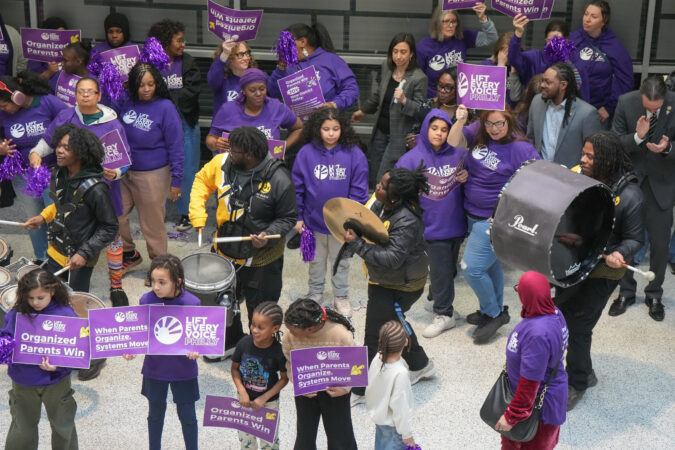
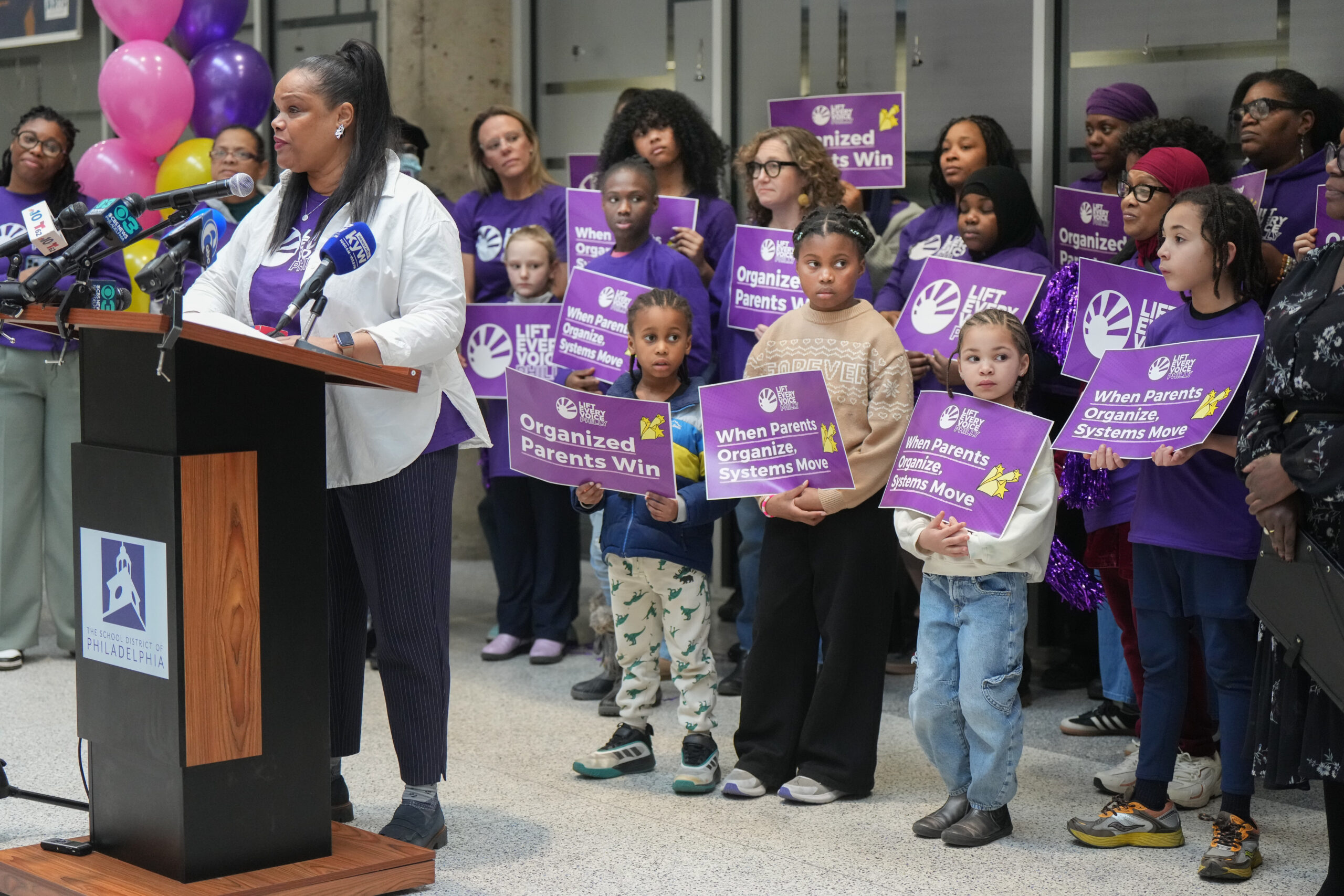
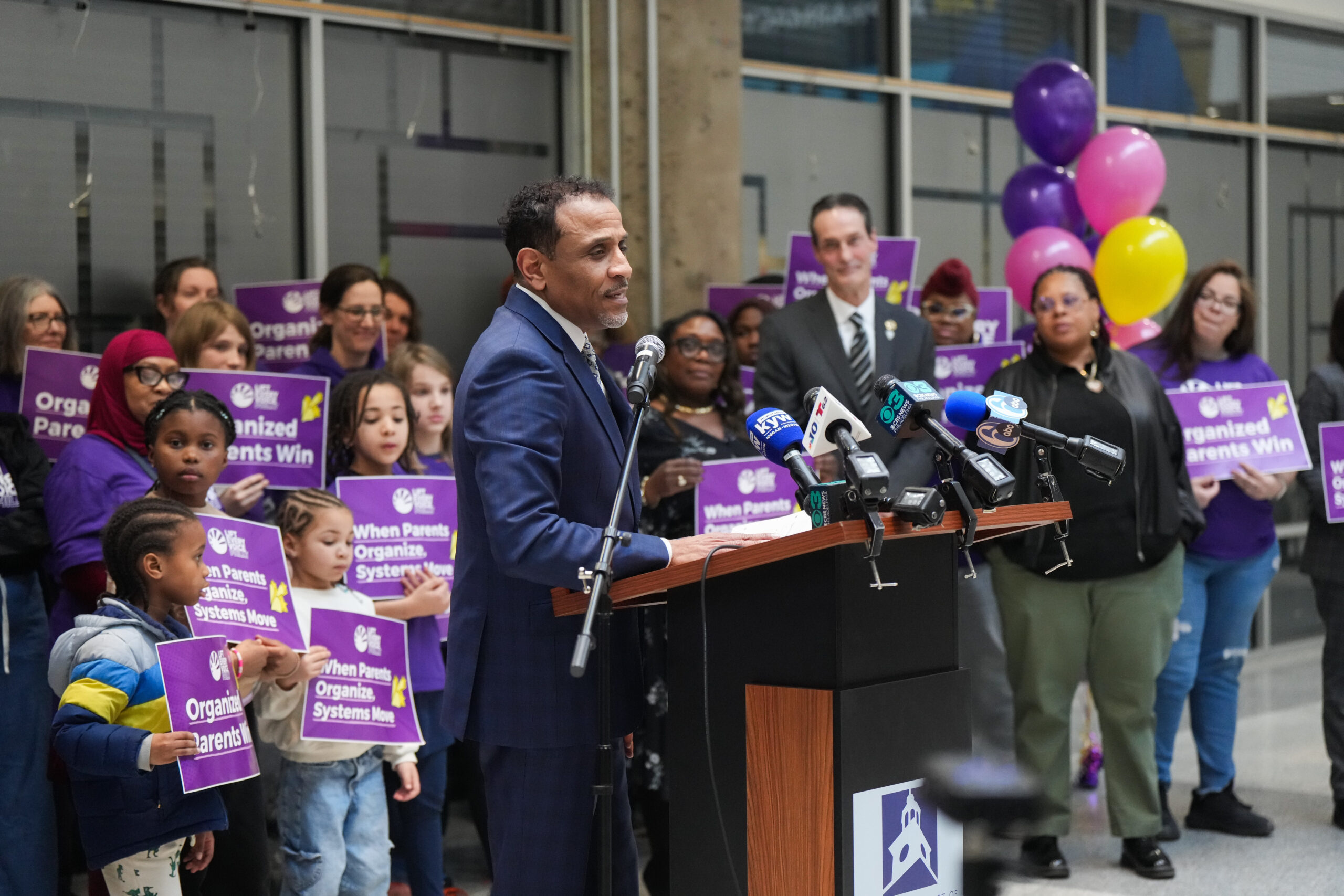
    With pom-poms and dancing, a drum line and cheers, Lift Every Voice members celebrated their victory at district headquarters Monday.

    But the two-year path to winning their demands was often sobering, and the district officials who locked arms with them at a news conference were slow at first to sign off on the policy.

    Superintendent Tony B. Watlington Sr. speaks during a news conference celebrating the wellness policy / joy campaign, at the school district building, in Philadelphia, on March 2, 2026.

    Superintendent Tony B. Watlington Sr., who now routinely talks about joy as one of the district’s core values, credited the parents for pressing the issue.

    “You know what Frederick Douglass once said? He said, ‘Power concedes nothing without a demand. It never has and it never will.’ And so I want to thank the members of Lift Every Voice. I wish we had done this much sooner. But I’m pleased that we’re doing it today,” Watlington said.

    Amy Faulring, a parent of two district students, said it was a happy day, but the campaign taught parents a sobering thing.

    “Even in some of the best schools, these practices were happening, in buildings that families fight to get into and feel proud of,” said Faulring. “That tells us this wasn’t about one school, it was about culture, and culture does not shift by accident. When basic protections aren’t written down, they become negotiable. They depend on which building you’re in or which parent feels empowered enough to speak up. Codifying this into policy changes that.”

    The policy, Faulring said, “sets a clear floor, it creates consistency, and it makes dignity non-negotiable.”

    The priorities, said Lift Every Voice member LaTi Spence, came right from kids.

    “Our children told us what was wrong,” said Spence. “They told us what it felt like to sit in classrooms thirsty, how hard it was to have silent lunches. They told us where joy was missing.”

    Councilmember Kendra Brooks said the policy fixes things that parents and students had to tolerate for too long.

    “When we think about children holding their bodies because bathroom access is protected, or sitting for hours without movement, or rushing through silent lunches, that’s not discipline,” Brooks said, who was a parent activist before she was a politician. “That’s not discipline. That’s not rigor. It’s actually dehumanizing.”