A 17-year-old Philadelphian turned himself in on Monday in connection with the fatal hit and run of June Rodriguez, a beloved and decades-long presence at Bob & Barbara’s Lounge.
Philadelphia police said they had already obtained a warrant for the teen’s arrest when he turned himself in, accompanied by his mother and attorney.
The teen, whose name is not being released because he is a minor, was charged with multiple felonies, including homicide by vehicle, as well as involuntary manslaughter, reckless driving, driving without a license, and related offenses.
But for the victim’s son, Skye Rodriguez, the arrest brings little solace.
“I feel relieved, but I’m still angry,” he said in between sobs. “I know I’m called to forgive because that’s my faith, I just don’t know how to. It’d be different if this kid hit my dad and went straight to the police station.”
But the teen didn’t.
The younger Rodriguez said his father did everything right as he rode his bike home after a shift at Bob & Barbara’s on Dec. 20.
“My father was very cautious — he even had reflectors on his boots,” said Skye Rodriguez, who learned of the added precaution when the morgue gave him his father’s things.
June Rodriguez, 54, was turning onto North 56th Street from Lancaster Avenue in Overbrook around 3:45 a.m. when the driver of a red SUV swerved into him and drove away, according to Philadelphia police.
Rodriguez’s death devastated Philadelphia’s queer community, where he was a known DJ, and the city’s house music scene. Friends remembered Diaz as a warm, welcoming individual, and a strong ally and presence in the LGBTQ+ community, though he was straight himself.
One remembrance feature on a GoFundMe page for Rodriguez’ funeral expenses said the DJ created “a sanctuary on the dance floor.”
His death also mobilized safe-streets advocates, who noted that stretch of Lancaster Avenue is one of the city’s most dangerous, part of the 12% of city streets that account for 80% of traffic deaths and serious injuries.
Rodriguez’s son said he had yet to watch the surveillance video procured by investigators. Police have told him that his father had his reflectors on and was in the bike lane.
Still, Rodriguez doesn’t know if he wants to see the moment of impact. His father’s belongings were covered with blood, he said. He doesn’t want to see the severity of the impact play out.
For now, he is grateful to have a break in the case.
“If it wasn’t detectives or police making it a big deal, what if it had been swept under the rug?” he said.
There will be times when passionate teammates have heated exchanges.
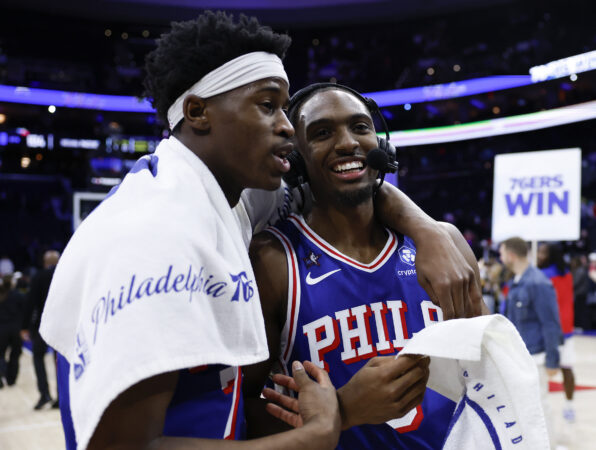
One of those occasions happened Friday night between the 76ers’ backcourt mates, Tyrese Maxey and VJ Edgecombe, during a loss to the Cleveland Cavaliers.
The two were spotted arguing near the bench during a break in action after Edgecombe left Cavs standout Donovan Mitchell wide-open for a three-pointer. Maxey yelled something to Edgecombe after the made basket, and the discussion continued on the sideline during a timeout. The two-time All-Star point guard even rose from the bench to further explain his point to Edgecombe, leading to a spirited discussion in front of teammates, coaches, fans, and cameras.
A video of the exchange, which circulated on social media, has gone viral.
“I was not aware until my dad called me and was like, ‘Hey, you and VJ good?’” Maxey said. “I was like, ‘Uh, yeah. Why?’ A couple of people sent [the video] to me, and I kind of just laughed at it. We want to win so, so bad. And we talked about the scenario of, like, not leaving Donovan Mitchell. … I didn’t want him to leave Donovan Mitchell.”
With Mitchell running down the court, Maxey wanted Edgecombe to switch off Craig Porter Jr., the ball handler. Instead, both players followed Porter, who passed to a wide-open Mitchell.
After catching the pass, the six-time All-Star stepped into a 27-foot three-pointer to knot the score at 16 with 6 minutes, 52 seconds remaining in the first quarter. The Sixers held Mitchell to 13 points on 4-for-13 shooting that night after he tormented them for 35 points two nights before.
Aside from the miscommunication, the Sixers guards did a solid job defending him. However, they struggled offensively. Maxey had 22 points on 9-for-23 shooting. Edgecombe scored 10 points on 4-for-5 shooting. He didn’t attempt a shot in the third quarter and scored three points on 1-for-2 shooting in the fourth.
But a lot of attention went to their exchange in the video.
“I just told him, like, man, in certain scenarios, certain principles go out the window,” Maxey said of wanting Edgecombe to switch on to Mitchell. “Like, this dude is really good, and he had 35 on us last night. I say all that to say, we just want to win. Like, we laughed about it after the game. I was the first person to tell him, like, ‘Dude, you shooting five times in a basketball game is not going to cut it for us. Like, we need you. You’ve got to be up to 10, 12. Like, you’ve got to be aggressive.’
“So, man, that’s fine. That’s my dog. That’s my little brother.”
McConnell’s milestone
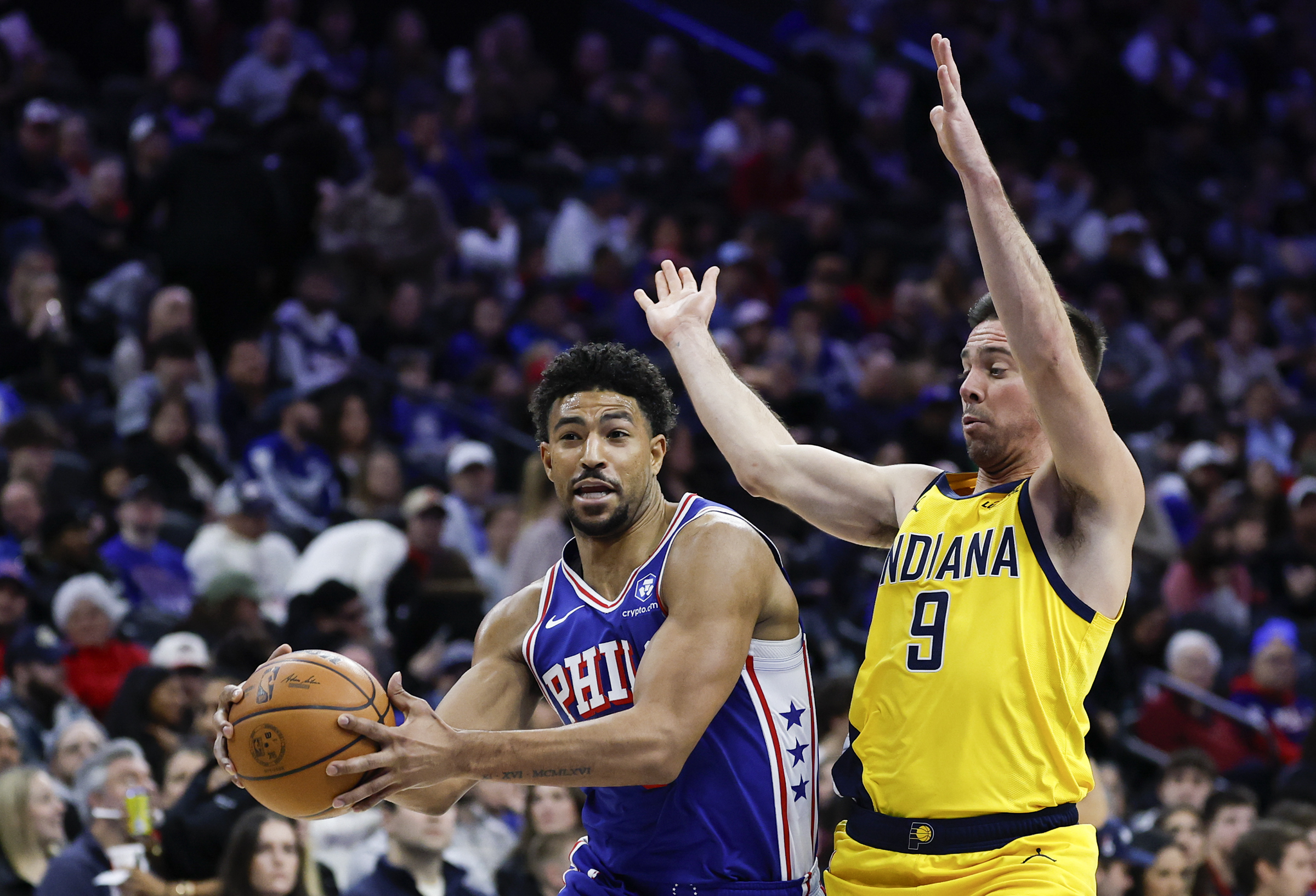
On Friday, T.J. McConnell joined another former Sixer, Lou Williams, as the only players in NBA history to record 3,000 assists off the bench.
McConnell, who’s in his seventh season with the Indiana Pacers, reached the milestone with two assists in the first quarter of the Pacers’ 129-117 victory over the New Orleans Pelicans.
Williams, who played a combined 17 seasons with the Sixers, Atlanta Hawks, Toronto Raptors, Los Angeles Lakers, Houston Rockets, and Los Angeles Clippers, recorded 3,262 assists as a reserve and added 527 as a starter.
Former Sixers guard T.J. McConnell (9), now with the Indiana Pacers, posted a stat that is unique to only two players who spent time in Philly.
After adding three assists in Monday’s 114-103 loss to the Sixers, McConnell has 3,010 assists off the bench. The 11th-year veteran is just one of five players to reach career marks of 3,000-plus points, 2,000-plus assists, 1,500-plus rebounds, and 500-plus steals as a reserve.
“I feel like my playing here established the player I was going to be throughout my career,” McConnell said of spending his first four NBA seasons with the Sixers. “It established a mindset on how I’m going to play, how I’m going to go about it, and how I’m going to be a pro.
“Obviously, I’m very thankful for my time here, because I wouldn’t have been put in a position to play as many years as I did. For them to take a chance on me and establish the type of player I want to be, I’m thankful.”
Undrafted out of Arizona, McConnell began his NBA journey as the Sixers’ fifth-string point guard during training camp in 2015. At the time, the 6-foot-1, 190-pounder didn’t even have a locker.
The former Sixers fan favorite averaged 6.4 points and 4.7 assists in 314 games with 72 starts before signing a free-agent deal with the Pacers on July 29, 2019.
LAS VEGAS ― On Saturday, captain Sean Couturier stood in front of reporters in the Flyers locker room at Xfinity Mobile Arena after a 6-3 loss to the Rangers and said, “We [stunk]. Plain and simple. We can’t show up.”
Fast forward to Monday night at T-Mobile Arena after a 2-1 win against the Vegas Golden Knights, and Couturier said, “Yeah, it was a gutsy win.”
It wasn’t always pretty, but it was a win. Finally, after losing six straight, the Flyers were able to hold off the red-hot Golden Knights.
Here are four stars.
4. The penalty kill
The Flyers’ penalty kill has been dreadful. Since Jan. 1, it entered the game as the league’s second-worst unit at 57.7%. That led to assistant coach Todd Reirden, who is in charge of the penalty kill, calling a meeting on Monday morning. According to Travis Konecny, it was a detailed, long meeting focused on reminding the players what made them so successful early in the season.
“We had a really good meeting this morning, and had a game plan going into their power play,” defenseman Nick Seeler said. “Obviously, they’re a top-10 power play in the league. I thought our pressure was a smart, pressure, right? So, try to take away time and space for [Jack] Eichel, he’s a heck of a player, obviously. We did a good job, obviously. We need to stay out of the box, but, you know, PK was good tonight so that’s a positive.”
Eichel did help Vegas get its lone goal when he sent a shot-pass to Tomáš Hertl as he glided in front and deflected the puck past goalie Sam Ersson.
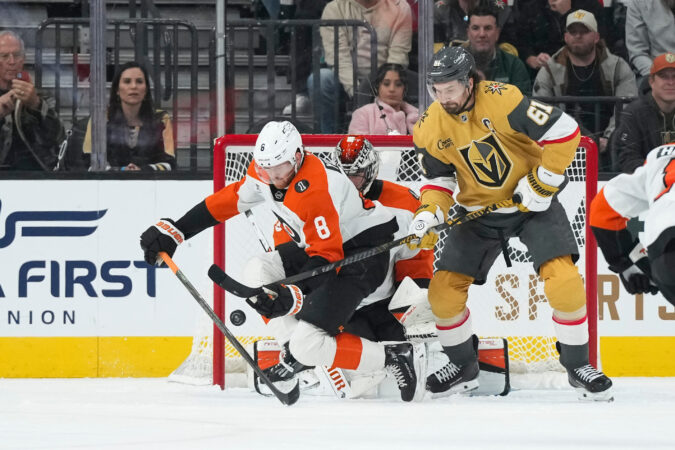
Flyers defenseman Emil Andrae and left wing Noah Cates sandwich Golden Knights center Jack Eichel during the second period.
But when you’re facing the fourth-best power play in the NHL, and you allow just one goal on seven power plays, that’s pretty darn good. And one of those penalty kills was in the last 1 minute, 33 seconds of the game when Owen Tippett sent the puck over the glass — in a one-goal game. The Flyers made two big blocks during that kill, one by Seeler and one by Cam York.
The structure was better as they didn’t collapse or shift into the box too often; coach Rick Tocchet likes to employ the diamond on the penalty kill. According to Natural Stat Trick, Vegas had 12 shot attempts, five shots on goal, seven scoring chances, and five high-danger chances. But in the end, the Flyers and Golden Knights each got a goal while the home team was on the man advantage.
“Obviously, on the PK you’re going to have to give up some shots. So just knowing which ones we want to kind of give up and the ones we need help to take away,” Ersson said. “Like a lot of our penalty kill, I think we build on like our urgency and our willingness to block shots. I think that’s huge for us to have success.
“And we did that tonight, and it kind of leads the way and gives so much momentum to the team when guys put their body on the line like that.”
3. Nick Seeler
Speaking of guys who like to lay their body on the line, Seeler came up big in several ways Monday.
Although Tocchet had shown different defensive pairings during recent practices and morning skates, he stuck to his pairings. Seeler was paired with Noah Juulsen and was on the ice during the final 1:33 of the game. Seeler slid and made a massive block with 44 seconds left on a Shea Theodore shot to preserve the win.
But it was earlier in the game when he made the biggest play.
In the second period, he faced a two-on-one when Juulsen pinched down the right boards. Seeler was the lone man back facing two of Vegas’ best in Ivan Barbashev and Mark Stone. He stayed on his feet and blocked the Stone pass intended for Barbashev across the crease.
It was a big moment in the game but also a big moment considering what Tocchet said Saturday after the loss to the Rangers.
“We’re just doing things,” an exacerbated Tocchet said. “Even on two-on-one, the guys on the outside site, why are you leaving your feet and letting them pass [across]? Just hold them; that’s something we’ve really worked on this year and have done a good job.
“But now we’re sliding again, and we’re trying to block a shot now. How many weakside goals have we been giving up lately? That’s something that I’ve been preaching since the start of the year: You cannot give weakside goals up.”
The play was huge as it kept it a one-goal game.
“Yeah, [Tocchet] likes the D to try not to leave their feet,” Seeler said. “Obviously, there’s situations where you need to desperation-wise, but, yeah, it’s good. It’s nice to break those up and get going the other way.”
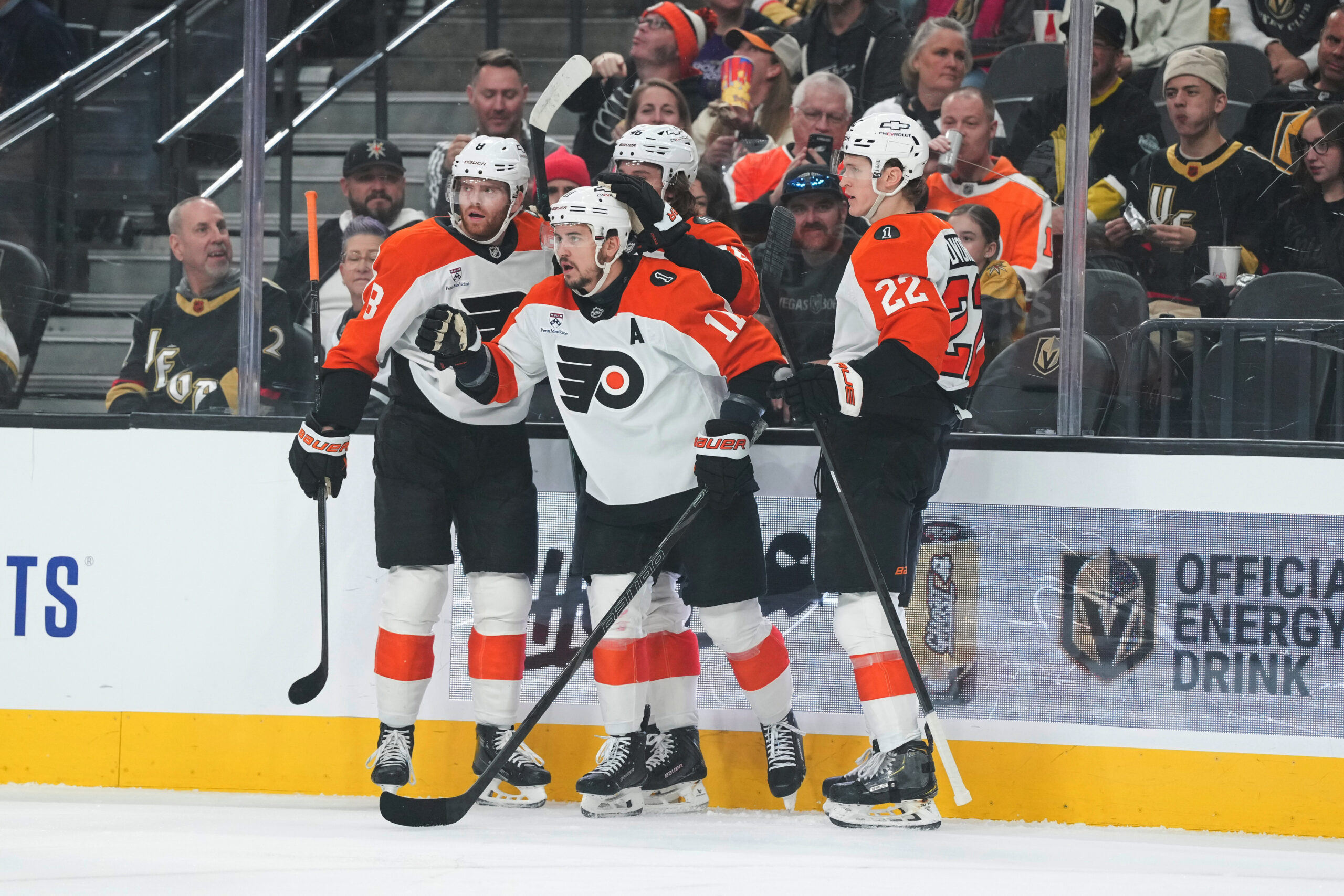
Flyers right wing Travis Konecny (11) celebrates his first goal against Vegas during the first period.
2. Travis Konecny
From the onset, it looked like the alternate captain was determined and focused on ending the losing streak. In the end, he led the way with a pair of goals, each scored off turnovers by the Golden Knights.
His first goal came off a Hertl turnover just inside the Flyers blue line as the Czech center tried to pass to Vegas defenseman Kaedan Korczak. Konecny poked the puck away from Korczak and took off. He skated in one-on-one with goalie Adin Hill and beat him glove side to open the scoring 3:46 into the game.
“I wanted to make sure I had a good start, our line had a good start, because that had been something that was creeping into our game that we were struggling with,” Konecny said.
In the third period, he picked off an errant pass by Eichel during a Vegas power play and took off again. This time he went blocker side because he was “just trying to mess with [Hill’s] head a little bit.” Konecny knows Hill, who was also his teammate at 4 Nations, and his father, as the Flyers forward spends his summers in Calgary, where the Golden Knights goalie grew up.
“Yeah, he’s a great player,” Couturier said. “That’s what he does, he scores goals, uses his speed well. And what I love about it is, his two breakaway goals he’s in the right spot defensively and jumps on loose pucks and reads and reacts the right way and gets rewarded.”
1. Sam Ersson
Nine days ago, after allowing seven goals on 23 shots to the Tampa Bay Lightning, Ersson spoke to The Inquirer. He called his season tough and the loss to Tampa Bay embarrassing. Nineteen games into the season, he was 6-8-4 with a bloated 3.43 goals-against average and an NHL-worst .855 save percentage among goalies who played in at least 15 games.
With Dan Vladař on injured reserve with an undisclosed injury, Ersson got a chance to right the ship on Monday. And it was evident from the jump that this night would be different.
Vegas defenseman Jeremy Lauzon skates with the puck ahead of the Flyers’ Matvei Michkov.
In the first minute of play, he made a confident save on defenseman Noah Hanifin before stopping a Stone tip-in from seven feet out.
“It’s a nice way to get in the game, get in a groove and a flow of the game, getting some shots early, and obviously nice to come up with some big stops,” Ersson said. “So it definitely helps [with confidence].”
The Swedish netminder moved well, tracking the puck and positioning his body well in advance of shots. According to Natural Stat Trick, he stopped 12 of 13 high-danger shots. He finished with 24 saves.
“Awesome. Again, we know it. He just proved us all right,” Konecny said. “He’s an unbelievable guy, unbelievable goalie, and, guys that work hard like him, who are just like the most likable guys, you really want to push for those guys, and I’m just really happy for him. Awesome teammate and stud goalie.”
Ersson earned a lot of praise from his coach postgame.
“Nobody’s going to feel sorry for Sam. He doesn’t have that attitude,” Tocchet said. “It’s almost like he’s got that closer mentality. I’ve given up a bunch of home runs, but I want the ball again. And he took the ball and closed the game for us.”
The clothing company founded by Kim Kardashian will pay $200,000 to end an investigation accusing it of charging New Jersey customers sales tax for a period of five years, even though clothing is exempt under state law.
The New Jersey Office of Attorney General accused Skims Body of improperly collecting sales tax between 2019 and 2024. The 6.625% levy applies to most consumer goods, but clothing and footwear for human use — including Skims’ underwear and shapewear — are largely exempt.
The attorney general’s office said that Skims engaged in “unconscionable business practices.” But the company said it “mistakenly” collected the taxes for half a decade, according to the consent order.
“As prices on everything from clothing to groceries soar, our office is committed to protecting our residents from unlawful practices that drive up the prices they pay at the register,” said New Jersey Attorney General Matthew Platkin in a statement.
The tax collection was due to a “technical error,” a Skims spokesperson said in a statement. The company fixed the error and said it is proactively reaching out to all affected customers to provide refunds.
“We remain deeply committed to the highest standards of compliance and have implemented enhanced safeguards to prevent any recurrence of similar issues,” the spokesperson said.
Skims agreed to pay $200,000 to close the investigation, according to a consent order dated Jan. 16. The agreement also requires the company to “use best efforts” for the next four years to refund customers.
The sales tax collected by Skims has already been remitted to the New Jersey Division of Taxes, the attorney general’s office said.
The company had been issuing refunds to New Jersey customers who complained about the sales tax charge even prior to the agreement, according to social media posts.
The apparel brand is valued at $5 billion, according to Fortune, and serves mainly Gen Zers and millennials.
Ryan Ogle, the PGA of America’s tournament director for the 2026 PGA Championship, announced his resignation via LinkedIn on Friday, four months before the Aronimink Golf Club outside of Philadelphia is set to hold the championship.
The historic golf course last hosted the PGA Championship in 1962.
“For the last year and a half,” Ogle wrote, “I’ve had the incredible privilege of leading the 2026 PGA Championship. We’ve been building momentum, telling the story of the event, and I’ve been sharing the journey with all of you right here on LinkedIn. That’s why this is a difficult message to write … in a few days, I will be stepping away from the PGA of America.”
Ogle, who cited the need to settle down and plant roots, is the third PGA of America executive to step away in recent months, following the departures of chief commercial and philanthropy officer Jeff Price in December and CEO Derek Sprague in January.
“I’ve reached a point where planting roots has become more important than planning the next move. I’ve decided to accept a new opportunity that allows me to finally settle my family in a permanent home while taking a significant step forward in my career,” he wrote.
Ogle moved to Newton Square in September 2024 to prepare for the championship — marking his family’s eighth relocation in 13 years. Ogle previously directed the PGA Championship in 2024 and in 2021.
The PGA of America has not announced replacements for any of the three vacancies.
“We would like to congratulate Ryan Ogle and wish him the best with his new opportunity,” the association said in a statement obtained by The Inquirer. “We’re grateful for his leadership and contributions to numerous PGA Championships, including the 2026 PGA Championship at Aronimink.
“Championship planning remains fully on track, supported by an experienced leadership team. We’ll share more about next steps at the appropriate time.”
The championship is set for May 14-17, marking the first major championship in the area since the 2013 U.S. Open was held at Merion Golf Club. Last spring, the PGA Tour hosted one of its signature events, the Truist Championship, at Philadelphia Cricket Club in Flourtown.
This year’s event joins a busy 2026 as one of many major sporting events coming to Philadelphia during America’s 250th celebration.
Dien has accepted a consulting opportunity and was not available for an interview on Tuesday. The museum had no further details to share, a spokesperson said.
The change is the first in the senior executive team since veteran museum and nonprofit leader Daniel H. Weiss was brought in as director and CEO about eight weeks ago.
The museum is currently mulling whether to keep or alter the rebrand, Weiss said in a recent interview.
Dien, who was previously vice president of advancement and partnerships at the Grammy Museum in Los Angeles, oversaw the Art Museum’s name change and new visual identity. He and Suda had hoped the museum’s rebrand would revive sagging attendance after its unveiling in early October.
“It’s going to bring people in and help put us more clearly on the map,” Suda said at the time.
“We have so much research that shows there is this brand perception that we’re the castle on the hill,” Dien said last November, during the rebrand’s rollout. “And so my job right now is [to ask], ‘How do we come down the steps and meet people where they’re at?’”
New signage in the Art Museum’s cafe, Oct. 6, 2025.
But the campaign was widely — though not universally — mocked.
A Hyperallergic story carried the headline: “People Really Hate the Philadelphia Art Museum Rebrand.”
A review in trade blog Brand New praised the rebrand, saying that it infused the museum with a “much needed, new, distinct, and energetic identity that was sorely missing.”
The rebrand, designed by Brooklyn-based branding and design firm Gretel, came with a name change for the institution, from Philadelphia Museum of Art to Philadelphia Art Museum, as well as a shorthand moniker — PhAM, which the museum has used for its new web address, visitpham.org, and in some marketing materials.
That drew an unfortunate joke moniker from wags — PhArt.
“We are an amazing museum with an amazing collection, amazing curators, and an amazing experience, and it’s really a shame, the jokes and negative reaction to the rebranding,” said museum trustee Yoram (Jerry) Wind a few weeks after the rebrand was introduced.
Another board member, Jennifer Rice, expressed support for it shortly after its launch.
“I do like it. I love the tagline ‘Wall to Wall Art for All.’ I like that it feels fresh and feels new and feels like it would connect with the audience we’ve had trouble connecting with,” Rice said
Some critics complained that a new logo inspired by the griffin figures adorning the building’s roofline looked less like that of an art museum and more reminiscent of a beer label or soccer team emblem.
“Please no food or drink in the galleries” sign outside the cafe at the Philadelphia Art Museum, Oct. 6, 2025, showing the museum’s rebrand graphics.
The rebrand, including the name change, new logo, and bolder graphics, also comprises a series of punchy taglines, like “Made You Look” and “Revolutionary Since 1876.”
Weiss has set up a task force of board and staff to evaluate the rebranding to “take a look at how it’s playing, what works, what doesn’t work, to do some analytical work around that and get a sense of how our various constituencies are perceiving it, recognizing that almost any rebrand is controversial at first,” he said. “The question is whether we’re in the territory of a rebrand that is counterproductive to our ambition or not.”
Their findings will be presented to the board for discussion on whether “we stay as it is now or make changes.”
Suda was ousted as director and CEO in November, three years into her five-year contract. She filed a wrongful-dismissal lawsuit against the museum about a week later.
If you’re starting to absorb the headlines, or embarking on your early-week doomscroll, you’re probably seeing a lot about Greenland.
President Donald Trump’s longtime interest in the Arctic island seems to be louder — and bolder — than ever, sparking a major geopolitical standoff.
But how did it all start? And where do things stand? Here are all your questions answered, so you’re prepared the next time someone asks you about Greenland.
How did Denmark acquire Greenland?
Greenland has been home to native peoples who crossed the Arctic from what is now Canada, Norse settlers, Lutheran missionaries, and U.S. military personnel who used it as a base to protect the United States from Nazi Germany and the Soviet Union.
As for when Denmark stepped in, the short answer is that Denmark’s control started with a colonial settlement, was formalized in 1953, and the agreement has since evolved into a self-governing structure with the Danish.
In the 1700s, a Danish missionary arrived in Greenland and started lining up settlements and establishing Danish colonization. Through most of the 18th and 19th centuries, Greenland was controlled by the Danish. The relationship was formally recognized by Denmark after World War II. In 1953, the island was fully incorporated as a Danish territory, giving Greenlanders Danish citizenship.
Things changed in the late 1970s. In 1979, Greenlanders voted in favor of home rule, establishing a local government. In 2009, Greenland earned even more autonomy, achieving self-government status. This stands today, with Greenland remaining part of Denmark but overseeing its own internal affairs. Denmark oversees defense and diplomacy issues, unless the regions opt to partner on an issue.
Is Greenland bigger than the United States?
Greenland is pretty big, but not bigger than the United States
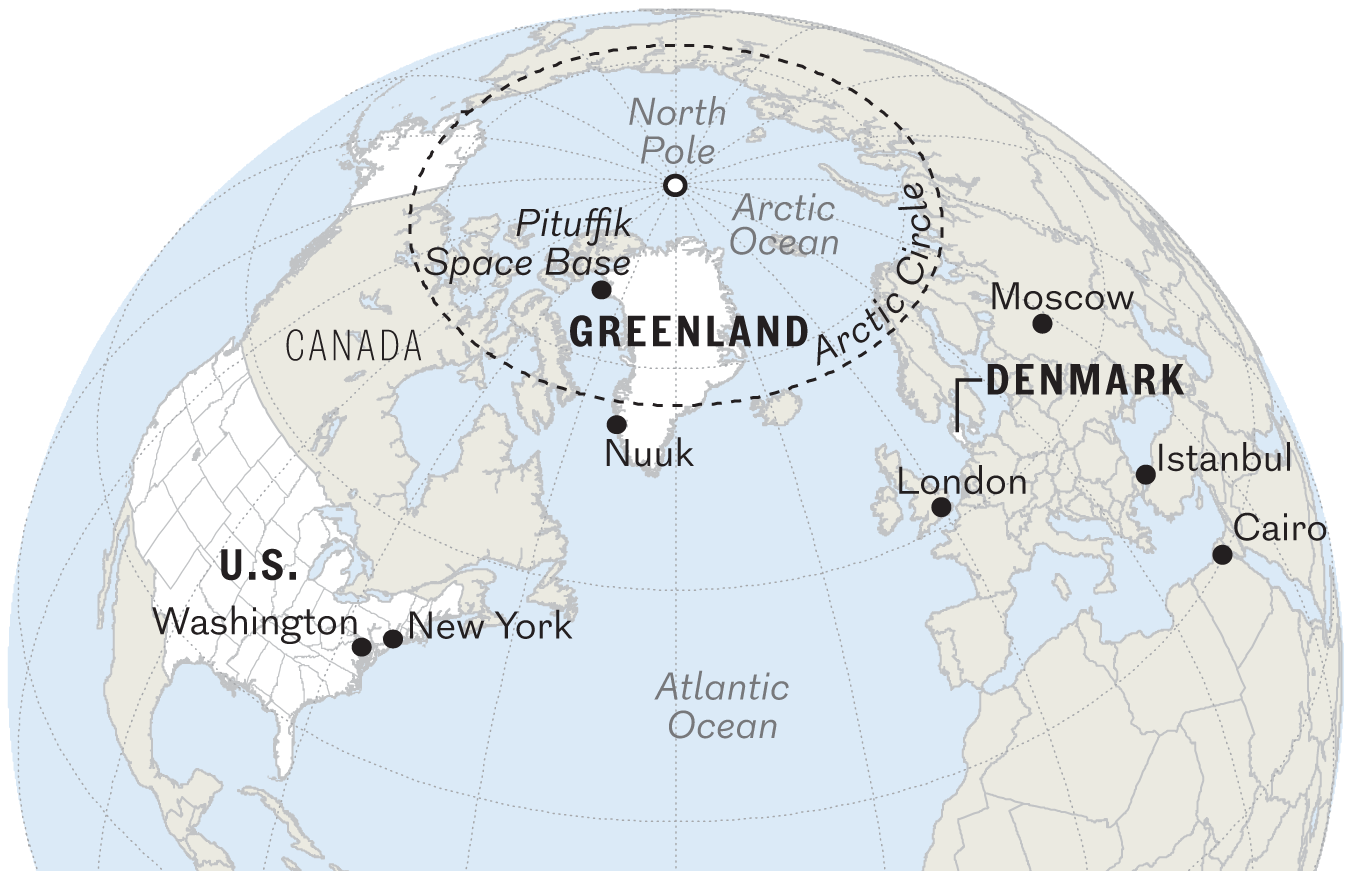
It is considered one of the biggest places in the world by geography and is about 20 times the size of Denmark, according to the territory’s tourism website. The island stretches about 836,000 square miles.
Map of Greenland, the U.S., and Denmark.
It is the world’s largest island that isn’t a continent and is larger than France, Germany, Spain, and the United Kingdom combined. It is also larger than the state of Alaska.
But, no, it’s smaller than the contiguous United States. All in all, the United States is about 4.5 times larger than Greenland.
The island has a population of roughly 56,480, according to the CIA. It is among the least densely populated countries in the world.
What natural resources does Greenland have?
Greenland is home to a bounty of natural resources, including oil, gas, and rare earth minerals. Those minerals are used for making batteries, electric vehicles, and other high-tech items, according to the New York Times. Currently, China dominates the global market for those minerals, meaning there is a reliance on China to source them.
Vice President JD Vance has touted Greenland’s “incredible natural resources” in the past. Last year, Republican senators held a hearing focused on Greenland’s importance and its rare earths.
But Greenland has only a few roads and ports, and environmentalists are opposed to developing on the island. That means mining and oil extraction in Greenland may not be productive.
Does the U.S. military have a base in Greenland?
Yep.
Formerly known as the Thule Air Base, the Pituffik (pronounced bee-doo-FEEK) Space Base was renamed in 2023 during the Biden administration to honor the native Greenlandic community and history.
It is the northernmost U.S. military installation and serves as an early warning missile detection site for North America. It is currently undergoing major upgrades.
How long has Trump talked about wanting Greenland?
It’s been awhile.
Trump first floated the idea of “buying Greenland” during his first term, comparing it to a “real estate deal.” When Danish leaders rejected his idea, he canceled a scheduled visit to Denmark in 2019.
When Trump began his second term, he spoke increasingly about his interest in the United States controlling Greenland, citing national security reasons.
But critics say his real intentions stem from personal feelings.
Is this really about Trump not winning the Nobel Prize?
Trump linked his aggressive stance on Greenland to last year’s decision not to award him the Nobel Peace Prize, telling Norway’s prime minister that he no longer felt “an obligation to think purely of Peace,” in a text message released Monday and verified by the White House.
Trump’s text to Jonas Gahr Støre, which he sent on Sunday, came a day after the president announced a 10% import tax on goods from the eight nations that have rallied around Denmark and Greenland, including Norway.
The text exchange, which was released by the Norwegian government, said in part: “Considering your Country decided not to give me the Nobel Peace Prize for having stopped 8 Wars PLUS, I no longer feel an obligation to think purely of Peace.” He concluded, “The World is not secure unless we have Complete and Total Control of Greenland.”
The Norwegian leader said Trump’s message was a reply to an earlier missive sent on behalf of himself and Finnish President Alexander Stubb, in which they conveyed their opposition to the tariff announcement, pointed to a need to de-escalate, and proposed a telephone conversation among the three leaders.
White House deputy press secretary Anna Kelly said of the text exchange that Trump “is confident Greenlanders would be better served if protected by the United States from modern threats in the Arctic region.”
Norway has since reaffirmed its support for Denmark and Greenland.
Also, for what it’s worth, the Nobel Peace Prize is awarded by an independent committee, not the Norwegian government.
Speaking Monday night to reporters before boarding Air Force One on his way back from Florida to Washington, Trump backtracked and said he didn’t “care about the Nobel Prize.”
What is Trump saying about Greenland now?
He’s doubling down.
Monday night, Trump took to his Truth Social platform and made a series of posts about how there was “no going back” when it comes to his push to take control of the island. He also posted private text messages he received from French President Emmanuel Macron and the head of NATO, and an AI-generated image of the American flag over Greenland and Canada.
Following Macron’s questioning of Trump’s approach, Trump suggested he could impose a 200% tariff on French wines.
Trump also announced he would meet with “various parties” to discuss Greenland during the World Economic Forum in Davos, Switzerland, this week.
On Tuesday, Trump held a nearly two-hour news conference, but largely did not acknowledge his stance on Greenland until asked by reporters.
He repeated his position that the U.S. needs to take control of the territory for the sake of national security.
“I think that we will work something out where NATO is going to be very happy and where we’re going to be very happy,” Trump said toward the end of the news conference.
Macron this week called for an emergency meeting in Paris with European leaders to address tensions with the U.S. over Trump’s pursuit to acquire Greenland in addition to increasing tariffs.
Trump told reporters he did not plan to attend the meeting and mentioned that Macron would not be leading France for much longer. Macron’s term ends in May 2027.
Do other politicians agree with Trump?
There is widespread disagreement over how Trump wants to handle Greenland.
Secretary of State Marco Rubio said the president wants to buy it, while top aide Stephen Miller suggested the U.S. could seize it by force. Vice President Vance’s discussion with Danish leaders last week ended in “fundamental disagreement.”
Several lawmakers across party lines have criticized Trump’s approach. GOP members, including Sen. Rand Paul of Kentucky and Rep. Mike Turner of Ohio, say the raised tariff threats could harm NATO and U.S. interests.
Rep. Don Bacon (R., Neb.) said last week that he would consider impeaching Trump if the U.S. invaded Greenland, describing the idea as “utter buffoonery.”
Sen. Lisa Murkowski (R., Alaska) called Trump’s coercive threats dangerous for alliances and “bad for America.” She and Sen. Jeanne Shaheen (D., N.H.) introduced bipartisan legislation that would prohibit the use of U.S. Defense or State Department funds to take control of Greenland or the sovereign territory of any NATO member state without that ally’s consent or authorization from the North Atlantic Council.
How are Greenland residents responding?
Copenhagen store owner Jesper Rabe Tonnesen wears a red cap for sale that he created with the slogans “Make America go away,” on the side, and on the front: “Nu det NUUK!,” a twist on the Danish phrase “Nu det nok,” meaning “Now it’s enough.”
Unsurprisingly, they’re not happy!
Over the weekend, hundreds of people in Greenland’s capital, Nuuk, braved near-freezing temperatures, rain, and icy streets to march in a rally in support of their own self-governance.
Thousands of people also marched through Copenhagen, many of them carrying Greenland’s flag. Some held signs with slogans such as “Make America Smart Again” and “Hands Off.”
A spoof Make America Go Away red cap in the style of Trump’s original MAGA campaign hat is surging in popularity in Denmark and has become a symbol of Danish and Greenlandic resistance.
“This is important for the whole world,” Danish protester Elise Riechie told the Associated Press as she held Danish and Greenlandic flags. “There are many small countries. None of them are for sale.”
The rallies occurred hours after a bipartisan delegation of U.S. lawmakers, while visiting Copenhagen, sought to reassure Denmark and Greenland of their support.
This article contains information from the Associated Press.
Late Thursday, within the hallways of One Citizens Bank Way, Phillies officials believed they were close to signing Bo Bichette.
How close?
“We were very close to having a deal done,” president of baseball operations Dave Dombrowski said Tuesday without divulging details. “We thought it was going to happen.”
Bichette, through his agent, informed the Phillies that he would sign if they met his seven-year, $200 million asking price, two major league sources confirmed. The team agreed. All that was left, according to a source with knowledge of the situation, was “crossing the T’s and dotting the I’s” on the Phillies’ offer to the star infielder.
That process was underway Friday when Bichette changed course, agreeing shortly before noon to a shorter-term (three years), higher-salary ($42 million per year) contract with two opt-outs from the Mets, who lost in their attempt to sign free-agent outfielder Kyle Tucker.
Most Phillies officials found out about it like the public did — through reports in the media.
“It’s a gut punch,” Dombrowski said. “I mean, you feel it.”
Bichette didn’t give the Phillies the chance to outbid New York. Even so, they wouldn’t have sprung for the fourth-highest annual salary in the sport or included opt-out provisions.
And that’s how the Phillies and J.T. Realmuto found their way back to each other.
Because the Phillies “almost certainly” were going to sign Bichette or Realmuto, not both, a major league source said. And if things had gone as they anticipated Thursday night, their longtime iron-man catcher would be meeting the media from a different city this week.
Yet here were Realmuto and Dombrowski, narrowly spared from divorce, trying to avoid sounding like staying together was more than a consolation prize for either side.
“Things got a little hairy there at the end, but I’m glad we’re back here,” Realmuto said. “This is where we wanted to be the whole time.”
Said Dombrowski: “We always wanted to bring J.T. back. That was always a priority for us. They knew it. We also knew that he wanted to come back. Just there was a disagreement as far as dollars were concerned.”
Indeed, Realmuto made a catcher-record $23.1 million per year since 2021. At age 35, amid a three-year decline at the plate, he conceded he would have to take a pay cut.
But Realmuto also believed a team should pay a premium for his strengths behind the plate, notably game-calling and handling a pitching staff, among the last intangibles that can’t be measured by metrics. The Phillies appreciate his skills in those areas, but valued it differently.
“We couldn’t bridge that gap,” Dombrowski said.
It led the Phillies to Bichette, with whom they met over a Zoom call on Jan. 12. The positional fit didn’t seem obvious earlier in the offseason. Bichette has only ever played shortstop. But as talks with Realmuto stalled, the Phillies began thinking about improving the roster in other ways.
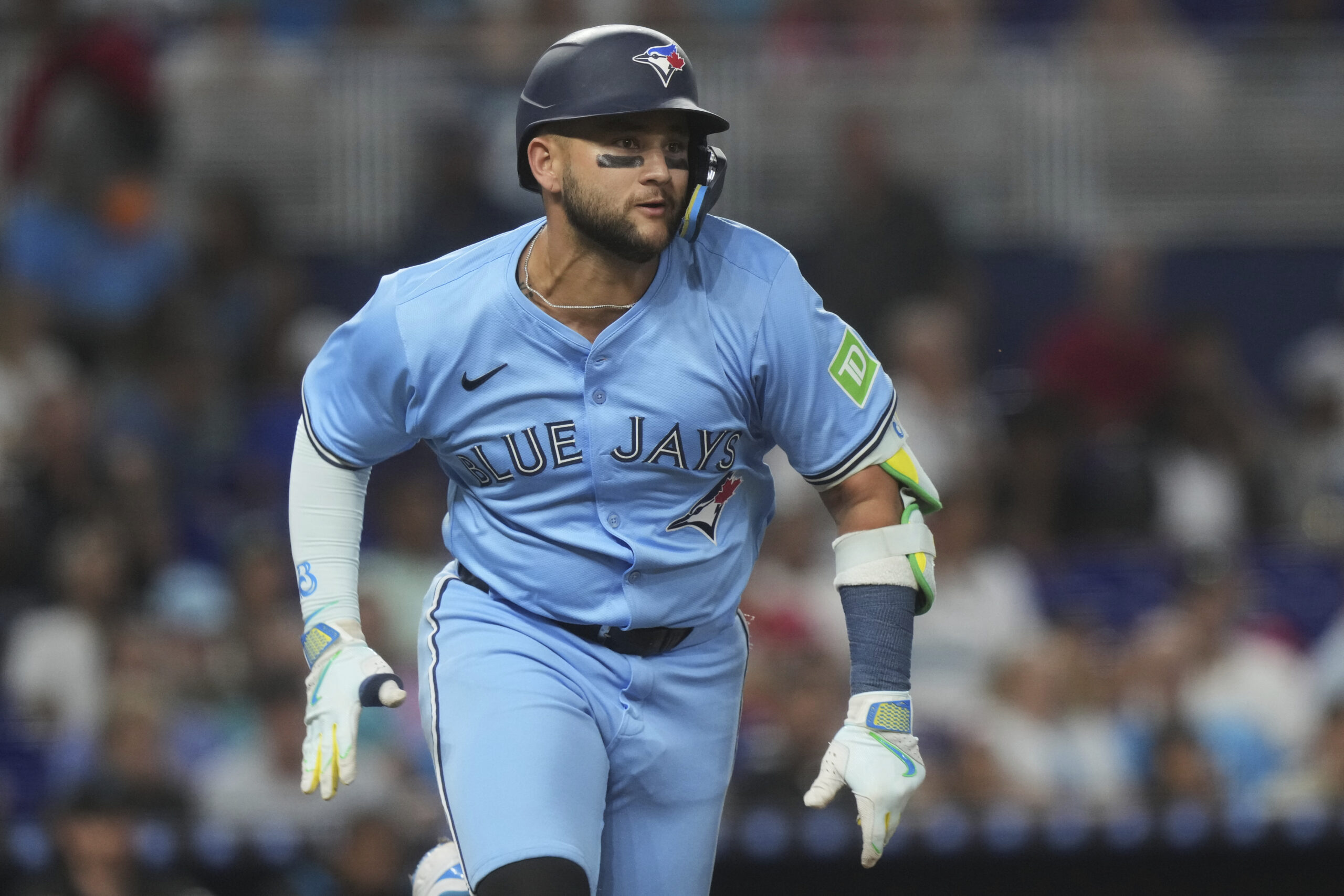
A shortstop with the Blue Jays, Bo Bichette would have played third base with the Phillies.
The Phillies would have played Bichette at third base and displaced Alec Bohm, who likely would’ve been traded. And Bichette was open to switching positions. The Zoom meeting went well enough that Dombrowski called Realmuto’s agent to inform him the Phillies might be going in another direction. Things began to get more serious.
Or did they? Given how it all turned out, did Bichette use the Phillies as a stalking horse to get the deal he wanted from the Mets?
“I can’t [say that] because you never know 100% what’s going on from their perspective,” Dombrowski said. “I do think he was sincere about thinking about coming to Philadelphia. Yes, I do. I think he was. We were at the numbers that they really asked us to match. [The Mets] jumped in at the last minute and made him a short-term offer that was very appealing to him.”
Some within the Phillies’ front office were furious. But Dombrowski said Bichette’s camp didn’t renege on a deal or negotiate out of bounds because the sides never reached the point of signing a “memo of understanding,” a document that would have preceded a completed deal.
“It wasn’t that we weren’t moving toward that direction,” Dombrowski said. “I did think that we were going to get there based upon our conversations. But we did not get to that point, so I can’t say that I ever thought we had it done.”
The Phillies thought their willingness to stretch the term of the contract to seven years with more guaranteed money would be an advantage over the Mets (or potentially the Dodgers if they hadn’t signed Tucker). It’s a tactic they used to help land other marquee free agents: Bryce Harper (13 years), Trea Turner (11 years), and Aaron Nola (seven years).
Instead, the Phillies missed out on a coveted free agent, a rarity since they signed Harper in 2019. They pivoted back to Realmuto within an hour of Bichette’s agreement with the Mets — “It was very quickly,” Dombrowski said — and bumped up their offer. They aren’t considering a run at any other big-ticket free agents, including Cody Bellinger.
Phillies president of baseball operations Dave Dombrowski said he was “upset” after finding out Bo Bichette picked the Mets, “but you have to pick yourself up and shake it off.”
They might actually be better off with Realmuto at the controls of the pitching staff than with Bichette’s right-handed bat in the lineup. Pitching, after all, remains the strength of the roster, and Zack Wheeler, Cristopher Sánchez, and others swear by Realmuto’s guidance.
Still, four days after Bichette slipped through the Phillies’ fingers, it was impossible to not hear the disappointment in Dombrowski’s voice.
“That day you are very … upset, I guess is the way to say it,” he said. “But you have to pick yourself up and shake it off. Because you can’t just wallow in what took place. So, after a day of feeling that way, or a time period, you need to move forward. That’s how you handle it.
“We did rebound in the sense that we signed J.T. right away. We’re very fortunate he didn’t sign somewhere else.”
In time, maybe it will start to feel more like it.
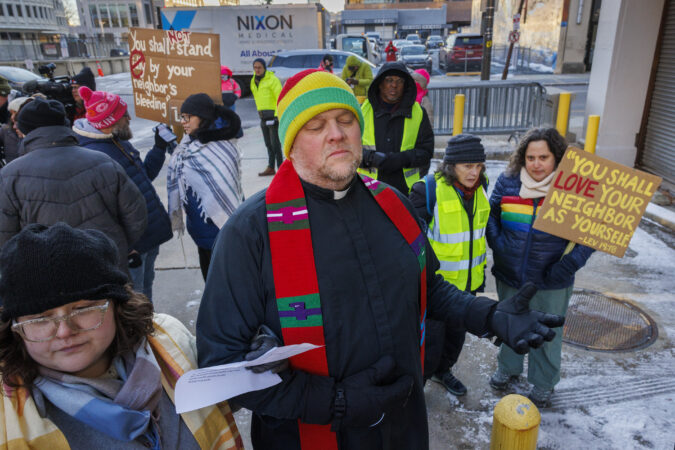
About 30 demonstrators blocked the garage doors at the Philadelphia ICE office Tuesday morning, saying they intended to stop agency vehicles from going to “terrorize” local residents.
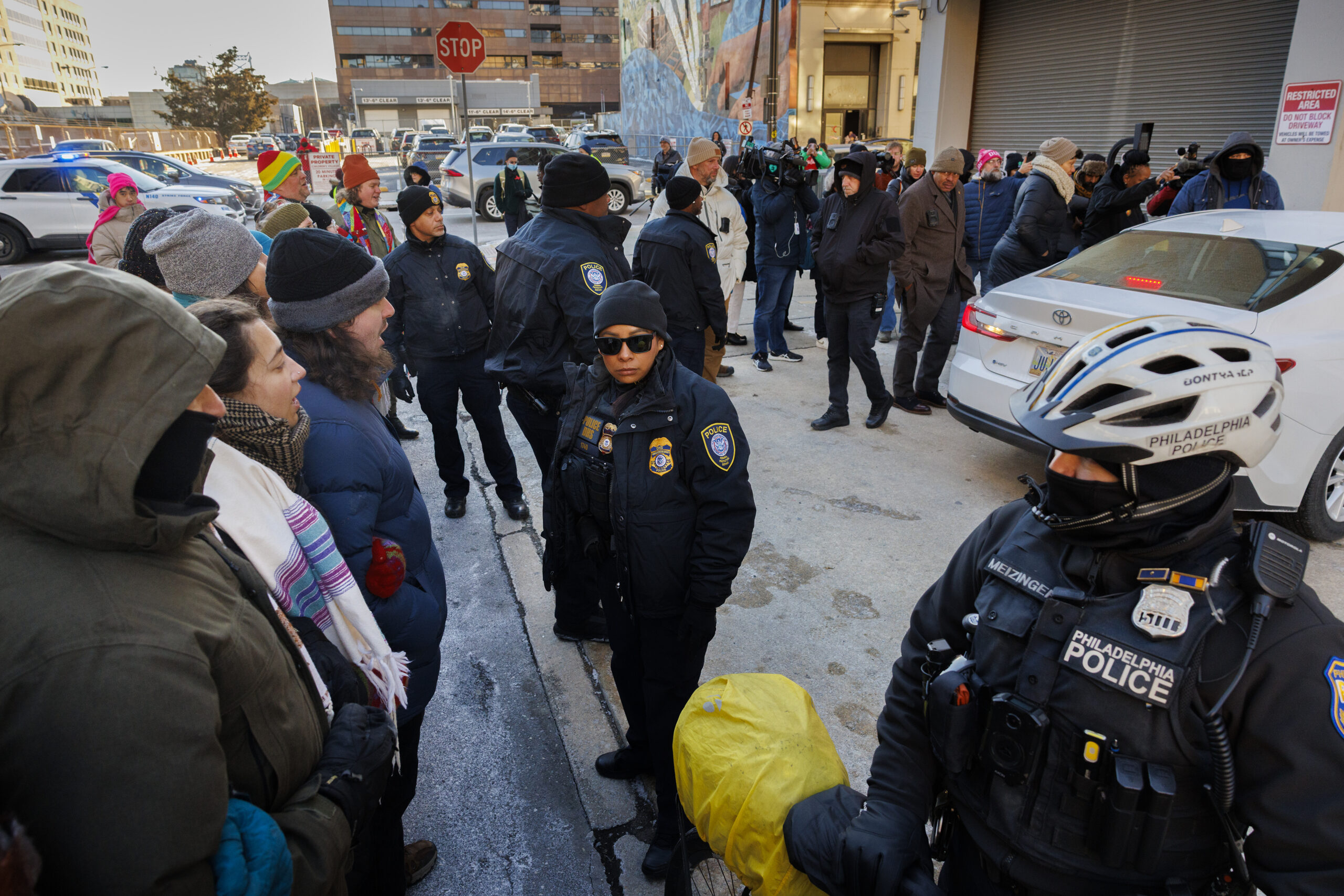
Only one car attempted to leave, and Philadelphia police moved demonstrators aside so it could depart.
No one was arrested.
Organizers with No ICE Philly had pledged to block the garage until they were forcibly removed or arrested, but halted the protest after about two hours. They said that they had accomplished their goal, and that the bitterly cold weather was too harsh on demonstrators who are older or who have medical conditions.
Demonstrators with No ICE Philly block the garage at U.S. Immigration and Customs Enforcement at 8th and Cherry Street, Philadelphia, Tuesday, Jan. 20, 2026.
The temperature was about 15 degrees when the protest began shortly before 8 a.m.
“All of us here have proven in our song and our prayer that we can slow down the machine of authoritarianism, of fascism, that we can delay the operations that will detain and kidnap and destroy our neighbors, our families, our community,” said the Rev. Jay Bergen, a leader of No ICE Philly and pastor of the Germantown Mennonite Church.
The protest was the latest in a string of anti-ICE demonstrations and vigils in the Philadelphia region; another was planned in Norristown on Tuesday evening. In October, a No ICE Philly protest outside the agency headquarters erupted into physical confrontations with police, with several people knocked to the ground and four arrested.
Immigration and Customs Enforcement officials did not reply to a request for comment Tuesday.
The clergy-led protest was boosted by City Councilmember Nicolas O’Rourke, who is a pastor of the Living Water United Church of Christ in Oxford Circle.
O’Rourke said that it was natural for him to join fellow clergy, that Tuesday’s action was part of a long tradition of faith leaders being at the forefront of the “struggle against oppression,” as led by the Rev. Dr. Martin Luther King Jr. and others.
Philadelphia Police and Department of Homeland Security officers block demonstrators from No ICE Philly as they attempt to block vehicles from leaving the garage at U.S. Immigration and Customs Enforcement at 8th and Cherry Street, Philadelphia, Tuesday, Jan. 20, 2026.
“We are a day after King’s day, and it’s important that we don’t just wax eloquent about the nice things that King said or the image that he’s been painted of now,” he said, “but we continue in that tradition of resisting the oppression as he saw it, we’re doing in our own time.”
The group locked arms and sang, offering prayers and songs of peace and affirmation.
The Rev. Hannah Capaldi, minister at the Unitarian Society of Germantown, noted that all around her were clergy of different faiths wearing collars, tallits, and stoles.
“We’re saying, listen, we have some level of moral authority in this city, and we’re trying to tell you where to look and what to pay attention to,” she said.
The Rev. Jonny Rashid, a protest organizer, outside of U.S. Immigration and Customs Enforcement at 8th and Cherry Street, Philadelphia, Tuesday, Jan. 20, 2026.
Capaldi hoped to plant “seeds of resistance” in the broader public, encouraging people to get involved.
“We need more people every day willing to do this,” she said, “to stand between the vehicles and the work that they’re doing to kidnap our neighbors.”
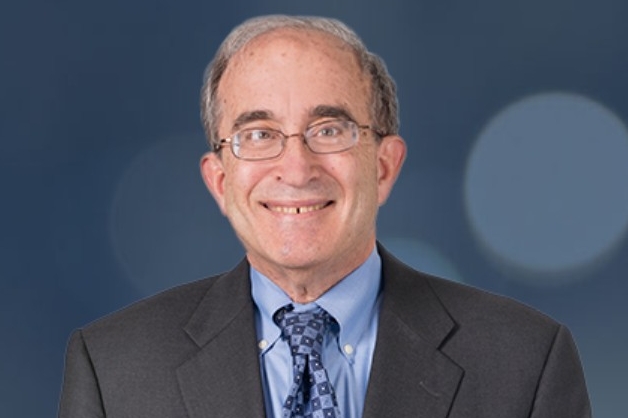
Daniel Segal, 79, of Philadelphia, cofounder and shareholder of the Hangley Aronchick Segal Pudlin & Schiller law firm, adjunct law professor at the University of Pennsylvania, former cochair of the Philadelphia Soviet Jewry Council, onetime board president at the Juvenile Law Center, mentor, and “mischievous mensch,” died Thursday, Jan. 8, of stomach cancer at his home.
Born and reared in Washington, Mr. Segal moved to Philadelphia in 1976 to teach at what is now Penn Carey Law School. He went into private law practice in 1979, became cochair of a litigation department in 1993, and joined with colleagues in 1994 to establish Hangley Aronchick Segal & Pudlin.
For more than 40 years, until his recent retirement, Mr. Segal handled all kinds of cases for all kinds of clients, including The Inquirer. He was an expert in juvenile law, defamation, the First Amendment, professional ethics, education, civil rights, and other legal issues.
He was president of the board at the Juvenile Law Center and worked pro bono for years, beginning in 2009, to help represent more than 2,400 juvenile victims and win millions of dollars in settlements in what is known as the Luzerne County “kids-for-cash” case. In that case, two judges were convicted of taking kickbacks for illegally sending juveniles to two private for-profit detention facilities.
“This is one of the worst judicial scandals in history,” Mr. Segal told The Inquirer in 2009. “The people you’re stepping on are the true, true little guys.”
Mr. Segal was honored in 2010 by the Philadelphia Bar Foundation.
Among his other notable cases are a 1985 workplace racial discrimination dispute, a 1990 libel case against The Inquirer, and a 2000 trial about the city taxing outdoor advertisers. “Dan Segal was a living testament to professional excellence,” said Mark Aronchick, his law partner and longtime friend.
Law partner and friend John Summers said: “He was a great teacher and mentor.” Marsha Levick, cofounder of the Juvenile Law Center, said: “He was a brilliant, steady partner who made us smarter and kept us laughing.”
Mr. Segal clerked for Chief Judge David Bazelon in the U.S. Court of Appeals for the District of Columbia Circuit in 1974 and for Supreme Court Associate Justice Thurgood Marshall in 1975. He was active with the Philadelphia Bar Association, Philadelphia Common Pleas Court, and the Penn Law School American Inn of Court.
He wrote articles for legal journals and letters to the editor of The Inquirer and Daily News. He spoke at panels and conferences, earned honors from legal organizations and trade publications, and was named the Thomas A. O’Boyle adjunct professor of law at Penn in 1992.
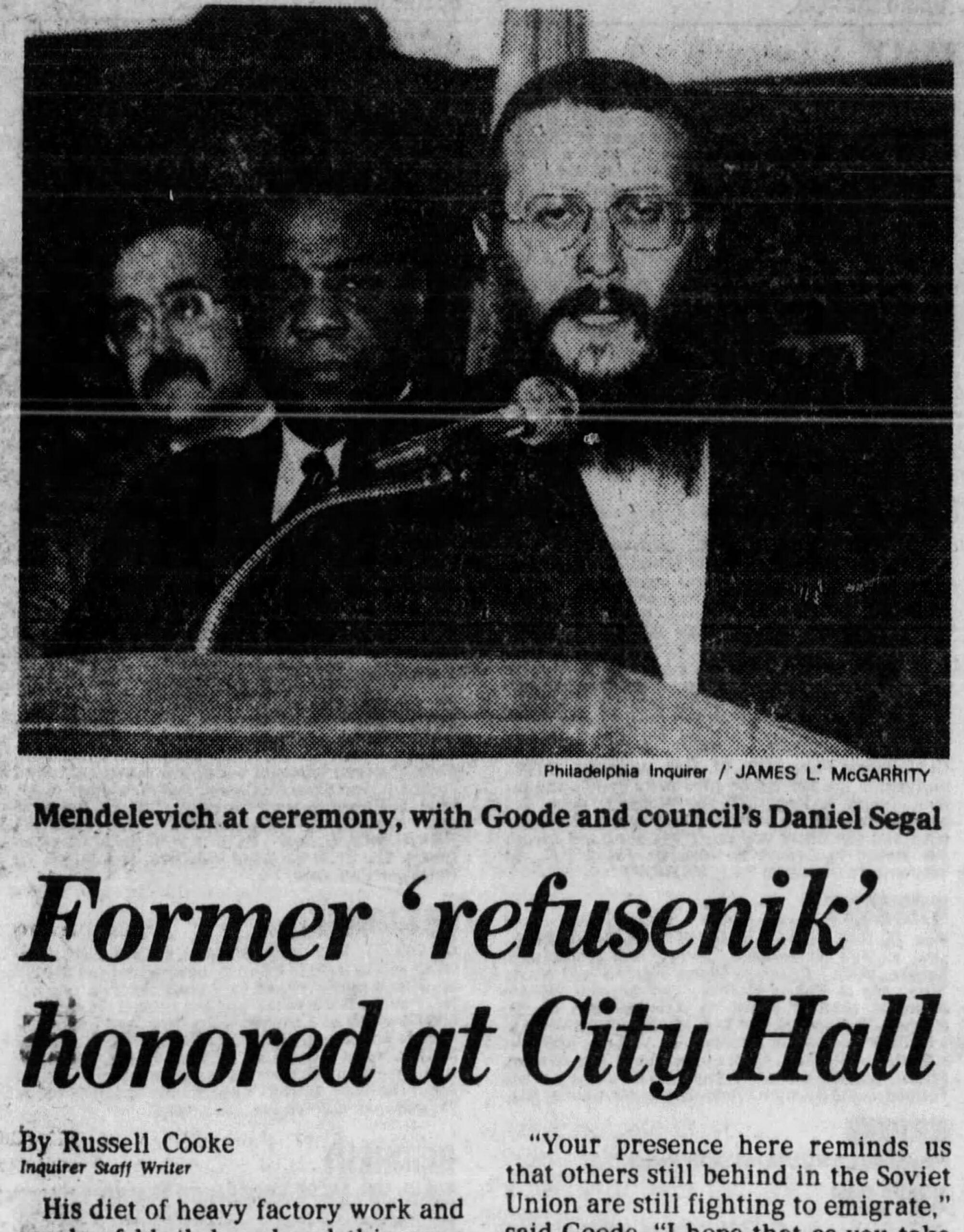
This story and photo features Mr. Segal (left) and appeared in The Inquirer in 1984.
The son of a rabbi, Mr. Segal was cochair of the Soviet Jewry Council in the 1980s, and he organized rallies and marches for social justice and human rights. He traveled to Israel often and to the old Soviet Union several times to secretly support Jews not permitted by government officials to immigrate to Israel.
“We are persuaded that the Soviet Jews are pawns in the Soviet-American relationship,” he told The Inquirer in 1985.
He served as president of the board of directors at what is now Jack M. Barrack Hebrew Academy and held leadership roles with the Jewish Community Relations Council, the New Israel Fund, Mazon: A Jewish Response to Hunger, and other organizations.
Colleagues at the New Israel Fund praised his “characteristic kindness” and “gentle and sparkling humor” in an online tribute. They said: “He was everyone’s favorite board member.”
Mr. Segal and his wife, Sheila, married in 1968.
Mr. Segal enjoyed pranks and funny jokes, even at work, and neighbors called him Silly Dan. His son Josh said: “His warmth, humor, and humility meant that he could connect with just about anyone.” A friend said he was a “mischievous mensch.”
He earned his law degree in 1973 and was executive editor of the Law Review at Harvard University Law School. He earned a bachelor’s degree in politics and economics at Yale University in 1968 and a master’s degree in international relations from the London School of Economics in 1969.
He taught elementary school for a year in Washington and spent another year in Europe before moving to Philadelphia. “He taught us just how important it is to stand up for what is right,” his son Eli said, “and to do so not only with conviction but with humility and kindness, and without a thought of getting personal credit.”
Daniel Segal was born July 4, 1946. He started dating Sheila Feinstein in ninth grade, and they married after college in 1968. They had sons Josh and Eli, and lived in Center City and Lower Merion before moving to Fairmount in 2018.
Mr. Segal’s sons said: “Our dad showed us that relationships are the heart of a life well-lived by nurturing lifelong friendships.”
Mr. Segal loved chocolate and ice cream. He recovered from a traumatic brain injury 20 years ago, and he and his wife traveled to Iceland, Peru, Vietnam, Europe, Japan, and elsewhere.
He doted on his family and friends, and he and his wife rented vacation places every summer to bring his sons and their families together. “Neither of us were surprised that our dad always made our kids feel so loved,” his son Eli said. “Because that was just how he made us feel.”