Tag: topic-link-auto

  • What’s a billion-dollar loan really worth? For private credit funds, it depends on who’s counting

    What’s a billion-dollar loan really worth? For private credit funds, it depends on who’s counting

    As pension funds and other investors have cut back new private equity investments after years of poor returns, Wall Street private equity managers such as Apollo Global, Blackstone, and KKR have moved more heavily into corporate lending.

    They compete with banks to make loans but aren’t bound by the rules that govern banks. The managers bundle the loans into private credit funds and offer them to investors as an alternative.

    “Everyone has shifted to private credit,” which should make investors extra careful, warns Richard Vague, chairman of Pennsylvania’s $80 billion school pension system, PSERS.

    Scholars at Yale Law School cite estimates that private credit funds are approaching $2 trillion in assets, up from $300 billion in 2010, and they’re on track to double in the next two years.

    As private credit funds have grown, analysts warn that limited information about the loans makes it hard to know what the credit funds are worth or how they would respond to a slowing economy.

    For example, Philadelphia-based FS KKR Capital Corp., one of the largest and oldest private credit funds, and two of its rivals have won unwelcome attention for posting very different prices for their investments in the same Silicon Valley private-equity takeover loan.

    Such ambiguity doesn’t exist in publicly traded securities such as stocks, where investor assumptions are reflected in the market price at any given time. The conflicting private-credit valuations suggest analysts aren’t certain about how likely the private credit funds are to get their money back or to lose money if loans default.

    “Risk is on the move. We’re talking trillions‚” Mark Pinto, head of private credit at Moody’s Investors Service, told clients in a recent report.

    Different from banks

    While banks have rules for measuring and publicly reporting loan losses and late payments — and private credit managers say they, too, apply strict internal standards — Moody’s analysts in that report called private credit loan reporting “opaque.” They cited private credit risk as a rapidly growing area of concern to financial systems.

    The rapid growth is new, but private credit has long history.

    FS KKR was set up as a publicly traded business development company and opened to investors in 2009 by Future Standard (formerly Franklin Square), a Philadelphia-based investment firm headed by Michael Forman and cofounded by college-housing baron and Sixers co-owner David J. Adelman.

    That fund is marketed by FS, but its investments are managed by staff at FS’s partner, private-equity giant KKR. It invests about $20 billion of FS’s total $86 billion in client assets, FS reported last year.

    While FS KKR paid shareholder dividends of 70 cents a share — or most of its profits in recent quarters — shares have lately traded around $15, down from the low $20s last year, a sign that investors are concerned about prospects in a slowing economy.

    In a widely reported example that points out the difficulty of measuring the value of the loans in these funds, FS KKR’s share of a loan to finance the 2021 purchase of Medallia, a Silicon Valley-based customer-service software company, was listed on KKR’s books last fall at 91 cents on the dollar, a discount of 9% to its original value, as confirmed in an SEC filing. A discount implies FS KKR has some doubt the borrower will pay its loans on time.

    But a rival Apollo Global fund listed the same loan at a 23% discount, as if Apollo saw a significantly higher risk that Medallia wasn’t going to pay.

    SEC records show a third private credit fund run by real estate giant and private-credit pioneer Blackstone listed the Medallia loan at an 18% discount.

    How can the same loan have three different values?

    Detailed public reporting on Medallia’s finances had almost stopped since yet another private-equity and private-credit investor, Chicago-based Thoma Bravo, paid $6.1 billion in 2021 for the company. Thoma Bravo took Medallia private and borrowed from FS KKR, Apollo, Blackstone and others to help fund the deal, Leyla Kunimoto, a former KPMG auditor noted in a post on her credit review platform, Accredited Investor Insight.

    That leaves investors trying to glean intelligence from limited information or trusting fund managers with their differing views and valuations.

    So what’s the loan really worth?

    KKR partner Daniel Pietrzak, who is both president and chief investment officer for FS KKR Capital Corp. and head of Global Credit at KKR, said pricing differences “can arise naturally” for loans that aren’t publicly traded.

    Factors include “variations in valuation providers, timing, policy nuances and available information,” he added in a statement. So, for example, one of the investors might know something others don’t.

    Pietrzak said KKR pays “independent third-party valuation providers as part of a robust and consistent process, which helps ensure valuations fairly represent asset value across our portfolio.”

    These specialized loan-value estimators include firms such as Lincoln International LLC in Chicago, Valuation Resource Corp. (VRC) in New York, and an affiliate of the Duff & Phelps advisory group.

    The Medallia loan totaled $1.8 billion at 6.5% interest. Many of the other loans in the funds are smaller and are used to finance midsized businesses, potentially spreading the risk if a few borrowers go broke, or compounding it in case of a widespread financial recession.

    FS KKR, like some other private-credit funds, “should incorporate higher discount rates for stressed credits,” including lower valuations for loans by companies with other outstanding loans that aren’t getting paid on schedule, said Rob Dubitsky, a former Credit Suisse managing director and Moody’s analyst who now heads The People’s Economist, a financial-analytics start-up.

    “These valuation and disclosure issues are not unique” to the FS KKR fund but are reflected in private credit funds’ recent weak share performance and low credit ratings from Moody’s and other agencies, Dubitsky wrote in a recent article.

    FS KKR was rated Baa3 by Moody’s last year and BBB- by Fitch. Those are the lowest investment-grade ratings above junk bonds. Lower ratings are for entities analysts expect are more likely to default, which would discourage many investors.

    While Moody’s analysts and other observers expect private credit funds to continue their recent rapid growth, investors watch their opportunities closely, and may shift course.

    For example, private equity has generally “underperformed” compared to public investments for most of the past five years, PSERS chief investment officer Ben Cotton told trustees at the board’s annual reorganization meeting Jan. 9. So he said he’s thinking it may be time to consider new private equity investments: “We are getting to where we may have opportunities and want to be ready.”
  • This Philly charter is starting its own college so kids can graduate with high school diplomas and college credits — for free

    This Philly charter is starting its own college so kids can graduate with high school diplomas and college credits — for free

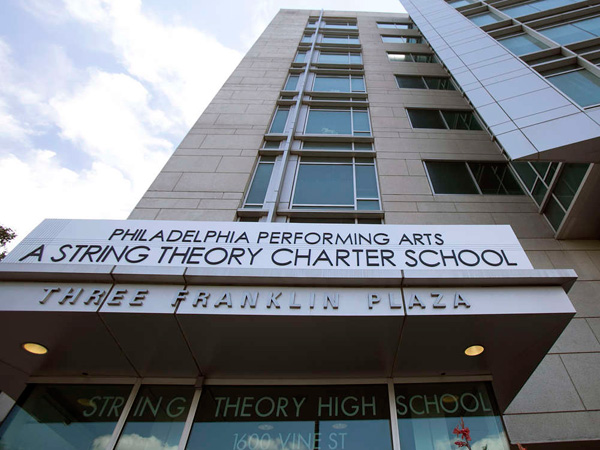
    A Philadelphia charter school is building its own college.

    Students at the Philadelphia Performing Arts Charter School, a K-12 facility of about 2,500 with campuses in South Philadelphia and Center City, should soon be able to graduate with high school diplomas and 60 college credits — for free.

    PPACS is not the only early college in the city — the Philadelphia School District has Parkway Center City Middle College, and other schools allow students to take college courses while in high school. Some schools offer dual enrollment, and a new early college charter will open in the city in the fall.

    But instead of partnering with existing colleges, String Theory, the education management organization that runs PPACS, is in the process of opening its own degree-granting institution.

    String Theory College will focus on design, technology, and entrepreneurship, offering PPACS students more flexibility than prior dual-enrollment partners had, said Jason Corosanite, the college president. Students won’t have to leave the school’s Vine Street campus to attend classes, either.

    “The whole goal is to get all kids prepared for college, with as many college credits as possible,” Corosanite said.

    The college already has Pennsylvania Department of Education approval, and its Middle States Commission on Higher Education accreditation vote is scheduled for March, commission officials said. Once schools are candidates for accreditation, that opens up college transferability, student loans, and Pell grant opportunities, though PPACS students pay no tuition because the school is a publicly funded charter.

    Corosanite said he is confident the school will gain Middle States approval and ultimately be able to offer students associate’s degrees.

    With Philadelphia’s crowded higher education market and a looming college enrollment cliff, it’s fair to question whether the city needs more degree-granting institutions, said Shaun Harper, a professor of education, public policy, and business at the University of Southern California. Some would say it does not.

    But, Harper said, “if this new creation is going to expand access and make higher ed more affordable, I think that is a spectacular thing. We need more innovative models in education that create more seamless pipelines from high school to college.”

    Harper’s research once centered on the experiences of high-achieving Black and Latino boys in New York schools who, once in college, “suddenly they realized that they were not as prepared for college as they had been led to believe by their high school teachers and by the grades they received in high school.”

    That makes Harper consider whether String Theory students “are really going to be pushed to do college-level work, and perform like college students would otherwise be able to perform? I think that is a thing to be concerned about.”

    Ultimately, Harper said, he is intrigued by the model.

    “There’s a real opportunity for [String Theory] to ensure that they are providing the right kinds of professional learning and professional development experiences for these educators, so they amass the skills that will be able to make the curriculum much more complex, much more college-level,” Harper said. “They may have a real shot here at teaching the rest of the nation something that ultimately becomes replicable.”

    High school and college in one stop

    The seeds of the idea trace back to PPACS’ first high school graduates — the Class of 2017.

    When Corosanite and other String Theory officials tracked those students, “some of our best and brightest kids were dropping out of college because of cost,” he said. “It wasn’t because they couldn’t do it. They were looking at the value proposition of these schools and dropping out. I felt the burden of, ‘We’re telling all these kids, yeah, you have to go to college,’ and then they graduate and can’t afford life. How do we solve for that?”

    Enter String Theory College.

    The program is already underway — about 40 students who participated in a pilot program are on track to graduate with college credits in June, and about 40 more are in 11th grade now.

    The college will initially be open only to students enrolled in PPACS. Going forward, every 11th- and 12th-grade honors and Advanced Placement course at the school will be a college-level course, and the PPACS faculty who teach the courses are college faculty.

    Course offerings include multivariable calculus, linear algebra, biotechnology, entrepreneurship, and design.

    Students still have access to the trappings of high school: All non-honors classes are still within the PPACS confines. And students must still meet state requirements for their high school diplomas — they are learning math, but it might be a design-focused math class, for instance.

    “Kids still have their high school experience — they still come to school on time, they still go to the lunchroom with everybody they go to school with,” Corosanite said. “They still see their friends, they still have prom, but they also have college. It makes it a lot easier.”

    There is no budget impact for PPACS, Corosanite said. The school, which as a charter is independently run and publicly funded, pays the college a per-credit hour rate that is roughly equivalent to community college, and that money covers teachers’ salaries and benefits.

    “We’re trying to be as efficient as possible with the classes the teachers have, and the college is in our building,” he said. “We’ve designed it to be cost-neutral. This is not a moneymaker — it’s mission-driven.”

    Going forward, Corosanite dreams of a graduate school of education — String Theory already offers continuing education for teachers — and offering college courses to other schools and districts.

    ‘This is a good opportunity’

    Hasim Smith, a PPACS senior, was pitched on the idea of taking college classes in high school when he was a 10th grader.

    Smith’s dad had heard about the pilot program and urged his son to go for it.

    “He said, ‘This is a good opportunity. I don’t want you to miss out on it,’” Smith said. “I like to challenge myself and do things that other people see as hard. And I like that it’s free — it helps with college costs.”

    Smith was game and now, at age 18, he’s looking forward to collecting his high school diploma and transferring dozens of credits to another college. (He’s already been accepted to 10 and is awaiting more decisions.)

    The courses are challenging, he said, but manageable, especially with his teachers’ support. He’s enjoyed the design challenges in particular, Smith said.

    “We had to learn a lot — it gets really deep. We have to learn about design, and different theories, and entrepreneurship,” Smith said.

    He had always thought he might want to pursue nursing as a career, but his String Theory college experience has him also considering architecture, he said.

    How to apply

    The college-in-a-high-school program has a limited number of slots for students who will be in 10th through 12th grade for the 2026-27 school year, and is accepting applications for those seats and for its incoming ninth-grade class.

    The school’s application deadline is Jan. 30.

  • Sharif Street could become Pa.’s first Muslim member of Congress. But don’t make assumptions about his politics.

    Sharif Street could become Pa.’s first Muslim member of Congress. But don’t make assumptions about his politics.

    When State Sen. Sharif Tahir Street converted to Islam 30 years ago, he already had a Muslim name.

    His father, John F. Street, who would go on to become Philadelphia’s mayor, gave his son a Muslim name when he was born in 1974 despite raising him in the Seventh-day Adventist Church, an evangelical Christian sect in which members of the Street family hold leadership roles to this day.

    As the senator tells it, his father initially considered adopting the name Sharif himself — not because he was considering converting to Islam but because he wanted to embrace the movement of Black Americans reclaiming pre-slavery identities.

    Instead, the elder Street, who had already built a reputation as a rabble-rousing activist, kept his name and dubbed his son Sharif, which in Arabic means noble or exalted one.

    The story would be surprising if it weren’t from the idiosyncratic Street family, which has played a unique outsider-turned-insider role in Philly politics for decades. The late State Sen. Milton Street was the senator’s uncle, and Common Pleas Court Judge Sierra Thomas Street is his ex-wife.

    This year, with Sharif Street a frontrunner in the crowded Democratic primary to replace retiring U.S. Rep. Dwight Evans, the family could make more history: If elected, Sharif Street would become the first Muslim member of Congress from Pennsylvania.

    A Street win would mark another milestone in political representation for Philadelphia’s large Muslim community, an influential constituency that already includes numerous elected officials and power players.

    But in characteristic Street fashion, that potential comes with a twist. Street has relatively moderate views on the conflict in Gaza and would likely stand out from Muslim colleagues in Congress like U.S. Reps. Ilhan Omar (D., Minn.) and Rashida Tlaib (D. Mich.), progressives who regularly denounce Israeli aggression.

    To be sure, Sharif Street, 51, is highly critical of Israeli Prime Minister Benjamin Netanyahu and the war in Gaza. But he is also quick to defend Israel’s right to exist as a Jewish state, favors the two-state solution, and counts many prominent Philadelphia-area Jews among his friends and political supporters.

    “Guess what? Benjamin Netanyahu is not the only leader of a major country in the world that’s committed war crimes, because Donald Trump has done the same thing,” Street said last week at a Muslim League of Voters event. ”But none of us would talk about getting rid of the United States of America as a country.”

    For Muslim voters who view the Middle East crisis as a top political concern, this year’s 3rd Congressional District race sets up a choice between one of their own and a candidate whose politics may more closely align with their views on Gaza: State Rep. Chris Rabb, a progressive who has been endorsed to succeed Evans by the national Muslims United PAC.

    “F— AIPAC,” Rabb said at a recent forum, referring to the American Israeli Public Affairs Committee, which has spent large sums and wielded aggressive tactics to unseat lawmakers it views as antagonistic to Israel. “They are destroying candidates’ lives because they don’t like that we’re standing up to them, that we are actively and consistently acknowledging that there is a genocide in Gaza.”

    Rabb, who is not religious and said he respects all faiths, is hoping that Muslim voters will embrace his stance on the issues.

    “Making history is not the same as being on the right side of history,” Rabb said in a statement.

    ‘Embrace all of the texts’

    Street said his Adventist upbringing immersed him in an Old Testament-rooted Christianity that led to a growing curiosity about all the Abrahamic faiths. As he got older and read more, he realized that he didn’t view Judaism, Christianity, and Islam “as separately as other people do.”

    “I do believe that the Abrahamic religions were all correct. In no way were they all supposed to be separate religions,” he said. “Islam allowed me to embrace all of the texts, which I had already decided to do.”

    Before converting, Street said he was embraced by the Muslim community in Atlanta when he was a student at Morehouse College. He officially converted after returning to Philly to earn his law degree at the University of Pennsylvania.

    Street’s Shahada, the creed Muslims take when joining the faith, was administered by Imam Shamsud-din Ali, his father’s friend. (Years later, Ali was one the elder Street’s associates being targeted by federal investigators when an FBI listening device was discovered in the mayor’s office in 2003. The episode created a firestorm around John Street’s ultimately successful reelection campaign that year, and Ali was later convicted on fraud and racketeering charges.)

    For many Muslim converts, the religion’s dietary strictures, such as abstaining from pork and eating Halal food, take some getting used to, Sharif Street said. That wasn’t a problem for him.

    “Islam has a lot of rules — unless you were Seventh-day Adventist,” he said, referring to the denomination discouraging followers from eating pork, shellfish, and numerous other foods.

    Street said his faith has guided him as an individual and public servant.

    “Islam, for me, focuses on my personal responsibility,” he said, and “the idea that man’s relationship with God is and always was.”

    His views on the unity of the Abrahamic religions also guide his perspective on the Middle East, he said.

    “I recognize that there won’t be peace for the state of Israel without peace for the Palestinian people, but there won’t be peace for the Palestinian people unless there’s peace for the state of Israel at some point,” he said.

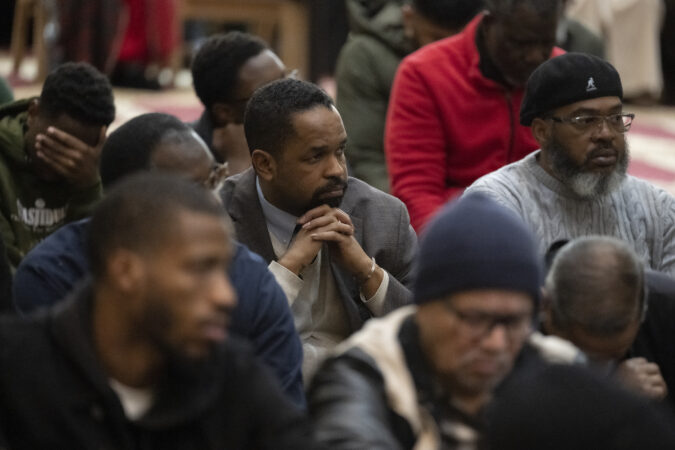
    Sharif Street participates in Friday prayer at Masjidullah mosque recently.

    Like elected officials of other religions, Street’s politics do not perfectly align with the teachers of Muslim leaders.

    On a recent Friday, Street attended Jumu’ah, the weekly afternoon prayer service, at Masjidullah in Northwest Philadelphia. A sign at the entrance reminded Muslims that abortion and homosexuality are against Islam’s teachings.

    “Almost every one of Philadelphia’s Muslim political leaders … are all pro-civil rights, including LGBTQ [rights] and pro-choice,” he said. The sign, he said, represented “some members of the faith leadership who are reminding us … that is not the stance of the official religious community.”

    For Street, that type of dissidence hits close to home.

    His father, he said, became Baptist after being “kicked out” of the Seventh-day Adventist Church for officiating a same-sex marriage in 2007 between Micah Mahjoubian, a staffer for Sharif Street, and his husband, Ryan Bunch.

    The Seventh-day Adventist Church in North Philadelphia did not respond to a request for comment.

    ’One of the most Muslim urban spaces’

    Ryan Boyer, who heads the Philadelphia Building and Construction Trades Council and is Muslim, likes to say he’s proud that members of his faith are so integrated into local politics that their religious identities are often overlooked.

    “We’re a part of the fabric,” said Boyer, whose politically powerful coalition of unions has endorsed Street. ”To me, it’s not that big of a deal. We’re here.”

    For Boyer, that means Muslim candidates like Street are judged based on their merits, not their identities.

    “He’s Muslim,” Boyer said of Street. “Well, is he smart? Does he present the requisite skills and abilities to do the job? … The answer is yes.”

    Other Muslim leaders in the city include: Sheriff Rochelle Bilal; City Councilmembers Curtis Jones Jr. and Nina Ahmad; former Police Commissioner Sylvester Johnson; and City Commissioner Omar Sabir, who is Boyer’s brother.

    Philly has also sent several Muslim lawmakers to Harrisburg, including current State Reps. Keith Harris, Jason Dawkins, and Tarik Khan.

    Although the community is less well-known nationally than those in Michigan or Minnesota, Philadelphia has one of the nation’s oldest and largest Muslim populations, with about 250,000 faithful in a city of 1.6 million, according to Ahmet Tekelioglu, executive director of the Council on American-Islamic Relations’ Philadelphia branch.

    By some estimates, Philly’s Muslim community has the highest percentage of U.S.-born followers of any major American city, thanks to the conversion of thousands of Black Philadelphians in recent decades. While many came to the faith through the Nation of Islam movement, a vast majority of Black Muslims in Philadelphia now practice mainstream Sunni Islam, Tekelioglu said.

    Add in thriving immigrant communities from West Africa and the Middle East, and Philadelphia is “one of the most Muslim urban spaces” in the country, he said.

    “Within a few minutes of walking in the city, you come across a visibly Muslim individual,” said Tekelioglu, whose nonprofit group does not make political endorsements. “Halal cheesesteak, ‘the Philly beard,’ and such — these also have overlap with the Muslim community and [the city’s] popular culture.”

    The Middle East and the 3rd Congressional District

    As a lawmaker, Street has been instrumental in forcing the Pennsylvania Interscholastic Athletic Association to allow Muslim girls competing in sports to wear hijabs and in leading the School District of Philadelphia to recognize Eid al-Adha and Eid al-Fitr as official holidays.

    That record is part of why he bristles at the Muslims United PAC’s endorsement of Rabb.

    “We cannot allow other people to hijack our community and hijack our issue because it’s Black people, it’s Muslims dying in Philadelphia right now, and some of these candidates don’t have anything to say about that,” Street said at the Muslim League of Voters event. “Some of them even got some fugazi Muslim organizations to endorse them.”

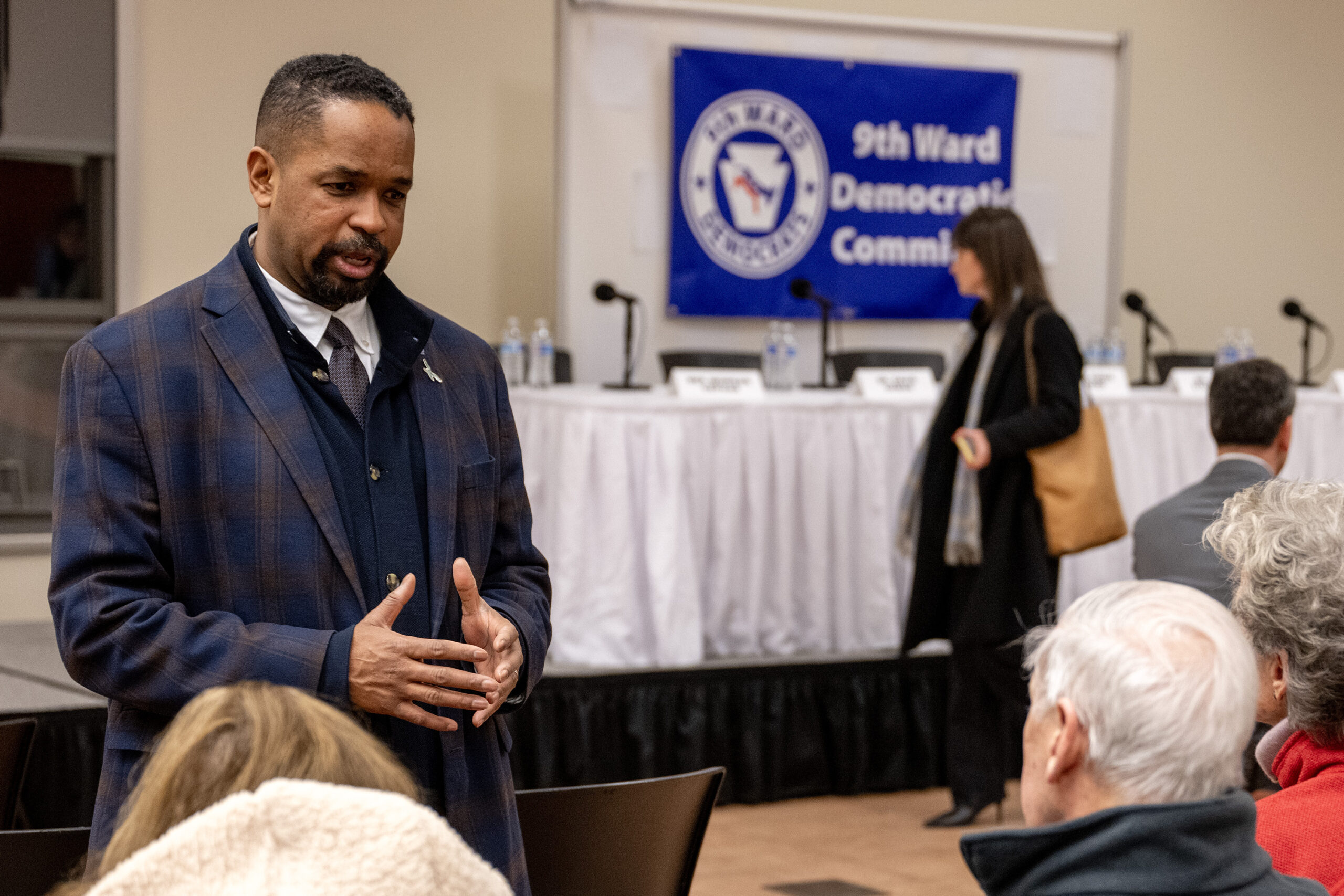
    State Sen. Sharif Street appearing at a forum hosted by the 9th Ward Democratic Committee in December.

    At another recent forum, the 3rd District Democratic candidates were asked whether they support legislation stopping U.S. weapons shipments to Israel after more than two years of conflict that has seen an estimated 70,000 Palestinians die in Gaza.

    Street, who traveled to Israel and Palestine in 2017, said the one-minute response time wasn’t enough to unpack the complicated issues, and none of the other candidates gave straightforward answers — except Rabb, who said he supported the proposal.

    “There are no two sides in this when we see the devastation,” Rabb said.

    In an interview, Street said his comparatively moderate views on the crisis and his relationships with Jewish supporters will allow him to “play a really constructive role” in Congress.

    “We need more people who can talk to both the Jewish and Muslim communities,” he said. “We need people who can have a nuanced conversation and do it with some real credibility.”

    Tekelioglu said he has observed Muslim voters moving away from “identity politics” and toward “accountability-based political stance.” That evolution has accelerated during Israel’s war in Gaza following the Hamas attacks on Oct. 7, 2023, he said.

    “Oct. 7 and everything that’s going on has made everything a bit more clear,” he said. “This doesn’t make it such that the Palestine issue is the main dealbreaker, but overall I see a trend of moving away from the identity politics.”

    The real question, he said, is, “Are they going to represent our interests?”

    Staff writer Anna Orso contributed this article.

  • Fran Dunphy speaks for the first time about how the NCAA point-shaving scandal touched La Salle

    Fran Dunphy speaks for the first time about how the NCAA point-shaving scandal touched La Salle

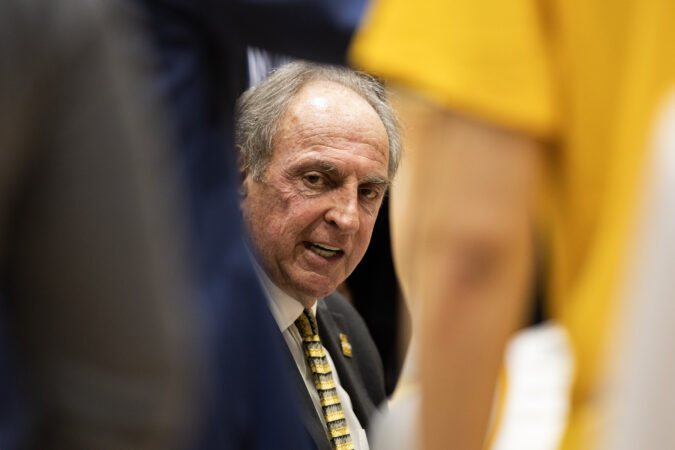
    Fran Dunphy sat at a long table inside La Salle University’s athletic center early Monday afternoon, his body turned toward a wide window on the other end of a conference room, as if the difficult discussion topic pained him and he was trying to shield himself from the hurt.

    A 70-page federal indictment had dropped Thursday accusing more than 39 college basketball players of fixing games and shaving points during the 2023-24 and 2024-25 seasons. Dunphy had read in disbelief as La Salle was mentioned more than once. One of his team’s games was the target of an alleged fix, and one of his former players, Mac Etienne, appeared in the indictment 28 times for shaving points at DePaul University in ’23-24, the season before he came to La Salle. Etienne reportedly reached a plea agreement with prosecutors on Dec. 8.

    La Salle released a statement Thursday noting that no one now connected to the university was charged and that the school would cooperate with any investigation. No one has accused the university’s administrators or coaches of any wrongdoing, and everyone who knows Dunphy knows that his integrity is beyond reproach. Still, there’s no getting around the disturbing implication of the La Salle-related details within the indictment.

    Two of the alleged fixers, Jalen Smith and Antonio Blakeney, “attempted to recruit” La Salle players to shave points in a Feb. 21, 2024, game against St. Bonaventure. The Bonnies were favored in the game’s first-half spread by 5.5 points, and the fixers “placed wagers with various sportsbooks totaling at least $247,000 on St. Bonaventure to cover” that spread. The Explorers led, 36-28, at halftime and won, 72-59.

    “We did our job that day,” Dunphy, who retired from coaching after last season, said in his first public comments since the indictment’s release. “I felt good about that — that there was nothing there, that we had won the game. I truly liked coaching those guys on that team. That was a good win for us.”

    But the fact that the bets failed and the fixers lost doesn’t answer an unsettling question: Why would the defendants have wagered nearly a quarter of a million dollars on a middling Atlantic 10 game if they didn’t already have reason to believe they’d win the bet — if they didn’t think they had someone inside working to help them?

    “I couldn’t tell you,” Dunphy said. “Again, I didn’t go down that path even a little bit. I just thought about my team, the fact that we had played fairly well that day, and I was just surprised and disappointed that anybody even thought we were involved in any of that. That was my disappointment.”

    Has he been thinking about that team, that season, and asking himself if such a scenario — one or more of his players shaving points — was possible?

    “Well, we were about a .500 team,” he said. “It wasn’t like we were superstars. But we had a good group of guys who wanted to work their ass off. That’s how I looked at it. Did I go back to the guys who played a lot of minutes? Yeah. That wasn’t their M.O. That would have been really surprising to me if any of those guys thought that [shaving points] would be something beneficial to them or anybody. …

    “Just surprise, disappointment, a bit shocking. Just, how did this happen? Where do we go with it?”

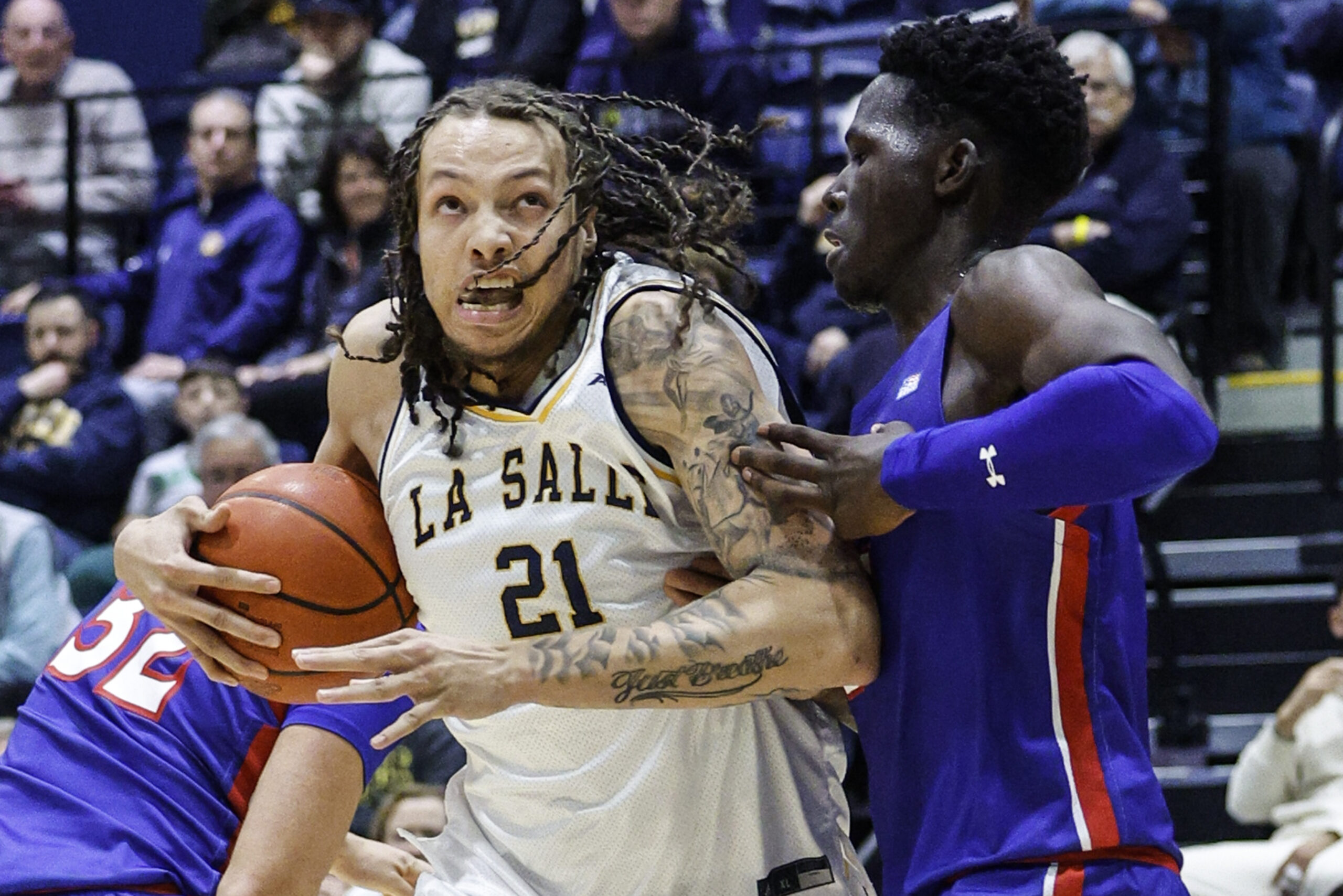
    Mac Etienne (21), who began his career at UCLA before transferring to DePaul and then to La Salle, reached a plea agreement with prosecutors on Dec. 8.

    As of Monday afternoon, he had neither rewatched the St. Bonaventure game nor reviewed the box score for anything curious or alarming. He hadn’t thought about the incident in those terms, he said, and perhaps he could not bring himself to think about it that way. How many times had he watched one of his players make a silly, stupid mistake during a game, and how many times had he yelled, What the hell are you doing? “I didn’t think twice about it,” he said. Was he supposed to have considered that a player screwing up like that was doing it on purpose, that the kid was on the take?

    Hell, in the Explorers’ 81-74 victory last March over St. Joseph’s, in the final win of Dunphy’s career in his final home game, Etienne had scored 13 points and grabbed 11 rebounds in 36 minutes. “Just a phenomenal game for us, and he was very much a part of it,” Dunphy said. “He was a very interesting guy to coach. Talented. A worker. And he seemed to care very much about his teammates. … He never complained about minutes or any of that.” But now Dunphy was remembering Etienne’s recruitment, the coaxing it took to get him to transfer from DePaul to La Salle, with the hindsight that Etienne had thrown games before he ever showed up and settled in at 20th and Olney. Now Dunphy was searching for signs and tells in retrospect.

    “You’re running through every guy who’s hitting the portal,” he said. “‘What do we need? This guy, does anybody know him?’ Some of the staff members knew him, knew about him.

    “Years ago, the portal wasn’t like it is. You’d recruit a kid in his sophomore, his junior year. You’d get to him. You’d get to know the parents, get to know his coaches. The coaches tell you what the kid is like, some of the idiosyncrasies. We don’t study that much anymore. There’s not as much vetting in today’s world. But that’s the way it is. It’s a challenge, and you try to meet that challenge.”

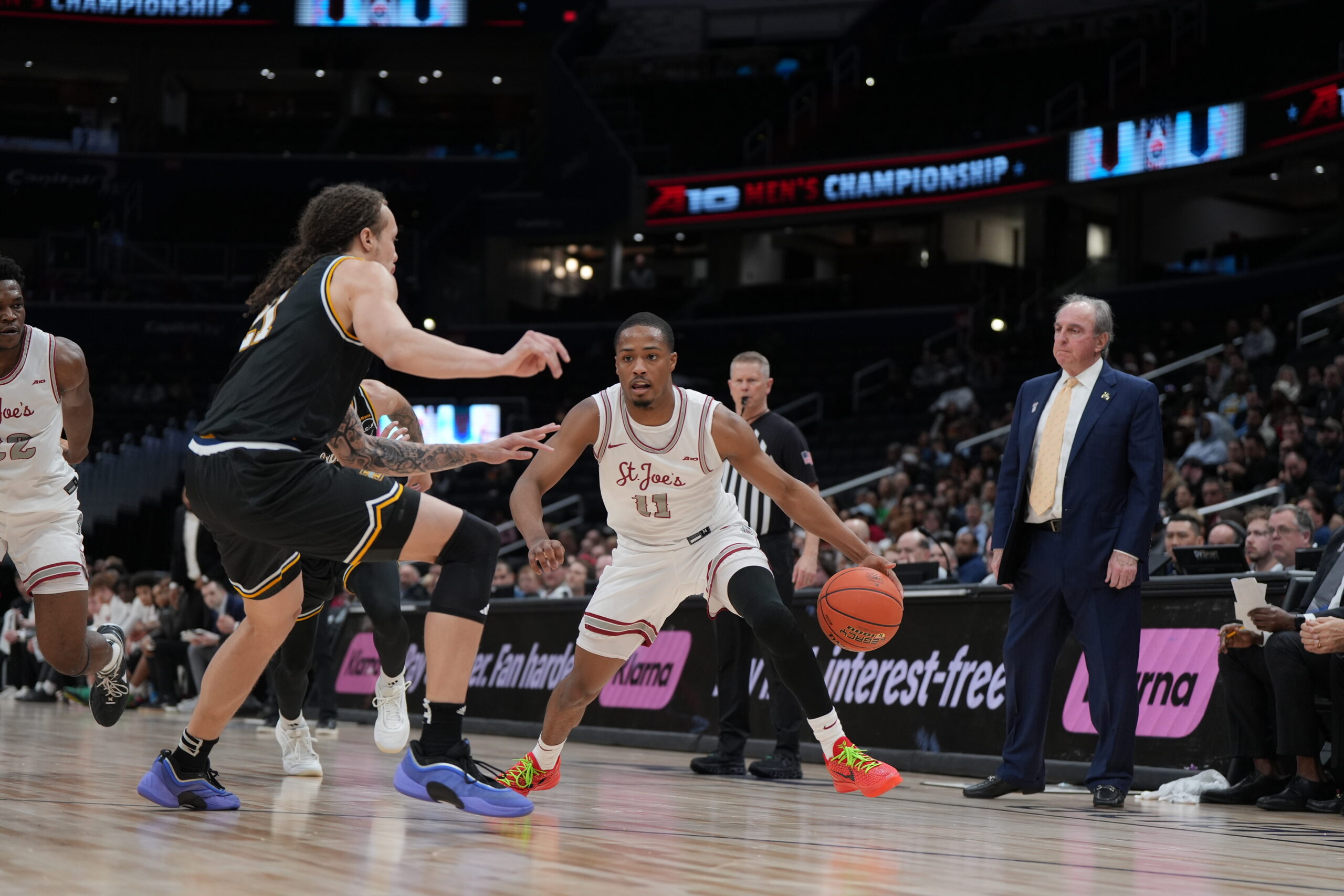
    Fran Dunphy (right) described Mac Etienne (defending St. Joseph’s guard Xzayvier Brown on March 13) as “a worker” in the time he coached him.

    College basketball has had plenty of point-shaving scandals throughout its past, of course; one of the biggest, in 1961, involved St. Joe’s. But it’s so easy now for gamblers to contact players and for anyone to place a bet — just a few taps and swipes on a smartphone — that even if law enforcement authorities keep catching the fixers, the credibility of college basketball and sports overall still will be in peril. The more arrests, the less the public will trust what it sees on the field and the court. The corruption can appear total and endless, yet so many stay strangely silent about it.

    Look around. Listen. Who are the giants of college basketball, the big-name coaches, who are speaking out about this scandal, who are sounding bells and alarms about the sanctity of their sport? “Nobody ever talked about this among my fellow coaches. Nobody,” Dunphy said. “It’s just not something that you talk about because you don’t believe it’s happening. You hear these stories that tell you it is, but you just say to yourself, ‘I don’t know how this could happen.’”

    The rot may have spread to his program, and Fran Dunphy doesn’t have to be the loudest voice calling for everyone to open their eyes, including his own. He just had to do what he did Monday. He just had to be one of the first.

  • After delays, Lehigh Avenue apartment project is ready to begin construction under a new owner

    After delays, Lehigh Avenue apartment project is ready to begin construction under a new owner

    A six-story apartment project at 2001 E. Lehigh Ave. is moving forward with a new owner after years of delay amid a difficult development environment.

    Five-lane Lehigh Avenue divides the southern portion of Kensington, which has experienced development more akin to the boom in Fishtown, from the parts of the neighborhood to the north that are at the heart of the city’s opioid crisis.

    But along the northern edge of the avenue, next to the Conrail tracks, a series of auto-oriented and light-industrial properties have been redeveloped as housing in recent years.

    “That whole corridor has continued developing. It’s even pushing over the tracks further up north, too,” said Brian Corcodilos, CEO of Designblendz, the architect for the project. “We’re confident that … this area continues to rent up.”

    The former owner of 2001 E. Lehigh, developer Isaac Singleton, secured zoning approvals for the project in 2023 and 2024. City records then show the property sold for $2.5 million in January 2025.

    A demolition permit for the property was issued this week to an address associated with developer Roman Ovrutsky — whose home The Inquirer profiled last year — and Corcodilos said their team expects construction to begin by early spring.

    Ovrutsky’s version of the project will feature 146 apartments, a slightly smaller number than Singleton proposed, and a little over 6,000 square feet of commercial space on the ground floor. The project will also have 54 underground parking spaces.

    Designblendz has updated the visual palette for the project by adding darker grays and slate-colored hues.

    Corcodilos said that changes in federal tax policy in President Donald Trump’s Big Beautiful Bill have enabled clients to begin building again. A lull in recent years was caused by heightened interest rates and an apartment glut that made it hard for developers to charge the rents necessary to pay back the loans on their projects.

    The former design for the building included greens and browns. The new vision features slate-colored hues.

    Corcodilos said developers have also found that more projects are making sense if they use either the city’s mixed-income housing zoning bonus — which allows taller or denser construction in exchange for an affordability component — or if they base their financing on catering to some tenants who use federal rent voucher subsidies.

    “That’s how a lot of these projects are getting done,” Corcodilos said.

    It’s illegal in Philadelphia to discriminate against renters using vouchers, but it’s common for landlords to discourage those tenants, and many buildings owners don’t proactively advertise to subsidized tenants.

    But in recent years, increasing numbers of landlords have seen the advantage of tapping into a large tenant base with almost guaranteed payments.

    Another property just north of Lehigh Avenue at 2200 E. Somerset St. was sold last year to the Philadelphia Housing Authority, after many of its tenants ended up being voucher holders.

    “A lot of these big buildings that are going up, the only way they’re penciling is if there’s some sort of an affordability component to it,” Corcodilos said.

    Beyond Kensington, Designblendz is seeing an increase in work this year due to developer-friendly changes in the federal tax code, opportunities in affordable housing provision, and an easing of the overall apartment glut, he said.

    “I’m not getting a sense at the moment that clients are worried about not filling their units,” Corcodilos said. “Obviously things slowed down a little bit over the last year and a half for the industry. But what we’re seeing right now, it’s busier than ever.”

  • Pa. leads in making breast cancer screening more accessible

    Pa. leads in making breast cancer screening more accessible

    Pennsylvania is leading the way on breast cancer screening policy. Thanks to Senate Bill 88, a decisive move from the commonwealth, patients with state-regulated health plans will no longer face high out-of-pocket costs when an abnormal screening requires follow-up breast imaging.

    Many Americans assume this is already the case, given the Affordable Care Act’s promise of no-cost preventive services. With breast cancer, however, that’s not always true.

    Patients whose routine screening mammogram reveals an abnormality require additional imaging for a more detailed look. Those who are at high risk due to family history, dense breast tissue, or a genetic abnormality may need an MRI or ultrasound for their routine screening, rather than a standard mammogram.

    Cultural, economic, and other social factors, including access to health care, may influence the lower rate of breast cancer screening.

    Neither meets most health plans’ technical definition of “preventive care.” And, in many parts of the country, both can cost hundreds, even thousands, of dollars out of pocket.

    By eliminating out-of-pocket costs for patients, Pennsylvania is establishing itself as a national leader in breast cancer treatment. But this state legislation can only go so far, and many people still face major gaps in coverage when they need breast imaging beyond a screening mammogram.

    As it turns out, that lack of coverage doesn’t sit well with voters.

    Support for treatment

    In a national poll of 1,000 Republican primary voters commissioned by the Alliance for Breast Cancer Policy, sentiment on the topic was clear: If a patient needs breast imaging, they should get it — with the full cost covered by their health plan.

    A full 95% of polled voters said insurers should cover the full cost of all recommended breast imaging, not just the standard screening mammogram. After all, preventive care means preventive care. Voters recognize that. When health plans split hairs and argue technicalities, they do so at the patients’ risk.

    A bill before Congress would help, covering many in Pennsylvania who will still fall through the cracks even after the passage of SB 88. Known as the Access to Breast Cancer Diagnosis (ABCD) Act (S 1500/HR 3037), the federal legislation would eliminate out-of-pocket costs for patients’ necessary breast imaging.

    And 85% of polled voters responded to the legislation’s primary goal: ensuring women get the answers they need before it’s too late. When breast cancer is caught early, treatment is more effective, less invasive, and far more likely to lead to positive outcomes — with five-year survival rates as high as 98%. Early detection saves both lives and dollars.

    Respondents expressed support for the ABCD Act, especially given the impact the bill would have on those who often can’t get the help they need: rural, lower-income, Black, Hispanic, and younger women.

    With costs for healthcare so high, many, especially younger women who make up 10% of all new breast cancer cases in the U.S., are looking toward high-deductible health plans to lower their monthly costs. But this often comes with less comprehensive coverage before a deductible. Two-thirds of polled voters say the full cost of necessary breast imaging should still be covered for those with high-deductible health plans.

    Pennsylvania is proving that bold, patient-centered policy can save lives and reduce costs. Yet, in more than half the country — and still for some in the Keystone State — outdated insurance rules still force patients to choose between lifesaving breast imaging and paying their bills.

    It’s time for Congress to follow Pennsylvania’s lead and make comprehensive breast cancer imaging a priority.

    Breast cancer doesn’t wait. In 2025, an estimated 43,000 women and men in the U.S. lost their lives to the disease, including 1,800 in Pennsylvania alone. Access to early diagnosis should never hinge on the state you reside in. Congress should take note of Pennsylvania’s recent legislation and ensure lifesaving screenings are within reach for everyone.

    Molly Guthrie is vice president for policy and advocacy at Susan G. Komen and leads the Alliance for Breast Cancer Policy.

  • Letters to the Editor | Jan. 20, 2026

    Letters to the Editor | Jan. 20, 2026

    F for Ford

    Donald Trump was at a Ford factory last week to continue his lies about the great state of the economy. As the president shuffled through, employee TJ Sabula called Trump a “pedophile protector.” Our illustrious leader replied with an expletive and flipped Sabula the bird. The company then suspended Sabula because Ford has a “core value of respect and values its policy against anything inappropriate … within our facilities.” Facts are stubborn things. Based on the facts of the incident, it was Trump, not Sabula, who should have been escorted from the factory floor. But facts do not exist in Trump World. The PR team for the tired, old, thin-skinned, wannabe king issued a statement saying that “a lunatic was wildly screaming expletives.” On that much we agree.

    Jim Lynch, Collegeville

    Hate the sin

    Much has been written by Donald Trump’s supporters alleging that his detractors are afflicted with Trump Derangement Syndrome: an extreme, negative, and hateful reaction to the sitting president. While there are many folks from the progressive (and moderate) side of the political aisle who may detest the man, I would suggest that the number of voters who abhor his policies, declarations, edicts, tweets, and contemptible rhetoric far outnumber those who irrationally “hate” him. Separating the man from his (un)presidential actions will be necessary if the nation is to begin the process of extracting itself from bipartisan discord.

    While it is not our right to judge any person as moral, amoral, or immoral — that determination rests solely with the Creator — it is our responsibility, as citizens living in a democratic republic, to voice concerns and criticisms when elected leadership fails to lift up the human condition. Christians are instructed explicitly and frequently to love all people at all times, but that axiom does not prohibit disapproval of deeds and words that fall short of righteous norms. Blind followership and ad hominem attacks are counterproductive to achieving that elusive more perfect union. A more judicious approach is to avoid hate and embrace critical analysis of executive decision-making.

    James L. DeBoy, Lancaster

    Fair’s fair

    I appreciate the update regarding just how much the violent crime rate has decreased in Philadelphia and other cities since DNA and a willingness to put the guilty in prison rather than “convenient suspects.” The slap on the wrist for the retired officers who lied about DNA evidence and helped send a man to prison for a crime he did not commit is yet another example of the brutality and disrespect for the people. These past practices have caused crime rates to stagnate, and “defunded” families of justice, people of their freedom, and taxpayers of their dollars. Maybe the call to defund the police would be better stated by saying they defunded us first.

    Mara Obelcz, Hatfield

    Living with pain

    I am writing in response to the recent op-ed by Ira Cantor regarding the growing crisis in pain management. As a patient with chronic pain, I can attest that responsibly prescribed opioid medication has allowed me to function, work long hours on my feet, and participate meaningfully in family life. Before receiving proper care, pain controlled every aspect of my day. Since beginning treatment, my quality of life has improved dramatically, without misuse, impairment, or adverse effects. Unfortunately, increasing restrictions and pharmacy shortages now threaten that stability, leaving responsible patients fearful of withdrawal and a return to debilitating pain.

    Abuse of any medication should be addressed, but eliminating access for everyone is neither compassionate nor medically sound. Patients who follow their treatment plans shouldn’t be punished for the actions of a minority. I believe pain medication, when practiced carefully and ethically, restores dignity and functionality. That should be protected, not dismantled.

    Shea Roggio, Phoenixville

    Move on

    Regarding “Murphy’s veto may doom N.J. town’s Groundhog Day.” When Pennsylvania’s Groundhog Day began in 1887, women couldn’t vote. People could be jailed for insolvency. The Prohibition movement was active and strong. Times change, as they should. It is long overdue for the good folks of Milltown to recognize the evolving public sentiment about forcing animals to participate in gratuitous spectacles. Using any animal as a marketing tool should be relegated to the dustbin of history. Groundhogs are shy, solitary animals. Their burrows are engineering marvels, going many meters deep with multiple rooms for specific purposes, like nesting and waste. Although they like to wander, they can climb trees and are good swimmers. It’s time to stop exploiting animals for “entertainment.”

    Jennifer O’Connor, senior writer, PETA Foundation, Norfolk, Va.

    Plain truth

    It’s both terrifying and a shame that President Donald Trump and minions all think their job is to protect the MAGA brand at all costs. Even in the face of a murderous shooting, their first instinct was to go public with easily discreditable lies about what occurred. They did so because they needed to inform the MAGA cult how to think about the killing of Renee Good in Minneapolis, even before seeing the various videos themselves. That’s their instinct. Not to show leadership to the whole country and calm the situation.

    If you saw the videos — saw Good say, “Dude, I’m not mad at you,” saw the shooter look her in the eye with his own camera while also holding a gun, saw her vehicle turning away from the shooter (not into), saw the shooter walk over 100 feet back to his vehicle without a hint of a limp or injury — and still believe the shooting was justified, then you are part of the cult. In the final passage of 1984, George Orwell wrote, “The Party told you to reject the evidence of your eyes and ears.” That’s why Trump et al. spoke out before the body was cold. Maybe this will become Trump’s Kent State moment.

    Richard Golomb, Philadelphia

    Power of suppression

    The sudden cancellation of a 60 Minutes segment about Donald Trump’s immigration policy and El Salvador’s notorious Terrorism Confinement Center is just the latest example of the suppression of news perceived as critical of this administration. It seems like every day another media outlet or news source is being compromised, co-opted, or crushed by the powerful, unrelenting forces opposed to independent, objective reporting. I must express my gratitude and appreciation to the owners and editors of The Inquirer for their steadfast commitment to fair and accurate coverage of what is truly a sad and frightening state of affairs in this country.

    I hope my fellow Philadelphians realize just how fortunate we are to still have this voice speaking truth to power when so many others have been silenced. Thanks especially to The Inquirer’s opinion and editorial writers, who every day demonstrate that there is still integrity and ethics in journalism, and who give me hope we will get through this dark period and that our republic may yet endure for another 250 years.

    Arthur Meckler, Philadelphia

    Join the conversation: Send letters to letters@inquirer.com. Limit length to 150 words and include home address and day and evening phone number. Letters run in The Inquirer six days a week on the editorial pages and online.

  • Dear Abby | Daughter concerned about parents’ heavy screen time

    DEAR ABBY: My young daughter and I had the pleasure of spending three months with my parents while my husband was deployed. We had a lovely visit, but over the course of our stay, I noticed my parents were spending more time on their phones than previously. Both are retired and in their mid-60s.

    I’m glad they are keeping up with technology, but I’m also concerned that their phone use may have a negative impact on their social health, behavioral health and mental acuity as they age. Growing up, we never had the TV or computers in our main living space, and screen time was limited. We ate dinner together every night, and socialization and conversation was an expectation.

    During my stay, my parents brought their phones to the dinner table and grabbed them midmeal to answer messages or search things on the internet. Throughout the days, I’d look up from what I was doing and see them glued to their screens. This new behavior is so different from the way they raised me. How can I speak to them about my concerns and encourage them to consider decreasing their phone usage?

    — NOTICED THE CHANGE IN WASHINGTON

    DEAR NOTICED: Yes, many things have changed since the time when you were raised. But if you think the day has arrived for you to parent your parents, forget about it. It not only won’t work, but it could also cause resentment because they are adults and not impressionable teenagers being educated about social interaction.

    ** ** **

    DEAR ABBY: My college roommate and I became close friends. I always thought he was a little bit arrogant. When I caught him getting upset that a girl liked me and not him, I realized he has always been about comparing and competing.

    At age 30, after we ended up working for the same company, we had a falling-out. I’m sure he has his complaints about me, but I am no longer interested in being his friend. We’re 36 now and still involved in our fantasy football league, so we see each other from time to time. We’re generally civil to each other, especially for the sake of the league.

    Well, he now wants to rekindle the friendship and keeps asking me to hang out. I’ve made excuses so far, and I wish he would take a hint, but I’m afraid I’m going to have to eventually tell him (again) that I’m not interested in hanging out. I don’t want to hurt his feelings any more than I have to. Please help.

    — NOT FEELING IT IN KANSAS

    DEAR NOT FEELING IT: You are not obligated to have anything more to do with this person than you wish. If the only time the two of you interact is during the fantasy football season, he shouldn’t be too hard to avoid. When he asks to hang out, continue doing what you have been, which is to say you are busy. Eventually, he may take the hint.

  • Horoscopes: Tuesday, Jan. 20, 2026

    ARIES (March 21-April 19). You’ve been a bit detached, which has served you well. Think of it as protection. But today, nothing feels stormy or overwhelming. The emotional climate is gentle enough to set your defenses down and experience things more directly.

    TAURUS (April 20-May 20). The majority won’t get it, and that’s actually a good thing. Relish your moment. Originality makes the world go round. Better to be truly seen as yourself by one person than to blend into the background.

    GEMINI (May 21-June 21). Your high standards aren’t just about turning in good work or making lifestyle choices. You extend your expectations to matters of character and attitude. You seek the company of those who are considerate, fair and compassionate, like you.

    CANCER (June 22-July 22). Even though you know intellectually that feelings are neutral — not wrong, not right, just information — you still judge yourself for having certain emotions. Instead of analyzing your process, just give yourself credit for having one.

    LEO (July 23-Aug. 22). The one you care for could get attention from different directions, but there is no care quite like yours, and this will become increasingly obvious. Let it be a source of pride to you. You will keep the relationship in balance by never forgetting the value of your love.

    VIRGO (Aug. 23-Sept. 22). Achievements will magically spill over from one domain to another because the way progress is made stays consistent. Skills grow through sequencing, patience and repetition. Break it into manageable pieces and build them one at a time.

    LIBRA (Sept. 23-Oct. 23). Scorekeeping turns giving and receiving into an accounting job instead of a spiritual or pleasurable gesture. Share without worrying about who gave what. The real benefit happens inside your heart as you give.

    SCORPIO (Oct. 24-Nov. 21). You’ll gather insight and construct a few stronger boundaries, not to keep people or experiences out of your life but to protect yourself from their effects the way a wetsuit allows the diver to explore depths.

    SAGITTARIUS (Nov. 22-Dec. 21). You are loyal to the ones who are loyal to you. You are also loyal to the ones who are (SET ITAL)not(END ITAL) loyal to you. Because to you, loyalty is a value, and the rules do not change when circumstances do.

    CAPRICORN (Dec. 22-Jan. 19). It’s hard enough to resist the influence you can feel. But what about the influence that is so much a part of the culture, you don’t even notice it? Awareness keeps you in charge. Ask, “What am I missing?”

    AQUARIUS (Jan. 20-Feb. 18). People react well when they understand the full scope of the situation. Many just don’t have the experience to know the layers and depths in play. This is why it’s important to have the right mentor. Such a person is coming into your life.

    PISCES (Feb. 19-March 20). We change. We are changed by one another. To interact with someone is to change them, and to change yourself. Today, you make extra efforts to be sure people are lighter, brighter and better for knowing you.

    TODAY’S BIRTHDAY (Jan. 20). Life buzzes with fresh experiences in this Year of Firsts — some are on your list, and many drop out of the blue to delight you beyond anything you could have planned. Close relationships are your treasure. More highlights: You’ll break ground and pour the foundation for a project you’ll keep building on for years. You’ll be proud of how you earn money, and you’ll have adventures in foreign territory. Leo and Taurus adore you. Your lucky numbers are: 3, 10, 31, 8 and 21.

  • Sixers takeaways: More urgency needed, Tyrese Maxey’s rising ceiling, and more from win over the Pacers

    Sixers takeaways: More urgency needed, Tyrese Maxey’s rising ceiling, and more from win over the Pacers

    The 76ers must play with a sense of urgency against bad and/or undermanned teams.

    Tyrese Maxey is a newly minted Eastern Conference NBA All-Star starter. But the Sixers point guard, and coach Nick Nurse, believe he has more to give.

    And the Sixers need more production from their bench.

    These things stood out in Monday’s 113-104 victory over the Indiana Pacers at Xfinity Mobile Arena.

    Lack of energy

    Maxey and Joel Embiid’s play, especially late in the game, enabled the Sixers (23-18) to avoid an embarrassing loss to the Pacers (10-34).

    Maxey scored 14 of his 29 points in the fourth quarter. The 6-foot-2, 200-pounder also had four assists and four steals while playing 10 minutes, 35 seconds in the quarter.

    In the quarter, Maxey was able to get to the paint more frequently and finish at the rim.

    “We kind of opened the court up a little bit,” he said. “Me and Joel didn’t play a lot of two-man game. So it’s kind of like just getting him the ball, coming off screens, and doing that.”

    But before Embiid reentered the game with 5:01 remaining, Maxey was paired with Quentin Grimes, Jabari Walker, Kelly Oubre Jr., and Adem Bona.

    “And with that unit, I know I have to be ultra-aggressive for myself, for my teammates as well, getting to the paint, kicking it out, generating threes. That’s what I tried to do. Got a couple of corner threes with that group, and that’s good offense for us.”

    For the game, Maxey made 12 of 24 shots to go with eight assists, four rebounds, a career-high eight steals, and one block.

    “I was just trying to be aggressive, you know, make plays for my teammates,” Maxey said of his steals. “I think it gets us going when we get out in the open court [after stealing the ball] and get some easy baskets.”

    Meanwhile, Embiid scored nine of his 30 points in the fourth quarter. The center also finished with nine rebounds and four assists.

    But it was like the Sixers fell into a deep slumber against the Pacers before they took over.

    Sixers center Joel Embiid poured in 30 points in a combeack win Monday over Indiana.

    At the start of the game, they looked like a well-oiled machine.

    Embiid had 10 points on 5-for-5 shooting. Oubre, who started in place of Paul George, had six points on 3-for-3 shooting. And Dominick Barlow had the other two points on 1-for-2 shooting, as the Sixers had an 18-15 lead with 6:19 remaining in the first quarter. They had made 9 of 12 shots at the time.

    They couldn’t shake the Pacers and clung to a 33-30 lead heading into the second quarter. And things only got worse for the Sixers in the second. They shot 26.3% and trailed by as many as 10 points against the NBA’s second-worst team. Much of the defending Eastern Conference champions’ struggles are down to injuries.

    On Monday, they were without Tyrese Haliburton (right Achilles tendon tear), Bennedict Mathurin (sprained right thumb), and Obi Toppin (right foot stress fracture).

    The Sixers struggled through 3-for-13 three-point shooting over the first three quarters. They ended up making 5 of 17.

    But struggling against an undermanned squad isn’t uncommon.

    On Jan. 5, they put forth an inexcusable effort against a Denver Nuggets team playing without its entire starting lineup and three key reserves.

    This time, the Sixers woke up from their slumber and escaped with a nine-point victory. But they need to do a better job of putting teams away that have no business competing with them.

    Maxey just scratching the surface

    Maxey impacted the game in many ways on Monday. But the belief is that the sixth-year veteran is just scratching the surface.

    “I think I’m most definitely nowhere close to where I could be, as far as basketball-wise,” Maxey said. “I feel like I can keep getting better. And my thing is I just want to be better. You know what I’m saying, for my teammates, for this organization, my family. And I know I have a coach, an organization, and teammates who believe in me. And when you have that, it kind of pushes you to be even better than what you are.”

    Right now, he must do a better job of adjusting when teams trap him. But Maxey is most proud of his leadership and the strides he’s made on defense. He was a good defender growing up. But he’s found that the transition to the NBA has been more challenging.

    Sixers guard Tyrese Maxey had a career-high eight steals in Monday’s win.

    “I feel like I figured it out a little bit on how to be impactful,” he said, “and impact the game on the [defensive] end of the floor.”

    But even though he needs to regain his rhythm, Maxey is in the midst of a career season.

    He is third in the league in scoring (30.2 points per game), second in steals (2.1), and 15th in assists (6.7). He is also fourth in made three-pointers (140), and has scored at least 30 points in 19 of 39 games.

    “We’re trying to give him every opportunity to be aggressive and go do his thing,” Nurse said. “And he’s very talented. And I keep saying there’s still a lot of room for growth, which I think is exciting.”

    More needed from Sixers bench

    The Sixers were outscored 35-14 in bench points, and even that was misleading. They only had eight heading into the fourth quarter.

    Grimes had five points on 1-for-7 shooting. Walker had five while making 2 of 5 shots. He was, by far, the most productive reserve, finishing with six rebounds and four steals. Bona (two points, 1-for-2 shooting) and Trendon Watford (two points, 1-for-4 shooting) were the other bench scorers.

    Justin Edwards and Jared McCain didn’t attempt a shot after playing only the final 47 seconds. But the Sixers must get more production out of their bench if they expect to remain competitive.