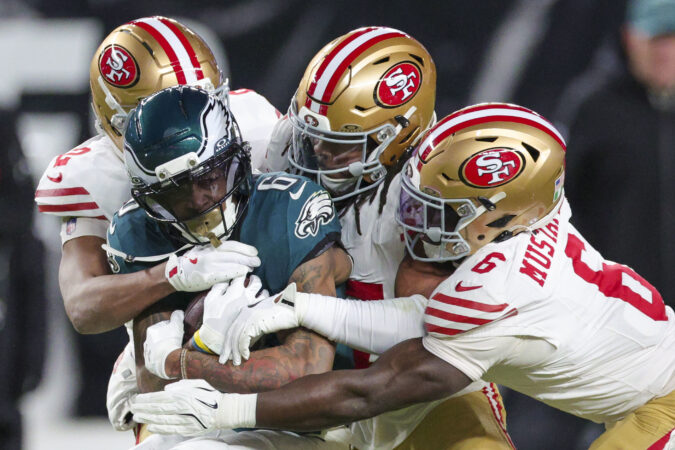
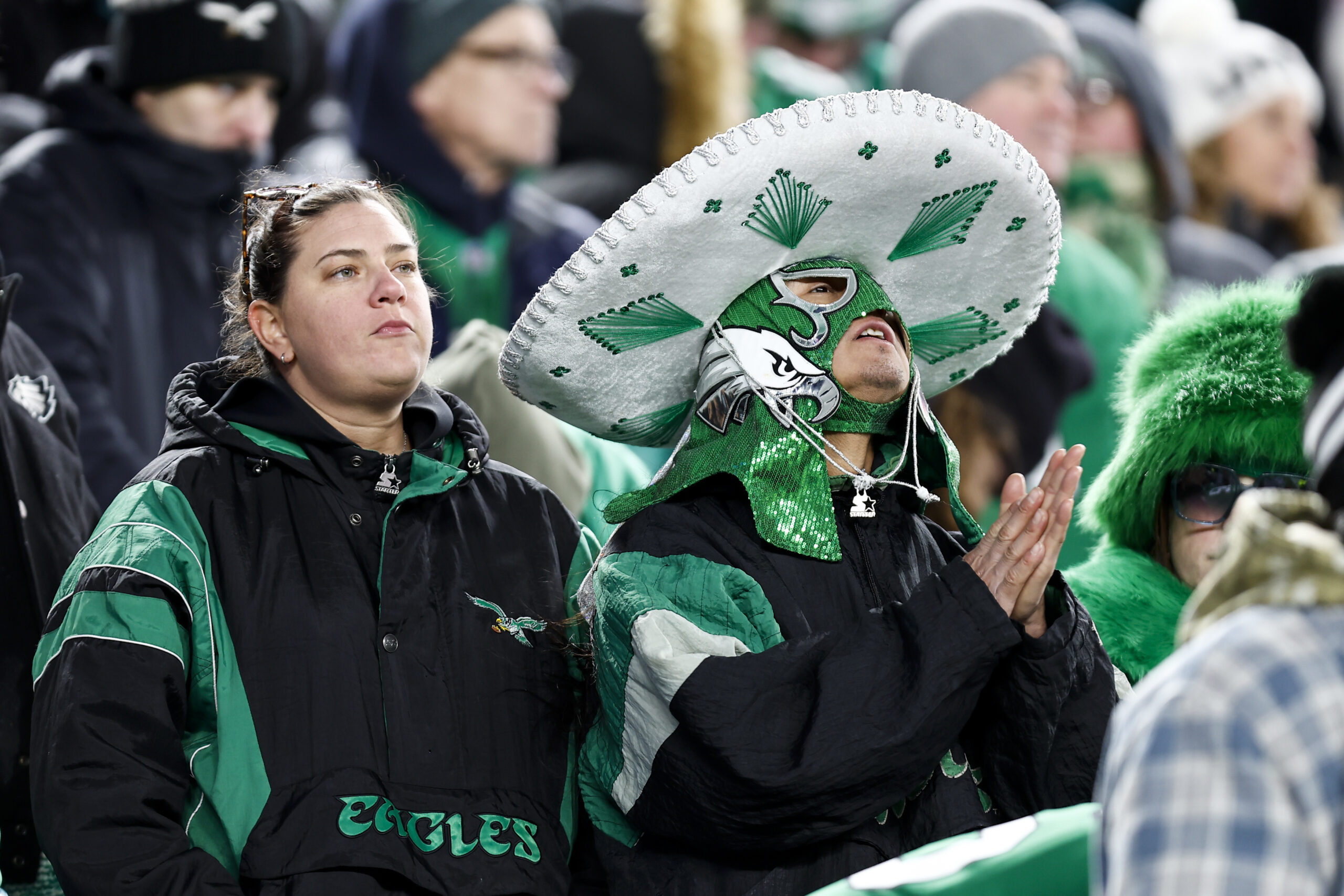
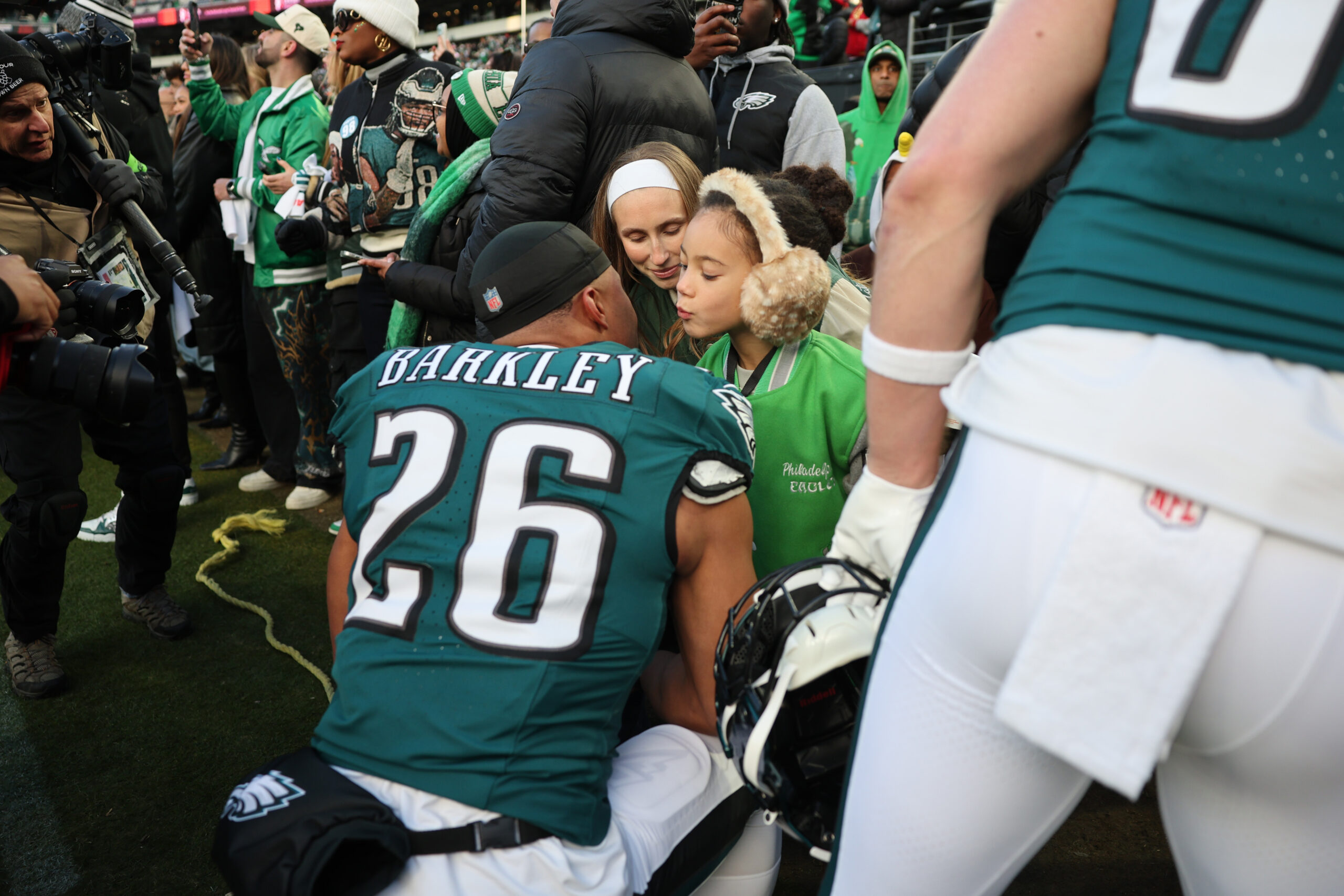
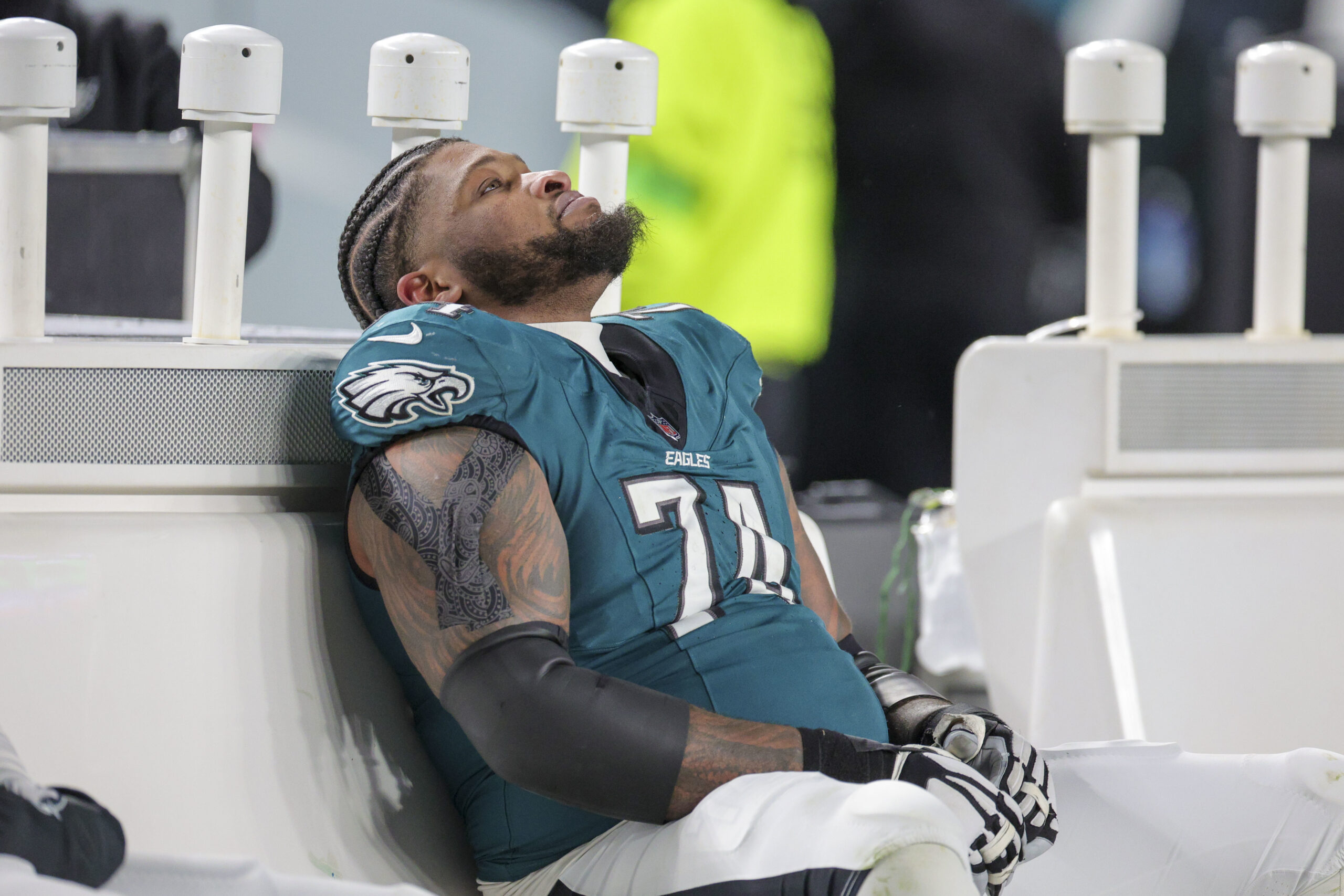
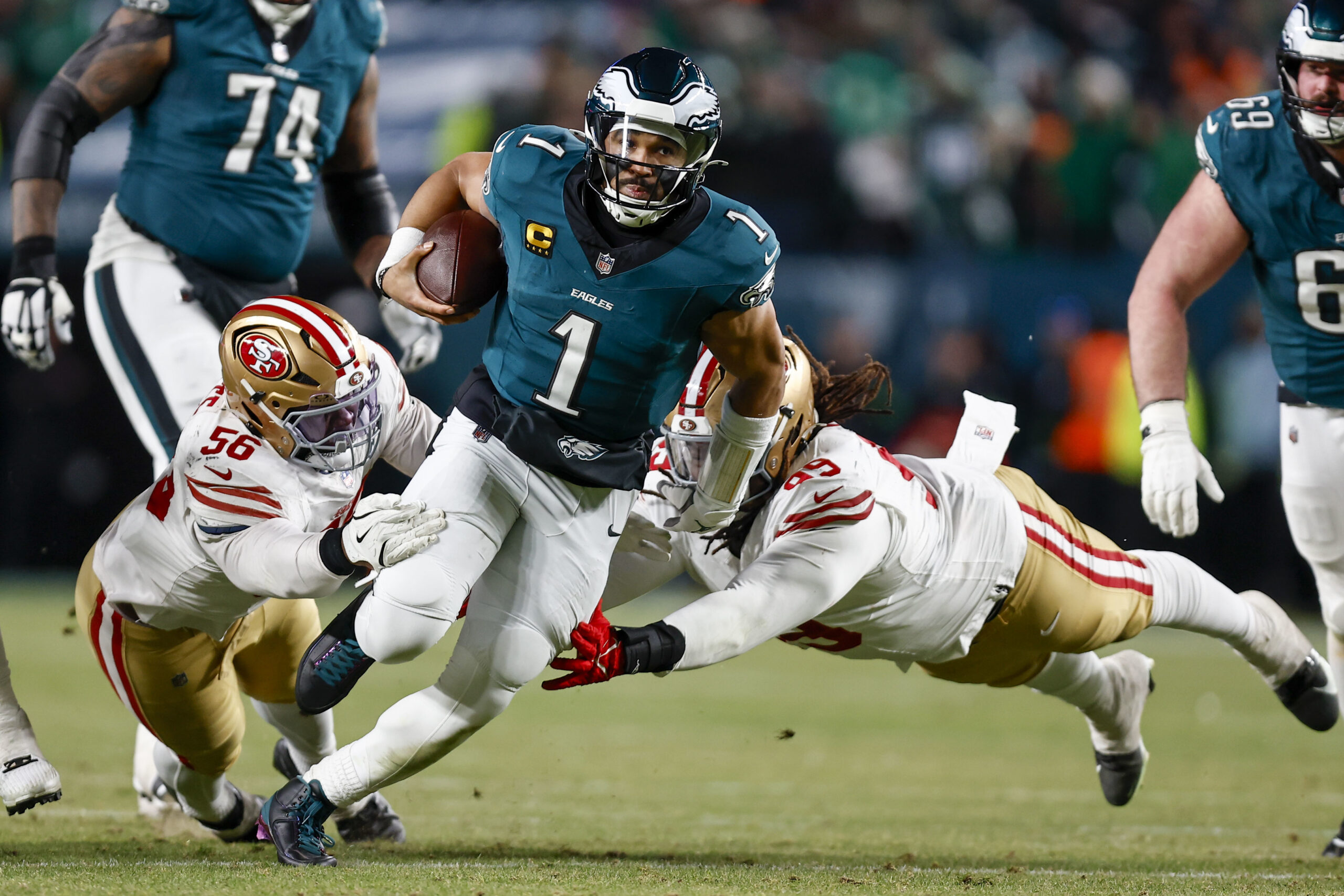
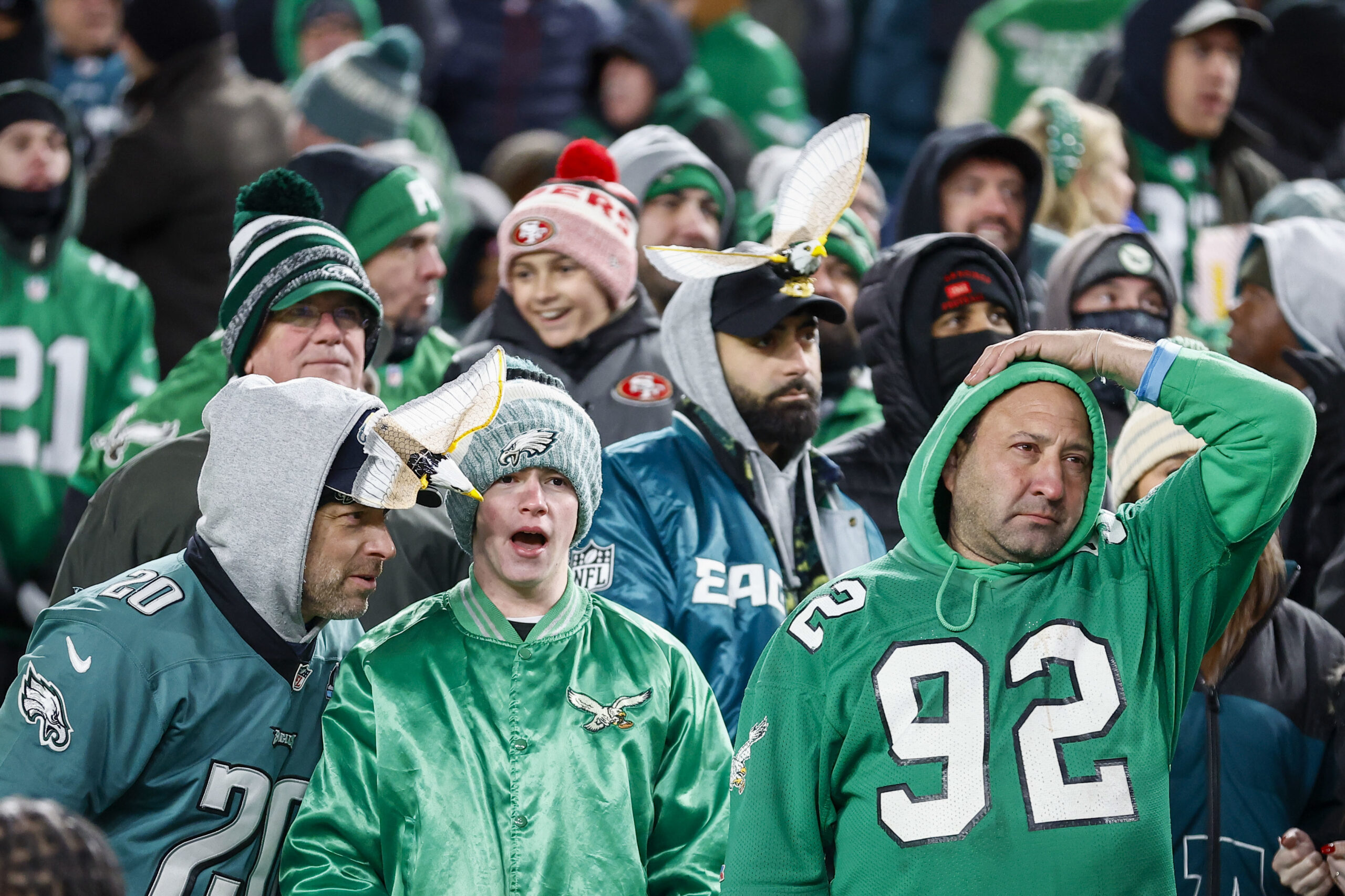
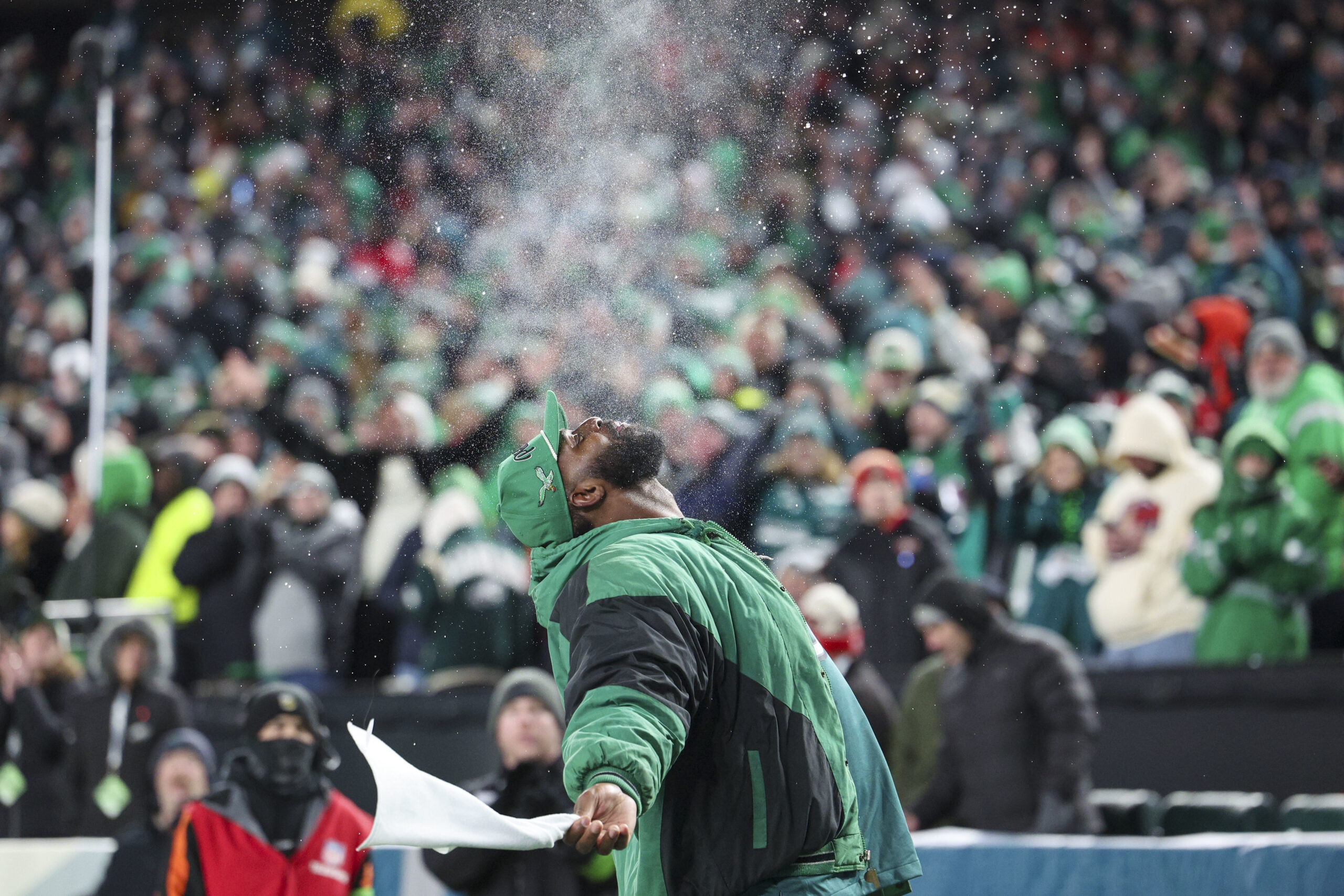
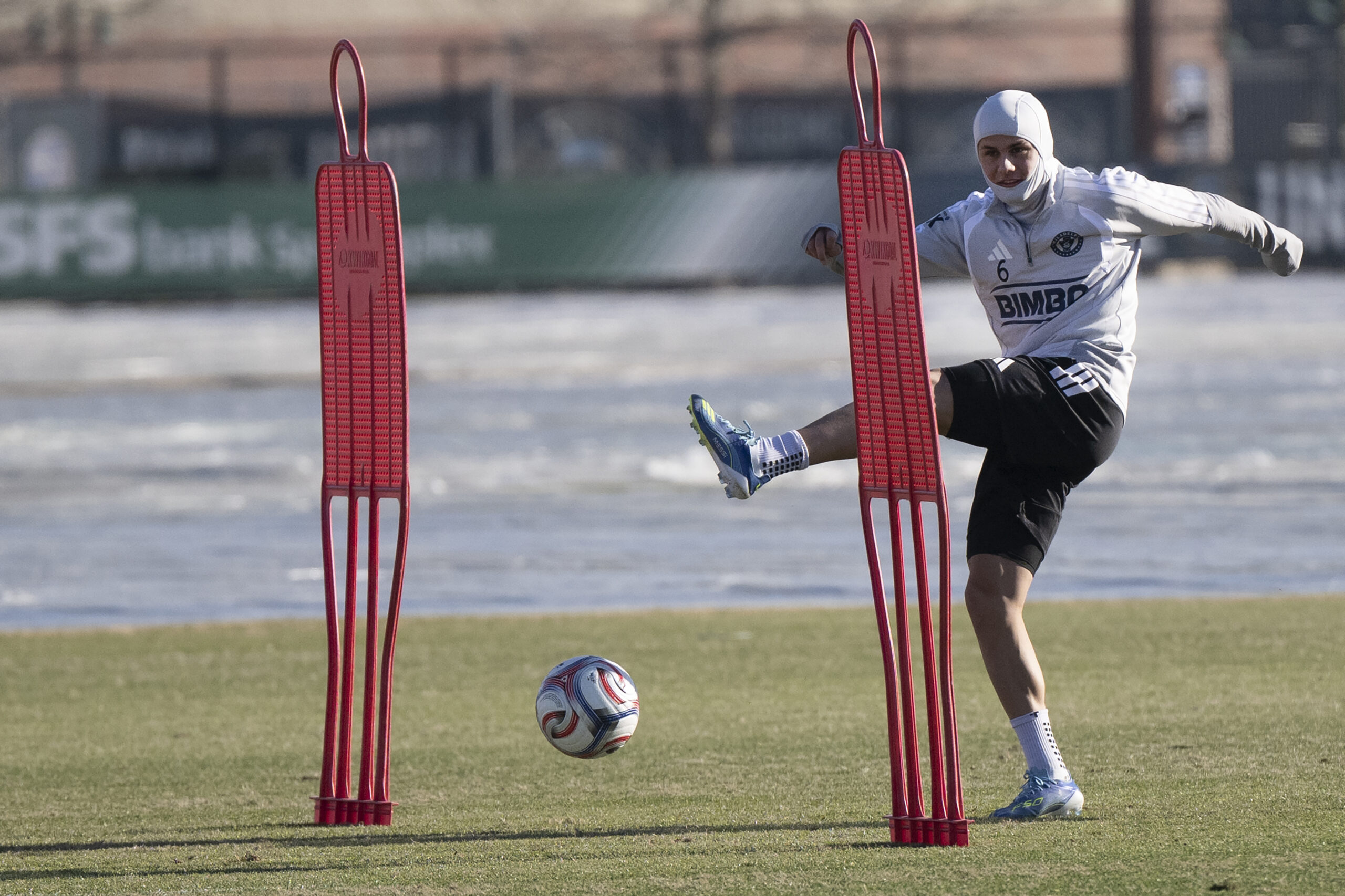
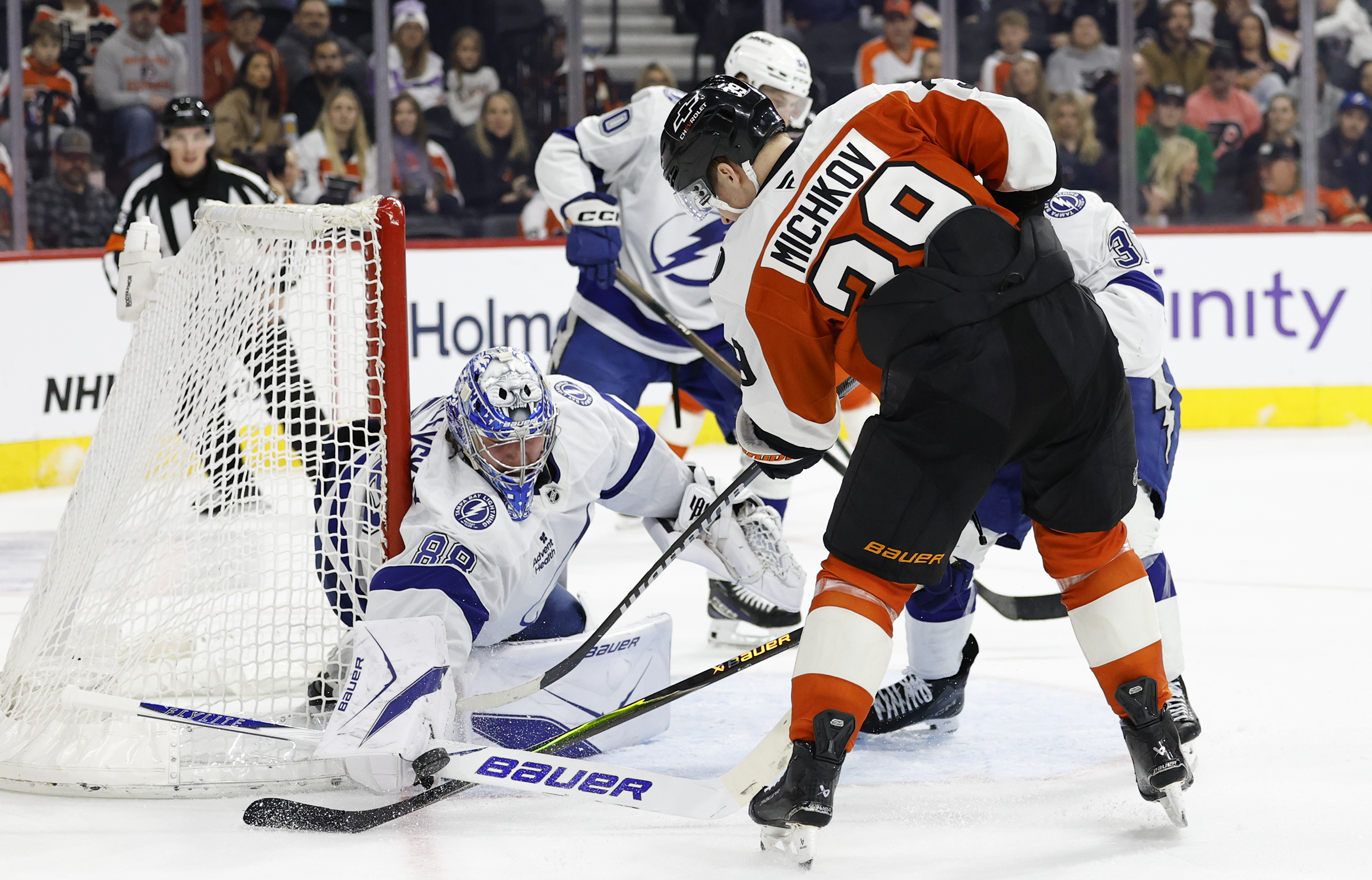
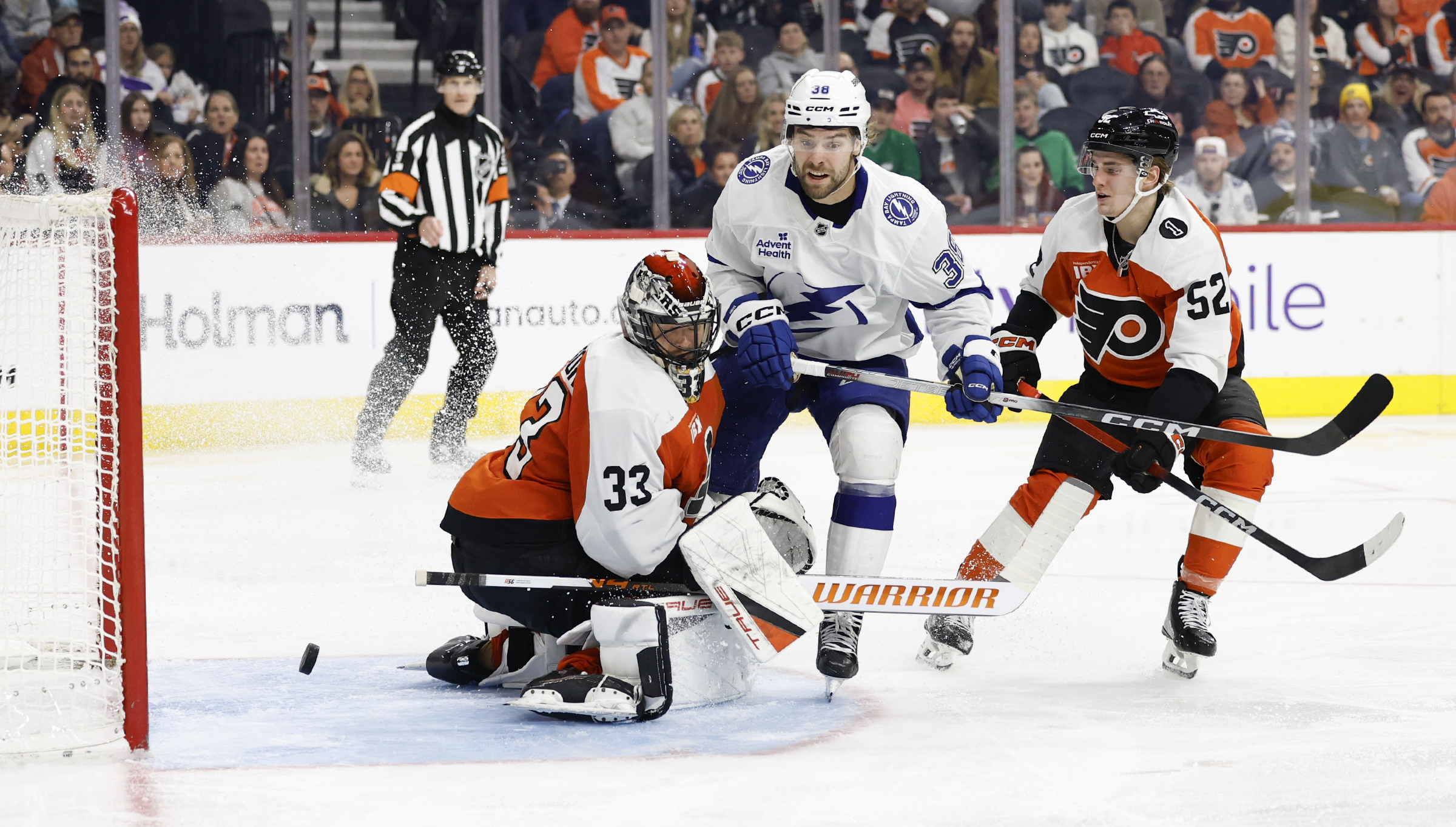
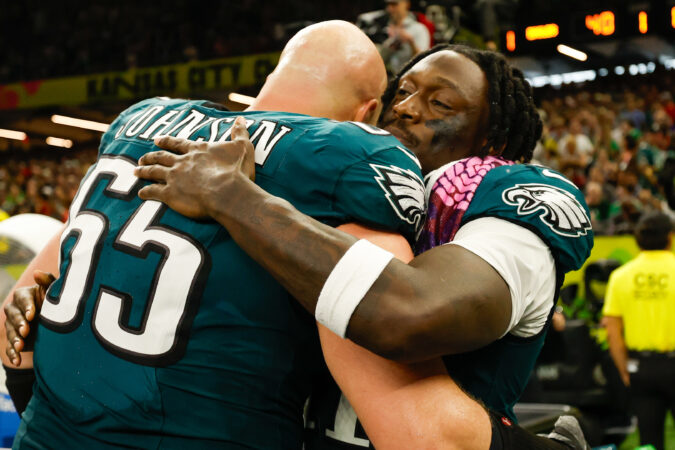
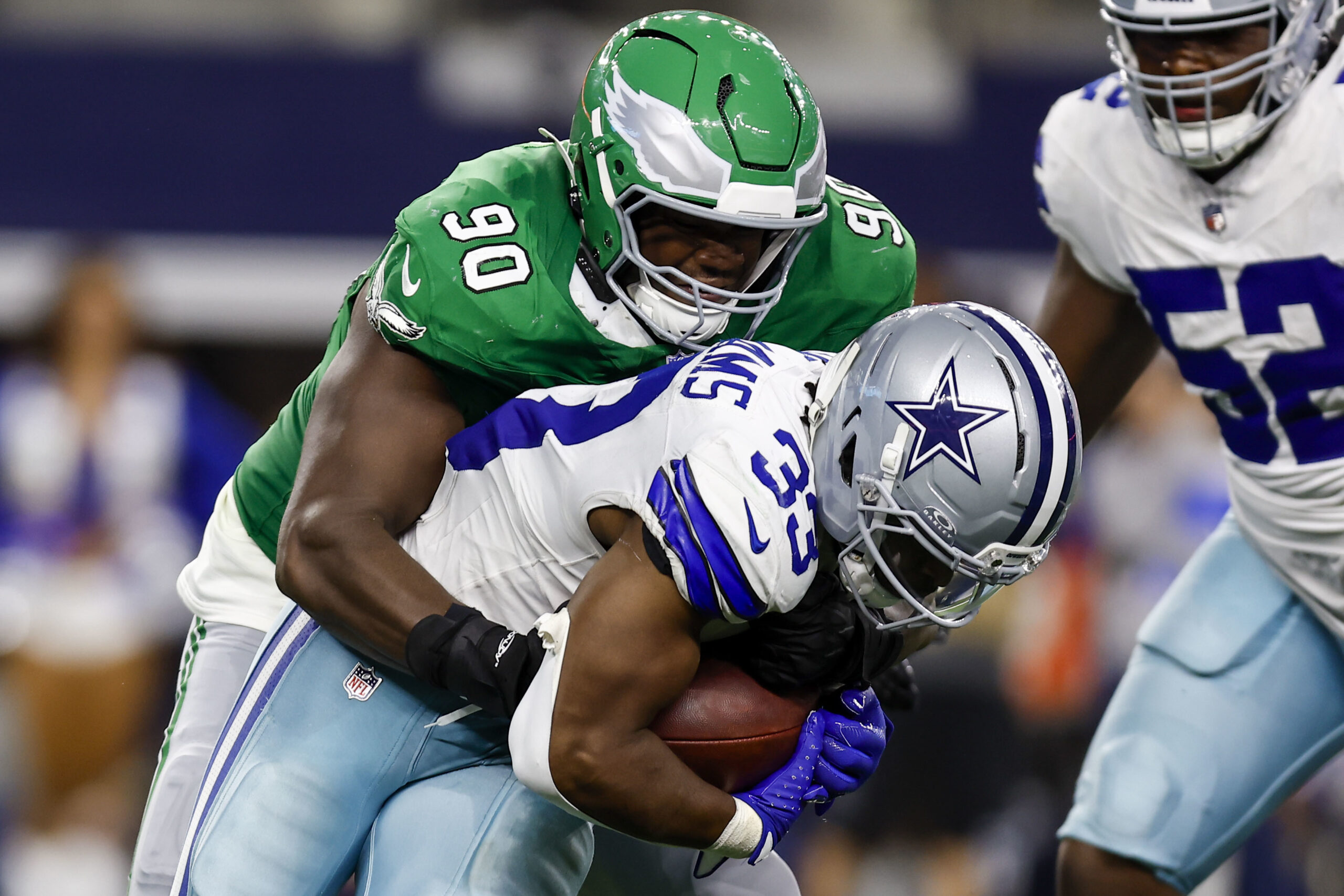
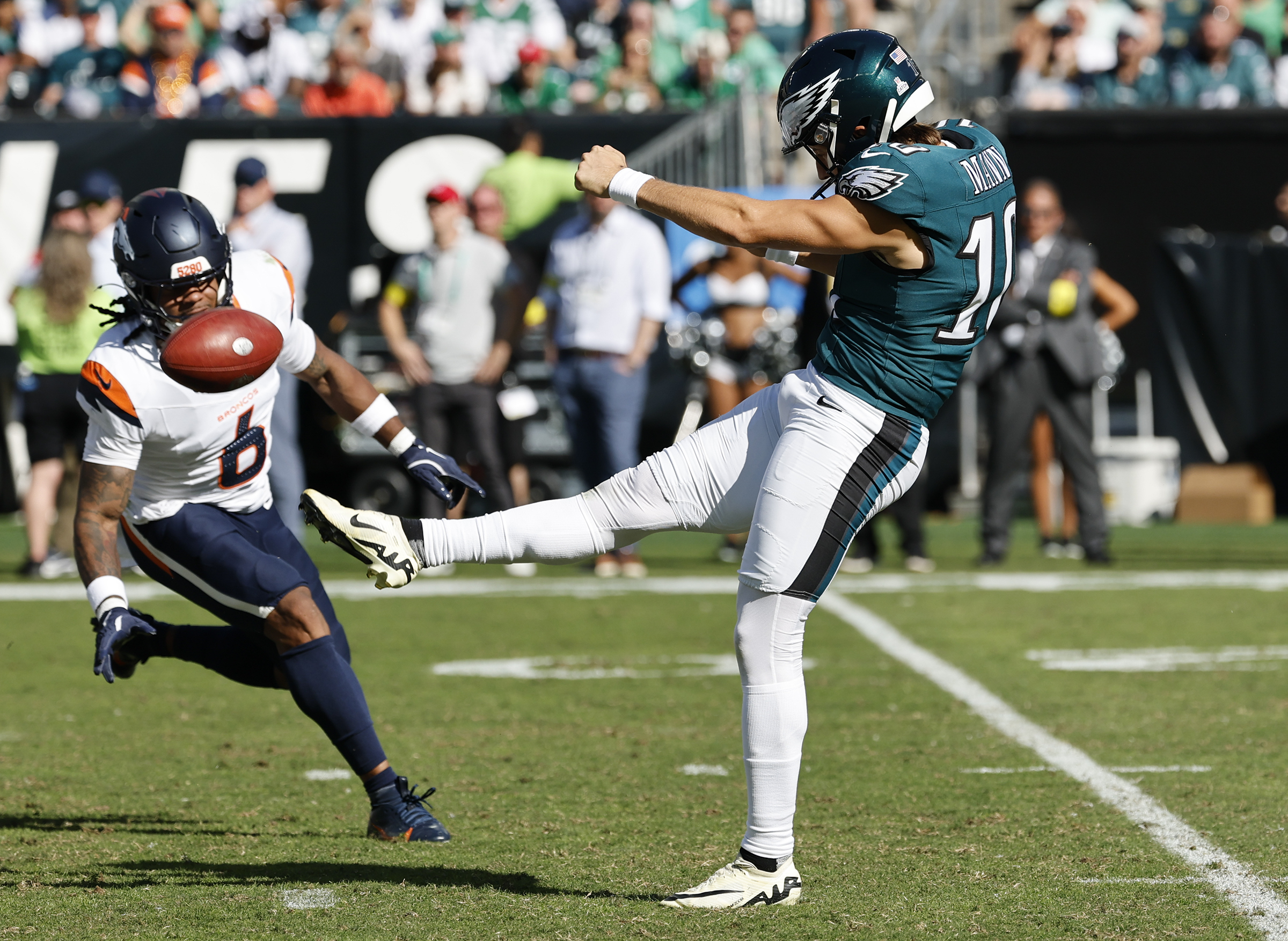
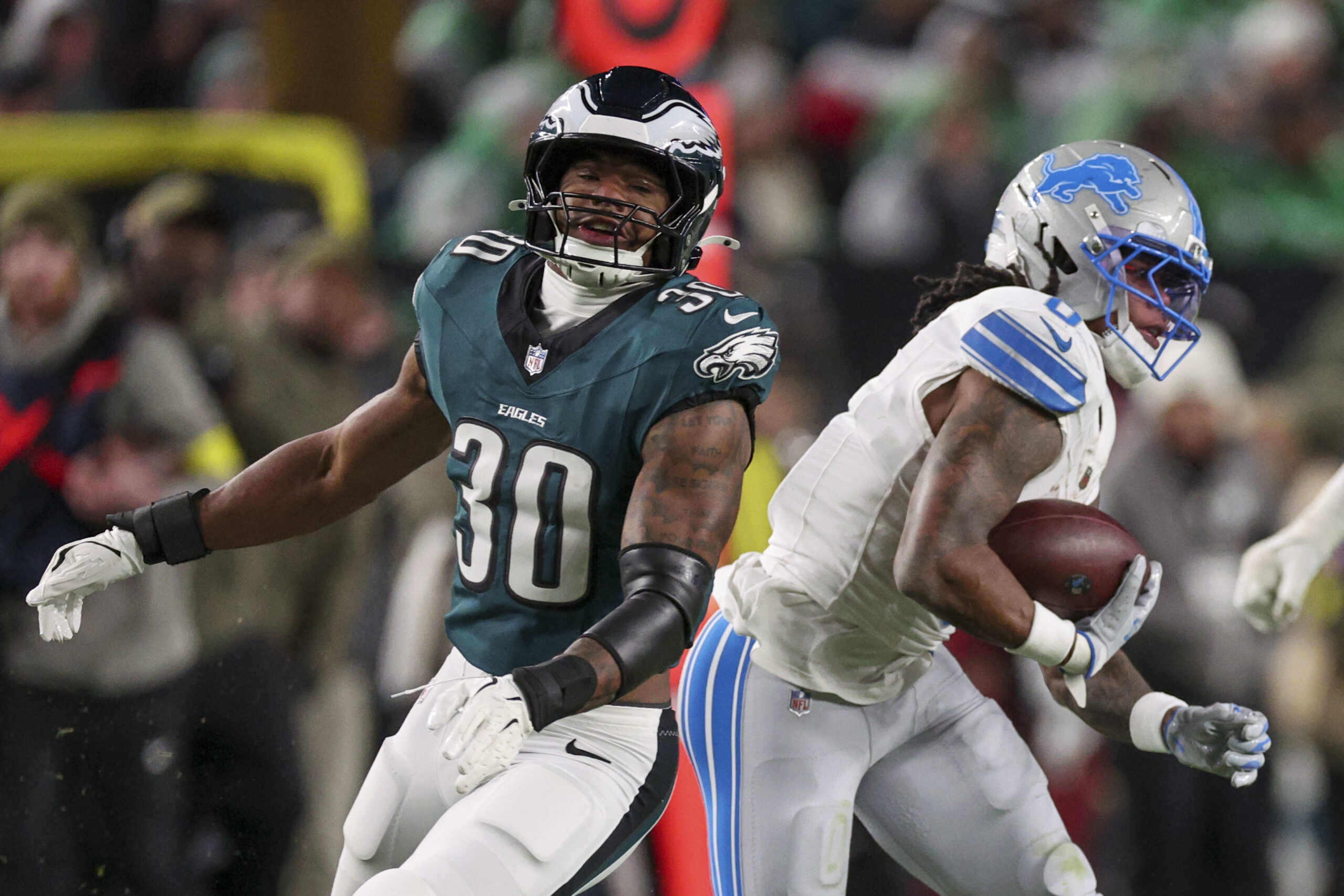
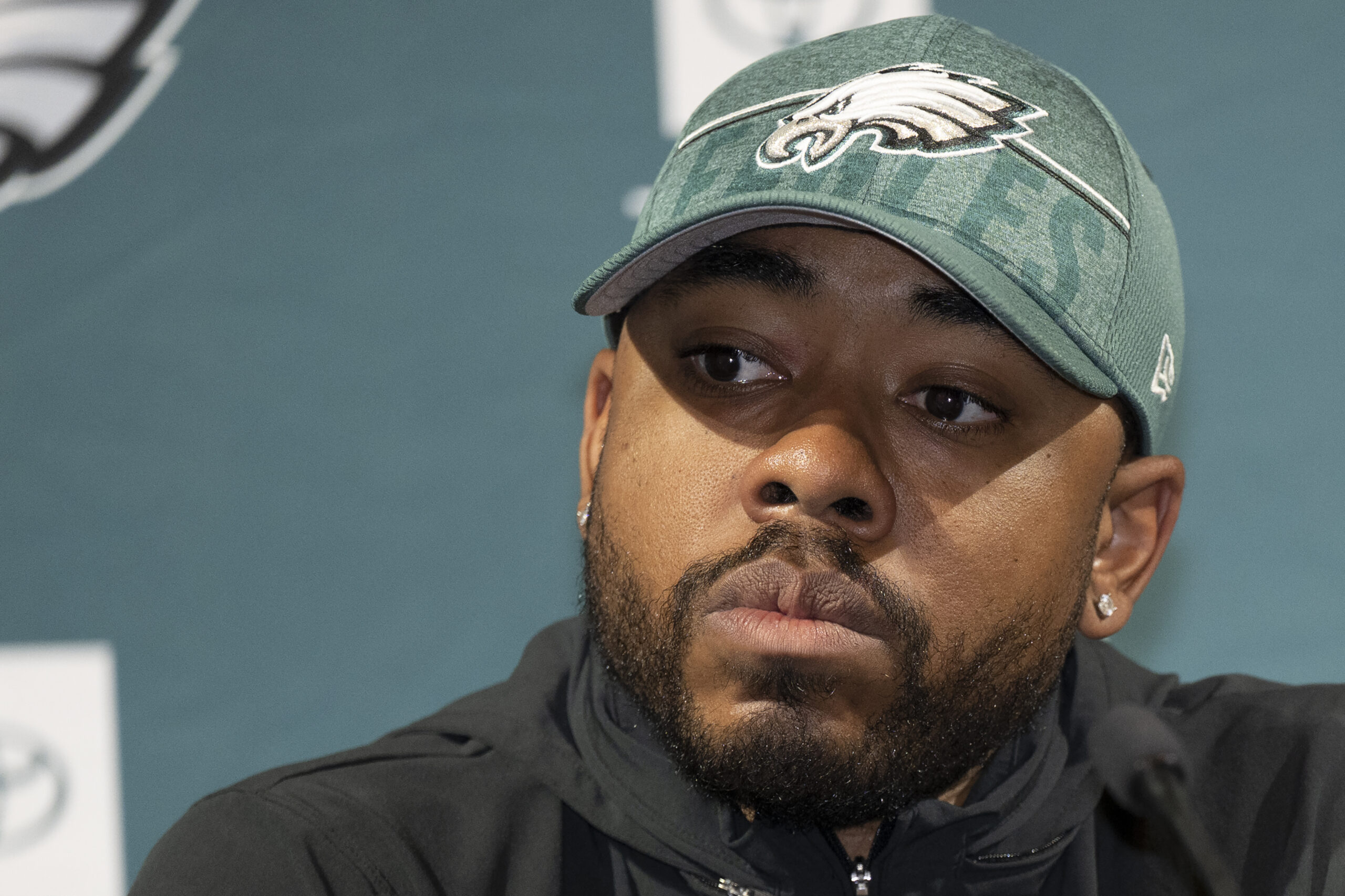
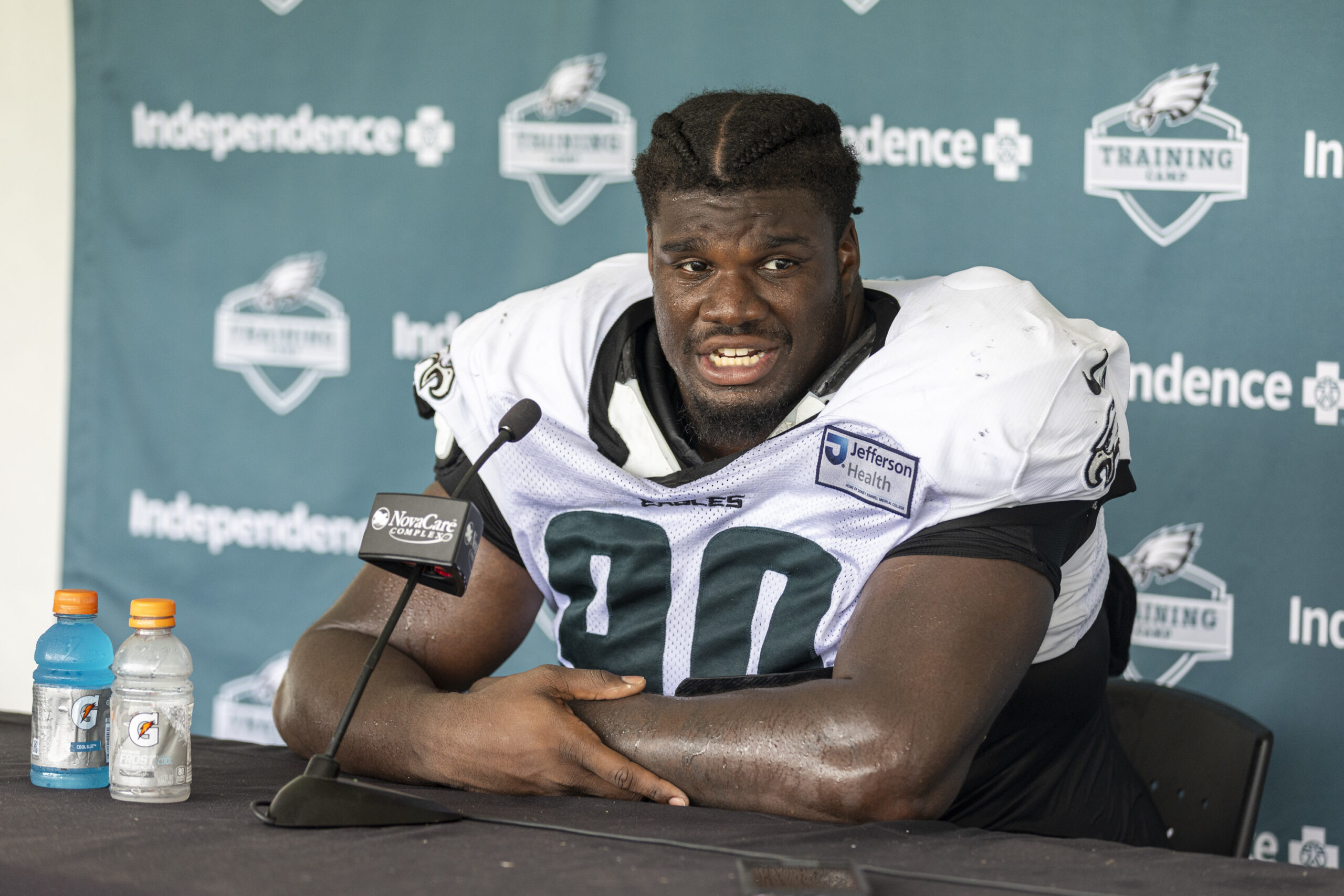
Each Friday, Inquirer photo editors pick the best Philly sports images from the last seven days. This week, however, isn’t just about the end of the Eagles’ season — it’s also about turning the page and remembering there’s more to life than just football. We’ve got photos of Joel Embiid and the Sixers, Matvei Michkov and the Flyers, and Cavan Sullivan and the Union returning to the practice pitch.
And, yes, there are pictures of the Eagles’ game — but maybe Saquon Barkley’s adorable kids can soften the blow …
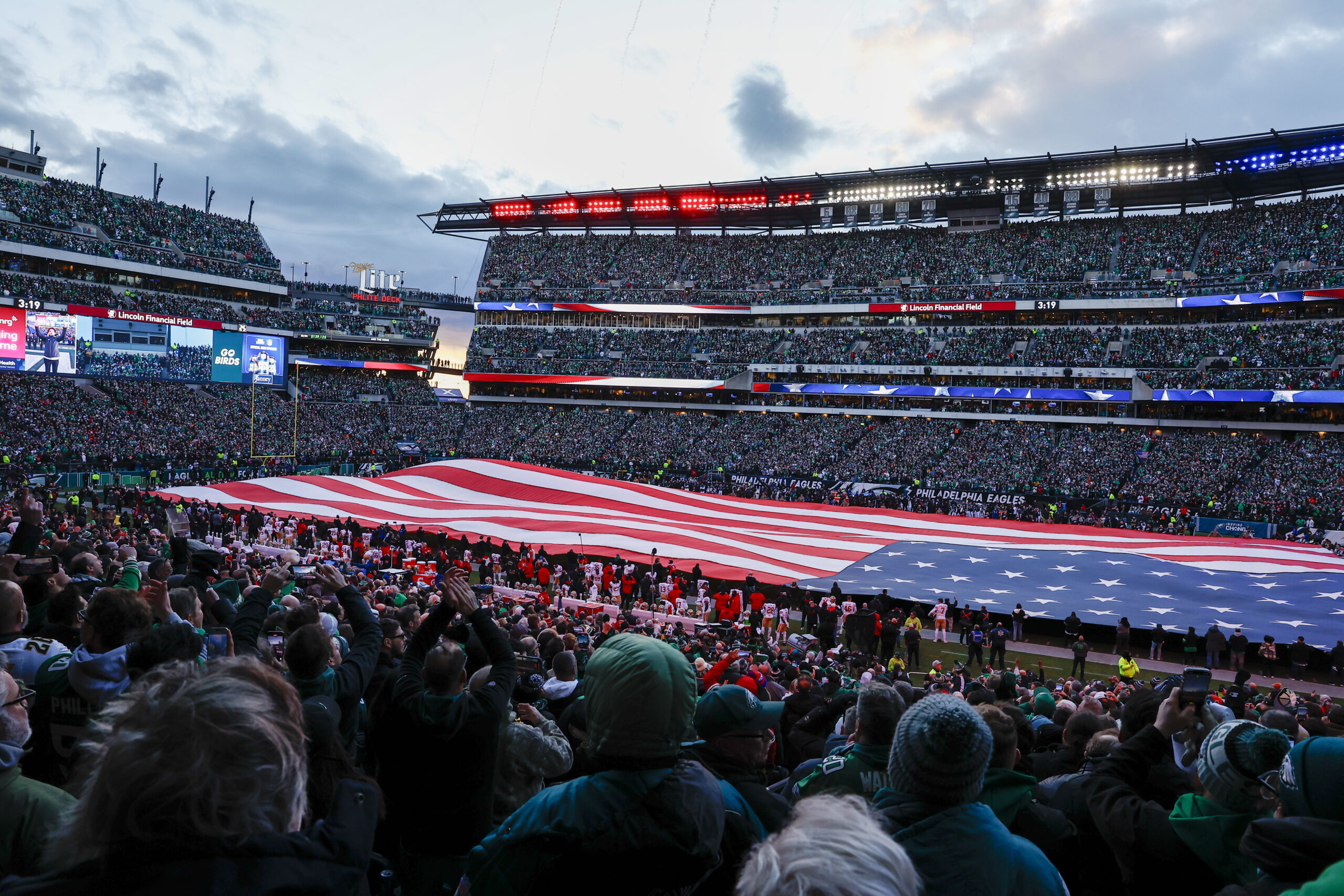
The Eagles’ loss Sunday was their first home playoff loss under Nick Sirianni.
The Eagles have made the playoffs in each of the five years under Nick Sirianni, but lost in the wild-card round three times. The other two years they went to the Super Bowl.
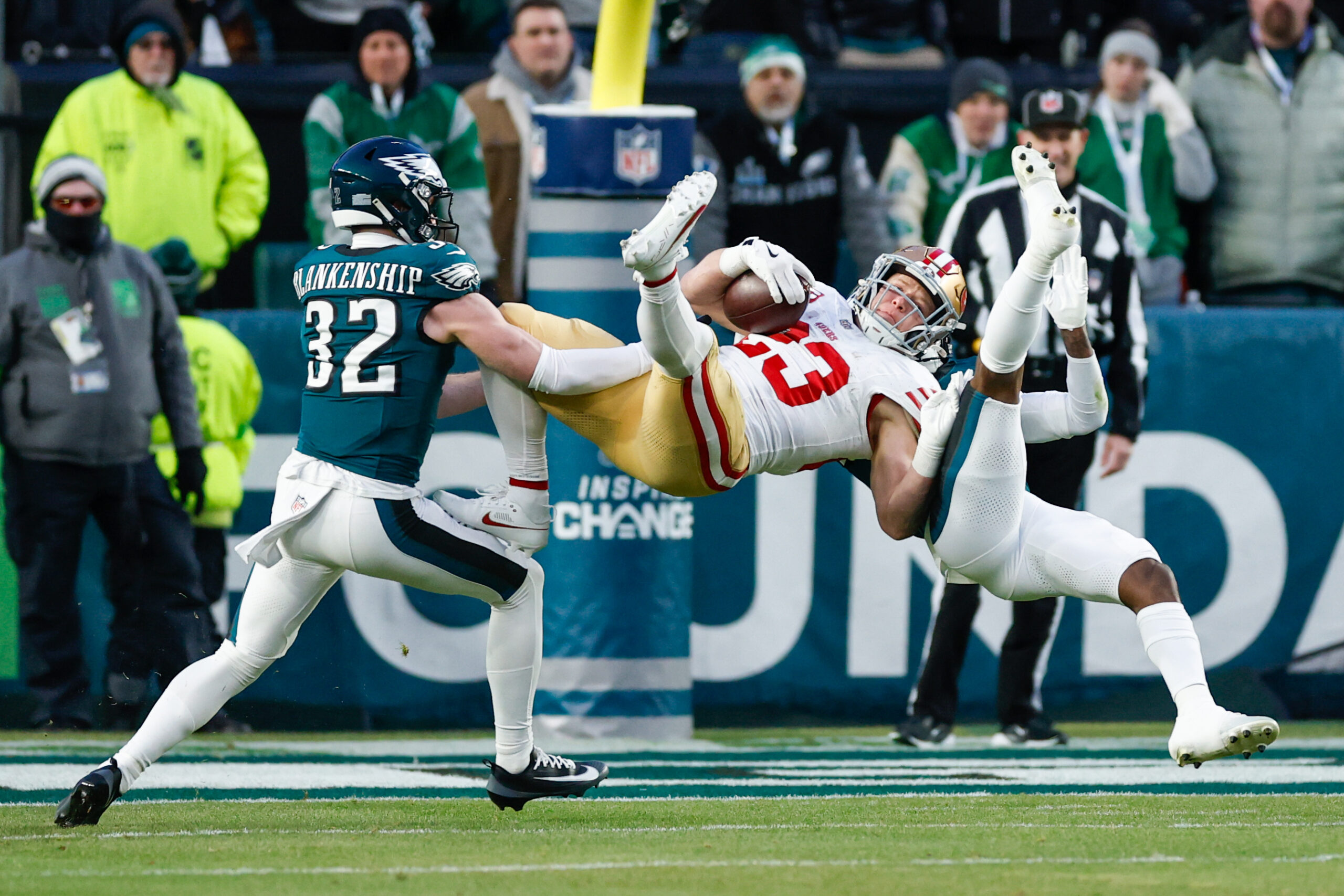
49ers running back Christian McCaffrey, who finished second in the NFL in yards from scrimmage, scored a pair of touchdowns against the Eagles on Sunday.
Who will be the Eagles’ next offensive coordinator is one of the biggest storylines surrounding the team this offseason.
But during the end-of-year press conference on Thursday, another topic rose that will have an impact on that coordinator and the Eagles as a whole.
A.J. Brown’s future in Philadelphia and Lane Johnson’s future playing football in general seem to carry some uncertainty.
The star receiver has expressed his frustrations with the offense and his involvement this season. He also declined to speak to the media after the Eagles’ postseason loss, both after the game and again the following day as the team cleared its lockers.
“It is hard to find great players in the NFL, and A.J. is a great player,” Roseman said. “I think from my perspective, that’s what we’re going out and looking for, when we go out here in free agency and in the draft, is trying to find great players who love football, and he’s that guy. So that would be my answer.”
And regarding Kevin Patullo’s removal as offensive coordinator, Nick Sirianni explained his decision as a need for the offense to “evolve” and in the best interest of the team.
Though, Sirianni didn’t outright fire the 44-year-old coach. For now, Patullo remains on staff. Sirianni said he will “see how it plays out.”
Another question that seemed to spark after the Eagles got bounced from the playoffs in the first round is what exactly does Sirianni do?
Roseman, unprompted, listed those responsibilities.
The narrative that Sirianni was just a figurehead propped up by Roseman and his coordinators has hung over his tenure — even after winning a Super Bowl. But it has gained steam again.
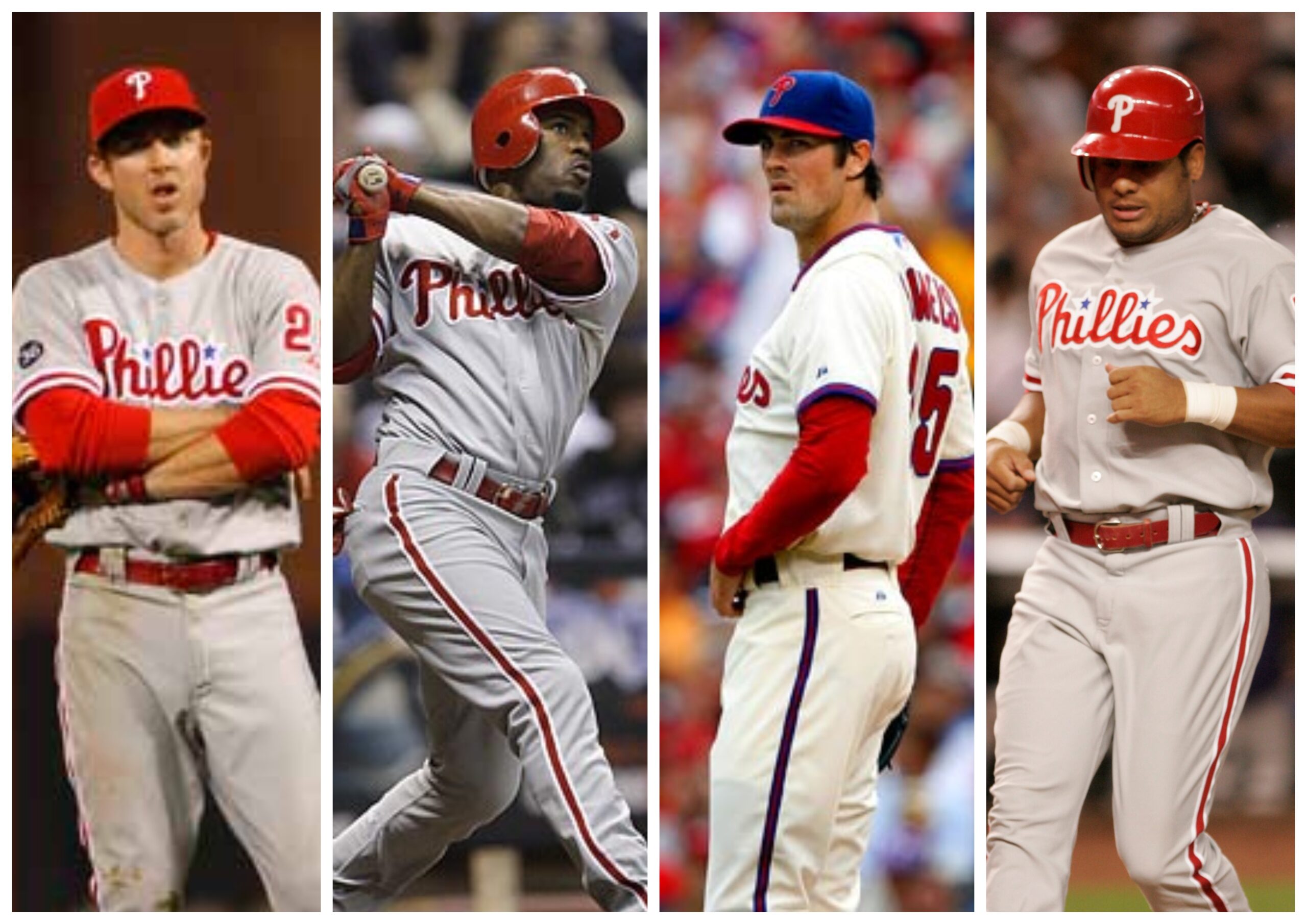
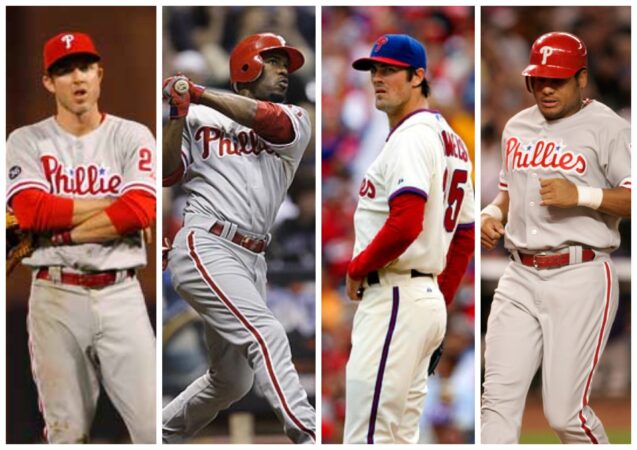
From left: Former Phillies Chase Utley, Jimmy Rollins, Cole Hamels, and Bobby Abreu are all on the Hall of Fame ballot.
What makes baseball’s Hall of Fame special? The quality of the players on the 1-yard line, a Tush Push from getting in. (Too soon for the Eagles reference?). Less than 24,000 players have made it to the majors. A fraction of those stuck around for 10 years, the minimum requirement to be considered by the screening committee that annually puts together the Hall of Fame ballot. Whittle it all down, and only about 5% of all major leaguers see their name on that sheet of paper.
But it’s another loaded ballot for the Phillies with Chase Utley, Jimmy Rollins, Bobby Abreu, and Cole Hamels. Let’s examine the Cooperstown case for each before the results are announced on Tuesday.
What we’re …
🤔 Wondering: This season wasn’t all bad for the Eagles. Here are the winners of the 2025 superlatives.
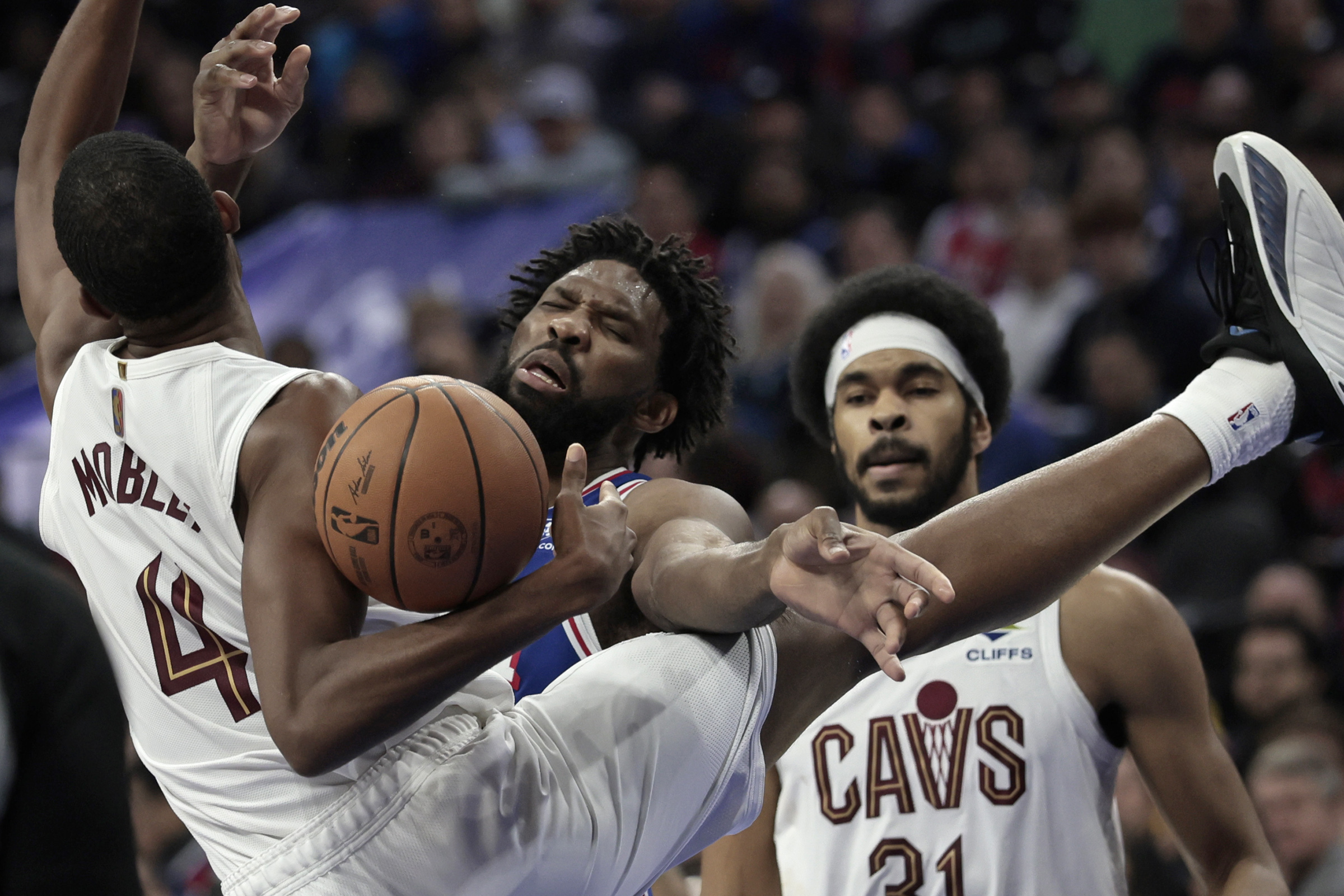
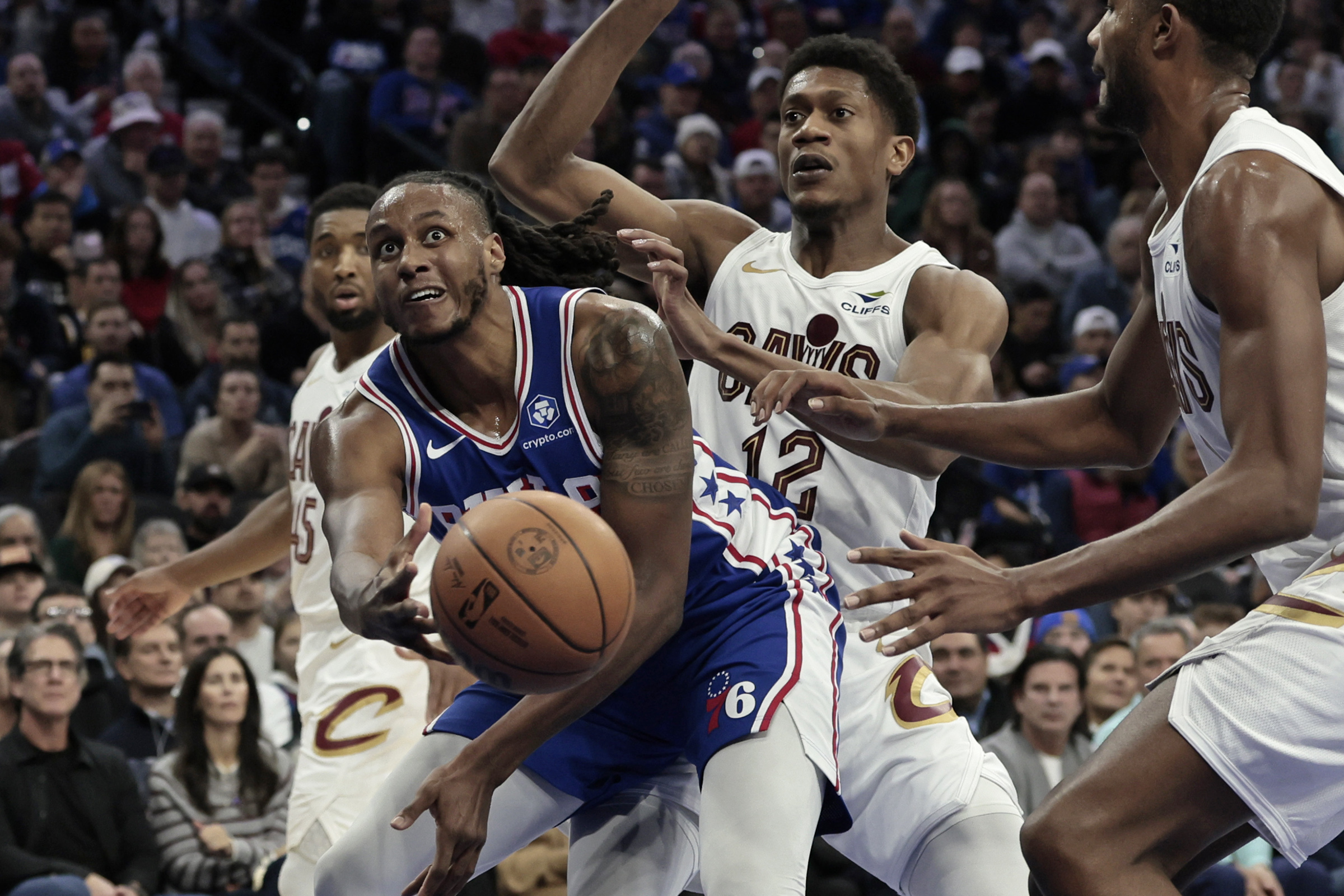
The Sixers’ Jabari Walker passes the ball off as Cleveland’s De’Andre Hunter (center) defends. Hunter is a Philly native and former Friends’ Central School star.
As soon as De’Andre Hunter had dropped his bags at the Cleveland Cavaliers’ hotel in Philly on Tuesday, he headed to Dalessandro’s Steaks. Hunter relished being back in front of family and friends inside Xfinity Mobile Arena Wednesday night, where he finished with 17 points, four rebounds, and four assists off the bench.
Hunter, a Friends’ Central School graduate, credits “love in the air” for his standout showing as the Cavaliers thrashed the Sixers.
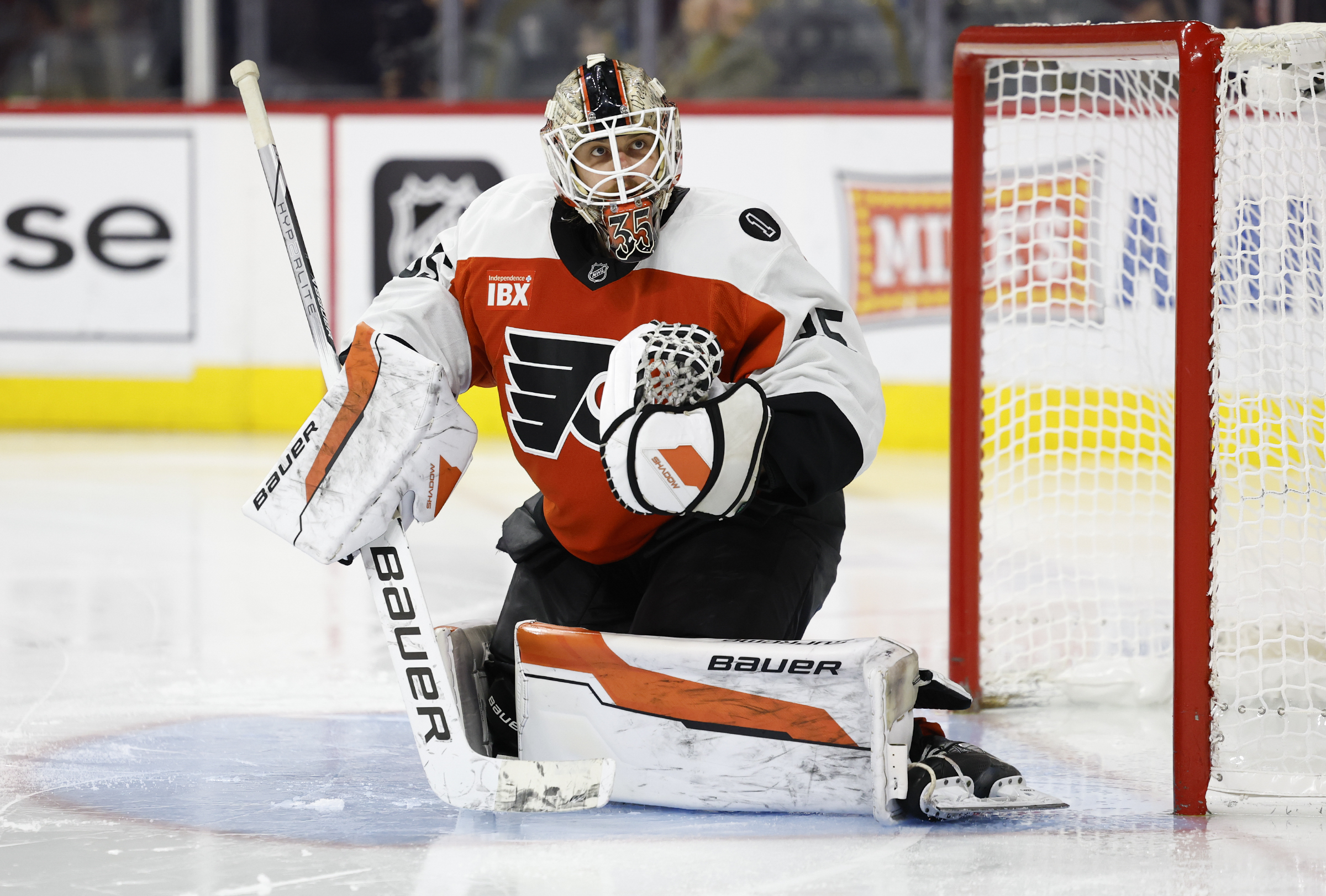
Aleksei Kolosov has been clear that he wants to play in the NHL. He’ll likely get another chance after being called up Thursday.
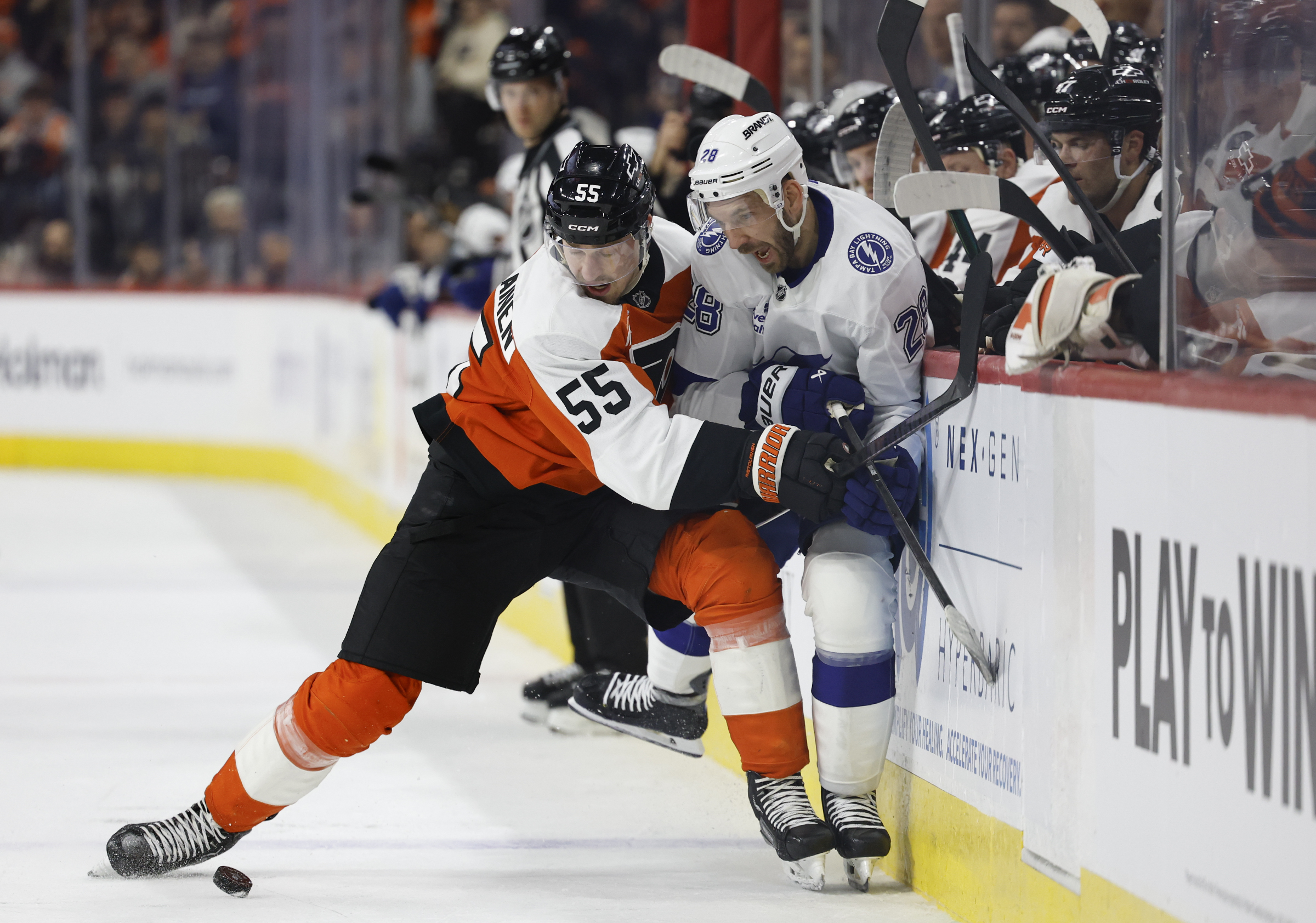
Things seemed to be looking up for defenseman Jamie Drysdale, who was set to return to the lineup on Wednesday night in Buffalo. But just a few short hours later, the injury bug resupplied its stinger. Defenseman Rasmus Ristolainen is also listed as day-to-day with an upper-body injury, after being a full participant at morning skate.
And the Flyers are still awaiting tests results on the severity of Dan Vladař’s injury from a loss against the Sabres. In the meantime, the Flyers recalled goalie Aleksei Kolosov from Lehigh Valley.
However, those injuries seemed to make a difference against the Penguins, as the Flyers suffered their fifth straight loss.
Sports snapshot
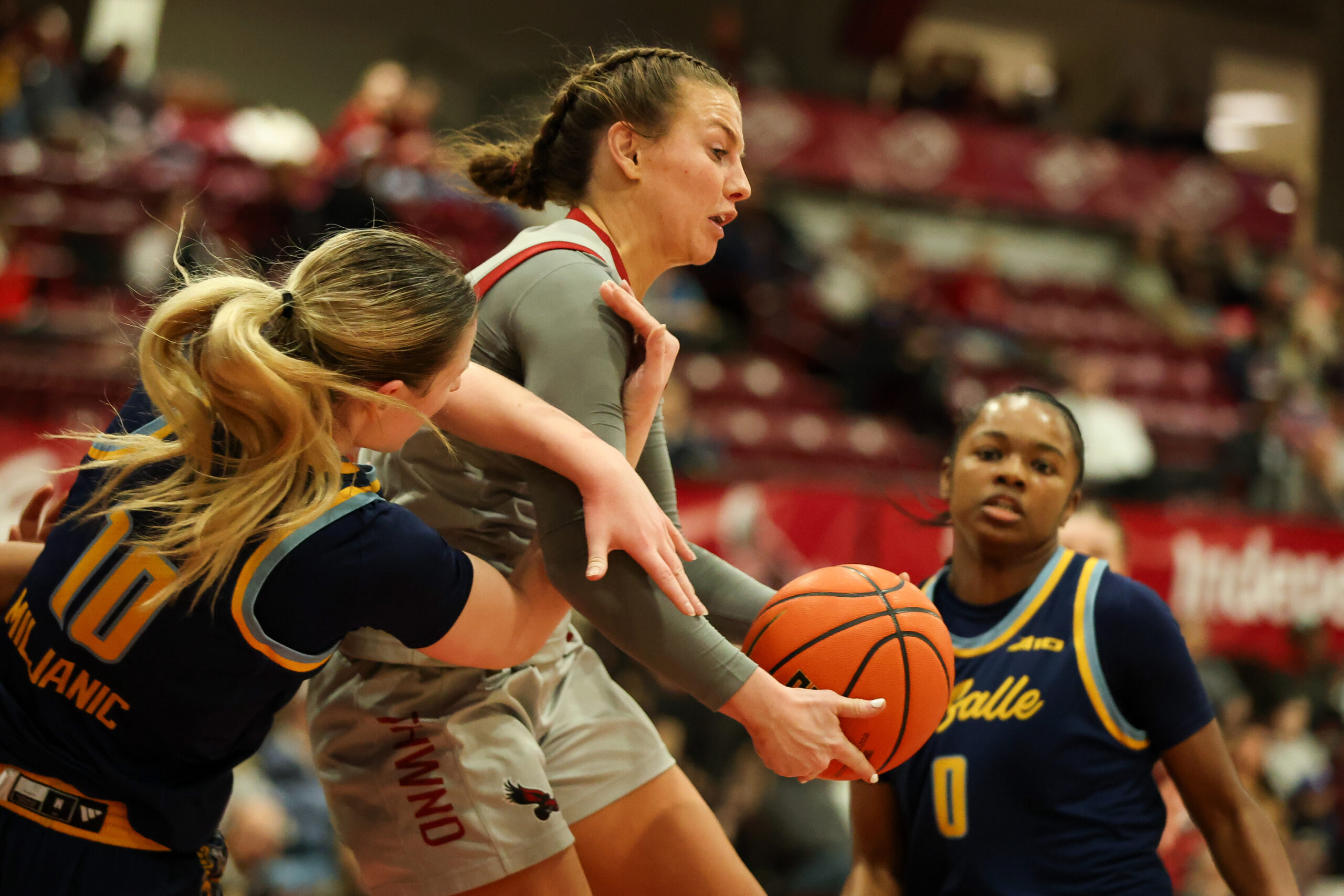
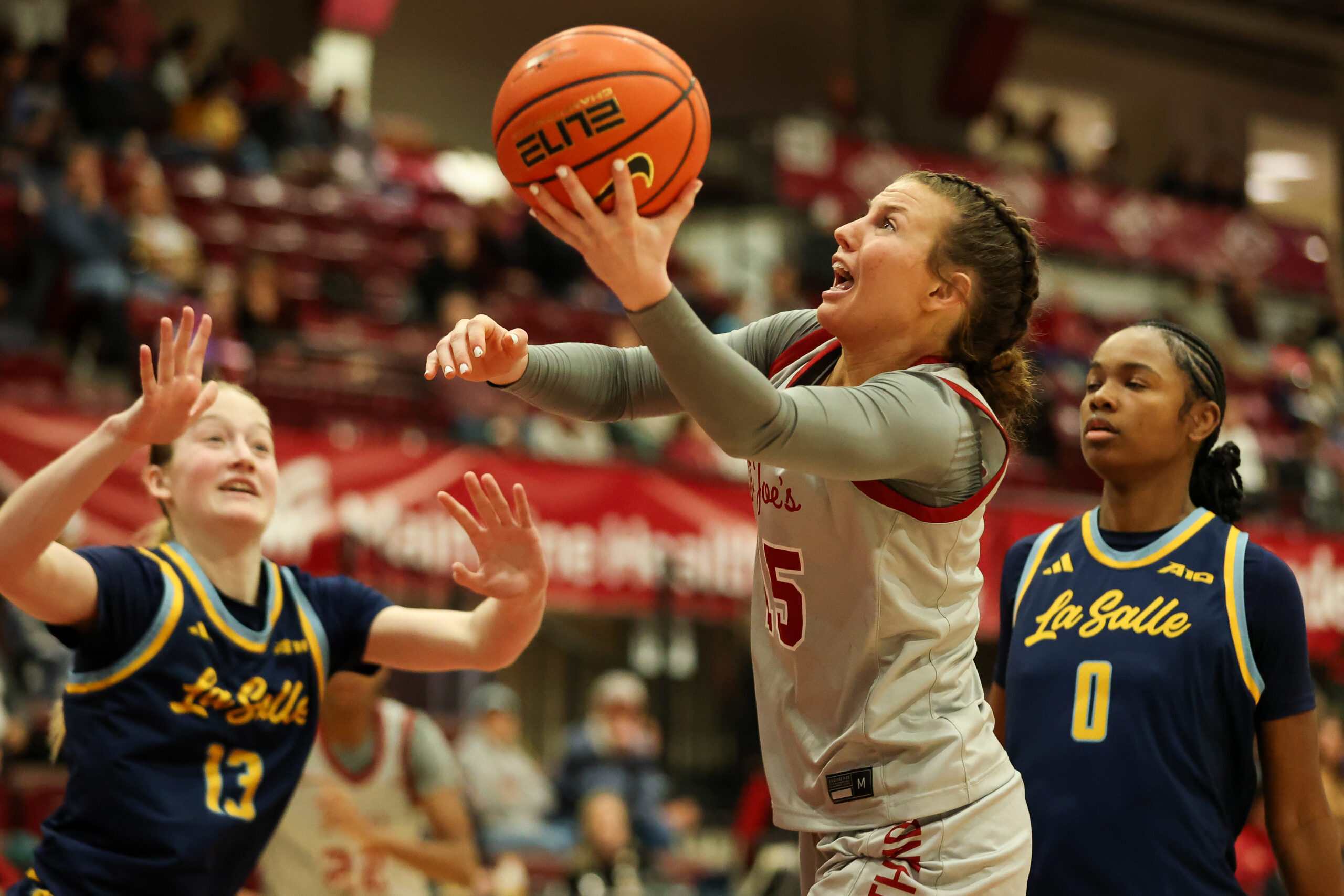
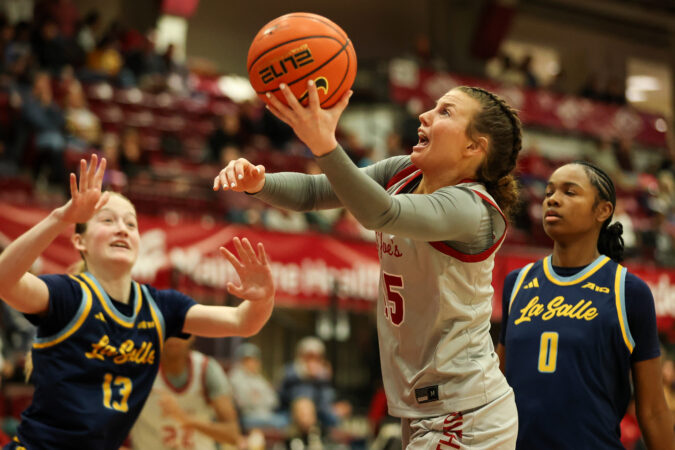
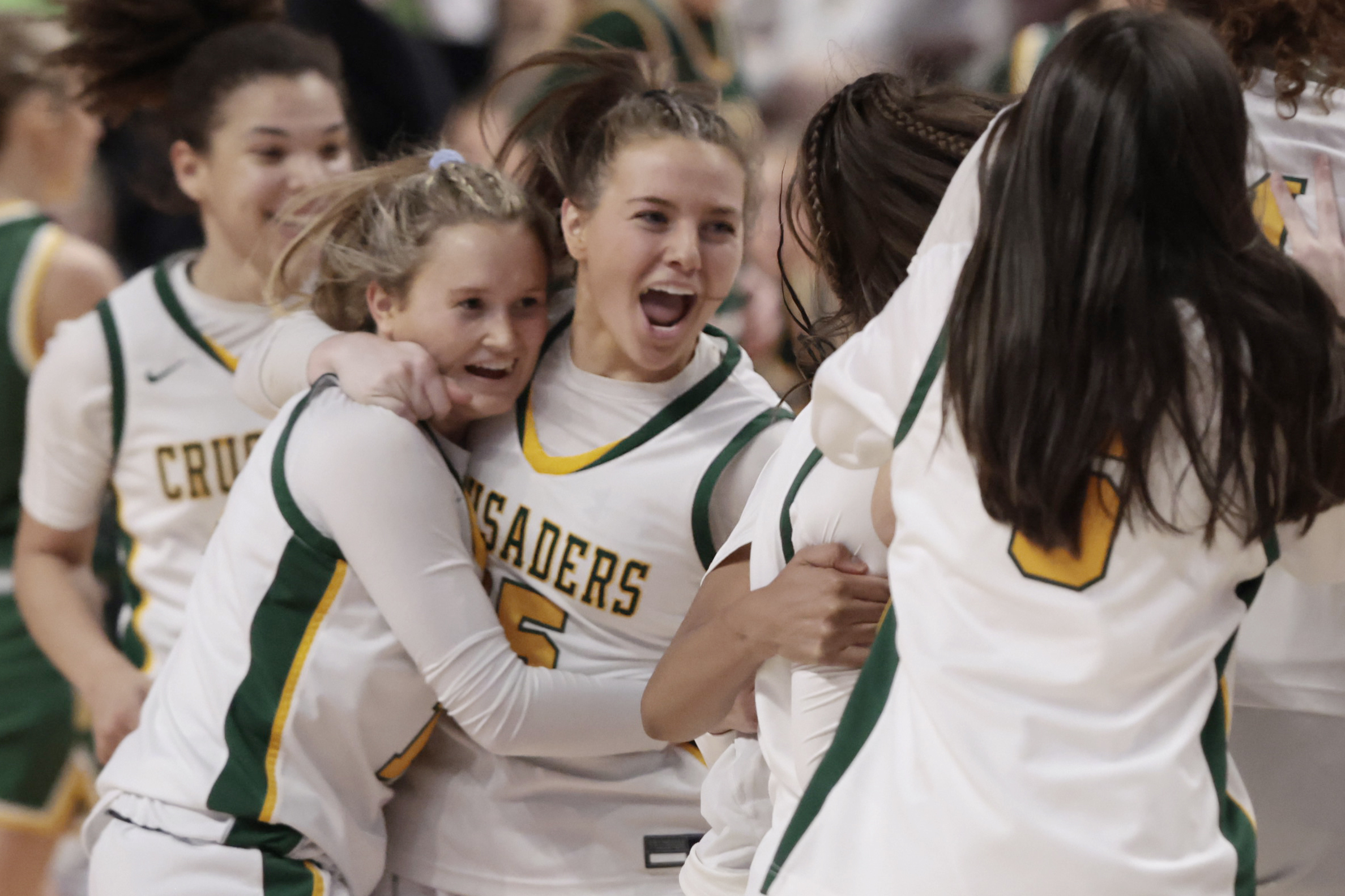
“Philly basketball is tough and it’s competitive, and I think that it really helped me transition into college,” St. Joe’s junior guard Gabby Casey said.
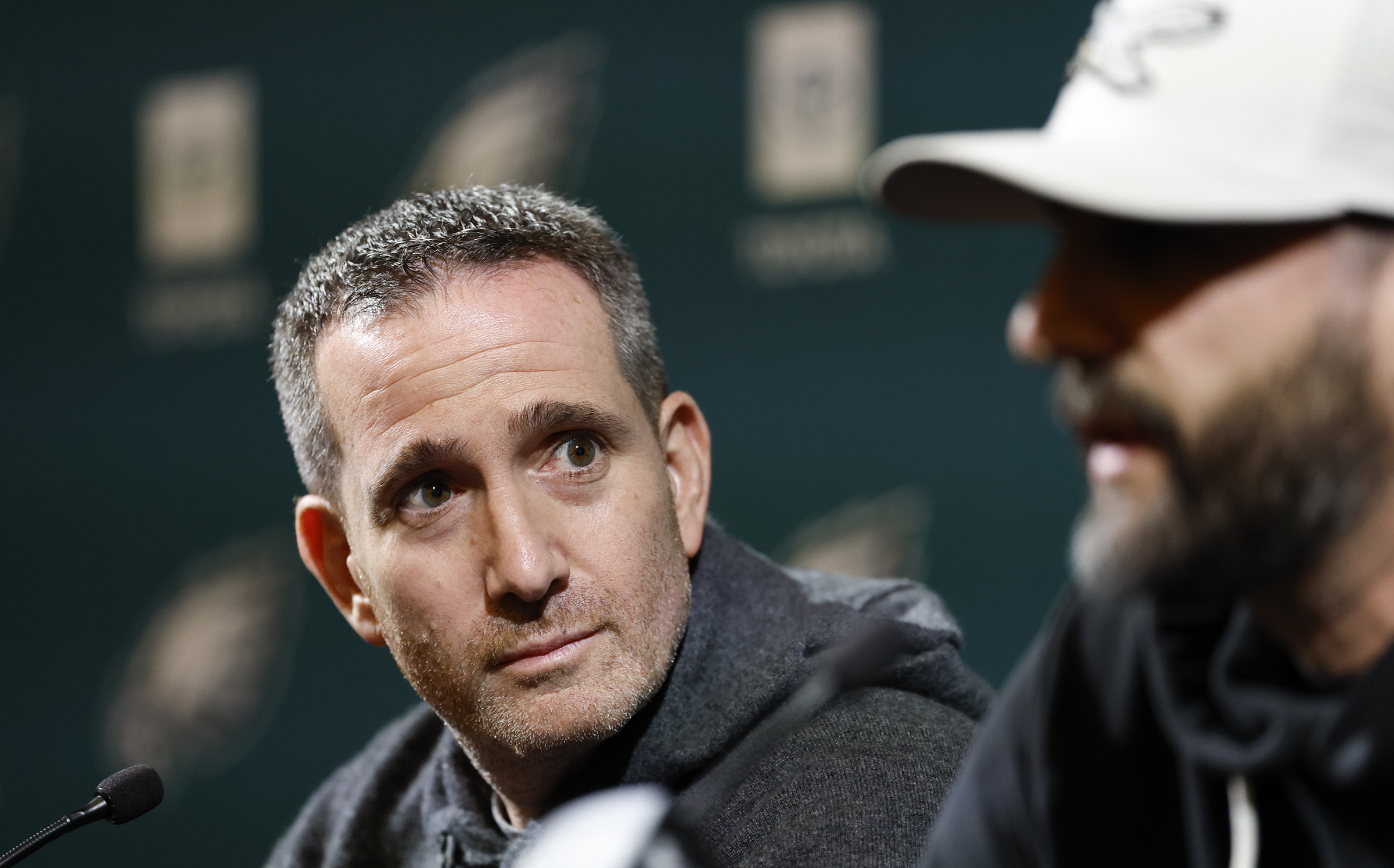
Eagles general manager Howie Roseman offered unsolicited and lavish praise for Nick Sirianni on Thursday.
There isn’t a whole lot of literal truth you can glean in most press conference settings. That’s especially true in the NFL. The Eagles are about to embark on an offensive coordinator search that could see them bring in a number of big name former head coaches who have their own schemes and, potentially, their own assistant coaches. But Howie Roseman made it a point to share his forceful vote of confidence in Nick Sirianni. It speaks volumes that Roseman took advantage of the opportunity, and that he did it forcefully, writes columnist David Murphy.
What you’re saying about your favorite rivalry
We asked: What’s your favorite rivalry? Among your responses:
The best sports rivalry of all time is Army-Navy. Nothing else even comes close. — Doug R.
There’s been a few throughout my 86 years. The absolute No. 1 will always be the Cowboys / Eagles. Regardless of our record as long as we beat Dallas all is good. Followed by the Flyers / Rangers, Phillies / Mets, 76ers / Celtics, and Villanova / St. Joe. — Ronald R.
Eagles and Cowboys for sure. My family is divided almost down the middle. That makes things interesting at times. — Tom G.
Growing-up in the 70’s, high school basketball in Lower Bucks County featured a fierce rivalry between Bristol High School and Holy Ghost Prep. Bristol, a small public school who won the PIAA State Championship in 1975 and a Holy Ghost, private school powerhouse. — Bob C.
When I was a young kid in Springfield Delco I would walk from my house up to the high school every season to see the Springfield vs Marple Newtown Thanksgiving rivalry. And later in life the Army Navy rivalry was always tops to me. I always rooted for Army, but then when I joined the Navy I of course switched. When I lived in Southern California I enjoyed the intense football rivalry between USC and UCLA. Now one of the most intense Philly rivalries is between the Mets and our Phillies. — Everett S.
West Philly vs. Overbrook — William D.
Born in Philly but now in Durango, Co. Before Dgo I was in Tucson, Az. for 15 years. I don’t think I ever witnessed a more bitter rivalry than my Az. Wildcats vs. the ASU “Scumdevils”.It is truly a bitter, unfriendly rivalry. On the Philly side, my dad took me (a 15 year old sophomore) to Franklin Field to see The Birds play the NY Giants. This was the game after Concrete Charlie cleaned Frank Giffords “clock”. Wat a show in the stands between NYG fans and Philly fans. It remains a great rivalry today.— Dave S.
We compiled today’s newsletter using reporting from Olivia Reiner, Jeff Neiburg, Jeff McLane, David Murphy, Scott Lauber, Jackie Spiegel, Ariel Simpson, Gabriela Carroll, Gina Mizell, Jonathan Tannenwald, Ryan Mack, Mia Messina, and Colin Schofield.
By submitting your written, visual, and/or audio contributions, you agree to The Inquirer’s Terms of Use, including the grant of rights in Section 10.
Thanks for reading! Hope you have a wonderful and restful weekend. Jim will be back in your inbox on Monday to get your week started. — Bella
Cole Hamels knew it for years, even before pitching his last major league game. Eventually, a day would come when his name appeared on the Hall of Fame ballot.
Even so, there was something about actually seeing it.
“When they do put your name on the ballot, they send you a letter,” Hamels recently told Phillies Extra, The Inquirer’s baseball podcast. “You can frame it.”
Better yet, cast it in bronze, just like those plaques on the walls in Cooperstown, N.Y. Because although only one, maybe two former players on this year’s ballot will get elected Tuesday night and inducted this summer, all 27 had careers worth recognizing.
Take, for instance, Hamels. He finished in the top 10 in his league in ERA six times in 15 seasons, 10 of which came with the Phillies. He ranks fourth in Phillies history in strikeouts (2,560) and sixth in innings (2,698). He was the MVP of the 2008 World Series and threw a no-hitter in 2015 in his final Phillies start.
By every measure, a brilliant career.
Yet Hamels’ name might be checked on fewer than one-quarter of the 400 or so ballots — and not the one cast by this voter. Hamels was polling at 31.1% as of Friday evening, according to industrious ballot collector Ryan Thibodaux’s tracker, more than the minimum 5% to stay on the ballot, far from the 75% for election.
But here’s what makes baseball’s Hall of Fame special: the quality of the players on the 1-yard line, a Tush Push from getting in. (Too soon for the Eagles reference?)
Consider that less than 24,000 players have made it to the majors, even for one day. A fraction of those stuck around for 10 years, the minimum requirement to be considered by the screening committee that annually puts together the Hall of Fame ballot.
Whittle it all down, and only about 5% of all major leaguers see their name on that sheet of paper. And since the inaugural Hall class in 1936, a total of 279 players have been elected, only 137 on the writers’ ballot.
“It’s not a disservice to anyone that doesn’t get that checkmark in any single year,” said Hamels, making his ballot debut this year. “They’re all some of the best baseball players that I was fortunate to play against.”
Indeed, that’s helpful to remember when the results are announced at 6 p.m. Tuesday on MLB Network.
Full disclosure: I voted for Carlos Beltrán, Félix Hernández, Dustin Pedroia, Andy Pettitte, and Chase Utley. Pedroia was the only addition to my ballot from last year. I strongly considered Hamels, in addition to David Wright, Andruw Jones, and Jimmy Rollins and might come around on some, or all, next year.
Every voter has a threshold for where to draw the 1-yard line. Over the years, my tendency has been to favor players who had a big peak, even if they lacked the longevity of classic Hall of Famers. Hernández, Pedroia, and Utley fall into that category.
For observers of the Phillies, it was another loaded ballot, with four candidates — Bobby Abreu, Hamels, Rollins, and Utley — who spent the bulk of their careers with the team. Howie Kendrick and Hunter Pence briefly played for the Phillies; Kendrick works for them as a special assistant.
Let’s dive into the Hall of Fame candidacies of the four longtime Phillies, from the most to the least likely to eventually get elected.
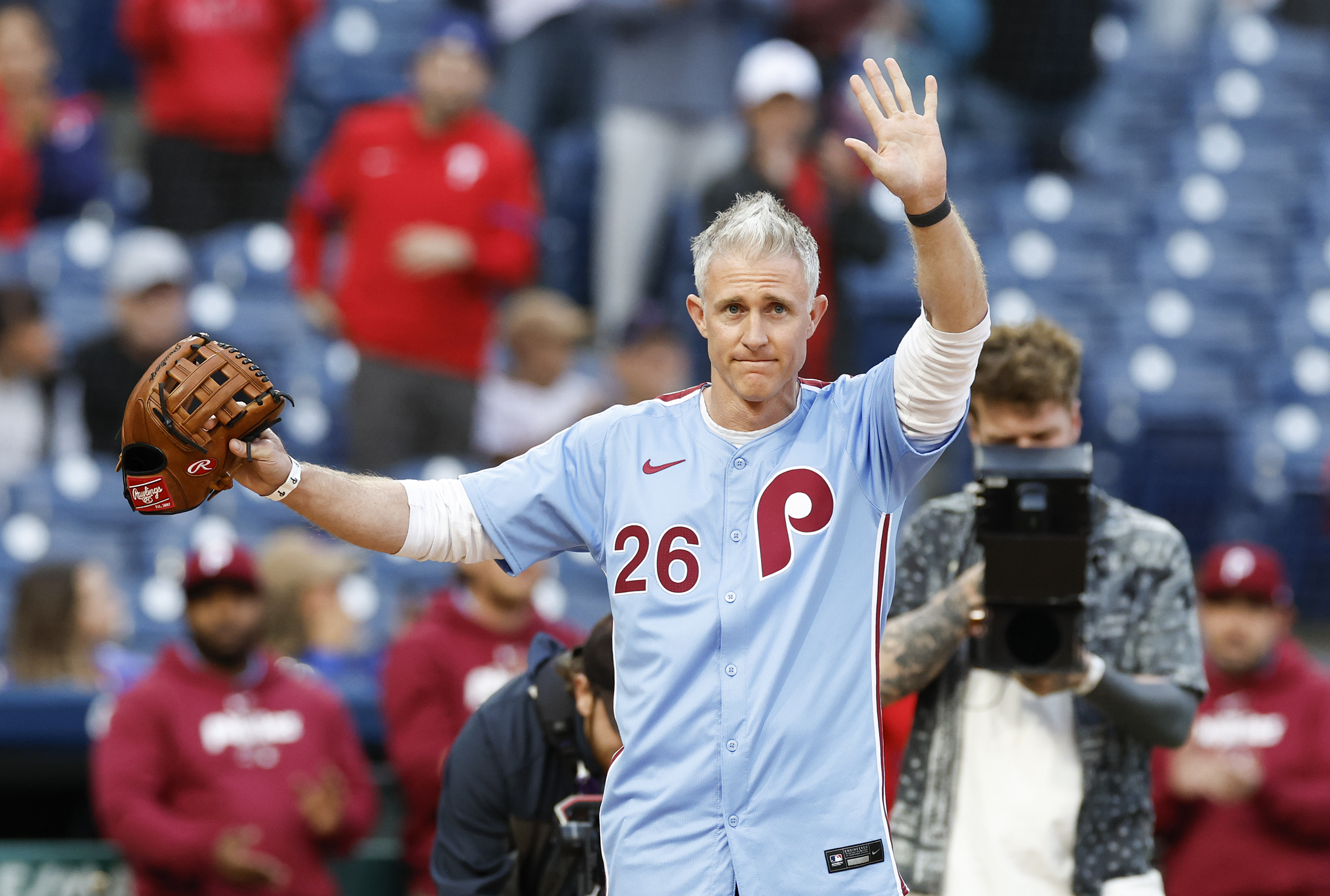
Chase Utley received nearly 40% of the vote last year in his second appearance on the Hall of Fame ballot.
Chase Utley
Years on the ballot: Three
2025 vote total: 39.8%
The writers haven’t elected a player with fewer than 2,000 career hits since Ralph Kiner in 1975.
Utley finished with 1,885.
But Utley appears to be trending toward eventual election, likely because of the height of a peak that lasted at least six seasons and, if you squint, as many as 10. From 2005 to 2014, he had a 127 OPS+ and ranked second among second basemen in extra-base hits behind Robinson Canó, who was suspended twice for failing a drug test. Utley also had the second-most wins above replacement of any player, trailing only Albert Pujols.
Utley made a healthy ballot debut (28.8%) in 2024, then got an 11-point bump last year. Without a strong first-year candidate, he’s set for his biggest leap yet, tracking above 60% in early returns, although players don’t tend to fare as well among voters who don’t make their ballot public.
Second basemen are historically underrepresented in the Hall of Fame. The writers have elected only two (Craig Biggio and Roberto Alomar) since 2006. Jeff Kent was elected last month by an era committee after topping out at 46.5% in 10 years on the writers’ ballot. Maybe it will help Utley and Pedroia with the writers.
Utley already got to almost 40% in only his second go-around. His statistics won’t change, but voters’ perspectives often do. It wouldn’t be surprising to see Utley climb over 50% this year and get the call to Cooperstown sometime around, oh, 2028.
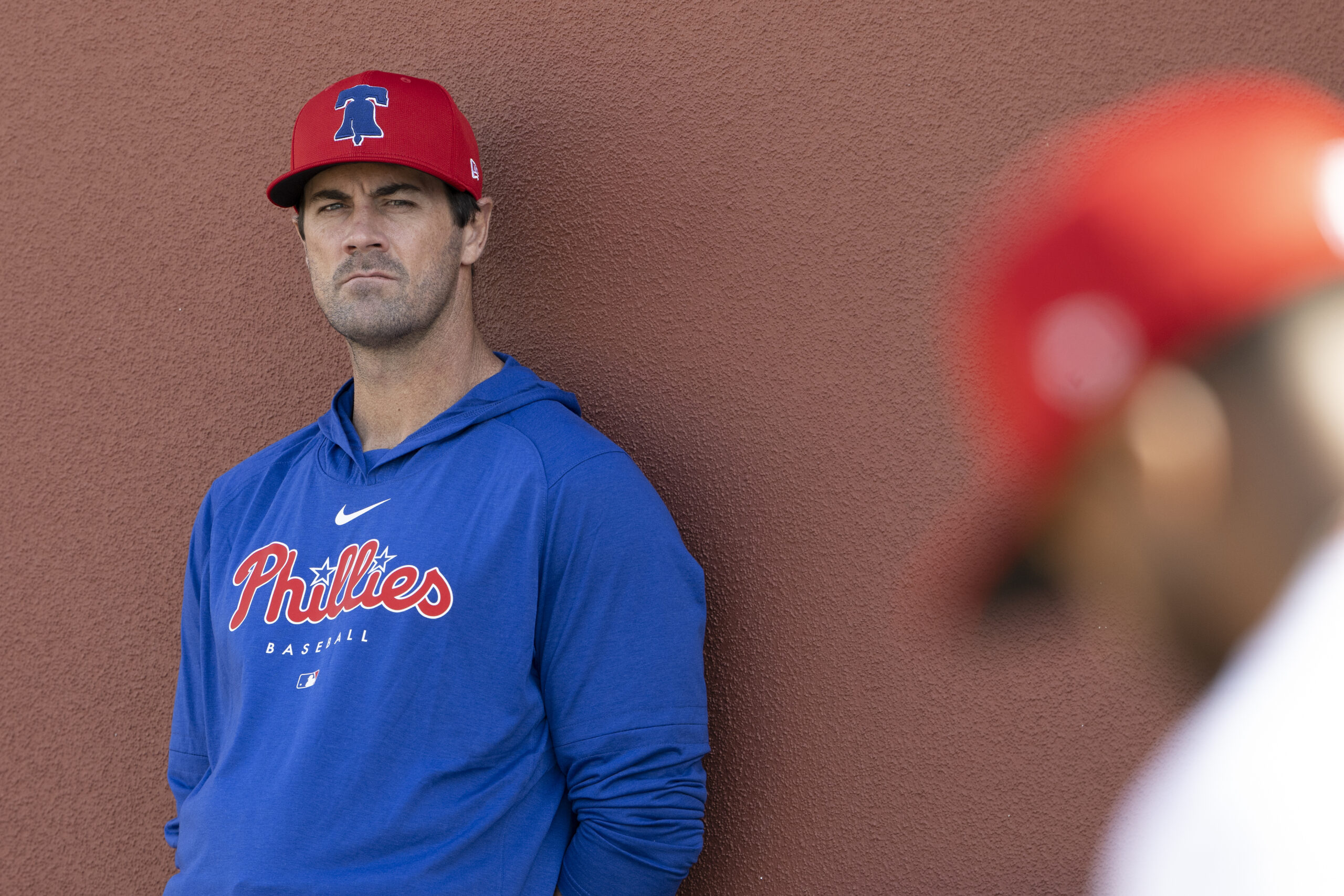
Cole Hamels worked for the Phillies this year as a guest instructor in spring training and a part-time television analyst.
Cole Hamels
Years on the ballot: One
Greg Maddux, Tom Glavine, Pedro Martínez, Randy Johnson, and John Smoltz went into the Hall of Fame in a two-year parade of starting pitchers in 2014 and ’15.
Since then, the writers have elected only three starters.
Roy Halladay, Mike Mussina, and CC Sabathia will be joined in five years by Clayton Kershaw and eventually by Justin Verlander and Max Scherzer. Maybe Zack Greinke, too. But beyond that group, who’s the next surefire Hall of Fame starter?
At a time when teams ask less of their starters than before, in an age of reduced workloads and an arm-injury epidemic that has shortened careers, starters no longer reach the classic benchmarks — 300 wins, 3,000 strikeouts, etc. — that the all-time greats once did.
It has been reflected in Hall of Fame voting. Johan Santana had a six-year peak with two Cy Young Awards and five top-five finishes but dropped off the ballot after one year because he apparently wasn’t dominant for long enough.
Voters appear to be recalibrating. Hernández’s peak lasted slightly longer than Santana’s and featured one Cy Young and two runners-up. He appeared on 20.6% of ballots as a first-time candidate last year and was tracking at better than 50%.
It’s difficult to assert that Hamels’ career, which didn’t include a top-three Cy Young finish, reached King Félix’s heights. But check out their numbers from 2007 to 2016:
Hamels: average of 208.2 innings, 126 ERA-plus, 46.5 WAR, according to Baseball-Reference.
Hernández: average of 214 innings, 129 ERA-plus, 47.2.
It’s close. Fortunately, Hamels will get additional consideration. He’s going to hang around on the ballot, maybe even topping Hernández’s first-year total.
Jimmy Rollins is the Phillies’ all-time leader with 2,306 hits.
Jimmy Rollins
Years on the ballot: Five
2025 vote total: 18.0%
Rollins’ significance to the Phillies would be undeniable even if he wasn’t their all-time hits leader. He was a soothsaying league MVP in 2007 and a World Series champion in 2008, and authored one of the biggest postseason hits in team history in the 2009 NL Championship Series.
The Phillies’ 143-year story can’t be written without their best shortstop.
The writers didn’t vote in Dale Murphy and Don Mattingly, whose excellence symbolized an era for the Braves and Yankees, respectively. Lou Whitaker didn’t get into the Hall of Fame after 19 starry seasons with the Tigers.
And thus far, J-Roll hasn’t gotten much traction either.
Despite sharing the middle infield with Utley for a dozen seasons, Rollins hasn’t matched his double-play partner’s ballot momentum. He debuted at 9.4% in 2022 and made only modest increases: 12.9% in 2023, 14.8% in 2024, and 18% last year. He’s tracking at about 23%, which would signal another small bump.
Rollins’ supporters within the electorate often note that he’s the only shortstop ever with at least 2,000 hits, 200 homers, and 400 steals. He also won a league MVP, four Gold Gloves, and a World Series ring.
But it’s difficult to ignore Rollins’ below-league-average OPS+ (95), although it wouldn’t be the lowest ever for a Hall of Fame shortstop (Phil Rizzuto, Ozzie Smith, Luis Aparicio, and Rabbit Maranville were worse).
Bobby Abreu spent half of his 18 year major-league career with the Phillies.
Bobby Abreu
Years on the ballot: Seven
2025 vote total: 19.5%
Twenty-one players had at least 900 extra-base hits and 1,400 walks. Here’s the list: Babe Ruth, Lou Gehrig, Mel Ott, Jimmie Foxx, Ted Williams, Stan Musial, Willie Mays, Mickey Mantle, Eddie Mathews, Hank Aaron, Frank Robinson, Carl Yastrzemski, Pete Rose, Mike Schmidt, Barry Bonds, Gary Sheffield, Frank Thomas, Jim Thome, Jeff Bagwell, Chipper Jones … and Abreu.
Yet Abreu somehow always seemed more like a supporting actor. He spent half his 18-year major league career with the Phillies but played for six teams. The Phillies won the World Series two years after he got traded; the Yankees won it one year after he left as a free agent.
Abreu built on a 5.5% debut in 2020 but has plateaued in recent years — 15.4% in 2023, 14.8% in 2024, 19.5% last year. Through Wednesday, he had picked up 12 votes and was polling at about 40%.
It would represent a decent jump for Abreu. But with only three more years on the ball, he needs a bigger leap to stand a chance at even sniffing 75%.
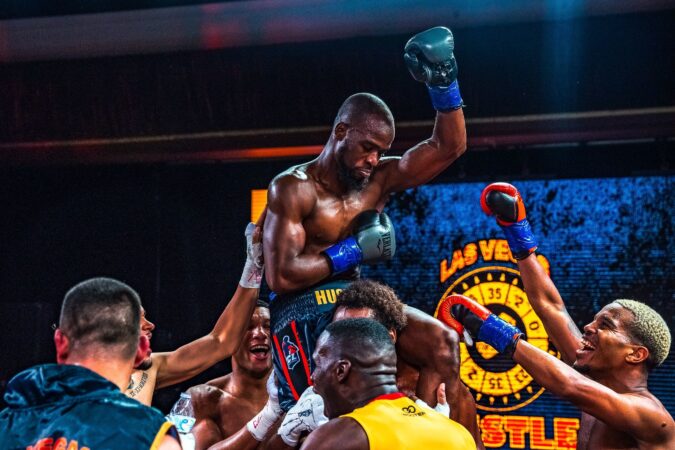
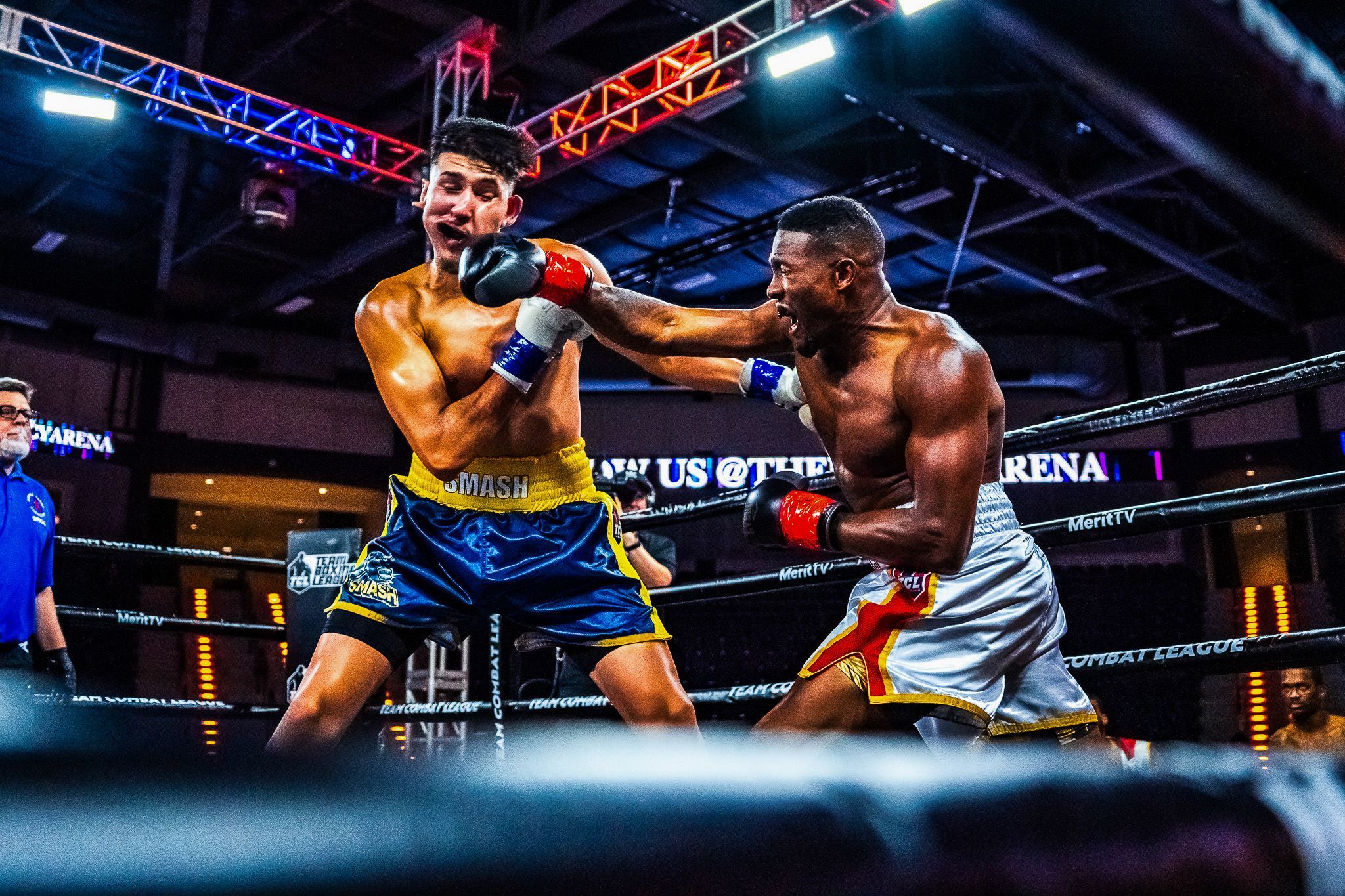
If you’ve ever thought about becoming a professional boxer, now may be your chance. The Team Boxing League will be hosting the first-ever televised open boxing combine at Bally’s Atlantic City this weekend (Jan. 16-18).
“The last two years, when we did different tryouts in different cities, we would get a line around the block from the gym that we would do tryouts in,” said Team Boxing League CEO Kevin Cassidy. “So, we decided we would do kind of America’s Got Talent style, open casting call. And that’s how we got into it.”
Fighters will compete for roster spots for the boxing league’s Season 4 lineup. Here’s what you need to know about the event …
What is team-based boxing?
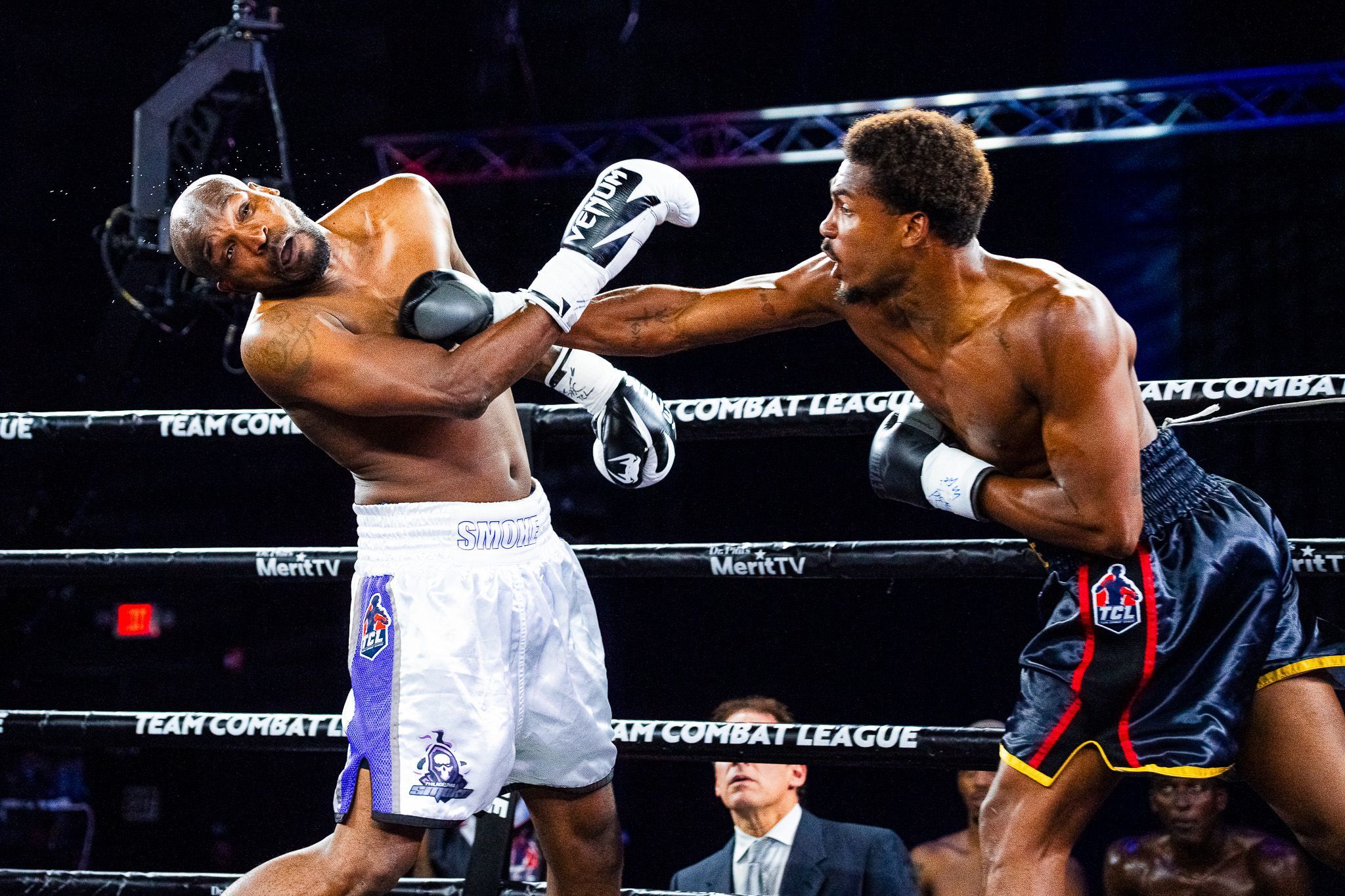
The Team Boxing League is the nation’s first — and only — boxing league with a team-based model.
Each bout features 24 three-minute rounds of non-stop fighting with competitors switching on and off after one-round matches.
Each bout for the Team Boxing League features 24 three-minute rounds of non-stop fighting with competitors switching on and off after one-round matches.
Each round is scored by three judges, who are licensed by a State Athletic Boxing Commission. A round is scored 10-9 for the winner of a judge’s decision, and if there’s a knockdown, it’s ruled 10-8. All 24 individual round scores are added up at the end, and the team with the highest total score gets the win.
And that format makes for a unique fighting style.
“It’s a little bit different in team boxing,” Cassidy said. “They train to go all out in one round. So, they could either fight one or two rounds in an event. That’s the most. It’s not like traditional boxing, where you have a couple of rounds where you’re feeling out the other fighter. This, you have 30 seconds to figure out the other fighter and then you have to go all out.
“It’s the TikTok of boxing. It makes for excitement in all 24 rounds.”
The TBL season begins mid-March and ends in September. They’ll host 56 events across the country, with 12 teams representing different cities — including the Philadelphia Smoke from the East Division.
What to expect from the combine?
This weekend’s three-day combine at Bally’s Traymore Ballroom will test each athlete’s endurance, strength, punching power, and accuracy through nine different stations.
“They have different things for each,” Cassidy said. “They have rope drills and speed bags. And we have some technology that Bally’s developed for boxing which is going to test their hand speed and see how many uppercuts they throw. They’ll test their endurance, their fitness, their punching power, their coordination, all of those things.”
Three-day combine for the Team Boxing League will be held at Bally’s Traymore Ballroom.
How to watch
All three days will be streamed live on the Team Boxing League app and an edited version will be broadcast on Envoy TV in February.
“I’m looking forward to learning the stories of the fighters, their backgrounds,” Cassidy said. “We have fighters that come from a very diverse background. You have guys who have been to prison, police officers, firemen, construction workers.
“There’s a lot of fighters around the country who never got a chance to make it and this gives them a lot of exposure.”
Fighters can register for the TBL Boxing Combine Tryouts online.
The last time the Eagles picked in the early 20s range of the NFL draft was two years ago, when the team broke a 22-year streak of not selecting a defensive back in the first round. The player they selected was Toledo defensive back Quinyon Mitchell, who was recently named a first-team NFL All-Pro.
After a disappointing end to their Super Bowl title defense, the Eagles head into the offseason with uncertainty at a few positions, but most of their core is intact.
Could they add younger pieces to an offensive line that struggled? Add some youth to a tight end room that might be without Dallas Goedert next year? Or will the Eagles add to the secondary?
With the Eagles locked into the No. 23 pick in the 2026 NFL draft, barring a trade, here are six players they could target:
Kadyn Proctor, OT, Alabama
Entering the 2025 college football season, Proctor, Alabama’s starting left tackle, had high grades from the NFL, but his uneven performances across 2025 have left his projection uncertain. Still, his athleticism at 6-foot-7, 366 pounds is hard to ignore, especially if teams project him as an interior player.
Proctor has powerful striking power upon contact and is an aggressive run blocker who can create displacement in one-on-one and double-team blocks. He has flashed the ability to stop defenders in their tracks when he gets his hands on them in pass protection.
Elite game tape from #Alabama LT Kadyn Proctor against Tennessee. Dominant as a run blocker and has some quality finishes as a pass protector against a really good pass rush.
The offensive tackle’s blocking technique is inconsistent, he plays with too high of a pad level at times, and he can too easily give up his outside shoulder on passing downs. Pairing Proctor with offensive line coach Jeff Stoutland could help the Alabama product become a more consistent player who could fit at either guard or tackle with his skill set along the Eagles’ O-line.
Kenyon Sadiq, TE, Oregon
One of the more popular names you will hear for the Eagles during draft season is Sadiq, who is an incredible athlete at the tight end position who relishes doing the dirty work as a blocker in the run game.
At 6-3, 245 pounds, Sadiq is unlikely to play as an attached tight end and will be coveted more for his receiving prowess. The Oregon standout, who finished the season with a team-high eight receiving scores, thrives working the seam and finding soft spots in zone coverage. His value in the red zone is noteworthy, with his ability to win vertically against secondary players and athleticism to catch passes in congested areas. According to Pro Football Focus, Sadiq caught 5 of 9 contested catch attempts.
#Oregon TE Kenyon Sadiq's value as a blocker, working the seams, and red zone value are all super valuable to the Oregon offense and are skill sets that should translate at the NFL level. Incredible athlete that consistently showcases the ability to catch the ball among chaos. pic.twitter.com/DGN6UzQrYX
The tight end prospect needs to clean up his drops (six in 2025), become a more complete route runner, and is more of an insert and cutoff blocker rather than a player who will be asked to block defensive linemen one-on-one. But Sadiq would be a dynamic addition to the Eagles, who haven’t drafted a tight end in Round 1 since they took Keith Jackson at No. 13 overall in 1988.
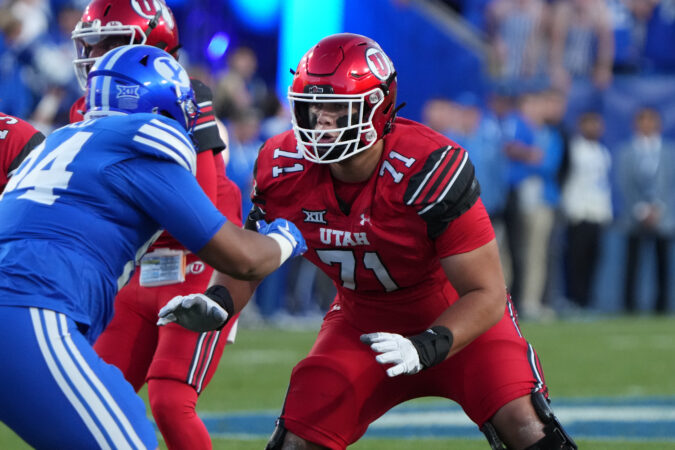
Caleb Lomu, OT, Utah
Sticking with the theme of offensive linemen, Lomu, a redshirt sophomore, is a skilled pass protector with quick, nimble feet, recovery ability, and a player who can refit his hands when they’re knocked off by pass rushers. At 6-6, 308 pounds, Lomu has the athleticism to move in pass protection and live out on an island against speed and power rushers.
#Utah LT Caleb Lomu hit Texas Tech edge David Bailey with a quick snatch trap. Thought he looked solid, had a few losses but held his own against TTU's talented pass rush duo. pic.twitter.com/R3Rc4mutKf
Per PFF, Lomu has allowed just eight quarterback pressures and zero sacks across 383 pass blocking snaps. The Utah tackle’s play strength needs to improve, evidenced by his inconsistency maintaining run blocks and generating movement at the line of scrimmage.
Lomu, though, could be the future for the Eagles at tackle, especially with Lane Johnson’s injury troubles this year. The prospect doesn’t have guard flexibility, but gives the Eagles a contingency plan for the 35-year-old Johnson’s inevitable retirement, whenever that occurs.
Monroe Freeling, OT, Georgia
One name that is starting to get buzz within the draft community is Freeling, the Georgia left tackle who finished the season playing at a high level in the team’s biggest game, a playoff loss to Ole Miss. The 6-7, 315-pound lineman moves well blocking in space, does a nice job framing up his blocks in the run game, and rarely gets beat in pass protection.
#UGA LT Monroe Freeling moves incredibly well in space, does a nice job framing up his blocks in the run game, and rarely gets beat in pass protection. Has only allowed 9 pressures and 2 sacks in 423 pass blocking snaps.
Freeling is fairly inexperienced relative to the other players on the list, having made just 17 starts in college, and has a tendency to lunge forward on blocks at times, but he would be a high-upside player who has a chance to be Johnson’s heir in a few years.
Olaivavega Ioane, OG, Penn State
There aren’t many interior offensive linemen worthy of a first-round pick, but Penn State left guard Ioane, a two-year starter, would be an ideal fit if the Eagles are looking to upgrade their interior.
Ioane consistently creates running lanes with his physicality and torque at 6-4, 336 pounds, and has knock-back power in pass protection to keep interior pass rushers at bay.
#PSU LG Vega Ioane was a big reason behind their big day running the football against Michigan State on Saturday. Consistently creating running lanes with his physicality and torque, and showed off the ability to decleat players in space as well pic.twitter.com/UZj47gxPyx
Despite the Nittany Lions’ disappointing season, Ioane was a bright spot, allowing just four pressures and zero sacks across 311 pass blocking snaps, according to PFF. He’s not an elite athlete, but has some movement ability in space. With the struggles in the interior from Eagles guards Landon Dickerson and Tyler Steen, Ioane could be an upgrade.
Avieon Terrell, DB, Clemson
If the Eagles decide to pair another early-round corner opposite Mitchell and keep Cooper DeJean in the slot, Terrell, the younger brother of Falcons corner A.J. Terrell, would be an ideal prospect to bring in. The Clemson defensive back didn’t have quite the same amount of ball production as his first two seasons, but was sticky in man coverage situations and forced five fumbles in 2025.
#Clemson DB Avieon Terrell does a nice job midpointing the out and corner routes to the field side and nearly comes away with the interception. Sticky in man coverage, route recognition and instincts are impressive in zone coverage looks. https://t.co/cJQ4uZzQNypic.twitter.com/iO9txXvgQO
Terrell is a smaller defensive back (5-11, 180 pounds) who struggles when matched up against bigger wideouts and tight ends. But he’s competitive at the catch point, has good zone-coverage instincts to close on routes developing in front of him, and has some nickel versatility to his game.
Any good team is built on trust, and when two teammates have played together as long as Gabby Casey and Aleah Snead have, trust comes naturally at this point.
Snead and Casey played AAU hoops together with the Philadelphia Belles and were members of the Philadelphia Belles Bluestar National Team in 2023. During that 2022-23 season, they also played against each other in high school, Casey at Lansdale Catholic and Snead at Penn Charter.
Then, in the fall of 2023, Snead and Casey set off for their freshman season at St. Joseph’s.
Now as juniors, the pair isn’t just playing together, they’re leading the Hawks together, in the box score and the locker room.
“Trust takes time, and we’ve been together for so long, so now we trust each other on the court to make big plays for each other,” Snead said. “Even to be a leader. I trust Gabby in her opinion on everything.”
Wherever you look on the St. Joe’s stat sheet, you’ll likely find Casey and Snead at or near the top. Casey leads the Hawks in scoring, (15.7 points per game), rebounds (6.9 per game), and steals (35). Snead follows directly behind her in each of the categories, averaging 10.9 points and 5.4 rebounds, and totaling 23 steals this season. Snead leads the team in minutes played, while Casey is just behind her.
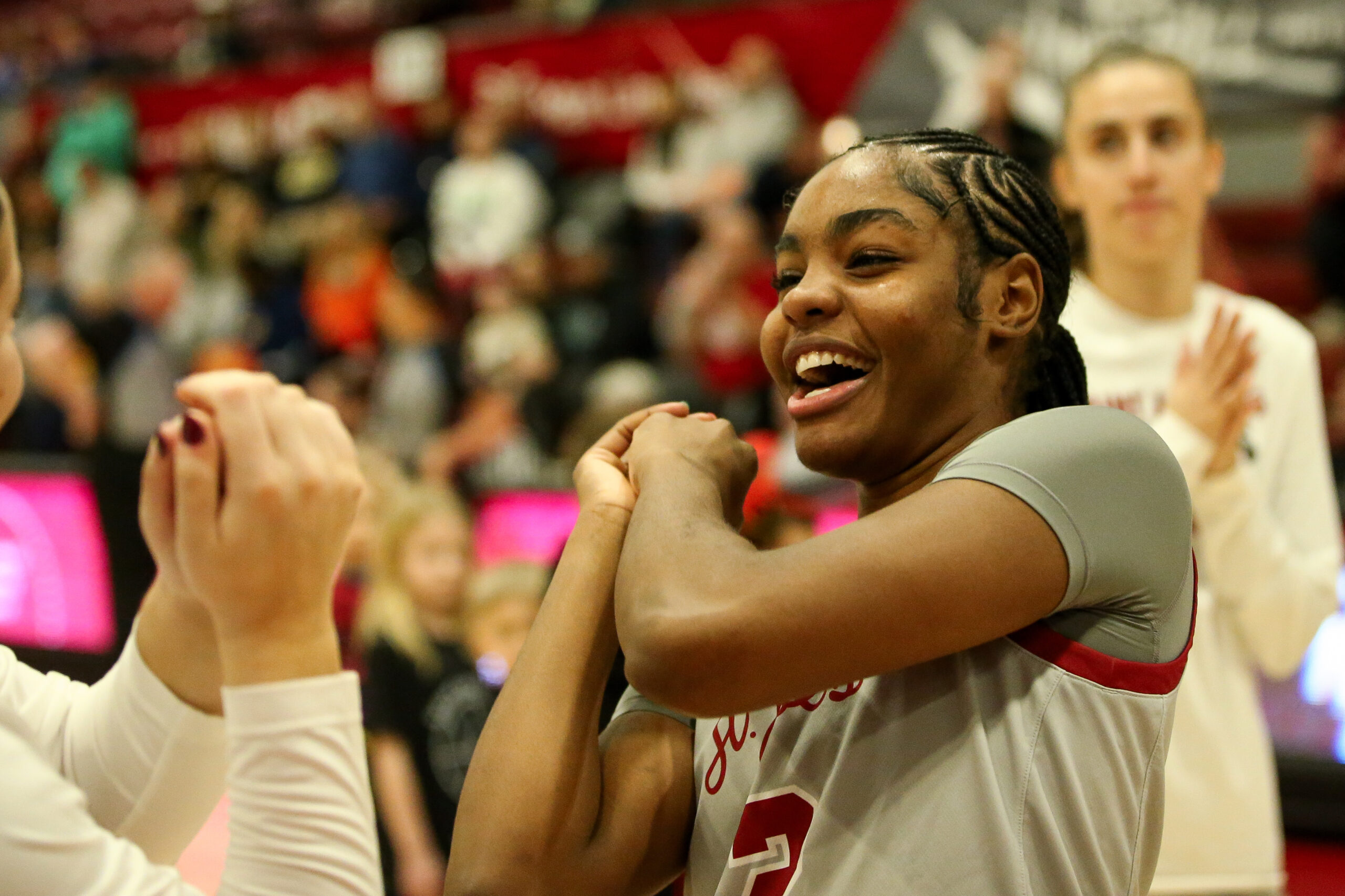
Saint Joseph’s guard Aleah Snead leads the team in minutes this season.
Hawks coach Cindy Griffin said that the duo understands these individual accomplishments don’t come without collective success for the team, which currently is 12-5 (3-3 Atlantic 10). Griffin said Snead and Casey have “taken a lot on their shoulders” offensively and defensively for the Hawks, put in the day-to-day work at practices, and bring the team closer.
After graduating two of its top players in Talya Brugler and Mackenzie Smith, and with a third, Laura Ziegler, transferring to Louisville, Griffin said Snead and Casey knew it was “their time to step up.”
“This is their team,” Griffin said. “They felt like they were putting in the work, putting in the time, and [have] a true understanding of what that looks like. And both have stepped up tremendously.”
Casey had a big jump last season and earned the Big 5’s Most Improved Player award. And as the A-10 Sixth Woman of the Year last year, Snead was no stranger to the “next player up” mentality, so it was only natural for the two to step into the role their teammates needed from them.
With Brugler and Smith as examples, Snead said it was easy to pass on what she learned from them when assuming her leadership role.
“I was a good follower, so becoming a leader myself was easy, and these people, my teammates, are easy people to lead on the court,” Snead said. “I just trusted myself and my ability to be able to support and make big plays for my team.”
It helps to lead alongside Casey, someone she trusts and with whom she is comfortable. Casey said they know how to run the court together and play off each other, which their coach saw even before they were her players.
Griffin’s youngest daughter, Hannah Griffin, played on the Philadelphia Belles with Snead and Casey, which allowed Griffin to get to know both the players and their families before they were Hawks.
“When it was time for summer, you could see the bond between the two of them and just being able to complement one another,” Griffin said. “You can see it on the court. They look for each other, they find each other, they trust each other, and they know that each is going to show up for each other.”
Casey and Snead were MVP of the Catholic League and Inter-Ac League, respectively, during the 2022-23 season, so both knew what it meant to play Philly basketball even before they arrived at St. Joe’s.
“Being home is a fun place and environment to be in, so I kind of am spirited and wear that on my chest,” Snead said. “I’m from Philly, I’m playing in Philly, people are coming to see us, and that’s why I just try to tell my teammates too.”
Gabby Casey (center) left Lansdale Catholic as the program’s all-time scoring leader.
Griffin said with players from the area like Casey and Snead, there is an understanding of the grit and competitiveness that accompanies playing in the city.
Casey experienced this during her time in the PCL, playing against other high school players with Division I aspirations.
“I think that really just helped me with the physicality level and the speed that we were able to play at in high school,” Casey said. “Philly basketball is tough, and it’s competitive, and I think that it really helped me transition into college.”
Now, that grit and competitiveness is helping to fuel the Hawks through the back half of the season, which Griffin said the team is taking one game at a time.
St. Joe’s was picked to finish sixth out of 14 teams in the A-10, and Casey said the Hawks used that as a “spark plug” to help them catch some opponents off guard.
But, ultimately, it comes back to trust, which starts with Casey and Snead.
“We just come out like we have nothing to lose and just give our all every single game, and we just really trust each other on and off the court,” Casey said. “That helps as well, just knowing what we can get done on the floor and ultimately coming out with wins.”
In 2000, Aaron Deede was an 18-year-old Delaware college student who enjoyed acting and had dreams of becoming a playwright.
But a car accident left him paraplegic with a traumatic brain injury that upended his plans.
“It was a little detour,” Deede said.
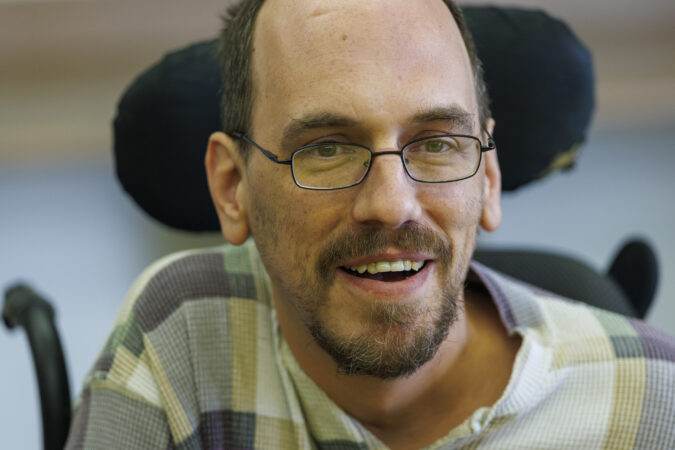
Now, at 43, he is returning to college along with four other residents of Inglis House, a nursing facility in Philadelphia’s Wynnefield sectionfor people with severe physical disabilities who use wheelchairsand haveconditions such as multiple sclerosis, cerebral palsy, spinal cord injuries, or challenges following strokes.
Deede and three other Inglis residents on Monday started online classes — some may go in person in subsequent semesters — at Community College of Philadelphia, with a fifth student scheduled to start this summer. Inglis pays for the students’ education from a donor-supported fund.
“I love it. I can’t wait,” Deede said Friday during a celebration Inglis held for the new students at its Belmont Avenue complex, giving each of them a backpack to start their journey.
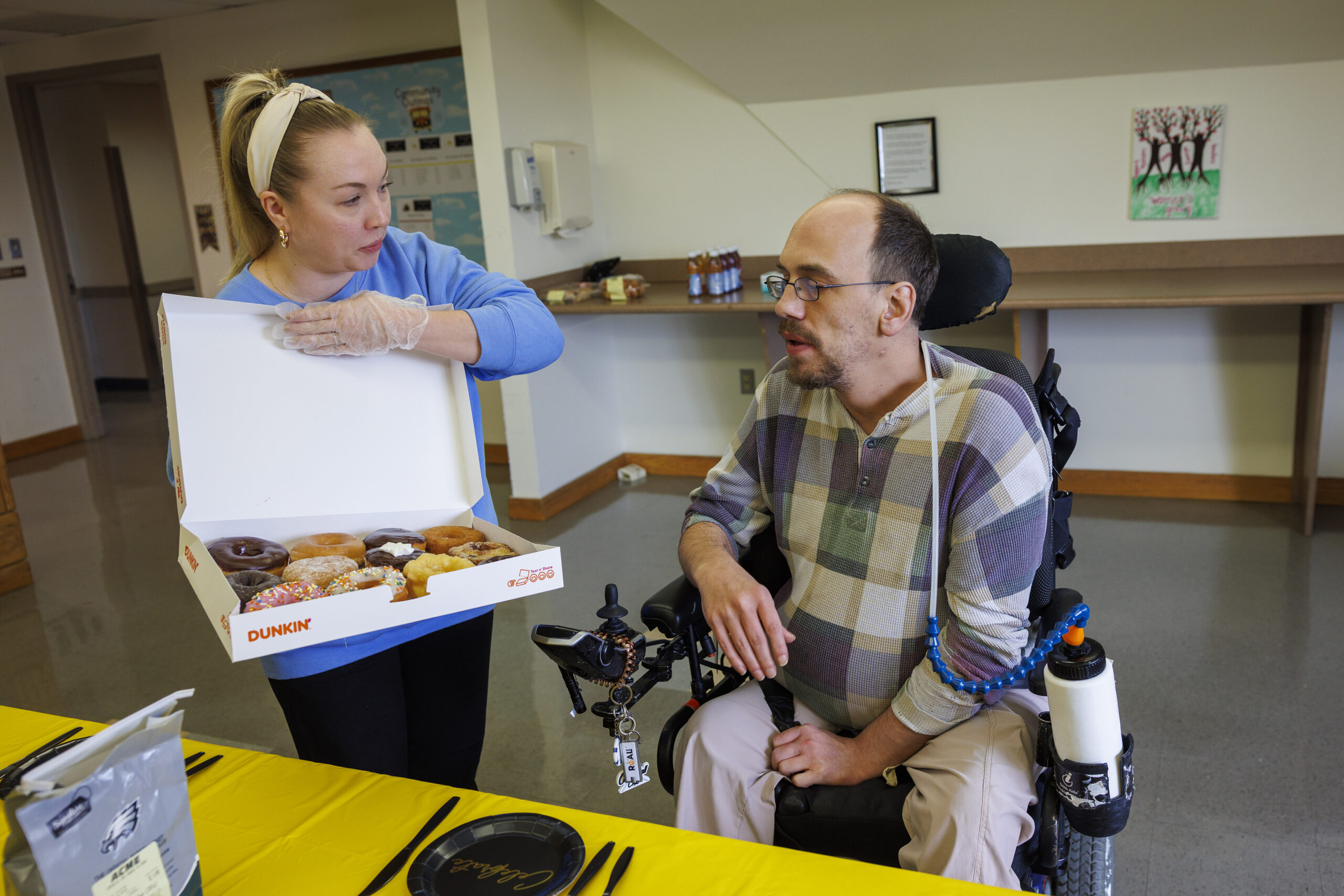
At right is Aaron Deede a resident of Inglis House. He is starting to take classes at Community College of Philadelphia. At left, Jaclyn Monaco, director of Therapeutic Life Enrichment, offers treats during the celebration for students.
Dozens of Inglis residents — who range in age from 18 to their 70s — have taken college classes over the years, and some have earned degrees. Butthis is the largest group to start together since the 1990s, said Jacklyn Monaco, Inglis’ director of therapeutic and life enrichment.
“Things sort of ebb and flow as far as the types of resident who move in and their personal goals,” she said. “Sometimes they’re recreational goals. Sometimes they’re physical goals. Sometimes they’re educational goals. At this point in time we have a lot of younger folks who are really interested in pursuing higher education.”
Nikos Rapach, 21, had been planning to join either the Army or the Coast Guard when he was in a car accident and lost the use of his legs and the mobility of his fingers.
Nikos Rapach, a resident of Inglis House, sets up at his workstation in the computer lab.
“I’m not going to be able to swing a hammer, so I have to start using my brain more,” said Rapach, who is from Hazleton.
He is taking English and trigonometry classes at CCP. He will use the computers at Inglis thathave adaptive technology to assist with note-taking.
“Everything here is a stepping stone for me,” said Rapach, who moved to Inglis in May. “I want to go back home. I want to get a job. I basically want to get my life back on track.”
“Like they say, if you don’t know your history, you are doomed to repeat it,” he said.
Deede, who came to Inglis in 2023, also would like to become a teacher, preferably at the elementary level.
Another resident who is taking classes at CCP aims to become a social worker at Children’s Hospital of Philadelphia, said Jeremy Ault, Inglis’ therapeutic education instructor. Another hopes to become an Urdu-to-English translator.
Stephanie Shea, 59, who is from Maryland and has a genetic neuromuscular condition, is taking liberal arts classes with the goal of getting a degree.
“It’s kind of a bucket-list thing,” said Shea, who recently got married to another resident. “It’s something I’ve always wanted to have.”
Founded in 1877, Inglis House currently serves about 180 residents, nearly 40% of whom are involved in educational activities — not just college. Classes are offered at Inglis in subjects such as history, law, science, poetry, and creative writing, as well as foundational skills like reading and personal finance.
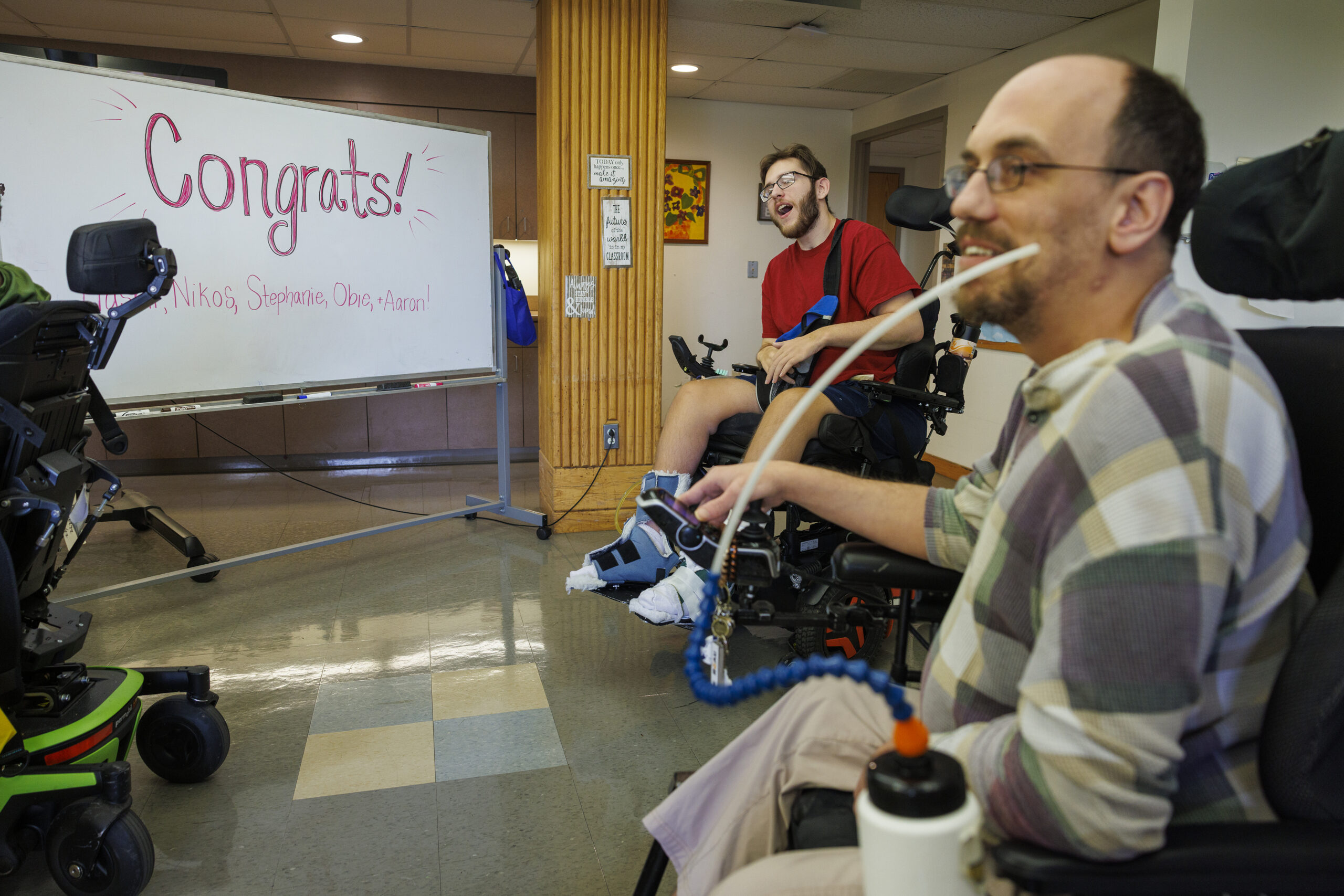
Aaron Deed (right) and Nikos Rapach are starting taking classes at Community College of Philadelphia.
Inglis staff accompanied the students to CCP’s campus to take their placement tests, register for classes, and visit’s CCP’s Center on Disability, the office that helps students with disabilities.
“We suggest accommodations based on their needs,” said Lisa Papurt, coordinator of disability services at the center, which typically serves 400 to 500 students with disabilities per semester.
Those services could include extra time for tests or technology to assist with note-taking or assistance in communicating with professors.
Papurt said she is excited to see the Inglis students start their educational journey.
“I hope to be able to support them through getting degrees, graduating, and moving on to a four-year institution,” she said.
When students entered their surprise celebration Friday, Ault, the therapeutic education instructor, told them it was time for them to celebrate.
“I’m so proud of you guys for doing so well this past year,” he said. “You guys have been such a pleasure to teach and be part of your lives really.”
Ault is helping students prepare for entry into college.
“I’m working on my writing skills and grammar,” Rapach said. “Jeremy has been giving me essay prompts to help me be a better writer so that when I get to college, I’m not trying to relearn everything.”
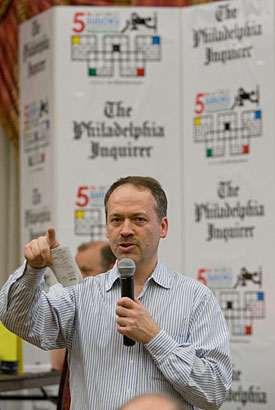
In nearly five decades of directing puzzle competitions, New York Times crossword editor and NPR puzzle master Will Shortz has encountered a cheater only once, at a Sudoku championship in Philadelphia.
Luckily, Shortz doesn’t hold it against us. That came across loud and clear when he recently announced he’s moving the American Crossword Puzzle Tournament from Connecticut down to Philly next year.
“Philadelphia has a cultured audience,” Shortz said when we spoke this week. “It’s just a great city to have a major literary event at.”
The first time I heard of the ACPT was while watchingWordplay, a 2006 documentary about crossword puzzles featuring Shortz; the latter half of the movie is set at his annual tournament. I loved the movie when it came out and on a rewatch 20 years later, it’s still as quirky and delightful as ever.
In the film, the late puzzle constructor Merl Reagle, who crafted crosswords for the Times, The Inquirer, and other papers across the country, calls the ACPT an “orgy of puzzling,” which is a fantastic phrase that I’m guessing he never got into a puzzle and one that’s probably responsible for the film’s perplexing PG rating.
The play-by-play
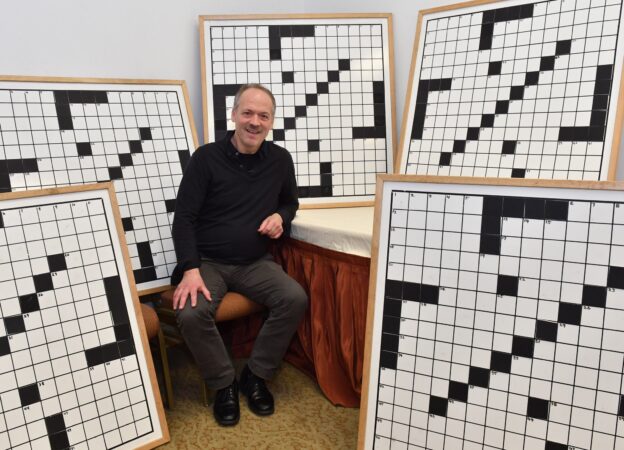
Shortz — who designed his own major in enigmatology (the study of puzzles) at Indiana University — founded the ACPT at the Marriott in Stamford, Conn., in 1978 when he was just 25.
“There had not been a crossword tournament in the country since the 1930s, so we were starting fresh,” he said.
The first tournament attracted 149 contestants. This year, there are 926 competitors, with a long wait list, and after 48 years at the Stamford Marriott (aside from a few years the tournament was held in Brooklyn), the ACPT has just outgrown the space. The tournament will be held there for the last time in April.
Shortz and his team looked for new venues around the Northeast and settled on the Liberty Ballroom at the Sheraton Philadelphia Downtown, where they can accommodate up to 1,250 contestants.
The tournament will be held there from April 30 to May 2 next year.
“I’m hoping with 1,250 seats we won’t have to turn anyone away next year,” Shortz told me. “My goal is for everyone to come who wants to.”
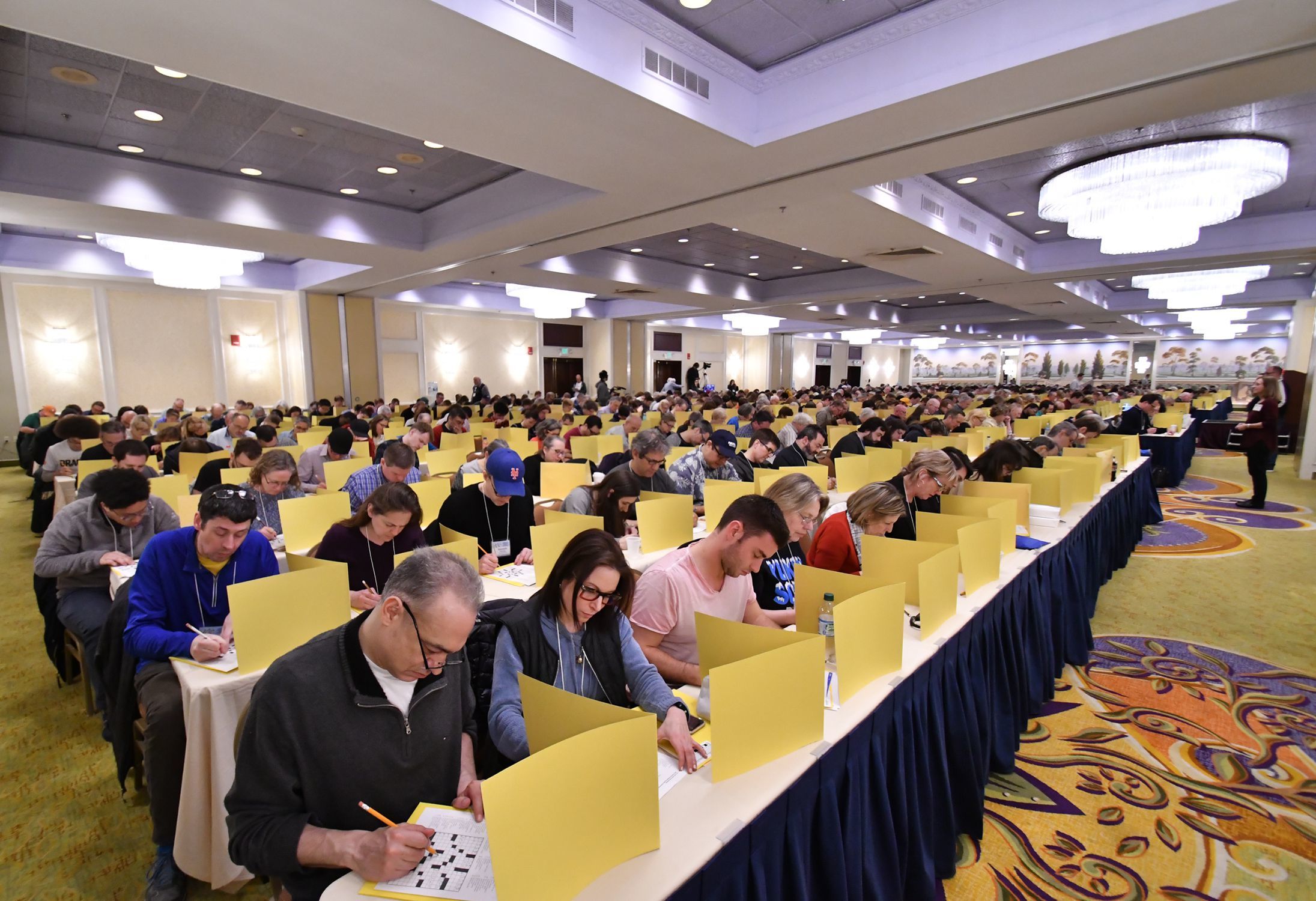
The ACPT is held over three days and consists of eight rounds of puzzles. All contestants compete in the first seven rounds, which, much to this Luddite’s delight, are still done with pencil and paper.
“I want everyone to compete equally,” Shortz said. “Some people are very fast with their fingers so I wouldn’t want the tournament to depend on your computer literacy.”
Contestants are scored based on accuracy and completion time. There are multiple divisions, with an eighth round of playoffs held for the top three divisions.
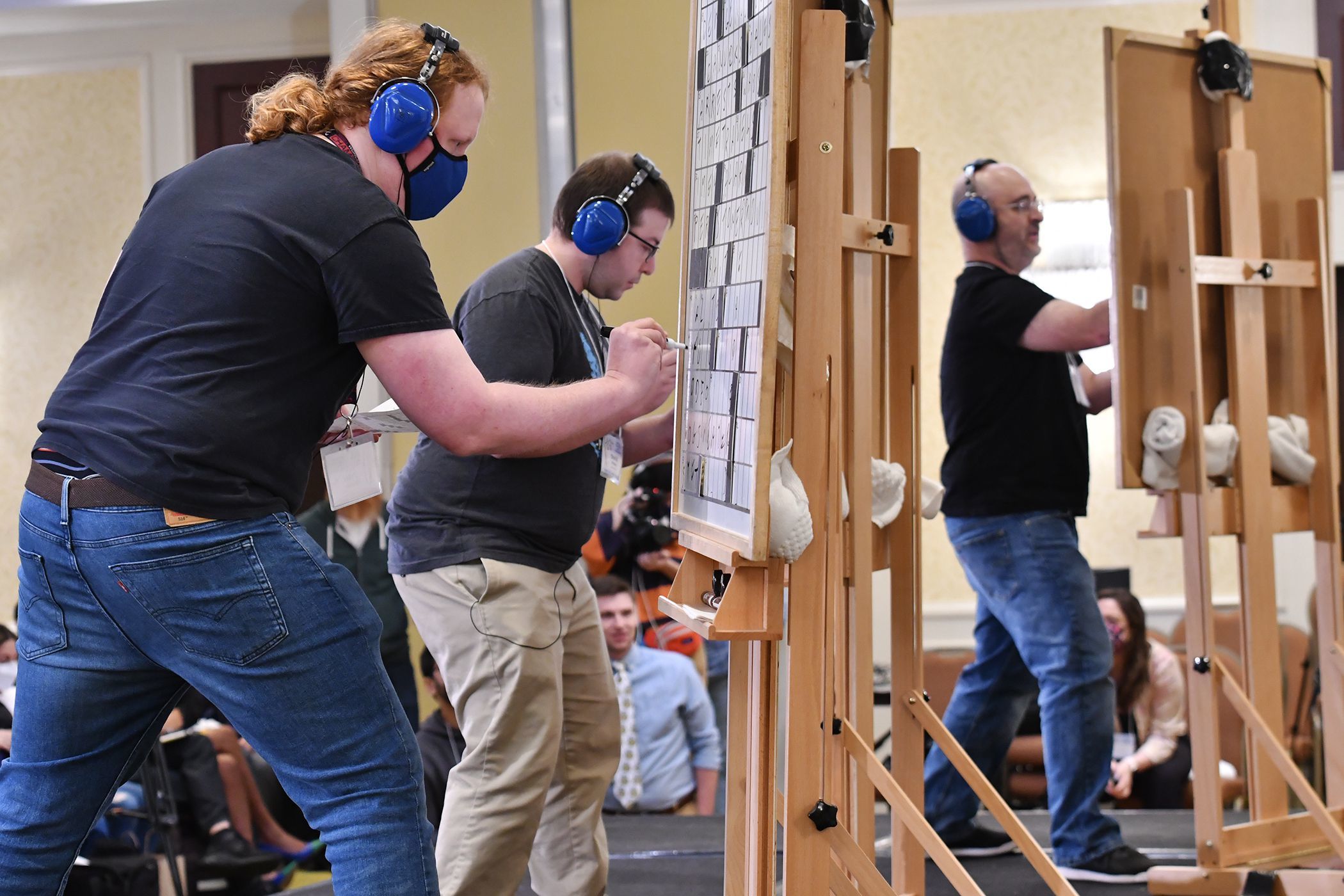
From left: Frequent top finishers Tyler Hinman, David Plotkin, and Dan Feyer compete live on stage during a championship round of the American Crossword Puzzle Tournament. Play-by-play announcers even call the games, so competitors must wear noise-canceling headphones.
The A and B division playoffs are held on stage, with top three contestants working on giant crossword puzzle white boards before a live audience (and you thought completing a Saturday Times puzzle by yourself was intimidating!). Play-by-play announcers even call the games, so competitors must wear noise-canceling headphones.
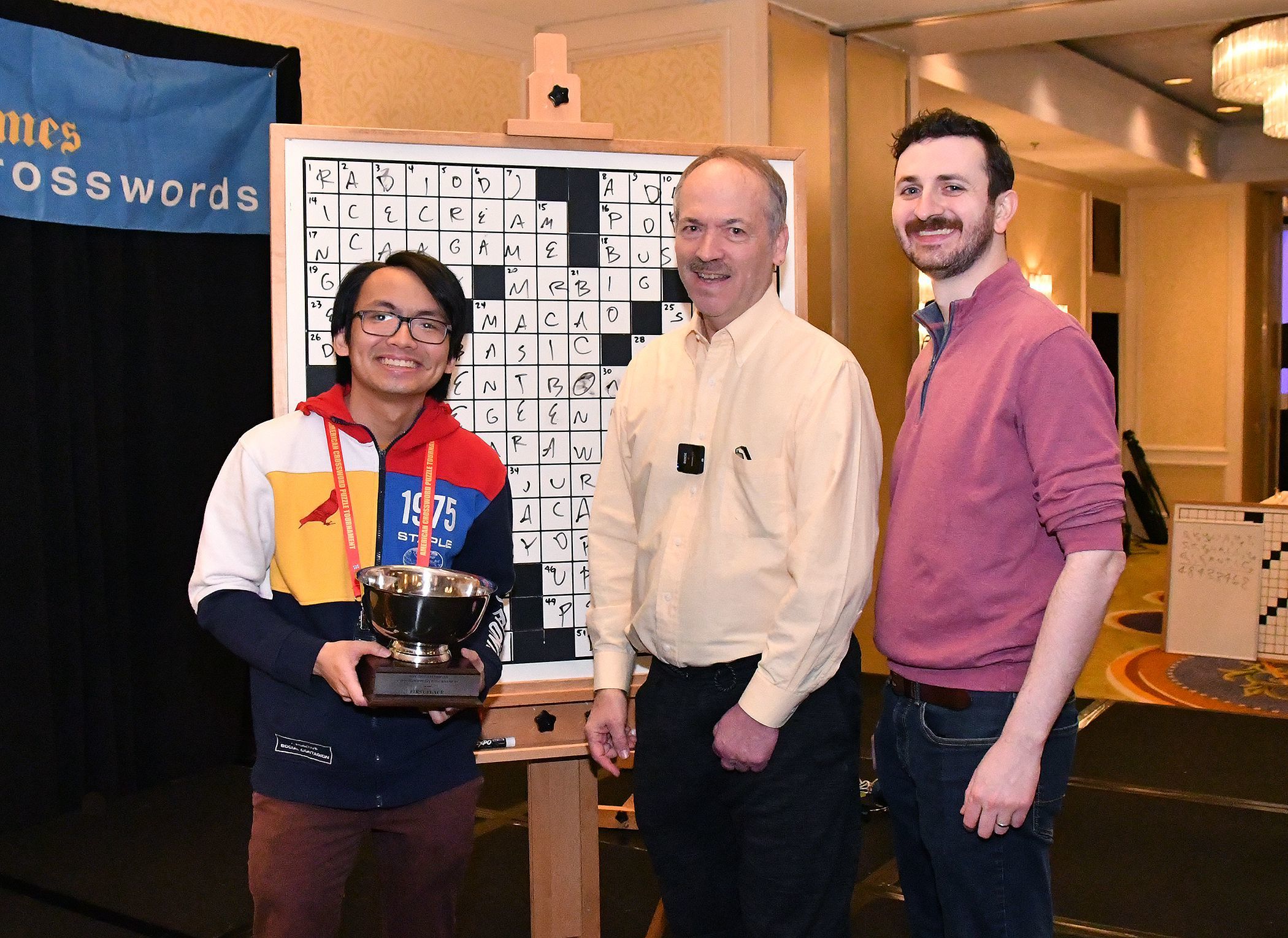
The division A winner gets a $7,500 prize and crossword glory for a year. The last two tournaments were won by Paolo Pasco, a 24-year-old crossword puzzle constructor and seven-time Jeopardy! winner who’s competing in the quiz show’s Tournament of Champions this month.
Aside from the competitive games, there are also informal word games, a puzzle market, and a contestant talent show.
Paolo Pasco, (left), winner of the 2025 American Crossword Puzzle Tournament, with tournament director Will Shortz, (center), and puzzle constructor Ryan McCarty.
‘No judgments’
Shortz has never missed a tournament, except for when it was canceled in 2020 due to COVID. Even after suffering a stroke in 2024, he showed up to the tournament, just two months later.
“I was in a subacute rehab center and everyone was advising me not to leave the center, but there was no way I was going to miss the tournament,” he told me. “When I came in a wheelchair, everyone stood up and applauded and that brought tears to my eyes.”
Donald Christensen, who has attended the ACPT since the 1980s and serves as the event photographer, said the contestants are “a microcosm of society.”
“When you attend one of the tournaments, you are among a group of about 1,000 people who make no judgments about you or your abilities, and who are often very willing to share their secrets to successful solving with anyone who is interested,“ he said via email.
Contestants work on solving puzzles at the Stamford Marriott during the American Crossword Puzzle Tournament.
I enjoy crossword puzzles, but I’m absolutely terrible at them, so much so that I question my college majors (nonfiction writing and communications), my career, and whether I actually speak the English language. But there’s even room for someone like me at the tournament — a noncompetitor option, where you can play but your solutions aren’t scored. Spectator-only tickets are available for the Sunday playoffs, too.
Contestants aren’t allowed outside help, but they’re not required to hand over their cellphones either. Shortz said referees would see any cheating and looking something up on a phone would just slow down a good contestant.
“It’s not a group that would cheat anyway,” Shortz said.
The Sudoku swindler
And that brings me back to the stupefying Sudoku scandal of 2009. For three years beginning in 2007, The Inquirer sponsored the National Sudoku Championship at the Pennsylvania Convention Center, with Shortz serving as host (The Inquirer and Shortz also partnered to host the World Sudoku Championship here in 2010).
Will Shortz explains the rules of the 2010 World Sudoku Championship, which was held in Philadelphia and sponsored by The Inquirer.
During the 2009 competition, a before-unknown player, Eugene Varshavsky of Lawrenceville, N.J., qualified for the finals in lightning time. But when he got on stage with his hoodie up for the championship round, he froze.
“It was a challenging puzzle but not crazy hard and he was utterly unable to finish it,” Shortz said. “It was kind of embarrassing for someone who’d solved the previous puzzle quickly.”
Still, Varshavsky was awarded third place, which came with a $3,000 prize. But puzzlers raised suspicions and the money was frozen while officials conducted an investigation.
Varshavsky was asked to come to The Inquirer to complete additional puzzles to prove his ability.
“We gave him the round-three puzzle he whipped through in the competition, which he was now unable to do,” Shortz recalled.
He was subsequently stripped of his title and the prize money. Shortz said officials believed he was getting help through an earpiece during the competition, though that was never proven. Coincidentally, a man by the same name was suspected of cheating in 2006 at the World Open chess championship in Philadelphia.
United by words
Philadelphia’s puzzle history isn’t all sordid though. We were home to the oldest known Times crossword puzzle contributor, the late Bernice Gordon, who constructed puzzles for decades and was the first centenarian to have a puzzle published in the Times.
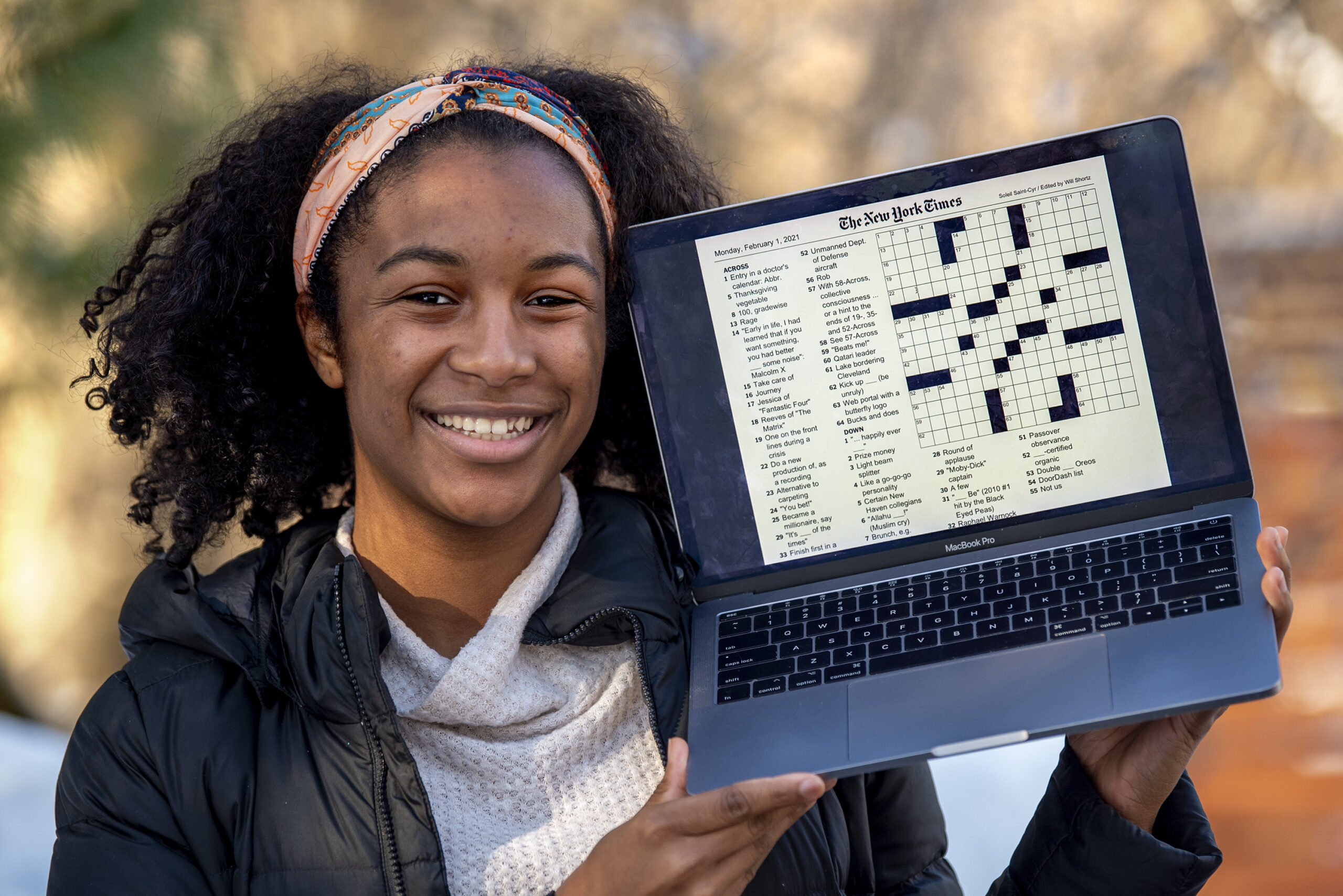
And in 2021, Soleil Saint-Cyr, 17, of Moorestown, became the youngest woman to have a puzzle published in the Times.
Cruciverbalist Soleil Saint-Cyr poses at her Moorestown home in 2021.
With all of the talk around AI today, I asked Shortz if humans are still better at crafting crossword puzzles than computers.
“Of course, computers can create crosswords now, but it takes a human mind to create a brilliant crossword,” he said. “Only humans can still come up for a clever idea for a new theme and only a human can write a good, original crossword clue.”
Perhaps there is no better place for the American Crossword Puzzle Tournament than right here in Philadelphia, where words birthed our country into existence. We’re still writing the story of our nation and trying to figure out if this puzzle can be solved, but as in Shortz’s tournament, people are still united by words and creating small moments of order amid the chaos.
“We’re faced with so many challenges every day in life and we just muddle through and do the best we can and we don’t know if we have the best solution,” Shortz said. “But when you solve a crossword puzzle … it gives you a tremendous feeling of accomplishment. You put the world in order.”
For more information on the ACPT and how to add your name to the 2027 contact list, visit crosswordtournament.com.
It’s awards season, and not just for those in showbiz. The Eagles fell short of a Super Bowl repeat, but they’re still eligible for the next best thing — The Inquirer’s 2025 EEOYAAOS (Eagles end-of-year awards and other superlatives).
The name is a work-in-progress and subject to change next season. All jokes aside, while the year ended in disappointment for the team, there were bright spots that can serve as sources of encouragement for seasons to come. Here are the winners of this season’s superlatives, unilaterally selected by yours truly:
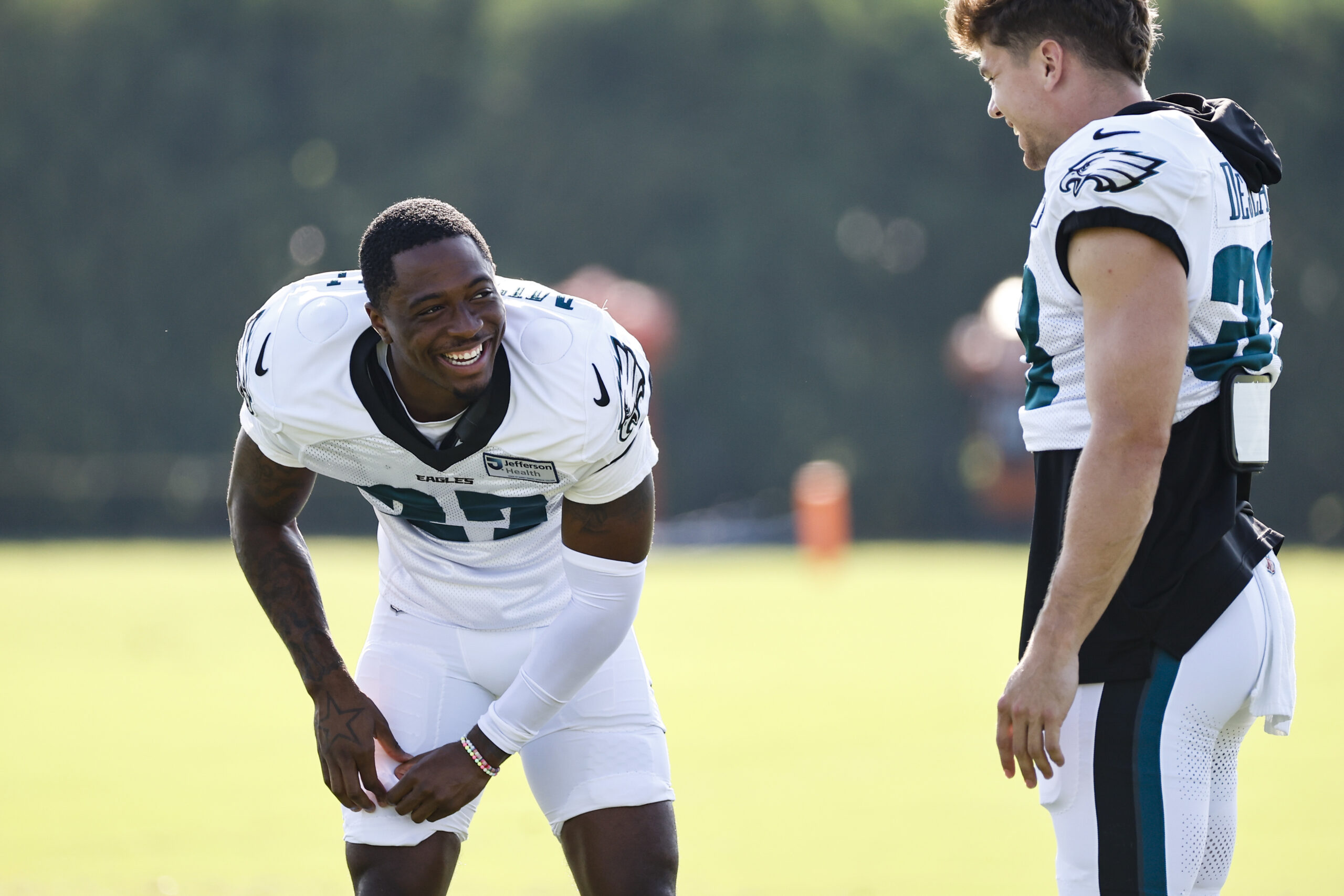
Quinyon Mitchell, left, and Cooper DeJean both became All-Pros in 2025.
Most Valuable Player
Let’s start this exercise off strong by breaking the rules (that don’t exist). There are two most valuable players on this year’s team, and they’re both on defense: Quinyon Mitchell and Cooper DeJean.
Not-so-coincidentally, both second-year cornerbacks were selected to their first All-Pro team and Pro Bowl this year.
In a short period of time, Mitchell and DeJean have become cornerstones of Vic Fangio’s defense. Mitchell, 24, took on more responsibility within the scheme in his second season. Before the Week 9 bye, the 2024 No. 22 overall pick out of Toledo was often tasked with shadowing the opposing team’s top receiver.
According to Next Gen Stats, going into Week 8, Mitchell had at least 10 man coverage matchups against Tampa Bay’s Emeka Egbuka (16 matchups), the Rams’ Davante Adams (15), Denver’s Courtland Sutton (15), and Minnesota’s Justin Jefferson (11). He conceded 43 receiving yards on four receptions against Sutton, but he held each of the other three receivers to 12 or fewer yards.
After the bye, Mitchell primarily aligned in the boundary, the short side of the field that typically garners less safety help. He had more passes defensed (9) than receptions allowed (6) across 29 targets and 233 coverage snaps in the boundary, per Next Gen Stats. His 20.7% completion percentage allowed in that alignment was three times lower than the season-long league average from that spot (65.5%).
DeJean was just as dominant from the slot, an important position in Fangio’s defense that is required to defend the run and pass. He finished the season with a 57.4% completion percentage and 5.9 yards per target from the slot. Both metrics rank below the league averages of 69.5% and 6.8, respectively.
They had their struggles (and successes) in the wild-card loss to the San Francisco 49ers, but their bodies of work throughout the year make them worthy recipients of the award.
If 2025 was his swan song in Philly, Dallas Goedert went out with a bang.
Offensive Player of the Year
This award nearly went to DeVonta Smith, but Dallas Goedert gets the slight edge. The 31-year-old tight end was Jalen Hurts’ most trusted receiver in the red zone, hauling in 10 touchdown passes inside the 20-yard line this season. That performance was particularly meaningful given the Eagles’ declining efficiency on the Tush Push.
Goedert’s 11 receiving touchdowns tied for the most among tight ends in 2025 and set a franchise record at the position. Goedert added two more touchdowns in the wild-card game — one rushing and one receiving — making him the first tight end in NFL history to rush for a touchdown in the playoffs.
This isn’t just about his red-zone performance, though. Goedert caught 73.2% of his targets, the most among the Eagles’ top three receivers (including Smith and A.J. Brown). He also started a career-high 15 games, which was particularly impressive coming off of an injury-riddled 2024 season.
He did not have his best year as a run blocker, although neither did any other player paving the way for Saquon Barkley. Still, it was a career-best year for Goedert in other areas heading into an offseason of uncertainty. He becomes an unrestricted free agent at the start of the new league year.
Jordan Davis was a force along the defensive line for the Eagles in 2025.
Defensive Player of the Year
Few Eagles players ascended as rapidly as Jordan Davis did this season. In his fourth year with the team, the 6-foot-6, 336-pound defensive tackle became the every-down player the Eagles sought when they drafted him No. 13 overall out of Georgia in 2022.
Davis played a career-high 61% of the defensive snaps in 2025, his first season playing more than half of them. Unsurprisingly, he was particularly effective against the run. According to Next Gen Stats, Davis notched a career-best 50 run stops, which are tackles in run defense that result in a negative play for the opposing offense. That total was the second-most among defensive linemen.
He showed some pop as a pass-rusher, too. Davis finished the year with a career-high 4½ sacks. His 22 pressures were a personal best, too, per Next Gen Stats. Davis could be in line for an extension this offseason as he enters the final year of his rookie deal.
Eagles punter Braden Mann has a strong leg and had a strong year.
Special Teams Player of the Year
There’s an argument to be made that Davis and Jalen Carter could share this award given their blocked field goals this season. But the unsung specialist of the season was Braden Mann,the 28-year-old punter. Some might even call him the Mann of the Year.
Mann, who signed with the Eagles in 2023 after spending the first three years of his career with the New York Jets, had the single best season by an Eagles punter in franchise history. He averaged 49.5 gross yards per punt, bringing his Eagles career average to a franchise-best 49.5.
In his Week 8 showing against the New York Giants, Mann averaged 57 net yards (subtracting return yardage) per punt, the most in a single game in franchise history. In a year where the Eagles offense punted a lot, Mann did his best to help out the defense and put opposing offenses in poor field position. He is set to become an unrestricted free agent at the start of the new league year and the Eagles would be wise to bring him back on a new deal.
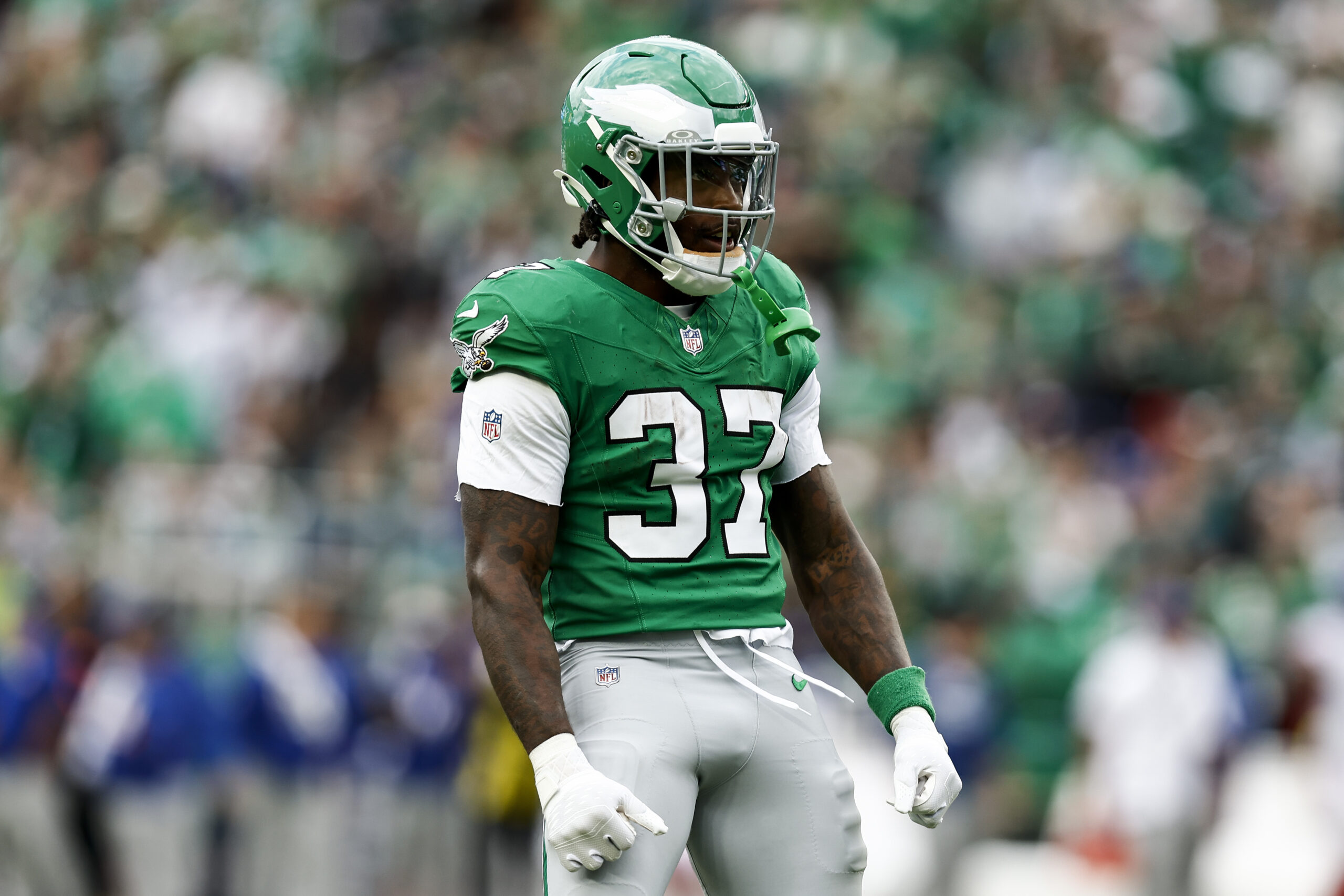
Jihaad Campbell is off to an encouraging start to his career.
Rookie of the Year
Jihaad Campbell was the Eagles’ top rookie this season. He didn’t have much competition. Safety Drew Mukuba fractured his fibula in Week 12 against the Dallas Cowboys, prematurely ending his up-and-down rookie campaign.
Ty Robinson, Mac McWilliams, Smael Mondon, Drew Kendall, and Cameron Williams hardly played this year. Kyle McCord and Myles Hinton didn’t play this year.
Still, Campbell is a worthy recipient. He fared well as the starting inside linebacker alongside Zack Baun while Nakobe Dean recovered from his torn patellar tendon in his knee to start the season. In Weeks 1-6, Campbell played 94.3% of defensive snaps, then dropped off to 30.7% over the next eight games before Dean’s hamstring injury.
He flashed potential, especially in coverage. Going into Week 13, he had a 63% completion percentage when targeted, which ranked ninth-lowest rate among linebackers in 2025 (minimum of 15 targets) at the time, per Next Gen Stats. Campbell has plenty of room to grow, with more opportunities on the way in 2026, as Dean is a free agent this offseason.
Defensive backs coach Christian Parker’s talents have been recognized around the league.
Assistant Coach of the Year
It’s a big season for the Eagles defensive backs room at the EEOYAAOS. Christian Parker, the Eagles defensive backs coach and passing game coordinator, is earning his flowers as the team’s assistant coach of the year.
The 34-year-old assistant has helped Mitchell and DeJean reach great heights in their first two seasons in the league, especially this season in their All-Pro year. Parker also deserves some credit for the improved play of Adoree’ Jackson as the season progressed. The second outside cornerback spot seemed like a concern coming out of training camp, but the competition eventually stabilized as Jackson grew more comfortable in the defense.
How much longer will Fangio be able to keep Parker around in Philly? Parker is reportedly interviewing with the Dallas Cowboys for their vacant defensive coordinator job.
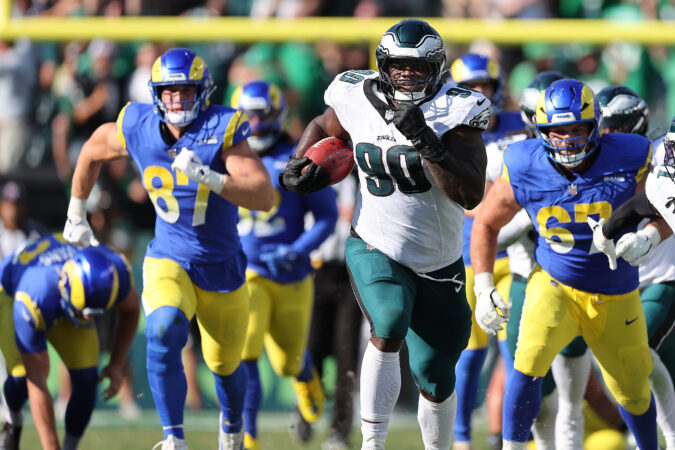
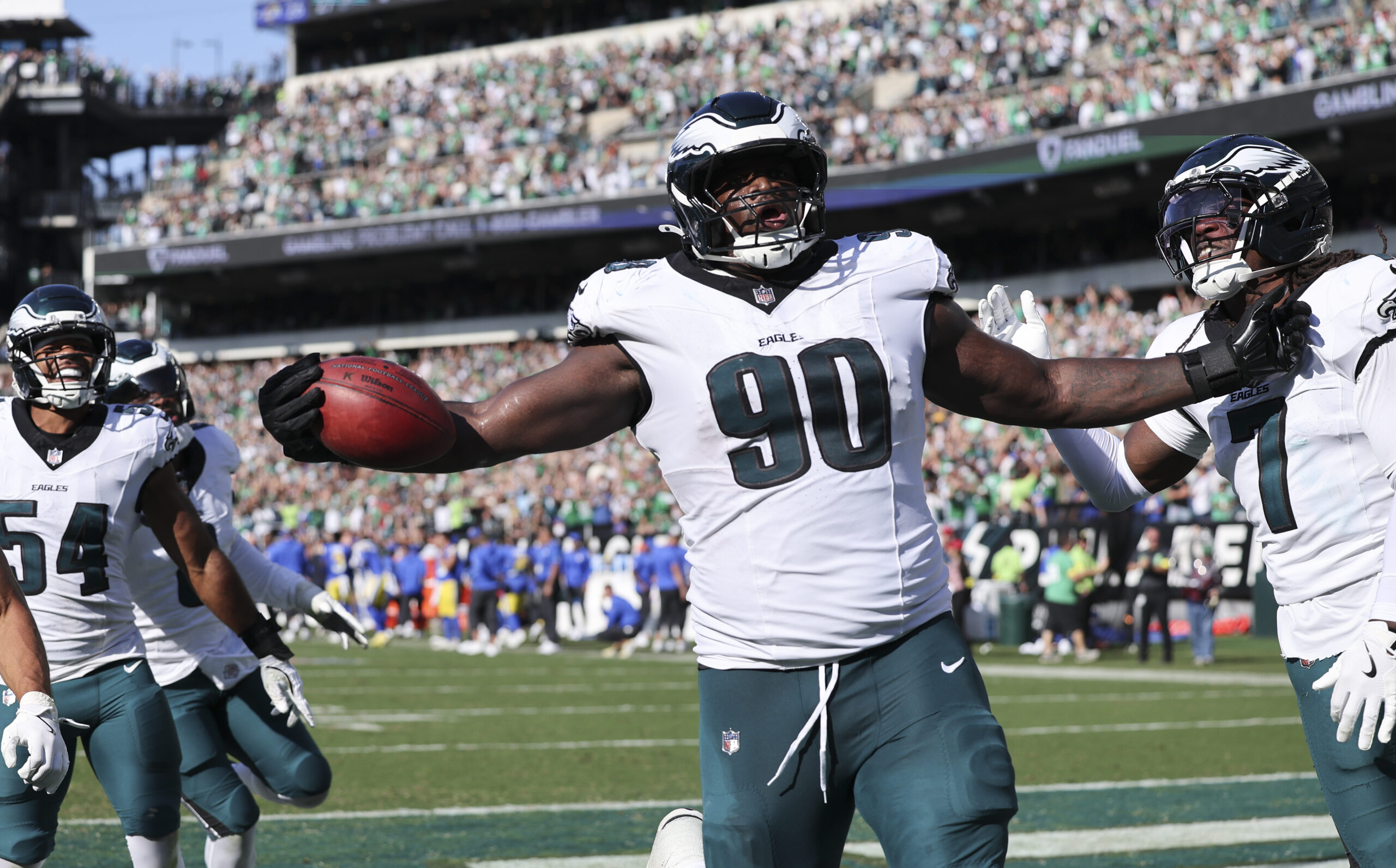
Jordan Davis celebrated a touchdown after running back a late fourth quarter blocked field goal against the Rams on Sept. 21.
Best play
Few plays brought more juice this season than Davis’ blocked field goal to seal the Eagles’ 33-26 Week 3 win over the Rams. Both Carter and Davis exploited the Rams’ weaknesses in their field goal unit to block a pair of three-point tries in the fourth quarter, but the image of the 6-foot-6, 336-pound Davis returning the loose ball to the end zone as time expired will live on in franchise history.
The play sustained the Eagles’ dominance over the Rams under Nick Sirianni, bringing their head-to-head record to 4-0 over the last three seasons (including the postseason).
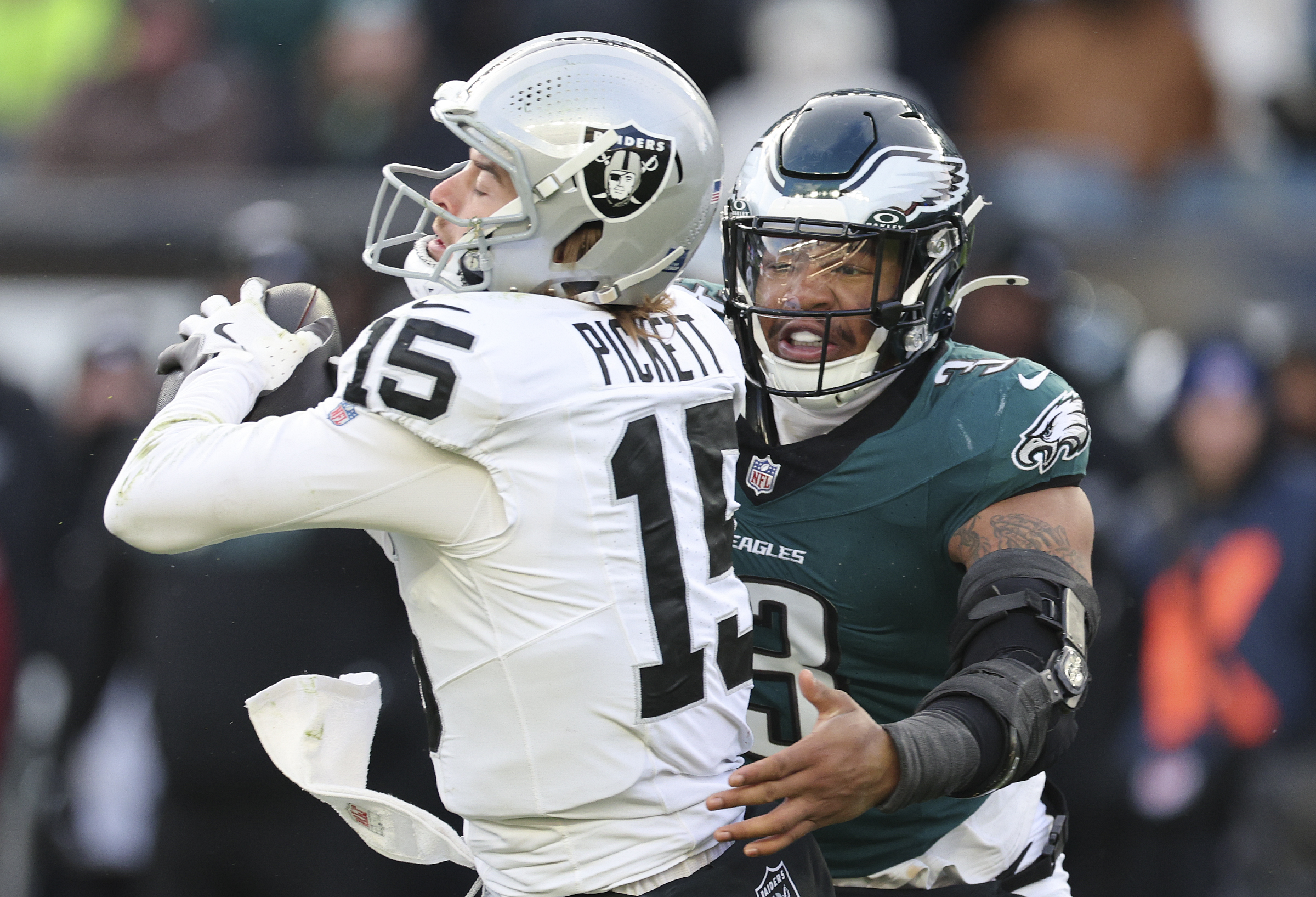
Nolan Smith Jr. and the Eagles emphatically assisted Kenny Pickett and the Raiders to becoming the NFL’s worst team in 2025.
Best game
The Eagles offense was a tale of two halves for the majority of the season, making for some uneasy watches. One of the only exceptions was the 31-0 Week 15 win over the Las Vegas Raiders.
In theory, the quality of the opponent should factor into consideration for this award. But the timing of this win is too important to ignore. This resounding victory came on the heels of the Eagles’ three-game losing streak, during which comparisons to the 2023 collapse intensified. The Eagles quelled some doubts by beating up on a bad team, although they ultimately faced the same postseason fate as the 2023 squad.
Fangio’s defense had never been more dominant. They limited the Raiders to 75 yards of offense, a new single-game franchise low for the Eagles and the fewest allowed by any defense during season at the time. Hurts bounced back from committing five turnovers the week prior in the loss to the Los Angeles Chargers. He went 12-for-15 for 175 yards and three touchdowns, earning a near-perfect 154.9 passer rating.
Tank Bigsby averaged nearly six yards per rush even as the Eagles’ rushing offense struggled at times.
Biggest surprise
It took some time, but Tank Bigsby proved to be a solid addition this season. Immediately after Howie Roseman acquired him from the Jacksonville Jaguars in exchange for 2026 fifth- and sixth-round picks, he began the first four weeks of his Eagles career as a kick returner.
He wasn’t the right fit for the role. After a couple of muffed kicks, he was removed from the gig. But on offense, he made the most of his scant carries. He 58 rushes for 344 yards and two touchdowns. While the majority of his touches came against bad defenses (i.e. the Giants, Raiders, and Commanders), his 5.9 yards per carry ranked third in the league among running backs with at least 50 runs.
Bigsby is under contract through 2026, ensuring the Eagles have a solid RB2 option behind Barkley next season.
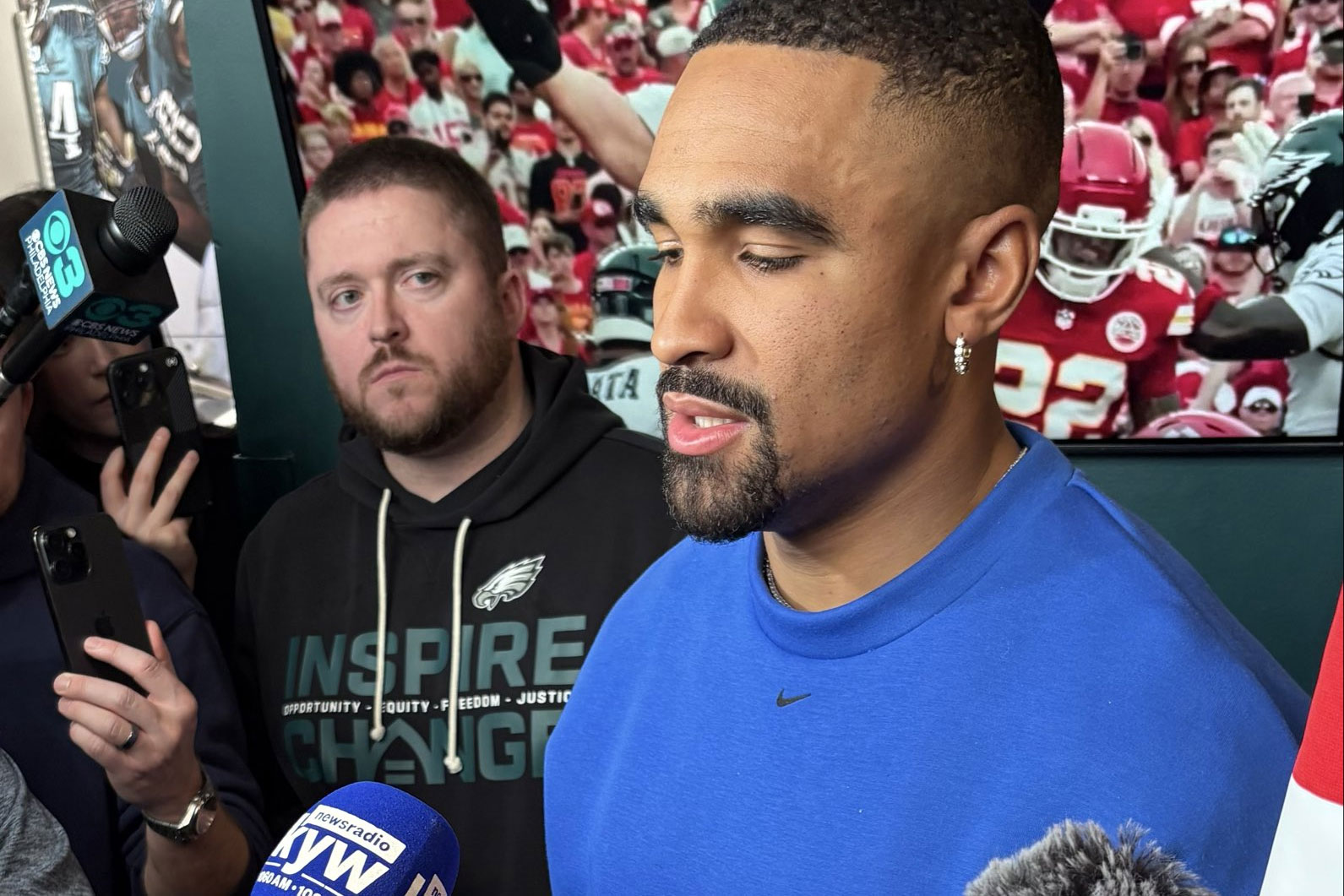
Jalen Hurts knows his way around a quote.
Best quote
Hurts is known for dropping bits of wisdom in his press conferences. He seems to have sayings for everything, including some of the hottest practices of training camp. After a sweltering practice on July 29, Hurts said, “Fatigue makes cowards of us all,” a quote that has been attributed to a variety of prominent figures including U.S. Army general George S. Patton and Green Bay Packers coach Vince Lombardi.
Perhaps the second-best quote of the season came from Jordan Mailata, regarding another one of Hurts’ aphorisms: “That [stuff] is [freaking] hilarious. Like, how does one think of that?”
Jordan Davis: fun to cover.
Best locker room guy
Davis emerged both on the field and off of it this season. Not only was he dominant as a player in his fourth season, but his infectious personality also uplifted his teammates as he stepped into a leadership role.
No player was more gregarious in the locker room. Transcribing interviews was typically an exercise in trying to decipher quotes from a cacophony of laughter and yelling in the background, which stemmed from Davis. The 26-year-old defensive tackle earned the Eagles local media corps’ stand-up player of the year award, bestowed upon a player for their accessibility and honesty.
Plenty of others deserved the distinction, too. Jackson and Zack Baun landed on my ballot, in addition to Davis. Brown, Barkley, Dean, Brandon Graham, and Britain Covey are always insightful in their discussions with the press.
Best nonhuman source of positivity
Reggie the dog, the Eagles director of joy. Better luck next year, Positivity Rabbit.
Six Pennsylvania nursing homes closed last year, down from 10 in 2024, according to data provided to The Inquirer by the Pennsylvania Department of Health.
None of last year’s closures were in the Philadelphia area. The most recent closure in Southeastern Pennsylvania was at Main Line Health’s Riddle Hospital, which shuttered its very small, 23-bed facility in early 2023. That year, five nursing homes closed statewide.
window.addEventListener(“message”,function(a){if(void 0!==a.data[“datawrapper-height”]){var e=document.querySelectorAll(“iframe”);for(var t in a.data[“datawrapper-height”])for(var r,i=0;r=e[i];i++)if(r.contentWindow===a.source){var d=a.data[“datawrapper-height”][t]+”px”;r.style.height=d}}});
But this year is starting with the loss of a Philadelphia facility. Monumental Post-Acute Care at Woodside, formerly called Bala Nursing & Rehabilitation Center, notified state official last month that the 180-bed facility will close next month.
Officials there could not be reached for comment about why nursing home is closing after 37 years. More than 90% of the facility’s patients had Medicaid insurance for low-income people.
Monumental is among the larger nursing homes to close recently. About half of the nursing homes that closed during the last three years had 50 or fewer beds. The statewide average is 127 beds.
Smaller facilities have a harder time covering their costs.
The county hardest hit by nursing home closures was Allegheny, which is home to Pittsburgh. Four nursing homes closed there. The counties that are home to Scranton and Wilkes-Barre each lost two facilities.