School districts around the region made varying calls for how they’re handling classes Tuesday as the region continues to dig out from the massive snowstorm that dumped more than a foot of snow in many places — with some closed altogether, others fully open, and others open, but delayed.
The Philadelphia School District opted for another day of virtual instruction.
Superintendent Tony B. Watlington Sr. has said the nation’s eighth-largest school system favors in-personinstruction, but places student and staff safety as its highest priority.
In Upper Darby, Delaware County, Superintendent Dan McGarry made the call to bring students in on time.
“The district transportation team and facilities team have been working hard all day to clear snow from our facilities for in-person instruction,” McGarry wrote in a message to families and staff. “We have been in communication with the township as well, and I want to thank them for their hard work getting roads clear for school tomorrow.”
Districts including Council Rock and Pennridge, both in Bucks County, called two hour delays.
In Montgomery County, Cheltenham and Lower Merion schools both announced a two-hour delay.
“Buses are expected to arrive at bus stops two hours after their normal pickup times; however, please be patient as snow and ice on some streets may cause additional delays,” Lower Merion spokesperson Amy Buckman said in a message to families Monday evening.
Cherry Hill and Moorestown, in Camden County, will also hold classes with a two-hour delay.
Renewed debate over virtual instruction in New Jersey
And while some Pennsylvania districts pivot to virtual instruction when significant snow falls, that’s not possible in New Jersey, where state law prevents it.
A handful of New Jersey districts opted for total closures. Lenape Regional, Evesham, and Medford schools, all in Burlington County, cancelled classes altogether.
Winslow schools in Camden County will remain closed Tuesday for a second consecutive day, said interim Superintendent Mark Pease. The district was shut down for three days during the last storm.
Pease said the district would use two days from its spring in April to make up the missed days. The break will be cut to three days, he said.
“If we get another storm, we will be extending the school year,” Pease said. “Let’s hope this is it for the winter.”
The snow storm renewed calls among some New Jersey educators to the state to allow virtual and hybrid instruction to avoid closing schools due to inclement weather.
In a social media post, Camden Education Association President Pam Clark said she was asking Gov. Mikie Shirrell to revisit the virtual option for traditional public schools. She used the hashtag “not fair.”
New Jersey allowed virtual and hybrid instruction when the pandemic shut down schools.
However, state law now strictly limits remote learning, according to the state Department of Education. Districts must meet a state requirement of 180 days.
School districts may seek approval for virtual learning for school closures lasting more than three consecutive days because of a declared state of emergency or a declared public health emergency.
There has been pushback against virtual learning because of concerns about learning loss suffered during the pandemic. There also are concerns that some schools don’t have enough Chromebooks or devices for students to log on.
Timothy Purnell, executive director of the New Jersey School Boards Association, said districts should have the flexibility to pivot when circumstances warrant such as a snow day.
Districts have invested in technology and training to successfully implement virtual instruction, he said.
“Limiting virtual instruction days exclusively to public health emergencies is yesterday’s logic,“ Purnell said in a statement.
The U.S. Coast Guard is investigating an incident in which a swastika was reportedly drawn on a bathroom wall at the Coast Guard’s training center in Cape May.
“Following discovery of a hate symbol drawn on a bathroom wall in a building at Training Center Cape May, the Coast Guard immediately referred the matter to the Coast Guard Investigative Service for investigation — consistent with longstanding Coast Guard policy. This hate symbol was immediately removed,” a spokesperson for the service branch said in an email Monday.
The Washington Post first reported on Monday that the hate symbol — which the Coast Guard did not specify —was a hand-drawn swastika that was discovered Thursday evening in the men’s bathroom.
Adm. Kevin Lunday, the Coast Guard commandant, was informed about the incident on Saturday, the Post reported.
“The Commandant immediately traveled to Training Center Cape May and held a mandatory All Hands with the nearly 900 recruits and staff to address the incident directly, reinforce the Coast Guard’s strong standards and policies, and reaffirm the Service’s dedication to accountability through our core values,” the Coast Guard spokesperson said.
In a statement, Lunday declared: “Anyone who adheres to or advances hate or extremist ideology — get out. Leave. You don’t belong in the United States Coast Guard and we reject you.”
Lunday added: “We will not allow anyone to put a stain of hate on our United States Coast Guard. We will not be defined by the cowardly acts, but instead be defined by our unwavering response and our resolve to defeat them.”
The spokesperson said that the Coast Guard is “committed to maintaining a workplace that is safe, professional, and respectful for every member of our workforce. Any behavior that undermines these standards will be addressed swiftly and seriously.”
Late last year, the Post reported that the Coast Guard had planned to downgrade swastikas and nooses in its workplace harassment manual as being “potentially divisive” rather than hate symbols.
In December, Lunday announced that the revisions were “completely removed” from the policy manual and that swastikas and nooses would still be considered overt hate symbols, the Post reported.
A former Chester County detective — who served as a technical adviser for the HBO crime drama Mare of Easttown — is suing her former employer and supervisor in federal court over alleged sex discrimination.
Christine Bleiler, who became Kate Winslet’s “go-to person” on developing her Emmy-winning performance as titular character Mare Sheehan, says shewas subjected to a “prolonged pattern of hostile, discriminatory, and demeaning treatment based on her sex,” according to a complaint filed this month in the Eastern District of Pennsylvania.
And though an internal investigation “corroborated” that she was being harassed, according to the suit, the county failed to remedy the harassment to which she was subjected.
In addition to Chester County, the lawsuit names as a defendant Thomas Goggin, who was Bleiler’s supervisor from 2021 to 2023. Bleiler resigned in September.
A spokesperson for the county declined to comment on ongoing litigation. An attorney for Goggin, who now serves as police chief in West Pikeland Township,did not immediately respond to a message seeking comment.
Bleiler, who worked as a police officer for nearly a dozen years in Oxford Borough before beginning as a Chester County detective in 2015, began working under Goggin in February 2021. He accused her of talking too much, yelled at her repeatedly over how she handled suspects or on differences in opinion, demeaned and condescended to her, and told her “she ‘better not’ tell anyone that he was a problem,” according to the complaint.
In August 2023, Bleiler brought the complaints to the detective division’s leadership, prompting an internal investigation that ultimately corroborated her claims, the suit says. Goggin was suspended for two weeks and was demoted, according to the complaint.
Bleiler was worried about working near Goggin once he returned from his suspension, the suit says, fearing that he might retaliate. She was instructed by the department’s leadership to “bury her head in her work” and “move on from this.” Though she began reporting to a new supervisor, working in proximity to Goggin “caused her significant discomfort, anxiety and distress over potential retaliation and continued harassment,” the complaint says.
Bleiler is asking a judge to declare that the county and Goggin’s actions violated federal and state antidiscrimination laws. It asks the court to grant her compensation for past and future lost earnings, earning capacity, and benefits, which the complaint argues Bleiler lost due to the “discriminatory and retaliatory conduct.”
“The conduct of defendants, as set forth above, was severe or pervasive enough to make a reasonable person believe that the conditions of employment had been altered and that the working environment was hostile or abusive, and in fact made plaintiff believe that her working environment was hostile and abusive because of her sex and her complaint of sex discrimination,” the complaint states.
While a detective for the county, in 2019 Bleiler served as a technical adviser for HBO’s Mare of Easttown, taking phone calls from Winslet morning and night to discuss upcoming scenes or to answer questions. At one point, Winslet visited her at the Justice Center in West Chester.
“She insisted,” Bleiler told The Inquirer in 2021. “I told my lieutenant at that time, he couldn’t believe it. He said, ‘All right, she’s your responsibility. Get her in and get her out, keep it quiet.’”
In the wake of the untimely deaths of three young players, A.J. Brown on Monday posted a 9-minute, 8-second testimonial on Instagram encouraging NFL athletes struggling with mental health issues to seek counseling and God rather than taking their own lives. It was poignant and it was beautiful.
It was a revealing glimpse into how Brown deals with his own demons. It also was an example of how the exceptional culture in the Eagles’ locker room emboldens this sort of leadership in the most important of ways.
“Don’t take the easy way out,” Brown said. “I once thought that was the way. I was 23 years old and I thought the same thing.”
Brown spoke two days after Vikings receiver Rondale Moore, 25, was found in his garage dead of a suspected self-inflicted gunshot wound. Moore had seen his last two NFL seasons ruined by preseason injuries. It was the third such incident in just 10 months.
In November, Cowboys defensive end Marshawn Kneeland, 24, also was suspected of taking his own life with a gun after a high-speed chase and crash.
Similarly, in April, LSU receiver and NFL prospect Kyren Lacy, also 24, shot and killed himself after a high-speed chase two days before his criminal trial in an unrelated incident.
Tragedy upon tragedy upon tragedy compelled Brown to speak out.
“Don’t end it like that, bro,” he begged. “Don’t end it like that.”
Advocacy
This wasn’t the first time Brown has spoken about his own struggles, but it is the most intense and impassioned message he has delivered.
🙏 Eagles WR AJ Brown, who said he contemplated suicide in 2020, shared his advice to those who might be struggling with their mental health
He recorded Monday’s message on his phone while sitting in his parked car. Most of it centered on Brown’s reliance on his Christian faith, but Brown also stressed the role that counseling performs in people whose worlds seem to be closing in.
“Go talk to [God], first and foremost, before you even go talk to a therapist. But go talk to a therapist,” Brown said. “Reach out to your loved ones. Go talk to somebody, bro. Get it off your chest. You’re not too tough to talk to someone.”
Much has been made of Brown’s unconventional behavior in his four seasons with the Eagles. He often has been publicly critical of the Eagles offense both in media availabilities and on social media. He has sparred with head coach Nick Sirianni during games. He continually hints in public that he would like to be traded, and a report last month said he submitted a trade request three times during the 2025 season. Brown also has boycotted the media twice in the last two seasons.
Suicide is suspected in the death of Vikings wide receiver Rondale Moore on Saturday.
Among the reasons the Eagles are patient with Brown, and among the reasons the media squawks so little about his boycotts, are Brown’s mental health struggles. He is afforded a larger measure of grace from teammates, coaches, administrators, and the press than athletes who struggle less.
This grace begins with Sirianni, whose inclusive, empathetic management style built on the foundation laid by Doug Pederson. One of the reasons Eagles owner Jeffrey Lurie hired Pederson in 2016 was Pederson’s “emotional intelligence,” which created an environment of understanding and acceptance unmatched by any locker room in the NFL. This environment, Lurie says, helped the Eagles reach three Super Bowls and win two.
In 2017, Pederson’s second season, Eagles guard Brandon Brooks opened up about treating his debilitating anxieties with therapy and medication, taboo subjects in the world’s most testosterone-charged league. The Eagles won their first Super Bowl after that season.
In 2021, Sirianni’s first season, Eagles right tackle Lane Johnson, who’d helped Brooks deal with his issues, missed three games dealing with his own mental health issues. The Eagles went to the Super Bowl after the 2022 season and won it after the 2024 season.
Johnson was, by far, the team’s best player in that span.
Brown was not far behind. That’s because, in part, the Eagles accepted him for him.
For instance, When Brown was caught on camera reading a self-help book on the sideline during a playoff game after the 2024 season, Sirianni told a local radio station, “Some guys pray in between, some guys meditate in between. A.J. reads in between.”
AJ Brown started reading a book on the sideline in the middle of a playoff game. pic.twitter.com/jz6YuLBYZ1
Sirianni also said, “A.J. Brown, is a great, great, great person.”
That’s generally the consensus in the Eagles’ organization: Brown might be a diva, and he occasionally might be insubordinate, but his heart is always in the right place.
That was never more evident than in Monday’s post.
His own experience
The mission statement of the A.J. Brown Foundation reads, in part, “Our vision is to cultivate a generation of resilient and confident young individuals.”
“I take pride in my mental health,” Brown said Monday. “Something I practice each and every day.”
Brown then offered what might be a glimpse into his own struggle and the methods he uses to cope.
“Stay in that fight,” Brown said. “Be strong. Do whatever you need to do. Get on your phone. Record videos of yourself talking to yourself. Say affirmations around the crib. Sticky notes. … Talk in third-person to yourself.”
Don’t worry about it if people think you’re strange:
“Let them call you crazy.”
With so many voices eager for attention, and with so much non-credible disparagement targeted at you, just accept your failures and ignore the critics as best you can:
“I want you to understand, in the NFL community, things aren’t always going to go your way. You may not get everything that you desire. Sometimes this game is not friendly. People are going to say nasty things about you. Call you this call you that. …
“But none of those things, in that moment, define you. You just have to understand that this is just a short moment in your life that’s just going to go, just like that,” he said, and snapped his fingers to illustrate.
Eagles wide receiver A.J. Brown celebrating a first-down catch against the Commanders on Dec. 20.
Frustration is constant; satisfaction, unattainable:
“I understand what it feels like when you’re trying to take care of your family. None of that stuff is fulfilling. The only thing that’s fulfilling in this world is our Lord and savior, Jesus Christ.”
Even now, Brown clearly struggles with issues. He said he focuses on his family, especially his two young children, when the darkness begins to descend, and looks within.
“Nobody cares about you, bro. Especially as a man. You have to do what makes you happy,” Brown said. “I don’t care what they call you. I don’t care whatever … whatever you think you failed at. … Whenever you have a negative thought, say 10 positive things about yourself.”
Just hold on, get help, and have faith in something.
God. Yourself. Anything.
“That sun is gonna shine,” Brown said. “It ain’t gonna stay rainy forever, bro.”
“I remember looking at him like, ‘All right, what do you want me to do?’” Painter recalled Monday. “I was 19, I’m coming in, hoping to break in, so I’m sitting there like, ‘You want me to put some weight on? What do you want me to do?’”
Three years later, Painter finds the whole thing to be oddly prophetic. Because if, as expected, the 6-foot-7 righty breaks camp with the Phillies, he will be 22 — a few days shy of his 23rd birthday on April 10 — when he makes his major league debut.
Just as Boras hoped, albeit for much different reasons.
Boras’s concern in 2023 stemmed from a belief, rooted in his experience with other clients, that most pitchers don’t physically mature until their early 20s. To prove his point, he rattles off a list of pitchers who debuted at 19 or 20 and flamed out by 29 or 30.
Phillies pitcher Andrew Painter is two years removed from Tommy John elbow surgery.
Fernando Valenzuela. Bret Saberhagen. Steve Avery. Kerry Wood. Félix Hernández. Madison Bumgarner.
But after being crowned by Baseball America as the sport’s best minor league pitcher in 2022, with a chance to be the first teenager to start a game for the Phillies since Mark Davis in 1980, Painter put his foot on the gas in the spring of 2023. In his first Grapefruit League start, he touched 99 mph in the first inning against then-Twins star Carlos Correa and uncorked a cutter that he’d only recently started throwing.
You know the rest. Doctors recommended rest and rehab, but Painter couldn’t avoid surgery. He didn’t pitch competitively for two seasons. Upon returning last year — amid expectations that he might reach the majors by “July-ish,” as Dave Dombrowski outlined — he struggled with wayward fastball command and didn’t get out of triple A.
So here he was Monday, a fully formed 22-year-old pitcher with his top-prospect shine only slightly dulled, facing the meat of the Phillies’ order — Kyle Schwarber, J.T. Realmuto, Bryson Stott, Bryce Harper, Alec Bohm, and Brandon Marsh — in live batting practice in preparation for his first Grapefruit League start later in the week or this weekend.
“Overall I thought his stuff was really good,” Schwarber said. “I thought the fastball had some life. Definitely had its good profile that it should have. The thing that’s going to really help him out is having his fastball and knowing where he’s going to put it. Right?”
Did anything look different from three springs ago, before the elbow injury, when Schwarber memorably took Painter deep in the direction of U.S. 19 traffic beyond the right-field fence on a back field at the Carpenter Complex?
“It’s a good question,” Schwarber said. “He’s getting a feel for things and making adjustments with his arm angle. I think you’re going to see a really good version of him.”
Painter’s arm angle dropped throughout last season. Maybe it was the toll of pitching 118 innings after a two-year absence. Maybe it was something else. He said he wasn’t overly aware of it. Besides, his focus was getting through the season healthy.
But the Phillies believe the lower arm slot affected his ability to spot his fastball consistently. And triple-A hitters teed off, batting .329 and slugging .585 against Painter’s four-seamer.
“In the season it’s kind of hard to keep up with that stuff, and you don’t want to mess with it in season,” Painter said. “It’s something you kind of just go back and look and you’re aware of it, but you really dial it in in the offseason.”
When Painter went home to South Florida and resumed his offseason training at Cressey Sports Performance, he set out to raise his arm slot again. The first few weeks of spring training have been reinforcing those habits.
Painter has made other tweaks, including the grip on his changeup. He developed blisters early last season in triple A and wasn’t able to throw the changeup as often as he wanted. It’s probably his best offspeed pitch. He also throws a hard slider, sweeper, and curveball.
“The changeup is a big thing,” Painter said. “The changeup was really good for me last year. Kind of bringing back the sweeper. Last year I was searching for a sweeper, and that was where the arm started to drop. So, I’m getting back to the one I threw pre-TJ [Tommy John surgery].
“Just being able to come in here and do my thing, without having to worry about pitch count or anything like that, just going out there and pitch, it’s nice.”
Pitchers often say everything is crisper and sharper in the second year after Tommy John surgery. The Phillies are hoping that will be the case for Painter.
Phillies pitcher Andrew Painter finishes warming up with a football during a spring training workout in Clearwater, Fla.
But maybe Painter will benefit from finally graduating to the majors. Because team officials were salivating three years ago over the possibility that he would crack the rotation and thought for sure he would pitch in the majors last year.
The opportunity exists for him now while Zack Wheeler is coming back from a complicated surgery to relieve pressure on a vein that was compressed between his collarbone and rib cage. The Phillies want Painter to earn a spot, but they won’t have anyone else to fall in line behind Cristopher Sánchez, Jesús Luzardo, Aaron Nola, and Taijuan Walker.
Painter’s time is now. At last. At age 22, just as Boras hoped.
“I didn’t know what to make of it at the time,” Painter said. “It was weird. But guys when they’re 19, you go out there, it’s almost like your body’s not ready. It can’t handle that load. So, yeah, I do think maybe this was all kind of a blessing in disguise.”
Extra bases
Orion Kerkering, slowed by a strained right hamstring, is targeting the end of the week to throw a bullpen session. … The Phillies will face the Marlins at 1:10 p.m. Tuesday in Jupiter, Fla., before returning to Clearwater on Wednesday to face the Tigers.
It rises and falls to the crescendo of the film’s emotional jazz riffs, matching the gravity of the civil rights struggle.
Proudfoot drops a cadre of never-before-seen black-and-white images of lawyer Jones’ backing King up, a display of Jones’ behind-the-scenes prowess. He was a speech writer and close friend of King’s.
But it’s the directors’ deft use of watercolor animations by Brazilian artist Daniel Bruson’s (Autism Goes to College) that brings a tenderness to Jones’ sometimes cynical, always cut-to-the-chase personality.
You see, Jones is that cat who, back in the day, stayed casket clean in sharp three-piece suits and sparkling Rolex watches. He’s that uncle who dared white men to tell him that he didn’t belong; that educated Black man who didn’t have time for racism. And it’s for that reason, King kept him in the background, but also in his ear.
Clarence B. Jones in an animated scene from “The Baddest Speechwriter of All.”
“I told Martin straight up,” Jones says in Baddest, answering Curry, who is making his directorial debut with the film. “Don’t put me near any demonstration. … If a white man puts his hands on me, they are going down.”
Three thousand watercolor images move seamlessly through Baddest narrating Jones’ life in a slow, jazzy rhythm. We watch him develop civil rights strategies with King and a coalition of like-minded Jewish people.
We are with Jones the night he matter-of-factly writes the first seven paragraphs of King’s “I Have a Dream” speech, arguably one of the world’s most important addresses. We watch King give the speech as Jones looks from the wings, surprised and in awe.
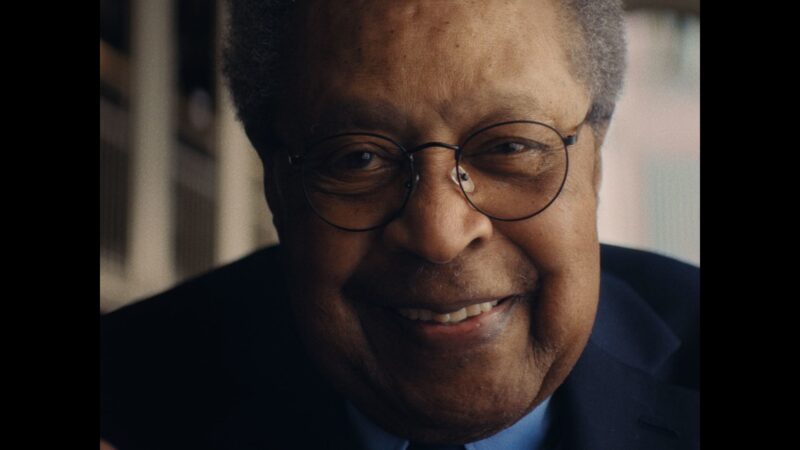
“I didn’t know he was going to read my words word-for-word,” Jones, 95, told The Inquirer in a recent video chat.
He closes his eyes often as he talks, punctuating his speech every so often with a well-placed, “You hear me?” or “You understand me?”
His hair is a short white Afro. Soft and defiant.
A wintertime soldier from North Philly
Jones was the only child of domestic workers, born in the 1300 block of Master Street, where Temple University’s sports complex stands today. Shortly after, his parents found work as live-in help at the Riverton, Burlington County, country estate of Edgar and Eleanora Lippincott, a Quaker family and part owners of a prosperous 19th-century Philadelphia-based clothing firm.
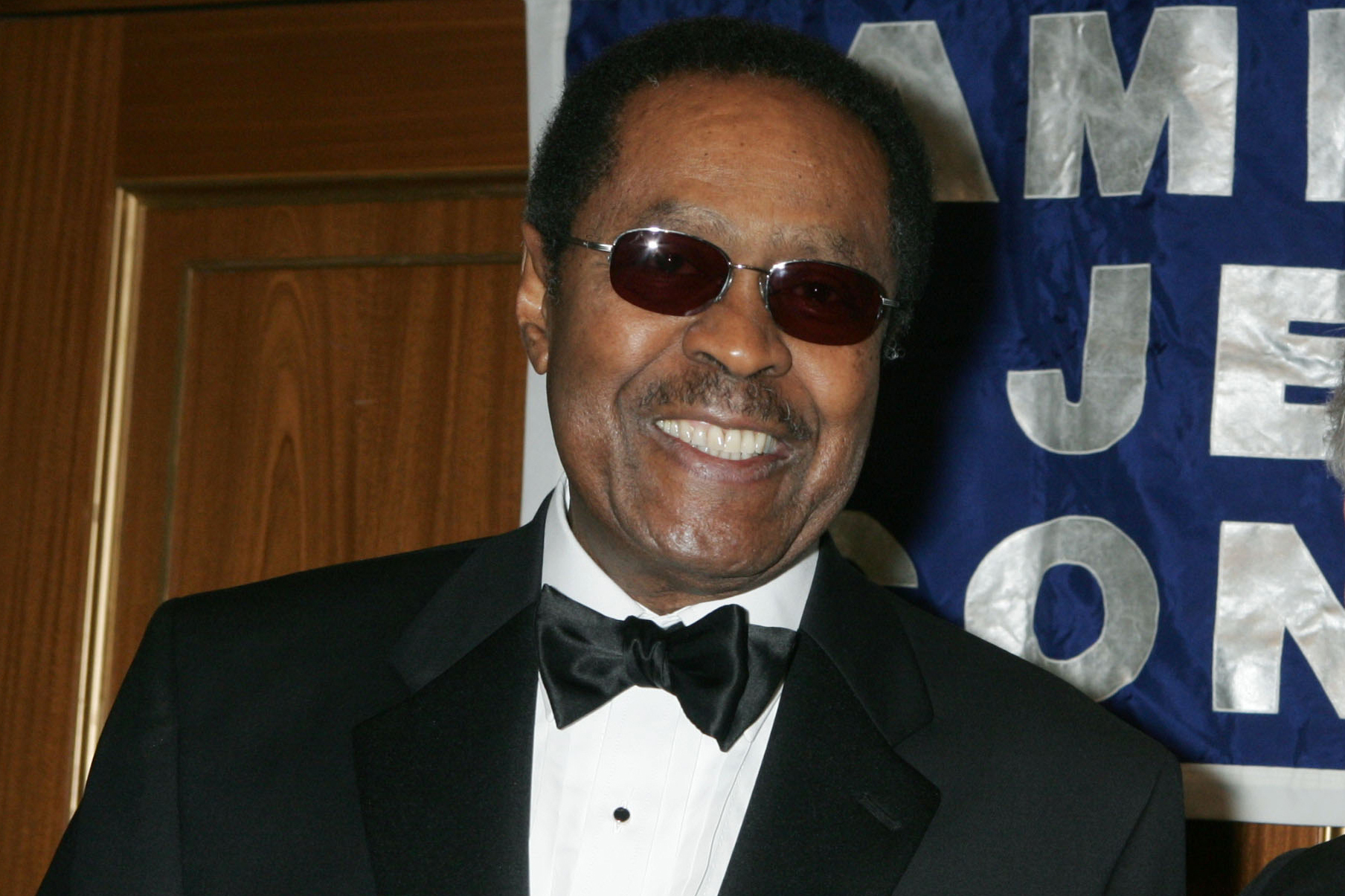
Clarence B. Jones before he received the American Jewish Congress’ “Isaiah Award,” on March 1, 2006, in New York.
“I lived there [with the Lippincotts] until they sent me to a Catholic boarding school [the Sisters of the Blessed Sacrament],” Jones said. “I was raised by Catholic nuns who told me, ‘Master Jones, you are a good boy, Jesus loves you. You are beautiful.’”
The positive reinforcement turned Jones into a force, at a time when Black people’s education and career options were limited by racism. He finished Palmyra High School in New Jersey, the current home of the Clarence B. Jones Institute of Social Advocacy, at the top of his class. He attended the summer program at the Juilliard School in Manhattan for two years and studied clarinet. There he fine-tuned the musical ear that, he said, aided him in writing King’s speeches.
He graduated from Columbia University, did a brief stint in the Army, and graduated from Boston University Law School. By the late 1950s, he was working as an entertainment lawyer for Revue Studios, which was absorbed into what is now Universal.
Clarence B. Jones in an animated scene in his living room in “The Baddest Speechwriter of All.”
Jones was at home one evening in 1960 when his mentor and former New York judge Hubert T. Delany asked him to defend King, then a young preacher and budding Civil Rights Movement leader, against a tax evasion charge in Montgomery, Ala.
Jones said no.
“I wondered whether he [King] was real,” Jones said. “‘Cause I’m saying he [King] comes from a middle-class Black family. He didn’t have to do this. I come from the kitchen.”
Yet, he agreed after hearing King preach at a church in neighboring Baldwin Hills. Jones was struck by his sermon imploring educated Black people not to turn their backs on the struggle.
In 1963, King was jailed again. This time in for leading demonstrations, marches, and sit-ins against racial segregation in Birmingham, Ala. Jones smuggled out notes that King wrote to his fellow clergymen while incarcerated and compiled the missives into King’s “Letter from a Birmingham Jail.”
That same year Jones worked with singer Harry Belafonte to secure $100,000 from the Rockefellers to bail Birmingham protesters out of jail. The Rockefellers asked him to sign a promissory note, that they later tore up. Jones references that promissory note in his draft of King’s speech.
“I was sharing a room with King in Albany, Ga.,” Jones told The Inquirer. “And he said, ‘Anybody can walk with me in the warm sunlight of an August summer. But only a wintertime soldier walks with me at midnight in the alpine chill of winter. You, Clarence, are my wintertime soldier.’”
How ‘Baddest’ came to be
Proudfoot and Curry met through a mutual friend in the late 2010s. A few years later, Curry helped produce Proudfoot’s 2022 Oscar-winning documentary The Queen of Basketball, the story of women’s basketball pioneer Lusia Harris.
Curry met Jones in 2022 when Golden State Warriors coach Steve Kerr invited Jones to speak to the team. Curry was intrigued with the elder statesmen’s stories and asked Proudfoot if he would be interested in working on a documentary about Jones’ life.
Stephen Curry, Clarence B. Jones, and Ben Proudfoot on the set of “The Baddest Speechwriter of All.”
“As a storyteller, I’m always interested in approaching well-known pieces of history through a fresh perspective,” said Proudfoot, a 35-year-old Nova Scotia native and two-time Academy Award winner. (Proudfoot’s credits also include the 2024 Netflix documentary The Turn Around, about Phillies superfan John McCann.)
“Clarence wasn’t just sitting there waiting for Dr. King to call him,” Proudfoot said. “He was a reluctant participant. He made a decision to live in comfort or live with purpose.”
Jones was King’s attorney until his assassination in 1968. In the late 1960s he became a partner at what is now Cogan, Berlind, Weill & Levitt, making him the first African American partner at a Wall Street investment banking firm. During that time he also became the first Black person to become an allied member of the New York Stock Exchange.
During the 1970s, Jones served as the chairman of the New York-based Inner City Broadcasting, where he and Percy Sutton — once Malcolm X’s attorney — founded New York’s WBLS, the blueprint for today’s R&B radio stations. There, he also had a hand in developing the long-running variety show, . From 1971 to 1974, Jones was editor and publisher of the New York Amsterdam News.
“I’m telling you,” Jones said as a sly grin crawled across his face. “I was a bad man.”
In recent years, Jones has enjoyed a renewed spotlight.
He was featured in a 2024 Super Bowl commercial paid for by the Foundation to Combat Antisemitism. “I’d remind people that all hate thrives on one thing, silence,” he says, urging viewers to stand up to Jewish hate. President Joe Biden awarded him the Presidential Medal of Freedom — the highest civilian honor — in May that same year.
Clarence B. Jones visiting the Martin Luther King Jr. Memorial in Washington in an animated scene of “The Baddest Speechwriter of All.”
Just days after the death of the Rev. Jesse Jackson, Jones remembered Jackson as a leader in the civil rights struggle. “I looked upon Jesse Jackson as someone who was a warrior in the battle who has fallen,” Jones said. “I regard him with great love and affection.”
At a time when the historical civil rights language Jones had a hand in drafting is seen by this presidential administration as racist toward white Americans, Jones is reflective.
If people would focus more on love, perhaps America would be a better place.
“King’s work was about love,” he said. “The love he had for his work, for his people … the love he had for me.”
Last season, Nic Deslauriers played 31 games for the Flyers, mostly due to an upper-body injury that kept him out for almost three months. This season, across the Flyers’ 56 games, the veteran winger has suited up for just 21.
“Not easy, that’s for sure,” he said Sunday after practice. “It’s where the young guys kind of step up and [I] just stay ready for when my name is called upon. It’s frustrating, but at the same time, I can’t control those things.”
A fourth-liner when he does slot in, Deslauriers is a bit of a throwback. Although he was selected by the Los Angeles Kings in the third round of the 2009 NHL draft as a defenseman, the now 35-year-old — his birthday was Sunday — is a tough, grinding forward who is feared across the league for his fists.
This season, he has one assist with a minus-3 rating while averaging 8 minutes, 18 seconds of ice time. He’s averaging the most minutes he’s played since his first year in Philly (10:06 in 80 games) after signing as a free agent in July 2022.
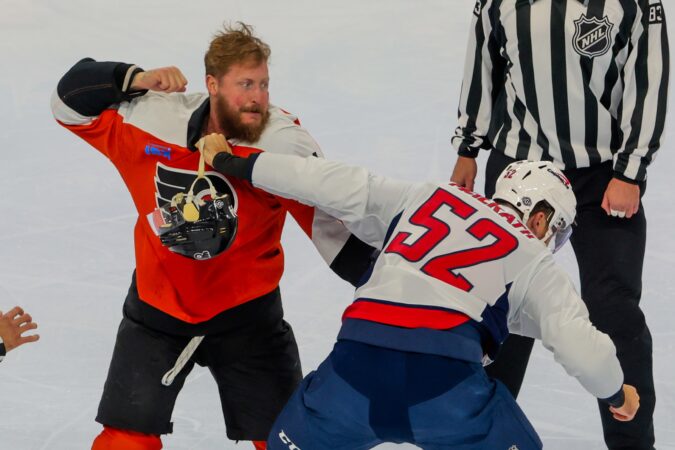
Since joining the Flyers, the forward has dropped the gloves 32 times in the regular season — most notably against the New York Rangers’ Matt Rempe in what many called the “Fight of the Year” two years ago Tuesday. Twenty of his 26 penalty minutes this season are from fighting majors against Minnesota Wild forward Marcus Foligno, Montreal Canadiens forward Arber Xhekaj — he fought his brother, Florian, who is also on the Canadiens in the preseason — Tampa Bay Lightning tough guy Curtis Douglas, and Brennan Othmann of the Rangers.
“It’s funny, there’s sometimes that I could see it kind of like disappearing, and then, it’s more when you watch the playoffs, and you see those guys, not enforcers technically, but the hardworking guys that hit, and, I wouldn’t say patrol, but if there’s something going wrong, they’re there,” he said.
“I think you see them in some teams, and those are teams that have success. So I think it’s getting away, that’s for sure, but I think there’s still a place for it.”
Flyers general manager Danny Brière is starting to build a reputation as a guy who does right by his veteran players. Last year, he traded Erik Johnson back to Colorado, where he had previously won a Stanley Cup, and Scott Laughton to his hometown Toronto Maple Leafs. With the trade deadline approaching on March 6, is the pending unrestricted free agent next?
“I think I have maybe another year or two in me [but] those are things out of my power,” Deslauriers said. “I’ve always taken care of my body for the type of job that I do, and I’m always ready. I still think I have some in the gas tank.”
Deslauriers feels like he came into camp in great shape, plus, as he noted, “I get bag-skated a lot, so I’m still in shape.” On the ice for every morning skate, whether optional or not, he spends extra time helping goalies work on their craft, does a hard skate if he’s not playing, and then hits the gym during the first period of the game. Sometimes he’ll head up to the press box afterward to check out the game.
“The game’s easier when you guys watch from up top,” he noted. “Some games you want to feel a refresh and you go up there and kind of look at the games. But the main thing, of not playing, is just staying in shape and waiting for your turn.”
Nic Deslauriers has played in just 31 of the Flyers’ 56 games this season. He might welcome a chance to play more elsewhere.
Unfortunately, time catches up to us all, and there is only so much road left for the Quebec native who is two games shy of 700 in the NHL. He got a taste of post-career life when he was hurt last season, spending more time with his four children and taking them to soccer tournaments in between gym sessions during the recent Olympic break.
But despite being the oldest player on the Flyers — he’s got nine months on linemate Garnet Hathaway — the respected and well-liked Deslauriers is not done yet.
“I know it’s toward the end,” he said with a laugh, “but trying to kind of prove that I can be here.
“If you look at my season this year, just 21 games, it’s not a lot, but I think I’m almost more in shape now than the last few years from all the skating.
“So, no, I think the passion of the game is still there. The love of the game is still there. And we’ll see where that goes.”
The NHL trade freeze lifted at 11:59 p.m. on Sunday. … Several Flyers and NHL items are up for auction at www.classicauctions.net, including items from the personal collections of Ron Hextall and Bobby Taylor along with the late Bernie Parent’s “Ghost” mask. The auction closes on Tuesday. … On Saturday, Flyers forward Owen Tippett surprised more than 50 children, ages 5-9, by participating in the Flyers Learn to Play practice at the Skatium in Haverford. An ambassador for the program since 2023-24 with his wife, Taylor, Tippett ran the players through skating and stickhandling drills. Participants in the program, which takes place at 18 rinks across Pennsylvania, New Jersey, and Delaware, are supplied full head-to-toe hockey equipment, a personal welcome message from the Tippetts, a certificate of completion signed by Owen, and the chance for a postgame meet-and-greet at Xfinity Mobile Arena.
More than a foot of snow fell overnight across the Philadelphia region, though the Jersey Shore was hit hardest by a powerful winter storm and blizzard-like winds.
“I don’t think we’ve seen anything like this since 1996,” New Jersey Gov. Mikie Sherrill said during an interview Monday morning, calling it the “storm of a generation.”
Due to heavy snow bands, the totals varied widely. Ten inches of snow were recorded in Boothwyn Monday morning, while 22.1 inches came down in Langhorne, Bucks County.
In Central Delaware, 20.5 inches fell in Woodside, while across the river 17 inches dropped overnight in Lindenwold, Camden County.
Officially, 14 inches fell at Philadelphia International Airport.
window.addEventListener(“message”,function(a){if(void 0!==a.data[“datawrapper-height”]){var e=document.querySelectorAll(“iframe”);for(var t in a.data[“datawrapper-height”])for(var r,i=0;r=e[i];i++)if(r.contentWindow===a.source){var d=a.data[“datawrapper-height”][t]+”px”;r.style.height=d}}});
Here are the latest snowfall totals from the National Weather Service, measured by trained spotters or observed by the service itself:
Pennsylvania
Philadelphia
Fox Chase: 14.8 in (11 a.m.)
Philadelphia International Airport: 14 in (1 p.m.)
Rockledge: 13.8 (7 a.m.)
Delaware County
Swarthmore: 12 in (10:31 a.m.)
Chadds Ford: 11.5 in (10 a.m.)
Clifton Heights: 10.5 in (9:30 a.m.)
Boothwyn: 10.0 in (5:15 a.m.)
Chadds Ford Twp: 9.8 in (2 a.m.)
Lima: 8.8 in (5:35 a.m.)
Media: 7.8 in (10:15 a.m.)
Chester County
Paoli: 9.8 in (11:30 a.m.)
East Nantmeal Twp: 9.5 in (8 a.m.)
West Chester: 8 (7:30 a.m.)
East Nottingham Twp: 7.5 (7:55 a.m.)
SE Exton: 7.0 in (12:39 a.m.)
West Caln Twp: 6.5 in (8:30 a.m.)
Wickerton: 6 in (7:30 a.m.)
East Coventry Twp: 5.5 in (9:20 a.m.)
Montgomery County
Norristown: 13.4 in (10:25 a.m.)
Willow Grove: 13.2 in (6:45 a.m.)
Skippack: 12.8 in (11:50 a.m.)
Fort Washington: 12 in (8 a.m.)
Green Lane: 11.4 in (9:15 a.m.)
Elkins Park: 10.5 in (9:15 a.m.)
Glenside: 10.5 in (7 a.m.)
Penn Wynne: 10.5 in (7 a.m.)
Willow Grove: 10 in (7 a.m.)
Gilbertsville: 9 in (8:30 a.m.)
Jenkintown: 8.5 in (8 a.m.)
Conshohocken: 8.4 in (8:42 a.m.)
Hatfield: 8 in (8:42 a.m.)
King of Prussia: 8 in (9 a.m.)
Royersford: 8 in (9 a.m.)
Collegeville: 7 in (9 a.m.)
Salford Twp: 6.8 in (9 a.m.)
Stowe: 4.1 in (9:18 a.m.)
Bucks County
Langhorne: 22.1 in (9 a.m.)
Richboro: 22 in (11 a.m.)
Morrisville: 21 in (8 a.m.)
Fairless Hills: 20.5 in (6:30 a.m.)
Croydon: 18 in (8 a.m.)
Levittown: 15.0 in (3:53 a.m.)
Warminster: 13.5 in (5:40 a.m.)
Fricks: 11.7 in (noon)
Souderton: 9.2 in (7 a.m.)
East Rockhill Twp: 8.5 in (6:30 a.m.)
Chalfont: 7.3 in (6:50 a.m.)
New Jersey
Atlantic County
Mays Landing: 19 in (12:55 p.m.)
Minotola: 17 in (11 a.m.)
Atlantic City International Airport: 16.9 in (1 p.m.)
Buena Vista Twp.: 16.5 in (12:30 p.m.)
Egg Harbor Twp: 14 in (11 a.m.)
Brigantine: 12.5 in (8 a.m.)
Estelle Manor: 10.5 in (8 a.m.)
Hammonton: 8.2 in (7:45 a.m)
Burlington County
Mount Laurel: 20.6 in (1:05 p.m.)
Columbus: 20.5 in (12:45 p.m.)
Leisuretown: 20.3 in (10:07 a.m.)
Mount Holly: 20.3 in (1 p.m.)
South Jersey Regional Airport: 20.3 in (11:30 a.m.)
Pemberton: 20 inches (noon)
Moorestown: 19.5 in (11:20 a.m.)
Lake Pine: 19.2 in (9 a.m.)
Westampton: 19.2 in (7 a.m.)
Mansfield Twp: 19 in (7 a.m.)
Medford Twp: 18 in (5:20 a.m.)
Hainesport: 17.8 in (8 a.m.)
Rancocas: 17.4 in (8 a.m)
Burlington Twp: 17.0 in (7 a.m.)
Medford: 16.8 in (8:35 a.m.)
Moorestown Twp: 16.7 in (7:30 a.m.)
Delanco: 16.2 in (12:30 p.m.)
Maple Shade: 16 in (7:30 a.m.)
Evesham: 12.3 in (7 a.m.)
Camden County
Lindenwold: 17 in (10 a.m.)
Barrington: 16.5 in (6:30 a.m.)
Haddon Heights: 15 in (12:02 p.m)
Mt. Ephraim: 15 in (7 a.m.)
Haddon Township: 14 in (10:15 a.m.)
Winslow Twp: 9.5 in (7 a.m.)
Gloucester County
Pitman: 21.5 in (11:30 a.m.)
Monroe Twp: 19 in (9 a.m.)
Glassboro: 17 in (8:45 a.m.)
Washington Twp: 16 in (6 a.m.)
Franklin Twp: 14.3 in (7:30 a.m.)
East Greenwich Twp: 14 in (5:45 a.m.)
Williamstown: 10.3 in (8 a.m.)
Monmouth County
Colts Neck: 24.1 in (1:15 p.m.)
Howell: 24 in (noon)
Manalapan Township: 21 in (10:30 a.m.)
Centerville: 20.5 in (8:30 a.m.)
Ocean Twp: 18 in (noon)
West Long Branch: 16 in (7:45 a.m.)
Red Bank: 14.3 in (7:30 a.m.)
Ocean County
Jackson: 25.2 in (1 p.m.)
Toms River: 23.5 in (10:45 a.m.)
Manchester Twp: 18 in (6:30 a.m.)
Manahawkin: 18 in (10:30 a.m.)
Tuckerton: 16 in (8:30 a.m.)
Berkeley Twp: 14 in (7 a.m.)
Beachwood: 13.5 in (7:30 a.m.)
Point Pleasant Beach: 11.5 in (7 a.m.)
Barnegat Twp: 10.4 in (7:45 a.m.)
Salem County
Monroeville: 18 in (8 a.m.)
Olivet: 16 in (11 a.m.)
Upper Pittsgrove Twp: 11.5 in (9:15 a.m.)
Delaware
New Castle County
Hockessin: 10 in (5:55 a.m.)
Holiday Hills: 8.3 in (2:10 a.m.)
New Castle County Airport: 8.3 in (7 a.m.)
Wilmington: 8 in (7 a.m.)
Newport: 7.2 in (7 a.m.)
Marshallton: 6.3 in (9:30 a.m.)
Newark: 5.5 in (7:30 a.m.)
Staff writers Anthony R. Wood and Amy S. Rosenberg contributed to this report.
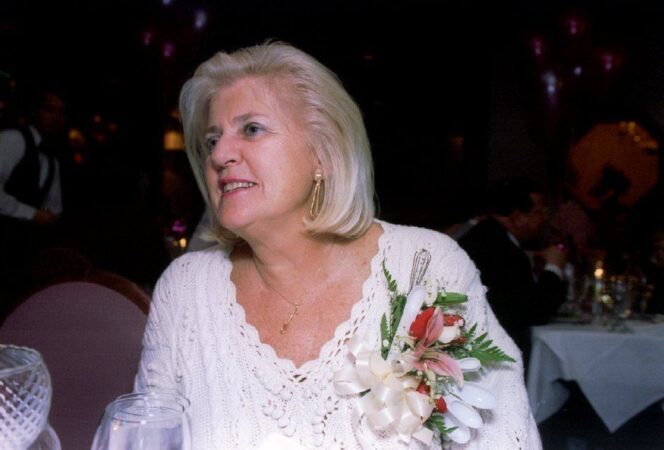
Charlotte Ann Albertson, 90, a pioneer in Philadelphia’s culinary scene through her long-running cooking school, died Sunday, Feb. 15, 2026, at her home in Harveys Lake, PA.
For more than five decades, Mrs. Albertson, a longtime Wynnewood resident, ran Albertson Cooking School, which has introduced generations of home cooks and aspiring professionals to global cuisines, wine, and hospitality. In the years before round-the-clock food television, the school also helped to elevate the profiles of local chefs.
Charlotte Ann Albertson in her element, leading a cooking class.
Born in Chicago to Joseph and Veronica Sutula, she grew up in Scranton and attended Marywood Seminary and Marywood College, graduating in 1957. She earned a master’s degree in education from the University of Pennsylvania, where she met her husband, Dr. Richard P. Albertson, an anesthesiologist and president of the medical staff at Lankenau Hospital; he died in 2024.
After their marriage in 1961, Mrs. Albertson taught fifth- and sixth-grade English at the former Wynnewood Road School in Lower Merion. In 1974, after taking classes with food writer/teacher Ethel Hoffman, she launched L’Epicure,later Albertson Cooking School.
Mrs. Albertson proved adept at recruiting talent for the school, which relies on itinerant faculty. “Her term was always: ‘Be bullheaded — don’t ever take no for an answer,’” said her daughter Ann-Michelle.
Charlotte Ann Albertson and her husband, Richard, toast at Christmas dinner in 2004.
Mrs. Albertson’s classes, held at first in her condo kitchen and later at a variety of venues, ranged from the sublime to the whimsical. She booked a woman whom she saw teaching cake-decorating at a department store to share the secrets to the butter cookies of her native Scandinavia. She hired a baker from the Commissary (one of the most popular restaurants in town in the late ’70s) to demonstrate desserts, got a Japanese friend to teach sukiyaki and tempura, and landed a cheese artist to teach how to sculpt cheddar into footballs and pine cones.
Lankenau Hospital was a rich recruiting ground. Her early instructors included the hospital’s chef, Bruce Cooper. “She was a tremendous supporter from the start, even investing in Jake’s [the landmark restaurant in Manayunk that opened in 1987] for its initial five years,” Cooper said last week.
In 1977, she met Le Bec-Fin chef Georges Perrier at Lankenau after his teenage stepson required surgery and Dr. Albertson was the anesthesiologist. She persuaded Perrier to teach, and he led classes even as his and his restaurant’s international reputation grew.
That same year, after reading about the impending closure of the Bellevue Stratford Hotel, Mrs. Albertson invited its executive chef to teach. “He said that he was too old, but he recommended a new guy in town, a master chef working at the Marriott,” Mrs. Albertson told The Inquirer for a 1994 profile.
He was Tell Erhardt. Although he had a heavy German accent, she said, he was “a charmer” and led 16 classes for her. Chef Tell parlayed that into spots on local TV and, later, frequent appearances on Regis and Kathie Lee and Saturday Night Live. (Chef Tell also inspired the gibberish-speaking Swedish chef on The Muppet Show.)
Charlotte Ann Albertson (left) with her family (from left): Daughters Ann-Michelle Albertson and Kristin Keifer, grandchildren Caroline and Cole Keifer, and her husband, Richard.
Mrs. Albertson traveled and studied extensively, taking classes at La Varenne and Le Cordon Bleu in Paris. “She showed us the world — Vietnam, South Africa, Brazil, Chile, Argentina, Italy, China,” Ann-Michelle said. “Everywhere she went for culinary work, she took us with her.”
She and her husband were also notably open about their choice to adopt. “I was adopted in 1967, when it was still pretty taboo,” Ann-Michelle said. “But from the beginning, the message was: ‘You were picked out special.’” The family maintained ties to St. Joseph’s Center in Scranton, from which Ann-Michelle and middle child Peter were adopted. Their third child, Kristin, was adopted privately in 1976.
Kristin’s dearest memories of the cooking school were the hands-on birthday party classes for kids; children were taught how to bake and decorate a cake from scratch as well as make pizza using homemade dough. “Getting to meet Julia Child multiple times and dine with countless celebrity chefs are also at the top of the list of my fond memories,” all thanks to her mother, Kristin said.
Beyond the classroom, Mrs. Albertson consulted for food and wine companies, libraries, and cultural institutions. She received the Delaware Valley Restaurant Association’s Panache Award in 1993 for promoting professional growth through education.
Only later did Ann-Michelle — a pediatric speech pathologist who now runs the cooking school — fully grasp her influence. “People would stop me and say, ‘Your mom did so much for me. I wouldn’t be where I am without her,’” she said.
As the business grew, Mrs. Albertson directed its success toward philanthropy, supporting causes including the Ronald McDonald House and Alex’s Lemonade Stand Foundation.
Mrs. Albertson attended Our Lady of Lourdes Roman Catholic Church in Overbrook and Our Lady of Victory at Harveys Lake. “We went to church every Sunday,” Ann-Michelle said. “The perk at the lake was that I could water-ski to church — and ski back.”
Mrs. Albertson was a charter member of the International Association of Culinary Professionals and belonged to the Confrérie de la Chaîne des Rôtisseurs, Les Dames d’Escoffier, Société Mondiale du Vin, the Philadelphia Culinary Guild, and the American Institute of Wine & Food.
She is survived by her children, Ann-Michelle Albertson, Kristin Keifer, and Peter Albertson; seven grandchildren; and a great-grandchild.
A funeral Mass will be celebrated at 11 a.m. Saturday, April 25, at Presentation B.V.M. Church, 204 Haverford Rd., Wynnewood. A celebration of life will follow at 12:30 p.m. at Savona, 100 Old Gulph Rd., Gulph Mills.
In keeping with her spirit, her family asks attendees to wear bright colors in remembrance of her zest for life.
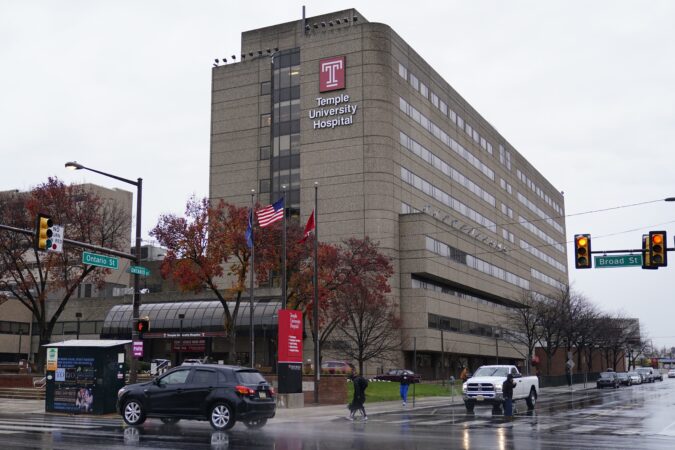
Temple University Health System had a $50.5 million operating loss in the six months that ended Dec. 31, the Philadelphia nonprofit told bond investors Monday. In the same period the year before, Temple reported a $13.5 million operating gain.
Here are some details on Temple results:
Revenue: Total revenue reached $1.64 billion, up 7.3% from the year before. Patient revenue rose 8% due mostly to increased outpatient revenue from Temple’s pharmacy business, infusions, and same-day surgeries. Two hits to revenue were a $14.3 million decrease in state funding and decline in the number of transplants, which bring in large amounts of revenue. Temple said it expects both of them to rebound in the remainer of fiscal 2026.
Expenses: Temple attributed some of its loss in the first six months of fiscal 2026 to $20 million in extra expenses associated with the opening of its new Woman & Families Hospital, a $7.2 million increase in medical liability expenses, and a $6.4 million increase in losses under its Medicaid contract with Health Partners Plans.
Notable: Despite its operating loss, even on a cash basis, Temple financial reserves increased to more than $1 billion as of Dec. 31. Most of the gain came from investments. The reserves equal the amount of money needed to keep the health system operating for 119 days if no more revenue came in. At the end of 2024, that figure was 113 days.