Philadelphia-based Iron Stone Real Estate Partners transferred control of two of their former Hahnemann University Hospital properties in the last two weeks.
The investment group acquired a portfolio of Hahnemann properties in 2021 and began redeveloping them into laboratory and office space.
But in recent weeks Iron Stone disposed of two of these properties.
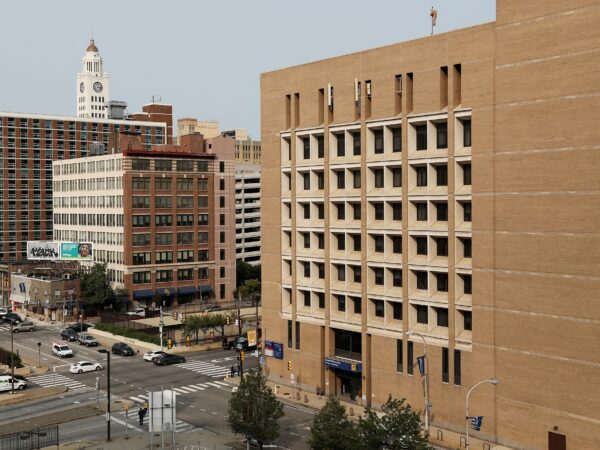
The company donated the New College Building at 245 N. 15th St. to Drexel University on Dec. 31.
“It’s a charitable donation,” said Jason Friedland, director of operations and investments at Iron Stone. “We felt that that building was best served with Drexel owning it and using it for a long time, long-term, for their research.”
When Iron Stone acquired the New College Building five years ago, Drexel occupied the property’s medical labs and was one of the few remaining tenants in the Hahnemann campus.
Back then the university was considering moving this Center City operation to the suburbs in the short term and to University City in the long term.
“The generous gift will provide the university with flexibility as it continues to consolidate operation of its College of Medicine on its University City campus,” Drexel spokesperson Britt Faulstick said in an email statement. “Plans for the New College Building will be determined in the future.”
On Jan. 6, Iron Stone sold the Broad and Vine Parking Garage at 1416 Wood St. to the Philadelphia Parking Authority for $21.3 million.
The 850-space garage had been exclusively for Hahnemann’s use. Iron Stone renovated the vacant garage after the bankruptcy and hired Metropolis Technologies — the largest parking operator in the United States — to run it.
The acquisition is the first time the Parking Authority has purchased a garage built by someone else, said Rich Lazer, executive director of the Parking Authority.
“Most of our garages, outside of the airport, are Center City-based, so its nice to push out onto North Broad,” Lazer said. “Our garages are lower cost than private garages, so it’ll help us maintain reasonable pricing.”
The authority plans to retain Metropolis Technologies as the operator, Lazer said.
Iron Stone still owns a couple former Hahnemann properties, including the 120,000-square-foot Race Street Laboratories at 1421 Race St. and the 15,000-square-foot building at 231 N. Broad St., which is fully leased by Bayada Home Health Care Inc. with a third of the space and Dynamed Clinical Research with the rest.
Race Street Laboratories was developed to tap into the life sciences and biomedical market, which boomed during the pandemic but has slowed substantially as interest rates spiked. Currently the building has only one tenant, Sbarro Health Research Organization, with 7,500 square feet of space.
Friedland said Iron Stone plans to move its headquarters from University City’s FMC Tower to one of Race Street Lab’s unused floors.
As for the rest of the space, Iron Stone is exploring alternative uses as the life sciences market continues to struggle.
“We’re seeing where the opportunities are in commercial real estate,” Friedland said. “We have a couple things we’re exploring, but we’re not really in a rush.”
Their plans for an apartment building were complicated by a bill introduced in December by Councilmember Jeffery Young to ban housing from the former hospital site.
But on Dec. 24, in advance of City Council action on the legislation, the developer received zoning permits for a 361-unit apartment complex at 222-248 N. Broad St. Dwight Group says they are nonetheless in negotiations with Young to secure his support.
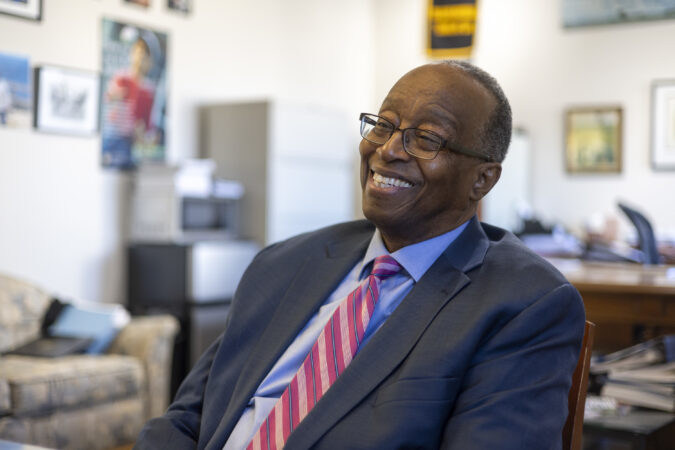
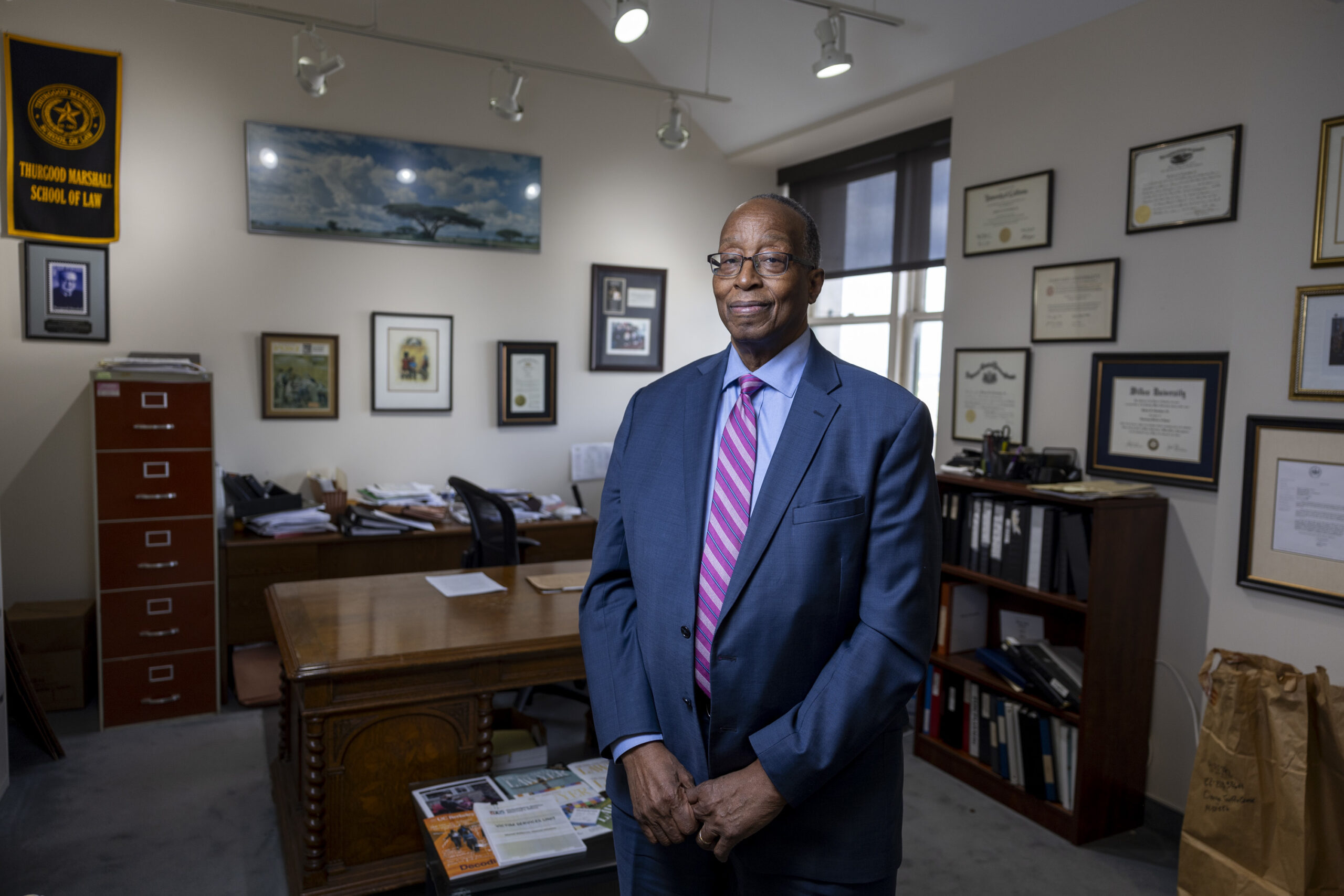
Robert Listenbee, the first assistant district attorney under Larry Krasner and a largely behind-the-scenes enforcer of the office’s progressive agenda, is retiring after nearly eight years as the office’s second-in-command.
Listenbee, 77, is expected to announce Friday that he is stepping down, marking the first shift in Krasner’s leadership team as the top prosecutor begins his third term.
A longtime public defender and juvenile justice advocate, Listenbee joined the administration at the outset of Krasner’s first term in 2018 — even as Krasner openly questioned whether the role of first assistant was necessary beyond its statutory requirement.
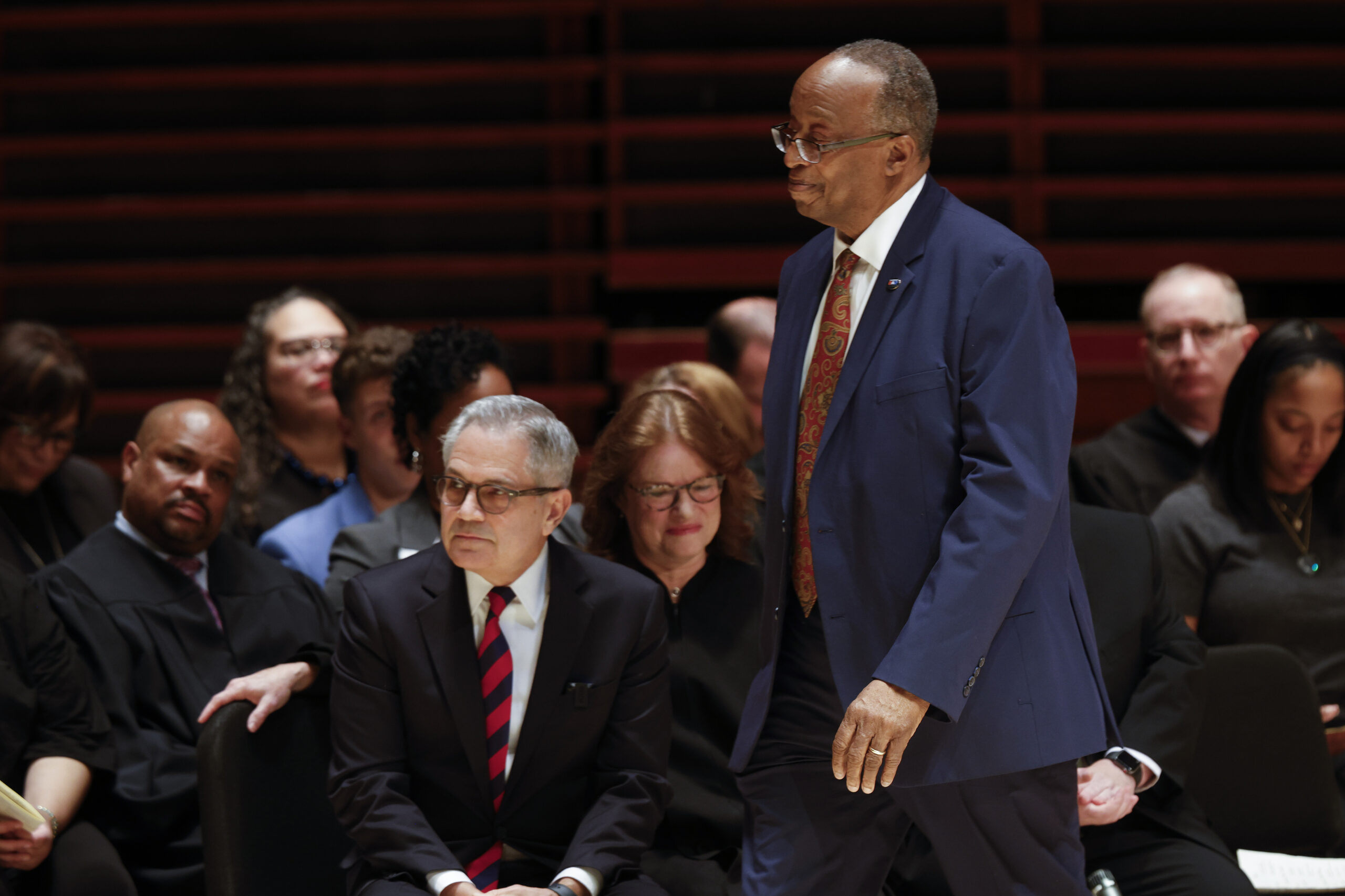
Robert Listenbee joined District Attorney Larry Krasner at the 2026 inaugural ceremony.
Over the course of Krasner’s tenure, Listenbee rarely served as the public face of the office on major cases, focusing instead on juvenile work, recruitment, and personnel matters.
Some prosecutors in the office said that often translated into a lack of visible management compared to previous first assistants, and that he served more as an internal messenger of Krasner’s often controversial agenda than the traditional day-to-day overseer of the office.
Listenbee has said his role was never set up to operate traditionally, and his goal was to carry out Krasner’s vision and reform the office.
Krasner declined to say who might replace him but he said he was evaluating candidates.
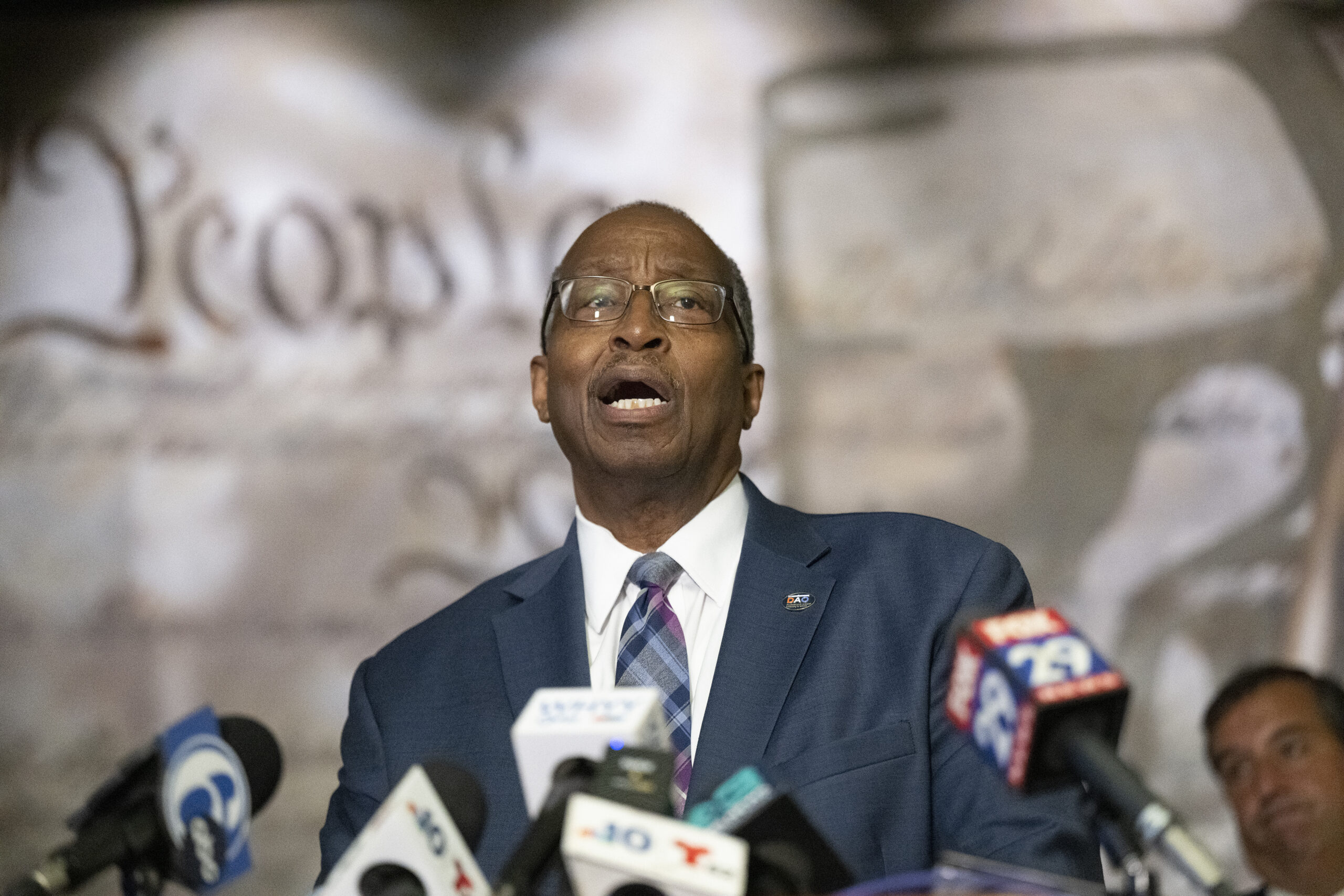
Robert Listenbee, first assistant district attorney, announced developments in the case against a West Philadelphia teen who was planning a terrorist attack.
Before joining the district attorney’s office, Listenbee spent decades as a public defender, including 16 years as chief of the juvenile unit at the Defender Association of Philadelphia. He later led the U.S. Department of Justice’s Office of Juvenile Justice and Delinquency Prevention during the Obama administration, and worked at Drexel University before returning to Philadelphia to join Krasner’s team.
We spoke with Listenbee about his unconventional path to the law, his years reshaping juvenile justice, internal tensions within the DA’s office, and his advice for Krasner’s third term.
This interview has been edited for length and clarity.
Tell me about your life growing up.
I was raised in Mount Clemens, just north of Detroit. My father worked in the auto industry. We were poor and lived in the projects. I went to a public high school, and was the first in my family to go to college.
I came from a small African American community where people look out for one another. This community saw something in me very early. When I was only planning to go to Kalamazoo College, a mom at my school decided my life was going to be different. She contacted the recruiter at Harvard University, and they visited me out in my little home in the projects when I hadn’t even applied. I got a full ride to Harvard.
I was among the first large group of African Americans at Harvard. It was 1966. We were in the middle of the Civil Rights Movement and the Vietnam War.
How was that?
There was total upheaval in this nation. Demonstrations everywhere, college campuses being taken over.
I worked on the committee that helped establish the African American Studies Department at Harvard, one of the first in the nation.
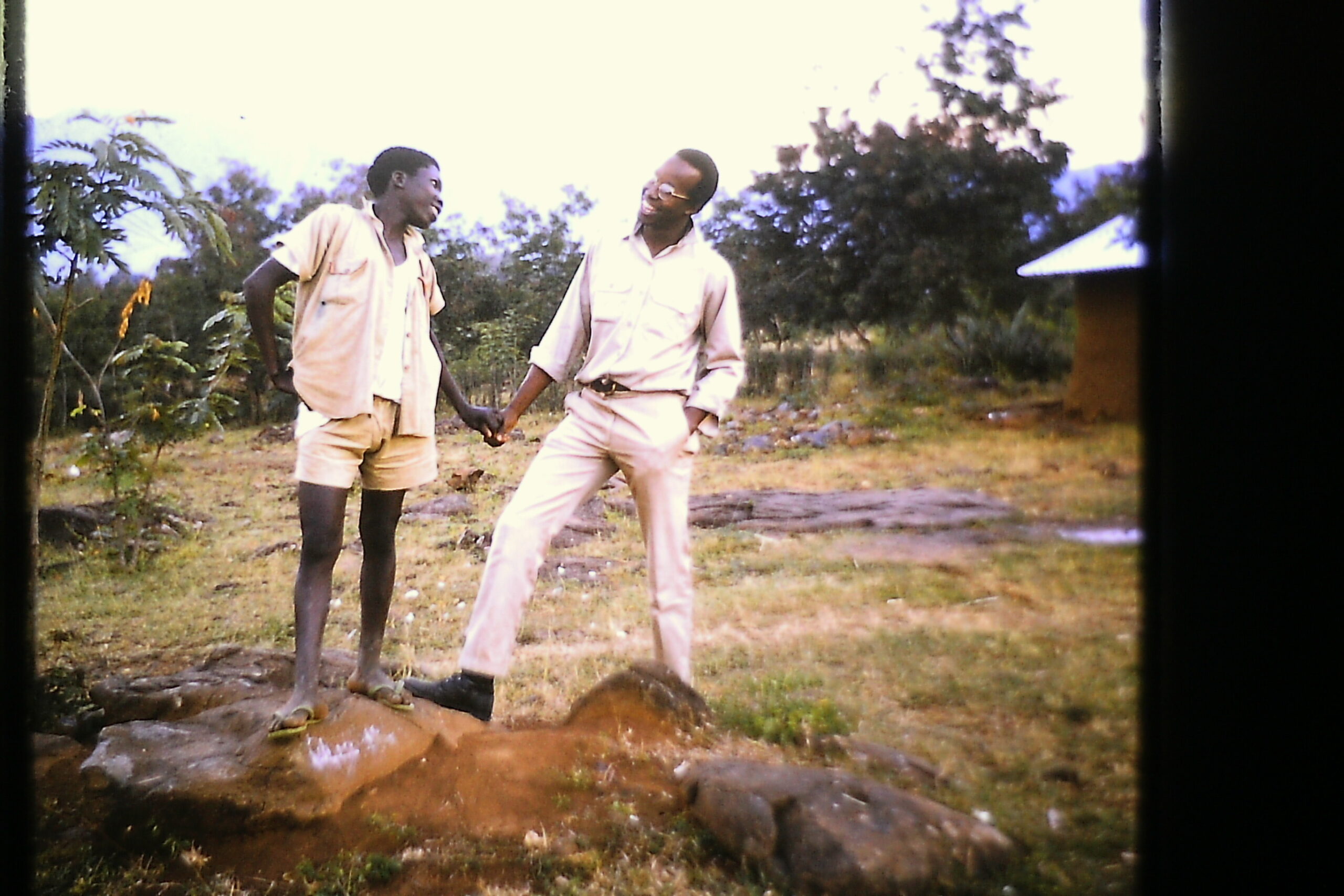
This was also at a time when African countries were becoming independent. I spent 16 months as a teacher in the rural area in western Kenya.
Robert Listenbee spent 16 months in Africa teaching English, and then traveled the continent before going to law school.
Instead of coming back from Africa, I decided to hitchhike around the world. I spent six months in Asia — Thailand, Laos, even as the war was going on. I rode a motorcycle into the Mekong Delta in Vietnam and had experiences that make me grateful to be alive. I hitchhiked across Africa and traveled 8,000 miles by train across India. I did all of this on about $600.
After a two-year gap year, I returned to Harvard and finished my degree.
I ended up getting a full-ride scholarship to Berkeley law school.
Where did you go after law school?
I had job offers but I had this crazy idea that I wanted to build a road across Africa, from Nairobi to Lagos, but I was broke and needed money to do it.
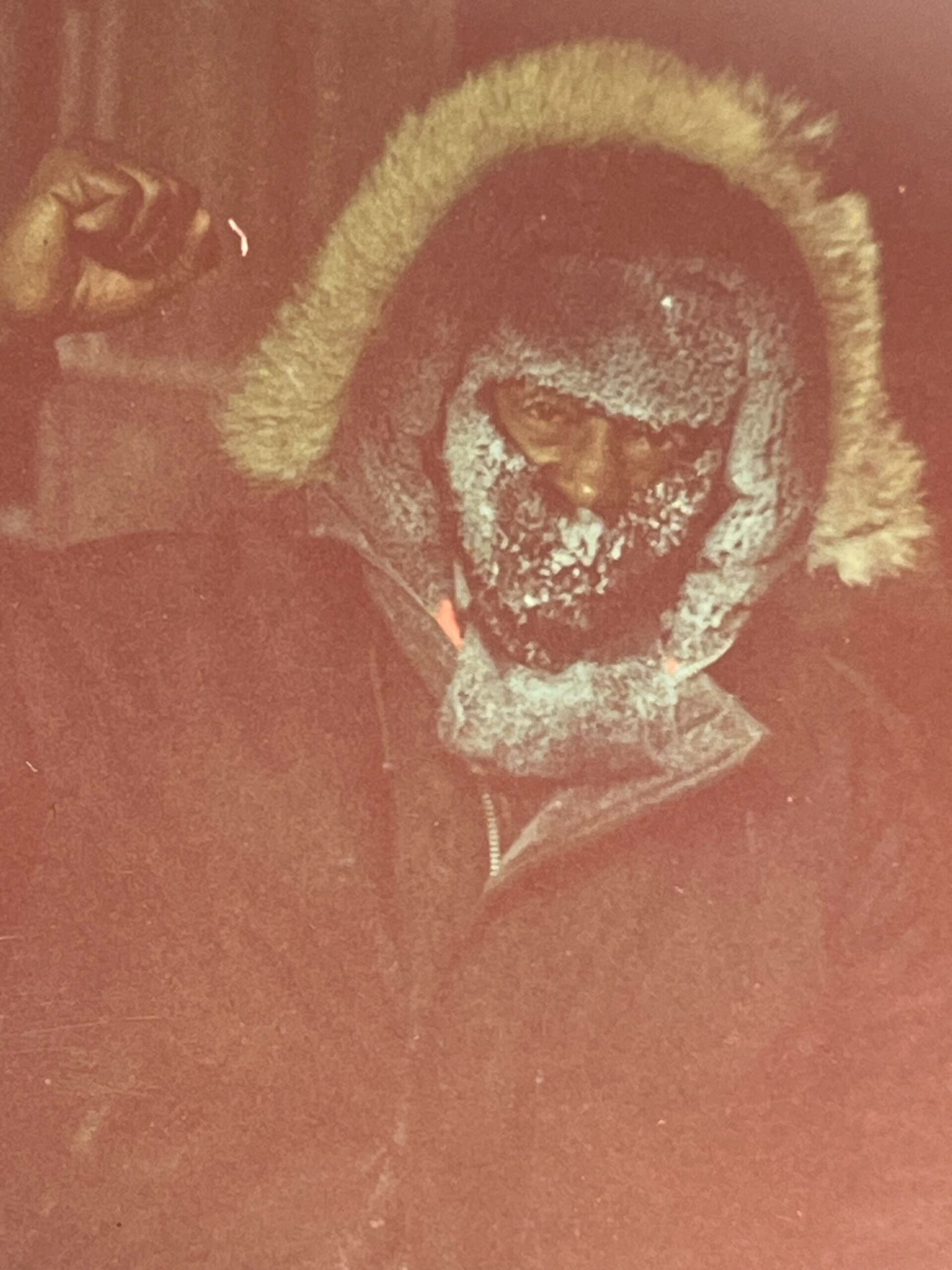
This was when the pipeline was being built across the North Slope of Alaska, and you could make gobs of money in a short period of time. So in 1976, I went to Anchorage without a job and lived in the YMCA. I shoveled snow, washed dishes, and worked at McDonald’s.
Robert Listenbee worked in the oil fields building the pipeline on the North Slope of Alaska for several years beginning in 1976.
Finally, I got a job on the pipeline.
I was there for a couple of years. I was a laborer in the oil fields. I worked trucks that rode across the Arctic Ocean in the middle of the winter. I worked on wildcat wells 50 miles from base camp. I had to relieve pressured gas to keep it from blowing up. It was 50 degrees below zero.
Robert Listenbee worked in the oil fields building the pipeline on the North Slope of Alaska for several years beginning in 1976.
I got into fights. People were trying to kill me at different points in time, and I was trying to kill other people, too. So I mean, the reason I know a little bit about criminal justice is because I was almost a criminal.
I never built the road in Africa. I eventually came back to Philadelphia, and worked construction until 1986.
So what about being a lawyer?
After my construction company failed, I was broke again. I ended up going back to legal work, and got a job working at the Defender Association.
You were the head of the juvenile unit for 16 years, and then you finished your career here on the other side — going from defending young people to prosecuting them. How was that transition for you?
Working for the U.S. Department of Justice’s Office of Juvenile Justice and Delinquency Prevention under President Obama helped prepare me for prosecutorial work.
I was adamant I would never work for this office. I thought it was corrupt. Krasner called me three times before I agreed to join as first assistant.
We were engaging in culture change. Some of the behavior of the people who were here was absolutely outrageous, especially in the homicide unit. They had a sense that this office belonged to them. It didn’t belong to the people. They were willing to cheat and do it and hide evidence in the process of doing it. That’s the feeling that I had when I first got here, and that’s what we found.
Robert Listenbee, first assistant district attorney, takes questions from the media after announcing developments in the case against a West Philadelphia teen who investigators say purchased materials including chemicals, wiring, and tactical equipment associated to become a terrorist.
There has been criticism of your juvenile work — some have said that it was too lenient during the period of intense gun violence and that kids went on to commit worse crimes. Others say the office hasn’t gone far enough to treat kids as kids. How do you assess your record?
We’ve reduced the number of kids in out of home placements. We’ve expanded juvenile diversion programs. In 2024, we created a juvenile homicide unit to review all cases of juveniles charged with murder.
I’m satisfied that we’re being as fair as we can and taking the time to carefully evaluate every issue in a case.
The first assistant is typically the person who manages the office day-to-day. Some prosecutors have said that, in this administration, that role functioned differently — that much of the management flowed directly from Krasner. Do you think that perception is fair, and how did you approach leadership in that environment?
The DA did not want the imperial first assistant that had been here before. He would prefer a flat structure to a hierarchical structure, which means you get assigned a lot of odd jobs depending on what he wants you to do.
If I were running the office, I would have run it completely differently. But I have to tell you that, having been here as long as I have, we never would have gotten this far without the DA’s serious concerns about what people around here were doing, whether they were implementing his policy or not. His skepticism, his oversight, is what’s kept this place moving in the direction that he wanted to go in. I wasn’t tuned in enough to the office to understand that from the very beginning, but I listened to him.
We hire people, we fire people, we move people around. That’s happened a lot. We sometimes end up with younger and inexperienced supervisors, because we haven’t really developed a program for training supervisors really well. We’re working on that.
I wish I had worked on juvenile issues earlier than I did.
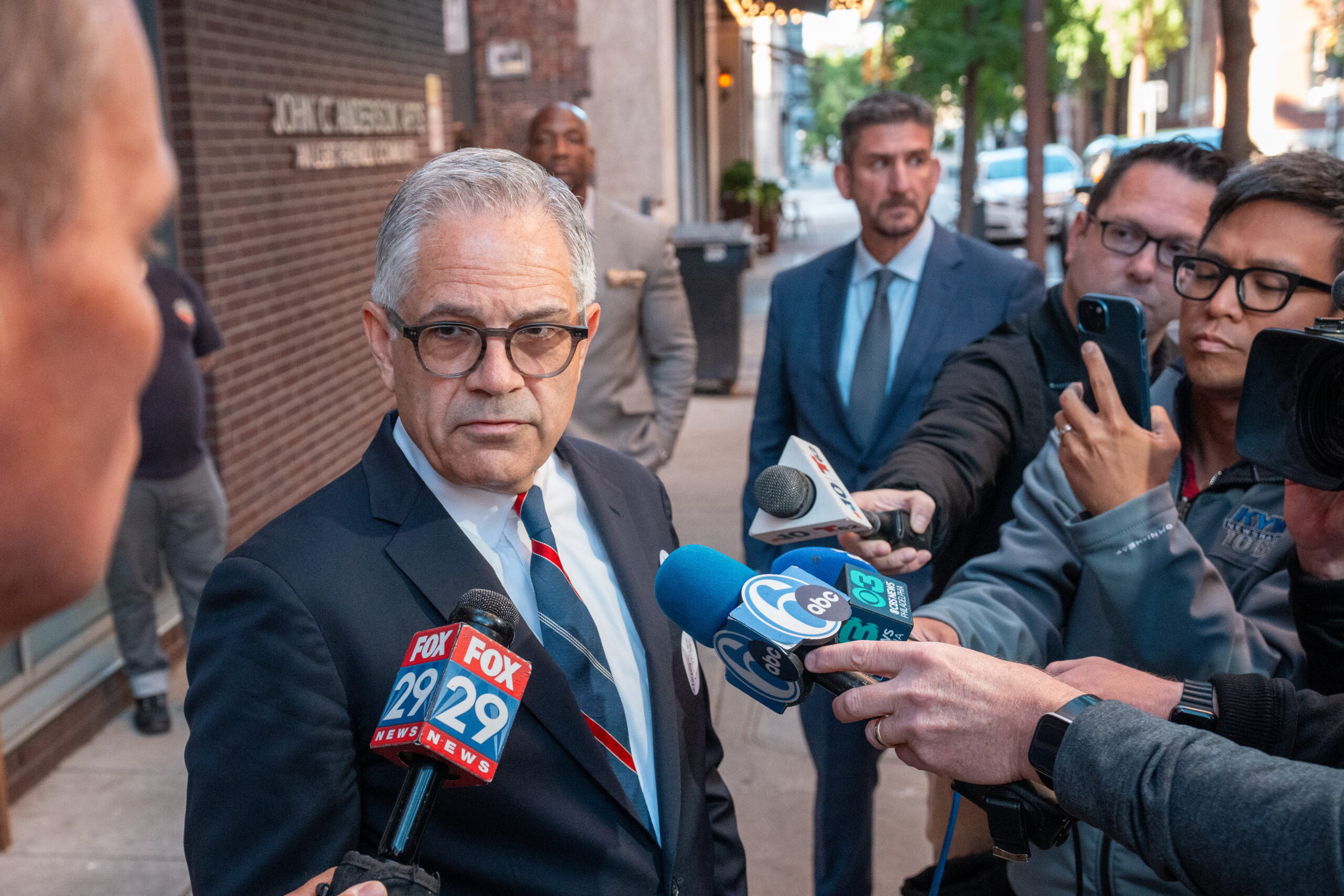
District Larry Krasner speaks with the media after casting his vote in the 2025 primary.
What’s your advice for the next first assistant?
You have to understand the DA’s goals and purposes and how he operates.
So, listen to Larry?
Not that. The DA is not a micromanager. But there’s no written directives on most of the things he wants, and there’s no organizational chart or hierarchy. If we have issues, we often go to him.
Do you have a piece of advice for Krasner in his third term?
This is a city that has a chip on its shoulder. The DA is a person who has a chip on his shoulder. They respect him for that when he speaks out. A lot of the things he says may not be politically astute, but they’re things he believes in. They like that about him.
He is the Donald Trump of the progressive era.
He needs to continue surrounding himself with people who can understand him and help him implement his policies.
A lot of people don’t like him, and I understand that. A lot of people don’t like me because I work for him. A lot of people don’t like what we do. That never mattered to me. I know that the people we have seen in court, the victims and the defendants and the witnesses, I know that we’re doing right by them. That’s my North Star.
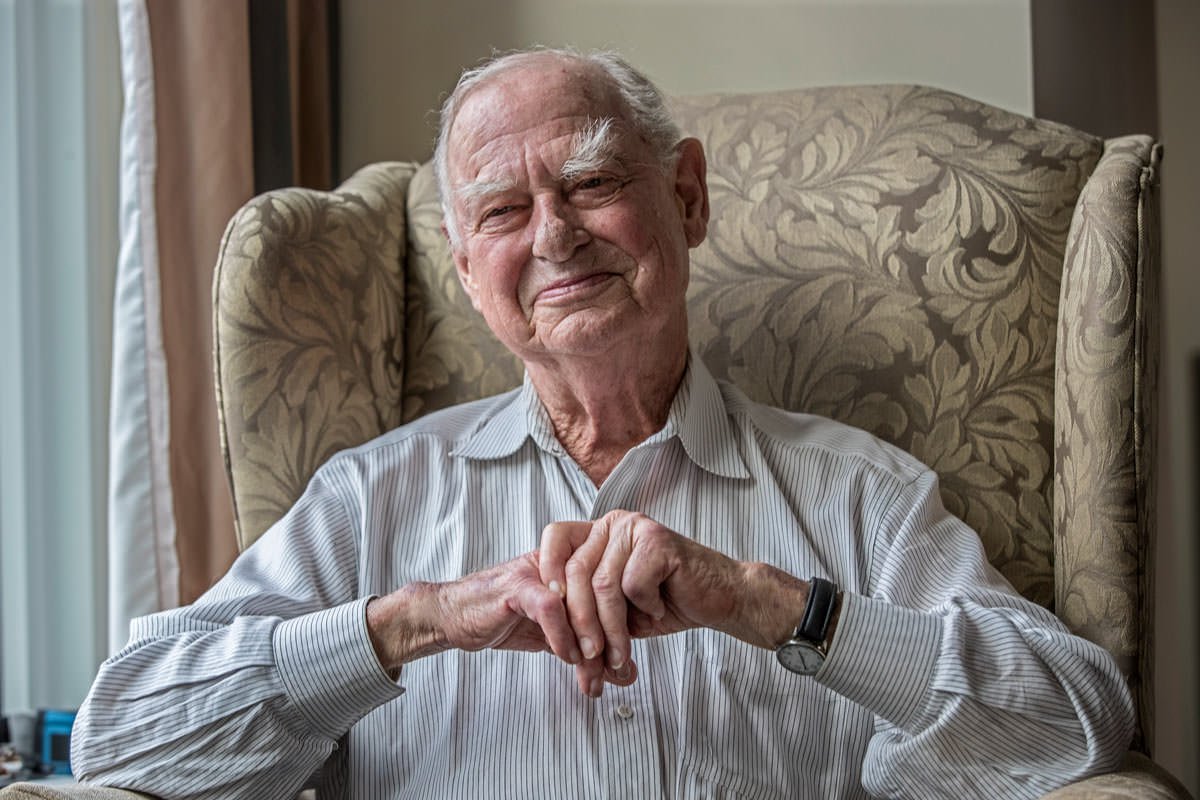
Robert Listenbee, the first assistant to District Attorney Larry Krasner, retired on Friday.
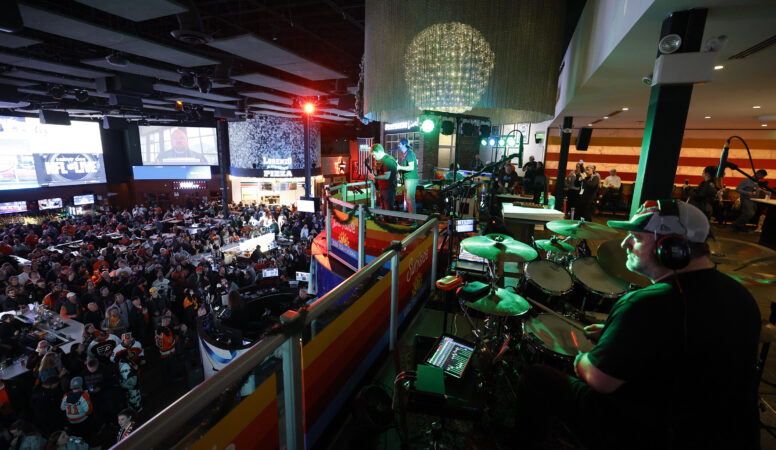
Hundreds of fans gathered at Stateside Live! ahead of the Flyers’ home game against the Toronto Maple Leafs on Thursday night to celebrate the franchise’s first Phish Night.
Whether they were dressed in Flyers gear, wearing Phish merchandise, or custom Trey Anastasio Flyers T-shirts, they danced to the sounds of Philly’s Phish tribute band, Rift, as they performed their 90-minute pregame set to get fans excited for what was in store for the rest of night.
Phish Night was a highly anticipated event for 45-year-old Doylestown native Brett Erpel and his brother Aaron. After the official announcement, Brett received a text message from his 47-year-old brother that read “Let’s go to this.”
The brothers have been fans of the band since 1995 after watching them perform for the first time at the Mann Music Center. Brett’s fandom has stretched over three decades.
For diehard fans like Brett and Aaron, Thursday night was the perfect combination of three things they love the most: Philadelphia, the Flyers, and Phish.
“I’m a huge Phish fan,” said 23-year-old Andrew Singer, a Philadelphia native. “The Flyers are an integral part of our city, especially during the winter time. I love Phish, the city of Philadelphia, and the Flyers. I just wanted to come out and support that.”
The Flyers and the band have had long connection. Phish’s first-ever performance at the Spectrum took place on Dec. 15, 1995, which saw their guitarist and singer Anastasio perform in a No. 10 John LeClair Flyers jersey. And before that performance the band visited the team in their training center.
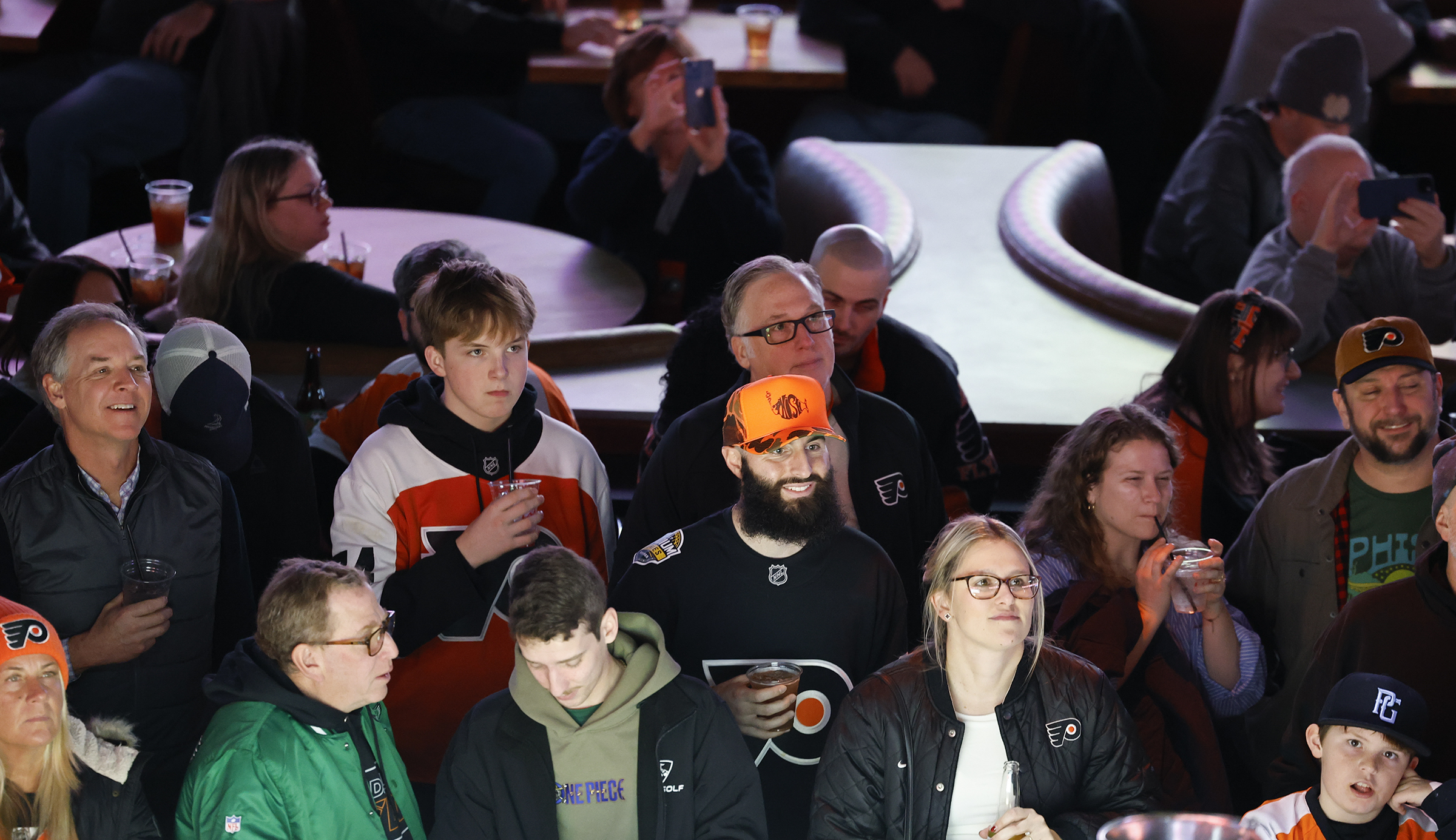
Flyers fans listen to Philly Phish tribute band Rift, at Stateside Live! on Thursday, January 8, 2026.
Since then, Phish had historic performances at The Spectrum which became immortalized on the album The Spectrum ’97.
“Tonight is sort of like the culmination of this long dating process,” said Ike Richman, who owns a communications company and is long-time friends with Phish. “Tonight’s their wedding day. The Flyers and Phish are finally getting married because we’ve had this parallel for so many years. The Flyers fans know about Phish and the Phish fans know about the Flyers. But, tonight they get to all come together in this beautiful night that features their music and celebrations.”
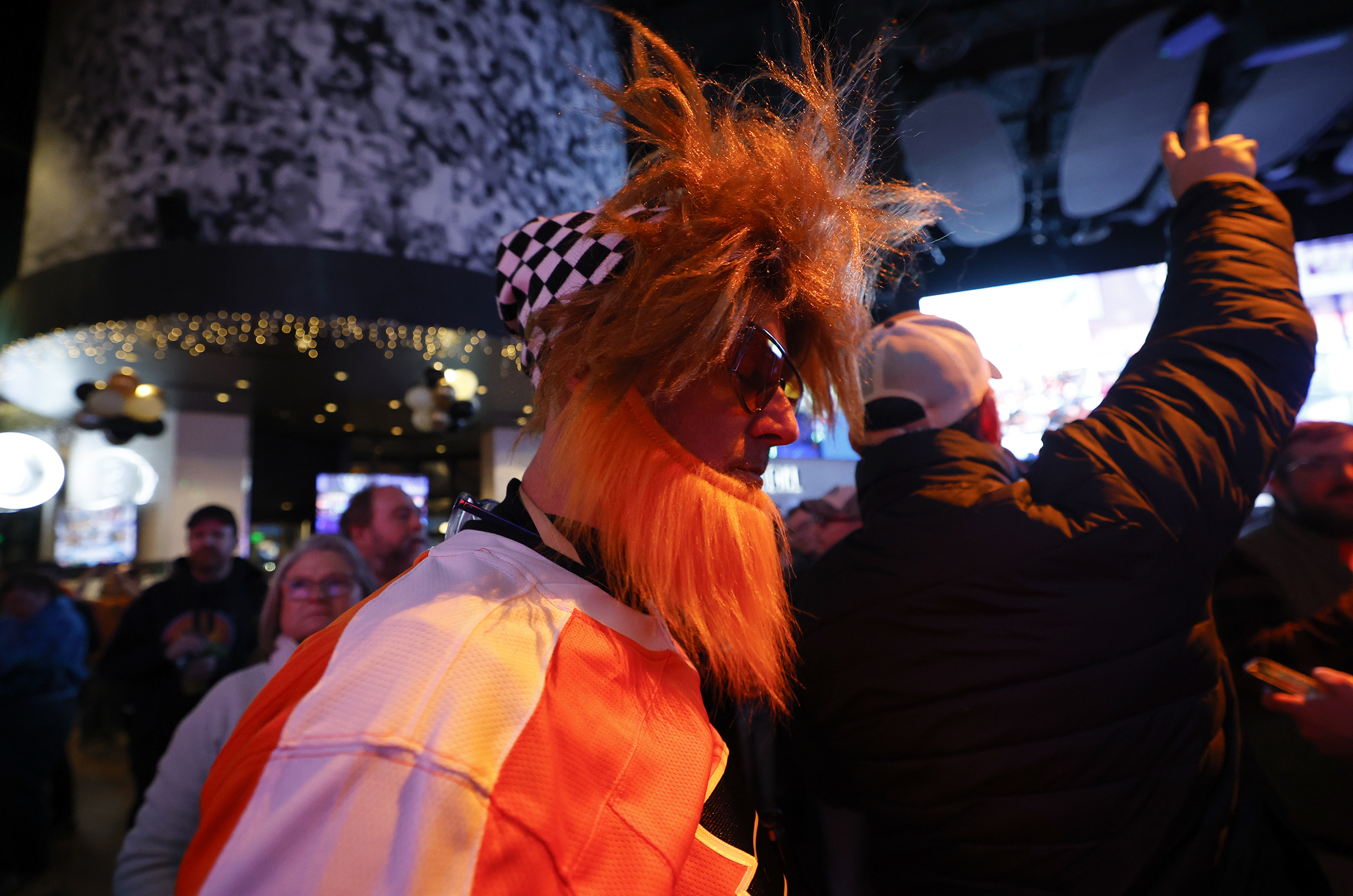
Anastasio has been a lifelong fan of the Flyers. Some have even made the connection that Anastasio and Flyers mascot Gritty look very similar, leading to some fans dressing up as the NHL mascot for a DIY Gritty costume contest, including Frank McGannon.
“I’m 50-years-old and dressed like this,” McGannon said. “I was invited to the concert being that it was Phish Night tonight. … And I was nominated to dress up for the Gritty contest. I guess I have that spirit, and here I am.”
McGannon made his way to the Xfinity Mobile Arena after the concert to get his one-of-a-kind, co-branded Phish and Flyers T-shirt, which features the band’s logo decorated in Gritty’s orange fur with the bubbles replaced by popcorn. The line for the shirt stretched across 11 sections, starting at the Sales and Service table, located across from Section 112, and ending at Section 101.
Flyers fan Greg McGannon listens to Phish tribute band Rift at Stateside Live! in a DIY Gritty costume.
“The shirt is great,” McGanon said. “I’m not going to lie, it’s the only reason I’m here.”
Along with the exclusive merchandise, fans could grab special menu items only available on Thursday night — including a Fishman doughnut from Federal Donuts & Chicken, a Split Open and Melt cheesesteak, a Poor Heart burger, a Ruby Waves vodka cocktail, and a Scent of a Mule vodka mule with a hint of mint.
The Fishman donut: A spiced cake donut with vanilla cream glaze and a red raspberry glaze ring pic.twitter.com/Bo2x8XJE88
Throughout the Flyers-Maple Leafs game, there were singalong moments from some of the band’s greatest hits, and Phish trivia questions which resulted in a fan winning a signed vinyl record from the band.
“It’s like a dream come true to see this happen,” said Richman, who presented the Flyers with the idea over the summer. “I’m grateful, again, that the Flyers are doing this and Phish is doing this. But, this is really for the fans and we want the fans to have a real good time. And as they say, let’s get down to the nitty-gritty and let’s get this show on the road.”
A portion of the tickets sold from the event will benefit The WaterWheel Foundation, which supports causes in the Phish community.
You don’t have to watch Noahkai Banks for long to see why so much hype surrounds him.
The 19-year-old centerback stands 6-foot-4 and around 200 pounds and has been a regular starter for Augsburg in Germany’s Bundesliga this season. Born in Hawaii and raised in Germany from a young age, he has been on the U.S. men’s national team radar for a few years now, including the 2023 under-17 World Cup squad.
Last September, he earned his first call-up to the senior squad. Though he didn’t play in that month’s games and hasn’t been called up since, just that one invitation got a lot of attention.
“He is a player that is really young, but with amazing potential,” U.S. manager Mauricio Pochettino said at the time. “He’s really young, but it’s good to see him, because he can go fast to the next level.”
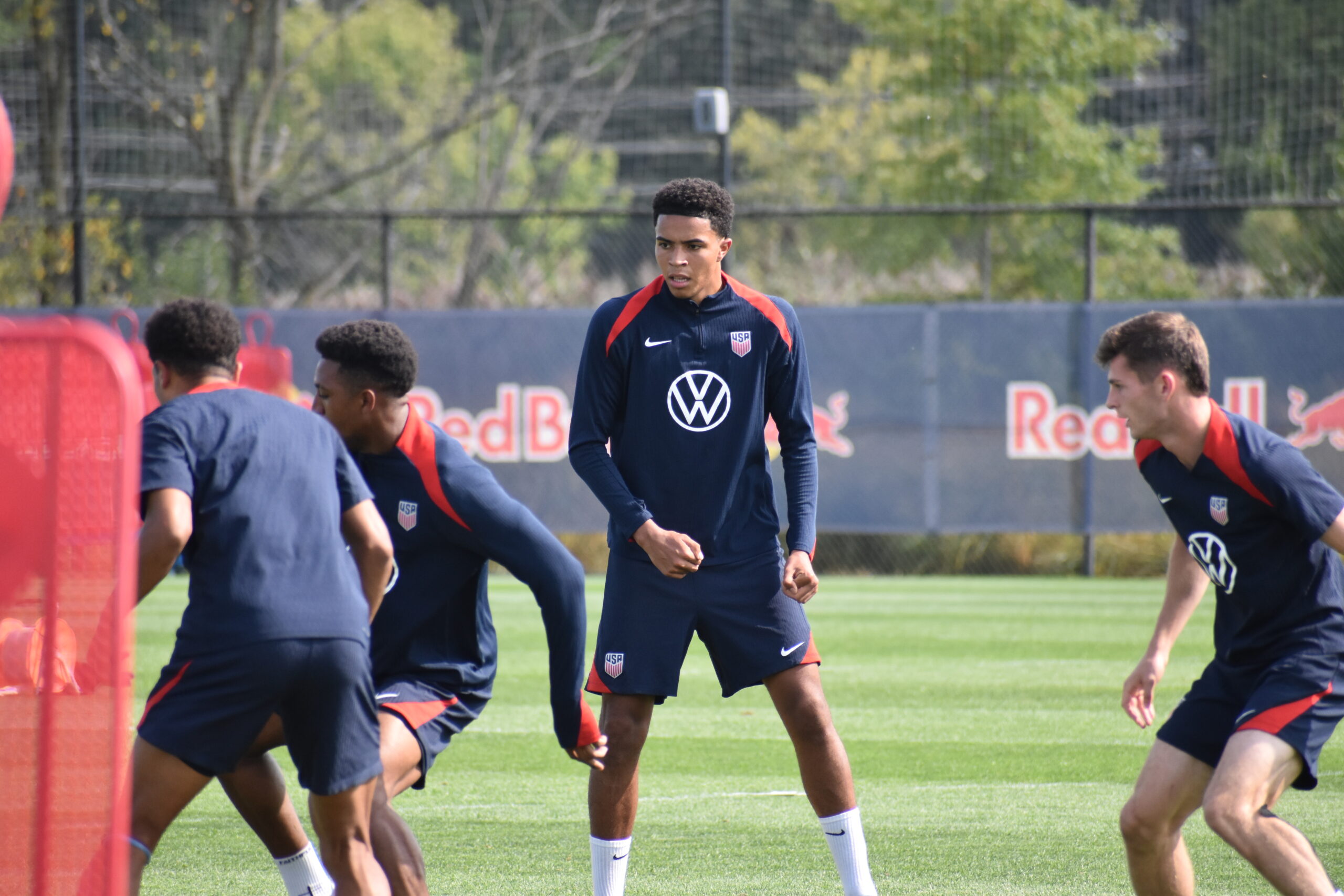
Noahkai Banks (center) at work during his first senior U.S. men’s soccer team camp in September.
It might be too soon for Banks to make this year’s World Cup team. Then again, the U.S. centerback depth chart isn’t in ideal shape right now, and the 26-player roster might be big enough to have room for him. The starting trio looks likely to be Chris Richards, Tim Ream, and Mark McKenzie, but no one has yet locked down a backup spot.
That adds to the buzz around Banks right now, and he knows it’s out there.
“I don’t read much, to be honest, but my mom always sends everything in the family chat because she uses a lot of Twitter and apps like this,” he said. “It’s cool. It’s a pleasure.”
He said he enjoyed his senior U.S. camp, though he hasn’t had a one-on-one talk with Pochettino yet.
“I’ve already felt the excitement during my training sessions, and I can see the team playing a strong role,“ Banks said. ”The national team boasts some excellent players — [Christian] Pulisic, [Malik] Tillman, Richards — and, of course, a highly experienced coach who has managed some of Europe’s top clubs. …
“It was immediately clear that Pochettino is a world-class coach, but I wouldn’t presume to expect a personal one-on-one during my first training camp,” Banks said.
Noahkai Banks (left) jumping for a header in front of the Union’s Nathan Harriel at U.S. camp.
A touch of homespun warmth certainly won’t hurt his standing with fans, either. But asked if he’s thinking about the World Cup, he quickly tapped the brakes.
“To be honest, I don’t think about the World Cup at the moment, because we have a difficult situation here at my club,” Banks said. “So it’s just about going from game to game here, and then let’s see what happens.”
He was referring to Augsburg being in the thick of a relegation fight. The Fuggerstädter, whose ownership group includes 76ers part-owner David Blitzer,stand 15th in the 18-team table — the last spot where staying up is guaranteed.
Augsburg fired manager Sandro Wagner in early December after just 12 games. The current boss, Manuel Baum, is an interim who coached just three games before the Bundesliga’s winter break arrived the weekend before Christmas.
That’s enough for any player to handle, not just an 19-year-old. So perhaps you can take Banks’ patience as a sign of maturity.
One of his best games this season so far was his next-to-last one before the winter break, on Dec. 13 at Eintracht Frankfurt.
Amid the hothouse atmosphere of Frankfurt’s 59,500-seat stadium — perhaps you saw the NFL games it hosted in 2023, along with decades of big soccer tournaments — Banks was one of the best players on the field. Though Augsburg lost, 1-0, he had five tackles and six clearances, won eight of the 13 duels he contested, and completed 42 of 47 passes.
It’s worth noting, too, that Banks played mostly as the right centerback in a 3-4-2-1 formation — the same setup the U.S. national team is using heading toward the World Cup. He even would have scored a late equalizer had he not been just barely offside when a corner kick was flicked on to him near the goal line.
The Bundesliga season resumes this weekend, with Banks’ Augsburg coincidentally visiting two other Americans: Borussia Mönchengladbach’s Gio Reyna and Joe Scally (Sunday, 9:30 a.m., ESPN+). There are always lots of games around Europe for U.S. fans to watch, but that one might draw a little extra attention.
It might also remind those fans that Germany has long been the top port of call for U.S. players who move abroad.
Many aspire to play in England, and the doors there are much more open than perhaps they’ve ever been. Still, the Bundesliga’s track record of being a place where Americans cannot just move but actually play and develop remains the best of any top European league.
Eintracht knows this as well as any Bundesliga club, as Philadelphia fans have seen from its preseason tours here in recent years. Former World Cup outside back Timmy Chandler has long called Eintracht home, as did Medford’s Paxten Aaronson for a while.
There’s another young American playmaker in the club’s pipeline in Marvin Dills, and Eintracht tried to sign much-touted Union striker prospect Malik Jakupovic before he decided to turn pro at home first.
“You have to give them the opportunity to grow and develop,” Eintracht sporting director Timmo Hardung said. “And I think this is what some of the clubs, us included, are trying to do: find players with top potential, with top talent, and ready to grow, ready to learn, ready to develop.”
Speaking of the U.S. specifically, he said: “The sportsmanship and the athleticism in the United States is top, and that should produce a lot of players out of the soccer landscape.”
Banks, who started in Augsburg’s youth academy at the under-10 age level, said the club has brought him along well.
“FC Augsburg is a very well-run and family-oriented club,” Banks said. “The club gives me valuable playing time, which is crucial for my development.”
Eintracht had Medford’s Paxten Aaronson (center) on its books until he left to return to MLS in late August.
He praised the club’s managing director, Michael Ströll, for having “a clear vision: Young players should make their way into the Bundesliga, and the club is also striving to further develop its playing style — with a focus on more active football.”
U.S. fans might remember that things didn’t go as well there for Ricardo Pepi in 2022, or for Michael Parkhurst in 2013. But Ströll didn’t take the job until after Pepi left, so we’ll see if things are different now. One piece of evidence is that Augsburg reportedly looked at signing 21-year-old Tampa native Santiago Castañeda in the summer.
Banks said he’s also happy off the field at Augsburg, which is just over 70 miles from the town of Dietmannsried, where he grew up. Both towns are in the German state of Bavaria, where the most famous city is Munich.
“I really appreciate being close to my family and the mountains,” Banks said. “Although I haven’t lived abroad yet, it is certainly a goal I hope to pursue in the future.”
If he keeps playing this well, the odds of that will certainly go up. And so will the odds of another national team call-up.
Tessa Janecke has dominated college hockey since arriving at Penn State in 2022.
Following a 47-point rookie campaign, Janecke earned the College Hockey America conference’s Freshman of the Year award. In the last two seasons, she was named a second team All-American.
And Friday of last week, the senior became the first Penn State player named to the United States Olympic women’s ice hockey team. The Winter Games, in Milan, Italy, have opening ceremonies on Feb. 6, though the team’s first game is Feb. 5.
In a collegiate career filled with stellar goals and nearly 100 wins, being a member of Team USA marked a monumental achievement for the Orangeville, Ill., native — one she had envisioned since the first time she put on skates.
“[Making the Olympic team] was always my dream,” Janecke said. “Going to college games and seeing those players on national teams, players I’m now playing with, I think [it shows] that no dream is ever too big if you work hard for it.”
Tessa's headed to Milan!
She becomes the first Nittany Lion ever to be named to the USA Women's Ice Hockey Olympic roster🇺🇸
— Penn State Women’s Hockey (@PennStateWHKY) January 2, 2026
Janecke said she was “relieved” when she found out that she made the team. She gave the news to her parents and teammates, phone calls she labeled as “very cool moments” with those who had made her achievement possible.
The 5-foot-8 forward made her USA Hockey debut in 2022, winning a silver medal at the International Ice Hockey Federation under-18 Women’s World Championships. She later won two gold medals and a silver medal across three appearances at the IIHF World Championships.
In 38 appearances with the U.S. senior national squad, Janecke has scored 13 goals and added 15 assists. Her highlight moment came this past April, when she scored the game-winning overtime goal to give the United States a 4-3 victory over Canada and secure a gold medal at the IIHF World Championships.
Bottom line: Janecke is no stranger to the international stage. And in Milan, she is eager to add another gold medal to her collection.
“Everything is going to come down to the gold medal game,” Janecke said. “So cutting out noise and focusing on the people in the locker room is going to be what’s most important.”
In four seasons at Penn State, Janecke has tallied 181 points, with 75 goals and 106 assists, all the best in program history, which began play on the Division I level in the 2012-2013 season. As a junior, she became the university’s all-time points leader, setting the record for both the men’s and women’s programs.
Halfway through Janecke’s senior campaign, her trophy case is packed.
Tessa now owns the record for both the most career goals (75) and career assists (106) in program history
— Penn State Women’s Hockey (@PennStateWHKY) January 3, 2026
She is a two-time Atlantic Hockey America Player and Forward of the Year and a two-time All-AHA first team selection. In Janecke’s four seasons at State College, Penn State is 98-31-6 with three NCAA Tournament appearances.
Now in Italy, she’s looking forward to representing something more.
“It’s always an honor to throw on your flag, to take in that moment and appreciate what has led you to that moment,” Jackecke said. “You just have to be grateful for how you’ve gotten there in the past and how it’s set you up for these moments.”
Janecke will miss “about a month” of Penn State’s season for the Olympics. But she remains confident that her team can sustain its success during her absence.
And she has the backing of Jeff Kampersal, Penn State women’s hockey coach, who lauded his star forward’s opportunity to “make history” at the Olympics.
“We are proud of Tessa making the USA Olympic Team,” Kampersal said. “Coming to Penn State, Tessa wanted to make history, not join history … [There is] no question Tessa has elevated all standards in our program. We appreciate her loyalty, and we are proud of her.”
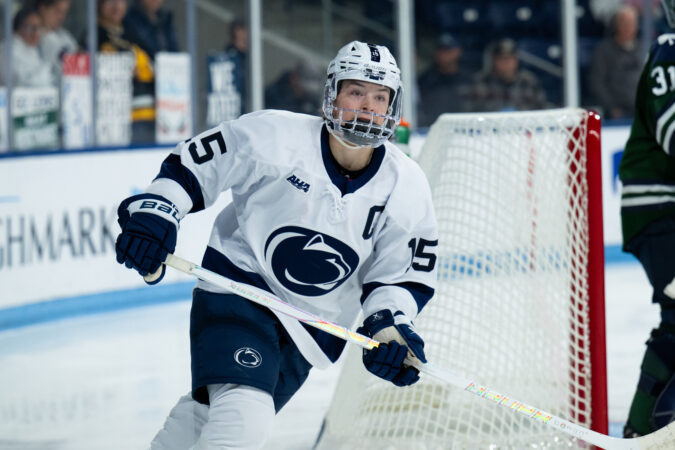
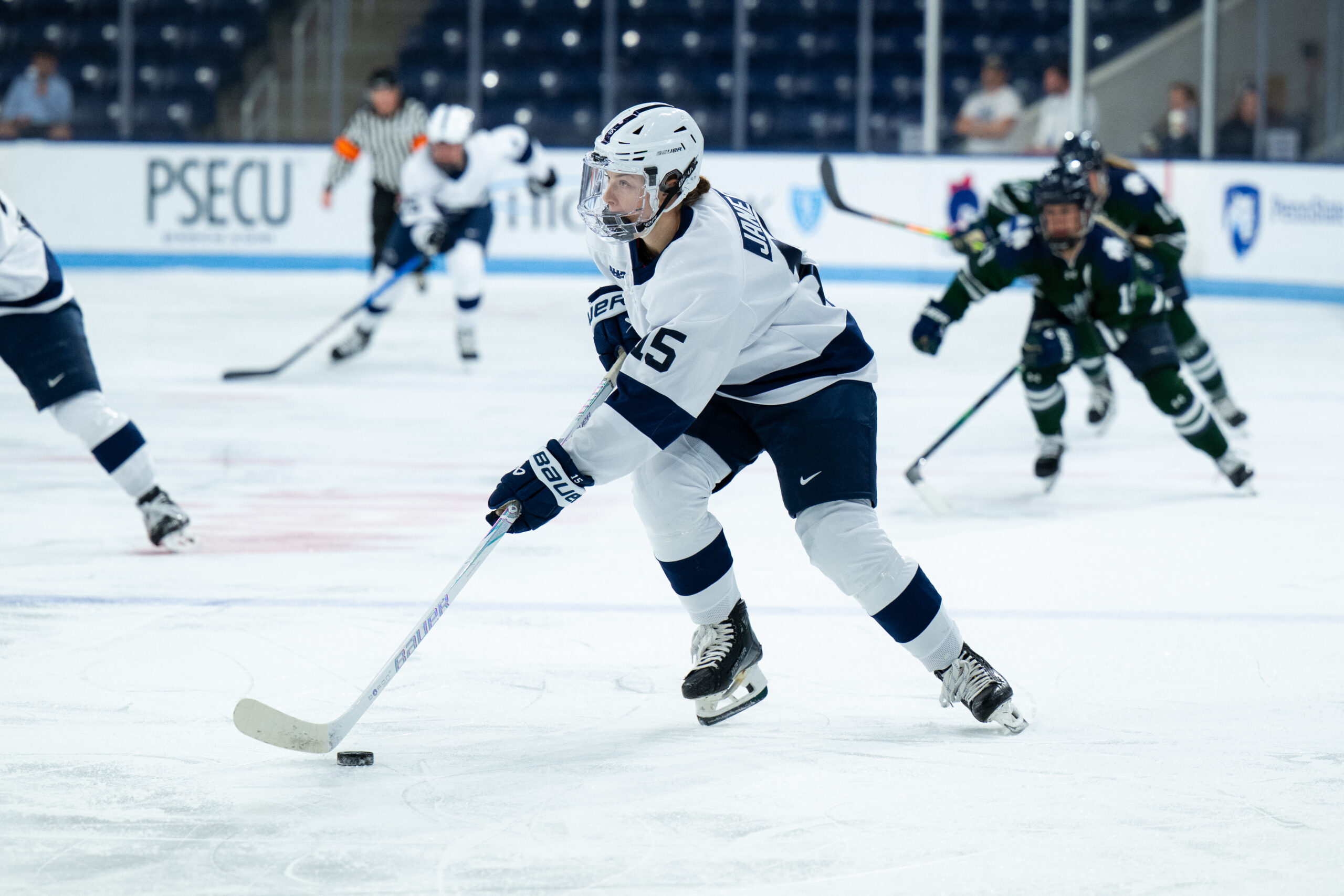
Penn State’s Tessa Janecke in action during the Nittany Lions’ 5-2 win over St. Lawrence on Sept. 26 at Pegula Ice Arena.
The U.S. women’s team opens Olympic play on Feb. 5 against Czechia before dates with Finland, Switzerland, and Canada in the preliminary round. The quarterfinals, semifinals, and gold medal game are scheduled for Feb. 13-19.
“This is going to be [played] on a much bigger scale, a lot more eyes on you,” Janecke said. “We have to go in there with the right mindset. There can’t be a moment too big or one that we’re not prepared for.”
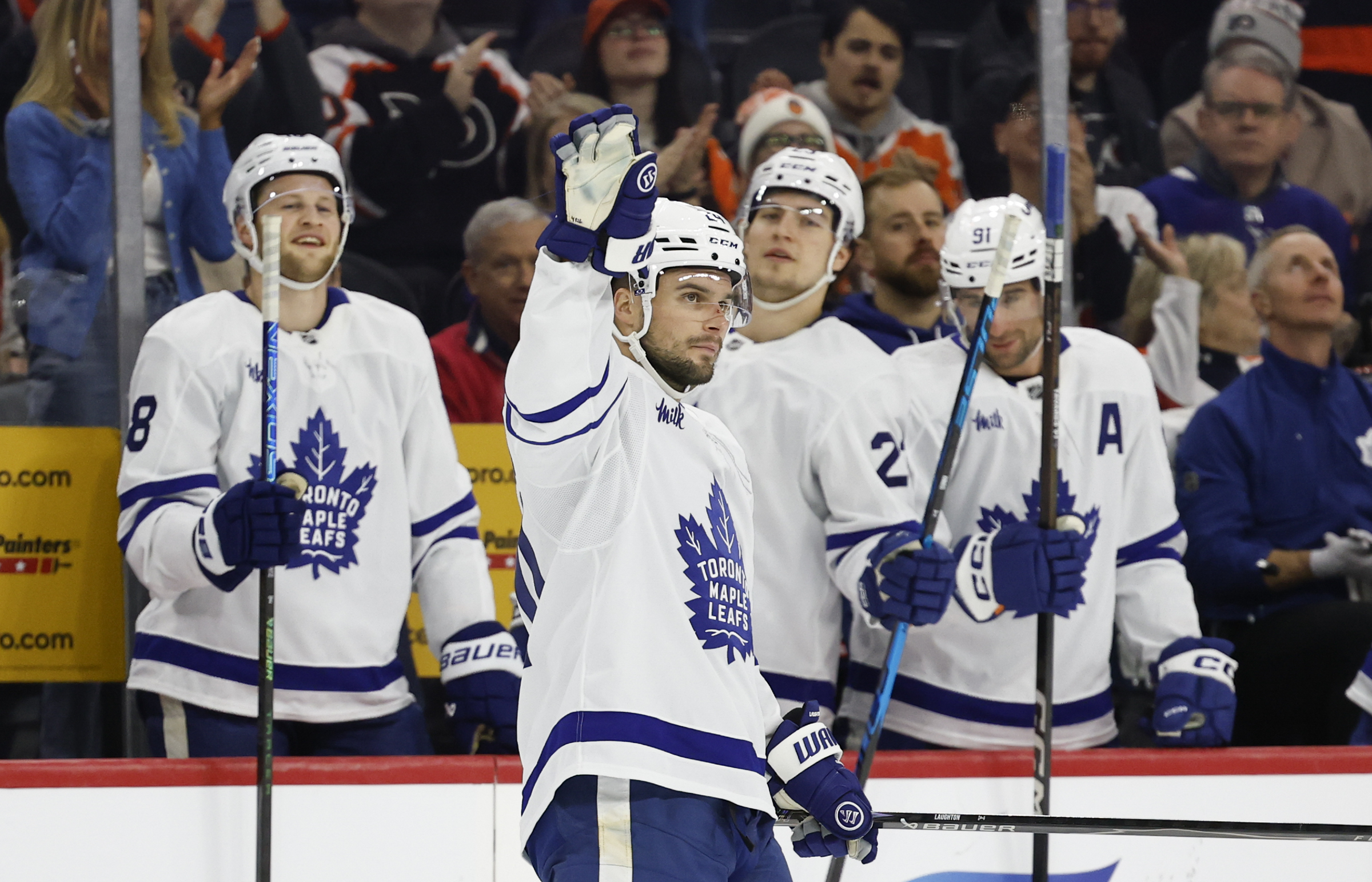
It was another sellout at Xfinity Mobile Arena, the building’s third straight, and the Flyers welcomed back another former member of the organization in Scott Laughton.
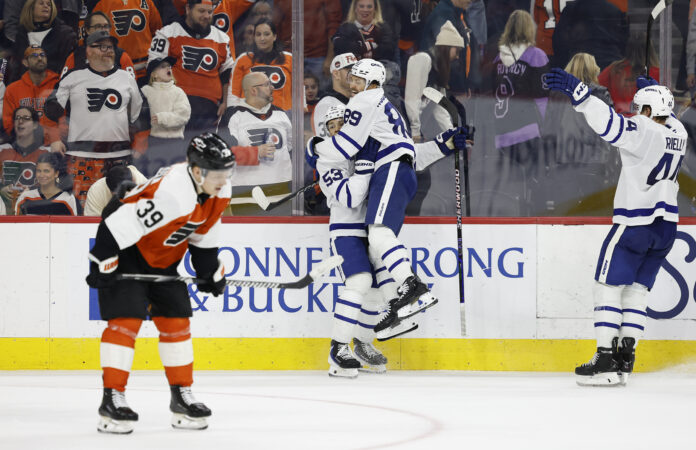
But the emotions and vibes weren’t nearly as high, and in the end, the Flyers lost 2-1 in overtime to the Toronto Maple Leafs. Easton Cowan scored the game-winner in overtime off a spin-around pass from John Tavares.
The Flyers’ loss snapped a two-game winning streak but extended their point streak to three games.
Laughton, playing in his first game as a visitor to Philly in his NHL career, tied the game 1-1 with 5 minutes, 56 seconds left in regulation.
Travis Sanheim shot the puck wide during a Flyers power play, and Laughton scooped up the puck before heading up the ice. He used his ex-teammate, Rasmus Ristolainen, as a screen before executing a pull-and-shoot shot past Dan Vladař.
It was Laughton’s fifth goal with Toronto and second while short-handed. He scored 10 short-handed goals as a member of the Orange and Black.
Travis Konecny did not come out for the third period after suffering an upper-body injury.
Coach Rick Tocchet said he did not have an update after the game, but said, “Something was bugging him, I guess, early on. I think he fell or something. I don’t know [all of] the whole details.”
But the forward and alternate captain had already left his mark in the game, giving the Flyers a 1-0 lead 55 seconds into the second period.
Maple Leafs center Scott Laughton, a longtime Flyer, waves to fans after a video tribute to him Thursday at Xfinity Mobile Arena.
The Flyers broke out of their own end after Sanheim stopped Leafs forward Calle Järnkrok in the Flyers’ end. Konecny scooped up the puck and fed Ristolainen, who dumped the puck in from the neutral zone.
Sanheim had taken off after breaking up the rush and was the first on the puck as it rang around in the Leafs’ zone. He tipped it to Christian Dvorak as he provided puck support along the boards, and the newly extended centerman carried the puck back down to the bottom of the left circle.
Konecny glided through the Leafs’ zone untouched and unnoticed into the left circle. He got the pass from Dvorak and sent the puck past the blocker of Toronto goalie Dennis Hildeby.
The goal was Konecny’s 14th of the year and 212th of his career, moving him past Sean Couturier for 14th in the Flyers’ record book. He is also now tied with Reggie Leach for 15th in points (514).
Philly had its chances to extend the lead but couldn’t find the back of the net. In the third period, they had their best chance when Toronto’s Matthew Knies was called for slashing Denver Barkey, and 1:08 later, Troy Stecher tripped Owen Tippett.
The Flyers had 11 shot attempts, including a Tippett wraparound attempt that missed and popped out, and Dvorak tried to bang it in. Trevor Zegras thought the puck crossed the line and, although it was reviewed, the NHL’s Situation Room said the video “supported the referees’ call on the ice that the puck did not cross the Toronto goal line.”
The Flyers also had several attempts in overtime as the puck bounced around, with Matvei Michkov and Couturier around the net, but they couldn’t get it cleanly on goal before Cowan scored.
Breakaways
Forward Bobby Brink and defenseman Jamie Drysdale did not play after getting injured in Tuesday’s win against the Anaheim Ducks, each with an upper-body injury. Matvei Michkov returned to the lineup after missing that game with a lower-body injury. Noah Juulsen took Drysdale’s place in the lineup. … Sanheim played in his 621st NHL game, surpassing Ed Van Impe for fourth place on the Flyers’ all-time games played list among defensemen.
Up next
The Flyers begin a two-game set against the Tampa Bay Lightning at Xfinity Mobile Arena on Saturday (7 p.m., NBCSP).
A chef’s career rarely follows a straight line, but as I settled into one of the cushy circular nooks at Fleur’s for a memorable meal, it was clear to me that George Sabatino’s story had detoured away from the spotlight for far too long.
Now a chef-partner at this gorgeous new Kensington restaurant, Sabatino was one of the most promising and inventive young chefs in Philadelphia a decade ago, spinning “herbivore” tasting menus, sous-vide shrimp ceviches, and crispy lamb rillettes at Aldine, his chef-owner debut near Rittenhouse Square that earned three bells in 2015.
When that restaurant closed three years later, however, Sabatino embarked on a journeyman’s path that never quite found sustained footing. He dipped back into his previous home in the Safran Turney universe for a spell as culinary director (reopening Lolita, helping with Bud & Marilyn’s at the airport, Good Luck Pizza Co., and Darling Jack’s), tried his hand at farming, worked as a private chef, and then helped stabilize Rosemary in Ridley Park.
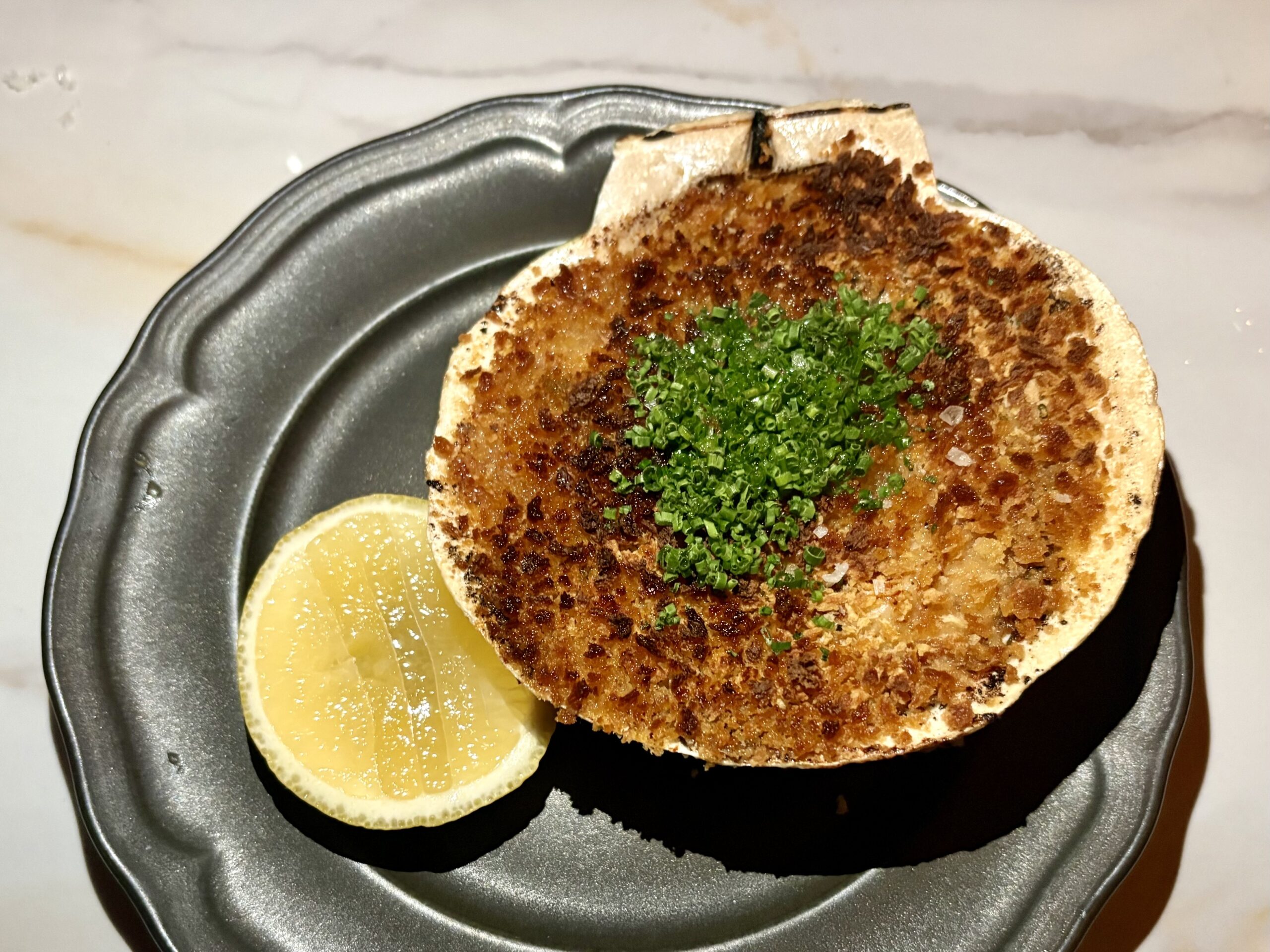
The scallop gratin at Fleur’s in Kensington suspends the sweet mollusks in a puree of celery root soubise and nixtamalized corn miso.
But Fleur’s is the first time in eight years Sabatino has been able to cook his own food — a style that’s now matured beyond the molecular gastronomy tricks of his youth. He’s now focused more on using seasonality and fermentation to elaborate on some classic French ideas. A scallop gratin cradled in its shell, for example, appears familiar enough, evoking Fleur’s brasserie theme with an aromatic whiff of truffle butter. But when I cracked its toasty crumb surface, those sweet scallops were enveloped in a silky puree that traveled to unexpectedly earthy depths thanks to a celery root soubise touched with nixtamalized corn miso. This was just the first of many bites that reminded me why I had been looking forward to Sabatino’s comeback for some time.
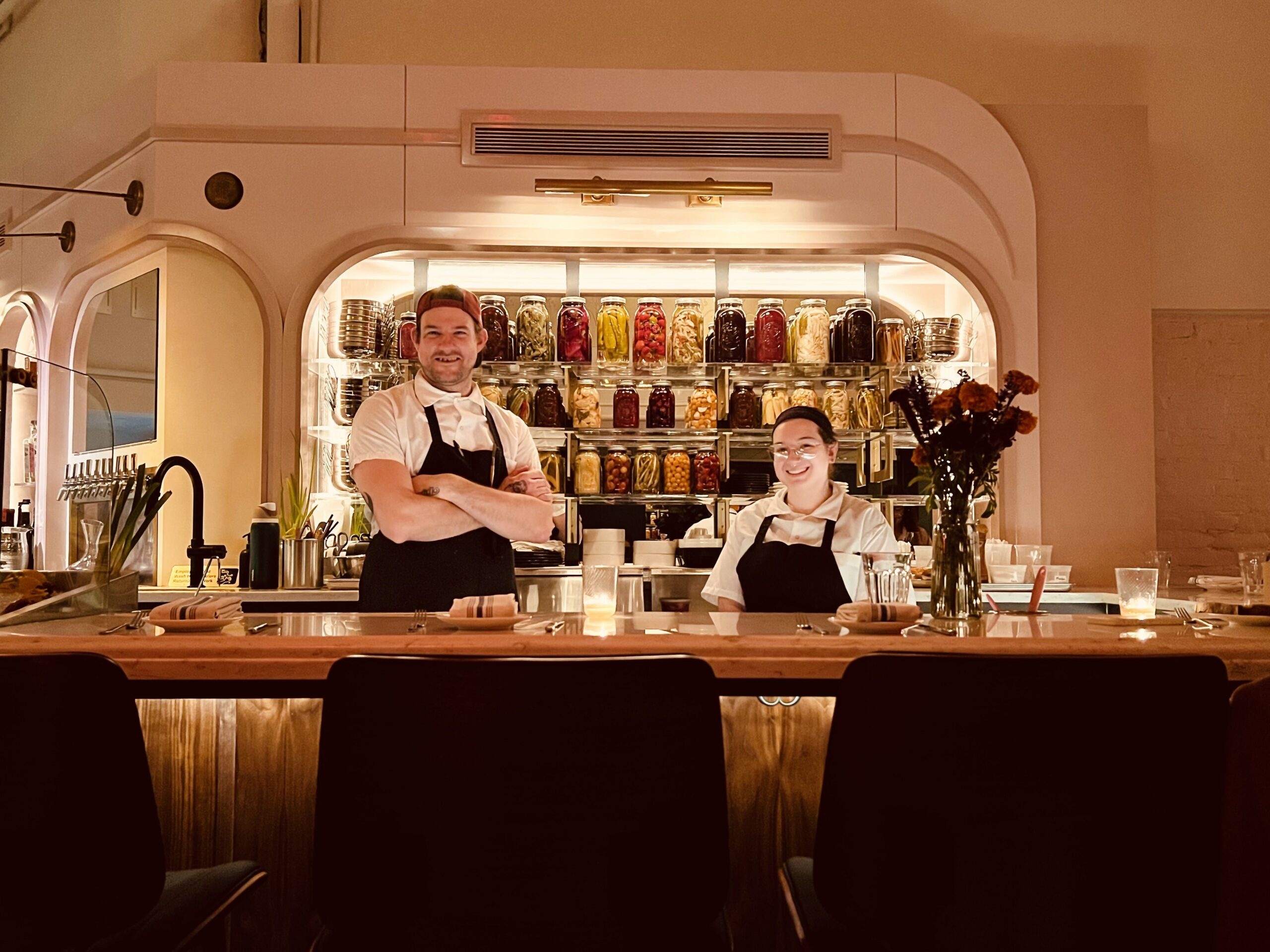
An impressive larder of canned produce displayed in jars behind the bar adds inspiration across the menu. There’s watermelon vinegar in the mignonette for raw Island Creek and Savage Blonde oysters, a vivid memory of distant summer soon to be replaced with the tart essence of fall pumpkin. A custardy mustard infused with seasonal fruits — preserved peaches at a recent visit — comes layered beneath a perfect terrine of pork and pistachio wrapped in bacon with crunchy beet-pickled vegetables à la Grecques.
Even a platter of briny middleneck clams on the half shell get a boost from a house-fermented hot sauce made from Fresnos and dried ancho chiles; the simple combination of tangy spice and ocean spray elevates this often-undervalued mollusk into a star-worthy role at Fleur’s.
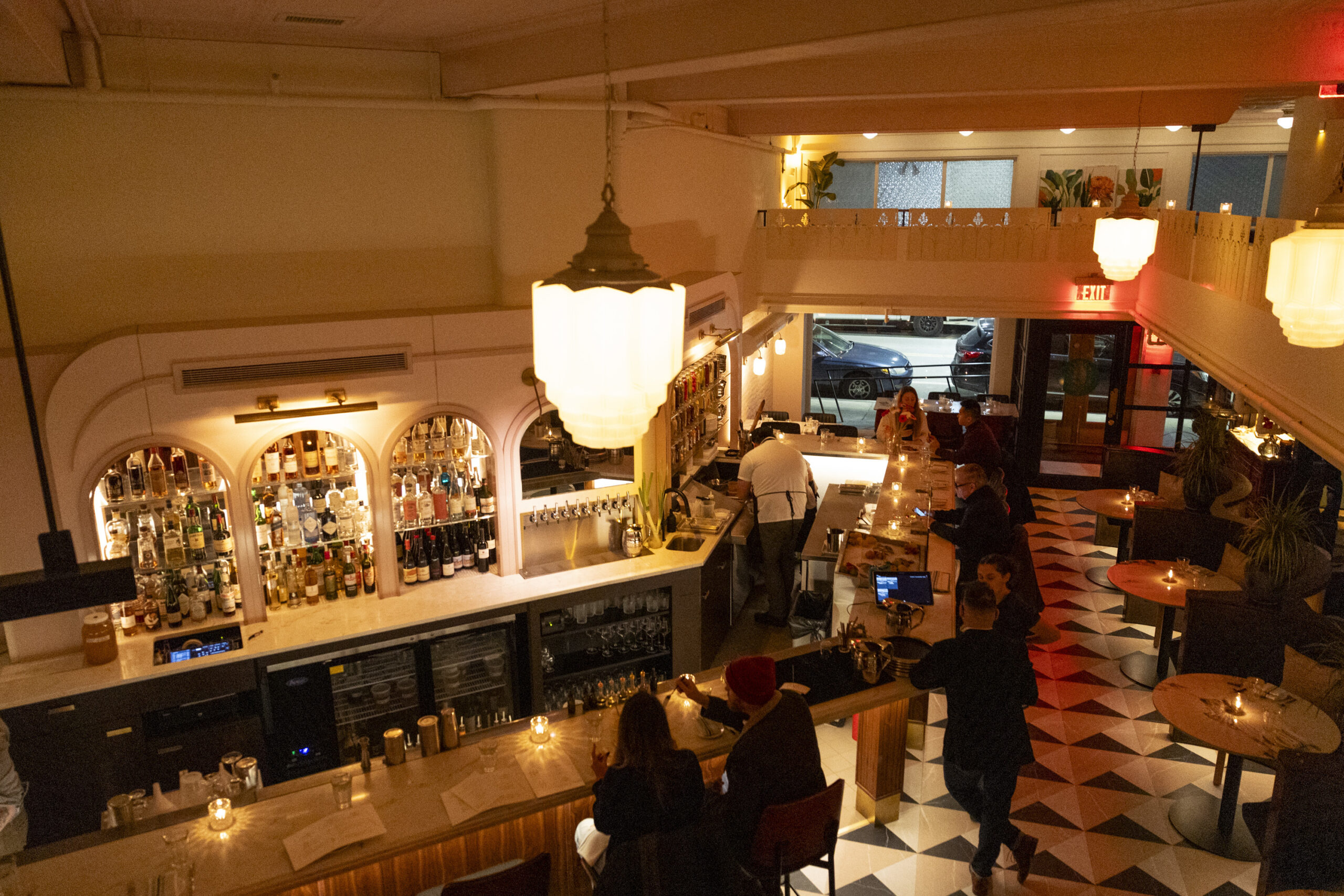
The raw bar’s shucking window sits at the crook of the long bar, which bends to follow the elbow-shaped contour of this historic space that is, in many ways, having a comeback of its own.
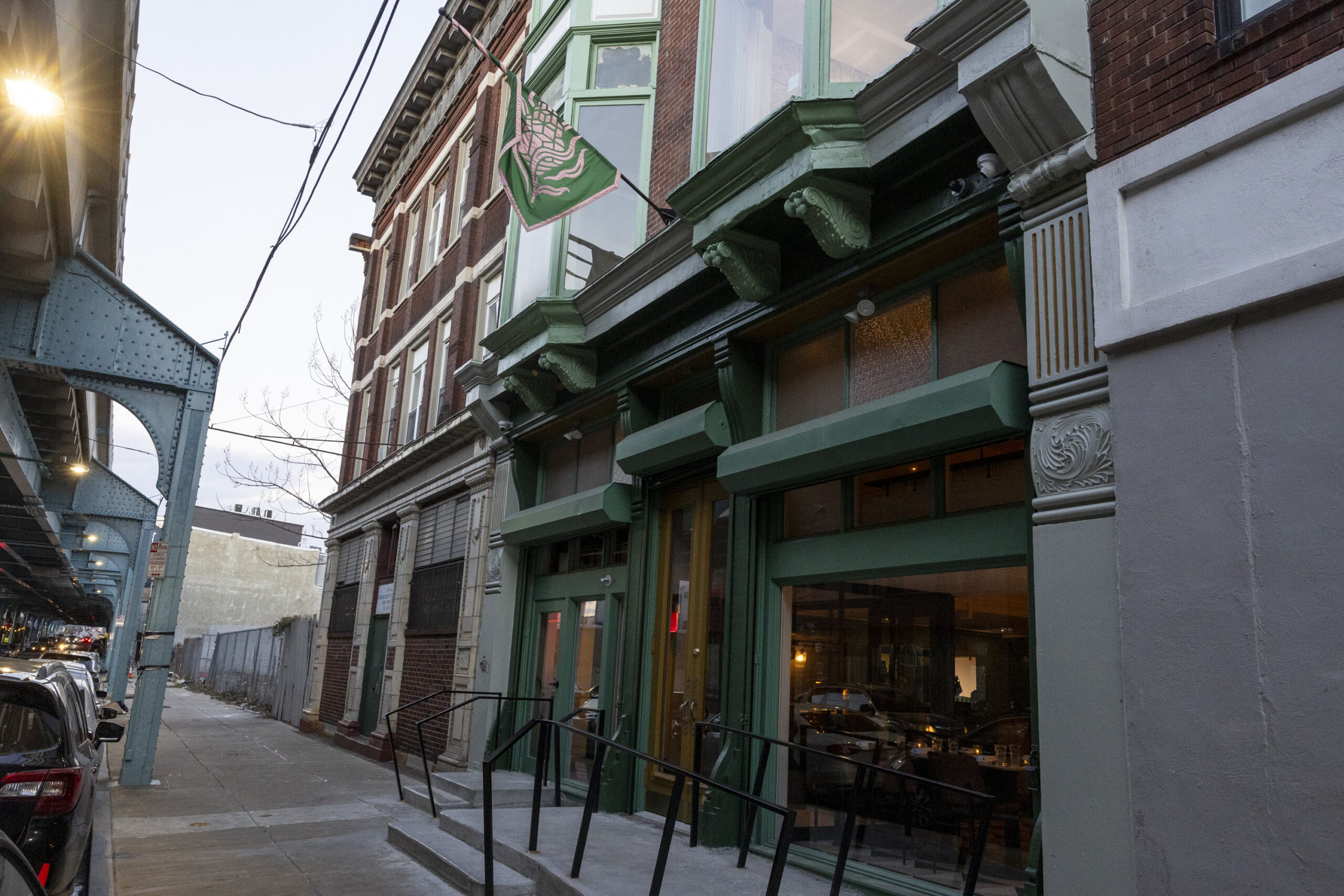
The inside dining at Fleur’s in Philadelphia on Friday, Jan. 2, 2026.The outside of Fleur’s in Philadelphia on Friday, Jan. 2, 2026.
You could easily miss the understated green facade of this five-story building on North Front Street, its entrance partially obscured by the rumbling girders of the Market-Frankford El. Even friends of mine who live mere blocks away were unaware that the old Fluehr’s Fine Furniture store — active from the 1880s through the early 2000s, but vacant for 17 years — had been renovated and revived, with plans to transform the L-shaped building into a boutique hotel, restaurant, and roof-deck event space.
Aside from the spelling modification to make the name sound French, it took plenty of vision for Sabatino’s partners, Starr alums Joshua Mann and Graham Gernsheimer, to conjure an upscale brasserie as an anchor for this project. One of the city’s best Puerto Rican restaurants, El Cantinflas Bar and Taco Place, has been a mainstay around the corner. But in 2022, when Mann and Gernsheimer first walked in and fell in love with this quirky space, none of the places that have since marked gentrification’s steady march northward into Kensington — Starbolt, Lost Time Brewing, Rowhome Coffee, American Grammar, Lee’s Dumplings and Stuff — had opened.
The inside dining at Fleur’s in Philadelphia on Friday, Jan. 2, 2026.Renderings of the Fluehr’s Furniture Store building re-envisioned as a boutique hotel.
The restaurant is phase one of the building’s ongoing development. And designer Lisa A. Calabro of cfTETTURA projects did a stellar job reimagining the deceptively large room into an inviting 130-seat space, preserving the mezzanine and art deco pendant lamps from Fluehr’s, then lining the dining room floor with geometric tiles and a chain of plush, semicircular teal banquettes that lend the dining experience an uncommon coziness.
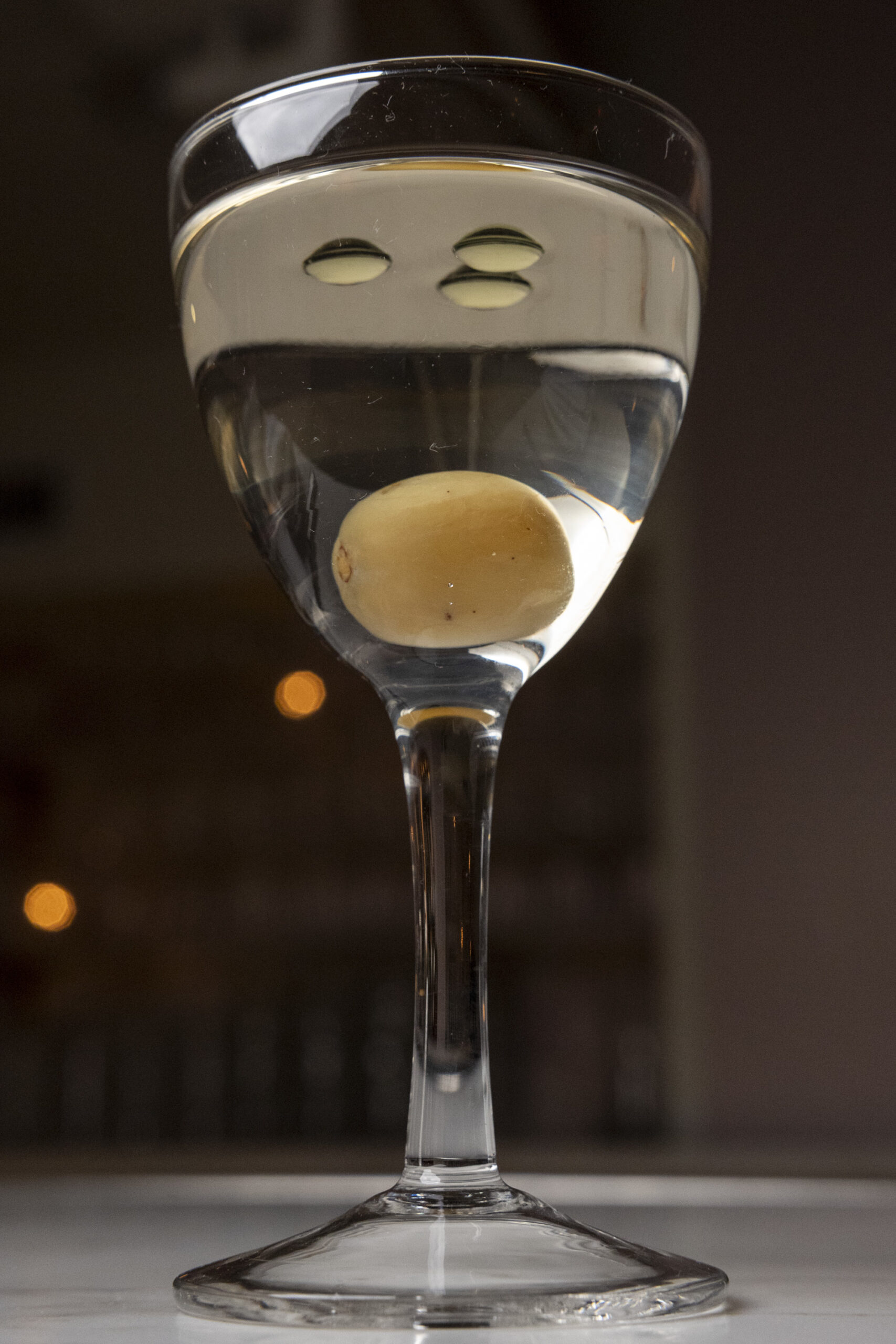
Even more intimate is the “hot tub,” a partially enclosed room for up to eight diners in back. It’s an intriguing nook where conversation is easy and the well-informed, outgoing servers drop details on everything from the smoked beef heart grated over the roasted carrots with puffed amaranth to the pickled-grape prize at the bottom of Fleur’s signature martini (exceptionally aromatic with a French-y touch of Pineau des Charentes). Ultimately, I preferred being part of the date-night energy in the main dining room, even if midweek crowds have been light.
The Fleur’s martini in Philadelphia on Friday, Jan. 2, 2026.
That’s perhaps no surprise, given that the check average of $71 (before tip and tax) hits a splurge level this corner of Kensington hasn’t seen to date. There’s solid value in the daily happy-hour specials, when you can snack on gluten-free frites crisped in beef tallow ($6) or a generous petite plateau from the raw bar ($40) to go with $8 glasses of French wine.
But Fleur’s regular dinner menu may oblige some light price-adjusting until it hits the sweet spot to attract a steady flow of neighborhood regulars. Sabatino’s roasted half chicken, for example, has instantly strutted into the top tier of my favorites, cured with duck fat-koji butter for a few days before it’s roasted to a crisp alongside a tub of impossibly good Duchesse mashed potatoes laced with Gruyère cheese. But at $39, it’s more expensive than similarly excellent chickens at Vernick Food & Drink, Parc, Honeysuckle, and Picnic.
Executive sous chef Ryan Connelly and line cook Emma Lombardozzi at the raw bar at Fleur’s, 2205 N. Front St., on Oct. 25, 2025.
Sabatino’s cooking is generally good enough to merit destination status, with a few exceptions. But in the tradition of ambitious new restaurants becoming pressure tests for the spending limits of a neighborhood in transition, Fleur’s will be an intriguing case to follow.
As it stands, aside from the chicken and a tasty cod in brown-butter meunière garnished with multiple varieties of pickled beans and caper berries, the entrees weren’t necessarily the highlights of my meals. The hanger steak frites, cooked sous-vide then finished to order, lacked the satisfying chew of a good steak properly cooked from raw. The Parisian gnocchi, the menu’s only sub-$30 entree, were a fine vehicle for a delicious ragout of Mycopolitan mushrooms, but the deep-fried plugs of choux pastry dough themselves were dry.
The whitefish tartine is a wonder of textures and subtle flavors.
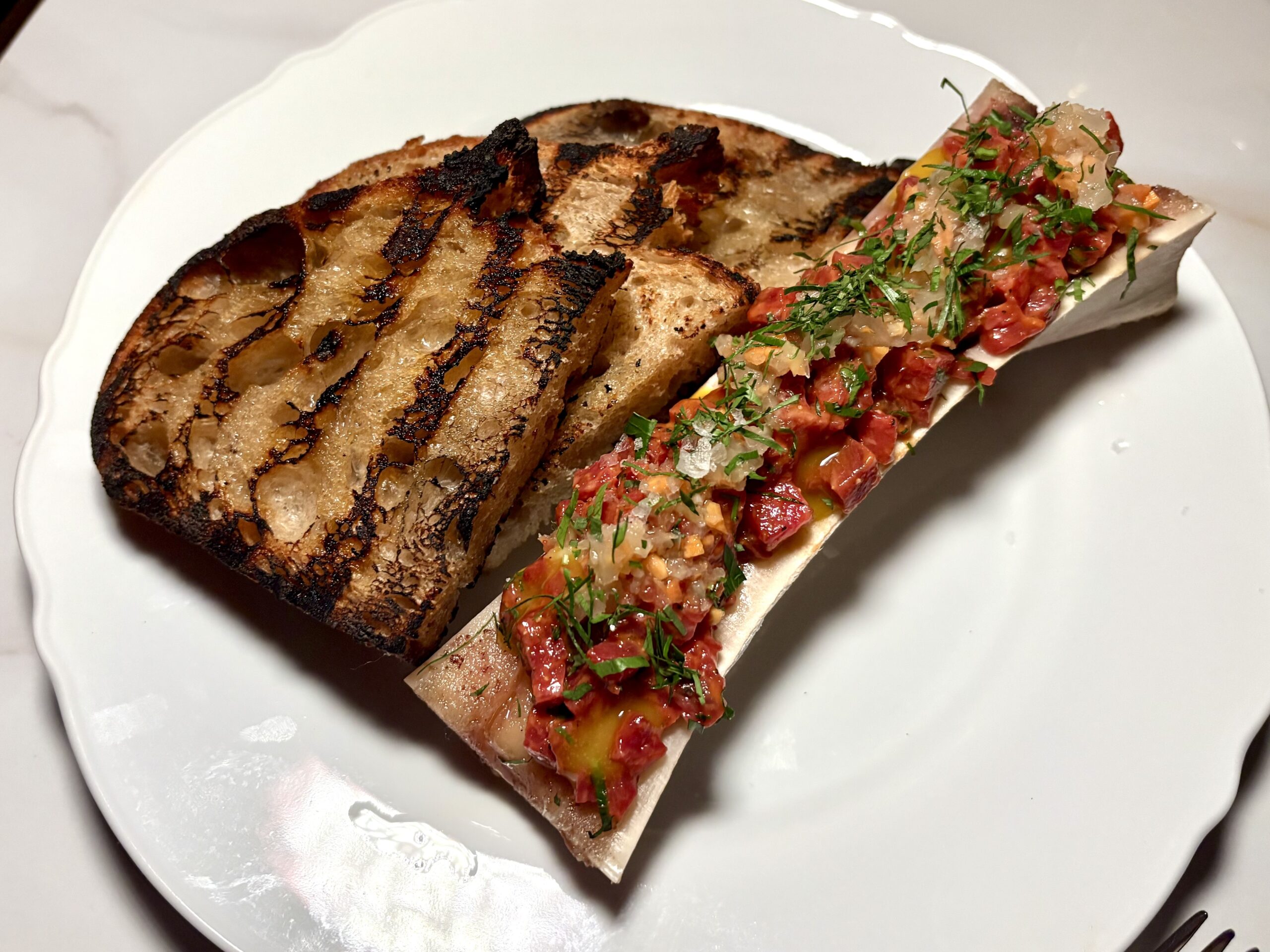
The most exciting bites here can be found among the more affordable small plates and raw bar offerings. Sabatino’s whitefish tartine is a wonder of textures and subtle flavors — the smoked fish salad layered between a bavarois cloud of fennel-steeped whipped cream beaded with salty trout roe and a toasty slice of duck fat brioche so good that I was stunned to learn it’s also gluten-free. There are tart shells stuffed with creamy uni custard. The dashi-poached shrimp cocktail is butter-tender and full of flavor. The zesty, hot-sauce spiked beef tartare comes decadently mounded over a roasted bone of melty marrow.
Beef tartare is served over roasted bone marrow at Fleur’s in Kensington.
Sabatino’s talent with vegetables is also on full display, with half-moons of deeply caramelized onion tarte Tatin enriched with Gruyère and more of that corn miso (made for Sabatino by Timothy Dearing of the Ule supper club). Roasted rounds of sumac-cured sweet potatoes are encrusted with sunflower seeds drizzled in a sauce gribiche. Grilled caraflex cabbage is served “à l’orange” with pickled green tomatoes, preserved ginger relish, spiced peanuts, and herbs.
The lobster soup with a squash broth at Fleur’s in Philadelphia on Friday, Jan. 2, 2026.
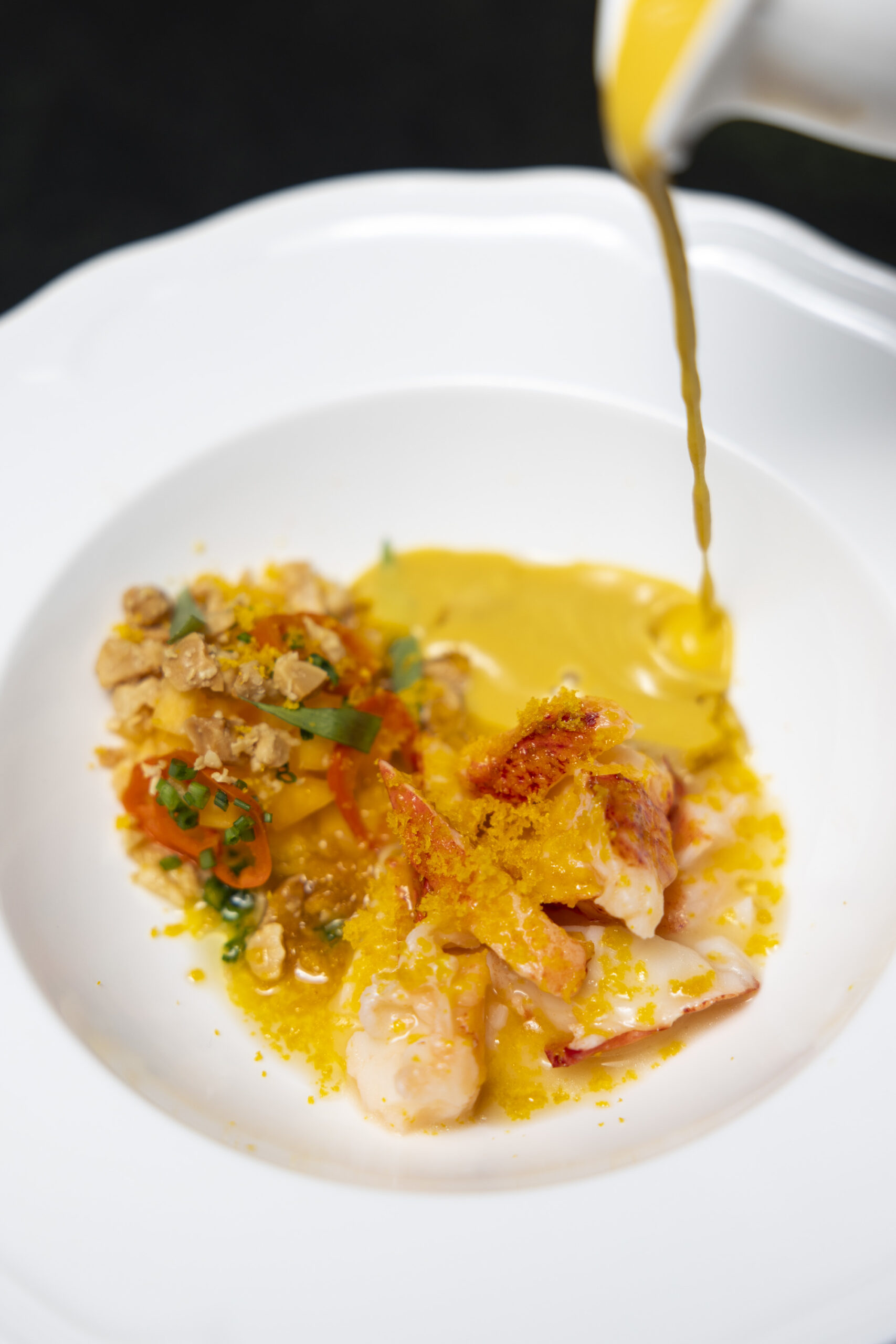
Pumpkin is also transformed into a luxuriously creamy soup with the fermented Japanese rice brew called amazake, poured tableside as an orange velouté over butter-poached lobster and crushed marcona almonds, chiles, and pickled pumpkin.
For dessert, you might go for the cheffy croissant stuffed with foie gras and white chocolate topped with sour cherry marmalade. But that croissant was even better blended with other bread scraps into a holiday bread pudding soaked with a rummy egg-nog crème anglaise garnished with brandied whipped cream.
My favorite finale here, courtesy of sous-chef Zoe Delay, is a regal take on the Mont Blanc, a brown-butter shortbread shell filled with brandied apples and a mountain of piped chestnut crème diplomate frosted with a peak of ginger whipped cream. The pastry first found popularity in France in the late 1800s.
Coincidentally, that’s around the same time the Fluehr’s family was opening its furniture store on North Front Street — just as Kensington was earning its industrial reputation as the “workshop of the world.” How fitting that it should mark the sweet revival of this venerable space. It’s a delicious comeback in every sense of the word.
The Mont Blanc at Fleur’s in Philadelphia on Friday, Jan. 2, 2026.
About 85% of the menu is gluten-free or can be modified, but highlights include gluten-free frites and gluten-free brioche for the whitefish tartine.
Menu highlights: scallop gratin; smoked whitefish tartine; clams on the half-shell with house hot sauce; pork and pistachio terrine; squash velouté with lobster; marrow bone beef tartare; grilled sweet potato; roasted carrots with grated smoked beef heart; roast chicken; cod; Mont Blanc tart.
Drinks: The French theme and focus on seasonality and fermentation extends to the beverages, beginning with cocktails like the house martini kissed with Pineau des Charentes and a pickled grape, or the French 75-ish Esprit de Corps with sage syrup and cognac infused with Lancaster County trifoliate oranges. The wine list is entirely French, focused on lesser-known indie bottles, like a petit salé blend from Château Roquefort. Considerable effort has also been poured into zero-proof options such as the clarified chocolate-beet-ginger punch called Coupe Rouge.
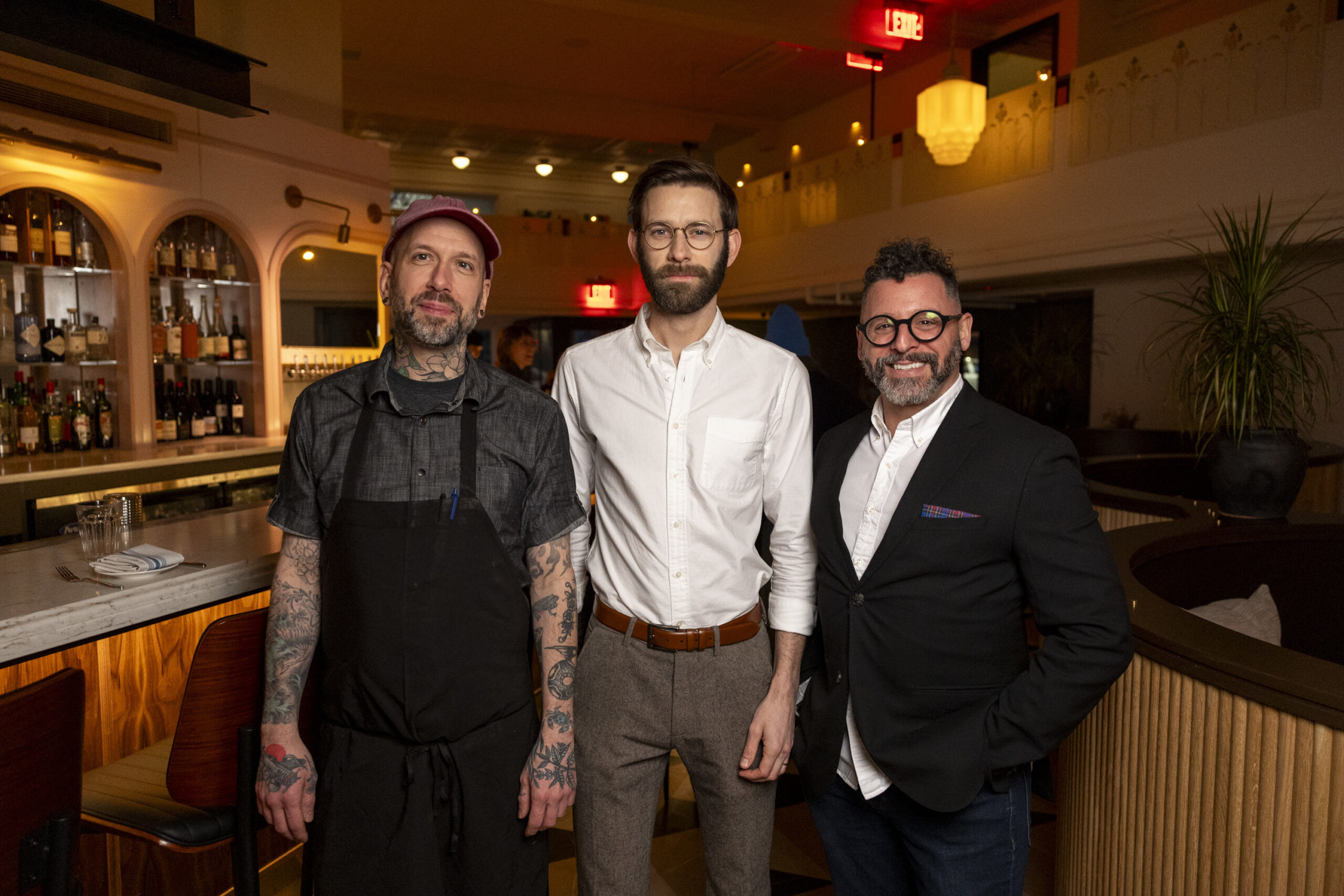
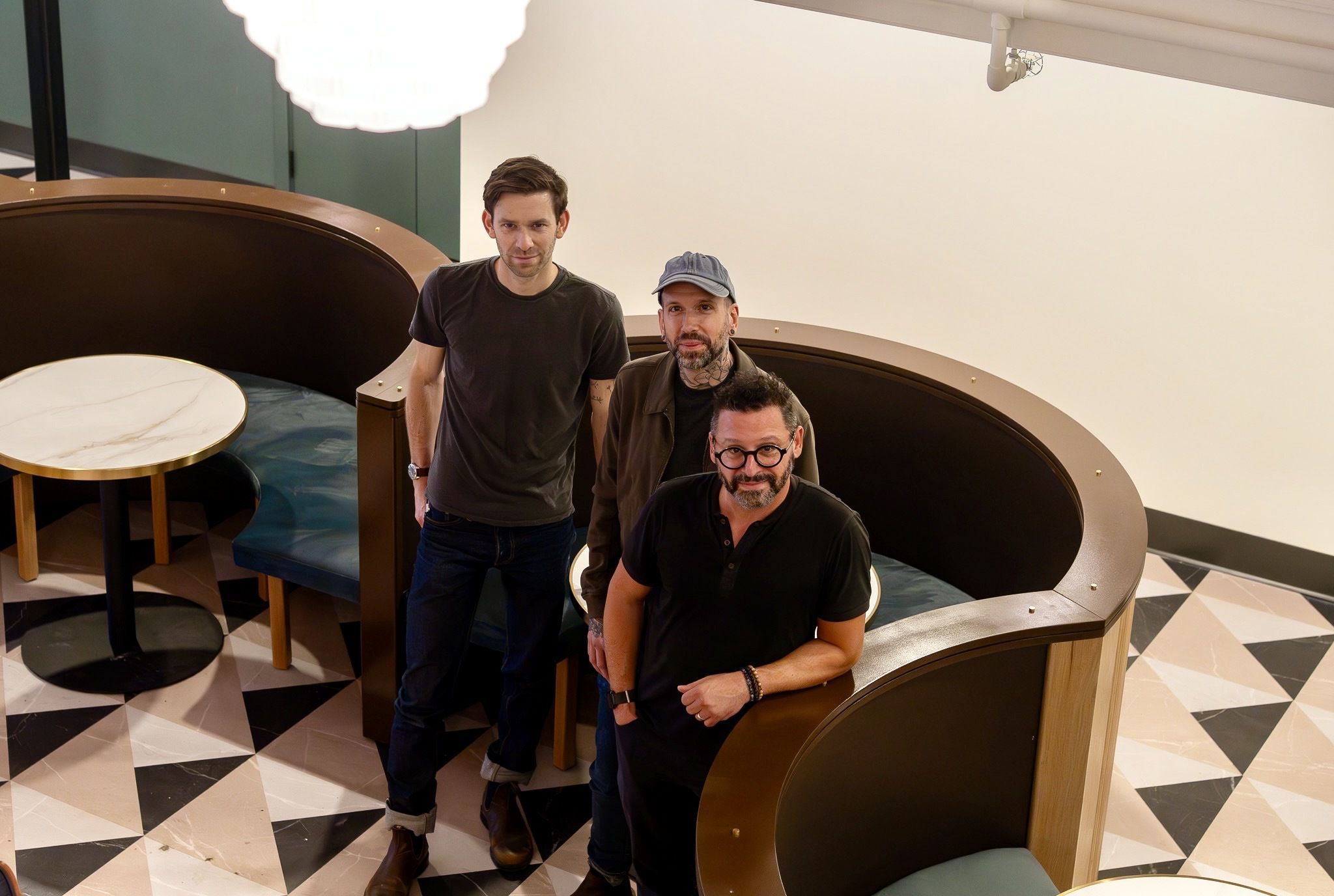
At Fleur’s, partners Graham Gernsheimer (from left), George Sabatino, and Josh Mann in the dining room. The glass lighting fixture is original to the building.
Pennsylvania’s two largest cities have more in common politically, demographically, and economically with one another than with the rest of the commonwealth. For decades, they also had in common the presence of great American newspapers serving their diverse and dynamic communities: The Inquirer and the Pittsburgh Post-Gazette. Sadly, that may no longer be the case.
On Tuesday, Block Communications, the owners of the Post-Gazette, announced that on May 3, it will shutter the newspaper, the roots of which date back 240 years. The loss of a once great newspaper in a major American city is itself a civic tragedy. The fact that this loss was entirely preventable is even more unfortunate.
It is no secret that the traditional print newspaper business is in sharp decline. Self-inflicted wounds — including a long history of labor strife, family disunity, and financial losses — have compounded these headwinds at the Post-Gazette. The Block family’s announcement cited cumulative losses of over $350 million over a 20-year period.
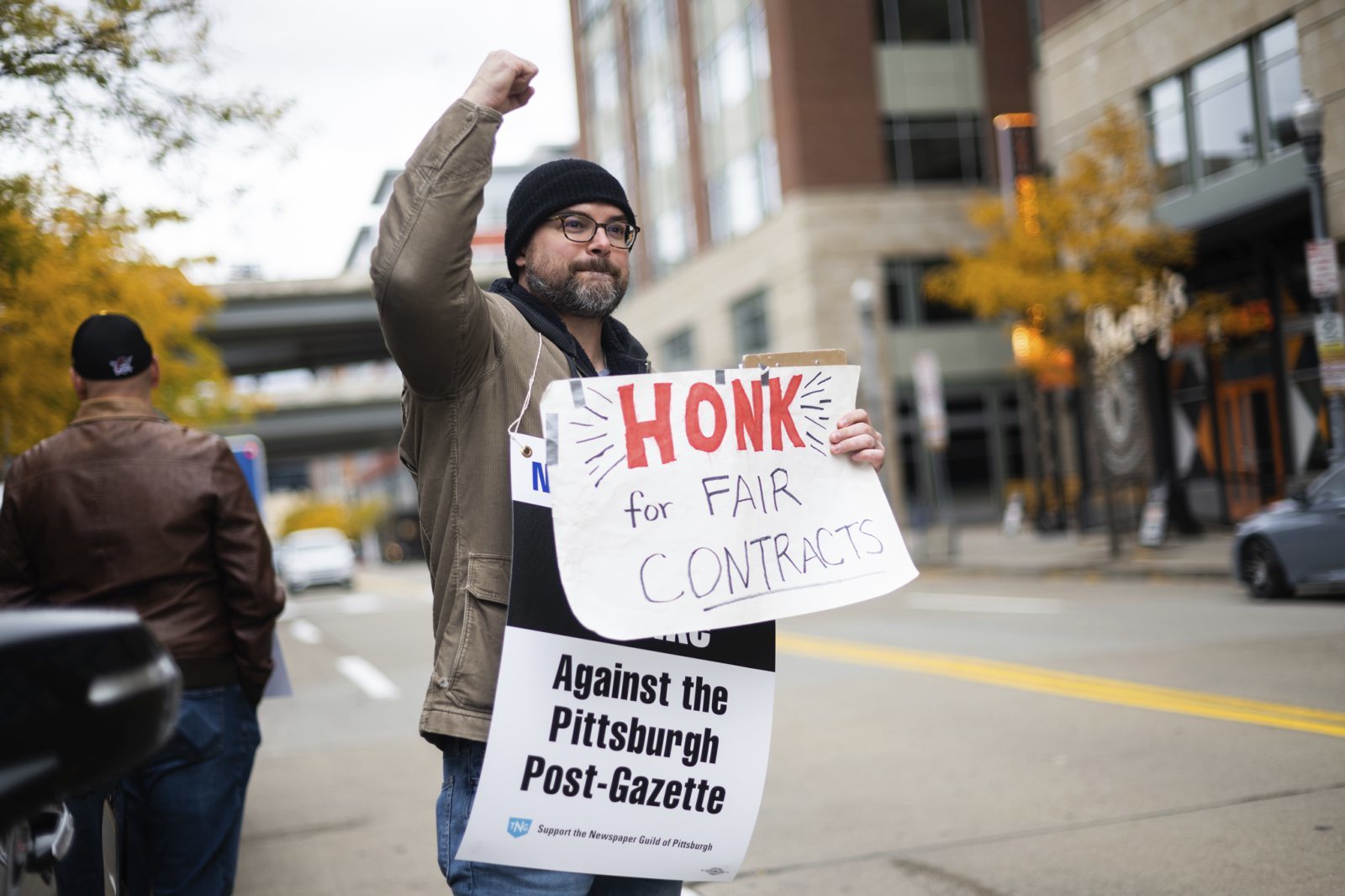
Disclosure of a decision to close the paper came the same day the U.S. Supreme Court denied the company’s appeal of a decision that required it to honor the terms of an earlier union contract, and after the resolution of a bitter three-year labor strike. Striking workers agreed to return to work on Nov. 24 and were told this week they would be severed.
John Santa, a copy editor at the Pittsburgh Post-Gazette, walks a picket line outside the newspaper’s offices with his fellow journalists in October 2022.
The Lenfest Institute for Journalism, of which I am CEO, is in the business of helping sustain and support local news. I heard this week from more than half a dozen news industry colleagues about the potential to “save the Post-Gazette.” As a Philly-based journalism executive, I was unsure what was really left of the Post-Gazette to save. So I reached out to Pittsburgh newsroom sources, readers, and local foundations.
While the Post-Gazette has suffered multiple layoffs and a reduction in its print schedule to two days a week, there is unquestionably still a there, there. The current newsroom numbers 110 employees. And its journalists still produce great public service journalism, covering politics to sports. More importantly, with or without the Post-Gazette, there remains a need and an appetite among readers for independent local news in Pittsburgh. As of the end of 2025, more than 60,000 pay for the P-G in digital form, and 27,000 in print.
To save, reinvent, or perhaps replace the Post-Gazette, it is instructive to look at recent local news investment in Philadelphia and Baltimore:
Ten years ago this month, the late H.F. “Gerry” Lenfest, a philanthropist and cable television entrepreneur, donated his ownership of The Philadelphia Inquirer to the nonprofit Lenfest Institute for Journalism, allowing The Inquirer to invest long term in the transformation of its news and business operations.
The late H.F. “Gerry” Lenfest, a philanthropist and cable television entrepreneur, donated his ownership of The Philadelphia Inquirer to the nonprofit Lenfest Institute for Journalism in 2016.
The Inquirer’s 200-person newsroom is supported in large part by the loyalty of readers, the growth of its digital revenues, and supplemented by donations from readers, foundations, and the Lenfest Institute. The Inquirer, which remains a for-profit enterprise, is well-managed, both editorially and as a business. It has more than 120,000 paying digital subscribers, and philanthropy — a finite resource — is a single-digit percentage of total revenues, although mission-critical.
Emulating the Lenfest Institute model, Stewart W. Bainum Jr., a Maryland-based hotel and healthcare executive, sought to acquire the Baltimore Sun from its parent company and to convert it to nonprofit ownership. Unable to come to terms with a difficult seller, Bainum chose instead to launch the Baltimore Banner from scratch in 2022, an impressive, all-digital nonprofit news enterprise that won the Pulitzer Prize for local reporting last year for coverage of its city’s opioid crisis.
Pittsburgh’s journalistic, business, and philanthropic interests have several paths open to them:
The Post-Gazette could be acquired by a nonprofit organization similar to the Lenfest Institute. However, local leaders with whom I have spoken seem loath to take on its obligations and liabilities.
The Post-Gazette is by no means the sole source of independent journalism serving Southwest Pennsylvania. The region is covered by NPR station WESA, by Pittsburgh’s Public Source, a small but effective nonprofit, and by Harrisburg-based Spotlight PA, of which the Lenfest Institute was a founder. Each of these entities could help form the foundation of expanded Pittsburgh news.
Or the community could build from scratch, mirroring the approach of the Baltimore Banner.
Each path has its complications, but they all have one thing in common: the need for determined, deep-pocketed, and strategically aligned funders to create sustainable local news at scale for the city of Pittsburgh.
Maxwell E.P. King, a former editor of The Inquirer and past president of two of Pittsburgh’s leading philanthropies — Heinz Endowments and the Pittsburgh Foundation — has sounded the alarm.
Maxwell E.P. King served as the editor of The Inquirer from 1990 to 1998.
“I am heartbroken, both as a reader and a contributor” to the Post-Gazette, King told me. “But the community, particularly the foundation community, must rally to this moment. Nonprofit journalism is succeeding around the country, most notably in Philadelphia with The Inquirer. We have to find a viable nonprofit way to continue daily journalism here. It is crucial for the region.”
Let’s hope Pittsburgh finds the resolve to serve its residents with the local news they need and deserve. Certainly, we at the Lenfest Institute are here to help.
Jim Friedlich is CEO and executive director of the Lenfest Institute for Journalism, the nonprofit, noncontrolling owner of The Inquirer. @jimfriedlich
For a moment, Comcast CEO Brian Roberts sounded a bit like Jason Kelce, without the foul mouth and not wearing a Mummers outfit.
During an NBC event Wednesday in New York City to hype its upcoming broadcasts of the 2026 Super Bowl and Milano Cortina Olympics, Sunday Night Football announcers Mike Tirico and Cris Collinsworth discussed the teams they might see in Santa Clara next month.
Collinsworth said he was “hedging” a bit but sticking by his prediction the Seattle Seahawks will represent the NFC in the Super Bowl. The announcers also mentioned the Los Angeles Rams, Buffalo Bills, and Aaron Rodgers and the Pittsburgh Steelers as intriguing possibilities, along with Drake Maye and the bounce-back New England Patriots.
After the panel, Roberts, a Philly native, took the stage and directed some criticism at his company’s top NFL talent over one notable omission.
“Cris and Mike, what the heck? You don’t even mention the Eagles once in the Super Bowl conversation?” Roberts joked. “I’m just a Philly guy, what can I say?”
While we still have the entire NFL playoffs to get through, Comcast-owned NBC is preparing for a busy February that will include broadcasting the Super Bowl, the Winter Olympics, and the NBA All-Star Game in Los Angeles.
While Tirico is an Olympics veteran and has long been praised as one of TV’s best sports announcers, he will be calling his first Super Bowl for NBC. It’s a fitting achievement for the Queens native who was baptized the morning the Packers and Kansas City Chiefs faced off in Super Bowl I.
“This has been a part of my life from truly the beginning of my life,” Tirico said. “To call the game, only a dozen people have done it, it’s the pinnacle of our business.”
Collinsworth: Eagles fans haven’t changed
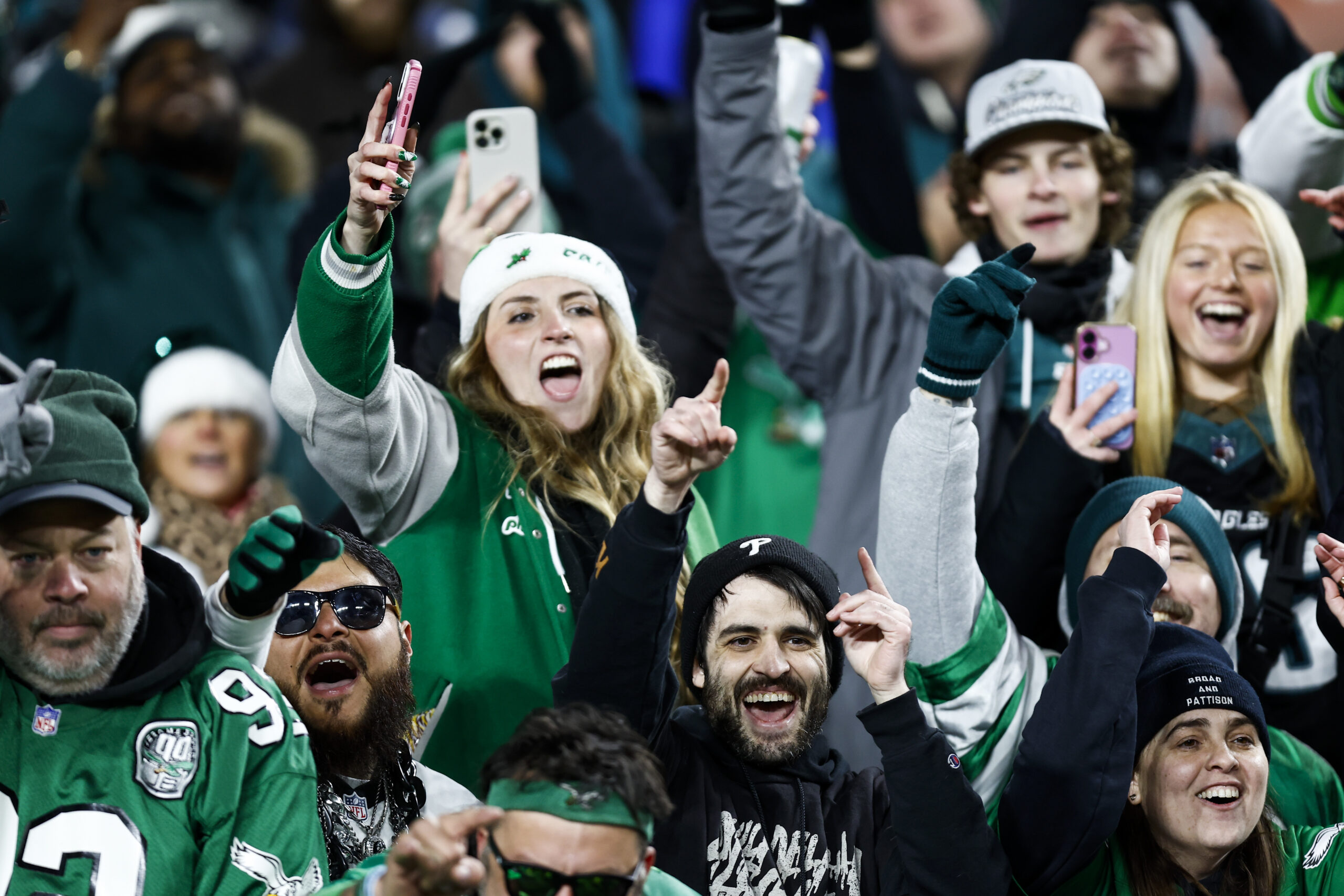
Philadelphia Eagles fans cheer after the game against the Washington Commanders at Northwest Stadium on Saturday, Dec. 20, 2025 in Landover, Md.
Collinsworth said NFL fans across the country share one common thread — they all think he hates their team.
That anger lingered into the Birds’ Super Bowl parade, where fans booed Collinsworth during replay of the broadcast airing on TVs along Broad Street.
The animosity is one reason Collinsworth actually looks forward to calling Eagles games, pointing out the passion of Philly fans.
But have Eagles fans become nicer to him since winning two Super Bowls?
“Oh, heck no,” Collinsworth said. “It’s a passionate place, man. I’ll just say that.”
This will be Collinsworth’s sixth Super Bowl in the booth, and his first alongside Tirico. Collinworth’s first Super Bowl was in 2005 for Fox alongside Joe Buck and Troy Aikman, and he’s called four since returning to NBC in 2006 — all alongside former partner and current Amazon play-by-play voice Al Michaels.
“I’m the one dumb enough to replace John Madden twice,” Collinsworth said.
Despite picking the Seahawks to win the NFC, Collinsworth said the conference appears wide open and he could easily see the Eagles making another run to the Super Bowl. But only if they start looking like last year’s squad, where both the offensive and defensive lines were dominant.
“When I see that Philly team again, then I’ll know they’ve got a real shot,” Collinsworth said.
Why Eagles-49ers isn’t airing on NBC
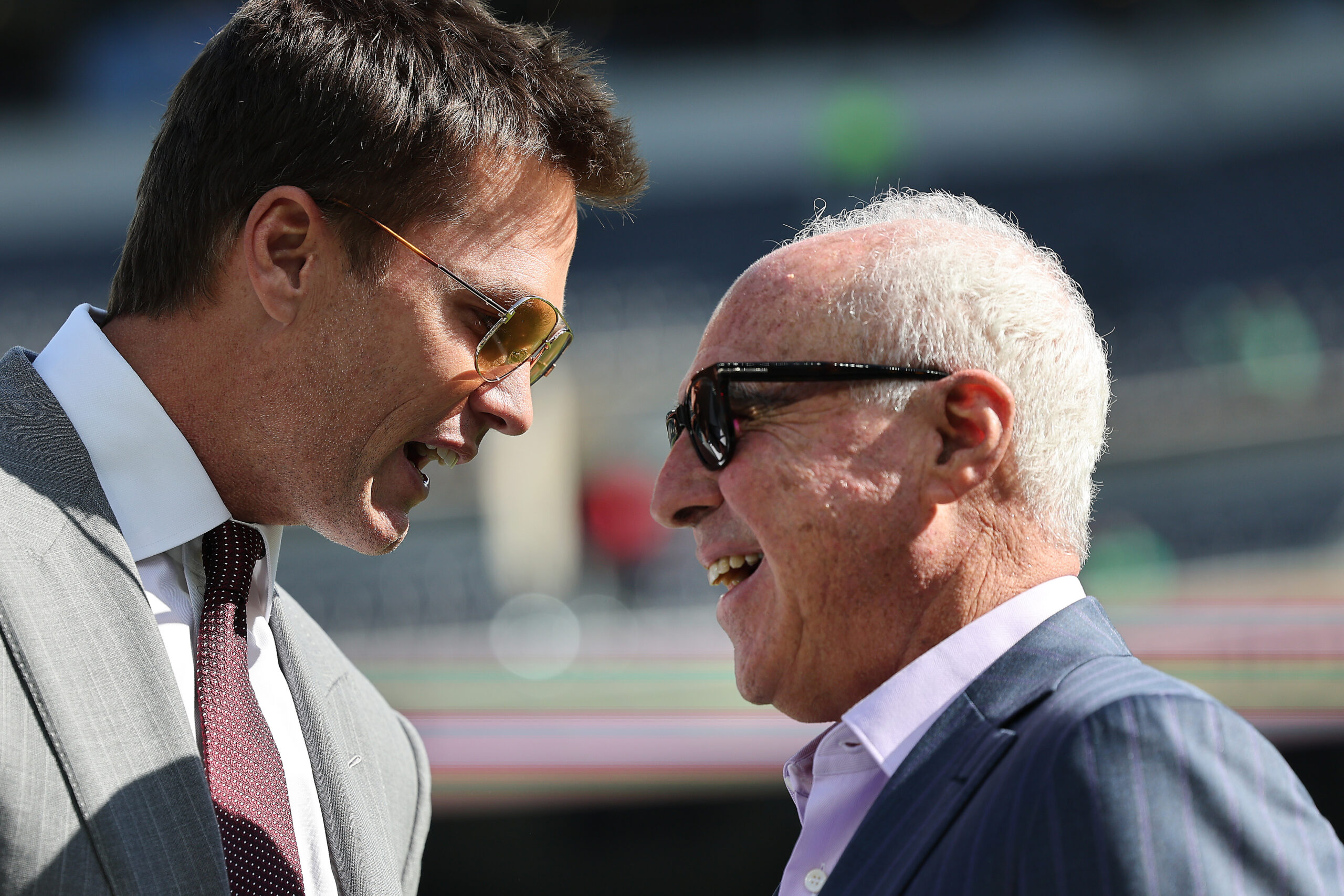
Tom Brady, seen here with Birds’ owner Jeffrey Lurie, will call Sunday’s Eagles-49ers wild-card game on Fox.
NBC and every other network was angling to carry the two stand-out games of wild-card weekend — the Eagles’ matchup against the San Francisco 49ers and the Green Bay Packers’ game against the Chicago Bears, just the third time the historic teams have met in the playoffs.
NBC got neither. Instead, they got Patriots vs. Justin Hebert and the Los Angeles Chargers.
49ers-Eagles landed on Fox in the Sunday 4:25 p.m. slot, a no-brainer considering last year’s Eagles-Packers game in that spot drew 35.9 million viewers, the most-watched game in the wild-card round. But instead of giving NBC Packers-Bears for the Sunday evening game, they tossed it to Amazon to stream on Prime Video Saturday night.
The move has largely been viewed by sports media pundits as a gift to Amazon as the NFL seeks to renegotiate its TV deals before they’re able to opt out in 2029. But it will also be the tech giant’s final NFL game in a season where they averaged 15.3 million viewers game, increasing the likelihood we’ll see a streamer land a Super Bowl during the next decade.
In addition to the Super Bowl, NBC will also broadcast one of the four divisional-round playoff games. If the Eagles win Sunday, they’ll hit the road to face Bears or host the Rams or Carolina Panthers at the Linc.
Tirico has been bullish on the Eagles, despite the Birds’ well-documented offensive struggles. During last Sunday’s broadcast, Tirico pointed out Jalen Hurts, last year’s Super Bowl MVP, is quietly lurking out there as Matthew Stafford, Josh Allen, and other quarterbacks dominate the conversation.
“There’s something about this Eagles’ team that I think even people in Philadelphia want to be a little skeptical of,” Tirico said. “But this team might be just as good as last year, and I can see them getting on a roll, 1,000%.”
And the possibility of an Eagles-Rams divisional playoff game landing on NBC?
“That would be awesome,” Tirico said.
Full wild-card TV schedule
window.addEventListener(“message”,function(a){if(void 0!==a.data[“datawrapper-height”]){var e=document.querySelectorAll(“iframe”);for(var t in a.data[“datawrapper-height”])for(var r,i=0;r=e[i];i++)if(r.contentWindow===a.source){var d=a.data[“datawrapper-height”][t]+”px”;r.style.height=d}}});
Other NBC notes
Beginning with their Chargers-Patriots wild-card game Sunday night, NBC will introduce a new graphics presentation that will include players’ hometowns, something they’re pulling in from their Olympics coverage. “We want to tell stories. We want to make you feel something about the human being inside that uniform,” Collinsworth said.
Sunday Night Basketball will debut on NBC Feb. 1, with Tirico joining the broadcast following the Olympics. So far, the Sixers aren’t slated to appear on Sunday Night Basketball, but that could change as the season moves forward.
Sunday Night Baseball, which is ending its 36-season run with ESPN, will begin on NBC at the end of May, following the Western Conference finals. Tirico has no immediate plans to call baseball games, but said “at some point I would like to.”
The winds evidently won’t be taking sides: The stadium’s orientation is more or less north-south, and the winds will be blowing from the west and then “swirling around in the Linc,” said Matt Benz, a senior meteorologist with AccuWeather Inc.
In any event, they won’t be much help to the quarterbacks or the kickers — San Francisco’s Eddy Piñeiro or Elliott, whose 74.1% field goal percentage this season was the second-lowest of his nine-year career. Piñeiro hit on 28 of 29 attempts.
Temperatures at the 4:30 p.m. kickoff are expected to be in the mid-40s and drop into the upper 30s during the game, and steady winds of 20 mph may drive wind chills into the upper 20s.
“At least it will be dry,” said Benz.
That won’t be the case around here Saturday.
The winds are to follow some drought-easing rains
After temperatures again climb well into the 50s on Friday, showers are possible at night, but the rains will be more “widespread” on Saturday, said Zach Cooper, a meteorologist with the National Weather Service office in Mount Holly.
No severe weather is expected, although rumbles of thunder are at least possible, he said.
Said Benz, “It’s going to be soaking rain Saturday afternoon into the evening.”
While rainfall amounts remain uncertain, about an inch was likely, the weather service said. Given the local rain deficits and the low water levels in the streams, no flooding was expected.
The only precipitation measured this month at Philadelphia International Airport, all of 0.1 inches, came from a dusting of snow on New Year’s Day.
Snow prospects are not exactly robust
Rain is possible the middle of next week, but the extended forecast remains flakeless, in least in the reliable range.
Temperatures on Monday will top out near 40 degrees, close to normal for the date, and reach the mid and upper 40s Tuesday and Wednesday. Another cooldown is expected late next week.
NOAA’s Climate Prediction Center has chances favoring below-normal temperatures in the Northeast in the Jan. 16-22 period, which would be approaching the season’s climatological peak snow season.
As for winter storm potential, its Thursday afternoon discussion that accompanied the extended outlook foresaw “an overall more active pattern.”