Tag: topic-link-auto

  • After striking gold in Paris in 2024, can NBC do it again at the Winter Olympics in Milan?

    After striking gold in Paris in 2024, can NBC do it again at the Winter Olympics in Milan?

    NEW YORK — In the lead-up to the Summer Olympics in Paris two years ago, there was no small amount of fear that the Games were losing their luster.

    It probably didn’t help that there were three straight Olympics in Asia, which meant most of the action was overnight for U.S. television viewers. And the pandemic definitely didn’t help, because sports without crowds in the stands weren’t as fun to watch.

    But NBC went all-in on Paris anyway, and was rewarded with huge ratings. Yes, people did still care, and they showed up to prove it.

    Now the network faces the challenge of bringing that energy to next month’s Winter Olympics in Milan and Cortina d’Ampezzo, Italy. The winter edition has historically drawn lower audiences than the summer no matter the circumstances, but NBC once again is going all-in.

    The Winter Olympics start Feb. 6 in Milan and Cortina d’Ampezzo, Italy.

    “We know the Winter Olympics haven’t been fully attended in eight years,” NBC’s Olympics executive producer Molly Solomon said at a media preview event last week. “We can’t take anything for granted. The media landscape has completely changed since 2018. So what have we got to do? We’ve got to win back viewers, we’ve got to show them why they should watch.”

    As with two years ago, there will be a lot of coverage on the big broadcast network, starting with at least five live hours a day. Because of the six-hour time difference between Italy and the eastern United States, the traditional prime time show will be like it was in Paris, with a mix of highlights and features.

    There will also be a lot of broadcasts on the USA Network and CNBC cable channels, and every event will be live on NBC’s Peacock streaming platform.

    If it feels natural to say all that, veteran Olympics fans will remind you quickly of how different things used to be. For many years, NBC held back showing some big events live to save them for the big prime time show.

    South Jersey-raised figure skater Isabeau Levito will likely be the highest-profile name from the Philadelphia area competing at the Winter Olympics.

    Paris was the first time NBC really opened everything up. It isn’t a coincidence that those were the first Games after Rick Cordella was promoted to president of NBC Sports, and the first outside of Asia after Solomon was promoted to her job in 2019.

    “The Olympics in Paris proved the Olympics are back, and remain an unrivaled media property with the unique abilities to captivate the nation and generate audiences across all demographics for 17 days and nights,” Cordella said. “We expect Milan-Cortina to carry on that legacy.”

    Solomon said she “felt as though we handed the viewer the remote control, and we said, ‘Hey, we’re going to give you different ways to watch the Olympics.’ And we’re now going to take all those learnings and build on them for Milan-Cortina.”

    With dramatic backdrops like the Eiffel Tower, the 2024 Summer Olympics in Paris proved to be a hit with U.S. TV viewers.

    A big bet paid off

    For as much as fans welcomed NBC’s change in philosophy, there was no guarantee it would succeed. If the prime time show’s ratings had flopped, some critics might have said the old way was more profitable.

    Instead, the network shot out of the gate. An average of 34.5 million viewers watched the first three days of competition in what were seen as the two “prime” slots, live coverage from 2-5 p.m. Eastern time then the nighttime highlights show — including a massive 41.5 million on the first Sunday.

    The average over the whole Summer Games ended at 30.4 million, which NBC said was up 80% from 2021 in Tokyo.

    Solomon said that when Cordella called her after the first weekend with the early returns, “I burst into tears, because those numbers — I didn’t think it was possible. … We didn’t even dream that big.”

    NBC’s lead Olympics host Mike Tirico said he could tell from the studio that things were working.

    “We saw that there was a formula for the prime time show: that [showing an event] live and then showing it again, and there was enough differentiation in what we showed again, that it was connecting with viewers,” he said. “And then hearing back from people who were home: ‘Hey, this is so great, I’m enjoying watching it at night after we watch all the daytime events.’ Probably day four, I would say that Monday or Tuesday, was [when] I got feedback that it was working.”

    The 2028 Summer Olympics in Los Angeles will be different again, since they’ll be on home turf. Then the 2030 Winter Olympics will be back in Europe in the French Alps.

    Who knows what the media landscape will look like by then, given how quickly things change these days, but it’s hard to believe NBC will ever revert to its past.
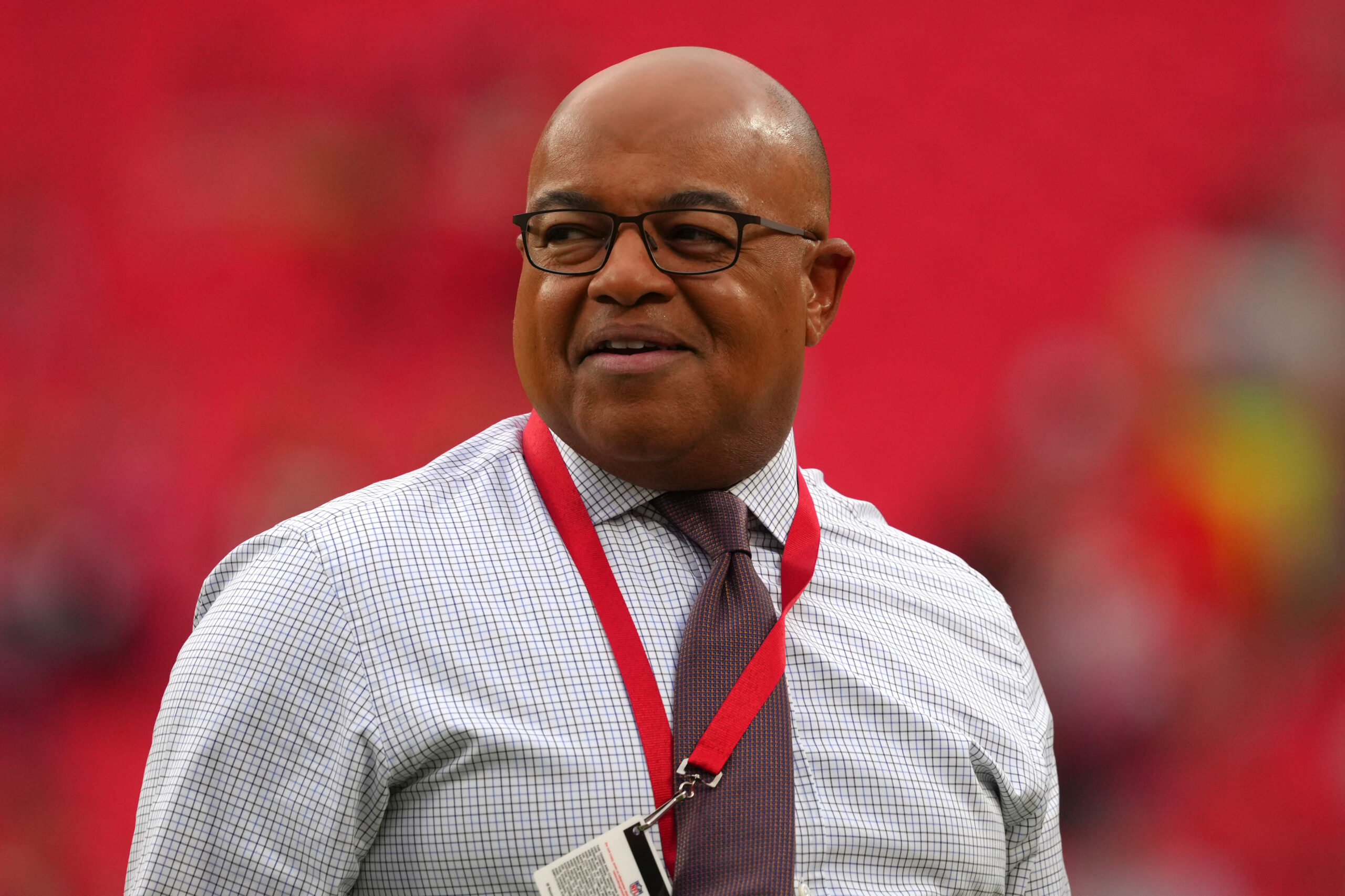
    Mike Tirico does lots of things at NBC, from hosting the Olympics to calling NFL and NBA play-by-play.

    “Just as a sports fan, I would say not,” Tirico said. He emphasized he was speaking just for himself, not his bosses, but his opinion counts for something.

    “I think we’ve seen because of streaming, you can access anything you want at any time,” he continued. “There’s still the largest audience sitting there at the end at night, and you want to give them the biggest events [as highlights]. So holding them doesn’t make any sense in this day and age. And we had long talks about that before Paris, and I think we saw a formula that worked.”

    This year’s new additions

    There will be a few new toys for viewers to enjoy next month. Peacock will have extra camera angles available for figure skating — including some behind-the-scenes ones — and ice hockey.

    Solomon worked with the International Olympic Committee to get live drone cameras into coverage, to get microphones on some athletes, and to get into warmup areas to show how athletes get ready for their big moments.

    Skiing superstar Lindsey Vonn will be at her fifth Olympics, 24 years after her first.

    “We’ve really pushed everybody to go places, and take the viewer places they’ve never seen before,” she said. “Because in the winter, you’re covered with goggles and head gear. So we need to be at the place before they put this stuff on. We need to see faces. And the International Olympic Committee has been great about granting us that access.”

    The biggest new thing might be an expansion of the popular “Gold Zone” whip-around live highlights show. From 8 a.m. to around 4 p.m. each day, it will be televised not just on Peacock but on the recently relaunched NBCSN cable channel.

    That means more viewers will have access, but it also takes away an incentive to subscribe to Peacock if you don’t yet.

    “I think the NBA would say that would drive people to subscribe to Peacock, or Premier League [soccer], and now that’s available on NBCSN,” Cordella said. “And so our view of NBCSN is that we’re going to be agnostic to how people consume our content, as long as we’re getting adequately paid for it [by distributors]. We did a deal with YouTube [TV], we’ve done a deal with our parent company Comcast, and hopefully we’ll do a deal with others, but NBCSN is a big part of our strategy moving forward.”

    For the most part, everyone speaking at the media preview event stayed away from another addition to the landscape: the United States’ current hostilities with Venezuela and Greenland, the Russia-Ukraine war, and the turmoil within U.S. borders over ICE and many other subjects.

    But they did not stay away from the subject completely.

    “I’ve just been thinking a lot about this: In this increasingly divided and isolated world, there’s not many moments when we all come together anymore,” Solomon said. “Sports does bring us together, but I think the Olympics is really even more unique.”

    Comcast CEO Brian Roberts also alluded to wider affairs in his speech at the end of the event.

    “Bringing our country together when a lot of things are pulling us apart is just a fabulous opportunity,” he said.

  • Low-alcohol wines are trending. Here’s one that’s actually good.

    Low-alcohol wines are trending. Here’s one that’s actually good.

    If there is one thing that winemakers are certain of at the dawn of 2026, it’s that demand will continue to grow for lighter wines that contain less alcohol. To date, those who have successfully capitalized on this trend have tended to be cheap, mass-market brands. To appeal to those looking to reduce their alcohol intake, many companies have created “light” brand spinoffs, in which some portion of the wine’s alcohol is removed with tech wizardry.

    Removing alcohol, however, alters flavor and compromises the complex balance of tastes, smells, and textures that people expect from a good wine.

    As lighter wines grow more popular, a number of smaller and more traditional wineries are exploring alternate methods for making lower-alcohol wines without sacrificing quality. Companies like Ramón Bilbao in Spain are making lighter, brighter, and fresher wines by changing how they grow their grapes instead of how they make their wine.

    This limited-edition “Early Harvest” wine is crafted from verdejo grapes picked two weeks earlier than usual in the Rueda region of Spain’s Douro River Valley. Picking grapes earlier results in fruit that contains lower levels of sugar and higher levels of tangy acidity — yielding fresh, vibrant wines that contain a lower percentage of alcohol than the norm.

    Ramón Bilbao’s standard Rueda verdejo contains 13% alcohol, a very typical strength for a dry, unoaked white wine. This early-harvested version is 15% lower in alcohol, coming in at only 11% ABV. Both iterations are crisp, dry, citrusy, and herbal, with a flavor profile that would please any fan of sauvignon blanc or grüner veltliner. However, rather than tasting flattened by alcohol-reduction machinery, this early-harvested edition is simply more delicate and perhaps a touch more refined. It is, after all, a superior cuvée from a single estate. Its flavors may be lighter and milder but the wine is nonetheless balanced, complex, and complete in a way that manipulated “light” wines are not.

    Ramón Bilbao “Early Harvest” Verdejo

    Rueda, Spain; 11% ABV

    PLCB Item #100049347 — on sale for $16.99 through Feb. 2 (regularly $19.99)

    No alternate retail locations within 50 miles of Philadelphia according to wine-searcher.com.

  • Two former homicide detectives get probation for lying about DNA evidence in murder case that spanned decades

    Two former homicide detectives get probation for lying about DNA evidence in murder case that spanned decades

    Two former Philadelphia homicide detectives were sentenced Wednesday to a combined three years of probation for lying about their knowledge of DNA evidence during the retrial of a man they helped convict of murder 35 years ago.

    Common Pleas Court Judge Lucretia Clemons imposed a two-year probation sentence for Manuel Santiago, 76, and one-year sentence for Frank Jastrzembski, 78. The retired detectives will not be required to meet with probation officers.

    The sentencing punctuates an unusual case in which prosecutors accused three retired Philadelphia police officers of fabricating evidence in a decades-old homicide case, and later perjuring themselves when testifying about that evidence under oath. A grueling eight-day trial in March revisited the 1991 murder of 77-year-old Louis Talley in Nicetown and the 2016 retrial of Anthony Wright, the man police helped send to prison for the crime.

    The jury ultimately rejected the larger conspiracy built by prosecutors that the detectives had framed Wright, but found both Santiago and Jastrzembski guilty of misdemeanor false swearing and found Santiago guilty on an additional count of perjury, a felony. A third detective who worked on the case, Martin Devlin, was acquitted of all charges.

    Santiago’s attorney, Fortunado Perri Jr., thanked Clemons for the “appropriate” sentence on Wednesday. Steve Patton, an attorney for Jastrzembski, reiterated that the jury had acquitted his client of planting evidence and described the conviction as a matter of “technical knowledge.”

    “We’re pleased with that outcome and thankful for the judge’s careful consideration of the facts of this case,” Patton said.

    In an interview Wednesday, Krasner blasted what he described as lenient sentencing guidelines for lying under oath in Pennsylvania. Probation is the recommended sentence for a false swearing conviction, while the maximum recommended penalty for perjury is nine months.

    “Those sentencing guidelines are disgraceful,” Krasner said, while also acknowledging the two defendants are both now in their 70s and have health issues.

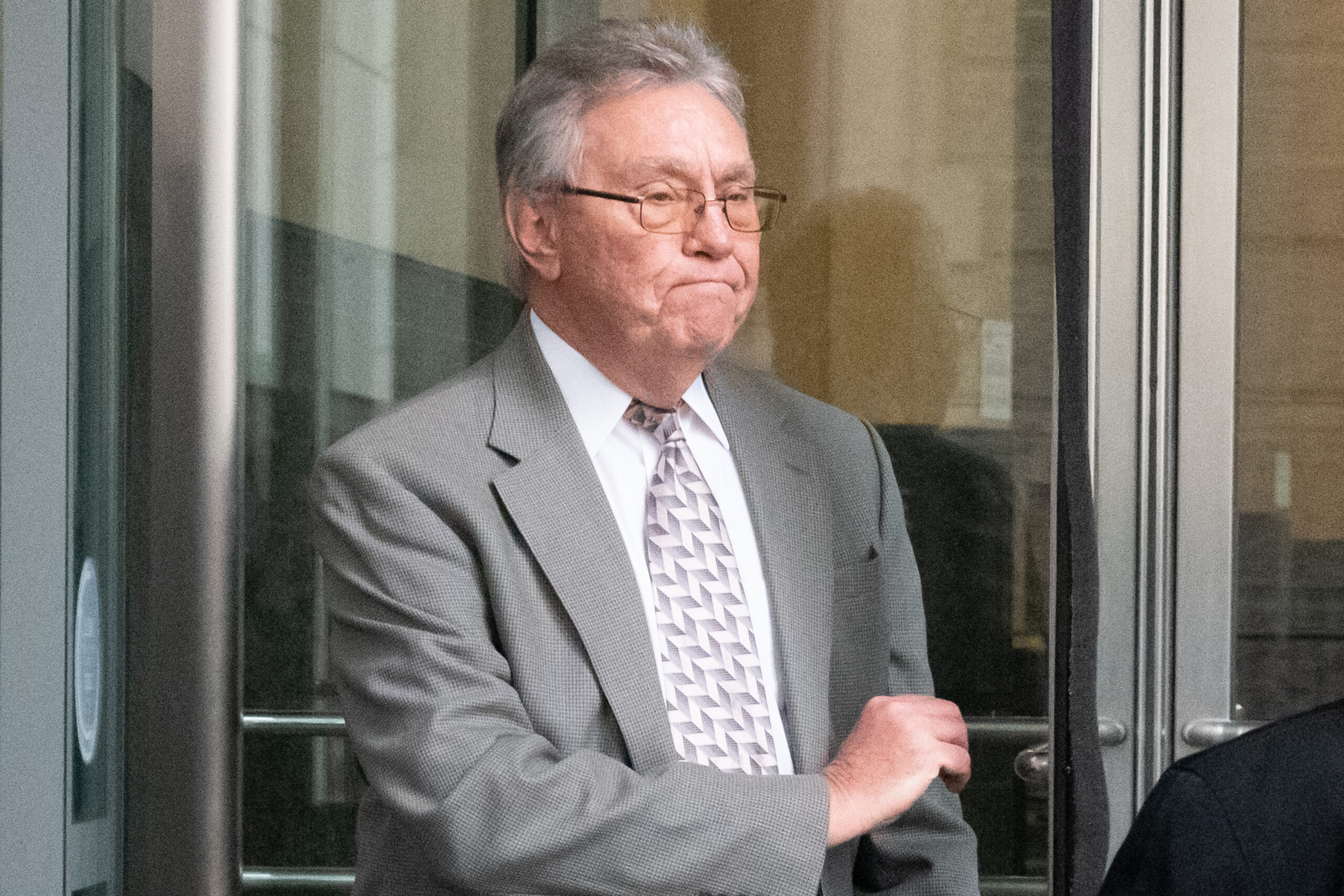
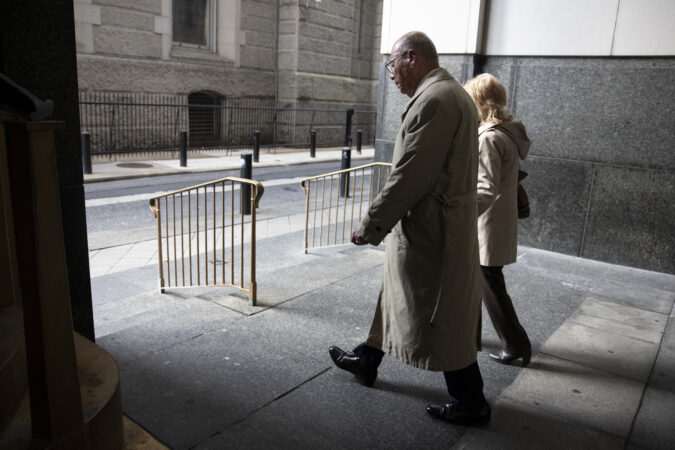
    Former Philadelphia Police Detective Frank Jastrzembski leaves the Criminal Justice Center in Philadelphia on March 17, 2025.

    At trial, Krasner’s top prosecutors contended that the three detectives had conspired to frame Wright for Talley’s murder, extracted a false confession from him, and planted evidence in his home.

    Santiago was acquitted of perjury in connection with his testimony about Wright’s murder confession, while Jastrzembski was acquitted of perjury and related charges for his testimony about a search warrant he executed at Wright’s home — charges that hinged on prosecutors’ ability to prove the detectives had wholly fabricated evidence.

    Instead, the convictions centered on what Santiago and Jastrzembski knew about the evidence against Wright when they testified at his 2016 retrial. The two detectives were instrumental in building the original case against Wright in 1991, and later sought to send him back to prison — even after DNA evidence implicated another man in Talley’s murder. Wright’s conviction was overturned in 2014 based on the strength of that forensic science.

    When prosecutors under former District Attorney Seth Williams charged Wright a second time — under suspicion that he had acted with an accomplice — Santiago and Jastrzembski were briefed on the new DNA information. The results pointed to a known crack user who lived near Talley in Nicetown, a man who had since died in a prison.

    Under oath at Wright’s retrial, however, Santiago and Jastrzembski denied knowing the DNA evidence implicated another suspect.

    Wright was acquitted and later filed a federal civil rights lawsuit against the city and won a $9.85 million settlement. During sworn depositions in that case, Santiago and Jastrzembski were questioned about the DNA evidence and gave answers that prosecutors said contradicted their earlier trial testimony.

    The perjury trial in March at times resembled a second retrial for Wright, with defense attorneys accusing him of getting away with Talley’s murder. Wright proclaimed his innocence.

    Following the jury’s verdict, Krasner insisted that the detectives had framed Wright, and he criticized his predecessor’s decision to retry the man after his conviction was overturned.

  • Older Americans quitting weight-loss drugs in droves

    Older Americans quitting weight-loss drugs in droves

    Year after year, Mary Bucklew strategized with a nurse-practitioner about losing weight. “We tried exercise,” like walking 35 minutes a day, she recalled. “And 39,000 different diets.”

    But 5 pounds would come off and then invariably reappear, said Bucklew, 75, a public transit retiree in Ocean View, Del. Nothing seemed to make much difference — until 2023, when her body mass index slightly exceeded 40, the threshold for severe obesity.

    “There’s this new drug I’d like you to try, if your insurance will pay for it,” the nurse-practitioner advised. She was talking about Ozempic.

    Medicare covered it for treating Type 2 diabetes but not for weight loss, and it cost more than $1,000 a month out-of-pocket. But to Bucklew’s surprise, her Medicare Advantage plan covered it even though she wasn’t diabetic, charging just a $25 monthly co-pay.

    Pizza, pasta, and red wine suddenly became unappealing. The drug “changed what I wanted to eat,” she said. As 25 pounds slid away over six months, she felt less tired and found herself walking and biking more.

    Then her Medicare plan notified her that it would no longer cover the drug. Calls and letters from her healthcare team, arguing that Ozempic was necessary for her health, had no effect.

    With coverage denied, Bucklew became part of an unsettlingly large group: older adults who begin taking GLP-1s and related drugs — highly effective for diabetes, obesity, and several other serious health problems — and then stop taking them within months.

    That usually means regaining weight and losing the associated health benefits, including lower blood pressure, cholesterol, and A1c, a measure of blood sugar levels over time.

    Widely portrayed as wonder drugs, semaglutide (Ozempic, Wegovy, Rybelsus), tirzepatide (Zepbound, Mounjaro), and related medications have transformed the treatment of diabetes and obesity.

    The FDA has approved several GLP-1s for additional uses, too — including to treat kidney disease and sleep apnea, and prevent heart attacks and strokes.

    “They’re being studied for every purpose you can conceive of,” said Timothy Anderson, a health services researcher at the University of Pittsburgh and author of a recent JAMA Internal Medicine editorial about anti-obesity medications.

    (Drug trials have found no impact on dementia, however.)

    People 65 and older represent prime targets for such medications. “The prevalence of obesity hovers around 40%” in older adults, as measured by body mass index, said John Batsis, a geriatrician and obesity specialist at the University of North Carolina School of Medicine.

    The proportion of people with Type 2 diabetes rises with age, too, to nearly 30% at age 65 and older. Yet a recent JAMA Cardiology study found that among Americans 65 and up with diabetes, about 60% discontinued semaglutide within a year.

    Another study of 125,474 people with obesity or who are overweight found that almost 47% of those with Type 2 diabetes and nearly 65% of those without diabetes stopped taking GLP-1s within a year — a high rate, said Ezekiel Emanuel, a health services researcher at the University of Pennsylvania and senior author of the study.

    Patients 65 and older were 20% to 30% more likely than younger ones to discontinue the drugs and less likely to return to them.

    What explains this pattern? As many as 20% of patients may experience gastrointestinal problems. “Nausea, sometimes vomiting, bloating, diarrhea,” Anderson said, ticking off the most common side effects.

    Linda Burghardt, a researcher in Great Neck, N.Y., started taking Wegovy because her doctor thought it might reduce arthritis pain in her knees and hips. “It was an experiment,” said Burghardt, 79, who couldn’t walk far and had stopped playing pickleball.

    Within a month, she suffered several bouts of stomach upset that “went on for hours,” she said. “I was crying on the bathroom floor.” She stopped the drug.

    Some patients find that medication-induced weight loss lessens rather than improves fitness, because another side effect is muscle loss. Several trials have reported that 35% to 45% of GLP-1 weight loss is not fat, but “lean mass” including muscle and bone.

    Bill Colbert’s cherished hobby for 50 years, reenacting medieval combat, involves “putting on 90 pounds of steel-plate armor and fighting with broadswords.” A retired computer systems analyst in Churchill, Pa., he started on Mounjaro, successfully lowered his blood glucose, and lost 18 pounds in two months.

    But “you could almost see the muscles melting away,” he recalled. Feeling too weak to fight well at age 78, he also discontinued the drug and now relies on other diabetes medications.

    “During the aging process, we begin to lose muscle,” typically half a percent to 1% of muscle weight per year, said Zhenqi Liu, an endocrinologist at the University of Virginia who studies the effects of weight loss drugs. “For people on these medications, the process is much more accelerated.”

    Losing muscle can lead to frailty, falls, and fractures, so doctors advise GLP-1 users to exercise, including strength training, and to eat enough protein.

    The high rate of GLP-1 discontinuation may also reflect shortages; from 2022 to 2024, these drugs temporarily became hard to find. Further, patients may not grasp that they will most likely need the medications indefinitely, even after they meet their blood glucose or weight goals.

    Reinitiating treatment involves its own hazards, Batsis cautioned. “If weight goes up and down, up and down, metabolically it sets people up for functional decline down the road.”

    Of course, in considering why patients discontinue, “a large part of it is money,” Emanuel said. “Expensive drugs, not necessarily covered” by insurers. Indeed, in a Cleveland Clinic study of patients who discontinued semaglutide or tirzepatide, nearly half cited cost or insurance issues as the reason.

    Some moderation in price has already occurred. The Biden administration capped out-of-pocket payments for all prescriptions that a Medicare beneficiary receives ($2,100 is the 2026 limit), and authorized annual price negotiations with manufacturers.

    The reductions include Ozempic, Wegovy, and Rybelsus, though not until 2027. Medicare Part D drug plans will then pay $274, and since most beneficiaries pay 25% in coinsurance, their out-of-pocket monthly cost will sink to $68.50.

    Perhaps even lower, if agreements announced in November between the Trump administration and drugmakers Eli Lilly and Novo Nordisk pan out.

    The bigger question is whether Medicare will amend its original 2003 regulations, which prohibit Part D coverage for weight loss drugs. “An archaic policy,” said Stacie Dusetzina, a health policy researcher at the Vanderbilt University School of Medicine.

    The Trump administration’s November announcement would expand Medicare eligibility for GLP-1s and related medications to include obesity, perhaps as early as spring. But key details remain unclear, Dusetzina said.

    Medicare should cover anti-obesity drugs, many doctors argue. Americans still tend to think that “diabetes is a disease and obesity is a personal problem,” Emanuel said. “Wrong. Obesity is a disease, and it reduces life span and compromises health.”

    But given the expense to insurers, Dusetzina warned, “if you expand the indications and extent of coverage, you’ll see premiums go up.”

    For older patients, often underrepresented in clinical trials, questions about GLP-1s remain. Might a lower maintenance dose stabilize their weight? Can doses be spaced out? Could nutritional counseling and physical therapy offset muscle loss?

    Bucklew, whose coverage was denied, would still like to resume Ozempic. But because of a recent sleep apnea diagnosis, she now qualifies for Zepbound with a $50 monthly co-pay.

    She has seen no weight loss after three months. But as the dose increases, she said, “I’ll stay the course and give it a shot.”

    The New Old Age is produced through a partnership with The New York Times.

    KFF Health News is a national newsroom that produces in-depth journalism about health issues and is one of the core operating programs at KFF — the independent source for health policy research, polling, and journalism.

  • Thomas Paine published ‘Common Sense’ and helped ignite a revolution on this week in Philly history

    Thomas Paine published ‘Common Sense’ and helped ignite a revolution on this week in Philly history

    They just needed a spark.

    The American colonies in the autumn of 1775, then under the thumb of King George III and his sprawling British Empire, were divided on the prospect of independence.

    Revolutionary ideas start in refined quarters, but they must spread to the masses to surge into action.

    And the 13 colonies were divided in threes: those who favored independence from English rule, those who opposed it, and those who wished to remain neutral.

    And then the spark arrived as a pamphlet.

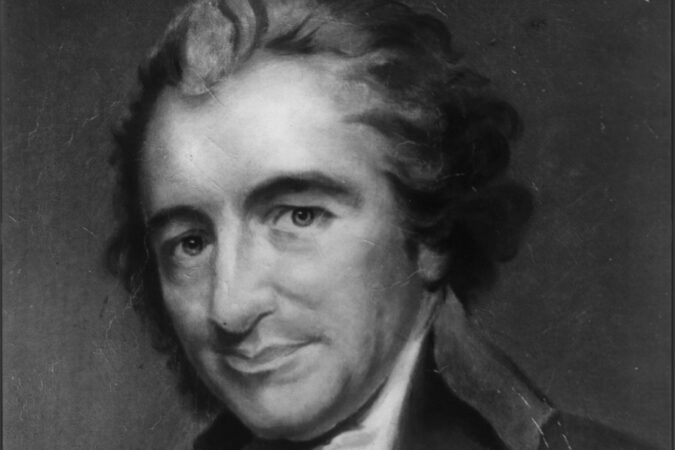
    On Jan. 10, 1776, in a small publishing house at Third and Walnut Streets in present-day Old City, Englishman Thomas Paine published his 47-page document. It promoted the cause of American independence, and stoked the fires of revolution.

    This pamphlet, titled “Common Sense,” was first printed anonymously.

    But the colonists knew who wrote it.

    An original English printing of “Common Sense,” the pamphlet written by Thomas Paine, combined with a rebuke entitled “Plain Truth” by James Chalmers, a British Loyalist officer. The two pamphlets were reprinted together in a book in London in 1776.

    Paine was a self-educated rabble-rouser who had found little success making corsets or collecting taxes.

    And who, upon meeting Benjamin Franklin after giving a speech in London, opted to join the upstart colonists and move to America in 1774.

    After following Franklin to Philadelphia, he followed him into journalism, writing and editing for Pennsylvania Magazine.

    It’s where he displayed a knack for speaking to the common people through essays denouncing slavery, promoting women’s rights, and dumping on English rule.

    And again he took from Franklin, turning his pamphlet into a lightning rod.

    In it he laid out his arguments in plain language.

    An island, he argued, should not rule a continent.

    “Every thing that is right or natural pleads for separation,” he wrote.

    More than 500,000 copies circulated the colonies, convincing the commoners, the people who would actually take up arms against the Royal military, to support a war against Great Britain.

    Despite his outsized role in lighting the fires of rebellion, Paine’s services would go unrecognized for a generation.

    He temporarily returned to Europe after the war, and his later denouncing of Christianity did him no favors on either side of the Atlantic. He died in poverty in New York in 1809 at age 72.

    It wouldn’t be until the mid-1970s for historians to recognize the enduring power of Paine’s pamphlet, which now holds a place of honor a step below Thomas Jefferson’s Declaration of Independence.

  • What was the first city-sponsored New Year’s Day procession in America? The answer lies in Philly.

    What was the first city-sponsored New Year’s Day procession in America? The answer lies in Philly.

    As the fog lifted on Jan. 1, 1901, four Fancy Dress Clubs and 16 Comic Clubs gathered at the corner of Broad and Reed Streets for the first ever Mummers Parade.

    “Kings, emperors, knights and jesters, clothed in purple royal or tinkling tensel [sic], wended their way up the broad thoroughfare …” reads a front-page story from the Jan. 2, 1901, Philadelphia Inquirer. “In the throng of merry makers, no tribe no nation, scarcely an individual was neglected.”

    That inaugural Mummers Parade was America’s first folk parade. It also marks the first time an American city hosted a New Year’s Day procession.

    It will be remembered Saturday at the Firstival in the Mummers Museum. Firstivals are the Philadelphia Historic District’s weekly day parties celebrating historic events that happened in Philadelphia before anywhere else in America, and often the world. They are part of a yearlong celebration of America’s 250th birthday.

    Artist Anh Ly’s No. 1 highlights the Mummers Parade’s vibrant costumes, instruments and playful traditions.

    That first Mummers Parade began 125 years ago at 9 a.m. on a chilly overcast morning, said Mark A. Montanaro, the Mummers Museum’s curator. It took participants just two hours to march up Broad Street and around City Hall to Girard Avenue.

    Three hundred dollars — $11,575 in today’s money — was awarded to the parade’s two first-place winners: the Elkton Association, part of the Fancy Dressed Club; and the White Cap Association, belonging to the Comic Club.

    Revelers partied all day and into the night.

    The boisterousness remains to this day. So much so that the Philadelphia Historic District did not want to start the Firstival celebrations with the parade, even though that was the initial plan. Why? Because they assumed the Mummers would still be recovering from their parade.

    The word mummer is derived from Momus, the Greek god of satire and mockery. Mommer is the Old French word for mime.

    Philadelphia’s 17th century English and Swedish immigrants dressed in elaborate regalia during the days between Christmas and New Year’s, knocked on their neighbors’ doors, and demanded treats of sweets and nuts. Over the decades, the door-to-door tradition turned into rambunctious neighborhood parties as Dutch, Irish, and Italian immigrants joined in on the fun.

    In November of 1900, Philadelphia Evening Bulletin reporter and theatrical promoter H. Bart McHugh and City Councilman John H. Baizley asked Mayor Samuel Ashbridge if the city would consolidate the block parties into one big parade.

    Plans were finalized by mid-December.

    The Mummers Parade remains one of Philadelphia’s most enduring traditions. It’s only been canceled three times: during the 1919 Spanish Flu, 1934 during the Great Depression, and 2021 during COVID. (This year, the String Band Division called off its competition due to strong winds.)

    The Jokers perform during the Fancy Brigade Finale at the Pennsylvania Convention Center during the 2026 Mummers Parade in Philadelphia on Thursday, Jan. 1, 2026.

    Parade routes have changed; today it starts at City Hall and ends at Washington Avenue. At times its been fraught with racial controversy, as some members have appeared in blackface as recently as 2020.

    That’s all in the past, Montanaro stressed.

    “The Mummers are striving for inclusivity,” Montanaro said. “We are a little bit of Mardi Gras, a little bit of Carnival, and a whole lot of Philly.”

    This week’s Firstival is Saturday, Jan. 9, 11 a.m. — 1 p.m., at the Mummers Museum, located at 1100 S. 2nd Street. The Inquirer will highlight a “first” from Philadelphia Historic District’s 52 Weeks of Firsts program every week.

  • Eagles-49ers film: Christian McCaffrey’s touches, dangerous George Kittle, and where Brock Purdy struggles

    Eagles-49ers film: Christian McCaffrey’s touches, dangerous George Kittle, and where Brock Purdy struggles

    A fascinating chess match should unfold on Sunday when one of the best defensive units in the NFL matches up with one of the league’s brightest offensive minds. Kyle Shanahan’s San Francisco 49ers squad, including stars Christian McCaffrey and George Kittle, will face off against Zack Baun, Quinyon Mitchell, and the rest of a stout Eagles defense.

    This will be the best offense the Eagles have faced since the Chicago Bears on Black Friday. Quarterback Brock Purdy, Kittle, and several other key pieces have missed time at various portions of the season, but they will arrive at Lincoln Financial Field with an offense that challenges defenses pre- and post-snap.

    From defending McCaffrey’s versatile skill set to exploiting a clear weakness on San Francisco’s defense, here are the keys for the Eagles in Sunday’s NFC wild-card showdown:

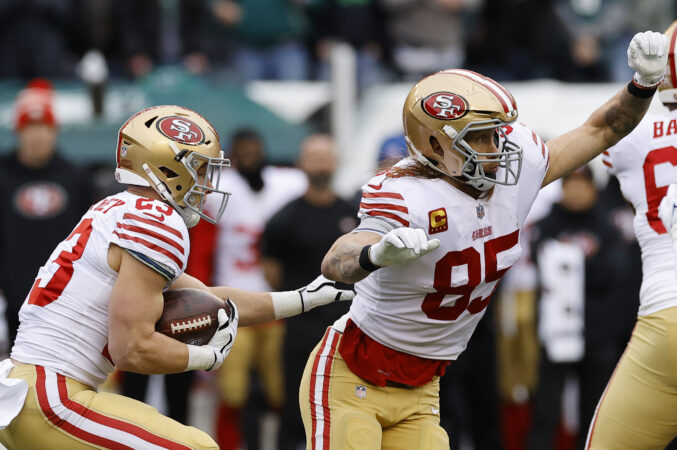
    Christian McCaffrey will try to make a positive impact on Sunday after losing a key fumble against the Seahawks.

    McCaffrey’s dual-threat ability

    According to Fantasy Points, McCaffrey had the NFL’s most touches (413) and touches per game (24.3) this season. He had 311 carries, ranking second in the league.

    The San Francisco offense depends on him in many ways, and his usage is a reflection of it. Starting in the running game, McCaffrey primarily carries the ball from under-center alignments, with 905 of his 1,202 rushing yards coming from those formations. Of the 27 runs for McCaffrey that have gone for 10-plus yards, 21 have come from under center.

    Under Shanahan, the Niners execute an outside zone scheme, but they mix in gap scheme runs to allow McCaffrey to get downhill as a runner.

    The numbers back it up, too. According to Next Gen Stats, McCaffrey has a 50% success rate on runs between the tackles as opposed to a 32.6% success rate outside the tackles. Still, McCaffrey has found daylight outside the tackles, especially on San Francisco’s outside toss play with fullback Kyle Juszczyk leading.

    Even when McCaffrey is not rushing, the Niners and Shanahan are scheming up ways for him to get the football. San Francisco has a dynamic screen passing game, and at the center of it is McCaffrey. The running back often receives screen passes off play-action or on angle screen actions, when the running back fakes going out for a route and comes back toward the middle of the field with blockers in front.

    Running screen passes not only slows down a pass rush, it plays to the strengths of McCaffrey, who is dynamic in making defenders miss in the open field. In the regular season, he led all running backs in receptions (102) and receiving yards (924), and ranked third in the NFL in yards after the catch (721).

    McCaffrey aligns all over the formation for San Francisco, from the backfield to the slot and even as an off-ball tight end. Because he’s a dynamic route runner out of the backfield, McCaffrey can present mismatches wherever he’s aligned on the field.

    According to Pro Football Focus, McCaffrey has played 86 snaps in the slot, 19 out wide, nine as an in-line tight end, one at fullback, and the remaining 817 in the backfield. While he rarely runs vertical routes, his movement around the formation can cause confusion and has led to big gains in the passing game.

    Kittle and the intermediate passing game

    The second-most dangerous player on the Niners offense is Kittle, who missed six games but finished with the second-highest catch rate (82.6%) and ranked third in expected points added (+43.5) among qualified NFL tight ends, according to Next Gen Stats.

    Like McCaffrey, Kittle is moved all over the formation, with most of his snaps coming from in-line alignments (397). He also spent a considerable amount of snaps as a slot receiver (115), out wide (26), and in the backfield (16), according to PFF.

    Purdy, who played in only nine games this season, has found comfort in the passing game throwing to Kittle over the middle of the field and down the seam. Kittle has caught 14 passes for 202 yards and two touchdowns on 20 targets between 10 and 19 yards, including 5 of 7 contested catch targets, according to PFF.

    Kittle is a matchup nightmare for whoever is defending him. The Niners make a concerted effort to set him up for one-on-one opportunities with smaller secondary players when the 6-foot-4 tight end is aligned in the slot, or out wide with pre-snap motion.

    Of Kittle’s 57 catches this season, 20 came from the slot or out wide, and he’s athletic enough to create separation on in- and out-breaking routes facing one-on-one coverage.

    Most of the Niners’ passing game operates in the short and intermediate areas of the field. Purdy has accumulated 1,734 of his 2,167 passing yards on passes between zero and 19 air yards, according to Next Gen Stats.

    One of their staple passing game concepts to exploit zone coverage is a Sail concept, which has an outside receiver running a vertical route and the slot receiver running a corner route than can convert to an out route. The passing concept is especially effective facing Cover 2 and Cover 3, as it puts the cornerback on that side of the concept in a bind to either run with the deeper route or try to undercut the outbreaking route.

    Between the numbers, the Niners offense is known to run a lot of deep, in-breaking routes and the Dagger passing concept, which has a clear-out vertical route occupying the deep safeties and the deep dig route coming in behind it. It is where Purdy is the most aggressive in pushing the ball downfield to hit big gains to receivers Ricky Pearsall, Jauan Jennings, and Kendrick Bourne. According to PFF, Purdy has 83 of 107 passes for 788 yards and four touchdowns on passes between the numbers from behind or at the line of scrimmage to 20 yards downfield.

    The passing concept is especially effective against one-high safety structures on defense and against zone coverage, often vacating space between the linebackers and safeties. The teams that have defended the play effectively this season have linebackers who have the range to take away the deep in-breaking route window, and the Eagles have Baun, who is capable of doing so.

    X factors: Turnovers and running game

    While Purdy has played at a high level to close the regular season, he has thrown an interception in six of his nine starts this year, including three against Carolina in November. He has been pressured 34.9% of the time, the fourth-highest rate among qualified quarterbacks this season, according to Next Gen Stats, but has been sacked only 11 times across 312 drop backs because of his mobility to escape the pocket.

    Where he struggles, though, is locating the football consistently targeting the middle of the field. Half of his 10 interceptions this season have been due to either throwing the football too high or behind his receivers. With pressure in his face, too, Purdy is susceptible to airmailing a pass.

    San Francisco’s defense ranks third in snaps out of a light box (45%, six or fewer players in the box) in the NFL, with only the Eagles and Patriots playing a higher percentage of snaps with a light box. That, coupled with the injuries piling up at linebacker, could mean a big day for Saquon Barkley and the Eagles running game.

    The defense has also been prone to giving up big plays in the passing game. The Niners, according to Next Gen Stats, gave up the seventh-highest total yards per game on throws that traveled 20 or more air yards (49.9) and tied the Bears for the second-highest total of touchdowns allowed on such throws.

    Expect Jalen Hurts and the Eagles offense to take their shots downfield, especially if the Niners load up to stop the running game.

  • Josh Shapiro’s reelection campaign in Pennsylvania starts now — but 2028 looms large

    Josh Shapiro’s reelection campaign in Pennsylvania starts now — but 2028 looms large

    He’s running.

    Gov. Josh Shapiro officially announced his widely expected reelection bid for Pennsylvania governor Thursday, as speculation over a 2028 run for president continues to build. The question now: How will the Democrat’s rumored presidential ambitions bolster or detract from his must-win election at home in 2026?

    Shapiro will kick off his reelection campaign with not one but two rallies — first stopping in Pittsburgh, then in Philadelphia. In a campaign video posted to social media Thursday morning, he touted his three years of leading a divided legislature and his bipartisan achievements in a politically split state, via a campaign that has already amassed a record $30 million war chest.

    He coasted to victory in 2022, elevating his profile within the national Democratic Party, and is not expected to face a primary challenger. In the general election, he will likely face Republican State Treasurer Stacy Garrity, who largely consolidated GOP support early.

    But that’s not the only race on the line in November.

    Shapiro, whose campaign declined to comment for this article, has been elusive when asked directly about plans to run for president. But in the last year, he’s taken bold steps to build a national profile, while quietly making moves behind the scenes that signal bigger political aspirations. He’s expanded his public affairs team, planned a book tour for the end of January, and sat for interviews with national magazines like the Atlantic, which published an extensive feature on him late last year. Last month, he and Democratic presidential candidate kingmaker U.S. Rep. Jim Clyburn (D., S.C.) discussed the pioneering Black lawmakers’s new book on a stage in Philadelphia. Earlier in December, he and Utah Gov. Spencer Cox, a Republican, discussed curbing political violence with NBC News host Savannah Guthrie, a conversation that highlighted Shapiro’s emphasis on bipartisanship.

    At home, he’s a local political celebrity, boasting approval ratings between 52% and 60%. But outside the Keystone State, he has yet to become a household name.

    As Shapiro looks to potential parallel runs, he’ll need to continue to build a national profile without outwardly focusing too much on the presidential picture.

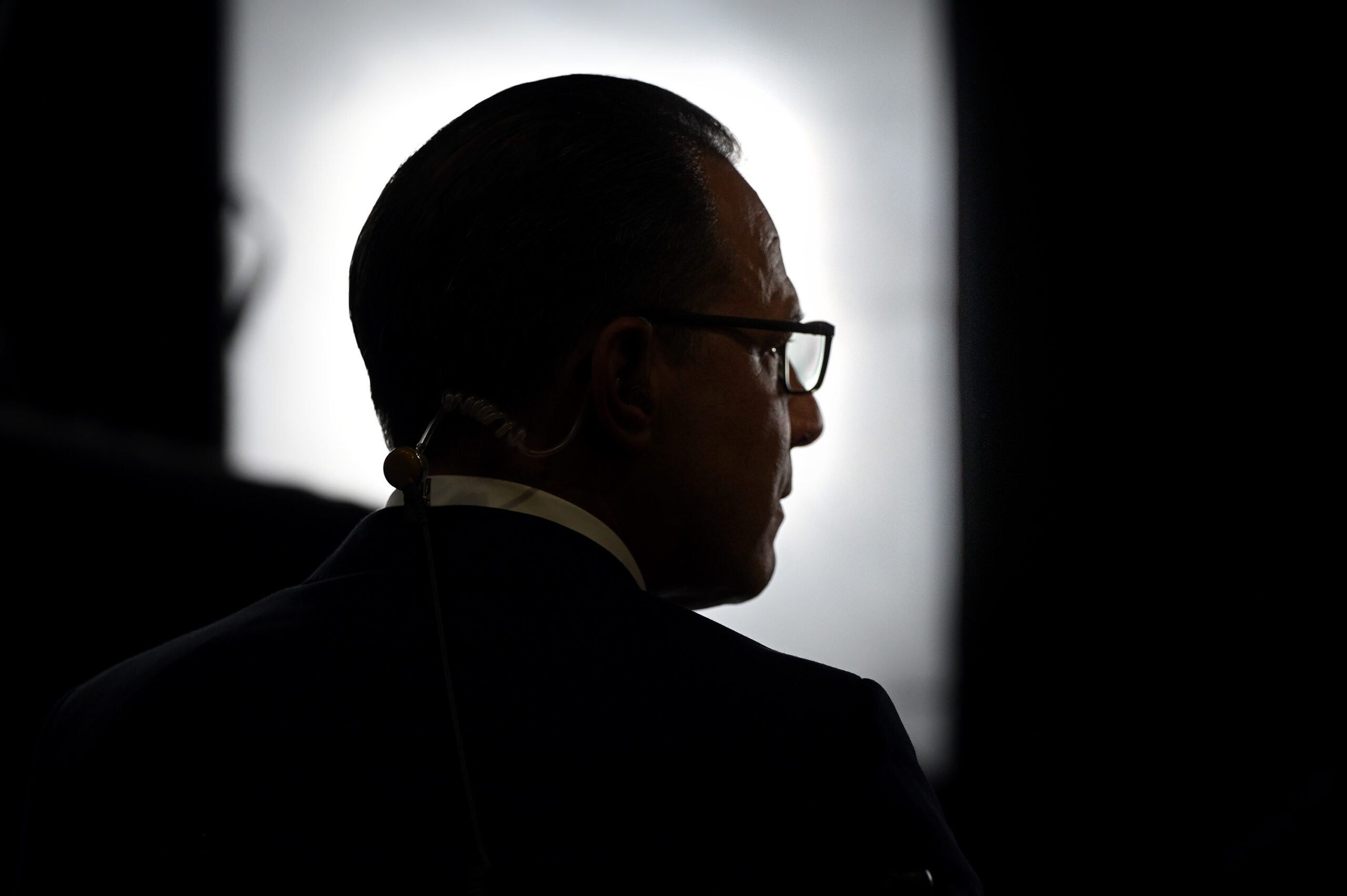
    Gov. Josh Shapiro is interviewed by TV news in the spin room at the Convention Center following the debate between former President Donald Trump and Vice President Kamala Harris Tuesday, Sept. 10, 2024.

    “The challenge, of course, is you have to take care of your next election first,” said Christopher Borick, a pollster at Muhlenberg College. “Of anything he does, he knows this is the most important thing for his potential success in 2028 if he was to run.”

    The former Pennsylvania attorney general, Montgomery County commissioner, and state representative has never in 20 years suffered an electoral defeat. Being passed over for Vice President Kamala Harris’ running mate in 2024 kept that winning streak alive.

    In the governor’s race, Shapiro will likely face a more formidable opponent in Garrity than he did in state Sen. Doug Mastriano (R., Franklin) in 2022, but he’ll also be running in a far more favorable political atmosphere for Democrats amid souring attitudes toward President Donald Trump and the GOP. If he can retain the governor’s mansion decisively and bring a ticket of Democrats vying for the statehouse and Congress to victory with him, that’s a narrative that could be strong in a Democratic presidential primary.

    “Having a win, and maybe an impressive one in Pennsylvania, the key swing state heading into that cycle, is about as big of a boost as any that you can have,” Borick added.

    Running local

    The 2028-curious Democrats include several other sitting governors generating buzz: California’s Gavin Newsom, Kentucky’s Andy Beshear, Maryland’s Wes Moore, Michigan’s Gretchen Whitmer, and Illinois’ JB Pritzker. Shapiro has formed alliances with several of them.

    But unlike some of his peers, Shapiro hasn’t been a frequent guest on cable news or podcasts with national reach.

    That’s not to say he hasn’t made moves toward a potential presidential run.

    On Oct. 4, 2024, nearly a month before Harris lost the presidential election to Trump, Shapiro confidentially requested that the state ethics commission determine whether he would violate any state ethics laws for accepting royalties from a book about his life in public service, according to the filing.

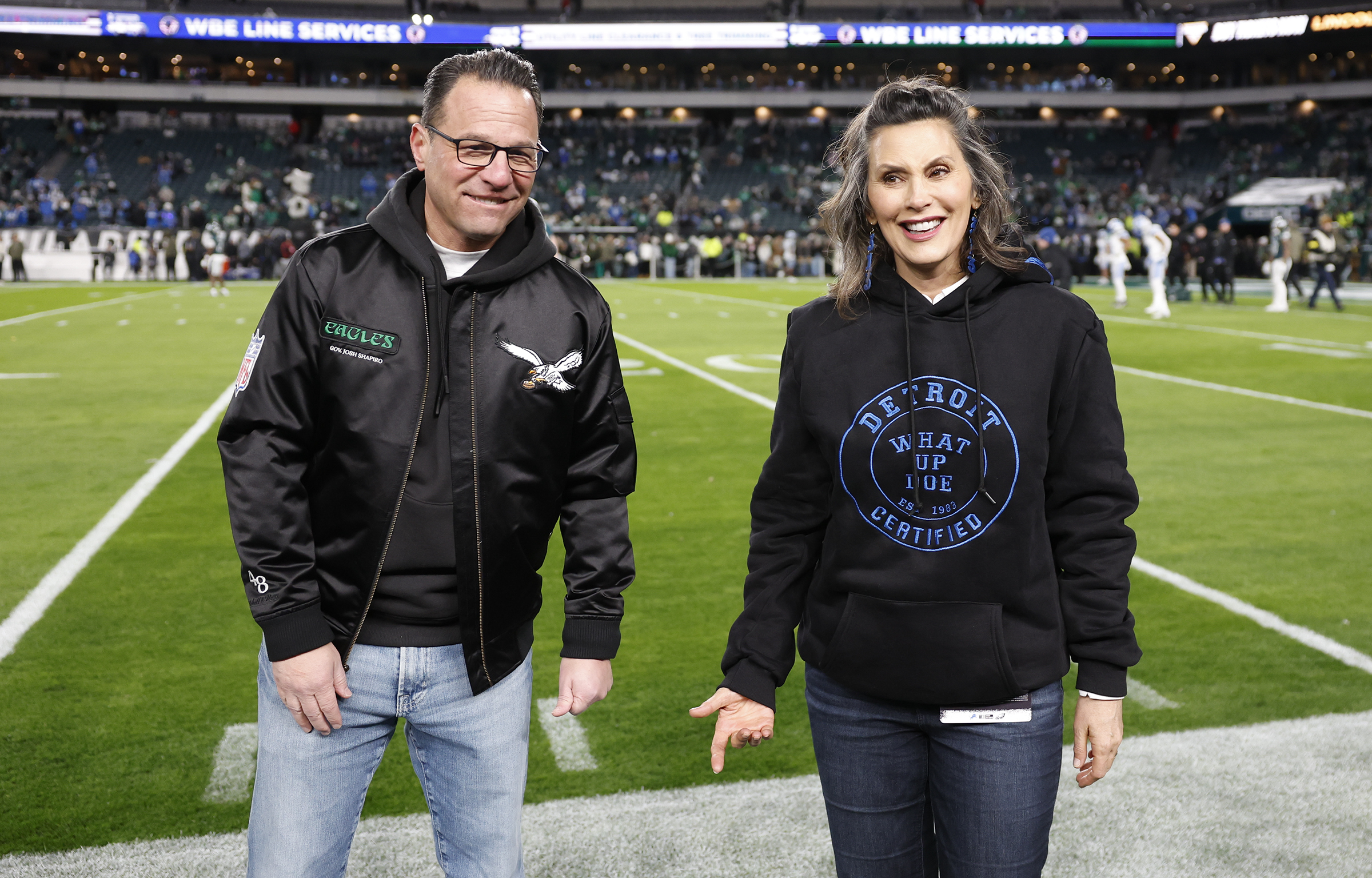
    Pennsylvania Gov. Josh Shapiro (right) and Michigan Gov. Gretchen Whitmer before the Eagles played the Detroit Lions at Lincoln Financial Field on Sunday, Nov. 16, 2025, in Philadelphia, PA.

    His book, Where We Keep the Light, will publish later this month, recounting his political upbringing, his vice presidential vetting, and the firebombing of his home last year. He’s not alone. Harris published a memoir about the 2024 election last year, and Newsom is due out with Young Man in a Hurry: A Memoir of Discovery in February.

    But in the coming months, several Democratic strategists predict Shapiro will be squarely focused on the governor’s race he has to win in Pennsylvania — simultaneously proving he has what it takes to capture the vote of the nation’s most important swing state.

    “He’s such a careful politician. He’s not taking anything for granted,” said former Gov. Ed Rendell, a Democrat who also once faced scrutiny for having potential presidential ambitions.

    Shapiro is likely to follow the same campaign playbook in Pennsylvania as he did in 2022: Stump in every region of the state, including areas where Democrats don’t usually show up. That helped him run down the margins in longtime GOP strongholds like Lancaster or Schuylkill Counties toward his resounding victory over Mastriano. Those stops in most of Pennsylvania’s 67 counties won’t give him as much time to visit South Carolina, Iowa, and New Hampshire, as the other Democratic presidential hopefuls start their sojourns.

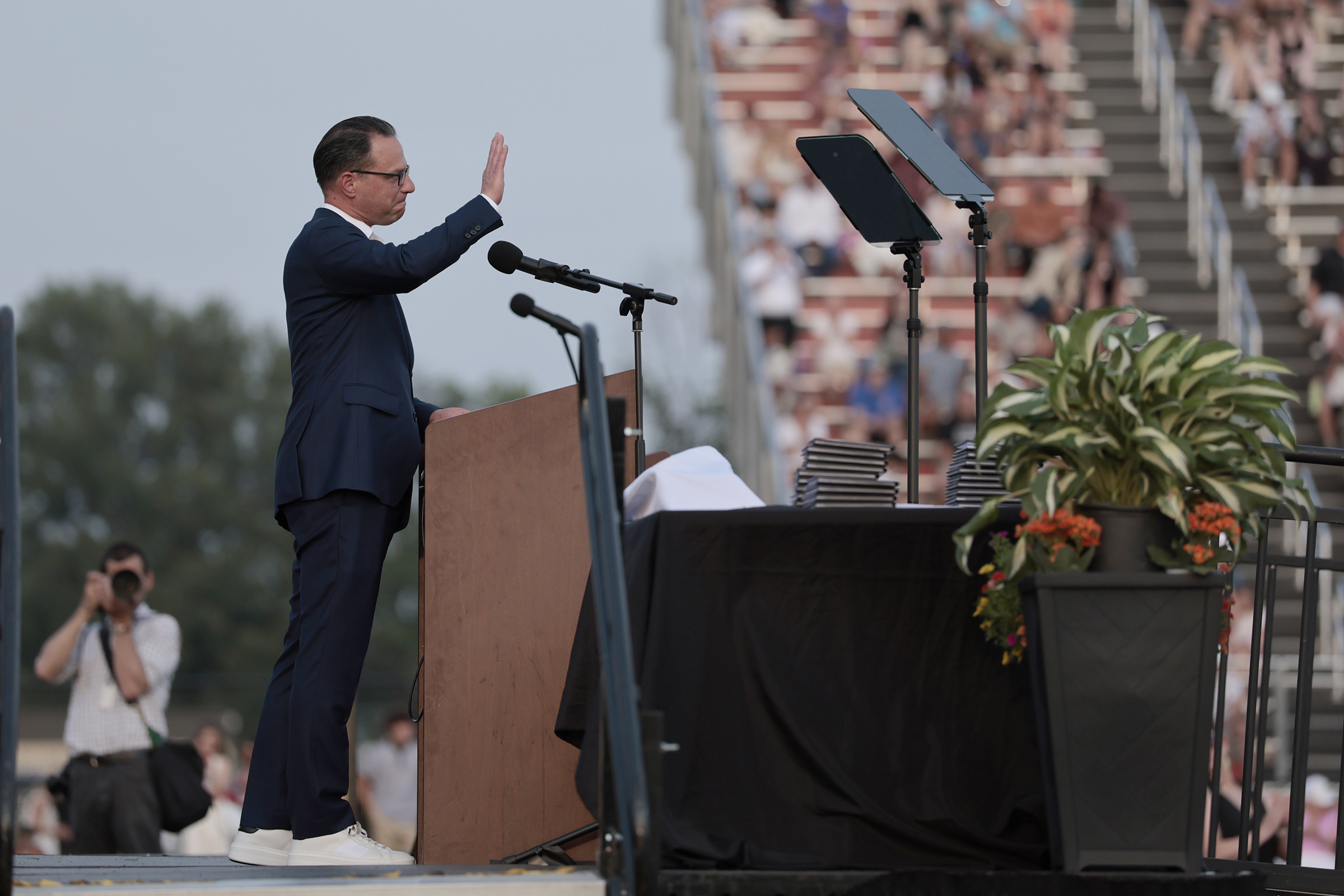
    Pennsylvania Governor Josh Shapiro waves goodbye to the crowd after speaking during graduation ceremonies at Pennsbury High School in Fairless Hills on Thursday, June 12, 2025.

    “The No. 1 caveat is stay focused on the race you’re running,” echoed Alan Kessler, a national fundraiser based in Philadelphia who has supported and fundraised for Shapiro.

    Still, the campaign is likely to generate attention beyond the Keystone State.

    Shapiro will still court donors in blue states as he fundraises for reelection, Kessler added.

    Come November, he will be the only governor with rumored 2028 aspirations up for reelection in a swing state. And his brand as a popular, moderate Democratic governor trying to restore trust in government — as well as his potential to help boost Democrats down ballot — will easily capture a wider audience and bring national media into Pennsylvania.

    As Democrats seek to flip control of the U.S. House in 2026, targeting several congressional districts in the state, the election may once again come down to Pennsylvania, and in turn, increase the spotlight on Shapiro. The governor is widely seen as someone who can boost the congressional Democratic candidates also on the ballot, having won three of the four districts that Democrats are targeting in the state by double digits in 2022.

    “Every single Democrat that I know that’s running for office in 2026 in Pennsylvania wants the governor to campaign with them,” Democratic state party chair Eugene DePasquale said.

    Preparing for an onslaught

    Republicans have targeted several weaknesses to try to erode Shapiro’s popularity in Pennsylvania and boost Garrity. They point to a lack of rigorous electoral challengers in his past. They question his record of “getting stuff done” — his oft-repeated motto — including three late state budgets. And they’ve harped on a lack of transparency as governor, including claims he used tax dollars for political benefit as well as a sexual harassment scandal involving a former top aide. They’ve also criticized his support for Minnesota Gov. Tim Walz, who recently dropped his third gubernatorial bid following a fraud scandal among the state’s Somali refugee population totaling $1 billion, according to federal prosecutors.

    Among the emerging attacks: Republicans want to highlight Shapiro’s presumed presidential ambitions, as they try to cast him as an opportunist more interested in a future White House bid than the problems of everyday Pennsylvanians.

    “Josh Shapiro is more concerned with a promotion to Pennsylvania Avenue than serving hardworking Pennsylvanians,” Garrity said in a statement, noting the state fared poorly in U.S. News and World Report rankings on the economy and education. “In the military, I learned the importance of putting service before self. Pennsylvanians are the hardest-working, most compassionate, strongest people in the nation, and together we will return Pennsylvania to our rightful place as a national and global leader.”

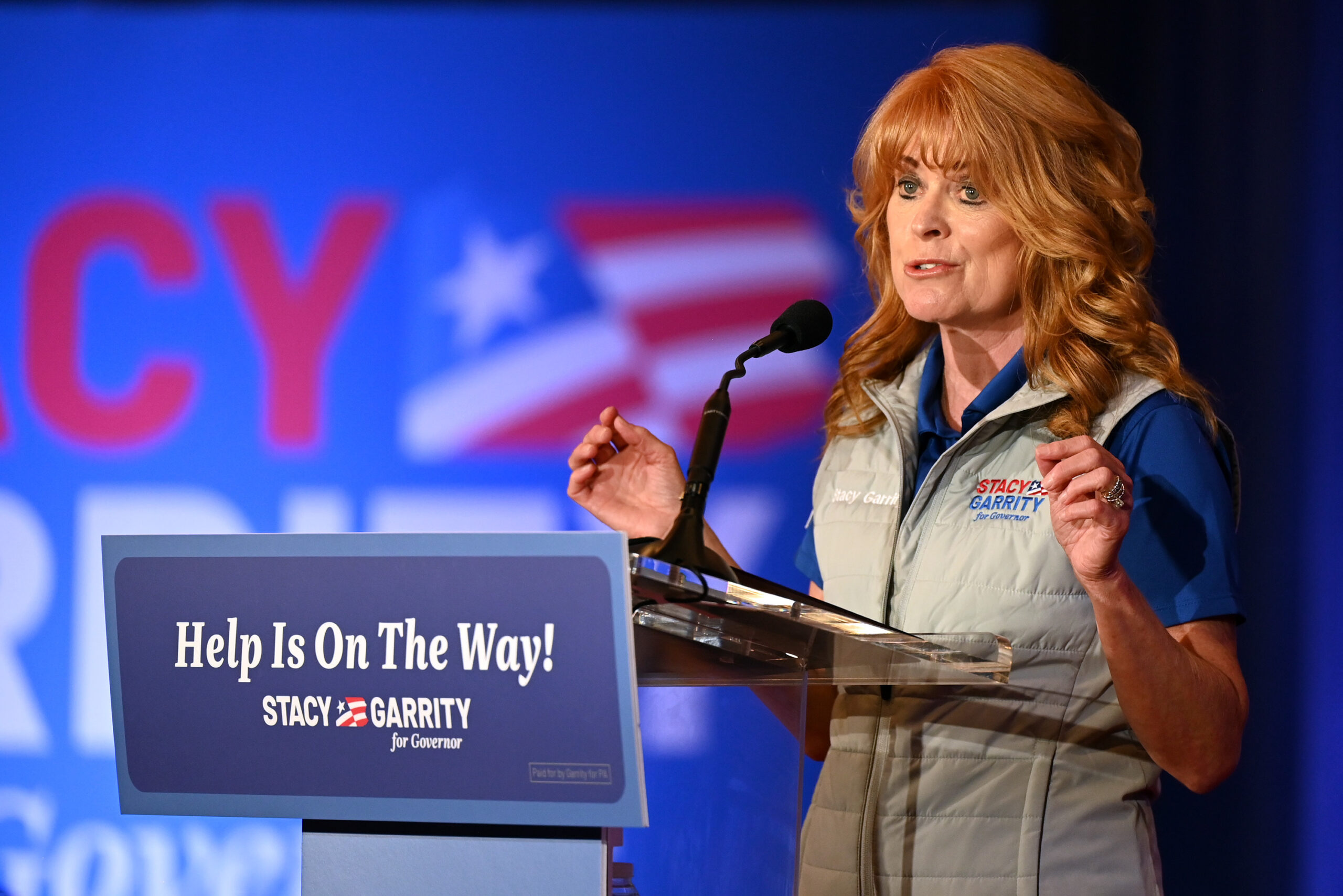
    State Treasurer and Republican candidate for governor Stacy Garrity holds a rally in Bucks County Sept. 25, 2025 at the Newtown Sports & Events Center.

    There are lingering missteps that could come up in a reelection campaign or afterward. He was unable to secure a long-term funding stream for mass transit, requiring him to use capital funds to keep SEPTA operating. He has yet to follow through on his support for school vouchers, a GOP-selling point for him that angered the powerful teachers’ unions in the state. And he’s faced questions over a number of actions his administration has taken, including $1.3 million in security improvements to his personal home following the attack on the governor’s residence in Harrisburg, his use of the state plane, and his transparency in open records requests, among others.

    Mastriano, the far-right Republican state senator who announced Wednesday he won’t run for governor, said in a statement earlier this week that Shapiro “owes [Pennsylvanians] straight answers” over his use of the state plane, security updates to his personal home in Abington Township, and more.

    “Pennsylvanians deserve accountability, not ambition,” he added, making a nod to Shapiro’s potential longer-term plans.

    House Speaker Joanna McClinton, back center left, Gov. Josh Shapiro, front center, and State Rep. La’Tasha D. Mayes, right, celebrate the signing of the CROWN Act, which prohibits discrimination based on a person’s hair type, during a press conference at Island Design Natural Hair Studio, in West Philadelphia, November 25, 2025.

    Borick, the pollster, was skeptical that attacks on Shapiro’s potential wider ambitions could reverse his largely positive public sentiment.

    “If that’s all they got, they don’t got a lot.”

    Republicans insist they see a path to victory for Garrity in a politically divided state with months to go until the election. But behind the scenes, some Republicans are already acknowledging the goal is to lose by less and prevent big losses in state legislature or congressional races.

    If Shapiro does look poised to cruise to victory, it might mean less media attention on the race, and it could mean he’s less vetted ahead of a much bigger stage.

    “I think Josh is better served if the [Republican Governors Association] puts $100 million into this race because then it’s nationalized,” said a Democratic political strategist based in Pennsylvania who did not want to be named speculating on Shapiro’s presidential run. “If it’s a cakewalk, CNN’s not gonna cover it …If he wants to be governor for another four years, he should pray for a cakewalk. If he wants to be president, he should pray for a difficult campaign.”

    Florida Gov. Ron DeSantis, for example, the strategist noted, cleaned up in his 2022 reelection, but failed to gain traction in the GOP presidential primary that Trump dominated.

    Beyond 2026

    Shapiro speaks Pennsylvanian very well. Raised in Montgomery County, he’s lived here almost all of his life, and has built an image as a popular moderate focused on problem-solving in a purple state. That’s earned him the support of about 30% of Trump voters in the state.

    But winning a general election in Pennsylvania is different than winning a Democratic presidential primary.

    He’s tried not to alienate the MAGA base, focusing on issues with bipartisan appeal like funding for apprenticeship and vocational-training programs. He’s taken on Trump in court, but has picked his personal battles with the president more carefully.

    But being a strategic, self-described “progressive pragmatist” can end up alienating voters on both sides.

    Gov. Josh Shapiro leaves after an event at the Port of Philadelphia Thursday, Apr. 10, 2025, the day after President Trump paused some tariffs.

    Becky Carroll, a Democratic political consultant in Chicago who has worked with Pritzker, said Shapiro seems less on the radar of voters in the Midwest. As she’s followed Shapiro’s career, she said she sees a “damn fine governor,” but someone who’s taken a more muted approach to Trump than blue state governors like Pritzker and Newsom.

    When it comes to a Democratic primary, candidates may be judged in part on their pushback to Trump, she said. “I think we’re in a moment where you can sulk in a corner and hope it’ll all go away or fight …,” Carroll said. “And if you’re gonna put yourself out there for a primary battle, you better show you have battle scars to prove you can fight for the most vulnerable in the country right now.”

    Gov. Josh Shapiro is interviewed by TV news in the spin room at the Convention Center following the debate between former President Donald Trump and Vice President Kamala Harris Tuesday, Sept. 10, 2024.

    But other national strategists see Shapiro’s moderate appeal as a potential asset in 2028. Jared Goldberg-Leopold, a former communications director for the Democratic Governors Association, thinks Shapiro’s biggest asset is his electoral track record in a state the nation knows is critical on the path to the White House. Primaries have previously been won by moderates whom the party thinks have the best chance at winning the general.

    But the first step, Goldberg-Leopold stressed, is the governor’s race ahead.

    “It would be easy for the Eagles to look past the 49ers to the next week of playoffs, but they’ve gotta focus on only one thing. And the same is true for the governor,” he said. “You can only prepare for what’s ahead of you, and the way people get in trouble in politics is planning too many steps ahead.”

    Staff writer Katie Bernard contributed to this article.

  • Pa. and N.J. lost thousands of jobs after federal workers signed up for Trump resignation program

    Pa. and N.J. lost thousands of jobs after federal workers signed up for Trump resignation program

    The number of federal government employees in the Philadelphia region plunged in October, according to new employment data that appear to reflect the departure of thousands who opted into President Donald Trump’s resignation program.

    Trump’s cuts to the federal workforce over his first year in office became clearer Wednesday with the release of new employment data from the U.S. Bureau of Labor Statistics (BLS). Across Pennsylvania and New Jersey, thousands of federal jobs were cut from September to October.

    It was the first time the government’s deferred resignation program has been reflected in local employment data. First offered in January 2025, this program allowed federal employees to resign from their jobs while continuing to receive pay. For many, the program ended Sept. 30. While it may have been months since they had completed duties related to their federal jobs, the end of the deferred resignation period is when they officially stopped being employed by the government for purposes of employment data.

    window.addEventListener(“message”,function(a){if(void 0!==a.data[“datawrapper-height”]){var e=document.querySelectorAll(“iframe”);for(var t in a.data[“datawrapper-height”])for(var r,i=0;r=e[i];i++)if(r.contentWindow===a.source){var d=a.data[“datawrapper-height”][t]+”px”;r.style.height=d}}});

    “The federal workforce is …in communities like Philadelphia, and we are part of the economy,” said Philip Glover, a union leader with AFGE District 3, which represents federal workers in Pennsylvania and Delaware. The recent local job loss will have ripple effects, he said. It “affects stores, transit, it affects tax bases, all of those things are affected,” he said.

    Federal agencies in the Philadelphia metro area — a region that includes Camden and Wilmington — shed about 2,900 jobs in October, down 5.3% from September. It was the steepest month-over-month decline since July 2010 and the fourth biggest since at least 1990.

    Pennsylvania lost overall about 4,800 federal jobs in October, a 4.8% drop and the largest month-over-month decrease since October 2020.

    New Jersey lost about 1,200 federal jobs in October.

    In nearly five years, employment overall has grown 12.6% in the Philadelphia metro area, but regional gains in federal employment have now been completely wiped out by job losses in the past year.

    window.addEventListener(“message”,function(a){if(void 0!==a.data[“datawrapper-height”]){var e=document.querySelectorAll(“iframe”);for(var t in a.data[“datawrapper-height”])for(var r,i=0;r=e[i];i++)if(r.contentWindow===a.source){var d=a.data[“datawrapper-height”][t]+”px”;r.style.height=d}}});

    The handful of larger prior declines in federal employment for Pennsylvania and Philadelphia came during the recessions of the early 1990s and 2000s, the Great Recession and its aftermath, or the COVID-19 pandemic — periods during which economic activity slowed and the federal government experienced a decline in tax revenue.

    The deferred resignation would have been reflected in a November release, but it was delayed because of the federal government shutdown, which stretched through early November.

    The federal employment figures include all full- and part-time civilian employees, including those of the Postal Service. But it does not include armed forces and intelligence agencies such as the CIA and NSA.

    Why federal workers resigned

    Paul Kenney spent almost 30 years at the National Park Service in Philadelphia — more than two decades in the Northeast Regional Office on Market Street in river protection and six years at Independence National Historical Park.

    All that came to a halt in March 2025. Kenney decided the Trump administration’s efforts to significantly reduce the federal workforce was too much. He felt demoralized and also concerned that a bill in Congress at the time would impact his pension.

    The 59-year-old decided to retire three years early, despite wanting to stay in the workforce. He had just scored some highly coveted grants for restoration efforts in the parks. He remains involved with his union, AFGE Local 2058, as a vice president.

    By the end of May, five people from Kenney’s 11-person team at the Northeast Regional Office left; almost all had opted to take an early retirement.

    “The pressure really was all DOGE,” Kenney said, referring to the Department of Government Efficiency Trump launched soon after taking office. It was a “grim” experience for those in the federal workforce, he added.

    Kenney is one of the thousands no longer on government payroll. Federal employees were laid off, took early retirements, and resigned in 2025 amid Trump’s workforce overhaul.

    Beyond layoffs earlier in 2025, the Trump administration sent termination notices during the government shutdown that started on Oct. 1. Those firings were ordered to be reversed under the deal to end the shutdown.

    Where are federal workers employed?

    In Pennsylvania, federal employment represented about 1.52% of all jobs as of November, down from around 1.69% for the same month in 2024, according to the new data.

    In New Jersey, federal workers represented about 1.05% of jobs overall as of November, down from around 1.13% in November 2024.

    The most recent BLS data are not broken down by agency or department, but data from March 2025 from Pennsylvania’s Department of Labor and Industry indicate that in Southeastern Pennsylvania, the largest employers of federal workers are the U.S. Postal Service, the Department of Defense, and the Department of the Treasury.

    window.addEventListener(“message”,function(a){if(void 0!==a.data[“datawrapper-height”]){var e=document.querySelectorAll(“iframe”);for(var t in a.data[“datawrapper-height”])for(var r,i=0;r=e[i];i++)if(r.contentWindow===a.source){var d=a.data[“datawrapper-height”][t]+”px”;r.style.height=d}}});

    Nationally, the federal government shed about 162,000 jobs in October, down 5.6% from September and 8.7% from the previous October. The government lost a further 6,000 jobs in November.

    There were about 2.74 million federal employees nationwide as of November, compared with about 3.02 million at the start of 2025. The country experienced a loss of 271,000 federal jobs from January through November.

    That’s not far off the 300,000 federal jobs that the Trump administration had said would be cut by the end of 2025. Data for the remainder of the year will be available later this month.

    “What it’s doing is putting a strain on the remainder of the workforce to continue operations,” said Glover. “That increases stress levels, it doesn’t increase efficiency.”

    Meanwhile, the federal government could shut down again, albeit partially, if legislators don’t reach a funding deal by Jan. 30.

    And with that in mind, Glover said, additional federal workers may be thinking about quitting. “I think people are making decisions now whether they’re gonna stay if that happens again.”

  • Mark McKenzie’s plan to crack the USMNT’s World Cup roster? Sticking to what’s in his ‘control.’

    Mark McKenzie’s plan to crack the USMNT’s World Cup roster? Sticking to what’s in his ‘control.’

    Mark McKenzie needed November.

    When he returned to the Philly area for the U.S. men’s national team’s penultimate game of 2025 against Paraguay, it was a homecoming that he said grounded him.

    He was groomed in the Union’s academy system, having spent three seasons as a homegrown player on the club’s first team, but this marked the first occasion in quite some time that McKenzie, a native of Bear, Del., returned to his old grounds.

    Well, they were technically all-new grounds, considering that when he came up the ranks, Subaru Park was named Talen Energy Stadium, and the sprawling expanse that is now the WSFS Sportsplex was still a rendering.

    But being back, seeing familiar faces, training with the national team in Chester, and even briefly seeing a few family members brought perspective to what he’s ultimately trying to do: find his name among 25 other hopefuls eager to make the American roster ahead of June’s FIFA men’s World Cup.

    At the time, McKenzie, 26, noted that packing in all of that perspective was part of a “business trip,” one that has continued under the watchful eye of U.S. men’s manager Mauricio Pochettino as the starting center back for Toulouse, in France’s first division.

    Mark McKenzie (3) has appeared in 17 matches for Toulouse this season, with 16 starts at center back.

    “It’s always special coming back to Philly,” McKenzie said following the U.S. win against Paraguay at Subaru Park on Nov. 15. “I saw some old friends, my family came by the hotel, and just that time to take a little stroll and grab a bite to eat reminded me of who’s been behind me on this journey, and who I’m playing for.”

    Playing time has been consistent for McKenzie, who has appeared in 17 league matches for Toulouse this season, starting 16 at center back. That bodes well, as Pochettino has repeatedly noted that consistency in match play is a plus in his eyes. And considering there’s not a clear early favorite as the No. 2 center back on the field for the Americans, McKenzie has to know that his chances are as good as anyone’s.

    “The biggest thing is controlling what I can control,” McKenzie said. “Sure, I think about that stuff, but ultimately it’s not up to me. That’s my mentality, my attitude going into my performances.”

    Defensively, McKenzie is taking control of a Toulouse team that is eighth in the Ligue 1 standings, just two spots outside of qualifying for the UEFA Europa League next season. There’s still plenty of time for McKenzie and the team to climb before the season concludes in May, though it will take a better run than the seven points out of a possible 15 the club has collected in its last five league matches.

    “Going back to my [home] club [in Toulouse], that’s where a lot of the hard work is done,” he said. “So I’m just handling myself in those ways, and just not trying to worry about the things outside my control. My job is to keep getting selected for my club, play well, and hope it’s enough to prove that I deserve the opportunity to represent my country.”

    Trying to qualify for the second men’s World Cup in the United States isn’t the only thing on McKenzie’s mind. In October he became a dad, and he is trying to find the balance between those early days of fatherhood, his responsibilities to his club, and staying on Pochettino’s radar.

    It seemingly worked out as McKenzie was called up for every U.S. camp in the fall cycle in October and November. In October, he told CBS Sports that the birth of his son made him feel like he had “more to play for.”

    And even though his baby wasn’t old enough to understand the rigors McKenzie is going through, having his son while going through this process appeared to mean the world to the center back.

    “He can’t really hold his head up right now, and he’s not really watching …,” joked McKenzie on CBS Sports’ Morning Footy show in October, “but when we look back on these moments, this is something that I’ll cherish forever; just to say that he’s out there watching his daddy play is something that I’ll hold dear to my heart.”

    In just his second game with the national team since becoming a father, Mark McKenzie (left) battles Australia’s Connor Metcalfe in their meeting on Oct. 14, 2025.

    If fate has its way, McKenzie would be one of four players in the U.S. player pool who came up in the Union’s academy system or spent time on the club’s first team who could find themselves on the World Cup roster.

    That list includes Medford’s Brenden Aaronson, Wayne native Matt Freese, and Media’s Auston Trusty, the latter also vying for a spot along the back line. Each player has been invited to recent camps, and there’s a belief that one, if not all, has a good chance to crack Pochettino’s World Cup squad.

    But there’s still time before that happens. Six months, to be exact — meaning all McKenzie can do is focus on the now.

    After all, it is the only thing in his control.

    “Look, I’m trying to make the decision as difficult as possible [for the U.S. coaching staff],” he said. “I only do that by being at my best when I’m with my club and making the most of my opportunities when I get them. I just plan to do what I do and showcase my talent to the best of my ability, and hope that’s enough.”