Bob Borzillo has a deal with his wife Terri: She puts everything in the dishwasher, but he has to unload it.
That’s what he was doing on a night in November, after the couple had arrived back home in Willistown from Barcelona. He was putting the very last thing — a wine glass — away. That’s where the 65-year-old’s memory stops.
But for Terri Borzillo, also 65, that’s where a terrifying ordeal began.
She had been just a few feet away, writing in her journal as her husband unloaded the dishwasher in the background. She heard him groan and glass shatter. She got up to help him, expecting to find him picking up glass shards. Instead she found him on the floor, unresponsive.
What they did not know then was that a piece of plaque had broken off, completely blocking his artery. He was in cardiac arrest — not breathing, no pulse. After having walked around Barcelona, averaging 18,000 steps a day, he had no symptoms, no warning signs, until he collapsed in their kitchen.
More than 350,000 people annually experience cardiac arrestoutside hospitals, and only one in 10 survives, said Jeffrey Salvatore, the vice president of community impact for the American Heart Association of Greater Philadelphia.
The association has been leading a campaign to teach more teens and adults hands-only CPR to increase bystander response rates. Nationally, 40% of those who experience cardiac arrest each year are helped by a bystander. The rate in the Philadelphia region is significantly lower: less than 26%.
The association also holds telecommunicator CPR training, so dispatchers can instruct people over the phone on how to provide CPR, said Salvatore.
“Cardiac arrest is 100% fatal without any intervention. If nobody does anything for the person, there’s no chance of survival,” he said. “By just calling 911 and just doing compressions, you can still double someone’s chance of survival.”
Terri Borzillo immediately went into action, calling 911.
“I think my husband’s having a heart attack,” she remembers screaming to the dispatcher.
Calmly, the Chester County dispatcher, Kayla Wettlaufer, had Borzillo describe her husband’s condition.
“She said, ‘OK, lady, get control of yourself. We’re going to do this together,’” Borzillo recalls. “By the command in her voice, and because there was no option, I had to do this.”
Wettlaufer led Borzillo through CPR over the phone — telling her where to place her hands, when to compress. Wettlaufer even told her when it was time to unlock the front door so the nearby first responders could get in.
“It was horrible to watch my husband in that condition, and it was horrible to know that I had the balance of his life in my hands,” Borzillo said.
With Wetlaufer guiding her — and, she swears, every doctor in heaven — she did compressions until the EMTs arrived, using paddles to restart his heart.
As the EMTs wheeled Bob Borzillo out, Terri Borzillo retrieved the bottles of holy water they had picked up at Our Lady Lourdes in Barcelona. She sprayed her husband and the EMTs.
It got her an odd look, but, she said, “For somebody who has deep faith, I know all the angels and saints were there with us, and we’re smiling today instead of crying,” she said.
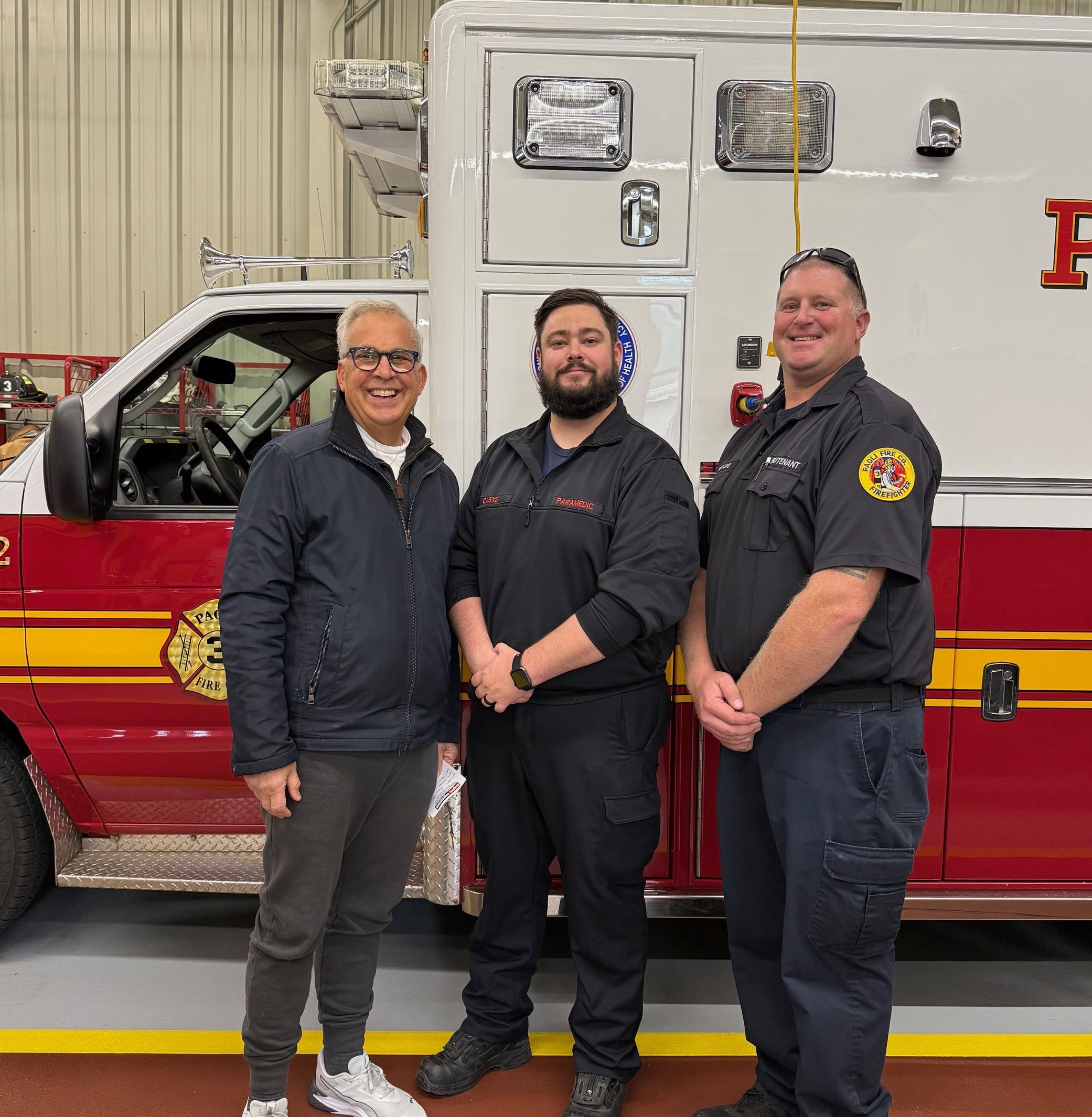
Bob Borzillo, left, takes a photo with two first responders who arrived to his home in November when he was in cardiac arrest.
Terri Borzillo’s faith runs back to their first date, more than 40 years ago. It was 1982, she was single, and her coworker asked her if she’d like to meet a nice guy. What do I have to lose? she thought. Acting as an intermediary, that colleague — a friend of Bob Borzillo’s family — told Bob about Terri. The young man’s father happened to know Terri’s father. He told his son, “Call that girl.” Bob listened.
On their blind date, Terri Borzilloknew he was the one. There was something to how he talked, explaining — of all things — turbine generators.
He really was a nice guy, she thought. (“I was a nerd,” he said.) She felt something click. Dear God, she thought, let him ask me out again.
One big Italian wedding, three sons, and seven grandchildren later, the two have lived in Chester County for more than 40 years.
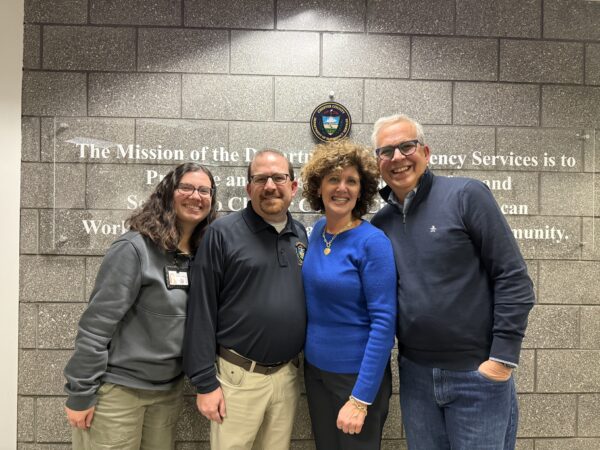
This experience has made him proud to be a county resident, Bob Borzillo said. After he was released from the hospital a few days later, Borzillo went to the firehouse and met the first responders. He and his wife met Wettlaufer, and toured her workplace.
Wettlaufer, an operator who has been with the county for almost five years and was honored by the county this month, was the start of a well-oiled machine, Borzillo said. Their proximity to the firehouse and Paoli Hospital helped get him professional care quickly.
“If the Eagles offense executed that efficiently, we would have been in the Super Bowl,” he said.
Terri Borzillosaid meeting Wetlauferhelped ease the trauma of the situation.
“She’s beautiful. And what they do there is amazing, and they get all of the credit,” she said.
Saturday marks three months since Bob Borzillo’s cardiac arrest. He and his wife are in Florida while he recovers, and will celebrate Valentine’s Day with friends from Chester County.
“Certainly the heart and what Valentine represents has a special meaning this year, and I am blessed to be here to celebrate it,” he said in an email.
This suburban content is produced with support from the Leslie Miller and Richard Worley Foundation and The Lenfest Institute for Journalism. Editorial content is created independently of the project donors. Gifts to support The Inquirer’s high-impact journalism can be made at inquirer.com/donate. A list of Lenfest Institute donors can be found at lenfestinstitute.org/supporters.
But inthe Philadelphia region, only 26% of people suffering cardiac arrest receive bystander intervention, saidJeffrey Salvatore, the vice president of community impact for the American Heart Association of Greater Philadelphia. That’s much lower than the national average of40%.
Though often used interchangeably, a heart attack and a cardiac arrest are not the same, and they warrant (slightly) different responses.
A heart attack is a “plumbing issue,” where there’s some blockage in the arteries that supply blood to the heart, Salvatore said.
But a cardiac arrest is an “electrical problem;” the heart pumps through an electrical system, and when something misfires or stops, that’s when a cardiac arrest occurs. It necessitates CPR.
“When the heart stops doing its job, we have to take over, and that’s when CPR comes into play,” he said.
Someone in cardiac arrest is unresponsive, and requires immediate intervention to prevent death.
You can check for unresponsiveness by tapping someone on the shoulder, rubbing their chest, or yelling loudly. If they don’t respond, call 911, and begin hands-only CPR, pressing hard and fast in the center of the chest.
In many cases,911 operators have been trained to walk callers through delivering CPR.
A heart attack can lead to cardiac arrest, but it can also happen separately, and never result in the heart stopping, Salvatore said.
If someone is exhibiting signs of a heart attack — chest discomfort; or discomfort in other areas of the upper body, such as arms, back, neck, jaw and stomach; shortness of breath; cold sweats; light-headedness; rapid or irregular heartbeat — call 911, Salvatore said.
The American Heart Association is seeking to expand training in hands-only CPR for adults and teens, to increase low bystander-intervention rates.
Just doing chest compressions — no mouth-to-mouth contact required — and calling 911 can double someone’s chance of survival, Salvatore said.
“They are the first responder before EMS gets to the scene,” he said.
For more information, or to get CPR certified, you can go to cpr.heart.org
In 2014, after one season as the Eagles’ head coach, Chip Kelly decided he’d had enough of DeSean Jackson, who’d been kind of a headache. Jeffrey Lurie had given Kelly power over the roster, and Kelly cut Jackson.
Jackson proceeded to lead the NFL in yards per catch in three of the next five seasons, two of which were 1,000-yard seasons. The Eagles would have just one 1,000-yard wide receiver in the next eight seasons (2014-21). They later had two in the same year, 2022, and the No. 1 receiver was A.J. Brown.
Today, 12 years after Kelly’s first foolish move — he also traded running back LeSean McCoy and he drafted disappointing receivers Nelson Agholor and Jordan Matthews — the Eagles again have a high-production receiver who’s been kind of a headache. NFL sources say they Eagles are considering trading him, even though such a trade would carry severe salary-cap ramifications; about $16 million, minimum.
That receiver is A.J. Brown.
Trading him would be crazy.
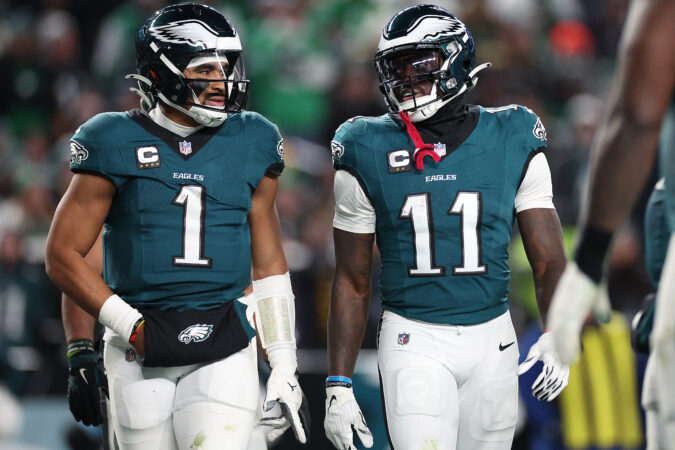
The Eagles should not even entertain offers for Brown. He is 28. He is driven. He is dedicated. He is irreplaceable. He’s spent the last four years making quarterback Jalen Hurts look good. That’s got to count for something.
Sure, he’s a diva, but then, he’s always been a diva. He was a diva when they traded for him four years ago. Brown immediately hung an “Always Open” sign above his locker. Huge diva move.
He has, at times, looked exasperated on the field. He has argued with coach Nick Sirianni on the sideline. For the last two seasons he’s continually criticized the offense both in person and on social media. The Eagles let him get away with it because they knew he’d still play well. They also let him get away with it because they knew, when they made the trade, and when they extended his contract twice, that he was likely to act like this.
Think about it: If you let your kid throw tantrums on the floor of the grocery store for three years, you can’t expect him to stop throwing tantrums when he’s 4. You just hope the tantrums aren’t so bad you can’t keep shopping.
Could this behavior be a distraction? On most teams, yes. But nobody in the Eagles locker room pays much attention to Brown’s antics.
“There is a genuine appreciation for A.J,” Jason Kelce said Wednesday on 94 WIP.
Kelce has been retired for two seasons, but he remains well-connected to his former coaches and teammates. On Wednesday, Kelce also noted that Brown’s frustrations might be limiting the receiver’s effectiveness. Kelce certainly would know. In his final season, Kelce, himself an emotional player, counseled Brown on harnessing frustration.
Both Kelce and Brown’s current teammates know Brown for who he is. They also know the Eagles cannot afford the luxury of sudden sanctimony.
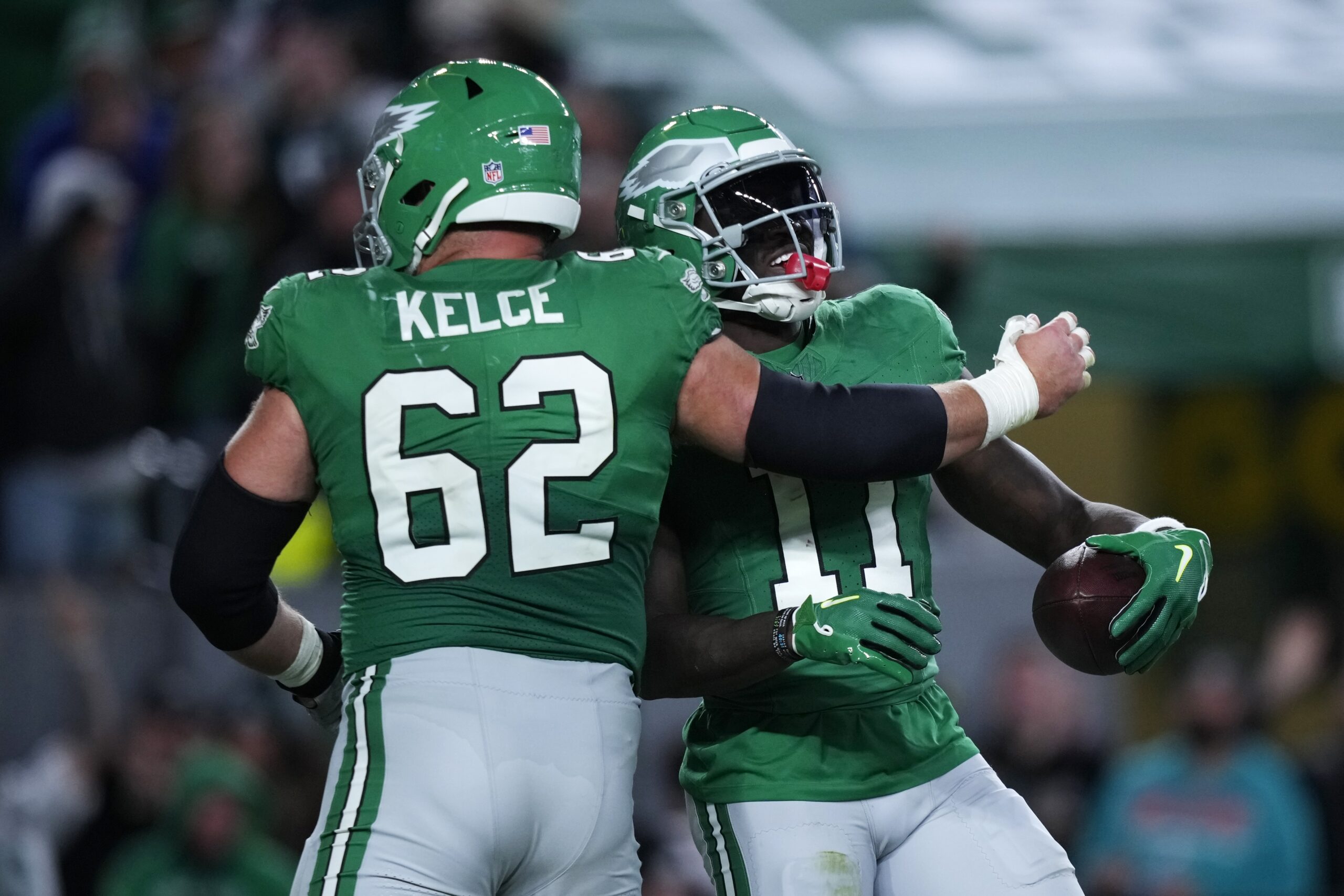
Eagles wide receiver A.J. Brown (11) celebrates a touchdown with center Jason Kelce during the 2023 season.
But does he really want to be here?
Brown hinted during the season that he might want to leave Philadelphia, posting the Bible verse Mark 6:11 after Week 4 on X: “If you’re not welcomed, not listened to, quietly withdraw. Don’t make a scene. Shrug your shoulders and be on your way.”
He then ignored the media for the season’s final two months. When he departed the locker room after the Eagles’ home playoff loss to the 49ers, he hugged several teammates in scenes that looked like permanent goodbyes.
However, last week, Brown broke his media silence on Micah Parsons’ podcast, apparently to send the message that he’d be happy to return to the Eagles.
“As an offense, we just come back and just really watch the tape and rediscover ourselves,” Brown said.
Asked if he was excited about new offensive coordinator Sean Mannion, he replied, “I’m excited for the season. I’m excited for what’s to come.”
In the bigger picture, it’s less important whether Brown wants to return than whether the Eagles can win another championship without him.
They cannot.
The Eagles have a shrinking window in which to reach another Super Bowl without a significant rebuild. They went to two of the last four Super Bowls. Get rid of Brown, and you can forget reaching a third any time soon.
He just had a 1,000-yard season in only 15 games, and that was his worst season in Philly. In 2024 he had a 1,000-yard season and played in just 13 games. He gave up on a few routes this season, and he disappeared in the wild-card playoff loss, but even when he’s bad, he’s good.
He’s gained 5,034 receiving yards on 339 catches in four seasons. That’s 387 more yards and 76 more catches than Mike Quick’s best four seasons, 986 yards and 104 catches than Harold Carmichael’s best four seasons, and 1,097 yards and 131 catches more than Tommy McDonald’s best four seasons as an Eagle. They played in different eras, especially McDonald, but if you think A.J. Brown wouldn’t have dominated in the 1950s and ’60s, then you need to YouTube some NFL Films.
Why would you trade the best receiver in team history if he’s still in his prime?
Which opens another discussion: Is Brown still in his prime?
If you look at simple stats, then probably yes. If you look at some advanced metrics, you might think his moon is waning.
For instance, Brown’s average separation last season, according to NFL Next Gen Stats, was 2.2 yards, eighth-lowest among qualified receivers. It also was an improvement; his 2.1 average in 2024 was third-lowest. But does it matter? After all, when he went to the Pro Bowl in 2022 and 2023 his separation averages were 2.6 and 2.4 yards, respectively.
Brown still consistently draws coverage from the other team’s best cornerback. He still consistently draws double teams. Last season, Pro Football Focus ranked him 11th in all-around play among receivers with at least 60 targets. He was No. 2 in drop rate.
That’s not to say he couldn’t have played better, but then, the wide receiver position is more dependent on the rest of the team than any other position.
The Eagles passing offense has averaged fewer than 195 yards per game each of the last two seasons, which seems absurd considering the weapons at Hurts’ disposal, but nobody in their right mind would consider this issue to fall at the feet of Brown, nor DeVonta Smith, nor Dallas Goedert.
In 2024, with defenses having discovered Hurts’ shortcomings and challenged Hurts’ arm, veteran offensive coordinator Kellen Moore leaned on running back Saquon Barkley and a historically dominant offensive line. That’s how the Eagles won the Super Bowl.
In 2025, opposing defenses sold out to stop Barkley, which worked, since the line had deteriorated due to age and injury. Challenged again, and with a first-time coordinator in Kevin Patullo, Hurts failed.
Not Brown. Hurts.
Let’s be real, folks.
You’re talking about trading the wrong damned guy.
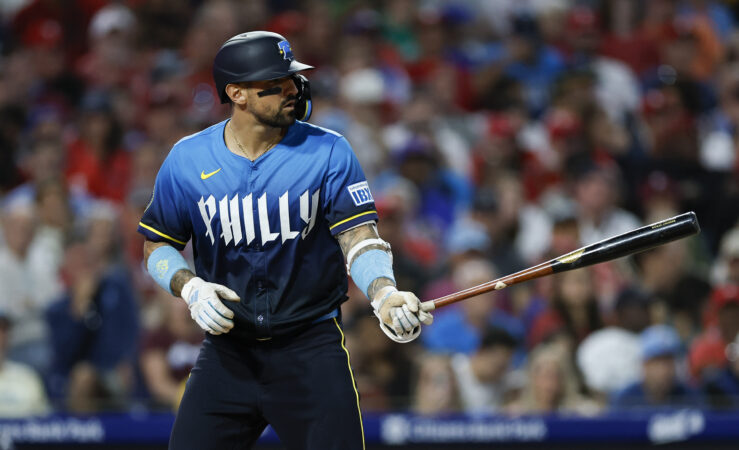
In the note, he finally filled in the blank: “Ok apparently I need to address the Miami incident.”
For eight months, the “Miami incident” hovered over the franchise without much other information. It was a turning point, but no one outside the clubhouse knew why.
Now we know his side of the story: After being pulled late in a June game in Miami, he brought a can of Presidente into the dugout and confronted Rob Thomson about what he saw as inconsistent standards. Teammates took the beer before he drank it. He apologized. The next day, his starting streak ended. And after that, the relationship was never the same.
But still, this ending lands with nostalgia.
This was the guy who turned tragic news cycles into accidental baseball folklore. The timing of his biggest hits was just uncanny. The day I-95 collapsed, or the day a president was shot at, or the day another dropped out of a race.
Then there was Liam, andthe joy of getting to experience Red October with his son in the stands. Back-to-back postseason multihomer games with his kid watching. Whatever else you thought about Castellanos, those nights felt special.
He was never boring, and that counts for something.
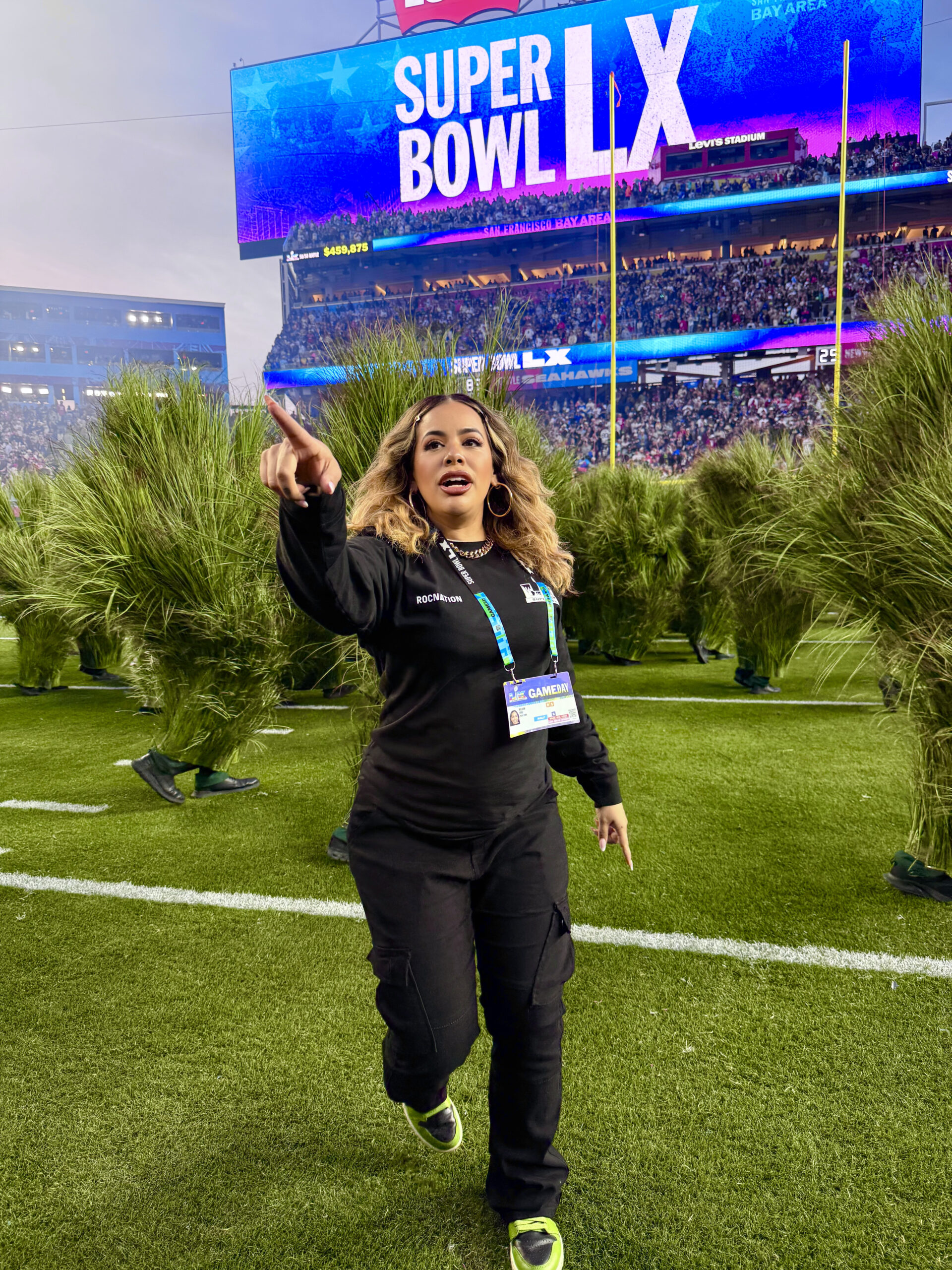
Northeast Philadelphia’s Delilah Dee walks through Bad Bunny’s halftime show stage at Santa Clara’s Levi’s Stadium, on Feb. 8 2026
An Eagles fan from Fishtown spent weeks rehearsing in a 50-pound grass suit, keeping the secret, grinding through 12-hour days, then waddling past Pedro Pascal and Cardi B on global television. A Northeast Philly marketing pro manifested her way onto the field crew and helped execute one of the most high-pressure seven-minute turnovers in live entertainment.
The plant story is peak Philly optimism: “The Eagles didn’t go, so I went for them.” That’s delusional in the best way. That’s Broad Street confidence. The field-team story hits deeper. In a halftime show centered on Latino pride and visibility, a Mayfair native who’s built community through Latin culture here in Philly ends up helping pull off the mechanics of the moment.
Would it have been better if it were an Eagle-and-Benito Bowl? Obviously. But Philly showed up anyway. Grass suit. Stage crew. Go Birds.
It hits 40 degrees and Philly declares emotional spring: A-
People are planning vacations, talking about the Cherry Blossom Festival, and declaring the worst is behind us while carefully sidestepping three-foot snowbanks and skating past frozen crosswalks. Someone said, “It’s gorgeous out,” and meant it sincerely.
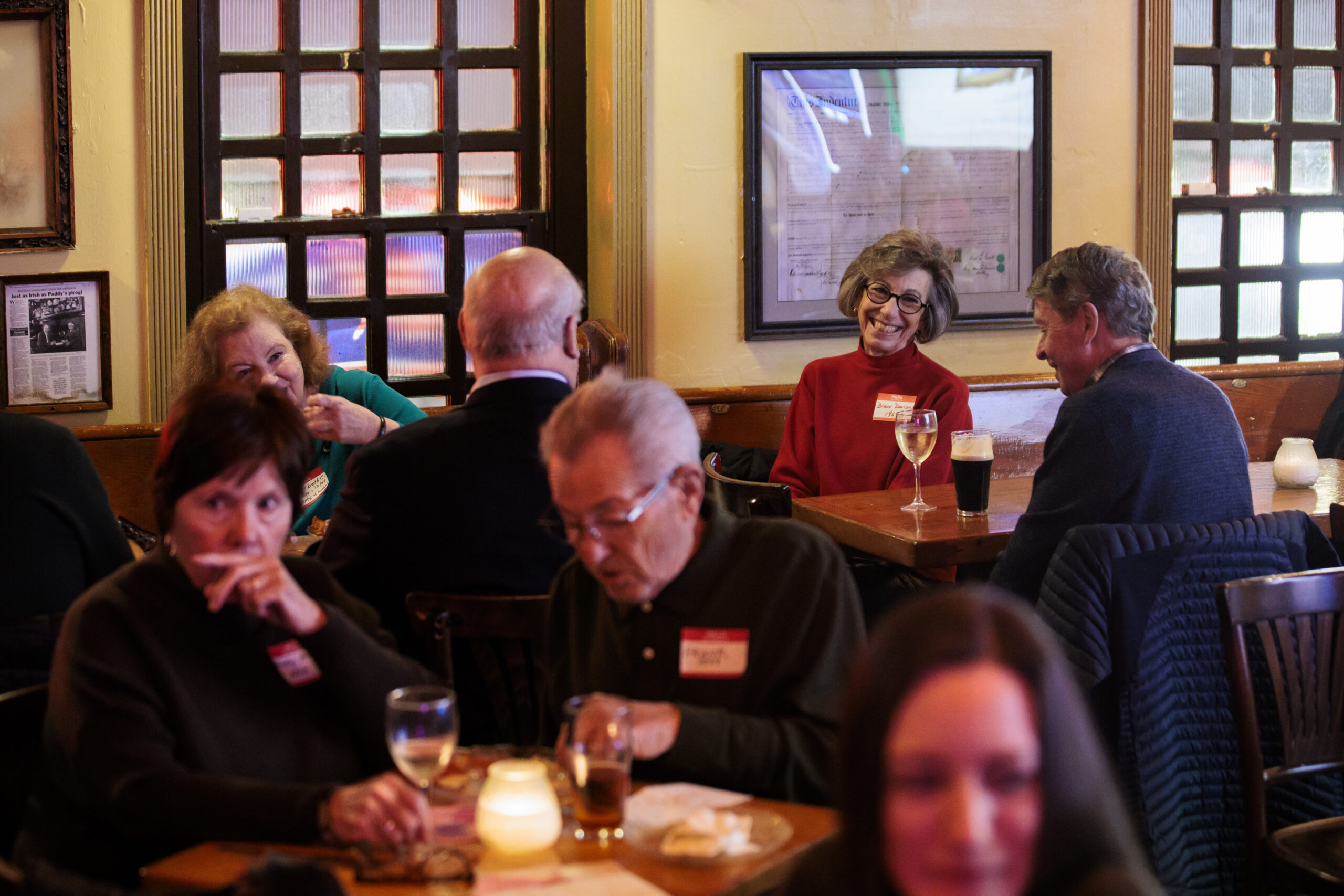
Diane and John Davison (back, right), who met here in 1969, laugh with other attendees at McGillin’s on Feb. 3, 2026. Attendees gathered for a book talk on “Cheers to McGillin’s: Philly’s Oldest Tavern.”
McGillin’s proves love doesn’t need an algorithm: A
The 166-year-old pub gathered dozens of couples this month who found love under its low ceilings and tinsel hearts. Some have been married 50-plus years while others are newlyweds who matched over wings and Yuenglings. The upstairs bar looked like a class reunion for romantics.
In a city that loves to argue about everything, this one’s hard to fight: Proximity still works. (Eye contact and beer don’t hurt, either).
There’s something deeply comforting about the idea that the most reliable matchmaker in Philly isn’t an app. It’s a place with oak tables, framed liquor licenses from the 1800s, and bartenders who’ve seen it all. At some point, the legend becomes self-fulfilling. If everyone believes McGillin’s is where love happens, eventually it does.
Pennsylvania watching eagle eggs hatch on a livestream: A
There is something deeply Pennsylvania about thousands of people spending their morning refreshing a live webcam of a bald eagle nest in an undisclosed Lancaster County tree.
More than 100 live viewers at mid-morning, with nearly 700,000 views last year. The chat section is full of viewers who are emotionally invested in avian domestic life.
There’s something quietly moving about it. Bald eagles were nearly wiped out here with just eight known active nests in 1990. Now there are more than 300.
Spring is coming. And until baseball starts, this is what we’ve got.
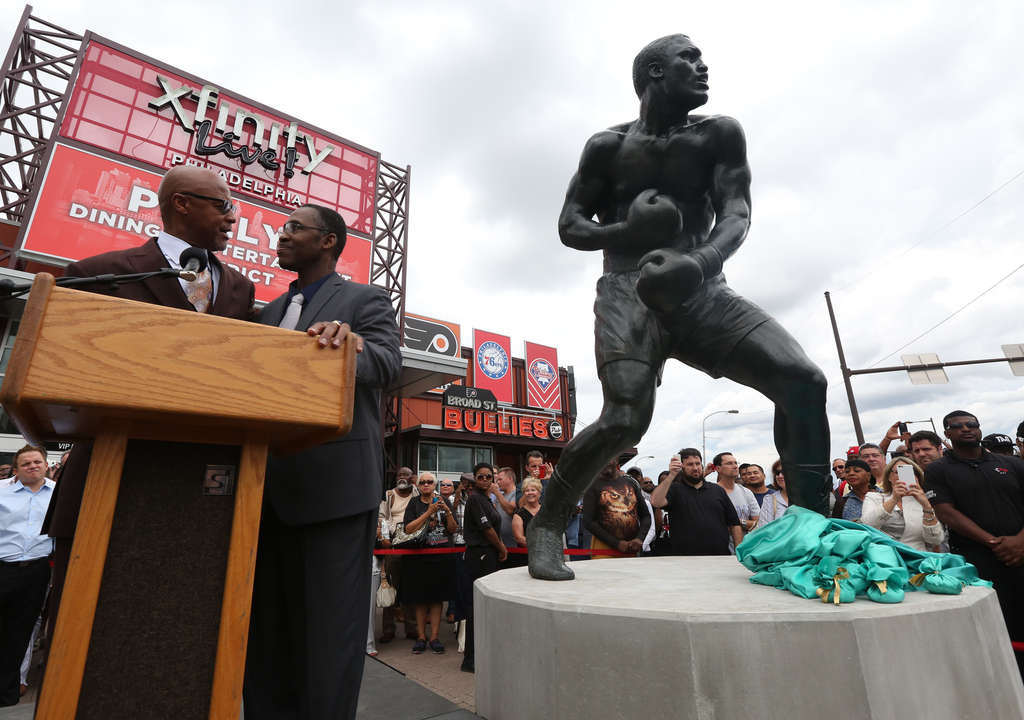
FILE – His son, and former heavyweight boxer Marvis Frazier (right), and Rev. Blane Newberry from Enon Tabernacle Baptist Church bless a 12-foot-tall 1,800-pound bronze statue of “Smokin’ Joe” Frazier after it was unveiled Saturday, September 12.2015 at XFinity Live in South Philadelphia.
The Art Commission voted unanimously to relocate Frazier’s 12-foot bronze statue from the sports complex to the base of the museum steps — the spot Rocky has occupied for two decades. Rocky, meanwhile, is headed back to the top.
On one level, the move feels overdue. Frazier wasn’t a metaphor. He was a real Philadelphian, an Olympic gold medalist, a heavyweight champion, the man who handed Muhammad Ali his first professional loss. Meanwhile, Rocky, beloved as he is, is a fictional character who may have beeninspired in part by Frazier’s life.
There’s something quietly powerful about visitors encountering Joe first, before heading up top to take a selfie with a myth.
Yes, there are valid conversations about symbolism, especially in Black History Month, about a real Black champion standing below a fictional white character. The city’s explanation is practical: Frazier’s statue is physically larger and not structurally suited for the top. Rocky’s footprint is smaller and easier to manage up there.
Logistics matter, but narrative does too, and this move reshapes the narrative. You climb the steps for the movie moment, but you pass the real champion on the way.
World Cup wants 4 a.m. last call. Philly isn’t sure it even wants 2: B-
On paper, this is easy. The World Cup is coming, and along with it comes half a million tourists and a global spotlight. Other host cities pour until 4 a.m. Philly shuts it down at 2.
The pitch is simple: if Brazil and Haiti kick off at 9 p.m., and knockout games can run long, why send thousands of fans back to their hotels when Miami and New York are just getting started?
The last time Pennsylvania tried this, during the 2016 DNC, the response was tepid, reported Philly Voice. Businesses had to deal with expensive permits and confusing rules, and the result wasn’t exactly a citywide bacchanal. And even now, bar owners quietly admit the late-night crowds aren’t what they used to be.
There’s also the Philly tension underneath this: We want to be global, but we also want to sleep. Would it be cool to say Philly partied like a World Cup city? Sure.
But it’s also true that if bars will be pouring until sunrise, at least half the neighborhoods would immediately be on 311, complaining about all the drunk and noisy tourists.
While American viewers recover from the shock of Ilia Malinin’s falls on the skating rink, the Olympics charge on with a Valentine’s Day full of interesting events.
From hockey to speedskating, Alpine skiing and moguls, there will be lots to watch. And since it’s a weekend, NBC will have coverage from 7 a.m. through the night on its big broadcast network.
Speedskater Jordan Stolz is the top individual American to watch, who is set to compete in the 500 meters after winning gold in the 1,000m with an Olympic record on Wednesday. NBC will show it live starting at 11 a.m.
At 3:10 p.m., the U.S. men’s hockey team plays Denmark in its second group game. The Danes only have four players currently on NHL teams, though there are familiar names including Ottawa’s Lars Eller and veteran Carolina goaltender Frederik Andersen.
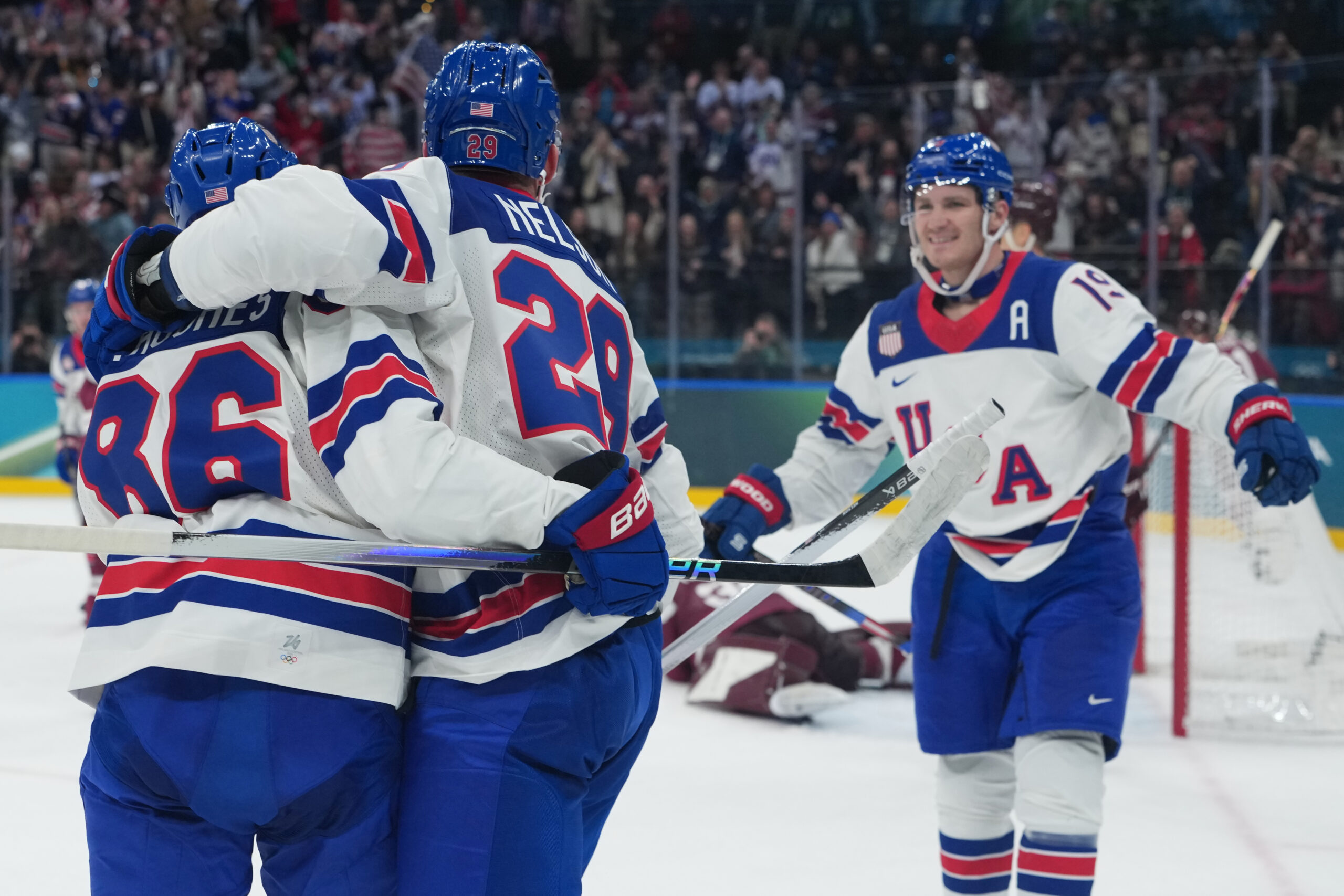
The U.S. men’s hockey team routed Latvia, 5-1, in its Olympic opener.
Early in the morning — as in 4:30 a.m. — the women’s dual moguls skiing final has two marquee Americans, Elizabeth Lemley and Jaelin Kauf. They won the gold and silver, respectively, in the individual freestyle event. It will air live on USA Network, replayed on NBC at 9:45 a.m., and available to stream whenever you want on Peacock.
How to watch the Olympics on TV and stream online
NBC’s TV coverage will have live events from noon to 5 p.m. Philadelphia time on weekdays and starting in the mornings on the weekends. There’s a six-hour time difference between Italy and here. The traditional prime-time coverage will have highlights of the day and storytelling features.
As far as the TV channels, the Olympics are airing on NBC, USA, CNBC, and NBCSN. Spanish coverage can be found on Telemundo and Universo.
NBCSN is carrying the Gold Zone whip-around show that was so popular during the Summer Olympics in 2024, with hosts including Scott Hanson of NFL RedZone. It used to be just on Peacock, NBC’s online streaming service, but now is on TV, too.
Liz Lemley going airborne on the way to her gold medal in the women’s freestyle moguls event.
Every event is available to stream live on NBCOlympics.com and the NBC Sports app. You’ll have to log in with your pay-TV provider, whether cable, satellite, or streaming platforms including YouTube TV, FuboTV, and Sling TV.
On Peacock, the events are on the platform’s premium subscription tier, which starts at $10.99 per month or $109.99 per year.
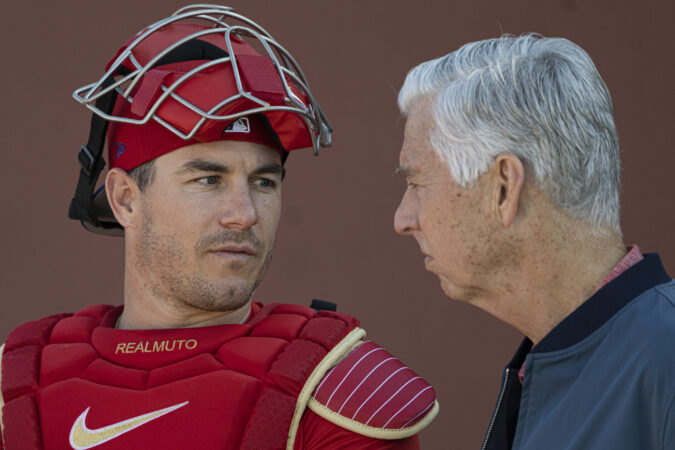
CLEARWATER, Fla. — One of the best catchers in baseball history intercepted Dave Dombrowski during a break in the general managers’ meetings in November.
Buster Posey had an itch to scratch.
Posey made roughly $170 million over a 12-year playing career in which he was a seven-time All-Star and three-time World Series champion. But he also observed that catchers, on the whole, weren’t as well-compensated as similar players at other positions, even though they are tasked with calling a game and handling a pitching staff.
So, Posey, now the San Francisco Giants’ president of baseball operations, approached his Phillies counterpart, who has led the front offices of five organizations over nearly four decades.
“He said, ‘Yeah, let me ask you a question: Why does the industry not put more dollar value on some of those things?’” Dombrowski recalled. “It’s hard, I think, the way it is. And we had a long conversation about it.”
Timely, too, as it turned out. Because the Phillies were in contract negotiations with free agent J.T. Realmuto, their catcher since 2019 and a foundational player in one of the winningest runs in the franchise’s 143-year history.
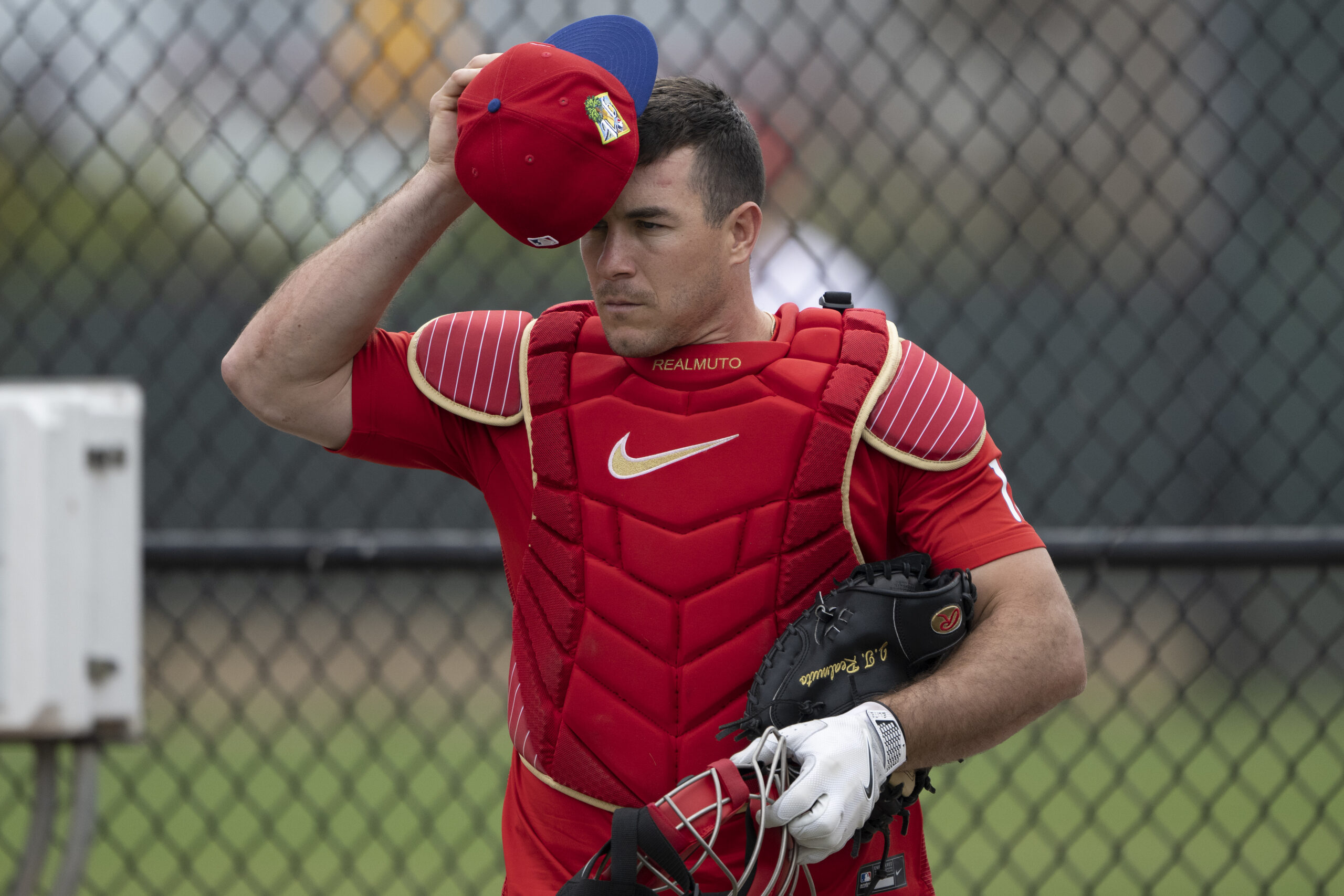
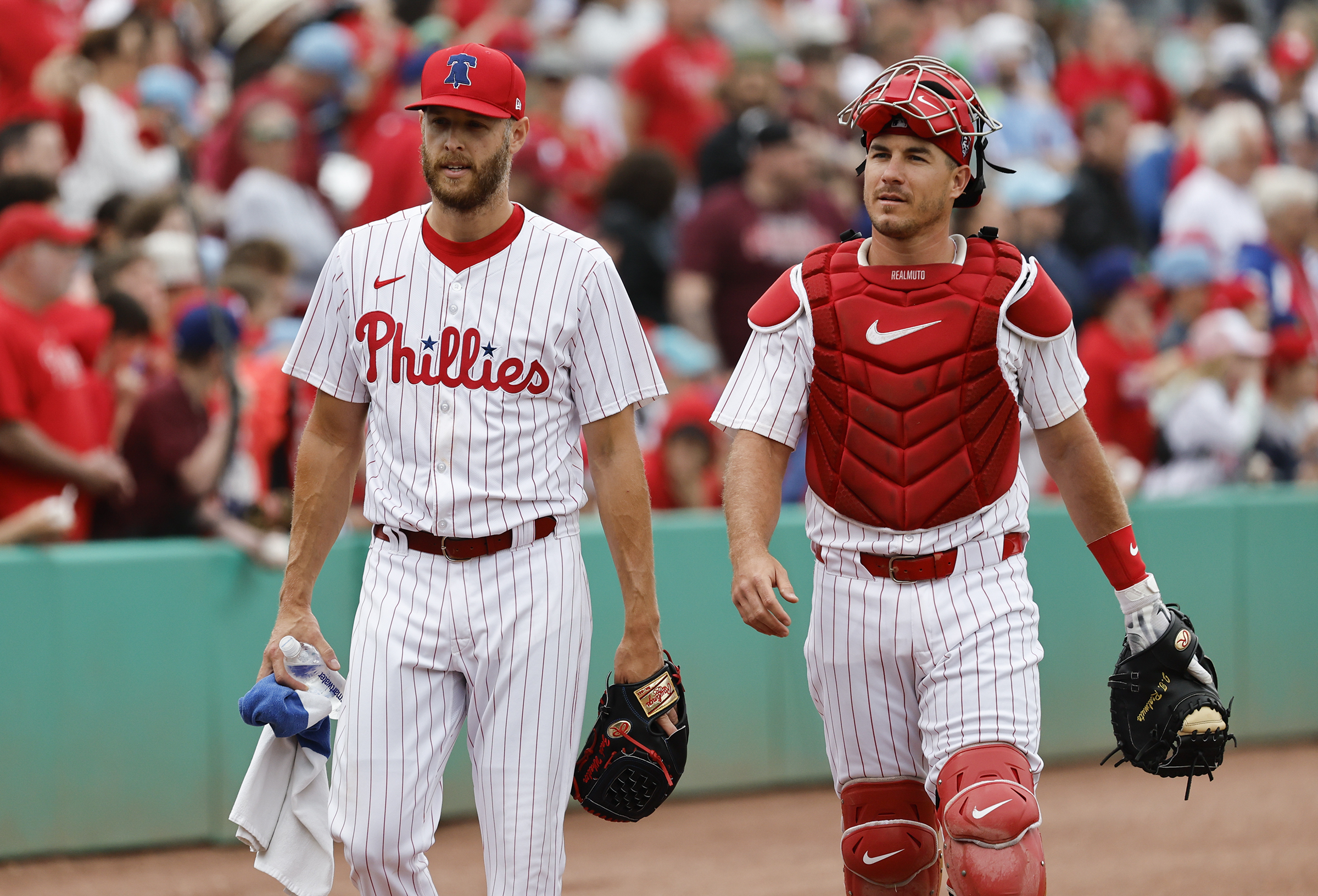
Phillies catcher J.T. Realmuto shown during the first day of pitchers and catchers practice on Wednesday.
And it would soon be clear that there was at least a $4 million-per-year gulf between what the team and the veteran catcher’s camp believed he was worth.
The Phillies prioritized re-signing Realmuto this winter. They made an offer in December — but at a reduced annual salary (in the $10 million to $11 million range, major-league sources said) after three consecutive seasons of declining offense. Behind the plate, Realmuto, who turns 35 in March, remains unassailable as a game-caller and leader.
Realmuto felt those skills were worth a certain salary. The Phillies valued them differently.
“We had a number in our mind, and we knew what we were worth,” Realmuto said this week on Phillies Extra, The Inquirer’s baseball podcast. “And I wasn’t going to take anything less than that.”
It was a familiar stance. Realmuto and his agents, who also represented Posey as a player, have long sought to boost the pay scale for catchers.
In 2021, Realmuto re-signed with the Phillies for a $23.1 million annual salary, a record for catchers — by $100,000. Five years later, the mark still stands. And it’s less than the record for any position other than relief pitcher (Edwin Díaz: $23 million). It’s also less than the seven highest salaries for third basemen and the top nine for outfielders, according to Spotrac.
Realmuto went to an arbitration hearing against the Phillies in 2020 over a $2.4 million difference in salary proposals because he was trying to move the goal posts for catchers. He lost.
“I don’t believe teams — from a) their models and b) their valuations — take into account the nonanalytical special sauce of a catcher,” said Matt Ricatto, Realmuto’s agent at CAA, the same agency that represented Posey as a player. “I think it’s a blind spot for baseball.”
So, Realmuto fought that fight again this winter. It nearly ended with him and the Phillies going their separate ways.
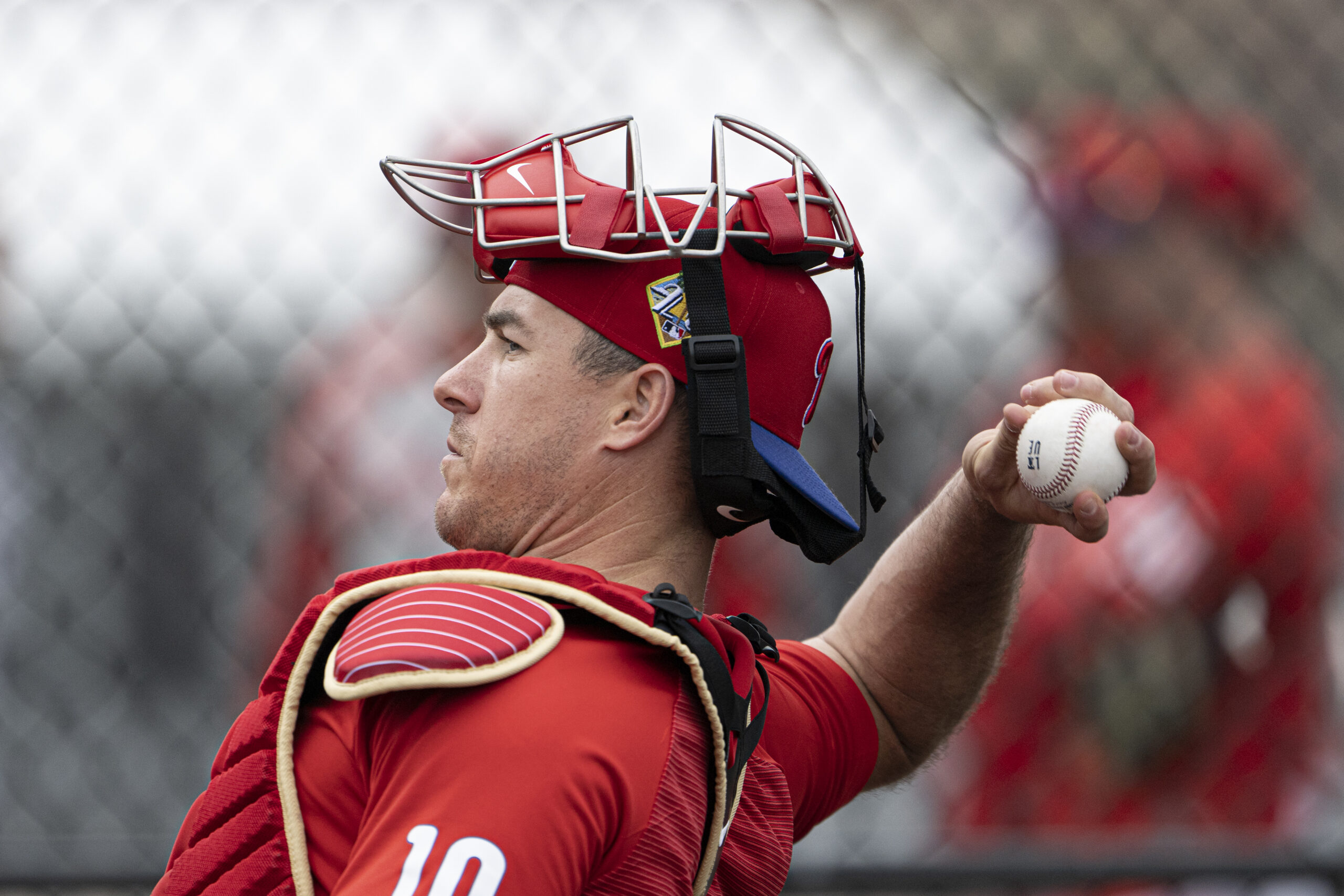
There was some uncertainty this offseason that J.T. Realmuto would not return to the Phillies, but both sides reached a deal last month.
Catch 22
Most people know the story by now.
In January, as talks with Realmuto reached an impasse, the Phillies pivoted to free-agent infielder Bo Bichette, even agreeing to make his desired seven-year, $200 million offer, major league sources said. If the Mets hadn’t swooped in with a higher-salary ($42 million per year) three-year deal, Bichette would be with the Phillies and Realmuto … well, with whom exactly?
“It got a little stressful there for a couple of days,” Realmuto said. “We started kind of thinking about our other options and putting the logistics together of what it might be like to go somewhere else. And thankfully it didn’t come to that because, as we’ve stated all along, this is where we wanted to be. We’re happy we didn’t have to up and move and go somewhere else.”
Indeed, Realmuto lives on Clearwater Beach. His wife and four children are with him throughout spring training. They’re comfortable in Philadelphia. Nobody wanted to leave.
But Realmuto felt it was important to continue his crusade for catcher equity. He held firm on not accepting the Phillies’ initial offers. On the night of Jan. 15, Dombrowski called Ricatto to inform him the Phillies were going in a different direction.
Roughly 12 hours later, once the pursuit of Bichette was foiled, the Phillies raised their offer to Realmuto: three years and $45 million, with as much as $7 million per year in bonuses based on merit (top-10 MVP votes, All-Star elections/selections, Gold Glove, Silver Slugger).
“If you ask any pitcher, any pitching coach, any manager, the most important thing a catcher can do is call a game and know his pitching staff and give them confidence when they’re on the mound,” Realmuto said. “If you can make your pitchers 5% better, 10% better, over the course of a year, that’s extremely, extremely valuable.”
Sure. But game-calling and handling a pitching staff are among the last largely unquantifiable skills in baseball’s analytics age.
“And because it’s not really quantifiable, then you don’t really get rewarded for it,” Realmuto said. “That’s the aspect that I just don’t agree with. It doesn’t sit well with me, so that’s kind of just why I enjoy fighting for it.”
J.T. Realmuto re-signed with the Phillies on a three-year, $45 million contract.
Measuring up
In modern baseball, there’s a metric for everything.
Almost everything.
Who’s the fastest runner? Statcast tracks feet-per-second sprint speeds. The best outfield jump? There’s data for that, too. A hitter’s average exit velocity, launch angle, and bat speed. A pitcher’s spin rate and vertical/horizontal movement.
The metrics for catchers include blocking, throwing, and framing, the technique of receiving a pitch in a way that influences the umpire to call a strike. “Pop time” measures how fast a catcher releases the ball on steal attempts. Realmuto annually has among the best pop times of all catchers. His framing isn’t typically as strong, in part because the Phillies don’t emphasize it as much as other teams.
But there isn’t a reliable gauge for calling a game. Phillies manager Rob Thomson, a former minor-league catcher, suggested catcher’s ERA and OPS as decent barometers.
In that case, opponents have a .682 OPS and Phillies pitchers have a 3.75 ERA with Realmuto behind the plate since 2023. The major-league averages during that time: .722 and 4.18.
A catcher’s ability to handle a pitching staff is almost entirely anecdotal.
Zack Wheeler swears by Realmuto. He barely ever pitches to anyone else (134 of Wheeler’s 157 starts for the Phillies have come with Realmuto behind the plate) and hardly ever shakes off a pitch that he calls.
Cristopher Sánchez, who emerged as the Cy Young runner-up in the National League last year, cited Realmuto’s diligence in putting together a game plan, a process that begins even before the starter arrives at the ballpark. And Jesús Luzardo describes Realmuto as “a no-B.S. guy” behind the plate.
“You show up to the field, he’s already there, doing homework, going over scouting reports, watching video,” Luzardo said. “So, when he goes up back there and he tells us, ‘This is the plan that we’re going to do throughout the game,’ you have confidence that he knows what he’s talking about and that it’s not [him] just winging it.”
In conversations with the Phillies and other teams this winter, Ricatto described Realmuto’s “cascading effect” on a team. Because although he’s not the best player on the roster, “he makes [teammates] better than anyone else at that [catcher] position,” Ricatto said.
Surely, that’s worth something.
But how much?
It’s a question that gets to the heart of Dombrowski’s chat with Posey.
“J.T. is outstanding, right?” Dombrowski said. “He handles the staff well. He does all those other things. But let’s say you had a catcher that, let’s say they hit .150. And they did all that [other stuff]. What would you pay that person? I don’t have that exact answer.
“But it’s one of those where it’s a combination of the value, the defensive performance, and all that — and the hitting aspect of our game. The game has rewarded offense [more than anything] throughout the years.”
Phillies ace Zack Wheeler (left) has said he almost never shakes off a pitch called by J.T. Realmuto.
‘I never felt like Plan B’
Realmuto is coming off his worst offensive season since his rookie year in Miami. But he wasn’t a .150 hitter, either. He batted .257 with 12 homers and a .700 OPS. Based on OPS-plus, he was 9% less productive than league average.
But even at Realmuto’s offensive peak, his agents believed he was paid less simply because he’s a catcher.
After the 2019 season, Realmuto filed for $12.4 million in arbitration because his numbers were comparable at the same point in his career to then-Nationals third baseman Anthony Rendon, who made $12.3 million in 2018. But a three-person panel ruled in favor of the Phillies’ $10 million offer, still an arbitration record for catchers.
And although the judges didn’t provide an explanation, Jeff Berry, one of Realmuto’s agents at the time, believed it was because they compared Realmuto only to fellow catchers, notably Baltimore’s Matt Wieters, who made $8.3 million in his third year of arbitration in 2015.
Which doesn’t mean Realmuto gets paid squat. He has made approximately $135 million since 2016. When his new contract expires, he will have made at least $180 million.
It’s little wonder, then, that Realmuto said he doesn’t have any hard feelings toward the Phillies after they nearly broke up with him last month. He insisted he doesn’t feel like a consolation prize for not landing Bichette.
“To be honest, I never felt like Plan B because I could have signed with the Phillies a month and a half earlier,” he said. “They just valued me differently than I valued myself.”
So, Realmuto stood on principle, just like he always has.
Nestled in the crook of the Lehigh and Delaware Rivers, Easton’s manufacturing might was powered by its waterways during the Industrial Revolution in the early 20th century. Tanneries, flour and silk mills, distilleries, breweries — these were the big businesses in town.
Now, those old industrial shells and the former mansions of tycoons house cafés and galleries, boutique hotels and French-inspired markets. Easton sits just 90 minutes from Philly, making it an easy weekend getaway. Take the Turnpike north, hook a right at Allentown, and head toward the river.
In dining, shopping and arts, Easton way overdelivers. Hotels are still catching up. Fortunately, the popular Gusto Hospitality Group (see Dine, below) opened the Townley House Hotel several years ago, and the 16-room boutique remains the best place to stay in town. An original mahogany staircase links the levels of this restored brick townhouse on Easton’s historic Millionaire’s Row. There’s a sun-dappled courtyard, Mercer-tiled fireplaces, maximalist wallpapers and custom headboards — a different one for each room.
📍 130 N. 3rd St., Easton, Pa. 18042
Stroll: Karl Stirner Arts Trail
Running nearly two miles along scenic Bushkill Creek to Lafayette College’s William Visual Arts Building, the Karl Stirner Arts Trail weaves through 27 works of public art. The trail is named for the German-born sculptor and metalsmith largely credited for making Easton an arts destination in the ‘80s. You’ll find his untitled steel arch, painted an unmissable scarlet, about two-thirds of the way down the path.
In this world, there are people who love pie, and there are monsters. Don’t be a monster. On Northampton Street, Easton’s main drag, Pie + Tart is charming spot with exposed brick walls and Shaker-style chairs from bakers Lisa Yelagin and Anne Gerr. Savory pies (coq au vin) and sweet ones (Mexican chocolate chess, cherry cheesecake) rotate weekly, alongside soups, quiches, and other cozy blackboard specials.
If you’re bringing kids — or you simply have strong feelings about Burnt Sienna and Tickle-Me-Pink — meet the Crayola Experience. The king of crayons was born — and still manufactured — right here in Easton. The four-floor experience mixes analog crafts and digital diversions, including an 85-foot water table and a photo booth that generates a coloring-book selfie. Great opportunity to see what you’d look like as a Mango Tango redhead.
Men’s shearling-lined shackets, watercolor paint-by-numbers journals, irreverent incense (“Chai-Scented Laziness,” “Burn Away the BS”) and more fill Belleville Market, a three-level department store inspired by the marketplaces the owners fell for in France. Keep an eye on their events page to see if your Easton trip lines up with the shop’s happenings, like the upcoming Moka pot demonstration and tasting and floral-filled spring open house.
📍 20 S. 3rd St., Easton, Pa. 18042
Drink: Kabinett
We don’t need to tell you: The PLCB does not make sourcing great wine easy. Which makes Kabinett, a Bavarian-inspired refuge furnished with warm woods, wishbone chairs, and framed botanical prints, all the more impressive. A grandly antlered stag skull presides over the bar. The Wine Spectator-recognized list ranges from whole-cluster Santa Barbara Sangiovese and South Australian Riesling from 175-year-old vines. It’s deep but playful, organized under headings like:“Reds ~ OK, Boomer. Safe Cabernet & oak space for full-throttle bottles.”
📍 125 Northampton St., Easton, Pa. 18042
Dine: Albanesi Restaurant & Bar
Italian restaurants run by Albanians form their own industry sub-genre. At Albanesi Restaurant & Bar, Gusto Group’s Mick Gjevukaj, who grew up in the war-torn former Yugoslavia, is putting his heritage center stage with dishes like harissa-spiced rib-eye qofte (kofte), veal goulash, and braised lamb shoulder lacquered in pomegranate. Climb into one of the camel-colored clamshell banquettes, order some samuna bread and hummus swirled with ajvar, a Balkan condiment of roasted peppers and tomatoes, and settle in for culinary geography lesson. Who knew you’d learn it in Easton?
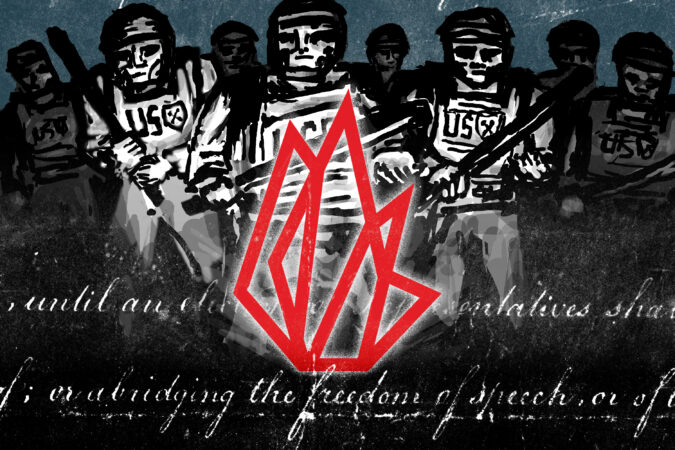
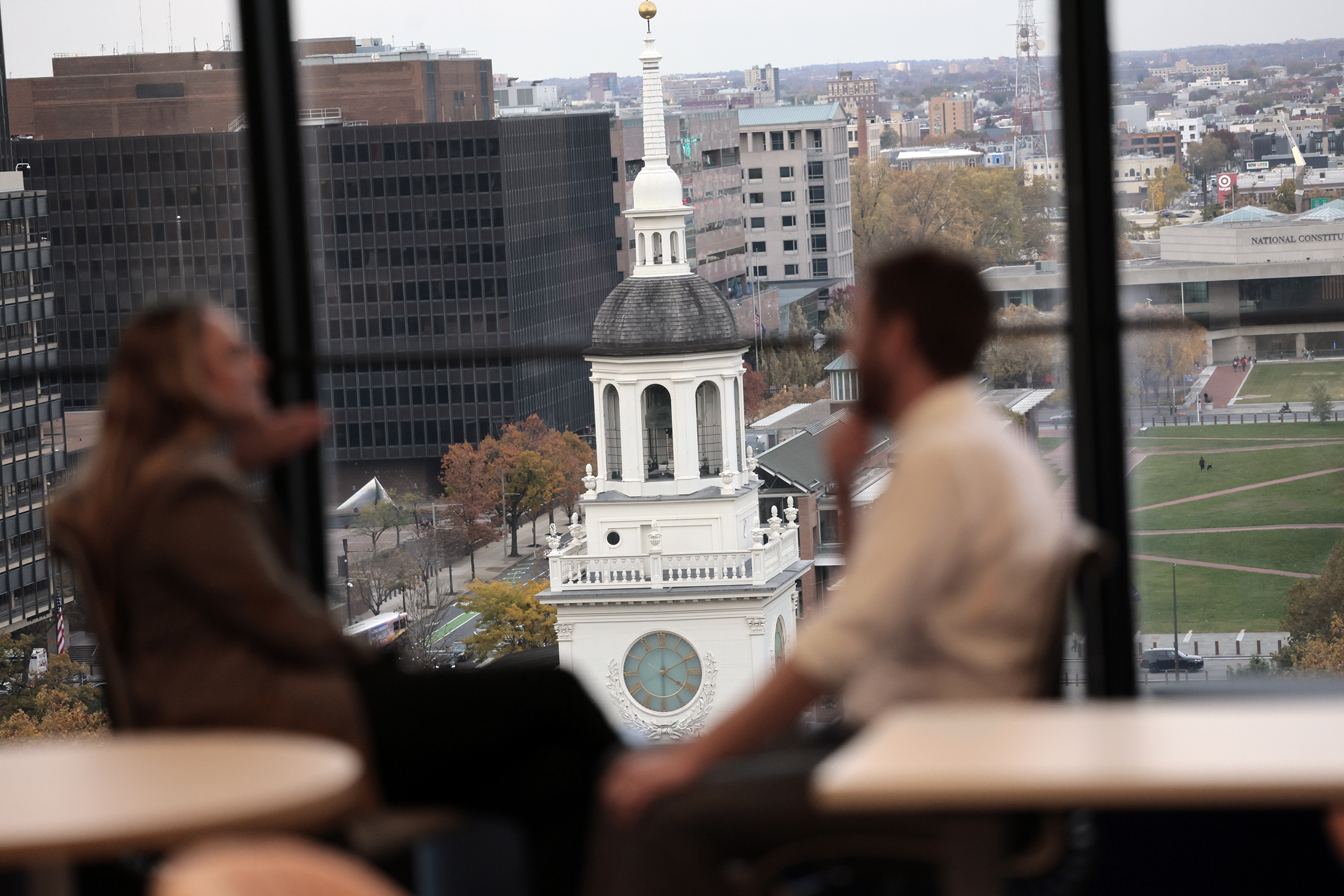
The sleek, modern offices of the Foundation for Individual Rights and Expression, or FIRE, sit on the southernmost edge of Independence Square. The enormous glass windows of a conference room called the Marketplace — a nod to the “marketplace of ideas” — perfectly frame Independence Hall.
The view is no coincidence. The free-speech organization, founded in 1999 and long known for decrying illiberalism and so-called cancel culture on American college campuses, is deliberate in the stories it tells.
In addition to the thousands of case submissions FIRE receives each year, staffers scour social media and news reports for compelling free-speech violations, partly looking, as legal director Will Creeley explained, for “cases you can tell a story with.”
For years, FIRE warned about threats to free speech, primarily on college campuses. Now the crisis it was preparing for has arrived.
The issue today is no longer one of cultural differences — students protesting controversial speakers or agitating for more diverse curricula.
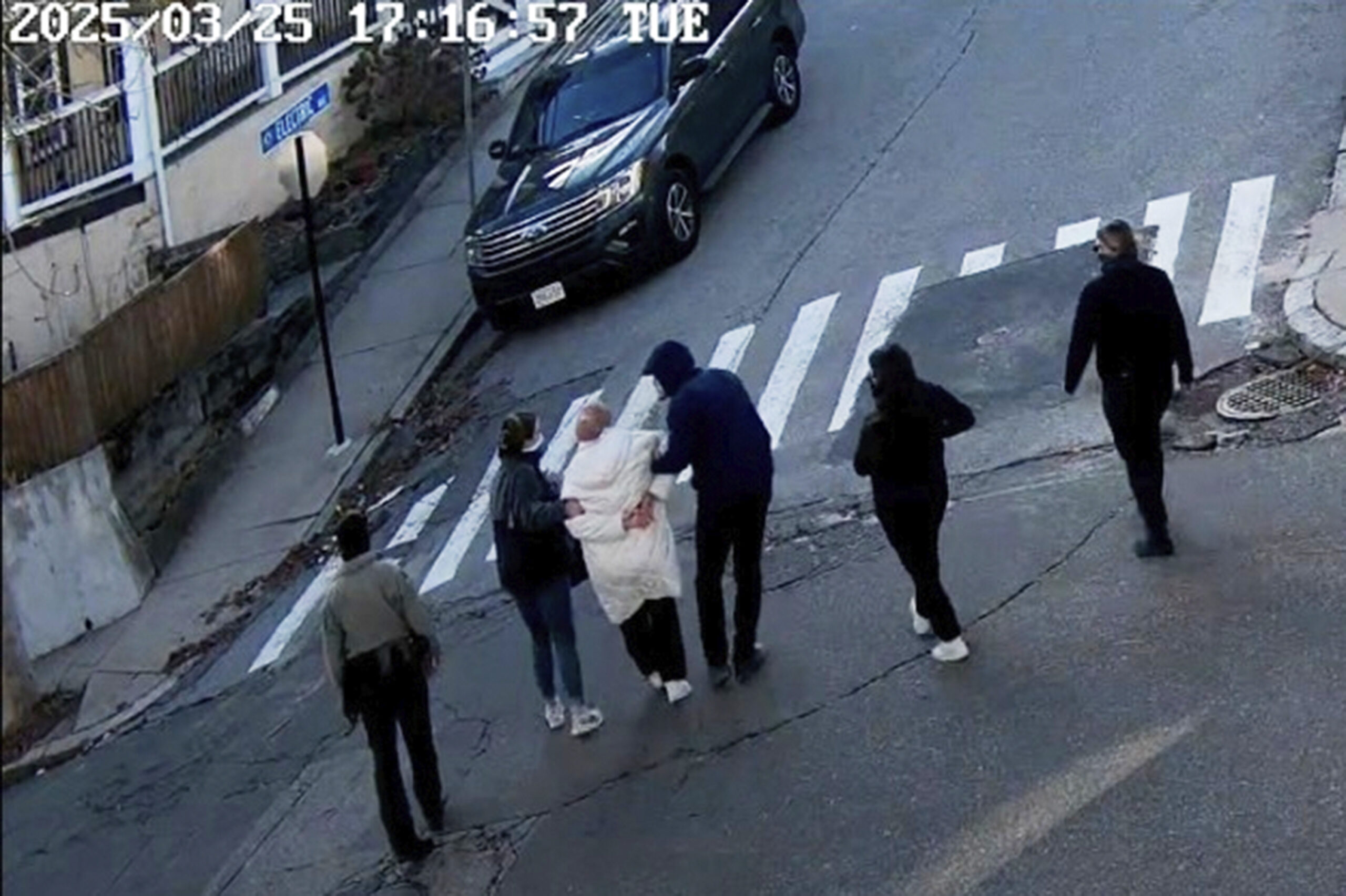
Rumeysa Ozturk, a 30-year-old doctoral student at Tufts University, was detained by Department of Homeland Security agents in March, an arrest captured by security camera footage.
Instead, the full power of the federal government is trained on universities and individual students who disagree with it. The stakes have grown exponentially, as became clear early on when federal agents detained Rumeysa Ozturk, a Tufts University Ph.D. student on a visa, after she cowrote an op-ed in a student newspaper. She then spent 45 days in Immigration and Customs Enforcement detention in Louisiana. (FIRE submitted an amicus brief in Ozturk’s ongoing federal case, in which a federal judge ruled last month that the administration had no grounds to deport her.)
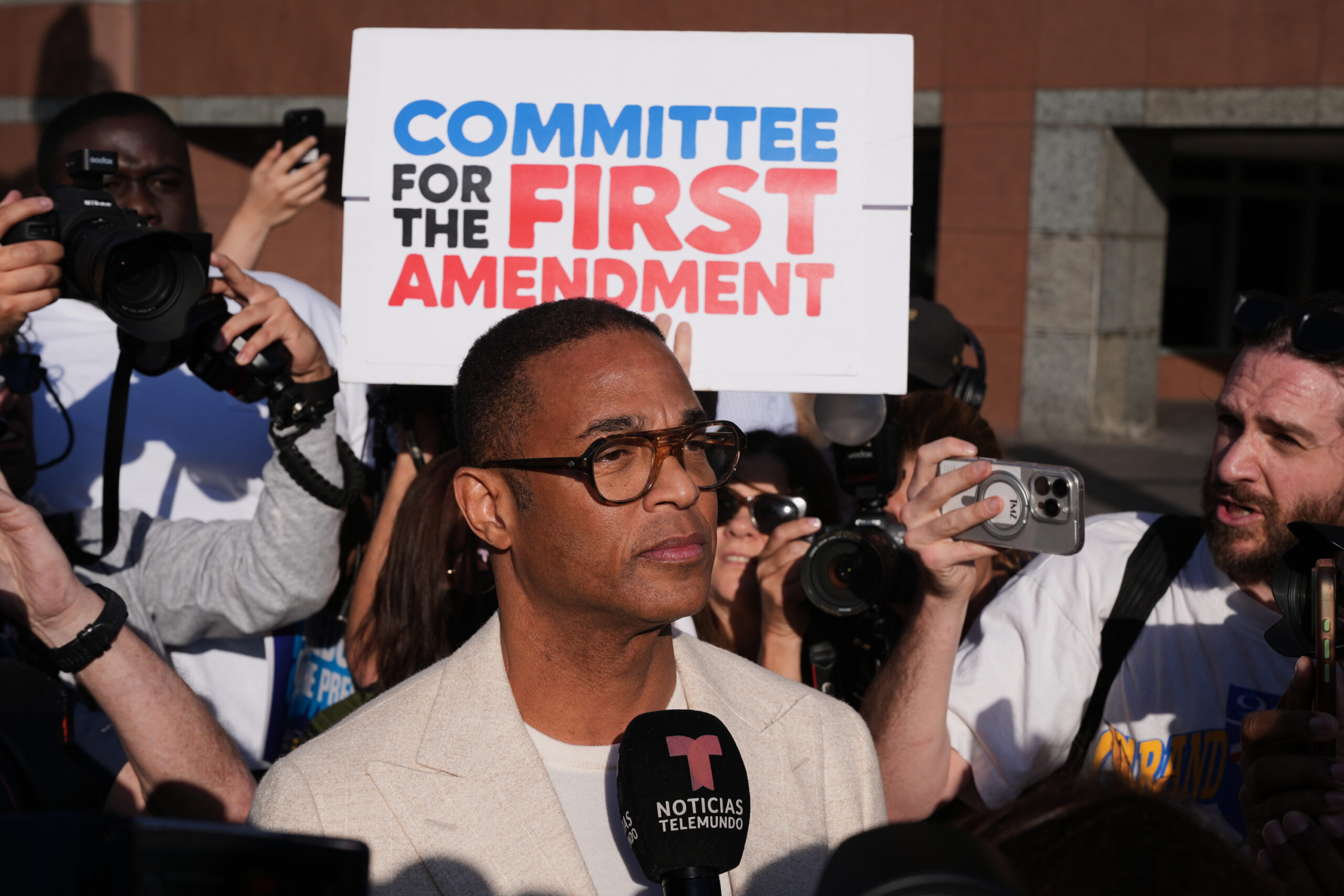
More recently, federal agents arrested and charged journalist and former CNN anchor Don Lemon with federal civil rights crimes for his coverage of an anti-ICE protest inside a Minnesota church. Of his arrest, the organization wrote, “FIRE will be watching closely.”
Journalist and former CNN anchor Don Lemon talked to the media after being detained for covering a protest inside a Minnesota church.
The question FIRE faces today is whether it can effectively meet the moment, and overcome skepticism from the left and from other free-speech advocates, some of whom argue the group helped lay the groundwork for an authoritarian crackdown.
Those critics say the present free-speech crisis is partly the predictable result of FIRE stoking a conservative panic over campus politics, effectively handing the federal government a well-crafted rationale for suppressing progressive voices.
FIRE’s leaders say they were not wrong before about cancel culture. Things were bad, they argue. But this is far worse.
“The threats we’re seeing right now, to me, often feel damn near existential,” Creeley, 45, said in a recent interview. “The incredibly important distinction is that what we’re seeing now from the right is backed by the power of the federal government.”
FIRE described the federal government’s demands on Harvard as “wielding the threat of crippling financial consequences like a mobster gripping a baseball bat.”
When the government becomes the censor
It can sometimes feel as if FIRE has been involved in nearly every major free-speech flash point of the last year — part of an intentional strategy to build the organization’s profile and raise awareness about speech violations, said Alisha Glennon, 41, the group’s chief operating officer.
Among dozens of ongoing cases, FIRE is suing Secretary of State Marco Rubio in federal court over the administration’s targeting of international students who reported on or participated in pro-Palestinian campus activism.
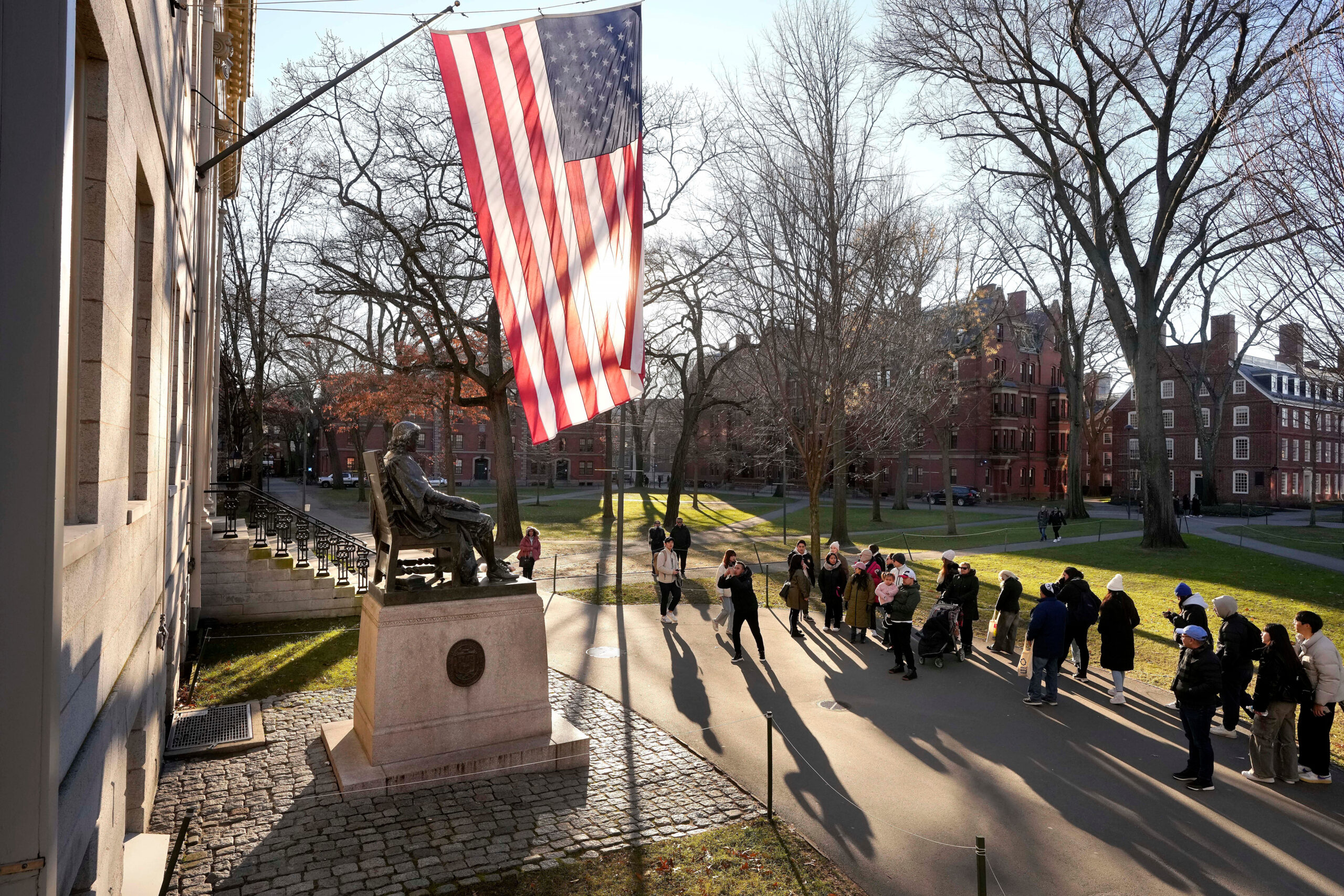
FIRE has also been outspoken in its defense of Harvard University. After the Trump administration sent Harvard a list of demands this spring — including banning some international students based on their views, appointing an outside overseer approved by the federal government to ensure “viewpoint diversity,” and submitting yearly reports to the government — the university refused to comply. Trump then sought to cut off billions of dollars of federal funding in response.
Harvard sued, and FIRE submitted an amicus brief supporting the university, noting that because of its own “longstanding role as a leading critic” of Harvard as a center of cancel culture, it was not less but more alarmed by the government’s “wielding the threat of crippling financial consequences like a mobster gripping a baseball bat.”
FIRE is also preparing to potentially sue Texas A&M University after the university instructed a philosophy professor in January to remove some teachings of Plato from an introductory philosophy course, citing new rules barring public universities in the state from offering classes that “advocate race or gender ideology.” FIRE wrote to the university, calling the move “unconstitutional political interference.”
Removing Plato from an intro philosophy class is the type of absurd, taken-to-the-extreme free-speech dispute that has long been FIRE’s bread and butter, and Creeley was particularly agitated about it.
Will Creeley, FIRE’s legal director, pictured here at the FIRE offices in Philadelphia. He was drawn to First Amendment work partly because his father was a poet.
“What the hell is ‘race and gender ideology’?” he said. “That’s a term so vague you could drive a truck through it.”
He had seen commentary about how 2,400 years ago, Socrates was put to death for corrupting the youth of Athens — and now administrators were, in effect, trying to run Socrates’ student out of College Station, Texas, too.
Creeley was almost laughing, but he was also feeling apocalyptic.
He has been half-joking with his staff that FIRE’s entire litigation program could be dedicated just to Texas. Yet he was also stewing over a decision by the University of Alabama in December to suspend two student publications, one focused on fashion and the other on Black culture and student life.
The university said both violated the Justice Department’s guidance on diversity, equity, and inclusion by narrowly appealing to female students and Black students. FIRE sent an outraged letter to the school, often a precursor to litigation.
“It’s one thing to say, ‘Hey, administratively, we’re not going to have an office of DEI,’” Creeley said. But to say, “‘And students can’t talk about these things.’ … That just drives me nuts.”
Off campus, FIRE is suing Perry County, Tenn., on behalf of Larry Bushart, a retired police officer who spent 37 days in jail after reposting a meme following the assassination of right-wing political activist Charlie Kirk. The meme depicted then-presidential candidate Donald Trump urging people to “get over” a separate shooting the year before.
Defending free speech is notoriously unpopular, and FIRE has leaned hard into a narrative of itself as a pure, principled defender of free speech, regardless of the consequences.
“We always say we just call balls and strikes, no matter what team is up to bat,” Glennon said. “If you are being criticized by both sides and praised by both sides every single day — well, then, that’s something that I wear as a point of pride.”
“Sometimes, if everybody’s criticizing you, you are screwing up,” Creeley acknowledged, and they both laughed. “But here I would say we’re doing it right.”
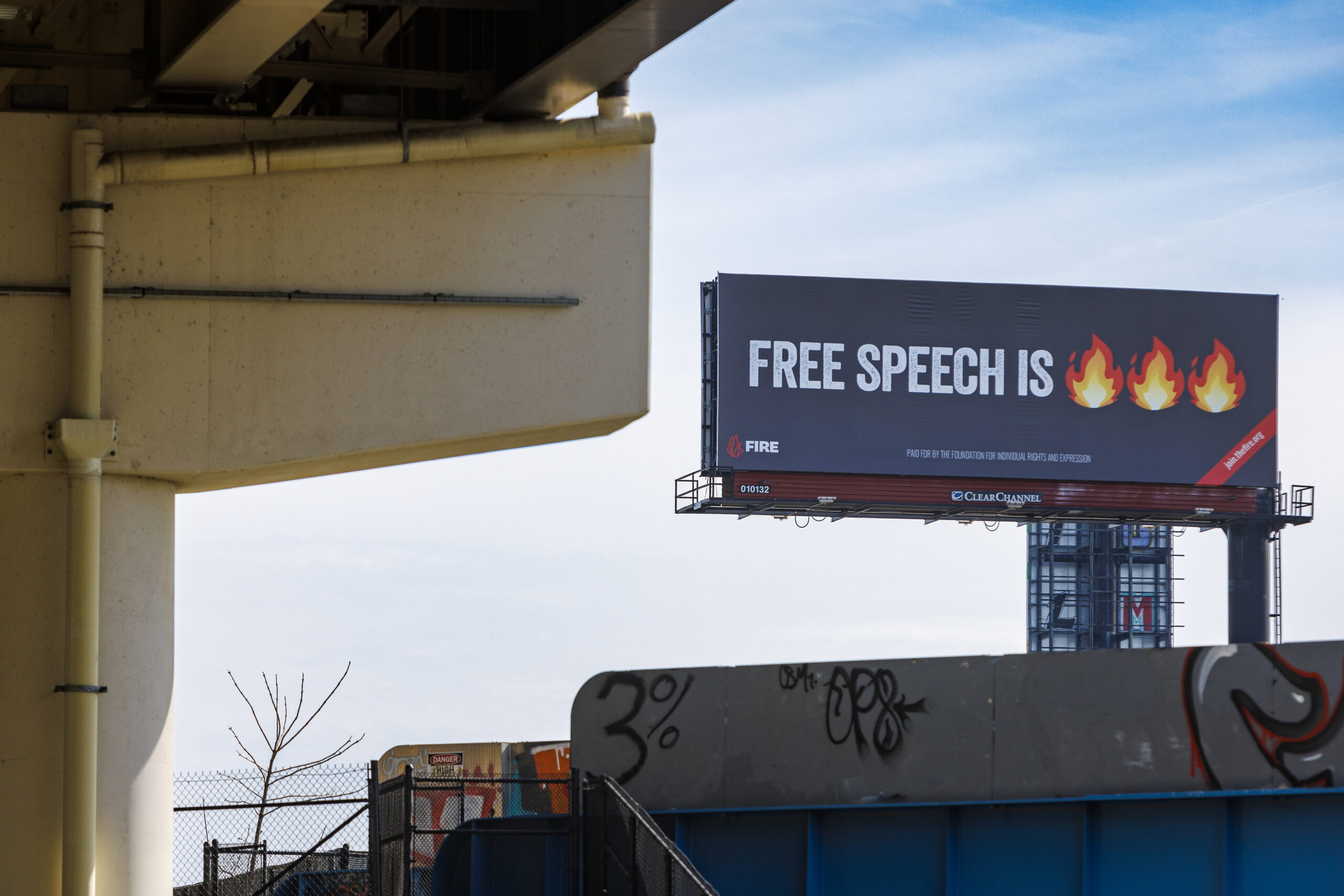
In 2022, FIRE expanded its purview beyond college campuses, including through a massive media campaign. One of its billboards is pictured here, visible heading north on I-95, in 2023.
From scrappy watchdog to national player
FIRE is insistently nonpartisan; staffers acknowledge the organization’s erstwhile conservative reputation but say it was never accurate.
And under the second Trump administration, it has become one of the most outspoken voices in the country for free expression. The nonprofit has a $32 million budget, about 130 staffers, and roughly 12,000 members paying a $25 annual fee.
Both Creeley and Glennon have been with the organization for nearly two decades, helping it grow from a small advocacy group into one garnering increasing mainstream attention. They said FIRE based itself in Philadelphia, not Washington, so that it would remain free from political interference. (One of the cofounders of the organization, Alan Charles Kors, an emeritus history professor at the University of Pennsylvania, is also based in Philly.)
At the Philly office, copies of the Wall Street Journal and the Chronicle of Philanthropy greet visitors. The conference rooms are named after free-speech references. (“It’s a little kitschy, but it’s cute,” Glennon said of the “Crowded Theater” room.)
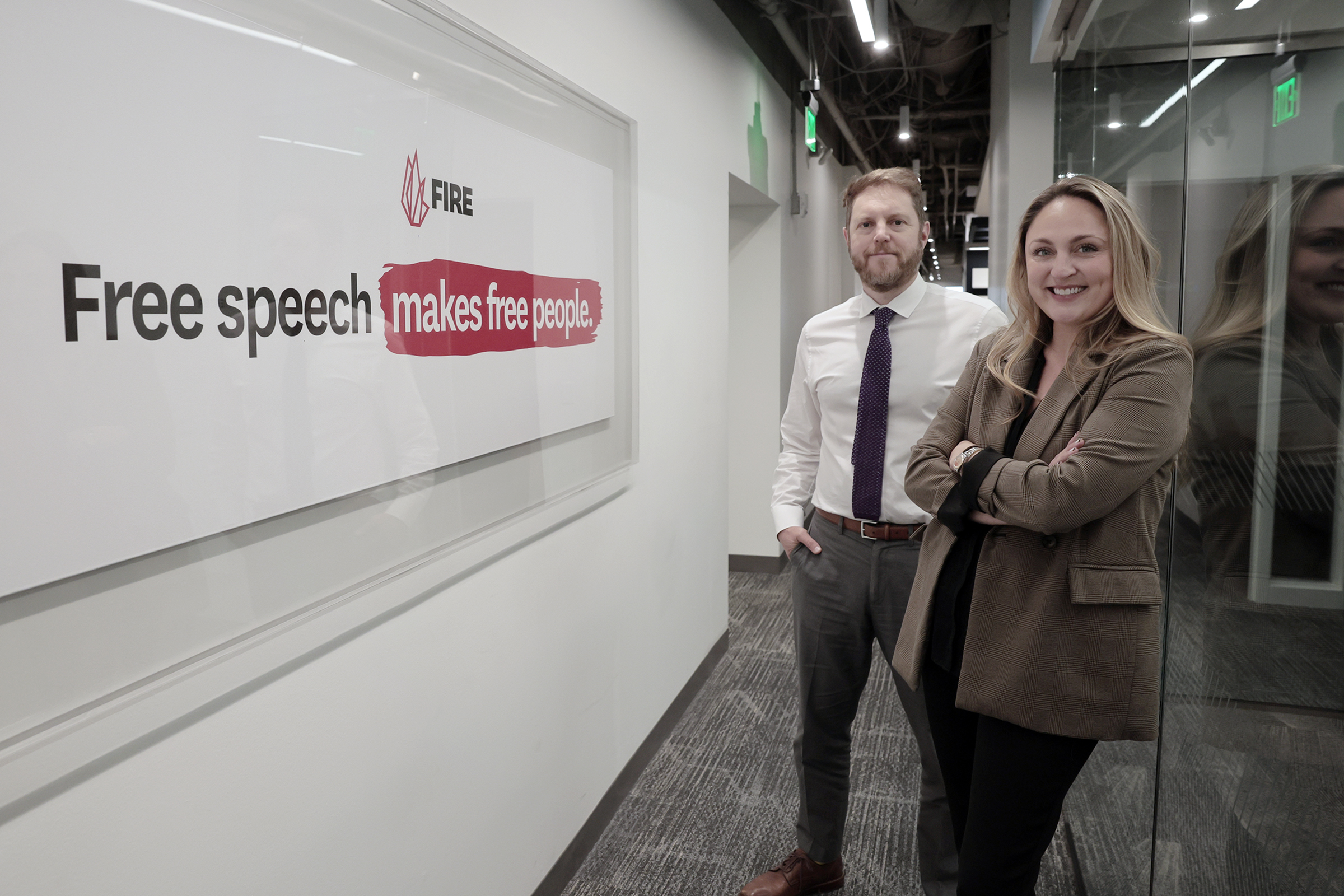
One afternoon this fall, Glennon, in an oversized tan blazer, black pants, and stilettos, her blond hair loose, and Creeley, in a white button-down and purple tie, his auburn beard neatly cropped, were quick to laugh, prone to peppering famous quotes about free speech throughout the conversation.
They appeared to be true believers — in free expression, in their work, in America.
Glennon said she fears “that people will become accustomed to a society that is less free, and that with every generation, we’re losing a little bit of that love for American exceptionalism and what free speech is.”
Creeley nodded.
“What’s the Kors quote? ‘A nation that does not educate in liberty will not long enjoy it, and won’t even know when it’s lost,’” he said, paraphrasing a quote from FIRE’s cofounder.
“‘Won’t even know when it’s lost,’” Glennon echoed. “Gave me chills.”
FIRE’s legal director Will Creeley and FIRE’s chief operating officer Alisha Glennon, pictured here at the Philly offices in November, have both been at the organization for nearly two decades.
From pressure campaigns to the courtroom
FIRE was founded by two civil libertarians who wrote one of the defining campus-panic books of the 1990s, The Shadow University: The Betrayal of Liberty on America’s Campuses, which Publishers Weekly at the time described as a polemic about how “the ‘political and cultural left’ is today the worst abuser of the principles of open, equal free speech.”
Creeley joined FIRE as a law school intern before becoming a full-time staffer in 2006. He comes from a long line of pacifist Quakers and was involved in the campus Green Party as an undergrad at New York University. He said he was drawn to First Amendment work because his father was a poet; words were important.
“I remember the first couple years, I was like, ‘Boy, I’m doing this free-speech work, I’m defending an awful lot of evangelical conservative Christians who I really don’t have much in common with,’” Creeley said. But that was the principle of the thing.
FIRE’s chief operating officer Alisha Glennon in “The Marketplace” conference room overlooking Independence Hall. All the conference rooms are named after free speech references.
Glennon, who was born and raised in Mayfair, joined FIRE around the same time. She had recently graduated from the College of William and Mary and was waitressing while applying for development jobs. “I was like, ‘Free speech! Everybody likes free speech!’” she said, laughing.
For more than a decade, FIRE focused exclusively on advocacy, aiming to “make rights violations so painful for a school that they just would abandon it,” Creeley said. Litigation was plodding and costly, and the awareness campaigns seemed to have an impact.
In 2008, for example, a student-janitor at Indiana University-Purdue University Indianapolis was accused of racial harassment after a coworker saw him reading Notre Dame vs. the Klan: How the Fighting Irish Defeated the Ku Klux Klan, a nonfiction book that depicted robed Klansman and burning crosses on the cover. FIRE took up the cause, and the university eventually apologized to the janitor.
Other early advocacy cases included defending a professor at a New Jersey community college over a photo he posted of his daughter wearing a Game of Thrones T-shirt, and intervening on behalf of a University of Alaska Fairbanks student newspaper accused of sexual harassment for publishing a satirical article about a new building shaped like a vagina.
Then in 2014, FIRE began suing schools. The effort launched with four cases, including one about an unconstitutional “free speech zone” at a college in California and one on behalf of students at Iowa State University who were told they could not use the university’s name while wearing T-shirts representing their chapter of the National Organization for the Reform of Marijuana Laws.
FIRE eventually won all four.
These days, staffers at the ACLU of Pennsylvania and FIRE work closely together, talking weekly and sometimes daily.
“I honestly don’t remember a time where we had a disagreement about how to analyze the case,” said Witold Walczak, the ACLU of Pennsylvania’s legal director.
Despite its ideologically broad legal work, FIRE perhaps became most famous in the mainstream for its conservative-leaning culture work. In 2015, executive director Greg Lukianoff cowrote an Atlantic article — and later a book — titled The Coddling of the American Mind, arguing that efforts to create “safe spaces” on campuses had gone awry. Cowritten with social psychologist Jonathan Haidt, the book portrayed campus identity politics as bordering on the surreal.
That was also the year Lukianoff helped to disseminate one of the defining “cancel culture” artifacts of the decade. He filmed a Yale student, who came to be known online as “shrieking girl,” screaming at a professor in the middle of a simmering debate on campus over what constituted racially sensitive Halloween costumes. The video made national news, eventually racking up nearly 2 million views on FIRE’s YouTube page.
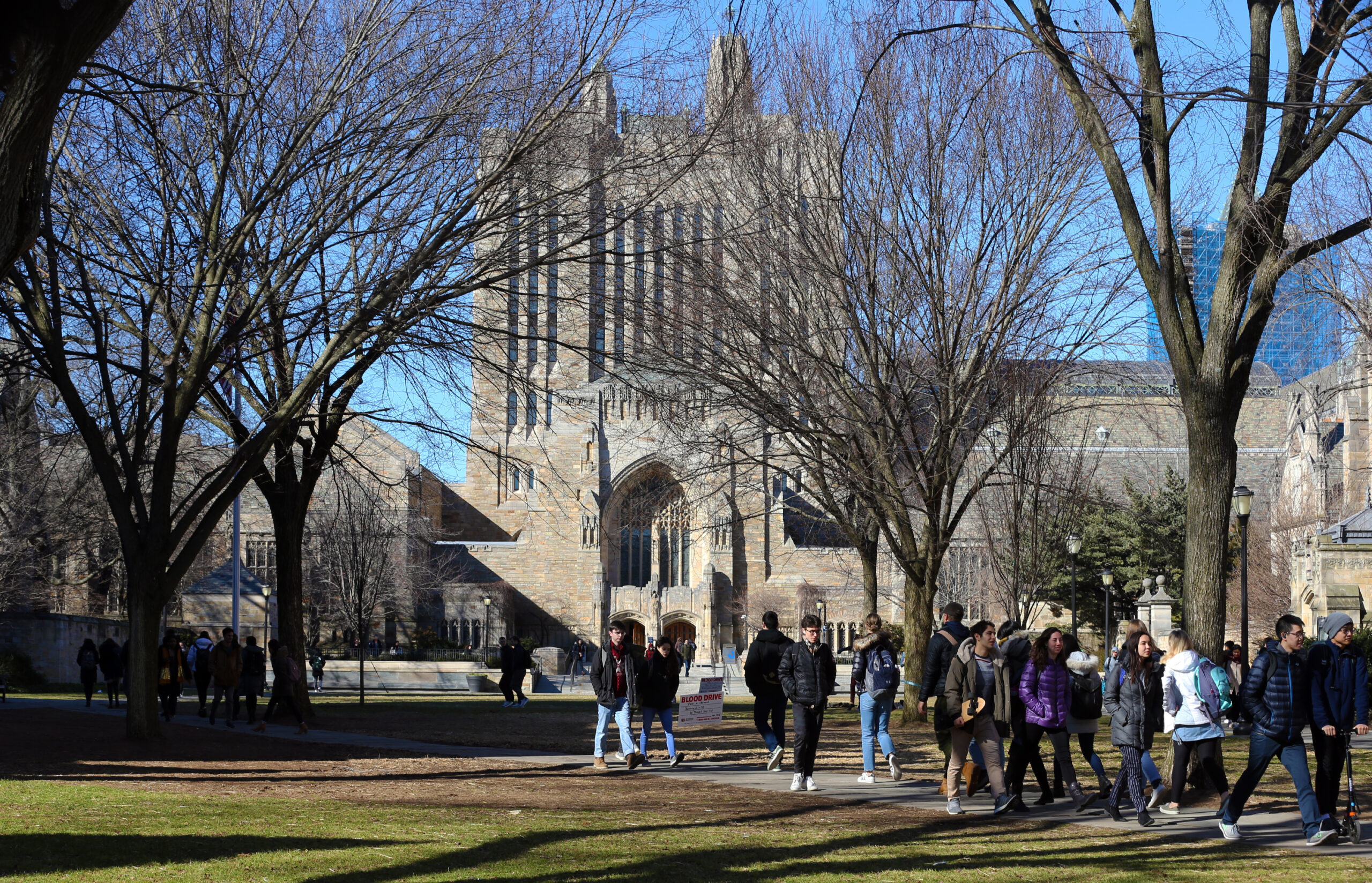
The campus of Yale University in New Haven, Conn.
The rankings — and the reckoning
These days, the organization tracks speaker disinvitations and scholars and students “under fire” through its public databases. Since 2020, it has also published annual “free-speech rankings” based on the databases and student surveys — rankings that have repeatedly placed Harvard at or near the bottom for free speech.
Those efforts underpin one of the central critiques of FIRE: that it has focused not only on government restrictions but also on the actions of private actors, including students.
“The rankings are based on those ideas of ‘cancel culture’ and shaming others and so on. And they’re not based on the First Amendment,” said Charles Walker, a retired attorney based in Maryland who published multiple critiques of FIRE’s rankings last year. “First Amendment law restricts what the government can do with regard to individual speech. It doesn’t address individuals speaking to each other.”
Bradford Vivian, a professor at Pennsylvania State University and the author of Campus Misinformation: The Real Threat to Free Speech in American Higher Education, described FIRE’s databases as “totally subjective, arbitrary, politically motivated tools.”
He argued that FIRE cherry-picks sensational incidents that do not necessarily have anything to do with true First Amendment violations, and prioritizes rankings that will make headlines over those that would be more accurate.
“FIRE has produced misinformation that others can easily use for nefarious purposes,” Vivian said.
FIRE for years whipped up a frenzy over liberal excess on elite college campuses, Vivian and other critics say. The Trump administration seized on that frenzy to slash federal funding and even imprison its detractors. Yet FIRE staffers do not see themselves as part of that story.
Even as FIRE insists it merely “calls balls and strikes,” critics note that state legislatures and the Trump administration have cited FIRE’s rankings as justification for punitive actions against universities.
Adding insult to injury, FIRE staffers have not always expressed much sympathy for the universities that now find themselves in the administration’s crosshairs.
“Administrators, colleges, universities have in some ways done plenty to bring this on themselves,” Sean Stevens, FIRE’s chief research adviser, told The Inquirer. “There was a lot of downplaying or ignoring of the concerns about the homogeneity of politics among the professorate or some of the curriculums.”
Still, Stevens, who oversees the annual rankings, said he disagrees with the Trump administration using his work to cut funding or shut down certain speech or academic departments. “That’s not anything we would advocate for,” he said.
In December, Lukianoff doubled down, publishing what amounted to an “I told you so” essay, arguing that universities now face a “worst of both worlds” scenario, in which government pressure combined with lingering cancel-culture dynamics are producing the “bleakest speech landscape imaginable.”
Creeley and Glennon said they never anticipated their work being used to justify repression.
“It’s galling to me to see our work invoked to justify that kind of illiberal crackdown,” Creeley said, pointing specifically to U.S. Rep. Elise Stefanik (R., N.Y.), who previously said she was a free-speech ally, using FIRE’s rankings in her anti-higher education campaigns.
If onetime allies now seem to have never cared much about free speech to begin with, that’s not on FIRE, they said.
“What we had been saying over the years was true‚” Glennon said. “We’re to blame now for the government overreach? I don’t think it’s a fair assessment.”
“I mean, that’s all we can do: Call out the abuses as we see them,” Creeley said. “If somebody wants to use our work for bad ends, we’ll fight you on it.”
FIRE was based in Philadelphia to avoid the political interference of Washington, D.C.
Can a referee still matter when the rules change?
At FIRE’s daily morning meetings to discuss pressing free-speech problems across the country, the agenda has grown longer. The scope, severity, volume, and nature of the cases they are seeing have changed, Creeley said. (He noted — twice — that an Alexandria Ocasio-Cortez presidency would likely keep FIRE busy as well.)
“In some places, the law is just getting flat-out ignored,” he said.
After two decades defending the First Amendment, Creeley has begun to reflect on whether placing his faith in the collective commitment to the law and the Constitution was the right choice. Still, he remains an optimist. He believes that such a commitment will prevail. That’s the whole promise of the country.
FIRE continues to see itself as a principled referee. Whether a referee still matters when the most powerful player insists the rules no longer apply — that remains an open question.
The Harlem Globetrotters are a can’t-miss attraction whenever they are in town. With their flashy and fun playstyle, along with in-game entertainment, they get fans involved and bring out plenty of laughs.
The Globetrotters consist of former high school and college players who adjusted their game to benefit the fan experience. The group includes a mix of men and women, but it wasn’t always that way.
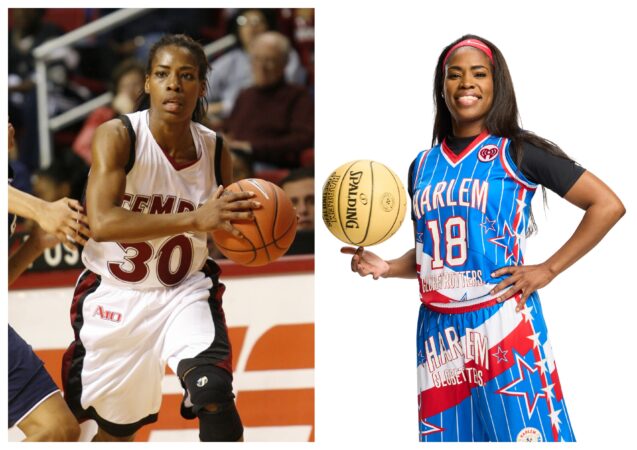
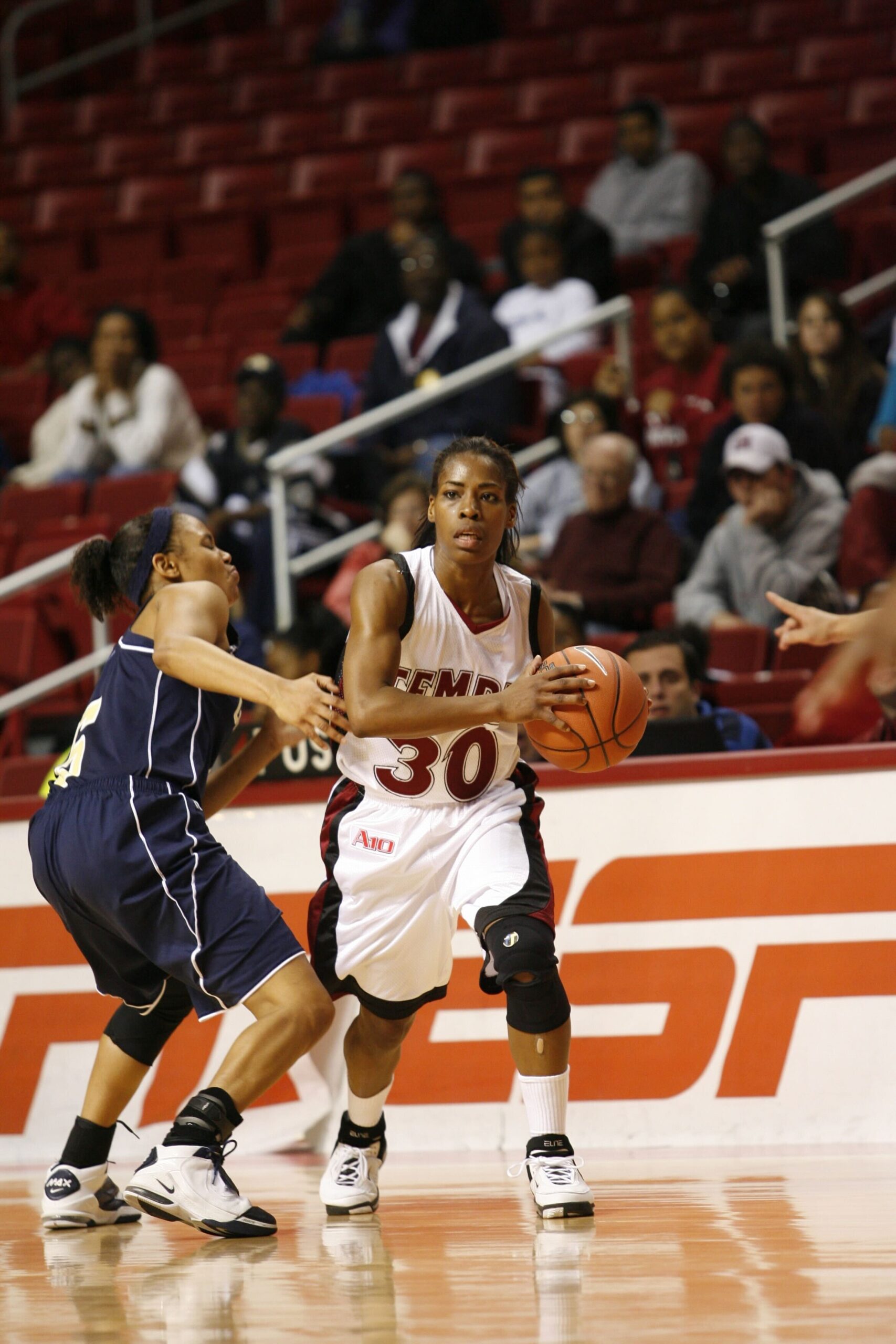
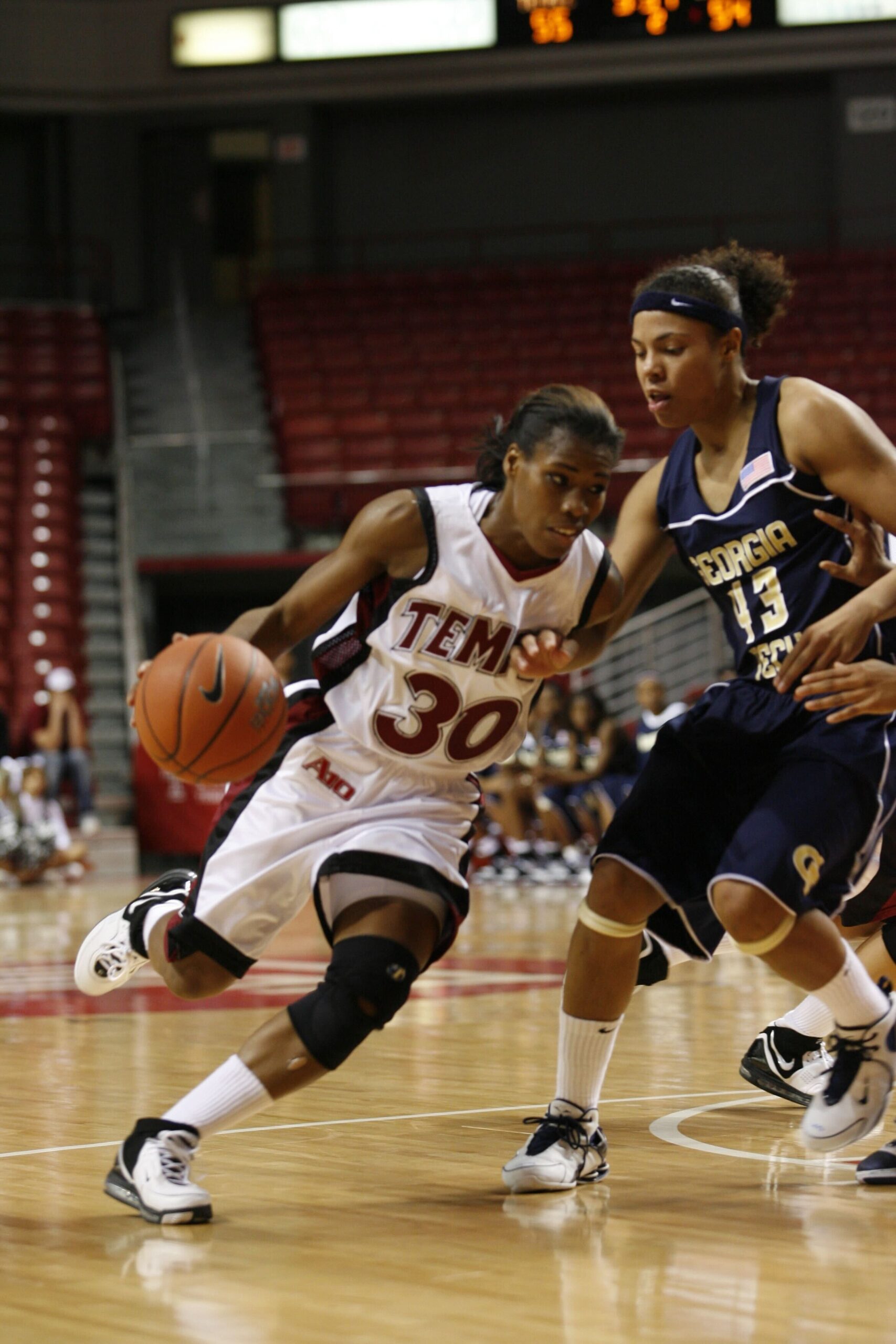
From 1993-2010, the Globetrotters had no women on the court. That changed in 2011, when Fatima “TNT” Lister joined the team. Lister played at Temple from 2005-07 — she played her first two years of college ball at the University of New Mexico. After playing a few years overseas, Lister tried out for the Globetrotters and earned a contract with the world-famous basketball team.
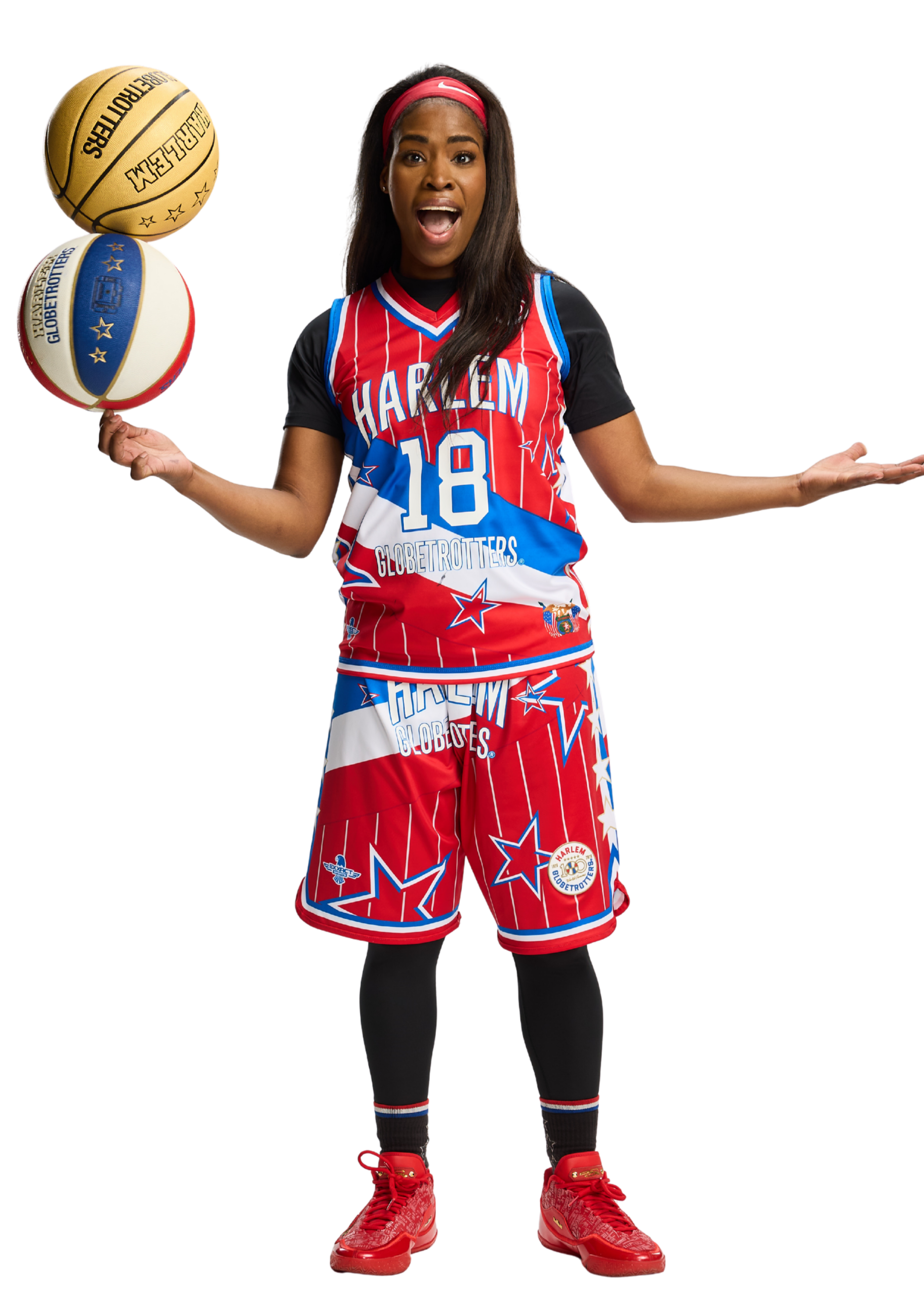
Lister adopted the nickname “TNT” from her teammates because of her explosive play and flashy dribbling. Fifteen years later, Lister still dons the jersey and has paved the way for other women to play for the Globetrotters.
“The fact that I get to kind of open that door back up for women to have this experience and I get to be that representation for little girls, you can tell kids things, but seeing is believing for kids,” Lister said. “So, the fact that they can see me out there holding my own and I get a chance to interact with them and things like that. That’s been the highlight for me.”
This year marks the 100th anniversary of the Globetrotters, and they will make appearances at the Liacouras Center on Feb. 19 and Xfinity Mobile Arena on March 1. While Lister won’t be in Philadelphia as she is with the international squad, the city still holds a special place.
The streetball and flashy style that embodies the Globetrotters has always been in Lister’s game. Growing up, the Colorado Springs native loved watching AND1 Mixtapes and 76ers legend Allen Iverson’s signature crossover.
But Lister’s game went beyond flashy dribbling. She played college basketball at New Mexico for two years, before transferring to Temple, where she learned under former head coach Dawn Staley.
Lister was a stellar three-point shooter while playing at Temple.
“It was a privilege to be able to pick her brain one-on-one,” Lister said. “Players dream of that, and as a basketball player, she’s done everything that I wanted to do. But I also got to see that she was very much part of the community. She did a really good job of taking care of her family and just juggling all of those things. It kind of inspired me to want to give back myself.”
It was one of the main reasons Lister signed a contract with the Globetrotters; they are heavily involved in the community, especially with children.
Lister’s favorite events are when the Globetrotters can bring a smile to a kid’s face who is going through a trying time.
Fatima “TNT” Lister tried out for the Globetrotters in 2011 and earned a contract with the world-famous basketball team.
Lister also enjoys bringing families together to make memories by watching her do what she loves — playing basketball. Each time Lister and the Globetrotters bring together thousands of fans it’s special.
“This has been an opportunity for me to do something that I’ve been in love with doing in terms of community service, but just on a bigger platform,” Lister said. “I’m really thankful to be a part of this and know how much we reach people, not just domestically but globally.”
While the Globetrotters’ on-court product may look fun and goofy, the group puts in hours of work to provide the best entertainment.
The Globetrotters are split into three squads, which allows them to play between 250-280 games at multiple venues each year. Practices last two and a half hours, and it’s not just tricks they are working on, the Globetrotters are doing regular basketball drills.
Fatima Lister played at Temple from 2005-07 before playing a few years overseas.
Most of the in-game skits or dazzling moves are improv, and they try to cater certain activities or fun moments to the city they are playing in.
Lister thought she would play just three seasons in the red, white, and blue, but instead has become a 15-year staple on the team. The experience continues to reap rewards, especially since her daughter, Kali, is old enough to watch her mom.
“She’s 7 now and she knows she doesn’t have the regular mom, and she loves it,” Lister said.”She loves coming to the games. I always bring her to the court. My teammates are like her uncles and they always make sure she has a good time. It’s been cool for her to see that.”
Lister has been an inspiration for other women to join the Globetrotters. She says her involvement serves “a purpose that’s bigger than me.”
“We all have our personal goals,” she added. “But the way I’ve been able to touch other people’s lives and use this thing that I have loved since I was 12 years old — I’ve probably performed in front of over 100,000 people. I don’t know everyone that I impacted, but I know the impact is bigger than even my dreams.”
I’ve never arrived to Exton’s Malgudi Cafe and not found a line out the door, whether for a late-night dinner or a blizzard-weekend brunch. That initially surprised me considering Malgudi appears at first glance to be an unassuming restaurant in a Chester County strip mall.
But this cafe is a special place, not only because it’s one of the region’s few Indian restaurants dedicated to vegetarian cooking, but because it may also be the only one focused specifically on the cuisine of the city of Bangalore, in the South Indian state of Karnataka.
I have loved virtually everything I’ve ordered here, from the crunchy stuffed pani puri puffs with sour-and-spicy green mint water to pour inside, to the lacy-crisp crepe roll of its onion rava dosa. But for a true immersion into the homey essence of Malgudi, which was launched in 2023 by four South Indian families, dive into a tray of bisi bele bath.
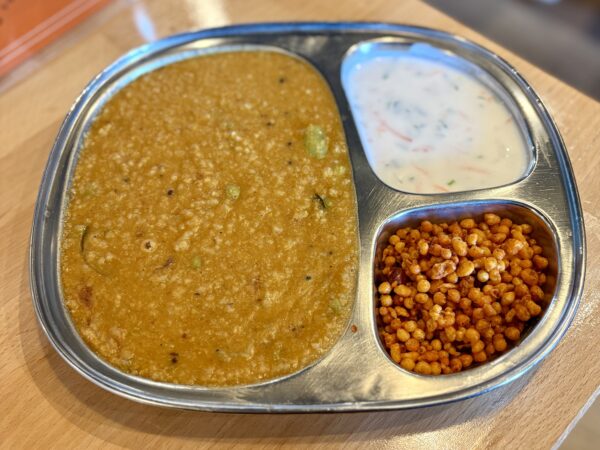
Known by its loyal customers as “Triple B,” this Karnataka comfort classic is a soulful stew of rice and toor dal (split pigeon peas) that are cooked down with seasonal vegetables until they essentially melt together into a soothing porridge. While the word “bisi” means “hot” in Kannada, this one-pot dish is not fiery so much as it is vivid with fragrant spice — tangy with tamarind and tomatoes then flared with the aromatics of Malgudi’s house masala, a punchy blend of dried red chilies, cinnamon, cloves, and coconut ground fresh. Served hot on a stainless-steel thali tray, there are sides of tart raita yogurt and crunchy boondi pastry beads to add more textures and flavors. On the off chance they’re already out of Triple B (as they were on my first visit), go for the khara pongal porridge of yellow moong lentils cooked down with cumin, cashews, chilies, and curry leaves. Malgudi Cafe, 10 W. Lincoln Hwy., Exton; 484-874-2124, malgudicafe.com
— Craig LaBan
Crab cakes at the Bomb Bomb, the classic Italian seafood joint revived by chef-owner Joey Baldino in deep South Philly.
Crab cakes at Bomb Bomb Bar
There’s a loose guideline followed by many people who dine out a lot: Get the most adventurous things on the menu. They’re often the best reflection of the kitchen’s passions.
So it was with a little sheepishness that I ordered, among other items, the “classic crab cake” at Bomb Bomb Bar, the deep South Philly institution that Zeppoli and Palizzi Social Club chef-owner Joey Baldino revived last fall. Crab cakes are frequently delicious, but they are also extremely common and seldom edgy, especially next to, say, whole Dungenesse crab and mom’s stuffed calamari.
But I’ll be forever content with my decision-making, for chef Max Hachey’s crab cakes are maybe the best ones I’ve ever had — a paean to blue crab, simply treated. To make them, Hachey combines crab meat from three different parts of the crab with reduced, onion-infused cream plus Dijon mustard, roasted-garlic aioli, chives, lemon zest, egg, and some crumbled Club Crackers (“just a few to held hold it together,” Hachey says). The mixture is scooped into dumpling-sized parcels, brushed with butter, then broiled. The cakes are plated, two to an order, on top of a swirl of basil vinaigrette, then garnished with confit cherry tomatoes still clinging to their crispy vines.
The meal at Bomb Bomb was full of hits, from the zippy antipasto salad to the oil-slicked Italian tuna spaghetti and the lobster and shells in a blush sauce, not to mention those torpedoes of sausage-stuffed squid doused in deep-red gravy. We were too full for dessert, but I didn’t feel so bad skipping it, as it was about as approachable as it gets: an ice cream sundae. Bomb Bomb Bar, 1026 Wolf St., bombbombbar.com
— Jenn Ladd
Goat in spicy scallop creole at a recent Honeysuckle x Kabawa collaboration dinner in Philadelphia.
Goat with spicy scallop creole at Honeysuckle x Kabawa popup
After eating an extremely gamey Kashmiri goat curry in high school, I had given up eating goat. I use the past tense because more than a decade later, I have relented on my goat fast. Last week, North Broad Street’s Honeysuckle restaurant hosted a popup with chef Paul Carmichael, who runs Kabawa in New York City’s East Village and presented some of his signature Caribbean dishes.
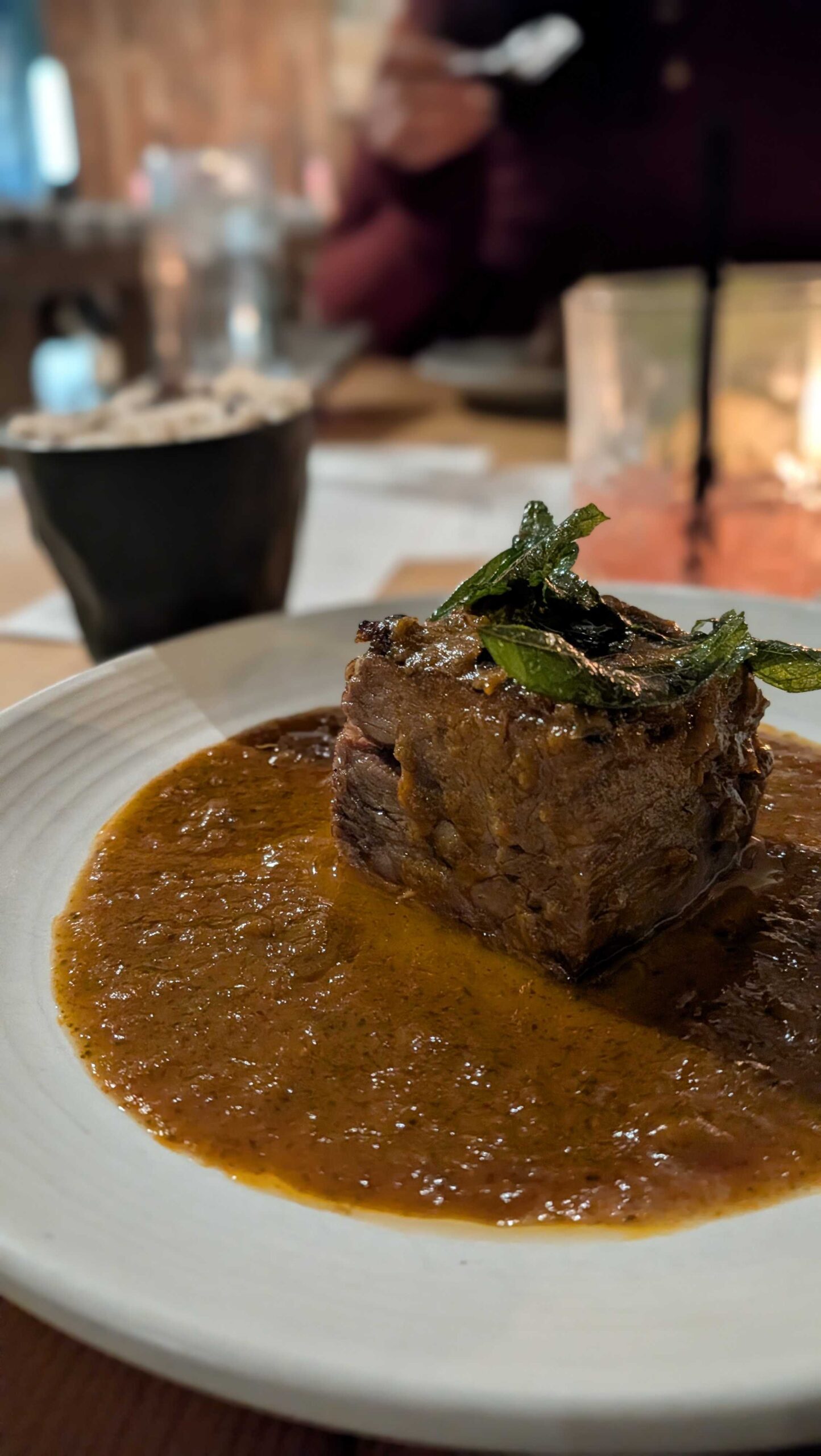
The goat shoulder was a perfect cube of meat, slow-cooked and succulent, bathed in a fiery gravy of habaneros and dried scallop. Glistening like a crown on top of the cube were fried curry leaves. It was absolute perfection, complemented beautifully by the collaborative dessert by Carmichael and Honeysuckle chef-owners Omar Tate and Cybille St.Aude-Tate: a decadent, mousse-y Marquise au Chokola dessert with rum, chocolate, dulce de leche, and djon djon — a rare mushroom from Haiti. Honeysuckle Restaurant, 631 N. Broad St., 215-307-3316, honeysucklephl.com