The 15th class of Forbes 30 Under 30 has some major Philadelphia connections, from Shark Tank winners to social media influencers, and Super Bowl champions.
A total of 18 people with ties to the Philadelphia area were recognized on the 2026 Forbes 30 Under 30 list in categories such as sports, social media, education, aerospace, and venture capital, among others.
Awardees who attended Philadelphia universities or based their businesses in the city appeared in all 20 categories.
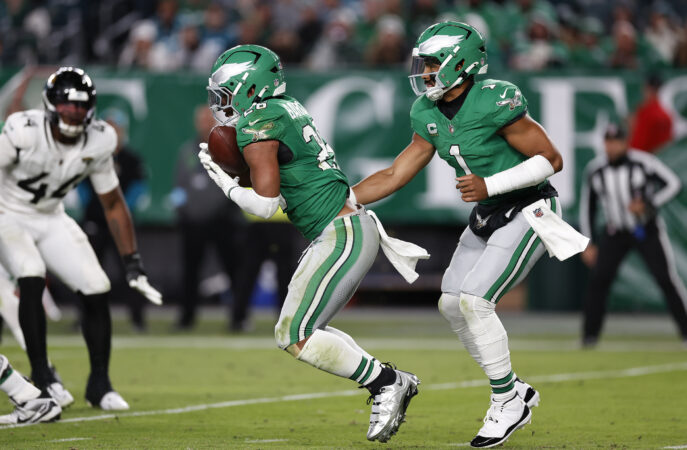
Among the 600 honorees chosen for this year’s class, the local representatives include Philadelphia Eagles Saquon Barkley, 28, and Jalen Hurts, 27. Along with carrying the Eagles to a Super Bowl LIX win earlier this year, Hurts and Barkley have landed major brand partnerships and endorsement deals, which have elevated their profiles beyond the gridiron.
Social media influencer Brandon Edelman (aka Bran Flakezz), 29, popular for his humorous TikTok videos about Philly culture and insights into influencer marketing, has also landed on the coveted list.
University of Pennsylvania alums Alexandre Imbot, 27, and Eli Moraru, 25, who founded Philadelphia’s the Community Grocer, are on the list. With partnerships with M&T Bank and FMC Corp, the leaders of the food-justice nonprofit have provided nutritious food to more than 10,000 Philadelphians, including recipients of the Supplemental Nutrition Assistance Program.
Another honoree is fellow Penn alum Kausi Raman, 28, cofounder of ChompSaw, a kid-safe power tool for cardboard cutting. Raman’s company has produced nearly 76,000 ChompSaws since 2022. In 2024, Raman joined cofounder Max Liechty on Shark Tank, where they secured $250,000 in a deal with Lori Greiner and Mark Cuban.
Another Philly-area honoree is John Huddleston, 27, the cofounder of Albacore Inc. The defense and space manufacturing company develops underwater vehicles to deter maritime invasions. Albacore has raised $6.5 million from backers including Z-Fellows, Outlander VC, Liquid 2, and Brave Capital.
Other Forbes 30 Under 30 honorees with Philadelphia ties
David Waltcher, 29, Penn alum and principal at New York-based venture capital firm FirstMark.
Salaar Kohair, 29, Penn grad and cofounder of L.A.-based gaming studio CAGE Studios.
Yejin Yeoum, 29, a Penn alum and principal at New York-based alternative investment manager BC Partners.
Tristan Fogt, 28, cofounder of Cincinnati-based Sensory Robotics and a Penn alum.
Jason Kaufmann, 26, Penn grad and cofounder of San Francisco-based Maritime Fusion.
Farah Otero-Amad, 29, Penn grad who’s a video producer and host at the Wall Street Journal.
Crystal Yang, 18, Penn student and founder of Audemy, a nonprofit assisting blind video gamers.
Katherine Sizov,29, Penn alum and founder of the life science company Strella, which designs technology to reduce food waste and improve quality.
Cindy Ji Won Lim, 29, Penn grad and director of brand marketing at Dallas’ Match Group. She’s also the cofounder of Korean American streetwear company Sundae School.
Andre Hamra, 28, Penn grad and founder of the recruiting platform Refer.
Kara Rosenblum, 28, Penn grad and co-owner of Bar Next Door in West Hollywood.
Maggie Tang, 25, Penn graduate and founder of Magic Technologies, an AI company specializing in hospitality services.
Montgomery County‘s former chief information officer says he was terminated because he requested accommodations for his mental health, according to a lawsuit.
But while claiming that there is “simply no question” Anthony Olivieri was terminated primarily due to his request for accommodations, the complaint takes a detour to describe instances of what it calls “fraud, waste, wrongdoing” by Montco officials since 2017.
Olivieri suffered from “anxiety, panic and depression complications,” the suit says. He took a medical leave of absence from November 2024 to January 2025. The issues persisted when Olivieri returned to work, in part because of “mistreatment,” the complaint says.
In July, the county fired him.
The fraud and wrongdoing allegations are included in the complaint because they explain how Olivieri’s “whistleblowing” contributed to a hostile work environment and his eventual termination, the lawsuit says.
“Montgomery County is steadfast in our commitment to fiscal responsibility and integrity,” a spokesperson said in a statement. “We do not comment on personnel matters or ongoing litigation.”
The most explosive allegation in the complaint revolves around the conduct of Dean Dortone, the county’s chief financial officer.
Montgomery County gave nearly $5 million to ePlus Inc., a company that provides a wireless communications network, in 2023 although a competitor offered the best technology solution, according to the complaint. Dortone tipped the bid in favor of ePlus, where he had been employed for about five years before joining Montco.
The complaint accuses Dortone of sharing the competitor’s proprietary bid with ePlus to allow the company to one-up its own proposal, in exchange for “lavish trips and golf outings.”
The relationship between Dortone and ePlus did not end when the company received the contract, the complaint alleges. The county’s CFO shared with ePlus the amount set aside in the budget for servicing the communications system, the suit says, allowing the company to charge the maximum allowed instead of invoicing according to need.
“This was gross waste and wrongdoing,” the complaint says.
ePlus did not respond to request for comment.
Olivieri also alleges that the county sent $500,000 to an impostor in 2017 and concealed the wire transfer to avoid embarrassment, and that in 2024 and 2025 the county claimed to have saved over $1 million by revamping printing infrastructure in offices even though the changes “did not happen.”
The suit also says that county officials often use personal emails to keep information from being available through right-to-know requests.
Olivieri says that he was “very vocal” in expressing concerns, using terms such as “fraud,” “waste,” and “illegal” to describe the conduct, and experienced hostility for it.
The original reason given to Olivieri for his termination was a broader “change of direction,” but when he sought unemployment benefits he learned that the county cited performance issues for his dismissal. But Olivieri received an unsolicited severance package of $30,000 in exchange for a legal waiver for retaliation and discrimination claims, the suit says.
The lawsuit calls the severance offer “well-established admissible evidence of discrimination, pretext, and retaliation.”
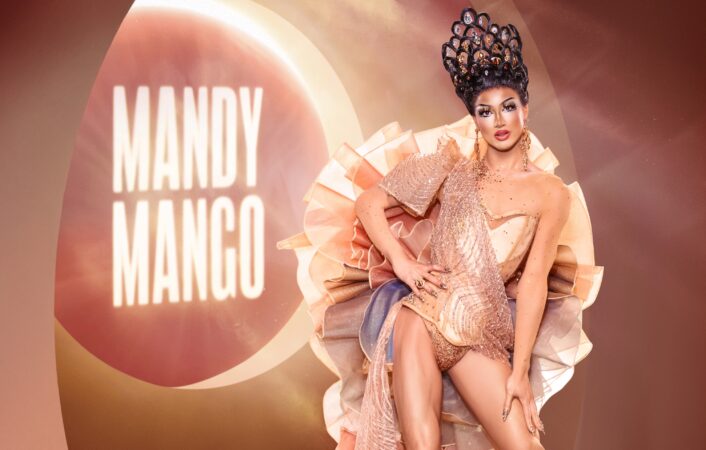
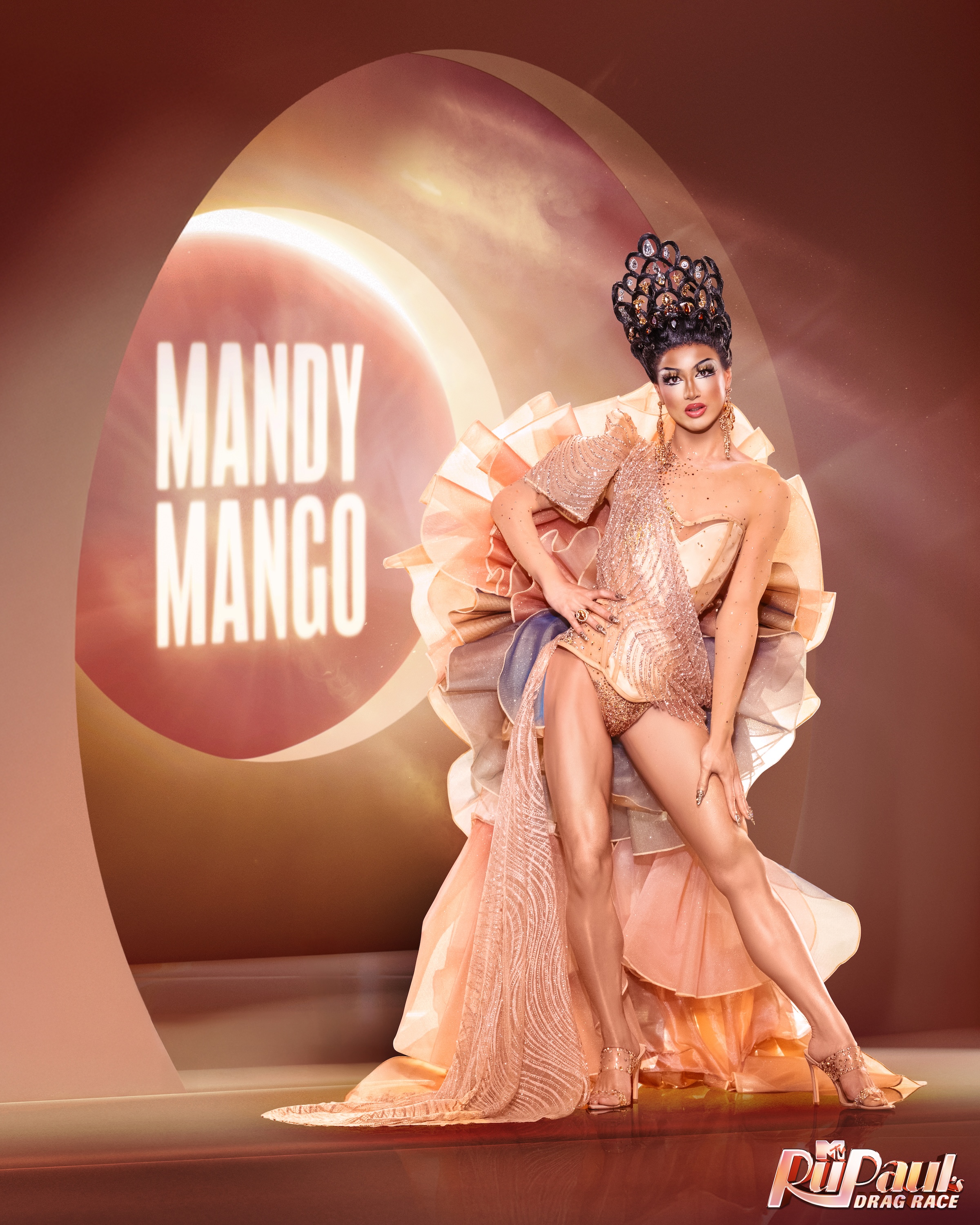
Philadelphia, start your engines — there’s another hometown star competing in the upcoming season of RuPaul’s Drag Race. Meet Mandy Mango, a first generation Filipino American who calls herself “the sweetest fruit in Philadelphia.”
Mango is one of 14 contestants announced this week who will compete in Season 18 of the legendary show that has catapulted the careers of some of the best drag performers in the country, from Trixie Mattel to Bianca Del Rio, to Bob the Drag Queen.
In the show, the queens face dance, makeup, sewing, acting, and lip sync challenges as they vie for the title of America’s Next Drag Superstar and a cash prize of $200,000.
Mango introduced herself in the show’s “Meet the Queens” Instagram post praising Philly’s drag scene, which she described as “very diverse, very eclectic.”
“We have our teeny boppers, we have our mama whoppers, we have some flippity floppers, and some daddy toppers,” she said.
She added that her biggest drag inspiration is her mother, who was a pageant queen in the Philippines in the 1980s.
Philly drag queen Mandy Mango will compete on Season 18 of ‘RuPaul’s Drag Race,’ premiering on Jan. 2 on MTV.
“Growing up [Filipino American] has always been strange, trying to figure out if I’m Filipino enough, American enough, or not enough of either, on top of being queer,” said Mango. “Drag has really guided my journey understanding my identity.”
Drag fans will likely recognize Mango’s performances on Philly stages in recent years, from the time she competed in Snatcherella, or organized a No Arena Drag Show in 2024 to protest the Sixers’ arena in Chinatown, which she called a “special place for me and my art,” according to Philadelphia Gay News.
Mandy Mango is the drag persona of Sigfried Aragona, an HIV care and community health nurse at Penn Presbyterian Infectious Diseases who advocates for LGBTQ+ healthcare. He lives in Philadelphia with his three cats, Wasabi, Sriracha, and Soy.
Aragona first performed in drag as a student at West Chester University to Chelley’s “Took the Night.” He later went on to work at AIDS Resource Alliance, a nonprofit that provides health services across Northcentral Pennsylvania.
In a 2020 TEDx talk in Williamsport, Pa., Aragona passionately explained how he blends drag performance with his healthcare work and community activism.
“With Mandy Mango, I feel powerful. I feel fulfilled. And I believe that my space in this world is finally valuable,” said Aragona. “Mandy’s drag journey seeks to blend nursing intellect and drag art to empower people similarly.”
Mango is only the second drag queen to represent Philly in Drag Race’s 16-year history, following Season 16 star Sapphira Cristál. The opera singer was a fan favorite who aced challenges all season long and ultimately placed second. Cristál earned the title of Miss Congeniality and brought home $35,000 in prize winnings.
Other contestants who have ties to the Philadelphia region are Aquaria, the winner of Season 10, who grew up in West Chester, and Season 3 competitor Mimi Imfurst, who was raised in Massachusetts and Maine, but now calls Philadelphia home. Both of them represented New York on the show.
Season 18 of ‘RuPaul’s Drag Race’ premieres at 8 p.m. on Jan. 2 on MTV.
A $78.6 million ferry, slated to join the fleet of vessels connecting Cape May and Lewes is one step closer to getting built. It will be the first hybrid ferry on the three-ship line that operates between the two beach destinations in New Jersey and Delaware.
The Delaware River and Bay Authority (DRBA) announced Tuesday that it had awarded the contract to build the ferry to Rhode Island-based Senesco Marine. The DRBA owns and manages the ferry line, which operates year-round.
Once built, the diesel-hybrid ship is expected to accommodate up to 75 vehicles and 400 passengers.
“For sustainable ferry operations in the future, it’s imperative we make this necessary capital investment today,” said DBRA executive director Joel Coppadge. “The ferry’s a critical piece of regional infrastructure, and we’re proud of the ferry’s heritage and link between two historic destinations. The new hybrid ferry is the start of the next chapter in the proud history of the Cape May-Lewes Ferry.”
A rendering of the $78.6 million ferry that is slated to join the fleet of vessels connecting Cape May and Lewes.
The Rhode Island firm tasked with building the ferry has been operating since 1999 and works both on new construction and vessel repairs. Construction is set to begin next year and is expected to be completed by the summer of 2029. The project is funded in part by a $20 million grant from the U.S. Department of Transportation.
The new ferry will replace a diesel craft that’s over 40 years old. Currently three ferries operate between Cape May and Lewes.
The new ship will have fewer emissions and be more cost-efficient, according to the DRBA.
Annually, the ferry line transports some 750,000 passengers and over 250,000 vehicles, according to James Salmon, a spokesperson for the DRBA. That number has declined over the years — roughly 1.1 million passengers used the ferry line in 2007.
A rendering of the interior of the new ferry, which is expected to begin construction in 2026 and be complete by 2029.
“The Cape May-Lewes Ferry is a vital transportation link and an economic catalyst for the southern regions of Delaware and New Jersey,” said Heath Gehrke, director of ferry operations, noting that some passengers use the service to commute to work.
Adults pay between $14 and $18 roundtrip depending on the season to make the roughly 85-minute trip. For a vehicle, it costs between $39 and $82 roundtrip depending on the time of year and day of the week. Bicycles can be brought onboard for free with the purchase of a passenger ticket, and there is separate pricing for motorcycles and scooters.
A rendering of the $78.6 million hybrid ferry slated to join the fleet of vessels connecting Cape May and Lewes.
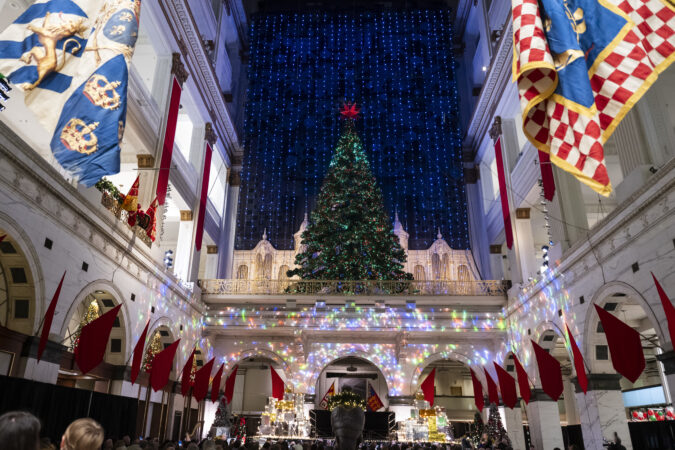
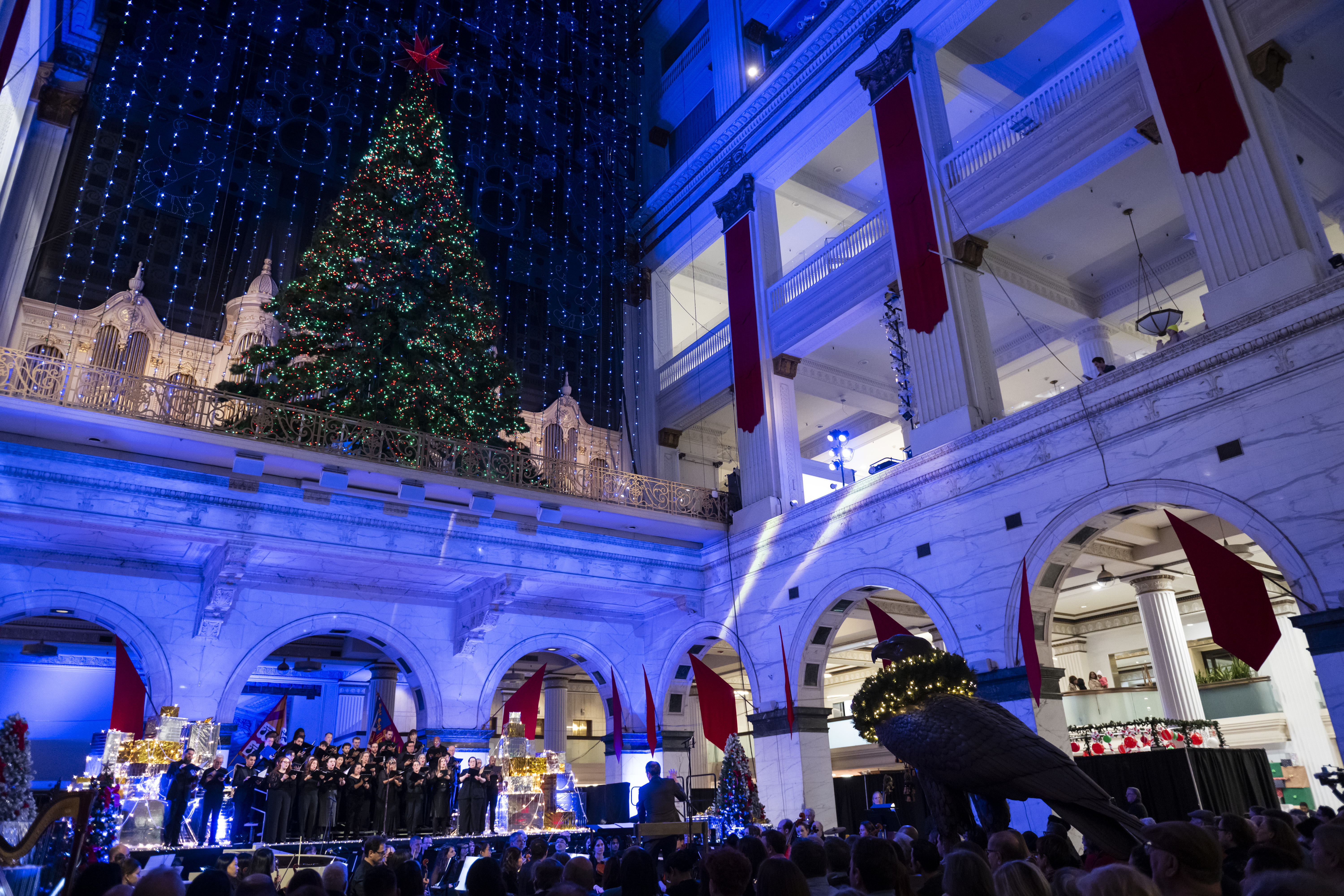
The Christmas tree was indeed magical and the music, in turns, brilliant and warmly enveloping. Even the Wanamaker Eagle got into the act, crowned for the occasion with a lit Christmas wreath hung around its neck.
A certain misty, nostalgic conjuring of Christmas past has reached its apotheosis in the Wanamaker Grand Court, and now the bittersweet countdown begins. Tuesday night’s “Home for the Holidays” concert is done, the Bearded Ladies Cabaret checks in next week, the Light Show and Dickens Village attractions run through Christmas Eve, and then the space closes for perhaps a couple of years while the building undergoes renovations.
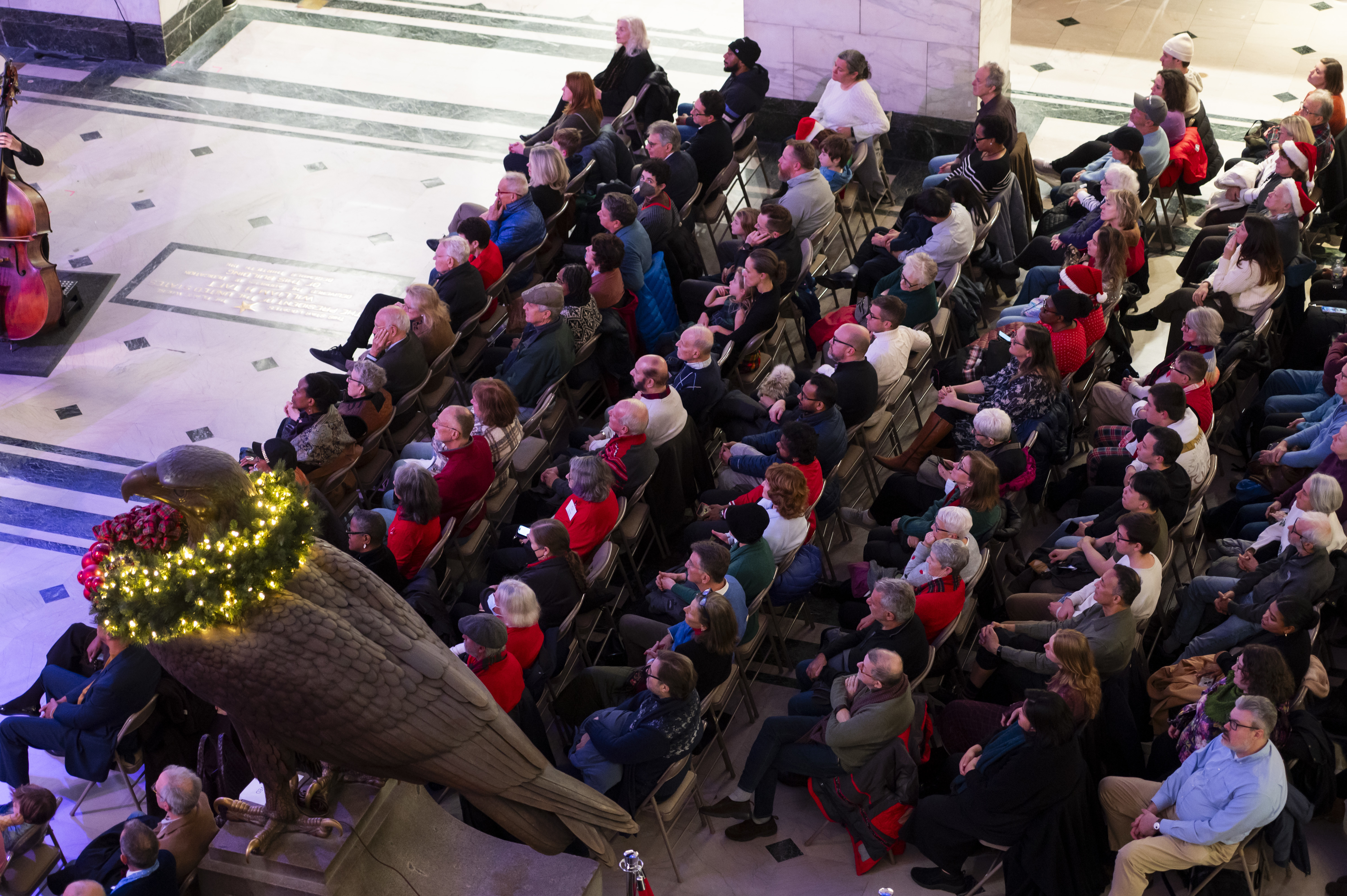
The Wanamaker Eagle donned a lighted wreath for Tuesday night’s concert.
The one-night-only concert in the former Center City Macy’s did exactly what it should have. In the best gritty Philadelphia tradition, it took a defeat — the departure of a major retailer and the imperilment of the beating heart of Christmas in the city — and turned it into a party.
Opera Philadelphia was the creative director behind the event, which swung from sincere and spiritual (chorus members running their fingers around the wet rims of glasses to produce an ethereal shimmer) to the head-scratching (a couple of dancers in dinosaur suits moving to an excerpt from Philip Glass’s 1000 Airplanes on the Roof).
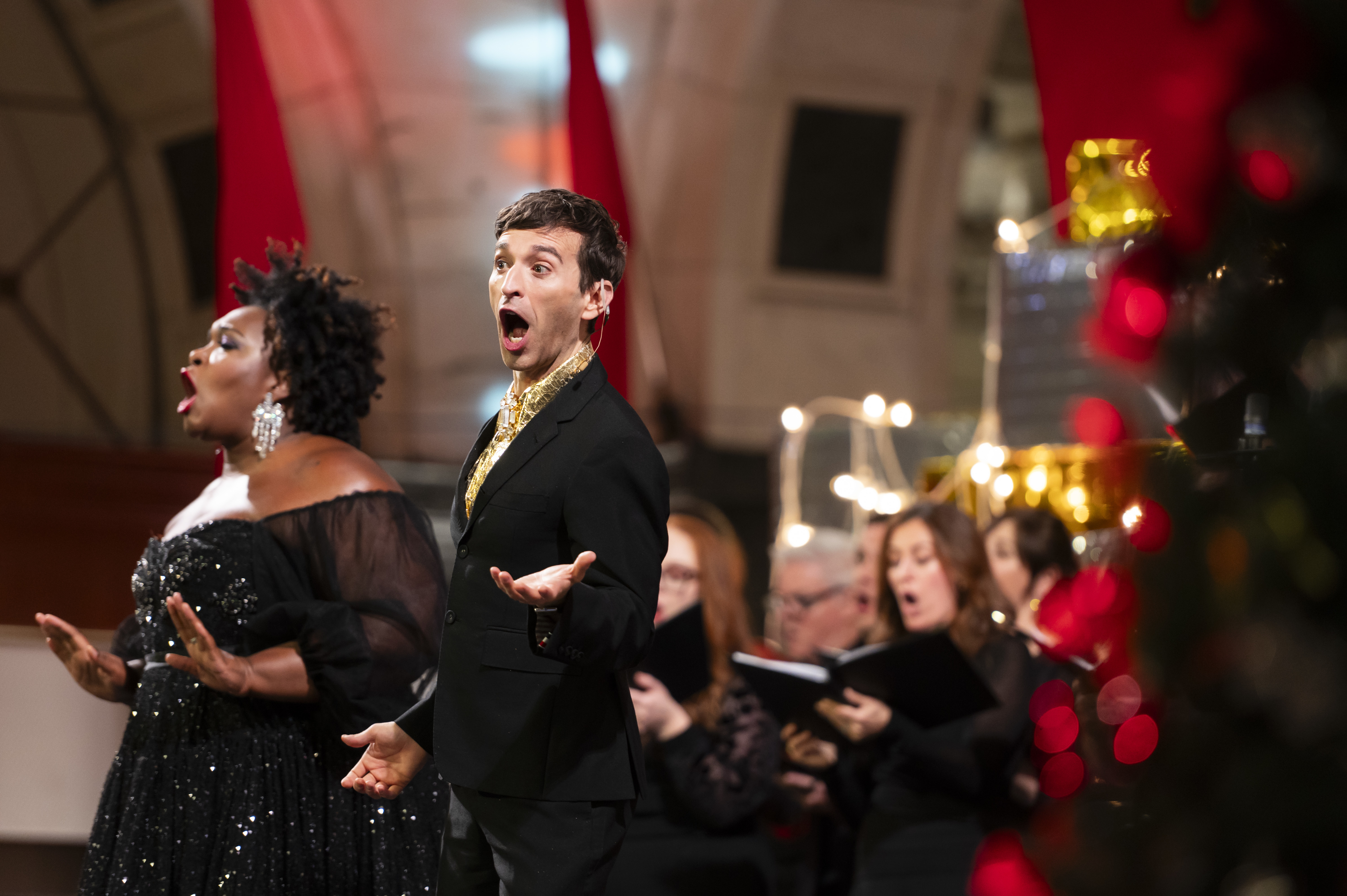
Anthony Roth Costanzo (right), countertenor, and Leah Hawkins (left), soprano, perform during “Home for the Holidays” on Tuesday at the Macy’s Center City.
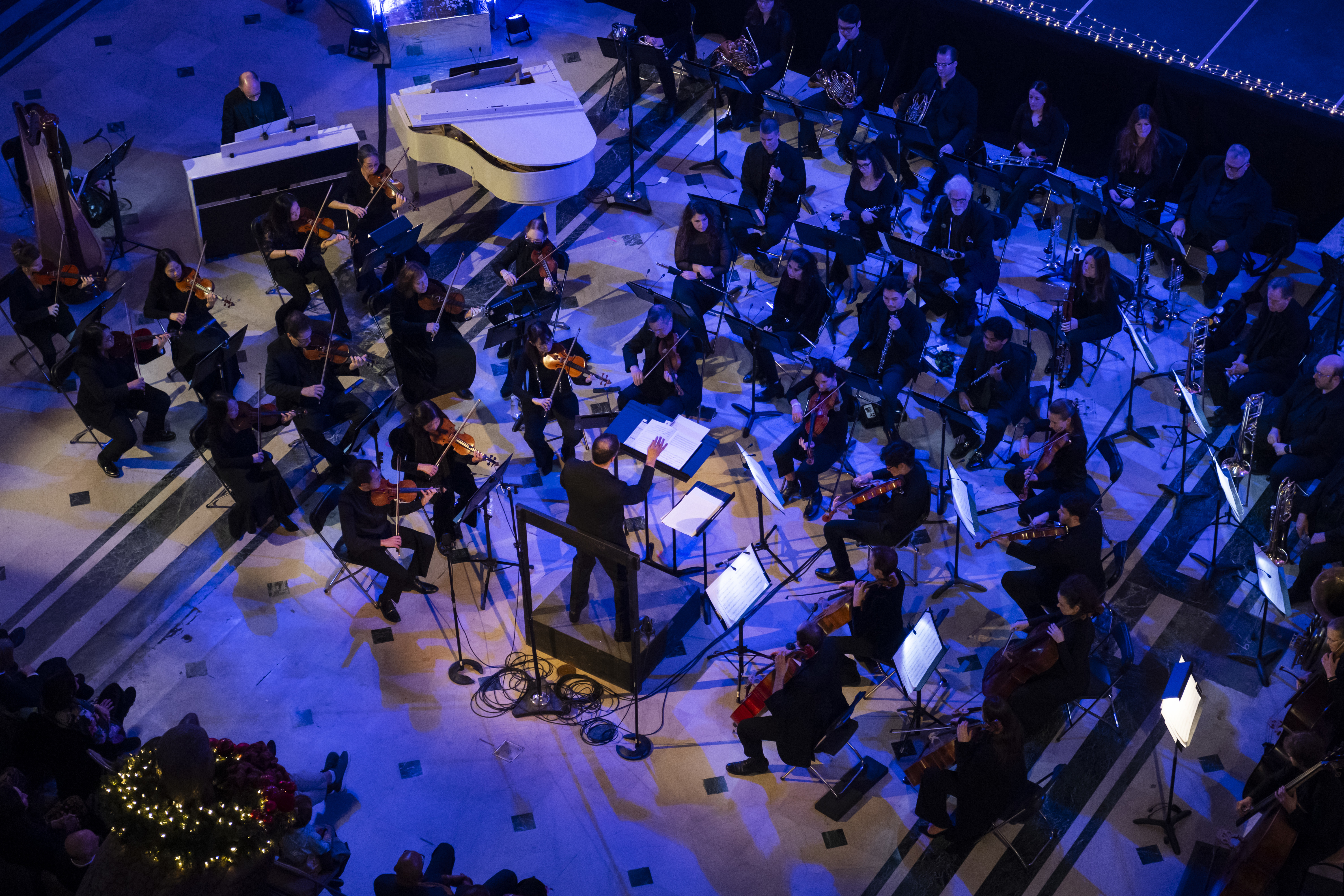
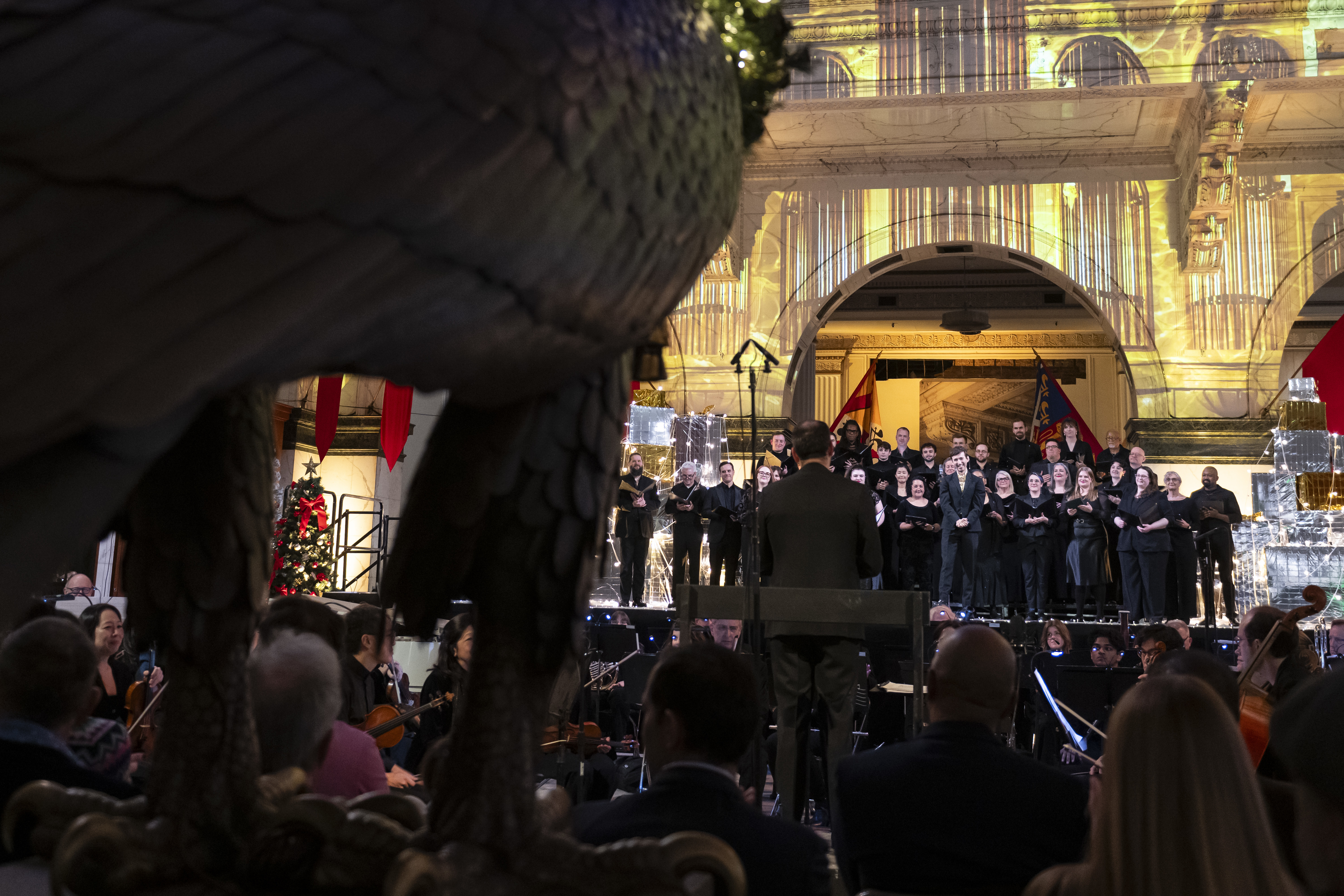
The forces — orchestra, chorus, dancers, superb soprano Leah Hawkins, and clarion-countertenor (and Opera Philadelphia chief) Anthony Roth Costanzo led by conductor Geoffrey McDonald — delivered a variety-hour-plus celebration a la “Radio City Christmas Spectacular,” if in miniature.
But the best vibe of the evening came from above via the hands and foot-peddling feet of organist Peter Richard Conte. He showed how a musician, instrument, and their space can seem made for each other, and why the Wanamaker Grand Court Organ is not one instrument, but many. The highly inventive organist called upon fat French horns and muted trumpets in his own arrangement of Victor Herbert’s “March of the Toys.”
Pure joy.
The Opera Philadelphia chorus performs in “Home for the Holidays” at the Wanamaker Building’s Grand Court on Tuesday, Dec. 2, 2025.
Christmas in this space triggers memories unique to each one of us, but it was a nice stroke by 10th Floor Productions to animate the marbled expanses around the courtyard’s arches with projected images of marching bears and soldiers for anyone who remembers the store as the source for holiday toys.
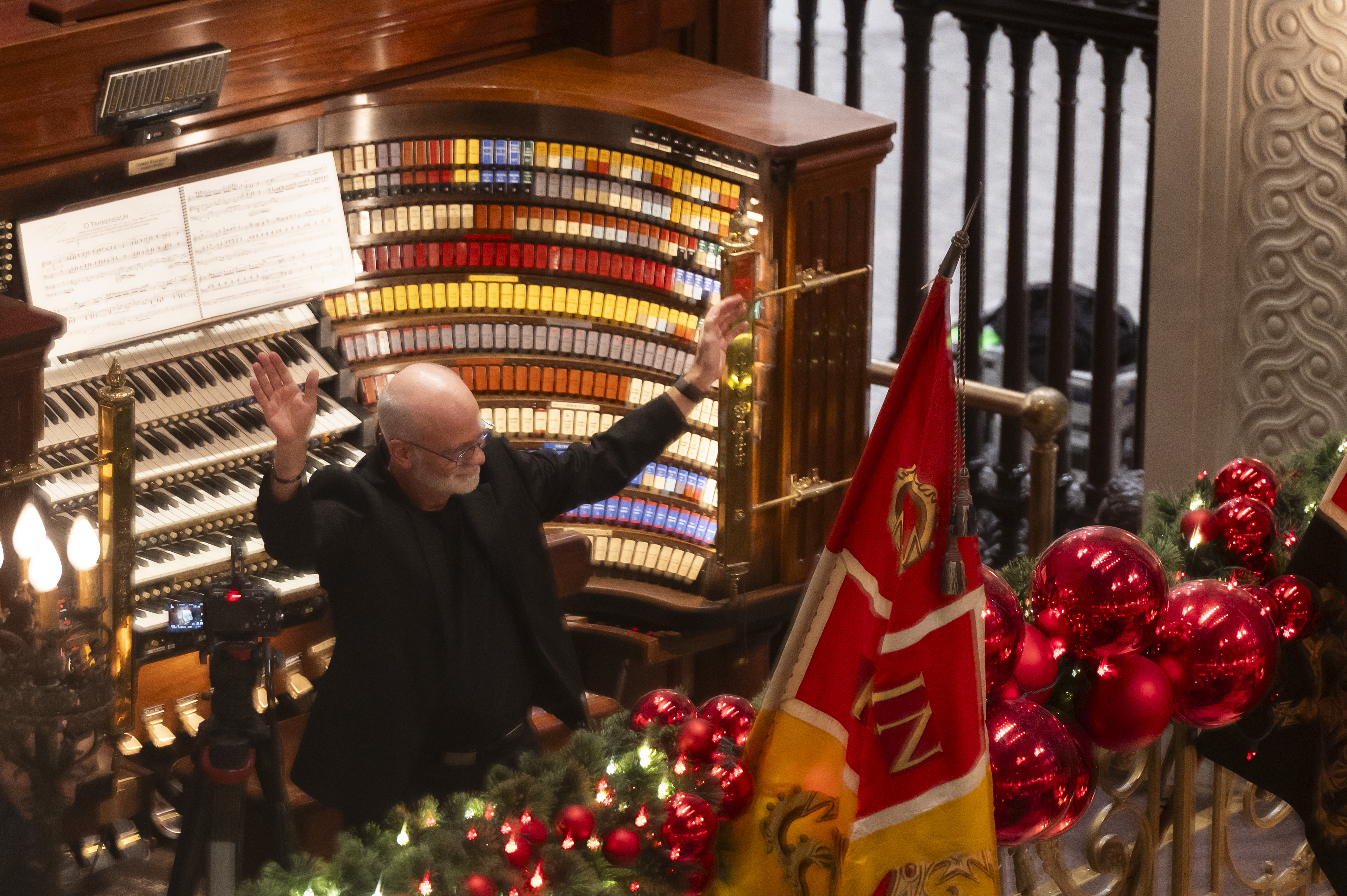
Frederick R. Haas, philanthropist and organist, waves to the crowd during “Home for the Holidays” in the Wanamaker Grand Court.
That the organ is still being played in this sliver of a post-Macy’s era is largely due to a $1 million donation from philanthropist Frederick R. Haas for the Pipe Up! series (as well as many previous gifts to the organ).
Rarely have a donor and his cause been more personally intertwined. Haas is himself a trained organist who could sometimes be heard playing in the space in its department store days. On Tuesday, he played his medley A Christmas Improvisation, tapping into a supply of enormous, overtone-rich bells in “Silent Night” and beautiful, unusual harmonizations in “Carol of the Bells.”
Conductor Geoffrey McDonald leading the Opera Philadelphia Orchestra in the Wanamaker Grand Court.
If the evening had a theme beyond Christmas, it was nostalgia.
Sub rosa, though, this and every event in the Pipe Up! series in the past few months has been about the future — about making the case for the Wanamaker Grand Court as a space that should survive as a public right of way no matter its next life.
TF Cornerstone, the building owner, has been generous and respectful of preserving public access so far. As the developer renovates and cuts deals with prospective tenants, access and the future of the organ as a daily presence hang in the balance.
The Opera Philadelphia orchestra, chorus, and vocal soloists in the Wanamaker Grand Court Tuesday night.
One piece on Tuesday night was a reminder of the special dynamic at risk.
When Opera Philadelphia flash-mobbed Macy’s with the “Hallelujah Chorus” from Handel’s Messiah in 2010, it packed a punch because of the surprise of it. Music was suddenly in the best place of all: somewhere you’d never expect it. That’s also the secret superpower of the organ.
It was great to hear the “Hallelujah Chorus” here again. But heard now, it seems like a challenge issued, illustrating what the space once was and might one day be again.
“Home for the Holidays” will be broadcast Dec. 23, 8 p.m. on WHYY TV12, WHYY radio (90.9 FM), and via whyy.org.
The Pipe Up! series continues with the Bearded Ladies Cabaret’s “It’s Giving Cabaret” in the Greek Hall at the Wanamaker Building, 13th and Market Sts., Dec. 10-14. operaphila.org.
The Wanamaker Light Show and Dickens Village run through Christmas Eve. visitphilly.com.
A University of Delaware student who planned to target a campus police building with firearms was arrested last week and charged with federal weapons crimes, authorities said.
Luqmaan Khan, 25, of Wilmington, vowed to “kill all” as he mapped out violent schemes in his journal — ones that involved Glock pistols, stun grenades, an assault rifle, and other “urban warfare setups,” according to a criminal complaint filed by the FBI.
New Castle County police discovered the alleged plot when, authorities say, they happened upon Khan behaving suspiciously in a disc golf park late last Monday.
When officers found Khan alone in a Toyota around midnight after the park had closed, they said, he repeatedly reached around in the vehicle and became nervous when questioned why he was there.
Khan was arrested for resisting arrest after he refused to get out of the driver’s seat. When officers searched the car, they found a loaded Glock .357 handgun, a brace for semiautomatic pistols that have been converted into machine guns, four loaded extended ammunition magazines, body armor, binoculars, and a notebook, according to the affidavit of probable cause for his arrest.
That notebook is now the center of an investigation being handled by agents with the FBI’s Wilmington office.
The marble composition book was littered with references to different firearms and the ideal scenarios for their use, the affidavit said.
Khan noted that an assault rifle was best for “open spaces,” while a Glock pistol was better for “fast transition fighting.” He suggested tear gas could be used for “room clearing,” the document said, while a sword or knife would allow for “no noise kills.”
Khan’s notebook also included a hand-drawn map of a building that federal authorities say appears to be the University of Delaware campus police station. It included notes about entry and exit points to the building at certain times of the day, the affidavit says.
Meanwhile, Khan named a University of Delaware police officer as a “specific target” according to the affidavit, which did not identify the officer.
Khan, the document said, “intended to use the weapons he amassed to commit ‘ambushes’ and ‘surprise attacks’ on targets” at the university.
Laura Carlson, the university’s interim president, said in a letter to the campus community that Khan has been “temporarily separated” from the university as the investigation continues and is barred from accessing campus buildings.
“There are no known or immediate threats to the University of Delaware community,” Carlson wrote. “However, [police described] evidence of a plan that targeted the University of Delaware Police Department (UDPD). This is frightening to all of us.”
Khan’s writings repeatedly mentioned becoming a “martyr,” authorities said. In an interview with the FBI after his arrest, the affidavit said, Khan told investigators that martyrdom was “one of the greatest things you can do.”
Khan, who was born in Pakistan and emigrated to America in his youth, is a U.S. citizen who lived alone and had no criminal convictions, federal authorities said.
Federal agents searched his residence last week and recovered an additional unregistered 9mm Glock pistol with a machine gun conversation kit, an M4 rifle with a scope and red dot sight, 10 more extended magazines, and a second body armor plate.
Federal prosecutors charged Khan with possessing a machine gun and an unregistered firearm. If convicted, he faces a maximum sentence of 10 years in prison, according to the U.S. Attorney’s Office.
Khan faces additional state charges for resisting arrest and other misdemeanors.
His lawyer,Eleni Kousoulis, was not immediately available for comment.
As U.S. District Judge Gerald McHugh prepared to sentence Mark Anthony Tucci for hurling racist, violent threats at two Black women he had never met, the judge paused for a moment and teared up.
Tucci’s vile language and promises to harm the women not only were criminally inexcusable, McHugh said, but also were a demonstration of “deeply hateful attitudes” that cannot be tolerated in society.
“It was meant to deny their dignity and their humanity,” McHugh said. “And that’s what makes it so troublesome.”
McHugh offered those remarks before sentencing Tucci on Tuesday to 33 months in federal prison and ordering him to pay nearly $17,000 in restitution. Tucci had pleaded guilty earlier this year to charges including threat to use a dangerous weapon, interfering with federally protected activities, and interstate communication of threats.
U.S. Attorney David Metcalf said in a statement that the case was an example of the criminal justice system holding someone accountable for language that was both disturbing and a violation of the victims’ civil rights.
“Every citizen is entitled to a peace and security undisturbed by the abhorrent and racist threats that took place in this case, full stop,” he said.
Tucci’s crimes took place last year in two separate incidents: In the first, Tucci, who is white, pulled up next to a Black woman driving on I-95, rolled down his window, and threatened to kill her, court documents said. The second episode happened when he repeatedly harassed a Black employee of the Philadelphia Department of Human Services who had been assigned to an investigation involving Tucci’s daughter.
In both instances, court documents said, Tucci used racial slurs and made bigoted, demeaning comments that played on offensive racial stereotypes. Prosecutors said he also threatened to harm both women — telling the driver on I-95 that he would kill her and throwing a coffee cup at her car, and, in the case of the DHS worker, finding her home address and cell phone number to continue his racist harassment.
As prosecutor Samuel Kuhn, of the Justice Department’s Civil Rights Division, outlined those facts during Tuesday’s sentencing hearing, Tucci repeatedly put his face in his hands, shaking and bowing his head.
Tucci later addressed McHugh, saying that he was embarrassed and ashamed, and that his actions were inexcusable. At the time of the crimes, he said, he had been suffering from undiagnosed mental health issues. He said that he has since been receiving treatment, and that his medications have helped him understand his past misdeeds.
Authorities initially said Tucci had boasted during one of the episodes about his association with the far-right Proud Boys group, and his lawyer said in court documents that the group “clearly influenced” him. But there was no discussion of the group or Tucci’s politics during his sentencing hearing.
Several of his relatives, including his mother and brother, testified and said they had seen his mental health improve over the last several months while receiving treatment in custody.
Tucci, for his part, said he wished he could have apologized to his victims, neither of whom attended the proceeding. Kuhn, the prosecutor, read statements on their behalf. In one of them, the motorist Tucci threatened said she still experiences anxiety as a result of the attack, particularly while driving.
“People who look like me have a right to live safely and freely,” she wrote.
Tucci said he agreed, and lamented that there was “nothing I can do to make it right.”
“I’m forever pegged as a racist because I said things that were racist,” he said.
As Tucci stood to leave the courtroom at the end of the hearing, McHugh, the judge, told him: “Your future is in your hands now.”
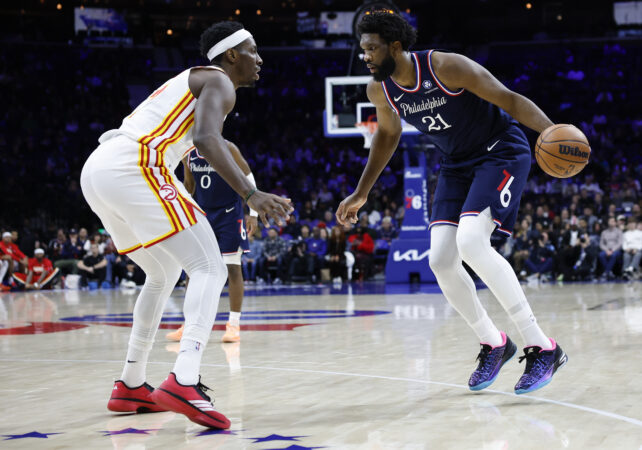
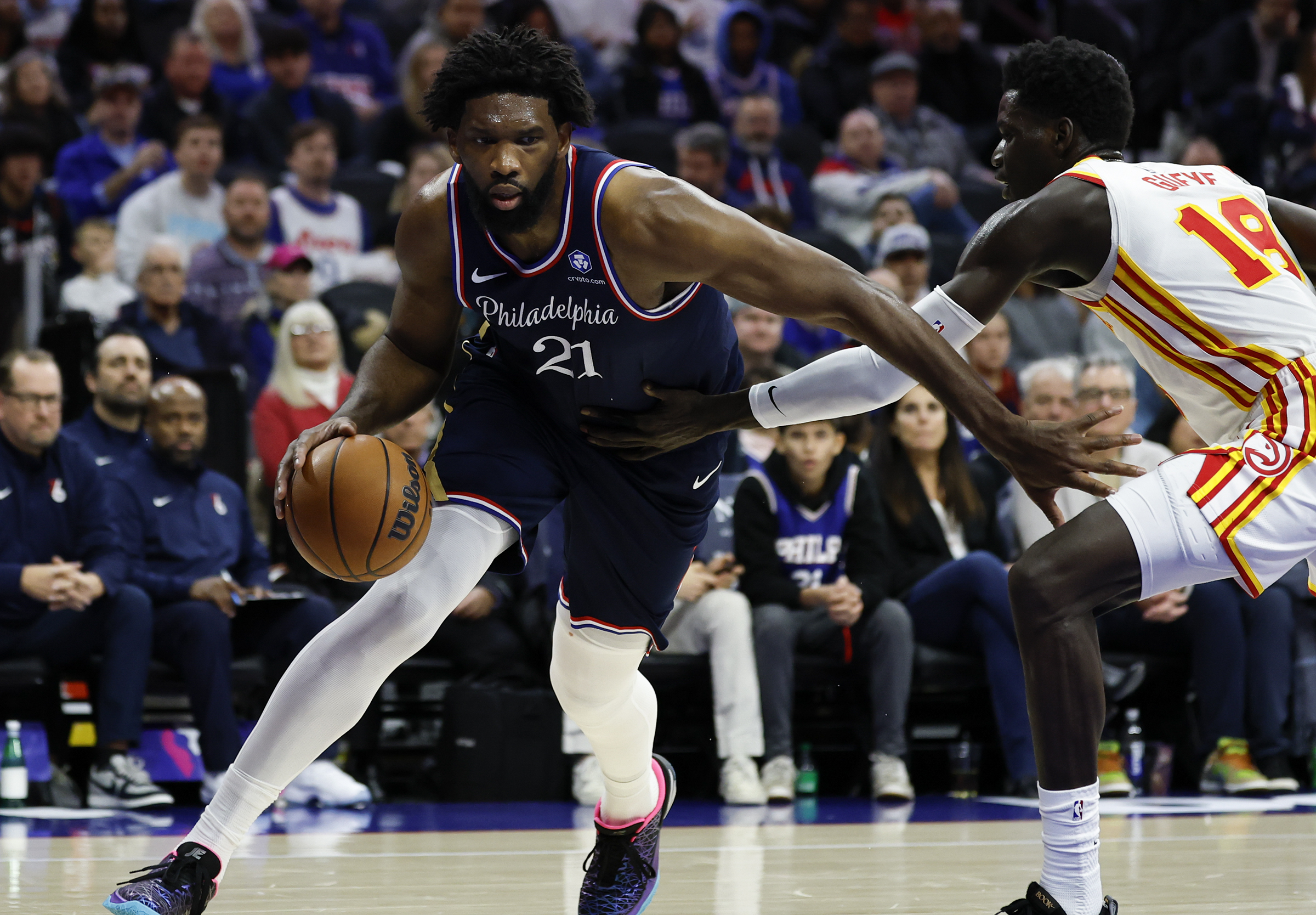
Joel Embiid’s new signature shoe with Skechers, the SKX JE 1, was released exclusively at Lapstone & Hammer on Saturday. The Sixers center, who signed with the brand last year after his five-year partnership with Under Armour ended, debuted his shoes during the team’s 142-134 double-overtime loss to the Atlanta Hawks on Sunday.
Embiid wore the low-top sneaker, which has his initials on the tongue of the shoe, in black, blue, and pink. The shoe is expected to release two other colorways: neon green and black, and a red, white, black, and gold color scheme that appears to match the Sixers’ all-black jerseys from their 2001 NBA Finals team, which the team has brought back for the 25th anniversary of that season.
First look at the SKX JE1 — Joel Embiid’s new signature shoe with Skechers. The official launch is just days away, but here’s a peek at a few colorways and some of the finer details. Looks like it’s rocking a Goodyear sole, too.
Embiid previously had just one signature shoe with Under Armour, the Embiid One, which released in September 2020. Having a second signature shoe with a different company is rare, and he joins players like Aaron Gordon, Kyrie Irving, and Andrew Wiggins as active players who have had signature shoes with more than one brand.
Although the shoes’ global release has not yet been announced, Embiid is on a small list of Philly athletes who have had their own signature shoes. The most notable is Allen Iverson with 18 Reebok signature shoes. Although the list is brief, how does Embiid’s newest shoe stack up against his predecessors?
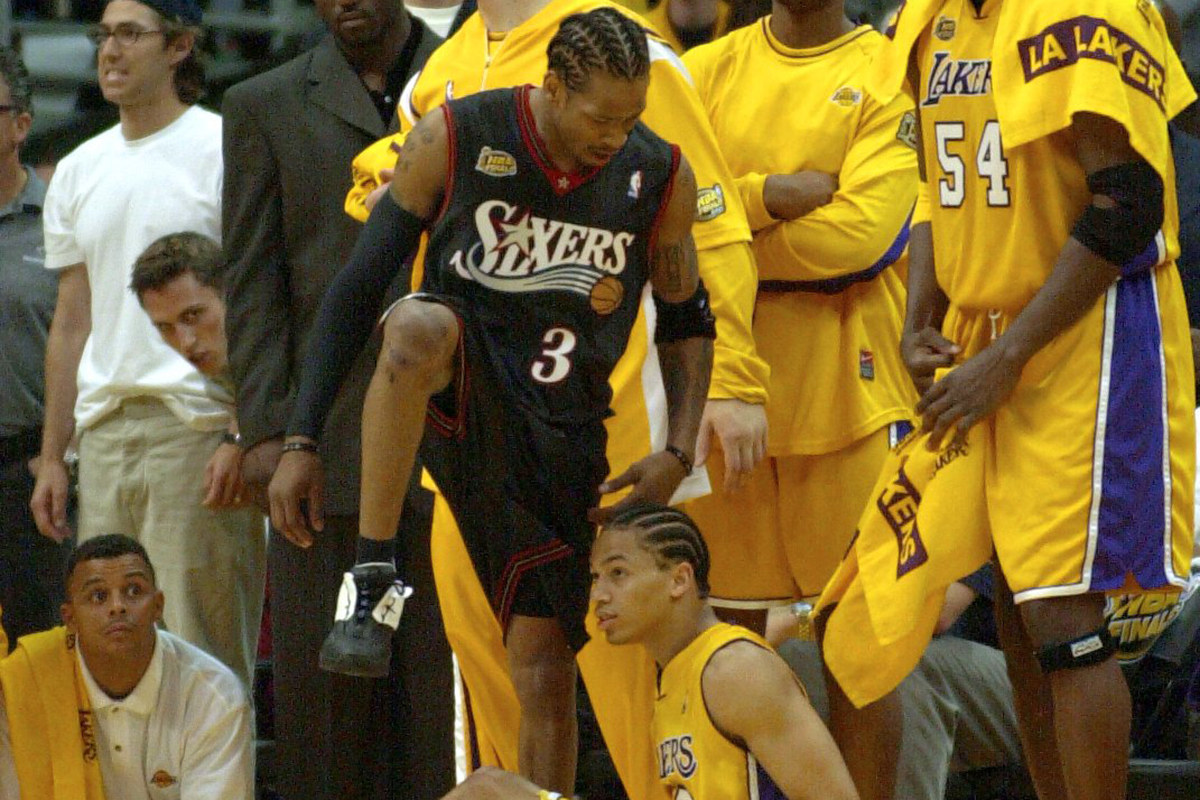
Allen Iverson was wearing the Reebok “Answer IVs” during Game 1 of the 2001 NBA Finals.
Iverson’s ‘Questions’ and ‘Answers’
There have been many Iverson shoes with Reebok, but the popularity of his Reebok Question 1 signature shoe, which debuted in 1996 after he was drafted No. 1 overall by the Sixers, and his Reebok Answer IV shoe, which came out in 2000, is palpable.
The latter has even been replicated as football cleats. Eagles wide receiver DeVonta Smith wore custom-made Iverson IV cleats for last year’s NFC championship game against the Commanders and the Super Bowl. The shoe was an homage to Iverson’s tunnel outfit for the NBA Finals, which featured a custom-made Eagles jersey with his last name on it and a green and white colorway for the Answer IVs.
The original Reebok Question sneakers are best known for their red cap, matching the style of the Air Jordan 11s that Iverson wore in college at Georgetown. The Question had a white base, with the red toe and blue bottoms to match the Sixers’ jerseys back then in 1996-97. Versions of them continue to be sold today, and Reebok has even unveiled a golf shoe in the same style.
We also need to show some love to the Answer 1 high-top shoes, which had hidden laces and featured the pump on the side of the shoe with Iverson’s logo on it.
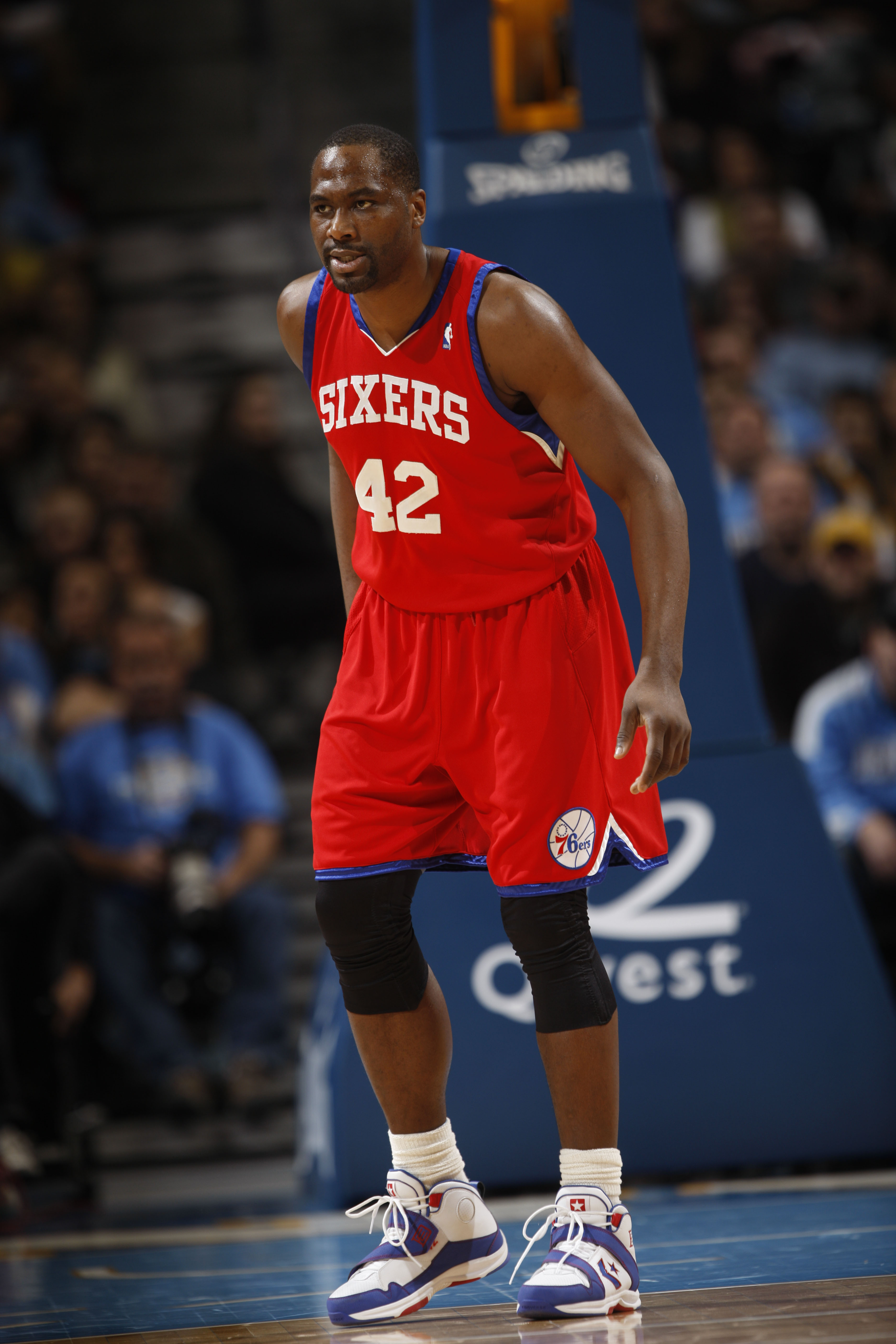
Sixers forward Elton Brand, now the team’s general manager, donned several versions of his Converse signature shoes during his time playing in Philly, including these in 2010.
Converse EB
Right as Elton Brand’s playing days started in Philly in 2008, so were his signature shoe releases. He debuted the Converse EB1 signature shoes during his first season with the Sixers, with the EB logo on the strap across the sneakers shaped as the letter “D” as an homage to his mother Daisy and his Dunbar Heights neighborhood near Peekskill, N.Y.
Brand went on to release the Converse EB2 and EB3 in 2009 and 2010, respectively. His shoes were best known for being sold exclusively at JCPenney for $65. He had two stints with Philly as a player (2008-12, 2016), then worked his way up through the Sixers’ organization from player development consultant to general manager.
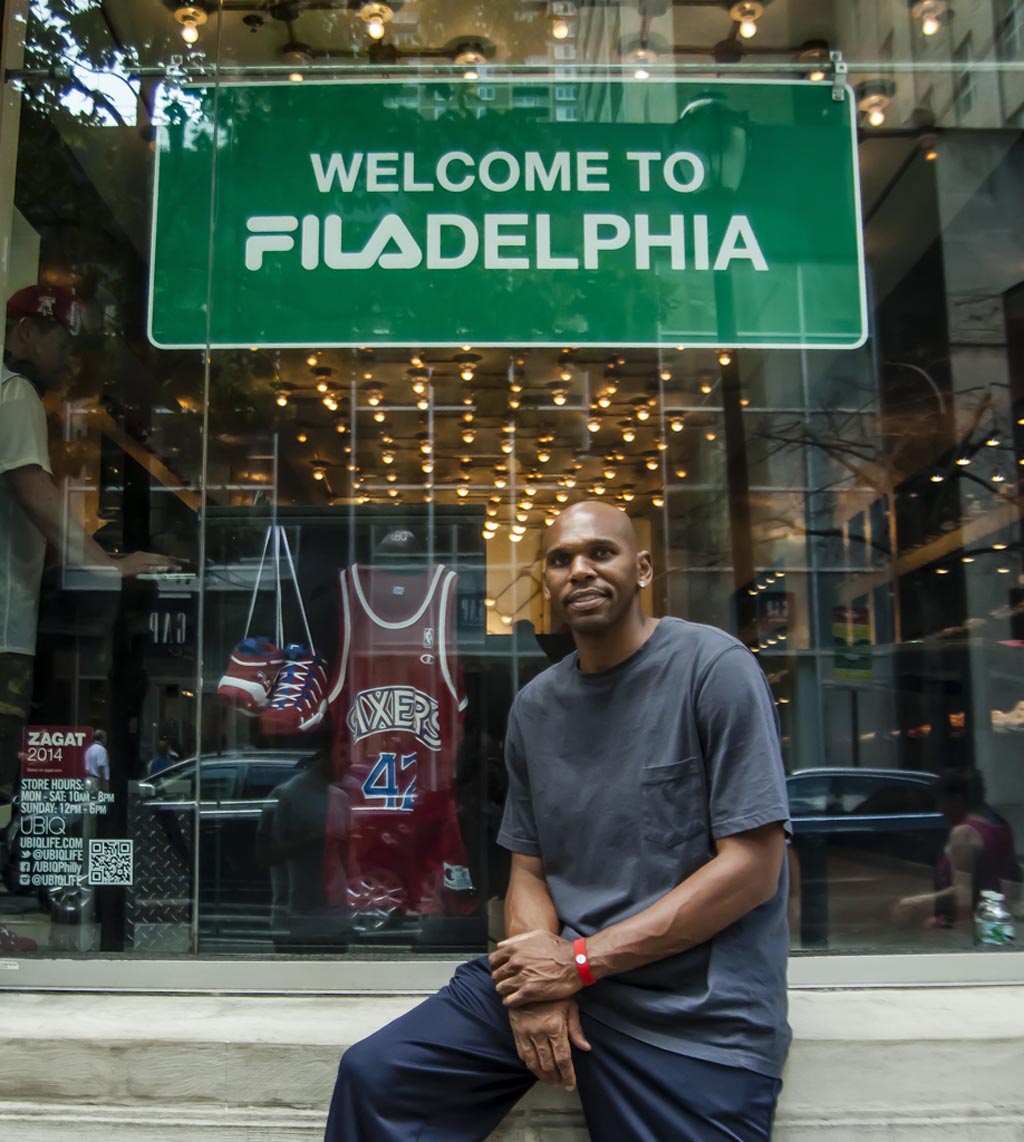
In 2014, Ubiq, Fila and Packer collaborated to bring former Sixer Jerry Stackhouse’s signature shoe back to life.
FILA Stackhouse
A year before Iverson came into the fold, Jerry Stackhouse, drafted third overall by the Sixers in 1995, debuted his shoe with FILA, called the “FILA Stackhouse,” which came on the heels of Grant Hill’s popular signature shoe in the mid-1990s.
The shoe became a major success because of Stackhouse’s instant impact in Philly, averaging 19.2 points as a rookie during the 1995-96 season. He played in Philly for only two seasons, but the shoe, which released in white, blue, and red and a white-and-red colorway, has held up over time.
In 2014, FILA and former Philly retailer Ubiq, which closed in 2020, collaborated with Packer Shoes to release the FILA Spaghetti, paying homage to Stackhouse’s 18-year career, which ended in Brooklyn with the Nets. The shoe featured the Sixers’ vibrant red and blue colors. He also released the FILA Stack II in 1996 and the FILA Stackhouse III during the 1998-99 season.
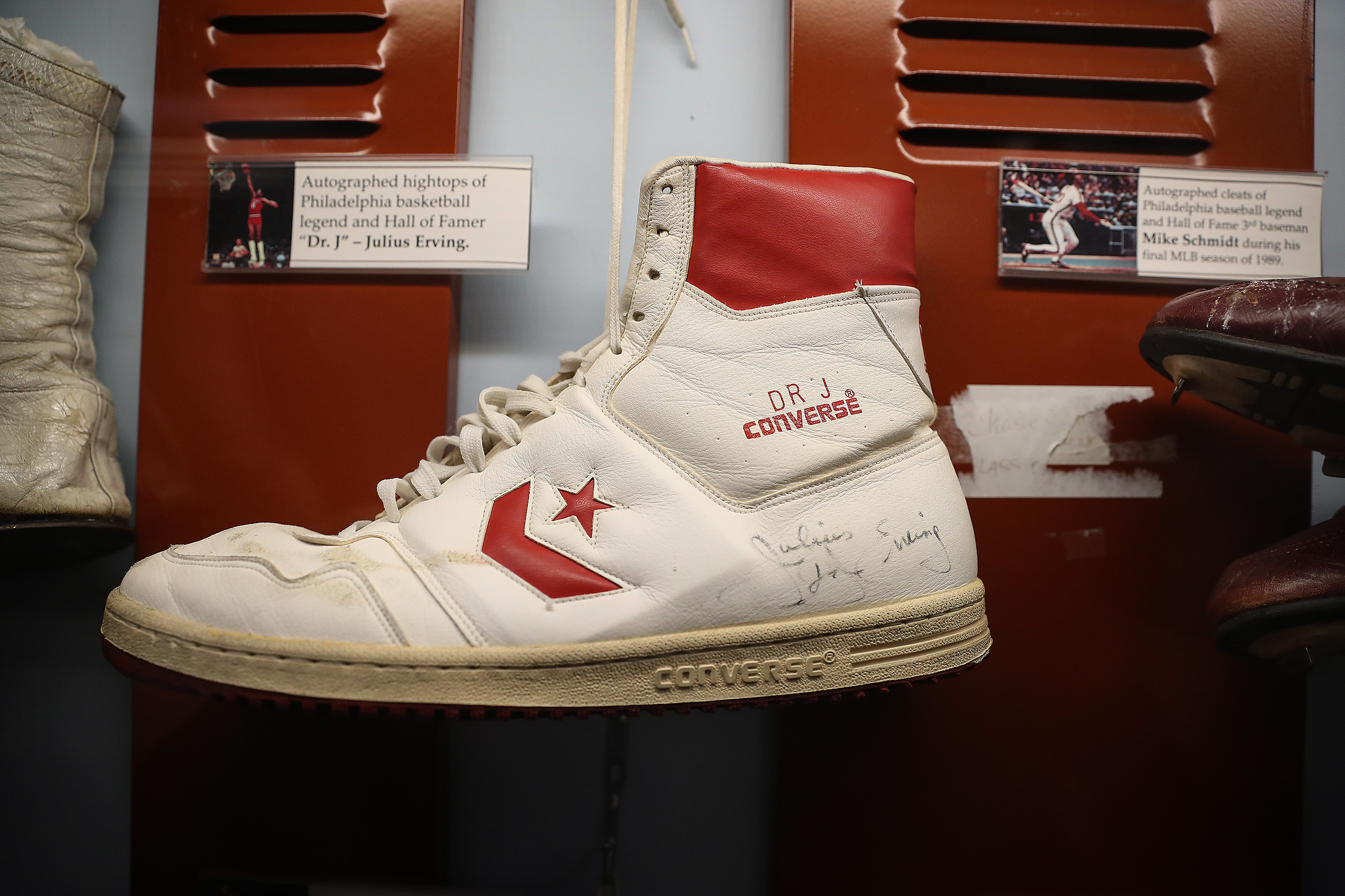
Julius Erving wore leather Converse sneakers during his 11 seasons with the Sixers.
Dr. J and the Converse Pro Leather
Julius Erving, better known as Dr. J, released his signature Pro Leather high-top sneakers with Converse in 1976, his first season in Philly, in a simple white-and-red colorway. Erving wore the leather sneakers throughout his career with the Sixers, which spanned 11 years.
He released a low-top version a year later, but the high-top classics are his most acclaimed signature shoe. Erving also released the Converse All-Star Dr. J 2000, which debuted in 1997, and Converse Dr. J Pro Leather 2K11, which came in 2011.
Reigning NBA MVP Shai Gilgeous-Alexander is now the face of Converse, but Erving and Chuck Taylor are a big part of the brand becoming a key player in the basketball space.
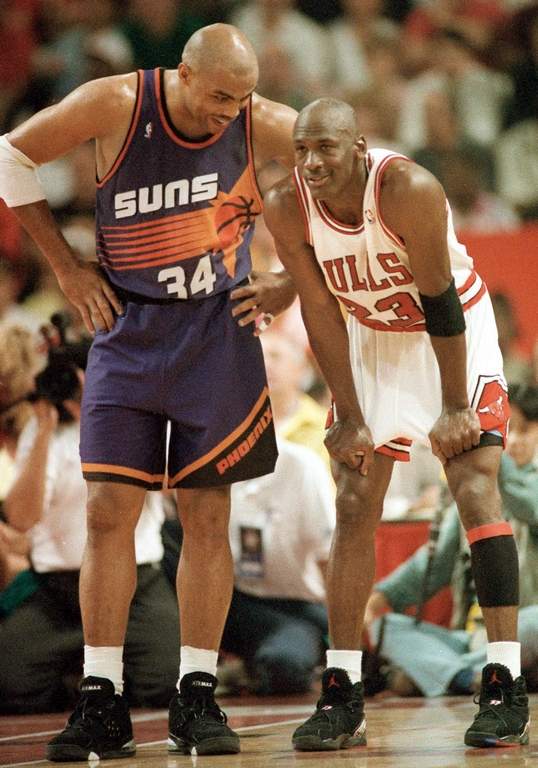
Charles Barkley is one of several Philly athletes who got his signature shoe while playing for another team.
Signature shoes elsewhere
Charles Barkley, Darryl Dawkins, Dikembe Mutombo, and Paul George all played in Philly at some point in their careers, but each had signature shoes released either before or after their time with the Sixers.
Barkley’s came when he was with the Phoenix Suns. The Nike Air Force Max CB sneakers were released in 1993, which became one of his iconic shoes, and he released six others over the next five years.
Dawkins had his signature shoe with the Nets come in 1984, the Pony Uptown. Mutombo had two signature shoes with Adidas: the Mutombo I and II sneakers, which came out in 1993 and 1994, respectively, while he was with the Nuggets.
George released all six of his signature shoes with Nike before arriving in Philly, from his debut Nike PG 1 sneakers being released in Indiana in 2017 to the Nike PG 6’s in 2022 with the Clippers.
Kobe Bryant, who played his high school ball at Lower Merion, had 29 signature shoes with Nike, though his Nike Zoom Kobe VI sneakers are probably the most popular pair in his collection.
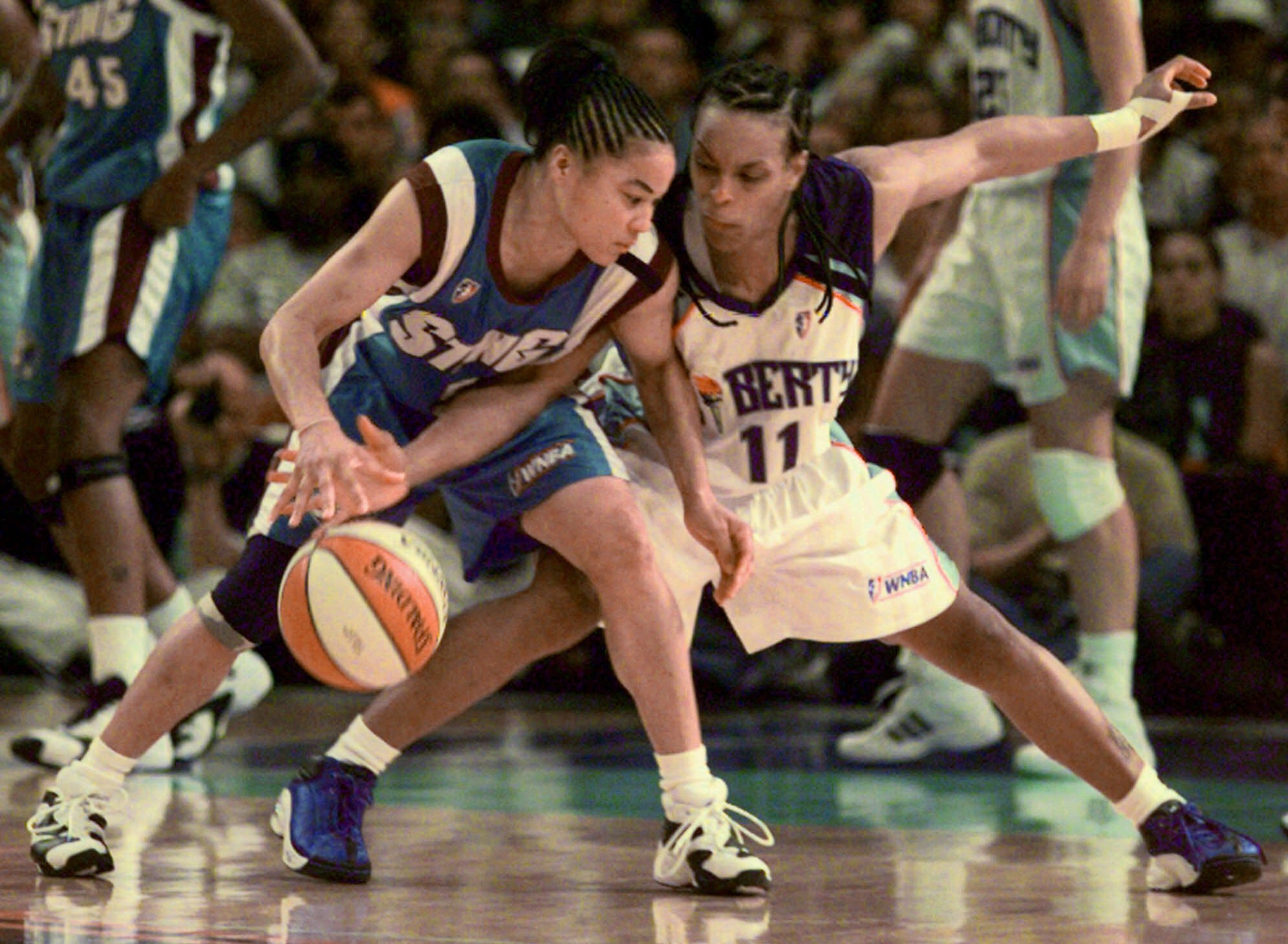
Dawn Staley was one of the first WNBA players to get her own signature shoe.
We can’t forget about North Philly native Dawn Staley, who had two signature shoes released in 1999 as part of the Nike Alpha Project. Staley debuted the Nike Air Zoom S5 during her first season in the WNBA in 1999 with the Charlotte Sting, and the Nike Air Zoom S5 II followed a year later.
Temple alum Eddie Jones, who played for six NBA teams, had two Jordan Brand signature shoes released early in his career: the Jumpman Quick 6 in 1998 with the Lakers and Jumpman Swift 6 in 1999 with the Hornets.
Sixers center Joel Embiid debuted his new signature Skechers sneakers over the weekend.
Verdict on SKX JE 1
Embiid’s first sneaker with Skechers look more modern and sleek than the Under Armour Embiid One shoes. Compared to other Philly athletes’ shoes, though, and due in part to Skechers’ lack of appeal as opposed to bigger basketball brands, it’s a tough one to rank ahead of Iverson, Dr. J, or Stackhouse’s signature shoes.
The colorway he debuted on Sunday is eye-catching, and the shoe will ultimately be judged by its performance when others are wearing it on the court. This could be the start of a long signature shoe partnership between Skechers and Embiid, but his first shoe definitely has room for improvement.
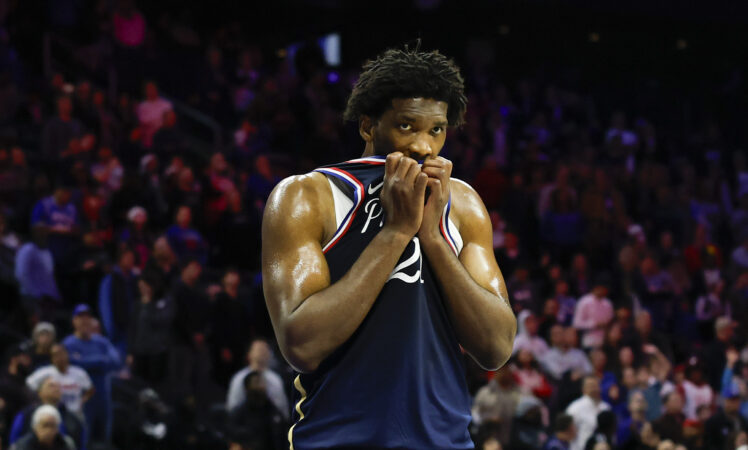
The NBA announced Wednesday that it has fined the 76ers $100,000 for violating the league’s injury reporting rules after Joel Embiid initially was listed as out for Sunday’s game against the Atlanta Hawks and then subsequently played in their double-overtime loss.
The NBA’s announcement said the Sixers “failed to accurately disclose the game availability status” of Embiid before the game. Embiid, who had missed nine consecutive games before Sunday, was listed as out because of right knee injury management on the league’s official report released Saturday night. He was upgraded to questionable Sunday afternoon before taking the floor for his pregame warmup and being announced in the starting lineup about 30 minutes before tipoff. He finished with 18 points, four rebounds, and two assists in a season-high 30 minutes.
According to the NBA, “the fine takes into account the [Sixers’] prior history of fines for violating injury reporting rules.” Embiid, who has dealt with several health issues throughout his decorated career, often is at the center of such inconsistencies on the league-mandated injury updates.
Embiid sat out Tuesday’s victory over the Washington Wizards to allow his right knee to recover and also has missed several games this season as part of his recovery from multiple left knee surgeries. The Sixers next play a back-to-back on Thursday against the Golden State Warriors at home and on Friday at the Milwaukee Bucks.
Nearly a year after Philadelphia Whole Foods workers voted to form a union, becoming the first group in the grocery chain to do so, their union’s ability to move forward and negotiate a contract is locked in a procedural standstill.
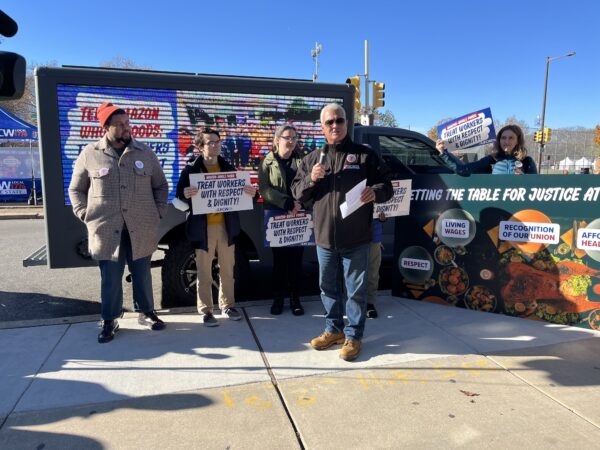
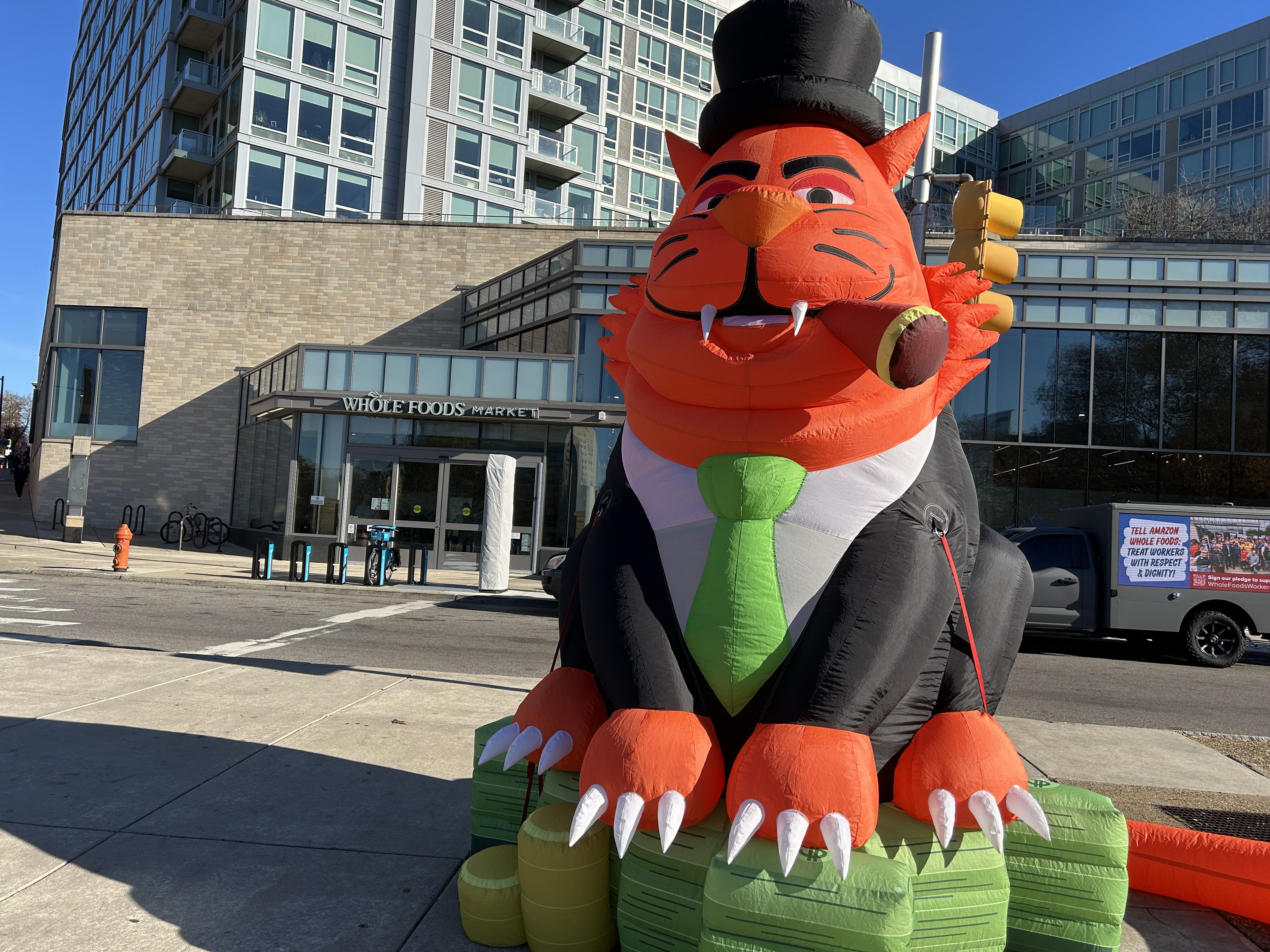
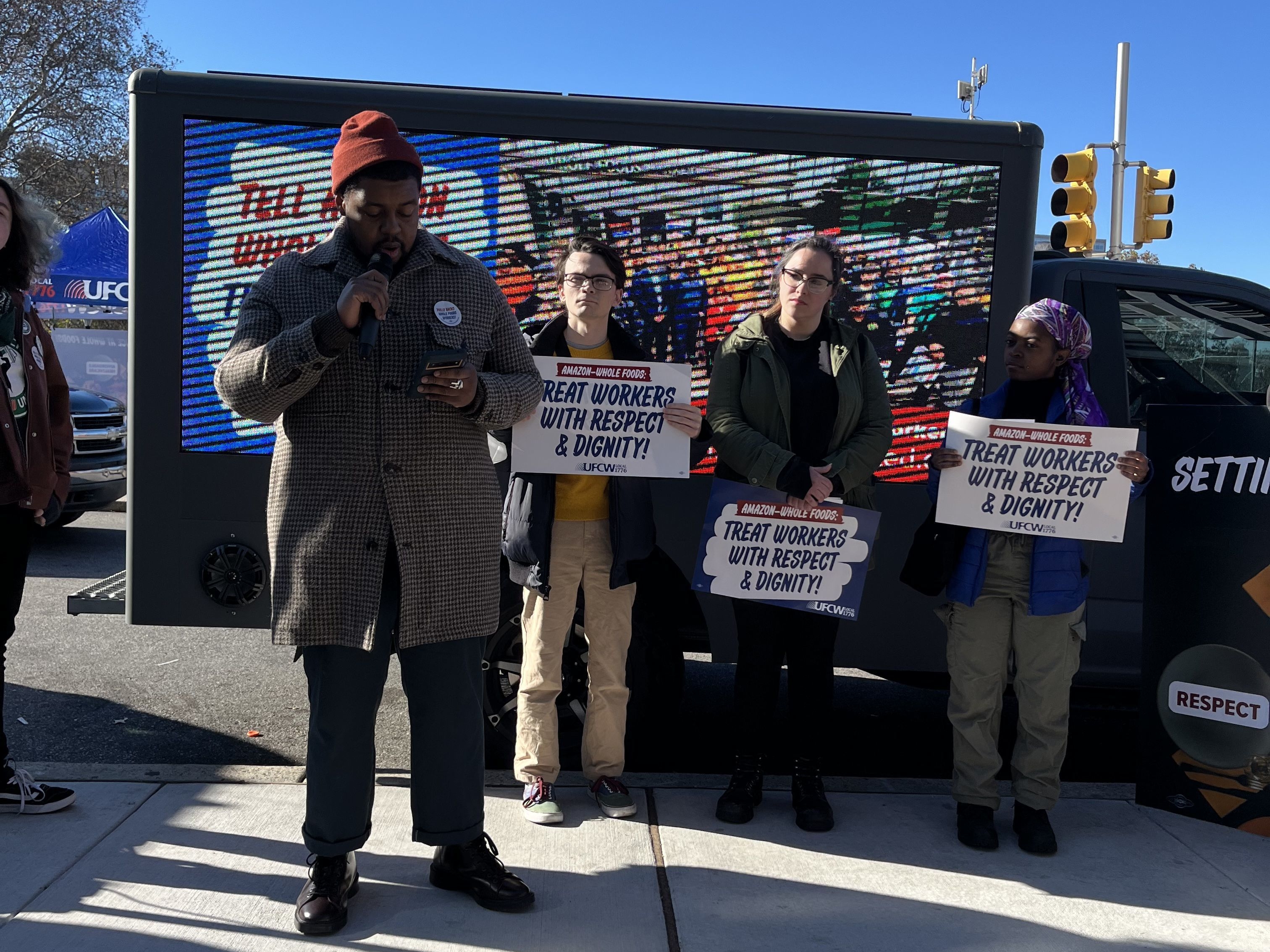
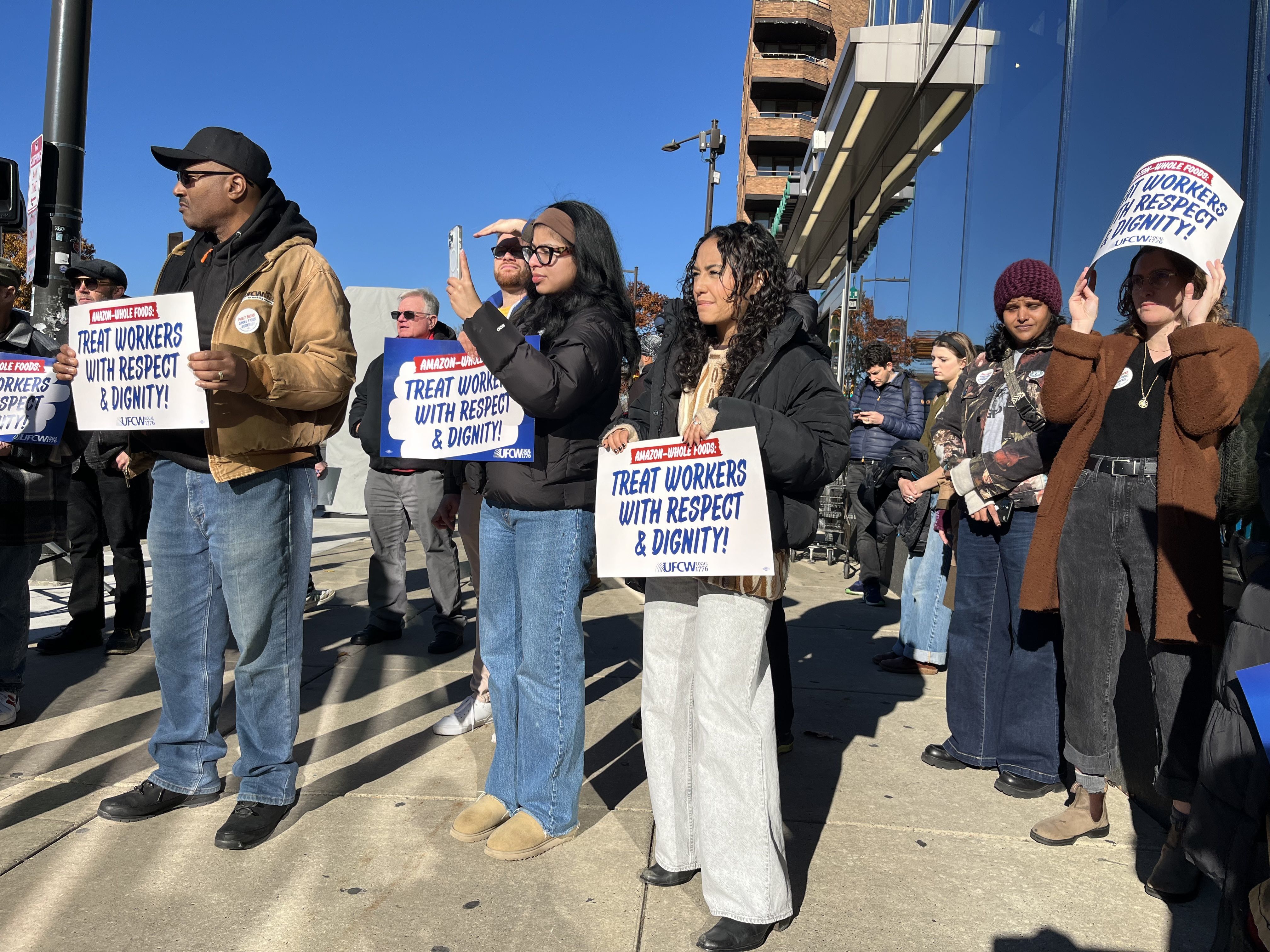
The Monday before Thanksgiving, workers and supporters gathered outside the Pennsylvania Avenue store, holding signs that read “Amazon-Whole Foods: Treat workers with respect & dignity!” Nearby, an inflatable “fat cat,” used by labor organizers and often denoting a person who uses wealth to exert power, stood tall outside the Whole Foods store.
Edward Dupree, who has been employed at Whole Foods for over nine years and works in the produce department at the Philadelphia store, told the crowd that in the 1970s, unionized grocery employees could maintain a middle-class family, but today workers are facing rising housing and healthcare costs as well as uncertainty in the economy.
“There’s been a concerted effort by billionaire business class — folks like [Amazon and Whole Foods owner] Jeff Bezos — to crush working class power by fighting unions like this,” said Dupree. “For 50 years, we’ve seen the worsening of living standards in tandem with the drop of unionization rates. It’s been long due for us to stand up for one another and fight back for a better future.”
Workers at the Philadelphia grocery store filed a petition to unionize with the National Labor Relations Board in November 2024 and made history in January as the first company store to successfully vote to unionize.
Employees want the company to begin negotiating a first contract, but for now, the case is at a standstill. Whole Foods has challenged the union election, and resolution of the issue lies with the National Labor Relations Board, which for months has been without the required quorum to make a decision since President Donald Trump fired a board member.
“We want Whole Foods to do what they’re obligated to do. What’s right to do is sit down and bargain a contract,” said Wendell Young IV, president of UFCW Local 1776, the union that Whole Foods workers elected to join. “We understand there’s a give and take in that process, but that’s from both sides. They’re refusing to even sit down and begin those discussions for a contract.”
An inflatable fat cat is seen outside the Whole Foods at 2101 Pennsylvania Ave. on Nov. 24, marking a year since workers first filed their intention to form a union with the National Labor Relations Board.
Why is the Whole Foods case at a standstill?
Whole Foods raised multiple objections to the worker union election earlier this year including alleging that the union promised employees would get a 30% raise if they voted for a union.
In May, the National Labor Relations Board’s regional director dismissed the challenge by Whole Foods, but the company asked for that decision to be reviewed. The union, for its part, has tried to block that review, but the board can’t make a decision either way without the required quorum.
“As previously stated, we strongly disagree with the regional director’s conclusion, and as demonstrated throughout the hearing earlier this year, including with firsthand testimony from various witnesses, the UFCW 1776 illegally interfered with our team members’ right to a fair vote at our Philly Center City store,” a spokesperson for Whole Foods Market said via email.
A union spokesperson said via email that they must wait until the board again has at least three members to review the case and added, “We expect that we will be successful at that time.”
Young, the president of the union local, has said in the meantime that the company is hiding behind the situation at the NLRB “to refuse to bargain.”
Edward Dupree, a Whole Foods worker, gathers with colleagues and supporters outside on Nov. 24 asking that the company come to the bargaining table and negotiate a first contract.
In the 1960s and into the 1970s, when it was not uncommon in the U.S. to see grocery workers strike or threaten to, Republicans and Democrats in office understood that unions were a permanent part of the economy, said Francis Ryan, a labor history professor at Rutgers University who has been a member of UFCW local 1776. The NLRB “provided some balance between the company and the union,” acknowledging that both parties “had an important role to play in our society,” he said.
“What we have in more recent years is a much more polarized political context, where the National Labor Relations Board is sometimes stocked with people who are aggressively anti-union,” said Ryan.
The Trump administration firing an official at the NLRB and not replacing them “is a deliberate attempt to make the process of collective bargaining and also organizing much more difficult,” said Ryan, adding that this is playing out in the case of Whole Foods.
Whole Foods workers and supporters outside the Center City grocery store on Nov. 24.
UFCW Local 1776, which Whole Foods workers in Philadelphia elected to join, represents thousands of workers across Pennsylvania and neighboring states in drugstores and food processing facilities, among other areas of work. The union represents grocery employees at ShopRite, Acme, and the Fresh Grocer.
Under the ownership of Amazon, the quality of work life at Whole Foods has deteriorated, said Young, adding that the company has unrealistic expectations and doesn’t compensate workers fairly in terms of wages, healthcare, retirement security.
“These people have no say in any of that — and that’s what led them to organize,” he said.
Whole Foods has said employee benefits include 20% off in-store items, as well as a 401(k) plan that offers a company match. The company also says it evaluates wages to ensure it is offering a competitive rate.
The number of unionized workers at grocery stores grew in the 1950s and 1960s in large part because areas of the U.S. were becoming more suburban and adding new grocery stores in the process, according to Ryan.
“You had thousands of workers in these new supermarkets that were unionized, and they made the retail clerks union one of the largest unions in the United States by the time you get to the 1970s — and Philadelphia was one of the real centers of supermarket unionization.”
It wasn’t unusual in the 1960s and 1970s for someone to make a living as a supermarket worker, although it was not uncommon for workers to have more than one job, said Ryan. In some cases, workers would stay at a grocery store for decades, he says, where they made decent wages and had a stable job indoors, adding that between 1965 and 1975 the wages of retail workers in Philadelphia nearly doubled.
Since then, it’s become much harder to make a living overall in the service industry, says Ryan.
But having unionized grocery stores amid other nonunion stores today can help shape the economy of the industry, says Ryan. A business that wants to maintain a nonunionized workforce might try to pay their workers the same starting rate that union workers make in wages, for example.
Unionized grocery stores “have a hidden-planet kind of role: They have this gravitational pull on the industry that actually raises conditions for everyone,” Ryan said.
While the Whole Foods store in Philadelphia is the first of the company’s locations to vote to form a union, others seem to be following.
“We now have active organizing going on, not only in other Whole Food stores in the area and around the country, but other grocery stores,” said Young.