TAMPA — The Flyers have hit the quarter mark of the 2025-26 season.
Sporting an 11-7-3 record, they sit one point back of a wild-card spot in a tight Eastern Conference where the worst team, the Toronto Maple Leafs, are just four points back of the Flyers.
Here’s what is on the mind of the Flyers faithful as The Inquirer opens up the mailbag for the first time this season:
Q: Could you see [Christian] Kyrou as a call-up at some point this year? — Danny Matos (@danmatos_danny) on X
Never say never. Is it a little too early to determine what the season brings? Sure. But across the past two seasons, I don’t get the sense that the Flyers call up players based on merit alone. Like most teams, it always seems to be based on need. But that’s not to say he doesn’t deserve a look.
Since being acquired in the trade that sent Samu Tuomaala to Dallas, Kyrou has 12 points (three goals, nine assists) with a plus-minus of plus-12 in 10 games. Not too shabby. Now, one issue is that Kyrou is 5-foot-10 and the Flyers already have two sub-6-foot defensemen on the blue line in Jamie Drysdale and Emil Andrae. The 22-year-old, who is the younger brother of St. Louis Blues forward Jordan Kyrou, is a right-handed shot and could find a role down the road given his offensive skills.
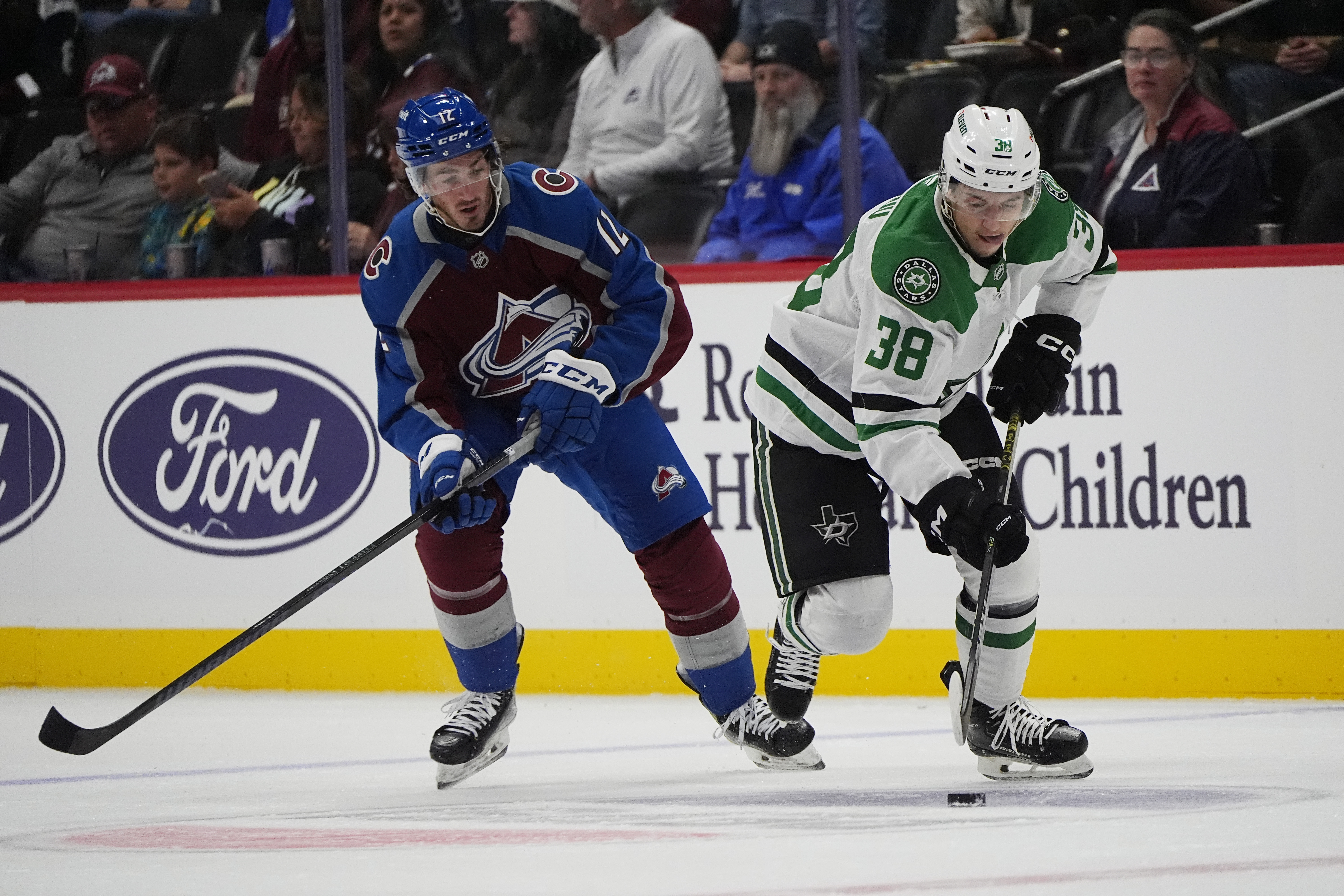
Defenseman Christian Kyrou has been a revelation with 12 points in 10 games since being acquired from Dallas last month.
Q: Do you feel Tocchet has prioritized player development over immediate journeyman success? — Hockeygobler (@hockeygobler) on X
This question sounds like it is more asking whether Flyers coach Rick Tocchet is focused on the rebuild. And it’s a tough one to gauge where Tocchet’s thinking lies. The whole point of a game is to win, and the whole point of a season is, ideally, to make the playoffs and compete for a Stanley Cup. After all, as former coach John Tortorella always said, winning is important to building culture.
Player development needs to be a multifaceted approach. It’s not necessarily X but X, Y, and Z. Players need to develop not just their individual skills but team concepts and systems that help the team win. Someone like Matvei Michkov needs to continue to develop his individual skills, like his offense, but he also needs to learn things like how to read plays better, like when to — and when not to — leave the zone early. He took a big step in the right direction on Saturday when he played it perfectly, and Sean Couturier fed him for a breakaway goal. It’s baby steps in that regard, but do I personally think some of the younger kids, like Michkov and Nikita Grebenkin, should play more? Yes. Would they maybe benefit from more ice time to correct mistakes? I believe so. Now, if they don’t make corrections and sit, well that’s another part of player development.
Q: Why do you think Tocchet is tougher on the younger kids for making the same mistakes the vets make? — Hassan Goodman (@phillygator1986) on X
Veterans will always get a longer leash. This isn’t a Tocchet thing. It’s a tale as old as time. And there’s a reason they are veterans: They’ve played in the world’s best league for a long time, and although they’ve assuredly made mistakes along the way, they have obviously corrected them to keep playing in the NHL.
Youngsters need to learn and grow, and have mistakes corrected, too. Should they be benched for entire games, a la Joel Farabee was famously under Tortorella? No. But there do need to be consequences for not learning and making corrections, and there’s no book on the younger kids yet to say they will fix things.
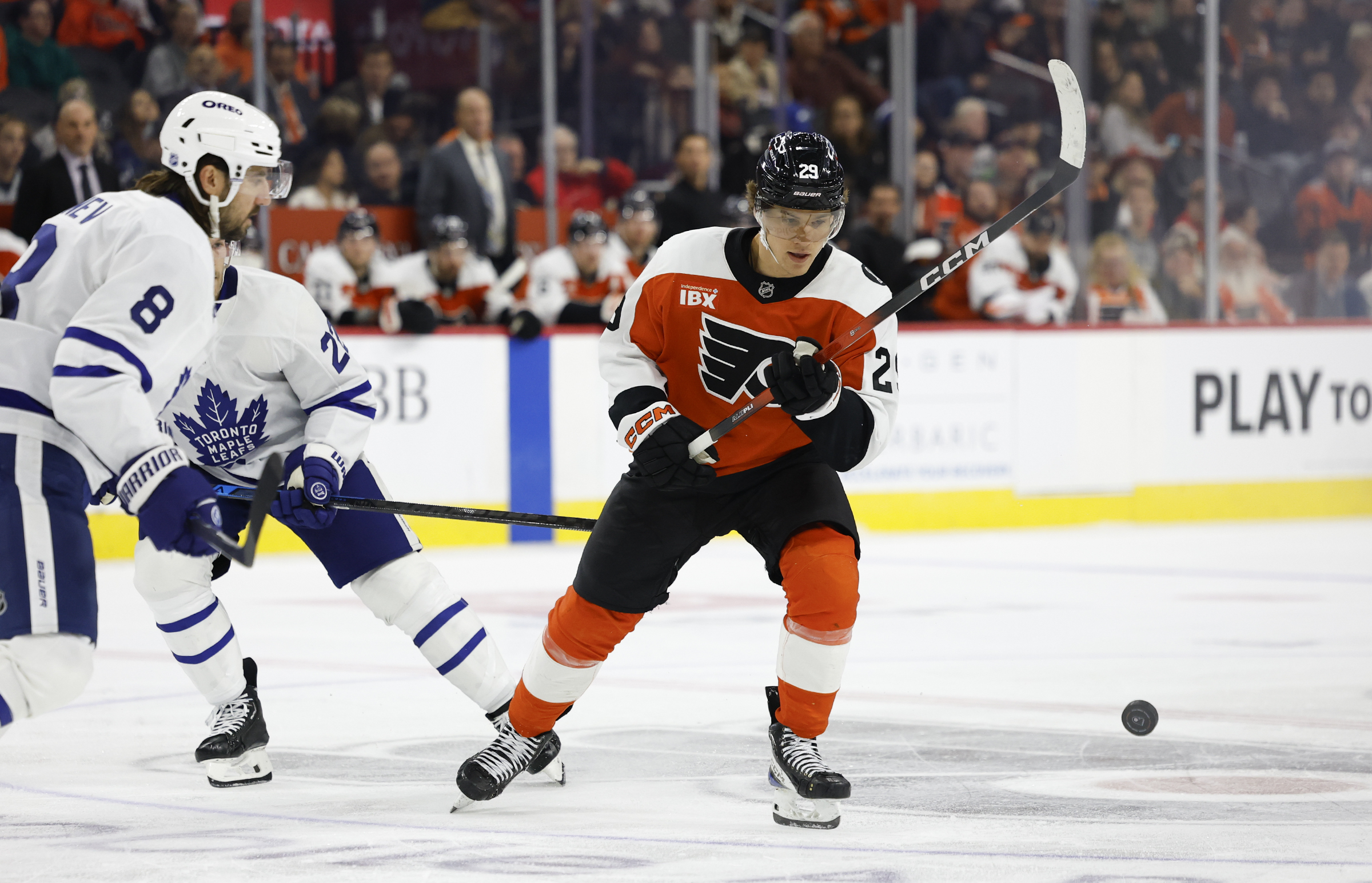
Q: Why does Tocchet consistently scratch 29?? It makes absolutely no sense to me. He clearly has skill and would benefit the struggling offense, yet we continue to play 44 over him. — Rich #83 (@dangler83) on X
To start, No. 29 is Grebenkin and No. 44 is Nic Deslauriers. I don’t think it’s fair to say it’s one or the other. Or that Deslauriers should only sit to get Grebenkin in. Deslauriers is a veteran who plays a specific role. There’s a reason he was on the ice on Monday in Tampa Bay — to contain and, if needed, which did happen, fight 6-9 Lightning forward Curtis Douglas. Grebenkin wasn’t going to fight him; it wouldn’t have been fair. And it wouldn’t have been fair to ask Garnet Hathaway or Nick Seeler, who can also drop the gloves, to take on that role.
Flyers winger Nikita Grebenkin has found playing time scarce of late.
Asking why Grebenkin, 22, has only skated in 12 of the Flyers’ first 21 games is a valid question. He’s talented, can play a physical game, and can score. Tocchet wants guys to go to the net and the dirty areas, and he thrives there — a scout told The Inquirer during the preseason they were impressed by his game.
But Tocchet recently said Grebenkin needs to be more predictable — this is something he has preached about his lines, especially the fourth line, which is the only one to presumably have a spot open for the winger. It’s also valid to say that you cannot be predictable if you don’t know how to predict the game, and the only way you can predict the game is by playing in games. Something has to give soon.
They had no answers for the Magic on a night when the home crowd of 19,746 booed them loudly over the last three quarters. Fans even began heading for the exits at the conclusion of the third quarter. And with the Sixers down 42 in the fourth quarter, the remaining fans chanted, ‘We want Kyle,’ in reference to Sixers reserve point guard Kyle Lowry, who’s in his 20th season.
The Sixers (9-8, 0-3 East Group B) hobbled into their group play game against the Magic (11-8, 3-0).
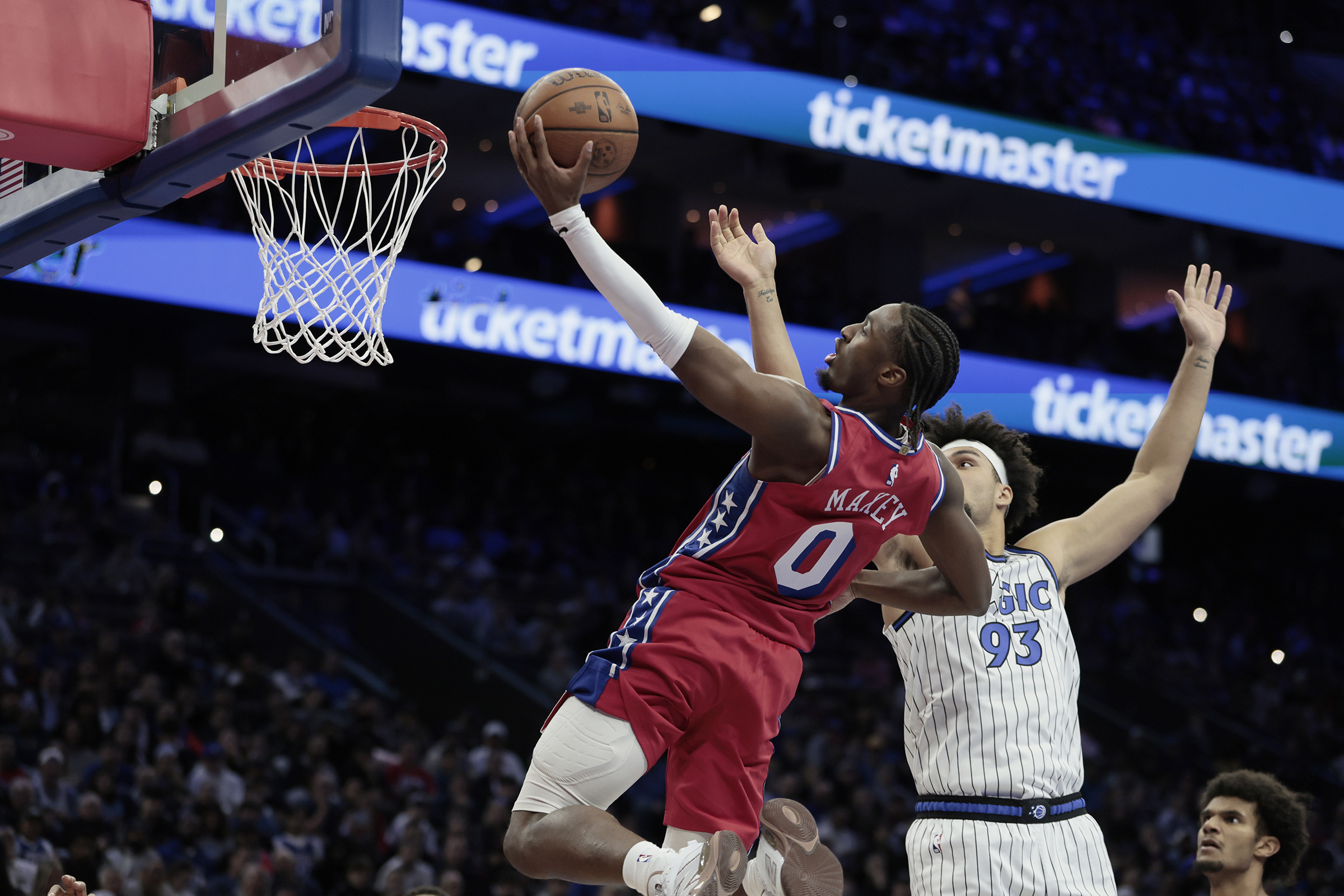
Tyrese Maxey and Dominick Barlow, who started the first two games in place of George, were the Sixers’ only available starters from the opening day lineup.
Embiid (soreness in right knee), George (sprained right ankle), Kelly Oubre Jr. (sprained left knee), VJ Edgecombe (left calf strain), along with reserve center Adem Bona (sprained right ankle) missed the game.
The Sixers’ able bodies shrunk when Trendon Watford suffered a game-ending left adductor strain with 4 minutes, 7 seconds remaining before intermission.
The reserve power forward grabbed the inner part of his left leg while passing the ball before falling to the court. After being helped up, Watford was assisted to the locker room.
He had eight points, one rebound, and an assist in 11 minutes. He was 2-for-2 from the field and 4-for-4 from the foul line.
The Sixers got another scare when Justin Edwards appeared to hurt his foot after scoring a third-quarter basket. He went to the locker room during a timeout to be checked out and returned to the game.
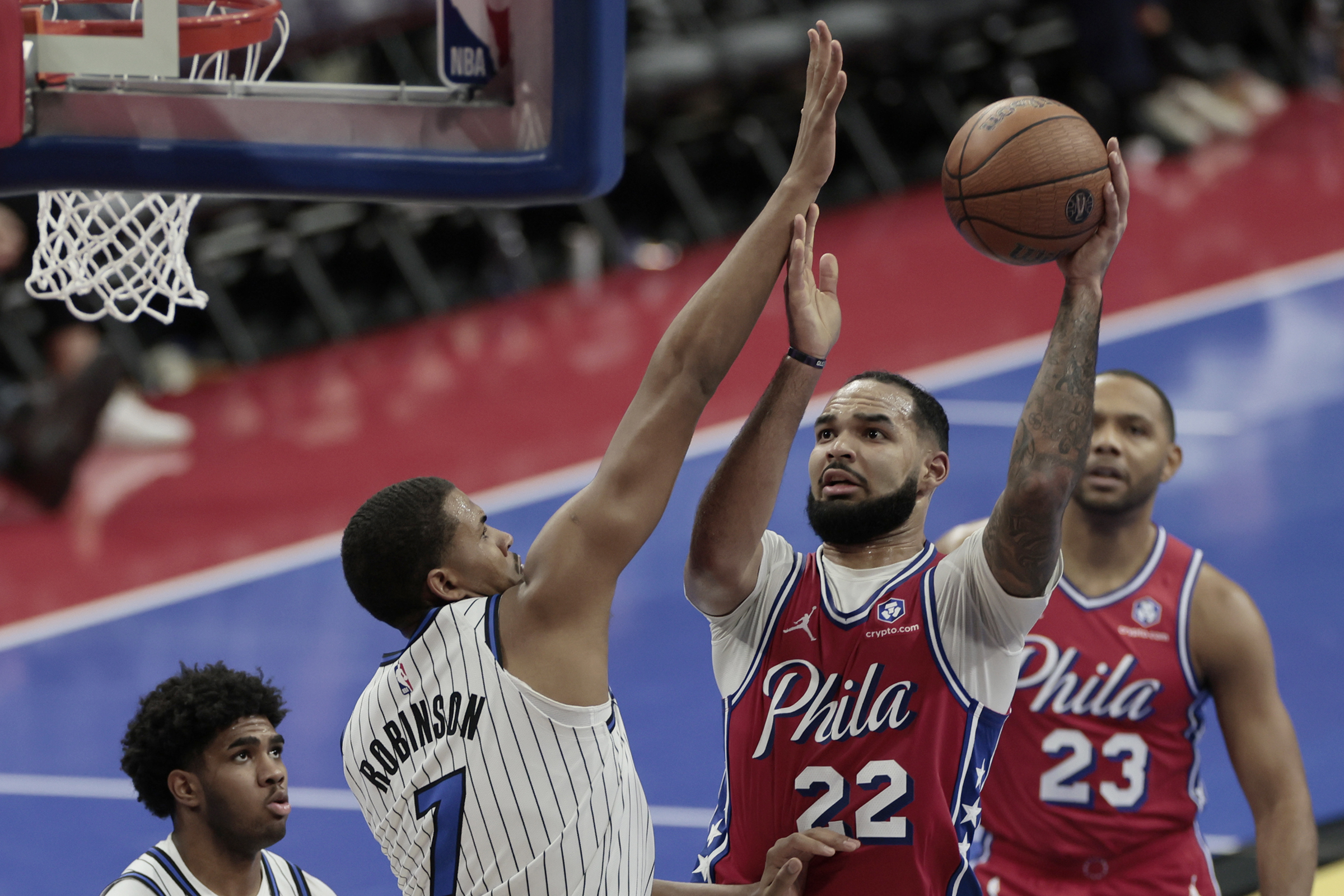
Sixers rookie Johni Broome played in just his fourth game of the season on Tuesday night.
With all the injuries, seldom-used guard Eric Gordon was the ninth man off the bench, and rookie power forward Johni Broome entered the game in the third quarter.
“It’s out of our control, man,” Drummond said of the injuries. “It’s the next-man mentality. It’s Barlow, [Jabari] Walker, Broome, and [Hunter Sallis]. These guys got to step up and be ready to fill those shoes. You know we are not excited for our guys to go out. But for them, it’s a great opportunity to come in and showcase themselves.”
While this is an excellent opportunity, the Sixers need to get healthy if they expect to remain competitive as they embark on an upcoming rough stretch of games.
Is the attrition starting to catch up to the Sixers?
“It sure felt like it tonight,” coach Nick Nurse said. “But, again, I think two or three times a season, you are going to have games like this where it’s like everything goes wrong. All of a sudden, they get hot. They start throwing in threes. We start turning [over the ball]. We can’t catch the ball. We can’t get back. We can’t grab a rebound. Just everything was really out of whack. You never really explain it. …
“Just like I told the guys, we’ve got to be better. That’s certainly not who we are out there tonight. We’ve got to get rid of this one, get rest and treatment over the next couple of days, and get back to who we are.”
Sixers must stop the ball
The Sixers struggled to stop the Magic’s dribble penetration. Orlando routinely drove to the lane with ease. Perhaps realizing the Sixers couldn’t stop it, the Magic prioritized the dribble drive for long stretches.
This was similar to what the Hornets did to the Sixers during the second game of the season. Charlotte led, 80-56, in points in the paint and had an 20–6 advantage in second-chance points.
Thirty of the Magic’s points in the paint came in the second quarter, where they outscored the Sixers, 51-25, to take an 86-60 halftime lead.
“It was one of those days, 82 games,” Drummond said. “These types of games do happen. Not that we want it to happen, but [stuff] does happen. It is what it is. Everything they shot went in. And it also didn’t help that we gave them that momentum in the second quarter, going into halftime.
“So it’s something to learn from. We’ve got to get some rest. A lot of guys are out, banged up right now. I think these next two days are very crucial for us going into Brooklyn.”
While Drummond downplayed it, the Sixers will have to improve their defense if they expect to beat quality teams. In a copycat league like the NBA, teams will watch this game film and attack the rim until the Sixers can stop them.
Drummond still an elite rebounder
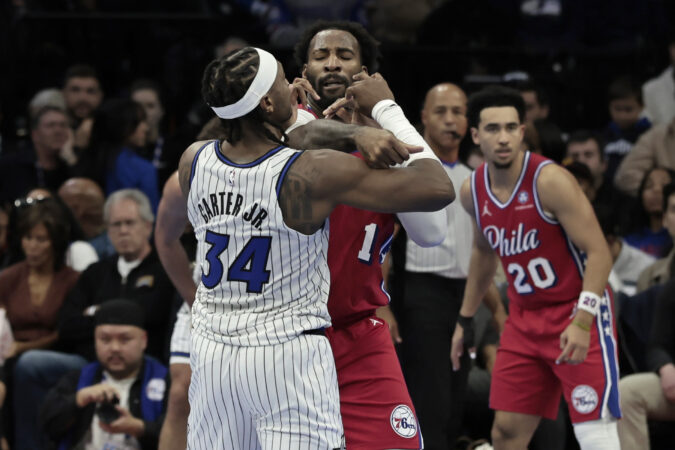
Drummond squaring up with Orlando center Wendell Carter Jr. was one of the most memorable things about this game.
The Sixers center got into a fighting stance after fouling and exchanging words with Carter. Things escalated after Orlando point guard Jalen Suggs shoved Drummond. That caused Walker to push Suggs.
Suggs received two technical fouls and was ejected. Meanwhile, Carter, Drummond, and Walker each received a technical.
“I had to stop the bleeding, man,” Drummond said of his exchange with Carter as the Sixers trailed 82-58 with 26.6 seconds left in the half. “They went on a crazy run. For me, if you can see me, I looked up at the score, and I was, like, ‘Man, this [expletive] is nasty. I got to do something.’ And I was just [expletive] with him, and he reacted. I was like, ‘OK, I got to capitalize on it!’
“I mean, I’m not one of those players who do anything dirty, so once I did what I had to do, I was clapping because I got the reaction I was looking for, I got somebody thrown out, hoping it would get us going a little bit. Still ended up losing by 30-plus, so it was one of those nights for us. Got to learn from it, watch film, and move on to the next one.”
But aside from that, Drummond continued to show that he’s still an elite rebounder.
The 32-year-old, in his 14th season, finished with three points and a game-high 12 rebounds in 22 minutes, 19 seconds. He is averaging 13.7 rebounds in his last eight games as a starter. That included a season-high 24 rebounds in Sunday’s 123-114 loss to the Miami Heat. And he had 18 boards in a Nov. 17 victory over the Los Angeles Clippers.
Drummond said his goal is to lead the league in rebounding. That will be tough to do once Embiid returns and takes a chunk of Drummond’s minutes. He’s currently ranked ninth (10.7) in rebounding. His play has been one of the team’s bright spots.
“For me, I’m trying to get back to No. 1,” Drummond said. “I’m [at] 10 right now. I think the leader [San Antonio’s Victor Wembanyama] is averaging [12.9]. I’m not too far off. The goal is to win, obviously. That’s first and foremost. [Rebounding] is what I’m known to do. So I got to keep putting a show on.”
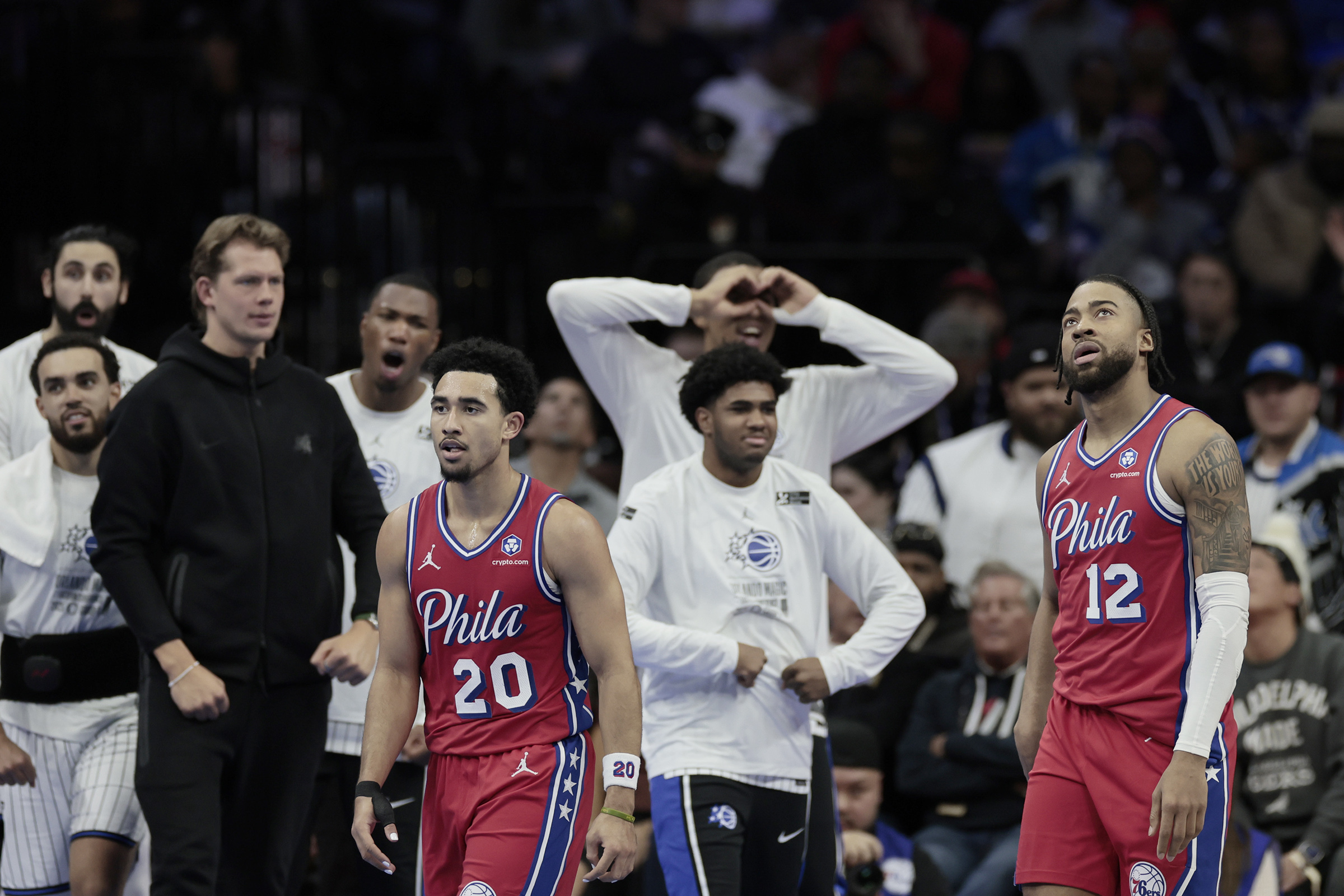
Sixers guard Jared McCain and forward Trendon Watford walk off the court during a timeout during their loss Tuesday night to the Magic.
Same old story with George and Embiid
A season ago, Embiid had only played in four of the Sixers’ first 17 games while George played in eight. Tuesday’s contest marked this season’s 17th game. And at this point, George has played in only three games, while Embiid has been available for six.
George was sidelined with a sprained right ankle. Meanwhile, Embiid missed his eighth consecutive game because of knee injuries. The last seven were because of right knee injury management or soreness. He also missed the Sixers’ 111-108 home loss to the Detroit Pistons on Nov. 9 because he doesn’t play on back-to-back nights to rest his left knee.
George missed the first 12 games while recovering from left knee surgery. Then he sat out Wednesday’s 121-112 loss to the Toronto Raptors because he isn’t cleared to compete on both nights of a back-to-back.
The Sixers signed George to a four-year, $211.5 million contract on July 6, 2024, to form a Big Three with Embiid and Maxey. But for the second straight season, Maxey is carrying the bulk of the load while the duo is dealing with injuries. The hope is that things will change as the season goes along.
Tyrese Maxey carried the scoring load for the Sixers with 20 points.
But one could argue that, for the time being, they’ve been worse, with George playing in five fewer games and Embiid out since Nov. 8.
A year ago, Embiid missed the entire preseason and first six games of the season because of left knee management. After that, he served a three-game suspension for an off-court altercation.
Embiid made his season debut last year against the New York Knicks on Nov. 12, 2024. After playing in three of the next four games, he missed seven straight contests.
George was also hampered by injuries before the start of last season.
He was sidelined for three weeks after hyperextending his left knee during an Oct. 14, 2024, exhibition game against the Atlanta Hawks, leading to a bone bruise. George suffered the same injury during the Sixers’ loss to the Memphis Grizzlies on Nov. 20, 2024, the team’s 14th game of the season. That cost him the next three games.
Give the Sixers credit for handling their absences better than a year ago, when the team was 3-14 through 17 games. But they are starting to fall apart, losing eight of 13 games after starting the season 4-0. And not seeing Embiid and George play is very reminiscent of last season.
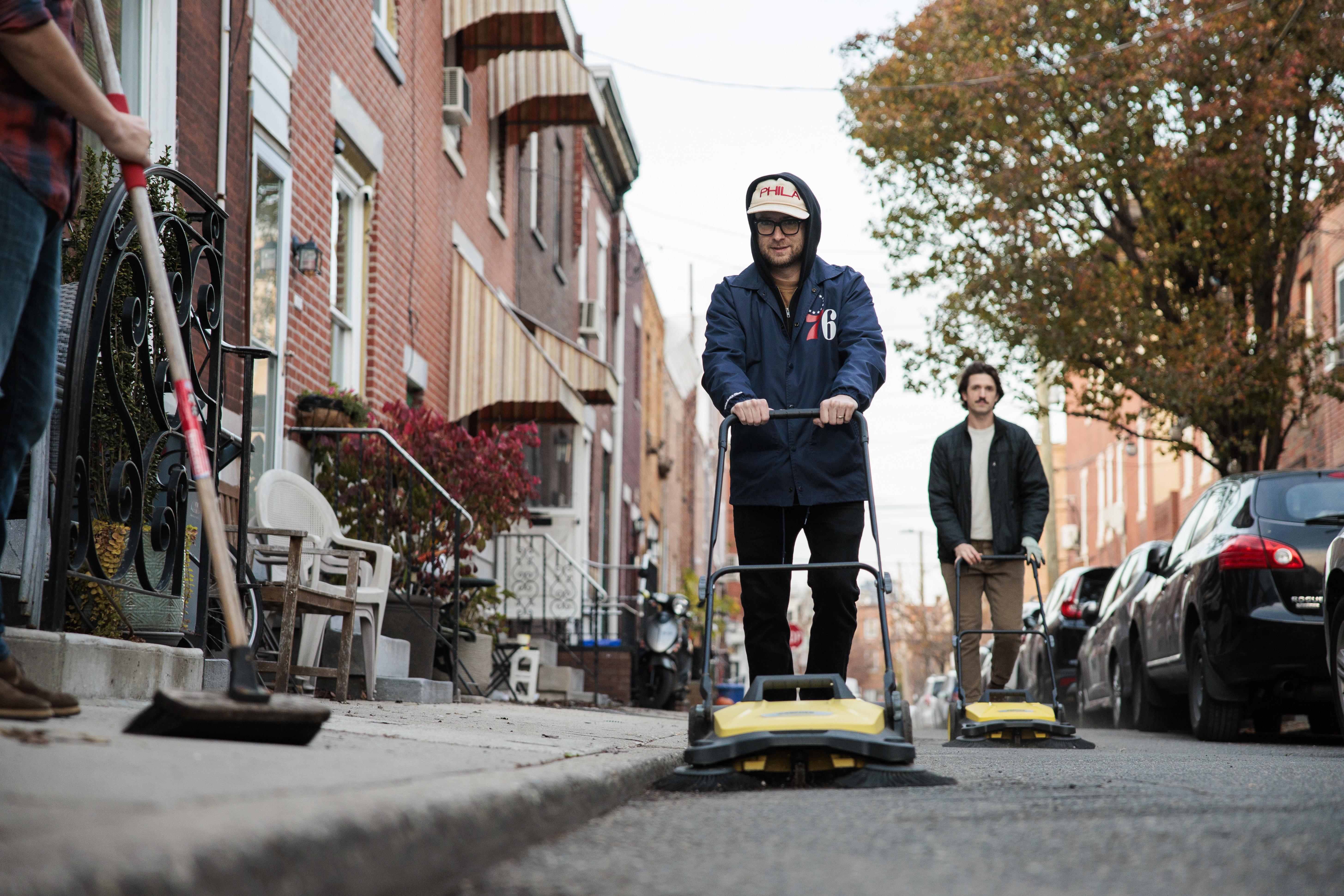
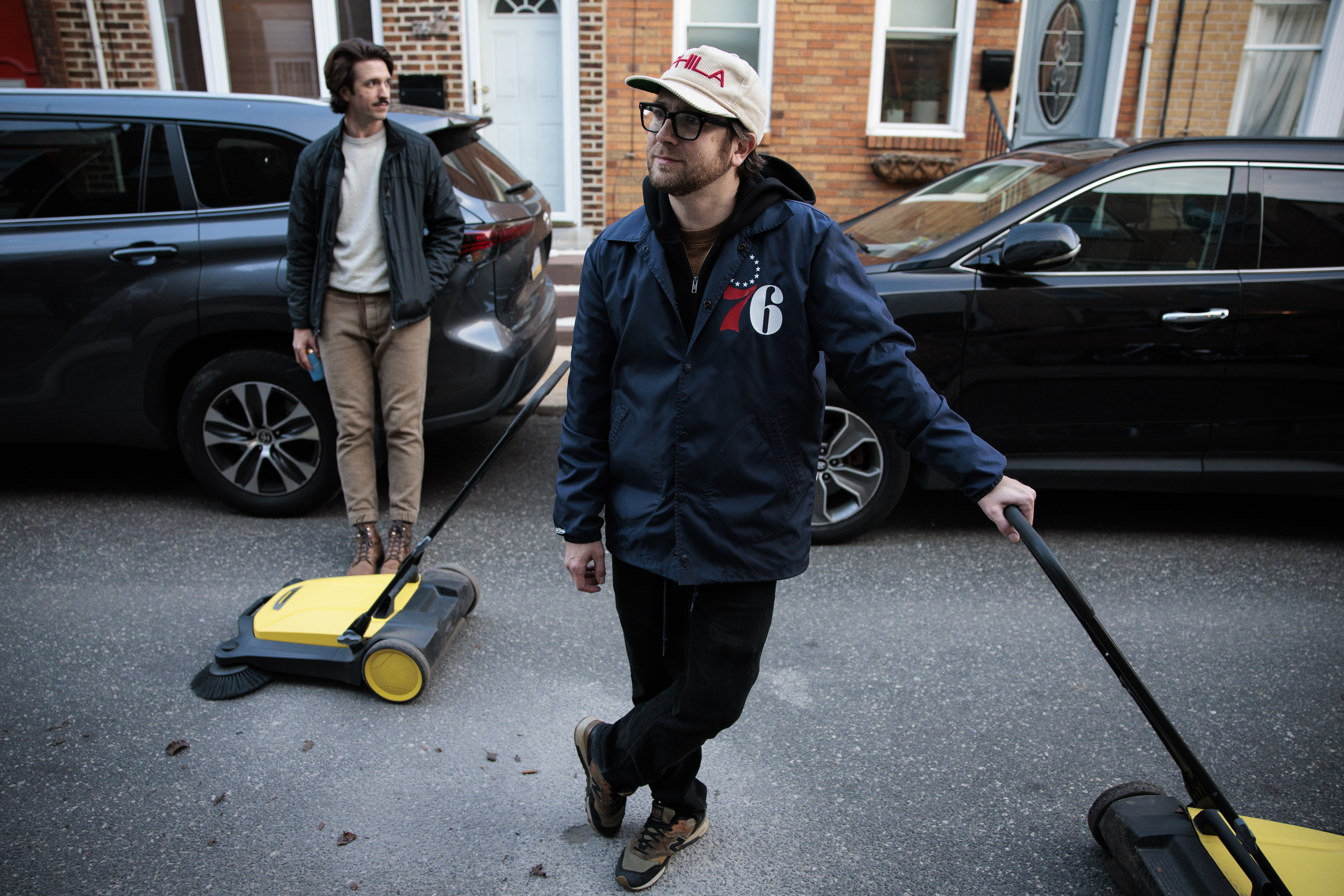
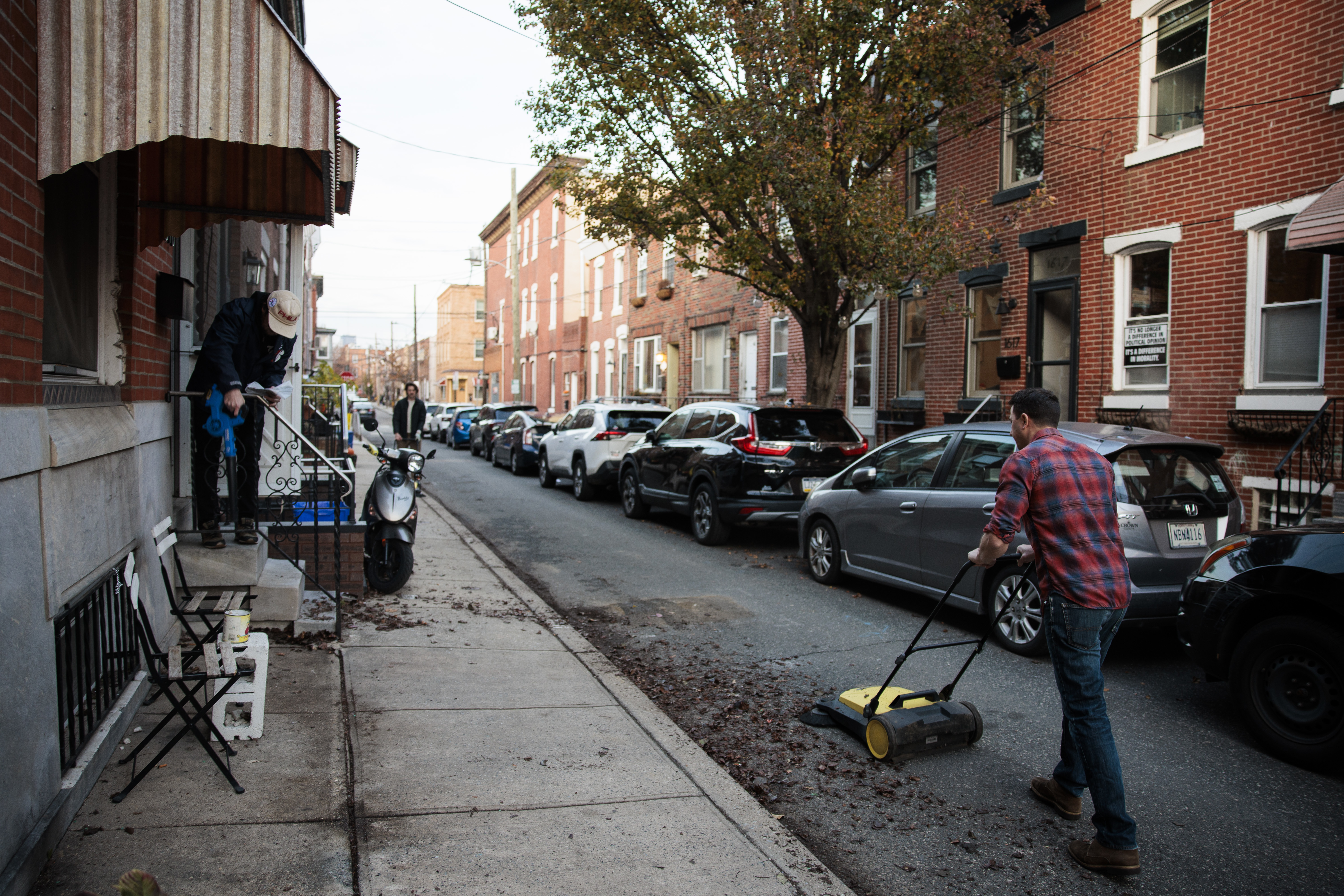
Just about every time Frederick Stahl, Matt Barber, and Anthony Masucci sweep their block of Iseminger Street in South Philly, someone stops them with a question or asks to take their picture.
That’s how I found out about these street-sweeping South Philly dads, when someone posted a photo of Stahl doing his thing on Facebook and a friend tagged me in the comments.
“This is the most fundamental level of environmentalism,” the photo was captioned.
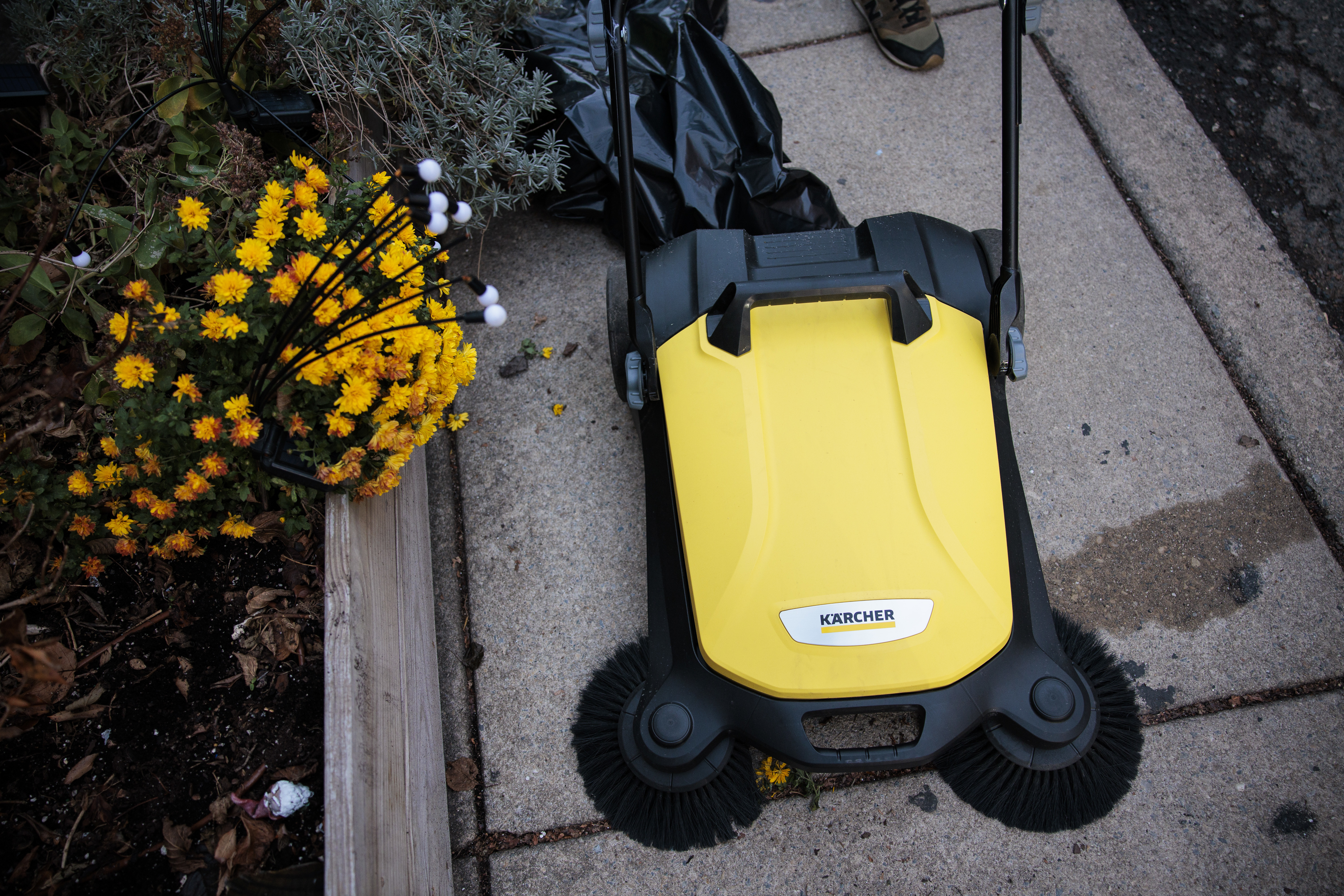
At first, I had to squint my eyes. I couldn’t tell what Stahl was pushing. It looked like a street sweeper, but it was yellow and fun-sized. I’d never seen anything like it before, and I dropped my email in the comments, hoping to learn more.
And so, when Stahl and I finally connected this month — more than a year after that photo was posted — I went down to his block to check it out.
“I’d be remiss not to include two of my neighbors — Matt Barber and Anthony Masucci,” Stahl wrote to me prior to our meeting. “I actually moved to Iseminger in 2020, and it was their street sweepers that inspired me to get one myself.”
Matt Barber and Frederick Stahl (right) demonstrate how to use the Kärcher push sweepers on Iseminger Street.
On their classic South Philly block, which boasts a Tofani door or two and a street so narrow you’re inclined to suck your gut in while you’re driving down it, there are 18 kids under the age of 14 and eight under the age of 3, including Stahl’s 1-year-old son.
“Those are the ones that really touch the concrete,” he said of the little tykes.
The guys used to sweep the street with janitor brooms, “just so our kids could come out and play without glass around,” Masucci said.
“Neighbors would be like, ‘Oh, it’s nice, but it’s really dusty,’ and I’d be like, ‘God! There’s gotta be a better way,’” he said.
During the COVID lockdowns in 2020, when Masucci had some extra time on his hands, he went searching online and stumbled upon the website for Kärcher, a German company that sells cleaning equipment. The company’s S 4 Twin model, which claims to sweep large areas up to five times quicker than a push broom, seemed like it might do the trick.
“I found this thing and all of the marketing is for driveways, like old men kind of brushing their long driveways in the suburbs,” Masucci said. “I was like, ‘I think this would work fantastic. It’s like a little Zamboni. Let me see what we can do.’”
The Kärcher S 4 Twin push sweeper on Iseminger Street in South Philly.
Masucci purchased one — which typically retails for $189.99 but is currently on sale for $125.36 — and donated it to the block. Barber offered to keep it on his back patio.
“Anthony came through and made the dream happen and we put it together,” Barber said.
“It was like Christmas,” Masucci said. “Oh my God, the first time going up and down, we’re like, ‘It’s filled! It’s filled and it works so cleanly and easily!’”
The guys all grew up watching their dads mow the lawn every weekend, and even though they don’t have lawns to mow in South Philly, using the sweepers felt a little like that, they told me. Stahl even bought his own Kärcher when his little one was on the way.
“We love the community and you feel great coming out here and doing it so much more efficiently than brushing around,” Masucci said. “The kids run out. They wanna help you push it. Everyone runs out and wants to help you bag it up. So it becomes a community thing.”
Neighbors Frederick Stahl (left) and Matt Barber with their Kärcher push sweepers on Iseminger Street in South Philly.
Barber even gets the kids to pull weeds from the sidewalk and throw them into the street so he can sweep them up, promising them water ice from around the corner if they help out.
“I go, ‘Listen, weeds for water ice,’” he said.
Kärcher’s S 4 Twin unit is lightweight, foldable, has an adjustable handle, and uses no electricity or gas, so it makes no noise.
“It runs on human will,” Masucci said.
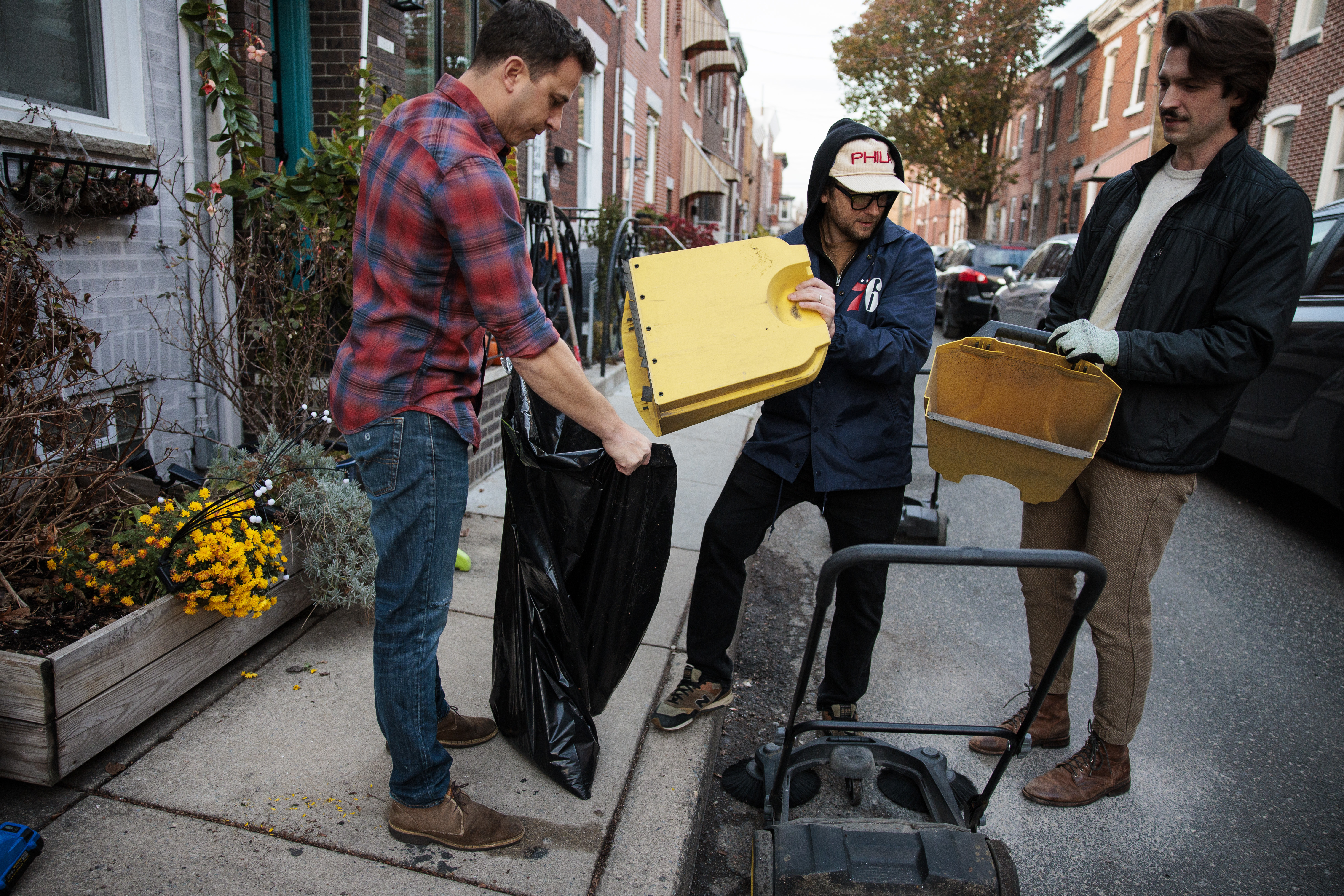
Its 5.25-gallon waste bin holds an impressive amount of debris and doesn’t blow up much dust. After the guys dumped it out following four passes along their street, the trash bag they emptied it into weighed about 15-20 pounds.
Neighbors Anthony Masucci (from left), Matt Barber, and Frederick Stahl empty the waste containers of their Kärcher units after sweeping their block.
“This bag will be so heavy at the end. I always feel like it’s a real proud moment,” Barber said.
Mostly they’re sweeping up dirt, debris, broken glass, nails, and cigarette butts. It takes about 20 minutes and four or five passes to clean the block.
The day after trash and recycling collection is particularly bad — there’s some stuff that misses the truck or glass that gets broken on its way in — so they make sure to do it then.
Some items will get stuck in the Kärcher, like flattened water bottles and dog poop bags, so they still have to pick up that stuff by hand (with gloves on!) before they do a pass.
The few times they’ve been unable to repair the device, they said Kärcher customer service has been amazing and sent them replacement parts and even a whole new unit for free.
The Kärcher S 4 Twin push sweeper.
When the dads first started using the Kärcher, one of their neighbors on the block, a South Philly lifer who threw his cigarette butts in the street, raised an eyebrow.
“He was like, ‘Yo man, what, what are you doing? Why are you out here always cleaning the street?” Barber recalled. “I said, ‘I don’t know, man. I just consider it my backyard.”
Not long after, that neighbor stopped throwing his cigarettes in the street, they said.
“It’s little stuff like that. Maybe it’s always what they did and now hopefully we’re raising awareness,” Masucci said. “If you’re in the city and living here you can impact a lot. You do rely on public works, and if the street light goes out we can’t go fix that, but this is something you can do.”
Being stewards of their street has also bought them a lot of equity with their neighbors, they said. The block holds three major parties a year, including one where they chuck pumpkins off the roofs of their rowhouses, and they get little pushback from anyone.
“We can be up late, blast the music and throw those crazy parties. Everybody knows we’re gonna mess stuff up, but we’re gonna clean it up, because in the end, nobody cares more than us,” Masucci said.
Anthony Masucci demonstrates how to use the Kärcher push sweeper on Iseminger Street.
The men would love to see more people in Philly get Kärchers, perhaps through a citywide program, and so would I. Philly has a notorious litter problem — I don’t have to tell you that — but when people become invested in their neighborhood and cleaning their block becomes a fun, easy, community activity instead of just a chore, it’s much more likely to happen.
“They have all these initiatives to clean up Philly and I’m like, if every block captain was given one of these and they just let people take responsibility for their block, you’d probably see a bit of a difference in terms of the litter and cleanliness of South Philly,” Barber said.
Since 1920, Philadelphia has gone without a Thanksgiving Day parade only twice — once because of poor weather, and once because of a global pandemic. But nearly four decades ago, another formidable foe — corporate sponsorship — threatened the city’s beloved holiday tradition.
That’s not a bad record for the country’s oldest Thanksgiving Day parade, which Gimbel Brothers Department Store launched with a humble procession through Center City. For more than 60 years, the festivities ended with Santa Claus climbing a ladder into the window of the Gimbels store at Ninth and Market Streets, signaling the start of the holiday season.
Until 1986, that is. Gimbels by then had fallen on hard times and, following its sale to the highest bidder, was liquidated. Its Philadelphia-area locations were to be converted into Stern’s department stores, and Gimbels hoped to pass the baton to that chain to keep the Thanksgiving Day tradition alive.
The problem was that Stern’s and its parent company, Allied Stores Corp., were not interested.
“I think the best we could do this fast is to buy the Mummers some T-shirts,” Allied Stores chairman Thomas Macioce told the Daily News in 1986.
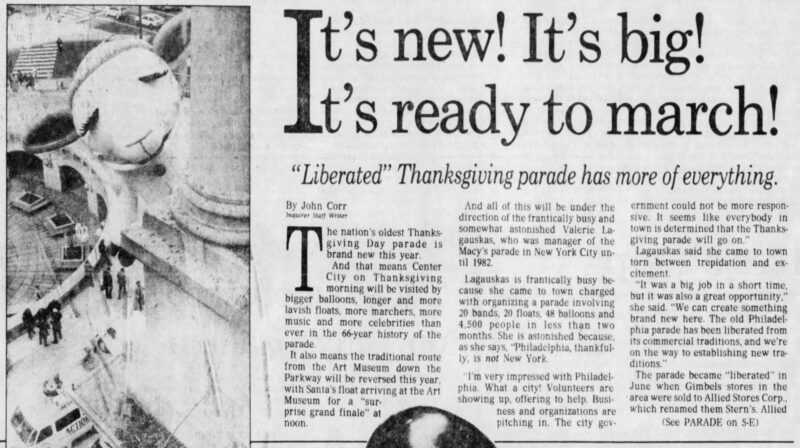
The parade that year, however, became bigger and better than it had ever been. Here is how The Inquirer and Daily News covered it:
Article from Jun 18, 1986 Philadelphia Daily News (Philadelphia, Pennsylvania) <!— –>
‘We can’t be ready in time’
A deal in the Gimbels sale emerged in June 1986 and, right away, the Thanksgiving Day parade was on the chopping block, at least for that year. Allied officials claimed no planning had yet been done and there was no way to put it together in time.
That, it turns out, wasn’t true. Ann Stuart, a Gimbels executive, told the Daily News that parade organizers had been proceeding as though the parade would be held as scheduled. And Barbara Fenhagen, the city’s special events coordinator, said planning was going ahead as usual.
Either way, Stern’s and Allied’s lack of interest left the city in a tight spot. Aug. 15 was the last day orders could go in for the floats to be ready on time, marking a hard deadline to find a sponsor. Whoever took up the role would be expected to spend hundreds of thousands of dollars.
“We will do everything we can to make sure that [the parade’s] appearance is not interrupted, even for one year,” Fenhagen said at the time.
Article from Jul 16, 1986 Philadelphia Daily News (Philadelphia, Pennsylvania) <!— –>
‘Don’t rain on our parade’
As the controversy wore on, Philadelphians and the local press grieved and snarled at the potential loss of a holiday tradition. The Daily News seemed to plead for Stern’s to reconsider.
“Please don’t rain on our parade,” the People Paper wrote in an editorial. “To Philadelphians of all ages, it launches the holiday season in a special and heartwarming way.”
Business columnist Jack Roberts struck a more combative tone, likening Stern’s to a houseguest who begins a conversation “by spitting in your face.” He later suggested that readers send back Stern’s junk mail to the company’s “Scrooge” executives with the phrase “I want the parade” scrawled across it.
Special events professionals, meanwhile, warned that forgoing the sponsorship might create a bad name for Stern’s that would be difficult to overcome.
“Philadelphians have a way of remembering,” special events consultant Shelly Picker said.
Article from Nov 21, 1986 Philadelphia Daily News (Philadelphia, Pennsylvania) <!— –>
‘We’re delighted’
The search for a new lead sponsor was arduous, with city officials approaching “most every local company that breathes,” according to a Daily News report. A number of bigger local outfits — ranging from Meridian Bancorp to Kiddie City — bowed out over cost and branding concerns.
Then, after 56 days of limbo, the Thanksgiving Day parade was back on. And it was thanks to WPVI (Channel 6), better known today as 6abc.
“When it became clear that because of the time frame and other commitments most were unable to assume that mantle, we decided to do it — and we’re delighted,” said the station’s general manager, Rick Spinner.
The station had been airing the parade locally for 19 years and seemed to be a natural fit to take over. And, as the Daily News reported, the city had been pressuring Channel 6 to come up with a plan, seeing as the station benefited significantly from broadcasting the day’s festivities.
The parade would go on to be known as the “Channel 6 Thanksgiving Day Parade.” But that was not the only — or even the biggest — change afoot.
Article from Sep 24, 1986 Philadelphia Daily News (Philadelphia, Pennsylvania) <!— –>
‘Establishing new traditions’
Channel 6 brought in the big guns straight away. Namely, by hiring a parade coordinator named Valerie Lagauskas, who previously managed the Macy’s parade in New York and wrote a book on parade planning.
A number of changes came under Lagauskas’ leadership, including a new route. Instead of starting at the Philadelphia Art Museum and marching toward City Hall, as had been tradition, the parade would reverse direction and end at the Art Museum. The route would allow for the use of larger balloons, bigger floats, and better camera angles for the parade’s telecast.
The full parade that year would also be broadcast nationally for the first time, appearing on the Lifetime network, in which ABC was part owner.
In total, there would be 20 bands, 20 floats, 8 gigantic balloons, and 40 other balloons that were merely very large, The Inquirer reported. A massive balloon of the cartoon cat Heathcliff would make its debut. The theme, fittingly, would be “We Love a Parade.” And leading it all as parade marshal would be Sixers legend Julius “Dr. J” Erving,
“The old Philadelphia parade has been liberated from its commercial traditions and we’re on the way to establishing new traditions,” Lagauskas said.
Article from Nov 28, 1986 The Philadelphia Inquirer (Philadelphia, Pennsylvania) <!— –>
‘The best ever’
On parade day, more than 500,000 spectators were expected to attend. And, according to reports from the time, they were not disappointed.
Not only were there better floats and a more picturesque route, but paradegoers also were met with unseasonably warm temperatures.
“It’s the first time we’ve been to a Thanksgiving Day parade where you could get a sunburn,” one attendee joked.
The parade itself seemingly went off without a hitch, concluding on the steps of the Art Museum as Santa Claus pulled up to a rendition of “Happy Holidays.” Musicians and dancers let go of green and white balloons that drifted out over the Benjamin Franklin Parkway to cheers.
And at least one Philadelphian didn’t forget who saved the day. Donna Harris, 30, of Audubon, who had attended the parade yearly since she was 5, was spotted holding a sign that read “Thank You WPVI.”
Thanksgiving is the sole American holiday whose name tells us exactly what we are meant to do.
This Thanksgiving — among many other blessings — I am giving thanks for our country’s vibrant, independent local journalism, and for the nation of laws and press freedoms that help preserve and defend it.
More than any other American holiday, Thanksgiving is about the exercise of free speech. Whether cordial or contentious, our views of our families, our culture, our sports teams, or our politics are debated freely over the American Thanksgiving table.
In a world in which we spend far too much time living in our own information bubbles, Thanksgiving allows — indeed forces — us to communicate across the table, across generations, and across sometimes deep partisan divides.
From the outset, the notion of Thanksgiving and freedom has been intertwined. In George Washington’s Thanksgiving Proclamation of October 1789, the new president asked the nation to give thanks “for the civil and religious liberty with which we are blessed, and the means we have of acquiring and diffusing useful knowledge.”
As worded, the proclamation is more a celebration of American freedoms than the blessings of a sumptuous meal. If Independence Day celebrates the declaration of American freedoms, then Thanksgiving celebrates their enactment and — one hopes — their permanence.
But on this, more than any Thanksgiving in memory, a free and independent American press seems in peril.
The current administration has orchestrated the virtual elimination of Voice of America and other vital U.S. international broadcasting and the defunding of NPR and PBS, among several other legal suits and regulatory intimidations.
The Inquirer is now the largest American newspaper under nonprofit ownership. The newspaper remains editorially independent of its parent company to protect the very freedoms for which its owner stands.
Thanks, in part, to this nonprofit structure, The Inquirer and its independent, high-impact journalism enjoy the funding support of individual donors, large and small, and of foundation and corporate contributors, both local and national.
It is said that “all politics is local,” and the same may be said of news. What happens in our nation or on our planet can often be best understood when reported from a local perspective.
The Inquirer, and the dynamic Philadelphia-area journalism scene of which it is a part, are a blessing for our city, our region, and our country.
Over the past year, a skilled, dedicated, and high-integrity group of women and men from The Inquirer, our region’s local TV stations, WHYY, WURD Radio, Impacto, the Philadelphia Tribune, Spotlight PA, and a diverse array of community news organizations have reported on the region’s biggest challenges: from the plight of our immigrant communities to solutions for gun violence, to economic mobility in what remains among the poorest big cities in America, to electoral politics in America’s largest swing state. This work saves lives, makes kids safer, and holds local and state government to account.
All those who report and edit the news, all who stand ready to defend their words in the courts or in the court of public opinion, everyone who helps fund great local journalism with their subscriptions or their donations, and all who read and act upon the vital insights of a free and independent local press deserve our thanks — and these days, our prayers.
Jim Friedlich is CEO and executive director of The Lenfest Institute for Journalism, the nonprofit organization that owns The Inquirer. @jimfriedlich
President Donald Trump accused six Democratic members of Congress of committing sedition,a claim that his administration has stuck to amid a fierce national debate that began when the lawmakers urged military and intelligence personnel to “refuse illegal orders.”
The Democratic members, who are all veterans or members of the intelligence community, shared a video online last week in whichthey accused Trump’s administration of pitting service members against American citizens andwarned against orders that would violate the Constitution.
The lawmakers did not reference specific orders, but members have spoken against strikes in the Caribbean and Trump’s deployment of the National Guard in American cities — both of which have faced legal scrutiny — as cause for concern.
Trump first responded to the video with a string of posts on his social media platform, Truth Social, calling for the lawmakers to be arrested and put on trial for sedition, “punishable by DEATH,” and sharing posts against them, including one that called for them to be hanged.
Two of the members represent Pennsylvania: U.S. Reps. Chrissy Houlahan (D., Chester), an Air Force veteran, and Chris Deluzio (D., Allegheny), a Navy veteran.
On Monday, the Department of Defense announced that it would investigate Sen. Mark Kelly (D., Ariz.), a former naval officer and the one veteran in the video who is still obligated to follow military laws because he served long enough to become a military retiree. The announcement threatened to call Kelly back to active duty for court-martial proceedings.
On Tuesday, a Justice Department official told Reuters that the FBI has requested interviews with the Democrats who appeared in the video, which some of the lawmakers publicly corroborated. The FBI declined to comment when reached by The Inquirer.
As the debate over the video escalates in the wake of Trump’s sedition accusation and his administration’s actions, a rarely used charge and the intricacies of military law have been thrown into the spotlight.
What is sedition, and is it punishable by death?
Sedition is an incitement of a rebellion or encouragement of attacking authority, or, in other words, the intent to overthrow the government, according to legal and military experts. When acting with others, it is called seditious conspiracy.
For civilians, sedition is a violation of federal law and carries prison time. It is not punishable by death.
Active-duty military, however, must follow the Uniform Code of Military Justice (UCMJ). While the military law has overlap with civilian law, it is more expansive, controlling, and strict, said Sean Timmons, a Houston-based attorney specializing in military law who previously served as an active-duty U.S. Army captain in the U.S. Army Judge Advocate General (JAG) program.
“In the civilian world you have a lot more defenses, and you have full First Amendment protections,” said Timmons, a managing partner at Tully Rinckey PLLC. “Whereas in the military, your First Amendment rights are quite limited.”
The maximum punishment for active military is death, but it can be far lower, he said.
Service members must be on active duty to be prosecuted under the UCMJ, but the conduct does not have to have taken place during active duty. This means that retirees like Kelly can be recalled for active duty to face UCMJ prosecution over their behavior while they were not on active duty.
What is an illegal order?
Members of Trump’s administration have pointed to the UCMJ rule that says members must follow lawful orders and orders should be presumed to be lawful. Service members can be punished for not following orders.
However, military rules also prohibit service members from following orders that are undoubtedly illegal — a point the lawmakers get at in their video — and they can be punished for doing so.
But whether orders are legal is supposed to be up to officers, not rank-and-file members, Timmons said.
“If you don’t comply, you could be charged with failure to follow orders and other crimes,”hesaid.
The exceptions (those obviously illegal crimes) would be war crimes like raping prisoners, deliberating killing civilians without justification, or torture, not day-to-day acts that would break the law, he explained.
Take the example of burning down an enemy’s structure.
“If your military unit says to burn it down because it’s part of the military objective, that’s a lawful order, even though it’s an illegal act,” he said. “It’s a war crime if it’s to burn down adaycare with kids inside.”
The boat strikes in the Caribbean have been in a legalgray area, he said, but “if your command says it’s legal, you’re supposed to execute.”
“The military system is harsh, cruel, and unfair … but it’s the system we have in place, and it’s designed that way to ensure discipline, obedience, and compliance,” he added.
Did the lawmakers commit sedition?
Claire Finkelstein, founder and faculty director of the Center for Ethics and the Rule of Law at the University of Pennsylvania’s Carey Law School and an expert in military ethics, said accusing the lawmakers of sedition “makes absolutely no sense, especially in a case in which they’re just reminding servicemen of their obligation not to follow illegal orders, which is a fundamental part of the UCMJ.”
“One has to really work hard to fill in the blanks here,” she said.
Timmons said five out of the six lawmakers have their freedom of speech to relyon as a protection.
“Just having divergent political views that the commander-in-chief doesn’t like, for civilians, there’s no liability, there’s no repercussions,” he said.
That doesn’t mean Trump’s administration cannot investigate them for “seditious behavior” anyway.
Kelly, on the other hand, was “on thin ice” by participating in a video that seems to undermine Trump’s authority, he said, and it’s not “totally crazy” to argue he engaged in seditious behavior under military law.
That being said, prosecutors would have to prove that his intent was to “cause a revolt within the ranks,” which would be “very hard,” he said.
“But could they make him miserable and humiliate him and charge him? Yes,” he said.
“Is that politically wise? Absolutely not. Is it reckless? Of course. But, technically, can they do it? Yes,” he added.
What are members of Trump’s administration saying?
White House press secretary Karoline Leavitt told reporters on Monday the White House supports the investigation into Kelly and accused him of trying to “intimidate” active-duty members with the video.
“Sen. Mark Kelly well knows the rules of the military and the respect that one must have for the chain of command,” she said.
“You can’t have a functioning military if there is disorder and chaos within the ranks, and that’s what these Democrat members were encouraging,” she added.
In a social media post on Monday, Defense Secretary Pete Hegseth called the lawmakers the “seditious six.”
“Encouraging our warriors to ignore the orders of their Commanders undermines every aspect of ‘good order and discipline,’” he wrote. “Their foolish screed sows doubt and confusion — which only puts our warriors in danger.”
How has Kelly responded?
Kelly, also a former astronaut, played down the impact of the threats against him on The Rachel Maddow Show Monday night.
“Is it stressful? I’ve been stressed by, you know, things more important than Donald Trump trying to intimidate me into shutting my mouth and not doing my job,” he said. “He didn’t like what I said. I’m going to show up for work every day, support the Constitution, do my job, hold this administration accountable.”
He also denounced the president’s rhetoric, calling it “inciteful.”
“He’s got millions of supporters,” Kelly said. “People listen to what he says more so than anybody else in the country, and he should be careful with his words. But I’m not going to be silenced here.”
He said he and his wife, former U.S. Rep. Gabby Giffords (D., Ariz.), who survived a 2011 assassination attempt in which she was shot in the head, “know what political violence is, and we know what causes it, too.”
What response have Houlahan and Deluzio gotten?
Houlahan and Deluzio, the two Pennsylvania lawmakers in the video, both reported bomb threats at their district offices on Friday following the president’s posts.
But they have also gotten messages of support.
Houlahan shared voice recordings of veterans from all over the country who left messages of support for her office and thanked her for her advocacy.
“Keep pushing it,” one said. “I’m with you, I’m behind ya,” another said.
“I am so proud of all six of you for making that video,” said another.
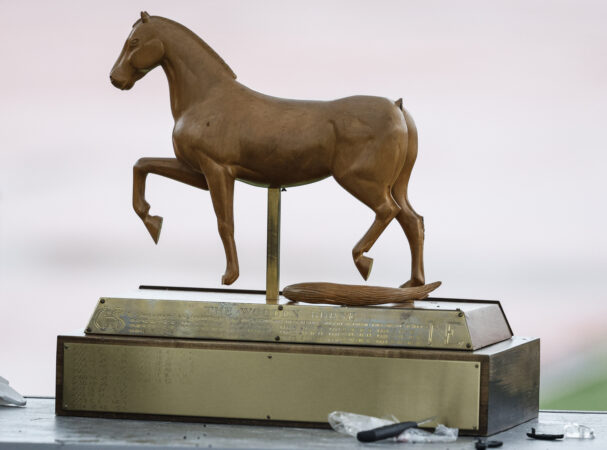
It was Nick Lincoln’s first season at Northeast High School, so the football coach asked his athletic director last November if the Wooden Horse — the mahogany trophy carved nearly 80 years ago by a student — could be brought to the field on Thanksgiving morning for the annual game against Central.
The trophy, heavy and old, usually stays inside. But what good is the Wooden Horse if the players can’t hoist it after a win?
“Well, we had a little too much excitement,” Lincoln said.
The celebration ended, and the horse no longer had a tail.
“I said, ‘Dude, you’re going to get me fired,’” athletic director Phil Gormley said. “‘You’re going to be back coaching in Delaware, and I’m going to be bagging groceries at the Acme.’”
Northeast vs. Central is one of the longest-running rivalries in the country, but the Thanksgiving game is no longer the spectacle it once was. The halls of the schools don’t buzz in the weeks leading up to it, the parade down Cottman Avenue was canceled years ago, the bleachers aren’t filled, and the trophy is falling apart.
High school football in Philadelphia once meant as much to Thanksgiving as Santa Claus climbing into Gimbels. But traditions fade. Just 10 games are planned Thursday in Southeastern Pennsylvania, down from 28 in 2005. Thanksgiving games have faded for a variety of reasons: state playoffs, lack of competition, tepid attendance, and school closures.
But Northeast vs. Central — the schools say it’s the nation’s oldest rivalry among public schools — refuses to go away, even if the trophy is showing its age. The teams will meet again at 10:30 a.m. Thursday at Northeast.
“I don’t think the game will fade,” Gormley said. “It’s not attended like it used to be, but I know it’s still important to our alumni. When I talk to anyone who comes back for any reason, it’s always a question that eventually comes up. I think the game, for the foreseeable future, is OK. It’s certainly something that could happen, but thankfully it’s not something that will happen anytime too soon.”
A historic game
The schools first played in 1892 and started playing annually in 1896. The rivalry has paused only twice: in 1918 during World War I and 2020 during the pandemic. They’ve played through snow, rain, and muddy fields.
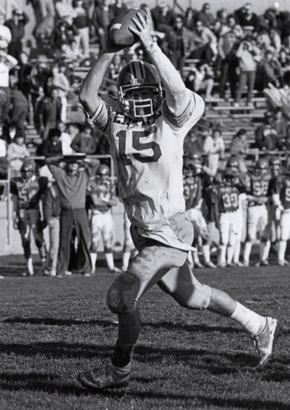
The rivalry was real, as the schools were just three miles apart: Central was at Broad and Green, and Northeast was at 8th and Lehigh. The trophy came along in 1947, when Northeast’s Spurgeon Smith, using only a kitchen paring knife, carved into a block of mahogany donated by Smythe Mahogany Company.
The games often were epic and packed. More than 15,000 fans saw Central beat Northeast in 1929 at the Baker Bowl, they played a muddy scoreless tie in 1971, and they’ve braved a few snowstorms.
Philadelphia had a full slate of high school football on Thanksgiving morning, and Northeast-Central was the game for years.
“Everyone is brought on board at Central knowing that Thanksgiving is against Northeast,” said Jeff Thomas, Central’s associate archivist. “No matter how good or bad the team is that year, that is the most important game. Very similar to Army-Navy. Both teams could be 1-6, but when they play each other, it’s the most important game.”
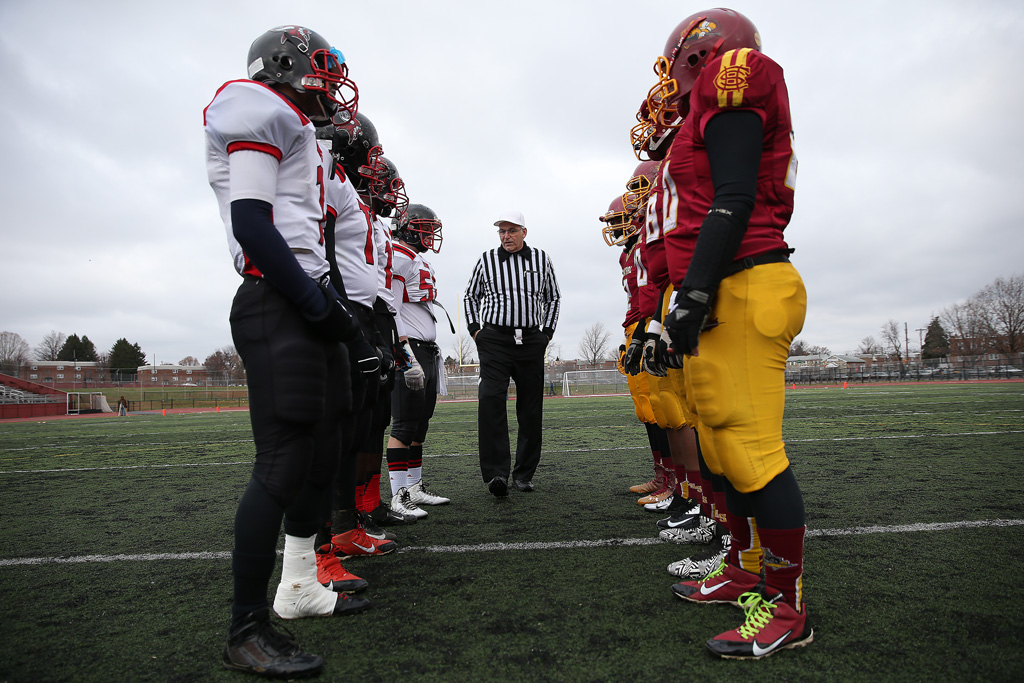
Northeast High School football players (left) meet at the center of the field with their Thanksgiving Day rival, Central High School, before the 2014 game.
In 1986, current Central coach Rich Drayton scored five touchdowns as the Lancers ran up the score in a 60-3 win in front of 7,000 fans. Afterward, Northeast coach Harvey Schumer refused to shake hands with Central coach Bob Cullman, and the two had to be separated at midfield. Three years earlier, Northeast didn’t let up in a 42-point Thanksgiving win. So Central was returning the favor.
The rivalry was deep.
“Wherever you go wearing your Lancers stuff, people ask for your class number,” Drayton said. “The next thing they say is, ‘Are we going to win on Thanksgiving?’ It’s a really big deal. Hopefully, the student body can notice before it’s too late how important it is.”
Hanging on
The parade of antique cars and convertibles started near the Roosevelt Mall, traveled west on Cottman Avenue, turned right on Glendale Avenue, then finished with a lap around the track that circled Northeast’s football field.
The stands were filled as more than 6,000 fans came each Thanksgiving to see which school’s trophy case would hold the Wooden Horse.
But the parade ended about 15 years ago when the school district replaced the cinder track with rubber. Students no longer decorate the stadium like they once did, and the game now attracts between 600 and 800 fans instead of thousands.
Both schools have strong alumni groups, and former students still come out. It’s a chance to wear a letterman’s jacket, see old classmates, and tell the same stories.
“We have breakfast in the gym for alumni who come back,” Gormley said. “These old guys would be in there razzing each other. ‘Well, you lost to Central. I never lost to them.’ You know how guys talk. It’s funny to hear.”
Central’s Mike Roche threw for 409 yards and five touchdowns in a 60-3 rout of Northeast on Thanksgiving Day 1986.
But interest among current students is tepid. Both schools draw students from across the city, and getting to Northeast Philly on a holiday morning can be a challenge.
The game has become one-sided — Northeast last lost in 2013 — and a football game doesn’t mean what it once did. The high school experience at Northeast and Central is not defined by the football teams the way it was in the 1960s or 1970s.
“We have career day, and me and the other old guys come in,” Thomas said. “At the end of each class, we’ll ask them who’s going to the game. One hand raised. I’m like, ‘OK. Well, let’s beat Northeast.’ They’re like, ‘Huh?’ It’s gone full cycle to almost no care at all.”
St. Joseph’s Prep and La Salle High School stopped their Thanksgiving game in 2006. North Catholic and Frankford played their final game in 2009 before North closed seven months later. Father Judge and Lincoln canceled their annual game last year, and Neumann Goretti and Southern won’t play this year.
Thanksgiving games drop off the schedule every year. As interest drops, could Northeast-Central be next?
“No,” Thomas said. “Well, maybe. After, say, everyone who graduated before 1985 is gone.”
High school football’s regular season in Pennsylvania started a week before Labor Day and ended a week before Halloween. Central did not make the playoffs, and Northeast lost in the first round, so neither team has played a game in nearly four weeks.
The PIAA playoff schedule has ended other rivalries as schools are either playing this weekend in the state tournament — like La Salle — or have been dormant for too long to play on Thanksgiving.
Northeast and Central found a way to keep their teams together as they wait for Thanksgiving. The coaches could have walked away weeks ago when the season ended — they instead practice a few times a week and schedule time in the weight room. They want to give their kids another game.
“I would love to be playing a PIAA playoff game and have to forfeit,” Lincoln said. “But it’s another chance for our guys to play football.”
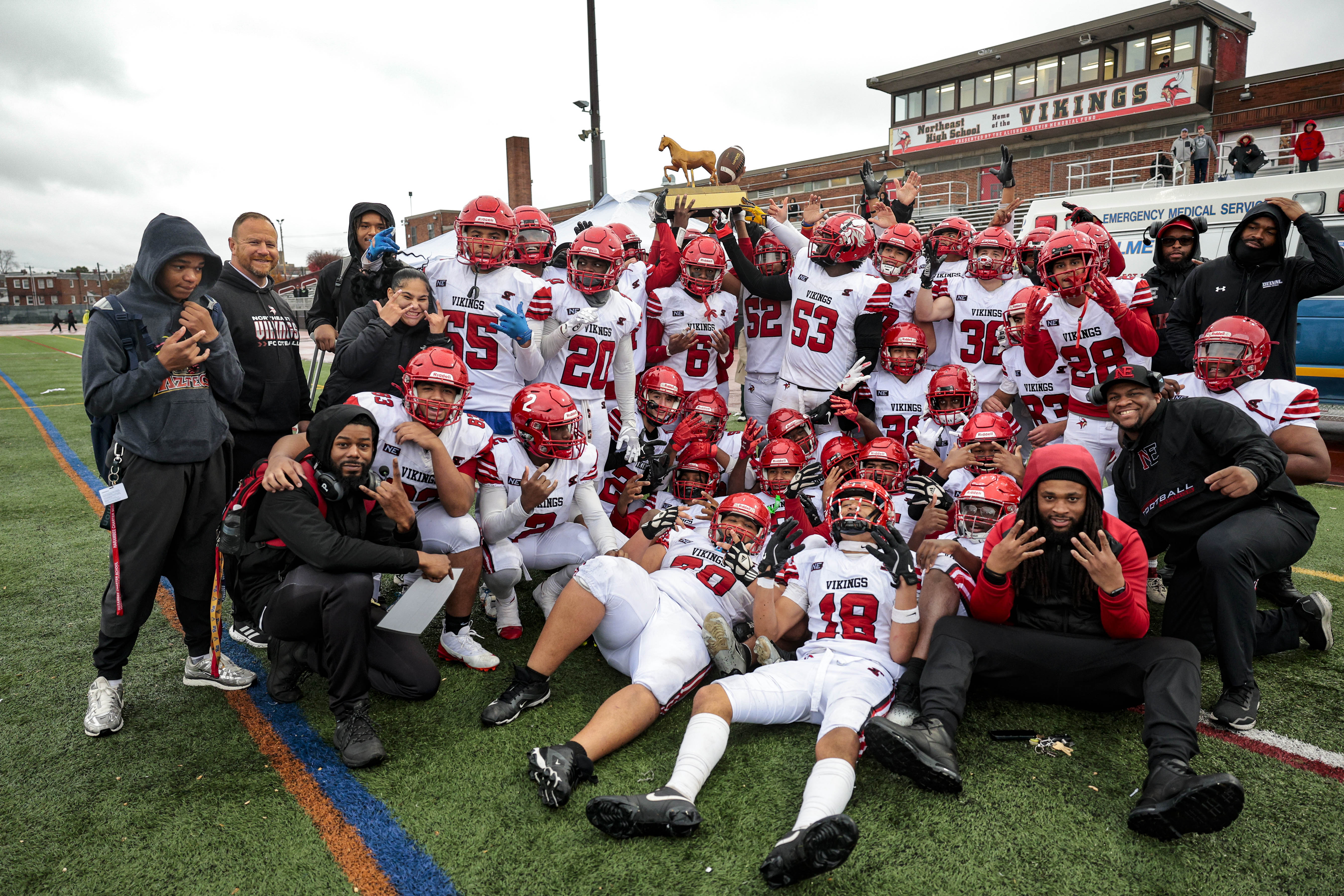
Northeast celebrates its 37-21 win over Central with the Thanksgiving game Wooden Horse trophy last year.
Lincoln held his breath last Thanksgiving before he found the Wooden Horse’s tail on the field. His first win against Central wasn’t spoiled by a horse’s rear.
Gormley took the Wooden Horse to a nearby trophy shop, which repaired the tail and added last year’s final score — Northeast 37, Central 21 — to the base before it was tucked safely into the trophy case. The Wooden Horse, just like the game it represented, refused to go away.
“I’m going to try to bring it out again,” Lincoln said. “Let’s see if the AD allows me to.”
When Byron Young’s father died earlier this year, he asked his mother for his dad’s key chain.
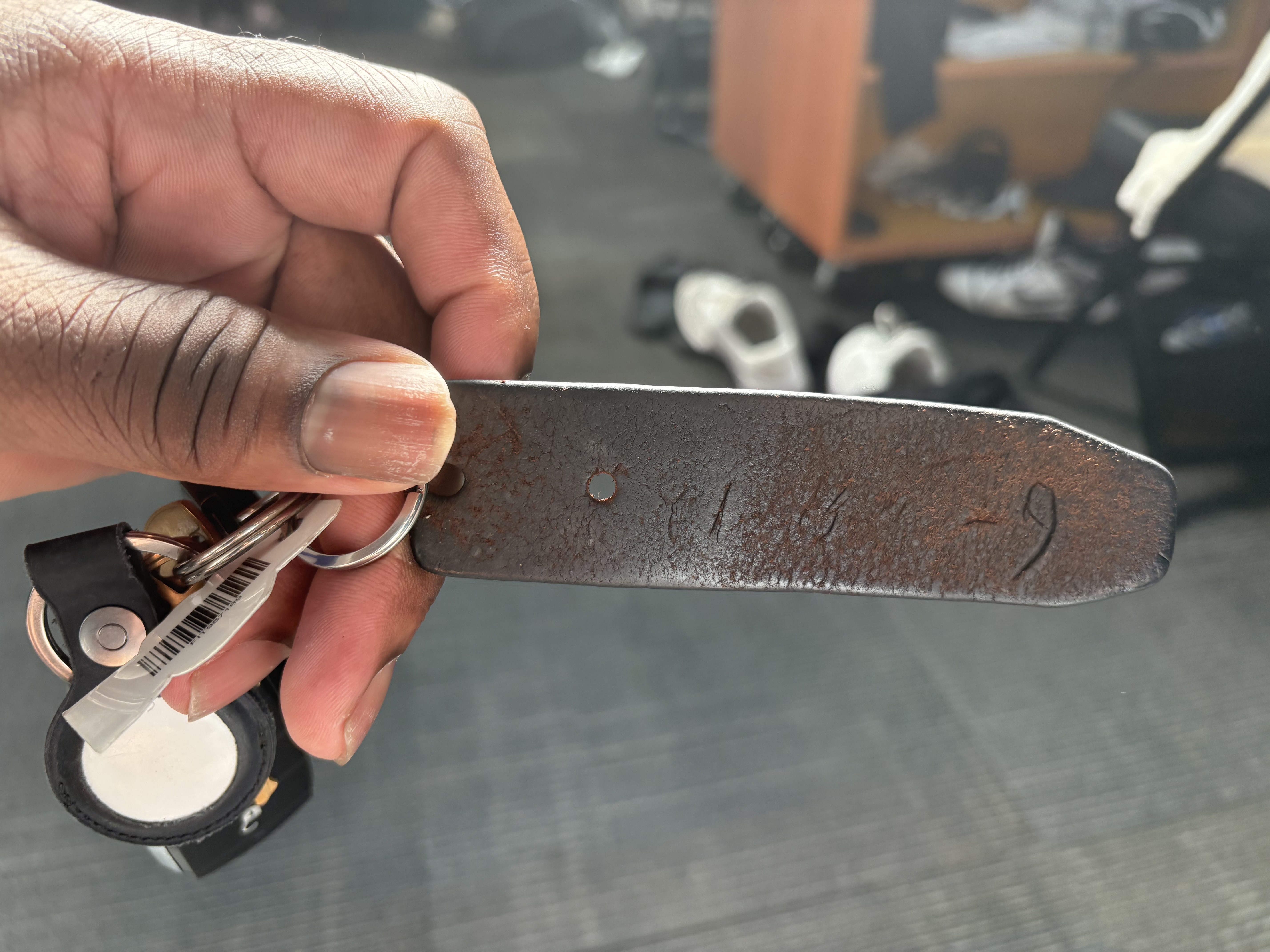
It’s not your normal key chain. It’s made from the end of a snapped belt, the key ring looping into one of the belt’s holes. There’s a date carved into the brown leather on one side. It’s faint now, but Young said he thinks it reads “7-1-9” for July 1, 2009.
“I think the date that was on the belt was the date that he cut the belt and put it on his key chain,” Young said. “I want to say the belt was broken or something, and he just put it on there. I don’t think there was any deeper meaning.”
But the chain has great significance to Young, the Eagles’ 6-foot-3, 292-pound defensive tackle. When he first linked it to his keys, he marked the other side of the belt with the date “4-7-25,” nearly 16 years after his father’s original carving and just a week after Kenny Young, 62, suffered a fatal heart attack.
Byron Young turned father Kenny’s broken belt into a key chain that serves as a reminder of his father’s love.
“It’s just something that I knew he always carried around since that day, I believe,” Byron said, “and so it’s just something I want to keep with me.”
Young grabbed the key chain from his locker stall when a reporter recently asked how he kept his father’s memory alive, crying as he gripped the belt. He doesn’t hide his emotion. He said he gets that from his father, who openly shed tears when he spoke about his love for his family or God.
“I think a part of being masculine is being able to show your emotions and explain the way you feel and express the way you feel to other people,” Young said. “Not just balling everything up and thinking, ‘Oh, I’m a man. I can’t talk about this.’”
When Young found out his father had died back home in Mississippi on March 31, he drove to teammate Gabe Hall’s house, overcome with grief. They met just before the 2024 season and spent the next six months as part of the same position group, training side by side nearly every day during the offseason. The goal was to make the Eagles’ 53-man roster after having served mostly as reserves. But his father’s death put Young’s football plans on hiatus. He flew home the next day.
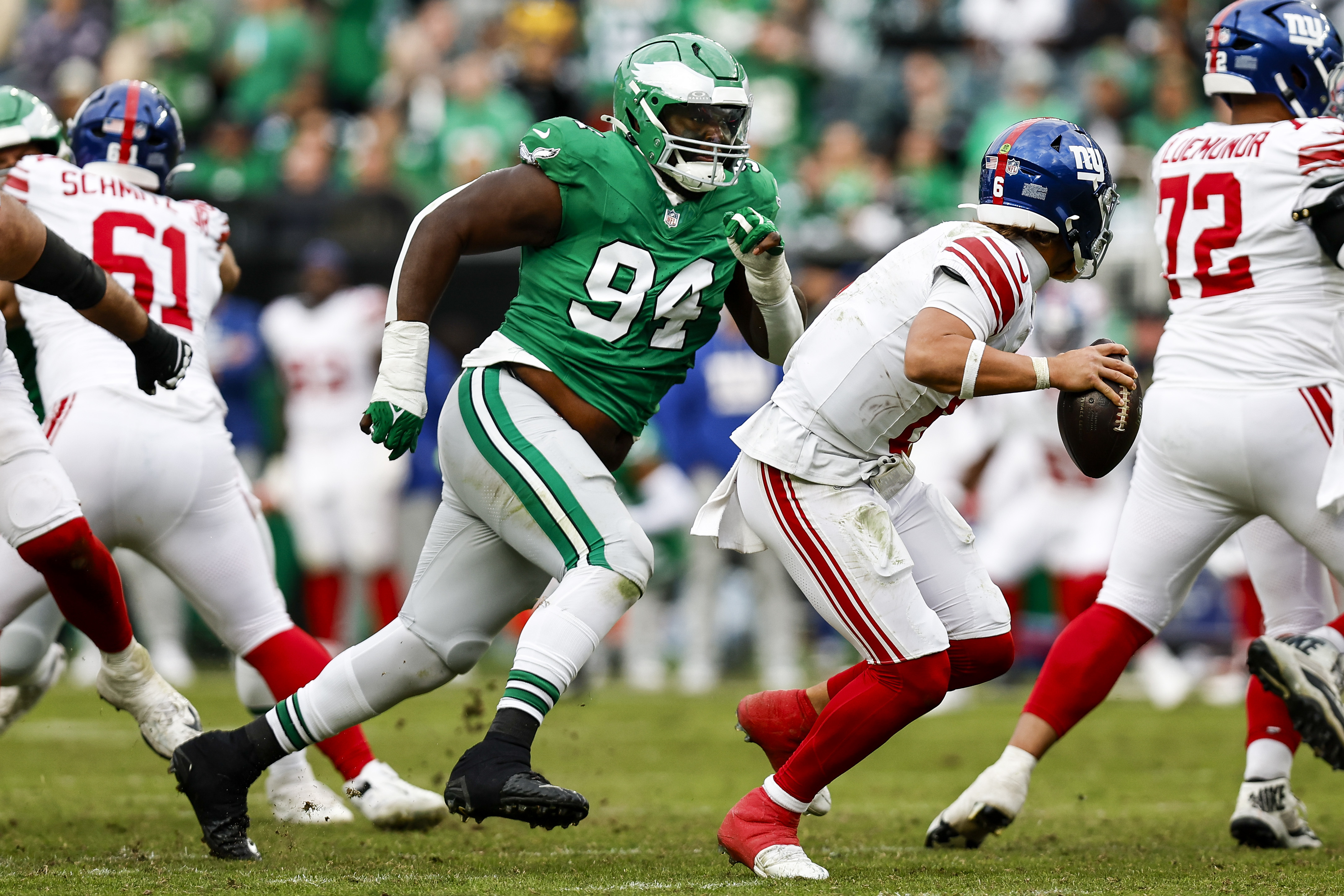
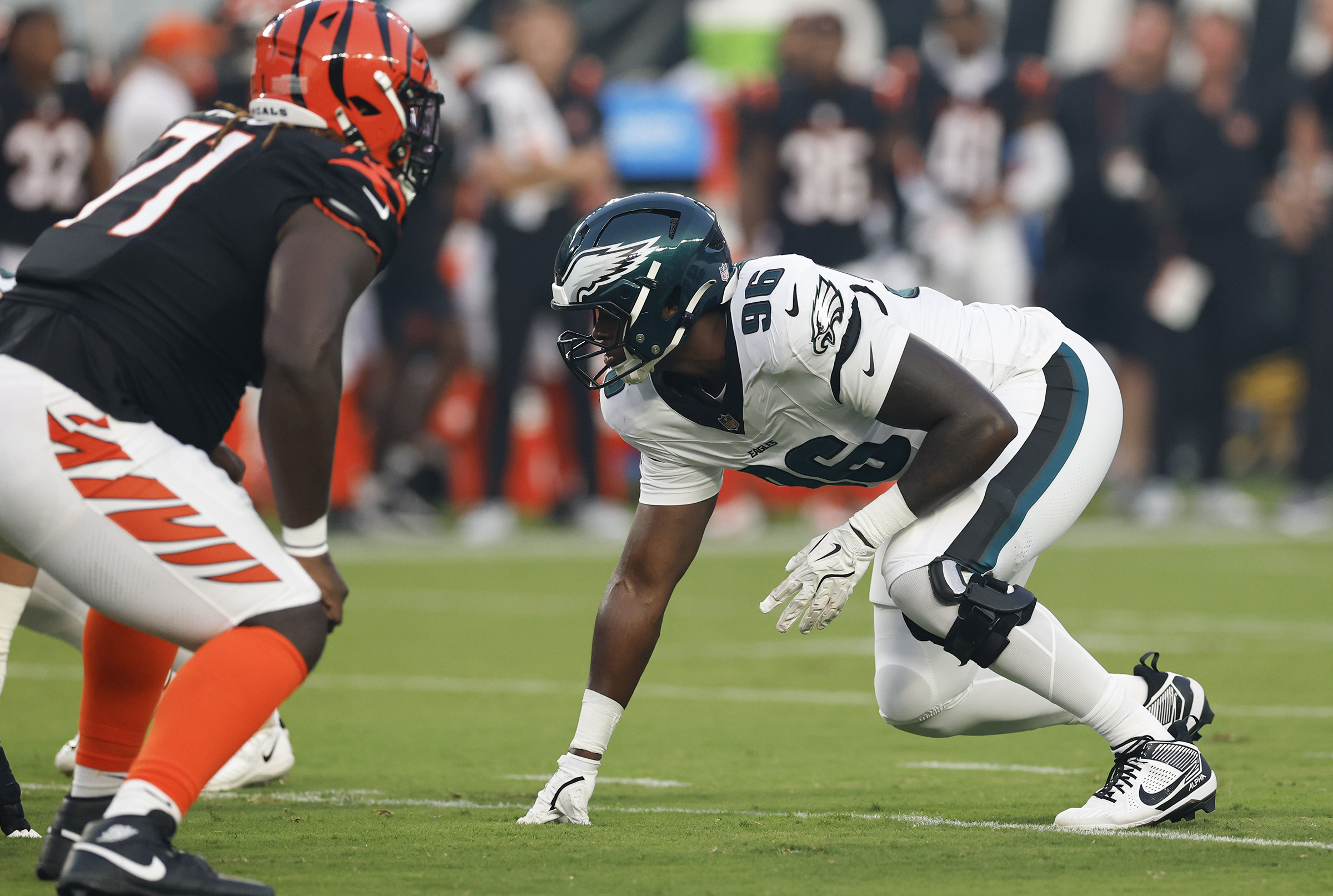
Eagles defensive tackle Byron Young has appeared in all 11 games this season.
“I expected him to be gone for the rest of summer,” Hall said. “I was like, ‘OK, he’s not going back. I’m going to miss him.’ But he came right back. And he was like, ‘Bro, it’s time to get to work.’ When I saw that, I was like, ‘Yeah, that’s my dog.’”
Hall said Young trained with a “chip on his shoulder” that motivated him. They played golf — along with former Eagles tackle Laekin Vakalahi — to break the monotony. And they sometimes spoke about Young’s father.
Hall said he did his best to keep his friend from ruminating on the loss. Young had all the inspiration he needed.
“A lot of working out, man, a lot of working out ’cause it’s what he would have wanted,” Young said of his father.
Young and Hall initially made the active roster. The latter was soon moved to the practice squad where he remains, while the former has played in every game this season as the Eagles’ fourth defensive tackle.
The 25-year-old Young said he doesn’t dwell on his father’s absence or his last moment with him because it was like so many.
“He wasn’t the type that didn’t tell you that he loved you. He wasn’t the type that didn’t tell you he was proud of you,” Young said. “He would always let you know, to the day that he passed, that ‘I’m proud of you; you’ve done a lot of great stuff.
“‘I love you.’”
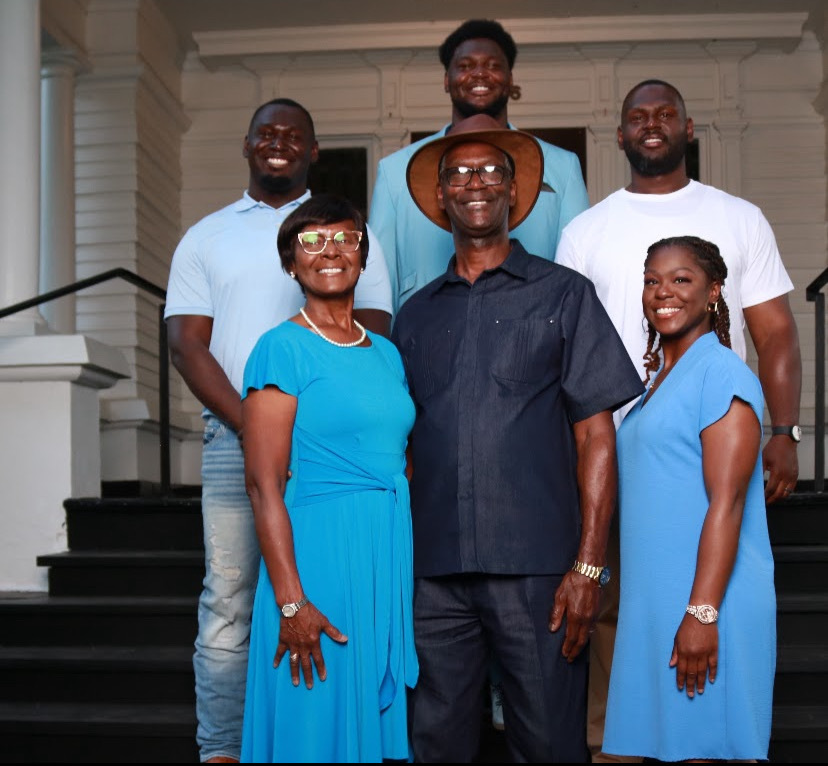
Byron Young (center) with his siblings and father, Kenny (center) and mother Melissa (left).
‘A passionate person’
Young didn’t play in Super Bowl LIX in February. His season ended in October when the Eagles placed him on injured reserve with a hamstring injury. But he was in New Orleans for the game, as was his family, which made the two-hour drive south from Taylorsville, Miss.
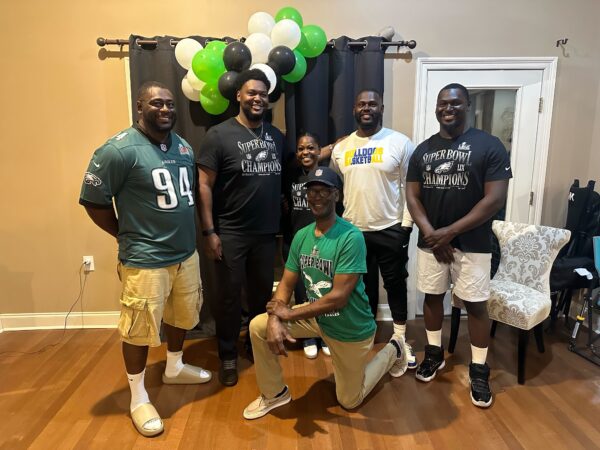
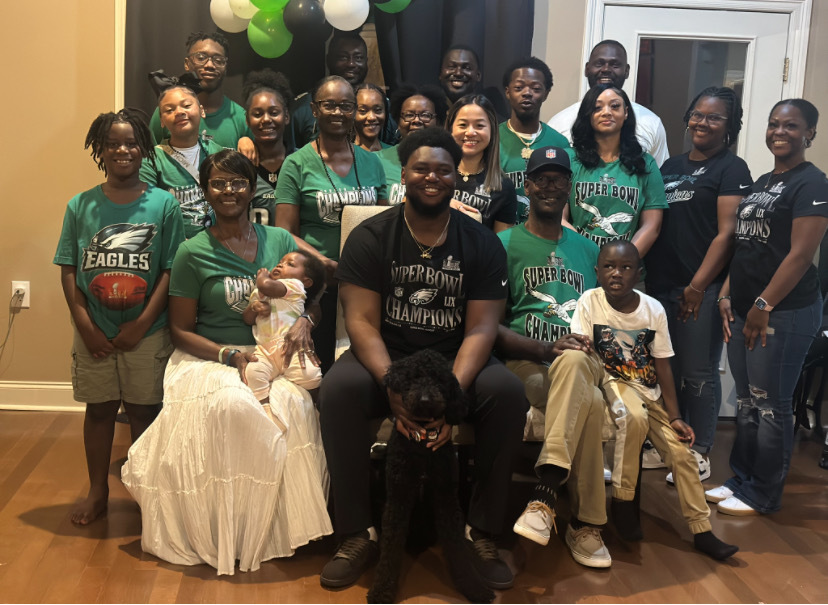
His parents, Kenny and Melissa, were unable to get on the field at the Superdome to celebrate with Byron after the Eagles toppled the Kansas City Chiefs. But the family had a proper party back home a month later with Byron and his brothers Kendrick, Regrick, and Brandon, and sister Shavon.
Byron Young (center), flanked by parents Melissa (left) and Kenny (right) at a family Super Bowl celebration last March. Kenny died suddenly two days after this photo was taken.
A day later, the Youngs gathered after Sunday church services to celebrate the birthday of Melissa’s sister. At one point, Kenny stood up and delivered a speech. He loved to talk. But he also wanted to express his love for his two sisters-in-law.
“He shed a few tears. What’s crazy is my uncle told him, ‘You get up there talking like you about to leave us,’” Byron said. “It just so happened that he did. I don’t know if he knew, or I don’t think he knew, but I don’t think anybody had any idea.
“But, man, he was just always a passionate person.”
Kenny Young didn’t have anything close to an ideal upbringing, according to his wife and son. But he was a man of faith and found mentors through the Friendship Church of God in Christ in Collins, Miss. He had just ended a relationship when one day in church he prayed that his next girlfriend would become his wife, according to an oft-repeated family anecdote.
His plea was answered when he met Melissa in the library at the University of Southern Mississippi. She was a student, and he liked to go there to read the magazines. They started dating and married two years later.
Kenny was a “hands-on man,” as his wife described him. He worked on farms growing up and was mechanically inclined. He was a laborer at Georgia-Pacific and pulled the wood that the company manufactured into paper products.
The work was physically grinding. Byron recalled his father’s long hours and hearing his keys jingle in the early mornings as he was leaving for the next 12-hour shift. But Kenny also was a present dad to five children, Melissa said.
There were rules and discipline. He coached his sons in youth football and sometimes took them to chop firewood for parishioners who needed warmth during the winter months. He loved to joke and laugh.
“The best way to describe Kenny is he loved well,” Melissa said. “He had a great love, reverence for God, and he spoke the truth out of love, and he didn’t want anybody to go to hell. … He was a deacon in our church.”
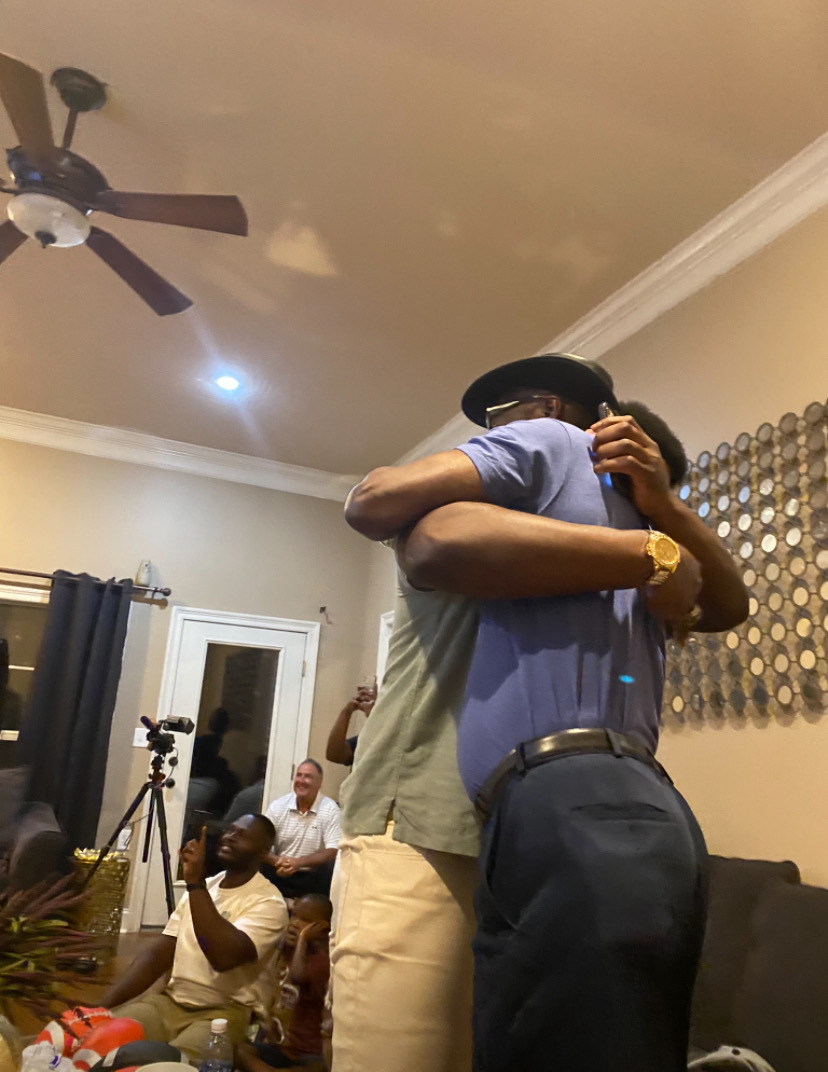
Byron Young hugging father Kenny after he was selected by the Las Vegas Raiders in the third round of the 2023 draft.
Kenny had been promoted to less strenuous jobs in his later years at Georgia-Pacific. He was a lathe machine operator who “pushed buttons,” Byron said, to keep wood on the straight and narrow. He could have retired, Melissa said, but he told her he was needed to spread the gospel at work.
“We had talked about the two of us retiring at age 65, maybe coming out the same year, but God retired him at age 62, and his work was done,” said Melissa, who’s still a pre-K teacher. “And I feel like God said to my husband, ‘Well done, that good and faithful servant.’
“He slipped away quickly and easily. He didn’t go through any suffering.”
‘A mini-him’
Kenny worked on Monday, the day after his sister-in-law’s birthday, after Byron flew back to Philly. Later that night, Kenny got into bed with his wife.
“He liked to play. And I thought he was making a sound just playing with me,” Melissa said. “And I said, ‘Well, Ken is gonna quit making that sound in a little bit.’ So I guess it may have been a moment, and he kept making the sound. … I got up and I turned the light on, I called his name and I pushed him, and he was not responsive.”
Melissa called Shavon and they dialed 911. They got Kenny off the bed, elevated his head, and tried chest compressions. One of Byron’s brothers called him immediately. There was nothing that could be done.
“He wanted to turn around and come drive right back,” Melissa said of Byron. “But one of his brothers convinced him not to. … They told him to get a flight, because he will get here by plane quicker than he would if he got on the road and drove.
“And he probably was not in any condition to be on the road anyway.”
Young called Hall instead. He wanted to know if he could watch his dog while he was away. They had worked out at NovaCare Complex, the Eagles’ practice facility, earlier that day. Hall sensed something was wrong.
“I was like, ‘You OK?’” Hall said. “This was late. You don’t just call me late.”
Young told him about his father and asked if he could drive over.
“He allowed me to cry on his shoulder,” Young said. “We just sat in silence because there was nothing really to be said.”
Eagles defensive tackle Gabe Hall helped Byron Young cope with the pain of his father’s death.
At one point, Hall said, Young cracked a joke. Hall had never met Young’s father, but he had heard stories about his sense of humor.
“You could tell he was kind of a mini-him, in a sort of way,” Hall said. “I just knew that was a person he always talked about. He talked about his dad at least a few times a week.
“You could just tell when a man respects somebody in their life.”
Kenny played football growing up, but couldn’t pursue it beyond high school because he had family responsibilities, his son said.
“According to him, he was one of the best ever,” Byron said. “And I don’t doubt it.”
He stopped coaching his sons when they reached a certain level. But he influenced their every decision. Byron wanted to play at Ole Miss, but Kenny felt Alabama and coach Nick Saban would be best for his son.
The first training camp was difficult.
“I remember calling him one day and not wanting to be there anymore,” Young said of his father. “He just told me that’s what I signed up for. … I didn’t really tell anybody else but him. He told me that wasn’t something that he wanted me to do because I gave Alabama my word that I would be there for four years.
“And that was kind of the end of me thinking that I was going to transfer.”
Young played in 13 games as a freshman, won a national title as a sophomore, and was All-SEC by his senior season. When the Las Vegas Raiders drafted him in 2023, he and his father had a long, knowing embrace.
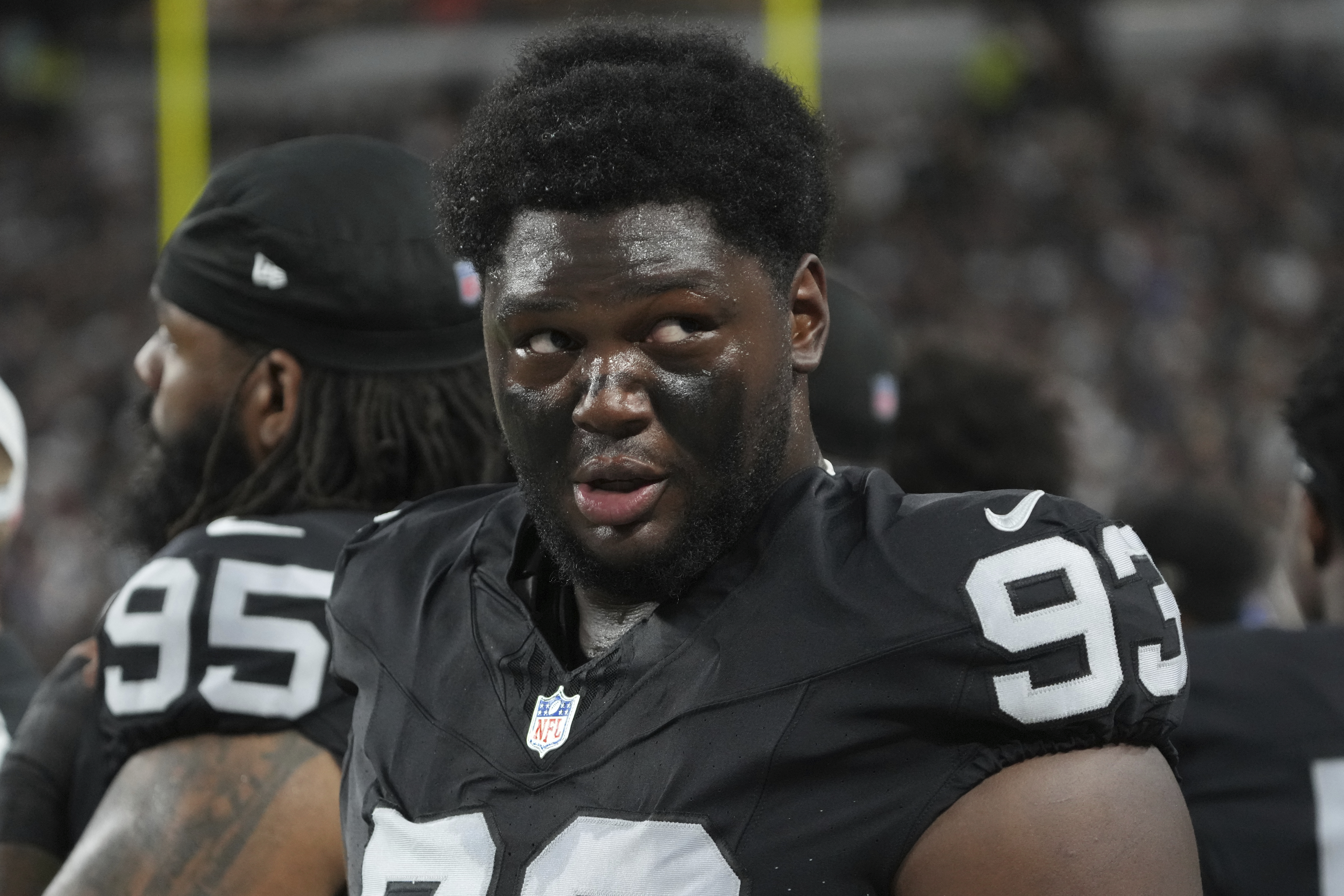
Byron Young spent one difficult season as a member of the Las Vegas Raiders before being cut and landing in Philly.
The NFL brought its own struggles. Young played in only six games as a rookie and was cut by the Raiders the following August. He still has the voicemail his father left him offering encouragement and advice.
“It’s something like the last thing that I have on my phone of his voice,” Young said. “And … I just always keep that in my mind.”
The Eagles signed him off waivers the next day. Exactly one year later, Young made the 53-man roster out of 2025 training camp. He said he wasn’t surprised “because I knew the work that I had put in.” He just wished his dad could have been there to see it.
“I believe that he knows, and that he’s in heaven or resting right now,” Young said, “and eventually I’ll see him again.”
For now, he has mementos. There’s Kenny’s 1967 Pontiac GTO parked in the shed his father built that Byron hopes to finish restoring. And, always with him, his father’s key chain.
“Hopefully, one day I have a son or a daughter,” Young said, “and I can give it to them.”
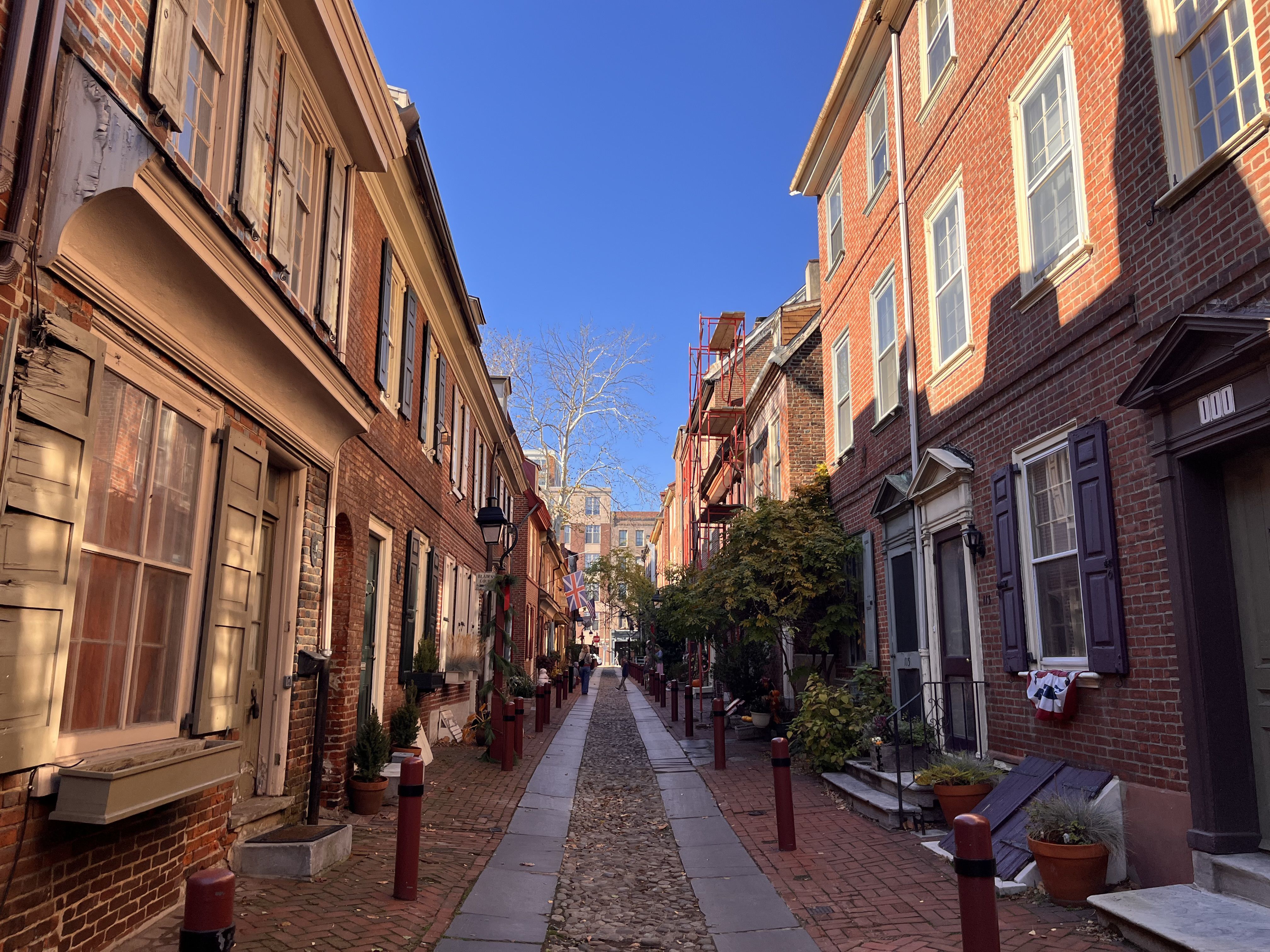
Few Philadelphians may recognize the name Dolly Ottey, yet nearly all know Elfreth’s Alley — the nation’s oldest residential street — which she helped rescue from decline and demolition starting in the 1930s.
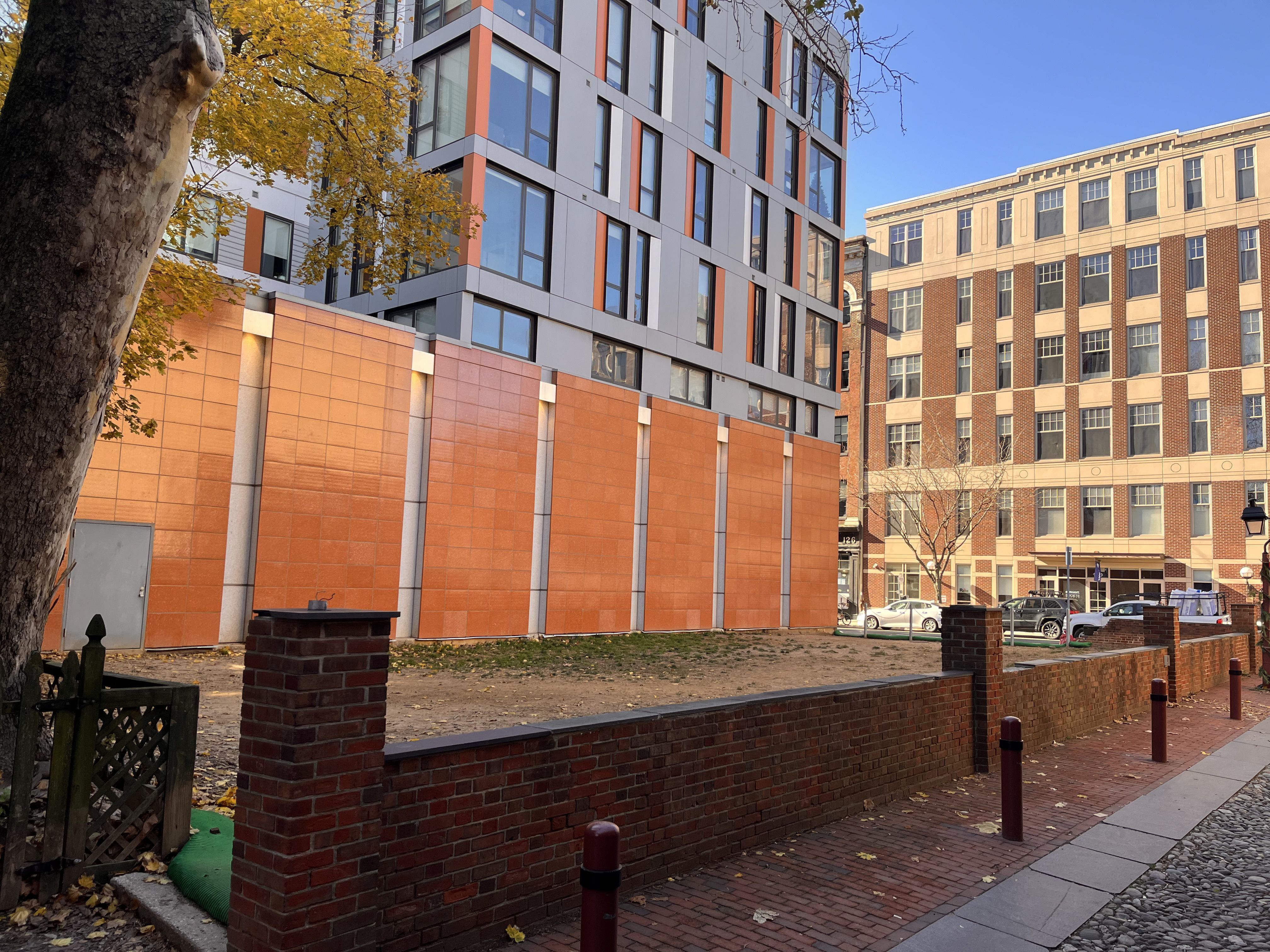
Now, after years of wrangling, a long-neglected vacant lot that some have derided as an eyesore at the historic location is slated for a transformation in time for the 250th anniversary of the Declaration of Independence.
Plans call for the lot at North Second Street and Elfreth’s Alley to be reborn as Dolly Ottey Park, honoring the woman who first championed preservation of the narrow cobblestone passage starting in the 1930s.
window.addEventListener(“message”,function(a){if(void 0!==a.data[“datawrapper-height”]){var e=document.querySelectorAll(“iframe”);for(var t in a.data[“datawrapper-height”])for(var r,i=0;r=e[i];i++)if(r.contentWindow===a.source){var d=a.data[“datawrapper-height”][t]+”px”;r.style.height=d}}});
Job Itzkowitz, executive director of Old City District, said the project took eight years of sporadic effort to get multiple parties to sign off on an agreement to create the park. Old City District is a nonprofit registered community organization.
“We want it to be a place where residents, tourists, visitors, employers, and employees can take a bit of a respite,” he said. “It’s going to be a drastic improvement.”
A conceptual rendering of Dolly Ottey park at Second Street and Elfreth’s Alley in Old City, Philadelphia. Organizers hope to transform the existing vacant space into a park by spring.
On a recent day, families and couples toured Elfreth’s Alley, taking pictures and discussing the history of the area. But none ventured into the vacant lot. Later, a lone woman could be seen walking her dog there.
Itzkowitz credited a renewed spirit of collaboration for breaking the stalemate.
He said changes in leadership at the real estate advisory board for the National Old City Apartments, which abuts the park, and crucial support from the nonprofit Elfreth’s Alley Association paved a path for agreement.
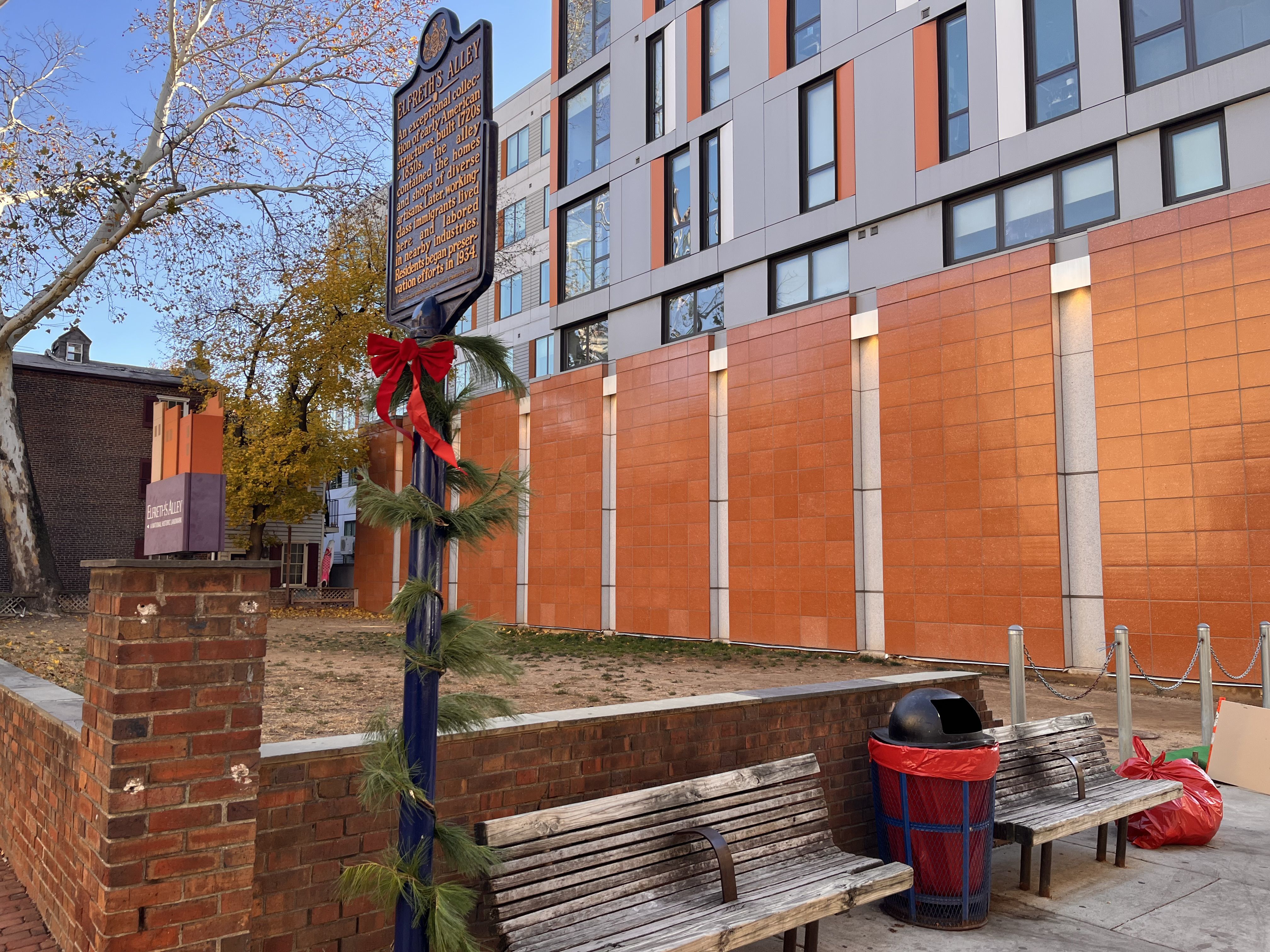
A view of a vacant lot at Second Street and Elfreth’s Alley in Old City Philadelphia. Plans for creation of Dolly Ottey Park at the location and named after an advocate who helped save Elfreth’s Alley in the early to mid 20th Century.
The lot is owned by Bit Investment Seventy-Eight LLC, according to city records, and is part of that company’s holdings for National Old City Apartments along North Second Street.
A usable space by spring
The pocket park will rise in two phases: an interim stage featuring a crushed stone base, picnic tables, planters, wild grasses, and repairs to a crumbling brick wall, followed by a more permanent design.
An architect has been hired to craft a cost-effective plan to deliver a usable public space by spring 2026.
The interim plan design for Dolly Ottey Park carries a modest $60,000 budget, with fundraising to break ground in February and finish by March. Old City District has set up an online link for public contributions.
Itzkowitz said the timing for the interim phase would ensure the park provides a welcoming experience for visitors during the Semiquincentennial as part of a significant historical landmark.
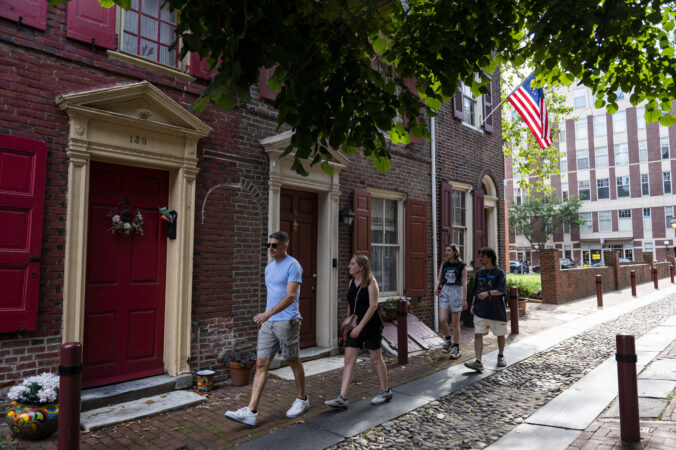
A view of Elfreth’s Alley.
Elfreth’s Alley is believed to be America’s oldest continuously inhabited residential street. Its origins trace to the early 1700s, when two landowners combined properties to create a cart path leading to the river. People have been living there since 1713.
The cobblestone alley, about 400 feet long and lined by 30 brick buildings, was named for Jeremiah Elfreth, an 18th-century blacksmith. It originally housed artisans and merchants, serving as a base for business ventures. Notable figures such as Stephen Girard, who helped finance the War of 1812, are believed to have lived here.
However, Elfreth’s Alley faced demolition due to neglect and development pressure. From the 1890s to the 1930s, part of the block was rebranded as Cherry Street, leading to the loss of at least one historic home.
Who is Dolly Ottey?
Ottey, a resident and owner of the Hearthstone restaurant at 115 Elfreth’s Alley, formed the Elfreth’s Alley Association in 1934 to protect the unique street and save it from destruction.
A view from Elfreth’s Alley facing a vacant lot at Second Street that will be transformed into Dolly Ottey Park.
Elfreth’s Alley faced an even bigger existential threat in the 1950s and 1960s when proposed construction of I-95 would have demolished at least half the block.
The demolition was vehemently opposed by Ottey and the Elfreth’s Alley Association. The community gathered 12,000 signatures for a petition presented at City Hall, successfully pleading for the street to be spared.
Elfreth’s Alley was protected as a National Historic Landmark in the 1960s as a result and is listed on Philadelphia’s historic register.
Ottey died in 1996, in South Jersey, at age 85.
Elfreth’s Alley remains not only a residential area but also a cultural and historical attraction. It holds a museum that educates visitors on its history and the lives of early inhabitants.
“I do solemnly swear that I will support and defend the Constitution of the United States against all enemies, foreign and domestic … and that I will obey the orders of the President of the United States and the orders of the officers appointed over me,” according to law.
Military and intelligence community members were recently reminded of this oath when, on Nov. 18, six members of Congress released a direct-to-camera video, telling service members that they “can refuse illegal orders.”
In response, the president unleashed a spate of social media posts calling for the lawmakers to be jailed, charged, and even executed. He subsequently doubled down on his threats of arrest and prosecution.
If there were any doubt whether the president’s words were empty rhetoric, look no further than the just-dismissed case against former FBI Director James Comey, who, after the president directed Attorney General Pam Bondi to pursue Comey via a Truth Social post, found himself under federal indictment weeks later.
The First Amendment does not permit the government to prosecute lawmakers for telling service members to hold the line against unlawful orders.
With a U.S. Department of Justice willing to pursue political prosecutions, another round of charges is almost certainly coming. The question is whether the Constitution’s protections will hold.
First Amendment barriers
Under modern First Amendment doctrine, the government cannot punish speech because it conveys a message the government dislikes. The law is especially protective of “core political speech,” i.e., speech advocating for sociopolitical change.
Meanwhile, speech loses protection when it is “directed to inciting or producing imminent lawless action and is likely to [cause] such action.” The standard — set intentionally high by the U.S. Supreme Court — comes from a 1969 case, Brandenburg v. Ohio, reversing a Ku Klux Klan leader’s conviction over his Klan rally speeches. As the court explained it, the First Amendment does not permit punishment for “mere advocacy,” no matter how abhorrent.
In other words, just like the government could not prosecute someone for using a vulgarity to describe the draftto protest the Vietnam War (Cohen v. California) or the KKK for saying that “there might have to be some revengeance taken” (Brandenburg), the First Amendment does not permit the government to prosecute lawmakers for telling service members to hold the line against unlawful orders.
Vindictive prosecution
Prosecuting these lawmakers would also present a textbook case of “vindictive prosecution.” As lawyers in the Comey case recently argued, the due process clause forbids prosecutions based on “a government official’s animus” or “personal spite” toward a person. Showing that, here too, the government acted because of “genuine animus,” as is required, would not seem difficult.
And although most grand jury proceedings come with a “presumption of regularity,” as one federal court recently put it, that may no longer be the case: “the irregular is now the regular.” Take the Comey case, for example. While the charges were just dismissed, recall that days before Comey was indicted, the then-head prosecutor for the Office of the U.S. Attorney for the Eastern District of Virginia declined to charge him.
In response, the president installed his own attorney, Lindsey Halligan, who had no prosecutorial experience, as interim chief of the office. Halligan then personally presented Comey’s case to the grand jury, days before the statute of limitations ran out, and recently admitted the final indictment was never reviewed by the full grand jury.
Lindsey Halligan, outside of the White House in August, had no prosecutorial experience before being named U.S. attorney.
Now, one federal judge has ruled that Halligan’s appointment was invalid, requiring dismissal, while another federal judge seems primed to dismiss the charges for good on vindictive and selective prosecution grounds, among others. Talk about unprecedented.
Even assuming the president found a prosecutor to pursue charges, and a grand jury indicted — neither of which is guaranteed — it seems highly unlikely the charges would survive against the growing backdrop of this administration playing fast and loose with the grand jury process to exact political retribution on the president’s perceived enemies.
Going on offense
But bracing for an onerous — even if legally faulty — investigation is not the only option. The president’s next political target to catch wind of a grand jury investigation against him or her could take a page from Ealy v. Littlejohn.
In that post-civil rights movement era case, a Black organization in Mississippi, which came under investigation for accusing local officials of failing to investigate the suspicious death of a young Black man, sued and got a court order to stop the investigation in its tracks.
The federal court determined that the investigation was being carried out for “the purpose of harassing and intimidating the plaintiffs in violation of their First Amendment rights,” and said it would be a “sorry day” for the country “were we to allow a grand jury to delve into” protected First Amendment activity “on the pretext that” it might reveal “some information relevant to a crime.” If ever there was a case to test out this affirmative strategy, this would seem to be it.
David Axelrod, a partner at Ballard Spahr, is a former Securities and Exchange Commission supervisory trial counsel in Philadelphia and a former assistant U.S. attorney in the Eastern District of Pennsylvania. Isabella Salomão Nascimento is a senior associate in Ballard Spahr’s Media and Entertainment Group. Before joining the firm, she was a staff attorney at the ACLU of Minnesota, where she specialized in civil rights and constitutional law.



 –>
–>  –>
–>  –>
–>  –>
–>  –>
–>