Five days ago, Flyers coach Rick Tocchet was asked about defenseman Adam Ginning, who has not suited up for a game since Oct. 25.
“I talked to [Flyers general manager Danny Brière] today. We’ve got to figure something out here, because we can’t have this guy [without] activity,” Tocchet said then. “I hate having guys sit long periods of time, wherever it is, so we talked about it. We have to have a game plan.”
The game plan materialized Tuesday, when Ginning was assigned on a conditioning loan to Lehigh Valley of the American Hockey League. Conditioning loans are for 14 days, and the Phantoms play five games between now and Dec. 2, including playing host to the Rochester Americans on Wednesday.
Ginning still counts toward the active NHL roster, so it does not open a spot for a call-up.
The Swedish defenseman, who turns 26 in January, has played in five games this season for the Flyers on the third pair. Averaging 15 minutes, 20 seconds — although that dropped to just over 12 in his last two games — he did not register a point but did have two shots on goal and is one of 11 skaters with at least an even plus-minus (minimum five games played).
A big defenseman at 6-foot-4 and 210 pounds, Ginning said that he wants to “be a steady defensive defenseman who can make hard plays and be a guy you can trust.” An unrestricted free agent on July 1, who now has 16 NHL games under his belt, he was a surprise out of training camp after having a disastrous one in 2024.
“I think I learned a little bit from it,” he told The Inquirer in September, “because I felt like I was trying to do a little bit too much last year maybe. And tried to prove myself in the wrong way instead of just doing what I’m good at — I tried to do maybe a little bit too much. So I tried to not do that this year.”
With Ginning in the AHL, it all but solidifies Emil Andrae’s spot in the lineup as the team’s fifth defenseman.
The 23-year-old has played in eight games this season — notably, all six since his latest call-up on Nov. 3. He has two assists and is one of five players on the team with a positive plus-minus (plus-3).
“I think I’ve been doing better and better every game here. … I think I’ve tried to start my game a little bit more simple, hard,” Andrae told The Inquirer on Nov. 9. “There’s a new coaching staff, so you’ve got to build up your trust, and I’ve got to be more reliable and consistent. And I think I’ve done a good job so far.”
The Swede is averaging 13:54 of ice time this season, but don’t let that number fool you. As he builds that equity and trust with the coaching staff, he has been given more time. In the past two games — a back-to-back — he is ranked third on the Flyers at 19:36. That is more than Jamie Drysdale.
Defenseman Adam Ginning hadn’t played since Oct. 25 before being sent on his AHL conditioning loan Tuesday.
Back on Nov. 9, Tocchet said Andrae was chasing consistency and had to put together consistent games. That tune has now changed. Andrae got an overtime shift Friday in the 6-5 win over the St. Louis Blues.
“Andrae deserves to play,” Tocchet said Monday. “He’s trying to become an everyday NHL defenseman, and he’s chipping away at that.”
Last season, Andrae played 42 games and notched seven points (one goal, six assists). He looks more confident this season, and while known for the ability to be a puck mover and an offensive player, he has been solid at both ends of the ice.
The biggest knock on Andrae has always been his size. At 5-f9, 189 pounds, he’s not a big blueliner. But he plays without fear and won’t back down from anyone on the ice, especially when battling along the boards.
The duo of him and veteran Noah Juulsen has played the third-most minutes together this season (87:50); Egor Zamula and Ginning also played alongside Juulsen. According to Natural Stat Trick, Juulsen and Andrae have been on the ice for more chances for the Flyers than the opposition (51.26% Corsi For) at five-on-five, while the Flyers have outscored their opponents 3-1 with that duo out there.
Andrae isn’t getting time on special teams — although he has power-play capabilities — but he is making his mark at five-on-five. According to Natural Stat Trick, despite playing just eight games, when Andrae is on the ice, the Flyers have a 55% Corsi For (first on the team), 63.8% of the shots (first), and 71.4% of the goals (first) and have scored two high-danger goals without allowing one.
And he is tied with Christian Dvorak for No. 2 on the team with a 1.034 PDO, which combines shooting percentage and save percentage. The Flyers have a .920 save percentage when he is on the ice.
Breakaways
The Flyers and Ed Snider Youth Hockey & Education are hosting a Bernie Parent Celebration of Life at 6 p.m. Friday at Xfinity Mobile Arena. It is free and open to the public, but fans need to secure a ticket for admission via Ticketmaster. … The Flyers placed defenseman Maxence Guenette, whom they acquired Monday in a trade with Ottawa, on waivers Tuesday. If he clears, he will report to Lehigh Valley.
As the murder trial for two men charged in the shooting death of Philadelphia Police Officer Richard Mendez drew to a close Tuesday, prosecutors and defense attorneys offered differing interpretations of what happened on that violent October 2023 evening.
Assistant District Attorney Cydney Pope said a group of men — including 20-year-old Yobranny Martinez-Fernandez and 23-year-old Hendrick Pena-Fernandez — went out that night with the goal of stealing cars, a business she said they carried out like a “well-oiled machine.” That, she said, included Martinez-Fernandez’s role of enforcer as he carried a 9mm handgun to protect the operation.
Mendez, 50, and his partner, Raul Ortiz, were shot after they interrupted the group’s attempt to steal a Dodge Charger in parking lot D at Philadelphia International Airport.
Prosecutors said Martinez-Fernandez was under the steering wheel programming a new key fob when he fired his gun, shooting Mendez multiple times through the torso and hitting Raul once in the arm. He also unintentionally shot an 18-year-old man who was one of the group’s accomplices, they said.
Martinez-Fernandez was charged with first-degree murder, robbery, and related crimes. Pena-Fernandez, who prosecutors say assisted in the crime, faces charges of second-degree murder and related crimes.
With both men facing life in prison without parole if convicted, defense attorneys Robert Gamburg and Earl G. Kauffman urged jurors to conclude that prosecutors had failed to make the case for their guilt.
For one, they said jurors should question whether prosecutors had presented sufficient evidence to prove that the men had even been at the crime scene that evening.
And they cast doubt on the account of the prosecution’s star witness — a man who was involved in the crime, and took the stand to implicate the two men after pleading guilty to lesser charges. Alexander Batista-Polanco, who the lawyers said stands to gain a lighter sentence in exchange for his cooperation with prosecutors, could not be trusted, they said.
Pope scoffed at the suggestion Batista-Polanco had lied in exchange for favorable treatment and reminded jurors that witnesses face the risk of violence to themselves, and to their families, when speaking out. She said she believed Batista-Polanco would likely be “looking over his shoulder for the rest of his life.”
Pope pointed to evidence including cell phone data and recovered DNA linking the men to the crime, which stretched from the South Philadelphia sports complex to the Cranbury, N.J., warehouse where she said the men torched the vehicle they used to flee the scene.
Gamburg, who represents Pena-Fernandez, suggested that prosecutors had erred in charging him with second-degree murder, a killing during the commission of a felony like robbery, arson, or rape. In this case, he suggested, stealing a car was more like theft, and no weapon was used to obtain the vehicle.
Pope, citing the shooting that followed and left a 22-year veteran of the force dead, disagreed.
“You can call it whatever you want,” she said, “but what this is, is robbery.”
But this week, Parker is going on the offensive. The mayor said she was eager to eliminate the city’s racial participation targets long before the current legal threats to the policy emerged, saying the city’s 40-year-old effort to use its contracting process to boost diverse businesses had failed.
“Did the Supreme Court ruling have anything to do with our decision-making? Absolutely,” Parker said Monday, referring to a 2023 ruling that threatened race-based affirmative action programs. “But it wasn’t the impetus for it. I ran on providing access to economic opportunity for all here in the city of Philadelphia.”
That case, Students for Fair Admissions v. Harvard, could mark the beginning of the end for a wide variety of government programs that seek to boost diversity or aid people of color.
In her first extensive comments since The Inquirer reported Parker’s administration had ended race- and gender-conscious contracting policies, the mayor defended her decision Monday at a last-minute “roundtable” meeting she organized in Northwest Philadelphia with business leaders.
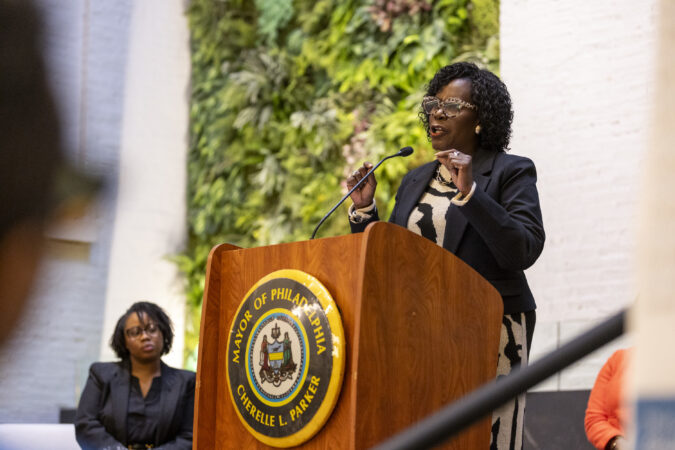
And she doubled down during a news conference Tuesday at the African American Chamber of Commerce headquarters, where she signed an executive order codifying the city’s shift to favoring firms that are registered as “small and local.”
“We knew the system was broken years before,” Parker, the city’s first Black female mayor, said. “Because every time we would look at the numbers and we would want to see how many Black and brown and women and disabled business owners were growing in the city of Philadelphia, the numbers became stagnant.”
Historically disadvantaged firms win city contracts worth more than $370 million annually, and supporters of the program criticized Parker for not fighting to preserve it.
City Councilmember Kendra Brooks of the progressive Working Families Party said Parker was “caving” to President Donald Trump, whose administration has sought to roll back policies on diversity, equity, and inclusion.
“People want to see leaders fighting for something,” Brooks said last week, “and right now we don’t see our city fighting for anything.”
But Chief Deputy Mayor Vanessa Garrett Harley said Monday that the administration examined the Philadelphia Office of Economic Opportunity’s registry of disadvantaged businesses that should get a leg up in city procurement opportunities, and found that only 20% were actually winning contracts.
“Obviously, it was not working,” Garrett Harley said.
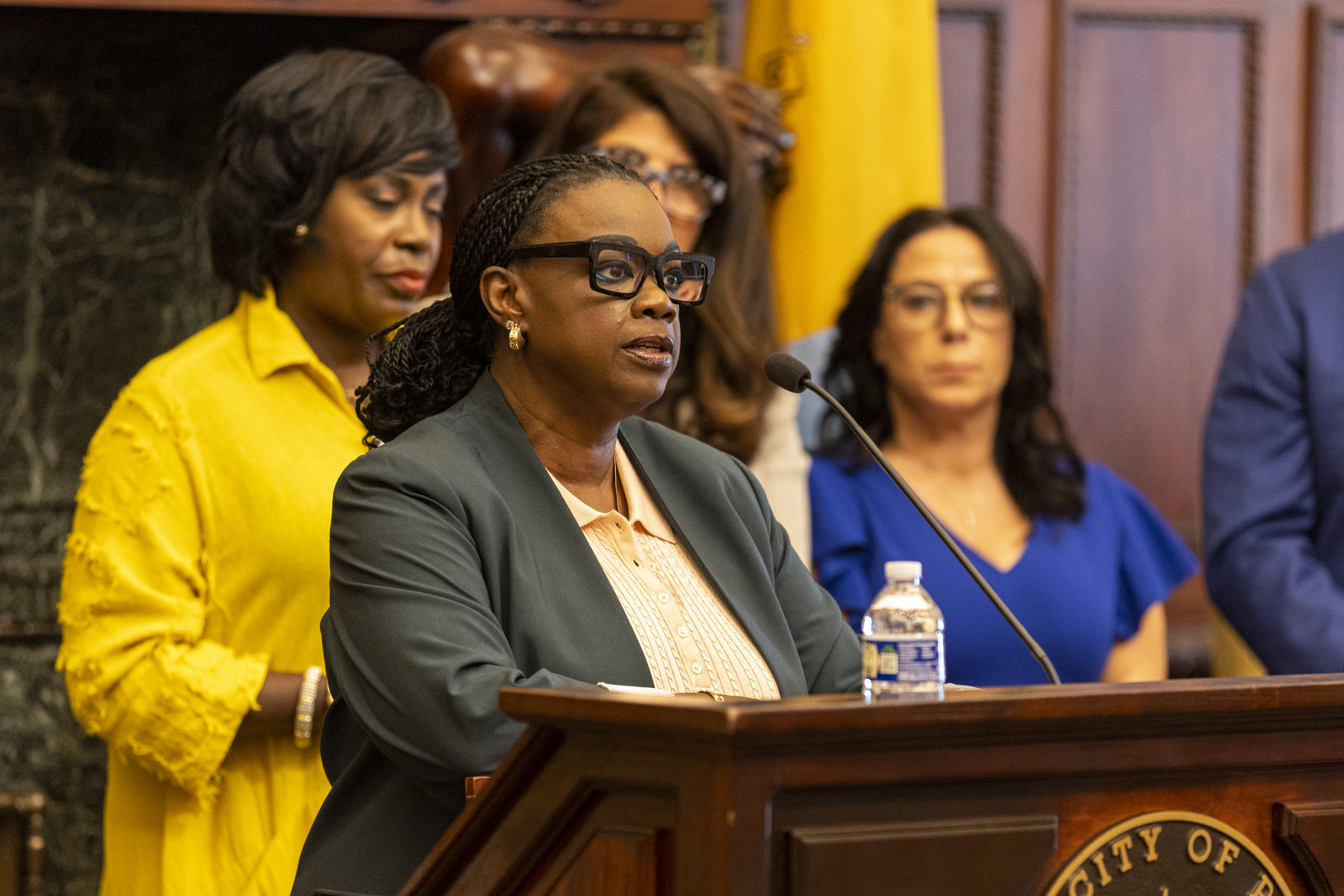
Deputy Mayor Vanessa Garrett Harley speaks during a press conference in Philadelphia, Pa., on Thursday, June 27, 2024.
Parker said that setting diversity goals was not enough to grow women- and minority-owned businesses. Instead, she said, they need technical assistance, access to capital, and other tools so that they can develop to the point where they are able to regularly compete for city contracts without relying on set-asides.
Her administration is focused on providing those resources, she said, and not just “checking boxes.”
“I’m fighting,” Parker said. “But I’m fighting the fight the way I know best: to achieve the results and act and extract the tangible results that I need for the people who live in this city, who own businesses in the city.”
‘Small and local:’ A new world for city contracting
Parker on Tuesday signed an executive order detailing city’s new contracting system. As previously detailed in The Inquirer, the city will now give preference to “small and local” firms rather than requiring participation for businesses owned by women, minorities, and people with disabilities.
The executive order does not set a target goal for what share of city contracting dollars should go to “small and local” businesses.
The city’s previous goal of directing 35% of contracting dollars to disadvantaged firms was similarly not enumerated in law. Instead, Parker’s order outlines a structure for setting benchmarks and providing assistance to firms seeking to do business with the city.
For example, it charges the economic opportunity office with setting overall contracting goals, as well as establishing “participation ranges” for individual contracts. Those ranges will be used to give contractors benchmarks for money that should be set aside for subcontractors and suppliers that are considered disadvantaged businesses.
The office is also responsible for maintaining the registry of small and local businesses. Garrett Harley said the “overwhelming majority” of businesses that are registered with the city as minority-, women-, or disabled-owned will qualify as “small and local.”
Nadir Jones, the city’s director of business impact and economic advancement, said firms already registered with the city will be “grandfathered in” and will not need to register again as small or local.
To qualify as “local,” a business must either be headquartered in Philadelphia city limits or meet two of three other criteria:
More than 60% of employees live in Philadelphia.
More than half of the business’ employees work in the city at least 60% of the time.
More than 75% of the business’ gross receipts came from Philadelphia.
To qualify as “small,” Jones said, a business must have fewer than 750 employees.
Parker said her administration is working with outside advisers to hone the program. That includes the African American Chamber of Commerce, which announced Tuesday it had established a Special Task Force on Economic Access and Procurement in response to the contracting changes.
“We will continue to advocate for policies that are not only measurable and defendable, but also those that produce real impact,” said Regina Hairston, the organization’s president and CEO. “However, as we have recently learned, these policy changes are happening whether we fully support them or not.”
A risk-averse legal strategy
Parker’s elimination of racial diversity targets in city contracting — due in part to the hypothetical threat of litigationraised by City Solicitor Renee Garcia — in some ways parallels the mayor’s decision earlier this year to settle a lawsuit challenging a city tax break that primarily benefited small businesses.
In both instances, critics said that the Parker administration overstated the legal jeopardy the programs faced and gave up without a fight. But there are key differences between Parker’s handling of the contracting goals and the tax break, which exempted firms’ first $100,000 in revenue from the business income and receipts tax, or BIRT.
If anything, there was less of an immediate threat to the city’s contracting diversity goals, which are not facing any legal challenge. The administration instead preemptively abolished its racial diversity targets due to rulings on separate issues, such as affirmative action in college admissions or the city’s project labor agreements.
The catalyst for Parker eliminating the BIRT exemption was a 2024 lawsuit filed by a Massachusetts medical device manufacturer challenging the constitutionality of the tax break. Critics of Parker’s decision argued that if the city had fought it in court, the case could have been thrown out because the company may have struggled to demonstrate harm, given that the tax break actually benefited the firm.
Instead, the city settled with the company, and Parker pressed Council to remove the tax break from city law.
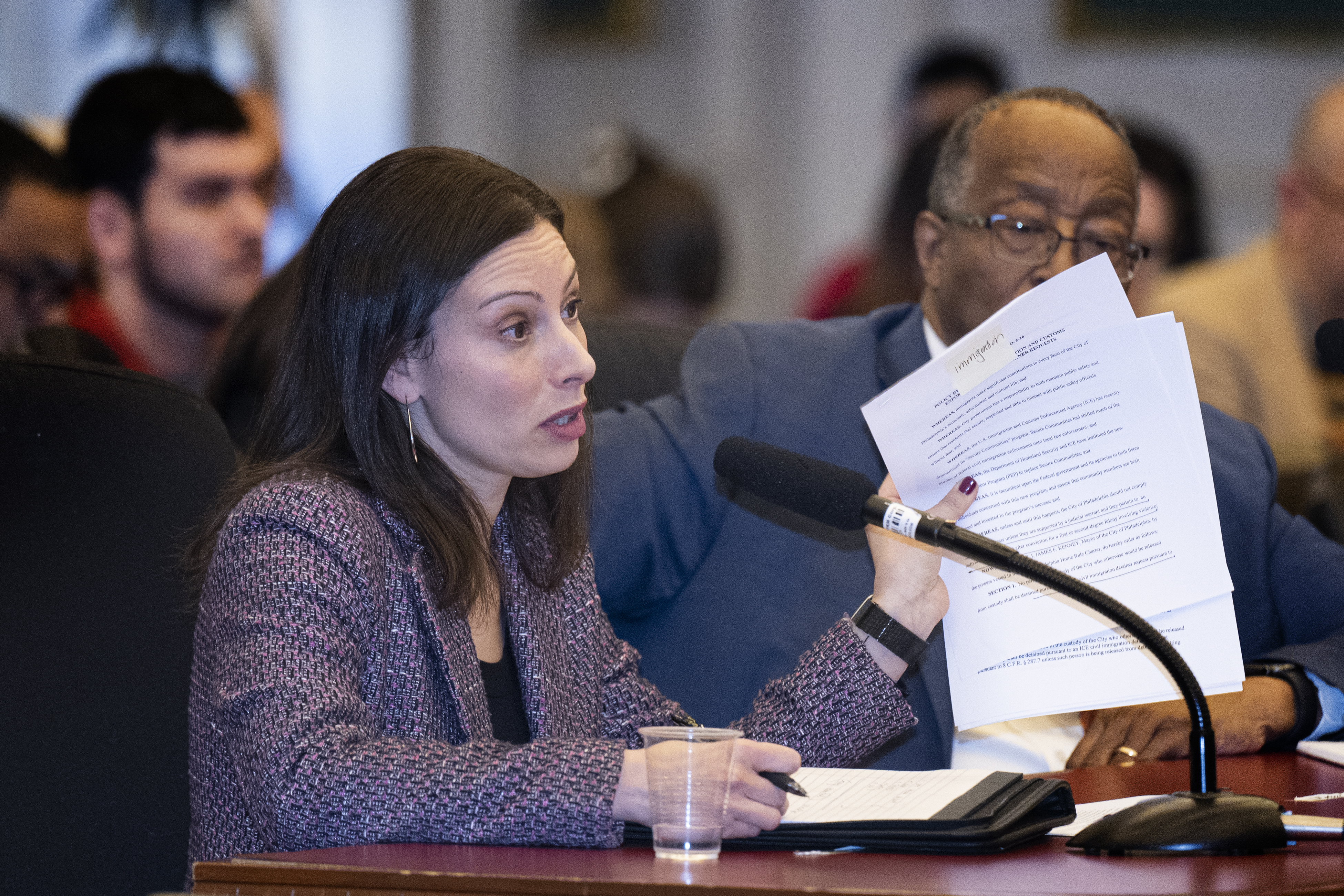
Renee Garcia, Philadelphia City Solicitor speak on Jan 22, 2025 during a hearing exploring Philadelphia’s readiness and commitment to protecting immigrant, LGBTQ+, and other marginalized communities in preparation for the impending Trump administration.
During the debate over the BIRT exemption, Garcia said Philadelphia could potentially lose hundreds of millions of dollars in tax revenue if it didn’t cave to the legal challenge. Critics of the city’s approach cast doubt on whether that was a realistic outcome.
But in the case of the contracting DEI goals, the potential risks articulated by the administration are far less dire.
Garcia said Monday the primary financial risk involved in maintaining the contracting diversity program is that if the city ever did get sued, and then lost a protracted court battle, it may have to pay the plaintiff’s attorney’s fees.
She also cited the possibility of creating unwanted legal precedent if the hypothetical lawsuit against the city reached the U.S. Supreme Court and lost — something that could still happen if a suit is filed against any of the hundreds of jurisdictions across the country that still have racial participation goals in contracting.
“This way, we do it on our terms,“ Garcia said. ”We have time to build it. We have a plan.”
The most important difference between the business tax and contracting issues is that Parker was in favor of the BIRT exemption but does not support the old contracting system.
In her budget address in March, Parker said she was begrudgingly seeking to end the tax break because state judicial rulings, in the administration’s view, had forced the city’s hand. But when it comes to the city’s contracting practices, Parker’s aims in some ways align with those seeking to undo longstanding city policy on diversity in contracting.
The administration’s messaging on the issue has become somewhat mixed. On one hand, Garcia said Parker was “anguished” when she realized she had to make changes to the contracting system due to the legal environment.
“She did not want to do this,” Garcia said.
On the other hand, Parker said she has long planned to reform the contracting system. Asked if her policy goals or new legal rulings were driving the decision, Parker said: “It’s both. It’s not either/or.”
“We are building something that does not exist here in the city of Philadelphia,” she said. “We are asking you to join the fight with us.”
A report published Tuesday by the Guardian, an English news outlet with a large U.S.-based sports staff, accused Union sporting director Ernst Tanner of a series of incidents involving racism, sexism, and homophobia directed toward people around American soccer.
The report centers on a “wide-ranging” complaint filed by the MLS Players Association with the league in January containing eight allegations. Since then, the Guardian said it has heard from “17 sources” who “have alleged numerous misbehaviors spanning nearly the entirety of Tanner’s seven-year tenure with the Union,” including those mentioned in the MLSPA’s report and other alleged incidents.
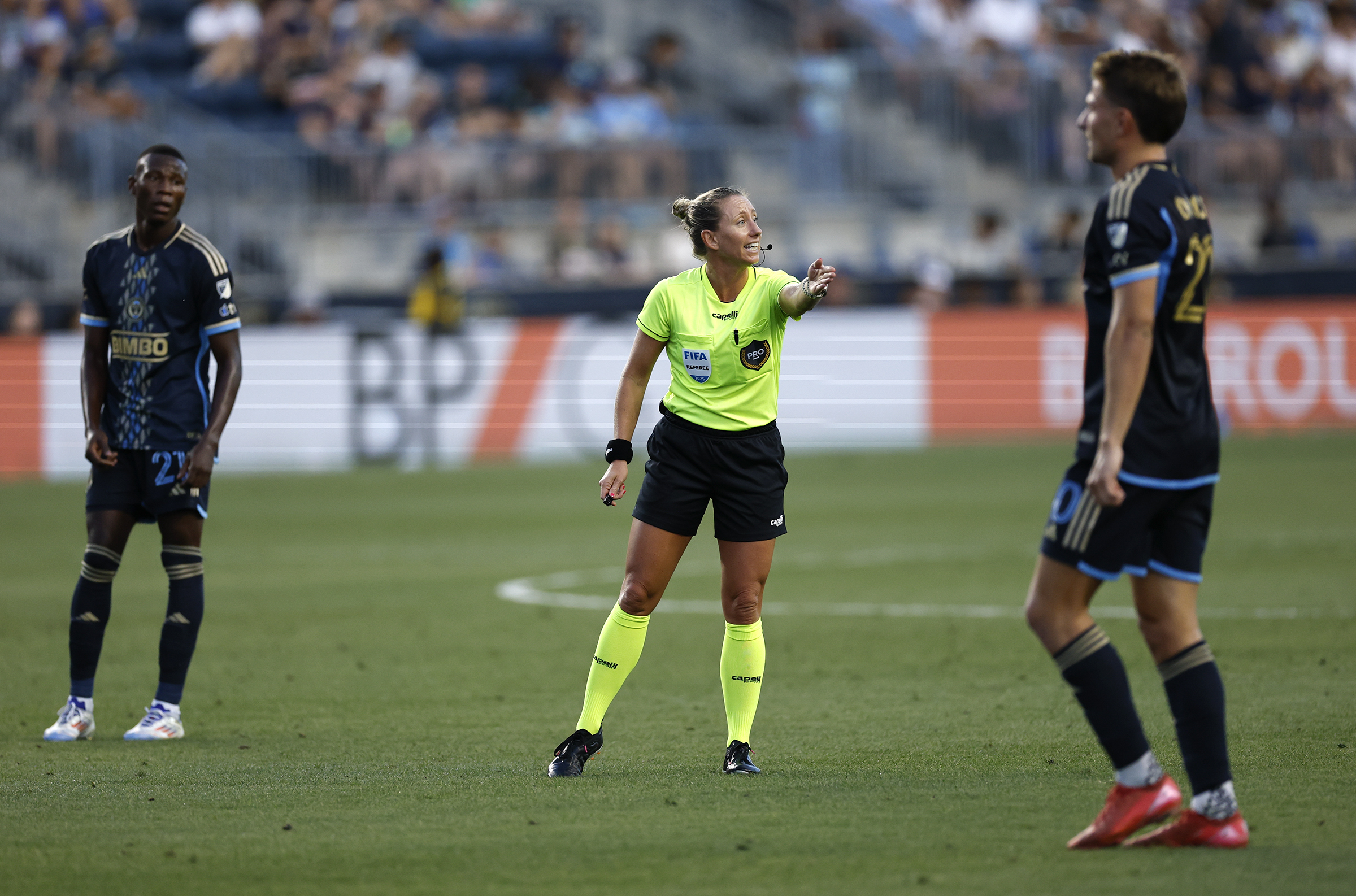
Figures allegedly targeted by Tanner include several referees, including Tori Penso.
Veteran referee Tori Penso is said to be a target of alleged sexist comments made by Union sporting director Ernst Tanner.
Although Penso has officiated top-level games for many years, including the 2023 women’s World Cup final, Tanner is accused of repeatedly criticizing her since 2020, including multiple claims that women should not be involved in men’s soccer.
A native of Germany, the 59-year-old Tanner has been the Union’s sporting director since 2018. His lawyer gave a statement to the Guardian saying that Tanner “denies ever intentionally making insensitive gender-based comments.”
The article said another veteran referee, Nima Saghafi, was the target of an allegedly homophobic slur by Tanner in a game in 2023. The MLSPA accused Tanner of racist remarks toward an assistant referee at a game in the same season.
In a statement to the Guardian later shared to The Inquirer, Professional Referee Organization general manager Mark Geiger said: “If these remarks are proven to be true, we are appalled. Such comments — and any form of discriminatory language — are deeply irresponsible, wholly inappropriate, and have no place in our game or in society. We take great pride in our diverse roster of officials who serve the professional game across North America, demonstrating leadership, integrity, and respect. Every PRO official has earned their place through hard work and dedication, progressing along the pathway solely on merit.”
MLSPRO general manager and referee Mark Geiger said that if the allegations against Tanner are true, it’s “deeply irresponsible.”
According to one source who spoke with the Guardian, Tanner “consistently would speak about African players like they were subhuman.”
He is also accused of enabling allegedly discriminatory behavior, including racism, by former Union II coach Sven Gartung. Tanner hired Gartung in early 2020, and he lasted only 5½ months in the job.
Beyond games, the Guardian reported that in 2019, the Union’s human relations department was notified about allegations that Tanner had “engaged in inappropriate physical contact” with a female employee by touching her buttocks “numerous times.”
The Guardian’s reporter, Pablo Maurer, said the outlet saw emails regarding the notice and heard from “nine sources familiar with the incidents.” Those sources said they had not received any response from the team, and the Guardian’s report said the sources claimed “the club’s handling of that complaint is par for the course.”
The report further claimed that “over a dozen current and former Philadelphia Union employees say that complaints concerning Tanner’s behavior have been submitted to the club’s HR department but that they have seen no evidence of a response.”
The Union’s chairman and majority owner, Jay Sugarman, looks on while sporting director Ernst Tanner speaks to the media in 2024.
Tanner’s lawyer told the Guardian that Tanner “firmly denies these accusations, some of which are six or seven years old. Throughout his career spanning over three decades in professional soccer around the globe, Mr. Tanner has worked fairly and effectively in a diverse, multicultural world upholding high standards of professionalism.”
The Union told the Guardian that Tanner “was found to have made potentially insensitive gender-based comments early in his tenure, for which he underwent training and had discussions with club leadership.” The team also said it was “not previously aware of the allegations in the MLSPA complaint.”
“The Philadelphia Union takes all allegations of misconduct extremely seriously and is unwavering in our commitment to maintaining a safe, respectful, and inclusive environment for all players, staff, and members of our community,” the statement said.
When reached Tuesday by The Inquirer, the team declined to comment beyond that statement.
MLS said it launched an investigation immediately after receiving the MLSPA complaint.
The Guardian reported that “Tanner was never placed on leave after the investigation began in January because MLS couldn’t corroborate the claims against him,” and that the investigation was closed within the last few weeks. But the outlet also said the league “found the alleged behavior, if true, to be unacceptable” and “a ‘clear violation’ of league policy.”
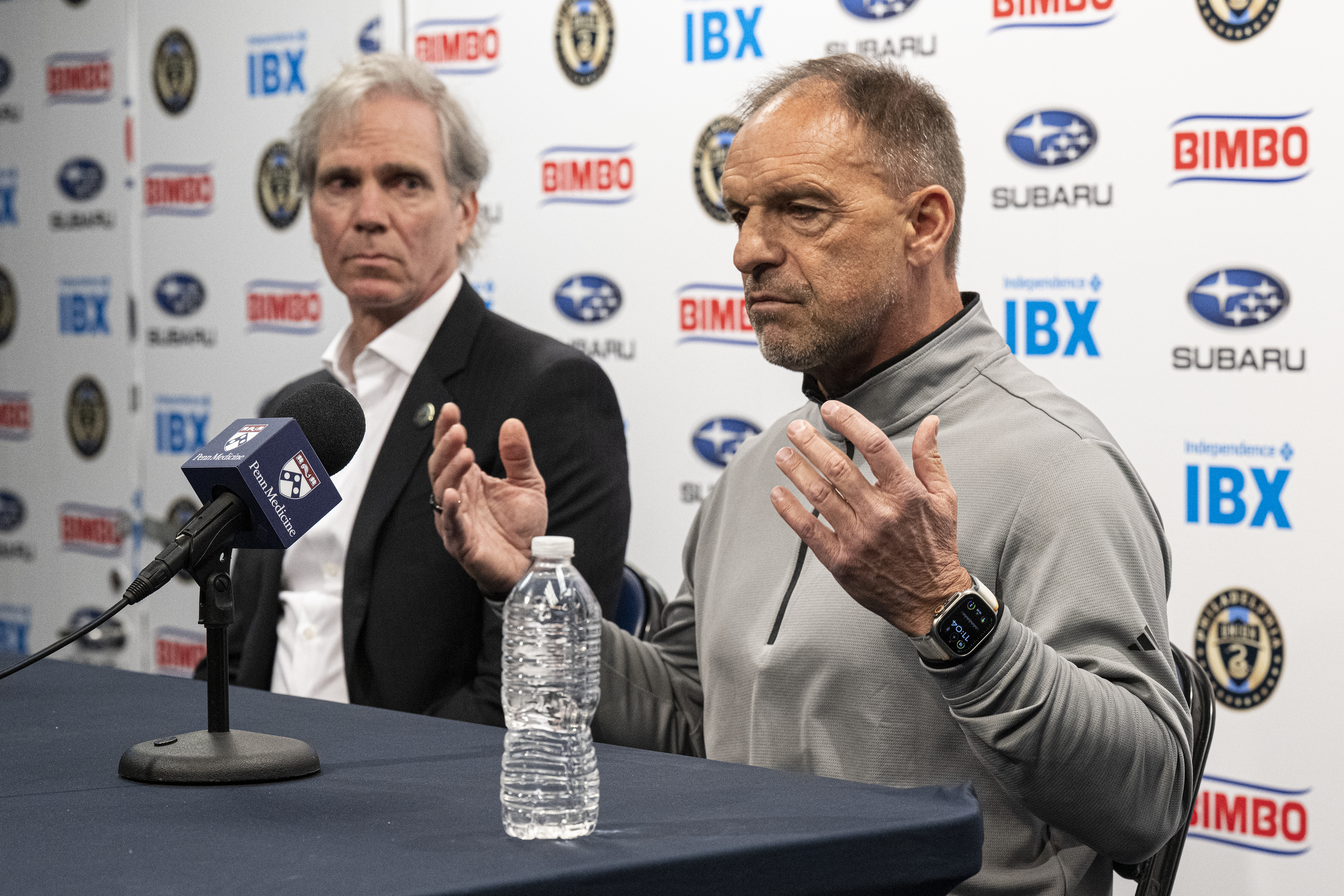
Ernst Tanner (left) welcoming Union manager Bradley Carnell during Carnell’s introductory news conference in January.
The league told the Guardian that Tanner had been required to follow a “structured remedial program focused on professional workplace conduct.” The report noted that Tanner has had to go through that training twice, along with the team’s “annual sensitivity training,” which is required of all staff.
MLS and the Union told the Guardian that if new information comes forward, both may investigate Tanner further. The league has an anonymous reporting hotline, and the team said that “should any new information emerge, the Philadelphia Union will act quickly and appropriately, in accordance with our policies, and will continue to cooperate fully with the league.”
The U.S. Equal Employment Opportunity Commission is suing the University of Pennsylvania for failing to release information related to an investigation it began in 2023over the school’s treatment of Jewish faculty and other employees regarding antisemitism complaints.
Penn, according to the complaint filed in federal court Tuesday, has not complied with a subpoena for information, including the identification of employees who could have been exposed to alleged harassment and the names of all employees who complained about the behavior.
In its quest to find people potentially affected, the EEOC demanded a list of employees in Penn’s Jewish Studies Program, a list of all clubs, groups, organizations and recreation groups related to the Jewish religion — including points of contact and a roster of members — and names of employees who lodged antisemitism complaints.
Penn usually does not comment on litigation, but in this case, the school ardently objected to the EEOC’s characterization of its cooperation and the personal nature of the material it was still seeking.
The school said in a statement it has cooperated extensively with the EEOC, including providing more than 100 documents and over 900 pages.
But the private university said it will not disclose personal information, specifically “lists of Jewish employees, Jewish student employees and those associated with Jewish organizations, or their personal contact information” to the government.
“Violating their privacy and trust is antithetical to ensuring Penn’s Jewish community feels protected and safe,” the university said Tuesday.
Penn also provided information on employees who complained and agreed that it could be shared, the school said, but the school would not provide information on those who objected.
“Penn also offered to help the EEOC reach employees who are willing to speak with the agency by informing all employees of the investigation and how they could reach out to the agency,” the university said. “The EEOC rejected that offer.”
The original complaint was launched by EEOC Commissioner Andrea Lucas, now chair of the body, on Dec. 8, 2023, two months after Hamas’ attack on Israel that led to unrest on college campuses, including Penn, and charges of antisemitism. It was also just three days after former Penn President Liz Magill had testified before a Republican-led congressional committee on the school’s handling of antisemitism complaints; the testimony drew a bipartisan backlash and led to Magill’s resignation days later.
Lucas, who was appointed chair this year by President Donald Trump, also brought similar antisemitism charges against Columbia University that earlier this year resulted in the school paying $21 million for “a class settlement fund.”
EEOC complaints typically come from those who allege they were aggrieved. Lucas, according to the complaint, made the charge in Penn’s case because of the “probable reluctance of Jewish faculty and staff to complain of harassing environment due to fear of hostility and potential violence directed against them.“
The EEOC’s investigation ensued after Lucas’ complaint to the EEOC’s Philadelphia office that alleged Penn was subjecting Jewish faculty, staff, and other employees including students “to an unlawful hostile work environment based on national origin, religion, and/or race.”
The allegation, the complaint said, is based on news reports, public statements made by the university and its leadership, letters from university donors, board members, alumni and others. It also cited complaints filed against Penn in federal court and with the U.S. Department of Education over antisemitism allegations and testimony before a congressional committee.
The EEOC complaint pointed to public comments by Magill, addressing antisemitism while she led Penn.
“I am appalled by incidents on our own campus, and I’ve heard too many heartbreaking stories from those who are fearful for their safety right here at Penn,” Magill said in 2023. “This is completely unacceptable.”
Magill also in a message had addressed “a small number of Penn staff members” who “received vile, disturbing antisemitic emails that threatened violence against members of our Jewish community,” in November 2023.
The complaint cited incidents of antisemitic obscenities being shouted on the campus, destruction of property in Penn’s Hillel, a swastika painted in an academic building, graffiti outside a fraternity and a pro-Palestinian encampment on the campus in 2024 that eventually was dismantled by police.
“Throughout its investigation, the EEOC has endeavored to locate employees exposed to this harassment and to identify other harassing events not noted by respondent in its communications, but respondent has refused to furnish this information, thereby hampering the EEOC’s investigation,” the complaint said.
Penn said it had received three antisemitism complaints, according to the federal complaint, but the EEOC questioned that number given the university’s workforce of more than 20,000. It demanded that the school provide names of all people who attended listening sessions as part of the school’s task force on antisemitism and all faculty and staff members who took the task force’s survey.
Penn objected to the subpoena and the commission partially modified it in September, ordering the school to comply within 21 days, the complaint said.
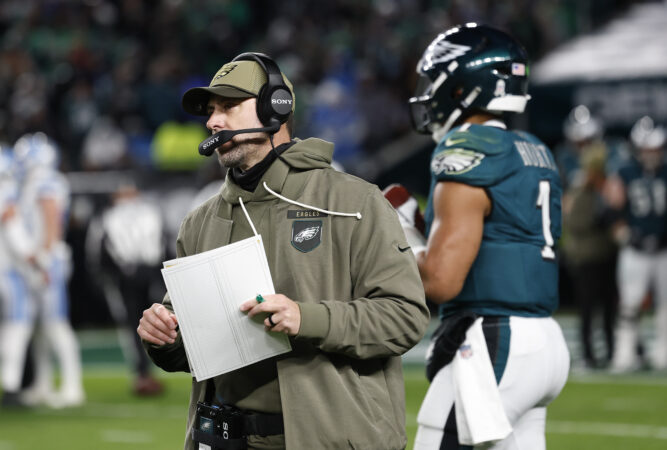
Another week, another lackluster performance from the Eagles offense.
While the Eagles defense came up with five fourth-down stops against the Detroit Lions — plus Cooper DeJean’s first-quarter interception — the offense didn’t have much to show for it. They scored nine points off those defensive stops (three field goals).
The Eagles went 1-of-3 in the red zone (33.3%, the offense’s second-worst rate of the season) and 4-of-15 on third down (26.7%, its fourth-worst rate). Kevin Patullo defended Jalen Hurts’ performance (14-of-28 for 135 passing yards) and asserted that the quarterback “played well” and took care of the football during “a difficult kind of game.”
When asked for his biggest frustration following the game against the Lions, the Eagles offensive coordinator pointed to a familiar issue for the group — negative plays, of which the offense had five (including a sack), and penalties, six of which came against the offense (not including a delay of game).
“I think like everything, when you look at the situations we have sometimes, when we’re on track, we do a pretty good job,” Patullo said. “And if we get off track a little bit, whether it’s a negative play or a penalty, that puts us kind of in a hole. We’ve had some trouble with that.
“It starts with us as a staff to make sure we’re in a good play and we’re executing at a high level and we’re all detailed up. And then if something happens like a penalty, sometimes those happen. We’ve got to be able to overcome that.”
One of the most eye-catching differences in the passing game between Weeks 10 and 11 was A.J. Brown’s involvement. The 28-year-old receiver went from three targets against the Packers to 11 against the Lions and finished Sunday’s game with seven catches for 49 yards.
However, Patullo pushed back on the perception that he made a concerted effort to get Brown the ball.
Eagles wide receiver A.J. Brown had seven catches on 11 targets against the Lions.
“It was really no different,” Patullo said. “I think, really, the plan was pretty much similar to how it was every other game with him, and the ball found him a little bit more, which is great. And he made some critical plays for us when we needed it. Made some really tough catches in traffic, and that’s what he’s awesome [at]. He’s a phenomenal player and did a really good job from that standpoint.”
Brown indeed made critical plays, including his 11-yard reception in the red zone in the second quarter that picked up a fresh set of downs and helped set up the Eagles’ lone touchdown.
But in the third quarter, Brown and Hurts also had an uncharacteristic miss on a go ball down the left sideline with Lions cornerback Rock Ya-Sin matched up against him in single coverage. Brown appeared to slow down on the route, which Patullo attributed to his battle down the field with Ya-Sin.
“He got kind of tangled up with a DB,” Patullo said. “I’m not so sure he located the ball wholeheartedly. But we’ve just got to continue to find ways to just connect on those kind of things and work on them in practice and really, throughout the history of it, Jalen and A.J. do an unbelievable job of connecting on those kind of things, and we’ll continue to throw them to them because he’s going to do his job and get open, and we usually hit them.”
Smith’s snaps limited
The Eagles’ defensive front has been on a tear the last two games, and one of its most important players isn’t even contributing on a full-time basis.
Nolan Smith has been on a snap limitation, according to defensive coordinator Vic Fangio, since he returned from injured reserve for the Eagles’ Week 10 game against the Green Bay Packers. Smith, the 24-year-old edge rusher, has played just 32.3% of the defensive snaps over the last two weeks, down from 75.9% in Weeks 1-3.
Fangio confirmed Tuesday that the decision to prevent Smith from seeing the field as often isn’t coming from him.
“You’ll have to speak to [vice president of sports medicine] Tom [Hunekle] about that,” Fangio said Tuesday when asked about Smith’s decrease in snaps. “I don’t know.”
Eagles edge rusher Nolan Smith (3) has played 32.3% of the defensive snaps over the last two weeks, including on Nov. 10 in Green Bay.
Smith’s workload increased slightly on Sunday night against the Lions. He played 37.5% of the defensive snaps, up from 27.9% against the Packers. He wasn’t as impactful against Detroit, though, and finished the game without a quarterback pressure for the first time this season, according to Next Gen Stats.
While Smith may still be working through his triceps injury, the Eagles edge rusher corps has stepped up in his absence, thanks to the addition of Jaelan Phillips. The former Miami Dolphins outside linebacker has led the group in defensive snaps (77.2%) since he joined the team. His 21.3% pressure rate leads all Eagles defensive linemen this season.
Linebackers rotation
Don’t expect Fangio to shake up the rotation of linebackers Nakobe Dean and Jihaad Campbell alongside Zack Baun any time soon.
The Eagles defensive coordinator said that rotation will “probably stay similar” going forward.
“Just because, keep Jihaad in there ready to roll, ’cause he’s the next guy up as an ILB,” Fangio said. “But he’s been getting time, too, at OLB.”
Dean has taken the majority of those reps at inside linebacker lately. According to Pro Football Focus, Dean took 40 snaps at inside linebacker against the Lions, while Campbell took 17 and just three at outside linebacker. The rookie’s 20 defensive snaps (33.9%) were his fewest of the season.
Over the last two weeks, Eagles linebacker Nakobe Dean (right) has 10 tackles (including two for a loss) and two sacks (three quarterback hits total).
But Dean has rounded quickly into prior form since his return from the physically unable-to-perform list with a knee injury in Week 6. In his last two games, Dean has posted 10 tackles (including two for a loss) and two sacks (three quarterback hits total). Fangio said he hasn’t been surprised by Dean’s immediate impact on the defense.
“I know he worked really hard in his rehab,” Fangio said. “He was bugging those guys in the training room to come back earlier than they allowed him to. So from that regard, no. Nakobe’s got good instincts, good football acumen. Kind of a football, I don’t want say it comes easy, but it comes natural to him. So that speeds it up, too.”
President Donald Trump is drawing widespread criticism after lashing out at a female reporter who was pressing for information about files related to Jeffrey Epstein.
As Trump was speaking to reporters Friday on Air Force One, Bloomberg White House correspondent and former Philadelphia Daily News reporter Catherine Lucey attempted to ask him about the release of the so-called Epstein files, which the Trump administration has refused to make public.
“If there is nothing incriminating in the files —” Lucey said before being cut off.
“Quiet, quiet, piggy,” an angry Trump shot back while pointing at Lucey.
Neither Lucey nor Bloomberg has responded to The Inquirer’s requests for comment.
“Our White House journalists perform a vital public service, asking questions without fear or favor,” Bloomberg said in a statement to the Guardian. “We remain focused on reporting issues of public interest fairly and accurately.”
Lucey, who has not spoken publicly about the matter, was first identified by the Guardian and can be seen in photographs of the interaction with Trump on Air Force One.
Trump’s remarks drew criticism from across the media world. CNN anchor Jake Tapper called the president’s remarks “disgusting and completely unacceptable.” Former Fox News anchor Gretchen Carlson called the president’s comments “degrading.”
“The president continues to behave in ways that not a single parent I know would tolerate from their elementary-school-aged kids,” wrote the Atlantic’s McKay Coppins.
A White House official defended the remark in a statement to MS NOW’s Vaughn Hillyard, claiming without evidence Lucey “behaved in an inappropriate and unprofessional way towards her colleagues on the plane.” The official did not elaborate.
Though the exchange took place days ago, video footage began circulating Tuesday ahead of a House vote on the Epstein files. It has since gone viral among the masses, drawing ire from critics and being reposted by outlets like Pop Crave.
Trump has a history of making sexist comments toward female journalists. He has called women in the press corps “nasty,” “crazy,” and “losers” over the years. He also has used derogatory language about women, comparing them to pigs, dogs, and other animals.
Before her time in D.C., Lucey was a respected reporter in Philadelphia, spending 12 years at the Philadelphia Daily News covering everything from police corruption to local news — but her sweet spot was politics. Her portfolio included coverage of then-Mayor Michael Nutter’s administration and the city’s changing power dynamics.
Lucey left in 2012 to work for the Associated Press, focusing on Iowa state politics and presidential races for four years. From there, she headed to the Wall Street Journal, where she covered the Trump and Biden administrations. She joined Bloomberg in March, according to a news release.
ABC News reporter Mary Bruce asks a question in the Oval Office Tuesday.
Trump also drew criticism Tuesday afternoon after lashing out at ABC News reporter Mary Bruce, who also asked about the Epstein files during an Oval Office meeting between the president and Saudi Arabia Crown Prince Mohammed bin Salman.
“Why wait for Congress to release the Epstein files?” Bruce asked. “Why not just do it now?”
“It’s not the question that I mind, it’s your attitude,” Trump shot back. “You’re a terrible person and a terrible reporter.”
Until recently, Trump had strongly opposed efforts to release the Epstein files. Last week, he called the House’s efforts to press the Department of Justice to make the files available a “Democrat hoax.”
Trump’s social connections to Epstein have been known for decades. Reports show Trump was mentioned in Epstein’s emails more than 1,000 times, making him the most-cited person in the documents released last week by the House Oversight Committee.
But Trump has been reversing his stance on releasing the files, saying on Air Force One, “we have nothing to hide.”
On Tuesday, the House of Representatives passed the Epstein Files Transparency Act in a 427-1 vote, demanding the Justice Department release the unclassified documents on Epstein and his associate Ghislaine Maxwell, who was convicted of sex trafficking.
The Republican-controlled Senate moved quickly Tuesday evening, agreeing to pass the Epstein bill by unanimous consent once it arrived from the House.
The bill would then head to Trump’s desk, who said in recent days he would sign it into law.
WASHINGTON — Congress passed legislation Tuesday to require President Donald Trump’s administration to release troves of records related to notorious sex trafficker Jeffrey Epsteinafter months of pressure from Democrats and survivors on the issue.
The U.S. House voted427-1 to pass the bill on Tuesday, prompting lawmakers in the chamber to cheer. The legislation was then rapidly passed by the U.S. Senate through unanimous consent, a process that skips debate when no senator objects to a bill.
Despite the overwhelming bipartisan consensus, Tuesday’s House vote followed months of pushing by Democrats to bring it the floor as Trump unsuccessfully lobbied to prevent it from receiving a debate.
The president abruptly changed his stance on the bill this week after it became clear it had enough Republican support to pass against his objections. The veto-proof bill now heads to Trump’s desk for his signature.
U.S. Rep. Rob Bresnahan, a freshman Republican who represents Northeastern Pennsylvania, told The Inquirer after the vote that his office “had a lot of phone calls” about the bill.
“We listened to our constituents… and I want to thank the people at home for bringing this to our attention,” he said outside the House chamber.
U.S. Rep. Clay Higgins, a Louisiana Republican, was the sole no vote. Five House members did not vote.
Trump said this week he would sign the bill into law, but he doesn’t actually need congressional approval to order the release of the files and could have already done so — a fact noted by U.S. Rep. Dwight Evans in the lead-up to the vote.
“Let’s be clear — Donald Trump doesn’t have to wait until Congress votes on this resolution,” Evans, a retiring Philadelphia Democrat, said in a Monday post on X. “If he wanted to, he could tell the Justice Department to release the Epstein files TODAY.”
The bill, called the Epstein Files Transparency Act, requires the Department of Justice to publish all unclassified files related to the prosecution and investigation of Jeffrey Epstein, a well-connected financier and convicted sex offender who was found dead in his jail cell in August 2019 and determined to have died by suicide after being federally charged with sex trafficking underage girls. After his death, his close associate Ghislaine Maxwell was convicted of sexually exploiting and abusing girls with him over the course of a decade.
The bill was led by U.S. Rep. Ro Khanna, a California Democrat who grew up in Bucks County, and U.S. Rep. Thomas Massie, a Kentucky Republican who frequently breaks with party leadership. U.S. Reps. Mary Gay Scanlon and Chris Deluzio, both Pennsylvania Democrats, were cosponsors.
Trump suggested on the campaign trail that he would release files related to the Epstein investigation, but after his administration faced uproar over their lackluster release of information surrounding the investigation, he began discrediting the cause.
Trump is mentioned numerous times in files that have already been released, including in an email in which Epstein claims Trump “spent hours at my house” with a young woman who later said she was a victim of Epstein, the New York Times reported last week. The president was neighbors with Epstein in Florida and was photographed with him at numerous social occasions in the 1990s and 2000s. He has called the efforts for more transparency a Democratic “hoax” that had fooled “stupid” Republicans who would be committing a “hostile act” by supporting the release.
Bresnahan was hesitant to answer whether any of the mentions of the president concern him.
“I saw some of the email threads; a lot of it was snippets. I don’t know where it came from,” said Bresnahan, who represents a swing district.
“I want to look at the whole comprehensive picture,” he added.
House Speaker Mike Johnson (R., La.) wasn’t going to allow the bill to be voted on the floor, so Khanna and Massie successfully forced the vote through a discharge petition, which was supported by all House Democrats and just three other Republicans — U.S. Reps. Marjorie Taylor Greene of Georgia, Nancy Mace of South Carolina, and Lauren Boebert of Colorado.
Massie and Khanna started to gather signatures in September and got the 218th needed on Wednesday last week when U.S. Rep. Adelita Grijalva (D. Ariz.) was sworn into office after winning a special election in September.
U.S. Rep. Brendan Boyle, a Philadelphia Democrat, blamed the delay for Grijalva’s swearing in on Trump and Johnson‘s resistance to the bill getting to the floor.
“There is a reason why Donald Trump has worked so hard to keep these Epstein files covered up,” he said in a video he shared on social media.
The bill reaching the floor put Republicans in a new bind: their stance on the matter would be on the record. They had to choose whether their loyalty to Trump would outweigh pressure from constituents on the matter.
Once it became clear the president wouldn’t prevail, Trump had a complete about-face Sunday night and called for lawmakers to support the bill.
“House Republicans should vote to release the Epstein files, because we have nothing to hide, and it’s time to move on from this Democrat Hoax perpetrated by Radical Left Lunatics in order to deflect from the Great Success of the Republican Party,” he posted on Truth Social.
“I DON’T CARE!” he added in the post and claimed that the files are a “curse on the Democrats, not us.”
Khanna said that almost 100 Republicans would have voted for the bill before Trump changed course in an interview with The New York Times.
“Trump saw his MAGA coalition was splintering and the last thing he could have had is a hundred Republicans vote for a Democratic bill in defiance of what he wanted,” he said in the interview. “Obviously, he has enough political instincts to realize how much he was losing on this issue.”
Once Trump signaled support for the bill, Khanna said he would “be surprised if it’s not close to unanimous.”
A separate House Oversight Committee investigation has released thousands of files from Epstein’s estate that show his connections spanning from Trump to influential leaders on Wall Street and across the globe. The Wall Street Journal also revealed over the summer a sexually explicit birthday message that appeared to be from the president to Epstein.
Trump has since called on the Justice Department to investigate ties between his political adversaries and Epstein, particularly the Clintons.
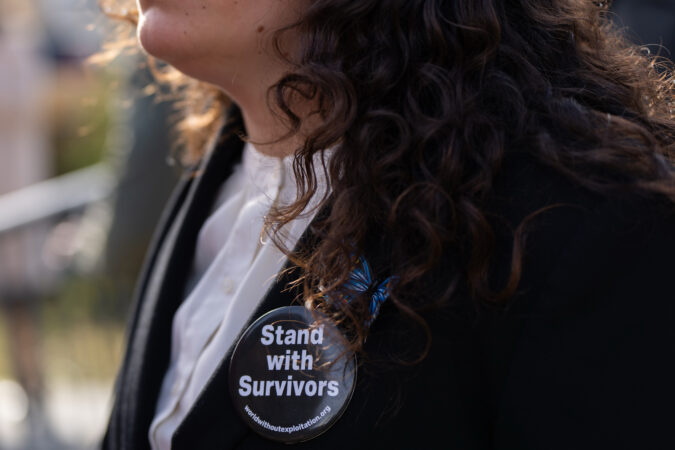
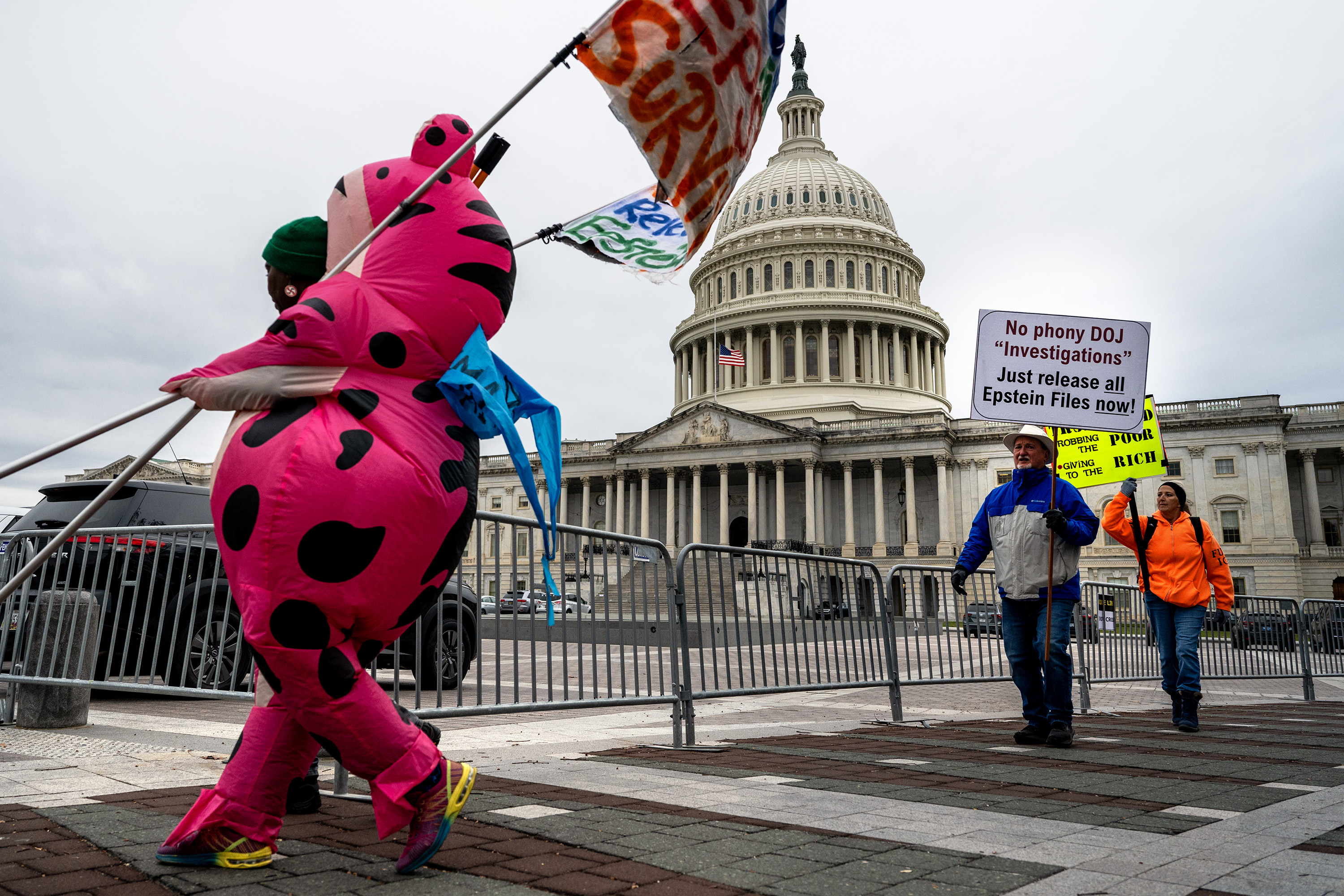
Survivors of Epstein’s abuse rallied outside the Capitol in the cold Tuesday morning.
Liz Stein, a survivor of Epstein’s abuse, said in a statement that she hopes “our elected leaders show the courage to stand with survivors.”
“Those of us directly impacted and harmed by the crimes of Jeffrey Epstein and Ghislaine Maxwell deserve justice and for the world to know our story,” she said. “It’s time for real accountability and true transparency.”
Where did Pa. Republicans stand prior to Tuesday’s vote?
U.S. Rep. Brian Fitzpatrick, a Bucks County Republican and former FBI agent who represents a purple district, had been quiet on the issue.
World Without Exploitation, an anti-human trafficking group that has called for the release of all Epstein files, put a billboard up in Fitzpatrick’s district that says: “Courage is Contagious: Release ALL The Epstein Files.”
Fitzpatrick was also the subject of digital ads from the Democratic National Committee about the Epstein files over the summer that called him one of Trump’s “sycophantic enablers.”
Even though no Pennsylvania Republicans signed onto the petition to allow a vote on the bill, some had previously indicated that they wanted the records released.
Bresnahan said on FOX56 WOLF on Friday that he wouldvote to release the files while making sure victims are protected. He told The Inquirer after the vote that he made that decision “weeks ago.”
When asked whether he was surprised at the near-unanimous support from his Republican peers, he said he “really wasn’t talking to a lot of my peers as to where they were going to be on it.”
Other Republicans made statements over the summer after the Justice Department said it would not release any more files. Attorney General Pam Bondi suggested in February that she had Epstein’s “client list,” but the department released files that were long in the public eye before claiming in July that Epstein didn’t actually have a list of clients.
U.S. Rep. Ryan Mackenzie, a freshman Republican who represents the Lehigh Valley, said during a telephone town hallin July that he would support measures to release DOJ files on Epstein if Trump’s administration doesn’t do more, NPR reported. He echoed that position Monday night, according to news reports.
“I know they have not released as much as I would like to see to date, but hopefully they’re going to be doing that,” he said in July. “And if not, then Congress should potentially step in and compel them to do that because again, the American people deserve to have full transparency and information about what is in those files, and ultimately, we’re going to get there.”
U.S. Rep. Scott Perry, a Trump ally who represents parts of Central Pennsylvania, shared a letter to Bondi on July 18 expressing “serious concern” over how the Epstein case had been handled and said it “remains one of the most troubling examples of apparent failures within our justice system.”
He said the Trump administration’s handling of the case at that point had “only heightened public distrust.” He cited how the administration’s February 2025 release of documents “contained little new information” and its pivot on a supposed client list.
“The continued secrecy surrounding these records undermines public confidence in the Justice Department’s commitment to justice,” he said at the time, requesting a special prosecutor to investigate the handling of the case.
Perry supported a Democratic motion in July to subpoena the Justice Department for the Epstein files in an effort led by U.S. Rep. Summer Lee, a progressive Democrat from Pittsburgh. He also backed motions to subpoena former President Bill Clinton and former Secretary of State Hillary Rodham Clinton related to the case.
Fitzpatrick, Perry, Mackenzie, and Bresnahan all represent districts that will be targeted by Democrats during next year’s midterms.
Also in July, U.S. Rep. Dan Meuser (R., Luzerne) called for the release of “all the pertinent, credible Epstein files” but focused squarely on Clinton.
Other Republicans in the state have been pretty quiet on the matter.
Lee, the Pittsburgh Democrat who led the summer subpoena effort, said in a post on X after the vote that the Department of Justice has “slow-walked” the release of files for months and echoed that Trump hasn’t acted on his ability to compel the department to release the files.
“No matter how wealthy or well-connected, every person who is complicit, enabled, or abused women and girls will be brought to justice,” she added.
Protesters head to the U.S. Capitol in Washington D.C. Tuesday, Nov. 18, 2025 as a bill that would require the release of records relating to Jefrey Epstein comes to a vote.
The bodies of Sasikala Narra, 38, and her son, Anish, were found in their blood-spattered apartment by their husband and father, Hanumantha Rao Narra, in March 2017. They had been stabbed to death.
In the end, the mystery was unraveled by a single drop of blood, prosecutors said Tuesday as they announced who they believe was the killer.
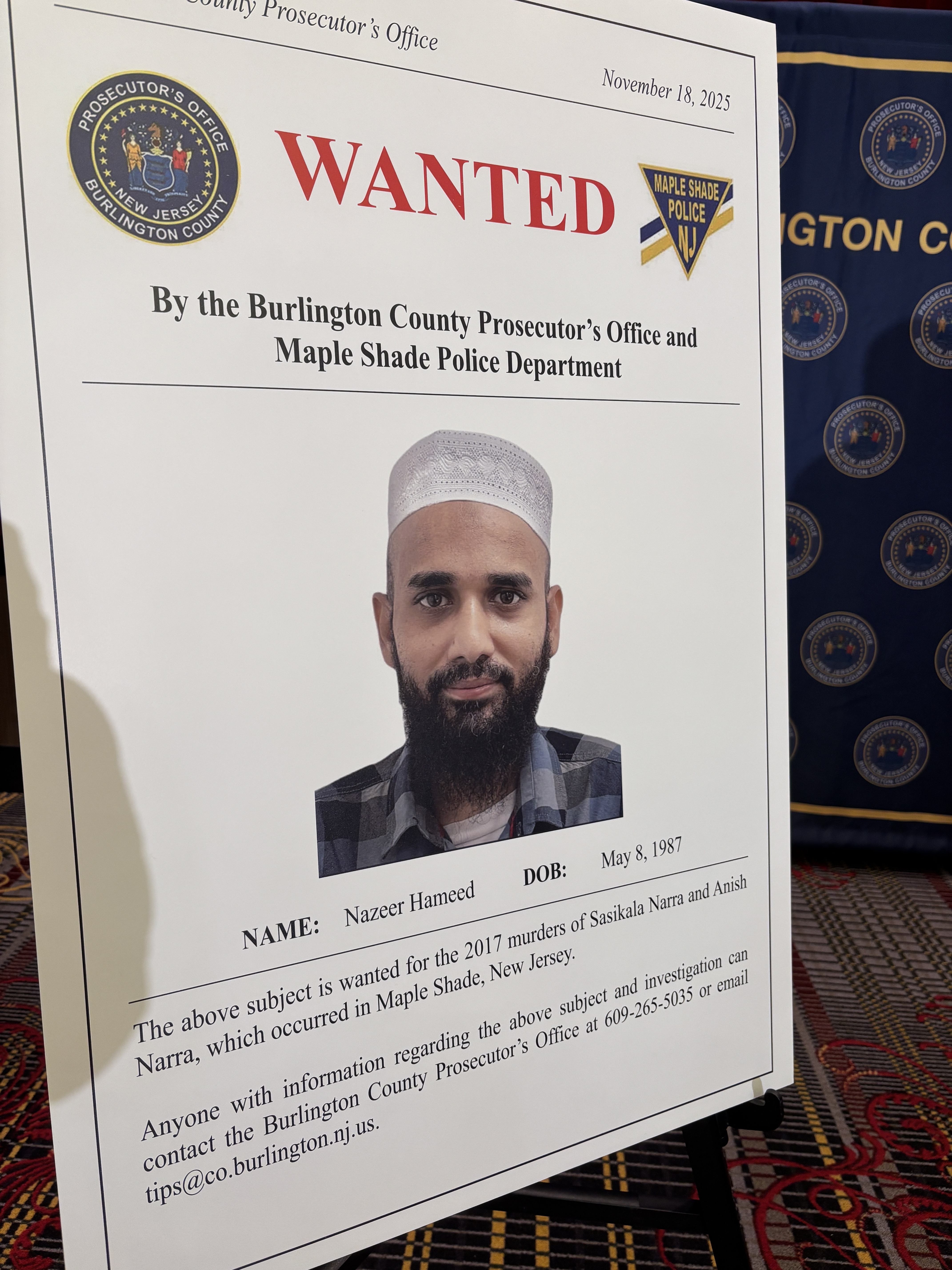
Nazeer Hameed, 38, has been charged with murder and related crimes in the double stabbing. Authorities say Hameed fled to his native India after the killings, where he remains today.
Hameed worked at Cognizant, a North Jersey tech company with an office in Philadelphia, alongside Hanumantha Narra, and lived in the same apartment complex as the family.
Sasikala Narra, 38, and her son, Anish, 6, were stabbed to death inside their apartment in Maple Shade in 2017.
Patrick Thornton, the chief investigator for the Burlington County Prosecutor’s Office, said he could not reveal any information about Hameed’s potential motives. But he said Hameed had stalked the family for some time before the killings and used his background in tech to hide his movements after the fatal stabbings.
Thornton said Hameed waited until Narra had left the apartment before attacking his family with a series of violent stab and slice wounds to their head and hands. Anish was nearly decapitated in the attack.
“These innocent victims were defenseless during the horrific attack,” Thornton said. “Veteran officers said this was one of the most brutal crime scenes they’ve seen in their careers, and they are still affected by the memory of it.”
Hameed’s indictment, according to Burlington County Prosecutor LaChia Bradshaw, was the result of a yearslong investigation that involved local, state, and federal law enforcement.
And while she said Tuesday that she was pleased to share the news of the charges against Hameed, she stressed that the work for law enforcement was far from over. Hameed is still living in India, and prosecutors in Bradshaw’s office are awaiting assistance from federal authorities to extradite him to New Jersey.
Prosecutors say Nazeer Hameed stalked the Narra family for some time before killing Sasikala and Anish Narra.
“We urge the full cooperation of our two nations to send a message that those who commit crimes cannot escape accountability by crossing oceans,” Bradshaw said.
Hameed was initially considered a person of interest in the case, and later identified as a suspect in 2019, when investigators found a drop of blood at the crime scene that did not belong to the victims.
For the next five years, detectives attempted to compel Hameed to submit a DNA sample, but were unsuccessful. The Indian government agreed to assist in the collection of the specimen, but never acted on that agreement, officials said Tuesday.
A break in the case came in 2024, when Cognizant, the tech company Narra and Hameed worked for, sent local prosecutors the laptop Hameed used. A sample of his DNA was pulled from the device, and was ruled to be a match to the blood found at the crime scene.
Authorities continued to investigate in the months that followed and, on Tuesday, publicly announced his involvement in the crime.
Bradshaw vowed to work with federal authorities and the Indian government to bring Hameed to America to face criminal charges.
“The passage of time does not lessen our resolve,” she said. “No border can stand in the way of justice, and the people of Burlington County deserve closure.”
The mother and son were killed in their Fox Meadows Apartment complex in Maple Shade, N.J.
The Narras immigrated to America from the Prakasam district in Andhra Pradesh state, on India’s eastern coast.
After marrying, they moved to Maple Shade and later enrolled their son in Our Lady of Perpetual Help Catholic School. Teachers there called Anish “a beautiful child of God” in speaking to reporters after his slaying.
Hanumantha Rao Narra could not immediately be reached for comment.
Through a lawyer, Sasikala Narra’s family in India said Tuesday they were relieved to hear that the killer had been identified.
“They’re very appreciative of all the work by law enforcement,” Donald F. Browne Jr. said. “It took a very long time, but that’s how justice goes sometimes, and they’re very thankful that everyone kept fighting and kept trying to find the answer to this case.”
The owner of the beleaguered Bistro at Cherry Hill, a longtime mall fixture that closed this summer amid bankruptcy proceedings, has been indicted on charges of tax fraud.
The New Jersey Attorney General’s Office announced the indictment against Andrew Cosenza Jr. on Tuesday, saying an investigation found that he had failed to send the state more than $270,000 in sales tax paid by Bistro customers in 2021 and 2022.
The 57-year-old Cherry Hill resident was indicted Oct. 29 on several charges, including tax fraud.
“Everyone is required to pay their fair share of taxes,” New Jersey Attorney General Matthew J. Platkin said in the statement. “This form of tax fraud will not be tolerated.”
Cosenza did not return a request for comment on Tuesday. No defense attorney was listed on court documents as of Tuesday, and an attorney representing Cosenza in a new Chapter 11 bankruptcy case did not return requests for comment.
Cosenza had owned the Bistro at Cherry Hill for more than 25 years. The beloved restaurant operated out of a 12,000-square-foot kiosk in the middle of the Cherry Hill Mall. This summer, it closed abruptly, saddening loyal customers.
In July, Cosenza told The Inquirer that the sudden closure was the result of a communication “breakdown” regarding a Chapter 11 bankruptcy petition that he filed in May. It was the restaurant’s second bankruptcy filing since 2017.
While Cosenza was incapacitated by medical issues over the summer, he said the Bistro’s Chapter 11 bankruptcy petition had been converted to a Chapter 7, which involves the liquidation of assets, without his consent. Cosenza said his brother showed up to open the Bistro on July 10 and found the doors locked.
The Cherry Hill Mall, where the Bistro at Cherry Hill operated for 27 years, is shown in January.
“This is not a case of mismanagement or inability to meet financial obligations,” Cosenza said in a July interview. He said that the bankruptcy was the result of lingering pandemic-related issues and that he had a plan for repaying his debts.
In early October, the Bistro’s bankruptcy case was dismissed. Cosenza told The Inquirer on Oct. 10, two weeks before the indictment, that he planned to keep fighting to reopen the Bistro. On Oct. 15, he filed for Chapter 11 bankruptcy as a small-business debtor.
The charges against Cosenza stem from a 2023 joint investigation by the New Jersey Division of Taxation’s Office of Criminal Investigation and the Division of Criminal Justice. Investigators said they found discrepancies between the gross sales tax amounts that Cosenza reported on his business tax returns and the amounts turned over to the state.
If found guilty of the charges, Cosenza could face five years or more in state prison and fines of more than $150,000, according to the prosecutor’s office.