Tag: topic-link-auto

  • Shayla Smith is adjusting to college basketball at Penn State after record-setting high school career

    Shayla Smith is adjusting to college basketball at Penn State after record-setting high school career

    Shayla Smith mingled on the Hagan Arena court Sunday afternoon, posing for a photo with St. Joseph’s guard Kaylinn Bethea.

    The brief reunion with a former Philly Rise EYBL teammate was one reason Smith said it felt like “a breath of fresh air” to be back in her hometown. It was her first trip as a Penn State player, after becoming the city’s all-time scoring leader for high school boys’ and girls’ basketball last spring.

    “It definitely feels good to be back here,” Smith told The Inquirer. “ … Just coming back home, seeing everybody, all my people.”

    An undisclosed injury kept Smith from playing in the Nittany Lions’ 89-77 victory over St Joe’s. Yet the former Audenried superstar is embracing the beginning of her college career, and coach Carolyn Kieger expects Smith to “drastically” help a 4-0 Penn State this season.

    “I wish she was 100% to play in her hometown today,” Kieger said postgame. “ … I’ve been really impressed with her work ethic and how she’s kind of been just soaking up learning and growing.

    “It’s an unfortunate injury there, but she’ll be back healthy and ready to rock here in no time.”

    Smith has played 19 total minutes during two of Penn State’s first four games, going 3-of-7 from the floor for six points along with four rebounds, two assists, two steals, and one block.

    But the 5-foot-9 freshman guard believes she has already improved since arriving on campus for summer workouts. Physically, Smith feels stronger and faster. Mentally, she feels more decisive, a necessity in Kieger’s “0.5” offensive system that requires players to begin to shoot, pass, or dribble in less than a second.

    Penn State freshman Shayla Smith (center) has played 19 total minutes this season.

    Smith also has concentrated on being a more vocal teammate, a noticeable emphasis while she watched Sunday’s game from the bench. She emphatically clapped when the Nittany Lions surrendered a layup on their opening possession, clearly aiming to motivate those on the floor. She stood up, lifted three fingers, and hollered “Yeah!” when Vitória Santana buried a three-pointer that gave Penn State an 86-74 lead with 1 minute, 37 seconds remaining. Smith applauded as her team dribbled out the final seconds of a game often played at a frenetic pace.

    Kieger said she envisions utilizing Smith’s frame and skills on both ends of the floor. She is an obvious three-level scorer who can shoot from beyond the arc and muscle her way inside. Those attributes fueled a decorated high school career in which she amassed a record-breaking 2,691 career points and averaged 27.5 points as a senior. Smith also has the capability to guard multiple positions, Kieger said.

    “I’m going to bring my physicality as a guard,” Smith said. “Just my attack mindset. Just embracing my role. Trying to be the best at what they need me to do. … When I get my chances, just do what I can do. Play my game when I get the chance.”

    Heading to Happy Valley also has meant adapting to college life. Though Smith quipped that she enjoys “just being able to do whatever I want and nobody saying anything,” these early months have been a test in time management. A diligent gym rat, Smith has been learning when to squeeze her individual workout time in between classes, practices, and other team obligations such as alumni events.

    “There’s always something to do,” Smith said. “ … I’ve just got to find the time to work on my craft and still be on top of everything else.”

    While recovering from this injury, Smith said she has been trying to make the best of observing how the game unfolds from a pulled-back perspective. That was a rarity when the offense flowed through her as a record-breaking high school player, who was a three-time All-State honoree and anchored Audenried’s three-peat as Public League champions.

    Shayla Smith, the former Audenried standout, did not play in Penn State’s win over St. Joseph’s on Sunday because of an injury.

    And spending Sunday’s return to Philly on the bench has made her “eager” to truly get her college career underway.

    “I just want to be a great teammate [and] master my role,” Smith said. “Bring my physicality. Bring everything that I can. I want to contribute, and help the team make it to the NCAA Tournament and Big Ten championship.”

  • In a church-turned-apartment, four roommates have made a new sanctuary

    In a church-turned-apartment, four roommates have made a new sanctuary

    The four roommates have hosted costumed Halloween parties for more than 80 people in their Spring Garden residence. Last year a guest came as a nun and another came as Jesus. They were, after all, visiting a church.

    Philadelphia Architecture in the 19th Century, described the city’s Spring Garden neighborhood as: “Houses, Quaker in Excelsis with pocket handkerchiefs of terraces and here and there a reticent church where one could sleep comfortably through hour-long sermons.”

    In that neighborhood, decades later, Corwynne Peterson, Riley Sperger, Ashlee Propst, and Magdalena Becker share a four-level unit in what was once Christ Reformed Church. The Romanesque-style brownstone place of worship was built in 1860 in the middle of a block of terraced houses.

    Times changed, the church’s congregation dwindled. The increasingly deteriorating building was used for several years as a recreation center and for after-school programs. Then in 2003 it was purchased by the Regis Group, a property development company.

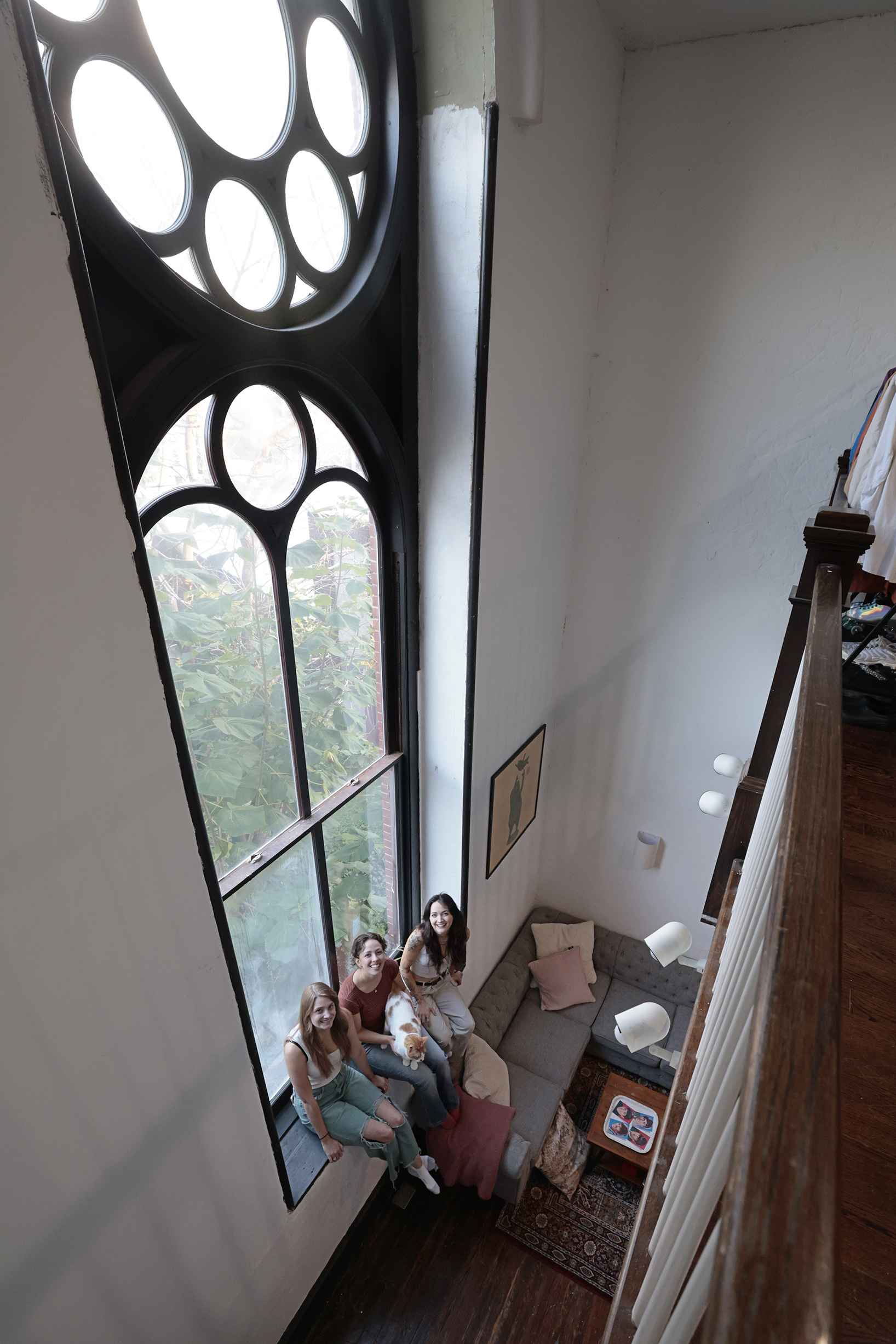
    As seen looking down from the third floor, (from left) Ashlee Propst, Corwynne Peterson, cat Hugo, and Magdalena Becker sit on the window sill in their apartment, formerly a church.
    Peterson shares some affection with her cat, Hugo, on the former church altar.

    Regis converted the church into 17 multilevel rental units, preserving the soaring ceilings, decorative plaster moldings, several leaded glass windows, and pine flooring. The eclectic decor includes whitewashed brick interior walls, new skylights and ceiling fans, exposed pipes and beams. Remnants of ecclesiastical patterned wallpapers still cover the wall near a door leading to the communal courtyard.

    For Halloween the roommates screen It’s the Great Pumpkin, Charlie Brown on the columned dome of what was the church sanctuary. At the top of the dome is a painted gold cross and crown, symbolizing the reward in heaven (crown) after trials on earth (cross).

    Peterson said she and her three roommates, all women in their 20s, call the sanctuary “the stage.”

    The sanctuary, furnished with a dining table and chairs, is on a raised platform a few steps above the living room, kitchen, powder room, and “library,” with bookshelves and Peterson’s piano keyboard.

    The exterior of the Homes at Chapel Lofts, built in 1860 as the Christ Reformed Church.
    The remaining original stained-glass window in the apartment.

    On the next level are Peterson’s and Sperger’s bedrooms, a bathroom, and a sitting area. Both women work as restaurant servers.

    An ornately carved oak banister between the bedrooms and overlooking the sanctuary might have once been the church’s Communion rail.

    Propst, a research specialist at the University of Pennsylvania’s Perelman School of Medicine, has the largest bedroom and a private bath on the third level, where there is also a washing machine and dryer the women share.

    Up a spiral staircase on the top level is Becker’s bedroom, adjacent to a rooftop deck. She shares a bathroom with Peterson and Sperger two flights down.

    Entranceway to the apartment’s library.

    A pair of silver stiletto-heeled boots decorate a shelf at the bottom of the stairs. Becker is a writer for Static Media and a dancer, “which is why I have a lot of shoes,” she said.

    The roommates separately found the converted church on Facebook, moving in at different times over the last 2½ years. They collaborated on the furnishings, sourcing the gray sectional in the living room, the gray sitting-area sofa and purple ottoman, and other furniture on Facebook Marketplace. Their parents and grandparents contributed oriental rugs.

    The vintage typewriter, which sits on a desk gifted by a neighbor, was a prop from a play in which Peterson performed. The Vanya poster is from an Off-Broadway, one-man show of the same name autographed for Peterson by the star, Andrew Scott.

    Magdalena Becker in her fourth-floor bedroom, with sun beaming through the skylight above.

    Abstract nature prints came from Etsy, and a Vogue magazine cover, old records, and other art displayed on the walls were purchased at thrift stores. The women’s colorful clothes hang on racks.

    Light streams from a tall window comprising various shapes of clear glass, which replaced disintegrating leaded glass. Some of the arched doorways still have stained-glass transoms.

    The roommates admit they don’t do much communal cooking. They each have their own shelves in the fridge and in the chestnut kitchen cabinets.

    Magdalena Becker stands on the south-facing deck just off of her fourth-floor bedroom.
    Corwynne Peterson stands in the doorway of the library with her piano keyboard.

    But they do host parties together. Besides the Halloween festivities there was a birthday party for Sperger in September.

    For Christmas celebrations, the sanctuary sparkles with green and red lights.

    The women also share affection for the only male in residence, Peterson’s orange and white cat, Hugo. And he is fond of all of them.

    Is your house a Haven? Nominate your home by email (and send some digital photographs) at properties@inquirer.com.

  • How a pipeline leak disrupted a quiet Bucks neighborhood: ‘Never drink the water’

    How a pipeline leak disrupted a quiet Bucks neighborhood: ‘Never drink the water’

    More than 2.5 million miles of fuel pipelines run under homes, farms, parks, and schools in the United States — enough steel line to circle the earth 100 times.

    One of those pipelines slices under Mount Eyre Manor, a suburban Bucks County neighborhood perched high above the popular Delaware Canal State Park towpath and only a few thousand feet from the Delaware River.

    For years, residents barely gave any thought to the Twin Oaks Pipeline, owned by Sunoco and its parent company, Energy Transfer. That changed in January when state inspectors uncovered a jet fuel leak.

    Now, the pipeline is always on their minds.

    “We will never drink the water in this house again,” said Kristine Wojnovich, whose well was one of six tainted in the leak. Six metal tanks, part of a filtration system installed by Energy Transfer, now crowd her basement wall.

    The Twin Oaks Pipeline stretches 106 miles. Built in 1958, its 14-inch diameter pipe carries jet fuel, diesel, or gasoline, depending on need, from Sunoco’s Twin Oaks Terminal in Aston, Delaware County, to a terminal in Newark, N.J.

    Along its route, the pipeline burrows beneath suburbs, tunnels under waterways — including the Delaware River — and runs below a school’s grounds and state and local parks. It carves directly through Mount Eyre in the Washington Crossing section of Upper Makefield Township.

    Federal regulators estimated that a “slow drip” had seeped undetected at least 16 months before the leak was detected.

    Energy Transfer has accepted responsibility and apologized at public meetings. The company declined to comment for this article but noted that it has set up a website with updates and documents related to the spill.

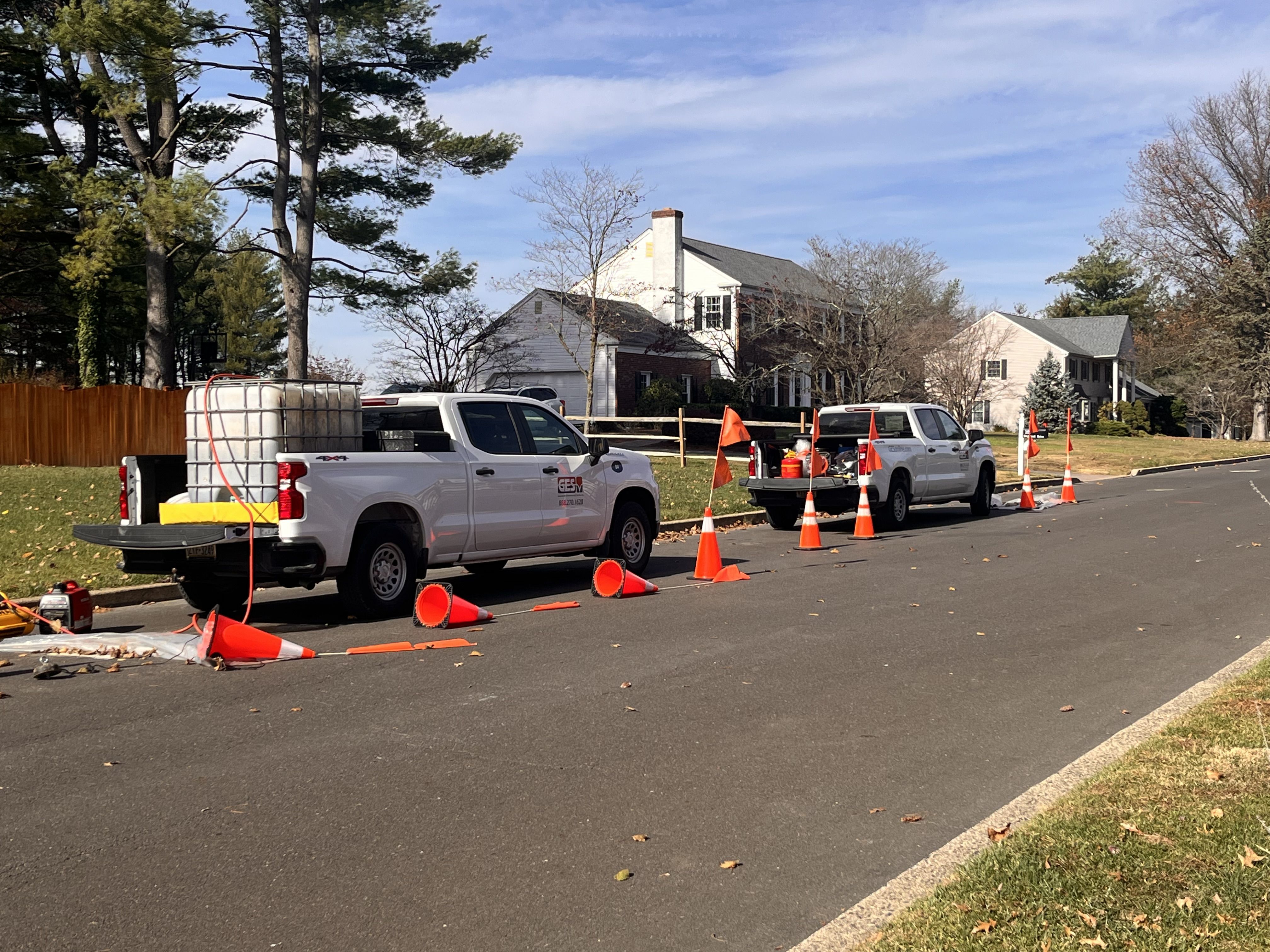
    A contractor for Energy Transfer working on a recovery well in front of Kristine Wojnovich’s home in the Mount Eyre Manor neighborhood.

    Signs of contamination

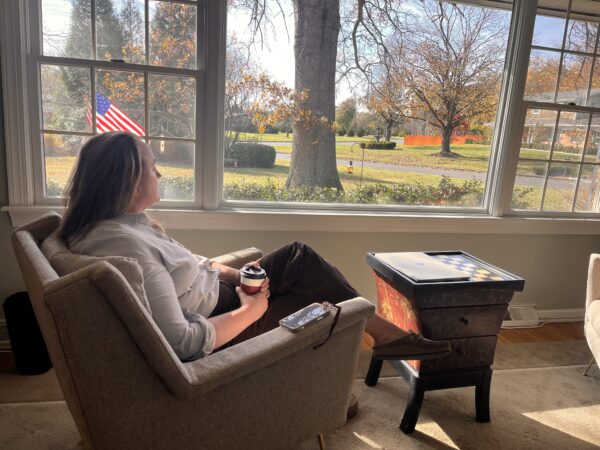
    Wojnovich said she first noticed “something off with the water” as she was getting a drink after a workout in September 2023. She recalled the incident on a recent day from her living room as several white trucks owned by an Energy Transfer contractor were parked outside as part of well-monitoring work.

    “It smelled to me like oil or gasoline or some kind of petroleum,” Wojnovich said.

    Uncertain whether she was imagining it, she waited for her husband, Kevin, to return home. He, too, noticed the odor and suggested they call Sunoco.

    The couple say Sunoco failed to locate a source of the odor and told them the likely cause was bacteria. Other neighbors had complained, too.

    But it wasn’t until Jan. 21, 2025, that residents first learned of a leak discovered during an investigation by the Pennsylvania Department of Environmental Protection. The DEP advised the federal Pipeline and Hazardous Materials Safety Administration (PHMSA) that water samples from a Mount Eyre home “indicated the presence of kerosene, a major component of JP-8 jet fuel.”

    PHMSA notified Energy Transfer and Sunoco.

    Since then, residents have attended hours and hours of meetings. They’ve filed seven lawsuits, including a class action. Wojnovich is one of the plaintiffs.

    Most people won’t drink the water. Many won’t cook with it. Wojnovich and her husband, Kevin, bathe elsewhere.

    Wojnovich noted that when her well was initially tested after the leak, “fumes came out. It was overwhelming. They measured 12½ feet of jet fuel on top of our drinking water well.”

    Her water, which eventually tested positive for contamination, now gets routinely tested by contractors paid by Energy Transfer. The company has drilled a second well for the family. But the Wojnoviches say their water still has a pungent odor.

    Kevin Wojnovich samples water from a point-of-entry-treatment, whole-house filtration system that Sunoco installed at his Washington Crossing home after a 2024 jet fuel leak was detected in the company’s Twin Oaks pipeline.

    The fallout

    Of six wells that tested positive for hydrocarbons, four exceeded contaminant levels for drinking water. Residents suspect other wells were, or are, tainted and are skeptical about the way testing has been carried out.

    According to the DEP, jet fuel contains “contaminants of concern” including benzene, toluene, ethylbenzene, xylenes, cumene, naphthalene, trimethylbenzenes, dichloroethanes, dibromoethane, and lead, which is also naturally occurring. The compounds can be harmful if ingested in large amounts. Some are carcinogens.

    Energy Transfer has purchased a home with a contaminated well on Spencer Road, adjacent to where the leak was detected, for $721,800. It is across from the Wojnoviches’ home and sits vacant. The company purchased the home to drill two recovery wells in order to remove contaminated water.

    Since digging up and repairing the pipe section, the company has recovered 1,027 gallons of fuel. About 163 gallons came from private wells, according to DEP records.

    Energy Transfer has paid contractors to excavate and remove 276 tons of petroleum-impacted soil, according to a DEP document. It has installed four wells to recover petroleum from underground, dug 26 wells to monitor groundwater, and put in 181 point-of-entry treatment filtration systems in homes. It has collected 1,289 water samples from 363 individual wells.

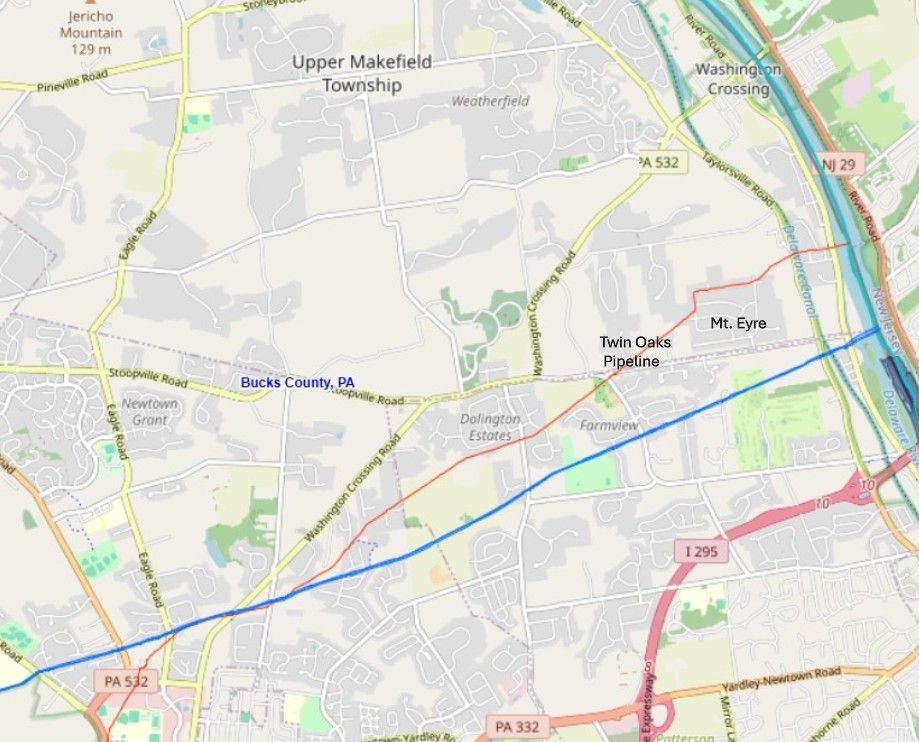
    A map from the federal Pipeline and Hazardous Materials Safety Administration shows the Mount Eyre Manor neighborhood in Washington Crossing, Bucks County, and Sunoco’s Twin Oaks pipeline in red. The blue line signifies another gas transmission pipeline.

    Over the summer, Energy Transfer, using an inspection tool, identified multiple anomalies in the pipeline in Upper Makefield Township that required excavation, according to an Oct. 22 update.

    The company said in an August letter that the anomalies presented no immediate danger and that there is no “data or information that the continued operation of the pipeline presents a critical safety concern or that the pipeline is leaking.”

    One of those excavations took place in a section of pipe next to the popular canal path used by cyclists and hikers. It is being dug up and replaced.

    The excavation along Taylorsville Road won’t disturb the canal trail, company officials said during a recent meeting. The term anomaly does not mean a pipe section is an immediate threat to the safety or integrity of the pipeline, Matt Gordon, vice president of operations at Energy Transfer, said at the meeting.

    Meanwhile, the pipeline continues to deliver fuel.

    A contractor for Energy Transfer excavates a pipe found along Taylorsville Road with an anomaly that the company said was not in any immediate danger of failing.

    ‘Another house is up for sale’

    The spill has upended life in and around Mount Eyre, neighbors say.

    Joe Babiasz said many neighbors had bonded through their children’s schools and activities before the spill. Now, instead of talking soccer, they talk pipelines.

    “It’s become part of daily life at this point,” Babiasz said. “When we get together socially, it’s the thing we talk about. It’s been kind of hard to just hang out with people and have it not come up. You can’t walk around the neighborhood without seeing a reminder. ‘Oh, there’s the monitoring well,’ or ‘another house is up for sale.’”

    Residents have expressed outrage and skepticism toward Energy Transfer, the parent company of Sunoco, over the handling and testing of the contamination. They say they don’t trust the company’s methods and doubt the safety of the 67-year-old pipeline.

    “There are the trucks out there now,” Babiasz said on a recent day. “You can see them or hear them. It’s been integrated into our daily life.”

    He asked: “Are they actually telling us everything?”

    Residents wonder if the leak would have been discovered if they had municipal water. They wonder whether the leak created a toxic plume underground and where it might drift to, including into the river.

    Neighbors plan to attend the next update by the DEP during a Dec. 8 webinar.

    Katherine LaHart, a plaintiff in the class-action suit, said her well water was once clear. Now it is “black — Texas brown.”

    “I worry every day about the integrity of our water, air and soil and the pipeline that runs through our neighborhood,” LaHart said. “It keeps me up at night.”

  • Why brittle bones aren’t just a woman’s problem

    Why brittle bones aren’t just a woman’s problem

    Ronald Klein was biking around his neighborhood in North Wales in 2006 and tried to jump a curb. “But I was going too slow — I didn’t have enough momentum,” he recalled.

    As the bike toppled, he thrust out his left arm to break the fall. It didn’t seem like a serious accident, yet “I couldn’t get up,” he said.

    At the emergency room, X-rays showed that he had fractured both his hip, which required surgical repair, and his shoulder. Klein, a dentist, went back to work in three weeks, using a cane. After about six months and plenty of physical therapy, he felt fine.

    But he wondered about the damage the fall had caused. “A 52-year-old is not supposed to break a hip and a shoulder,” he said. At a follow-up visit with his orthopedist, “I said, ‘Maybe I should have a bone density scan.’”

    As Klein suspected, the test showed he had developed osteoporosis, a progressive condition, increasing sharply with age, that thins and weakens bones and can lead to serious fractures. Klein immediately began a drug regimen and, now 70, remains on one.

    Osteoporosis occurs so much more commonly in women, for whom medical guidelines recommend universal screening after age 65, that a man who was not a healthcare professional might not have thought about getting a scan. The orthopedist didn’t raise the prospect.

    But about 1 in 5 men over age 50 will suffer an osteoporotic fracture in their remaining years, and among older adults, about a quarter of hip fractures occur in men.

    When they do, “men have worse outcomes,” said Cathleen Colón-Emeric, a geriatrician at the Durham VA Health Care System and Duke University and the lead author of a recent study of osteoporosis treatment in male veterans.

    “Men don’t do as well in recovery as women,” she said, with higher rates of death (25% to 30% within a year), disability, and institutionalization. “A 50-year-old man is more likely to die from the complications of a major osteoporotic fracture than from prostate cancer,” she said.

    (What’s “major”? Fractures of the wrist, hip, femur, humerus, pelvis or vertebra.)

    In her study of 3,000 veterans ages 65 to 85, conducted at Veterans Affairs health centers in North Carolina and Virginia, only 2% of those assigned to the control group had undergone bone-density screening.

    “Shockingly low,” said Douglas Bauer, a clinical epidemiologist and osteoporosis researcher at the University of California-San Francisco, who published an accompanying commentary in JAMA Internal Medicine. “Abysmal. And that’s at the VA, where it’s paid for by the government.”

    But establishing a bone health service — overseen by a nurse who entered orders, sent frequent appointment reminders, and explained results — led to dramatic changes in the intervention group, who had at least one risk factor for the condition.

    Forty-nine percent of them said yes to a scan. Half of those tested had osteoporosis or a forerunner condition, osteopenia. Where appropriate, most of them began medications to preserve or rebuild their bones.

    “We were pleasantly surprised that so many agreed to be screened and were willing to initiate treatment,” Colón-Emeric said.

    After 18 months, bone density had increased modestly for those in the intervention group, who were more likely to stick to their drug regimens than osteoporosis patients of either sex in real-world conditions.

    The study didn’t continue long enough to determine whether bone density increased further or fractures declined, but the researchers plan a secondary analysis to track that.

    The results revive a longtime question: Given how life-altering, even deadly, such fractures can be, and the availability of effective drugs to slow or reverse bone loss, should older men be screened for osteoporosis, as women are? If so, which men and when?

    Such issues mattered less when life spans were shorter, Bauer explained. Men have bigger and thicker bones and tend to develop osteoporosis five to 10 years later than women do. “Until recently, those men died of heart disease and smoking” before osteoporosis could harm them, he said.

    “Now, men routinely live into their 70s and 80s, so they have fractures,” he added. By then, they have also accumulated other chronic conditions that impair their ability to recover.

    With osteoporosis testing and treatment, “a man could see a clear-cut improvement in mortality and, more importantly, his quality of life,” Bauer said.

    Both patients and many doctors still tend to regard osteoporosis as a women’s disease, however. “There’s a bit of a Superman idea,” said Eric Orwoll, an endocrinologist and osteoporosis researcher at Oregon Health & Science University.

    “Men would like to believe they’re indestructible, so a fracture doesn’t have the implication that it should,” he added.

    One patient, for example, for years resisted entreaties from his wife, a nurse, to “see someone” about his visibly rounded upper back.

    Bob Grossman, 74, a retired public school teacher in Portland, blamed poor posture instead and told himself to straighten up. “I thought, ‘It can’t be osteoporosis — I’m a guy,’” he said. But it was.

    Another obstacle to screening: “Clinical practice guidelines are all over the place,” Colón-Emeric said.

    Professional associations like the Endocrine Society and the American Society for Bone and Mineral Research recommend that men 50 and older who have a risk factor, and all men over 70, should seek screening.

    But the American College of Physicians and the U.S. Preventive Services Task Force have deemed the evidence for screening of men “insufficient.” Clinical trials have found that osteoporosis drugs increase bone density in men, as in women, but most male studies have been too small or lacked enough follow-up to show whether fractures also declined.

    The task force’s position means that Medicare and many private insurers generally won’t cover screening for men who haven’t had a fracture, though they will cover care for men diagnosed with osteoporosis.

    “Things have been stalled for decades,” Orwoll said.

    So it may fall to older men themselves to ask their doctors about a DXA (pronounced DECKS-ah) scan, widely available at $100 to $300 out-of-pocket. Otherwise, because osteoporosis is typically asymptomatic, men (and women, who are also undertested and undertreated) don’t know their bones have deteriorated until one breaks.

    “If you had a fracture after age 50, you should have a bone scan — that’s one of the key indicators,” Orwoll advised.

    Other risk factors: falls, a family history of hip fractures, and a fairly long list of other health conditions including rheumatoid arthritis, hyperthyroidism, and Parkinson’s disease. Smoking and excessive alcohol use increase the odds of osteoporosis as well.

    “A number of medications also do a number on your bone density,” Colón-Emeric added, notably steroids and prostate cancer drugs.

    When a scan reveals osteoporosis, depending on its severity, doctors may prescribe oral medications like Fosamax or Actonel, intravenous formulations like Reclast, daily self-injections of Forteo or Tymlos, or twice-annual injections of Prolia.

    Lifestyle changes like exercising, taking calcium and vitamin D supplements, stopping smoking, and drinking only moderately will help but aren’t sufficient to stop or reverse bone loss, Colón-Emeric said.

    Although guidelines don’t universally recommend it, at least not yet, she would like to see all men age 70 and up be screened, because the odds of disability after hip fractures are so high — two-thirds of older people will not regain their prior mobility, she noted — and the medications that treat it are effective and often inexpensive.

    But informing patients and healthcare professionals that osteoporosis threatens men, too, has progressed “at a snail’s pace,” Orwoll said.

    Klein remembers attending a seminar to instruct patients like him in using the drug Forteo. “I was the only male there,” he said.

    KFF Health News is a national newsroom that produces in-depth journalism about health issues and is one of the core operating programs at KFF — the independent source for health policy research, polling, and journalism. The New Old Age is produced through a partnership with The New York Times.


  • Philadelphia’s Center for Advocacy for the Rights and Interests of Elders is closing next week after nearly 50 years

    Philadelphia’s nonprofit Center for Advocacy for the Rights and Interests of Elders, known as CARIE, is closing next Wednesday after nearly 50 years, the organization’s board announced Tuesday in an email to supporters.

    Few details were available on what led to the decision to close abruptly the day before Thanksgiving. CARIE’s new executive director, Brian Gralnick, did not reply to an email or voicemail asking for more information.

    Board chair Joan Davitt, an associate professor and geriatric scholar at the University of Maryland School of Social Work who lives in the Philadelphia area, also did not respond to requests for comment.

    The organization lists 26 employees on its website. Its most recent audited financial statements show that it had $2.9 million in revenue and a $177,307 operating loss in the year that ended June 30, 2024.

    An unaudited financial report for the seven months that ended in January warned that CARIE “was facing financial risks, including the potential default on its line of credit.” At the end of January, CARIE only had enough cash to pay its bills for two weeks, the report obtained by The Inquirer said.

    This year, CARIE lost two of its largest contracts, effective next year. Those contracts were to provide long-term care ombudsman services for the elderly in most of Philadelphia and in Montgomery County. An ombudsman’s job is to provide independent advocacy for residents of long-term care facilities and to help resolve complaints about care and living conditions.

    In Philadelphia, CARIE had provided the service since 1981, four years after its founding. Philadelphia Corporation for Aging, which manages the contracts, is still finalizing the selection of the new providers.

    CARIE started providing ombudsman services in Montgomery County in 2022, but the county’s Office of Aging Services is taking the service back in-house on Feb. 1.

    CARIE has lacked stability in senior leadership since the retirement of Diane Menio in March 2023. Menio had been executive director for 34 years.

    Menio’s successor, Whitney Lingle, lasted just 19 months. She was followed by an internal acting executive director for a year. Gralnick took over in September.

  • Letters to the Editor | Nov. 19, 2025

    Letters to the Editor | Nov. 19, 2025

    Journey with Alzheimer’s

    Thank you to Wendy Ruderman for your moving story about Mike West. I had the privilege of knowing both Mike and Lynn — Mike, who left a lasting impact, and Lynn, who continues to honor his legacy with grace and heart. Your piece truly captured their spirit.

    Mike was always approachable — no matter how challenging the business discussion, his smile always led the way into the room. He was a consummate professional who brought people together and made things happen, always with kindness and respect.

    Reading about his journey with Alzheimer’s was difficult. It’s hard to imagine the weight of the decisions he faced. I salute Lynn for her courage in sharing resources and their family’s experience, so others might find help and understanding on their own Alzheimer’s journeys.

    Your story is a reminder that it’s easy to get caught up in the day-to-day and forget what matters most in support of friends and family. Mike’s legacy isn’t just in Rothman’s growth, but in how he treated people — with genuine care. Sharing his story will help more families find the support they need.

    Thank you for telling it with such compassion.

    Richard L. Snyder, chief operating officer, Independence Blue Cross

    Ridding sewage pollution

    I’m writing in response to the recent article about sewage pollution in the Philly-Camden region. As a coxswain on the St. Joseph’s women’s rowing team, I spend hours training on the Schuylkill. Lately, it’s hard not to think about what’s flowing below us — billions of gallons of sewage-tainted water.

    Combined sewer systems — where sewage and stormwater share the same pipes to a treatment plant — serve about 60% of Philadelphia. These systems can’t handle heavy rainfall, causing overflows that contaminate our rivers. Between 2016 and 2024, an average of 12.7 billion gallons of untreated sewage and stormwater entered local waterways each year. This goes against the Clean Water Act’s goal of protecting U.S. waters and threatens wildlife, communities, and athletes like myself.

    Philadelphia must invest in stronger infrastructure that can handle heavy rainfall. While green stormwater projects are an important start, they aren’t enough to protect the Schuylkill and Delaware Rivers. Ongoing sewage overflows make training and recreation unsafe for up to 195 days a year. It’s time for the Water Department to act and keep our rivers clean and safe.

    Cecilia Sarnowski, Philadelphia

    Insult to veterans

    I read with astonishment and anger the article about the disappearance of exhibits about Black American soldiers in a World War II cemetery in the Netherlands.

    Does this administration know no shame?

    These soldiers died fighting for freedom and against the Nazis. They must be remembered.

    How must their descendants feel?

    Judy Hartl, Philadelphia

    Join the conversation: Send letters to letters@inquirer.com. Limit length to 150 words and include home address and day and evening phone number. Letters run in The Inquirer six days a week on the editorial pages and online.

  • Horoscopes: Wednesday, Nov. 19, 2025

    ARIES (March 21-April 19). Even if you’re capable of doing something on your own, accepting help is still valuable, just not for the obvious reason. The “help” isn’t really the point; what matters is what you learn through the exchange.

    TAURUS (April 20-May 20). Sometimes the fastest way forward is to pause, check your bearings, and confirm your orientation, because you don’t want to go fast in the wrong direction. A brief moment of awareness now will save hours later.

    GEMINI (May 21-June 21). People ask of you what they will. But you can’t oblige every ask. People who respect you will stay in dialogue even when they don’t get what they want. People who only want the “yes” will fade away when they hear “no.”

    CANCER (June 22-July 22). Love can witness without fixing. Kindness can be warm and steady without falling into the gravity of another person’s need. Take care of yourself first. It’s not selfish; it’s the correct order.

    LEO (July 23-Aug. 22). You may have wonky tools or a clumsy setup today, and that’s actually perfect. When things are tricky, it wakes up your inventiveness, forcing you to move differently, think sharper and invent. And you’re so brilliant when you improvise!

    VIRGO (Aug. 23-Sept. 22). Kindness isn’t a contract. Your generosity doesn’t obligate you to the comfort of others. Protect your energy. Give because it delights you, not because it’s expected. And if you’re just not sure, hold off until you have a stronger feeling about what to do next.

    LIBRA (Sept. 23-Oct. 23). You sense the ache of the world even on bright days. Still, it’s not betrayal to feel good. When joy visits, take it in. And someone must remember what hope feels like. Why shouldn’t that someone be you?

    SCORPIO (Oct. 24-Nov. 21). It’s not too much to ask life to impress you, especially if you ask it to yourself, or send it to the heavens, or write it in your journal. After all, you regularly give more than what’s expected of you. And others might, too, if they sense the challenge.

    SAGITTARIUS (Nov. 22-Dec. 21). You’re awakening to how uneven emotional labor can be. Don’t confuse serving with loving. True partnership is mutual tending. Step back from one-way giving; step toward those who offer warmth back. Balance restores dignity and real joy.

    CAPRICORN (Dec. 22-Jan. 19). You’ve been accused of stubbornness, but there’s an upside to it — and in your case it’s an up and up and up side. Tenacity got you here and tenacity will get you to the next place, too. Keep it pushing, eyes ahead, never stop.

    AQUARIUS (Jan. 20-Feb. 18). To want more from someone is to overlook who they already are. Love’s rare grace is to stop improving, fixing or expecting, and simply witness. Let them be, and they’ll rise naturally into the truest version of themselves.

    PISCES (Feb. 19-March 20). When you chase a floating ball in water, your own motion pushes it away. The same goes for goals and people. Consider approaching indirectly, from the side or under the surface. Don’t make waves. Let it drift closer to you.

    TODAY’S BIRTHDAY (Nov. 19). Welcome to your Year of Wonder Work. You’ll create something that makes you proud to wake up early. The mix of joy and diligence turns ordinary efforts into legacy-making magic. More highlights: Romance finds you in motion — on a journey, in a workshop, mid-song. You’ll refine your tastes, elevate your surroundings, and collect experiences that feel cinematic. Cancer and Leo adore you. Your lucky numbers are: 10, 39, 26, 14 and 13.

  • Dear Abby | Husband repeatedly mentions his late ex in his sleep

    DEAR ABBY: My husband of 4 1/2 years had an old girlfriend he was on and off with for 15 years. She passed away while he was in prison. We got married three months after he was released. The thing is, when he sleeps, almost every night, he says her name and how much he loves her. He says because he’s doing it in his sleep, he doesn’t know he’s doing it. It seems to upset him that I’m upset. He doesn’t want to hurt me. What can I do to deal with it or get him to stop doing it?

    — DREADS THE BED IN COLORADO

    DEAR DREADS: Your husband was on and off with his late girlfriend much longer than he has been married to you. Old habits die hard. If he wakes you when this happens, don’t hesitate to gently wake him. If he asks why you did it, explain that he was talking in his sleep. (Do not be specific about what.) Then try to remember that she is history, and you are right next to him.

    ** ** **

    DEAR ABBY: I’m a senior widow who has been dating an older man for a year now. He’s caring and thoughtful and has many good qualities, but one thing he does is creating difficulty for me. He constantly stares at other women. I’ve talked with him about a “five-second rule,” but he doesn’t hear me. He told me he was raised by his mother and grandmother and that’s why he’s attracted to women in general. He says it doesn’t mean anything.

    I have never been with a man who constantly looks at other women. He also prefers to have women friends rather than men friends. I don’t want to be jealous, but sometimes it’s hard keeping those feelings down. I’m trying to decide whether I should end this relationship or stay in it and try to overcome my feelings of jealousy.

    — RED FLAG IN CALIFORNIA

    DEAR RED FLAG: If this person makes you feel less good about yourself, recognize it IS a red flag. His behavior is insensitive and rude. Because you have asked him to stop staring at women when he is with you and he makes excuses to continue, my advice is to find a companion who is more considerate of your feelings.

    ** ** **

    DEAR ABBY: My wife of 31 years and I have been fighting over politics and cultural changes in our country. The arguments have cooled down by mutual agreement, but so has our sexual desire for each other. Our marriage consultant has always taken my wife’s position; I am left on my own. I have no support from the rest of my family (three lovely daughters), but I still love and respect my wife. She told me that I must switch my politics to hers or she will leave me. What do I do?

    — THREATENED IN WISCONSIN

    DEAR THREATENED: Tell your wife and her marriage consultant that as your political arguments have dwindled, so has your sex life. It may be time to seek professional counseling with someone else on your own. Your wife’s ultimatum is unrealistic. Unless the two of you can agree to disagree, take her up on her offer.

  • USMNT stuns Uruguay with a 5-1 rout in its last game of the year

    USMNT stuns Uruguay with a 5-1 rout in its last game of the year

    TAMPA, Fla. — The U.S. men’s soccer team closed its year with one of its toughest tests under Mauricio Pochettino, against star-studded Uruguay on Tuesday. And if the opponent’s quality wasn’t enough, Pochettino upped the ante by starting many of his backups to test them.

    What resulted was one of the most surprising games not just of Pochettino’s tenure, but for some years with the U.S. program: a 5-1 shellacking by the Americans, with goals from four different scorers.

    Sebastian Berhalter, Alex Freeman (twice), and Diego Luna tallied in the first half, and Tanner Tessmann added another in the second before a crowd at Raymond James Stadium that was as stunned as it was thrilled.

    As much as the result of any friendly game counts, Pochettino’s lineup changes immediately became the night’s first headline. Just two of the 11 players who started Saturday’s win over Paraguay, right back Sergiño Dest and former Union goalkeeper Matt Freese, remained starters three days later. (The short time between contests was perhaps another factor in Pochettino’s rotation.)

    John Tolkin (left) and goal scorer Diego Luna (right) were among the new U.S. starters.

    Pochettino took the U.S. back to a 4-3-3 setup, with Union alumni Mark McKenzie and Auston Trusty together at centerback, John Tolkin at left back, and Freeman at right back. Aidan Morris was the midfield stopper behind Timothy Tillman and Berhalter; and Luna, Haji Wright, and Dest were the front three from left to right.

    They faced an Uruguay lineup stacked with marquee names. Barcelona’s Ronald Araújo anchored the back line; Tottenham Hotspur’s Rodrigo Bentancur and Manchester United’s Manuel Ugarte led the midfield; and Flamengo dynamo Giorgian de Arrascaeta created behind striker Federico Viñas of Spain’s Real Oviedo.

    Along with their talents, they were expected to bring Uruguay’s famed garra charúa fighting spirit. Instead, the near total opposite happened.

    Berhalter opened the scoring in the 17th off a free kick trick play, a give-and-go with Dest for a curler from the left side of the 18-yard box. The son of former U.S. manager Gregg Berhalter grabbed his jersey by the badge as he exulted, pointed to it, and aimed an ear to the crowd — perhaps to make a point to his critics.

    Freeman doubled the lead four minutes later when he leapt to meet Berhalter’s corner kick and headed it past a stranded Uruguay goalkeeper Cristopher Fiermarin — one of la Celeste’s only inexperienced players, in just his second national team game.

    In the 31st minute, Freeman made it 3-0 at the tail end of another corner kick play. After an initial clearance, Freeman ended up on the left side of the field, Trusty sprung him forward, and Freeman — who plays his club soccer 90 minutes west of here in Orlando — split Araújo and Ugarte before shooting.

    Luna struck the fourth in the 42nd, set up by Tillman. This really was shocking now, as Uruguay’s stars looked tired and uninterested. It was miles from the standard set by famed manager Marcelo Bielsa, who launched Pochettino’s professional career decades ago at Argentine club Newell’s Old Boys.

    This all said, in the moments Uruguay advanced forward, the U.S. defense didn’t exactly look great. It came to a head in first-half stoppage time, when Freese came off his line, nearly crashed into Freeman, recovered, then was stuck at his right post as de Arrascsaeta uncorked a bicycle kick in front of McKenzie. Seven U.S. field players stood in front of Freese at the point when de Arrascaeta launched himself.

    Uruguay’s fight showed up in the second half, but not always for the better: Bentancur was ejected with a straight red card in the 65th for upending Berhalter.

    Just before then, Pochettino made his first substitutions of the night. Luna, Wright, and Dest went out, and Gio Reyna, Folarin Balogun, and Tessmann went in. That didn’t all add up as like-for-like swaps, but the end result was a 4-2-3-1 with Berhalter, Reyna, and Tillman in front of Morris and Tessmann.

    The fifth goal came in the 68th, off another corner kick play. Reyna had the eventual assist with a ball floated from the left wing that Tessmann headed in, with Fiermarin barely contesting the service.

    Max Arfsten and Brenden Aaronson entered next, replacing Tolkin — who had been kicked around enough to be injured — and Tillman in the 75th. Cristian Roldan was the last U.S. substitute, replacing Morris in the 86th.

    When the clock struck 90 minutes, Guatemalan referee Julio Lune blew the final whistle right away instead of adding stoppage time.

    He, like everyone else, had seen quite a sight.

  • Andrew Painter, Alex McFarlane, and Gabriel Rincones Jr. added to Phillies’ roster before Rule 5 draft

    Andrew Painter, Alex McFarlane, and Gabriel Rincones Jr. added to Phillies’ roster before Rule 5 draft

    The Phillies added three prospects to their 40-man roster Tuesday to protect them from next month’s Rule 5 draft: right-handed pitchers Andrew Painter and Alex McFarlane and outfielder Gabriel Rincones Jr.

    The Rule 5 draft will be held Dec. 10 at the winter meetings in Orlando. If an eligible player is selected by another organization, he must remain on their 26-man roster all season or he will have to pass through outright waivers and be offered back to his former team.

    As the Phillies’ No. 1 prospect, Painter was expected to be protected. In his first full season after undergoing Tommy John surgery, Painter, 22, posted a 5.26 ERA in 118 innings between single-A Clearwater and triple-A Lehigh Valley. He had issues with command, but stayed healthy for the full season, and the Phillies remain confident he will be a part of their future.

    “I think he’s going to be better the second year out after the Tommy John [surgery],” Phillies manager Rob Thomson said in October. “The command’s going to get better. The quality of stuff’s going to get a little bit better. He’s going to be fine.”

    McFarlane, 24, wrapped up his first season following Tommy John surgery in 2023 and posted a 4.84 ERA. He moved to the bullpen toward the end of the season and finished the year with double-A Reading. McFarlane has had some command struggles, but his slider grades out highly and he can touch 100 mph with his fastball.

    Gabriel Rincones Jr. spent the season in triple A, where he slashed .240/.370/.430 and hit 18 home runs.

    Rincones, 24, made a strong impression with his power in spring training this year as a nonroster invitee. A left-handed hitter, Rincones spent the season in triple A, where he slashed .240/.370/.430 and hit 18 home runs. He struggles against lefties, hitting just .107, but could fill a platoon role with his .261 average and .873 OPS against right-handers.

    The Phillies’ 40-man roster stands at 33 players.

    Notable names left unprotected include Griff McGarry, who will be eligible for the Rule 5 draft for the second straight season. McGarry was named the Phillies’ Paul Owens Award recipient as their 2025 minor league pitcher of the year after a bounce-back season.

    Once considered a top prospect, McGarry, 26, has had inconsistencies with command but improved his walk rate from 10.2 walks per nine innings in 2024 to 5.2 in 2025.

    Felix Reyes, who had some eye-popping numbers in double A and triple A this season, will also be unprotected. The utility player slashed .331/.362/.562 in 101 games.

    Catcher Caleb Ricketts was also left off the roster. Ricketts hit .256 with a .702 OPS in 58 games with double-A Reading.