Tag: topic-link-auto

  • We cannot understand American history without Black history

    We cannot understand American history without Black history

    One cannot truly claim to understand American history without knowing African American history, and without understanding America’s complete history, we’re condemned to repeat past mistakes.

    The recent removal of the slavery exhibit at the President’s House made me realize that there were forces at work actively trying to erase uncomfortable truths about America’s history.

    With that recent obfuscation in mind — and in celebration of Black History Month — I’d like to introduce readers to some little-known history from Philadelphia during World War II.

    Discrimination decades ago in Philadelphia is not to be confused with racial murder in Philadelphia, Miss. However, to understand current race-related issues, we must acknowledge that whatever violence was inflicted on African Americans down south, equally insidious behavior took place in Northern cities like Philadelphia.
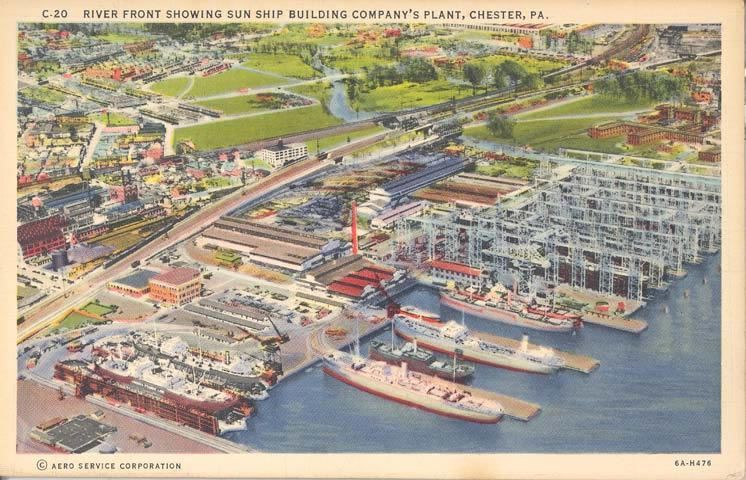
    A postcard depicts an aerial view of the Sun Shipyard in the 1930s.
    • Although the Fair Employment Practices Committee barred racial discrimination during World War II, Chester’s Sun Shipyard maintained a 5,000-plus man segregated shipyard, which company officials claimed was needed to limit racial strife.
    • Philadelphia’s newspapers legally listed nonfederal defense job openings and apartment rentals by race.
    • Newsreels and movies about the iconic battles of Guadalcanal, Saipan, the Bulge, Iwo Jima, and Okinawa almost never featured any Black servicemen, but they were there.
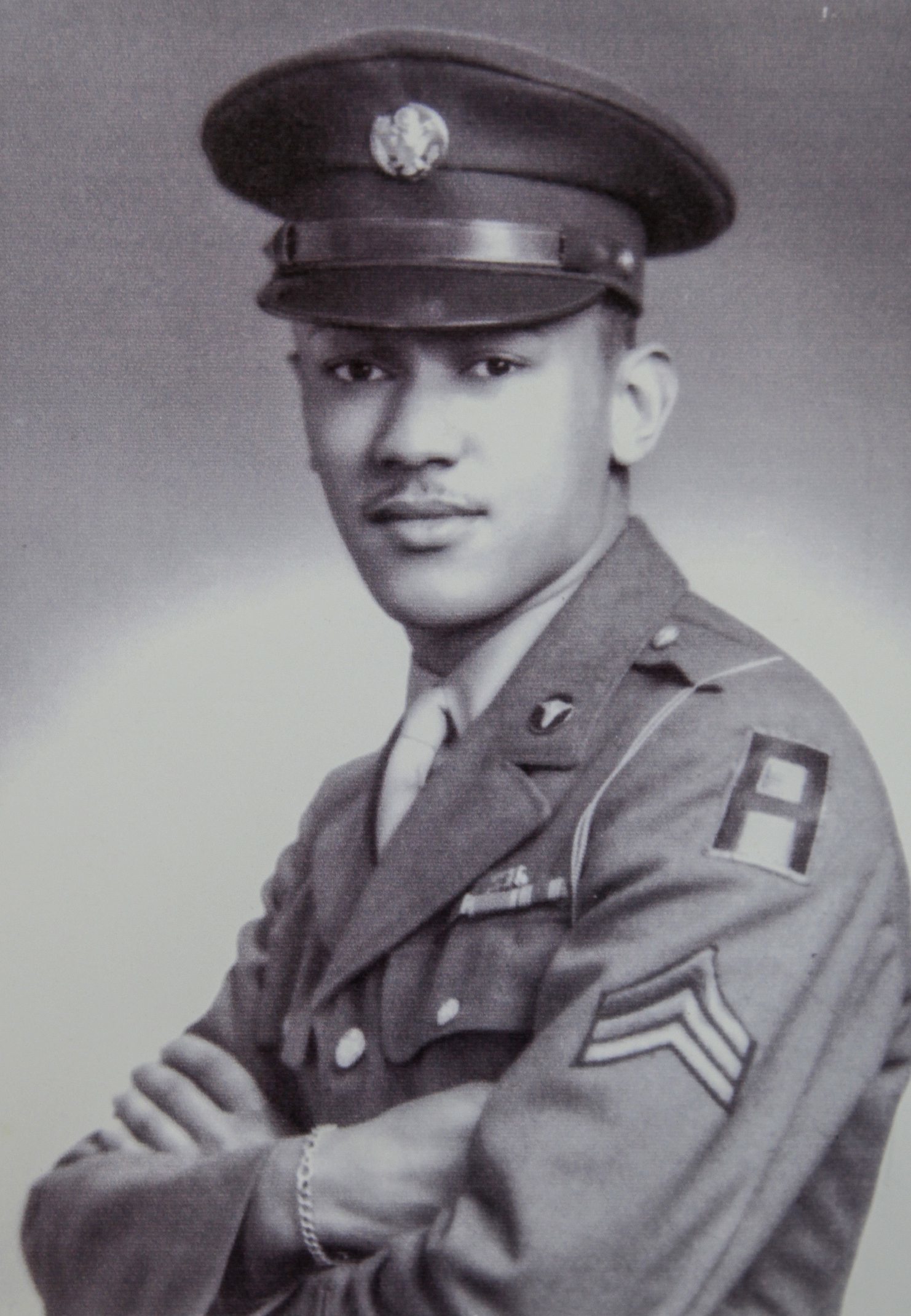
    Cpl. Waverly B. Woodson Jr. was an army medic assigned to the 320th Barrage Balloon Battalion. The battalion’s job was to set up explosive-rigged balloons to deter German planes. At a time when the military was still segregated by race, the balloon battalion was the only African American combat unit to land on Normandy on June 6, 1944.
    • On D-Day, Overbrook High grad Waverly B. Woodson Jr., a Black combat medic who, despite being wounded, treated over 200 soldiers at an Omaha Beach field dressing station. After toiling for over 30 straight hours and being completely exhausted, he resuscitated three soldiers who had nearly drowned in the frigid waters off the English Channel.
    • In 1943, Milton R. Henry, a Philadelphia Tuskegee pilot, got into a confrontation with an armed white Montgomery, Ala., bus driver over being forced to sit in the back of a bus. Henry might have been murdered if not for the quick intervention of several white English pilots.
    • In 1944, a racist Durham, N.C., bus driver murdered Pvt. Booker T. Spicely in cold blood. They had “had words” over Spicely’s initial choice of a bus seat. The bus driver was tried and quickly acquitted. Spicely lived in Philadelphia with his sister prior to his enlistment.
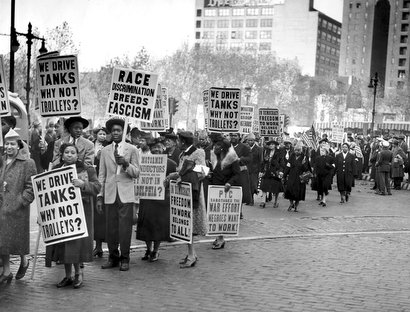
    A Philadelphia Transit Co. (which would eventually become SEPTA) protest supporting Black trolley drivers enters Reyburn Plaza across from City Hall on Nov. 8, 1943.
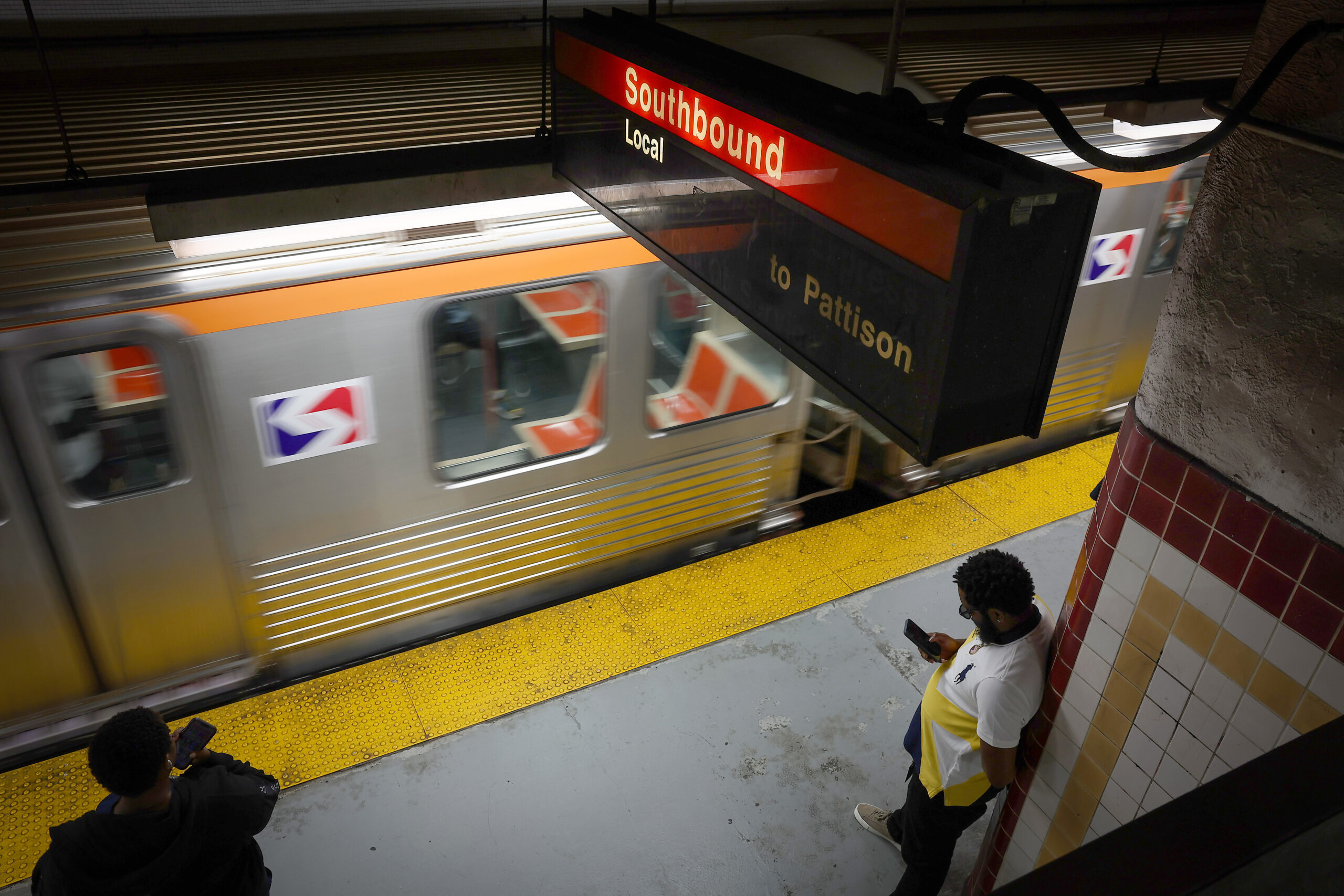
    • In 1944, racists struck the Philadelphia Transit Co., SEPTA’s predecessor, and prevented workers from using trolleys, buses, and subways for several days. Worker absenteeism caused the loss of a million war matériel production hours. President Franklin Delano Roosevelt ordered 5,000 troops to Philadelphia — instead of to Europe or the Pacific — to restart and guard its transit system.
    • In a top-secret 1945 operation, African American paratroopers fought West Coast forest fires ignited by Japanese balloon bombs. Norristown native Pfc. Malvin L. Brown died during one of the 555th Parachute Infantry Battalion’s firefighting operations.
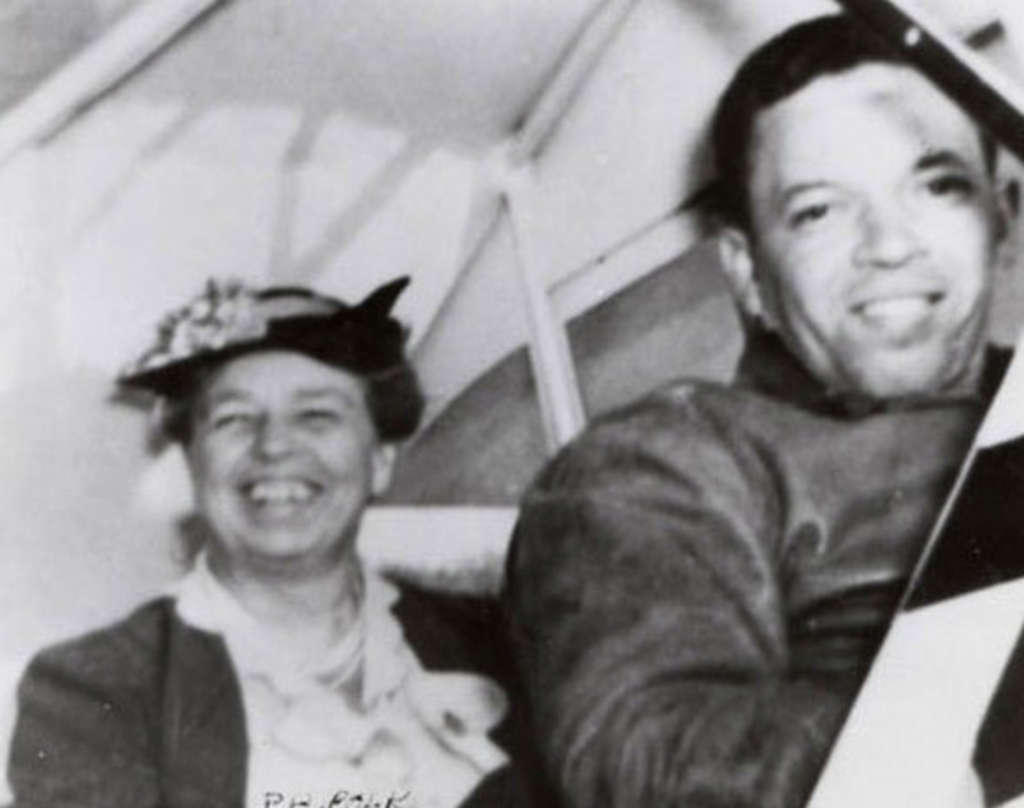
    First lady Eleanor Roosevelt got a flight over the Tuskegee Institute with C. Alfred Anderson at the controls.
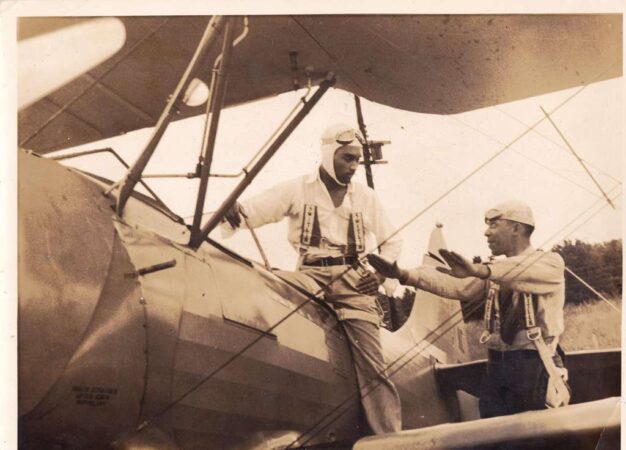
    • Irrespective of the Tuskegee Airmen’s flying skills, after the war, none was hired by a commercial airline. Some pilots had received their initial training from Bryn Mawr native C. Alfred “Chief” Anderson. In March 1941, Anderson flew Eleanor Roosevelt around Tuskegee, Ala., which caused some War Department skeptics to reevaluate their initial hesitancy with Black pilot training.
    • In April 1945, 101 Tuskegee Airmen, including several Philadelphians, were arrested for disobeying an unlawful discriminatory order. The charges were quickly dropped, but administrative reprimands were placed in these officers’ 201 files.
    • Philadelphia native William T. Coleman, a summa cum laude University of Pennsylvania graduate, interrupted his Harvard Law School studies to serve as an Army Air Force officer. Honorably discharged, he returned to Harvard, graduated first in his class, and clerked for a federal appeals court judge and a U.S. Supreme Court justice. Armed with his very substantial résumé and glowing recommendations, he initially moved to New York — as no white Philadelphia firm would hire him.
    • Throughout the war, while Philadelphia-based Whitman’s Chocolates was producing millions of pounds of “Samplers,” it was also producing “Pickaninny Peppermints,” despite protests by the NAACP to remove the offensive slur from the product’s name.
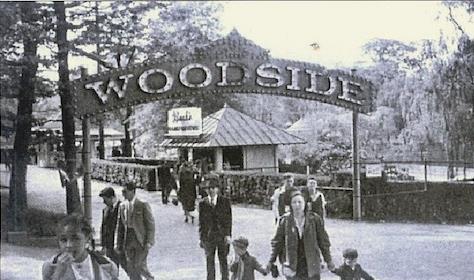
    The Woodside Amusement Park. The Fairmount Park Transit Co.’s trolley stopped at the park until the line closed in 1946.

    Over the last few years, some politicians have claimed that the United States is not a racist country, that slavery didn’t cause the Civil War, and that slavery benefited enslaved people by teaching them useful skills. The ignorance of these 21st-century politicians, who have many followers, makes it imperative that everyone study African American history, not just in February, but all year long.

    Paul L. Newman is an amateur historian specializing in African American history of the first half of the 20th century. He has created a mini-series docudrama that highlights the events in this essay.
  • Philly Council president says he’ll hold up school funding over the closure and consolidation plan ‘if need be’

    Philly Council president says he’ll hold up school funding over the closure and consolidation plan ‘if need be’

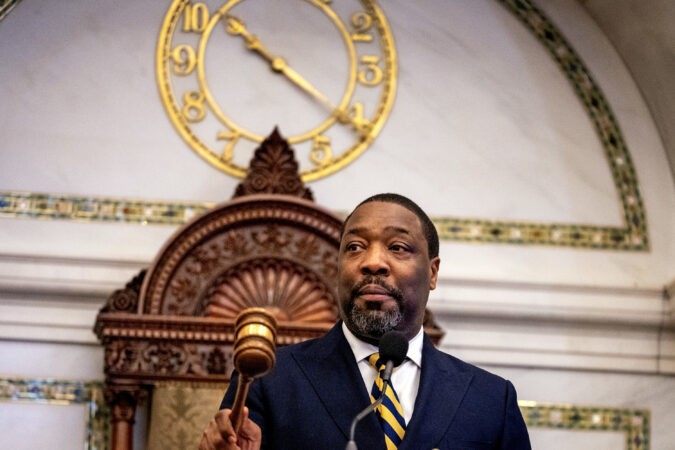
    Philadelphia’s top lawmaker said he’s willing to hold up city funding to the Philadelphia School District over concerns about the recently released closure and consolidation plan, a warning that signals City Council intends to leverage its biggest bargaining chip as members fight to keep schools in their neighborhoods open.

    City Council President Kenyatta Johnson said in an interview Friday that multiple members oppose proposed closures in their districts, and some want more robust investments in schools slated for consolidation in exchange for their support.

    Johnson’s primary concern, he said, is “making sure that the issues and concerns that we would like to see addressed with the facilities plan are reflected in the final recommendations.”

    Asked if he’d be willing to hold up the city’s contribution to the school district if their concerns are not met, Johnson said: “If need be.”

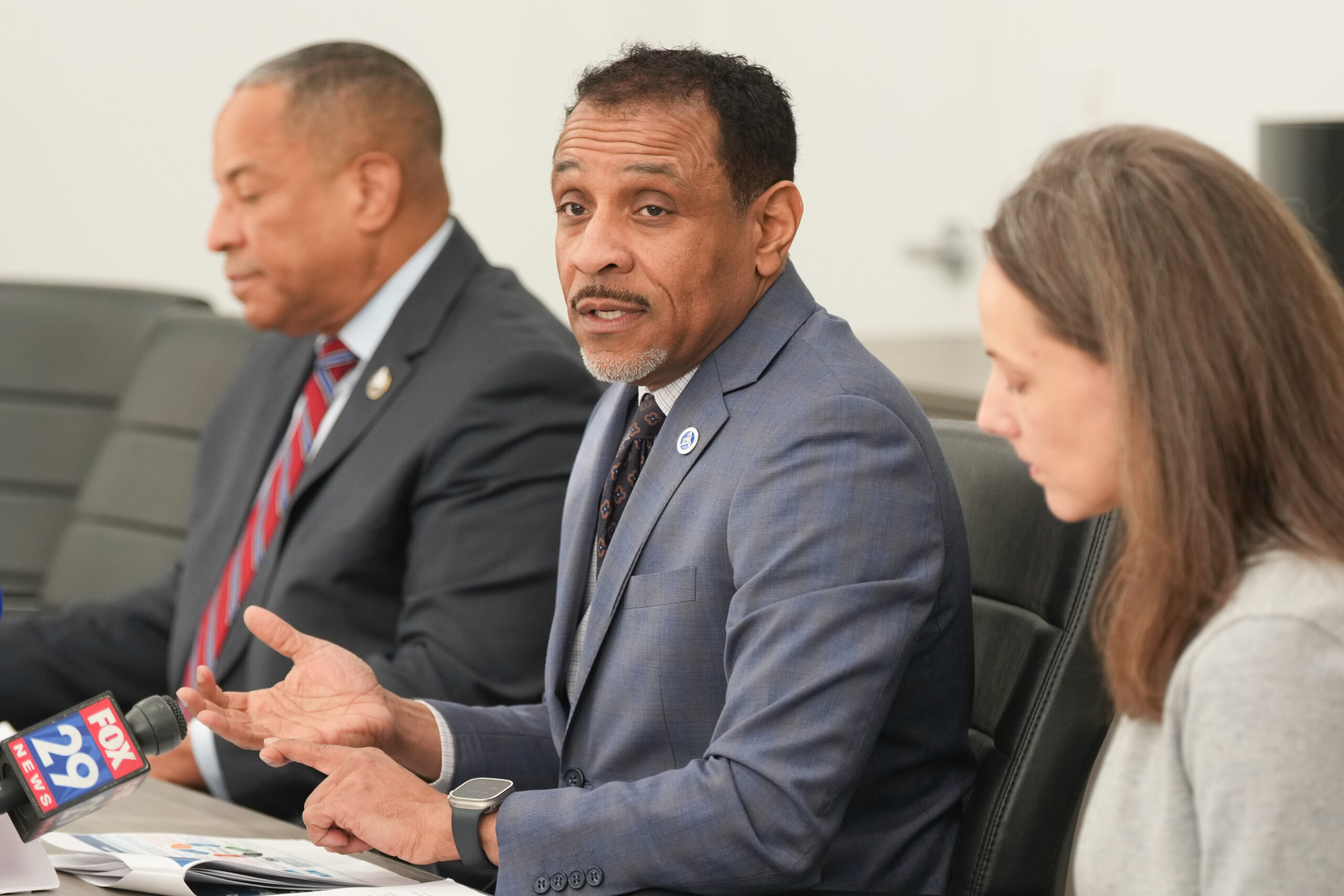
    Schools Superintendent Tony B. Watlington Sr. has proposed sweeping changes to schools across the city, including closing 20 schools, ordering six others to share buildings, and modernizing 159 buildings. His plan is subject to approval by the school board, which will likely vote sometime this winter.

    Oz Hill (left), Superintendent Tony B. Watlington Sr. (center), and Claire Landau at a news conference to announce plans for the first draft of the Philadelphia facilities master plan during a news conference at the Philadelphia School District Headquarters in Philadelphia on Jan. 20.

    Johnson’s public insistence that Council members exercise veto power over parts of the district’s long-awaited facilities master plan is notable, and it raises the stakes ahead of a Feb. 17 hearing, during which every Council member will have the opportunity to question district officials about the proposal.

    The Council president — a Democrat who is typically even-keeled and does not often speak publicly about legislative strategies — wields significant control over the fate of the city budget, which members must pass by the end of June. Mayor Cherelle L. Parker will unveil her proposed budget in March.

    Local revenue and city funding made up about 40% of the district’s budget this year, or nearly $2 billion. Most of that is the district’s share of city property taxes which, unlike other school systems in Pennsylvania, are levied by the city and then distributed to the district.

    In addition, the city makes a separate, direct contribution to the district, which this year was nearly $285 million.

    Johnson’s opposition to elements of the plan could also position lawmakers somewhat at odds with Parker and Watlington. The pair have operated in lockstep since Watlington last month unveiled his proposal.

    The plan did not appear to go over well in Council, with several members expressing immediate concerns. The day the plan was released publicly, Johnson endorsed another member’s legislation to amend the city’s governing document and grant Council power to remove members of the school board at will.

    Councilmember Cindy Bass at City Council’s first session of the year on Jan. 23, 2025, in City Hall.

    Some Council members said they plan to fight proposed closures and advocate for more investment in struggling schools.

    Speaking at a meeting at Lankenau High School in Upper Roxborough last week, Councilmember Cindy Bass pushed back against the notion of closing Lankenau, a well-regarded magnet outside of her district, and other strong schools, including Fitler Academics Plus and Parkway Northwest in her district.

    “When budget time comes up, I’ll be asking about these decisions that the school district is making,” Bass, a Democrat who represents parts of North and Northwest Philadelphia, told an emotional crowd of more than 100. “We don’t support them and we don’t understand them. They have not been rationalized.”

    At Conwell Middle School in Kensington, Councilmember Quetcy Lozada, a Democrat who represents the neighborhood, said she was “having a really hard time understanding how the decisions were made.”

    Closing Conwell, a magnet school whose enrollment has fallen to just over 100 because of parent concerns over neighborhood safety, was particularly galling, Lozada said.

    “We are saying to these families, ‘We are punishing them because, as a city, we can’t respond to the public safety issues that we have on the outside,’” Lozada said. “And that is just not fair.”

    Johnson said he wanted to see a clear safety plan for students being asked to travel to schools in new neighborhoods.

    He also floated rebuilding consolidated schools as “all-in-one” campuses that are co-located with parks, recreation centers, and other city services.

    “It would be in the best interest of the school district and the school board to think outside the box in terms of how they move forward, besides just saying, ‘We’re going to be closing down schools,’” Johnson said. “And those are conversations that we’re having right now.”

  • Haiti and the Union will make World Cup history in Philadelphia. Here’s how.

    Haiti and the Union will make World Cup history in Philadelphia. Here’s how.

    Every World Cup is full of great stories, and Haiti will bring a lot to town this summer.

    Les Grenadiers have qualified for their first men’s tournament since 1974, after not being able to play any of their home games in their own country because of political unrest. Their matchup against five-time champion Brazil in Philadelphia is one the nation really wanted because there are historic cultural and soccer ties between the countries.

    But for as big as that game will be, there will be an even bigger story on the field for local soccer fans.

    If Union midfielder Danley Jean Jacques makes Haiti’s squad, and he will as long as he’s healthy, he’ll have the rare privilege of getting to play a World Cup game in his club’s home city. Not his home stadium, since the game will be played at the Eagles’ home in South Philly, but it’s still an amazing thing.

    “I’m very happy to be playing here in Philly because I know the atmosphere,” Jean Jacques told The Inquirer earlier this year. “I think all the fans in Philly will come to support me, and it will be a pleasure to play here.”

    The last time anyone from the Concacaf region, which covers North and Central America, played a men’s World Cup game in their home city was in 1986 in Mexico. There will be many opportunities for it to happen this summer, but Jean Jacques will be the only one with a chance to achieve the feat in Philadelphia.

    Haiti’s World Cup schedule

    (all times Eastern)

    Saturday, June 13: vs. Scotland in Foxborough, Mass., (9 p.m., FS1)

    Friday, June 19: vs. Brazil at Lincoln Financial Field (9 p.m., Fox29, tickets)

    Wednesday, June 24: vs. Morocco in Atlanta, (6 p.m., FS1)

    Fast facts

    Haiti’s manager, Sébastien Migné, has never set foot in the country since taking the job in 2024. … Haiti is one of the countries currently under a travel ban imposed by the Trump administration. The team’s official delegation will be able to travel here, but fans who live in the country might not be able to. … Asked about the ban at the World Cup draw in December, Migné told reporters: “It depends on Mr. Trump.” … The largest populations of Haitian expatriates in North America are believed to be in New York, northern New Jersey, Miami, and Montreal. … Haiti’s best Concacaf Gold Cup run in the modern era was in 2019, when it made the semifinals. It won the title in 1973 and was runner-up in 1971 and ’77. … Though the nation’s men’s team hadn’t made a World Cup since 1974, its women’s team got there in 2023. Attacking midfielder Melchie Dumornay of French club OL Lyonnes is one of the world’s top young players.

    Union midfielder Danley Jean Jacques is expected to be a big piece of Haiti’s World Cup squad.

    Three players to watch

    Duke Lacroix: Here’s another Haiti story with a Philly angle, and this one might be even more surprising. Lacroix played at Penn from 2011 to 2014. Now 32, he has carved out a solid career in the second-tier USL Championship. A North Jersey native with Haitian ancestry, he earned his first national team cap in 2023.

    Danley Jean Jacques: We’re mentioning him again here because it’s that big of a deal. He also could become the first active Union player to play in a World Cup game. Olivier Mbaizo was the first active Union player to make a World Cup roster, with Cameroon in 2022, but he didn’t get on the field.

    Derrick Etienne Jr.: One of a few Haiti players with ties to MLS, Union fans have seen him plenty over his years with the New York Red Bulls, Atlanta, Columbus, and currently Toronto.

    Haiti’s Philly connection

    Along with the players, Haiti has a significant immigrant population in the Philadelphia region. Local estimates say around 30,000 people here are either from Haiti or have family histories there, with communities in North Philadelphia, Olney, and East Mount Airy. As of last December, some 12,000 had Temporary Protected Status from the U.S. government.

    Historic ties between Philadelphia and Haiti date back centuries, to when slaves and slaveholders fled the Haitian revolution in 1793.

    Make sure you check out …

    For a taste of Haiti:

    For a Haitian feast in Philly, get to Gou, says food writer Hira Qureshi: You’ll find fritay platters, flaky pâté pastries, griot, Rasta pasta, and hearty stews at this Olney BYOB. Crowd favorites include the zel poul (fried chicken wings glazed with mango-flavored Rhum Barbancourt, jerk seasoning, and Faye’s hot honey) and Gou’s signature plantain cups — crispy plantain shells with spicy pikliz slaw and generous heaps of shrimp, lambi (conch), oxtail, or griot.

    Owned by husband-wife duo Imma and Emmanuel Laguerre and partner Yves Atoulon, Gou is one of the most exciting Caribbean restaurants in Philly’s dining scene, which is why you’ll find it on The 76, The Inquirer’s annual list of essential area restaurants. 📍5734 Old Second St., ☎️ 267-335-4176, instagram.com/gouphilly

    SEPTA’s Broad Street Line train is a direct path from the city to the stadium on game day.

    Navigating Philly

    The best way to navigate getting to the stadium area where the games will be held is via SEPTA, the city’s public transportation system. The network has its own app and is fully integrated into apps, including Google Maps, Apple Maps, Transit, and CityMapper.

    Whether you’re coming in by way of Philadelphia’s international airport or its main train hub, William H. Gray III 30th Street Station, it’s easy to get around Philly’s Center City district and other neighborhoods by bus, train, or trolley.

    Don’t feel like figuring out all the schedules? Taxis or ride shares via Uber or Lyft also are quick and convenient options.

  • Ecuador has massive plans to make noise in this summer’s World Cup. Here’s how they can do it.

    Ecuador has massive plans to make noise in this summer’s World Cup. Here’s how they can do it.

    Heading into the fifth World Cup in its history, Ecuador will kick off a plan to advance from the group stage for the second time right here in Philadelphia.

    Ecuador reached the round of 16 in 2006, its second tournament appearance, but made group-stage exits in 2014 and 2022.

    La Tri will contend with Germany, the Ivory Coast, and Curaçao for a spot in the knockout rounds. Bolstered by some emerging stars in Europe, will Ecuador be able to get out of its group and into the knockout stage?

    Ecuador’s World Cup schedule

    (All times Eastern)

    June 14: vs. Ivory Coast at Lincoln Financial Field (7 p.m., FS1, tickets)

    June 20: vs. Curaçao in Kansas City, Mo. (8 p.m., FS1)

    June 25: vs. Germany in East Rutherford, N.J. (4 p.m., Fox29)

    Ecuadorian stalwart Enner Valencia could make his third appearance in a World Cup for his nation at age 36.

    Fast facts

    Ecuador is ranked 23rd in FIFA’s latest world rankings. … Ecuador’s best result at the Copa América is fourth place. It has accomplished that feat twice, most recently in 1993. Ecuador and Venezuela are the only South American nations without a Copa América championship. … Ecuador’s manager, Sebastián Beccacece, took over the role in August 2024. … the nation’s all-time leading scorer, 36-year old Enner Valencia, could make his third World Cup appearance for La Tri.

    Three players to watch

    Moisés Caicedo will feature in midfield for La Tri this summer. Caicedo is one of a few young Ecuadorian players who have emerged as key pieces for major European clubs. Caicedo, 24, has spent the last three seasons at Premier League club Chelsea, where he has been a fixture in defensive midfield. Caicedo has been just as important for his country, starting 16 of Ecuador’s World Cup qualifiers. Caicedo has already scored in a World Cup game, netting a goal in La Tri’s 2-1 loss to Senegal in 2022.

    Willian Pacho (left) is considered one of the most talented defenders in the world.

    Another young rising Ecuadorian star, Willian Pacho, is the team’s most talented defender. The centerback is in his second season at Paris Saint-Germain. Pacho started 23 matches for PSG in its Ligue 1-winning campaign last season and played every minute during the club’s run to winning the 2024-25 UEFA Champions League. Pacho also started all 18 World Cup qualifying matches for Ecuador, leading an Ecuadorian defense that allowed just five goals in those 18 matches.

    Kendry Páez is Ecuador’s most exciting young attacker and is expected to make his World Cup debut this summer. After logging seven goals and three assists for Ecuadorian club Independiente as a 16-year old, Chelsea acquired the teenage phenom, who currently is on loan at Ligue 1 side Strasbourg. Páez is 18 but will be 19 by the time Ecuador begins its World Cup campaign. This summer’s tournament could be a breakout moment for Páez, who will return to Chelsea at the end of the 2025-26 season.

    Philly meets Ecuador moment

    La Tri played a warmup friendly against Bolivia at Subaru Park in June 2024 ahead of the 2024 Copa América. Ecuador secured a 3-1 win over the Bolivians behind goals from Enner Valencia, John Yeboah, and Jordy Caicedo. Páez and Moisés Caicedo came on as substitutes for Ecuador.

    Make sure you check out …

    Support a local Ecuadorian business …

    It’s a bit outside the city, but Rinconcito Restaurant and Bakery in Upper Darby is one of the most authentic spots for a good Ecuadorian meal. There’s a full menu of breakfast, lunch, and dinner options, but our favorite are the soups, like the Caldo de Bolas, a beef and plantain soup that comes in a healthy portion (32 ounces).

    Looking for a sweet treat? It’ll be summer, so consider trying one of their milkshakes, preferably the Maracuya (passionfruit) one. Delicious. 📍7001 W. West Chester Pike, Upper Darby. ☎️ 610-713-6313. elrinconcitoecuatoriano.com

    SEPTA’s Broad Street Line train is a direct path from the city to the stadium on game day.

    Navigating Philly

    The best way to navigate getting to the stadium area where the games will be held is via SEPTA, the city’s public transportation system. The network has its own app and is fully integrated into apps, including Google Maps, Apple Maps, Transit, and CityMapper.

    Whether you’re coming in by way of Philadelphia’s international airport or its main train hub, William H. Gray III 30th Street Station, it’s easy to get around Philly’s Center City district and other neighborhoods by bus, train or trolley.

    Don’t feel like figuring out all the schedules? Taxis or ride shares via Uber or Lyft also are quick and convenient options.

  • Philly will be a stop on the Ivory Coast’s hopeful path to World Cup glory. Twice.

    Philly will be a stop on the Ivory Coast’s hopeful path to World Cup glory. Twice.

    Ivory Coast will try to advance past the group stage for the first time in its history when it returns for its fourth World Cup this summer.

    Les Éléphants made three straight World Cups after earning their first qualification in 2006, but all three appearances ended in the group stage. Ivory Coast missed the 2018 and 2022 tournaments, but it will make its return in 2026.

    Ivory Coast will battle with Germany, Ecuador, and Curaçao to advance out of Group E, but with the expansion of the knockout stage from 16 to 32 teams, Les Éléphants will have their eyes on the nation’s first trip past the group stage.

    Ivory Coast’s World Cup schedule

    (All times Eastern)

    June 14: vs. Ecuador at Lincoln Financial Field (7 p.m., FS1; tickets)

    June 20: vs. Germany in Toronto (4 p.m., Fox29)

    June 25: vs. Curaçao at Lincoln Financial Field (4 p.m., FS1; tickets)

    Fast facts

    Ivory Coast is ranked 37th in FIFA’s latest world rankings. … The country has won the African Cup of Nations three times, most recently as the host nation in 2023. … Emerse Faé will manage Ivory Coast at the World Cup. Faé took over as manager in the middle of the 2023 tournament, which was held in 2024. Jean-Louis Gasset resigned from his managerial duties after Les Éléphants finished third in their group.

    Amad Diallo was a big part of Ivory Coast’s run in the African Cup of Nations in December. He is expected to guide the team in his World Cup debut this summer.

    Players to watch

    While his younger brother, Désiré Doué, draws a bigger spotlight for Paris Saint-Germain and the French national team, Guéla Doué will have an opportunity to grab some of that attention for himself with Ivory Coast this summer. Doué, a dual citizen of France and the Ivory Coast, plays club soccer for French club Strasbourg in Ligue 1. Doué should be the first-choice right back for Faé’s squad this summer, as he made four starts there at the 2025 African Cup of Nations.

    Amad Diallo will be the attacking engine for the Ivory Coast this summer. Diallo was the leading goal scorer for Les Éléphants at the Africa Cup this winter, logging three goals and an assist while lining up in attack and midfield. Diallo, 23, recorded 16 goal contributions (goals and assists) for Manchester United in the English Premier League last season. He is set to make his World Cup debut this summer.

    Ibrahim Sangaré likely will be another key piece of the Ivorian team for the World Cup. The defensive midfielder has made 52 appearances for his country after debuting as a 16-year old in 2014, including four starts in the 2023 Africa Cup. Sangaré, 28, has spent the last three seasons with EPL side Nottingham Forest, making 42 starts across all competitions. After helping Les Éléphants top its group in World Cup qualifying, Sangaré will get a chance to make his first appearance at the World Cup.

    Philly meets Ivory Coast moment

    Didier Drogba, an Ivorian icon and the nation’s all-time leading scorer, made his first start for Chelsea in a preseason friendly at Lincoln Financial Field in August 2004. Drogba, who scored 104 Premier League goals in nine seasons at Chelsea, scored in the first half to give Chelsea a 2-1 lead over AC Milan. Milan won the match, 3-2.

    Drogba scored 65 goals for Ivory Coast, including the nation’s first World Cup goal in 2006. Drogba retired from international competition in 2014 but continued to play domestically, suiting up for Major League Soccer’s Montréal Impact (now CF Montréal) and the United Soccer League’s Phoenix Rising. He retired from club competition in 2018.

    You should check out …

    Ivory Coast-centric restaurants are in short supply in the Philadelphia region, but Inquirer critic Craig LaBan has a food pick for fans. He recommends Le Baobab in Southwest Philadelphia:

    Jeanne Hien nearly lost everything when a kitchen fire tore through her small Woodland Avenue restaurant in 2021 and closed it down for a year. But Le Baobab is back, and so are some of Philly’s only takes on the cuisines of her husband’s homeland, Ivory Coast, and her own in neighboring Burkina Faso.

    While the menu shares multiple dishes in common with countries across West Africa, the specialties here come off the grill — succulent halal lamb chops cut from the thigh, juicy chicken, and flavorful whole fish — each scented with a marinade of garlic and rich brown Maggi seasoning that’s smothered in a chunky onion sauce laced with bell peppers and tomatoes.

    Order it with the fluffy couscous of fermented grated cassava called attiéké and a side of alloco, or sweet plantains fried to a tawny brown crisp. The restaurant is still takeout-only for now, but, going into its 18th year on Woodland Avenue, Hien aims to revive her 20-seat dining room for inside dining within the coming months. 📍Le Baobab, 5353 Woodland Ave., ☎️ 215-729-1074

    SEPTA’s Broad Street Line train is a direct path from the city to the stadium on game day.

    Navigating Philly

    The best way to navigate getting to the stadium area where the games will be held is via SEPTA, the city’s public transportation system. The network has its own app and is fully integrated into apps, including Google Maps, Apple Maps, Transit, and CityMapper.

    Whether you’re coming in by way of Philadelphia’s international airport or its main train hub, William H. Gray III 30th Street Station, it’s easy to get around Philly’s Center City district and other neighborhoods by bus, train, or trolley.

    Don’t feel like figuring out all the schedules? Taxis or ride shares via Uber or Lyft also are quick and convenient options.

  • A ‘Blue Wave’ will carry Curaçao’s all-time World Cup underdog story to Philly

    A ‘Blue Wave’ will carry Curaçao’s all-time World Cup underdog story to Philly

    Every World Cup has its underdogs, and this year’s edition will have more than most because it’s the first with 48 teams. But none will be quite like Curaçao.

    It’s the smallest country ever to qualify for a men’s World Cup, by both population (just over 150,000 people) and land mass (171 square miles).

    Long ago, as a Dutch territory and then part of the former Netherlands Antilles, Curaçao became its own nation in late 2010. In March 2011, it became an independent member of FIFA.

    Since then, the country has grown in soccer by leveraging its connections to the Dutch diaspora to recruit dual-national players. That started to pay off in 2017, when Curaçao qualified for the Concacaf Gold Cup for the first time. Two years later, the Blue Wave reached the quarterfinals, falling to the United States in Philadelphia.

    This summer, it’ll be back at the same stadium, this time to play on soccer’s biggest stage of all.

    Curaçao’s World Cup schedule

    (all times Eastern)

    June 14: vs. Germany in Houston (1 p.m., Fox29)

    June 20: vs. Ecuador in Kansas City, Mo. (8 p.m., FS1)

    June 25: vs. Ivory Coast at Lincoln Financial Field (4 p.m., FS1, tickets)

    Fast facts

    If you’ve never seen Curaçao on a map, you might have heard of some of its neighbors. Aruba is 75 miles west over the Caribbean Sea, and Venezuela is around 40 miles south. … The squad’s veterans include brothers Juninho and Leandro Bacuna, both of whom have played in England and now play in the Netherlands and Turkey, respectively. … Manager Dick Advocaat is a legend of the sport who previously coached his native Netherlands, Russia, and a slew of club teams, including the Netherlands’ PSV Eindhoven and Scotland’s Rangers. … Curaçao’s most famous athletes traditionally have been baseball players. Notable major leaguers include Andruw Jones, Kenley Jansen, and former Phillie Didi Gregorius.

    Former Phillies shortstop Didi Gregorius was born in the Netherlands and grew up in Curaçao from age 5.

    Three players to watch

    Eloy Room: One of a few Curaçao stalwarts with experience in MLS, he played for the Columbus Crew from 2019 to 2023 and backstopped the team’s MLS Cup title win in 2020. Forward Jürgen Locadia played down the road in Cincinnati from 2020 to 2021.

    Ruben Kluivert: He hasn’t played for the Blue Wave yet, but the possibility that he might is big enough. His father is former Dutch superstar striker Patrick Kluivert, and one of his brothers is Justin Kluivert of English Premier League club Bournemouth. Ruben plays for French club Lyon and has considered committing to Curaçao. If he does, he’ll go right into the spotlight.

    Tahith Chong: He grew up on the books of mighty Manchester United but never made it there. In 2023, he made it to the big time when he signed for Luton Town after the Hatters’ promotion to the Premier League. Now, he plays for Sheffield United in the second-tier Championship.

    Curacao’s Roshon Van Eijma (center) guided the nation past Jamaica last year to qualify for its first-ever World Cup.

    Curaçao’s Philly connection … sort of

    It’s not direct, but if you’re a Union fan, it will matter to you. Curaçao topped Andre Blake’s Jamaica to win its World Cup qualifying group in the final game, a scoreless tie on Jamaica’s turf. If the Reggae Boyz had won that game, Blake may have gotten a World Cup homecoming after waiting so long to play in the tournament.

    SEPTA’s Broad Street Line train is a direct path from the city to the stadium on game day.

    Navigating Philly

    The best way to navigate getting to the stadium area where the games will be held is via SEPTA, the city’s public transportation system. The network has its own app and is fully integrated into apps, including Google Maps, Apple Maps, Transit, and CityMapper.

    Whether you’re coming in by way of Philadelphia’s international airport or its main train hub, William H. Gray III 30th Street Station, it’s easy to get around Philly’s Center City district and other neighborhoods by bus, train, or trolley.

    Don’t feel like figuring out all the schedules? Taxis or ride shares via Uber or Lyft also are quick and convenient options.

  • Monday’s Olympics TV schedule: Snowboarding, figure skating, speedskating, and more

    Monday’s Olympics TV schedule: Snowboarding, figure skating, speedskating, and more

    At any Olympics, there’s a chance you might tune in to something you rarely see and get hooked.

    For this writer, long track speedskating is one such sport. Back in the 1990s, Bonnie Blair and Dan Jansen were among the most famous Americans at the Winter Games: Blair for her many gold medals, and Jansen for coming up painfully short many times before finally triumphing in 1994.

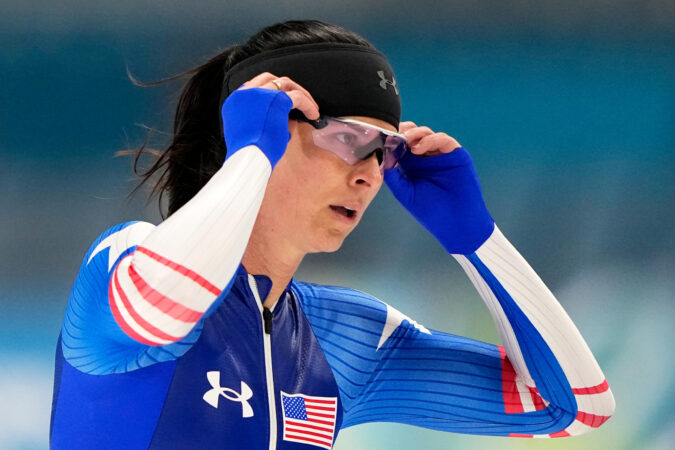
    This year, the top U.S. speedskaters are Erin Jackson on the women’s side and Casey Dawson on the men’s side. There’s also an interesting story in Brittany Bowe, and not just because of her impressive career.

    Bowe is going for her third career Olympic medal at age 37, having won bronze in the team pursuit in 2018 and another bronze in the 1,000 meters in 2022. She has held the 1,000-meter world record three times in her career, including the current mark since 2019, and is the American record holder in the 1,500.

    But that’s only part of Bowe’s story. She’s originally from Ocala, Fla., about an hour and a half north of Tampa — not what you’d think of as fertile ground for an ice sport. She trains at the Olympic facility in Salt Lake City, where the 2002 Games were held and the 2034 Games will be. It’s one of just six long track speedskating ovals in the United States.

    On top of that, Bowe played college basketball from 2006-10 at Florida Atlantic. She didn’t play against any Big 5 teams back then, so not many people around here would be able to say they saw her before she was famous. But plenty of people have seen her in recent times, and more will at these Olympics.

    The women’s 1,000 meters will be live on USA Network from 11:30 a.m. to noon Philadelphia time, then on NBC until 12:45 p.m. Other big events Monday include two that NBC will carry live: snowboarding’s women’s big air final at 1:30 p.m. and figure skating’s ice dance at 2:40 p.m. The ice dance competition will start on USA at 1:20 p.m.

    How to watch the Olympics on TV and stream online

    NBC’s TV coverage will have live events from noon to 5 p.m. Philadelphia time on weekdays and starting in the mornings on the weekends. There’s a six-hour time difference between Italy and here. The traditional prime-time coverage will have highlights of the day and storytelling features.

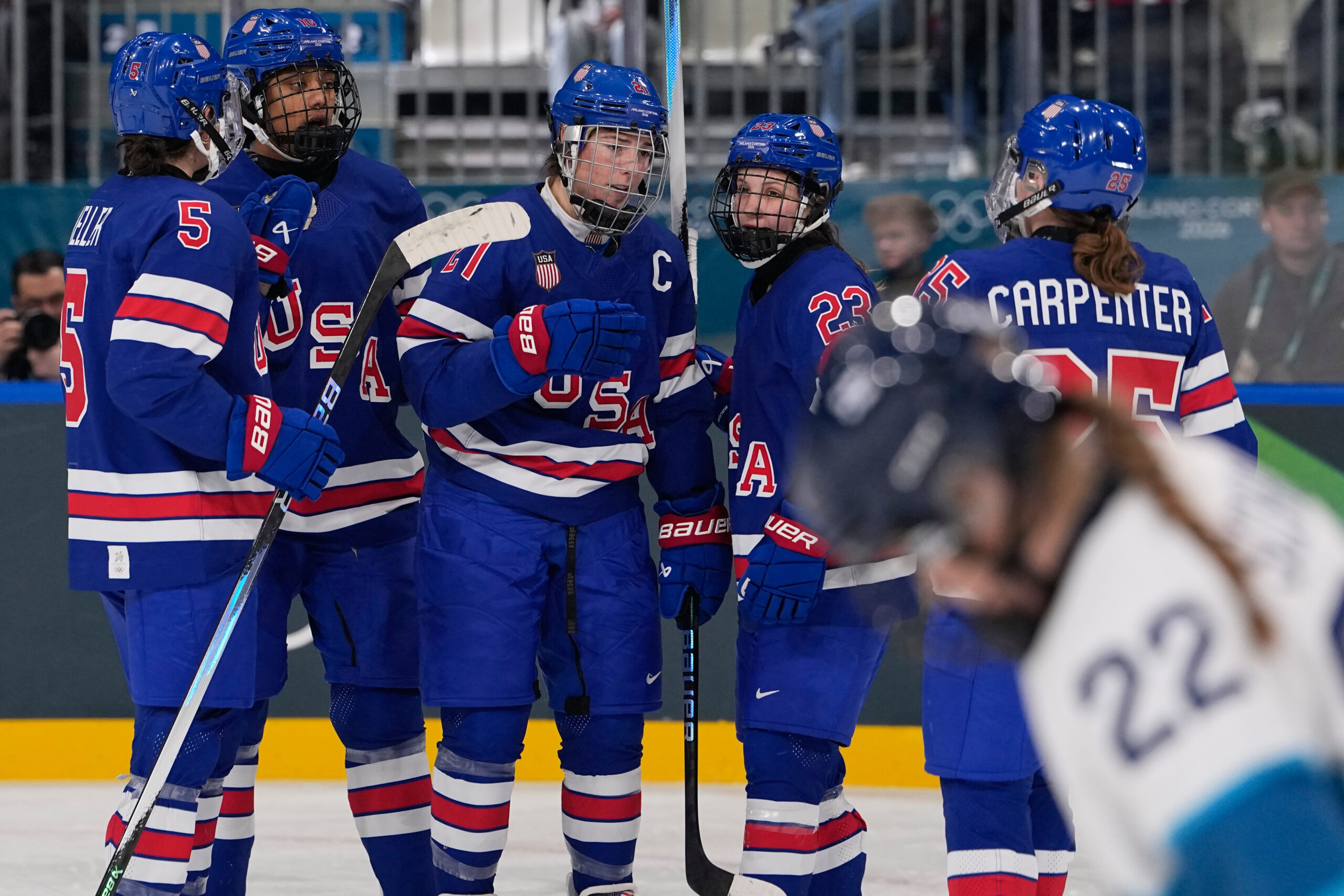
    The U.S. women’s hockey team plays its next-to-last group game on Monday, against Switzerland at 2:40 p.m.

    As far as the TV channels, the Olympics are airing on NBC, USA, CNBC, and NBCSN. Spanish coverage can be found on Telemundo and Universo.

    NBCSN is carrying the Gold Zone whip-around show that was so popular during the Summer Olympics in 2024, with hosts including Scott Hanson of NFL RedZone. It used to be just on Peacock, NBC’s online streaming service, but now is on TV, too.

    Every event is available to stream live on NBCOlympics.com and the NBC Sports app. You’ll have to log in with your pay-TV provider, whether cable, satellite, or streaming platforms including YouTube TV, FuboTV, and Sling TV.

    On Peacock, the events are on the platform’s premium subscription tier, which starts at $10.99 per month or $109.99 per year.

    Here is the full event schedule for the entire Olympics, and here are live scores and results.

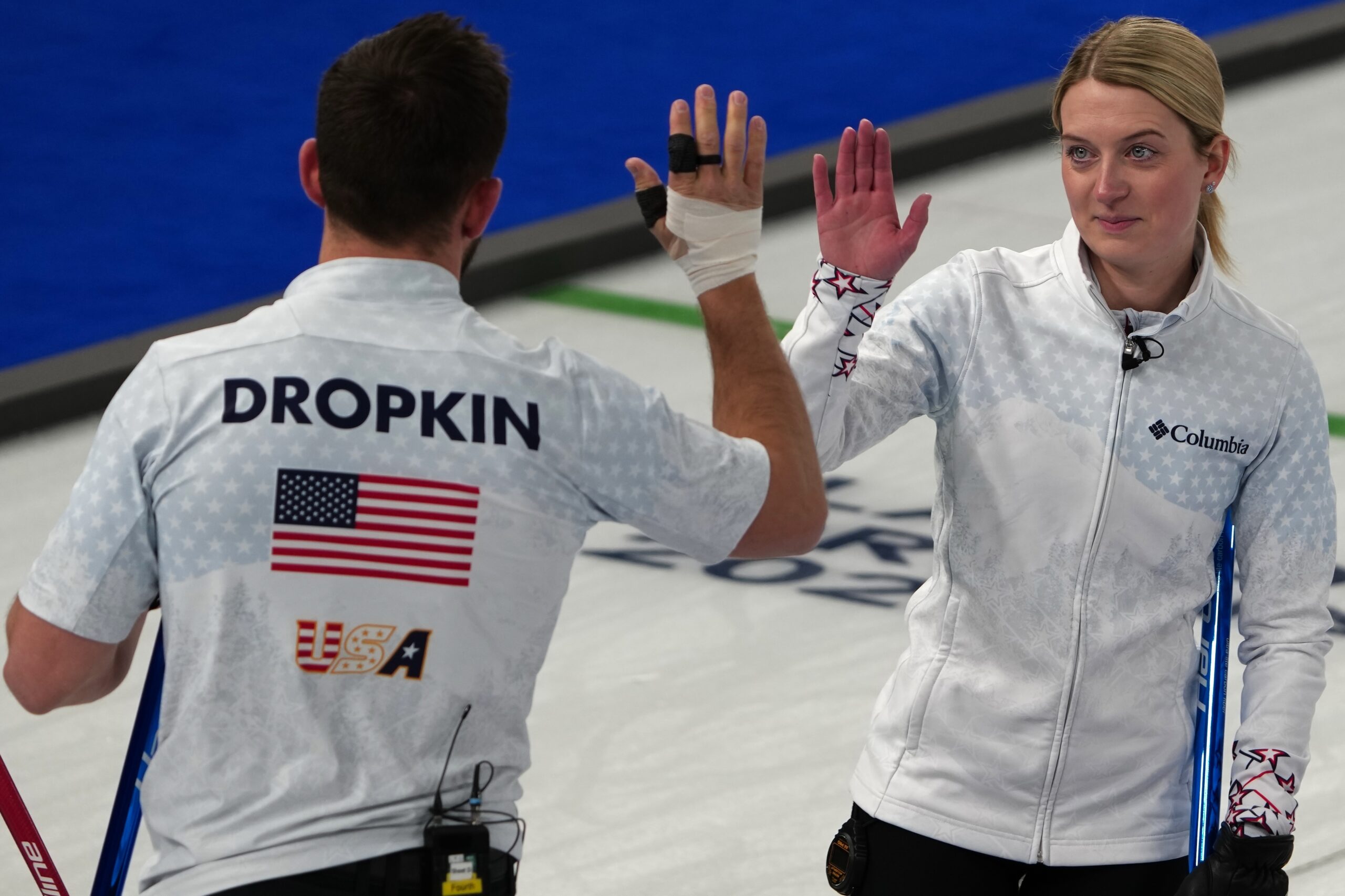
    Cory Thiesse (right) and Korey Dropkin are the first United States team to reach the curling mixed doubles semifinals. They’ll play in that round on Monday, just after noon Philadelphia time.

    Monday’s Olympics TV schedule

    NBC

    • Noon: Speedskating — Women’s 1,000 m
    • 12:45 p.m.: Alpine skiing — Men’s team combined, downhill and slalom (tape-delayed)
    • 1:30 p.m.: Snowboarding — Women’s big air final
    • 2:40 p.m.: Figure skating — Ice dance, rhythm dance
    • 8 p.m.: Prime time show replays including Alpine skiing, figure skating, and freestyle skiing
    • 11:35 p.m.: Late show replays including snowboarding and speedskating

    USA Network

    • 4:30 a.m.: Alpine skiing — Men’s team combined, downhill portion
    • 6:30 a.m.: Freestyle skiing — Women’s slopestyle final
    • 8 a.m.: Alpine skiing — Men’s team combined, slalom portion
    • 11 a.m.: Luge — Women’s singles first run
    • 11:30 a.m.: Speedskating — Women’s 1,000 meters
    • 12:05 p.m.: Curling – Mixed doubles semifinals
    • 12:35 p.m.: Luge — Women’s singles second run
    • 1:20 p.m.: Figure Skating — Ice dance, rhythm dance
    • 2:40 p.m.: Ice hockey — United States vs. Switzerland women
    • 5 p.m.: Ice hockey — Canada vs. Czechia women (joined in progress)
  • Philly native Mike Petrakis built PowerPay, a fintech company for people who think banks are too slow

    Philly native Mike Petrakis built PowerPay, a fintech company for people who think banks are too slow

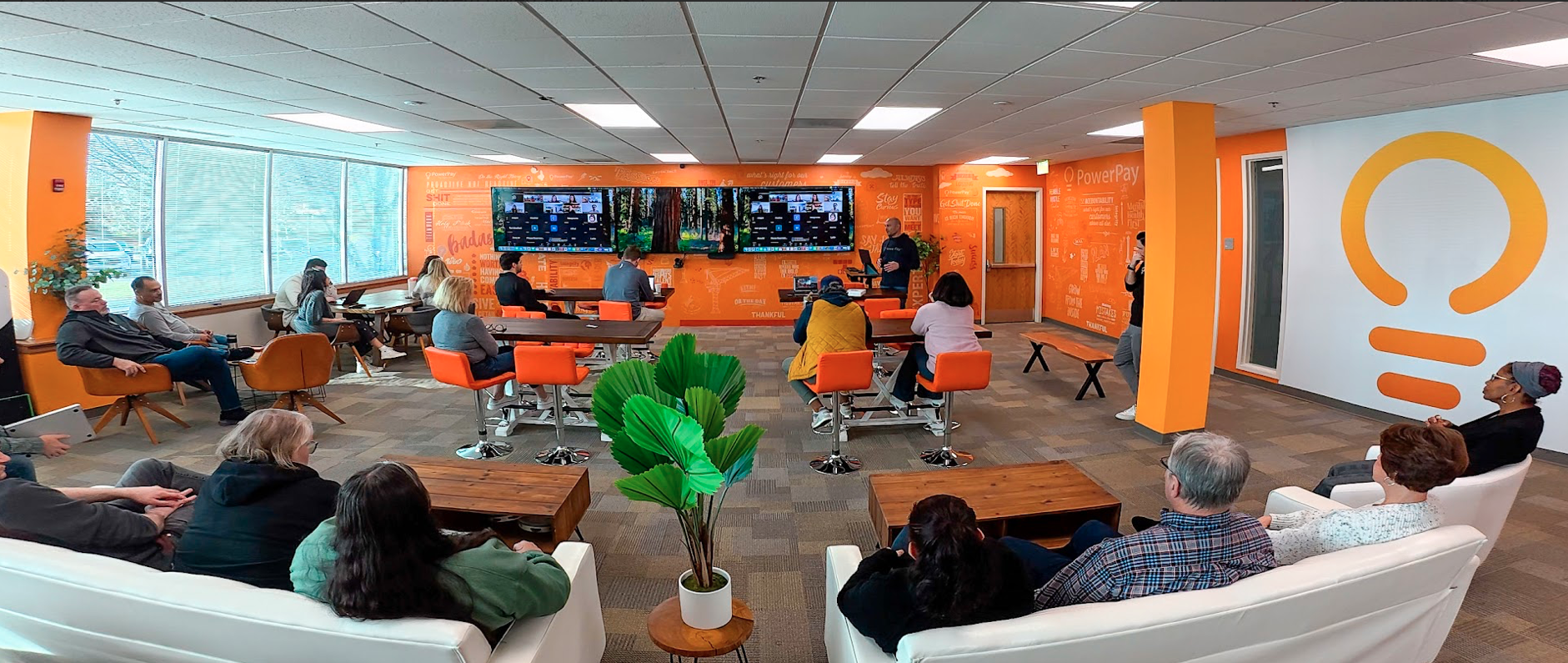
    The Philadelphia region, once a banking center, is still home to financial innovators. One of the growing digital lenders based nearby is seven-year-old PowerPay, whose 225 staff members build a software platform to finance home improvement loans, personal loans for hearing aids and other medical needs, and a growing list of services, from its new offices just off U.S. 202 near King of Prussia.

    PowerPay revenues more than doubled to $200 million last year, as the company processed $6 billion in loan applications.

    The company raised its local profile last winter when it cosponsored the Christmas light show at the former Wanamakers in Center City. That got its name out to more prospective employees and borrowers.

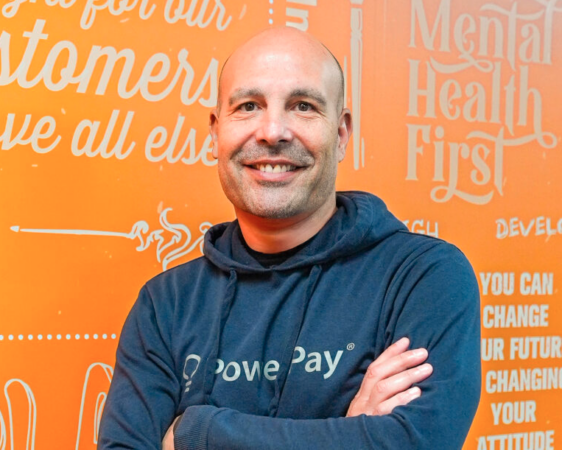
    Founder Mike Petrakis, a native of Northeast Philadelphia and Archbishop Ryan High School graduate, played varsity soccer at Drexel University and briefly went pro in England. He settled in Doylestown and a sales career, which led him to start PowerPay in 2017. Early backers included hoteliers Jay Shah and Eustace Mita.

    He agreed to talk to The Inquirer about his company’s growth and prospects. Questions and answers edited for clarity and brevity.

    What’s the difference between your company and a bank?

    A lot of people think banks are inconvenient. Their loan docs are thirty-some pages. With fintechs, someone applies in seconds, and in milliseconds you can get an offer back.

    We collect thousands of data points — email transmissions, phone checks, geotagging, information in databases that is available. Social media, not so much. We make sure we can recognize the device from which they are putting in the application. We put all this into our models.

    We are onboarding more artificial intelligence. We take a driver’s license and check — does the signature match the customer on the platform? is that image theirs? It is done in an instant.

    Lending has become an automated business. Why do you still do so much business by phone?

    You get a loan with us, you are going to be connected to us for the next 15 years, and we need to be connected to each other. We are deploying digital routing that moves them from an initial inquiry to a specialized team member without the traditional “on hold.” And we have engineers on premise and around the world.

    The goal is to work so hard to get the consumer that we can keep them in perpetuity.

    PowerPay has its headquarters just off U.S. 202 near King of Prussia.
    Since you’re not a bank, how do you fund these loans?

    Credit unions financed our loans early on. Now we have KeyBanc and Capital One and other major lenders.

    We aren’t a bank, so we don’t have the same oversight, and we can move faster. But we work with banks, so our processes are built to be fully compatible with bank regulations. We process half a billion dollars’ worth of loans a month, which is larger than most banks.

    What do you do any better than a bank?

    We just built a new product, PowerPay 360. You pay interest only for 12 months, then interest and principal for 14 years. Leaves a little extra cash in their pocket for a year. We set that up in 30 days.

    Banks are so conservative; for them to build that, with their large, core technology systems, it would take them years to get it into the market. Apple tried to get in the consumer financial business and left within two years.

    We are adding credit card and mortgage products, and healthcare loans, too. We just opened a relationship with U.S. Bank to grow that relationship to half a billion dollars.

    Credit cards have moved from plastic into a whole digital landscape for the consumer. We are making it so [in late 2026] you can tap your smartphone or mobile device at Home Depot and not just buy supplies but also hire your installer or service provider, and get an installment loan to pay for the whole project.

    What else are you preparing to sell?

    We now have an insurance business. We sell credit-default insurance for the benefit of our financial sponsors. Our underwriter is domiciled in the Cayman Islands under their financial regulations. We aggregate the risk into asset-backed securities [and sell loans in risk-based pieces to get higher returns]. We sell those to investors, and the insurance comes off.

    We’re going to grow insurance. Involuntary unemployment, disability, credit, life. We would domicile that in the U.S. We are talking to large insurance carriers we could front for and share the risk.

    How did you get into this business?

    In 2017, I was a national contractor, [helping buyers finance] home generators for Generac, Cummins, Kohler, Briggs & Stratton. You pay $99 a month for 10 years, and we’d get them a loan with Synchrony or GreenSky [two online-lending pioneers].

    Generac came to me and said, how can we make these loans, too? I said start a national call center. It took me six months to find a software platform and a credit union to finance us.

    At first we were just a couple of people, sitting in the Whole Foods beer garden in Plymouth Meeting. We’d have breakfast, then set up our laptops that we bought at Best Buy, initiating loans and writing the code on third-party platforms. Then we grew out of Whole Foods, and we got our first office at the Life Time fitness club in Ardmore.

    We took over an auto-loan platform and converted it to make home-equity loans. We were ready to really build it up, and then Generac backed out.

    So we said, what else can we finance with this? We approached the big home improvement companies, Renewal by Andersen window installations, and others.

    What was it like, launching into the pandemic?

    The home improvement companies were sitting on millions in applications they couldn’t get funded. We underwrote those loans and got them funded, at first, by credit unions.

    We onboarded 100,000 users overnight, and we nearly blew up the software platform we were using. So we built our own, and now we own all our intellectual property.

    We went at first to many credit unions, and they shared participation with other credit unions, but then they would get scared and pull out. We still weren’t big enough for Goldman or JPMorgan. Even the second-tier banks would only lend part of the money. Finally, we found one credit union, Chartway [based in Virginia], they kept the doors open.

    In 2023, we were ready to sell loans in our first securitization. We kept servicing rights. That legitimized us in the eyes of the bankers. Capital One agreed to help us with the securitization.

    There were 50 lawyers involved! We only did a $118 million deal. But we have done much larger ones since, and now I can get it done with a lawyer on each side in a couple of days. We underwrite the loans, we insure them, and then we sell them, de-risking.

    It becomes a cost-of-funds game — the lower the cost, the less onerous the rates we can offer consumers.

    We can drive billions more through this platform.

  • Ooh la la: France’s unparalleled team of superstars will light up Philly in the World Cup

    Ooh la la: France’s unparalleled team of superstars will light up Philly in the World Cup

    There will be a lot of great teams and fun vibes in Philadelphia’s World Cup games this summer. But none will be able to match France’s array of superstar talent.

    In fact, almost no other team in the world can run with the team’s depth, except maybe Spain and England. Brazil, which also will play in Philadelphia, probably is fourth.

    It’s not just that France has all-everything forwards Kylian Mbappé and Ousmane Dembélé, the latter the current holder of the Ballon d’Or as the world’s best player. The team has astonishing depth at every position on the field and players at elite clubs around Europe.

    They span all ages, too, from 34-year-old midfield anchor N’Golo Kanté to 19-year-old playmaker Warren Zaïre-Emery. Manager Didier Deschamps, in his third and final World Cup at the helm, will have the task of trying to pick 26 players for his squad from a sea of talent.

    France’s Kylian Mbappe is hoping to pick up where he left off on what was a breakthrough performance at the 2022 World Cup in Qatar.

    Not that there’s any pressure, either, after France won the 2018 World Cup — Mbappé’s breakout on the big stage — and made the 2022 final. Just three teams in soccer history have made three straight World Cup finals: West Germany’s men in 1982, ’86, and ’90; Brazil’s men in 1994, ’98, and 2002; and the U.S. women in 2011, ’15, and ’19.

    It won’t be surprising if France joins that club this summer, but it will be quite impressive. Les Bleus have tough group games against Senegal, the newly crowned African champion, and Norway, with its own stars in Erling Haaland and Martin Ødegaard.

    In the knockout rounds, Germany could await in a round of 16 game set for July 4 in Philadelphia. Getting to see France here twice would be quite a treat for local fans, especially that matchup.

    France’s World Cup schedule

    (all times Eastern)

    Tuesday, June 16: vs. Senegal in East Rutherford, N.J. (3 p.m., Fox29)

    Monday, June 22: vs. Bolivia, Suriname, or Iraq at Lincoln Financial Field (5 p.m., Fox29, tickets)

    Friday, June 26: vs. Norway in Foxborough, Mass. (3 p.m., Fox29)

    Fast facts

    France’s opponent in Philadelphia will be determined by a UEFA playoff in March. Bolivia will play Suriname on March 28, and the winner will play Iraq on March 31, with both games in Monterrey, Mexico. … France is one of only eight nations to have won a men’s World Cup. It became that club’s seventh member in 1998, with a team led by the legendary Zinedine Zidane. … The Paris region has been renowned for nearly a decade as having the biggest pool of young soccer prospects anywhere in the world. … Six candidates to make France’s team played in Philadelphia during the Club World Cup, though Mbappé did not because he was ill when Real Madrid visited. … Local estimates say just over 71,000 people in the region claim French ancestry.

    Three players to watch

    Kylian Mbappé: The star of stars, with a personality to match his prolific scoring and creativity. One of the biggest in this tournament too, with Lionel Messi (Argentina), Cristiano Ronaldo (Portugal), and Lamine Yamal (Spain). Thousands of fans will flock to South Philly just to see him, no matter what jersey they’re wearing.

    Ousmane Dembélé: Before he led Paris Saint-Germain to last year’s Champions League title and the Club World Cup title, he was one of the most frustrating players in the sport. For all his skill, he had a track record of messing up some of the biggest scoring chances you could imagine. Something finally clicked last season, and now he’s almost unstoppable.

    William Saliba: France isn’t just stacked in its attack. Its defense also is terrific, and Deschamps cares about that a lot — he was the midfield anchor of France’s ’98 champions that won the European championship two years later. Saliba is a stalwart centerback for Les Bleus and English club Arsenal, and at 24 years old is only just starting to hit his peak.

    William Saliba (center) is a formidable force on the back line of France’s defense.

    France’s Philly connection

    There isn’t much, soccer-wise, but there have been connections outside sports for centuries. France was the first ally of the British colonies that declared independence in 1776. Benjamin Franklin led the diplomatic effort, and, in 1778, France signed the Treaty of Alliance to give its official backing.

    In the early 20th century, French architect Paul Philippe Cret designed the Benjamin Franklin Parkway, modeled on Paris’ famed Avenue des Champs-Élysées. Cret also designed the bridge named in Franklin’s honor and helped renovate Rittenhouse Square into what’s now Philly’s best-known city park.

    If you’re an art fan, Philly has two of the world’s largest collections of works by famed French artists: painter Pierre-Auguste Renoir at the Barnes Foundation, and the Rodin museum for sculptor Auguste Rodin. Fans walking from Center City to the World Cup fan fest on Lemon Hill will pass by both on the Parkway.

    Make sure you check out …

    Philly and the surrounding area claims a cherished legacy of great French restaurants — Le Bec-Fin being chief among them — but food writer Beatrice Forman recommends Supérette, a new-school but extremely legit entry to the city’s Gallic scene.

    The interior of Supérette, a market and restaurant that will be all things France in Philly during the World Cup.

    This all-day French wine bar has perfected the art of the “sip-and-nibble” with a menu of compulsively snackable light bites that range from a sheet of tiny raviolis stuffed with comté to a sandwich on pinsa bread (focaccia’s thinner sister) layered with potato chips and customizable charcuterie boards.

    The space is divided down the middle into a casual yet effortlessly trendy bar and an épicerie that sells a curated mix of meat, cheeses, prepared goods, and imported French snacks. Who’s to say you can’t enjoy a baguette straight from the bread bag at a soccer game? 📍1538 E. Passyunk Ave., superettephl.com

    SEPTA’s Broad Street Line train is a direct path from the city to the stadium on game day.

    Navigating Philly

    The best way to navigate getting to the stadium area where the games will be held is via SEPTA, the city’s public transportation system. The network has its own app and is fully integrated into apps, including Google Maps, Apple Maps, Transit, and CityMapper.

    Whether you’re coming in by way of Philadelphia’s international airport or its main train hub, William H. Gray III 30th Street Station, it’s easy to get around Philly’s Center City district and other neighborhoods by bus, train, or trolley.

    Don’t feel like figuring out all the schedules? Taxis or ride shares via Uber or Lyft also are quick and convenient options.

  • A K-8 Jewish day school is proposed for Washington Square West

    A K-8 Jewish day school is proposed for Washington Square West

    A long vacant parking garage at 510-28 S. Eighth St. sits between some of Philadelphia’s most desirable neighborhoods, and Rabbi Yochonon Goldman hopes it could soon be the site of Center City’s only Jewish day school.

    It all depends on how the Zoning Board of Adjustment rules.

    The four-story, almost 36,000-square-foot plan for the building is the third iteration of the proposed K-8 school. Goldman, who is rabbi of B’nai Abraham Chabad, and developer Masada Custom Builders are seeking neighborhood support for the project.

    The proposal has stirred controversy for its height, size, and the inclusion of several apartments. The project needs seven variances from the city’s Zoning Board of Adjustment, largely because the garage is zoned for multifamily rowhouse development, just like most of the surrounding blocks.

    The plan is more likely to succeed at a zoning hearing if it has the support of local neighborhood groups, chiefly the Washington Square West Civic Association.

    “I truly believe that this educational institution will enhance our neighborhood,” Goldman said at a neighborhood meeting last week. “It will be a tremendous asset to all residents of the neighborhood, whether you’re Jewish or not.”

    Goldman’s synagogue runs a successful nearby pre-kindergarten program at the synagogue on 527 Lombard St., and many parents are frustrated by the lack of a Jewish elementary school in the area.

    But the Lombard Mews homeowners association, which borders the site to the west, has organized to negotiate with the development team and hired veteran zoning attorney Paul Boni.

    Immediate neighbors say they are most concerned with the proposed building’s size and height, which in early iterations was five stories. They are skeptical of plans to build three apartments on top of the school, saying the apartments would bulk up the structure.

    Speakers from Lombard Mews included Aren Platt, who served as one of Mayor Cherelle L. Parker’s top advisers during her election campaign and the first year of her administration. He reiterated that his neighbors’ chief concern was with height and size, not the idea of a school in this location.

    Two of the apartments above the school would be small studios for interns who join the faculty and will need affordable nearby residences. The largest would be for the rabbi’s family: a bi-level condo with a private elevator and roof deck.

    A rendering of the Jewish day school planned for the Washington Square West neighborhood.

    At the meeting, the design team noted that the current version of the building is 52½ feet, down from over 70 feet originally. The team reduced the ceiling height of each floor and eliminated one story from the plans.

    Still, critics argued against the apartments — especially given that the classrooms have shrunk to meet neighbor demands but the living units remained intact.

    “We’re puzzled as to why the proposal includes three luxury dwelling units on the top,” Boni said at the meeting. “Eliminating that square footage would seem to go a long way toward meeting our requested building envelope.”

    Goldman argues that the apartments atop the school are essential to the project’s success.

    “A rabbi’s home is not just a private residence; it’s a communal space which builds strong relationships among community members who become like an extended family, sharing meals with the rabbi’s family,” Goldman said in an email. “It’s all part of the educational model which we envision for the school.”

    Goldman also says that having a responsible and active presence on site 24/7 will be a positive for the school building. But most important to him, the close proximity will aid in the religious practice of his community.

    “This space is not just a home. It is a vehicle for hospitality and connection,“ he said. ”Beyond the academics offered in the classroom, the school is a place where the values of Judaism come to life.”

    Some opponents thought the school should be rejected entirely for its attempt to bypass the property’s zoning. The proposal provides only 12 parking spaces, while the zoning requires twice that, and a roof deck is not allowed under current land-use rules.

    Regarding parking and potential congestion from the plan — a fear expressed by some nearby small business owners — the development team said their traffic study showed that 50% to 60% of students would walk to school, as they already do to the pre-K program. Supporters noted that many Jewish families who do not drive on Shabbat and certain holidays would prefer to live within walking distance to school.

    “Right now, we have 75 kids, and at least 60 from those kids are walking,” said Isaac Ohayon of Masada Custom Builders. “They live in the neighborhood. … They’re all no more than 10 to 15 blocks away.”

    The Washington Square West Civic Association will vote Tuesday on whether to support or oppose the project when it goes before the zoning board March 4.