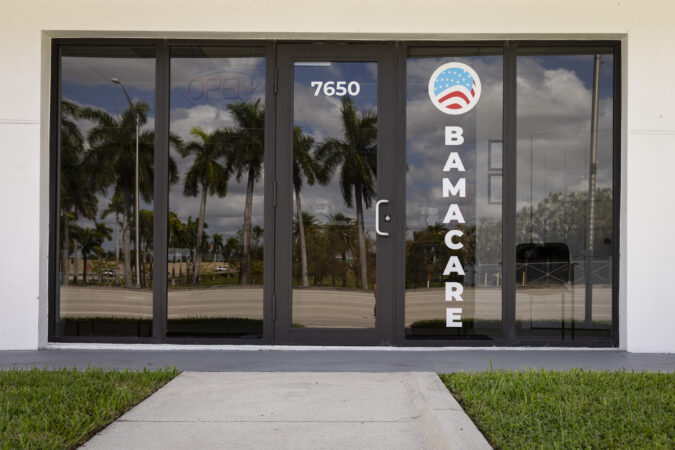
Amid rising inflation and business costs, many Philadelphia corner stores, bars, laundromats, and smoke shops have turned to skill games, the slot machine look-alikes, to help keep their slim margins afloat.
The machines, which shop owners say also encourage their customers to linger in stores and make additional purchases, are particularly profitable because theyare not taxed or regulated like slot machines — and they have been operating without state oversight in a legal gray area for more than a decade. But a recent state Supreme Court ruling may force that tochange.
Last week, Pennsylvania’s highest court handed down a decision deeming skill games the same as slot machines. That means the skill game terminals proliferating around the state will soon be illegal if not operated and taxed at 52%, and housed in a highly regulated casino or truck stop with a license to carry slot machines. Those terms will take effect in less than four months unless the state legislature intervenes.
Owners and clerks at several corner stores throughout Philadelphia that offer the games say they do not contribute a lot of revenue to their establishments directly, but they foster more of a lounge atmosphere in the shops that leads patrons tostay longer and purchase more snacks, drinks, lottery tickets, and other goods. Many of the business owners said they are willing to stomach a tax on skill games, but additional regulations would make them rethink keeping the machines.
José Pérez, who runs a corner store on Opal Street in South Philadelphia, said his store runs on incremental profits. And, he said, when people play the skill game machines and start feeling lucky, they often are inclined to make other purchases there.
“This business is about getting a little bit of money from every product, and the machines are a tiny source of income that adds up to that,” he said in Spanish between transactions at the store’s register. “While people play, they buy other stuff in the store. And if they win, they buy lottery tickets. Because when someone has one vice, they probably have two.”
Tax proposals from Harrisburg
Lawmakers in Harrisburg have for years failed to reach an agreement on how to tax and regulate the so-called skill games
The issue has proved to be tricky in Pennsylvania’s split legislature, where Democrats narrowly control the House and Republicans control the Senate. The skill games industry leader, Georgia-based Pace-O-Matic, long maintained a friendly relationship with the Senate GOP, and the Republican lawmakers appeared willing to support policies that benefited them. But last year, the goodwill began to sour after the company backed political campaigns against incumbent Republican state lawmakers who did not support its requested low tax rate on the machines.
State Rep. Danilo Burgos (D., Philadelphia) and State Sen. Anthony H. Williams (D., Philadelphia) have introduced a bipartisan bill in their chambers to impose a $500-per-month fee on each skill game machine operated in Pennsylvania, with a 50,000-machine cap across the state. There are currently an estimated 70,000 skill game machines in Pennsylvania, according to the state attorney general’s office.
Skill games can be seen through the door of a mini mart on Kensington Avenue in the Kensington section of Philadelphia on Wednesday, July 30, 2025.
The proposed legislation would split revenues among transit and infrastructure, local governments, and state police for enforcing the cap and fee. The bills also prohibit small businesses whose “primary source of net revenue” is from skill games, in an effort to prevent mini casinos in stop-and-go corner stores around the city. Burgos estimates the regulations would bring in $300 million in new revenue to the state in their first year.
The bill includes additional protections for Philadelphia, where City Council voted in 2024 to ban the machines. The ban never went into effect, after a lawsuit was filed seeking to block it. In the legislation before the General Assembly, Philadelphia has specific carve-outs that would allow city officials to block stop-and-go businesses or “chronic nuisance” businesses from getting a license to carry the games.
Surrounded by hundreds of skill games supporters at a news conference Wednesday on the Capitol steps in Harrisburg, Williams said rank-and-file lawmakers would hold up passing the state budget, due June 30, if there is not a deal to protect small businesses from losing their skill games altogether.
“In this time when everybody talks about affordability, I can’t afford a 52% tax,” Williams said.
The fee-per-machine option offered in the Democratic-sponsored bills is backed by Pace-O-Matic, which has spent millions of dollars on political campaigns and lobbying in the state, in addition to millions more spent by other parts of Pennsylvania’s booming gambling industry.
Meanwhile, a separate proposal backed by the Senate GOP and penned last year would set the tax at 35% on gross terminal revenue, in addition to annual license fees. A small portion of those fees would go toward the state’s resources for problem gambling.
Gov. Josh Shapiro, a first-term Democrat, has proposed taxing the machines at the same rate as slot machines — a hefty 52% levy on each machine’s net revenue — in his last two budget proposals. As the machines have continued to proliferate around the state, Shapiro’s office estimated the newly regulated industry could bring in nearly $800 million in revenue in its first year.
Uncertain future with uncertain revenue
Philly store owners were divided on whether it would be worth keeping the machines if they needed to pay a lofty tax on either housing the devices or the profits they made on them.
Andrew Karki, who operates a laundromat near Pérez‘s store in South Philadelphia, said the machines occupy the customers while they wait for their laundry to finish and, as at Pérez‘s store, lead to purchases of candy and soda from the small bodega he runs inside the laundromat.
He estimated the machines make up 15% to 20% of his monthly revenue, and he said he would likely be willing to take on a tax on the games, even a rather large one, to keep them around.
“It’s hard, but we got to pay it. We got to pay it,” Karki said.
For others, like Diego Reyes, who runs a secondhand shop on Kensington Avenue with about a dozen skill machines inside, taxing the small businesses for the machines does not seem fair. The terminals are often owned by small amusement companies, and are largely operated by Pace-O-Matic. The business owners get a cut from the machine’s revenue for allowing the terminal in their building.
“They should tax the owner,” Reyes said in Spanish, wearing a Phillies cap and T-shirt with a size-medium sticker still stuck on the back, as three people played the machines.
Pérez agreed that any tax should be on skill games companies and not on the businesses that carry them.
It is frustrating to think another tax may be coming down the line,he said,when small-business owners already pay so many of them and see little return on the investment in the community.
“Look outside, that pothole has been there for six months. We have no safety,” Pérez said. “What do you want me to pay more taxes for if you are not doing anything to better the conditions with it?”
Staff writer Isabel Maney contributed to this article.
The night before Roy Halladay died, he was with his team. It was Nov. 6, 2017, and Calvary Christian High School was playing an exhibition game in Clearwater, Fla.
Halladay, a pitching coach, showed up in baseball pants and a batting practice jacket, with a clipboard beneath his arm. This would not have been unusual for March or April, but fall ball was much more relaxed.
The rest of the staff, which was dressed in shorts and T-shirts, erupted in laughter. Halladay didn’t hesitate to fire back. “Thanks for the heads up,” he said with a grin.
As the Warriors jogged onto the field, just past 7 p.m., the future Hall of Famer sat on the bench. After a few innings, infielder Christian Cairo joined him.
He liked watching games with Halladay. The former Phillie and Blue Jay brought the same intensity to coaching that he did to his 16-year MLB playing career, but with a newfound lightness.
He’d routinely crack jokes from the dugout. Months earlier, a hitter from a local high school walked up to the plate. He had straight, long hair, all the way down to his back. Halladay turned to the mound.
“Hey!” he yelled. “Look out for the bunt! This chick can run!”
The high schoolers loved it.
“Ridiculous stuff like that,” said Halladay’s 25-year-old son, Braden. “It was funny because he’s saying this to, like, 14-year-old kids.”
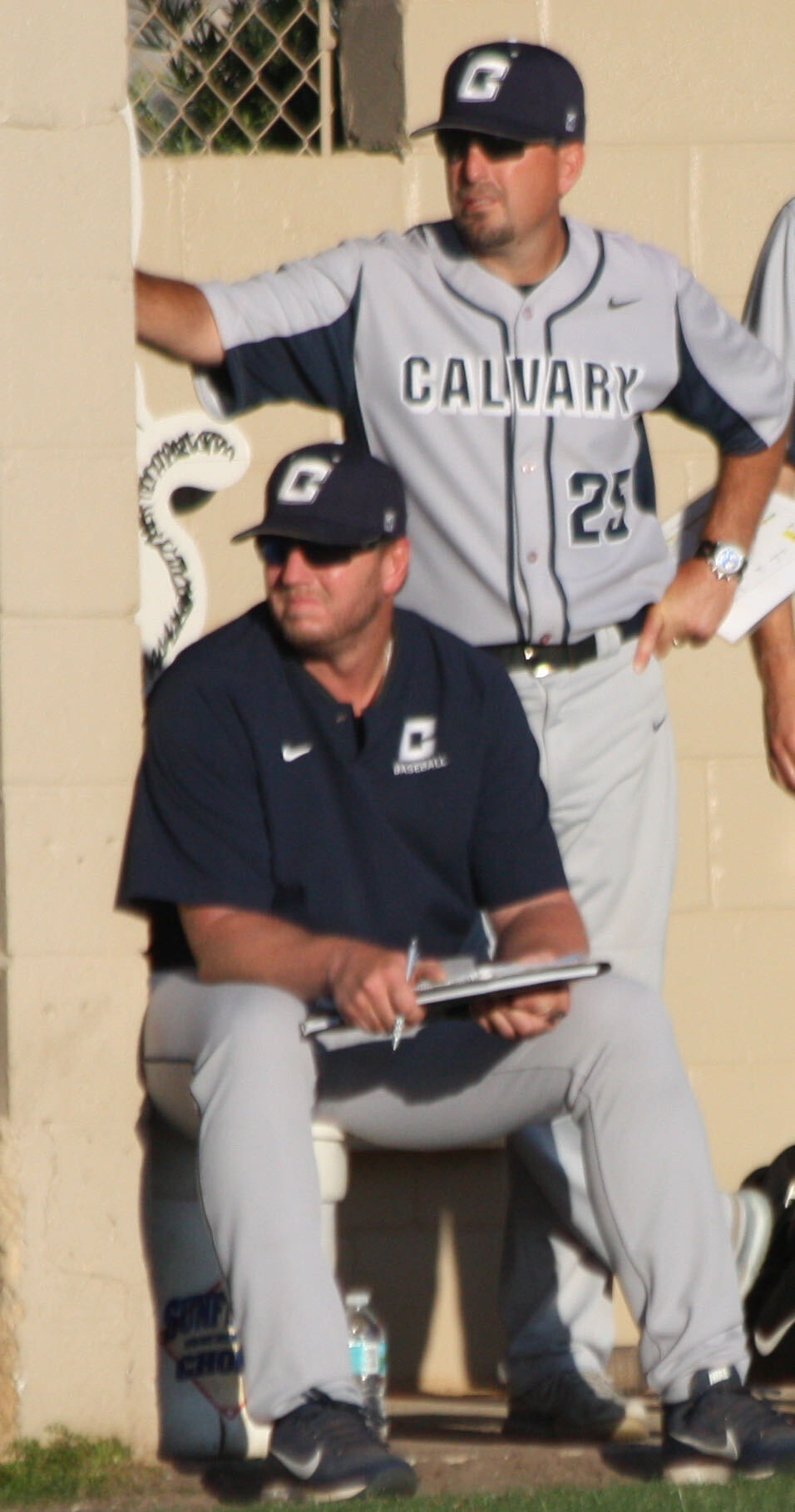
Coach Greg Olsen (seated) and pitching coach Roy Halladay during a Calvary Christian game in spring of 2017.
Halladay was in prime form on Nov. 6. The game wouldn’t count toward Calvary Christian’s record, but he was still taking notes and videos on his iPad.
He was also razzing everyone in sight: his players, their players, umpires.
“We were talking crap with each other,” Cairo said. “It was a lot of fun.”
At 9:30 p.m., the two teams left the field. By the next afternoon, ominous rumors had started to spread. Braden, then 17, got a call from his mother. She told him to pick up his 13-year-old brother, Ryan, and drive them to their house.
Pitcher Nolan Hudi texted Braden while he was in the car. He sent a link to a Twitter post: a selfie of him and Roy in the cockpit of his plane, taken three days prior.
The photo had gone viral. People were commenting “RIP.”
Hudi asked if people on social media had ever tweeted such morbid things about his father.
“No,” Braden said.
That morning, at 11:47 a.m., Halladay had flown his Icon A5 out of Brooksville-Tampa Bay Regional Airport. A few minutes after taking off, he crashed into the Gulf of Mexico.
The boys he coached are now men. Braden works in data analytics for the Texas Rangers. Cairo, 25, is a minor leaguer in the Phillies system. Some have played for other affiliates; Hudi spent a couple of years pitching at the University of South Florida.
They all cherish that 2017 season. Not just for what they learned (which was plenty) but for what they saw. As a big leaguer, Halladay was fierce and, at times, intimidating.
But as a coach, he was more laid back. He’d play pranks. He’d chirp. He’d try goofy things to help his team win, like flying a drone over a rival’s batting practice.
It was all refreshingly fun. What the players didn’t realize, though, was that they were giving Halladay something too.
“A way for him to enjoy baseball,” Braden said, “in a very pure form again.”
Roy Halladay won two Cy Young awards in his 16-year career, including in 2010 with the Phillies.
Roy being Roy
Halladay never liked the spectacle his success could bring. And it was difficult for him to escape.
His sons started playing travel ball in the early 2010s, at the height of his career. The Phillie would frequently be stopped for autographs at games and tournaments.
This attention got so bad that he started keeping a Groucho Marx-style disguise — black-rimmed glasses and a fake nose and mustache — in the back of his car.
“He thought it was hilarious,” Braden said, “because it’s the stupidest disguise you can come up with.”
But while Halladay didn’t enjoy the chaos, he did enjoy teaching. In 2011, Hudi played alongside Braden on a Florida team called the West Coast Warriors. Halladay, fresh off his second Cy Young Award, would stop by to help out.
One day, he approached Hudi during a bullpen session in Tarpon Springs. Halladay asked what pitches he threw. The 11-year-old’s answer was essentially “nothing.” He asked if he’d ever tried a cutter. Hudi shook his head.
Halladay grabbed a baseball and showed him a grip. Then he reached for a pen, and traced around Hudi’s hand, so the middle schooler could practice at home.
“He outlined where my fingers were,” Hudi said. “I thought that was so cool.”
Parents would ask Halladay if he’d be willing to coach, but he always demurred. The big leaguer wanted his son to carve out his own identity in the sport. Having a world-class athlete around would make that challenging.
But in 2014, he had a change of heart. Halladay had recently retired. Braden was only a year and a half removed from high school, and had experienced a few seasons on his own.
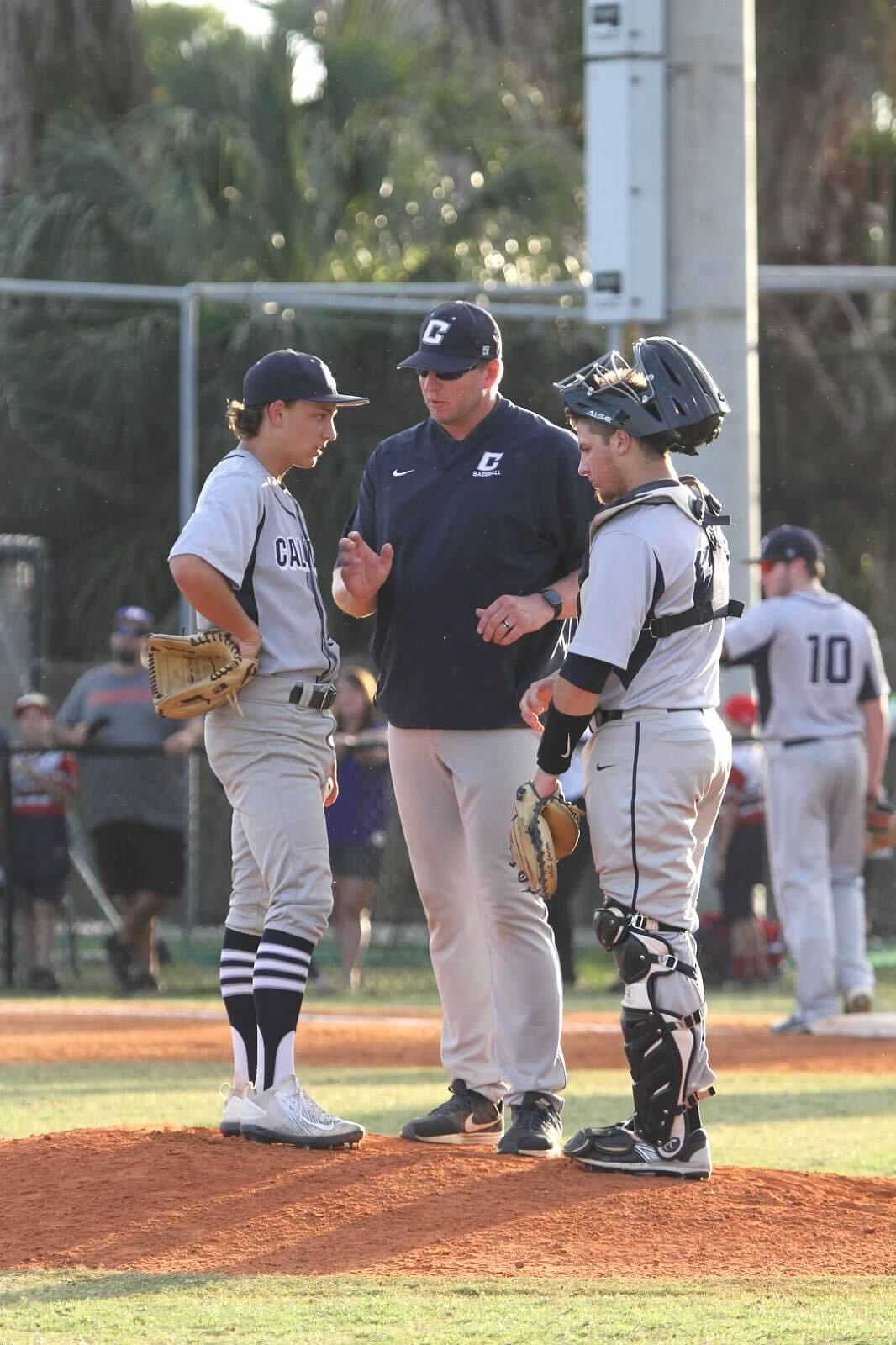
Roy Halladay talking to pitcher Nolan Hudi during a game in 2017.
The son encouraged his father to join the coaching staff of his travel ball team, the Dunedin Panthers. Halladay stayed through 2015, serving as pitching coach and later head coach.
He did not take this role lightly. Once, a baserunner bowled over Dunedin’s catcher at home plate. The league’s rules stated this should be an automatic out, but the umpires didn’t call it.
Halladay was furious. He explained to the crew that they’d made a mistake. One umpire, who didn’t recognize the eight-time All-Star, told him that he didn’t “know the rules of baseball.”
This set off Halladay even more. He was ejected. Braden, who wasn’t standing far away, overheard a conversation between the officials not long after.
“He goes, ‘Hey, dude, you know you just ejected Roy Halladay, right?’” Braden recalled. “And the umpire goes, ‘Oh my God.’”
Halladay decided to have himself a day. He went to the concession stand and bought three cheeseburgers. He filled his big Yeti tumbler with Diet Coke, got in his truck, and pulled it behind the left field fence.
He sat there for the rest of the game, scrutinizing the umpire’s every call. If he missed one, Halladay would let him know it, loudly proclaiming that the official didn’t “know the rules of baseball.”
Braden enrolled at Calvary Christian in 2016. He spent his freshman year playing junior varsity, without his father, and was promoted to varsity as a sophomore.
Halladay joined head coach Greg Olsen’s staff that year. Hudi transferred in from East Lake High School in Clearwater not long after. He and Braden were close friends; Hudi would sleep over at the Halladays’ house fairly often.
To Hudi, the 6-foot-6 Halladay was not a star pitcher. He was an eccentric parent. One time, when the boys were older, Hudi made the mistake of drinking Halladay’s last Dr Pepper.
Halladay barged into the game room, where Hudi and Braden were watching TV.
“Who drank the last [expletive] Dr Pepper?” he asked.
Hudi, holding the can with trepidation, said he didn’t know.
The pitcher stormed out. He returned 30 minutes later with two six-packs.
“He’s like, ‘This six-pack is yours,’” Hudi recalled. “And then he holds up another case, and he’s like, ‘Don’t [expletive] touch this. This is mine.’”
Roy Halladay had a 3.25 ERA in four seasons with the Phillies and tossed a perfect game in 2010.
Halladay brought the same attitude to the Warriors in 2017. Braden wasn’t used to seeing his father act this way on a baseball field.
“Whenever he was home, he was kind of a funny, not-take-things-too-serious kind of person,” he said. “It was more so that you’d notice at the field that he wasn’t doing that. And he actually was kind of a little bit scary.”
But at Calvary Christian, there was no pressure to uphold a persona.
“I think he just got to be himself,” Braden said.
A method to his madness
Olsen had been around a lot of coaches at this point, some of them former big leaguers. But he quickly learned that reaching the pinnacle of the sport didn’t necessarily translate to on-field instruction.
This was especially true when it came to resonating with kids. They could easily discern coaches who were sincere from those who were not. And if they deemed a coach insincere, it was over.
Halladay didn’t have this problem. He could explain grips and mechanical adjustments with ease (and without condescension).
Roy Halladay with his son Braden in 2017.
He would go beyond telling a player what to do. He’d help them find their feel. That way, when the high schoolers were alone on the mound, they could throw a curveball or a splitter, or any other pitch, and make corrections in the moment.
The coach showed no favoritism, not even to his son. He studied like he was still in the big leagues, sitting on a bucket with his enormous iPad, scribbling notes during games and practices.
“It was like a 55-inch flat-screen TV,” Hudi said. “And he’s a big guy, so him holding that giant thing made it look even crazier. Nobody knew what he was writing down.”
He didn’t need to show them. Halladay routinely proved he’d done his homework. In 2017, he helped Hudi redesign his entire windup, from stepping sideways to stepping behind the rubber, with his hands overhead.
Halladay wanted the pitcher’s momentum going toward the plate; otherwise, his stride would be inconsistent.
“The wealth of knowledge was crazy,” Hudi said. “And it went so much further than pitch grips.”
Halladay helped his team with mental skills, too. Olsen would often see him talking to players between innings, to strategize for upcoming at-bats or guide them through a tough moment.
He’d tailor his mound visits to whatever was needed, no matter how unorthodox it looked.
Braden remembered one game when he was losing his command. Halladay walked out to the mound but didn’t say a word. He just stared.
After the inning was over, the pitcher approached his father.
“Hey man, what was that?” Braden said.
“Were you thinking about throwing strikes?” Halladay asked.
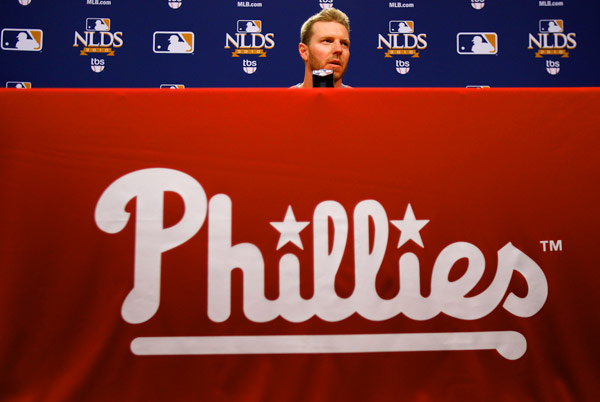
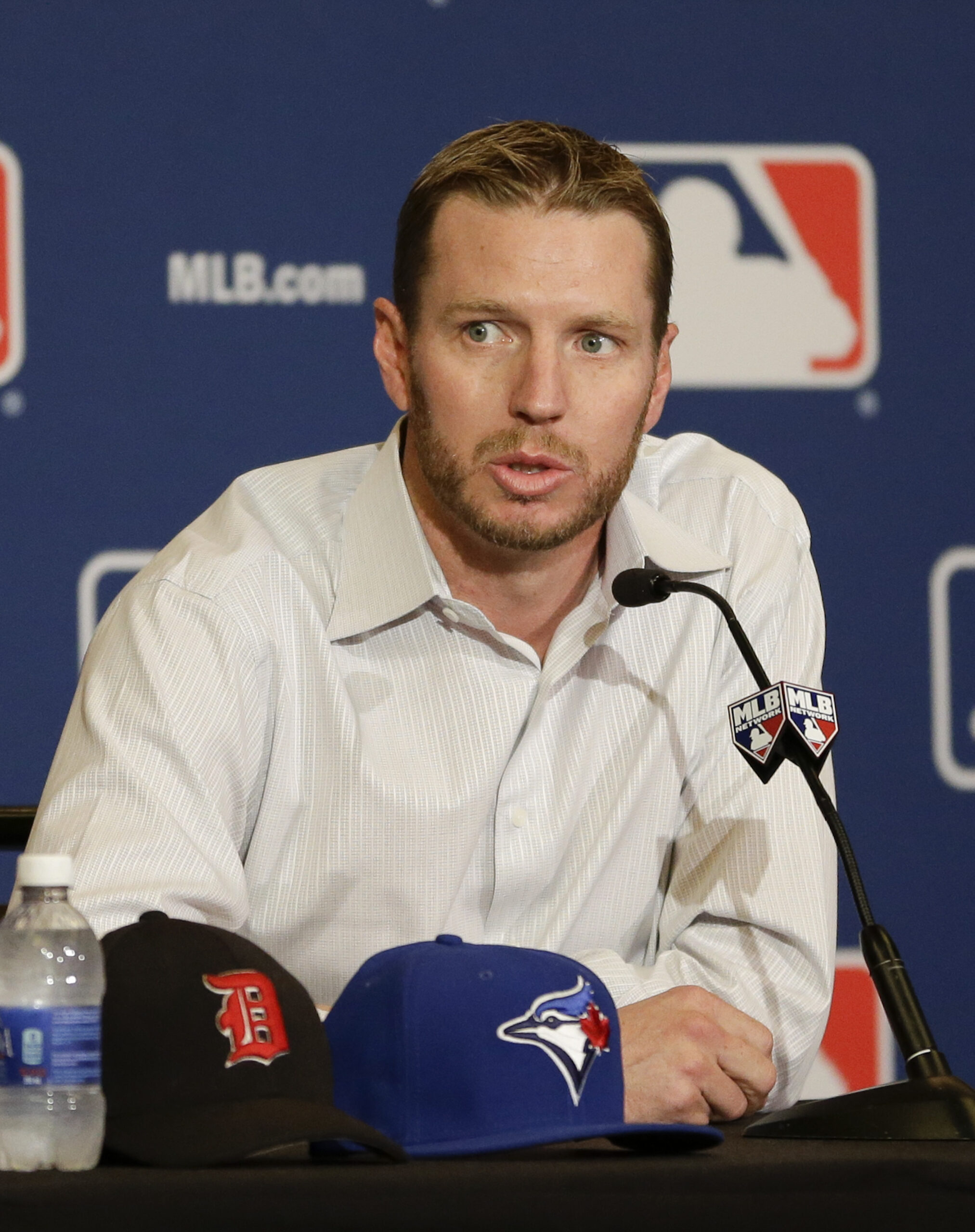
At his retirement news conference in 2013, Roy Halladay had a Dunedin Panthers hat among the caps for the teams he played for.
“No,” Braden said. “I was thinking about how weird that was.”
His father smiled.
“Exactly!” he said.
This was just one of many instances when Halladay was validated for his quirky ideas. He and Olsen would stand next to each other in the dugout, signaling pitches to Calvary’s catcher.
They usually agreed. But every once in a while, Halladay would propose something unusual. In the district semifinal, a formidable Tampa Catholic hitter took his final at-bat. He’d struck out twice earlier in the game on sliders.
Halladay wanted a fastball down the middle.
“He was like, ‘Look, we gotta go off script at some point,’” Olsen recalled. “And he was right. We threw a ball right down the middle, and the hitter froze. That was his genius of pitch calling.”
Two weeks later, in the regional final, Halladay called for a splitter in the ninth inning with a runner on first and a one-run lead.
There was one problem: The pitcher had never thrown a splitter in a game before.
“In that moment, I felt like this is either going to work, or our season could be over,” Olsen said. “Because the kid’s gonna hit it out. But he made the right call. We jammed him, he grounded out, and we won the game.”
Cairo, who was sidelined with a hand injury, had a front-row seat to all of this. Sometimes, the infielder would sit next to Halladay on the bench and go through pitch sequencing.
Other times, they’d just talk crap.
“I remember this one pitcher was talking a lot after we scored like six runs on him,” Cairo said. “Roy told him to go sit in his truck or something like that. That was fun.”
Calvary Christian didn’t lose a game that year. The Warriors were perfect in the regular season — despite enduring injuries to multiple players — and made it to the state championship in Fort Myers in late May.
By now, everyone knew of Halladay’s idiosyncrasies. So no one was surprised when he was caught flying a drone over Pensacola Catholic’s practice.
The opposing coaches saw a metal device whizzing through the air. They told a security guard, who spotted Halladay in the dugout with a remote control and a grin.
The security guard was not as amused. Had anyone else pulled this stunt, they would’ve been kicked out of the game. But Halladay knew the tournament officials wouldn’t do that.
He got a slap on the wrist.
“The official was like, ‘Hey, dude, like, you can’t spy on the other team with aerial equipment,’” Braden said. “And he was like, ‘Ahhhh … sorry, sorry.’”
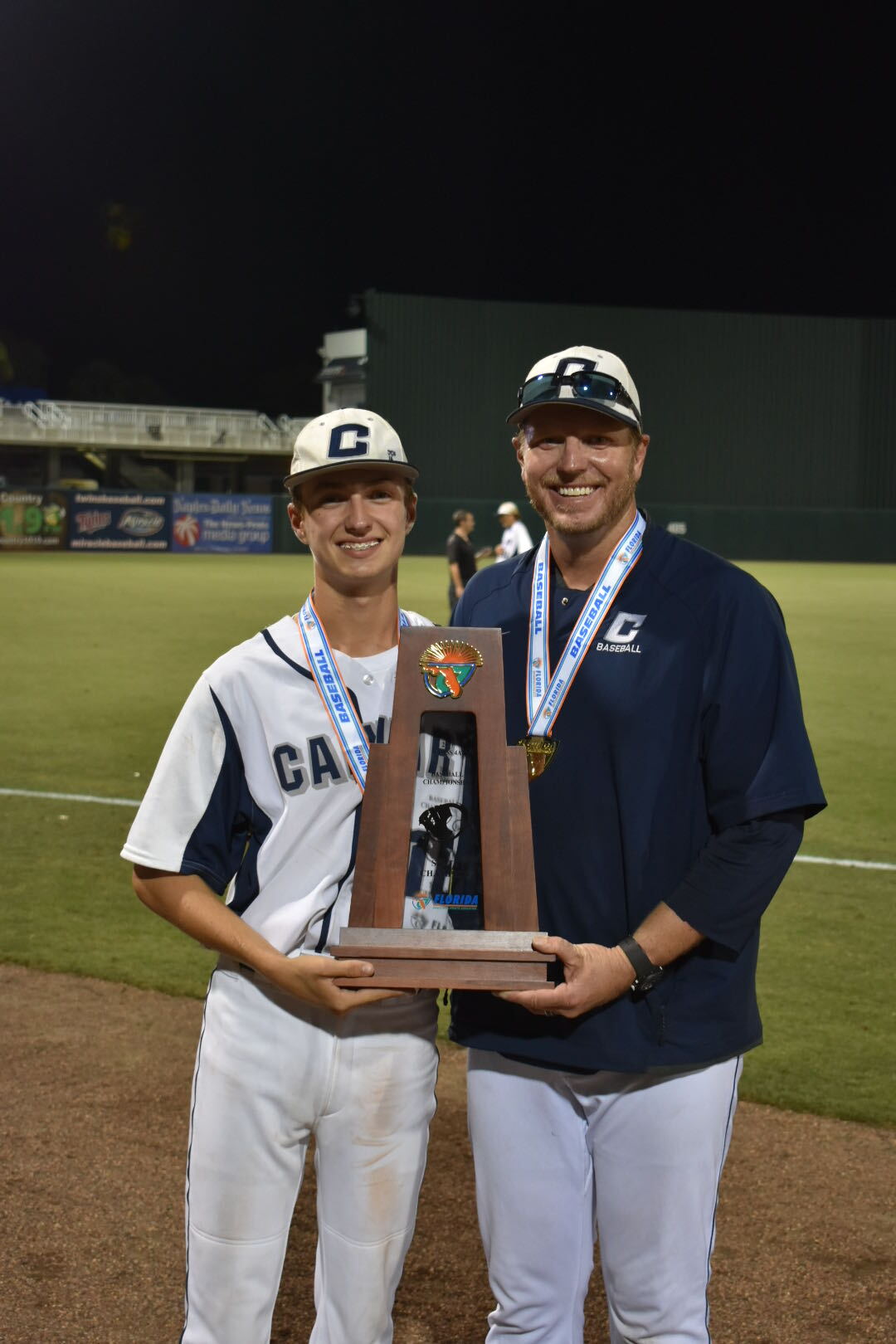
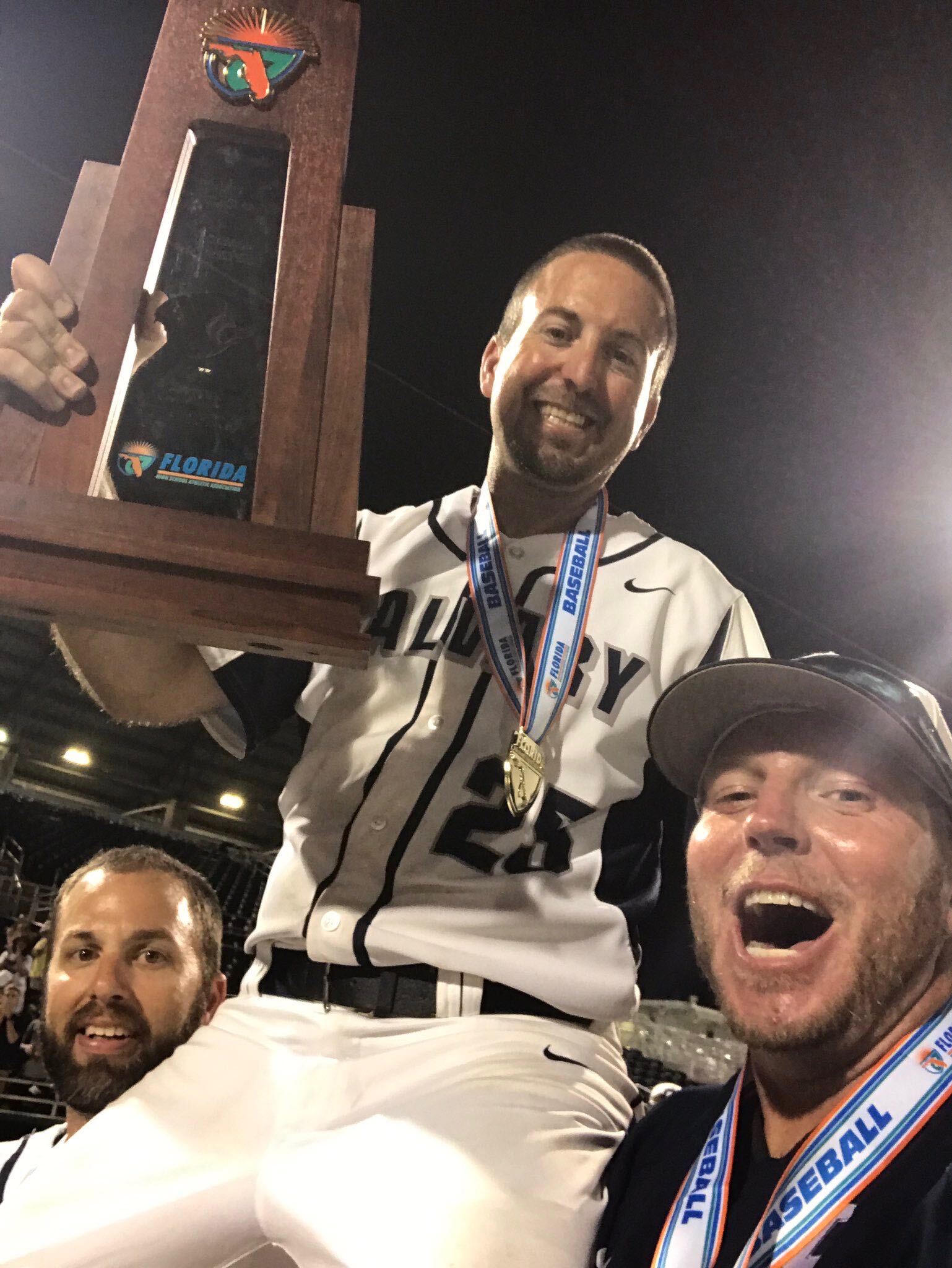
Roy Halladay and coach Greg Olsen after winning the state championship in 2017.
‘I really felt him there’
The drone surveillance didn’t end up being necessary. Calvary Christian won the Class 4A state baseball title handily. By the sixth inning, they’d amassed an 11-1 lead over Pensacola Catholic. The game ended by mercy rule.
The high schoolers sprinted from the dugout, jumping into a dogpile. Halladay flitted around the group, giving bear hugs big enough to lift players off the ground.
He and assistant coach Mike White hoisted Olsen on their shoulders, as he carried a wooden trophy. The former Phillie beamed from ear to ear. This wasn’t a World Series. But it was sweet all the same.
Halladay couldn’t wait to do it again next season, which is why he arrived to an exhibition game in full baseball garb in early November. But that would be the last time he’d see his team.
Yes here are the HS kids and me with my son! Proud dad, Proud coach, Proud member of a coaching staff! #familypic.twitter.com/3WgoW0kwC6
Braden described the days after his father’s death as a blur. Teammates and coaches came by the house to express condolences. Cairo and Hudi barely left his side.
On Nov. 8, Olsen gave the younger Halladay a call. Calvary Christian had another exhibition game scheduled for Nov. 9, against East Lake.
Braden was supposed to start, but Olsen said they could cancel it altogether if he wanted. He told his coach he would think about it.
Less than 24 hours later, Braden was in his car, driving to the ballpark. As he warmed up in the bullpen, he heard a loud noise.
The high schooler looked toward the sky to find a small airplane flying overhead.
“It looked exactly like my dad’s,” he said. “That brought me closer to him in that moment.”
At 7 p.m., Braden stepped onto the mound, with his father’s Calvary jersey hanging in the dugout. A typical November game would draw about 30 to 40 people; on this night, there were four to five hundred.
Braden insisted that he’d take it one inning at a time, but once he started, he couldn’t stop. Four frames later — a long outing by fall ball standards — he’d allowed one hit and no runs.
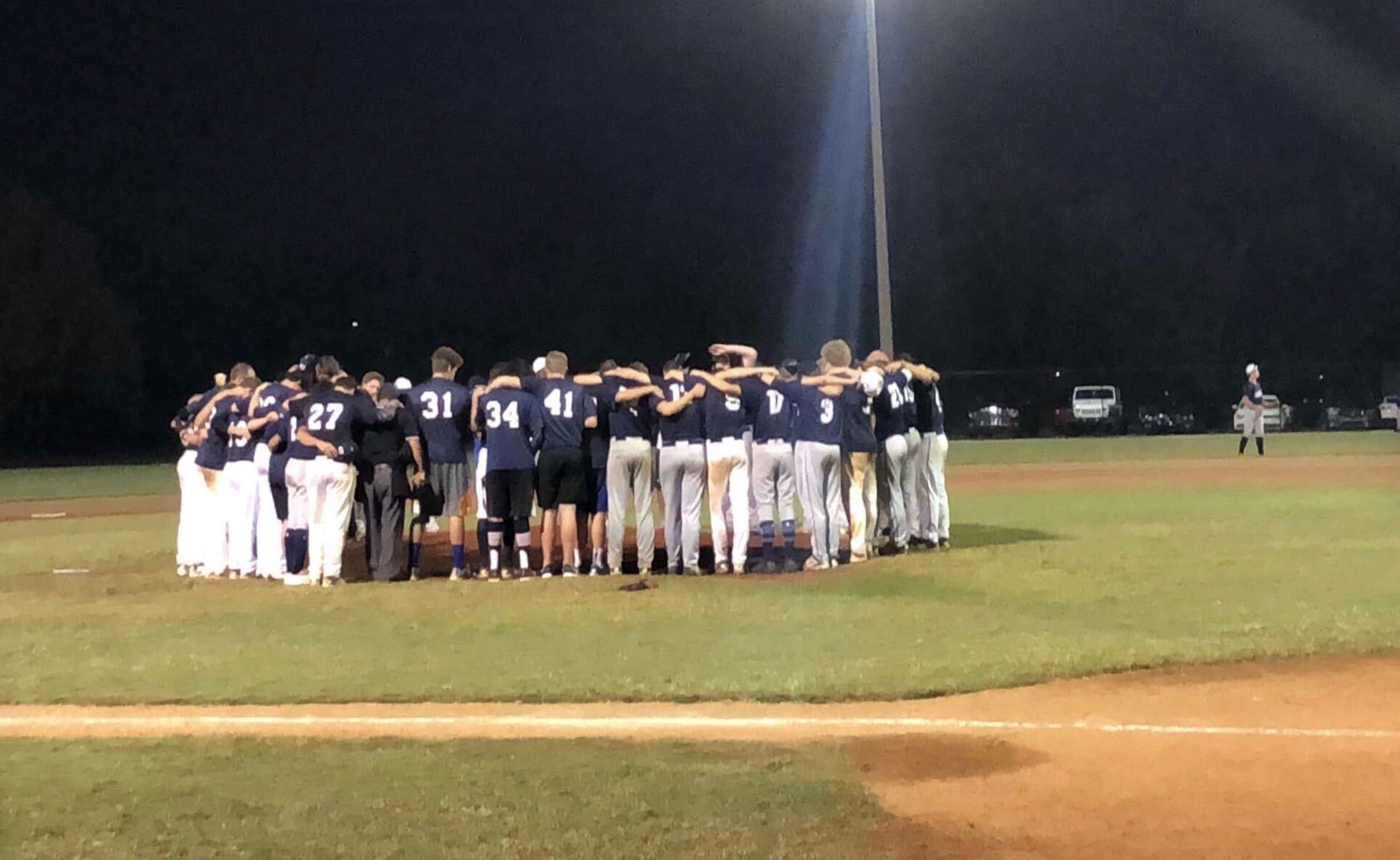
The Calvary team gathers on the mound to say a prayer following Braden’s first start after his father’s passing in 2017.
Braden told Olsen he was done. He walked off the mound, grabbed his father’s jersey, and began to cry.
“Obviously when he passed away, my thought was, ‘I lost my father,’” he said. “But that was my first moment of … he’s still with me. I still have him. I really felt him there.”
The players circled around the mound and said a prayer. Someone took a photo and sent it to Braden. Through the darkness, a ray of light shined down on his head.
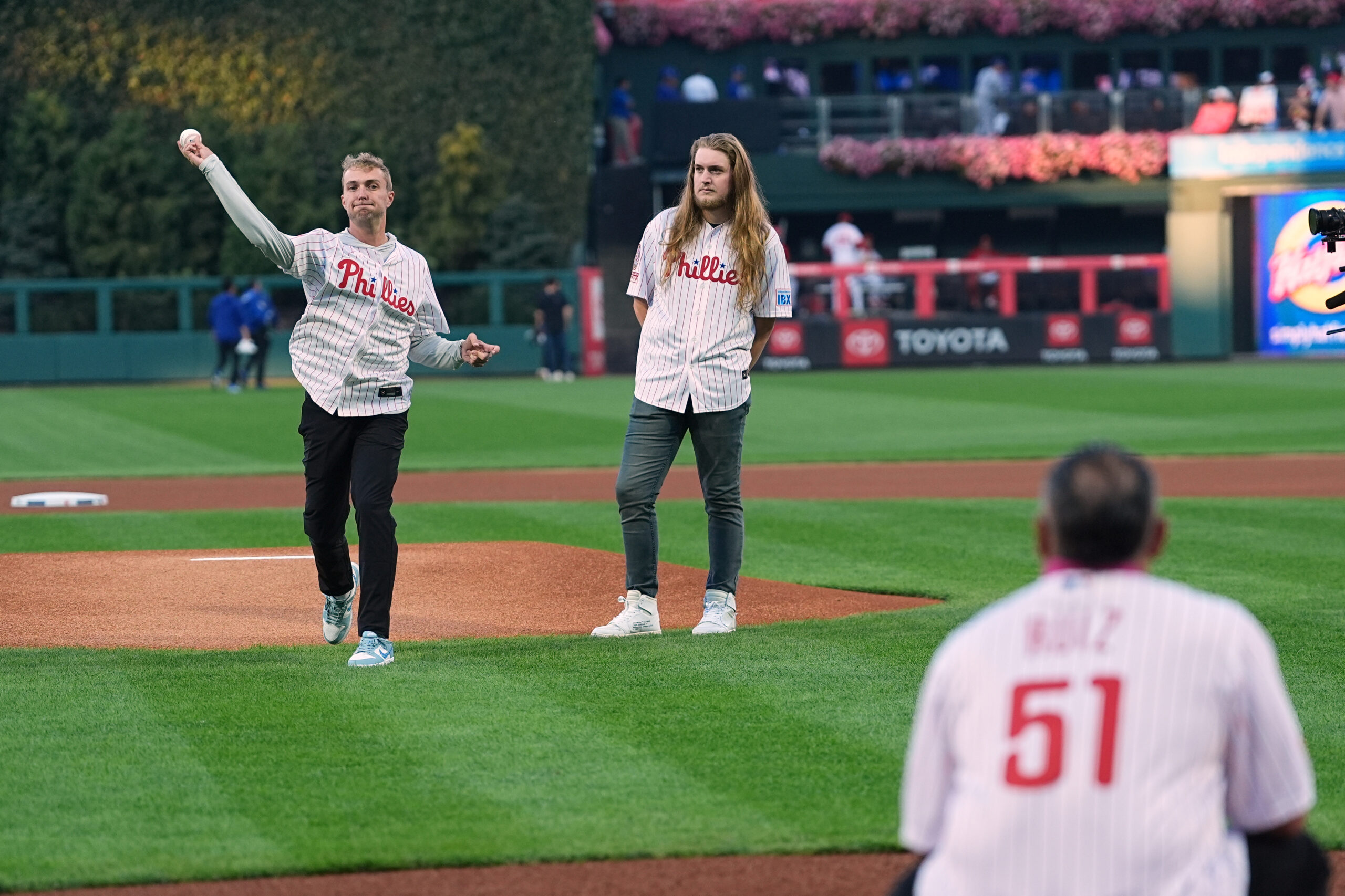
Braden Halladay (left) accompanied by his brother Ryan, throws the first pitch to former Phillies catcher Carlos Ruiz, marking the 15th anniversary of their father Roy Halladay’s postseason no-hitter, ahead of an NLDS game against the Dodgers in 2025.
A different side of Halladay
On Nov. 14, 2017, the Phillies held a celebration of life at their spring training complex. It was open to the public; thousands of people attended.
After the ceremony, Halladay’s friends and family moved to the batting cages beneath the stadium. Standing on bright green turf, with the nets pulled back, they grieved.
This was the first time many of his players had met his Phillies and Blue Jays teammates. And as the high schoolers traded stories with Chase Utley and Ryan Howard and Cliff Lee, it dawned on them that they’d seen a completely different person.
The former big leaguers painted a picture of a cutthroat competitor; a titan of the sport whose intensity seeped out. To the boys of Calvary Christian, he just was a goofy dad.
This is how they will remember him. They’ll never forget the perfect game, or the postseason no-hitter, or the countless shutouts. But for those 17 high schoolers, who are now 17 men, the coach they knew meant so much more.
Starting with Thursday’s World Cup game in Philadelphia and the late night United States men’s national team match with Turkey, where the U.S. allowed a last-second goal that cost them in a 3-2 loss in its World Cup group finale game.
There’s also the NHL draft tonight, with the Flyers on the clock with the 21st pick — and the MLB announced the first phase of fan voting for the All Star game. Can you guess which Phillies are in the running to start?
But before we get into all that, Alex Coffey delivered a powerful story on the late Hall of Famer Roy Halladay. Halladay, who won two Cy Young Awards in his 16-year career, including in 2010 with the Phillies, died of blunt force trauma and drowning after he crashed his Icon A5 into the Gulf of Mexico in 2017. The night before, he was with his team.
Halladay served as a pitching coach at Calvary Christian High School in Clearwater, Fla. The boys he coached are now men, and they still cherish that 2017 season.
But what the players didn’t realize was that they were giving Halladay something too: “A way for him to enjoy baseball in a very pure form again.”
Alongside Sean Couturier and Luke Glendening, Garnet Hathaway was part of a formidable fourth line in the playoffs for the Flyers.
The Flyers decided to make some moves ahead of the draft and traded veteran forward Garnet Hathaway to the Panthers, along with a 2026 sixth-round pick, for a fifth-round pick and a 2027 fourth-rounder.
The Flyers now own four picks this weekend, but all eyes will be on Danny Brière and Co. in the first round. While they have quite a ways to go till their pick, here are nine players who could be there.
And if you missed our Reddit AMA, where Jackie Spiegel answered your questions, we’ve got all the highlights here.
What we’re …
🏀 Analyzing: How Labaron Philon Jr. will fit in with the Sixers backcourt led by Tyrese Maxey and VJ Edgecombe.
Ngaly Camara, of Guinea, (center), holding up the Ivory Coast flag as they celebrate before the match against Curaçao on Thursday.
In between the two dense blocks of orange and dark blue, fans came bearing jerseys and flags from any national team you could think of — even some Eagles jerseys — in the stands at Philadelphia Stadium on Thursday.
Curaçao vs. Ivory Coast was the least marquee matchup of Philly’s World Cup slate, which made it the easiest ticket for local and passionate soccer fans, as well as diehard supporters of both nations.
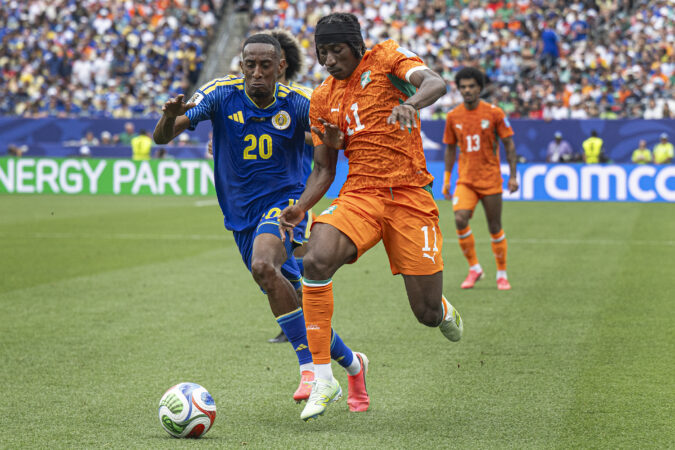
In the end, it was the fans in orange who went home happy, as Ivory Coast secured its first trip to the knockout rounds with a 2-0 win. For Ivory Coast forward Yan Diomande, the accomplishment was a triumph.
And check out what fans of all allegiances were saying after watching both Ivory Coast-Curaçao and Germany-Ecuador in Lemon Hill Park at the FIFA Fan Festival.
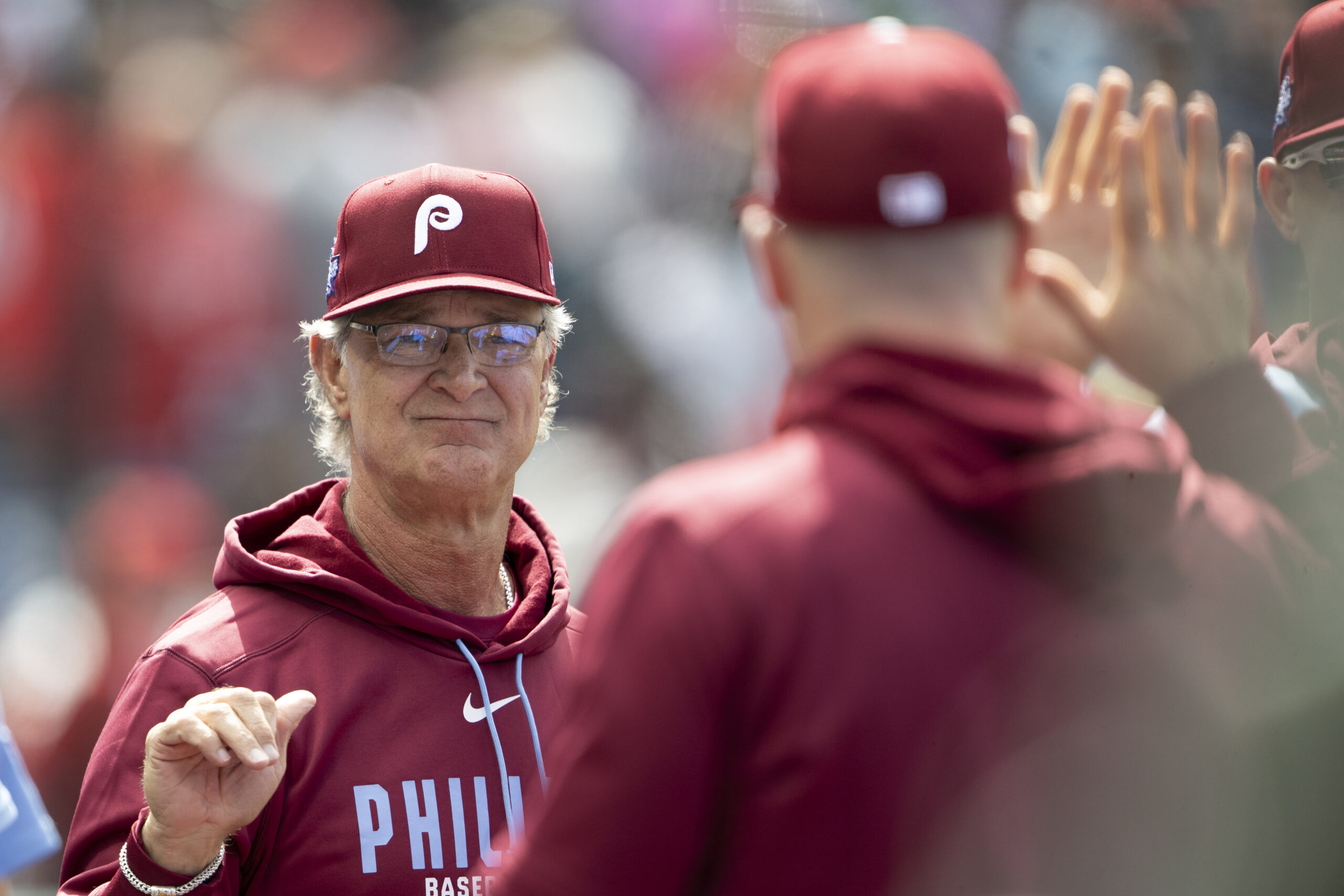
Phillies interim manager Don Mattingly will coach in an All-Star Game for the third time in his career.
Don Mattingly is officially the Phillies’ first All-Star. The interim manager will be on the National League’s staff as an honorary coach.
As for the players, Alec Bohm, Bryson Stott, and Brandon Marsh are each second at their respective positions after the first phase of fan voting. Surprisingly, Bryce Harper isn’t among them.
Another day, another ninth inning comeback for the Phillies, who were powered by Harper’s two-run homer to complete a third straight late-inning comeback win over the Nationals.
Riq Woolen has a chance to make major waves in the Eagles defense, with a potential big payday to follow.
While the offseason focus was centered around the impending trade of A.J. Brown and new offensive coordinator Sean Mannion, the Eagles new cornerback Riq Woolen had plenty of buzz during spring workouts.
Woolen has an opportunity to flourish at a spot where the Eagles’ defense struggled last season. His skill also allows them to put All-Pro Cooper DeJean in position to be even more effective.
With that being said, let’s take a look his film from Seattle and see why the Eagles are excited about Woolen.
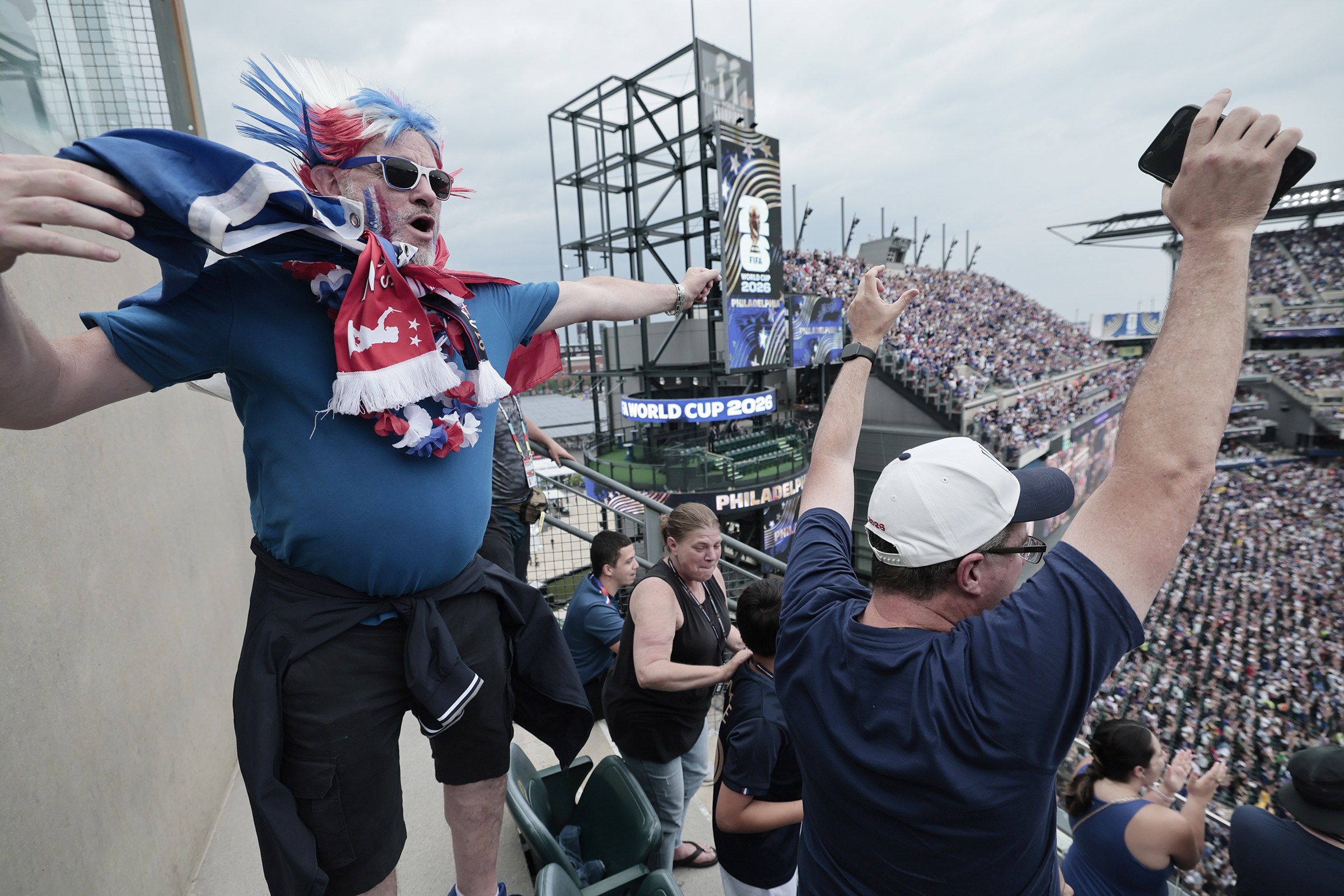
French fans arrived in Philly earlier in the week for their team’s group stage match against Iraq on Monday. France won, 3-0.
Each Friday, Inquirer photo editors pick the best sports images from the last seven days. This week, the World Cup craziness continues, despite thunderstorms attempting to put a damper on Philly’s celebration. Check out our best sports photos of the week.
We compiled today’s newsletter using reporting from Alex Coffey, Jonathan Tannenwald, Scott Lauber, Lochlahn March, Gabriela Carroll, Jackie Spiegel, DeAntae Prince, Matt Mullin, Gina Mizell, Jeff McLane, Devin Jackson, Ariel Simpson, Owen Hewitt, Mia Messina, and The Inquirer photography staff.
By submitting your written, visual, and/or audio contributions, you agree to The Inquirer’s Terms of Use, including the grant of rights in Section 10.
And that’s it for me this week! Have a great weekend, we’ll be back in your inbox on Monday. — Bella
A nascent property tax relief program for New Jersey seniors has been at the center of budget negotiations between Gov. Mikie Sherrill and lawmakers as the state’sbudget deadline quickly approaches.
That program, called Stay NJ, is expected to undergo changes that would slice the income eligibility by more than half, kicking off seniors that made hundreds of thousands of dollars and started reaping the benefit this year.
The benefit is currently available to seniors making less than $500,000, but that cap would be lowered to $200,000 under an agreement between the governor and legislative leaders, according to reports of closed-door budget talks. Those making less money would be eligible for a larger refund under the arrangement.
The proposal is a compromise between Sherrill, who pushed for cuts to the program, and House Speaker Craig Coughlin (D., Middlesex), a key player in budget negotiations who has championed Stay NJ.
As the name suggests, Stay NJ was created in 2023 to incentivize New Jerseyans to remain in the Garden State by providing refunds to eligible seniorhomeowners. The program was designed to start payments in 2026, so the very first checks had just begun going out when the first term governor presented her early March budget proposal.
Here’s what to know about the status of the Stay NJ program.
Is there a budget deal?
Sherrill, Coughlin, and State Sen. President Nicholas Scutari (D., Union) announced Tuesday that they came to a budget “agreement.” The closed-door deal wasn’t made public, and legislators continue to iron out the details ahead of the deadline this coming Tuesday.
They said the budget agreement totals $60.7 billion, the same total Sherrill proposed in March. The governor has touted her proposal as “fiscally responsible,” though it’s still the highest price tag in the state’s history.
The joint statement mentioned few details but cited a handful of measures, including Stay NJ.
The state leaderssaid their agreement ensures the program “is a sustainable benefit retirees can count on.”
The propertytax relief program issues refund payments to eligible seniors in quarterly installments. The first Stay NJ payments were issued in February with an average of $600 each, according to the state treasurer’s office.
Under the current policy, eligible homeowners over 65 years old who make under $500,000 a year are eligible to get refunds for as much as half their property tax bills. The refunds are capped at $6,500 in a year.
What did Gov. Sherrill want to change about Stay NJ?
Sherrill wanted to slice the eligibility cap in half so only seniors with an annual household income below $250,000 would qualify.
She also wanted to lower the maximum benefit to $4,000.
“That’s a fairer, more efficient use of taxpayer money,” she said in her budget address in early March.
Stephen Sigmund, a spokesperson for Sherrill, said at the time of her proposal that 90% of Stay NJ recipients would keep their benefits.
The AARP expressed outrage at her proposal as New Jersey seniors struggle with the cost of living. But critics of the program who believe it directs too much state money to higher earners praised her for wanting to rein it in.
So what’s actually changing?
According to reports of the budget agreement, Sherrill and legislators agreed on a compromise.
Sherrill agreed to steer an additional $100 million funding to the program, NJ.com reported.
Meanwhile, legislative leaders agreed to lower the income threshold to qualify for the program to $200,000, even lower than what Sherrill initially suggested.
And as part of the new plan, those earning the least would get bigger deductions, according to the report.
Seniors making $100,000 or less would qualify for up to $6,500; those making between $100,000 and $150,000 would be eligible for up to $5,000, and those making $150,000 to $200,000 would qualify for up to $4,000, according to the report.
Coughlin said at an AARP town hall that Sherrill’s proposed cap across the board of $4,000 was “too low,” and that he would “stand up for Stay NJ,” New Jersey Monitor reported earlier this month.
Spokespeople for the governor did not respond to a request asking for confirmation of the plan.
After the congratulatory hugs, picture posing and victory lap, Yan Diomande pointed to the sky.
It was unclear whether the Ivory Coast forward was thinking of his departed sister or just his country’s unprecedented accomplishment in the World Cup as he exited the field at Philadelphia Stadium following a 2-0 win over Curaçao on Thursday.
But surely it was a moment of emotion for the 19-year-old wunderkind.
Diomande’s arrival in the international consciousness of soccer took another step after the Ivory Coast advanced to the knockout stage of the tournament for the first time, ever. He might not have been Player of the Match — that honor was reserved for teammate Nicolas Pépé, who scored both goals — but Diomande assisted on the first and produced other chances.
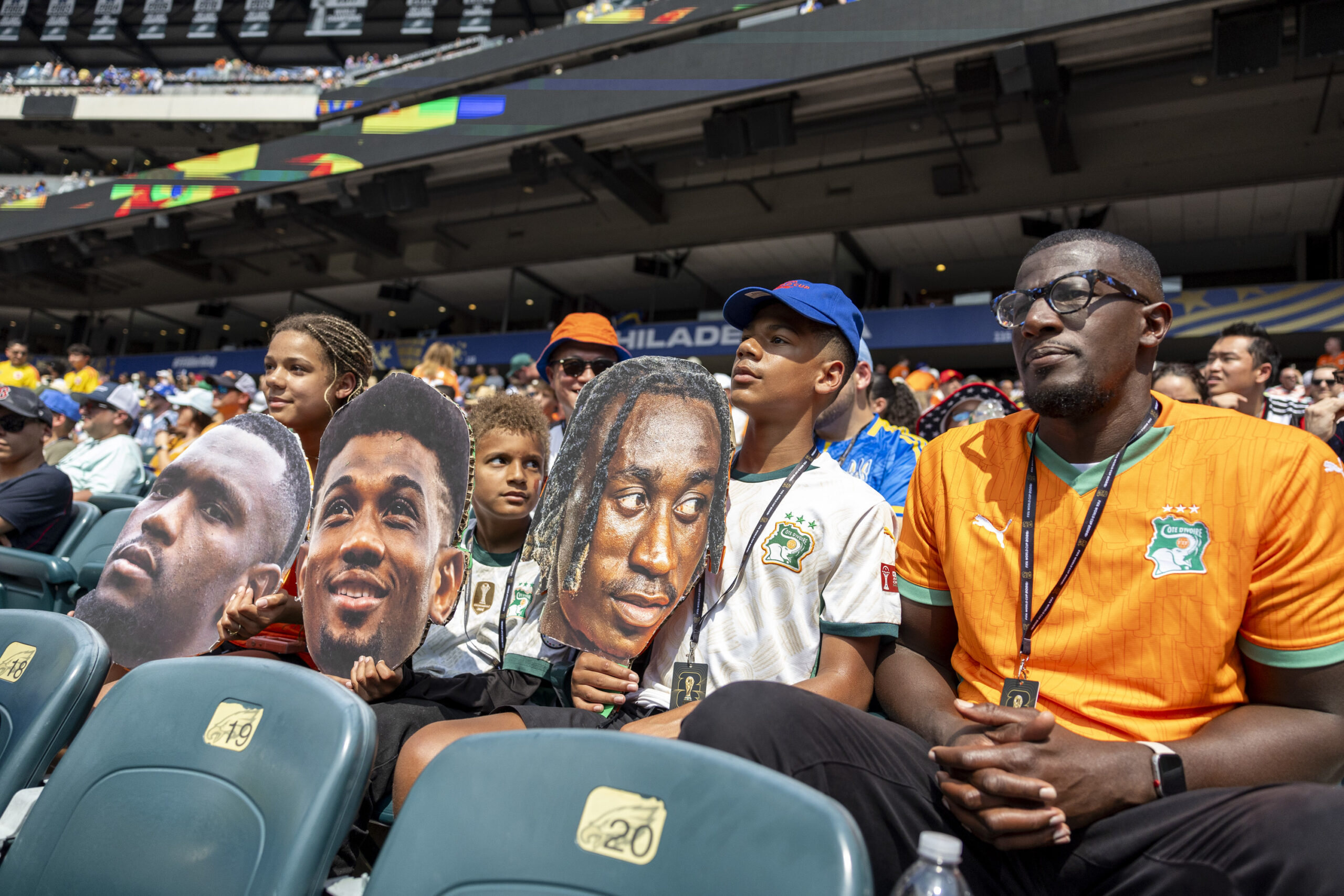
The cutout of Yan Diomande (far right), is on display as (right to left) Yed Anikpo, of Ivory Coast, is with his family Jude, 13, Zeke, 9, and Eden, 14 at Thursday’s Ivory Coast-Curaçao match.
He will get at least one more opportunity to represent his homeland when Ivory Coast faces Norway in the round of 32 on Tuesday in Dallas. Philly, though, will be remembered as where Diomande first launched his star in America, especially for casuals who haven’t followed his meteoric rise over the last two years.
Most hardcore fans have been aware of the former United States high school athlete for some time. He was Rookie of the Season in the German Bundesliga playing for RB Leipzig, where he scored 12 goals and had nine assists last season.
And he’s been one of the most sought-after signings this offseason with powerhouse European clubs like Liverpool, Paris Saint-Germain, and Bayern Munich reportedly in pursuit. Diomande might not be a household name here, but the New York-based Roc Nation is his agency.
Rapper Jay-Z, Roc Nation’s founder, attended Ivory Coast’s first fixture of group play at Philadelphia Stadium, normally known as Lincoln Financial Field, in support of his client. Diomande dominated that game — a 1-0 victory over Ecuador on June 14 — from both wings.
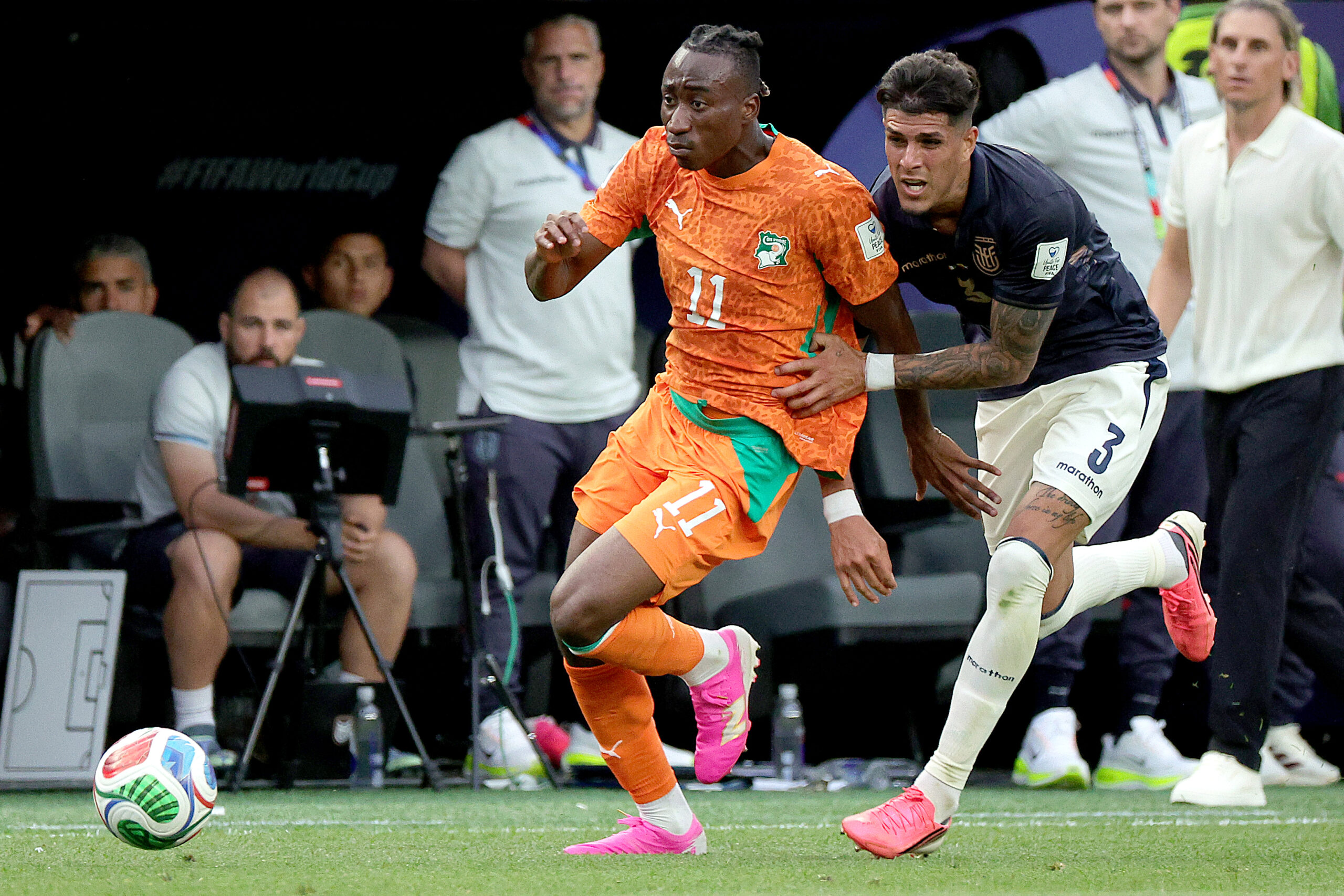
On Thursday, five days after Ivory Coast suffered a late, gut-punching 2-1 loss to Germany, the forward played exclusively on the left flank. Diomande needed only minutes to make his presence felt. Gifted a Curaçao turnover, he penetrated along the end line and found Pepe in front for a one-touch goal in the 7th minute.
Diomande continued to be problematic when he dribbled at defenders. His combination of speed, agility, and power forced Curaçao to send multiple defenders his way. And yet, he still created the most chances (3) by the half.
Pépé’s second goal came in the 64th minute when he received a pass just inside the box and ripped a left-footer past keeper Eloy Room. Three minutes later, Diomande was subbed off, likely to preserve him for next week.
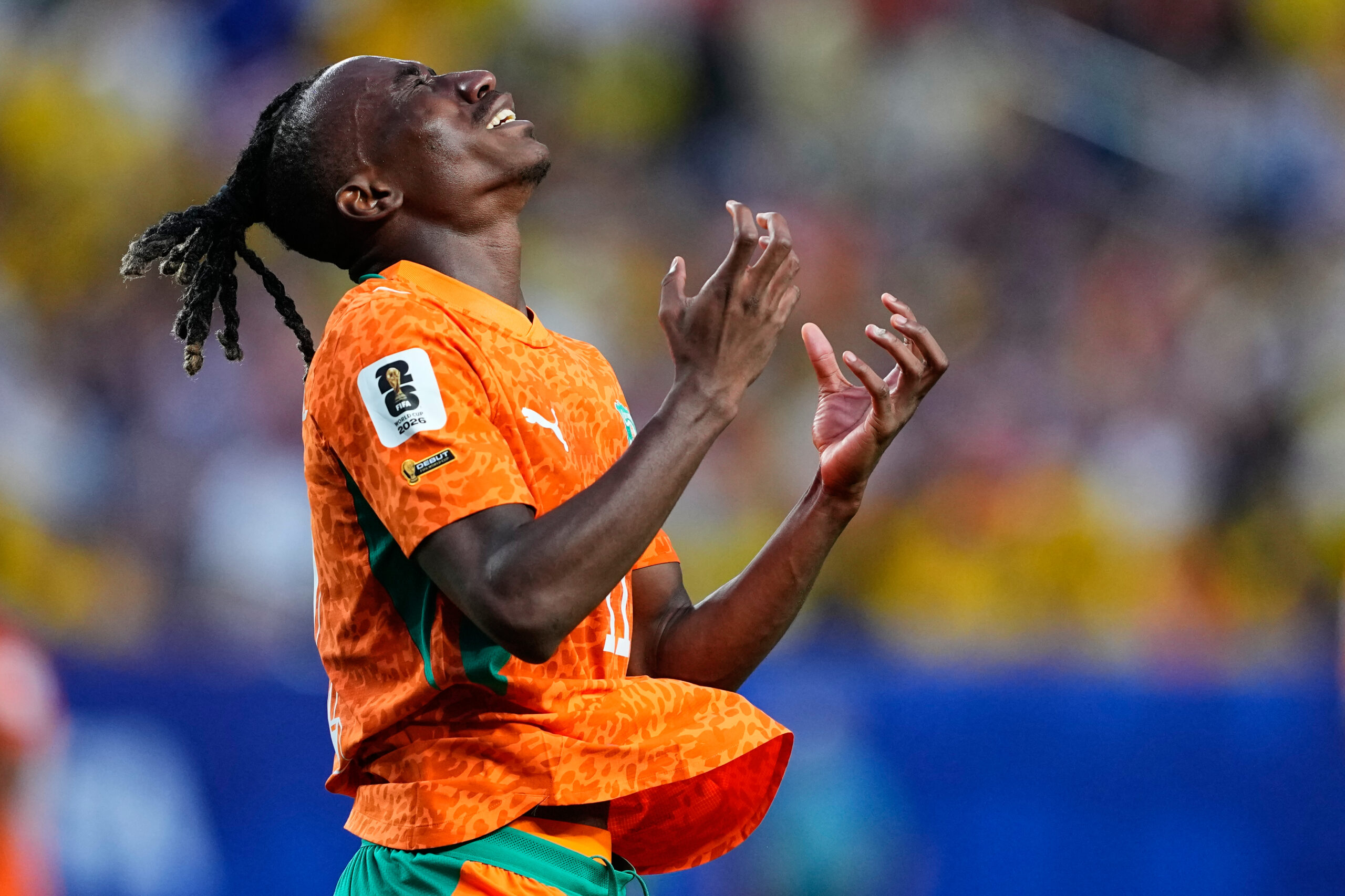
Yan Diomande (left) has put on a show in his pair of appearances with the Ivory Coast in Philadelphia.
Diomande has been playing with a heavy heart. A year ago, his 15-year-old sister, Roxane, died back home after her drink was spiked. Diomande penned an emotional open letter to his sister in The Players’ Tribune upon his return to the U.S. for the World Cup.
“I don’t feel anything. It’s like I’m not even human,” he wrote. “Since you died, I’m just blank.”
Diomande has, if anything, been the opposite on the pitch. In fact, that’s exactly how Ivory Coast native Lucas Droh described him before the match as he and his older brother, Pacome, tailgated in the lot outside Xfinity Mobile Arena.
“He’s expressive,” Lucas, 32, said. “He plays happy and with an imagination.”
10/10 – 🇨🇮 Yan Diomande is the only player this century to do the following across his first three FIFA World Cup games:
The Drohs, along with cousin Kevin Gnako, traveled from Charleston, S.C., to watch Diomande and Les Éléphants play on Thursday. They are from Abidjan, the largest city in the West African nation, and emigrated to the United States 15 years ago after their mother married.
Diomande is also from Abidjan. He wrote about his impoverished childhood and how he wore plastic sandals to play because his family couldn’t afford cleats. When he was finally given proper footwear, he wore them to bed, although he said that he still dons the sandals when he’s home.
“He’s from the streets,” Lucas said. “He grew up poor, so he’s hungry.”
At 15, Diomande relocated to the U.S. and ended up at DME Sports Academy in Florida. He had a short stint in the United Premier Soccer League and drew attention from MLS clubs, but Europe beckoned.
English Premier League teams like Chelsea, Bournemouth, and Crystal Palace, along with clubs in other countries, tried Diomande out. But it was Leganes in Spain that signed him in 2024. Just before he made his debut against Real Madrid, the former squad of his hero, Cristiano Ronaldo, he found out Roxane had died.
Côte D’Ivoire supporters take pictures with 19 year-old Yan Diomandé in stands after the match in Philadelphia, the shining star of the tournament so far for Les Éléphants 🐘🇨🇮 pic.twitter.com/9OfhcfOcIw
“I never got any answers. I don’t know if I want to know why,” Diomande wrote in the letter to his sister. “Maybe it was jealousy. Maybe it’s just something that happens in our country. Maybe I could have protected you. I don’t know.”
Diomande said that he doesn’t care about playing for money, and that he wants to use his success “to show the whole world” what Roxane saw in him, and that every time he scores, “I’ll make sure everybody knows your name.”
He has yet to score here, but goals are forthcoming, just like fame and fortune. While Liverpool reportedly balked at Leipzig’s initial price tag, Diomande could ultimately fetch close to €100 million.
In the meantime, he’s focused on the World Cup. Ivory Coast failed to qualify in 2022 and 2018, but it’s trying to recapture the glow of the early-to-mid 2000s when Didier Drogba, Yaya and Kolo Touré wore the orange in three appearances. As talented as those lineups were, they never got out of the group stage.
The Droh brothers and Gnako touted this version of Les Éléphants, which had knocked off France, 2-1, in a tune-up friendly earlier this month.
In the backdrop of an impressive performance in this World Cup from the Ivory Coast’s Yan Diomande is the heartbreak at the passing of his younger sister, Roxane.
“We didn’t lose a friendly coming in,” Pacome said. “The Elephant is going to do some stomping.”
Ivory Coast will likely have to ride Diomande if they are to advance. Pépé (Villareal), forward Ange-Yoan Bonny (Inter Milan), and midfielder Ibrahim Sangare (Nottingham Forest) are formidable and among many on the roster who play for European clubs.
But Diomande has been dubbed the second coming for his country.
“That’s the next Drogba. Everybody wants him now,” Pacome Droh said. “But he’ll always be ours.”
The first round of the 2026 NHL draft is just hours away, and the Flyers are scheduled to pick at No. 21.
Who will be there, before general manager Danny Brière’s turn to face the camera and announce the pick, is anyone’s guess. With the expectation that prospects like Wyatt Cullen, Ryan Lin, and Alexander Command — who really does scream Flyer more than anyone on this list — will be long gone, here are nine players (in alphabetical order) the team could take in the first round.
“He was a tremendous skater. He just loves playing hockey. He’s kind of a rink rat. I think it’s what he’s always wanted to do,” Tommy Bleyl’s coach at Mid Fairfield, Ryan Haggerty, told The Inquirer.
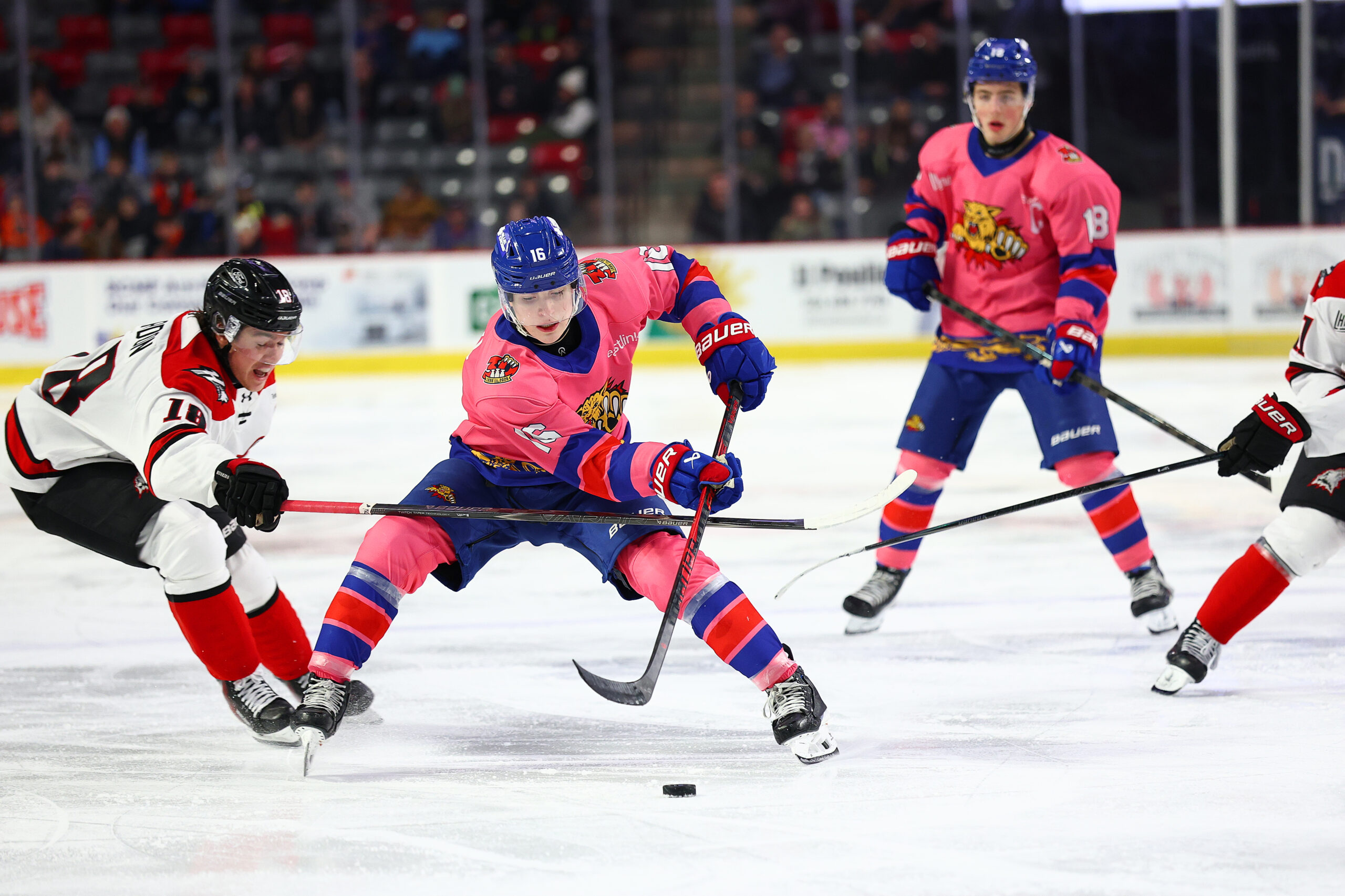
Tommy Bleyl, RHD, Moncton (QMJHL)
With Lin expected to be gone, Bleyl is the next man up among defensemen under 6-feet tall. He was labeled as the player not enough people are talking about by FloHockey’s NHL draft and prospects analyst Chris Peters on Flyers Gameday Central’s draft preview show. NHL.com’s Mike Morreale and USA Today have Bleyl as the pick at 21 for the Flyers.
Listed at 5-foot-11¼, 170 pounds, the 18-year-old just put up one of the best rookie seasons by a defenseman in Quebec Maritimes Junior Hockey League history with 81 points in 63 regular-season games — breaking a rookie scoring record for blueliners that stood for 48 years — led the “Q” in assists (68), was named the top defensive rookie, and finished third in playoff scoring (28 points).
A self-described two-way defenseman who has good feet, a pretty strong hockey IQ, and is feisty, the New York native came from the same Mid Fairfield program as Trevor Zegras and is headed to a Flyers favorite, Michigan State, in 2027 alongside 2025 draft pick Matthew Gard, who committed on Thursday.
Maddox Dagenais, RW, Québec (QMJHL)
Why is Dagenais potentially the guy?
The Flyers like Canadians, with 13 of Brière’s draft picks coming from Canada. He is over 6-feet — officially 6-3¾ and 198 pounds — and the Flyers have drafted 17 out of 26 players under the GM at that line of demarcation.
He has pedigree — his dad, Pierre, played in the NHL — and the Remparts forward can play center and wing, with versatility a trait Brière has stressed as important. Dagenais also skated alongside Flyers prospect Nathan Quinn. And his GM in Québec is none other than Simon Gagné, so you know the Flyers have checked in on him. Peters had Dagenais to the Flyers in his final mock draft on Friday.
Dagenais was No. 2 on the Remparts with 62 points (30 goals, 32 assists) in 62 regular-season games and tied for No. 1 in power-play points (25) with Quinn, the Flyers’ 2025 sixth-rounder. A lefty who played the right side, he’s a high-volume shot-taker, can win in the faceoff circle, and loves to throw reverse hits — Gagné said that area of Dagenais’ game reminds him of his ex-Flyers teammate, Peter Forsberg.
An Illinois native, Jack Hextall played for the same youth hockey program as Flyers assistant coach Todd Reirden.
Jack Hextall, C, Youngstown (USHL)
A distant cousin of former Flyers goalie and GM Ron Hextall, this Hextall is a 6-0½ inch, 195-pound right-shot centerman who netted 58 points in 59 games for the Youngstown Phantoms last season and is off to Michigan State to play with Flyers prospect Shane Vansaghi in the fall.
The 18-year-old from Illinois is known for his non-stop motor, high hockey IQ, attention to detail, being relentless, and his pro habits. Those are all attributes the Flyers typically value highly, and Philly has done its homework on Hextall, who was one of the best forwards for the 2025 Hlinka Gretzky Cup-winning Americans with seven points, including three in the championship game.
“Jack has always cared about the whole ice in all three zones. He prides himself on being a trustworthy go-to guy for his coaches,” Youngstown coach Ryan Ward said. “He wants to thrive in all situations, whether that be a shutdown defensive situation or being on the ice when we need to score a goal. So he’s a very mature player for his age.”
JP Hurlbert, LW, Kamloops (WHL)
The 6-0, 190-pound left winger, who can play center, is coming off an impressive season where he won the Rookie of the Year award in the Western Hockey League after posting 97 points (42 goals, 55 assists) in 68 regular-season games. Hurlbert wore an “A” for the Blazers and said at the NHL scouting combine that he is an offensive-minded forward who can anticipate plays, has an accurate and deceptive shot, can freeze defenders, and is “dangerous” whether at five-on-five or on the power play.
“JP is a super offensive hockey player, and he’s really focused on scoring, and he’s good at it,” Nick Fohr, his coach at the U.S. National Team Development Program two seasons ago, told The Inquirer. “ … He’s a really good hockey player, and he’s driven to score. He loves to score, he loves to be around things offensively, and that’s really where he thrives, and where he’s at his best.”
A native of Texas, the 18-year-old thought he had a good meeting with the Flyers and is off to the University of Michigan with prospect Jack Nesbitt in the fall.
Nikita Klepov, RW, Saginaw (OHL)
Born in Florida and raised in Russia, Klepov posted 97 points in 67 games, with 38 points on the power play and three short-handed goals for Saginaw this past season. Bound for Michigan State in the fall, he was named the Ontario Hockey League’s Rookie of the Year and was the first newbie to lead the league in scoring since future Hall of Famer Patrick Kane.
“You don’t lead the OHL in scoring by accident,” The Athletic’s NHL draft and prospects reporter Scott Wheeler told The Inquirer of Klepov, who represents the U.S. internationally and will turn 18 on Saturday. “Extremely, extremely talented player with the puck. He’ll work, too; he’ll go and get it back. He’s average size, so average-size wingers can often linger.
“ … And if you’re looking for a top six guy in the second half of the first round, there’s not going to be a lot of guys who you can say his projection is as a top six guy. Nikita is one of those guys with his playmaking. ”
Miami (Ohio) center Ilia Morozov won’t turn 18 until August.
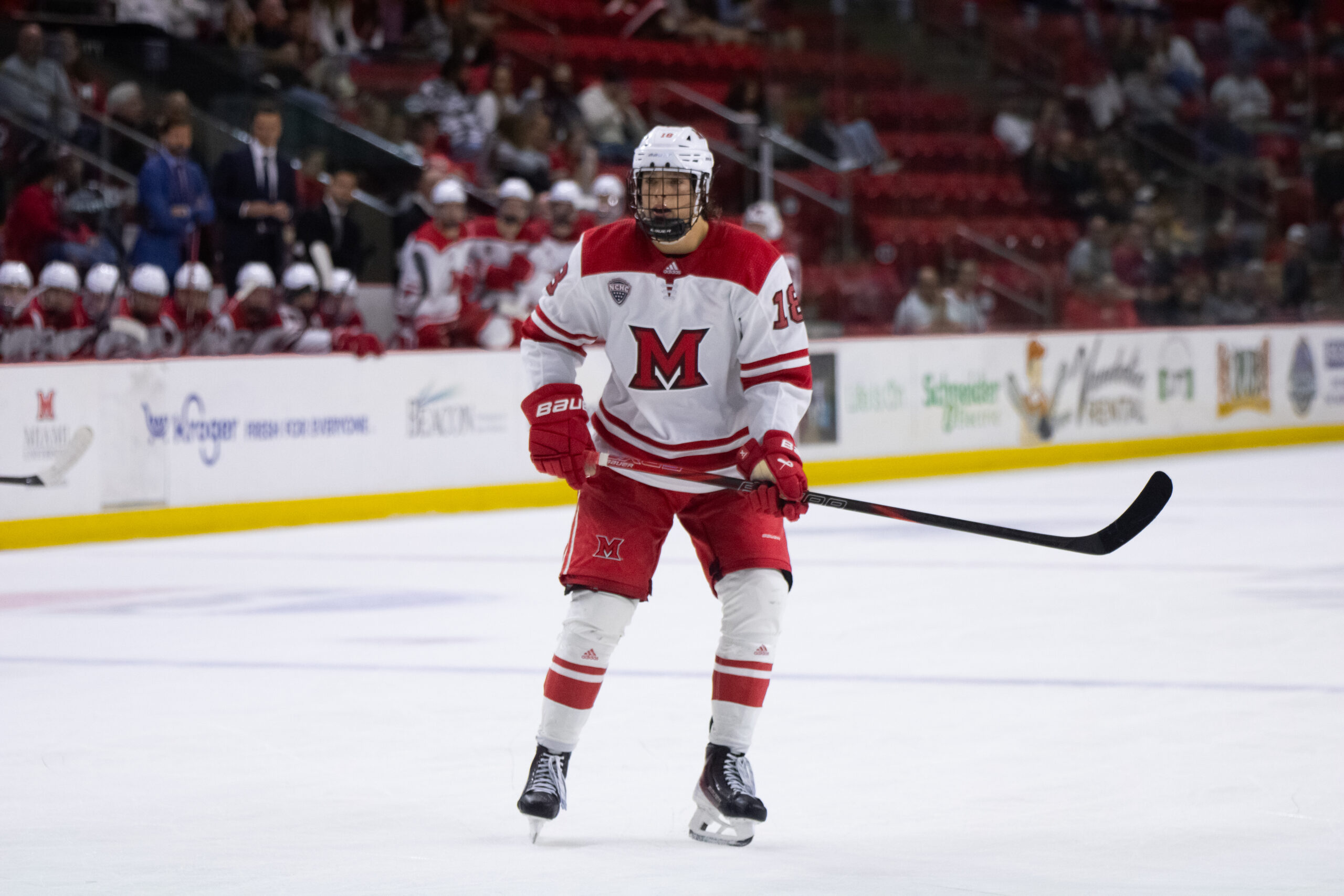
Ilia Morozov, C, Miami (OH) (NCAA)
TSN’s Craig Button, who has a pretty good knack for making picks, has the Flyers taking the 17-year-old Morozov in his latest mock draft.
Morozov, a two-way center at 6-2¾, 205 pounds who is smart, competitive, and physical, just wrapped up a freshman year at Miami (Ohio) in which he started as the youngest player in men’s college hockey. Morozov, who won’t turn 18 until August, started quickly but cooled off and finished with eight goals — three on the power play and one short-handed — and 20 points in 36 games, helping the school go from a three-win season to 18.
“Thought there was a maturity there, certainly the size and strength, but we still feel like he’s really scratching the surface, even strength-wise,” RedHawks coach Anthony Noreen told The Inquirer. “ … And I think, for me, that’s kind of what’s most exciting about him, this kid is just always taking a monumental leap every summer, and we really feel he’s going to continue to do that.”
Adam Novotný, LW, Peterborough (OHL)
Pro Hockey Group’s Jason Bukala has the Flyers picking Novotný at No. 21, citing his goal scoring abilities. At 6-1 and 200 pounds, the winger, who played the entire season in Peterborough, led his team in goals (34) and points (65) and finished second and tied for fourth in the OHL with 278 shots on goal and eight game-winners, respectively.
A standout at World Juniors, the power forward, who has speed and a strong work ethic, had three assists and a tournament-high 34 shots on goal in seven games for silver-medal-winning Czechia.
“Well-rounded. I think I am versatile, and I can play those different roles,” he said when asked to describe his game at the combine. “That’s maybe something that can help me in the future to make it to the NHL 100%. I think my speed is a weapon too. … And also one-on-one battles, I think I’m very strong in them.”
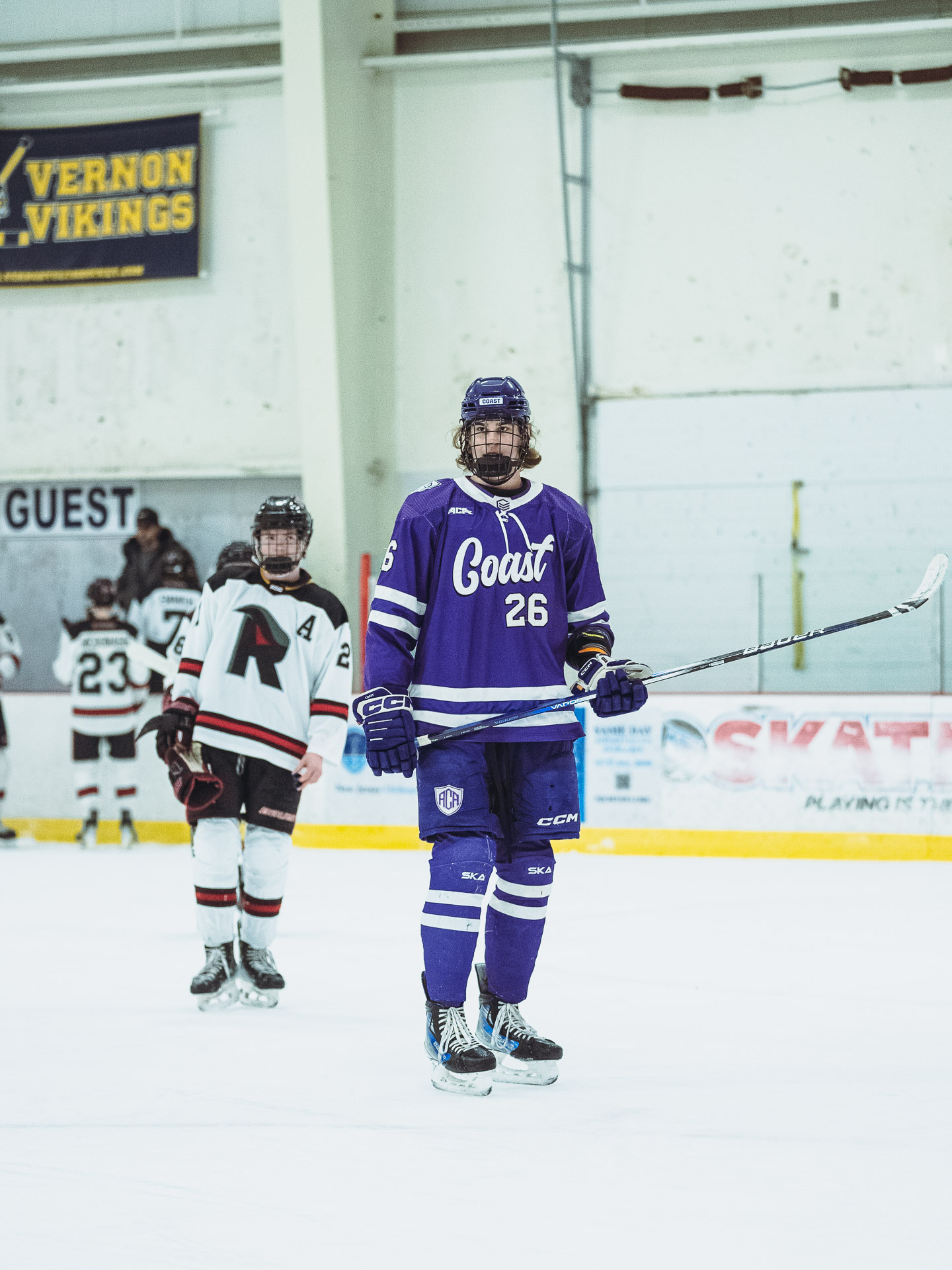
Maksim Sokolovskii first came to North America as a 16-year-old to play for Atlantic Coast Academy.
Maksim Sokolovskii, LHD, London (OHL)
ESPN, NHL.com’s Adam Kimelman, Wheeler, and Sportsnet’s draft guru Sam Cosentino all have Sokolovskii as the guy for the Flyers. In Western New York at the combine, the word going around was that the Flyers were very high on him but it does make one stop and pause slightly as the Flyers are known to make unexpected picks, like Nesbitt or Jett Luchanko.
But there are several reasons why this makes sense, starting with the fact that he plays for London, the same team from which the Flyers drafted Denver Barkey and Oliver Bonk. There’s the sheer size — 6-7¼, 240 pounds — that the Flyers also go for, having drafted fellow giants like the 6-5 Gard, Nesbitt, Carter Amico, and Luke Vlooswyk last year. Sokolovskii, who has a late birthday, is turning 18 in July.
And he’s raw and a project — the Flyers staff loves projects — who needs to work on his puck play. But he does not need to work on his skating and that’s the key here. “When you’re huge, and you can skate, that’s often all that you need for NHL scouts to sort of perk up and start to pay attention,” Wheeler said in Buffalo.
Despite turning 17 last Sept. 3 — quick reminder, players like Luchanko and Spencer Gill were later birthdays — Suvanto spent the majority of the past season skating for Tappara in Liiga, the top professional ice hockey league in Finland. He was a kid among men, skating in the middle-six, and notched two goals and 11 points in 48 games.
A 6-3, 213-pound two-way center, who draws comparisons to the Florida Panthers’ Aleksander Barkov, the fellow Finn considers himself a “big guy who can battle, can win some battles, can protect the puck” and has “OK game-reading skills, [and] can predict plays before that happens.” Suvanto, who was Elite Prospects’ Cam Robinson’s pick for the Flyers in his final mock draft, does want to work on his offensive game and be a bigger threat in the offensive zone.
Suvanto played with Flyers prospects Heikki Ruohonen and Max Westergård at World Juniors, where he played on a defensive-minded line. And the drum-playing, lefty-shooting center who hails from the same hometown as Rasmus Ristolainen, knows a thing or two about Philly: “Obviously, Rocky is from that city,” he said at the combine. “ … Big rivalry with the Penguins. … They got Trevor Zegras, good talented player, a lot of young great players so I think they’ve got a good future ahead of them.”
The Democratic National Committee should require each presidential candidate — as a condition of receiving campaign financing support — to issue at least one press release a week on affordability. There is no issue that is going to be more important to voters in the midterms or in 2028 than their ability to afford food, housing, and healthcare. Not abortion, not LGBTQ issues — nothing takes precedence over being able to afford your own food, housing, and healthcare. The president dangles so many alluring targets for commentary — the failed war in Iran, the grift, and of course, the algae and peeling paint in the Reflecting Pool. But don’t be sidetracked, Democrats: What people care about is their money. Get on it. At least one piece a week solely on affordability. You can thank me later.
Linda Falcao,Baltimore
Personal option needed
The Editorial Board is right: Washington is failing patients. But a public option would only make things worse.
The Inquirer’s editorial claims five insurers have “earned” $9 trillion since the Affordable Care Act passed in 2010. But that’s a misleading figure because it represents revenue, not profit.
Those companies made a combined $371 billion in net income over that period — a 4.1% margin (low compared with other industries), or roughly $25 billion a year. Against the nearly $5 trillion Americans spend on healthcare annually, that’s about one-half of one percent. Insurer profit isn’t driving the affordability crisis.
The ACA has already pushed America toward government-managed healthcare, consolidated insurers, and increased premiums. A public option would deepen that path.
Canada’s median wait for specialist care now runs nearly 29 weeks, and the U.K. has more than 7 million patients on its waiting list. This rationing isn’t incidental; it’s how governments control costs when a fixed budget meets unlimited demand.
The real fix is to empower patients. This means enacting price transparency, expanding telemedicine, and allowing nurse practitioners and pharmacists to practice the full extent of their training. But that’s just the beginning of getting government out of the way of affordable care.
Andrew Lewis, president and CEO, Commonwealth Foundation
Join the conversation: Send letters to letters@inquirer.com. Limit length to 150 words and include home address and day and evening phone number. Letters run in The Inquirer six days a week on the editorial pages and online.
DEAR ABBY: I’ve been a widow for nine years and just got engaged. When I asked my fiance if I could put a picture of my late husband in our new home, he became upset. He said he shouldn’t have to walk into his own home and look at pictures of a man who once “had” me.
I have three kids with my late husband. We were high school sweethearts, and I took his death extremely hard. I can’t help but think that my fiance is overreacting. I feel he wants me to just erase everything I had with my husband.
My kids will be living with us, too. Should I respect his wishes, or should I stand my ground and make sure my late husband’s memory is alive for the sake of my children?
— REMEMBERING IN AMERICAN SAMOA
DEAR REMEMBERING: I hope you recognize that this is a huge red flag. Your fiance is jealous and insecure. If he would be upset seeing a photograph of your late husband, how is he going to feel when he interacts with your children, who are living symbols of the love you shared with another man?
You are entitled to display a picture of their father if you wish. It needn’t be as large as a political poster nor hung in the front hall. It is important that you have further discussions about this with your fiance and, if you are wise, premarital counseling until this issue is resolved.
** ** **
DEAR ABBY: My husband (a college-educated native English speaker) mispronounces a LOT of words, specifically common names, the name of our children’s school and some other frequently used words. How do I politely correct him? I feel this is because he doesn’t pay attention, and I’m sure others notice it as well.
— ANNOYED IN CALIFORNIA
DEAR ANNOYED: Make a list of your husband’s “trouble words.” Then, when the two of you are relaxed and well-fed, start a conversation with him and ask if he realizes he does this. When he asks you what you mean by that, pull out the list and go over it with him, pronouncing the words correctly. Explain that you are raising the subject because you love him, and you won’t bring it up again, but you think he should be aware.
** ** **
DEAR ABBY: We love going to my aunt’s house for dinner, but she uses plug-in home fragrances that give all of us headaches. We have to come home and shower and wash our clothes to get the scent off us. She is an amazing baker, and the fragrance compromises the taste of the baked goods! How do we politely tell her this?
— HESITANT NIECE IN NEVADA
DEAR NIECE: Tell your aunt you love coming over to her house, but that you have developed an allergy to scents that causes you to get headaches. Then ask her to please unplug the scent dispensers and to air the place out for an hour or so before she has you over. It is a legitimate reason, and you are not the only person who can be affected by artificial scents.
ARIES (March 21-April 19). Don’t let one bad moment make you forget the good you’ve done and who you’re becoming. Wrong turns can be righted — that’s what U-turns are for. So what if the journey takes longer? What matters is that you’re on the path.
TAURUS (April 20-May 20). You sense what people want, and you could easily provide it, but the question is: Should you? Pleasing people isn’t always the same as helping them. You’ll go beyond what people want to give them what they need.
GEMINI (May 21-June 21). There’s someone who occupies more mental real estate than they probably realize. Tiny interactions feel loaded with meaning and possibility. This can be distracting, but it is also creatively energizing. Channel some of that voltage into your own ambitions.
CANCER (June 22-July 22). Lots of people become jaded by hard challenges. Not you. You’re resilient. You face the challenge with the spirit of improvisation and charm. You move through the puzzles with style and the perfect balance of courage and flexibility.
LEO (July 23-Aug. 22). You’re trying to lead with your better instincts. But the inner child wants a popsicle and a playground, the critic wants to file a complaint, and the dreamer wants to go back to sleep. Choose humor and patience over force.
VIRGO (Aug. 23-Sept. 22). Upon reflection, the past situation that was such a disappointment at the time turned out to be the plot twist that kept things interesting — maybe even the one that made you heroic. The current detour has equal promise.
LIBRA (Sept. 23-Oct. 23). Laughter has a way of becoming uncontrollable at exactly the wrong moment — a very relatable tension. Those things that break unexpectedly reveal something liberating underneath. You’ll experience the sublime relief of humor, spontaneity and shared humanity.
SCORPIO (Oct. 24-Nov. 21). A simple acknowledgment has restorative power. For instance, hearing your own name spoken kindly can be a healing in and of itself. Reminded of the importance of making people feel welcome, you’ll fill someone’s deep need for recognition.
SAGITTARIUS (Nov. 22-Dec. 21). After the hard work, you’ll have a sense of accomplishment that makes it all worthwhile. The feeling is such a high, and the product and rewards of your work are so magnificent, you could become happily and helpfully addicted to this.
CAPRICORN (Dec. 22-Jan. 19). In the same way your pet senses your mood, you have an animallike instinct toward emotional resonance with you care about, and you communicate beyond what language can convey. You’ll use it to make an accurate and fortuitous move.
AQUARIUS (Jan. 20-Feb. 18). Some parts of collaboration will work out and others not so much. When money, relationships and stress get knotted together in a ball, don’t try to untangle it. Toss it instead. As soon as you let it go, life gets fun again.
PISCES (Feb. 19-March 20). You’ll speak carefully not to avoid conflict, stick to the script or please anyone, but because you know that words matter. Today you’ll think what you say, say what you think and wield your influence well.
TODAY’S BIRTHDAY (June 26). It’s your year of Visionary Passion. Free from the confines of the visible world, everything is enhanced by your private vision. Your conviction draws in the tools, funding and team you need to build what you imagine. More highlights: You form tight bonds with unlikely partners in both your professional and personal life. Good systems make you stronger in the ways you most want to be. Virgo and Pisces adore you. Your lucky numbers are: 8, 28, 6, 17 and 25.
INGLEWOOD, Calif. — With first place already secured, the U.S. men’s soccer team finished out its World Cup group stage slate with a 3-2 loss to Turkey on Thursday.
Kaan Ayhan scored the winner with the last kick of the game in the 98th minute, denying the Americans an unbeaten group run after wins in the firsttwo games.
That took the air out of what had been a raucous crowd of 70,492 that watched Media’s Auston Trusty score the second-fastest U.S. goal in men’s World Cup history, and Sebastian Berhalter tie the score early in the second half after Turkey led 2-1 at halftime.
Still, with the group already wrapped up, the U.S. is set to face Bosnia & Herzegovina in the round of 32 on July 1 in Santa Clara, Calif. (8 p.m., Fox29, Telemundo 62). That matchup was confirmed earlier Thursday by other results across the final round of the group stage.
Against Turkey, U.S. manager Mauricio Pochettino started the night by making even more lineup rotations than he’d hinted at. There were nine changes from the last starting group against Australia, and 10 from the opening game against Paraguay. Weston McKennie goes down as the only player to start all three games, and Ricardo Pepi as the only other player to start two.
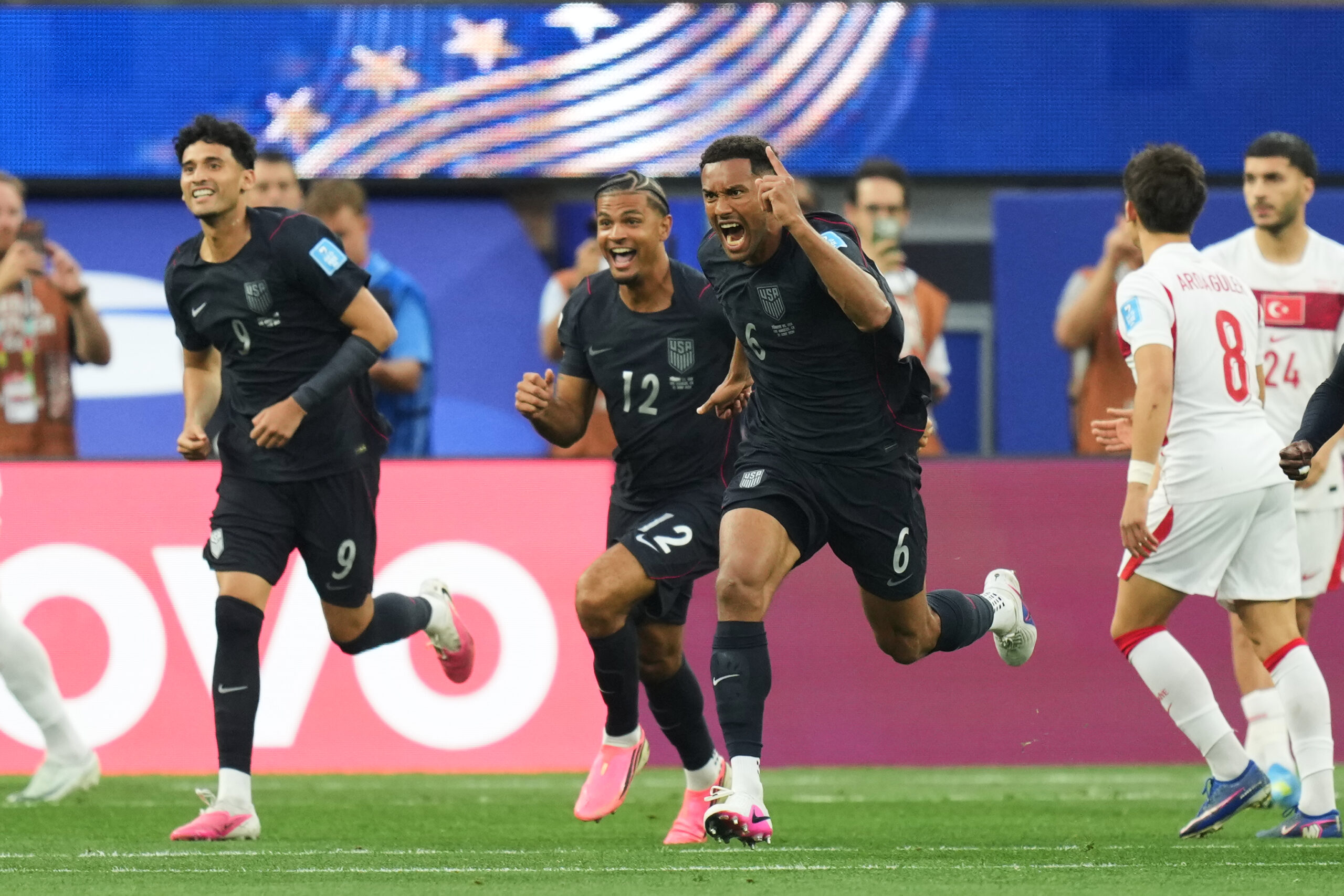
Trusty got things going by smashing in a Sebastian Berhalter corner kick that fell right at his feet. The Media native and Union product ran away screaming as he celebrated his first national team goal, and the first U.S. goal at a men’s World Cup scored by a player born in the Philadelphia region.
Media’s Auston Trusty (6) celebrates scoring his side’s first goal against Turkey during Thursday’s Group D finale for the United States.
The only other American goal scorer to have resided in the area was Scotland-to-Philadelphia immigrant Bart McGhee in 1930, the first tournament in history.
THE @USMNT SCORES IN THE 3RD MINUTE TO TAKE THE LEAD 🇺🇸
It was also the second-fastest scored by a U.S. player at a men’s World Cup, topping John O’Brien’s fourth-minute tally against Portugal in 2002. (Clint Dempsey’s strike in 30 seconds against Ghana in 2014 will be a lot harder to beat.)
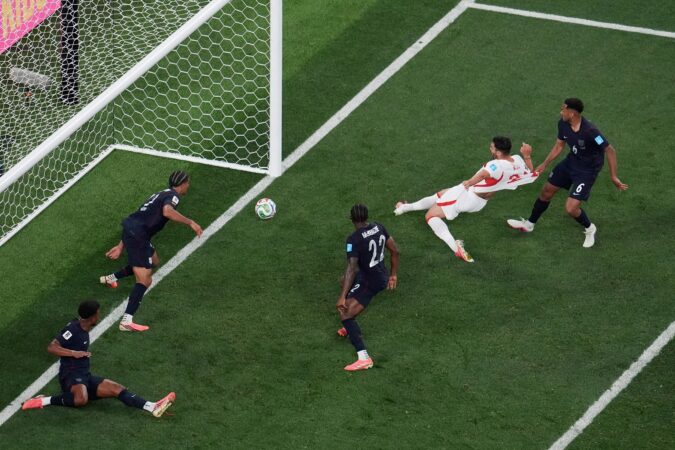
Alas, the lead only lasted seven minutes. It started with Arda Güler of Spanish superpower Real Madrid taking a pretty pass from Oğuz Aydın, then beating Mark McKenzie twice off the dribble as he ran forward. The first move cleared a path for Barış Alper Yılmaz, and the second came when Yılmaz returned the ball to Güler for an easy finish past Matt Turner.
McKenzie nearly made up for it in the 29th when the U.S. got another corner kick and he cashed in a rebound. But he was offside when Pepi’s initial shot was saved by Uğurcan Çakır, so it didn’t count.
Orkun Kökçü put Turkey ahead in the 31st by capping off the kind of move Turkey was supposed to make throughout this tournament: fast, skilled passing leading to a precise finish. Güler was in the middle of the buildup along with Turkey’s other superstar, Kenan Yıldız of Italy’s Juventus.
Now, at last, the team that had taken 62 shots over its first two games without scoring — the most of any team in the tournament, and the highest total without a goal since stats started in 1966 — was finally finding the net. And of course it had to come in this game, not just for the U.S.’ sake but for the sake of a team already eliminated from advancing.
Another look at the build-up from Türkiye and the goal from Kökçü to take the lead over the US in Los Angeles 🇹🇷 pic.twitter.com/CPvlOSPbUY
The U.S. flew out of the gates again to start the second half, and this time Berhalter finished a goal instead of starting it. McKenzie launched a throw-in, Turkey’s Abdülkerim Bardakcı knocked it down in the box, the ball deflected out to Berhalter, and he lashed in a first-time hit from the 18-yard line.
2-2! SEBASTIAN BERHALTER FINDS THE EQUALIZER FOR THE @USMNT 🇺🇸
Christian Pulisic was the first substitute to enter, replacing Tim Weah in the 58th. It wasn’t a surprise that he played, but it was a bit surprising that he came in so early.
Four minutes later, Brenden Aaronson caught a piece of a loose ball off Çakır’s save of a Pulisic shot, but his first-touch attempt rolled far off target.
A trio of subs entered in the 77th: Sergiño Dest, Alex Freeman, and Alejandro Zendejas for Aaronson, Gio Reyna, and Joe Scally. That set up the U.S. with three centerbacks for the rest of the night, plus Trusty continuing his start on the left flank.
Malik Tillman was the last substitute to enter, replacing McKennie in the 86th.
Unfortunately, the night ended on a bad note for Trusty. He was clipped by Aydın and went down in a heap. But at least he could walk off under his own power, and he returned to the game after a short spell on the sideline.