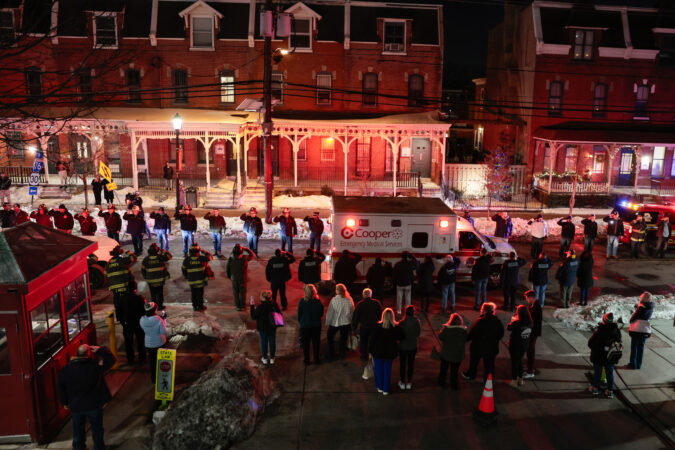
A Camden firefighter died Thursday after getting trapped under ice and water in the Delaware River, according to the Camden mayor’s office.
The Professional Fire Fighters Association of New Jersey on thursday night identified the fallen first responder as Howard Bennett.
The firefighter was doing regular maintenance on a department fireboat near Wiggins Marina around 11:30 a.m. when he fell into the water and got stuck under the ice. He was trapped for about 30 minutes, Fire Department Chief Jesse Flax said at a news conference.
Bennett was removed from the water, given medical attention, taken to Cooper University Hospital, and declared dead.
“I do not have enough words that I can even say that could tell you how this is hurting all of us,” Flax said.
Camden Mayor Victor G. Carstarphen thanked the fallen firefighter for the sacrifices he made to serve the city.
“He wasn’t just a public servant,” Carstarphen said. “He was a husband. He was a brother, a father, that committed his adult life to serving and protecting and being there for our residents in the city.”
Pete Perez, the president of Local 788, a union that represents Camden firefighters, described Bennett as particularly skilled in boating.
“He was our guy for when it came to the boat stuff,” Perez said.
“I’m devastated to the core,” Perez added. “For first responders — police and fire — training, routine things, can be inherently dangerous and today, unfortunately, we learned that.”
Mathew Caliente, president of the Professional Fire Fighters Association of New Jersey, said in a statement:
“We are devastated by the loss of Brother Bennett who dedicated his life to protecting the residents of Camden. Our hearts, our prayers, and our full support are with his family, his friends, and the members of Camden City Firefighters Local 788 and Camden Fire Officers Local 2578 during this unimaginably difficult time.”
As expected, the 76ers parted ways with Eric Gordon.
Sources confirmed that the Sixers traded the reserve shooting guard to the Memphis Grizzlies on Thursday in exchange for a 2032 second-round pick swap. This move gives the Sixers various options.
It opens up a roster spot to convert Dominick Barlow’s two-way contract into a standard deal. It also gives them a little over $7.6 million in salary cap space under the first apron, meaning they can sign players on the buyout market in addition to using up to $8 million in a trade exception to acquire a player.
Gordon played only in six games this season, with his last appearance coming Dec. 23 against the Brooklyn Nets. The 37-year-old, in his 18th season, signed a one-year, $3.63 million contract on July 1 after declining his $3.47 million player option.
Gordon’s deal carried a $2.3 million cap hit and a $2.3 million dead cap value, which was considered a good, low-risk expiring salary for potential trades.
The thought was that the Sixers could use a second-round pick to entice a team with a lot of cap space to take on Gordon’s contract for the remainder of the season. It turns out they found a trade partner in the Grizzlies.
After a week of moderate winter temps, we’re back to single digit chills and snow-packed streets this weekend.
At this point, we’re used to the bone-numbing winds, so nothing will stop us from enjoying fun, brutally-entertaining, and dog-friendly events happening this weekend. Am I right?
While our beloved Birds didn’t make it to the Super Bowl this year, there’s plenty of watch parties for disheartened fans in need of support, and others looking forward to Bad Bunny’s electrifying half-time show.
Plus, a brutal bare knuckle brawl will take place in South Philly. Craftsman Row’s annual Mardi Gras pop-up experience will transport patrons to New Orleans’ French Quarter. And a reimagined Shakespearean classic will open at the Philadelphia Contemporary Theatre.
Whatever you choose, just please avoid ice fishing on the frozen Schuylkill. There’s enough events to go around before you need to risk your warmth (and life) on the river’s ice-solid surface.
Just look below, and you’ll find plenty of events worth reeling into your weekend plans.
Schuylkill River as seen from former railroad bridge in Manayunk section, Philadelphia on snowy and cold Monday, Jan. 26, 2026.
The Schuylkill is frozen, so that means you can ice fish on it. Right? No!
With the surface of the Schuylkill frozen solid, a reader asked through Curious Philly if ice fishing is allowed on the grand tributary.
Short answer: no.
While fishing along the Schuylkill is accepted and celebrated in warmer temperatures, those dreaming of an Arctic lifestyle should be reconsider their plans.
⚜️ A taste of NOLA: Stop by Craftsman Row Saloon for a taste of New Orleans. The bar’s annual Fat Tuesday pop-up experience will feature Mardi Gras-inspired dishes and southern favorites like jambalaya, crawfish mac and cheese, and po boys.
🍷 The formula of love: Learn the science of romance at the Science History Institute’s event on Friday. Wine chemist André Isaacs, master chocolatier Jim St. John, essential oil specialist Kim Bleimann, and others will dive into the history of your favorite Valentine’s Day staples for “Wine, Roses, and Chocolate: How Romance and Science Work Together.”
🐶 The return of Bark Bowl: The fifth annual Bark Bowl returns to Craft Hall on Saturday. While their furry, four-legged friends are enjoying the indoor turf and doggie toys, pet-parents can enjoy a special menu of drinks, crafty-style pizza, BBQ platters, and other offerings.
🏈 Super Bowl Watch Parties: While our beloved Eagles didn’t make it to the biggest night in sports, it doesn’t mean you can’t stop by watch parties at Fringe Bar, Taller Puertorriqueño, Stateside Live!, and other venues and dive bars.
📅 My calendar picks this week: Step Afrika! at Miller Theater, First Friday in Chestnut Hill, Restaurant Week in Center City
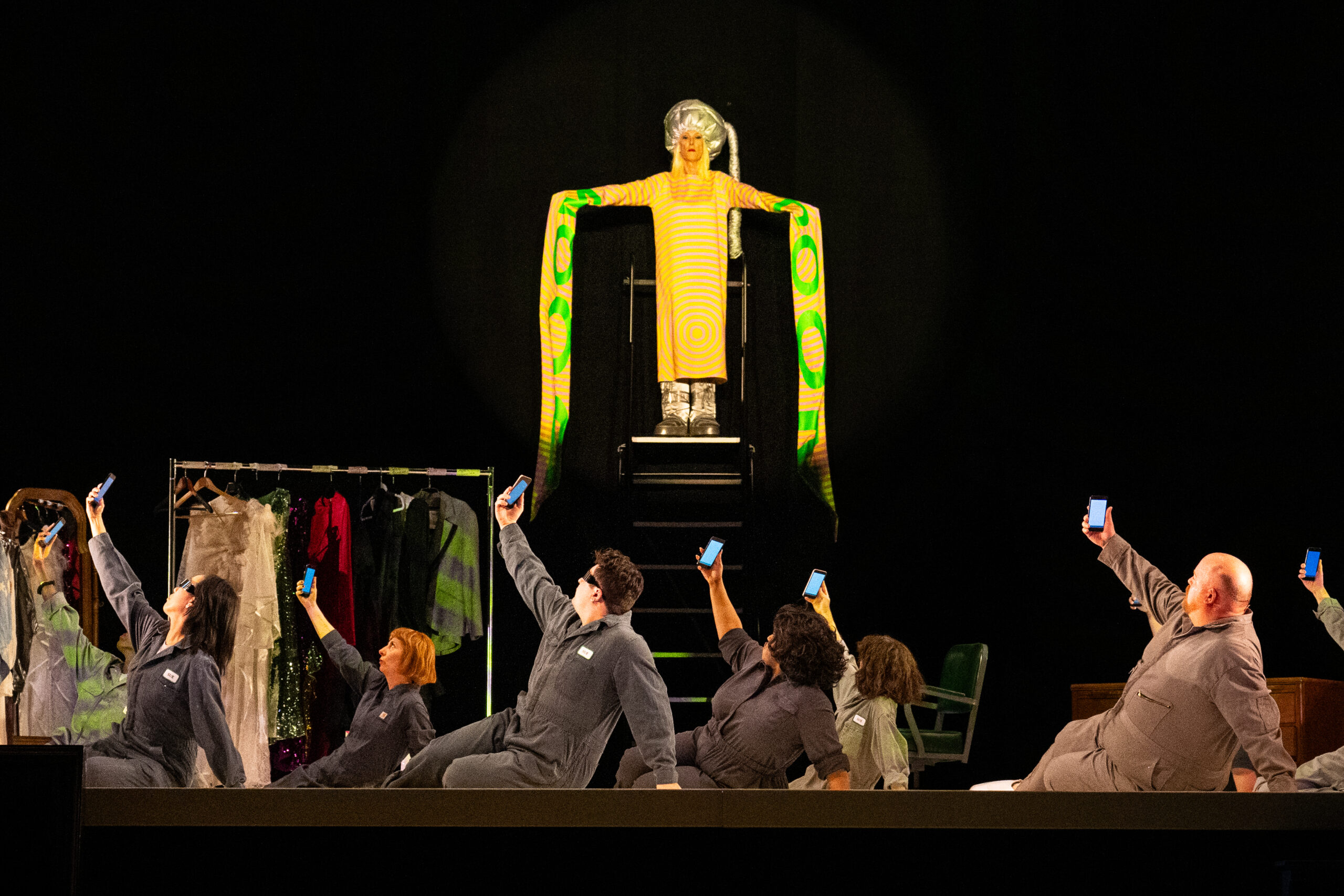
Kiera Duffy (left) and Justin Vivian Bond perform in “Complications in Sue” during the final dress rehearsal at the Academy of Music in Center City Philadelphia on Saturday, Jan. 31, 2026. The original libretto is based on an idea by Bond, and is playwright Michael R. Jackson’s operatic debut.
Opera Philadelphia’s ‘strange little roller coaster ride’ is rolling into town
Created to commemorate the Opera Philadelphia’s 50th anniversary, Complications in Sueopened on Wednesday with 10 composers commissioned to write eight-minute scenes. (Here’s our review!)
The scenes encompass the century-long life of a mythical everywoman named Sue, who does everything from saving Santa Clause from an existential crisis in a nonbelieving world, to fending off aggressive shopping algorithms. Impressive, right?
Complications in Sue plays through Sunday at the Academy of Music. All tickets are Pick Your Price, starting at $11.
Read more in writer David Patrick Stearns’ story here.
Winter fun this week and beyond
🏎️ One final lap: Stop by the Philadelphia Auto Show, and take a spin around the Pennsylvania Convention Center before the annual ends on Sunday. Hundreds of vehicles will be displayed throughout the exhibition, including some you can test drive in and outside the building.
🤜🏽 Put your dukes up: The biggest night in Bare Knuckle Fighting Championship returns to Philly for KnuckleMania VI at Xfinity Mobile Arena. Show-stoppers like heavyweight champion Ben Rothwell will defend his title against former UFC champ Andrei Arlovski in a main event clash.
🎭 A reimagined theater classic: A modern, fast-paced, and thrilling reimagining of Shakespeare’s Julius Caesar will take center stage at the Philadelphia Theatre Company on Froday. The show runs through Feb. 22.
🧗🏼♂️ Come Baa-aaa-ack to Please Touch Museum: Shaun the Sheep, Bitzer, and your kid’s other farmyard friends will guide them through a series of fun problem-solving activities at the Please Touch Museum. Kids can scale small climbing walls, form their own stop-motion animations, and test their agility on balance boards. The exhibit runs from Saturday to May 10.
🎸 Thursday: Off the heels of the Oklahoma band’s seventh album, the Turnpike Troubadours bring their brand of Red Dirt country at the Met Philly. The band will be joined by wry Texas songwriter Robert Earl Keen.
🎤 Friday: Soulful Alabama singer Kashus Culpepper, whose new album, Act I, features guest appearances from Sierra Ferrell and Marcus King, will play World Cafe Live’s Free at Noon. Then, he’s headed to the Foundry at the Fillmore for a second gig that night.
🎤 Tuesday: Two days after singing “America the Beautiful” at Super Bowl LX in Santa Clara, Calif., on Sunday, Brandi Carlile will kick off her “Human Tour” at Xfinity Mobile Arena on Tuesday.
Assuming the roads are clear, and the snow isn’t too brutal this weekend, make your way to these stellar events.
Besides, I’m sure it helps to keep Eagles fans’ minds off Sunday’s game. And I’ll say it again — avoid any ice fishing, please.
Figure skating is one of the most popular events at the Winter Olympics.
But many only follow it every four years, which can make it confusing when the rules change — as they do annually. Most of the names also are new since 2022.
Plus, figure skating is a judged sport, so sometimes the skater you love might get dinged on rules you don’t know and not place as well as you’d expect.
Here is a breakdown of how to watch the Olympic figure skating events:
What are people talking about?
The Blade Angels
The American skaters! Team USA has been a powerhouse off and on, but 2026 is very much an on year.
On the women’s side, all three women — who call themselves the Blade Angels — have major titles to their name. South Jersey’s Isabeau Levito is the 2023 U.S. champion and the 2024 world silver medalist. The 18-year-old was born in Philadelphia and lives and trains in Mount Laurel.
Amber Glenn is a three-time U.S. champion and won the Grand Prix Final in 2024.
Alysa Liu is a two-time national champion and the reigning world and Grand Prix Final champion.
Ilia Malinin skates his program at the U.S. Figure Skating Championships in January in St. Louis.
The Quad God
Ilia Malinin named himself the Quad God early on, and he’s lived up to that name, landing seven triples (the six major jumps plus one in combination at the 2025 Grand Prix Final in December.
He is the only man in the world to land a quad axel in international competition. Sometimes called the quaxel, it is 4½ revolutions in the air with a forward (read: harder) takeoff.
The quad axel was the talk of the 2022 Olympics in Beijing because Japan’s Yuzuru Hanyu was going to attempt it. But he did not land it cleanly.
Malinin has competed it many times since then. Thanks to the difficulty of the move and his consistency, he has not lost a competition he skated in several years.
All three men on the U.S. team are second-generation skaters. Malinin’s parents represented Uzbekistan at two Games.
Andrew Torgashev’s Ukrainian mother, Ilona Melnichenko, competed for the Soviet Union and was the 1987 World Junior champion in ice dancing. His Russian father, Artem Torgashev, was a pairs skater, also for the Soviet Union, and is a two-time World Junior Championships medalist.
Ice dancer Anthony Ponomarenko’s parents, Marina Klimova and Sergei Ponomarenko, are the only ice dancers to have won an Olympic medal of every color. They are the 1992 Olympic champions.
Married ice dancers Madison Chock and Evan Bates are seven-time national champions.
Chock and Bates
American ice dancers Madison Chock and Evan Bates are back for their fourth and fifth Olympics, respectively. The married couple has a team gold medal from the 2022 Winter Olympics. They are seven-time national champions and three-time world champions. The only title they haven’t earned yet is an individual Olympic medal. There are a few other teams who could challenge them for Olympic gold, but they have the edge entering the event.
The oldest competitor and whether she can skate
Deanna Stellato-Dudek is 42 and competed in singles for the United States when she was a teenager. She retired because of injury but came back 16 years later when she realized her unfulfilled Olympic dream. She competed in pairs for Team USA before teaming up with Maxime Deschamps and eventually getting her Canadian citizenship.
After a four-year ban because of the war in Ukraine, Russia was allowed to send a limited number of skaters to an Olympic qualifier competition to compete as neutral athletes. They were not considered if they had shown any support for the war. Two women qualified: Adeliia Petrosian and Viktoriia Safonova. Petrosian is in contention for a medal and likely will be the only woman to attempt quads at the Games.
One neutral Russian man was cleared to compete, Petr Gumennik. No pairs or ice dancers were allowed.
Who else is on Team USA?
The other U.S. dance teams in Milan are Ponomorenko and Christina Carreira, who’s from Canada and recently became a U.S. citizen. They are the 2026 U.S. bronze medalists and medaled twice at the World Junior Championships.
Emilea Zingas and Vadym Kolesnik teamed up in 2022 and quickly found success. They are the 2026 U.S. silver medalists.
Ellie Kam and Danny O’Shea compete during the pairs free skate in January.
In pairs, Ellie Kam and Danny O’Shea, the 2026 U.S. silver medalists and 2024 champs, are fan favorites because O’Shea competed through three Olympic cycles before he made the team. They are 13 years apart.
Emily Chan and Spencer Akira Howe overcame a rough short program to place fourth (and win the pewter medal) in January’s U.S. championships. They made the team because other top teams’ skaters didn’t share citizenship. Chan and Howe are the 2023 U.S. silver medalists. Howe is in the World Class Athlete Program of the U.S. Army and hopes to become an Army chaplain.
Normally, skaters compete individually or in pairs. In 2014, the team event was added to Olympic competitions. Different skaters can skate the long and short programs for each event (men’s, women’s, pairs, dance), but a team can repeat in two events.
Only the ones chosen to skate win medals, rather than the entire Olympic team.
The team event began with ice dance on Friday and ran through Sunday. Individual events begin Monday, also with ice dance.
In 2022, Russia was poised to win the gold, with the United States right behind it and then Japan. But after 15-year-old Kamila Valieva was found with banned drugs in her system, she was retroactively banned for four years. (That period recently expired, and Valieva is training again.)
In past team events, the United States won bronze in 2014 and 2018. Russia and Canada were the other medalists both years (Russia won in 2014, and Canada in 2018).
Pairs has the big jumps, throws, and lifts. Dance is almost entirely footwork and is based on ballroom dance.
What is the difference between the short program and the long program?
The short program has a set of required elements that the skaters must perform. They have some freedom within those restrictions. For example, if they are told to do a triple jump, they may choose any triple jump. Generally, they choose the harder jumps because they earn more points. But they may also choose the jump they do best.
If skaters miss a required element, they get a zero for it. For example, if a triple jump is required and the skater does a double instead, it is as if he or she didn’t jump at all.
In dance, the short program is called the rhythm dance. A theme is chosen every year. This year, it is “the music, dance styles, and feeling of the 1990s.”
The long program has more freedom, but it still must be a “well-balanced program,” meaning a combination of elements covering the full surface of the ice.
The short program for singles and pairs is 2 minutes, 40 seconds, plus or minus 10 seconds. The rhythm dance is 2:50, plus or minus 10 seconds.
The long program for all is four minutes, plus or minus 10 seconds.
What are the differences between figure skating jumps?
The skating blade looks flat, but it actually is sharpened to a curve with two edges.
Jumps take off from an edge (axel, loop, Salchow) or from the skater tapping in his or her toe (flip, Lutz, toe loop).
The axel is a forward entry but lands backward. All other jumps start and land backward.
The flip and Lutz are very similar toe jumps, but the flip is from an inside edge, and the Lutz from the outside, meaning the Lutz requires slightly more rotation, and thus is given more points.
A common mistake is that a skater will aim to do one but change the edge at the last minute. Commentators often talk about that as a “flutz.”
Another common mistake is a “cheated” jump, meaning the blade lands at least a quarter turn short of rotation. That results in a deduction or sometimes even a downgrade, meaning an intended triple jump is called a double.
Which skaters are expected to do well?
Along with the U.S. women, the Japanese women are very strong. They are led by three-time world champion Kaori Sakamoto, who won the Olympic bronze medal in 2022.
On the men’s side, along with Malinin, the top contenders include Yuma Kagiyama of Japan, who earned the silver medal at the 2022 Olympics and is also a three-time World silver medalist. France’s Adam Siao Him Fa and Kazakstan’s Mikhail Shaidorov are others to watch.
The top ice dancers are Chock and Bates. Canadians Piper Gilles and Paul Poirier earned the silver medal behind Chock and Bates in the last two world championships.
Silver medalists Piper Gilles and Paul Poirier (left), gold medalists Madison Chock and Evan Bates, and bronze medalists Lilah Fear and Lewis Gibson celebrate their medals at worlds in 2025.
The pairs contenders are led by Riku Miura and Ryuichi Kihara of Japan, the reigning world champions. Others include Sara Conti and Niccolò Macii (Italy), Minerva Fabienne Hase and Nikita Volodin (Germany), and Anastasiia Metelkina and Luka Berulava (Georgia).
How is Olympic figure skating judged and scored?
The judging system was changed after the 2002 Salt Lake Olympics judging scandal, when two judges allegedly colluded to make certain skaters champions. The 6.0 system was replaced by IJS, the international judging system, which defines how many points each element is worth.
The officials include judges and a technical panel. The technical panel determines an element — including whether a triple should be downgraded to count as a double — and the judges decide the quality of the element. Skaters may be given a positive or negative grade of execution depended on how the element was performed. They also are given points for skating skills, transitions between elements, and performance. This is how a more artistic skate with fewer big jumps, can still do well. It is also how a skater with lots of impressive jumps but easier footwork may not win.
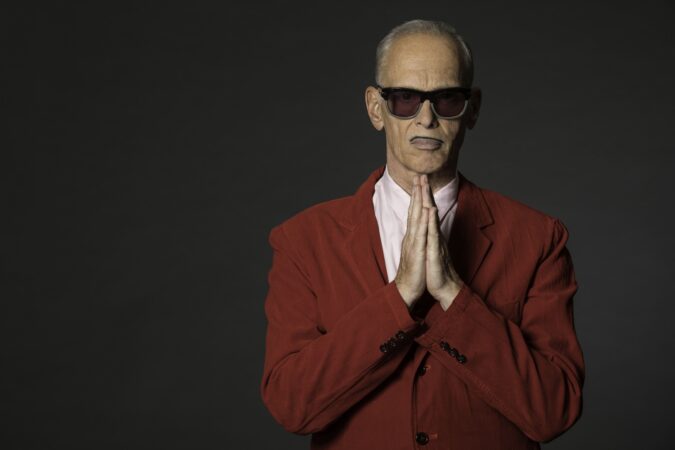
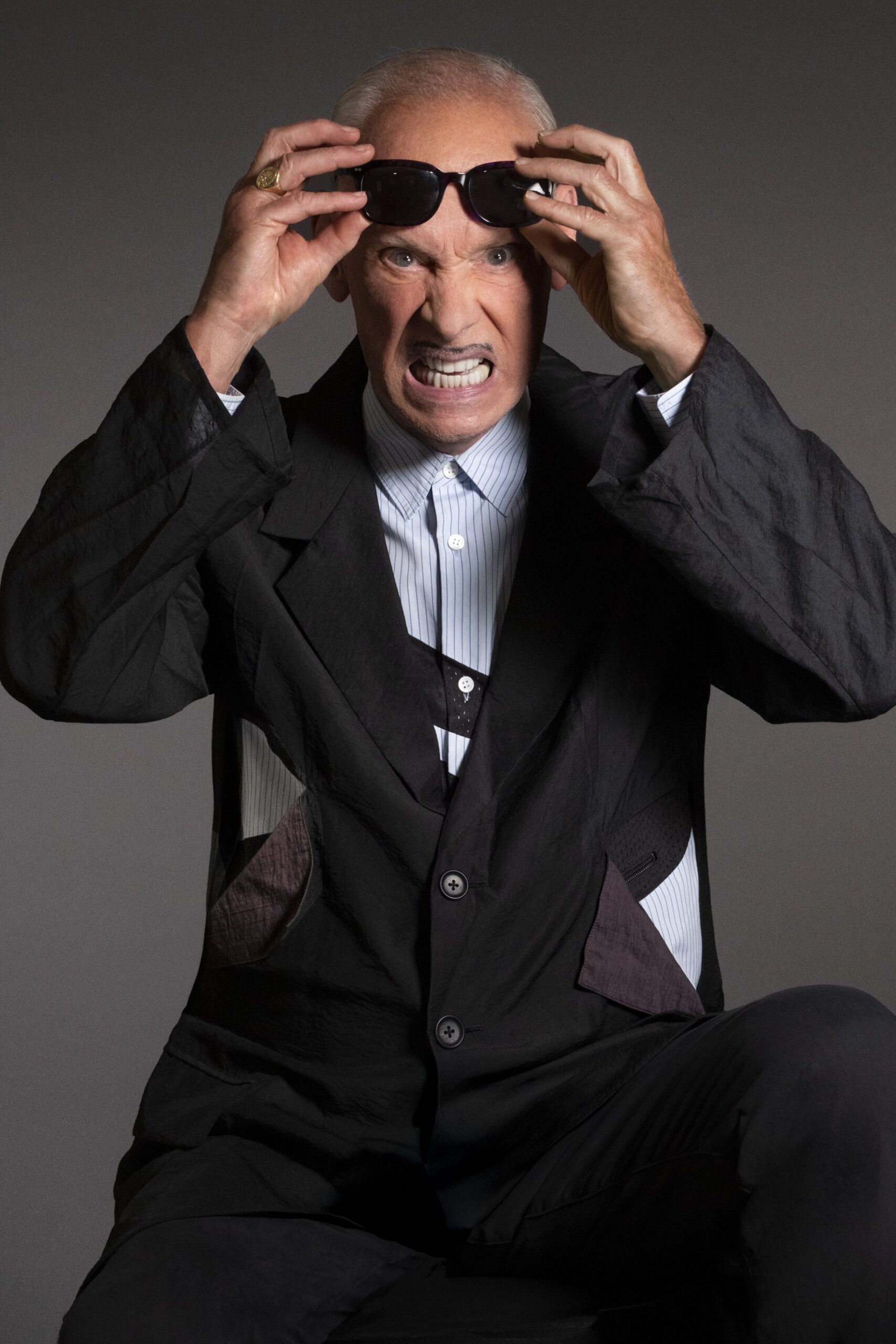
It’s a chilly January afternoon and John Waters is on the phone talking about his new one-man show, “Going to Extremes.”
Waters, whose subversive indie films inspired William S. Burroughs to dub him “The Pope of Trash,” is calling from San Francisco, where he has an apartment. He has another one in New York and a place in Provincetown, Mass.
But Waters’ heart — and his home — is in Baltimore.
“That’s where my house is, that’s where my office is, that’s where my studio is,” Waters said. “Baltimore is always where I lived. I never for a moment thought of leaving there.”
Waters’ 1970s queer cult classics like Multiple Maniacs and Pink Flamingos starring iconic drag queen Divine were all made in Baltimore, as were mainstream breakthroughs like Hairspray (1988) and Cry-Baby (1990).
Charm City has always been essential to Waters’ work because, “I knew it well, and I praised a city that, in that time, had an inferiority complex.”
Thanks to his movies and other works, like Barry Levinson’s Diner and David Simon’s The Wire, “Baltimore does not have an inferiority complex anymore because we praised all the things that people used against it.”
“I think Philadelphia has the same issue sometimes, too. And we even have the same accent, though ours is a little weirder.”
“Philadelphia was always a good market for me,” he said. “Elizabeth Coffey was from there, a great, great actress who’s in a lot of my films, the first [transperson] I ever worked with… And the TLA cinema was one of the first theaters that made Pink Flamingos famous. It played there forever.”
Waters and Divine made several trips up I-95 for appearances at TLA midnight movie screenings, one of which, from 1974, is immortalized on YouTube.
It shows a lank-haired Waters in trademark shades and a Little Richard-inspired pencil mustache sitting beneath a Citizen Kane poster, and Divine popping out of a cake.
Waters’ early movies can still shock. Watching Divine’s character Babs Johnson eat poo in Pink Flamingos never goes down easy. But over time, Waters has been lauded as a transgressive pioneer of undeniable importance.
Or, as he puts it: “I’m so respectable I could puke!”
John Waters’ show “Going to Extremes” comes to the Colonial Theatre in Phoenixville on Saturday.
Pink Flamingos was added to the National Film Registry in 2021 and judged to be the 31st best comedy of all time last year by Variety. The publication called it “the cinematic birth of punk.” In the 91st spot on the same list is Waters’ Hairspray, the musical starring Ricki Lake (and Divine as her mother) about an American Bandstand-like 1960s Baltimore TV show’s struggles to integrate its dancers.
“C’mon, the 100 best comedies in the history of film, and two of them are mine? We’re talking the Marx Brothers, Charlie Chaplin, everything. When I see that for movies that are probably even more offensive today than they would have been then because of all the things that you wouldn’t have been allowed to do — it’s astounding to me.
“I’m proud,” he said. “I’m amazed by it. I think it’s wonderful. Debbie Harry, who’s a friend” — and hilarious as a scheming stage mom in Hairspray — “and I have talked about that. Aren’t we glad we’re alive to see this? Because many are not.”
For all of his respectability, however, Waters, 79, still finds it hard to get films financed and made.
“The last two movies I was supposed to make never happened. Aubrey Plaza was going to star, and we had a big company buy the rights to my novel Liarmouth. And it fell through.”
Still, Waters says, “I’m busier now than I’ve ever been.”
“I love the punks,” he said. “They’re the only minority who want to be hated.”
He also gathers his flock every September for a long weekend in Connecticut at Camp John Waters, where “people come and live as my characters for four days. We call it Jonestown with a happy ending.”
Every year, he also writes a brand new show and takes it on the road, sometimes with a Christmas theme in holiday season. “Going to Extremes” is billed as “crackpot comedy.”
But don’t call it stand-up, or performance art.
“It’s a sermon,” he said. “It’s a religious gathering.”
And it aims to speak to America’s deep divisions with a tool he finds sorely lacking in the body politic: humor.
“When I was young, the radical left had a sense of humor, with the Yippies and Abbie Hoffman. Today, they have more rules than my parents had.”
Waters is worried about the times, especially about the persecution of trans people in the second Trump administration.
“Of course, I’m worried about all of it, because you can’t embarrass him,” he said about the president. “He’s like the punks — he loves to be hated, too. When I saw him around in the ‘70s, he was a liberal. He was in Studio 54. He hung around with Hillary!”
One of the highlights of “Going to Extremes,” he promised, will be revealing “the only funny thing [Trump] has ever said.”
What is it? “You have to come to the show to hear it.”
Waters is excited to return to the Colonial, where he performed in 2022. “The Blob was filmed there! And I, of course, love The Blob.”
Water doesn’t love everything about barnstorming the country, though.
“I don’t like it when the plane is late,” he quipped. “But I do enjoy it. I do 50 shows a year, so I’m always in motion. I’m a carny. It’s what I do. And I’m in touch with my audience.
“Elton John once said to me, the day you stop touring, it’s over. And that’s true. You have to keep doing it. Somebody’s waiting to take your place the minute you blink.”
“John Waters: Going to Extremes,” Feb. 7, 8 p.m., the Colonial Theatre, 227 Bridge St., Phoenixville. ColonialTheatre.com.
A high-concept stunt? A rare stroke of artistic luck? A Frankensteinian collage of 21st-century life?
All of that can be said about Complications in Sue, an opera of sorts that premiered with surprising cohesion and great audience response, on Wednesday at the Academy of Music.
Opera Philadelphia is on new ground with this collection of 10 loosely linked scenes by different composers who did their work without knowing what the others were up to.
Each scene documents a decade of the life of Sue, in a birth-to-death chronicle curiously devoid of outstanding achievements but forming a reflection of the worlds (both inside and outside her psyche) swirling around her.
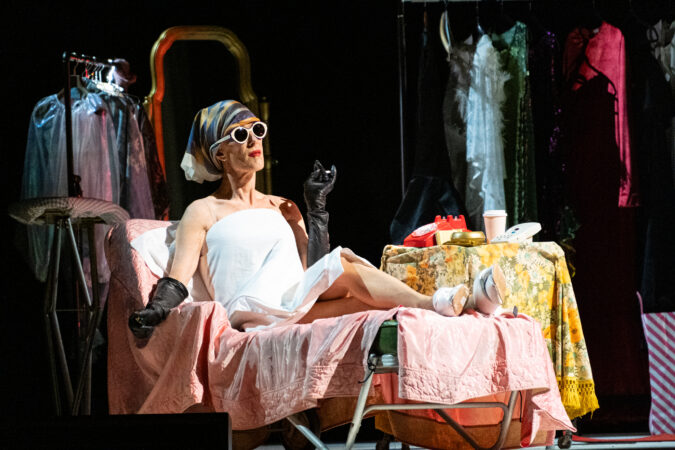
Sue’s shopping algorithm comes to life in Scene 6 of “Complications in Sue.” Justin Vivian Bond’s costumes were designed by JW Anderson.
At the center of it all — including episodes about Santa Claus in crisis, a grieving ex-husband, and Sue’s shopping algorithms coming to life — was the sharp-tongued cabaret artist Justin Vivian Bond.
Playing the imaginary Sue, she sang, talked (and danced here and there), and seemed to go off script with a damning litany of current government persons and entities. She prompted the loudest ovation of the evening with a no-holds-barred condemnation of U.S. Immigration and Customs Enforcement.
Somehow, the components came together, thanks partly to the anything-can-happen atmosphere of the piece.
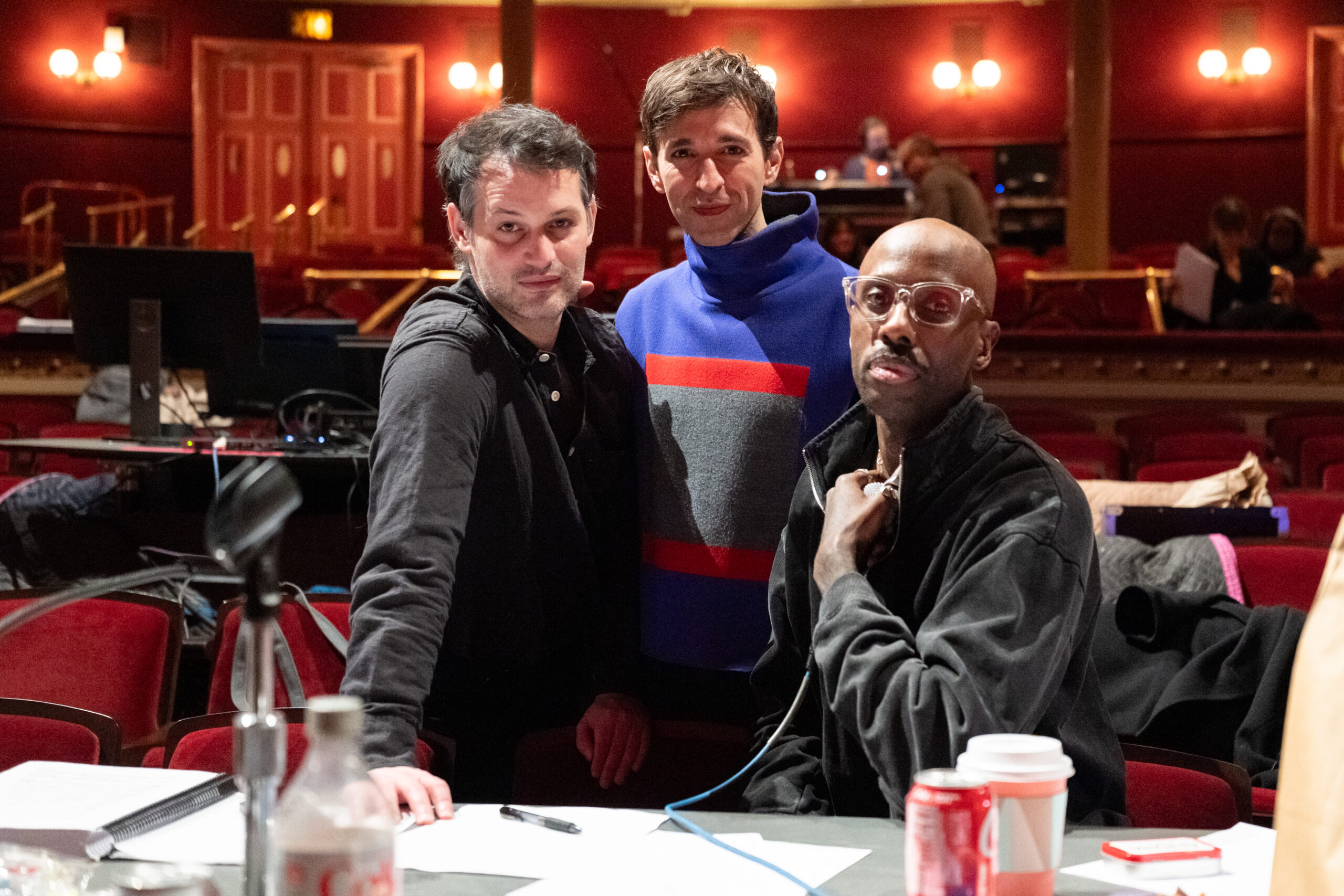
From left: Director Zack Winokur, producer Anthony Roth Costanzo, and director Raja Feather Kelly before a dress rehearsal at the Academy of Music on Jan. 31, 2026. The venue will be showing the new opera “Complications in Sue” from Feb. 4-8.
The 10 episodes — as fantastically conceived by librettist Michael R. Jackson — are like semi-improvised comedy sketches that leave certain psychological doors open for the composers to create a sense of operatic magnitude.
The composer lineup, full of strong personalities, was framed by Errollyn Wallen on birth (during which Bond walked down the theater aisle saying hello to aisle seaters) and Nico Muhly on death (in lovely choral writing with a waning, interior heartbeat).
Generally, tunes weren’t a priority as the composers characterized the theatrical events that Jackson gave them, such as Nathalie Joachim’s scene with a newscaster from deep within Sue’s psyche interviewing her about life choices. When Sue’s husband has a meltdown, Dan Schlosberg goes on a rampage through musical styles reflecting the cultural jumbles of our times. Missy Mazzoli makes Santa Claus’ breakdown more tragic than comic.
Bass-baritone Nicholas Newton portrays a disillusioned Santa in Scene 2 of “Complications in Sue.”
Nobody just went for laughs, even when they seemed to.
Andy Akiho had singers being annoyingly manic playing college kids obsessing over who they thought Sue is. But this is where the overall theme of Complications in Sue coalesced: Do we know anybody? Or ourselves? Do we want to?
Composers Cécile McLorin Salvant, Rene Orth, Alistair Coleman, and Kamala Sankaram also wrestled with such issues in one way or another, sometimes using minimalist-shaded repetition for urgency, prominent bass lines for dark corners and with absolutely no need to box these situations into some sort of smooth musical package.
Mezzo-soprano Rehanna Thelwell as Brenda Blackwoman, broadcasting
from inside Sue’s imagination in Opera Philadelphia’s “Complications in Sue.”
That last quality made many of these miniature compositions seem epic in their implications. Was Complications in Sue really just 90 minutes?
Under the confident direction of Caren Levine, the four-member cast consistently gave it their all in deeply unconventional musico-dramatic assignments.
Kiera Duffy and Nicky Spence each had episodes giving them space to dominate the stage on their own. Duffy’s voice was an island of sweet stillness even in tumultuous moments while Spence never let intonation and enunciation slip even in his most reckless moments.
The cast of “Complications in Sue” (From left: Nicky Spence, Kiera Duffy, Justin Vivian Bond, Nicholas Newton, and Rehanna Thelwell) in the final scene of the world premiere opera.
Nicholas Newton played both Santa Claus and Death with equal conviction (an accomplishment indeed). And if you walked in not knowing that Rehanna Thelwell was walking through her stage roles that were actually sung by Imara Miles, you wouldn’t be any the wiser.
The one disappointment on the performance front was Bond’s dance of death: It was just a lot of twirling in moments that asked for transcendence. Much of Bond’s fan base feels anything she wants to do is just fine. I’m not one of them.
One major achievement was how the production elements worked together. That just doesn’t happen very often in new operas.
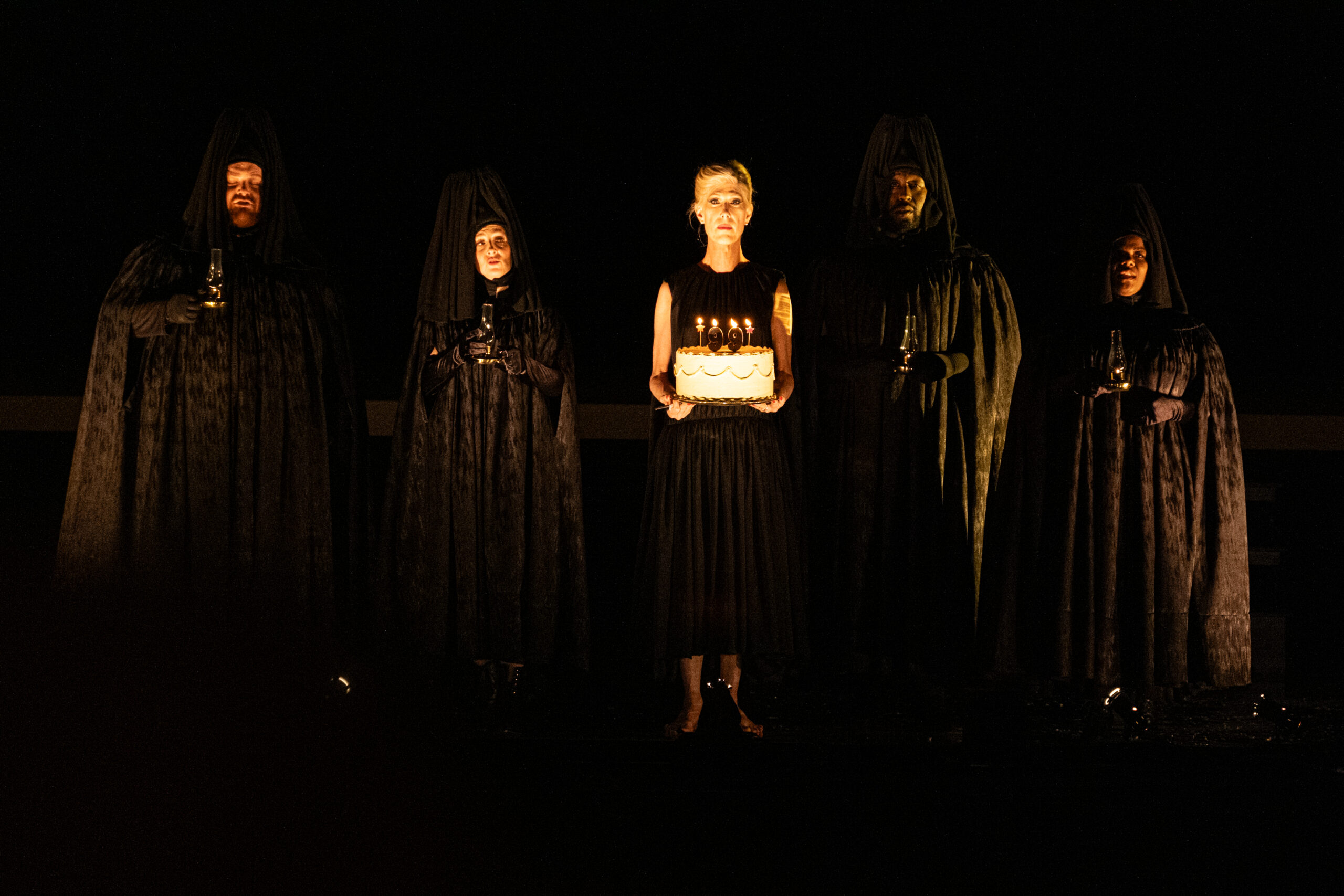
Justin Vivian Bond as 10-year-old Sue in “Complications in Sue,” directed by Raja Feather Kelly and Zack Winokur
The Krit Robinson-designed production ranged from a charmingly makeshift Christmas tree to dazzling abstraction. In later scenes, the stage had concentric rectangular frames, each with changing, subtle coloring.
Raja Feather Kelly and Zack Winokur shared directing duties but in such fluid, choreographic staging, it was hard to determine where one director’s work started and the other left off.
Consider what this team could do in more conventional operatic circumstances. I hope to see that.
“Complications in Sue,” plays at Feb. 5, 7 p.m. Feb. 6, 8 p.m. Feb. 8, 2 p.m. Academy of Music, 240 S Broad St. All tickets are Pick Your Price, starting at $11. operaphila.org, 215.732.8400, tix@operaphila.org
Two Januarys ago, the Flyers were riding a wave, building steam for the postseason beach.
But a loss to the Eastern Conference’s worst team, the Ottawa Senators, in Game 2 of what proved to be a five-game losing streak sent that wave crashing down before it came ashore. It was a turning point in an otherwise promising season.
Heading into their Thursday matchup at Xfinity Mobile Arena (7 p.m., NBCSP), the Flyers and Senators were in a different predicament. Both teams are on the outside looking in at the playoff picture, but they are tied in points percentage (.545), with the Flyers having a game in hand.
It is the last game for each team before the NHL takes a break for the 2026 Milan Cortina Olympics. The Flyers hoped end the unofficial first half of the season with a two-game winning streak.
“Just play how we can play,” forward Noah Cates said Wednesday after practice. “Obviously, a big win [Wednesday], but kind of struggled a little bit there. But try to flush it and get one more before the break.
“Put ourselves in the best spot possible for that push coming in late February, March, and April. So it’s kind of getting back to the way we have been playing when we’ve had success and kind of the team game that we can play.”
Cates was quick to mention that the Flyers’ record after a win isn’t great — it’s 9-11-4. Two of those losses, one in regulation and one in overtime, came at the hands of the Senators.
Although he knew the stat, he and his teammates aren’t paying too much attention to it. After all, Flyers coach Rick Tocchet stresses keeping an even keel and never reading too much into the highs or the lows.
Rick Tocchet says it is important that the Flyers’ minds don’t drift elsewhere with one game remaining before a three-week break.
But the bench boss has been down this road before and knows he needs to keep his team focused, as a nice break is on the horizon.
“You’re concerned a guy’s mind is somewhere else,” he said Thursday during an optional morning skate. “I think [assistant coach] Todd [Reirden] told the story about, I think Sidney Crosby, before an All-Star break, or this sort of thing, is one of the leading point-getters of all-time.
“Sometimes their minds are already, ‘Hey, where [are we] going?’” he said. “This is a big game. This is a mindset game. So, yeah, even keel, 100%.”
The Flyers are off the ice until 2 p.m. Feb. 17, when they will practice in Voorhees. They do not return to game action until Feb. 25 at the Washington Capitals (7 p.m., NBCSP).
Sam Ersson was back on the ice with his teammates and participated in the optional morning skate with forward Nic Deslauriers, defenseman Emil Andrae, and goalie Aleksei Kolosov at Xfinity Mobile Arena.
The goalie was injured last Thursday during the Flyers’ loss to the Boston Bruins. Ersson allowed five goals on 20 shots and did not come out for the third period after suffering a lower-body injury.
“I would expect it, yes,” Tocchet said when asked if Ersson should be good to go after the Olympic break. “I mean, 21 days [until the next game]. I would expect it for sure, especially that he’s on the ice now.”
Breakaways
Dan Vladař (17-8-5, .904 save percentage) will start against the Senators. He was in goal for the 2-1 loss in October, allowing two goals on 33 shots. Kolosov will serve as the backup. … Forward Garnet Hathaway slots back into the lineup and Deslauriers comes out. … Despite Tocchet saying he didn’t want Andrae to remain out of the lineup too long, the defenseman will sit again Thursday for the fifth straight game. Andrae has not played since Jan. 26, a 4-0 loss to the New York Islanders. “I was talking to [Reirden], he’s kind of liked the PK the last 3-4 games,” Tocchet said. “I think it’s helped us the last couple of games, even with confidence. … We’ll reset after this game. We have two weeks off, we’ll figure things out from there.”
The Swarthmore Public Library has officially done away with overdue fees, joining a growing contingent of libraries that say the fines do more to drive patrons away than to get them to return their books on time.
Swarthmore’s library serves residents of Swarthmore and neighboring Rutledge and is a member of the Delaware County Public Library System. A nonprofit, the library is powered by private donations and government funding. It served around 3,100 cardholders in 2024.
Overdue fines can actually deter library use, all while bringing in marginal financial benefits, said Alec Staley, the library’s director.
Case studies have shown that library fees ultimately can discourage people from returning books. After the Chicago Public Library dropped fees in 2019, it saw a 240% increase in return of materials within three weeks. During a six-week fine-forgiveness program at the San Francisco Public Library in 2017, nearly 700,000 items were returned (the items returned were valued at $236,000).
Once late fees start accruing, many people, especially low-income library patrons, will stay away to avoid paying them, forfeiting their library access entirely. Oftentimes, late fees burden the people who need library resources the most.
Collecting fees has also become taxing for library staff, Staley said. Turning away families because of overdue fees has weighed heavily on Swarthmore’s librarians.
“We were just punishing [people] for no reason at all,” he said.
The new policy means any outstanding late fees will be wiped from cardholders’ balances.
Elizabeth Brown, president of the library’s board of trustees, said fine revenue is “not a meaningful source of our budget.”
Swarthmore Borough is set to contribute $277,000 to the library this year, up 17% from the year prior.
Late fees make up only around 1%, or $5,000, of the Swarthmore Public Library’s annual revenue. Library officials believe they can close the gap with fundraising.
Does this mean people will be able to take the books and run? Not really.
“We’ll still have a lost-item charge,” Brown said. “This is by no means a free-for-all.”
Unreturned items will be marked “lost” after three weeks and a fee will be charged. However, fees will be dropped if the “lost” book is returned.
The Swarthmore Public Library joins a growing group of Philly-area fine-free libraries.
The Free Library of Philadelphia went fine-free in 2020, a move the library system said would increase equity and bring back 88,000 cardholders who were unable to access library services due to fines.
In Delaware County, the Upper Darby Township and Sellers Memorial Free Public Library, Newtown Public Library, Media-Upper Providence Free Library, and Ridley Park Public Library are fine-free.
Ultimately, Staley said, imposing fines runs counter to the heart of what a public library is supposed to be.
“We champion that we’re one of the last free spaces in the United States,” he said. “But then we have this secret where we’re still charging fines.”
This suburban content is produced with support from the Leslie Miller and Richard Worley Foundation and The Lenfest Institute for Journalism. Editorial content is created independently of the project donors. Gifts to support The Inquirer’s high-impact journalism can be made at inquirer.com/donate. A list of Lenfest Institute donors can be found at lenfestinstitute.org/supporters.
On Wednesday, in a social media post addressed to Philadelphia, longtime Eagles offensive line coach Jeff Stoutland announced his decision to leave the organization after 13 seasons.
“I’ve decided my time coaching with the Eagles has come to an end,” he wrote. “When I arrived here in 2013, I did not know what I was signing up for. I quickly learned what this city demands. But more importantly, what it gives back. The past 13 years have been the great privilege of my coaching career. I didn’t just work here, I became one of you. Stout Out.”
At least one Eagles offensive lineman was named to the Pro Bowl in every year of Stoutland’s tenure with the franchise. Two Eagles running backs led the league in rushing during the same span: LeSean McCoy in 2013 and Saquon Barkley in 2024.
The news comes a week after The Inquirer first reported that Stoutland’s role as the team’s run game coordinator waned during the season as the Eagles shifted their game-planning responsibilities. Stoutland, as reported by ESPN, did not desire to keep the role after the in-season change.
With the news of the two-time Super Bowl champion assistant relinquishing his coaching role, many fans have taken to social media to thank Stoutland. Others have looked to display their dismay …
I seriously wish stoutland got one more ring or NFC championship. The amount of talent he coached up will be remembered. Thank you for giving us some of the best OL play 🫶🏼 #stoutland
Leaving no time wasted, some fans have begun to blame Stoutland’s departure on coach Nick Sirianni’s reported takeover of run coordinator duties. Stoutland’s agent, Alan Herman, told ESPN that Stoutland was frustrated with the change and felt his input was being ignored.
The news of Stoutland’s decision was coupled with uncertainty around defensive coordinator Vic Fangio’s retirement. The Inquirer has since reported that Fangio will be staying with the Eagles through 2026, but that did not stop onlookers from connecting the two coaching developments to what they perceived as a larger cultural problem.
Eagles might as well fire Sirianni now. Stoutland suddenly leaving and Fangio seriously considering retirement. That's two elite coaches that don't want to work with you
Vic Fangio and Jeff Stoutland. 2 of the most respected coaches in the NFL. Both wanted to leave like the NovaCare complex was on fire. That should tell you all you need to know. pic.twitter.com/OKgXkVgodW
Others have called on fans to stop the blame game and cease the “conspiracy theories.” Meanwhile, some have seen the departure as a positive for the franchise, as it indicated that new offensive coordinator Sean Mannion would be taking more control over the offense.
Stoutland leaving is a big loss, but the overreaction and conspiracy theories about why he's leaving is nauseating.
Idk this seems healthy and doesn’t create panic for me. If we want real change on offense then Mannion needs space to implement his scheme (pass game + run game). If adapting to McVay/Shanahan scheme gave Stoutland pause, as article suggests, it was time to part. Great run. https://t.co/gSjso9fs2f
Stoutland was not the only Philadelphia favorite to depart from the city on Wednesday. A few hours before the assistant coach’s announcement, the Sixers traded away second-year guard Jared McCain to Oklahoma City for the Houston Rockets’ 2026 first-round pick and three second-round picks.
Report: Sixers had no idea Stoutland was going to “retire” and would not have traded Philadelphia hero Jared McCain to “add salt to the wounds”. https://t.co/bjS7BgcfH8
A massive 1.3 million-square-foot Schuylkill County warehouse that just 13 months ago bustled with 505 workers moving cheap overstock goods like shower curtains or pet cleaners for now-bankrupt retailer Big Lots sits utterly abandoned, its dozens of truck bays fenced off and surrounded by a silent shroud of snow.
It’s hard to imagine, but in the very near future, this white behemoth could be warehousing thousands of desperate human beings behind its bland, baby blue-trimmed concrete walls. On Monday, U.S. Immigration and Customs Enforcement filed a county deed that confirmed its $119.5 million purchase of the Big Lots facility — one more island in an American gulag archipelago of detention camps for the undocumented immigrants ICE is aggressively arresting from coast to coast.
“It hurts my heart,” the Rev. Brian Beissel, pastor at Christ’s United Lutheran Church in nearby Ashland, told me, choking up a bit, as we sat in a car outside the warehouse entrance.
When I asked him to expand on the source of that pain,Beissel’s response epitomized what other local residents have been saying about the stunning ICE news — a blend of small-town fears about stressed infrastructure with spiritual unease over the images of violent immigration raids in Minneapolis and elsewhere. He invoked Schuylkill County’s deep resentment of the 20th-century coal barons who took the money and the minerals and then ran. “They’re promising jobs, but how long are they going to be here?”
But then Beissel — a Schuylkill County native who sees himself as a not very political preacher, in a county that Donald Trump won in 2024 with nearly 71% of the vote— pivoted to his moral dismay over a citizenship-seeking restaurant owner and father of a 2-year-old he knows from nearby Danville who was arrested by ICE and agreed to return to Mexico. “The Bible is pretty darn clear,” he said, “that we welcome the stranger.”
Brian Beissel, pastor at Christ’s United Lutheran Church in Ashland, Pa., stands in front of the former Big Lots warehouse in Tremont, Pa., that has been purchased by U.S. Immigration and Customs Enforcement (ICE), on Wednesday.
The Trump regime told America this day was coming. Its acting ICE director, Todd Lyons, said in an April interview that he wanted to run the agency like a business, with a deportation process “like [Amazon] Prime, but with human beings.”
Ironically, the soon-to-be ICE detention center in Schuylkill County, about 100 miles northwest of Philadelphia, is less than a mile from a massive new Amazon fulfillment center that opened in 2023. Soon, trucks carrying consumer bric-a-brac to Tremont will be jostling on Interstate 81 with buses carrying day laborers or restaurant servers in handcuffs to those reborn rows of truck portals.
ICE, flush with a whopping $45 billion in cash from Trump’s so-called Big Beautiful Bill to construct its human supply chain, is currently racing to buy sites for 23 detention centers with as many as 76,500 beds from coast to coast — often keeping communities like Tremont in the dark to thwart the inevitable opposition.
In fact, the Schuylkill County deal is the second ICE facility in east-central Pennsylvania announced just this week. A different warehouse location, which ICE envisions as a kind of feeder camp for 1,500 detainees, was also purchased for $87 million in Hamburg, Berks County — only 25 miles from Tremont.
Even if you could somehow put the morality of what many see as concentration camps on U.S. soil to the side, the government’s scenario for tiny Tremont — a coal-country hollow of two-story brick homes and faded American flags with just 2,000 residents — boggles the mind.
The Big Lots site could soon see a community of nearly 10,000 people — the 7,500 detainees and an estimated more than 2,000 workers to oversee them — that would instantly become the second-largest city in Schuylkill County (after Pottsville, the county seat). It’s just 300 yards from the largest daycare center in a township where the water and sewer system is already at capacity, with no local police force or nearby hospital to deal with the inevitable emergencies. The U.S. government won’t be paying the roughly $1 million a year in annual property taxes that propped up local schools and county and municipal services.
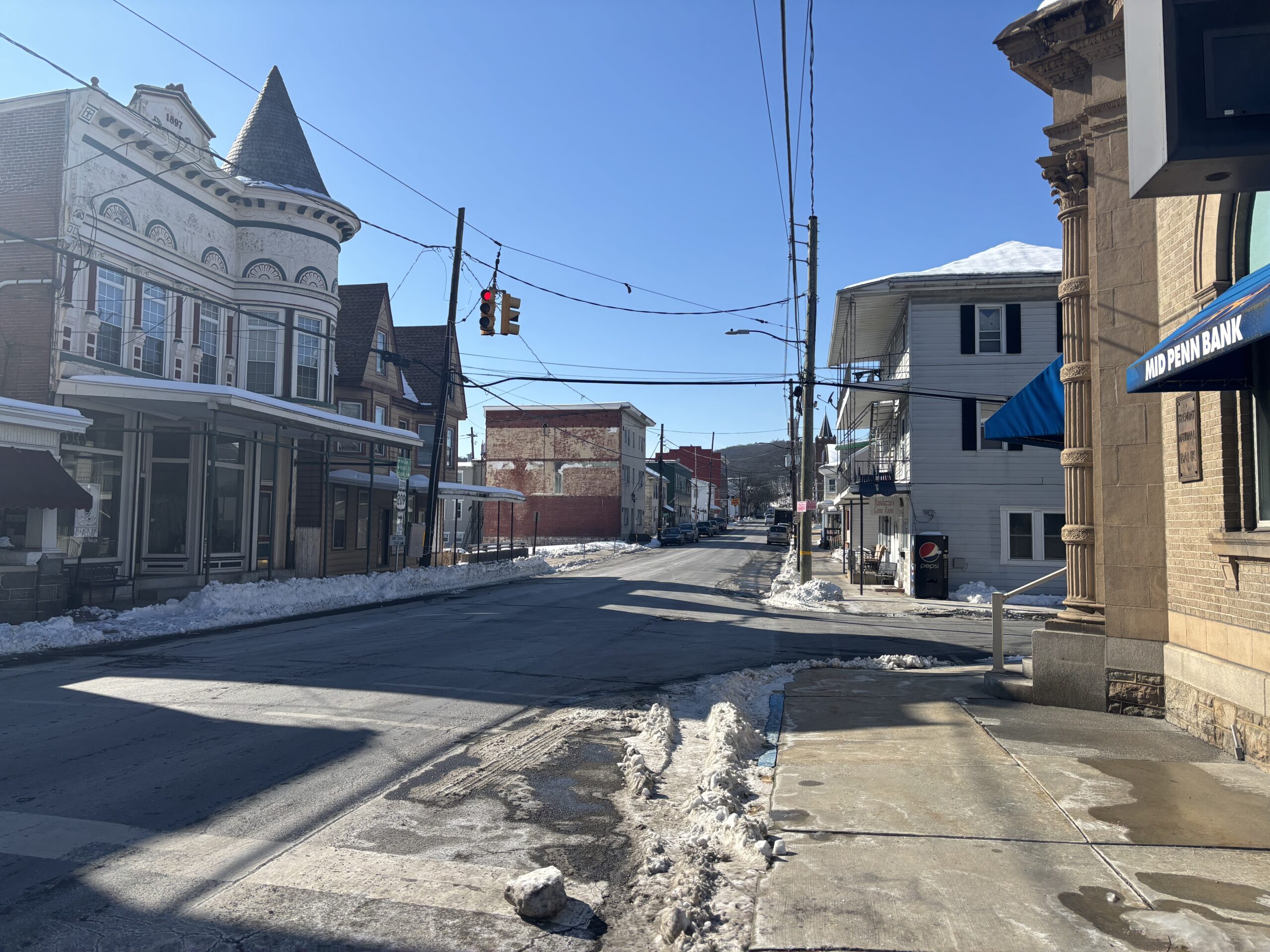
The empty streets of downtown Tremont, Pa., on Tuesday. The 2,000 people of the coal-country borough and its surrounding township would be dwarfed by 7,500 potential detainees at a planned ICE facility on the edge of town.
It’s these kinds of not-in-my-backyard worries that are driving a lot of the initial concern in Schuylkill County, especially from politicians who are cautious in talking about the fraught immigration issue in blood-red Trump country. “I am not going to get into a debate over the overarching immigration policies of the United States of America,” the GOP chair of the county commission, Larry Padora Jr., told a meeting on Wednesday, where he confirmed the ICE purchase of the warehouse.
But a growing number of neighbors do want to talk about those immigration policies, and the stench of inhumanity.
“I’m scared,” Tana Smith, a 24-year-old server at Behm’s Family Restaurant, the local wood-paneled breakfast hangout, told me about the pending ICE project. She, too, blended fears about the daycare site and possible escapees from a detention center with empathy for those same would-be detainees. “People’s families are just being, you know, ripped apart,” she said. “It’s really sad.”
Smith said she’d already gently lobbied her dad — a Republican who said, “I guess it’s just taking care of the illegal people” — against the ICE plan. “I was like, I don’t feel like that’s true at all,” she said. “I feel like they’re going after everyone.”
Andrea Pitzer, author of the definitive history of global concentration camps, One Long Night, said Tremont residents like Smith are right to be alarmed. She told me her research found that authoritarian regimes frequently rely on existing sites like abandoned warehouses or factories as they launch a growing network of gulags.
“The U.S. is clearly echoing previous history with these warehouse acquisitions,” she said. “Dachau — not a death camp, to be sure, but one of the earliest Nazi concentration camps — took over a converted factory when it began its heinous existence in 1933.”
A massive new ICE detention center is coming to Tremont Township in Schuylkill County. At full capacity, it would have a population roughly equivalent to 30 times the Township’s current population: https://t.co/Zp385ZKcjJ
Pitzer asked, “What things will they do on this new, huge scale behind barbed wire?” She noted that the warehouses are a massive expansion of a system that’s already at a record for detainees, with more than 73,000, and is already plagued by squalid conditions, a measles outbreak at the family detention site in Texas, and a death rate as much as 10 times as high as during the Biden administration.
No wonder ICE has moved to buy up new sites — including the two Pennsylvania warehouses — with a practically Soviet level of state secrecy. There are no public hearings. Top lawmakers from both parties have been left in the dark. “This was quiet,” the Democratic county commissioner, Gary Hess, told the meeting. “It was silent. And then, bango! There it was.”
“These will not be warehouses — they will be very well-structured detention facilities meeting our regular detention standards,“ the U.S. Department of Homeland Security insisted in a statement Wednesday. It added that the federal acquisitions “should not come as news,” as ICE expands its nationwide dragnet.
Yet, arguably the region’s most powerful politician, Republican U.S. Rep. Dan Meuser, who voted for the $45 billion fund, has sounded, fittingly, like TV’s fictional German prison camp guard, Sgt. Schultz: He knows nothing, nothing! His spokesperson said Meuser, with both planned facilities in his 9th Congressional District, “has requested a call with … [ICE], and our office has reached out for additional information to better understand the details of the situation. We have not yet received a response.”
Instead, it fell on Meuser’s likely Democratic opponent in November — Rachel Wallace, a former chief of staff for the U.S. Office of Management and Budget who has returned to her native Pottsville — to organize a town hall last week when the project was still rumored.
Lisa Von Ahn (left) and Josephine Kwiatkowski, members of the Schuylkill County chapter of Indivisible, attend a county commissioners meeting in Pottsville on Tuesday to speak out against a proposed ICE detention center in Tremont, Pa.
Most of the 100 or so peoplewho packed a fire hall voiced opposition, but for a variety of reasons. The local GOP state representative, Joanne Stehr, attended and agreed with the not-in-my-backyard concerns, but then drew loud boos when she reportedly said: “I’m saying ICE has a job to do, and it’s going to get done. We are taking out the trash.”
The growing uproar in Schuylkill County echoes brewing battles in many of the 21 other locations, even in areas that voted heavily for Trump in 2024. In Ashland, Va., a Canadian-based warehouse owner canceled its planned deal with ICE after economic pressure and opposition from county commissioners. Elected officials in Roxbury, N.J., and other proposed sites are also fighting to keep ICE out, but it’s unclear how much traction such an effort will get in red rural Pennsylvania.
“We want economic development, and we want good businesses that are part of the community,” Wallace, the congressional candidate, told me as she decried the process and her opponent Meuser’s silence. “And this is the opposite of that.”
And a growing number of Schuylkill County residents say their biggest alarm is less over the NIMBY concerns and more about the idea of their backyard hosting an American concentration camp.
“We have seen firsthand the brutality that government agents are using to detain American citizens, legal immigrants, and law-abiding immigrants without legal status, and the violence in our streets caused by masked, heavily armed agents,” Josephine Kwiatkowski, an Army veteran and retiree from Pottsville, told the commissioners. She said these scenes and “the civil rights violations, the lack of humanitarian conditions [in current ICE facilities], and the discounting of the Constitution are the same issues that I was willing to sacrifice my life to oppose.”
Pitzer, the concentration camp historian, said the time to act is now, before these proposed gulags are up and running.
“Those who made excuses for or ignored these kinds of camps in Russia in the 1920s or Germany in the 1930s couldn’t know how much more vast and lethal those systems would become a decade later,” she said. “But we, who have those examples and other horrors from around the world in our rearview mirror, have no excuse.”
This should be a five-alarm fire, not just for the politicians who’ve been trusted with keeping an American republic, but for citizens who are beginning to grasp a monstrous reality that was set into motion when Trump’s xenophobic demagoguery won a narrow plurality on Nov. 5, 2024. The image of our neighbors shipped in a supply chain like patio furniture and disappeared into the bowels of a Big Lots warehouse should have all of us asking a fundamental question.