The Pennsylvania House has approved a measure that could help reinstate the rights of parents whose children are in state custody and another that would protect the parental rights of incarcerated people.
The latter bill clarifies that a person’s incarceration status cannot be the sole reason for taking away parental rights.
It gives courts flexibility in parental-right termination cases by allowing them to consider an individual’s efforts to comply with family service plan requirements despite being incarcerated. Also, courts could delay filing for termination when incarceration is the primary reason a child has been placed in foster care.
The Joint State Government Commission’s Task Force on Children recommended the changes in 2011.
The other bill would give parents whose children have been in the custody of the state for at least 15 months, or who are at least 17 years old, a process to reinstate their parental rights. Those parents would now be able to petition the court and demonstrate they are willing and able to properly care for their children.
Both bills, which were passed earlier in the week with minimal opposition, now head to the Senate for consideration.
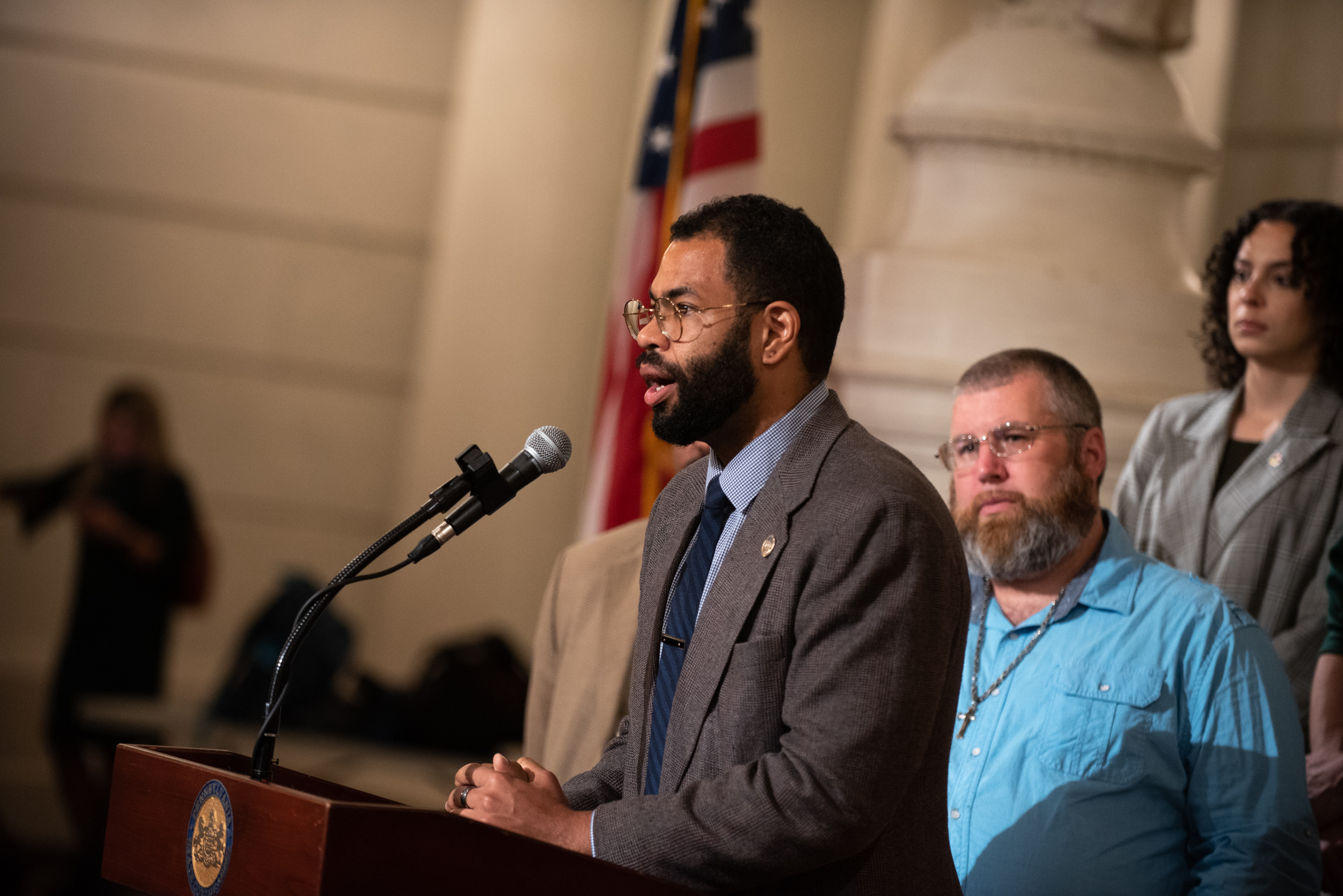
Democratic State Rep. Rick Krajewski, whose district covers West and Southwest Philly, introduced both bills. Krajewski said that under current law, it is extremely difficult for people whose parental rights have been removed to get them reinstated, and he is interested in providing people second chances.
“It doesn’t mean those parents are any less loving, any less caring, or any less willing to show up for their children. And unfortunately, people make mistakes … people are also not static. People grow, they go through changes,” he said.
PA Democratic State Rep. Rick Krajewski speaks to people gathered for a protest in 2022.
Krajewski said his personal experience witnessing his stepfather being incarcerated and other family members being involved in the criminal justice system helped him understand how detrimental separating children and parents can be for both parties. He said removing a person’s parental rights solely because of incarceration is cruel.
“This feels like an additional punishment that isn’t relevant to whatever harm they caused. … I don’t think it’s just to add this additional penalty on top,” he said.
Krajewski has also introduced another child-welfare-related bill that would end the practice of intercepting benefits intended for foster children, and instead place the benefits in a savings account. City Council banned the practice in Philadelphia in 2022 following an Inquirer investigation, but the Philadelphia Department of Human Services still kept over $1 million a year meant for foster children and the practice remained common statewide. The bill was passed out of committee on Wednesday and will be considered by the full House.
Local advocates like Community Legal Services Philadelphia and Philly Voice for Change, a nonprofit working to prevent family separation, voiced their support for the parental rights bills after they passed.
“The bipartisan support in the House demonstrates a commitment to families and a recognition that children should not remain in the system when their parents are ready, willing and able to provide safe and loving care,” said Philly Voice for Change cofounder April Lee in a statement.
“This vote is an important step toward keeping families together, promoting reunification and ensuring that children have every opportunity to return home when it is in their best interest,” she said.
Entering his ninth season as an Eagle, Zach Ertz could see the writing on the wall. With the continued emergence of tight end Dallas Goedert and a rough four-win 2020 season at the front of mind, it seemed certain the two parties would be headed for a divorce.
But finding a landing spot for the three-time Pro Bowler took longer than originally anticipated. Expecting to be dealt before the 2021 preseason, Ertz was still on the roster when training camp arrived. So on a whim, the veteran tight end decided to dye his hair bleach blond.
“I essentially hadn’t been there all offseason. I had ankle surgery so I was missing OTAs anyway. And I showed up for training camp with blond hair,” Ertz said on his former teammate Jason and Travis Kelce’s New Heights podcast. “I don’t regret much about my time in Philly or this career, but the one thing I do regret is kind of that phase, showing up to training camp with blond hair.”
Eagles tight end Zach Ertz jogs off the field after the Eagles beat the Atlanta Falcons to open the 2021 season.
Jason Kelce, who played alongside Ertz for over eight seasons, was as sure as anyone that the Southern California native would get dealt before games started. He was so confident that he put his own head of hair on the line.
“It was so obvious, unfortunately, that my time was probably coming to an end, that Jason was like, ‘Bro, when are you getting traded? You’re going to get traded any day now. If you’re still on the team Week 1 then I’ll dye my hair,’” Ertz recalled. “I don’t think I had anything to lose in this situation.”
And as the summer days rolled on, Ertz’s wait for a trade didn’t materialize — at least not before the Eagles’ Week 1 game against the Atlanta Falcons. So when the longtime teammates ran out onto the field at Mercedes-Benz Stadium, they were rocking a matching hairdo.
“I just wanted Zach to have something to look forward to if he was still on the team, like, ‘At least Jason dyed his hair to match,’” Kelce recalled.
Most important, Ertz’s wife and former U.S. women’s national soccer team star Julie Ertz, who was also a guest on this week’s episode, said she liked her husband’s new look.
“That’s really all that matters, honestly,” Zach quipped.
As for Kelce, Ertz referred to him as Guy Fieri as both the hosts and guests reacted an image of a blond Kelce, that Jason called “the worst photo of me possible.”
Jason Kelce dyed his hair to match Ertz’s at the start of the 2021 season.
“I don’t think Kylie [Kelce] liked your hair as much as I liked Zach’s hair,” Julie joked.
Ertz remembers his Philly days
Ertz was also asked to reflect on his time in Philly.
“When you spend nine years somewhere, you’re going to always have a natural affinity for the place,” Ertz said. “Unfortunately … I wasn’t able to play my whole career [in Philadelphia].”
But what Ertz most appreciated from his time on the Eagles were his teammates. After getting selected in the second round of the 2013 draft, Ertz quickly inserted himself into a young Eagles foundation designed to remain intact for years — one that also included Kelce, Brandon Graham, Fletcher Cox, and Lane Johnson.
“The thing I look back on fondest is our core group of guys that we had together for a long period of time, with you, Lane, BG, Fletch, myself,” Ertz said. “It wasn’t easy all the time for any of us. Like there were times we’d get killed in the media or whatever it was, and I always knew you four always had my back regardless of what we were going [through]. And I hope you guys felt the same about me.
“And it is a little emotional talking about — I don’t know why — but just going through that, just being around the guys. No one is going to remember about how many yards or catches or starts we had, but I do remember the day-to-day, grinding, the stories of you kicking over a trash can because you didn’t like the way a coach was treating someone else, or Lane hiding your helmet — those are the things I remember.”
Eagles tight end Zach Ertz (left) and defensive end Brandon Graham (right) walk off the field after a 37-17 loss to the Dallas Cowboys in December 2020.
Ertz’s time in Philly ended in November 2021 when a long-awaited trade sent him to the Arizona Cardinals. The Eagles’ single-season receptions leader played two more seasons with the Cardinals and two with the Washington Commanders. But when Ertz, who is now a free agent, returned to the City of Brotherly Love with Washington, he couldn’t get the Birds’ fight song out of his head.
“Even when [I was] on the other sideline … It’s still like subtly in the back of my mind,” Ertz admitted, “singing it as I’m over there watching.”
Looking ahead, Ertz is aiming to suit up to play in his 14th NFL season, but he does not yet know where. Complicating the situation is a season-ending ACL tear that the 35-year-old suffered in a Week 14 shutout loss to the Minnesota Vikings.
But Ertz is pleased with the recovery progress he’s made and expects to be ready near the start of the season.
“We’re in a good spot. We’re like five, almost six months now from surgery, so just training every day, doing everything I can to get back to where I was,” Ertz said. “It’s a long process. There’s some long days, there’s some long weeks, some long months … it’s tough, but we’re just trying to stack these days right now.”
Ertz’s blond phase didn’t last long, but it was memorable.
IRVINE, Calif. — If you’re new to soccer, this is the sort of thing you should know about as you learn the sport. And even if you’re a veteran of the game, you might not have realized it had happened.
For many years, FIFA’s first standings tiebreaker at World Cups was soccer’s tradition of goal difference: goals scored minus goals conceded. But this time, it has switched to head-to-head result, the format used by the Union of European Football Associations in the Champions League and other continental tournaments.
It didn’t exactly go unnoticed when it was announced, but it wasn’t seen as a big deal. Now, though, it has become a growing controversy.
The issue isn’t so much about determining group winners, though the U.S. has benefited on that front. If goal difference was the first tiebreaker, the Americans wouldn’t have clinched first place yet.
The U.S. win over Australia combined with Paraguay’s win over Turkey last week clinched first place in the group.
They have because Paraguay beat Turkey a few hours after the U.S. beat Australia. That left the U.S. with six points, Paraguay and Australia with three each, and Turkey with none.
Since the U.S. has beaten Paraguay and Australia, it has the tiebreaker over both. So if Turkey beats the U.S Thursday night (10 p.m., Fox29, Telemundo 62) and there’s a winner in Paraguay-Australia (10 p.m., FS1, Universo), the U.S. will keep first with a tie on six points. With a goal difference tiebreaker, even though the Americans are sitting at a strong plus-5, a big loss plus a big win in the other game could have changed things.
The bigger issue tournament-wide is how head-to-head has eliminated teams after two games — and it’s magnified further by the best eight third-place teams qualifying.
If goal difference was the first tiebreaker, a last-place team could jump to third in the last minute and have a prayer of making the cut. Instead, five of the tournament’s 48 squads were eliminated before playing their finales: Turkey, Haiti, Jordan, Panama, and Tunisia. (Haiti’s elimination came in Philadelphia with the loss to Brazil.)
Cecilio Waterman’s Panama joined Haiti as Concacaf teams eliminated from advancing after two games.
There has been some outrage among purists about this in Europe, even though they’re more used to the format than they might admit because of the Champions League. But even the talking heads who understand the head-to-head way’s benefits have agreed with something that Americans ought to be able to see, too.
It’s more fun when more teams are alive going into the last round of games. If goal difference was the first decider, there could be a dose of chaos along with the stars, underdogs, and however many goals are scored.
Fortunately, Philadelphia’s last two group games will have drama. On Thursday, Curaçao, one of this tournament’s greatest underdog stories, could snatch one of the top eight third-place finishes if it upsets Ivory Coast (4 p.m., FS1, Universo) and Germany beats Ecuador in the Meadowlands (4 p.m., Fox29, Telemundo 62). On the flip side, if Ecuador wins that game, Ivory Coast will have to win or tie to keep hold of second.
Then on Saturday, Ghana and Croatia will have lots to play for (5 p.m., FS1, Universo). Ghana could steal first place if Panama upsets England in the Meadowlands (5 p.m., Fox29, Telemundo 62), while Croatia needs a win to finish second and avoid playing a group winner in the round of 32.
Ghana’s tie with England on Tuesday in Foxborough, Mass., means the Black Stars still have a slim chance of winning their group.
Wondering what the players think? Alas, you won’t get much out of the U.S. camp. All they care about is winning games. But at least veteran centerback Chris Richards brought some humor.
“On our end, we just want go into the next round with nine points,” he said. “I haven’t really thought too much about the rule change — I feel like the rules are always changing, so I’m kind of confused myself. But as long as we keep winning, that’s the number one thing.”
Christian Pulisic got right to the point when he arrived to meet the media before Wednesday’s practice.
“Can I guess the first question?” he said, knowing full well what it would be. Of course everyone wanted to know how he and his rehabbed calf were feeling.
Christian Pulisic reaches for the ball in a drill at Wednesday’s practice.
“I’m feeling good,” he said as he headed into a third straight day of full participation. “I’ve obviously joined with the team in the last few days. So I’m feeling good, positive going into [the game], and hopefully I’ll be able to play a part in it tomorrow.”
The Hershey native reconfirmed that he was kicked in his left calf in practice a few days before the U.S.-Paraguay game (he politely declined to say who did it), then again in the first half of the contest.
“Throughout the first half I felt good, and then I started to notice it a little bit, and I think adrenaline definitely carried me through,” he said. “I think I had a pretty strong contusion, strain, whatever you want to call it.”
It might have hurt more emotionally than physically that he couldn’t play against Australia. He certainly took in as much of that day as he could as a spectator.
“I never really feared the worst, but I obviously didn’t want it to keep me out any longer than it had to,” Pulisic said. “And I was really trying to get ready for the last game — I feel like I could have gone, but it just wasn’t quite there.”
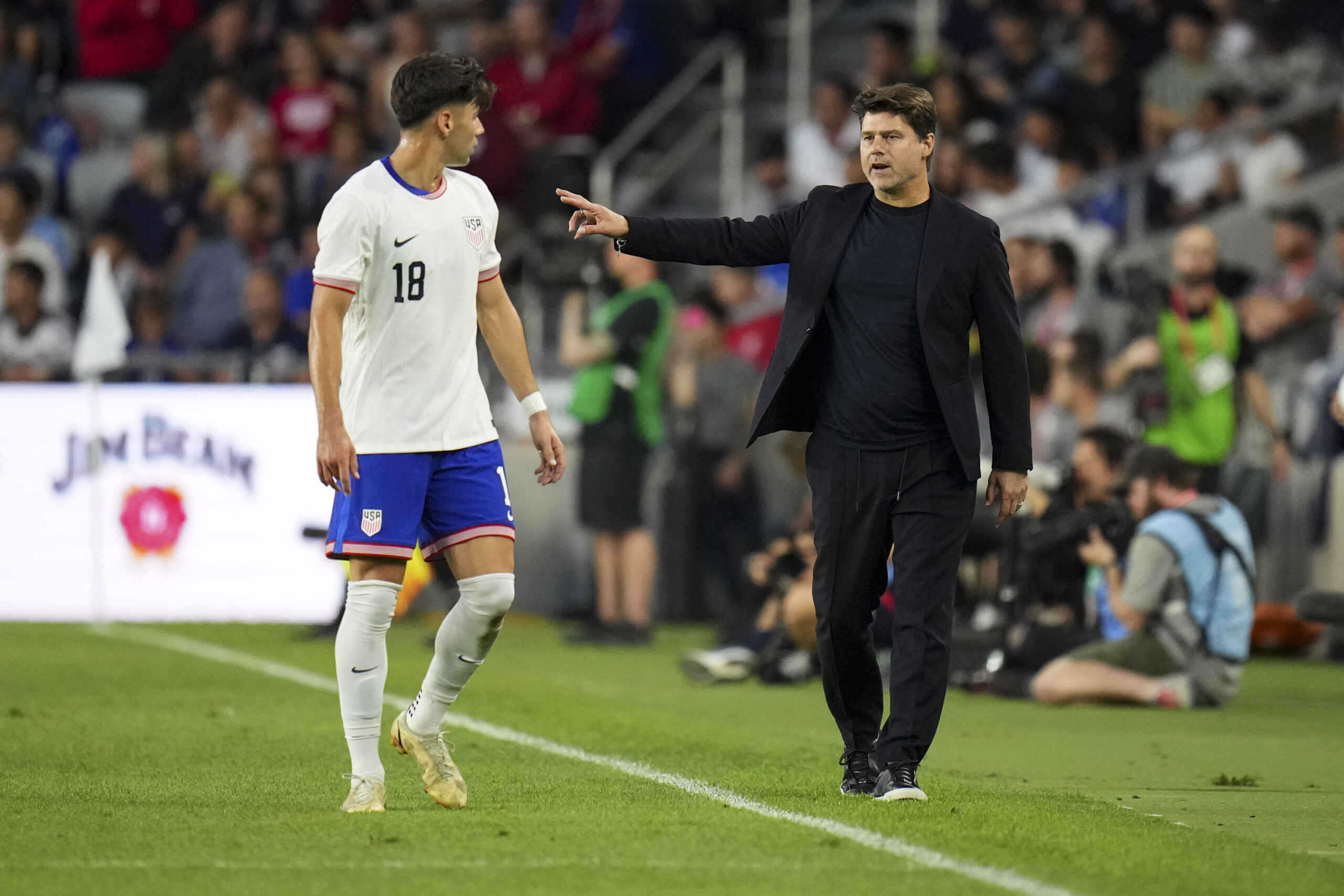
U.S. manager Mauricio Pochettino (right) and goalkeeper coach Toni Jiménez at Wednesday’s practice.
Players with yellow cards won’t play vs. Turkey
In his news conference Wednesday afternoon, U.S. manager Mauricio Pochettino confirmed that the four players with yellow cards — Tyler Adams, Folarin Balogun, Richards, and Antonee Robinson — won’t play vs. Turkey so that they don’t pick up another and get suspended for the round of 32.
“I think it isn’t necessary to take a risk and then to take another yellow card, and be not available for the next stage,” Pochettino said. “And I think that is a little bit a normal and easy answer: not to play with them from the beginning.”
He said of Pulisic’s status: “He’s available, and then we need to decide if it’s possible for him to play from the beginning or be on the bench and play in the second half.”
Cristian Roldan is also dealing with a minor quad injury, and has not practiced for the last few days.
“We need to assess tomorrow if he can be available,” Pochettino said. “I think he’s evolving really well. If it’s not for tomorrow, hopefully for next week.”
The notice, filed Wednesday in Philadelphia Common Pleas Court, seeks to insert the attorney general’s office into the case of Marc Brittingham, Rasheed Turner, and Jermal Shuler, whose convictions in a 1997 killing were vacated in May after prosecutors and defense attorneys said key evidence presented at their trial was unreliable.
But last week, the Pennsylvania Supreme Court said in a forceful ruling that District Attorney Larry Krasner’s office had displayed a pattern of misleading judges while seeking to overturn murder convictions. Moving forward, the justices said, the state attorney general’s office should be given the opportunity to review such cases before a judge can decide whether to grant relief.
The filings raise a procedural question at the heart of the new ruling. The Supreme Court’s decision requires judges to notify the attorney general and gives the office “the right to intervene in the case before ruling on the concession.” But in this case, that moment had already come and gone; the judge had accepted the district attorney’s position and overturned the convictions.
What may have allowed the attorney general back in was timing: The 30-day window to appeal the decision had not closed yet. The office filed its notice of intervention and an appeal on day 29.
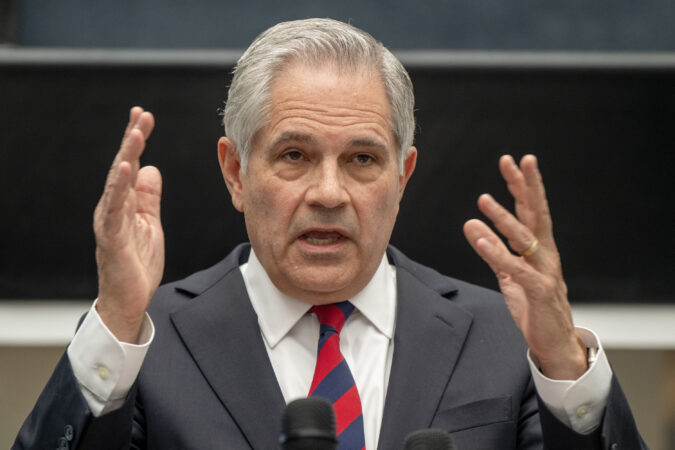
Krasner, in a brief phone call Wednesday, said, “I hope the public will watch this case carefully.”
“I hope they will watch what our attorney general’s office stands for and what the district attorney’s office stands for,” he said. “Stay tuned. It’s going to tell us a lot about what’s really going on.”
Deputy Attorney General Hugh Burns did not say in court documents how or why the office believed it had authority to intervene in this case, saying only that it was taking the action in response to the state Supreme Court’s order from last week.
A spokesperson for the office declined to comment.
Wednesday’s filing seeks to reopen a case in which many of the facts underlying the district attorney’s decision to join defense lawyers in seeking to vacate the convictions remain obscured by extensive redactions in court filings.
Prosecutors and defense attorneys said the case was undermined by newly uncovered information about the work of Bennett Preston, a former assistant medical examiner whose testimony helped establish the prosecution’s timeline of Essie Mae Thomas’ death.
Thomas, 73, was found stabbed to death inside her Northwest Philadelphia home in November 1997. A jury convicted Brittingham, Turner, and Shuler the following year, after hearing testimony from a neighbor who placed them at the home and from Preston, who linked Thomas’ time of death to the witness’ account. Nearly three decades later, Krasner’s prosecutors said that the testimony of the witness and Preston was questionable, and that disciplinary action had been taken against Preston.
The details of those disciplinary actions, however, were redacted from filings.
Officials with the district attorney’s office have said that the discovery of previously unknown disciplinary action involving Preston helped prompt the reinvestigation. But prosecutors have declined to publicly detail much of that information, and court records filed in the case concealed significant portions of the evidence that led them to conclude the convictions could no longer stand.
When Common Pleas Court Judge Jennifer Schultz vacated the convictions in May, she found that the newly uncovered evidence would likely have changed the outcome of the trial. Prosecutors then withdrew the charges, ending the case and allowing the men to walk free.
Jules Epstein, a criminal law professor at Temple University, said “this is unknown territory.” Because a court order is not final for 30 days, he said, the office could have a right to appeal.
“What disturbs me is did they actually look at the merits of this decision? Or did they just knee jerk and say, ‘It’s Krasner, we’re going to challenge it’?”
Marissa Boyers Bluestine, assistant director of the Quattrone Center for the Fair Administration of Justice at the University of Pennsylvania‘s law school, said the language of the high court’s order did not appear to leave room for retroactivity.
Bluestine, who worked on Brittingham, Turner, and Shuler’s case in her previous role leading the Pennsylvania Innocence Project, said it was also curious that the attorney general’s office was involving itself without the judge’s invitation.
“They’re saying that they are intervening, not requesting permission to intervene, which is an interesting way to put it,” she said.
A nuclear power plant engineering manager for Constellation Energy has been indicted on federal insider trading charges of using advance knowledge that his company planned to reopen a uranium-powered electric plant at Three Mile Island to collect illegal profits on the stock options market.
Casey Muggleston, of Marshallton, Del., worked on the license renewal team applying to the Nuclear Regulatory Commission for permits to restart the plant. According to a Delaware grand jury indictment, Muggleston made $1.48 million from his “scheme to obtain illegal profits” using “material nonpublic information” before Constellation announced its decision.
Following an investigation by FBI agents in Maryland and Delaware, Muggleston was charged Wednesday by the U.S. Attorney’s Office for Delaware with securities fraud and four counts of insider trading.
The charges carry a maximum sentence of 105 years, if he is convicted. However, white-collar sentences are typically a fraction of guideline terms. The government also wants Muggleston to forfeit the $1.48 million.
Neither Muggleston, who worked for Constellation or its former owner Exelon Corp. from 2008 until 2025, according to a related SEC complaint, or his attorney returned a call seeking comment.
“Constellation is aware of the government’s indictment,” company spokesperson Paul Adams said in an email. “As Mr. Muggleston is no longer an employee, we have no further comment.”
According to the indictment, Muggleston bought call options on the company’s shares, a cheap way to collect gains in a stock’s share value, without having to pay the shares’ entire trading cost.
Three relatives also bought options but have not been charged, according to the indictment.
In a separate civil complaint, the Securities & Exchange Commission alleged Muggleston also shared information on other confidential Constellation deals as late as June 2025. He left the company that year, according to the SEC.
Here’s what the indictment alleges:
As early as April 2024, Constellation had said publicly that it was looking at restarting the reactor but hadn’t made a decision. Before going public with the news, Constellation had employees such as Muggleston refer to the restart as “Project Tetris.”
A May 21 email to staff, including Muggleston, which was part of correspondence cited by both federal prosecutors and the SEC in their complaints, told employees to keep the licensing team’s progress “very confidential.”
Three days later, Muggleston sent his cousin, who lives near the plant, an email noting “the restart is building steam. I’m trying to think of how to profit off this …” He added that there were “no guarantees.”
Eight days later, on June 1, he gave the cousin a heads-up that a decision would likely be made later that month.
By June 8, Muggleston had begun buying Constellation options in his Delaware brokerage account, betting the stock would rise, mostly by dates in July or August. By Aug. 14, he had accumulated 195 options contracts.
But Constellation hadn’t announced the reopening. The share price for a time drifted lower, and some of his initial options expired and became unprofitable.
Then on Aug. 15, two colleagues told Muggleston the restart was approved, and he was summoned to a restart planning meeting.
Starting the next day, he bought another 150 options, then another 360. In early September the stock rose to over $200, making more of his options profitable.
On Sept. 20, when Constellation made its announcement, the stock closed at $255, and he sold his 550 remaining options for a total profit of $1.48 million.
Muggleston had taken Constellation’s annual training reminding employees, board members, and contractors that they and their family members are barred from trading on insider information and from “tipping” outsiders with that information, the indictment says. Insider trading is also illegal under federal securities law.
The nuclear restart would help Constellation, a Baltimore-based power plant operator, supply data centers under a contract with Microsoft, among other customers. The plan is supported by President Donald Trump, Gov. Josh Shapiro, and other government officials. Environmental critics say the process is being rushedand could raise the likelihood of contamination.
Constellation’s plan focuses on Three Mile Island’s reactor that closed in 2019 for economic reasons. It was not damaged in the 1979 partial nuclear meltdown.
Constellation says it’s on track to load uranium into the reactor next spring and begin to supply electric power later in 2027.
Main Line Health and UnitedHealthcare have an “agreement in principle” on new contract and will extend the current contract until the new deal is completed, Main Line Health said Wednesday.
Main Line’s contract with United was set to expire Tuesday, potentially disrupting care for 32,000 people who rely on Main Line doctors and have health insurance through United. The negotiations covered employer-sponsored plans and Medicare Advantage plans.
“For nearly a year, Main Line Health worked diligently and in good faith to reach a responsible agreement — one that reflects the true cost and complexity of the high-quality care we deliver to this community every day. We are pleased to have reached this milestone, and our patients will experience no disruption to their care,“ Main Line said in an email.
Main Line said the preliminary agreementrelieves some of the administrative burden for doctors and patients. They include prior authorization delays, claim denials, and excessive audit activity, Main Line said.
United, the nation’s largest health insurer, did not immediately provide a comment.
The company based in Eden Prairie, Minn., this year failed to reach a new agreement with Jefferson Health’s Lehigh Valley Health Network for Medicare Advantage and employer plans. That outcome added to the worry for some patients that the same thing would happen in Philadelphia’s western suburbs, where Main Line is the leading provider of healthcare services.
A 36-year-old survivor of slavery said he has tried to follow all the rules since fleeing Mauritania, a mostly desert land in West Africa, and seeking asylum in the United States in 2023.
But when Ousmane Soumare arrived at the U.S. Immigration and Customs Enforcement office in Philadelphia in November for a routine check-in, he was detained by officers.
Now Soumare, who was released by a federal judge’s order, and two other immigrants who fear a similar fate in their forthcoming appointments are suing ICE and the Department of Homeland Security over the policy change that led to such arrests.
The Philadelphia ICE field office violated federal law when it “unlawfully rescinded” a longstanding policy that largely allowed immigrants to pursue their immigration cases without fear of rearrest, the suit says. ICE then “began re-arresting and re-detaining people previously determined to pose no risk of flight or danger to the community and still in full compliance with all conditions of their release,” the suit says.
Soumare, Lassana Dianifaba, and a third immigrant, who was not named in court documents, filed the lawsuit Wednesday in federal court in Philadelphia.
“When the government releases a person from custody, there is an implicit promise that their liberty will be honored as long as they follow what is asked of them,” said Vanessa Stine, senior staff attorney with the ACLU of Pennsylvania, which represents the immigrants. “These rearrests disregard a decades-old policy and sow fear and chaos.”
ICE does not comment on pending litigation, a spokesperson said.
‘Unheard of’
In Philadelphia, ICE arrests of people who arrive for what they thought would be routine check-ins and appointments have gone from rare to common.
That is because “sometime toward the middle of 2025,” the suit says, the local ICE office rescinded its policy that required individualized evaluation of new circumstances that would indicate an immigrant is a danger or flight risk.
Each year thousands of people report to ICE or related immigration agencies for the mandatory check-ins. Some immigrants are required to appear every couple of weeks, some once a month, others once a year.
The appointments help immigration officials keep track of people who in the past have been low priorities for deportation, allowed to live freely as they pursue legal efforts to stay in the United States. Now that landscape has shifted.
The changes have put immigrants in risky positions, making every visit to the ICE field office a gamble, because they have little choice but to show up.
Six immigration attorneys filed affidavits in support of the new proposed class-action lawsuit that detail an explosion of cases. Christopher Casazza estimated his firm has represented roughly 190 people who were detained at ICE check-ins since September.
Before 2025, it was “unheard of” for a law-abiding immigrant to be detained at a routine check-in, Casazza said.
Steven Morley, who served as an immigration judge between 2010 and 2022, said in an affidavit that he could not recall “any circumstance” of people being re-detained unless they had committed a crime.
Philadelphia federal judges responding to the flood of lawsuits by immigrants challenging their detention have also taken notice of the shift.
In February, U.S. District Judge Gail A. Weilheimer wrote that ICE had set a “trap” for “thousands of noncitizens” by arresting immigrants who were following instructions.
ICE offices in other cities have similarly reversed course on requiring a material change in circumstance to re-detain released immigrants, and federal judges in California and New York found the lack of individual assessment unlawful.
The proposed class action in Philadelphia asks a federal judge to certify the class, and declare the rescission of the changed circumstances policy unlawful.
Soumare’s next check-in is scheduled for July, and he is anxious about visiting the ICE office again.
“When I think of the risk of being re-detained at my next check in, it scares me,” he said in a court filing. “But I will still attend because I want to follow all the necessary steps to stay here.”
Visa holders and green card applicants
Even people who are seeking legal status through lawful government processes are in danger of arrest.
Green-card applicants, asylum seekers, and others who have ongoing legal or visa cases to stay in the United States have been unexpectedly taken, part of a Trump administration strategy, lawyers and advocates say, to boost the number of immigration arrests and to deport anyone who can possibly be deported.
Arrests have occurred not just at ICE offices, but also at U.S. Citizenship and Immigration Services and at private offices of federal contractors.
ICE says that all immigrants who do not hold legal immigration status may be subject to arrest and removal. They say that arrests undertaken at federal agencies are safer for officers, because visitors have been screened for weapons when they enter the buildings.
DANA POINT, Calif. — Fifteen months ago, Mauricio Pochettino walked out of SoFi Stadium at the low point of his tenure as the U.S. men’s soccer team’s manager.
Not only had his players lost both games at the Concacaf Nations League final four, but they had lost badly, with a squad including many of the program’s stars. He had taken the job to prepare one of the World Cup’s cohosts for the biggest stage, and everything felt about as far from ready as possible.
Two weeks ago, Pochettino was back on the same field, about an hour north of here, joined by many of the same players. This time, they charged to a 4-1 rout of Paraguay in the Americans’ World Cup opener, jolting the tournament and the nation to attention.
“I didn’t recognize it,” he said in a gathering with media at his office in the team’s swanky hotel along the Pacific Ocean. “Because it was empty” the first time.
Mauricio Pochettino’s frustration showed during the U.S. team’s loss to Panama in last year’s Concacaf Nations League semifinals.
Indeed, the stands were mostly empty when the U.S. played Panama in the semifinals, then Canada in the third-place game. They were filled only in the other halves of those doubleheaders, when Mexico won twice to take its first Nations League title after three straight U.S. triumphs.
“I was crying afterward in the dressing room, because I felt so sad for all the American people, for the players, for the staff,” Pochettino recalled. “I said, ‘OK, we play in our own place, our own country, and 70,000 Mexican people’ … I cannot accept that.”
This time, as he put it, was “a completely different vibe, different energy.” The place was full, and backing the hosts. Sure, that it was a World Cup helped, even with the ticket prices. But it was clear from the moment the crowd joined in singing the national anthem that there really were U.S. national team fans in the stands.
There’s still a long way to go this summer, with progression to the knockout rounds and first place secured before Thursday’s group stage finale against Turkey (10 p.m., Fox29, Telemundo 62). And the U.S. team hopes there will be a long way still to go after that.
But given this game’s lessened stakes, there’s a moment to stop and survey just how far the program has come.
A big crowd was on hand on June 12 in Inglewood, Calif., for the U.S. World Cup opener against Paraguay.
‘The person you used to be’
The most striking feature of Pochettino’s office is a balcony with a postcard view of the water, the surfers in it, and the stunning sunsets beyond them. Ranked No. 2 is a wall covered with a U.S. Soccer logo and one of the team’s slogans for the tournament: Why Not U.S.?
Within the lines of type, Pochettino wrote a series of motivational phrases, some of his creation and some by others.
Growth is often painful, for it means saying goodbye to the person you used to be.
The talent has brought us here, but it is heart, effort, and unity that will make us unforgettable.
Heart turns effort into belief — and when everything hurts, heart keeps us fighting together.
Mauricio Pochettino (right) giving instructions to Auston Trusty (left) and Mark McKenzie during Tuesday’s U.S. practice at the team’s base camp in Irvine, Calif., ahead of Thursday’s match against Turkey.
“I think every single quote represents our journey from day one to today and beyond,” he said.
They’re also more proof of how Pochettino values the psychological side of the sport, a factor that’s even more important with national teams than it is with clubs.
National teams can’t buy players to boost their talent the way clubs can, especially Pochettino’s previous employers at England’s Chelsea and Tottenham Hotspur and France’s Paris Saint-Germain. If a national team’s top players aren’t delivering, all the manager can do is drop them, call in other players, and hope they do enough.
That’s what happened after the Nations League failure.
Yunus Musah (left) is perhaps the highest-profile player who has fallen out of the national team rotation during Mauricio Pochettino’s tenure.
“Maybe we didn’t feel or see how difficult the process was going to be,” Pochettino said. “We were so naive when we signed our contract. … We misjudged the situation — it was worse than we really believed.”
‘We were knocked out’
He and the assistants he brought with him came in believing that the players would immediately be as all-in on working toward the World Cup as the staff.
“And then we arrived here, we received a big punch,” he said, mimicking it, “and we were knocked out for a while.”
Pochettino was, as he relayed in these remarks with an expletive, shocked.
Mauricio Pochettino (center, in cap) and top assistant Jesús Pérez (foreground) during a U.S. practice last October.
“We were so excited about that, because it was so close to the World Cup,” he said. He expected in turn that people would be “desperate to help everyone, to be involved, come to the national team. And what’s the opposite?”
He felt it as soon as he took charge in the fall of 2024. By the time the Nations League final four arrived, he said “that punch, we expected” — words as damning as any he has said in his tenure.
“I think it was more a plan to have this punch that was painful, but it was necessary for people to realize in which place we were,” Pochettino said. “For the players to realize that this way, it was impossible to arrive in a good condition to the World Cup.”
We’ll never know what would have happened if the U.S. had won the Nations League title with its stars playing well. But because it didn’t, Pochettino moved quickly to start tearing things down, bringing in a slate of new players to challenge incumbents from the summer’s Gold Cup into the autumn.
Max Arfsten (left) is one of the new players who has gained Mauricio Pochettino’s trust.
There were a lot of questions along the way, and among outsiders, uncertainty as to whether the move would pay off. But when the Americans beat Japan in September, they showed they had reached the corner to turn around. Over the ensuing months, they got there.
Now, Pochettino has a galvanized group, and some of its biggest names have led the way in the World Cup. The U.S. might not be able to win it all, but there’s no questioning the players’ commitment now.
At one point, Pochettino was asked how much he has learned about American culture in the job. He has been asked that a few times in his tenure, and unfortunately hasn’t had much to answer with — not least because he and his staff don’t live in the United States.
This time, he had more to say.
Mauricio Pochettino (center) talking to his players during a hydration break in the U.S. match against Australia last Friday in Seattle.
“People are very approachable, they make you feel comfortable, it’s very welcoming,” he said. “You go to some place like Nashville and you go to a bar, and if you are alone, you make friends so quick. And it looks like in a few minutes, you belong that in that place.”
That, he said, “was a massive surprise. … Different states and everything, but you have the same essence of the human being.”
If it’s tempting to want such a message that can resonate in a divided country — especially during a unifying event like a World Cup — it bears saying that Pochettino probably hasn’t experienced the full depths of what has caused the divisions.
But conversations with people who know him bring up a reminder: He’s one of many foreign visitors, especially from his native Argentina, who look up to the United States culturally and see the good before the bad.
“The country is massive and the people are so good,” Pochettino said. “I think we’ve learned a lot, I think we are much better people now, knowing the country and the culture of the people here.”
He made a wisecrack about America’s reputation for junk food, a subject that the world has lived out in coming to our shores this summer. (Ask the Netherlands fans who went to Buc-ee’s, a famed Southern convenience store chain.)
“People say Americans have no healthy food. Yes, you have healthy food,” citing a trip he took to a Whole Foods supermarket. “But also you have the food that makes you feel, you know, like Chick-fil-A.”
He even said at one point that “when you are here, I think it’s difficult now to see yourself living in another place” and that “we will miss” the country.
Here was Mauricio Pochettino’s speech to the crowd at the start of the day:
That opened the door to ask if he’d like to stay in the job after his contract ends following the World Cup. There have been some discussions with U.S. Soccer, but the widespread presumption remains that he’ll go.
He avoided a direct answer, saying his focus now is on the World Cup.
“And then if we want to stay, we have months to talk, or days or weeks, because it’s four years until the next World Cup,” he said, later adding: “We told the federation we are open, but now I think it’s not to be distracted.”
WASHINGTON — A Pennsylvania program that assists homeowners and small landlords by financing repairs was on track Wednesday to expand nationwide, after Congress this week passed a bill that both Republicans and Democrats are celebrating as the first major federal housing law in decades.
Tucked into the 374-page omnibus legislation is a pilot version of a federally backed Whole-Home Repairs program — an idea that was originally sponsored by State Sen. Nikil Saval (D., Philadelphia) and passed in Pennsylvania in 2022.
The program offers grants or loans to address safety, habitability, and efficiency concerns.
But despite wide bipartisan support for the program and dozens of other housing reforms in the larger bill, final approval was derailed on Wednesday when President Donald Trump canceled the bill-signing ceremony in an attempt to force Congress to first pass more restrictive voter-ID laws.
Democrats and some Republicans quickly rebuked the president, who still made a rare appearance on Capitol Hill to meet with Senate Republicans. The intraparty meeting turned contentious, according to multiple reports, while Democrats noted they had enough votes to overturn Trump’s veto if he holds out long enough.
“It’s a mess,” said U.S. Sen. Andy Kim (D., N.J.). “Finally, we’re doing something that the American people want. We got bipartisanship. We worked on it forever. … Then he just parachutes in and just blows it all up here at the end.”
The 21st Century ROAD to Housing Act aims to incentivize housing construction, restrict large institutional investors from buying single-family homes, improve financial literacy, and more.
More than a year in the making, it includes a separate stand-alone Whole-Home Repairs Act that U.S. Sen. John Fetterman (D., Pa.) had introduced in each of the last two sessions of Congress. Fetterman’s bill merged last year into the larger bill while keeping many of the same provisions as the Pennsylvania-level program.
Households that earn less than 80% of the area median income are eligible for grants, while small landlords with affordable units can access loans, including forgivable loans.
Saval said he expects the national version to also reflect that level of “immense demand” — particularly as the program starts small and as homeowners across the country face higher costs to maintain their residences.
“This is a huge issue. There are some 200,000 homes in Pennsylvania alone that have moderate to severe deficiencies,” Saval said. “Everyone is dealing with rising energy costs. Everyone’s dealing with the cost of materials and labor and the inability to pay for all that.”
Addressing those kinds of affordability concerns, which have become a top-of-mind political issue during this year’s high-stakes midterm elections, is a rare bipartisan effort to emerge from the U.S. Capitol.
Philadelphia-area lawmakers on both sides of the aisle had spent months advocating for the bill.
U.S. Sens. Dave McCormick (R., Pa.) and Lisa Blunt Rochester (D., Del.) — members of the Senate committee that advanced the legislation — both celebrated the final passage by talking about its impacts on affordability and “cutting red tape.” Kim called it a “historic” move to bring costs down.
“This package comes at a critical moment,” Blunt Rochester said in a statement, noting a nationwide housing shortage of as many as 7 million units. Five bills she separately sponsored — to accelerate building, increase investment in community development projects, develop zoning and land-use policies, and more — were featured in the final law.
The Whole-Home Repairs provision of the legislation was not a guarantee as negotiations developed over the last year. House Republicans were generally skeptical of creating a new government program, and specifically critical of the policy’s tenant protections, according to a source familiar with the negotiations. But their counterparts in the Senate, and Democrats in both chambers, helped keep it in the larger bill.
Fetterman said in a statement that Whole-Home Repairs “ensures families can stay in their homes” and that passing it had been a priority since he entered the Senate in 2023.
“I’ve consistently maintained that our housing crisis needs real solutions that help address the problems at the center,” Fetterman said.
Saval, who said he made multiple trips to Capitol Hill to work with sponsors and lobby for Whole-Home Repairs, said he was “thrilled” by the inclusion of a program that he and the coalition of advocates who helped push the idea had always envisioned as a model that could be replicated.
He said he expects the pilot program to prove successful in “a few states” where it is able to launch. Unlike previous version of the federal bill that would have allocated $30 million to the pilot, there is no specific funding number for Whole-Home Repairs in the 21st Century ROAD to Housing Act.
The legislation calls for the secretary of the U.S. Department of Housing and Urban Development to identify between two and 10 “implementing organizations” every year during the pilot, which is set to run through October 2031. The organizations will be local or state governments that administer the programs.
Saval said that no matter how much funding is allocated, it “will undoubtedly fall short of the need,” but that its effectiveness will spur further investment.
“It repays itself,” Saval said. “It repays itself in stabilized communities. It repays itself in stabilized property values, in people remaining in their homes rather than in unsafe or unhealthy homes, or rather than abandoning them.”
Staff writer Jake Blumgart contributed to this article.
After finishing his call with new Toronto Maple Leafs general manager John Chayka on June 16, Simon Benoît reached out to Trevor Zegras.
Benoît and Zegras, along with Jamie Drysdale, played together for the Anaheim Ducks for several seasons, and the band is now back together. Benoît and goalie Joseph Woll were acquired June 16 from the Leafs for goalie Sam Ersson, defenseman Emil Andrae, and a third-round 2026 draft pick.
“I reached out to Zee right after I got the call from Chayka, and I told him, as a joke, keep your head up in practices, because I’m coming,” he said in a news conference held via Zoom on Wednesday. “I think he was laughing about that one. I know them, I spent a lot of time with them on the ice, outside the ice, so I was pretty happy that I knew two guys already on the team.”
Simon Benoît is expected to bring a physical defensive presence to the Flyers.
Benoît was pretty busy on his phone because he also called Woll. The call came at a good time because the goalie, who found out about the deal while going through his hockey card collection — “I’m a big hockey card collector,” he said — and didn’t know he’d have company in Philly.
“I was pretty sad to hear the news right when it happened, and went for a walk and actually had my buddy, Mr. Benoît, [he] gave me a call,” said Woll, also via Zoom. “… At that point, I was thinking about leaving the Leafs, and Bennie called me, and just excitement in his voice, I think, really helped, for me, see how an unbelievable opportunity this was.”
Woll’s phone was also busy. He got a message from Dan Vladař, his new goalie partner, and his mom, Shelly, mentioned she is friends with the mom of Flyers prospect Shane Vansaghi, who is from the St. Louis area like Woll’s family. Woll has already spoken to Flyers GM Danny Brière and coach Rick Tocchet, as has Benoît, and has chatted with goaltending coach Kim Dillabaugh. He said that he and “Dilly” already see eye to eye on where his game can go.
“I would say one major focus is getting back to playing to my strengths as a goalie,” Woll said when asked what he wanted to work on this summer. “I think I have a very good technical base, and I think I’m an elite skater, and I have great athleticism.
“I think sometimes I don’t let that come out enough in situations, and so one of my major goals is to really get back to playing to my strengths and letting those shine.”
Joseph Woll is coming off a career-worst year but was positive about the evolution of his game.
Woll is coming off the worst year of his three-plus-year career with a 3.34 goals-against average and .899 save percentage for a team that finished last in the Atlantic Division and is picking No. 1 in Friday’s draft. But over the course of his career, his numbers are pretty impressive: a 63-43-9 record, 2.94 GAA, and .906 save percentage. He is using the bad — like his disastrous turn for USA Hockey at World Championships in May — and the good, which includes impressive numbers in the postseason.
“I think one of the biggest things about goaltending, and probably like anything else in life, it’s a constant process that you’re honing your game over years, and the big benefits I find in goaltending are experience,” he said.
“And sometimes experience leads you to have positive outcomes, negative outcomes, and I think where a lot of the growth lies is in the negative outcomes, because that’s all a learning process, and learning and honing your game is a continual thing.”
Benoît, who will turn 28 around the start of training camp, will be honing his game on the blue line for the Flyers. A defensive defenseman, he prides himself on eating pucks, helping to clear out the front of the net, killing penalties, and being hard to play against. Considered a team-first guy, he has 36 points across 352 NHL games and isn’t afraid to drop the gloves if needed.
As of Wednesday, the Flyers’ defense does look a little crowded with Travis Sanheim, Rasmus Ristolainen, Cam York, Drysdale, and Nick Seeler expected to be slotted in. Then there is the expectation that David Jiříček, Oliver Bonk, Ty Murchison, and Hunter McDonald will push for jobs; Jiříček will have to clear waivers if he gets sent down.
“My whole career has been a battle. It’s not something new for me. I’ve been battling since I came in the league,” Benoît said. “Those spots are never for granted. You have to fight every year to stay in the lineup, every game, every practice, to be able to play that game.
“It’s such an unbelievable game that for me, having a chance to still compete and fight for those spots and play every night and wear the jersey to play in the National [Hockey League] is just a great opportunity.”
Simon Benoît’s style of play is well-known to the Flyers.
Where he plays in the lineup and if there is space is to be determined as the NHL’s officially in trade mode right now. Regardless, Benoît is excited to be in Philly — and on the same side as the fans here.
“I always felt playing in the barn where the fans are just crazy, it brings your emotion up, right? So having the chance to play for fans that are going to push this in the same direction as you, it’s just going to be magical,” he said.
“I feel like having that emotion from the stands is going to transfer to the ice for sure. Well, that’s how I feed. I feed on emotion. So for me, having the fans yelling every time [I] make a hit and stuff, it’s just better. It just feels like a playoff game every single game. So it’s fun.”