Tag: topic-link-auto

  • Everything you need to know about Phillies spring training: Key dates, storylines to watch, and more

    Everything you need to know about Phillies spring training: Key dates, storylines to watch, and more

    Punxsutawney Phil may have seen his shadow on Monday, but spring training waits for no groundhog.

    The Phillies’ trucks have been loaded with gear, including thousands of baseballs and one hot dog launcher, and have begun their journey toward Clearwater, Fla. Camp is set to open on Feb. 11, officially starting the long buildup toward October.

    Here’s everything to know about Phillies spring training this year:

    What are some key dates?

    Pitchers’ and catchers’ first workout: Feb. 11

    First full-squad workout: Feb. 16

    First spring training game: Feb. 21 at Blue Jays (Dunedin, Fla.)

    Spring training home opener: Feb. 22 vs. Pirates (Clearwater)

    World Baseball Classic:

    Last spring training game: March 23 vs. Rays (Clearwater)

    Opening day: March 26 vs. Rangers, 4:05 p.m., Citizens Bank Park
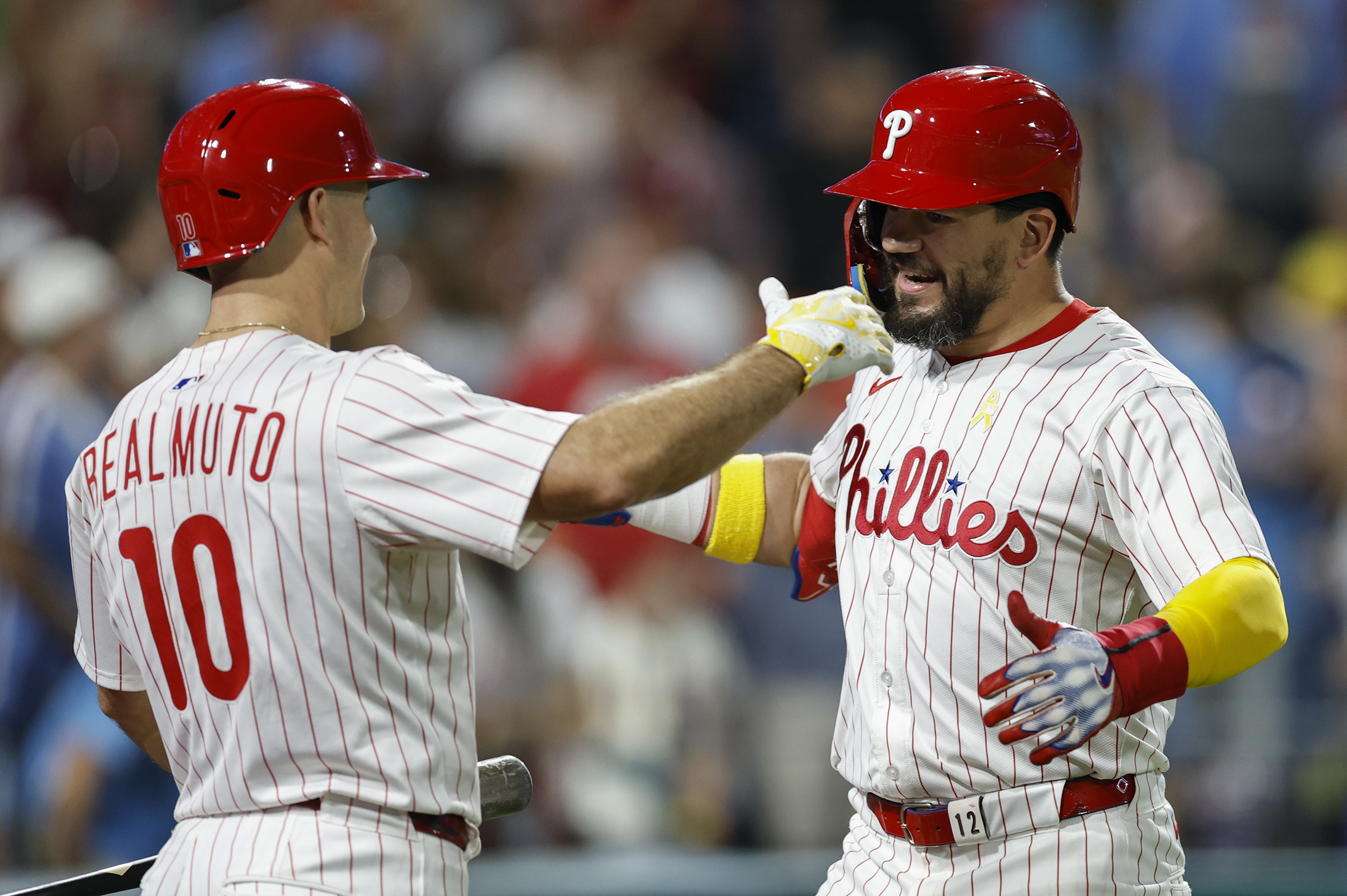
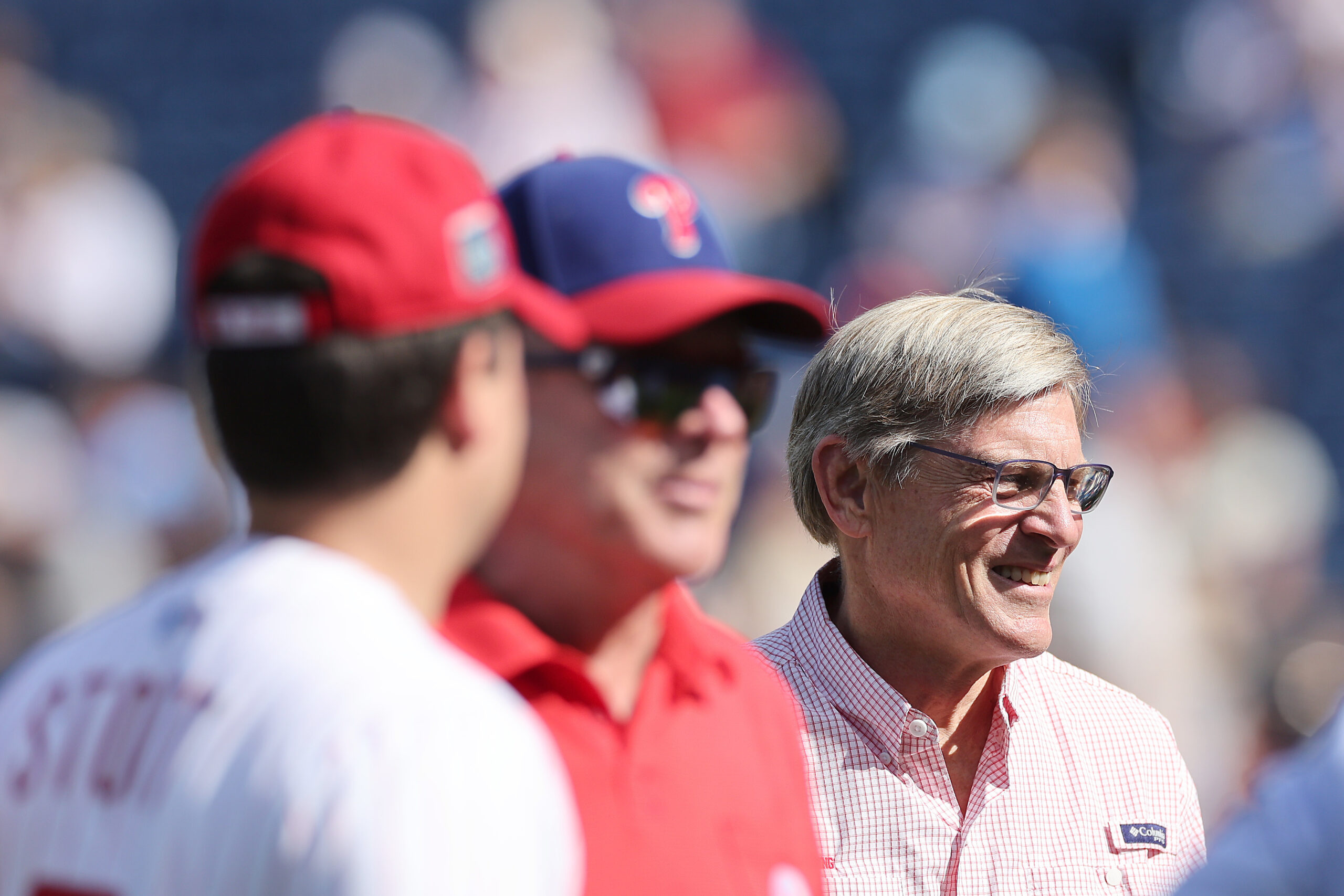
    The Phillies’ biggest moves of the offseason were bringing back two members of their core: Kyle Schwarber (right), and J.T. Realmuto.

    What additions did the Phillies make?

    It was really more about the addition they didn’t make.

    When the Phillies went to sleep on Jan. 15, they believed Bo Bichette would be in their lineup for seven seasons after they agreed to his $200 million asking price. By lunchtime on Jan. 16, he signed with the Mets. Dave Dombrowski described it as a “gut punch,” even though the former Blue Jays shortstop wasn’t a consideration for the Phillies until after the holidays.

    They prioritized bringing back Kyle Schwarber and J.T. Realmuto, and after signing the former to a five-year, $150 million contract in mid-December, they made an offer to the latter. Talks with Realmuto stalled over money, and the Phillies began considering alternatives. Bichette expressed an interest in switching positions and met with the Phillies over Zoom on Jan. 12.

    After the Mets swooped in with a higher-salary, shorter-term offer, the Phillies swiftly adjusted their pitch to Realmuto and reached a three-year, $45 million agreement.

    Otherwise, they signed right fielder Adolis García to replace Nick Castellanos, whom they will pay to play elsewhere this season, and Keller. They sent lefty Matt Strahm to the Royals for Jonathan Bowlan in a reliever swap. And they added bullpen depth with Zach McCambley (Rule 5 draft), lefty Kyle Backhus (trade with Arizona), Yoniel Curet (trade with Tampa Bay), Chase Shugart (trade with Pittsburgh), and Zach Pop (free agent).

    The Phillies also gave manager Rob Thomson a contract extension through 2027 and hired Don Mattingly as his bench coach.

    — Lauber
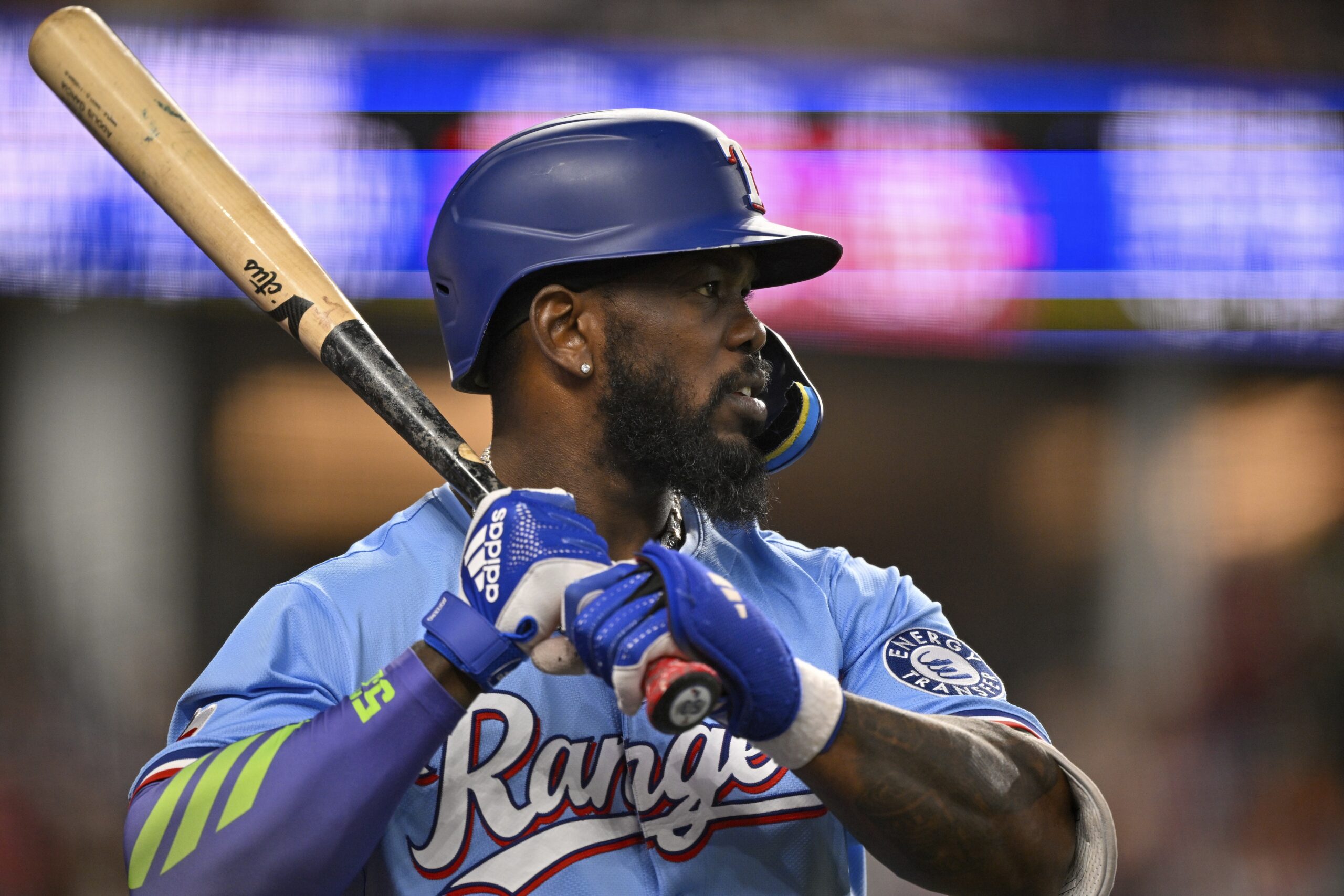
    The Phillies are counting on outfielder Adolis García to rebound from a down 2025 season with the Rangers.

    Which new Phillie is most intriguing for 2026?

    Lauber: Does Justin Crawford count as “new?” Oh, OK, we’ll get to him later. In that case, García. In 2023, he hit 39 homers, got down-ballot MVP votes, and dominated the postseason for the World Series champion Rangers. The Phillies bet on bouncebacks last year from Max Kepler and Jordan Romano and went bust. Will their latest free-agent gamble work out better?

    March: Keller. The right-hander had been a starter for most of his career before his breakout season last year as a high-leverage reliever for the Cubs, and he has retained his starter’s arsenal of four-seam, sinker, slider, changeup, and sweeper. That, plus a jump of over 3 mph on his fastball in 2025, makes him an intriguing back-end option in the Phillies’ bullpen.

    What did the rest of the NL East do this offseason?

    Rooting for the Mets must feel like riding the Coney Island Cyclone. And the last few months surely left fans nauseous, dizzy, and uncertain if they’re really satisfied.

    Consider: After going from a 5½-game lead in the division to missing the playoffs in a three-month collapse for the ages last season, the Mets traded Brandon Nimmo and Jeff McNeil and didn’t re-sign Edwin Díaz and Pete Alonso. New Yorkers lost their minds, sure that president of baseball ops David Stearns misplaced his.

    But the Mets signed Bichette, relievers Devin Williams, Luke Weaver, and Luis García, first baseman Jorge Polanco, and center fielder Luis Robert Jr., and traded for second baseman Marcus Semien along with ace Freddy Peralta and swingman Tobias Myers.

    Are the Mets different? Oh yeah. Are they better? We’ll see.

    The Braves hired a new manager (Walt Weiss) and bulked up the bullpen with Robert Suarez and the return of closer Raisel Iglesias. They re-signed shortstop Ha-Seong Kim (out until at least May after hand surgery), traded for utility man Mauricio Dubón, and signed outfielder Mike Yastrzemski.

    Two other big moves: The Marlins acquired 23-year-old outfielder Owen Caissie from the Cubs for right-handed starter Edward Cabrera; the Nationals traded top-of-the-rotation lefty MacKenzie Gore to the Rangers, plunging Washington even further into a rebuild under a new, ultra-young front office (36-year-old president Paul Toboni) and manager (33-year-old Blake Butera).

    — Lauber
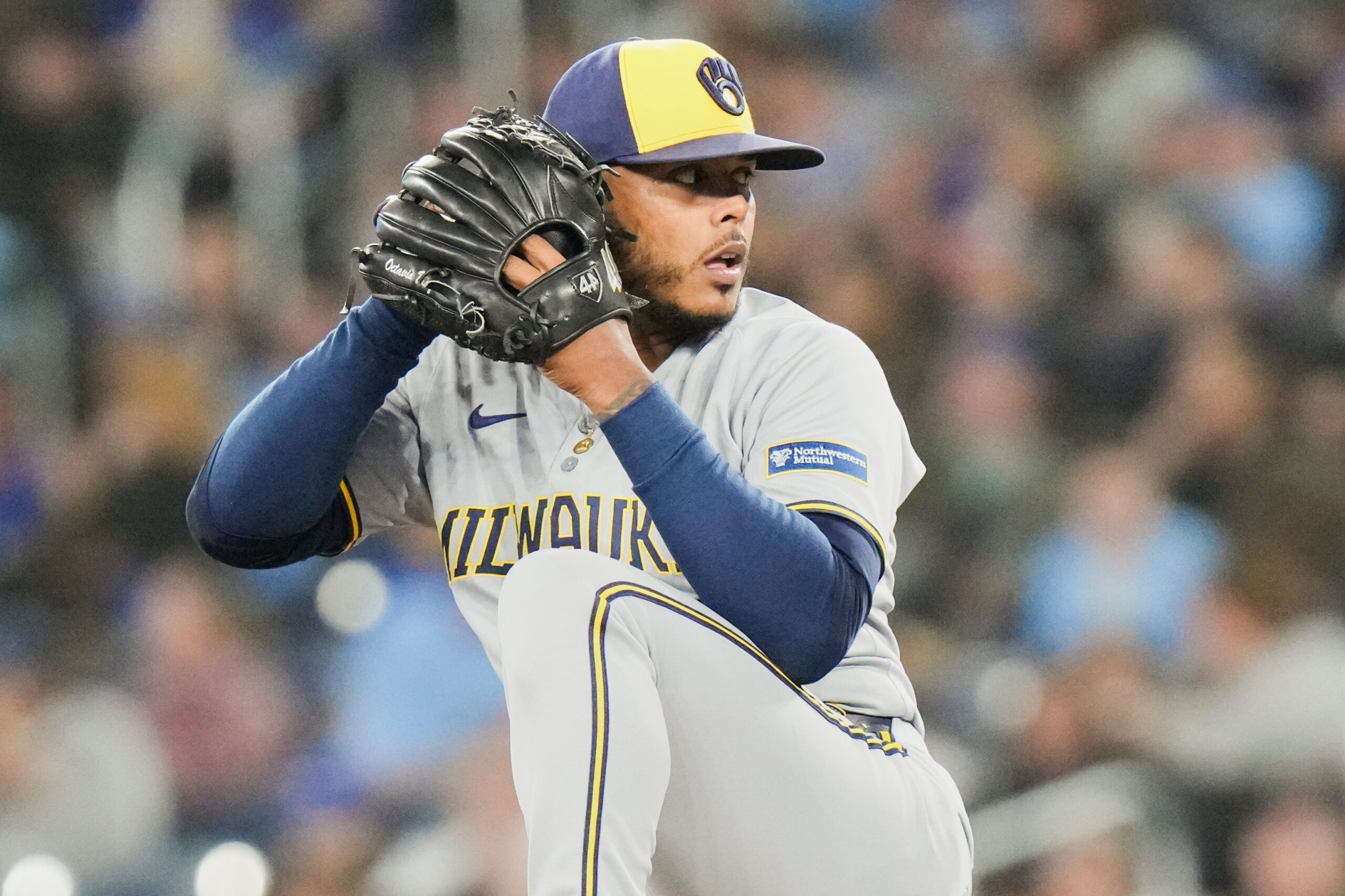
    The Mets’ busy offseason included trading for Brewers ace Freddy Peralta.

    Which NL East addition will have the biggest impact?

    Lauber: Bichette. What, you expected a different answer? If nothing else, the drama will be delicious when Bichette makes his first visit to Philly (June 18-21, by the way). But he’s also a terrific hitter who will be learning a new position on the second-largest payroll in baseball. Get your popcorn ready.

    March: Peralta. The collapse of the Mets’ starting rotation was one of the main contributors to their free-fall out of playoff contention at the end of last season. With the Brewers in 2025, the right-hander had a 2.70 ERA over 176⅔ innings and posted the most wins in the National League (17-6). Peralta finished fifth in Cy Young voting and is now positioned to lead the Mets’ rotation.

    Zack Wheeler’s return from thoracic outlet decompression surgery is still to be determined.

    What are the top Phillies storylines this spring?

    Lauber: A year ago, Zack Wheeler would have been my choice to start one game for all the marbles. (Yes, over even Tarik Skubal and Paul Skenes.) Wheeler is now five months removed from thoracic outlet decompression surgery. Every time he picks up a ball in spring training will be newsworthy, not only in determining when he will return to competition but what he looks like when he does. Will he still be an ace of aces?

    March: Andrew Painter has been a top storyline for many springs now, from teenage phenom with a chance to make the team to his road back from Tommy John surgery. Well, he’s back now. Painter pitched 118 innings in 2025, all in the minors, never receiving the major league call-up expected in “July-ish.” This will finally be his first normal spring since 2023, and there is a rotation spot up for grabs. Will he earn it?

    What’s the Phillies’ biggest roster decision?

    Lauber: Although the decision to commit to Crawford was made early in the offseason, it’s about to play out in real time. At 22, he would be the youngest outfielder to make a Phillies opening-day roster since Greg Luzinski and Mike Anderson in 1973. As the Phillies turn over the keys to center field, Crawford will be at the center of attention.

    March: The Phillies stocked up on potential bullpen depth this winter, making a host of minor league deals, a few trades, and a Rule 5 selection of McCambley. Six reliever spots are likely spoken for, barring injury: lefties José Alvarado and Tanner Banks, and righties Jhoan Duran, Keller, Orion Kerkering, and Bowlan. There will be some stiff competition for the final two spots.
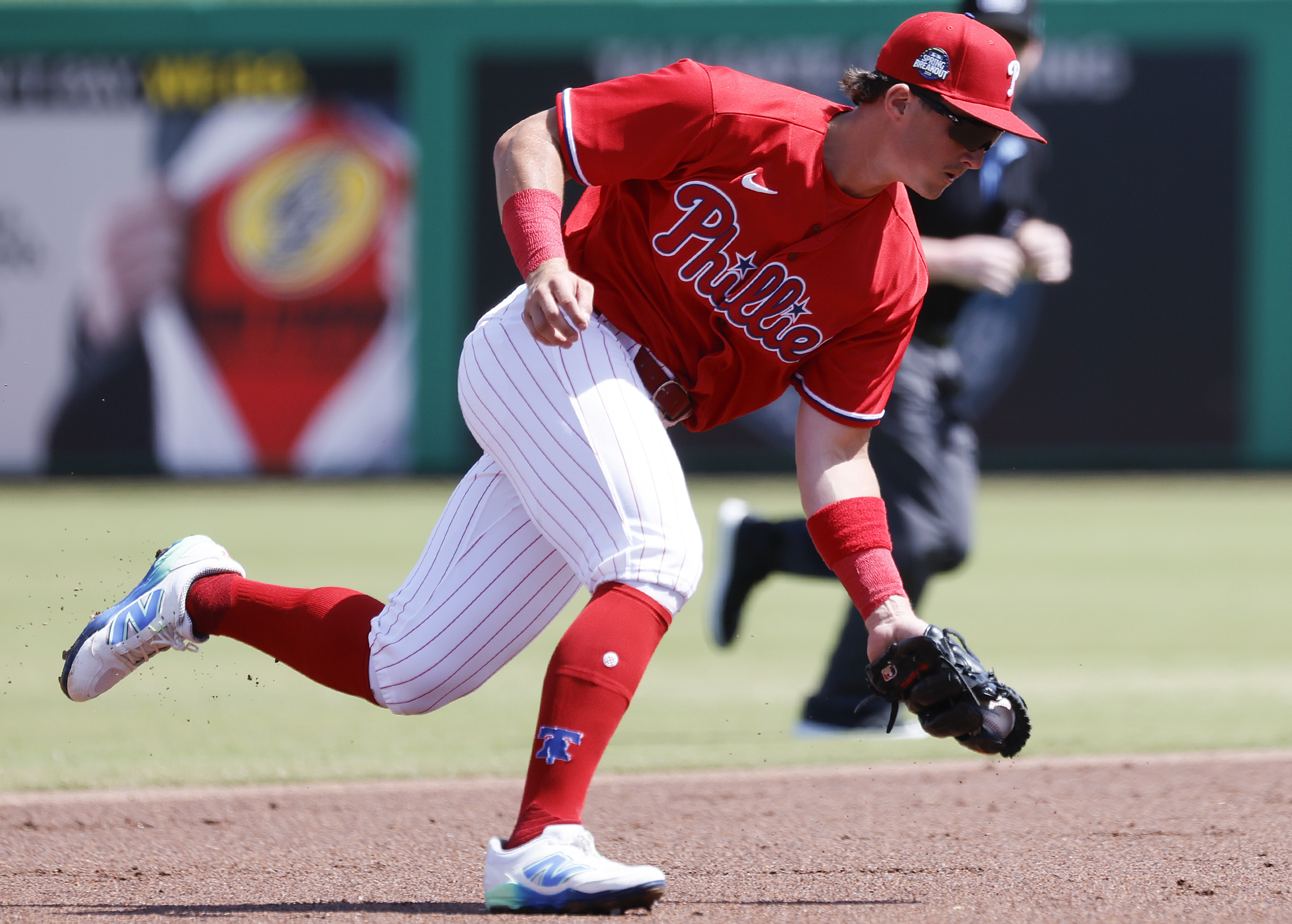
    Shortstop prospect Aidan Miller should also get some work at third base this spring.

    Which prospect should fans look out for?

    Lauber: As you watch Crawford and Painter, don’t take your eyes off Aidan Miller. The Phillies intend to expose the 22-year-old shortstop to third base in spring training, but it will be interesting to see how much third he actually plays — and how fast they push him if he starts hot in triple A and/or Alec Bohm falters again in April.

    March: Gabriel Rincones Jr. made a big impression last spring with a couple of towering home runs. The outfielder was added to the Phillies’ 40-man roster ahead of the Rule 5 draft, and he could get a major league look at some point in 2026. Rincones, who will be 25 next month, struggles against left-handed pitching, so any opportunity would likely be in a strict platoon. But he has some big power potential against righties.
  • He celebrated his 30th by putting down roots in Mount Airy

    He celebrated his 30th by putting down roots in Mount Airy

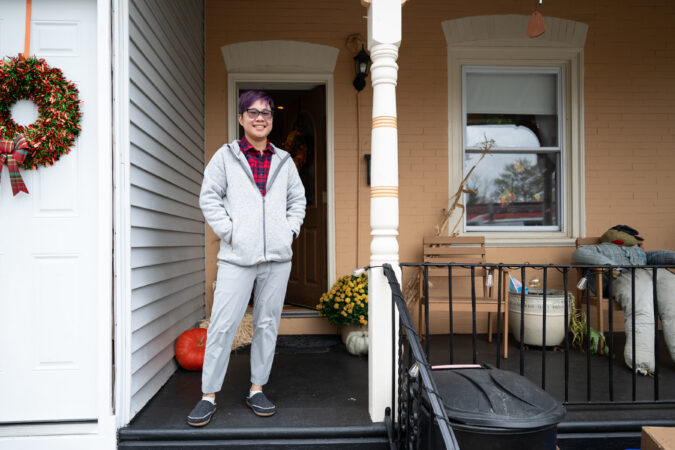
    After living in small apartments in Queen Village and Rittenhouse Square, Cooper Lee Kidd was ready to start shopping for his first home.

    The Washington, D.C., native, who works in banking and volunteers for the Philly Goat Project, wanted more indoor space and more yard for gardening and entertaining friends. He purchased his home one day before his 30th birthday.

    “This is the first house that we saw,” Kidd said on an autumn afternoon. The light from his living room window highlighted a strand of his purple hair. “I looked at another one, a rowhouse in South Philly, but it was literally sinking into the ground. We came back to this one.”

    The 900-square-foot rowhouse, nestled near the end of the block in East Mount Airy, was thoughtfully designed, he said. The home, outfitted with hardwood floors, tall ceilings, and lots of natural light, felt less cookie-cutter and industrial than the many other houses he saw online. Most important, he said, it was located in a progressive neighborhood with a strong sense of community.

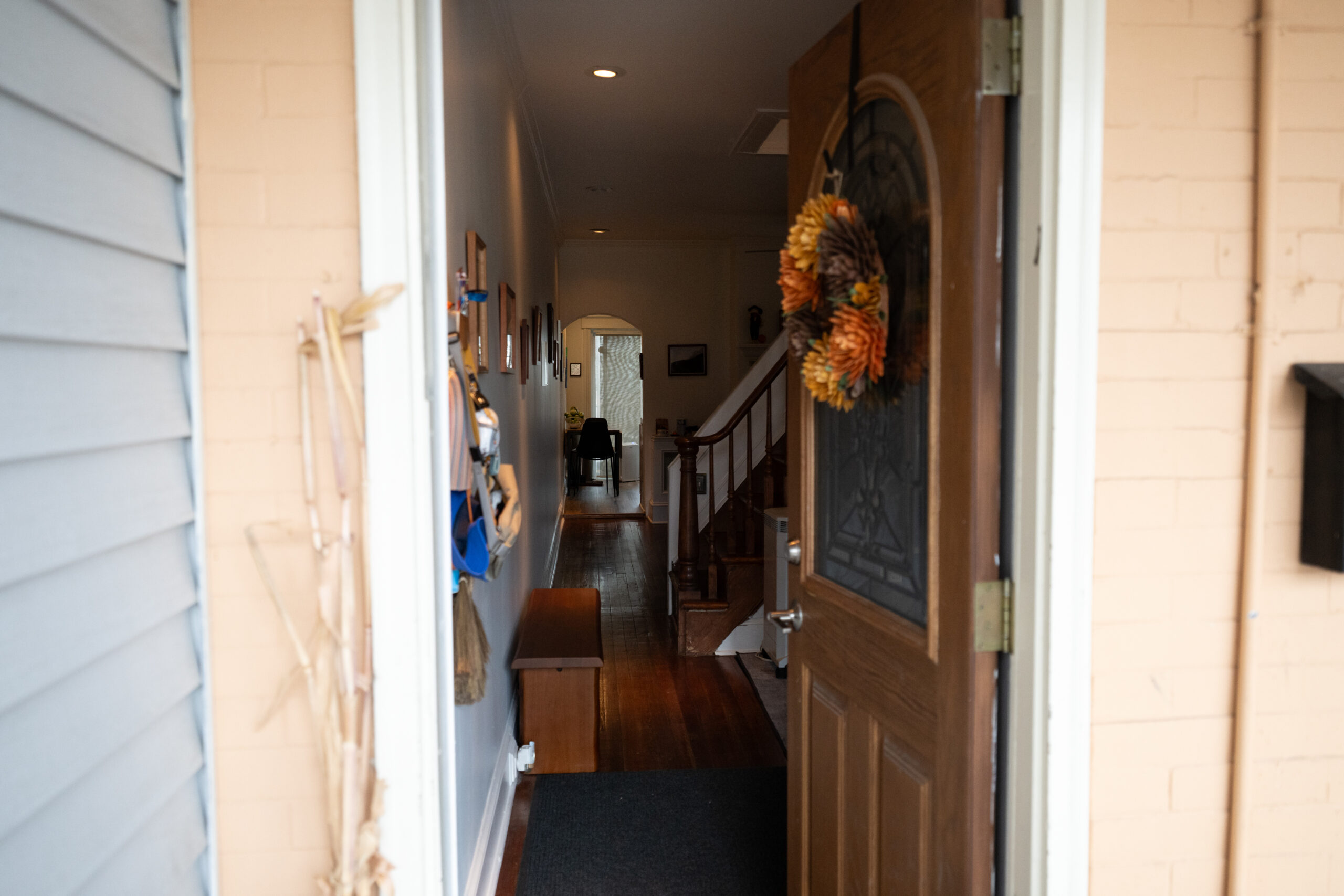
    The entry to Kidd’s rowhouse.
    The living room, where a plant in the window enjoys the afternoon sun.

    “I wanted to be very intentional about moving to the area. I didn’t want to live in a neighborhood that was all white. It’s also very economically diverse and that was very important to me,” he said. “Plus, you are near public transportation. You are near nature. There is so much happening here.”

    In the front room, a large ornate mantel anchors the space. A decorative leaded glass door leads to a cozy porch. He painted the porch black and decorated it with a pride flag and corn that he grew in the backyard.

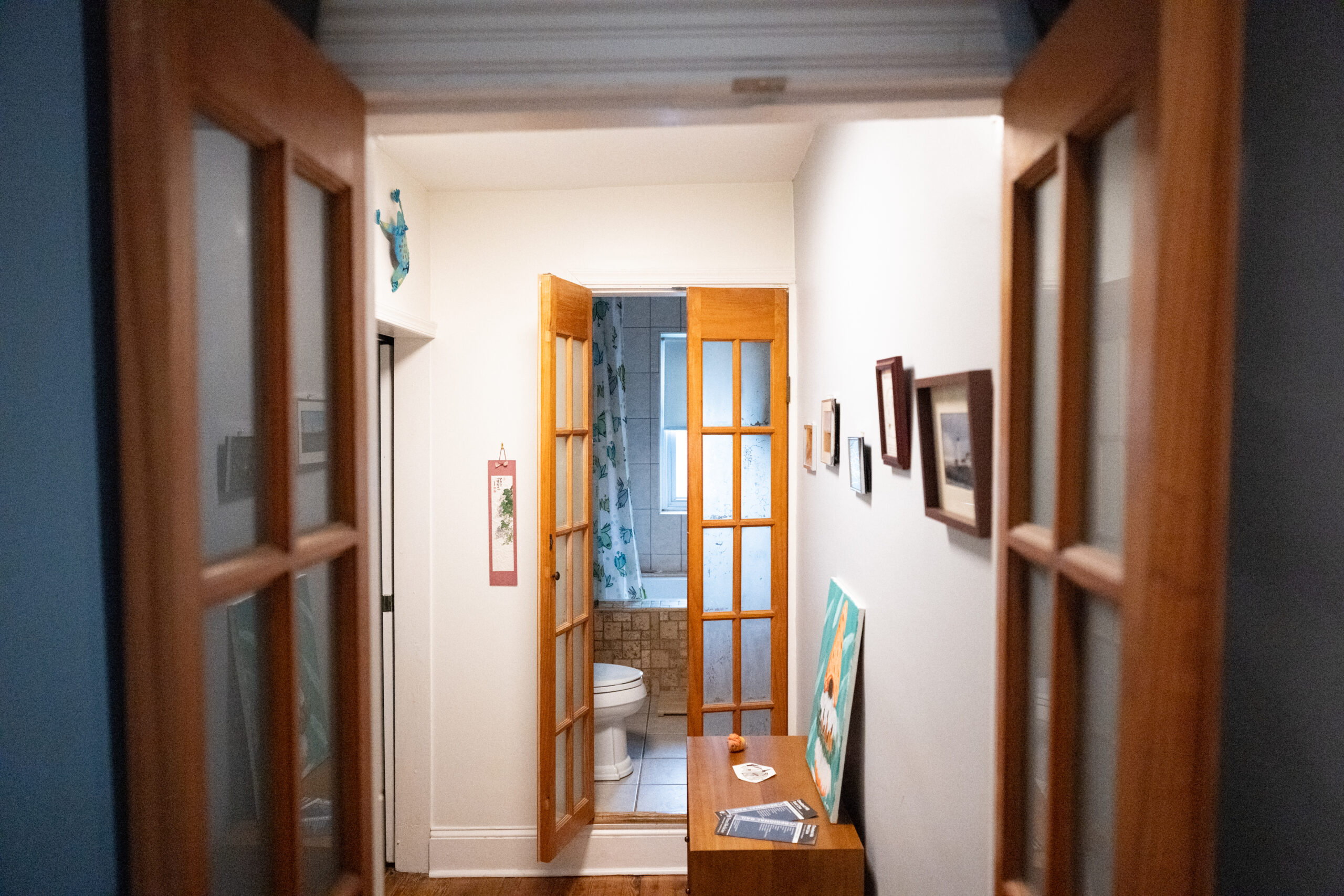
    A steep set of stairs divides the living room and adjacent dining room, which like other areas of the home are decorated with Kidd’s photography, including images from his trips to Zion National Park, Assateague Island, and Chicago. Rustic wooden doors lead to a bathroom, which used to be a closet, and to the basement. The dining room boasts decorative tile, a large cabinet, and dining table.

    “The previous owner left a lot of furniture. He got out of here very fast,” Kidd said. The owner, who moved out of the country, left the dining room cabinet, the TV stand, a bed frame, and even a French sports car that he tried to sell to Kidd.

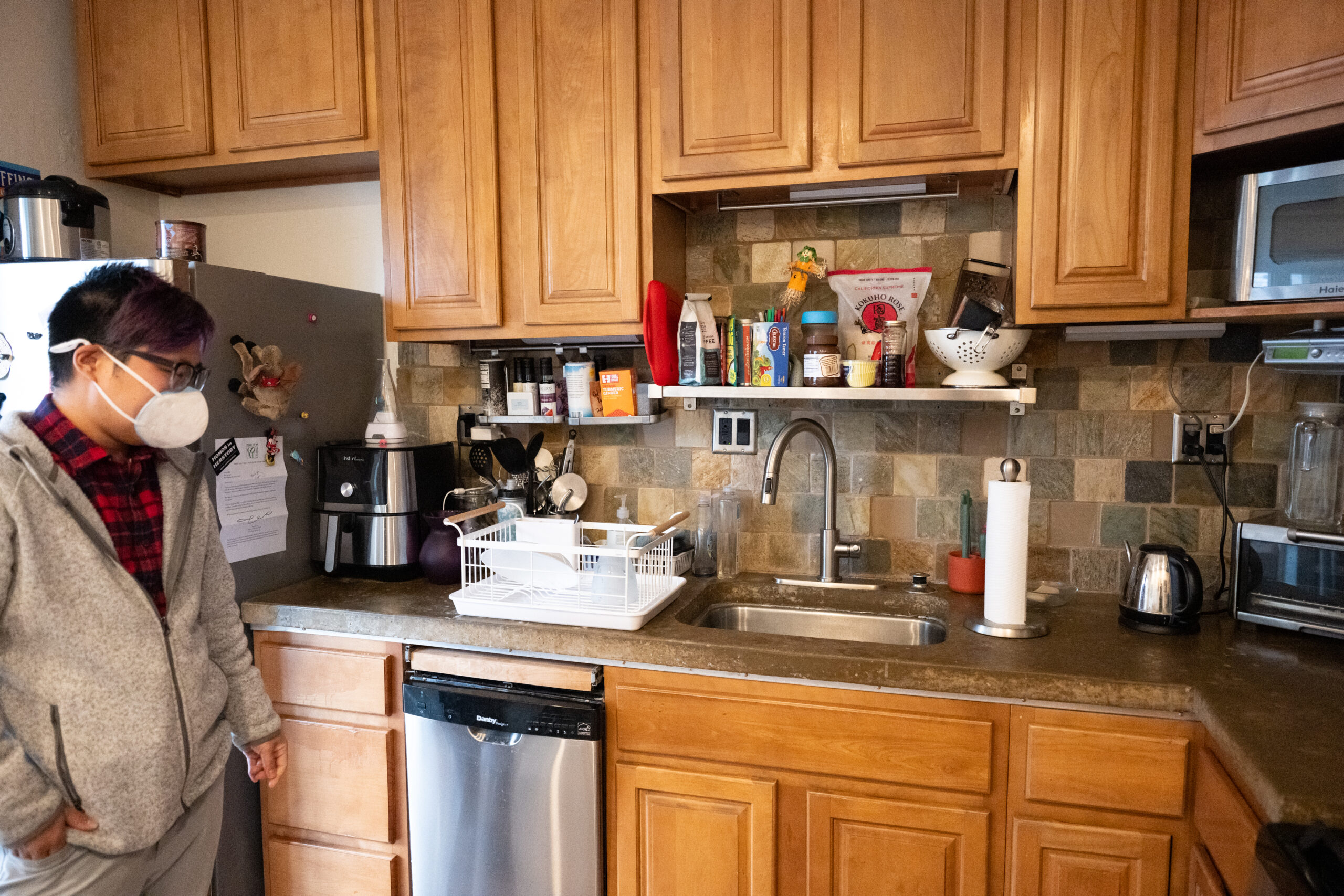
    The larger kitchen with a dishwasher was an upgrade for Kidd.
    The upstairs landing and bathroom.

    Kidd didn’t buy the car, but he was grateful for the furniture. “It’s very expensive to furnish a home.”

    In the back of the rowhouse, the spacious L-shaped kitchen came with oak cabinets, concrete countertops, and a dishwasher. While he’s not a huge fan of the countertops, Kidd said he was grateful for the upgrades.

    “When I was in Rittenhouse, I had to wash dishes in the bathtub,” he said.

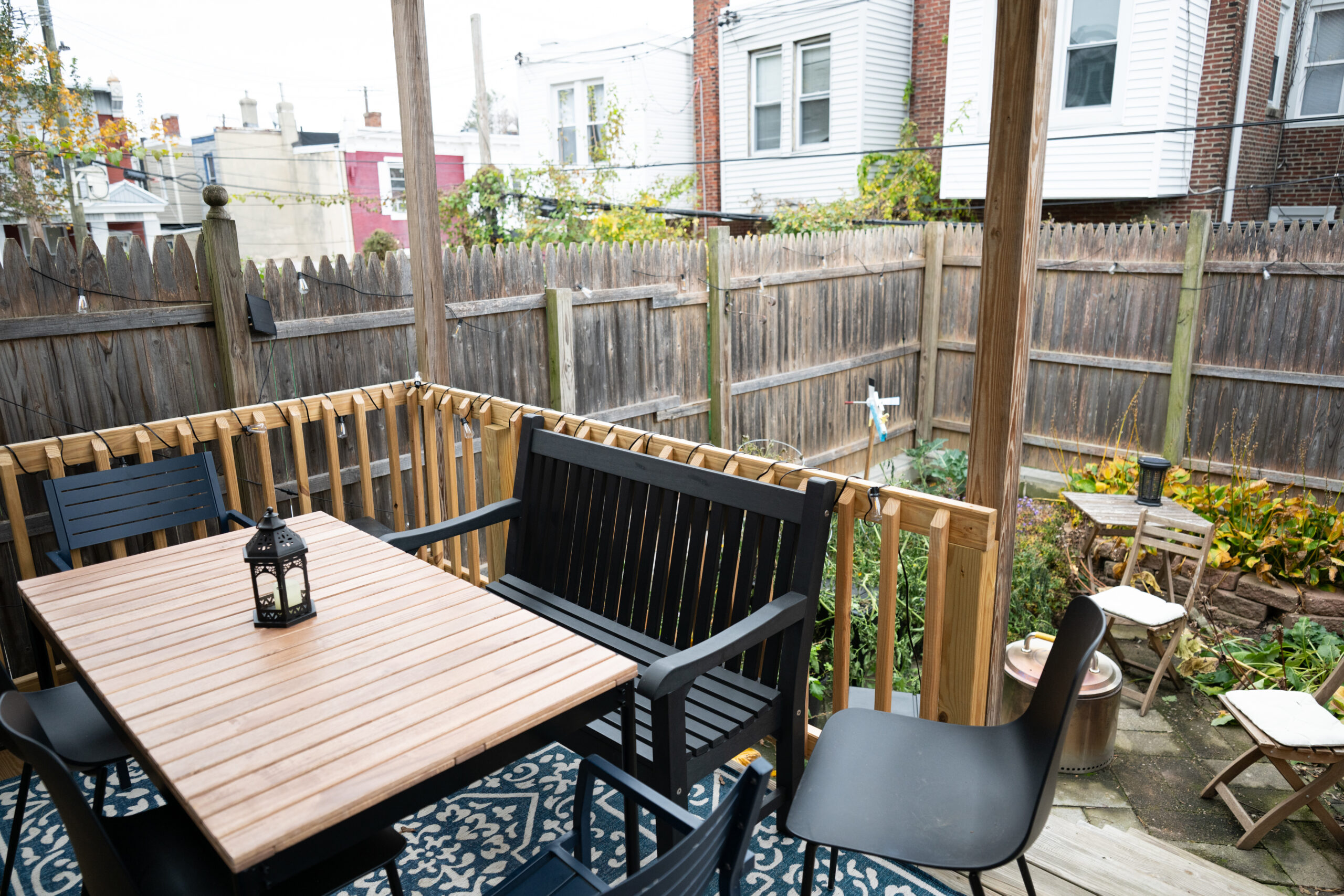
    Double doors lead to a quaint deck, wooden pergola, and postage-stamp yard.

    The outdoor space was a major draw for Kidd. It took him weeks to clean out the yard, but he was able to grow several plants during his first summer in the home.

    This past summer, Kidd spent some free time growing broccoli, kale, tomatoes, and native plants, purchased from local business Good Host Plants. It had taken weeks to clean out the trash that the previous owner had left in the yard.

    “I had never gardened before,” Kidd said. “I grew up in a normal suburban home. My parents gardened. I don’t think my brother and I were interested at the time.”

    The last batch of tomatoes Kidd harvested from his backyard garden is piled into bowls in his kitchen.
    Kidd’s garden during the summer, as the flowers were blooming. He worked to clear out the yard and make space for plants and seating after moving in.

    Kidd attended the University of Maryland for his undergraduate degree in sociology. He went on to work for the Children’s Hospital of Philadelphia for several years, studying HIV in adolescents, before the grant funding his work was cut. He then returned to graduate school at the University of Maryland. In 2022, he started his current job in banking and finance.

    He uses the second bedroom upstairs as his office. Painted a moody hunter green, the office is outfitted with built-in bookcases and a charming pocket door.

    The front bedroom faces a historic cemetery. The open space provides for a nice view.

    “The Realtor joked that I could commune with my ancestors,” he said. “But you get a really nice sunrise and sunset. There’s no obstruction.”

    The home office is made cozy with a velvety couch and throw pillows.

    Kidd is grateful the city and neighborhood even has affordable and attainable homes for someone his age.

    “This home feels very cozy, so much more than the apartments. It feels like mine.”

    Is your house a Haven? Nominate your home by email (and send some digital photographs) at properties@inquirer.com.

  • The test of time | Sports Daily Newsletter

    The test of time | Sports Daily Newsletter

    About 50 years ago, paging through the Sunday Inquirer, you would find it stuffed with man’s-world staples — stories on the NFL, NHL, pro and college basketball.

    But on Page 16 on Nov. 28, 1976, sandwiched between two men’s basketball previews, a headline read: “Move over guys, here comes another Top 20 poll.”

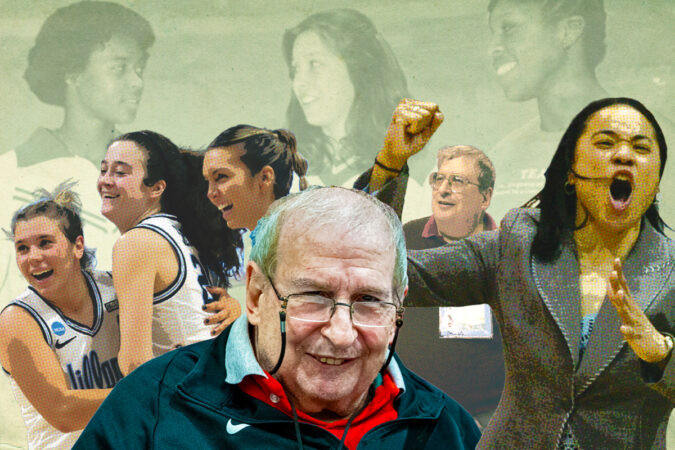
    Conceived by Inquirer sports editor Jay Searcy and nurtured by Mel Greenberg, the poll gained popularity and became a building block in the growth of women’s basketball.

    It took 28 years after the inception of the Associated Press’ men’s college basketball poll for the women to get one. Most newspapers and TV stations ignored women’s basketball coverage.

    But if there was a hotbed, it was the Philadelphia area, from Immaculata dominating the AIAW days of the ’70s to the Norristown-raised Geno Auriemma creating a dynasty at UConn.

    In 1978, the AP began distributing Greenberg’s women’s basketball poll. In 1994, Greenberg ceded its compilation to the AP. The poll was a cornerstone of the game.

    And it all started in The Inquirer’s newsroom.

    — Isabella DiAmore, @phillysport, sports.daily@inquirer.com.

    If someone forwarded you this email, sign up for free here.

    ❓What was your favorite era to be a sports fan in Philly and why? Email us back for a chance to be featured in the newsletter and in a future story.

    Not sweating it

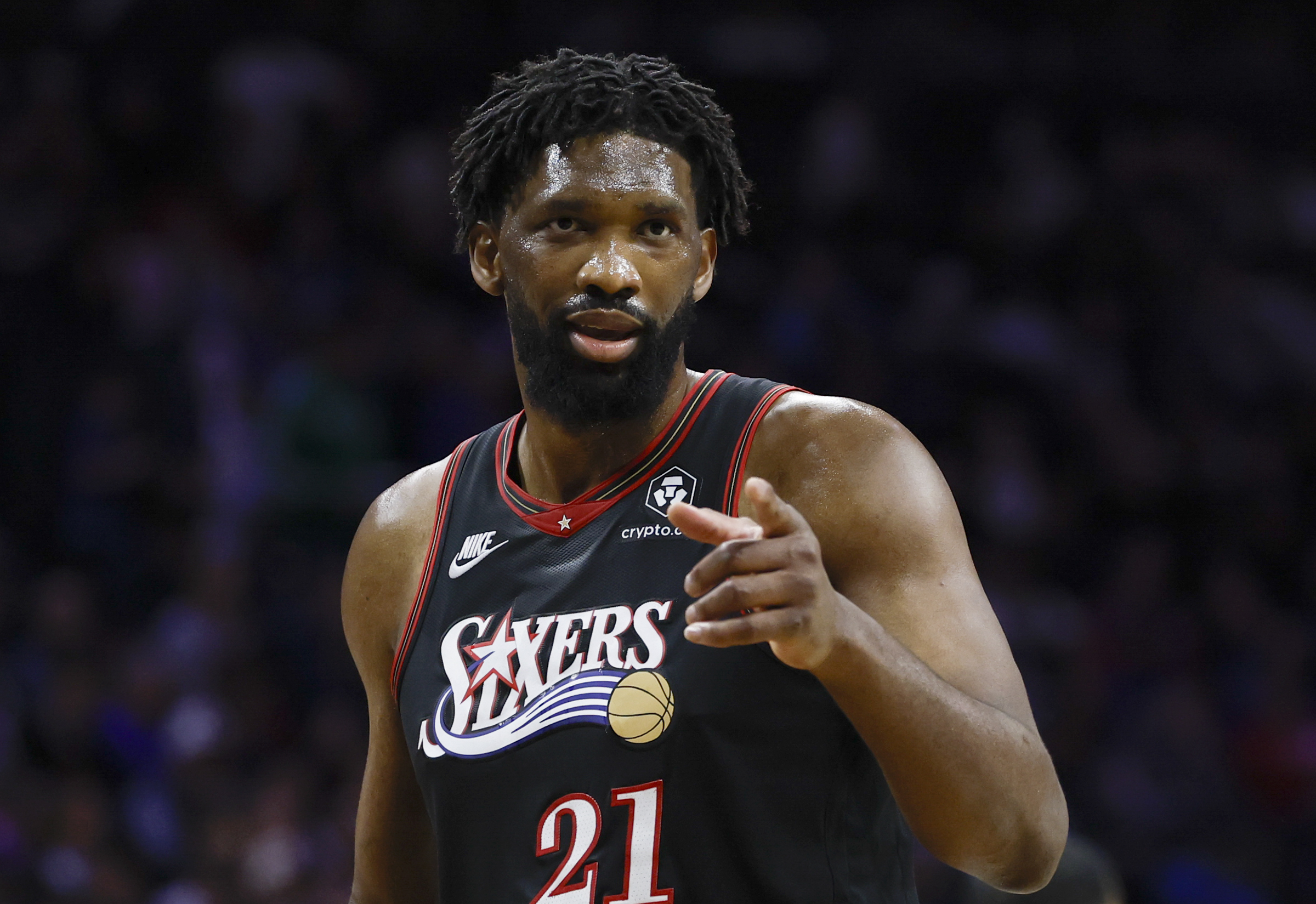
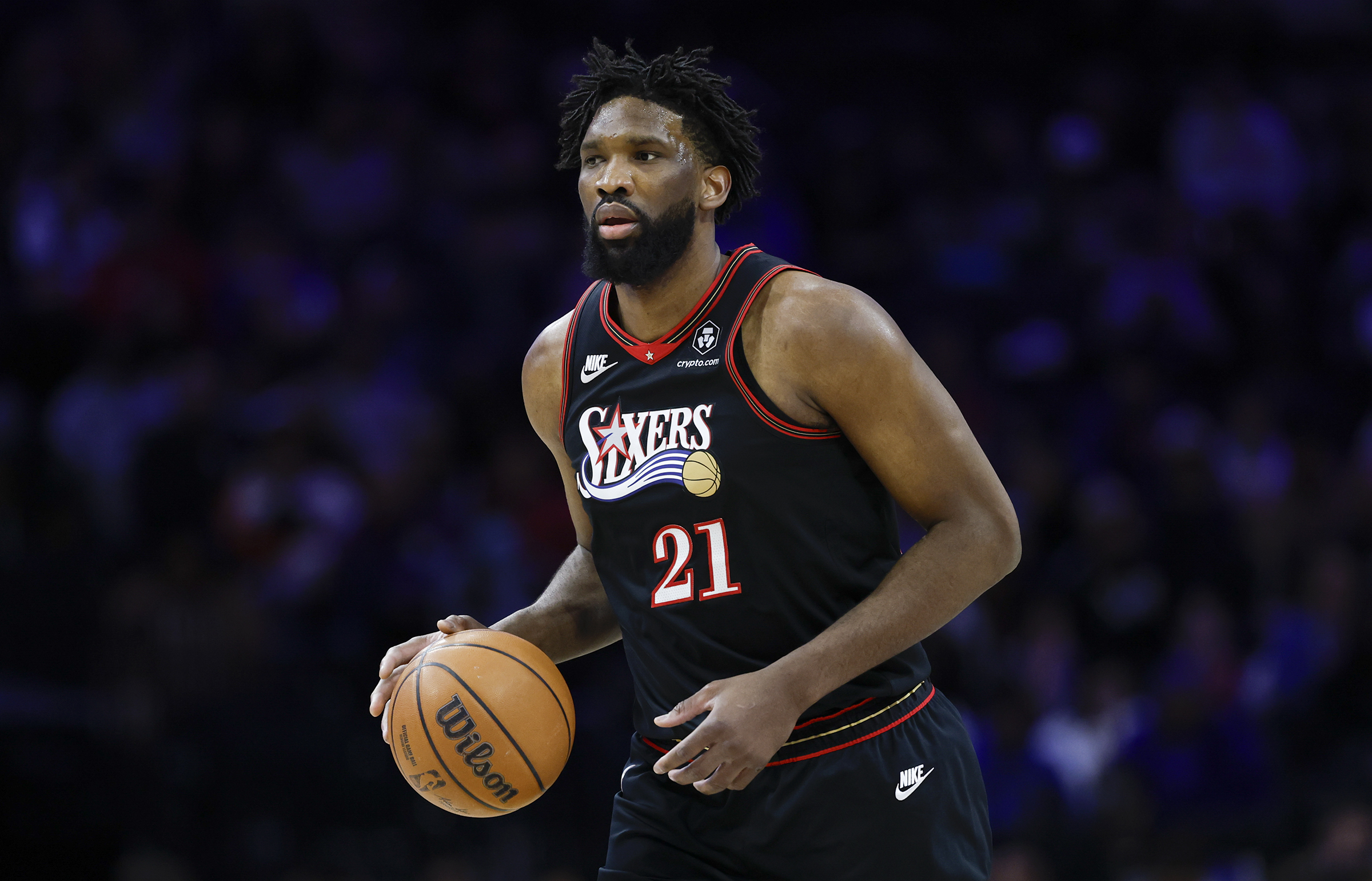
    While Sixers center Joel Embiid was not chosen as an All-Star Game reserve, he still could be added as an injury replacement.

    Joel Embiid is content with spending his All-Star break on a family vacation, instead of at the game, after he was not selected as an Eastern Conference reserve. The Sixers center said he doesn’t need “any validation from anybody,” but he still could be named an injury replacement, with Milwaukee Bucks star Giannis Antetokounmpo out with a calf strain. His teammates and coach, though, were a bit surprised that Embiid was not among those selected, considering his production in recent weeks.

    The Sixers should approach this week with the intention of ensuring that a roster spot is available to convert Dominick Barlow to a standard contract. His career-high 26 points and 16 rebounds in Monday’s win against Clippers proved that the Sixers need to keep him around.

    What we’re …

    ⏱️ Counting down: The days until baseball begins as the Phillies loaded their spring training truck on Tuesday.

    🤔 Wondering: Will Roger Goodell and the NFL expand the regular season to 18 games? The commissioner says it’s “not a given.”

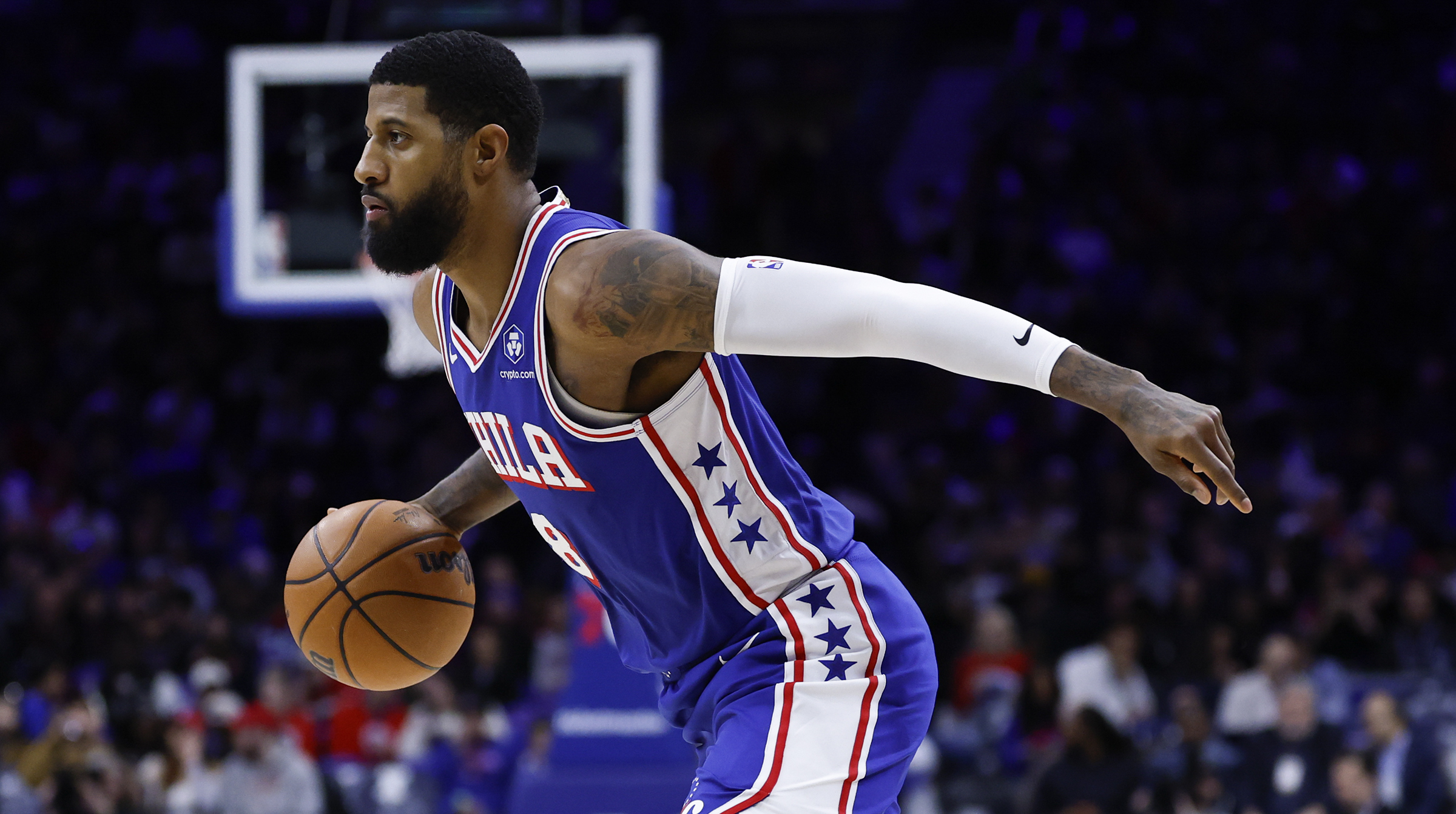
    🏀 Learning: With Thursday’s NBA trade deadline looming, can the Sixers realistically replace Paul George? Here are six questions the team faces.

    📖 Reading: A former Temple soccer player turned football kicker got the Seahawks on the board in their first NFL season. But he made his name playing the accordion.

    Back in the Super Bowl

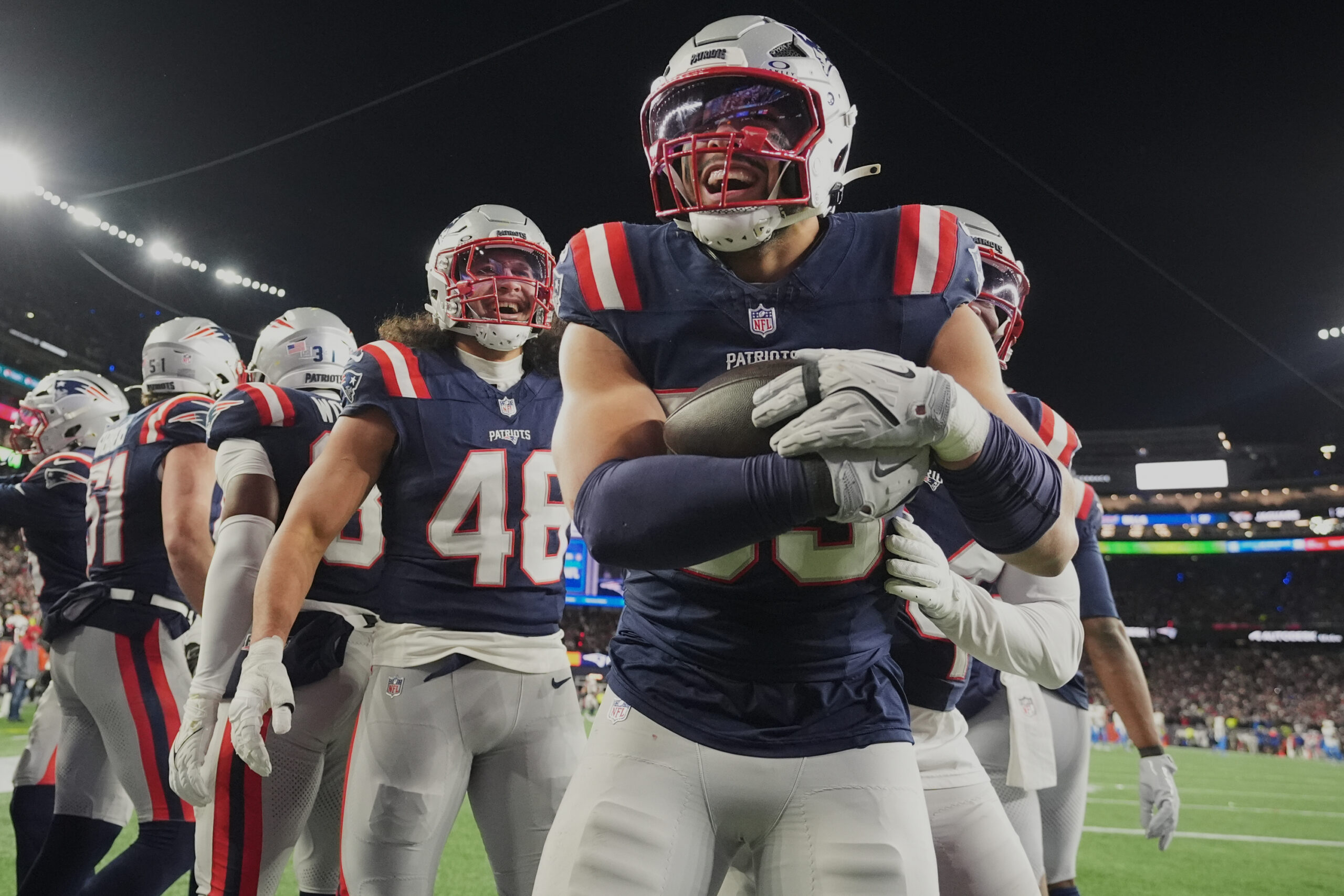
    Christian Elliss has had an impactful playoff run for a Patriots team that has retained his services through three coaching regimes.

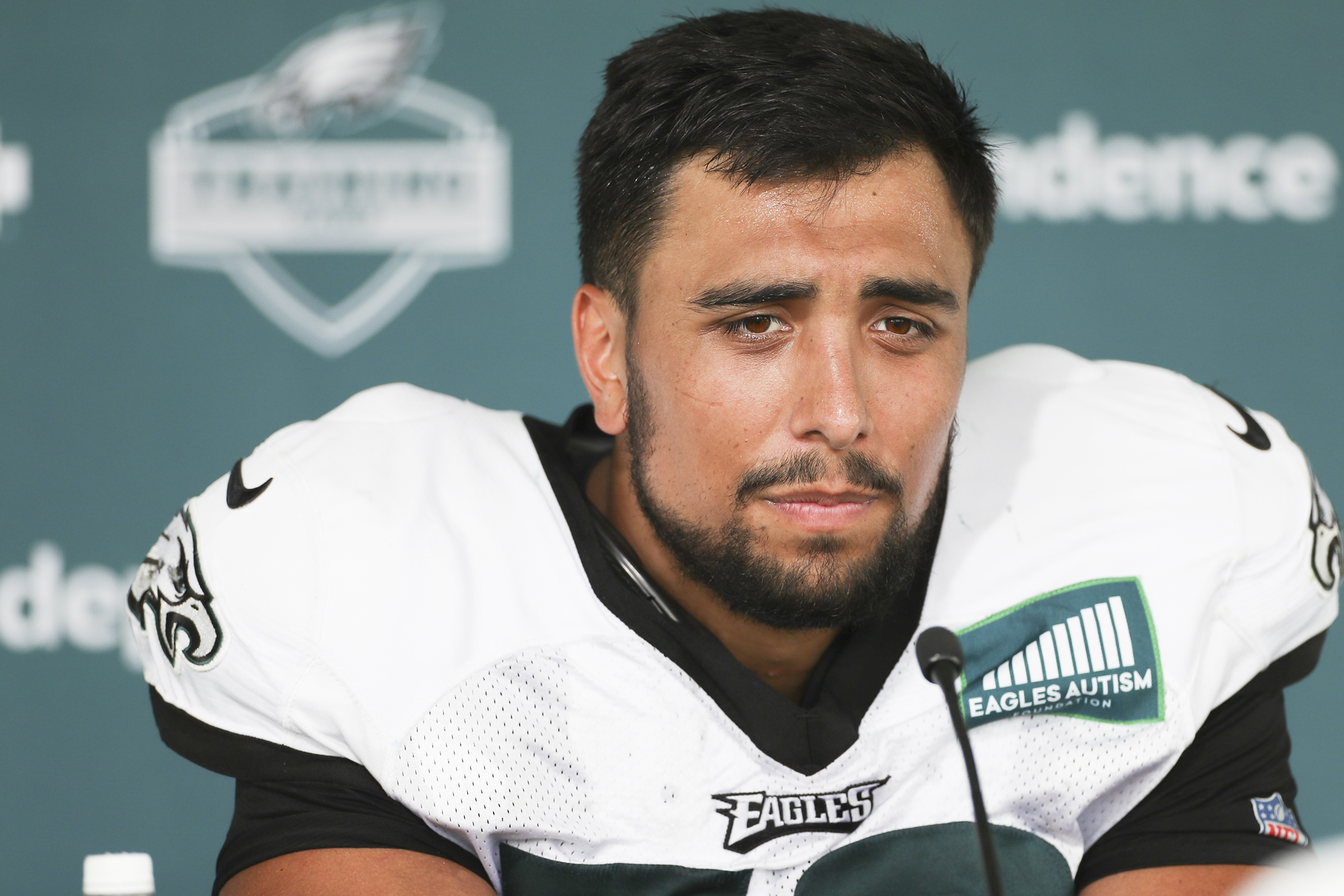
    Christian Elliss was cut from an NFL roster six times in the first two seasons of his career — five times by the Eagles. The last time was at the end of the 2023 season: “They didn’t see me as piece for them. But luckily Bill [Belichick] did.”

    The linebacker went from tears after the Eagles cut him to joy with a Patriots team that has made him a key part of its defense, and it has landed him back in the Super Bowl.

    Flyers GM clears the air

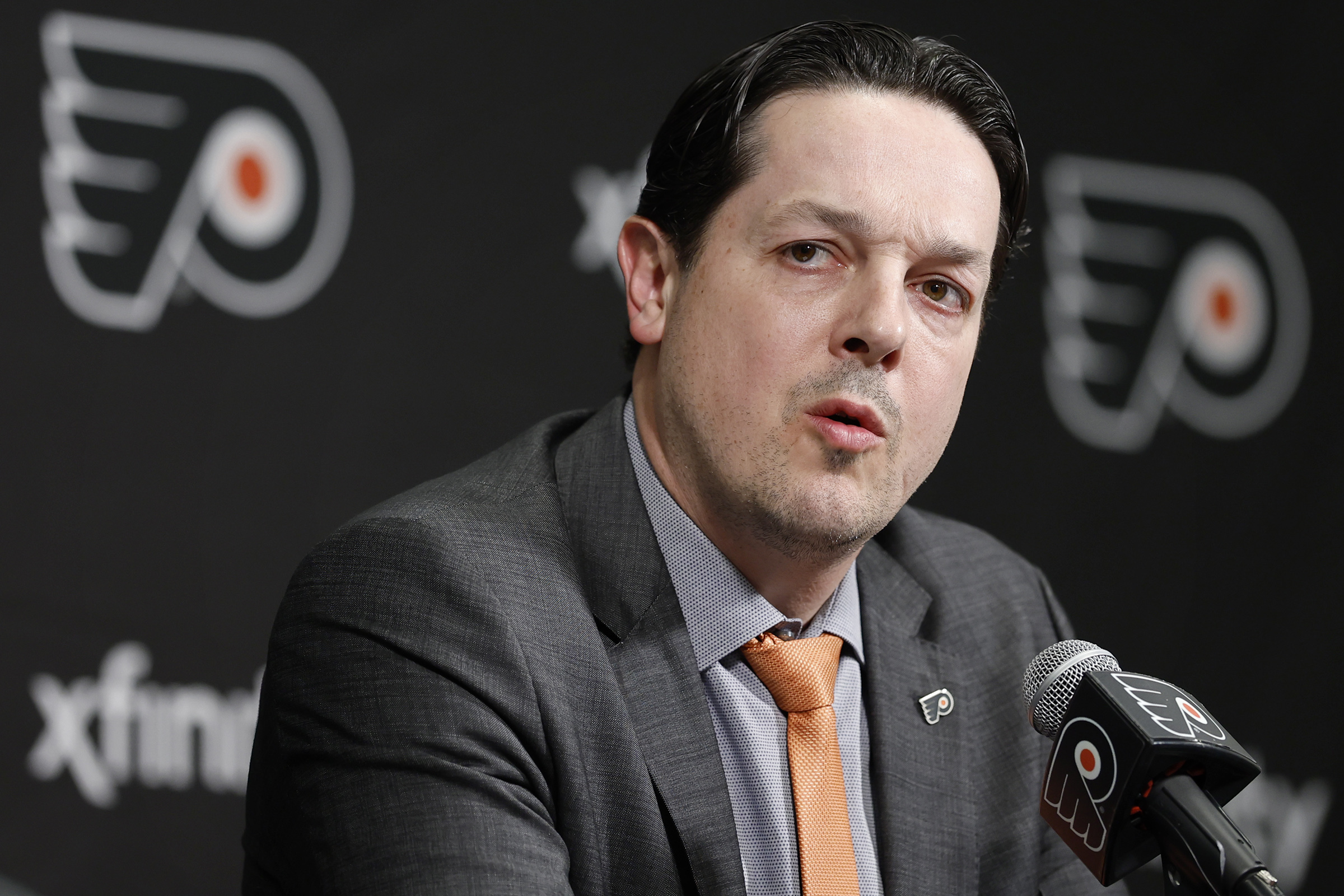
    Flyers general manager Danny Brière said Tuesday that Matvei Michkov and Rick Tocchet have “a good relationship” and that this is all part of the learning process for the young winger.

    Much of the talk in Flyers Land the past few weeks has been about Matvei Michkov, his lack of ice time, and whether coach Rick Tocchet is the right coach for his long-term development.

    That speculation reached a climax on Sunday at the Flyers’ Carnival, after Tocchet doubled down on his previous revelation that Michkov showed up to training camp out of shape and is still fighting to catch up. On Tuesday, Flyers general manager Danny Brière met with the media to refute any potential rift between the Russian winger and his head coach. Here’s what he had to say.

    Trevor Zegras prefers to play center. Entering Flyers training camp, the consensus from the player and the front office was that Zegras would get a chance back at his natural position. However, that hasn’t been the case — until recently. Tuesday marked the third straight game with Zegras playing down the middle.

    If all goes well, the 24-year-old could help solve one of the organization’s biggest issues. Time will tell, and for now, Rick Tocchet is sticking with it.

    On the ice, the Flyers snapped their four-game losing streak with a 4-2 win over the Washington Capitals. Jamie Drysdale scored the go-ahead goal in the third period.

    Spring training primer

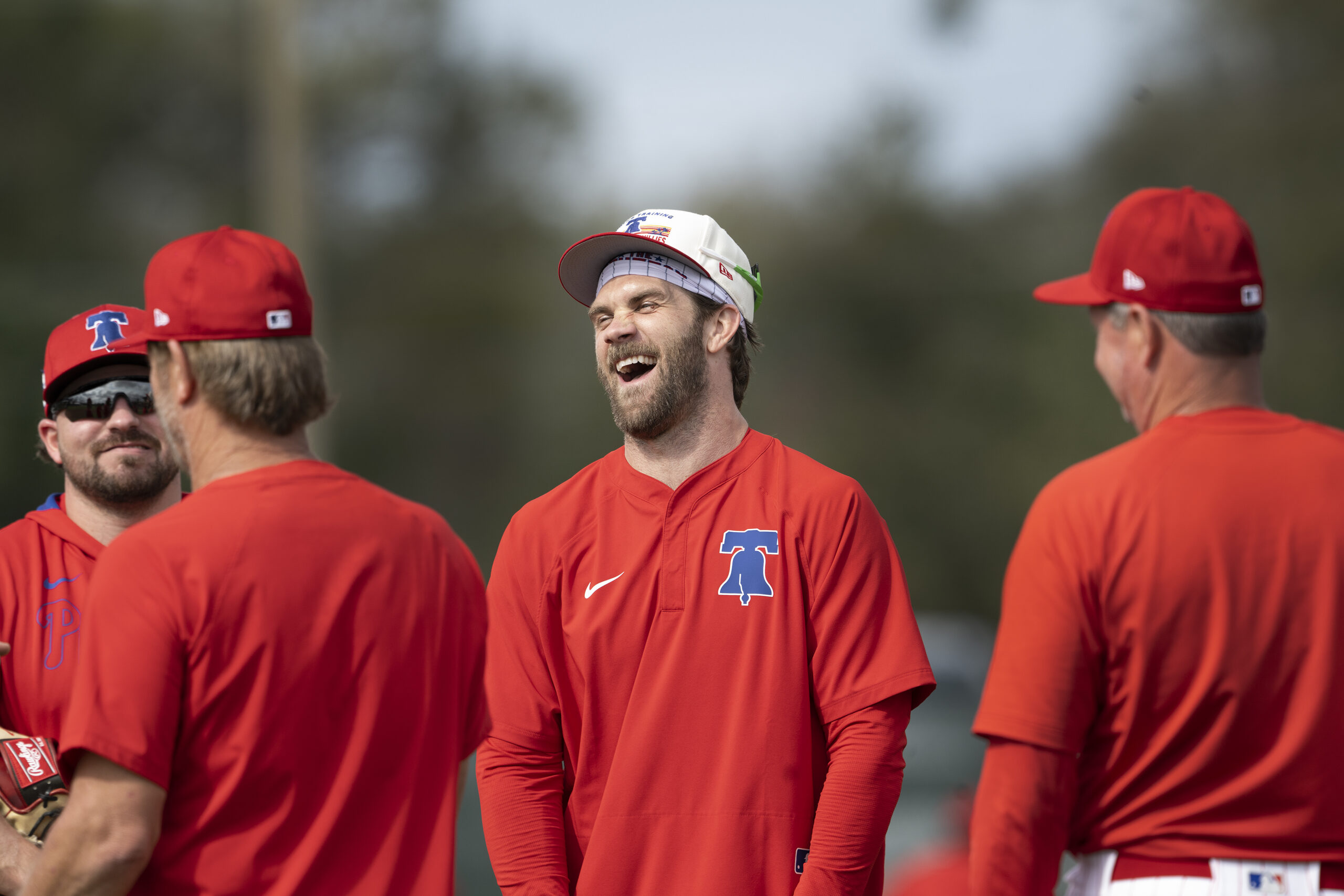
    Bryce Harper and the Phillies will soon be getting back to work at their spring training home in Clearwater, Fla.

    Punxsutawney Phil may have seen his shadow on Monday, but spring training waits for no groundhog.

    The Phillies’ trucks have been loaded with gear, including thousands of baseballs and one hot dog launcher, and have begun their journey toward Clearwater, Fla. Camp is set to open on Feb. 11, officially starting the long buildup toward October.

    Here’s everything to know about Phillies spring training.

    Sports snapshot

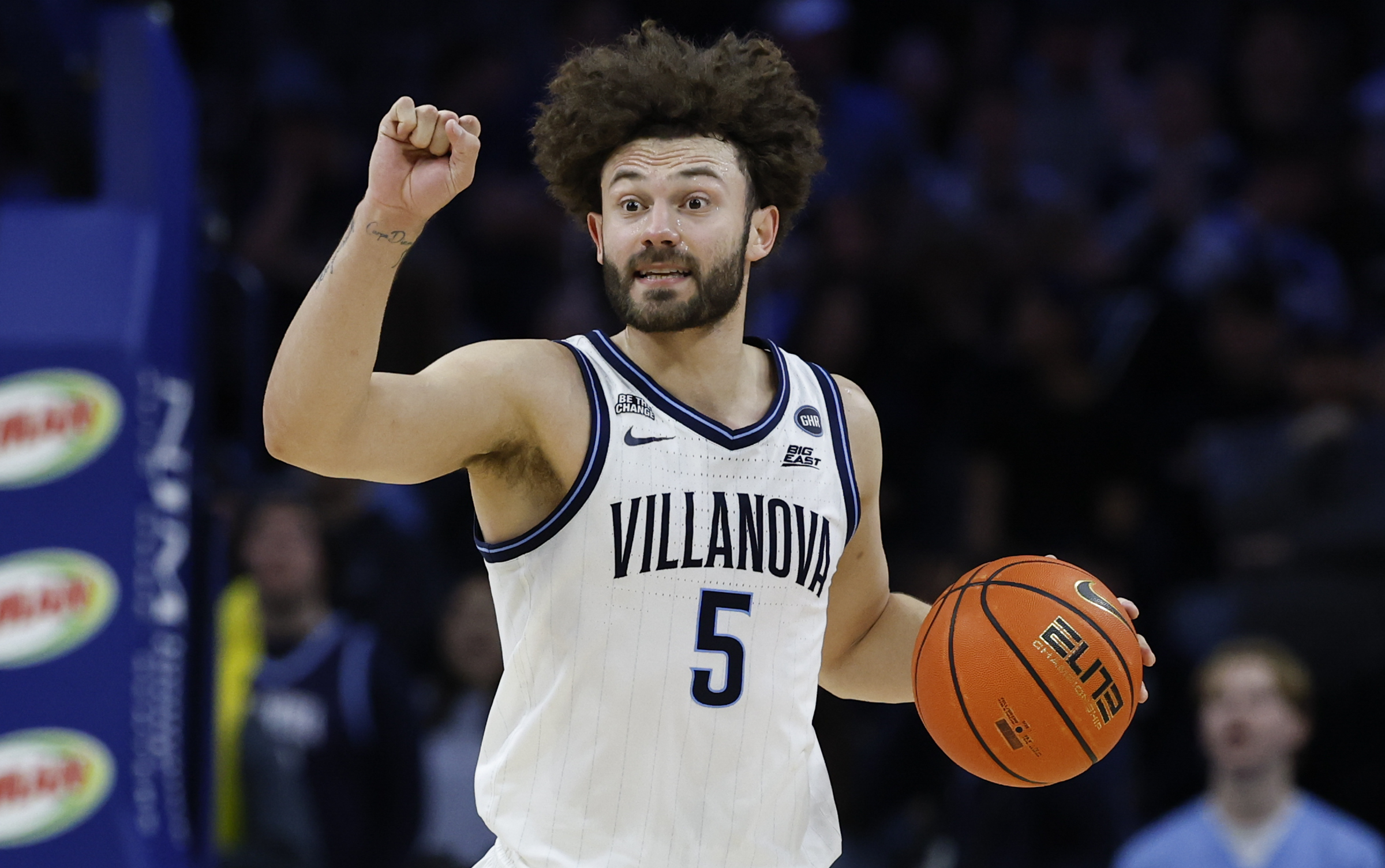
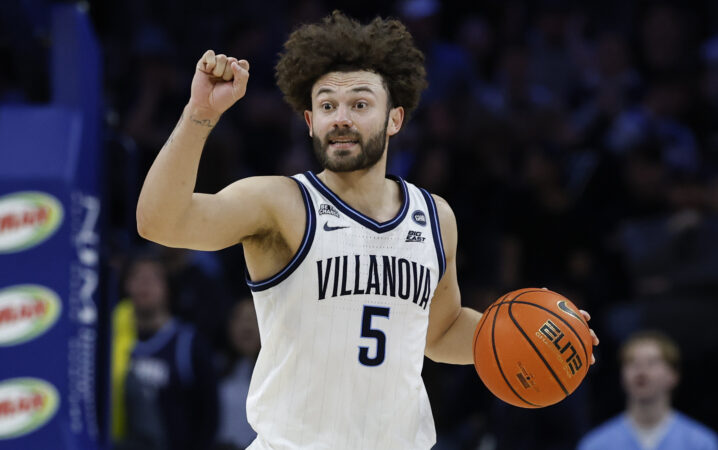
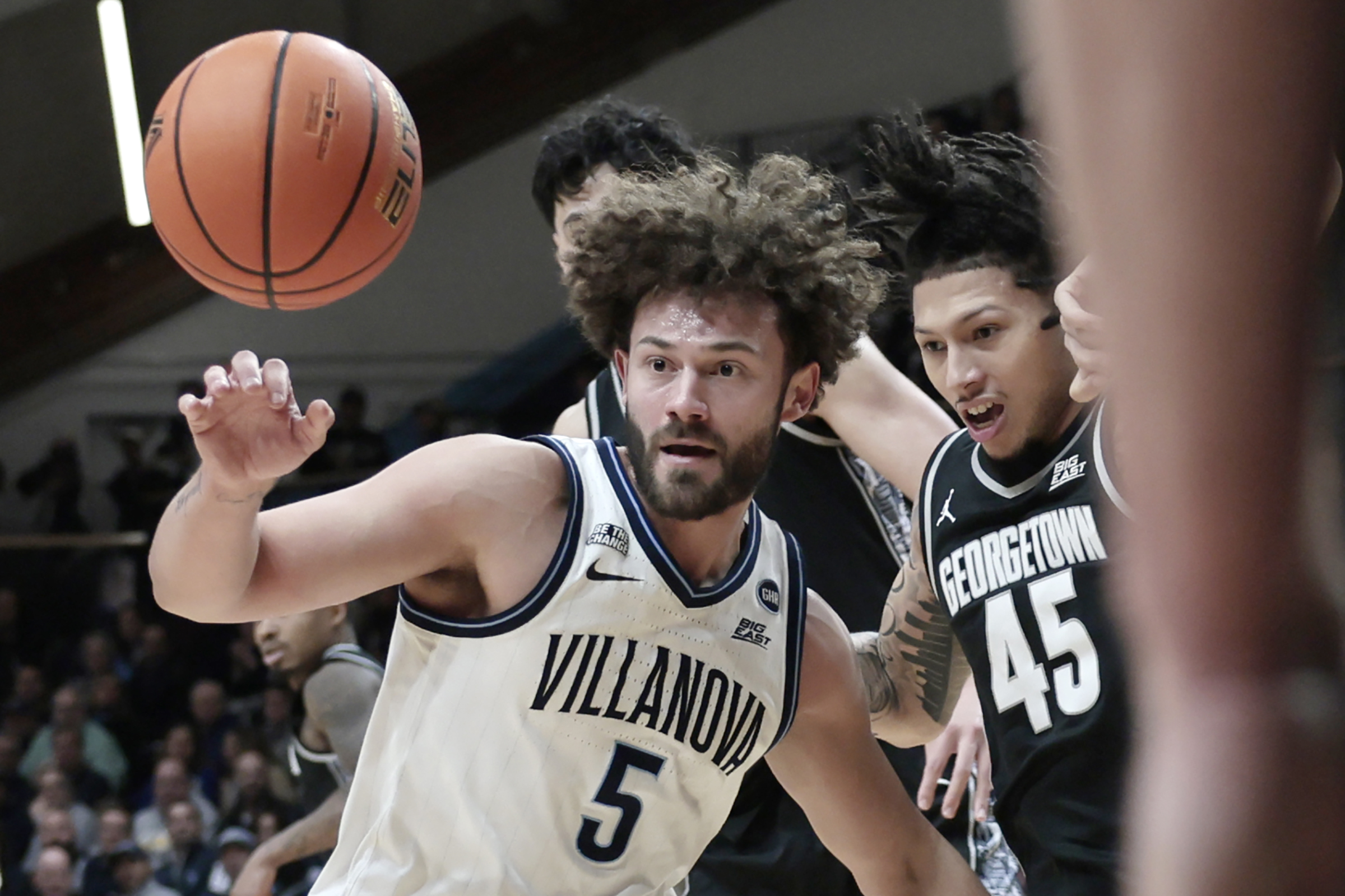
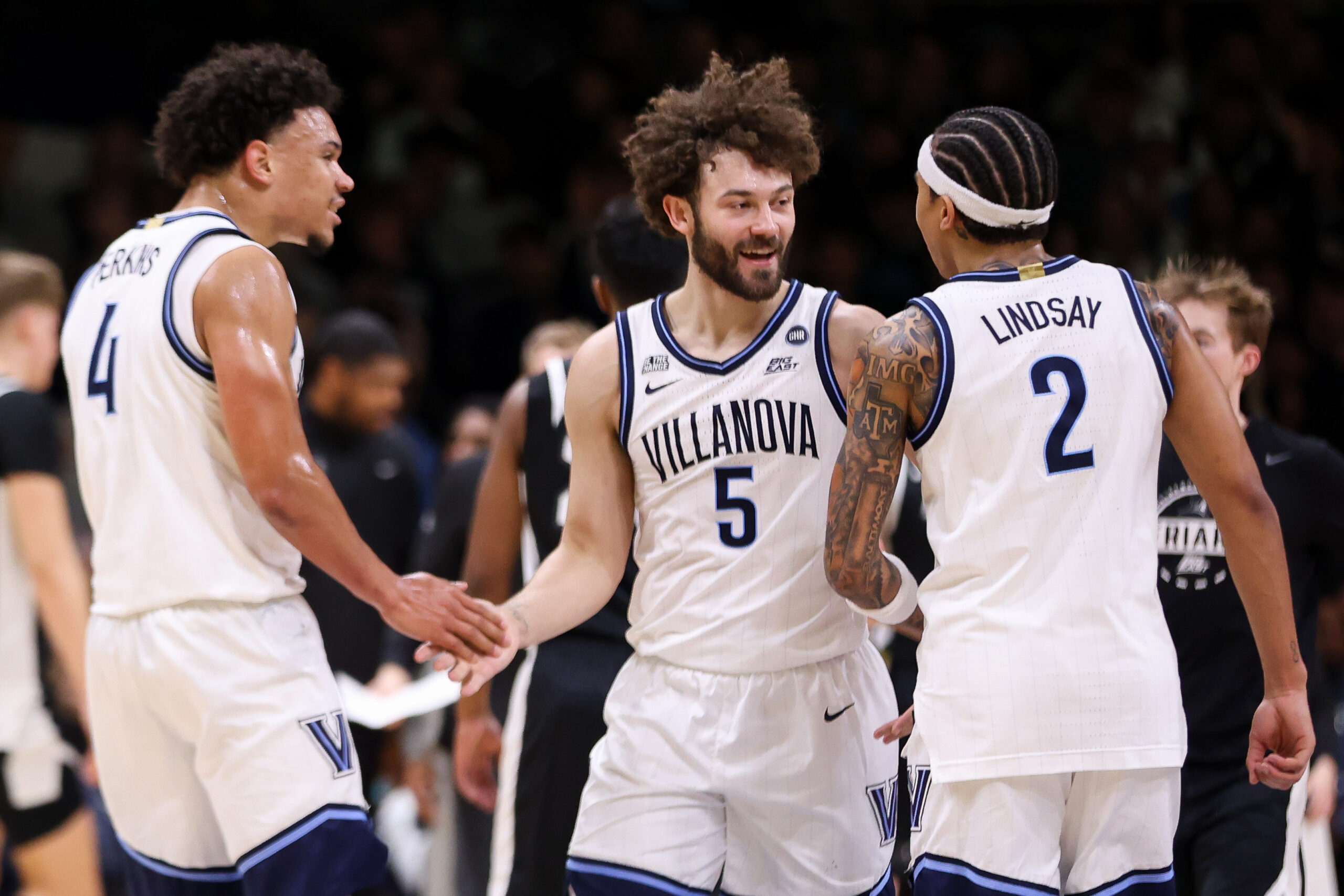
    Villanova guard Devin Askew is with his fifth college team.
    • Full circle: Jay Wright recruited Devin Askew out of high school. Six years and five programs later, his journey to Villanova seems fitting.
    • Buying in: Temple football coach K.C. Keeler didn’t lose any of his starters to the transfer portal. He says “they saw the vision.”
    • New era: Penn State’s 2026 football season will include a Friday night matchup and a trip to Lincoln Financial Field.
    • Adding depth: The Union bolstered their defense on Tuesday with the signing of Colombian centerback Geiner Martínez.

    Join us on Reddit

    The Inquirer’s Lochlahn March joins a Reddit AMA today at noon.

    Have any questions about the Phillies heading into spring training?

    The Inquirer’s Lochlahn March will provide some answers during a Reddit AMA today at noon.

    🧠 Trivia time answer

    Who was the first 76er to be named NBA rookie of the year?

    B) Allen Iverson — Melinda W. was first with the correct answer.

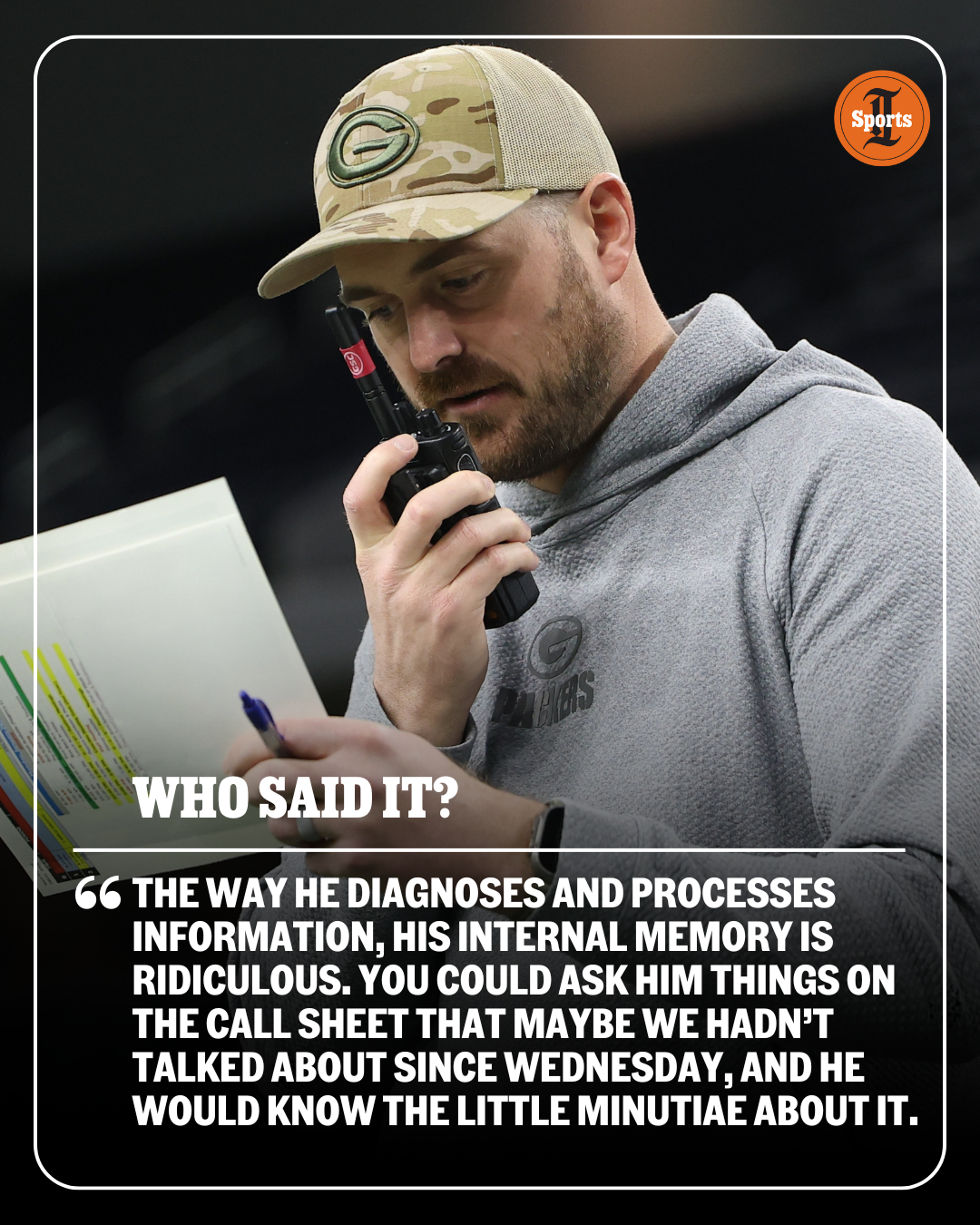
    Who said it?

    Sean Mannion’s former coaches predict he will be “a home run hire” for Eagles.

    While some may be skeptical about of the Eagles’ hiring of Sean Mannion at offensive coordinator, his former coaches say he’s “a home run hire.” Take a look at who said it here.

    What you’re saying about Philly’s best first-round pick

    We asked: Who was the best first-round pick ever in Philadelphia sports? Among your responses:

    With the fourth overall pick in 2013, Lane Johnson, University of Oklahoma. He has led the Eagles 3 Super Bowl appearances and 2 Championships. A cornerstone of the offensive line, the team does not excel when he is not in the game. — Bob C.

    Best first round draft pick EVER for all Philly sports teams was of course Wilt Chamberlain by the then Philly Warriors in 1959. Best 76er 1st round pick Allen Iverson 1996, best Phillies Cole Hamels 2002, best Eagles Chuck Bednarik 1949, Bob Brown 1964, & Lane Johnson 2013. And best 2nd round Bobby Clarke 1969, and Mike Schmidt 1971. — Everett S.

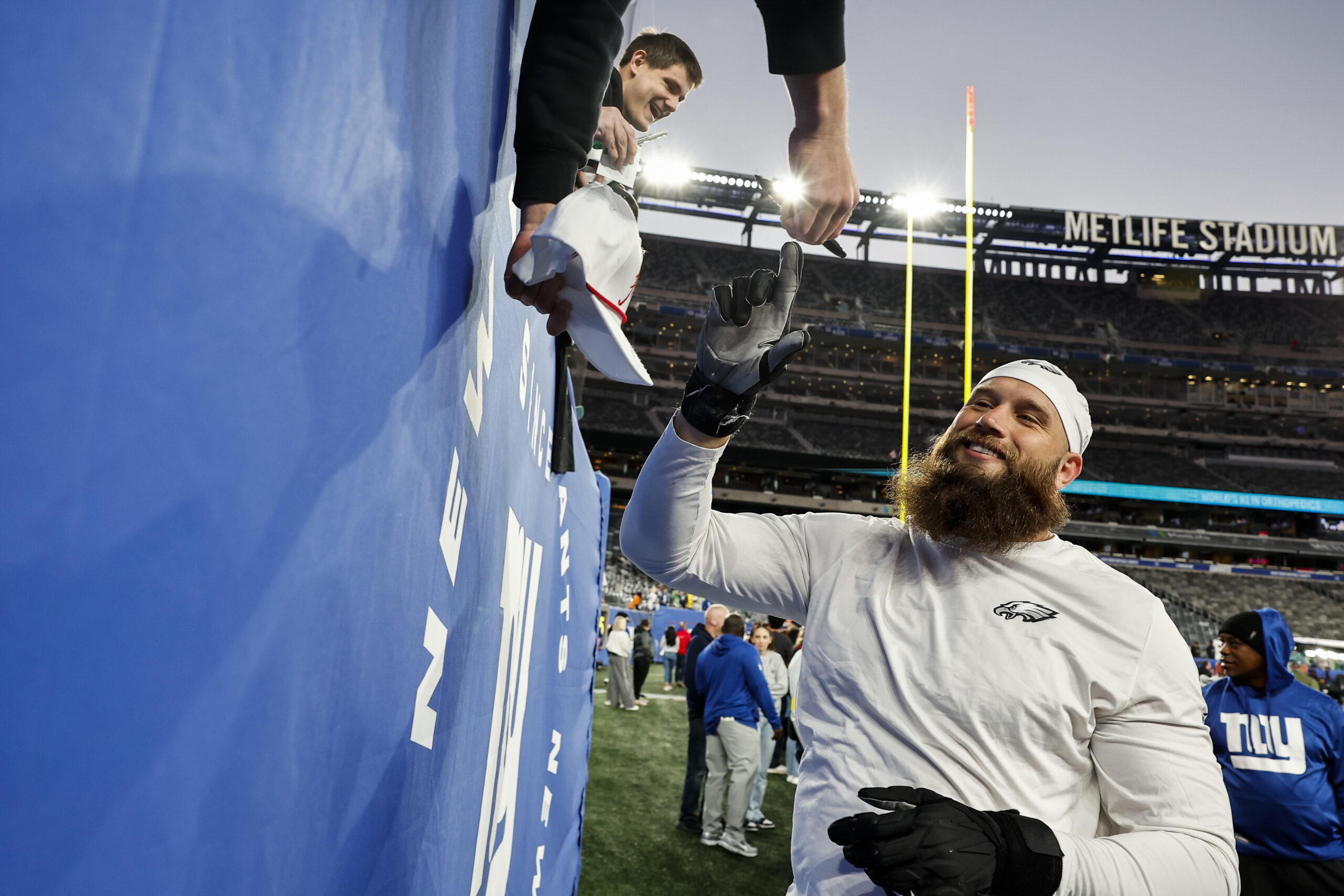
    Eagles offensive tackle Lane Johnson signs autographs before the game against the New York Giants on Oct. 9.

    Without a doubt Bobby Clarke. Kind of sad that it happened over 50 years ago and they’ve never done better. Tom M.

    Hard to beat Lane Johnson. Foundational, dominant, long-standing with over a decade of elite performance leading to two Super Bowl victories. — John C.

    We compiled today’s newsletter using reporting from Frank Fitzpatrick, Scott Lauber, Lochlahn March, Jeff Neiburg, Matt Breen, Ryan Mack, Devin Jackson, Jackie Spiegel, Gabriela Carroll, Owen Hewitt, Jonathan Tannenwald, Keith Pompey, Gina Mizell, Jeff McLane, and Ariel Simpson.

    By submitting your written, visual, and/or audio contributions, you agree to The Inquirer’s Terms of Use, including the grant of rights in Section 10.

    Thanks for getting your morning started with me. Have a wonderful Wednesday, and Kerith will catch back up with you on Thursday. — Bella

  • Follow the money to find the secret to the 2026 Phillies roster

    Follow the money to find the secret to the 2026 Phillies roster

    When it comes to the 2026 Phillies, the three most meaningful words in the human language ring true once again.

    Follow the money.

    Read the menu from right to left. There, you will find the players who will make the Phillies the team they need to be. Or, you will find the players who will deserve the blame if the Phillies prove not to be that team.

    Zack Wheeler is making $42 million, which is the same amount the Mets will pay newcomer Bo Bichette. Kyle Schwarber is making $30 million, the same amount the Cubs will pay newcomer Alex Bregman. Aaron Nola is making $24.5 million, which is about $2.5 million less than the Blue Jays gave Dylan Cease and right in line with what the Padres gave Michael King. Bryce Harper and Trea Turner are combining to make about $52.5 million, which is about $5 million less than the Dodgers have agreed to pay Kyle Tucker over the next four years.

    Ok, that last one is absurd. But the Phillies are one of 29 teams who can’t compare to the Dodgers.

    Anywhere east of Tinseltown, there is no room for excuses. The Phillies are on track to arrive at opening day with a payroll that is $21 million higher than the Braves, $52 million higher than the Cubs, $63 million higher than the Padres, and a whopping $157 million higher than the Brewers. They are a near lock to finish the season with one of the top five payrolls in the game. No, they aren’t the Dodgers ($387 million) or Mets ($363 million). But neither are the Yankees these days ($304 million).

    The criticism must feel good to John Middleton, in a strange way. Two decades ago, he was part of an ownership consortium that oversaw one of MLB’s most underfunded rosters relative to market size/potential. His power play into a majority stake was motivated in large part by his desire to operate like a true economic powerhouse. The fan base has been thrilled to adjust its expectations upward. The way folks are questioning Middleton’s billionaire bona fides, you’d think he spent the offseason picking up shifts in the gig economy. It’s worth stating for the record that the Phillies have signed $227 million worth of new guaranteed contracts at an average annual value of $66 million, or nearly 25% of their payroll.

    John Middleton’s Phillies will have one of the most expensive payrolls in the game.

    I’m not licking any boots here. I understand that the criticism levied toward the Phillies is as much a function of makeup as money. The majority of the Phillies’ outlays this offseason have gone to incumbents, with Schwarber re-signing for five years and $150 million and J.T. Realmuto for three years and $45 million. The same was true last offseason, and the season before, when Nola and Wheeler both signed nine-figure deals. After two straight postseason one-and-dones, the impression is of a poker player doubling down while drawing dead.

    One of the difficult parts of being a personnel executive is that a fan base is rarely careful what it wishes for. Middleton’s partiality to the familiar makes plenty of sense when you consider the Phillies’ recent history. The last time they bowed to the wishes of those chanting, “Blow it up,” the result was a lost decade. Creative destruction is a fine idea. But it had better be creative.

    The Schwarber and Realmuto contracts are perfect examples. Would the Phillies have really been better off if they’d given Schwarber’s money to Bregman or Bichette? You can certainly make the argument. If the Phillies had non-tendered Alec Bohm and let Schwarber walk, they could have signed Bregman to play third base and then given Eugenio Suarez the one-year, $15 million deal he signed with the Reds to play designated hitter. Maybe then they don’t feel the need to pay $10 million for Adolis Garcia’s right-handed power bat and instead sign Luis Arraez (one-year, $12 million) or Ryan O’Hearn (two years, $29 million) and convince Harper to return to the outfield. Or maybe they sign Josh Naylor to play first base and let Realmuto walk.

    So, yeah, there were options. Bregman, Suarez, and Naylor will earn about $65 million in AAV in 2026. Schwarber, Realmuto, Bohm, and Garcia will earn about $65 million in AAV in 2026.

    Would the Phillies have been better off?

    Maybe. But, man, there’s a whole lot of risk baked into maybe. Enough risk that it’s worth stepping back and asking what they’d be trying to accomplish. Neither combination is going to stack up to the Dodgers on its own. Just so happens the first combination has helped the Phillies improve their win total in each of the last four years while also winning 96 games and a division title in 2025. Neither combination will mean much if Harper takes another step backward, or if Wheeler doesn’t return from his blood clot as the same pitcher he was, or if Nola is the same pitcher he was last season, or if Turner is still something less than a guy who deserved $300-plus million.

    The story of this offseason was the money the Phillies spent in previous offseasons. The incumbents are the ones who need to do the heavy lifting. That’s how it should be when the incumbents’ wallets are as heavy as the Phillies’. There is plenty of potential upside in the form of Justin Crawford, Andrew Painter, Aidan Miller, Gabriel Rincones Jr., even Otto Kemp. The floor will be set by the known commodities. This year more than ever, Harper and Co. need to make themselves known.
  • The Eagles cut Christian Elliss as the 2023 season unraveled. His new life with the Patriots has him back in the Super Bowl.

    The Eagles cut Christian Elliss as the 2023 season unraveled. His new life with the Patriots has him back in the Super Bowl.

    SAN JOSE, Calif. — Christian Elliss was cut from an NFL roster six times in the first three seasons of his career — four times by the Eagles. The last one, on Dec. 6, 2023, stung the most.

    “I remember just [being] on the phone with my dad, crying,” Elliss said. “I was like, ‘Dad, that’s the one that really broke me.’ Because I thought I was playing well. I knew I had the talent to play, but for whatever reason … I can’t remember.”

    The reasons were complex. The Eagles were reeling and injuries and subpar play at linebacker had forced general manager Howie Roseman to sign veteran Shaquille Leonard. Elliss played mostly on special teams, but he was viewed as the low man at linebacker and was waived.

    “Howie and who’s the head man over there …,” Elliss said before being reminded that Nick Sirianni was the Eagles’ head coach. “… and Nick, for whatever reason, they didn’t see me as a piece for them. But luckily Bill did.”

    That was Bill Belichick, the former Patriots coach. Elliss was claimed off waivers by New England the next day. And he hasn’t left, despite the coaching turnover that went from Belichick to Jerod Mayo to Mike Vrabel since Elliss’ arrival.

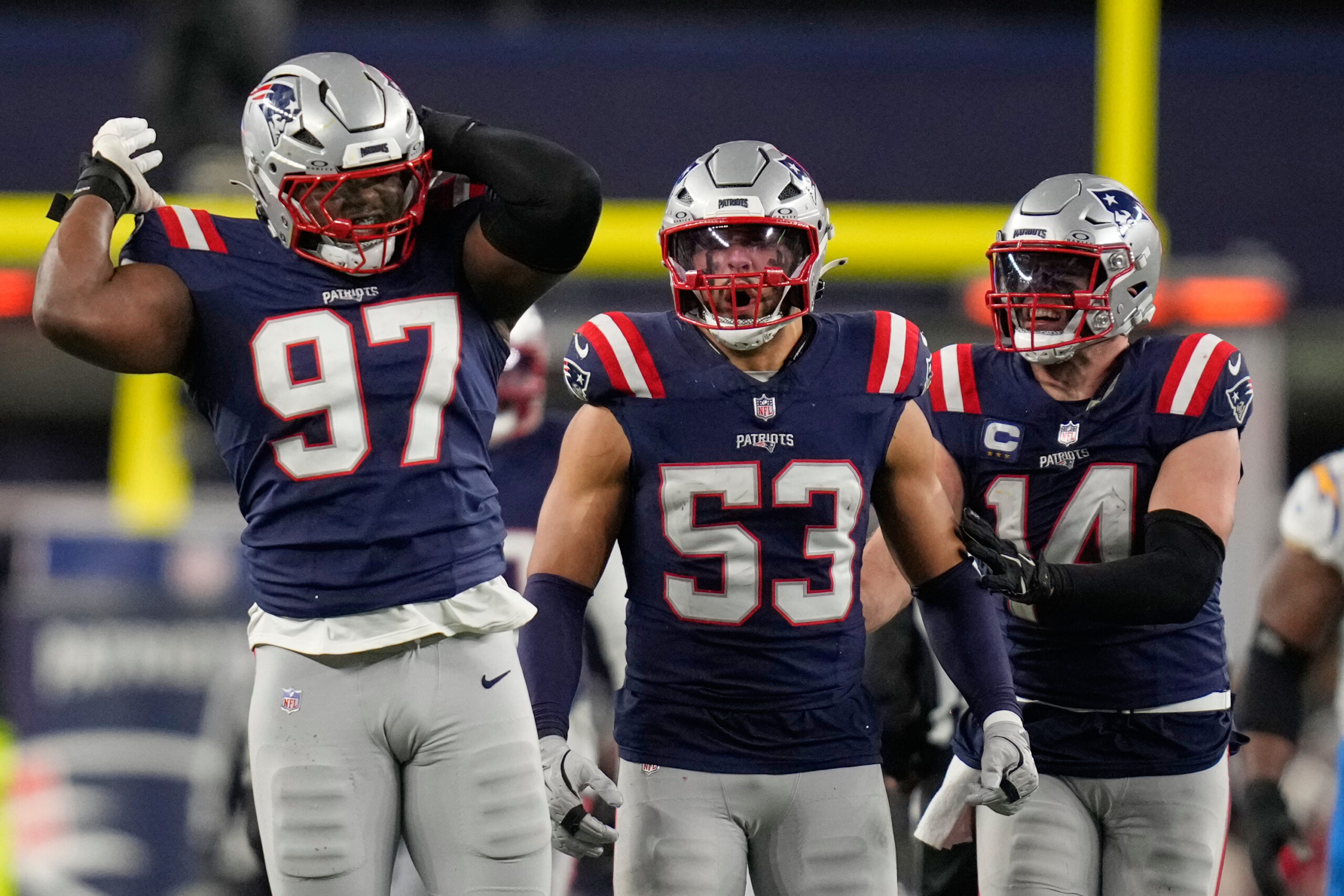
    Christian Elliss (53) was primarily a special-teamer in Philadelphia but has been a regular at linebacker for Mike Vrabel’s Patriots.

    Getting cast off by the Eagles may have broken Elliss, but he has put himself back together over the last two-plus years. And he has been made whole into a starting linebacker on a Patriots team that has exceeded expectations and will face the Seattle Seahawks in Sunday’s Super Bowl LX.

    Elliss, 27, may still have a chip on his shoulder. He and his wife, Kaysie, had two young children at the time, and he wasn’t sure about his future. But he said he now sees the silver lining in his sixth — and last — release.

    “Honestly, me going to the Patriots was probably the best thing for me,” Elliss said. “I had vets that showed me the ropes. I had coaches that believed in me and wanted me there. I think New England is the perfect spot for me.”

    Roseman probably regretted the decision. He had cut Elliss four times before, only to bring him back on the practice squad. But other NFL teams had about a season’s worth of film on the athletic linebacker, and not all of it as a member of all four special teams corps.

    “We saw that he had some traits that we wanted to work with,” Patriots general manager Eliot Wolf said. “He had been productive on special teams for those guys, and when he had the opportunity to play on defense, he had been productive, especially in coverage.”

    Elliss actually had started on defense for the first time in his career in the game before his release. He struggled in the blowout loss to the San Francisco 49ers, but he wasn’t the only one. Defensive coordinator Sean Desai’s scheme was like Swiss cheese, and he eventually got demoted.

    But Roseman felt he needed to address the linebacker group at that time. He didn’t necessarily have to create a roster spot at that position, but he told Elliss if he cleared waivers, the Eagles would bring him back.

    His calculation proved wrong.

    “They did tell me that,” Elliss said. “But when I got six teams that wanted to claim me, that affirmed that, yeah, I can play.”

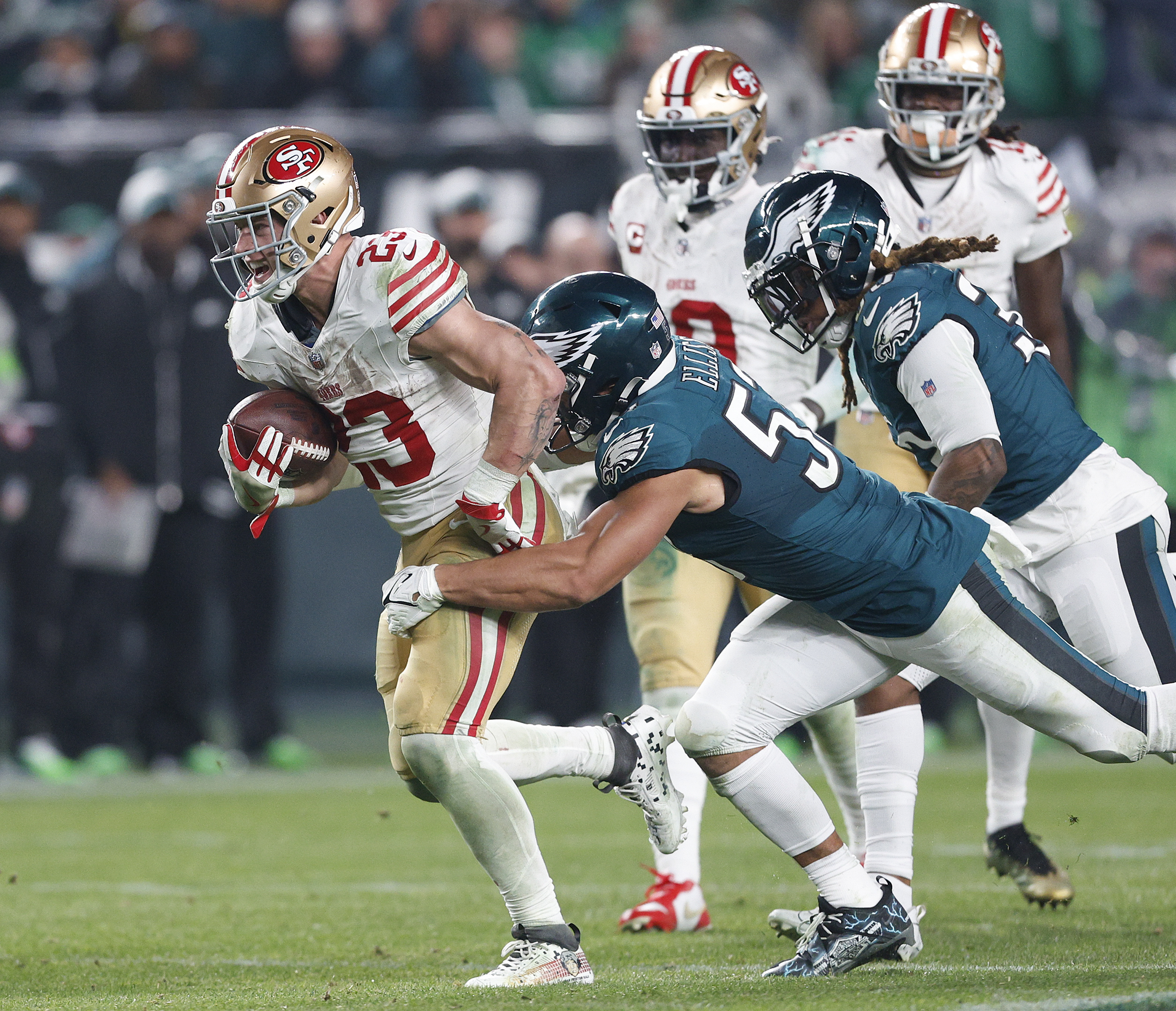
    Christian Elliss (center) in his final game as an Eagle, which saw the defense gutted in a 42-19 loss to the 49ers.

    Belichick had him work exclusively with special teams for the last month of the 2023 season. When the legendary coach left the Patriots in the offseason, Elliss had to convince another regime that he was worth keeping.

    He made the 2024 roster as a backup and special teams contributor. But by Week 5, he started logging significant playing time on defense and became a regular the rest of the way. When Mayo was fired after the season, Elliss said he wasn’t expecting to return, though.

    The Las Vegas Raiders made a play for the free agent. But because Elliss was restricted, the Patriots could match the two-year, $13.5 million offer. Vrabel and Wolf would remake most of New England’s front seven, but Elliss fit their vision and was retained.

    “We felt that even though he reached free agency, he was still ascending,” Wolf said. “And he’s really just improved and improved. He’s a great kid. He plays really hard. He’s got some of the traits you can’t teach. He’s super fast. He’s explosive. He’s got great change of direction.”

    There were initial struggles playing in a new scheme with new terminology in 2025. Elliss missed eight tackles in the first three games and was benched in the second half of the third game. But the Patriots stuck with him, and he steadily made progress.

    “I think he took it to heart,” linebackers coach Zak Kuhr said of the benching. “He made some different personal changes with how he was going to view his position and his role. And credit to him and how he went about it.”

    It has helped to have a head coach who played the position at a high level. Vrabel was a key cog in Belichick’s early Super Bowl-winning Patriots teams. He mostly played on the outside and often would rush from the edge, but he was open to moving inside to serve team needs.

    Mike Vrabel has won the respect of the entire Patriots locker room, including Elliss, in his first year as New England’s head coach.

    Elliss said Vrabel has instilled in the Patriots that same unselfish mentality.

    “I’ve never had a coach where he’s truly a player’s coach, meaning he holds everyone to the same standard. Not everyone does that in the league,” Elliss said. “Everybody has favorites one way or another. It’s just human nature. But for him, he doesn’t let it show, at least on the field or at least in the building.

    “He makes sure everyone’s held to the same standard. No one gets away with anything. If you’re BS-ing in practice, if you’re putting your own self above the team, he never lets that slide.”

    Growing up third-oldest of 12 children — seven of whom were adopted — Elliss may have understood the importance of the collective more than most. He also comes from a football family. His father, Luther, played 10 seasons in the NFL, and his brothers Kaden, Noah, and Jonah also have played in the league.

    Noah spent parts of the 2022 and 2023 seasons on the Eagles as a practice squad defensive tackle. Christian and Jonah, a linebacker for the Denver Broncos, met in the AFC championship game. Their emotional embrace after the game touched many.

    Only one could advance to the Super Bowl. Christian will be making his second appearance. He played 24 special teams snaps for the Eagles three years ago. He said he watched and rooted for his old team last year when it avenged the loss to the Kansas City Chiefs in the first Super Bowl meeting.

    Christian Elliss came up short while with the Eagles in his last Super Bowl appearance and has another shot at an elusive ring this Sunday.

    Elliss might have flourished in Vic Fangio’s scheme. The Eagles had long undervalued linebackers, but the defensive coordinator has spearheaded an organizational shift with investments made in Zack Baun and Jihaad Campbell, for example.

    Baun was instrumental in the defensive dominance of Kansas City. But the front four set the tone and harassed quarterback Patrick Mahomes into taking six sacks and committing three turnovers.

    “Ball disruption. When you affect the quarterback, when you make him so he can’t set his feet and he’s always on his toes, it’s hard for them to produce,” Elliss said. “And I think the Eagles really did that well.”

    Elliss should get opportunities to get after Seahawks quarterback Sam Darnold. He already has generated seven pressures in just 18 pass rush attempts this postseason. Two years ago, after his release, he was thinking more about survival than the Super Bowl.

    “I was cut, I think, six, seven times in my early NFL career,” Elliss said. “And, honestly, I remember asking my dad, ‘Dad, is this meant for me? I don’t want to keep getting cut.’ It’s a terrible feeling, especially [because] I had two kids at the time. So that’s definitely hard.

    “But I believe trials and tribulations produce endurance, they produce character. And I think it helped me in the long run.”

  • Philly’s Don Bitterlich scored the first points in Seahawks history. But he made his name playing the accordion.

    Philly’s Don Bitterlich scored the first points in Seahawks history. But he made his name playing the accordion.

    Don Bitterlich’s Chevy Caprice was loaded with everything he needed for his gig that night at an Italian restaurant in Northeast Philly: an accordion, a speaker, and a pair of black slacks.

    He learned to play the accordion as a 7-year-old in Olney after his parents took him to a music shop on Fifth Street and he struggled to blow into a trumpet. His father pointed to the accordion, and Bitterlich played it everywhere from his living room on Sixth Street to Vitale’s on Saturday nights.

    The owner of Vitale’s — a small restaurant with a bar near Bustleton and Cottman Avenues — paid Bitterlich $175 every Saturday. It was a lot of money for a college student in the 1970s. First, he had to finish football practice.

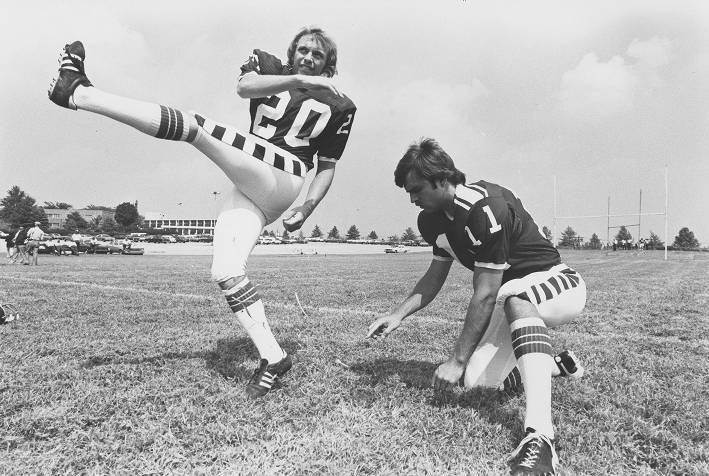
    Bitterlich went to Temple on a soccer scholarship before football coach Wayne Hardin plucked him to be the placekicker. He never even watched a football game, but soccer coach Walter Bahr — the father of two NFL kickers — told Hardin that Bitterlich’s powerful left leg was fit for field goals.

    Bitterlich went to football camp in the summer of 1973, while also playing soccer for Bahr and trying to keep up with his accordion. He had yet to officially make the football team that August, so there was no use in canceling his 10 p.m. Saturday gig at Vitale’s. Bitterlich was due to play there in 90 minutes, but the Owls had yet to include their kicker in practice. He was hoping to leave practice by 8:45 p.m., and it was almost time.

    “I’m watching the clock,” Bitterlich said.

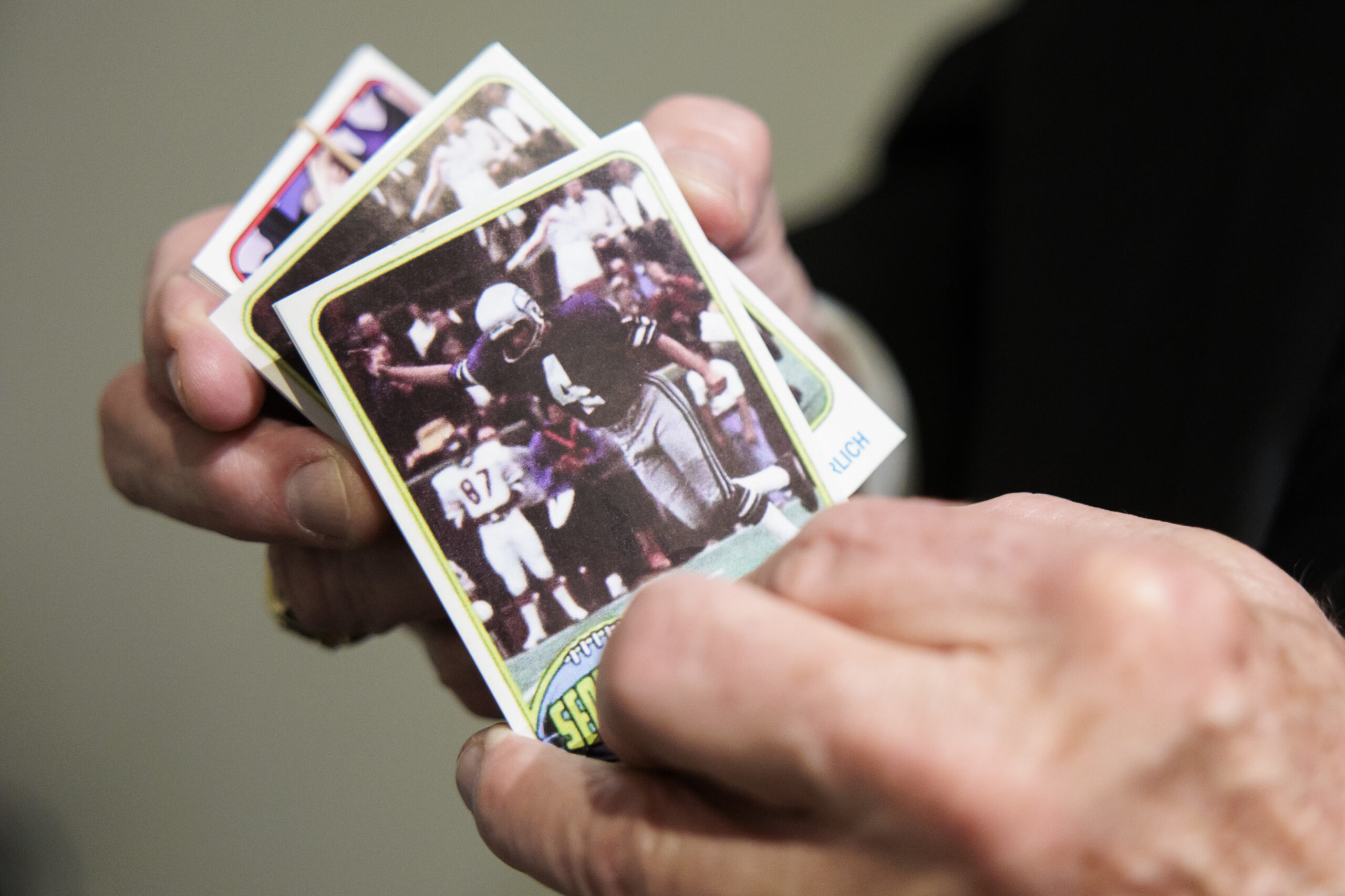
    Don Bitterlich holds his Seahawks football card. He scored the first points in Seahawks history as a kicker.

    He asked an assistant coach if the team was going to kick, and the coach shrugged him off. A half-hour later, he asked again. He had to go, Bitterlich said.

    “He said, ‘Go where?’” Bitterlich said.

    Bitterlich set records at Temple, played in an all-star game in Japan, was in his dorm when he was selected in the 1976 NFL draft, and scored the first-ever points for the Seattle Seahawks, who play Sunday in Super Bowl LX against the New England Patriots.

    He made it to the NFL despite knowing little about football until he became Temple’s kicker. It was a whirlwind, he said.

    He really made his name with the accordion, the instrument he’s still playing more than 50 years after he had to rush to a gig from football practice.

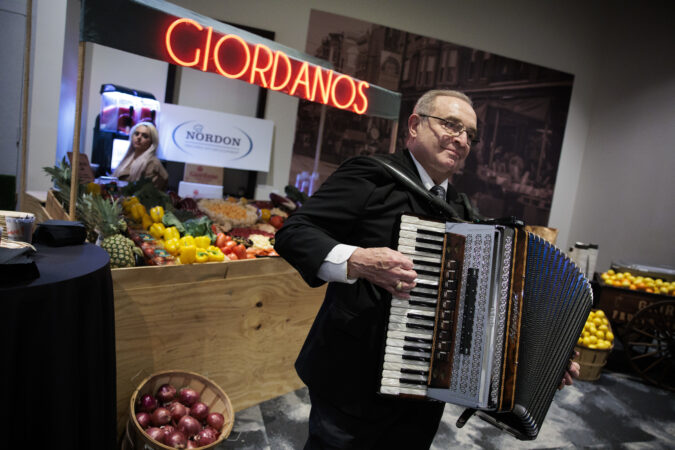
    He has long been a regular at German festivals, restaurants, banquets, and even marathons. A German club in the Northeast called Bitterlich “the hardest working accordion player in the world.” He played a gig on Sunday night in South Philly and another on Monday morning near Lancaster.

    Bitterlich, 72, who worked as a civil engineer until retiring last year, said he played more than 100 gigs in 2025. Football stopped years ago, but the show rolls on.

    “These days,” he says, “most people around hear me playing the accordion, and they don’t know that I kicked in the NFL.”

    Becoming a kicker

    Bitterlich was home in Warminster — his family moved from Olney just before his freshman year at William Tennent High — when Bahr called. The Temple soccer coach had been a star on the U.S. team that upset England in the 1950 World Cup and was one of the best players to come out of Philadelphia.

    “He had this raspy voice,” Bitterlich said. “He smoked cigars during practice and basically chewed and ate half of it as well. He always called me ‘Bitterlich’ but called me ‘Donald’ if I screwed up.”

    Don Bitterlich (20) at Temple, likely during the 1975 season.

    So Bitterlich figured he was in trouble when his coach called him “Donald” on the phone.

    Bahr asked Bitterlich whether he knew who Hardin was. Yes, he said. Bahr said he had just talked to the football coach and told him Bitterlich could kick. The coach had watched Bitterlich since he played soccer for Vereinigung Erzgebirge, a German club his grandfather founded off County Line Road. He told Bitterlich he could do it.

    “So I said, ‘No soccer?,’” said Bitterlich, who was also the mascot at basketball games in the winter. “‘No, you’re my starting left midfielder.’ I was thinking, ‘How is this going to work?’”

    Bahr told Bitterlich to call the football office, get a bag of balls, and start kicking. He kicked every day at the German club and tried to figure it out. He was soon splitting his day between football camp in Valley Forge and soccer camp at the old Temple Stadium on Cheltenham Avenue in West Oak Lane. Each sport practiced twice a day and Bitterlich found a way to make them all.

    He played a soccer game that season in Pittsburgh, flew home with the team, and then took a taxi from the airport to Temple Stadium to kick for the football team. He was studying civil engineering and balancing two sports plus his accordion.

    It eventually became too much. Hardin told Bahr that he would give the kicker a full scholarship to play football. That was it.

    “With the football scholarship, I got room and board,” Bitterlich said. “So I was living on campus after commuting from Warminster. It was insane. I was so worn out.”

    Making history

    Bitterlich kicked a game winner in October 1973 against Cincinnati as time expired, made three kicks at Temple longer than 50 yards, and was the nation’s top kicker in 1975. The soccer player made a quick transition.

    “Coach Hardin always said, ‘If I yell ‘field goal,’ I expect three points on the board,’” said Bitterlich, who was inducted into the Temple Hall of Fame in 2007. “He expected that. The point of that was that he trusted you. That was his way of saying, ‘I’m not asking you to do anything that I don’t think you can do.’”

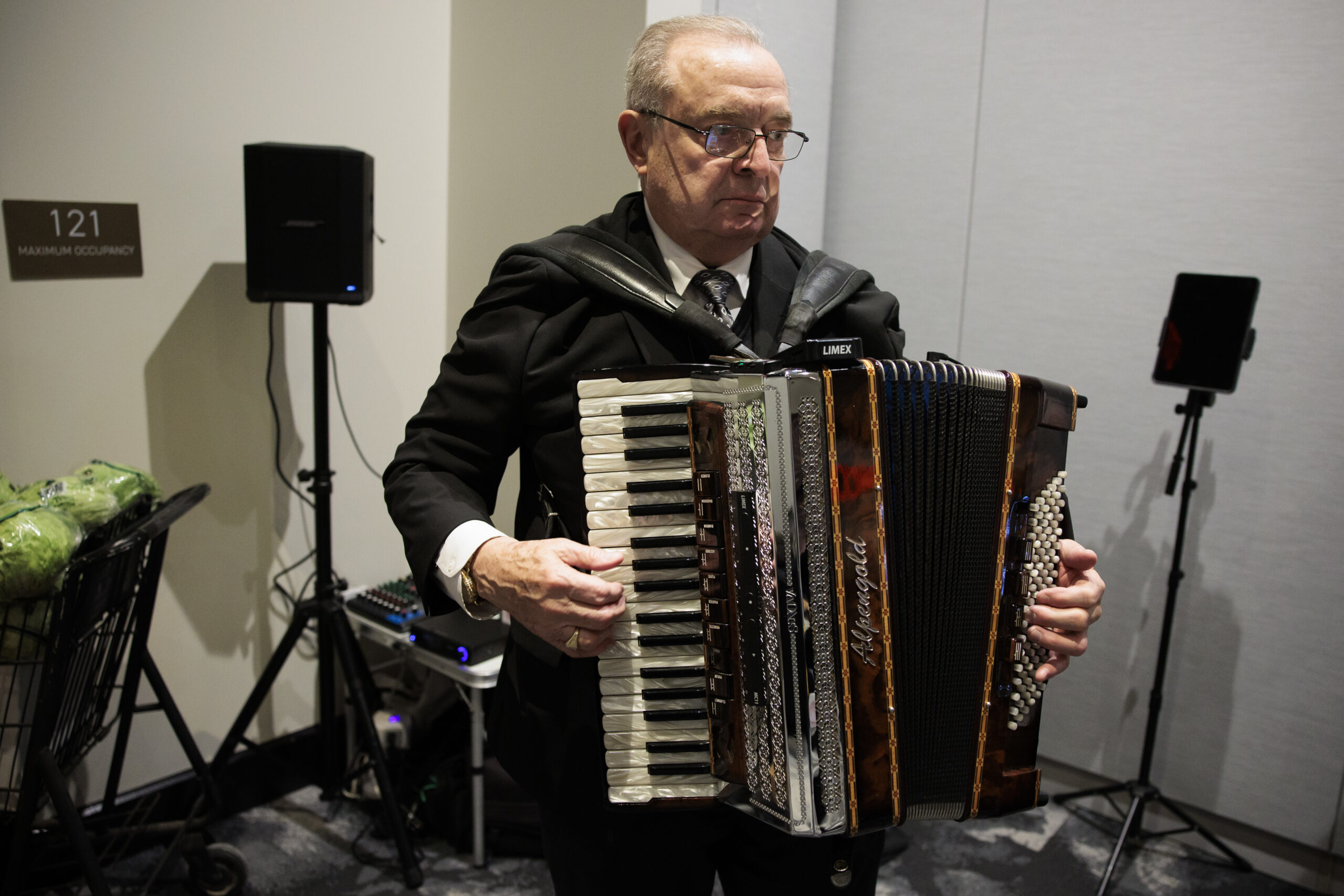
    Don Bitterlich performs with his accordian on Sunday during The Tasties at Live! Casino.

    The coach helped Bitterlich understand the mental side of kicking, challenging him in practice to focus on the flagpole beyond the uprights. Try to hit the flag, he said.

    “That had a huge mental impact on me,” Bitterlich said. “You have that image, and then when you do your steps back and you’re set, that’s all you can see. It made all the difference in the world for me. Once you have that image, you zone out any of the noise. You’re just focused on that image.”

    It helped him focus in September 1976 when the Seahawks opened their inaugural season at home against the St. Louis Cardinals. They drafted Bitterlich five months earlier in the third round. The Kingdome’s concrete roof made the stadium deafening, but Bitterlich felt like he was back in North Philly practicing at Geasey Field as he focused the way Hardin taught him to.

    He hit a 27-yard field goal in the first quarter, registering the first points in franchise history. The Seahawks had quarterback Jim Zorn and wide receiver Steve Largent, but it was the soccer player who scored first.

    Bitterlich’s NFL career didn’t last long, as the Seahawks cut him later that month after he missed three field goals in a game. He tried out for the Buffalo Bills, but a blizzard hindered his chances. He signed with the Eagles in the summer of 1977, missed a field goal in a preseason game, and was cut.

    He landed a job as a civil engineer in Lafayette Hill. He received a call on his first day from Eagles coach Dick Vermeil, who said the San Diego Chargers wanted to try him out. Bitterlich flew to California the next day but turned down a three-year NFL contract that would pay him only slightly more than his new job back home.

    “Plus, the real reason I turned down their offer was that they couldn’t hold for a left-footed kicker,” Bitterlich said. “Their holder just couldn’t get the ball down. I didn’t want to sign that contract. ‘What’s going to happen in two days when that guy can’t get the ball down?’”

    A week later, the San Francisco 49ers called. He flew back to California, tried out against another kicker, and was told he won the job. But the 49ers decided to sign Ray Wersching, who had been cut the previous season by the Chargers. Bitterlich turned down the chance to replace Wersching in San Diego, and now Wersching was swooping in for the job Bitterlich wanted in San Francisco.

    “I went back home and said, ‘That’s enough,’” said Bitterlich, who played three NFL games. “It started to get disappointing.”

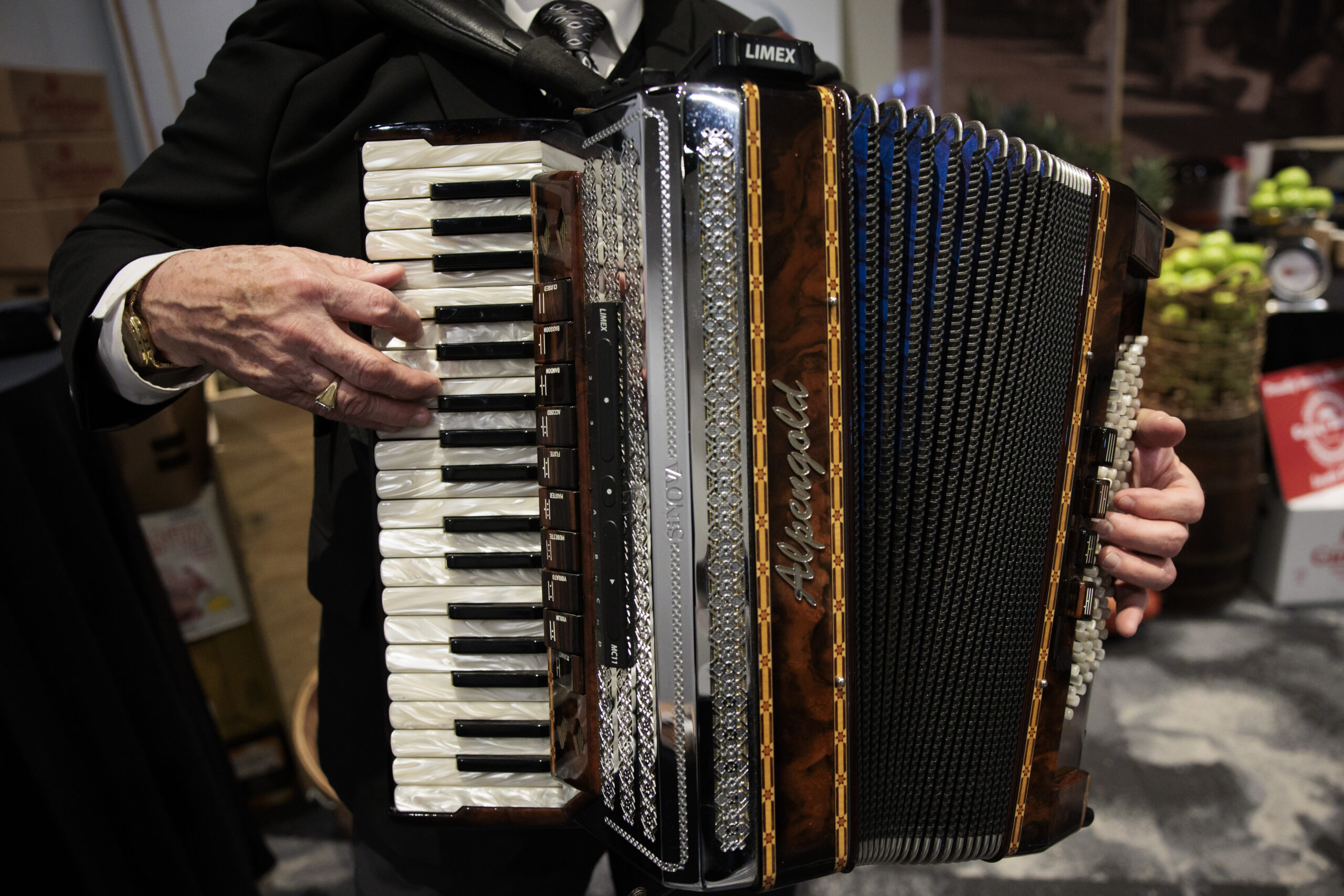
    “I love to play,” Bitterlich says of his accordion. “I usually don’t take breaks. Most bands will play 40 minutes on, 20 minutes off. I just play through.”

    Still playing

    His NFL journey was hard to imagine that day at practice as he watched the clock at Temple Stadium and thought about how long it would take to drive to Vitale’s. Bitterlich told the assistant coach that it was almost time to play his accordion. That, the coach said, was something he would have to talk to Hardin about. Fine, Bitterlich said.

    “I didn’t know if I was going to make the team or not, and I knew I was going to play soccer,” Bitterlich said. “So I just went over and told Coach.”

    Hardin heard his kicker say he had to leave football practice to play the accordion and laughed.

    “He said, ‘Yeah, I heard something about that,’” Bitterlich said.

    The coach stopped practice and let Bitterlich get in the mix. He nailed six field goals and the other kicker shanked a few. The job felt like his. He hit a 47-yarder and looked over at Hardin.

    “He’s like, ‘Yeah, yeah. Go ahead. Go,’” Bitterlich said.

    Bitterlich was soon in his Chevy Caprice, heading down Cottman Avenue on his way to Vitale’s. He wasn’t late to his accordion gig that night. His football career would end a few years later, but the music has yet to stop.

    “I enjoy it,” Bitterlich said. “I love to play. I usually don’t take breaks. Most bands will play 40 minutes on, 20 minutes off. I just play through. I really don’t take a break. I love it.”

  • Villanova recruited Devin Askew in high school. Six years and five schools later, he’s fueling the Wildcats.

    Villanova recruited Devin Askew in high school. Six years and five schools later, he’s fueling the Wildcats.

    Devin Askew was covered in sweat when he sat down in a room inside the practice facility at Villanova on Monday, fresh off an on-court workout with development coach JayVaughn Pinkston that followed a weightlifting session.

    Askew, Villanova’s sixth man, is on a tear as of late, averaging 15.8 points during a six-game stretch in which the 23-year-old guard has made 17 of 29 three-pointers. Sessions with Pinkston, a former Villanova player, have helped. Pinkston’s role is exactly that, to do the little things to get the most out of every player. But with Askew, Pinkston’s presence also is a reminder of the past and the winding journey Askew has traveled to put himself in the running for Big East Sixth Man of the Year.

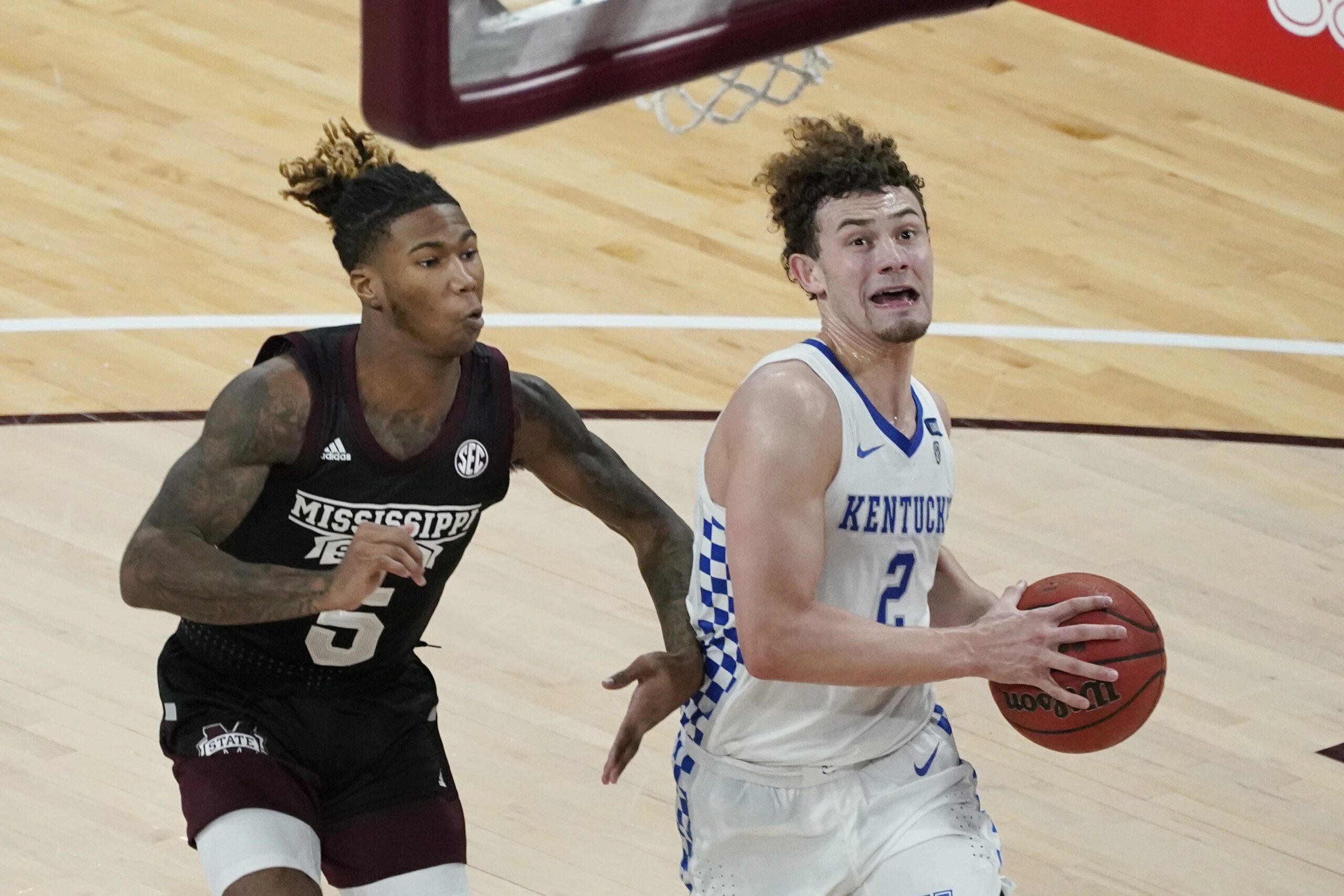
    There are few connections remaining to the Villanova program of old, and Pinkston, who played for the Wildcats from 2011 to 2015, is one of them. Which gives him the right to playfully rib Askew about 2019, when, as a top recruit in the class of 2020 from California, he chose Kentucky over Villanova (and others).

    “He’ll always tell me I should have been here five years ago,” Askew said. “I should’ve always been a Villanova Wildcat.”

    Devin Askew is making a strong case for Big East sixth man of the year.

    He is here now almost by accident. His college journey has traveled more than 8,000 miles from Mater Dei High School in California to Lexington, Ky., to Austin, Texas, to Berkeley, Calif., to Long Beach, Calif., and, finally, to the Main Line. Five schools in six years. Which made him just another sign of the times when Kevin Willard plucked him out of the transfer portal to give his roster a much-needed experienced ballhandler and shooter.

    He was, to the outside world, another mercenary college basketball player passing through a random place on a map and collecting a paycheck to bridge his way to wherever professional hoops takes him.

    But for Askew, his time at Villanova has been a “full-circle” experience. Like in most people, his past explains the present, and it’s fitting the journey ends here, where his future is being determined during a critical turning-point season for him and Villanova.

    ‘It’s why we brought him here’

    This recent stretch is what Willard imagined when Villanova recruited Askew this time around. It’s a young Villanova roster, especially at guard. Freshman Acaden Lewis and sophomore Bryce Lindsay have had breakout seasons with the Wildcats, but Askew lately has been a steady presence, and his experience has allowed him to compete on both ends during the physical demands of a Big East schedule.

    Before the last six games, Askew reached double figures just three times in 15 contests. It took a little bit longer for it all to come together because he suffered a knee injury during the lead-up to the season. His injury history followed him. A sports hernia injury ended his junior season at California after 13 games, and a foot injury ended his following season, the 2023-24 campaign, after just six.

    That injury gave him a redshirt season, but also extra perspective to get through his first few months at Villanova, when he missed nearly two months of practice and was not 100% when the season started.

    “I’m tough, and I’m not going to quit,” Askew said when asked what he has learned about himself along his college journey.

    Were past versions of him not as tough?

    “The true test of knowing that is to go through something,” he said. “I’m willing to go through it and deal with anything that comes to me because I love the game, I love the sport of basketball. I don’t want to stop playing.”

    Villanova has needed Askew to be a stabilizing force at times, and it also has needed him to take over games offensively, like against St. John’s and Connecticut, two of the more experienced teams in the conference.

    “I don’t view it as they need me to take over,” Askew said. “There are so many things going on within a game, taking over a game could be a defensive stop.”

    Devin Askew scored a team-high 20 points off the bench against Providence on Friday.

    Willard credited a recent run of strong practices after Askew made five three-pointers and scored 20 points in Friday’s win over Providence. The coach has talked recently about how critical it is to have Askew’s experience. He’s a big reason the Wildcats are 16-5 overall and 7-3 in the Big East as they head into Wednesday night’s home game vs. Seton Hall.

    “It’s why we brought him here,” Willard said. “This is the type of player he is. When you go into the portal, you really have to evaluate and watch film and see what he has. When he was on his visit, I think the best part about it was I just loved his maturity. He’s a terrific, terrific person.

    “He’s getting rewarded for being a hard worker and a terrific person.”

    A piece from all the places

    There is a part of every stop that make up the player and person Askew is.

    He chose Kentucky as a 17-year-old top-40 prospect because who wouldn’t want to play for John Calipari and follow in the footsteps of top guards like Shai Gilgeous-Alexander and Tyrese Maxey?

    What did he learn from each stop? Askew went through them one by one.

    Devin Askew said his time at Kentucky “taught me patience and to be even-keeled.”

    At Kentucky, he learned how to go from being the guy on a high school team to being one really good player on a team of other really good players. It wasn’t an easy learning experience. “It actually taught me patience and to be even-keeled,” he said. “There’s going to be ups and downs, and you can’t get too high or too low. I was just an emotional kid.” He had high expectations for himself and didn’t meet them. He started losing his love of basketball.

    Enter Texas, which may be the most important stop of the five. “That brought back all that love for me,” Askew said. “No, you still love this game. Chris Beard and that coaching staff saved my career.” Askew averaged 14.9 minutes off the bench and was a role player on a team that reached the NCAA Tournament. He fell back in love with basketball, but he wanted a place where he could start, so he went back home to California.

    At Cal, it was time to “go show it,” Askew said. “I was ready. And the seasons just got cut short to injuries both years, and that’s where we kept learning and kept growing. … This is the life we chose.”

    Cal allowed him to be closer to his family. He has leaned heavily on his two brothers and his parents over the years. Cal also gave him his undergraduate degree in interdisciplinary studies. But entering the 2024-25 season, he was an oft-injured journeyman with two seasons of eligibility left — one redshirt year, one COVID year — looking to prove he could still play. To the portal, and to Long Beach State, he went.
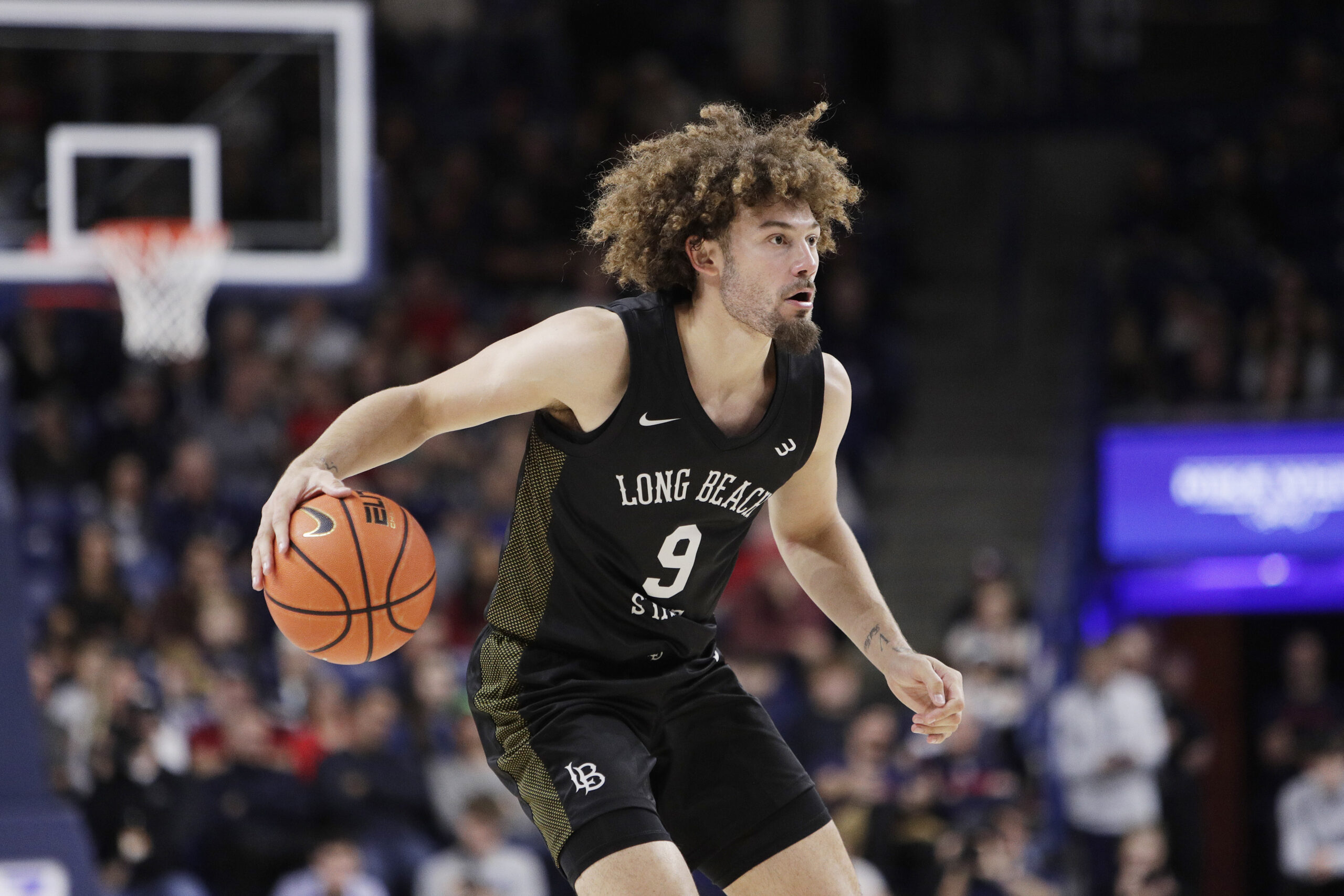
    “Go do it,” Askew said of Long Beach. “It wasn’t go show everyone, because I wasn’t into showing everyone. But it was prove to yourself again.” He scored 18.9 points per game and shot 37.6% from three-point range on a team that won seven games and ended the season by losing its last 15.

    At Long Beach State, Devin Askew averaged 18.9 points.

    “Not a lot of people believed in me and believed I could play still,” Askew said. “They gave me the platform to show what I could still do.”

    He found a believer in Willard, who needed another guard in late April to fill out his roster. Villanova, Askew said, is the place to put all of those experiences together.

    There are a lot of reasons to gripe about the state of college basketball, and a player going to five schools in six years is one of them. Askew is, in a sense, a one-year rental who helped Willard get Villanova back on track in his first season.

    Off the court, Askew is taking classes toward a master’s certificate in Villanova’s public administration program, a year after earning a certificate in communications at Long Beach. On the court, Askew is helping Villanova get back to the NCAA Tournament.

    When the topic of the tournament came up, Askew shook his arms and said he got chills.

    “That would mean everything to me,” he said. “I kind of get emotional thinking about it. As a kid you always want to play in the tournament. You go to college and want to play college basketball to make the tournament.”

    A continuation of his current form will go a long way toward making that possible, and helping him raise his own profile. The NBA probably isn’t in his future, but there is a country or league out there for a lot of players like him.

    “I don’t know what this year will do for me,” Askew said. “And I don’t like to hope, because what will happen will happen. I’m just thankful wherever this game takes me, thankful and grateful.”

    Sometimes it takes you to the place where maybe you were always supposed to be.

  • A ‘significant’ portion of the Schuylkill is frozen. Don’t do anything stupid.

    A ‘significant’ portion of the Schuylkill is frozen. Don’t do anything stupid.

    It should go without saying, perhaps, but city officials this week are saying it anyway:

    Just because temperatures have dipped into the teens (or lower) in recent days, doesn’t mean it’s safe to walk, skate, or drive across the area’s frozen lakes, rivers, and waterways.

    “We’re getting reports of people walking and ice skating on Philadelphia’s rivers,” the Philadelphia Police Department said in a post to X on Sunday. “This is illegal for a reason. River ice is not as thick as it looks — moving water underneath weakens it and conditions can change fast. Please stay safe and stay off the ice!”

    Though the Philadelphia Police said Monday there had been no rescues at this point, the department has fielded more than a dozen calls already, according to Capt. Anthony LaSalle of the city’s police Marine Unit.

    LaSalle said a “significant” portion of the Schuylkill was currently frozen over, something that hasn’t happened in a decade.

    “In some areas, it could be thicker than other areas, and you’ve got to realize that water is flowing underneath it,” LaSalle said. “You can have six inches in some areas and one inch in another area. And if there’s debris, that makes the ice even weaker.”

    It’s a sentiment echoed by City Hall, which this week also urged residents to stay off all frozen waterways for the safety of both themselves and first responders.

    “Police and medical staff have been advising residents and visitors to stay off all frozen rivers, lakes and waterways,” a city spokesperson said in an email. “Ice conditions are unpredictable, and walking, skating, or driving on frozen surfaces is extremely dangerous.

    “Falling through ice can become fatal within minutes and places both the public and first responders at serious risk. For everyone’s safety, the City is asking everyone to stay on solid ground and avoid all frozen waterways.”

  • Six burning questions facing the Sixers at the NBA trade deadline

    Six burning questions facing the Sixers at the NBA trade deadline

    What if the 76ers don’t make a trade before Thursday’s 3 p.m. deadline?

    Staying pat could signal they’re comfortable with their current roster. It may also be a sign that they don’t have any extra pressure from Paul George’s suspension, and that they believe their current roster is good enough to contend in the Eastern Conference.

    Here are six questions for the sixth-place Sixers (29-21) heading into the deadline:

    Will they prioritize staying under the luxury tax threshold or upgrading the roster?

    On Thursday, Joel Embiid expressed his desire to avoid the Sixers’ annual salary dump at the trade deadline to avoid paying the luxury tax.

    “So hopefully we keep the same team,” Embiid said. “I love all of the guys that are here. I think we’ve got a shot.

    “I don’t know what [the front office is] going to do. But I hope that we get a chance to go out there and compete because we’ve got a good group of guys in this locker room, and the vibes are great.”

    The team is just $1.2 million over the luxury tax threshold, thanks to a $5.8 million tax variance credit because of George’s unpaid suspension, during which he will lose $11.7 million.

    Before George’s suspension, the Sixers were $7 million over the tax threshold and were expected to trade away at least one expiring contract. While the Sixers are still expected to make some type of move, they can keep all three of the players — Quentin Grimes ($8.7 million salary), Kelly Oubre Jr. ($8.3 million), and Andre Drummond ($5 million) — who had expiring contracts that could have helped them duck the tax.

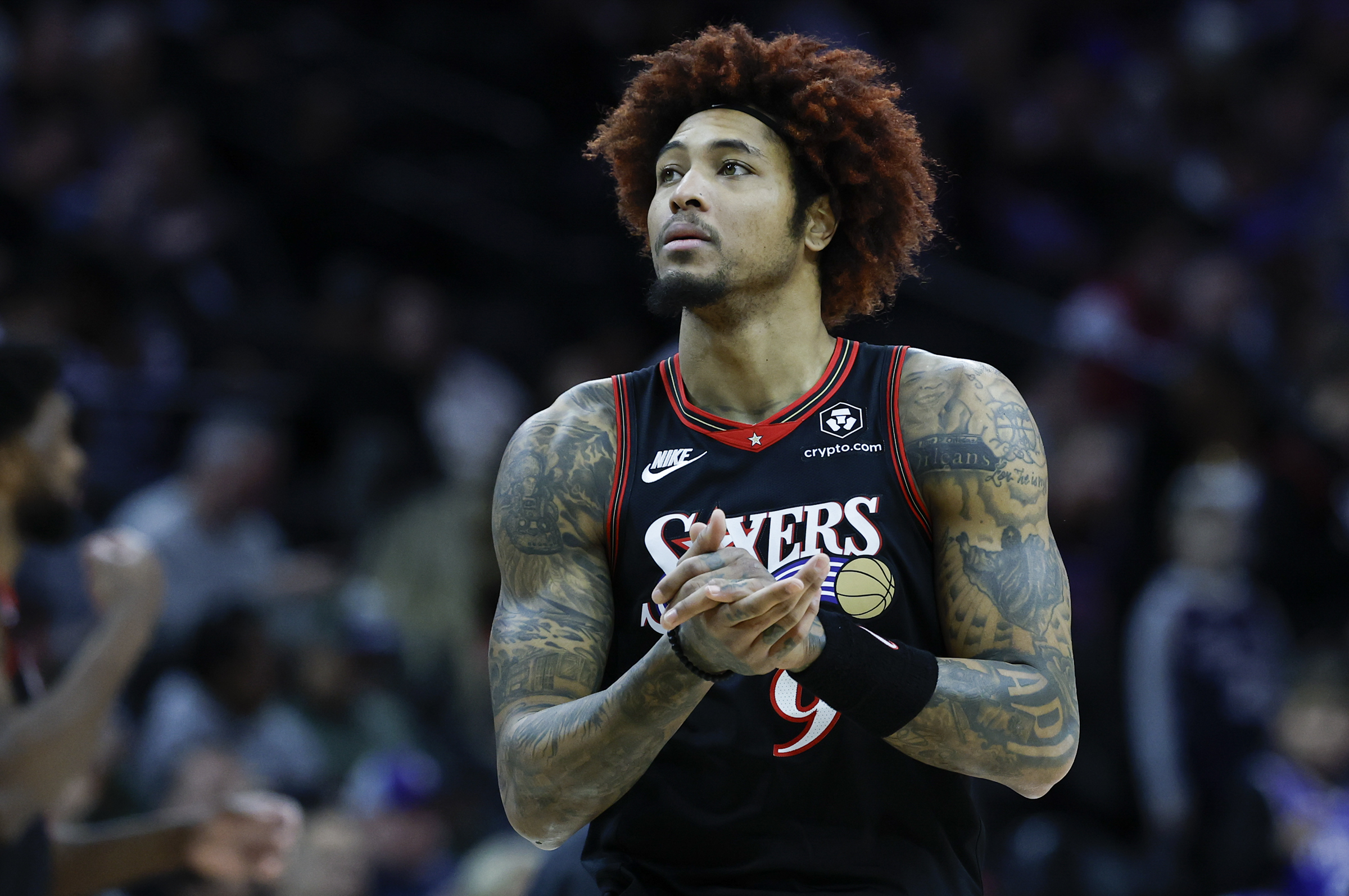
    Sixers guard Kelly Oubre Jr., has stepped up in Paul George’s absence as the nine-time All-Star serves a 25-game suspension.

    Do the Sixers have reliable players on the roster who can step up during George’s absence?

    Oubre, VJ Edgecombe, and Dominick Barlow have all shown they can handle larger roles until George returns on March 25 for the final 10 games of the season.

    Edgecombe, a rookie shooting guard, has been the Robin to Tyrese Maxey’s Batman when Embiid and George have missed games or were limited by minutes restrictions. In addition to scoring 34 points in the season opener, the 20-year-old has two game-winning baskets this season.

    Meanwhile, Oubre played well in Saturday’s 124-114 victory over the New Orleans Pelicans, the first game that George missed due to the suspension. The 6-foot-8 swingman scored 19 points on 7-for-13 shooting to go with 10 rebounds and four assists.

    “That’s big time,” Maxey said of Oubre’s 10 rebounds. “We’re going to need it, especially filling in for that role. And I have trust in him, because Kelly’s a guy who is not scared of the moment.”

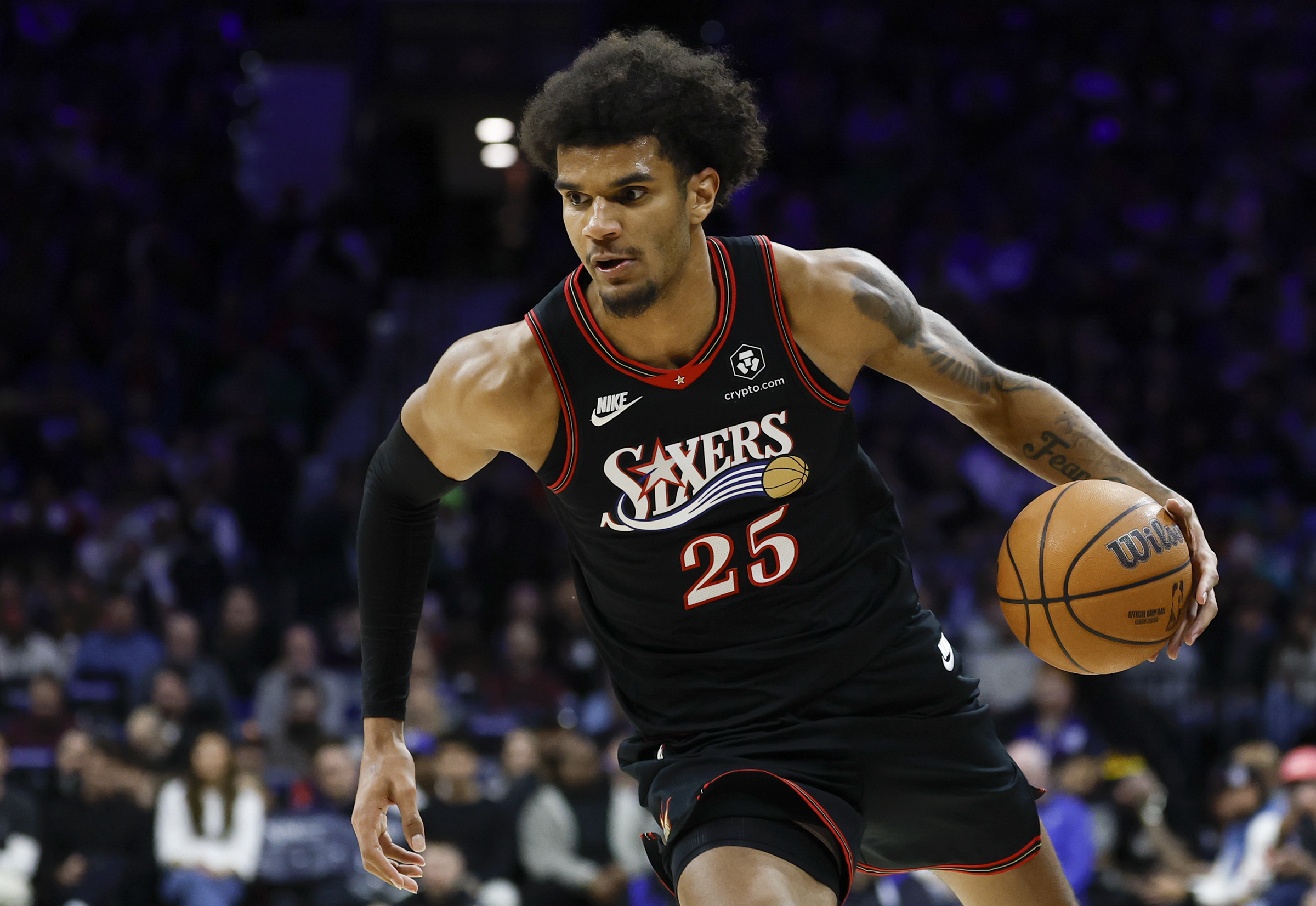
    Dominick Barlow became first Sixer with at least 25 points and 10 offensive rebounds since Hall of Famer Charles Barkley did so in November 1990.

    Barlow followed up with his own big-time moment in Monday’s 128-113 road victory over the Los Angeles Clippers. The power forward, who is starting in place of George, finished with a career-high 26 points to go with 16 rebounds, including a career-high 10 offensive boards, to post his second double-double of the season. He also finished with two steals and a block.

    The 6-9, 215-pounder became the first Sixer with at least 25 points and 10 offensive rebounds since Hall of Famer Charles Barkley did so in November 1990. So the Sixers have players more than capable of filling in for George, a nine-time All-Star.

    Do the Sixers have the available trade assets required to get a significant upgrade in talent at the trade deadline?

    Aside from Maxey and Edgecombe, the Sixers don’t have the assets needed to acquire the type of player who could drastically improve the team via a trade. And the Sixers aren’t going to trade either player.

    Embiid is once again playing at an elite level, averaging 29.3 points over the last 15 games heading into Tuesday’s contest against the Warriors. However, he has an extensive injury history and a three-year, $193 million contract extension that kicks in next season. While he looks great at the moment, there is a lot of uncertainty concerning how he’ll hold up in the future.

    Sixers forward Paul George has been suspended 25 games for violating the league’s anti-drug policy.

    Meanwhile, George has a tough contract to move after signing a four-year, $211.5 million deal in July 2024. At this stage of his career, he’s recognized as a fourth option on a championship team. Yet George is being paid as a top-two player. As a result, it’s hard to justify taking on his salary at this time.

    And since the Sixers aren’t going to trade Maxey or Edgecombe, they shouldn’t forfeit their future by surrendering draft picks to facilitate a trade. They’ll need those picks to acquire young talent and continue building around Maxey and Edgecombe after Embiid and George leave Philly.

    What’s the possibility of the team moving salary to convert two-way players Dominick Barlow and Jabari Walker to standard deals?

    That could happen. Both players have been vital to the team’s success this season. Unless they sign Charles Bassey to a second 10-day contract on Thursday, the Sixers will have a standard roster spot available that day.

    After the fifth game of George’s suspension, he will be moved from the active roster to the suspended list. The Sixers will be able to sign an additional player once he’s on that list.

    The fifth game is Saturday’s road game against the Phoenix Suns. But the Sixers could also create an additional roster spot by trading a minimum-salary player to a team with available salary-cap space in exchange for draft assets.

    Sixers forward Jabari Walker has outplayed the two-way deal he signed before the season.

    How will the Sixers manage the backup center position?

    Sources have said the Sixers are open to trading Drummond, even though he’s their best rebounder. If that happens, they’ll have to look for a backup center to grab rebounds and block shots.

    Bassey, or a similar player, could be an option. The team initially selected the 6-foot-11 center out of Western Kentucky with the 53rd pick in the 2021 draft. He appeared in 23 NBA games as a rookie, averaging 3.0 points on 63.8% shooting along with 2.7 rebounds, 0.7 blocks, and 7.3 minutes.
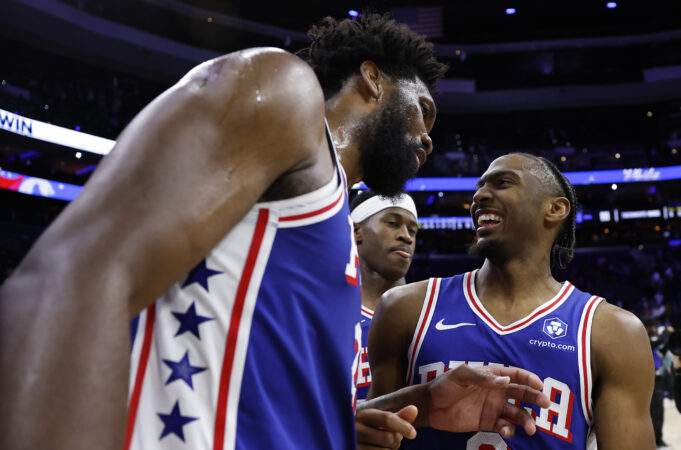
    However, Bassey was waived on Oct. 13, 2022.

    He has averaged 4.3 points and 4.3 rebounds across 115 NBA games with the Sixers, San Antonio Spurs, and Memphis Grizzlies.
    Sixers center Joel Embiid has returned to form this season, averaging 26.1 points, 7.4 rebounds and 3.8 assists.
    Can this team compete for a title as currently constructed?

    A lot of that will depend on Embiid’s health. With him playing at a high level, the Sixers were a dangerous team. When he plays well, they could beat anyone in the league.

    But how will the Sixers compete against the Boston Celtics, who are adding standout center Nikola Vucevic and a second-round pick from the Chicago Bulls in exchange for Anfernee Simons and a second-rounder? Will seeing the Celtics and other East teams try to improve through trades force the Sixers to make a move? Time will tell.

  • Gov. Josh Shapiro says he’ll prevent data center developers from ‘saddling’ Pennsylvanians with higher energy costs

    Gov. Josh Shapiro says he’ll prevent data center developers from ‘saddling’ Pennsylvanians with higher energy costs

    Gov. Josh Shapiro had a message for data center developers on Tuesday: Come to Pennsylvania, but bring your own energy — or pay up.

    During his budget address, Shapiro said his proposal — the Governor’s Responsible Infrastructure Development (GRID) standards — will ensure center operators are “not saddling homeowners with added costs because of their development.”

    Data centers, which house the technology to power cloud storage and other computing, have been proliferating across the country and the region due to the increasing demands of generative artificial intelligence, or AI. State and local officials are trying to keep up with the rapid pace of development, proposing new legislation — and updating existing measures — in an attempt to regulate the facilities.

    Shapiro’s plan would require data centers to supply their own energy or pay for any new generation they need. It also calls on them to hire and train Pennsylvania workers and comply with “the highest standards of environmental protection,” including in water conservation, Shapiro said.

    In exchange, the governor added, data center developers will get “speed and certainty” in the permitting process, as well as applicable tax credits.

    The comments from Shapiro, a Democrat who has consistently encouraged data center development, come amid a flurry of legislative and executive action, as elected officials promise to keep Pennsylvania and New Jersey consumers from bearing the costs of these power-hungry facilities.

    Data centers, the electric grid, and governors’ proposals

    Locally, proposals for large AI data centers have faced opposition from East Vincent Township, Chester County to Vineland, Cumberland County.

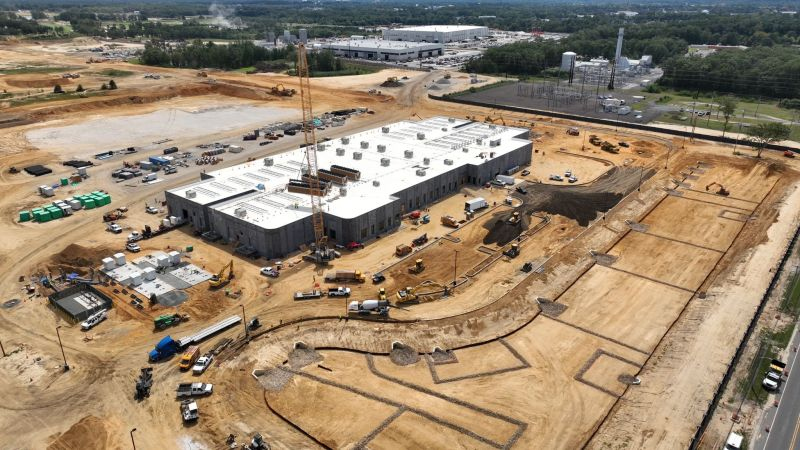
    A half-built data center in Vineland is expected to be completed later this year, with a capacity of 300 megawatts.

    Many experts have attempted to quantify the impact of these centers on Americans’ energy bills. In one analysis, Bloomberg News found that the monthly electric bills of customers who lived near significant data center activity had increased 267% in the past five years.

    At the same time, some governors, including Shapiro, have criticized and sued PJM, the Montgomery County-based electric grid operator, over its annual capacity auction, which influences how much customers pay.

    On Tuesday, Shapiro reiterated calls for PJM to speed up new power-generation projects and extend a price cap.

    Separate from GRID, Shapiro also said electric companies, including Peco, should increase transparency around pricing and “rein in costs” for consumers, including low-income and vulnerable Pennsylvanians.

    “These steps will save consumers money immediately,” Shapiro said. He announced an energy-affordability watchdog to monitor utility-rate requests and take legal action if necessary to prevent companies from “jacking up their rates and costing you more.”

    In New Jersey, new Gov. Mikie Sherrill made energy affordability a central tenet of her campaign. At her inauguration last month, she declared “a state of emergency on utility costs,” following through on a promise she had made in stump speeches and TV ads.

    Through several executive orders, she froze utility rates and expanded programs to spur new power generation in the state. She also ordered electric utilities to report energy requests from data centers.

    “This is just the beginning,” Sherrill said in her inaugural remarks. “We are going to take on the affordability crisis, and we are going to shake up the status quo.”

    In Pennsylvania, ‘Data Center Consumer Protection Bill’ advances

    An Amazon data center is shown last year while under construction in front of the Susquehanna nuclear power plant in Berwick, Pa.

    Meanwhile in Harrisburg and Trenton, some lawmakers have other ideas about how to keep residents from subsidizing data centers.

    As of Tuesday, nearly 30 bills in the Pennsylvania and New Jersey legislatures mentioned data centers, according to online records. Many of those bills aren’t directly related to residents’ electric bills, and instead address the facilities’ energy sources, water usage, environmental impacts, and general regulation.

    Others attempt to tackle rising consumer costs.

    On Monday, the Pennsylvania House Energy Committee advanced a measure referred to as the “Data Center Consumer Protection Bill.” Lawmakers say it would keep residents’ bills down by creating a regulatory framework for data centers and requiring their operators to contribute to utility assistance funds for low-income Pennsylvanians.

    “Today’s vote brings us one step closer to protecting ratepayers,” Robert Matzie, the Beaver County Democrat who introduced the bill, said in a statement. “Data centers can bring jobs and expand the local tax base, but if unchecked, they can drive up utility costs. Electric bills are already too high.”

    The state House Energy Committee also heard testimony Monday on a bill that would allow the state to create a “model ordinance” for local municipalities to regulate data centers, and another that would require centers to report their annual energy and water usage.

    The bills were introduced by State Reps. Kyle Donahue and Kyle Mullins, both Democrats from the Scranton area, which has become a hot spot for data center development.

    “There is a real concern and a sense of overwhelm among the people we represent,” Mullins said at the hearing. “The people of Pennsylvania have serious concerns about data center energy usage and water usage, especially as they see utility bills continue to rise rapidly.”

    Dan Diorio, vice president of state policy for the Data Center Coalition, said he worried the bills would discourage operators from building in Pennsylvania. He said they are already incentivized to reduce energy costs, which are estimated to make up anywhere from 40% to 80% of a data center’s total operating costs.

    “Data center companies strive to maximize energy efficiency to keep their costs low,” Diorio said.

    Rep. Elizabeth Fiedler, the Philadelphia Democrat who chairs the energy committee, closed Monday’s hearing by reminding members of one of its main objectives: to “keep down the energy bills that are skyrocketing for people back home.”

    A South Jersey lawmaker says his bill could help consumers

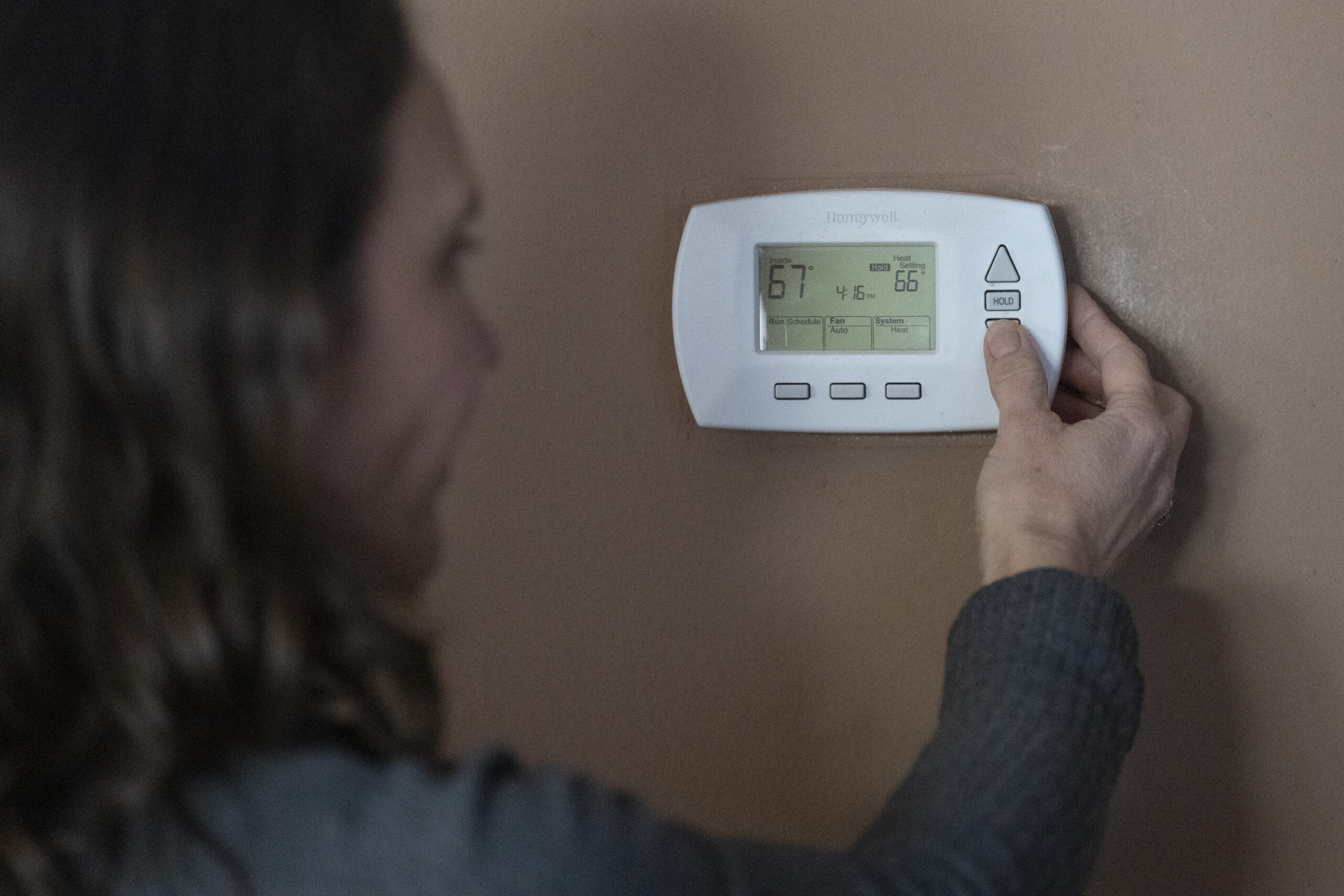
    A Philadelphia-area woman woman turns down her thermostat in attempt to save on electricity in this January 2023 file photo.

    The pain of skyrocketing utility bills has been felt acutely in New Jersey, which unlike Pennsylvania uses more energy than it produces.

    Between 2024 and 2025, New Jersey residents’ electric bills rose more than 13% on average, the fifth steepest increase in the U.S., according to federal data analyzed by the business magazine Kiplinger. Pennsylvanians saw a nearly 10% increase during the same period, according to the data.

    Prices are expected to keep rising in the coming years as more data centers are constructed.

    A bill sponsored by New Jersey State Assembly member David Bailey Jr., a Democrat from Salem County, attempts to prevent future price hikes.

    The legislation would require data center developers to have “skin in the game,” as Bailey described it in a recent interview, and sign a contract to purchase at least 85% of the electric service they request for 10 years. He said it would also provide incentives for data centers to supply their own energy generation.

    “I don’t want to come off as an anti-data center person,” said Bailey, who represents parts of Gloucester, Salem, and Cumberland Counties. “This is a very positive thing. We’re just saying we don’t want these big companies to come in and pass this [cost] on to our mom and pops, our neighbors, and our everyday ratepayers.”

    Bailey said he was disappointed that his bill was pocket-vetoed by former Gov. Phil Murphy last month. Now, it has to restart the legislative process. But Bailey said he expects it to eventually pass with bipartisan support.

    “No matter your party affiliation you understand the affordability issue,” Bailey said. “You understand your electric bill” — and how much it has risen recently.