Tag: U.S. women’s soccer team

  • The USMNT, USWNT, and your kid’s youth team are all different. U.S. Soccer is fine with that.

    The USMNT, USWNT, and your kid’s youth team are all different. U.S. Soccer is fine with that.

    Sometimes, it feels like there’s a distance between the U.S. men’s and women’s soccer teams, even though they wear the same crest.

    Over the years, various people involved with both programs have tried to close that gap, including at U.S. Soccer headquarters. Sporting director Matt Crocker is definitely on that list, and high up on it.

    That’s especially true when he talks about his vision of “the U.S. Way,” the creation of an on-field guidebook for the whole governing body. Many people will instinctively conclude that Crocker is sending a sermon from the mount, given how often the governing body has tried to do that over the years.

    But it isn’t that simple, and it’s not just Crocker saying so. The last few months of on-field results at the senior levels have offered proof.
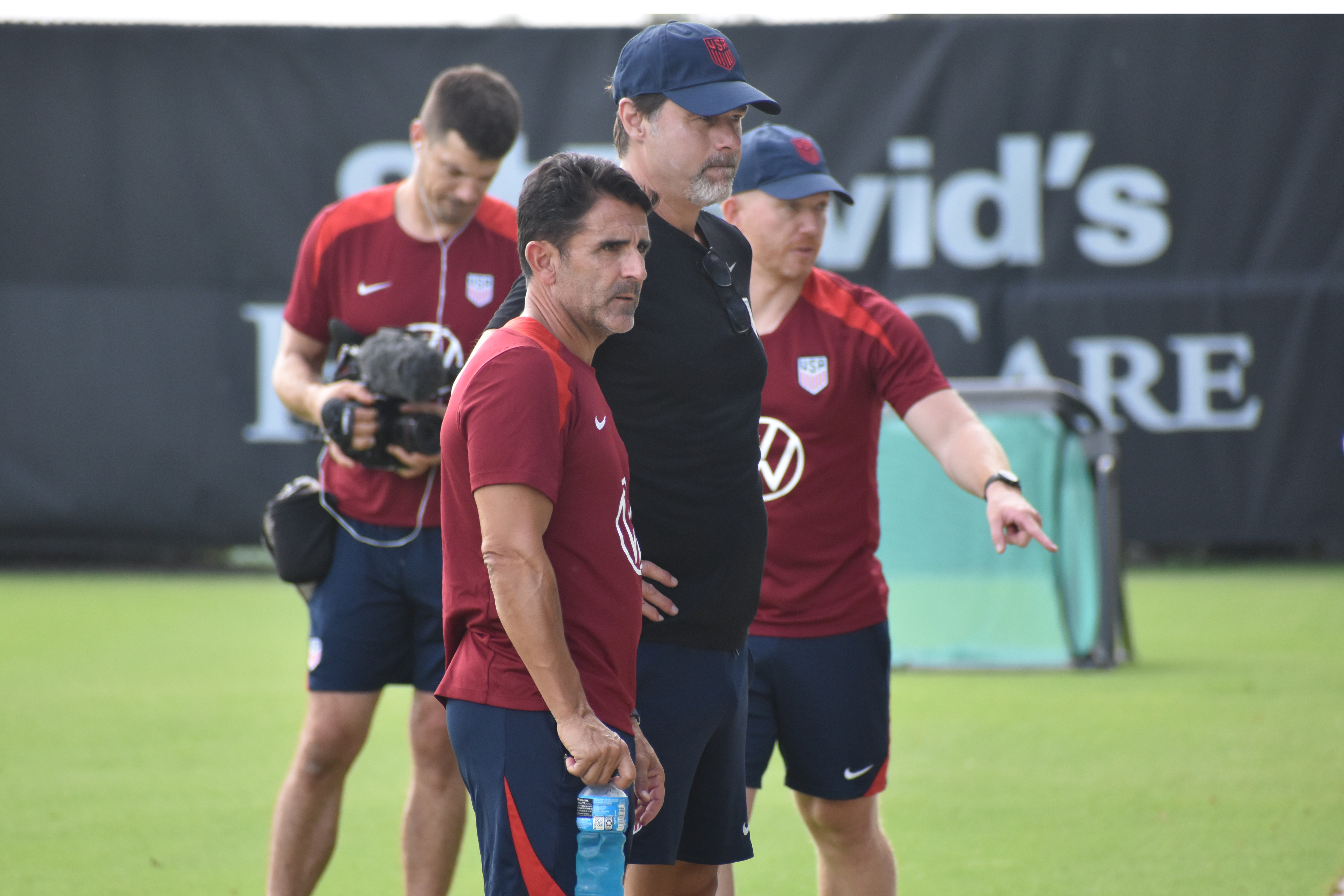
    Mauricio Pochettino (center) and his top assistant Javier Pérez (left) at a U.S. men’s soccer team practice in October.

    In some countries, every national team would be required to play the same way. Think of the Netherlands and Spain, for example, two programs with decades-long histories of putting philosophy over pragmatism.

    Crocker is more pragmatic. Once he hired Mauricio Pochettino to coach the senior men and Emma Hayes to coach the senior women, he wanted to get out of their way. He does not stop Pochettino from playing a 3-4-2-1 formation, and Hayes from playing a 4-3-3.

    “They are arguably two of the best coaches in the world,” Crocker told The Inquirer. “Who am I, in my experience, to dictate how they should be playing or not playing? I think the idea of that, for me, is not the way I work.”

    His experience gives him power if he wants to exercise it. Before joining U.S. Soccer in 2023, previous stops for the native Welshman included seven years at English soccer’s governing body, the Football Association. He planted seeds that have now made the nation elite on both the men’s and women’s sides.
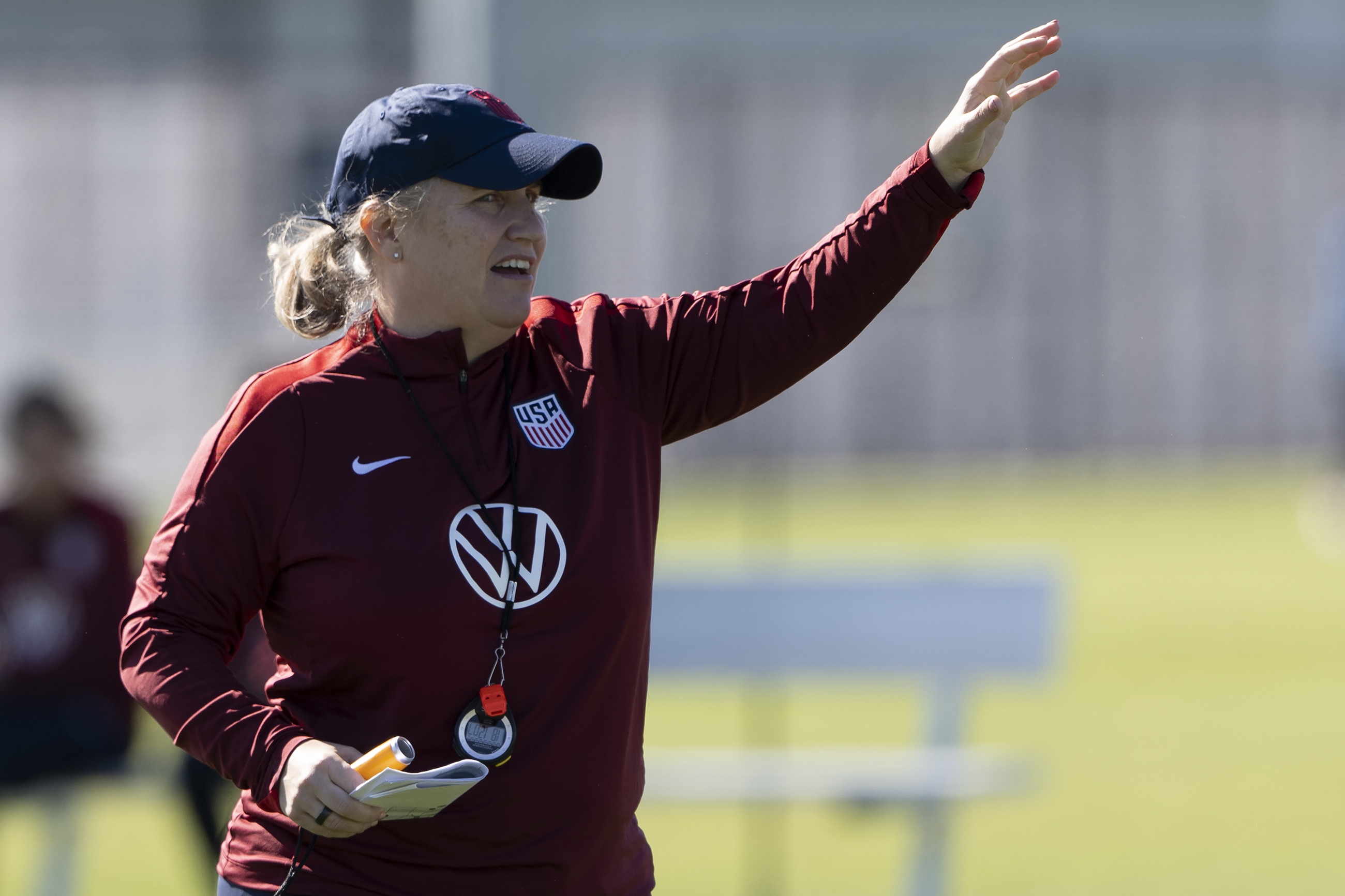
    Emma Hayes at a U.S. practice in Chester in October.

    But no, what Crocker said is what he meant.

    “Of course, there’s going to be a framework … of how we want them to work,” he continued. “But ultimately their job is to provide winning teams, and I think they’re doing a pretty good job at doing that. And my job is to make sure that they get what they need to be able to do that.”

    If you only follow soccer casually, you might not think much of this. If you’re deep in the sport, especially the American game, you know it matters to hear that from someone so high-ranking.

    “The way I see it is, my job is not to dictate every single detail of how everything needs to look or feel,” Crocker said. “I need to use their experiences, because they’ve got more than me in those areas of what winning looks like.”
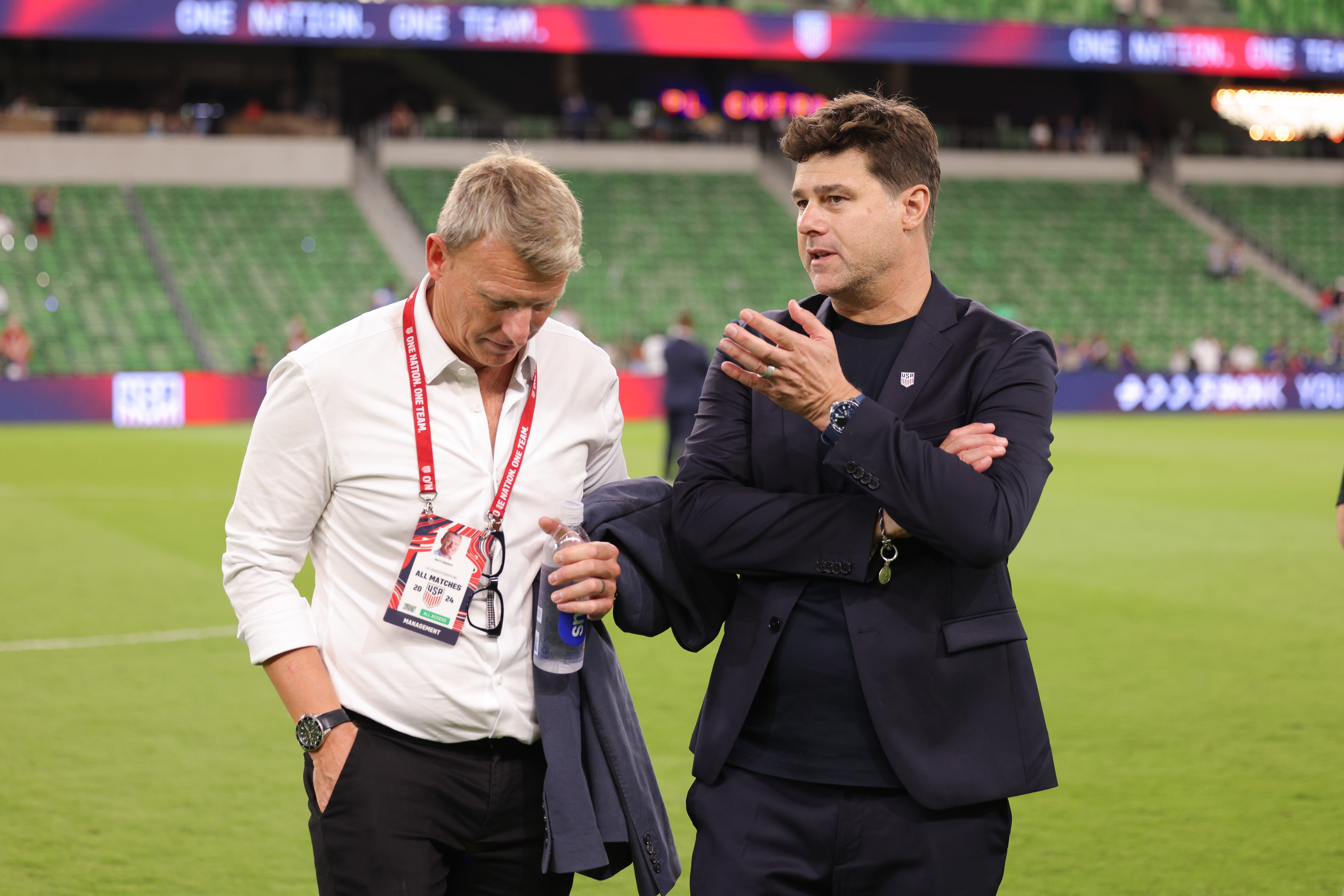
    Matt Crocker (left) listening to Mauricio Pochettino at a U.S. game last year.

    Hayes vouched for this, and not by making light of the size of her trophy mantel. She knew Pochettino before taking the U.S. job because they overlapped at English club Chelsea, and she knew American soccer from many years of working here before returning to her native London in 2012.

    “Mauricio’s ideas on how to win football matches might be different to mine, for example, but we both have ambition to win football matches,” Hayes said. “And we both have an appreciation that American players have their own unique set of qualities that we can lean into.”

    How they execute from there is up to them.

    “Yes, the U.S. Way is very clear and overarching — that sits above our WNT and MNT and all our other 27 teams,” Hayes said, using the abbreviations for the senior women’s and men’s teams. “But within that, some of those differences are in and around the game model.”

    That might not sound like much, but it really does matter.

    Emma Hayes has had immense success since arriving as the U.S. team’s manager two years ago.

    It all starts with youth soccer

    If there’s distance between the men’s and women’s teams, it often feels like there’s a canyon between the senior squads on TV and the youth teams your kids play on. That, too, has seemed deliberate at times, with so many factions in the sport wanting to do what they want instead of working together for the game as a whole.

    America’s youth soccer landscape, which better resembles an industrial complex — and really feels that big, in terms of scale — has a long history of rebelling against being told what to do by U.S. Soccer. Crocker quickly became well-versed in this when he took his job, and has spent a lot of time trying to change the tone.

    “I think we have to recognize that what we do in state X can’t just be replicated and put into state Y,” he said. “Everyone’s unique and individual, and we have to listen to their individual needs. But we’ve also got to be clear on the framework of the things that are fundamental, and that we are going to do irrespective.”

    He admitted that the scale of this country “scares you to death” for such a project, compared to how he built the England DNA program at the FA in 2013.

    Before joining U.S. Soccer, Matt Crocker (right) spent seven years at England’s Football Association, and also worked twice for English club Southampton.

    “You could bring every county FA to St. George’s Park, all of which were within a three-hour drive [from the national training center],” Crocker said. “You could mandate, you could then put people out into those environments to support it, and you could do it where you could really monitor something on a much smaller scale. Doing this is something I’ve never experienced before.”

    That literal geography, not just youth soccer politics, influenced his journey to now.

    “I don’t think there’s one silver bullet that you need to take, or you go, ‘It’s not going to work because of X,’” he said. “I just think we have to recognize the uniqueness of the country, build on that as a positive, but also remember not to make the same mistakes as others that have gone before us.”

    Then came words that a lot of people — especially the youth coaches out there — have wanted to hear.
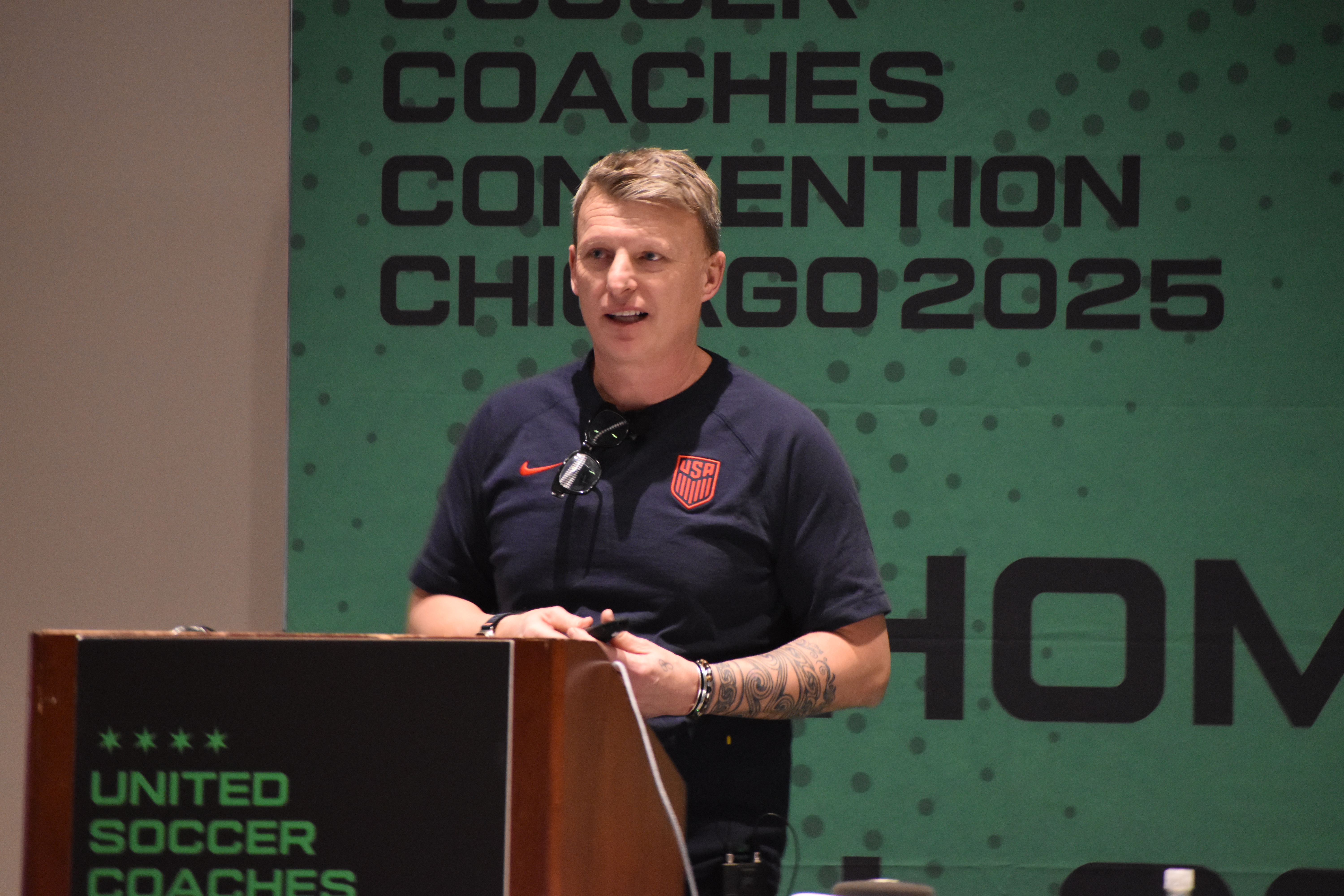
    Matt Crocker speaking at the United Soccer Coaches convention last January, to an audience that isn’t always on U.S. Soccer’s side.

    “I say this respectfully [because] I wasn’t here, but what I heard was U.S. Soccer was telling: We told, we told, we told,” Crocker said. “And now our job is to listen, to work, to problem solve, but to bring everyone together.”

    Anecdotally, it’s been working. At various events this year where Crocker has spoken to youth and amateur teams, he has been warmly received. But the hardest part is yet to come, as a recent moment showed.

    ‘More worried about their bottom line’

    Earlier this month, Crocker spoke to a crowd of the governing body’s sponsors and donors. Some of them wore track jackets of their youth clubs, but most were in business clothes. Crocker shared the stage with deputy sporting director and onetime Union centerback Oguchi Onyewu and U.S. men’s legend Landon Donovan.

    “For those who are not familiar with the youth soccer landscape in this country, it’s a bit of a disaster, right?” Donovan said. “It really is. There’s so many competing interests.”
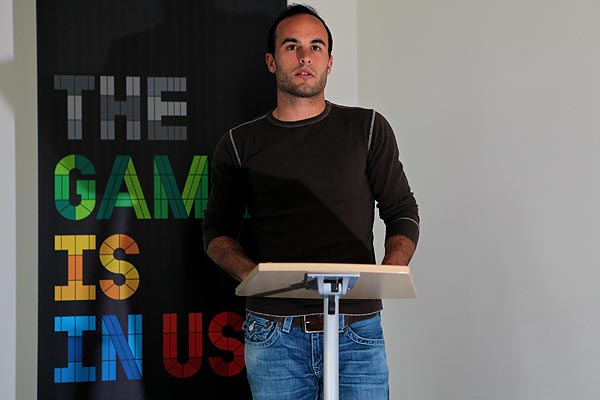
    U.S. men’s national team legend Landon Donovan says that the youth model might be too far gone to suggest anything that would affect their bottom line.

    He spoke of a local club near his home in southern California, but knew it could have been countless others.

    “People are very content with their little fiefdom and their little salary and their club and their control and their power,” Donovan said. “So what’s the incentive now for these clubs to change? … We do have national pride, but they’re more worried about their bottom line than they are [about] growing U.S. soccer.”

    The words were as true as they were damning.

    “I think the saying is, do what you’ve always done and you’ll get what you’ve always got,” Crocker said. “There’s been a lot of talk about, there’s a player that plays in this league over here that has to drive or fly thousands of miles because this league is falling out with this league, and they won’t play each other. And that’s not putting the child, that’s not putting the sport, at the heart of what we’re all about.”

    Matt Crocker (left) with U.S. Soccer Federation CEO JT Batson.

    It’s true for the boys and men, and it’s true for the girls and women. It’s an enormous task, but Crocker is willing to give from his side, and that is noticed.

    “I think it’s being respectful to environments that have already been created,” he said. “Us as U.S. Soccer, being the national federation, the people that should be really saying, ‘Hey this is what player development and the game could look like in this country’ — it’s about time we spoke up and started to share some of that. But it’s not through a dictator approach, it’s through more of a collaborative way of doing things.”

    Crocker’s plans are due to be published in January, the same month Philadelphia will host the 2026 United Soccer Coaches convention. It won’t be easy for him to get that crowd on his side, for the reasons Donovan made clear. If Crocker can, though, the benefits could last long past the World Cup.
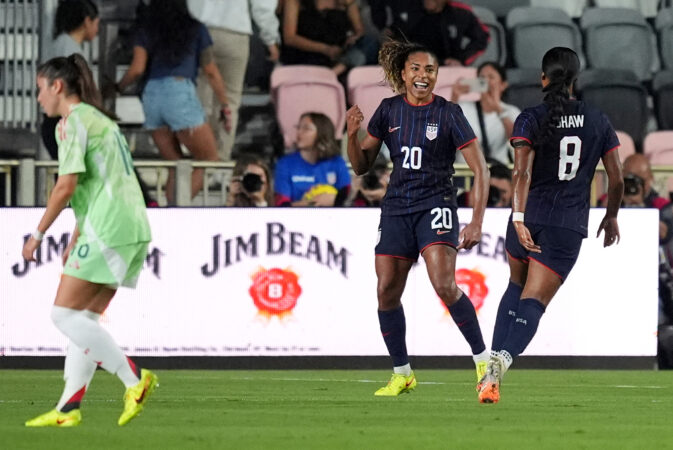
  • Catarina Macario stars again as the USWNT sweeps Italy to end its year

    Catarina Macario stars again as the USWNT sweeps Italy to end its year

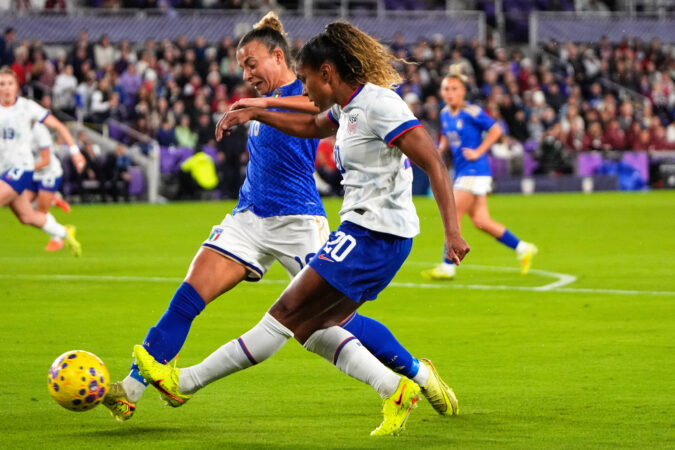
    FT. LAUDERDALE, Fla. — Catarina Macario scored in her third straight international match and the United States women’s national team defeated Italy 2-0 on Monday night in the final game for the national team this year.

    The United States has scored in 16 straight matches, including all 15 this year. The national team wrapped up 2025 12-3-0.

    Macario scored the opening goal in the 20th minute with a strike from the corner of the box and up over Italy goalkeeper Francesca Durante’s head and into the side netting of the far post.

    Jaedyn Shaw added a second goal before halftime, taking a pass from Alyssa Thompson before squaring up and calmly finishing out of Durante’s reach to make it 2-0.

    Claudia Dickey earned her fifth clean sheet in her sixth appearance in goal for the USWNT.

    Macario had a pair of goals a 3-0 victory over Italy on Friday night in Orlando, Florida. Olivia Moultrie, who scored the other goal on Friday, was available off the bench Monday.

    Macario, who plays for Chelsea, led the team this year with eight goals, including seven goals in her last seven starts. She nearly got a second goal at Ft. Lauderdale’s Chase Stadium but it was disallowed because of a foul, denying her a third brace in her last three international games.

    Macario and Emily Fox were among the players named earlier Monday as nominees for the women’s U.S. Soccer Player of the Year award, joining Rose Lavelle, Thompson, and Sam Coffey.

    U.S. coach Emma Hayes made five changes to the starting lineup from Friday’s victory in the first game against Italy, going with veterans Naomi Girma, Lindsey Heaps, Fox and Macario. Three teenagers started for the United States, including 19-year-olds Claire Hutton and Jordyn Bugg and 18-year-old Lily Yohannes.

    The USWNT will next gather from Jan. 17-27 for the team’s annual camp in Carson, Calif., with a match planned against Paraguay and another against an undetermined opponent.

  • Catarina Macario’s two goals lead the USWNT to win over Italy, 3-0

    Catarina Macario’s two goals lead the USWNT to win over Italy, 3-0

    ORLANDO, Fla. — Cat Macario scored two goals and the United States defeated Italy 3-0 on Saturday night in a friendly match at Inter&Co Stadium.

    It was the first of two friendlies between the teams, with the second scheduled for Dec. 1 in Fort Lauderdale.

    Olivia Moultrie also scored while goalkeeper Claudia Dickey earned the shutout in just her fifth appearance at the senior level.

    “I think obviously we wanted to keep building on the performances we had last camp, and the emphasis on coming out strong and sticking to our principles, and I think that’s what we did,” said U.S. veteran Rose Lavelle, who earned her 116th cap. “Overall, I think a really good team performance.”

    The United States wasted no time in attacking Italy’s goalie Laura Giuliani, scoring inside the first two minutes.

    Fresh off their NWSL title with Gotham, Lilly Reale found teammate Lavelle to start the sequence. Lavelle then went wide to Alyssa Thompson, who quickly returned the ball. Lavelle found Moultrie, who went far side for her second goal in as many appearances with the team.

    “We talked about starting fast and starting strong, and I think the momentum carried out,” Moultrie said. “We had a really good week of training, so I feel like it flowed into the first minutes of the game.”

    An offside call on Lavelle at the 48-minute mark denied Moultrie her second goal.

    In the 64th minute, Sam Coffey dribbled down the middle and found Macario breaking on her left. Macario took the pass and fired a shot far side to give the United States a two-goal lead.

    Macario added her second in the 76th minute when she snared a pass from the team’s youngest player, 18-year-old Lily Yohannes, and fired a shot from the top of the right side of the box to the far side of the goal.

    It was Macario’s 15th goal in 28 international appearances. Macario has now been involved in 18 goals in her last 14 U.S. appearances.

    “It was a great win, it’s always a pleasure being with this team,” said Macario, who has 12 goals and six assists since February of 2022. “I feel so happy to be in this environment, and I feel like it really just helps you be the best version of yourself.

    “Lucky enough that (U.S. coach) Emma (Hayes) knows me very well, and she knows what I can bring to the team. This was a good year … in which I have just been trying to find some consistency … just trying to find my rhythm.”

  • Philadelphia is on a long list of potential cities for the 2031 women’s World Cup

    Philadelphia is on a long list of potential cities for the 2031 women’s World Cup

    NEW YORK — The United States Soccer Federation proposed 14 American sites among 20 possible venues to host games for the 2031 Women’s World Cup, including seven U.S. stadiums to be used for next year’s men’s tournament.

    FIFA released the bid books Friday for the 2031 and 2035 women’s tournaments. There is only one bidder for each, a U.S.-Mexico-Costa Rica-Jamaica proposal for 2031 and a United Kingdom plan for 2035. FIFA is to formally confirm the bids at its congress on April 30.

    Twenty-six additional U.S. stadiums were mentioned as suitable venues for a 48-nation tournament the bidders project would draw 4.5 million fans and generate about $4 billion in revenue, up from $570 million for 2023 in Australia and New Zealand and a projection of $1 billion for the 2027 tournament in Brazil.

    Proposed ticket prices of $35 for the cheapest seats in the opening round to $120 to $600 for the final were listed in a ticket grid. FIFA has refused to release a grid for next year’s men’s tournament, saying only prices initially ranged from $60-$6,730 but could fluctuate with dynamic pricing. The bid book said premium seating would average 10%-20% of capacity at the majority of 2031 stadiums.

    Lincoln Financial Field last hosted a women’s World Cup in 2003.

    Fifty sites in all were mentioned in the joint 2031 bid. Final decisions likely will not be made for several years.

    The bid book also said “other suitable cities are included” beyond the specified 14 “as part of the broader bid framework with the understanding that they will continue to be equally considered for the purposes of stadium selection.”

    “By proposing more than the required 20 sites, the joint bidders demonstrate a commitment to securing the best possible hosting conditions and ensuring the tournament represents the full diversity of our region on a global scale,” the bid book stated.

    The 2026 U.S. sites included in the 2031 proposal are Arlington, Texas (AT&T), Atlanta (Mercedes-Benz), East Rutherford, N.J. (MetLife), Houston (NRG), Inglewood, Calif. (SoFi), Kansas City, Mo. (Arrowhead), and Seattle (Lumen Field).

    MetLife Stadium in East Rutherford, N.J., hosted this year’s Club World Cup final and will host next year’s men’s World Cup final.

    The seven others are Charlotte, N.C. (Bank of America), Denver (Empower Field), Minneapolis (U.S. Bank), Nashville (Geodis Park), Orlando (Camping World), San Diego (Snapdragon), and Washington (proposed NFL venue on the RFK Stadium site).

    Orlando and Washington were sites of the 1994 men’s World Cup.

    Mexico’s three sites for next year’s World Cup also are proposed for the women’s tournament, Mexico City (Azteca), Guadalajara (Akron), and Monterrey (BBVA), along with a fourth in Torreón (Corona).

    National stadiums are proposed in Kingston, Jamaica, and San Jose, Costa Rica.

    The national stadium in Kingston, Jamaica will host its first women’s World Cup games.

    Other U.S. venues listed as possibilities are Foxborough, Mass. (Gillette), Philadelphia (Lincoln Financial Field), and Santa Clara, Calif. (Levi’s), all venues for next year’s men’s World Cup.

    Additional sites included were Baltimore (M&T Bank), Birmingham, Ala. (Protective), Carson, Calif. (Dignity Health Sports Park), Cincinnati (TQL), Cleveland (Huntington Bank Field), Columbus, Ohio (Lower.com Field), Frisco, Texas (Toyota), Glendale, Arizona (State Farm), Harrison, N.J. (Sports Illustrated), Los Angeles (Memorial Coliseum), Miami (Chase), Nashville (Nissan), New York (Etihad Park), Orlando (Inter & Co), Pasadena, Calif. (Rose Bowl), St. Louis (Energizer Park), San Francisco (Oracle Park), Sandy, Utah (America First Field), and Tampa, Fla. (Raymond James).

    Second possible sites in cities, all with lower capacities, were included for Houston (Shell Energy), Kansas City, Mo. (CPKC), and Washington (Audi Field).

    Indianapolis was listed for a proposed stadium.

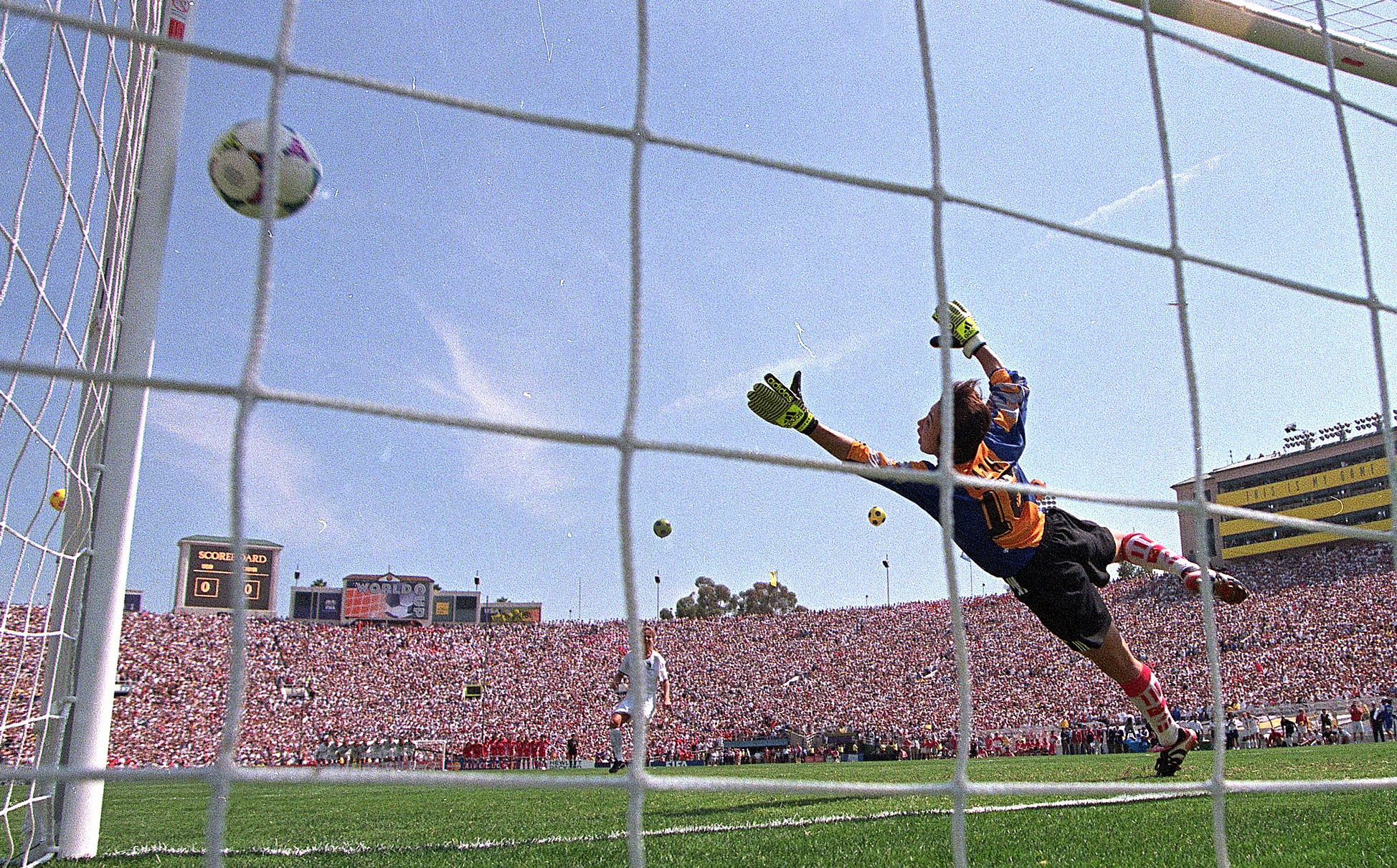
    The Rose Bowl in Pasadena, Calif., hosted the 1999 women’s World Cup final – still one of the most famous games in women’s soccer history.

    Miami’s Hard Rock Stadium was the only 2026 World Cup venue not included.

    Chicago was not listed after dropping out of bidding to host in 2026 because of what it said were FIFA’s burdensome financial demands.

    Additional possibilities in Mexico are Pachuca (Miguel Hidalgo) and Querétaro (Corregidora) along with Universitario as an alternate choice in Monterrey. Saprissa was listed as an alternate site in San Jose, Costa Rica.

    Organizers envision fan festivals and watch parties in conjunction with games. Revenue from marketing and sponsorships is projected at $1.4 billion.

  • USWNT bounces back from rare loss with 3-1 win over Portugal

    USWNT bounces back from rare loss with 3-1 win over Portugal

    EAST HARTFORD, Conn. — Olivia Moultrie scored two goals and the U.S. women’s national team bounced back against Portugal with a 3-1 victory on Sunday after honoring former goalkeeper Alyssa Naeher.

    The United States was coming off a 2-1 loss to Portugal in the first game of the international window on Thursday in Chester. It was Portugal’s first victory over the U.S. and just the third loss for the national team under coach Emma Hayes.

    Moultrie scored just 45 seconds into the game to give the USWNT the early lead. Portugal leveled in the fifth minute on Jessica Silva’s header off a cross from Beatriz Fonseca.

    Moultrie added her second in the 10th to put the Americans back in front. The 20-year-old has a pair of two-goal games in 10 international appearances.

    Sam Coffey, who came into the game as a substitute in the 77th minute, put the game away with a goal in the 82nd. Coffey and Moultrie are teammates on the Portland Thorns in the National Women’s Soccer League.

    Hayes made eight changes to the starting lineup from the group she started on Thursday.

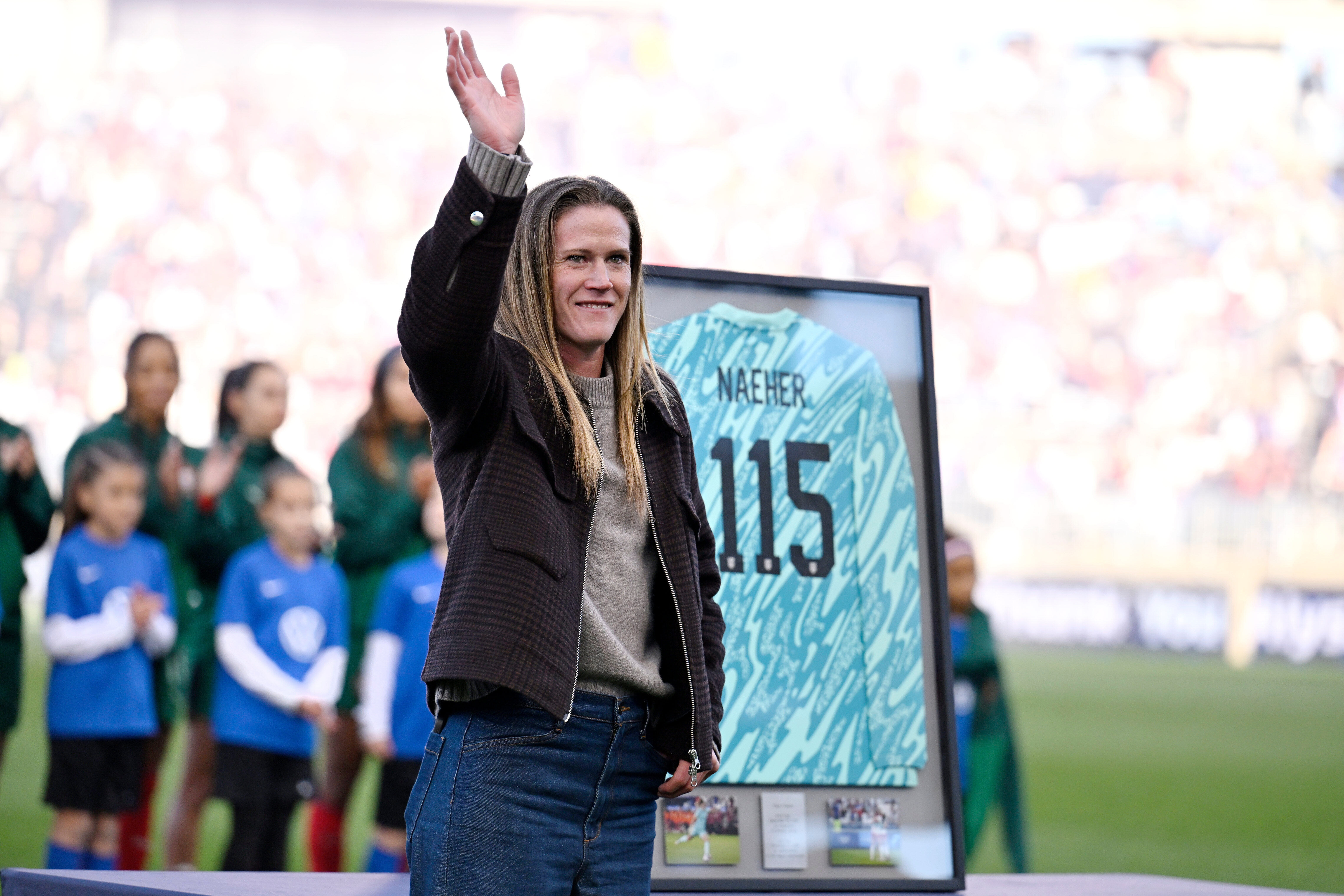
    Before the match at Pratt & Whitney Stadium, the United States honored Naeher, a Connecticut native, who retired from the national team late last year after winning a gold medal at the Paris Olympics.

    Naeher was the starting goalkeeper for the U.S. team that won the Women’s World Cup in 2019 and the 2024 Olympics. She’s the only U.S. goalkeeper to earn a shutout in both a World Cup and an Olympic final.

    Alyssa Naeher waves to the crowd in her home state during her retirement ceremony.

    The team was without some of its star players. Trinity Rodman was nursing an MCL sprain in her right knee that she sustained Oct. 15 during a CONCACAF W Champions Cup match with her club team, the Washington Spirit.

    Defender Naomi Girma remained sidelined with a calf injury that occurred before the start of Chelsea’s season in September.

    Forward Lynn Biyendolo, who was left off the U.S. roster because of a knee injury, announced on Saturday that she and her husband are expecting their first child. Other prominent national team players who have taken maternity time off this year include Sophia Wilson and Mallory Swanson.

    Hayes said that U.S. Soccer was developing more comprehensive “pre- and postpregnancy” protocols to be announced in the future.

    The United States has one more match during the current international window, against New Zealand on Wednesday at CPKC Stadium in Kansas City, Mo.

  • An unusual loss shows the USWNT might not have its new No. 1 goalkeeper yet

    An unusual loss shows the USWNT might not have its new No. 1 goalkeeper yet

    When a team gives up a goal on a corner kick, it’s rarely just down to one person. But when a team gives up two goals on corner kicks in one game, there likely will be alarm bells.

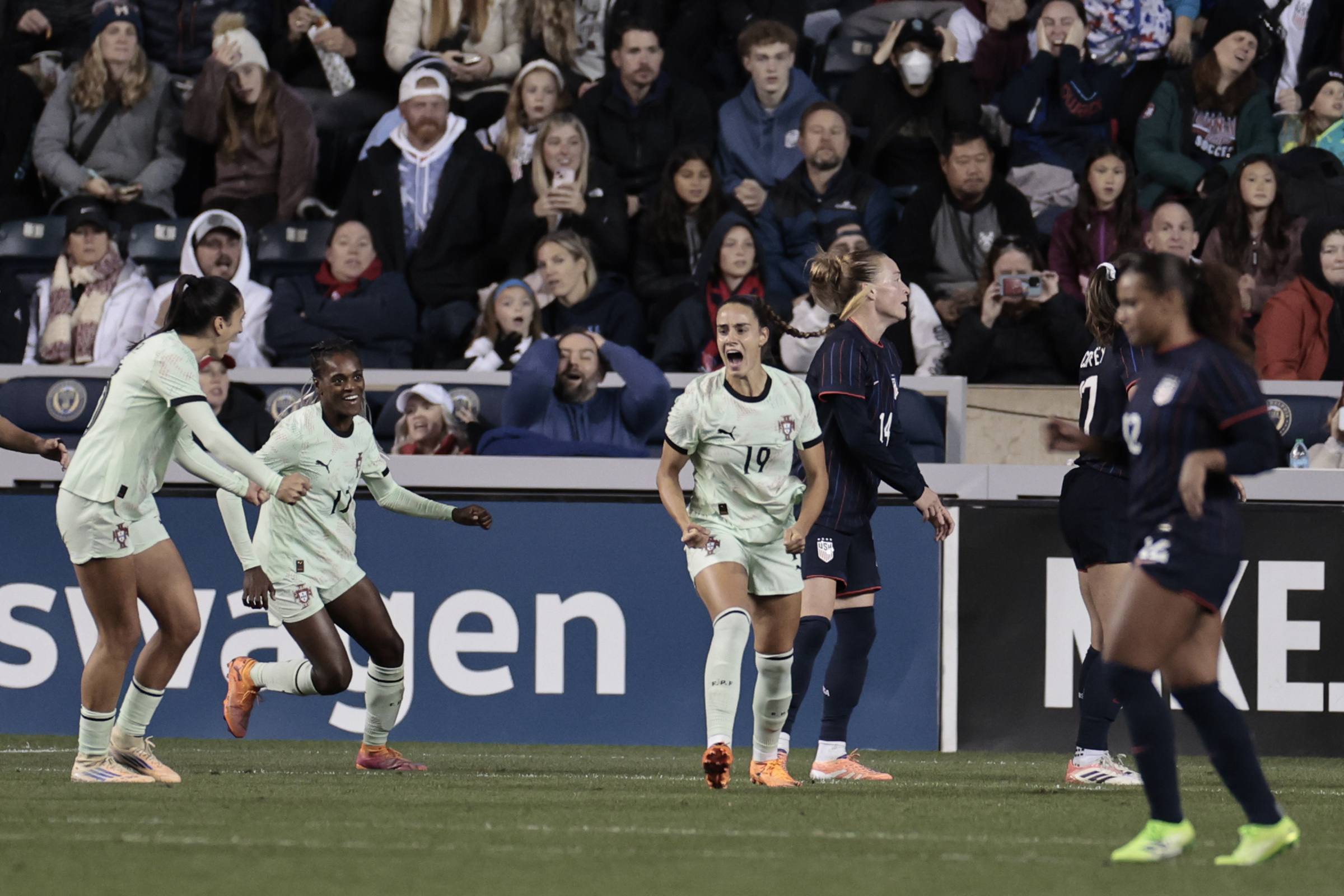
    That’s what happened Thursday night at Subaru Park, where the U.S. women were upset by Portugal, 2-1.

    Manager Emma Hayes was frustrated afterward, as were many of her players. There are few things — sometimes nothing — a soccer coach dislikes more than giving up goals on set pieces.

    Nor did it help that this U.S. squad looked unusually disjointed, even for a group that hadn’t been together in four months and had just two days of practice before kickoff.

    “I didn’t recognize us,” Hayes said. “ I felt that we just rushed everything. We went direct. We didn’t look like the team that we’ve been working on, but that’s what happens when you got 113 days apart.”

    She admitted she had “felt it the last two days in training,” seeing “so many misconnections, just taking a bit of time for us to get on the same page.”

    And she offered a few of the rhetorical flourishes that have long made her popular among fans and players.

    “Sometimes you need a kick up the back side like that,” she said at one point.

    “I was frustrated this evening because it felt like a game of Whac-a-Mole,” she said at another. ”I felt like I put something out, and then I was whacking that — that’s how the game felt for me as a coach. And I’ve been doing this for so long, I hate them games.”

    Hayes wasn’t going to pick at individual players or positions, to no surprise. She knew, though, that the U.S. team’s decades of success have also earned it the right to be criticized, and she usually doesn’t mind that when it’s warranted.

    There will be questions about the centerbacks and forwards. The latter certainly falls under Hayes’ remark that “there’s so many decisions we made” that felt like the wrong one.

    “I’m like, ‘Is it the right moment to take a shot? Slip a player in?’” she said. “No, we didn’t make those decisions.”

    And from up in the press box, there were questions about a position that has faced several lately.

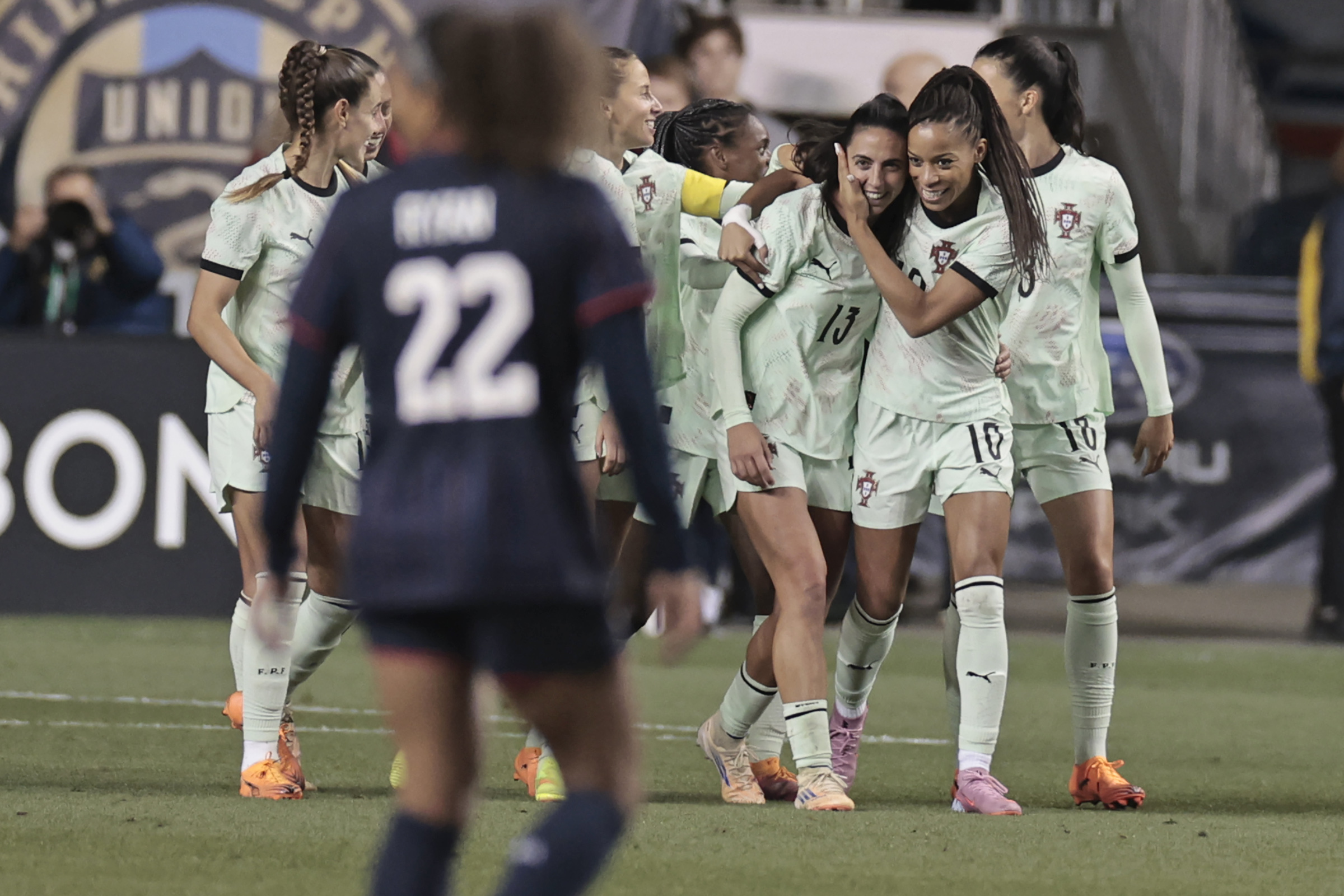
    Portugal’s Fatima Pinto (center) celebrates after scoring the game-winning goal.

    Minding the net

    For much of the night, goalkeeper Phallon Tullis-Joyce didn’t play badly. She was credited with two saves, the best of which was a close-range stop on Tatiana Pinto after a misplay by U.S. centerback Tara McKeown.

    But Tullis-Joyce didn’t look good on either of those corners.

    Again, neither solely were her fault. On the first, Diana Gomes jumped amid three U.S. players to win the header and knocked it low, beating Tullis-Joyce on the bounce.

    The second was off an outswinging corner that Tullis-Joyce wouldn’t have gotten to in any circumstance, and Fatima Pinto’s shot bounced off two U.S. players. So it’s nitpicking to say Tullis-Joyce’s reaction time wasn’t ideal. But the standard is high, and it felt like just enough to plant a seed of doubt.

    “Those were tough to take on the chin,” Tullis-Joyce said.

    Asked about her play on those corner kicks, she said: “They had some driven corners into that back post area. I’m sure I’ll take a look at the clips afterward to see whether or not maybe I could play a bigger role in that, but that’s just for me to look and review afterward.”

    Hayes likely will stick with Tullis-Joyce as her new No. 1 goalkeeper for a while. The 29-year-old New Yorker has generally played well for the U.S., and is playing quite well at club level for England’s Manchester United.

    Still, we’ll see if anyone else gets minutes over the next two games during Sunday’s rematch vs. Portugal (4 p.m., TNT, Universo) — coincidentally Alyssa Naeher’s retirement tribute — and Wednesday’s game vs. New Zealand in Kansas City (8 p.m., TNT, Universo).

    Current No. 2 Claudia Dickey presumably would be first in line for that shot. And if after that, Aubrey Kingsbury leads the Washington Spirit on a second straight run to the NWSL title game, there might be some clamor for her to get a call-up for the first time since June of last year.

    ‘Not locked in enough’

    Otherwise, the blame was spread around.

    “It felt really individual out there,” said midfielder Rose Lavelle, who scored the U.S.’s goal just 33 seconds after kickoff. “I think everyone was trying to maybe fix it on their own. That’s something that, when the going gets tough, we’ve got to make sure we’re sticking together, playing together.”

    Sam Coffey was particularly miffed about conceding on those corner kicks. Asked how she’d assess the plays, she responded promptly: “Obviously, we got scored on them, so I wouldn’t assess them very high.”

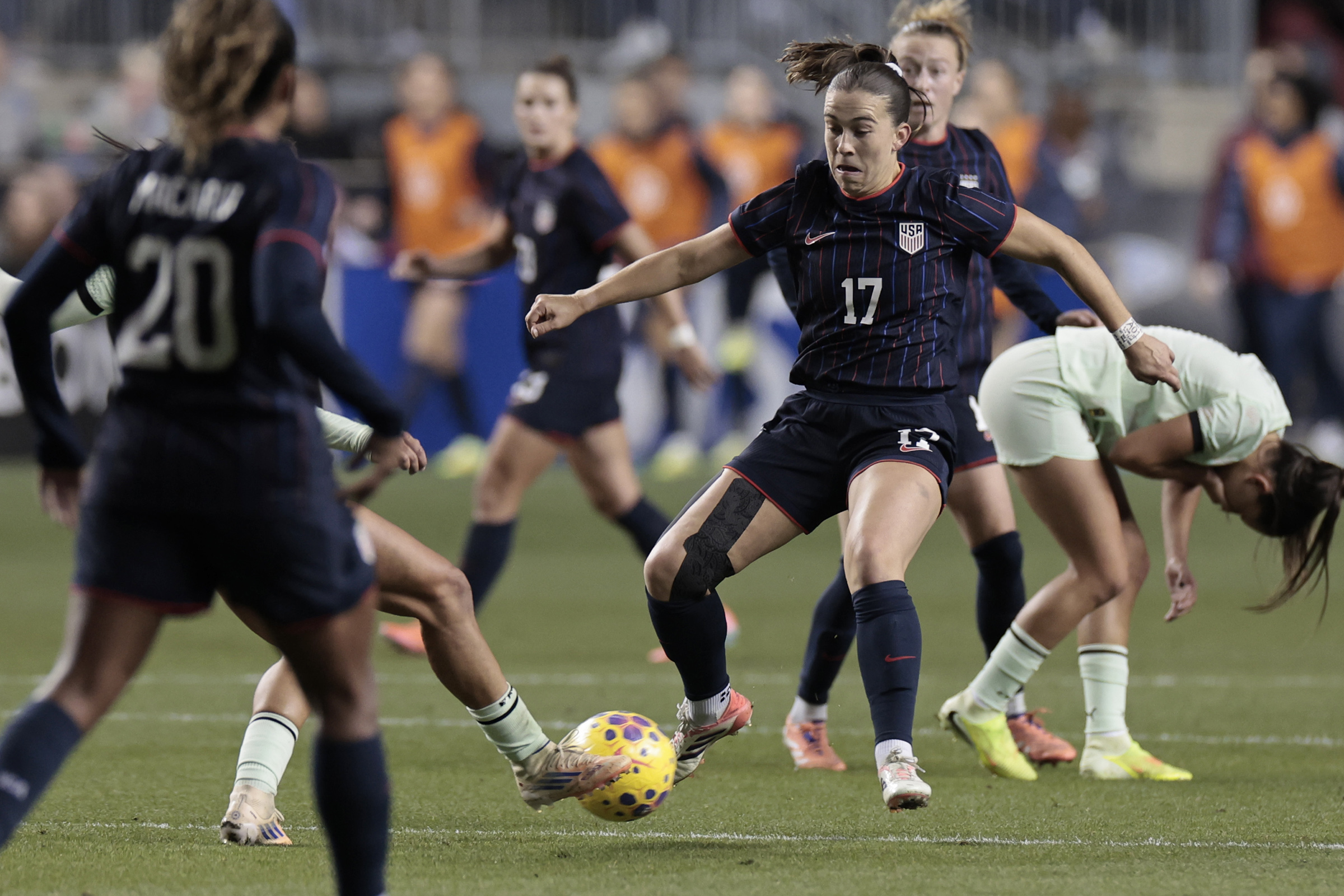
    Sam Coffey (center) on the ball in the middle of the action.

    She credited Portugal, and rightly so. Though the Navegadoras are No. 23 in FIFA’s global rankings, they’ve got more talent than a few teams ahead of them — as they showed in tying reigning European champion England in February, then Italy at this summer’s Euros.

    Those results are more telling than the one that naturally stuck in many American fans’ minds Thursday night, the scoreless tie Portugal pulled against the U.S. at the 2023 World Cup.

    But Coffey saved most of her words for her own side, which also was the right move.

    “I think whether we’re not locked in enough in those moments or we’re not doing good enough in our man-marking or being alive for a second phase [when a ball is recycled after being cleared], I think that’s an area we’ve always prided ourselves on, and that was not up to our standard tonight,” she said. “Set pieces win championships, win games. And for them to capitalize on those and win the game that way, I think is really disappointing for us, and we have to be better.”

    Diana Gomes (center) celebrates scoring Portugal’s first goal.

    It is obviously better to lose in an off-year friendly than in an actual tournament. And on top of any loss lighting a spark under this group, they know they’ll see the same team again a couple days.

    “The lucky thing for us is we have a second shot at this,” Lavelle said. “There’s no months of time between the next time we can maybe get better from this loss. So we have three days to turn around and show up better.”

    Tullis-Joyce was even more blunt: “Revenge, for sure.”

    It will no doubt get attention, as this team always does.

  • The USWNT strike first, but Portugal has their number again in 2-1 loss at Subaru Park

    The USWNT strike first, but Portugal has their number again in 2-1 loss at Subaru Park

    Before Thursday night, the last time the U.S. women played Portugal was the scoreless tie at the 2023 World Cup that started their downfall.

    For the first 33 seconds this time, it looked like things had changed. But by the end of the night, Portugal had the Americans’ number again — this time a 2-1 win as the visitors at Subaru Park.

    It was the U.S.’s first loss in a visit to the Philadelphia area since 2004 and the current team’s first loss in seven games dating back to February.

    Those 33 seconds were how long it took for the U.S. to open the scoring through Rose Lavelle. Catarina Macario set the play up with a dazzling move, running and dancing amid Portugal’s defense before feeding the assist.

    It was the seventh-fastest goal in U.S. women’s team history, and it will not be recorded that Lavelle clearly was offside. But with no video review in this friendly, the goal stood, and the crowd of 17,297 — including U.S. legend Alex Morgan and many ex-teammates honoring her retirement ceremony — cheered.

    Lavelle nearly scored again on a breakaway in the ninth, sprung beautifully by Alyssa Thompson. But Portugal goalkeeper Inês Pereira denied her with a charge off her line and a tip of the ball to just the right side of the post.

    From there, Portugal turned the tide. In the 37th minute, Kika Nazareth spun around Lavelle, passed wide to Andreia Jacinto, and she tried a chip attempt that landed on top of the crossbar. Two minutes later, a misplay by Tara McKeown let Tatiana Pinto get free on goal, and U.S. goalkeeper Phallon Tullis-Joyce had to come off her line for a sprawling stop.

    Portugal scored on the ensuing corner kick, as Diana Gomes beat Emily Sonnett on the jump.

    The U.S. looked livelier early in the second half, but Thompson flubbed a chance, and Macario got caught up to on a breakaway just in time to have the ball poked from behind.

    Nor could the Americans capitalize on a close-in free kick from the right wing, served well by Sam Coffey but not finished by anyone in the crowded 18-yard box.

    U.S. manager Emma Hayes took her time to make substitutions, but when she did, it was a quadruple move in the 69th minute. In came midfielders Claire Hutton and Lily Yohannes and forwards Yazmeen Ryan and Emma Sears; out went Coffey, Lindsey Heaps, Michelle Cooper, and Macario.

    Three minutes later, Portugal took the lead off another corner kick when Fátima Pinto trapping the service wonderfully and shooting low past Tullis-Joyce. There was a bit of a deflection, but Tullis-Joyce looked a little too frozen, and Hayes did not hide her frustration.

    Jaedyn Shaw was next to enter for the U.S. in the 78th, replacing Lavelle.

    The U.S. did not lack for scoring chances, but it couldn’t finish them. Outside back Avery Patterson forced a sharp save from Pereira in the 81st, and Yohannes headed right at Pereira a few seconds later.

    As the U.S. searched for an equalizer, Sears sent a well-placed pass through the 18-yard box in the 93rd that no teammate caught up to. And in the last seconds, Thompson shot when she could have passed — one of a few less-than-ideal decisions she made on the ball — and Yohannes lofted a cross that Pereira caught.

    That felt like the night in a nutshell, right as the final whistle blew to end it.

  • Alex Morgan looks back at her history in Chester — and forward to the USWNT’s bright future

    Alex Morgan looks back at her history in Chester — and forward to the USWNT’s bright future

    In the mind’s eye, October 2010 might still feel recent. But there are a few ways to measure how long it has really been since Alex Morgan scored her first U.S. women’s soccer team goal.

    One is that back then, the future superstar was in college at the University of California. She was a senior set to graduate a semester early, but she still wasn’t a pro yet when she took the field at what then was called PPL Park.

    The other is that her historic night in Chester had just 2,505 witnesses in the stands.

    That was partially because the Phillies had a home playoff game that evening, one that turned out to be Roy Halladay’s no-hitter. But it was also nine months before the moment that sparked a new boom of interest in women’s soccer that has carried into the present: Megan Rapinoe’s legendary cross for Abby Wambach’s goal in the 2011 World Cup quarterfinals.

    Before all that — before two World Cup titles, an Olympic gold, two U.S. league titles, a Champions League title in Europe, and so much more — there was this moment.

    And before Morgan grew her girl-next-door personality into a hammer that pounded soccer’s old guard, a 21-year-old entered a game as a substitute with her team down, 1-0.

    “It was a really tense night before that goal,” Morgan told The Inquirer ahead of her national team retirement ceremony Thursday at the U.S.-Portugal game at Subaru Park (7 p.m., TNT, Peacock). “We had a really long unbeaten streak on home soil, and so coming in in that moment and being called upon, it was like, ‘OK, are you sure you’re calling upon me?’”

    Just over 10 minutes after Morgan took the field, Heather Mitts hit a long ball forward from the midfield line. Wambach was first to it, knocked it down, and, two bounces later, Morgan thumped it in the net.

    “It was a big sigh of relief,” Morgan said, “and it was a great moment that I’ll always remember.”

    She also remembered the small crowd. That was a fairly common sight back then, with the glow of the 1999 era long faded. The U.S.’s 2008 Olympic gold, led by Carli Lloyd, briefly rekindled the flame, but there was no top-level domestic league in this country from 2004 to 2008.

    In June 2011, Morgan, Lloyd, and company played their World Cup send-off game at the former Red Bull Arena (now Sports Illustrated Stadium) in North Jersey before a crowd of 5,852. Six weeks later, their world changed forever.

    “We come back [after] we lose in the final, and all of a sudden, everyone’s paying attention more,” Morgan said. “We gain momentum, we win an Olympics in 2012, and in that final in 2012, we have 80,000 people watching at Wembley [Stadium] in London. … Everything kind of turned, all in that moment.”

    For over a decade, Morgan was the star of stars. But time comes for every athlete, and after the Olympics in 2021, it started to for her. Then-U.S. manager Vlatko Andonovski started to bring in the next generation, and Morgan did not play for the national team from that October until June 2022.

    She was recalled for Concacaf’s World Cup and Olympic qualifying tournament, as the national team faced many injuries and she was on a tear in the NWSL. But she insisted on taking nothing for granted.

    On the eve of the tournament, she spoke with The Inquirer in an interview that remains memorable to this day.

    “I’m here to continue to make a name for myself on this team, get back into the squad definitively, and help this team,” she said at one point.

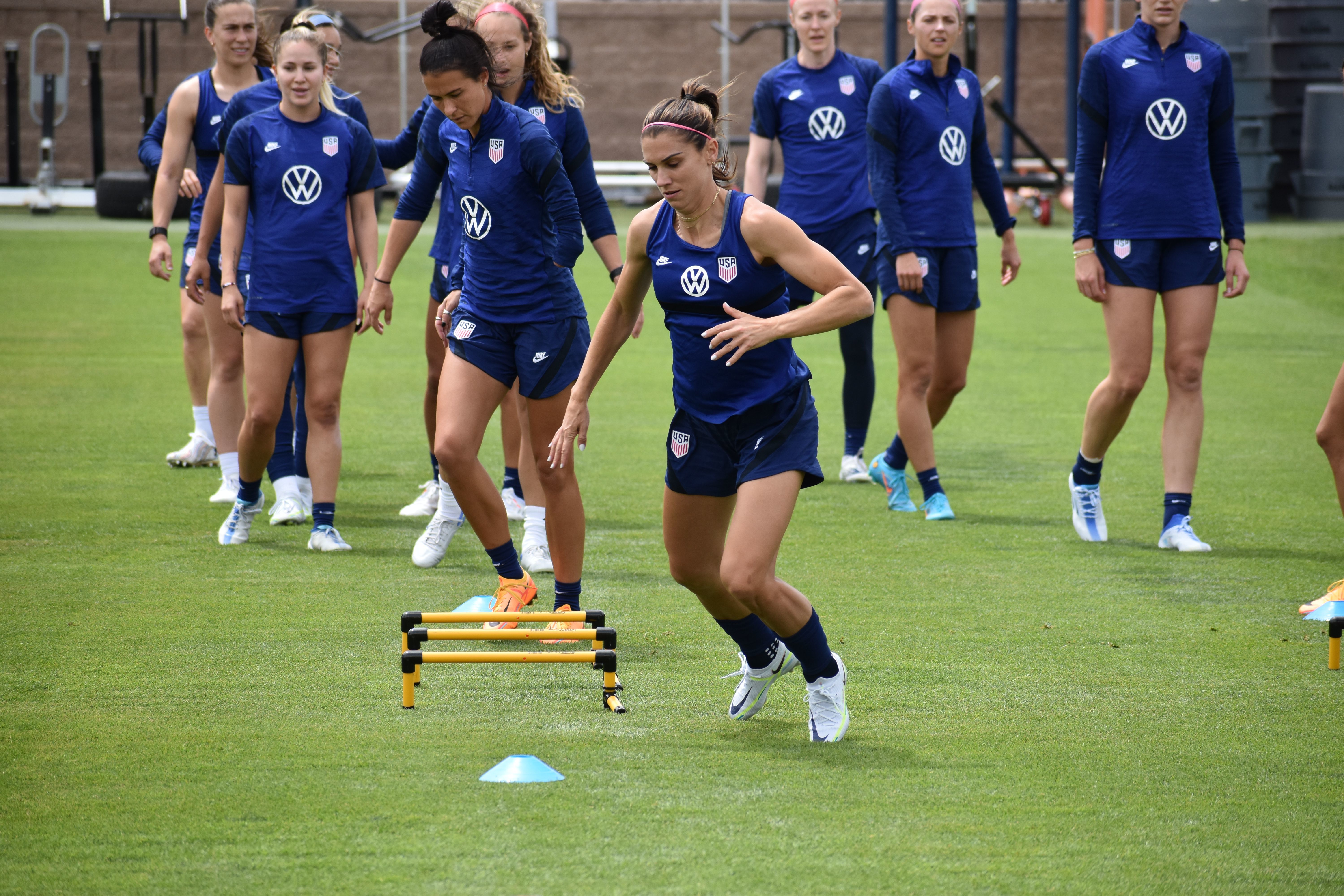
    Alex Morgan (center) works out at the United States women’s national soccer team’s practice in Centennial, Colo., near Denver, on June 21, 2022.

    At another point, she said: “Not being here in the last eight months, I have to bring it back to the basics.”

    Why would a player of her talent and pedigree believe that? The answer was obvious. When that’s how the superstar acts, everyone else follows.

    And whenever a national team player is seen as not fully bringing it — whether on the women’s or men’s side — those words return.

    If Alex Morgan was that way, they should be, too.

    As she spoke now, she again summoned the weight of the crest she wore 224 times.

    “I never took playing for the national team for granted,” she said. “I knew that one day you could be there, and the next day you won’t, if you don’t continue to make a case for yourself. I think that was really the mentality that the previous generation — Abby, Shannon Boxx, Christie Rampone — set in stone for this team, and maybe it was the previous generation that also instilled that in them.”

    Morgan knew she was perceived — and still is — as the golden girl, attractive to marketers for more reasons than just her skills. But people in the soccer world who know her well knew she put in the work.

    “For me it was like, you don’t walk into this team and wear this jersey with the assumption that you deserve to be there day in and day out without working for it, sunup to sundown,” she said. “A lot of people think with me it was an easy ride, and I was a real shoo-in on the team for 13, 14, 15 years, and that’s just not the case. I fought to be there every single day.”

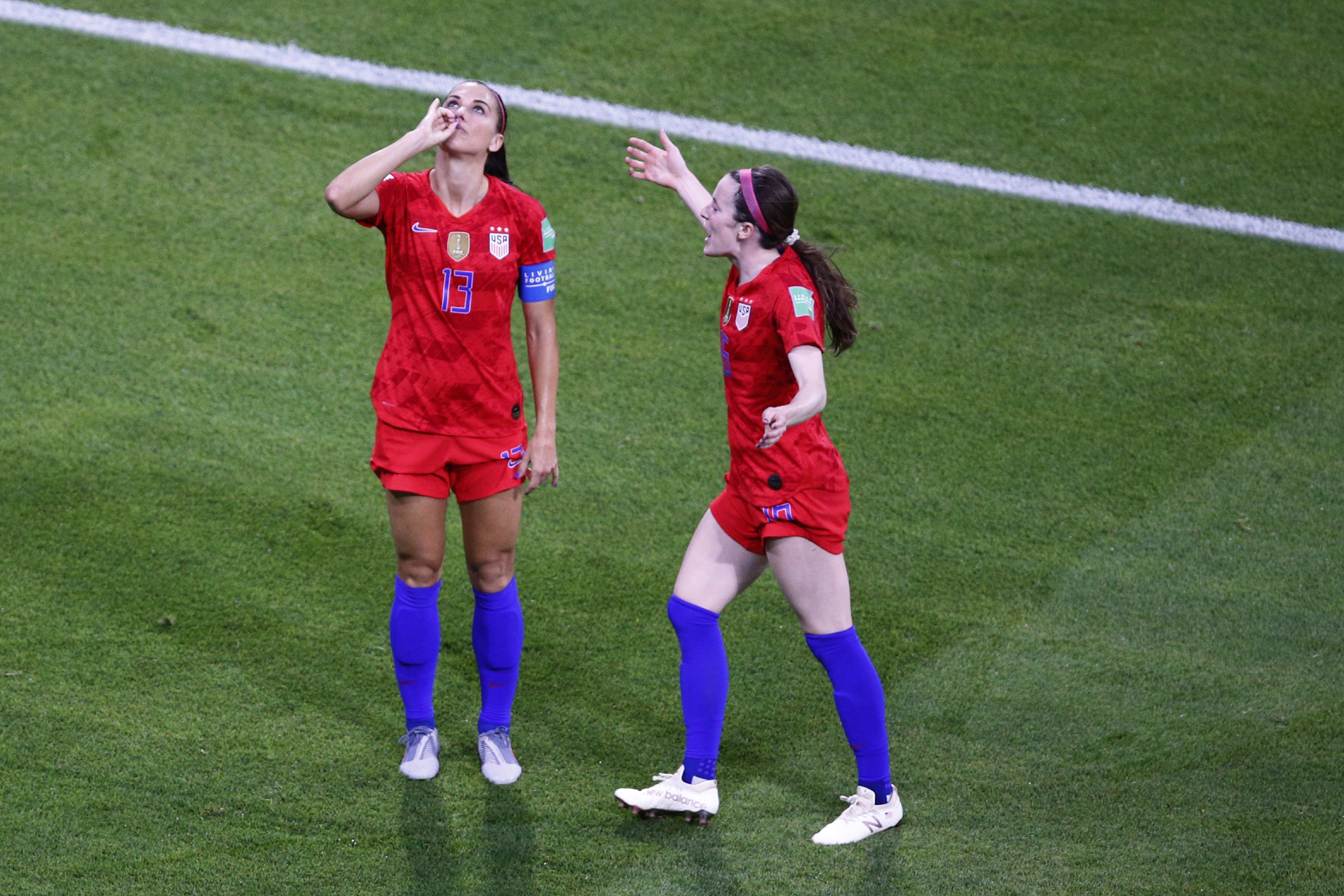
    The most famous of Alex Morgan’s many goal celebrations: drinking tea after flattening England in the 2019 World Cup semifinals, on her birthday no less.

    And though she has given countless interviews in her career, she had not forgotten that one from 2022 and the circumstances that surrounded it.

    “I had injuries, and I was out on maternity leave, and I needed a break after grinding and having my daughter, and this is exactly when we talked,” she said. “[I] was being omitted from the team for a certain amount of months because I needed a little bit of an extra break because I hadn’t stopped since having my daughter.”

    When Andonovski expressed his displeasure, Morgan was ready.

    “I said, ‘This is how you’re going to get the best out of me, is if I take this break,’” she said. “I’m glad I’d made that decision at the time, but I had to grind to get back into it.”

    Vlatko Andonovski (left) dropped Alex Morgan from the U.S. squad after the 2021 Olympics but brought her back in 2022 and kept her involved through the 2023 World Cup.

    She was ready for that, too.

    “That mentality is not one that I created on my own,” Morgan said. “It’s one that this team had from the very start, from the very first time that I entered into the team: one of not making assumptions, and one of working for everything that we earned, and knowing that we can never take anything for granted. I hope that players now continue to live by that — certainly, certainly I did.”

    And so, on cue, to the present generation of players whom Morgan will watch from the stands on Thursday. Some of Morgan’s teammates are still going, surrounded by a fleet of young risers aiming for the 2027 World Cup.

    “To be there and to be able to see the players and kind of be in that environment for a little bit is really fun and nostalgic,” Morgan said. “But I think that this team is in a really good place. You want to be in this place where you’re giving players chances a couple of years before you kind of narrow in on that core group when it comes to the World Cup year.”

    They likely will be on display at Subaru Park: 18-year-old Lily Yohannes, 19-year-old Claire Hutton, 20-year-olds Olivia Moultrie, Jaedyn Shaw, and Alyssa Thompson — the last two of whom already have major tournament experience.

    “There’s a lot of young players that already have incredibly valuable experience, with either the previous World Cup or Olympics,” Morgan said. “There’s also a lot of opportunity to become leaders on this team. … I feel like all these younger players are making names for themselves, and, yeah, I’m really excited to see [them].”

    Just as they will be excited to see her, the one who set the bar they all want to reach.

  • Lily Yohannes and Alyssa Thompson have arrived at their star turns with the USWNT

    Lily Yohannes and Alyssa Thompson have arrived at their star turns with the USWNT

    There are a few ways to measure who the players of the moment are for the U.S. women’s soccer team.

    One is in the box score, as usual: goals, assists, saves, and so on. Another is measured before kickoff, and with a decibel meter.

    Most of the time, the winner of that contest is a veteran, and that might happen again when the Americans play Portugal on Thursday at Subaru Park (7 p.m., TNT, Peacock). Sam Coffey is an obvious favorite, as is electric playmaker Rose Lavelle.

    But keep an eye — or an ear, in this case — out for two of the U.S. squad’s younger players who are quickly becoming fan favorites. Midfielder Lily Yohannes and winger Alyssa Thompson have all the skills and charisma to be national team mainstays, and their bandwagons are filling up fast.

    Lily Yohannes (center) working out during the U.S. women’s soccer team’s practice Tuesday morning at the Union’s facilities.

    Yohannes plays club soccer for Europe’s most decorated team, France’s OL Lyonnes (formerly known as Lyon). The 19-year-old from D.C.’s Virginia suburbs joined in July, as OL retooled its squad to seek a record-furthering ninth Champions League title.

    She hasn’t needed long to settle in. Last Wednesday, she scored a stunning goal from nearly 45 yards out in her team’s European season opener, a 3-0 win over Austria’s St. Pölten. The play went viral instantly, heightening the anticipation of her first U.S. appearance since June.

    “So many world class players and such a high standard, high level every day in training,” Yohannes said. “Every day is super-intentional, and you just have to, like, stay switched on every day. And I think that’s something that’s super good for me and for my development to have.”

    She has two American teammates at the club, midfielders Lindsey Heaps — the national team’s longtime captain — and Korbin Shrader. Heaps had already taken Yohannes under her wing in U.S. camps, and has done so more now.

    “I think she’s just such a quality player and such a footballer,” Heaps said. “And to have her in Lyon, to now be there and learn from all the players that are there, is such a an incredible experience for her. But I think she just fits in our team so well, as she started out.”

    Heaps blazed the trail 11 years ago for American teens who skip college to turn pro in Europe, and Yohannes is one of many who’ve followed her. But even the veteran had to rave about that long-range goal, calling it “absurd when you think about an 18-year-old taking a chance like that.”

    From L.A. to London

    Thompson joined Chelsea, England’s biggest team, this summer from the NWSL’s Angel City. The Blues have never won the women’s Champions League, and have never been shy about craving it.

    So it turned heads when they not only brought Thompson to London, but did so for a $1.3 million transfer fee — not small by women’s soccer standards, but well below expectations for a 20-year-old.

    She has also started quickly. At the same hour as Yohannes’ goal, Thompson notched a goal and an assist in Chelsea’s 4-0 rout of France’s Paris FC.

    “I really wasn’t thinking about leaving Angel City, and then when I got the offer, like, a week before the transfer window, I felt like immediately that I wanted to go,” Thompson said. “I’ve always wanted to play in Europe, and I felt like this opportunity, I don’t know when it would come again, and Chelsea is such an amazing club, known all over the world.”

    She could see a big picture beyond soccer, too.

    “I was like, I really want to go and experience a different place — I’ve lived in L.A. my whole life,” she said. “I feel like this should be just so good for me, like, as a player, obviously, but as a person too, just developing things that I’ve never had to think about before.”

    There have also been moments of levity. A reporter from The Athletic got the best answer out of Thompson on the day, asking about off-the-field adjustment.

    “They have less AC … I really like it cold when I’m sleeping, so that’s annoying sometimes,” Thompson said, joining a long tradition of Americans lamenting England’s lack of air-conditioning. “And I haven’t tried any of the English food. I don’t like beans in general, so I just wouldn’t try it.”

    Alyssa Thompson (right) working out in a drill during Tuesday’s practice.

    Neither player is new to the national team at this point, or to its devoted fan base. Yohannes debuted in June of last year (and scored that night too) and has played seven games; Thompson has 22 caps, three goals, and three assists, and was on the 2023 World Cup team.

    Thompson narrowly missed making last year’s Olympic squad, but that was always likely to be just a short setback. Now she’s in form, and will likely see a lot of playing time in this month’s games.

    “Alyssa, she fits in seamlessly to to Chelsea’s game,” Heaps said. “She just got her first goal, and I think that’s something that she’s wanted since she’s set foot there in Chelsea. So, very happy for her.”

    A historic day in Chester

    Tuesday marked the return of the U.S. women to the area for the first time in 3½ years, and also something never seen around here.

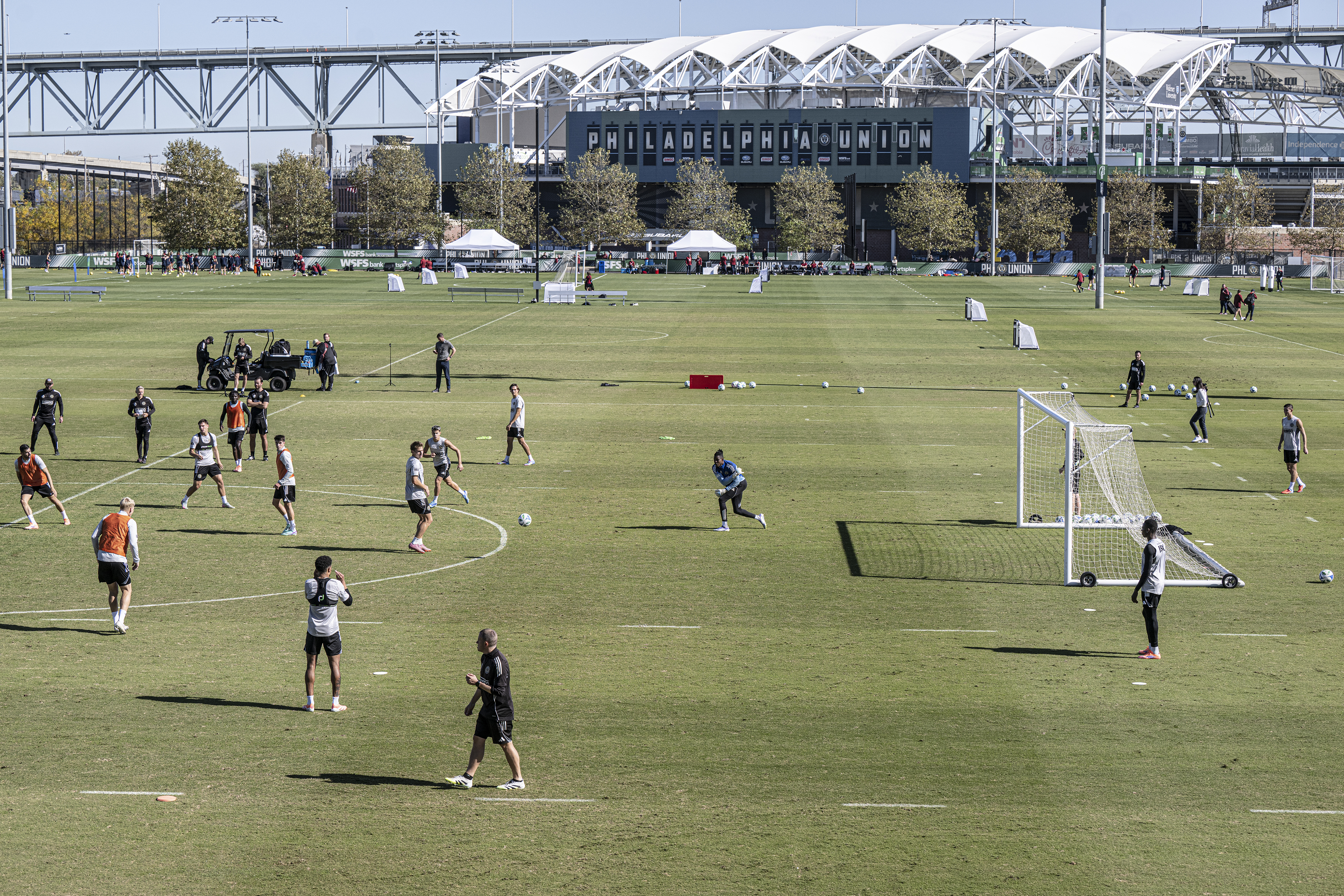
    For a few minutes in the late morning, the national team and the Union were practicing in the club’s training complex at the same time, with one squad at each end of the three grass fields along Seaport Drive.

    It was the first time the Union shared the space simultaneously with another professional squad, and it likely won’t be the last.

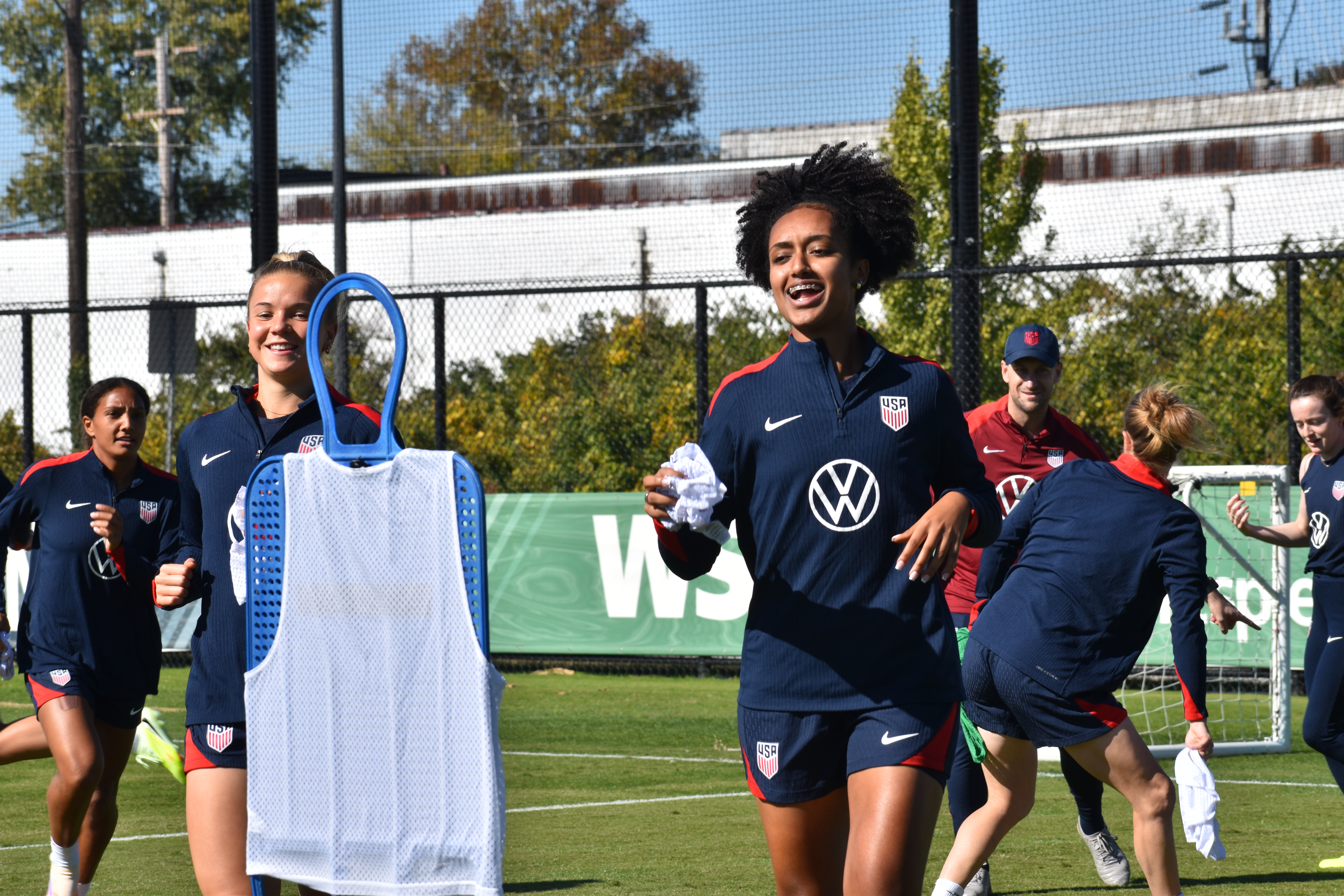
    A view from above the fields on Tuesday morning, with the Union in the foreground and the U.S. women in the background.

    “The appetite for soccer here is incredible,” said longtime Union captain Alejandro Bedoya, who will attend Thursday night’s game with his daughter. “There’s so much talent when you look at the men’s national team, for the women’s national team, for the Union academy, the players that have come through here. … It’s amazing. And what this sportsplex means, it was a great initiative to get this built.”

    The closest previous occasion was earlier this summer, when Chelsea borrowed some of the Union’s fields but did most of their work inside Subaru Park. The nearest thing to an overlap was when the English club invited a few Union reserve squad players to come over from their practice to fill out a scrimmage.

    Next year, the complex will be a base camp for one of the teams in the World Cup. But it will be mostly reserved for that, with MLS planning to shut down its schedule during the tournament.

  • The U.S. launches a continent-wide bid for the 2031 women’s World Cup, and Philadelphia wants in

    The U.S. launches a continent-wide bid for the 2031 women’s World Cup, and Philadelphia wants in

    NEW YORK — After months of speculation and waiting, the United States’ big bid to organize the 2031 women’s World Cup across the continent became official on Monday.

    The U.S. launched its effort with Mexico, Costa Rica, and Jamaica, with one eye on the tournament’s expansion to 48 teams and another on giving women’s soccer in the Concacaf region a big boost.

    “We’re proud to lead this bid, and we chose to do it together with our Concacaf partners because this moment is bigger than any one country,” U.S. Soccer Federation president Cindy Cone said at a news conference with officials from the three other countries and a number of former star players.

    More than 30 U.S. cities have expressed interest in getting involved, including Philadelphia. The city was a host the last time the women’s World Cup was in the U.S., in 2003, and will host the men’s tournament for the first time next year.

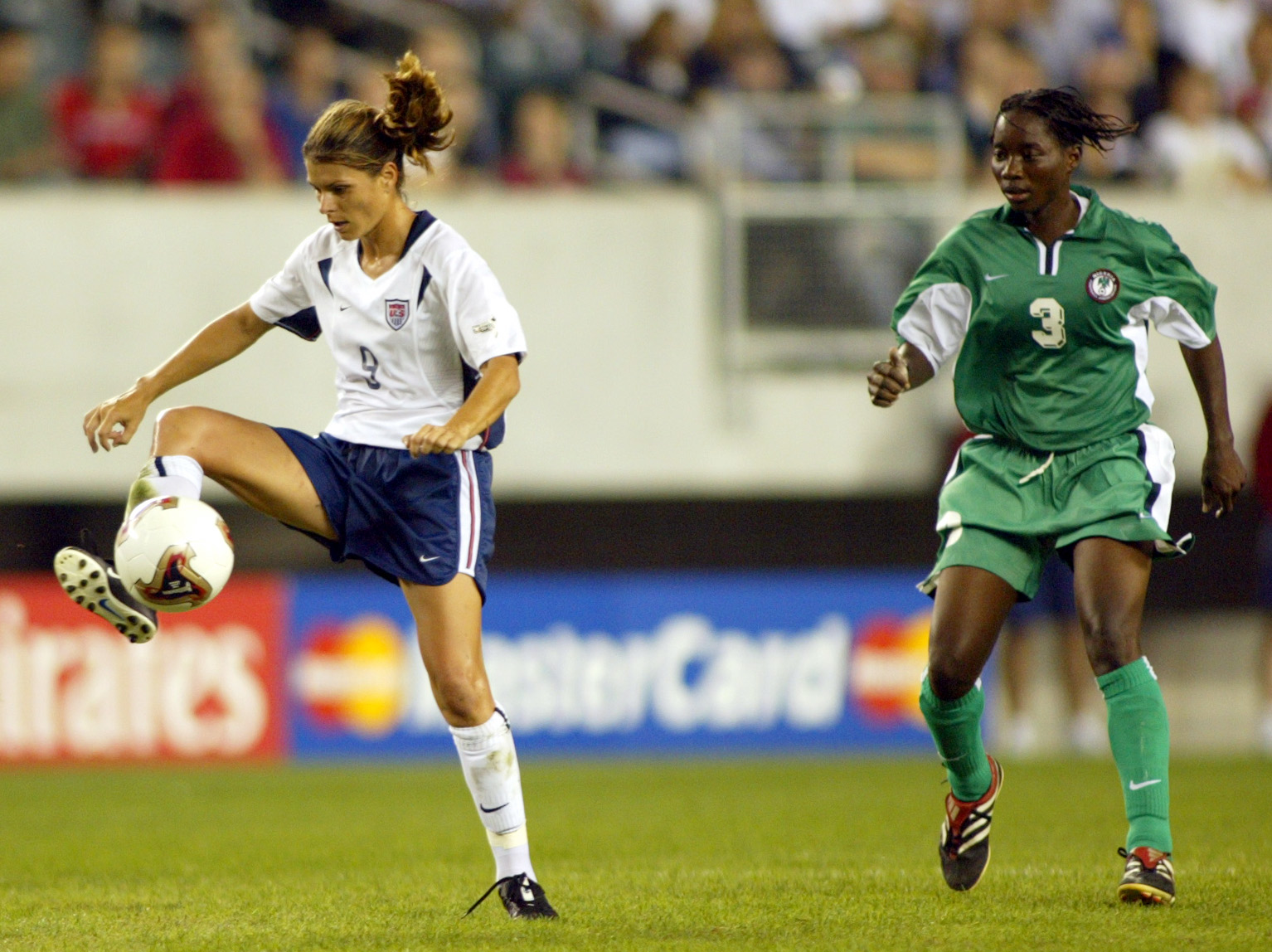
    Mia Hamm (left) led the United States’ win over Nigeria at Lincoln Financial Field in the 2003 women’s World Cup.

    “We are excited for the possibility to host the women’s World Cup and learning the bid process, and we’re definitely interested to learn more,” PHL Sports deputy executive director Brea Stanko told The Inquirer. “We hosted the women’s World Cup in 2003 — it’s grown exponentially. It was a great event for us, and we’re excited to see what we could bring here.”

    The World Cup would come a year after Philadelphia’s WNBA team launches, continuing the growth of women’s sports in the city.

    “You can see the growth of the sport, as we heard tonight,” said Maria Grasso, chiefs sales officer for the Convention and Visitors Bureau. “I think that’s truly exciting for us. We have a tremendous relationship with FIFA, as well as U.S. Soccer, which just gives us all the reasons we [are] really excited about this, like the rest of this room.”

    The official bid book is due in November, and this bid is expected to be the only one worldwide. While it’s not official yet, it’s likely just a formality. And though the due date is a month from now, the host cities don’t have to be officially set when the bid book goes in.

    U.S. Soccer Federation CEO JT Batson in January.

    Cone and U.S. Soccer CEO JT Batson said the selection process won’t happen until after next year’s men’s tournament is done, given how much work is going into that. (For comparison, North America’s 2026 men’s bid won a vote in 2018, and cities were picked in 2022.)

    “As the only bidders for the FIFA 2031 women’s World Cup, I admit I like our chances,” Cone said with a laugh. “When we are officially selected, we’ll work with FIFA to deliver the biggest, most impactful women’s sporting event in history.”

    FIFA’s vote is expected next April at the global governing body’s congress in Vancouver, the host city of the 2015 women’s World Cup final and one of the many hosts of next year’s men’s tournament.

    “Our confederation’s commitment to women’s football has never been stronger, and hosting the FIFA women’s World Cup [in] 2031 will build on this momentum,” Concacaf president and FIFA vice president Victor Montagliani said in a statement. He was unable to attend in person.

    U.S. Soccer president Cindy Cone

    Cone said when she pitched the multi-country idea to Montagliani, “he didn’t hesitate for a second. He jumped in immediately, offered his full support, and has been one of the strongest advocates for our vision from day one.”

    It will be the third time the U.S. hosts the tournament, after the groundbreaking 1999 edition and the on-short-notice 2003 edition. Mexico hosted a world championship for women’s national teams in 1971 before FIFA officially launched a women’s World Cup 20 years later, and the country will become a three-time men’s World Cup host next year — 1970, 1986, and 2026.

    Costa Rica and Jamaica, meanwhile, will host a senior-level FIFA tournament for the first time.

    “One of our goals of an inclusive 2031 women’s World Cup was [to be] an instigator for investment, obviously in our countries, but also across the region and ultimately the world,” Batson said. “And for Jamaica and Costa Rica to show the world that they can host a Women’s World Cup and obviously field great teams, that is a great motivator to programs and countries all across the world.”

    Mexico hosted an unofficial women’s soccer world championship in 1971. In modern times, FIFA has officially recognized the event’s significance in growing the sport.

    The proposed venues in the other countries aren’t official yet, nor is how many games each country will get. Mexico will have choices to make, with Monterrey, Guadalajara, and Mexico City set to be host cities next year. Monterrey in particular has become a hotbed for the women’s game in recent years.

    Costa Rica and Jamaica will presumably use their national stadiums: the former’s 42,000-seat modern venue in San José, and the latter’s historic 35,000-seat venue in Kingston.

    “To realize that there’s a chance that globally, people can experience this on this great of a scale, and for the U.S. to recognize the beauty of that, and to be in partnership with us, it means so much,” said former Jamaican national team player Cheyna Matthews, who played in the 2019 and 2023 World Cups and for seven years in the NWSL.

    “I just think about the impact that this is going to have for young girls in Jamaica,” Matthews continued. “I think even young boys who aspire to be part of the Reggae Boyz [Jamaica’s men’s team], I think that this just provides an opportunity for them to see it. Because some can’t travel, some have never left Kingston. … I think that it will obviously inspire, but it’ll continue to have that dividend later on.”