Tag: U.S. women’s soccer team

  • USWNT captain Lindsey Heaps will join NWSL expansion team Denver Summit

    USWNT captain Lindsey Heaps will join NWSL expansion team Denver Summit

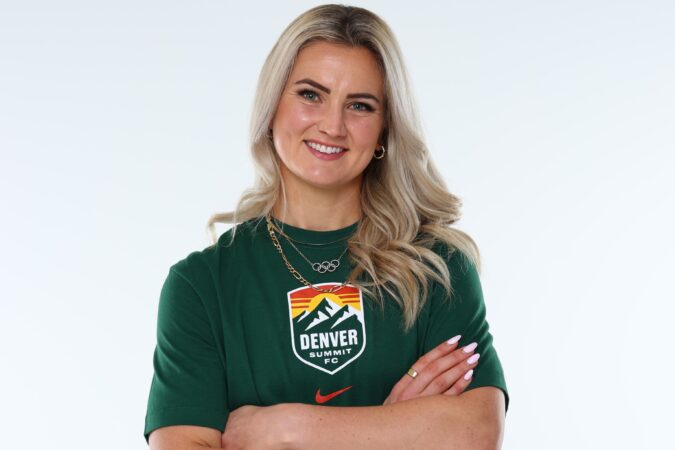
    U.S. women’s soccer team captain Lindsey Heaps will join NWSL expansion team Denver Summit in June, ending a four-year tenure at France’s OL Lyonnes to move to her hometown’s new club.

    The move had been speculated about on both sides of the Atlantic for some time, but was not finalized until now. Heaps will depart OL at the end of the ongoing European season, in which she will almost certainly win a fourth French league title and could add a second Champions League crown.

    From the moment the Denver team was announced last January, the Golden, Colo., native knew she wanted to play there someday.

    “One thing I wanted to do was kind of take the Denver aspect out of it, and really look at it from a football perspective — what the ownership was doing and what we were trying to create here at Denver Summit,” Heaps said Monday. “As hard as it was to to take the Denver and the home aspect out, it was something that was very intriguing to me. And it aligned with everything that I wanted to do, and I wanted it to be the right move for my career.”

    Once Heaps was satisfied with that, the emotional part was easy. Along with being closer to her husband, San Diego FC sporting director Tyler Heaps, she’ll get to play in front of her parents, the rest of her family, and many friends in Denver far more often than she can now.

    “It was amazing once it finally became real,” she said. “The feeling of going and being able to play in my home state, and for such an incredible community, and also a club that just wants to do things in the right way — I’m very, very thankful and I’m just excited to get going.”

    She later added: “Knowing that I could play in my home state with my family and friends close by, obviously closer to my husband as well, it is really hard to pass up that opportunity with everything being said.”

    ‘Always seek a new challenge’

    She previously played in the NWSL from 2016 to 2021 with the Portland Thorns, after starting her career with Paris Saint-Germain in 2012 — famously becoming the first major American women’s soccer prospect to spurn college as a teen.
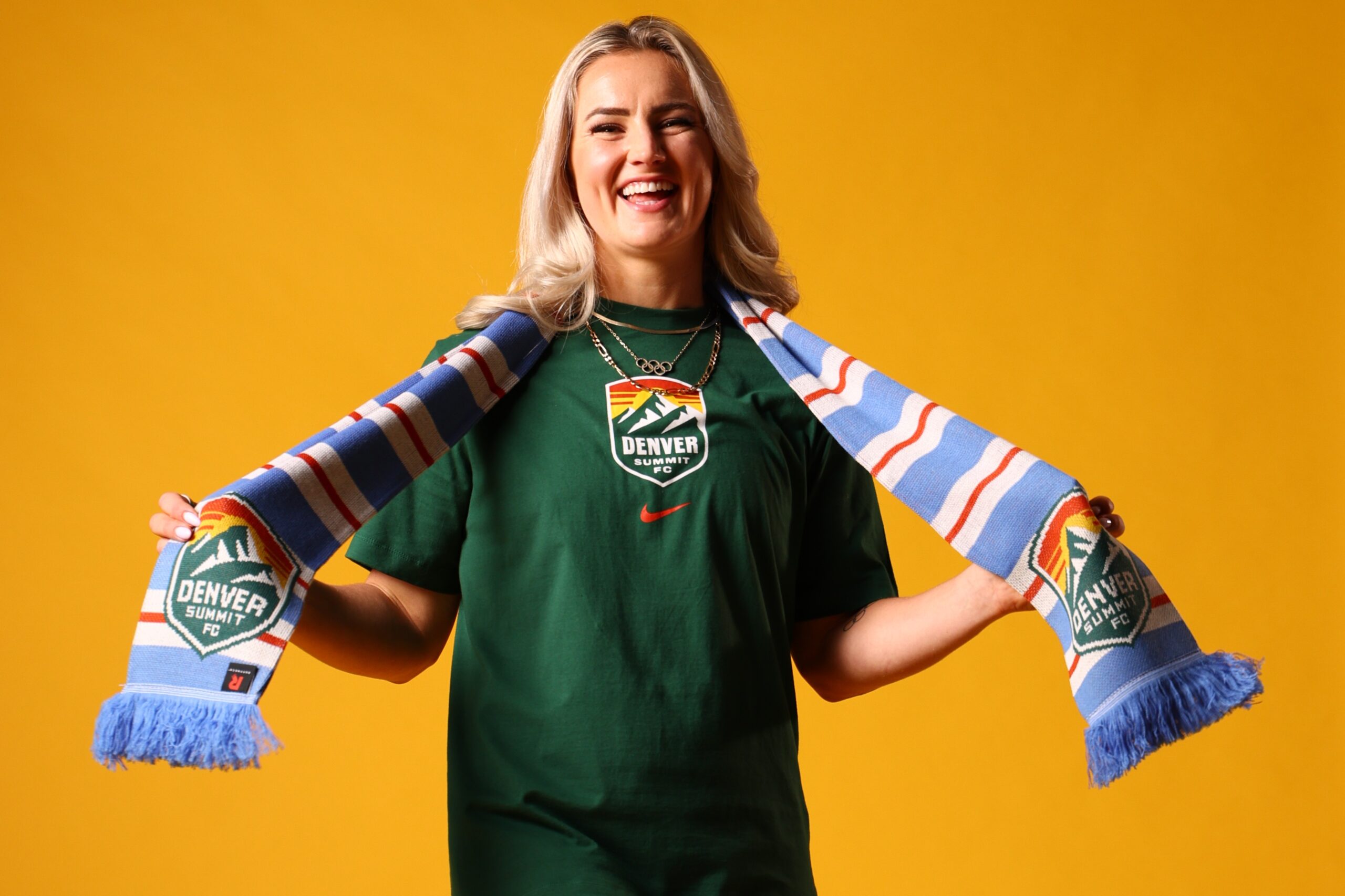
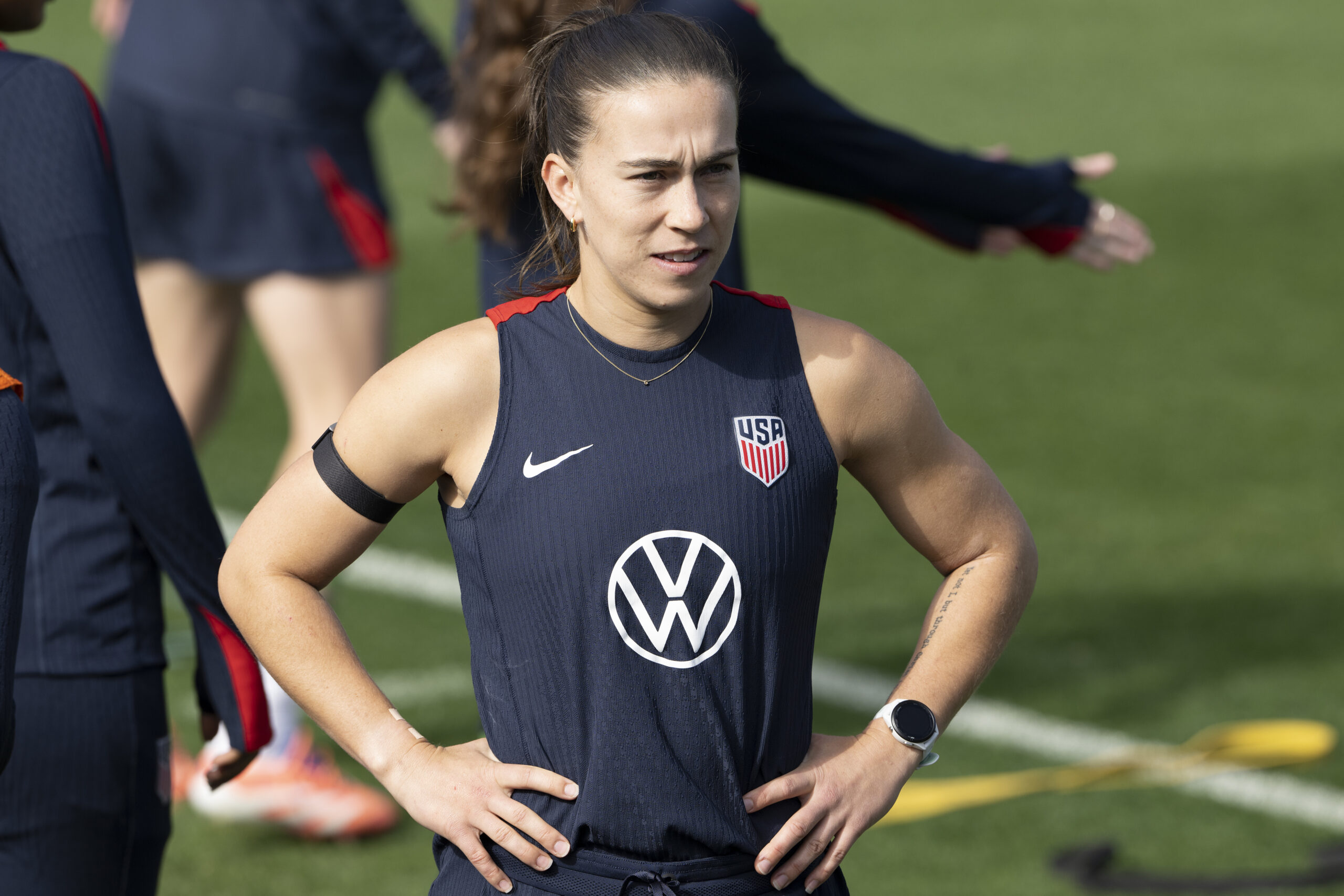
    Lindsey Heaps, a native of suburban Denver, will come home to join Denver Summit FC.

    Heaps won the 2017 NWSL championship and two regular-season titles with the Thorns, and with the U.S. won the 2019 World Cup and 2024 Olympics. Her 170 U.S. caps rank 19th all-time, tied with Carla Overbeck.

    The timing of the announcement will be noted by fans who have a close eye on the battle between the NWSL and European clubs for U.S. stars. Sam Coffey still seems to be on the cusp of moving to Manchester City, and the former Penn State star was at the team’s home game Sunday.

    Trinity Rodman’s future, meanwhile, remains undecided. The NWSL’s “High Impact Player” (HIP) provision designed to keep her in the league remains contentious, and the NWSL Players Association wants to take the league to arbitration over it.

    It was no surprise that the subject came up again Monday.
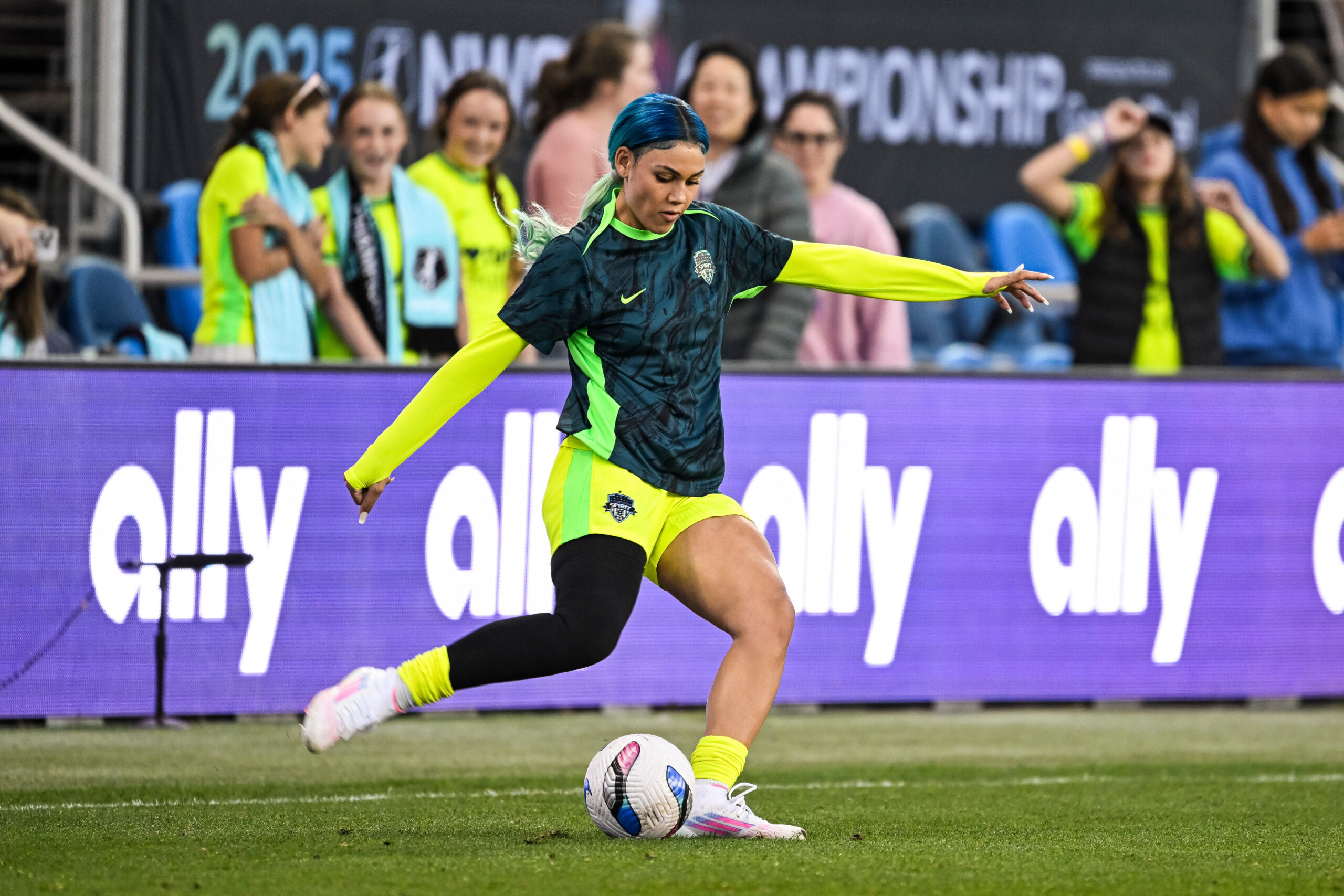
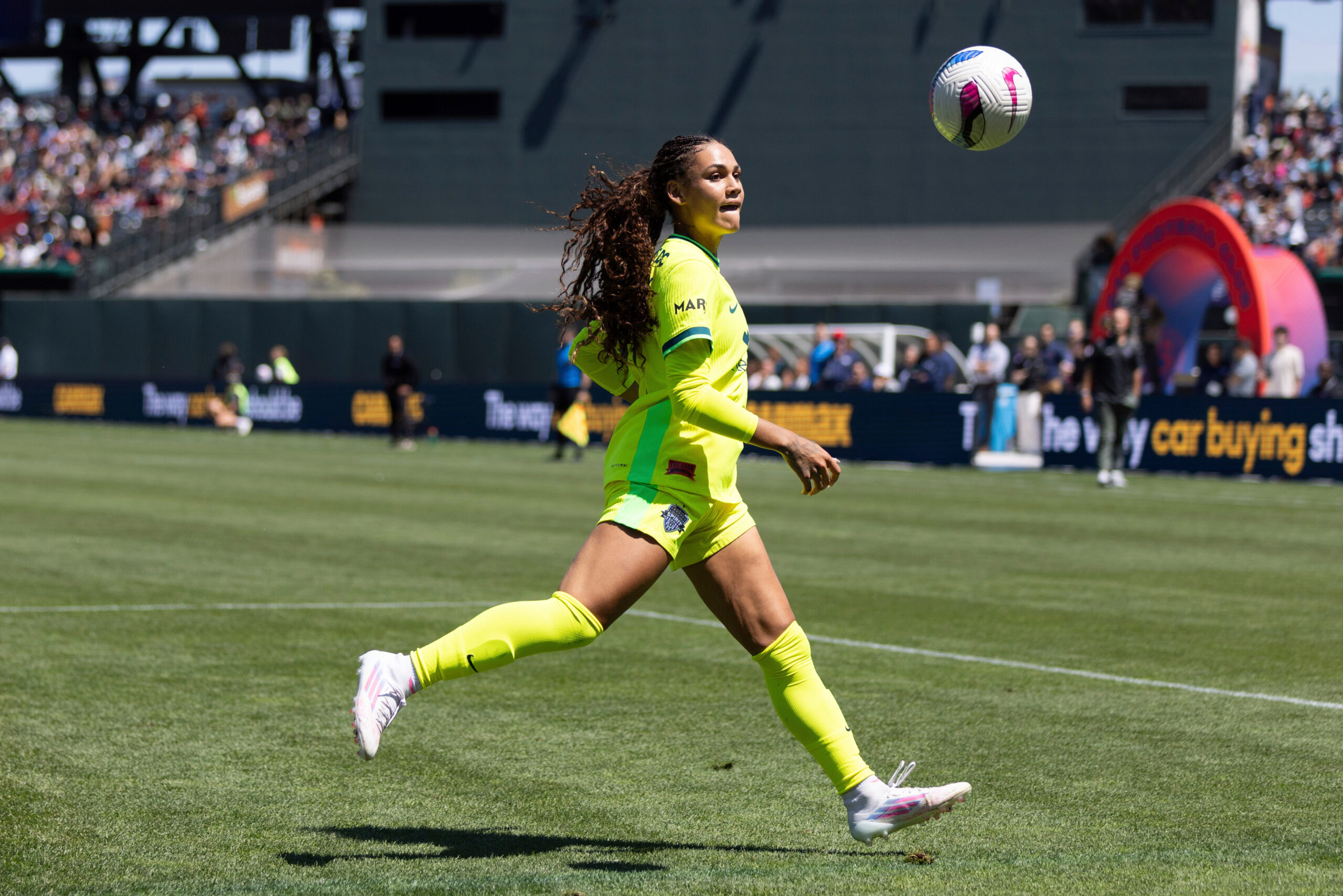
    Trinity Rodman’s uncertain future is the biggest story in the women’s soccer world right now.

    “I think the most important thing I want to put out there is, with other national team players, younger players, my message is always: one, you want to do the right thing for you,” Heaps said. “But also, that you should always seek a new challenge. I always give the advice that I think it is so special to go play in a different environment, in a different culture.”

    She also applied the principle to players from European nations who’ve come to the NWSL, such as the San Diego Wave’s French veterans Kenza Dali and Delphine Cascarino. Heaps has played with both over the years.

    “I think it is so special to see how they’re thriving and doing so well,” she said.

    The HIP controversy

    Heaps qualifies for HIP status, which means she can be paid beyond the league’s salary limits. Denver GM Curt Johnson said the team had wanted to sign Heaps no matter what and for some time, but will use the status on Heaps’ contract if it stays in place.
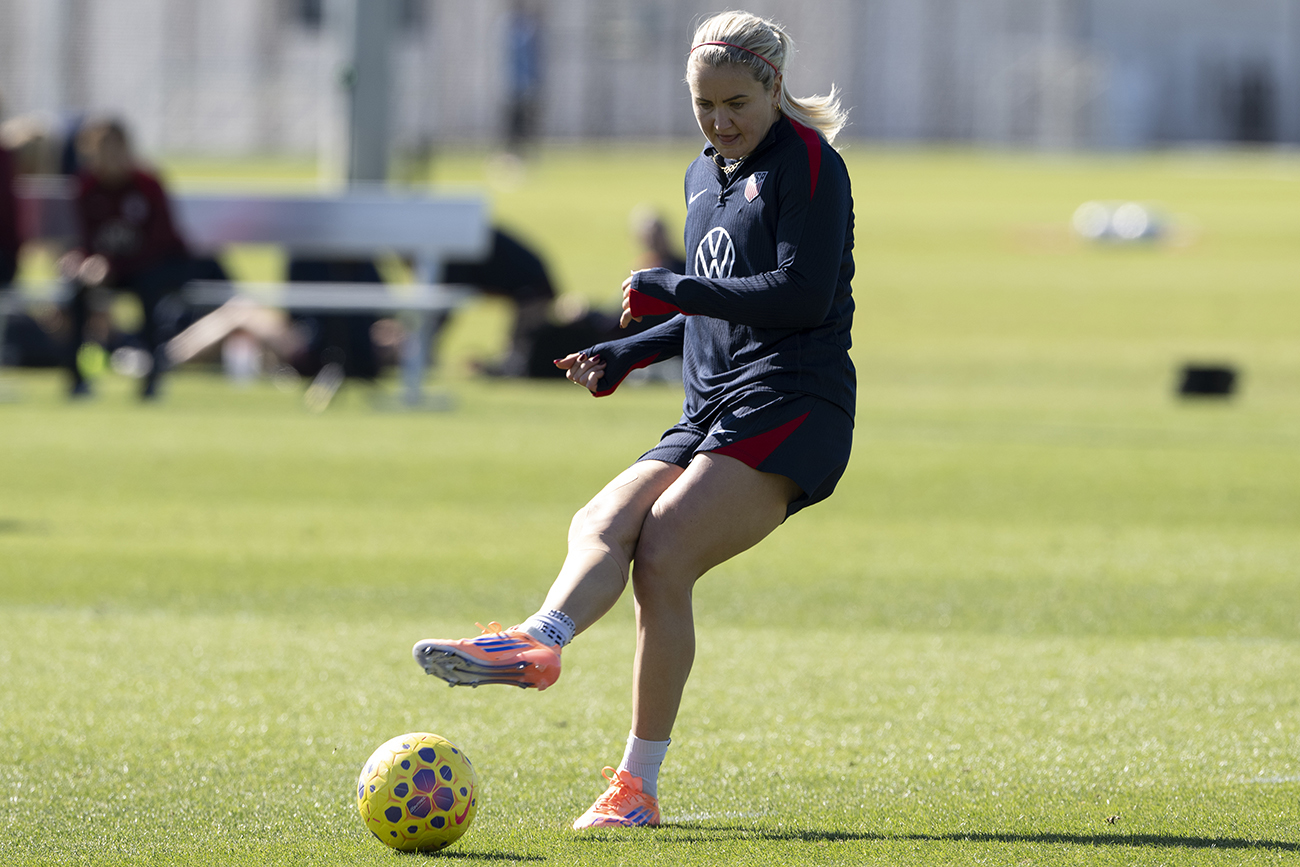
    Lindsey Heaps at work with the U.S. women’s national team when it came to Chester in October.

    “This was something that predated the HIP rule,” he said. “Our intention was to sign Lindsey, then the HIP rule came along.”

    The rule doesn’t take effect until July 1, which puts teams in the awkward position of having to sign contracts now that are backloaded to incorporate the status — while also waiting to see how the arbitration plays out.

    Each team will have a pot of $1 million to spend beyond the salary cap on players who qualify. There is no limit on how many players per team can be given the status, but there is a natural limit on how many ways it makes sense to divide the cash.

    “When a player is assigned the HIP category, the salary cap charge is in the salary cap, and then there’s a pool of money outside the salary cap, is how it works,” Johnson said. “But we’re moving forward with the assumption that this will fall in the HIP category, and hopefully we’re moving on to finding our next player that fits that category.”

    He deferred the rest to the league. A spokesperson there confirmed how Johnson described things, and declined further comment.
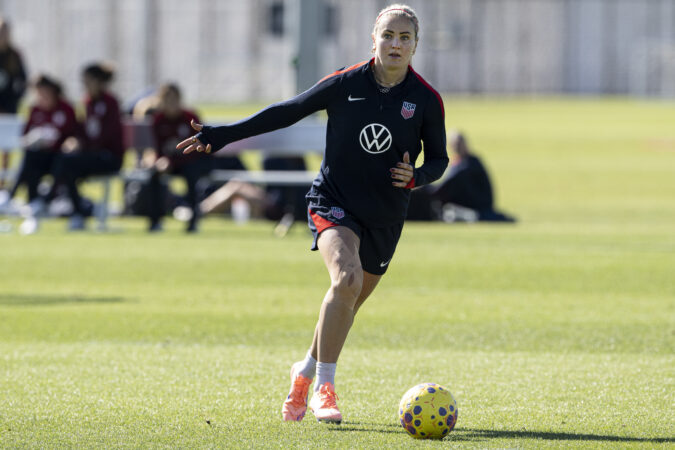
  • Lindsey Heaps is a natural in the Champions League. But will other USWNT stars fit well in Europe?

    Lindsey Heaps is a natural in the Champions League. But will other USWNT stars fit well in Europe?

    Although some of Lindsey Heaps’ games in Europe aren’t easy for American fans to watch, the chances that do come along show why she’s so comfortable there.

    The 31-year-old midfielder plays for her club, France’s OL Lyonnes, as more of a facilitator than the do-it-all general she’s often been cast as with the United States — not just by fans, but by coaches over the years.

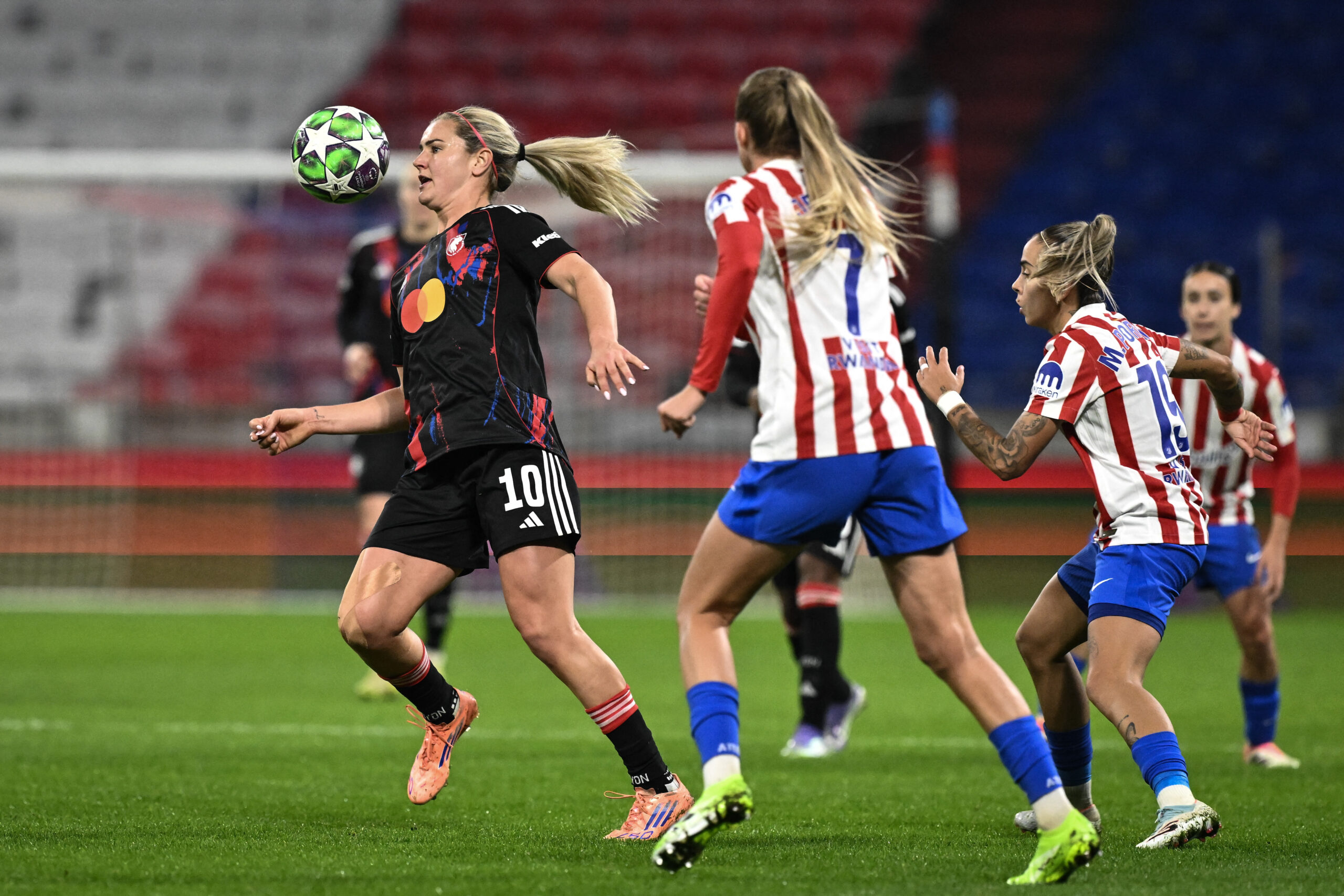
    It’s easy to focus on Heaps not scoring, especially given that she started her career as a forward before moving into midfield. But her last game for OL, against Spain’s Atlético Madrid in the Champions League, showed a different side of Heaps.

    She completed 42 of 44 passes that night, continuing a pace of a 90% pass completion rate in Champions League games this season, and had eight defensive recoveries. The players around her did most of the creating, especially midfielder Melchie Dumornay and wingers Tabitha Chawinga and Kadidiatou Diani.

    Any team would dream of having OL’s squad of superstars. The club was the standard-bearer in Europe long before American businesswoman Michelle Kang bought it in 2023 (she also owns the NWSL’s Washington Spirit and England’s London City Lionesses), and it has remained at that level.

    No team in France comes close to OL’s 18 league titles, all won in the last 19 years — as in, every season except one. Nor is any team in Europe close to OL’s eight Champions League triumphs from 2011-22, even though Barcelona is the continent’s top team right now.

    Heaps has three league winners’ medals and one from the European Cup, and could add to both totals this season. OL is running away with the French league, and earned a round-of-16 bye in the Champions League thanks to an unbeaten group stage run.

    “It’s unbelievable, I think this year especially,” she told The Inquirer. “New coach, new culture a bit, standards, competitiveness. The training is unbelievable in everything that we’re doing, and obviously you see it on the pitch as well. But we take each game at a time, and we just keep rolling.”

    Lindsey Heaps (left) on the ball during last month’s OL Lyonnes-Atlético Madrid game in the UEFA women’s Champions League.

    A high value on high standards

    That new coach is a familiar name: Jonatan Giráldez, who joined OL from the Washington Spirit in the summer. It was a controversial move, since Kang was accused of taking from one of her teams to boost another.

    But that claim is above Heaps’ pay grade.

    “Honestly, I think I speak for everyone on the team: he is such a quality coach,” Heaps said. “You just learn so much, and even for me, I want to continue learning, or looking at the game in a different way, or tactical adjustments, or things like that. … He wants us to win so badly, and he wants us to do so well as players, and he cares about us — he cares about how we do and how we perform, but also us as people.”

    Giráldez returned the praise.

    “A very, very important player,” he said of Heaps. “Her role on the field is beyond the tactical, because she’s able to understand a lot of situations on the field — when the team has the ball, when the team doesn’t have the ball. … I’m very happy to have her in the team.”

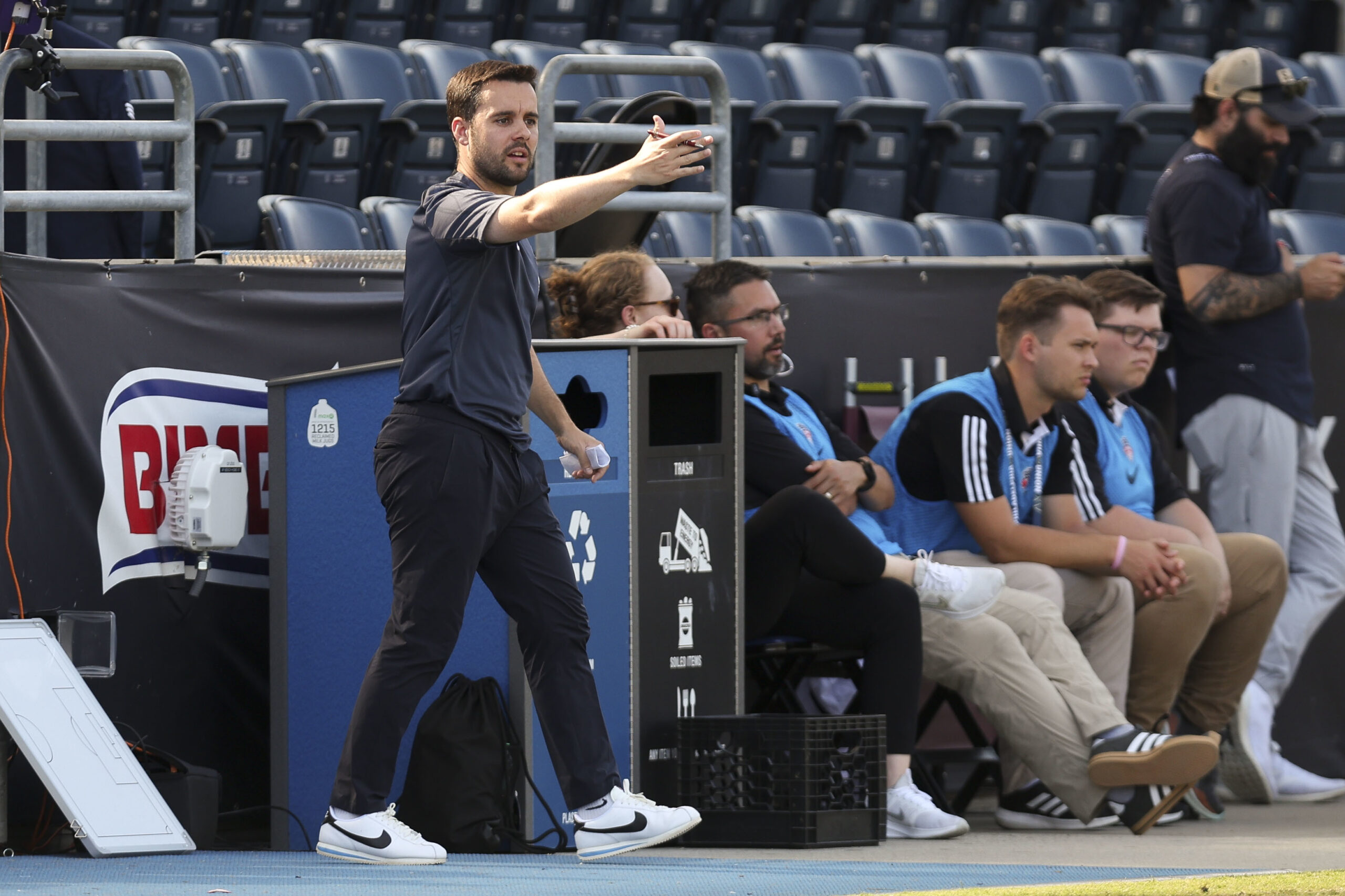
    Jonatan Giráldez on the sideline at Subaru Park when the Washington Spirit played a game there in 2024.

    Heaps mentioned the team’s “training environment” a few times in the interview, praising the high standards there. That counts for a lot, especially among U.S. national team stalwarts.

    For lack of a better way to put it, the top American players have long relished getting their butts kicked on a daily basis, whether by the NWSL’s competitive balance or the famed ferocity of U.S. practices.

    Heaps is the latest in a lineage from Mia Hamm through Abby Wambach, Heather O’Reilly, Julie Ertz, and Carli Lloyd, all of whom spoke just as bluntly (and sometimes more so). Now Heaps wants to pass it on to a new era.

    She gets to do that in Lyon, not just with the national team. The club’s squad includes 22-year-old American midfielder Korbin Shrader and 18-year-old Lily Yohannes, the latter of whom is starting to meet the hype as a generational talent.

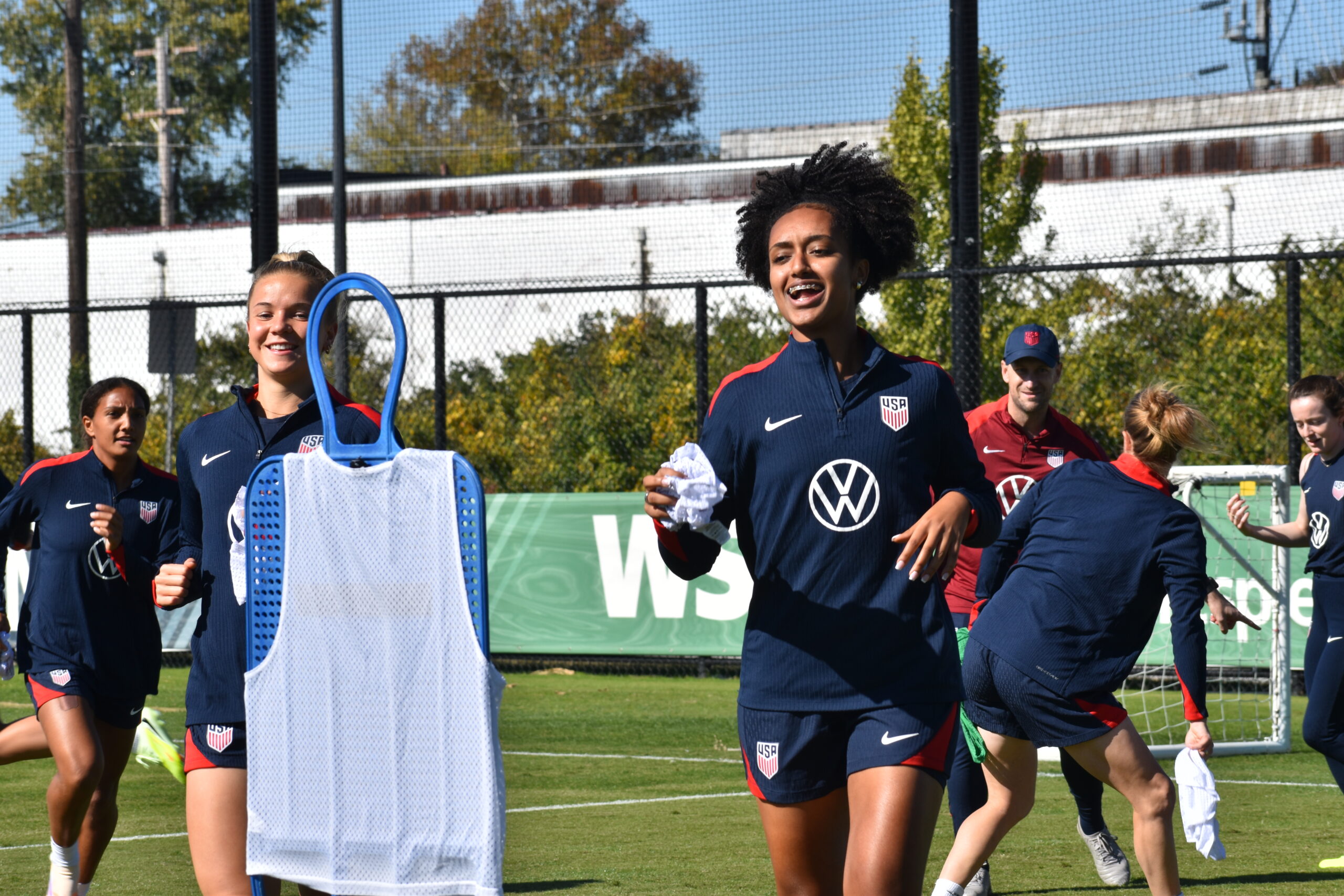
    Lily Yohannes (center) at work with the U.S. women’s soccer team in Chester in October.

    ‘The best midfielder in the world soon’

    Unfortunately, Yohannes hasn’t gotten to play much in the Champions League this season. She didn’t play at all against Atlético Madrid, where the tactical matchup would have been a great lesson.

    Heaps also wanted that, but she preached patience.

    “We all need to remember that she’s 18 years old,” she said. “At the end of the day, she needs to keep doing her thing, because she’s been playing so well — she’s been playing well with the national team, she’s training well here. And like I said before, it is just such a competitive environment.”

    But Heaps is not immune to the buzz around Yohannes, and didn’t mind indulging in some.

    “I know these games mean a lot for her, but her ceiling is so, so high,” she said. “I just said to her that no matter what, in a few years from now, you’re going to remember games like this that maybe you don’t come into. But you’re going to be a starting player and a non-stop player, and I believe the best midfielder in the world soon to come.”

    Yohannes has played her entire career in Europe, and Heaps has played eight of her 14 professional years there. The American contingent across the Atlantic keeps growing, with Penn State product Sam Coffey soon to join it at England’s Manchester City.

    Will playing overseas fit other Americans as well as it does Heaps? The question is always on the table, but it’s in bright lights above Trinity Rodman’s head right now. Her standoff with the NWSL over getting paid what she’s worth — with Kang on her side, trying to structure a contract within the league’s salary rules — has naturally led to European suitors chasing her.

    It might also reveal a truth that Europe’s chattering class doesn’t like admitting. Very few European clubs are truly at a high enough level to be right for elite U.S. talents.

    Lyon is one for sure, but there would be an even bigger uproar if Rodman moves there. Barcelona is another, but the Spanish giants don’t sign Americans. Manchester City, Arsenal, and Chelsea measure up in England, but Chelsea’s roster looks too loaded to have room for Rodman right now.

    Trinity Rodman’s uncertain future is the biggest story in the women’s soccer world right now.

    ‘Do what’s best for her’

    Beyond them? Paris Saint-Germain was in that class, but has fallen hard this year. Germany’s Wolfsburg is far from its past glories, and Bayern Munich still has a ways to rise. Real Madrid and Manchester United have stars, but their ownerships aren’t trusted to build truly top programs.

    The highest tier is really just the first five clubs you read above, and that’s not much.

    Then add in Rodman’s huge commercial impact, which would be diminished going abroad — less so in England, but still notably.

    Many clubs outside England also have poor attendances. OL averages just over 5,000 in a 59,000-seat stadium despite all its stars. PSG plays almost all its French league games at a 1,500-seat field within the bigger club’s practice facilities, far out in the Paris suburbs. Both are a far cry from the 15,259 that Washington averaged this year, or the even bigger crowds in Los Angeles and Portland.

    Not for nothing, then, did U.S. legend Tobin Heath — who played for PSG, Manchester United and Arsenal amid many years in American leagues — recently say Rodman should stay in the NWSL.

    Tobin heath during her playing days with Manchester United in 2020.

    “I advise a lot on players going or staying, and 95% of the time, I will usually say go,” she said in an interview on fellow former superstar Megan Rapinoe’s podcast. “I think that her game will be 1000% louder here. I think she can be the face of the league.”

    At the time Heaps was asked, the NWSL was still putting together its new High Impact Player rule. She had heard about it, but the details hadn’t all been published yet — including the controversial rules on how players qualify. So Heaps chose her words carefully, but she had plenty of them.

    “I don’t think it’s a bad idea,” she said, tying in what she has seen over the years from MLS’s Designated Player rule. (Her husband Tyler is San Diego FC’s sporting director.). “If you want some of the best players in the world to come and play in the NWSL, some things do have to change. … We want to continue growing the league. So, what’s the best way of doing that? We’ve got to get the best players there.”

    It was also easy to think Rodman’s situation would be settled by now. Heaps wondered if it might not just come down to salary, but she encouraged Rodman to do what she feels is right.

    “Trinity needs to do what’s best for her,” Heaps said. “The money is kind of on the side of it — obviously, that’s a big thing for us professionals. But Trinity, she’s going to make the decision that’s best for her, and I think that’s the most important.”

  • Trinity Rodman returns to USWNT for January camp even though she isn’t with a club right now

    Trinity Rodman returns to USWNT for January camp even though she isn’t with a club right now

    Though the U.S. men’s soccer team will command the lion’s share of the spotlight this year, the women’s team isn’t scaling anything back.

    That starts Jan. 17, when Emma Hayes gathers 26 players for the program’s annual winter training camp in suburban Los Angeles. It will kick off the 41st year of the women’s team’s existence, and will include games against Paraguay on Jan. 24 in Carson, Calif., and Jan. 27 against Chile in Santa Barbara, Calif.

    Because the camp takes place outside of official national team windows, all 26 players will come from the NWSL. And because Gotham FC is playing in FIFA’s inaugural Women’s Champions Cup in London at the end of the month, the club’s many national team stars — such as Rose Lavelle, Emily Sonnett, and Jaedyn Shaw — were not called up.

    They’re in Europe already, training for a few weeks in Marbella, Spain, before heading north to England. (In fact, they’re at the same complex where the Union will be for part of their preseason camp later this month.)

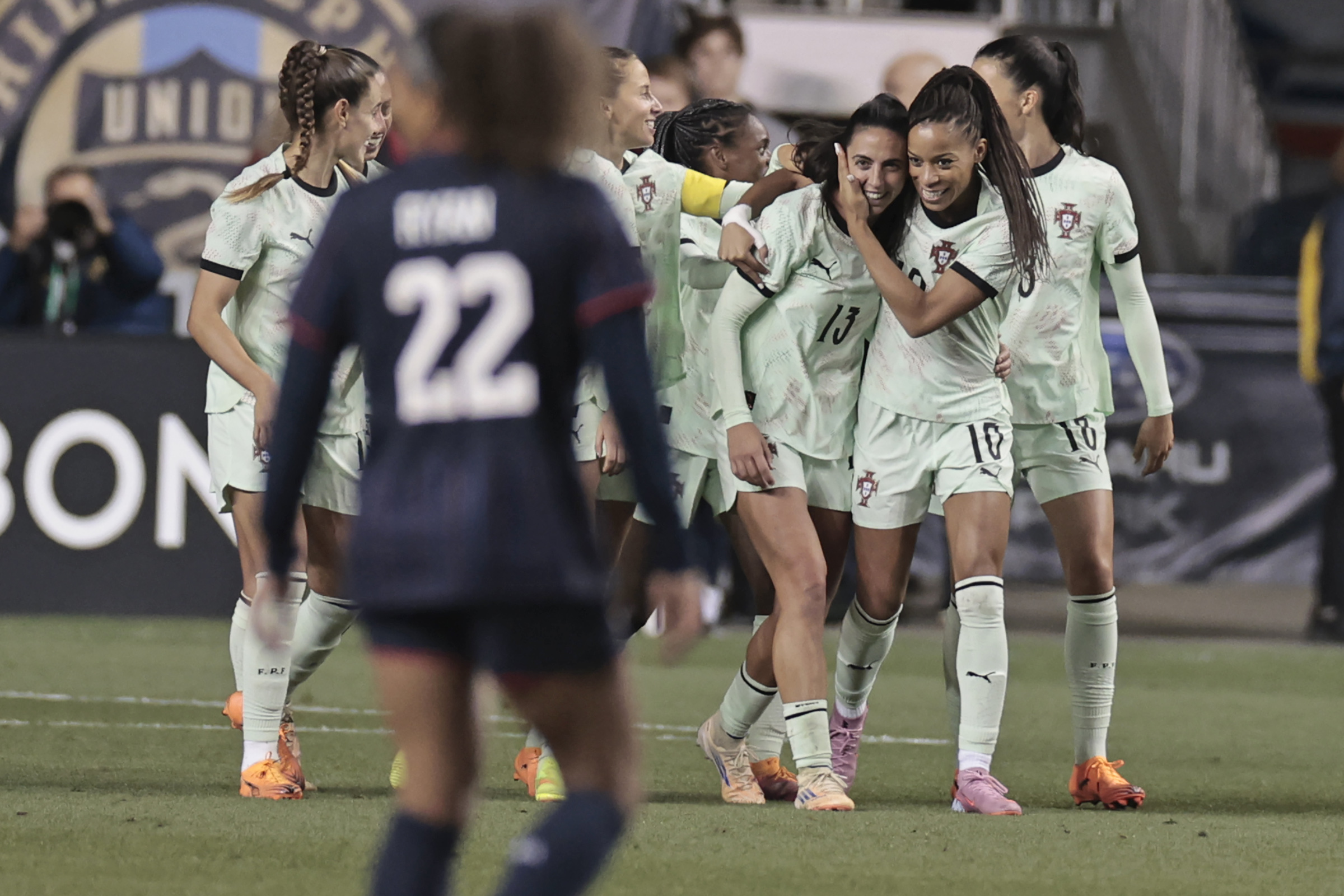
    Rose Lavelle (left) and Gotham’s other U.S. national team stars are preparing for FIFA’s Women’s Champions Cup tournament.
    That said, Hayes’ squad has a few veterans and many newcomers, which is no surprise. January camps outside of World Cup years often are that way.

    But one name stands out: Trinity Rodman. It’s her first national team call-up since April because of injuries, and she will arrive as a free agent — officially “unattached” on the U.S. roster — since her Washington Spirit contract expired at the end of December.

    Rodman’s future is by far the biggest story in the women’s soccer world right now. All signs are she’d like to stay in Washington, but she’d also like to be paid what she’s worth — and she’s worth a lot.

    NWSL commissioner Jessica Berman said at the league’s championship game in November, when Washington lost to Gotham, that “we want Trinity in our league, and we will fight for her.”

    NWSL commissioner Jessica Berman

    Spirit owner Michele Kang also has shown she wants to keep Rodman in town. Kang put together a back-loaded contract offer that would fit within NWSL salary rules by cashing in on the next cycle of broadcast rights. But Berman vetoed it, with Bloomberg reporting in early December that she said it “violated the spirit of the rules.”

    This sparked an enormous outcry from fans, media, and the players’ union. The union filed a grievance claiming the decision violated “at least five different sections” of the collective bargaining agreement, according to The Athletic.

    The league soon retreated some — but only some. It proposed a new “High Impact Player” status that would allow teams to pay stars up to $1 million beyond the salary cap, and in early December, the league’s board of governors approved the change.

    It quickly emerged that the new rule was not so simple, and that blew up in the NWSL’s face. Unlike Major League Soccer’s Designated Player rule, the NWSL’s version put restrictions on what kinds of players can earn the status.

    Michele Kang seems to be trying to keep Trinity Rodman in Washington, and Rodman seems to want to stay there.

    They included being ranked in voting for honors bestowed by the media, including France Football’s Ballon d’Or top 30, the Guardian’s top 100, and ESPN’s top 40.

    Many women’s soccer journalists have no interest in having influence over players’ salaries like that. It also matters that those rankings’ voting pools skew heavily toward Europe, including journalists, coaches, and former players.

    This promptly was called out by one American soccer industry veteran for having “outsourced the valuation of players for an American soccer league to European media.”

    The league also counts SportsPro Media’s “Top 150 Most Marketable Athletes.” That promptly was bashed by fans as being even more subjective than journalists’ opinions. (It also drew attention that in the league’s press release, this item was first on the list of criteria.)

    Trinity Rodman has become one of the NWSL’s biggest stars.

    Another metric on the list is being in the “top 11 minutes played for the USWNT” over the last two years for field players, or No. 1 in minutes for goalkeepers. This puts players’ eligibility for a big paycheck in Hayes’ hands, with her starting lineup and substitution choices.

    Hayes was asked Thursday what she thinks of having that power.

    “Nothing will change with me and the way that I’m doing things, regardless of any ruling that’s put in place,” she said. “To be honest with you, it’s probably going to be a little bit longer until they resolve what that criteria is — whether it ends up being that or something else, you’d have to ask them. But from my perspective, nothing changes with regards to how I will operate.”

    Hayes also said she “didn’t know” the rule was coming before it was announced, and that she found out about it from the national team’s longtime PR chief, Aaron Heifetz.

    U.S. women’s soccer team manager Emma Hayes

    The NWSL Players Association has continued to oppose the rule, and said Wednesday that it is preparing to take the league to arbitration. The league claimed it has the right to impose the rule without collective bargaining and said it consulted the union on the rule. The union disagrees on both counts.

    “A league that truly believes in the value of its players would not be afraid to bargain over it,” the NWSLPA said in a statement when the rule was announced.

    It would prefer that the league just raise the cap by $1 million for this year. ESPN reported that the league’s base salary cap for this year is $3.5 million “before additions for revenue sharing.”

    How many of the league’s 16 teams would favor that isn’t known, nor is it known what the vote of clubs would have to be to make that happen.

    Trinity Rodman at last year’s NWSL championship game, which the Washington Spirit lost to Gotham FC.

    What is known is that Rodman will report to national team camp without a club affiliation, and it isn’t clear where she’ll end up. Many European clubs reportedly have expressed interest, although the list with the roster room and the quality Rodman deserves is pretty short.

    The other big absence from this squad is midfielder Sam Coffey. The reason for that was revealed a few hours after the roster was announced: The Guardian reported that she is in “advanced talks” to join England’s Manchester City, and that the deal is “close to completion.”

    Manchester City leads the Women’s Super League standings and is seeking its first title since 2016 after many runner-up finishes. Second-place Chelsea has Catarina Macario, Naomi Girma, and Alyssa Thompson, and third-place Arsenal has Emily Fox.

    Former Penn State star Sam Coffey reportedly is close to a move to English club Manchester City.

    USWNT January camp roster

    Goalkeepers (3): Claudia Dickey (Seattle Reign) Mandy McGlynn (Utah Royals), Jordan Silkowitz (Bay FC)

    Defenders (8): Jordyn Bugg (Seattle Reign), Avery Patterson (Houston Dash), Izzy Rodriguez (Kansas City Current), Tara Rudd* (Washington Spirit), Emily Sams (Orlando Pride), Gisele Thompson (Angel City), Kennedy Wesley (San Diego Wave), Kate Wiesner (Washington Spirit)

    Midfielders (8): Croix Bethune (Washington Spirit), Hal Hershfelt (Washington Spirit), Claire Hutton (Kansas City Current), Riley Jackson (North Carolina Courage), Lo’eau LaBonta (Kansas City Current), Sally Menti (Seattle Reign), Sam Meza (Seattle Reign), Olivia Moultrie (Portland Thorns)

    Forwards (7): Maddie Dahlien (Seattle Reign), Jameese Joseph (Chicago Stars), Trinity Rodman (unattached), Yazmeen Ryan (Houston Dash), Emma Sears (Racing Louisville), Ally Sentnor (Kansas City Current), Reilyn Turner (Portland Thorns)

    * — The former Tara McKeown got married a few weeks ago.

    USWNT schedule

    Jan. 24: Vs. Paraguay in Carson, Calif., 5:30 p.m. (TNT, truTV, Universo, HBO Max, Peacock)

    Jan. 27: Vs. Chile in Santa Barbara, Calif., 10 p.m. (TBS, Universo, HBO Max, Peacock)

    March 1: Vs. Argentina in Nashville, 5 p.m. (TNT, truTV, Universo, HBO Max, Peacock)

    March 4: Vs. Canada in Columbus, Ohio, 6:45 p.m. (TNT, truTV, Universo, HBO Max, Peacock)

    March 7: Vs. Colombia in Harrison, N.J., 12:30 p.m. (TBS, truTV, Telemundo 62, Universo, HBO Max, Peacock)

  • The USWNT will return to north Jersey in March to play Colombia

    The USWNT will return to north Jersey in March to play Colombia

    Local fans have become used to traveling up to northern New Jersey to watch the U.S. women’s soccer team, and in a few months, they’ll get to do it again.

    The Americans will play Colombia on March 7 at Sports Illustrated Stadium in Harrison as part of the annual SheBelieves Cup tournament. Canada and Argentina are the other teams in this year’s field, and they’ll play at 12:30 p.m. before the U.S.-Colombia game at 3:30 p.m.
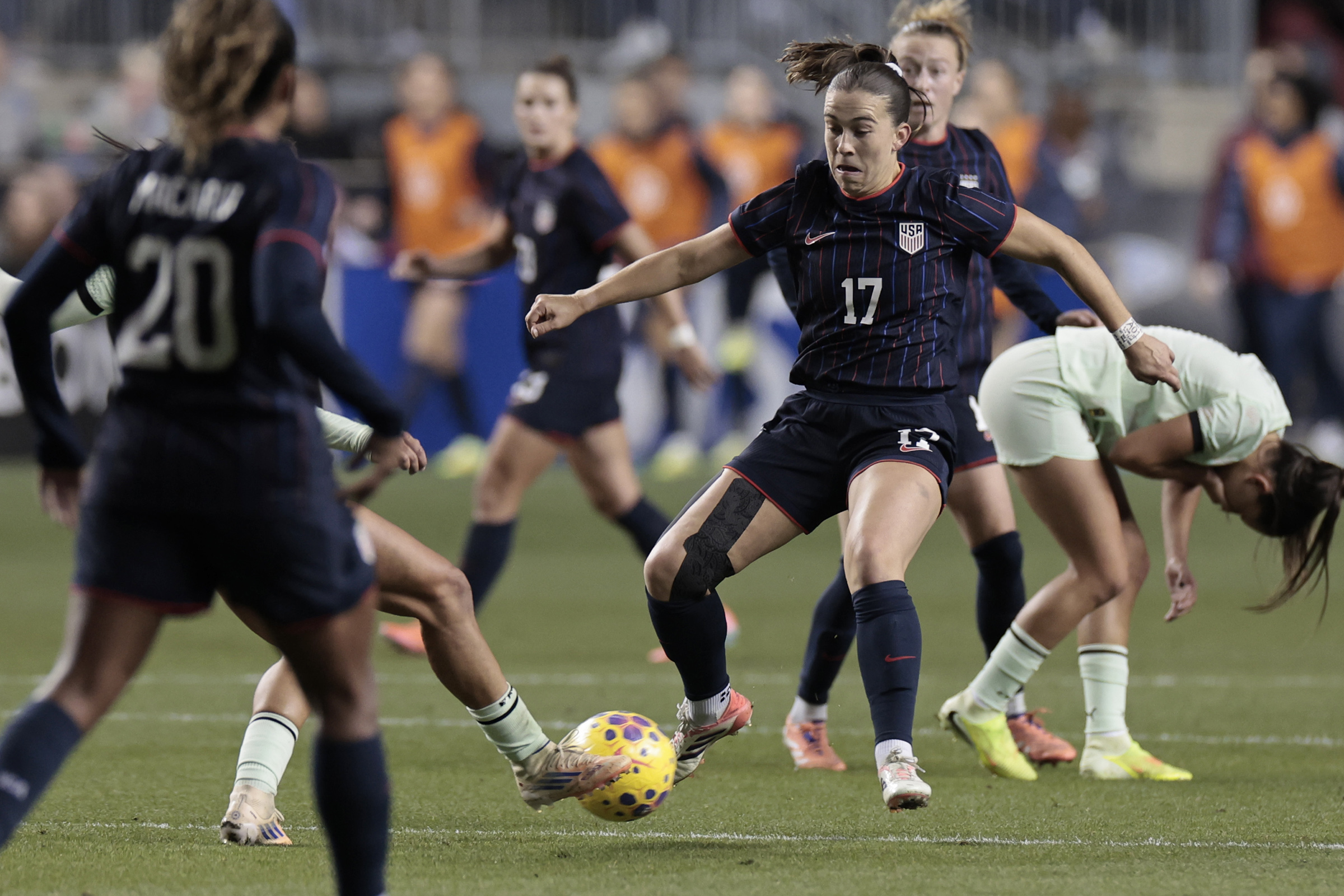
    It will be the last day of the round-robin, with Nashville hosting the opening doubleheader on March 1 and Columbus, Ohio, hosting the middle games on March 4. The day also will feature the retirement tribute for U.S. legend Tobin Heath, a North Jersey native who earned first-ballot induction into this year’s National Soccer Hall of Fame class.

    The U.S. women have played nine times at the 25,000-seat venue formerly known as Red Bull Arena. Their last seven games there have drawn sellout crowds.

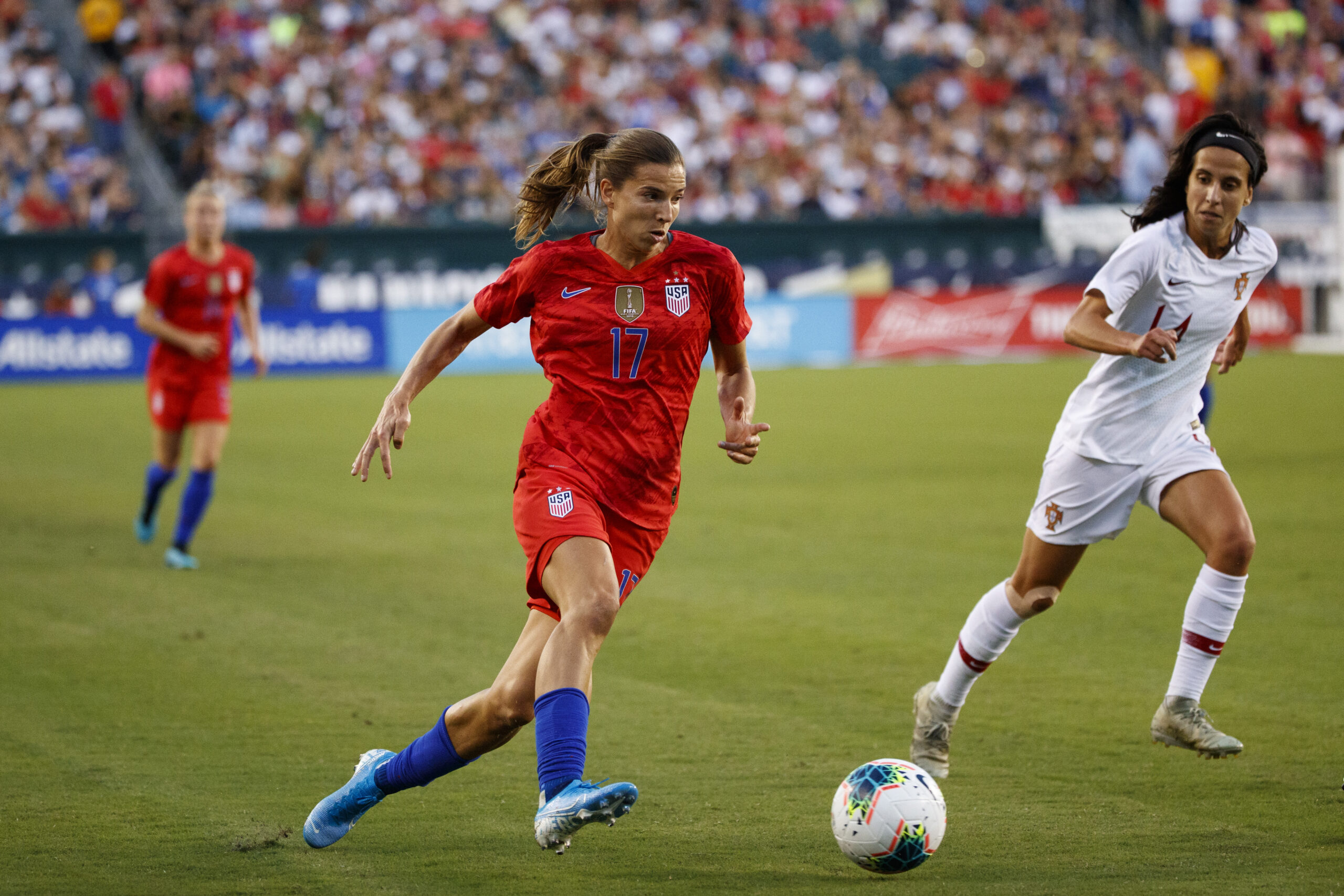
    Tobin Heath playing in Philadelphia in 2019. She won two World Cups, two Olympic gold medals, and two NWSL championships in her career.

    Unfortunately, the U.S. kickoff time means that fans here who also follow the Union will have to choose between going north and going down to Chester for the Union’s 7:30 p.m. game against the San Jose Earthquakes.

    In theory, they could try to race out of Harrison to get on the New Jersey Turnpike, but traffic up there is almost certain to make that impossible.

    As for the teams in the SheBelieves field, Canada is the best of them on paper at No. 10 in FIFA’s global rankings. But the Canucks have lost five straight games, a streak that started with a 3-0 rout by the U.S. in June. Since then, they have faced Switzerland, the Netherlands, and Japan twice.

    Colombia is the most intriguing team of the bunch. Las Cafeteras are ranked No. 20, but have three superstars in their attack: the Washington Spirit’s Leicy Santos, Real Madrid’s Linda Caicedo, and Chelsea’s Mayra Ramírez. Colombia made the final of last year’s Copa América and lost on penalty kicks to Brazil after a wild 4-4 tie.

    U.S. Soccer tends to put the best game for the U.S. on the tournament’s last day, so it says something that Colombia got the honor this time.

    Argentina is ranked No. 30, and finished third at last year’s Copa. Forward Paulina Gramaglia used to play for the Houston Dash, and is now with Spain’s Tenerife.

    These games will be the first of a year that builds up to Concacaf’s women’s championship in November. The tournament will serve as qualifying for the 2027 World Cup and 2028 Olympics, though the U.S. doesn’t have to worry about the latter as the host.

    “These are three teams that will likely be in the World Cup in 2027 and of course we’ll likely see Canada in World Cup qualifying at the end of the year, so when focusing on our continued preparations and growth as a team, the SheBelieves Cup is of great value,” U.S. manager Emma Hayes said in a statement. “Each team brings different strengths and will challenge us to find success in all parts of the field, which is exactly what we need as we continue our process to build toward the big events on the horizon.”
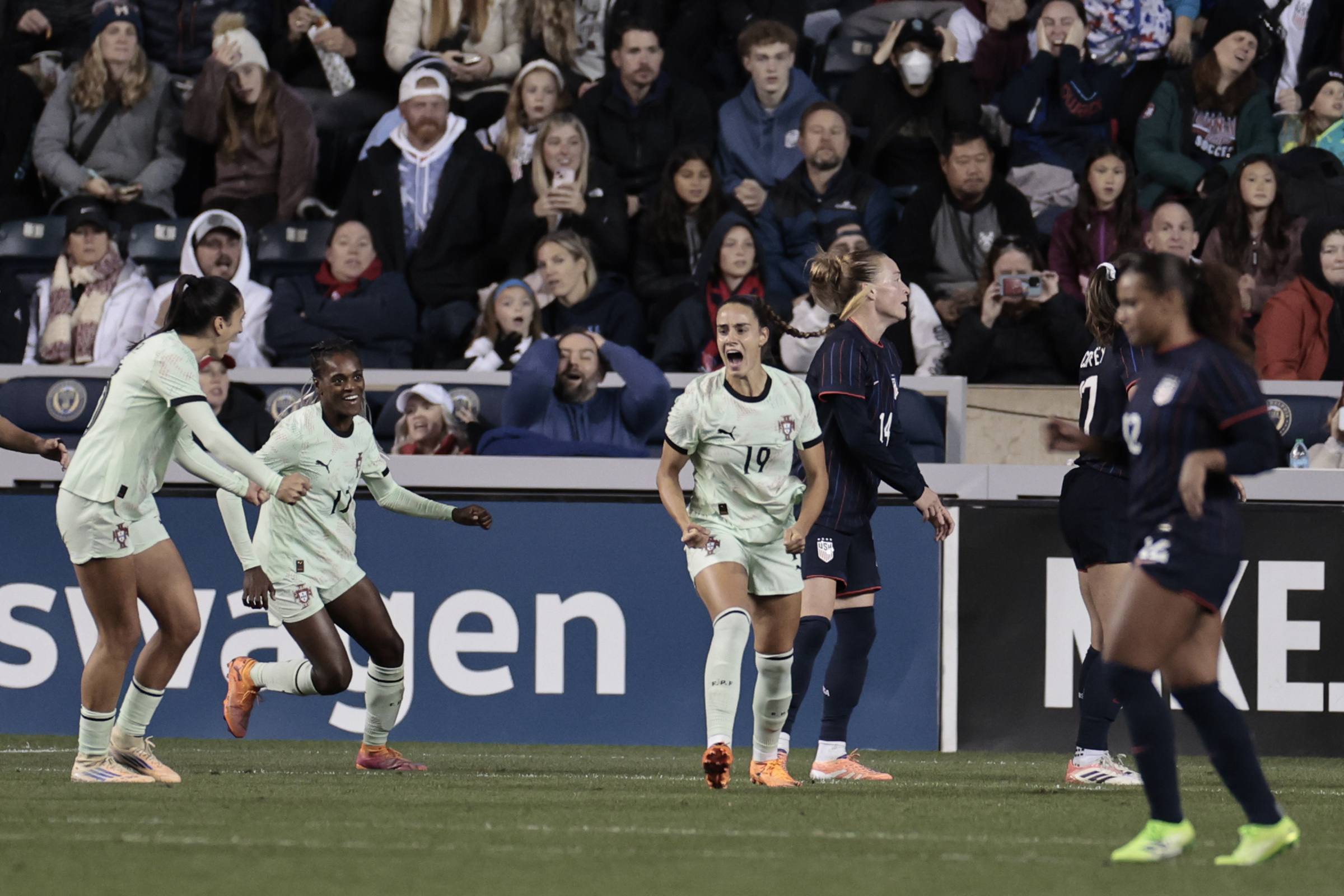
    Ticket presales for U.S. Soccer members start on Thursday, and the general public sale starts on Monday.

    U.S. manager Emma Hayes overseeing a practice in Chester in October.

    SheBelieves Cup schedule

    Sunday, March 1: Canada vs. Colombia (2 p.m., truTV and Universo) and United States vs. Argentina (5 p.m., TNT, truTV, Universo) in Nashville.

    Wednesday, March 4: Argentina vs. Colombia (3:30 p.m., truTV and Universo) and United States vs. Canada (6:45 p.m., TNT, truTV, Universo) in Columbus, Ohio

    Saturday, March 7: Canada vs. Argentina, 12:30 p.m. (truTV, Universo) and United States vs. Colombia (3:30 p.m., TBS, truTV, Telemundo 62, Universo) in Harrison, N.J.

    All games also are available via online streaming on HBO Max in English and Peacock in Spanish.

  • The USMNT, USWNT, and your kid’s youth team are all different. U.S. Soccer is fine with that.

    The USMNT, USWNT, and your kid’s youth team are all different. U.S. Soccer is fine with that.

    Sometimes, it feels like there’s a distance between the U.S. men’s and women’s soccer teams, even though they wear the same crest.

    Over the years, various people involved with both programs have tried to close that gap, including at U.S. Soccer headquarters. Sporting director Matt Crocker is definitely on that list, and high up on it.

    That’s especially true when he talks about his vision of “the U.S. Way,” the creation of an on-field guidebook for the whole governing body. Many people will instinctively conclude that Crocker is sending a sermon from the mount, given how often the governing body has tried to do that over the years.

    But it isn’t that simple, and it’s not just Crocker saying so. The last few months of on-field results at the senior levels have offered proof.

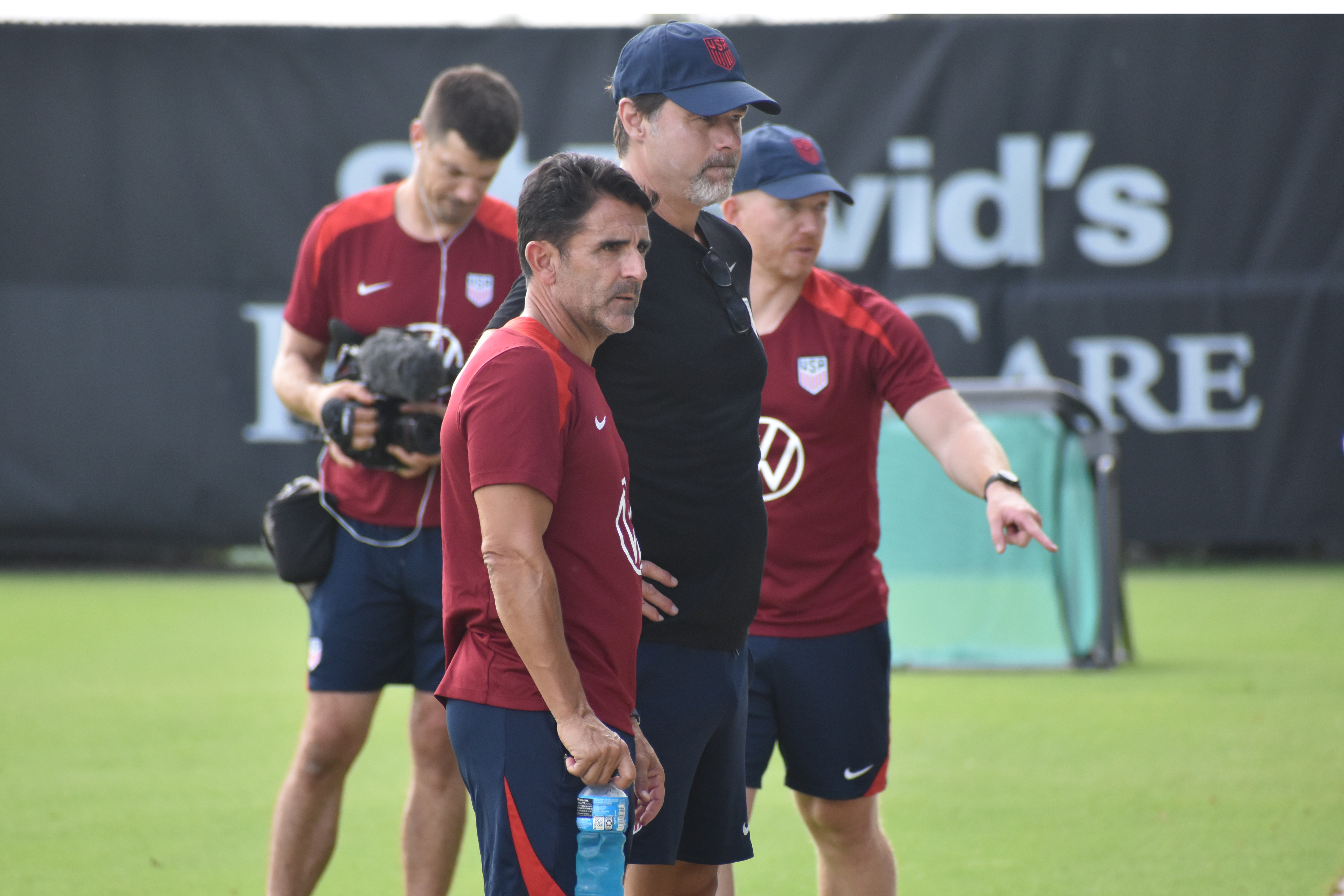
    Mauricio Pochettino (center) and his top assistant Javier Pérez (left) at a U.S. men’s soccer team practice in October.

    In some countries, every national team would be required to play the same way. Think of the Netherlands and Spain, for example, two programs with decades-long histories of putting philosophy over pragmatism.

    Crocker is more pragmatic. Once he hired Mauricio Pochettino to coach the senior men and Emma Hayes to coach the senior women, he wanted to get out of their way. He does not stop Pochettino from playing a 3-4-2-1 formation, and Hayes from playing a 4-3-3.

    “They are arguably two of the best coaches in the world,” Crocker told The Inquirer. “Who am I, in my experience, to dictate how they should be playing or not playing? I think the idea of that, for me, is not the way I work.”

    His experience gives him power if he wants to exercise it. Before joining U.S. Soccer in 2023, previous stops for the native Welshman included seven years at English soccer’s governing body, the Football Association. He planted seeds that have now made the nation elite on both the men’s and women’s sides.

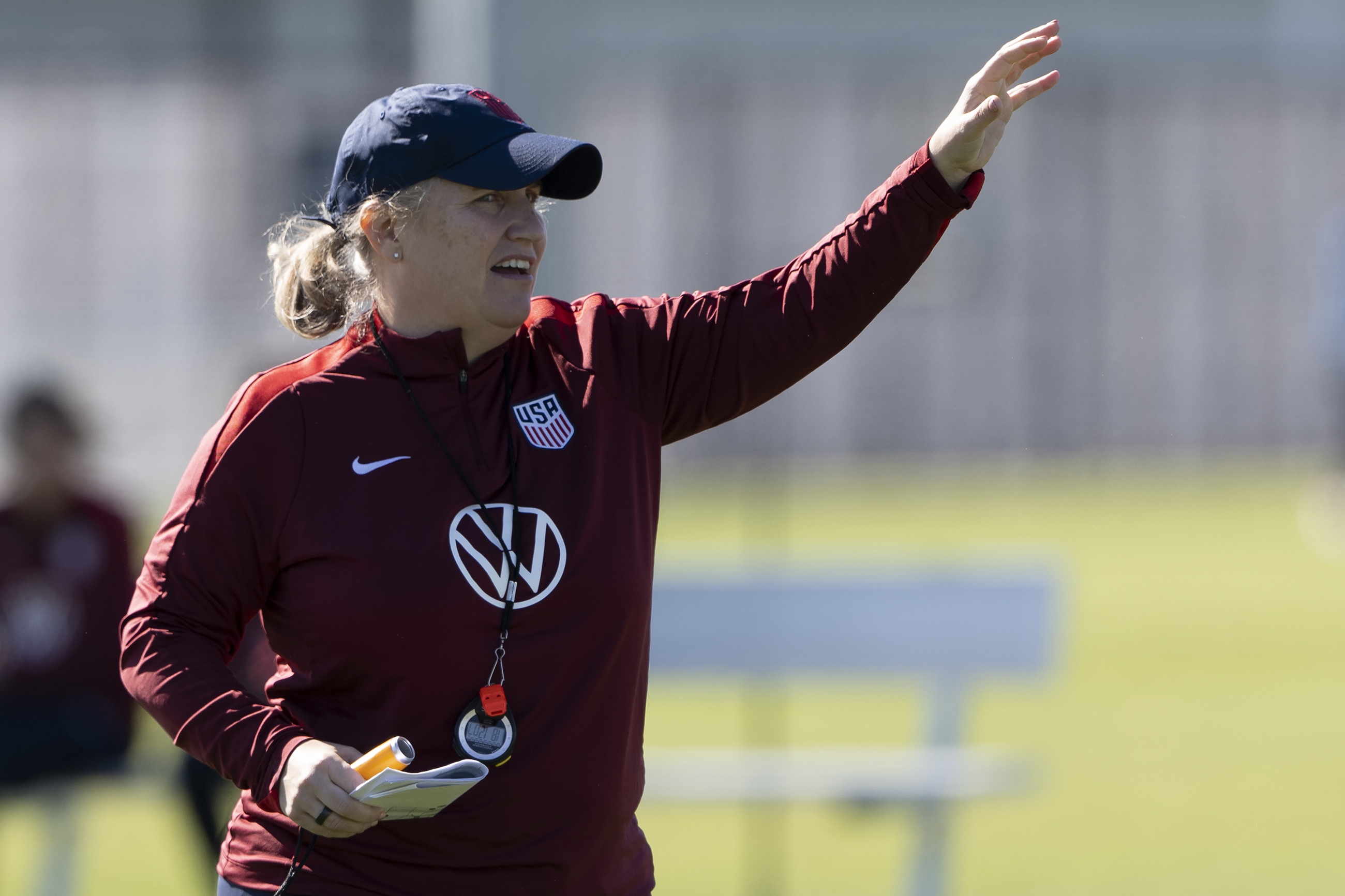
    Emma Hayes at a U.S. practice in Chester in October.

    But no, what Crocker said is what he meant.

    “Of course, there’s going to be a framework … of how we want them to work,” he continued. “But ultimately their job is to provide winning teams, and I think they’re doing a pretty good job at doing that. And my job is to make sure that they get what they need to be able to do that.”

    If you only follow soccer casually, you might not think much of this. If you’re deep in the sport, especially the American game, you know it matters to hear that from someone so high-ranking.

    “The way I see it is, my job is not to dictate every single detail of how everything needs to look or feel,” Crocker said. “I need to use their experiences, because they’ve got more than me in those areas of what winning looks like.”

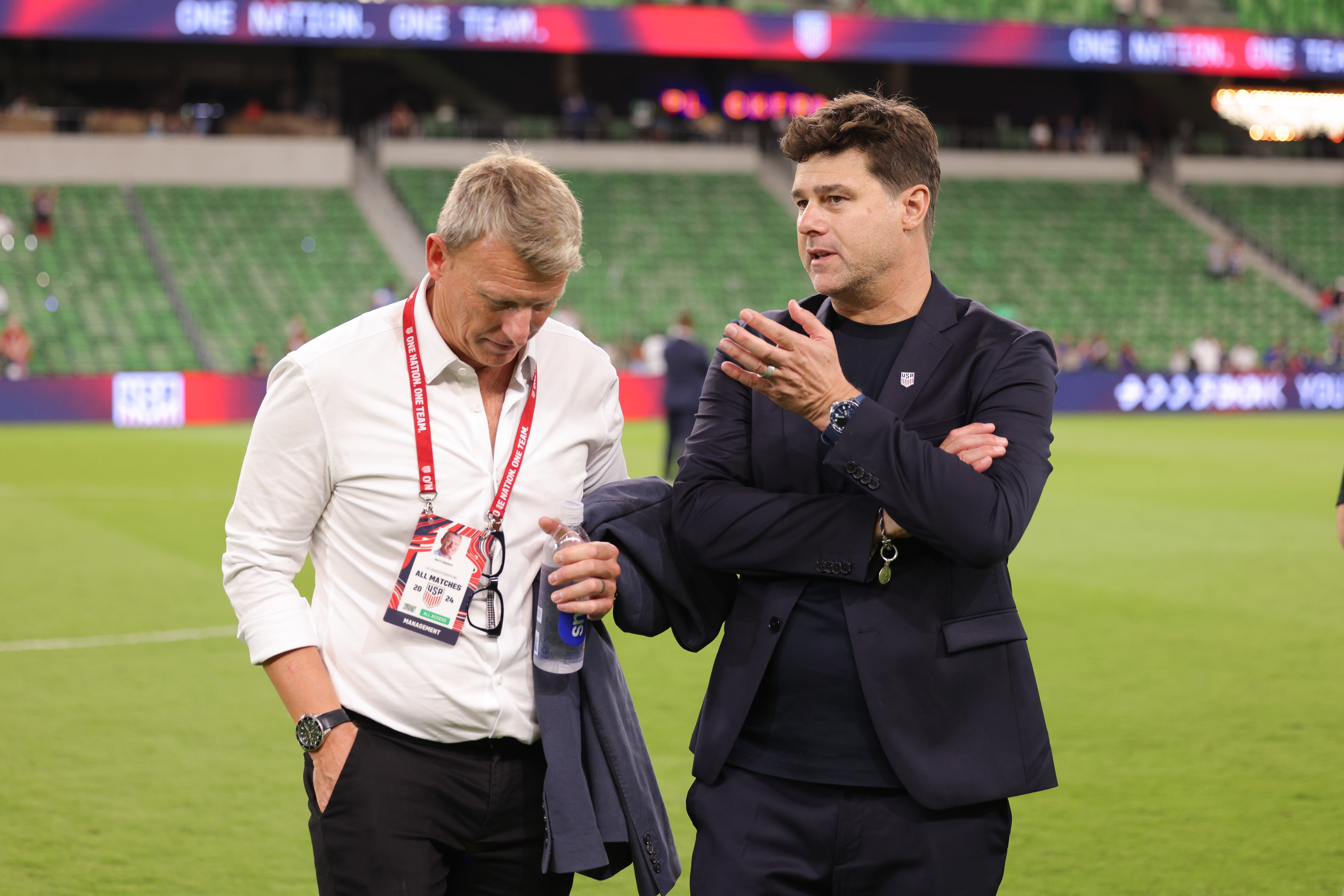
    Matt Crocker (left) listening to Mauricio Pochettino at a U.S. game last year.

    Hayes vouched for this, and not by making light of the size of her trophy mantel. She knew Pochettino before taking the U.S. job because they overlapped at English club Chelsea, and she knew American soccer from many years of working here before returning to her native London in 2012.

    “Mauricio’s ideas on how to win football matches might be different to mine, for example, but we both have ambition to win football matches,” Hayes said. “And we both have an appreciation that American players have their own unique set of qualities that we can lean into.”

    How they execute from there is up to them.

    “Yes, the U.S. Way is very clear and overarching — that sits above our WNT and MNT and all our other 27 teams,” Hayes said, using the abbreviations for the senior women’s and men’s teams. “But within that, some of those differences are in and around the game model.”

    That might not sound like much, but it really does matter.

    Emma Hayes has had immense success since arriving as the U.S. team’s manager two years ago.

    It all starts with youth soccer

    If there’s distance between the men’s and women’s teams, it often feels like there’s a canyon between the senior squads on TV and the youth teams your kids play on. That, too, has seemed deliberate at times, with so many factions in the sport wanting to do what they want instead of working together for the game as a whole.

    America’s youth soccer landscape, which better resembles an industrial complex — and really feels that big, in terms of scale — has a long history of rebelling against being told what to do by U.S. Soccer. Crocker quickly became well-versed in this when he took his job, and has spent a lot of time trying to change the tone.

    “I think we have to recognize that what we do in state X can’t just be replicated and put into state Y,” he said. “Everyone’s unique and individual, and we have to listen to their individual needs. But we’ve also got to be clear on the framework of the things that are fundamental, and that we are going to do irrespective.”

    He admitted that the scale of this country “scares you to death” for such a project, compared to how he built the England DNA program at the FA in 2013.

    Before joining U.S. Soccer, Matt Crocker (right) spent seven years at England’s Football Association, and also worked twice for English club Southampton.

    “You could bring every county FA to St. George’s Park, all of which were within a three-hour drive [from the national training center],” Crocker said. “You could mandate, you could then put people out into those environments to support it, and you could do it where you could really monitor something on a much smaller scale. Doing this is something I’ve never experienced before.”

    That literal geography, not just youth soccer politics, influenced his journey to now.

    “I don’t think there’s one silver bullet that you need to take, or you go, ‘It’s not going to work because of X,’” he said. “I just think we have to recognize the uniqueness of the country, build on that as a positive, but also remember not to make the same mistakes as others that have gone before us.”

    Then came words that a lot of people — especially the youth coaches out there — have wanted to hear.

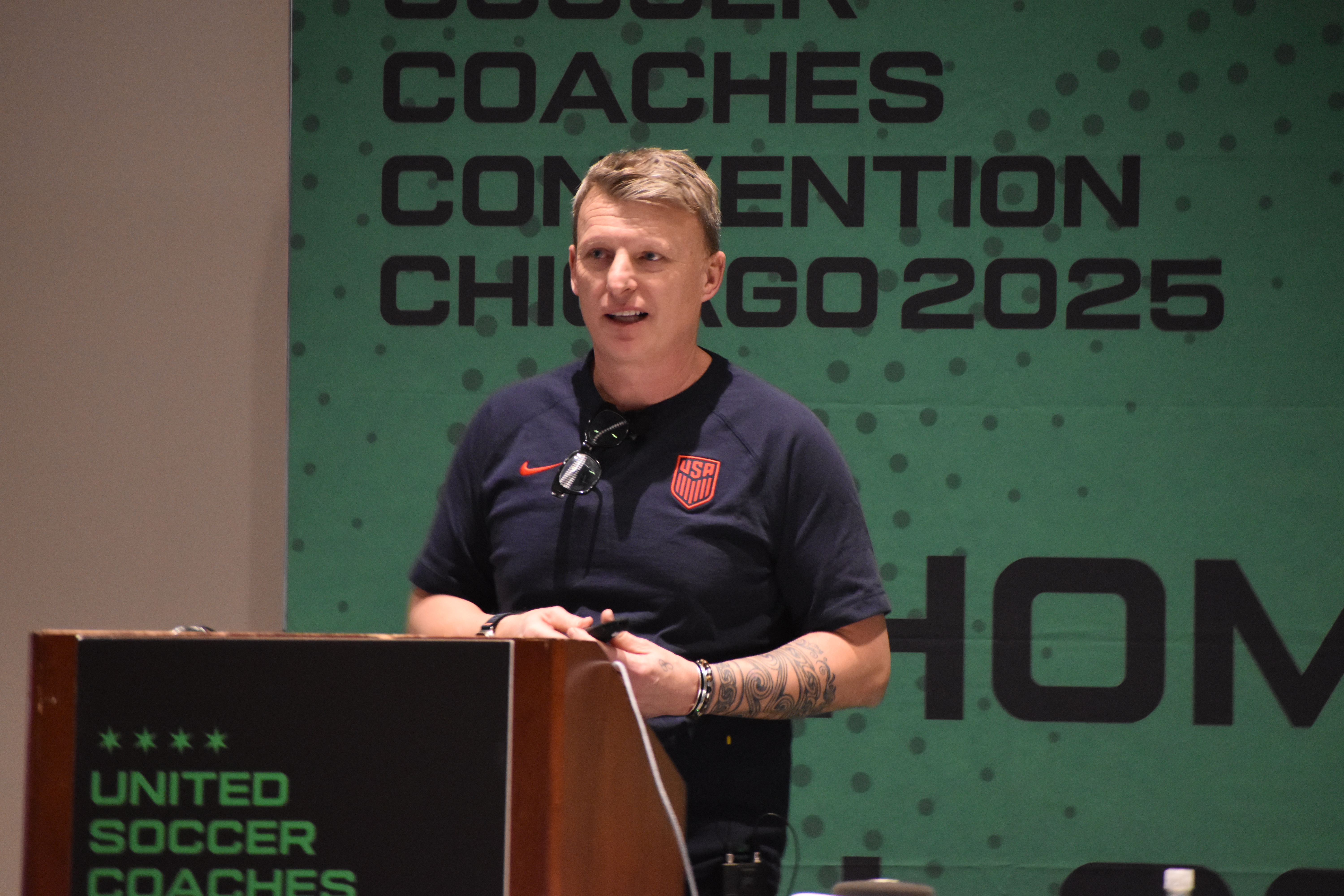
    Matt Crocker speaking at the United Soccer Coaches convention last January, to an audience that isn’t always on U.S. Soccer’s side.

    “I say this respectfully [because] I wasn’t here, but what I heard was U.S. Soccer was telling: We told, we told, we told,” Crocker said. “And now our job is to listen, to work, to problem solve, but to bring everyone together.”

    Anecdotally, it’s been working. At various events this year where Crocker has spoken to youth and amateur teams, he has been warmly received. But the hardest part is yet to come, as a recent moment showed.

    ‘More worried about their bottom line’

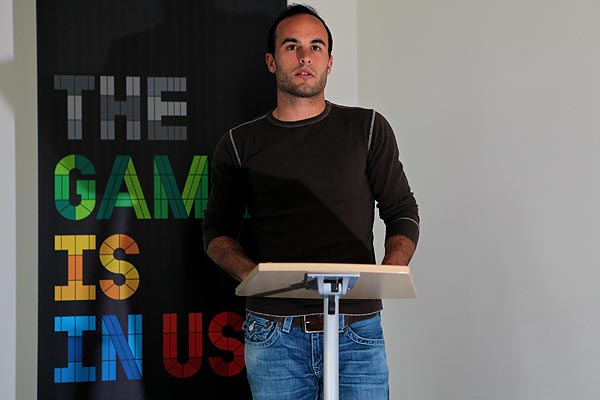
    Earlier this month, Crocker spoke to a crowd of the governing body’s sponsors and donors. Some of them wore track jackets of their youth clubs, but most were in business clothes. Crocker shared the stage with deputy sporting director and onetime Union centerback Oguchi Onyewu and U.S. men’s legend Landon Donovan.

    “For those who are not familiar with the youth soccer landscape in this country, it’s a bit of a disaster, right?” Donovan said. “It really is. There’s so many competing interests.”

    U.S. men’s national team legend Landon Donovan says that the youth model might be too far gone to suggest anything that would affect their bottom line.

    He spoke of a local club near his home in southern California, but knew it could have been countless others.

    “People are very content with their little fiefdom and their little salary and their club and their control and their power,” Donovan said. “So what’s the incentive now for these clubs to change? … We do have national pride, but they’re more worried about their bottom line than they are [about] growing U.S. soccer.”

    The words were as true as they were damning.

    “I think the saying is, do what you’ve always done and you’ll get what you’ve always got,” Crocker said. “There’s been a lot of talk about, there’s a player that plays in this league over here that has to drive or fly thousands of miles because this league is falling out with this league, and they won’t play each other. And that’s not putting the child, that’s not putting the sport, at the heart of what we’re all about.”

    Matt Crocker (left) with U.S. Soccer Federation CEO JT Batson.

    It’s true for the boys and men, and it’s true for the girls and women. It’s an enormous task, but Crocker is willing to give from his side, and that is noticed.

    “I think it’s being respectful to environments that have already been created,” he said. “Us as U.S. Soccer, being the national federation, the people that should be really saying, ‘Hey this is what player development and the game could look like in this country’ — it’s about time we spoke up and started to share some of that. But it’s not through a dictator approach, it’s through more of a collaborative way of doing things.”

    Crocker’s plans are due to be published in January, the same month Philadelphia will host the 2026 United Soccer Coaches convention. It won’t be easy for him to get that crowd on his side, for the reasons Donovan made clear. If Crocker can, though, the benefits could last long past the World Cup.

  • Catarina Macario stars again as the USWNT sweeps Italy to end its year

    Catarina Macario stars again as the USWNT sweeps Italy to end its year

    FT. LAUDERDALE, Fla. — Catarina Macario scored in her third straight international match and the United States women’s national team defeated Italy 2-0 on Monday night in the final game for the national team this year.

    The United States has scored in 16 straight matches, including all 15 this year. The national team wrapped up 2025 12-3-0.

    Macario scored the opening goal in the 20th minute with a strike from the corner of the box and up over Italy goalkeeper Francesca Durante’s head and into the side netting of the far post.

    Jaedyn Shaw added a second goal before halftime, taking a pass from Alyssa Thompson before squaring up and calmly finishing out of Durante’s reach to make it 2-0.

    Claudia Dickey earned her fifth clean sheet in her sixth appearance in goal for the USWNT.

    Macario had a pair of goals a 3-0 victory over Italy on Friday night in Orlando, Florida. Olivia Moultrie, who scored the other goal on Friday, was available off the bench Monday.

    Macario, who plays for Chelsea, led the team this year with eight goals, including seven goals in her last seven starts. She nearly got a second goal at Ft. Lauderdale’s Chase Stadium but it was disallowed because of a foul, denying her a third brace in her last three international games.

    Macario and Emily Fox were among the players named earlier Monday as nominees for the women’s U.S. Soccer Player of the Year award, joining Rose Lavelle, Thompson, and Sam Coffey.

    U.S. coach Emma Hayes made five changes to the starting lineup from Friday’s victory in the first game against Italy, going with veterans Naomi Girma, Lindsey Heaps, Fox and Macario. Three teenagers started for the United States, including 19-year-olds Claire Hutton and Jordyn Bugg and 18-year-old Lily Yohannes.

    The USWNT will next gather from Jan. 17-27 for the team’s annual camp in Carson, Calif., with a match planned against Paraguay and another against an undetermined opponent.

  • Catarina Macario’s two goals lead the USWNT to win over Italy, 3-0

    Catarina Macario’s two goals lead the USWNT to win over Italy, 3-0

    ORLANDO, Fla. — Cat Macario scored two goals and the United States defeated Italy 3-0 on Saturday night in a friendly match at Inter&Co Stadium.

    It was the first of two friendlies between the teams, with the second scheduled for Dec. 1 in Fort Lauderdale.

    Olivia Moultrie also scored while goalkeeper Claudia Dickey earned the shutout in just her fifth appearance at the senior level.

    “I think obviously we wanted to keep building on the performances we had last camp, and the emphasis on coming out strong and sticking to our principles, and I think that’s what we did,” said U.S. veteran Rose Lavelle, who earned her 116th cap. “Overall, I think a really good team performance.”

    The United States wasted no time in attacking Italy’s goalie Laura Giuliani, scoring inside the first two minutes.

    Fresh off their NWSL title with Gotham, Lilly Reale found teammate Lavelle to start the sequence. Lavelle then went wide to Alyssa Thompson, who quickly returned the ball. Lavelle found Moultrie, who went far side for her second goal in as many appearances with the team.

    “We talked about starting fast and starting strong, and I think the momentum carried out,” Moultrie said. “We had a really good week of training, so I feel like it flowed into the first minutes of the game.”

    An offside call on Lavelle at the 48-minute mark denied Moultrie her second goal.

    In the 64th minute, Sam Coffey dribbled down the middle and found Macario breaking on her left. Macario took the pass and fired a shot far side to give the United States a two-goal lead.

    Macario added her second in the 76th minute when she snared a pass from the team’s youngest player, 18-year-old Lily Yohannes, and fired a shot from the top of the right side of the box to the far side of the goal.

    It was Macario’s 15th goal in 28 international appearances. Macario has now been involved in 18 goals in her last 14 U.S. appearances.

    “It was a great win, it’s always a pleasure being with this team,” said Macario, who has 12 goals and six assists since February of 2022. “I feel so happy to be in this environment, and I feel like it really just helps you be the best version of yourself.

    “Lucky enough that (U.S. coach) Emma (Hayes) knows me very well, and she knows what I can bring to the team. This was a good year … in which I have just been trying to find some consistency … just trying to find my rhythm.”

  • Philadelphia is on a long list of potential cities for the 2031 women’s World Cup

    Philadelphia is on a long list of potential cities for the 2031 women’s World Cup

    NEW YORK — The United States Soccer Federation proposed 14 American sites among 20 possible venues to host games for the 2031 Women’s World Cup, including seven U.S. stadiums to be used for next year’s men’s tournament.

    FIFA released the bid books Friday for the 2031 and 2035 women’s tournaments. There is only one bidder for each, a U.S.-Mexico-Costa Rica-Jamaica proposal for 2031 and a United Kingdom plan for 2035. FIFA is to formally confirm the bids at its congress on April 30.

    Twenty-six additional U.S. stadiums were mentioned as suitable venues for a 48-nation tournament the bidders project would draw 4.5 million fans and generate about $4 billion in revenue, up from $570 million for 2023 in Australia and New Zealand and a projection of $1 billion for the 2027 tournament in Brazil.

    Proposed ticket prices of $35 for the cheapest seats in the opening round to $120 to $600 for the final were listed in a ticket grid. FIFA has refused to release a grid for next year’s men’s tournament, saying only prices initially ranged from $60-$6,730 but could fluctuate with dynamic pricing. The bid book said premium seating would average 10%-20% of capacity at the majority of 2031 stadiums.

    Lincoln Financial Field last hosted a women’s World Cup in 2003.

    Fifty sites in all were mentioned in the joint 2031 bid. Final decisions likely will not be made for several years.

    The bid book also said “other suitable cities are included” beyond the specified 14 “as part of the broader bid framework with the understanding that they will continue to be equally considered for the purposes of stadium selection.”

    “By proposing more than the required 20 sites, the joint bidders demonstrate a commitment to securing the best possible hosting conditions and ensuring the tournament represents the full diversity of our region on a global scale,” the bid book stated.

    The 2026 U.S. sites included in the 2031 proposal are Arlington, Texas (AT&T), Atlanta (Mercedes-Benz), East Rutherford, N.J. (MetLife), Houston (NRG), Inglewood, Calif. (SoFi), Kansas City, Mo. (Arrowhead), and Seattle (Lumen Field).

    MetLife Stadium in East Rutherford, N.J., hosted this year’s Club World Cup final and will host next year’s men’s World Cup final.

    The seven others are Charlotte, N.C. (Bank of America), Denver (Empower Field), Minneapolis (U.S. Bank), Nashville (Geodis Park), Orlando (Camping World), San Diego (Snapdragon), and Washington (proposed NFL venue on the RFK Stadium site).

    Orlando and Washington were sites of the 1994 men’s World Cup.

    Mexico’s three sites for next year’s World Cup also are proposed for the women’s tournament, Mexico City (Azteca), Guadalajara (Akron), and Monterrey (BBVA), along with a fourth in Torreón (Corona).

    National stadiums are proposed in Kingston, Jamaica, and San Jose, Costa Rica.

    The national stadium in Kingston, Jamaica will host its first women’s World Cup games.

    Other U.S. venues listed as possibilities are Foxborough, Mass. (Gillette), Philadelphia (Lincoln Financial Field), and Santa Clara, Calif. (Levi’s), all venues for next year’s men’s World Cup.

    Additional sites included were Baltimore (M&T Bank), Birmingham, Ala. (Protective), Carson, Calif. (Dignity Health Sports Park), Cincinnati (TQL), Cleveland (Huntington Bank Field), Columbus, Ohio (Lower.com Field), Frisco, Texas (Toyota), Glendale, Arizona (State Farm), Harrison, N.J. (Sports Illustrated), Los Angeles (Memorial Coliseum), Miami (Chase), Nashville (Nissan), New York (Etihad Park), Orlando (Inter & Co), Pasadena, Calif. (Rose Bowl), St. Louis (Energizer Park), San Francisco (Oracle Park), Sandy, Utah (America First Field), and Tampa, Fla. (Raymond James).

    Second possible sites in cities, all with lower capacities, were included for Houston (Shell Energy), Kansas City, Mo. (CPKC), and Washington (Audi Field).

    Indianapolis was listed for a proposed stadium.

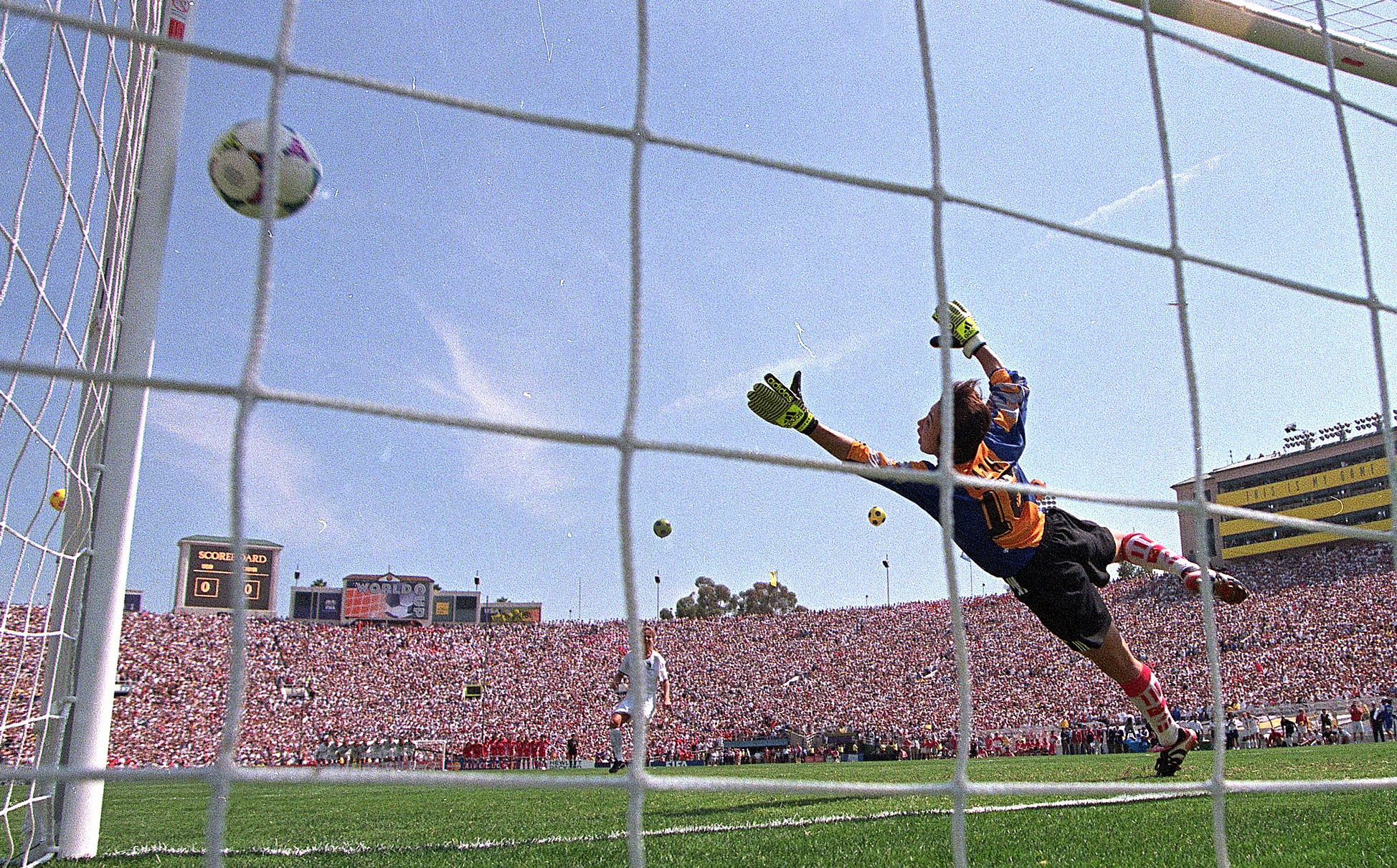
    The Rose Bowl in Pasadena, Calif., hosted the 1999 women’s World Cup final – still one of the most famous games in women’s soccer history.

    Miami’s Hard Rock Stadium was the only 2026 World Cup venue not included.

    Chicago was not listed after dropping out of bidding to host in 2026 because of what it said were FIFA’s burdensome financial demands.

    Additional possibilities in Mexico are Pachuca (Miguel Hidalgo) and Querétaro (Corregidora) along with Universitario as an alternate choice in Monterrey. Saprissa was listed as an alternate site in San Jose, Costa Rica.

    Organizers envision fan festivals and watch parties in conjunction with games. Revenue from marketing and sponsorships is projected at $1.4 billion.

  • USWNT bounces back from rare loss with 3-1 win over Portugal

    USWNT bounces back from rare loss with 3-1 win over Portugal

    EAST HARTFORD, Conn. — Olivia Moultrie scored two goals and the U.S. women’s national team bounced back against Portugal with a 3-1 victory on Sunday after honoring former goalkeeper Alyssa Naeher.

    The United States was coming off a 2-1 loss to Portugal in the first game of the international window on Thursday in Chester. It was Portugal’s first victory over the U.S. and just the third loss for the national team under coach Emma Hayes.

    Moultrie scored just 45 seconds into the game to give the USWNT the early lead. Portugal leveled in the fifth minute on Jessica Silva’s header off a cross from Beatriz Fonseca.

    Moultrie added her second in the 10th to put the Americans back in front. The 20-year-old has a pair of two-goal games in 10 international appearances.

    Sam Coffey, who came into the game as a substitute in the 77th minute, put the game away with a goal in the 82nd. Coffey and Moultrie are teammates on the Portland Thorns in the National Women’s Soccer League.

    Hayes made eight changes to the starting lineup from the group she started on Thursday.

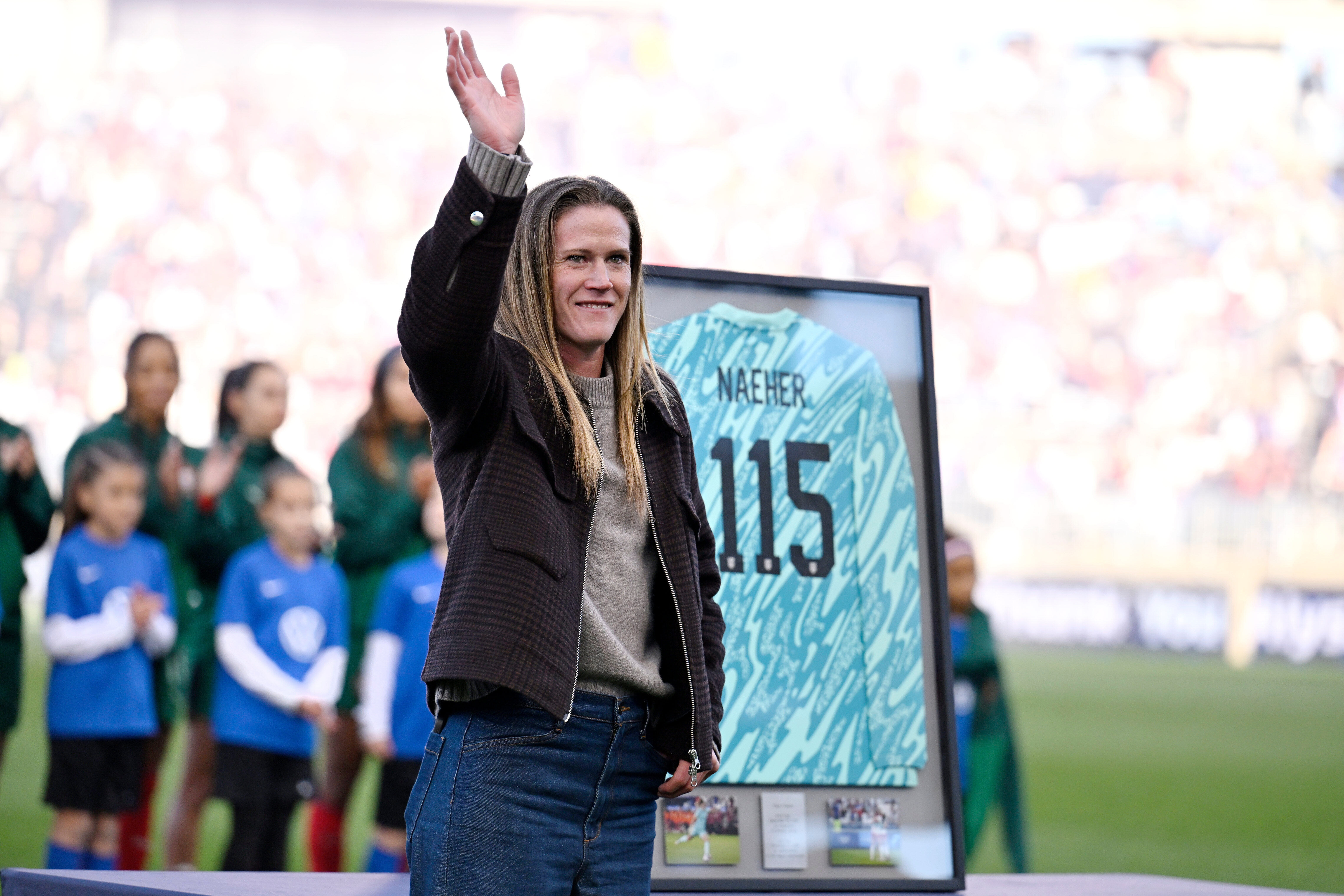
    Before the match at Pratt & Whitney Stadium, the United States honored Naeher, a Connecticut native, who retired from the national team late last year after winning a gold medal at the Paris Olympics.

    Naeher was the starting goalkeeper for the U.S. team that won the Women’s World Cup in 2019 and the 2024 Olympics. She’s the only U.S. goalkeeper to earn a shutout in both a World Cup and an Olympic final.

    Alyssa Naeher waves to the crowd in her home state during her retirement ceremony.

    The team was without some of its star players. Trinity Rodman was nursing an MCL sprain in her right knee that she sustained Oct. 15 during a CONCACAF W Champions Cup match with her club team, the Washington Spirit.

    Defender Naomi Girma remained sidelined with a calf injury that occurred before the start of Chelsea’s season in September.

    Forward Lynn Biyendolo, who was left off the U.S. roster because of a knee injury, announced on Saturday that she and her husband are expecting their first child. Other prominent national team players who have taken maternity time off this year include Sophia Wilson and Mallory Swanson.

    Hayes said that U.S. Soccer was developing more comprehensive “pre- and postpregnancy” protocols to be announced in the future.

    The United States has one more match during the current international window, against New Zealand on Wednesday at CPKC Stadium in Kansas City, Mo.

  • An unusual loss shows the USWNT might not have its new No. 1 goalkeeper yet

    An unusual loss shows the USWNT might not have its new No. 1 goalkeeper yet

    When a team gives up a goal on a corner kick, it’s rarely just down to one person. But when a team gives up two goals on corner kicks in one game, there likely will be alarm bells.

    That’s what happened Thursday night at Subaru Park, where the U.S. women were upset by Portugal, 2-1.

    Manager Emma Hayes was frustrated afterward, as were many of her players. There are few things — sometimes nothing — a soccer coach dislikes more than giving up goals on set pieces.

    Nor did it help that this U.S. squad looked unusually disjointed, even for a group that hadn’t been together in four months and had just two days of practice before kickoff.

    “I didn’t recognize us,” Hayes said. “ I felt that we just rushed everything. We went direct. We didn’t look like the team that we’ve been working on, but that’s what happens when you got 113 days apart.”

    She admitted she had “felt it the last two days in training,” seeing “so many misconnections, just taking a bit of time for us to get on the same page.”

    And she offered a few of the rhetorical flourishes that have long made her popular among fans and players.

    “Sometimes you need a kick up the back side like that,” she said at one point.

    “I was frustrated this evening because it felt like a game of Whac-a-Mole,” she said at another. ”I felt like I put something out, and then I was whacking that — that’s how the game felt for me as a coach. And I’ve been doing this for so long, I hate them games.”

    Hayes wasn’t going to pick at individual players or positions, to no surprise. She knew, though, that the U.S. team’s decades of success have also earned it the right to be criticized, and she usually doesn’t mind that when it’s warranted.

    There will be questions about the centerbacks and forwards. The latter certainly falls under Hayes’ remark that “there’s so many decisions we made” that felt like the wrong one.

    “I’m like, ‘Is it the right moment to take a shot? Slip a player in?’” she said. “No, we didn’t make those decisions.”

    And from up in the press box, there were questions about a position that has faced several lately.

    Portugal’s Fatima Pinto (center) celebrates after scoring the game-winning goal.

    Minding the net

    For much of the night, goalkeeper Phallon Tullis-Joyce didn’t play badly. She was credited with two saves, the best of which was a close-range stop on Tatiana Pinto after a misplay by U.S. centerback Tara McKeown.

    But Tullis-Joyce didn’t look good on either of those corners.

    Again, neither solely were her fault. On the first, Diana Gomes jumped amid three U.S. players to win the header and knocked it low, beating Tullis-Joyce on the bounce.

    The second was off an outswinging corner that Tullis-Joyce wouldn’t have gotten to in any circumstance, and Fatima Pinto’s shot bounced off two U.S. players. So it’s nitpicking to say Tullis-Joyce’s reaction time wasn’t ideal. But the standard is high, and it felt like just enough to plant a seed of doubt.

    “Those were tough to take on the chin,” Tullis-Joyce said.

    Asked about her play on those corner kicks, she said: “They had some driven corners into that back post area. I’m sure I’ll take a look at the clips afterward to see whether or not maybe I could play a bigger role in that, but that’s just for me to look and review afterward.”

    Hayes likely will stick with Tullis-Joyce as her new No. 1 goalkeeper for a while. The 29-year-old New Yorker has generally played well for the U.S., and is playing quite well at club level for England’s Manchester United.

    Still, we’ll see if anyone else gets minutes over the next two games during Sunday’s rematch vs. Portugal (4 p.m., TNT, Universo) — coincidentally Alyssa Naeher’s retirement tribute — and Wednesday’s game vs. New Zealand in Kansas City (8 p.m., TNT, Universo).

    Current No. 2 Claudia Dickey presumably would be first in line for that shot. And if after that, Aubrey Kingsbury leads the Washington Spirit on a second straight run to the NWSL title game, there might be some clamor for her to get a call-up for the first time since June of last year.

    ‘Not locked in enough’

    Otherwise, the blame was spread around.

    “It felt really individual out there,” said midfielder Rose Lavelle, who scored the U.S.’s goal just 33 seconds after kickoff. “I think everyone was trying to maybe fix it on their own. That’s something that, when the going gets tough, we’ve got to make sure we’re sticking together, playing together.”

    Sam Coffey was particularly miffed about conceding on those corner kicks. Asked how she’d assess the plays, she responded promptly: “Obviously, we got scored on them, so I wouldn’t assess them very high.”

    Sam Coffey (center) on the ball in the middle of the action.

    She credited Portugal, and rightly so. Though the Navegadoras are No. 23 in FIFA’s global rankings, they’ve got more talent than a few teams ahead of them — as they showed in tying reigning European champion England in February, then Italy at this summer’s Euros.

    Those results are more telling than the one that naturally stuck in many American fans’ minds Thursday night, the scoreless tie Portugal pulled against the U.S. at the 2023 World Cup.

    But Coffey saved most of her words for her own side, which also was the right move.

    “I think whether we’re not locked in enough in those moments or we’re not doing good enough in our man-marking or being alive for a second phase [when a ball is recycled after being cleared], I think that’s an area we’ve always prided ourselves on, and that was not up to our standard tonight,” she said. “Set pieces win championships, win games. And for them to capitalize on those and win the game that way, I think is really disappointing for us, and we have to be better.”

    Diana Gomes (center) celebrates scoring Portugal’s first goal.

    It is obviously better to lose in an off-year friendly than in an actual tournament. And on top of any loss lighting a spark under this group, they know they’ll see the same team again a couple days.

    “The lucky thing for us is we have a second shot at this,” Lavelle said. “There’s no months of time between the next time we can maybe get better from this loss. So we have three days to turn around and show up better.”

    Tullis-Joyce was even more blunt: “Revenge, for sure.”

    It will no doubt get attention, as this team always does.