CLEARWATER, Fla. — It’s a long, scary-sounding procedure — venous thoracic outlet decompression surgery — so let’s just ask Zack Wheeler to explain what it entailed on that Tuesday in September at a St. Louis hospital.
OK, Zack, don’t spare any details.
“Basically all they do,” the Phillies ace said Tuesday, “is go in, chop the bone, get rid of that [rib] because that’s what’s causing it, get rid of the blood clot, and then open up the vein. My vein closed back, I think two different times, so they had to go back and open it. If it happened again, I think they were just going to do a stent. But so far, so good.
Five months later, there’s a matter-of-factness with which Wheeler talks about all of this, from the onset of symptoms on the eve of an Aug. 15 start in Washington to the tension-filled days and weeks that followed.
Maybe it’s because the 35-year-old righty endured injury-related misery early in his major-league career. In the spring of 2015, he suffered a torn elbow ligament and had Tommy John surgery. Setbacks in his recovery led to a second procedure and caused him to miss two seasons.
Compared to that, Wheeler says this is “not that bad.”
“Knock on wood,” he added, tapping the side of his locker.
Since he signed with the Phillies in 2020, Zack Wheeler leads all major-league pitchers with 28.6 wins above replacement, according to Fangraphs.
Wheeler remains in the long-toss phase of his comeback, playing catch from as far as 120 feet. He’s inching closer to throwing from the mound. The standard buildup will follow: bullpen sessions, facing hitters in live batting practice, more bullpen sessions, and a few starts in the minor leagues.
Although Wheeler won’t be ready in time for opening day, he and the Phillies believe he will pitch a lot of innings this season. But beneath the optimism is an underlying mystery raised the other day by none other than Bryce Harper.
“We have no idea what Wheels is going to look like,” Harper said. “We all hope that Wheels comes back and is Zack Wheeler because there’s nobody better in baseball when he’s going good. But we have no idea.”
In classic Wheeler fashion, he insists he isn’t worried.
“I don’t think there’s any reason why I wouldn’t be who I am,” he said. “It’s not like a major surgery. I just got a rib taken out. It might sound like a crazy situation, or crazy surgery, or whatever, but mentally, I’m not really stressed about it. Physically, I’m not really stressed about it.”
Not since that Friday night in D.C., at least, when a late-night consultation by the Nationals team physicians after a five-inning start led to the next-day diagnosis of a blood clot near his right shoulder.
In detailing for the first time those few days in August, Wheeler said he felt “like a full feeling” as he went through arm exercises in the training room on Aug. 14. He chalked it up as “something wacky,” and went outside to play catch. The sensation didn’t subside.
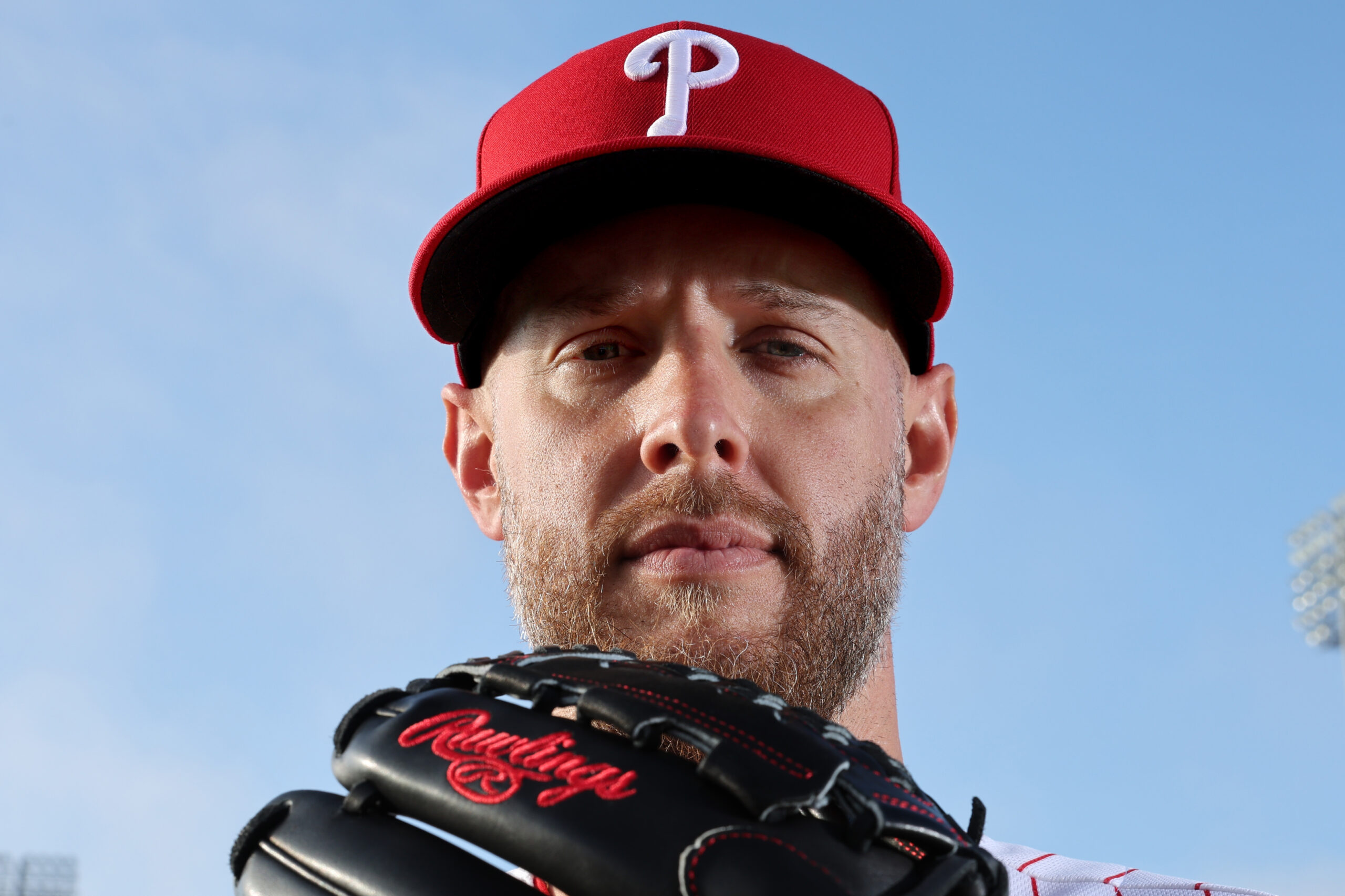
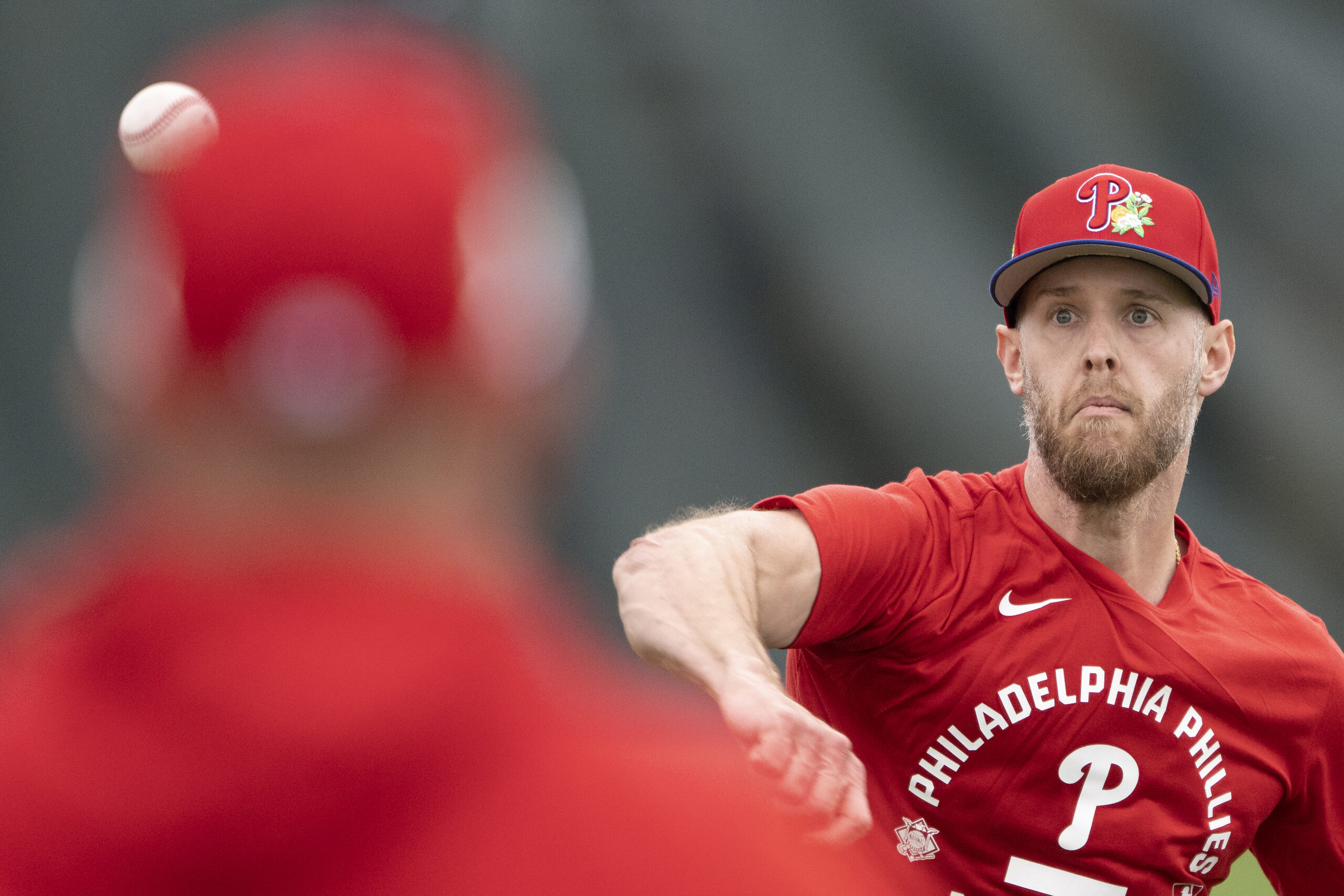
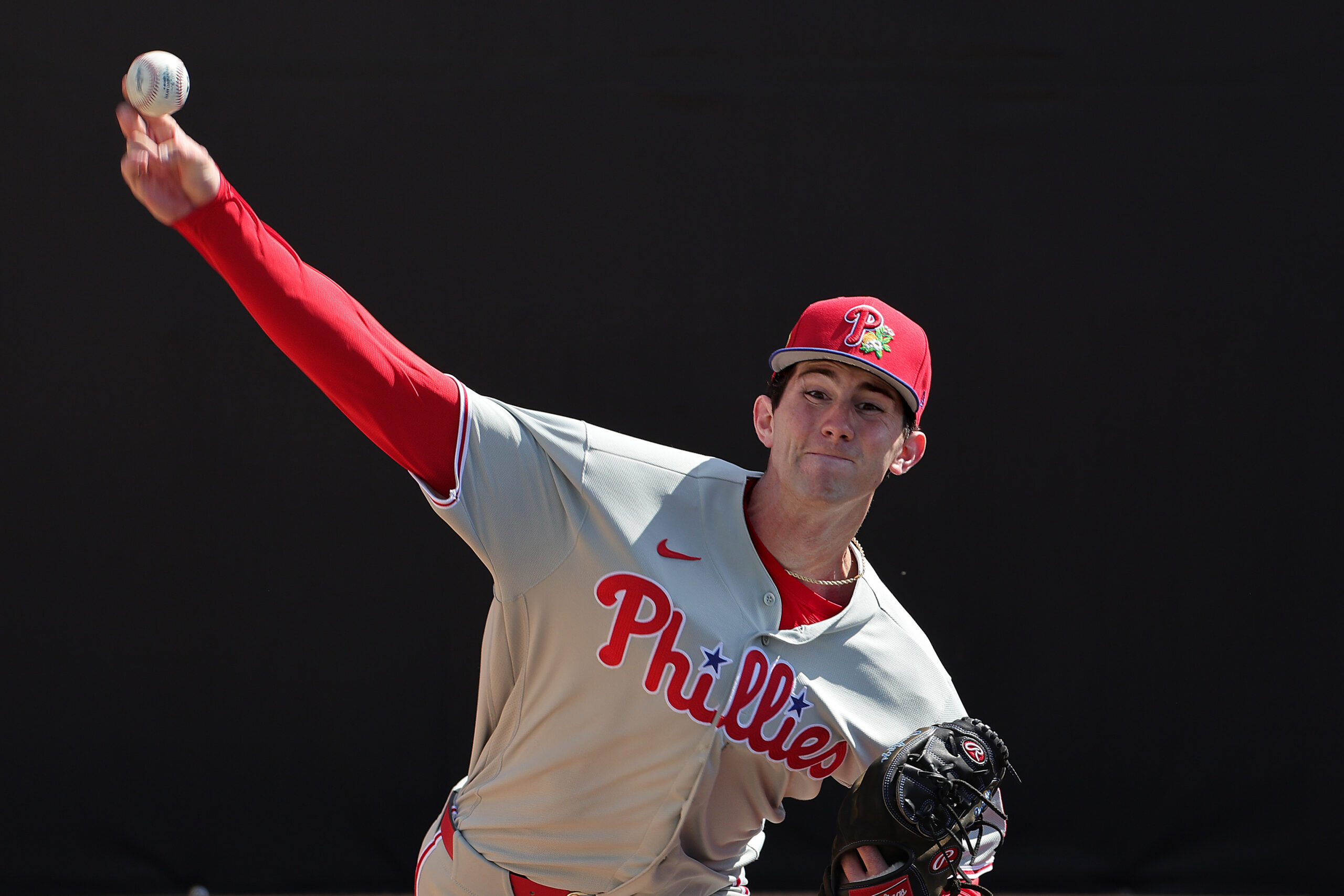
Phillies pitcher Zack Wheeler was diagnosed with a blood clot near his right shoulder after a start in Washington on Aug. 15 of last season.
When they work out, Phillies pitchers often wear a cuff that partially restricts blood flow to help the arm recover. As Wheeler put it, “your veins start popping up.”
“That’s literally what I felt like,” he said.
Only he wasn’t wearing the cuff.
Wheeler said he reported the issue to head athletic trainer Paul Buchheit, with whom he has developed a close relationship since both joined the Phillies in the 2019-20 offseason. He also told Buchheit about “a little bubble in my armpit” that looked like a lymph node.
Everything checked out in the training room. Wheeler said the “full feeling” went away, then returned the next day in the bullpen before his start, then went away again. He held the Nationals to two runs in five innings, threw 97 pitches, and topped out at 95.7 mph, a 1.5-mph gain over his previous start.
“Paul was like, ‘Let’s just get it checked out,’” Wheeler said. “The D.C. doctors came over, and they’re like, ‘Uh, it’s not a lymph node. You need to go get that checked out tomorrow morning, first thing.’ And that was kind of what started the whole thing.”
Doctors diagnosed the blood clot. Wheeler went back to Philadelphia and underwent a venogram, a test to detect blood flow in his veins. The conclusion: The clot was caused by a vein that got compressed between Wheeler’s rib cage and collarbone.
If anything, Wheeler actually felt relieved.
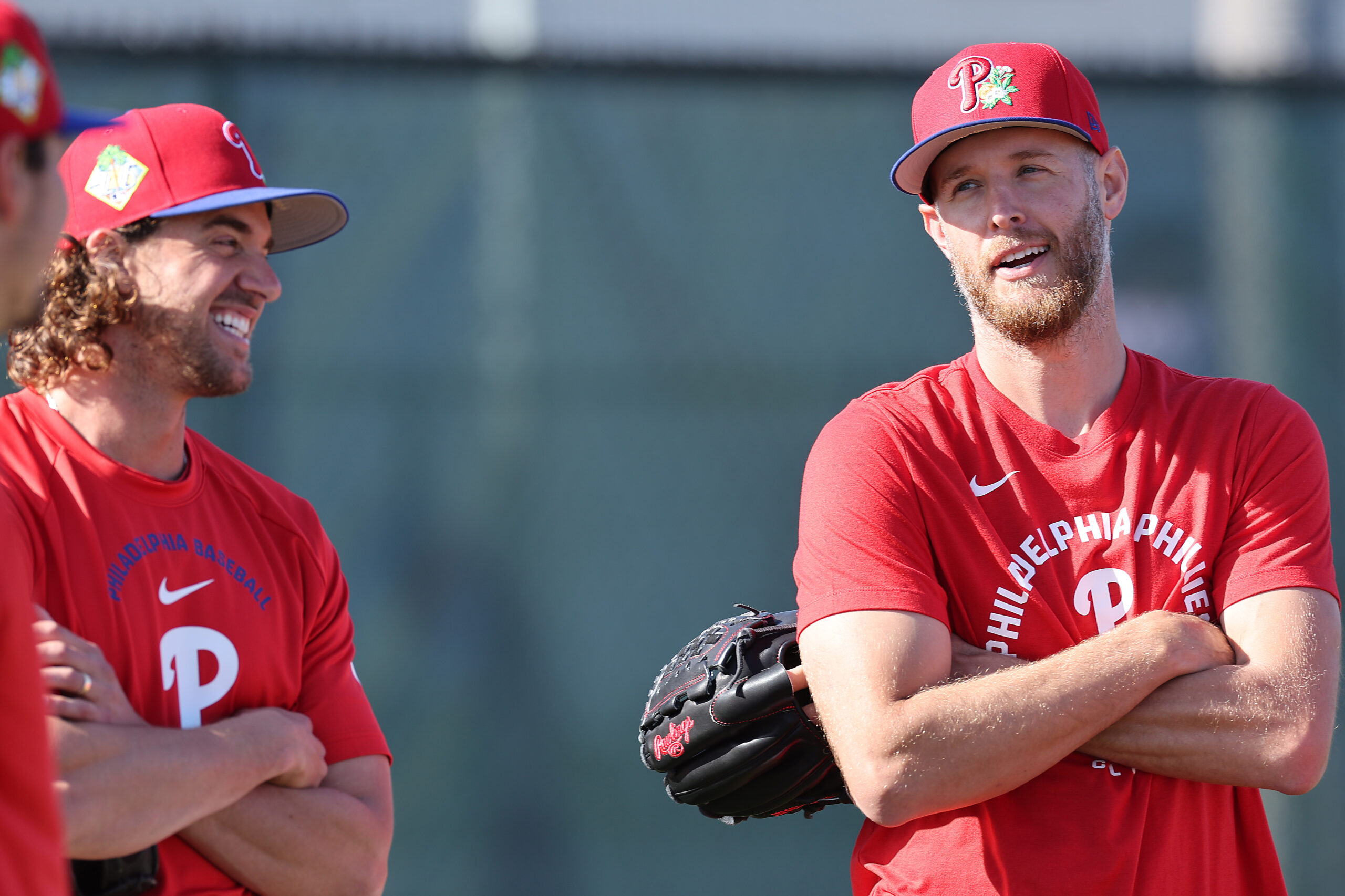
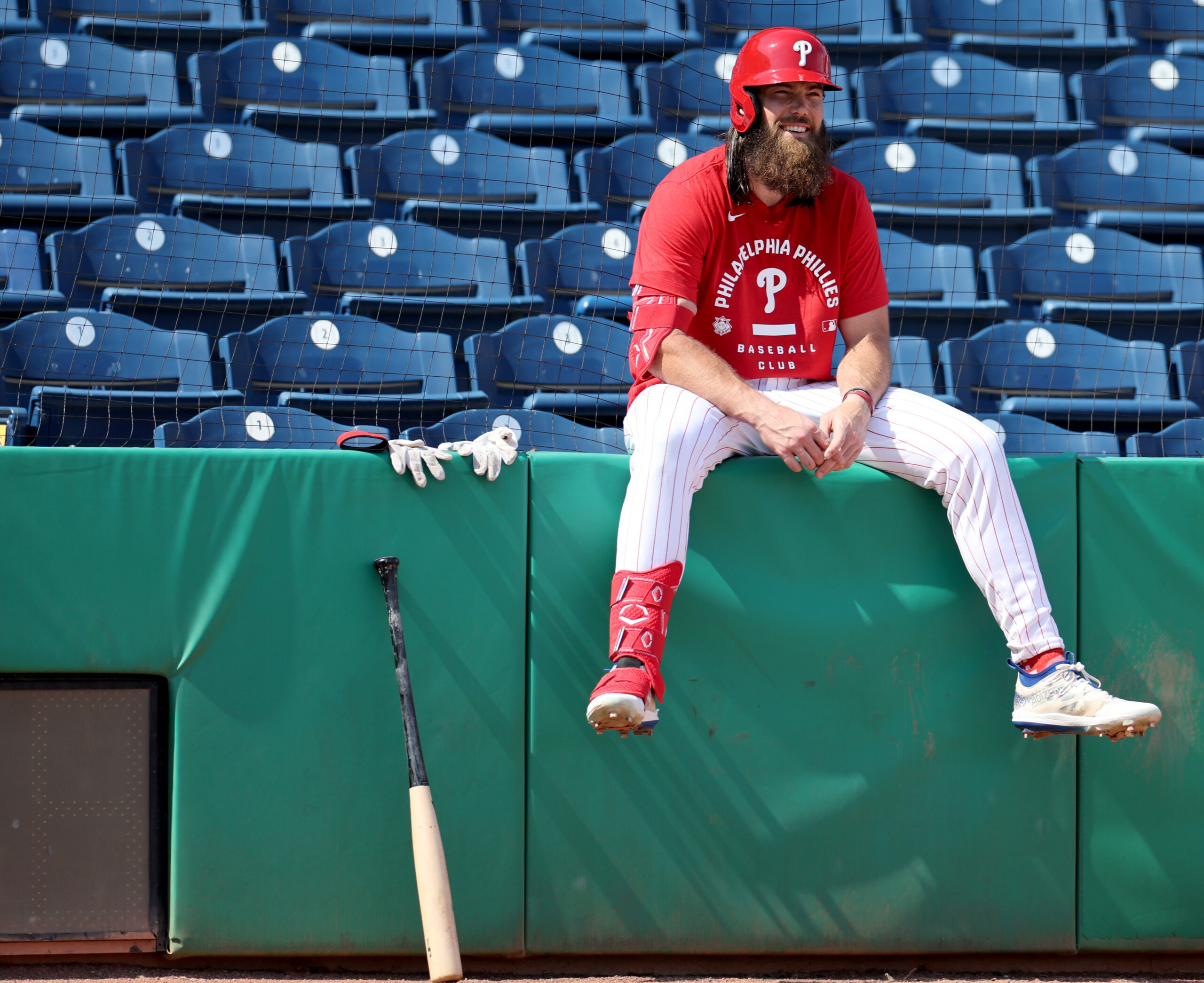
Phillies pitcher Aaron Nola (left) listens as Zack Wheeler jokes around during spring training in Clearwater, Fla.
“Even though like the whole blood clot thing was pretty serious, I didn’t even find it that scary,” he said. “Maybe I’m just naive to it. But I didn’t get a blood clot because of my health or anything like that. It’s just two bones were pinching together. That’s why it happened. So, that kind of eased the thoughts in my head.”
Wheeler underwent a thrombolysis on Aug. 18 at Thomas Jefferson University Hospital to remove the clot and open the vein. After taking blood thinners for five weeks, Wheeler had surgery Sept. 23 to remove the rib. The vein had closed again and a second clot was forming.
It was “nothing out of the ordinary,” according to Wheeler, who said his St. Louis-based vascular surgeon, Robert W. Thompson, warned that the vein might not stay open until after they removed the rib.
“Just from hearing what they were saying, if it stayed open, hooray. But I don’t think they really expected it to,” Wheeler said. “The rib was still there. The clavicle is obviously still there.”
Before Wheeler left the hospital, doctors went in again to make sure the vein hadn’t closed again. It had not.
Then came the hard part: weeks of physical therapy and rehab, including a strict diet of what Wheeler described as “small amounts and healthy stuff,” not easy for an unabashed fast-food and junk-food lover. He’s unsure how much weight he lost but said it was “a good bit.”
“You can’t have fats or something like that,” said Wheeler, who rejoined the team Oct. 4 for pregame introductions before Game 1 of the division series against the Dodgers. “I lost a lot of weight doing that because I could barely eat, really.
“It was pretty painful that first week. It was rough. But since then it’s been pretty smooth sailing.”
Wheeler spent most of the winter in Philadelphia, rehabbing under Buchheit’s supervision. There’s a history of pitchers returning from this particular form of thoracic outlet syndrome. Among the success stories: Merrill Kelly, at age 31, had surgery in September 2020, made it back by April 2021, and is still going.
So, while outsiders — and even some of his teammates — wonder if Wheeler will be Wheeler again after a procedure that he insists wasn’t as scary as it sounds, he puts in the work each day with his usual nonchalance.
“I mean, it might be a little thought, but at the same time, you can’t worry about that kind of stuff,” Wheeler said. “There’s no hesitation at all.”
You won’t find chef Joey Baldino flexing tweezers with microgreens or dotting plates with fluid gels at the Bomb Bomb Bar and Grill.
That’s because Baldino, who also owns the popular Palizzi Social Club near 12th and Reed and Collingswood’s Zeppoli, occupies a unique place in Philadelphia’s pantheon of chefs as the preservationist-in-chief for the classic-but-fading flavors of Italian South Philly.
Baldino has managed one of the trickiest tasks possible — to retainthe essential character of a down-to-earth neighborhood bar while also making it his own, giving more depth to the seafood and drinks, and infusing it with sustainable new appeal for newcomers and longstanding regulars alike.
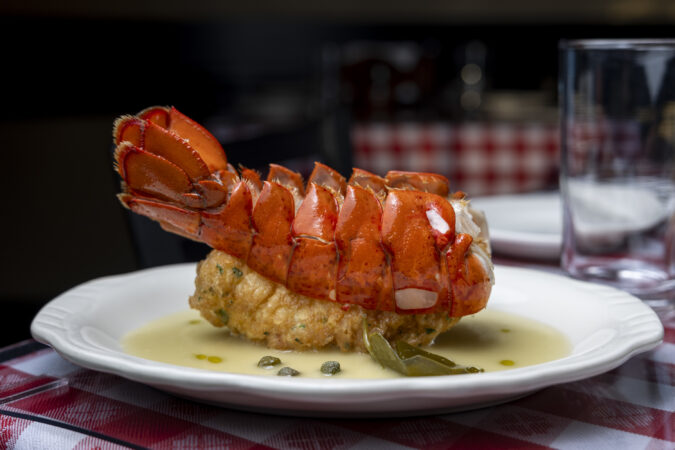
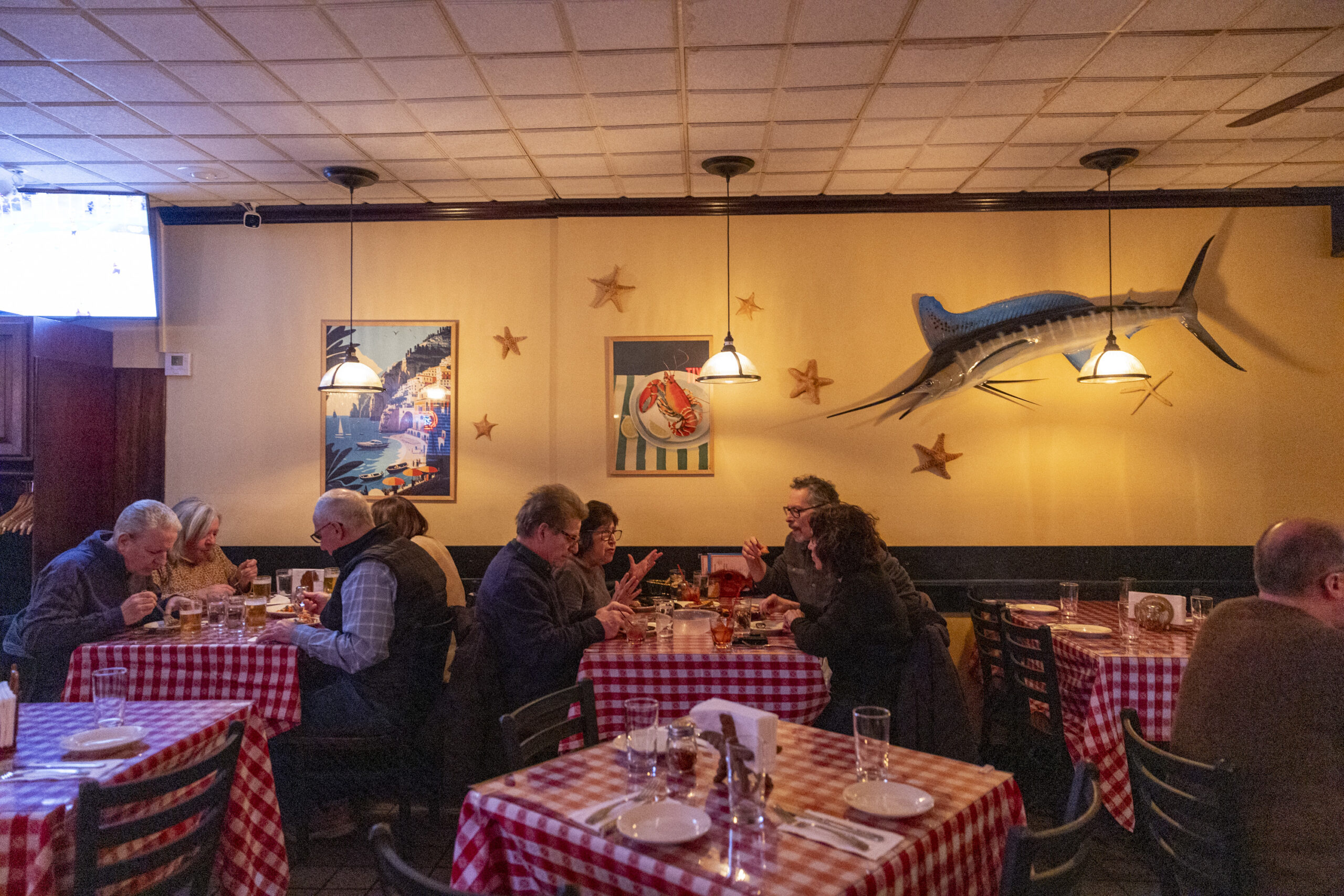
At the Bomb Bomb, where the tiny back dining room is draped with red-checked tablecloths, a plastic marlin hangs on the wall, and Louis Prima tunes fill the air (along with Nina Simone, the Ramones, and vintage Herb Alpert brass), this humble son of East Passyunk is at his best in summoning his ancestors with, among other things, one of the best “mussels red” I’ve ever had. A shot of Calabrian chile paste and white wine give his fra diavolo sauce an irresistibly zesty ba-da-boom. His reinterpration of a venerable standby like lobster francese is even more proof of his golden old-soul touch: He infuses the meat with the zing of Goodfellas-style thin-shaved garlic before crisping it inside a delicate egg-wash crust, then floating it atop a lemony puddle of butter sauce laced with the briny crunch of caper leaves beneath the bright orange lid of its shell.
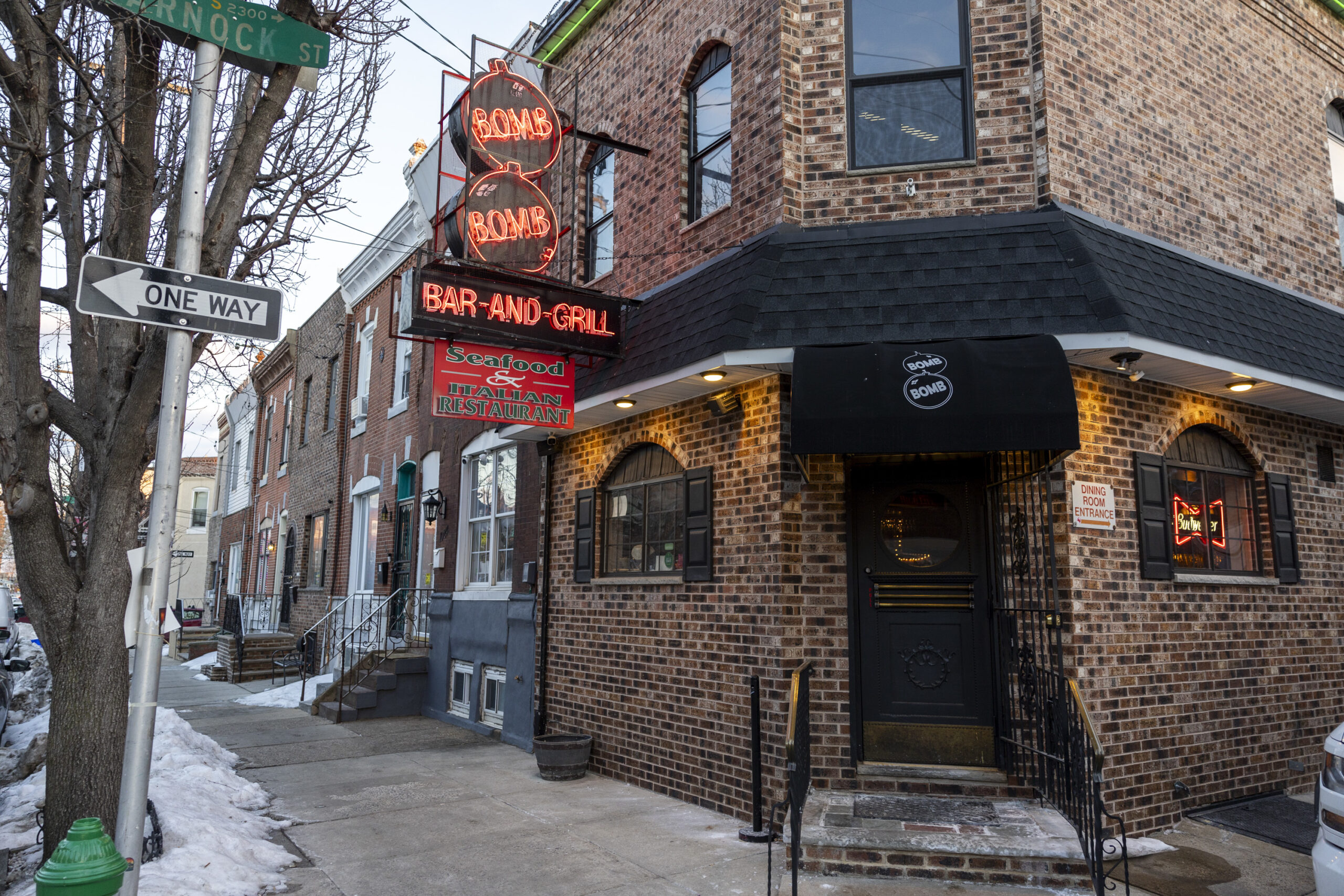
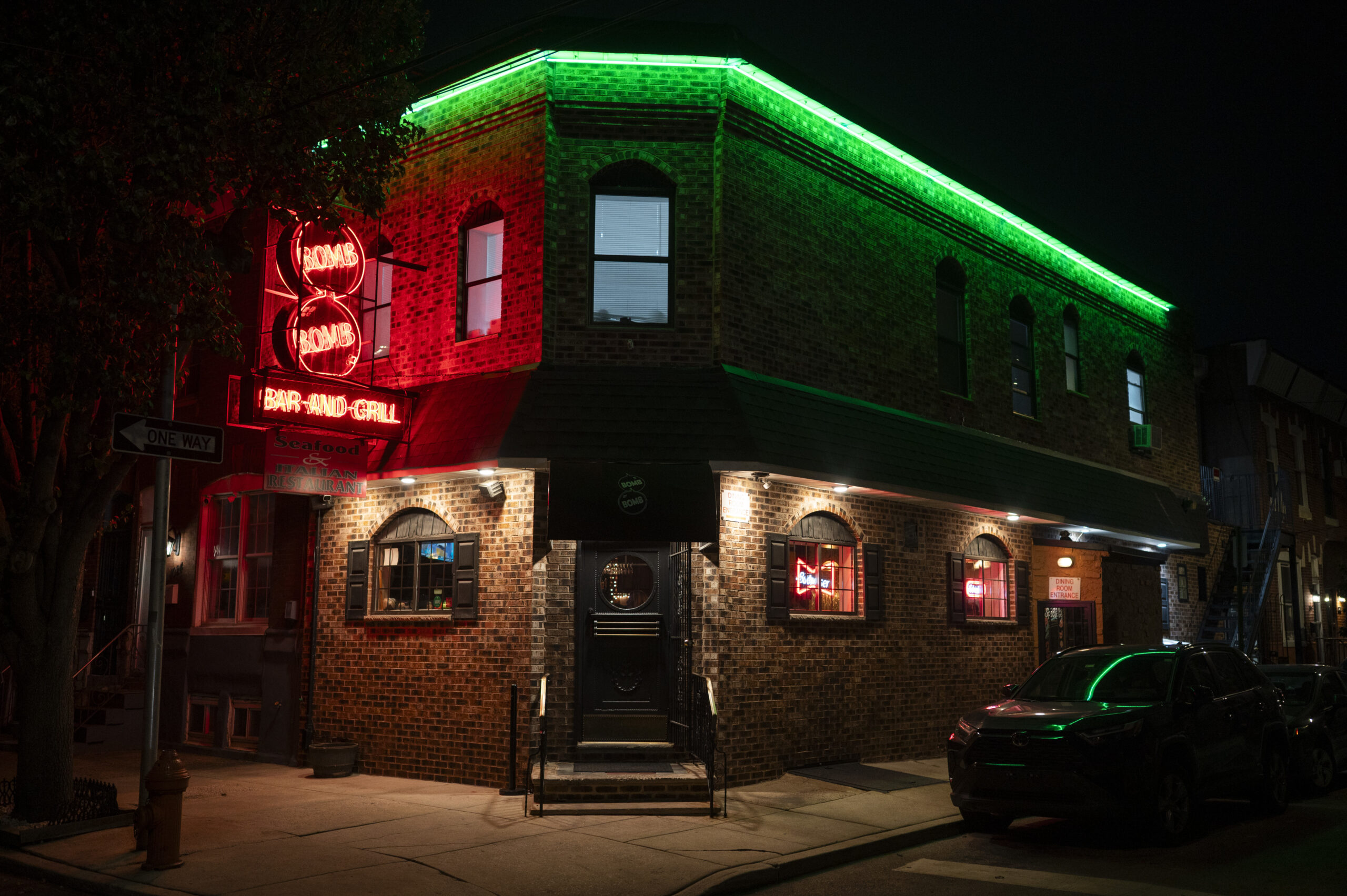
The outside of Bomb Bomb Bar in Philadelphia, Pa., on Thursday, Feb. 12, 2026. .Joey Baldino has managed to retain the character of a down-to-earth neighborhood bar while also making it his own.
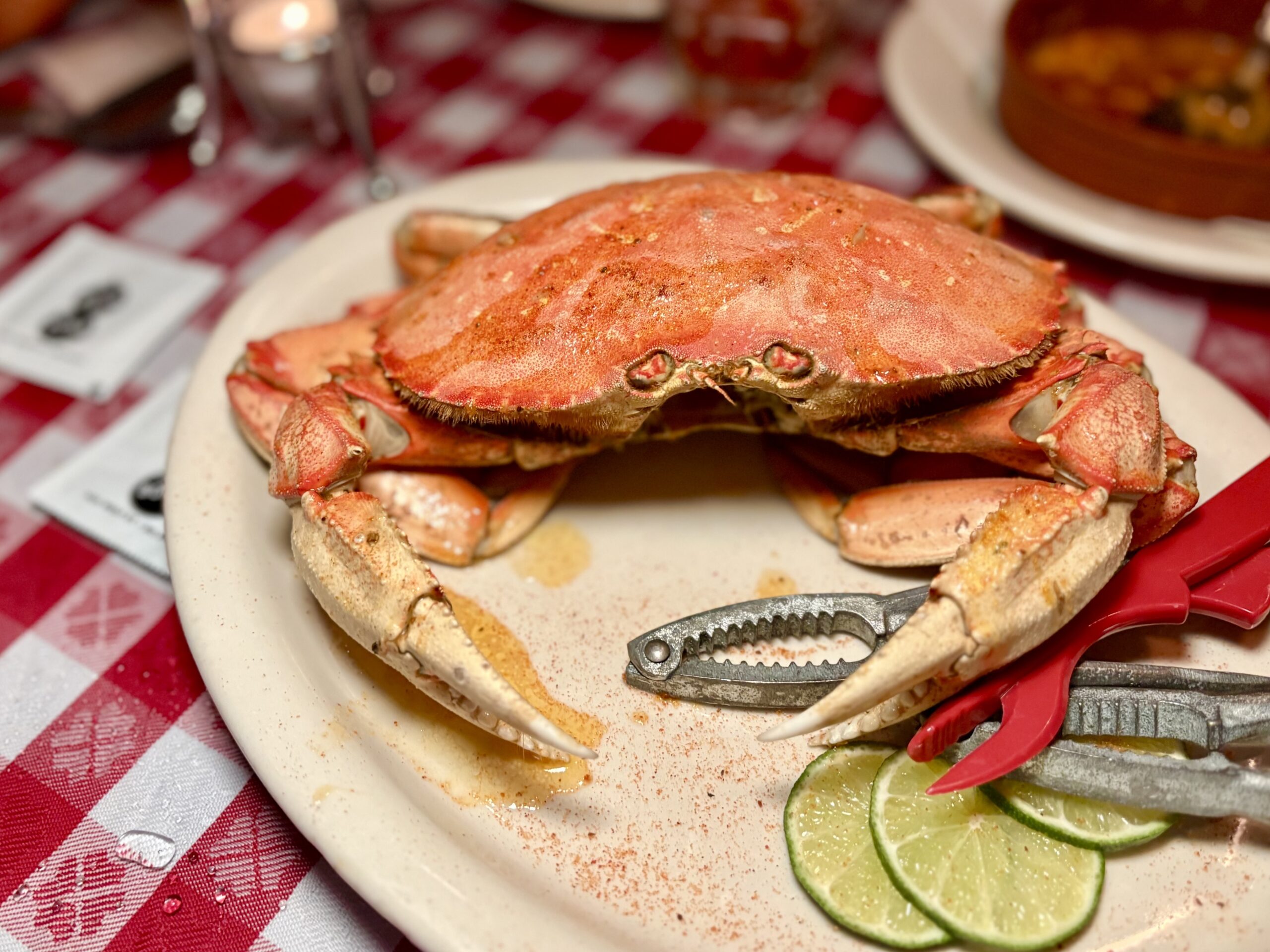
“It’s time to bib up now!’” says longtime Bomb Bomb server Linda DeCero, sidling up behind us to tie on the disposable plastic bibs for our seafood feast to come, a plump and meaty steamed Dungeness crab for two scented with juniper, orange, and bay beside a votive-warmed basin of drawn butter.
As one of several options for the prix fixe menu here, it’s a different kind of crustacean indulgence than the homey spaghetti with crab gravy the Bomb Bomb was originally known for. That was when it was owned by the Barbato family, which not only gave this storied corner taproom its name (a nod to a pair of 1936 firebombings allegedly committed by a jealous competitor), but also kept it rolling with baked ribs and “That’s Amore” kitsch for 73 years until it was sold to Baldino in early 2025.
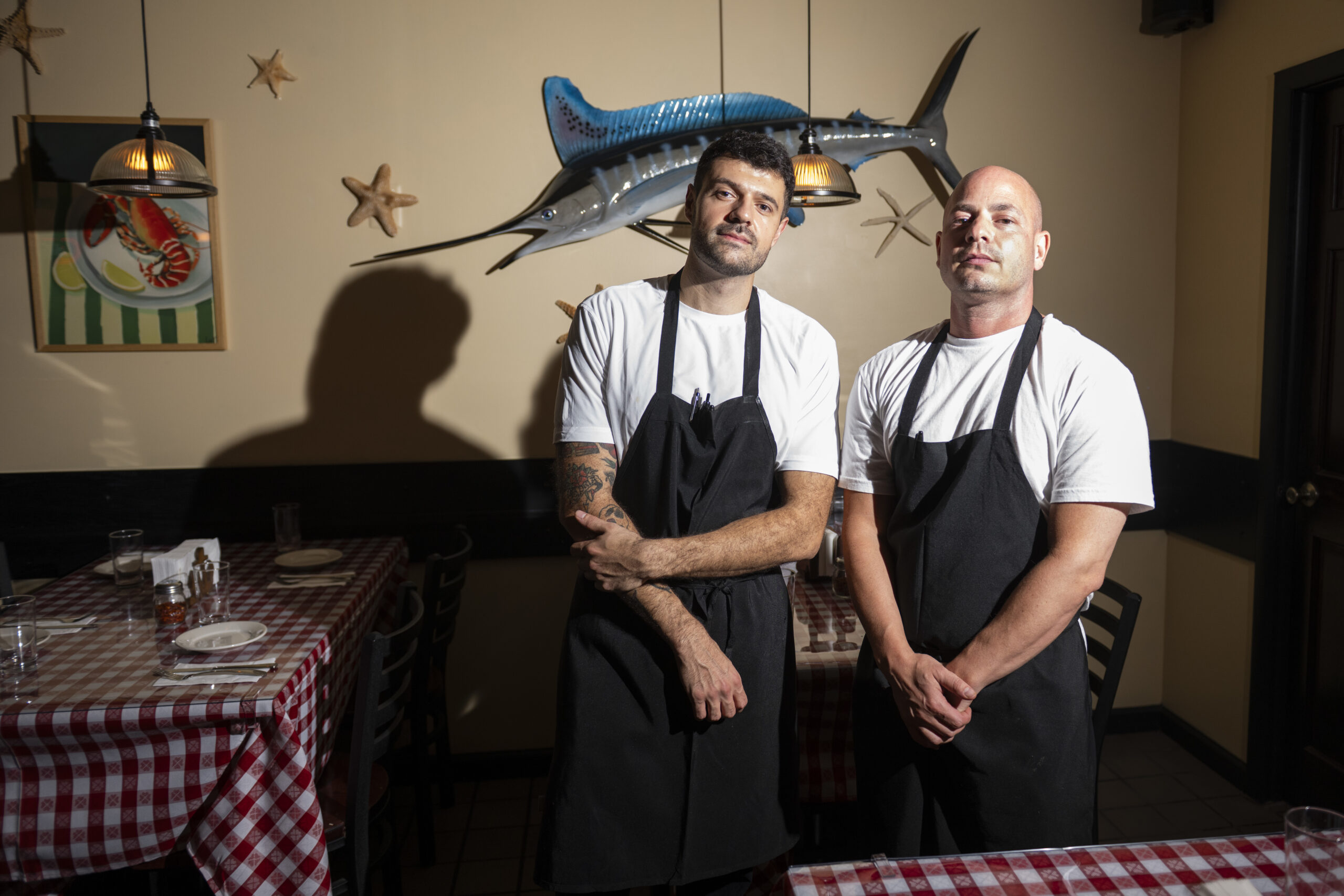
The steamed Dungeness crab for two is one of the highlights of the Italian seafood menu at Bomb Bomb Bar.Bomb Bomb Bar chefs Max Hachey (left) and Joey Baldino in the South Philadelphia landmark during a friends and family dinner on Sept. 29, 2025.
Baldino, who took nine months to open his lightly renovated version of the bar, has managed the transition with aplomb. Just ask the two cheerful sisters at the table beside us, who came from South Jersey to toast their late father’s birthday with a celebratory dinner and sundae at his longtime favorite tavern: “He’d love what they’ve done to the place!” one told me as we waited outside in the rain for our rides after the meal.
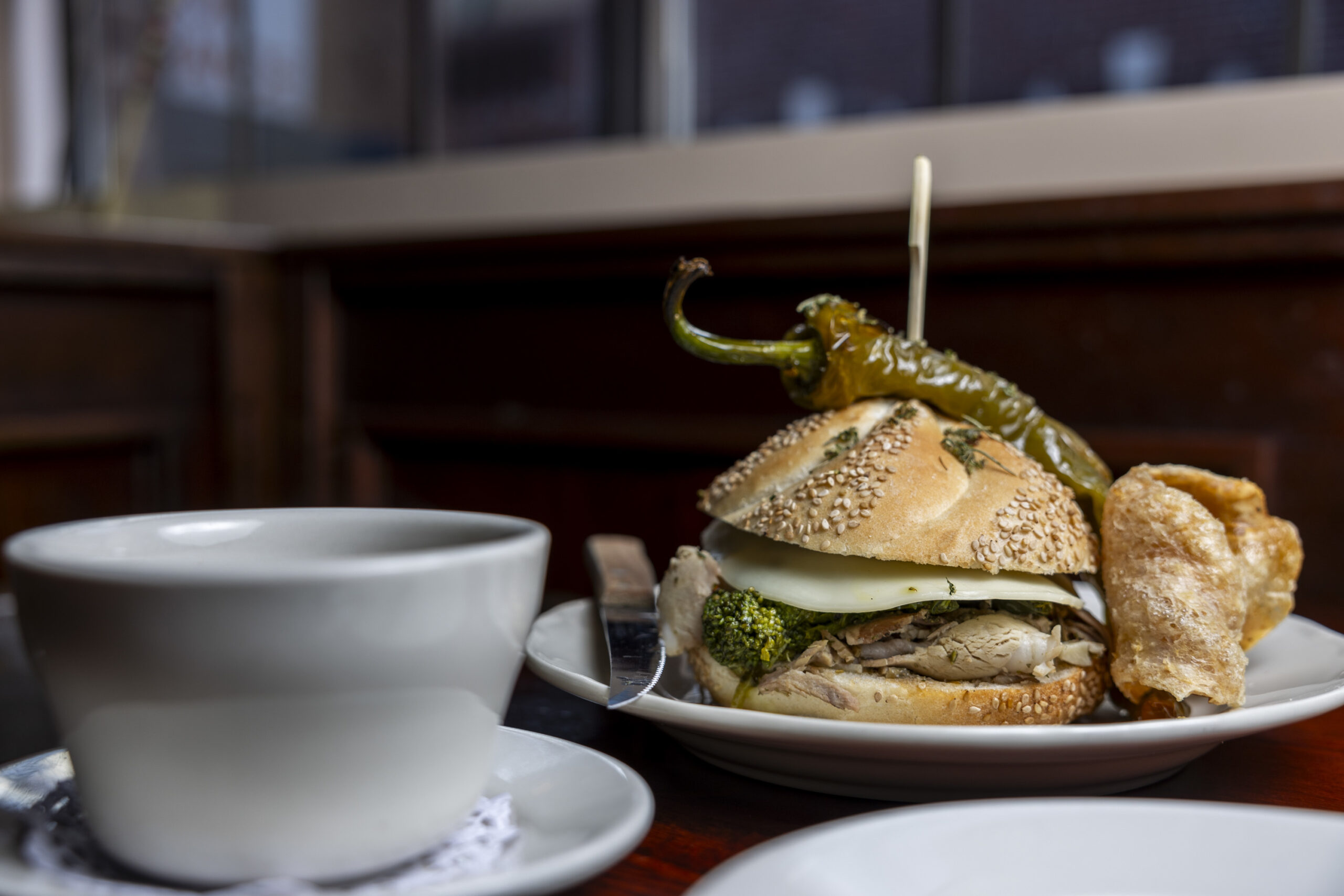
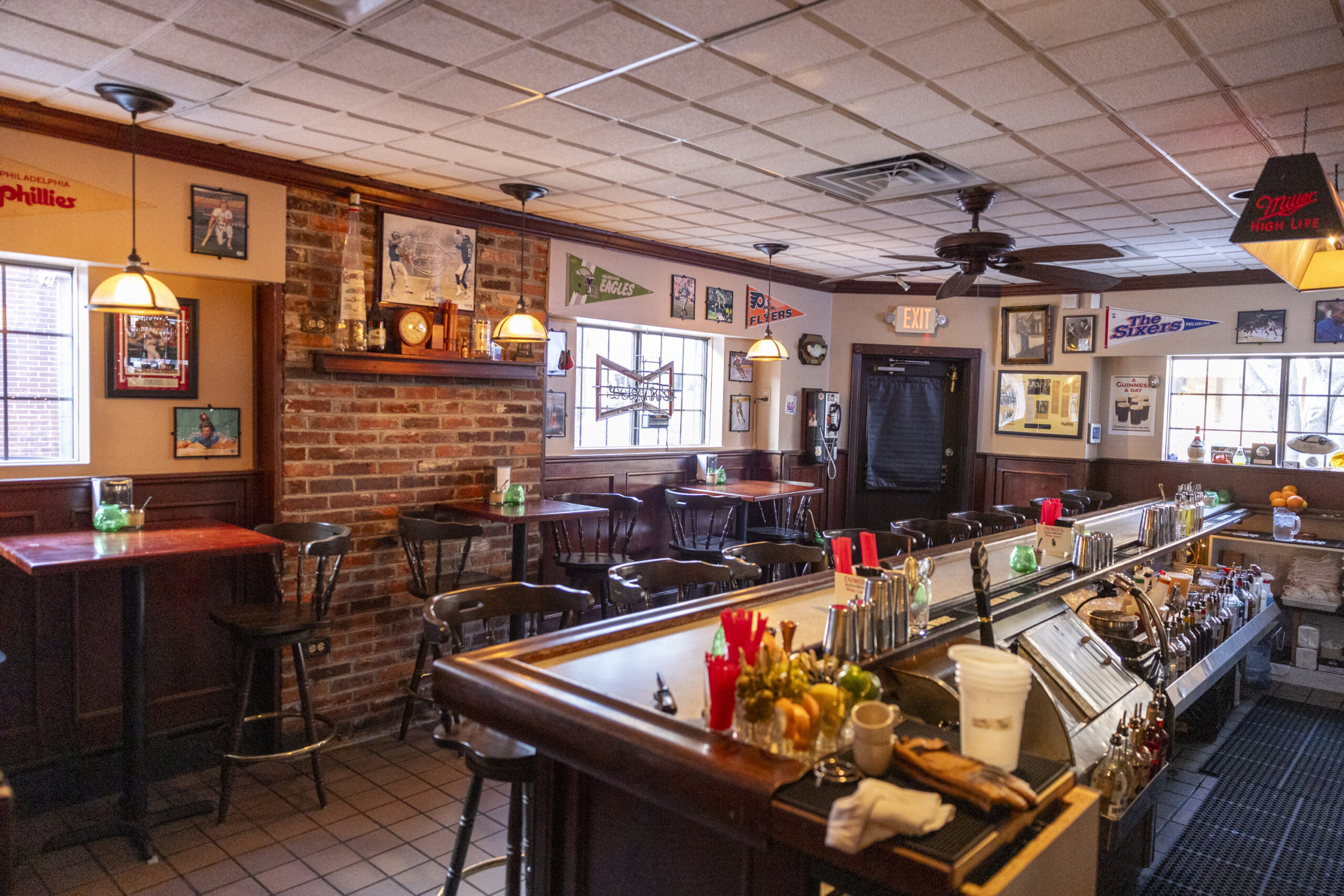
Baldino, 47, is uniquely suited for the task, having grown up eating steamed crabs out of a wooden bowl at his grandfather Al Mazza’s very similar bar at 12th and Reed — part of a generation of Italian bars like Strolli’s and South Philly Bar & Grill that have almost all now disappeared. He’s kept the Bomb Bomb’sclassic format of the neighborhood corner tappie intact, with room for 16 walk-ins in the small barroom up front, where you can nibble on sublimely juicy roast pork sandwiches and sip Vespers spiked with peperoncini brine while the Flyers skate across TVs behind the bar.
Meanwhile, the intimate 26-seat rear dining room, accessed through the onetime “Ladies Entrance,” is a boisterous reservation-only hideaway for three seatings nightly of a prix fixe seafood menu meant to evoke the Christmas Eve dinners of Baldino’s youth.
The pork sandwich with long hots at the Bomb Bomb Bar.The inside bar area of Bomb Bomb Bar in Philadelphia, Pa., on Thursday, Feb. 12, 2026. .
At $62 a person — with a choice of five sharing dishes for two people or six items for four people plus a pasta and a side — the price is fair considering the quality and quantity of the cooking. There are plenty of options for add-ons, specials, and drinks to turn dinner here into a splurge.
The antipasto for $18 is one add-on you probably shouldn’t miss for its bounty of house-pickled veggies, salumi, and cheese. And if the bagna cauda special is on offer, that’s another worthy vegetable-centric starter culled from Baldino’s daily shopping rounds through the Italian Market — grilled eggplants and zucchini, blanched cabbage rolls, and imported chicory shoots. They are perfect for dipping in a warm crock of buttery anchovy-garlic cream while your table sips through its first round of cocktail classics with Italian twists.
There’s a Bloody Mary sparked with Calabrian chilies and shredded provolone, a frozen Roman Coke spiked with amaro, a prickly pear riff on a margarita, and a crispy house pilsner made for the Bomb Bomb by Human Robot. I lean more into the affordable Italian wines when it comes to the heart of the prix fixe menu; a fizzy dry Lambrusco, the peachy almond notes of a Grechetto, and some light-hearted reds (a juicy Nebbiolo for $14) won’t overwhelm the seafood.
As for the food itself, you almost can’t lose — unless you have an aversion to an occasional excessive use of breadcrumbs on standbys like the shrimp oreganata or bacony clams casino. I preferred the cockles in brothier “clams white” form, steamed in Carlo Rossi Chablis (the official jug wine of South Philly) over a bowl of toast to finish last, having soaked in all that garlicky juice. The Bomb Bomb’s shrimp cocktail is also exceptionally flavorful from a gentle poach in a white wine court bouillon perfumed with orange and thyme.
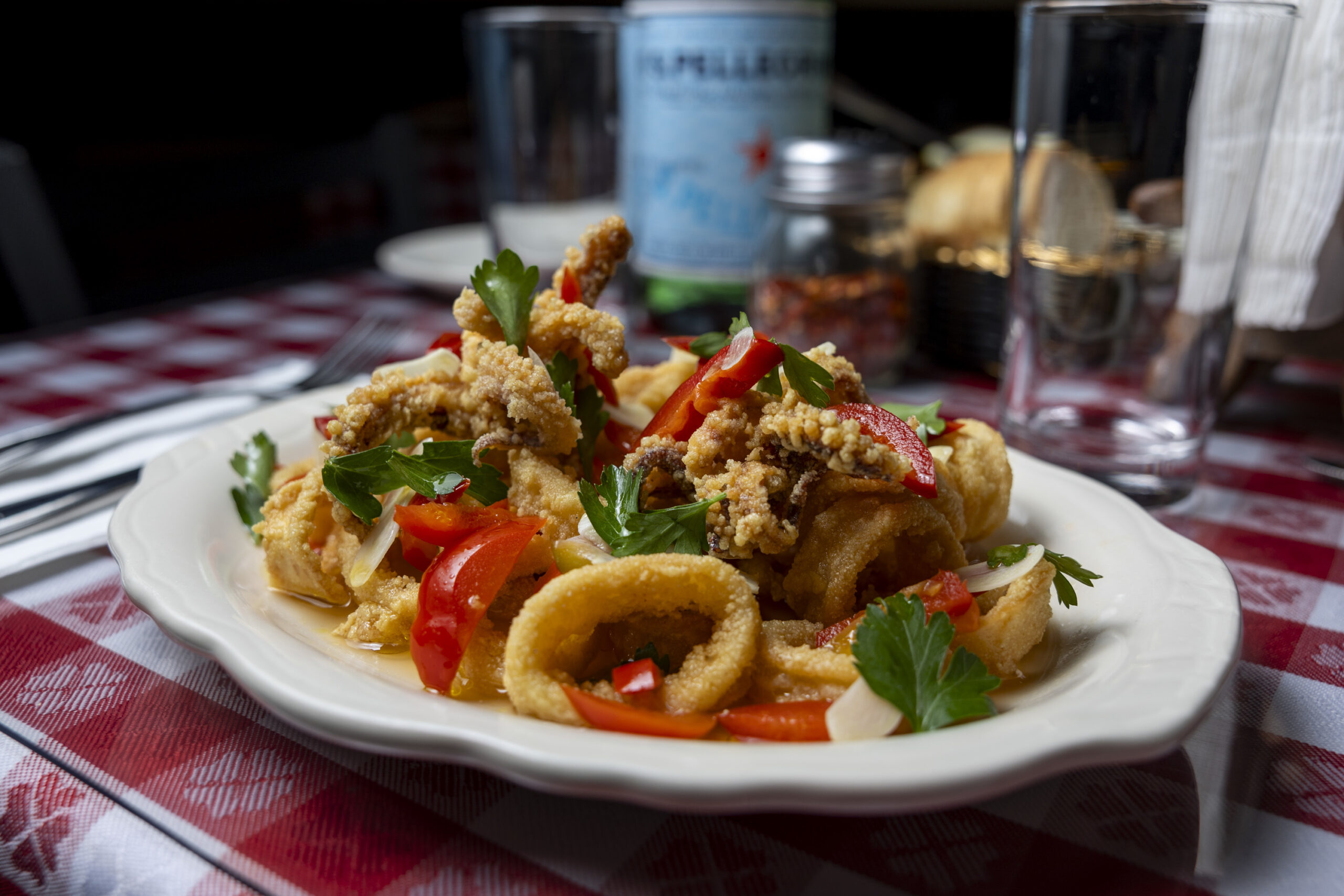
The fried calamari at the Bomb Bomb Bar in Philadelphia, Pa., on Thursday, Feb. 12, 2026. .
The fried calamari (also available on the limited tavern menu, like the shrimp cocktail) are the epitome of a bar classic done right, tenderized in cream before they’re crisped in seasoned semolina and tossed in a spicy confetti of red and green cherry peppers. But if you want to taste a deep cut from the Baldino family’s Seven Fishes repertoire, Mom’s stuffed calamari — the toothpick-sealed squid tubes stuffed with ground tentacles and Parmesan breadcrumbs that become incredibly tender after a two-hour simmer in tomato sauce — will absolutely take you there.
The stuffed squid is something of an homage to the Barbatos, who made a different version of the recipe. Similarly, Baldino’s baked St. Louis-cut spare ribs, exclusive to the bar menu, are a slightly cheffier, orange-scented riff on a popular mainstay during the family’s tenure. I appreciated both menu items for the continuity they offered between the two owners.
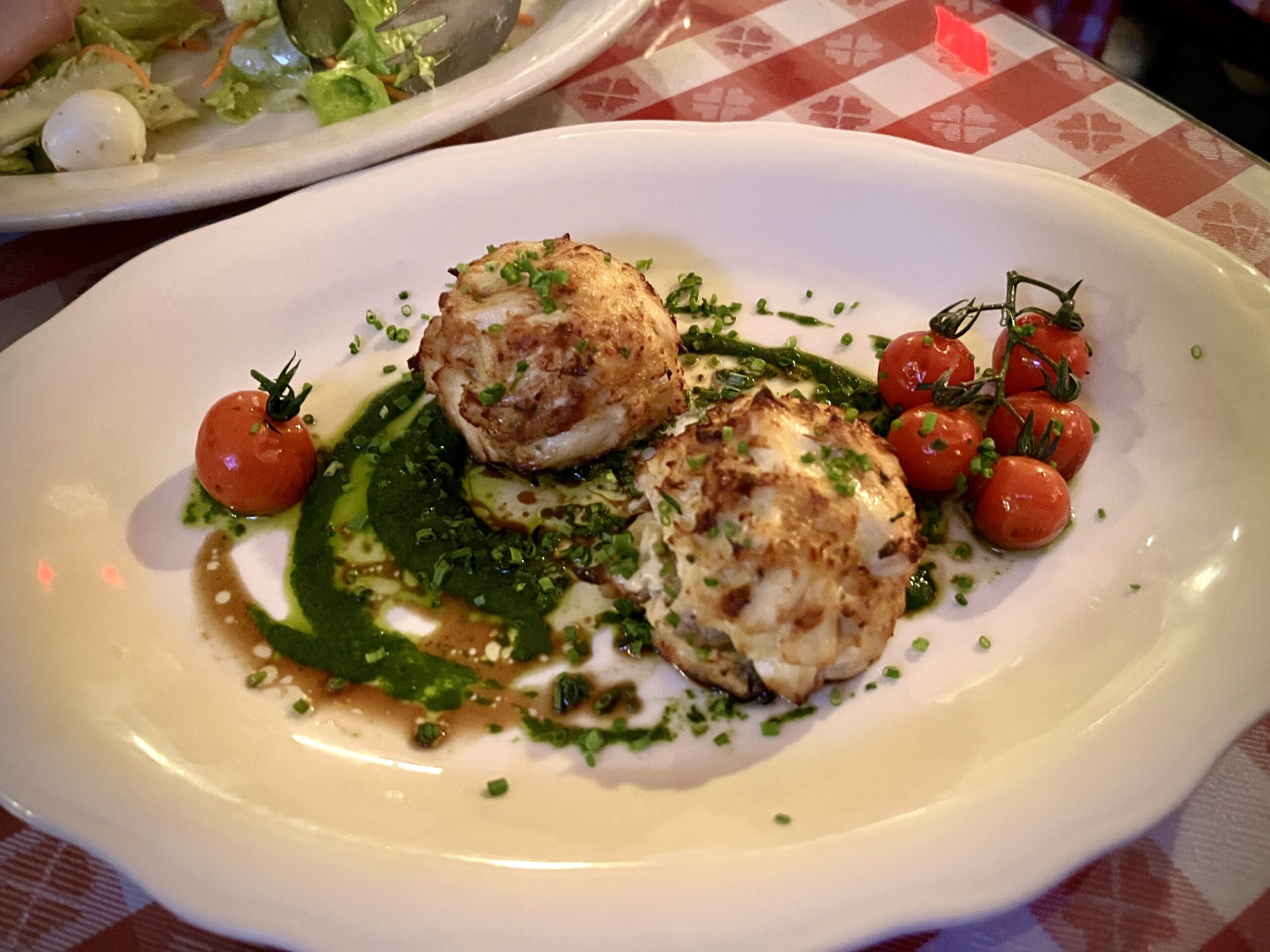
Two other luxurious seafood dishes shouldn’t be ignored. The baked crab cakes created by chef Max Hachey (last at Friday Saturday Sunday) were a celebration of sweet meat bound up with onion cream, roasted garlic aioli, and crushed crackers — easily one of my new favorites in the city. And the lobster-and-shells genre has also been taken to a clever new level here, inspired by the flavors of a stromboli: Al dente pasta cradles butter-poached lobster in a blush sauce enriched with melted mozz and zingy ground pepperoni.
Crab cakes at the Bomb Bomb, the classic Italian seafood joint revived by chef-owner Joey Baldino in deep South Philly.The carbonara at the Bomb Bomb Bar in Philadelphia, Pa., on Thursday, Feb. 12, 2026. .
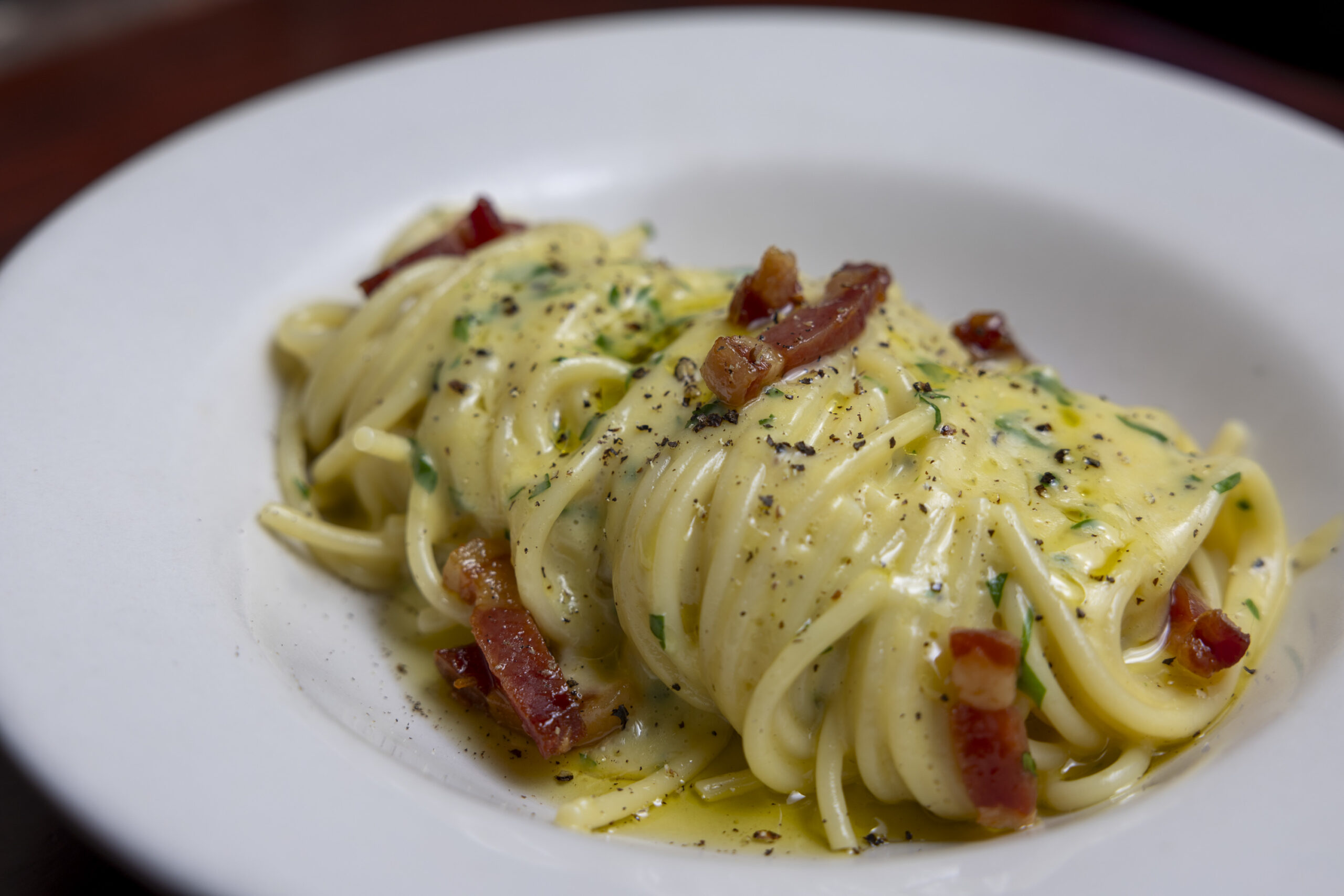
As a testament to Baldino’s confident grasp of the South Philly Italian canon, he feels no need to resort to any red-gravy meatball clichés on the pasta side of the menu. His carbonara is the stuff of creamy noodle dreams, its egg-and-bacon glaze still frothy even though it’s blended with three kinds of cheese, including an alpine twinge of toma. The black ink spaghetti is a dark-horse noodle champ — quite literally, because its simple, garlicky shine of aglio-e-olio sauce is turned jet black with sepia ink. And Baldino’s Italian tuna pasta might be the most overlooked gem of them all, a comforting yet elegant deconstruction of tuna noodle casserole.
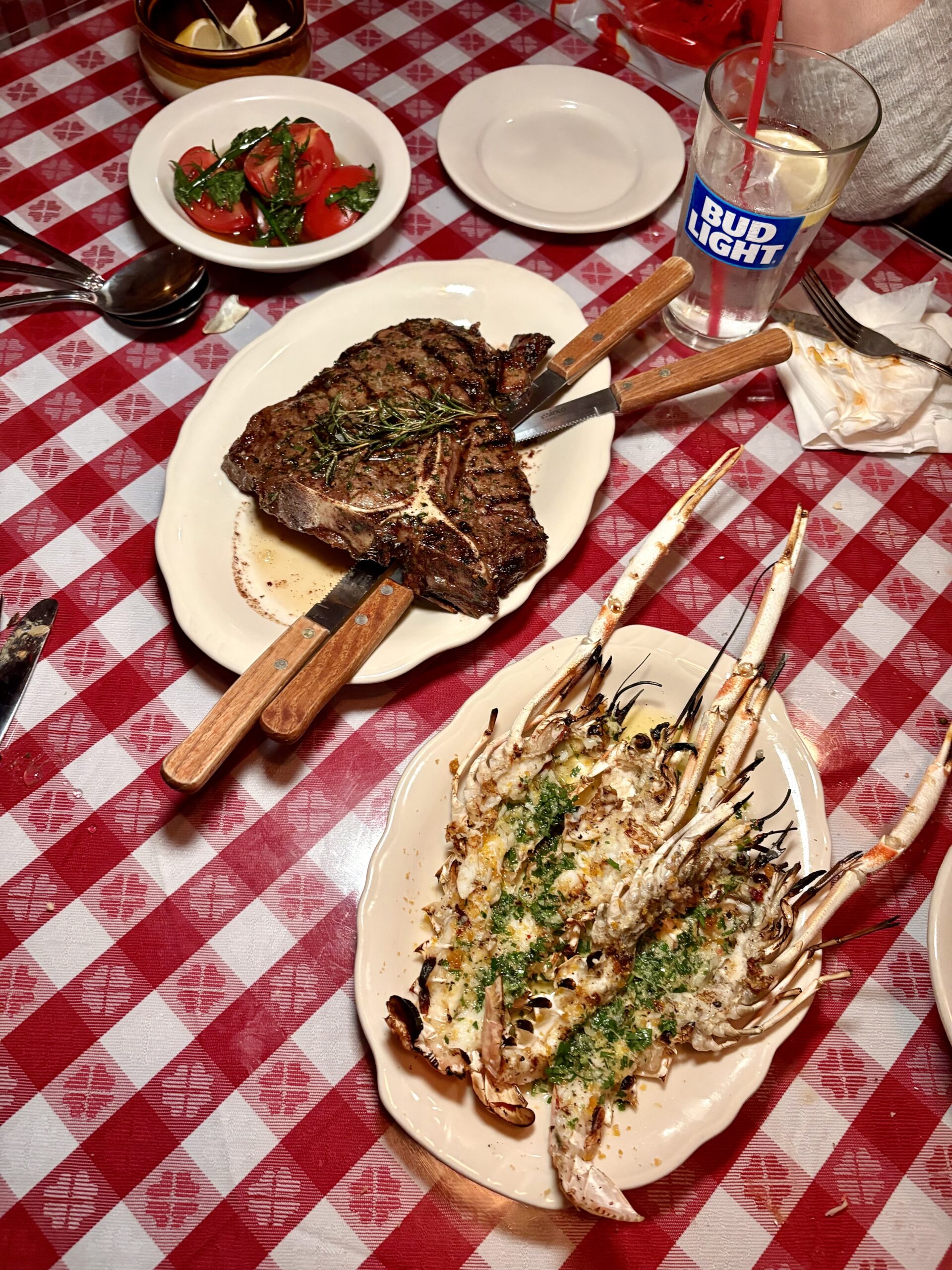
There are always other off-menu treats lingering in back to keep the dinner intriguing, like grilled langostini glistening with bottarga butter in a fragrant nod to the Sicilian flavors of Zeppoli. The frequent special of garlicky T-bone steak basted with olive oil-soaked rosemary branches is so good, I wonder if there’s a retro Italian chophouse lingering in Baldino’s future, too.
Keeping the Bomb Bomb’s distinctive red-neon sign glowing bright over the corner of Warnock and Wolf Streets, now beckoning to an enthusiastic new generation, is more than enough of an achievement. So order yourself a vanilla ice cream sundae drizzled with house chocolate sauce, brown-butter caramel, and a fried banana — a sweet tribute to a long gone shake shop that Baldino also loved — and lift a toast to the ancestors. Italian South Philly’s culinary preservationist-in-chief has scored once again.
A porterhouse steak and grilled langostini with bottarga butter are two notable recent specials at the Bomb Bomb Bar & Grill.
Dinner seatings in rear dining room by reservation only Thursday through Monday, at 5, 7, and 9 p.m. Bar is open to walk-ins only Thursday through Monday, 5 p.m.-1 a.m. Lunch served Saturday and Sunday, noon-3 p.m.
Not wheelchair accessible. There are two steps at the front entrance and bathrooms are not accessible.
Gluten-free pasta is available and much of the menu can be modified to be gluten-free, including the antipasto, lobster francese, streamed seafood, and ribs.
Menu highlights: clams casino; crab cake, lobster francese; shrimp oreganata; mussels fra diavolo; fried calamari; lobster and shells; Dungeness crab; spaghetti alla carbonara; herbed tomatoes; porterhouse special. Bar menu: porchetta sandwich; shrimp agrodolce; vanilla sundae.
Drinks: The full bar showcases simple but booze-forward cocktails with a zesty Italian twist, like the Vesper spiked with peperoncini brine and a Bloody Mary sparked with Calabrian chilies, frozen drinks such as the bubbly limoncello Scroppino.
The exterior of Bomb Bomb Bar in South Philadelphia on Monday, Sept. 29, 2025.
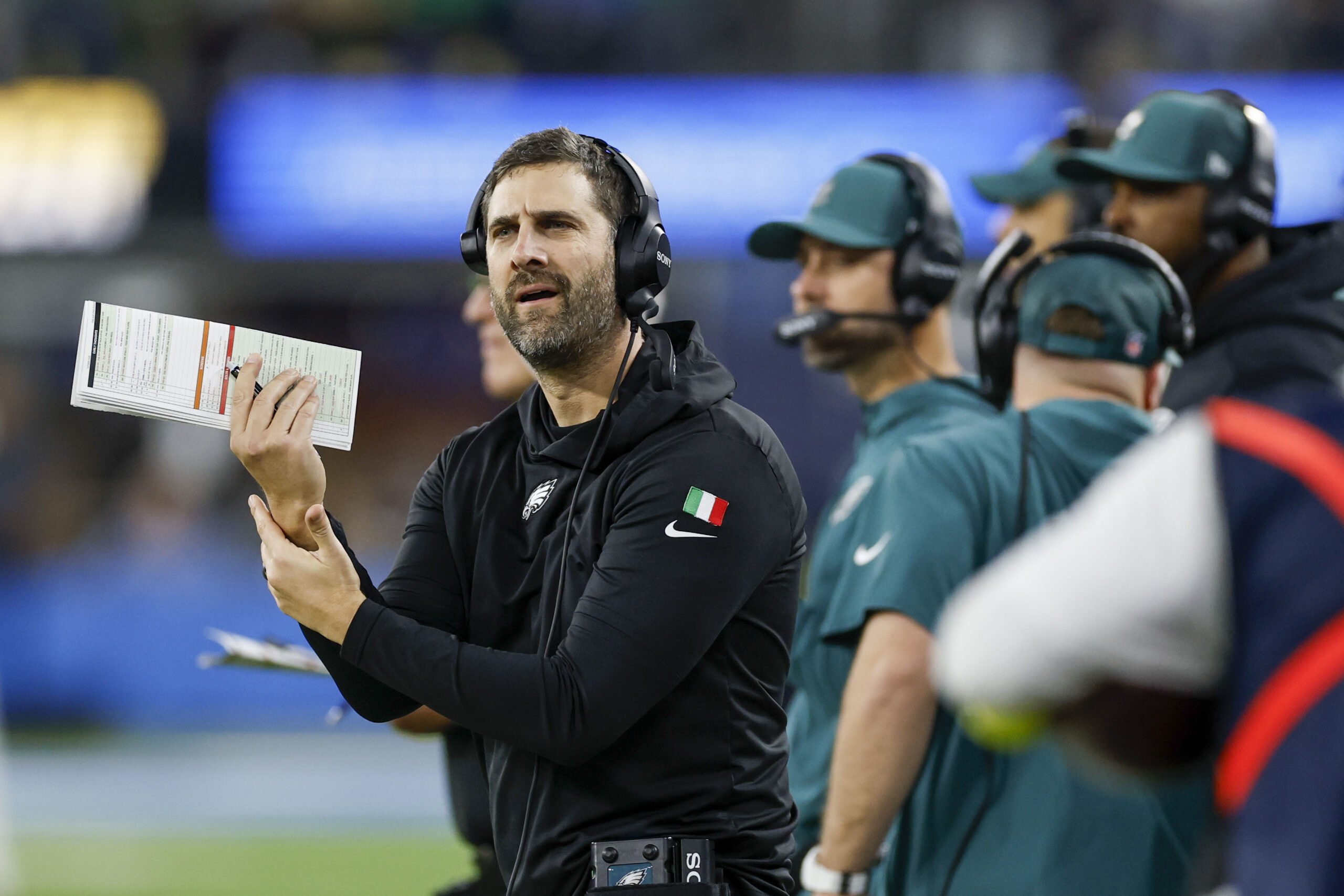
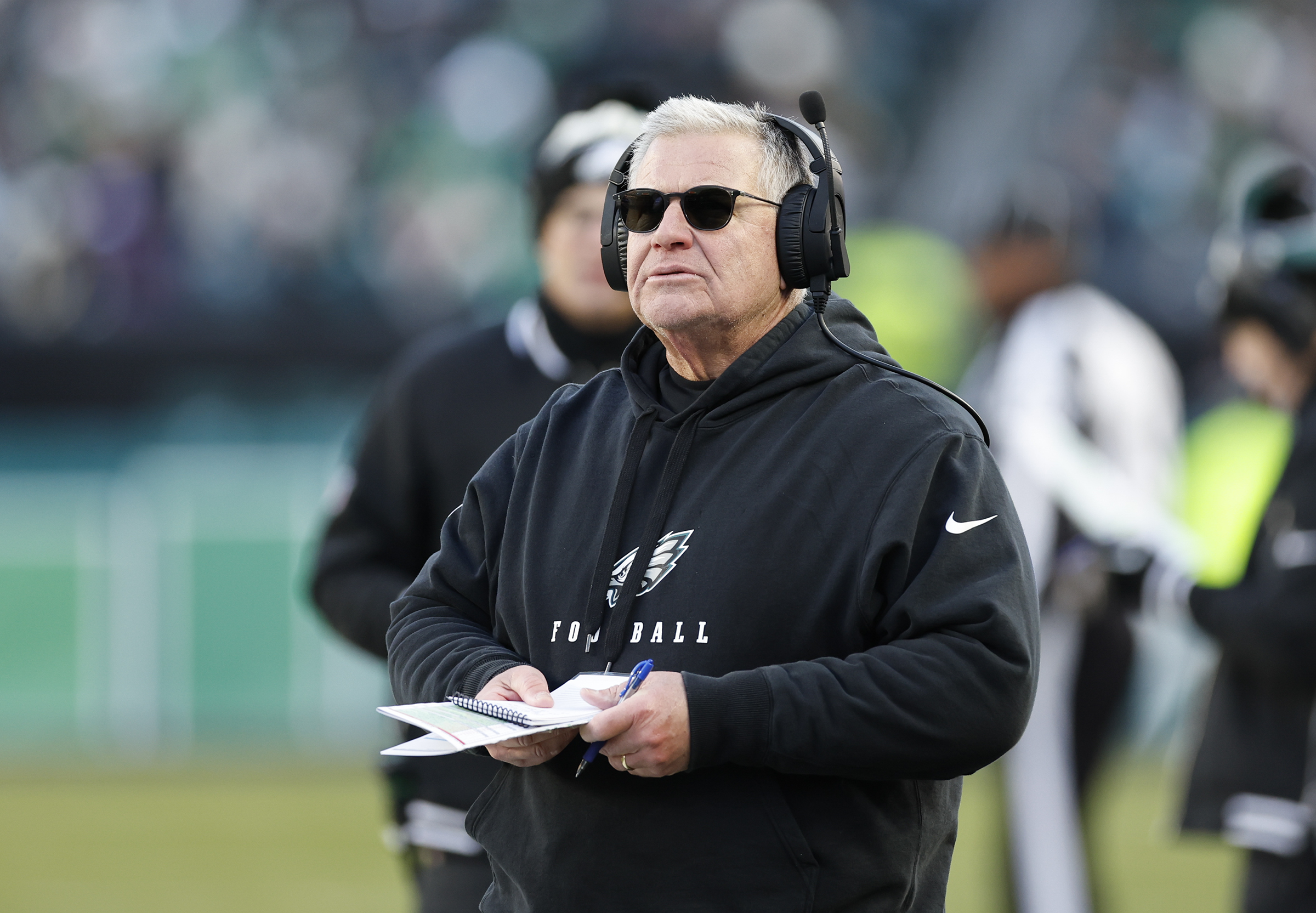
Nick Sirianni sat back in a chair with his feet up in UGG slippers. The Eagles coach looked as relaxed as he has in over a year, and certainly since a tumultuous 2025 season ended with him having to oust consigliere Kevin Patullo as offensive coordinator last month.
Sirianni met with reporters at the newly named Jefferson Health Training Complex on the Friday before the scouting combine. He and general manager Howie Roseman normally answer questions with locals in Indianapolis before they hit the combine podium. But with so much change already — and more to come — the Eagles opted for the more familiar setting of their draft room to address pertinent matters about the team.
Sirianni and the more upright Roseman spoke separately, each for around 40 minutes. They tackled subjects ranging from wide receiver A.J. Brown’s uncertain future to longtime offensive line coach Jeff Stoutland’s departure. But a significant portion of their availability — especially the coach’s — was spent on new offensive coordinator Sean Mannion.
Why did Sirianni hire the inexperienced former Packers quarterbacks coach? Why was the search drawn out? How much did wanting the Shanahan-McVay offense factor into the decision? What did Sirianni like about the scheme? How much autonomy will Mannion have? How will quarterback Jalen Hurts and other returning players adapt to the new system? And how will the changes affect evaluations of Brown and future Eagles?
Sirianni was light on details — how could he not be with so many unknowns? — but he and Roseman did provide enough information to allow for informed perspective on Mannion, the new scheme, and what could be an inflection point for the coach, his quarterback, and the Eagles overall. Here are 10 takeaways about the offense from Friday’s interviews:
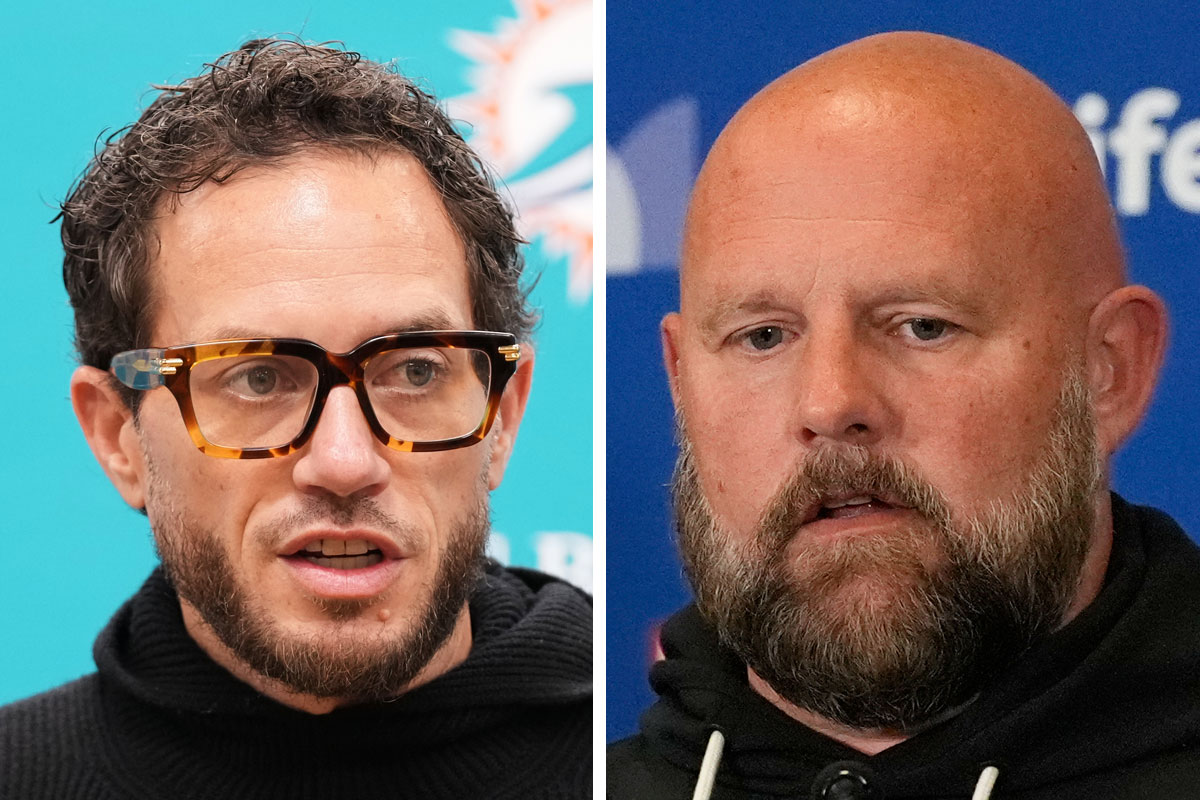
1. The Eagles pivoted in their approach to the OC search after it became obvious that Mike McDaniel and Brian Daboll wanted to explore other opportunities.
Former Dolphins coach Mike McDaniel (left) and former Giants coach Brian Daboll.
Sirianni didn’t confirm Inquirer reporting that McDaniel and Daboll were leading candidates, but he said he entered the offensive coordinator search looking for a veteran play-caller.
“I went into it … like I’d like for somebody to have some of the experience that’s done this,” Sirianni said. “Obviously, Sean has not had experience calling the plays. That, to me, was [secondary]. Like, we got into it and that kind of changed. I’m like, ‘No, this is the best guy for the job.’”
Sirianni also said he went into the process most interested in the Shanahan-McVay scheme, which would suggest that McDaniel was the primary target. Daboll comes from another system of offense, but he worked previously with Hurts at Alabama and would have checked other boxes. McDaniel went to the Chargers, while Daboll was hired by the Titans.
We’ll never know if the Eagles would have offered either McDaniel or Daboll the position, but clearly the search shifted into another phase. Sirianni said he interviewed a total of 17 candidates and that seven reached the second round. Only four of the final seven names — Josh Grizzard, Jim Bob Cooter, Jerrod Johnson, and Mannion — became public.
Mannion’s first interview was virtual, while the second was in person. Sirianni said that once he got him in the building, it confirmed his initial impression that the 33-year-old former quarterback was the guy for the job even though he had never called plays.
“What I was really looking for was the detail in which everything was explained to me, because the detail is so critical, conviction on what they believed and why they believed in it, and the vision and conviction of that how they went about it,” Sirianni said. “Like, OK, you haven’t called plays, but how do you go about thinking about calling plays in this particular area, like the vision for the offense, the vision and the conviction for how you would call it?”
2. Sirianni led the search and made the final decision — a fact that was made abundantly clear.
Eagles head coach Nick Sirianni listens to questions from media members with general manager Howie Roseman on Jan. 15.
Roseman, who touted Sirianni’s credentials as a CEO-type coach last month, made light of outside perception that he and owner Jeffrey Lurie hold strings over a powerless Sirianni when asked why he made those unprompted comments.
“Hold the strings, like during the games?” Roseman said. “Am I in his ear?”
Roseman, of course, remains one of the more entrenched figures in his position after two Super Bowl titles and 10 playoff appearances in 16 seasons as GM. He has final say over both the 90- and 53-man rosters and his influence with Lurie also can’t be overstated.
Roseman is also one of the most resourceful executives in the NFL. He helped Sirianni identify Mannion as a budding prospect.
“As you talk to people around the league, and they described him and his future, it became somebody that we really felt like we needed to talk to,” Roseman said. “It’s just his name kept coming up as we were doing things and as we were talking about the way that we were kind of moving from an offensive perspective.”
Sirianni, who spoke before Roseman, talked about a collaborative approach but identified himself as the “point man” in the search.
“The coaches that we bring in here always going to fall on me, right?” Sirianni said. “And I have to make those final decisions.”
Were the Eagles powers-that-be trying to empower their coach in giving him ownership over the coaching changes, or were they distancing themselves from the moves? Maybe only Lurie and Roseman can answer that question.
3. The Eagles are hoping Mannion will be the offensive coordinator version of Sirianni.
Nick Sirianni’s 2021 hire was an outside-the-box choice. Is Sean Mannion another diamond-in-the-rough choice?
The Eagles have had unprecedented success under Sirianni. They have a Super Bowl MVP in Hurts. They have Pro Bowl-caliber offensive players at multiple spots. And yet, there were rumblings that some OC candidates didn’t consider the job as desirable as other vacancies.
While previous coordinators Shane Steichen and Kellen Moore parlayed winning into promotions, Brian Johnson and Patullo were out after just one season at the helm. The position comes with both internal and external pressures. There’s also a question of Sirianni’s permanence in Philly and how Hurts has factored into coordinator turnover.
The Bears’ Declan Doyle, for instance, declined an interview request and reportedly told the Eagles he was staying in Chicago, even though he doesn’t call plays. Not long after, he took the offensive coordinator job with the Ravens, although it should be noted that he will work under defensive-minded coach Jesse Minter in Baltimore.
“All that really matters,” Sirianni said, “is the guy that you end up picking for the job and his excitement and willingness to be there.”
Sirianni might feel some kinship with Mannion, who didn’t interview for any of the other 14 coordinator openings this offseason. Sirianni, too, was an under-the-radar choice who surfaced late in the process when the Eagles tabbed him to be coach.
While Mannion had no other bites this offseason, like Sirianni five years ago, it doesn’t mean he won’t pan out.
4. It was the Shanahan-McVay scheme that led the Eagles to Mannion.
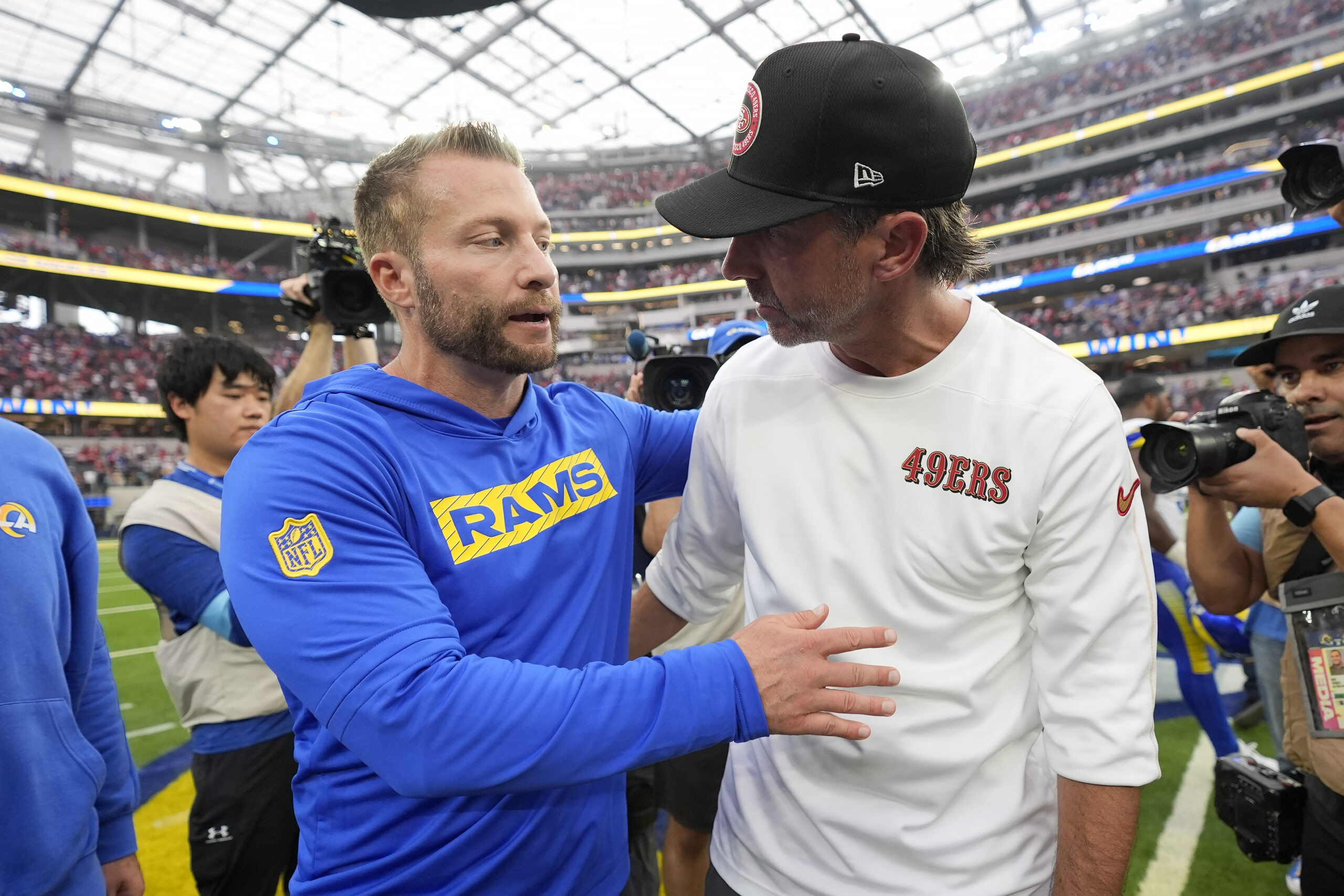
The schematic principles favored by Sean McVay (left) and Kyle Shanahan held increasing appeal for Nick Sirianni as he went through the OC process.
Sirianni interviewed coaches with backgrounds and experience in various offenses, but one scheme stood out more than others.
“It was in my forefront of my mind to say, ‘I’m interested in this,’” Sirianni said of the Kyle Shanahan-Sean McVay scheme. “But I didn’t necessarily say, ‘I have to have this.’ And then as the process went forward that’s where I kind of got to with that.”
The Shanahan-McVay system is often run-based that utilizes a wide-zone blocking scheme. It often marries the run with the pass through under-center play action. It features motion and misdirection. And it uses all the above to create space in the passing game for easy reads, yards after the catch, and explosive plays downfield.
While there were some commonalities between Sirianni’s and Moore’s schemes which allowed for a relatively easy transition, and maybe prevented the latter from fully implementing his offense, the Shanahan-McVay system is significantly different than Sirianni’s on early downs.
“Third down, red zone, backed up, four-minute [offenses] — a lot of those things are pretty similar in the thought process of people,” Sirianni said. “It’s the first- and second-down run, play action where people are a lot different and have different philosophies. And … that’s where I see just it’s going to be a little bit of a change there, but we’ve got good players.”
5. Improving the run game was paramount in choosing the new coordinator and scheme.
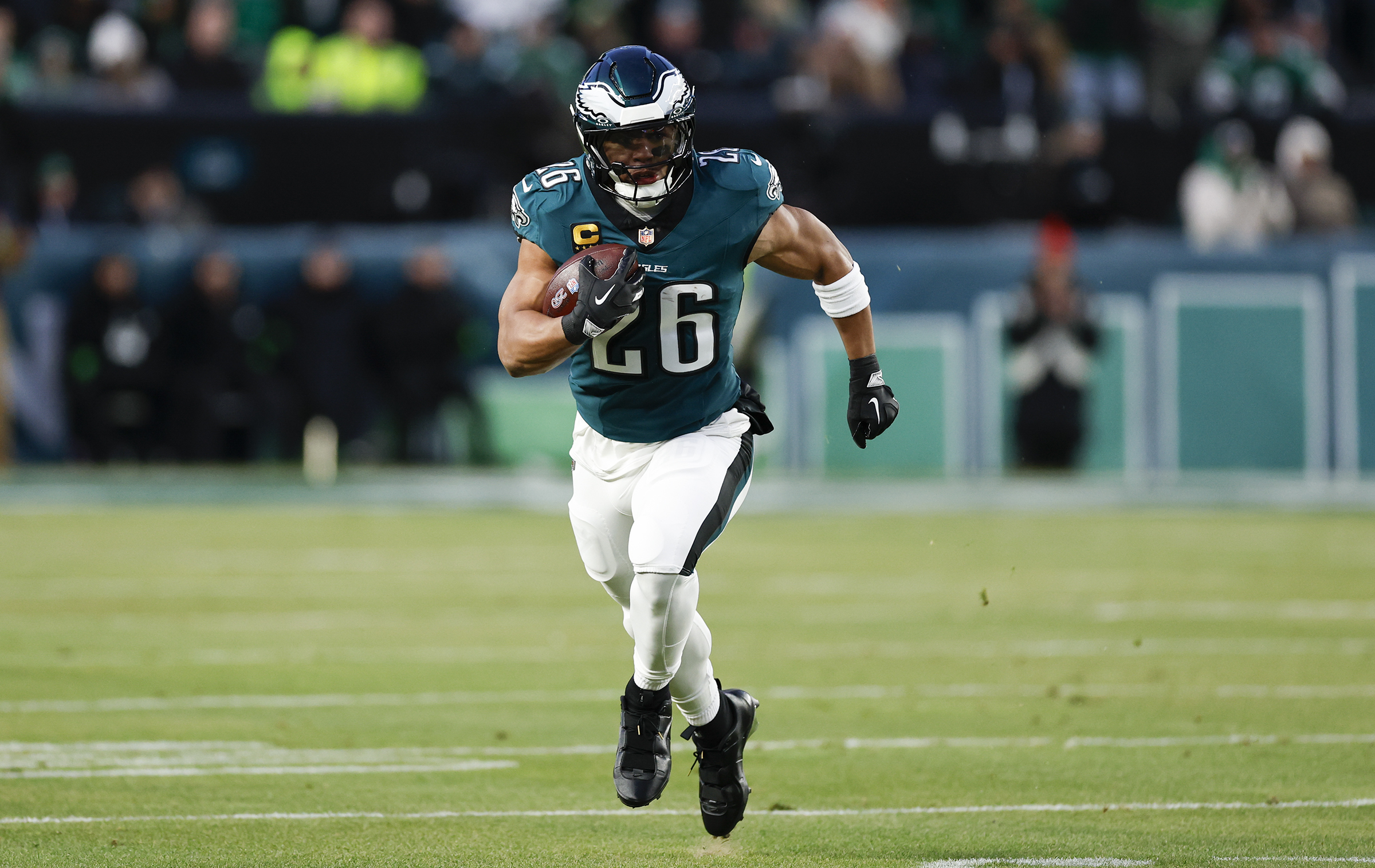
Could a Saquon Barkley renaissance be in store in the new Eagles offense?
There’s no question the Eagles’ passing offense was substandard and there needs to be more sophistication in the operation. But when Sirianni’s teams have had their greatest successes, it’s been behind a dominant running attack.
The Eagles were bound to face challenges after Saquon Barkley’s historic campaign in 2024. Injuries on the offensive line didn’t help matters. But when opponents devoted their efforts to stopping the run with increased numbers in the box, the Eagles struggled to adjust and make defenses pay through the air.
Sirianni equated how the Shanahan-McVay rushing offense handles defensive intricacies with how some passing offenses have adapted to modern coverages.
“You’ve seen a lot of teams that have done things where they’re reading pure progressions to handle all the junk that is being thrown at you by the defense,” he said. “This version of the run game is kind of in that mix, as well. It’s the run-game version of it.
“There’s a lot of junk that’s being thrown at you. This handles a lot of it.”
6. The run-blocking scheme changes were probably the chief reason Stoutland resigned.
Jeff Stoutland’s O-line alignment principles would not have meshed easily with Sean Mannion’s scheme.
The most significant change in the running game will come with the offensive line. The preferred wide-zone blocking scheme of the Shanahan-McVay offense is much different than the mid-zone scheme Jeff Stoutland employed with the Eagles for 13 seasons.
Stoutland was also the run game coordinator since 2018, but the alteration meant that he wouldn’t have returned in that role. Sirianni confirmed that he wanted Stoutland back, although the 64-year-old assistant would have had to teach his O-linemen a new run-blocking technique.
At its most elemental, wide-zone blocking has offensive linemen fire off the ball and block at an angle to create cutback running lanes. Mid-zone blocking has O-linemen more under control, perhaps required to win more at the point of attack and shuffle in their assignments.
One is not better than the other, they’re just different. The Eagles think their returning O-lineman can block in any scheme, but there will be an adjustment. The change could benefit an athletic center like Cam Jurgens, or it could hinder a cinder block like left guard Landon Dickerson.
“Will there be maybe a little bit more emphasis on movement and athleticism?” Roseman said. “Maybe a click. Maybe.”
Roseman was talking about how the new scheme may affect his evaluations in the upcoming draft. Right tackle Lane Johnson is returning for a 14th season, but the Eagles could be searching for his successor.
Stoutland was as involved as any coach in the pre-draft process and through his prioritization of “critical factors” helped the Eagles land Johnson, Dickerson, Jurgens, and left tackle Jordan Mailata, a former rugby player.
“We’re looking for a lot of the same things,” Roseman said, “with a lot of the same — a shout-out to Stout — critical factors that we’ve always been looking for.”
7. Hurts may actually run even less in the new offense.
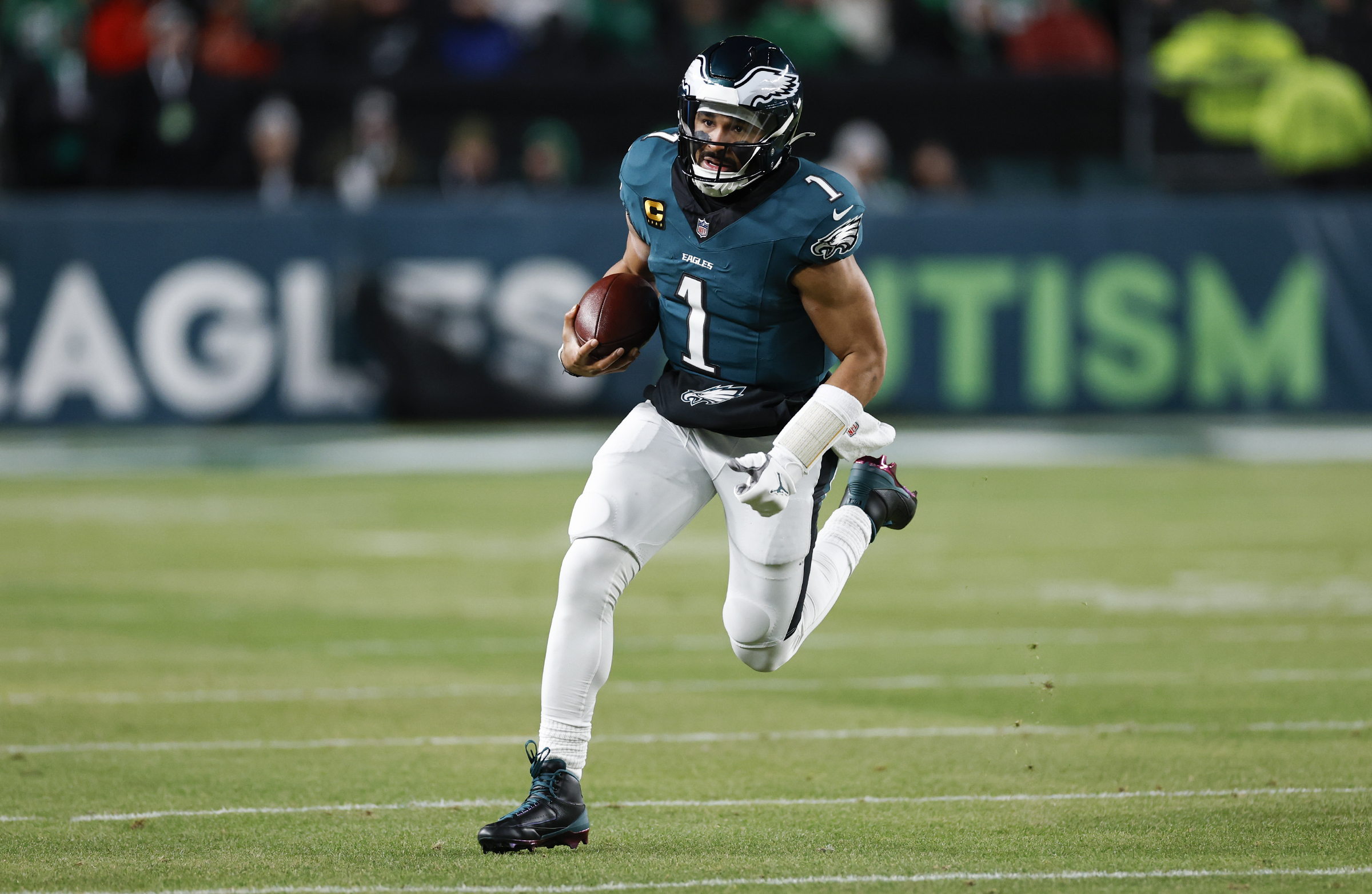
Jalen Hurts might run less in the Sean Mannion scheme.
Hurts’ history with different offensive coordinators and play callers dating back to college is a fact that has been repeated so frequently at this point it’s almost not worth mentioning, especially for a quarterback entering his seventh NFL season.
He has admitted that having first-year success with Moore should give the discourse less meaning. The scheme has also been relatively similar during the Sirianni-Hurts partnership. There has been a natural progression with his coaches asking him to do a little more under center, off play action, and with motion.
“He’s shown that he can do all these things,” Sirianni said. “I think what’s awesome about Jalen is he’s shown he can do a lot of things really well. … The great thing about great players is they can usually fit to any scheme.”
And yet, the Eagles have never majored in any of the above. Was that on Sirianni and his coordinators, or was it on Hurts? How much did Stoutland’s preferred run scheme prevent the offense from evolving? All of the above were likely factors.
Whatever the answer, change is coming. Hurts should be on board, especially if he wants to run less and desires more schemed-up layups in the passing game. With less shotgun, there won’t be as many designed quarterback run opportunities.
It remains to be seen whether less of Hurts on the ground is a good thing. It wasn’t last season. There are ways to incorporate some quarterback runs into the Shanahan-McVay scheme, but there will likely be fewer zone reads and run-pass option plays.
8. Sirianni left plenty of wiggle room for carryover from the previous offense.
Nick Sirianni will continue to have a voice on offense, as he has had in all previous iterations of the attack.
While some Sirianni critics may have short attention spans, he has presided over an offense that has often been among the best in the league. And in winning a Super Bowl last year he was able to retain some of the better parts of his scheme and incorporate it with Moore’s.
He said the same will happen with Mannion.
“I think that some of the things that you can sprinkle in from the things that we’ve done, it’ll just be a good mesh of different things,” Sirianni said. “You want to have something that you can [hang] your hat, which I think that we’ve always had, but then adapt that to different things that your players do well.”
The best coaches scheme to their players’ skill sets. In 2021 and 2024, the Eagles installed pass-based offenses before switching at midseason to feature the run. Some of that had to do with Hurts’ limitations as a dropback passer, but also to emphasize his mobility, a dominant O-line, and Barkley.
It would be foolish for Sirianni to commit to anything, although the Shanahan-McVay offense will initially be the scheme the Eagles hang their hats on. But there won’t be a complete whitewash.
“Its ever-evolving,” Sirianni said. “Shoot, you might end up saying, ‘Hey, I wanted to be an outside zone team, but it looks like we’re going to be a little bit more of a gap team, or vice versa, right?’ And it could be the same with, ‘Hey, I wanted to be a little bit more play action, but it looks like we’re going to be a little bit more naked and move the pocket and stuff like that.’”
Mannion won’t have autonomy like defensive coordinator Vic Fangio. How could he with no experience? The offensive-minded Sirianni will obviously be involved at some level. But he wants Mannion to ultimately be responsible for running the offense.
“I know that the most important thing that I need to do is be the head football coach of the football team, not the offensive coordinator for the Philadelphia Eagles,” Sirianni said. “I need to be the head football coach in charge of everything. It’s setting that vision, all the different things that go into it.
“But I’ve had a lot of experience in putting together an offense, so I’m here as a resource for him in that aspect.”
9. Mannion will work closely with Hurts.
Sean Mannion’s experience as an NFL quarterback could help ease communication with Jalen Hurts.
Mannion’s pedigree as a quarterback played some role in his hiring. Hurts had his best seasons under former quarterbacks in Steichen and Moore. Mannion has been credited with assisting the development of Packers starter Jordan Love and the reclamation of backup Malik Willis.
Hurts has a strong personality, so it’s no guarantee that Mannion’s playing experience or his relative youth will translate to a harmonious relationship. That could go in any direction. But Mannion’s former teammates and coaches have been unanimous in their praise of how he comports himself.
As for Hurts’ actual position coach, the Eagles opted to move pass game coordinator Parks Frazier to quarterbacks coach and let Scot Loeffler go. Sirianni said he wanted some continuity, but also pointed to Frazier’s one season working in the Shanahan-McVay scheme with the Dolphins under McDaniel.
Grizzard offered Sirianni the chance to keep a runner-up for the job who also has experience in the system and one year of play-calling under his belt. While he could be viewed as a backup if Mannion struggles, the Eagles were likely more focused on having an in-house replacement to guard against what happened after Steichen and Moore left.
New tight ends coach/run game coordinator Ryan Mahaffey and offensive line coach Chris Kuper were Mannion hires and will be instrumental in installing the new wide zone blocking scheme.
10. The new scheme probably won’t increase the likelihood that Brown wants to stay in Philly.
Change is coming to the Eagles offense, but it’s not necessarily the kind of change that will make A.J. Brown happier.
Roseman will ultimately do what’s best for the team even if Brown no longer wants to be an Eagle. Brown has expressed his love for Philly, but that doesn’t necessarily mean he wants to return if the passing game is going to remain secondary.
Brown could envision a scenario in which the Shanahan-McVay scheme improves Hurts as a thrower and gives the receiver opportunities to use his skills after the catch. But if the running game remains the focus, he may not get the targets he desires.
Replacing Brown wouldn’t be easy, even if receiver DeVonta Smith has a more prominent role. The free-agent market is light at the position. And while the draft is said to be deep, there are few Day 1 starters at receiver. The Eagles also have other needs.
Roseman may need to replace all three of his top tight ends with Dallas Goedert, Grant Calcaterra and Kylen Granson slated for free agency. The Shanahan-McVay scheme favors hybrid tight ends who can run-block.
“I would say that the tight-end position starts with me in evolving,” Roseman said. “I think that from my perspective, I’ve always had an affinity for kind of the receiving tight ends. I think that that’s shown in my work.”
It certainly showed this past season. Goedert, Calcaterra, and Granson were detrimental to the running game. They weren’t the only ones.
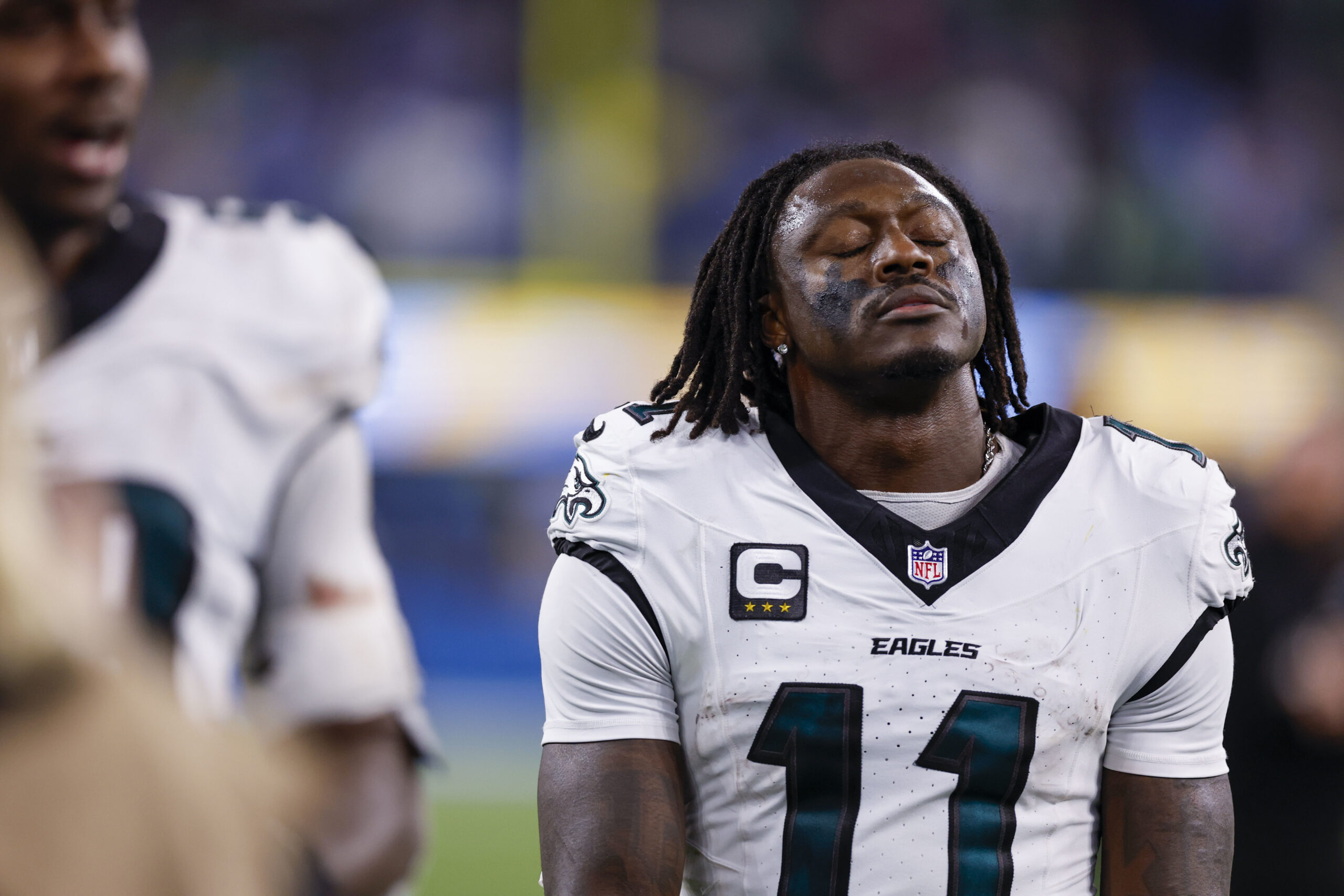
In the wake of the untimely deaths of three young players, A.J. Brown on Monday posted a 9-minute, 8-second testimonial on Instagram encouraging NFL athletes struggling with mental health issues to seek counseling and God rather than taking their own lives. It was poignant and it was beautiful.
It was a revealing glimpse into how Brown deals with his own demons. It also was an example of how the exceptional culture in the Eagles’ locker room emboldens this sort of leadership in the most important of ways.
“Don’t take the easy way out,” Brown said. “I once thought that was the way. I was 23 years old and I thought the same thing.”
Brown spoke two days after Vikings receiver Rondale Moore, 25, was found in his garage dead of a suspected self-inflicted gunshot wound. Moore had seen his last two NFL seasons ruined by preseason injuries. It was the third such incident in just 10 months.
In November, Cowboys defensive end Marshawn Kneeland, 24, also was suspected of taking his own life with a gun after a high-speed chase and crash.
Similarly, in April, LSU receiver and NFL prospect Kyren Lacy, also 24, shot and killed himself after a high-speed chase two days before his criminal trial in an unrelated incident.
Tragedy upon tragedy upon tragedy compelled Brown to speak out.
“Don’t end it like that, bro,” he begged. “Don’t end it like that.”
Advocacy
This wasn’t the first time Brown has spoken about his own struggles, but it is the most intense and impassioned message he has delivered.
🙏 Eagles WR AJ Brown, who said he contemplated suicide in 2020, shared his advice to those who might be struggling with their mental health
He recorded Monday’s message on his phone while sitting in his parked car. Most of it centered on Brown’s reliance on his Christian faith, but Brown also stressed the role that counseling performs in people whose worlds seem to be closing in.
“Go talk to [God], first and foremost, before you even go talk to a therapist. But go talk to a therapist,” Brown said. “Reach out to your loved ones. Go talk to somebody, bro. Get it off your chest. You’re not too tough to talk to someone.”
Much has been made of Brown’s unconventional behavior in his four seasons with the Eagles. He often has been publicly critical of the Eagles offense both in media availabilities and on social media. He has sparred with head coach Nick Sirianni during games. He continually hints in public that he would like to be traded, and a report last month said he submitted a trade request three times during the 2025 season. Brown also has boycotted the media twice in the last two seasons.
Suicide is suspected in the death of Vikings wide receiver Rondale Moore on Saturday.
Among the reasons the Eagles are patient with Brown, and among the reasons the media squawks so little about his boycotts, are Brown’s mental health struggles. He is afforded a larger measure of grace from teammates, coaches, administrators, and the press than athletes who struggle less.
This grace begins with Sirianni, whose inclusive, empathetic management style built on the foundation laid by Doug Pederson. One of the reasons Eagles owner Jeffrey Lurie hired Pederson in 2016 was Pederson’s “emotional intelligence,” which created an environment of understanding and acceptance unmatched by any locker room in the NFL. This environment, Lurie says, helped the Eagles reach three Super Bowls and win two.
In 2017, Pederson’s second season, Eagles guard Brandon Brooks opened up about treating his debilitating anxieties with therapy and medication, taboo subjects in the world’s most testosterone-charged league. The Eagles won their first Super Bowl after that season.
In 2021, Sirianni’s first season, Eagles right tackle Lane Johnson, who’d helped Brooks deal with his issues, missed three games dealing with his own mental health issues. The Eagles went to the Super Bowl after the 2022 season and won it after the 2024 season.
Johnson was, by far, the team’s best player in that span.
Brown was not far behind. That’s because, in part, the Eagles accepted him for him.
For instance, When Brown was caught on camera reading a self-help book on the sideline during a playoff game after the 2024 season, Sirianni told a local radio station, “Some guys pray in between, some guys meditate in between. A.J. reads in between.”
AJ Brown started reading a book on the sideline in the middle of a playoff game. pic.twitter.com/jz6YuLBYZ1
Sirianni also said, “A.J. Brown, is a great, great, great person.”
That’s generally the consensus in the Eagles’ organization: Brown might be a diva, and he occasionally might be insubordinate, but his heart is always in the right place.
That was never more evident than in Monday’s post.
His own experience
The mission statement of the A.J. Brown Foundation reads, in part, “Our vision is to cultivate a generation of resilient and confident young individuals.”
“I take pride in my mental health,” Brown said Monday. “Something I practice each and every day.”
Brown then offered what might be a glimpse into his own struggle and the methods he uses to cope.
“Stay in that fight,” Brown said. “Be strong. Do whatever you need to do. Get on your phone. Record videos of yourself talking to yourself. Say affirmations around the crib. Sticky notes. … Talk in third-person to yourself.”
Don’t worry about it if people think you’re strange:
“Let them call you crazy.”
With so many voices eager for attention, and with so much non-credible disparagement targeted at you, just accept your failures and ignore the critics as best you can:
“I want you to understand, in the NFL community, things aren’t always going to go your way. You may not get everything that you desire. Sometimes this game is not friendly. People are going to say nasty things about you. Call you this call you that. …
“But none of those things, in that moment, define you. You just have to understand that this is just a short moment in your life that’s just going to go, just like that,” he said, and snapped his fingers to illustrate.
Eagles wide receiver A.J. Brown celebrating a first-down catch against the Commanders on Dec. 20.
Frustration is constant; satisfaction, unattainable:
“I understand what it feels like when you’re trying to take care of your family. None of that stuff is fulfilling. The only thing that’s fulfilling in this world is our Lord and savior, Jesus Christ.”
Even now, Brown clearly struggles with issues. He said he focuses on his family, especially his two young children, when the darkness begins to descend, and looks within.
“Nobody cares about you, bro. Especially as a man. You have to do what makes you happy,” Brown said. “I don’t care what they call you. I don’t care whatever … whatever you think you failed at. … Whenever you have a negative thought, say 10 positive things about yourself.”
Just hold on, get help, and have faith in something.
God. Yourself. Anything.
“That sun is gonna shine,” Brown said. “It ain’t gonna stay rainy forever, bro.”
“I remember looking at him like, ‘All right, what do you want me to do?’” Painter recalled Monday. “I was 19, I’m coming in, hoping to break in, so I’m sitting there like, ‘You want me to put some weight on? What do you want me to do?’”
Three years later, Painter finds the whole thing to be oddly prophetic. Because if, as expected, the 6-foot-7 righty breaks camp with the Phillies, he will be 22 — a few days shy of his 23rd birthday on April 10 — when he makes his major league debut.
Just as Boras hoped, albeit for much different reasons.
Boras’s concern in 2023 stemmed from a belief, rooted in his experience with other clients, that most pitchers don’t physically mature until their early 20s. To prove his point, he rattles off a list of pitchers who debuted at 19 or 20 and flamed out by 29 or 30.
Phillies pitcher Andrew Painter is two years removed from Tommy John elbow surgery.
Fernando Valenzuela. Bret Saberhagen. Steve Avery. Kerry Wood. Félix Hernández. Madison Bumgarner.
But after being crowned by Baseball America as the sport’s best minor league pitcher in 2022, with a chance to be the first teenager to start a game for the Phillies since Mark Davis in 1980, Painter put his foot on the gas in the spring of 2023. In his first Grapefruit League start, he touched 99 mph in the first inning against then-Twins star Carlos Correa and uncorked a cutter that he’d only recently started throwing.
You know the rest. Doctors recommended rest and rehab, but Painter couldn’t avoid surgery. He didn’t pitch competitively for two seasons. Upon returning last year — amid expectations that he might reach the majors by “July-ish,” as Dave Dombrowski outlined — he struggled with wayward fastball command and didn’t get out of triple A.
So here he was Monday, a fully formed 22-year-old pitcher with his top-prospect shine only slightly dulled, facing the meat of the Phillies’ order — Kyle Schwarber, J.T. Realmuto, Bryson Stott, Bryce Harper, Alec Bohm, and Brandon Marsh — in live batting practice in preparation for his first Grapefruit League start later in the week or this weekend.
“Overall I thought his stuff was really good,” Schwarber said. “I thought the fastball had some life. Definitely had its good profile that it should have. The thing that’s going to really help him out is having his fastball and knowing where he’s going to put it. Right?”
Did anything look different from three springs ago, before the elbow injury, when Schwarber memorably took Painter deep in the direction of U.S. 19 traffic beyond the right-field fence on a back field at the Carpenter Complex?
“It’s a good question,” Schwarber said. “He’s getting a feel for things and making adjustments with his arm angle. I think you’re going to see a really good version of him.”
Painter’s arm angle dropped throughout last season. Maybe it was the toll of pitching 118 innings after a two-year absence. Maybe it was something else. He said he wasn’t overly aware of it. Besides, his focus was getting through the season healthy.
But the Phillies believe the lower arm slot affected his ability to spot his fastball consistently. And triple-A hitters teed off, batting .329 and slugging .585 against Painter’s four-seamer.
“In the season it’s kind of hard to keep up with that stuff, and you don’t want to mess with it in season,” Painter said. “It’s something you kind of just go back and look and you’re aware of it, but you really dial it in in the offseason.”
When Painter went home to South Florida and resumed his offseason training at Cressey Sports Performance, he set out to raise his arm slot again. The first few weeks of spring training have been reinforcing those habits.
Painter has made other tweaks, including the grip on his changeup. He developed blisters early last season in triple A and wasn’t able to throw the changeup as often as he wanted. It’s probably his best offspeed pitch. He also throws a hard slider, sweeper, and curveball.
“The changeup is a big thing,” Painter said. “The changeup was really good for me last year. Kind of bringing back the sweeper. Last year I was searching for a sweeper, and that was where the arm started to drop. So, I’m getting back to the one I threw pre-TJ [Tommy John surgery].
“Just being able to come in here and do my thing, without having to worry about pitch count or anything like that, just going out there and pitch, it’s nice.”
Pitchers often say everything is crisper and sharper in the second year after Tommy John surgery. The Phillies are hoping that will be the case for Painter.
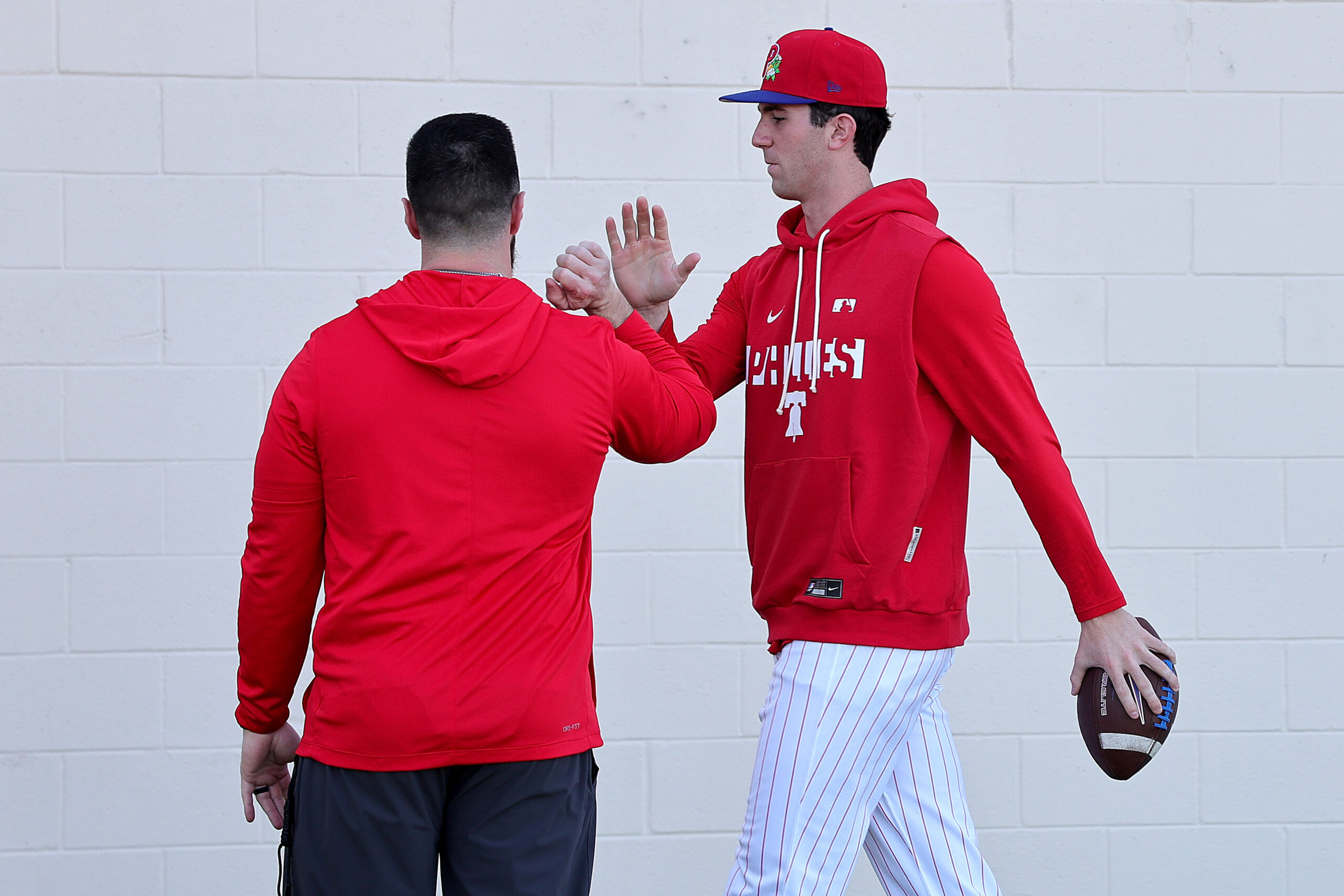
Phillies pitcher Andrew Painter finishes warming up with a football during a spring training workout in Clearwater, Fla.
But maybe Painter will benefit from finally graduating to the majors. Because team officials were salivating three years ago over the possibility that he would crack the rotation and thought for sure he would pitch in the majors last year.
The opportunity exists for him now while Zack Wheeler is coming back from a complicated surgery to relieve pressure on a vein that was compressed between his collarbone and rib cage. The Phillies want Painter to earn a spot, but they won’t have anyone else to fall in line behind Cristopher Sánchez, Jesús Luzardo, Aaron Nola, and Taijuan Walker.
Painter’s time is now. At last. At age 22, just as Boras hoped.
“I didn’t know what to make of it at the time,” Painter said. “It was weird. But guys when they’re 19, you go out there, it’s almost like your body’s not ready. It can’t handle that load. So, yeah, I do think maybe this was all kind of a blessing in disguise.”
Extra bases
Orion Kerkering, slowed by a strained right hamstring, is targeting the end of the week to throw a bullpen session. … The Phillies will face the Marlins at 1:10 p.m. Tuesday in Jupiter, Fla., before returning to Clearwater on Wednesday to face the Tigers.
Temple University Health System had a $50.5 million operating loss in the six months that ended Dec. 31, the Philadelphia nonprofit told bond investors Monday. In the same period the year before, Temple reported a $13.5 million operating gain.
Here are some details on Temple results:
Revenue: Total revenue reached $1.64 billion, up 7.3% from the year before. Patient revenue rose 8% due mostly to increased outpatient revenue from Temple’s pharmacy business, infusions, and same-day surgeries. Two hits to revenue were a $14.3 million decrease in state funding and decline in the number of transplants, which bring in large amounts of revenue. Temple said it expects both of them to rebound in the remainer of fiscal 2026.
Expenses: Temple attributed some of its loss in the first six months of fiscal 2026 to $20 million in extra expenses associated with the opening of its new Woman & Families Hospital, a $7.2 million increase in medical liability expenses, and a $6.4 million increase in losses under its Medicaid contract with Health Partners Plans.
Notable: Despite its operating loss, even on a cash basis, Temple financial reserves increased to more than $1 billion as of Dec. 31. Most of the gain came from investments. The reserves equal the amount of money needed to keep the health system operating for 119 days if no more revenue came in. At the end of 2024, that figure was 113 days.
Aidan Miller on the Phillies roster on opening day? Don’t count on it. But don’t completely rule it out. And don’t mark your calendar too far into the future. The April showers could bring a lot more than flowers this year.
Two weeks into spring training, the Phillies aren’t going out of their way to disguise their hopes for their top prospect. The whole organization seems to understand that a certain degree of aggression is required in order to overtake the Dodgers in the National League and survive the Mets and Braves in the NL East. Bryce Harper made some news Sunday in an interview with Tom McCarthy and Ruben Amaro Jr. during the broadcast of the Phillies’ Grapefruit League game against the Pirates. Harper implied that Miller is battling an injury, jokingly saying that he wants to see the prospect “get off his butt and get in the game, that’d be nice. I need him to get healthy.”
It was later revealed that Miller has been battling some back soreness. But the important part of Harper’s comment was his overarching point.
“He could help us by the end, obviously,” the Phillies superstar said.
The path of least resistance is the wisest path for now. Start Miller in the minors. Get him some time at second and third base in addition to shortstop. Evaluate the big league lineup over the first couple of months of the season, with a particularly keen eye paid toward Alec Bohm and Bryson Stott. Let the facts on the ground make the decisions for you.
The important thing for the Phillies is not to fight those decisions should they become obvious. Miller is a special enough bat to warrant stepping outside your defensive comfort zones. He’ll be 22 years old by June 9. Over the last three seasons, 49 hitters have logged at least 200 plate appearances at the age of 22 or younger. That includes game-changers like Julio Rodríguez, Elly De La Cruz, James Wood, Corbin Carroll, and Gunnar Henderson.
Miller is in the same class of prospects as those hitters. If he starts this season the way he finished 2025 — hitting .356 with 23 extra-base hits in his last 39 games — the Phillies will need to find a spot for him. Every day they wait will be a wasted one. They are at a point in their trajectory where they will need something unforeseen to happen in order for their lineup to produce at even 2022 levels. Miller is both the most likely candidate and the one who can move the bar the furthest north.
Some others who still have some degree of upward mobility:
Brandon Marsh
Marsh is an interesting case. The gap between public perception and actual production is wider than for any player on the Phillies roster. In fact, it might be wider than for any athlete in the city. Look at Marsh’s final 2025 numbers compared with some randomly selected players:
Jackson Chourio: .270/.308/.463, 112 OPS+, 21 HRs, 589 PAs
Jackson Merrill: .264/.317/.457, 112 OPS+, 16 HRs, 483 PAs
Harrison Bader: .277/.347/.449, 117 OPS+, 17 HRs, 501 PAs
Steven Kwan: .272/.330/.374, 96 OPS+, 11 HRs, 693 PAs
Marsh: .280/.342/.443, 114 OPS+, 11 HRs, 425 PAs
Brandon Marsh figures to platoon in left field with the righty-hitting Otto Kemp.
Most interesting is the side-by-side comparison to Kwan, who was a hot trade-deadline name connected to the Phillies last summer. Marsh outproduced the Guardians’ veteran in virtually every category. Yet people would feel a lot differently about the Phillies’ outfield outlook for 2026 if it was Kwan in there instead of Marsh.
This isn’t a one-year phenomenon, either. In the three years since the Phillies acquired Marsh from the Angels, his 115 OPS+ ranks 28th out of 106 MLB outfielders with at least 800 plate appearances. That’s higher than Chourio and Kwan and also Jazz Chisholm, Jurickson Profar, and Taylor Ward, to name a few.
The lack of enthusiasm for Marsh isn’t entirely irrational. In the last two postseasons, he has reached base three times in 28 plate appearances over eight games. His left-handed bat is an inconvenience when attempting to construct a batting order around Harper and Kyle Schwarber. He hasn’t been the plus defender in center field that many expected when the Phillies acquired him. With a middling 39 home runs in 1,373 plate appearances over the last three seasons, he doesn’t bring prototypical corner-outfield power. Long story short, he hasn’t been the player the Phillies are sorely missing: a right-handed power bat who can hit behind Harper and/or Schwarber.
Marsh can’t do anything about the fact that he hits left-handed. But he does bring some positive uncertainty on the upper end of the range of outcomes. He made some noticeable improvements in his bat-to-ball game in 2025, raising his contact rate from 74.7% to 78.3%, according to FanGraphs. Much of that jump came out of the zone. He swung at more pitches out of the zone (30.5%, up from 26.1% in 2024) but also connected on more of those pitches (56.3%, up from 51.4%). The result was less power and fewer walks, but also fewer strikeouts and more base hits. All in all, the tradeoff was positive one vs. 2024. The question now is whether he can add on a little more power in the zone.
Marsh finished last season on a serious upswing. After a brutal first six weeks of the season, he hit .299 with an .835 OPS over his last 107 games. His last two months were especially spicy, with a .325/.367/.584 batting line and eight home runs in 166 plate appearances from July 28 to the end of the regular season. During that stretch, he ranked seventh among outfielders in weighted on-base average (.401) and sixth in slugging percentage (.584) with a home run pace of about 25 per 162 games.
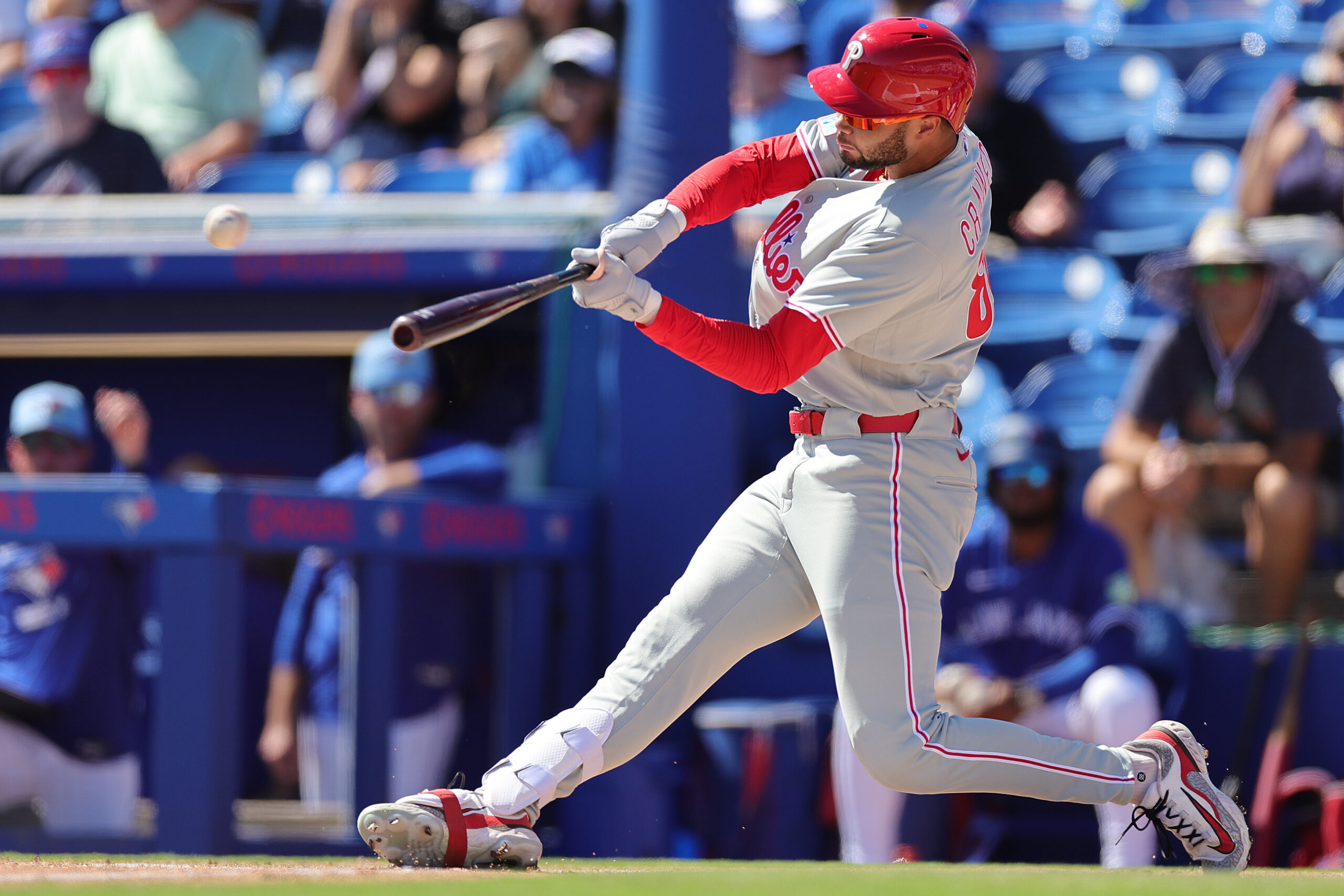
Justin Crawford slashed .334/.411/.452 in triple A last season.
Justin Crawford
Obvious, yes, especially now that it seems he has a spot locked up on the opening day roster. It would be a huge boost if Crawford could somehow bring his .334/.411/.452 triple-A batting line to the majors without much drop-off. Hello, leadoff spot. We’ll worry about lefties later.
But that’s not the real game-changer of a scenario. No, the one the Phillies can dream of is the one Crawford hinted at in his first at-bat of the spring, a double off the center-field wall off of big league lefty Eric Lauer. What if Crawford finally starts to develop the power suggested by his frame and his pedigree?
It’s awfully hard for a big league hitter to swing his way on base as routinely as Crawford did in the minors. But the Phillies would gladly sacrifice some of that average for some of the pop that his papa had during his prime. Carl Crawford’s power started to come at the age of 22, in his third season in the majors. That was his first All-Star season for the Rays, when he led the majors with 19 triples and also hit 11 home runs for a .450 slugging percentage that would continue to improve throughout his early 20s.
Justin has his dad’s frame. He has a similar swing. He finished last season with just 34 extra-base hits in 506 plate appearances. But the jump is going to come, as long as he can make big-league contact.
The moral of the story: There is upside on this Phillies roster. It only means so much. We’ve seen that with Bohm and Stott over the last few seasons. But Miller and Crawford offer plenty of reason to hope. At the very least, the Phillies seem to understand that they could be necessities.
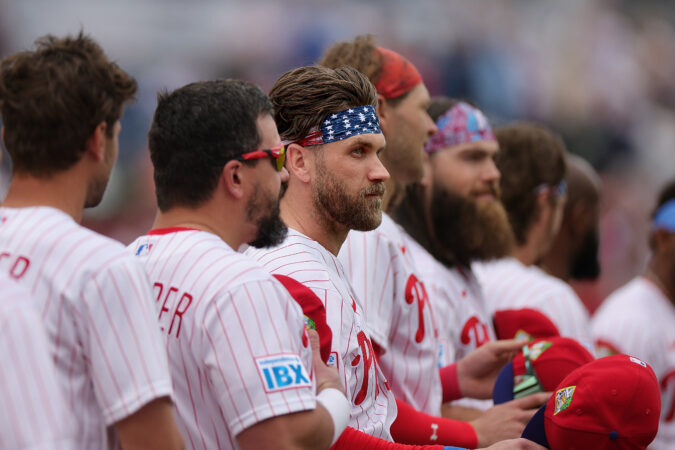
Ninety minutes before the start of the Phillies’ first home spring-training game Sunday, as teammates moved about the clubhouse like commuters through 30th Street Station, Harper stood still in front of a TV and watched the NHL superstars from Team USA receive their gold medals.
Players skated victory laps with American flags draped over their shoulders. The national anthem played. Cue the team photo.
What would a global best-on-best baseball tournament look like?
Exactly what the world just witnessed between the U.S. and Canada in what Phillies manager/proud Canadian Rob Thomson described as “one of the best games you’ll ever see.”
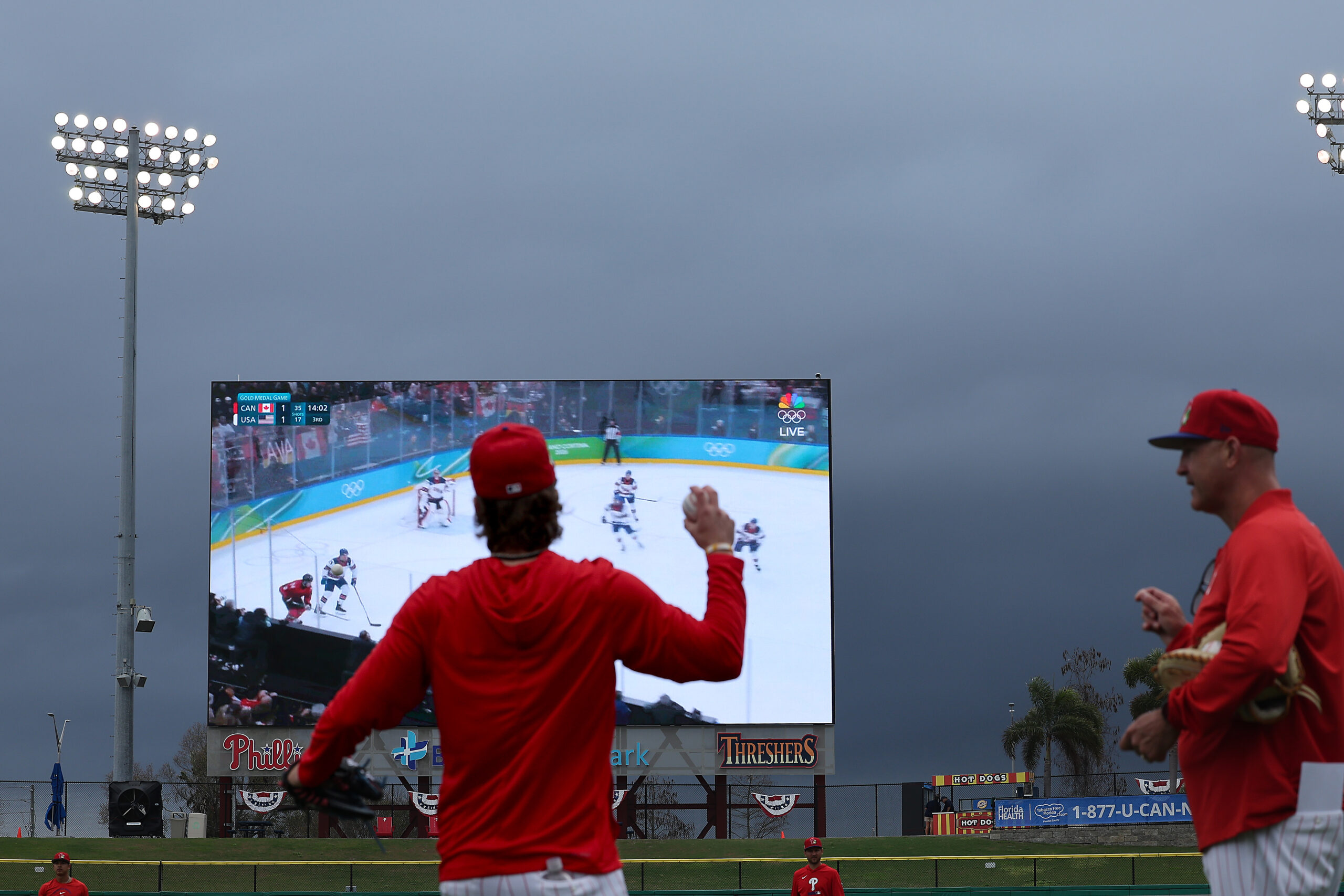
It was so good that the Phillies put it on the new 3,200-square-foot LED video board at BayCare Ballpark as they took batting practice during the third period and overtime. Kyle Schwarber did an interview from the third-base dugout so he would be able to keep one eye on the action.
Phillies second baseman Bryson Stott watches the U.S.-Canada Olympic gold medal game as he warms up Sunday in Clearwater, Fla.
“Yeah, that was awesome,” Schwarber said. “That was amazing. Probably one of the more exciting hockey games in a long time. I don’t get to watch hockey that much, but that will probably get me back into watching a lot more.”
Which is precisely why MLB needs to follow the NHL’s lead.
Harper and Schwarber are among 10 Phillies who will leave camp Saturday to join their respective countries’ delegations for the World Baseball Classic. For two weeks in March, national pride will be at stake.
And players seem to be taking the WBC as seriously as ever.
Since the tournament’s inception in 2006, Team USA has had difficulty recruiting the best pitchers, in particular, to compete in an international exhibition in the middle of spring training. But this time, both reigning Cy Young Award winners — the Pirates’ Paul Skenes and Tigers’ Tarik Skubal — signed on to wear stars and stripes.
Shohei Ohtani, who famously struck out Mike Trout to end the last WBC in 2023, will return to lead Japan, albeit only as a hitter. The Dominican Republic’s lineup is loaded, with Juan Soto, Manny Machado, Vladimir Guerrero Jr., Julio Rodríguez, and Fernando Tatis Jr. Venezuela, Mexico, and Puerto Rico are stacked, too.
“This is our time to represent our country,” Schwarber said. “It gives you that motivation, you know? Being that we’re going to be heading into that and knowing what to expect. Obviously we’re not Olympians. But it’s our mini-Olympics. Right?”
Sure. And players will compete with intensity. Anyone who thinks it doesn’t mean much to the players should hear Schwarber talk about what he did with his silver medal in 2023.
“I don’t know where it’s at,” he said. “You only probably care about the gold one. You don’t want to get the second-place one.”
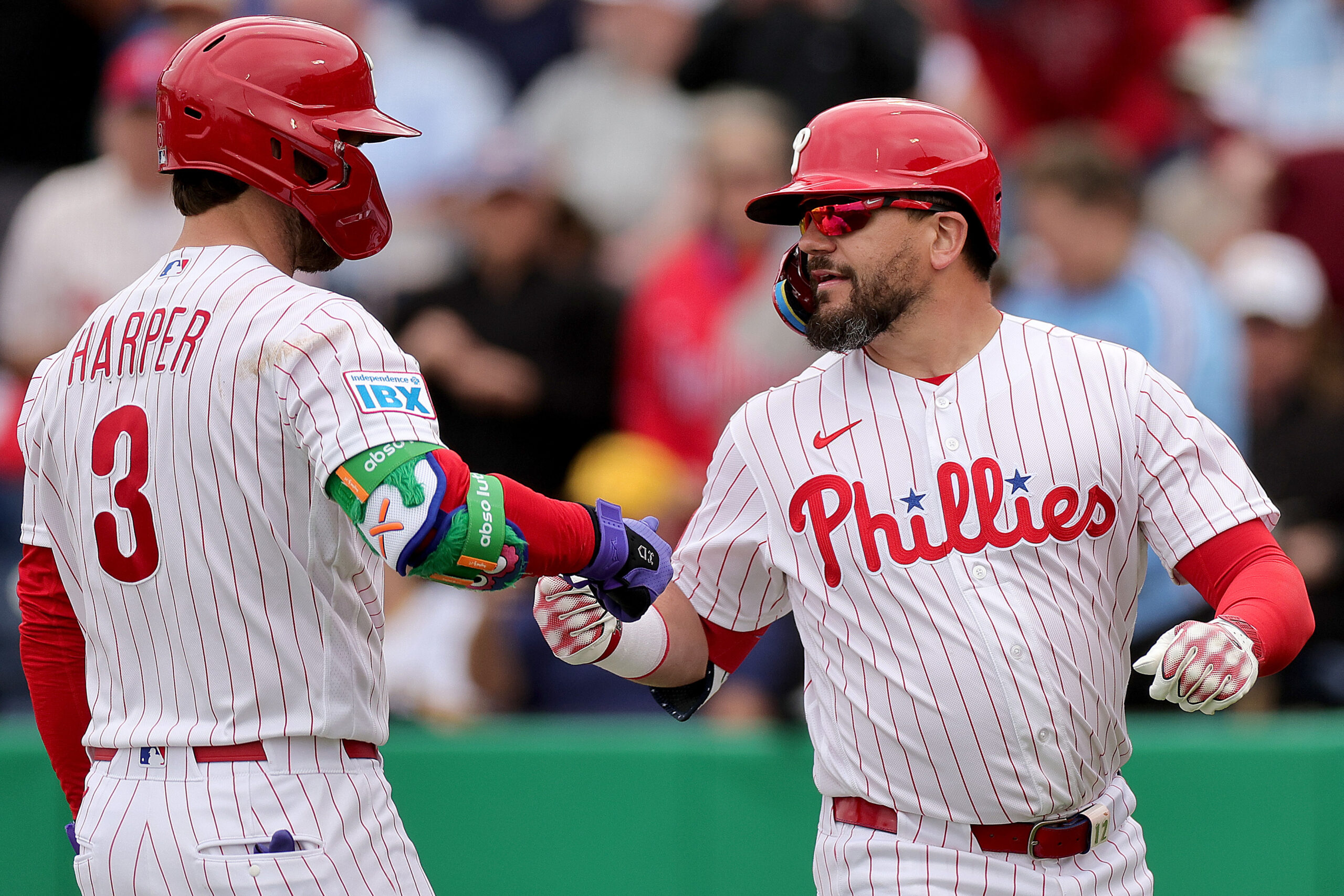
Phillies designated hitter Kyle Schwarber (right) celebrates his solo home run with Bryce Harper on Sunday.
But because of when the WBC is contested, there will be pitch limits and other health-related restrictions. At training camps in Florida and Arizona, teams will cross their fingers and toes that their players return intact.
If anything, then, the WBC is closer to hockey’s 4 Nations Face-Off, last February’s riveting tournament that was still only the appetizer to the main course in Milan.
Still, as international competitions go, it’s the best baseball has.
Unless …
“I know Bryce has been very outspoken about it, and I think [the Olympics] would be great for us,” Schwarber said. “We all grew up watching the Olympics and being kids and just tuning into all different kinds of events. Back in the day, the TV dinners, go get the pull-out tray, throw it on the couch, all the family sitting down at night. We’re watching the Olympics. We’re watching the gymnasts, the swimming, the diving. Those were all big ones. I loved watching the sprinters run.
“It’d just be great for our game in general, to where you go to the Olympics and it’s worldwide. Everyone would see it, and it might reach a broader audience than just some countries that are really in tune to it.”
But would the players buy in? Part of what makes Olympic hockey such a draw is the passion exhibited by the players, especially among the Americans and Canadians, many of whom put aside their day jobs as teammates in the NHL to pound on one another on an international stage.
“It’d be a no-doubter for a lot of guys,” said Schwarber, who played for Team USA in college. “When they ask you, you’re like, ‘Yeah, absolutely.’ And the cool thing for us is we have so many different cultures in our game that everyone’s going to separate from the [MLB] organization side of things and go to the country side.
“I know, if I’m freaking 50 and they go, ‘Hey,’ I’ll be like, ‘Yes.’ I might be playing softball by then, but I’d say yes.”
Harper was among the first players to commit to Team USA for the WBC in 2023 but had to withdraw after having elbow surgery in the preceding offseason. He hasn’t played for his country since he was a teenager.
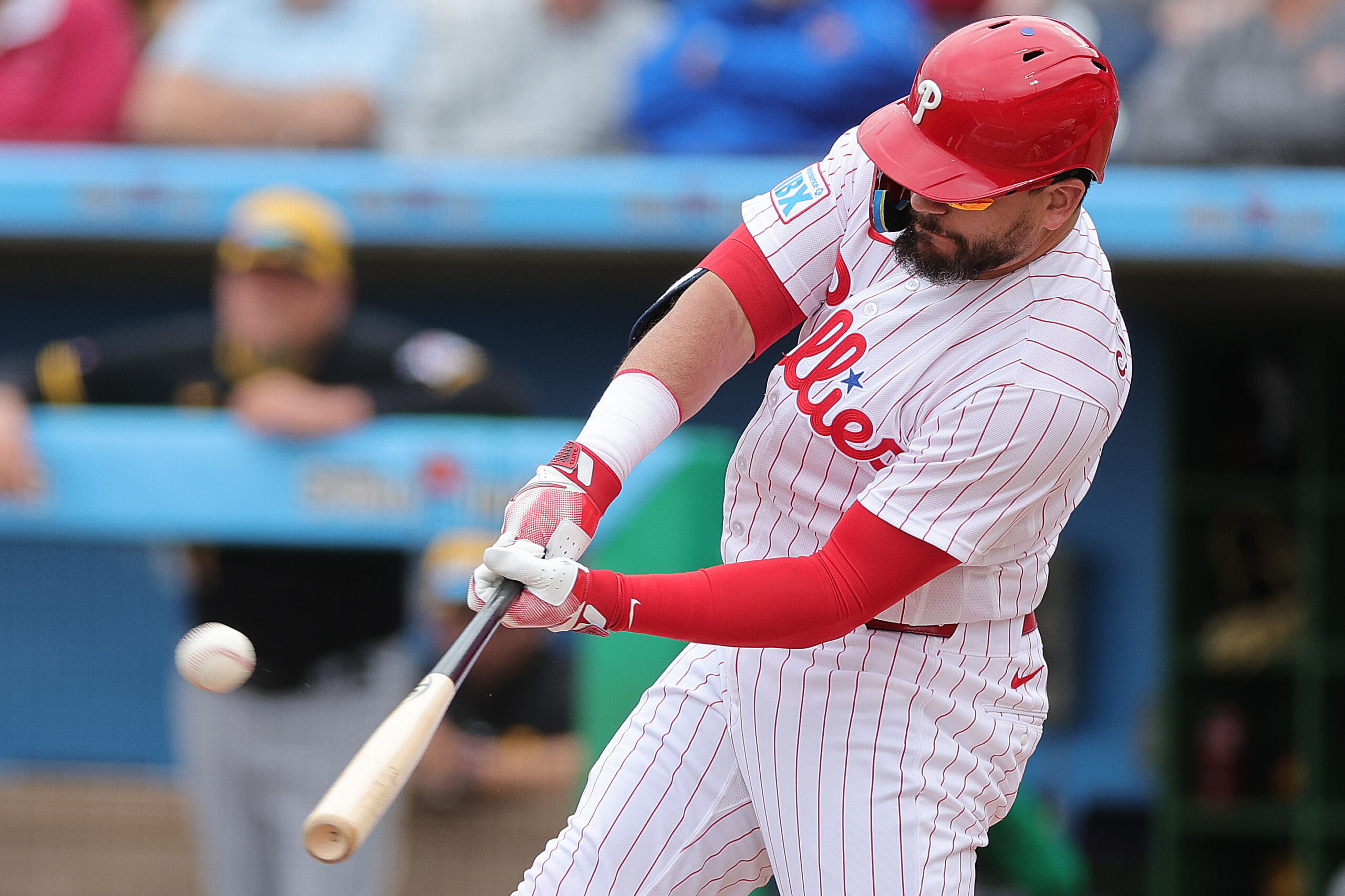
Kyle Schwarber hits a solo home run for the Phillies in the first inning against the Pittsburgh Pirates.
“I can’t wait,” Harper said the other day. “Representing your country, there’s nothing better. Nothing better. The feeling of putting ‘USA’ on your chest and playing for something so much bigger than yourself, representing your whole country, there’s nothing greater.
“And having Aaron Judge hit behind me is going to be a lot of fun, as well.”
When Harper at last turned away from the television Sunday morning and walked to his locker, he politely declined to talk about the game. He appeared emotional, especially after watching Team USA bring two of the late Johnny Gaudreau’s children, Noa and Johnny Jr., onto the ice as part of the celebration.
Watching it all, Harper surely must have thought about the possibility of 2028 in Los Angeles.
“We’ll see,” he said.
But anyone could plainly see what it would mean for baseball to have the best players in the world in the next Olympics.
Julius Erving will celebrate his 76th birthday on Sunday, just a few weeks after the 50th anniversary of the event that led to his milestone signing by the 76ers: the American Basketball Association’s Slam Dunk Contest. Erving’s victory in the five-man competition — held in Denver on Jan. 27, 1976, during the ABA’s final season, while he was starring for the New York Nets — marked his breakthrough into America’s sports and pop-culture consciousness.
In this excerpt from his book “Magic in the Air: The Myth, the Mystery, and the Soul of the Slam Dunk,” Inquirer columnist Mike Sielski details why the contest was so significant to Erving, to the Sixers, and to the evolution of professional basketball.
Julius “Dr. J” Erving celebrated his 76th birthday this week.
The people in charge of the ABA were under no illusions about the condition of their league as it entered its ninth season. Despite its star power — Connie Hawkins, George McGinnis, Erving, more — franchises were folding, or relocating then folding, every year. Two, the San Diego Sails and Utah Stars, went under during that 1975-76 season. Rather than committing to keep the league afloat, its top-drawing teams — the Nets, with Erving, and the Denver Nuggets, with their sky-walking star, David Thompson — were eyeballing the NBA, looking to bolt to a stabler, more lucrative situation.
To juice interest, and with less to lose with each passing day, the league’s decision-makers tried a new format for its midseason All-Star Game at McNichols Arena: The Nuggets, as the defending champions and the game’s hosts, would take on a squad of players picked from the ABA’s other six teams. That wasn’t all. The country-western singers Glen Campbell and Charlie Rich would perform before the game, and, at the suggestion of Jim Bukata, the league’s public-relations director, there would be a slam-dunk contest at halftime.
Five players, all of whom would already be in Denver for the game, would take part: Erving, Thompson, George Gervin, Artis Gilmore, and Larry Kenon. Including a non-All-Star in the contest would have required flying in a non-All-Star for the contest, and no one in the league was about to spend that extra money. Erving asked Kevin Loughery, the Nets’ head coach, if the contest ought to have a white participant, and in fact, the league invited the Nuggets’ Bobby Jones to compete. Jones declined. “I wanted to win the All-Star Game,” he told me. “I didn’t have the energy to do what those guys did.”
On Jan. 27, 1976, with 17,798 — the largest crowd in ABA history — on hand, with $1,200 in prize money at stake, the five competitors were briefed on the rules before commencing with the contest. Each of them could attempt up to five dunks in a two-minute span. One of the dunks had to be from a stationary position; one had to have the player start his move from the foul line, 10 feet away, or beyond. Two contestants would dunk on one basket and three would dunk on the other, the public-address announcer told everyone, “to take pressure off the rims and backboards.”
Based on “artistic ability, imagination, body flow, and fan response,” four judges would determine the winner. The panel: former Knicks star and Nuggets general manager Vince Boryla; Nuggets super-fan Alberta Worthington; high school standout LaVon Williams, who was “Mr. Basketball” in Colorado before heading off to the University of Kentucky; and Barry Fey, a former guard at Penn who, as a concert promoter, had set up the pregame festivities with Campbell and Rich.
Gilmore, the tallest competitor at 7-foot-2, appeared unsure of what to do, as if he hadn’t practiced or planned his dunks or was, for whatever reason, holding back. Gervin and Kenon were a little looser, but there was a mood of tentativeness in the arena until Thompson got the ball.
Fresh from a remarkable career at North Carolina State and in his rookie season with the Nuggets, he had been nervous throughout the days leading into the contest, so eager was he to live up to the home crowd’s expectations and hopes. His teammates had been pumping him up, encouraging him, letting him know which of his dunks they thought were his best. From the right side, he charged toward the hoop and hammered down a powerful right-handed slam. Working quickly, he ripped off a double-pump two-handed reverse and, from the left baseline, a 360-degree spin and jam, establishing himself as the man to beat.
But now, it was Erving’s turn. Standing directly under the basket, he dunked two balls at once — a nod, perhaps unconsciously, to his days at Roosevelt High School on Long Island, when he pulled off the trick as a teenager. Then he walked out to halfcourt, then back to the free-throw line, then back to the opposite free-throw line, counting and measuring his steps as he went.
Before the contest, he had made a $1,500 bet with Doug Moe, then an assistant coach with the Nuggets, that he could take off from the foul line and dunk during his descent. He paused, bent at the waist, then started, a slight stutter step, then a sprint into four floor-eating strides from the midcourt stripe to just inside the foul line, then … whoosh. Up.
“I’ve described Julius as more of a glider than a jumper,” Jones told me. “He was more of a long jumper.”
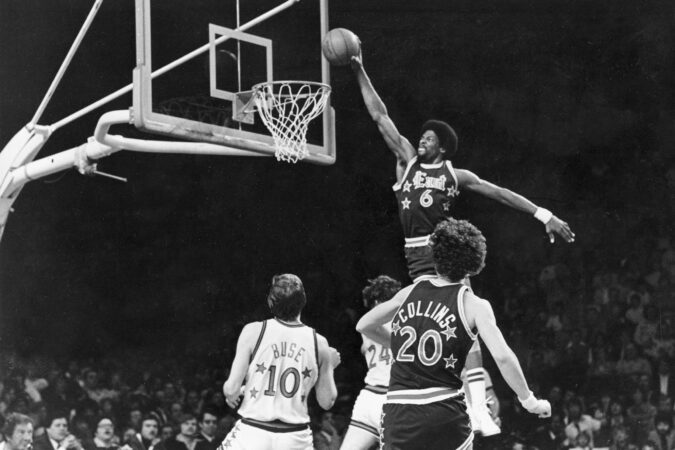
New York Nets forward Julius Erving, left, raises his arms as he is hugged by a teammate following the Nets victory over the Denver Nuggets at the Nassau Coliseum, Uniondale, N.Y., on May 7, 1976.
The crowd let out a communal Whoa. Erving lost the bet to Moe, but he didn’t need another dunk to win the contest. After a reverse from the right side, he swooped in from the left side, grabbing the rim with his left hand and windmilling the ball through the hoop with his right, then finishing with an “Iron Cross” dunk from the right baseline, spreading his arms and dunking the ball without looking at the basket. All the game’s players greeted him at halfcourt to congratulate him. The judges’ decision was a formality.
“It was something else,” Erving told me. “It’s still talked about today. I didn’t know it would have such a lasting effect on basketball history, and neither did any of the other players. I don’t think any of us really knew. We were the ABA, and we were crowd-pleasers. Yes, we made history, but the intention wasn’t making history.”
The All-Star Game — and, in turn, the dunk contest — was supposed to have been broadcast nationally but ended up being televised in just five markets: Denver, Indianapolis, Louisville, San Antonio, and St. Louis. Since the game didn’t end until after 2 a.m. Eastern time, the ripples from the contest didn’t start spreading immediately. Only after Good Morning, America and The Today Show featured Erving and Thompson did the magnitude of the event begin to reveal itself.
“Merger plans had long been in the works between the ABA and the NBA,” ESPN’s Eric Neel once wrote, “but the contest no doubt hastened them.”
Afterward, Erving said that he was unlikely to compete in another dunk contest ever again, that his knees were “75 percent of what they used to be.” (He did, in fact, compete in another: the NBA’s 1984 contest, where he finished second to the Phoenix Suns’ Larry Nance.) But he and the ABA had already ignited, or at least accelerated, an insurrection within pro basketball. The slam dunk was cool, and the ABA had embraced it, which made the ABA cool, which made the NBA seem stuffy and stiff in comparison, mostly because it didn’t have the athlete who, more than anyone, had made the slam dunk cool.
Julius Erving of the New York Nets, known as “Dr J,” scores during an ABA game at Nassau Coliseum, in Uniondale, N.Y., on Nov. 29, 1975.
In Philadelphia, 76ers general manager Pat Williams had watched those TV highlights of the contest.
“That,” he told me, “is what really put Julius on the stage.”
Erving never missed a game during his three-year career with the Nets, leading them to the league championship in 1974 and 1976, and was at times seemingly too good to be true. Long before San Antonio Spurs coach Gregg Popovich figured out that he could scream at his franchise centerpiece, Tim Duncan, and that Duncan would take the criticism without complaint, and that the other, lesser players would understand Popovich gave the team’s superstar no special dispensation, Kevin Loughery used the same psychological tactic with Erving. Doc messed up, even when he didn’t. Doc was no different, even if he was.
One night, Erving dunked over three defenders, and Loughery called a timeout for no reason other than to pull Erving aside and tell him, You just played the greatest three-minute stretch of basketball I’ve ever watched. Rod Thorn, an assistant under Loughery, had never seen a player catch and dunk an alley-oop pass with one hand until he saw Erving do it. The shame was that his exploits took place so often under the blanket of the ABA’s obscurity.
In Game 6 of the ‘76 ABA Finals, Erving scored 31 points, pulled down 19 rebounds, and blocked four shots as the Nets rallied from a 22-point deficit in the third quarter to beat the Denver Nuggets, 112-106, and win the series in six games. As they stormed the Nassau Coliseum court, Nets fans nearly trampled Nuggets’ play-by-play voice Al Albert, who climbed atop a table to escape. Albert lost his microphone and headset. The phone and cable lines he needed for his broadcast were cut. His television monitor crashed to the floor.
The chaotic scene was a bittersweet valedictory for The Doctor’s tenure: The passion and adoration that he would earn over his career in the NBA, with the Sixers, would manifest itself in that final game … and never again with the Nets. Attendance was low throughout the ABA. So was revenue. The franchises were too regional. The league was falling apart.
“Everybody thought we were in the hinterlands,” Bill Melchionni, a member of that ‘75-75 Nets team, told me. “We were minor-league.”
Four ABA teams merged with the NBA in June 1976. “I can say without a doubt,” broadcaster John Sterling, who was the Nets’ radio play-by-play voice at the time, once said, “that what finally convinced the NBA to merge was a chance to get Julius in the league.” Melchionni, who had become the Nets’ general manager immediately after that championship series, began fielding phone calls from civic leaders and chambers of commerce around the country, begging to have Erving and the Nets come to their cities to play exhibition games, offering as much as $50,000 as enticement.
“We were scheduled to play two games in Vegas,” Melchionni told me. “Guys would ask, ‘How many minutes is he going to play?’ And I’d say, ‘It’s an exhibition game. He’s not going to play 48 minutes.’”
The calls stopped, of course, after Wednesday, Oct. 20, 1976. The last day that Julius Erving belonged to the ABA. The first day that the NBA belonged to Julius Erving.
TOKYO — You have to wake up early in the morning to catch the world’s largest fish market at its peak. You also need to keep your head on a swivel.
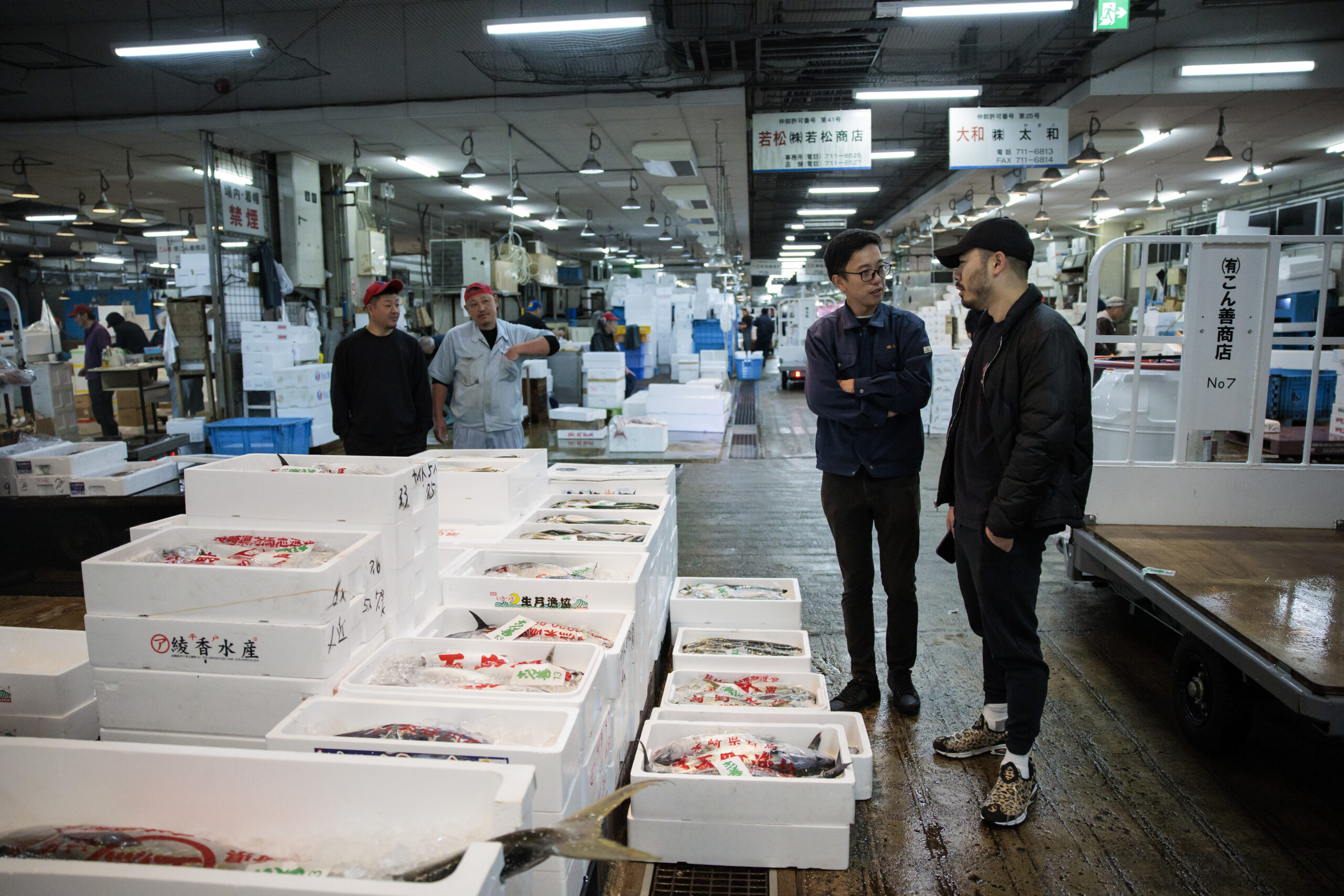
“Careful here! These drivers can be crazy!” said our market escort, yanking me back from a warehouse lane wet with fish blood and water as several electric forklifts zoomed past. Piled high with styrofoam boxes bearing some of the most coveted seafood on the planet, these silent-but-speedy carts were designed for Toyosu Fish Market, a state-of-the-art facility built in 2018 on reclaimed land in Tokyo Bay.
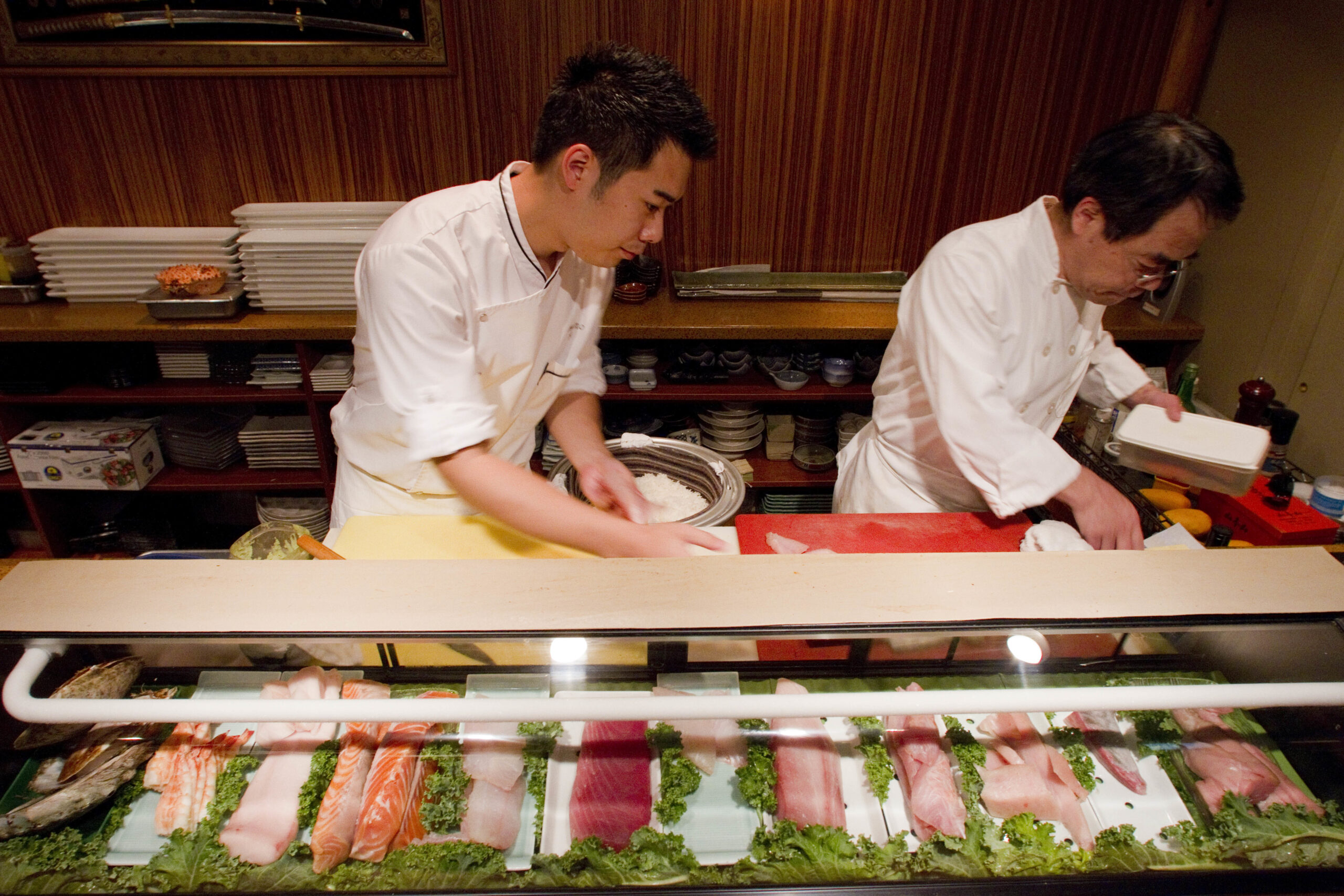
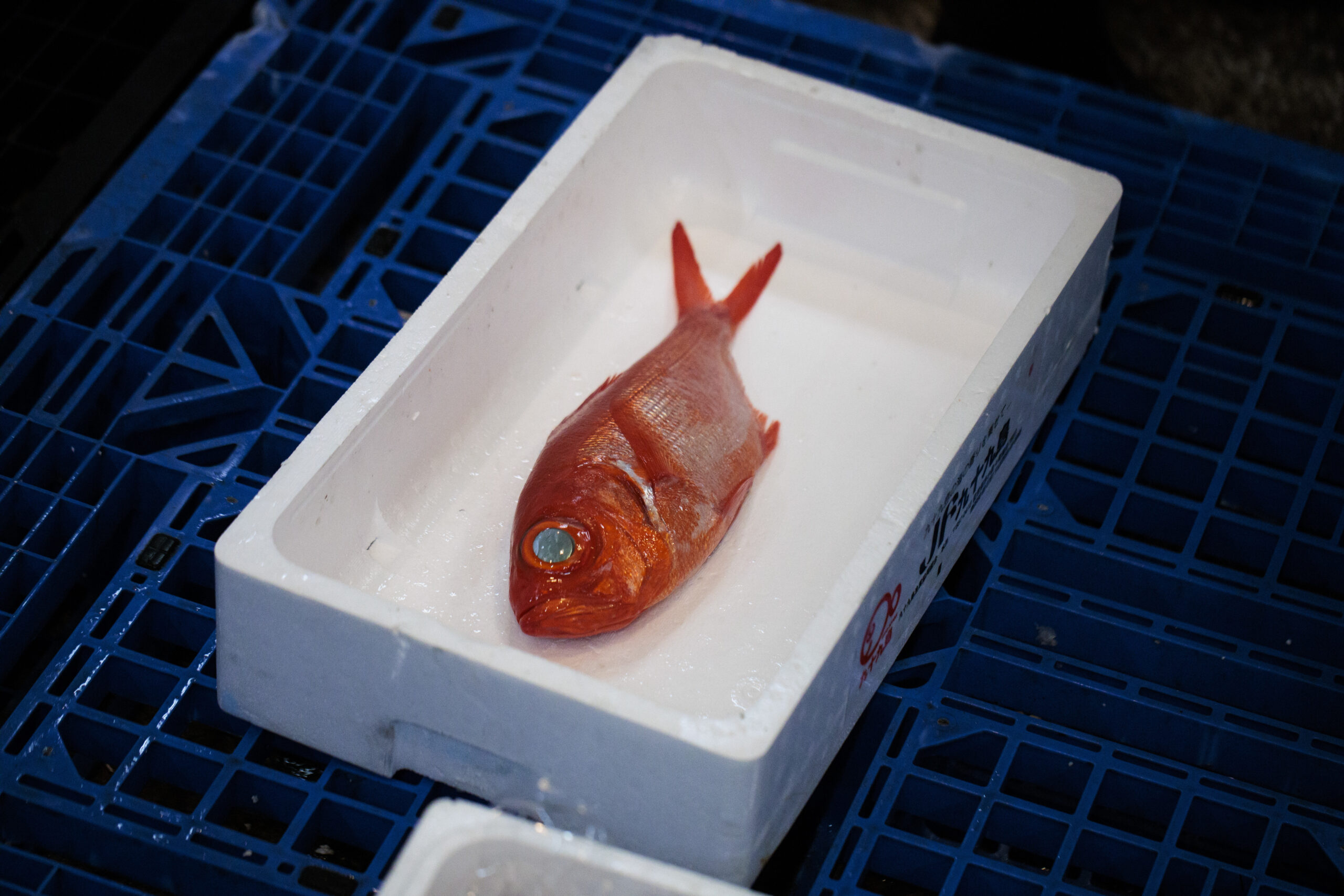
The massive refrigerated halls were already humming with activity before dawn on a November morning as Philadelphia chefs Jesse Ito and his father, Masaharu “Matt” Ito, walked through vast aisles of whole fish on ice toward the live-seafood hall, where an acre of ocean creatures bobbed in gurgling tanks flanked by an ike jime station. Thrashing madai red snappers there were deftly dispatched with two strokes of a knife and a wire spike to the brain — a swift death considered both humane and, from a culinary perspective, optimal.
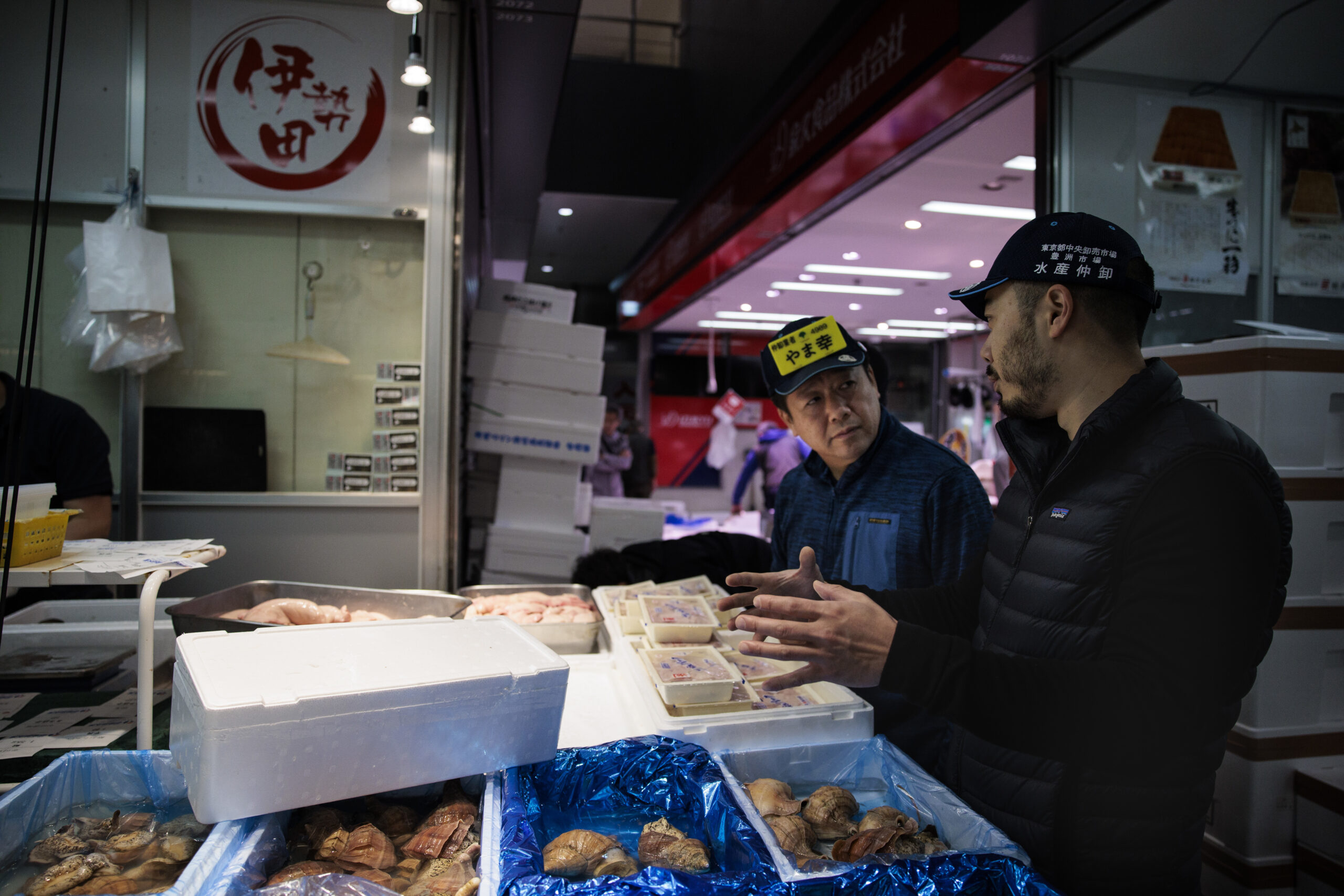
Hirokatsu Takeda talks with Jesse Ito in a stall at Toyosu Market on Tuesday, Nov. 4, 2025, in Tokyo, Japan.
“It instantly disables the nervous system from producing chemicals that degrade the fish and keeps the meat fresh,” said Jesse, of Royal Sushi & Izakaya, whose industry contacts had lent us official hats and white rubber boots to accompany them to areas of this seafood paradise where tourists are not permitted.
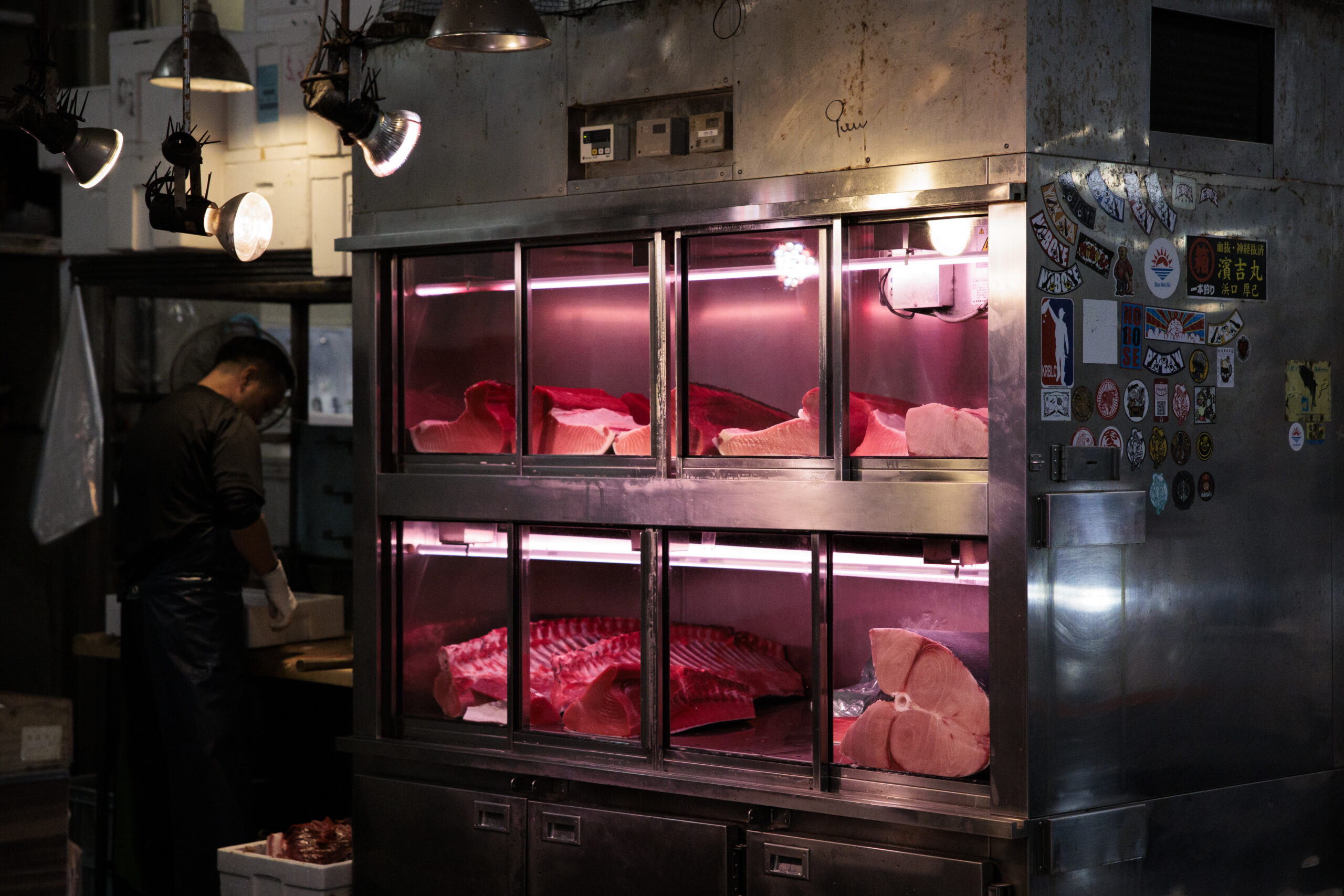
At 5:30 a.m. sharp, the hand bells began to chime: Tokyo’s famous tuna auction was underway! We turned into a frigid hall where hundreds of tunas, some as big as couches, were laid atop the jade-green floor. Prospective buyers pried their bellies open with pikes to inspect the fatty pink flesh inside. Auctioneers from five different houses simultaneously launched into a rapid-fire sing-song pattermet with the cries of replying bidders, the chaotic burst of noise transforminginto a haunting, rhythmic chant that resonated in our chests.
“It sounds almost tribal — and you feel it,” said Jesse, 36, who buzzed with excitement from the auction floor. “Japan is so futuristic, and there’s probably a much more efficient way to do this. But this is about culture and preserving tradition. This is part of what it means to be Japanese.”
One of the most respected sushi chefs in the U.S., Jesse was not buying tuna on this day in November, but taking in this time-honored ritual alongside his father.
“I’m so glad we got a chance to experience that together,” Jesse said.
Matt, 72 and Japanese-born, taught a teenage Jesse the fundamentals of making sushi at Fuji, the family’s long-running restaurant in South Jersey. He and Jesse sold it before opening Royal Sushi & Izakaya in Queen Village together with partners in 2016, when Jesse was 26.
Jesse grew up in Cherry Hill and worked at Fuji from childhood. Before age 27, he’d never flown on an airplane, let alone travelled to Japan — a curiosity for a talent who’s risen to national acclaim as an eight-time finalist for the James Beard award, aMichelin-recognized chef, andthe face of the 32nd best restaurant in North America as ranked by World’s 50 Best. He finally made it to Japan in 2024 on a research trip for his new restaurant, dancerobot, with business partner and chef Justin Bacharach. This secondvisit, in late 2025,would also be full of nonstop eating in search of inspiration, found at street stalls, yakitori grills, sushi counters, and world-renowned kaisekis.
But this journey was especially personal: We were boarding a plane later that morning to the southernmost Japanese island of Kyushu, to visit the village where Matt was born.
Map of Craig LaBan’s travels in Japan with Philadelphia chef Jesse Ito and his father, Matt.
Matt, who lives alone in Pennsauken with his two macaws, Sakura and Ichiro, had not been back to Japan in 25 years and, before last year, had no imminent plans to return. Jesse thought it important for his father to go while he was still physically able, and paid Matt’s way.
“I never thought I’d get a chance to go to Japan with him,” Jesse said.
The prospect of a father-son jaunt was hardly a given. The last time they took a family vacation? “Jesse was 3 years old,” said Matt, recalling a trip to Florida before his world got “caught up in work, work, work … I regret that.”
There were other complications. Matt’s visa needed to be updated. Jesse had also been reluctant in previous years to relinquish two weeks of revenue from his omakase, an expensive experience for 16 diners each night (almost entirely regulars) that’s one of the toughest reservations in America.
Matt Ito and Jesse Ito talk with Chef Kunihiro Shimizu outside of his restaurant, Shimbashi Shimizu, on Sunday, Nov. 2, 2025, in Tokyo, Japan. No photos or video are allowed during the omakase at Shimbashi Shimizu, and international visitors are only permitted when accompanied by someone who understands Japanese.
Even more daunting was the prospect of so much time together. Despite working in the same restaurants every day for the past 22 years, the two rarely interact. There’s been challenging history between them: Jesse watching his parents’ divorce as a teen, financial struggles at Fuji, and a shifting power dynamic in the kitchen at Royal as Jesse took the lead and became a star — all while publicly grappling with alcoholism.
With Jesse now five years sober, the air between them has been cleared. “I had a sit-down with my dad and there were a lot of raw emotions,” Jesse said. “I apologized, and he spoke, too. We’ve made amends. We’re on good terms now.”
Jesse Ito and Matt Ito eat Tonkotsu ramen at a shop across from the Nagahama Fish Market on Thursday, Nov. 6, 2025, in Fukuoka, Japan.
For Matt, the chance to journey to his homeland for the first time in a quarter-century with his son was an unexpected gift: “This is the first time I’ve spent this much time alone with Jesse since he was in junior high.”
After leaving the tuna auction, Jesse hustled to introduce himself to several suppliers that handle prime ingredients he wanted to bolster his menus.
“Next time I order,” he said as we walked to lunch, “they’ll know who I am and give me the good stuff. ‘That’s Jesse-san, send him the best!’”
Matt trailed behind, reveling in the beauty of all that gorgeous seafood, including live snapping turtles that gave him flashbacks to his teenage years as a fish-market butcher: “Be careful or you’ll lose one of these!” he said, wiggling his fingers.
We were famished by the time we arrived at Iwasa, a small restaurant in the market serving sushi for breakfast. We devoured the freshest pink toro, tender abalone, blood clams carved into snappy pompoms, and the sweetest shrimp over nubs of warm rice. It was just 6 a.m. We still had a late-morning plane to catch. The longest day of Matt and Jesse Ito’s big adventure had only begun.
An inauspicious beginning
Matt Ito arrived in Philadelphia almost exactly 50 years ago, just as an epic snowstorm in February 1976 froze the Schuylkill River solid. The 21-year-old chef was having regrets. The sandwich on the plane — roast beef on dry rye bread — was shocking. “I’d never seen such terrible food,” he said. When the owners of Sagami picked him up at JFK airport, he gazed out the windows of their Datsun with dismay as the wintry New Jersey Turnpike rolled by with “no mountains, just flat land, ice, and snow.”
He’d been recruited through a friend in Kyushu to this still-fledgling restaurant in Collingswood, where he lived upstairs for the first two weeks. He was in charge of making sushi at a moment in American culture when tuna rolls, raw salmon, and even tempura-fried shrimp were still novelties. “A lot of people had never seen this before. I had to teach people how to eat it,” Matt said.
But owners Chizuko and Shigeru Fukuyoshi were wonderful, he said, and Sagami was a fortuitous landing spot. That’s where he met Jesse’s mother, Korean-born Yeonghui Choi, who was a server. When he decided to open Fuji in 1979, she joined him there, building the business while his English was still limited.
Despite its out-of-the-way location in a Cinnaminson strip mall, Fuji became a cult favorite of gourmet societies like La Chaîne de Rotisseurs thanks to Matt’s lyrical kaiseki. By the time I first encountered it in 1999 — writing a rave review about the tuna-wrapped foie gras, curry-spiced squab, and bundles of lobster crisped inside translucent tempura crusts — I could not fathom how such a talent had remained largely unknown to Philadelphia’s wider public for nearly two decades. When the Itos were forced through eminent domain to move their restaurant to Haddonfield in 2007, Matt’s cooking was better than ever. But the restaurant remained under the radar.
Jesse worked his way up from dishwasher to head sushi chef at Fuji by 2008, getting more involved in the business.He graduated Rutgers-Camden with a business marketing degree in 2011. The decision to sell the restaurant after 37 years in 2016 came down to the unforgiving limitations of a family-run BYOB. “It’s not like we were failing. But we worked so hard for so little return, and there was no way for my parents to stop working,” Jesse said.
Jesse Ito (left) and his father, Matt Ito work at the raw bar at Fuji, Haddonfield, June 9, 2011.
They leveraged the sale of Fuji to allow his mother to retire, and to build something bigger. He and Matt partnered with restaurateurs Stephen Simons and David Frank — who own Royal Tavern and Cantina Los Caballitos, among severalothers — to open Royal Sushi & Izakaya.
“I wanted to take care of my parents financially and also do something for myself,” Jesse said. “It’s a classic immigrant story: The first generation works hard and lays the groundwork, the second generation either takes it to the next level or goes a different route to become a doctor or go into finance. I grew up in that struggle, and as a teenager, life was not always nice.”
Jesse has clearly taken it to the next level. Half a century after Matt helped usher in the dawn of sushi for Philadelphians, his son is now redefining the genre’s boundaries with his ever-evolving omakase. Bridging and building that legacy is no small feat considering there are now over 17,000 sushi restaurants in America, according to Nobu Yamanashi, of Yama Seafood in Jersey City, which distributes fish to over 800 restaurants around the country, including Royal Sushi.
“All the iconic Japanese chefs with global reach are in their 70s,” says Yamanashi. “The next Nobu [Matsuhisa] or Morimoto doesn’t exist yet. It’s up for grabs. But there are a handful of Japanese chefs right now that have a chance to lay that claim. Jesse has the ability.”
The potential for such recognition was already evident on Matt and Jesse’s trip. In Tokyo, atDen, a renowned kaiseki destination (No. 32 on World’s 50 Best Restaurants), Jesse took pride in signing the wall at the restaurant’s invitation, joining the names of famous chefs who’d visited from around the world. Jesse was also caught completely off-guard at Yohaku in Osaka when chef Yoji Arakawa asked him for a picture after our meal. “I was nervous when you walked in because I follow you on Instagram,” Arakawa told him.
Chef Zaiyu Hasegawa talks with Matt Ito during dinner service at Den on Monday, Nov. 3, 2025, in Tokyo, Japan. Den has two Michelin stars.Jesse Ito points out his message on the wall at Den on Monday, Nov. 3, 2025, in Tokyo, Japan.
That his growing social media profile had somehow reached halfway around the world both stunned and delighted Jesse: “That was super-validating,” he admitted.
Jesse denies he has ambitions of global renown. But he’s certainly embraced the trappings of superstar chefdom. He has flown to London half a dozen times over the past few years to tattoo his arms with sleeves of colorful peonies and jetted to Los Angeles to tattoo his chest with a coiling dragon. On our field trip to Tokyo’s Kappabashi kitchen-supply district (“It’s Toys ‘R’ Us for chefs!”), he splurged on $1,000 worth of hand-blown sakeware for Royal’s omakase. A visit to the famed Nenohi knife store in Tsukiji Market bolstered his collection of high-end knives, including a gleaming broad blade with an emerald-lacquered scabbard that ran him a cool $2,700.
Jesse Ito checks out the knives at Nenohi Cutlery Co. at the Tsukiji Market on Monday, Nov. 3, 2025 in Tokyo, Japan.
“The omakase is a performance, so it’s nice to have a great knife,” he said as lights danced across his face from the sword-like curve of another sujihiki slicer he was considering.
His father was quietly shaking his head in the corner. Matt, who’s so thrifty he brought his own onigiri rice balls from South Jersey to snack on while in Japan, said he could not relate his son’s knife obsession.
“If a knife cuts well, that’s all I need,” he said. “And don’t tell his mother he spent so much on a knife. She hates this.”
The sun sets during a drive on Wednesday, Nov. 5, 2025 in Japan.
A detour, and then a discovery
We arrived at Oita Hello Kitty Airport around 1 p.m., and when we stepped outside, Matt took a deep breath of the ocean air hugging the rocky coast of Kyushu Island.
“It’s a homecoming!” he said. “I can smell it!”
We’d come to visit Miemachi, Matt’s hometown on the outskirts of Oita. And Jesse was visibly concerned. He’s accustomed to being in control of every logistical detail, both at his restaurants and for the itinerary of this trip, and our time in Kyushu was the only leg of the journey he’d delegated to his father. But he grimaced when he saw his father’s gameplan for transit between the airport and Miemachi. Matt’slegal pad was scrawled with a series of connecting trains and buses that would get us there in three hours if all went smoothly.
Jesse Ito and Matt Ito wait on the train platform at Miemachi Station on Tuesday, Nov. 4, 2025, in Miemachi, Japan.
“Do we really need to go there?” asked Jesse, clearly drained after waking at 3:30 a.m. for our tour of Toyosu and then rushing to board a flight. “Nothing’s going to be open. What are we even going to see?”
I insisted we follow through: This was one of the main goals of our trip! Matt, sensing Jesse’s unease, surprised his son by hiring a cab to take us there directly.
Ninety minutes later, we rolled through the small town of Bungo-Ōno and up into the sparsely populated hills of Miemachi, an agricultural patchwork of rice paddies framed by the jagged triple peaks of Mount Katamuki. The cab moved slowly toward a cluster of houses, then drifted to a stop on Matt’s cue. Jesse was certain we were lost.
“Dad, what’s the plan to get back? They don’t have Uber here.”
Matt did not reply. Instead, he exited the car and walked down the road until he disappeared around the bend. The cab driver got out and smoked a cigarette against the car hood. Minutes ticked by and Jesse began to panic.
“This is why I can’t let my dad plan things. Let’s be proactive, rally my dad and get out of here!” he said, suddenly shaking his phone. “I can’t get a signal. There’s no internet. I can’t use Google Translate to communicate with the driver!”
At that moment, Inquirer photographer Monica Herndon, who had followed Matt, came jogging back to the cab: “He found it!”
Fukiko Ito talks with Matt Ito and Jesse Ito, outside of her home on Tuesday, Nov. 4, 2025, in Miemachi, Japan.The area where Matt Ito used to live on Tuesday, Nov. 4, 2025, in Miemachi, Japan. The home he used to live in is no longer standing.
Just over the rise, we found Matt at a low-slung house happily chatting with Fukiko Ito, 84, a cousin he’d not seen in decades who answered the door by pure luck. She was living in the house Matt’s father, Hideo, had built for his grandfather in 1967.
“Wow! Wow! Wow!” Matt said, proudly introducing Fukiko to his son. We followed her into the backyard and discovered another surprise: a granite altar with blooming yellow flowers that marked the family grave.
“My mother and father are buried here,” Matt told Jesse, whose anxious edge had instantly softened into one of quiet awe. “Your great-grandparents are buried here.”
As a falcon circled overhead, Jesse quietly gazed at the monument and spotted his family crest etched into granite. It was the same patterned quince flower, descended from a branch of the Ito samurai clan, that he’d used for Royal’s logo. He now realized that he’d transcribed it incompletely.
The Ito family crest is seen on the family grave in the backyard of Fukiko Ito’s home on Tuesday, Nov. 4, 2025, in Miemachi, Japan. Jesse Ito uses the family crest as the logo for his Royal Sushi omakase in Philadelphia.
“I’m missing the house that goes around the outside of the flower,” he said, noting it for correction.
Matt had been giddily wandering the yard’s garden, picking fragrant sudachi citrus and orange persimmons off the trees. He caught Jesse’s eye and then — “here, catch!” — tossed him a piece of the family fruit.
Days later, Jesse would regard this as one of most powerful episodes of the trip, a direct connection to a heritage that rooted him to ancestral land that, since he was young, had felt like a distant concept not only as an American who’d never traveled, but as the product of a mixed-culture marriage who wasconstantly confronting impostor syndrome.
“For most of my life I felt that way, like a misfit — an American-Japanese-Korean kid who was not accepted by either group,” Jesse said.
He took heart in the pure delight that bloomed across his father’s face, an unfamiliar expression: “I’ve never seen him so happy — maybe ever.”
In the moment, though, Jesse later said, when he saw that persimmon arc across the yard, he thought of his childhood in Cherry Hill, a lonely latchkey-kid existence with his parents always at the restaurant. He’d microwave himself a dinner of buttered rice and seaweed. His dad was never around to actually play catch.
Matt Ito and his cousin Fukiko Ito pick persimmons in the backyard of her home on Tuesday, Nov. 4, 2025, in Miemachi, Japan.
Letting Jesse run the show
A flood of parallel emotions was soon to overwhelm Matt, too.
As he and I sat alone togetheron the commuter train to the nearby spa town of Beppu following the unplanned family reunion, he recalled his own childhood. He was an indifferent student who spent time farming at age 14 to help care for the family when his father, a Japanese calligraphy teacher and former Army cook, fell ill. His father only gave Matt his blessing to become a chef on his deathbed one year later: “Under one condition: Just be the best.”
Fifteen-year-old Matt started his careerin a fish market, butchering the local delicacy of fugu blowfish, learning to massage the deadly poison out of its liver underwater. His mother found him a kitchen job at the New Tsaruta Hotel, a resort where, in fact, we were staying that night. It was there Matt learned the art of kaiseki, a multi-course tribute to the seasons that employs different cooking techniques with every course. Matt also befriended a mentor there who gave him words to live by: “You have to make your own life. There are opportunities floating by you in the air. You just have to grab them!”
After two more years training in Osaka, the same mentor presented him with his big shot: the position at Sagami.
“I figured I’d go to America for two years,” Matt said. But he kept grasping at the opportunities. A wife. Their own restaurant. Two children — Jesse and his older sister, Naomi. Devoted customers and a lifetime of work. Too much work.
“I had a plan until I was 45, but then I messed up after that,” Matt said as the train rattled towards Oita. “I should have been a better father. I should have been a better man at the house. Instead I was always working, and as a result I lost my wife. I still feel bad about it, but we’re still friends and I talk to her every day. And every day before this trip, she’s so worried and tells me: ‘Don’t let Jesse eat fugu!’”
Matt’s still a partner at Royal Sushi & Izakaya, but he’s content to watch Jesse run the show, admiring his son’s creativity (“sometimes I think he’s a genius”). He comes in for a couple hours early each day to make the tamagoyaki, the delicate, lightly sweetened rolled omelet customers often order to finish their meal.
“[The cooks] just know me as the grumpy old man there making rolls. I’m Ito-san, that’s all. A funny old man.”
Matt Ito walks towards the New Tsaruta Hotel on Tuesday, Nov. 4, 2025, in Beppu, Japan. Matt once worked in the kitchen at the New Tsaruta Hotel in Beppu.
But he’s also observed closely as Jesse pours himself into the restaurant with a determination and focus he recognizes all too well.
“He works too hard, and I worry about him. I want him to have a life, too. I hope he finds someone to get married to, like any parent would.”
Is he worried his own story is repeating itself with his son?
Matt nods as the train pulls into Beppu station. Finally, 16 hours after rising to watch the morning tuna auction in Tokyo, we shuffled like zombies into the lobby of the New Tsaruta Hotel.
The aging tower overlooking Beppu Bay — known for sixth-floor open-air baths fed by the town’s famous hot springs — had lost some of its grandeur over the past half-century, Matt conceded. But when an exhausted Jesse opened the door to his room, he was not prepared for the culture shock of the spare traditional Japanese accommodations, with little more than a tatami mat visible. “There’s no bed!” he thought to himself, unaware of the futon in the closet. He turned around and, not wanting to offend his father, quietly left New Tsaruta and checked himself into a cushy new hotel nearby.
Colorful shops line the street in Dotonbori on Thursday, Nov. 6, 2025, in Osaka, Japan.
Small improvements every day
“I’m sorry if I was cranky last night,” apologized Jesse the next morning as we boarded an early train to Fukuoka. A soft mattress had helped him recover his good spirits. Our previous day had been special. “I saw how happy my dad was and I felt like I’d done my duty as his son,” he said.
But today brought another adventure on Kyushu that we’d all been looking forward to: nori day!
We had come to Japan to eat, of course, and our nine days were filled with extraordinary flavors. We devoured luscious king crab legs for breakfast at Tsukiji Market, soulful curry-drenched pork katsu worth the 90-minute wait in Osaka, and the legendary Pizza Y topped with bluefin tuna and wasabi at Savoy Tomato & Cheese in Tokyo. We marveled at the poetic wonders of the modern kaiseki at Den, where chef Zaiyu Hasegawa’s food married culinary mastery with a sense of humor that resonated with Jesse as a model for his own restaurants.
Curry with shrimp, spinach, and cheese at Hakugintei on Friday, Nov. 7, 2025, in Osaka, Japan.
But Jesse had also come to Japan on a quest to further his pursuit of kaizen, the Japanese philosophy of making small improvements every day. And our field trip for day two in Kyushu — a visit to an artisan nori producer — had the potential to tangibly elevate his food. Quality fish takes center stage at any great sushi restaurant. But the difference between “good” and “extraordinary” can often come down to unsung supporting ingredients like nori and vinegar, whose varying qualities dramatically impact the final bite.
That’s why we found ourselves standing atop the seawall in Yanagawa, peering out at the breezy Ariake Sea, where 50% of Japan’s nori is farmed. The seaweed grows in-season there likemoss-green netting between poles that punctuate the water all the way to Nagasaki across the bay, whose tidal rhythms undulate between the wash of ocean water and the warmth of drying sun, fostering a coveted flavor that’s deep and complex.
Maruho — the manufacturer that hosted our tour — arguably makes the best, according to Nobu Yamanashi, the Jersey City seafood distributor. Jesse was clearly impressed as we tasted myriad varieties, crunching through piles of crispy seaweed snacks speckled with spicy pollock roe (mentaiko), then nibbling through ascending grades of plain nori — the kind commonly used to wrap maki, temaki hand rolls, and onigiri — until he finally landed on the coveted No. 1.
“This is so good!” said Jesse, holding a deep green sheet to the light, its denser weave pressed with flecks of aonori, another seaweed variety known for its color and fragrance. Its flavor was deeply oceanic. Its texture so crisp, it snapped cleanly when Jesse folded it in half, already imagining its effect wrapped around a fatty tuna handroll or a morsel of mackerel pressed over cubes of warm rice back in Philadelphia. “It’s like a cracker … I just hope I can afford it.”
Nori is shown untoasted, left, and after toasting, right, at Maruho on Wednesday, Nov. 5, 2025, in Yanagawa City, Japan.
This is the most expensive nori on the market. At $3.50 per sheet wholesale, it was twice the cost of the already top-market seaweed Jesse was currently using, and exponentially more than common sushi-bar nori. If Yamanashi had his way as Maruho’s exclusive importer, Jesse was about to become the first sushi chef in America to use it — “He’s a top-10 customer and he pays his bills.”
Jesse Ito listens during a tour about the vinegar making process at Saga Vinegar on Wednesday, Nov. 5, 2025, in Saga City, Japan.
Success becomes a balancing act
Indeed, Jesse’s omakase — already one of the priciest dining experiences in Philly at $300 per person as of last October — had been scheduled to rise to $355 by the time we returned home in November, to accommodate all the new treasures he’d found. The top-shelf uni he’d begun buying from Toyosu was $350 a tray. The creamy lobes of plump monkfish liver from Hokkaido he planned to marinate in shoyu before gently steaming them into a silky pâté cost 10 times more than the ankimo he’d previously used. The Maruho nori, he’d later report, “has been a real game-changer. That stuff is amazing.”
As we walked briskly through Fukuoka’s Nagahama Market, a calmer scene than Toyosu but still the second-largest fish market Japan, Jesse gave his Kyushu-based fish buyer, Takahiro Hirota, a wish list. Luminous pink madai sea breams. Silvery shima aji jacks. Translucent yare ika, or spear-tipped squid.
“This is hard to find, can I get one for next week?” he said, gesturing at the squid, which becomes silky-soft and sweet when sliced just right.
Takahiro Hirota talks with Jesse Ito at Nagahama Market on Thursday, Nov. 6, 2025, in Fukuoka, Japan.A kinmedai or golden eye snapper, at Nagahama Market on Thursday, Nov. 6, 2025, in Fukuoka, Japan.Large cuts of tuna in a refrigerator at Nagahama Market on Thursday, Nov. 6, 2025, in Fukuoka, Japan.
The omakase — and Jesse himself — have come a long way since Royal Sushi & Izakaya first earned four bells from The Inquirer in 2018, when Jesse’s tasting menu was (just!) $130.
The omakase’s ingredients, place settings, and techniques have continuously leveled up. And the storytelling its 18 courses now convey — including the extraordinary bibimbap with uni and toro that’s inspired by Jesse’s Seoul-born mother and composed over buttered seaweed rice (a childhood throwback, albeit now truffled)— has transformed the meal into something deeper than just a luxury splurge. Even as its fee rises, it remains hundreds of dollars less than similar experiences in New York and beyond.
“After eating at multiple sushi omakases in Tokyo and Kyoto, from multiple Michelin stars to none, the best sushi omakase I have ever eaten is from Jesse Ito right here in Philadelphia,” says Marc Vetri, the Spruce Street pasta maestro who also owns a restaurant in Kyoto.
Much of Jesse’s restaurant world is, in fact, accessible and relatively affordable to the wider public, both at dancerobot, where live jazz and karaoke nights keep it lively, as well as the izakaya portion of Royal, a walk-in experience Michelin noted with a Bib Gourmand as a “good value.” But it’s little wonder regulars guard their standing reservations to the omakase like courtside tickets for a Sixers game, ahead ofa 1,000-person Resy waitlist that occasionally shakes a couple seats loose for newcomers. The seemingly impossible scrum shows no signs of abating.
Jesse sympathizes with the notion of trying to make the omakase more accessible, but he simply doesn’t know how to achieve that without sacrificing the valuable personal relationships he’s forged over a decade to the murky forces of the anonymous internet, where valued seats risk becoming little more than a resale-market commodity.
“If I was dumb enough to get rid of all my regulars, people with access to bots would just buy up everything and resell them,” he said.
As with so much in Jesse’s life, hiskeen sense of how to navigate the challenges of success has been shaped by periods of struggle, alongside his parents and on his own.
The pandemic presented an existential threat to Royal’s business and halted the omakase for over a year while the izakaya kept the lights on with takeout and a la carte. On the brink of losing his house, Jesse was also compelled by the crisis to finally confront his relationship with alcohol, which he’d long relied on to numb his anxieties and fears.
Tiny bars fill the narrow streets in Shinjuku Golden Gai on Saturday, Nov. 8, 2025, in Tokyo, Japan.
He became sober on Dec. 1, 2020, a status he’s maintained since, regularly attending support groups and talking publicly about his recovery. The shift reshaped his workplace, paring Royal’s hours back to five nights a week, closing at 11 p.m. for a more sustainable environment. Sobriety has helped him cope with setbacks. (“Part of losing the Beard award eight times … you come away with the ability to enjoy the moment,” he said.) It has also given him the clarity to build healthier relationships, “to be a better partner, a better friend, and a better son.”
Jesse still gets a rush from the performance of slicing pristine fish and the intimacy of entertaining a handful of customers from behind his counter.
“I’m going to keep it this way for as long as I can because it’s a moment in time when I get to do this,” he said. “It’s like a show every night.”
Over the course of our time in Japan, however, Jesse succeeded in making his biggest impression on an audience of one: his father.
“This was the best trip I’ve ever had and I’m really appreciative,” said Matt, who’s now planning a return trip on his own to travel to Miemachi with his Tokyo-based sister.
Matt could typically be found lingering several paces behind us on our fast-paced visit, soaking in the sights, sounds, and flavors of the land he’d left 50 years ago. But he was also looking forward, enjoying the rare opportunity to observe his son out in the world as he forged new business relationships and soaked in inspiration at every turn: “I’m so proud of the mature person he’s become. He’s made his own life.”
Matt also relished this opportunity to simply be with Jesse, even if conversation between the two was often sparse.
“It’s funny because I don’t have to say more than one word,” Matt said. “I know he understands.”
Matt Ito and Jesse Ito enjoy a tea tasting at Souen on Saturday, Nov. 8, 2025, in Tokyo, Japan.