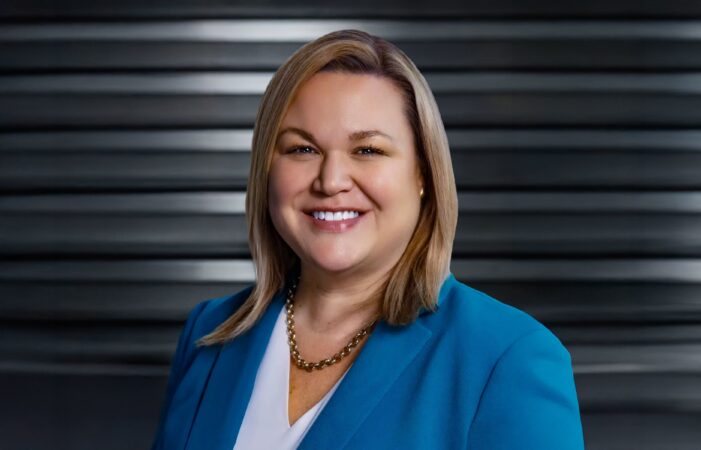
Main Line Health appointed Anna Michelle Brandt president of its Lankenau Medical Center in Wynnewood, the nonprofit health system announced Monday.
Brandt mostly recently worked as chief operating officer at University Hospital, a 519-bed academic medical center in Newark, N.J., which Main Line’s new CEO Ed Jimenez led before taking over at Main Line.
The new Lankenau president also worked previously with Jimenez at UF Health Shands Hospital in Florida.
Brandt succeeds Katie Galbraith, who left Lankenau in September after about three years to lead New England Baptist Hospital in Boston.
Lankenau, a level 2 trauma center, sits in Lower Merion Township at the intersection of West Philadelphia and Montgomery and Delaware Counties.
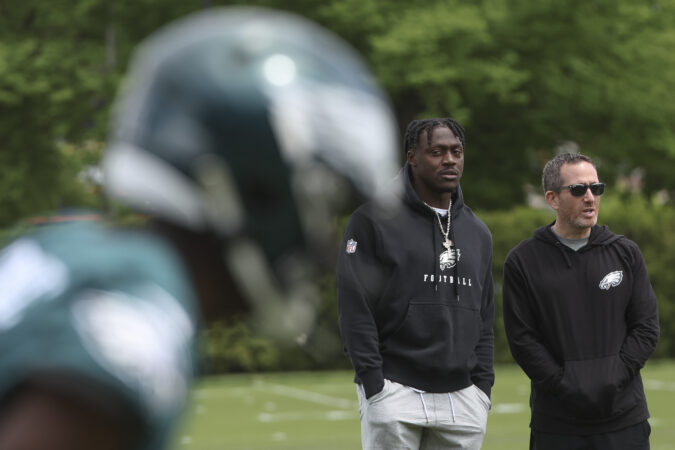
The next two months will be franchise-defining for Howie Roseman and the Eagles. That’s partly a function of how much they need to accomplish in order to get their offense on a sustainable footing. But it’s also a function of how much opportunity they have to do so. In fact, they have more of it than most teams in their situation can hope to have.
The decision-making revolves around the draft, as it always does. The most honest thing anybody can say about the draft is that the best decisions are primarily a result of what’s available. Roseman deserves a ton of credit for projecting Quinyon Mitchell as an elite cornerback. But he gets credit for drafting him only because he lasted until the 22nd pick. Same goes for Cooper DeJean in the second round at No. 40. Who knows what this Eagles defense looks like if Mitchell and DeJean weren’t on the board.
I see a lot of parallels between that 2024 draft and this year’s. The Eagles’ offense is at a similar juncture, particularly in the pass-catching department. DeVonta Smith is great. He’s also the only guy on the depth chart at wide receiver and tight end, if we’re assuming that A.J. Brown is potentially on the way out. The best way to get yourself into trouble when you are on the clock is to focus on immediate needs over expected future value. The Eagles’ opportunity is that this year’s draft looks like it aligns with their needs.
If the mock drafts are to be trusted, the Eagles could have their choice of one of at least three potential difference-makers at No. 23 and perhaps a second if they can move up in the second round. Last year, I was beating the drum for Missouri receiver Luther Burden III, who ended up going No. 39 to the Bears. This year’s trio is even better.
Oregon tight end Kenyon Sadiq. Texas A&M wide receiver KC Concepcion. Alabama wide receiver/utility man Germie Bernard.
The comps are Vernon Davis, Antonio Brown/Stefon Diggs, and Deebo Samuel.
I’m not going to sit here and pretend I have an opinion on any of the linemen who could be on the board in the late first round. If the Eagles have a chance to draft one with a Lane Johnson or Jalen Carter grade, they should obviously do it. What I do know is that the pass-catchers should be a priority, and that there are three guys who could offer the value that Mitchell and DeJean did on the defensive side.
This draft is better than people are giving it credit for, particularly in the range where things start to look realistic for the Eagles. The precombine consensus had Sadiq going No. 19, Concepcion going No. 27, and Bernard going No. 69. The Eagles have picks No. 23 and 54, but I’m skeptical that they’ll be in position to pick two of the three.
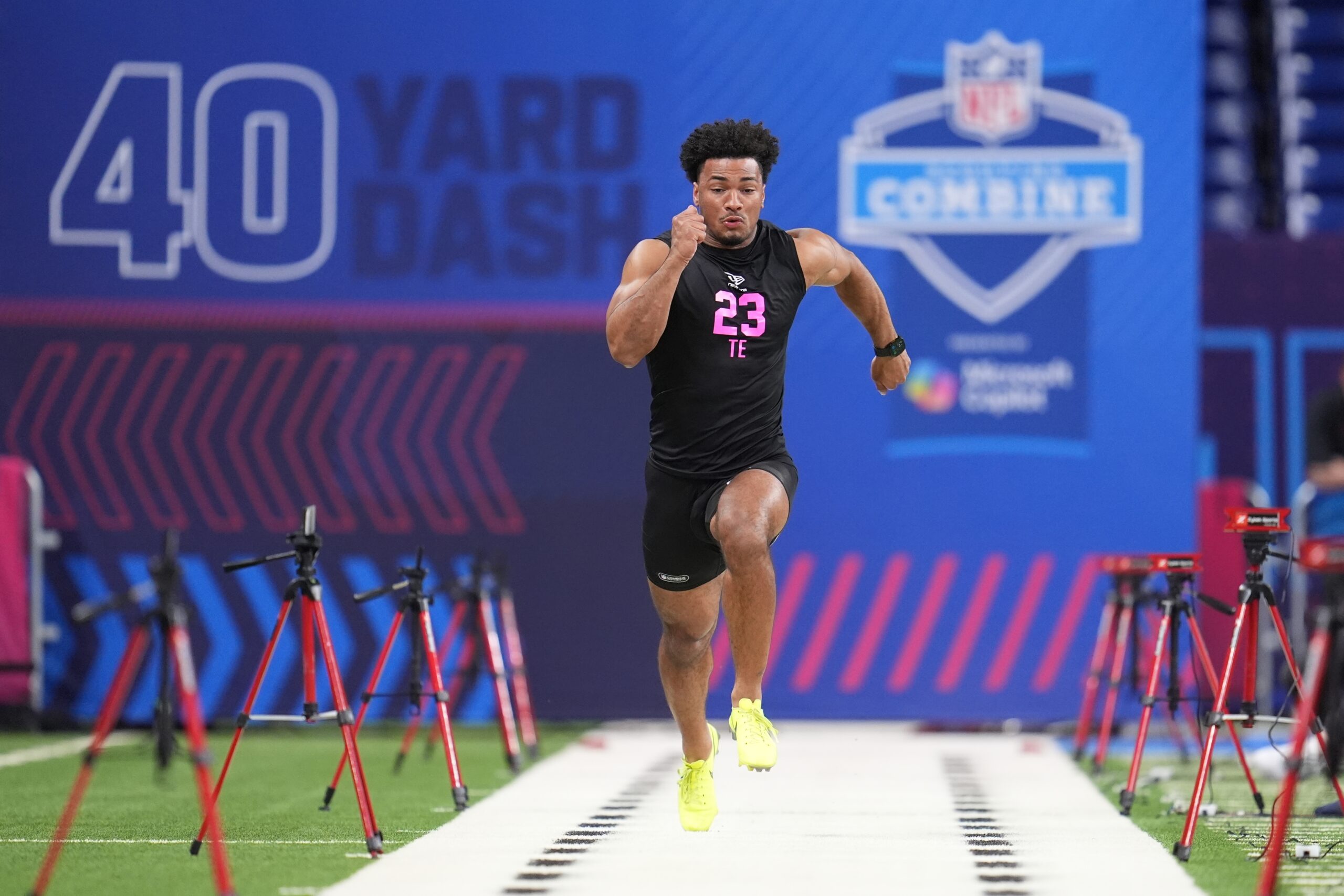
The idea that Sadiq will last anywhere close to No. 23 always seemed detached from reality. That’s especially true after a combine performance unlike any we’ve seen at the tight end position in recent memory. Sadiq’s 40-yard dash time of 4.39 seconds was the fastest by a tight end since converted quarterback Matt Jones in 2003. His 1.54-second 10-yard split would have ranked him among the Top 12 wide receivers at this year’s combine. He also put up wideout-like numbers in the broad jump and vertical leap.
It would be one thing if Sadiq’s measurements were at odds with his game tape. But they aren’t. The game speed and explosiveness are there. Most notable is the way they show up off the ball. His combination of acceleration and compact strength allowed Oregon to use him in all sorts of ways in their blocking schemes: out wide on wide receiver screens, across the formation on running plays, etc. It is impressive to watch. This isn’t Kyle Pitts. I have to imagine every cutting-edge play designer in the NFL would love to have Sadiq’s skill set at his disposal. Don’t listen to the folks who try to compare him to fellow workout warrior Eli Stowers. The Vanderbilt tight end is a worthy late-second-round gamble. But watch both of their cut tapes and you’ll quickly realize one of these things is not like the other.
Kenyon Sadiq’s 40-yard dash time of 4.39 seconds was the fastest by a tight end since converted quarterback Matt Jones in 2003.
To be clear, Sadiq’s isn’t a conventional skill set. He isn’t anything close to your classic tackle-adjacent receiver-lineman tweener tight end. Which might be one reason why the draft industry rates him where it does. At 6-foot-3 with 31½-inch arms, he is at the negative extreme in terms of length at the position. Of the 14 tight ends who had a 1,000-yard season since 2010, only one was listed at 6-3 or shorter, according to Pro-Football-Reference.com (Delanie Walker, 2015). Sadiq’s arm length measurement ranks in the bottom 10% of tight ends at the combine since 2010. Combined with his chiseled 246-pound frame, he looks more like an H-back than a prototypical pass-catching tight end. That’s only a problem for a scheme that lacks imagination.
If anything, Sadiq’s overall pass-catching numbers are at odds with his game tape. His 892 career receiving yards in three years at Oregon would be the lowest for any tight end drafted with a top-28 pick since at least 2010. Every tight end drafted in the top 15 since 2010 had at least one season with 58-plus receiving yards per game. O.J. Howard at No. 19 in 2017 averaged 40.1 yards, which is about what Sadiq averaged this season (51 catches, 560 yards, 14 games).
Thing is, Sadiq looks the part on film. The guy pops in all phases of the game. Look at his two touchdown catches against USC in October. On goal-to-go from the 8-yard line, he beat USC safety Christian Pierce on a perfect in-breaking route and then was in the process of running away from him when he made the catch in the back of the end zone. On the second, he got behind a late rotation on a seam route and then made a great catch in traffic in front of the deep man before being sandwiched. Sadiq finished the season as one of two major conference tight ends in the last five years to have five TD catches of 20-plus yards.
Sizewise, I see Vernon Davis. The more intriguing comp is George Kittle. Sadiq may never be the blocker that Kittle is, i.e., one of the best ever at the position. But that’s not the point. The point is Kittle as a pass-catcher. In four years at Iowa, he had 48 catches for 737 yards, topping out at 22 catches for 314 yards as a senior. The 49ers drafted him in the fifth round. He would go higher in a redraft.
No position in the NFL draft is less contingent on college production than tight end. Jimmy Graham played one year at Miami, caught 17 passes, and was drafted in the third round. Antonio Gates never played college football. When Travis Kelce turned 23 years old, he was a senior at Cincinnati who’d caught 19 passes for 247 yards in 25 career games. They are the exceptions, sure. But name another position where three such exceptions went on to become three of the greatest of all time (four if you count Kittle).
Let’s reiterate our point here. It isn’t that Sadiq is the same type of prospect as the guys I just mentioned. He’s on a much higher level. It isn’t that he is going to become those guys. The point is that Sadiq’s relatively paltry receiving numbers shouldn’t make him fall in the draft. Chances are, they won’t.
KC Concepcion had 61 catches for 919 yards and nine touchdowns as a junior at Texas A&M.
Concepcion is more likely to be there at No. 23. He’s a bit slight at 6-foot, 196 pounds. He didn’t run the 40 or take part in any of the other athleticism tests at the combine. Silence in a court of law, etc. But none of that should matter when you see the film. The ability to create change-of-direction separation is elite. It shows up in the numbers. In addition to his 61 catches for 919 yards and nine touchdowns as a junior at Texas A&M, and his 70 carries for 431 yards and three touchdowns in three collegiate seasons, he is coming off a season where he averaged 18.2 yards with two touchdowns on 25 punt returns after returning just five in his first two seasons. Whatever the physical measurements, his is an NFL frame, and an NFL game.
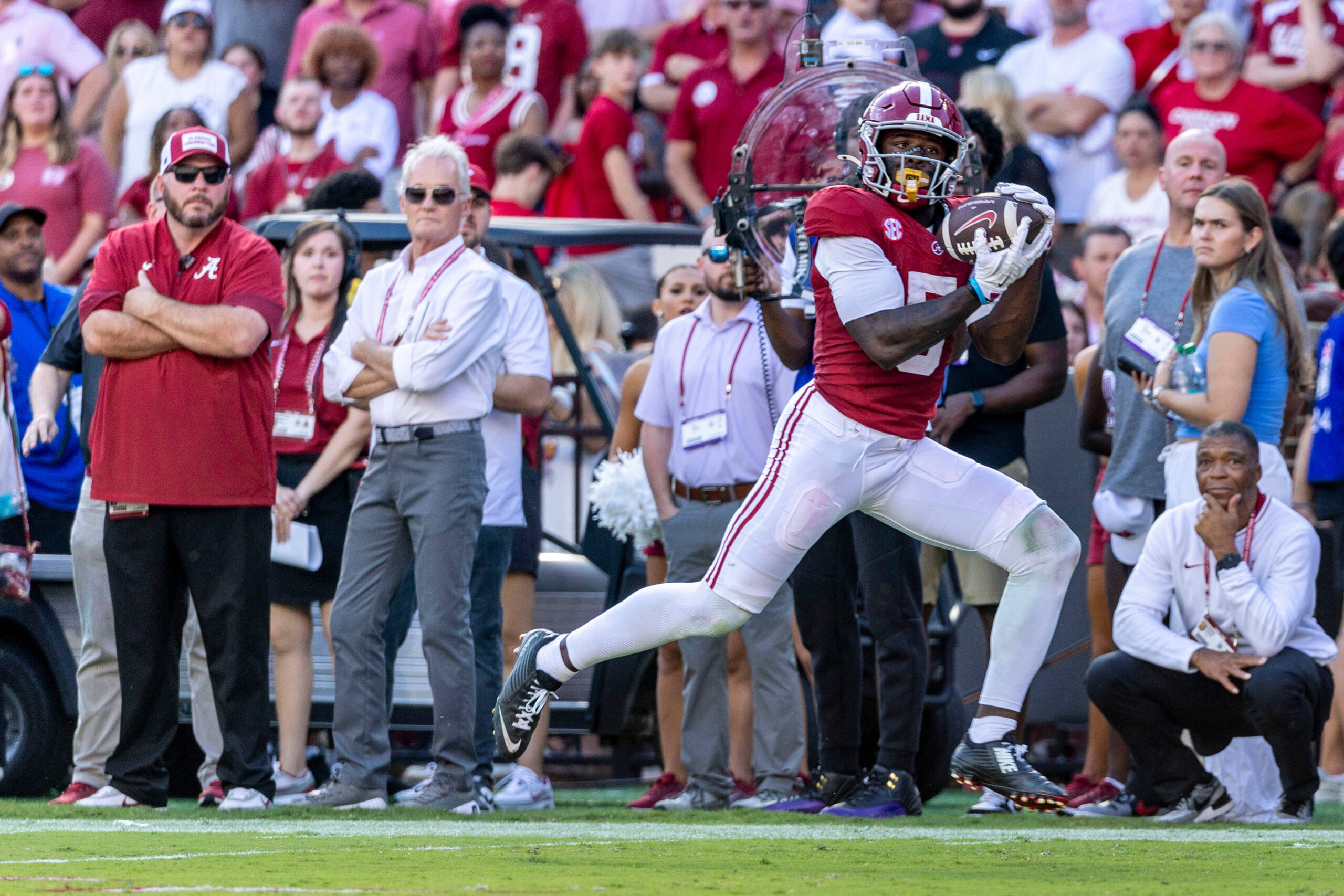
Bernard is the DeJean of this year’s draft. Midway through his rookie season everyone will look back and say, how did this guy fall as far as he did? Assuming the current projections are correct and he won’t be a first-round pick. Comps are usually fuzzy things. Man, does he look a lot like Deebo Samuel did during his peak with the 49ers. At 6-1, 206 pounds with a low center of gravity and ballcarrier instincts, Bernard could easily pass for a third-down back. But he is a wide receiver, one who averaged 57 catches for 828 yards over his last two seasons at Alabama. He has as high of a floor as anybody can have at his position. Too many GMs chase upside in a draft. The real test is projecting a player’s probability of achieving that upside. Bernard plays the game with a fluidity and instinct that will translate in some meaningful capacity. So much so that the Eagles shouldn’t hesitate to draft him at No. 23 rather than gambling he’ll still be there beyond.
There is an elephant in the room here, one so large that he has already been mentioned. The Brown thing is simple. Even if he is here next year, he won’t be here much beyond that. Jalen Hurts isn’t one of the rare quarterbacks who makes the pass-catching talent around him better. The Eagles will fail and fail miserably if Smith is his only pass-catcher who is above replacement level. They would be wise to trade Brown if it lands them a draft pick that facilitates the acquisition of someone with the ability to help replace him.
“If someone is going to give you something you didn’t anticipate and you won’t even have the conversation, I don’t think you’re necessarily doing your job or really servicing the team you’re with,” Roseman said at the combine last week. “You never know what someone is willing to do.”
The perfect draft for the Eagles is Sadiq first and then one of Concepcion or Bernard second. Given the value that teams place on the trenches, it’s hard for me to believe in a worthwhile certainty/upside ratio with any lineman who would also be available.
Germie Bernard had 64 catches for 862 yards and seven touchdowns at Alabama last season.
I’m skeptical that Sadiq will last anywhere close to where the current mock drafts have him going. At this time last year, Daniel Jeremiah and Pro Football Focus both had Colston Loveland going in the 18-20 range. In 2024, PFF had Brock Bowers going 18th. Loveland ended up going 10th and Bowers 13th. Both were among the top nine non-quarterbacks off the board. So, I wouldn’t put too much stock into the current projections, which have Sadiq lasting into the 20s and potentially reaching the Eagles at No. 23. I also don’t think the Eagles can bet on Concepcion being there. Nor can they with Bernard at 54.
The idea of trading Brown makes a lot more sense from that perspective. It’s only true if Roseman can somehow finagle something like the No. 31 overall pick from the Patriots. Maybe by swapping No. 54 and No. 68 for the Pats’ No. 63. So, the Eagles trade Brown in order to move up 23 spots from No. 54 to No. 31 while moving down nine spots from No. 54 to No. 63.
There are at least three prospects who would make it worth it.
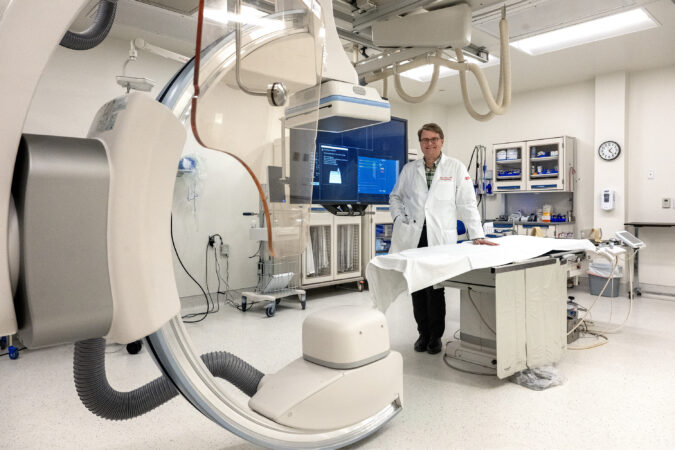
At AMS Surgery Center in suburban Montgomery County, patients can park right in front of the entrance, walk through just a few doors, and undergo cardiac procedures in a sterile operating room with equipment as high-tech as in any hospital procedure room.
In the year and a half since its first patient underwent a cardiac catheterization, the center has performed more than 1,000 cardiac procedures that previously required patients to go to full-service hospitals.
The Horsham center showcases a new front as sophisticated healthcare procedures move to freestanding outpatient medical facilities, promising to save patients money. The shift also adds to the financial pressures facing the region’s hospital-centered health systems.
Four centers have opened or are in the final stages of approvals in Southeastern Pennsylvania. Their arrival comes after state lawmakers in 2022 broadly expandedthe types of procedures allowed outside hospitals to include cardiac catheterizations, pacemaker implants, and other treatments that until then had to be done in a hospital.
Pennsylvania is the first Northeastern state to allow the minimally invasive procedures in freestanding surgery centers, but Southern states like Florida, Louisiana, and Texas have permitted the practice for decades, experts said. Research has found surgery centers generally are as safe as outpatient departments in hospitals.
An independent physicians group, Bryn Mawr Medical Specialists Association, opened Heart & Vascular Center of the Main Line — the Philadelphia region’s first such center — in late 2022. in Bryn Mawr. AMS Surgery Center in Horsham performed its first procedure in the fall of 2024, initially treating only Medicare patients. Itadded patients with private insurance last summer.
The market has continued torapidly expand:ReVaMP Heart & Vascular Surgery Center in Center City started treating Medicare patients last fall. The Ambulatory Cardiovascular Center of Pennsylvania, near King of Prussia, expects to perform its first procedures on patients next month.
Medicare pays the centers about a third less than hospital outpatient departments for the same procedures, but the centers have significantly lower costs, allowing them to be profitable. Medicare pays physicians the same wherever procedures are done.
Independent cardiology groups traditionally have performed interventional procedures, such as implanting stents and pacemakers, in hospitals. Some are jumping at the opportunity to expand through the surgery centers, where they can have a financial stake in the entire operation.
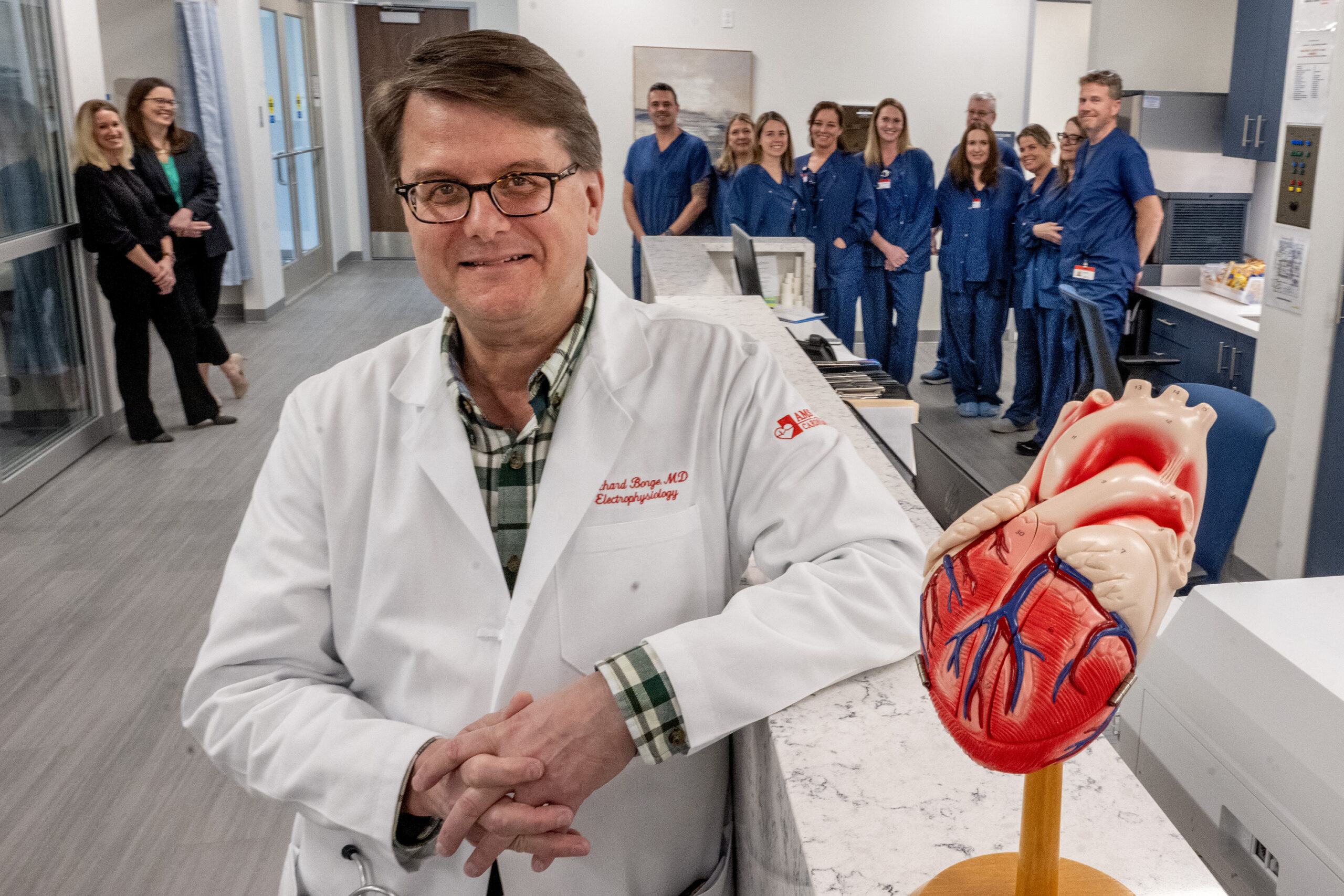
“We’ve always been very fiercely independent, fiercely entrepreneurial, and patient-centered,” said Richard Borge, an AMS interventional cardiologist who is medical director for the group’s surgery center.
How much cardiac care — among the most profitable business lines for hospitals — will move out of hospital outpatient departments remains unknown. But cardiac surgical clinics will not take over heart care to the extent seen when outpatient orthopedic centers began offering hip and joint replacements,predicted Lauren Clementi, a senior vice president at Kaufman Hall, a Chicago consulting firm.
“This one’s a little trickier because the acuity of patients,” she said.
Cardiologists will continue treating many patients with complex medical needs in hospitals, which remain the only option for riskier procedures such as open-heart surgeries.
Gregory Schmitt went to AMS Surgery Center to undergo procedures for a heart stent and stents in both legs.The retired machine-shop owner, who lives in Ivyland, called such centers great for patients.
“I highly recommend it. It’s much easier than trying to navigate a hospital,” Schmitt said.
How we got here
Healthcare has been shifting awayfrom requiring overnight hospital stays, even for common procedures like cataract surgery.The trend starteddecades ago with same-day procedures in hospitals, followed by the rise of freestanding surgery centers.
In cardiology, people now commonly receivestents and pacemakers as outpatient care. But until recently, doctors had to implant the devices in a hospital.
“Once upon a time, every patient we cathed had to spend the night in the hospital,” said veteran cardiologist Mark Victor, referring to cardiac catheterization.
With the rise of outpatient procedures,Victor said, the question for many clinicians became: “If they’re hospital ambulatory, why do they have to be in the hospital at all?”
Victor has long advocated for the adoption of outpatient cardiology proceduresas the CEO of Cardiology Consultants of Philadelphia. Thelarge cardiology practice joined last year a national private-equity backed group, Cardiovascular Logistics, and will soon start performing surgical procedures at the center opening near King of Prussia.
In 2020, Medicare started paying for outpatient cardiac catheterizations — which entail running a catheter through a blood vessel in the thigh or wrist to examine the heart and install devices like stents.
Richard Borge is medical director of AMS Cardiology Surgery Center in Horsham, whose arrival is moving advanced cardiac care from hospitals to outpatient clinics.
Even then, Pennsylvania rules required cardiac catheterizations to occur in an acute-care hospital, according to Stephen Abresch, director of government affairs for the Ambulatory Surgery Center Association, a national trade group in Alexandria, Va.
Pennsylvania lawmakers cleared the way for expansion byeliminating that restriction in 2022 as part of a broad expansion of what the state’s surgery centers were allowed to do. “It had been a quarter century since the state had gone in and reviewed that,” he said.
The Heart & Vascular Center of the Main Line has scheduled its first cardiac ablations this week. Horsham’s AMSaims to start offering those procedures in June. Victor’s King of Prussia groupexpects to add ablations in the future as well.
Impact on hospitals
It is too soon to know how the new surgery centers will impact the region’s existing health systems. In some cases, independent cardiologists generate significant patient numbers forhospitals’ cath labs.
After Bryn Mawr Medical Specialists opened its cardiovascular surgery center near Main Line Health’s Bryn Mawr Hospital, the private group performed fewer procedures on low-risk patients at the hospital.
To sustain patient volumes, Main Line has increased collaboration with other physician practices, while continuing to treat an“older patient population, whose more complex health conditions require the advanced expertise and emergency support only a hospital setting can provide,” officials said in a statement.
In Horsham, most of the patients coming to AMS would have gone toJefferson Abington Hospital before the surgery center opened in partnership with Atria Health, a private-equity backed group, Borge said.
Jefferson declined to comment.
King of Prussia’s Ambulatory Cardiovascular Center of Pennsylvania is opening through anunusual four-way partnership involving Cardiology Consultants of Philadelphia, Cardiovascular Logistics, SCA (a unit of UnitedHealth’s Optum), and the University of Pennsylvania Health System.
“Ours is not going to seriously impact any one hospital system, which they’re all relieved about,” said Victor, who is also president of the Mid-Atlantic region for Cardiovascular Logistics. He said other health systems were invited to invest in the surgery center, but only Penn did so.
Penn declined to comment for this article. On the Alvarez & Marsal What’s Your Moonshot podcast, the health system’s chief operating officer, Michele Volpe, recently said the system needs ”to move a bit faster in taking much of the work that we are doing in inpatient ORs and moving them into outpatient or ambulatory freestanding ORs.”
AMS Cardiology’s ambulatory surgery center in Horsham is one of four new cardiovascular surgery centers in Southeastern Pennsylvania.
Center City’s ReVaMP Health & Vascular Surgery Center wantsto bring in cardiologists from nonaffiliated practices,and even the city’s big health systems. The facility opened last year, spearheaded by Re-Vasc Med Professionals’ two interventional cardiologists in partnership with Surgery Partners, a publicly traded manager of surgery centers nationwide.
“I’m 100% sure this is going to be the trend of the future,” Re-Vasc CEO and founder Jon George said.
A health insurer’s perspective
Richard Snyder, a top executive at Independence Blue Cross, the largest health insurer in Southeastern Pennsylvania, has for years watched joint replacements and other procedures shift from hospitals to lower-cost surgery centers.
The financial impact goes beyond the lower prices at surgery centers, he said, expecting that hospitals will not simply cede these patients to new competitors.
Some hospitals might decide to take a lower payment for outpatient procedures. “Traditionally, that happens when we have capacity in lower-cost settings,” he said.
At the same time, Medicare is pushing to pay the same price for services, wherever they are performed. “Hospitals, by necessity, will need to move some things to lower-cost settings in order to not lose money on them,” Snyder said.
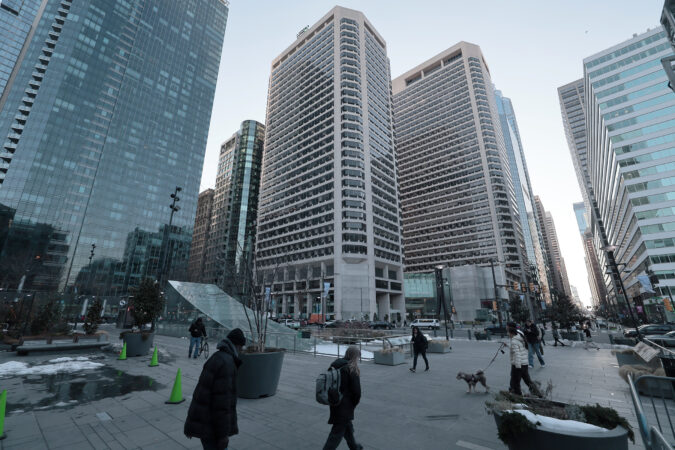
When it opened in 1974, the connected concrete towers of Centre Square boasted the most office space in Philadelphia, at over 1.7 million square feet.
Over 51 years later, the Brutalist behemoth still holds that title.
Butprobably not for much longer.
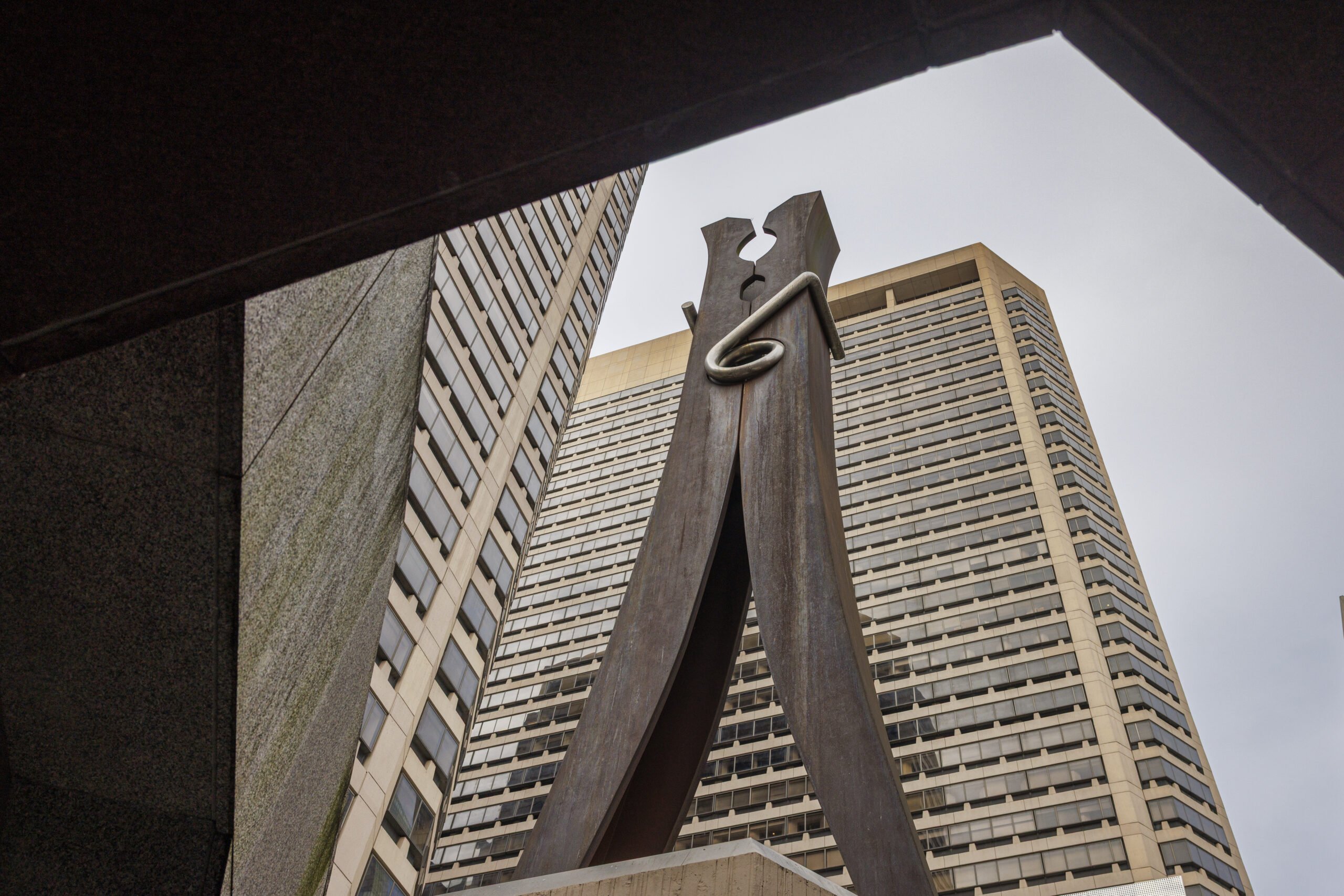
Centre Square — also known as the “Clothespin building” for its four-story pop art sculpture — is slated for mixed-use redevelopment by PMC Property Group and investor and developer Dean Adler, with much of the complex being devoted to hotel rooms and apartments.
“That corner of West Market is the best corner in the city,” Adler said. “You get …all the visibility going around the circle. When you look at City Hall, it may not be so nice inside, but outside, it’s a 1904 Beaux Arts building.”
Centre Square’s fortunes sank when COVID-19 struck and have never recovered. At the end of 2025, occupancy stood at 37.6%, giving it the highest vacancy rate in Center City,according to Morningstar Credit.
In 2017, when Centre Square last sold, it went for $328 million. Last July, the complex was appraised at $104.4 million and is now under agreement of sale to PMC and Adler for less than $94 million, according to Adler.
He says the plan is to retain 500,000 square feet of office space, enough to house the remaining tenants. Then there will be between 250 and 500 apartments spread between thebuilding’s two towers. Three hundred luxury hotel rooms will be built on the upper floors of the east tower, facing City Hall.
“William Penn is in your bedroom,” Adler said of the hotel.
Centre Square is located across from City Hall on what investor Dean Adler calls “the best corner in the city.”
On the lower levels of Centre Square, Adler says there will also be a spa and a 50-meter pool — amenities that he says the building previously had.
The acquisition of Centre Square is part of a wave of high-profile redevelopments between Adler and PMC, led byits president, Ron Caplan.
In recent years, the partners have purchased and redeveloped the Bellevue on South Broad Street, the Battery on the Delaware River, and the Bourse on Independence Mall.
“In today’s environment, there’s a real estate crisis, and we are buying these buildings for 20 cents on the dollar,” Adler said. “We …are rejuvenating architectural gems that are functionally obsolete.”
PMC declined to comment. News of Centre Square’s acquisition was first reported by the Philadelphia Business Journal.
Centre Square (center) at 1500 Market Street in Philadelphia on Friday, Feb. 27, 2026
More than ‘an office district’
The new Centre Square is part of a trend in which struggling office buildings have sold for less than half their previous prices with plans to convert the spaces into homes.
Centre Square’s discount was even deeper: The reported sale price is almost half what it sold for in 2002, not even adjusting for inflation.
The Wanamaker Building, which had over 1.4 million square feet of office space, is another example. Previously one of Philadelphia’s largest office buildings, it is being turned into apartments by TF Cornerstone and Alterra Property Group. Only a small number of offices will be preserved.
“The office district isn’t only an office district anymore,” said Prema Katari Gupta, president of the Center City District.
“There’s hospitality; there’s increasing residential. What makes a city great is when you have these layered neighborhoods with a lot of different types of demand drivers,” Gupta said.
The partners in Centre Square’s redevelopment haveworked together for decades, including on the new Aramark headquarters on the Schuylkill and 2040 Market St.
Adler‘s longtime business partner, Ira Lubert, with whom he founded real estate investment group Lubert-Adler, is not involved in the project. Instead, the Centre Square project partnership with PMC is being done under the auspices of a new venture, Adler & Co.
Philadelphia’s No. 1 business address
Centre Square spans two towers because it dates to an era when developers would not build taller than the William Penn statue atop City Hall, an unofficial agreement with the city that lasted until the 1980s when the Liberty Place skyscrapers were erected.
Planning for Centre Square began in the mid-1960s, signaling a shift, along with the construction of Penn Center, for Philadelphia’s office district from the Art Deco South Broad Street to West Market Street.
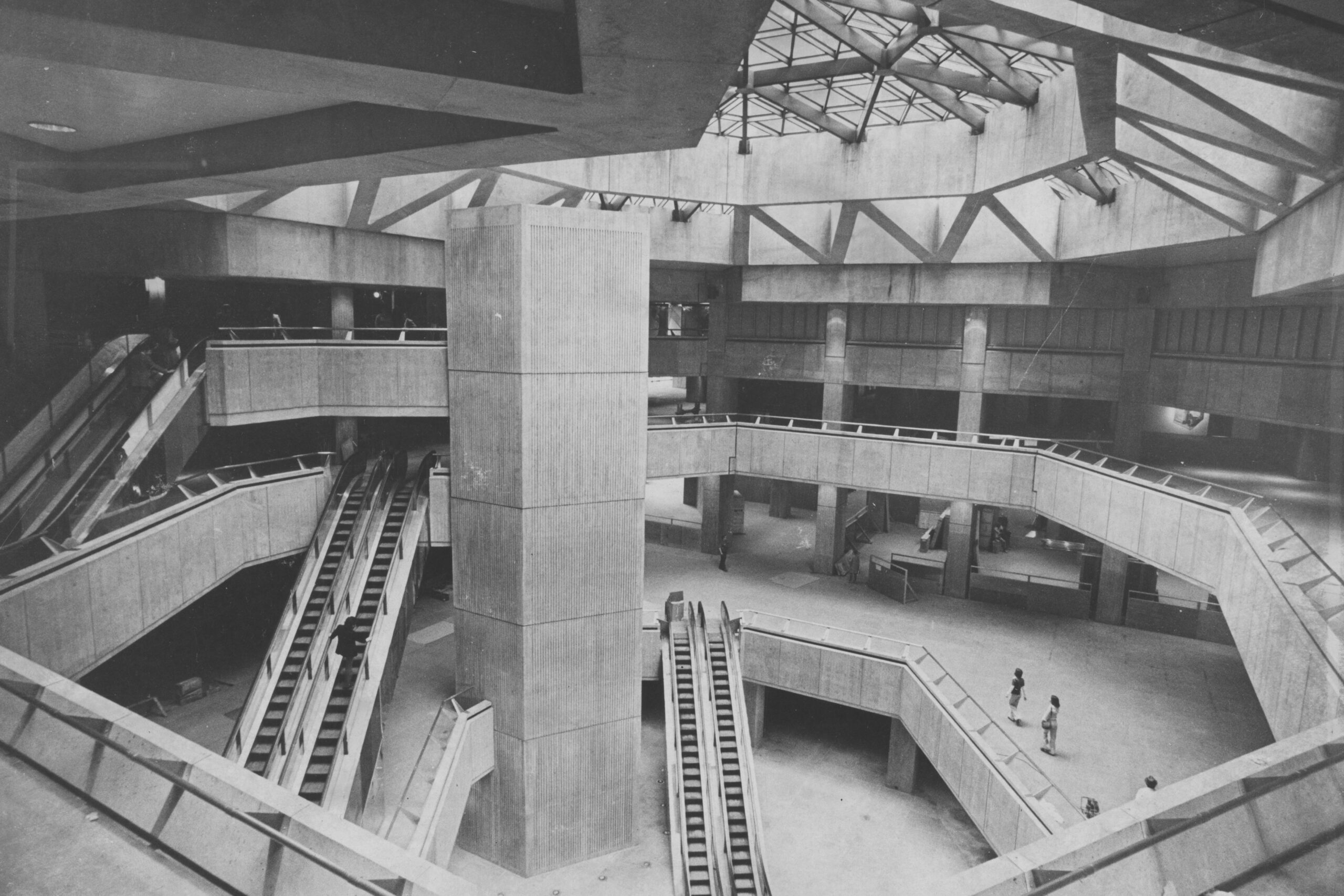
Centre Square’s atrium and retail space in in 1974.
“Those buildings created the momentum,” said Bill Hankowsky, former CEO of Liberty Property Trust, which developed neighboring office skyscrapers like Liberty Place and the Comcast towers. “It was the biggest single project that said we’re going down Market West.”
Designed by architect Vincent Kling and developer Jack Wolgin, it was seen as a revolutionary project and hailed as Philadelphia’sNo. 1 business address in ads in The Inquirer.
Centre Square also bears the architectural hallmarks of the 1960s, like its poured concrete building materials that — along with its respect for the old height limit — set it apart from the steel skyscrapers built farther down West Market later in the decade.
The building’s Brutalist architecture — often a polarizing style — has bedeviled many of its subsequent owners, who pumped millions of dollars into Centre Square nearly every decade since the 1970s to keep it competitive.
“It is structurally built differently than other buildings on Market West,” Hankowsky said. “It’s a substantial building, but also it is a tougher building to deal with. The walls are thick, the floors are thick. It’s a big challenge.”
That’s part of what deterred many other developers who considered buying the building.
The sheer scale is a challenge, too. Some interested parties were put off by the percentage of the building that would have to remain office, as a full residential conversion is unlikely.
“The buildings don’t particularly lend themselves to a complete conversion to apartments,” said John Grady, who used to lead the Philadelphia Industrial Development Corp. and studied the building for its prior ownership. “They’re too big, and the floor plates don’t work as well as other buildings.”
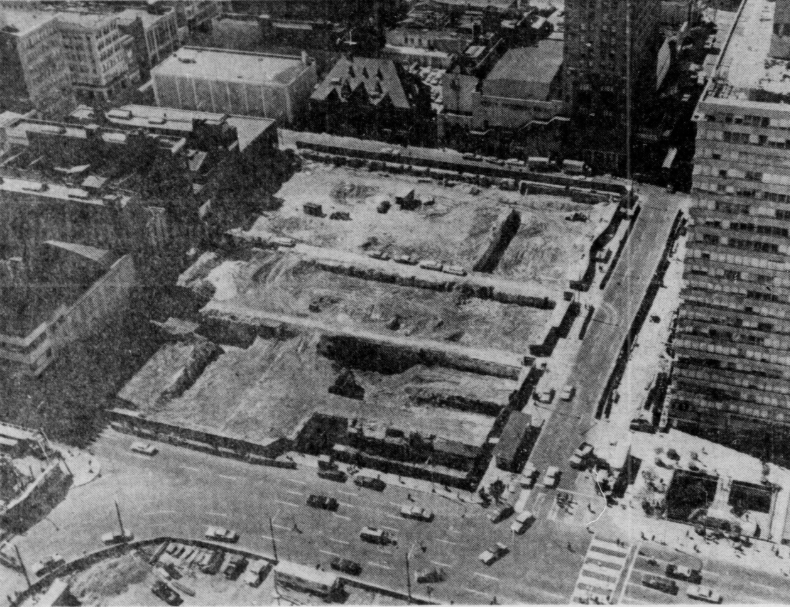
A photo of the long vacant lot while Centre Square went through its fiscal and legal trials during construction.
Born in drama, consideredfor Comcast HQ
Centre Square’s birth was not easy. Its planning and construction took almost 10 years, with legal and financial delays that included an investigation of the project by then-District Attorney Arlen Specter. (Wolgin told reporters that the Republican politician was “out to get” him.)
The delays left a yawning vacant lot just west of City Hall, which led Mayor James Tate to describe Centre Square as “doomed” in 1969.
When Wolgin eventually began construction, he then faced blowback from powerful critics of Claes Oldenburg’s Clothespin sculpture that he wanted to place in front of his towers.
“It was a disaster!” Jack Wolgin told The Inquirer in 2001. “They said, ‘How can you take something like this pop art and put it in front of City Hall? It’s a monstrosity! It’s a disgrace!’”
Despite the building’s polarizing beginnings, it became a mainstay of the office market, attracting one-time corporate giants like CoreStates bank and Towers Perrin consultants.
Claes Oldenburg’s pop art Clothespin sculpture stands in front of Centre Square.
It snagged Comcast as a tenant in the early 1990s, after the company was forced out of its first urban home by the fire that destroyed One Meridian Plaza.
Comcast studied the building as a possible headquarters for the company before eventually turning to Liberty Property Trust to build their skyline-defining towers.
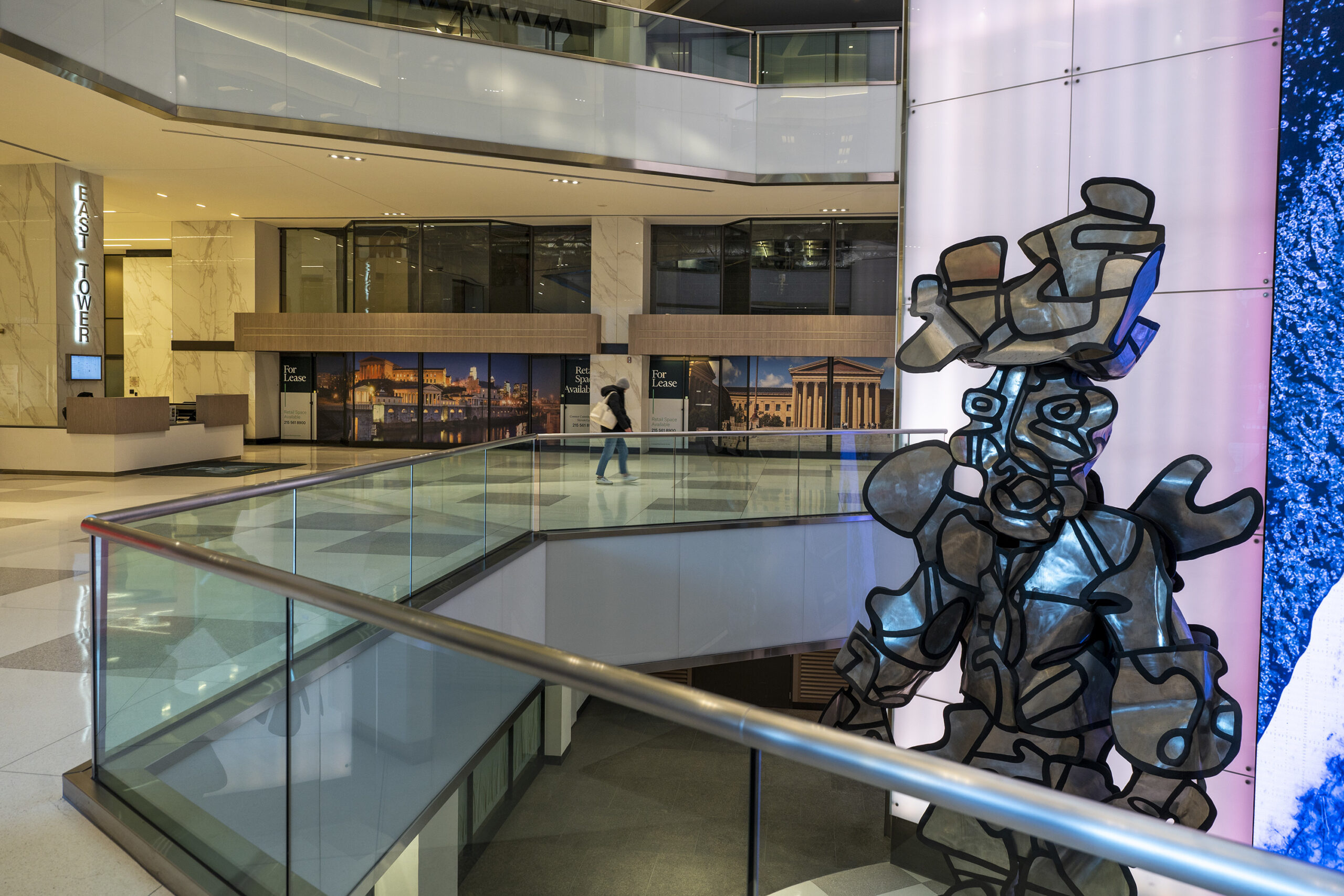
Still, many of its 1960s-era flourishes proved difficult to adapt to the modern era. By the 1980s, the atrium that connects the two towers and houses its inward-facing retail received its first renovation.
Centre Square’s atrium has undergone renovations almost every decade since.
The lobby of Centre Square in 2024.
Looking ahead
Inquirer architecture critic Inga Saffron wrote about Centre Square‘s latest update in January 2020.
“Fortunately for Philadelphia, the city’s biggest, baddest Brutalist complex, Centre Square, has always been too big to fail,” she wrote just before COVID-19 struck and emptied office towers around the country.
Now, six years later, Adler and PMC Property Group believe they can bring it back as something new.
After a week or so of abusing the clueless 20-somethings for serving as Donald Trump’s latest dupes, it only seems fair to credit the few USA hockey lads for their reluctant mea culpas.
Several of the players who were involved in the debauched postgame celebration with debased FBI director Kash Patel that devolved into a misogynistic phone call with President Trump have issued a range of regrets in the past few days.
Good for them, I guess.
Maybe they’ll think twice next time before laughing about women — in this instance, their Olympic gold-medal counterparts, and the best women’s team ever assembled — being treated as their inferiors.
Maybe.
In his congratulatory call after a golden goal win over Canada on Sunday (a call he did not make to the women’s team three days earlier), Trump invited the men to the White House, then said, “We’re going to have to bring the woman’s team. You do know that?” Otherwise, Trump said, “I do believe I probably would be impeached.”
I took my shots at Team USA midweek, when I noted that any random group of young, white, millionaire American males are more likely than not to agree with Trump, and might have even voted for him, and therefore they innately took little issue in serving as his pawns last Sunday morning and then again Tuesday, when 20 of the 25 players visited the White House and attended Trump’s unhinged State of the Union address. I noted, however, that they shouldn’t realistically be expected to act differently, and that their transgression was far less concerning than, say, Bryson DeChambeau, Trump’s golf mascot.
Ever eager to distract from his administration’s endless corruption, he could not leave the boys alone. Not even if it meant cannibalizing one of their own.
The White House used AI to generate a false statement from Trump supporter and Team USA star Brady Tkachuk in a postgame TikTok video:
“They booed our national anthem, so I had to come out and teach those maple syrup eating (bleepers) a lesson.”
The AI fake is part of a post that includes highlights from the game. The post indicates that AI was used in its construction, it does not specify which parts were fake.
Tkachuk specified which parts were fake on Thursday.
“Well, it’s clearly fake, because it’s not my voice, not my lips moving,” Tkachuk told reporters. “I know that those words would never come out of my mouth. So, I can’t do anything about it. … It’s not my voice. It’s not what I was saying. I would never say that. That’s not who I am, so I guess I don’t like that video because that would never come out of my mouth and never had that thought.”
Maybe. Maybe not.
Despite Tkachuk’s protestations, the White House has not deleted the post. He’s their weapon of the day.
Tkachuk also denied hollering out that Trump should “close the northern border” during Trump’s phone call. Hard to disprove that one, especially since it took him four days to do so.
It should be noted: Tkachuk not only plays for a Canadian team, the Ottawa Senators, he’s also their captain.
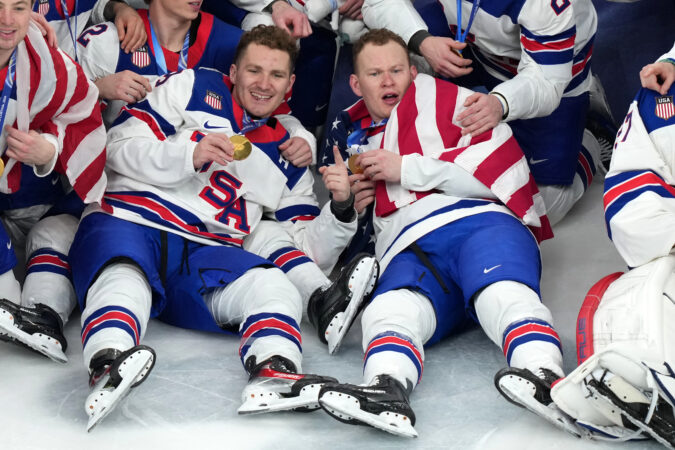
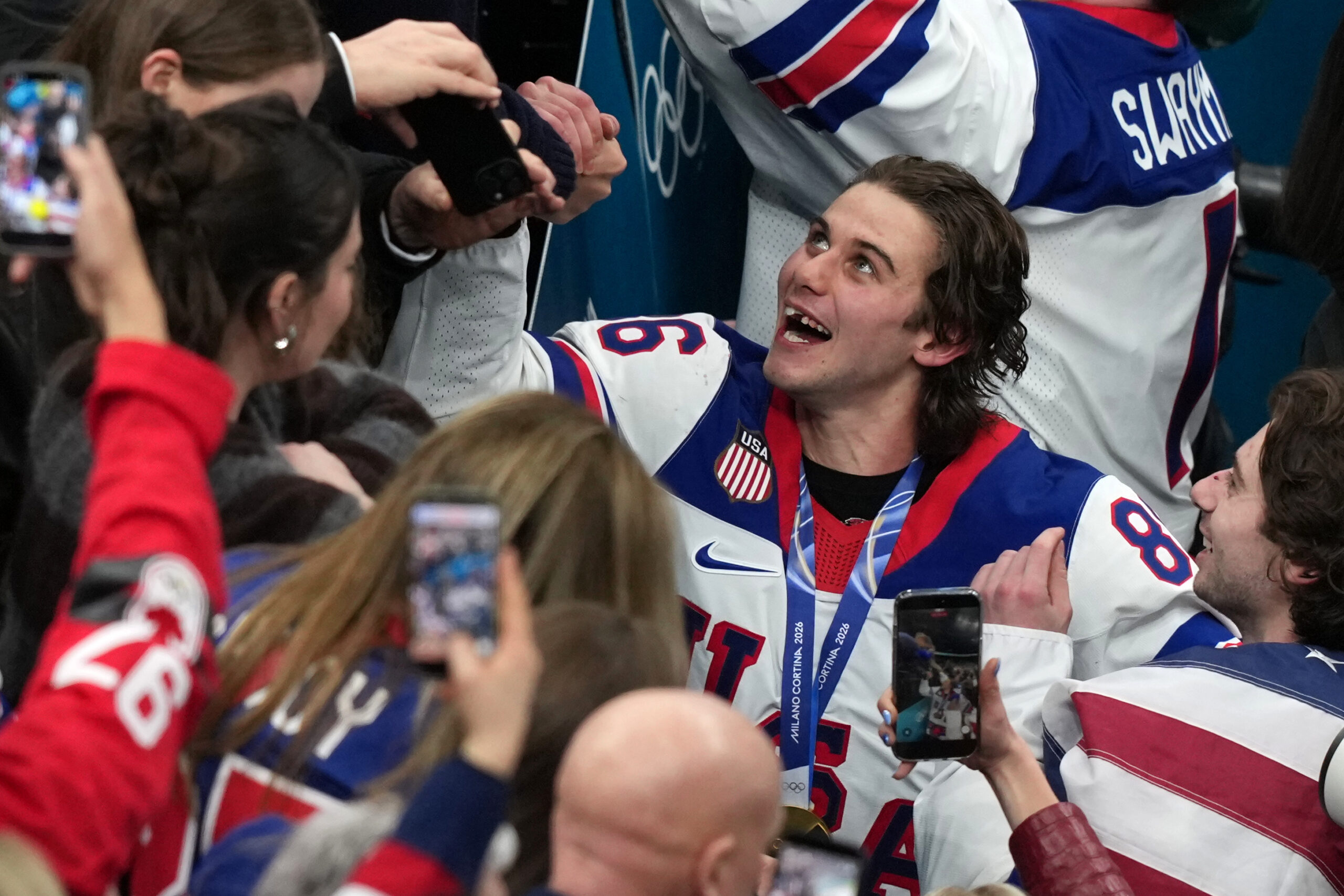
It’s hard to feel anything other than Schadenfreude for Tkachuk, or for any of the other players who declined to issue public apologies until public opinion swung so heavily against them. It might have been a week of pure celebration of a historic win. It was the first men’s hockey gold since the Miracle on Ice in 1980, and it was sweet revenge for the 2010 gold-medal loss that, like Sunday’s, was decided on an overtime goal.
That goal-scorer, Jack Hughes, who sacrificed his smile to a high stick in the game, almost gets it.
Jack Hughes (86), who scored the Golden Goal for Team USA, celebrates with fans and teammates.
He attested that the men’s and women’s teams commingle and support each other, which is true … and then, like the sheltered, self-unaware, entitled 24-year-old that he is, Hughes chastised critics of the men’s team thusly:
“Everything is so political. We’re athletes.”
Really, Jack? Just athletes, huh?
Later that day, Hughes and four Team USA teammates posed for a picture with White House press secretary Karoline Leavitt.
Hughes and two Team USA teammates wore MAGA hats.
You know. Trump hats. Political hats.
You can’t make it up.
The last thing anyone wanted when USA won was for it to become political. Can’t cry “don’t make it political, people just look for stuff, etc.” with this. It was all avoidable pic.twitter.com/G4w6aPs0Bq
Asked this week by reporters if he agreed with some of his teammates’ recent apologies, Hughes replied, “Yeah,” then deflected with drivel.
Jack Hughes responds to question asking if he agrees with Jeremy Swayman saying US Men’s Hockey ‘should have reacted differently’ during post-game call with Trump. pic.twitter.com/zvSd7dsxmp
“Looking back at it now, I think it was a mistake,” Senators defenseman and Team USA teammate Jake Sanderson told reporters. “But I think things got blown out of proportion a little bit. You know, we have nothing but the utmost respect for the women. I think if we were to do it again, I think we wouldn’t do that, and we made a mistake. … We love the women.”
Bruins goalie Jeremy Swayman told reporters, “We should have reacted differently.”
Jeremy Swayman: “We should’ve reacted differently” to President Trump’s comment about the women’s team.
“We know that we are so excited for the women’s team. We have so much respect for the women’s team. To share that gold medal with them is something we’re forever grateful for” pic.twitter.com/YJwPmFSb1z
Significantly, none of them issued any apology unprovoked. None of them apologized on his own.
Tkachuk was even less accountable:
“Honestly, it was just a whirlwind of a moment. Can’t be in control of what somebody says. It just caught us off-guard a little bit, talking to the president.”
No remorse detected.
As for the women, they now have twice rejected invitations to visit Trump & Co., both for Tuesday’s circus and another invitation floated later in the week. Their statement:
“Players are back competing with their professional and collegiate teams and are in the midst of their season. They’re honored and grateful to be invited and any opportunity to visit the White House as a team will be based on their schedules once their seasons conclude.”
Hall of Fame goalie Dominik Hašek applauded the women’s refusal to be used as political props by a man who not only ignored them, and not only demeaned them, but has yet to apologize: “Your president is a big liar and a fraud who abuses his position to insult and bully his fellow citizens.”
Much respect to these women👍👍👍 Yes, your president is a big liar and a fraud who abuses his position to insult and bully his fellow citizens. Still, I believe you must have shown a great deal of heroism in making this decision. Thank you for that👍 https://t.co/W5IrO9zEcy
Eccentric rap star Flavor Flav even invited the women to come party with him in Las Vegas as long as a hotelier and an airline help with travel and accommodations.
If the USA Women’s Hockey team wants a real celebration and invite ,,, I’ll host them in Las Vegas. Do some nice dinners and shows and good times. I’m sure I can get a hotel and airline to help me out here and celebrate these women for real for real. pic.twitter.com/NhtRJ8UxKE
Hey, it’s more than Trump lapdog Kid Rock would ever do.
As might be expected, the women are dealing with the snub with a measure of grace and resignation that neither Trump nor most of the men’s team would ever be able to muster.
“With the phone call specifically, it’s not surprising, to be frank,” USA forward Kelly Pannek told reporters Wednesday. “So I don’t know why we expect differently.”
It’s depressing to realize that the players on arguably the best team in the history of women’s hockey find themselves the victims of Trump’s narcissism, his administration’s piggishness, and much of the country’s indifference to both.
“I think there’s a genuine level of support there and respect,” between the men’s and women’s teams, Hilary Knight, the women’s captain, told ESPN. “I think that’s being overshadowed by a quick lapse. I think the guys were in a tough spot.”
It was a spot they did not create for themselves. It was a spot in which they failed the women, their country, and themselves.
And it is a spot in which many of them have chosen to linger.
Jefferson Abington Hospital was cited by the Pennsylvania Department of Health for sanitation problems in its trauma center last year.
The incident was among more than a dozen visits health department inspectors made to the Jefferson Health facility between December 2024 and November 2025.
Here’s a look at the publicly available details:
Dec. 4, 2024: Inspectors followed up on a July 2024 citation for failing to report an incident in which a mental health patient ran away from the hospital and security staff left the hospital’s campus to apprehend them.
Dec. 23: The Joint Commission, a nonprofit hospital accreditation agency, renewed the hospital’s accreditation, effective September 2024, for 36 months.
Jan. 16, 2025: The hospital was cited for sanitation issues, including several dirty triage bays, a brown substance under a patient’s head and on the floor, and a black, sticky substance on a hospital bed wheel. Administrators retrained maintenance workers on cleaning protocol and assigned additional staffers to ensure daily cleaning.
Jan. 16: Inspectors came to investigate a complaint and for a monitoring survey but found the hospital was in compliance. Complaint details are not made public when inspectors determine it was unfounded.
Jan. 28: Inspectors visited for a mental health monitoring survey and found the hospital was in compliance.
Feb. 19: Inspectors came to investigate a complaint but found the hospital was in compliance.
March 12: Inspectors came to investigate a complaint but found the hospital was in compliance.
April 17: Inspectors followed up on the January citation regarding sanitation issues and found the hospital in compliance.
May 29: Inspectors came to investigate two complaints but found the hospital was in compliance.
July 16: Inspectors came to investigate a complaint but found the hospital was in compliance.
Sept. 5: Inspectors came to investigate a complaint but found the hospital was in compliance.
Sept. 18: Inspectors came to investigate a complaint but found the hospital was in compliance.
Nov. 5: Inspectors came to investigate a complaint but found the hospital was in compliance.
INDIANAPOLIS — Mike Vrabel’s recent comments about A.J. Brown may not qualify as tampering, but they are reflective of a certain preoccupation those associated with the Eagles have had with the wide receiver’s future at the scouting combine this week.
And, to some degree, the rest of the league shares that preoccupation — elite receivers still in the prime of their careers rarely are available.
Vrabel didn’t bring up Brown on his own. The Patriots coach first was asked about his relationship with his former player during a news conference on Wednesday and then about possibly trading for him during an interview session with New England-area reporters shortly afterward.
“I think that we’ll look at everything that we can possibly look at to add to our roster,” Vrabel said in answering the second question. “There’s a lot of back-and-forth. Taking on compensation. And so, I’m sure there’ll be a lot of opportunities for us to talk about trades, not only this week, but as we prepare and get closer to the draft.”
Patriots head coach Mike Vrabel has expressed his affection for A.J. Brown, but how that translates to a potential deal remains unknown.
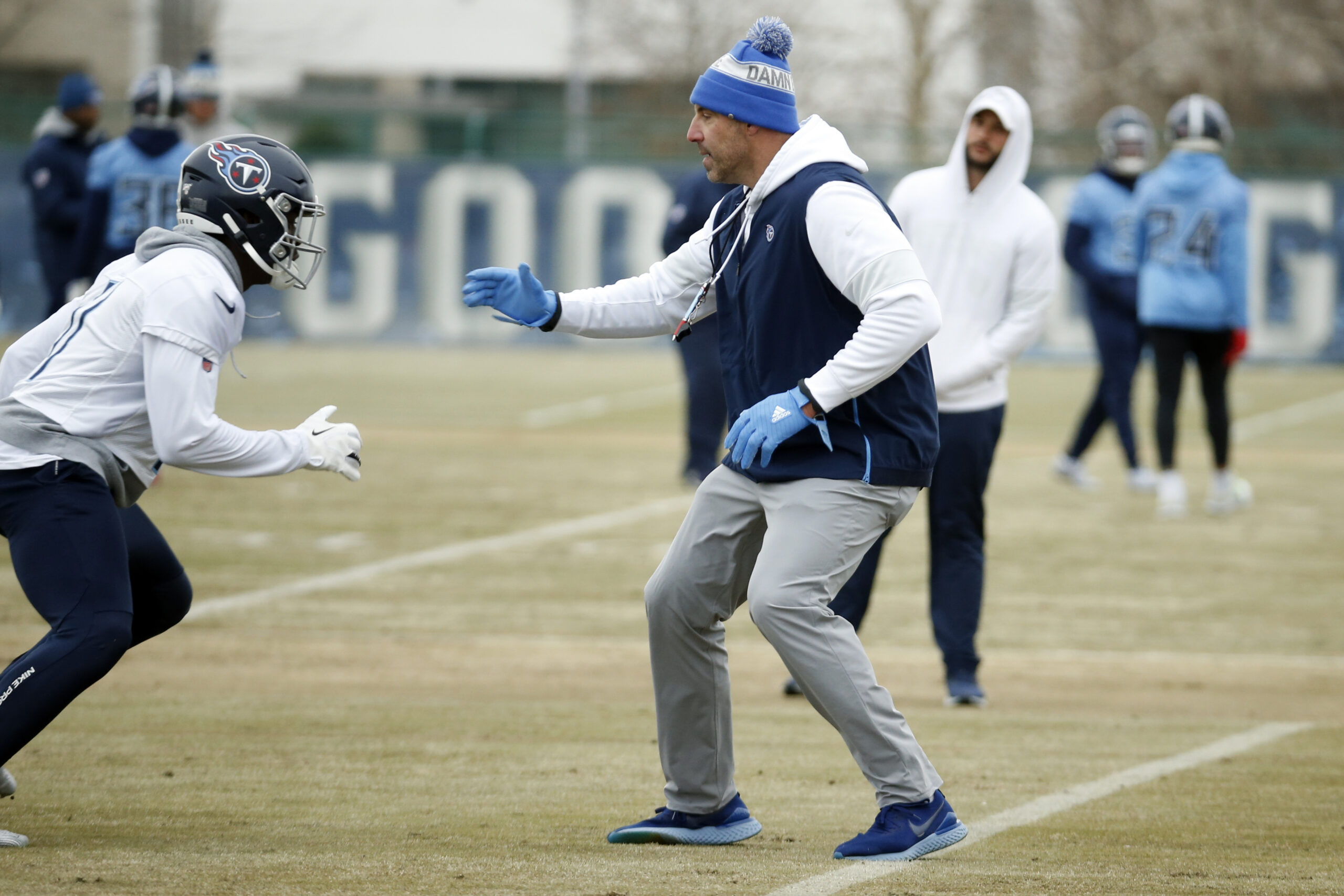
It was a rather innocuous response, and Vrabel made sure not to mention Brown by name, as that could be considered tampering with a player under contract with another team. But the former Titans coach, who drafted the receiver in 2019 and coached him for three seasons, didn’t avoid going into detail about how close he remains to Brown.
“I think the relationship with players — and, specifically, you asked about A.J. — has meant a lot,” Vrabel said earlier from the combine media center podium. “I watched him grow. I watched him mature. I’m proud of him, proud of the father that he is. I’m proud of the husband. And that has nothing to do with where he plays or where he played.
“So those are the things that are important. We reach out, text each other during the things that happen good to each other. And sometimes things don’t go so well for the people that you’re close with and you text those, as well. So it’s been a two-way street of support and reminders of what got us to where we are here today.”
There’s little wrong with what Vrabel said, as it’s been consistent with his comments about Brown since the Titans traded him to Philly almost four years ago. Just last January, after he was hired in New England and as the Eagles were in the middle of their Super Bowl run, Vrabel said the following about Brown on Boston radio:
“I love him to death and I have a very, very close relationship with him.”
A lot has changed around Brown’s Eagles and Vrabel’s Patriots a year later. And with Eagles general manager Howie Roseman unwilling to shut the door on Brown being obtainable for the right price, Vrabel’s openness about his communication with the 28-year old could be characterized as flirtatious.
Not that Roseman should take any issue with his remarks, as they could help spur activity and give the general manager the type of leverage he would need to receive compensation for an All-Pro-caliber receiver whose exit would leave a giant hole on offense and trigger significant salary cap repercussions.
A.J. Brown (left) eventually warmed to Mike Vrabel’s coaching in Tennessee, though it was Vrabel’s Titans who ultimately dealt Brown.
And that is why a decision on Brown seemingly will be made sooner — as in the next 10 days ahead of the official start of the “legal tampering” period on March 9 — rather than later. At least that’s the sense sources close to several Eagles with uncertain futures have gotten from their conversations with the team this week.
Roseman should be compelled to make a decision in the immediate future. Moving or keeping Brown impacts almost every other personnel decision he will make this offseason in terms of free agency, contract extensions, and the draft. It’s not an imperative, but waiting would make putting the roster puzzle together more difficult.
Roseman’s messaging has been consistent since the end of the season.
“It’s really hard to find great players,” Roseman said last week to Eagles beat reporters. “I think A.J. is a great player. I think that, from my perspective, we’re looking to improve in all areas, and you don’t do that by subtracting.”
Eagles coach Nick Sirianni tweaked his initial response to questions about Brown after he said he couldn’t “guarantee” the receiver’s return — based on the notion that nothing in life is guaranteed — during his media rounds at the combine on Tuesday. Sirianni avoided the phrasing and said he expects and wants Brown back.
But Roseman will make the final call and he will be the one entertaining offers. And that’s exactly what he has made obvious to interested teams every time he’s been asked about Brown: We’re open for business. Give us your best shot.
“I think you go into the league year listening to offers for everything and anything,” Roseman said last week. “I don’t think that you can go into any conversation with anyone and just shoot things down without hearing what they have to say, because you never know.”
What Roseman is doing here is creating momentum and building a market that would draw in competing offers. All he needs is two interested teams to create leverage. Three teams could get him closer to the finish line, depending upon the value he has assigned to Brown.
Roseman’s tactics are renowned. He’ll set the cost much higher than prevailing wisdom says it should be. One NFL executive said he heard the Eagles were seeking a return that included a first- and second-round draft pick. Whether accurate or not, the price tag is already being floated within league circles.
Teams will check in, some with more interest than others, but Roseman will get a sense of who is serious by their initial offers. He’ll then whittle down their counter-arguments until he grinds out what he views as suitable compensation.
If he doesn’t get that compensation, he won’t trade Brown, even if the receiver has told the Eagles he wants out of Philly. The cap hit — about $45 million — is just too steep. And even if the teams have a handshake deal to wait until June 1 so the Eagles can spread the charge over two years, Roseman probably won’t take anything less than a conditional second-rounder.
Brown may seem to be on the decline. He may have a chronic knee condition that hurt his stock as far back as the pre-draft process. He might be emotional and the occasional headache. But he’s still better than most receivers and seemingly anyone who will be available in free agency.
The draft is another animal. But teams like the Patriots, Bills, and Ravens might be only a Brown away from getting over the championship hump. All three teams have picks in each of the first two rounds. The Patriots have Nos. 31 and 63, the Bills have Nos. 26 and 60, and the Ravens have Nos. 14 and 45.
The Eagles have eight projected picks with one first-rounder (No. 23), one second-rounder (No. 54), and two third-rounders (No. 68 and a No. 98 projected). It’s possible Roseman would accept a 2027 first-rounder in return for Brown.
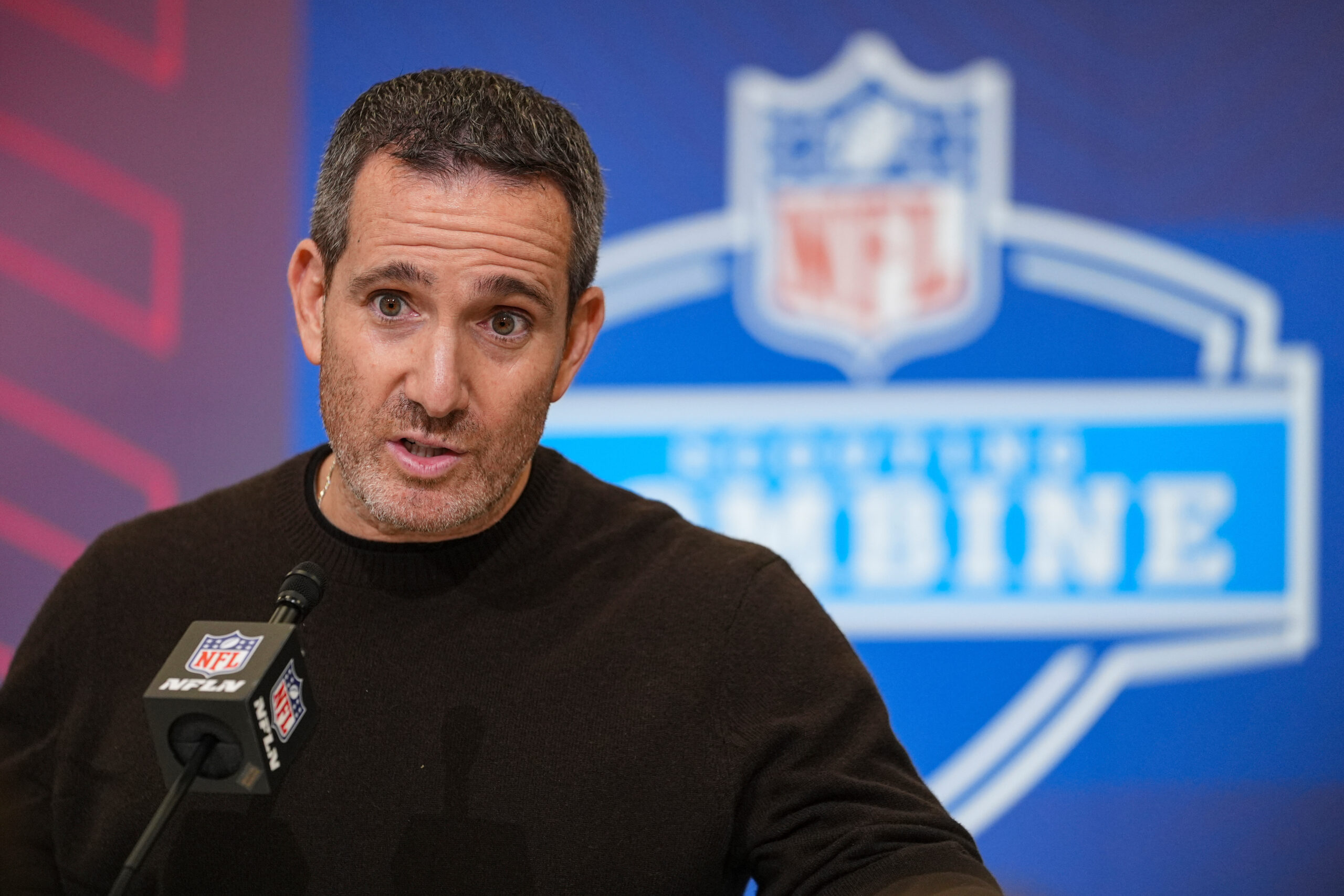
Howie Roseman acknowledged that nothing is off the table when it comes to trade talks. But he has a history to suggest he won’t be fleeced.
But it seems inconceivable that the Eagles would take anything less than what the Seahawks got for receiver DK Metcalf last offseason — essentially a second-rounder — or the Bills got for receiver Stefon Diggs — essentially second- and fifth-rounders — two offseasons ago.
A trade partner would have to be willing to take on the remaining amount of the three-year, $92 million extension Brown signed two offseasons ago — at about $25 million per over the next two seasons. But that isn’t a backbreaking commitment for a player who turns 29 in June.
The Patriots have a need at the position, even if Diggs reached 1,000 yards receiving in his first season in New England. It was clear in Super Bowl LX that quarterback Drake Maye, despite his deficiencies, was lacking a true No. 1 target.
Brown was rooting for the Patriots, having been a fan since he was young. He went on the Dudes on Dudes podcast hosted by former Patriots Julian Edelman and Rob Gronkowski before the title game and spoke about his affinity for the team and for Vrabel, the coach he said he didn’t initially like in Tennessee.
The Patriots, of course, lost to the Seahawks. The podcast did not air until Feb. 18, however, so Brown’s chumminess with an enemy team might have come off as brash to some Eagles fans. Edelman ended the show by saying, “Just remember, we’re all Patriots. You know that, right?”
Brown winked, as if to suggest that he would become a Patriot, but quickly rebounded and said, “No, no, no. I’m trolling.”
The constant media attention on a potential Brown trade may seem like trolling to Eagles fans reluctant to see the star receiver leave after four dominant seasons. But the prospects are real. Whether it happens or not, the answer could come in a matter of days.
Bill Koch was in a hospital bed for 10 days, imagining this to be how his coaching career would finally end. A doctor sent him immediately to Fox Chase Cancer Center in the fall of 2019 after an annual colonoscopy. Koch had colon cancer. They operated on Koch the next day, stitched his stomach, and left him planning for rounds of chemotherapy and radiation.
Koch (pronounced “Cook”) has been an assistant on Father Judge’s basketball staff since 1979 and has helped the football team even longer. He worked at Judge for more than 30 years as a nonteaching assistant, doing everything from monitoring the lunch periods and substitute teaching to helping kids find a college.
And the 76-year-old is still at the all-boys school in Holmesburg nearly every day, washing the basketball uniforms and making sure everything is just right before another practice begins.
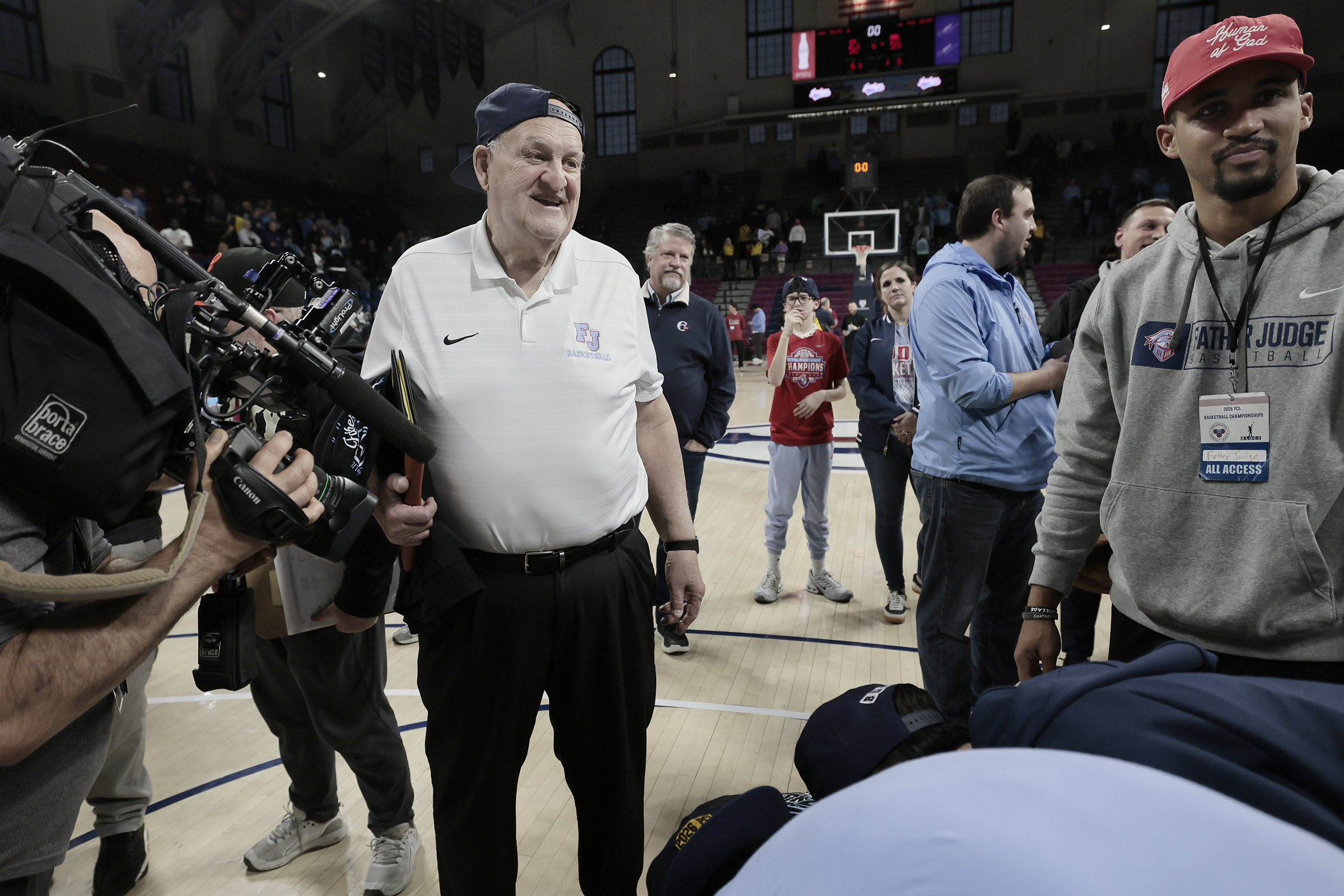
Koch graduated from Judge in 1967, grew up near Holme Circle, and still lives in the Northeast. He helps the football team in the fall and the basketball squad in the winter. Koch was there Sunday when Judge won a second straight Catholic League boys’ title, sitting on the bench as an assistant coach just like he has for the past 47 years.
But for 10 days, Koch wondered whether his time on the sideline was up. Then the doctor returned to his room and sent him home. No chemo. No radiation. It was rare, the doctor told Koch, but the cancer was gone.
“I almost got stopped,” Koch said.
Judge’s mascot is the Crusader, but it can be argued that the school’s symbol is Mr. Koch.
“He’s a lifer,” said basketball coach Chris Roantree. “People associate Mr. Koch with Father Judge and Father Judge with Mr. Koch. He’s been a part of Father Judge for 50-plus years. He’s the ultimate Judge Guy in my eyes in terms of everything he’s done for kids.”
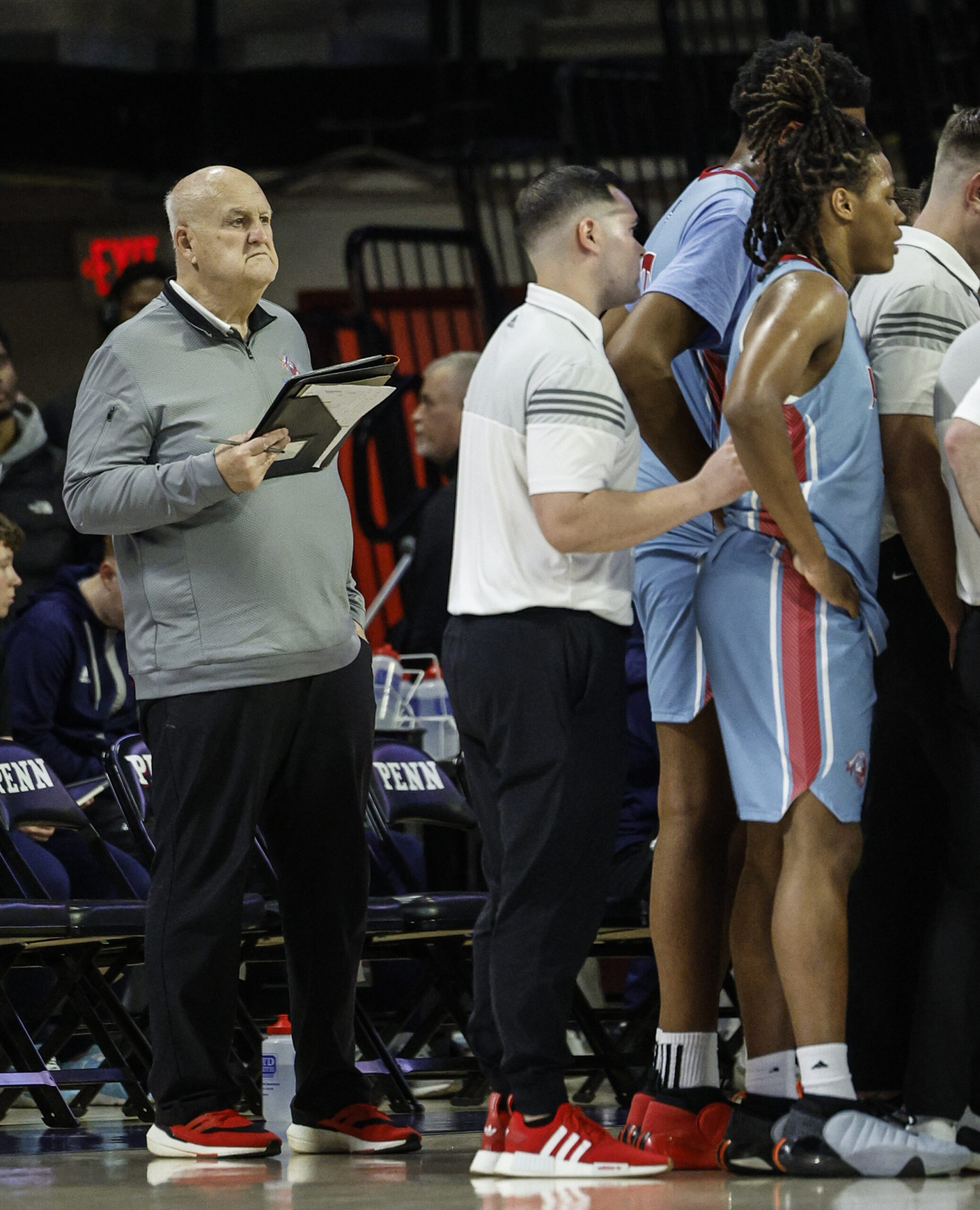
Father Judge assistant coach Bill Koch (left) during a timeout against Roman Catholic during the Catholic League boys’ semifinals on Saturday at the Palestra.
Home on Solly Avenue
Koch didn’t play football at Judge, but he did know how to tape ankles, which was enough for football coach John “Whitey” Sullivan to ask Koch in 1974 to coach the freshman team. Five years later, Bill Fox — often Koch’s teammate in two-on-two at Pollock Playground — added him to the basketball staff.
Koch coached JV hoops for 30 seasons, won 606 games, and never thought about going elsewhere. A basketball program usually changes JV coaches every few years, but not Judge.
Fox, who died of ALS in 2021, once told the Daily News that Koch “bleeds Father Judge blue.” Koch worked basketball camps every summer with the top college coaches and had chances to be an assistant somewhere. He was at home on Solly Avenue.
Judge had more than 3,000 boys when Koch was a student — “If you turned the wrong way, you got bounced,” he said — so there wasn’t any room on the basketball team for a 5-foot-11 kid.
“What are you going to do? I thought I was going to make it,” Koch said.
He hit a growth spurt in college and played on a team at St. Francis in Loretto, Pa., with future NBA players Kevin Porter and Norm Van Lier. He played in the summer with guys from La Salle and St. Joseph’s and said his 50 points at Pollock are still a playground record. He worked after college as a machinist and a roofer before going to work at Judge. He has never left.
“I gave up all the other jobs and I was making good money back then,” Koch said. “But this is something I love. Some people think I’m crazy, but hey, you can’t look back.”
Bill Koch is “the ultimate Judge Guy in my eyes in terms of everything he’s done for kids,” says Father Judge basketball coach Chris Roantree.
Where’s Mr. Koch?
Judge’s basketball team was in San Diego last season when someone stopped the coaches. The man said he was a graduate and then asked to see Koch.
“We always run into someone who says, ‘Where’s Mr. Koch?’” said Jim Reeves, one of the team’s assistants. “The list is endless of people he knows.”
Reeves played a season of JV ball for Mr. Koch, who called the big man “Crazy George” — a reference to an old basketball trickster — every time Reeves grabbed a rebound and started dribbling. Koch kept things loose, let his players play, and made sure they hustled.
“My big thing is it doesn’t take talent to hustle,” Koch said. “So my kids hustle.”
Koch coached Roantree in the 1990s and helped him land a football scholarship to Lycoming College. So of course, Roantree planned to keep Koch as an assistant in 2021 when he took over the program. But Roantree didn’t really have a choice.
Koch keeps stats during games, logs the minutes each player plays, oversees the student managers, and makes sure the practice uniforms are ready. He does the things people often don’t see, Reeves said.
The players — some of whom are more than 60 years younger than Koch — call him “Pop Pop” and develop secret handshakes with him. They put him on TikTok earlier this season and sit with him before practice at the scorer’s table.
“He might not be showing them how to do a drop step, but it’s about the relationships that he forms,” Reeves said. “People couldn’t believe that Chris kept Mr. Koch on. It’s like, ‘Why wouldn’t we leave Mr. Koch on?’ You can see the bond he creates. It gives you a past and present. It bridges the gap from the old Judge to the new Judge.”
Koch said the only time he gets in trouble is if he messes up the clock during practice.
“I think sometimes he dozes off when he’s doing the clock,” Roantree said. “He still does a lot for the program. He’s there every day.”
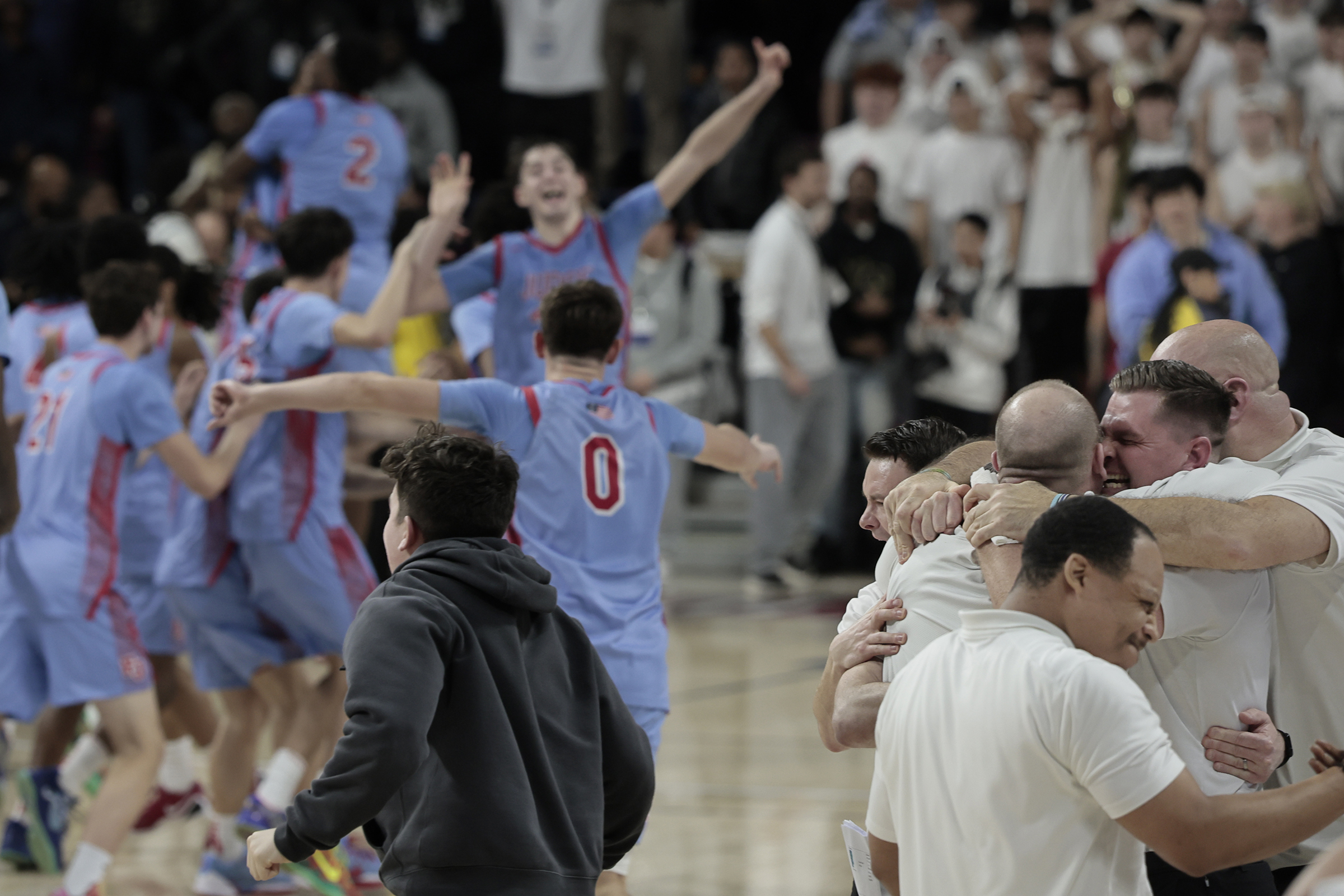
Father Judge celebrates winning the Catholic League championship over Neumann Goretti on Sunday.
Not done yet
Judge once relied solely on nearby parishes like St. Matthew’s, St. Timothy’s, and St. Jerome’s for enrollment. The basketball team was a bunch of kids from Northeast neighborhoods. But that’s no longer the case as students can now come to Judge from anywhere. Some basketball players, Roantree said, leave their home at 6:30 a.m. to get to school.
The roster isn’t constructed the same way it was in 1998 when Roantree, Reeves, and current assistant Brian Bond won it all.
But they played Sunday against Neumann Goretti in the Catholic League final like a bunch of hard-nosed kids from Mayfair. They hustled after loose balls, grabbed offensive rebounds, and did the little things to hold on to a lead down the stretch. The Crusaders, who play Saturday against Public League champ Imhotep for the city title, are still a team of Judge Guys. And maybe that’s because they have a coaching staff full of former players and a lifer on the bench.
“A lot of the kids we have, it’s almost like their parents would fit in in Northeast Philly because that’s what they are,” Reeves said. “They are from out of the neighborhood, but they have that same mentality.”
Koch eventually got out of his hospital bed during his 10-day stay, walked around Fox Chase Cancer Center, bumped into people he knew, and stopped in the chapel.
“There were people a lot worse off than I was,” Koch said. “I was grateful that I didn’t have to go through what other people have to go through. I’m thankful. I guess a lot of people said prayers for me.”
The doctor told him to return every six months for the next five years to make sure he was cancer free. Five years later, Koch was good. Ring the bell, the doc said.
“But they didn’t have a bell where his office was,” Koch said. “So it was make believe.”
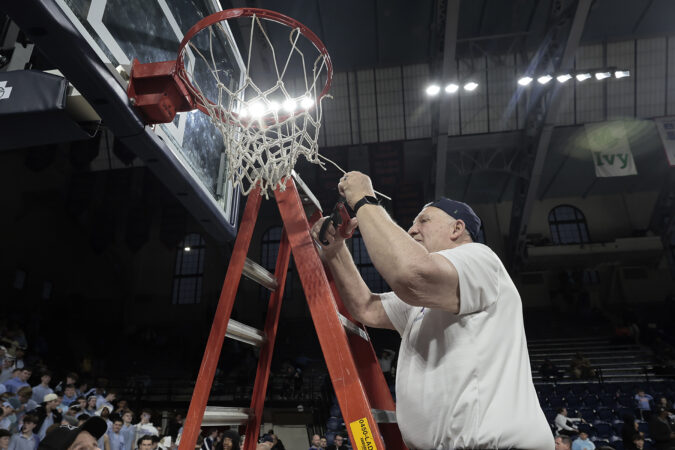
He climbed a ladder on Sunday at the Palestra after Judge — the school he has devoted his life to — won it all. It may have felt like make-believe as Judge won one game in the season before Roantree was hired and went 27 years without a title before winning the last two. But this was real.
The Judge Guy cut down a piece of the net as the other Judge Guys cheered. He’s not done yet.
CLEARWATER, Fla. — Shane Victorino retired to Las Vegas in 2016, three years before Justin Crawford popped up on the scene there at Bishop Gorman High School.
In December, the former and future Phillies center fielders finally met up at a Vegas-area batting cage.
“I’m not one to get into the middle of people’s journey, but I would always wonder,” Victorino, a guest instructor in Phillies camp for the past few days, said of Crawford. “And this offseason, we finally decided that we wanted to get some work in together.”
Victorino, who played in the majors at the same time as Crawford’s dad, was struck by many of the qualities that are impressing Phillies officials this spring. Never mind that Crawford is on track to become the youngest outfielder in a Phillies opening-day lineup since Greg Luzinski in 1973. The 22-year-old has the right mix of confidence and curiosity.
As manager Rob Thomson puts it, “He acts like he deserves to be here.”
“Being a son of a big leaguer, he sure didn’t act like one,” Victorino said. “And that was very interesting to me, the humbleness, the kind of kid he is. [The Phillies] have got a good one, bro.”
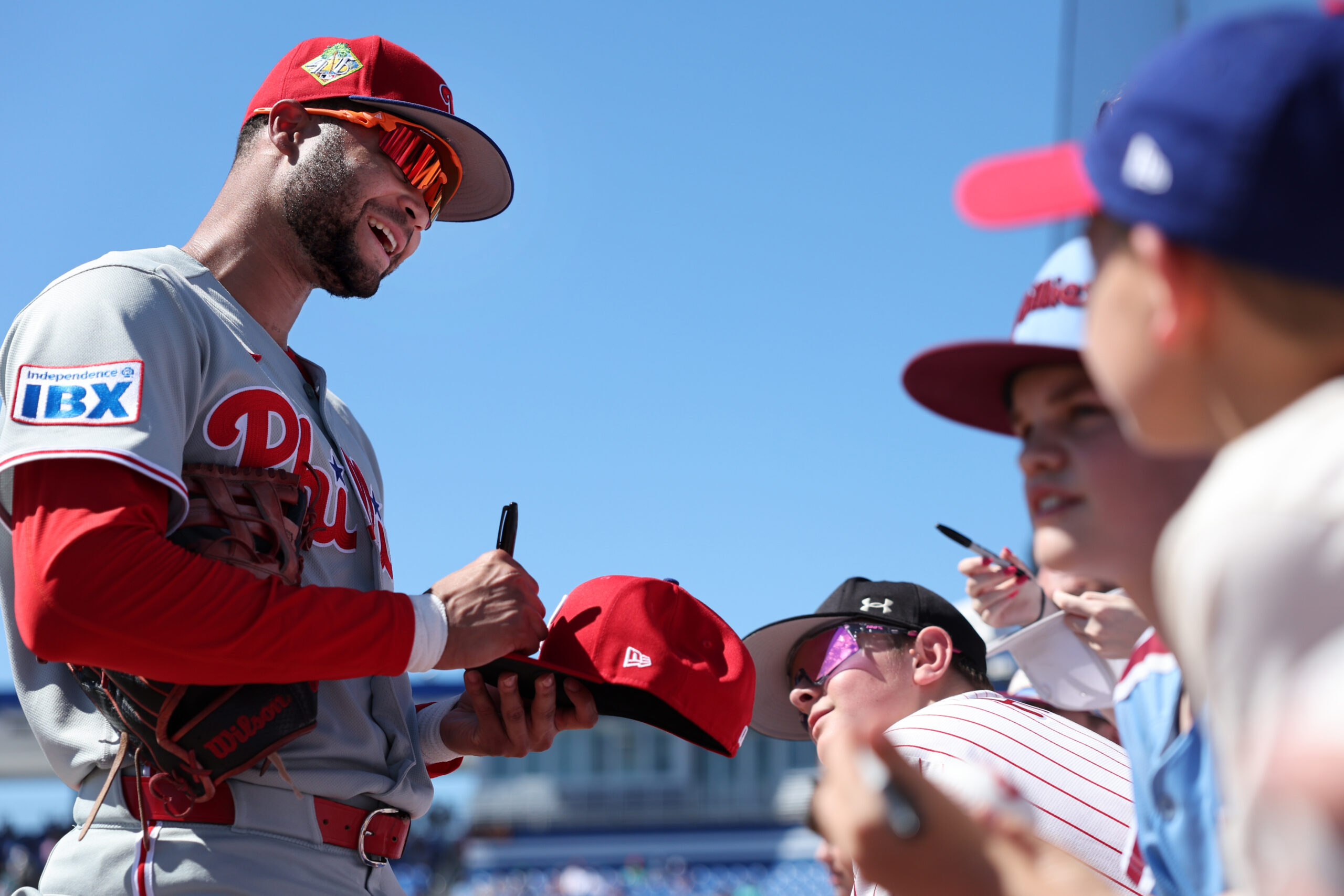
Phillies center fielder Justin Crawford signs autographs before a spring training game against the Blue Jays on Saturday.
Crawford’s inner circle is overflowing with major-league influences that extend beyond even his dad, Carl Crawford, a four-time All-Star outfielder with the Tampa Bay Rays. His godfather, Junior Spivey, played five seasons in the majors. Mike Easler, his personal hitting coach, had a 14-year major-league career. Crawford went to Arizona in the offseason to improve his defense — with former star center fielder Eric Davis.
By all accounts, Crawford is a sponge, soaking in advice and information but also asking pertinent questions. Upon meeting up with Victorino, he wanted to know one thing.
What’s it like to play in Philadelphia?
Because it isn’t for everyone. Crawford’s dad came up with the Rays and thrived in small-market Tampa Bay but struggled with the spotlight in Boston after signing a seven-year, $142 million contract with the Red Sox. Philly is a similarly sports-crazed Northeast market.
Victorino, 45, relished the big-market experience, winning the World Series with the Phillies in 2008 and Red Sox in 2013 and producing big postseason moments during both runs.
“He wanted to know, like, ‘What are the things that I’ve got to make sure that I’m ready for and that I’m prepared for?’” Victorino recalled. “And I said, ‘You ain’t dumb, bro.’ I said, ‘It’s a hard place to play. It’s a tough fan base.’ But I said, ‘There’s so many things that you bring, the person that you are, the player that you are, that the city’s longing for. So, if you do that, Justin, then the rest will take care of itself.’”
Former center fielder Shane Victorino is a guest instructor in Phillies camp.
Victorino offered up two specific tips: Be accountable and play hard.
“I said, ‘Fly around the bases, play the game right, and this city’s going to love you,’” Victorino said. “‘That’s all they care about. They want you to hit a ground ball and try to beat it out. And when you beat it out, they’re going to have 40,000 [fans] on their feet.’”
Victorino came to the Phillies in the Rule 5 draft in 2004 and wasn’t a touted prospect. But like Crawford, he had a dominant season in triple A, batting .310 with 18 homers and a .912 OPS in 2005.
It wasn’t until the Phillies traded Bobby Abreu at the July deadline in 2006 that Victorino got a chance to play every day at age 25. He took over center field once Aaron Rowand left in free agency after the 2007 season.
The Phillies considered calling up Crawford at times last season but instead left him in triple A, where he won the International League batting crown with a .334 average. Although Crawford is hailed for his bat-to-ball skills and sprinter’s speed, some scouts point to his high ground-ball rate as a reason to be skeptical that he will hit in the majors.
But Crawford has batted .300 at every level of the minor leagues, and the Phillies believe the time has come to turn over the keys to center field.
“Just being in the cage with him, his approach, his outlook on the game, his willingness to want to learn and ask questions — the right questions — is what stood out to me,” Victorino said. ”The baseball side, that’s up to [hitting coach Kevin Long]. But I think this organization’s got a great identity of where he is as a player. I think there’s going to be a leash long enough that he’s going to be able to figure it out.
“I told him, ‘They’re going to forget about guys like me and others because they’re going to fall in love with Justin Crawford.’ And I’m cool with that because that means that the team’s going to be better, the city’s going to be excited, and the fans will be, too.”
A few other notes from spring training:
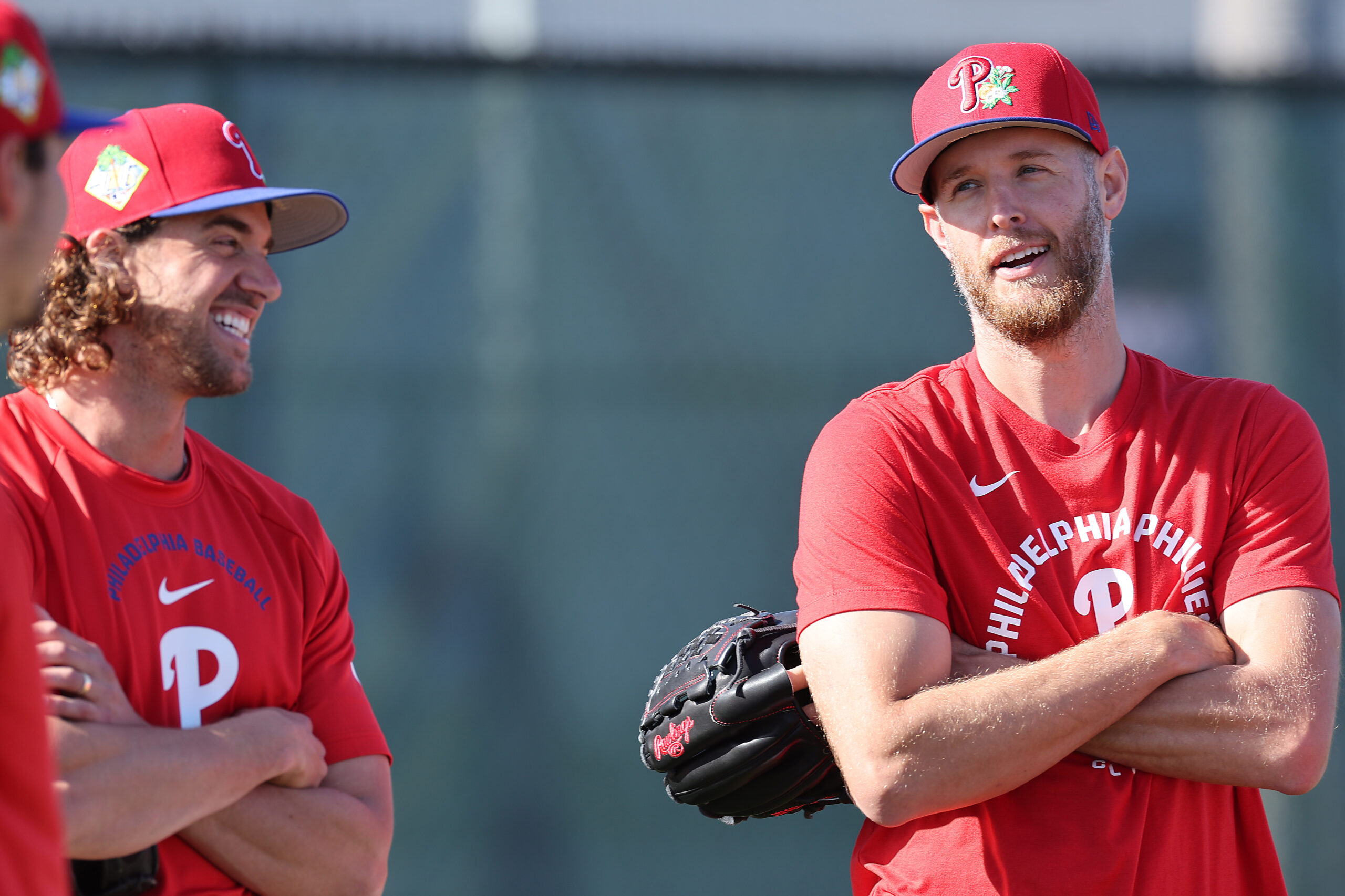
Aaron Nola (left) and Zack Wheeler (right) are no longer the constants in the Phillies starting rotation.
Changing of the guard
For five years, the Phillies’ optimism about their chances to make the playoffs, win the division, and go on a deep run through October was rooted in two pitchers.
Wheeler ranks first in WAR (30.4) and third in ERA-plus (146) and among 96 pitchers who threw at least 500 innings since 2020. Nola is 16th in WAR (16.0) and 59th in ERA-plus (102) in that span.
And their durability stood out as much as their dominance. Wheeler ranks third in innings pitched (979) and fifth in pitches thrown (15,319) since 2020; Nola is seventh (944⅓) and ninth (15,002).
Wheeler and Nola were as reliable as sunrise and sunset.
It’s unfamiliar, then, that they represent two of the Phillies’ bigger questions this spring. Wheeler, who will be 36 in May, is attempting to return from surgery in which his first rib was removed to relieve a vein that was compressed between his rib cage and collarbone. Nola, 33 in June, is trying to bounce back from an injury-plagued season in which he posted a 6.01 ERA.
Suddenly, the surest things in the Phillies’ 2026 rotation are lefties Cristopher Sánchez and Jesús Luzardo. Sánchez, 29, is the Cy Young runner-up; Luzardo, 28, is a candidate for a contract extension with free agency looming after the season.
And then there’s 22-year-old top prospect Andrew Painter, on the verge of making his long-awaited major-league debut.
Meanwhile, Wheeler and Nola are still around, with corner lockers in the spring-training clubhouse and the potential to still impact the Phillies’ season in a big way.
“It’s nice having guys develop and taking those next steps because it helps us if we were to maybe take a step back as we get older,” Wheeler said. “They’re getting to where we’ve been, which is just reaching, I don’t want to say your peak, but reaching your potential and being the pitcher who you think you could be and who everybody else thinks you could be.
“They’re getting to that point. It’s pretty cool to see. And we’ve already been there, and we’re just trying to make that last, me and [Nola].”
Phillies reliever Orion Kerkering suffered a mild (Grade 1) strain of his right hamstring early in spring training.
Bullish on the ’pen
Orion Kerkering uncorked a pitch in a bullpen session before camp opened and felt a grabbing sensation in his right leg.
“I thought it was just a cramp,” he said.
It turned out Kerkering suffered a mild (Grade 1) strain of his right hamstring. He’s aiming to throw from a mound Sunday, which would be a big step in a progression that typically involves multiple bullpen sessions and facing hitters in live batting practice before getting into games.
There’s still time for Kerkering to be ready for opening day. He would join closer Jhoan Duran, Brad Keller, Jonathan Bowlan, and lefties José Alvarado and Tanner Banks as locks in an eight-man bullpen. Do the math, and there are two spots for at least a half-dozen relievers, most of whom have made solid initial impressions.
Kyle Backhus might have an inside track. Not only does Thomson prefer a third lefty, but as a sidearmer, Backhus provides a unique look. The 28-year-old posted a 4.62 ERA and 22 strikeouts in 25⅓ innings last season for Arizona. The Phillies traded for him in December for single-A outfielder Avery Owusu-Aseidu.
It was one in a series of offseason dart throws to add bullpen depth. The Phillies acquired right-handers Yoniel Curet from the Rays and Chase Shugart from the Pirates for minor leaguers. They signed righty Zach Pop as a free agent and selected righty Zach McCambley in the Rule 5 draft.
Pop, 29, features a sinker that Thomson described as a “bowling ball.” He’s out of options and would need to clear waivers. McCambley, 26, must remain on the Phillies’ active roster all season or be offered back to the Marlins, his former organization, for $50,000.
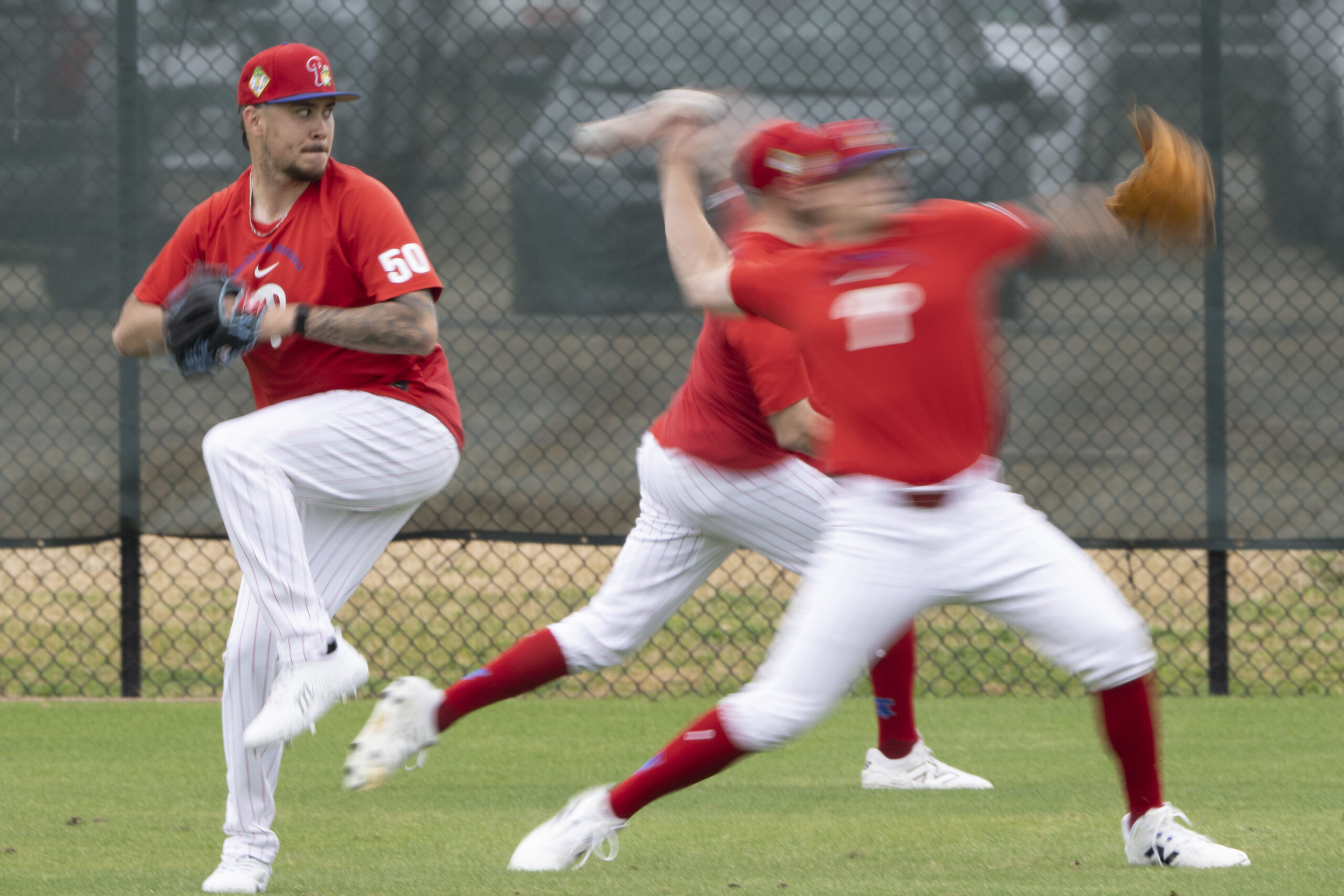
Kyle Backhus might have an inside track on one of the two remaining bullpen spots.
Maybe that gives them an edge over Backhus, Curet, Shugart, and holdovers Seth Johnson and Max Lazar, all of whom have minor-league options.
Veteran relievers Lou Trivino and lefty Tim Mayza are also in camp as nonroster invitees. Because they finished last season in the majors, have six years of service time, and signed minor-league deals, they are entitled to a $100,000 retention bonus to go to the minors if the Phillies don’t add them to the 26-man roster five days before opening day.
It all sets up an intriguing competition over the next few weeks.
“We’re going to have some tough decisions at the end of this thing,” Thomson said.
Alvarado committed to pitch for Venezuela in the World Baseball Classic but had to withdraw due to issues in obtaining insurance. The Phillies will have 11 participants: Bryce Harper, Kyle Schwarber, and Keller (U.S.); Sánchez and outfielder Johan Rojas (Dominican Republic); righty Taijuan Walker (Mexico); catcher Garrett Stubbs and Lazar (Israel); infielder Edmundo Sosa (Panama); Nola and outfield prospect Dante Nori (Italy). … Veteran utility man Dylan Moore is competing for the final spot on the bench after signing a minor-league contract a few days before camp opened. Moore, who is also eligible for the retention bonus if he isn’t added to the roster before opening day, said he wanted to join the Phillies for the opportunity to work with Long. “He pointed out some things in my swing that he thought he could really help me with,” said Moore, a .206 hitter with a .693 OPS in seven major-league seasons. “That was a huge factor. I think he could help me.”
What if I told you that Alec Bohm offered more protection to Bryce Harper than Kyle Schwarber?
What if I told you the Phillies’ best batting order is the one they rode to the NL East title, and that Rob Thomson shouldn’t change a thing?
I can’t say either of these things with any degree of certainty. All I can tell you is what the numbers added up to last season. If you don’t like numbers, what you are about to read probably isn’t for you. But a surprising number of people emailed me after Tuesday’s column and suggested that I compare Harper and Schwarber’s numbers when hitting back-to-back in the lineup.
As a refresher, the topic du jour — or however you say the topic of that day in French — was Harper’s struggles to score runs after reaching base. It was a pertinent topic, given that it sat at the intersection of issues people rightfully have with the Phillies’ odd-fitting and top-heavy batting orders.
But the ramifications of Dave Dombrowski’s roster construction are much broader than the infrequent sound of Harper’s cleats clacking on home plate. The weight is disproportionately borne by Thomson. The dam has more holes than he has fingers. Baseball would be a lot more fun if he could use Harper and Schwarber twice each time through the batting order. Until he can, the lineup will always leak somewhere.
The question remains. What is the optimal (legal) combination? Specifically, at the top of the order, seeing that Thomson has used a number of different combinations of Harper, Schwarber, and Trea Turner, with or without another hitter mixed in.
I used Retrosheet’s play-by-play data and borrowed Will Hunting’s chalkboard and did some figurin’. Harper behind Schwarber, Schwarber behind Harper, neither behind the other. The sample sizes are too small to render any definitive judgments, especially given other confounding variables in play.
Observation 1: Harper didn’t get any benefit from batting in front of Schwarber.
In fact, he was his least productive self with Schwarber behind him in the order. The splits are pretty drastic. Harper’s OPS was nearly 100 points higher when batting in front of Bohm vs. Schwarber. And it wasn’t just because he walked more. His extra-base hit percentage was higher, thanks in part to five home runs in 126 plate appearances in front of Bohm compared with seven in 200 in front of Schwarber.
Here’s the interesting part: Harper was much better hitting behind Turner when Schwarber wasn’t hitting directly behind him, specifically when Bohm split the lefties in the No. 3 spot, with Harper batting second and Schwarber fourth. In fact, Harper and Schwarber were both pretty darn good in those situations — again, in tiny sample sizes.
Harper behind Turner, and nonconsecutively with Schwarber: 9-for-37, five extra-base hits, two home runs, 11 walks, .903 OPS.
Schwarber in those situations: 9-for-38, six extra-base hits, four homers, eight walks, 1.014 OPS.
All of Harper’s plate appearances in front of Schwarber came in the first three months of the season. The last time Thomson used a Harper-Schwarber lineup was those back-to-back losses in Toronto when the Blue Jays outscored them, 11-2.
Phillies manager Rob Thomson has quite the number of decisions to make when it comes to where Bryce Harper and Kyle Schwarber end up in his batting order.
After Harper returned from the injured list in late June, Thomson switched to the lineup that carried the Phillies through the rest of the season. Schwarber in the two-hole, followed by Harper. Only twice did he deviate from that batting order when both players were in the lineup. Understandably so. The Phillies averaged five runs per game in their last 79 games, putting together a team OPS of .789.
There is a question of correlation vs. causation here. Were the Phillies better as a team because Harper’s numbers were better behind Schwarber? Or were Harper’s numbers better behind Schwarber because that’s where he was hitting when he and the rest of the team found its stride?
All sorts of variables could be in play: the quality of pitching the Phillies faced in the last three months vs. the first three months, the weather, etc.
That being said …
The numbers show Kyle Schwarber should not bat in the cleanup spot behind Bryce Harper.
Observation 3: Schwarber should not bat cleanup. The optimal lineup is either Turner-Schwarber-Harper or Schwarber-Turner-Harper.
The Phillies were at their best when Schwarber and Harper were batting in the top three. This is obvious. Schwarber may look like the prototypical table-clearer until you see what happens when Bryson Stott and Turner are getting it set.
No offense to either player. But the goal is to get your elite players the most at-bats. It doesn’t get more prototypical than Aaron Judge, and the Yankees bat him leadoff.
It comes down to this, really: Down by one in the bottom of the ninth with the top of the order due up, you want a lineup that guarantees Harper and Schwarber a chance at tying the game. The data from last season doesn’t prove anything, but it is always smarter to err on the side of what the data suggests when what it suggests is the same as one’s intuition.
We can argue about Bohm vs. Adolis García vs. Realmuto. Hopefully, we’ll end up arguing about Aidan Miller. But there isn’t much of an argument for batting Schwarber or Harper lower than third.
Just ask any opposing pitcher what he would prefer.