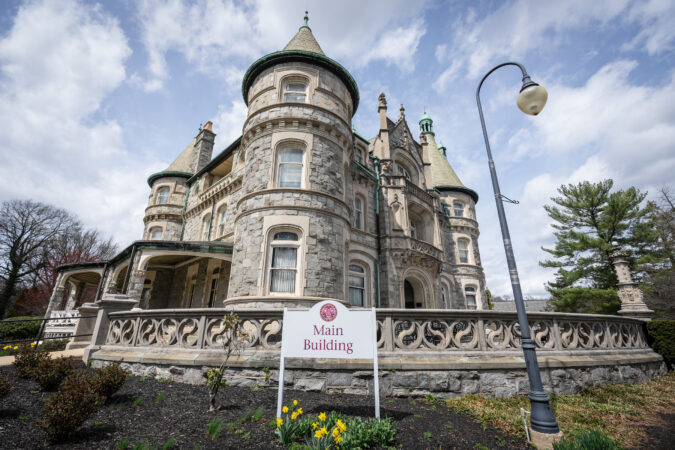
Rosemont College’s accrediting body has asked the school for information on its student records and finances and policies “to ensure truthfulness in public relations announcements.”
The private, suburban liberal arts college has until Tuesday to submit a report to the Middle States Commission on Higher Education, according to an announcement on the accrediting body’s website.
Rosemont announced last spring that it was planning to close for good in 2028 and that nearby Villanova University is purchasing its campus. The college’s enrollment for thefall semester stood at 428, down about 45% from last year.
The freshman class of 21 students is just a quarter of the size of last year’s first-year enrollment. And it will be the last freshman class to enter the 104-year-old Catholic college.
It’s unclear what prompted Middle States to ask Rosemont for the report; the body doesn’t elaborate on its posted actions. Rosemont President Jim Cawley did not respond to a request for comment.
The questions are a likely indicator that more action is coming, which could be as basic as accepting the college’s report, or could be more serious, such as an accreditation warning. Colleges need accreditation to keep their students eligible for federal aid.
Middle States also asked Rosemont to provide evidence of “fair and transparent policies and procedures regarding the evaluation and acceptance of transfer credits, policies and procedures for the safe and secure maintenance and appropriate release of student information and records, including student athletics” and “full disclosure and financial information … that includes realistic enrollment and budget projections and the assumptions on which they are based, is adequate to support educational purposes and programs.”
The college in 2022 received a warning from the commission that its accreditation could be in jeopardy because it did not appear to be meeting requirements around planning, budget and academic assessment. But in 2023, the warning status was removed and the school’s accreditation was reaffirmed through 2028-29.
It could become increasingly challenging for the school to operate as it enrolls fewer students each year until its closure. Another hit could come next year, when NCAA sports are discontinued and more athletes may transfer. Under the merger agreement, Rosemont is expected to receive some financial support from Villanova through 2028.
Rosemont was one of 13 colleges The Inquirer examined in 2024 and found was in poor financial health, using an index developed by a finance executive at a small college in Illinois. The school had reported operating losses for five straight years through June 2023.
On Creighton Road in Lower Merion, it’s not unusual for residents to buy the house next door.
The owners of the 3.85-acre property at 648 Creighton Rd. did just that when they purchased the home but wanted a pool. They decided to put one on the neighboring property.
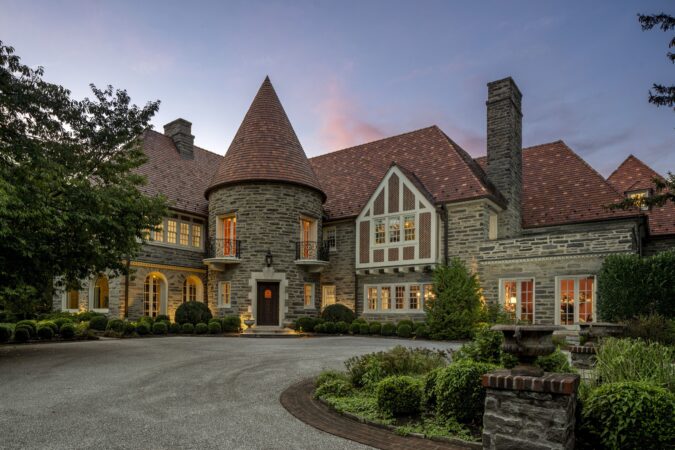
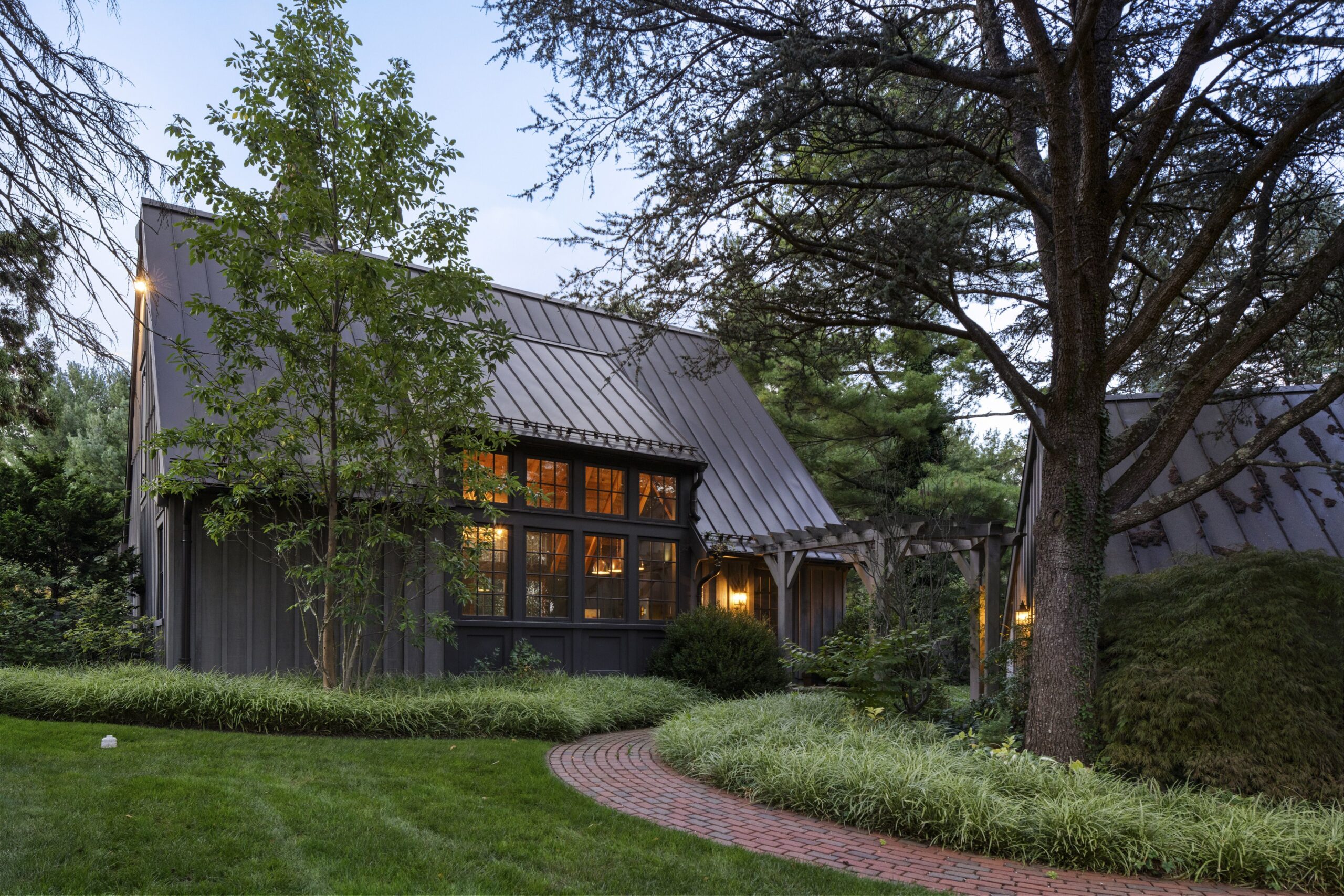
The century-old main house with seven bedrooms, seven full bathrooms, and three half bathrooms is available for $7.9 million. And the one-bedroom, one-bathroom carriage house next door that was rebuilt in 2015 is on the market for $2 million.
Creighton Road “has become the estate street,” said listing agent Lavinia Smerconish with Compass Real Estate.
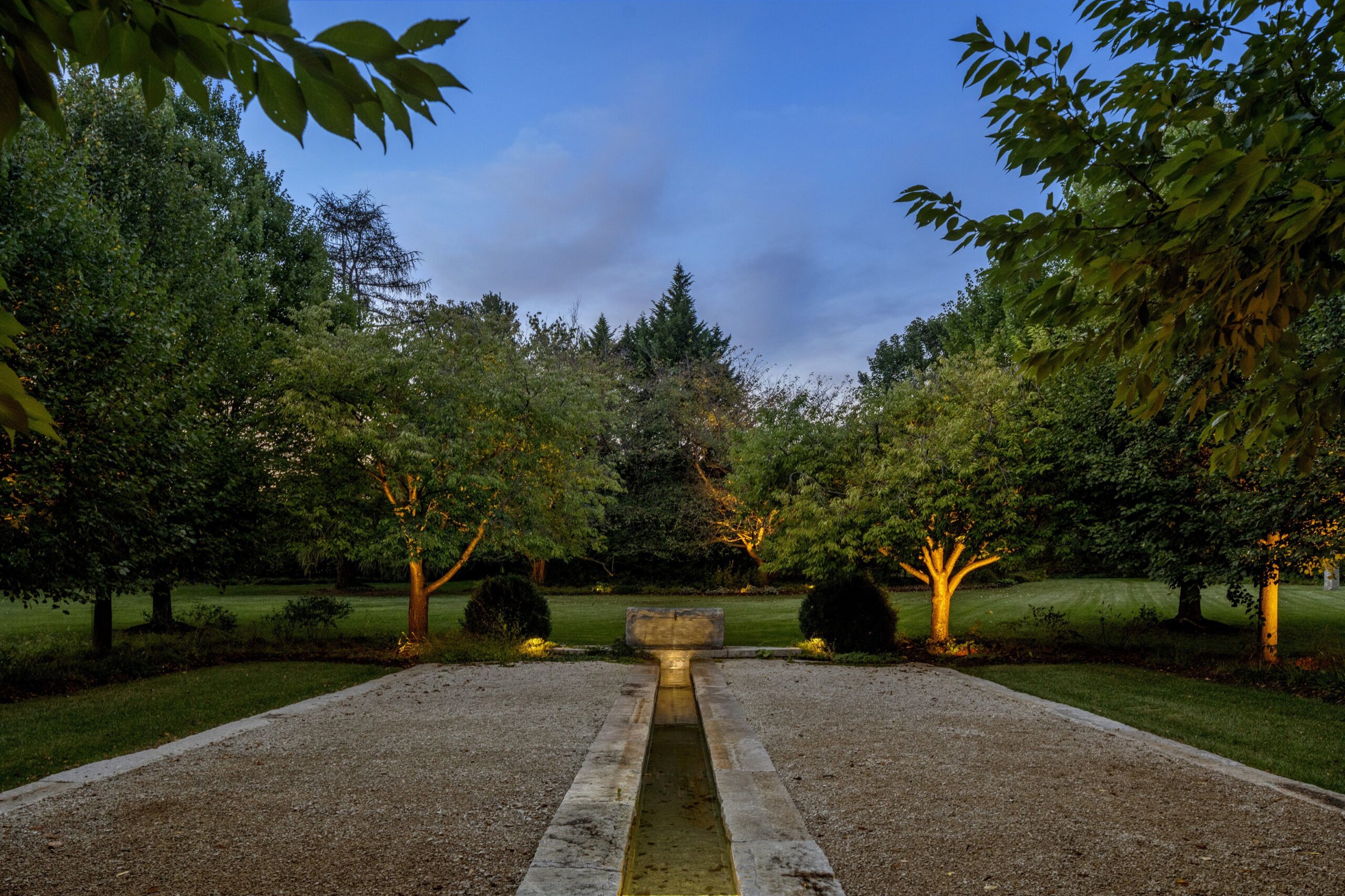
The property is 3.85 acres and includes a sprawling yard.
The owners are open to selling their properties separately, but they won’t sell the carriage house before the main one in case a buyer wants both.
The fieldstone main house is 11,418 square feet. It used to have a series of small rooms for staff and a giant entrance that looked like a banquet hall that no one knew what to do with, Smerconish said. A previous owner reimagined the home with larger rooms, more natural light, and more functional space.
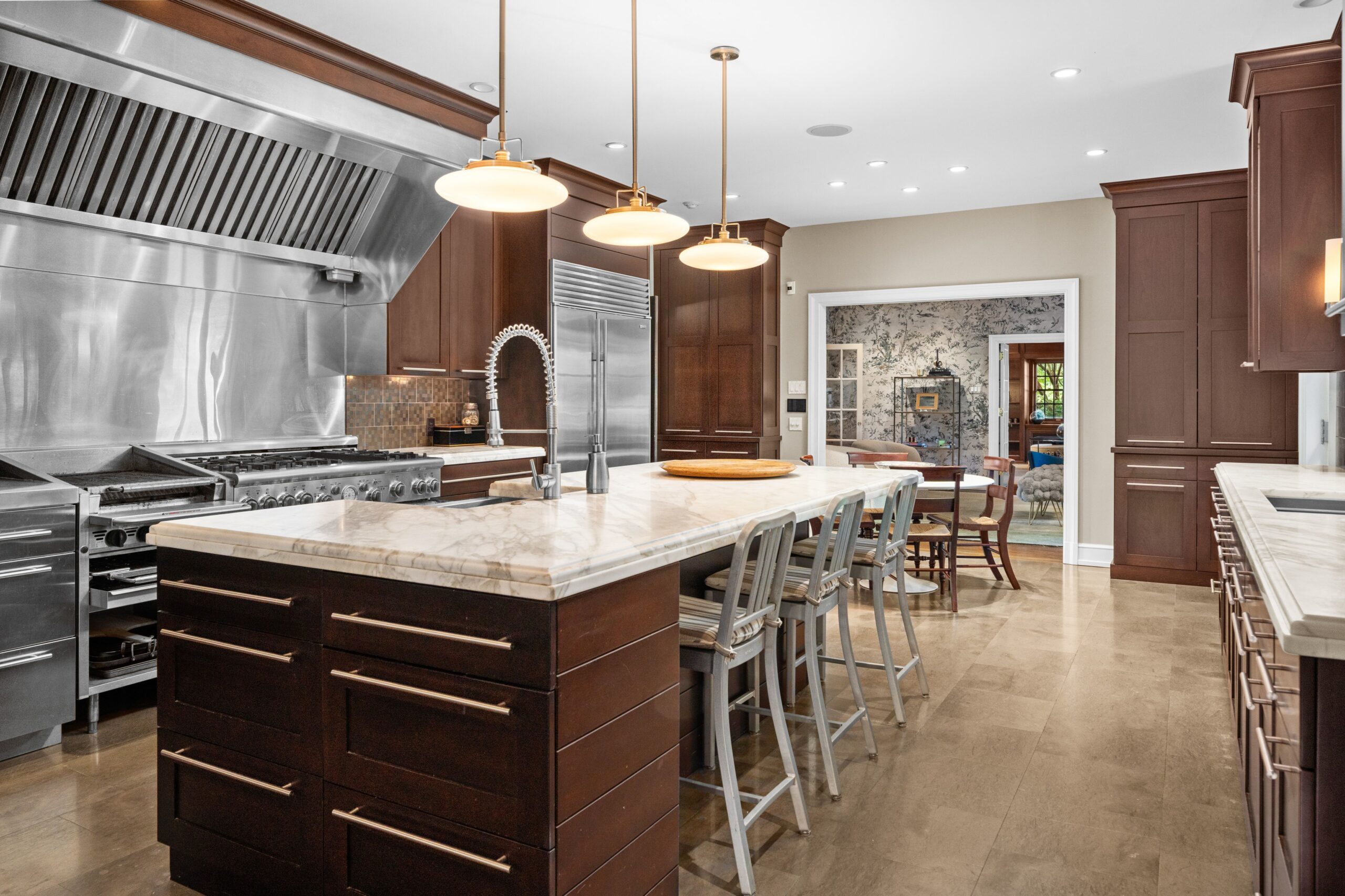
The home has a commercial kitchen with a large island with seating.
The front door opens to an entrance tower with a chandelier and winding staircase. Living and dining rooms branch off from the foyer with the family room straight ahead.
The home has a commercial kitchen with an island with seating. The property includes an exercise room, solarium, four fireplaces, suite above the attached garage for guests or a nanny, sprawling yard lined with trees and hedges, terraces, and detached garage. The sitting room off the primary bedroom could be kept as is or turned into a huge closet, Smerconish said.
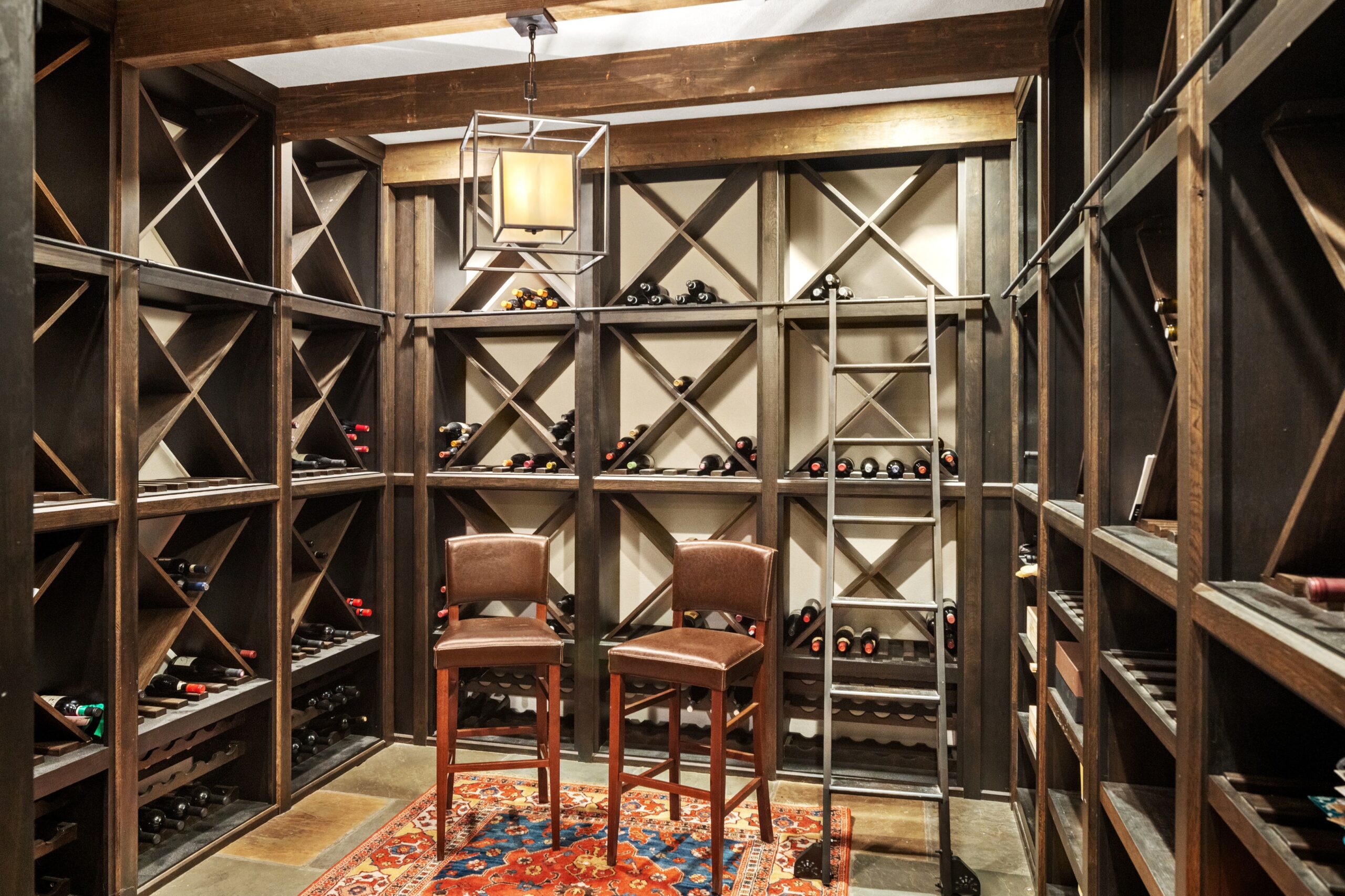
The finished basement spans 1,538 square feet and includes a wine cellar.
The basement includes a sports bar with TVs, wine cellar for up to 3,000 bottles, movie room, gym, and bathroom.
The property “is both impressive and cozy at the same time,” Smerconish said.
The carriage house on the market for $2 million on Creighton Road in Lower Merion is being sold as a package along with the $7.9 million house next door.
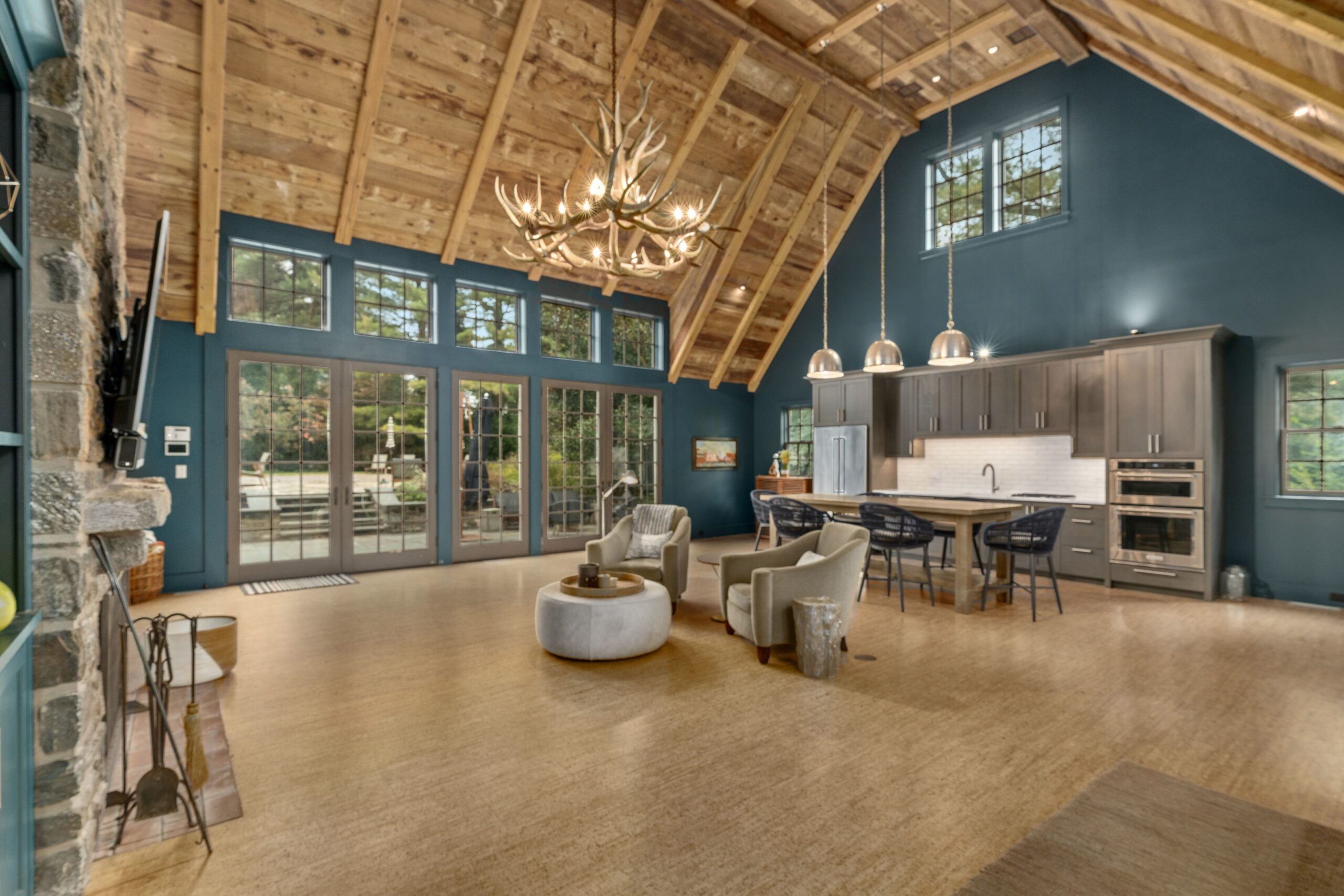
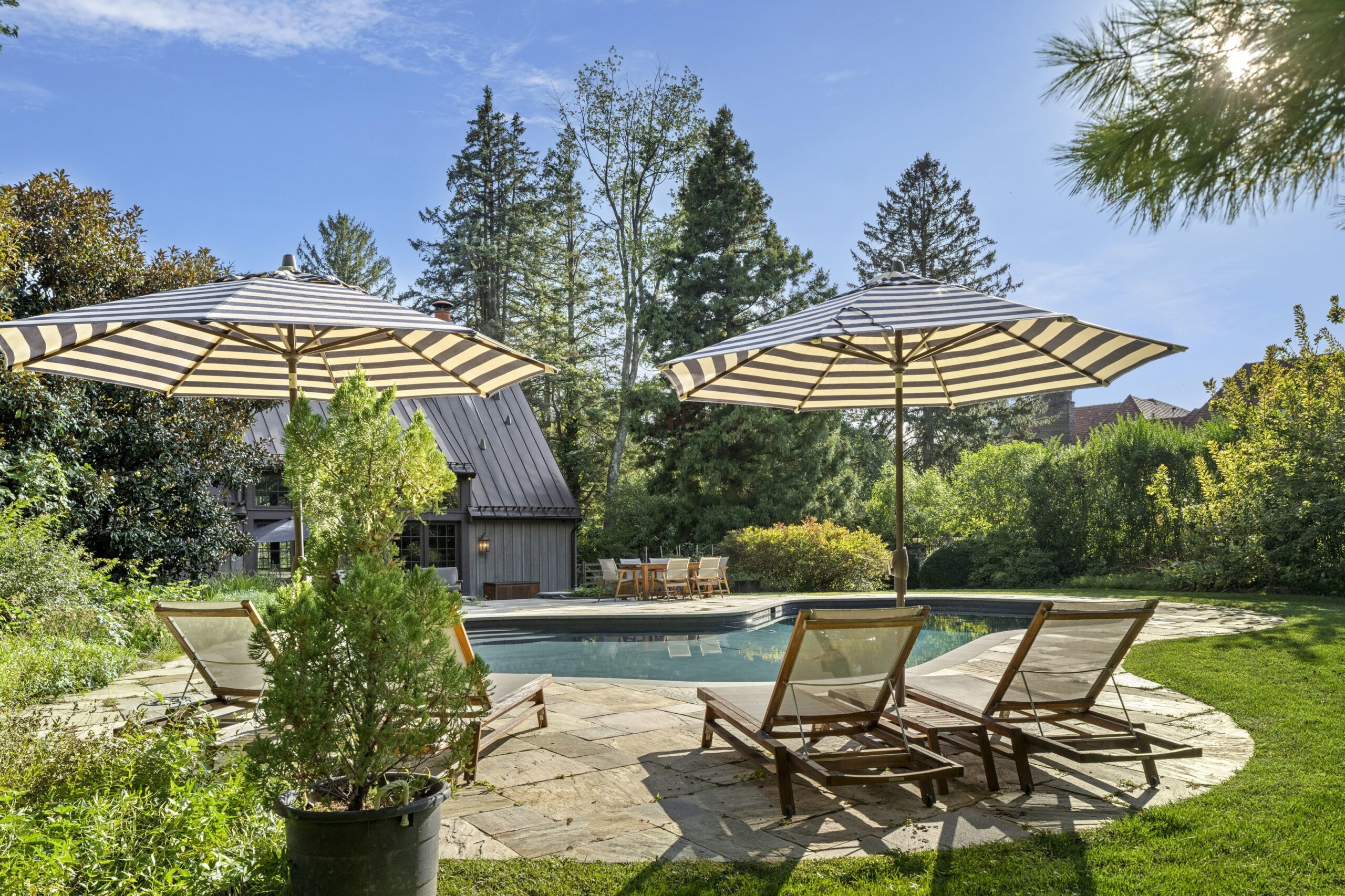
The carriage house next door spans just over 1,000 square feet on an almost one-acre lot. It has a bedroom, bathroom, laundry room, eat-in kitchen, and living room. A flagstone patio leads to the heated saltwater pool.
The properties are walking distance from the Appleford estate, which is an event venue, bird sanctuary, and arboretum with gardens and walking paths. They are minutes from Villanova University and Stoneleigh, a public garden of the nonprofit Natural Lands.
And they’re also minutes from the Schuylkill Expressway and I-476.
The carriage house includes a kitchen, bathroom, and bedroom.
The properties were listed for sale on Dec. 5. Now that the holidays are over, Smerconish said, she will start accepting appointments to tour them. She said photos of the main house especially don’t do it justice.
“You get more with a physical tour and experiencing it,” she said.
Flagstone surrounds the carriage house’s heated saltwater pool.
Lower Merion swore in five new commissioners on Monday, kicking off the board’s 126th year of governing the Montgomery County township.
Between rounds of applause and family photos, commissioners outlined the major challenges, and opportunities, the body will face in 2026. Board members highlighted recent accomplishments — creating a process for establishing board priorities, restricting gas-powered leaf blowers and plastic bags, advancing capital projects, hiring a police superintendent, supporting the development of affordable housing, and reversing the post-pandemic decline in police staffing levels.
“We’re solving problems, we’re moving forward, and we’re even having a little fun,” said commissioner V. Scott Zelov, who was sworn in for his sixth term.
Zelov on Monday night became the eighth commissioner in Lower Merion history to serve for at least 20 years, board President Todd Sinai said.
Sinai, who was first elected to the board in 2017, was unanimously reelected board president. Incumbent commissioner Sean Whalen called Sinai a “stalwart leader of this board,” praising Sinai’s leadership througheconomic ups and downs.
Jeremiah Woodring, also an incumbent commissioner, was unanimously elected vice president. Sinai described Woodring as “thoughtful and inquisitive,” “balanced,” and “diplomatic.”
Jana Lunger was sworn in as Lower Merion tax collector.
Here’s a who’s who of the five newly elected Lower Merion commissioners, all of whom replaced outgoing commissioners who chose not to run again in 2025.
Michael Daly, an attorney and the former president of the Gladwyne Civic Association, was sworn in to represent Ward 2, which includes Gladwyne and Penn Valley. Daly has lived in Lower Merion for around 15 years with his wife and three children, all of whom are products of the Lower Merion School District. In his law practice, he focuses on defending class action lawsuits and complex litigation. In a candidate interview earlier this fall, Daly said he’s focused on quality of life issues, including walkability, public parks, and safe streets. He replaced outgoing commissioner Joshua Grimes.
Charles Gregory, a longtime township employee, will represent Ward 4, which encompasses Ardmore and Haverford. Gregory, who was born and raised in Ardmore, worked for Lower Merion Township for 23 years until 2024. He’s the former president of the Lower Merion Workers Association and a Boy Scout troop leader. During a candidate forum, Gregory said he believed he could “make a difference from a blue collar aspect.” Gregory replaced outgoing commissioner Anthony Stevenson.
Christine McGuire is a forensic psychologist and business owner who will serve Rosemont and Villanova in Ward 6. McGuire lived in Gladwyne for nine years before moving to Villanova around three years ago. In a candidate forum, McGuire said she has been active in the Gladwyne Civic Association and in the parent group that studied Lower Merion’s school start time change. As the owner of a psychology practice, she said she understands “what a budget is and that you have to work within the budget and not look at it like a blank check.” She replaced outgoing commissioner Andrew Gavrin.
Craig Timberlake, an Ardmore resident who was instrumental in the 2025 redevelopment at Schauffele Plaza, will represent Ward 8’s South Wynnewood and East Ardmore. Timberlake moved to Ardmore around 15 years ago from Maine. He says he was drawn to Ardmore’s high-quality schools, walkable neighborhoods, and transit options. He believes the township should incentivize “smaller,” “incremental,” and locally funded development and decrease speed limits to protect pedestrians. Timberlake is a project manager at OnCourse, an education technology platform. He replaced Shawn Kraemer, the board’s outgoing vice president.
Shelby Sparrow, the former president of the Penn Wynne Civic Association and a longtime community organizer, will represent Penn Wynne and Wynnewood in Ward 14. Sparrow’s priorities include ensuring the community is engaged in Main Line Health’s redevelopment of the St. Charles Borromeo Seminary property; addressing pedestrian safety; and encouraging sustainability and park stewardship. She was previously the director of development for St. Peter’s Independent School in Center City. She replaced outgoing commissioner Rick Churchill.
Sinai and Zelov, who were reelected in November, were sworn in, and sitting commissioners Woodring, Whalen, Daniel Bernheim, Louis Rossman, Ray Courtney, Maggie Harper Epstein, and Gilda Kramer were welcomed back.
This suburban content is produced with support from the Leslie Miller and Richard Worley Foundation and The Lenfest Institute for Journalism. Editorial content is created independently of the project donors. Gifts to support The Inquirer’s high-impact journalism can be made at inquirer.com/donate. A list of Lenfest Institute donors can be found at lenfestinstitute.org/supporters.
Way back in 2022, when Philadelphians gathered on an abandoned pier to watch a man eat a rotisserie chicken, folks on social media began to wonder: “Is Philadelphia a real place?”
Sure, that perception has a lot to do with an unbelievable event that actually happened in the suburbs (Delco never fails to carry its weight), but Philly also saw its fair share of the bizarre this year, too.
As we prepare for what may be one of the most important (and hopefully weirdest!) years in modern Philadelphia history, let’s take some time to look back on the peculiar stories from across the region that punctuated 2025.
Five uh-oh
Kevon Darden was sworn in as a part-time police officer for Collingdale Borough on Jan. 12 and hit the ground running, landing his first arrest just four days later.
The only problem? It was his own.
Pennsylvania State Police charged Darden with terroristic threats and related offenses for an alleged road rage incident in 2023 in which he’s accused of pointing a gun at a driver on the Blue Route in Ridley Township. At the time of the alleged incident Darden was employed as an officer at Cheyney University.
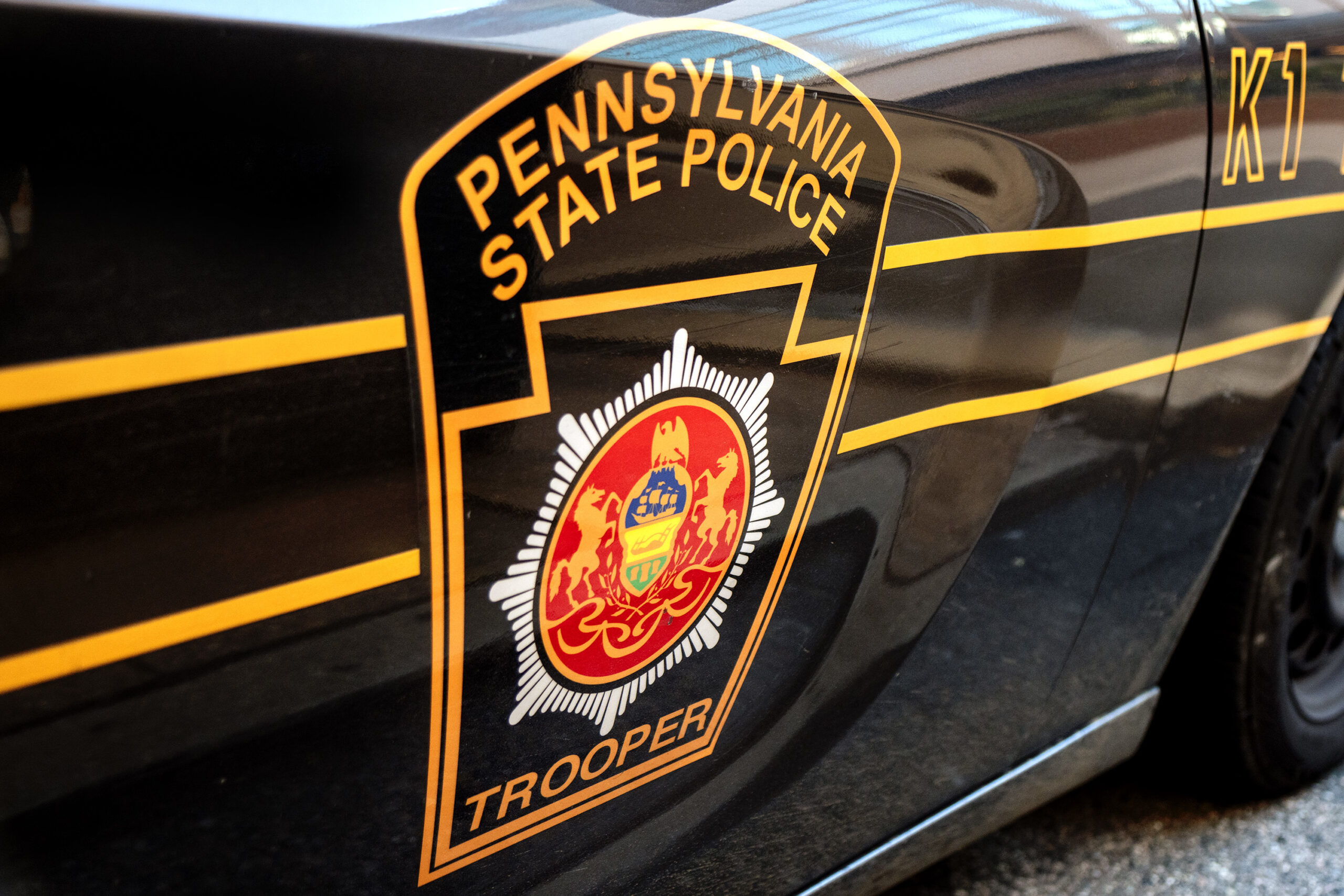
A Pennsylvania State Police vehicle. The agency provided two clean background checks for a Collingdale police officer this year, only to arrest him four days after he started the job.
Here’s the thing — it was state police who provided not one but two clean background checks on Darden to Collingdale officials before he was hired. An agency spokesperson told The Inquirer troopers had to wait on forensic evidence tests and approval from the District Attorney’s Office before filing charges.
Darden subsequently resigned and is scheduled for trial next year in Delaware County Court.
For the Birds
The Eagles’ second Super Bowl win provided a wellspring of wacky — and sometimes dicey — moments on and off the field early this year.
Mayor Cherelle L. Parker started the championship run off strong by going viral for misspelling the most popular chant in the city as “E-L-G-S-E-S” during a news conference. Her mistake made the rounds on late night talk shows and was plastered onto T-shirts, beer coozies, and even a license plate. If you think the National Spelling Bee is brutal, you’ve never met Eagles fans.
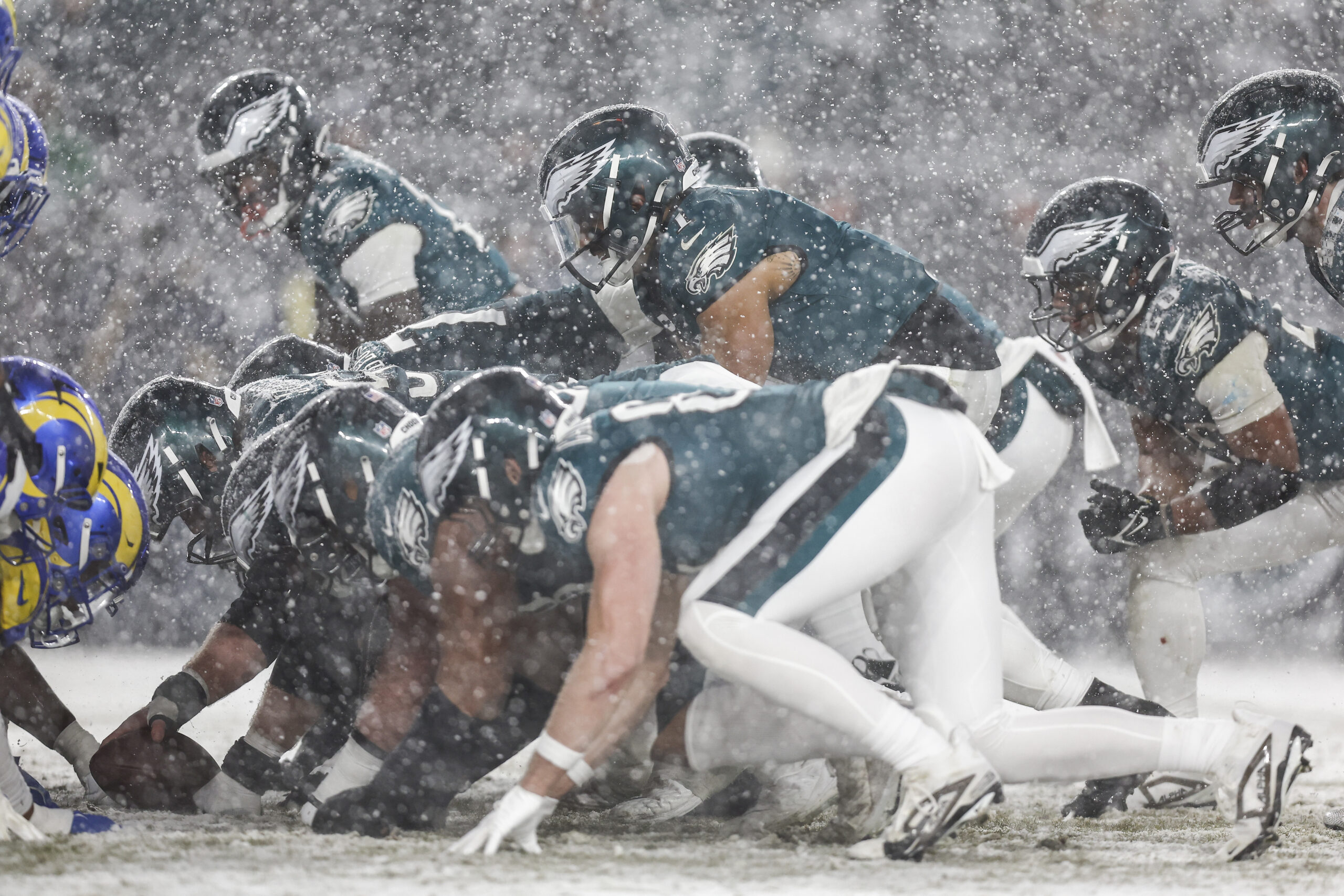
Philadelphia Eagles quarterback Jalen Hurts at the line of scrimmage during the fourth quarter of the NFC divisional playoff at Lincoln Financial Field on Jan. 19. The Philadelphia Eagles defeated the Los Angeles Rams 28 to 22.
Then there was the snowy NFC divisional playoff game against the Los Angeles Rams at Lincoln Financial Field; continued drama around the Tush Push (which resulted in Dude Wipes becoming an official sponsor of the team); and Cooper DeJean’s pick-six, a gift to himself and us on his 22nd birthday that helped the Birds trounce the Kansas City Chiefs 40-22 in Super Bowl LIX.
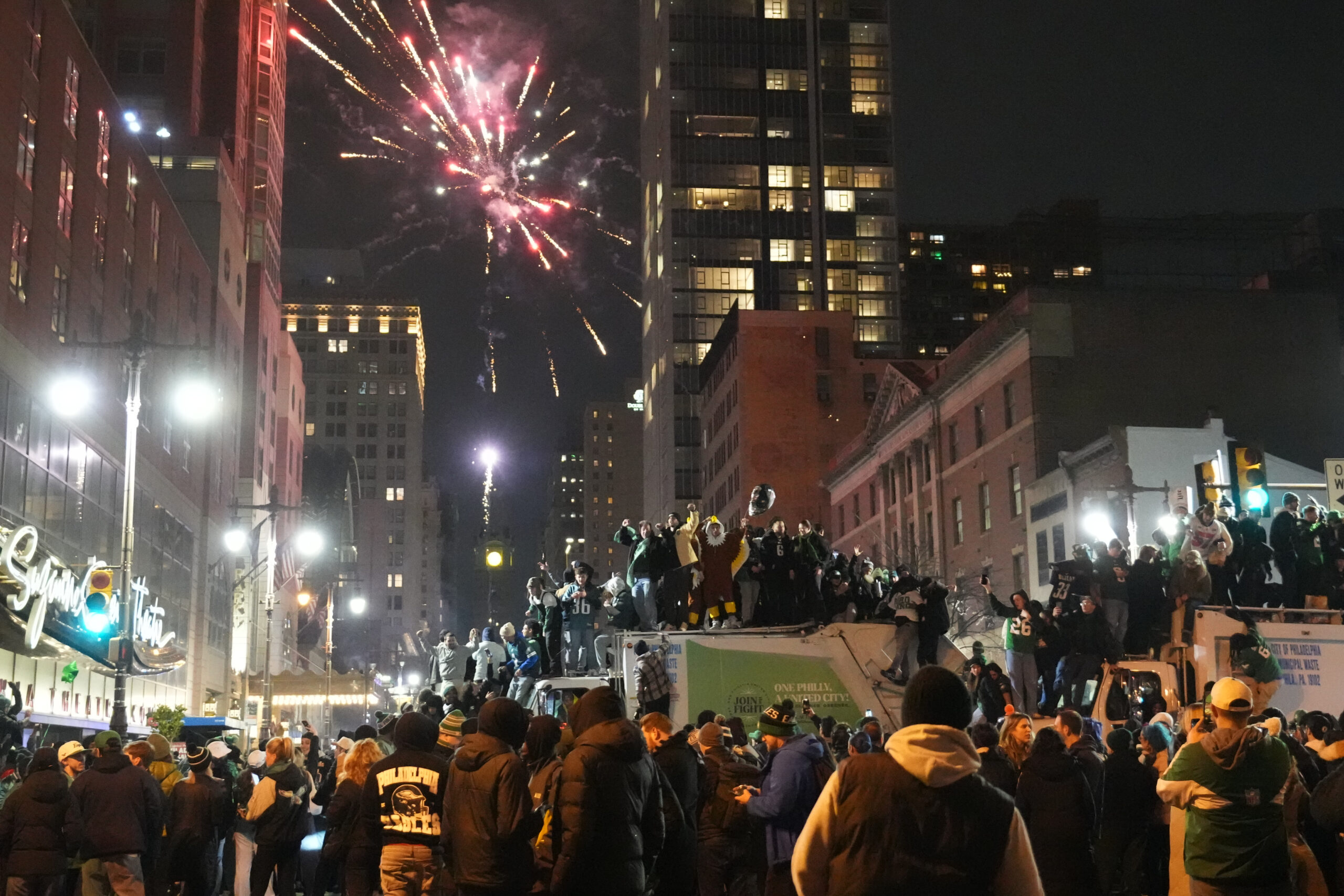
As soon as the Eagles won with Jalen Hurts as MVP, Philadelphians let loose, flooding the streets like a drunken green tsunami. Fans scaled poles and tore them down; danced on bus shelters, medic units, and trash trucks; partied with Big Foot, Ben Franklin, and Philly Elmo; and set a bonfire in the middle of Market Street.
Eagles fans party on trash trucks in the streets of Center City after the Birds win in Super Bowl LIX against the Chiefs on Feb. 9.
Finally, there was the parade, a Valentine’s Day love letter to the Eagles from Philadelphia. Among the more memorable moments was when Birds general manager Howie Roseman was hit in the head with a can of beer thrown from the crowd. He took his battle scar in pride, proclaiming from the steps of the Philadelphia Art Museum: “I bleed for this city.”
As we say around here, love Hurts.
Throngs of Birds fans lined the Benjamin Franklin Parkway for the Eagles Super Bowl Parade on Feb. 14.
A $40 million goodbye
As far as inanimate objects go, few have experienced more drama in recent Philly history than the SS United States, the 73-year-old, 990-foot luxury liner that was docked for nearly three decades on the Delaware River waterfront.
Supporters spent more than $40 million on rent, insurance, and other measures to keep the ship in Philly with the hopes of returning it to service or at least turning it into a venue. But a rent dispute with the owners of the pier finally led a judge to order the SS United States Conservancy, which owned the vessel, to seek an alternate solution.
Workers on the Walt Whitman Bridge watch from above as the SS United States is pulled by tug boats on the Delaware River.
And so in February, with the help of five tugboats, the ship was hauled out of Philly to prepare it to become the world’s largest artificial reef off the coast of Okaloosa County, Fla.
If the United States has to end somewhere, Florida feels like an apt place.
The ‘Delco Pooper’
While the Eagles’ Tush Push was deemed legal by NFL owners this year, a Delaware County motorist found that another kind of tush push most definitely is not after she was arrested for rage pooping on the hood of a car during a roadway dispute in April.
Captured on video by a teen who witnessed the rear-ending, the incident quickly went viral and put a stain on Delco that won’t be wiped away anytime soon.
Christina Solometo, who was dubbed the “Delco Pooper” on social media, told Prospect Park Police she got into a dispute with another driver, whom she believed began following her. Solometo claimed when she got out of her car the other driver insulted her and so she decided to dump her frustrations on their hood.
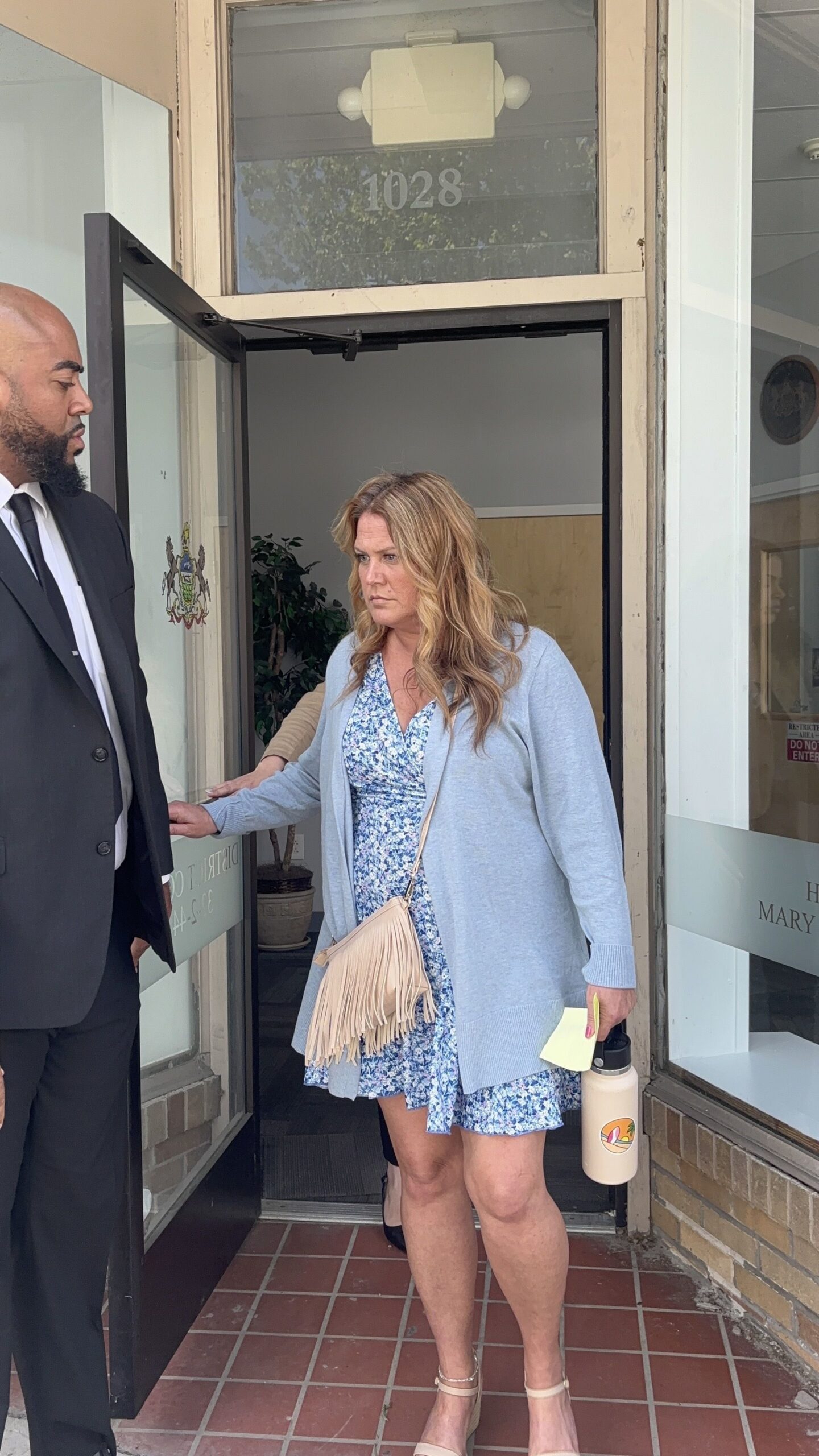
A private security guard holds the door open for alleged “Delco Pooper” Christina Solometo following her preliminary hearing Monday at Prospect Park District Court.
“Solometo said, ‘I wanted to punch her in the face, but I pooped on her car instead and went home,’” according to the affidavit.
I’ve written a lot of stories about Delco in my time, but this may be the most absurd.
Hopefully, she won’t be clogging up the court system anymore.
The Delco pope
Delco is large, it contains multitudes, and never was that more clear than when two weeks after the Delco Pooper case broke, a Delco pope was elected.
OK, so Pope Leo XIV is technically a native of Chicago, but he attended undergrad at Villanova University — which, yes, technically straddles Delco and Montgomery County — but Delco’s had a tough year so I’m gonna give it this one.
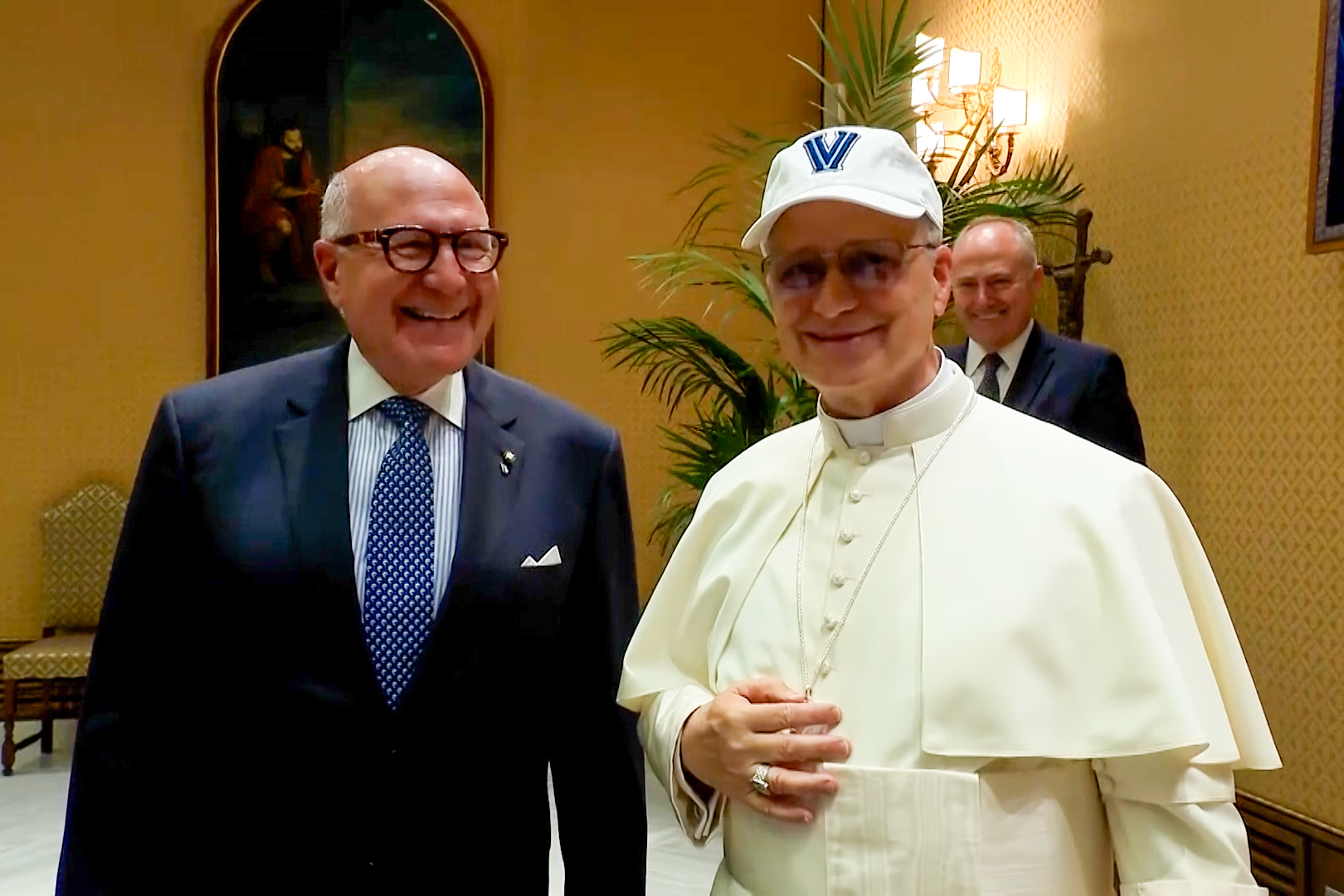
This video screen grab shows Pope Leo XIV wearing a Villanova University hat gifted to him during a meeting with an Italian heritage group.
Born Robert Prevost, Pope Leo is the first U.S. pope in history and also a citizen of Peru. He earned his bachelor’s degree in mathematics from Villanova in 1977 and an honorary doctor of humanities from the university in 2014.
Center City Sips, the Wednesday Center City happy hour program, long ago earned a reputation as a rite of passage for 20-somethings who are still figuring out how to limit their intake and want to do so in business casual attire.
Things seemed to calm down after the pandemic, but then Philadelphians took Sips to another level and a whole new place this year — the streets.
Videos showed hundreds of people partying in the streets of Midtown Village on Wednesday nights this summer. Granted, the parties look far more calm than when sports fans take over Philly after a big win, but the nearby bar owners who participate in the Sips program said their places sat empty as people brought their own alcohol to drink.
Jason Evenchik, who owns Time, Vintage, Garage, and other bars, told The Inquirer that “No one is inside, and it’s mayhem outside.”
“Instead, he claimed, people are selling alcohol out of their cars and bringing coolers to make their own cocktails. At one point on June 11,Evenchik said, a Tesla blocked a crosswalk while a man made piña coladas with a pair of blenders hooked up to the car,” my colleague Beatrice Forman wrote.
In no way am I condoning this behavior, but those two sentences above may be my among favorite this year. Who thinks to bring a blender — with a car hookup — to make piña coladas at an unauthorized Center City street party on a Wednesday night?
Philly.
Getting trashed
Philadelphians experienced a major city workers strike this summer when Mayor Cherelle L. Parker and AFSCME District Council 33 couldn’t agree on a new contract for the union’s nearly 9,000 members.
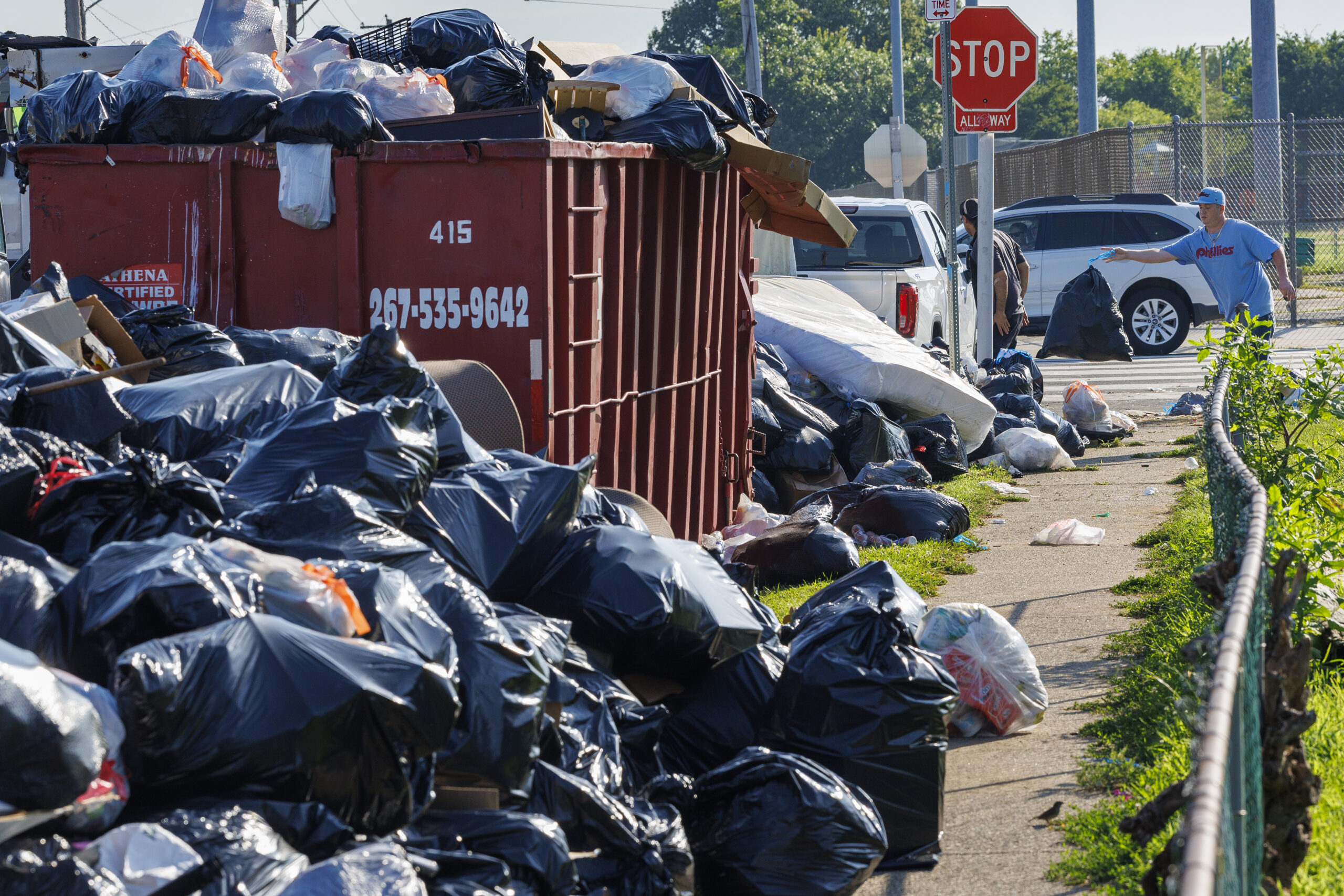
Residents with trash arrive at garbage dump site at Caldera Road and Red Lion Road in northeast Philadelphia during the AFSCME District Council 33 workers strike in July.
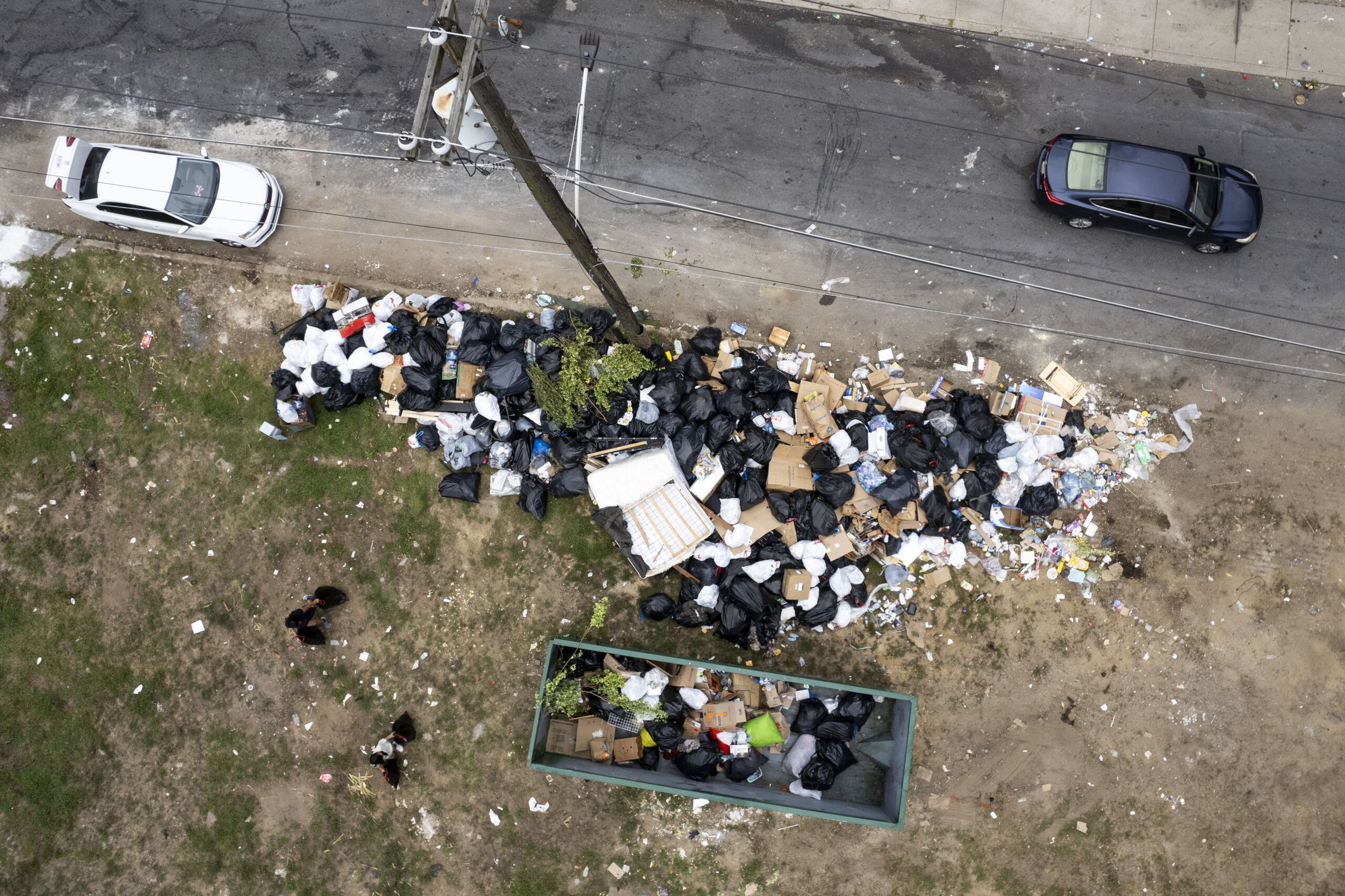
As a result, things got weird. Dead bodies piled up at the Medical Examiner’s Office; a striking union member was arrested for allegedly slashing the tires of a PGW vehicle; and for eight days in the July heat, garbage heaped up all across Philadelphia. The city set up temporary trash drop-off sites, which often overflowed into what were nicknamed “Parker piles,” but that also set off a firestorm about whether using the sites constituted crossing a picket line.
Wawa Welcome America July Fourth concert headliners LL Cool J and Jazmine Sullivan even pulled out of the show in support of striking workers, resulting in a fantastic “Labor Loves Cool J” meme.
It was all like something out of It’s Always Sunny in Philadelphia. In fact, the gang predicted a trash strike in the 2012 episode “The Gang Recycles Their Trash.”
The real strike lasted eight days before a contract was reached. In true Philly form, AFSCME District Council 33 president Greg Boulware told The Inquirer “nobody’s happy.”
A large pile of trash collects at a city drop-off site during the AFSCME workers strike this summer.
97-year-old gives birth to 16 kids
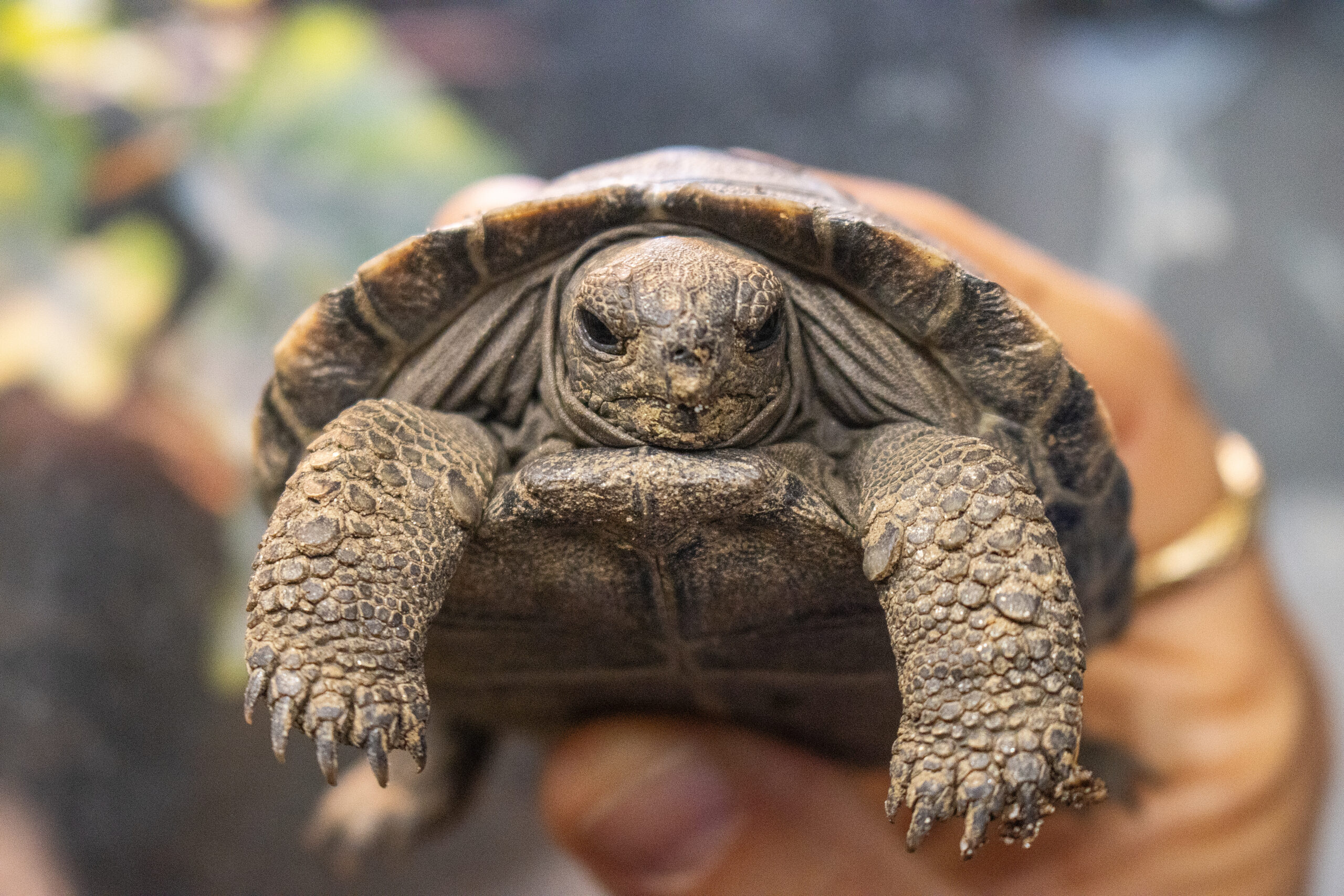
A local nonagenarian couple became national shellebrities this year for welcoming seven babies in April and nine more in August, proving that age ain’t nothing but a number, as long as you’re a tortoise.
Western Santa Cruz Galapagos tortoise Mommy, and male Abrazzo, left, are shown on Wednesday, April 23, 2025, at the Philadelphia Zoo in Philadelphia, Pa. The hatchlings’ parents, female Mommy and male Abrazzo, are the Zoo’s two oldest animals, each estimated to be around 100 years old.
Mommy and Abrazzo, Western Santa Cruz Galapagos tortoises who reside at the Philadelphia Zoo, made history with their two clutches, becoming the first pair of the critically endangered species in the zoo’s 150-year history to hatch eggs and the first to do so in any accredited zoo since 2019.
Mommy is also the oldest known first-time Galapagos tortoise mom in the world, so it’s safe to say she doesn’t have any time or patience for shenanigans. She’s got 16 heroes in a half shell to raise.
Western Santa Cruz Galapagos tortoise egg hatchling.
Phillies Karen
Taking candy from a baby is one thing — babies don’t need candy anyway — but taking a baseball from a kid at a Phillies game is a deed so foul and off base it’s almost unimaginable.
And yet, that’s exactly what happened at a Phillies-Marlins game in September, when a home run from Harrison Bader landed in the stands and a dad ran from his seat to grab it and give it to his son. A woman who was sitting near where the ball landed marched over to the dad, berated him, and demanded the ball be given her. Taken aback, the father reached into his son’s baseball glove and turned the ball over.
The entire scene was caught on camera and the woman, with her Kate Gosselin-esque hairdo, was immediately dubbed “Phillies Karen” by flabbergasted fans.
While the act technically happened at the Marlins stadium in Miami, Fla., it captured the minds and memes of Philadelphians so much that it deserves inclusion on this list. Phillies Karen has made her way onto T-shirts and coffee mugs, inspired skits at a Savannah Bananas game and the MLB Awards, and she even became a popular Halloween costume.
To this day, “Phillies Karen” remains unidentified, so it’s a safe bet she lives in Florida, where she’ll have better luck with alligators than with people here.
Institutional intrigue
Drama at area institutions this year had Philadelphians sipping tea like we were moms on Christmas morning, and sometimes, left us shaking our fists in the air like we were dads putting up tangled lights.
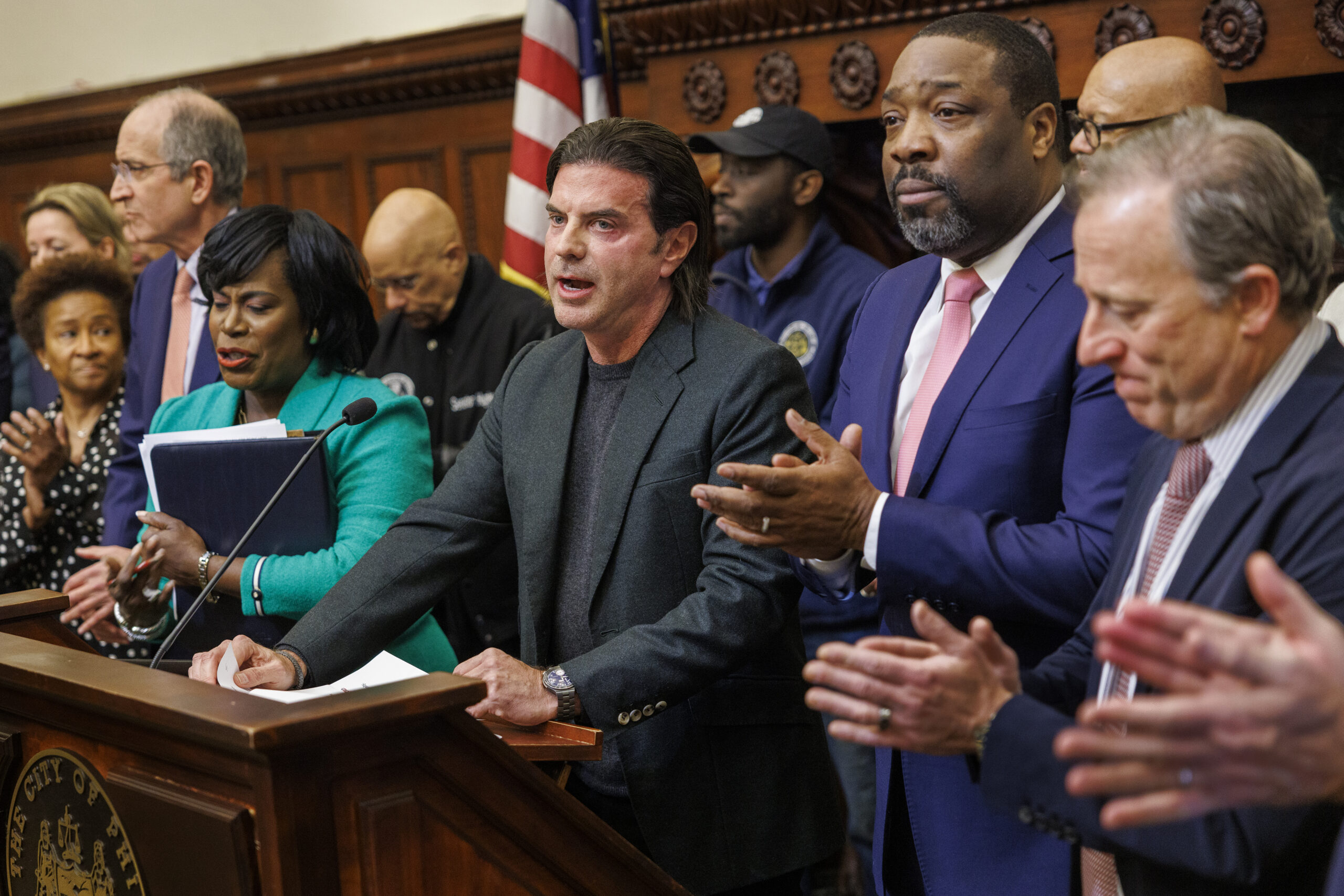
David Adelman with the Philadelphia 76ers makes a statement at a press conference in the Mayor’s Reception Room in January regarding the Sixers changing directions on the controversial Center City arena. At left is mayor Parker, at right City Council President Kenyatta Johnson and Josh Harris, Sixers owner.
It started early in January, when the billionaire owners of the Sixers surprised the entire city by announcing the team would stay at the South Philly sports complex instead of building their own arena on Market East. The decision came after two years of seemingly using the city, its politicians, and its people as pawns in their game.
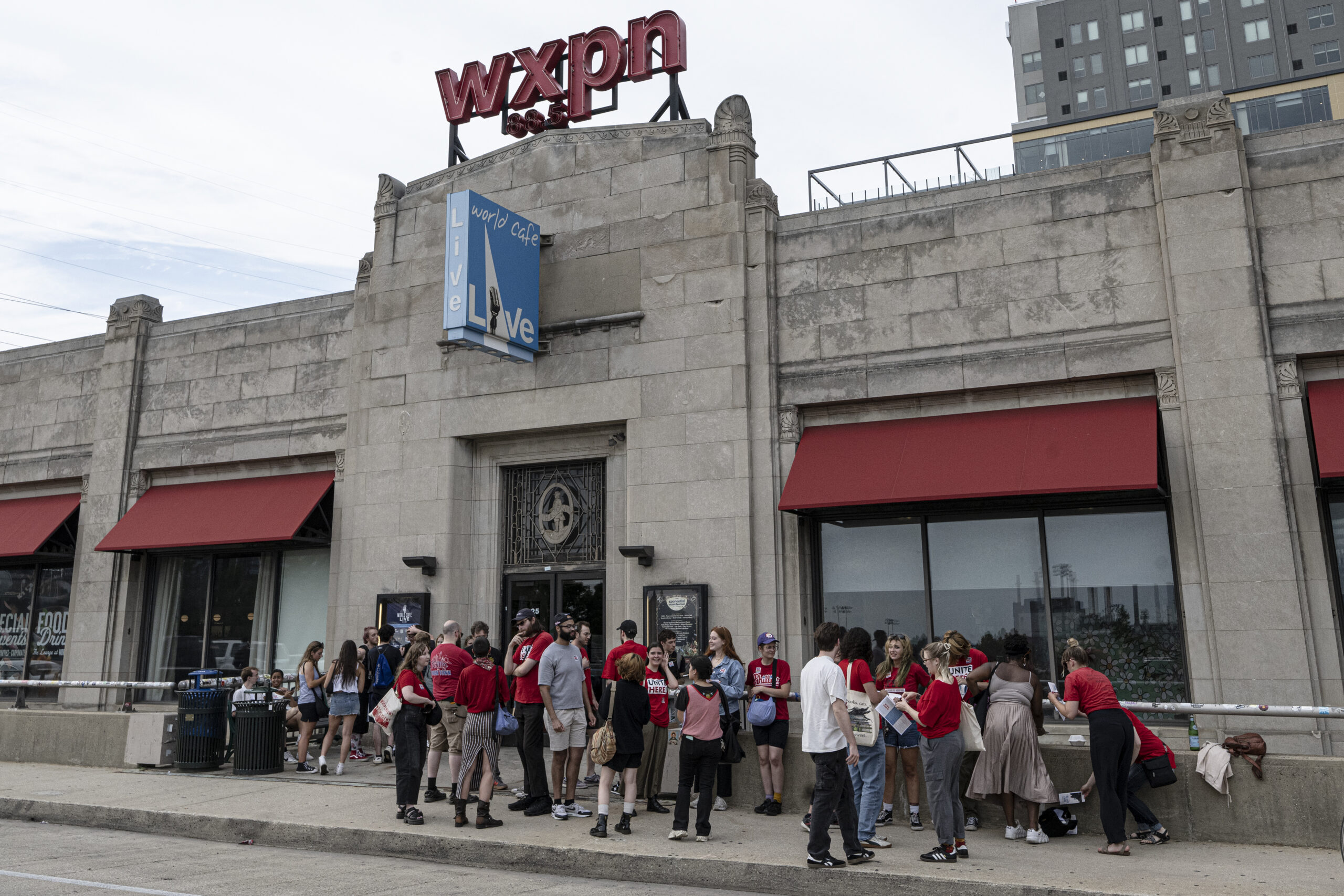
Workers gathered outside World Cafe Live before a Town Hall meeting with management in July.
In June, workers staged a walkout at World Cafe Live due to what they claimed was “an unacceptable level of hostility and mismanagement” from its new owners, including its then-CEO, Joseph Callahan. Callahan — who said the owners inherited $6 million in debt and that he wanted to use virtual reality to bolster its revenue — responded by firing some of the workers and threatening legal action. Today, the future of World Cafe Live remains unclear. Callahan stepped down as CEO in September (but remains chairman of the board), the venue’s liquor license expired, and its landlord, the University of Pennsylvania, wants to evict its tenant, with a trial scheduled for January.
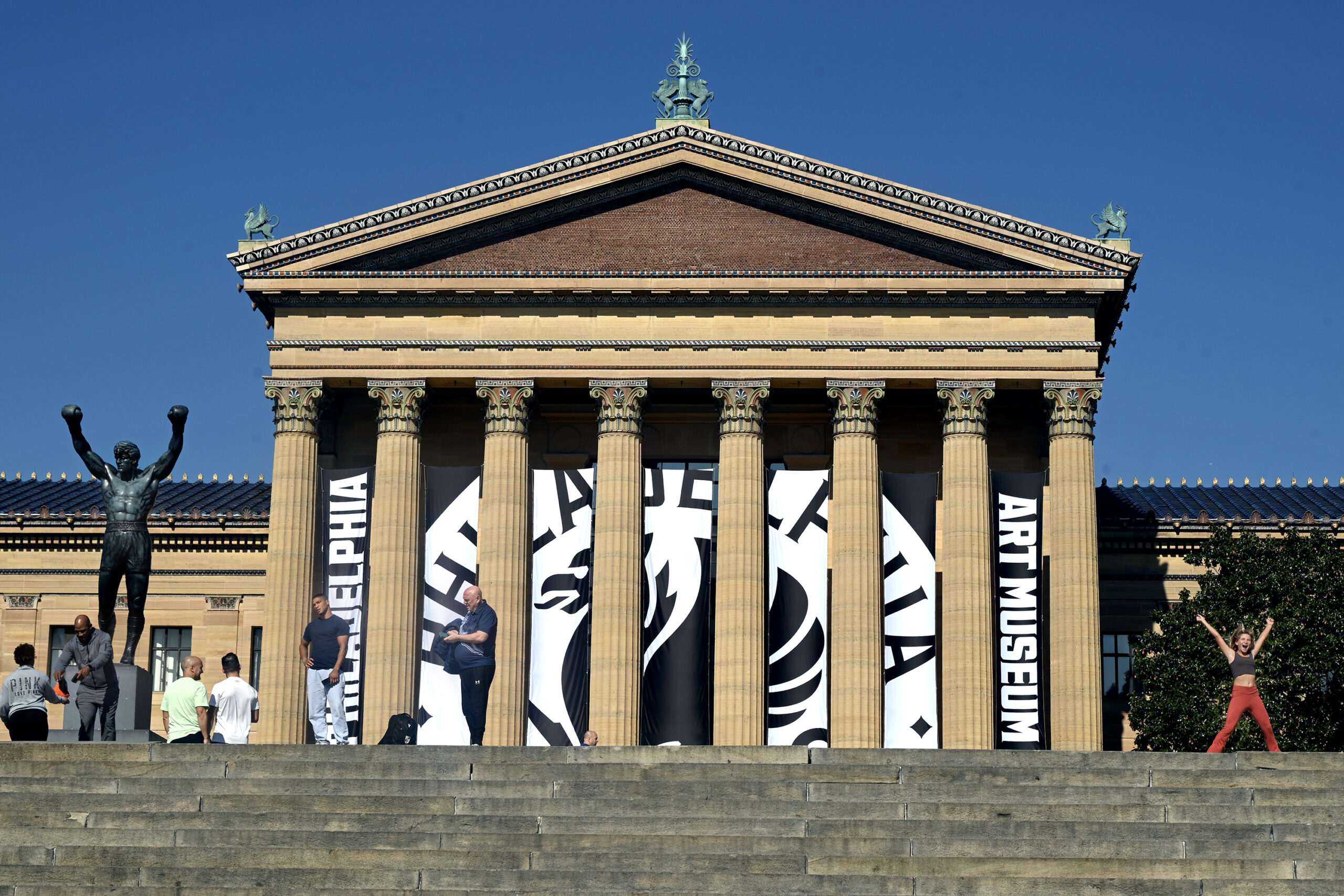
Signage at the east entrance to the Philadelphia Art Museum reflects the rebrand of the institution, which was formerly known as the Philadelphia Museum of Art.
Finally, late this year at the Philadelphia Art Museum, things got more surreal than a Salvador Dalí painting, starting with an institutional rebrand that surprised some board members, didn’t land well with the public, and resulted in a lot of PhART jokes. In November, museum CEO Sasha Suda was fired following an investigation by an outside law firm that focused, in part, on increases to her salary, a source told The Inquirer. Suda’s lawyer called it a “a sham investigation” and Suda quickly sued her former employer, claiming that “her efforts to modernize the museum clashed with a small, corrupt, and unethical faction of the board intent on preserving the status quo.”
Nobody knows where all of this will go, but it’s likely to have more drama than a Caravaggio.
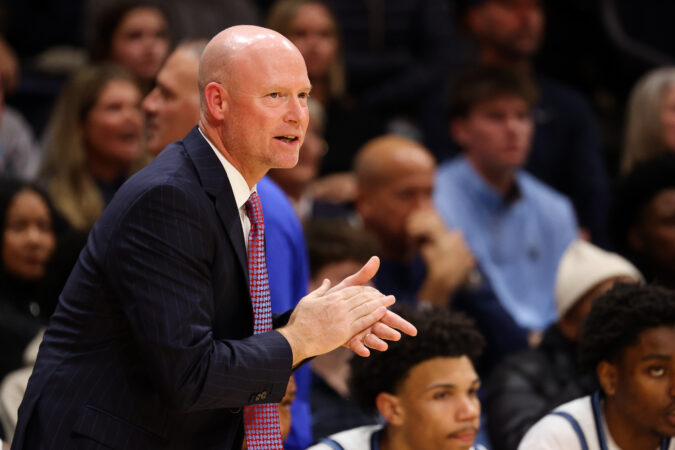
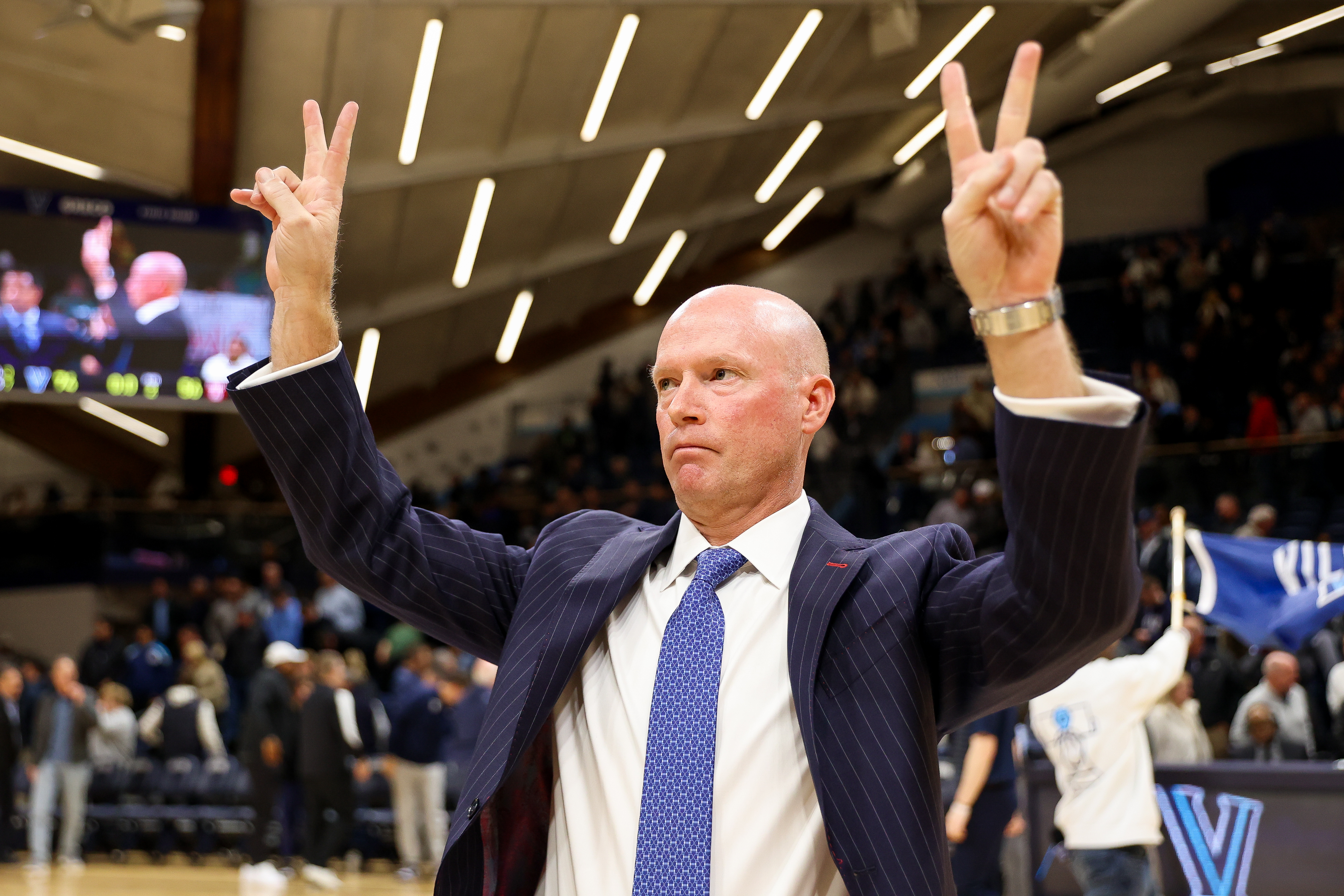
NEWARK, N.J. — More than an hour before the game, Kevin Willard was on and around the basketball court at the Prudential Center, the place he called home for 12 seasons as Seton Hall’s head coach.
The first-year Villanova coach, like most head coaches, normally is tucked away going over final game preparations while assistants get his players loose. But Willard was home. It was an emotional couple of days since the Wildcats arrived here Monday evening.
“This place helped raise my family in a very special way,” Willard said. The family saw the same security guards who used to carry his children — one now a college freshman, the other a high school senior — around after games.
Before tipoff, Willard embraced Seton Hall coach Shaheen Holloway, who coached under Willard for 11 seasons at Iona and Seton Hall. A video that played before the national anthem showed highlights of Willard’s tenure at Seton Hall, and the sellout crowd of 11,153 mostly responded with a nice ovation for the coach who left in 2022 for Maryland and returned Tuesday for his first game against his old program with one of its bitter Big East rivals.
The show at that point was over. “Walking out, once I got out, we got to win a game,” Willard said.
It was a sloppy-at-times Big East fight during the first half, but Villanova used an emphatic 16-0 run early in the second half and pulled away from Seton Hall in a 64-56 victory that wasn’t as close as the final score suggested. Villanova led by as many as 20 midway through the second half.
Kevin Willard spent 12 seasons from 2010 to 2022 with Seton Hall before taking a job at Maryland.
The Big East opener was a matchup of teams off to hot starts. Willard’s Wildcats improved to 10-2 and handed Seton Hall (11-2) its second loss of the season.
The Wildcats entered Tuesday ranked 30th in the NCAA’s NET rankings, and they shot up to 20th on Wednesday morning after winning their first Quad 1 game of the season. By 10 p.m. Tuesday, the metrics site KenPom had Villanova ranked 24th. Seton Hall was just outside the Associated Press Top 25 this week. The Pirates were 27th, based on ballot points. Surely, Villanova will be in the conversation to be ranked for the first time since November 2023 next week.
The Wildcats’ two losses are to then-No. 8 BYU and No. 2 Michigan. They hit the holiday break with a home victory over Pittsburgh and road wins at Wisconsin and Seton Hall.
“We’re trending in the right direction,” Willard said. “I like the fact that no one’s really talking about us.”
They are now. It was a light day on the college basketball calendar, and, given Seton Hall’s surprising start to the season and Willard making his return to Newark, there were plenty of eyeballs watching Villanova pass the eye test.
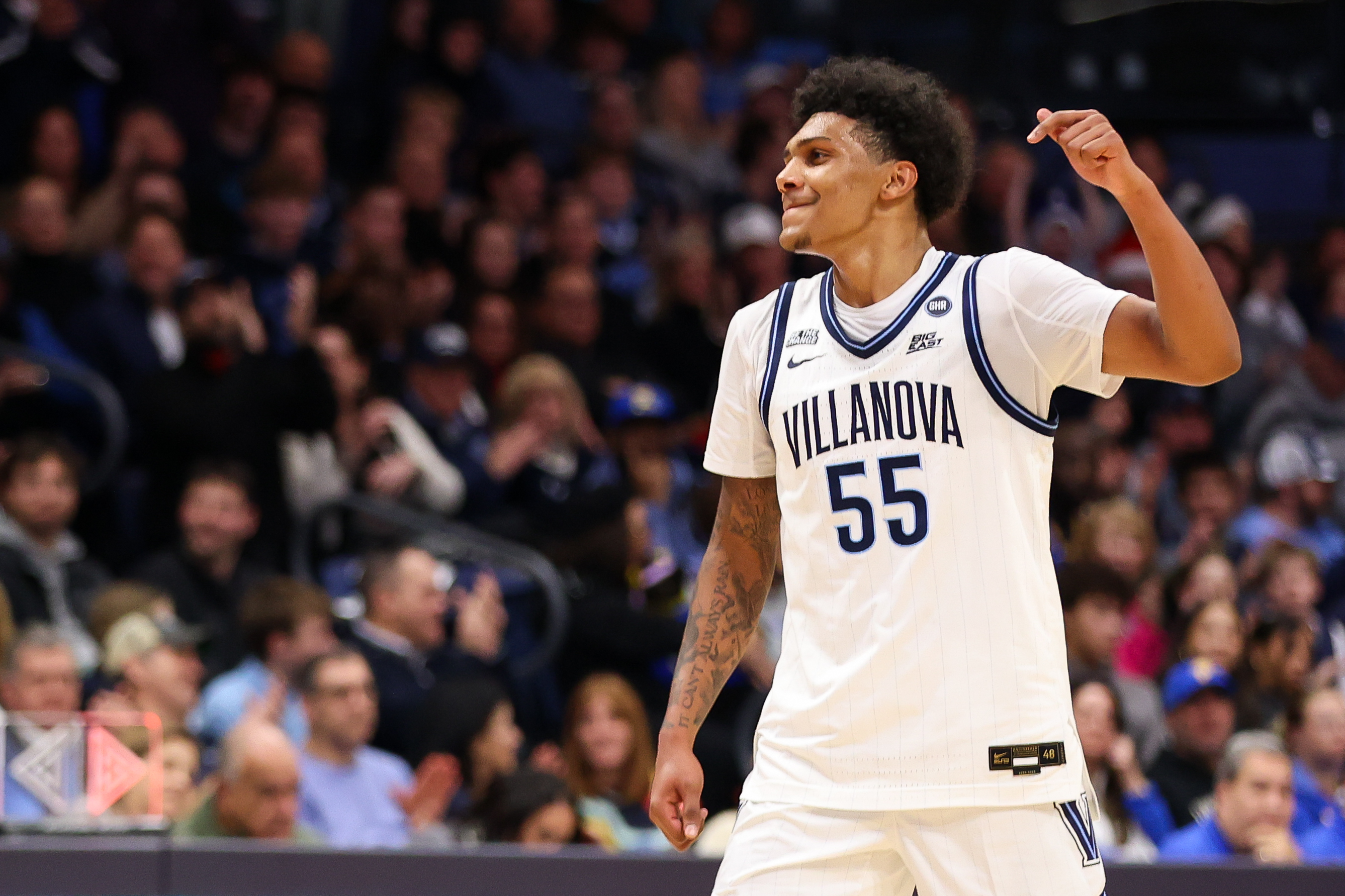
Freshman point guard Acaden Lewis “controlled the game,” Holloway said, after he led all scorers with 16 points on 6-for-11 shooting to go with five rebounds, two assists, and three steals (to cancel out three turnovers) in a season-high 37 minutes. Redshirt freshman Matt Hodge added 12 points and six rebounds, and redshirt sophomore Bryce Lindsay scored 15 points on nine shots.
The night was far from perfect for Villanova. The Wildcats turned the ball over 18 times and had trouble with Seton Hall’s press after the lead ballooned late in the game. They allowed 16 offensive rebounds and had just eight of their own.
Villanova freshman guard Acaden Lewis played a season-high 37 minutes in a 64-56 win over Seton Hall on Tuesday night.
But Villanova had an answer every time Seton Hall pushed back in the second half. Devin Askew hit a three-pointer to push the lead back to 17 (50-33). Hodge put back a Lewis miss with just over eight minutes to play that stopped a 6-0 Seton Hall run and bumped the lead back to 16. The Pirates then cut their deficit to 13 before Lindsay made a three-pointer. He made 3 of 7 attempts on the night.
“We’re battle-tested,” Willard said. “We played BYU on the road, Michigan on the road, Wisconsin on the road, three Big 5 games … so I have a lot of confidence in the fact that our guys have played against a lot of good teams.”
Villanova overcame its struggles because of its defense. Willard said the game plan was to make dynamic Seton Hall point guard Adam “Budd” Clark, a West Catholic graduate, be a scorer and not a “sprayer.” The Wildcats, who utilized a zone defense, forced him into tough spots and limited his driving opportunities. He also was limited to just five minutes in the first half because of foul trouble, and Seton Hall’s offense was disjointed without him. Clark finished 1-for-11 from the floor, and Seton Hall converted just 33.3% of its shot attempts.
The Pirates were 15-for-30 on what were considered layups by the official stats, but the majority of their shots were well-contested. The 16-0 run happened mostly because of Villanova’s active hands, which forced steals and easy transition buckets.
Earlier in the season, defense was one of Willard’s major concerns. It recently has become a strength. Why? Lewis said physical practices where fouls aren’t called have translated into higher-intensity stretches of defense during games.
Villanova returns home on New Year’s Eve for a game vs. DePaul (8-5). But first, a few days off to celebrate the holiday, a break that got a little merrier with Tuesday’s win.
“We’re trending up,” Lewis said. “Since that Michigan game, we really locked in and built with each other. [Michigan] showed us there’s levels, and we’re building up to that level to see them again when March comes around and we want a different look when that happens.”
After Tuesday, playing meaningful basketball in March seems like a real possibility.
Haverford College senior Jackson Juzang earlier this year had been talking to a school administrator about the need for more resources to support student journalism.
The administrator, Chris Mills, Haverford’s associate vice president for college communications, asked if there was a network of student newspaper journalists in the region that Haverford could join and seek support from.
There wasn’t.
“So I decided to create one,” said Juzang, 22, an English major from Pittsburgh who serves as associate editor of the Clerk, Haverford’s student newspaper.
Jackson Juzang explains why he started the Philadelphia Student Press Association.
He established the Philadelphia Student Press Association as a nonprofit and created a board with student editors from 11 college news organizations around the region, including Temple, Drexel, Villanova, St. Joseph’s, La Salle, Rowan, Rutgers-Camden, Bryn Mawr, Swarthmore, Haverford, and Eastern.
With the slogan “Rooted in Philly, Reporting for All,” the group — which collectively represents about 400 student journalists — is seeking funding from organizations to support student journalism at a time when college budgets are tight and the news industry faces challenges, including rising print costs and lower readership. The association already has held workshops with more planned next year, and its 21-member board meets monthly and discusses common issues and problems and brainstorms solutions.
“We have so many people coming from different regions, but we are united in the sense that we are all here for the same reason,” said Claire Herquet, an editor at the La Salle Collegian.
At a recent meeting, members talked about artificial intelligence and what to do if an editor suspects a student writer used it, Herquet said. There were two instances over the past semester when she read an article submission and thought the terminology and phrasing didn’t sound like the writer, she said.
“If I didn’t have PSPA, I wouldn’t have people to lean on,” said Herquet, 21, a junior communications major from Camden. “It would just be me versus the problem.”
Herquet manages communications for the association. She has been reaching out to foundations about obtaining grant funding for the association. Some college newsrooms are better funded than others and can give writers and editors stipends.
She’s hopeful that uniting the newsrooms will result in better experiences for students and more funding.
La Salle’s publication is only digital; there is no print version. Costs are minimal, but funding would cover professional workshops for students and costs, such as travel, associated with their reporting.
The Whit, Rowan University’s student news site, prints a newspaper once a week and receives financial support via student government, but print costs are rising, said junior Katie Thorn, who serves as managing editor.
“We’re trying to figure out with the budget we have if it is possible and what we are going to have to sacrifice to keep our paper printing,” Thorn said.
Thorn, who is serving as treasurer for the association, said it’s been helpful to learn that other student organizations are facing the same challenges.
“Journalism as a whole is such a scary world right now,” said Thorn, 20, a journalism major from Mantua, Gloucester County, “and you’re kind of throwing yourself into the fire. Am I going to find a job? Where does my future lie? Having people who support you and uplift you is a great thing.”
Haverford’s student newspaper has received funding via the president’s office and is able to pay its writers, Juzang said. In January, the Clerk will publish its first print edition.
But the Clerk would like resources for deeper reporting and investigative work and mentorship, he said.
Juzang, who hopes to pursue a graduate degree in communication management next year at the University of Southern California, said he’s invested thousands of dollars of his own money to get the association started. He currently works as a research/editorial intern for NBC Sports.
He said the association also has received support from the Philadelphia-based Foundation for Individual Rights and Expression.
Juzang said he would like to help schools, including Widener and Lincoln, that used to have student news sites revive them. He also has begun talking to student journalists in other metro areas, including Washington, Boston, New York, and Baltimore, about starting an association for their university newsrooms, he said.
Mills, the Haverford communications administrator, was pleased to see Juzang take that conversation the two had last March and create a mechanism for student journalists to share their experiences and learn from each other.
“It’s really important for the students to share resources and knowledge and wisdom,” he said. “For those of us who value student journalism, it’s great to see them prioritizing this and making the time to do it.”
There was no time Aaron Ball enjoyed more than being in victory formation on the football field, and 16 years ago Thursday was particularly special.
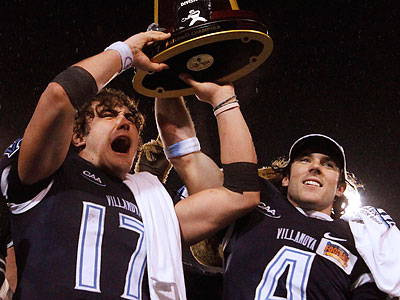
The former Villanova running back, now living just outside of Virginia Beach, Va., still has fond memories of the program’s only FCS championship victory, a 23-21 win over Montana on Dec. 18, 2009.
“When [it was] the fourth quarter and the time was running out, and we’re in victory formation‚” Ball told The Inquirer, “it was just an incredible feeling. Just thinking about the moments we had, like after the game in the locker room and going crazy, the trophy and everything. That whole experience was incredible.”
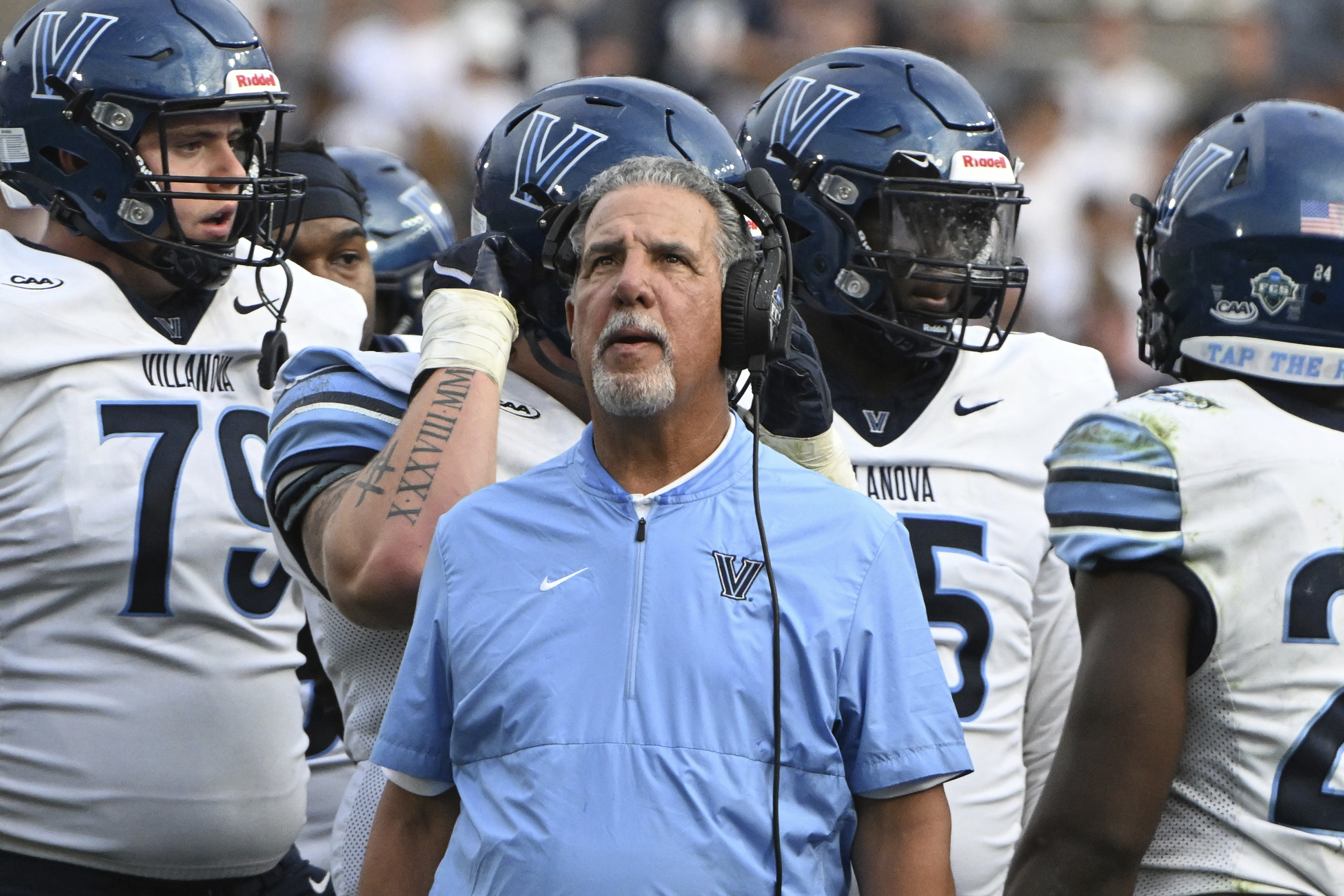
The Wildcats, now led by Mark Ferrante, who was assistant head coach under Andy Talley on that 2009 team, are one game away from being back in the national championship game.
After a comeback victory in the FCS quarterfinals against Tarleton State, Villanova will host Illinois State in the semifinal (7:30 p.m., ESPN2) on Saturday, the team’s first home game this late in the playoffs since the 2009 team narrowly defeated William & Mary, 14-13.
Like that 2009 team, this year’s squad suffered an early CAA loss and went on a lengthy winning streak. Former quarterback Chris Whitney, a St. Joseph’s Prep graduate who was the team’s leading rusher in 2009, believes there is an uncanny resemblance between his team and this year’s group.
“I feel like there’s a lot of similarities. The defense is really good, and they’ve shown that in the last three games in the playoffs, playing against three top teams in the country,” Whitney said. “And then you flip to the offensive side, they have a great three-headed running game. … Even down to the running backs, very similar to our running backs, Angelo Babbaro and Aaron Ball.
“Then, from a quarterback perspective, [current starter Pat McQuaide] is taking care of the ball.”
Brandyn Harvey helped Villanova upset Temple at Lincoln Financial Field in 2009.
‘We never felt like anybody could beat us’
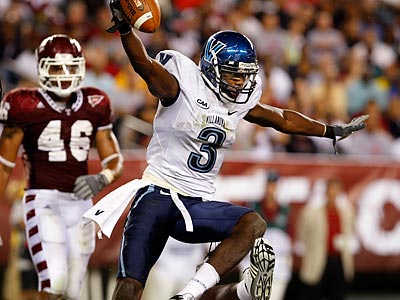
Former wide receiver Brandyn Harvey knew something special was afoot when Villanova went to Lincoln Financial Field and beat Temple by three points to open the 2009 season.
Harvey, the team’s leading receiver that year who is now living in Los Angeles, said that “beating Temple was more fun than beating Montana,” because of the back-and-forth the two schools had that summer leading up to that August matchup.
“It put us on the right trajectory to just finish and be successful throughout the rest of the season,” Harvey said.
Former tight end Chris Farmer, a West Catholic graduate, added: “I know we all thought that we could beat Temple, which would have been a [FBS] school at that point. So once we did that, I think our confidence got rolling a little bit more. And we just took it from there.”
Ball, though, had a different perspective on when he knew Villanova could be a championship team.
After Villanova lost to New Hampshire on Oct. 10, the former running back, who finished with 794 rushing yards in 2009, third-most on the team, thought the team was “overlooking our opponents.”
“After that game, it was a big turnaround for us,” Ball said. “[We were] just doing a little bit too much, and needed to settle in. And then the next game, we bounced back [beating James Madison, 27-0]. And I was like, ‘OK, we’re actually a pretty good team.’ When I’m comparing ourselves to other teams and where they’re at and where we’re at. And I was like, ‘Man, you really can kind of do something special with this team.’”
For Farmer, who started his career at defensive line and switched to tight end as a junior, what stood out most to him was the talent and the “great camaraderie” that 2009 team had. Everyone hung out with each other, Farmer said, and outside of having class, the “locker room was always filled.”
And the one common trait that Whitney, Harvey, Ball, and Farmer agreed that the team had back then? Perseverance.
The 2009 college football season was perhaps the most successful in Philadelphia history. Penn won the Ivy League, Villanova won the FCS national championship and Temple reached a bowl game for the first time in 30 years.
“We always felt like we were supposed to win, especially at that point in the season,” Farmer said. “So in those playoff games when we were down, just leaning back into the camaraderie, everyone kept their energy going. [The] sidelines never got disappointed or [had their] heads down. I think that camaraderie probably carried us through, to be honest.”
Added Harvey: “We may have been out of a possession, but we never felt like we were out of the game. We never felt like anybody could beat us at the end of the day, like we were just very confident. I wouldn’t say we were cocky, but we were just very confident, just in ourselves, just based off the work that we put in, because we know how hard we work, especially in the summer, and all that just carried over and translated to the season.”
‘Coach Ferrante was the president’
The offensive line and assistant head coach on that 2009 team is the same coach who leads Villanova now: Ferrante, now in his 38th year with the program.
While Talley led the program during the first 29 years that Ferrante was with the program, it was the latter whom players say was key in getting them to play on the Main Line. Ferrante was the local recruiter for both Whitney and Farmer, as both played in the Catholic League.
Both worked closely with the offensive line — Farmer at tight end, Whitney at quarterback — and each agreed that Ferrante’s impact on the team was apparent.
“He served, as I would say, a father figure to a lot of guys on the team,” Farmer said. “Honestly, he was — if coach [Talley] was the chairman or CEO, then coach Ferrante was the president, making sure everything was up to speed and running the way Coach T wanted it.
“He put a lot of time, a lot of sweat into the program, you know, to be honest, man, so to see him finally have the opportunity to take the reins … and quickly getting the program to be successful, it’s really cool.”
Added Whitney: “I have a special place in my heart for Coach Ferrante, frankly. … To talk about a guy who is deserving, putting in his time [for 29] years as an assistant, with the same program putting in that time to then get his chance as a head coach and get a chance to to reach the top of the mountain. I would love nothing more than that for him.”
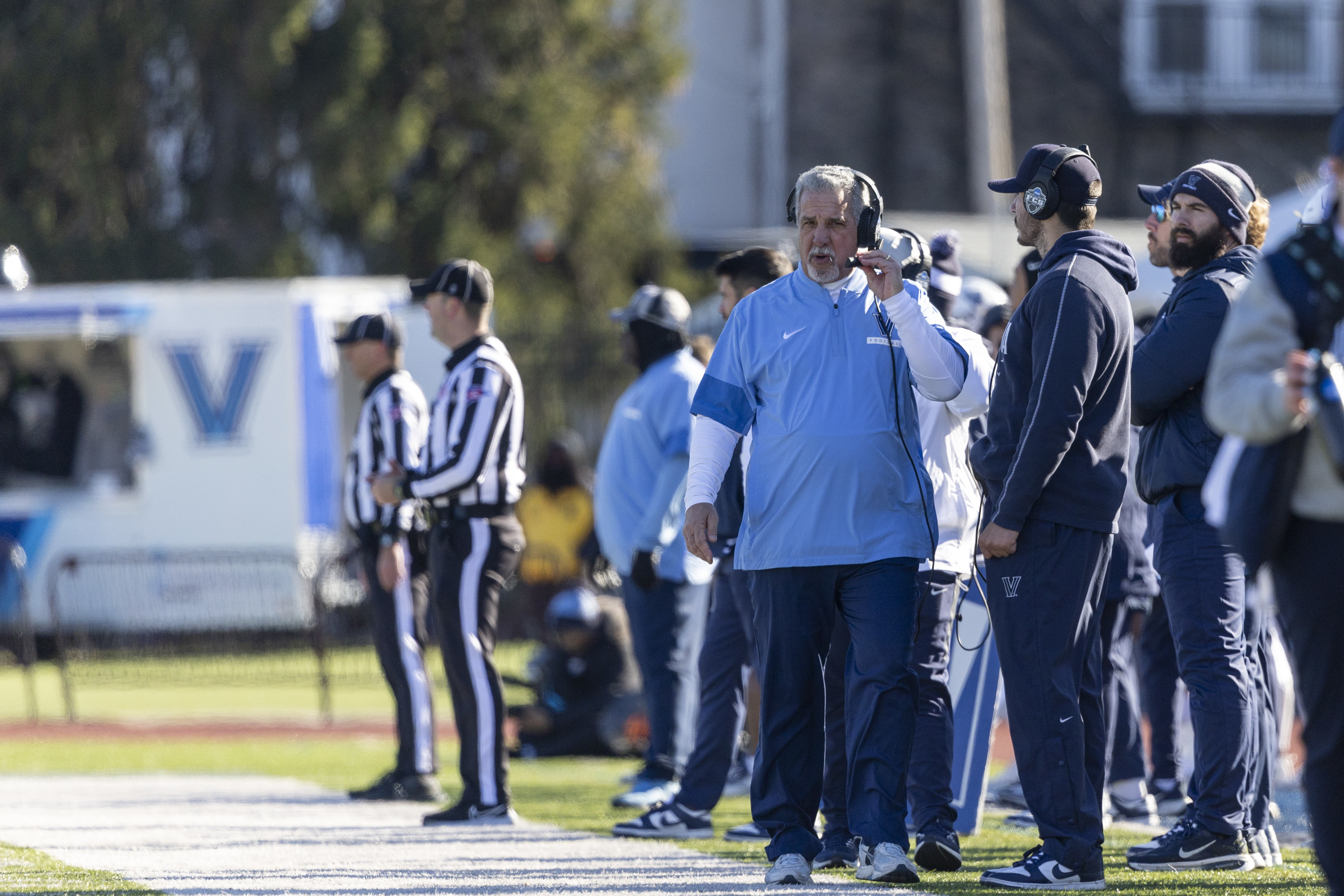
Villanova coach Mark Ferrante on the sidelines during its game against Harvard on Nov. 29.
College football has changed plenty in the 16 years since Villanova’s last football title, including the transfer portal and Name, Image, and Likeness to name a few, though the latter doesn’t affect the FCS level as much. But Harvey says his 2009 team only had a handful of transfers, none of whom started on their team, compared to this year’s Villanova team, which starts a transfer quarterback, wide receiver, and has a few other rotational defensive players who transferred in.
While the culture in college football is different now, Harvey points to the transfer portal as a positive development to the competitiveness of the FCS level.
“I feel like the portal has really impacted the FCS level. I was thinking about this last week, watching a couple of games and just seeing where some of the players came from. I think when I was playing, I don’t know if it was our culture, but we didn’t really accept transfers,” Harvey recalls. “Players literally come from everywhere, no matter the level. … I know people tend to knock [the] FCS, but it’s also competitive level as well.”
Added Whitney: “For Pat [McQuaide, a Nicholls State transfer] to come in the spring, and a lot of those guys coming in the spring and meshing as well as they have, it’s a credit to them. It’s also a credit to coach Ferrante. I mean to get these kids to bond so quickly and play together is pretty tough, but it is obviously the new norm in college football.”
The years in between have looked different for each former player, but the love for their alma mater remains the same. Spread from coast to coast, they still keep in touch with former teammates, tune in to watch Villanova’s football games, and share various memories from that title team with their children.
They will all be watching this weekend. Harvey and Ball plan on making the trip to the title game if Villanova beats Illinois State.
And speaking of common threads, here’s one more: the 2009 team won the FCS title game in its final year in Chattanooga, Tenn., and this year’s championship game will played in Nashville, Tenn., after a 16-year stint in Frisco, Texas.
Pennsylvania’s fledgling State Board of Higher Education on Thursday rolled out itsfirst strategic plan, setting goals addressing affordability, increased degree attainment, the state’s workforce and economic development needs, and the fiscal health of colleges.
The board voted unanimously to post the 10-year plan for public comment.It will consider adoption in February.
“The plan will strengthen partnerships, break down silos, and enable effective reinvestment in the sector,” Cynthia Shapira, chair of the board, said in a statement introducing the plan.
It comes as the sector faces perhaps its greatest challenge in decades. Both private and public universities have been losing enrollment as the number of high school graduates falls — with another dip beginning next year and a 12% decline expected in Pennsylvania by 2037. Public trust in colleges has faltered, while concerns about cost and student debt have mounted.
They are also facing scrutiny from President Donald Trump’s administrationand a forecasted gap in workers who require a postsecondary credential in essential areas, such as healthcare, teaching, and advanced manufacturing.
The Pennsylvania State System of Higher Education, which oversees the state’s 10 universities, endorsed the plan’s emphasis on collaboration across private and public colleges and universities.
“Within our own system, we have learned that when universities work together, they can innovate, overcome challenges and better serve students and the Commonwealth,” the system said in a statement. Shapira is also the chair of PASSHE’s board.
The 21-member higher education board includes college presidents, administrators, legislators, and students.It was formed in 2024 by the governor and General Assembly to help public and private colleges work more cohesively and better serve students and the state’s workforce needs. The plan rollout follows public hearings that drew comments from more than 1,200 people, the board said.
The plan outlines the challenges facing the higher education sector including another coming decline in the high school population, financial constraints, and the lack of coordination among institutions. Student debt averages more than $40,000 per student in Pennsylvania, the plan notes.
“Multiple comparative state-level analyses … place Pennsylvania at or near the bottom in terms of affordability, attainment, and state investment per capita,” the report stated. “Adding to these challenges are a large and growing postsecondary workforce credential gap, and a range of closures and mergers that threaten to reduce access to postsecondary education.”
In the Philadelphia region, Cabrini University and the University of the Arts closed in 2024 and Rosemont College announced earlier this year that it would cease operations in 2028 and that Villanova University would purchase its campus. Salus University was merged into Drexel University. Six of Pennsylvania’s state universities were merged into two entities in 2022, and St. Joseph’s University absorbed the University of the Sciences the same year.
Other local colleges have struggled with enrollment declines and deficits. Temple University, for example, has gone from more than 40,000 students in 2017 to less than 30,000 this year.
What are the specific goals in the plan?
The new plan set six goals:
Increase postsecondary attainment.
Ensure affordable pathways to postsecondary credentials.
Support the economic development needs of the state.
Support the workforce development needs of the state.
Ensure accountability and efficient use of state funds.
Strengthen the fiscal health and stability of the higher education sector.
How will the board work toward those goals?
To meet the goals, the board proposes a “strategic communications plan” that touts the benefits of postsecondary education and how it impacts employment outcomes.
It also emphasizes expanding funding for dual credit programs and enrollment in those programs to streamline the path from high school to college and allow students to accumulate more credits before they graduate high school. In addition, the plan proposes studying how to improve retention rates and focusing on reenrolling adults who started college but didn’t finish; there are more than 1.1 million Pennsylvanians with some college experience.
Among its plans for addressing affordability are support of policies that “expand financial aid and forgive debt for in-demand, high-quality credentials,” take advantage of new federal Pell grants for workforce programs, and boost access to “open educational resources” to reduce the cost of course materials.
The report also discusses the intent to “maximize the impact of research universities,” recruit out-of-state students to broaden the talent pool, and increase access to paid work experiences for students.
To promote fiscal health, the plan recommends identifying and promoting best practices for fiscal efficiency and cost savings, and developing resources and an advisory group to help financially struggling colleges.
“If institutions decide to close or merge, tools and expertise to assist in this process will help maximize savings, retain access to critical academic programming, and mitigate negative effects on students and communities,” the plan states.
Another advisory group is recommended to help communities where colleges close maintain access to postsecondary education.
What comes next?
After the public comment period and the plan’s final adoption, the board intends to report annually on progress toward the goals and to consider revisions to the plan every five years.
By advancing to the FCS semifinals for the first time since 2010, Villanova gets to continue a successful 2025 season on its home turf as it hosts Illinois State on Saturday (7:30 p.m., ESPN2).
The No. 12 seed Wildcats and unseeded Redbirds have piled up upset victories to find themselves with a national championship game appearance on the line.
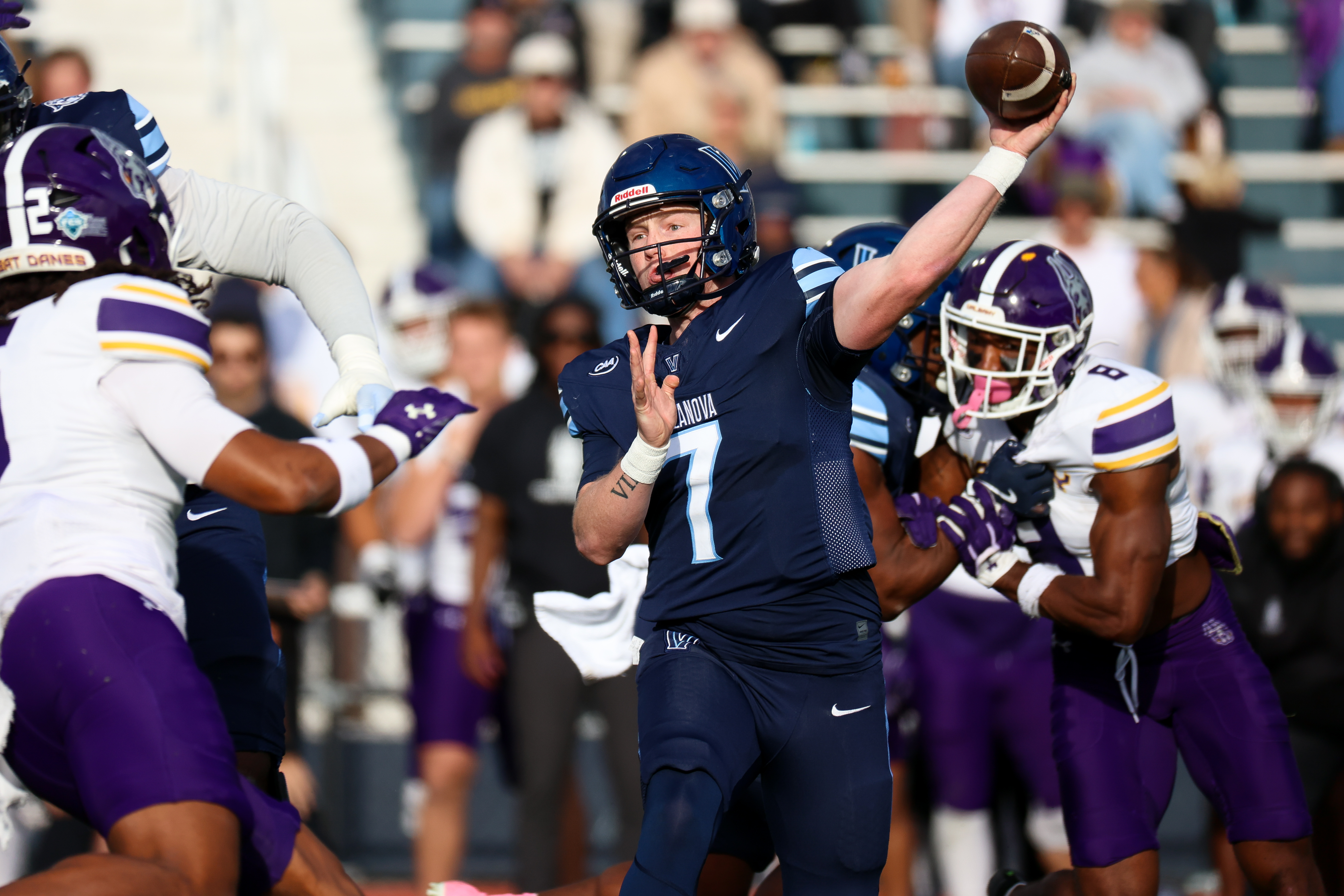
Villanova (12-2) is coming off a 26-21 road win over No. 4 seed Tarleton State. Villanova’s defense slowed down Tarleton, the top scoring offense in the FCS. The Wildcats rallied from a 14-0 deficit as graduate quarterback Pat McQuaide passed for 180 yards and one touchdown. Freshman wide receiver Braden Reed threw a touchdown pass of his own and had the game-winning touchdown catch in the fourth quarter.
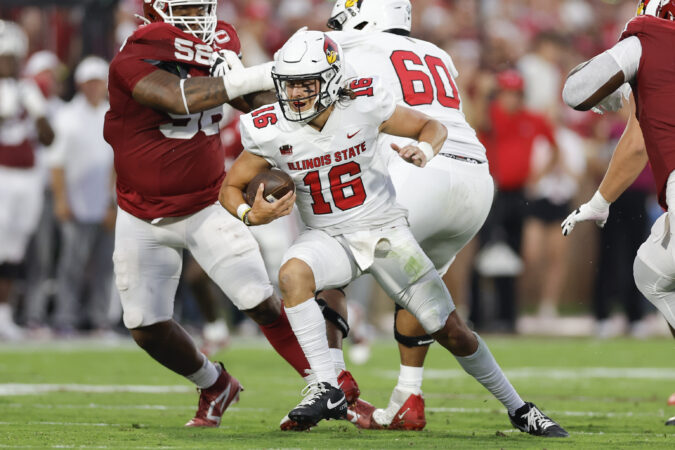
Meanwhile, Illinois State (11-4) headed to the West Coast and took down No. 8 seed UC Davis, 42-31. Senior quarterback Tommy Rittenhouse led the way with 266 passing yards and three touchdowns.
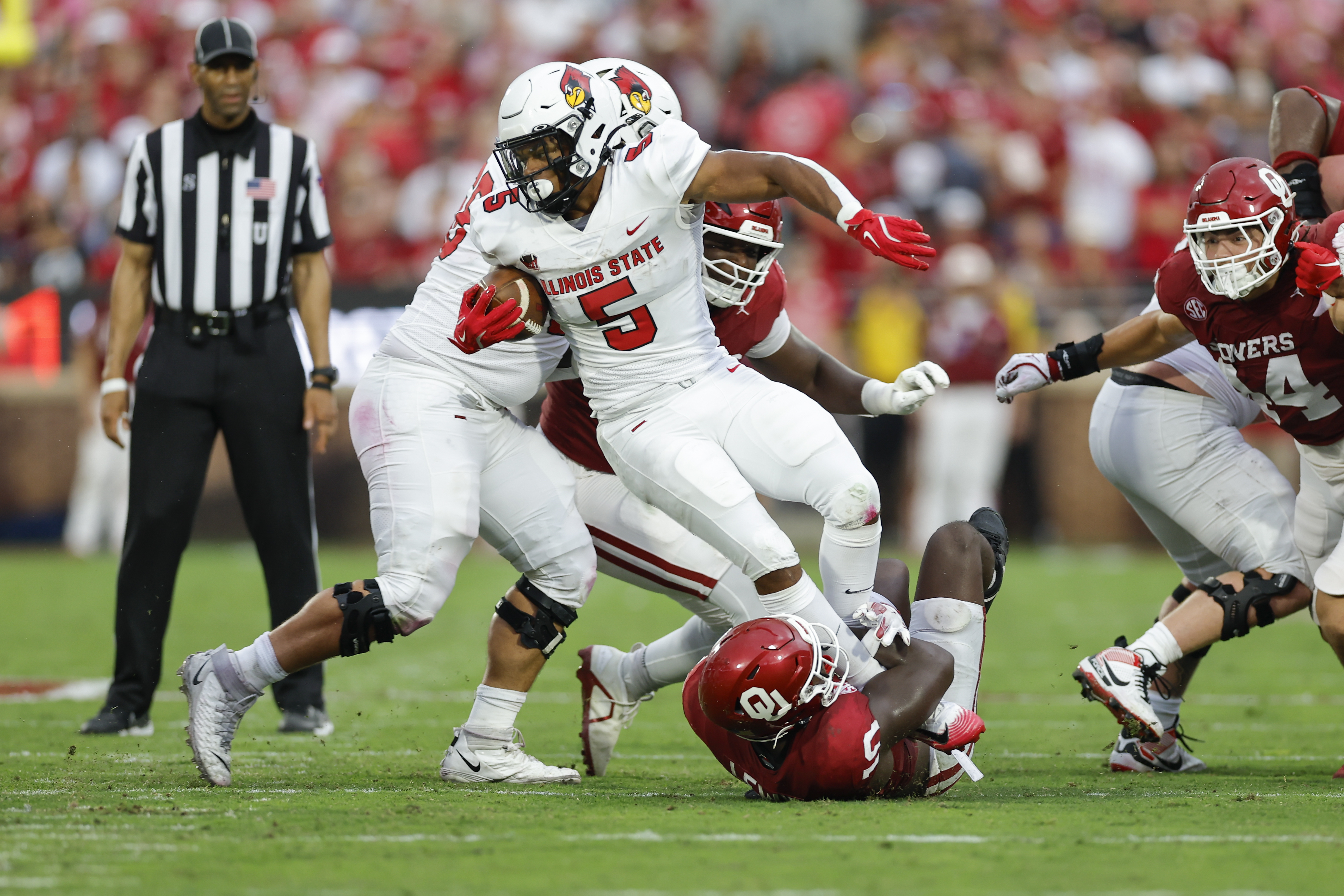
Illinois State running back Victor Dawson (5) has posted back-to-back 100-yard rushing games.
Get to know Illinois State
Illinois State will be making its first FCS semifinal appearance since 2014 and its third in program history. It has been a historic playoff run for the Redbirds, from upset wins to school records broken, under head coach Brock Spack, who’s in his 17th season.
Illinois State finished third in the Missouri Valley Football Conference and lost, 37-7, to Southern Illinois to end the season. But the Redbirds bounced back, starting with a 21-3 victory over No. 16 seed Southeastern Louisiana in the first round of the playoffs.
Illinois State’s most impressive victory of the season came as it slid by defending champ and No. 1 seed North Dakota State, 29-28, in the second round. The Redbirds secured the comeback win over the 10-time FCS champions by means of a two-point conversion with a minute left.
The Redbirds have been unfazed when playing in enemy territory, as each of their three playoff wins have been on the road. Illinois State has won eight consecutive away games against FCS opponents.
Pat McQuaide (7) will try to deliver Villanova to the FCS final playoff round for the first time since the Wildcats won it all in 2009.
Quarterback battle
Rittenhouse has been playing some of his best football of the season during the playoffs. With his performance last weekend, Rittenhouse surpassed 3,000 passing yards this season. In his second season as Illinois State’s starter, Rittenhouse is averaging 200.4 passing yards per game, with a 66% completion rate.
Rittenhouse and senior wide receiver Daniel Sobkowicz have become a dangerous duo, connecting on a 93-yard touchdown at UC Davis. Sobkowicz now holds school records for career receptions (250) and for touchdowns in a single season (16).
In his first season as Villanova’s quarterback, McQuaide, a Nicholls State transfer, is averaging 208.9 passing yards per game with a 60% completion rate. While McQuaide has rushed for just 10 yards this season, Villanova has leaned on its powerful run game and experienced offensive line.
Sophomore running back Ja’briel Mace has been McQuaide’s primary option, running for 151 yards and one touchdown at Tarleton State. He leads the team with 887 rushing yards this season.
Mark Ferrante’s team has shown discipline in avoiding turnovers this season.
Limiting miscues
Avoiding preventable errors will be crucial in Saturday’s matchup.
Last Saturday’s win over Tarleton State was uncharacteristically messy for Villanova. McQuaide threw a costly interception in the opening drive, and the Wildcats nearly gave the game away because of defensive penalties in the fourth quarter. Holding and unsportsmanlike conduct charges on the same play advanced Tarleton 25 yards to the Villanova 27. Fortune struck for Villanova as Tarleton’s apparent touchdown pass on fourth down was overturned and ruled out of bounds.
Villanova’s offense has overall been effective at protecting the football this season. The Wildcats have conceded just six turnovers, the fewest in the FCS.
Flags have rarely been an issue for Illinois State, which ranks sixth in the FCS for fewest penalties per game (4.27).
However, the Redbirds have at times struggled with turnovers this season, committing 19 total. Rittenhouse threw five interceptions at North Dakota State, and one at UC Davis.
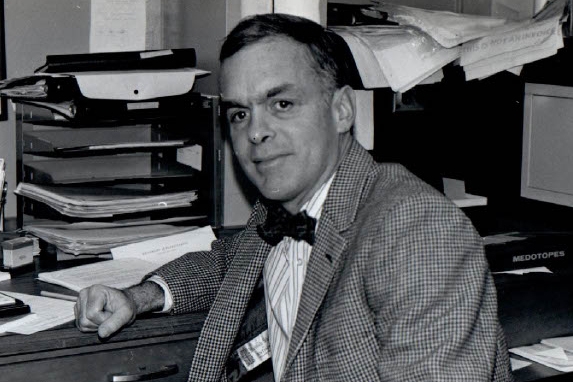
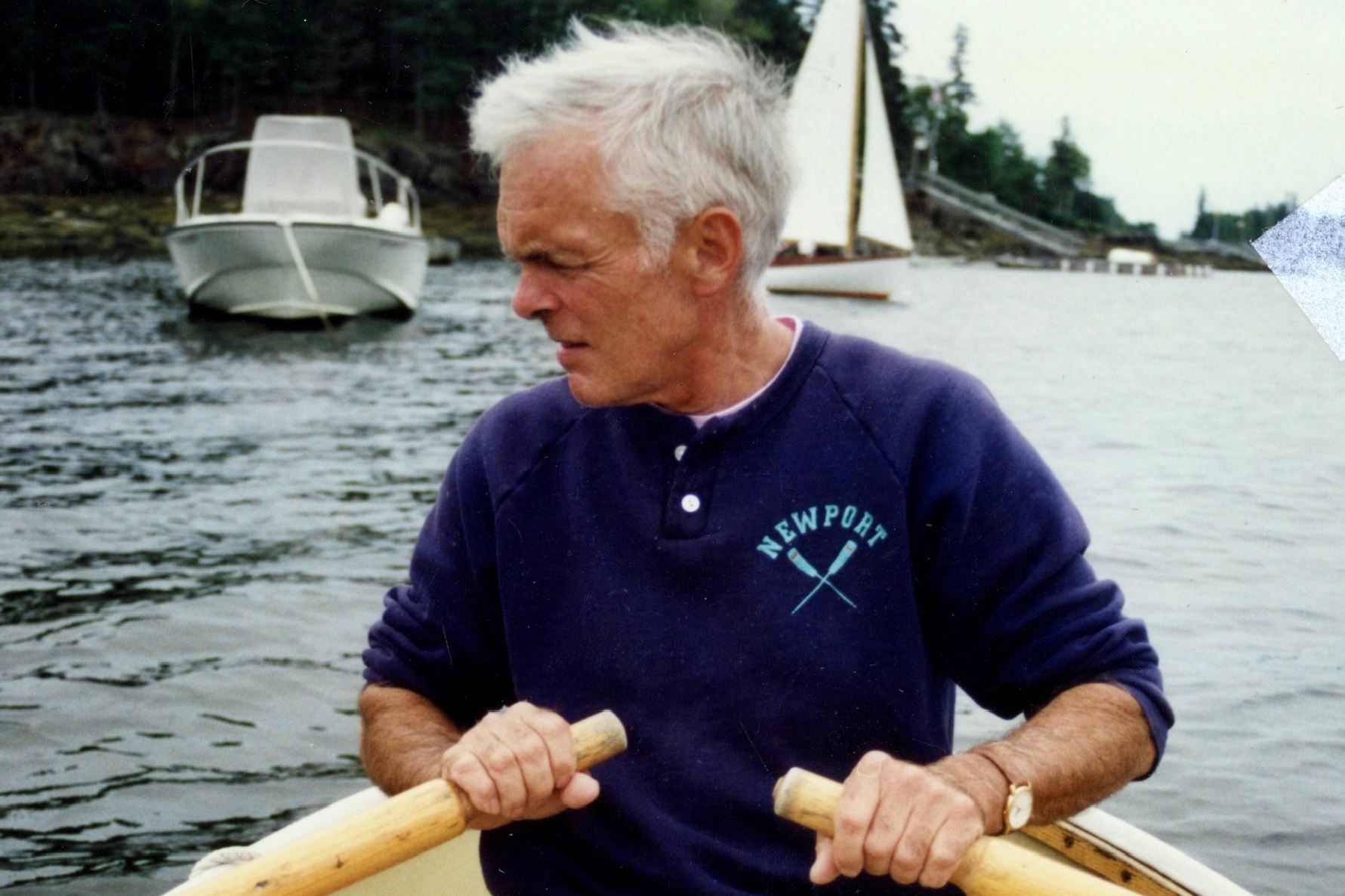
William L. Elkins, 93, of Coatesville, pioneering research immunologist at what is now the University of Pennsylvania’s Perelman School of Medicine, associate professor emeritus of pathology and laboratory medicine, innovative longtime Angus cattle rancher in Chester County, avid sailor, and veteran, died Tuesday, Nov. 11, of complications from pneumonia at Chester County Hospital.
The great-great-grandson of Philadelphia business tycoon William Lukens Elkins, Dr. Elkins fashioned his own distinguished career as a scientist, medical researcher, and professor at Penn from 1965 to 1985, and owner of the Buck Run Farm cattle ranch in Coatesville for the last 39 years.
At Penn, Dr. Elkins conducted pioneering research on how the human immune system fights infection and disease. He collaborated with colleagues in Philadelphia and elsewhere around the country to provide critical new research regarding bone marrow transplants and pediatric oncology.
His work contributed to new and more effective medical procedures at Penn, Children’s Hospital of Philadelphia, and elsewhere, and he instructed students and residents at Penn. But his lifelong love of the fields and rolling hills he roamed as a boy in Chester County never faded, he told Greet Brandywine Valley magazine in 2023.
Dr. Elkins was a lifelong outdoorsman.
“Farming is in my blood,” he said. “So even when I went to medical school and all that, the enthusiasm never left, and I wanted to go back to it.”
So he retired from medicine at 53, and he and his wife, Helen, bought nearly 300 acres of the old King Ranch on Doe Run Church Road in Coatesville. She kept the books and looked after the business. He became an expert on breeding cattle and growing the high-energy grass they eat.
Wearing floppy hats and riding a colorful ATV from field to field, Dr. Elkins worked his land for decades. He mended fences and tended daily to his 120 cows, heifers, and prize bulls.
He championed holistic regenerative farming and used new scientific systems to feed his cattle. He rejected commercial fertilizer and knew all about soil composition, grass growing, and body fat in cattle.
Dr. Elkins and his wife, Helen, married in 1966.
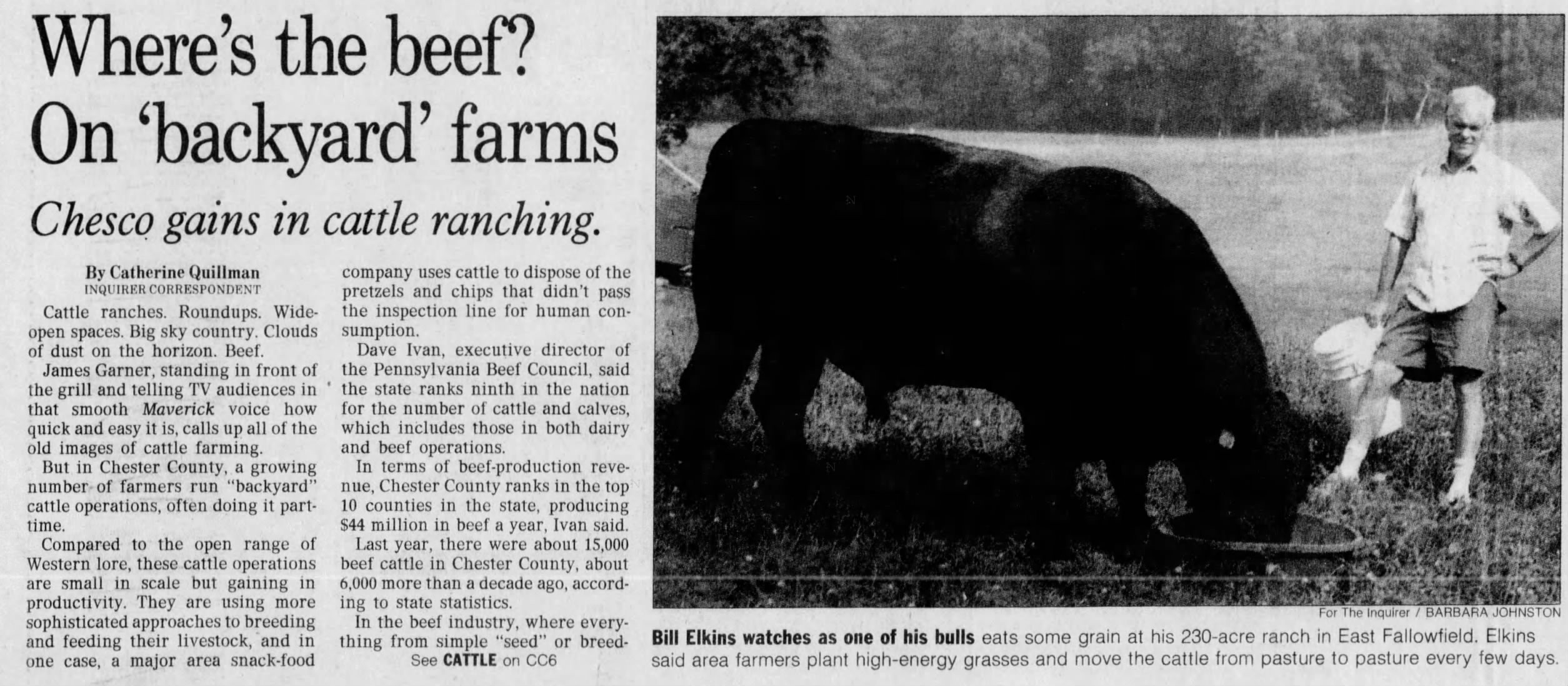
In a 1995 Inquirer story, he said: “Cattle are just like anyone else. If you just turn a few cattle out in a great big field, they will wander around, eat the grass they like best, and leave what they don’t want. That means the less desirable grasses tend to predominate.”
He traveled the country to confer with other cattlemen and helped found the Southeast Regional Cattlemen’s Association in 1994. He sold his beefsteaks, patties, jerky sticks, and kielbasa grillers to private customers online and to butchers and restaurants.
At least one local chef featured an item on the menu called Dr. Elkins’ Angusburger. Lots of folks called him Doc.
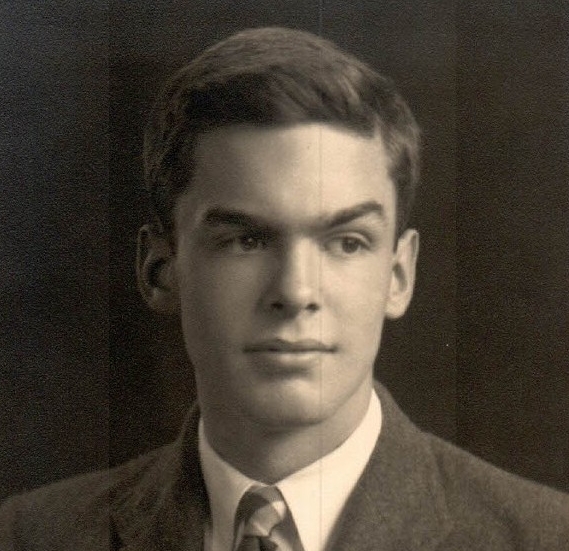
He earned his medical degree at Harvard University in 1958 and served two years in the Navy at the hospital in Bethesda, Md. He was a surgical intern in New York and discovered that he preferred the research lab. Before Penn, he worked at the Wistar Institute of biomedical research.
Dr. Elkins graduated from St. Mark’s School in Massachusetts in 1950.
Away from the lab, Dr. Elkins was an ocean sailor, expert navigator, and former boat club commodore. He was active with the Brandywine Conservancy, Natural Lands, and other groups, and was lauded by national organizations for his wide-ranging conservation and wildlife efforts.
He made his farm a haven again for the bobolink grassland songbird and other migratory birds and butterflies that had dwindled. “Buck Run Farm is more about growing grass and trees than beef,” he told Greet Brandywine Valley. “We’re blessed by the land.”
William Lukens Elkins was born Aug. 2, 1932, in Boston. He lived on the family dairy farm in Pocopson, Chester County, when he was young, went to boarding school in Massachusetts for four years, and earned a bachelor’s degree in biology at Princeton University.
He met Helen MacLeod at a party in Washington, and they married in 1966 and had a daughter, Sheila, and a son, Jake. They lived in Center City, Society Hill, and Villanova before moving to the farm. “He was easy to be with,” his wife said.
Dr. Elkins enjoyed sailing and fishing.
Dr. Elkins loved nature, fishing, and baseball, and he followed the Phillies, the Flyers, and other sports teams. “He had a wonderful bedside manner,” his daughter said. “He was a great listener. He really knew how to support people.”
His son said: “He was unassuming and direct. He spoke his mind. He connected with so many different people. He was curious about the world around him.”
His wife said: “He was thoughtful and always concerned about people. He had good humor. He was fun.”
In addition to his wife and children, Dr. Elkins is survived by five grandchildren and other relatives. A sister died earlier.
This article about Dr. Elkins and his ranch appeared in The Inquirer in 1995.