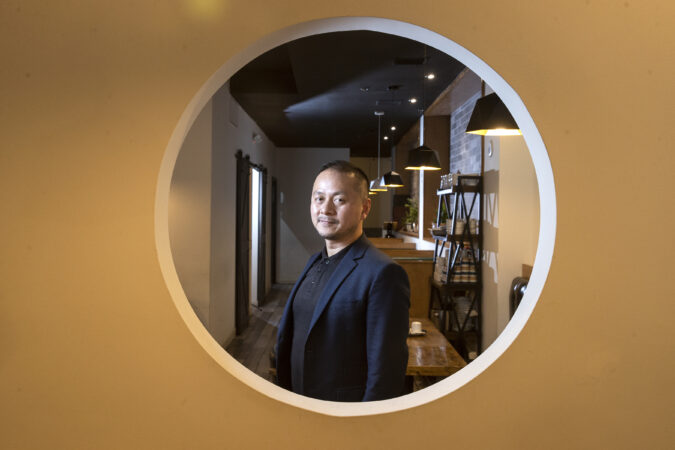
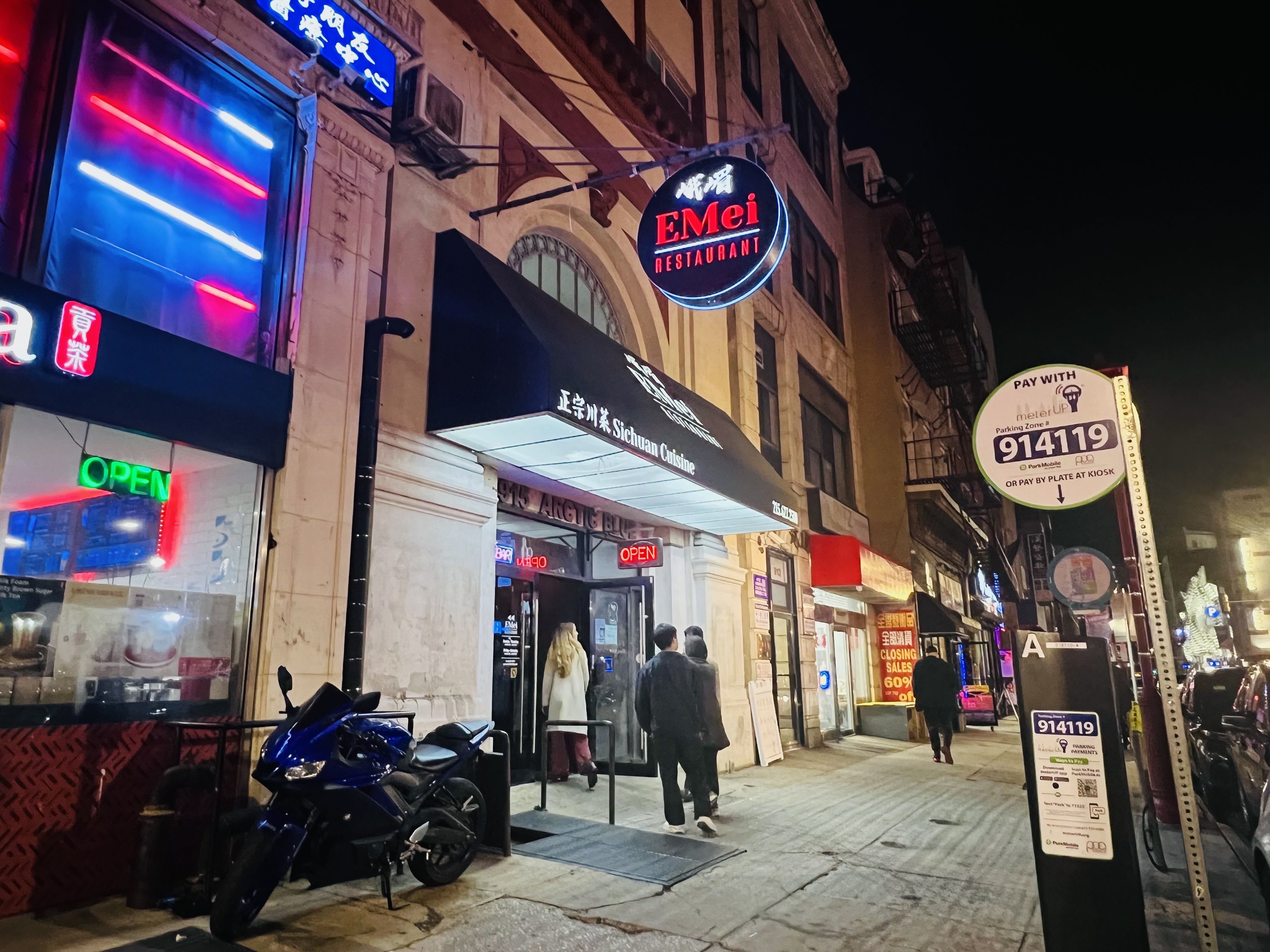
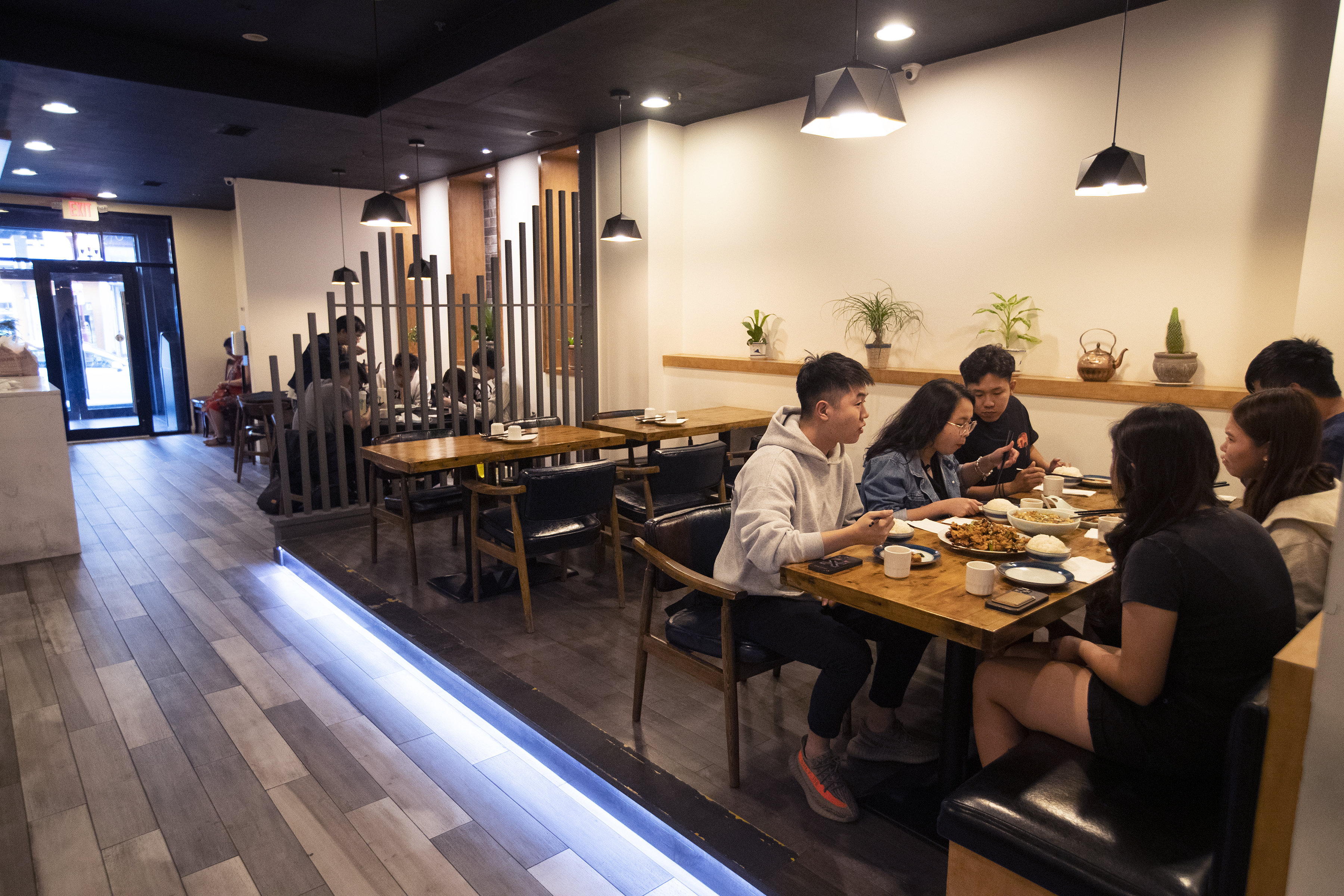
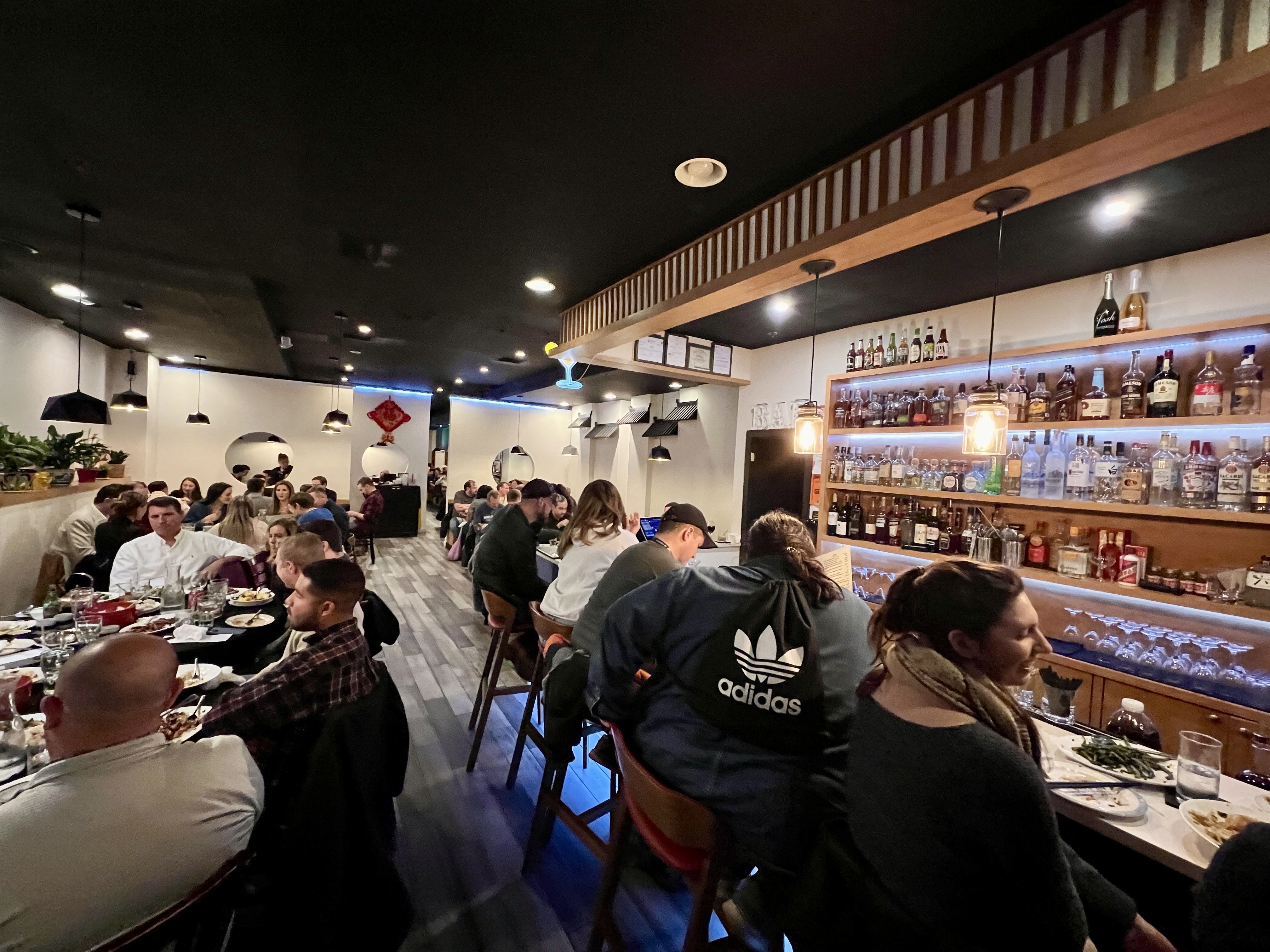
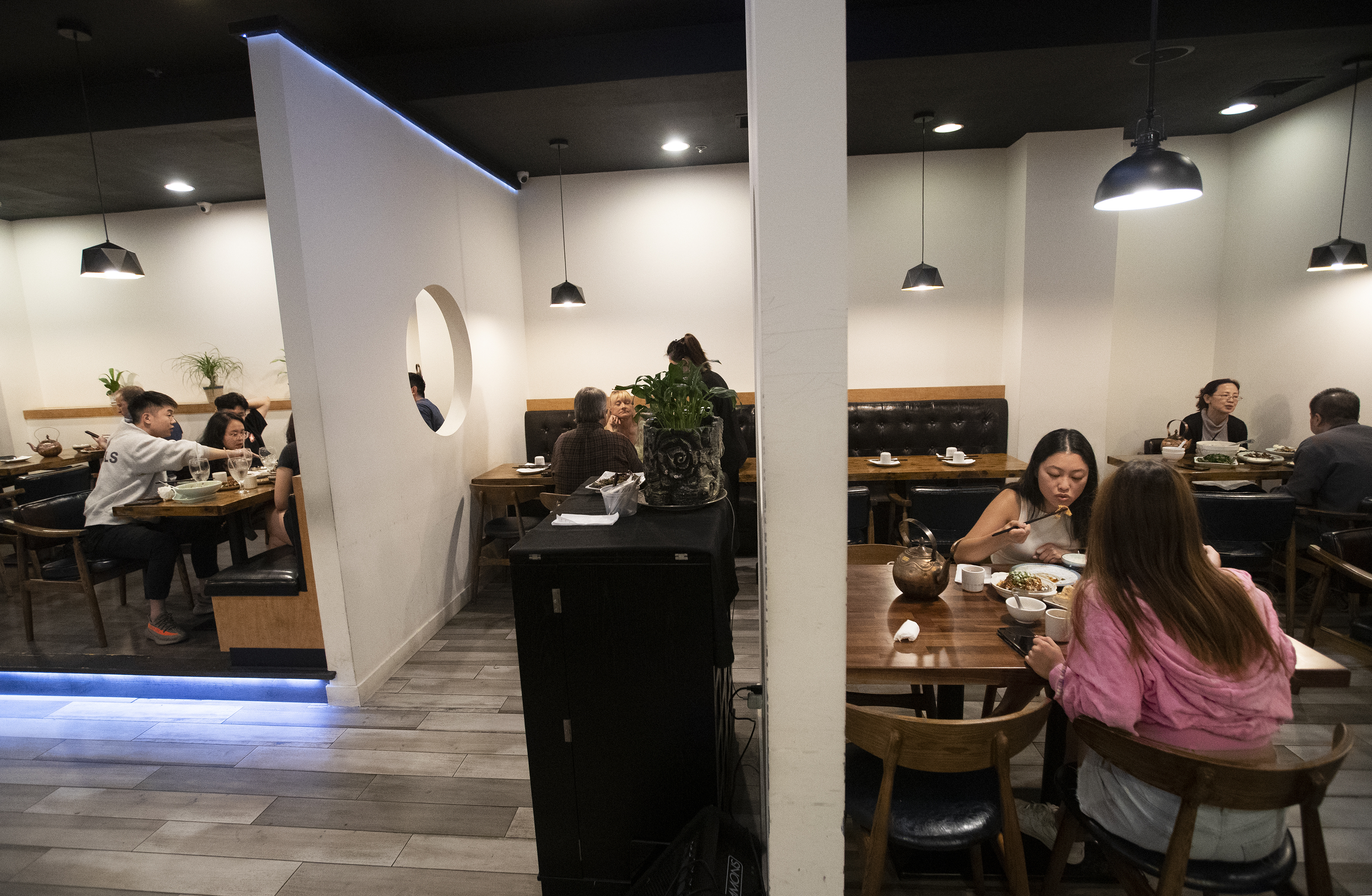
Dan Tsao’s restaurant EMei at 915 Arch St. in Chinatown on Nov. 8, 2025.
Tsao said the East Passyunk EMei would roll out in phases, with takeout and delivery launching in February during renovations and full dine-in service targeted for summer 2026. He said he wants to become part of the Passyunk Avenue community for decades to come.
Real estate broker Greg Bianchi, who represents the family that owned the Marra’s building at 1734 E. Passyunk Ave., called the deal “a win-win for everybody. [Tsao is] going to bring more people and business to the other businesses. People don’t realize what a force he is in the Chinatown community.”
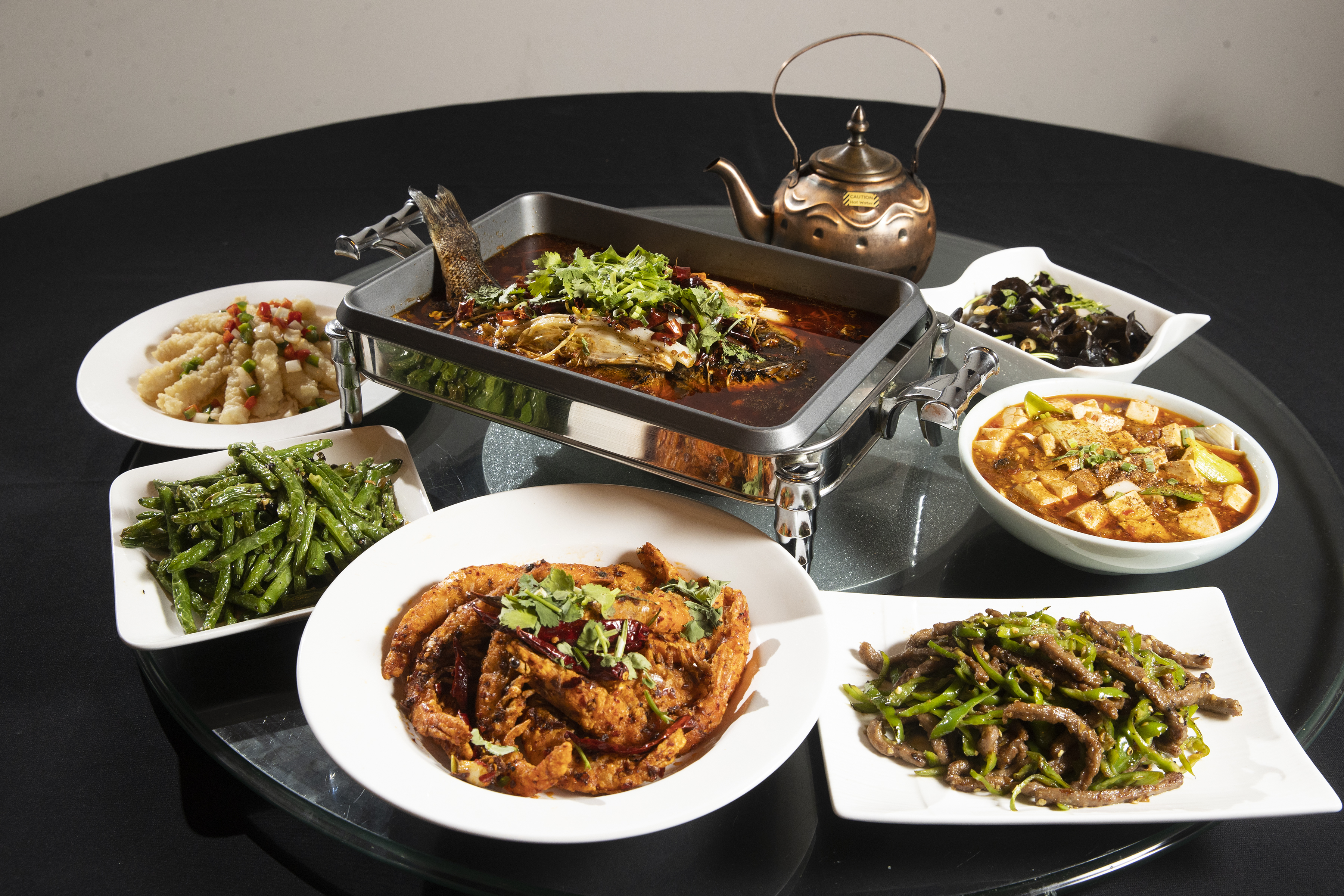
Dishes served family style at EMei, 915 Arch St.
Besides operating EMei, Tsao — who immigrated from China after high school and graduated from Penn State in 1999 — has been a newspaper publisher for 18 years. His New Mainstream Press operates Metro Chinese Weekly and Metro Viet News, offering deeper news coverage than the typically ad-heavy publications that had dominated the local Asian-language media.
The kitchen at 915 Arch St., entirely in the basement, is now at capacity. Even after recent upgrades, including six new wok stations, 18 new kitchen staffers, and robots delivering foods to the tables, “growth requires new space,” Tsao said.
Tsao analyzed sales data and found that many customers hail from Lower Merion, where he lives with his family — hence the opening in Ardmore. He also noticed that EMei is especially popular in South Philadelphia, whose four ZIP codes account for more than 20% of delivery volume.
This made East Passyunk a natural site for expansion. He said he was immediately drawn to the Marra’s building and was surprised that it had been on the market for more than four years.
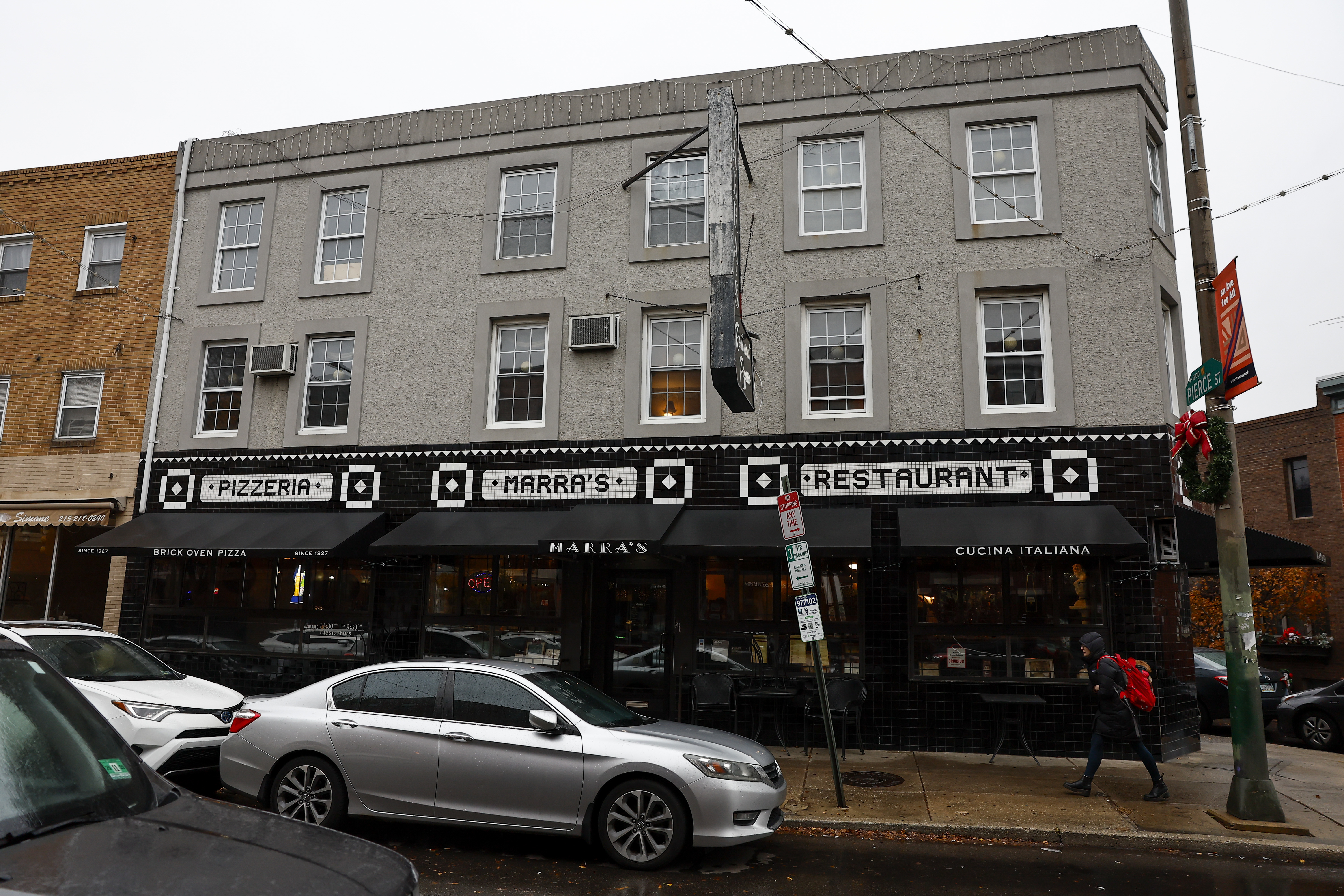
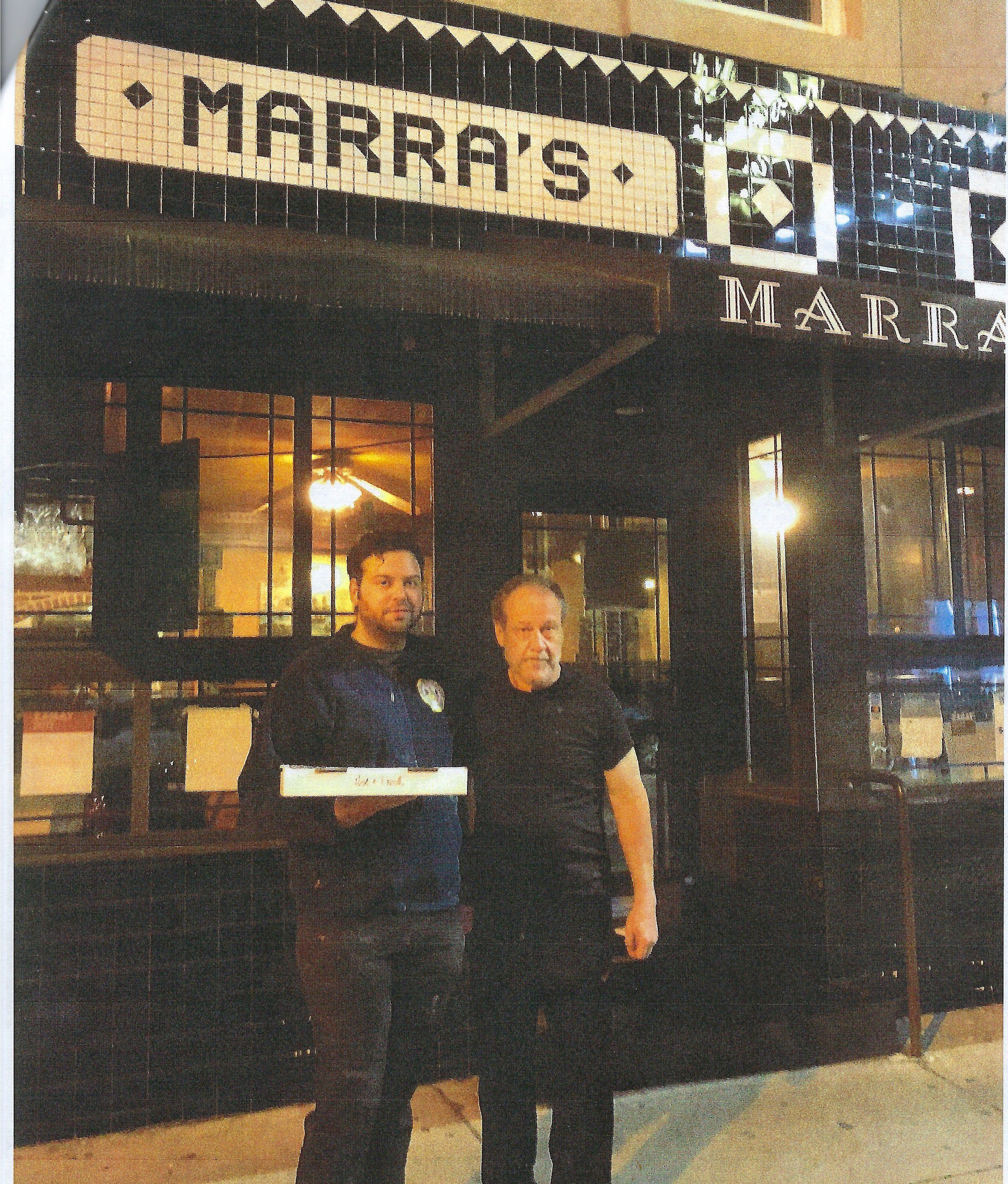
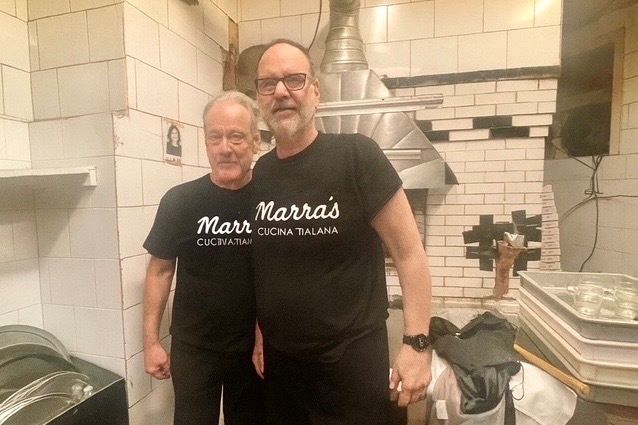
Marra’s restaurant, as seen on Nov. 30, 2025, its last day.
When Tsao learned that co-owner Robert D’Adamo — a grandson of Marra’s founder Salvatore Marra — was preparing to retire, Tsao saw parallels in his own experience: Before the pandemic in 2020, his mother-in-law, Jinwen Yu, and her business partner, chef Yongcheng Zhao, were looking to step aside; Tsao became an unlikely restaurateur, buying out partners and taking on responsibilities he had not expected.
“My father spent his entire career as an executive at a food enterprise in our hometown in Zhejiang, and in college I worked every position in a Chinese takeout restaurant,” Tsao said. “Through my newspaper and digital platforms, I’ve also worked with more than 200 restaurant clients. I always knew this was a hard business. But I didn’t fully understand the challenges until I took over EMei.”
He recalls fixing sewage backups until 2 a.m., working overnight with contractors to maneuver a 1,200-pound wok station into the basement, and spending hours after service refining the menu with chefs. “The industry is brutal,” he said. “If you stay mediocre, or stay in the comfort zone of only serving a niche customer base, you will struggle — even if the restaurant doesn’t close. I knew we had to evolve EMei into something much bigger.”
The dining room of EMei at 915 Arch St.
In 2019, he and his wife, Ting Ting Wan, closed the restaurant for two months to renovate. During the first two years of the pandemic, when sales dropped 50%, the entire family worked more than 60 hours a week to keep the business alive.
Tsao also pulled two assistants from his media company to build formal back-office systems that later enabled EMei to scale. During the pandemic, Tsao launched RiceVan, a delivery and distribution service that transported Chinatown meals to suburban households and provided jobs for refugees and new immigrants.
EMei restaurant at 915 Arch St., which opened in 2011.
EMei has since grown from 11 full-time employees to 37, and sales have increased more than 300% compared with pre-pandemic levels, Tsao said.
Tsao credits the restaurant’s founders — Yu and Zhao — for staying involved. “They still come in every day, even now,” he said. “Part of it is that retirement can be boring. But it’s also because once we took responsibility for operations and finances, they were able to relax, work fewer hours, and focus purely on the culinary side.”
The dining room of EMei, 915 Arch St.
A historic building reimagined
The Marra’s building will undergo substantial structural and mechanical upgrades, Tsao said. Plans include a first-floor restroom to resolve long-standing ADA issues; full replacement of HVAC and electrical systems; and removal of window units in favor of central air.
The vintage booths will be reupholstered. The bar will shift to the Pierce Street corner to improve flow. The second-floor private dining room will get new lighting and finishes; the third floor may be converted into a multipurpose or staff area. Tsao said he intends to address minor structural concerns while preserving the historic masonry and architectural character.
One open question is the fate of Marra’s nearly century-old brick pizza oven, which Marra’s family member Mario D’Adamo said was failing. EMei will test whether it can be used. If removal becomes necessary, Tsao said the bricks, sourced from Mount Vesuvius, would be saved and possibly given to the D’Adamo family, the East Passyunk Business Improvement District, or incorporated into the renovation.
“Our model has evolved — instead of putting over half a million dollars into leasehold improvements that don’t belong to us, we’d rather put that money into a building that becomes part of the company’s foundation,” Tsao said. “Restaurants come and go, but great restaurant buildings with stories — like this one — can last generations. We want to be the next chapter in that story, not just a tenant passing through.”
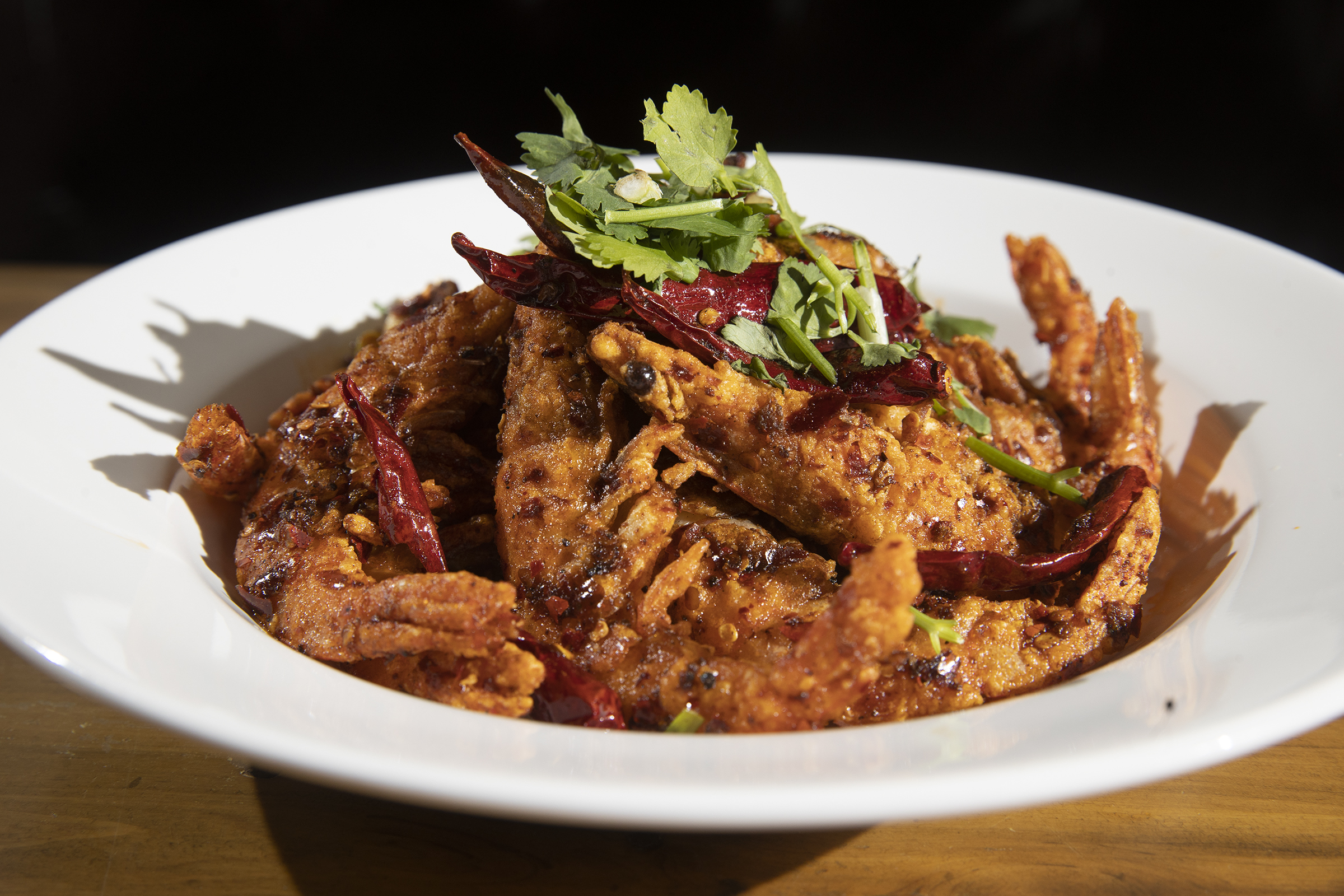
The jumbo shrimp in hot peppers at EMei at 915 Arch St. on Sept. 15, 2022.
What to expect on EMei’s menu
The East Passyunk menu will reflect the Chinatown original while serving as a testing ground for contemporary Sichuan cooking – “lighter, seasonal, more ingredient-driven interpretations that show how Sichuan cuisine continues to evolve,” Tsao said.
Roast duck and possibly Shanghai soup dumplings are under consideration, filling a void left by the closure of Bing Bing Dim Sum nearby. Some heritage dishes removed from the Chinatown menu will return there, helping differentiate the three locations while keeping them unified. EMei’s gluten-free program, including a separate fryer, will continue.
Tsao said the neighborhood feels like home to his family. “I took my three kids — ages 6, 14, and 17 — to the East Passyunk Fall Fest again this year, and they instantly connected with the neighborhood’s energy,” he said. “They spent nearly 30 minutes exploring Latchkey Records, each leaving with something they picked out themselves. Watching them fall in love with the street the same way we did really made it feel like home.”
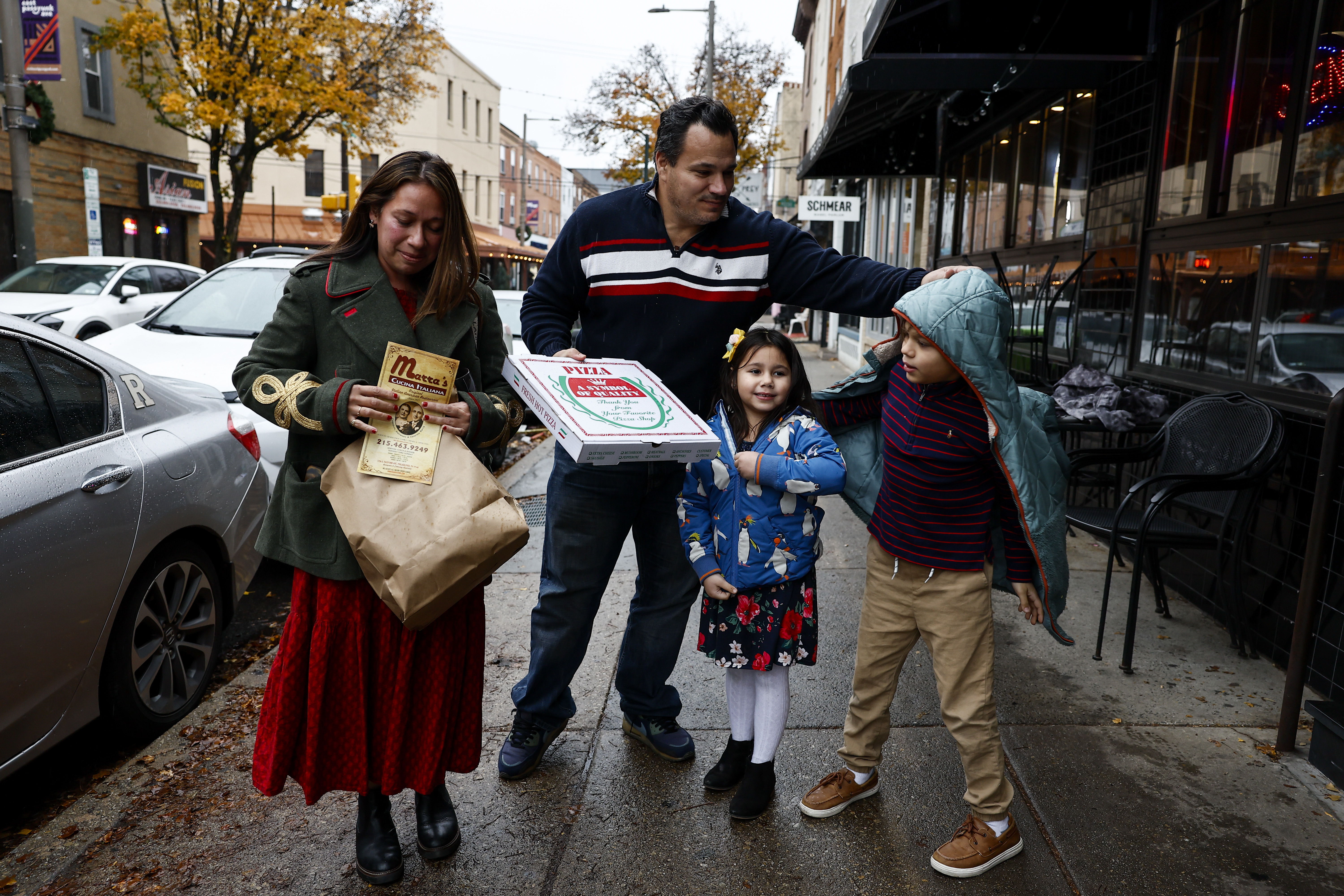
Antoinette and Chris Caserio walked out of Marra’s on Sunday afternoon with their children, a menu, a pizza box, and a bag of leftovers they called “their last supper.”
“It’s super sad,” Antoinette Caserio said. “My dad’s 80 and this was his spot.”
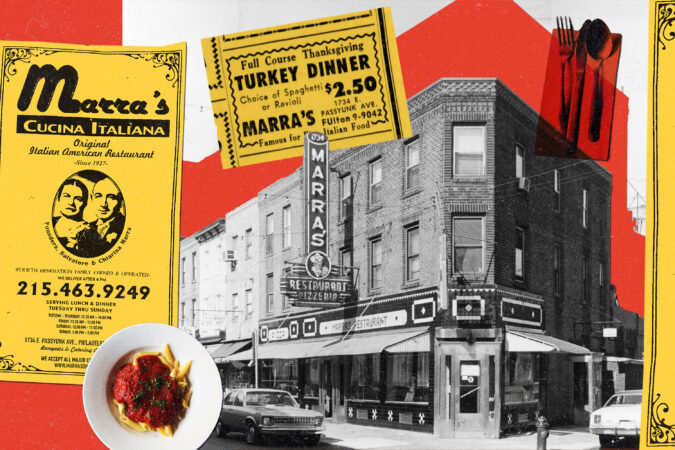
Marra’s, the family-run restaurant widely considered Philadelphia’s oldest pizzeria, closed Sunday after 98 years — a day in advance of the sale of its iconic black-and-white-tiled building at 1734 E. Passyunk Ave. in South Philadelphia. The property had been on the market for several years.
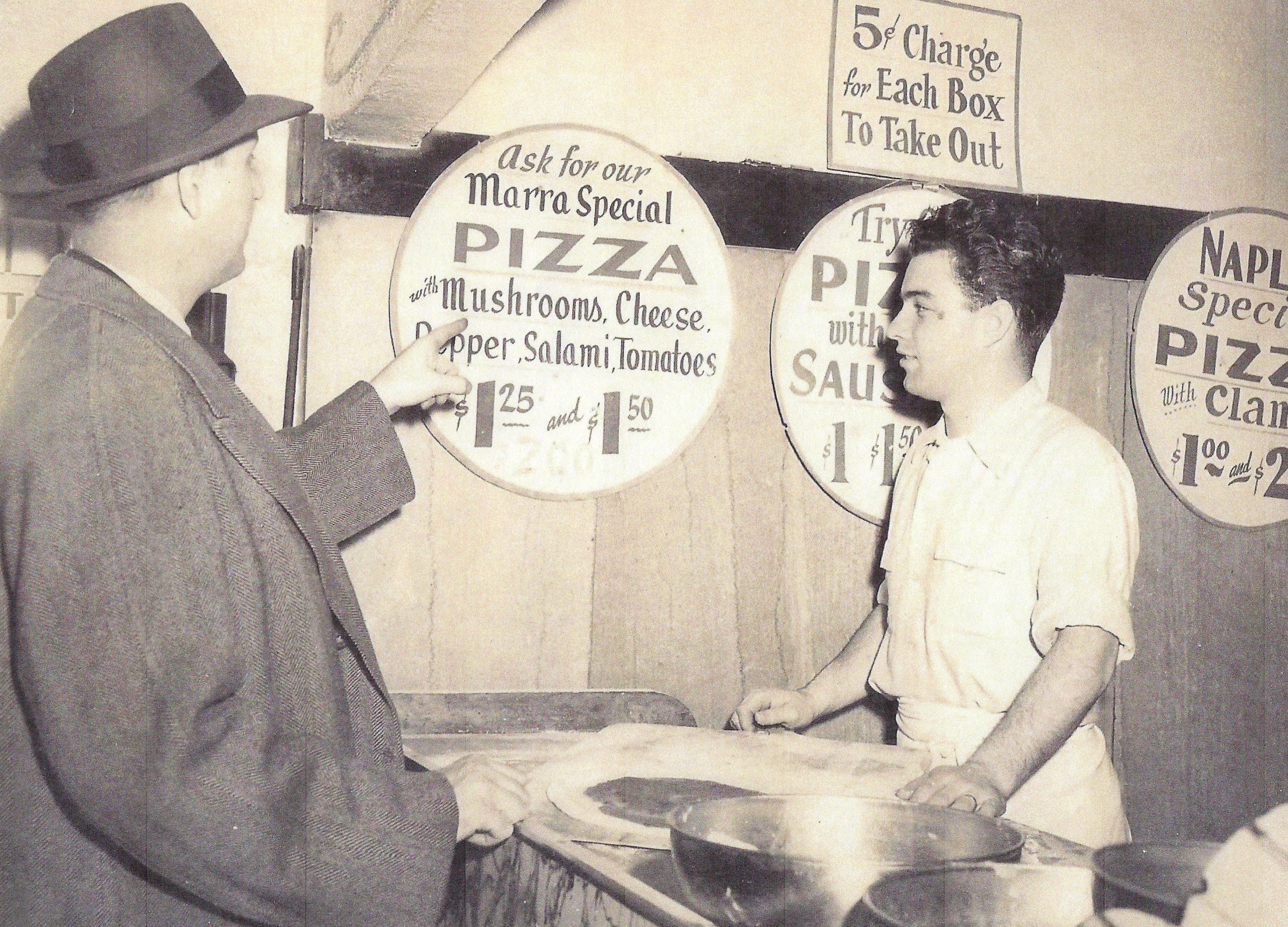
Mario D’Adamo Sr. (right) with a Marra’s customer just after World War II.
The buyer, Chinatown restaurateur and publisher Dan Tsao, said he plans to open a branch of his popular Sichuan restaurant EMei next year.
Marra’s was one of the last remaining links to East Passyunk Avenue’s featured role in the Italian American immigrant experience of the early 20th century. It also marks a transition for the founding Marra and D’Adamo families, who say they are exploring a new location for the restaurant, which opened in 1927.
Mario D’Adamo Jr., a grandson of founders Salvatore and Chiarina Marra and brother of co-owner Robert D’Adamo, said business had dipped after the pandemic, but that wasn’t the impetus for the sale. “The biggest killer was parking,” he said by phone while searching for a spot Sunday. “Small restaurants can survive that; large places can’t.” With 160 seats, including its 80-seat banquet room on the second floor, Marra’s lost a lot of business because of it, D’Adamo said.
Robert D’Adamo, 75, and cousin Maurizio DeLuca, 61, who took over ownership in 2000, declined to speak with The Inquirer over the last few weeks as word spread of the impending sale, citing their emotions. In a statement, they said they were prepared to move on with “the same love that has always defined us — just in a location that better serves our guests.”
Antoinette and Chris Caserio and children Kira and Chris leaving Marra’s on Nov. 30, 2025.
Mario D’Adamo Jr., 71, a lawyer and deputy court administrator for Philadelphia’s Family Court, sold his stake about 25 years ago but retains an interest in the Marra’s name.
With the sale to Tsao, the building will remain a restaurant. Tsao has said he intends to renovate the building while respecting its look and feel.
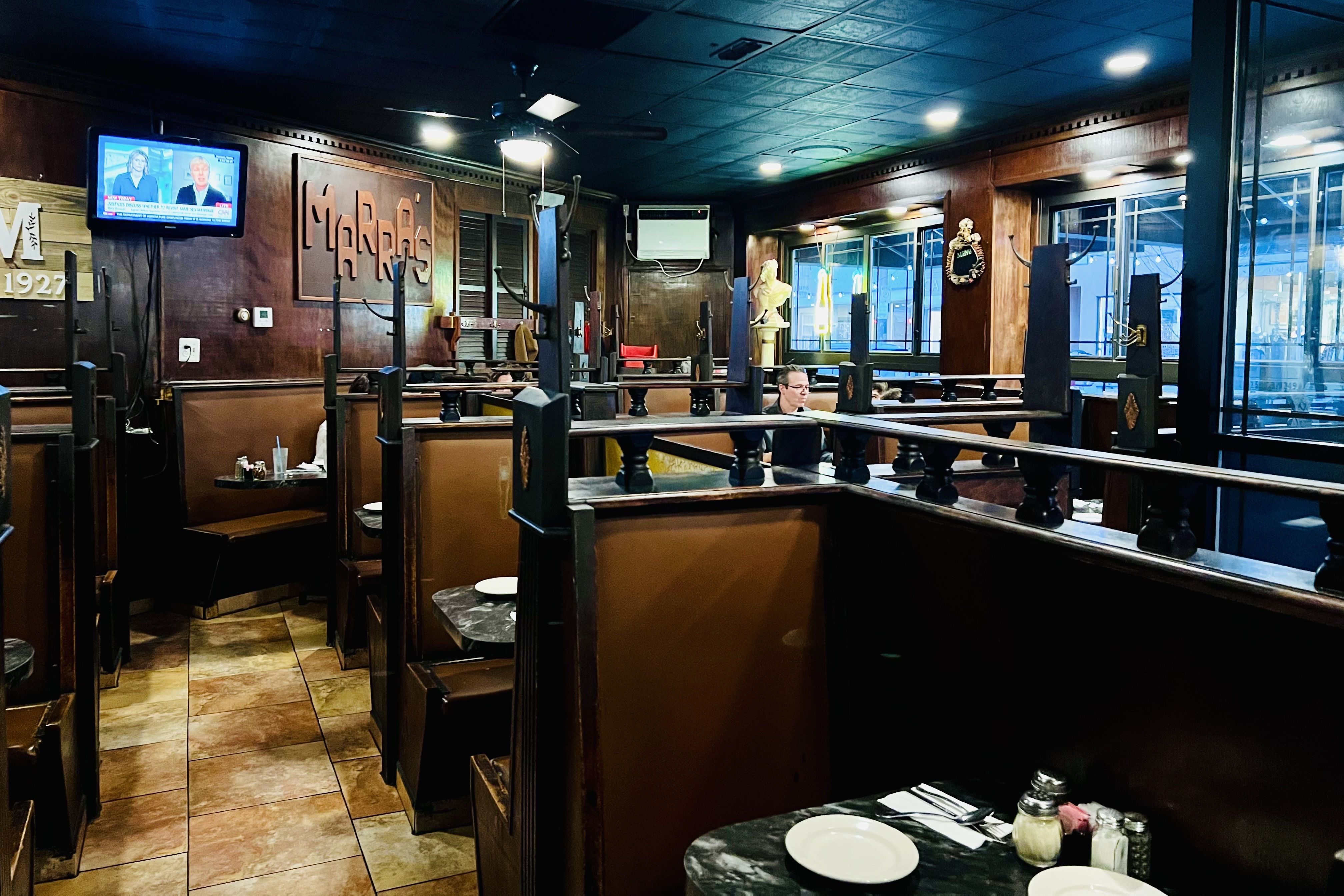
The front dining room at Marra’s, 1734 E. Passyunk Ave., on Nov. 7, 2025.
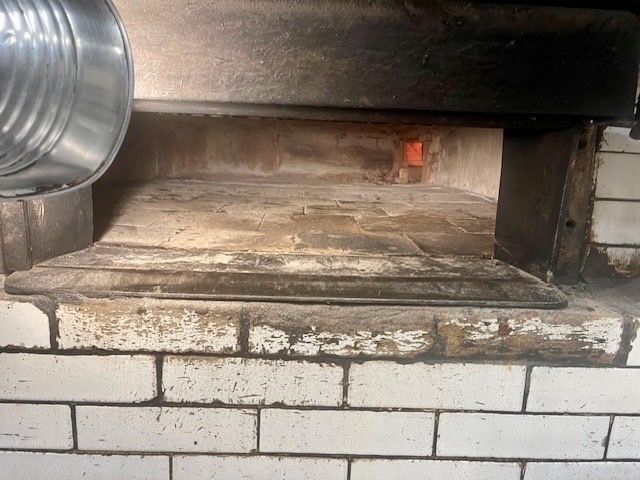
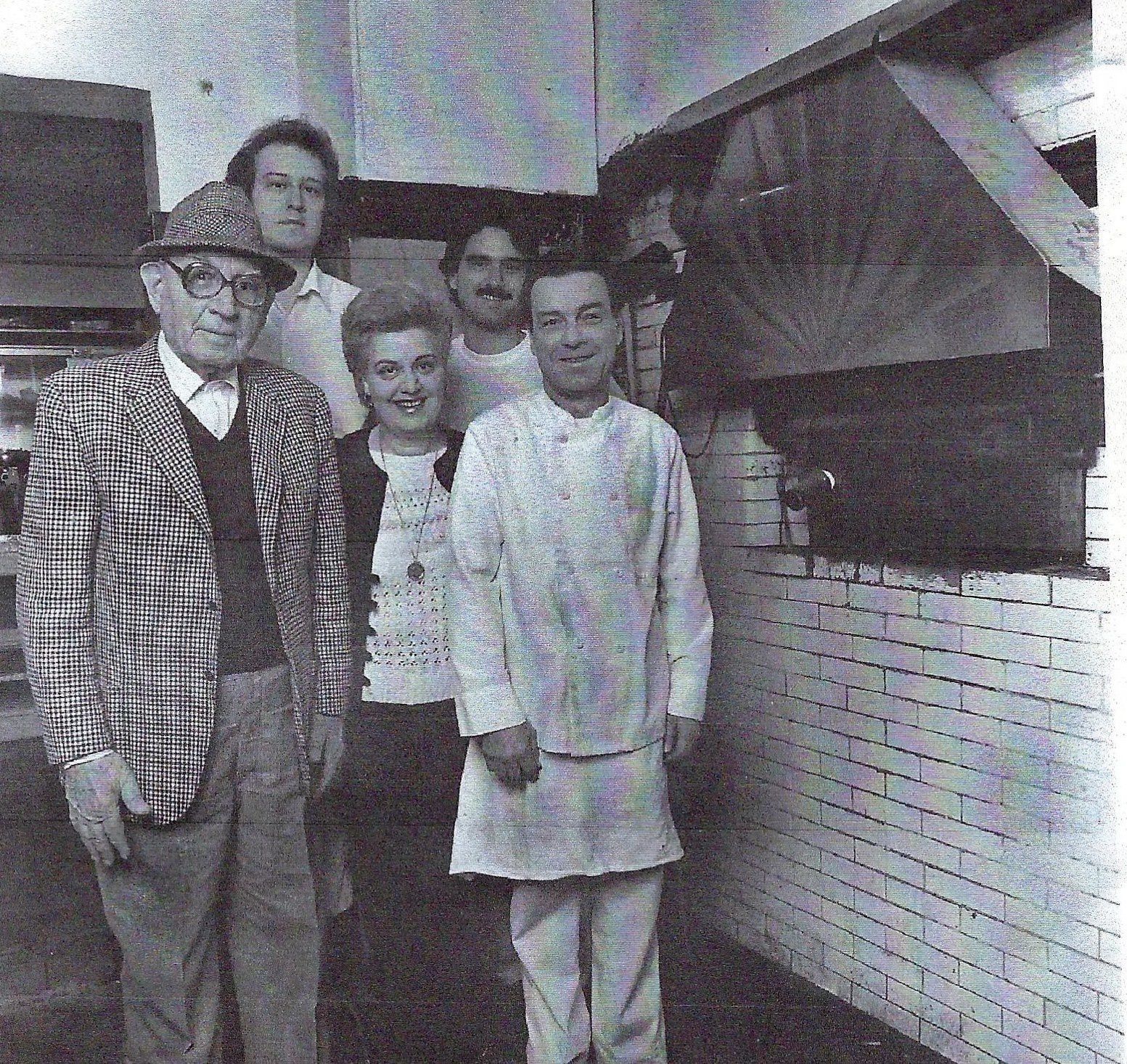
Marra’s oil-fired brick oven, believed to be one of the city’s oldest, may not be salvageable, D’Adamo said.
The life of the bricks is about 100 years and the inside is collapsing, even though an artisan patched it about two years ago. “The oil flame is so hot that the bricks are now pulverizing,” he said.
Marra’s backstory
The families of Salvatore Marra and Chiarina Daniele were baking pizza in Naples before the turn of the 20th century.
Shortly after the couple married, they set out for the United States.
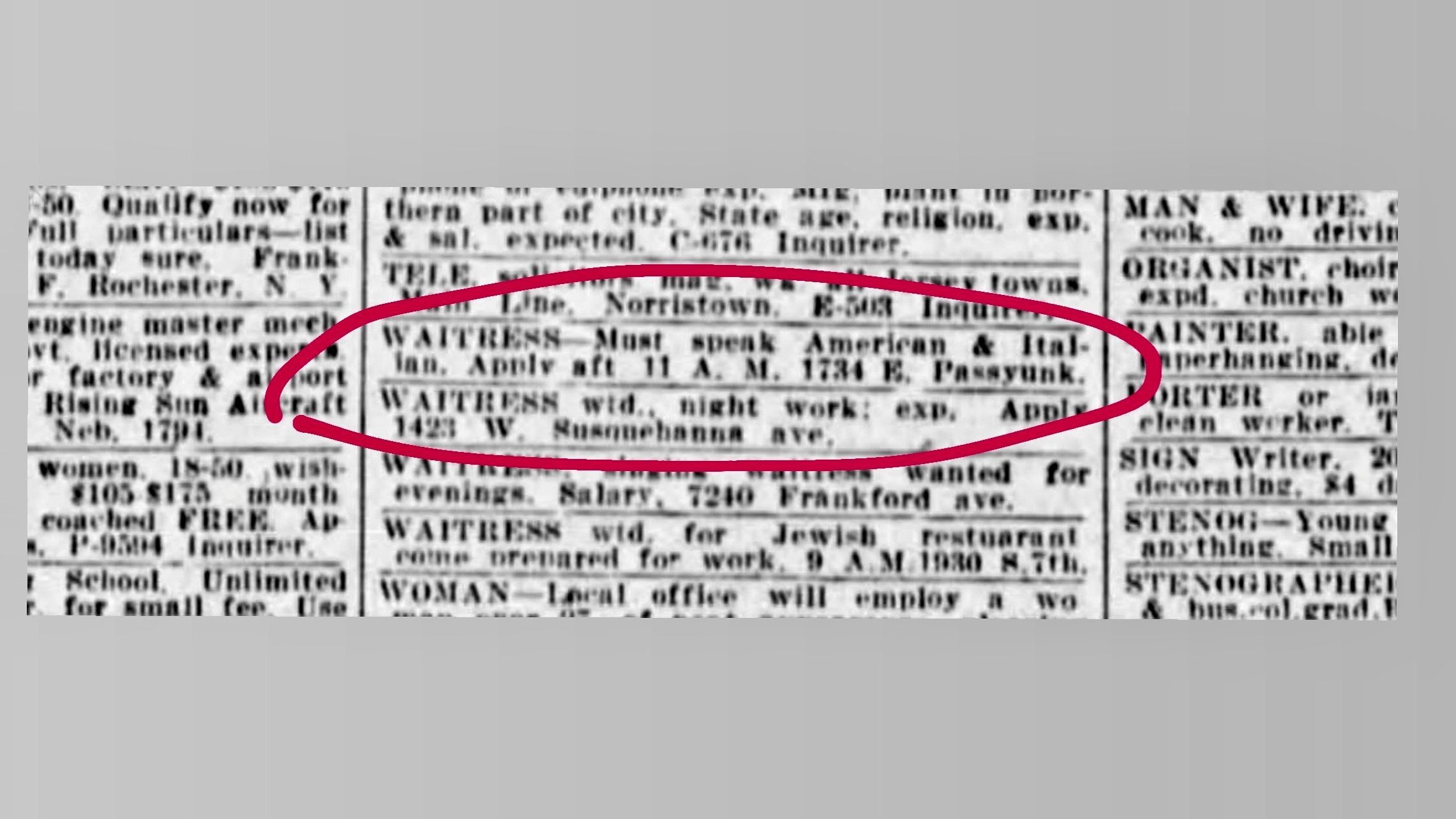
Marra’s help-wanted ad from The Inquirer on March 14, 1934, seeking a waitress who “must speak American & Italian.”
Marra family lore holds that Salvatore arrived at Ellis Island in 1921 with a single dime — likely a 10-centesimi coin — which he tossed into New York Harbor so he could say that he had begun his life in America with nothing. Chiarina joined him soon after.
His early attempts to recreate Neapolitan pizza were discouraging — first in Brooklyn and then Chicago. He thought that the pies were lacking and blamed the ovens.
The century-old brick oven at Marra’s on Nov. 30, 2025.
Back in Naples, the ovens were lined with lava bricks from Mount Vesuvius, which radiated and retained heat in a way he couldn’t replicate. When the Marras moved to Philadelphia, he ordered bricks from Naples and had the oven built for their first pizzeria, which opened in 1924 at Eighth and Christian Streets in South Philadelphia. This time, the pizza tasted right.
In 1927, when the Marras bought a former butcher shop at 1734 E. Passyunk Ave., the oven was dismantled brick by brick and rebuilt there.
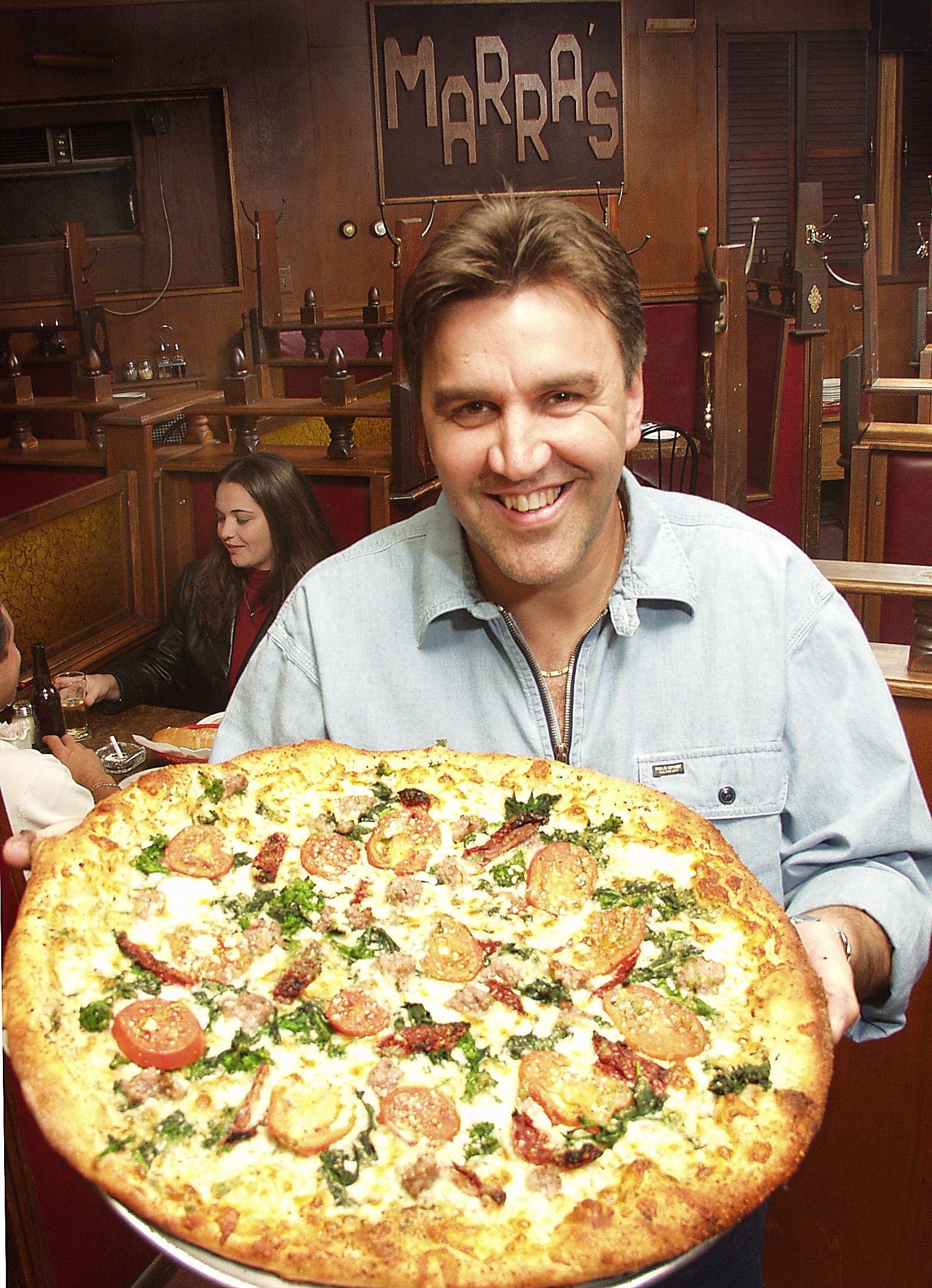
At Marra’s, co-owner Maurizio DeLuca holds a pizza fresca on Oct. 10, 2001.
The neighborhood was teeming with immigrants, and East Passyunk’s diagonal path through the city’s rowhouse grid — historically, it was a Lenape trail — had made it a natural commercial strip. For generations, families bought their church clothes, shoes, furniture, and sundries on the Avenue.
Salvatore and Chiarina still lived on the restaurant’s third floor after their retirement in 1947. She died in 1973 at age 73. Salvatore, in his usual fedora, was a familiar presence on the Avenue until his death in 1984 at age 89.
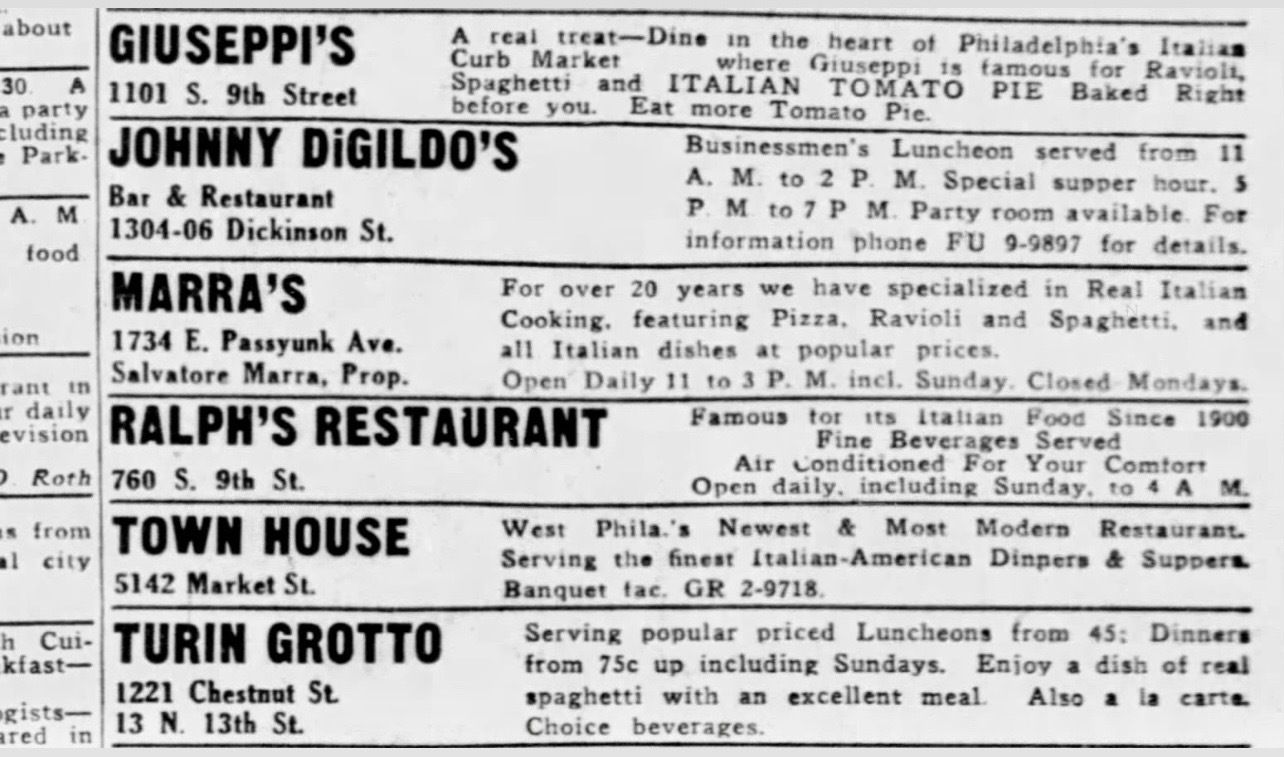
Marra’s ad in The Inquirer on Feb. 28, 1948.
Their children, Bianca and Vincent Marra, carried Marra’s business forward after Salvatore and Chiarina’s retirement. By that time, Bianca had married Mario D’Adamo Sr., a Marra’s busboy who lived around the corner. (Their children, Robert, Mario Jr., Linda and Marlene, represented the next generation.)
Bianca D’Adamo, known as “Mama D’Adamo,” became one of the restaurant’s most visible figures. In a 1980s interview with The Inquirer, she recalled a particularly loud regular from years past: a kid named Fred Cocozza. “He’d come in, stand right over there, and sing at the top of his lungs,” she said. “Papa would come out of the kitchen and tell him to get out. He thought it was bad for business.” In 1947, he performed for 20,000 people at the Hollywood Bowl and signed a film contract with MGM as Mario Lanza.
Patriarch Salvatore Marra with his daughter, Bianca, grandsons Robert (rear left) and Mario Jr., and son-in-law Mario Sr.
In 1950, Bianca and Vincent bought the bakery next door and expanded the restaurant. Vincent Marra opened his own Marra’s restaurant on Baltimore Pike in Springfield, Delaware County, in 1954.
Marra’s fame
During Bianca and Mario’s oversight, Marra’s began attracting the spotlight. For National Pizza Week in 1955, Salvatore Marra was named Pizza Man of the Year. In 1977, Eastern Airlines’ in-flight magazine, Pathways, cited Marra’s as one of the five best pizzerias in the country. Philadelphia Magazine named it South Philly’s top pizzeria in 1985 — the same year Villanova University won the NCAA men’s basketball championship. That year, coach Rollie Massimino, a regular, inspired the dish known as Rollie’s ziti in white, a bowl of ziti and broccoli in garlic sauce, that remained on the menu till the end.
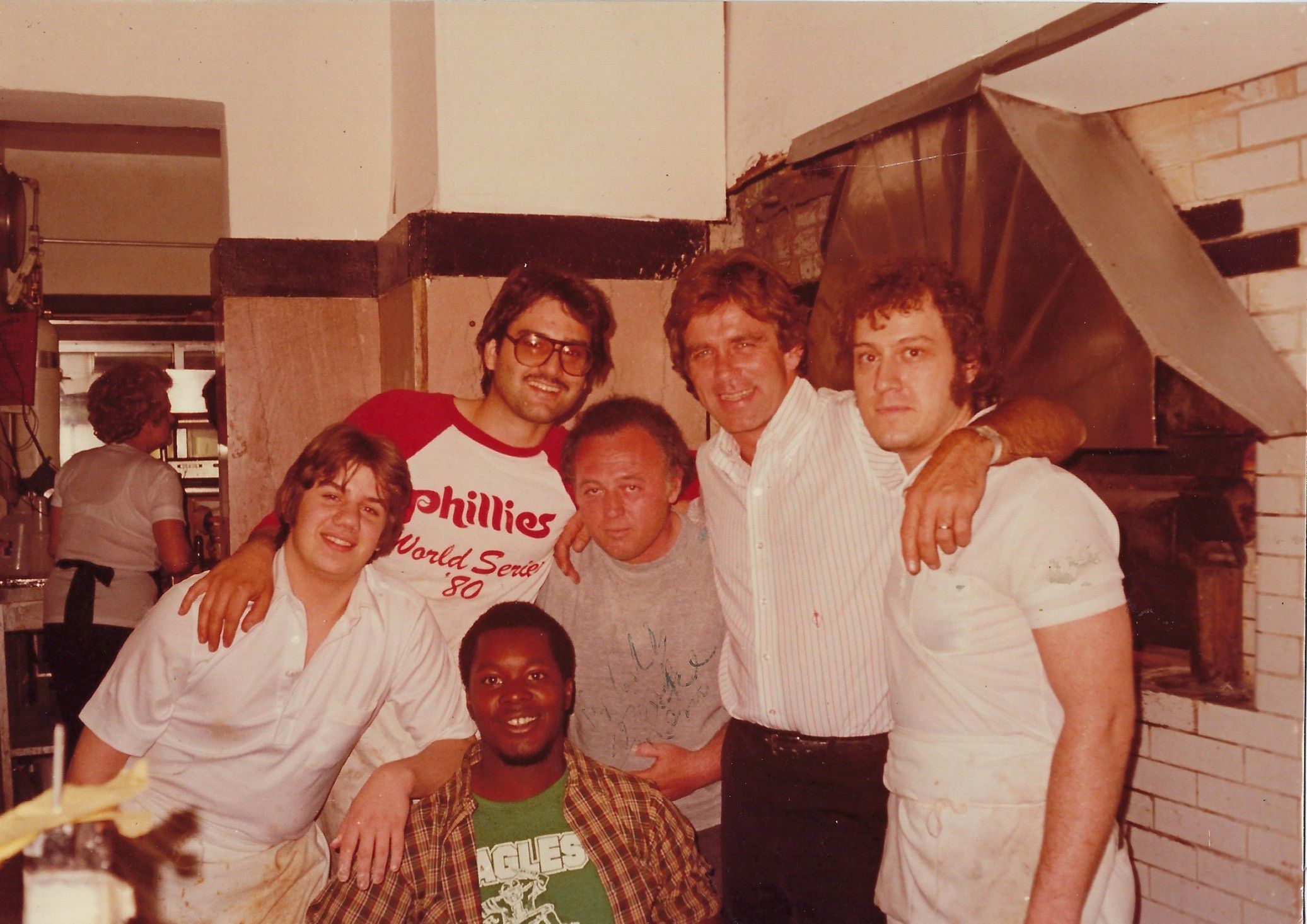
Baseball great Tim McCarver (second from right) with Mario D’Adamo Jr. (in Phillies shirt) and Robert D’Adamo (right) at Marra’s in the early 1980s.
Marra’s celebrity guest list read like an index of 20th-century American entertainment: Mickey Rooney, John Wayne, Frank Sinatra, Frankie Avalon, Eddie Fisher, Jimmy Darren, Bobby Rydell, Al Martino, John Travolta, Eugene Ormandy, Conan O’Brien.
When Passyunk Avenue’s fortunes began dipping in the 1990s, a group now known as Passyunk Avenue Revitalization Corp. began buying and rehabbing distressed properties. (PARC was originally created in 1991 as Citizens’ Alliance for Better Neighborhoods, but later became embroiled in a scandal that brought down former state Sen. Vincent Fumo.)
The early 2000s saw a new wave of residents moving in from outside the neighborhood as PARC’s work helped spark an influx of chef-driven restaurants and bars to join such traditional spots as Mamma Maria and Mr. Martino’s (which opened in 1992) and Tre Scalini (1994).
Le Virtù, serving the rustic cuisine of Abruzzo, opened in 2007 in a former community newspaper office at 1927 E. Passyunk. That year, Fiore’s, which fed generations in a low-slung building where Passyunk crosses 12th and Morris Streets, became a Mexican restaurant, Cantina Los Caballitos.
Restaurants continued to usher in change along the Avenue as the years went on. The distinctive curved building at 1709 E. Passyunk morphed through the years from an appliance store to a bank and then to a men’s clothing store before opening in 2017 as Barcelona Wine Bar. What is now Rice & Sambal, an Indonesian BYOB at 1911 E. Passyunk, was a photographic-supply shop for years after World War II.
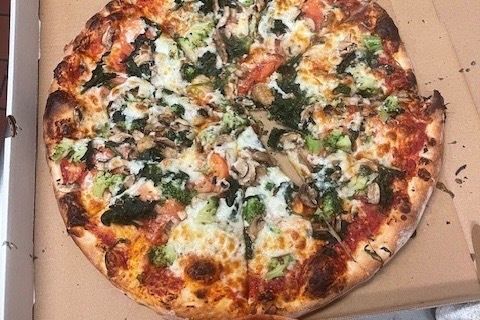
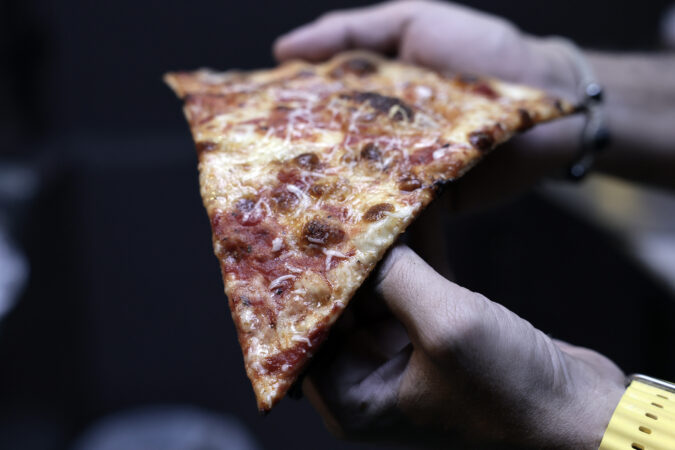
Marra’s co-owner Robert D’Adamo (right) with his nephew, Michael D’Adamo, in 2023.The last pizza baked at Marra’s, 1734 E. Passyunk Ave., on Nov. 30, 2025.
Marra’s closing is painful to Mario D’Adamo Jr., as he recounted late Sunday after the last pizza — topped with spinach, broccoli, tomatoes, and mozzarella — slid out of the oven. Like his brother, he grew up on the third floor of the restaurant’s building.
“It became part of your DNA,” he said. “We used to close at 2 or 3 in the morning. My whole life, I heard the jukebox playing Sinatra, Dean Martin, Tony Bennett. I still go to bed late because of that. Some of my earliest memories are my father coming up the steps, tired, smelling like the restaurant, folding his apron over the banister.
“Other families watched football. We watched cooking shows,” D’Adamo said. “Everything in your mind connects back to the restaurant.”
Brothers Robert D’Adamo (left) and Mario D’Adamo Jr. in the kitchen at Marra’s on Nov. 30, 2025.
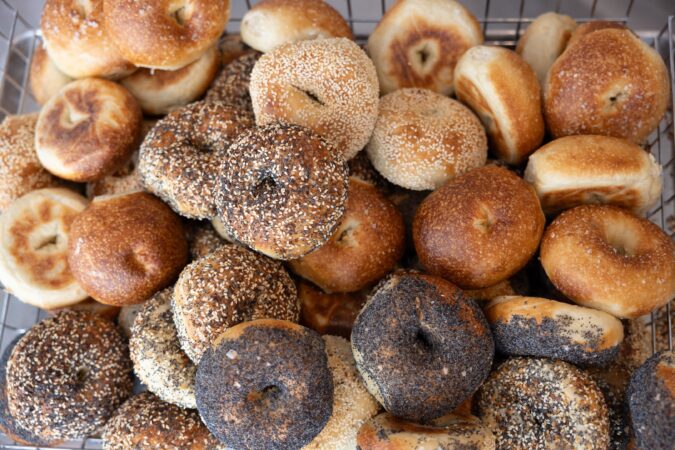
PopUp Bagels, the viral bagel chain that is on its way to the Philadelphia area, will preview its arrival with a one-day pop-up event Sunday at Di Bruno Bros.’ flagship store near Rittenhouse Square.
PopUp will take over Di Bruno’s second floor from 9 a.m. to 1 p.m., offering an early taste of its “grip, rip, and dip” bagels — and a limited-edition collaborative schmear — while raising money for charity.
PopUp’s location in Suburban Square in Ardmore, across from Shake Shack, is due to open in early 2026.
Bagels will be available by preorder only, with sales launching Monday on popupbagels.com. Franchisee Brian Harrington said 300 dozen bagels would be available at Di Bruno’s, 1730 Chestnut St.
Harrington said that for one of his new stores in Boston earlier this year, PopUp tied a preview to the Boston Marathon. “We put them online for preorder and they sold out in 16 minutes,” Harrington said. As people arrived for their bagels (six for $24), they were feted with music and PopUp swag to stimulate buzz.
PopUp, conceived in a Connecticut backyard in 2021, does not make sandwiches or even offer sliced bagels — rather, the bagels are sold hot and whole with cups of cream cheese “schmears” or butter for dipping.
In Philadelphia, customers will be able to preorder a six-pack of mixed bagels — plain and everything flavors — along with classic plain and scallion schmears. The highlight will be a third schmear: a limited-time-only collaboration blending Di Bruno’s Abruzzi cheese spread with PopUp’s classic cream cheese.
Proceeds from the day will benefit the Eagles Autism Foundation and the Travis Manion Foundation.
After Ardmore, PopUp is planning for three locations in the Philadelphia market in 2026 and as many as seven or eight overall in the longer term.
PopUp Bagels was launched during the pandemic by Adam Goldberg, a bored flood-mitigation specialist who started baking sourdough bread at his home in Westport, Conn. He turned that into a bagel recipe, settling on a light, soft bagel, as opposed to the chewy New York style. The backyard project drew attention and led to pop-up shops in New York City.
Social media attention and investors quickly followed. Fans of the chain line up outside locations across Connecticut, New York, and Massachusetts to film TikToks of them ripping apart bagels and dipping them into cream cheeses.
Fairmount will soon get an interpretation of Outback Steakhouse— that is, if the chain restaurant existed in a Filipino alternate universe. Chance Anies’ Manong, a word that means “elder brother” in Ilocano, the Filipino dialect of Anies’ paternal family, opens to the public on December 5.
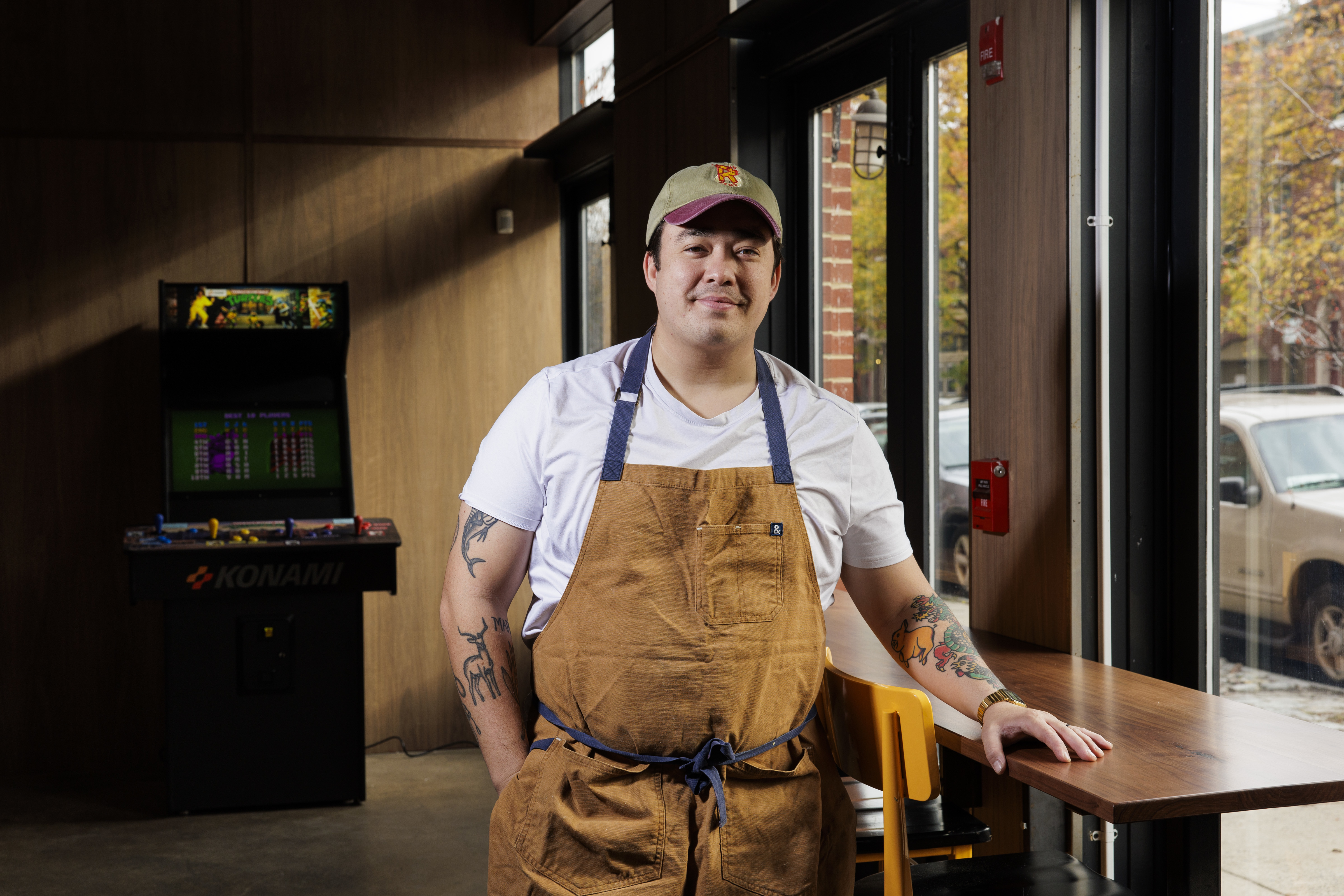
Anies, the chef-owner behind beloved Bella Vista BYOB Tabachoy, took over the former Tela’s space at 1833 Fairmount Ave. earlier this year. It’s a huge departure from Tabachoy’s minuscule footprint of 985 square feet, and of course, from its origins as a small food truck, which Anies still owns. “Manong’s kitchen is bigger than Tabachoy,” said Anies.
Chef Chance Anies posed for a portrait at Manong on Thursday, Nov. 20, 2025 in Philadelphia.
The dining room, which Anies had entirely renovated, seats over ninety people, including nine at its ample bar, at seats painted school bus yellow. There are globe lamps and custom-built booths, backed by forest green shiplap, and resembling the same leather-esque banquettes of a throwback, middle class steakhouse. There are also booths lining the windows, like in every diner movie that has ever been made. The dining room feels industrial, thanks to its exposed ductwork and concrete floor with veined cracks.
The front-of-house and back-of-house staff numbers around 28 people, unlike the eight, mostly part-timers that run Tabachoy.
Manong is a celebration of Anies’ ‘90s youth. Walk in through its enormous glass doors, above which their offerings are painted in orange cowboy-style font (Breakfast, Lunch, Dinner, Coffee, Bottle Shop), and on your left is a Teenage Mutant Ninja Turtles arcade game, procured from “an arcade guy in Michigan.” At Manong’s photo shoot for this article, Anies carried around a paper sack filled with Beanie Babies, given to him by his mother-in-law, as he tried to decide where to put them as decorations.
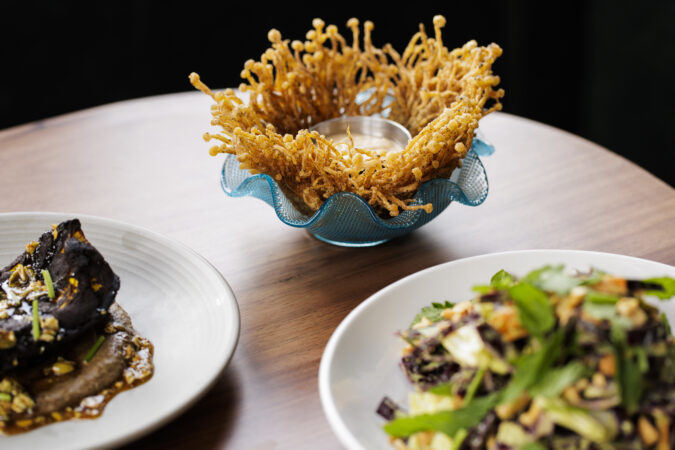
The Bloomin’ Shroom at Manong on Thursday, Nov. 20, 2025 in Philadelphia.
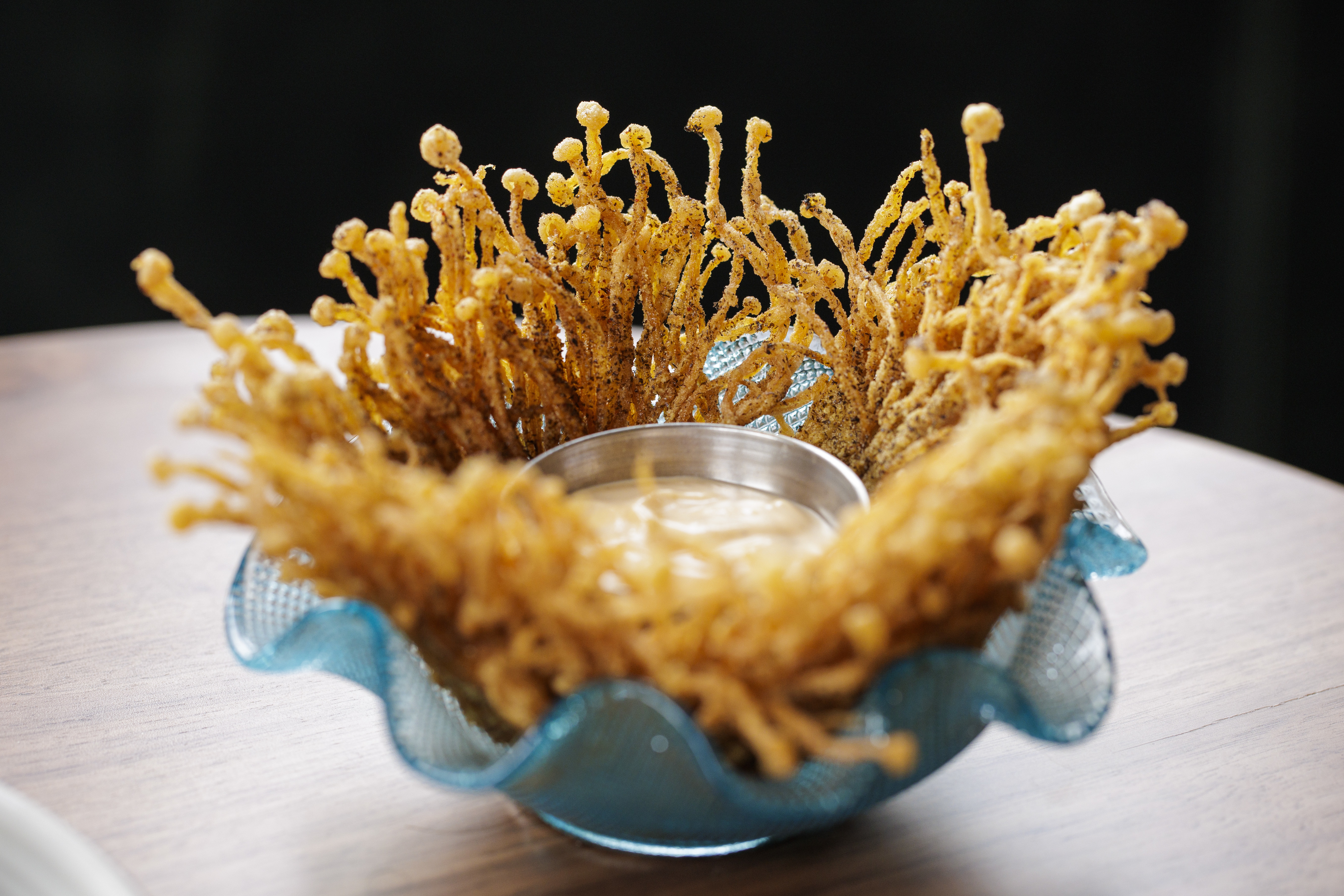
As a riff on Outback’s blooming onion, on Manong’s menu there will be a blooming mushroom, consisting of crispy enoki mushrooms tossed in cornstarch, garlic, and powdered, preserved lemon peel and arranged in a pressed glass frilled dish, mimicking a blooming effect with a ramekin of salsa rosada (a mixture of vegan mayo and housemade banana ketchup) at its center. Their Dynamite Lumpia, stuffed with pork, jalapeños, and mozzarella are enormous crispy parcels, unlike Tabachoy’s small, delicate rolls. “They’re like if a jalapeño popper married a lumpia,” said Anies.
The salad at Manong on Thursday, Nov. 20, 2025 in Philadelphia.
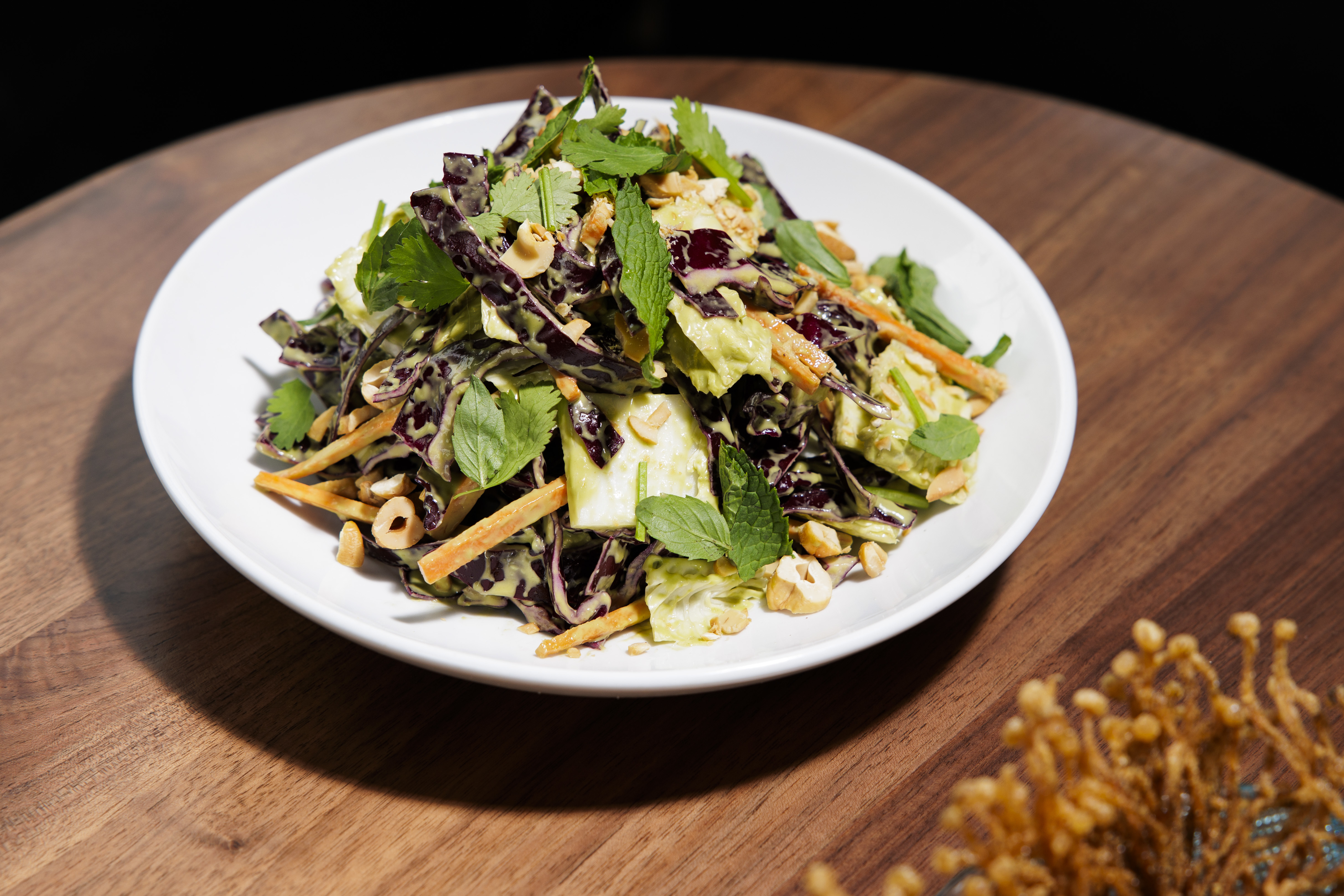
Their house salad will feature a green goddess dressing made with canned bangus, or milkfish, a popular Filipino pantry ingredient. Anies is also making efforts to develop versions of Filipino stalwarts that are less processed, like pulverizing red rice yeast for his tocino, a sweet Filipino cured pork known for its bright red hue, typically synthetic in origin. “It’s crazy how red the red rice yeast is,” he said. “It’s like an all-natural Red 40.”
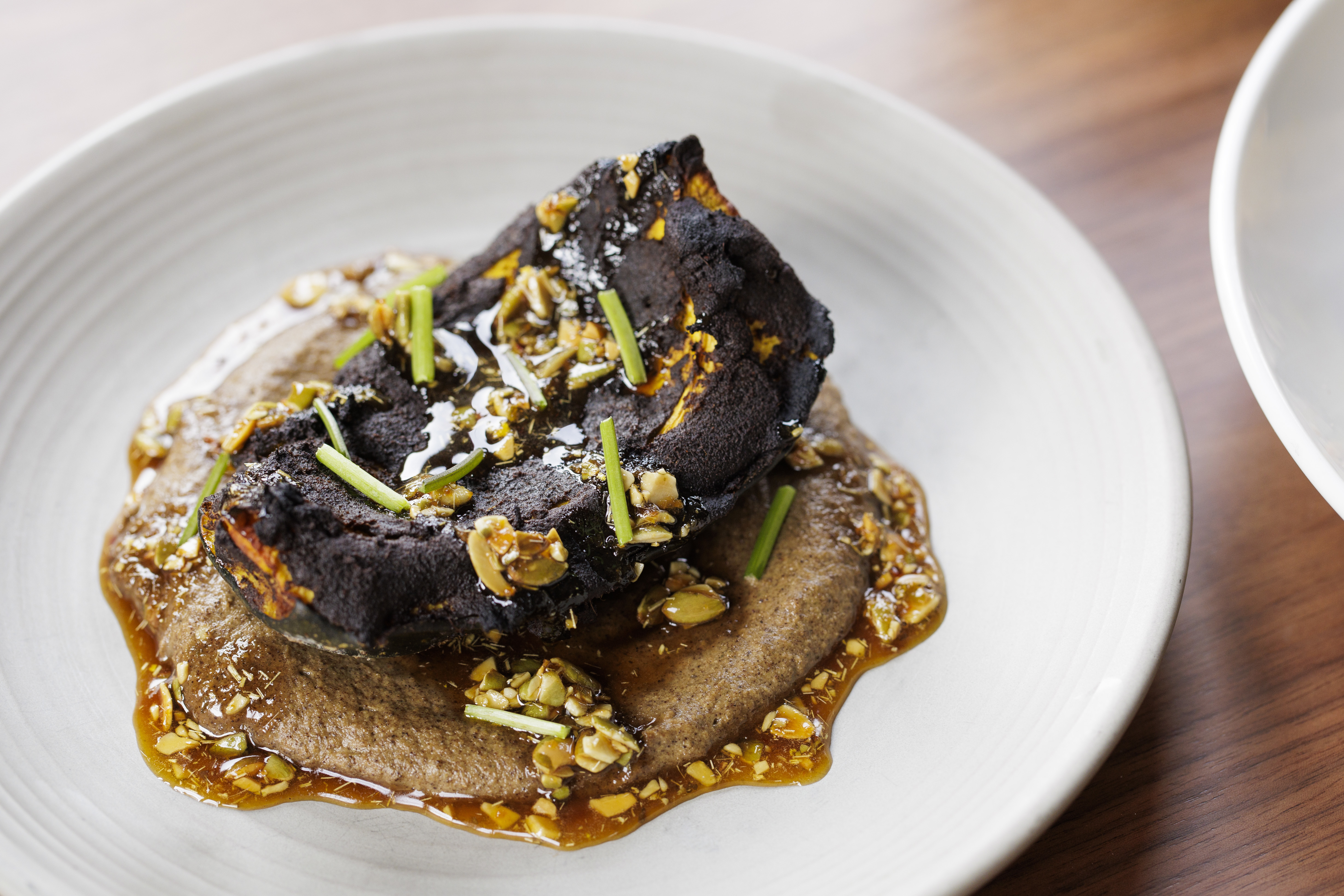
The squash at Manong on Thursday, Nov. 20, 2025 in Philadelphia.
Their Balong Burger — “Balong” is a term of endearment meaning “my boy” or “my child” in Ilocano and what Anies’ mother calls him — has a bun that echoes the pillowy Filipino loaves called pandesal and fashioned into four conjoined pieces. “The bun is sort of like connected King’s Hawaiian rolls,” said Anies. A half-pound burger patty will be sandwiches between the sliced open buns, with an option to add another patty on. It will be served with housemade banana ketchup and white American cheese. “But not Cooper Sharp. We’re not fancy over here,” said Anies.
To finish your meal, there will be homemade ube ice cream, fudgy in texture, and served in little metal dishes, along with a robust dessert menu of frozen treats like calamansi water ice.
Unlike Tabachoy, Manong has a liquor license. Expect local beers on draft from Love City and Carbon Copy, breweries that Anies developed relationships with after vending with his food truck at them for years. But there will also be Filipino Kasama rum in cocktails and served with a bottle of San Miguel beer as a “Quezon City Wide,” a nod to Anies’ father’s birthplace. Bottles of the Filipino beers San Miguel and Red Horse, an extra-strong lager brewed by San Miguel, will also be available at the bar. “But they don’t export kegs. I guess we could pour the bottles into kegs to have them on draft,” joked Anies.
And also unlike Tabachoy, where diners need to exit the front door, make a right, turn down an alley, and re-enter the building in order to go to the bathroom, Manong’s bathrooms (indeed there are now plural “bathrooms”) are accessed through the main dining room. One is papered with old magazine articles and Applebee’s-themed. The other is Outback-themed. And where did he procure the neon decor for each? “Don’t ask, don’t tell,” he responded.
Manong, to start, will be open Wednesday to Sunday from 5 p.m. to 11 p.m. They will seat guests until 9:30 p.m. as their kitchen will close before the bar does, at 10:30 p.m. Reservations are available on OpenTable.
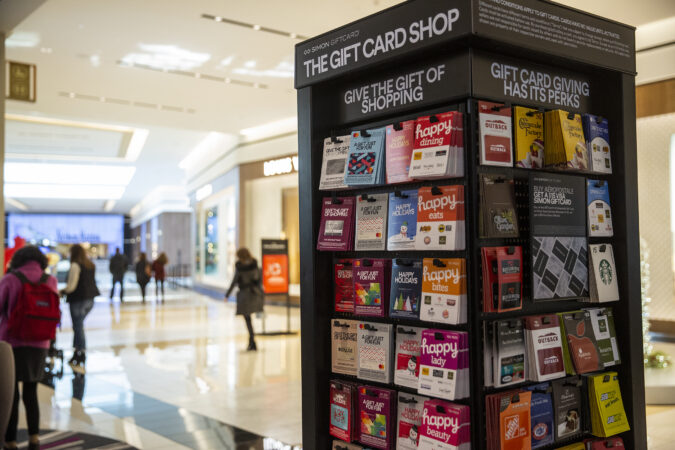
Restaurant gift cards begin as a thoughtful gesture — a birthday envelope, a holiday token, a “you deserve a night out.” So often, however, they migrate to a junk drawer or coat pocket, resurfacing in a moment of hopeful nostalgia:
“Hey, remember this place?”
But that cool restaurant has become a vape store, a Pilates studio, or a bubble-tea shop with a plastic vine selfie wall accented by the phrase “Let’s Make Pour Decisions.” written in neon.
That $75 that you thought would buy a roasted half chicken and a glass of natural wine from a “carefully curated” list has become a relic of a business that thrived briefly and then disappeared.
If you’re receiving a restaurant gift card this holiday season, there’s one important thing to bear in mind:
Use it. Fast. Not “soon.” Not “when it feels right.” Not after you’ve coordinated three calendars and a celestial alignment. Treat it like arugula, not heirloom jewelry. And if you’re giving one, attach an affectionate nudge: Go immediately.
Gift card horror stories
One-off, independent restaurants — the mainstay of Philadelphia’s mighty restaurant scene — depend on gift card sales. Ben Fileccia, senior vice president with the Pennsylvania Restaurant & Lodging Association, calls restaurant gift cards “one of the best ways to support the local businesses that bring our communities together.” He considers them a “direct investment in the neighborhood restaurants that show up for our schools, charities, and local events. Most restaurants honor every card they sell, and gift cards continue to be a reliable, meaningful way to support the hospitality businesses you love.”
But temper that with the idea that restaurants come and go.
Some restaurants wind down operations and stop selling gift cards months before the shutdown, publicly advising customers to use them promptly. One case in point is Laurel in South Philadelphia this year, which enjoyed a six-month countdown. Just last week, Rocco’s at the Brick shut down without warning during a dispute with the landlord; the owner graciously is refunding outstanding gift cards.
Others are not so ethical. On Christmas Eve 1994, a popular Center City bistro called Odeon was selling gift certificates — they were paper back then. Odeon never reopened after New Year’s and the gift certificates became bookmarks. The rumor was that the reservationist sold them, not knowing that the restaurant was closing.
Buying from a restaurant chain can be safer. But just two months ago, Iron Hill Brewery & Restaurant — a pillar of the region for three decades — shuttered three locations and, two weeks later, closed the remaining 16 and then filed for bankruptcy protection. If you have an Iron Hill gift card, you’re at the very back of the line.
J. Alexander’s, a contemporary steakhouse chain, shut down its King of Prussia location without notice last year. Gift cards can be honored at the closest remaining locations in Clifton, N.J., or Annapolis, Md. Grand Lux Cafe’s Cherry Hill location closed in 2020, directing customers to its King of Prussia location, which closed a year later. If you still have a Grand Lux Cafe card, plan a day trip to Paramus, N.J., or Garden City, N.Y. (Cheesecake Factory owns Grand Lux but does not accept its cards.)
Bertucci’s is slowly, quietly exiting: The suburban locations in Bryn Mawr, Langhorne, Marlton, Mount Laurel, and beyond went dark, leaving only Springfield, Delaware County, and Newark, Del. Houlihan’s vanished from Philadelphia and its suburbs altogether, and Ruby Tuesday has done the same slow fade, retreating from malls and roadside plazas that once seemed permanent.
The numbers
Total gift card spending is expected to reach $29.1 billion, up from $28.6 billion in 2024, according to the National Retail Federation. Consumers plan to purchase between three to four gift cards and expect to spend an average of $171.32 per person. Restaurants remain the most popular gift card type (27%), followed by bank-issued cards (25%), department stores (25%), and coffee shops (20%).
As you might imagine, restaurants do not mind selling cards. By industry estimates, 5% to 15% of restaurant card value is never used — a concept known as “breakage.”
In Pennsylvania, the law prohibits gift cards from expiring in less than two years and bans dormancy fees; after five years without redemption the value is presumed abandoned and may be sent to the state. In New Jersey, the law requires that gift card value remain fully available for at least 24 months and restricts inactivity fees during that period.
What else to do
Universal gift cards, like those issued by Visa and Mastercard, are the safest bet if you want to give something other than cold, hard cash. Although there’s usually an upfront fee with their purchase, they travel with the recipient, not the business. They survive concept changes, closures, disputes, and chef departures. Perhaps give the recipient one of these gift cards with a list of suggested restaurants. (For inspiration, I might suggest including a copy of The Inquirer’s 76 Magazine, our guide to the restaurants that are defining dining in the region, available through The Inquirer’s online store.)
Or consider a donation in your friend’s name to a Philadelphia hunger-relief nonprofit, such as Share Food Program, Sunday Love Project, and People’s Kitchen, which work magic turning even modest gifts into many meals.
Of course, you could skip giving a gift card altogether. Instead, pick a date, make a reservation, and treat the recipient to a meal — and to your company.
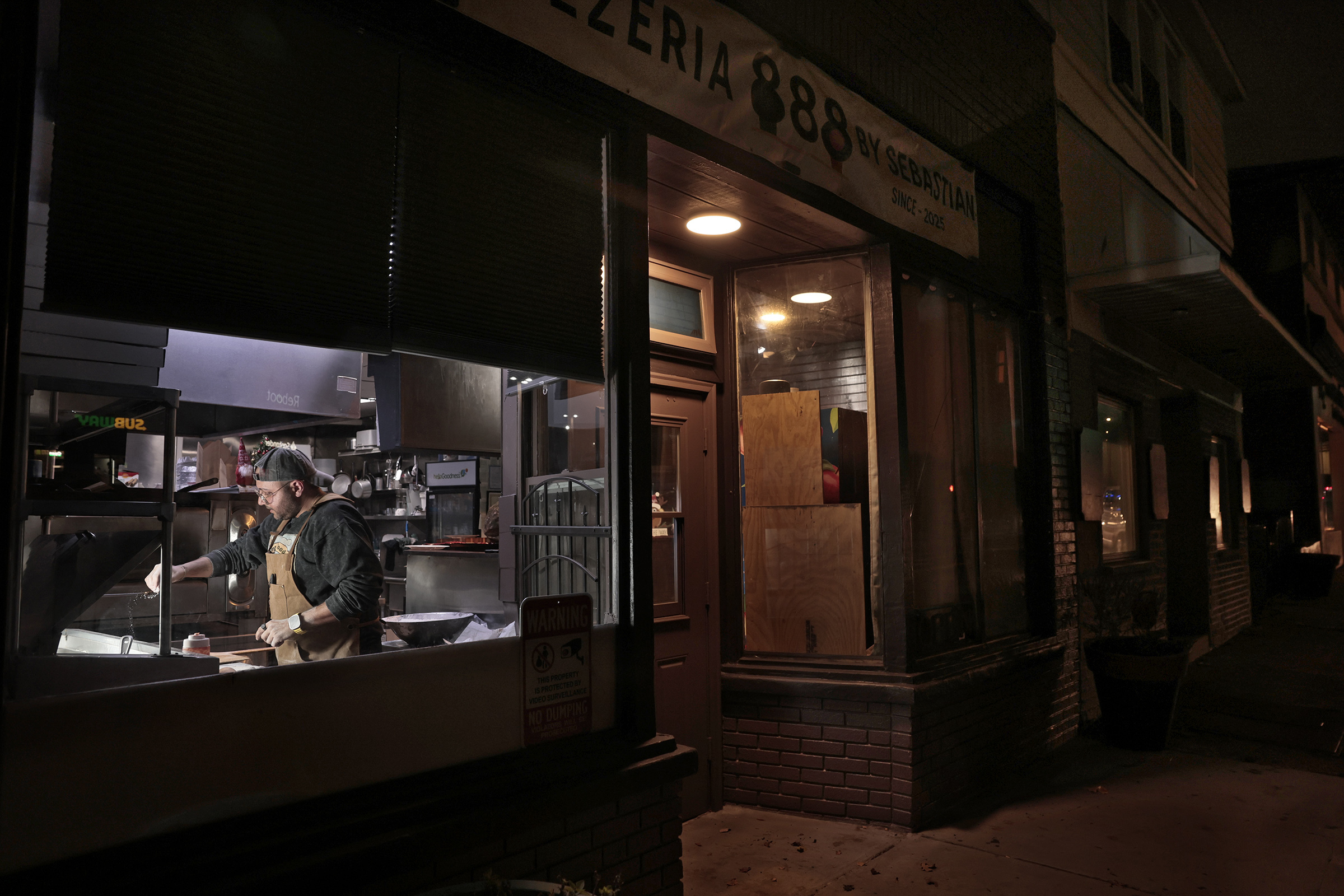
Pizzerias crave visibility, but there’s no sign pointing to Apizzeria 888 by Sebastian. It’s a true hole in the wall you’ll likely blow right past while trying to keep up with traffic whizzing along Old York Road in Elkins Park.
Sebastian doesn’t care.
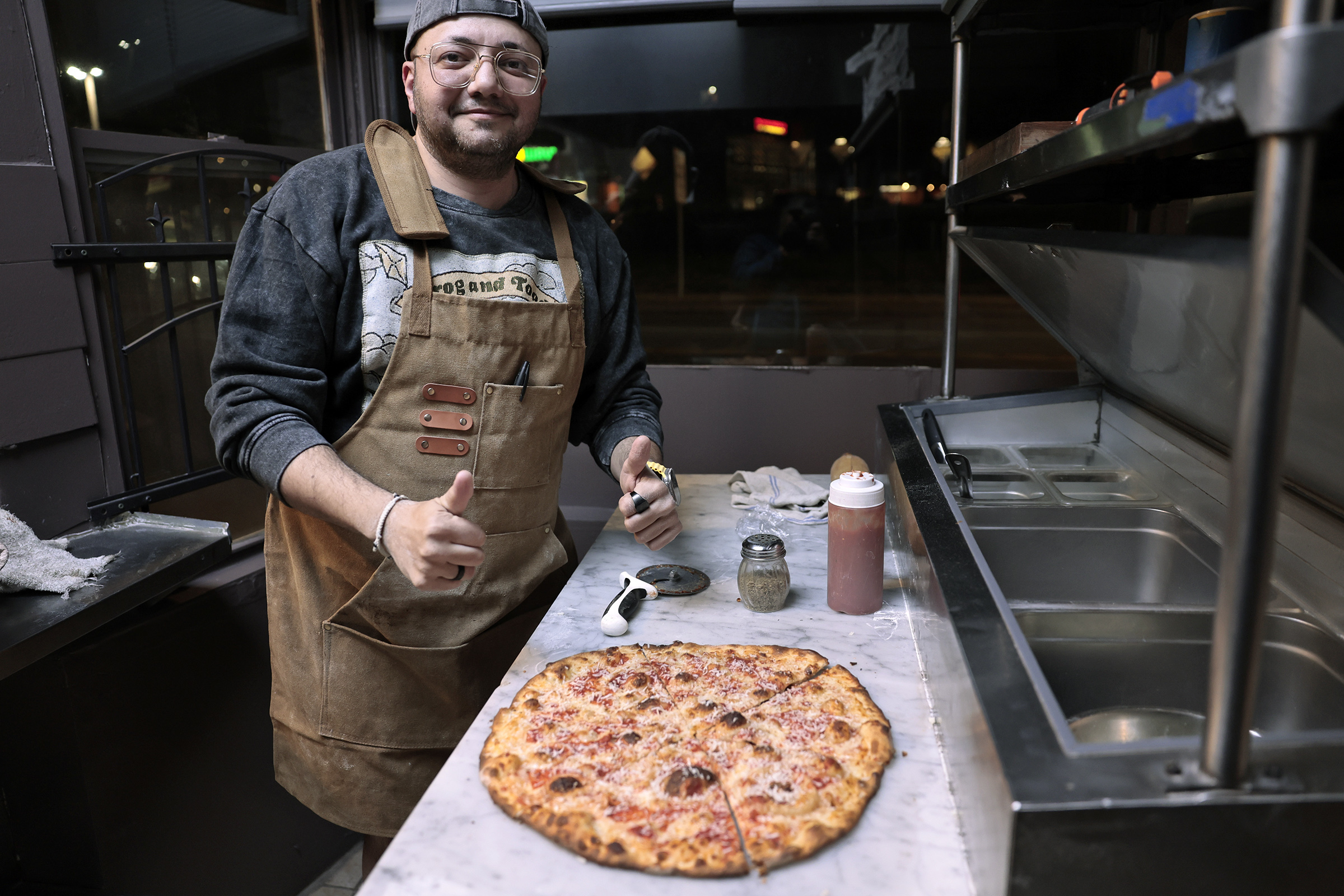
Right now, Sebastian Besiso is working for himself and by himself: 40 pies a night, walk-in or call-in, pickup only, limited menu, and no third-party delivery after he got frustrated with UberEats’ fees one night and smashed the order tablet to bits.
Sebastian Besiso checks the undercarriage of a pizza at Apizzeria 888 by Sebastian.
Besiso has an endgame — and Apizzeria is more of a lab than a pizzeria. He views it as a test ground for something bigger — what he cryptically calls part of a “social media interactive platform that will drive people directly to a restaurant.” It won’t be a delivery service, he said, but will offer the technology to give pizzerias better control over their business.
That would also mean moving beyond Apizzeria’s cramped takeout setting. “I want a real dine-in experience where people can come, sit down, enjoy themselves, eat Roman and Neapolitan pizza, and drink halal beer,” he said. “This current setup is not sustainable long-term.”
“I’m not saying I’m better,” says Sebastian Besiso. “I’m saying this is my style.”
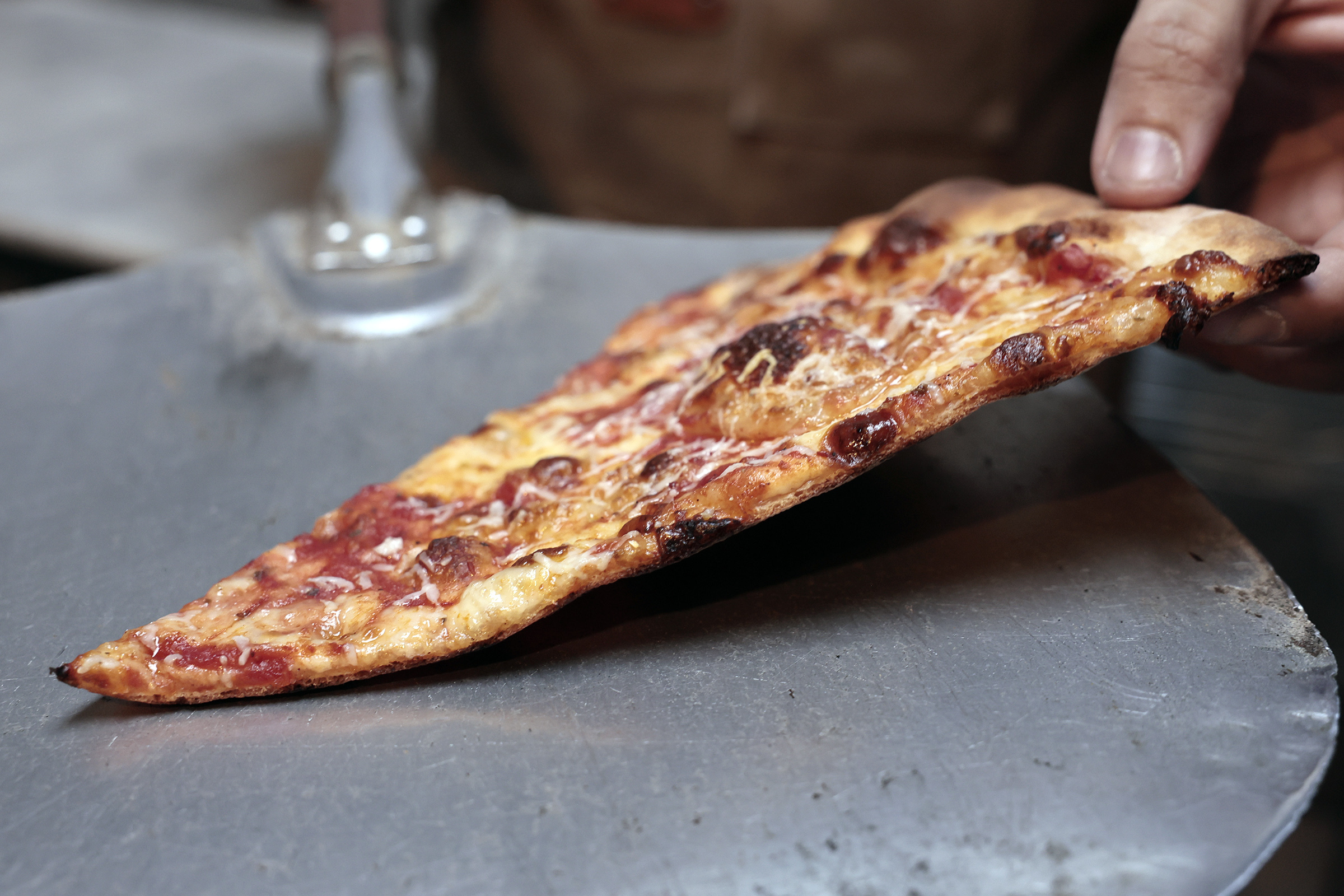
Besiso is the first to say that you may not like his pizza, especially if you prefer more conventional New York or Neapolitan styles, as many of his Elkins Park neighbors seem to. His “Roma” has two kinds of aged cheese, a smear of a slightly sweet tomato basil sauce, and an almost impossibly thin crust that shatters around the edges as you bite in. There is no flop whatsoever. It has the crunchy, cheese-on-the-bottom qualities of Chicago tavern-style, though Besiso slices his pies into conventional eighths, not party squares. Toppings include beef pepperoni and sausage crumbles.
His pizzas are well-done. “People around here will say, ‘You burned my pizza,’” he said. “I tell them, ‘Just take a bite.’”
A pizza just out of the oven at Apizzeria 888 by Sebastian.
His customers — and I am one — take a bite and love it. I’m obsessed.
“I’m not saying I’m better,” Besiso said last week, rolling out a 7-ounce dough ball into a 14-inch round — about half the weight of what’s used in a conventional New York-style pizza of the same size. “I’m saying this is my style.”
That restraint can confuse customers. “They look at a $25 price for a 14-inch pizza and feel cheated,” Besiso said. “They judge by quantity, not quality.”
An experimental pizza crust made by Sebastian Besiso of Apizzeria 888 by Sebastian.
I asked Gregorio Fierro, a local consultant well versed in pizza styles and parlors around the world, to tag along on a visit. “You can easily finish a 14-inch pie and not feel weighed down,” he said, impressed. “It’s not one of those heavy pizzas where you feel stuffed.”
Besiso, 42, started in the pizza business 20 years ago before he went to Drexel for chemical engineering. While building his career, he worked at the Pizza Gourmet, a parlor in Northeast Philadelphia, before buying Brandywine Pizza in Spring Garden with his brother. In 2020, he took over his current location, then called New Venice Pizza, across from Elkins Park Square. During the pandemic, he opened the shop for overnight deliveries. In his idle moments, he began tinkering with hydration, fermentation, yeast, and oven temperature and fell down the pizzaiolo rabbit hole.
Note the thinness of Sebastian Besiso’s Roma pizza at Apizzeria 888 by Sebastian.
After working overseas on an engineering job, he came back and last month rebranded the shop; “888” is a lucky number.
Besiso keeps everything close to the vest: He says he “ages” his dough at least two weeks and uses just a speck of yeast and much lower hydration than other shops. The Roma’s base is a low-moisture mozzarella blend. (“Let’s leave it at that,” he said.) A grated cheese goes on top. “People assume it’s Parmigiano Reggiano, but it’s not,” he said. (Fierro suspects it’s Pecorino Romano.)
Sebastian Besiso pauses at his Apizzeria 888 by Sebastian in Elkins Park.
Besiso’s real talent is his mastery of his 60-year-old Blodgett deck oven. He pulls out each pizza near the end, lets it rest, and then slides it back for the final few seconds. Even that tiny step makes the pizza crunchier. When the pie is done, he sets it on a rack — not a pan — for cutting to preserve even more snap.
Besiso’s cardboard pizza box also plays a role. He hand-punctures each with rows of small holes for ventilation. “Steam is not your friend,” Besiso said. “You close the box, drive 10 or 15 minutes, and the steam ruins everything.”
If you’re not local, the smart move is to call in your order, park in the lot around back, get paper plates, snag a Mexican Coke or a Fanta from the fridge, and enjoy the pizza on the hood of your car. You can take home the pizza and pop it into a hot oven for two minutes, if you must.
Right now, Besiso is developing his own panuozzo — a flat, pizzalike bread — for a line of sandwiches. If you like those, you like them, he said. “And if you don’t, you don’t.”
Apizzeria 888 by Sebastian, 8021 Old York Rd., Elkins Park, 215-635-1200. Hours: 5 to 8 p.m. Tuesday to Thursday, 4:30 to 8:30 p.m. Friday and Saturday.
Sebastian Besiso is seen through the front window at Apizzeria 888 by Sebastian.
Come Dec. 6, Amanda Shulman, chef and creator of the now Michelin-starred Rittenhouse restaurant Her Place Supper Club, knows exactly what she’ll be doing: boxing up hundreds of cookies.
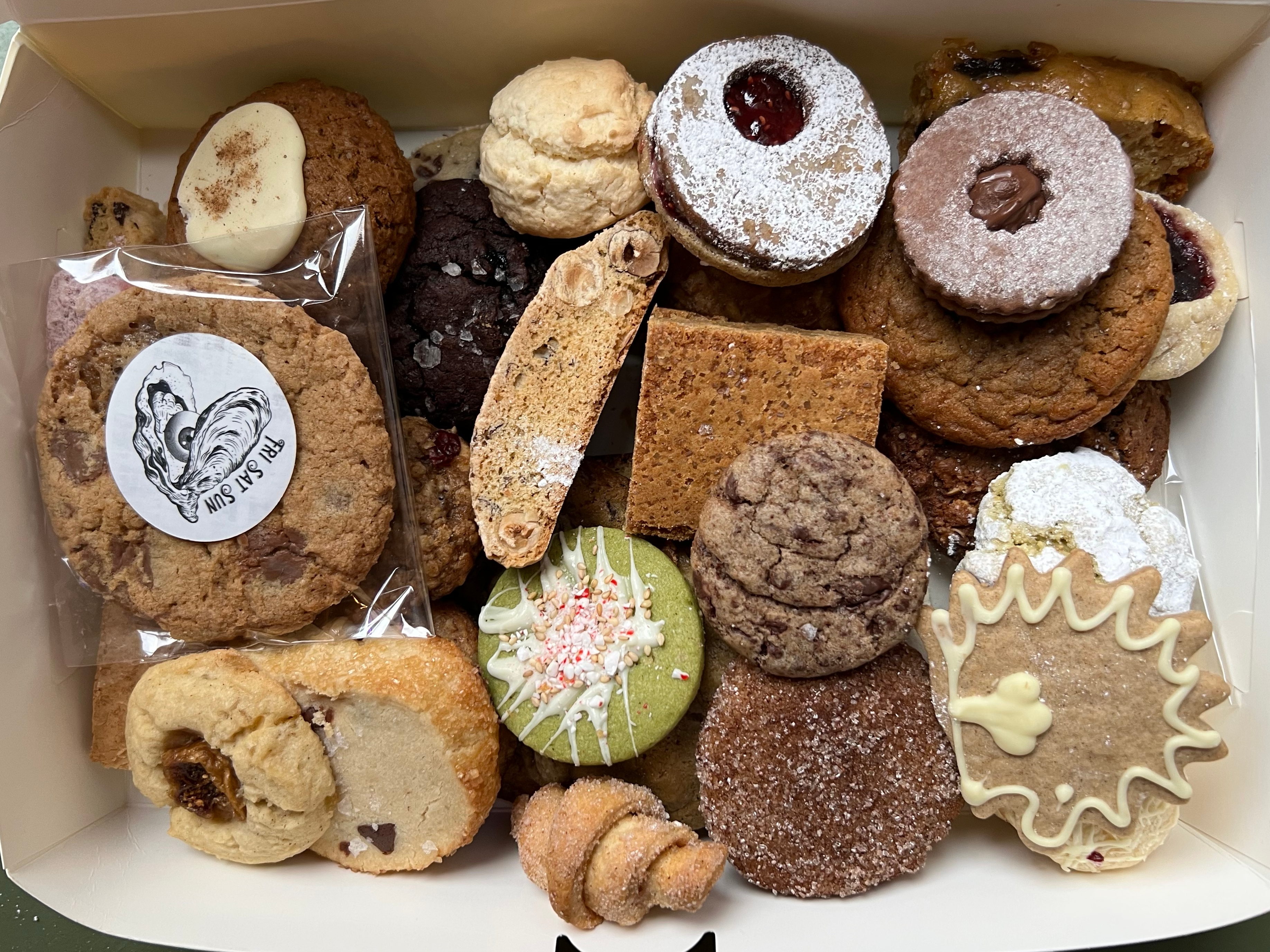
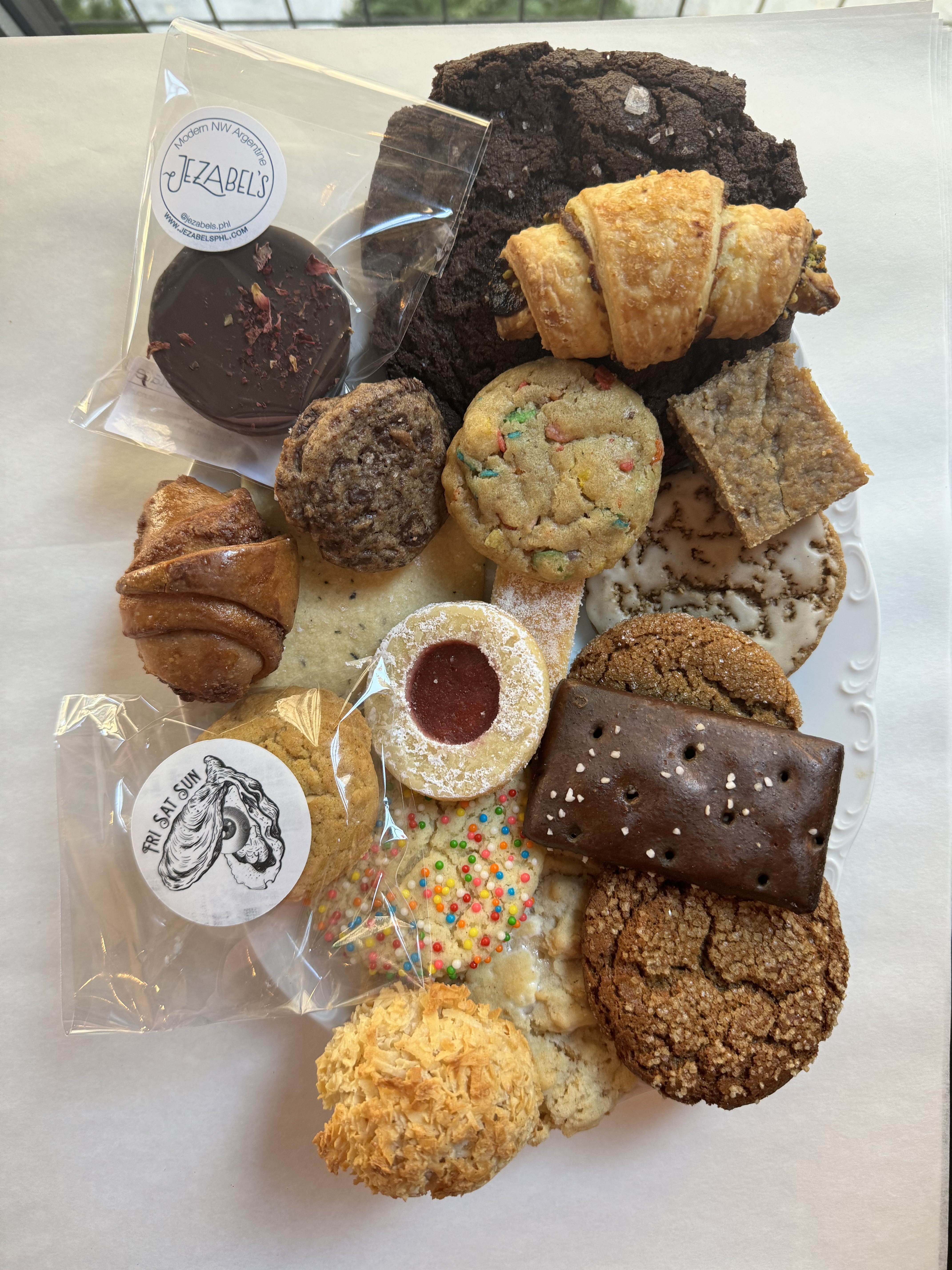
More than three dozen cookie varieties — snickerdoodles, chocolate chips, shortbread, thumbprints, meringues, macaroons, and many more, in 100-cookie batches — will be ferried to Center City that morning. They’ll be brought by bakers and pastry chefs from around the region, all of whom have enlisted to help Shulman pull off what has become an epic holiday fundraiser, Cookies 4 Coats, now in its fourth year.
Shulman and her crack team take over once the cookies have converged. They’ll crank for two hours, putting together a cookie box so big, it will fill the front seat of your car.
“It’s so many cookies,” Shulman said in a recent interview. “It is an irresponsible amount of cookies, and it’s awesome.”
The first edition of Cookies 4 Coats’ annual cookie boxes, which assemble treats from well over two dozen bakers and chefs from around Philly. The fundraiser has only grown since it started in 2022.
If you’ve scored a box in previous years — the reservations for them were snapped up in a matter of hours last December — you know the treasure trove of sweets that lies within.
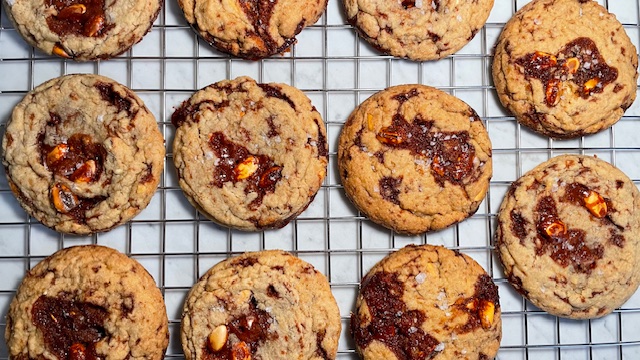
Last year’s 41-cookie box was full of recipesfrom pop-up bakers and pastry chefs, including several folks behind some of Philly’s most vaunted restaurants, bars, and bakeries: brown butter chocolate chip cookies from Provenance pastry chef Abby Dahan, white chocolate and cranberry oatmeal cookies from Friday Saturday Sunday’s Amanda Rafalski, hazelnut shortbread from Vetri’s Michal Shelkowitz, Italian anise wedding cookies from Laurel chef Nick Elmi, Krispie cornflake marshmallow cookies from New June’s Noelle Blizzard, and Irish shortbread from Meetinghouse chef Drew DiTomo, not to mention Shulman’s own sourdough chocolate chips.
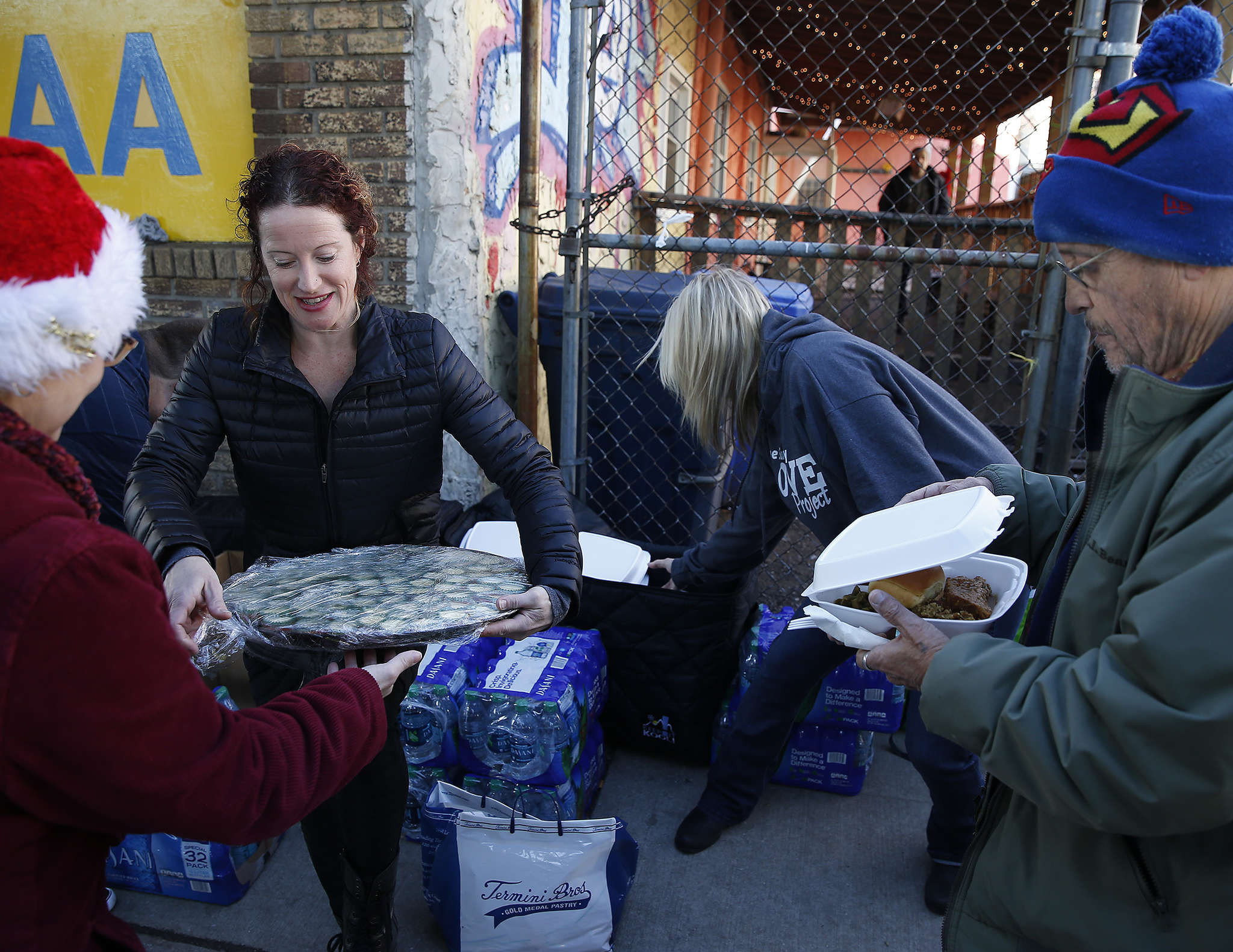
All the proceeds from these coveted cookie boxes are split between Broad Street Love, the radical hospitality-rooted Center City nonprofit, and Sunday Love Project, a Kensington nonprofit that runs a free community grocery store in the Riverwards neighborhood. Last year’s sell-out bake sale generated a $15,000 donation to Sunday Love that funded the purchase of hundreds of coats for local kids, as well as programming (music, art, cooking classes, etc.) for children and families, according to Sunday Love founder Margaux Murphy.
Margaux Murphy, founder of the Sunday Love Project, serves Carlos Gonzalez.
Shulman and Murphy first met in 2021, while Murphy was still running Sunday Love out of the Church of the Holy Trinity at 19th and Walnut, serving 2,000 meals a week to anyone in need. Shulman and the Her Place crew — then in their first year of business — got involved, cooking lunches for kids going to summer camp and dropping off meals to the church.
Her Place was the stage for various pop-up bake sales and charity events in those pandemic-era years. In 2022, the idea came to Shulman for an extra-special one: “Everybody loves a holiday cookie box.” Why not assemble a citywide assortment and donate to Philly charities?
She put out an open call to bakers to pitch in and got tremendous response. She shared an online spreadsheet for the participants to see who planned to bake what, so that there wouldn’t be too many repeats. To add to the box’s value, they included a recipe book so that buyers could recreate their favorites at home.
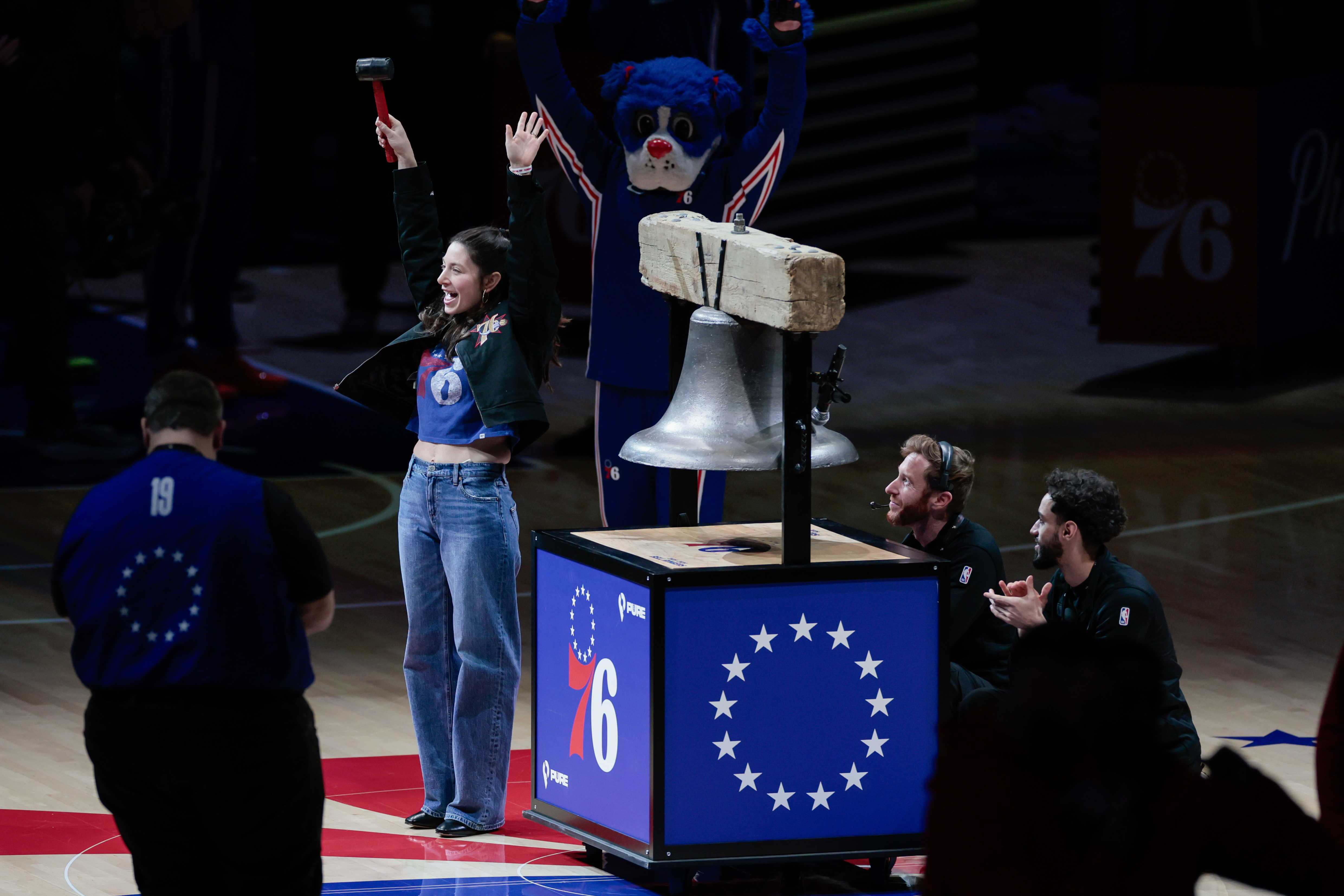
Her Place Supper Club chef Amanda Shulman rings the bell at the Sixers game Wednesday, Nov. 19, 2025, in Philadelphia
Shulman estimates 32 bakers contributed to the first Cookies 4 Coats box, raising thousands of dollars.Ever the one to see things through, Shulman didn’t leave much work for Murphy to do after collecting the cash.
“The first year, I [sold the boxes] a little earlier and I bought [the coats] all myself on Black Friday and had them all shipped to my house, so I had hundreds of coats in my apartment,” Shulman laughs, recalling the charity-induced splurge. “I needed to get different designs. I had to be sure there was something for everybody, so I went a little crazy. I had never racked up a credit card like that, and it was so exhilarating.”
Things are different these days, and Shulman says that’s for the best. “Now we just write checks, because they need other things besides coats — and [Murphy] gets to pick out what she needs as opposed to me just going on a shopping spree.”
One of Cookies 4 Coats’ annual cookie boxes, which assemble treats from well over a dozen bakers and chefs from around Philly.
Reservations for this year’s cookie box went live earlier this month and sold out in a matter of days. Shulman lowered the total number of boxes sold from 120 to 100, but the fundraiser is set to generate even more this year, because the price — $135 per box — increased to cover the cost of improved packaging: Each cookie will be individually wrapped this year, so buyers know which cookie is which rather than guessing based on flavor profiles and recipe cards (a fun game in itself).
Thirty-three bakers and chefs are signed up to contribute thus far, including Scampi’s Liz Grothe (cappuccino Rice Krispies treat), New June’s Blizzard (salted double chocolate chip shortbread), Amy’s Pastelillos’ Amaryllis Rivera-Nassar (besitos de coco), and Lost Bread’s Dallas King (honey butter corn cookies). (For those who don’t have a Cookies 4 Coats reservation, we offer eight of Shulman’s favorite recipes from last year’s box as a consolation.)
Murphy is perpetually floored by the size of the donation, and by Shulman’s seemingly bottomless reservoir of generosity. Murphy’s had strangers give thousands of dollars to Sunday Love, only to discover it was because Shulman recommended the nonprofit to a customer or acquaintance. Shulman recently collaborated with the Philly-area meal-delivery service Home Appetit, sending a portion of the sales to Sunday Love; it resulted in an $8,000 donation.
“I always tell her, she waves a magic wand and she’s just like, ‘Here’s $10,000, feed all the children,’” Murphy said. She remembers a very pregnant Shulman coming to last year’s annual coat giveaway (which will take place this year on Dec. 13 at 3206 Kensington Ave.). “She was in my store because she wanted to see the kids getting coats — I was like, ‘I swear to God, if you have this baby right here on my floor’ — that’s how hard she was working just to make sure that we had everything.”
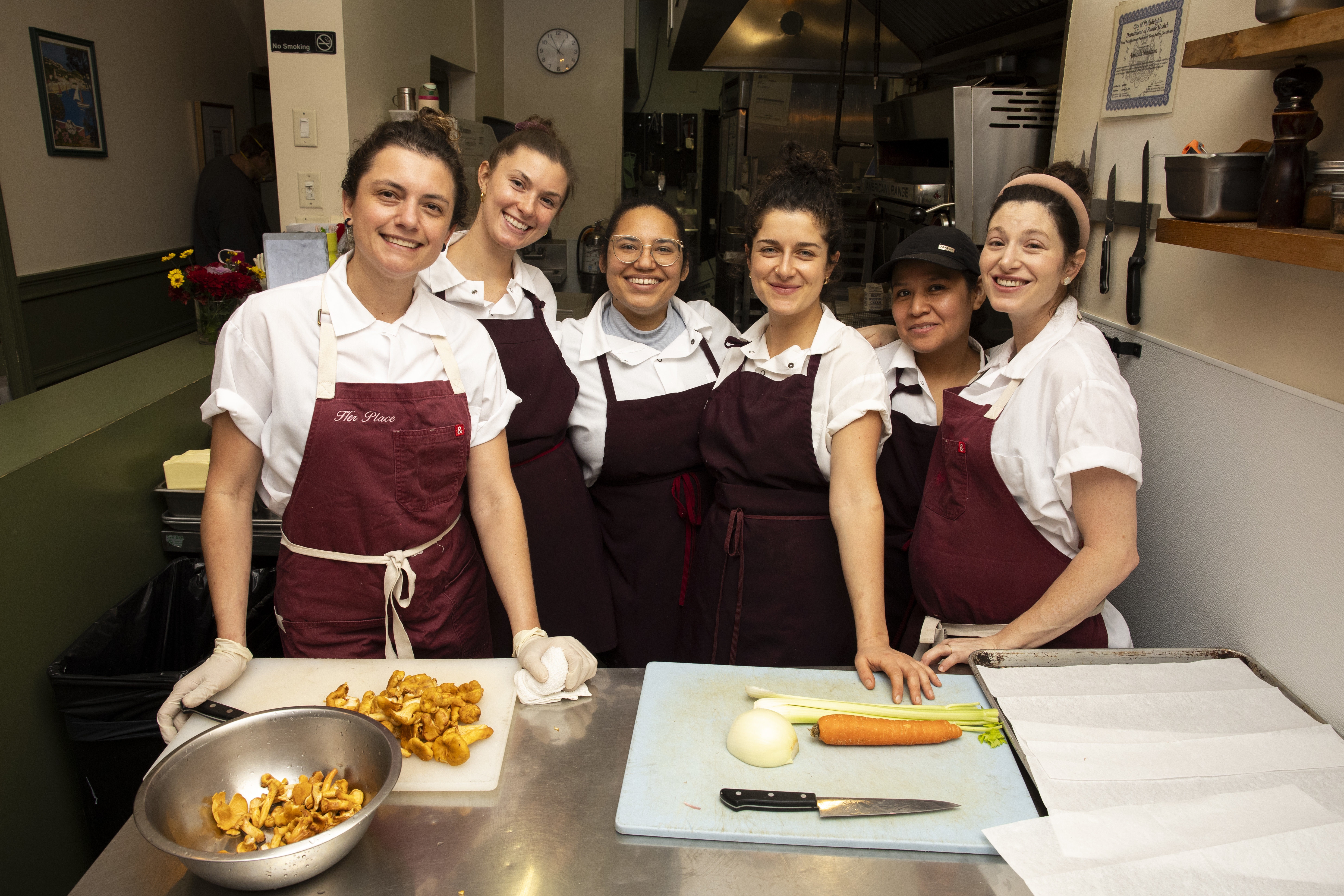
The Her Place team from left to right: Chef de Cuisine Ana Caballero, Line Cook Lauren Fiorini, Pastry Chef Jazzmen Underwood, Sous Chef Santina Renzi, Prep Cook Denia Victoriano, and Chef/Owner Amanda Shulman posed for a group photo at Her Place Supper Club on Tuesday, Nov. 26, 2024 in Philadelphia. Her Place is located at 1740 Sansom Street in Center City.
Shulman remembers that day a little differently, singling out a moment where she watched a little girl pick out a coat — “this brand-new, shiny pink coat that she got to pick out,” she said. “It’s full circle when you get to do every single part of the process, from the physical picking of the cookies to packing them to printing the things. I’m very grateful to everybody who helps out, and especially to my own team, because it’s a lot of work to make it this seamless.”
That’s what Shulman comes away with when reflecting on what goes into this crumb-flecked effort: gratitude.
“If I can say thanks to my team … and to the community, that would be awesome. Thank you to all the bakers and restaurant people who give so much in the busiest time,” she said. “These bakers take time to not only make [the cookies], but then get it to us. It sounds like an easy lift — it’s not, especially if you’re going to work that day. I don’t take it for granted at all.”
Editor’s note: An earlier version of this story stated that 100% of the Cookies 4 Coats proceeds go to Sunday Love Project. It is split 50/50 between Sunday Love and Broad Street Love.
These cookies were among chef Amanda Shulman’s favorites of the 40-plus entries included in last year’s Cookies 4 Coats box, which Shulman coordinates and sells every year with the help of more than two dozen contributors, with 100% proceeds split between the Sunday Love Project and Broad Street Love. The recipes, sourced from Philly kitchen pros, have been lightly edited for clarity but not tested.
Note: While some recipes call for cups and teaspoons, several of them call for grams (one generous contributor includes both). Most baking professionals measure ingredients by weight, using a digital scale to ensure accuracy; not only does it result in more accurate measurements, it also saves time and cleanup. If you want to convert from one measurement to another, you can find a very helpful equivalencies chart online at King Arthur Flour’s website. — Jenn Ladd
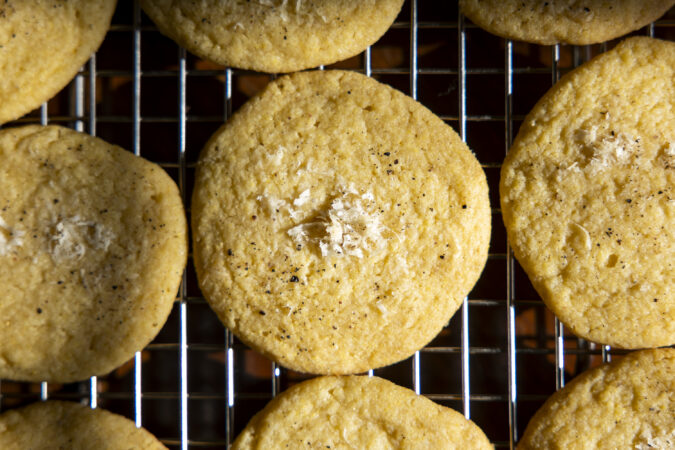
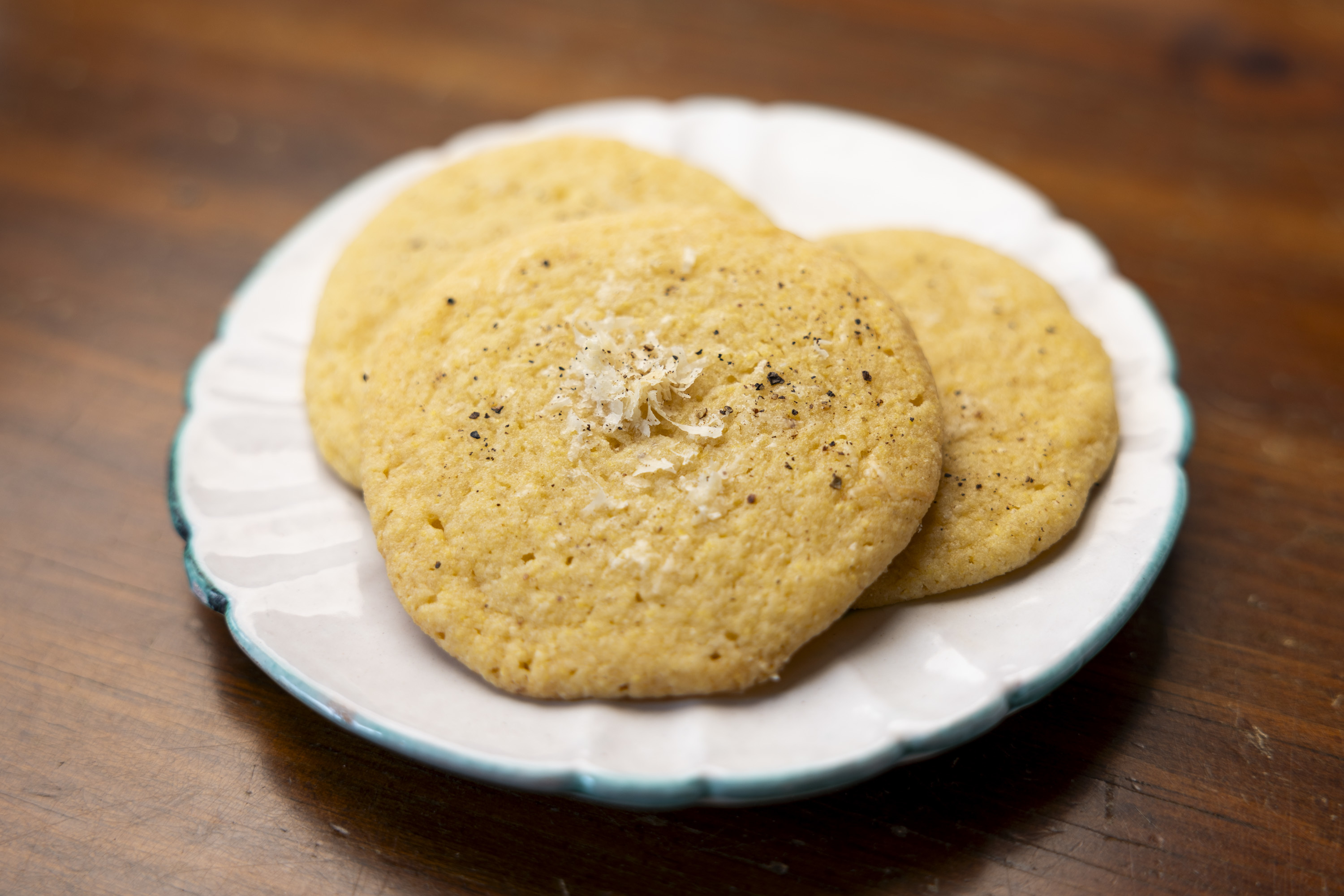
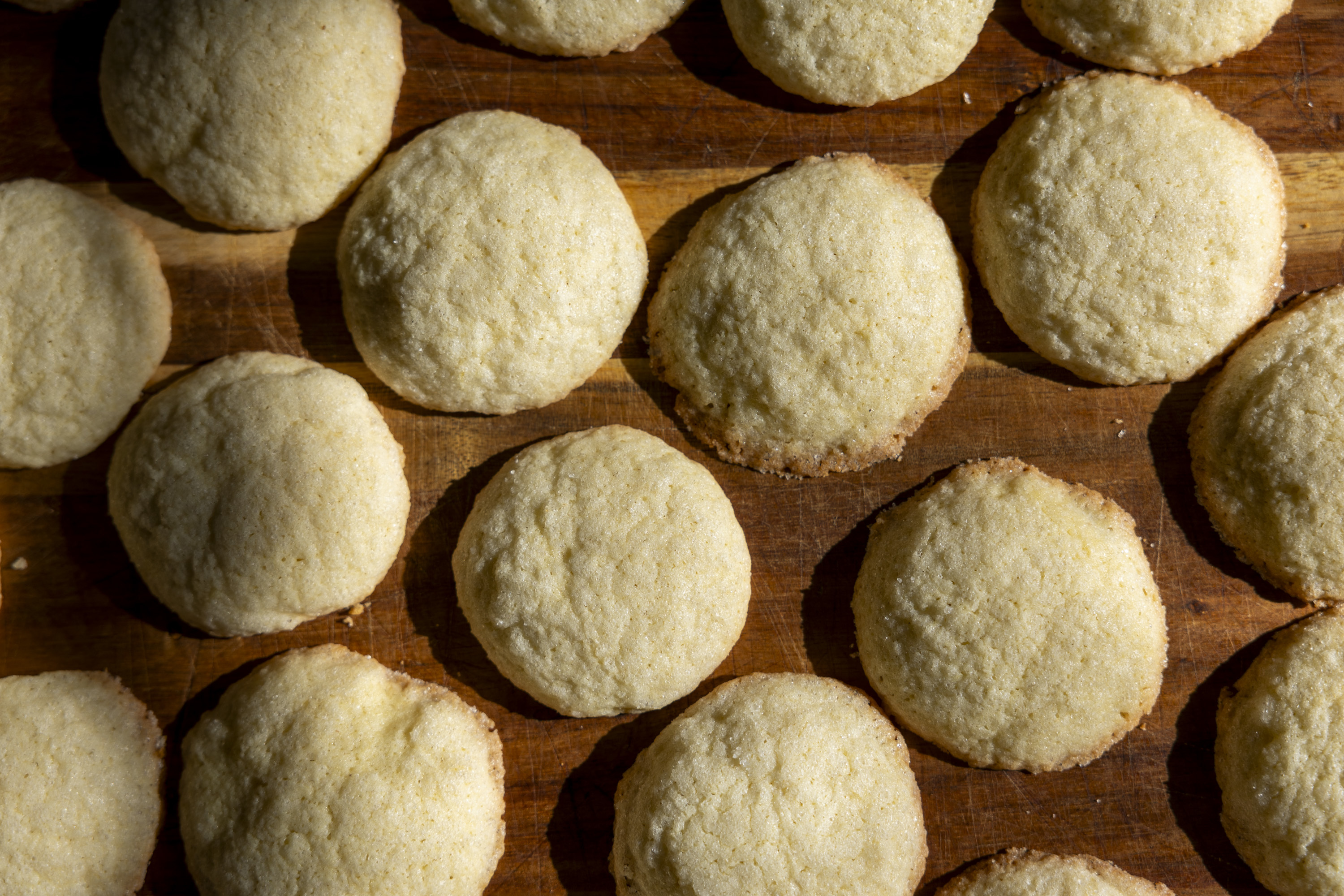
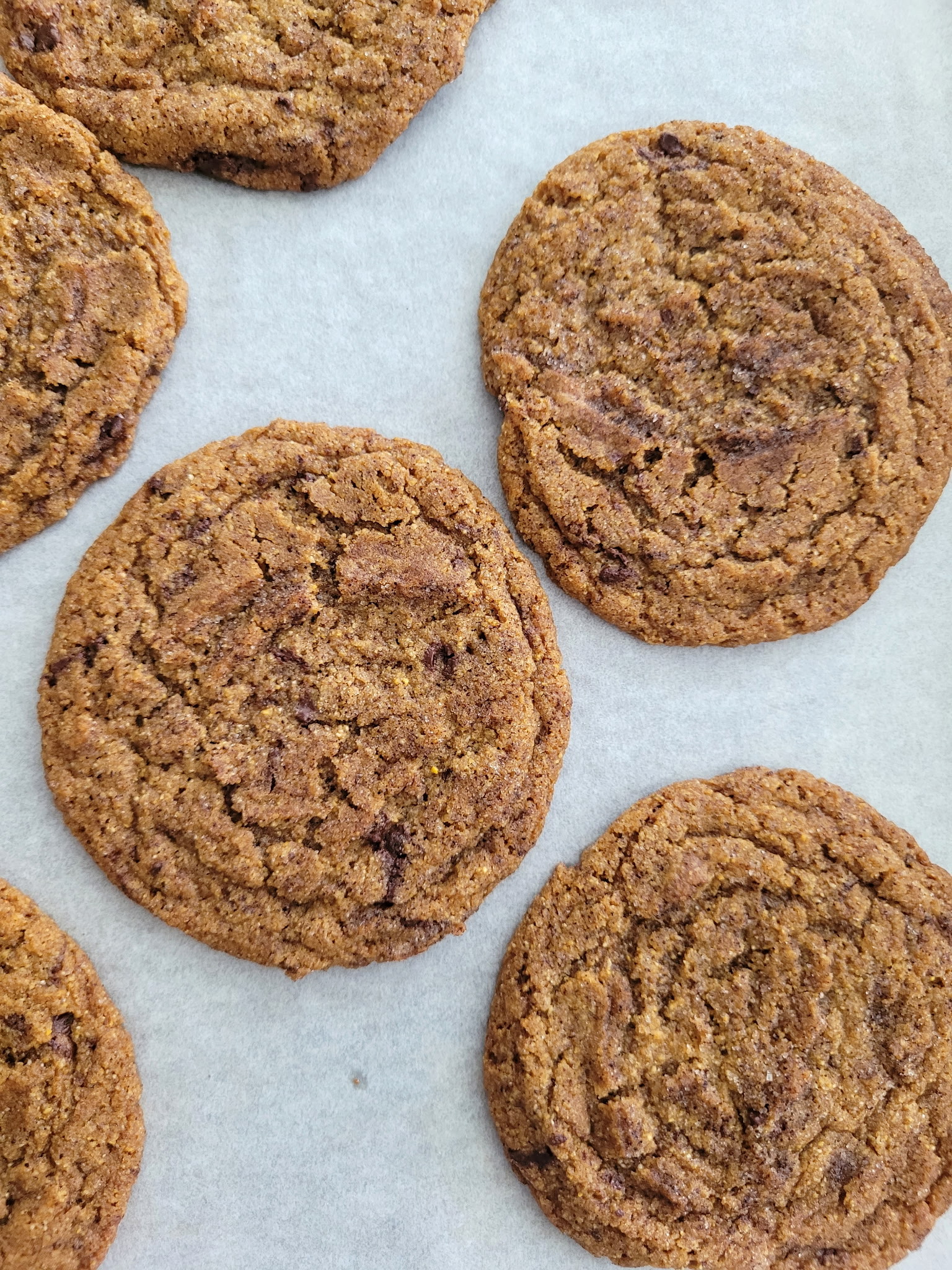
The Parmesan Cornbread Cookies made by Inquirer reporter Jenn Ladd in Philadelphia, on Friday, Nov. 14, 2025.
Parmesan cornbread cookies
Recipe by Ashley Huston, Dreamworld Bakes
Makes 45 cookies
This fun recipe from Ashley Huston, the baked-good mastermind behind Kensington’s Dreamworld Bakes, yields soft, chewy cookies, and a lot of them. You can easily halve the ingredients below for more modest batch, but they’re so good (and freeze well) that you’re better off making it as written.
Cornmeal gives cookies the faintest grainy texture — in the best way — and a big dose of honey lets you inform their flavor with your favorite type, be it clover, wildflower, or buckwheat. Top the cookie dough rounds with as much grated fresh Parmigiano Reggiano (or sprinkle the nicest pre-grated parm you have) and cracked black pepper as you like; if you sprinkle it on before you chill the cookies, it’ll hold up better upon baking for a more visually interesting cookie.
525 grams all-purpose flour
350 grams cornmeal
12 grams salt
6 grams cornstarch
6 grams baking powder
3 grams baking soda
450 grams (4 sticks) butter, softened
400 grams white sugar
200 grams honey
110 grams egg (2 eggs), room temperature
Parmesan cheese, freshly grated, to taste
Black pepper, freshly milled, to taste
Heat the oven to 350°F. Sift together the flour, cornmeal, salt, cornstarch, baking powder, and baking soda. Set aside.
In a stand mixer with the paddle attachment, cream the sugar and butter together until light and fully incorporated. Add the eggs and honey, then beat until blended.
Gradually add the dry ingredients to the mixer, beating until combined. Do not overmix.
Scoop out 1.5-ounce portions of dough onto onto a lined sheet pan, form discs, top with Parmesan and pepper. Refrigerate for 15 minutes.
Bake for 9 to 11 minutes, until set.
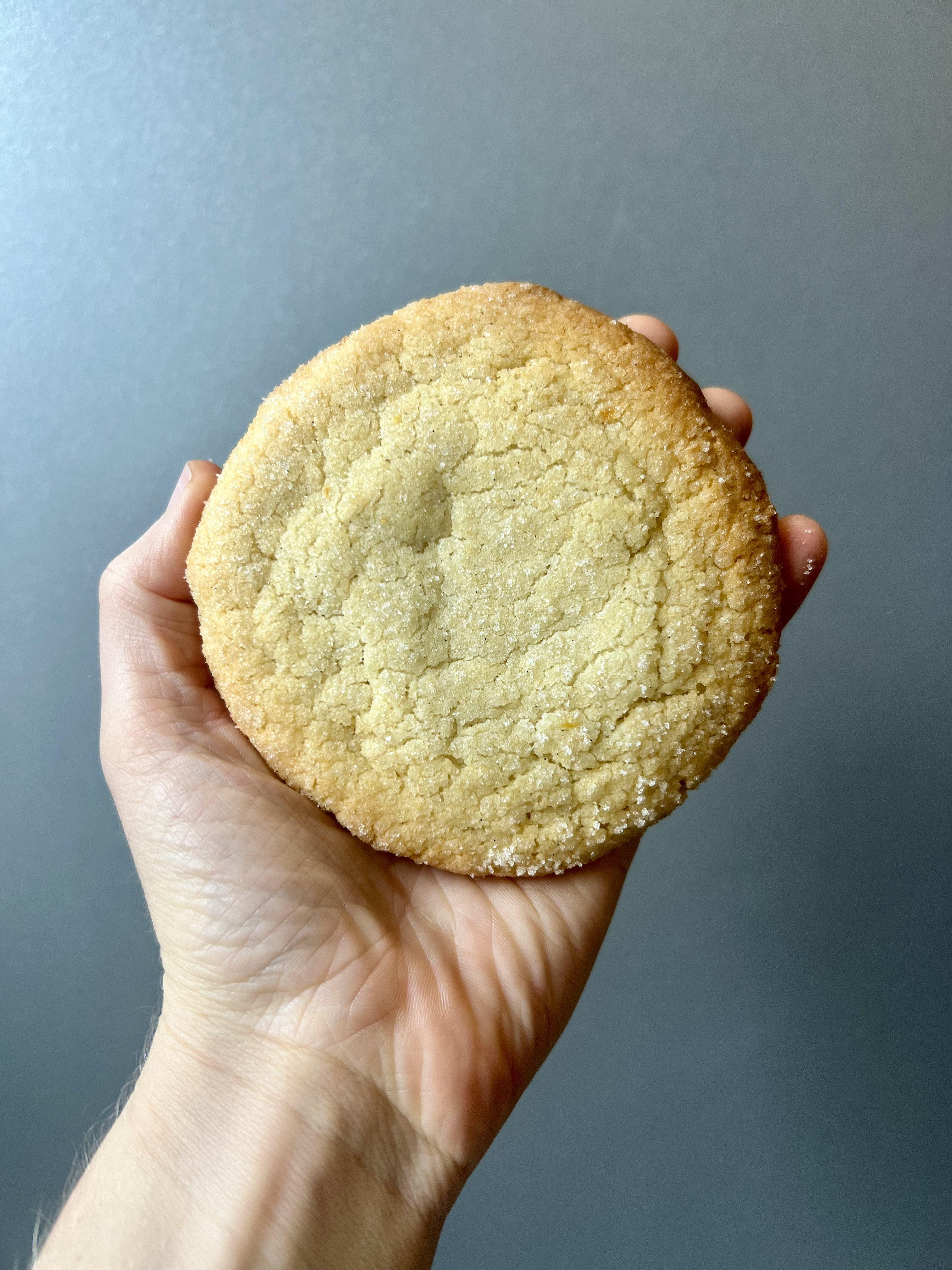
Mighty Bread’s Italian almond cookie.
Italian almond cookie
Recipe by Christopher DiPiazza and Siobhan McKenna, Mighty Bread Co.
Makes 20 large cookies
This crowd-pleasing cookie — which is giant, a characteristic of all things Mighty Bread — was inspired by the quintessential sprinkle cookies found in virtually every South Philly Italian bakery. Head pastry chef Siobhan McKenna says Mighty Bread swaps orange-vanilla sugar for sprinkles to make it “a bit more elevated.” But we won’t tell if you cover your cookie dough in rainbow sprinkles (or, you know, jimmies).
750 grams all-purpose flour
10 grams baking powder
3 grams baking soda
8 grams salt
450 grams butter
110 grams cream cheese
500 grams granulated sugar, plus 200 grams for coating
16 grams vanilla paste
100 grams eggs
4 grams almond extract
Finely grated zest from an orange
Vanilla bean, split
Combine the flour, baking powder, baking soda, and salt. Set aside.
In a stand mixer with the paddle attachment, cream the butter, cream cheese, vanilla paste, and sugar until pale and doubled in size. Scrape down bowl and paddle.
Add the eggs in two increments, beating until fully incorporated. Add the almond extract and scrape down the bowl and paddle. Add the dry ingredients in several increments until incorporated. Transfer the dough to another bowl or container, cover, and chill for 45 minutes to an hour.
While the cookies chill, scrape the vanilla bean seeds into the remaining 200 grams sugar. Add the orange zest. Rub together to combine thoroughly.
Scoop the dough into balls (100 grams each for a Mighty Bread-sized cookie). Dip each cookie in the orange-vanilla sugar before placing on a lined sheet pan, spacing appropriately, six to a half-sheet pan.
Bake at 350°F for 14 to 16 minutes, rotating after 6 and 12 minutes and checking for another 2 to 4 minutes, until edges are set and center is cooked but soft.
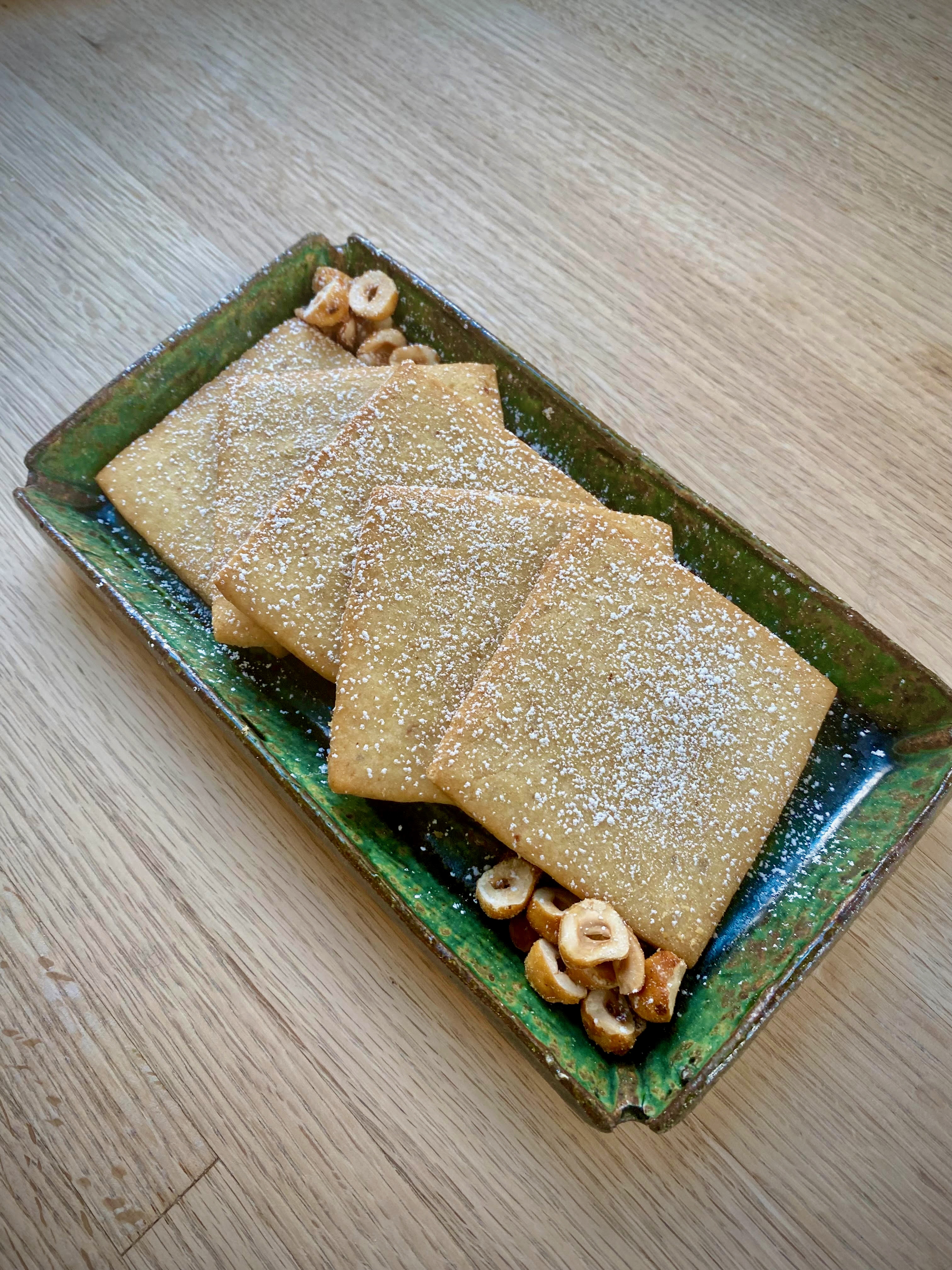
Hazelnut shortbread made by Vetri Cucina’s Michal Shelkowitz.
Hazelnut shortbread
Recipe by Michal Shelkowitz, Vetri Cucina
Makes 24 cookies
There’s not much backstory to these simple (but delicious) cookies, says pastry chef Michal Shelkowitz. “I just love shortbread! They’re the only cookies I allow to be crispy,” she says, adding “maybe a hot take, but crispy chocolate chip cookies make me want to die inside.”
100 grams hazelnuts
275 grams all-purpose flour, divided
½ teaspoon baking powder
½ teaspoon salt
250 grams butter, room temperature, cubed
70 grams powdered sugar
60 grams egg yolks
Heat the oven to 350°F. Spread the hazelnuts on a baking tray, toast in the oven for 5 to 8 minutes, until golden and fragrant. Allow to cool completely. Once cool, place hazelnuts in a food processor along with half of the flour and grind to a fine powder. Add the hazelnut mixture to the remaining flour, then mix in the baking powder and salt. Set aside.
In a stand mixer with the paddle attachment, cream the butter and powdered sugar for a few minutes until butter is light in color and fluffy. Scrape the bowl down well, then add the egg yolks. Mix until completely incorporated. Scrape down once more, then add all of the dry ingredients. Mix on low speed until all of the flour has been absorbed and a soft dough forms.
Transfer the dough to a piece of parchment paper. Press down to even it out, place another piece of parchment on top, and roll out the dough to about ½-inch thickness. At this point you can either cut the dough into 3-inch squares or use similar-sized cookie cutters. Transfer the sheet of dough onto a tray and chill in the refrigerator until firm.
Once firm, use an offset spatula to transfer the cookies to a lined baking tray, placing them about 1 inch apart. Bake for 10 to 12 minutes, until the edges turn golden brown. Let cool on the sheet tray before removing.
Roasty Toasty Kinako cookies made by Linna Li of Aidomi Cafe
Roasty toasty kinako cookies
Recipe by Linna Li, Aidomi Cafe
Makes 12 cookies
This project cookie comes from Chester Springs native Linna Li, a veteran of New York’s restaurant industry who now owns Mama Wong in Exton and is searching for a home for Aidomi Cafe, a forthcoming all-day spot with a menu that will blend Li’s Chinese background with the Honduran roots of her partner, chef Jose Nunez. That cultural combo informs these cookies: They get crunch from a brittle made with cancha, or toasted corn nuts, and warm, nutty flavor from kinako, or roasted soybean flour. Those ingredients are widely available in Latin and Asian supermarkets, respectively. (You can also sub a store-bought brittle or toffee if you like; see note below.) Optional buckwheat flour plus masa harina and cornmeal add further complexity, which is what Li’s all about.
“Anytime I create like a cookie recipe,” she says, “I’m really focused on flavor — something that’s not too saccharine, has a little bit of a more salty component to it — but also something that’s pretty interesting in texture.”
Note: If substituting the canchita brittle with store-bought brittle or toffee, reduce the brittle weight from 120 grams to 90 grams.
120 grams (1 cup) buckwheat flour or AP flour or any gluten free flour
60 grams (½ cup, plus 1 tablespoon) masa harina
48 grams (⅓ cup) finely ground cornmeal
30 grams (4 tablespoons) kinako powder
1 teaspoon baking soda
1 teaspoon kosher salt
226 grams (2 sticks) unsalted butter, softened
75 grams (⅓ cup) granulated sugar
100 grams (½ cup, packed) dark brown sugar
1 tablespoon vanilla paste or vanilla extract
1 large egg, room temperature
120 grams (1 heaping cup) canchita brittle, chopped into pea-sized pieces, plus more for garnish
Flaky sea salt
For the canchita brittle
Line a sheet pan with parchment paper and set aside. In a pan over medium heat, combine the oil, cancha corn, and 1 teaspoon of the salt, stirring occasionally to get even coloring. After a few minutes, the kernels will start to pop; you can partially cover the pan so the kernels don’t pop out. Stir until the canchitas are golden brown and have a nice crispy bite, about 10 minutes. Transfer to a bowl and set aside.
Combine the sugar, butter, and water in a saucepan, preferably with a light-colored bottom. Warm the mixture over medium heat until it melts and begins to bubble, swirling the pan occasionally. Cook the butter, swirling often, until it is golden and the milk solids are dark caramel-colored (with a temperature of 300°F), 6 to 8 minutes.
Once the mixture is golden, thick, and bubbly, fold in the canchitas, stirring until evenly coated. Add the baking soda and the remaining salt. Turn off heat and stir until baking soda is completely dissolved. Spread the mixture over the lined baking sheet and spread to a single layer. Let cool completely before chopping into shards.
For the cookie
Stir together the buckwheat flour, masa harina, cornmeal, kinako powder, baking soda, and salt in a medium bowl and set aside.
In a stand mixer with the paddle attachment, beat the butter, sugar, and dark brown sugar on medium speed for about 5 minutes, until the mixture is smooth and fluffy, scraping down the bowl and paddle as needed. Drizzle in the egg and vanilla, beating until the egg is fully incorporated, about 1 minute.
Add the flour mixture in small batches, reserving a few tablespoons, and mix on low speed for about 30 seconds until the flour is almost combined, with few visible flour streaks. Stop the mixer and scrape down the bowl and paddle.
Combine the reserved flour with the canchita brittle, evenly coating each piece with flour. Add half to the dough, folding it in by hand. Once folded, pour in the remaining half and scrape the bowl from bottom up to release any ingredients that may be stuck.
Using an ice cream scoop or your hands, portion out cookies to 70 grams and place on a lined sheet pan, making sure they are close but not touching. Cover the baking sheet with plastic wrap and refrigerate overnight or up to 24 hours to allow the dough to rest.
When ready to bake, heat the oven to 350°F. Transfer portioned dough to another lined sheet pan, leaving about 2 inches between each cookie. Top each cookie with a small piece of canchita brittle pressed down into the dough.
Bake for 15 to 17 minutes. You want the cookies to be slightly underdone. They will feel soft to the touch but will firm up as they cool.
While the cookies are still warm, tap the center of each with a spatula to create an indent. Top each with flaky salt and shape with a 4-inch cookie cutter (they will spread so shaping while warm is crucial). Cool completely before transferring to a wire rack. Cookies can stay at room temperature in an airtight container for up to one week. Unbaked dough can stay frozen for up to one month.
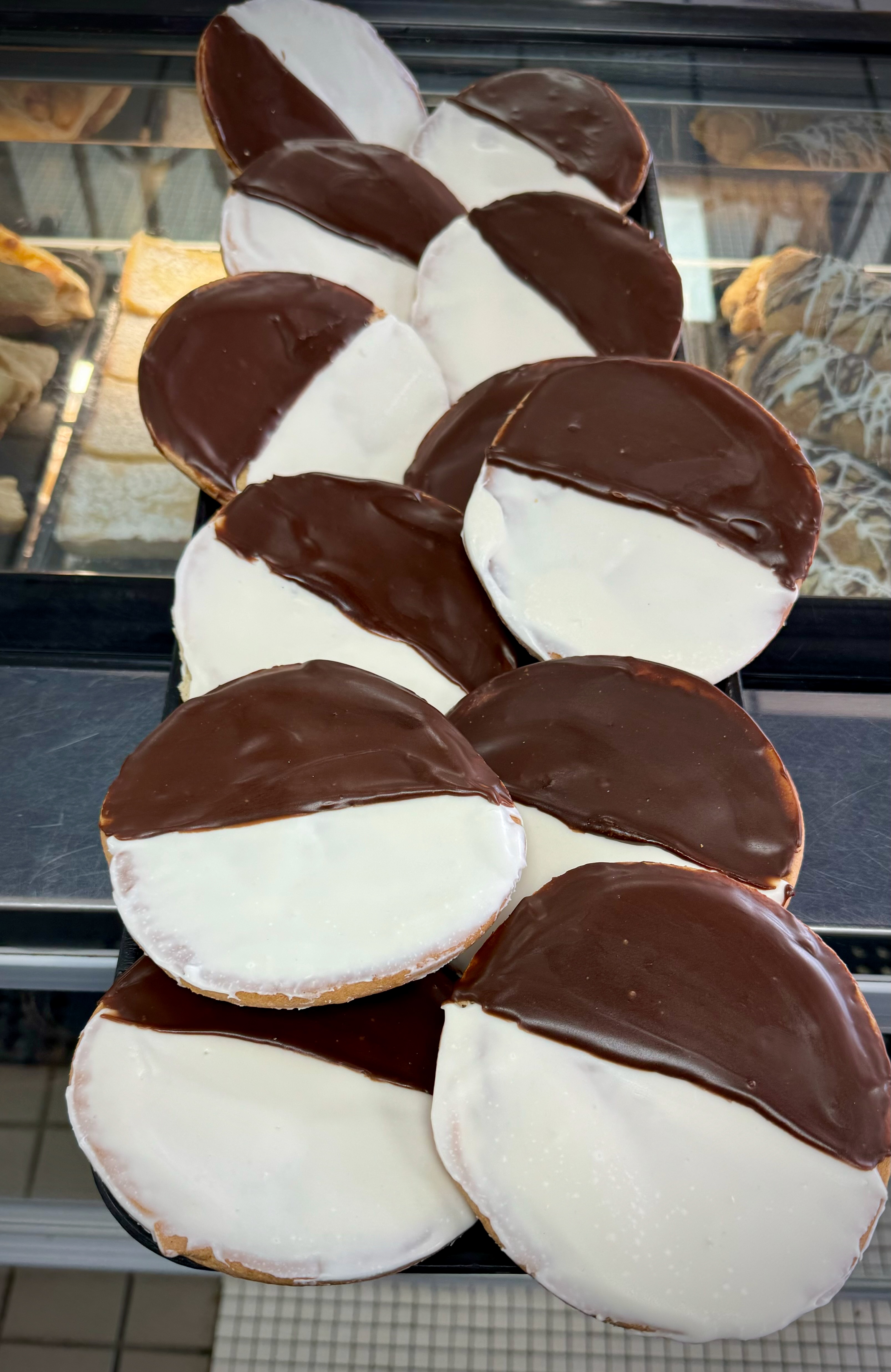
Brandon Parish’s black & white cookie, from the Kibitz Room.
Black & white cookie
Recipe by Brandon Parish, the Kibitz Room
Makes 12 to 14 cookies
Brandon Parish’s spin on this classic deli treat uses an ultra-moist muffin batter for the cookie, yielding a fluffy, not-too-sweet base for the black-and-white icing. If you want to recreate a Kibitz Room dessert at home, try serving a hot black-and-white cookie with powdered sugar, sprinkles, and a scoop of ice cream or gelato.
For the cookies
1⅔ cups all-purpose flour
⅔ teaspoon baking soda
⅔ teaspoon salt
½ cup buttermilk
⅔ teaspoon vanilla
½ cup unsalted butter, softened
⅔ cup sugar
1⅓ large egg
For the icing
2 cups confectioners’ sugar
1⅓ tablespoons clear corn syrup
2⅔ teaspoons lemon juice
⅓ teaspoon vanilla
1⅓ tablespoons water (roughly)
⅓ cup cocoa powder
Heat the oven to 375°F if using a conventional oven or 350°F if using convection. In a small bowl, sift together the flour, baking soda, and salt. In a separate bowl or measuring cup, mix together the buttermilk and vanilla.
In a stand mixer with the paddle attachment or with an electric mixer, beat butter and white sugar together in a large mixing bowl with an electric mixer until it’s evenly distributed, about 3 minutes. Add the egg and beat until blended.
Alternating with each addition, gradually add the dry ingredients ½ cup at a time, incorporating the buttermilk mixture between each addition. Mix until smooth, occasionally scraping down the sides of the bowl.
Spoon ¼ cup portions of batter onto a lined sheet pan. Bake for 15 to 17 minutes, or until the tops are golden brown and spring back when touched. Place on a cooling rack and allow to cool completely before icing.
In a large bowl, stir together the confectioners’ sugar, corn syrup, lemon juice, vanilla, and ½ tablespoon of water until smooth. Place half of the mixture into a separate bowl and add the cocoa powder, and remaining water bit by bit until it is the same consistency as the white icing. If the icing is too runny, whisk in more confectioners’ sugar until smooth and spreadable.
Turn cooled cookies flat side up. Using a pastry spatula or a butter knife, spread on the icing, white over one half, chocolate over the other. Let set.
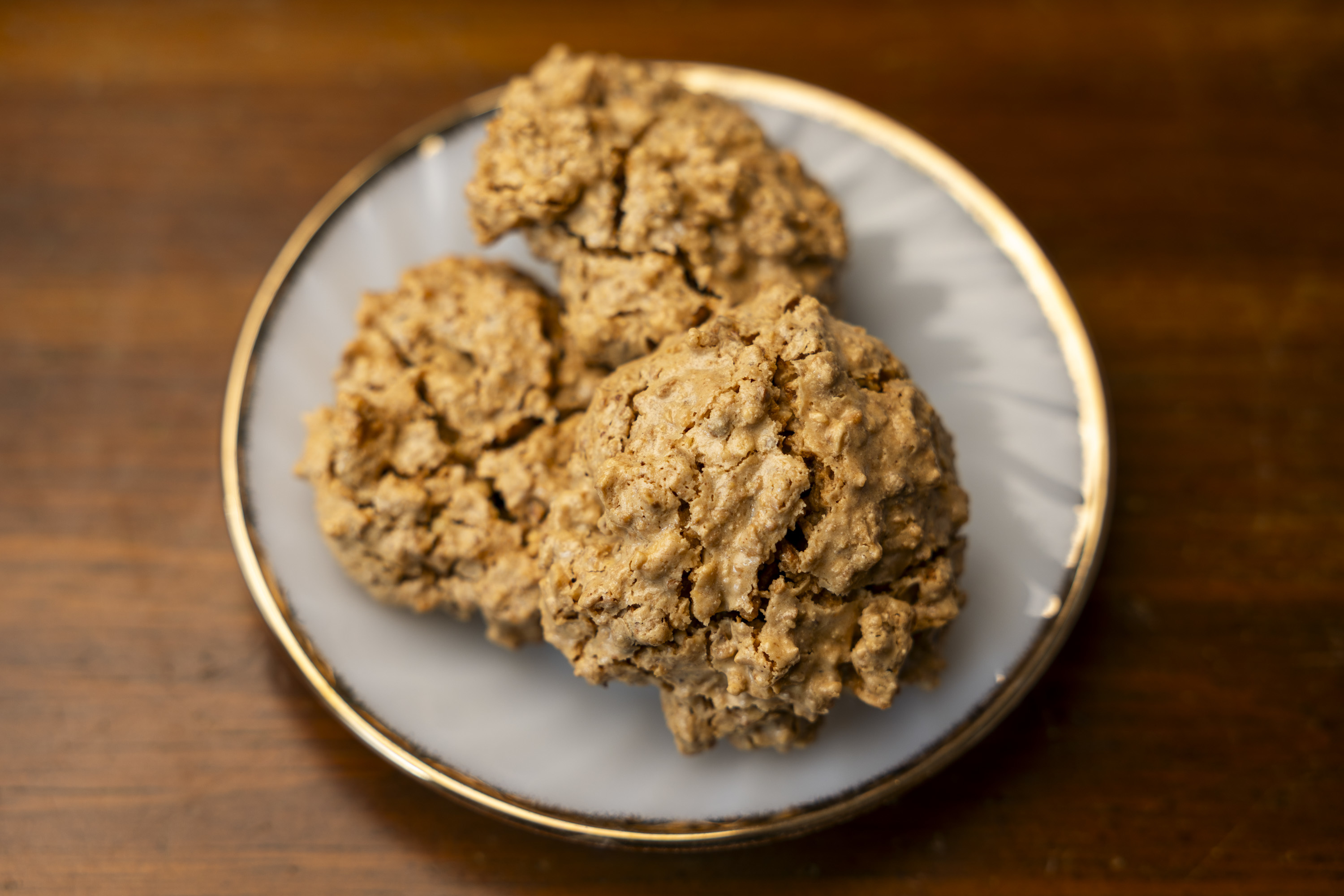
The brutti ma buoni cookies made by Inquirer reporter Jenn Ladd in Philadelphia, on Friday, Nov. 14, 2025.
Brutti ma buoni (ugly but good)
Recipe by Justine MacNeil, Fiore
Makes 18 cookies
These chewy-crunchy meringue cookies use a slightly unusual cooking process — there aren’t too many stovetop cookies — that will fill your kitchen with the sweet smell of toasted hazelnuts and caramelizing sugar. “All the classic Italian recipes are quite bizarre,” says Justine MacNeil, the reining pastry queen (and co-owner) of Fiore, who is delighted by this nutty cinnamon-spiced cookie. “They’re my fave.”
250 grams hazelnuts
250 grams granulated sugar, divided
90 grams egg whites
125 grams sugar
½ teaspoon kosher salt
¼ teaspoon vanilla extract
⅛ teaspoon ground cinnamon
Toast the hazelnuts at 350°F until golden brown, 12 to 15 minutes. Let cool. Reduce the oven to 275°F (convection) or 300°F (conventional). Line a sheet pan with parchment or Silpat.
In a food processor, grind the hazelnuts and 125 grams of the sugar into small pebble-like pieces. Be careful not to overgrind and turn the mixture into nut butter. Set aside.
In a stand mixer with the whisk attachment, whip the egg whites on high speed. Once they are opaque, slowly stream in the remaining 125 grams of sugar and whip until thick and shiny, about 5 minutes. Fold the hazelnuts into the egg white mixture. Fold in the salt, vanilla, and cinnamon.
Transfer the mixture to a 4-quart pot or saucepan. Cook over medium-low heat, stirring often, until the mixture thickens and begins to gain a caramelized color, 8 to 10 minutes.
Scoop immediately onto the lined sheet pan using either a 2-tablespoon scoop or two spoons. (They are supposed to be irregularly shaped.)
Bake for 20 to 25 minutes, until dried and lightly golden. Allow to cool and then store in an airtight container for up to one month.
The limoncello cookies made by Inquirer reporter Jenn Ladd in Philadelphia, on Friday, Nov. 14, 2025.
Limoncello cookies
Recipe by Aurora Samsel
Makes 5 dozen cookies
Try a nub of this cookie dough raw and you’ll get the bite of raw olive oil and the tang of fresh lemon juice and limoncello. But these three-bite cookies bake up into mild lemony treats that are absolutely kid-friendly. They come courtesy of pastry chef Aurora Samsel, who developed them while working at Osteria. Samsel characterizes this as a basic dough with some Italian spins (including semolina flour). She likes to bake the cookies so they come out a very light golden brown, but it’s OK if you take them a shade darker around the edges. “They taste delicious either way,” she says.
2 cups all-purpose flour
⅔ cup semolina flour
1 teaspoon baking powder
½ teaspoon baking soda
½ teaspoon kosher salt
½ cup (1 stick) unsalted butter, softened
2 tablespoons extra-virgin olive oil
1 cup granulated sugar, plus more for rolling
1 large egg
1 large egg yolk
Freshly grated zest and squeezed juice of 1 lemon
2 tablespoons limoncello
½ teaspoon pure vanilla extract
Heat the oven to 325°F. Line a sheet pan with parchment or Silpat and spray with oil.
Sift together the flour, semolina, baking powder, baking soda, and salt and put it aside.
Using an electric mixer with a paddle attachment, cream together the butter, olive oil, and 1 cup of the sugar.
Scrape the bowl, then with the mixer on, slowly add the egg and egg yolk. Scrape again, then add the lemon zest, lemon juice, limoncello, and vanilla extract.
Once combined, add the dry mixture, and continue to mix until all combined. The dough will be soft and sticky. Place the dough in the fridge and chill for 1 hour (or longer).
When ready to bake, place some sugar in a small bowl. Scoop the ball into 15-gram portions, rolling each to a 1-inch ball. Roll in the sugar, then place on the prepared pan.
Bake for 12 to 14 minutes, rotating the pan halfway through, until the cookies are a pale golden brown and set. When out of the oven, transfer the cookies onto a wire rack to let cool completely.
Mocha snickerdoodles made by Jessica La Torre of High Street Bakery.
Mocha snickerdoodles
Recipe by Jessica LaTorre, High Street Philadelphia and the Bread Room
Makes 30 cookies
Buy a bunch of butter for these snickerdoodles, which call for browning 2 pounds of it and combining some of that with regular salted butter, too. High Street bakery production manager Jessica LaTorre notes that these cookies came about as a result of tinkering with the restaurant’s cornmeal snickerdoodle, and that it’s a crispy-crunchy variation of the cinnamon-coated classic. “Don’t expect much chewiness,” she says. “If you are looking for a bit more of a classic snickerdoodle chew you can swap in up to half brown sugar for the granulated.” A stickler for detail, LaTorre also suggests using fine or medium-grind cornmeal and erring on the side of underbaking.
For the cookies:
230 grams brown butter (see below), room temperature
230 grams salted butter, softened
600 grams granulated sugar
15 grams espresso powder or finely ground coffee
400 grams all-purpose flour
300 grams cornmeal
14 grams cream of tartar
12 grams baking soda
5 grams kosher salt (Diamond Crystal)
100 grams (2) eggs, room temperature
100 grams dark chocolate, finely chopped
For the dusting sugar:
100 grams granulated sugar
10 grams cinnamon, ground
20 grams espresso powder or finely ground coffee
5 grams cocoa powder
For the glaze (optional):
130 grams confectioners sugar
16 grams milk
20 grams light corn syrup
2 grams kosher salt
For the brown butter: Cube 8 sticks (2 pounds) of unsalted butter. Cook in a medium pot over medium heat, allowing it to foam and bubble. Stir frequently until the butter and milk solids at the bottom turn a golden brown. Cool to room temperature. You’ll have extra. Save for another project (like Amanda Shulman’s brown butter sourdough chocolate chip cookies).
For the cookies: In a stand mixer fitted with the paddle attachment, cream both butters, the sugar, and the espresso powder until light and fluffy. In a separate bowl, whisk together the flour, cornmeal, cream of tartar, baking soda, and salt.
Scrape the bowl and paddle with a spatula. Mixing on low speed, add the eggs in one at a time. Scrape again. Add in the dry ingredients and mix on low until just combined. Fold the finely chopped chocolate into the dough.
Using a 2-ounce scoop or two spoons, scoop the dough onto a lined and greased cookie sheet and then chill in the fridge for at least an hour.
Heat the oven to 350°F. Mix the sugar and spices together and roll your cookies in it. Space them 6 to a cookie sheet and bake for about 8 minutes, until the cookies have completely puffed. Tap the tray on a counter to gently deflate the cookies.
For the glaze: Whisk all the ingredients together. Transfer to a piping bag and drizzle over cooled cookies. Allow to dry before stacking.
In the early ’90s, Colleen Mazzella walked into a newly opened pizzeria and met the man who would become not only her boss, but her husband.
She was visiting a friend who had been hired at Italian Affair in Stafford, and owner Dominick Mazzella, then a recent Staten Island transplant, offered her a job, too.
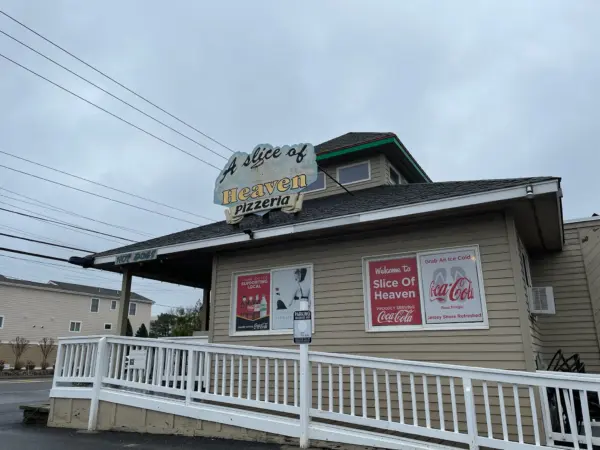
They soon became a couple, and a year later, in May 1995, opened A Slice of Heaven across from Fantasty Island Amusement Park on Long Beach Island. The building at 7th Street and Bay Avenue in Beach Haven had housed a car wash, candy store and photo shop through the years, and when the two met with owner Peter Buterick, “he said ‘I’m going to take a chance on you. I’ve got a good feeling about this,’” Mazzella said.
They made a name for themslves, thanks to a menu of dishes like stuffed cheesesteak pizza, scratch-made meatballs and cheesesteaks.
Thirty years later, the building is full of memories that became precious to Mazzella after Dominick died just days before his 50th birthday in 2024. She recalls the Stanley Cup being brought to the restaurant (“My husband was a gigantic hockey fan,” she said), staying open to serve pizza until 4 a.m. and borrowing ingredients from other restaurant owners to get through busy days.
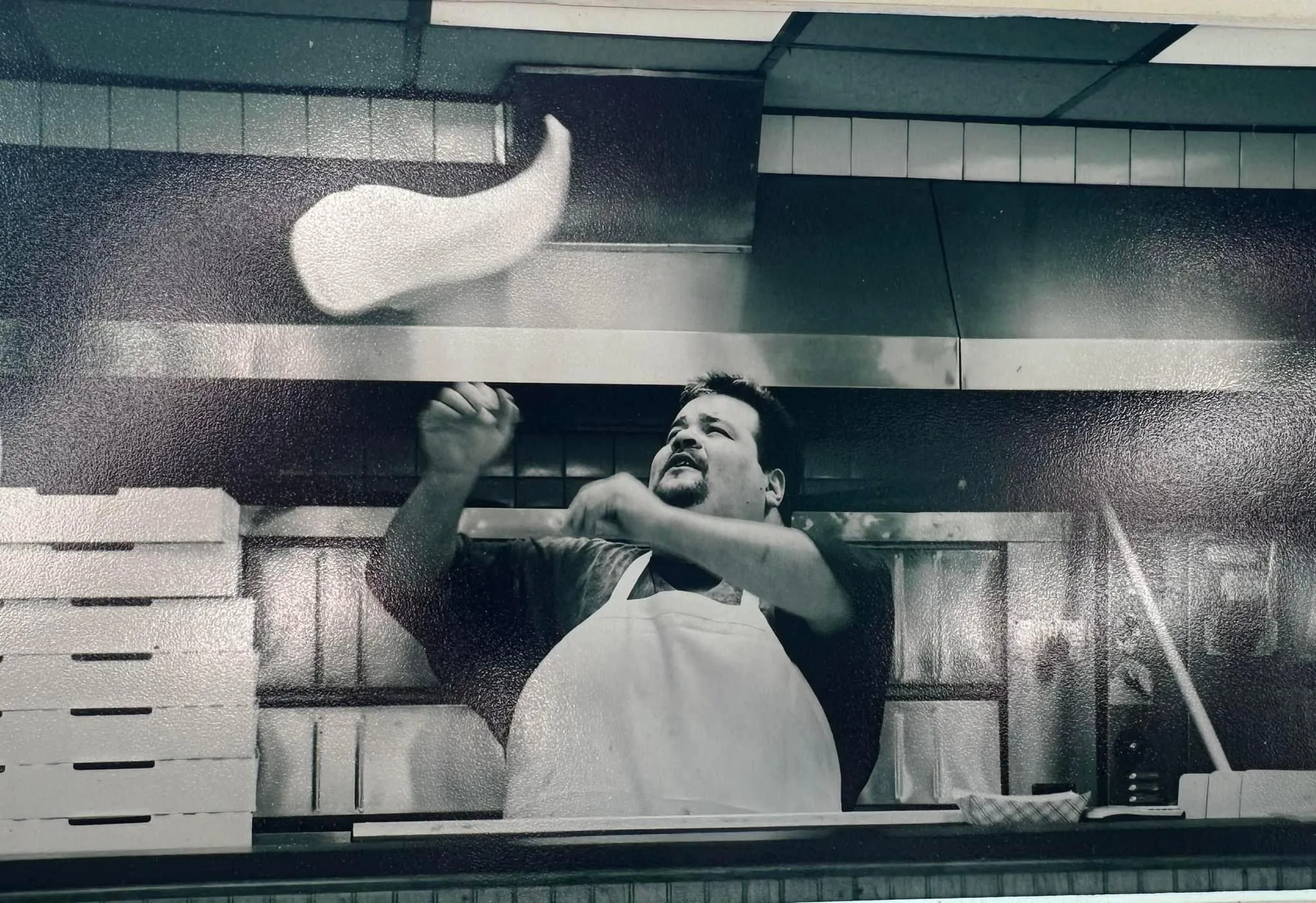
Dominick Mazzella is pictured behind the counter of A Slice of Heaven, the Long Beach Island pizzeria he opened with his wife, Colleen, in 1995.
She remembers when a family who lost their father stopped in for his favorite pizza before spreading his ashes on the beach, rebuilding after Superstorm Sandy sent four feet of water into the dining room and making pizza by flashlight during a power outage.
The restaurant is also where Dominick taught his son to make pizza, a legacy the 18-year-old — also named Dominick — has dreamed of continuing.
But it will have to happen somewhere else, as A Slice of Heaven closed earlier this month. The Mazzellas leased their restaurant space and the building has been sold.
“The plan was to take this place over,” Mazzella said of her and her husband’s plans for their son, a third-generation pizza maker whose grandfather emigrated from Naples, Italy, and owned restaurants in New York before opening the Stafford pizzeria with Dom.
A Slice of Heaven’s last day in business was Nov. 17, and Mazzella must vacate the building by the end of the month. She has been searching for a new location since learning of the impending sale several years ago, and while she wants to keep the restaurant on Long Beach Island, rentals that will work for her business are hard to come by, she said.
“My intention is to be on the island,” said Mazzella, who grew up in Brant Beach and now lives in Cedar Run on the mainland. “I love the people here. I grew up here. I love everything about it.”
“It’s just a fact of finding a place to land,” she said. “It’s been tough. I just have to keep believing that the places that I found that didn’t work out didn’t work out for a reason, and that it’s because we’re waiting for the right place.”
“We’ll find something,” she said. “I gotta believe that.”
Since announcing the closing date in early November, Mazzella has seen an outpouring of support online and in person, with customers sharing memories and well wishes.
One spoke of how the elder Dominick fulfilled her request to spell “It’s a boy!” in pepperoni on a pizza for her gender reveal. Another customer wrote of how the restaurant’s delivery driver checked on her elderly father when she couldn’t reach him. Dozens more said A Slice of Heaven’s pizza is part of their vacation tradition.
For Mazzella, it is stories like these that make giving up not an option.
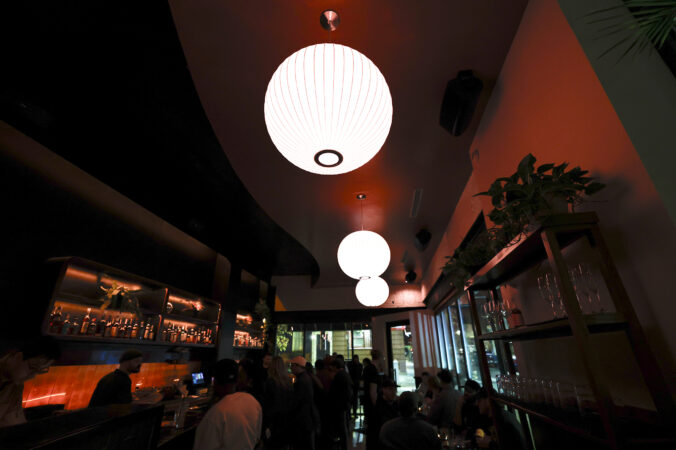
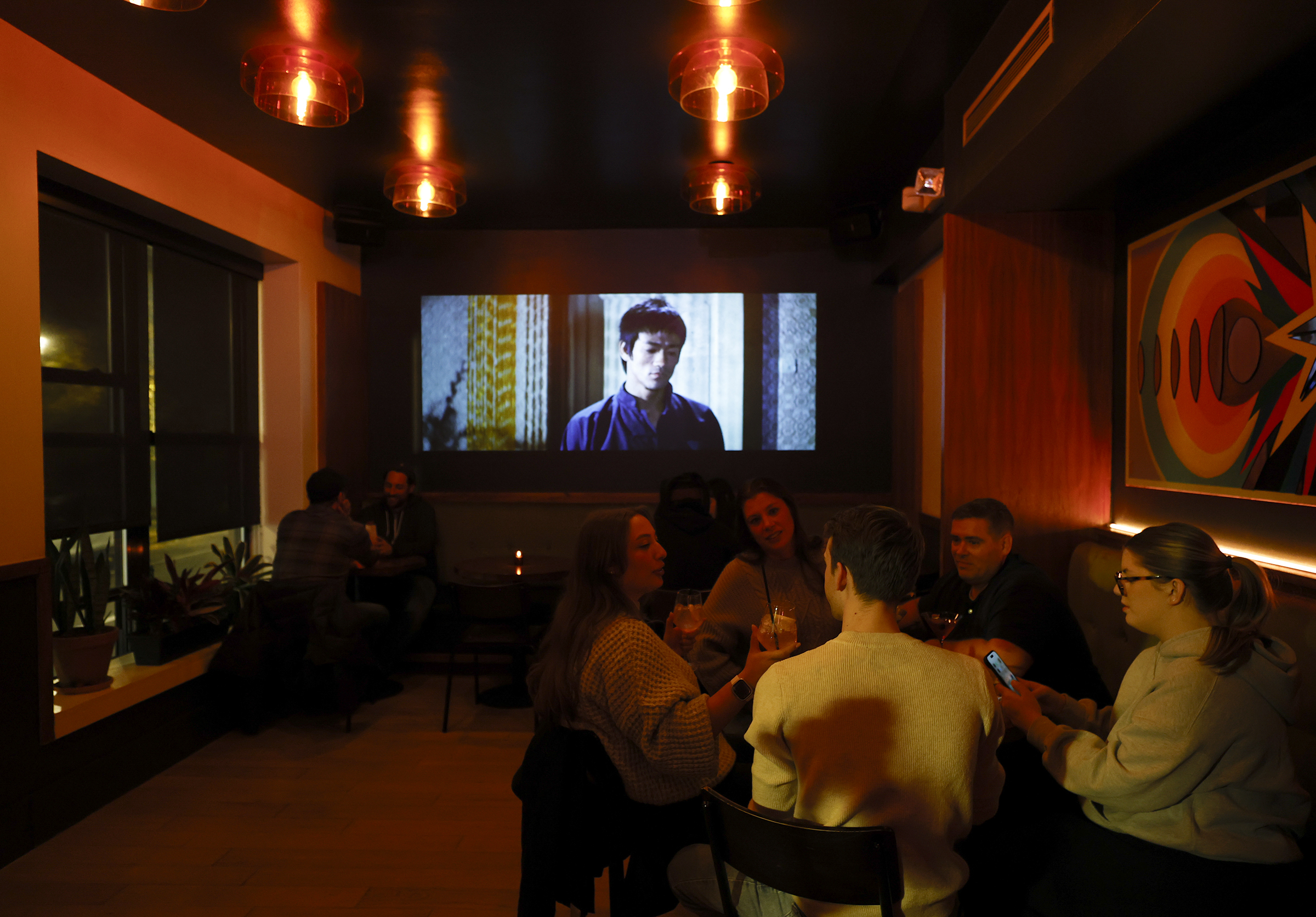
Static!, the follow-up bar from the owners of Fishtown cocktail lounge Next of Kin, opened Tuesday in the former Tria space in Washington Square West. A moody, dark wood-paneled space illuminated by large paper globe lanterns, the 35-seat bar is an even slicker cousin to its Fishtown counterpart and brings to Center City cocktails concocted by some of the nerdiest, most process-driven bartenders in Philly.
The menu is divided into four styles of cocktails — shaken down, shaken up, stirred down, and stirred up — plus non-alcoholic options, wine, and local beers. All cocktails range from $15 to $17. There is almost no food, save for a sweet and spicy nut mix, olives, and soft pretzels from Center City Pretzel, served with whole-grain mustard. “We aren’t chefs,” Darrow said in an interview earlier this year, forecasting the light-snack menu.
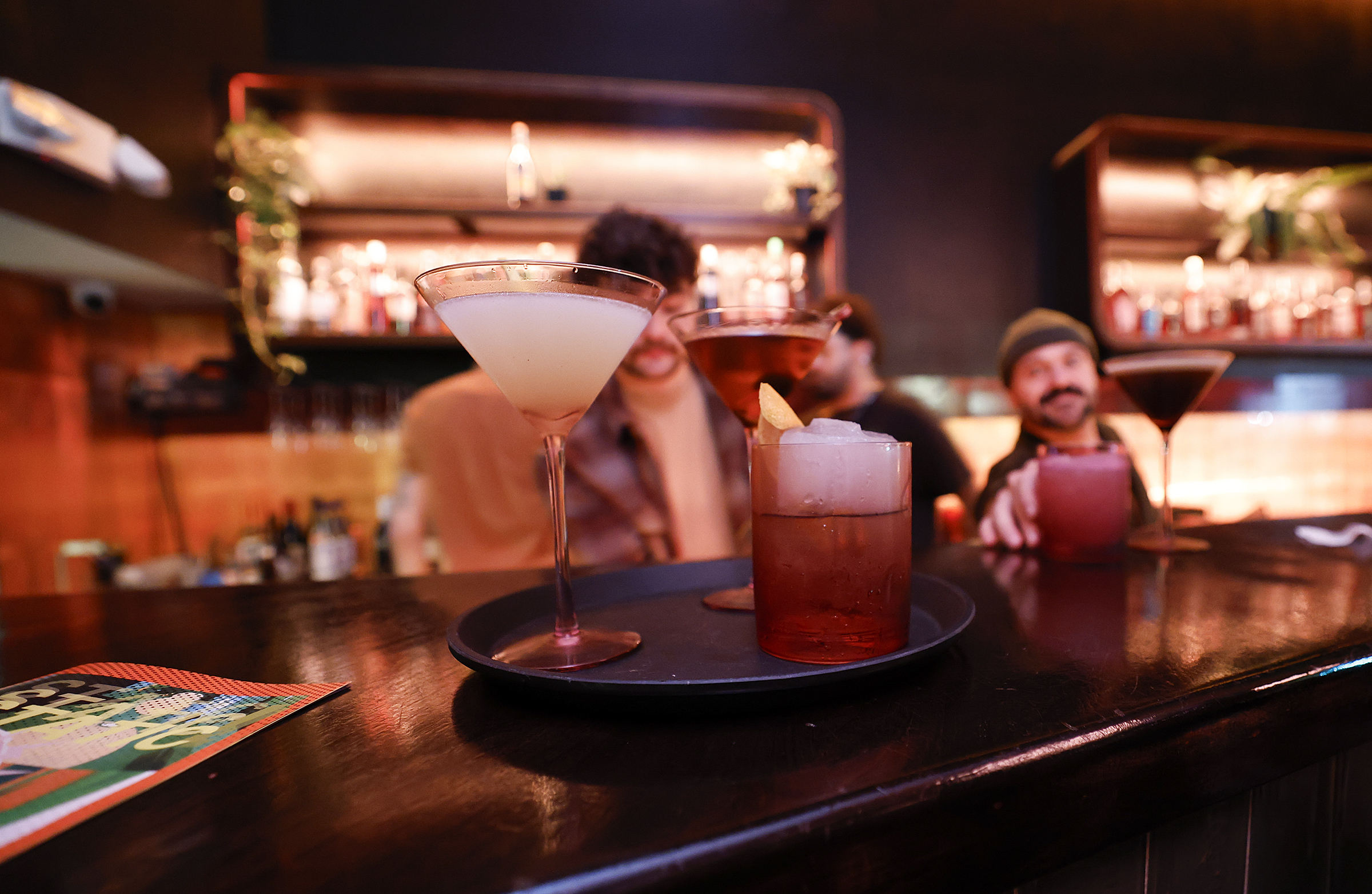
Cocktails ready for pickup at Static in the Washington Square West neighborhood on Monday, Nov. 24, 2025.
Static! operates independently of Next of Kin, but there are echoes of its sensibilities, said Darrow, who has stayed mostly hands-off in the development of the new menu.
General manager Jared Ridgeway is the mind behind the cocktails here. There are more balanced riffs on familiar classics, and just a few directly transplanted from Next of Kin, such as their Clover Club and Smoke and Barrels, which blends rye whiskey, mezcal, amaro, and cherries. Ridgeway’s amaretto sour also updates a classic. “If you put 2 full ounces of amaretto in a drink, it’s overwhelmingly sweet,” Ridgeway said. “The whole point of cocktails is a fine balance, so I learned a little sneaky trick from [Oyster House bartender] Resa [Mueller] to put a little reposado tequila in to balance the sweetness of the Lazzaroni amaretto.”
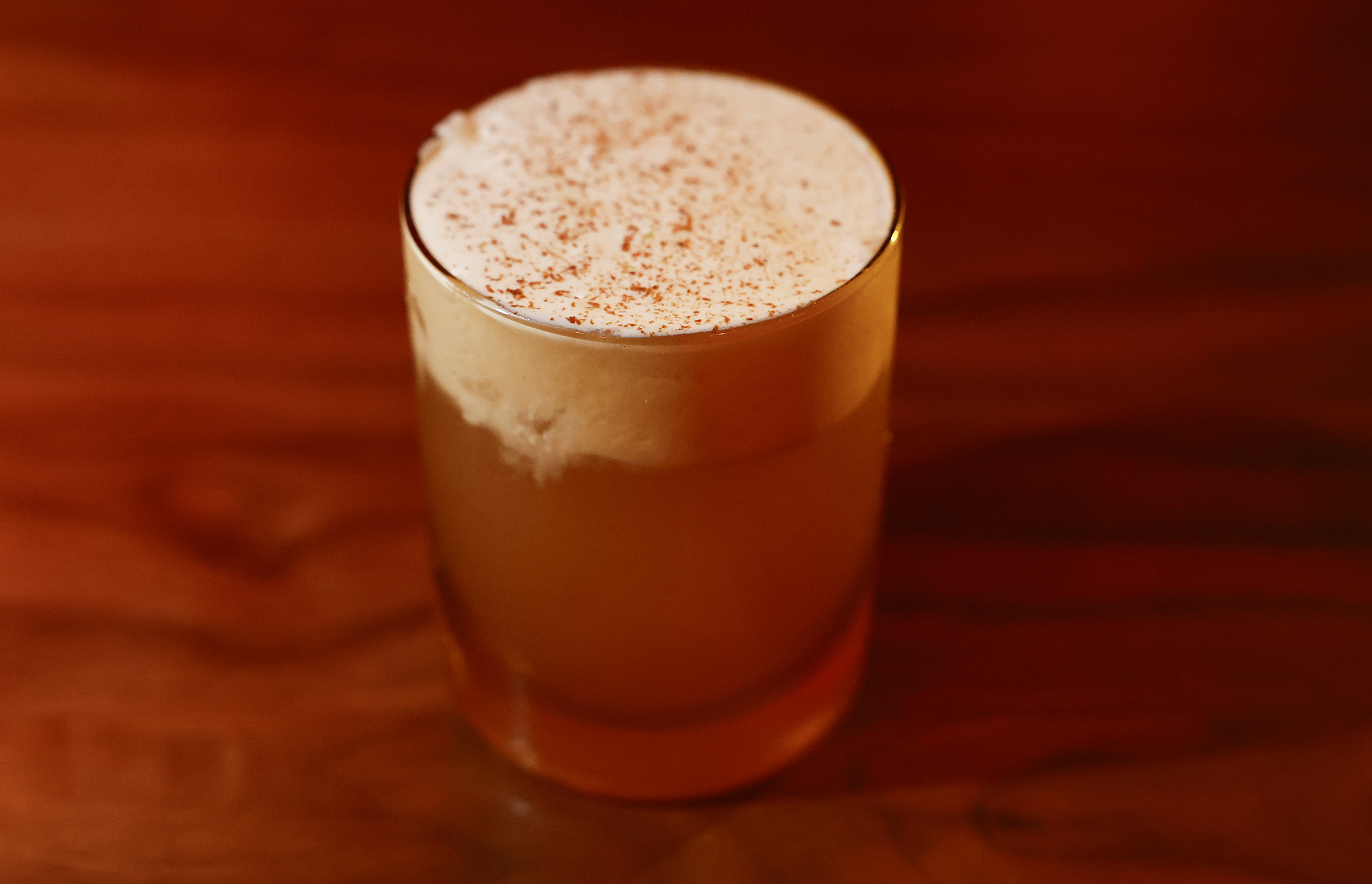
There are also cocktails entirely unique to Static! “Top of the World is a nice little seasonal play on incorporating apples, but with miso cream on top,” said Ridgeway. “It’s like an Irish cream topper where you get velvety silky foam on top versus a whipped cream.” The result has no perceptible bubbles and floats above a tart, bright, light-bodied cocktail.
The Top of the World cocktail, with brandy, honey, apple, and miso cream, served at Static in the Washington Square West neighborhood on Monday, Nov. 24, 2025.
Static!’s bartenders may not be chefs, but they’re performing no small amount of kitchen prep. Like Next of Kin’s signature cocktails, the components behind the bar here are extremely labor-intensive. The miso cream is made from whipping yellow miso with simple syrup and heavy cream. Similarly, Static!’s appletini involves infusing vodka in-house. “We’re really highlighting key ingredients, doing them a bit more justice,” said Ridgeway.
The layout of the former wine bar remains the same, with a long bar and elevated loft with table seating. Most of the construction involved updating the plumbing, building out a back bar, and making the space conducive for an operation heavily dependent on ice.
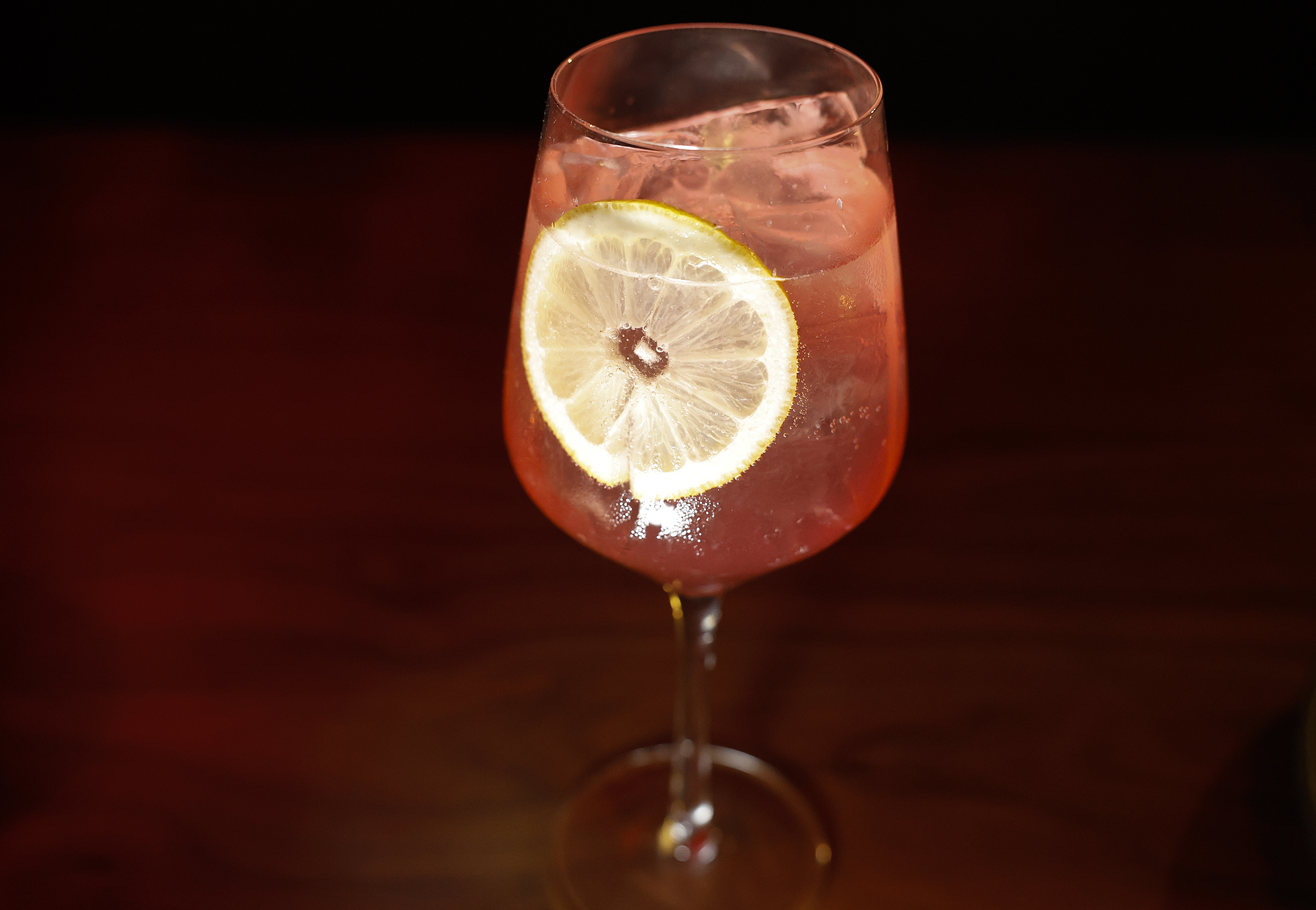
The Hawaii 7-5 cocktail with gin, lemon, hibiscus syrup and prosecco served at Static in the Washington Square West neighborhood on Monday, Nov. 24, 2025.
Why the name — and the punctuation? “Static!” refers to the “good, positive, and palpable energy transitioning between people and a human interaction,” said Darrow. “It’s also about the static on the TV screen and that physical disruption of digital space.” The punctuation removes the stasis from “static.”
The opening comes on the heels of Next of Kin’s high-profile September pop-up in Paris at the cocktail bar Mesures, which was attended by both French locals and “a dozen regulars from Philly who made the trip,” said Darrow.
Static!, 1137 Spruce St., instagram.com/static_phl. Hours: 4 p.m. to midnight Monday through Wednesday, 4 p.m. to 2 a.m. Thursday through Saturday, and 4 p.m. to 10 p.m. on Sunday.
Guests drink in the second floor at Static in the Washington Square West neighborhood on Monday, Nov. 24, 2025.