I spoke with a Friends School class this week, primarily about my photos decades ago of unhoused men in Center City. It was part of their week working with PhotoVoice, a research method where participants photograph their own lives to highlight community strengths and challenges, and advocate for social change.
After the class, and following many thoughtful questions from the middle schoolers about how in general I approach people before I photograph them, and specifically people in vulnerable situations, a student came up to ask me a more practical question: “How do you take pictures in bad weather?”
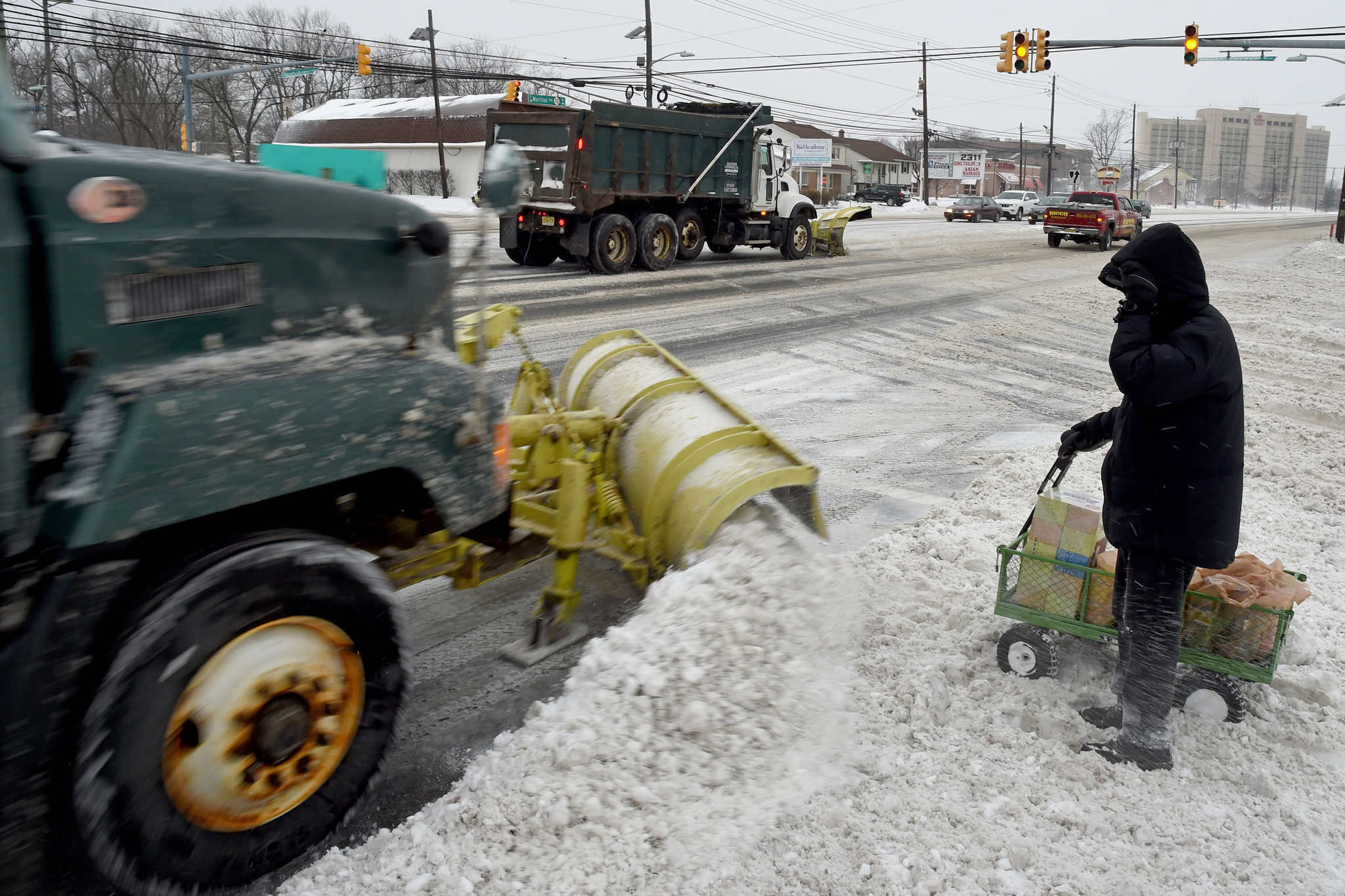
Pedestrians and plows on Rt. 70 in Cherry Hill in Januiary, 2018.
I don’t have an all-weather, sealed camera, so besides dressing as best I can for the conditions (and always having a spare pair of thick, dry wool socks in my car) keeping my camera protected is the biggest priority. I not only need to stave off mechanical/electronic breakdown, but have to keep my lens clear of the elements.
I told him I do have a dedicated rain sleeve but I’ve only used it once or twice at rainy sporting events (they’re priced from $2 each up to $200).
Mostly I use plastic bags or a large umbrellas (watching that I not catch the edges in my frame). I also try to find dry areas to stand in — while watching and photographing others out in the elements. I seek cover under a roof, awning, or doorway. I go into parking garages or subway entrances.
The glass entrance to SEPTA’s underground concourse at Dilworth Park by City Hall.
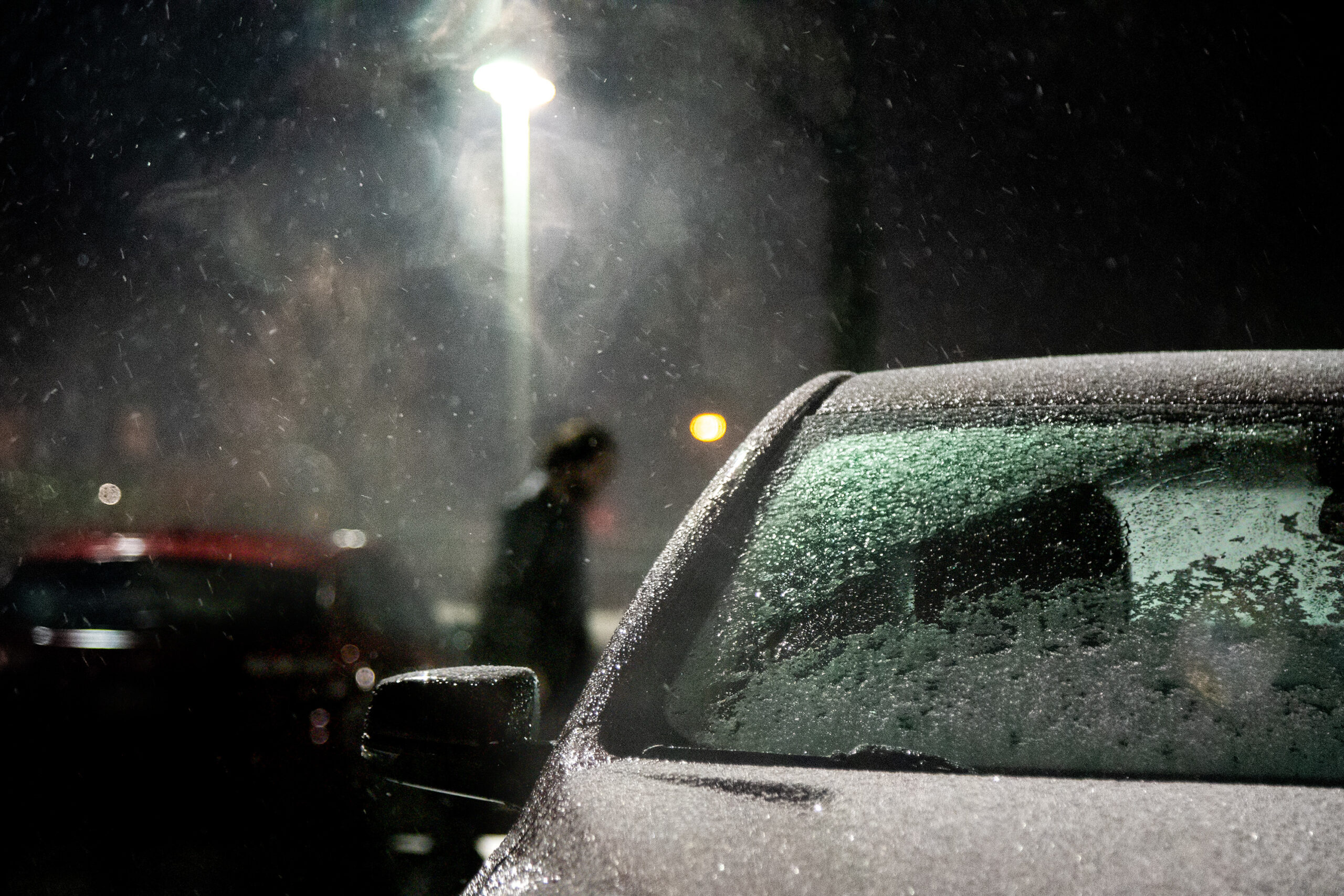
Sometimes I safely park my car where I can briefly open my leeward (downwind!) window. Other times the rain or snow on glass can even be an effective way to portray the “dab” weather. It can be in or out of focus to create a bokeh-like effect or blurred to convey mood. Your choice of a fast shutter or slow shutter can either stop the drops or show their movement.
Precipitation — some snow and some rain — falls on cars in a parking lot on City Avenue.
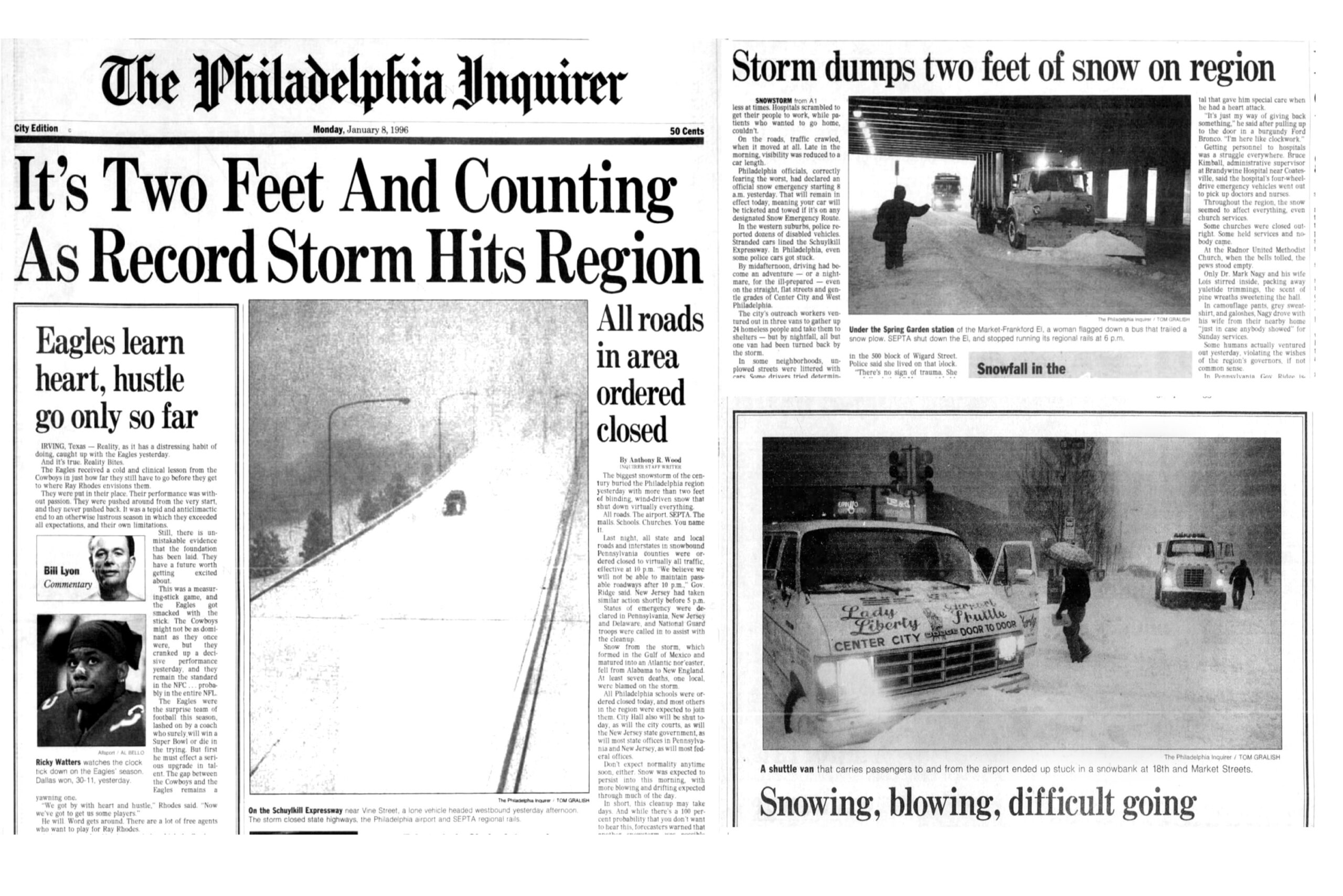
I’ve covered all of the biggest storms of the past few decades, including the historic “Blizzard of the Century” thirty years ago this month.
Front page and inside photos from The Philadelphia Inquirer. January 8, 1996.
So, I took my own advice while preparing to go out last Sunday. Knowing the roads would get worse as the day went on, I drove out of my South Jersey neighborhood while an early pass of the plows left main arteries somewhat passable, and headed straight to the nearest Wawa that I knew would have a clear-ish parking lot.
Stepping out from under the overhang — I made a few photos before walking out into on the wide street to get the few passing cars and plowing crews in a nearby shopping center.
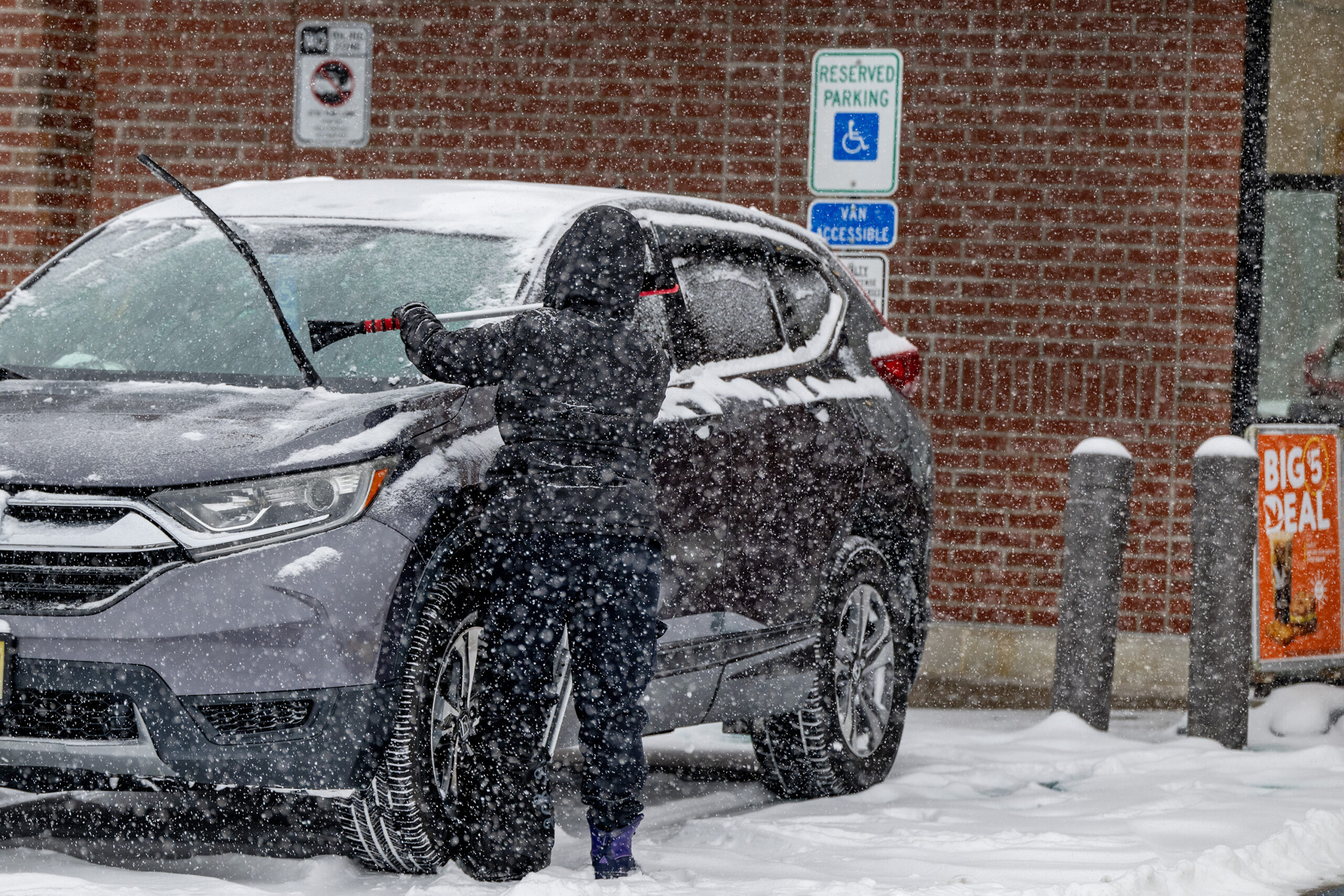
Carmen Roman clears snow off her car at a Cherry Hill Wawa early Sunday morning, Jan. 25, 2026, as heavy snow bands move through the region generating snowfall rates of 1 to 2 inches an hour.
From there, confirming my fears the roads would be more difficult to drive on, I headed the Westmont PATCO station, finding a safe place to park even as workers were hard at it, clearing the lot.
I made photos from the elevated platform before taking a train to Collingswood, where — standing on the leeward side of the stairwell shelter — I took more pictures then walked into downtown.
Haddon Avenue was plowed and relatively empty of cars, but the sidewalks were impassible. I sent in my best photo of people walking along the middle of the downtown street.
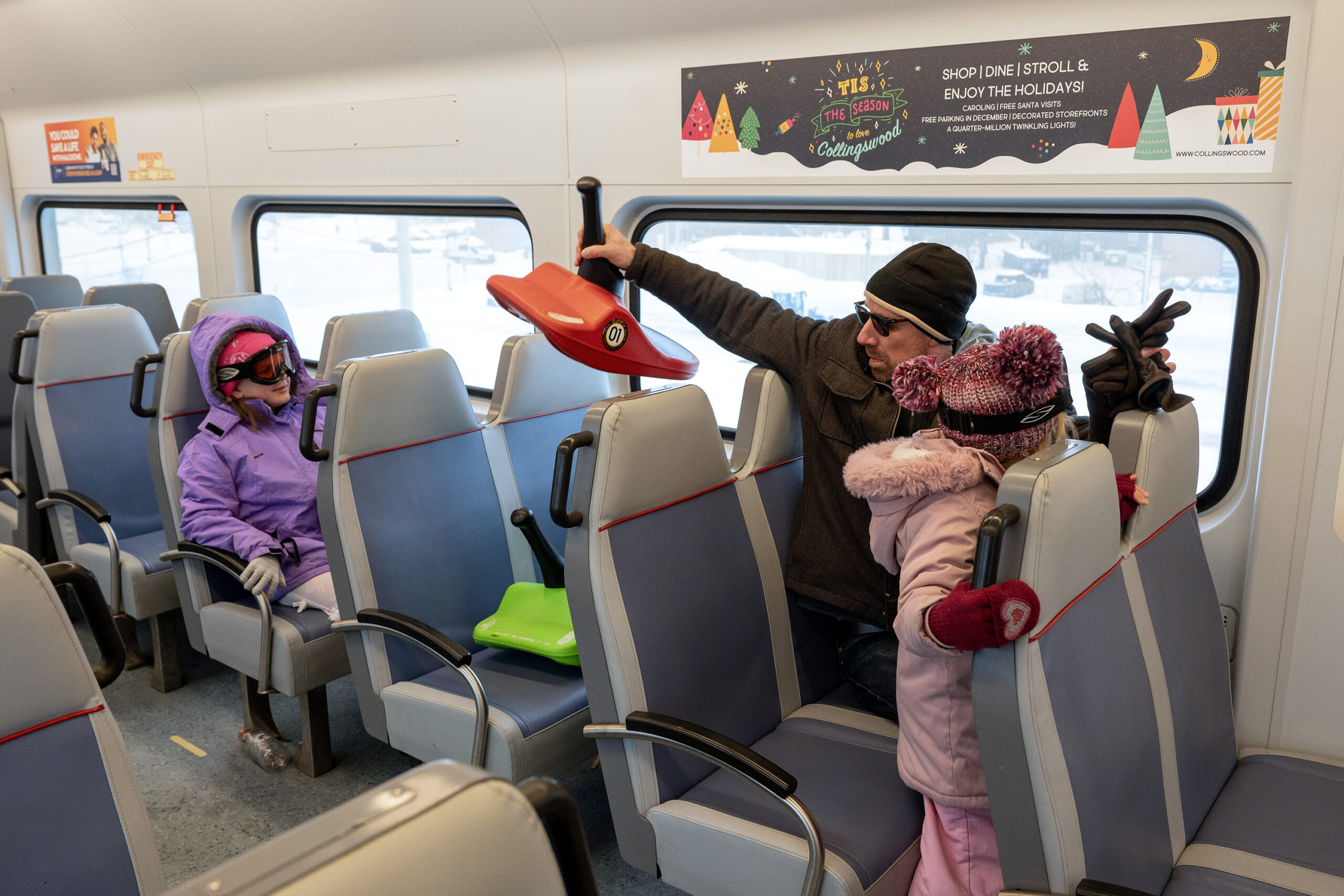
It was then I saw Mike Doveton and his daughters. Not wanting to repeat my earlier image, I asked if they were headed to or from sledding.
They were walking to the PATCO station to sled in Haddonfield, so I tagged along.
On the train headed to sled.
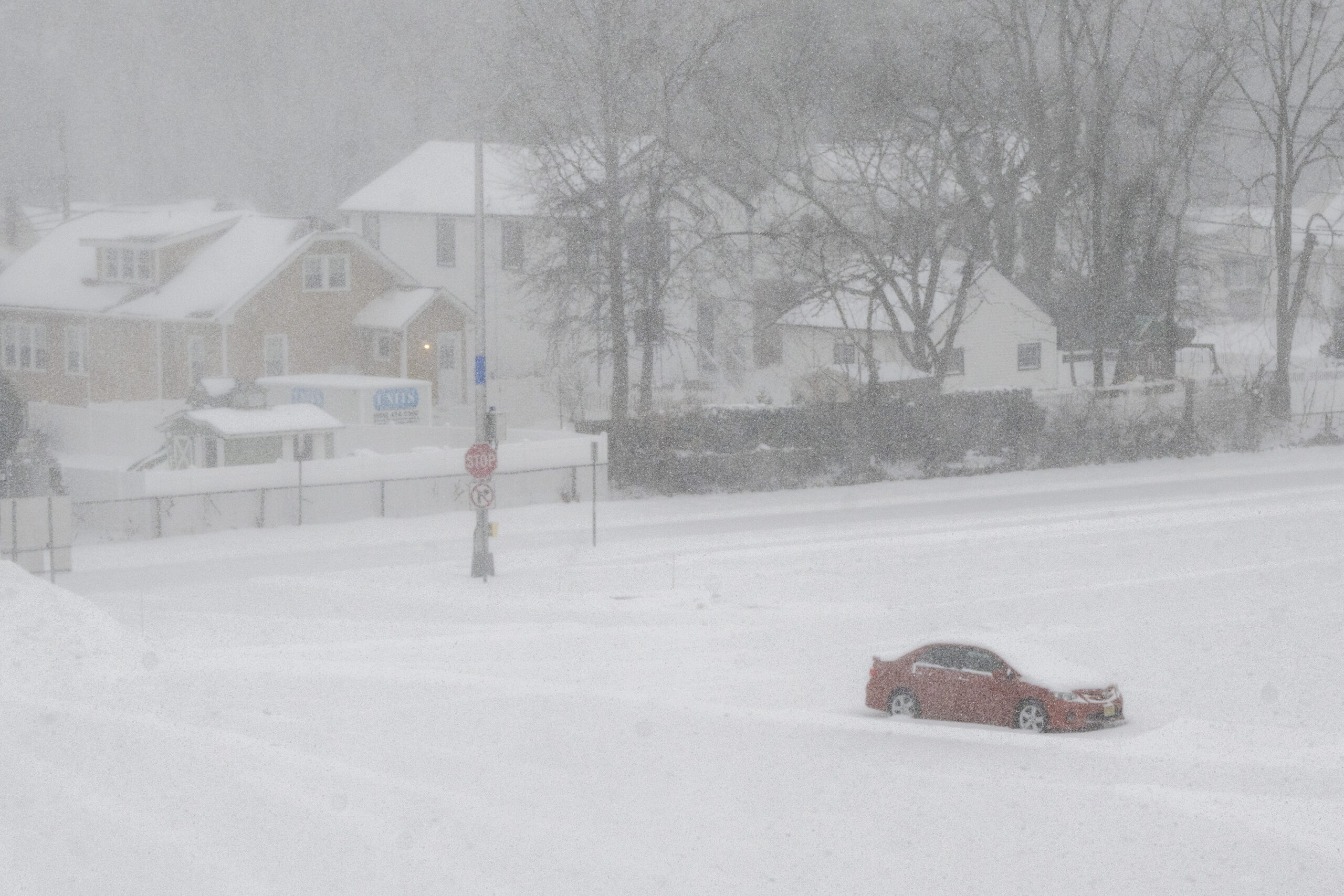
I went with them to their destination, but didn’t want another kids-on-a-hill photo, so I got back on the train returning to the Westmont station, and my car, calling it a day. Until I saw someone digging out their car — the same one I had photographed hours earlier. I got as close as I could to the spot on the platform and made an “after” photo.
Before and after in the Westmont PATCO station parking lot.
Luis Nova had left his car there on Friday, and was in Philadelphia all weekend helping friends move and going to a goodbye party. He spent the morning sledding with friends in Clark Park in West Philadelphia. Like me, he had experience with storms. “I spent four years in Rochester [NY],” he told me. “So I knew what I was signing up for and was ready. I left all my equipment to get myself out.”
But the highlight of the day was at the very end, as I headed for home as the snow was turning to sleet. Two hours earlier, in the middle of the storm my grandson snapped a photo out our front window of an Elmo head in the middle of the street before the wind blew it away, and shared the picture with our family. As I approached my house, I see a red ball rolling fast down the street toward me. I almost drove into a snow bank laughing.
Not really, but I did pull into the driveway, grab a camera, jump out of my car and go chasing after it. The wind was really moving it, and I couldn’t see where it was, which was hard to imagine, being as the road and everything else was all white. I came up to a couple of guys shoveling and asked, “Did you see an Elmo head come this way?” They had, and said it went up a driveway and jumped onto the sidewalk. I found it and just as I was lining up my photo the wind took it again and it started spinning.
Since 1998 a black-and-white photo has appeared every Monday in staff photographer Tom Gralish’s “Scene Through the Lens” photo column in the print editions of The Inquirer’s local news section. Here are the most recent, in color:
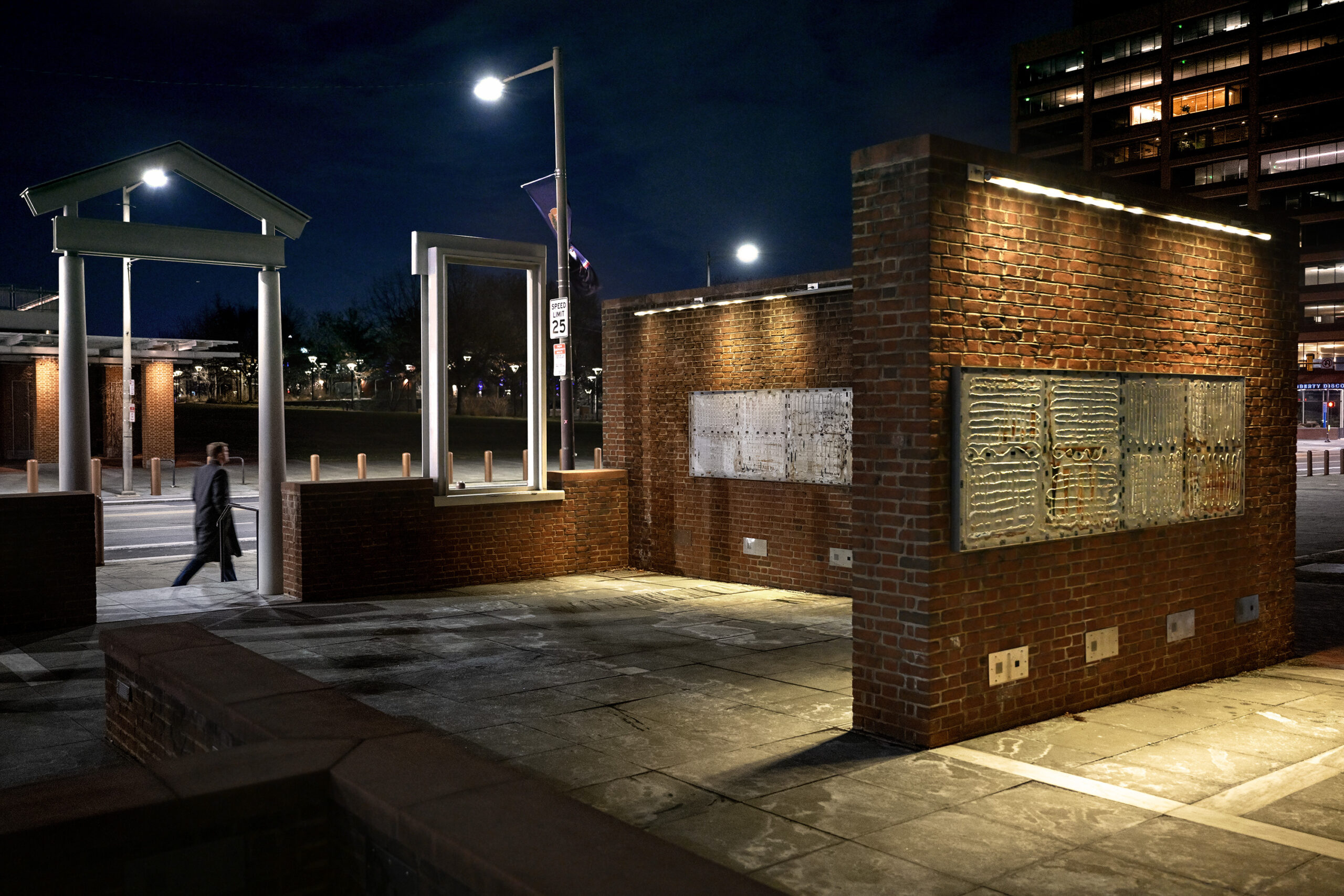
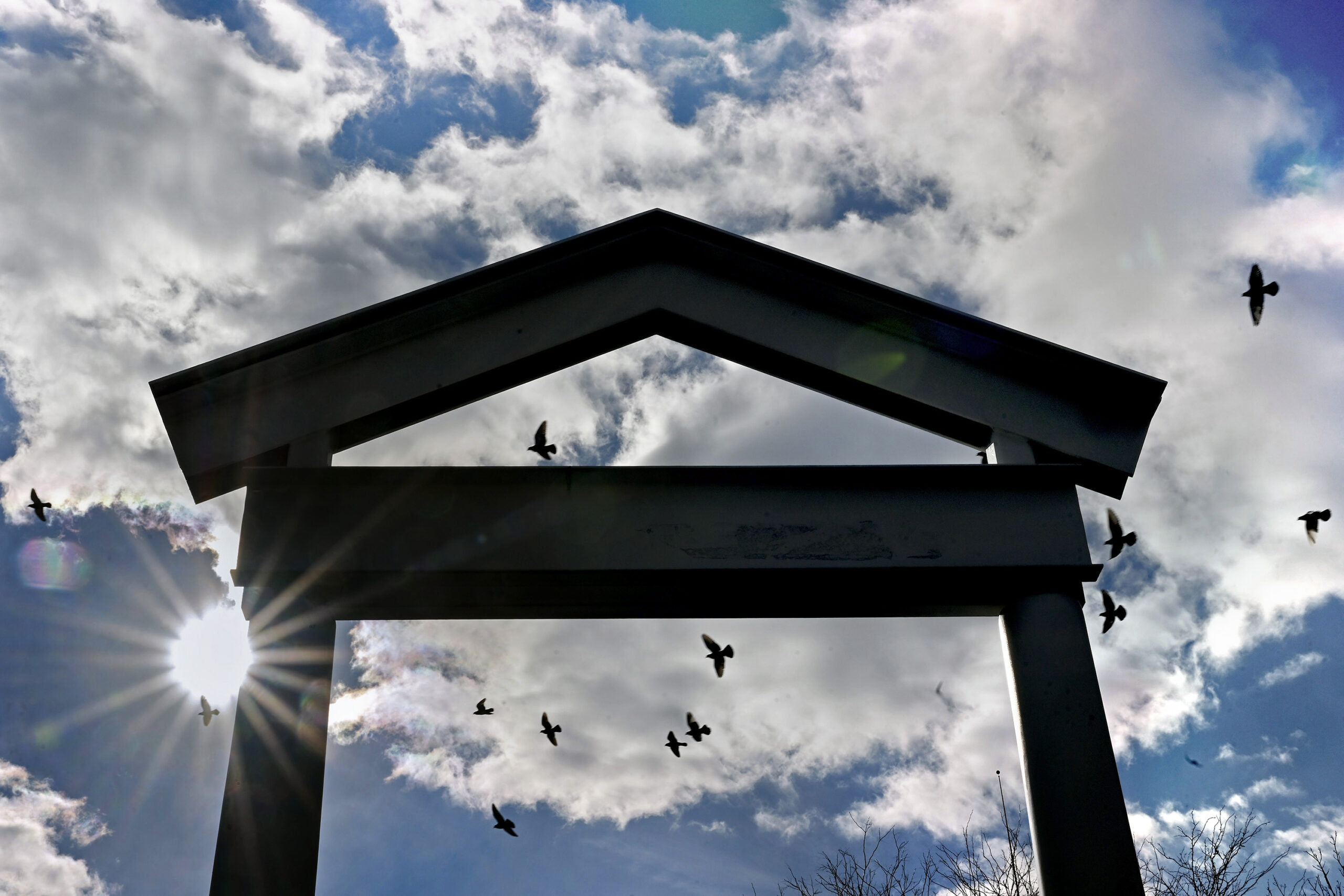
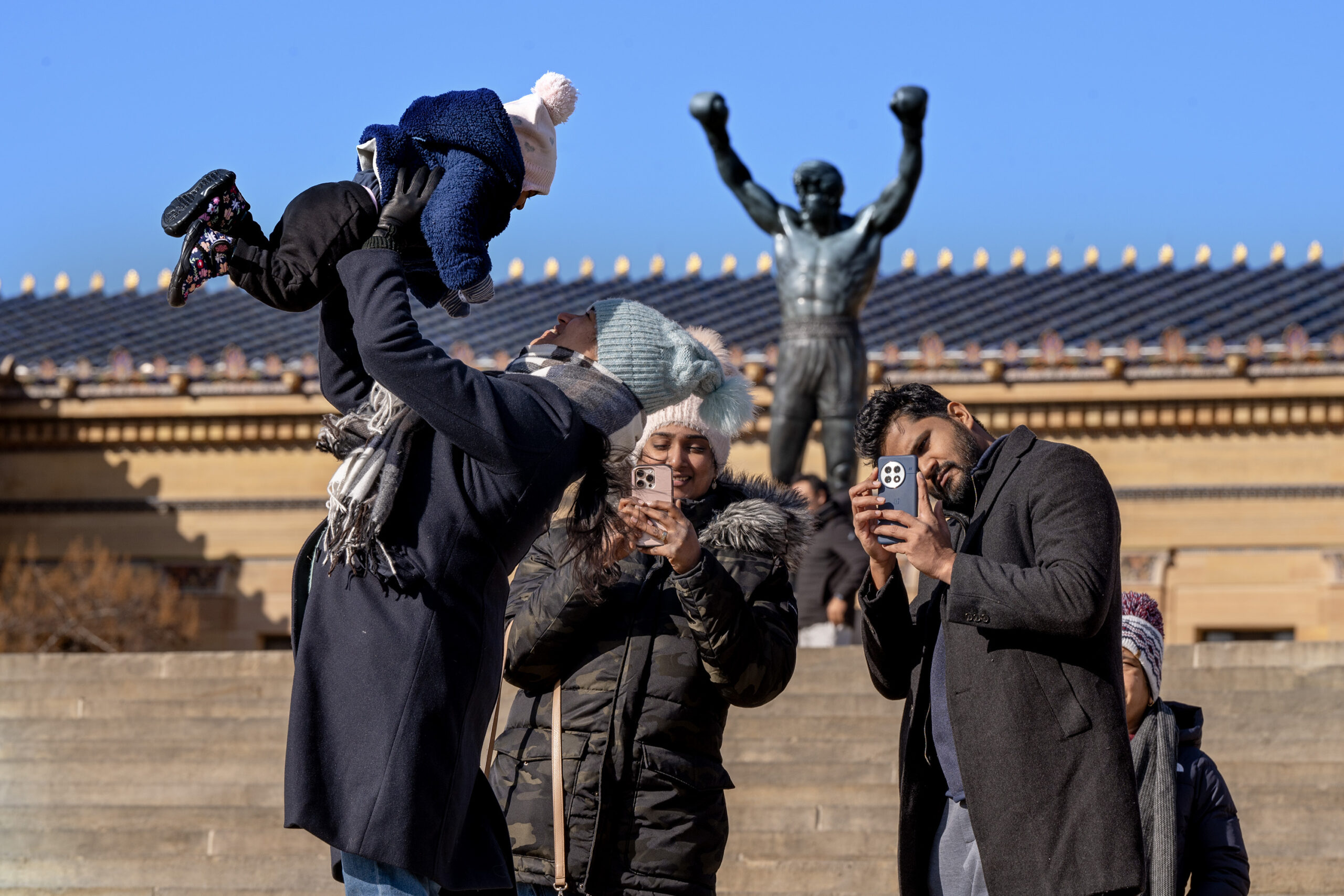
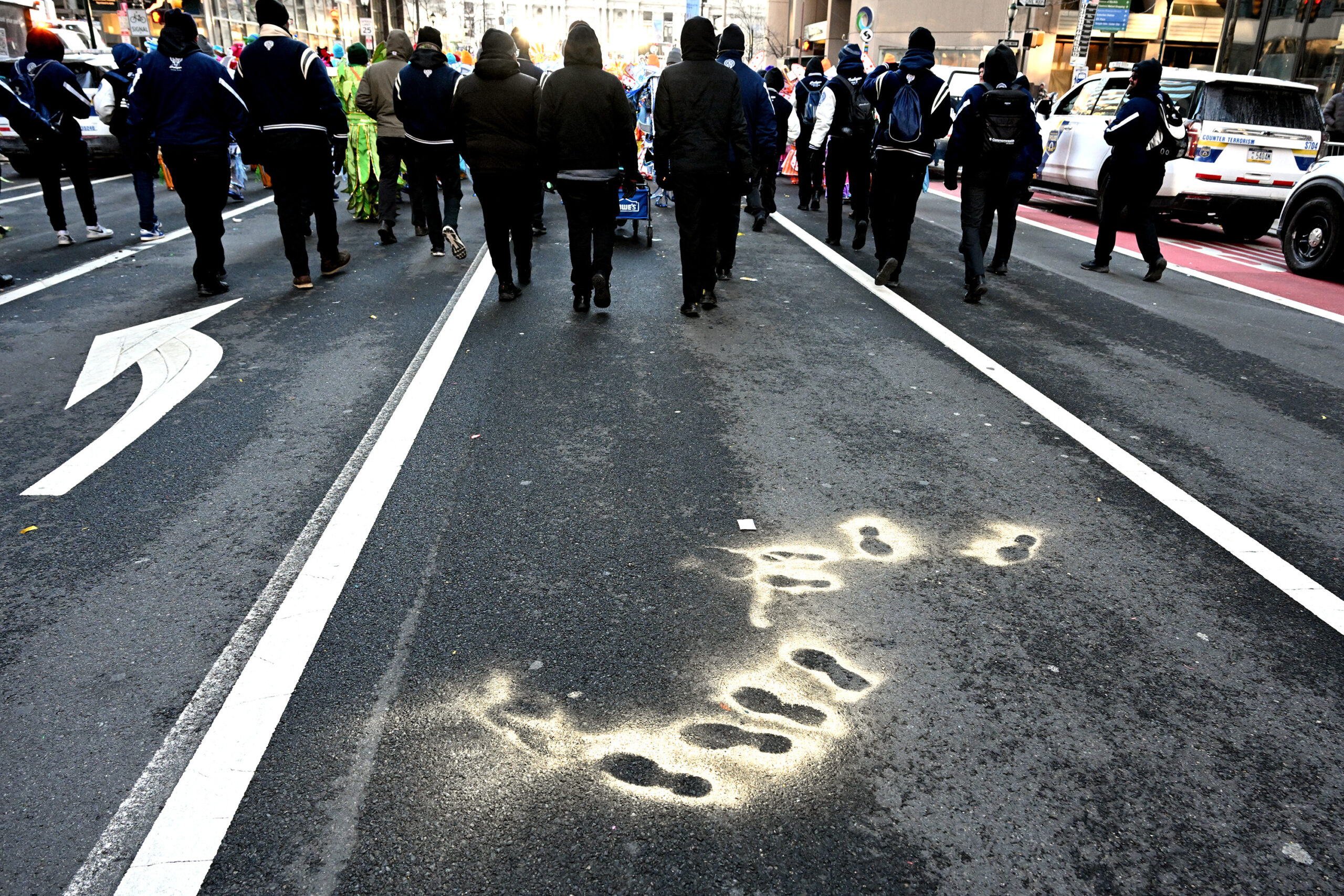
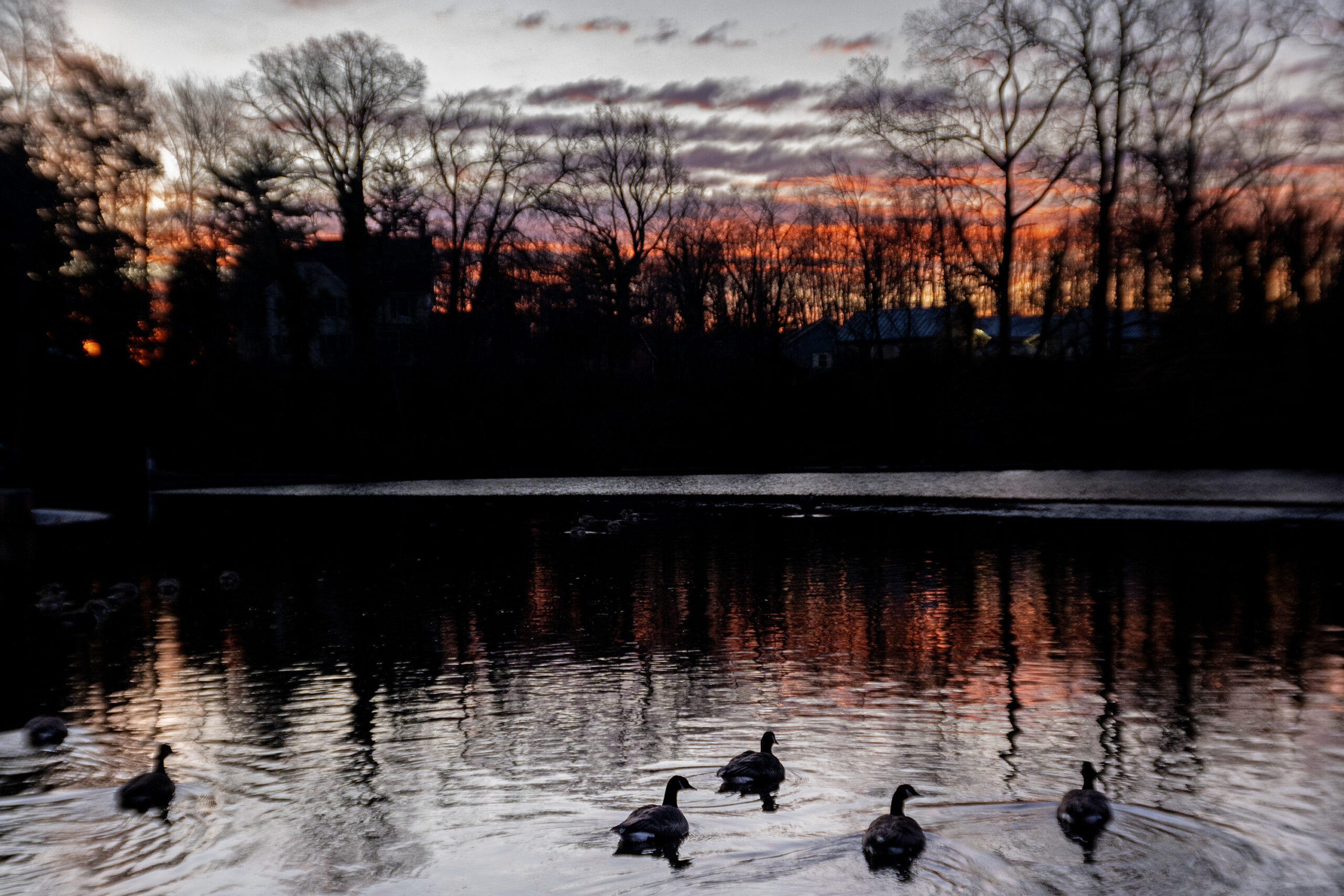
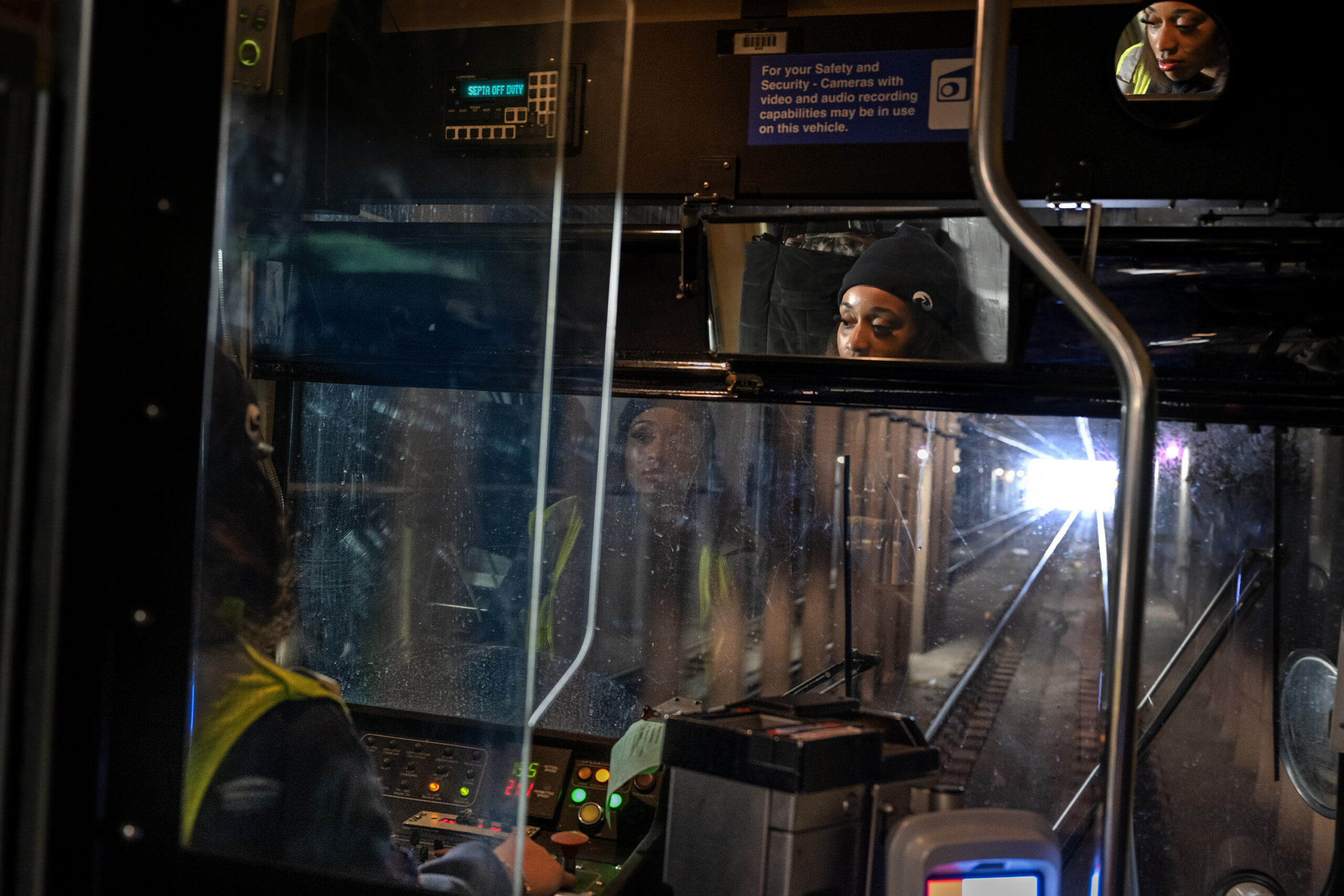
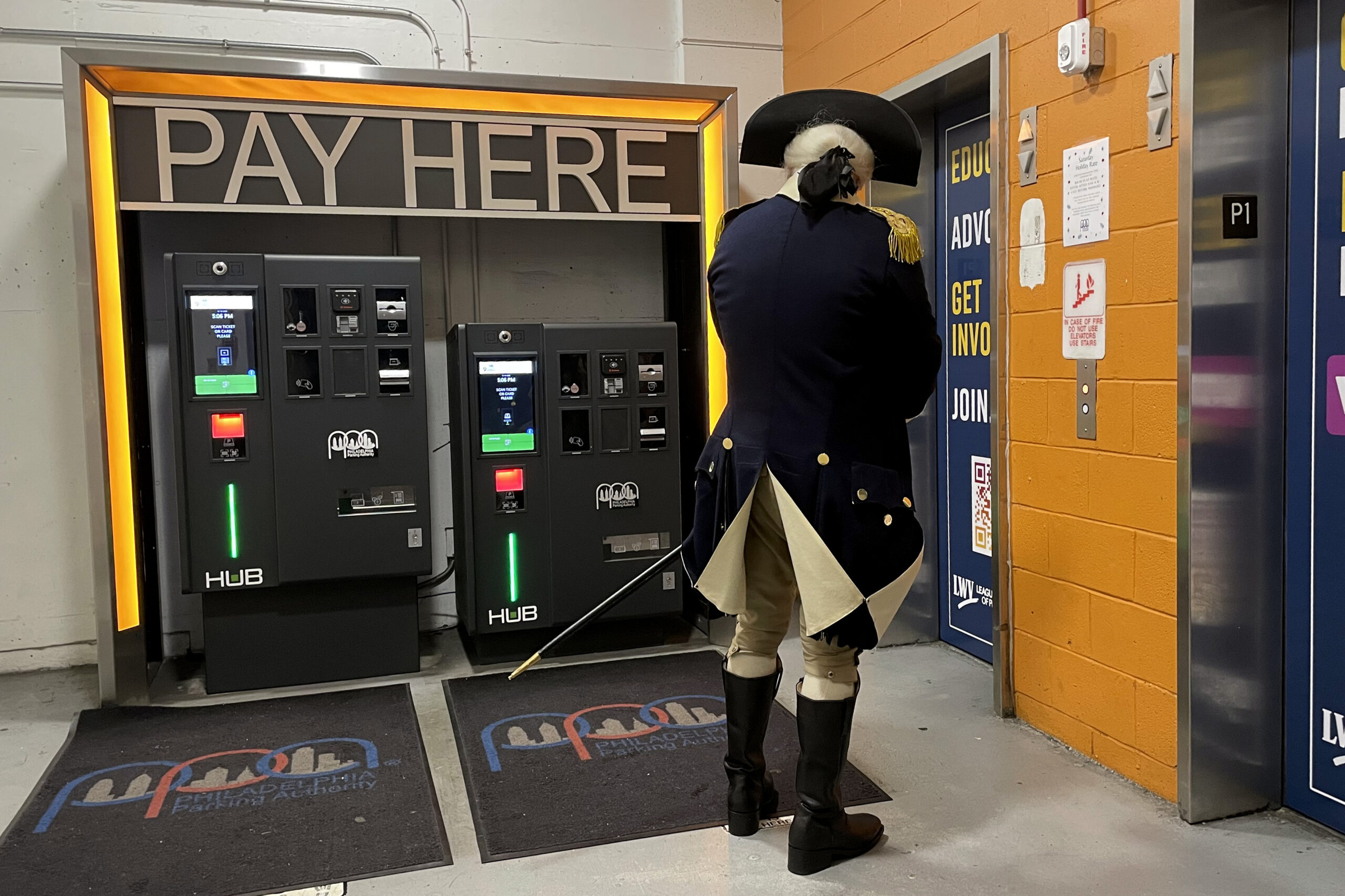
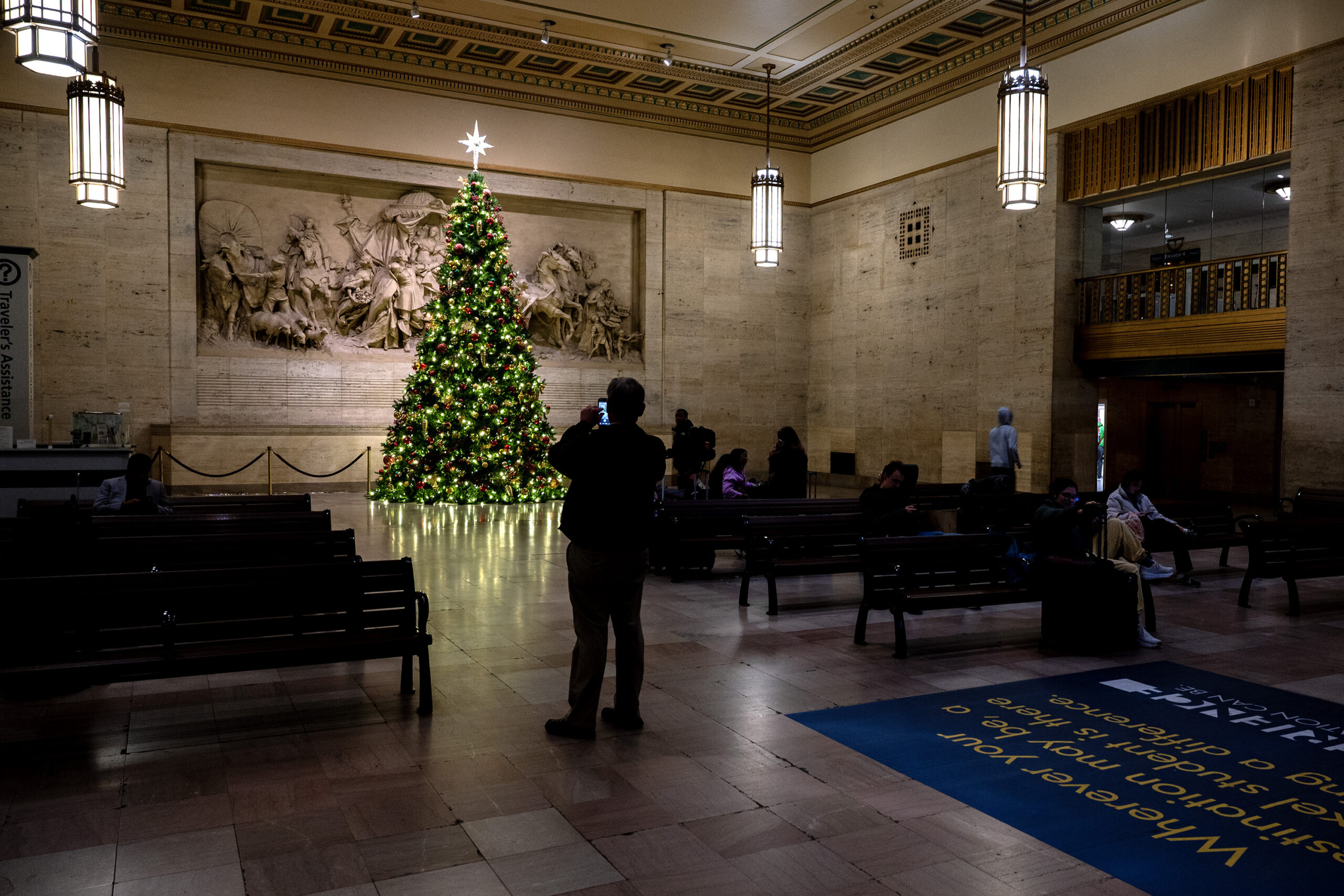
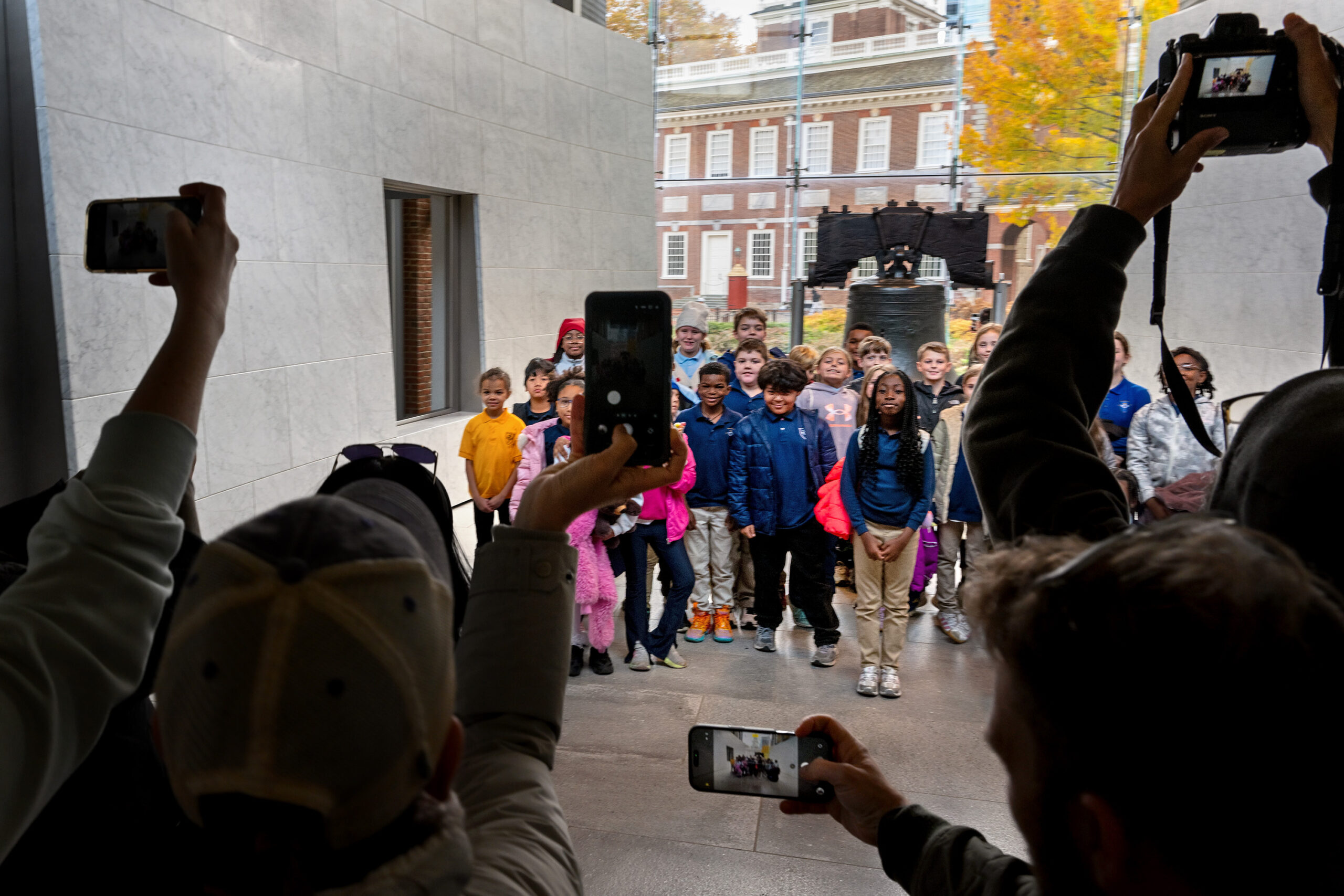
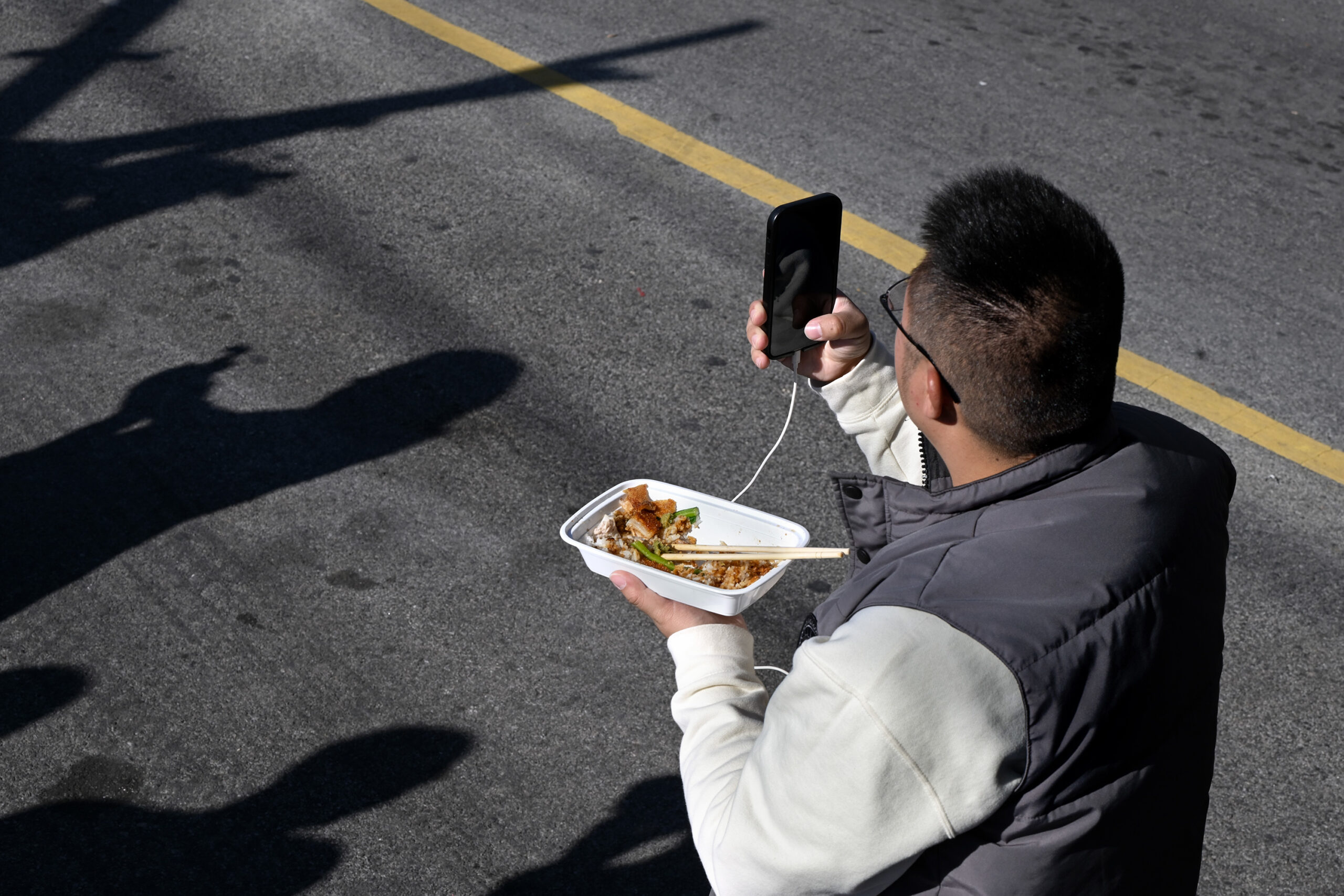
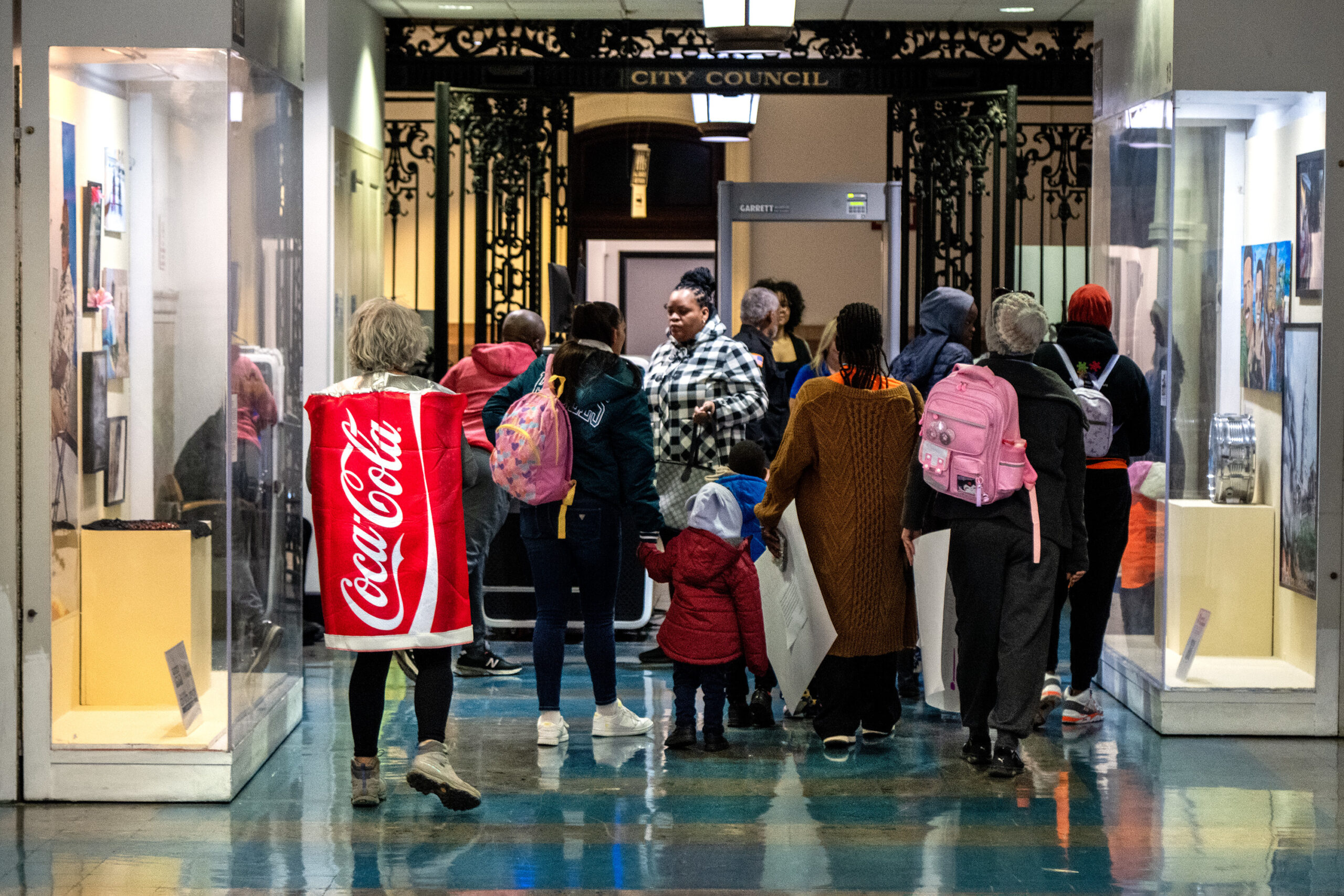
January 26, 2026: The President’s House in Independence National Historical Park hours Jan, 22, after all historical exhibits were removed following President Trump’s Executive Order last March that the content at national parks that “inappropriately disparage” the U.S. be reviewed. The site, a reconstructed “ghost” structure titled “Freedom and Slavery in the Making of a New Nation” (2010), serves as a memorial to the nine people George Washington enslaved there during the founding of America.January 19, 2026: A low-in-the-sky winter sun is behind the triangular pediment of the “front door” of the open-air President’s House installation in Independence National Historical Park. The reconstructed “ghost” structure with partial walls and windows of the Georgian home known in the 18th century as 190 High St. is officially titled, “Freedom and Slavery in the Making of a New Nation” (2010). It is designed to give visitors a sense of the house where the first two presidents of the United States, George Washington and John Adams, served their terms of office. The commemorative site designed by Emanuel Kelly, with Kelly/Maiello Architects, pays homage to nine enslaved people of African descent who were part of the Washington household with videos scripted by Lorene Cary and directed by Louis Massiah. Deepika Iyer holds her niece Ira Samudra aloft in a Rockyesque pose, while her parents photograph their 8 month-old daughter, in front of the famous movie prop at the top of the steps at the Philadelphia Art Museum. Iyer lives in Philadelphia and is hosting a visit by her mother Vijayalakshmi Ramachandran (partially hidden); brother Gautham Ramachandran; and her sister-in-law Janani Gautham who all live in Bangalore, India.January 5, 2026: Parade marshals trail behind the musicians of the Greater Kensington String Band heading to their #9 position start in the Mummers Parade. Spray paint by comic wenches earlier in the day left “Oh, Dem Golden Slippers” shadows on the pavement of Market Street. This year marked the 125th anniversary of Philly’s iconic New Year’s Day celebration.Dec. 29, 2025: Canada geese at sunrise in Evans Pond in Haddonfield, during the week of the Winter Solstice for the Northern Hemisphere. December 22, 2025: SEPTA trolley operator Victoria Daniels approaches the end of the Center City Tunnel, heading toward the 40th Street trolley portal after a tour to update the news media on overhead wire repairs in the closed tunnel due to unexpected issues from new slider parts.December 15, 2025: A historical interpreter waits at the parking garage elevators headed not to a December crossing of the Delaware River, but an event at the National Constitution Center. General George Washington was on his way to an unveiling of the U.S. Mint’s new 2026 coins for the Semiquincentennial, December 8, 2025: The Benjamin Franklin Bridge and pedestrians on the Delaware River Trail are reflected in mirrored spheres of the “Weaver’s Knot: Sheet Bend” public artwork on Columbus Boulevard. The site-specific stainless steel piece located between the Cherry Street and Race Street Piers was commissioned by the City’s Public Art Office and the Delaware River Waterfront Corporation and created and installed in 2022 by the design and fabrication group Ball-Nogues Studio. The name recalls a history that dominated the region for hundreds of years. “Weaver’s knot” derives from use in textile mills and the “Sheet bend” or “sheet knot” was used on sailing vessels for bending ropes to sails. November 29, 2025: t’s ginkgo time in our region again when the distinctive fan-shaped leaves turn yellow and then, on one day, lose all their leaves at the same time laying a carpet on city streets and sidewalks. A squirrel leaps over leaves in the 18th Century Garden in Independence National Historical Park Nov. 25, 2025. The ginkgo (Ginkgo biloba) is considered a living fossil as it’s the only surviving species of a group of trees that existed before dinosaurs. Genetically, it has remained unchanged over the past 200 million years. William Hamilton, owner the Woodlands in SW Phila (no relation to Alexander Hamilton) brought the first ginkgo trees to North America in 1785.November 24, 2025: The old waiting room at 30th Street Station that most people only pass through on their way to the restrooms has been spiffed up with benches – and a Christmas tree. It was placed there this year in front of the 30-foot frieze, “The Spirit of Transportation” while the lobby of Amtrak’s $550 million station restoration is underway. The 1895 relief sculpture by Karl Bitter was originally hung in the Broad Street Station by City Hall, but was moved in 1933. It depicts travel from ancient to modern and even futuristic times. November 17, 2025: Students on a field trip from the Christian Academy in Brookhaven, Delaware County, pose for a group photo in front of the Liberty Bell in Independence National Historical Park on Thursday. The trip was planned weeks earlier, before they knew it would be on the day park buildings were reopening after the government shutdown ended. “We got so lucky,” a teacher said. Then corrected herself. “It’s because we prayed for it.” November 8, 2025: Multitasking during the Festival de Día de Muertos – Day of the Dead – in South Philadelphia.November 1, 2025: Marcy Boroff is at City Hall dressed as a Coke can, along with preschoolers and their caregivers, in support of former Mayor Jim Kenney’s 2017 tax on sweetened beverages. City Council is considering repealing the tax, which funds the city’s pre-K programs. October 25, 2025: Austin Gabauer, paint and production assistant at the Johnson Atelier, in Hamilton Twp, N.J. as the finished “O” letter awaits the return to Philadelphia. The “Y” part of the OY/YO sculpture is inside the painting booth. The well-known sculpture outside the Weitzman National Museum of American Jewish History was removed in May while construction continues on Market Street and has been undergoing refurbishment at the Atelier at the Grounds for Sculpture outside of Trenton.
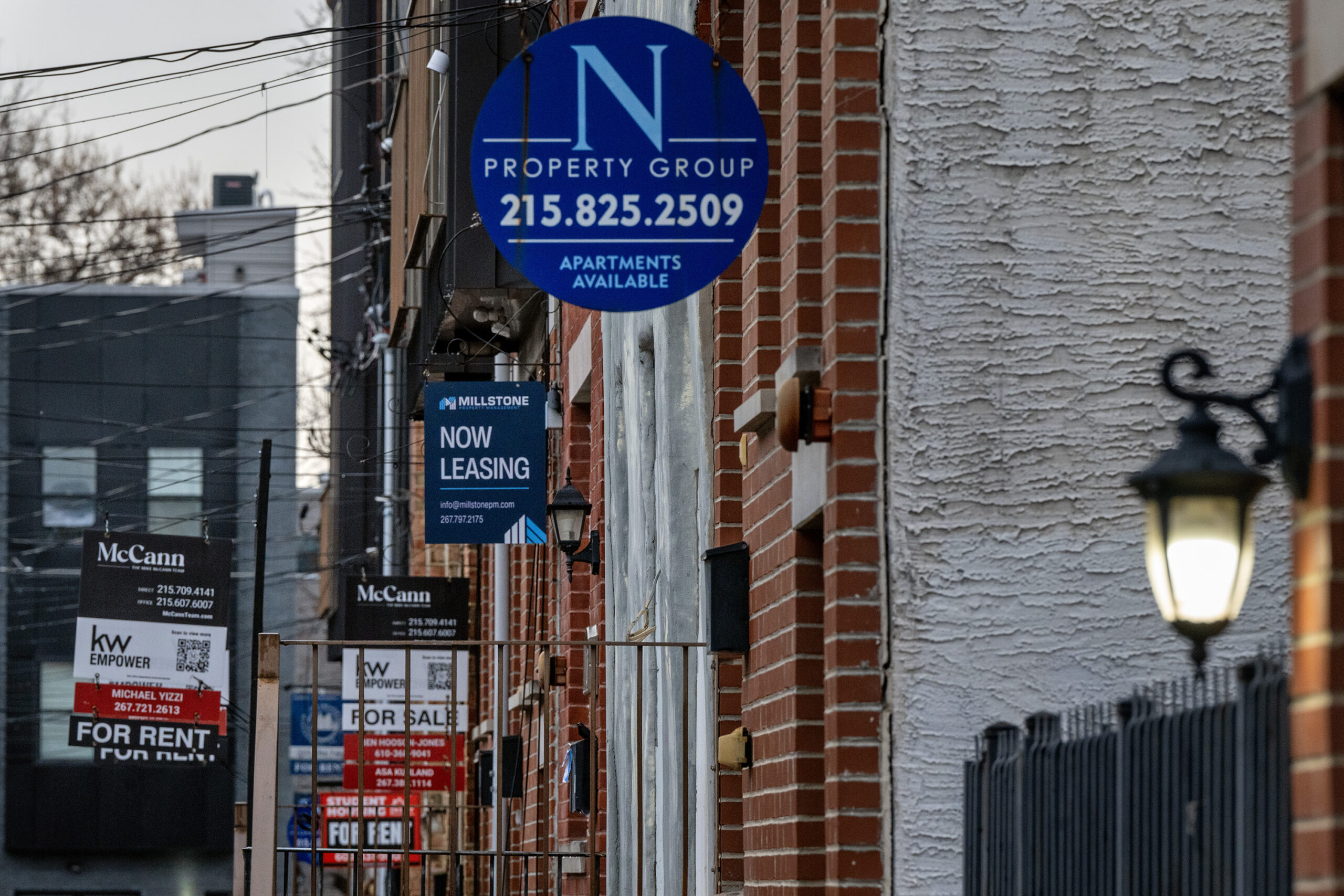
More than two dozen Philadelphia-area real estate professionals helped arrange $45 million worth of questionable deals around Temple University in which student rentals that had sat on the market for months abruptly sold for about double their asking prices, an Inquirer investigation has found.
In 52 settled or still-pending sales over roughly the last year, apartment buildings were listed for sale at an average price of $450,000, but found no takers. Within days of being re-listed for a higher price, the same properties sold for as much as $905,000 — at least on paper — to buyers who took out mortgages that far exceeded the original asking price.
Eight sellers or their agents now say they entered into the deals with the understanding that they would actually receive close to the original asking price — not the much higher amount that was officially listed on deeds and other public records. And an appraiser said that real estate agents on both sides of a proposed deal tried to pressure him to raise the valuation of a property.
The sales have raised concerns about possible mortgage fraud in the area around Temple, which could lead to a spate of foreclosures and affect property assessments, tax bills, and student rentals. At least one such property has gone into foreclosure over an unpaid mortgage, according to court records.
Solomon Wisenberg, a former assistant U.S. attorney in North Carolina and Texas who specialized in white-collar crime and bank fraud, said the people involved in the deals could face scrutiny from criminal investigators.
“I don’t know any fraud prosecutor who wouldn’t be interested in looking at that,” Wisenberg said. “Settlement statements have to reflect reality. If you don’t present an accurate picture to the financial institution that is financing the loan, you’ve got problems.”
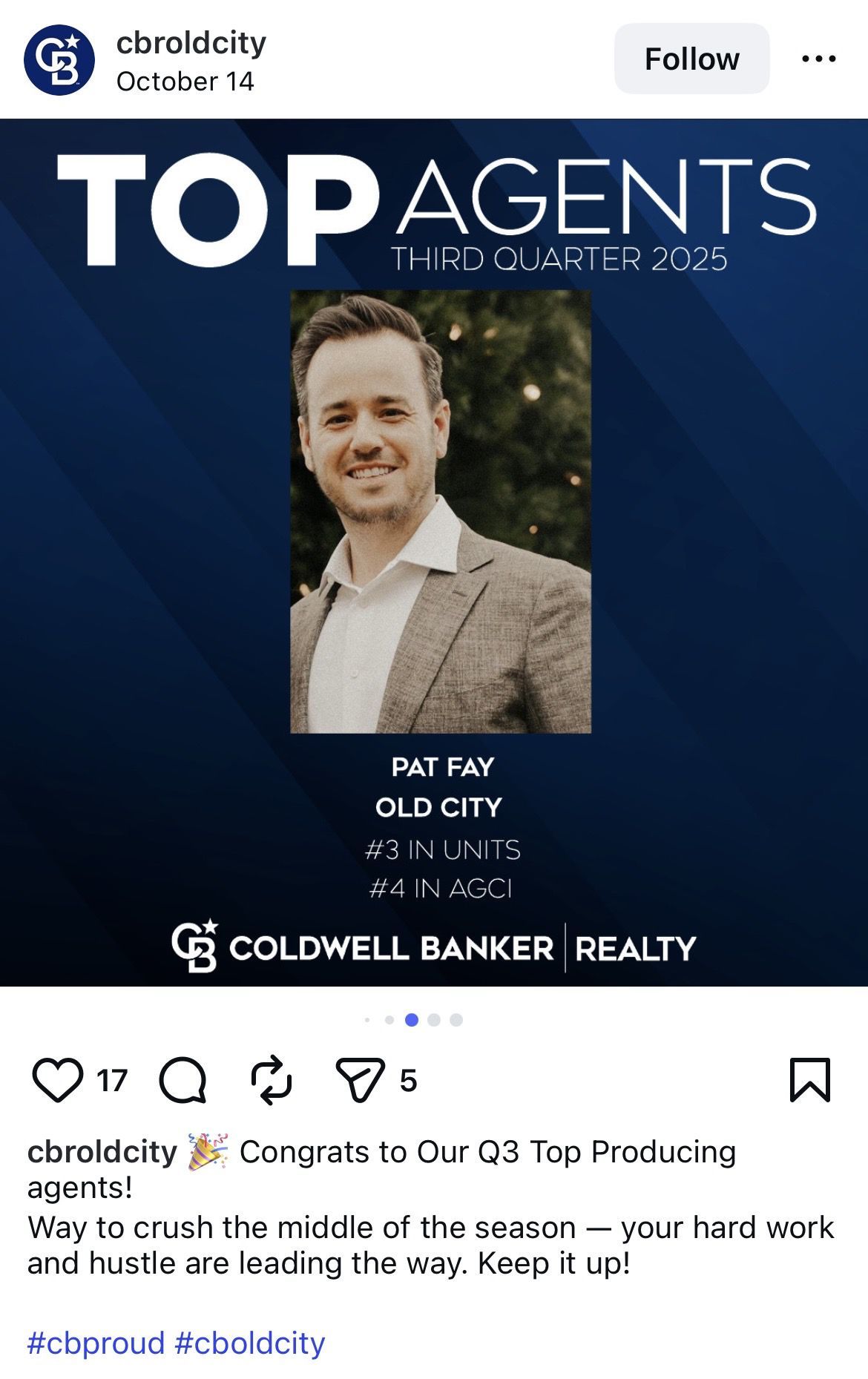
Patrick C. Fay, a real estate agent in Coldwell Banker’s Old City office, was involved in every deal, representing at least seven buyers who purchased the properties through limited liability companies. One of those buyers had been convicted of an earlier mortgage fraud scheme.
Pat Fay had been one of the top real estate agents last in Coldwell Banker’s Old City office. His clients have purchased properties around Temple University — at twice the listing price.
Coldwell Banker cut ties with Fay in December, hours after The Inquirer published a story concerning 33 of his deals around Temple.
But Fay had a counterpart on the other side of every transaction. They included agents at major brokerages such as Keller Williams, Long & Foster, and eXp — as well as three agents who worked in the same Coldwell office as Fay and helped him close 13 sales.
Coldwell Banker’s national office said this month that it has launched an internal investigation into the matter.
Fay, who was one of the top agents in his Coldwell office, has denied wrongdoing. He declined to discuss specific sales.
“In my over 20 years in real estate, I have maintained an unblemished record with no ethical violations or complaints filed against me,” Fay wrote in a text message last week. “These claims are without merit.”
(function() {
var l2 = function() {
new pym.Parent(‘patfay’,
‘https://media.inquirer.com/storage/inquirer/projects/innovation/arcgis_iframe/patfay.html’);
};
if (typeof(pym) === ‘undefined’) {
var h = document.getElementsByTagName(‘head’)[0],
s = document.createElement(‘script’);
s.type = ‘text/javascript’;
s.src = ‘https://pym.nprapps.org/pym.v1.min.js’;
s.onload = l2;
h.appendChild(s);
} else {
l2();
}
})();
Steve Orbanek, a spokesperson for Temple University, said the university learned about the situation from The Inquirer’s previous report and is now investigating possible impacts on its student renters.
“It goes without saying that the university condemns any unlawful behavior, and we find these allegations deeply concerning, both for our students and neighbors who reside in the community,” he said.
‘Fat Pay’
Fay, of Moorestown, Burlington County, started arranging deals in December 2024 to purchase apartment buildings around Temple University that owners had been struggling to sell.
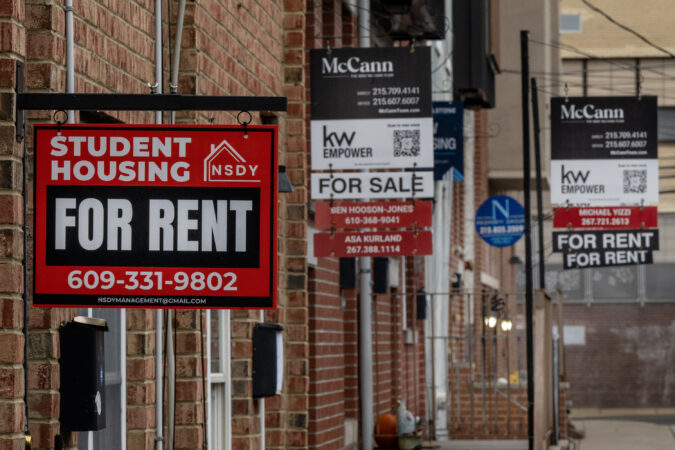
The value of those properties, which are largely marketed as student rentals, has fallen in recent years. A local landlords association said vacancy rates are up and rents down amid declining enrollment at the university, which has shed 10,000 students in under a decade.
Fay, who has used the handle “Fat Pay” on social media, had buyers willing to make a deal. However, in multiple cases identified by The Inquirer, that was true only after the sellers and their real estate agents agreed to sign a deed showing that the property had sold for much more than the original asking price.
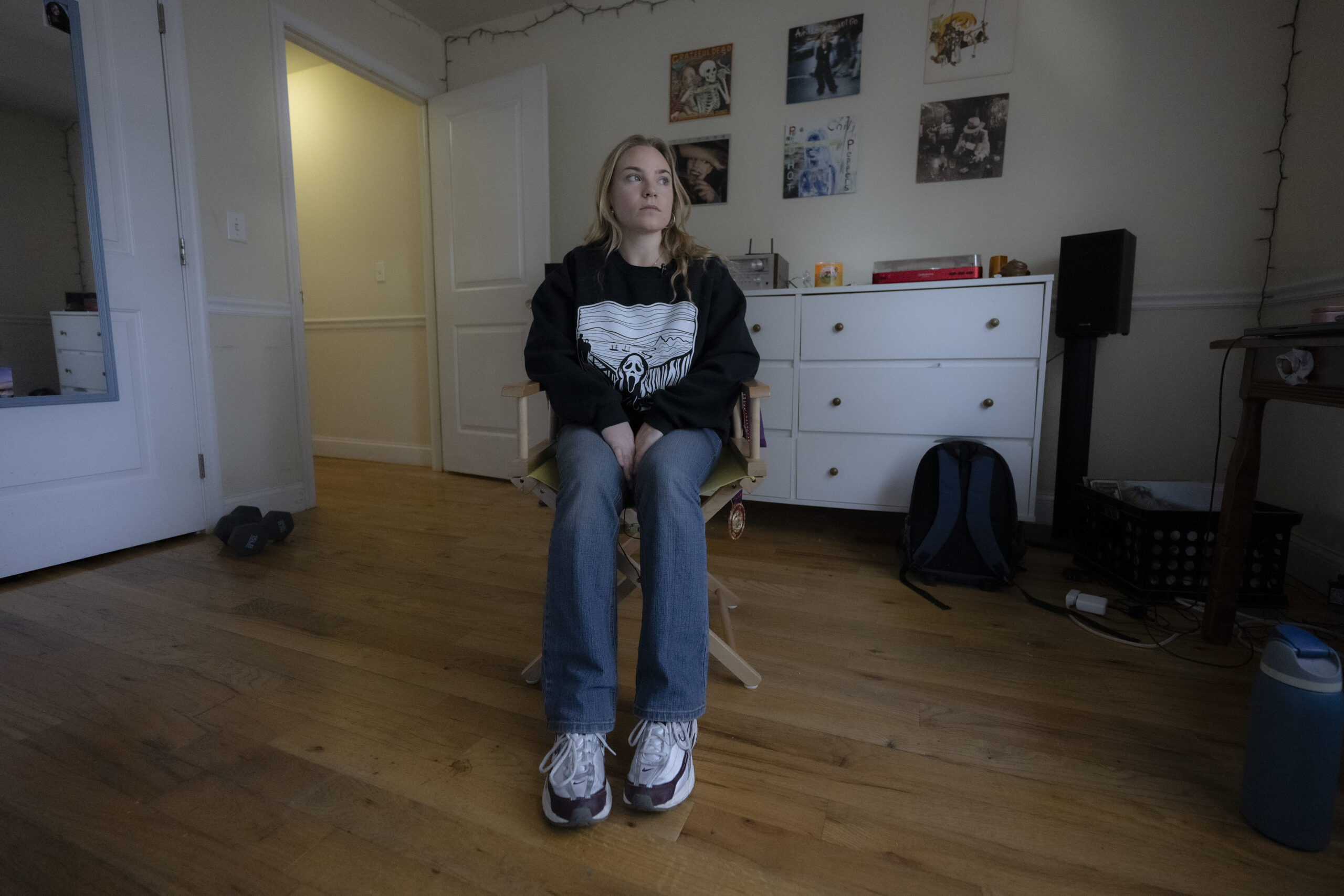
Joelle Delprete, a former Temple grad student who works for the university, lives in an apartment unit that Fay helped purchase. Soon, unpaid water and trash collection bills started piling up.
Shaina Levin, a Coldwell agent who worked with Fay in his Old City office, represented a seller in one such deal on 15th Street. The property was initially listed for sale last July at $375,000. Records show Fay’s client bought it for $842,000 in September 2025 after securing a $673,600 mortgage.
“It’s a bonus when we can keep it in the Coldwell Banker family,” Levin posted on Facebook, referring to the sale. “Thanks Pat Fay for teaming up on this one. Congratulations to your buyer!”
In an interview, Levin said her client received an amount closer to the original listing price, not the $842,0000 sales price recorded on the deed.
She saidthe buyer contended that thehigher sales price was tied to a planned renovation. City permit records show no evidence of construction or renovation work on the building.
Levin said that Fay’s proposal was “totally unconventional,” but that her office manager at Coldwell Banker ran it by the company’s legal department, which signed off.
“Legal said, ‘Yep, all good,’” Levin said. She referred additional questions about the sale to her manager, who declined to comment.
Fay’s buyer in that deal was UrbanNest Acquisitions, a limited liability company created the same month as the sale by Tanjania Powell-Avery, a former real estate agent from Pottstown, Montgomery County. Federal prosecutors with the Eastern District of Pennsylvania indicted Powell-Avery and two others in 2010 for participating in a mortgage fraud ring in the Philadelphia area. She pleaded guilty and was sentenced to five years’ probation and nine months’ house arrest.
Powell-Avery declined to comment.
Two other colleagues of Fay’s at his former Old City office also brokered sales with him, according to data from the Multiple Listing Service, a shared database that real estate professionals use to track and arrange deals.
Karl Klotzbach represented sellers in eight deals with Fay over five months last year — more than any other seller’s agent, records show. The eight properties had originally been listed for a total of $3.4 million before they were each re-listed and sold for a combined $7 million.
Klotzbach did not respond to requests for comment.
Matthew Greene, another Coldwell agent, brokered four sales with Fay on North 12th Street. The properties were each listed for $450,000 last April, then re-listed at $879,000 the following month. In July, each property sold at the higher amount within days of one another, with all four sales backed by a separate $703,200 mortgage.
Greene would not discuss the sales.
“I’m happy to direct you to our legal team for any comment,” he said. Greene hung up the phone without providing any contact information.
Daryl Turner, the branch vice president at Coldwell Banker’s Old City office, referred questions to the company’s legal department. Andrea Gillespie, a national spokesperson for Coldwell Banker, which operates in 49 countries and territories, would not comment on the sales.
“We immediately disaffiliated Pat Fay and are continuing to investigate the matter internally,” Gillespie said in an email. “Coldwell Banker stands for trust and integrity, and we hold our agents to the highest ethical standards.”
‘This is my livelihood’
While sellers were eager to offload their toxic real estate investments, not every deal went smoothly.
John Sexton, an independent licensed appraiser with twenty years’ experience in the Philadelphia market, said in an interview that an appraisal company working for a lender contracted him last year to evaluate a property on North Park Avenue, near Temple’s campus. The sale was being brokered by Fay and Peter Lien, an eXp real estate agent representing the seller.
It was the kind of property common around Temple: a Victorian-era rowhouse that had been converted into a three-unit, nine-bedroom student rental. And, like similar properties in the area, it sat on the market unsold for more than two months, with no takers, at its $408,000 asking price.
The property was taken off the market in October, but then reappeared as a pending sale at $879,000, according to MLS data. Fay had found another buyer ready to pay more than double.
Sexton said he quizzed Lien about why a property that had not undergone recent renovations would suddenly jump in price. Sexton said Lien responded that an earlier broker simply “hadn’t been familiar with the real estate market” around Temple.
Sexton said the implication of these conversations was that Lien “had a person who would pay $879,000, so I should just do my job and mark it at $879,000.”
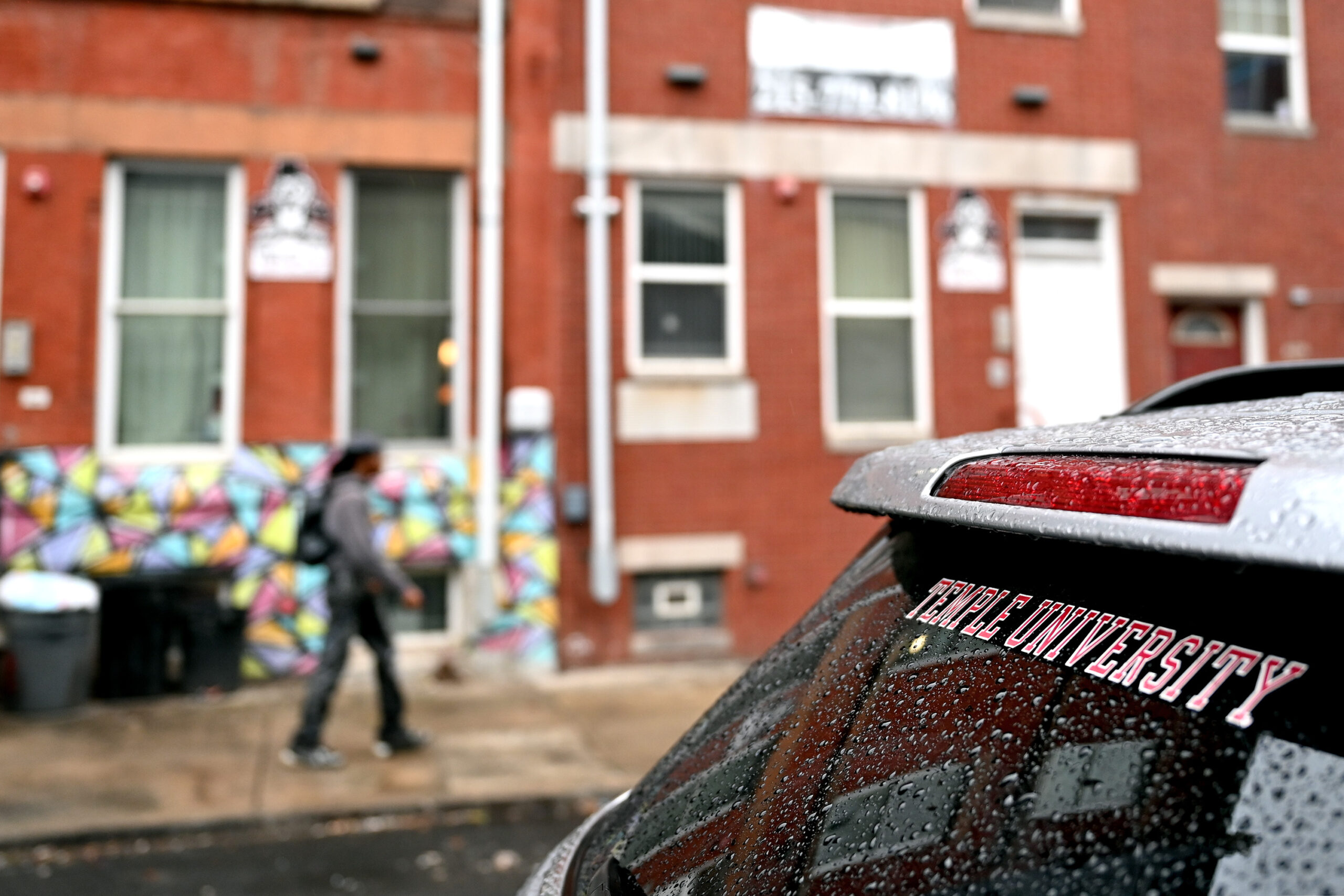
The 1700 block of Arlington St. in North Philadelphia Wednesday, Dec. 10, 2025. Buyers have snapped up $48 million in student housing around Temple University, often paying more than twice what properties were originally listed for even though rents are down and vacancies are up for student housing.
Sexton said he then received an unusual email from an individual named “Jay Jay,” who indicated he was working with Fay. The email included a list of nearby properties that had all sold in the $800,000 range, establishing that the sales price was reasonable.
Sexton looked into the comparable sales and found that they had all been brokered by Fay. “Jay Jay” also sent Sexton copies of leases for apartments in the same building, purporting to show units leasing for $2,500 a month. But when Sexton dug up sales listings for the same building from a few weeks earlier, they advertised that the units had been leased for closer to half that amount.
“Jay Jay” did not respond to an e-mailed request for comment.
Sexton said he called Fay to discuss the discrepancies, and the real estate agent accused him of being inexperienced and pushed him to approve the higher value.
“It’s a tough situation,” Sexton said. “You have two brokers pressuring you and sending you signed documents saying the sale price is valid.”
Sexton said after he told Fay he would need to further substantiate the higher asking price, Fay stopped responding.
The property never sold and is now off the market.Sexton never heard from Fay again.
“It’s infuriating to me, because he’s putting my license in jeopardy,” Sexton said. “This is my livelihood.”
In a text message, Fay denied “any claim that I have ever manipulated or influenced an appraisal in any fashion.” He did not respond to questions about the sale.
Lien said he could not comment on the failed deal.
“I was instructed by my brokerage that any press would have to go through our office, and we’re not allowed to speak on it,” said Lien, who works out of eXp’s King of Prussia office.
The manager of that eXP office did not return a request for comment.
‘Really bad stuff’
Daniel Perlman, a former prosecutor in the Maryland State’s Attorney’s Office who now practices white-collar criminal defense, said anyone who signed documents they knew to be false could potentially face legal problems.
“If there are documents that have incorrect information for a mortgage, then yeah, somebody has criminal liability,” Perlman said. “You’re under penalty of perjury for signing these documents.”
A spokesperson for the U.S. Attorney’s Office in the Eastern District of Pennsylvania said the office does not confirm or deny the existence of investigations, as did a spokesperson for the Pennsylvania State Real Estate Commission, which licenses agents.
Nick Pizzola, vice president of the Temple Area Property Association, which represents local landlords, said the COVID-19 pandemic has had a lasting negative impact on the off-campus real estate market, leaving landlords struggling to sign leases and pay their own mortgages.
Still, he said, the seller’s agents had to have known something was amiss when a buyer was offering double the asking price.
“Anyone who knows anything about real estate would have run away from those deals,” Pizzola said. “Some really bad stuff was happening.”
Most participants in Fay’s deals were reluctant to discuss their roles when contacted by The Inquirer this month. Some seller’s agents said their brokerages had instructed them to remain silent. Others claimed ignorance when it came to the details of the deals they had helped arrange.
The 1900 block of N. 18th St in North Philadelphia Wednesday, Dec. 10, 2025. Buyers have snapped up $48 million in student housing around Temple University, often paying more than twice what properties were originally listed for even though rents are down and vacancies are up for student housing.
In the March 2025 sale of an apartment building on the 2200 block of North Sydenham Street, for example, both the seller and his agent said they could not explain why the sales price did not match the amount listed on the deed.
The property initially went up for sale for $324,900 in December 2024 but was then re-listed and sold to Fay’s client in March 2025 for $789,000. The seller, Alvjod Dedaj, said he did not actually receive that higher amount. He referred further questions to his real estate agent at Long & Foster.
“I have no clue what’s going on,” Dedaj said. “I just cashed out a certain amount of money.”
Dedaj’s agent, Bob Kiziroglou, who works out of Long & Foster’s Devon office, said he, too, could not recall why the asking price suddenly jumped. He referred questions to Fay.
“Reach out to him, man, he’ll give you all the details,” Kiziroglou said.
A message left at Long & Foster’s Devon office was not returned.
The Broad Street office of Keller Williams Realty was another hub for deals involving Fay, with five of its agents representing sellers in eightsales. An office manager did not respond to requests for comment.
Wisenberg, who was a prosecutor in the Whitewater/Madison Guaranty Savings & Loan investigation, said he found it particularly suspicious that Fay arranged deals with mortgages that far exceeded the initial asking price, and with sellers receiving less than the stated purchase price.
“What’s he doing with the rest of the money?” Wisenberg asked.
Trouble brewing
Already, there are signs of trouble in the neighborhood around Temple.
In November, one lender, Easy Street Capital, filed to foreclose on a Park Avenue property that sold in late 2024 for $850,000 — more than double its value just two years prior.
While no buyer’s agent is listed in MLS data for the sale, Lien, the eXp agent, is listed as representing the seller. The buyer, Park Ave Enterprise LLC, is registered to an associate of Fay’s who participated in at least four other sales around Temple that he brokered.
According to court filings, the LLC defaulted on an $807,000 mortgage about four months after purchase.
The lenders that financed Fay’s purchases now bear the most risk of the overvalued and under-occupied rentals lapsing into foreclosure. A private lenders association in Novemberwarned its members of a “fraud scheme” operating around Temple University, and cities like Baltimore have seen hundreds of properties fall into foreclosure as a result of suspected mortgage fraud rings.
A spokesperson for City Councilmember Jeffery “Jay” Young, whose district encompasses the affected properties, said he was “not familiar with the situation.” He called mortgage fraud “a common and unscrupulous real estate practice that happens too often in our city.”
Orbanek, the Temple spokesperson, said the university is working to identify students who may be impacted by potential foreclosures and asked themto contact the university’s Essential Needs Hub, which connects student renters with supportive resources.
Joelle DelPrete, a former Temple grad student who works for the university, lives in an apartment unit that Fay helped purchase. He brokered a sale of the rental property to “18th Estates LLC” in December 2024 for $868,000. It had previously been listed for $385,000.
A few months later, DelPrete said, Fay texted her that he was the property manager, and he wanted her to sign a new lease so he could begin collecting rent.
“We assumed it was a totally legit company,” DelPrete said.
Soon, DelPrete said, unpaid water and trash collection bills started piling up, and maintenance issues went unanswered. In October, she found a document known as an Act 91 notice that was posted on an adjacent property in advance of foreclosure proceedings. It showed the owners — who had been represented in the purchase by Fay — had stopped paying its mortgage and owed roughly $25,000.
DelPrete and her three roommates are hoping to move out before her building goes into foreclosure.
“Especially living around Temple, you just gotta be careful and make sure everything is aboveboard,” she said. “If something feels off, it is off.”
In Philly’s bustling, pop-up-riddled bakery scene, Dead King has some of the most idiosyncratic hours out there: It’s open just twice a week, from 4 to 6 p.m. Thursdays and 10 a.m. to 1 p.m. Saturdays. Perhaps as a result, one often needs to brave a long line that snakes through the numerous warehouse spaces inside Manayunk Timber, which houses the bakery. (If you just want sourdough or pizza dough — both excellent — and you live in parts of Northwest Philadelphia, you can subscribe for bread delivery.)
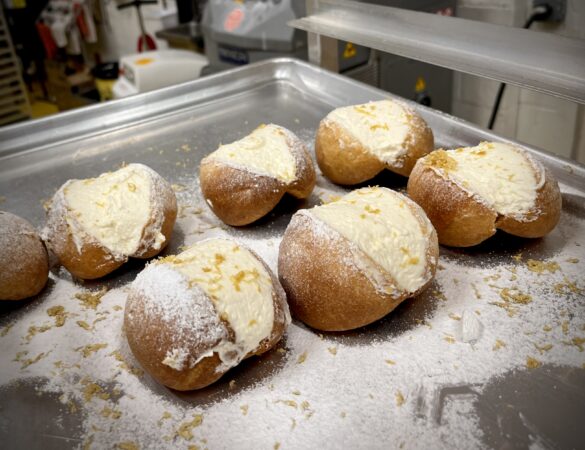
I was rewarded for my pains on an icy Thursday afternoon by a nearly empty parking lot and no line at all. There were plenty of rosemary focaccia slabs, tomato pie slices, and olive-twisted baguettes to be had, plus loaves of plain, cinnamon raisin, and jalapeño-cheddar, saucer-sized chocolate chip cookies, and cream cheese-iced spice cake squares. And that maritozzi? I polished it off in minutes, not taking nearly enough time to savor its buttery brioche cushion, tangy labneh topping, and the bright burst of lemon curd at the center. Oh well. I’ll just have to go back next week. Dead King Bread, 5100 Umbria St., deadkingbread.myshopify.com
— Jenn Ladd
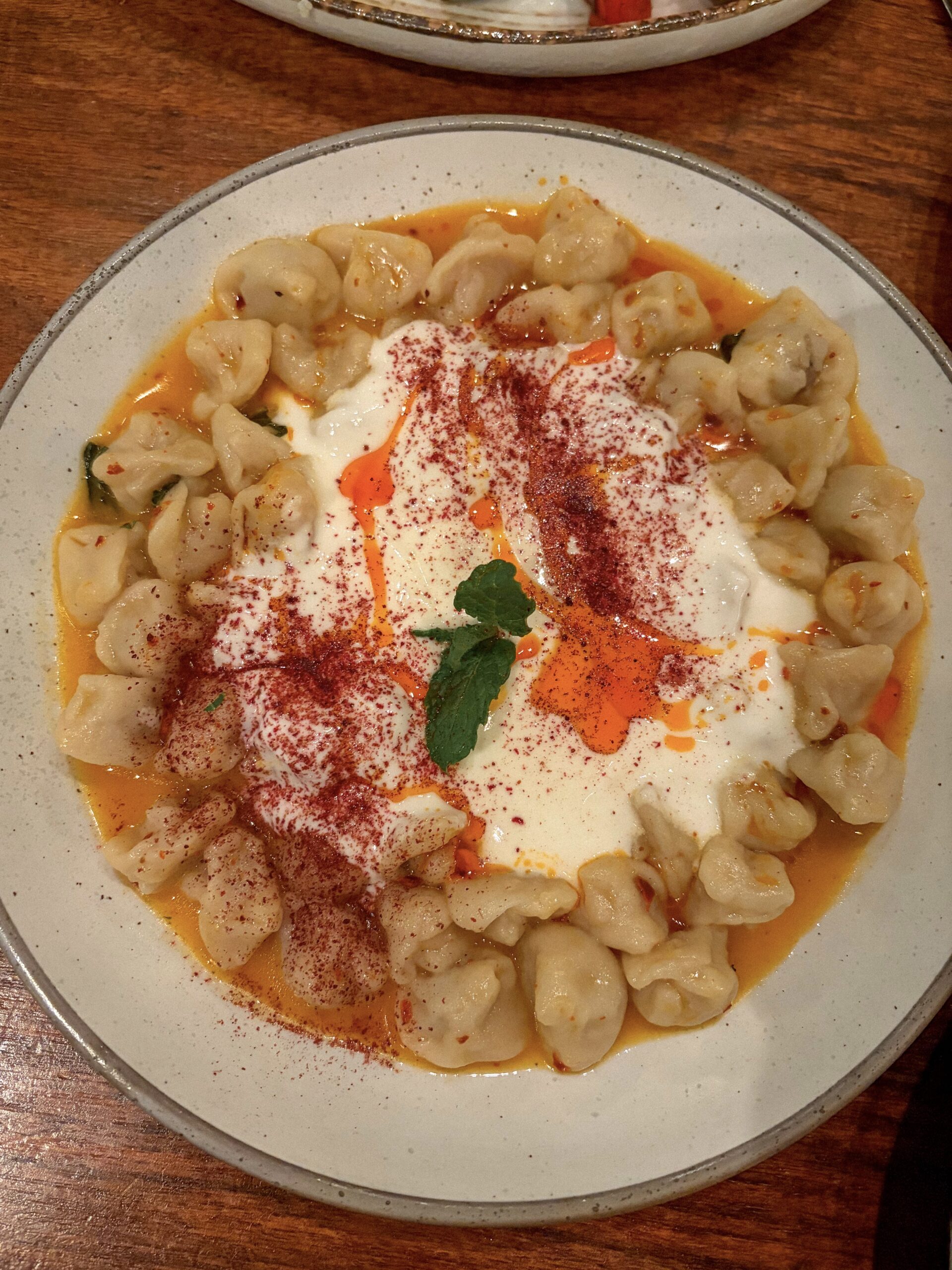
A plate of Manti served at Pera Turkish Cuisine in Northern Liberties.
Manti at Pera Turkish Cuisine
Manti holds a special place in my heart. It’s the dish my family eats when I touch down in Istanbul for my annual trip to Turkey. The second the plates land on our table at Aşkana (one of my favorite restaurants in the city), the ceremony begins, signaling to everyone in the dining room, “This family has reunited!”
Manti is also the dish my mom makes best. Whenever she has guests over, this is what you’ll find on the dinner table. It’s a labor-intensive dish, generally a family affair: one person makes the dough, another prepares the filling, and several fill and fold the dumplings. It’s popular across Turkey, Armenia, and Uzbekistan, but the version served at Pera reminds me of the recipe I grew up with: small, tender dumplings filled with ground lamb — pinched to look like little stars — topped with garlicky yogurt and spiced butter. Is it better than my mom’s manti? I’m obligated to say no. However, it comes close. Pera’s manti is textbook, with each bite containing the sacred combination that makes this dish a comfort meal: lamb, yogurt, and butter. Pera Turkish Cuisine, 944 N. Second St., 215-660-9471, peraphiladelphia.com
— Esra Erol
Kapusniak at Heavy Metal Sausage
Kapusniak (or sauerkraut soup) at Heavy Metal Sausage.
This week, the balm that soothed my frozen body, attained after scaling the mountainous snow piles of South Philly, was a bowl of soup at Heavy Metal Sausage on Thursday. It was kapusniak, a sauerkraut soup with mushrooms that’s currently on their lunchtime specials menu. Tangy, hearty, and lightly smoky, it instantly transported me from the butcher shop to Poland, where I once spent the weeks sipping sour soups. Heavy Metal Sausage Co., 1527 W. Porter St., heavymetalsausage.com
— Kiki Aranita
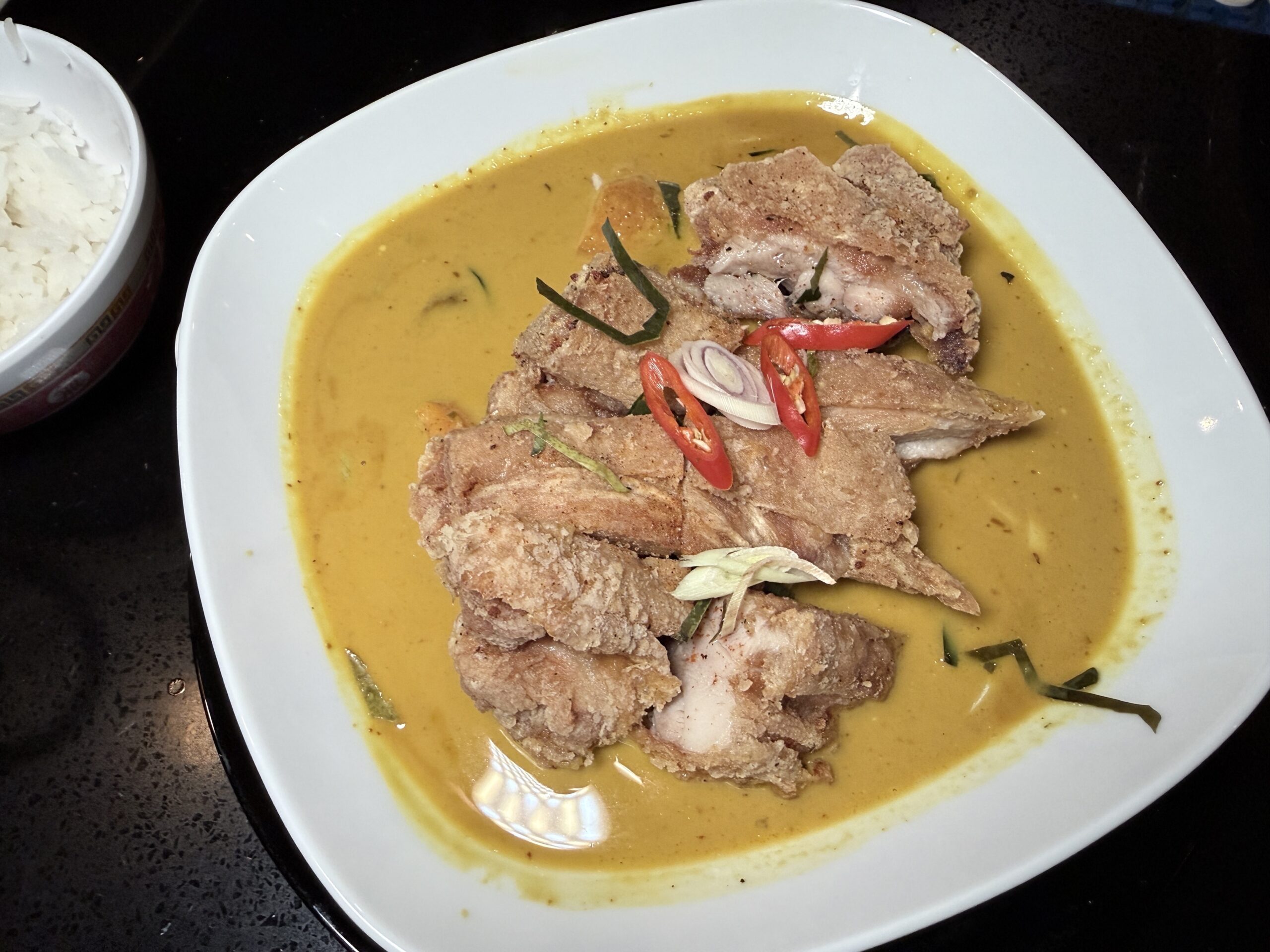
Fried chicken curry at Gabriella’s Vietnam
Fried chicken curry at Gabriella’s Vietnam
As an antidote to the bitter cold, chef Thanh Nguyen has just put a selection of curries on the menu at Gabriella’s Vietnam, and her fried chicken curry may be the very best version of the dish found in Philly. The chicken is tender, its skin crispy, and the curry meets a Goldilocks ideal — not too thin, not too thick, balanced in creaminess and savoriness, with a touch of spice. It’s extraordinarily restorative when spooned onto steaming hot rice. Gabriella’s Vietnam, 1837 E. Passyunk Ave., 272-888-3298, gabriellasvietnam.com
We’ll show you a photo taken in the Philly-area, you drop a pin where you think it was taken. Closer to the location results in a better score. This week we have three historic sites across the city! Good luck!
Round #18
Question 1
This location has been in the news recently. Where is it?
Loading…
ClickTap on map to guess the location in the photo
ClickTap again to change your guess and hit submit when you're happy
You will be scored at the end. The closer to the location the better the score
Tom Gralish / Staff Photographer
Pretty good/Not bad/Way off! Your guess was from the location.Spot on! Your guess was exactly at the location. Here's also where a random selection of Inquirer readers guessed.
The President’s House made headlines when the National Park Service removed exhibits about slavery following an executive order by President Donald Trump.
Quiz continues after ad
Question 2
Where can you find the Philly Renaissance Faire and an electronic music festival?
Loading…
Don Nigroni / Spotlight PA
Pretty good/Not bad/Way off! Your guess was from the location.Spot on! Your guess was exactly at the location. Here's also where a random selection of Inquirer readers guessed.
Fort Mifflin is a Revolutionary War-era historic landmark near Philadelphia International Airport. It recently hosted the Making Time ∞ festival.
Quiz continues after ad
Question 3
Where is this historic house?
Loading…
Michael Bryant / Staff Photographer
Pretty good/Not bad/Way off! Your guess was from the location.Spot on! Your guess was exactly at the location. Here's also where a random selection of Inquirer readers guessed.
Stenton, a colonial-era house and museum, is home to the Dinah Memorial – a memorial that honors a one-time enslaved housekeeper who saved the house from destruction by British soldiers.
Your Score
ARank
Amazing work. You know your Philly history.
BRank
Good stuff. You’re almost perfect.
CRank
C is a passing grade, but you could do better.
DRank
D isn’t great. Try again next week!
FRank
We don’t want to say you failed, but you didn’t not fail.
You beat % of other Inquirer readers.
We’ll be back next Saturday for another round of Citywide Quest.
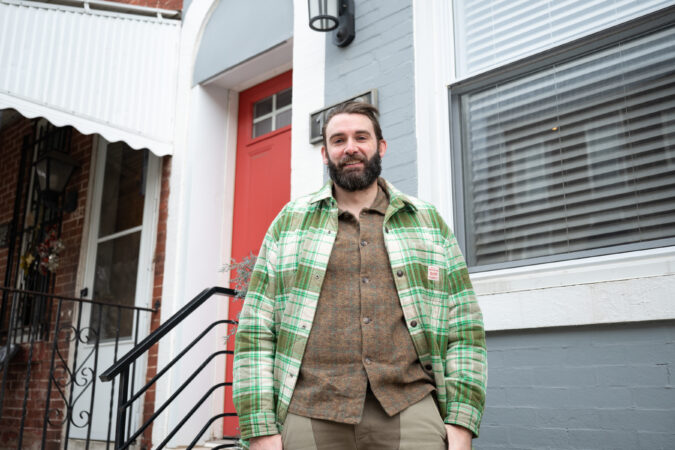
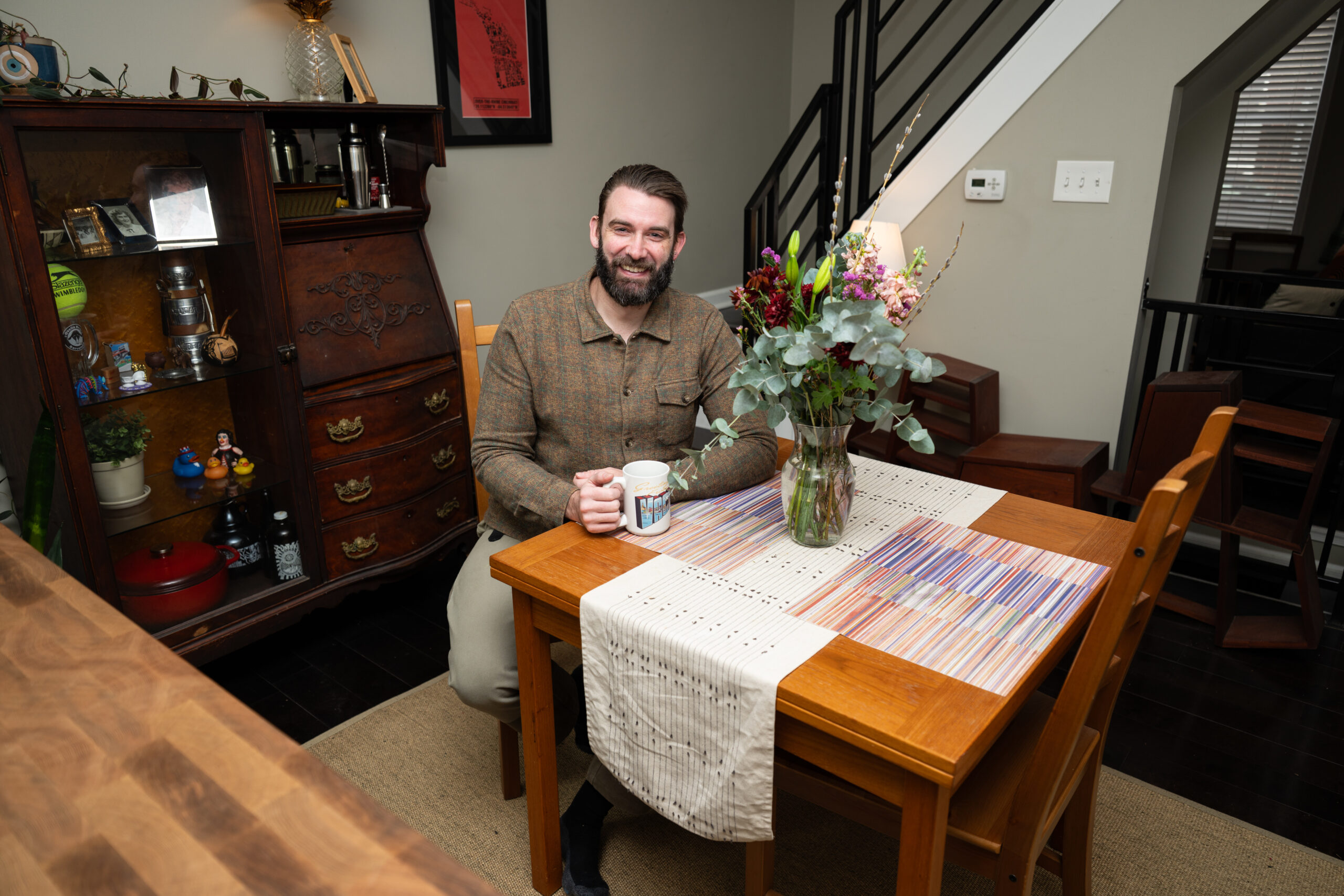
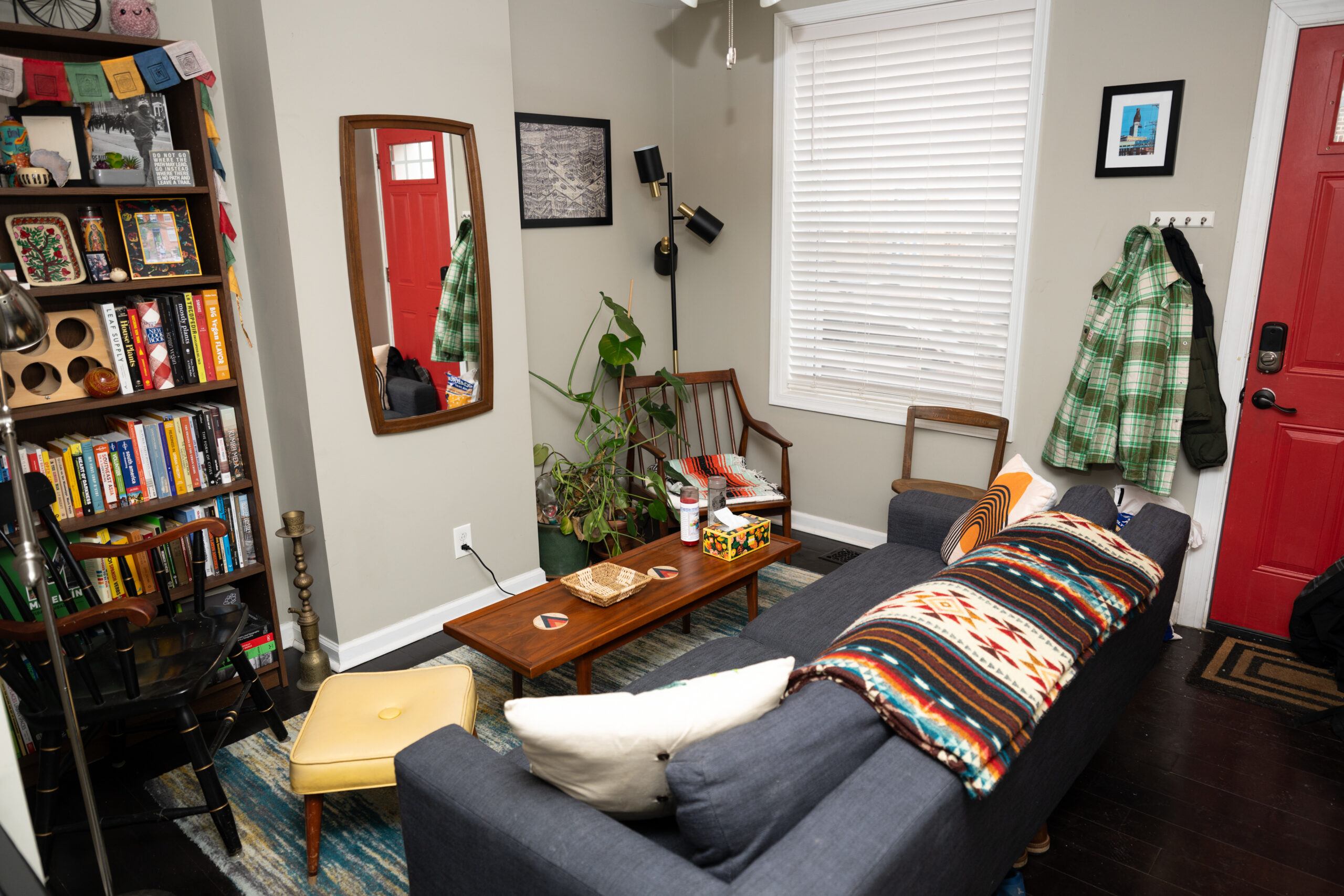
The house: A 960-square-foot townhouse in Norris Square with two bedrooms and one bath, built in 1920.
The price: Listed for $255,000; purchased for $255,000
The agent: Kate McCann, Elfant Wissahickon
Todtz saw potential in the house’s flexible floor plan.
The ask: Evan Todtz was tired of commuting from Baltimore to Washington, D.C. He didn’t want to live in the latter, and he couldn’t find work in the former, so he considered the next-closest big city: Philadelphia.
“I’ve always really loved Philly and wanted to spend more time in it,” Todtz said. When his company approved a transfer to its Philadelphia office, Todtz moved north and rented an apartment in Norris Square. A year later, he was ready to make it official. “I felt like I was getting into a groove in Philly,” he said, “and I wanted to invest in a place and make this my home.”
Transit access was Todtz’s top priority. He frequently travels along the east corridor for work, so being close to the Market-Frankford line, which could take him directly to 30th Street Station in the “wee hours of the morning,” was a nonnegotiable. He wanted two bedrooms, enough space to host visitors, and an outdoor space. Everything else was flexible. “I’m particular, but I’m not picky,” he said.
Todtz liked the living room’s tan walls and dark floors. They made the room feel cozy.
The search: Todtz began looking seriously at the end of 2023, after attending a first-time homebuyers workshop hosted by Philly Home Girls. Over a month, hesaw several homes on weekends and evenings. He saw the house he would eventually buy early in his search, but it felt out of reach. Originally listed at $280,000, it hovered just above what he felt comfortable paying. He put it on a mental “maybe” list and kept looking. One month later, the price dropped to $255,000. “That’s when it felt within striking distance,” Todtz said. “It was closer to comps in the market.”
The appeal: Todtz immediately noticed the quality of the renovation. The house looked polished but not flashy, neat but not boring. “There weren’t super high-end finishes I wasn’t going to appreciate,” Todtz said, “and there wasn’t the gray-washed millennial nothingness design that so many new houses have.”
Instead, the house felt solid and lived-in, with dark wood floors and warm-colored walls. “It was very cozy and pretty,” Todtz said. He also liked the flexible floor plan and could see “potential in the footprint,” he said. Mostly, he liked that there wasn’t anything glaringly wrong with it. “It just felt very manageable,” he said. “It didn’t feel like I was taking on a massive project that I didn’t know how to start.”
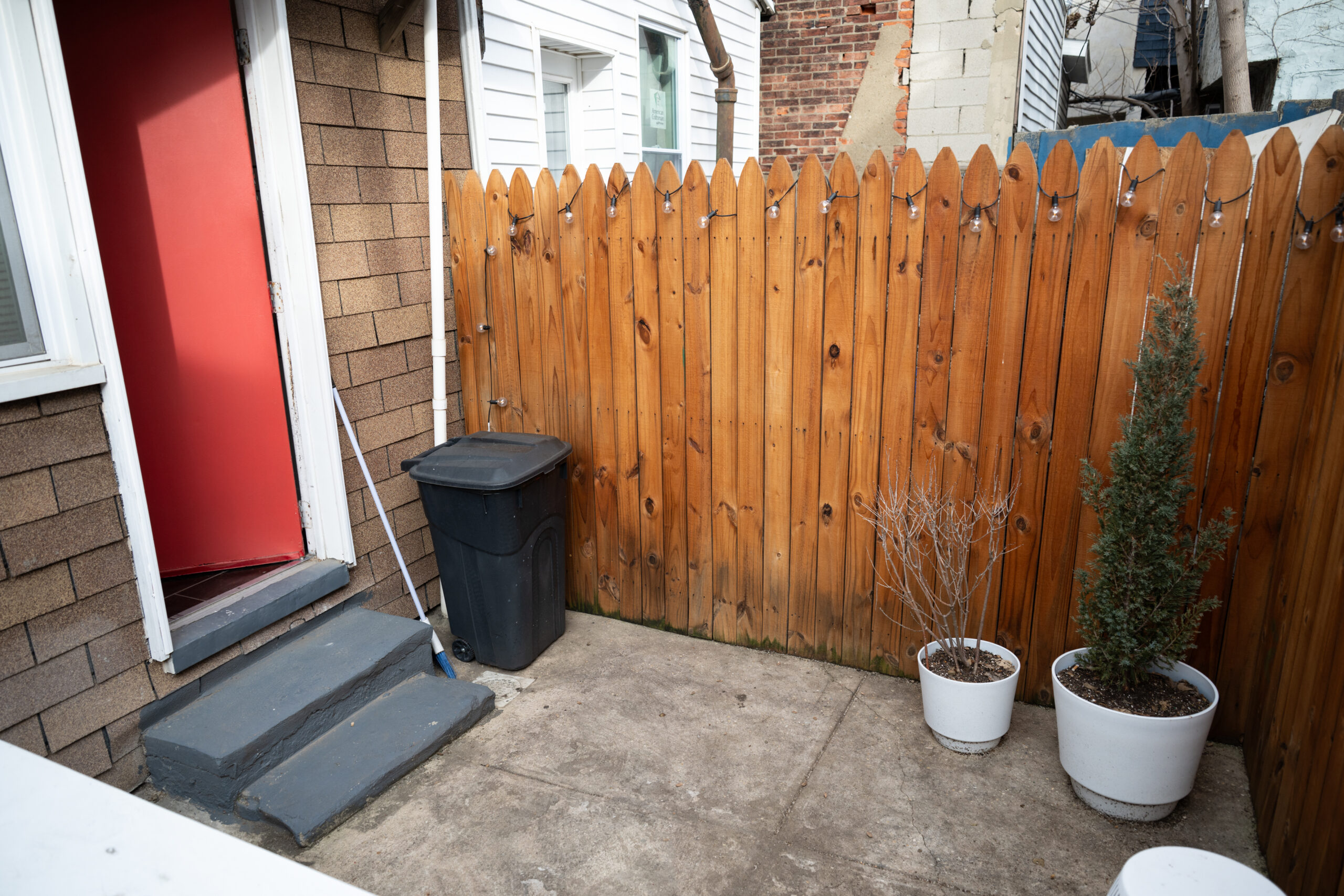
Todtz said he would be happy with any kind of outdoor space.
The deal: By the time the price dropped to $255,000, the house had been sitting on the market for months. Todtz and his agent sensed the seller was “eager to get it off his books,” so they offered the asking price and requested a 3% seller’s assist. The seller agreed. “That was a huge win,” Todtz said. It effectively lowered the price to $247,000.
The inspection turned up only minor issues. The silver coating on the roof was wearing, and the seller, a small-time developer from Queens, N.Y., offered to address it without hesitation. “He was very chill,” Todtz said. “It was great to work with him.”
The money: All in, Todtz spent about $21,000 on closing costs and upfront expenses. Todtz’s mortgage is through the Keystone Home Loan Program, which required only a 3.5% down payment, provided he paid mortgage insurance. The money came primarily from his long-term savings.
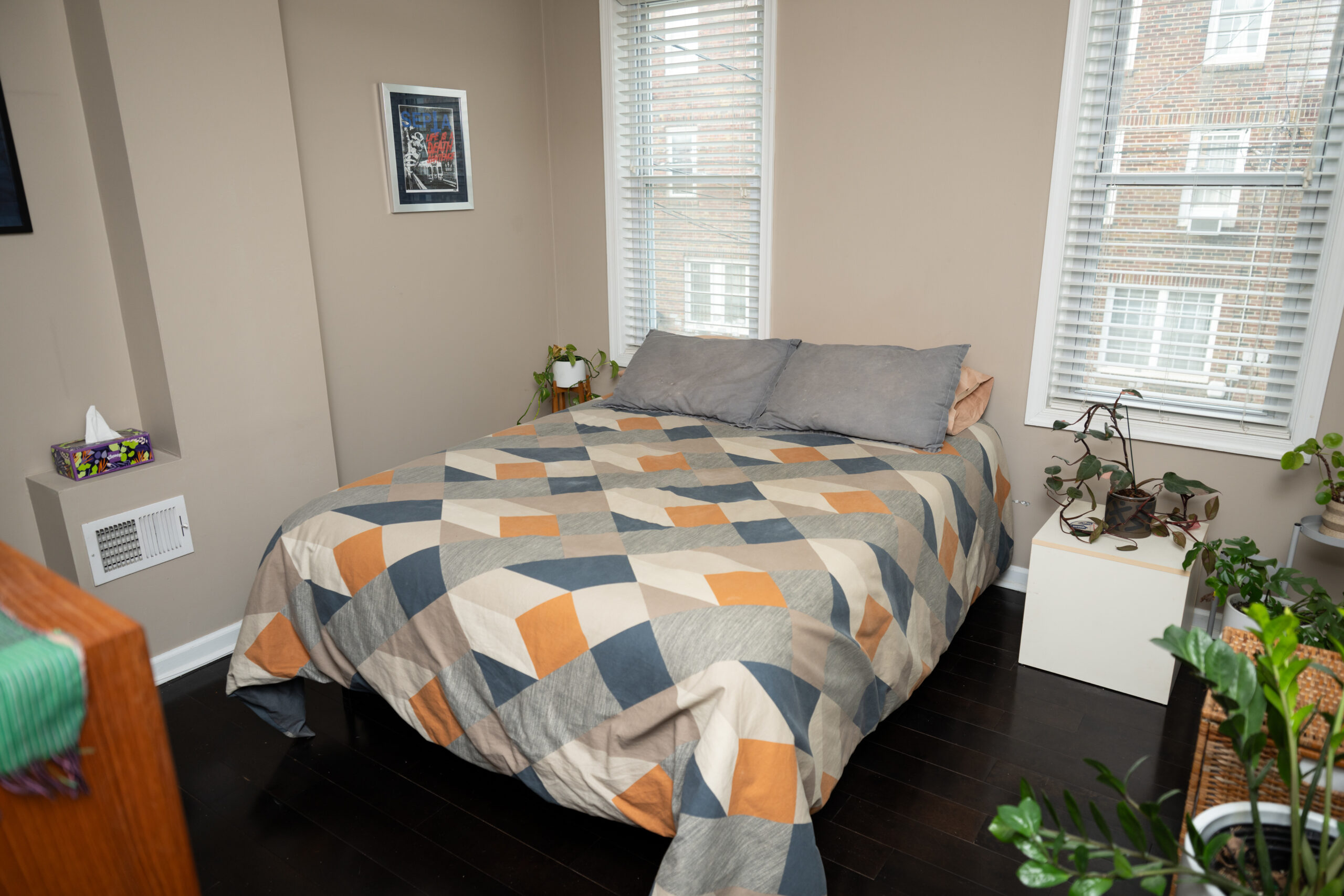
One of two bedrooms in Evan Todtz’s house.
“Every paycheck since graduating from undergrad, I’ve been putting money away,” Todtz said. “However modestly, whether it was 50 bucks or 100 bucks.” Eventually, he transferred some of those savings into a mutual fund that he let grow for a decade. He put the rest in a high-yield savings account. He also received a few thousand dollars from his grandmother’s estate.
The move: Todtz closed on April Fools’ Day, which he feared was a bad omen. His agent reassured him it wasn’t. He spent the next month moving small items in his car, then hired movers to handle the bulk of the work over a weekend in May. He didn’t ask his friends to help him move. “I want to keep my friends,” Todtz said. ”I don’t want to make them stop talking to me.”
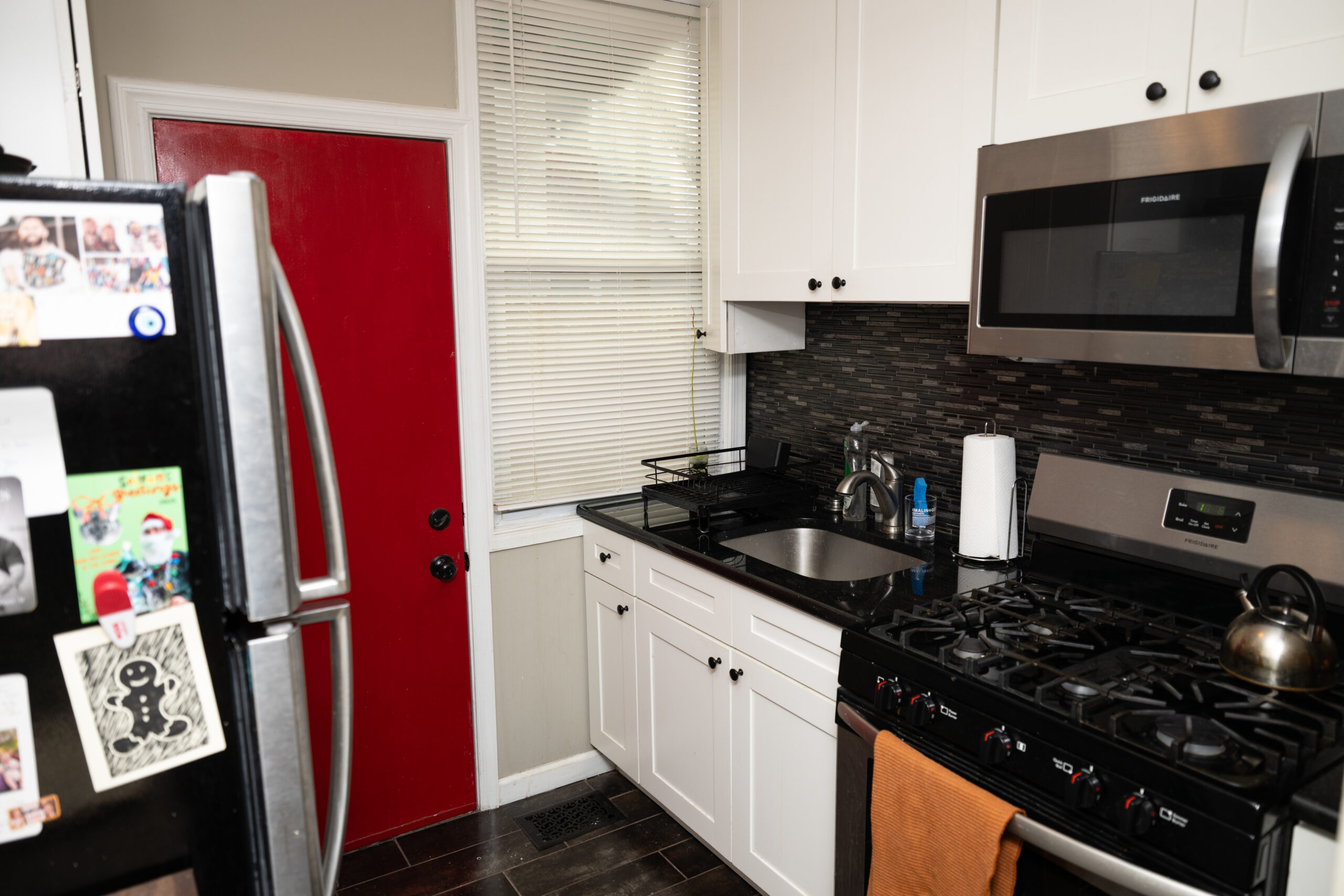
Todtz loves his kitchen even though it’s “a little small,” he says.
The move was mostly smooth, except for one casualty: a box spring that couldn’t fit up the new house’s narrow staircase.
Any reservations? Todtz doesn’t regret buying, though he acknowledges that homeownership comes with new anxieties. Given the current state of the economy, “renting and being able to flee is kind of attractive,” he said.
Still, he’s glad he made the leap. “I’m happy to own,” he said, “and I feel comfortable learning as I go.”
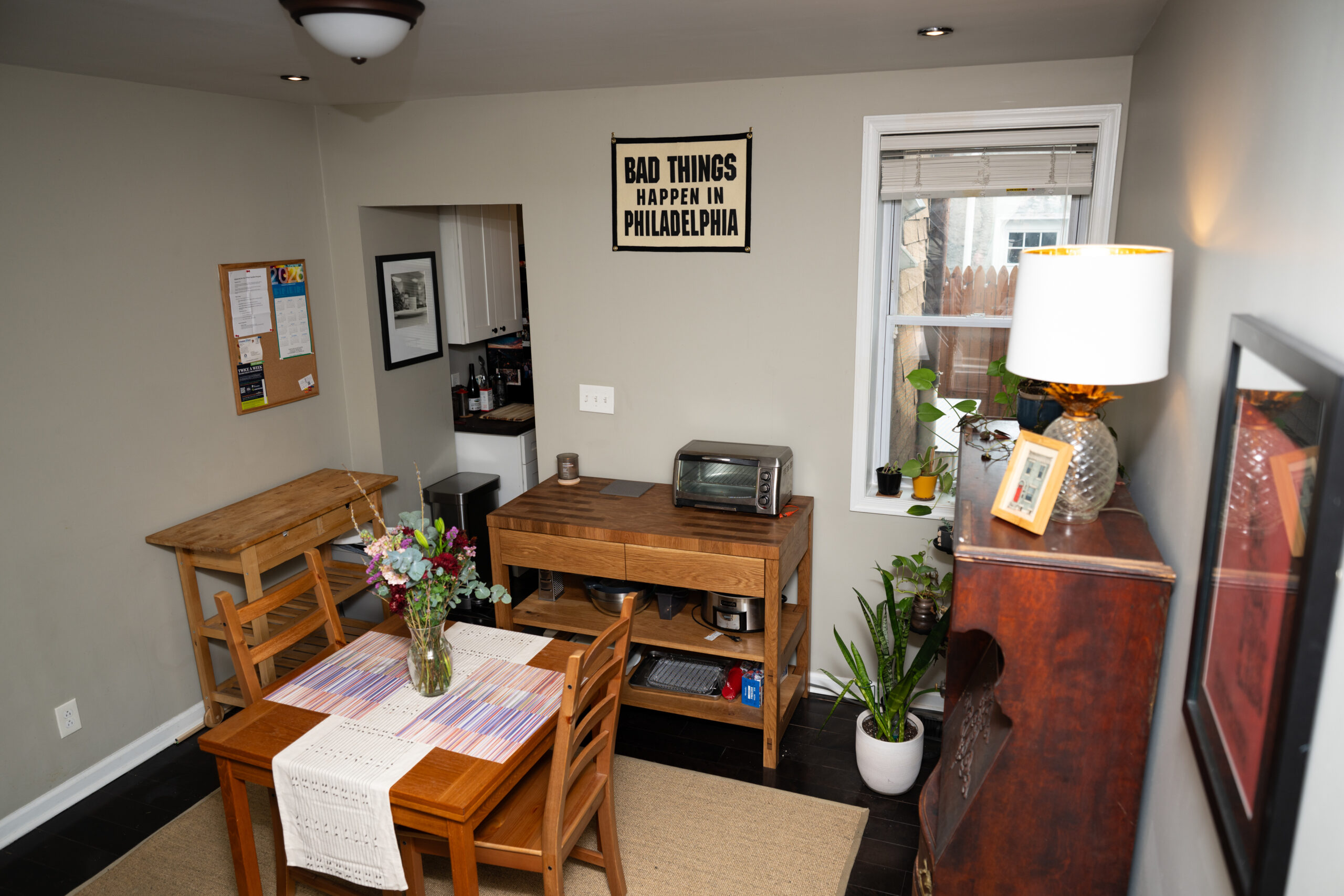
The custom wood butcher block Todtz built with the help of the Philadelphia Table Co.
Life after close: Most of the changes Todtz has made have been cosmetic. “I didn’t want to bite off more than I could chew,” he said. He tackled the patio first, pressure-washing the concrete, re-staining the fencing, and adding cafe lights. After that, he partnered with Philadelphia Table Co. to build a custom wood butcher block that has doubled the counter space in his kitchen.
He has a couple of larger projects he plans to tackle next year, such as a full HVAC upgrade, but for now, he’s focused on rebuilding his savings. “I’m happy with the investment,” he said, “but I’m very much in a house-poor moment right now.”
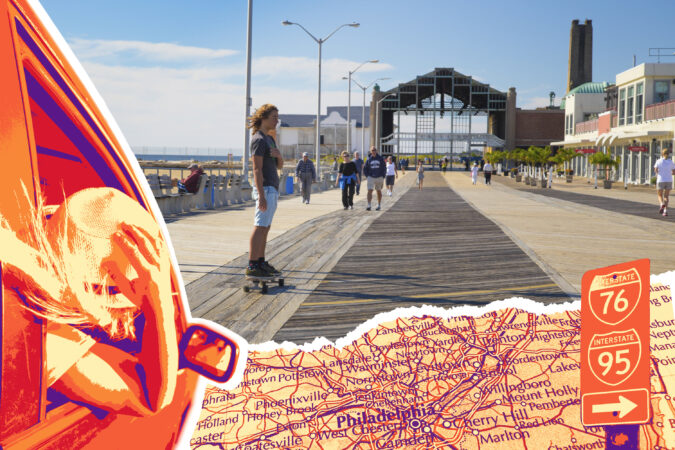
Would you believe it if we told you Asbury Park is the same distance from Philly as Sea Isle? For many Philadelphians, the north end of the Shore might as well exist on another planet. Fortunately, the offseason is the perfect time to broaden one’s horizons — so that come summer, you might break out of the tribal nature that governs which sands you plant your umbrella in.
As one of the larger towns on the coast, with a healthy year-round population, Asbury Park makes an ideal entrée. Things are open in the winter.
Not everything — but enough to keep you busy for a weekend of city-level food, idiosyncratic shopping, and live music. Start the car.
Make your first stop just to the south of Asbury, at Hey Peach in Bradley Beach. This inviting granny-core café-bakery from Erin “Peach” Kilker lines its wooden sideboard and pastry case with holey olive fougasses, crackling croissants, Scottish shortbread, fat cream puffs, and more. If the weather cooperates, grab one of the bistro tables out front and enjoy your pastry (or three) with a Counter Culture coffee.
It might not be beach weather, but the glittering sea views from the 11-foot windows at Asbury Ocean Club are just as dramatic in winter. The soothing dune-and-khaki suites in this luxurious 54-room high-rise — which opened in 2019 — feel especially indulgent in the offseason. Winter rates hover in the mid-$300s; that same room can top $1,000 on a summer weekend.
Cosplay your favorite Stranger Things kid (minus the Vecna creepy-crawlies) at Silverball Retro Arcade. Gamer or not, it’s impossible not to light up like the 1992 Addams Family pinball machine when you step inside this clanging, jangling boardwalk fixture. And because it’s not summer, the chances are good you’ll have no trouble finding an empty Skee-Ball lane. (Fun fact: Skee-Ball was invented in Vineland in 1907, with early alleys manufactured in Philly.)
📍 1000 Ocean Ave. N., Asbury Park, N.J. 07712
Shop: Asbury Park Bazaar
Right in the middle of the boardwalk, where you can shop for travel-inspired hoodies at Promised Land Apparel and thrifted art supplies at Asbury Park Art Club, Asbury Park Bazaar pops up through the year inside the Grand Arcade at Convention Hall. More than 50 vendors will fill the space on Valentine’s Day weekend, selling everything from patch-customized beanies and travel-inspired hoodies to candles that melt into massage oil.
📍 1300 Ocean Ave. N., Unit C-4, Asbury Park, N.J. 07712
Read: Paranormal Books & Curiosities
Ghost ships, Victorian murders, haunted houses — in Asbury Park, spooky season never really ends. Paranormal Books & Curiosities anchors the city’s supernatural streak, selling horror novels, spellbooks, and oddities, while also running ghost tours and curating a small paranormal museum. Whether you’re looking for Grady Hendrix, Paul Tremblay, or something to summon the corners, you’ll find it here.
📍 621 Cookman Ave., Asbury Park, N.J. 07712
Dine: Judy & Harry’s
Named for owner Neilly Robinson’s parents, Judy & Harry’s in the St. Laurent Hotel is a two-in-one restaurant and cocktail bar with butterscotch leather barstools, frosted globe lights, and framed family photos. The menu, by Robinson’s partner and James Beard semifinalist David Viana, blends her Italian and Jewish heritage with dishes like limoncello-splashed hamachi crudo, ricotta-matzo ball soup, schmaltzy potatoes, and chicken and eggplant parm. If you’re visiting Asbury on a Sunday, swing in for their $38 Sunday Sauce prix fixe supper.
📍 408 Seventh Ave., Asbury Park, N.J. 07712
Jam: The Stone Pony
What’s the opposite of a sleeper pick? First opened in 1974, Stone Pony is so deeply and inextricably tethered to Asbury Park. Everyone knows it. The bar and venue runs shows every weekend through the offseason, and the variety is pretty astounding: a Dave Matthews tribute band, country singer Hunter Hayes, a student showcase from Red Bank’s School of Rock, bassist and Phish cofounder Mike Gordon. Tourists go. Summer people go. Locals go. You should go.
When Mayor Cherelle L. Parker unveiled her much-anticipated plan to address Philadelphia’s housing crisis last year, there was predictable criticism from the political left. Activists said the proposal drafted by the moderate Democrat would not do enough for the city’s poorest residents.
Less predictable was that a majority of City Council stood with them.
Even the Council president, a centrist ally of the mayor, sided with a progressive faction that just two years ago had been soundly defeated in the mayor’s race — but whose new de facto leader in City Hall has proven adept at building alliances across the ideological spectrum.
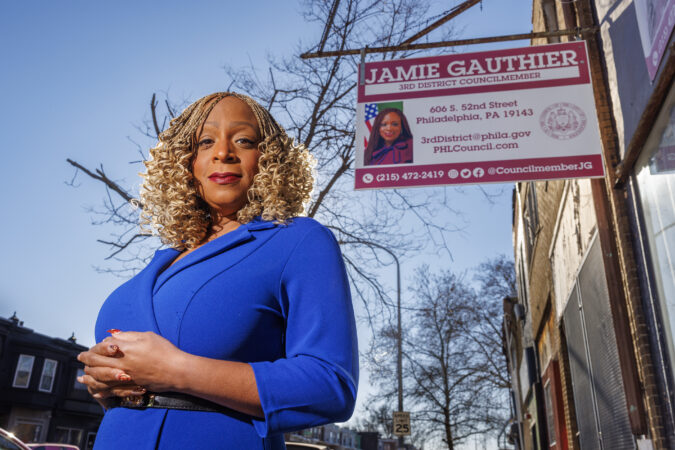
At the center of that shift was Jamie Gauthier.
The second-term Democratic lawmaker from West Philadelphiahas solidified herself over the last year as a leading voice on Council and a counterweight to Parker. She has worked within the system as opposed to trying to break it, maintaining relationships with power players who disagree with her on policy.
She counts Ryan N. Boyer — the labor leader who is Parker’s closest political ally — among those who consider her a “thought leader.”
“Over the last year, what you saw,” Boyer said, “is her modulate her positions to become more practical.”
Gauthier has generally voted with progressives, including last year when she opposed the controversial Center City 76ers arena proposal. But she has also endeavored to be a team player, at times compromising on ideological battles to focus on priorities in her district.
Last year, she voted for Parker’s plan to cut taxes for businesses and corporations when other progressives opposed it, because her main priority was securing housing funding. She has not opposed some tough-on-crime efforts in the Kensington drug market, instead allowing her colleagues who represent that area to dictate the policy there.
She says she is trying to use her political capital where it matters.
“Why would I take a protest vote and tank a relationship with a colleague when I’m going to need them later?” she said. “I want to win.”
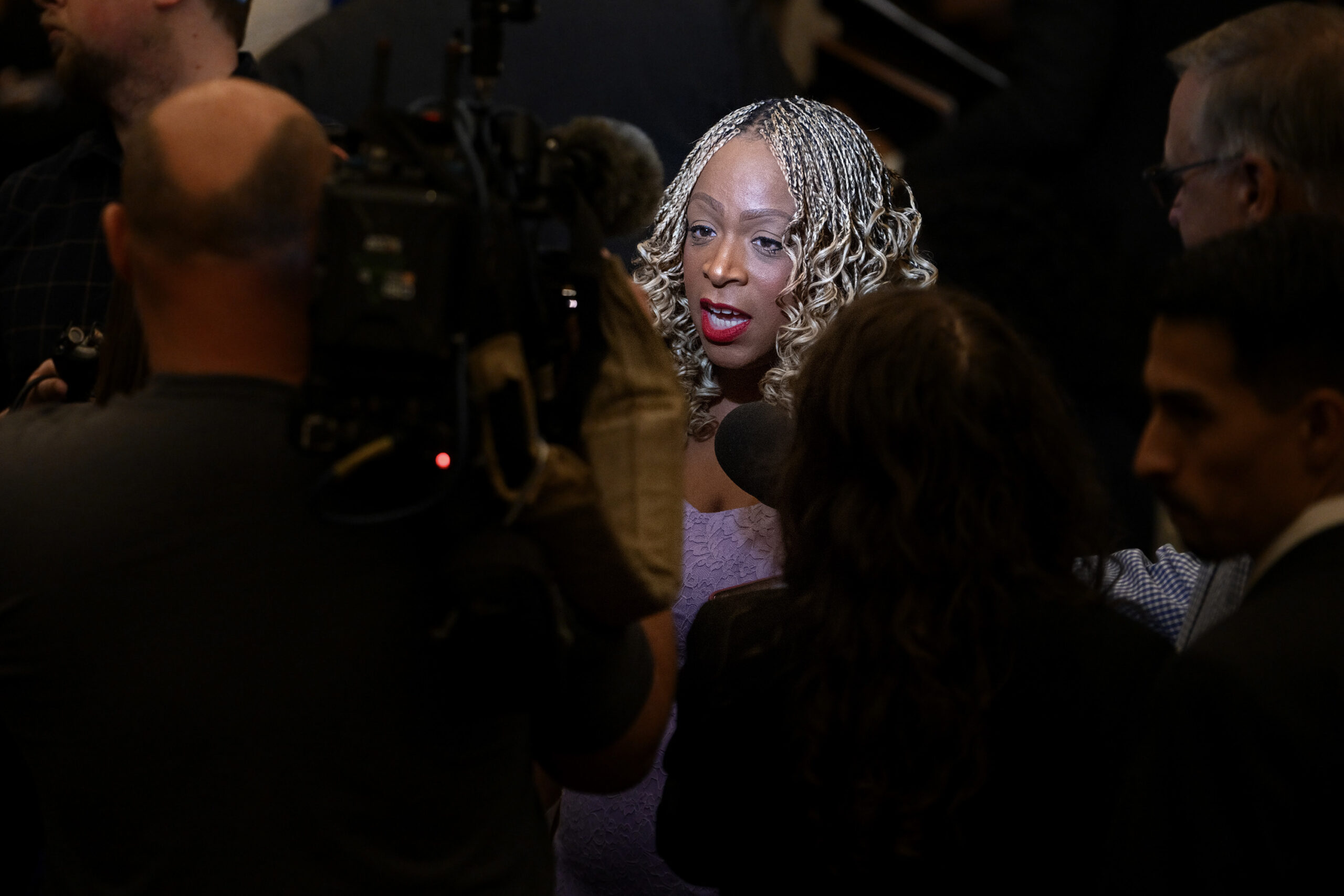
Councilmember Jamie Gauthier talks with news media following a special session of City Council on March 24, 2025.
The fact that Gauthier is a district Council member who represents a large swath of the city west of the Schuylkill also gives her cachet with colleagues. Council has a long tradition of honoring how members want their own neighborhoods to be governed.
Gauthier, who leads Council’s housing committee, has used the influence to make West Philadelphia something of a testing ground for left-of-center policy. Plenty oppose what they see as draconian restrictions on real estate development in her district.
Others see a progressive champion, and some political observers think Gauthier could amass enough support to run for mayor one day. She doesn’t deny that she has thought about it.
But for whatever politics Gauthier can navigate in City Hall, she knows she can rise only if she is successful at home.
‘Not just a lone actor’
When Parker took office, Council was in a moment of upheaval. Council President Kenyatta Johnson was the new leader of the chamber, and several prominent voices were gone after they had resigned to run for mayor themselves.
One was Helen Gym, who was seen as the leader of Council’s left flank. There were questions about who would fill the void once Gym was gone.
Gauthier, 47, an urban planner by trade, did not come up through an activist movement in the same way Gym did, and was a bit more reserved in her style.
But she carries the mantle for the same theory of governance: that lawmakers should prioritize the vulnerable, and that what is good for business is not necessarily good for everyone else.
That set Gauthier on an ideological collision course with Parker, a former Council member who ran for office on a promise to uplift the middle class, a group the mayor believes has been too often ignored.
It came to a head in the fight over Parker’s Housing Opportunities Made Easy, or H.O.M.E., initiative.
Parker wanted to set unusually high income eligibility thresholds for some of the programs so that middle-class families could unlock government subsidies they may not otherwise qualify for. A significant portion of Council, meanwhile, wanted the money to go initially to Philadelphians most vulnerable to displacement.
Parker was clear-eyed about who was leading the charge.
“Councilmember Jamie Gauthier, she may be comfortable and OK with telling Philadelphia homeowners, working-class Philadelphians, that they have to wait and there is no sense of urgency for them,” Parker said in a December interview on WHYY. “But that is not a sentiment that I support or agree with.”
Gauthier is quick to point out that she did not work alone, and that one member of a 17-member body cannot accomplish much. Alongside Councilmember Rue Landau, a fellow Democrat and a housing attorney by trade, Gauthier worked for months to win over her colleagues.
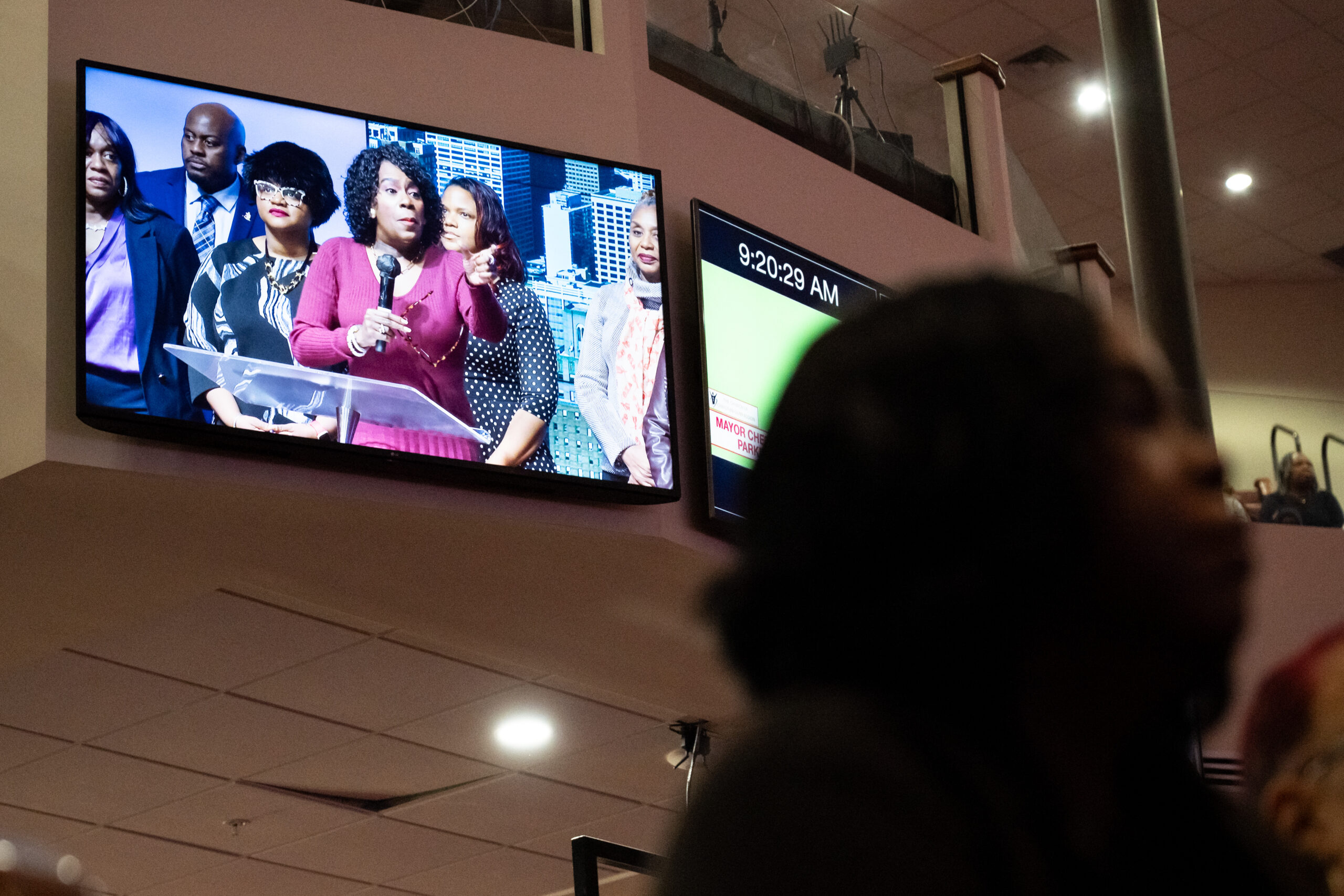
Gauthier didn’t think Parker helped her own cause. A “line was crossed,” she said, when Parker took the fight outside City Hall and to the pulpit. Amid negotiations with Council, the mayor went to 10 churches on one Sunday in December to lobby for support, saying her vision was to not “pit the ‘have-nots’ against those who have just a little bit.”
Mayor Cherelle L. Parker speaks to the crowd at The Church of Christian Compassion in the Cobbs Creek neighborhood of West Philadelphia on Sunday, Dec. 7, 2025. Parker visited 10 churches in Philadelphia on Sunday to share details about her HOME housing plan.
To Gauthier, the divisiveness was coming from the mayor’s office.
“I wish the mayor and her administration were more open to other people’s ideas, were more OK with disagreement on policy issues, and more aware of Council as a completely separate chamber of government,” Gauthier said, “as opposed to a body that works for her.”
That is a candid assessment of the relationship between Parker and City Council from Gauthier. Few lawmakers from the mayor’s own party have criticized her publicly.
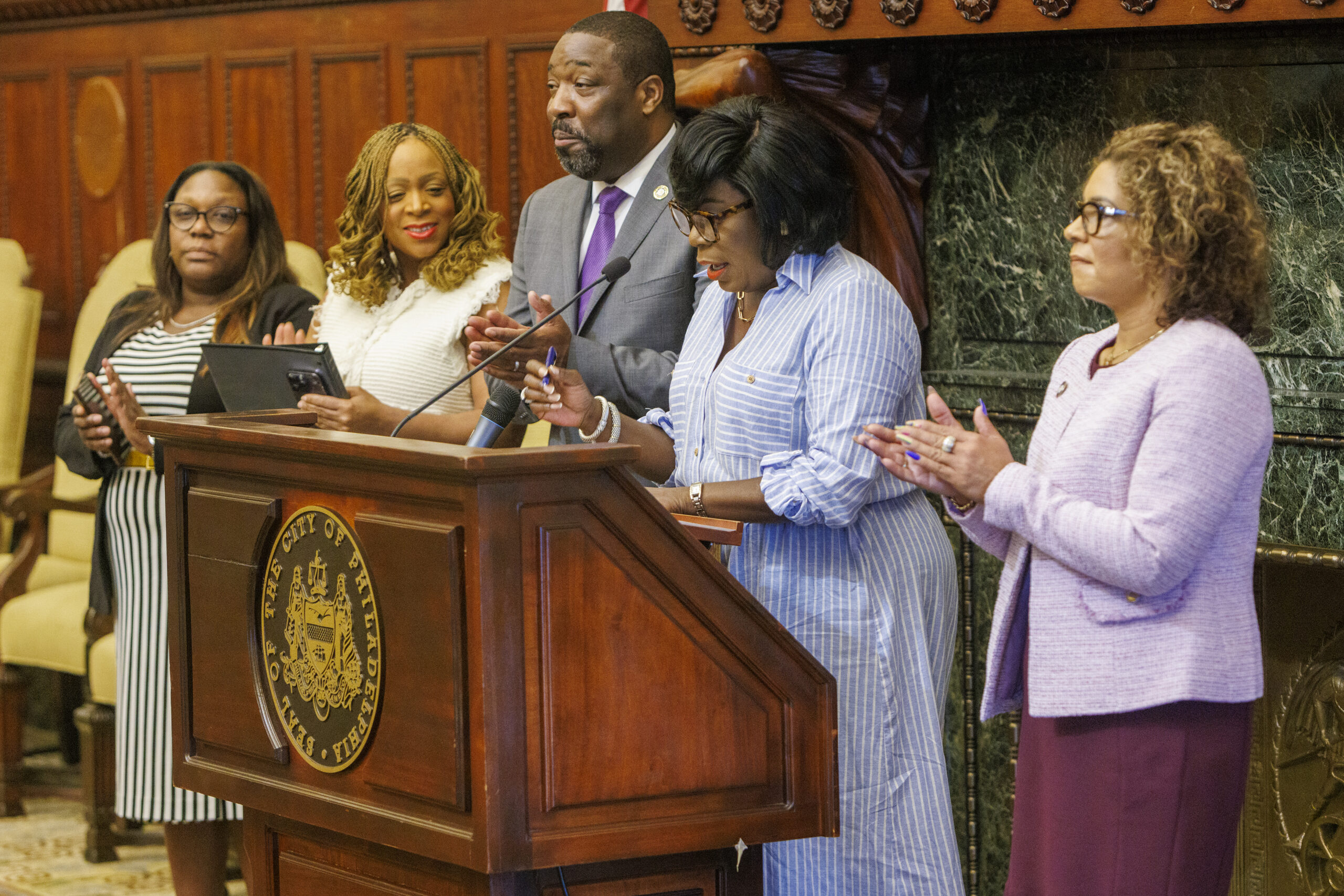
Philadelphia Mayor Cherelle Parker holds a press conference regarding her first budget flanked by members of city council in her reception room, Philadelphia City Hall on Thursday, June 6, 2024. Council members from left are Kendra Brooks, Jamie Gauthier, council president Kenyatta Johnson, and Quetcy Lozada.
State Rep. Rick Krajewski, a West Philadelphia Democrat and a progressive who has worked closely with Gauthier, said the fight over H.O.M.E. showed that Gauthier has learned “the diplomacy required to be an effective legislator.”
“It was a good example of not being afraid of a conflict that felt important to stand up for,” he said, “but then to not just be a lone actor, but organize with other colleagues and allies.”
Gauthier’s most important ally was Johnson, who negotiated directly with Parker through the process and controls the flow of legislation in the chamber.
The two go back years. Before Johnson was Council president, he made a point of welcoming new members, a gesture that has always stuck with Gauthier. They worked closely to secure funding for gun violence prevention. And Gauthier said that since Johnson took the gavel, he has been more open to working with progressives than his predecessor was.
He does not talk about that publicly. What he will say is that he works in partnership with Gauthier because she understands “the bigger picture in terms of how we move forward as the institution.”
“I consider her to be a pragmatic idealist,” Johnson said. “She wears her heart on her sleeve, and she really believes in actually doing the work.”
She was also supported by real estate interests, some of whom now have buyer’s remorse.
After Gauthier pulled off a shock win, she arrived in Council and quickly aligned with the progressive bloc. Through her first two terms, she has used councilmanic prerogative often, and has voted with her district Council colleagues so that they can do the same.
She admits that it is an effective tool for accomplishing her goals quickly.
Carol Jenkins, a Democratic ward leader in West Philadelphia, said Gauthier’s use of councilmanic prerogative is “part of her maturation.”
“That’s the power you have,” Jenkins said.
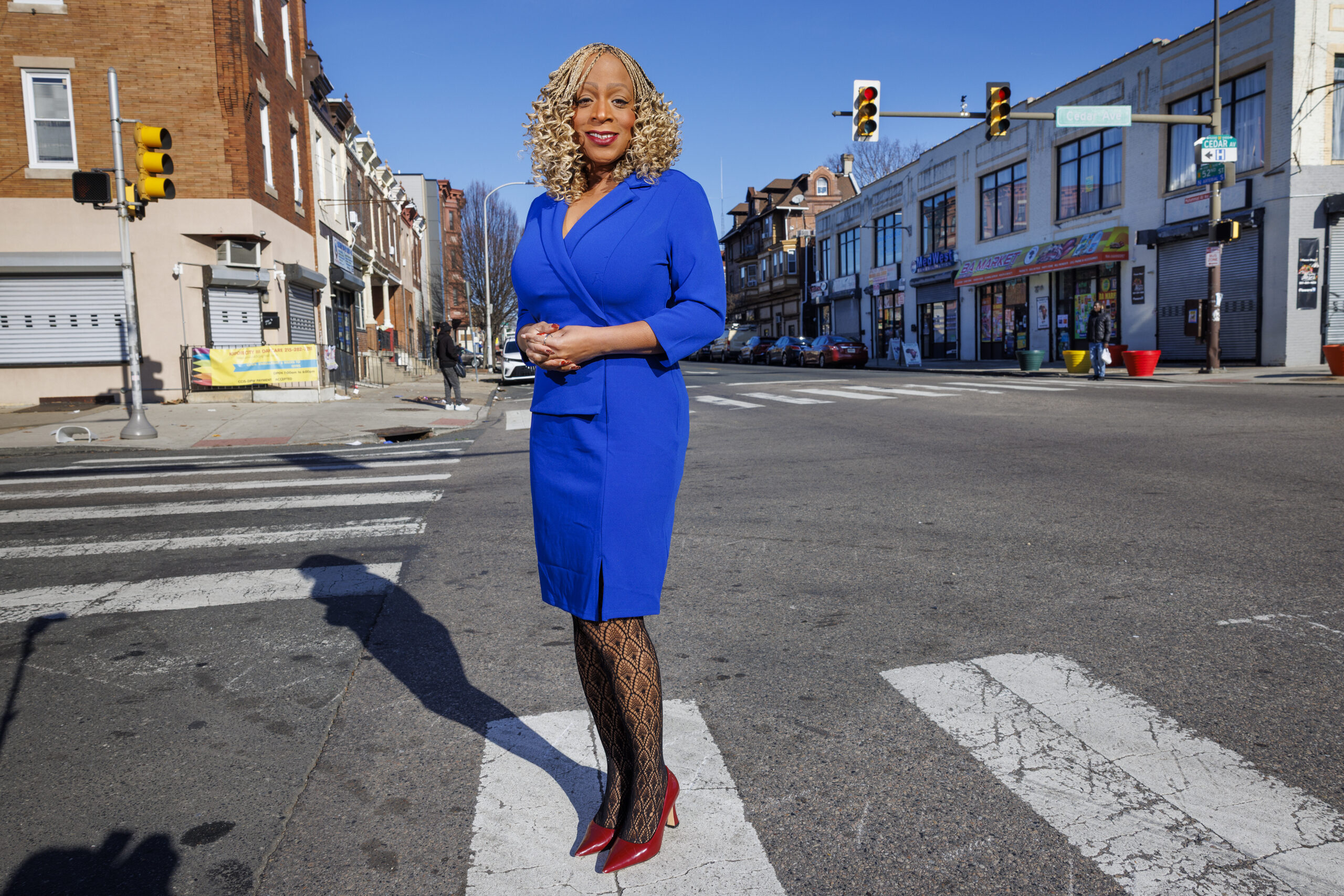
City Councilmember Jamie Gauthier in her district near 52nd Street and Cedar Avenue in Philadelphia on Monday, Dec. 22, 2025.
However, her most notable use of councilmanic prerogative has been in housing policy, and some developers say her district is now the most hostile to growth in the city.
In Gauthier’s first term, she championed legislation to create what is known as a Mixed Income Neighborhood overlay. In essence, it requires that developers building projects with 10 or more units in certain parts of her district make at least 20% of their units affordable. That is defined as accessible for rental households earning up to 40% of the area median income.
For Gauthier, it’s a tool to slow the rapid gentrification of her majority-Black district.
But developers say that growth has slowed significantly in the areas covered by the overlay since it took effect in 2022. Some have said they avoid seeking to build in the 3rd District entirely. The only major project currently in the works in the area is a parking garage.
Ryan Spak, an affordable housing developer who said he considers Gauthier a friend, has been among the most outspoken critics of the overlay. He said while Gauthier’s “moral compass is pointed in the right direction, her policies don’t math.”
“You would never ask a restaurant to give away its ninth and 10th meal for 40 cents on the dollar, with no additional discounts or benefits,” he said, “and expect that restaurant to survive.”
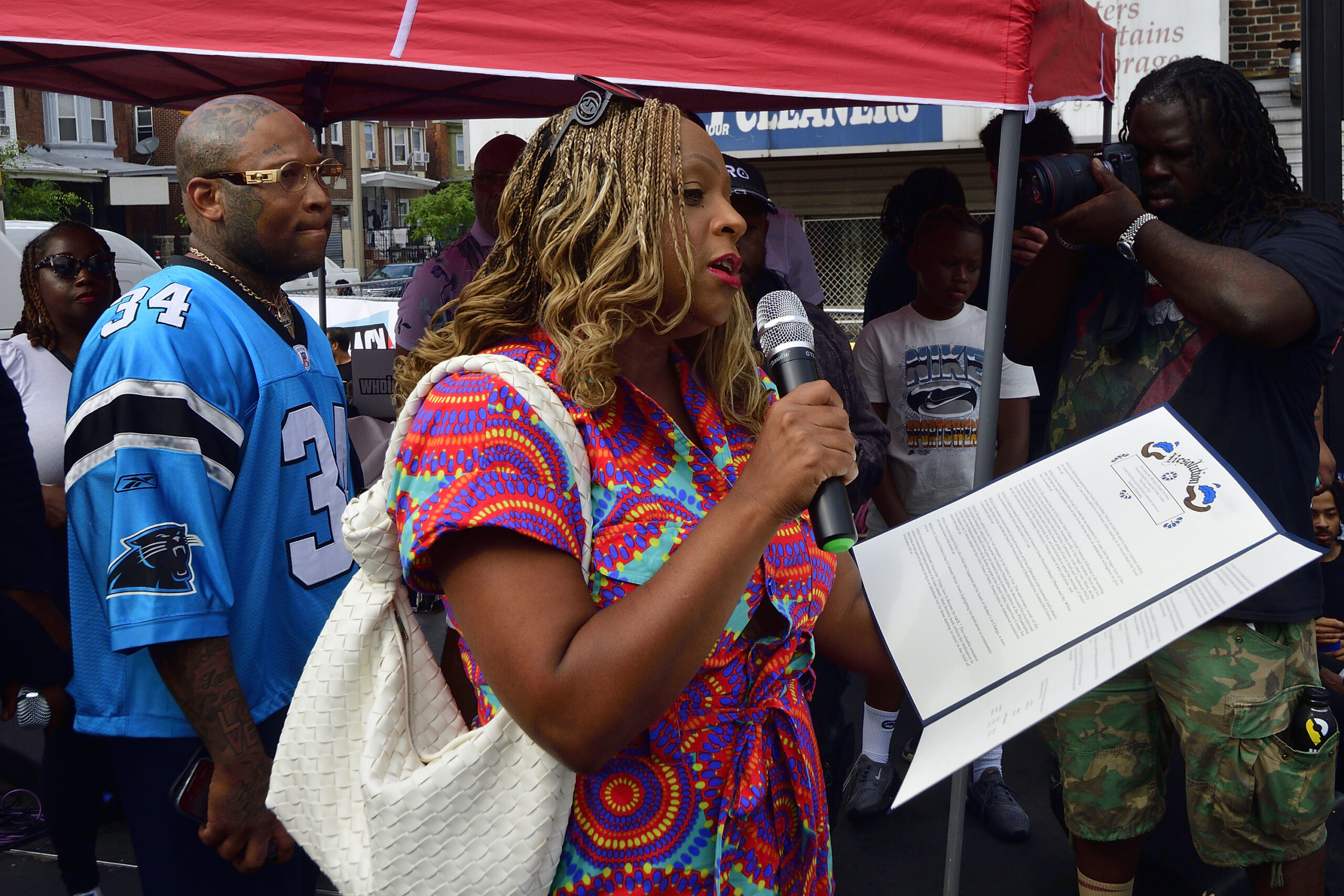
Councilmember Jamie Gauthier reads out a citation honoring Rapper Mont Brown during a street naming ceremony for the Southwest Philadelphia native at the 13th Annual Stop the Violence Kickback Block Party at 55th Street and Chester Avenue, in Southwest Philadelphia on August 17, 2024.
Gauthier said she has made adjustments, and she championed legislation to accelerate permitting and zoning approvals. The mandate, she said, is necessary because the market won’t build enough affordable housing on its own.
“As untenable as it is to them that they can’t make the numbers work, it’s untenable to me that people can’t afford to live here,” Gauthier said. “So we can come together and we can fix that. But I’m not going to move from my position that we have to demand affordability.”
Mayoral buzz, but no ‘stupid campaigns’
Gauthier is one of several names that have been floated in political circles as potential candidates for mayor in 2031, which would be Parker’s final year in office if she runs for and wins a second term. Several of her Council colleagues, including Johnson, are seen as potential contenders.
“I’d be lying if I didn’t say that mayor could be interesting one day,” Gauthier said. “I also don’t believe in stupid campaigns. So I would never do that if I didn’t think I had a path.”
Boyer said he has counseled Gauthier to pursue moderate policy and avoid being “label-cast” as far left. He said Philadelphia is not Chicago or New York, and he doesn’t see the city electing an uber-progressive to be the mayor any time soon.
“Philadelphia has always been a real center-left community,” Boyer said, “and just because you’re the loudest isn’t the most popular.”
The left may have other plans. Robert Saleem Holbrook, a progressive activist, said that Gauthier would be an “ideal candidate” for higher office and that the city’s leftists would back her.
Probably.
“So long as she stays true and supportive of progressive ideals,” Holbrook said. “You can’t compromise on your way up.”
Franki Jupiter grew up in St. Louis, the son of a Presbyterian minister and a Bible study teacher. He was raised to believe he should marry young and remain committed — to both Jesus and his wife — for life.
But Jupiter, 39, didn’t end up doing so.
“I love people, and I’m not great with impulse control,” he explained. (Franki Jupiter is a stage name, but it’s also the one everyone in his life uses.)
After years exploring his sexuality, Jupiter became polyamorous. He met his second wife, G, in 2018 in California, and the two married in 2020, first on Zoom during COVID lockdown and then in a four-day Indian wedding with G’s family.
From the beginning, Jupiter and G have been in an open relationship, but they still consider each other primary partners.
“We have a house together. We’re building a life together. We have two cats together,” Jupiter said. “When you’re in any kind of relationship, it always has to be a conversation.”
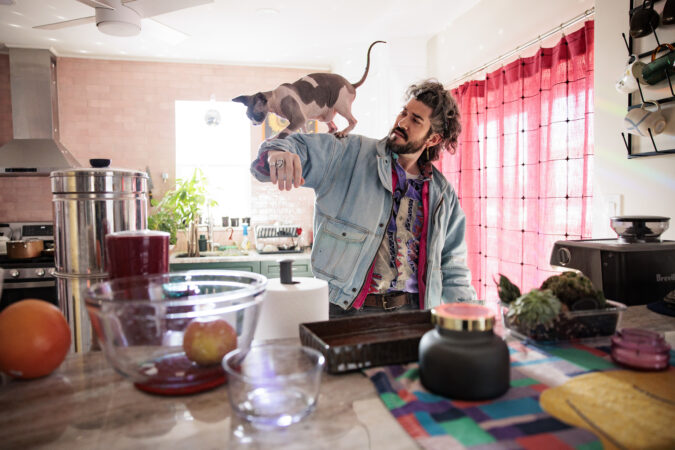
Jupiter in the home he shares with his wife.
Jupiter moved to Manayunk this summer alongside G and his girlfriend of four years, A, who lives a 10-minute walk away. (The Inquirer is referring to his partners by their first initials because they requested privacy.)
He works as a relationship and career coach, and is a singer-songwriter trying to put together a band.
The following, as told to Zoe Greenberg, has been edited for length and clarity.
On being the son of a preacher, and queer
My life partnership, first and foremost, was supposed to be with our Lord and Savior, Jesus Christ. After that, it was supposed to be with one person who you meet and then marry way too early because you’re both eager to have your first intimate relations.
Since I was born, I was queer. I was always putting on my sister’s and my mom’s clothes. There were boys at school that I thought were really cute. I was attracted to drag queens and trans people. I was told very explicitly by my parents and everyone in the church that was not OK.
On having sex before marriage, though he wasn’t supposed to
You’re a 13-year-old boy, and you’re like, “Damn, this is all I can think about. I’m supposed to just give this over to God and actually not think about it?” It just felt less and less biologically possible.
It also messed with my head, because it meant that every person I dated, I wondered, How do I make this person my spouse?
By the time I was 18, I finally had a girlfriend where I could genuinely see us being together forever, which in hindsight is crazy. But I could see it strongly enough that I thought we could probably have sex. And so that was when I decided, All right. This is OK for me.
Having sex as a teenager would not have been in the top 50 things I did that surprised my parents. There was a little bit of a “Don’t Ask, Don’t Tell” policy.
Franki Jupiter makes matcha at home.
On becoming ‘feral’ after leaving home
When I got to college, I went fully feral. I dropped out of school and joined a band. I started taking acid all the time, and moved to Rome briefly and studied photography, fell in love there.
The parts of me that had been repressed for so long all came a bit too much to a head.
After a few years I decided to dial it back and see what I was really looking for. I met someone who ended up being my first wife. She was wonderful and we had a lot of chemistry. We knew that the relationship might not stay steady, but instead of honoring that, we got married.
On discovering polyamory
We sold our car, bought a van, and drove out to California. Within a year of being there, we were separated.
One of the things I realized on the heels of our split was I’m really not a one partner kind of person.
Initially I thought maybe I’d just have to be single forever. Then I read a lot of Reddit threads on people with multiple partners. I read some of the Polyamory 101 hits: The Ethical Slut, Sex at Dawn, Polysecure. I knew lots of people in the Bay Area who were polyamorous.
My whole life, I’ve loved people so much that the idea of not being in some relationship was crazy to me. But I knew that if I was going to be in relationships, they were going to be open.
On meeting G, the woman who would become his second wife
We met for dinner and it was great. One of the first things she asked me was, “Are you gay?” I was like, “I’m not not gay. But no, I’m not gay. I’m open for whatever.”
We went back to her place, had a one-night stand, and didn’t expect anything after that. But we kept coming back. There was this unspoken sense that even if we never see each other again, this has been excellent.
On forgetting to tell G he was still married
I was still legally married to my first wife. I had told G from the beginning, “I’m going to be seeing other people, and I actually don’t want to have a monogamous relationship, ever.” I had also been dating other people concurrently and had told everyone, “By the way, I am technically still married and we’re in the process of getting a divorce.”
I guess I neglected to say it to G.
A few months in, we were at her house and she was cooking dinner. I said something like, “I’d love for us to get together again next week, I just gotta wrap some stuff up with my wife.” She was like, “You gotta what?”
I said, “I gotta wrap some stuff up with my wife.” She said, “What are you talking about?”
I said, “Oh my God, did I not tell you?” She said, “No, you did not.”
I asked if she wanted me to leave and she said she didn’t think so. I asked if she wanted me to rub her feet and she said that would be OK.
After that, she said something along the lines of, “It’s OK. It doesn’t seem like this is something you meant to hide from me. I think we can figure out how to move on from here.”
On marrying G
With G having an Indian passport, our scope as a couple was extremely limited. I could see ways in which marrying her was extremely beneficial for both of us, but definitely for her, because she’d be able to move around much more freely.
Honestly, it felt a little bit like what marriage used to be way back in the day. It wasn’t strictly a love marriage.
She actually proposed to me. We went up to the border of Oregon and California and took a bunch of acid. She took a ring off me and put it back on and said, “Wanna get married?”
Franki Jupiter shows off the disco ball decor in his first floor bathroom.
On meeting his girlfriend, A
Our first date was at a historical gay bar in Berkeley. I told A from the get-go, “I have a wife and my wife is going to be a big part of my life.”
She moved to Philadelphia a little before G and I did this summer. A and I see each other weekly, we take vacations sometimes. As far as I’m concerned, and hopefully as far as she’s concerned, we have no intentions of not being together.
One of the reasons we moved to Manayunk specifically was because she was dating a guy who now lives down the street from me. When we came out to see Philadelphia, he gave us the lay of the land. He and I are still buds. She and him are not dating anymore.
On the relationship between his wife and his girlfriend
My wife and girlfriend have very different personalities. I wouldn’t see them being friends independently of me, like if they had met each other and struck up a conversation, I don’t know that they would necessarily have gone back for seconds. But there’s no bad blood there.
There is a finite amount of time, so I don’t foresee adding other long-term partners. But also, who knows?
This story is part of a new series about life partners across the Philadelphia area. See other stories in the series here and here.
If you want to share your story about who you’re navigating life with romantically or otherwise, write to lifepartners@inquirer.com. We won’t publish anything without speaking to you first.
TOKYO — I’ve never gone out of my way to eat a cheesesteak far outside of Philadelphia.For one thing, I can devour a great one anytime I want when I’m home. I’d rather experience the flavors of different cultures when I travel. The cheesesteak is also one of those iconic foods that almost inevitably tastes wrong outside its home regions: The farther away you roam from its birthplace, the more chance that a false detail — the wrong roll, ingredient combo, precooked shortcut, or even menu description (the sandwich is not called a “Philly”)— is likely to result in something as soulless as a Subway replica.
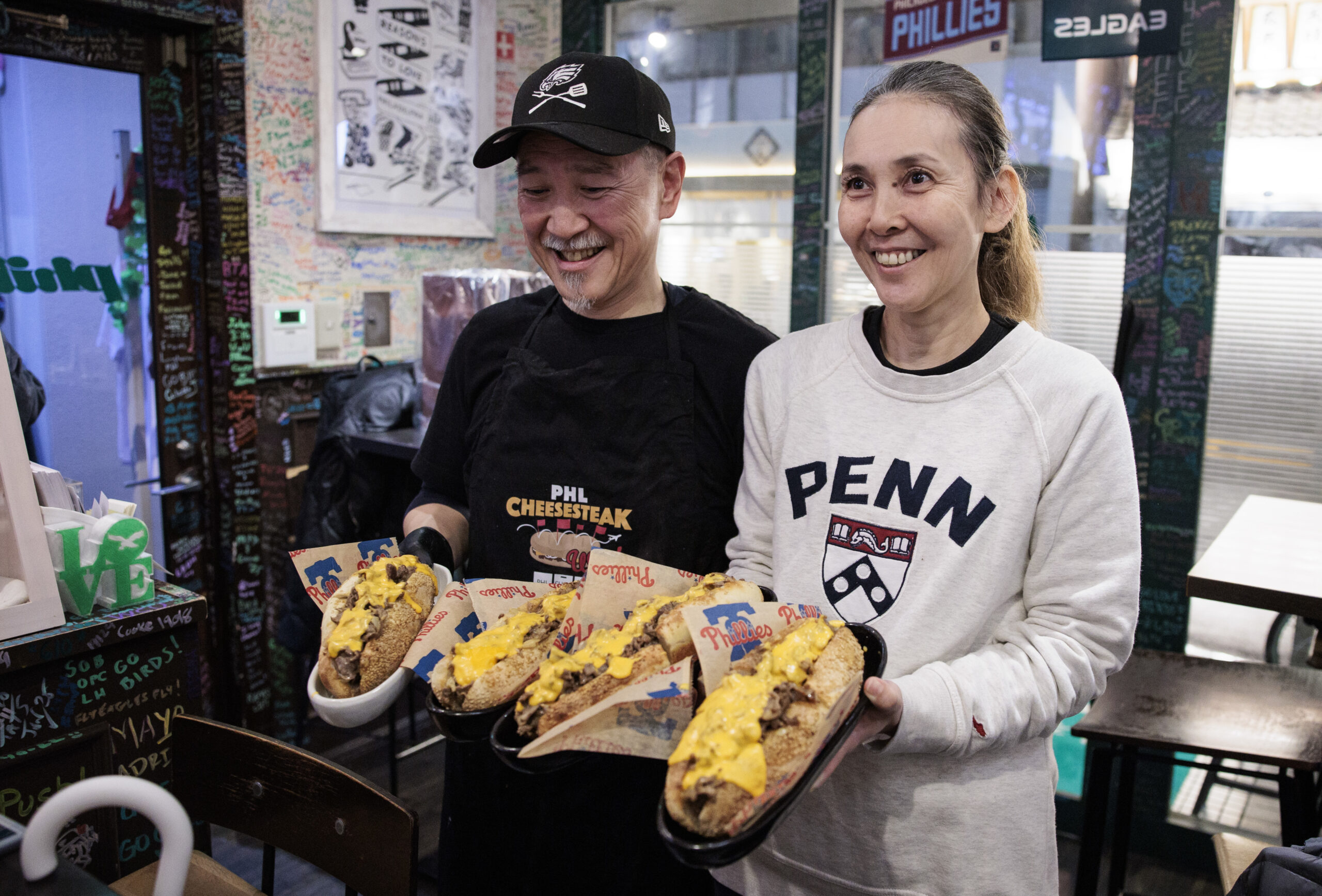
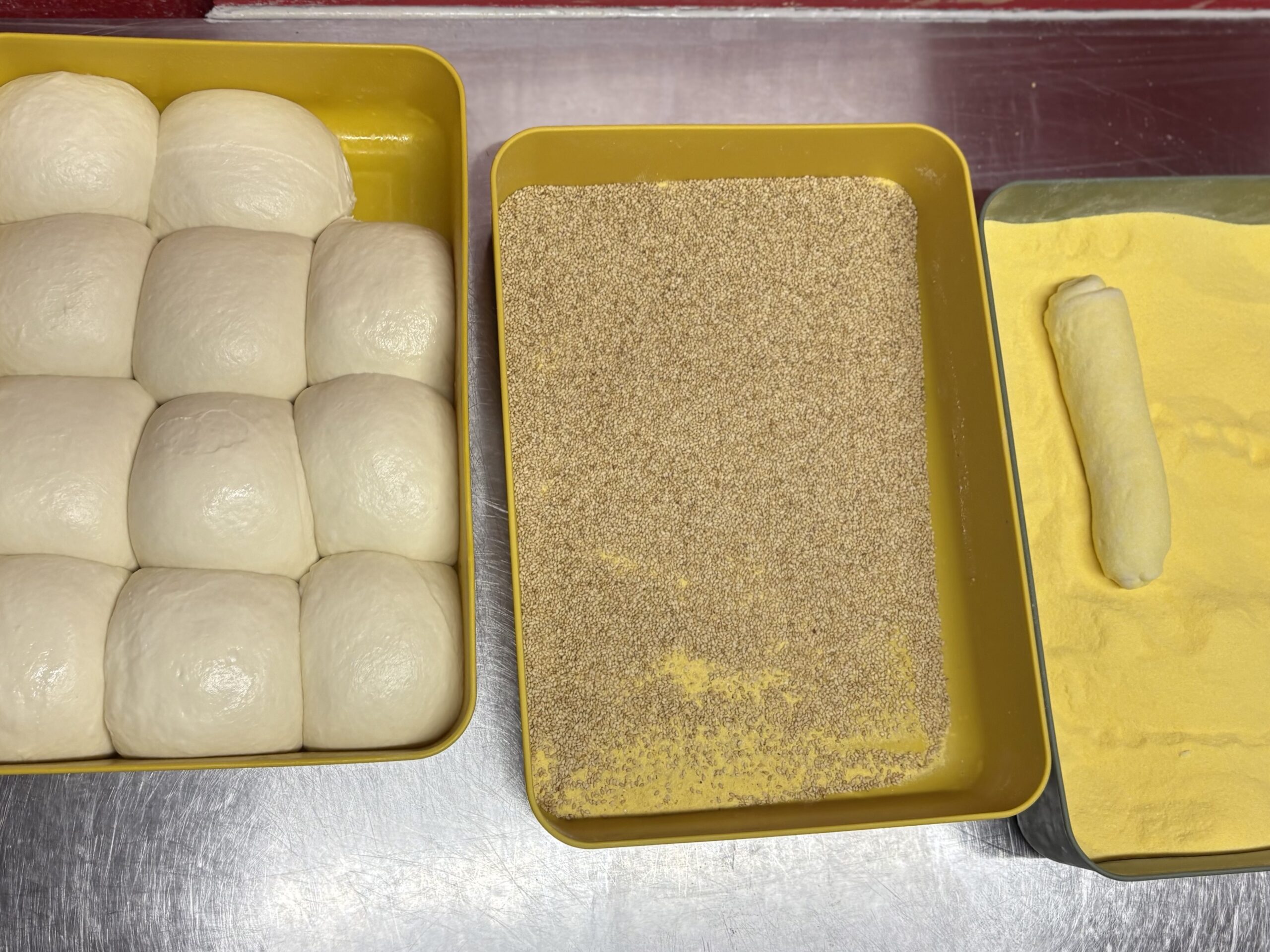
Of course, I needed to travel all the way to Japan to be proven wrong. At Nihonbashi Philly, a restaurant in one of Tokyo’s business districts, a “Go Birds!” sign glowing kelly green out front is just a tease of the Brotherly Love vibes being conjured inside. There, I found Tomomi Chujo in a Penn sweatshirt hand-shaping dough for rolls in her tiny basement prep kitchen, coating them in sesame seeds, and proofing them to be baked fresh for our sandwiches to come.
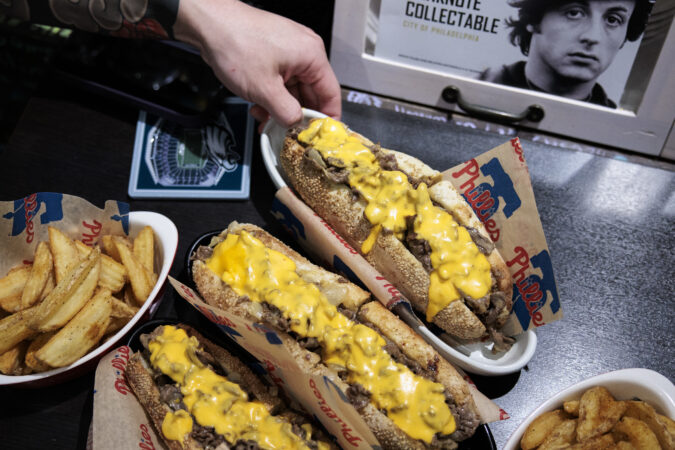
Kosuke Chujo and his wife, Tomomi, with cheesesteaks at Nihonbashi Philly in Tokyo, Japan.
Tomomi and her husband, chef Kosuke Chujo, are pretty much international Philly celebrities by now. Their efforts to create a faithful cheesesteak on the other side of the globe were brought to the world’s attention by Philly expat social media in 2023 and profiled a year later in The Inquirer by my colleague Jenn Ladd. They drew more than 1,000 hungry Philadelphians who lined up in hopes of tasting their cheesesteaks at a Kensington-Fishtown pop-up at Liberty Kitchen in May, when they were also honored by Philadelphia City Council for their efforts to rep Philadelphia abroad.
Considering I’m reluctant to wait in long lines for a cheesesteak even at Angelo’s, it’s no surprise I didn’t attend the Chujos’ Fishtown pop-up. But, like so many Philadelphians I know who’ve recently made the cheesesteak pilgrimage while visiting Japan, I was not going to waste a good trip to Tokyo without finally checking out Nihonbashi Philly. We waited until the final night of our trip. After nine days of consuming my weight in sushi, ramen, 7-Eleven onigiri, katsu, and yakitori skewers, I was ready for a little taste of home before actually boarding a plane back.
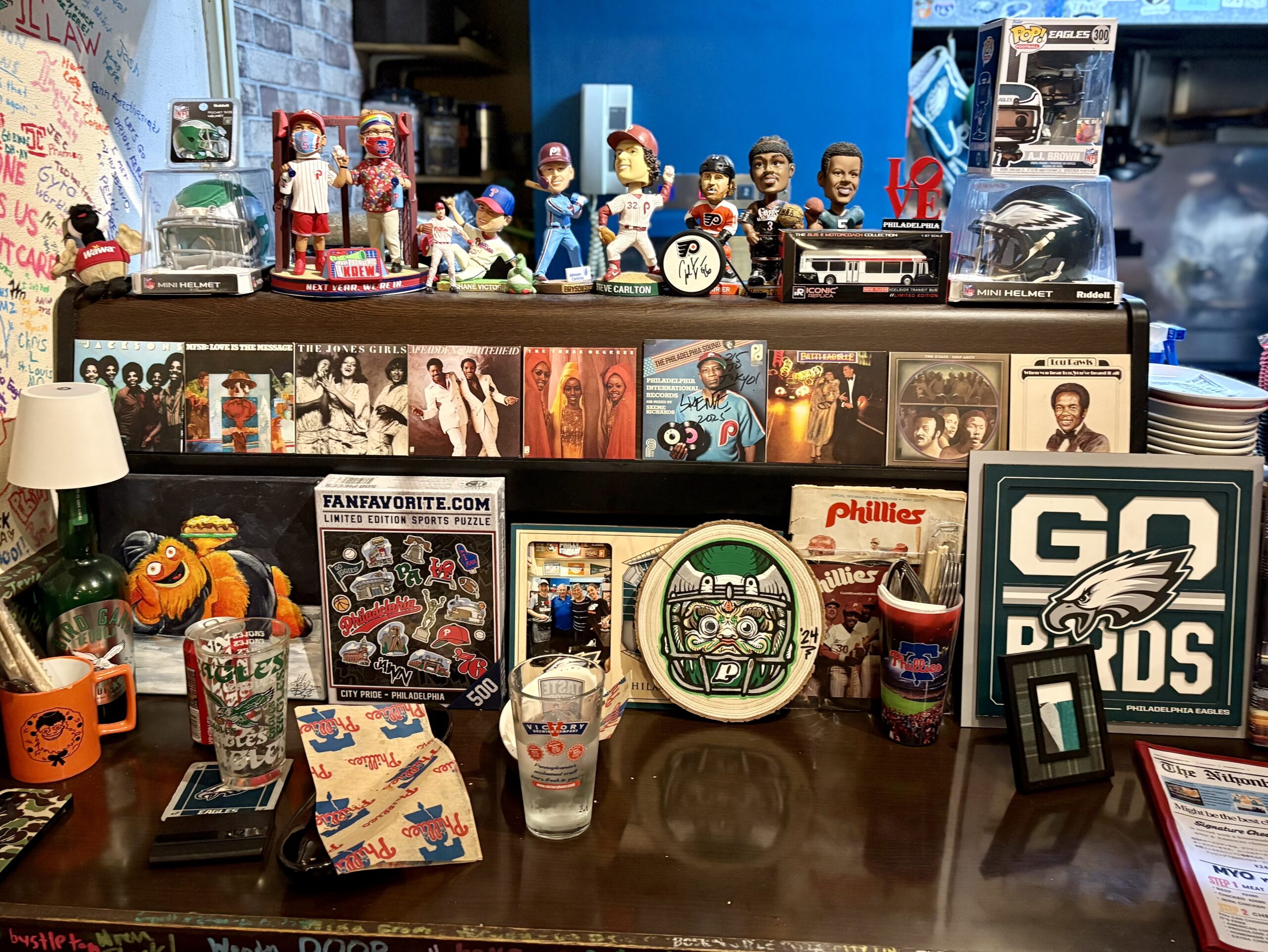
A collection of Philadelphia soul music, bobbleheads, and Philly-themed paraphernalia grows every time an expat visits the Chujos’ restaurant.Handwritten messages decorate the walls at Nihonbashi Philly.
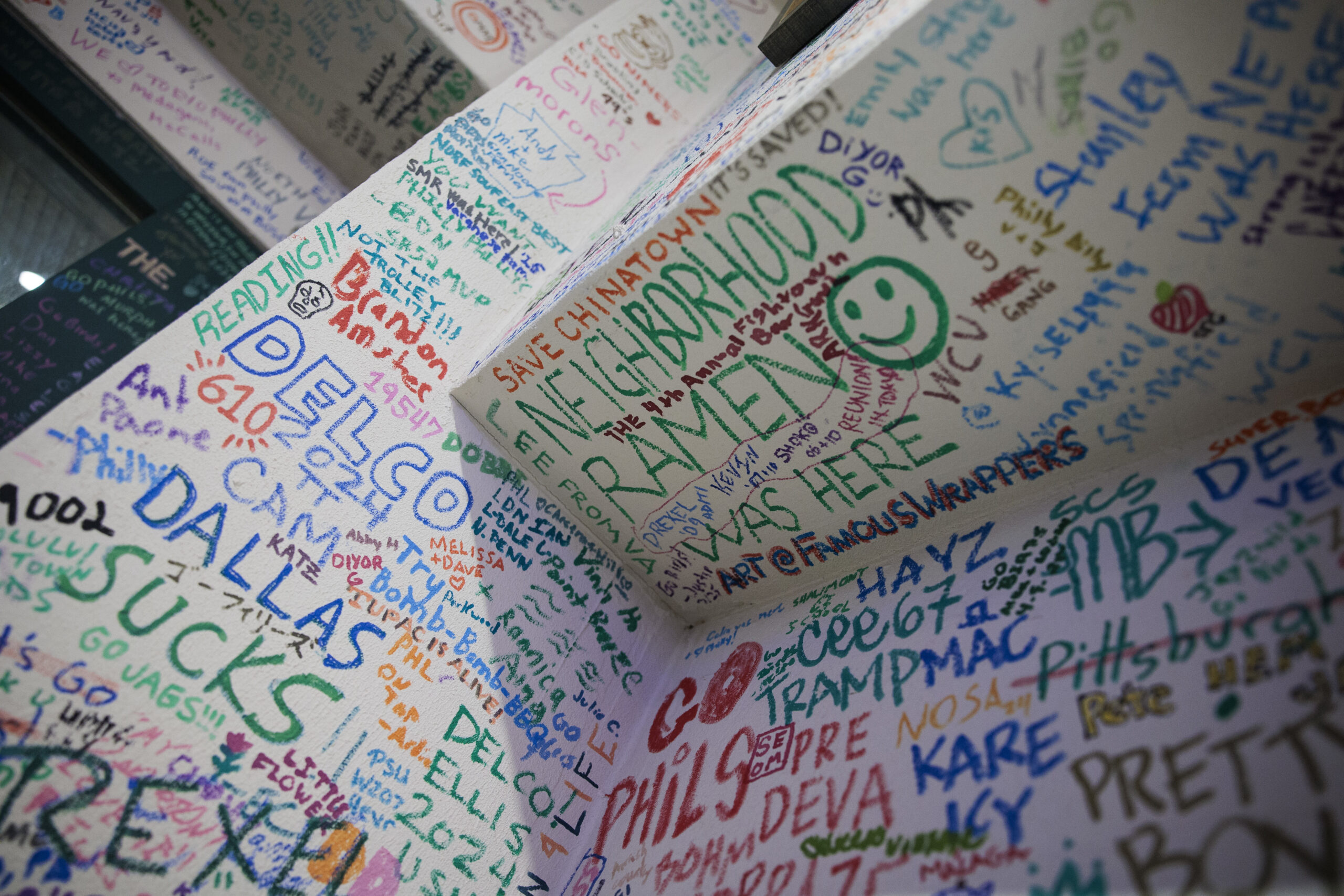
Inside the Chujos’ snug two-story restaurant and bar, I found a space bursting with so much Philly-themed memorabilia, it was almost like passing through the Portal in LOVE Park (at least before it was removed due to vandalism). There are empty Bird Gang whiskey bottles that have been converted into lamps, Kosuke’s extensive CD collection of favorite Philly singers (hello, Patti LaBelle), copious Wawa swag, Gritty art, SEPTA shot glasses, customer-scrawled walls etched with “Dallas Sucks” flair, and a bobblehead shrine of Philly sports figures that’s been transported here from the Elkins Park childhood bedroom of now-Tokyo-based sports journalist Dan Orlowitz, one of the Chujos’ earliest local cheerleaders: “That’s authentic Philly dust!” he says, nudging Donovan McNabb’s spring-loaded noggin into an enthusiastic wobble. “I don’t even have to go home anymore.”
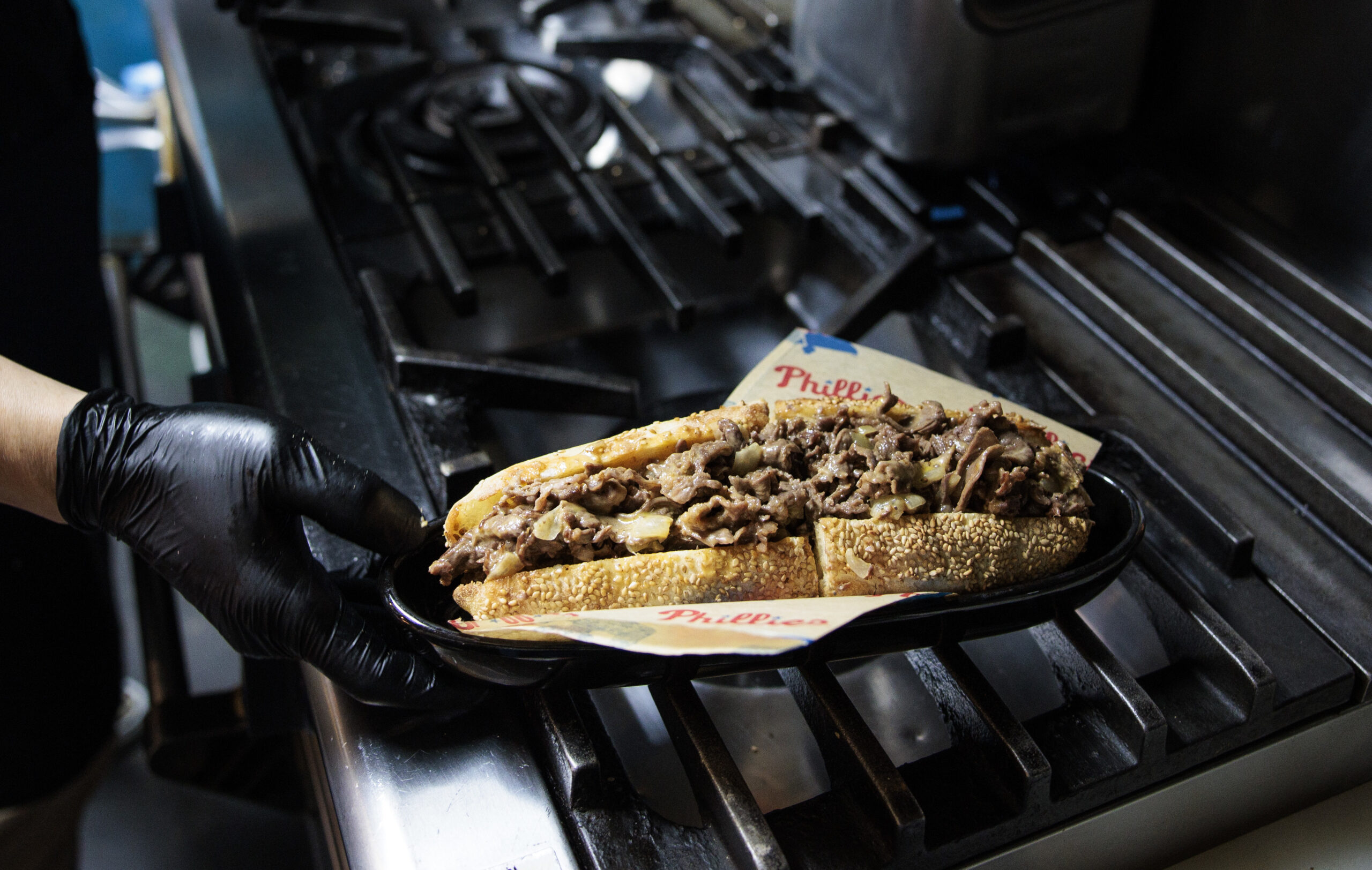
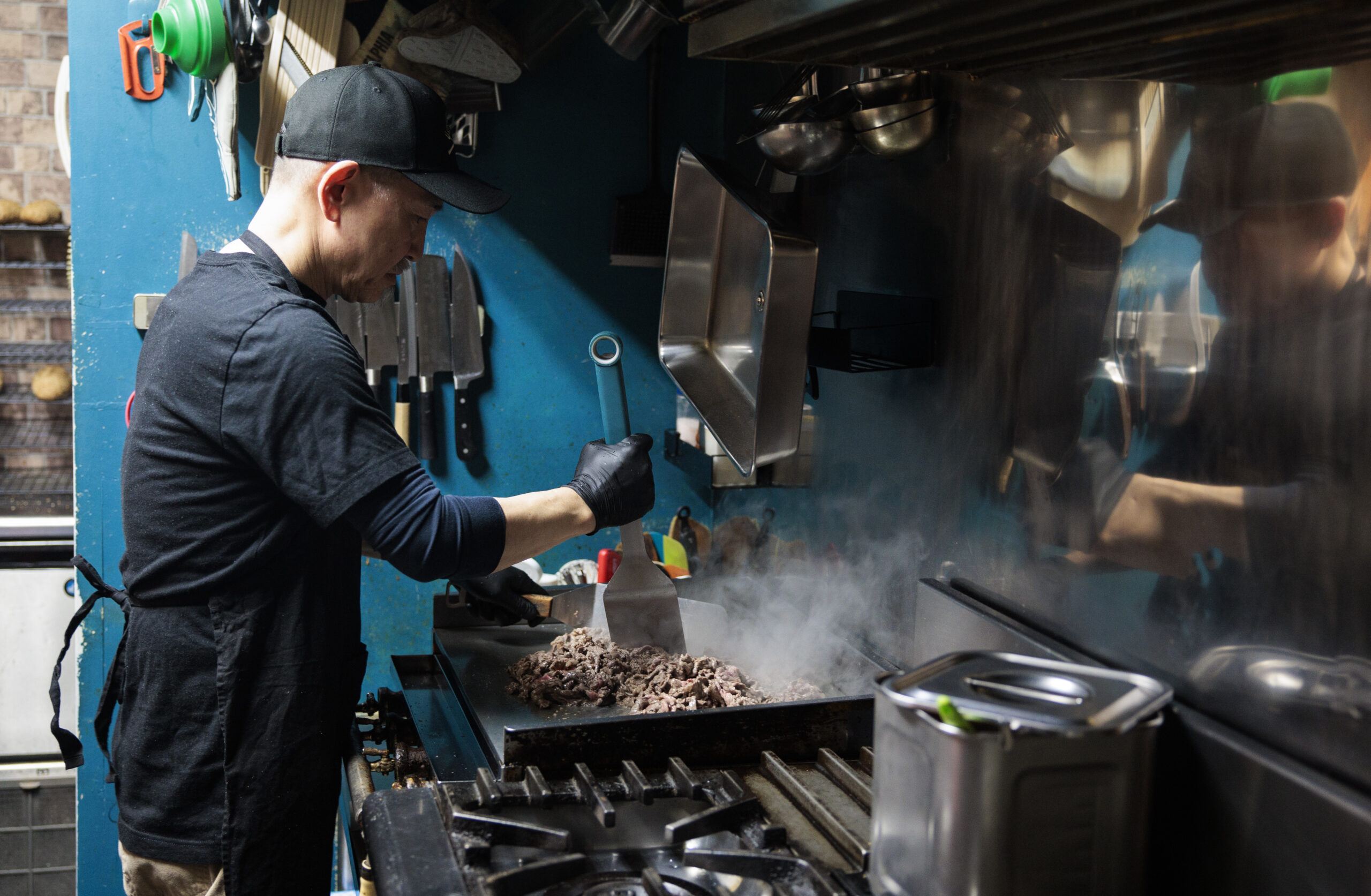
Orlowitz, in fact, was mostly talking about the food. And I was impressed with Kosuke’s work at the griddle, as he rough-chopped good American rib eye and onions without overcooking them, using chopsticks to taste for proper seasoning, melting in cheese, and then scooping it all into Tomomi’s roll for a juicy sandwich that was hearty enough to share. It was a satisfying cheesesteak, even if the cheese was not quite right — slices of American cheese that lacked the creamy flow and piquant savor of the now-standard Cooper Sharp, currently unavailable in Japan. (The Chujos also make their own version of whiz, but, considering I’ve always been a whiz hater, the finishing yellow drizzle on our sandwiches didn’t help. Next time, I’ll go for provolone.)
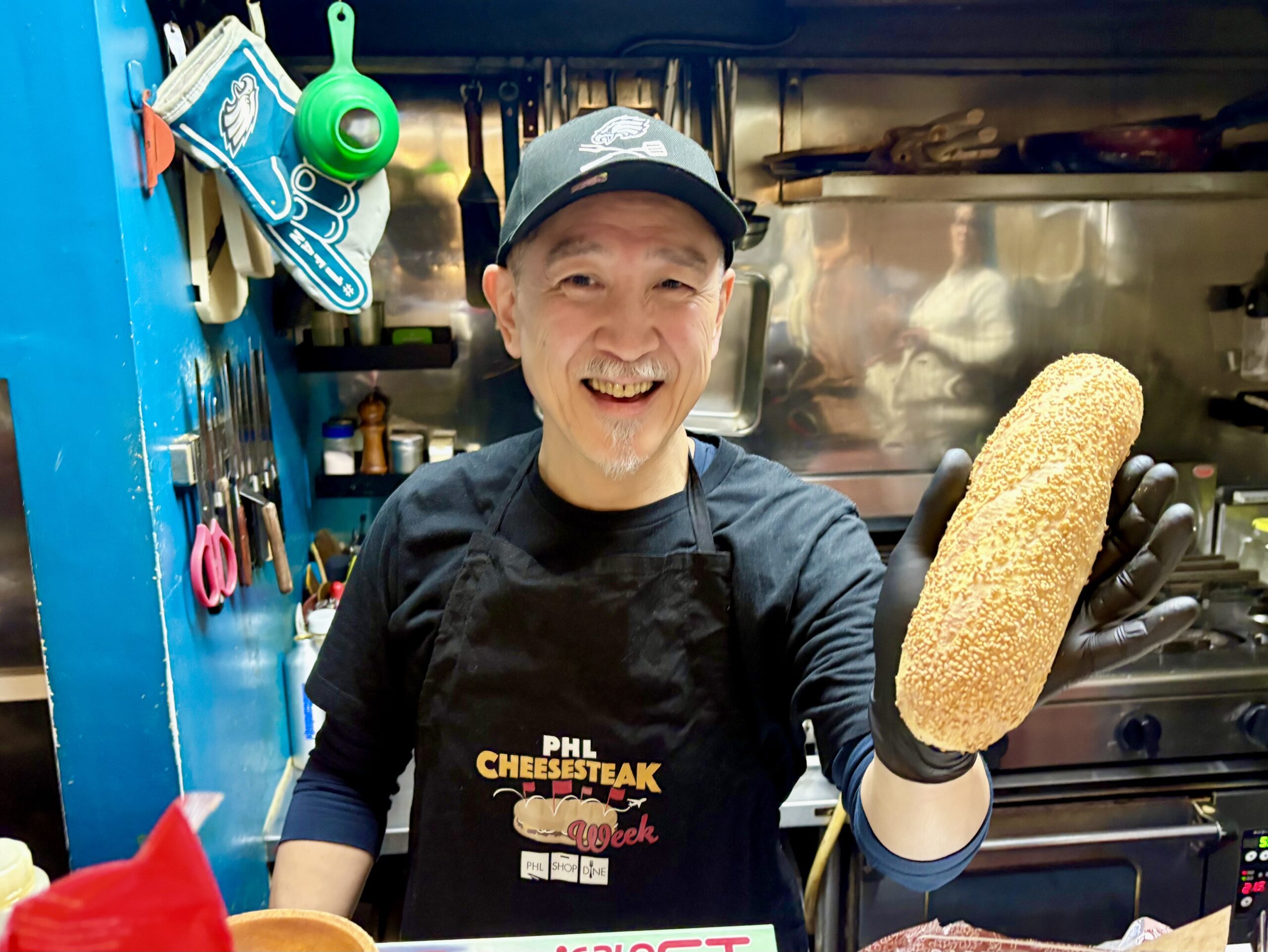
Kosuke Chujo makes a cheesesteak at Nihonbashi Philly on Sunday, Nov. 9, 2025 in Tokyo, Japan.Kosuke Chujo holds a seeded roll baked fresh by his wife and partner, Tomomi Chujo, before preparing a cheesesteak at their restaurant.
Tomomi’s fresh rolls are the outstanding X factor. The Chujos have been vacationing in Philadelphia since 2021, and in between reconnaissance visits to at least 100 different cheesesteak places, she has studied the art of the long roll at old-school Sarcone’s Bakery as well as modern outfits such as Lost Bread Co. and Ursa Bakery.
The bread here is softer than typically crusty Philly rolls because more finely ground Japanese flour (ideal for tender shokupan milk bread) doesn’t have as much gluten as its American counterpart. Tomomi compensates for the texture by fully encrusting her rolls in Japanese sesame, which has rounder and more flavorful seeds that add their own distinctive, toasty crunch. It’s so noticeable, in fact, one friend said the sesame conjured for him unexpected tahini backnotes.
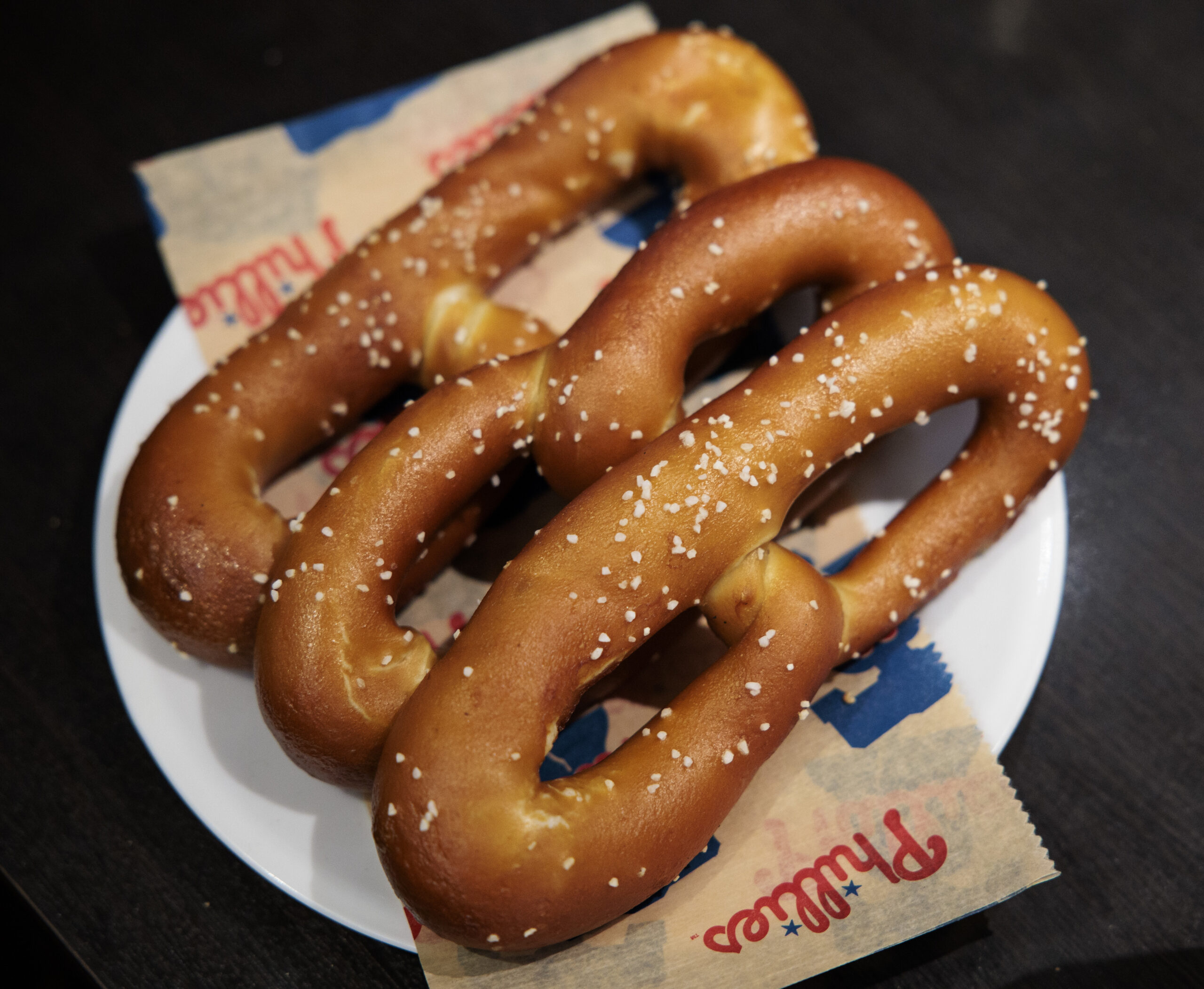
Fresh rolls are prepped for cheesesteaks in the basement of the restaurant called Philly in the Nihonbashi district of Tokyo. Once shaped by hand, their bottoms are dusted in corn meal before they get encrusted in sesame seeds and then baked.Tomomi Chujo’s fresh-from-the-oven salt-speckled soft pretzels.
Cheesesteak obsessives (myself included) will dwell on such minutiae, but I consider such natural variations part of the sandwich’s essential evolution as a living tradition, both in its many thrilling international interpretations among Philadelphia’s immigrant communities, and in the recent boom of house-baked rolls that distinguish some of Philly’s next-gen best.
So much artisanal craft goes into what the Chujos make that, with better cheese, their version would easily land among the upper tier in Philadelphia itself. (Tomomi’s soft pretzels — fresh from the oven and salt-speckled — meanwhile, are already elite.)
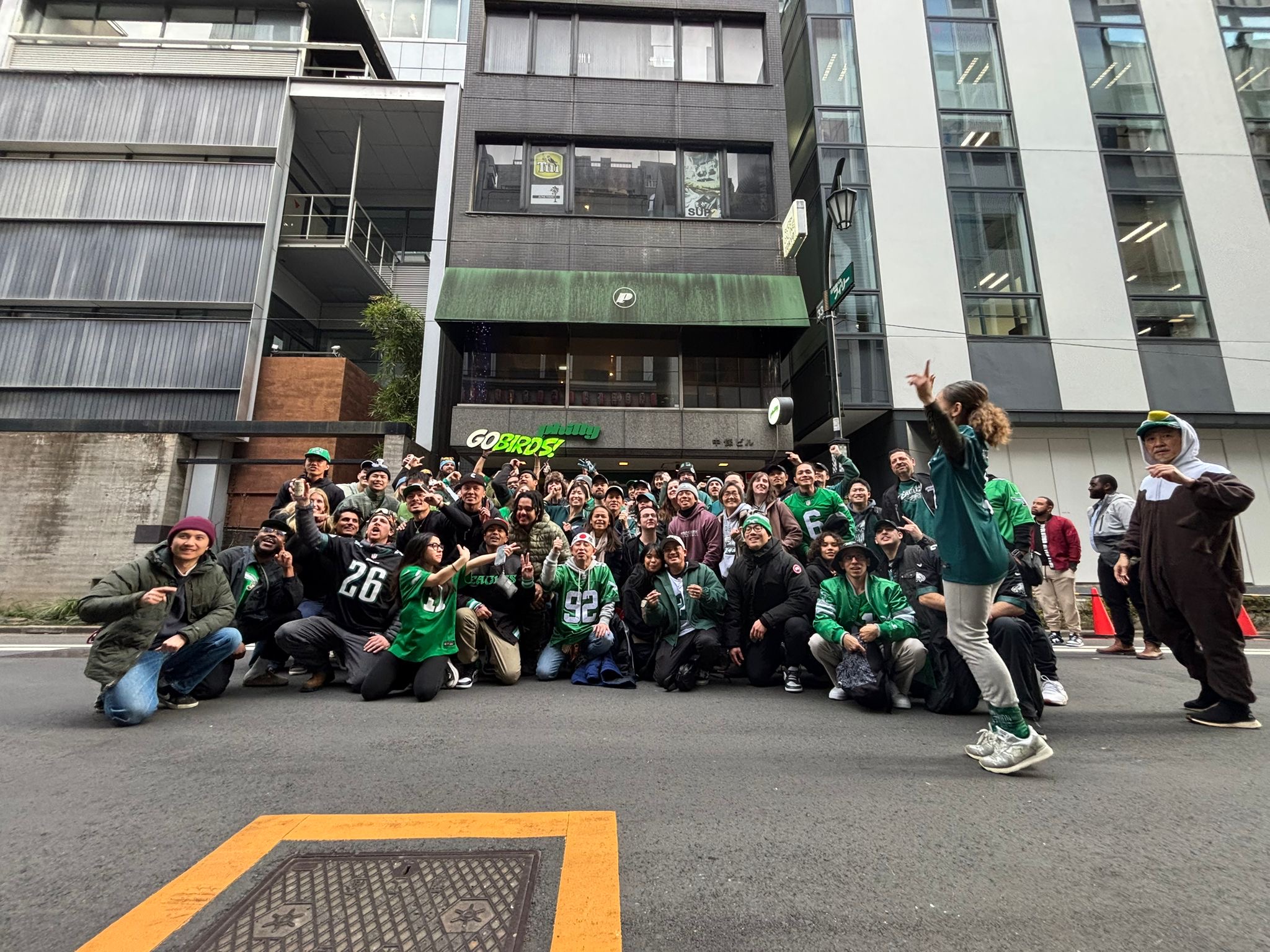
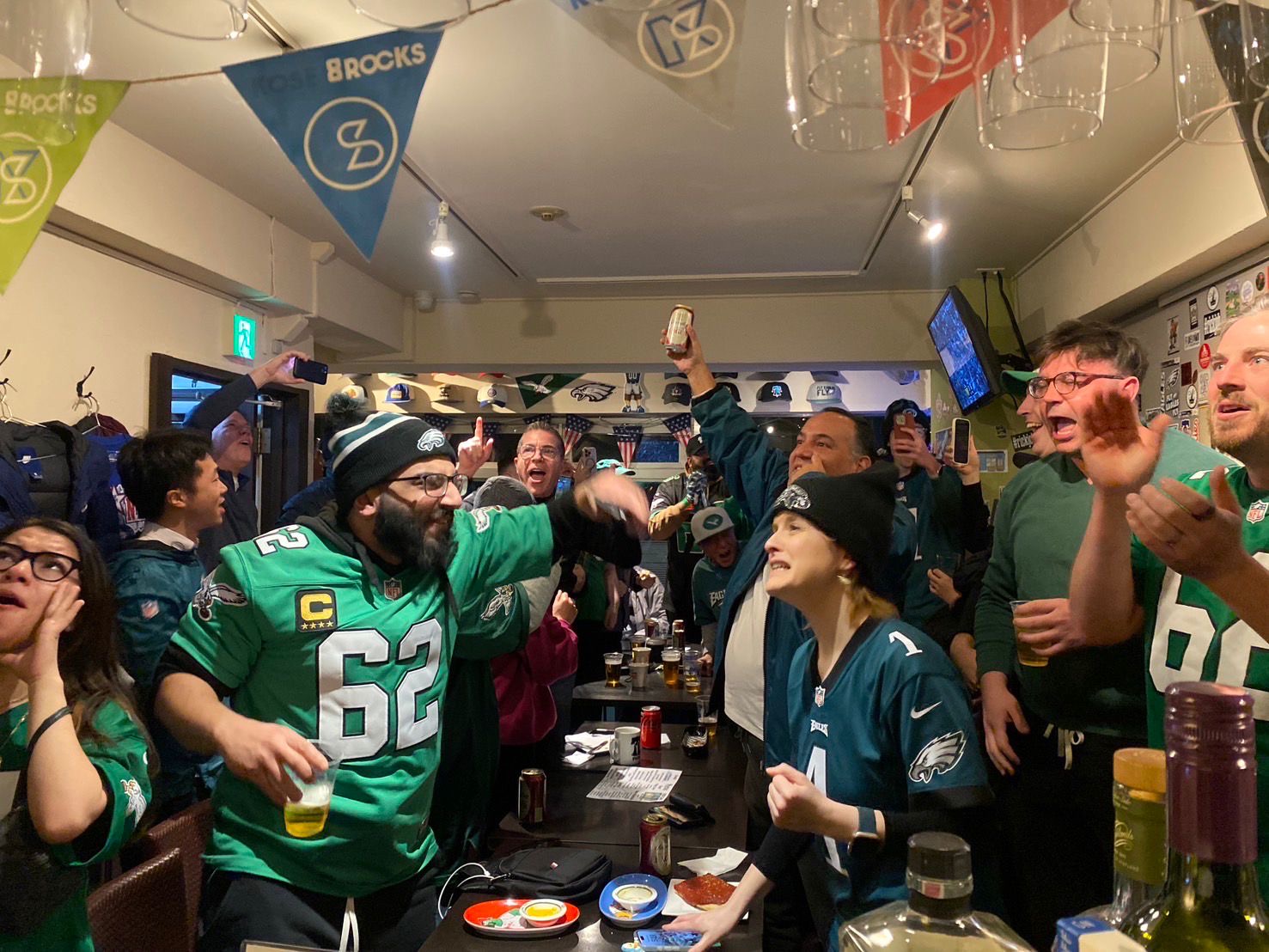
But what makes a visit to Tokyo’s Philly so special is not really even the cheesesteaks. (Though the sandwich has seen a recent boost in interest among Japanese customers since Shohei Ohtani praised it during the Dodgers-Phillies playoff series.) It is the Chujos’ genuine embrace of Philadelphia’s culture and people, from the music to the Eagles watch parties they regularly host, culminating in full-throated “E-A-G-L-E-S Eagles!” victory chants outside that occasionally startle their quiet-loving Tokyo neighbors.
Eagles fans outside Nihonbashi Philly, in Tokyo, during a recent Eagles game.The Chujos regularly host Eagles watch parties at the restaurant.
“We want to be part of the community,” says Tomomi. The Chujos are planning another Philly visit this summer during America’s Semiquincentennial to celebrate their 15th anniversary with wedding photos on the Rocky Steps and in front of City Hall.
For the proud residents of a city with a long tradition of embracing scorn from the wider world — a city whose unofficial anthem is “No one likes us and we don’t care!” — it is touching to see ourselves reflected with so much love and effort in a sandwich created by friends abroad who regard us with nothing but admiration.
This wasn’t merely the rarity of a good cheesesteak far afield, it was a cheesesteak of affirmation: When someone likes us enough to cook our birthright sandwich properly, we actually do care! Deeply.
“The bread on that cheesesteak and those pretzels were so good,” agreed chef Jesse Ito of Royal Sushi & Izakaya, who also came along to Nihonbashi for the meal. “But just to see another culture pay so much respect to something so Philly, if you love where you come from, you almost have to go.”
I have invited two Inquirer journalists who I knew could answer this week’s question — Sam Ruland, who has gone to Clearwater for Phillies spring training and frequents the Shore, and Amy S. Rosenberg, a Shore resident and The Inquirer’s Shore correspondent.
Have a question of your own? Or an opinion? Email me.
Evan Weiss, Deputy Features Editor
This week’s question is:
What’s a better vacation: a week at the Jersey Shore or spring training in Clearwater?
Amy S. Rosenberg, Life & Culture Reporter
I’d say if you’re talking about February or March, definitely opt for spring training. We’ve got almost nothing for you down here.
I‘m always really envious of people who go to spring training. Do people envy me for living at the Shore? Maybe. Maybe not.
So maybe it’s easier for me to say definitely take that spring training trip! Then in the summer take day trips to free beaches (Atlantic City, Strathmere, Wildwood) and sit there with the games on audio. That’s just a lovely day at the beach.
Sam Ruland, Features Planning and Coverage Editor
I went to Phillies spring training in Clearwater in 2023, splitting a house Airbnb with friends, doing the full baseball-all-day, casual-night-out routine.
Clearwater felt special because it was a treat: a few days of baseball optimism, warm weather when Philly is still miserable, and no expectations beyond watching baseball and drinking beer.
I think both of these experiences are so different though! Spring training wouldn’t fill the void of missing a week down the Shore in the summer. Spring training is spring break!
Amy S. Rosenberg
Which is more expensive?
Sam Ruland
Depending on when you book flights, it can be cheap. But if you don’t plan far enough out, you can easily end up dropping close to $1,000 on airfare … to Florida. Which feels wrong.
Amy S. Rosenberg
I would have guessed the Shore would be the more expensive. I really miss the old minor league Atlantic City Surf that played on Albany Avenue at the Surf Stadium, a lot of times with fireworks, and their own mascot, Splash. You didn’t need to leave the Shore to have the full experience, especially for little ones. Mitch Williams was the coach one year.
I typically spend about $38 each way to get to Florida from Atlantic City, just saying.
Sam Ruland
WOW!
Amy S. Rosenberg
(Don’t tell anyone about ACY, the world’s greatest airport.)
Sam Ruland
We spent about $200 on roundtrip flights. But when we considered going last year the prices were wayyyy higher.
Amy S. Rosenberg
As someone who’s a Philly sports fan, though transplanted, I sometimes find it hard to get into the teams in the early season, so for me, going to spring training would be a great way to guarantee a full season immersion, which sounds heavenly.
But if you’re stuck up north, and into basketball, Atlantic City hosts the MAAC 10 tournament, which is a great lead-up to March Madness. A lot of times, the teams that win are sleeper upsets in the main tournament, like St. Peter’s Peacocks. Atlantic City people had a head start on that.
Sam Ruland
I think the Shore is probably more money for a full week — no question. But for some reason, it also feels like you get more out of it. And I say that as someone who loves the Phillies deeply and does not enjoy admitting this.
Amy S. Rosenberg
When you’re down in Clearwater, do you get any beach time? Is there even a beach in Clearwater?
(I’m not really a west coast Florida person.)
Sam Ruland
Yes, there are beaches, but for us the days revolved around games and schedules. The beach was there in theory; spring training energy very much took over in practice.
Amy S. Rosenberg
I feel like spring training vacation is something you should do but not every year maybe.
Evan Weiss
Yeah, I think if it’s something you’ve always wanted to do … go for it. Then go down the Shore next year.
Sam Ruland
Agreed! Spring training is a great trip — but the people who go every year usually don’t have to choose. For friends or couples, Clearwater is perfect. For families, the Shore just makes more sense, even if it costs more.
Amy S. Rosenberg
I think it would be an awfully long summer without that trip down the Shore.
Sam Ruland
I mean Jersey Shore in March vs. Clearwater in March, I think yes, Clearwater. You’re not going to Shore that early!
Amy S. Rosenberg
Yeah, March is kind of bleak. Lots of contractors building very expensive homes on land where cute bungalows used to be. I am surprised to see my summer neighbors showing up on long winter weekends though.
Evan Weiss
So if it’s spring training vs. peak summer down the Shore, do you both side with the Shore?
Sam Ruland
Peak summer Jersey Shore, 1,000%. No hesitation. Hoagies on the beach, Shore showers, no shower happy hours, ice cream every night, boardwalk walks for no reason. That’s unbeatable. But in March, being in Clearwater with the Fightins just feels right.
(But one over the other, I think I have to choose Shore.)
Amy S. Rosenberg
I think it’s OK to take a summer off and go to spring training, especially if people in the traveling group are into it. You won’t be banned from the Shore. There are weekends and free beaches and ways to do it without breaking the bank. And if the Phillies go deep in the post-season you can join the locals on the beach with the twilight games on, order a pizza, and you’ll feel like the beach is a South Philly street where everybody’s on their steps listening.
(Just bring a sweatshirt.)
This conversation has been edited andcondensed for length and clarity.