I have walked through Independence National Historical Park many times looking at the many interpretive panels, exhibits and historical materials after President Donald Trump’s March 27, 2025 Executive Order 14253.
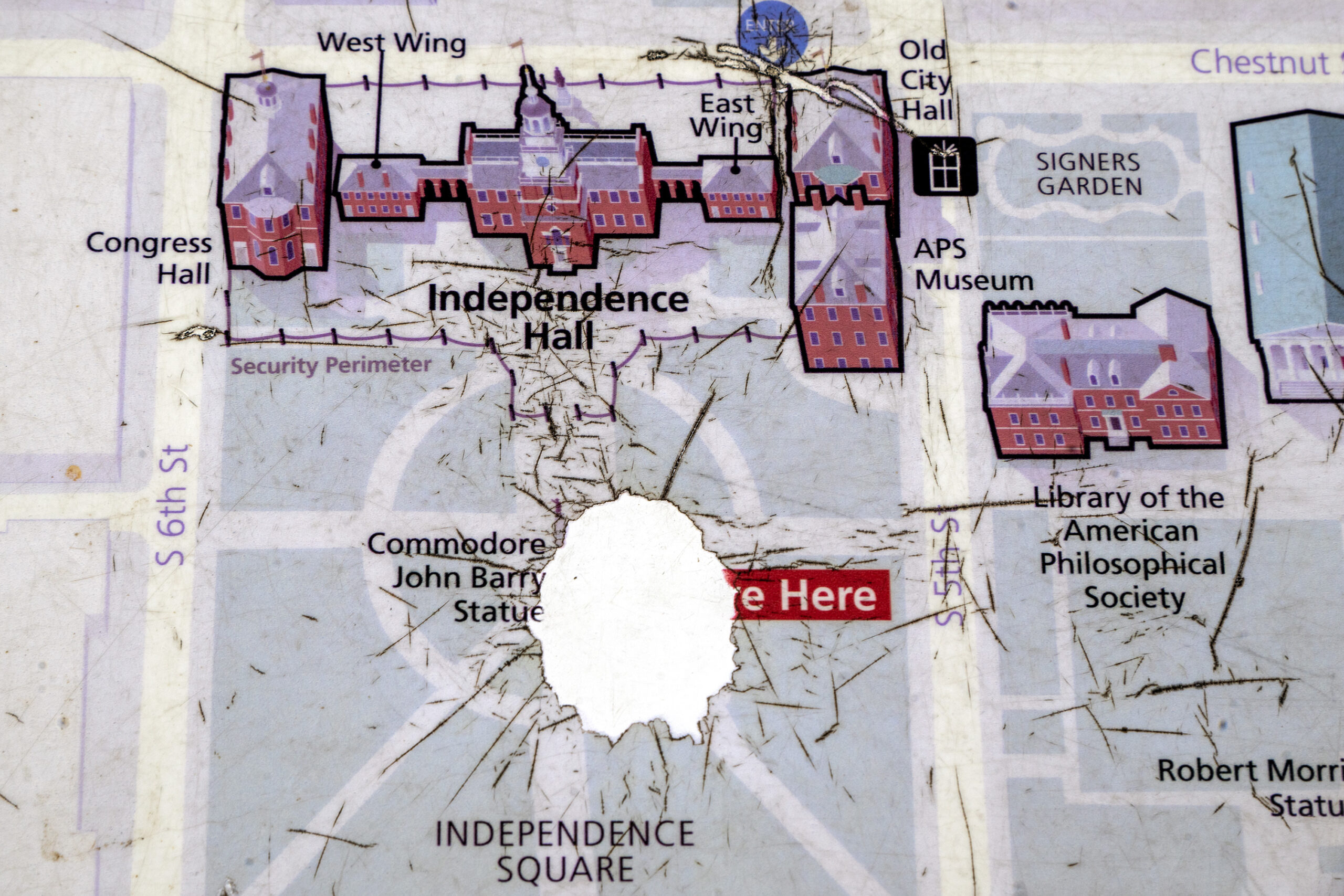
“You Are Here” sign in the square behind Independence Hall July 23, 2025.
Titled “Restoring Truth and Sanity to American History,” the order directed the Department of the Interior, which oversees the National Park Service, to review over 400 national sites to remove or modify interpretive materials that it deems “inappropriately disparage Americans past or living (including persons living in colonial times).” The order aimed to focus on the “greatness of the achievements and progress of the American people.”
At first I looked at the many interpretive panels, videos, exhibits and historical materials in Independence Hall, Liberty Bell Center, President’s House and Ben Franklin Museum, wondering which ones the Interior Secretary might identify that “perpetuate a false reconstruction of American history, inappropriately minimize the value of certain historical events or figures, or include any other improper partisan ideology.”
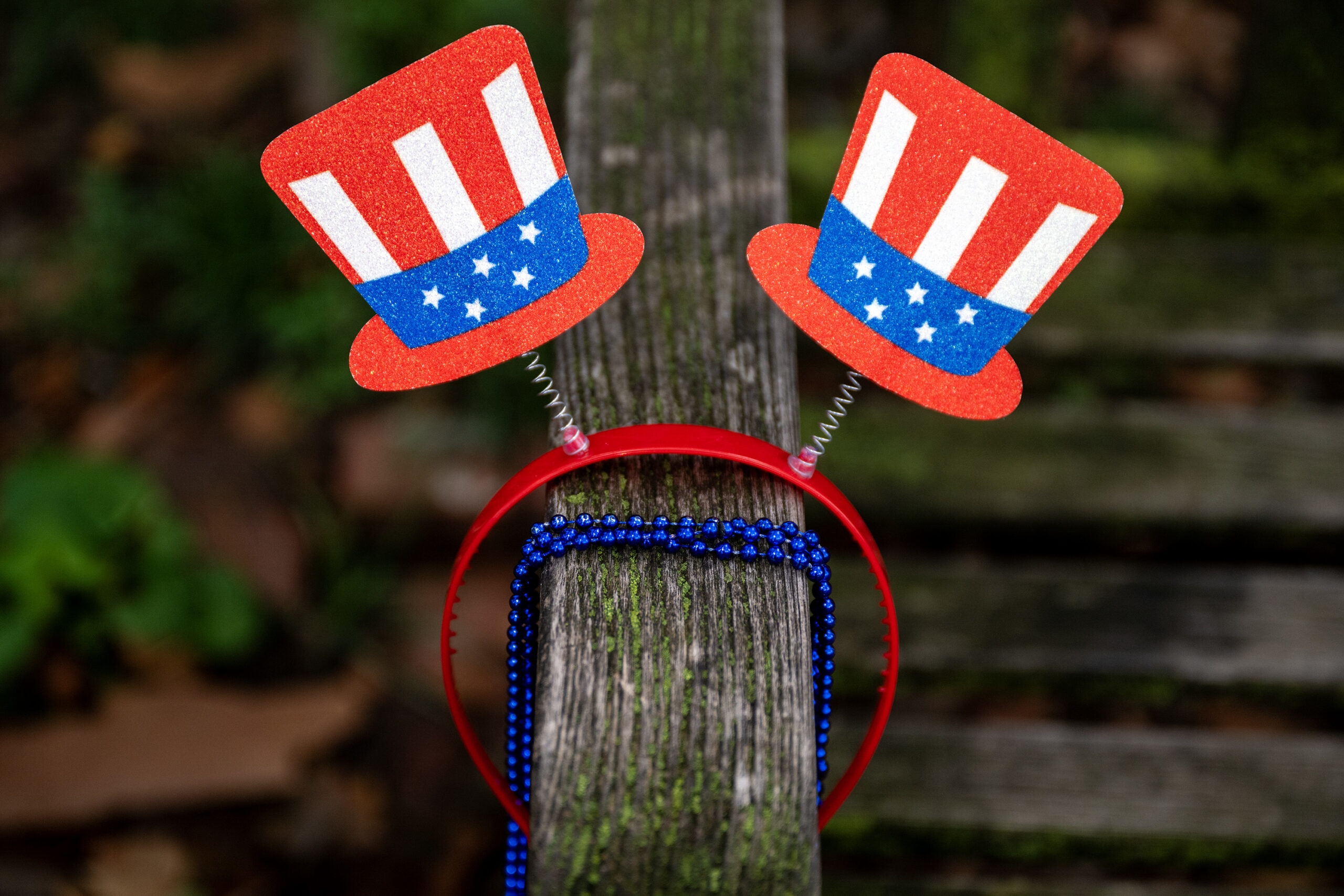
An Uncle Same hatted headband is left on a park bench Philadelphia’s Historic District during the Independence Day weekend celebrations Jul. 2, 2025.
I took a lot of photos, but realized there wasn’t a way I could write a caption reading, “the administration doesn’t like what this panel says about slavery.” So I put any photos I made in a file for later use.
In July, the New York Times broke the story that employees of the National Park Service had been flagging descriptions and displays at scores of parks and historic sites around the country for review — and they had examples of a few here in Philadelphia.
The next day, armed with the specific panels at the Liberty Bell and the President’s House they reported, I went back and re-photographed them all for our own story.
My colleague Fallon Roth obtained and reviewed the internal comments submitted by NPS employees here with many more details so in the following days I made many more photos.
I was even told to re-photograph some panels for a third time, grumbling (to myself) when told “we need higher resolution versions, shot head on, without any distortion,” for an interactive project. Which, I had to admit later (again, to myself) turned out great!
The President’s House came under particular scrutiny, and the removal of noncompliant displays was initially slated to come on Sept. 17.
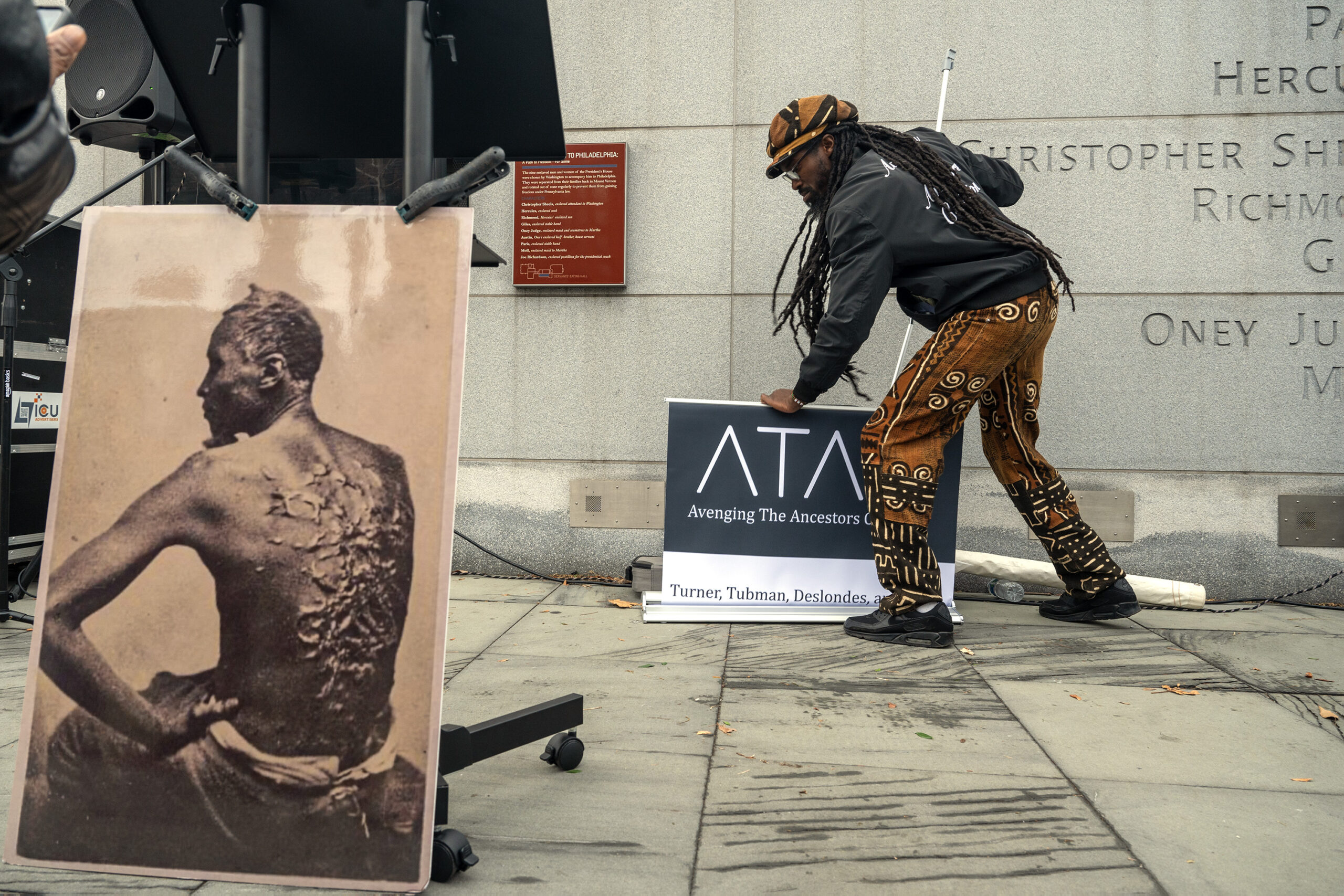
Farugh Maat, with Avenging the Ancestors, Coalition, takes down signs at the President’s House exhibit following a ceremony on the site Dec. 21, 2025 marking the 15th anniversary of its opening. The photo at left, known as “The Scourged Back” is copy of one that was removed from display at Fort Pulaski National Monument in Georgia following an order from President Trump’s “disparaging” executive order.
The administration’s deadline came and went. We got tips that signs had been altered, but I checked, and nothing actually happened. Until Thursday.
I was on assignment near Independence Hall, and as always, walked through the President’s House. It was quiet except for a local TV news crew using Independence Mall as a location for their report on this weekend’s coming winter storm.
Later while editing that assignment, we got a tip that workers with tape measures where looking and poking around “behind the panels” there. I rushed down where my colleague Maggie Prosser was already asking them what they were up to.
I photographed the entire removal, and was joined by photographer Elizabeth Robertson who even made an overall photo from our newsroom overlooking the site.
Finally, I ended up returning after dark, just because.
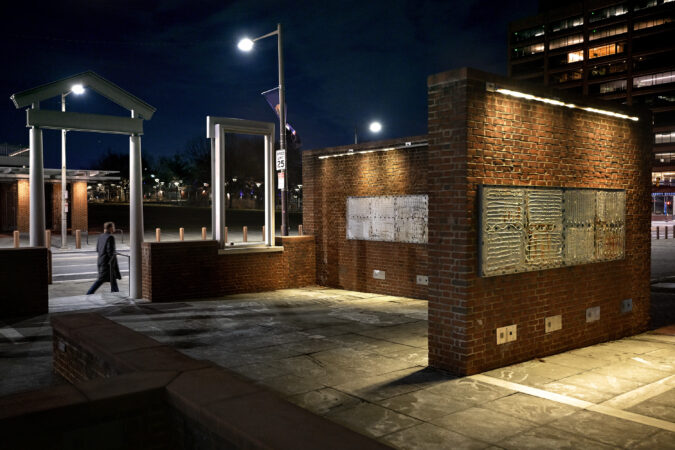
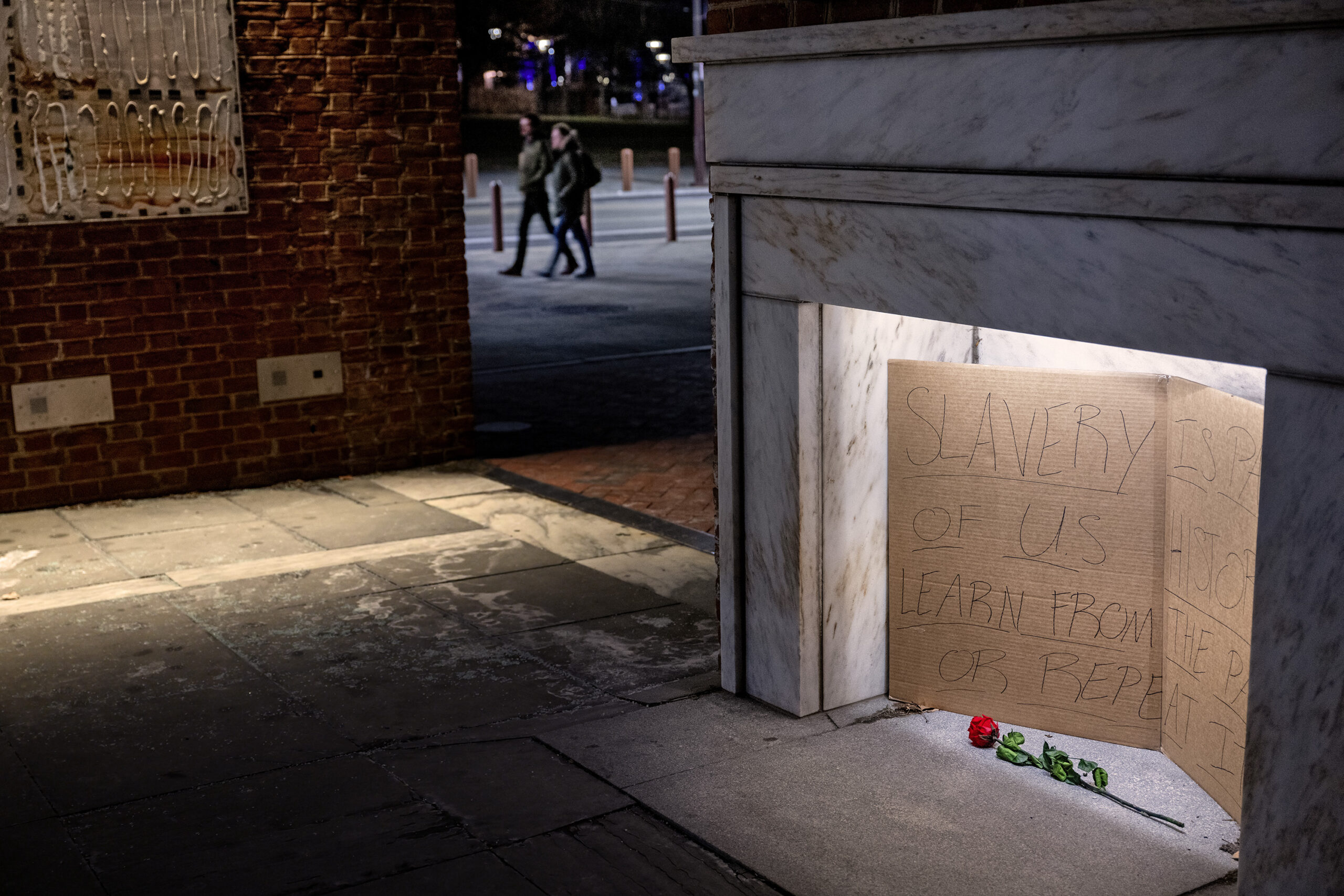
A single rose and a handwritten cardboard sign – “Slavery is part of U.S. history learn from the past of repeat it”- are inside an empty hearth at the President’s House site Thursday night, Jan. 22, 2026 after workers removed display panels.
Since 1998 a black-and-white photo has appeared every Monday in staff photographer Tom Gralish’s “Scene Through the Lens” photo column in the print editions of The Inquirer’s local news section. Here are the most recent, in color:
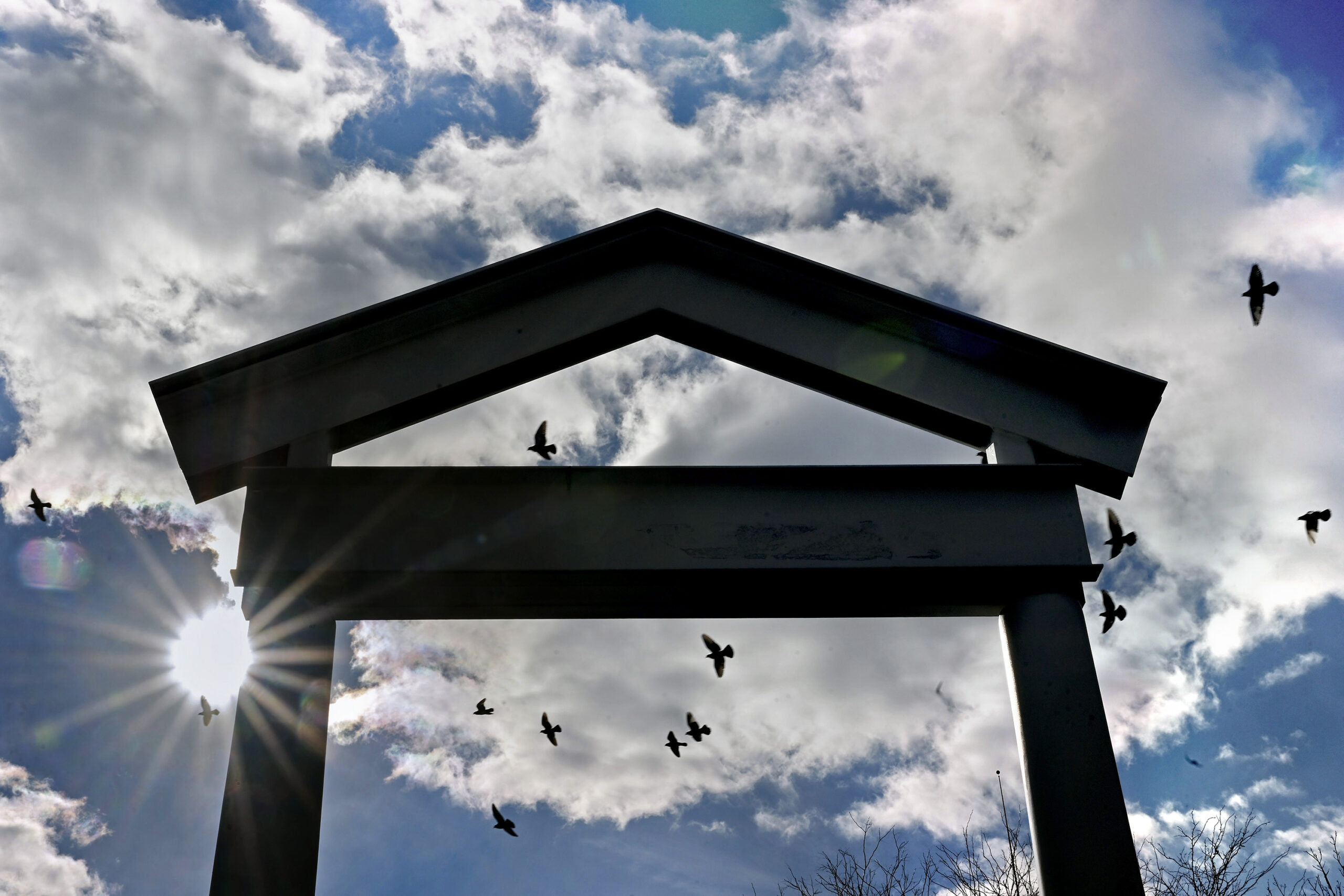
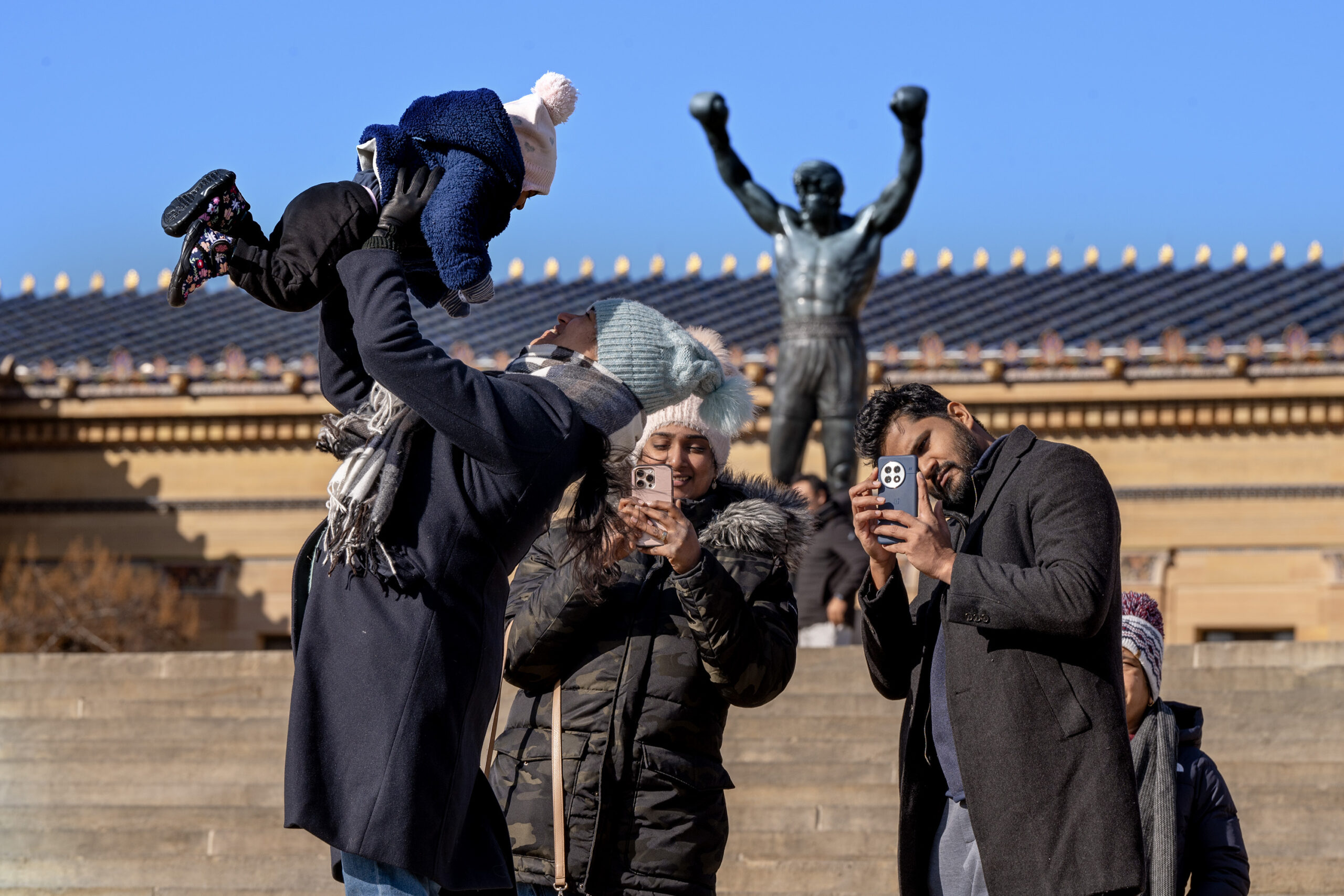
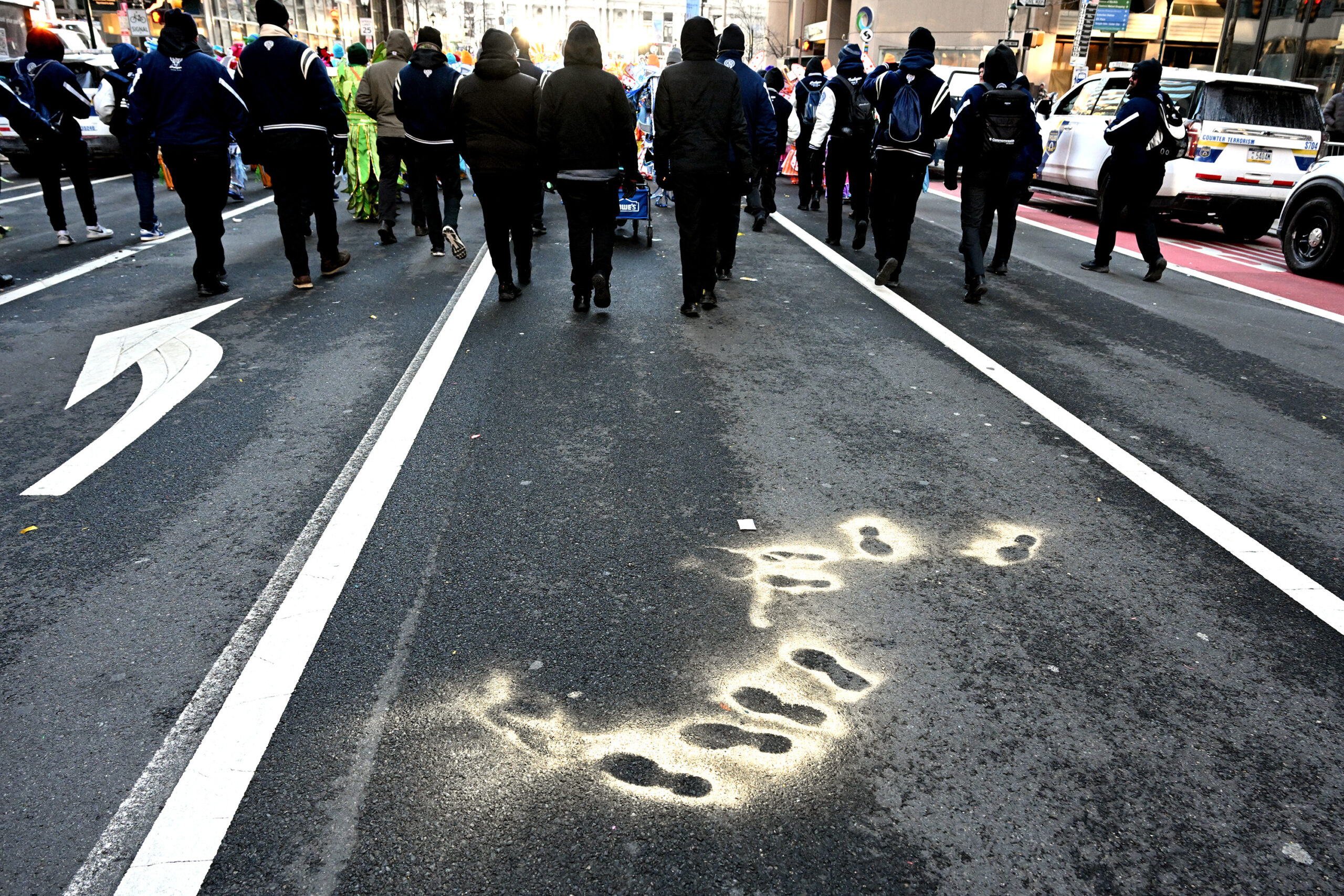
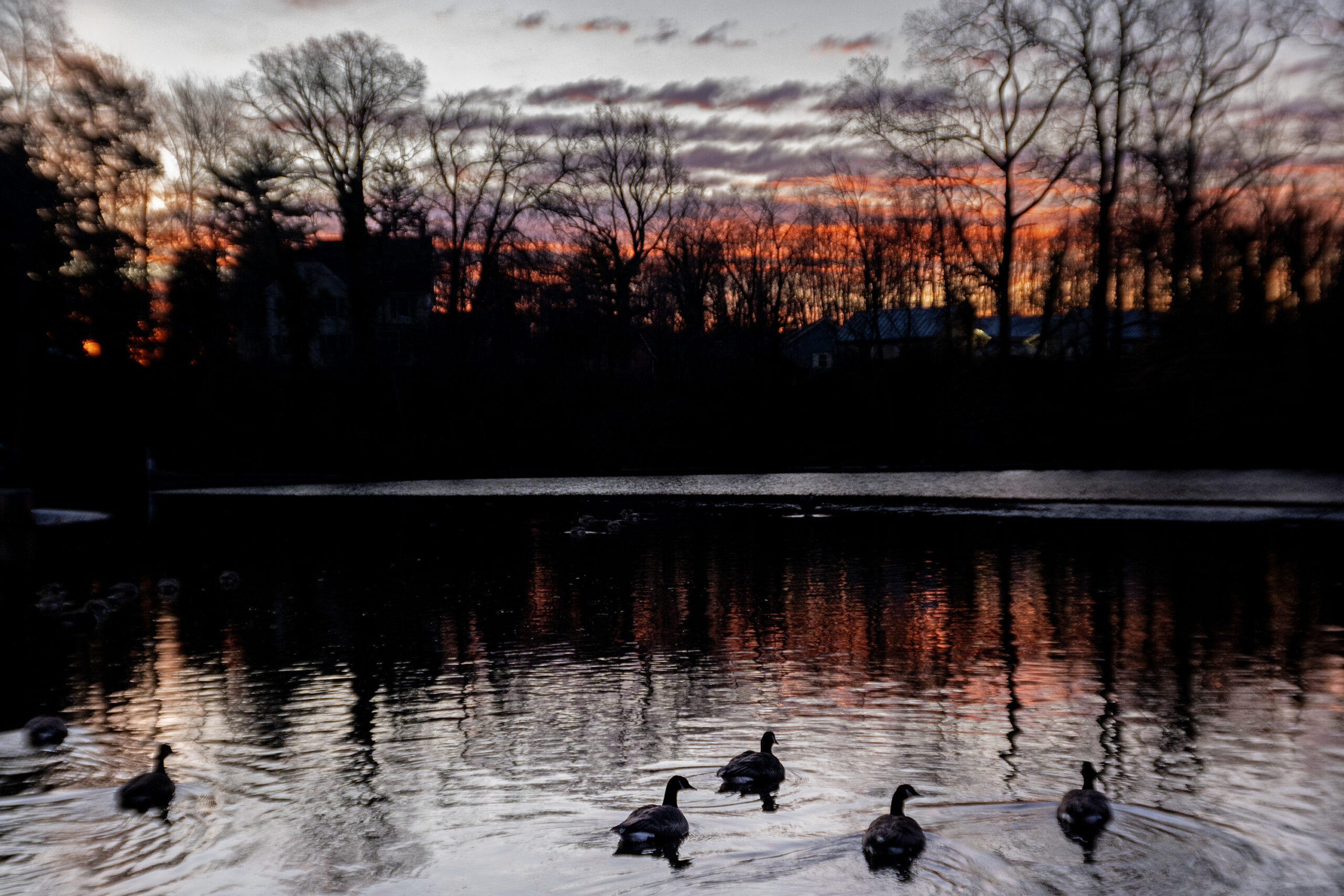
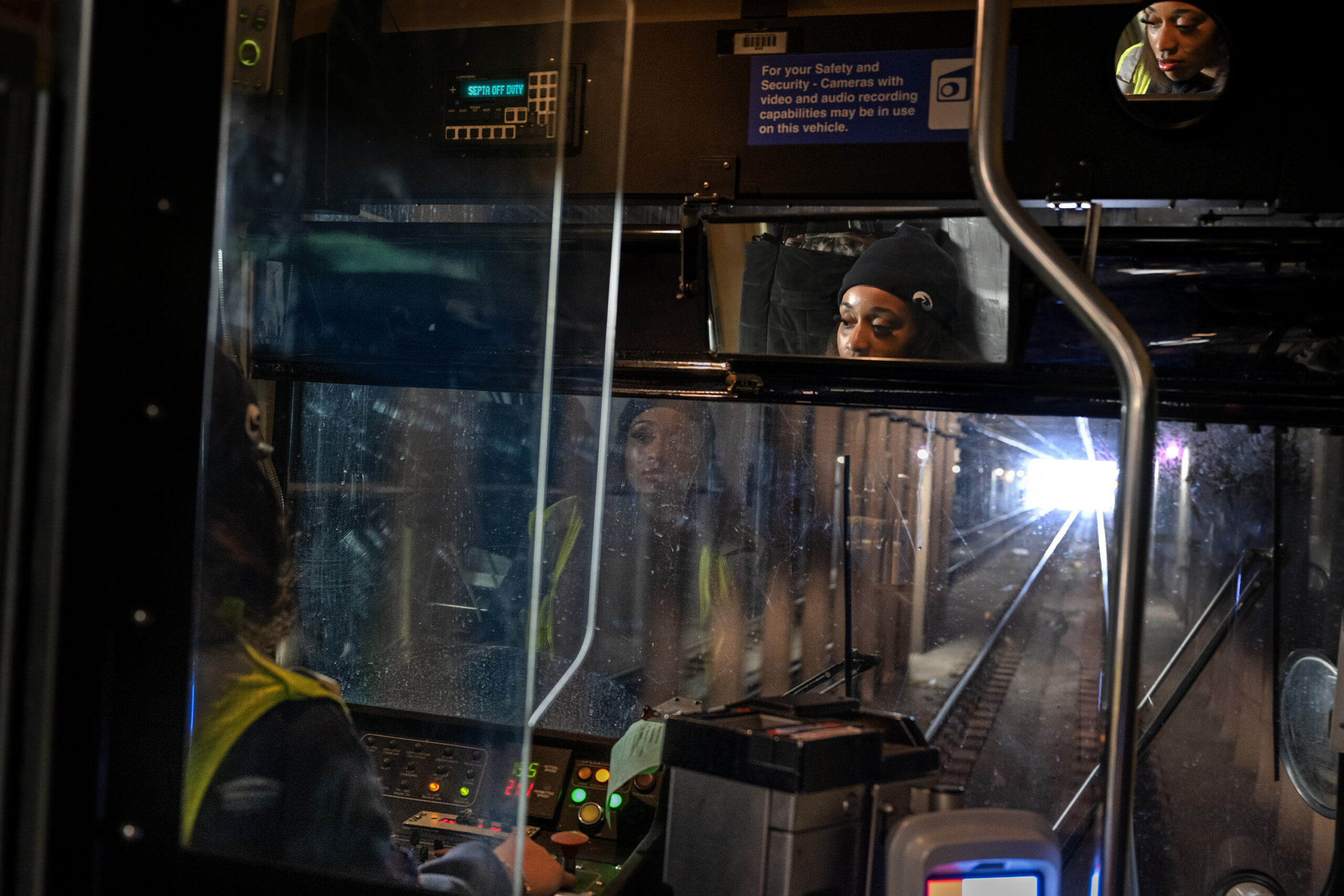
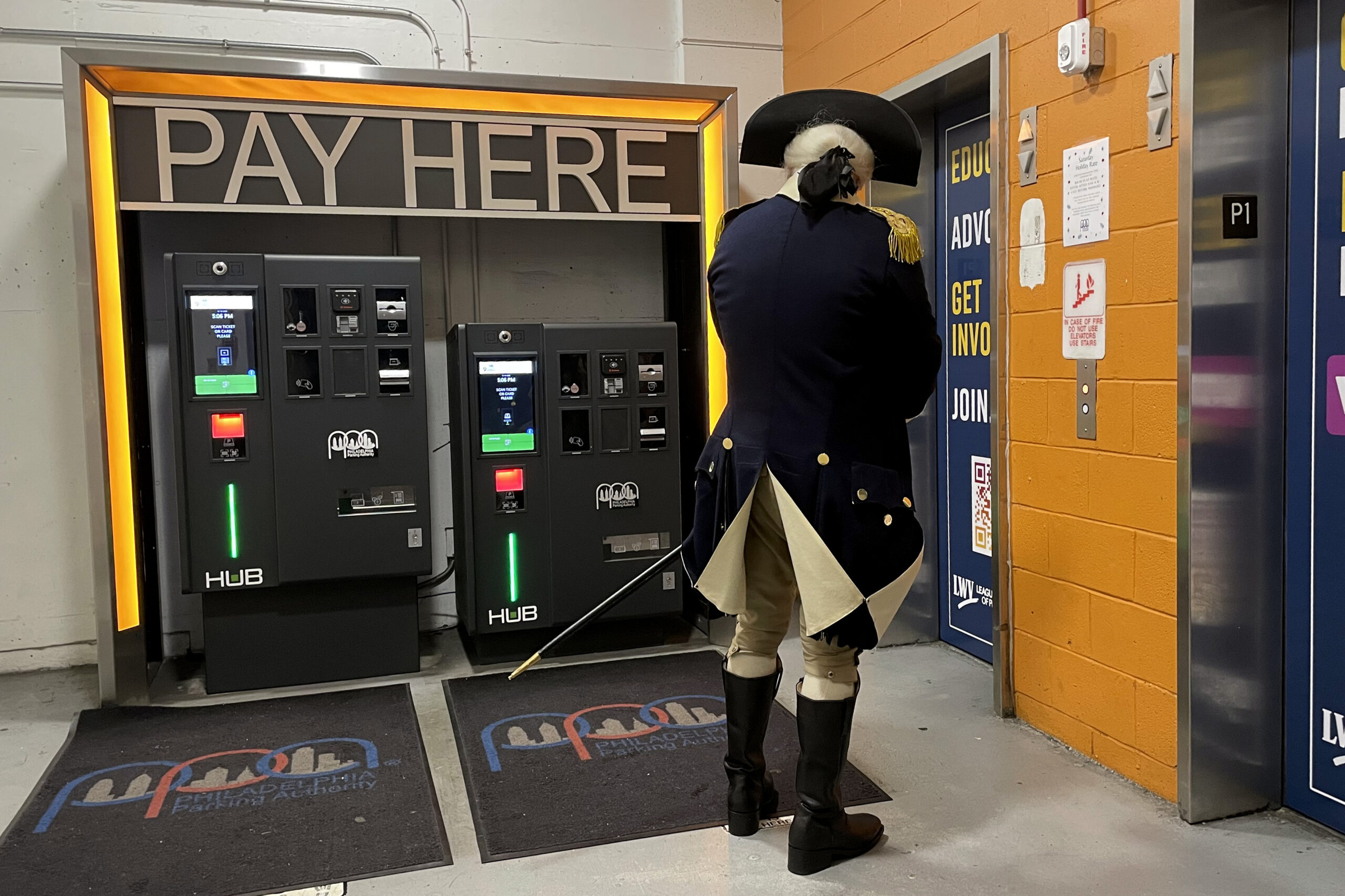
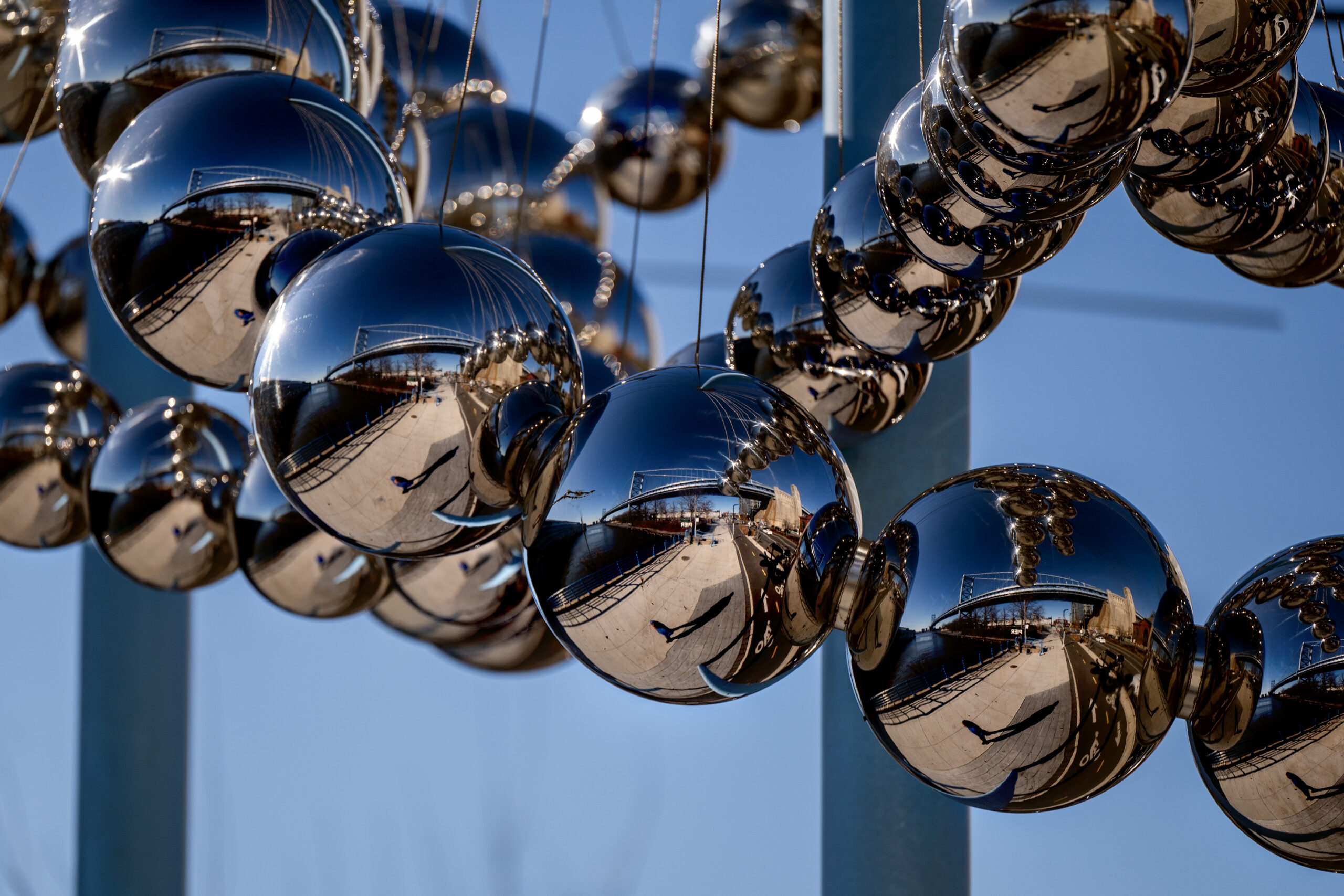
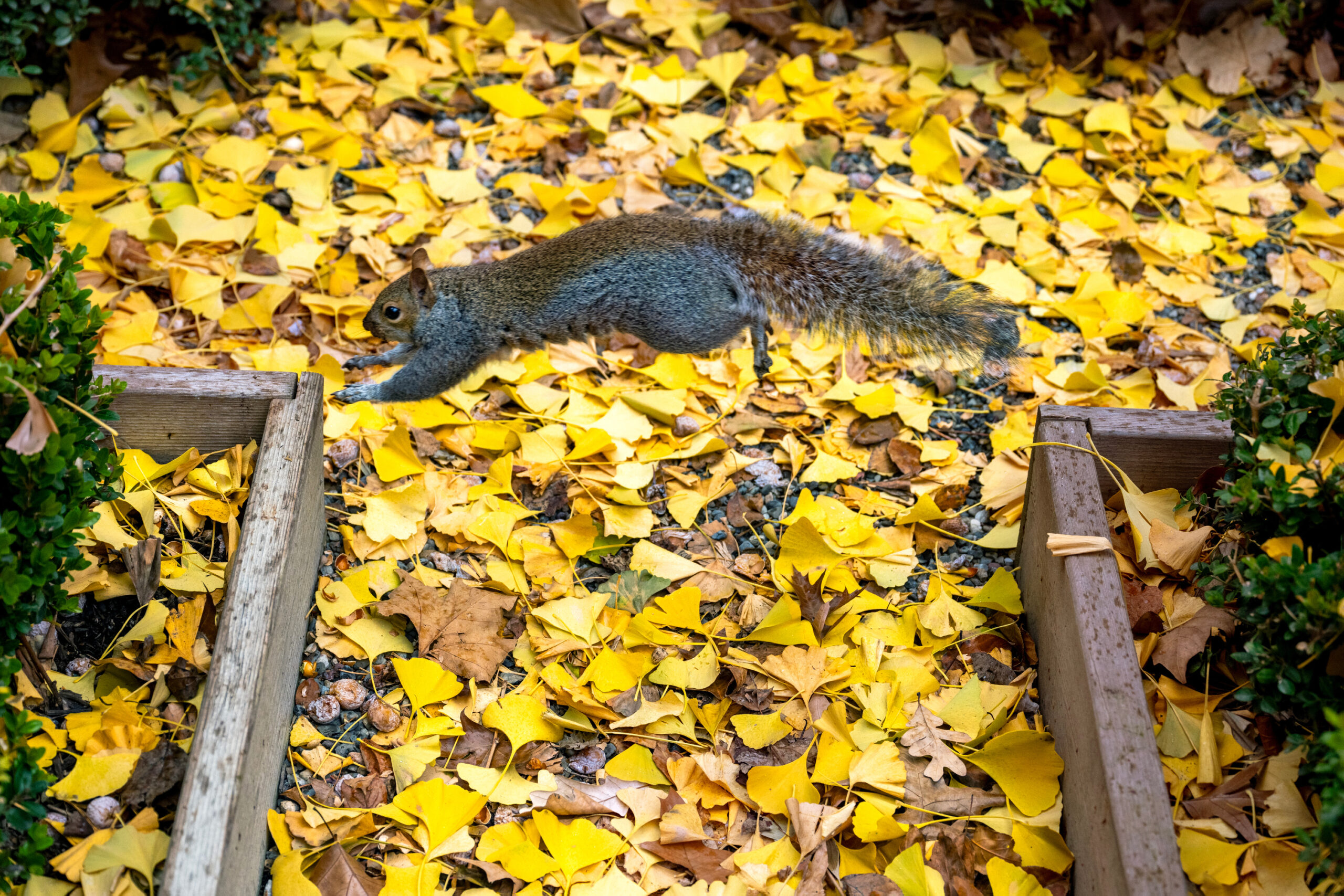
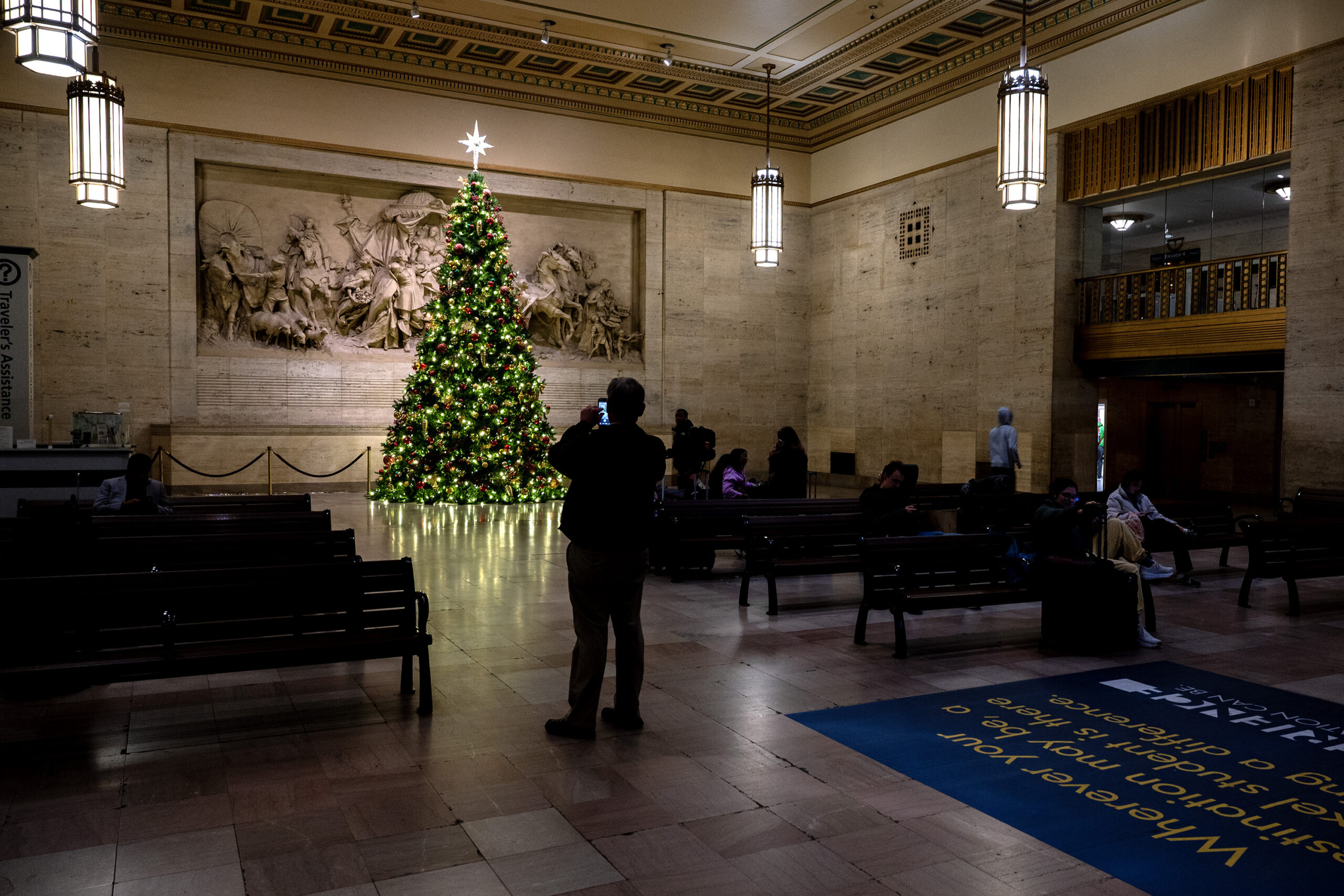
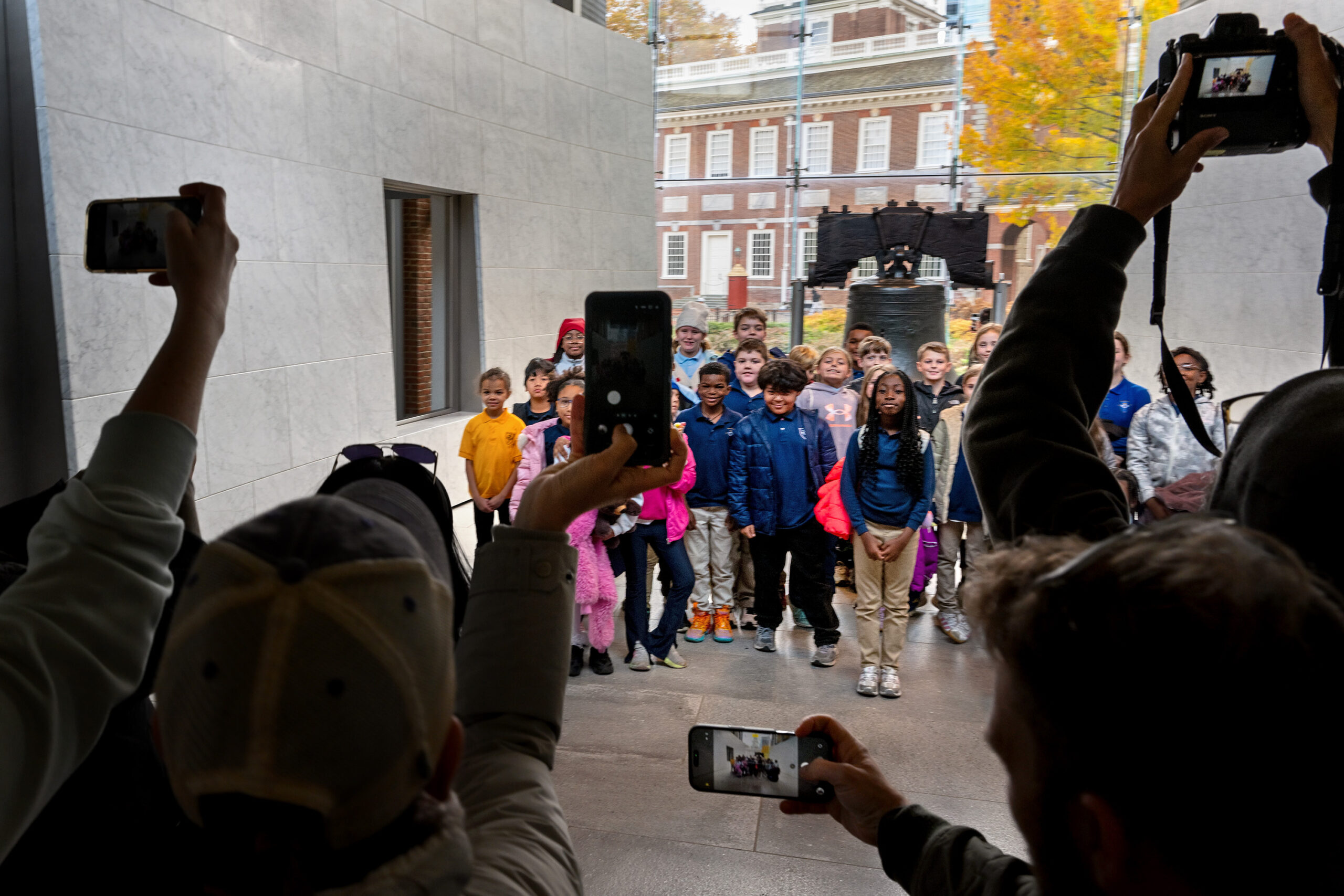
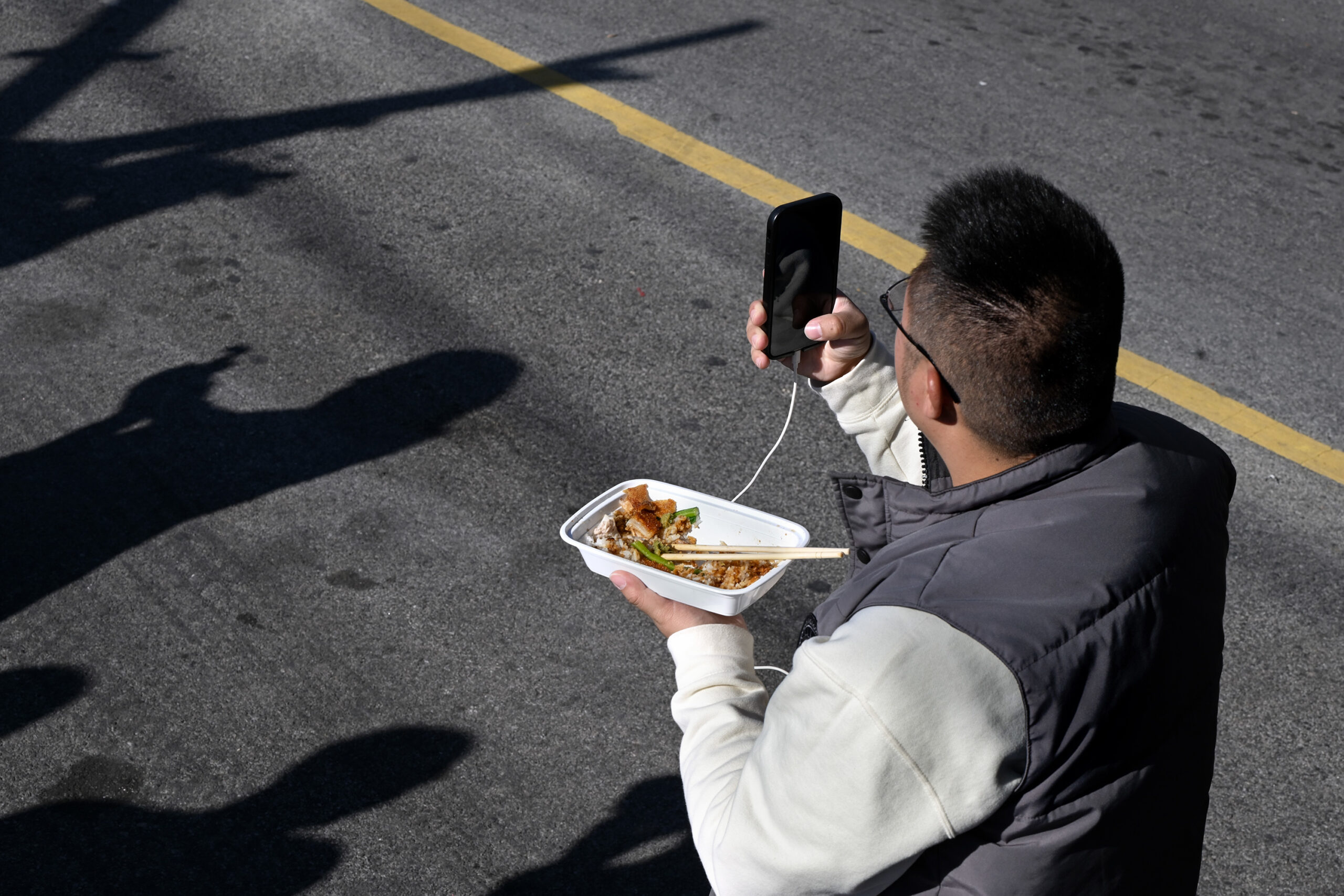
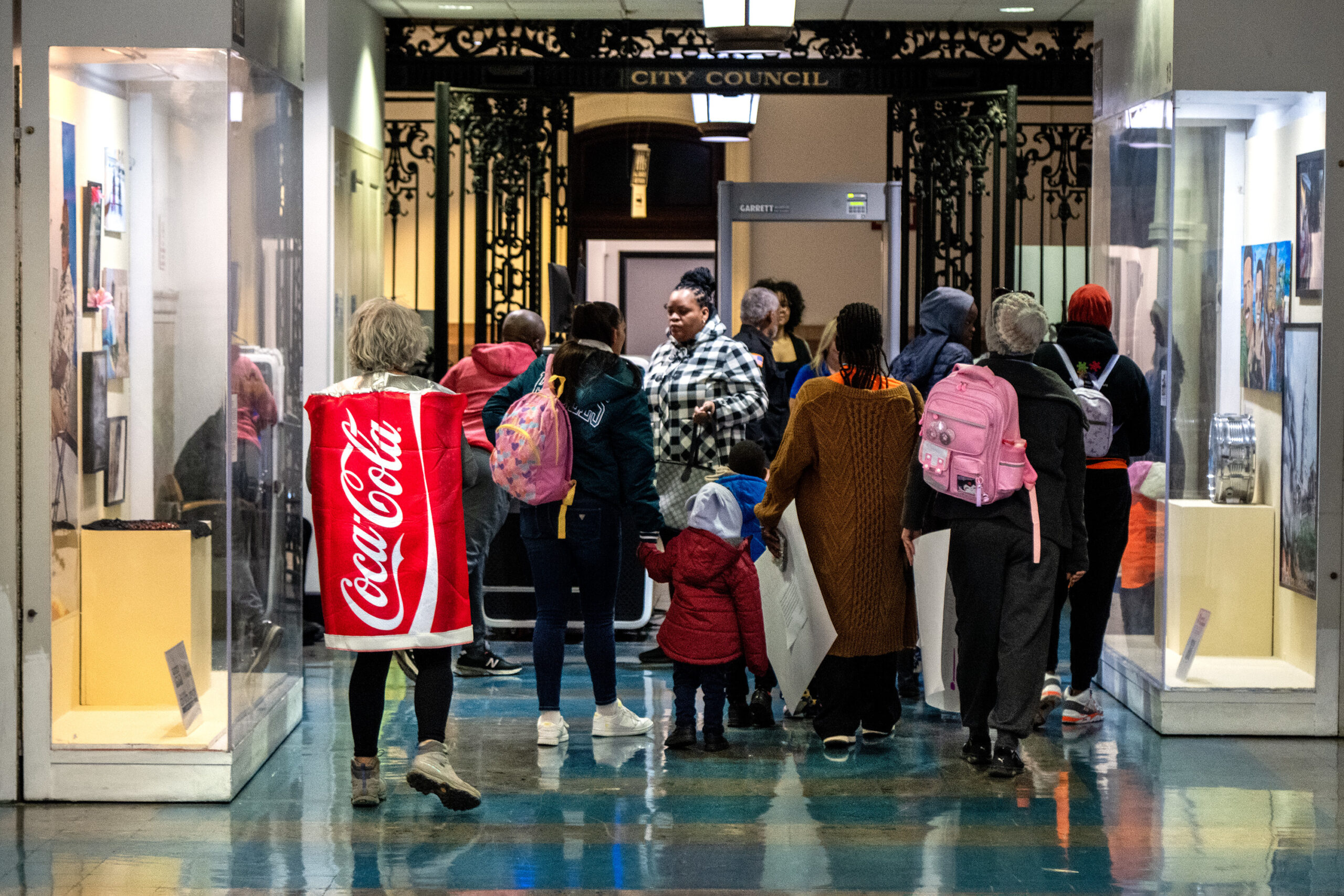
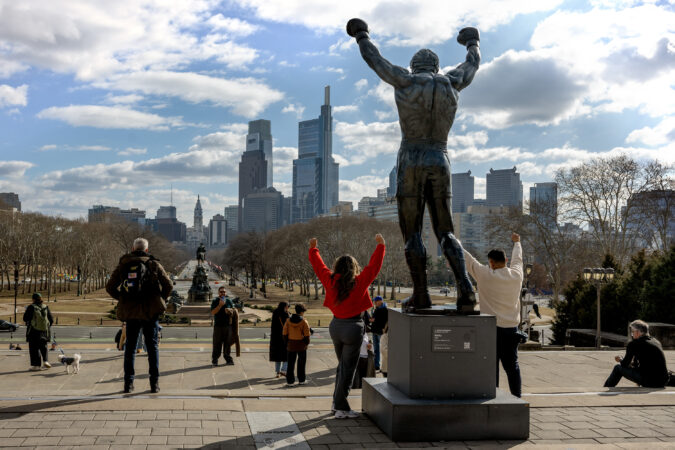
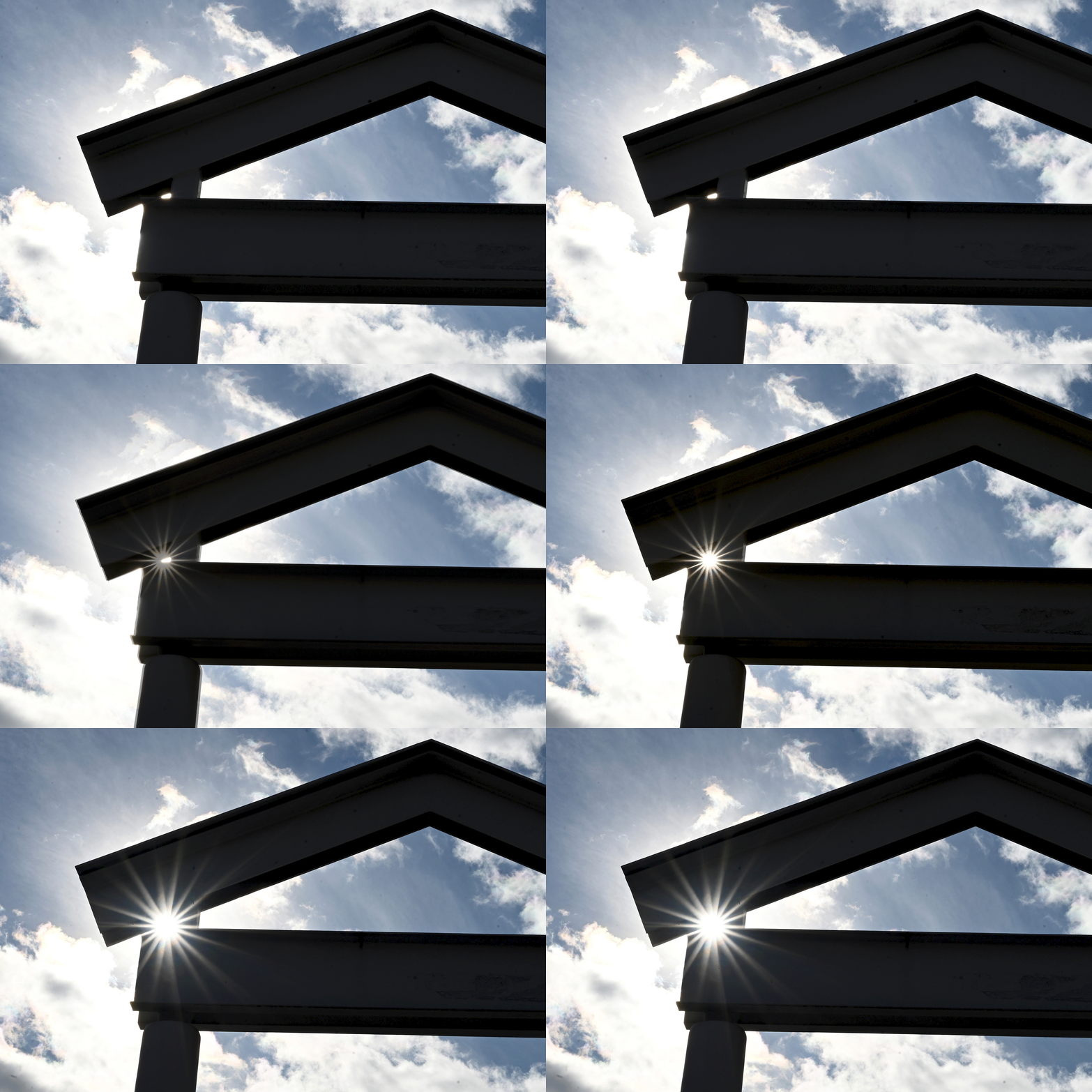
January 19, 2026: A low-in-the-sky winter sun is behind the triangular pediment of the “front door” of the open-air President’s House installation in Independence National Historical Park. The reconstructed “ghost” structure with partial walls and windows of the Georgian home known in the 18th century as 190 High St. is officially titled, “Freedom and Slavery in the Making of a New Nation” (2010). It is designed to give visitors a sense of the house where the first two presidents of the United States, George Washington and John Adams, served their terms of office. The commemorative site designed by Emanuel Kelly, with Kelly/Maiello Architects, pays homage to nine enslaved people of African descent who were part of the Washington household with videos scripted by Lorene Cary and directed by Louis Massiah. Deepika Iyer holds her niece Ira Samudra aloft in a Rockyesque pose, while her parents photograph their 8 month-old daughter, in front of the famous movie prop at the top of the steps at the Philadelphia Art Museum. Iyer lives in Philadelphia and is hosting a visit by her mother Vijayalakshmi Ramachandran (partially hidden); brother Gautham Ramachandran; and her sister-in-law Janani Gautham who all live in Bangalore, India.January 5, 2026: Parade marshals trail behind the musicians of the Greater Kensington String Band heading to their #9 position start in the Mummers Parade. Spray paint by comic wenches earlier in the day left “Oh, Dem Golden Slippers” shadows on the pavement of Market Street. This year marked the 125th anniversary of Philly’s iconic New Year’s Day celebration.Dec. 29, 2025: Canada geese at sunrise in Evans Pond in Haddonfield, during the week of the Winter Solstice for the Northern Hemisphere. December 22, 2025: SEPTA trolley operator Victoria Daniels approaches the end of the Center City Tunnel, heading toward the 40th Street trolley portal after a tour to update the news media on overhead wire repairs in the closed tunnel due to unexpected issues from new slider parts.December 15, 2025: A historical interpreter waits at the parking garage elevators headed not to a December crossing of the Delaware River, but an event at the National Constitution Center. General George Washington was on his way to an unveiling of the U.S. Mint’s new 2026 coins for the Semiquincentennial, December 8, 2025: The Benjamin Franklin Bridge and pedestrians on the Delaware River Trail are reflected in mirrored spheres of the “Weaver’s Knot: Sheet Bend” public artwork on Columbus Boulevard. The site-specific stainless steel piece located between the Cherry Street and Race Street Piers was commissioned by the City’s Public Art Office and the Delaware River Waterfront Corporation and created and installed in 2022 by the design and fabrication group Ball-Nogues Studio. The name recalls a history that dominated the region for hundreds of years. “Weaver’s knot” derives from use in textile mills and the “Sheet bend” or “sheet knot” was used on sailing vessels for bending ropes to sails. November 29, 2025: t’s ginkgo time in our region again when the distinctive fan-shaped leaves turn yellow and then, on one day, lose all their leaves at the same time laying a carpet on city streets and sidewalks. A squirrel leaps over leaves in the 18th Century Garden in Independence National Historical Park Nov. 25, 2025. The ginkgo (Ginkgo biloba) is considered a living fossil as it’s the only surviving species of a group of trees that existed before dinosaurs. Genetically, it has remained unchanged over the past 200 million years. William Hamilton, owner the Woodlands in SW Phila (no relation to Alexander Hamilton) brought the first ginkgo trees to North America in 1785.November 24, 2025: The old waiting room at 30th Street Station that most people only pass through on their way to the restrooms has been spiffed up with benches – and a Christmas tree. It was placed there this year in front of the 30-foot frieze, “The Spirit of Transportation” while the lobby of Amtrak’s $550 million station restoration is underway. The 1895 relief sculpture by Karl Bitter was originally hung in the Broad Street Station by City Hall, but was moved in 1933. It depicts travel from ancient to modern and even futuristic times. November 17, 2025: Students on a field trip from the Christian Academy in Brookhaven, Delaware County, pose for a group photo in front of the Liberty Bell in Independence National Historical Park on Thursday. The trip was planned weeks earlier, before they knew it would be on the day park buildings were reopening after the government shutdown ended. “We got so lucky,” a teacher said. Then corrected herself. “It’s because we prayed for it.” November 8, 2025: Multitasking during the Festival de Día de Muertos – Day of the Dead – in South Philadelphia.November 1, 2025: Marcy Boroff is at City Hall dressed as a Coke can, along with preschoolers and their caregivers, in support of former Mayor Jim Kenney’s 2017 tax on sweetened beverages. City Council is considering repealing the tax, which funds the city’s pre-K programs. October 25, 2025: Austin Gabauer, paint and production assistant at the Johnson Atelier, in Hamilton Twp, N.J. as the finished “O” letter awaits the return to Philadelphia. The “Y” part of the OY/YO sculpture is inside the painting booth. The well-known sculpture outside the Weitzman National Museum of American Jewish History was removed in May while construction continues on Market Street and has been undergoing refurbishment at the Atelier at the Grounds for Sculpture outside of Trenton.October 20, 2025:The yellow shipping container next to City Hall attracted a line of over 300 people that stretched around a corner of Dilworth Park. Bystanders wondered as they watched devotees reaching the front take their selfies inside a retro Philly diner-esque booth tableau. Followers on social media had been invited to “Climb on to immerse yourself in the worlds of Pleasing Fragrance, Big Lip, and exclusive treasures,” including a spin of the “Freebie Wheel,” for products of the unisex lifestyle brand Pleasing, created by former One Direction singer Harry Styles.
Rocky already has a perfectly good spot. People find it. They take photos. They run the steps. They leave happy. The city gets its tourism moment without blocking views, rerouting pedestrians, or turning the top of the Art Museum steps into a permanent selfie bottleneck.
Moving the statue to the top isn’t about improving the experience — it’s about maximizing it. More drama. More branding. More spectacle. And, quietly, more privatization of space that used to just be… there.
That’s the part that grates. The Art Museum grounds have been slowly filling up with things that make sense individually — pop-ups, shops, events, installations — but collectively start to feel like you need a reason, a ticket, or a purchase to exist there. Rocky at the top isn’t just a statue move; it’s another inch taken from a public place that worked fine as-is.
There’s also the price tag. Spending up to a quarter-million dollars to relocate a movie prop in a city that can’t reliably maintain sidewalks or fund its parks feels, at best, tone-deaf. At worst, it sends the message that the view matters more than access.
Rocky is supposed to represent the everyman. Putting him on a pedestal, literally, kind of misses the point.
Leave him where he is. Let the steps belong to everyone.
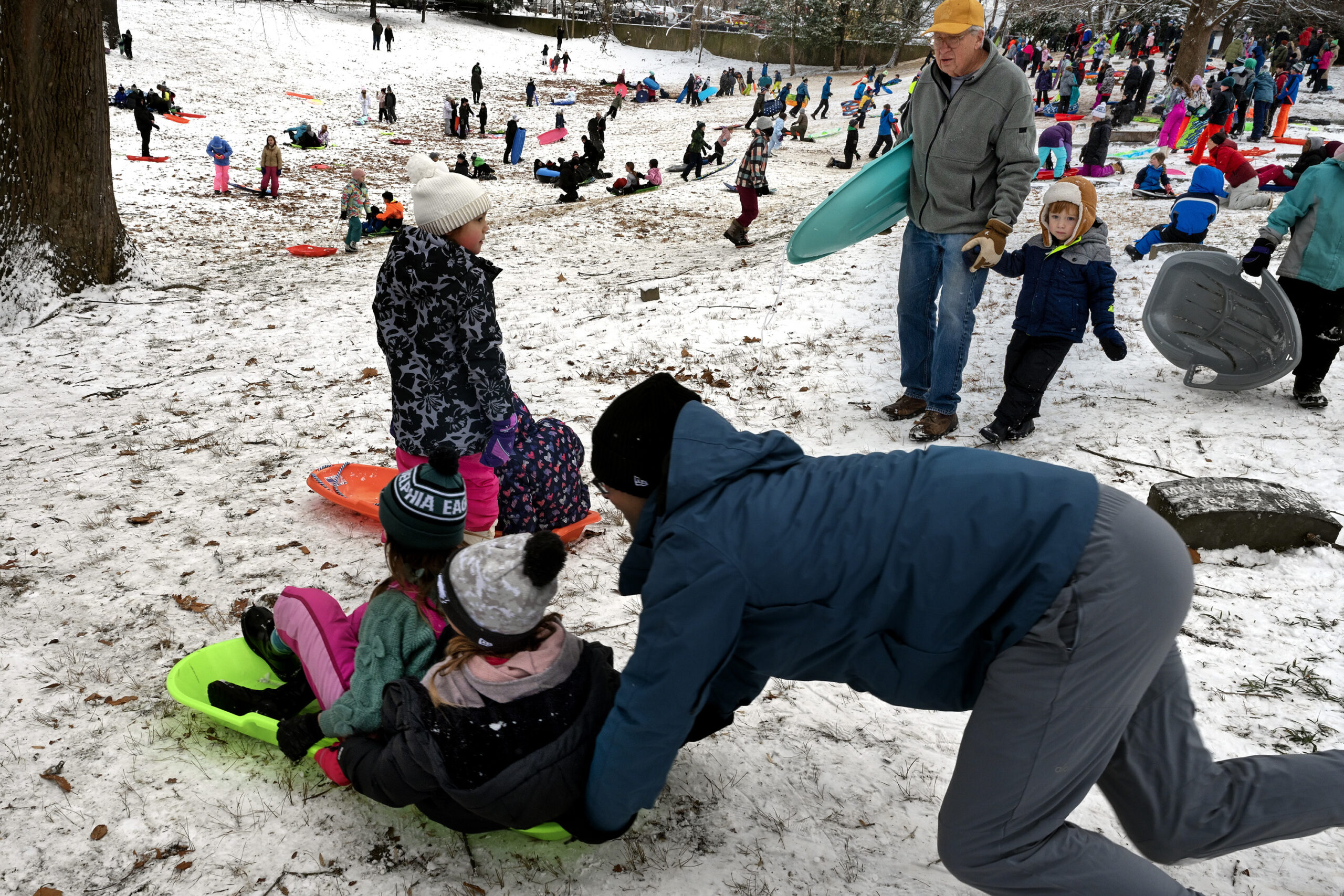
Doug Taylor (center) of Collingswood, sledding with his 3-1/2 year old grandson Will, waits for a space to open up on the crowded hill in the Haddonfield Friends Meeting cemetery on Jan. 6, 2025. “This is the best day ever!” said Will, about his first real experience with snow.
Snow is beautiful. Everything else about it is not: A for the initial excitement and beauty, F for the cleanup
The snow itself? Gorgeous. Magical. Instagrammable. The Wissahickon is about to look like a snow globe and for about 12 minutes, we will all pretend winter is charming.
The problem is everything that comes with it.
The grocery stores are already stripped bare like a snowstorm personally offended them. Bread is gone. Milk is gone. Eggs are gone. Somehow the rotisserie chickens are gone. People who have never once made French toast are suddenly preparing for a weeklong siege.
Then there’s the shoveling. The bending. The freezing. The part where you convince yourself it won’t be that bad and then immediately regret every life choice once your boots hit the sidewalk. And that’s before you remember some forecasts are floating numbers as high as 17 inches.
Group chats will fill with radar screenshots and passive-aggressive optimism. “Let’s see how it looks Sunday morning,” someone will say, knowing full well no one is leaving the house.
And yes, we’re all rooting for the plows. We always do. We say their names like prayers. We lower our expectations just enough to avoid heartbreak, but not enough to stop hoping.
An F because while snow may be pretty, it is also disruptive, exhausting, and a logistical nightmare that turns adults into meteorologists and grocery shoppers into survivalists. Enjoy the view. Then grab a shovel.
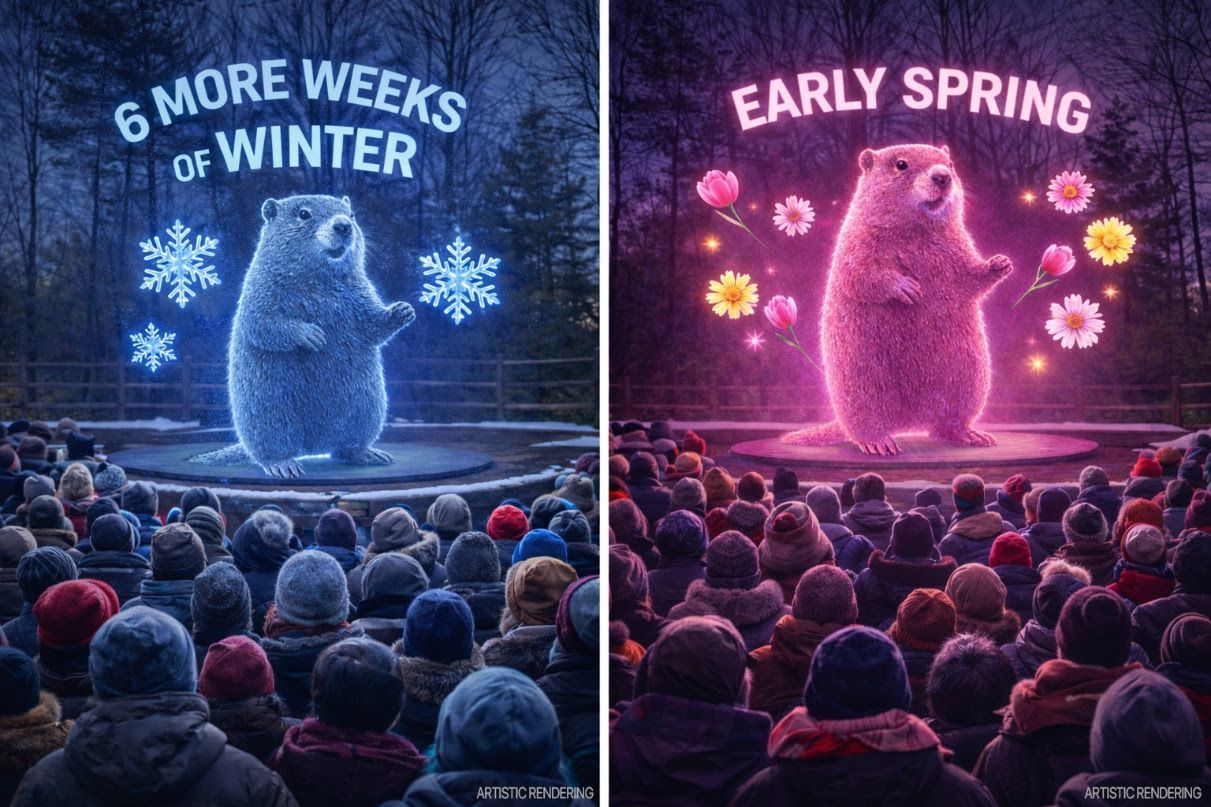
An artistic rendering of the hologram PETA is offering to replace Punxsutawney Phil.
PETA wants Punxsutawney Phil replaced with a hologram. Pennsylvania says absolutely not: A
Every January, right on schedule, PETA shows up with a new proposal to fix Groundhog Day. And every January, Pennsylvania responds with the same energy it reserves for people who suggest putting ketchup on a cheesesteak.
This year’s idea: Retire Punxsutawney Phil to a sanctuary and replace him with a massive, color-changing 3D hologram. A digital marmot. A Bluetooth rodent. Phil, but make it Coachella.
The problem isn’t animal welfare — it’s that Groundhog Day is not a TED Talk. It’s a pre-dawn ritual involving cold fingers, bad coffee, and a collective agreement to believe in something deeply unserious. Turning Phil into a hologram misses the point entirely. If people wanted a clean, efficient, high-tech weather forecast, they would simply look at their phones and go back to bed.
The most Pennsylvania response came from Josh Shapiro, who posted a photo of Phil with “DON’T TREAD ON ME,” effectively summarizing the state constitution in four words. This is not a debate about projections versus puppets. It’s about tradition versus disruption, and Pennsylvania will pick tradition every time, even when it makes no sense.
Phillies pitcher Ranger Suárez throws during the third inning of Game 3 of baseball’s NLDS against the Los Angeles Dodgers Wednesday, Oct. 8, 2025, in Los Angeles.
Wait, we loved Ranger Suárez. How did we get his name wrong?: C
This one landed like finding out you’ve been calling a close friend by the wrong nickname for years… not out of malice, just momentum.
Because Philly didn’t just like Ranger Suárez. Philly loved him. He was homegrown. Trusted. October-tested. His walk-up song was literally “Mr. Rager.” We chanted it. We printed it. We built a whole vibe around it. And somehow, in all that time, nobody stopped to say, “Hey, by the way, is this right?”
The funny part is that this revelation didn’t come with tension or correction. It came with grace. Of course it did. Suárez wasn’t scolding anyone. He wasn’t reclaiming anything. He was just explaining, gently, to a new city, while reassuring the old one that we didn’t need to panic.
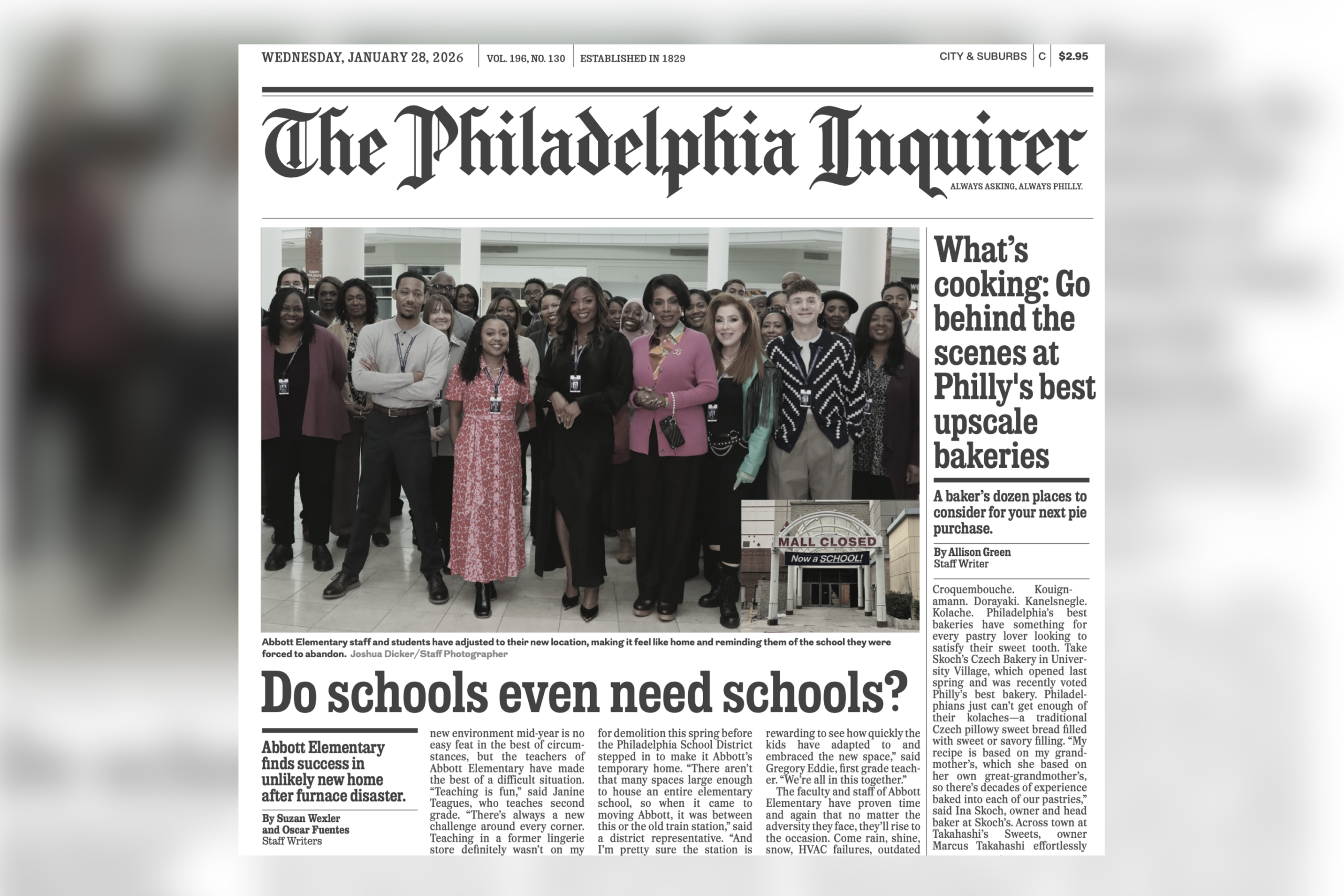
A mock front page of the Philadelphia Inquirer as seen in Season 5 of “Abbott Elementary.”
‘Abbott Elementary’ puts The Inquirer on the front page and nails the vibe: A
This could’ve gone sideways fast. A fictional front page cameo is exactly the kind of thing that can feel smug, indulgent, or weirdly self-important.
In this week’s episode, the paper shows up to cover Abbott’s unexpected success while the school operates out of an abandoned mall. The headline is glowing. The teachers react. Janine beams. Melissa checks whether her quote made it in. Barbara does a victory lap. And then, crucially, the moment passes.
Because in Philly, a front page is not the finish line. It’s a moment.
The district still drags its feet. The construction crew gets reassigned. The attention becomes something administrators can point to instead of acting on. That’s the joke, and it’s a sharp one. Abbott understands that recognition often arrives right before progress stalls, not when it accelerates.
The Four Seasons drops a $25,000-a-night penthouse and Philly blinks twice: B-
Look, nobody is confused about who this is for. It’s still jarring to see the number written down.
For that price, you get 4,000 square feet, sweeping views, curated art, wellness rooms, and menus tied to Vernick Fish and Jean-Georges. Luxury, in other words, is being taken extremely seriously.
And to be fair, this makes sense on paper. Philly is bracing for a monster tourism year with the World Cup, the Semiquincentennial, and a calendar stuffed to the margins. High-end visitors are coming, and the city would like to make sure they don’t stay in New York and commute down like it’s a day trip.
Still, there’s something very Philly about the collective reaction here, which is less awe than quiet disbelief. Not outrage. Not moral panic. Just a pause, followed by: Who is actually booking this?
Because this is a city where luxury tends to coexist awkwardly with reality. A $25,000-a-night penthouse sits a few blocks from potholes, delayed trains, and a whole lot of people who are very proud of finding a good deal.
Maria Cozamanis and Romina Ustayev in episode 101 of “Members Only: Palm Beach.”
Philly somehow gets dragged into a Palm Beach reality show: D
This isn’t fun, campy reality TV. It’s stiff, glossy, and deeply invested in rules that feel made up for the sole purpose of excluding someone. The clothes are loud, the behavior is small, and the hierarchy is treated like gospel. Everyone is performing wealth as if it’s a full-time job, and no one seems to be enjoying it.
Set in the orbit of Mar-a-Lago, the show mistakes proximity to power for personality. Conversations revolve around who belongs where, how to dress “properly,” and which customs are acceptable. It’s uncomfortable in a way that feels less accidental than the show probably intends.
The Philly connection only adds to the weirdness. Aside from one recognizable name, these aren’t women who reflect anything most people here recognize as Philly culture. They don’t feel local. They feel imported, like a version of “high society” that got lost on the way to a country club and wandered onto Netflix instead.
And yet, it’s weirdly watchable. Not because it’s good, but because it’s baffling. The kind of show you finish not feeling entertained, just slightly grimy and confused about how this became the vibe.
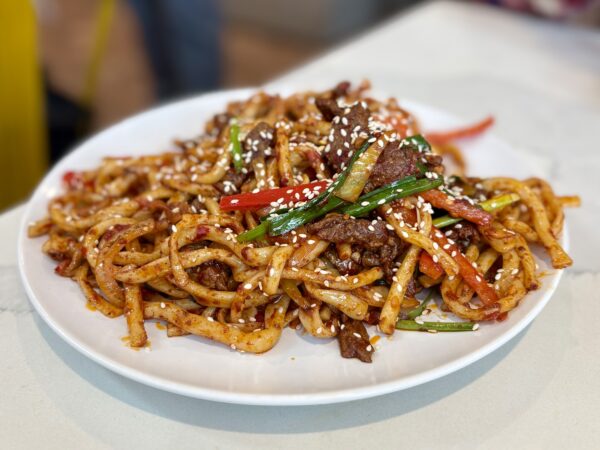
I’ve been following the lagman trail for some time now, savoring these chewy, hand-pulled Central Asian noodles from the Uzbek soup bowls of Northeast Philadelphia. Try them at Uzbekistan Restaurant, or in chef Temir Satybaldiev’s stir-fried tribute to his Kyrgyzstani grandmother on the Slavic fusion menu at Ginger. Now, another version of lagman noodles — traditional to the Uyghur ethnic minority in Western China — has landed in University City with Uyghur Noodle King.
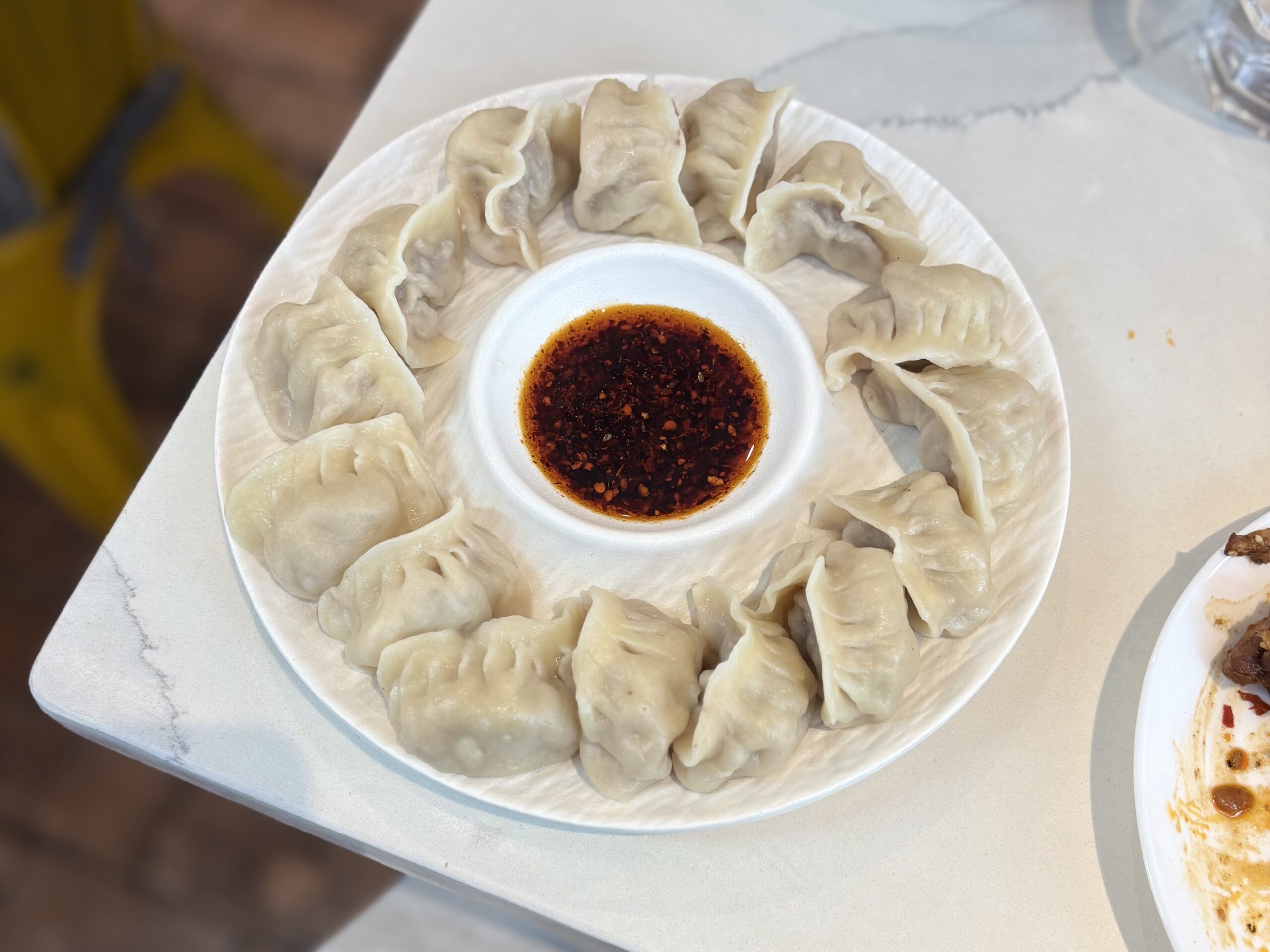
Located in an airy glass box of a space next to Paris Baguette near 38th and Chestnut, this is the first restaurant for co-owners Husenjan “Yush” Damolla and Abdurahman Tawakul. Damolla came to Drexel to study finance 13 years ago and ultimately stayed, working in real estate before finally turning this November to his passion for the food of his hometown, Kashgar, China. The all-halal recipes come from Damolla’s cousin, Mirkamil Rozi, who has a restaurant in Australia and has been training the duo remotely through Zoom sessions between their kitchens. So far, it’s paid off nicely with a tight but tasty menu of flaky samsa turnovers, fragrant kebabs, “big plate chicken” stews laced with numbing Szechuan peppercorn spice, and excellent handmade dumplings stuffed with lamb.
Handmade dumplings stuffed with halal lamb are a highlight at Uyghur Noodle King in University City.
The lagman, though, are the main event, with twine-like noodles that have the kind of elastic snap that can only be achieved through hand-pulling — a vigorous game of cat’s cradle that transforms a single lump of dough into a fistful of 30 or so longer strands. The final dish tosses those noodles into a hot wok with morsels of bell pepper, ginger, chives, and a dried pepper paste that combines with vinegar and soy to create a zesty glaze that glows with tang and spice. Damolla concedes they’re still working on consistency, but relies daily on his cousin’s best advice: “Just follow your heart and imagine you’re cooking for the people back home.” Uyghur Noodle King, 3816 Chestnut St., 347-507-8788, instagram.com/uyghur_noodle_king
— Craig LaBan
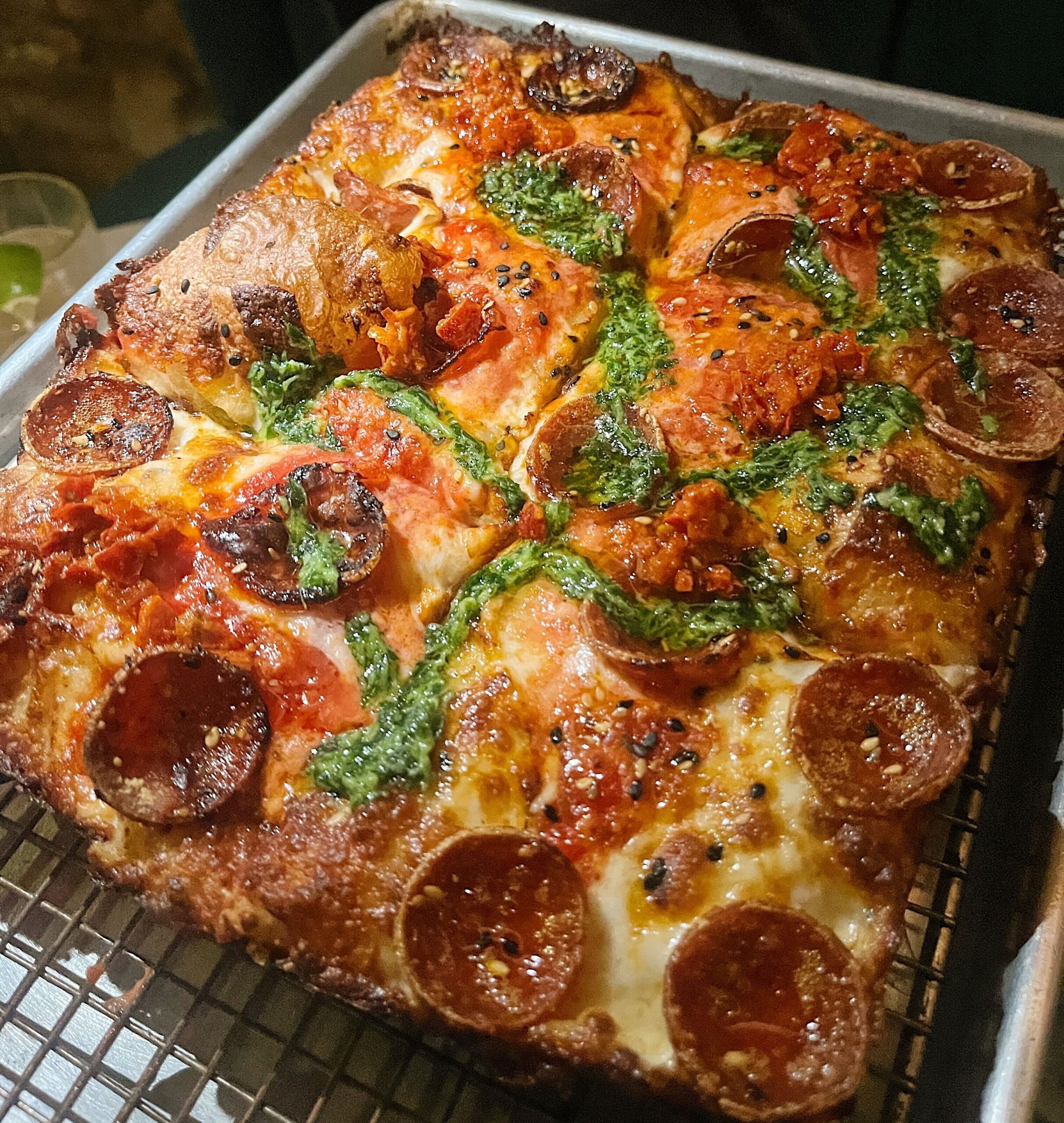
The MVP (VIP style) pizza from Emmy Squared in Queen Village.
The MVP (VIP style) from Emmy Squared
As an ex-New Yorker, it’s my birthright to hate Detroit-style pizza. At its worst, it’s just soggy-yet-burnt bread that lacks the je ne sais quois of a good tomato slice. But at Emmy Squared — Detroit pizza by way of two New York City hot shots who can’t stop opening satellite locations — the square pies rank among the best non-traditional pizza in the city.
Emmy Squared’s MVP pie is composed of ingredients that border on sacrilegious: a Wisconsin cheese blend, a mix of vodka and red sauce swirled with parsley pesto, and a sesame seed crust with an almost focaccia-style crumb. A VIP version is topped with Calabrian chilies and pepperoni slices so crispy the edges fold up to form tiny cups. The result is a flavor combo that hits all the right notes: a little bit of tang, a touch of spice, and an herbaceous finish from the pesto. Good pizza, after all, really is just excellent bread slathered with sauce and cheese. So if the elements are all there, who cares if the form is a little off? 632 S. 5th St., 267-551-3669, emmysquaredpizza.com
How transformative can a piece of bread be? Turns out, very. Especially if you’re able to keep it perfectly crunchy (almost funnel-cakelike), douse it in a bath of decadent caramel, then top it off with a perfect dollop of vanilla ice cream.
I give you Meetinghouse’s caramel toast, an item on the Kensington restaurant‘s menu I would have never thought to order had it not been highly recommended to me by a friend (or two, actually). I’ll truly be dreaming of it for some time to come. Well, that, and Meetinghouse’s green salad — it could double as a wedding centerpiece — and a crab dip that would make any Marylander proud. Meetinghouse, 2331 E. Cumberland St., meetinghousebeer.com
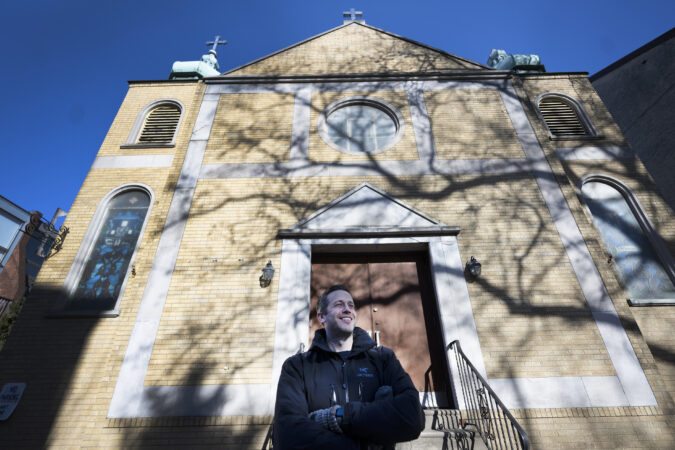
The buyers: Carrita Thomas, 33, nonprofit program evaluator; Jake Stein, 42, CEO of a tech start-up
The house: A 6,775-square-foot church in Society Hill built in 1920
The price: Listed for $2.5 million, purchased for $2.5 million
The agent: Kate McCann, Elfant Wissahickon Realtors
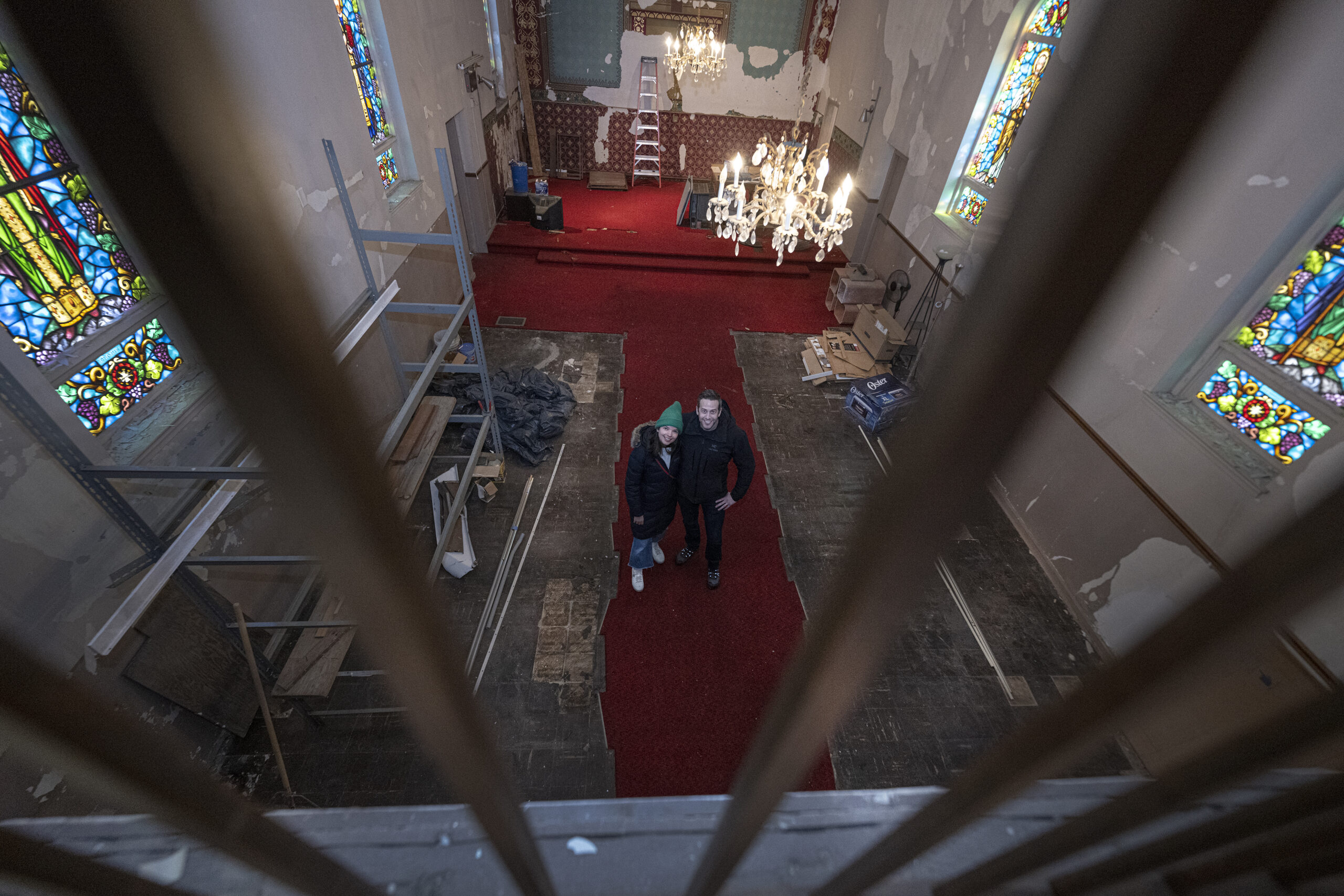
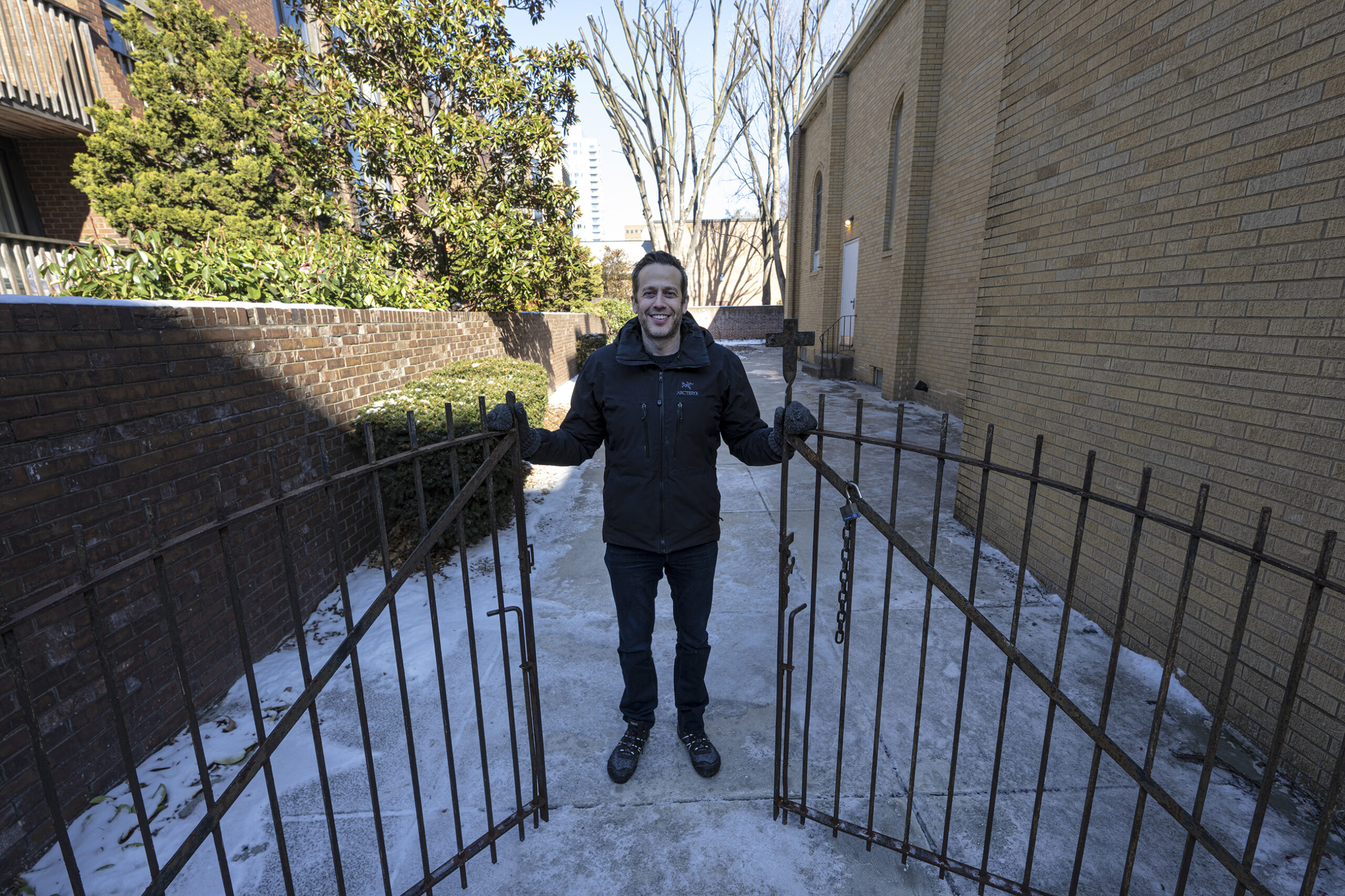
Carrita Thomas and Jake Stein on the main floor of their newly purchased church in Society Hill.
The ask: Carrita Thomas and Jake Stein moved to Society Hill in 2021 and immediately fell in love. They grew even more attached after having their first child. They loved the abundance of playgrounds and parking. But most of all, they appreciated how the area functioned as a village. “We have a great community of friends,” Thomas said. “We are very close with our neighbors.”
But when they found out that Thomas was pregnant with twins, their rowhouse, which once felt generous, suddenly seemed cramped. They needed more space fast but didn’t want to leave the neighborhood. They also wanted on-site parking and outdoor space for Thomas to garden. Plus they needed at least six bedrooms. The couple knew they were in for a difficult search.
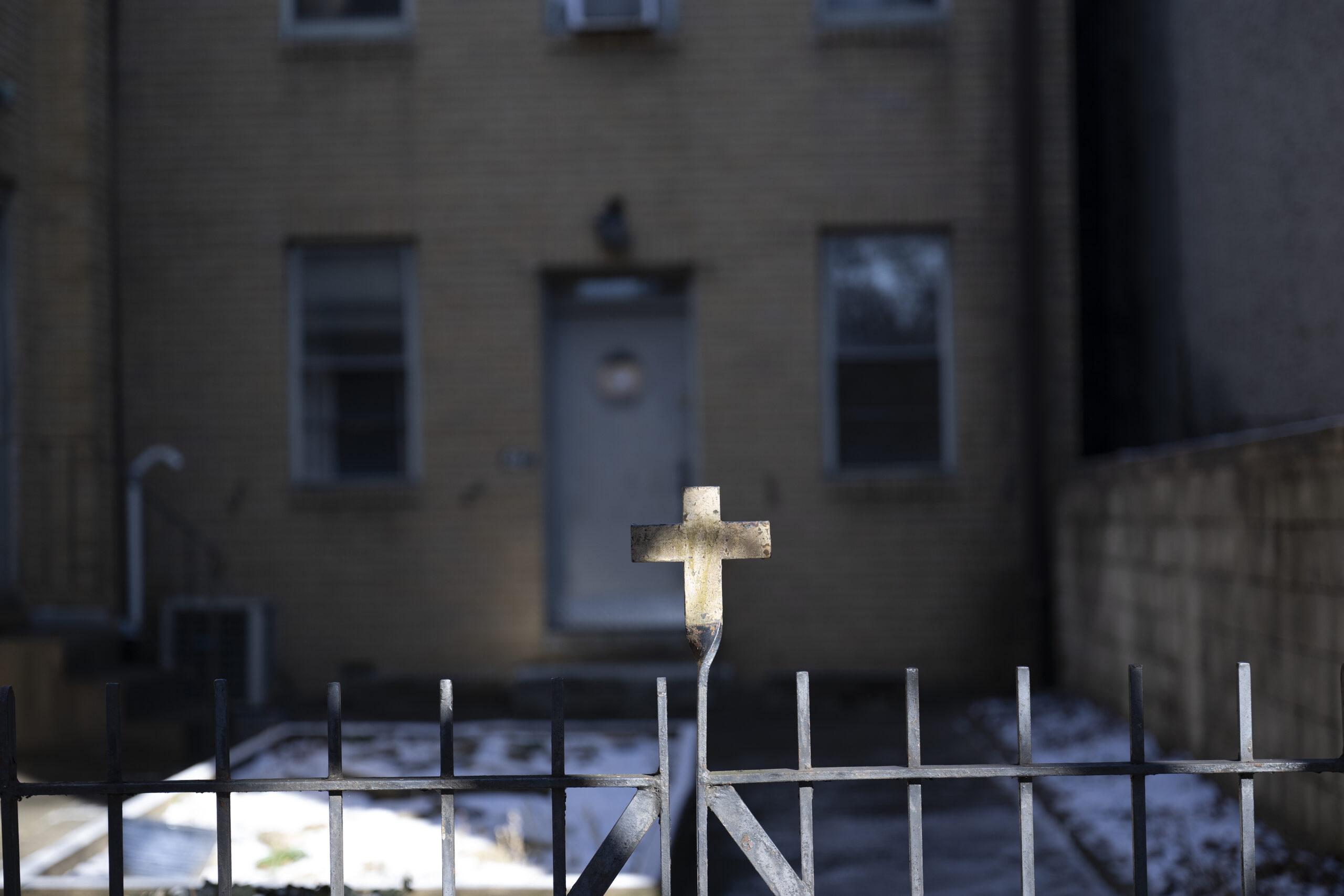
One of the church’s courtyards with plant beds where Thomas and her daughter recently planted bulbs with friends.
The search: The market moved fast for houses that met their criteria. More than once, they scheduled showings for houses already under contract. Once, they scheduled a showing three days after a house came on the market, only to have the agent cancel because it had already sold. After several misses, they decided to reassess their options, including renovation. “We had not been interested in it before because we’d only heard negative stories,” Thomas said.
Around the same time, Stein noticed a sale sign on a vacant church two blocks from theirhome. It had been unused for decades, its landscaping overgrown, its windows dark. “I always thought it was so cool and interesting,” Stein said. “And what a waste.”
That discovery shifted their search. Instead of continuing to hunt for the impossible-to-find, perfect rowhouse, the couple began to consider the most glaring fixer-upper in the neighborhood.
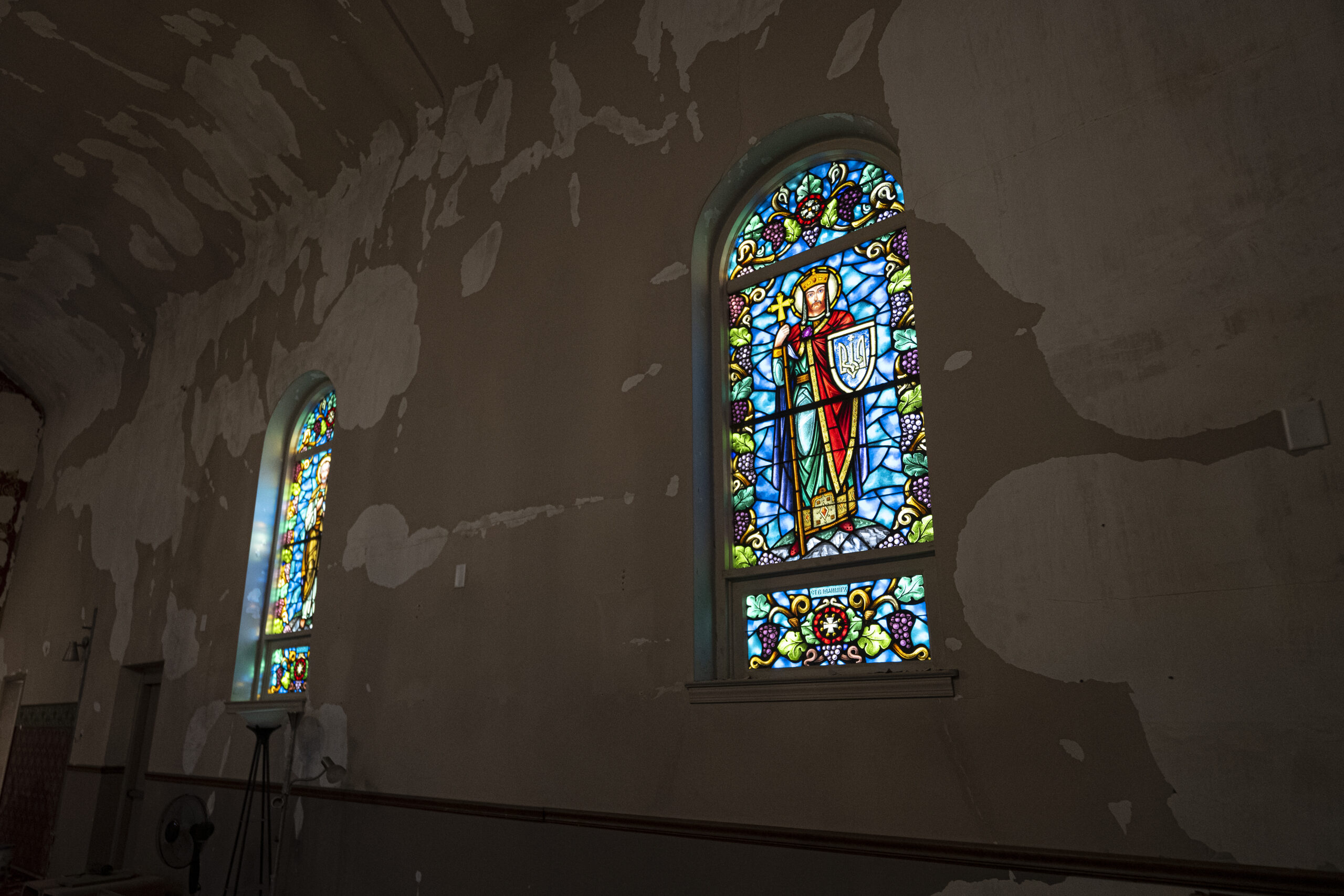
The couple fell in love with the church’s raw materials, like the stained glass windows lining its walls.
The appeal: Thomas was initiallyskeptical. Every church conversion she had seen leaned toward a loft-style layout, and she didn’t want to live in an open, cavernous space. But walking through the property with an architect helped her picture more-private floor plans.
One of the church’s main selling points was its driveway and ample parking space.
Inside, the building was structurally sound and full of “high-quality raw material,” said Thomas. But what really sold them was the “insane amount of outdoor space.”
To get a sense of renovation costs and trade-offs, the couple also consulted with someone who had previously run a design-build construction company. That process replaced vague anxiety about expenses with concrete ranges. “There are really expensive versions of renovations,” Stein said, “and there are much more reasonable versions.”
Understanding that they could “choose their own adventure” and “dial up or dial down the budget based on their design decisions” made the renovation seem actually doable, if not meaningful.
Thomas appreciated that the church had once been a place where people gathered. “One of our primary values is community,” she said. And the idea of restoring that function — even in a different form — felt really special to the couple. “It just adds so much richness to our lives,” she said.
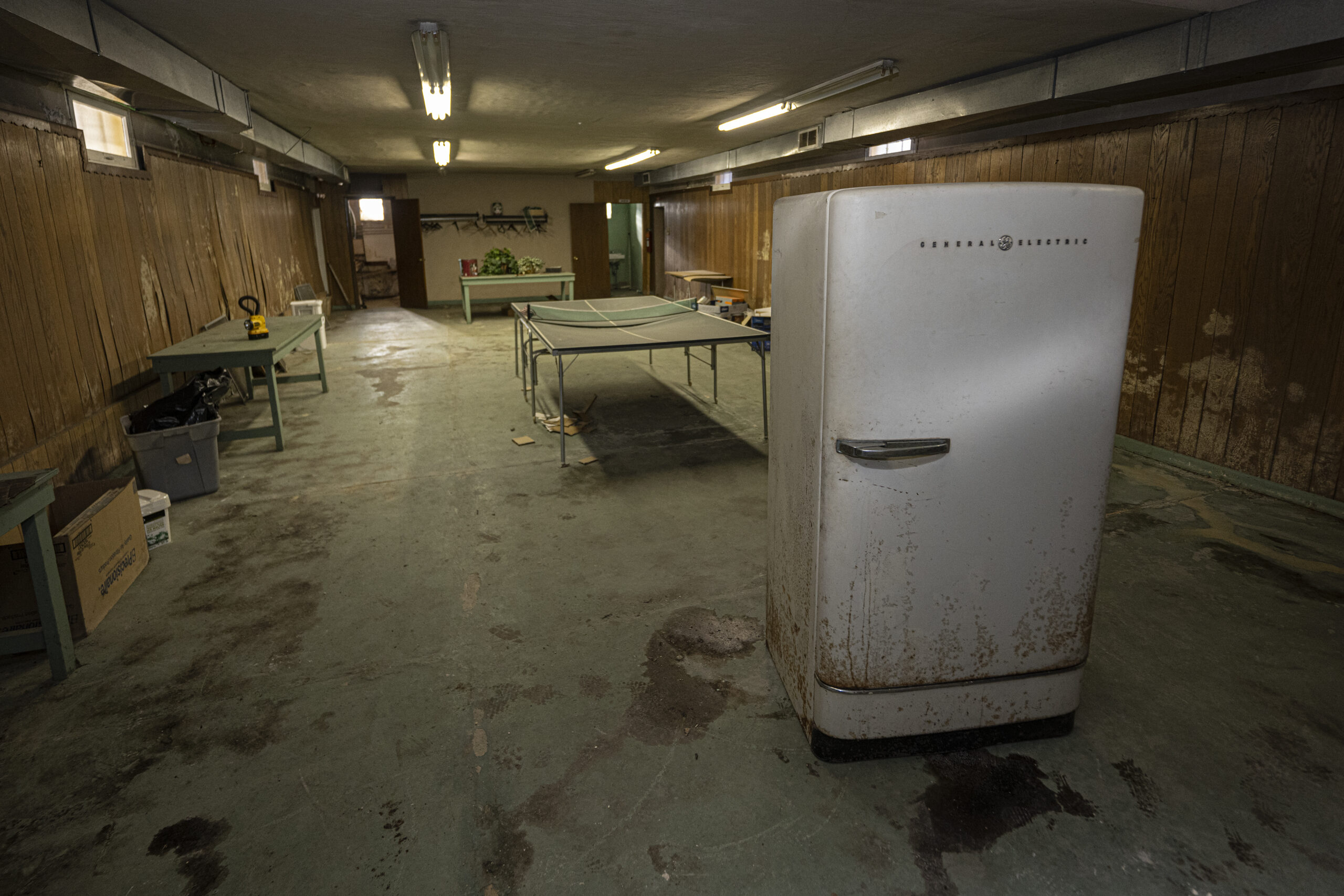
One of Stein’s favorite features of the church is the basement and the giant warped Ping-Pong table, on which he’s played multiple games.
The deal: Thomas and Steinknew that the terms would be largely out of their control. The seller, who lived out of state, had owned the building for decades and was not inclined to negotiate. She had rejected several offers over the years and did not advertise her property as being for sale online. Even getting the asking price took effort. Their agent had to follow up multiple times. The seller eventually told them it was $2.5 million. She had recently rejected an offer below the asking price without counteroffering, so the couple didn’t bother negotiating. “We know we would only get it if we met all of her terms,” Thomas said. They submitted a straightforward offer, including skipping the inspection, at the asking price, and the seller accepted.
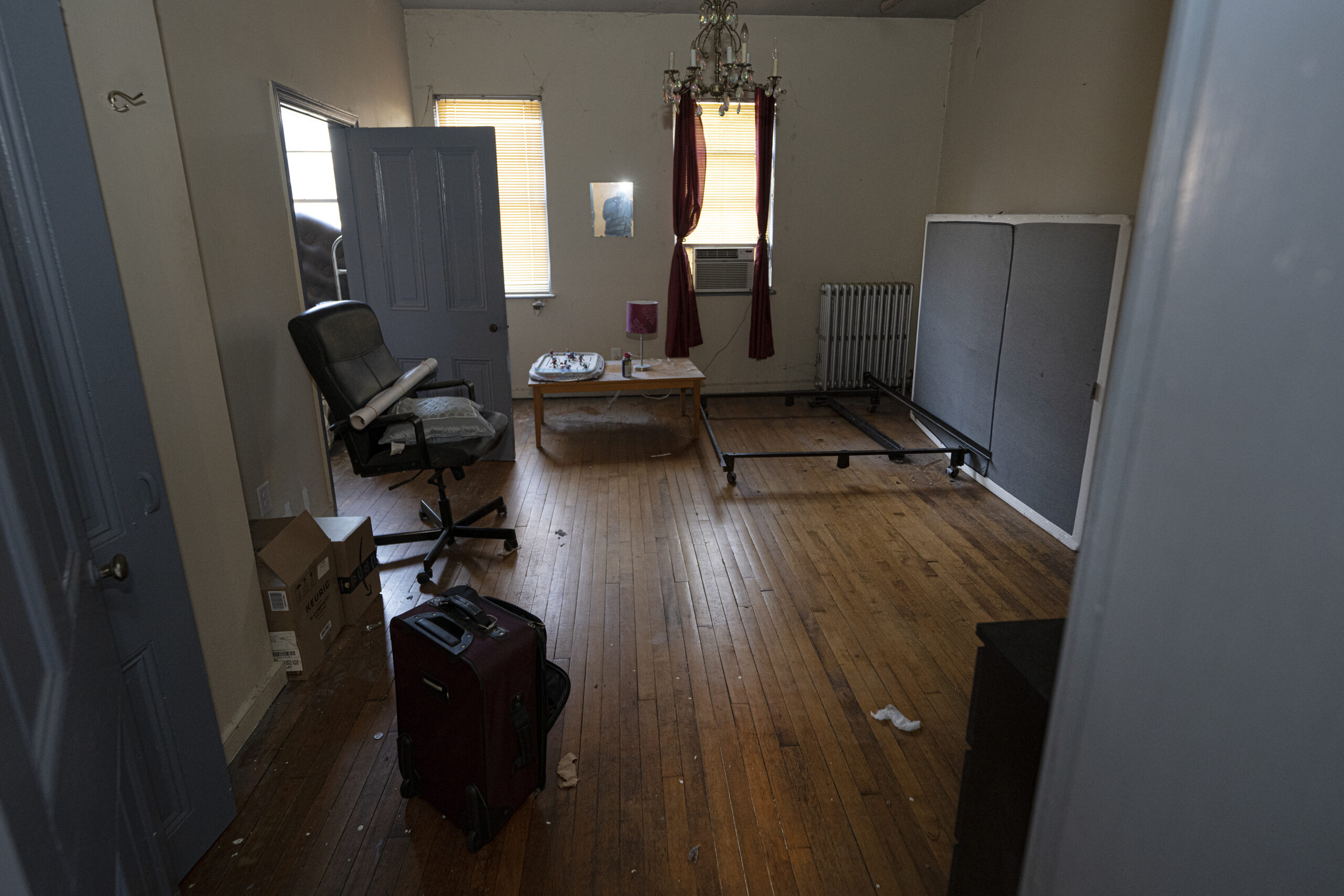
Interior views of the newly purchased church owned by Carrita Thomas and Jake Stein.
The money: Thomas and Stein put $2.5 million down in cash — the full cost of the property — the day they closed. They did not take out a mortgage. The funds came from the sale of Stein’s former software company, which he sold in 2018 for $60 million. Their renovation budget is still fluctuating.
The move: Thomas and Stein closed on the church at the end of September.
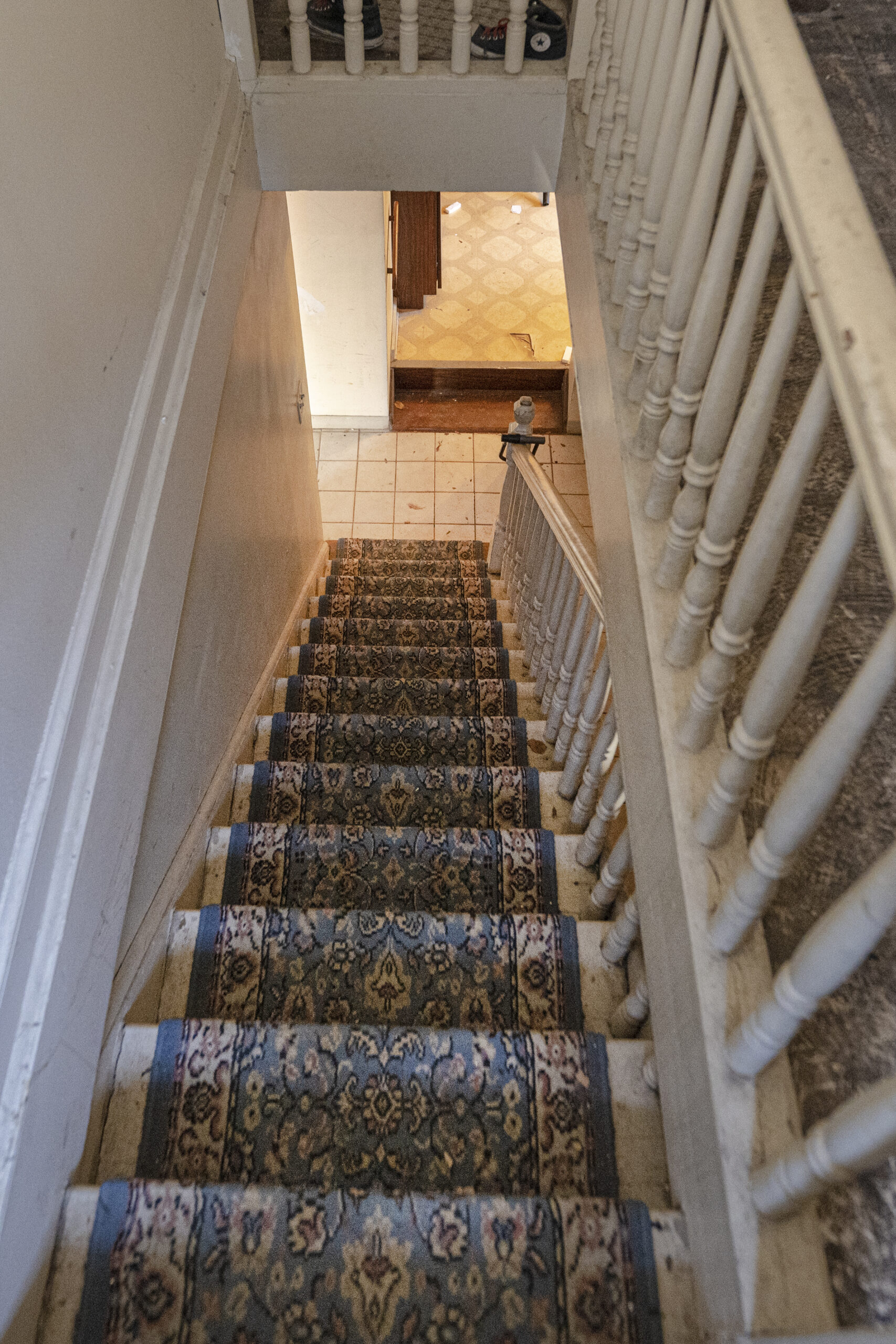
A view of the staircase in the rectory that is attached to the church.
They spent the past few months figuring out how to approach the renovation, talking with people who had done similar projects, and meeting with contractors. “It’s a slow process,” Thomas said, “but it’s a really important part of it.” Now, they are finalizing contracts with vendors. She expects the entire project to take about two years. Construction is still a ways away.
They are living in their Society Hill rowhouse for now, and it no longer feels too small. “We’re pretty comfortable,” Thomas said. “Something changed for me after I had the twins. I think both of our tolerance for chaos just went up a lot.”
Any reservations? The couple is happy with their purchase, even though there are still many unknowns. “A lot of careful planning needs to go into this,” Thomas said. “There are a lot of open questions still,” Stein added. They will have to knock down a few walls to figure out what is even possible. It will take at least 10 months to finalize the design. The couple is up for it. “It’s a cool project,” Thomas said.
Life after close: Even though the renovation hasn’t started, the building is already functioning as part of the neighborhood again. The couple hosted a Halloween party for their neighbors, and a few weeks later Thomas had her daughter’s friends over to plant bulbs.
We’ll show you a photo taken in the Philly-area, you drop a pin where you think it was taken. Closer to the location results in a better score. This week’s theme is all about snow! Good luck!
Round #17
Question 1
Where is this person waiting for the bus?
Loading…
ClickTap on map to guess the location in the photo
ClickTap again to change your guess and hit submit when you're happy
You will be scored at the end. The closer to the location the better the score
Heather Khalifa / Staff Photographer
Pretty good/Not bad/Way off! Your guess was from the location.Spot on! Your guess was exactly at the location. Here's also where a random selection of Inquirer readers guessed.
Pretty good/Not bad/Way off! Your guess was from the location.Spot on! Your guess was exactly at the location. Here's also where a random selection of Inquirer readers guessed.
This is the Independence Hall hole at the Philly Mini Golf course in Franklin Square Park. Until February 16, the entire course will be Winter themed with lights, seasonal music, and occasional inflatable snowman.
Quiz continues after ad
Question 3
Where are these folks shoveling?
Loading…
Tyger Williams / Staff Photographer
Pretty good/Not bad/Way off! Your guess was from the location.Spot on! Your guess was exactly at the location. Here's also where a random selection of Inquirer readers guessed.
Service workers at the Philadelphia Zoo are shoveling snow on a parking lot near the new “Pherris Wheel.” This new observation wheel that will remain through America’s 250th anniversary celebrations.
Your Score
ARank
Amazing work. A Winter wonderland of knowledge.
BRank
Good stuff. You’re a real snowman.
CRank
C is a passing grade, but you nearly slipped.
DRank
D isn’t great. That was an avalanche of bad answers.
FRank
We don’t want to say you failed, but you didn’t not fail.
You beat % of other Inquirer readers.
We’ll be back next Saturday for another round of Citywide Quest.
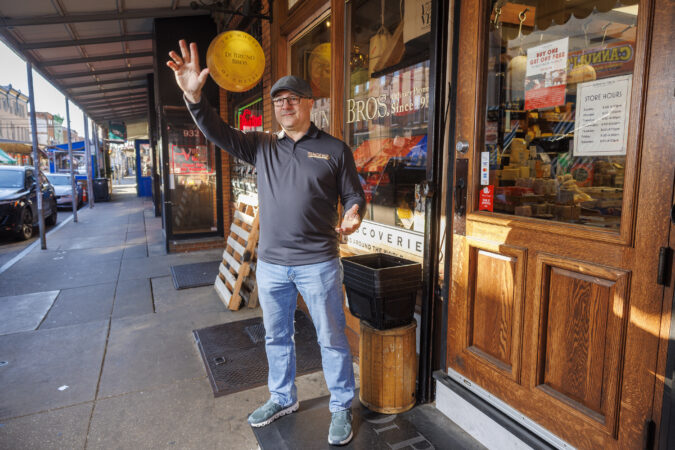
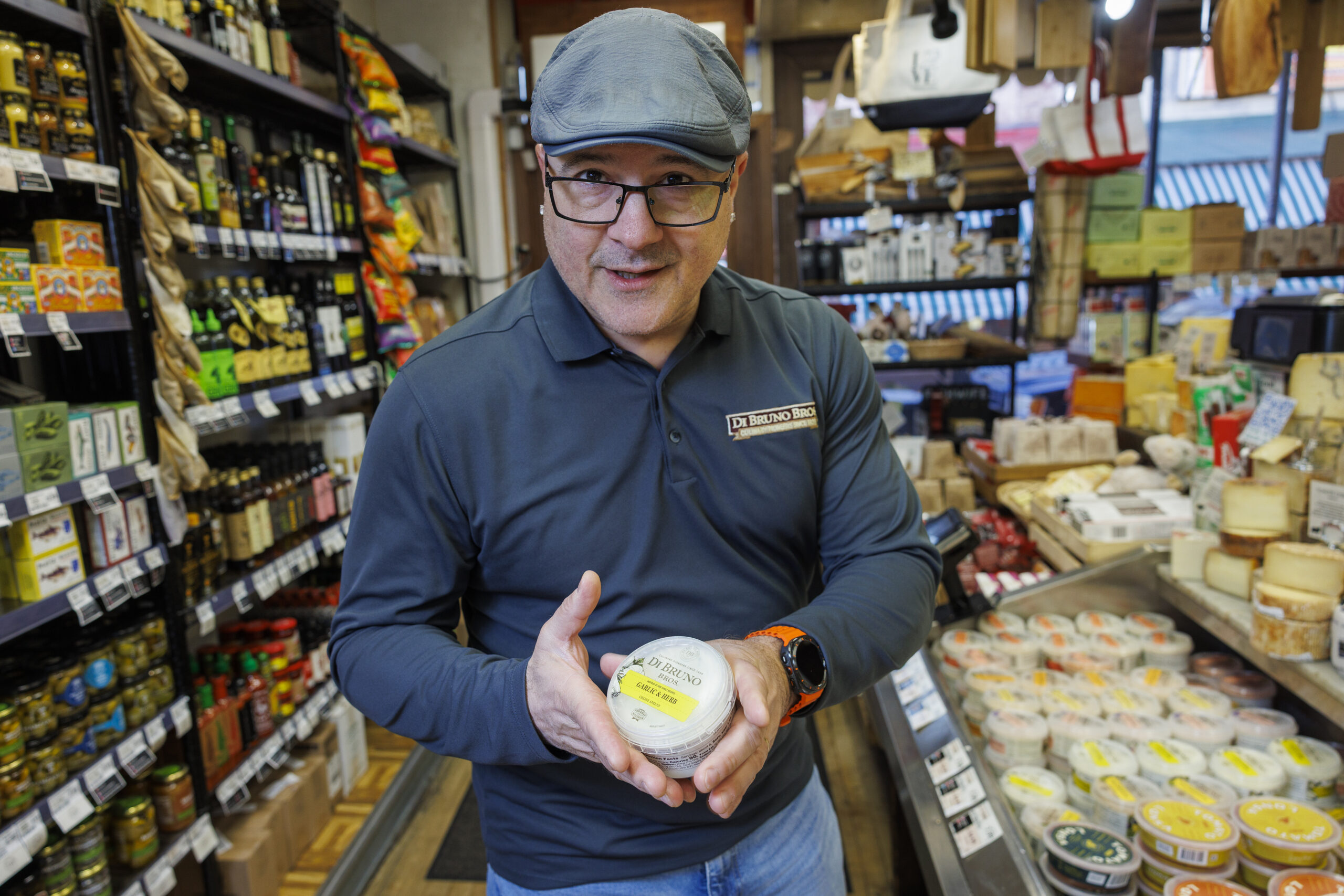
Emilio Mignucci’s name is synonymous with cheese in Philly. The third-generation Di Bruno Bros. owner-turned-vice president of the brand, now owned by Wakefern, lives in Center City but his heart is still in the Italian Market. The legendary importer and cheese connoisseur is also a sometime cheese tour guide, taking cheese-obsessed guests on culinary adventures in Europe with Cheese Journeys. But he’s just as passionate a guide in his hometown. Here are his favorite places to grab a bite on a perfect Friday in Philly.
Emilio Mignucci with a cheese spread he enjoys eating.
4:20 a.m.
My father trained me to get up this early from when I was very young. When I was a kid I used to work the produce stands in the Italian Market and we would start setting up at 4:30 or 5 a.m. I’ve always had that routine.
4:30 a.m.
Nowadays I head to the gym when I wake up. I get in a workout until about 5 or 6 a.m. and then do a five to 10 minute meditation, then practice my Italian on Duolingo, which I’ve been doing for a six-year streak.
6 a.m.
I split my week between Wakefern headquarters in Edison, N.J., and Philly. But I work from home on Mondays and Fridays, so for coffee I’ll walk over to La Jefa.
7 a.m.
I get a cappuccino with whole milk at La Jefa and a concha. They’re always filled with lavender or something cool. I also like their corn husk coffee, but if I’m getting that I skip the concha. And I love their pastrami lengua sandwich on days they do brunch, but I don’t normally eat breakfast.
7:30 a.m.
I walk to Di Brunos in Rittenhouse where I have an office. We just came out of the best season for cheese, which is fall into winter. I’ll taste cheeses with the team behind the counter, like Jasper Hill Farms’ Winnimere and Pleasant Ridge Reserve. They’re stinky and so darn good. I love Alpine-style cheeses.
Emilio Mignucci, DiBruno describes his perfect day, Friday, Jan. 16, 2025. Emilo grandson of the founders of DiBruno take a whiff of cheese.
Noon
I eat lunch around noon. If I stay in the store, I grab one of our seasonal salads, though I’m attracted to the pizzas. But the best lunch in Philly is John’s Roast Pork. There’s nothing better. I crave it. I dream about it. It’s the most succulent pork sandwich. The pork is cooked in its own juices and when you go up to the counter to order, it’s taken out of that hot pork broth. Then there’s sharp provolone and I love the bitter spinach and a single long hot pepper. I know everyone talks about cheesesteaks in this town and they’re great, but for me the best sandwich is the roast pork.
1 p.m.
I go back to work, finish up emails and meetings about product innovation and figuring out cures for the tariffs and increases in pricing because we import so much stuff.
3 p.m.
If people are visiting me, I love taking them to the Italian Market. It’s the oldest open air market in the country and it shows what Philly is all about. [Even though the immigrants have changed] it’s still a mix of really good hardworking people. When my aunts and uncles came over from Italy, they worked their tails off there. So I’ll stop for an espresso at Anthony’s for something traditional and Italian, chicory-flavored, and bitter. Then I’ll pick up stuff for my wife like fresh lettuces. She likes the sweeter ones like Bibb and romaine. I like the more bitter ones like arugula. I’ll also grab mushrooms, peppers, and onions. My wife always makes me roasted peppers.
5 p.m.
I try to sneak into Fiorella when they first open, but I also love Blue Corn. If it’s Fiorella, I try to go with three other people so we can get the whole menu and all the pastas. The pasta for me is second to none. It’s spectacularly delicate, very well made, and not overly filling. Then I have to get something sweet. Isgro’s was open late over the holidays and I have to get their ricotta cookies. A dozen of those is what my wife will get me instead of a birthday cake.
8 p.m.
There are so many good bars in Philly but a.bar is my corner bar. My wife and I go two or three times a week. I like Negronis or I’ll get a Vesper. Nothing is more perfect than a Vesper.
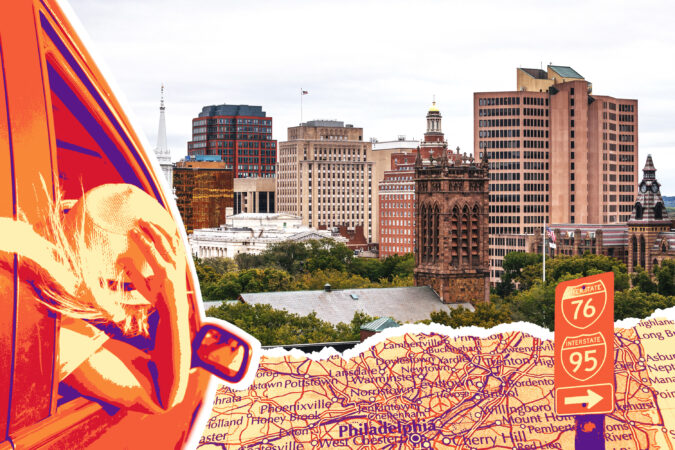
With a population of just over 140,000, New Haven still manages to be tiny Connecticut’s third-largest city — and one that punches well above its weight as a weekend getaway.
It’s a university town, a harbor town, and a New England town, all folded into one. The result is a destination with world-class cultural institutions, excellent food — the pizza is as outrageous as you’ve heard — and easy access to the outdoors, from the river-fed coast of Long Island Sound to one of the largest urban parks in the region. From Philly, it’s about three hours and change up I-95, depending on traffic around New York. Start the car.
Originally the HQ of the tire-producing Armstrong Rubber Co., the Wharf District Hotel Marcel inhabits an architecturally significant, brutalist concrete building honeycombed with windows and retrofitted to run entirely on renewable energy. The inside is just as interesting: terrazzo staircases with mahogany rails, Connecticut-made walnut beds, and a circular bar pouring spirulina margaritas and nonalcoholic spiced cranberry cider.
📍 500 Sargent Dr., New Haven, Conn. 06511
Hike: East Rock Park
New Haven’s central green space, East Rock Park, spans 427 acres and rises 350 feet above the city, rewarding visitors with sweeping views of downtown and Long Island Sound. Not feeling a winter hike? You can drive to the summit instead. Traveling with kids? Stop by the Trowbridge Environmental Center on the park’s west side for hands-on exhibits about the local ecology.
If there’s only one thing you know about New Haven, it’s probably the pizza. Or as they call it here, apizza (“a-beetz”), derived from the southern Italian immigrants that opened the first shops in the early 1900s.
For lunch, stage a mini pie crawl along Wooster Street and compare two legends located a block apart. At Frank Pepe (est. 1925), the tomato pie and oregano-dusted white clam pie are classics for a reason. At Sally’s Apizza (1938), whose recent expansion hasn’t dimmed the original’s quality, the blistered tomato pie with mozzarella is the move.
📍 Frank Pepe: 157 Wooster St., New Haven, Conn. 06511
📍 Sally’s Apizza: 237 Wooster St., New Haven, Conn. 06511
Visit: Yale Peabody Museum
If there are only two things you know about New Haven, they’re probably the pizza and Yale. The Ivy’s lovely, leafy campus dominates the center of town. (It’s no Penn, but…) The impressive collection at the Yale Peabody Museum, which is free to visit and requires no advance ticketing, includes a towering brontosaurus skeleton, a 300-pound Brazilian tourmaline cluster, and 4000-year-old Mesopotamian cuneiform tablets.
Decried as an incongruous eyesore when the Gordon Bunshaft-designed Beinecke Rare Book and Manuscript Library opened in 1963, the modernist building has become an architectural icon on campus. Translucent marble cladding gives the interior a cozy glow while protecting the literary treasures, which are arranged in a stunning five-story cubic column, from sun damage. Even if you’re not a rare-books obsessive, it’s worth visiting for the space alone. Current exhibits include a 15th-century Gutenberg Bible and illustrated Japanese crepe-paper books.
It’ll likely be a bit too chilly to sit out on the pretty deck over the Quinnipiac River, but the warm woodwork and porthole windows get the seafood-tavern vibe across well at Fair Haven Oyster Co. Start with four different types of New England oysters, then progress to tots topped with American sturgeon caviar, oil-poached tuna toast, and bone-in skate wing in Meyer lemon brown butter. Skip dessert.
Based in Litchfield County, Arethusa Farm Dairy produces some of the richest ice cream around, using 16%-butterfat milk from its own cows. Lucky for New Haven visitors, there’s an outpost at the Yale Shops. Breathe in the smell of freshly pressed waffle cones while choosing from classic flavors like coconut-coconut chunk, strawberry that actually tastes like strawberries, and an excellent coffee ice cream. One scoop is never enough.
The long-lost demo tape had always held a certain mythos in Charlotte Astor’s imagination.
For years, the Cherry Hill teen had heard stories about it, recorded about 30 years ago by her mother’s very loud, very short-lived, teenage hardcore band, Seed.
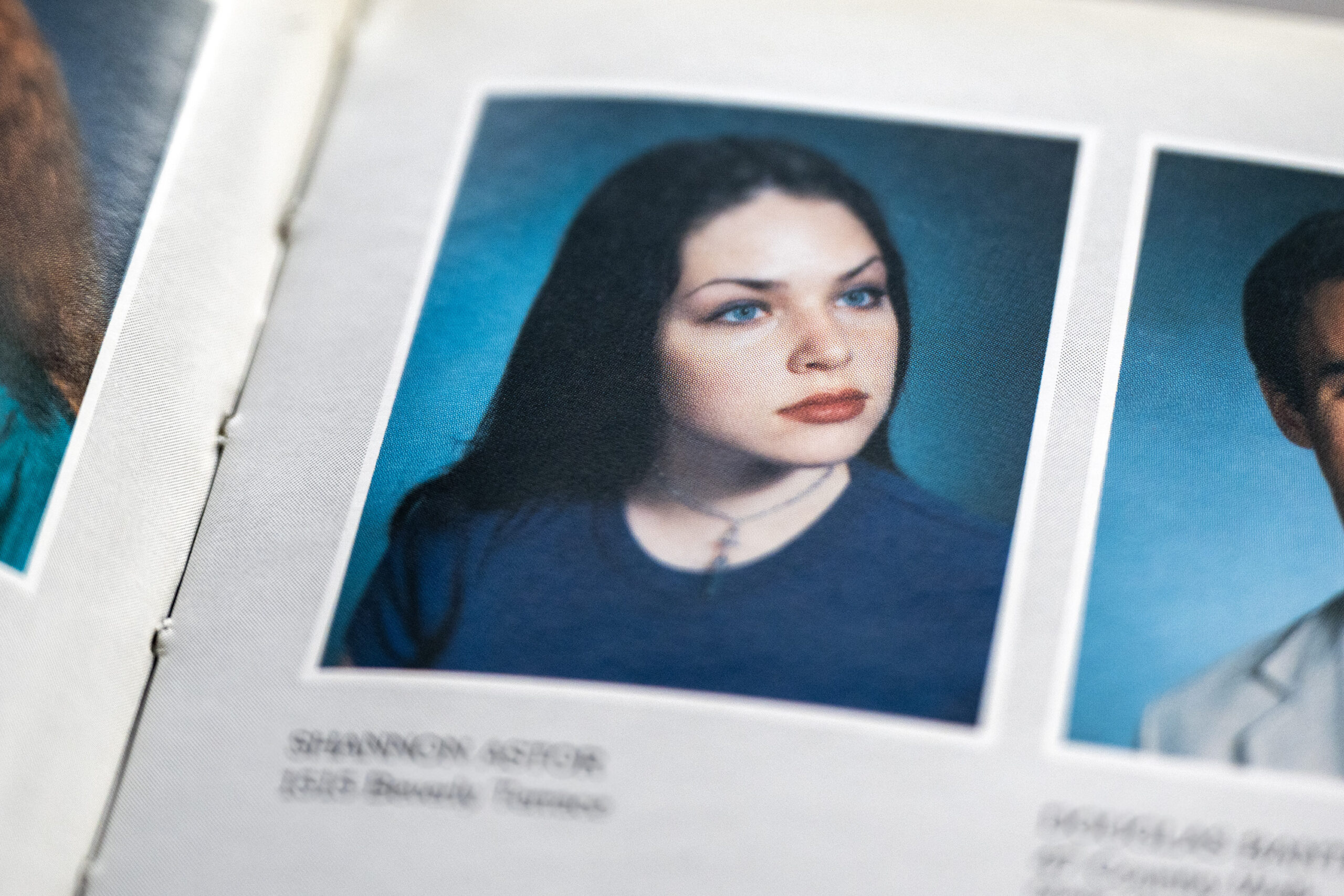
Shannon Astor, now 47, had been a vocalist for the group, just 14 or 15 years old, at a time when female representation within the genre was rare. Within a year or so, the group had disbanded — but before it did, the group, which typically practiced in a member’s parents’ basement, recorded a single demo. There had been only a few dozen copies produced back then, and they had all sold, scattering out around the South Jersey area.
For Charlotte, the tape became a kind of white whale — a relic of her mother’s hard-charging past, something the teen occasionally scoured the web for, to no avail.
She’d never heard her mother’s band. And she wanted to. Badly.
“Ninety-five percent of what I have about my mother is in the stories she tells me,” says Charlotte, 16, a junior at Cherry Hill High School East.
But a demo was something tangible. Something concrete.
“A demo,” she decided, “I can find.”
And so one night last spring, that’s what she set out to do.
She had little to go on: A rough estimate of when the demo would have been released (1993-94), a general geographic location (South Jersey), and a single lyric (“In the wind of the AM shadows cling to nearby trees as season shifts to satisfy the light from above”).
“I have been looking for this tape for 4 years,” she wrote in an appeal to her 1,000 or so Instagram followers, “… and it would mean the absolute world to me to find this tape.”
Butsomething about her search — this desire to connect with a parent, to bridge a gap three decades wide — resonated. It became, within the tight-knit confines of the hardcore music scene, a united pursuit.
At an age when most teenagers couldn’t get far enough away from their parents, here was one launching a quixotic quest to better understand hers.
A senior class photo of Shannon Astor in the 1996 Cherry Hill High School East yearbook. Now 47, Shannon was previously in a hardcore band called Seed.
Soon, strangers from across the country were digging through old boxes in basements, or tagging old running buddies from Jersey’s 1990s hardcore scene in social media posts. Some reached out to old producers from the area, wondering whether the demo might have made its way into some dusty studio corner.
Messages poured in, too — hundreds of them — with suggestions ranging from the plausible to the outlandish. Had she tried getting in touch with Bruce Springsteen’s people? You never know what the Boss might have stowed away in some mansion closet.
“I suddenly had communication with so many people who I thought I would never in my life have any connection with,” Charlotte said. “California to Jersey, and everything in between.”
The lead singer of a well-known Jersey straight-edge band of the era, Mouthpiece, joined the search, messaging Charlotte after others reached out to him about the tape. (He vaguely remembered her mother, Shannon, but not the band.)
Much of the outside help, Charlotte notes, has come from the hardcore community.
Indeed, much of Charlotte’s young life is rooted in the same hardcore music scene that her mother’s once was. Like Shannon before her, Charlotte spends many nights at hardcore shows around the area, photographing the scene for the magazine she self-publishes, “Through Our Eyes.” And like her mother previously, she’s a member of the “straight-edge” hardcore community, a group with a shared collection of ideals that includes abstaining from drinking or drugs. (Her first flirtation with teenage rebellion came when she snuck out of the house one night to go to her favorite record store.)
And though her mother does not necessarily share Charlotte’s zeal for locating the old tape — “I’m not waiting for some garage band demo to be unearthed,” Shannon joked — she understands what it would mean to her daughter to have it.
“It’s special to me only because of how much she needed to hear it,” said Shannon. “I’m just so pro-Charli and everything that she does … But this is her journey, and something that was intrinsically important to her.”
To those in the scene, meanwhile, the response has been very hardcore.
“A bunch of people banding together to help this random girl find her mom’s thing,” said Quinn Brady, 19, of New York, and a friend of Charlotte’s. “Most people assume that hardcore people are not very nice or friendly. [But] there’s this inherent kinship. It connects people across the nation in a way that not a lot of other genres of music do.”
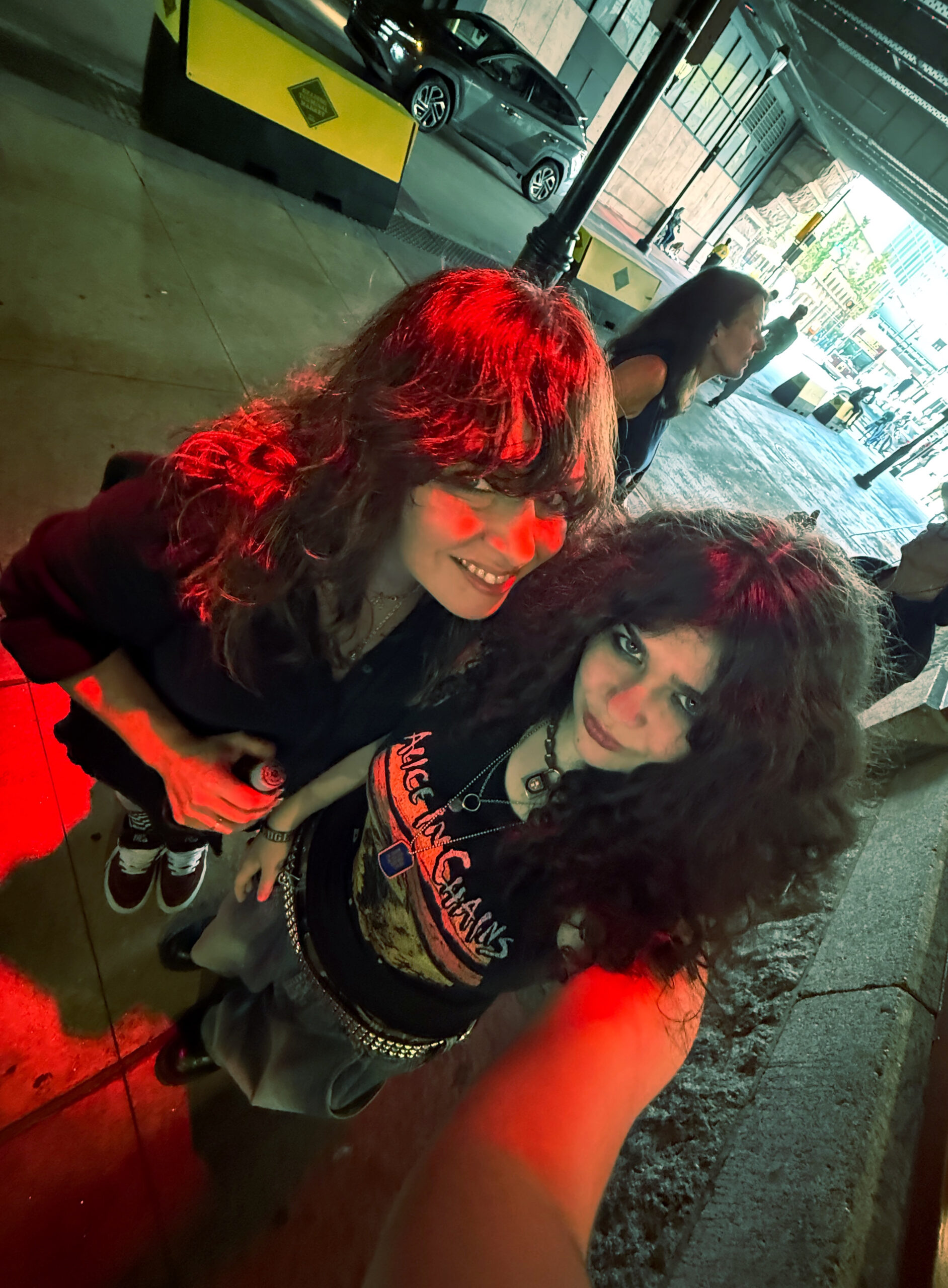
A recent selfie by Charlotte Astor (right) and her mother, Shannon Astor, taken at Reading Terminal Market.
Those outside the hardcore scene have been no less enthralled, however.
In December, after NJ.com picked up the story, further extending its reach, a documentary filmmaker reached out about the possibility of doing a film on her quest.
Last year, after posting in some “old-head” hardcore Facebook groups about the tape, Shane Reynolds — a member of the Philly-based hardcore band God Instinct — stumbled upon what appeared to be the most promising lead yet.
“I found the guy who allegedly made the demo,” Reynolds said.
But when she got the man on the phone, Reynolds says, it proved to be a dead end.
The closest Charlotte came was last year, not long after she first posted about the demo on Instagram. Her mom’s former bandmate in Seed, convinced he must have kept something from that period, recovered from storage an old cassette that featured a recording of a single Seed practice session.
Charlotte took it home, pushed it into the stereo in her bedroom. She stared at the ceiling as the tape began to play and 30 years fell away.
For the first time, she could put a sound to the stories she grew up hearing.
“The first thing I heard was a few seconds of my mom talking,” Charlotte said. “That’s my mom, when she was 16. I’m listening to a clip of my mother, listening to her at the same age I am.”
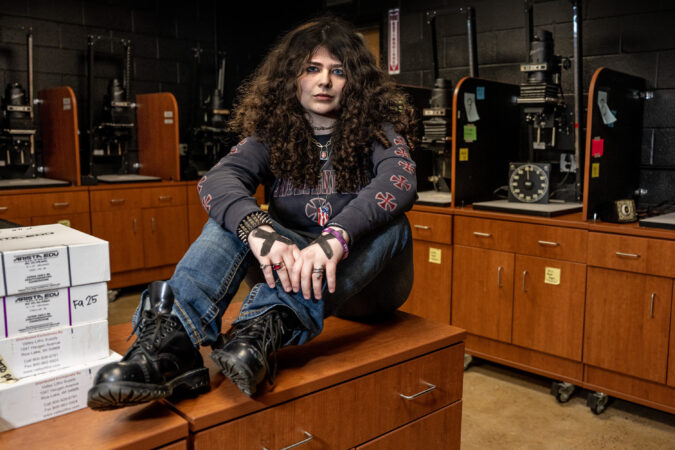
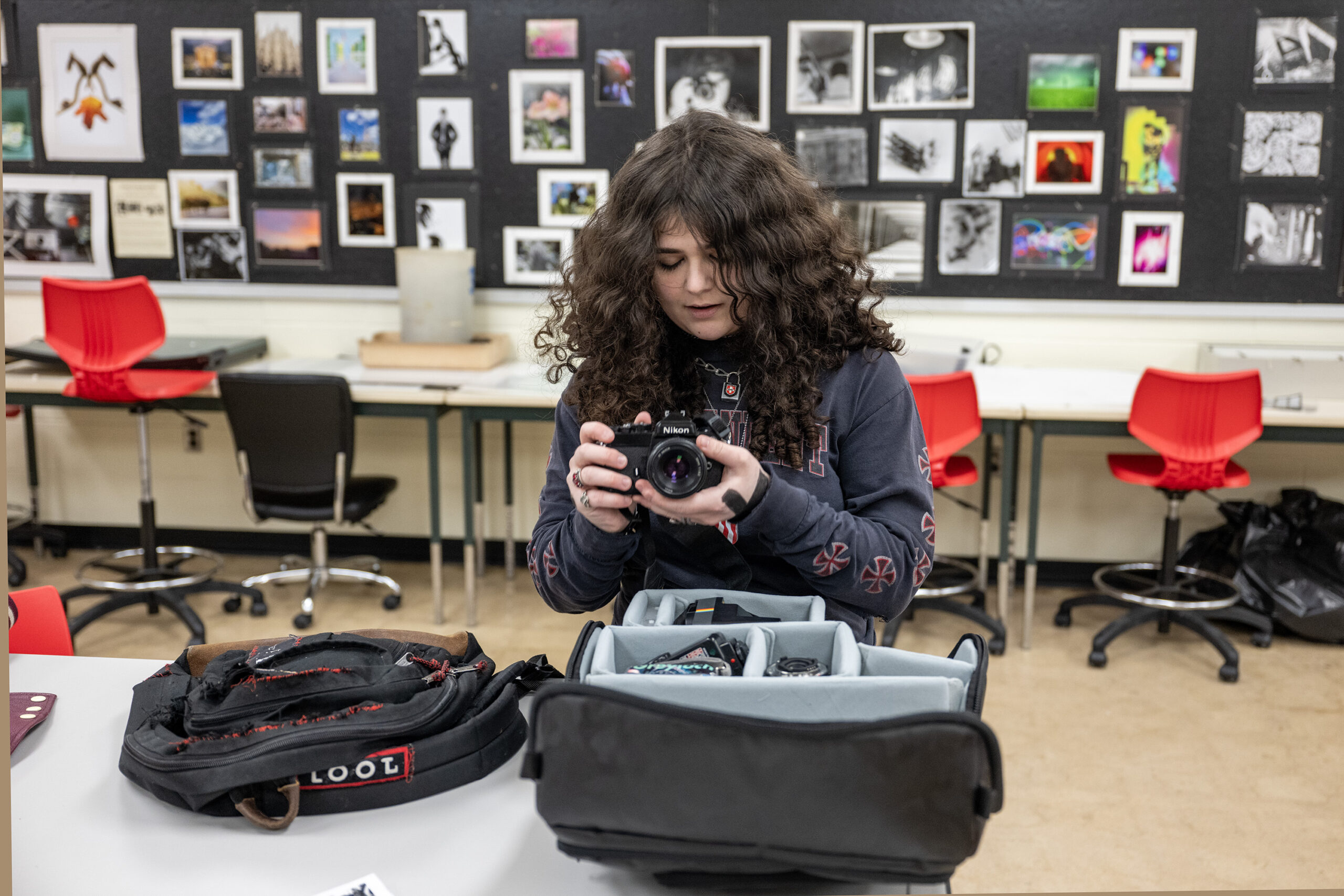
Charlotte Astor, a junior at Cherry Hill High School East, and her vintage 35mm film Nikon camera in the school’s photography classroom.
Still, that small taste has only reinforced her devotion to unearthing the actual demo.
Charlotte remains realistic about her odds of finding it. No, it’s not likely to be found in some radio station’s studio. And no, Bruce Springsteen is almost certainly not in possession of a three-decades old demo tape from her mother’s teenage years.
But some graying hardcore fan from the ’90s, with a penchant for hoarding and a cluttered garage?
Stranger things have happened.
“I have confidence — unwavering confidence — that someone has it,” Charlotte says. “And that I will get my hands on it.”
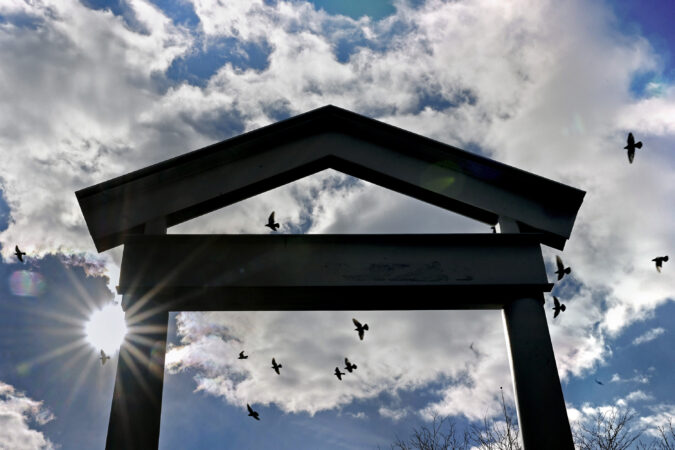
The reconstructed “ghost” structure with partial walls and windows of the building known in the eighteenth-century as 190 High Street is officially titled, “Freedom and Slavery in the Making of a New Nation” (2010).
The open-air President’s House installation in Independence National Historical Park was designed to give visitors a sense of the house where the first two presidents of the United States, George Washington and John Adams, served their terms of office.
The commemorative site designed by Emanuel Kelly, with Kelly/Maiello Architects, pays homage to nine enslaved people of African descent who were part of the Washington household with videos scripted by Lorene Cary and directed by Louis Massiah.
Just like the Rocky statue I photographed last week in anticipation of this week’s news, the President’s House was in the news last year so it remains on my radar as I walk around Old City (our newsroom is right across the street).
The cloud formation in the winter sky was what first caught my attention. Then it was seeing the sun lined up directly behind the triangular pediment above the Georgian home’s “front door.”
I played with “placement” of the sun peeking through a tiny gap at a bottom corner of the gable. I knew knew that f/22 on my mirrorless camera’s lens would give me a nice starburst. It’s an optical effect that happens because the lens’ aperture blades don’t form a perfect circle. And the narrower the opening — like f/22 — the more pronounced the effect (shooting at f/2.8 is not quite as dramatic).
Then it was simply a matter of my moving my head ever-so-slightly to align the sun with the little hole — like threading a needle.
While standing in the thin shadow of the door, I was getting blasted in the eye each time I moved. Then a group of tourists, or a noise, startled a flock of pigeons and as they took flight I was not poised just right, but I liked having the birds there better than a perfect placement of the starburst.
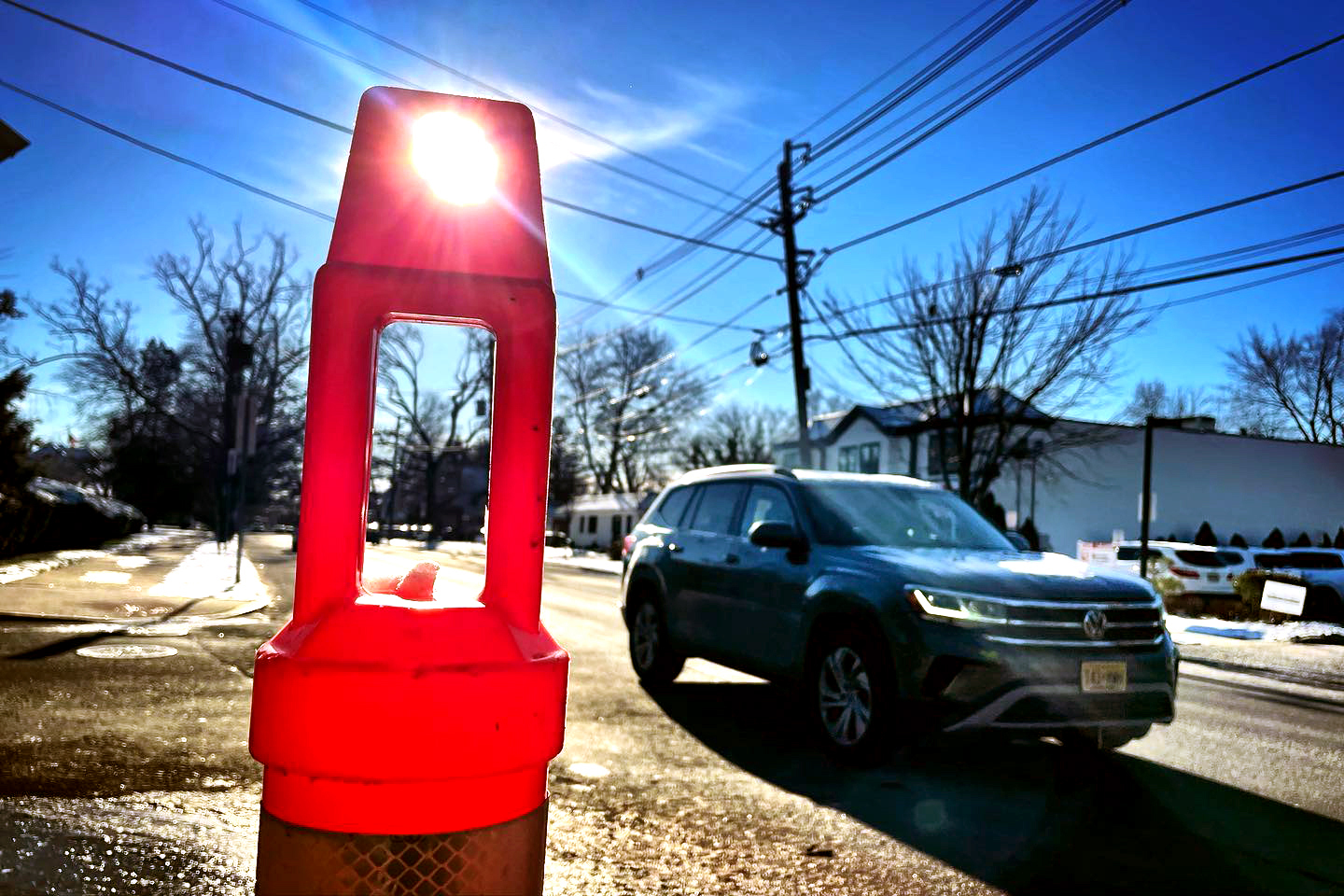
I tried a similar “trick” a few years ago, when walking around my town photographing with my iPhone. It doesn’t have a mechanical diaphragm so the effect is not the same. Plus, the threading-the-needle part is much more difficult when you are not actually looking through the lens as in a DSLR. And with a backlight sun blasting you directly in the face.
The optical principle of refraction through a lens diaphragm is the same for both mirrorless and DSLR cameras because light travels through the lens elements and aperture in the same way.
Since 1998 a black-and-white photo has appeared every Monday in staff photographer Tom Gralish’s “Scene Through the Lens” photo column in the print editions of The Inquirer’s local news section. Here are the most recent, in color:
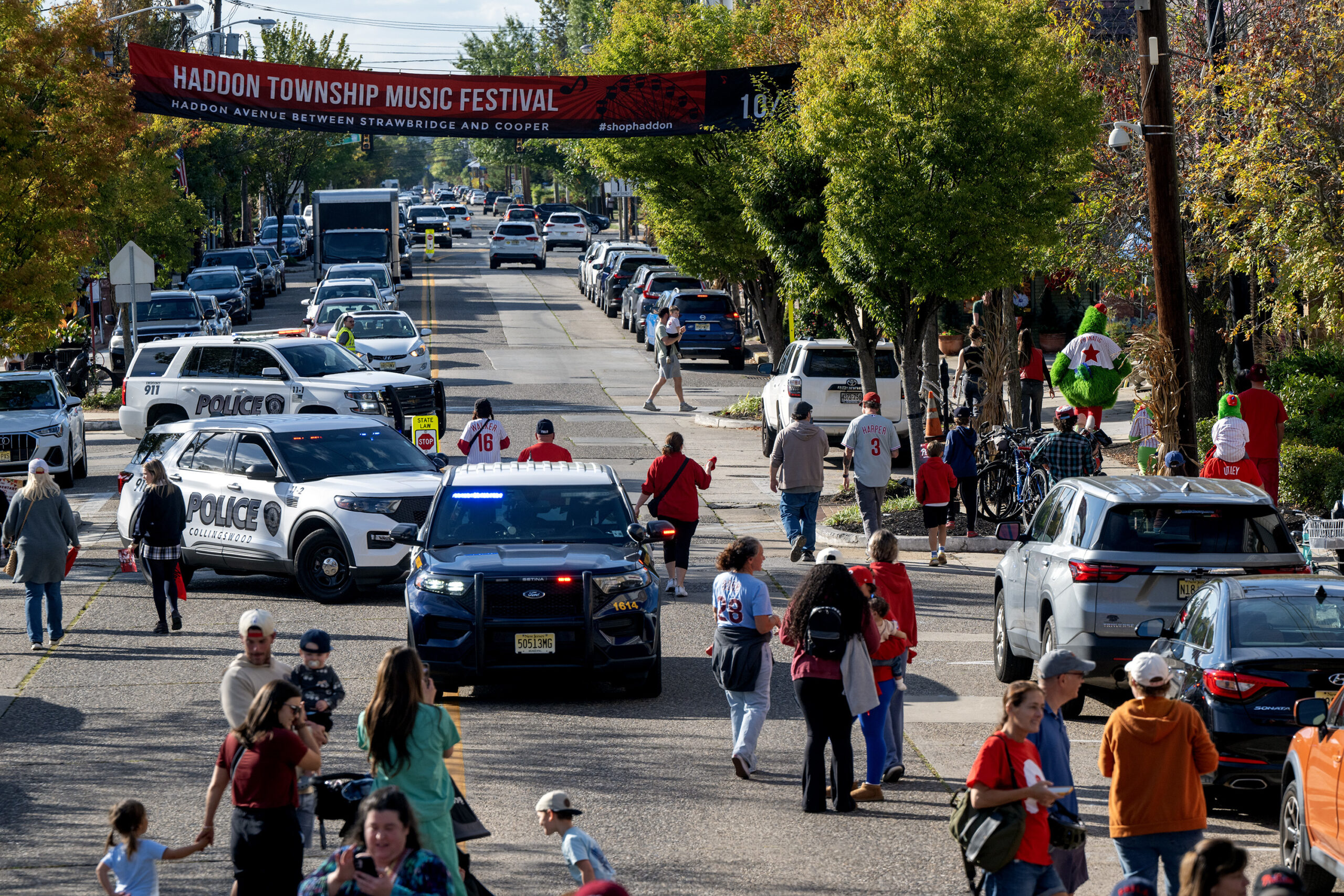
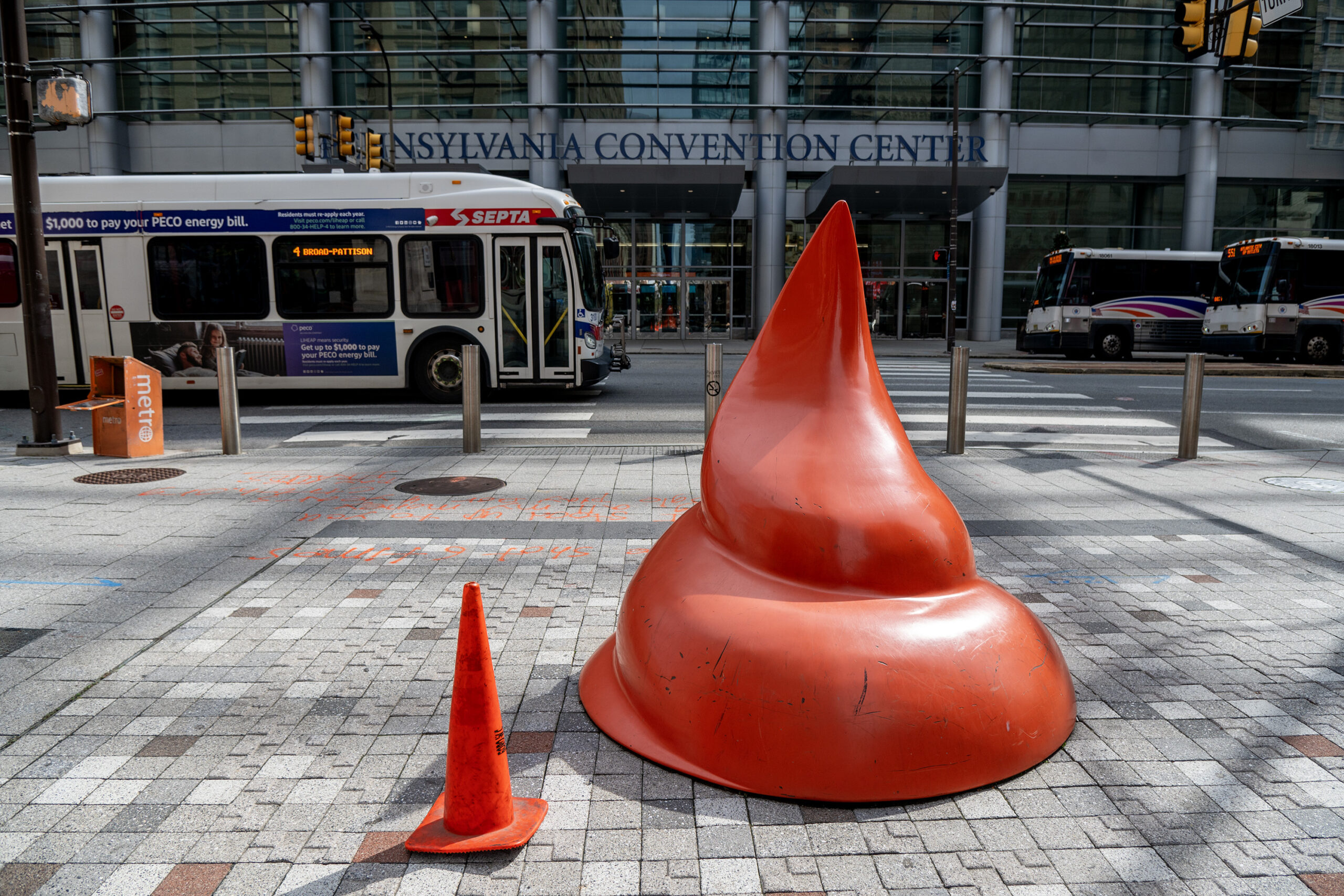
Deepika Iyer holds her niece Ira Samudra aloft in a Rockyesque pose, while her parents photograph their 8 month-old daughter, in front of the famous movie prop at the top of the steps at the Philadelphia Art Museum. Iyer lives in Philadelphia and is hosting a visit by her mother Vijayalakshmi Ramachandran (partially hidden); brother Gautham Ramachandran; and her sister-in-law Janani Gautham who all live in Bangalore, India.January 5, 2026: Parade marshals trail behind the musicians of the Greater Kensington String Band heading to their #9 position start in the Mummers Parade. Spray paint by comic wenches earlier in the day left “Oh, Dem Golden Slippers” shadows on the pavement of Market Street. This year marked the 125th anniversary of Philly’s iconic New Year’s Day celebration.Dec. 29, 2025: Canada geese at sunrise in Evans Pond in Haddonfield, during the week of the Winter Solstice for the Northern Hemisphere. December 22, 2025: SEPTA trolley operator Victoria Daniels approaches the end of the Center City Tunnel, heading toward the 40th Street trolley portal after a tour to update the news media on overhead wire repairs in the closed tunnel due to unexpected issues from new slider parts.December 15, 2025: A historical interpreter waits at the parking garage elevators headed not to a December crossing of the Delaware River, but an event at the National Constitution Center. General George Washington was on his way to an unveiling of the U.S. Mint’s new 2026 coins for the Semiquincentennial, December 8, 2025: The Benjamin Franklin Bridge and pedestrians on the Delaware River Trail are reflected in mirrored spheres of the “Weaver’s Knot: Sheet Bend” public artwork on Columbus Boulevard. The site-specific stainless steel piece located between the Cherry Street and Race Street Piers was commissioned by the City’s Public Art Office and the Delaware River Waterfront Corporation and created and installed in 2022 by the design and fabrication group Ball-Nogues Studio. The name recalls a history that dominated the region for hundreds of years. “Weaver’s knot” derives from use in textile mills and the “Sheet bend” or “sheet knot” was used on sailing vessels for bending ropes to sails. November 29, 2025: t’s ginkgo time in our region again when the distinctive fan-shaped leaves turn yellow and then, on one day, lose all their leaves at the same time laying a carpet on city streets and sidewalks. A squirrel leaps over leaves in the 18th Century Garden in Independence National Historical Park Nov. 25, 2025. The ginkgo (Ginkgo biloba) is considered a living fossil as it’s the only surviving species of a group of trees that existed before dinosaurs. Genetically, it has remained unchanged over the past 200 million years. William Hamilton, owner the Woodlands in SW Phila (no relation to Alexander Hamilton) brought the first ginkgo trees to North America in 1785.November 24, 2025: The old waiting room at 30th Street Station that most people only pass through on their way to the restrooms has been spiffed up with benches – and a Christmas tree. It was placed there this year in front of the 30-foot frieze, “The Spirit of Transportation” while the lobby of Amtrak’s $550 million station restoration is underway. The 1895 relief sculpture by Karl Bitter was originally hung in the Broad Street Station by City Hall, but was moved in 1933. It depicts travel from ancient to modern and even futuristic times. November 17, 2025: Students on a field trip from the Christian Academy in Brookhaven, Delaware County, pose for a group photo in front of the Liberty Bell in Independence National Historical Park on Thursday. The trip was planned weeks earlier, before they knew it would be on the day park buildings were reopening after the government shutdown ended. “We got so lucky,” a teacher said. Then corrected herself. “It’s because we prayed for it.” November 8, 2025: Multitasking during the Festival de Día de Muertos – Day of the Dead – in South Philadelphia.November 1, 2025: Marcy Boroff is at City Hall dressed as a Coke can, along with preschoolers and their caregivers, in support of former Mayor Jim Kenney’s 2017 tax on sweetened beverages. City Council is considering repealing the tax, which funds the city’s pre-K programs. October 25, 2025: Austin Gabauer, paint and production assistant at the Johnson Atelier, in Hamilton Twp, N.J. as the finished “O” letter awaits the return to Philadelphia. The “Y” part of the OY/YO sculpture is inside the painting booth. The well-known sculpture outside the Weitzman National Museum of American Jewish History was removed in May while construction continues on Market Street and has been undergoing refurbishment at the Atelier at the Grounds for Sculpture outside of Trenton.October 20, 2025:The yellow shipping container next to City Hall attracted a line of over 300 people that stretched around a corner of Dilworth Park. Bystanders wondered as they watched devotees reaching the front take their selfies inside a retro Philly diner-esque booth tableau. Followers on social media had been invited to “Climb on to immerse yourself in the worlds of Pleasing Fragrance, Big Lip, and exclusive treasures,” including a spin of the “Freebie Wheel,” for products of the unisex lifestyle brand Pleasing, created by former One Direction singer Harry Styles.October 11, 2025: Can you find the Phillie Phanatic, as he leaves a “Rally for Red October Bus Tour” stop in downtown Westmont, N.J. just before the start of the NLDS? There’s always next year and he’ll be back. The 2026 Spring Training schedule has yet to be announced by Major League Baseball, but Phillies pitchers and catchers generally first report to Clearwater, Florida in mid-February.October 6. 2025: Fluorescent orange safety cone, 28 in, Poly Ethylene. Right: Paint Torch (detail) Claes Oldenburg, 2011, Steel, Fiberglass Reinforced Plastic, Gelcoat and Polyurethane. (Gob of paint, 6 ft. Main sculpture, 51 ft.). Lenfest Plaza at the Pennsylvania Academy of the Fine Arts on North Broad Street, across from the Convention Center.
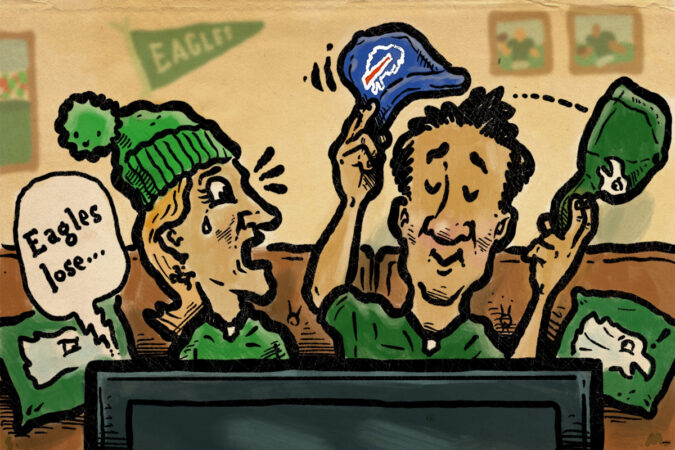
You don’t necessarily need to root for another team … but it’s perfectly acceptable to root for certain teams to lose more than others. Post-Eagles playoff fandom is less about loyalty and more about spite management.
You’re no longer picking a champion; you’re ranking villains.
Dugan Arnett, Life & Culture Reporter
I believe that Philadelphians should be free to root for any of the NFL’s remaining playoff teams. Except the Patriots, obviously. No one should ever root for the Patriots.
Tommy Rowan, Programming Editor
At this point, you’re rooting for fan bases. So I’m rooting for Bills fans. As a fan base, they’ve been through it. Despite an unprecedented four straight Super Bowl appearances in the early 1990s, they have zero championship wins to show for it.
And there are some similarities between Buffalo fans and Philly fans. Our friends from up north routinely throw each other through card tables at game day tailgates like WWE wrestlers. The two fan bases could honestly be cousins. Real long-suffering Northeast football fans recognize real. So, Go Bills. … Until the playoffs are over.
Amy Rosenberg, Life & Culture Reporter
This is when being a transplant has its advantages. Buried ancestral loyalties can now resurface. My dad loved the Bills dating back to the Marv Levy era. I’ve always loved the Rams? Feels OK to go with the Bills. (Getting some Bills consensus here.) Anything remotely Boston, New England, or Dallas is obviously off-limits. Chicago could be a late pivot to root for. Birds, Bills, Bears.
Matt Mullin, Senior Sports Editor for Digital Strategy
Unsurprisingly, I have a lot of thoughts on this. Sorry! Like Biggie said, there are rules to this game, so I wrote you a manual. And these can be applied to almost any season — or any sport.
You absolutely cannot root for the team that eliminated you, so the 49ers are out. But! If they win it all, you’re allowed to say the Eagles basically finished second.
You can’t root for any NFC East teams — luckily that’s not a concern this year — or any teams that beat you during the regular season. Goodbye, Denver and Chicago.
In fact, you shouldn’t really root for any NFC team, since you’ve likely beefed with them all at one point. But if you must, pick one of the teams you beat. At least that way you’ll be able to convince yourself the Eagles were actually the better team. Would the Rams, who the Eagles beat in the regular season and last postseason and don’t really have a fan base to rub it in, making the Super Bowl be the worst? Probably not. But that doesn’t mean you have to support them.
You should also try to avoid rooting for the top seeds, since Philly loves an underdog. We’ve already eliminated the Broncos, but so long, Seattle.
That leaves three AFC teams. Again, any team that beat you this year is automatically out. So are the Patriots. You never root for the Patriots.
In five simple steps, we’ve now boiled it down to just two acceptable teams: the Bills and Texans. We’ll give the Bills the nod here since their fan base and Eagles fans seem to have a lot in common — even though their coach tried to kill the Tush Push over safety but still uses it regularly.
Sam Ruland
I think my ideal Super Bowl here would be Bills vs. Bears. Because the Bills have a good fan base, fun, loyal (all the things we said). And I have no negative thoughts on the Bears fan base either. Also, never forget Jason Kelce tailgating with the Bills Mafia. That’s gotta count for something.