At least 1,100 dead or sick birds, mostly Canada geese, have been reported across New Jersey in an outbreak that started on Valentine’s Day, according to state officials.
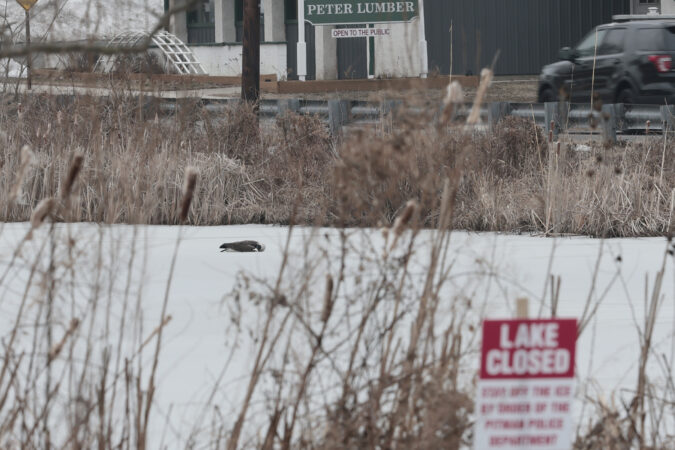
At least 50 geese have died at Alcyon Lake in Pitman, Gloucester County. Officials have closed the lake and the adjoining Betty Park out of precaution.
The fish and wildlife division within the New Jersey Department of Environmental Protection (DEP) and the U.S. Department of Agriculture are tracking them as suspected cases of highly pathogenic avian influenza (H5N1), or bird flu.
Bird flu is not new. But it began to spread in the U.S. in January 2022 and has infected wild and domestic birds in every state.
While bird flu can infect humans, the U.S. Centers for Disease Control and Prevention has said it is primarily a threat to animals and poses little risk to the public.
State officials say large numbers of dead geesemay be concentrated in areas where birds gather to look for open water as ice melts. They said that the 1,100 dead or sick wild birds were reported between Saturday and Monday.
Where have dead geese been found?
The DEP says it has received reports of dead Canada geese in South Jersey, including in Hainesport, Burlington County; Sicklerville, Camden County; and Pitman.
Annmarie Ruiz, Gloucester County’s health officer, said the dead geese were noticed in Pitman on Tuesday. She said that there were probably more than 50 at Alcyon Lake, but that there were reportsof dead geese elsewhere in the municipality.
“Right now, we have to presume that it is bird flu based on the signs the birds were exhibiting,” Ruiz said.
The New Jersey Department of Agriculture took some of the birds for testing. The results could take weeks, she said.
“Right now, we’re just erring on the side of caution,” Ruiz said.
Ruiz said workers use face shields and gloves when handling the birds, which are triple-bagged before being disposed.
She said people can report sick or dead wild birds to Gloucester County animal control at 856-881-2828 or the DEP at 877-927-6337.
A lifeless bird lays on the ice at Alcyon Lake in Pitman, N.J. on Wednesday, Feb. 18, 2026. Two adjacent parks, Betty Park (in background) and Alcyon Park (not in photo) are closed as a result of the mysterious birds deaths.
Caryelle Lasher, Camden County’s health officer, said there have been only a small number of reports of dead birds in the county.
Those were concentrated in the lake off Mullen Drive in the Sicklerville section of Gloucester Township, she said.
Overall, however, the county has not seen a spike in reports, she said.
Ruizand Lasher — as well as state officials — stress that people should not touch sick or dead wildlife of any kind. And they should keep pets away.
Even though the risk is low, the potential for human infection exists.
H5N1 is a respiratory bird disease caused by influenza A viruses. Wild birds, such as ducks, gulls, and shorebirds, can carry and spread these viruses but may show no signs of illness, according to the DEP.
The disease can kill domestic poultry such as chickens. Typical symptoms include diarrhea, nasal discharge, coughing, sneezing, and incoordination.
It continues to infect not only birds, but also mammals.
Tips to prevent infection:
Do not touch sick or dying animals, or bring them into your home.
Keep pets away from them, as well as away from droppings.
Wash hands frequently if you are near wildlife.
Do not eat undercooked eggs, poultry, or beef.
Prevent cross-contamination between cooked and raw food.
When the Media-area NAACP was selecting a few Black figures to spotlight throughout Black History Month, adding Marie Whitaker to the list was a no-brainer, said Cynthia Jetter, president of Media’s NAACP chapter.
Within the community, “I think most people know the story,” Jetter said.
The story, that is, of when Whitaker sat down for a meal at the Tower Restaurant at the corner of State and Olive Streets with her baby in her arms and her sister by her side in 1943.
No one waited on them.
This bothered Dorothy James, a white Quaker woman who was dining at the restaurant. So she approached a worker there who explained that the waitresses did not serve Black people,James recounted in a letter she wrote a few days after the incident.
Whitaker soon left the restaurant with her baby and sister and went elsewhere. Soon, James joined them, she wrote.
Whitaker and James became fast friends and cofounded Media Fellowship House the following year. The goal was to bring together Media residents of all races and religions for events and meals. It grew over the course of its first decade, and in 1953, they raised enough money from community members to buy a property on South Jackson Street, where the organization flourished.
Whitaker died in 2002, but the fellowship house lived on. In its 82 years, it has gone from hosting sewing circles and childcare events to helping Black people buy homes in restricted neighborhoods to now offering assistance to first-time homebuyers and helping those facing foreclosure.
For Amy Komarnicki, who now runs the Media Fellowship House, the values Whitaker championed — inclusion, resilience, and courage — are always guiding her.
“I think you have to move toward the injustice that you see and not ignore it,” Komarnickisaid.
That is especially difficult to do when you’re on the receiving end of the injustice, she added.
“Being willing to accept an invitation to talk about it takes enormous bravery and trust,” Komarnickisaid. “It’s good to be uncomfortable. It’s good to make people uncomfortable for the greater good. It opens up space for dialogue.”
Living in Media and going to Fellowship House growing up exposed him to people from all kinds of demographics and religions, Bill Whitakersaid. And that was no accident; it was something his mother and Fellowship House helped lay the groundwork for.
“She was resolute and knew what she wanted, not just for her family, but for her community and for her world,” Whitaker said. “She had a vision of what Fellowship House stands for, bringing people together and having people speak across what seems now to be a chasm of our differences — she wanted people to speak across that, to reach across that and come together.”
As long as Fellowship House stands, that work, just as important now as then, will continue, Bill Whitaker said.
Every morning, Julie Parlade, a 34-year-old stylist from Springfield, wakes up and does what most millennials do. She reaches for her phone and checks her apps. Instagram, Gmail, maybe the news. Then she checks one more: Craigslist. Yes, that Craigslist. The classified advertisement website that was popular in the early aughts and 2010s. She checks it later in the day, too, pretty much whenever she has downtime. “It’s so automatic for me,” she said. “I have an obsession.”
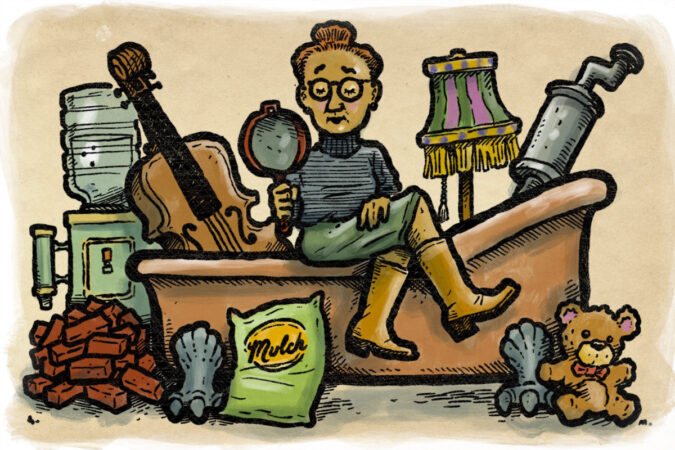
Parlade mostly sticks to the free section, where she has scored everything from a pair of Frye boots in perfect condition to an entire set of Le Creuset cookware. Half of her house is furnished from the Craigslist free section: the clawfoot tub in the bathroom, the subway tile in the kitchen, the mid-century modern furniture in the living room.
She started using Craigslist around 2010, first for jobs and apartments, and never really stopped. Today, it’s still her go-to source for secondhand items, despite the rise of other online marketplaces like Depop and Facebook Marketplace. “Everyone uses Craigslist,” Parlade said, “so I feel like I’m able to get better things. It’s a much broader net.”
Does everyone still use Craigslist? Maybe not everyone, but more people than you might think. Despite its reputation as a digital relic, Craigslist draws more than 105 million monthly users, making it the 38th most popular website in the United States, according to internet data analytics company SimilarWeb.
And in Philadelphia , the site remains a daily resource for people seeking work, housing, materials, and other necessities. University of Pennsylvania professor Jessa Lingel, 42, who interviewed hundreds of Craigslist users in Philadelphia for her book An Internet for the People: The Politics and Promise of Craigslist, says the platform functions as a kind of parallel infrastructure to more polished platforms, particularly for people with fewer financial resources. “Craigslist still has a role to play for a lot of Philadelphians who are just trying to live their everyday lives,” Lingel said.
Access to affordability
That role shows up most clearly in the kinds of jobs and housing that still circulate through Craigslist. Lingel, who lives in North Philadelphia, said many of the users she interviewed relied on the site to find warehousing shifts, construction work, and short-term gigs paying around $20 an hour — work that rarely surfaces on platforms like LinkedIn or Indeed because “those other platforms haven’t called those folks in,” she said.
The same pattern holds for housing. Affordable apartments and private rooms for rent still appear regularly on Craigslist, posted by college students seeking temporary roommates or by landlords unwilling to pay higher listing fees. As one of Lingel’s interviewees put it, the cheap housing is on Craigslist, not Redfin. He called Craigslist the “poor people’s internet,” Lingel said.
Craigslist does not release detailed user data, so there’s no way to know how many Philadelphians still rely on the site. But, said Lingel, given that Philadelphia is the second-poorest big city in the country, it would not be surprising if “the poor people’s internet” remained especially relevant here. “Craigslist is gritty,” Lingel said, “and so is Philly.”
Privacy protection and net nostalgia
For some Philadelphians, the appeal of Craigslist isn’t affordability so much as how little of themselves it asks for in return. Unlike newer marketplaces that tether buying and selling to social profiles, Craigslist allows users to remain largely invisible — no profile photos, no friend networks, no algorithm stitching transactions back to a personal identity.
It harkens back to a simpler time on the internet, and, according to Lingel, holds special appeal for young tech skeptics who “are more ideologically attached to Craigslist.” .
“The comparison that I think of is children of the ’80s going to ’50s- themed diners and getting really into Lindy Hop. It’s like, ‘Oh, this is a vision of the internet that I want to have experienced but have not.”
That simplicity is precisely what draws people like Raquel Glassman, a cofounder of a local kombucha company from Port Richmond, who mostly uses Craigslist to give things away. When she’s decluttering, she’ll box up items, leave them on the sidewalk with a handwritten “free” sign, snap a photo, and post it online. “It’s always gone within the day,” she said.
If Glassman, 31, is going to sell an item, she likes that she can do it anonymously on Craigslist. Facebook Marketplace is more efficient, she says, but it’s not a great place to go if you don’t want your aunt to know that you’re getting rid of the “ugly lamp” she gave you. “She’ll see it on my Facebook because we’re friends,” said Glassman. “You put that on Craigslist if you want to sell that.”
IRL effects
But the funny thing about Craigslist is that while it lets you be a stranger online, it forces you to be your full self in real life, and some people prefer that. According to Lingel, hobbyists such as musicians and car enthusiasts are among the most active Craigslist users.
Indeed, two of the most popular “For Sale” subcategories on Philly Craigslist are auto parts and instruments — both of which benefit from face-to-face transactions. They allow sellers to avoid shipping costs and allow buyers to inspect their purchases. As Michael Lesco, a 33-year-old musician and marijuana dispensary manager said, “If I’m going to put $300 into something, I want to meet you in person and put the money in your hand.”
Like Parlade, Lesco also makes good use of Craigslist’s free section. Last summer, he used it to get mulch and brick for the garden he was building in the abandoned lot next to his house in West Philly. The project could’ve easily cost $5,000. Instead, he and his wife did it for less than the cost of their West Philly Tool Library membership. “We could not have done it without Craigslist,” Lesco said.
Parlade’s most recent Craigslist score was also construction-related: free drywall from a contractor. “We’re going to use it to fix my dad’s house,” she said. Craigslist, she added, is “almost like a service.”
On the night of Feb. 4, at about 9:30, Christine Nangle received a text. It was from her boss Matt Selman, executive producer of the Fox program The Simpsons.
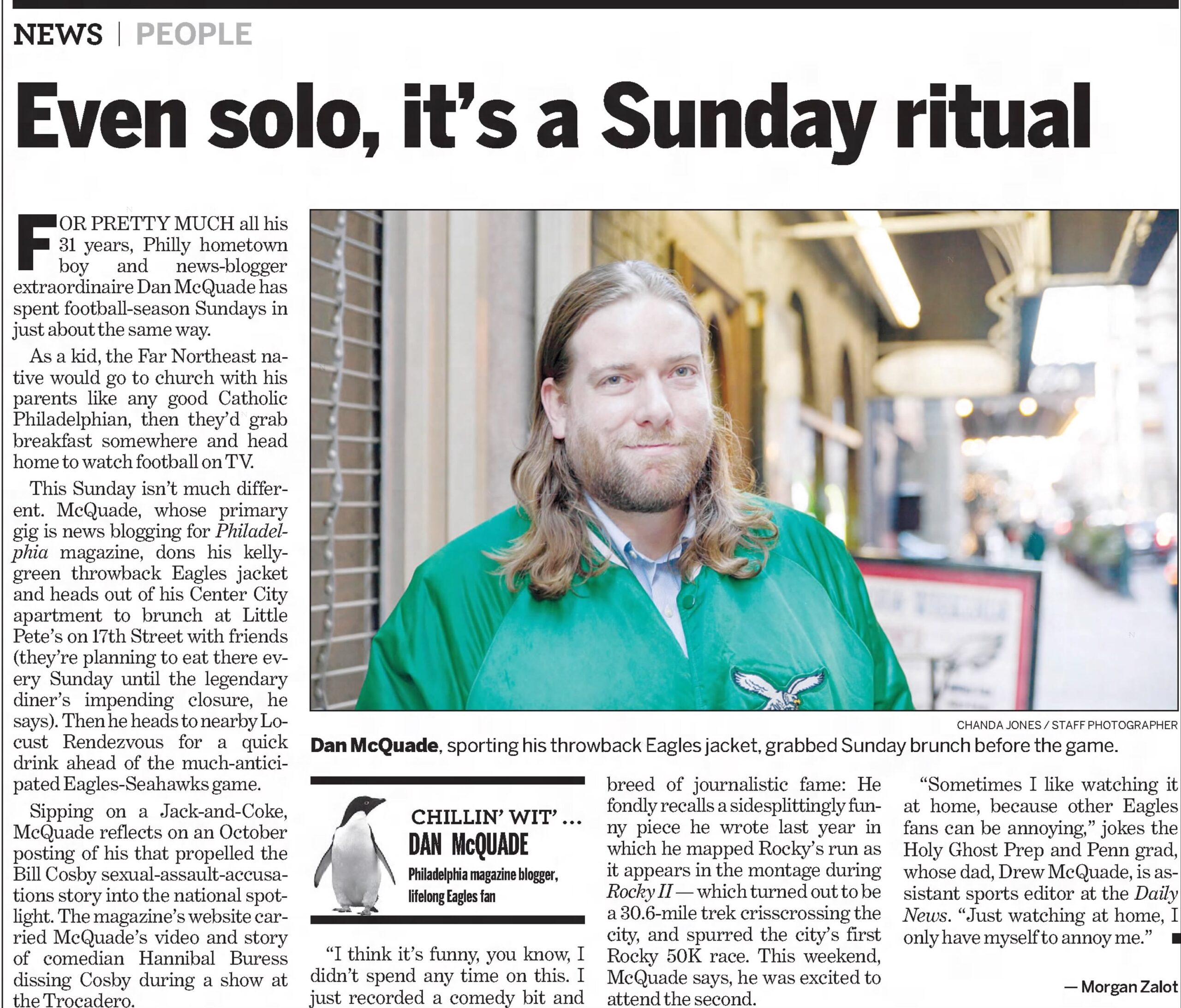
He had an idea. A mutual friend of theirs, Defector writer Dan McQuade, had recently died of neuroendocrine cancer at the age of 43. McQuade was a Simpsons superfan who embraced all of Philadelphia’s quirks, from tacky boardwalk T-shirts to the comically small La Salle smoke machine.
The Simpsons was about to air its 800th episode, set in Philadelphia. It included a litany of local references, many of them obscure to anyone outside the Delaware Valley.
McQuade had been planning to write about it. He hoped to get together to discuss the episode with Nangle and Selman while simultaneously watching and riffing on another Philadelphia-based show — Do No Harm, a medical drama McQuade described as “weird and bad.”
But that never happened. McQuade’s condition worsened. He died Jan. 28 at his parents’ home in Bensalem.
The Simpsons episode seemed tailor-made for McQuade. The producers hadn’t sent the final video to Fox studios yet. So, Selman made a proposal: Why not add a Dan McQuade Easter egg?
Nangle, a writer and producer on the show, couldn’t believe it. A few days earlier, she’d had the same thought, and almost texted it to her boss. But she assumed that it would be too late, because the episode was set to air on Feb. 15.
Matt Selman and Christine Nangle pictured at “The Simpsons” 800th episode party on Feb. 6.
The coworkers began to scour footage for any spot they could fit a Simpson-size, shaggy-bearded Philadelphian. Nangle considered putting him in the Mütter Museum, when Homer visited with a National Treasure-themed contingent.
But that was ruled out. So was the “Philadelphia Super Bowl Riot of 2018.” Selman worried viewers wouldn’t be able to recognize McQuade among the crowd of rabid fans.
“That was the Super Bowl when the Eagles beat my beloved Patriots, because of Bill Belichick’s inflexibility,” the executive producer said. “I thought about jamming him into that, but you wouldn’t have been able to see his cute little face. His little hairstyle.”
Instead, Selman found the perfect scene. About halfway through the episode, at the 10:49 mark, Homer goes to a Roots concert. The camera pans to the front row.
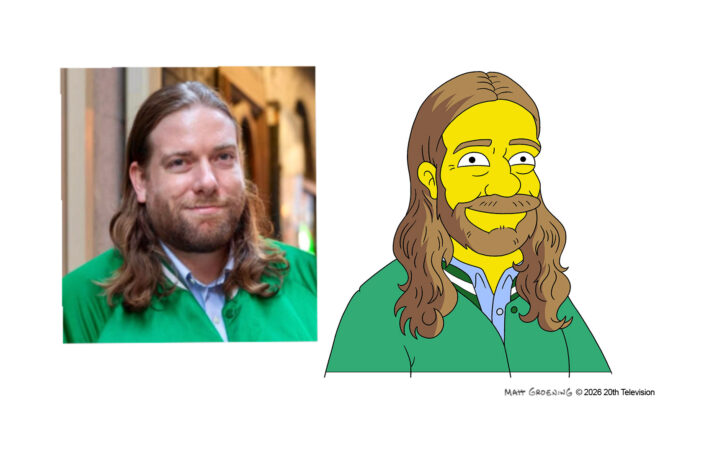
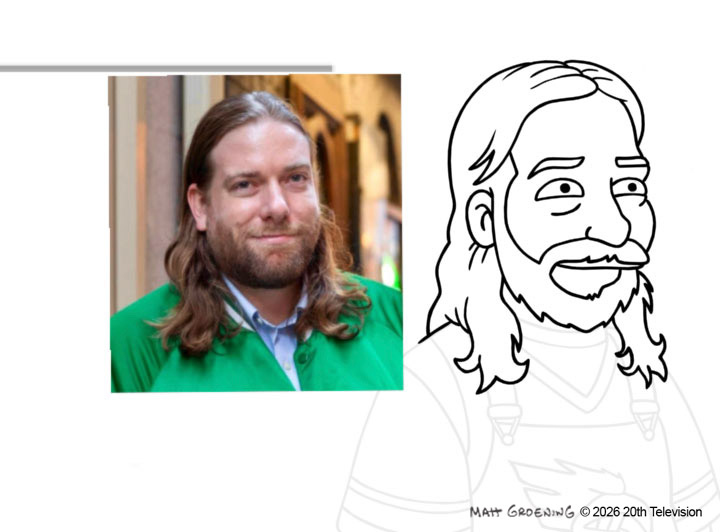
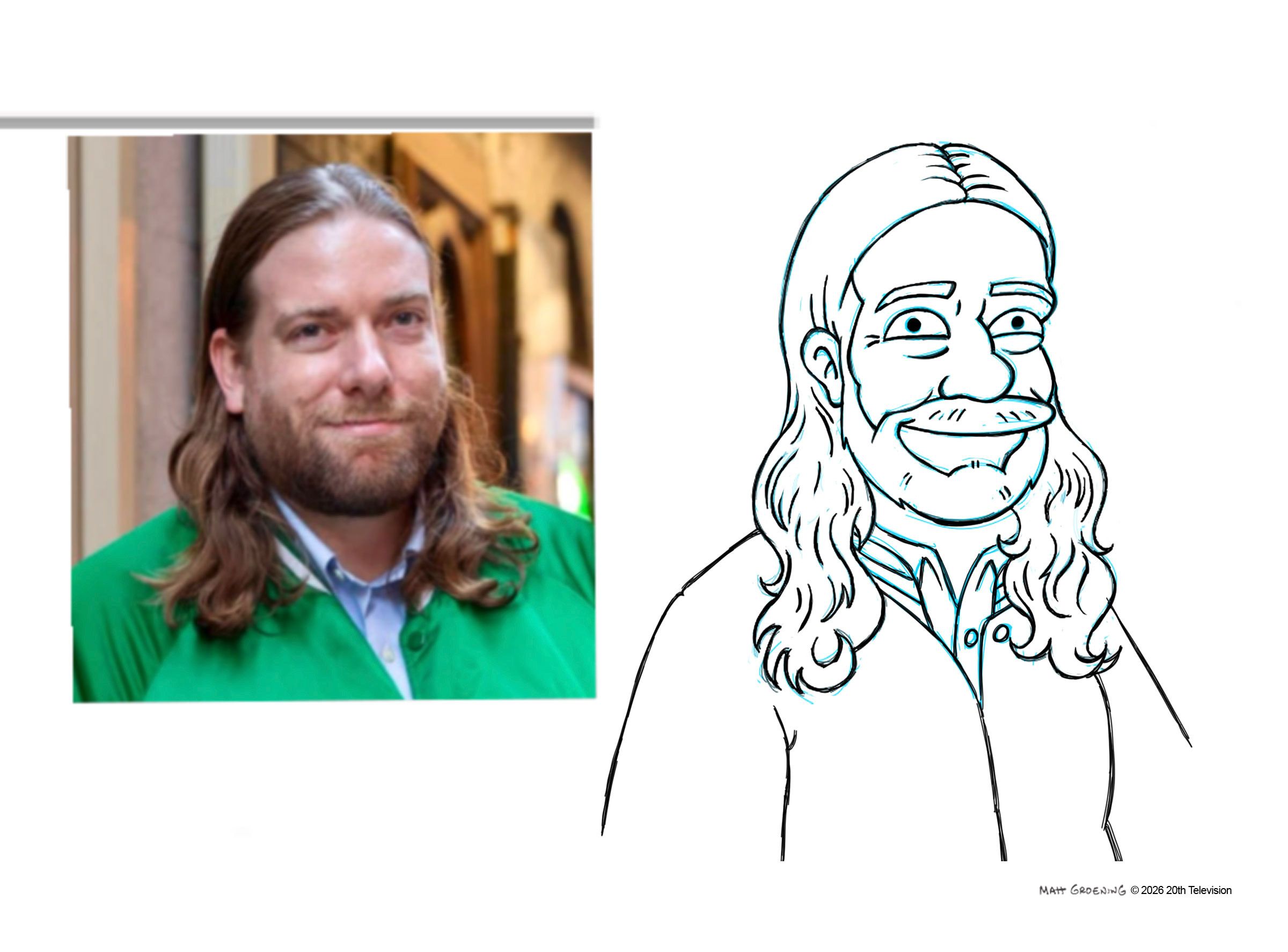
In the upper right-hand corner, wearing a kelly green satin jacket, with his long hair parted down the middle, is Dan McQuade.
“If it brought his family an ounce of relief, for one millisecond, then it was worth it,” Selman said.
Dan McQuade’s likeness was utilized in a scene depicting a concert by The Roots.
‘This is a good idea’
Selman had known McQuade for about five or six years. They were both alumni of the University of Pennsylvania, where they worked as editors at the Daily Pennsylvanian and 34th Street Magazine.
McQuade was 11 years younger, so they never met on campus. But Selman developed an appreciation for his work, and an online friendship blossomed.
Nangle, who grew up in Oxford Circle and attended Little Flower High School, met McQuade only once, when they were teenagers. But like Selman, she got to know him through his writing.
“He did this whole piece about the Franklin Mills Mall,” she said. “Just having somebody give voice to something that you thought was a mundane, dumb part of your life, and elevate it and make it seem like it matters, is really cool. You feel really seen.”
She added: “I barely remember meeting him in high school, but just reading his work, I was like, ‘It’s crazy that I’m not friends with this guy.’ And I was like, ‘Next time I’m in the city, we have to hang out.’”
Long after the producers moved to Los Angeles to work on the show, McQuade remained their portal to Philadelphia’s idiosyncrasies. In a way, Nangle looked to him as a kindred spirit.
They were both trying to bring a bit of the city’s character to a national audience. For Nangle, that meant slipping Delco accents and eccentric characters into her shows.
Selman would often go back and forth with McQuade about general Philadelphia weirdness. But they’d also talk about The Simpsons, of which McQuade was a lifelong fan.
A few times, the writer managed to combine his two passions.
“He’d text me photos of bootleg Bart Simpson T-shirts that he found,” Selman said. “And mail them to me. He would always send them to me.”
McQuade and Selman had been planning a story around The Simpsons’ 800th episode for months. In October, the writer flew out to Los Angeles, to discuss it more in person.
(Selman characterized this as more of a “fun-hang session.”)
They toured the Fox studio and went to the gift shop, where McQuade purchased Itchy and Scratchy toys for his son, Simon. They finished the day with lunch at Moe’s Cafe.
“There was a Philly cheesesteak on the menu,” Selman said. “And he was like, ‘I know this is going to be terrible, but I’m going to get it anyway.’
“He didn’t think it was that good. He was a champ about it, though.”
At the time, McQuade seemed to be in good health and good spirits. He’d told Selman about his cancer diagnosis but said that he “was doing OK.”
When the executive producer heard that his friend had died, he was shocked. Selman read McQuade’s obituary, and looked back on a video of Simon playing with the Itchy and Scratchy toys.
Then, the concept came to him.
Selman reached out to line producer Richard Chung. Chung’s job was to streamline episode production — and it was rare for The Simpsons to add a character, even a minor one, so last-minute. Selman wasn’t sure how Chung would react.
It would cost the company money and time. Not every line producer would have approved. But Chung did.
“This is a good idea,” he said.
The likeness of late writer Dan McQuade used in a recent episode of “The Simpsons” went through several iterations.
Going ‘full Santa Claus’
The next day, Chung started working on adding McQuade to the episode. He reached out to a character designer, who drew out a sketch.
After it was done, Selman brought the concept to Drew Magary and David Roth at Defector. He asked what they recommended McQuade wear.
“They said, ‘Put him in the kelly green Eagles satin jacket,’” Selman recalled. “So, we were able to put that implied jacket on him.
“And then we just kind of looked for good pictures of his funny hair.”
Dan McQuade’s Defector colleagues Drew Magary and David Roth recommended that the illustrators capture McQuade in his kelly green Eagles jacket.
Selman and Nangle decided to replace a generic member of the crowd at The Roots concert with McQuade.
It was unclear to Selman, or Magary, or Roth, if McQuade liked or disliked The Roots. But it was the best spot to include him. McQuade would be positioned right behind the Phillie Phanatic (tweaked to avoid copyright infringement).
“I don’t know if [Dan] was or was not a Roots fan,” Selman said. “They didn’t seem to know. I think they would have known if he was a huge fan, but I hope he wasn’t an enemy.
“Plus, legal-version of Gritty and legal-version of Phanatic are both there. So, I assumed he liked them. They all went together.”
‘The Simpsons’ illustrators replaced a random fan at The Roots concert with a likeness of Dan McQuade.
Less than 48 hours after Selman and Nangle exchanged texts, McQuade was added to the show. He was included in the first-aired broadcast on Feb. 15, as well as the legacy version (on Disney+).
The late writer’s appearance lasted only nine seconds, but fans caught on.
Later that night, Nangle confirmed on Bluesky that it was indeed an homage to McQuade. Her post quickly went viral. She received all sorts of messages and mentions.
“I guess they didn’t want to put his Mass card from the funeral [there],” Nangle said. “So, they put that image instead, which took my breath away.”
It was a hectic process, but Selman and Nangle are grateful they could honor McQuade in their unique way. They hope this episode can provide some joy to his loved ones, when they’re missing their Simpsons-loving friend.
“Having this job gives you magic Santa Claus powers to bring joy to people,” Selman said. “And you can’t use your Santa Claus powers all the time, to bring joy to everybody.
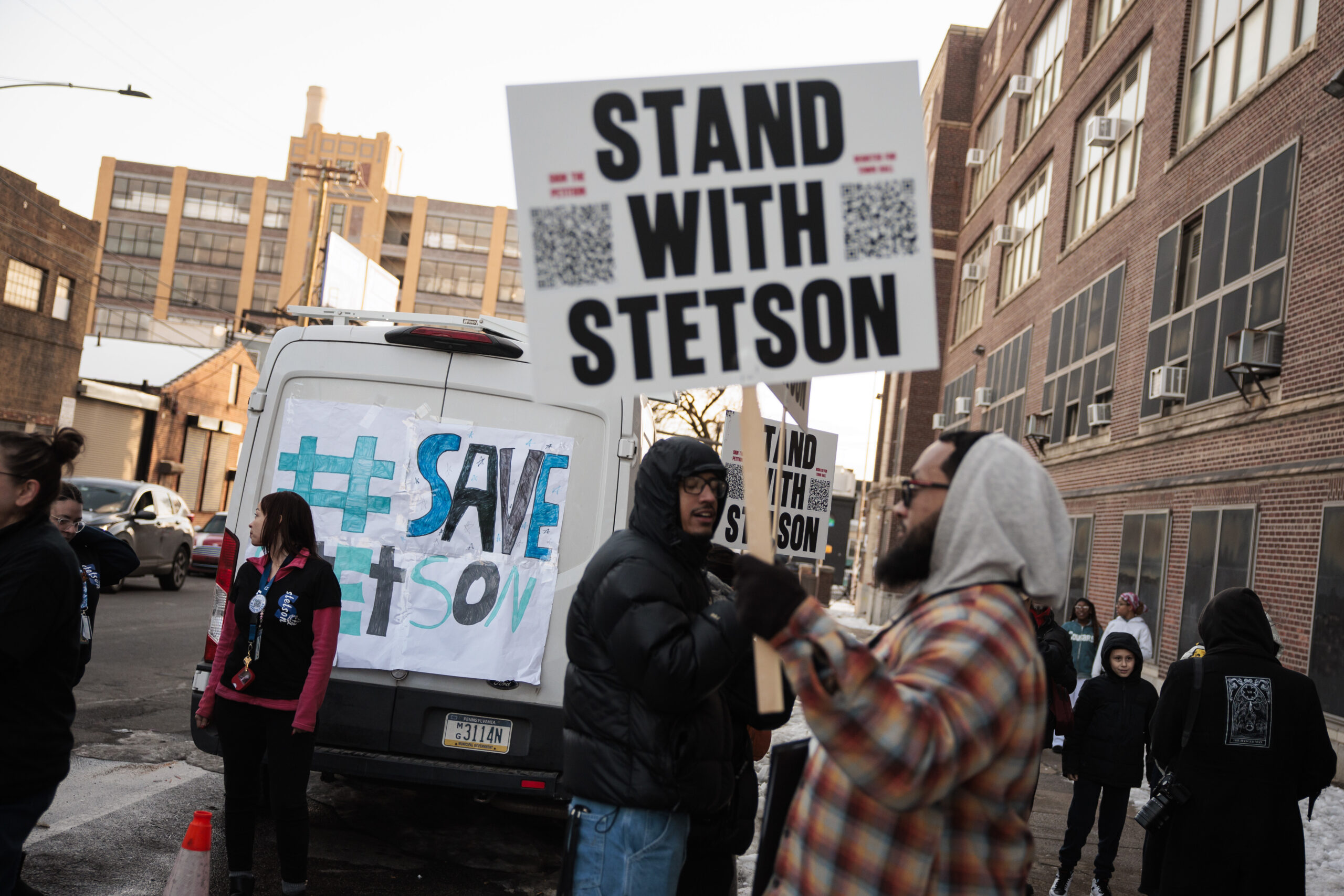
As cars whizzed by on B Street, one student banged a drum and another struck a cymbal. Others waved signs and marched in circles.
“Save our school!” the group of about 50 middle schoolers shouted outside Stetson Middle School in Kensington last week. “Save Stetson!”
Stetson is one of 20 schools Superintendent Tony B. Watlington Sr. has proposed closing as part of a $2.8 billion facilities plan. Officials say closures are necessary to improve educational outcomes and equity system-wide, and to balance enrollment in a district that has 70,000 empty seats.
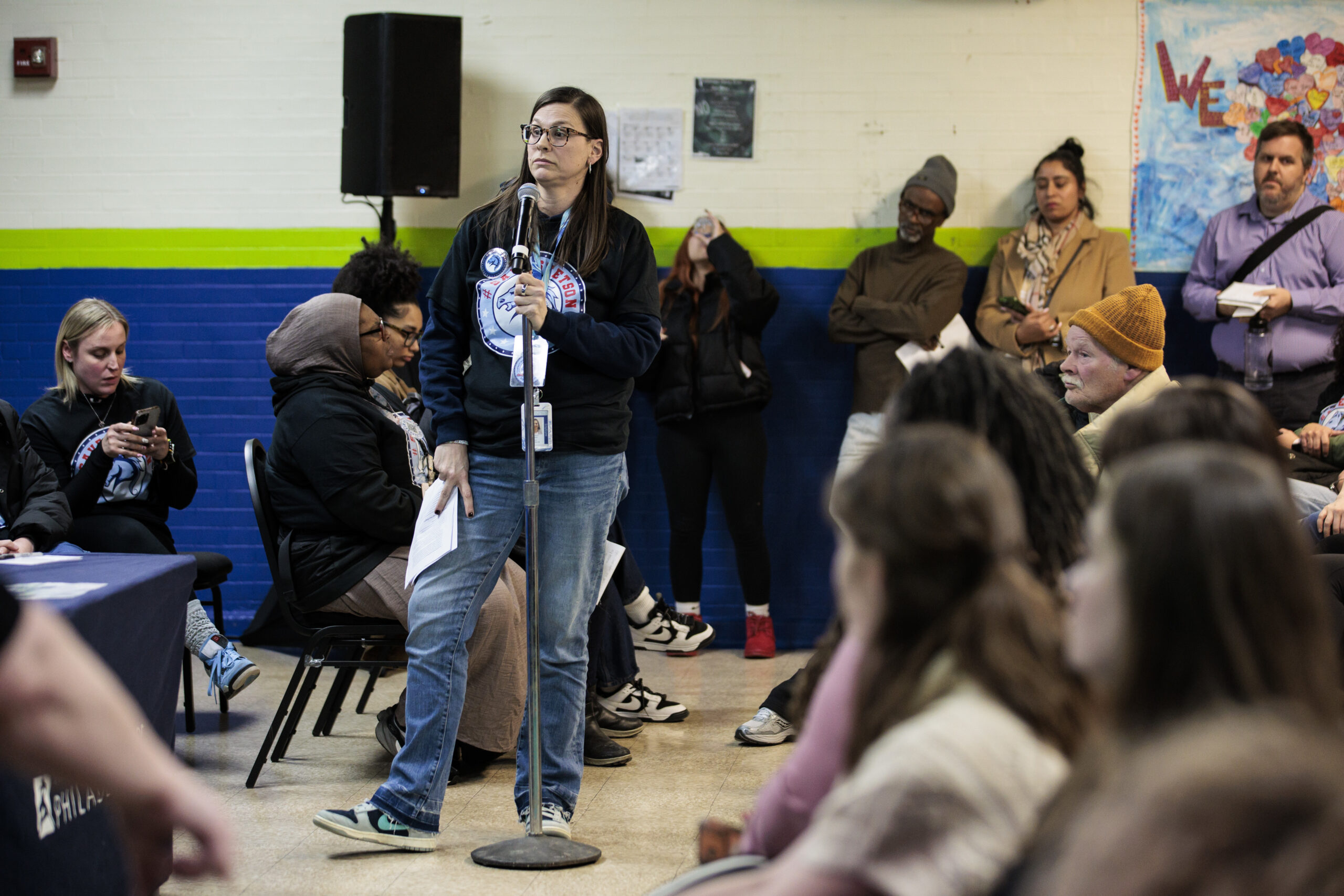
Love Letters to Stetson decorate the hallway during a community meeting at John B. Stetson Middle School in Kensington last week. Stetson is one of 20 Philly public schools facing closure.
But Stetson isn’t going down without a fight.
The school is 59% occupied, by the district’s calculations, and its building is in “unsatisfactory” condition. Stetson also scored “poor” on program alignment, a measure that takes into account a school’s ability to offer “appropriate spaces” for things like art, music, physical education, and career and technical education.
Its supporters say Stetson has been left to languish and that their neighborhood is overrepresented on the closure list. The district, they say, is taking away a community that’s been a constant for families in a struggling neighborhood at the center of the city’sopioid crisis.
“You tell this community that they are not worth investment,” one Stetson studentsaid at a meeting at the school last week. “How is it equitable to shut a school in a neighborhood that already lost so much? If this building needs repair, fix it for the children, not for the administration.”
Twelve requests to fix a leaky roof
The district has said it plans to hold on to the Stetson building and operate it as “swing space” — a building that can be used to relocate students from other schools that must temporarily shut down to accommodate repairs.
Instead of closing soon, the district is proposing phasing Stetson out gradually. The school would stop accepting new fifth graders in 2028, and close in 2030.
Students who previously would have gone to Stetson will go to Cramp and Elkin elementaries, which will grow to accommodate middle grades. Both schools are less than a mile from Stetson.
Students, teachers and supporters rally before a community meeting at John B. Stetson Middle School on Thursday, Feb. 12, 2026 in Philadelphia. Stetson is one of 20 Philly public schools facing closure.
Officials have also said the move to shut downStetson is part of a larger strategy of movingaway from middle schools and focusing instead onK-8 schools.
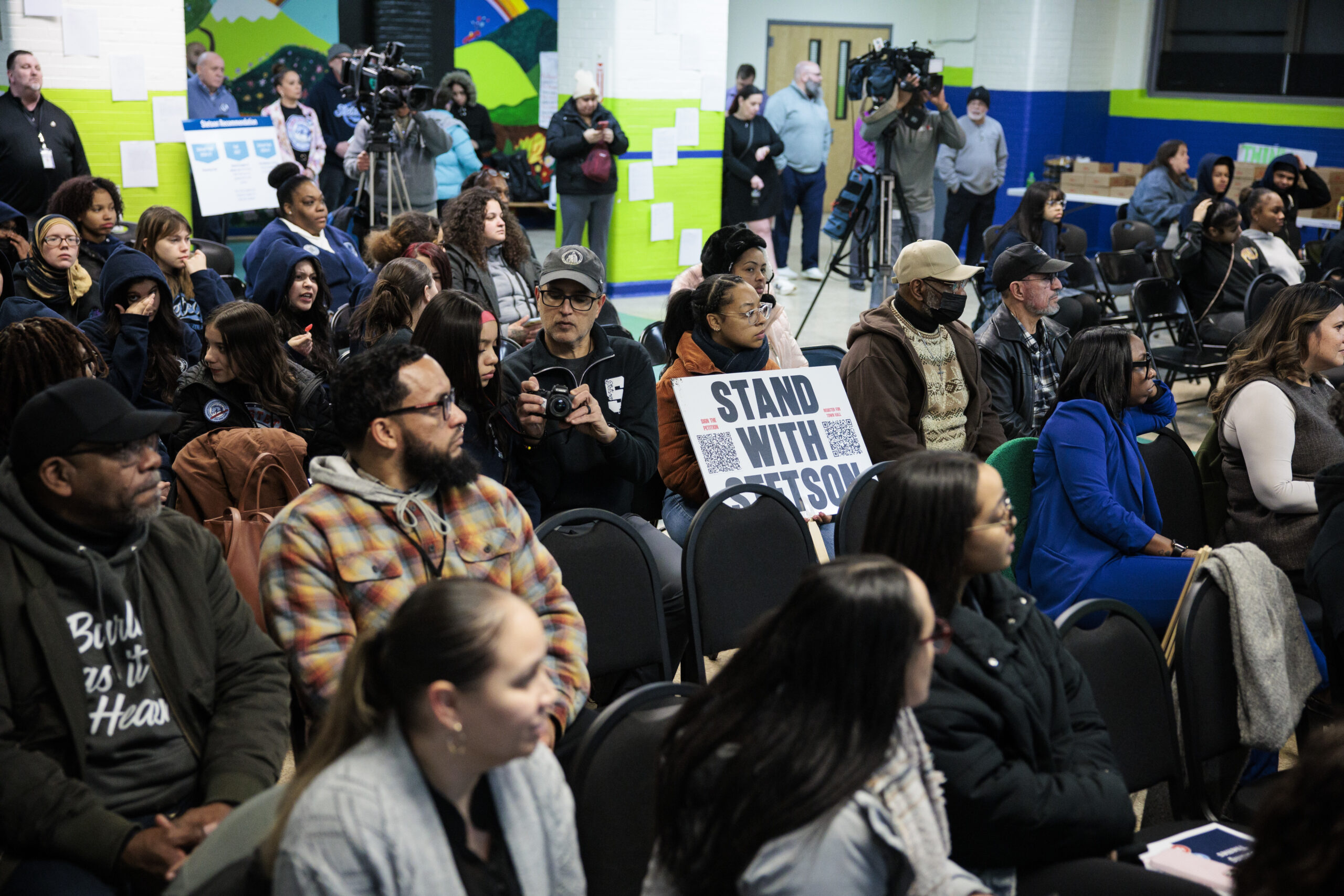
Community angst spilled over at the closing meetinglast week, with audience members booing district officials who were there to present information and answer questions, and applauding for those who spoke up for Stetson.
If the district has money to spend on fixing up buildings, why not spend on Stetson’s building, students asked.
Students and attendees listen during a community meeting at John B. Stetson Middle School last week.
“We have a fourth floor,” one sixth grader said. “Y’all could just fix that, y’all could fix the pipes, y’all could fix everything.”
Another student said she was frustrated by mold in the school, and a leaky roof.
“I heard that it’s your fault,” the student said.
Later, at a Tuesday City Council hearing, Councilmember Quetcy Lozada told Superintendent Tony B. Watlington Sr. that Stetson staff have put in 12 separate requests to fix the leaking roof.
“That roof is still leaking,” a frustrated Lozada said. “Can I have someone please today commit to going to Stetson and checking their leaking roof?”
Watlington said he would “make that happen.”
‘The void that it’s going to leave behind’
The district got the Stetson call wrong, said Kathryn Lajara, a special-education teacher at the school.
“Our school is being penalized for allegedly lacking space — P.E., special education, art,” Lajara said. “These conclusions are based on incomplete and misleading information, not on lived reality of what happens in our building every single day.”
Special ed coordinator Kathryn Lajara speaks during a community meeting at John B. Stetson Middle School last week. Lajara and others spoke out against the recommendation to close the school in Kensington.
Stetson has an art lab, rooms for piano class, dance, a music room, anda photography room, Lajara said. And it serves 140 students with disabilities, despite the district saying it had inadequate special-education spaces.
Lajara was also frustrated by the district’s upkeep of the building.
“We fight the dripping water every day from the roof that you continue to neglect,” Lajara told district officials at the community meeting.
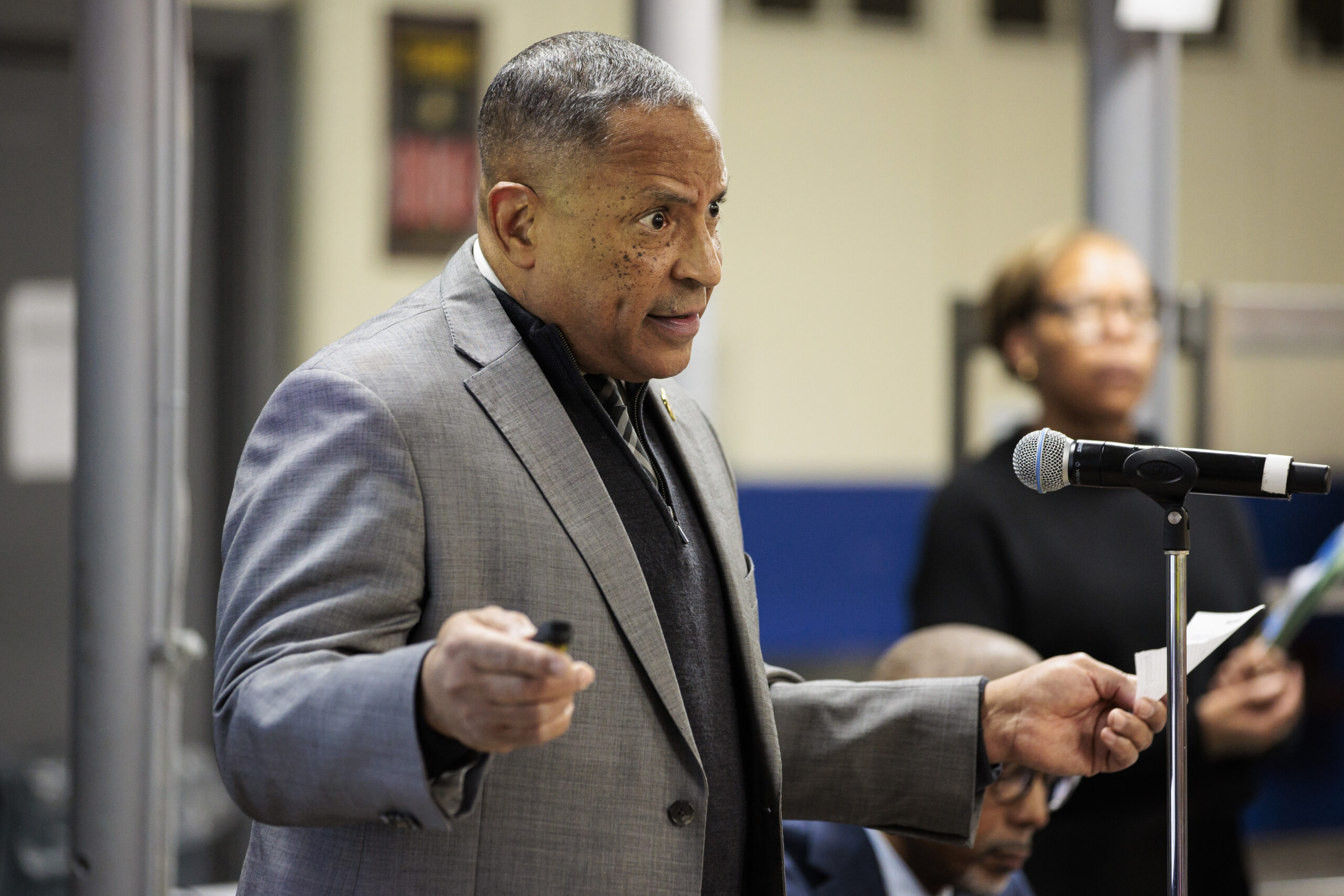
“I’m going to admit to you: We have neglected this building over decades,” Deputy Superintendent Oz Hill told the audience.
Lajara looked at Hill.
“Instead of continuing to neglect, how about we decide that our community and our students are best to invest in?” she said.
Deputy Superintendent Oz Hill speaks during a community meeting at John B. Stetson Middle School last week.
Crystal Pritchett, another Stetson teacher, suggested the district’s decision to send students to Cramp and Elkin was not in tune with neighbors’ wishes about safety and comfort.
Families have safety concerns about sending their kids to other schools, Pritchett said.
“You know nothing about this community,” Pritchett said. “You aren’t listening.”
Stetson opened in 1915 and was a district schoolfor nearly 100 years. It turned into a charter school runby the nonprofit Aspira in 2010, but the district took it backin 2022 after Aspira failed to meet district standards.
Abandoning it altogether is unthinkable, said the Rev. David Orellana, a pastor at CityReach Church in Kensington.
“I don’t think we’re taking into account the negative impact and the void that it’s going to leave behind,” Orellana said. “Taking Stetson away is taking the heartbeat of this community.”
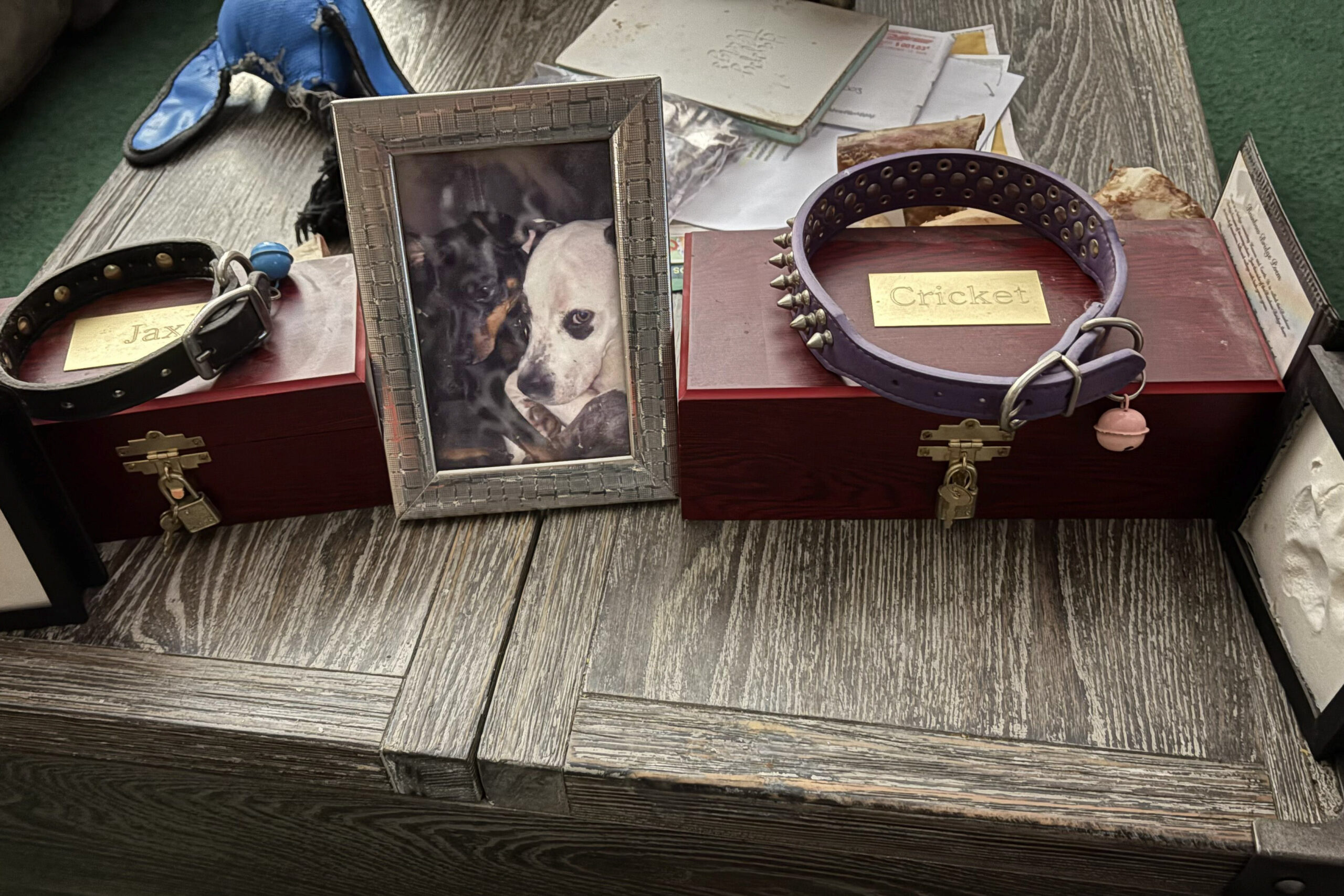
Raymond and Anna Wakeman had returned from dinner early on a Saturday night and were relaxing on the couch with their two rescue dogs in their Northeast Philadelphia home. Cricket, a pit bull, rested his head on Raymond’s shoulder. Jax, a miniature pinscher, was curled up next to Anna.
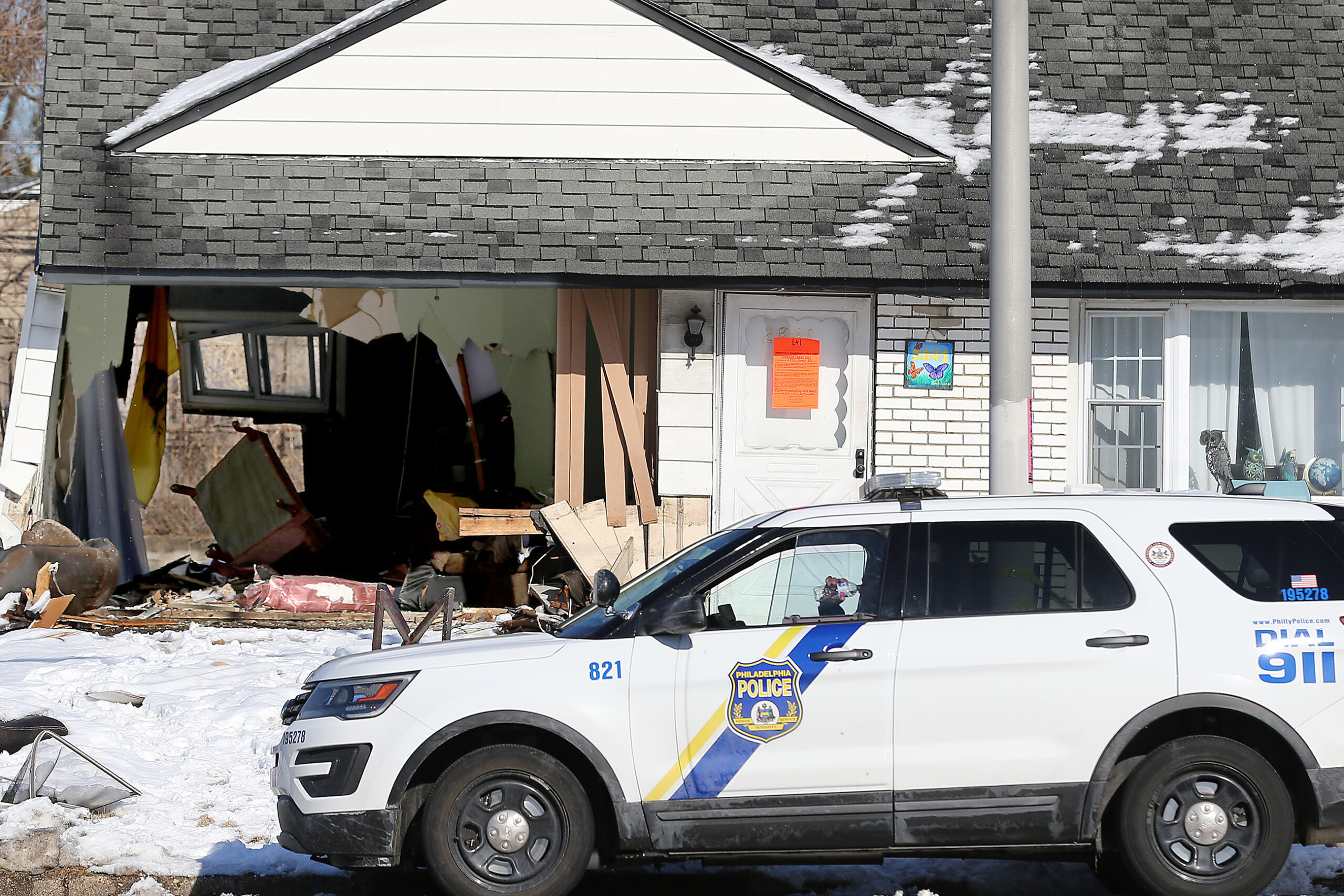
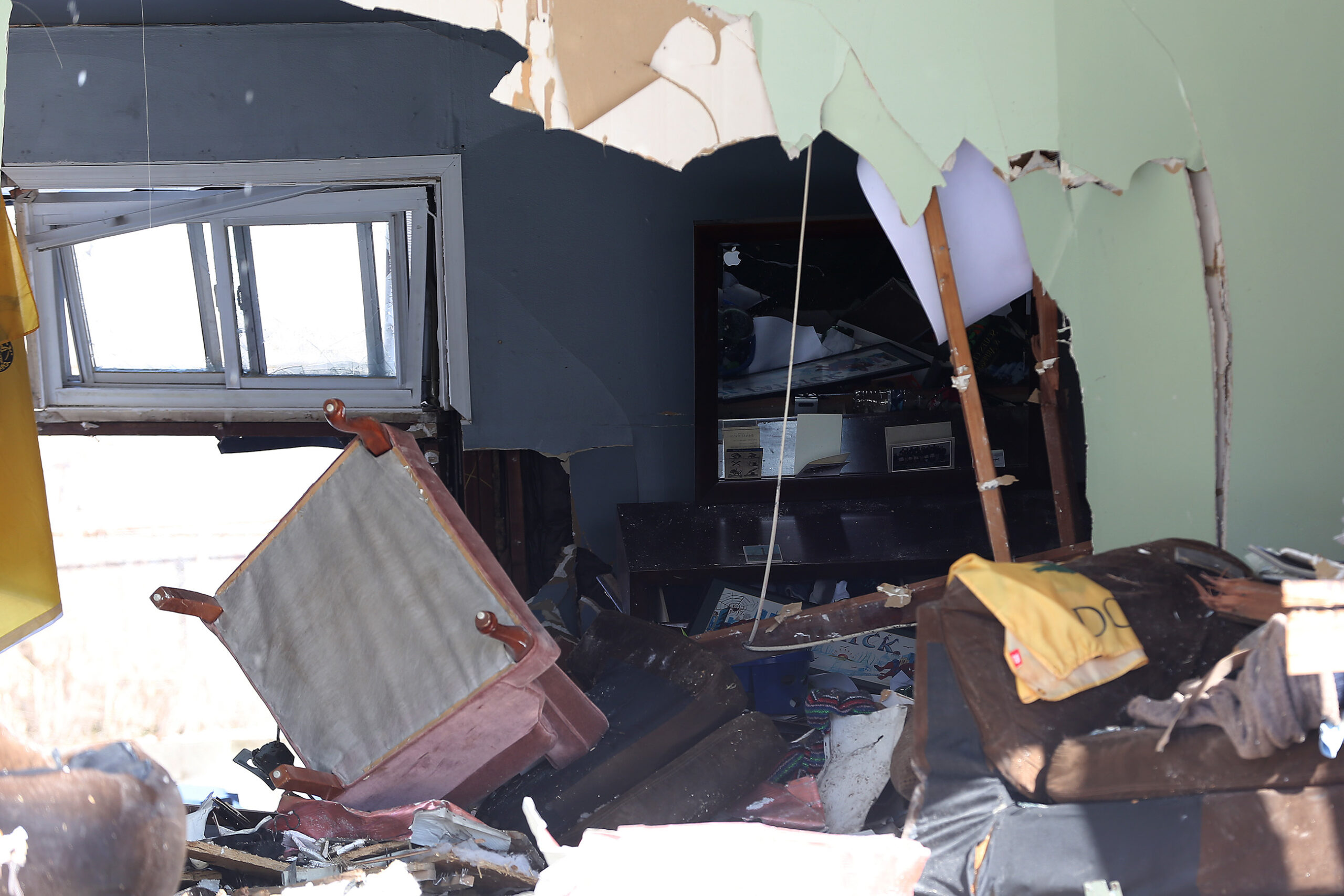
In an instant, a 2014 Dodge Dart exploded through the front of the Wakemans’ home and into their living room.
Firefighters arrived to find Anna in another room, pinned under the silver Dodge and gravely injured. Rescuers worked feverishly to free her from the wreckage and rush her to the hospital. Jax was dead. Cricket underwent emergency surgery, but died soon after.
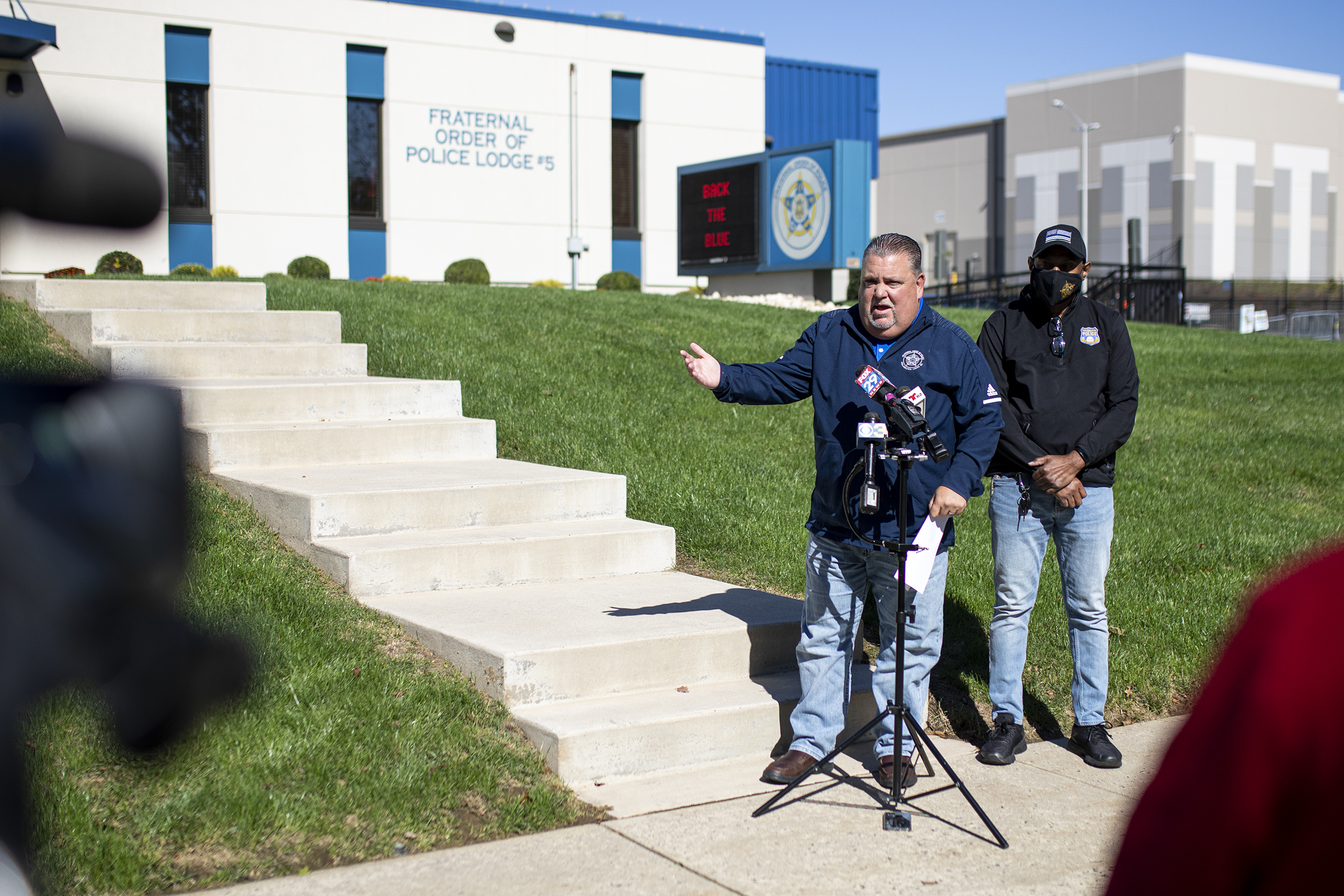
Anna Wakeman assembled a memorial to the family’s two rescue dogs, Jax and Cricket, who were killed by a Gregory Campbell, a Philadelphia police officer who crashed his car into her home in 2021. Campbell spent hours consuming alcohol at a bar operated by the Fraternal Order of Police Lodge 5.
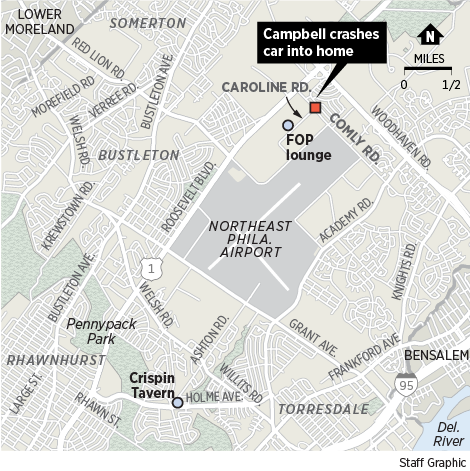
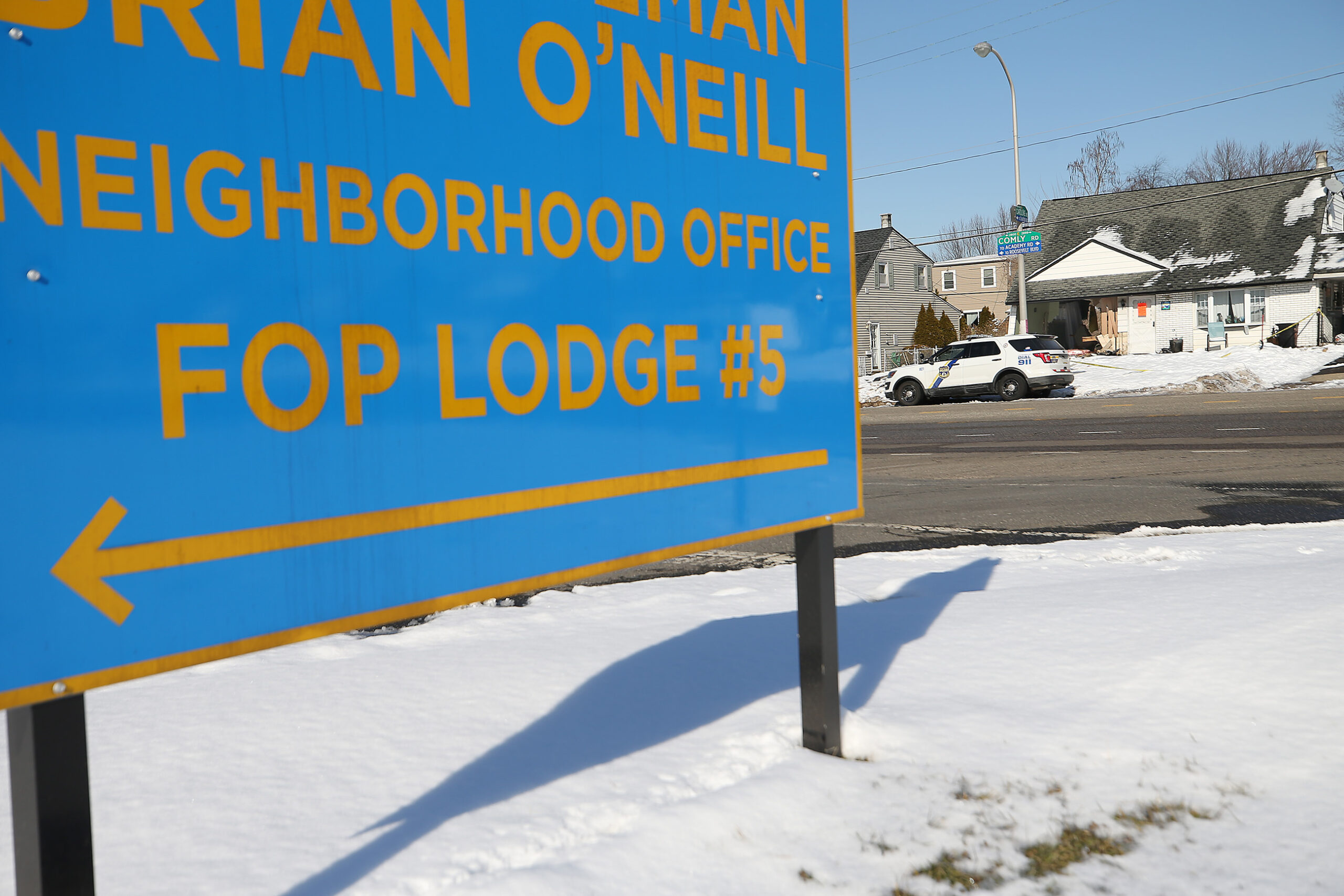
The driver, off-duty Philadelphia Police Officer Gregory Campbell, had been drinking since midafternoon on Feb. 6, 2021, and a lawsuit would later allege he had consumed as many as 20 alcoholic beverages. He had most of them where he ended his evening, at the 7C Lounge, a members-only club for active and retired cops operated by the Fraternal Order of Police Lodge 5, inside the union’s headquarters.
Campbell was arrested and fired from the police force after the crash. In June 2022, a Common Pleas Court judge sentenced him to 11½ to 23 months in prison.
“I am so sorry,” Campbell told the Wakemans in court, “for everything I’ve put you and your family through.”
Campbell’s accident and subsequent trial were widely covered at the time. But an Inquirer investigation has found troubling new details about that crash and the aftermath that were never made public, and identified two additional auto accidents tied to the 7C Lounge. The findings raise questions about how drunken-driving cases are investigated when they involve a powerful police union operating its own bar.
Records show that after crashing into the Wakeman house — and while it was still unclear whether Anna Wakeman had survived — Campbell was allowed to confer with FOP representatives and delay a blood-alcohol test for nearly six hours.
Gregory Campbell’s Dodge Dart sped from the parking lot outside the FOP’s 7C Lounge into the Wakemans’ home, killing the family’s two dogs and almost killing Anna Wakeman.
The delay was an apparent violation of Pennsylvania law, which requires suspected drunk drivers to undergo testing within two hours of being behind the wheel unless good cause is given. The records include no explanation for the delay.
An officer in the police department’s Crash Investigation District later testified in a deposition that he had never before encountered a person accused of driving under the influence who was allowed to seek guidance from his labor union before undergoing blood testing.
When Campbell’s blood was finally tested, his alcohol level registered at 0.23%, almost three times the 0.08 legal threshold for drunken driving. A toxicologist later estimated Campbell’s blood-alcohol content at the time of the accident was as high as 0.351%, more than four times the legal limit.
The Wakemans filed a lawsuit in Philadelphia Common Pleas Court against Campbell, the 7C Lounge, and Lodge 5. The couple’s attorney hired a liquor liability expert — a former police officer who had been an investigator for the New Jersey Division of Alcoholic Beverage Control for 11 years — who concluded that there was “overwhelming evidence” that the 7C Lounge had overserved Campbell and failed to monitor him or intervene.
The “actions and inactions were negligent and reckless” and “contributed directly to the accident, damages and injuries sustained by the Wakeman family,” the expert, Donald J. Simonini, wrote in his 23-page report.
On the night of the crash, a Philadelphia police accident investigator attempted to interview employees working at the 7C Lounge but was unable to do so because the bar had closed hours earlier than scheduled. The investigator said subsequent attempts to obtain information from the employees were also unsuccessful.
A manager later testified that he was “following orders” when he shut down the bar early.
An aerial view of Lodge 5’s headquarters, the 7C Lounge, and Anna and Raymond Wakeman’s home.
At that time, Lodge 5 was led by its longtime president, John McNesby. His chief of staff, Roosevelt Poplar, was vice president of the union’s Home Association, a nonprofit that operates the 7C Lounge.
Neither McNesby nor Poplar responded to requests for comment.
State law grants regulators broad authority to crack down on bars found to have overserved customers, with sanctions ranging from fines to suspension or revocation of a liquor license. Yet the FOP’s bar has faced no regulatory repercussions during the 16 years it has operated at its Northeast Philadelphia headquarters.
Paul Herron, a Philadelphia lawyer who specializes in liquor licenses and enforcement, said that the Pennsylvania State Police Bureau of Liquor Control Enforcement (BLCE) has “very stringent requirements” and that most establishments tend to have at least minor violations, such as improper recordkeeping. He said it is “very unusual” that the 7C Lounge has a clean slate given the severity of the Campbell case.
Campbell “had consumed monumental amounts of liquor, and for that to just not show up anywhere is awfully strange,” Herron said. “I would expect that if this happened to another place, that this would come to light, to the knowledge of the bureau, and they would ultimately issue a citation.”
In another incident tied to the 7C Lounge, regulators did not open an investigation because the union did not report what had happened.
The Inquirer viewed two minutes and 40 seconds of surveillance footage of the 7C Lounge parking lot from the evening of Nov. 22, 2021. The recordings come from three separate cameras and show a patron walking out of the 7C Lounge and getting into the driver’s seat of a compact SUV. At 11:21 p.m., the driver backs up, then accelerates forward into a parked truck, hitting it hard enough to slam the truck into the front bumper of an SUV parked behind it.
The motorist pauses a few seconds, reverses, then accelerates past the damaged vehicles and runs over two orange cones. The driver then plows through the FOP’s fence on Caroline Road, destroying a section of it, before disappearing from the camera’s view.
A source with firsthand knowledge of the incident said Poplar reviewed the footage of the parking lot crashes and took notes, including “4 cars hit” and “fence,” with the time each object was hit.
Roosevelt Poplar won a heated reelection battle for the FOP’s presidency in 2025. He previously served as the vice president of the union’s Home Association, a nonprofit that operates the 7C Lounge.
A police spokesperson said there is no record that the crashes in the 7C Lounge parking lot had ever been reported to authorities.
Herron said a typical bar would have almost certainly reported that type of incident.
“It’s just not something that would have happened maybe if it didn’t involve the police or the FOP,” he said.
‘I was dizzy’
There are potential conflicts of interest if law enforcement officers with arresting powers own establishments that serve alcohol. In fact, state law prohibits police officers from holding liquor licenses because they are responsible for enforcing liquor laws.
But that restriction does not extend to the FOP’s Home Association because it is considered part of a fraternal, nonprofit organization. State law defines such entities as “catering clubs” — much like a VFW post or an Elks Lodge — and permits them liquor licenses.
It’s a loophole in the law that Anna Wakeman, who barely survived the accident with Campbell’s Dodge, doesn’t understand.
“The cops can drink as much as they want there,” Wakeman, now 58, said. “The bartenders serve them till they’re blackout drunk and let them leave.”
When Campbell crashed into the Wakemans’ home, it was the second time the family’s property had been damaged by a patron who left the FOP’s bar impaired. Less than two years earlier, a former Philly cop had left the 7C Lounge, got into his car, and smashed into Anna Wakeman’s SUV, which was parked in her driveway.
Anna Wakeman and her husband couldn’t stomach the idea of returning to their Northeast Philadelphia home after the 2021 car crash, fearing it could happen again. They moved instead to West Virginia.
On a Sunday night in April 2019, an ex-Philly cop named Damien Walto worked as a DJ at the 7C Lounge, which has an expansive bar with gleaming dark wood and big-screen TVs. Walto was no longer an active member of Lodge 5: He had been fired from the police force in 2010 for allegedly assaulting a woman while off duty, and was later sentenced to three to six months in prison.
Walto left the bar just after 10 p.m. in his GMC Envoy. Rain was falling, the roads were slick, and Walto told a reporter that he lost control of his SUV when he tried to steer past a tractor-trailer on Caroline Road. He careered through the intersection at Comly Road and smashed into Anna Wakeman’s Chevrolet Equinox, which was sitting in her driveway.
The force of the impact crumpled the rear of the Equinox like an accordion and propelled it into Raymond Wakeman’s parked Chevrolet Silverado.
The Wakemans watched Walto stumble out of his Envoy, dazed and disoriented, then stagger along the sidewalk while clutching an Easter basket.
In a recent interview with The Inquirer, Walto said he does not remember if he drank any alcohol at the party, perhaps because he struck his head hard against the steering wheel.
“I was dizzy and messed up,” he said. “I didn’t know what was going on.”
Walto returned to his GMC and fumbled with a screwdriver in an attempt to remove an FOP-marked license plate from his SUV, the Wakemans said. He toppled over and the license plate remained in place, they said.
Walto said he was not trying to hide his link to the police union. “My tag fell off and I was trying to put it back on,” he said.
Police officers arrived at the scene and noted that Walto appeared to be under the influence of drugs or alcohol. They arrested him, and medics transported him to the hospital for chest pain, according to a police report. There is no mention in the report of Walto having suffered a head injury.
At the time of crash, Walto was also facing DUI charges in Montgomery County, court records show. In August 2019, he pleaded guilty there to driving under the influence and was sentenced to up to six months in prison; he spent 72 hours behind bars, he says.
His Philadelphia case was later dismissed.
The fact that the 7C Lounge has been connected to multiple drunken-driving incidents is troubling, experts say.
The 7C Lounge closed for business early the night Campbell crashed into the Wakemans’ house.
“The more accidents that result from serving alcohol at any bar, owned by the police union or anyone else, the more the public would be ordinarily concerned about the continuing operations of that establishment,” said Mark Carter, a longtime employer-side labor attorney and a member of the U.S. Chamber of Commerce’s Labor Relations Committee.
“Here, you’ve articulated a pattern of behavior that would create a legitimate interest by the city or the prosecutor’s office about the continuing operations of that establishment.”
The state BLCE, which has the authority to issue sanctions, would not confirm or deny the existence of any investigation.
‘Watch our boy’
Hours before the Wakemans were nearly killed in their home in 2021, off-duty Philly cops had gathered for what was supposed to have been a somber affair: paying tribute to James O’Connor IV, a police corporal who had been shot and killed in the line of duty in March 2020.
The Crispin Tavern, a small bar on Holme Avenue in Northeast Philadelphia, staged a beef-and-beer fundraiser for O’Connor’s family that afternoon. Among the bar’s patrons was Campbell, who recalled drinking about six beers there before he climbed into his car and drove to the 7C Lounge, court records would later show.
He arrived at the FOP’s bar just after 5:20 p.m. His next three hours inside the establishment are detailed in a report written by Simonini, the liquor liability expert, who watched video footage from the bar’s security feed.
Campbell, who had been on the police force since March 2018, joined a table of five. Nearby, a man in a white shirt had trouble standing and nearly fell several times as he struggled to get his jacket on. He took a swing at another customer who tried to steady him.
Simonini noted that a server walked by the stumbling man four times but did not once ask if he was OK.
During a deposition, an attorney representing the Wakemans asked the 7C Lounge’s bar manager, Ernie Gallagher, about the stumbling man’s apparent intoxication.
Gallagher theorized that instead of being drunk, the man might have suffered from a neurological disorder.
“A lot of times we have a lot of people come in who don’t even drink, and, you know, they have [multiple sclerosis],” Gallagher said. “They fall and they go, ‘He wasn’t even drinking.’”
When reached for comment recently, Gallagher said: “I have no recollection. I have no comment. I have nothing.”
Simonini wrote that Campbell was drinking what appeared to be bottled beer, Twisted Tea, and mixed drinks out of plastic cups. In one 36-minute period, Campbell downed both his own drinks and others served to people at the table.
This consumption went unnoticed by 7C staff, Simonini wrote.
Gallagher said in his deposition that he considers “two drinks an hour” a safe amount to serve a patron.
“Clearly, Campbell and his party were served far more than ‘two drinks an hour,’” Simonini wrote.
At 7:40 p.m., Campbell returned to the bar, where it appeared Gallagher waved him off. Gallagher said in his deposition that he told Campbell, “Yo, you’ve had enough,” and he thought he told a bartender, “Watch our boy, Greg.” That bartender said in a deposition that he had no recollection of Gallagher’s comment.
Simonini wrote in his report that the 7C bartenders “served Campbell and his party 6-7 drinks at a time, and never watched where the drinks were going and to whom.”
Around 8:10 p.m., Campbell finished a bottle of beer and drank from a plastic cup at the bar. He headed to a bathroom but appeared unsteady, Simonini wrote.
Campbell then went outside. Surveillance video appears to show him losing his balance while walking around a snow bank toward his Dodge Dart.
Lawyers showed Campbell footage from the nearly three hours he spent at the 7C Lounge. Asked in his deposition whether he should have been refused alcohol, he answered, “Yes, based on my blood level of intoxication, yes.”
“Could you safely operate a motor vehicle when you left that bar?” the Wakemans’ lawyer asked.
“No,” he replied.
‘Gurgling on blood’
Campbell got behind the wheel at 8:17 p.m. He pulled onto Caroline Road and drove north toward Comly Road.
The posted speed limit in the area is 30 mph.
Campbell’s Dodge rocketed to 82 mph.
He zoomed past a stop sign, then crossed four lanes of traffic before striking a curb at 70 mph. The Dart thundered over the Wakemans’ snow-covered front yard.
As smoke and dust filled his home, Raymond Wakeman stood up, in shock at the devastation that surrounded him. Shards of crushed glass cut his bare feet.
“The car went right by my face and took my dog,” Raymond recalled. “It took Anna and Jax.”
Campbell climbed out of his car, but didn’t seem to “know where he was or what happened,” Raymond said.
Raymond couldn’t find his wife. But he heard faint sounds coming from the undercarriage of the car, which had come to rest in their son’s bedroom.
“She was gurgling, breathing, but gurgling on blood or something,” he said.
Raymond ripped vinyl siding off his house and used it to shovel rubble and debris from the front of Campbell’s car.
Finally, he saw her battered face.
“There was blood coming out of her ears, nose, and mouth,” he said. “Her leg was hanging off. She was barely breathing.”
Medics transported the Wakemans to Jefferson Torresdale Hospital. When the couple’s 17-year-old son, Patrick, arrived at the hospital, a doctor told him his mother was unlikely to survive the night.
“Honestly, I thought that was going to be the last time I’d ever see my mom,” he said.
Police arrested Campbell outside the splintered remains of the Wakemans’ house and transported him to Jefferson Torresdale, where he was handcuffed to a bed and treated for a cut to his forehead. He was dazed and there was a stench of alcohol on his breath, the police report said.
Then he received special visitors at his bedside, according to court records: unnamed FOP representatives.
Poplar, in his deposition for the Wakemans’ lawsuit against the FOP, was asked how the union is notified after an officer is arrested.
FOP President Roosevelt Poplar (right) said in a deposition that the union was contacted shortly after Gregory Campbell crashed into the Wakemans’ home.
“So, this is just like an extra benefit that if you’re a cop that gets locked up, they call your union rep, 911 actually does?” the Wakemans’ lawyer asked.
“Yeah, that’s the only way we could get notified,” Poplar replied.
“I mean, look. There’s a lot of unions out there. Is there a 911 call going to the Teamsters if they get locked up to their union rep?” the lawyer asked.
“I don’t know,” Poplar replied. “I doubt it.”
Shortly after Campbell’s car bulldozed into the Wakemans’ home, a union representative called the 7C Lounge and told the staff to close for the night — even though closing time was not until 3 a.m. — because an officer had been involved in an accident after drinking there.
“I was following orders,” 7C Lounge bartender Andrew Reardon said in a deposition.
A.J. Thomson, the Wakemans’ attorney, alleged in court documents that the bar was closed to “prevent an investigation by Philadelphia Police and for any witnesses to be allowed to disperse prior to interviews. This was a possible homicide investigation that the FOP actively worked to torpedo.”
The FOP denied those allegations in a response to the Wakemans’ lawsuit, and its attorneys argued that bartenders did not serve Campbell while he was visibly intoxicated and did not cause the crash. The union vehemently denied allegations of negligence, recklessness, or carelessness.
At Jefferson Torresdale, Campbell conferred with Lodge 5 representatives and refused to take a blood-alcohol concentration (BAC) test.
Accident investigators obtained a warrant to draw Campbell’s blood, a process that took four hours. His blood was finally drawn and tested at 2:34 a.m., nearly six hours after his arrest.
Even with that delay, Campbell’s blood-alcohol level was almost three times the 0.08 legal threshold.
Those with a level between 0.25% and 0.40% are considered in a “stupor,” meaning they may be unable to stand or walk, and could be in an impaired state of consciousness and possibly die, according to Michael J. McCabe Jr., a toxicologist and expert on the effects of alcohol, who filed a report in the Wakeman lawsuit.
Herron, the liquor license lawyer, said in a case like this, he would expect the State Police Bureau of Liquor Control Enforcement to investigate and issue a citation. An administrative law judge would subsequently hear the case and decide what sanctions to impose.
The minimum fine for serving a visibly intoxicated person is $1,000.
“For more serious cases, if someone is injured, the administrative law judge has the discretion to impose larger fines or suspensions,” Herron said. “The problem with this case is that any investigation was sort of thwarted. It never really got to the point where there was an investigation.”
‘I should have died’
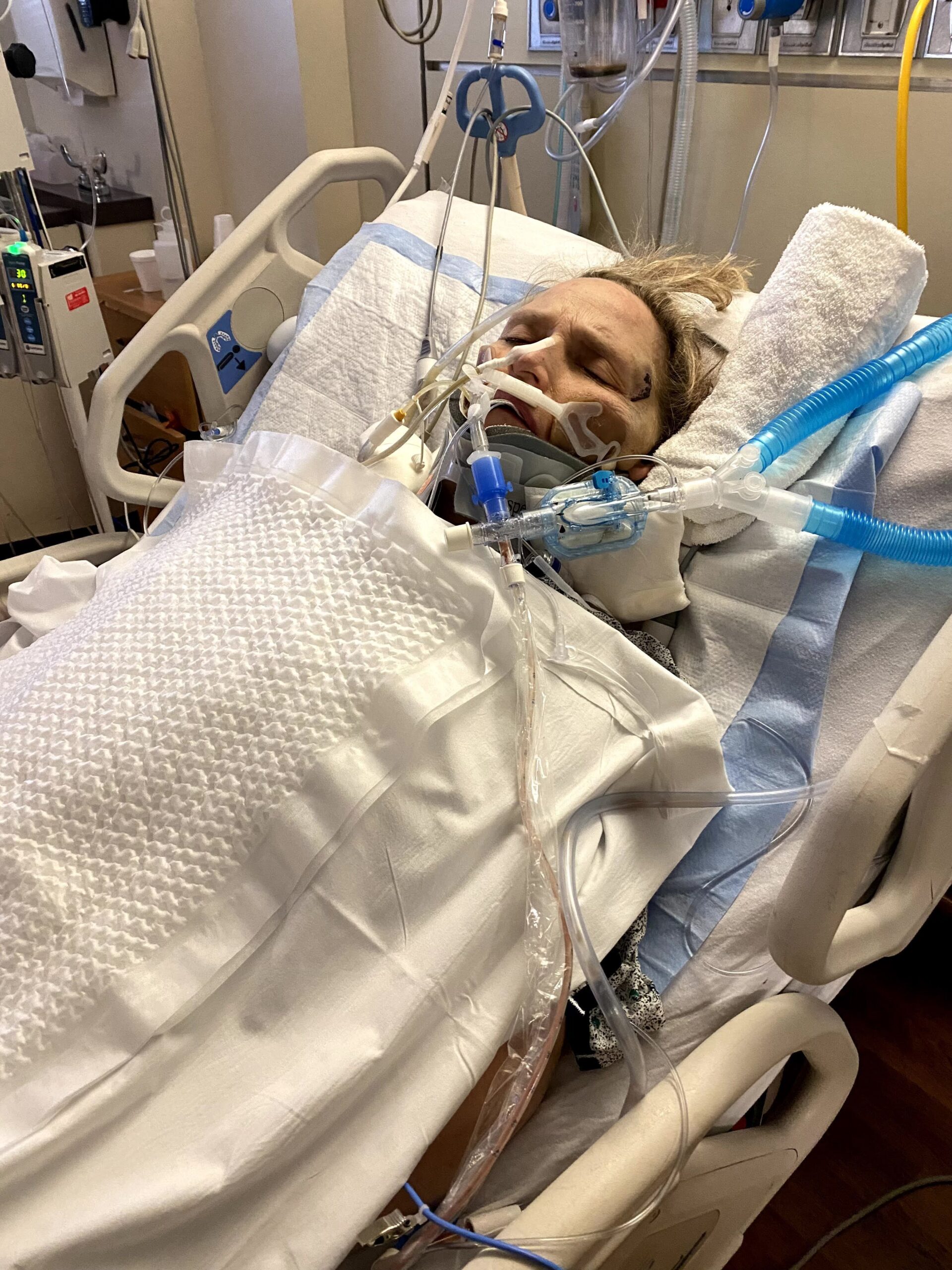
Anna Wakeman spent more than two months in a coma.
She had suffered a collapsed lung, a brain bleed, and a badly bruised heart muscle. Her spleen and her kidney were lacerated. Her sternum, thoracic vertebrae, collarbone, and 13 ribs were broken, along with her left leg.
She remained hospitalized for several weeks, then needed physical therapy.
Anna Wakeman spent more than two months in a coma after she was struck and dragged by Campbell’s car.
“I should have died,” she said. “The only reason I’m here is God was breathing for me.”
The Wakemans’ insurance company paid off the mortgage on their severely damaged home. The couple couldn’t stomach the idea of ever setting foot again inside, so they sold the property to a developer and moved to West Virginia.
They each spoke at Campbell’s sentencing hearing in June 2022.
“I was normal before this,” Anna said through tears, telling the judge she still suffers from a traumatic brain injury and lives in constant pain.
Campbell spent about a year in prison, and then was placed on house arrest.
“The man who did this to me walks free,” Anna Wakeman said in a recent interview “But I don’t have peace. We lost everything. I’m in pain all the time every single day. I’m in prison in my own body.”
The Wakemans sued the FOP under Pennsylvania’s Dram Shop Law, which holds bars liable if they serve alcohol to a drunk patron and that decision leads to injuries or damages.
In 2024, the case was settled for an undisclosed amount.
Records the Home Association filed as a 501(c) nonprofit do not require the kind of specificity that would show how the organization paid the Campbell settlement, or whether any payments were made related to the 2019 Walto crash or the unreported 2021 parking lot incident. An August investigation by The Inquirer found that while the union controls an array of nonprofits — including the Survivors’ Fund, Lodge 5, and the Home Association — its finances are opaque and difficult to track, in part because large amounts of cash move through the organizations.
Nearly five years after the accident that upended her life, Anna Wakeman still questions why 7C Lounge bartenders didn’t stop serving Campbell, or at least call him a cab, that evening.
“They let him leave knowing he was going to get behind the wheel,” she said. “These are officers of the law. They should hold the law sacred. There shouldn’t be different rules for them.”
With the arrival of above-freezing temperatures, Philadelphia is declaring an end to an emergency response that lasted 26 days, closing the chapter on an all-hands-on-deck mobilization of various city departments that navigated the biggest snowfall in a decade and the persistent cold snap that followed.
The city’s “enhanced code blue” response began the Friday before a winter storm that blanketed Philadelphia with 9.3 inches of snow and sleet on Jan. 25. The designation allowed the city to deploy support services across departments for some of the city’s most vulnerable, living on the streets.
A preliminary estimate by the city puts the cost of the storm response at about $59 million, which officials said reflects the intensity of the storm and conditions that followed.
“A tremendous City workforce, outreach teams, first responders, nonprofit partners, and community stakeholders came together without hesitation,” Mayor Cherelle L. Parker said in a statement Tuesday. “Because of their coordination, compassion, and commitment, lives were protected during some of the harshest conditions we have faced this winter.”
Amid a bitter cold that hampered snow-removal efforts, the city embarked on a cleanup operation that lasted more than two weeks and combined heavy machinery and old-fashioned manual digging.
Here are some key numbers highlighting how various city departments mobilized and the costs they accrued.
Heavy machinery and dump trucks collecting piles of snow from Germantown and Thompson Street, Philadelphia, Wednesday, Jan. 28, 2026.
$46,021,516 in snow removal
The city crafted its $4.1 million snow operations budget for fiscal year 2026 using a rolling-year average of prior costs.
But the storm brought about a slew of unanticipated expenses and challenges, including snow removal, ice control, and other emergency operations.
The city looked to contractors to bolster its workforce as it launched a massive effort to treat and plow streets.
Contractor plowing and salting operations during the storm cost $13.9 million, while the post-storm contractor cleaning and lifting operations cost $31.8 million. The remainder of the expenses came from snow-related operations across departments, such as the activation of warming centers.
Part of what made the storm so costly was the uncooperative temperatures.
Amid complaints from residents over what was perceived as a slow cleanup, the city noted that the below-freezing temperatures created increasingly tightly packed ice that had nowhere to go.
The city even brought in a snow melter from Chicago, which eliminated 4.7 million pounds of snow in the first two days after the snowfall. The costs of melting, which is considered a specialized service, ran more than $139,000.
After the initial snow removal, the city moved to what it called its lifting operations.
Snowplows, compactors, front-end loaders, and backhoes took part in an intricate operation where snow was placed in dumpsters before being shipped off to more than 30 dumping sites.
The Philadelphia Streets Department mobilized up to 300 pieces of equipment on any given day in an effort to leave no street untreated.
The city went through 15,000 tons of salt through the three-week cleanup amid other challenges, such as an icy Delaware River that temporarily blocked additional salt orders, and the rising cost of salt post-storm.
The cost of salt was more than $1.2 million.
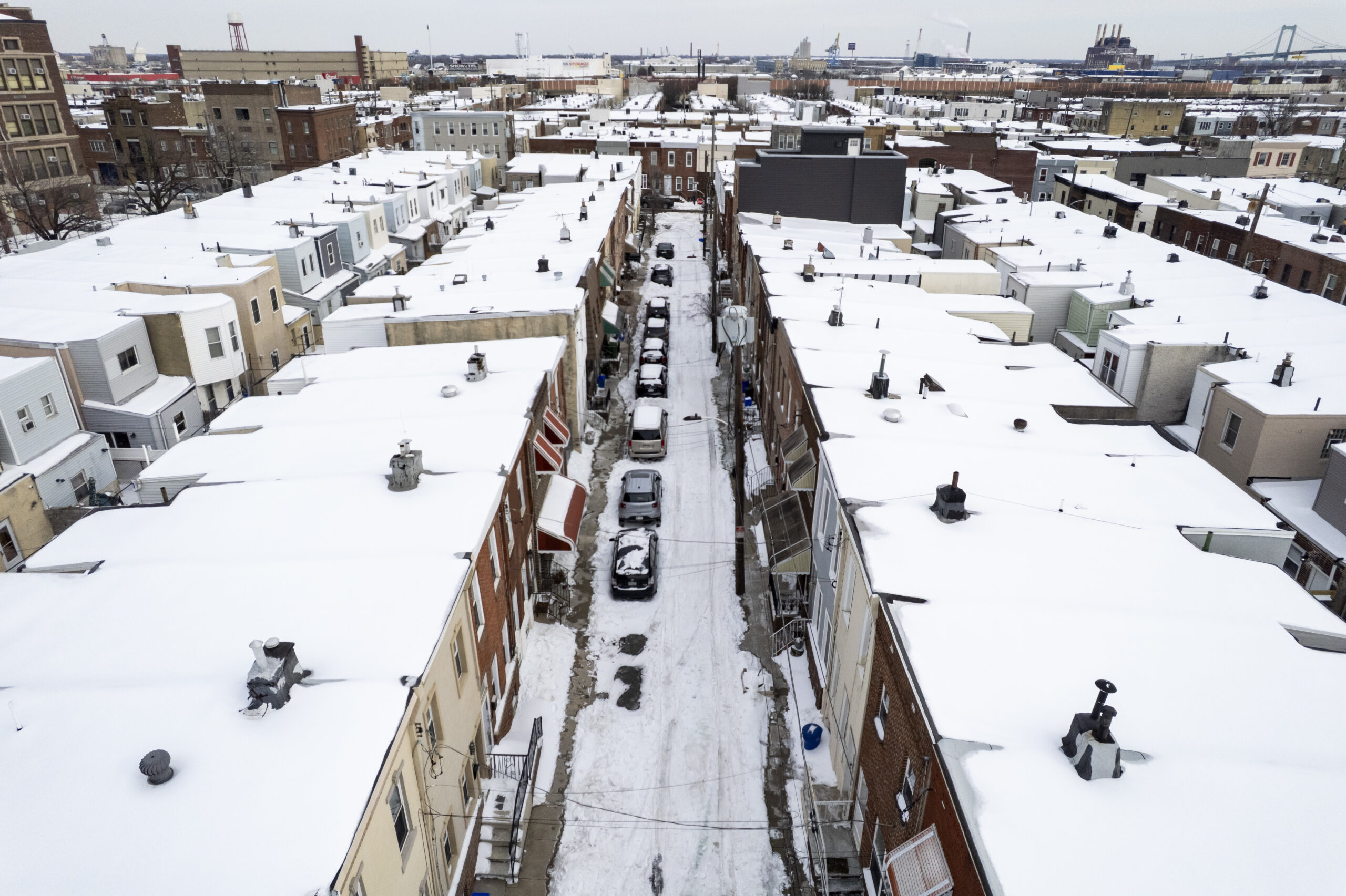
Emily Street is still covered in snow near Furness High School (top left) on Wednesday, Jan. 28, 2026 in South Philadelphia.
18,340 ramps cleared
The massive cleanup had the city looking at creative ways to boost the number of workers clearing streets.
The streets department tapped participants in its Future Track Program for snow-removal efforts early on. These are trainees, typically at-risk young adults, who are not enrolled in higher education and are unemployed. They get job experience, as well as other services, and they help in beautification projects.
The trainees cleared hundreds of ADA ramps across Philadelphia.
But more than a week after the storm, the city was still being flooded with complaints about inaccessible crosswalks and SEPTA stops piled with ice.
That’s when officials tapped into a city program that pays people the same day for their work, deploying 300 people to help chip and sweep away the hardened ice with shovels and brooms.
The city assembled a more than 1,000-person workforce for cleanup efforts this way, deploying a mix of city employees, contractors, and participants from the same-day pay program.
In all, the city said, the crews worked nearly 2,300 intersections, clearing 18,340 ADA ramps and about 2,800 SEPTA stops.
The use of contractors, however, was met with pushback from American Federation of State, County and Municipal Employees District Council 33, the city’s largest municipal workers union, which said the decision was made without consulting the union.
“Our members are the trained, dedicated workforce responsible for this work, and it is disheartening to see the administration move forward without even a discussion on how best to manage these challenges,” DC 33 president Greg Boulware said in a statement in early February.
(function() { var l = function() { new pym.Parent( ‘phillysnowcosts__graphic’, ‘https://media.inquirer.com/storage/inquirer/ai2html/phillysnowcosts/index.html’); }; if(typeof(pym) === ‘undefined’) { var h = document.getElementsByTagName(‘head’)[0], s = document.createElement(‘script’); s.type = ‘text/javascript’; s.src = ‘https://pym.nprapps.org/pym.v1.min.js’; s.onload = l; h.appendChild(s); } else { l(); } })();
22 warming centers
The cold snap presented another life-or-death challenge for the city: how to get people living on the streets indoors.
Between Jan. 20 and Feb. 14, homeless outreach teams worked nonstop distributing more than 2,800 warming kits, 4,000 fleece blankets, 700 cases of water, and 35,000 food items while trying to get people to take a shelter bed or go to one of the city’s 22 so-called warming centers.
The code blue designation allowed the city to activate some libraries and recreation centers as hubs for people looking to escape the cold.
The warming center operation was seen as lifesaving, largely supported by library staff. Between Jan. 19 and Feb. 11, New York City recorded at least 18 cold-related deaths; Philadelphia had three over a similar time frame.
Still, after 20 days of 12-hour operations, staff at the daytime centers described a lack of support from the city when it came to dealing with people who had medically complex issues requiring behavioral health support and wound care. (One library staffer said more city-assigned support staff showed up at the daytime centers after The Inquirer published a report about workers’ concerns.)
Philadelphia officials said more than 100 people from more than 20 city and partner organizations helped support the warming centers.
Nighttime warming centers had about 4,400 overnight guests, according to the city.
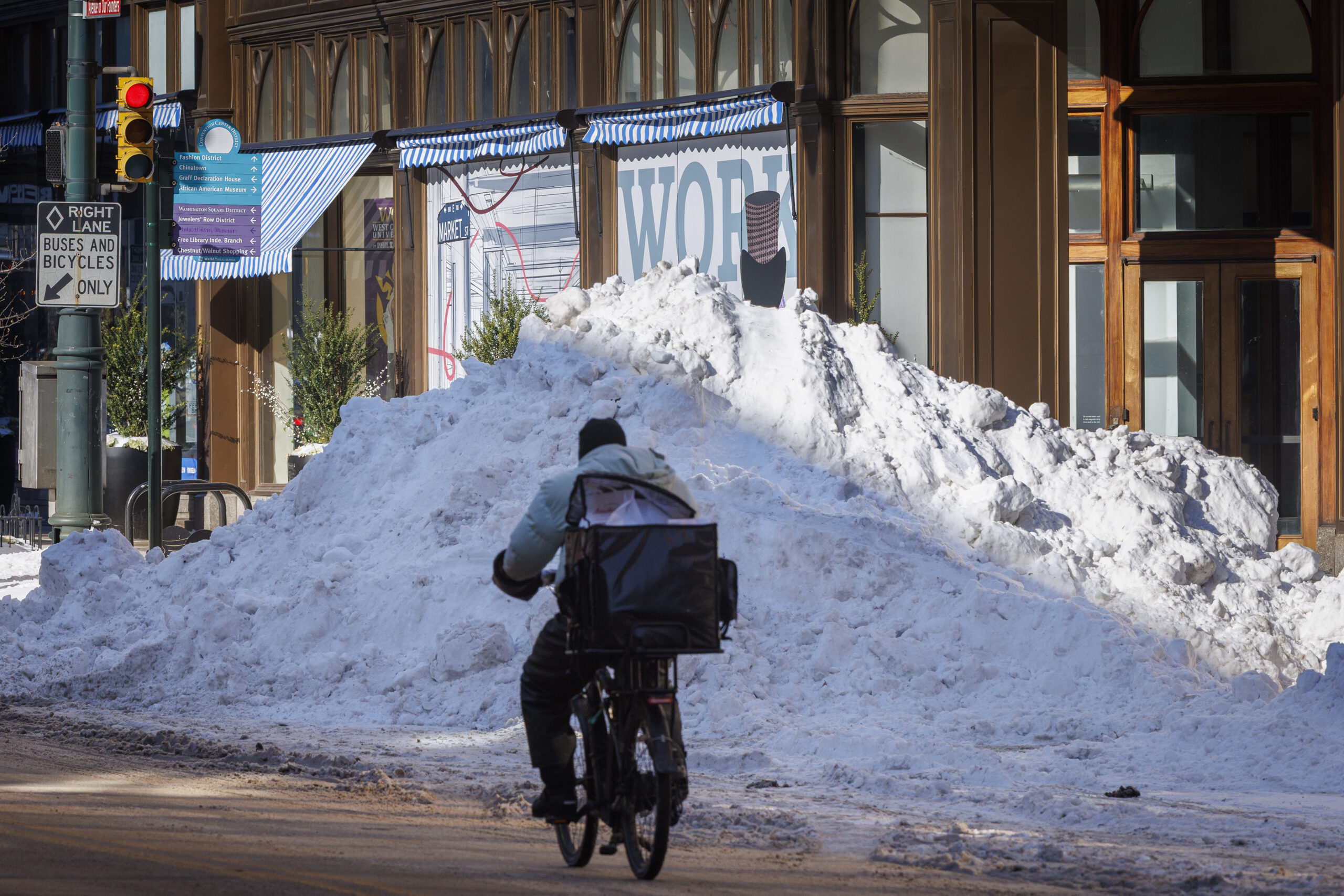
Mount Market Street at 7th Street, Center City Philadelphia, Tuesday, Jan. 27, 2026. Large pile of snow on northeast corner of Market and 7th.
$50 million from general fund
Because snow operations exceeded the initial amount allotted in the budget, the city plans to transfer $50 million from its general fund to its transportation fund.
Even so, the city said its general fund remains higher than projected in its five-year plan because of a larger-than-anticipated general fund balance in the previous fiscal year.
More than 40 drug and gun convictions were vacated Wednesday, the latest batch in what could grow to 1,000 cases tied to three narcotics officers who prosecutors say repeatedly gave false testimony in court.
Common Pleas Court Judge Rose Marie DeFino-Nastasi dismissed 47 cases — most involving defendants jailed because of their convictions — after prosecutors conceded that the testimony of three officers on the Philadelphia Police Department’s Narcotics Strike Force could no longer be trusted.
In December, the district attorney’s office said that Officers Ricardo Rosa, Eugene Roher, and Jeffrey Holden were found to have repeatedly given false statements in drug-related cases after attorneys with the Defender Association of Philadelphia uncovered video evidence that contradicted their accounts.
The defenders said the officers regularly watched live surveillance footage to monitor suspects in drug investigations, then did not disclose it to prosecutors or defense attorneys in court. The video footage showed they also testified to things that did not happen or that they could not have seen from where they were positioned, according to court filings.
Prosecutors later said that they could no longer vouch for the officers’ credibility and are expected to dismiss scores of cases built on their testimony in the coming months.
Nearly all the defendants at the center of the cases dismissed Wednesday were in custody, including several serving years in prison tied to their drug convictions.
Among them is Hamid Yillah, 34, serving four to nine years in state prison, plus two years’ probation, on gun and drug charges based on the testimony of Roher and Rosa, prosecutors said.
And Juan Lopez, 38, serving five to 10 years in prison on drug possession and conspiracy charges.
DeFino-Nastasi vacated their convictions and sentences.
Not everyone whose conviction was overturned will walk free. Some are also serving time for unrelated serious crimes, including murder and aggravated assault.
But many without additional arrests could be released as a result of Wednesday’s ruling.
The dismissals follow more than 130 convictions that were thrown out in December after prosecutors and defenders identified more than 900 cases built almost entirely on the officers’ word. Approximately 200 cases have been resolved so far.
The officers at the center of the case remain on active duty, but have been temporarily reassigned from narcotics amid an ongoing internal affairs investigation, said police spokesperson Sgt. Eric Gripp.
That investigation, which began in early 2024, remains incomplete because the district attorney’s office has not provided the department with the information necessary to complete it, he said.
The district attorney’s office previously said it provided internal affairs with details of the officers’ false statements last March. But Gripp said the records and evidence offered did not appear to show wrongdoing.
(Paula Sen, of the Defender Association’s Police Accountability Unit, said she and her colleagues have also provided internal affairs with a few dozen cases where the officers’ testimony did not match surveillance footage.)
Since the first batch of cases was thrown out in December, Gripp said, the department has followed up with the district attorney’s office for more information about the alleged wrongdoing, including the nine cases identified in court records in which the officers were said to have given false statements.
“To date, we have not been provided with those cases,” he said.
Gripp said that some of the cases discharged Wednesday involved dangerous drug dealers carrying weapons, and that narcotics officers risk their lives to make arrests.
“This work matters, and repeated dismissals without providing the department the information necessary to review and address the concerns does not advance officer accountability or public safety,” he said. “We continue to expect good faith cooperation from all partners in the criminal justice system. We remain ready to act immediately upon receipt of any substantiated information.”
The district attorney’s office did not immediately respond to a request for comment.
Prosecutors have stopped short of accusing the officers of lying, but said “there’s enough of a pattern of inconsistencies across testimony that we can’t rely on them as critical witnesses in court.”
Michael Mellon and Paula Sen work in the Police Accountability Unit for the Defender Association.
Sen and Michael Mellon, of the defenders’ Police Accountability Unit, disagreed, and said the officers “straight up lied.”
Sen and Mellon said they first spotted a pattern of testimony discrepancies in 2019 while reviewing surveillance footage that conflicted with statements Rosa had made in drug cases. Over time, they said, they continued scrutinizing his narcotics squad and identified similar issues with testimony from Holden and Roher.
According to the defenders, the officers relied on the city’s surveillance camera network to watch suspected drug activity in real time but did not disclose that investigative method — withholding evidence that should have been turned over to the defense.
In court, Mellon said, the officers denied using the cameras and frequently testified that they personally observed hand-to-hand drug transactions. Video later showed those exchanges either did not occur or would have been impossible for the officers to see because the suspects were out of view.
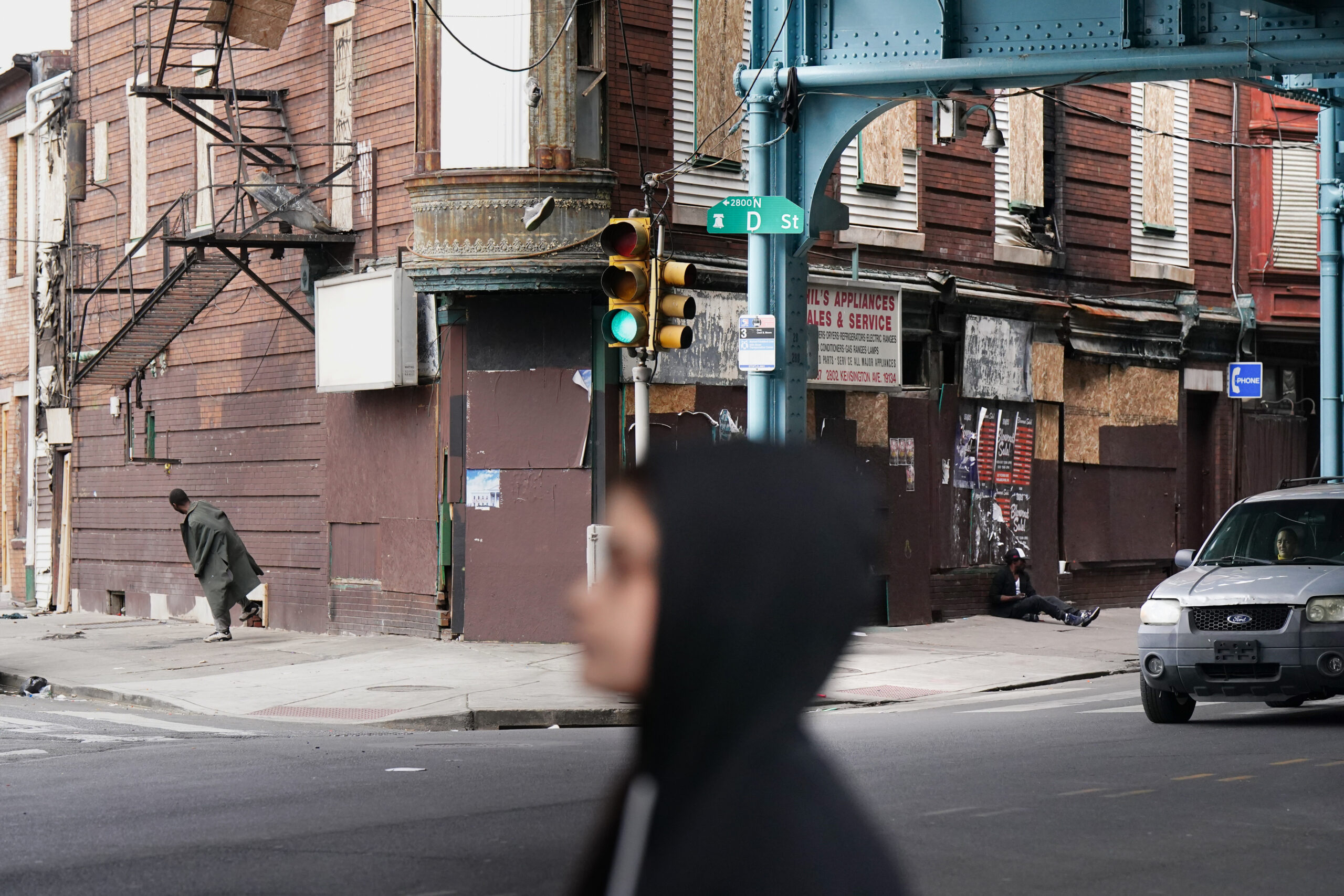
A video camera used by Philadelphia police is positioned at the corner of D Street and Kensington Avenue.
Sen said her office sent letters to all of the defendants whose cases were being reviewed to let them know they might be eligible for relief.
Still, she said, the convictions often resulted in years of peoples’ lives spent incarcerated and on court supervision — time they cannot get back.
“We are not talking about big drug busts. We are talking about the lowest of the low cases, hand-to-hand drug sales … within a quarter of a mile radius of Kensington,” she said. “That’s what makes this especially egregious.”
Antthony Mark Hankins, a Savannah, Ga.-based fashion designer who had a 31-year on-air career with HSN until he was terminated in July, filed the lawsuit last week against the network and its parent company, QVC Group, according to federal court documents.
Hankins seeks at least $30 million in damages for what his attorneys describe in the documents as an “abrupt and unjustified termination” that “reflects a pattern of discriminatory treatment, retaliatory conduct, and operational mismanagement.” The lawsuit is filed in the U.S. District Court for the Eastern District of Pennsylvania.
A show is filmed at QVC’s studios in West Chester in 2023.
Between 2023 and 2025, HSN executives reduced Hankins’ airtime and decreased promotion of his brand, Antthony Design Originals, to focus on a “TikTok-centered business model,” according to the designer’s lawsuit. As a result, he says his gross sales last calendar year were $13.24 million, more than $2 million less than projected. When he was more supported by the network, he said, his sales outperformed expectations.
Hankins, who is Black, also says the company discriminated against him based on race, including by promoting him more heavily during Black History Month, firing him without cause, and immediately pulling him off the air despite decades of strong performance, according to the lawsuit.
In the documents, Hankins also alleges breach of contract, defamation, interference with third-party business relationships, and misappropriation of his name and likeness in advertisements.
In a Facebook post on his business page, Hankins said the lawsuit “is about standing up for the values my brand was built on, protecting my legacy, and ensuring that fairness and accountability matter — especially for creators who have given decades of their lives to their work.”
Hankins’ attorney, Samuel B. Fineman of Semanoff Ormsby Greenberg & Torchia in Huntingdon Valley, did not return a request for additional comment.
A QVC logo is shown outside its studios in an undated file photo. The company has been based in West Chester for more than 30 years.
The networks’ parent company, which rebranded as QVC Group last year, has struggled recently amid stiff competition from e-commerce and social-media platforms like TikTok Shop.
Its revenue and operating income have been on the decline, and fewer people are shopping. As of September, about 7 million customers had made a purchase on the networks in the past year, down from 8.1 million in fiscal year 2023.
According to Bloomberg’s report last week, company executives were talking with creditors about a potential bankruptcy, but had not made a decision on whether to file.
A search for “QVC Group” in online court records did not show any bankruptcy filings as of Wednesday.
When Mayor Cherelle L. Parker stood in the city’s emergency management center last month and announced that her administration was preparing for the worst winter storm Philadelphia had seen in years, she was flanked by the police commissioner, the head of public schools, and a dozen other deputies.
Missing from the news conference of Philadelphia’s top officials was Managing Director Adam K. Thiel, whose job it is to oversee the delivery of city services.
It wasn’t the only time over the last year that Thiel, Philadelphia’s No. 2 public official, was noticeably absent.
Thiel, who is effectively the city’s chief operating officer, was out of office last year for a total of nearly five months, much of which he spent on military leave, according to 2025 payroll register records obtained by The Inquirer. His increasingly low profile in Philadelphia City Hall has generated frustration and fueled questions about his job performance among some lawmakers, especially as the city faced criticism over the recent snow cleanup.
Almost half of Thiel’s $316,200 city salary last year was for paid time off, according to payroll records. He is one of the highest-paid officials in the government and made more than Parker, who last year earned $280,000.
In addition to his top city role, Thiel is a major in the U.S. Army Reserves. He joined the reserves in August 2024, eight months after beginning his job as managing director.
Thiel also holds other positions outside government. In 2024, while he was managing director, he made more than $300,000 working as a consultant, according to financial disclosures. He is an adjunct faculty member at two universities and sits on several nonprofit boards.
Five City Council members told The Inquirer that it has been months since they interacted directly with Thiel.
“The managing director of the city is an extremely important job,” said Councilmember Jamie Gauthier, a Democrat from West Philadelphia. “I do not understand how someone who is absent as much as Thiel is able to carry out this job effectively.”
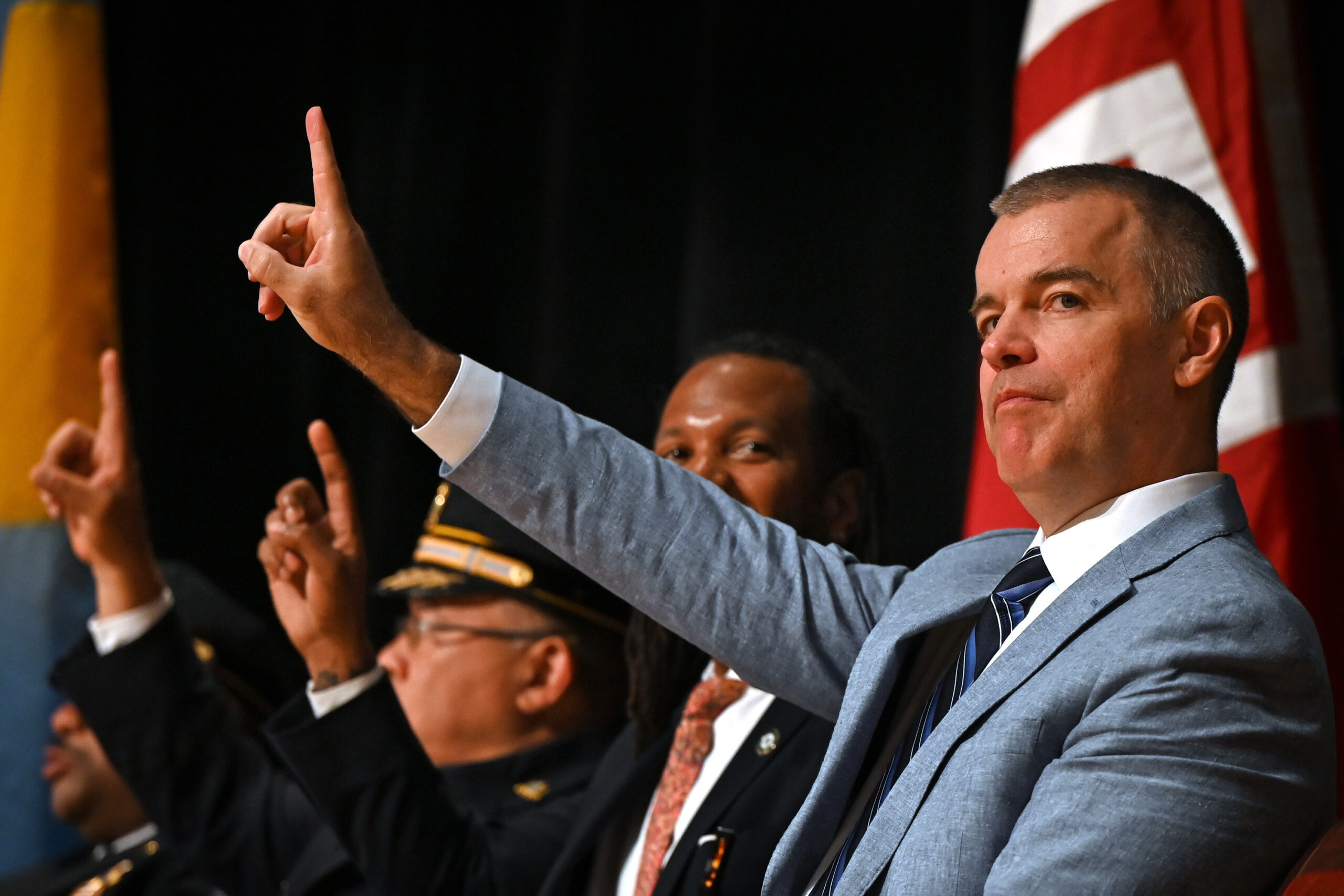
Managing Director Adam Thiel during graduation ceremonies for the police academy Class #402 of the Philadelphia Police Department and Temple University Police Department at Temple University Performing Arts Center June 17, 2024.
The administration declined requests to interview Thiel and Parker for this article. In a statement, Thiel thanked Parker for her “continued support of our city of Philadelphia employees who also serve the United States of America.”
Sharon Gallagher, a spokesperson for the managing director’s office, said in a statement that Thiel has been employed by the city for nearly 10 years and “earns leave offered by the city the same way as other city employees accrue vacation, sick days, family, medical, military and other leave categories.”
Payroll records show that Thiel logged six weeks of military leave time last year — the maximum amount the city offers employees. Gallagher said he also used 11 weeks of accrued vacation time to cover additional military assignments.
The administration declined to answer questions about Thiel’s military service, including details about his location and unit. His LinkedIn page says he “helps provide emergency management subject matter expertise to combatant commands and partner nations.”
Thiel is also founding partner of one consulting firm and the president of a second, though the specific nature of that work is not known and he has declined to disclose his clients publicly.
In 2024, Thiel said his consulting work took fewer than 10 hours per week. Gallagher said Tuesday that “nothing has changed” since then.
The Parker administration did not publicly announce when Thiel was on leave last year, but officials acknowledged it once asked by reporters last summer. At the time, Deputy Managing Director Michael Carroll filled in on an interim basis.
Thiel, 53, is a nationally recognized expert in emergency management. He held a variety of firefighting, public safety, and disaster preparedness roles across the country before coming to Philadelphia in 2016 to serve as fire commissioner and deputy managing director under former Mayor Jim Kenney.
Thiel said in a statement Tuesday that Williams was “the best choice to lead our city’s unified response to the recent snowstorm operation and is the right leader for future snow and ice events.”
Gauthier said the city’s handling of the storm “needed a higher-level emergency response.” She said while she respects Thiel’s military service, she raised his consulting work as a concern.
“A decision needs to be made what he wants to do. Does he want to serve locally, or does he want to do other things?” Gauthier said. “We need a managing director who will serve full time.”
The administration did not answer questions about whether Thiel was in town through the duration of the city’s 26-day winter emergency response.
Parker’s chief of staff, Tiffany W. Thurman, said in a statement that the city is proud to offer benefits such as military and administrative leave that support employee well-being and professional development.
Thurman said Thiel “is always reachable and fulfills the responsibilities of his position as needed based on the situation.”
“His leadership — as is the case with the leadership team of any large city — is not limited by time designated as leave,” she said.
The purpose of the Philadelphia managing director
The authors of the 1950s-era Philadelphia Home Rule Charter created the position of managing director to serve as a barrier between the mayor’s political appointees and the city’s operational departments.
The idea was that having a bureaucrat at the helm would ensure city service delivery would be apolitical, and the mayor cannot fire the managing director without cause.
In reality, different mayors have granted their managing directors varying levels of power.
In this 2018 file photo, LOVE Park is by (left to right) then-Philadelphia Parks and Recreation Commissioner Kathryn Ott Lovell, former City Council President Darrell Clarke, former Philadelphia Mayor Jim Kenney and then-Managing Director Michael DiBerardinis.
For example, former Mayor Michael Nutter dispensed with decades of tradition and assigned robust portfolios to several deputy mayors. While his managing directors were important figures in his administration, they oversaw fewer operating departments than their predecessors.
Kenney, Parker’s immediate predecessor, sought to re-empower the city’s managing director position, while his deputy mayors took on advisory roles. He reassigned almost all departmental oversight to the managing director’s office.
“We’re going to have a managing director that’s actually a managing director,” Kenney said before he took office.
Council members who were in office before Parker’s 2024 swearing-in became used to the managing director being accessible. Several lawmakers said that under Kenney’s administration, they routinely communicated about constituent services matters with ex-Managing Director Tumar Alexander and his predecessor, Brian Abernathy.
That hasn’t been the case with Thiel in the role.
“Since the beginning of this administration, I have gone to Carlton Williams,” said Councilmember Jeffery “Jay” Young Jr., a freshman Democrat who represents parts of North Philadelphia.
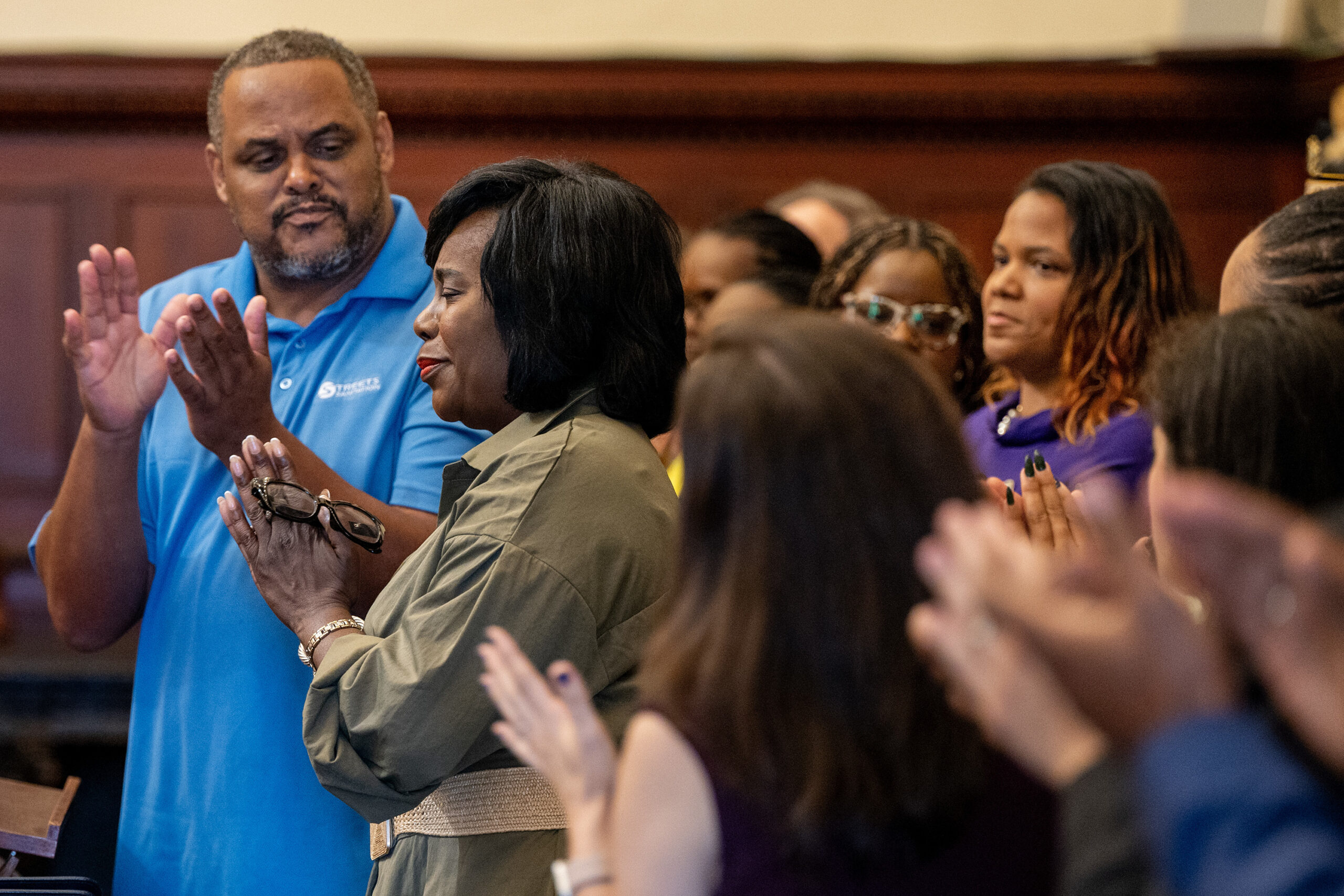
Mayor Cherelle L. Parker is applauded by members of her administration at City Hall Wednesday, Jul. 9, 2025, hours after reaching a tentative contract agreement with District Council 33 leaders overnight, ending the workers’ strike. At left is Carlton Williams, director of the Office of Clean and Green Initiatives and Chief Deputy Mayor Sinceré Harris is behind the mayor at right.
Several other members said that instead of going to the managing director’s office, they take administrative needs to legislative affairs staff, agency heads, or Thurman.
“Almost everything goes through Tiffany, and she’s able to get things done,” said one Council member who spoke on the condition of anonymity to preserve relationships with the administration.
Parker doesn’t deny that little happens at the top rungs of city government without Thurman’s involvement. The mayor has come to see her chief of staff as the central figure in her administration and calls her the city’s “chief air traffic controller.”
Phil Goldsmith, who served as managing director for two years under former Mayor John F. Street, said Thiel’s minimized public role may be because Parker appears to favor “a very strong mayor’s office.”
“It seems to me that the managing director may have to go through more hoops to get things done than, for example, I had to do,” Goldsmith said. “That’s just a function of what a mayor wants and feels comfortable with.”
Fading out of public view
Thiel’s lack of public appearances over the last year has been unusual for a managing director.
It has been 10 months since he testified before City Council, despite the managing director in previous administrations being a mainstay in hearings to answer lawmakers’ questions about city services ranging from street repaving to emergency preparation.
And in December, when a half-dozen top Parker administration officials spoke during the mayor’s State of the City event, Thiel was not on the roster.
The decrease in visibility marks a departure from his first year in office, when Thiel had a more consistent public presence and was often seen beside the mayor.
Ahead of a snowstorm in January 2024, Thiel stood with Parker during a news conference about preparations. He donned a suit while snowflakes fell, and he reassured the city that the administration was ready for the service disruptions that bad weather can bring.
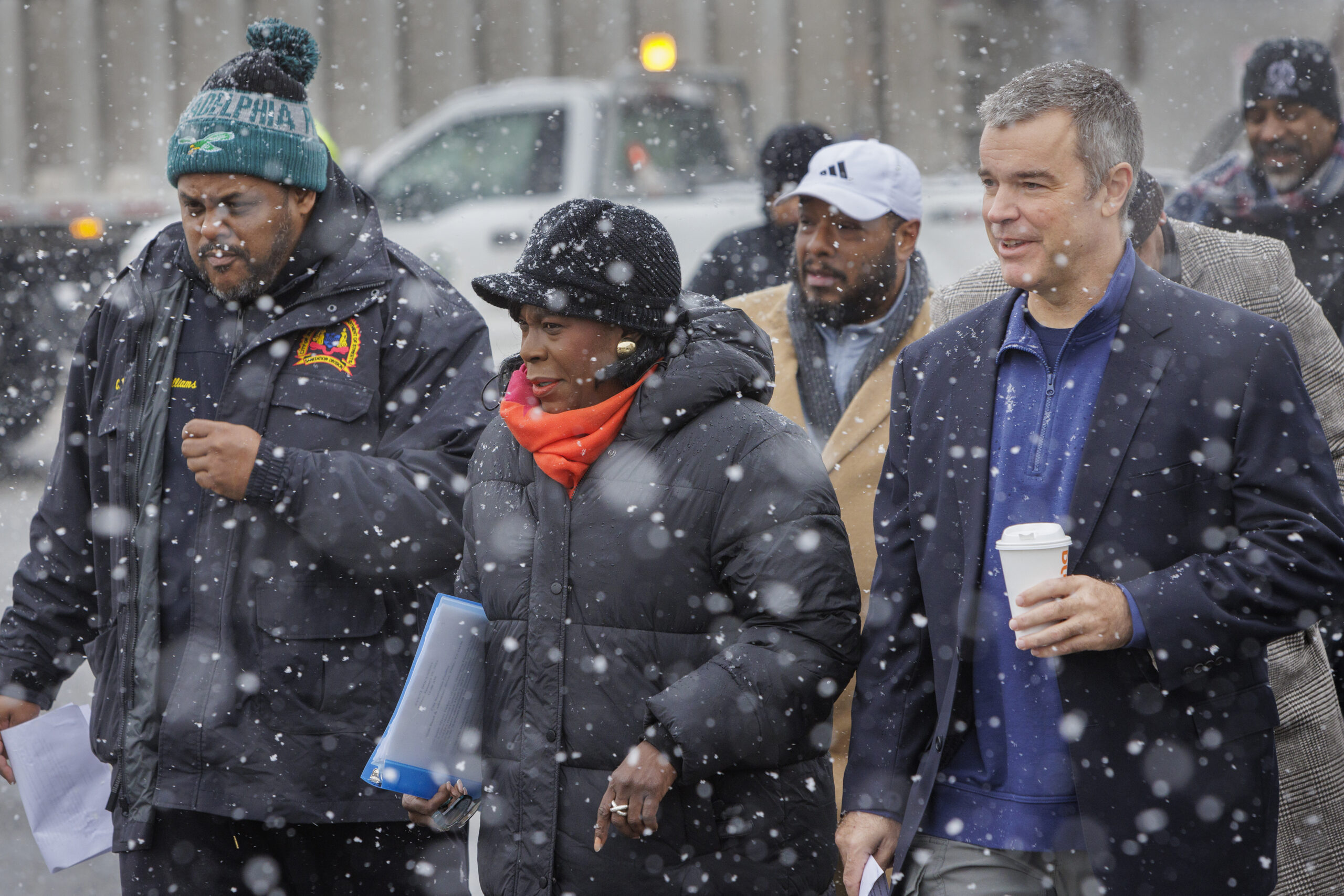
Mayor Cherelle L. Parker (center) with Managing Director, Adam Thiel (right) and at left Carlton Williams, Director of Clean & Green Initiatives, at a news conference with city officials in Northeast Philadelphia on Friday, Jan. 19, 2024 to share the city’s response to the snowstorm.
Through his first year in the position, Thiel also faced scrutiny as the face of some of the mayor’s most controversial initiatives.
He took a leading role in Parker’s efforts to end the open-air drug market in the city’s Kensington neighborhood, and he oversaw the development of the Riverview Wellness Center, a new city-owned recovery house for people with substance use disorder.
Today, much of Kensington initiative is overseen by the public safety director, who reports directly to Parker. A new head of community wellness is leading development at Riverview, and Williams was the face of the storm response.
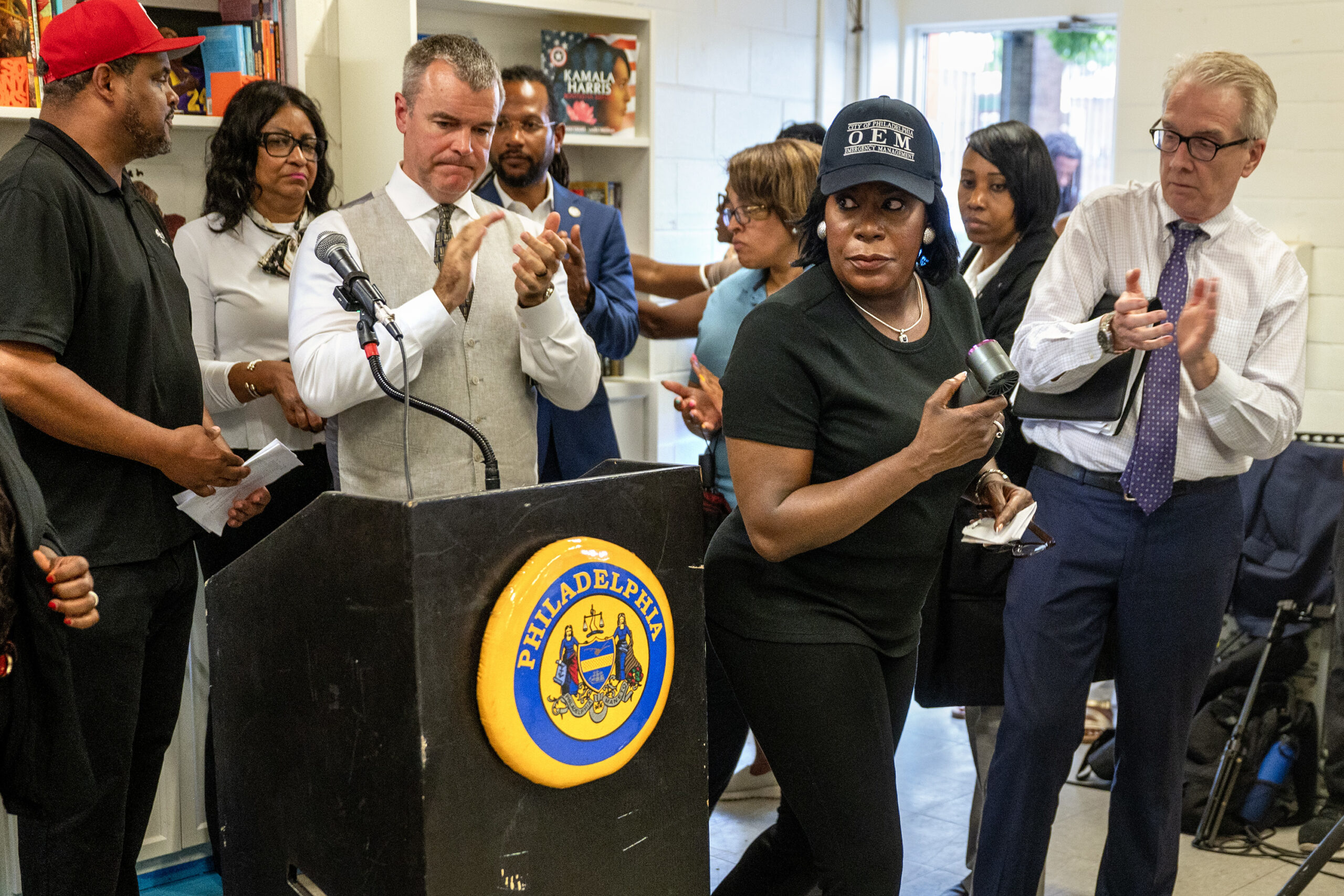
Mayor Cherelle L. Parker finishes a news media briefing with her leadership team at the Tustin Playground at 60th St. and W Columbia Ave. Tuesday, Jul, 1, 2025, on the first day of the strike by District Council 33. At left are Carlton Williams (Phillies cap), Director of Clean and Green Initiative with the Dept. of Streets Sanitation Division; and Managing Director Adam Thiel (at lectern).
But by the time the strike was resolved, Thiel had faded from public view, departing from his city job for one of his stints on military leave. After Parker reached an agreement with the union, she held a news conference with 20 top deputies and thanked each of them by name.
Thiel, absent from the City Hall news conference, was not one of them.
Staff writers Ryan W. Briggs and Sean Collins Walsh contributed to this article.