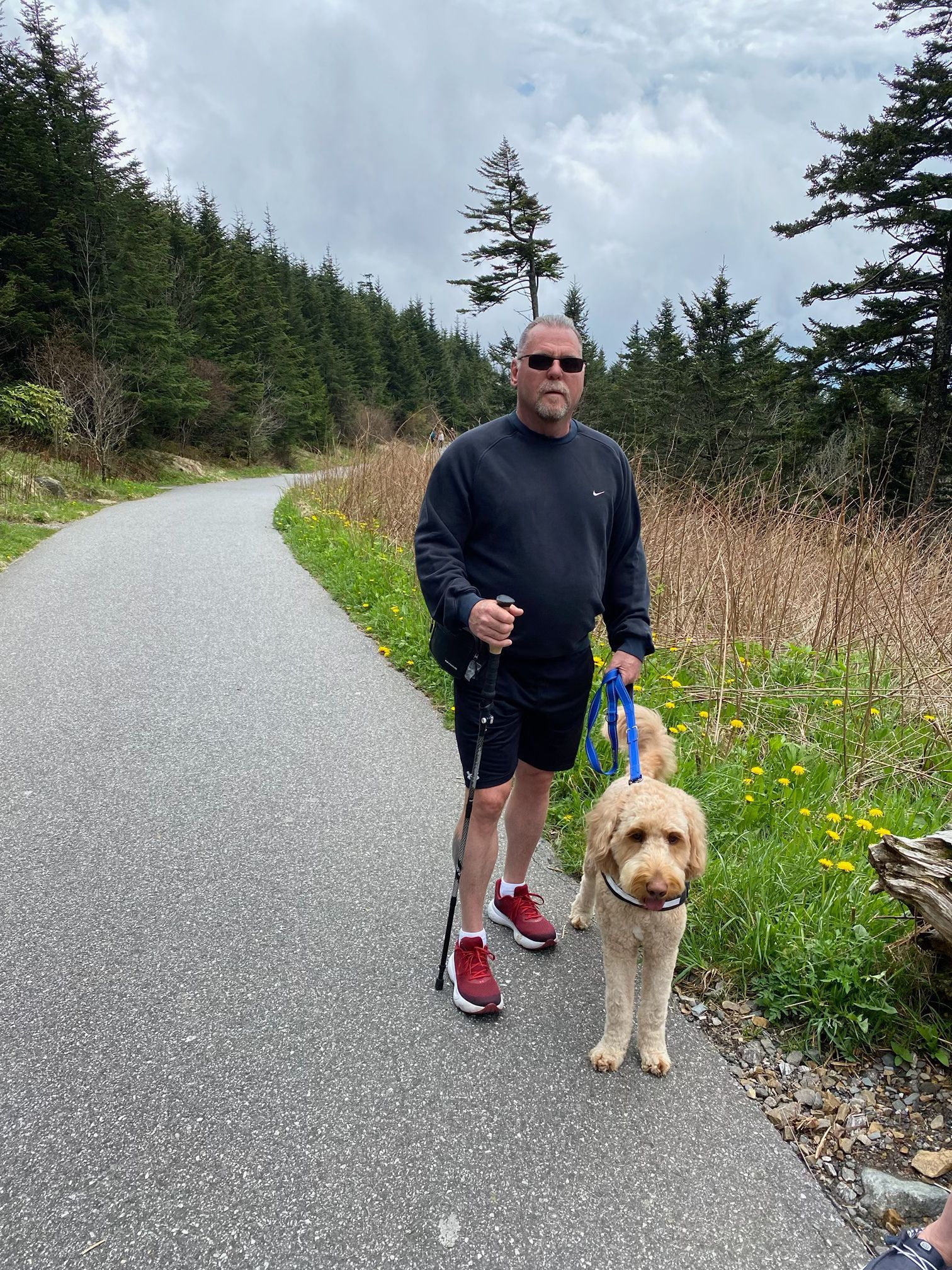
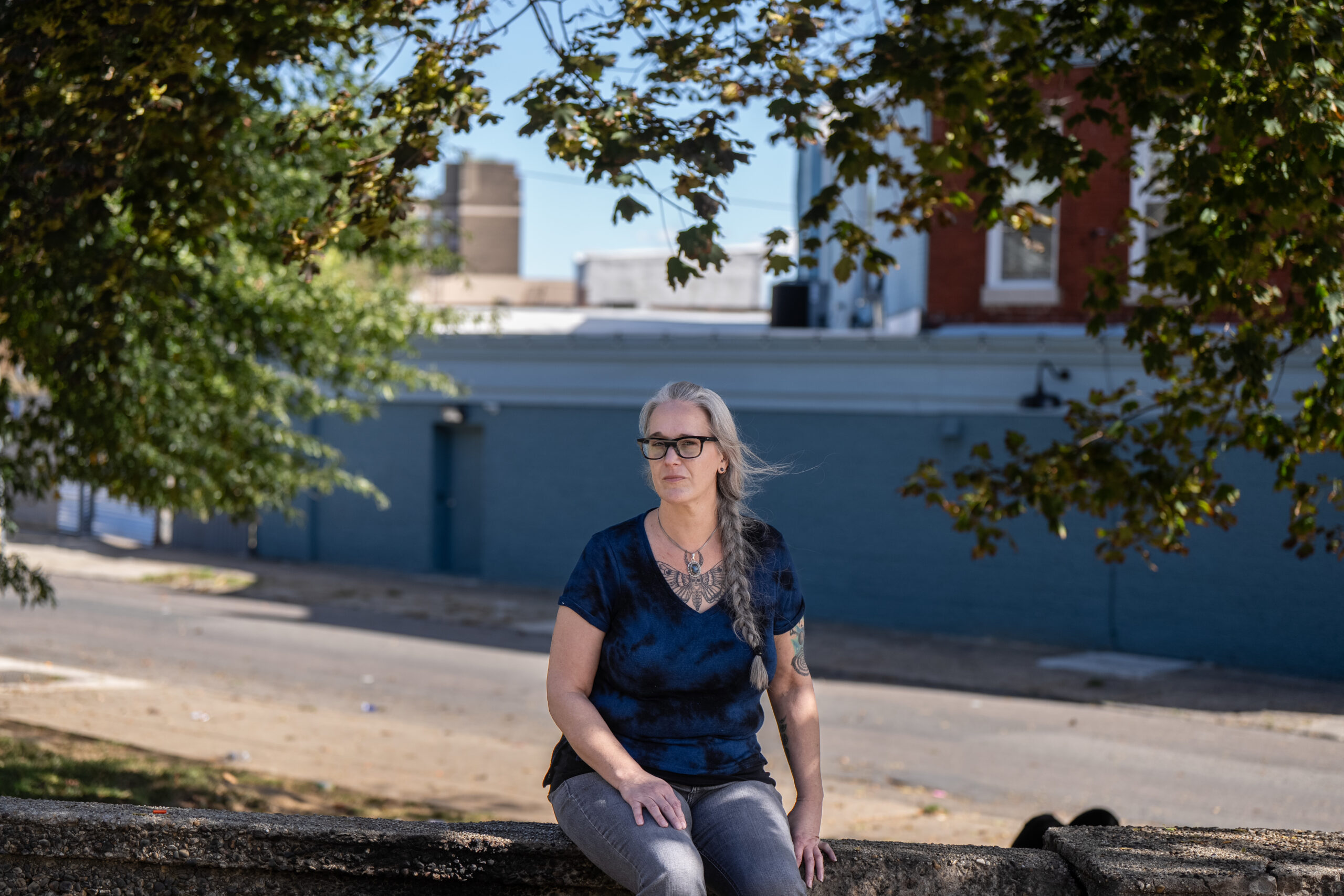
Susanna Nolt grew up in Ephrata, the eighth in a family of 12 kids. They were Old Order Mennonites and lived similarly to the Amish, though Nolt said her community pushed back against the comparison: “Our buggies are black! The Amish buggies are gray!”
There weren’t arranged marriages, but Nolt knew what was expected: Around age 18, she could begin dating a young man who was baptized in the Church. After marrying, she would raise her own large family within the Old Order Mennonite community, just as her parents and grandparents and great-grandparents had done. A family tree Nolt made when she was 16 went 14 generations back, featuring almost all Mennonites.
When Nolt was 27, she had what she described as a “spiritual rebirth” and decided to leave. She was excommunicated and kicked out of her family’s home.
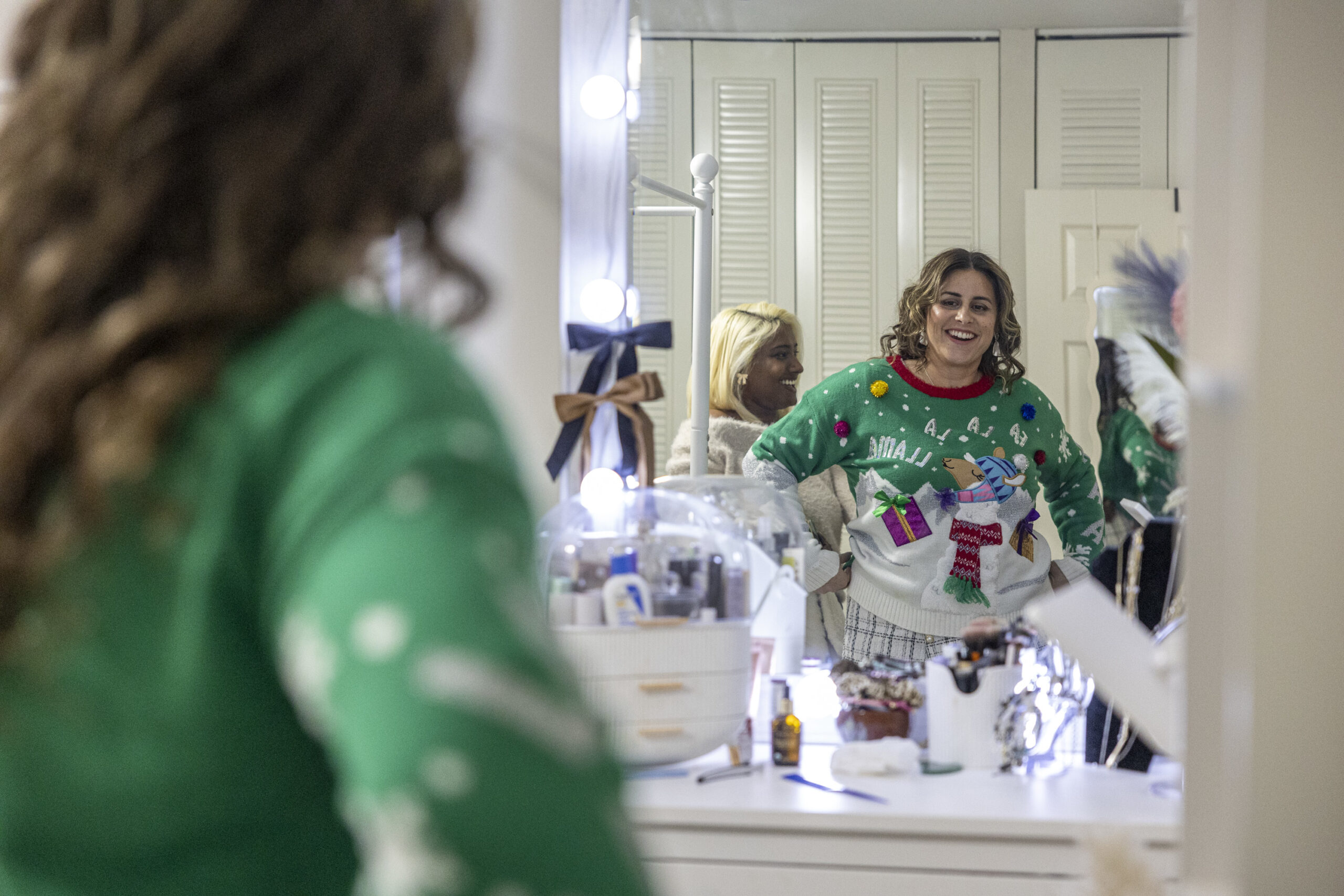
Nolt checks out her Christmas “ugly sweater” before the event.
After a few years of living in Lancaster and nannying in Reading, she moved to Roxborough.
Now 39, Nolt works as a nanny, drives for Lyft, and is earning an online master’s degree in art education from Liberty University. She lives by herself, and is figuring out what romantic partnership might look like in her new future.
The following, as told to Zoe Greenberg, has been edited for length and clarity.
On growing up in a different world
We knew the Church’s rules better than we knew the Bible. They were read to us every half year, the day before Communion: how long the dresses need to be, how big the head coverings need to be.
You didn’t have to work hard to make friends. You had your neighbors, the girls from church. You would go to school in the one-room classroom. We only went till eighth grade; we were prohibited from going to high school or college.
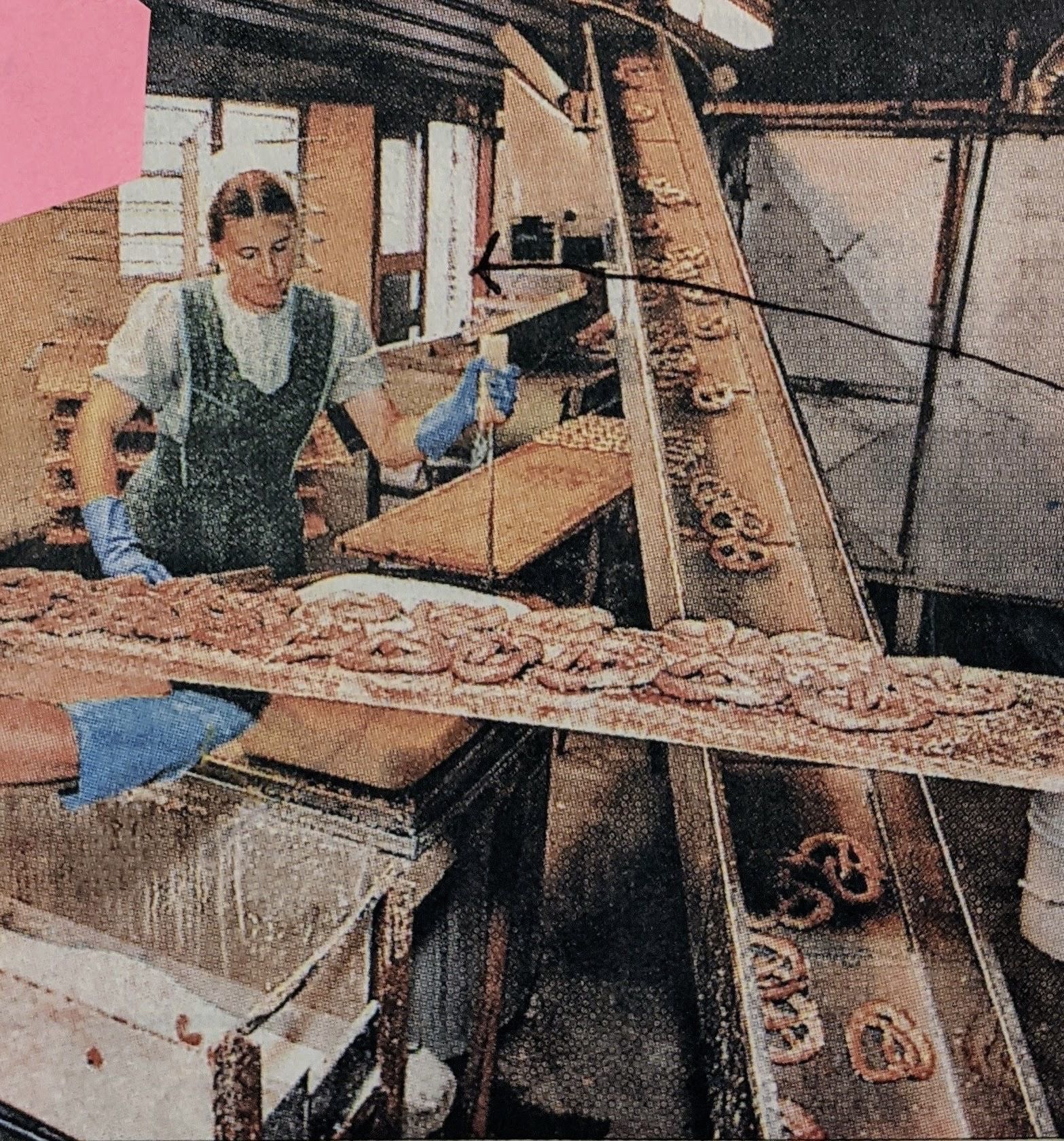
The earliest photo that Nolt has of herself is this newspaper clipping that shows her working at Uncle Henry’s Pretzel Bakery in Mohnton, Pa., when she was 19.
My mom was, obviously, a stay-at-home mom. We did all our cooking, canning, freezing, sewing, baking, gardening ourselves. So that was a full-time job for a mom. We had a ginormous garden.
My dad was a leather worker. He made harness parts for the horses. He was a deacon in the Church, so he was sometimes pretty busy with that, which made our income especially low, because positions in the Church do not pay.
On Sunday nights in the ‘dating parlor’
Young people were pretty much allowed to choose who they wanted to date, with the expectation that you date only someone who’s a baptized member of the Church, to ensure that you can build a good Mennonite family.
We had Sunday night dates, usually five-hour dates at the girls’ homes.
The house was very plain, no pictures. We had a dating parlor — it was the most decorated room of the house. The girls’ boyfriends would come over around seven o’clock on Sundays and stay ‘till 11 or 12.
The couple would sit on the couch and chat. Sometimes younger siblings would go in and play board games with them, or we’d play yard games like croquet or volleyball. Sometimes they would go on a walk in the woods. But most of the time they would spend in the parlor, getting to know each other and discussing their future.
Nolt had never been to a speed dating event before but wanted to try it.
On ‘courting buggies’ and Rumspringa
Sometimes the boys liked to decorate their buggies, to make them courting buggies. They would have a fancy varnished cabinet in the front, and maybe some dice or feathers hanging, and a nice afghan blanket or some kind of throw over the feet, because they wanted to impress their girls. They’d put reflectors on the buggy and some stripes, usually coordinating with the interior of the buggy.
In the outside world, I’ve learned they see Rumspringa as this year where you go out and experiment with the outside world, but that’s not really what it was to us. Rumspringa was just youth group, hanging out with our friends from church on Saturday nights.
Often it was hymn singing, and then afterward we would have a snack and play volleyball. There was usually a dance. We weren’t allowed to listen to music, so the dance itself was often kind of boring, because dance and music kind of need each other.
Nolt consulted her friend on which earrings she should wear.
I didn’t date much. In my time, guys didn’t really ask as easily, and the girls had no way of playing into it. You just had to wait until a guy would ask you. That felt very constricting to me.
Only about 50% of my friends were dating, if that. My mom especially, she had no problem with me being single.
Our weddings would happen on Tuesdays or Thursdays at the bride’s house. The bride’s family was responsible for hosting the wedding, which was all day: eight o’clock in the morning to at least eight o’clock at night. I never knew weddings were that expensive, because the family just provided it.
On choosing to leave
Ever since I was 10 years old, I had questions. I wouldn’t ask my questions, because that would make you a troublemaker. Ironically, I was afraid that our rules weren’t strict enough. For example, we weren’t allowed to have cameras or pictures because that was considered a graven image or an idol. I always loved playing with dolls, and I started thinking, “Maybe dolls are graven images or idols.” And I became so obsessed and bothered.
I tried to settle down by getting baptized at 17. But I felt like something wasn’t right, something was missing.
Then, when I was 27, I was teaching out in Kansas for a completely different set of Mennonites. I started realizing that bringing my rules to their community did not help anything. Like, nobody wants more rules.
I had this moment of rebirth in which I realized that Jesus is not the same as being Mennonite and all these rules really have nothing to do with Jesus.
At first I kept it to myself. I didn’t actually get excommunicated and kicked out of my parents’ house until soon after I was 28.
On losing everything
I learned that leaving is a much, much bigger deal than I ever realized, because those relationships were basically severed. I lost all my friends. I lost everything I had ever known. I had no idea how to drive a car. When I finally was able to get a car, it was like, No, you can’t drive it, you have to get a title, you have to get it notarized, you have to get insurance.
In my experience, you just get a horse and a buggy and you go drive.
A year or two after I left, my mom said that they’d been talking about it, and they decided they still want to be family. I’m still seen as the black sheep, but basically if they invite the family, they’re going to invite me. I can visit them, but of course I have to wear a long skirt or dress.
It doesn’t feel like family. It’s kind of this emotional distance.
On assimilating to the ‘English’ world
I had been nannying and I was looking for my next position and all the good ones were in Philadelphia. I moved to Philly, not knowing anyone.
I have to learn how normal people think. I grew up with no music, no media, no TV. A lot of conversations make all kinds of references to singers, actors, movies, shows. It’s a lot of researching all the time to understand what people are talking about.
I was enjoying Christian music already and I wanted to branch out, but found it difficult to connect with the music since it was overwhelmingly new. I could never recognize songs playing in public areas — it just sounded like noise. Until one day I did recognize a song and I felt so connected and happy I got tears.
Nolt in her home in Roxborough, where she lives alone.
So one of the guys I dated would send me playlists of 12 songs every time I requested a new list. I specifically asked to focus on songs that you hear in restaurants, malls, offices, etc. He would send me a list and I listened until I was familiar with each song.
My previous employer composed a list of 50 classic movies from the ‘70s to the current day so I could watch and slowly begin to catch on to references. Over the holidays that year when I was lonely, I binge-watched all those movies.
I found acquaintances in Philly who taught me about football, patiently explaining how the game works. I’ve become an Eagles fan.
On dating and ghosting
Most of the people I dated, I met online. I’ve used Upward, which is a Christian dating app; I’ve used Match. Even though I’m 39, in many ways, I’m just starting my life.
There was a guy who was in the film business, and I said, “I grew up without any of this, and so I’ve always been curious, how do they create this effect?” He got so freaked out that that was my background, and he sent me a long text afterward like, “I think you’re a really wonderful girl, but we’re just not compatible.” And he quickly blocked me.
Dating is much more inconsistent than dating in the Old Order Mennonite community. You think you’re dating them, and then all of a sudden they’re like, “Oh, never mind.”
I don’t expect perfectly scheduled dates like we had back there, but just some sense of consistency.
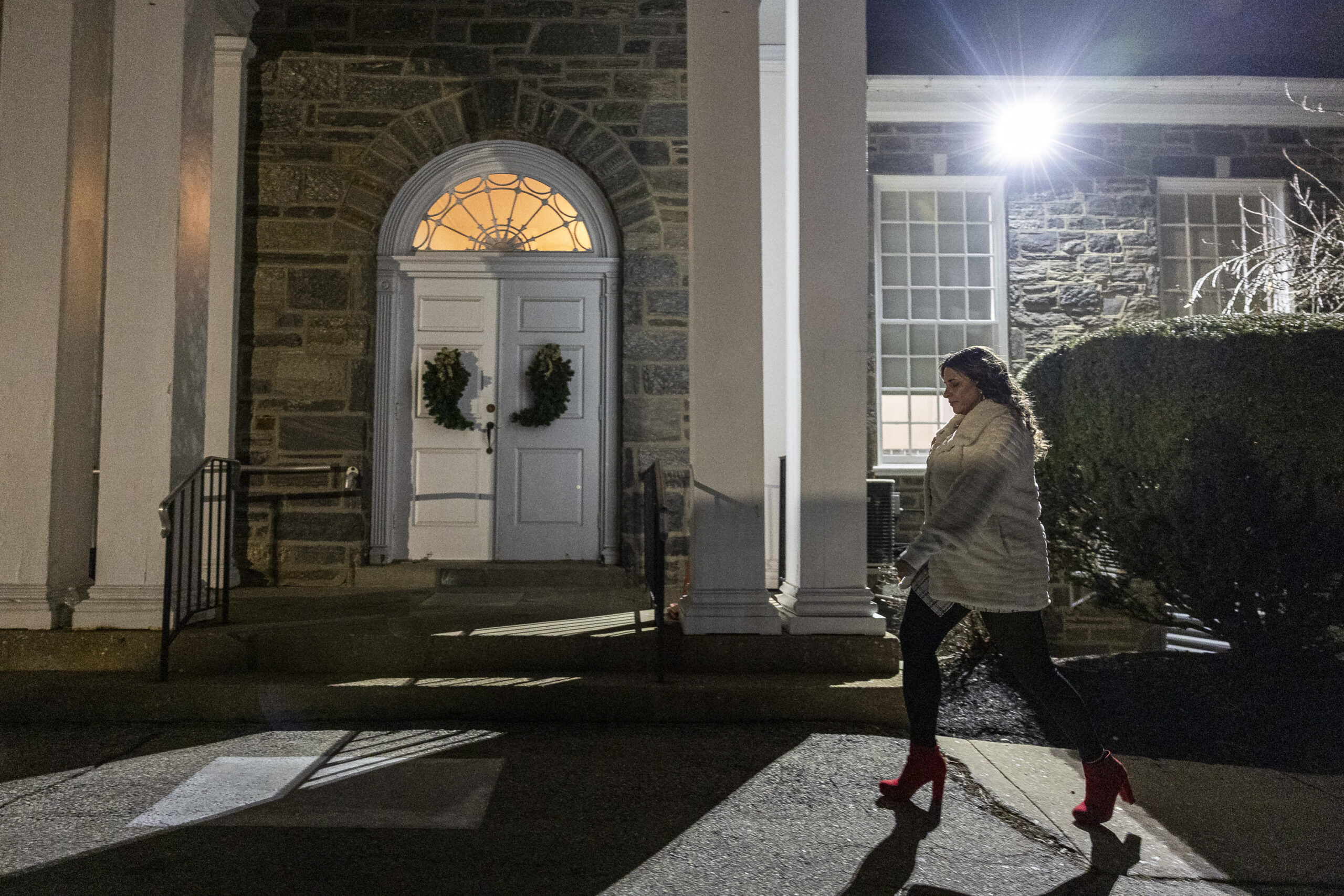
Nolt headed to the church where the speed dating event was held.
There’s some pretty serious genetic diseases among my people because the gene pool is so small, so I’m really not interested in dating someone from my background. Another reason I’m not interested is that many of them do not really assimilate to the extent that I have.
I’ve taken a number of the people I’ve dated out to Lancaster. They met my parents, and some of them did really well. Others were more just glad when it was over.
I don’t hide my background, because it’s part of who I am. Sometimes I wish it wasn’t, but that doesn’t change the fact that it is.
If I have a long-term committed relationship, I’m going to need to have someone who can be OK with that.
This is the first in an occasional series about life partners across the Philadelphia area. If you want to share your story about who you’re navigating life with romantically, write to lifepartners@inquirer.com. We won’t publish anything without speaking to you first.
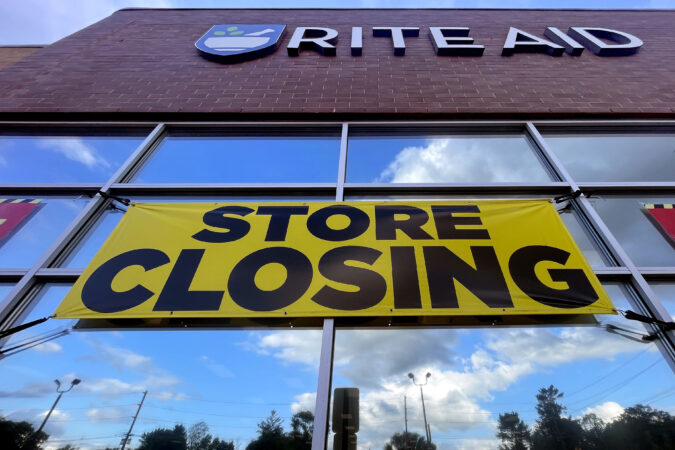
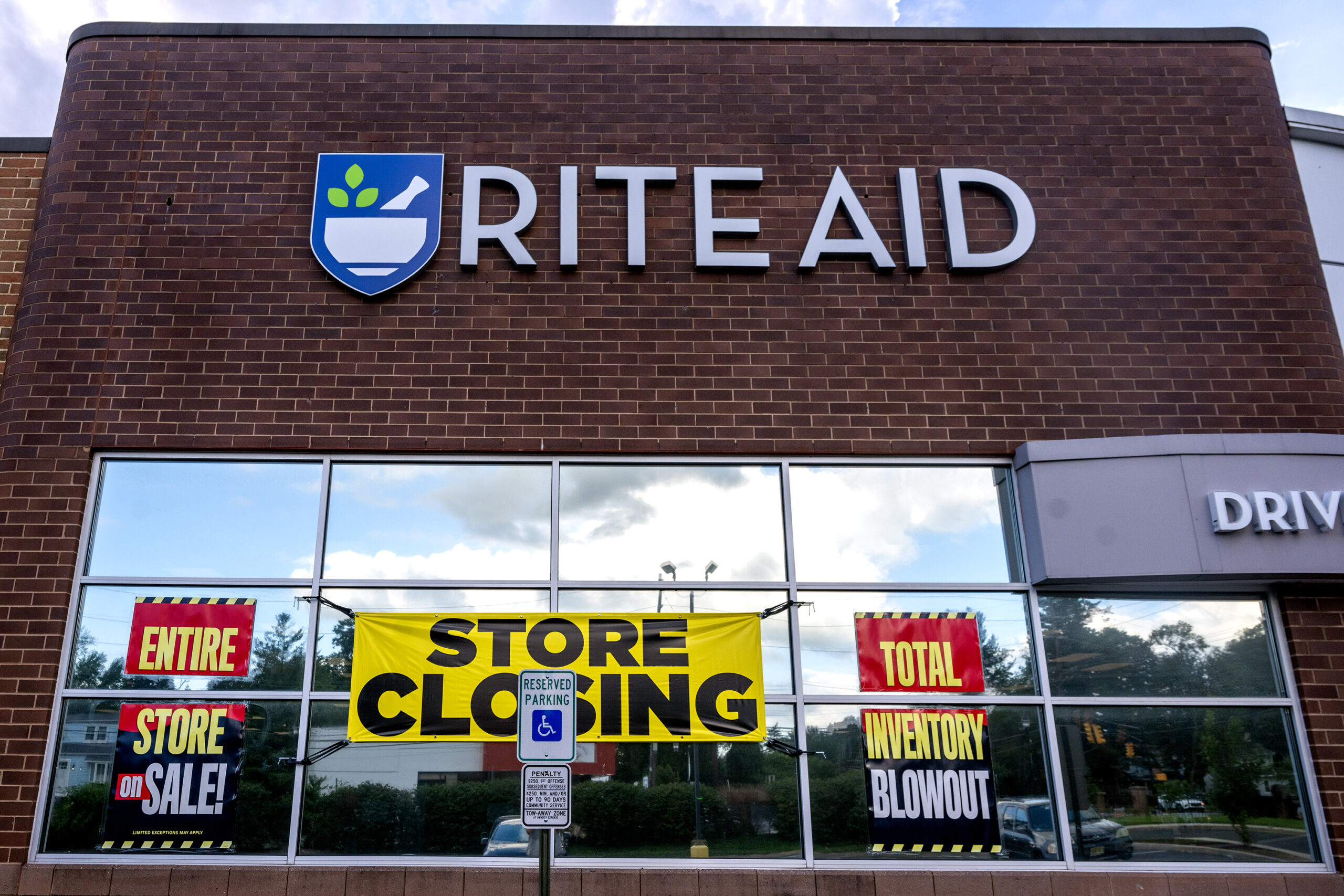
In filing for bankruptcy again, Rite Aid announced that it would be closing or selling all locations. At the time, it had about 1,000 stores nationwide, including about 100 in the Philadelphia region.
The closures further exacerbate pharmacy access issues, especially for lower-income Philadelphians who don’t have cars. People in more isolated rural areas are also impacted: The 46,000 residents of Perry County, west of Harrisburg, lost half their pharmacies when their three Rite Aids closed.
Adieu to Iron Hill Brewery
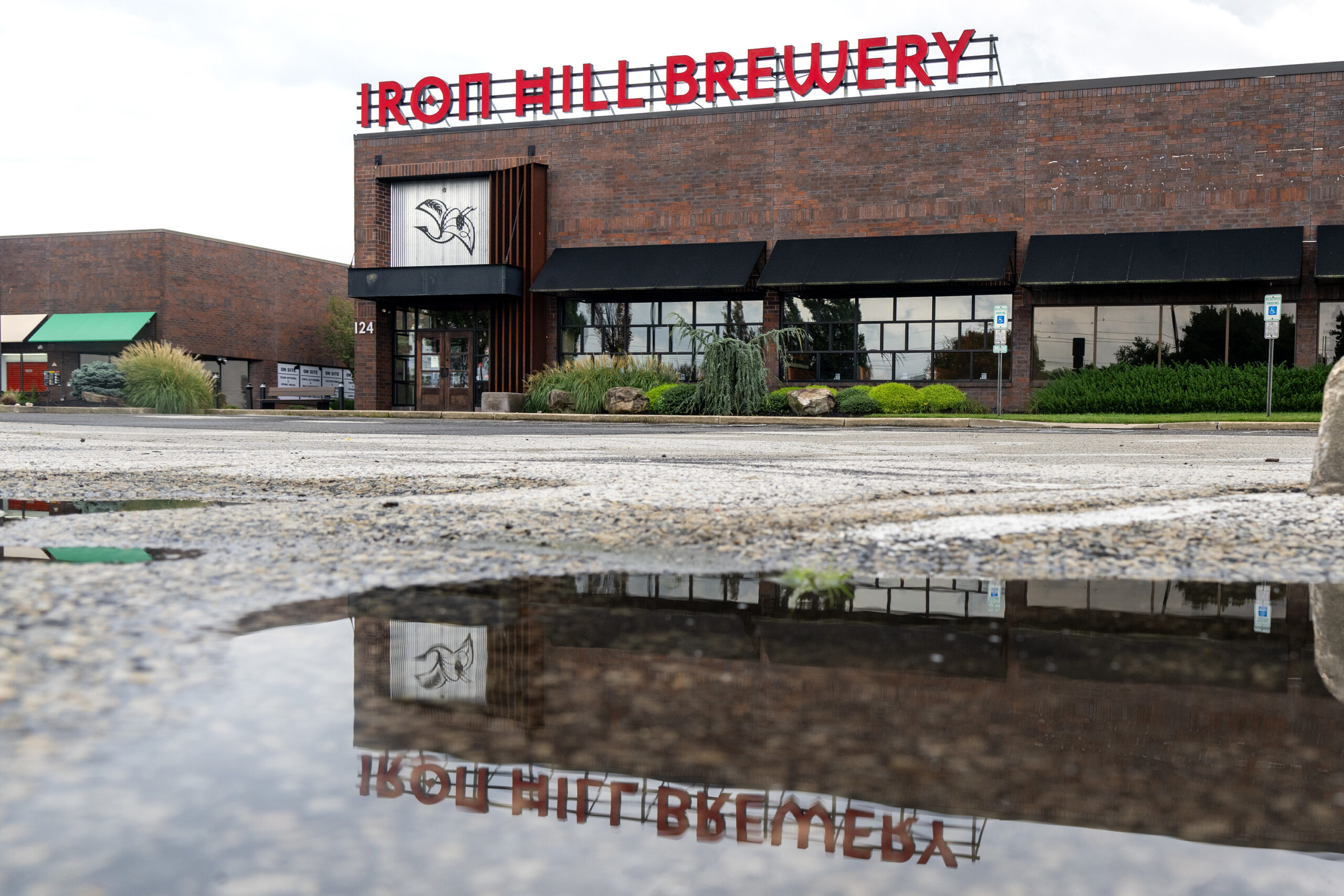
A view from the outside looking in of a shuttered Iron Hill Brewery in West Chester in October.
On a Thursday morning in late September, the nearly 30-year-old company, considered by many to be a pioneer of the local craft-brewing scene, announced that its brewpubs had closed their doors for the last time.
The closed Iron Hill Brewery in Maple Shade in September.
Bankruptcy filings shed more light on the Exton-based company’s financial straits: Iron Hill owed more than $20 million to creditors and had about $125,000 in the bank.
In November, a bankruptcy judge approved an offer by Jeff Crivello, the former CEO of Famous Dave’s BBQ, to resurrect 10 Iron Hills, including in Center City and West Chester, pending landlord negotiations. The restaurants could be reopened as Iron Hills or as other brands.
Crivello said he plans to reopen the Rehoboth Beach brewpub — as well as the Iron Hill restaurants in Columbia and Greenville, S.C. — as locations of Virginia-based Three Notch’d Brewing Co.
The fates of the other ex-Iron Hills will be determined in the bankruptcy process. Brewing equipment, furniture, and other items from the closed restaurants were auctioned off earlier this month.
Mainstays say goodbye in the Philly burbs
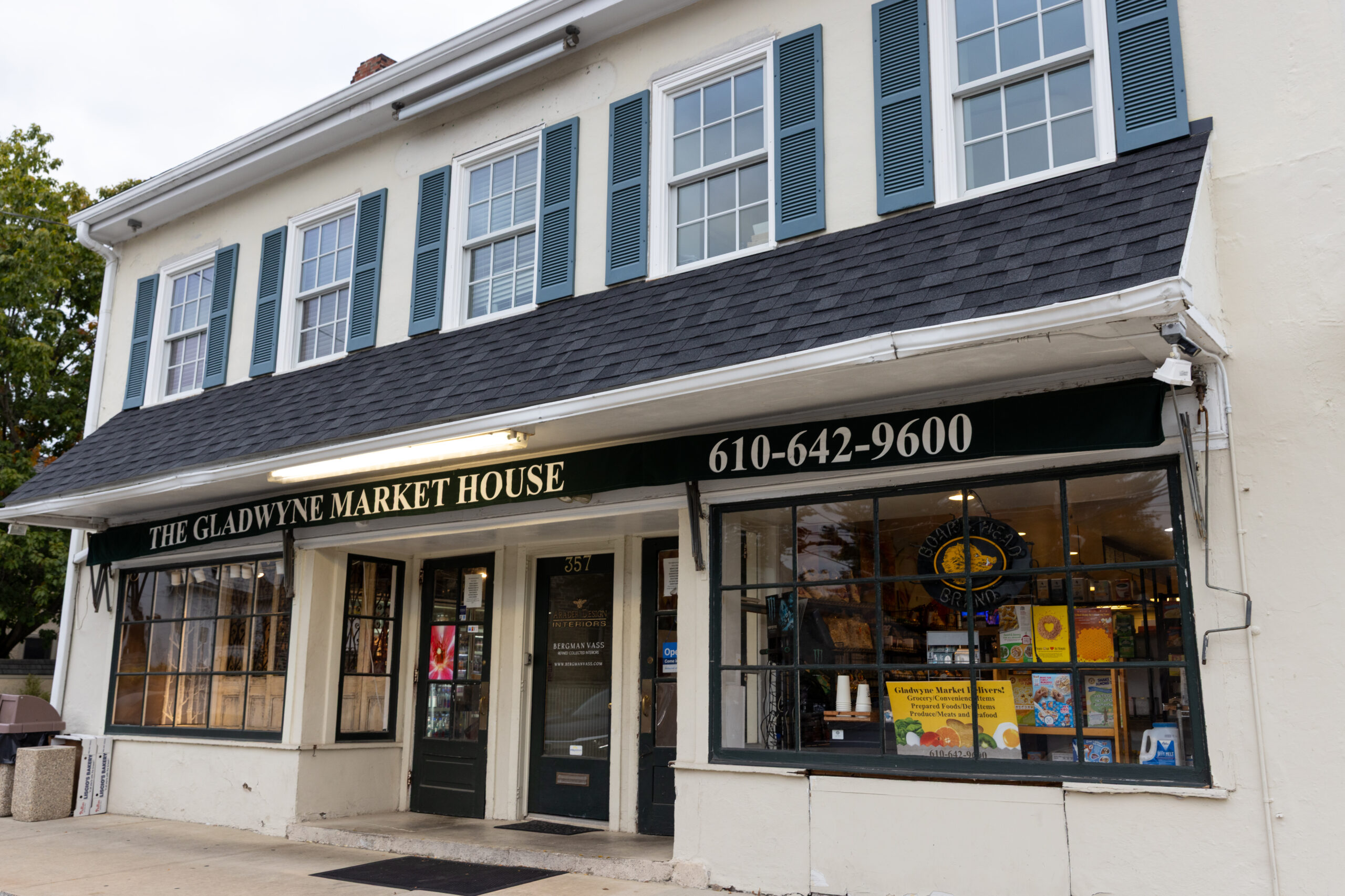
Gladwyne Market as pictured in October.
Local chains weren’t the only business casualties of 2025.
In South Jersey, the Bistro at Cherry Hill, a beloved restaurant that operated in a 1,200-square-foot mall kiosk for 27 years, closed abruptly in July.
At the time, the restaurant’s president, Andy Cosenza, said the closure was due to a communication “breakdown” that had resulted in his voluntary Chapter 11 bankruptcy petition being converted to a Chapter 7, or liquidation, without his knowledge. Since then, however, Cosenza has been indicted on charges of tax fraud. The Bistro has remained closed.
When Scott Edgell was discharged from the military after a service-related head injury at age 20, he thought he would resume life as normal.
But over the next four decades, the Lancaster Countyman was troubled by frequent migraines, memory problems, dizziness, irritability, and balance issues. Even everyday activities, like grocery shopping or eating at a restaurant, became overwhelming.
“I didn’t understand what was happening to my body,” said Edgell, who is now 57.
He realized the head injury he suffered while serving in the military was to blame after watching the 2015 movie Concussion, but struggled to find doctors who knew how to help him.
Just as he started to lose hope in late 2023, he learned abouta Jefferson Health program in Willow Grove for veterans and first responders with traumatic brain injuries (TBIs). The clinic provides physical and cognitive rehabilitation to participants over a three-week intensive outpatient program.
Edgell is among the estimated one in four veterans who have had a TBI. More than half a million U.S. military members have been diagnosed with the injury since 2000, according to the Department of Defense.
Many suffer TBIs as a result of combat-related incidents, exposure to blasts during explosions, training accidents, and vehicle crashes.
While some patients can recover completely, up to 30% of those with mild TBIs, also commonly called concussions — which account for the vast majority of TBI cases — experience long-term symptoms.
The lasting effects of TBIs are often overlooked among veterans because of the injury’s invisibility. Yet they can be life-altering, affecting employment, personal relationships, and overall quality of life.
Veterans with a TBI had suicide rates 55% higher than veterans without the injury, one study found.
Jefferson’s program, called the MossRehab Institute for Brain Health, was founded in 2022 and has treated roughly 100 patients. Itruns on donations — the biggest being from the veterans’ wellness nonprofit Avalon Action Alliance, which has provided $1.25 million annually.
Donations allow them to offer the program at no out-of-pocket cost to veterans and first responders, and cover housing, transportation, and meals during the three weeks.
“I walked in those doors at the lowest part of my life,” said Edgell, who participated in June 2024.
Though there’s no cure for his injury, the program has helped him rebuild his life.
“All you can do is learn to manage your symptoms,” he said.
Edgell and his family, including his wife Tami, stepdaughter Monica Bressler, son-in-law Kenny Bressler, and granddaughter Hayvin.
The program
Edgell entered the MossRehab program in June 2024 as part of a cohort of four.
The first step in his rehabwas learning about what was happening to his brain.
His accident occurred back in 1989, when a steel hatch swung shut and hit him in the back of the head during a training exercise at Fort Riley, Kan.
Doctors at the time provided memory exercises, mental health support, and physical rehabilitation to improve his gait, but nothing brought him back to baseline.
Edgell managed to push through his memory problems in college by putting in extra effort into studying, and ultimately became an electronics engineer.
However, it became harder to cope with the symptoms as he got older.
Even brief outings would exhaust him to the point of needing days to recover.
When his wife, Tami, would ask what she could do to help him, he wouldn’t know what to say.
One therapist at the program offered him a helpful analogy: If a normal brain is like a six-burner stove, then having a brain injury is like being down to only three burners.
“You’re trying to do everything with two or three burners that you would normally do with six, and your brain just becomes very fatigued and overwhelmed,” Edgell said.
The program teaches participants to adapt to their brain’s new way of functioning, whether through physical rehabilitation for symptoms such as dizziness, or cognitive rehabilitation to address issues affecting attention, concentration, memory, and mood.
“We’re basically retraining the brain to do something that it’s having difficulty doing because of an injury,” said Yevgeniya Sergeyenko, a physical medicine & rehabilitation physician and clinical director of the program.
Since treatment for TBIs revolves around managing the symptoms — which can vary widely between patients — the program has staff across an array of specialties that patients see throughout their three-week stay.
One provider helped Edgell, who was struggling to get more than a few hours of sleep a night, find medication to help him sleep.
A physical therapist, meanwhile, assisted with his balance and core structure, so he could walk and move around more easily.
Others taught Edgell exercises to improve his dexterity, speech, and memory.
Army veteran Scott Edgell participates in a cohort session at the MossRehab Institute for Brain Health.
Some forms of therapy were less conventional.
There was horticultural therapy — a therapy that involves working with plants — which Sergeyenko said has been shown to lower blood pressure and is intended to help with emotional regulation.
Patients also did yoga and other mindfulness and movement activities intended to calm the nervous system.
Edgell said yoga wasn’t his favorite, but he found art therapy helped him communicate more openly.
One of the exercises at the start of the program asked himto draw a tree. He drew one that “was not doing very well,” he said.
At the end of the three weeks, he drew a lush version full of leaves. The framed drawing now hangsin his dining room.
“I look at that everyday to see where I came from,” he said.
Army veteran Scott Edgell shows drawings of trees representing himself during a cohort session at the MossRehab Institute for Brain Health.
Outcomes
Program organizers say returning to a pre-injury baseline is not always a realistic goal.
“There’s not a medicine that you can give that’s going to make all of your brain injury symptoms subside,” said Kate O’Rourke, the program director at the clinic.
The program aims toimprove function and quality of life.
As of September, the last time outcome statistics were compiled, 82 patients had gone through the three-week intensive. Sixty-five percent saw significant reduction in their symptoms, as measured bytheir Neurobehavioral Symptom Inventory scores — which assesses a patient’s severity of neurobehavioral symptoms from 0 to 88. The average reductionwas 13.26 points.
Ninety-nine percent of patients reported that they personally felt they improved after the program.
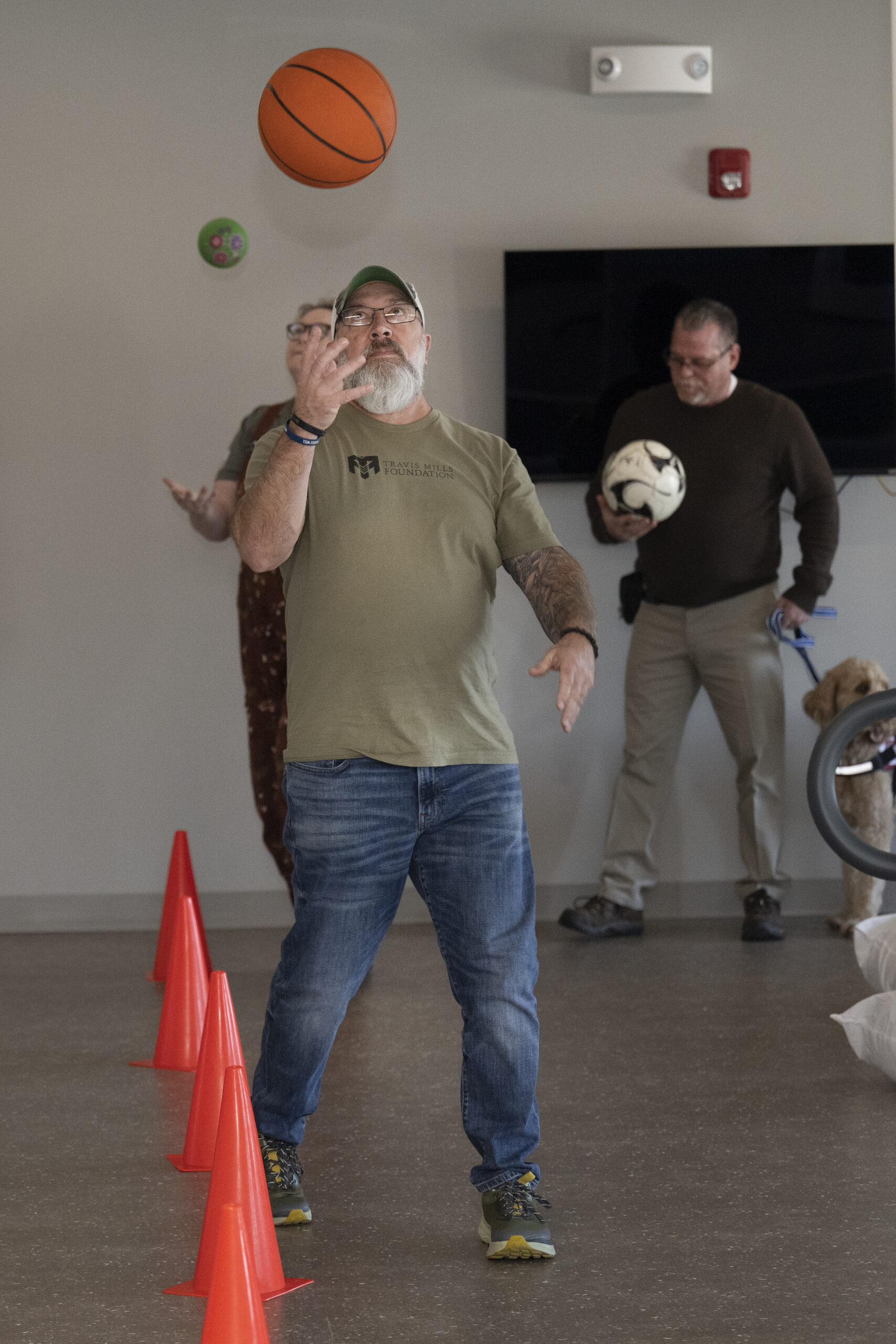
Current patients (Jeff Todd Malloch and Jessica Mack) and Army veteran Scott Edgell participate in a cohort session with his therapy dog, Lars, at the MossRehab Institute for Brain Health.
Edgell regularly reaches out to staff for advice, and meets with the program’s alumni in monthly conference calls.
He still has bad days sometimes, but he’s able to manage them better.
Before, when he would go to a grocery store or restaurant, he would become overwhelmed by the noise, lights, and commotion.
“I couldn’t catch my triggers before I fell off the cliff,” Edgell said.
He was only able to leave the house four to five times a month.
Working with a service dog at MossRehab inspired him to get one of his own.
Now, when he starts to react, a golden doodle named Lars will nudge him, giving him a moment to let his brain calm down.
Edgell and his service dog, a golden doodle named Lars.
Today, he’s able toleave the house more frequently and for longer.
He and his wife have reconnected with friends and engaged more in social activities.
“I still get tired, I still need breaks, but my recovery time is a lot faster, and it’s not nearly as devastating,” Edgell said.
CHICAGO — Travis Konecny walked into the visitors’ locker room long after the Flyers’ 3-1 victory against the Chicago Blackhawks.
The alternate captain had just wrapped up doing TNT’s postgame show. He sat down at his stall, wearing everything but his helmet and gloves, ready to chat with the assembled reporters.
Konecny unwrapped the tape holding his shin guards in place and answered his last question. In a video recorded by the Flyers’ content staffers, you can see a big grin on his face as he paused while talking about notching his 300th NHL assist. Teammate Trevor Zegras is standing behind the media, peering in before saying, “Take your gear off,” with a chuckle.
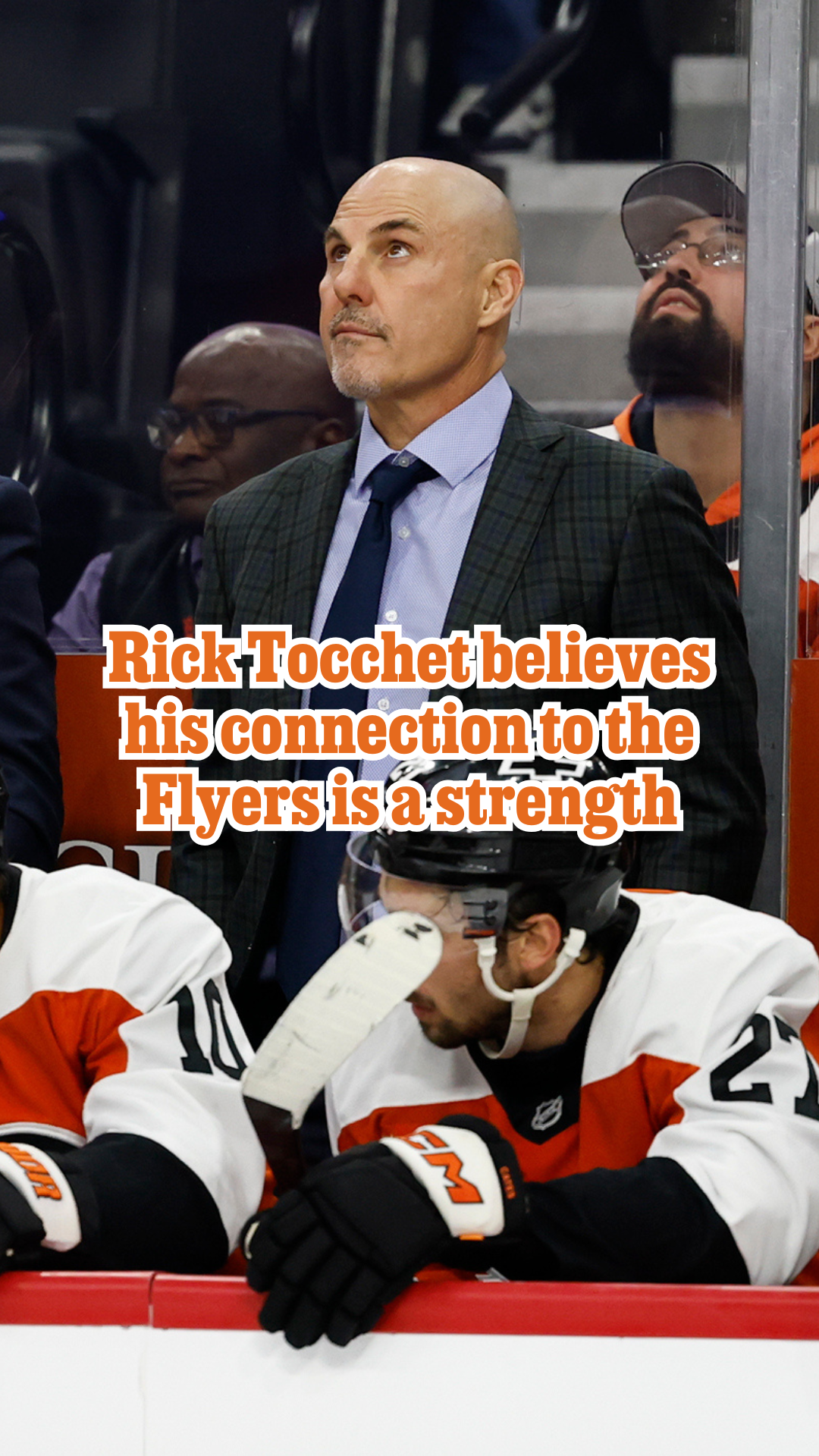
It was just one example of many seen around this team since the start of training camp — the Flyers are light and loose this season.
“I think in here we know we can have as much fun as we want, but when we go on the ice, we have a job to do,” forward Owen Tippett recently told The Inquirer.
“I think that’s what makes it more special, is that we know we can kind of joke around and mess around with each other off the ice, but as soon as the puck drops, we’re all ready to go to battle for each other.”
There are several factors contributing to the Flyers’ good vibrations.
One could be that they wrapped up a perfect back-to-back for the second time this season, after beating the Vancouver Canucks 5-2 on Monday.
Flyers Bobby Brink watches his goal on the replay as he celebrates with Trevor Zegras (right) and other teammates during a Dec. 3 game.
The wins halted the Flyers’ fifth losing streak this season at two games. The longest? A measly three-game swing Dec. 11-14, with each loss coming after regulation. There’s still a lot of runway left in the season but the last time the Flyers didn’t have more than a three-game slide was 2011-12.
That season, current general manager Danny Brière was pulling on a hockey sweater every night instead of a suit, and captain Sean Couturier was a rookie.
“Enjoy the game. Enjoy everything that goes around you,” Couturier said before playing his 900th game on Dec. 7. “I feel when I was 18, I was just so serious, so focused, which is not a bad thing, but I think throughout the years, I figured to kind of balance it out and take the game on a little lighter side at times, and don’t want to be so serious and focused.
“That’s probably the thing I’d recommend to myself [back then]. Just loosen up a little bit and enjoy it.”
The Flyers are loose and enjoying it. And playing well. Yes, the 12 regulation wins — second fewest in the Eastern Conference — are an issue, given that regulation wins are the first tiebreaker for a playoff spot.
But a team many outsiders expected to be at the bottom of the standings is not just in second place of the Metropolitan Division and two points back of the Carolina Hurricanes at the NHL’s holiday break, but has the sixth-best points percentage in the entire league.
“I don’t think we care about what they think,” Dvorak said after Monday’s game when asked about the Flyers starting to make the rest of the division believers.
“We just care about how we believe in ourselves and how we’re playing. And there’s a lot of belief in our room here, and we’re confident in ourselves, and that’s all that really matters.”
Flyers (from left to right) right wing Owen Tippett, defenseman Travis Sanheim, center Trevor Zegras and center Christian Dvorak on the ice against the Pittsburgh Penguins on Dec. 1.
Some would point to the maturation of players who have bonded and built a strong culture over the past few seasons. Others would say it’s the injection of veterans and youngsters. Zegras, center Christian Dvorak, forward Carl Grundström, and goalie Dan Vladař (recently compared by coach Rick Tocchet to the vocal goalie in the movie Slap Shot, Denis Lemieux) specifically have injected balance to the lineup.
“We’re a really, really tight group,” Konecny told The Inquirer in mid-December. “And that’s the thing. I’m sure every team says it, but for some of the guys who have been elsewhere that are here, the staff that’s here, we hear how tight this group is from those guys. … Like, for me, I don’t know any other team, but from what I hear, when guys come in here, this is a great group.
There is one obvious answer that everyone would probably cite when it comes to the change: the new bench boss.
There’s no denying the different coaching style Tocchet has when compared to predecessor John Tortorella. When things go bad, you look to the bench and, while he will have his moments, Tocchet often remains cool as a cucumber.
During practices, he is constantly spotted feeding pucks to players as they work on a specific skill. Notably, Tocchet was seen sending passes recently to Zegras in Voorhees for one-timers like the one he scored on Monday night. Other times, he’s at the whiteboard drawing out a system or structure he wants, or, at 61 years young, the Flyers Hall of Famer is showing players how to shift or move on the ice when trying to evade defenders.
Flyers head coach Rick Tocchet.
“Regardless of the winning and losing, I think that when players respect each other, and they have fun with each other, and they care about each other, it goes a long way. If somebody has a bad game or something bad happens, you have people to rally around,” said Tocchet, who played 621 of his 1,144 NHL games in orange and black.
“Even as a coach, like, I might give a couple of guys [stuff], and you know when I leave, there’s three or four guys picking those guys up. And that’s so valuable for me as a coach. … It’s a huge thing to have that closeness.”
That closeness can be felt in the room or on the ice. The players go to bat for each other during games and chirp and pick on each other in the room. But they also sit around and discuss what just happened in practice or during a game, and what they did well or need to work on.
Maybe that’s why they are 19-10-7 through 36 games and playing not just well, but putting the NHL’s top teams on the ropes while beating bad teams.
Last season, it took the Flyers 44 games to reach 19 wins. Two seasons ago, when they looked like a playoff team before a late-season collapse, it took them 34. (By the way, win No. 19 that season was against Tocchet and the Canucks).
The Flyers rank 19th in goals per game (2.94) — roughly one-tenth better than last season — but have skyrocketed from the fifth-worst team in goals allowed (3.45) to the ninth-best (2.75). The penalty kill has stabilized lately after a drop and is the ninth-best in the NHL (82.5%), and the power play is not the worst in the league. It’s tied for 23rd with the Hurricanes (16.8%) and has connected three times in the last three games.
Flyers defenseman Travis Sanheim, right wing Travis Konecny, and center Sean Couturier on the ice against the Carolina Hurricanes on Dec. 13.
Why are things working? There’s a buy-in.
“I think you’ve got to be committed to getting to the right areas,” Konecny said Tuesday when asked about the Flyers scoring two more goals by getting to the net.
“And I think, I forget, might have been Jay [Varady] our assistant coach, he said, ‘You do the right thing 20 times, and nothing happens. But that 21st time is when it goes in, and if you have that mentality of just like doing the right thing every shift, and your opportunities will come, then I think everyone’s going to be in a good spot.’”
And right now, the Flyers are in a pretty darn good spot.
The word was out among Chester County teens: West Grove Smoke Shop wasn’t checking IDs.
“Many students frequented it,” a student told a Pennsylvania State Police officer investigating how scores of local high schoolers were getting their hands on an array of marijuana products. “So many, in fact, that there were long lines at the smoke shop after school.”
The tip — revealed in a grand jury report released in October — launched one of the largest stings of smoke shops in Pennsylvania this year. While those shops are allowed to sell hemp-based THC products that fall below a certain potency threshold, undercover detectives found widespread deception. After investigators made purchases from 19 stores in Chester, Delaware, and Lancaster Counties, lab tests determined all but one were selling unregulated marijuana falsely labeled as hemp.
It was a striking, if rare, example of local law enforcement cracking down on smoke shops selling hemp-based THC products, which an Inquirer investigation this year found are often just black market weed, sometimes contaminated with harmful toxins and chemicals. Several teens in Chester County told police they got sick from such products, with one landing in the hospital.
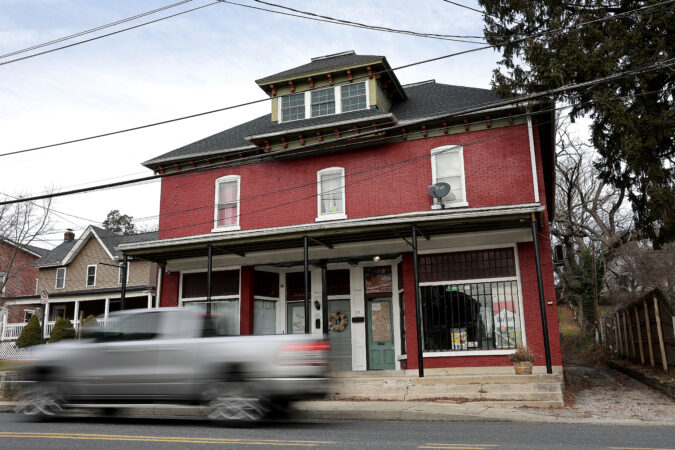
A view looking into the front window of the former West Grove Smoke Shop in West Grove, on Sunday, Dec. 21, 2025.
Confusion over federal hemp law, and the inability of lawmakers in Harrisburg to pass regulations in a state lacking a recreational cannabis program, has led to smoke shops popping up all over Pennsylvania. But the emerging effort to police these shops has so far been inconsistent and haphazard.
Philadelphia City Councilmember Katherine Gilmore Richardson has advanced a series of bills designed to crack down on scofflaw operators, who typically pull fraudulent grocery store licenses to open up shop. An Inquirer analysis found that the city has taken a stricter approach to smoke shops that operate under grocery store permits while peddling drug products and paraphernalia — with investigators doubling violations for improper licensing over the last two years.
“[It] marks important progress in the city’s efforts to better enforce against illegal smoke shops and nuisance businesses devastating our neighborhoods,” Gilmore Richardson said.
But block after city block, smoke shops remain open and continue to operate with relative impunity — sometimes within view of a similar shop that authorities have closed down.
Many use thinly veiled references in their names, such as “High Time Convenience” or “Hi Baby,” the latter featuring a logo meant to resemble the popular RAW rolling paper brand. Since 2022, nearly 100 zoning permits filed by the Frankford-based permit expediter Tina Accounting & Tax Services on behalf of would-be grocery store proprietors were later cited by inspectors as invalid, an Inquirer analysis found. (“There is no assumption that they are aware that these businesses may later become nuisance businesses,” a city official said.)
With the city short of investigators, many shops simply reopen even after they are shut down. Philadelphia has cited at least 42 stores, many of them smoke shops, for resuming operations after receiving an official shutdown order from inspectors over the last two years. One store, Market Mini Mart, located in the shadow of the 52nd Street El station, was cited 10 times for illegally reopening, records show.
City officials said the lack of a specific “smoke shop” permit makes it difficult to track the scope of the problem. Yet an Inquirer analysis of the city’s list of top 35 “nuisances businesses” found more than a third either had “smoke shop” in their names or advertised drug paraphernalia.
Going after technical violations remains one of the few tools available to local authorities, short of conducting raids and lab tests to determine if the over-the-counter products comply with federal law.
The supply line for smoke shops, however, could dry up next year. A provision in a federal spending bill would ban intoxicating THC products derived from hemp nationally, potentially closing a loophole that has created a glut of these quasi-legal products across the country.
The grand jury investigation acknowledged that the growing number of smoke shops presents a daunting challenge. The lead investigator in the Chester County case “quickly realized the sheer number was overwhelming, and many stores were interconnected, operating across multiple counties,” according to the grand jury report.
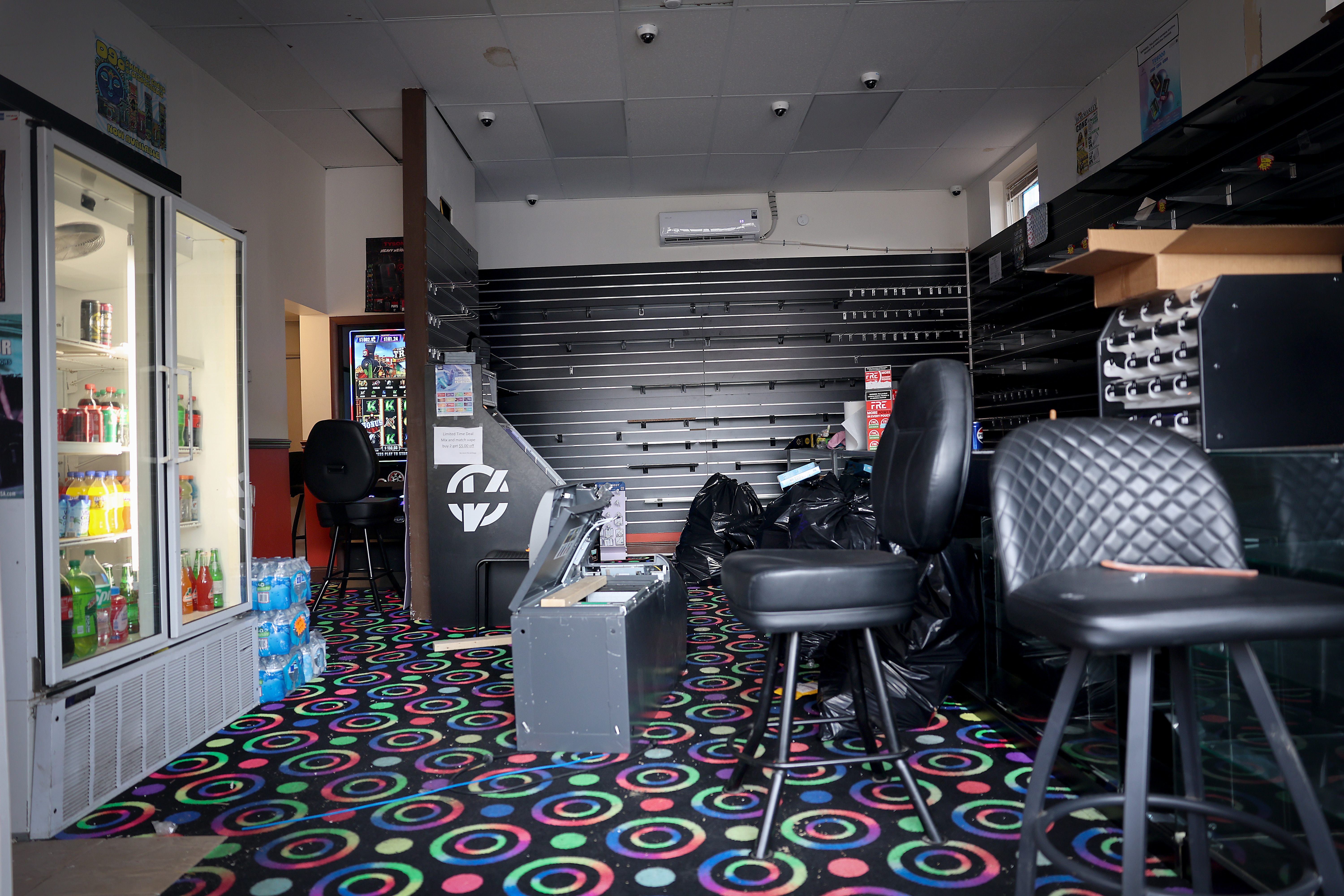
That investigation resulted in the September arrest of Satish Parsa, 33, the owner of three establishments, including the West Grove Smoke Shop, a redbrick storefront that now sits empty. Parsa faces more than 60 counts of drug trafficking and related charges, according to court records.
His attorney, Elliot Marc Cohen, said Parsa, who has pleaded not guilty, intends to “vigorously” fight the prosecution.
Ellie Siegel, CEO of Longview Strategic, a Philadelphia-area cannabis consultancy firm, argued that selective enforcement is ineffective.
When the federal ban goes into effect late next year, she reasoned, many smoke shops will shut down as the supply line dries up, while others will attempt to pivot toward the regulated marijuana market.
“The manufacturers won’t have a way to manufacture the intoxicating hemp products they’re making now,” she said. “It’s the closing of a loophole.”
A sample of hemp-based THC flower that was purchased by The Inquirer and sent for lab testing this summer.
The rise and fall of the Philly smoke shop
In interviews with about a half dozen Philly-area smoke shop owners over the last month, several told The Inquirer that they are bracing for closure, saying survival is nearly impossible in an already saturated market.
Others said they are confident they can endure.
On South Street, more than a dozen smoke shops crowd the mile-long stretch east of Broad Street. The longtime operator of Munchies Reloaded recalled thriving years when bongs and pipes brought in roughly $600,000 annually, before he expanded into hemp.
Now, he said, business has plunged nearly 80%. City inspectors have increasingly fined and shuttered stores for selling glassware used for smoking. Those items are easier to classify as “drug paraphernalia” prohibited by city codes, rather than quasi-legal hemp, which is superseded by federal laws.
“There used to be good money in it,” said the store owner, who declined to give his name. “Now there is no money.”
Smoke shops proliferated during the pandemic, often launched by marijuana enthusiasts, immigrant entrepreneurs, or small grocers looking to replace revenue lost to increasingly strict tobacco sale regulations.
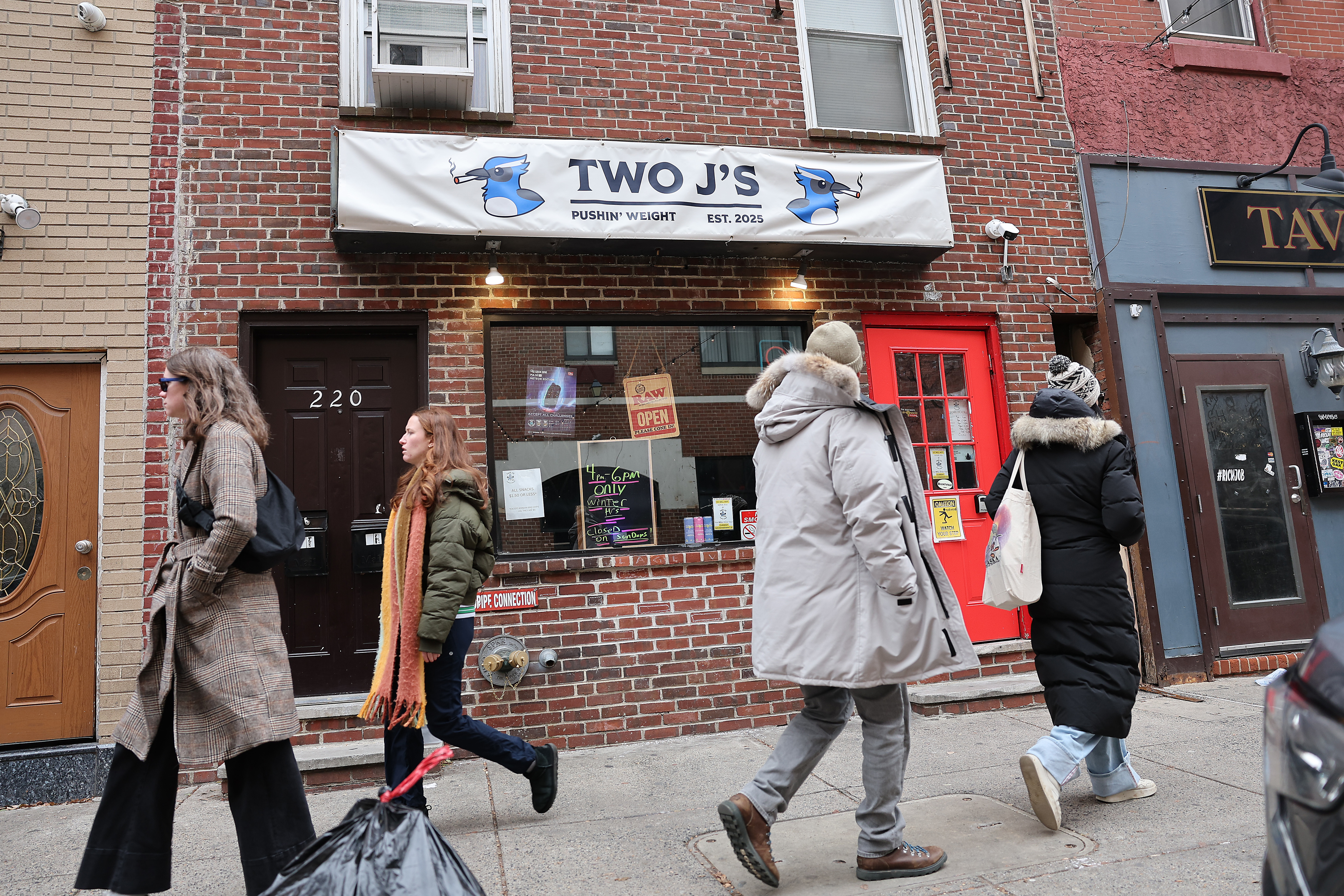
Pedestrians walk along South Street by Two J’s Pushin’ Weight shop in Philadelphia, on Sunday, Dec. 21, 2025.
Some shop owners have migrated to Philadelphia from the New York City area, lured by lower rents and higher demand in a state without legal recreational cannabis. A business permit for Green Broad Smokeshop on Broad Street, for instance, lists an owner based in Queens.
At the peak, a single shop could net between $250,000 and $1 million annually, depending on foot traffic and product line, according to two owners who spoke with The Inquirer on the condition they not be named so they could speak frankly about their businesses. Low overhead and high demand made for a tempting copycat model — a cheap pound of hemp might cost $600 in bulk but retail for more than $5,500.
On the same block as Munchies Reloaded, Abtein Jaeger and his brother in January opened Two J’s Pushin’ Weight. Jaeger said he sources high-grade hemp from West Coast farmers, positioning his store as a premium dispensary amid competitors selling a lower-quality product.
He said he is upbeat about surviving a potential crackdown on stores like his next year.
“It’s not the worst thing in the world,” Jaeger, 34, said.
He added that he would comply with any testing requirements and try to apply for a license, and that he already enforces a 21-plus age limit.
Reforming the Wild West of weed
Unlike in state-run cannabis programs, which mandate costly contaminant testing, hemp products need only carry a certificate of authenticity showing the flower tested under 0.3% Delta-9 THC at harvest.
The Inquirer, in its investigation earlier this year, commissioned a lab to test 10 products. Nine of them exceeded that limit, and most were tainted with banned pesticides, harmful mold, or heavy metals. Manufacturers had also used forged certificates to make their products appear safe and legitimate, The Inquirer found.
But the complexity of federal drug law makes it difficult to prove products are illegal, as many hemp-based products use THC variants like Delta-8 or Delta-10 that are not specifically banned.
For now, most shop owners say, local police leave them alone. Undercover stings, like those led in the suburbs, remain rare because they demand expensive lab testing and significant resources.
One South Street establishment has a singular strategy for surviving a potential crackdown.
South Street Cannabis Museum, whose logo includes a Liberty Bell festooned with marijuana leaves, exhibits a small collection of Reefer Madness-era newsprint, historical pamphlets, and other weed-themed memorabilia.
Exterior view of South Street Cannabis Museum in Philadelphia, on Sunday, Dec. 21, 2025.
“We are a museum, first and foremost, where we can engage with the public about the history, science, culture, and art of cannabis,” said owner Kristopher Wesolowski, 42, a former neuroscience lab manager and event planner, who pivoted into hemp sales after the pandemic.
The back half of the museum is a gift shop where visitors can buy hemp-derived THC flower under glass display cases.
“It’s almost like a simulated dispensary,” Wesolowski said. “But it’s not like some spot where people can just go and get high. … You can get historically stoned at our museum, in a sense.”
Like other proprietors, Wesolowski said the hemp industry has been “screaming for regulation,” as “bad actors” gave well-intentioned store owners a bad name.
But he also cautioned that overregulation would only create new problems, like increasing demand for unpredictable designer drugs on the black market.
“When you close one door, another will open,” he said. “And that one might be a little bit more dangerous.”
Harry Kalas loved Christmas. The holiday combined two of his favorite things: singing and making people happy. So when Andy Wheeler, a producer at CBS3, approached the broadcaster about reading ’Twas the Night Before Christmas in 2002, Kalas didn’t have to give it much thought.
“I’ll come right in,” he replied.
The station was recording a segment of five local broadcasters reciting the poem. Kalas would be featured alongside Marc Zumoff and Tom McGinnis of the 76ers, Merrill Reese of the Eagles, and Jim Jackson of the Flyers.
It aired Dec. 24, and a few years later, while cleaning out his desk, Wheeler found the unedited Kalas video. He watched it through, and suddenly, an idea popped into his mind.
They had the footage. Why not use the Kalas version in its entirety?
Wheeler (no relation to longtime Phillies announcer Chris Wheeler)presented it to producer Paul Pozniak and sports director Beasley Reece, who signed off. Christmas Eve was always a slow news day. This would give them something seasonal that undoubtedly would resonate with their audience.
A decades-long tradition was born. Barring breaking news (and Eagles games), the station has aired Kalas’ reading of the poem every Dec. 24 since 2005.
Management hasno plans to change that.
“Obviously, people love Christmas and people love Harry Kalas,” Wheeler said. “And having him read that story, with his voice that everybody is so used to … I think people miss him and miss hearing him.
“It’s almost like watching a home movie of Christmases past.”
A broadcaster for all seasons
To Phillies employees, Kalas’ voice was as synonymous with Christmas as it was with summer. He loved carols and often sang them at the team’s holiday party.
The broadcaster would do this in a way only he could. Toward the end of the evening’s festivities, Kalas would ask those gathered to join hands to “sing the greatest Christmas song ever.” As they swayed back and forth, he’d belt out “Silent Night” in his baritone voice.
Dan Stephenson, the Phillies’ longtime video productions manager, compared it to a star gracing a stage.
“We knew at some point in the evening that Harry was going to be the entertainment,” he said. “And that was good enough for all of us.”
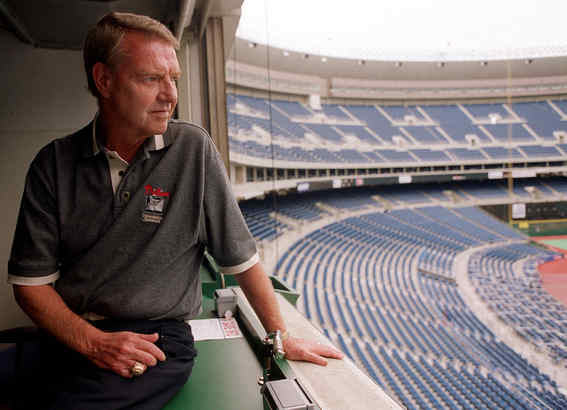
Harry Kalas in the booth at the Vet in July 2000.
This wasn’t Kalas’ only December tradition. In the early 2000s, he visited retirement homes in the Philadelphia area to provide seasonal cheer.
Like the Phillies’ holiday party, these visits inevitably ended with Christmas carols. John Brazer, who worked in the team’s marketing department for 33 years, remembered driving Kalas to a retirement community in Media in 2005.
On the ride there, Brazer asked the broadcaster if he enjoyed singing to the retirees.
“John, I tell you what,” Brazer recalled Kalas saying. “I love it. I love Christmastime. But the songs I really love doing are the religious songs — ‘Hark the Herald Angels Sing’ and ‘Silent Night.’”
He got emotional for a moment, then abruptly changed his tune.
“But I really don’t like when they do a secular song. I’m not a big fan of ‘Jingle Bells’ and ‘Santa Claus is Coming to Town’ and stuff like that.”
Brazer and Kalas arrived at the retirement home a few minutes later. Kalas began taking requests, as an employee played along on the piano.
The first four songs were religious in nature. The fifth was not.
“Someone said, ‘Hey, Harry, can you sing ‘Jingle Bells?’” Brazer said. “And he [turned to] me with this disgusted look.”
Despite his personal opinions, Kalas launched into an upbeat rendition of the song with a big smile on his face, as if it were his favorite carol of all.
Harry Kalas was legendary within the community of Phillies fans.
Brazer relayed the story to Stephenson, who wasn’t surprised. Kalas would sign every autograph with glee. He’d get all sorts of requests — fans asking him to record voicemail greetings, or to read the names of their bridal parties — and would always oblige.
It was about making people feel like they mattered.
“There was no way he wasn’t going to sing it,” Stephenson said with a laugh. “That was classic Harry.”
Harry Kalas couldn’t resist tossing a reference to longtime broadcast partner Richie Ashburn (right) into his Christmas recitation.
‘Like he was reading to his grandkids’
Wheeler had a December tradition, too. When he was a kid, growing up in Aston, his parents would read ’Twas the Night Before Christmas every Dec. 24.
The idea of having play-by-play announcers recite the poem on air was exciting, but when it came to Kalas, the young producer was nervous.
He grew up listening to the voice of the Phillies, and was worried about coming off as inexperienced (or worse, clueless). But when Kalas arrived to KYW’s studios at 5th and Market, he brought calm to a chaotic scene.
The only Christmas tree the producers could find was in the lobby, so they had Kalas do his taping there. Station employees filtered in and out, causing quite a bit of background noise. A gaggle of children with limited attention spans sat in front of him.
But none of that seemed to faze Kalas. Wheeler handed him the book (bought from a nearby Borders), and the broadcaster began to read.
His audience was entranced.
“It was almost like he played the role of Santa Claus,” Pozniak said. “With his voice, and the way he relates to people. He wasn’t too big to be talking to kids he didn’t know. It was like he was reading to his grandkids or something.”
Kalas sat in front of the tree for about 40 minutes, asking producers for feedback and reciting lines until he was satisfied. He even added his own creative flair.
Near the end of the poem, the broadcaster realized there was a reference to a pipe. He decided to give a nod to his partner, Richie Ashburn, who famously smoked in the booth.
“And the beard on his chin was as white as the snow,” Kalas read. “The stump of a pipe — like Whitey’s — he held tight in his teeth …”
Kalas grinned at Wheeler.
“Had to get that in there,” he said.
Harry Kalas and CBS3 producer Andy Wheeler at the 2008 World Series.
It wasn’t until a few years later, when Wheeler found the old recording, that he realized just how special Kalas’ version was. So KYW, and subsequently CBS3, began running it every Christmas Eve.
After Kalas died of heart disease in April 2009, the station considered ending the tradition. Wheeler and Pozniak were concerned that it would be in poor taste.
But Reece insisted they continue.
“This is a way of keeping him close,” he told the producers.
Years later, the recitation still has that effect. From start to finish, it captures Kalas perfectly. You can see his humanity, and his humor. You can hear the richness in his voice.
And if you listen closely enough, you can even catch his favorite carol, softly humming in the background: “Silent Night.”
Heather Huot, the top executive at Catholic Charities, named her only daughter after Lidia, a homeless, mentally ill, and often cranky elderly woman she met as a young social worker at Women of Hope Vine, a transitional housing facility run by the organization Huot now leads.
As “mean spirited” as Lidia was, Huot said, Lidia still celebrated forsythia.
When their bright yellow blossoms heralded winter’s end, Lidia would drag Huot outside to marvel. “Despite all the hardships,” Huot said, “there are things to be celebrated.”
Which brings us to the Christmas holiday season.
Even if it were possible, which it’s not, to overlook all the troubles in our world, with wars and starvation, or even to overlook all the troubles in our nation, there would still be the troubles of the season — too much work, too much loneliness, too many struggles.
Where’s the forsythia?
Two weeks ago, it was outside the Archdiocesan Pastoral Center in the form of a living Nativity scene, complete with a wee baby goat named Lady, an artificial-snow machine, an actual camel, and an elementary school choir in their Catholic school uniforms singing “Joy To the World.”
Yes, “Joy To The World,” because 500 children, some of whom live in tough circumstances, got a chance to celebrate Christmas and with it, maybe, the hope that the holiday brings. It was the 70th annual Archbishop’s Benefit for Children, a Catholic Charities of Philadelphia event funded by a grant from the Riley Family Foundation. No expense was spared.
Heather Huot, the chief of Catholic Charities Philadelphia, pets a calf during a living Christmas scene in front of the Archdiocesan Pastoral Center in Center City Philadelphia.
More than 60 volunteers from area high schools lunched on pizza and cookies before heading across the street to a lavishly decorated ballroom in the Sheraton Philadelphia Downtown. Balloons, banners, party favors, huge plates of cookies, a container of ice cream cups, and a bucket of all different flavors of milk awaited at each table. Kids and chaperones crowded the dance floor, only to make way for an appearance by Santa, who high-fived his way around the ballroom. At the party’s end, the volunteers sprang into action distributing bags of toys — all beautifully wrapped.
In a way, the party is a metaphor for Catholic Charities as a whole. Both the party and the organization are big and multifaceted with lots of moving parts, involving all types of people, not only Catholics.
Each year, Catholic Charities spends about $158 million to run about 40 different programs in four main categories — care for seniors; support for at-risk children, youth, and families; food and shelter; and its biggest category, many-pronged assistance for people with intellectual and developmental disabilities and their families.
As an overview, there’s housing for at-risk youth in Bensalem. In Philadelphia, people may be familiar with St. John’s Hospice on Race Street, which provides food, showers, shelter, and case management to men. There are several smaller transitional housing shelters for women in the city.
Social workers funded by Catholic Charities assist students at six Catholic high schools across the region. Other social workers handle case management under contract with the City of Philadelphia. A program teaches teenagers involved in the juvenile justice system about conflict resolution. Family navigators step in to assist families with issues ranging from employment to parenting support. There are adoption and foster-care services.
For the elderly, Catholic Charities supports senior centers and works to help seniors stay independent through case management.
Archbishop Nelson Pérez poses with students during a holiday party.
Just over half of Catholic Charities’ annual budget is allocated to supporting people with intellectual or developmental disabilities. A major focus is housing for adults. For example, at the Divine Providence Village in Springfield, Delaware County, 72 women live in six cottages on a 22-acre campus with a pool, greenhouse, and picnic pavilion.
In addition, there is employment support, a day program, field trips, a family-living program, and respite care to help families overwhelmed by caregiving responsibilities.
Nearly 80% of Catholic Charities’ funding comes from government sources, which, these days, requires Huot to focus her prayers. “I ask God to help me get through this and to give me the strength and the people around me to get through this,” she said. “At the same time, we have to recognize that God provides in ways you don’t expect.
“We’ve been blessed with generous benefactors who have stepped in,” she said. “The Philadelphia community is incredibly generous. We get a bad rap as the people who throw snowballs at Santa Claus, but Philadelphians will give you the shirt off their backs. They are passionate about caring for one another.”
The generosity moved Lakisha Brown to tears as she shepherded her two children and a third to the party earlier this month. Brown, 44, lives in a three-bedroom subsidized housing apartment at Catholic Charities’ Visitation Homes in Kensington.
“This is the best I ever lived,” she said. But, she said, just outside her door “is a constant reminder of where I came from and where I never want to go.”
Brown’s father died when she was in elementary school and her mother struggled with alcohol addiction. Brown left home when she was 16 under the protection of a man who started their relationship with gifts and ended it with beatings.
“He left me in a coma,” she said.
Brown had her own struggles with addiction. She spent many nights without a roof over her head. If lucky, she could sleep in safety in an abandoned car on a quiet block. One night, she went to a party in a hotel. When she woke up, her clothes were off. Whatever happened wasn’t consensual.
Soon after, she learned she was pregnant and, knowing that, she vowed to give her baby a clean birth. She found a drug program and a place to live. Slowly, through housing and support from Catholic Charities, she rebuilt her life.
Erika Hollender holds up her grandchild so Layani, 3, can touch Percy the camel.
“They help us with budgeting, with money management,” said Brown, who relies on disability, welfare, and food benefits while trying to cope with her own mental health issues. “When we get some money, we want to spend it on the children. We were parenting out of guilt and shame.”
Those are the big things, but what Brown wants people to understand is that the level of care is deep, personal, and specific. It’s being able to ask a staff person for a roll of toilet paper and trash bags — basics that are sometimes unaffordable when money must be allocated to food and shelter.
“A mom’s job is never done,” she said, explaining why people should donate to Catholic Charities. “It is needed for mothers who come from nothing. It is needed.”
For more information about Philly Gives, including how to donate, visit phillygives.org.
About Catholic Charities of Philadelphia
People served: 294,000 annually (in the 2023-24 fiscal year)
Annual spending: $158.6 million across four pillars of mercy and charity
Point of pride: Catholic Charities of Philadelphia is the heart of the church’s mission in action, serving all people regardless of background. With decades of experience, nearly 40 comprehensive programs, and deep community partnerships, Catholic Charities turns compassion into action, and action into lasting and impactful change.
You can help: By serving meals, volunteering at a food pantry or shelter, hosting a food or clothing drive, and sharing your gifts and passions with seniors.
Sonia Lewis endured the worst year of her life when she was a senior in high school — her mother almost died and Lewis had to step up to take care of her family.
But the principal and teachers at her Philadelphia high school lifted her up, helped her get to college, and Lewis took care of the rest — multiple advanced degrees, a thriving career, a national profile.
As Lewis racked up accomplishments, it was always in the back of her mind to return the favor to her school, somehow.
“For me, who I am today is really a huge part is Bodine High School,” she said.
Bodine High School for International Affairs senior students cheer after learning former student, Dr. Sonia Lewis, donated $16,200 to cover senior school fees on Friday, December 19, 2025. Dr. Lewis is giving back after the Northern Liberties high school helped her during a difficult time, while she was a student 20-yrs-ago.
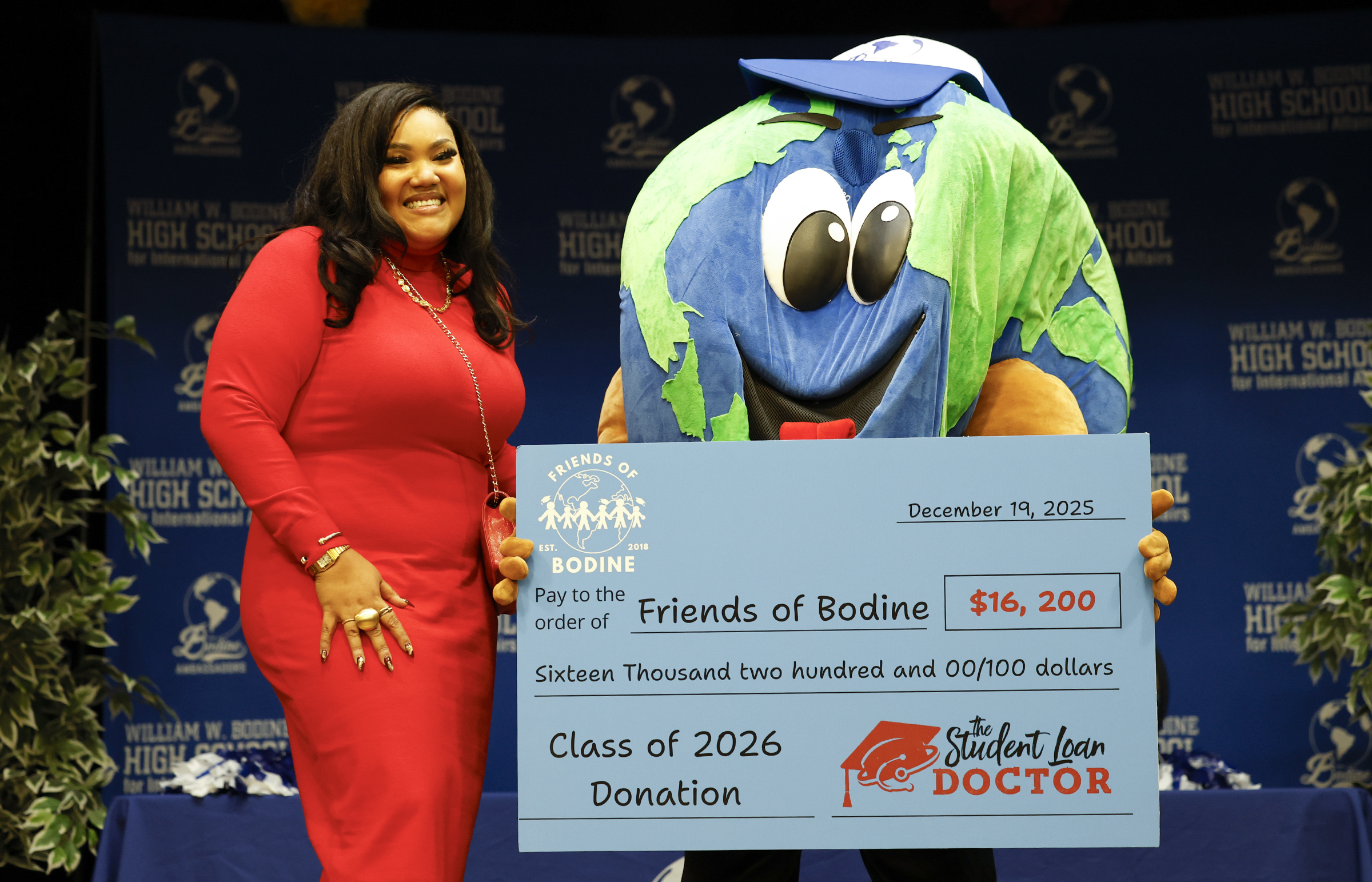
So on a December day, Lewis walked into the auditorium of the Philadelphia School District magnet school with a surprise — the largest donation ever given to the nonprofit that supports Bodine. She gave $16,200 to cover the bulk of every senior’s class dues — funds that most students struggle to pay.
Aaliyah Bolden, a Bodine 12th grader, was jubilant after the announcement.
“I’m just so grateful,” Bolden said. “Coming from an underrepresented community and having financial hardships, this just makes a big difference to me.”
‘Can you work with me?’
Lewis was a standout student at Bodine, an international affairs high school in Northern Liberties. She was class president, active in student government, a strong student in the Class of 2005, a leader.
She was raised by her single mother and grandmother, both Philadelphia teachers, told from a very young age that she was college-bound.
But when Lewis was 16, her priorities shifted, out of necessity. Her mother was gravely ill with bacterial meningitis and other complications. Her grandmother had just beaten cancer, but it fell to Lewis to advocate for her mother, to take her to appointments, to navigate the healthcare system on her behalf. She worked three jobs to help bridge financial gaps.
School just could not be at the top of her priority list.
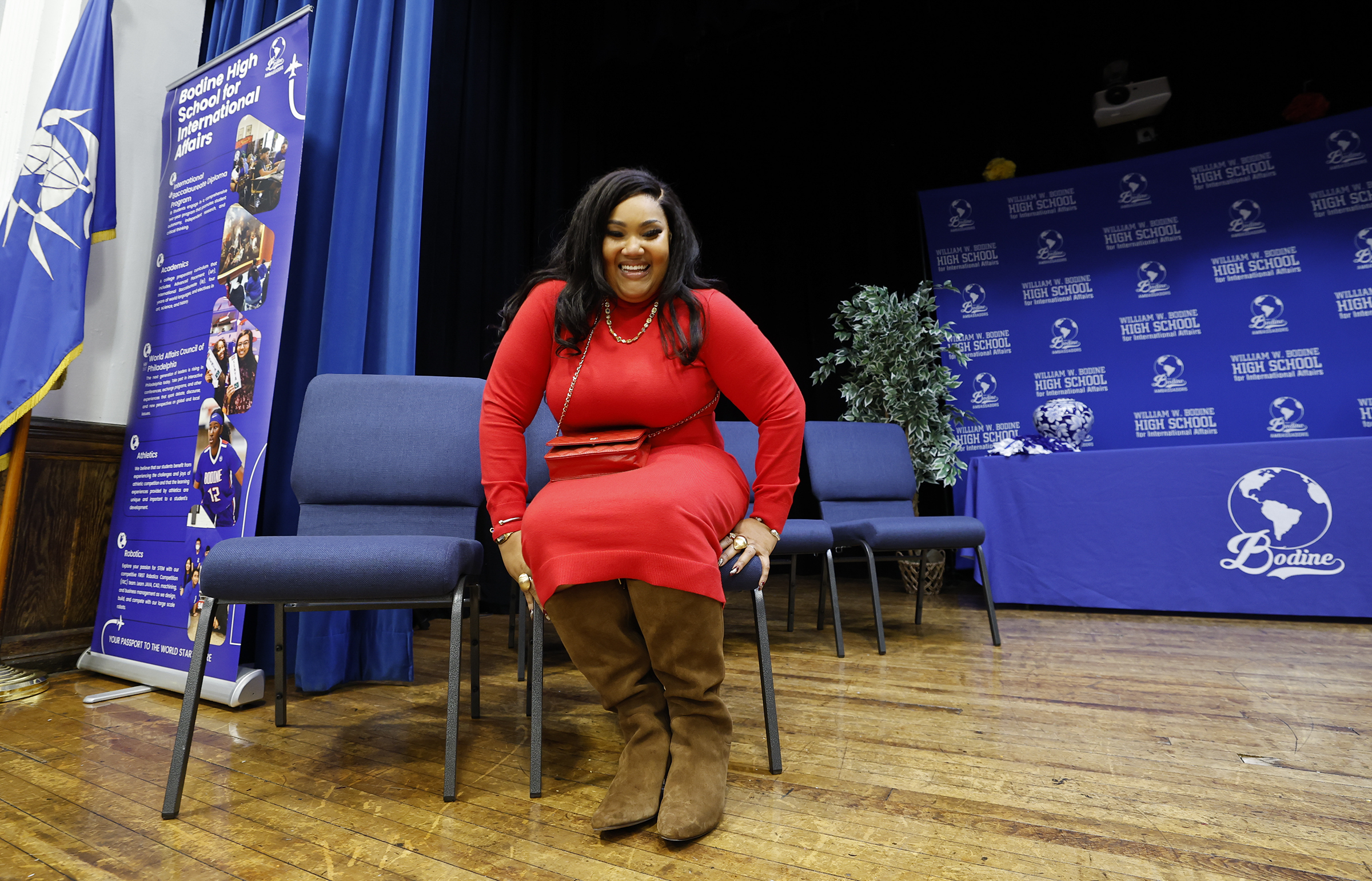
Dr. Sonia Lewis takes a seat before speaking to Bodine High School for International Affairs senior students on Friday, December 19, 2025. Dr. Lewis gifted $16,200 for the 2026 senior class, to cover senior school fees. Dr. Lewis is giving back after the Northern Liberties high school helped her during a difficult time, while she was a student 20-yrs-ago.
“I had to tell my high school, ‘These are my circumstances. I’m going to have to leave school to make some of these appointments,’” Lewis said. “I was just really clear with everyone at Bodine about what I needed, and I said, ‘Can you work with me?’”
They did. But some deadlines are firm, and Lewis missed the federal student-aid loan deadline because her mother had just gotten out of a coma, had cognitive issues, and was unable to gather the necessary information or complete the form.
“I had to become the mom,” Lewis said. “I would have to ask her, ‘Did you brush your teeth today?’ Nobody was thinking of the FAFSA.”
As students’ college acceptances were rolling in, Bodine’s principal noticed that there were none for Lewis. The principal asked her what was happening.
Lewis’ grandmother contemplated taking out a mortgage on her house to send her to college, but Lewis was too practical for that.
“I told the principal, ‘We don’t have any money. We missed the deadline,’” she said. “There was no money coming in from my mom. We had my grandmother’s retirement, but that wasn’t enough.”
Lewis figured she would work for a year, saving money and filling out the FAFSA form for the next cycle. But Karen P. Hill, the principal, just shook her head.
A busybody for good
The principal’s plan became evident at Bodine’s senior awards ceremony, Lewis remembers, when “they just kept calling my name” as prizes were announced.
At the end of the evening, Lewis walked off with an envelope full of checks totaling $16,000 — enough to allow her to enroll at Bloomsburg University and pay her first year’s tuition.
Once she got to Bloomsburg, Lewis continued to grind, working multiple jobs, earning scholarships, making connections. Then, after she earned her bachelor’s degree, Lewis moved on to working in higher education, spending time at Peirce College and elsewhere as an academic coach and in admissions.
She earned her master’s degree, and eventually her doctorate. Now, she’s “the Student Loan Doctor”; Lewis believes her 13-employee company is the first Black woman-owned student loan repayment firm in the United States.
Dr. Sonia Lewis stands with the Bodine High School for International Affairs mascot Amby during a a senior class assembly on Friday, December 19, 2025. Dr. Lewis gifted $16,200 for the 2026 senior class, to cover senior school fees. Dr. Lewis is giving back after the Northern Liberties high school helped her during a difficult time, while she was a student 20-yrs-ago.
Lewis coaches clients to create plans to pay off their student loan debt — through repayment, loan consolidation and forgiveness, and more. She’s a sought-after expert, quoted in national publications, offering free weekly classes, growing her business by the year. She has 150,000 followers on Instagram.
Lewis is allergic to sitting still. Her nickname in her sorority, Delta Sigma Theta, was “Busybody.” She has channeled that for good — the Student Loan Doctor has now served over 50,000 clients since 2016, helping get an estimated $55 million in student loans forgiven.
The business is hard work, but a joy for Lewis, who gets to know she makes a direct impact on her clients’ lives — like the surgeon who had $997,000 in loans, including loans that were in arrears.
“He didn’t know what to do,” Lewis said. “He got his loans forgiven. He wound up paying us like $300. We’re very affordable.”
The hardest worker
A few days before winter break, Lewis entered the Bodine auditorium with a massive smile on her face.
Her gift — hatched after Lewis presented a $1,000 scholarship to a Bodine graduate in the spring, then decided to go much bigger — was a surprise for the students, who knew only that a successful alum was visiting.
David Brown, the Bodine principal, reminded the students gathered in the auditorium that the small school was a special place.
“Our leaders don’t just leave with diplomas,” Brown said. “They leave with a global perspective.”
Then Marty Moyers, a Bodine teacher and president of the Friends of Bodine, a nonprofit that raises money for the school, presented Lewis: “Her journey has been a great one, and it started right here in this building,” Moyers said.
Bodine High School for International Affairs senior students cheer after learning former student, Dr. Sonia Lewis, donated $16,200 to cover senior school fees on Friday, December 19, 2025. Dr. Lewis is giving back after the Northern Liberties high school helped her during a difficult time, while she was a student 20-yrs-ago.
When he announced Lewis’ plan, there was stunned silence at first. Then, wild applause broke out. Students’ faces were jubilant.
Remember this, Lewis told them: She didn’t have a 4.0 grade-point average. But she showed up in every way possible.
“Even in my professional life as a super-successful entrepreneur, I’m not the best, but I’m a really hard worker,” Lewis said. “You guys got that. That’s the discipline and the spirit you want to have about yourselves as you’re leaving Bodine and you’re going into college, or you’re going into the workforce or entrepreneurship.”
De’Anna Drummond, a senior, is deep into her applying-for-scholarships-and-worrying-about-paying-for-college season. Class dues were another stress to think about, but she was delighted at the news that they are mostly covered, thanks to Lewis.
“Any donation is appreciated,” Drummond said. “It all adds up — senior trip, senior brunch, yearbook, everything.”
Bolden, Drummond’s friend, nodded.
“And someday,” Bolden said, “we should also give back when we can.”
For years after the abrupt folding of a South Philadelphia-based company that promised big returns on cryptocurrency, investors who lost thousands of dollars had two questions — where was the firm’s elusive CEO, and when would he be held accountable?
A lawsuit brought by the Securities and Exchange Commission this month is offering answers.
Danh C. Vo, the 37-year-old founder of the now-defunct VBit Technologies Corp., was accused last week of misappropriating more than $48 million of investor funds in a nationwide scheme that affected 6,400 people. Vo’s alleged victims, many of them in the Philadelphia region, gave him money to maintain highly advanced computers they believed would generate passive income through the cryptocurrency Bitcoin.
While Vo possessed some of the computers — devices that process cryptocurrency transactions and reward the owner with a fraction of Bitcoin in exchange for maintaining the costly technology — SEC investigators found VBit’s customers did not own the computers Vo said he had sold them.
That was hardly the only alleged fabrication in VBit’s four-year existence.
In all, Vo raised more than $95 million from investors and kept much of the Bitcoin the company generated in a personal account before fleeing the Philadelphia area to Vietnam in 2021,SEC investigators say.
Weeks earlier, Vo had learned he was the subject of a federal investigation.
As customers grew increasingly suspicious of VBit’s supposed sale that winter to an “Asia-based company” — an organization the SEC now says existed only on paper — Vo blamed his lack of communication on mysterious health issues, the complaint says.
All the while, the company’s day-to-day operations ground to a halt and investors found they were no longer able to withdraw their money.
The complaint also names a handful of Vo’s family members, who are not accused of wrongdoing but have been ordered to return investor funds.
Investigators say that before he fled the country, Vo gifted $5 million to his wife and others close to him.
Vo has yet to hire an attorney, court records show. The complaint does not show whether investigators know his current location.He could not be reached by phone, and a number for his wife was disconnected.
Bitcoin ‘without the headaches’
Before the cryptocurrency industry’s rise in the public eye, Bitcoin and other digital tokens were considered niche financial tools used by only the most devout believers.
Then, in the thick of the pandemic, crypto was seemingly everywhere, from Matt Damon-assisted Super Bowl commercials to the portfolios of billion-dollar hedge funds and international banking institutions.
When used for making transactions or storing value, Bitcoin and other cryptocurrencies can serve legitimate purposes.
But companies like VBit took the hype a step further. In the view of burgeoning executives like Vo, “mining” for Bitcoin with advanced computers offered the average person a near-mythic opportunity to get rich.
Vo started VBit Technologies in 2018 with the uninitiated in mind. He set up shop in a redbrick office building on bustling Washington Avenue, keeping a small staff of employees there.
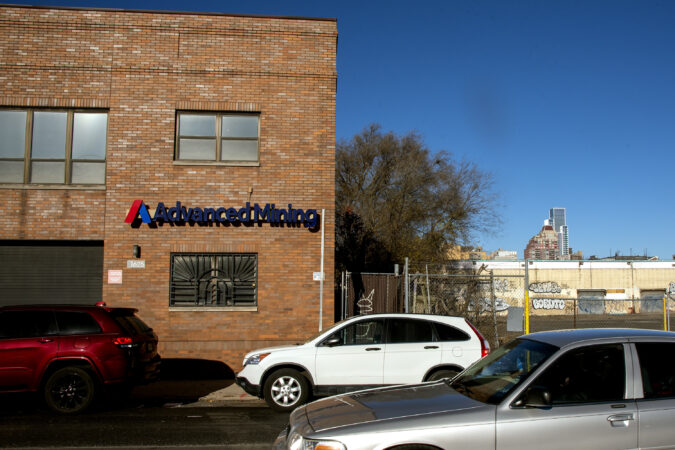
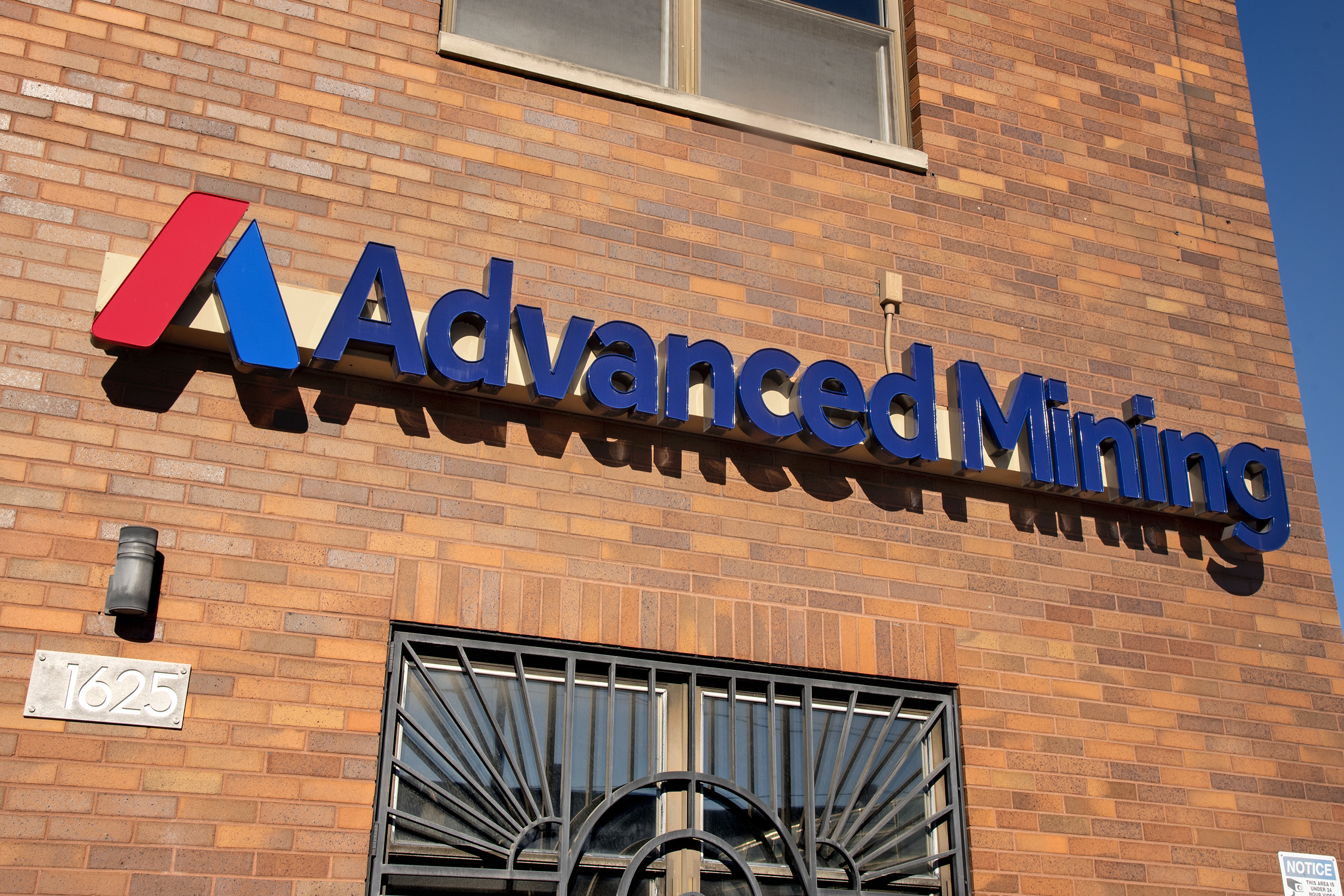
The scene at 1625 Washington Avenue Tuesday Dec. 13, 2022. The sign reads “Advanced Mining” the business that acquired the cryptocurrency company VBit Technologies which is facing several new lawsuits in federal court after its customers claim the company froze them out of millions of dollars in assets this summer.
An investigation published in The Inquirerin 2022 found some of Vo’s customers had little knowledge of how cryptocurrencies actually worked. SEC investigators say customers believed VBit would provide them with a “turnkey solution” for those complexities.
Vo sold investors “hosting agreements” for the computers that, in some cases, cost upward of $100,000 per package, according to the complaint. VBit told customers that if they purchased one of the Bitcoin-earning computers, the company would pool together their devices’ collective computing power, generating even greater returns.
Vo owned a building in rural Montana and leased facilities elsewhere to house thousands of the noisy devices, which use massive amounts of power and rarely make sense for an individual to operate at home.
As the Bitcoin piled up, customers tracked their profits on digital portals that VBit had created for them.
According to the SEC, those figures were nothing more than pixels on a screen.
The complaint says the actual profits went directly into accounts that only Vo controlled. Meanwhile, customers had no way to know what exactly the CEO had even sold them.
Investors were not provided serial numbers for their computers, and were largely barred from visiting the far-flung facilities that housed them, according to the complaint. Instead, Vo alone controlled the devices — and sold many more than he actually possessed.
In 2021, the company’s peak sales year, VBit sold agreements to host more than 8,400 computers, according to the complaint. The company had just 1,643 on hand.
Meanwhile, of the $48 million of investor funds Vo allegedly misappropriated, the CEO “gambled away” around $32 million on other cryptocurrency investments, the complaint says.
For customers who did choose to cash in on their profits, Vo kept several million in a separate account to dole out. Still, the SEC found that VBit had never had enough money to back up the total value of the investments.
And because many customers had only partially purchased their computers, using their newfound income to pay VBit back the balance they owed on the device, the scheme largely averted their suspicions.
At least until the company’s final days.
A mysterious exit
On Oct. 19, 2021, Vo learned the SEC was investigating his company for selling unregistered securities, according to the complaint.
The CEO soon began laying the seeds of a supposed sale of his company to a new firm, Advanced Mining Group.
A website for Advanced Mining was registered on Nov. 1, and by January 2022, a news release went out to crypto-related news outlets announcing that VBit had been sold for more than $100 million.
The sale would give Vo “peace of mind and freedom to focus on my health,” the CEO said in a cryptic statement.
Meanwhile, investigators say, Vo began transferring investors’ money to his family and himself.
More than $15 million went to Vo’s personal bank account, according to the complaint. His sister received $300,000, his brother, $500,000, and his mother, $100,000.
Vo’s daughter, who is a minor, received $1 million in a trust fund. None of the family members provided services in exchange for the funds, the complaint says.
The only person who received more than Vo’s daughter was his wife, Phuong D. Vo. The CEO gifted her $1.8 million over a monthlong period, according to the complaint.
And on Nov. 19 — the day Vo began transferring the funds — he filed for divorce from his wife, the complaint says. The CEO’s travel records indicated he was headed for Vietnam the following day.
For VBit’s customers, Vo’s secretive exit and the supposed sale to Advanced Mining began a period of decline and confusion.
Customers who had been incentivized to recruit other investors through video-based information sessions soon began to lose communication with those higher up in the marketing chain.
And for the sliver of investors who had been cashing in, withdrawals went from taking hours to weeks. By June 2022, customers found they were frozen out of their accounts entirely.
Attempting to explain the chaos, representatives with Advanced Mining told customers through email that the company was having regulatory issues with the SEC. The agency declined to comment on any such probe at the time.
In July, Advanced Mining promised refunds that investors say never came. By the fall, company communication had gone dark.
Customers soon launched a series of unsuccessful lawsuits in multiple states, hoping to claw back their money via a judge. In Washington state, financial regulators opened a smaller-scale investigation into potential fraud on behalf of a group of residents.
In group chats on the messaging app Telegram, hundreds of investors began to gather, finding solace that others, too, had allegedly been victims of Vo’s company. Members spent the months after VBit’s collapse speculating about the CEO’s whereabouts and the increasingly unlikely odds of getting their money back.
The SEC’s lawsuit this month signals the first sign of closure in those customers’ yearslong quest for justice.
There has not been a post in one of those chats, dubbed “PA Advanced Mining Lawsuit Group,” since 2023.
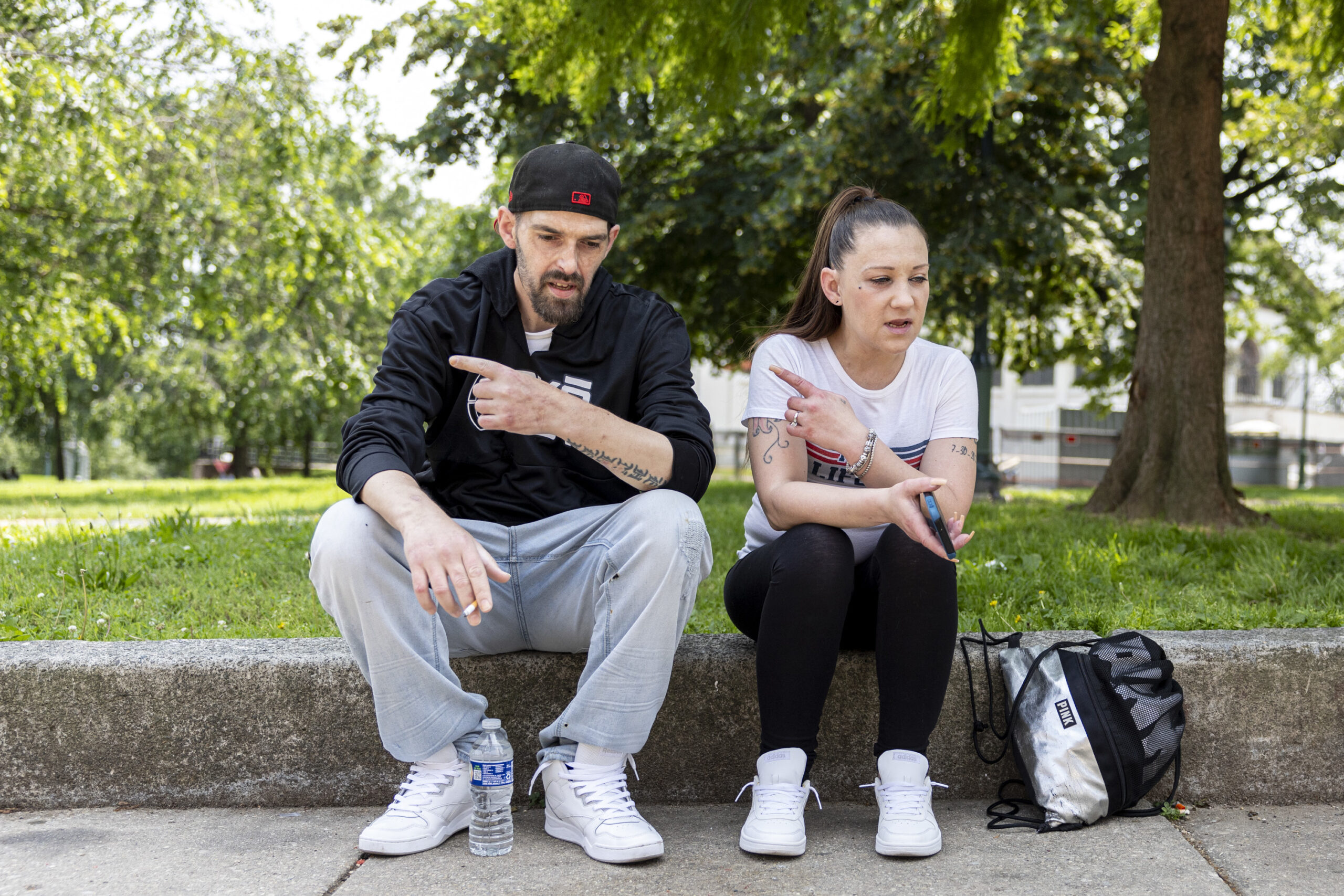
Christina Gallo and Daniel Zehnder came to McPherson Square in the Kensington neighborhood looking for a fix, as they did almost every day.
But on this day in late April, an SUV pulled up. A woman bounded out with an offer that sounded like a miracle: an all-expenses-paid trip for free treatment at a luxury rehab center in California.
Gallo and Zehnder, both then37, hoped their lives were finally about to turn around after two decades strugglingwith addiction.
“We wanted to get clean,” Gallo said.
Christina Gallo and Daniel Zehnder, pictured here in Kensington’s McPherson Square in June, were recruited to what they thought would be a luxury rehab in California.
Within days, they were in a Lyft from their Bucks County trailer to the Philadelphia airport. Everything — the Lyft, the flight, the rehab — had been paid for, by whom they did not know.
They landed at a treatment facility in Los Angeles with a gleaming swimming pool, but said they did not see doctors or nurses and were offered little medical treatment to ease their agonizing withdrawal symptoms.Within a few days,the couple had left the clinic, relapsed, and the life-changing trip they envisioned ended in an ambulance rushing to a nearby hospital, where Gallo was admitted to intensive care.
Their California dreams were dashed. But the trip notchedanotherrecruitmentfor The Rehab Specialist, a year-old operation that makes money by scouting the streets for people in addiction to send to independently run rehab centers across the country.
Rehab Specialist recruiters working in Philadelphia offered free plane tickets, housing, and medical care — and at times cash, cell phones, cigarettes, and clothes — to entice people into recovery homes, Inquirer reporters found in interviews with seven people who had firsthand knowledge of the recruiting tactics.
With a single conversation in Kensington, recruiters alsogot willingpatients enrolled in private health insurance that could pay higher rates, often without the patients understanding what they had signed up for — until bills started to arrive.
Businesses like The Rehab Specialist operate as middlemen inan industry where one person’s recovery can be cashed in for hundreds of thousands of dollars in insurance payments.
Some referral and marketing services in the addiction treatment industry are legal. But the business is also notoriously rife with insurance fraud and patient brokering — a term that describes referrals to specific clinics in exchange for illegal kickbacks or bribes.
Rehab Specialist brochure, advertising a Spanish-Colonial style mansion with a pool in the backyard.
Pennsylvania is seeing a resurgence of patient brokering, according to tracking in 2023 by Highmark Health, a Pittsburgh-based Blue Cross Blue Shield affiliate. Such schemes are especially a concern in Kensington, home to one of the nation’s largest open-air drug markets.
Federal laws and a patchwork of state laws are supposed to protect vulnerable people. Prosecutors have limited resources, however, and rarely investigate low-level players.
Pennsylvania considered stronger laws after a major scandal.In 2019, federal and state prosecutors uncovered a multimillion-dollar insurance fraud scheme at Liberation Way, a Bucks County recovery home. The abuses spurred Pennsylvania lawmakers to introducelegislation that would have made it a felony to use money or services to lure patients into addiction rehabs and other healthcare facilities. The measure died without advancing to a vote.
“People get pretty brazen when nobody’s looking,” said Alan Johnson,chief assistant state attorney in Palm Beach County and a national expert on fraud in the industry.
Johnson called a description of The Rehab Specialist’s practices “classic patient brokering.”
For months, Philadelphiaadvocates for people in addictioncirculated warnings about the business and posted photos of its recruiters on Facebook. They tried to alert police, but never heard back.
Screenshot of text messages between Christina Gallo and a Rehab Specialist recruiter, saying that Gallo and Zehnder got approved for private insurance that would pay for their treatment in California.
The Philadelphia Police Department did not respond to requests for comment, and the Philadelphia District Attorney’s Office said it has not opened an investigation and declined to comment on The Rehab Specialist’s practices.The Pennsylvania Attorney General’s Office also declined comment.
On social media, The Rehab Specialist’s director and founder, Gus Tarrant, strongly disputed critics who accused his business of patient brokering.
“I have never and would never give a client money to go to rehab or encourage them to cycle in and out of programs,” Tarrant wrote in a March post to a Facebook group that monitors addiction treatment.
Tarrant, in a June interview with The Inquirer, reiterated that he and his business havedone nothing wrong.
Tarrant said that his operation has a national focus and came to Philadelphia this spring because the city has “the worst drug epidemic in the country.”
Tarrant said his recruiters send patients out of their home state to avoid triggers for relapse, a practice he strongly believes in, having gone through his own recovery from addiction about five years ago. (Though popular in some recovery circles, some research suggests that it can be less effective than getting treatment closer to home, where people have established support networks.)
“Our goal is to help as many people as we can,” Tarrant said. Now based in Myrtle Beach, S.C., Tarrant has channeled his experience into starting at least two businesses in the past five years focused on people in addiction.
He said rehab centers payhis business a flat fee to arrange for people from Kensington to receive treatment in California, but declined to share details. Two Los Angeles treatment centers told The Inquirer they had paid Tarrant and his operation a flat fee for “marketing,” but both also declined to give specific details of the arrangement.
On business cards, Tarrant’s title is listed as The Rehab Specialist’s founding partner; his LinkedIn profile says he started working there in 2024.
The Inquirer was unable to find any documentation indicating the business was formally incorporated in a search of state corporate registries where its recruiters and Tarrant have operated. The Inquirer also did not identify any lawsuits filed against The Rehab Specialist.
The Inquirer interviewed Tarrant by phone this summer. He did not return multiple calls, texts, and emails this month requesting additional comment.
Reporters interviewed five people who were approached by The Rehab Specialist’s recruiters on the street, and another two whose relatives were recruited.
All shared similar stories about how the process worked. Two said they enjoyed eating chef-made meals and benefited from group therapy and daily outings in Los Angeles.
One mother said her son ultimately decided not to board the plane to California, though he continued to receive frequent calls from Rehab Specialist recruiters urging him to travel for treatment. In another case, a woman said her brother did not get the care he needed in California and ended up in the ICU.
Gallo and Zehnder were among the three people interviewed who said the medical care they received in California did not meet their expectations for a luxury rehab facility. The couple blames The Rehab Specialist for launching them on a journey that ended with them worse off than before.
“I don’t know if they have the intention of trying to help people,” Gallo said, “but they’re going about it totally the wrong way.”
Christina Gallo and Daniel Zehnder in June, sitting in the spot where they were first approached by The Rehab Specialist recruiters in McPherson Square Park.
Lofty promises and dire warnings
The fliers that The Rehab Specialist recruiters passed out in Kensington featured photos of a Spanish Colonial-style mansion surrounded by palm trees, with a pool in the backyard. They advertised “holistic treatment” including equine therapy, medical detox, and an intensive outpatient program.
All that, in sunny California.
The pitch has particular appeal in Philadelphia, where people have struggled through long waits to access medical detox programs that allow patients to withdraw under the supervision of a doctor or nurse. These programs typically offer medications to help ease intense withdrawal symptoms like nausea, vomiting, and agitation, all of which have become more dangerous as potent animal tranquilizers and industrial chemicals contaminate the local drug supply.
Despite often lofty promises, the addiction treatment industry has long seen high-profile prosecutions over exploitative practices.
In the Philadelphia area, the Liberation Way prosecution sent the company’s CEO and medical director to federal prison. Prosecutors said the center had signed patients up for private insurance plans and paid their premiums. It then charged insurers for shoddy or unnecessary treatment that resulted in excessive insurance payouts.
California and Florida in particularhave emerged as hot spots for addiction treatment fraud. In South Florida, a 2022 federal prosecution of a$112-million scheme led to prison sentences foreight people accused of using cash bribes and free rides, flights, drugs, and alcohol toattract patients to a rehab center.The payments were distributed via anetwork of lower-level street recruiters, purportedly hired for “marketing,” according to an affidavit from the case.
But addiction treatment scams are often ignored because they involve sprawling national investigations that require significant resources. State prosecutors can’t justify the expense and federal prosecutors won’t take on low-level fraudsters, according to Johnson. Palm Beach County prosecutors stepped up enforcement after the state passed stricter laws in 2017.
“You have to prioritize cases. This is not high on their hit list, unless it’s going to make a big splash,” said Deb Herzog, a former federal prosecutor turned fraud investigator at Anthem Blue Cross.
Melissa Ruby, an activist who runs a national Facebook group to monitor patient brokering, in Philadelphia in October.
Warnings about The Rehab Specialist instead came from Melissa Ruby, 46, and other local advocates. Ruby runs a Facebook group dedicated to monitoring patient brokering nationwide, and started sharing photos on social media as soon as the recruiters showed up in Kensington. She did the same when they were reportedly spotted in Pittsburgh.
She said she also alerted aPhiladelphia police officer who runs an independent nonprofitto help people in addiction, but never heard back.
For Ruby,the issue is personal: She has a relative who was a victim of patient brokering.
“BEWARE!!” she wrote in a March post about The Rehab Specialist, punctuated with red stop sign emojis. “No good will come from any of this!!”
Tarrant, the Rehab Specialist director, was a member of Ruby’s Facebook group at the time and wrote that the vast majority of the negative information Ruby had posted about him was “completely wrong.”
“I am not paid by the client or any ‘referral fees’ based on clients sent,” Tarrant wrote.
When asked in the Facebook group why The Rehab Specialist was sending patients out of state on free flights, he declined to answer, writing that he believed the questions were in bad faith. He encouraged people to reach out to him directly so he could explain.
After a few weeks, Ruby kicked him out of the group. “Adios, Gus!” she wrote.
A sunny pitch in Kensington
One day in April, two female Rehab Specialist recruiters introduced themselves to Samuel Rosato, 47 at the time, as he got off the El near Kensington. He was immediately intrigued.
“They were just real pretty and tan,” Rosato said.
They later said all they needed were a few identifying details, and they would be able to set him up with private insurance that would pay for everything at a luxury rehab out west.
Rosato scribbled down his Social Security number and handed over his ID card. Within 10 minutes, he said, the recruiters told him they had secured him Blue Cross Blue Shield insurance. Rosato, like others interviewed by The Inquirer, did not know who was paying for his insurance or lodging.
The Rehab Specialist recruiters, whose names he shared with The Inquirer, are not licensed insurance brokers or healthcare navigators in Pennsylvania.
Allison Hoffman, a health law professor at the University of Pennsylvania, said that without more information on how patients were signed up for insurance plans, it isdifficult to say definitively whether insurance laws were violated. But, she added, “it sounds potentially illegal.”
Tarrant said his employees “don’t deal with any of the insurance.” He said they do not directly enroll clients in insurance, but rather direct recruitsto independent, licensed insurance brokers.
Patients “sign up for the insurance themselves,” he said. Hedeclinedto say more, citing patient confidentiality.
A week later, Rosato said an Uber picked himup at his mother’s home in Northeast Philadelphia for his flight to California. He said he was joined by three other people from Kensington who told him they had also been recruited by The Rehab Specialist.
“I love it out here,” Rosato said in June, several months into his recovery in California. “I’m trying to rebuild my life now, starting at the bottom.” (Rosato stopped responding to calls and texts from The Inquirer in the fall; his mother said this month that he’s back in Philadelphia, but she is not sure where.)
Jerome Hayward, 48 at the time, and his girlfriend, Megan McDonald, 39 at the time, also didn’t ask too many questions when they were recruited in front of a Kensington soup kitchen and traveled separately to California in the spring.
Told only that she had been “approved” for treatment, McDonald said she didn’t realize she had been signed up for a Blue Cross Blue Shield plan until she received paperwork at a hospital.
“How would we pay for it?” McDonald asked. “Because we’re broke. We got no money.”
Megan McDonald and Jerome Hayward at a drop-in center in Philadelphia’s Kensington neighborhood.
A rising entrepreneur
Tarrant rose in the rehab industry after getting his start vacuuming floors at a rehab company run by LaMitchell Person, a mentor who Tarrant credited for giving him “the opportunity to get sober and clean,” in an interview with a local news station in California. The two later became business partners.
They were working together at a California rehab company in 2021 when a 22-year-old named Dean Rea died of a fentanyl overdose after leaving an associated sober home.
Rea’s mother later accused Tarrant, Person, and other employees ofcontributing to the death in a lawsuit filed against the facility,Ken Seeley Communities. Neither Tarrant nor Person, then the facility’s executive director, was named as a defendant in the case.
In court records, Rea’s mother claimed Tarrant falsely told Rea that his insurance wouldn’t cover more intensive treatment elsewhere.
“Gus is, essentially, a salesman whose goal is to admit as many patients to KSC as possible,” their legal complaint said. The rehab company denied the allegations, and Rea’s suit was settled in a confidential agreement in 2023 for an undisclosed amount.
In an interview this month, Person called the lawsuit’s claims inaccurate. “Fentanyl killed her son. Not Gus, not me, and not the organization,” Person said.
By the time the suit was settled, Tarrant and Person had both left the business.
In 2022, they filed paperwork to incorporate a company called Origin Addiction Services, based in Idaho, according to state corporate records. An official address on the website is a P.O. box in a Boise strip mall.
The company’s website said it offered addiction recovery services such as interventions, sober companionship, counseling, and transportation.
The company’s website featured an ‘about’ page with professional headshots of a nine-member executive team. All but three of those headshots appearedto be drawn from stock photo services,and The Inquirer was unable to trace the individualsto authentic social media or LinkedIn accounts.
After The Inquirer contacted Personabout the photos in September, all of them– except his own — were removed overnight. Person later said in a phone interview that the stock photos and some of the employee names were “placeholders,” but insisted that the staffers were real.
The company filed paperwork to dissolve a year later; Person said it had never done business, and he and Tarrant went on to pursue separate endeavors.
Person was in Philadelphiarecruiting people at the intersection of Kensington and Allegheny Avenues in March, according to acity employee there to help people in addiction. Person handed him a business card identifying himself as a “regional director” of The Rehab Specialist, said the employee,whom The Inquirer is not naming because he was not authorized to speak to the media and feared losing his job.
Person answered the phone this summer when The Inquirer called the Rehab Specialist’s general number, but he said he did not work there.
In a follow-up interview this month, he said that Tarrant had hired him to build a call center for a California rehab, saying that was his only involvement with The Rehab Specialist.
He said he hadnot come to Kensington and was not responsible for business cards that listed him as the regional director.
“Gus wanted me to work for him, because we are friends,” Person said.
Christina Gallo and Daniel Zehnder in McPherson Square Park in June.
A dream dashed in California
Desperate to get clean, Christina Gallo and Daniel Zehnder accepted the offer to fly to California after being recruited in Kensington earlier this year. A luxury van picked the couple up when they arrived at Los Angeles International Airport on May 3, they said.
The driver took the couple to Gevs Recovery, a large gated house in a residential neighborhood in Northridge. Gevs has been licensed as a drug abuse recovery home since 2024. State records show that as of early August, no complaints about its care have beenfiled with the California Department of Public Health.
Gallo and Zehnder said the Gevs house was dark and empty when they arrived, aside from a handful of employees. Gallo began to panic as drug withdrawal left her shaking and sweating, with a bloody nose and headache pangs that felt like she had stuck her finger in an electrical outlet.
“I said, ‘What’s going on here? Where’s any of the nurses or the doctors?’” she recalled. “‘Who’s going to be taking care of us, medically?’”
“We don’t do that here,” she remembers them saying. The Gevs employees told Gallo they could send her to a hospital, or give her some Tylenol, she said.
Alarmed, Gallo and Zehnder decided to leave. On their way out, they said a woman descending the stairs told them she had just left the hospital after a month there.
“Are you guys from Philadelphia, too?” Gallo recalled the woman asking.
She and Zehnder headed to a cheap motel, but they didn’t feel they could stand the withdrawal effects and decided to buy drugs nearby. By the morning, their symptoms had grown worse, and they returned to Gevs to demand plane tickets home.
Kristine Kesh, an operations manager at Gevs, told The Inquirer the center does have medical staff on site and does offer medication treatment for withdrawal.
“These clients have been addicts for most of their lives, and they come in expecting this glorious detox,” Kesh said. “Whatever they’re expecting is not realistic. I mean, you can’t help everybody.”
At the airport, Gallo vomited on herself before collapsing to the ground in pain. Zehnder defecated and vomited on himself. An ambulance took them to the emergency room, where Gallo was placed in intensive care.
After two days in the emergency room and the intensive care unit, Gallo and Zehnder were released.Zehnder’s mother paid for their flights home.
While Zehnder was away, bills from Highmark started arriving at his mother’s house — even though he had been promised free treatment.
The bill, which misspelled his last name, said he owed a $267 premium for the month of May. He said he also received a $700 bill for the ambulance ride from the LA airport to the emergency room, which he threw away.
Six months after their disastrous trip, recovery feels as far away as when their return flight from California landed. At the Philadelphia airport, they hailed a cab and went straight to Kensington. They wanted to inject heroin, right away.