Biology professor Jody Hey was lecturing on human evolution one recent day at Temple University.
His students vigorously took notes by hand in paper notebooks.
There wasn’t a laptop in sight. Nor an iPhone. No student’s face was hidden by a screen.
Hey said he stopped allowing them about a year and a half ago after seeing research that students are too often distracted when laptops are open in front of them and actually learn better when they have to distill lectures into handwritten notes.
“The clearest sign that it’s making a difference is that students are paying attention more,” said Hey, who has taught at Temple for more than 12 years. “And they want to participate much more than before.”
Hey is among a seemingly growing number of professors who have chosen to keep laptop and phone use out of class, with exceptions for students with disabilities who require accommodations. Several said they made the decision after seeing what some students were doing on their laptops during class.
Temple University biology professor Jody Hey stopped allowing laptops to be used in class about a year and a half ago. He said he’s noticed improvement in student performance.
Jessa Lingel, an associate professor of communication at the University of Pennsylvania and director of the Gender, Sexuality, and Women’s Studies Program there, stationed teaching assistants in the back of her room to observe.
Students “were out there booking flights and Airbnbs,” Lingel said. “Fun fall cocktail recipes. They were online gambling in class. I thought, ‘This is not acceptable.’”
She originally disallowed laptops in 2017, but decided to go easy in 2021 as students returned after the pandemic, she said. She reinforced the ban after her teaching assistants’ observations.
“It’s a movement,” Lingel said. “More and more people are headed in this direction.”
In Hey’s class, students have warmed up to the laptop ban.
“At first I didn’t like it,” said Jess Nguyen, 20, a junior genomic medicine major from Broomall, “because I kind of organize all my notes on my laptop. But I feel I’ve been learning better by writing my notes.”
When she took notes on her iPad, she sometimes got distracted and played computer games, she said. In Hey’s class, that’s not an option.
Students said it takes more time to write notes and sometimes their hands get tired.
“After a couple classes, you kind of get used to it,” said Sara Tedla, 22, a senior natural sciences major from Philadelphia.
She’s on the fence about which way she prefers to take notes.
“It’s good that for an hour and 20 minutes you can just sit down and, without any technological distractions, focus because that’s a part of your brain you can work on,” said Quinn Johnson, 20, a senior ecology major from Philadelphia. “The more you do it, the easier it becomes to focus on something for a long period of time.”
‘Students learn better’
Professors say laptopsare pretty ubiquitous in the classroom when they are permitted.
Hey conducted research on laptop use and presented it at a Temple department faculty meeting earlier this year.
“As early as 2003, a study was done contrasting the retention of lecture material by two groups of students, one who had laptops and unrestrained internet access and a second who worked without laptops,” he said. “In that study, students with laptops scored 20% lower on average in the subsequent exam.”
Four of every five students who used laptops in a general psychology class said they checked email during lectures, another study showed, while 68% used instant messaging, 43% surfed the net, 25% played games, and 35% said they did “other” activities.
He also cited studies showing students who took notes by hand performed better on tests. Others cited that research, too.
Penn President emerita Amy Gutmann co-teaches a class at Penn’s Annenberg School for Communication with the dean Sarah Banet-Weiser. They don’t allow laptops or phones to be used in the classroom.
“I read the literature on it and it really showed that students learn better when they’re taking notes rather than trying to type as fast as they can verbatim what you say,” said Amy Gutmann, Penn president emerita, who is co-teaching a class at the Annenberg School for Communication this fall.
Some professors say laptop use in class can be beneficial.
Sudhir Kumar, a Temple biology professor, said he asks his class of 150 students to respond to questions on their laptops every 10 minutes. Their answers count toward their grades.
“It’s constantly keeping them on their toes,” he said.
He would not want to see everyone give up on laptop use in class.
“We cannot fight technology,” he said. “Teachers have to embrace technology, whether it is artificial intelligence or computers. That is a standard mode of operation for most people today.”
(Left to Right) Jess Nguyen, 20, a junior from Broomall, Allan Thomas, 22, a senior from Philly, and Sara Tedla, 22, a senior from Philly, in a class taught by Temple University biology professor Jody Hey last month.
In Cathy Brant’ssocial studies methods classof 20 to 25 students at Rowan University, laptops are key. Brant, an associate professor of education, saidthere are lots of hands-on group projects, and she frequently asks students to check New Jersey standards online as they prepare their lessons. She also teaches them how to use AI appropriately in the classroom.
One of her students, she said, recently handed in a paper with very detailed notes from Brant’s lecture that she probably got only because she was able to type quickly on her computer.
“You’re responsible for paying attention in class,” she said. “Maybe it’s a little harsh, but I’m just like, ‘If you want to be on Facebook the entire time during class, that’s on you.’”
Jordan Shapiro, an associate professor at Temple, more than a decade ago used to make a point of having his students post on Twitter, now X, during class and counted it toward classroom participation.
Now, he tells students to put their laptops away during class.
“I tell them I have no problem with tech or laptops,” he said. “I just think that none of us get enough time in our lives to just focus on ideas or to listen in a sustained way to the people around us.”
He also became concerned about students doing homework during class, he said, and usingartificial intelligence to supply them with questions and comments to ask in class. They were “outsourcing class participation to the robots,” he said.
Mark Boudreau, a biology professor at Penn State Brandywine, disallowed laptops for the first time this semester.
“I thought I would get real pushback … or people might even drop the class,” he said. “But … a lot of students have had other faculty who have this policy.”
Exam scores in his three courses are better this year, he said.
Hey noted student grades have gone up, too. But he can tell some students struggle with note-taking; some just listen and don’t take notes.
“That’s better than sitting there and going on Facebook,” he said.
A congressional committee is investigating allegations of antisemitism in the Philadelphia School District.
U.S. Rep. Tim Walberg (R., Mich.) said this week that the House Education and Workforce Committee — which he chairs — would probe “disturbing reports of Jewish students being harassed and subjected to open antisemitism in their classrooms and hallways” in three school systems: Berkeley Unified in California, Fairfax County in Virginia, and Philadelphia.
Walberg and U.S. Rep. Ryan Mackenzie, a freshman Republican who represents the Lehigh Valley, informed Superintendent Tony B. Watlington Sr. of the investigation in a letter sent Monday.
The committee, the lawmakers said, “is deeply concerned” that since the Oct. 7, 2023, Hamas attacks on Israel, it has “received allegations that SDP is rife with antisemitic incidents, including allegations of teachers spreading antisemitism in the classroom and SDP approving antisemitic walkouts that isolate Jewish students.”
Monique Braxton, a spokesperson for the district, said she cannot comment on ongoing investigations.
The Office of Civil Rights found in December 2024 that despite “repeated, extensive notice” of acts of antisemitism and other harassment in its schools, the district did not adequately investigate the claims, take appropriate steps to respond to them, or maintain all necessary records.
Walberg and Mackenzie’s letter said that even after the Office of Civil Rights settlement, antisemitic incidents have continued unanswered.
Allegations of antisemitism against certain educators
The representatives also referred to the district’s director of social studies curriculum, who they said “has been widely condemned by Jewish advocacy groups in light of his ‘pattern of denying the Jewish connection to the Land of Israel, refusing to speak about peace or coexistence, and downplaying the lived experiences of Jewish people in the face of violence.’”
Philadelphia, the letter said, failed “to exercise oversight of antisemitic materials in the classroom.” Officials also took issue with what they said was a partnership between the district and the Council on American-Islamic Relations-Philadelphia. (The organization this summer announced it was available to partner with local schools and administrations to provide religious accommodations and build inclusivity.)
Ahmet Tekelioglu, executive director at CAIR-Philadelphia, said it “takes pride in offering these resources” but had no special partnership with Philadelphia’s school district. Instead, it was broadly offering its educational materials and training to any school, educator, or district, he said.
Tekelioglu dismissed the investigation as the machinations of “wild, right-wing” congresspeople.
“It’s a continuation of McCarthyism, what they are trying to do against colleges,” Tekelioglu said. “They are trying to quell and suppress academic freedom in school districts.”
What are the representatives calling for?
The committee requested documents “to assess SDP’s compliance with Title VI and determine whether legislation to specifically address antisemitism discrimination is needed.”
The district was given a deadline of Dec. 8 to produce documents including an anonymized chart of all allegations of antisemitism against students, faculty, or staff since Oct. 7, 2023; all documents and communications since that date “referring or relating to walkouts, toolkits, workshops, curricula, course materials, educational material, guest speakers, lecture series, partnerships, teacher training, or professional development, referring or relating to Jews, Judaism, Israel, Palestine, Zionism, or antisemitism, in the possession of SDP schools or offices”; and more.
Late on a stormy September night, Katie and Anthony Young were watching a horror show. In this instance, it wasalso a reality show.
A surveillance camera showed 8-footfloodwaters drowning the generator in the rear of their restaurant, Hank’s Place. The water crashed into the dining and kitchen areas, tossing around furniture and emptying the contents of refrigerators.
The remnants of Hurricane Ida in 2021 had overwhelmed the Brandywine Creek at Chadds Ford, one of the region’s most picturesque locales, made famous by a frequent Hank’s customer, artist Andrew Wyeth.
“I don’t think either one of us was anticipating it being that catastrophic,” Katie Young said.
In a region where flooding is a perennial threat, an Inquirer analysis of the area’s most flood-prone waterways found the Brandywine ranks among the elite, based on available U.S. Geological Survey data.
(function() {
var l2 = function() {
new pym.Parent(‘area_floods’,
‘https://media.inquirer.com/storage/inquirer/projects/innovation/arcgis_iframe/area_floods.html’);
};
if (typeof(pym) === ‘undefined’) {
var h = document.getElementsByTagName(‘head’)[0],
s = document.createElement(‘script’);
s.type = ‘text/javascript’;
s.src = ‘https://pym.nprapps.org/pym.v1.min.js’;
s.onload = l2;
h.appendChild(s);
} else {
l2();
}
})();
A total of 61 major and moderate floods have occurred since 2005 at Chadds Ford and three other gages on the main stem of the Brandywine and its branches. The Brandywine East Branch near Downingtown has registered more major and moderatefloods, with 33 combined, than any gage point in the region.
No. 2 on the list was the Delaware River at Burlington, with seven major and 19 moderate floods, although that is not quite the same as stream flooding. Technically, flooding measured on the five Delaware River gages south of Trenton, including the one at Washington Avenue in South Philly, is “tidal,” since it is influenced by the behavior of the Atlantic Ocean and the Delaware Bay.
The chaotic behavior of the atmosphere may forever be elusive; however, more flooding along the Brandywine, the Delaware, and the rest of the region’s waterways is an absolute certainty.
Various studies have documented increases in extreme precipitation events with the warming of the planet. But humans are affecting the flood calculus immeasurably by hard-topping rain-absorbent vegetation.
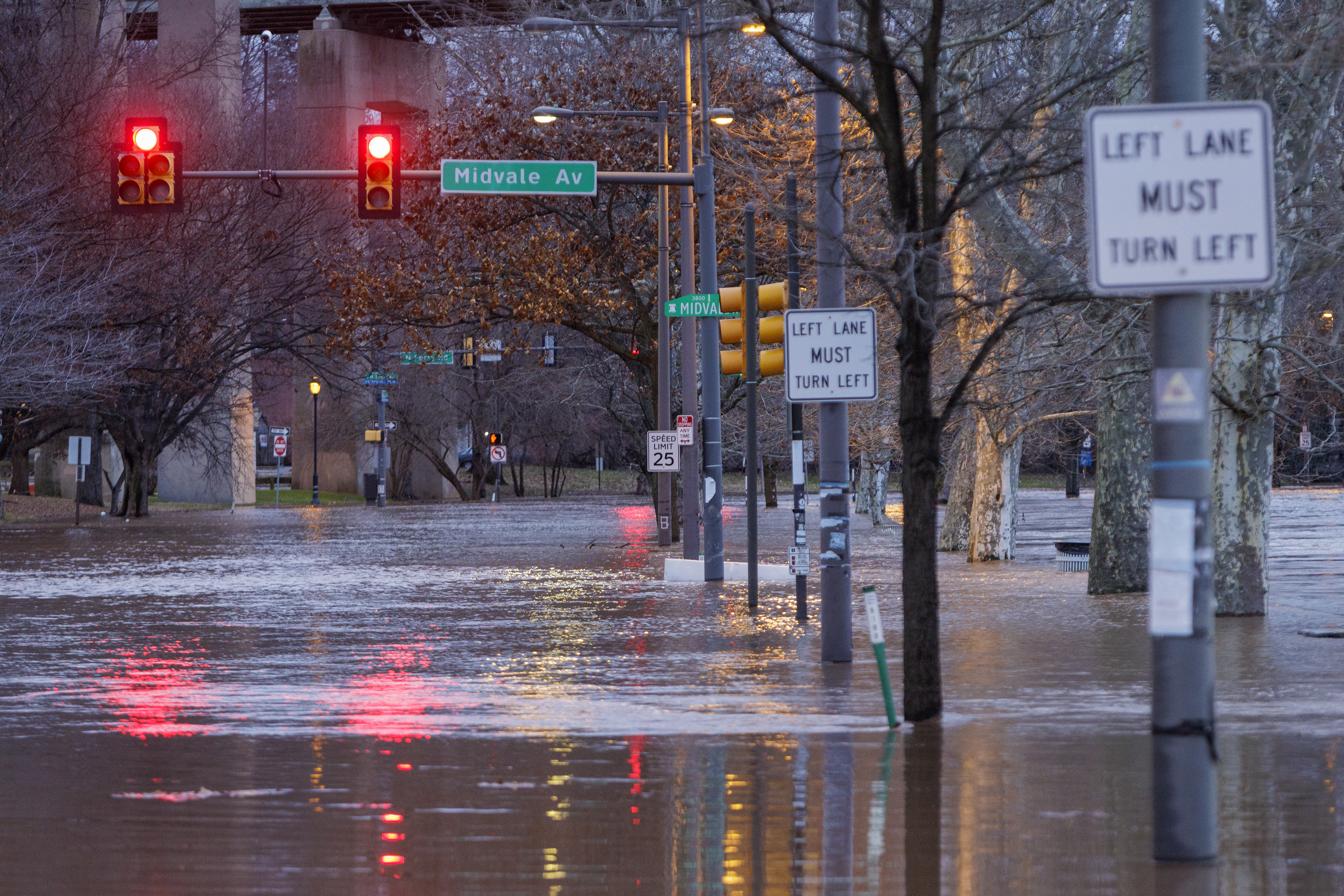
Schuylkill River floods onto Kelly Drive at Midvale in the East Falls section of Philadelphia on Wednesday, Jan. 10, 2024.
A comprehensive analysis of the Brandywine watershedpublished in April reported that impervious surfaces increased by 15% along the Great Valley’s Route 30 corridor from 2001 to 2020.
Those increases are “significant,” said Gerald Kauffman, director of the University of Delaware’s Water Resources Center, which coauthored the study along with the Brandywine Conservancy and the Chester County Water Resources Authority.
Municipalities welcome tax-generating development. Conversely, Kauffman said: “You get more value if you build next to a greenway. It’s the eternal debate.”
From 2001 to 2020, the population in the Brandywine watershed grew nearly 25%, to 265,000 people, with 150,000 more expected by the end of the century. That’s a lot of rooftops and driveways feeding water into the stream, which empties into the Delaware River.
Along the Delaware, the rising water levels of the Atlantic Ocean and the Delaware Bay are forecast to generate more flooding. The National Oceanic and Atmospheric Administration estimates that sea levels have been rising about an inch every five years.
While the oceanic salt line— the boundary between ocean and freshwater — usually stays well south of Philly, the tidal pulses contribute to flooding in the city and areas to the north, where the channel narrows, said Amy Shallcross, water resources operations manager at the Delaware River Basin Commission.
The five tidal gages along the Delaware from Newbold Island to Marcus Hook have registered more than 90 significant floods since 2005, according to the Inquirer analysis.
The study was limited to the 33 USGS gages that had a period of record of at least 20 yearsand list designated flood stages.
Along with the Delaware River sites, other stream gages that appeared in the top 10 list for major and moderate flooding were those on the Perkiomen, Chester, Neshaminy, and Frankford Creeks.
Motorists brave the heavy rain and deep puddles along Creek Road in Chadds Ford during a nasty flood event in January 2024.
The gage network cannot capture all the episodic flooding from the likes of thunderstorm downpours.
Flood frequency is not the only consideration for siting a gage, said Tyler Madsen, a hydrologist with NOAA’s Middle Atlantic River Forecast Center, in State College. For example, the gages have to be located in areas free of unnatural barriers, such as bridge abutments.
Plus, a major consideration is funding. They are costly to monitor and operate, serving multiple purposes such as measuring water quality and streamflow.
They rely on a variety of funding sources, including state and local governments, that are not available everywhere.
The Brandywine study’s suggested remedies included adding flood-control structures and beefing up warning systems all along the watershed, but warned: “Even with unlimited financial and technological resources, it would be impossible to eliminate all flood risks.”
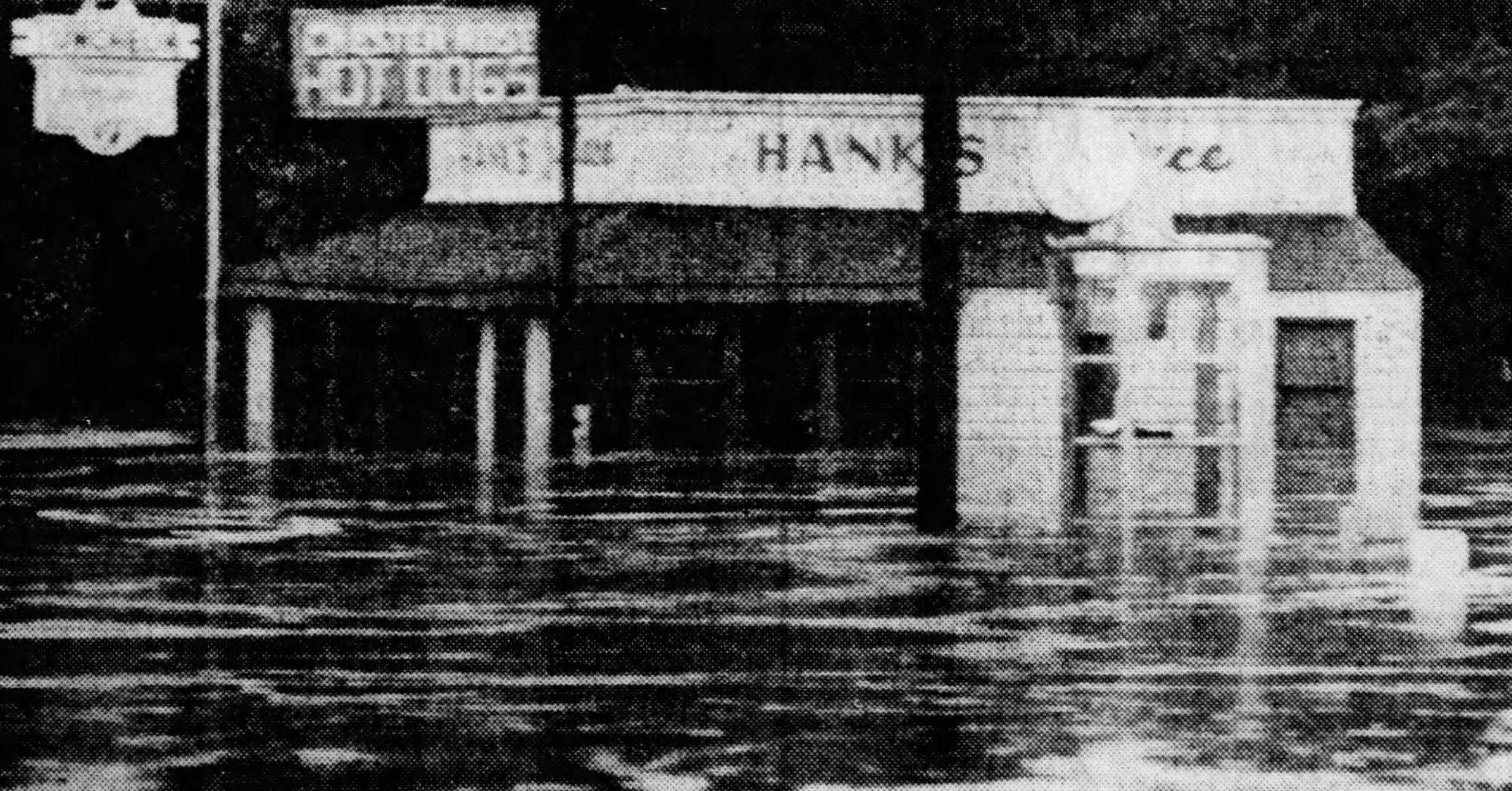
Hank’s Place, on Routes 1 and 100 in Chadds Ford, was swamped by water from the rains of Tropical Storm Agnes in June 1972. The area has a long history of flooding, and the restaurant was reconstructed after it was flooded and damaged by Ida in 2021.
The Youngs are prepared to live with those risks, come storms or high water.
If you’re trying to pass some time while you wait for your delayed flight home, these stories can help.
Joy Velasco / For The Inquirer
The Inquirer published some fantastic reads this year — stories you may have meant to read but couldn’t find the time for. The holidays are the ideal time for catching up: Maybe you’re stuck on a delayed flight, waiting for the turkey or ham to thaw, or just looking for an excuse to avoid that one annoying relative who’s a despicable Cowboys fan.
We’ve rounded up some of our best and top-read journalism from 2025. Take this quiz to find the perfect match for your holiday downtime.
There’s always some anxiety that comes with heading to the airport. This week, maybe more so.
AAA predicts nearly 82 million Americans will travel at least 50 miles for Thanksgiving, a U.S. record if it stands. Even with concerns about the reliability of air travel, AAA reports about 6 million people will fly to their destination this week, a glut of humanity that could jam airports nationwide.
Air traffic at Philadelphia International Airport (PHL) has been running relatively smoothly since the government shutdown ended, Inquirer analysis shows.
But an onslaught of holiday passengers could quickly change that.
Are you headed to PHL? Use our charts below to get a glimpse of how the airport is functioning today. The charts will update every hour through Jan. 1 and reset every morning at 4 a.m.
window.addEventListener(“message”,function(a){if(void 0!==a.data[“datawrapper-height”]){var e=document.querySelectorAll(“iframe”);for(var t in a.data[“datawrapper-height”])for(var r,i=0;r=e[i];i++)if(r.contentWindow===a.source){var d=a.data[“datawrapper-height”][t]+”px”;r.style.height=d}}});
window.addEventListener(“message”,function(a){if(void 0!==a.data[“datawrapper-height”]){var e=document.querySelectorAll(“iframe”);for(var t in a.data[“datawrapper-height”])for(var r,i=0;r=e[i];i++)if(r.contentWindow===a.source){var d=a.data[“datawrapper-height”][t]+”px”;r.style.height=d}}});
Nearly half of the flights at PHL were delayed or canceled at PHL during the climax of the federal government shutdown, which lasted until Nov. 12. Analysis shows delays and cancellations have returned to normal levels since, with disruptions generally affecting less than 20% of flights a day.
Fewer than five flights a day have been canceled for the last week at PHL.
In the lead up to the holiday weekend, Frontier Airlines was experiencing the most disruptions. More than 40% of the company’s flights in and out of PHL were delayed or canceled last weekend, analysis of PHL flight board data shows.
PHL offers flights from 15 airlines. The chart below shows what percentage of the most active airlines’ flights are delayed or canceled.
window.addEventListener(“message”,function(a){if(void 0!==a.data[“datawrapper-height”]){var e=document.querySelectorAll(“iframe”);for(var t in a.data[“datawrapper-height”])for(var r,i=0;r=e[i];i++)if(r.contentWindow===a.source){var d=a.data[“datawrapper-height”][t]+”px”;r.style.height=d}}});
What about my flight?
PHL offers up-to-date information for each flight arriving or departing from its gates on its website. However, airport officials recommend checking with your airline for more specific information.
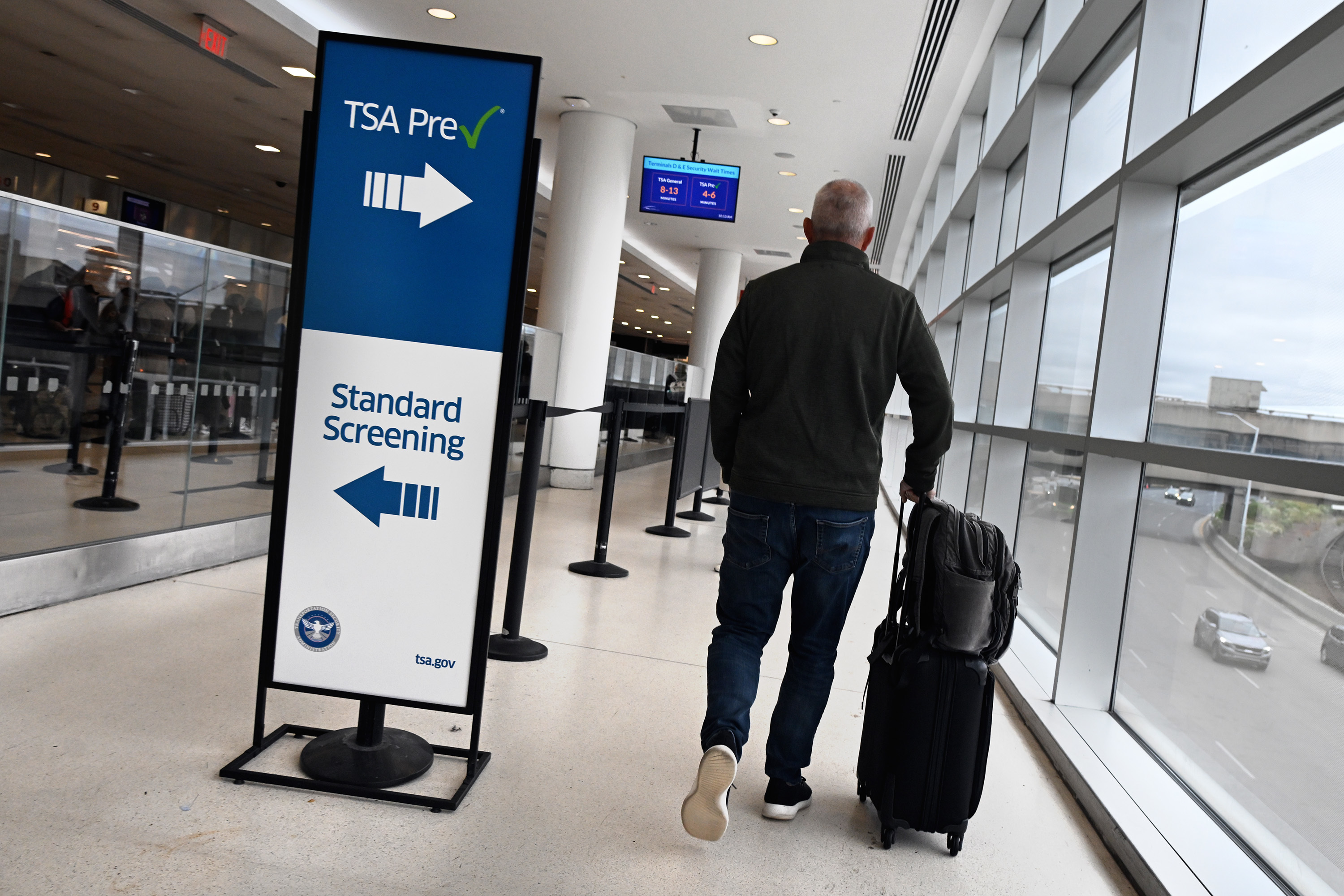
A traveler enters the TSA PreCheck security line at Terminals E-F at Philadelphia International Airport in October.
Security wait times
As of Monday morning, all six security checkpoints at PHL were open. TSA PreCheck is available at Terminals A-East, C and D/E.
Current security wait times are available on PHL’s website.
Weather outlook
Leaving Philly: Rain could slow things down Tuesday afternoon into Wednesday, according to the National Weather Service. Some wind may linger into the weekend, but otherwise flying out of Philadelphia looks fairly unhindered. What’s happening at your destination could, of course, change this.
Coming to Philly: Elsewhere in the country, NWS forecasts show a broad area of low pressure affecting the eastern half of the country with rain Tuesday into Wednesday. Later in the weekend, weather systems could affect the Midwest, Northwest and Rocky Mountains, potentially complicating travel from those locations.
The news comes 5½ years after a federal court-appointed receiver seized the Philadelphia loan company amid investigations that have sent its top officers to federal prison.
“Sounds like Christmas to me!” said investor Joe Brock, a management consultant who invested $200,000 with Par.
Starting in 2011, Par raised $550 million, telling investors it was lending to merchants at high interest rates for big profits. But Par insiders diverted over $200 million to themselves, and many of its clients couldn’t repay the loans. In March 2020, Par stopped paying investors back.
In July 2020, the SEC filed a sweeping fraud lawsuit against the firm, its owners and pitchmen. Criminal charges followed in 2023. Eight people involved with the company have pleaded guilty and been sentenced to prison and fines.
How much will investors get?
The investors were repaid $111 million, just over half their missing $220 million, under an initial “distribution” of Par assets approved last December.
Another $97 million will be on the way, pending approval by Florida-based federal Judge Rodolfo Ruiz, who has overseen the case since FBI agents raided Par’s Old City offices and detained founder Joseph LaForte on gun charges in 2020. The judge has declared Par a Ponzi scheme, designed to defraud, by using old investors’ money to fool new investors into falsely believing Par was profitable.
A third, smaller payout may be arranged in the future, which could bring the recovery above the loss total, according to the new proposal.
The plan was filed Friday to the judge.
In July 2020, the FBI raided Par offices and founder LaForte’s Haverford home, and the SEC asked Ruiz to put the company into receivership to protect what was left of investors’ money and to investigate whether LaForte and his allies had stolen money from the company.
The SEC also filed civil charges against founder LaForte, his wife, Lisa McElhone, chief financial officer Joseph Barleta, and four investment salespeople, accusing them of selling unregistered securities and failing to disclose LaForte’s prior federal fraud convictions.
Federal criminal fraud charges followed against the three top Par officials, plus debt collectors James LaForte and Renato Gioe; an investment salesman, Perry Abbonizio, and two Colorado accountants who did Par’s taxes.
The investors are getting their investmentsback, but not the promised interest. And the paybacks will be uneven.
Under the terms of the proposal, investors in Par funds set up through Dean Vagnozzi, a former King of Prussia insurance agent who was Par’s most successful salesperson, are on track to receive as much as 98% of their total investment, or as little as 46%, depending on when they invested and how much was in Par.
Some of the funds set up for Vagnozzi’s A Better Financial Plan invested partly in Par and partly in life-settlement contracts, insurance policies purchased from their owners at a discount so investors collect the proceeds when they die. Investors in those funds still hope to collect additional funds as the policyholders die.
Where the recovered money is coming from
The $110 million in the first distribution from the receiver was funded largely by money seized from Par and from founder Joseph LaForte, McElhone, and other Par officials.
The $97 million in the second distribution included $36.5 million in Par funds that had been held in escrow while the receiver negotiated how much was owed to investors in the Chehebar family (some members spell it Shehebar), who own Rainbow Stores.
Lawyers for the Chehebars argued that they had negotiated senior payment rights and should have gotten repaid before other investors. But the receiver said the Chehebars were actually “insiders” who worked closely with the LaFortes and didn’t deserve special treatment.
The Chehebars agreed to settle for $3.1 million — or more if the receiver is able to pay all approved investor claims.
Another $31 million for the payback has been collected from a settlement of lawsuits against John Pauciulo, salesman Vagnozzi’s longtime lawyer, whom Vagnozzi and others blamed for failing to warn that the Par funds ought to be registered with the SEC and to warn investors about LaForte’s criminal past.
Insurers for Pauciulo’s former law firm, Eckert Seamans, agreed to pay $47 million, but part of that total was consumed in payments to lawyers and others with claims against Pauciulo.
In hearings this fall, investigators for the Pennsylvania Disciplinary Board, an arm of the state Supreme Court, have argued that Pauciulo failed to properly advise his clients about the danger from investing in Par. A ruling is pending.
Helping fund the planned second round of payments to Par investors was $10 million from the sale of LaForte’s former vacation home in Jupiter, Fla., one of the last of 25 properties seized by the receiver as proceeds of the Par founder’s fraud.
The rest is funded by millions taken from Par and its investors and not paid out earlier.
For a potential third distribution, the receiver and its consultants have identified several additional funding sources:
$11 million in still-uncommitted cash from the funds the receiver took from Par and its owners;
$10.5 million in a requested IRS refund of taxes Par paid on phony profits the company reported when it was trying to get more people to invest;
$1 million from the sale of three remaining properties at 20-22 N. Third St. in Philadelphia, the last of 20 city properties the receiver has used to raise cash for victims;
Up to $4 million that might still be collected from Par’s last borrowers, half of it from Kingdom Logistics, a Texas-based mining company.
Investors also should receive some proceeds from the liquidation of the former Par Funding corporate jet, worth an estimated $6 million when it was seized by the FBI in 2020, and a Charles Schwab investment account, worth more than $13 million at that time. The government has a separate process for deciding how to pay back that money to investors.
Expenses for the receiver’s lawyers and other professional services have cost around $100,000 a month, according to the receiver’s most recent quarterly reports.
All the Par officials charged with crimes were sentenced, most of them earlier this year, after pleading guilty to criminal fraud and, in some cases, other charges.
Besides fines, restitution and probationary periods, these are the prison terms for people involved:
Faced with a forthcoming increase in elementary school enrollment, the Cherry Hill School District may redraw boundaries for its 12 neighborhood schools.
The South Jersey school district has been studying expected demographics for the coming years and came up short; there are not enough available seats to accommodate an anticipated burst in elementary student population.
To meet the demand, the district has undertaken an “Elementary Enrollment Balancing,” which means possibly adjusting where students go to school. Cherry Hill is the 12th-largest district in the state, with nearly 11,000 students.
“We want to make sure there is not a negative impact on children and families,” Superintendent Kwame Morton told parents at a recent community meeting.
Why is Cherry Hill rebalancing its elementary schools?
The demographic study conducted in 2024 showed that five of Cherry Hill’s 12elementary schools are expected to have a shortage of seats in the 2028-29 school year, said George Guy, director of elementary education.
Based on census data and housing construction projections, the district will be short about 337 seats, according to Guy. The demographic survey examined possible growth over a five-year period, from 2024-25 through 2028-29.
“Those kids are coming. We have to do something,” Guy said in a recent interview. “We can’t wait to do it.”
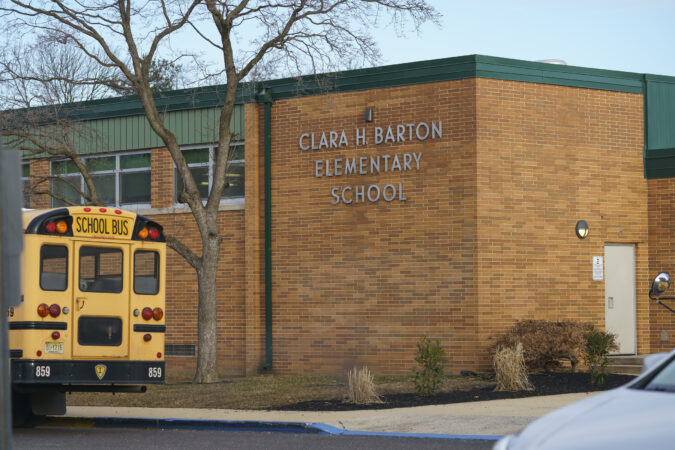
The five schools in question and the expected growth in their enrollment are: Clara Barton,126 students; Joyce Kilmer,81 students; Horace Mann, 50 students; Richard Stockton, 56 students; and Woodcrest Elementary, 50 students, Guy said.
What will the process involve?
It is not yet clear how many students could be affected by the rebalancing, district officials said. Some elementary schools are nearing capacity, and a few have surplus seats.
At a school board presentation this month about the enrollment balancing project, several parents expressed concerns about their children possibly being moved. Parents like the convenience and proximity of a neighborhood school.
“What’s the game plan here?” asked Nicole Marley, who hasthree sons. “I don’t want my kids to leave their school. It’s stressful.”
Guy said possible options include grouping schools by proximity, with nearby schools to share students and programs, and reassigning students to less-crowded schools. Also under consideration is converting the Arthur Lewis administration building to an elementary school, which could accommodate about 200 students, he said.
District officials currently are not considering a bond referendum to raise funds to build a new school, Guy said. In October 2022, Cherry Hill voters overwhelmingly approved a $363 million school bond referendum, one of the largest in New Jersey history.
“We want to be open to anything,” Guy said. “We don’t want to take anything off the table.”
A board committee has been charged with developing a plan to address the overcrowding. Parents peppered the committee with questions at an information session held at Cherry Hill East.
“We’re still very early in the process,” said board president Gina Winters.
Currently, the sprawling 24.5-mile community of nearly 75,000 is divided into elementary school zones. Most students are assigned to a neighborhood school within two miles of where they live.
Morton said the board has set parameters for the rebalancing committee. Besides minimizing potential disruptions, transportation must be taken into consideration, he said.
The district doesn’t want students riding a bus for long periods of time, especially special needs students, Guy said. Two of the affected schools— Barton and Kilmer — are located on the west side of Cherry Hill, while the other three— Mann, Stockton, and Woodcrest — are on the east side.
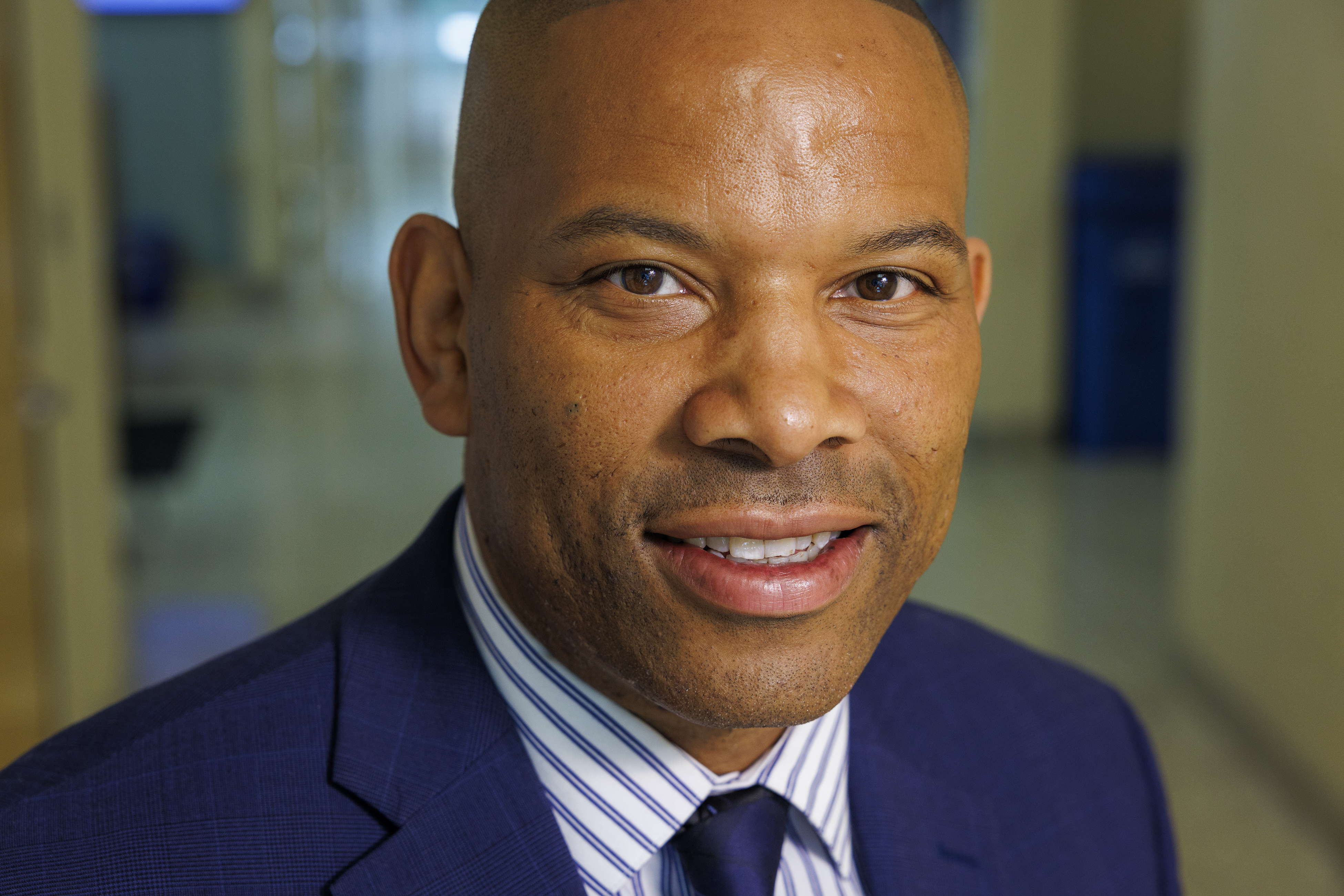
Kwame Morton, superintendent of Cherry Hill schools.
What is the timeline for the plan?
The committee plans to present a preliminary rebalancing plan to the school board in January or February. A final plan is expected by June or July.
The district held three community meetings in November to get feedback from residents and answer questions. More community meetings are planned for March.
Parent Dan Levin, an urban planner, questioned how the committee gathered its data. He suggested the committee consider more long-term planning for 15 years down the road.
“You’re shooting in the dark,” said Levin, whose son attends James Johnson Elementary. “You’re throwing good money after bad.”
Morton said the district wants to implement the rebalancing plan for the 2027-28 school year, beforeenrollment is expected to swell in the 2028-29 school year.
Will middle schools and high schools be impacted?
Guy said the district’s most pressing need for more seats is at the elementary schools. He said officials are not yet examining future enrollment needs at the middle and high schools.
Ramon Roman-Montanez knew the police were watching.
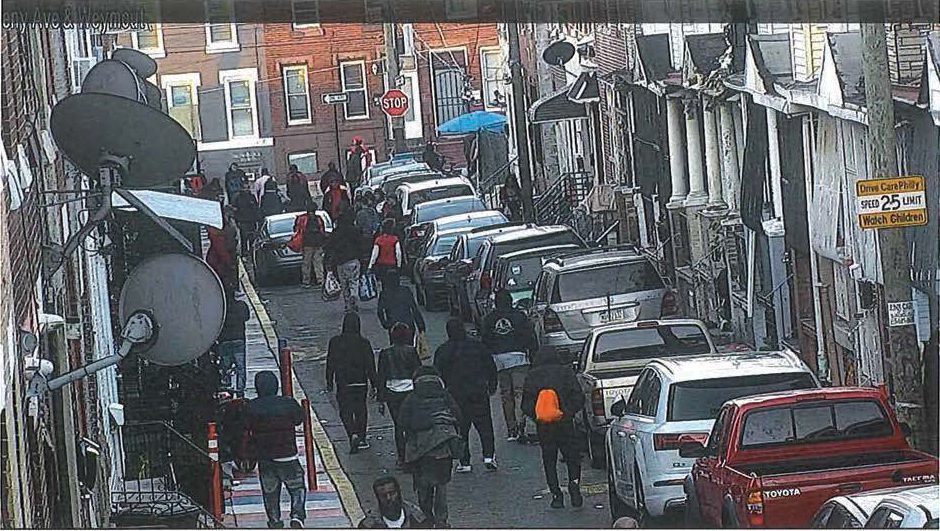
One day last April, as Roman-Montanez prepared to hand out free drug samples to users on Weymouth Street — a common tactic that dealers use to attract customers — he stood in the middle of the Kensington block and spotted a problem.
The cops had put up a pole camera.
Using binoculars, Roman-Montanez scouted out the new device at the end of the block, prosecutors said in court documents. But he had a business to run — and so, after talking with a few associates in the street, he decided that giveaway day would move forward as planned.
Shortly after dawn, prosecutors said, customers were recorded on the new surveillance camera crowding onto the 3100 block of Weymouth to receive their samples.
And in the weeks to come, business continued to boom.
A pole camera placed near Weymouth Street captured potential drug customers coming to the block to receive free samples handed out by the gang that ran the block, prosecutors said.
The camera, however, was just one hint of what authorities now say was a sprawling, multiyear investigation into the gang Roman-Montanez helped lead — a group that sold thousands of doses of heroin, fentanyl, crack, and cocaine over the course of more than a decade, and effectively took over a residential block in a neighborhood that has long suffered from crime, open-air drug dealing, and neglect.
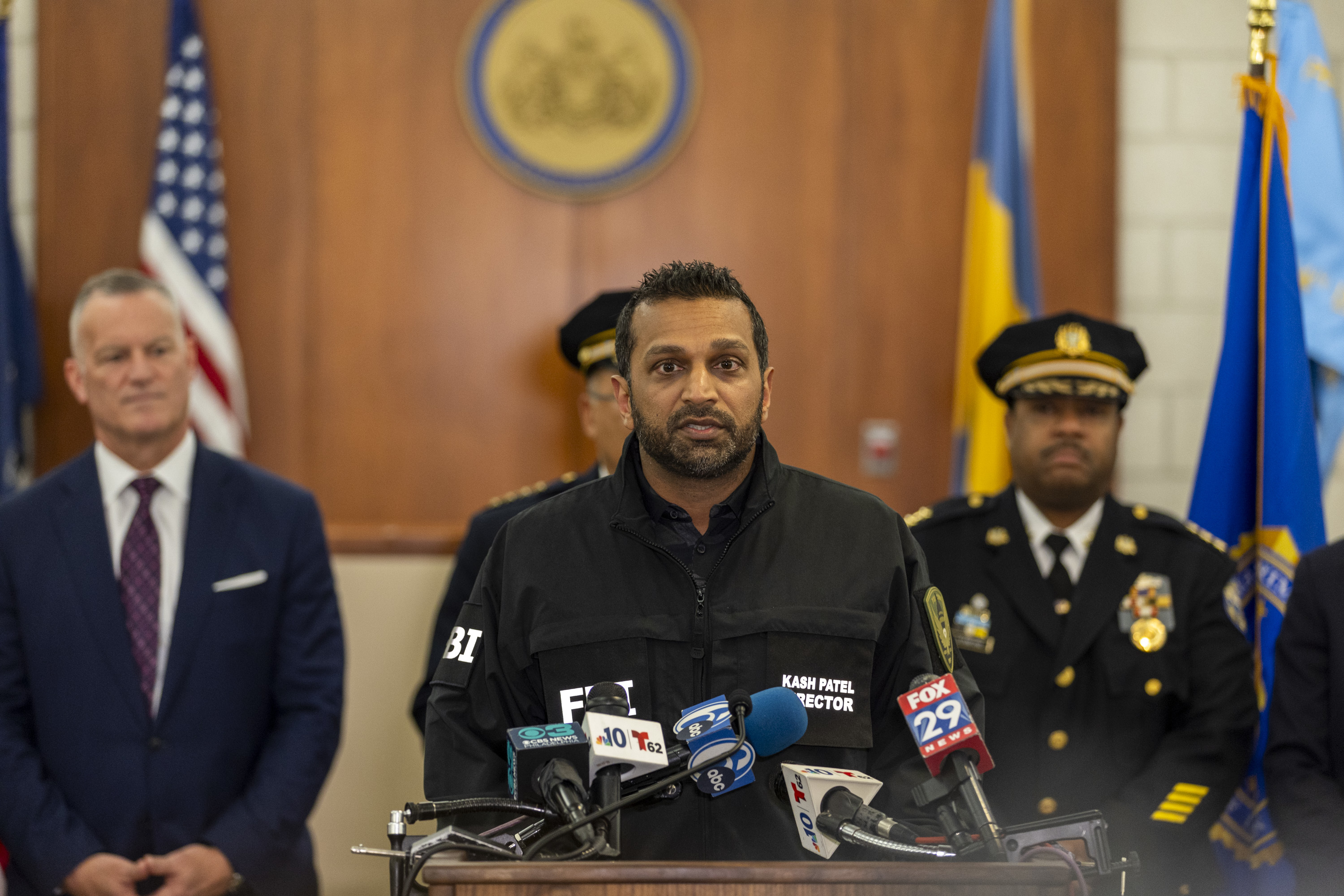
The results of the probe came to light last month, when FBI Director Kash Patel came to Philadelphia to announce that 33 people, including Roman-Montanez, had been indicted on drug charges. Patel called the case a model for law enforcement across the country, and an example of how to take out a drug gang terrorizing a community.
FBI Director Kash Patel speaks to press at the 24th Police District Headquarters in Philadelphia on Oct. 24.
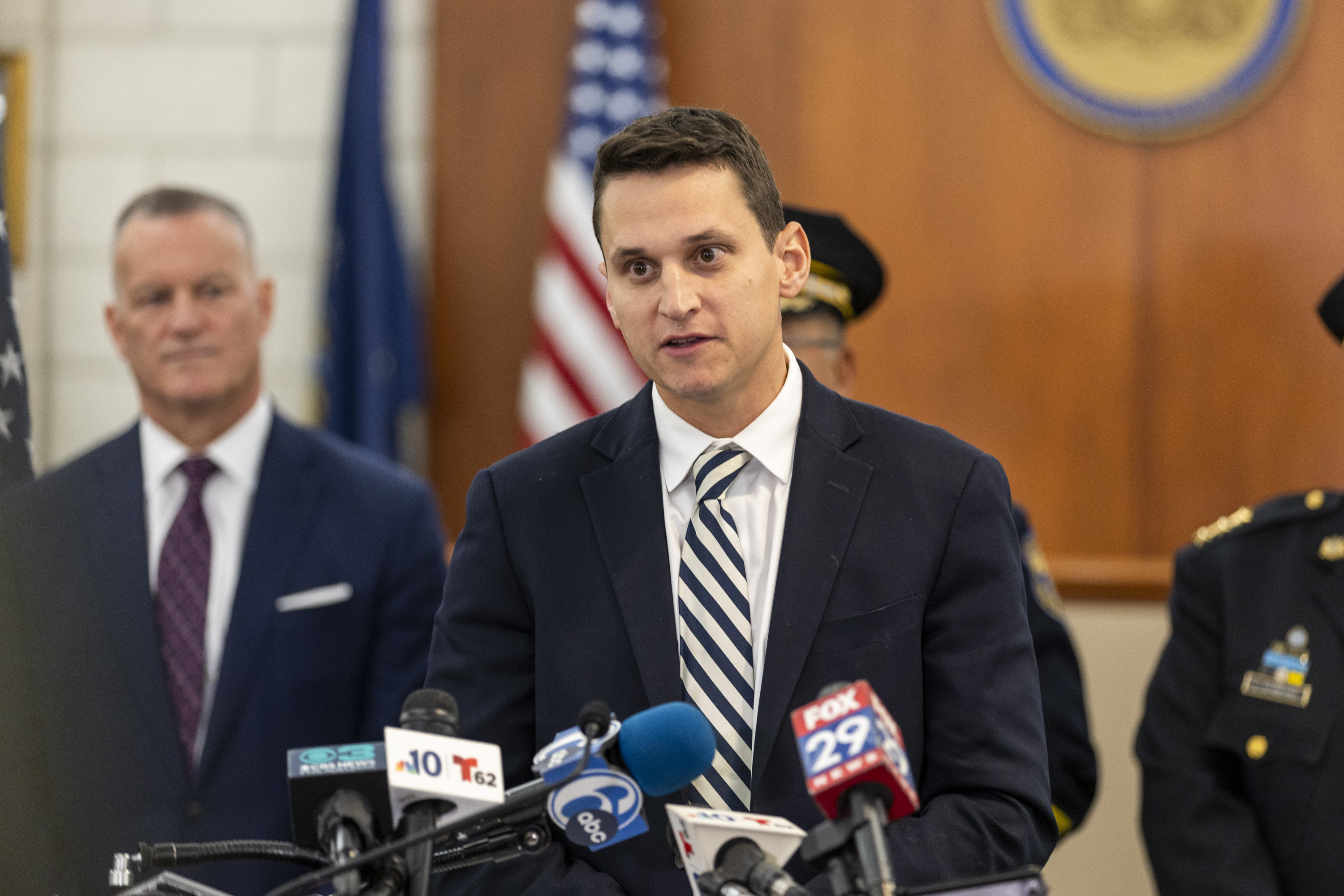
To understand the scope of the case — which U.S. Attorney David Metcalf described as the region’s largest single prosecution in a quarter-century — The Inquirer reviewed hundreds of pages of court records, examined social media accounts and videos connected to the group, and interviewed law enforcement officials and Weymouth Street residents.
The review revealed previously unreported details about the investigation, including that authorities ran monthslong wiretaps on about a half-dozen phones tied to gang members, placed a recording device in a vacant lot the gang used as a meeting place, employed at least seven confidential informants, and believe that over the course of nine years, the group trafficked tens of thousands of doses of drugs into the city — worth millions of dollars.
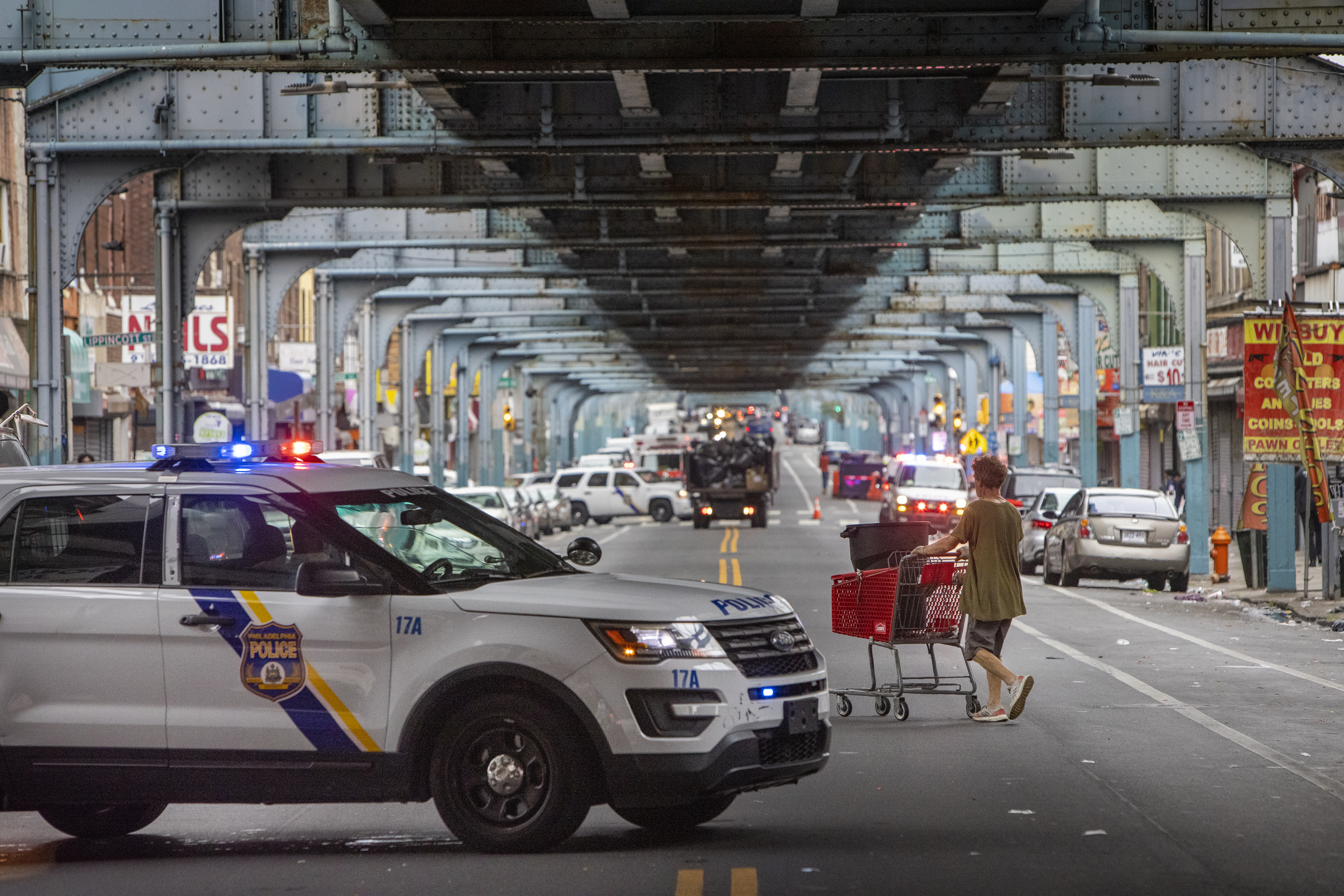
Philadelphia police this month continued to restrict access to Weymouth Street long after gang members had been arrested, a highly unconventional approach that officials said was aimed at sustaining the block’s newfound sense of quiet. Several residents said they didn’t mind the unusual tactic, in part because it helped prevent their block from quickly returning to its status as a marketplace for round-the-clock drug deals.
Those tactics underscored the depth of the investigation, which unfolded in the heart of Kensington — where law enforcement has employed a variety of approaches over the years to try to address crime, drug dealing and violence, sometimes with mixed results.
Philadelphia officials have for years tried a variety of tactics to try and address crime and quality-of-life concerns along Kensington Avenue.
But the review also showed that even as the investigation was underway, the gang continued to operate in the open — and some of law enforcement’s attempts to hold people accountable as the probe was unfolding were unsuccessful.
In August, for example, Roman-Montanez was charged in state court with drug possession and related crimes after police found fentanyl, crack, and $20,000 in cash in his house — the result of a raid on Weymouth Street that was part of the investigation into his gang.
But a few weeks later, his attorneys persuaded a Philadelphia judge to reduce his bail and he walked out of jail. The 40-year-old — who federal prosecutors now say was the de facto chief operating officer of one of the city’s biggest drug conspiracies — was taken back into custody only this month, when federal authorities unsealed his indictment.
Even as investigators were continuing to collect evidence against the gang, members routinely appeared in videos and songs on social media in which they boasted about their gang affiliation, brandished guns, and threatened acts of violence against rivals.
Some of the videos made modest Weymouth Street look more like a nightclub. Men wearing shimmering gold chains can be seen carrying designer bags and waving guns with extended clips at the camera. Others smoke blunts, or mix soda and a purple liquid together to make what appears to be the codeine-infused drink “lean.”
A video for the song “Philly Boy,” uploaded to YouTube last spring, made clear where the debauchery was taking place: It opens with a shot of the Weymouth street sign.
Beyond the fact that people who remained on the street could continue to sell drugs, prosecutors said the gang used threats to maintain control over their territory. And at least two suspected coconspirators were killed as the investigation wore on — sparking the potential for more retaliatory violence. Prosecutors have not yet charged any gang members with any shootings or homicides, but have said their investigation is continuing.
Metcalf, through a spokesperson, declined an interview request to discuss the case in more detail. But while announcing the takedown last month, he said there is always a tension in long-running investigations between making quick arrests and taking time to gather evidence for broader or stronger cases. And in this instance, he said, the goal was clear: Prosecutors were seeking to “eliminate the organization.”
“We could obviously just prosecute individual seizures of guns and drugs. But the organizational prosecution … that’s what’s going to make a difference in the community,” he said. “This neighborhood will be a lot safer than it [would’ve been] if we didn’t take our time to do that.”
U.S. Attorney David Metcalf speaks to press at the 24th Police District Headquarters on Oct. 24.
A sophisticated operation
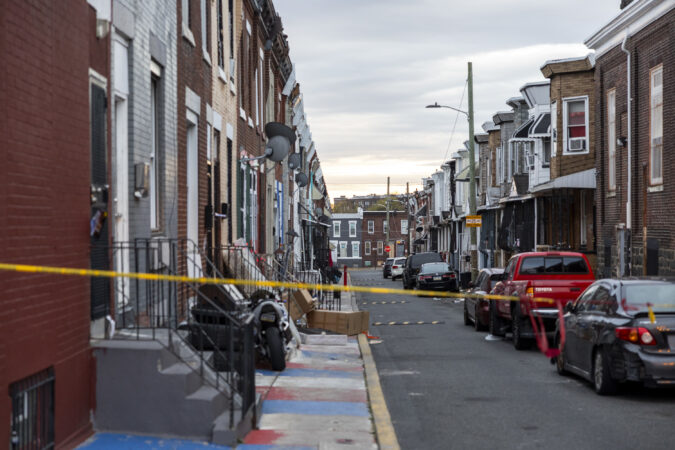
Weymouth Street is one of a series of narrow, rowhouse-lined blocks in Kensington just a few steps from McPherson Square and near the intersection of Kensington and Allegheny Avenues — long the epicenters of a bustling narcotics bazaar.
Some corners in the area can pull in tens of thousands of dollars a day in drug sales, authorities say. And the competition among dealers has often led to violence, with shootings and homicides in Kensington historically outpacing the rest of Philadelphia.
The crew on Weymouth Street thrived in that environment, prosecutors said, and developed a sophisticated system for seeking to build and protect a business that sold fentanyl, crack, and cocaine 24 hours a day, seven days a week.
Their drugs were branded with unique stamps or names like Ric Flair, Horse Power, Gucci, or Donald Trump. Bags were sold for $5 each, prosecutors said, while “bundles” of about a dozen packets went for between $55 and $75.
The group maintained an internal hierarchy, prosecutors said, with key figures at the top overseeing layers of workers who engaged in hand-to-hand sales, watched out for police, managed the drug supply, or used violence to protect the operation. Many members were related to one another, prosecutors said, and some families had people from multiple generations working for the group.
The leader was Jose Antonio Morales Nieves, prosecutors said, who “owned” the block and allowed people to deal there in exchange for payments he called “rent.”
His top deputies ran the day-to-day operations, prosecutors said, and included Roman-Montanez, nicknamed Viejo, and Roman-Montanez’s paramour, Nancy Rios-Valentin.
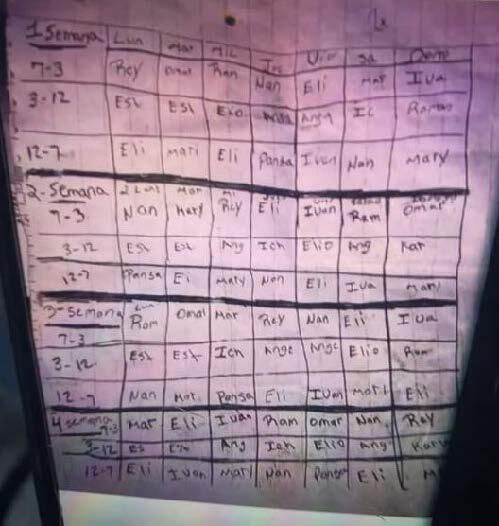
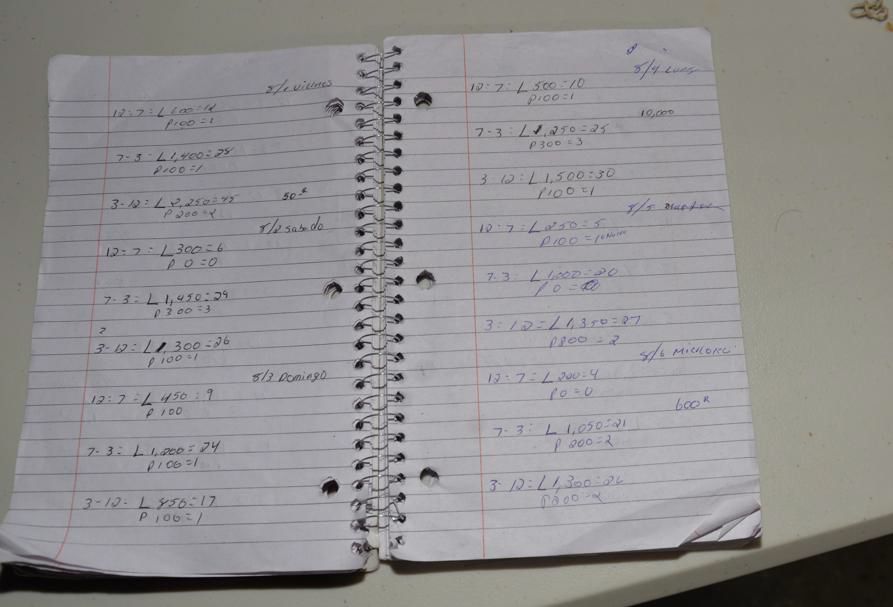
The two set and distributed schedules for lower-level employees, kept track of how and when drug stashes needed to be refilled, and maintained handwritten ledgers tracking sales per shift.
Prosecutors said leaders of the Weymouth Street drug trafficking organization kept detailed schedules on which members would work which shifts.
The first episode in the indictment dates to January 2016, when, prosecutors said, Angel Rios-Valentin — the brother of Nancy Rios-Valentin — stood watch as someone sold drugs to a confidential informant.
A few months later, the indictment said, police conducted a traffic stop on the block, and gang leader Morales-Nieves — also known as Flaco — responded by approaching the officers in a threatening manner carrying a shovel.
As the gang continued to build its business on Weymouth, prosecutors said, several members took up residence on the block, including Roman-Montanez, and members used a variety of houses or abandoned lots to store or sell drugs.
Among them, prosecutors said, was a vacant lot with a tent they labeled the “bunker.” It was next door to the house Roman-Montanez shared with Rios-Valentin, they said, and served as a meeting place, stash location, and place to cook crack.
Last May, prosecutors said, it also served as a site for violence, when Roman-Montanez dragged a man into the bunker, and another gang member — who is not named in court documents — beat him with a rod.
Crimes involving violence
Much of the 170-page indictment revolves around individual episodes in which members of the gang conducted operations that would be considered routine if they weren’t illegal, such as selling drugs to users, managing the block’s supply, or handling illicit proceeds.
The document includes detailed quotes from those accused of taking part in the operation and describes their actions with unusual precision, the result of what prosecutors said were a series of wiretapped phones, cameras — including one inside the bunker — interactions with informants, and seizures of drugs by police.
Police found handwritten ledgers detailing drug activities inside Ramon Roman-Montanez’s house on Weymouth Street, prosecutors said.
Some incidents, however, went well beyond the everyday rhythm of drug sales, prosecutors said.
In November 2024, several gang members ran after a car that had sped down Weymouth, then fired shots at the vehicle after they caught up to it around the corner, the indictment said. The document does not say if anyone in the car was struck.
Six months later, prosecutors said, the pole camera captured footage of two members of the gang — John David Lopez-Boria and Luis Williams — laughing at someone sitting on a front step across the street, then beating the person and dragging the victim into an abandoned lot to continue the assault.
The gang’s violent nature was also captured on YouTube, where gang members appeared in videos taunting rivals and flaunting guns.
In one video, the rapper Sombra PR — whom prosecutors described in court documents as an unindicted coconspirator — made clear that he and a Weymouth Street gang member known as Panza would use a Draco gun to come after anyone who threatened them.
“I’ll get you with Panza with Draco and you’re stiff,” he rapped.
Prosecutors said Weymouth Street members often flaunted guns and boasted about their gang affiliation in YouTube videos.
Panza, whose given name was Heriberto Torres Gual, was described by prosecutors in court documents as one of the group’s enforcers, and he appeared in some of Sombra PR’s videos.
But last month, Gual, 31, was gunned down while riding an electric bike on the 3000 block of Kensington Avenue, just a few blocks from Weymouth, according to police. Surveillance footage showed a torrent of shots being fired out of an SUV that had pulled up beside him.
In all, police recovered 35 spent shell casings from the scene and said it was a targeted attack.
Gual was the second high-ranking gang member to be killed in the last year, authorities said. Last November, Felix Rios-Valentin — the brother of Nancy and Angel Rios-Valentin — was fatally shot in Mayfair.
Police have made no arrests in either case.
After Gual’s death, an Instagram account for a record label dubbed “Weymouth Family” made a post referencing the title of a new song that memorialized Gual. The post tagged Pressure 9X19, the artist behind “Philly Boy.”
And on another account associated with Weymouth-tied rappers was an illustration of an unmistakable street sign: the marker for the intersection of Allegheny Avenue and Weymouth Street.
Evading accountability
During their long investigation, law enforcement did sometimes disrupt the gang’s drug operations and make arrests.
In 2020, Angel Rios-Valentin was convicted in federal court of illegal gun possession after officers found him carrying a loaded handgun that he had taken from Roman-Montanez’s house. He was sentenced to five years in prison and was on supervised release when he was arrested again last month.
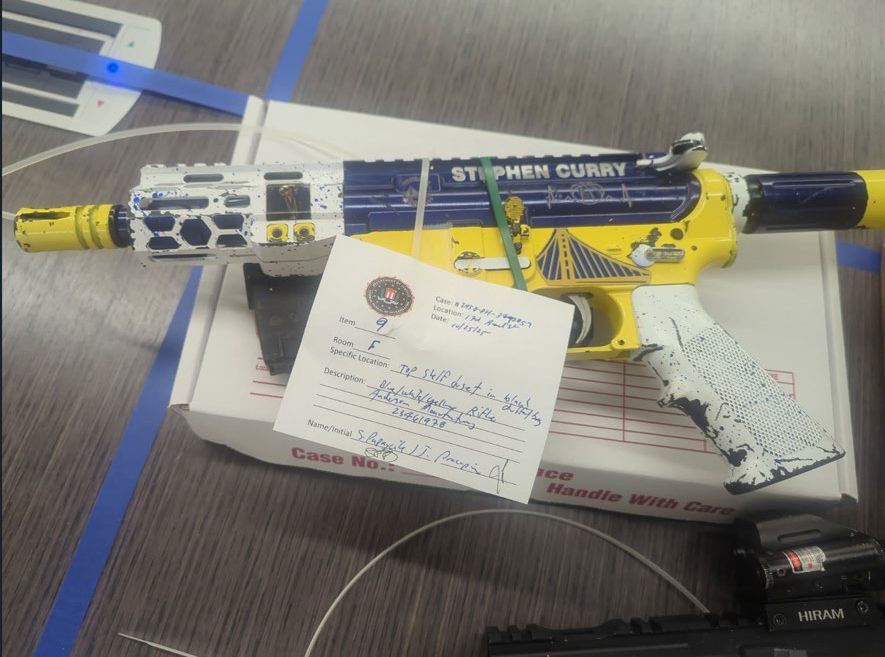
Police found four guns in Rios-Valentin’s house, a discovery that prosecutors said showed his ongoing commitment to the gang.
When Angel Rios-Valentin was arrested, prosecutors said, responding officers found several guns in his house, including this assault rifle.
Roman-Montanez, meanwhile, was arrested twice in the last three years, court documents show — but in both cases managed to avoid significant consequences.
In October 2022, police searched his house and found 96 grams of fentanyl, four loaded guns, and nearly $125,000 in cash, prosecutors said. Roman-Montanez was charged in state court, but the case was withdrawn.
Federal prosecutors did not explain the withdrawal in court documents, and because the case did not result in a conviction, the records are now sealed under Pennsylvania law. The district attorney’s office did not respond to a request for comment.
A source familiar with the case said it collapsed because scheduling issues with lawyers and witnesses delayed the preliminary hearing for more than a year and prosecutors ultimately withdrew the charges.
The second arrest was in August, when police, acting on a search warrant, again searched Roman-Montanez’s house and found more fentanyl, crack, and cash inside, court records show. He was charged with crimes including conspiracy and possession with intent to deliver, and his bail was set at $750,000.
But a month later, his lawyers persuaded a judge to lower his bail.
The prosecutor argued against that, according to a transcript of the bail hearing, saying the sheer amount of drugs and cash involved made clear that Roman-Montanez was “not a minor player.”
But Common Pleas Court Judge Elvin Ross III said details about Roman-Montanez’s role in the conspiracy were lacking. He reduced bail to $300,000, and a few weeks later, Roman-Montanez was back on the street.
Will the quieter aftermath last?
On the morning of Oct. 24, dozens of federal agents and city police officers swarmed Weymouth Street to arrest suspected gang members and gather additional evidence to use in their court case. Some targets were taken into custody elsewhere — the group’s leader, Morales Nieves, was arrested in Luquillo, Puerto Rico.
Patel, the FBI director, said at a news conference afterward that the case “is not just one instance of removing a couple of people — it is an example of how you remove an entire organization that has corrupted not just the city of Philadelphia but the state of Pennsylvania as well.”
Roman-Montanez has pleaded not guilty, as has Nancy Rios-Valentin. Her attorney wrote in court documents that she maintains her innocence, that the case against her was “not strong,” and that she “cannot be convicted on a theory of ‘guilt by association.’” A federal judge on Monday ordered that Rios-Valentin — who has four children — be released from jail and placed in home confinement at her sister’s house while awaiting trial.
On Weymouth Street, residents said in interviews that life has been quieter in the weeks since the raids. Some of that is the result of the ongoing police presence, which began to relax this week as officers resumed allowing passersby to walk or drive through the street.
One resident, who asked not to be identified for fear of retaliation, said he appreciated law enforcement’s attempt to help clean up a struggling area.
But he was skeptical that one prosecution — even one as ambitious as this — would reverse a persistent and neighborhood-wide problem.
“I don’t see it making a big difference any time soon, and it’s nobody’s fault,” he said. “This is not an overnight fix.”
A Philadelphia jury reached $35 million verdict last week against Main Line Health and the University of Pennsylvania Health System for a cancer misdiagnosis that led a then-45-year old Philadelphia resident to undergo a total hysterectomy in 2021.
Main Line discovered later that the biopsy slides used to make the diagnosis in February 2021 were contaminated. The cancer diagnosis was due an error that involveda second person’s DNA, not that of the plaintiff, Iris Spencer, who did not have cancer.
Main Line settled with Spencer in 2022 for an undisclosed amount, so it won’t have to pay its share of the verdict.
The jury found Penn and its physician, Janos Tanyi, a gynecological oncologist, liable for $12.25 million, or 35%, of the total awarded in damages for her unnecessary hysterectomy. The lawsuit said Spencer suffers from “surgically-induced menopause.”
The lawsuit against Penn and Tanyi said the physician did not do enough to resolve a conflict between biopsy results at Main Line and those at Penn, where Spencer sought a second opinion.
A Penn biopsy did not find cancer. Other tests were also negative, but Spencer did not know about those results.
“The verdict affirms the central importance of the patient and the doctor’s obligation to inform the patient of all of the test results, of all of her options, and that she shouldn’t be dismissed because she’s a patient and not a doctor,” Spencer’s lawyer, Glenn A. Ellis, said Monday.
The $35 million verdict is Philadelphia’s largest this year for medical malpractice, according to data from the Philadelphia Court of Common Pleas.
Medical malpractice costs have been rising throughout healthcare. A factor in Pennsylvania is a 2023 rule change that allowed more flexibility in where cases can be filed.
Spencer’s troubles started in February 2021 at Main Line’s Lankenau Medical Center where her biopsy found that she had cancer in the lining of her uterus despite the lack of symptoms.
For a second opinion, Spencer saw Tanyi at Penn a few days later. A repeat biopsy came back negative, according to Spencer’s complaint that was filed in early 2023. Tanyi also performed other tests, all of which came back negative, but he did not share that information with Spencer, the complaint says.
After Tanyi performed the complete hysterectomy on March 8, 2021, Penn’s pathology laboratory found no cancer in the tissues that had been removed from Spencer’s body.
That’s when Spencer, who has since moved to Georgia, went back to Lankenau seeking an explanation. Seven months later, Main Line informed her that she never had cancer.
Main Line and Spencer subsequently “reached an amicable full and final settlement to resolve and discharge all potential claims for care involving the health system,” Main Line said in a statement. Main Line did not participate in the trial.
Penn said in a statement: “We are disappointed by the jury’s verdict in this case that was unmoored to the evidence presented at trial on negligence and damages. Our physician reasonably relied on the pathology performed at a hospital outside our system that revealed a very aggressive cancer.”
Penn said it plans to appeal the verdict, which could increase by more than $2 million if the court approves a motion for delay damages that Ellis filed Saturday.
A majority of Latino adultsdisapprove of President Donald Trump’s job performance and his policies on immigration and the economy, according to a new Pew Research Center report that offers insight on the shifting opinions of a key voter demographic that Trump made inroads with in 2024.
The study, published Monday, offers a glimpse into how a majority of Latino adults nationwidehave a negative view of Trump’s performance and policies that were important to them during the 2024 election. However, a majority of Latinos who voted for Trump in 2024 remain supportive of the president.
Pew Research Center based its analysis on two nationwide surveys conducted this fall. The center surveyed almost 5,000 Latino adults from Oct. 6 to Oct. 16 as part of itsNational Survey of Latinos. A prior survey of U.S. adults, including 629 Hispanic respondents, was conducted from Sept. 22 to 28.
The report includes the opinions of Latino residents in the United States, including people both eligible and ineligible to vote. A strong majority of Latino voters who supported former Vice President Kamala Harris in 2024 are critical of Trump’s performance, according to the report.
Among the highlights of the survey, 70% of Latino adults disapprove of Trump’s handling of the presidency, 65% disapprove of the Trump administration’s immigration policies, and 61% say the president’s economic initiatives “have made economic conditions worse,” according to the report.
Additionally, approximately four in five Latinos say that Trump’s policies “harm Hispanics, a higher share than during his first term.”
Latinos are among the fastest growing demographic groups in the United States and were a key voting bloc during the 2024 presidential election. Though Trump significantly improved his support among Latino voters in 2024, he did not win the demographic overall. In Pennsylvania, some Latino voters set aside his incendiary rhetoric about their community in favor of his promises to help the economy.
(function() { var l = function() { new pym.Parent( ‘pew-latino__graphic’, ‘https://media.inquirer.com/storage/inquirer/ai2html/pew-latino/index.html’); }; if(typeof(pym) === ‘undefined’) { var h = document.getElementsByTagName(‘head’)[0], s = document.createElement(‘script’); s.type = ‘text/javascript’; s.src = ‘https://pym.nprapps.org/pym.v1.min.js’; s.onload = l; h.appendChild(s); } else { l(); } })();
It remains to be seen how the pessimism with Trump reflected in the report will impact the 2026 midterms, said Luis Noé-Bustamante, a research associate at the Pew Research Center and an author of the report.
But Latino voters swung back to Democrats during the elections earlier this month, including for Democratic Gov.-elect Mikie Sherrill, whose margins over Republican Jack Ciattarelli ranged from 57 to 71 percentage points in majority Latino municipalities, according to data from Nov. 5.
“Similar to how the economy and affordability was a top issue among Latinos in the lead up to the 2024 election, it continues to be a priority among them and something in which they continue to have generally pessimistic views,” Noé-Bustamante said. “But that could change. Conditions on the ground could change and of course that could shift opinions of the president and his administration.”
In the Pew Research Center survey, about two-thirds of Latinos say their situation in the United States is worse today than it was a year ago, the first time in nearly two decades of the Pew Research Center Hispanic surveys.
Latinos have become increasingly concerned about their belonging in the United States, increasing from 48% in 2019 to 55% in 2025, according to the report. And when it comes to their personal finances, approximately one-in-three Latinos have struggled to pay for groceries, medical care, or their rent or mortgage in the last year. However, half believe their financial situation will improve over the next year and some have had beneficial financial experiences in the last year.
On immigration, slightly more than half — 52% — of Latino adults say they worry constantly about the prospect that they, or someone they are close to, could be deported amid the Trump administration’s surge of immigration enforcement. About 71% say the administration is “doing too much” when it comes to deporting immigrants who have not legally entered the U.S, according to the report.
Though a vast majority of Latinos have a critical perspective of Trump, Latinos who voted for Trump in 2024 have largely remained loyal to the president and his ideals, while Latino Republicans who did not vote for him have less favorable views of the president.
As an example, Trump has an 81% job approval rating among Latinos who voted for him, though this has declined from 93% at the beginning of his term.
Similarly, a smaller share of Latino Trump voters say their situation has worsened in the United States, that Trump’s policies are harmful to Hispanics, and that they’re worried about their belonging in the U.S.