On Tuesday, the city agreed to pay $250,000 to a former clerk who, like several other register of wills employees, said he was fired after he refused to contribute to Gordon’s campaign.
Nicholas Barone alleged in a 2023 federal lawsuit that Gordon, through an intermediary, had first requested a $150 contribution in late 2021.
When Barone told his supervisor he could not afford to contribute, Gordon asked for $75, according to the lawsuit. Barone balked again.
Then, in January 2022, Barone received a termination letter, effective immediately. The letter came four days after a performance review found he was exceeding expectations, according to his suit.
“She pressured everyone to make a donation and sort of made it known, if you’re not donating, you’re not going to be employed,” said Barone’s lawyer, James Goslee.
In addition to the Barone settlement, the city has paid $400,000 to settle four other federal lawsuits brought by former Gordon staffers. They alleged that Gordon, who was elected in 2019, had essentially turned the register of wills office into an arm of her unsuccessful reelection campaign.
Patrick Parkinson, a former administrative deputy in the office, claimed in his lawsuit that Gordon “continually and relentlessly badgered” him for campaign money, then fired him in 2022 when he refused. His suit was settled in 2024 for $120,000.
Barone’s case was unusual in that it was the only one that got as far as a trial, which began Monday. Several former employees testified about how Gordon had politicized the office. Gordon testified last.
The city then agreed to settle before the jury began deliberating. Goslee said her testimony was a “disaster” for the defense.
“She just wasn’t a good witness, I’ll put it to you that way,” Goslee said. “She should not be in politics or be allowed anywhere near public office.”
Reached by phone Thursday, Gordon initially declined to comment. She called back five minutes later.
“In connection with the allegations brought against me, I maintain I did nothing wrong,” Gordon said. “Any decision to settle the case was a decision made by the City of Philadelphia.”
A spokesperson for the city’s law department declined to comment.
The register of wills office is a somewhat obscure row office in City Hall that employees approximately 100 people with an annual budget of about $5.2 million. It issues marriage licenses, processes inheritance-related records, and does other nonpolitical work.
But it also has a reputation as a Democratic patronage operation going back at least to the 1980s, with jobs being doled out to people with political connections.
Goslee said he was hoping that Barone’s case might lead to some “structural change.”
“This is a very important public interest case,” he said. “That system of entrenched, compelled patronage really needs to come to an end.”
That does not appear to be happening yet.
Gordon was defeated in the 2023 Democratic primary by John Sabatina Sr., an estate attorney and Northeast Philadelphia ward leader. He took office in January 2024.
The city has since paid out $256,000 in settlements to nine former register of wills employees who filed lawsuits alleging that Sabatina fired them to make way for his own patronage hires. Five cases are still pending.
“It was a hit list,” lawyer Timothy Creech, who is representing most of those ex-employees, said in September, comparing Sabatina to a “Tammany Hall”-style party boss, a reference to the former New York City political machine.
“It wasn’t to save money,” Creech said. “It was specifically to hire their own people.”
Register of Wills John Sabatina
Several of the 30 office employees on the list are described by their connections to Gordon, including “Tracey niece,” “Tracey’s friend, 7th Ward committee person,” “Last Tracey hire.” The suggested action for most of those employees was immediate termination.
“We have enough immediate terminations to allow us several hires in the next two weeks,” reads a note at the bottom of the spreadsheet.
Another note appears to indicate that some firings were planned before Sabatina had replacements:“We don’t have people lined up for all of these jobs and we need to make sure we use up all of the funds set aside in the budget for salary.”
Sabatina has declined to comment on those cases.
Lauren Cristella, president and CEO of the Committee of Seventy good-government group, said it is not acceptable for the city to spend more than $900,000 to settle lawsuits stemming from politics in the register of wills office.
“We can all think of a thousand better things we could do with these funds,” Cristella said. “The patronage mill better start printing money to keep up with these payouts because taxpayers in this city can no longer foot this bill. When is enough for Council and the mayor to meaningfully reform the row offices?”
Last year, the Pennsylvania Intergovernmental Cooperation Authority, Philadelphia’s fiscal watchdog, passed a resolution to recommend that City Council and Mayor Cherelle L. Parker abolish the register of wills office, along with the sheriff’s office, another row office with a long history of problems.
Neither Parker nor Council has shown any interest in taking action.
Gordon, who ran unsuccessfully for Congress in 2024, now works in the sheriff’s office as a services representative, according to city payroll records.
“Row offices are set up to create jobs for the politically connected, not serve the people of our city,” Cristella said. “It doesn’t matter who is in the office, the taxpayers are always on the hook for their abuse of power.”
Staff writer Ryan W. Briggs contributed to this article.
In December, Katrina Williams watched as the man who killed her brother was sentenced to decades in prison and felt, she said, as if a two-year nightmare was coming to an end.
But weeks later, another shooting took the life of her only son.
Williams’ brother, Lashyd Merritt, 21, was one of five people killed in a mass shooting in Kingsessing in July 2023, when Kimbrady Carriker walked through the Southwest Philadelphia neighborhood with an AR-15 rifle and fired at random passersby.
Then, in January, her 19-year-old son, Russell, was killed by a man who, like the Kingsessing shooter, committed a spree of crimes, police say.
“I’ll never understand it,” said Williams,43. “There’s no reason for it.”
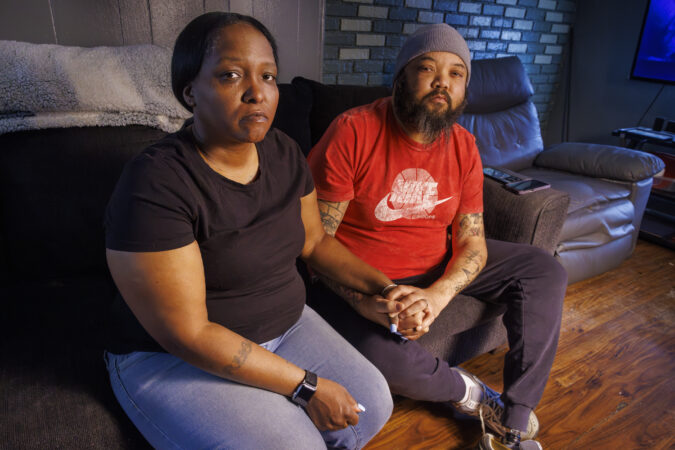
A high school photograph of Russell Williams being held by his father and mother, Katrina and Russell Williams Sr. at their home in Southwest Philadelphia on Feb. 6.
For Williams, the trauma of Merritt’s violent death never fully dissipated, she said, and the fatal shooting of her son only compounds her pain.
It’s a cycle of violence that is not unfamiliar in the city.
For others with relatives killed in the Kingsessing attack, the traumatic impact of gun violence did not end on that July day. Nyshyia Thomas lost her 15-year-old son, DaJuan Brown, to the gunfire and, while she was still mourning, her 21-year-old son, Daquan Brown, was arrested last year in connection with another mass shooting in Grays Ferry.
Asked about the evening of Jan. 28, when she and her husband, Russell Williams Sr., learned of their son’s death, Williams said two things came to mind:
“Déjà vu,” she said, and “hell.”
A seemingly random crime
Around 10 p.m. near 64th Street and Lindbergh Boulevard, police said, 19-year-old Zaamir Harris stepped off a SEPTA bus and stole a bike from the vehicle.
He rode up to Russell Williams, who was walking home from night school, where the teen was studying to become a commercial truck driver. Harris then pulled a gun and fired at Williams multiple times, striking him in the throat, police said.
Williams collapsed near 66th Street and Dicks Avenue, just three blocks from home. After the shooting,Harris ditched the bike and stole an e-scooter before fleeing, according to police.
Police tracked Harris to a Wawa at 84th Street and Bartram Avenue, where he was arrested. He was charged with murder and gun crimes. Investigators recovered three fired cartridge casings from the scene, as well as a 9mm handgun, according to police.
A spokesperson for the Philadelphia Police Department declined to say whether investigators have determined a motive for the shooting, citing the ongoing investigation.
Katrina Williams said her son did not know Harris, and a police detective told her the shooting was random.
After he was shot, Russell Williams was rushed to Penn Presbyterian Medical Center, where he died from his injuries. It was the same hospital where Williams’ brother, Merritt, was taken after being shot in Kingsessing, she said.
Katrina Williams, whose son, Russell, 19, was shot and killed not far from family home in Southwest Philadelphia.
Russell Williams had recently graduated from Philadelphia Electrical and Technology Charter School and dreamed of an entrepreneurial career in stock trading.
Like her son, Williams said, Merritt was a hard worker who wanted to better his life. He worked for the IRS, had a girlfriend, and wanted to travel the world, she said.
“We lost two great people,” Williams said. “Two of them.”
That police made an arrest in the slaying of their son has brought little solace, Williams and her husband said as they sat in their Southwest Philadelphia living room on a recentFebruary day. Family photos filled the space, and a portrait of Russell, smiling and wearing a tuxedo, hung on the wall.
As the case against her son’s accused killer proceeds, Williams said, she will be in court every step of the way, just as she was when Carriker pleaded guiltyin the death of her brother.
In December, as Carriker faced sentencing, Williams said, she could not bring herself to address the judge and ask for a long prison sentence, as relatives of other victims did. She was so overcome with anger, she said, that she feared she might physically attack her brother’s killer.
But she was in the room when Common Pleas Court Judge Glenn B. Bronson sentenced him to 37½ to 75 years in prison. In Williams’ view, Carriker should have received a life sentence for each person he killed, she said, even if no punishment could make up for the loss of Merritt.
Now, Williams is preparing to head back to court as she once again seeks justice.
Since her son’s death, Williams said, she has taken comfort in the kindness of friends and family. She was touched, she said, to see a “block full of people” gather to honor his life and release balloons in his memory. But the ache of her loss remains.
“It’s like pain on top of pain — it’s just always gonna be hard,“ Williams said. ”I just gotta deal with it the best way I can.”
As U.S. Commerce Secretary Howard Lutnick’s relationship with Jeffrey Epstein gains new scrutiny, questions have emerged on Haverford College’s campus about how to address their mega-donor’s involvement.
Lutnick, a 1983 Haverford graduate who has donated $65 million to the college and whose name is on the school’s library, had contact with the late financier as recently as 2018, long after Epstein pleaded guilty to obtaining a minor for prostitution and soliciting a prostitute, according to documents released by the Justice Department. And during congressional testimony this week, he said he visited the sex offender’s private island with his family in 2012. That’s even though Lutnick previously said he had not been in a room with Epstein, whom he found “disgusting,” since 2005.
At Haverford, where the library at the heart of campus is named after Lutnick,two students have floated a proposalto remove Lutnick’s name from the building and wrote a resolution that could be discussed at a forthcoming student-led meeting, according to the Bi-College News, the student newspaper for Haverford and Bryn Mawr Colleges. Fliers that say “Howard Lutnick is in the Epstein Files — What Now?” have been posted around campus, according to the publication.
And in an email to campus Thursday, Wendy Raymond, president of the highly selective liberal arts college on the Main Line, said she and the board of managers are monitoring the situation.
“We recognize that association with Epstein raises ethical questions,” she wrote. “While Secretary Lutnick’s association with Epstein has no direct bearing on the College, as an institution, we are committed to our core values and cognizant of broader ethical implications raised by these disclosures.”
Commerce Secretary Howard Lutnick listens during an event with President Donald Trump in the Oval Office of the White House earlier this month.
A Commerce Department spokesperson told the Associated Press last month that Lutnick had had “limited interactions” with Epstein, with his wife in attendance, and had not been accused of “wrongdoing.” Lutnick told lawmakers this week: “I did not have any relationship with him. I barely had anything to do with him.”
Lutnick, formerly chairman of Cantor Fitzgerald L.P., a New York City financial firm that lost hundreds of employees in the 9/11 World Trade Center attacks, served on Haverford’s board for 21 years and once chaired it. In addition to the library, the indoor tennis and track center bears the name of his brother Gary Lutnick, a Cantor Fitzgerald employee who was killed on9/11, and the fine arts building carries the name of his mother, Jane Lutnick, a painter. He also funded the college’s Cantor Fitzgerald Art Gallery.
In making a $25 million gift to the college in 2014 — which remains tied for the largest donation Haverford has received — Lutnick told The Inquirer the college had helped him during a particularly difficult period. He lost his mother to cancer when he was a high school junior, and one week into his freshman year at Haverford, where he was an economics major, his father died as the result of a tragic medical mistake.
The then-president of Haverford called Lutnick and told him his four years at Haverford would be free.
“Haverford was there for me,” Lutnick said, “and taught me what it meant to be a human being.”
Lutnick’s gift was used to make the most significant upgrades to the library in 50 years. Lutnick left Haverford’s board in 2015.
He was confirmed as commerce secretary a year ago, after President Donald Trump took office for the second time. Since the Epstein documents were released, Lutnick has faced bipartisan calls to resign.
Some in the Haverford community have spoken out online about Lutnick’s ties to Epstein.
“How soon can we petition to make Magill Magill again,” one alum, who said they were at Haverford when Lutnick attended, wrote anonymously on a Reddit thread, referring to the library’s prior name. “More urgently, does Haverford plan to express compassion and support for the survivors and publicly condemn Lutnick for his involvement?”
The Haverford Survivor Collective’s executive board, a group founded in 2023 and led by Haverford students and survivors of sexual assault, also called on the college to “re-examine” its ties to Lutnick.
“At what point will the College confront its relationship with this individual?” the group asked. “At what point will it say, unequivocally, ‘enough is enough’? At what point does a reluctance to do so extend beyond mere negligence into a moral failing?”
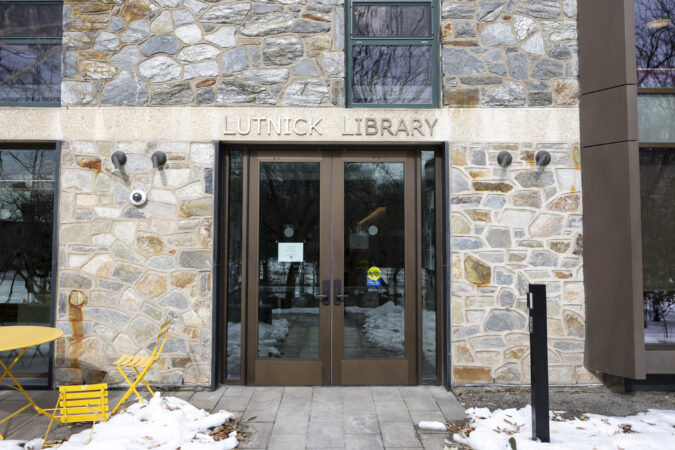
The outside of the Lutnick Library at Haverford College
Push to rename the library
Earlier this month during a Plenary Resolution Writing Workshop — part of Haverford’s student self-governance process — students Ian Trask and Jay Huennekens put forth a resolution that would change the name of the library, the student newspaper reported.
At plenary sessions, which take place twice a year in the fall and spring, the student body discusses and votes on important campus issues. On March 23, a packet of plenary resolutions will be released to the student body, with the plenary session scheduled for March 29.
“We feel that it is important that the college reflect the values of the student body, and that those values do not align with the Trump administration or the associates of Jeffrey Epstein,” the students told the Bi-Co News.
Attempts to reach Trask and Huennekens were unsuccessful.
If the student resolution passes, it would go to Raymond for signing.
But even then, it’s no easy feat to remove a name from a college building. There would be a review process involving the board of managers that could take a while.
Under Haverford’s gift policy, the school can rename a building if “the continued use of the name may be deemed detrimental to the College, or if circumstances change regarding the reason for the naming.”
Raymond would have to convene a committee, consider that committee’s recommendations, and make her recommendation to the external affairs committee of the board of managers and its chair and vice chair. The external affairs committee then would make its recommendation to the full board of managers.
At nearby Bryn Mawr College, it took years before M. Carey Thomas’ name was removed from the library. Thomas, who was Bryn Mawr’s second president, serving from 1894 to 1922, was a leading suffragist, but also was reluctant to admit Black students and refused to hire Jewish faculty.
In 2017, then-Bryn Mawr president Kim Cassidy issued a moratorium on using Carey’s name while the college studied how to handle the matter. A committee in 2018 decided students, faculty, students, and staff should no longer refer to the library using Thomas’ name, but decided to leave the inscription and add a plaque explaining the complicated history.
The college faced continued pressure from students to take further action and removed Thomas’ name in 2023.
Other colleges have taken similar actions. Princeton University in 2020 stripped former President Woodrow Wilson’s name from its public affairs school and presidential college.
As the Department of Homeland Security approaches an increasingly likely shutdown this weekend, U.S. Rep. Brian Fitzpatrick (R., Bucks) said reforms to ICE, including banning masks for federal immigration agents, should be a part of any funding extensions for DHS.
“I’m the only federal agent in Congress,” Fitzpatrick, who served in the FBI for 14 years, said in an interview Thursday. “I spent my whole professional career as an FBI agent. Never once did I wear a mask, never. Executing a search warrant, arrest warrant, you name it, because you need to be transparent. You need to identify yourself. The whole function of policing requires the trust of the public.”
U.S. Immigration and Customs Enforcement and the U.S. Border Patrol, the agencies involved in the fatal shootings of two American citizens last month in Minnesota, both fall under DHS, which will enter a shutdown if lawmakers do not reach a funding deal by Friday.
The Border Patrol and ICE would continue to operate after receiving funding from President Donald Trump’s One Big Beautiful Bill Act, but a lapse in funding to DHS would affect other agencies under the department, including the Transportation Security Administration, the Coast Guard, and the Federal Emergency Management Agency, of which many employees would be working without pay.
Democrats have demanded that restrictions on masking and other changes to immigration enforcement be part of any funding deal.
Fitzpatrick, who represents a purple district, is rare among Republicans in accepting Democrats’ proposal as Congress grapples with a national reckoning over Trump’s immigration crackdown after federal agents killed Renee Good and Alex Pretti in shootings caught on video.
“There is broken trust between the public and ICE, and we have to restore that trust,” Fitzpatrick said.
“And the only way you restore that trust is by enacting reforms that are going to rebuild that social contract,” he continued. “Because policing is a social contract, whether it be local law enforcement or federal law enforcement.”
In the aftermath of the shootings in Minnesota, the House ended a four-day government shutdown earlier this month by passing a five-bill funding package that excluded DHS. Fitzpatrick, who voted for the House bill, said he would aim to work with Democrats to come up with a solution.
Negotiations on DHS’s allocation appeared to be at a standstill Thursday ahead of lawmakers going on a 10-day break, making a partial shutdown appear likely. In the U.S. Senate, a vote to advance a funding bill was rejected in a 52-47 tally Thursday, falling short of the necessary 60-vote threshold, the Associated Press reported.
“The agents wearing masks, I think primarily that’s driven by people are going to dox those people. That’s a serious concern, too, absolutely,” Fetterman said in a Fox News interview with correspondent Jacqui Heinrich (who is engaged to Fitzpatrick).
Whether ICE agents should be allowed to wear masks has become a point of contention since the escalation of Trump’s immigration policies, with legislative bodies across the U.S., including in Philadelphia City Council, introducing legislation to prohibit them.
Fitzpatrick, cochair of the bipartisan Problem Solvers Caucus, said Thursday that he believes there is “unanimity” among lawmakers in Washington for reforms, like requiring ICE agents to wear body cameras and prohibiting them from wearing masks.
The Bucks County lawmaker, one of nine Republicans representing districts that went for Democratic presidential nominee Kamala Harris in 2024, has frequently touted his willingness to break withTrump on issues, such as voting to extend Affordable Care Act subsidies and opposing the final passage of the One Big Beautiful Bill. (Democratic opponents note that he cast a key vote to advance an earlier version of Trump’s legislation.)
As for next steps, Fitzpatrick said he and U.S. Rep. Tom Suozzi (D., N.Y.), cochair of the Problem Solvers Caucus with Fitzpatrick, are continuing to communicate with House Speaker Mike Johnson (R., La.) and House Minority Leader Hakeem Jeffries (D., N.Y.) as discussions over DHS funding and changes continue.
“I would hope that we can all agree that everybody needs to be treated humanely and with respect and with dignity, that everybody believes in upholding the rule of law, everybody believes in the constitutional rights of everybody in this country,” Fitzpatrick said.
Gov. Josh Shapiro unveiled a broad plan Thursday meant to grow and preserve Pennsylvania’s housing supply as the state faces a shortage of homes residents can afford.
The plan aims to expand residents’ access to homes, connect Pennsylvanians to resources to keep them housed, make homebuilding faster and less costly, and improve coordination of housing efforts across agencies and levels of government.
Recommendations and reforms in the state’s Housing Action Plan, which is meant to guide Pennsylvania into 2035, are embedded in the governor’s proposed budget, Shapiro said.
“And now, the ball is in the court of the legislature to carry this forward and to get it done,” he said at a news conference in Philadelphia.
The plan is the culmination of a process that started in September 2024, when Shapiro signed an executive order directing state officials to create it.
Inthe plan, Shapiro highlights that more than a million Pennsylvania households are spending more than 30% of their income on housing. These households are “cost burdened,” according to the U.S. Department of Housing and Urban Development’s definition. Building more can lower housing costs.
Shapiro called the plan a long-term housing strategy that “brings together all different groups who are doing this work, builds on their expertise, and tackles housing access and affordability from every single angle.”
Here are key takeaways from Shapiro’s proposed housing action plan, the first of its kind in Pennsylvania.
Enacting the plan
Much of the plan relies on action from lawmakers in the state’s split legislature and other stakeholders rather than Shapiro’s administration exclusively. It does not assign dollar amounts to proposals, but calls on local governments to allow more housing and housing types, on builders to build more, and on both to work together to remove barriers to housing construction.
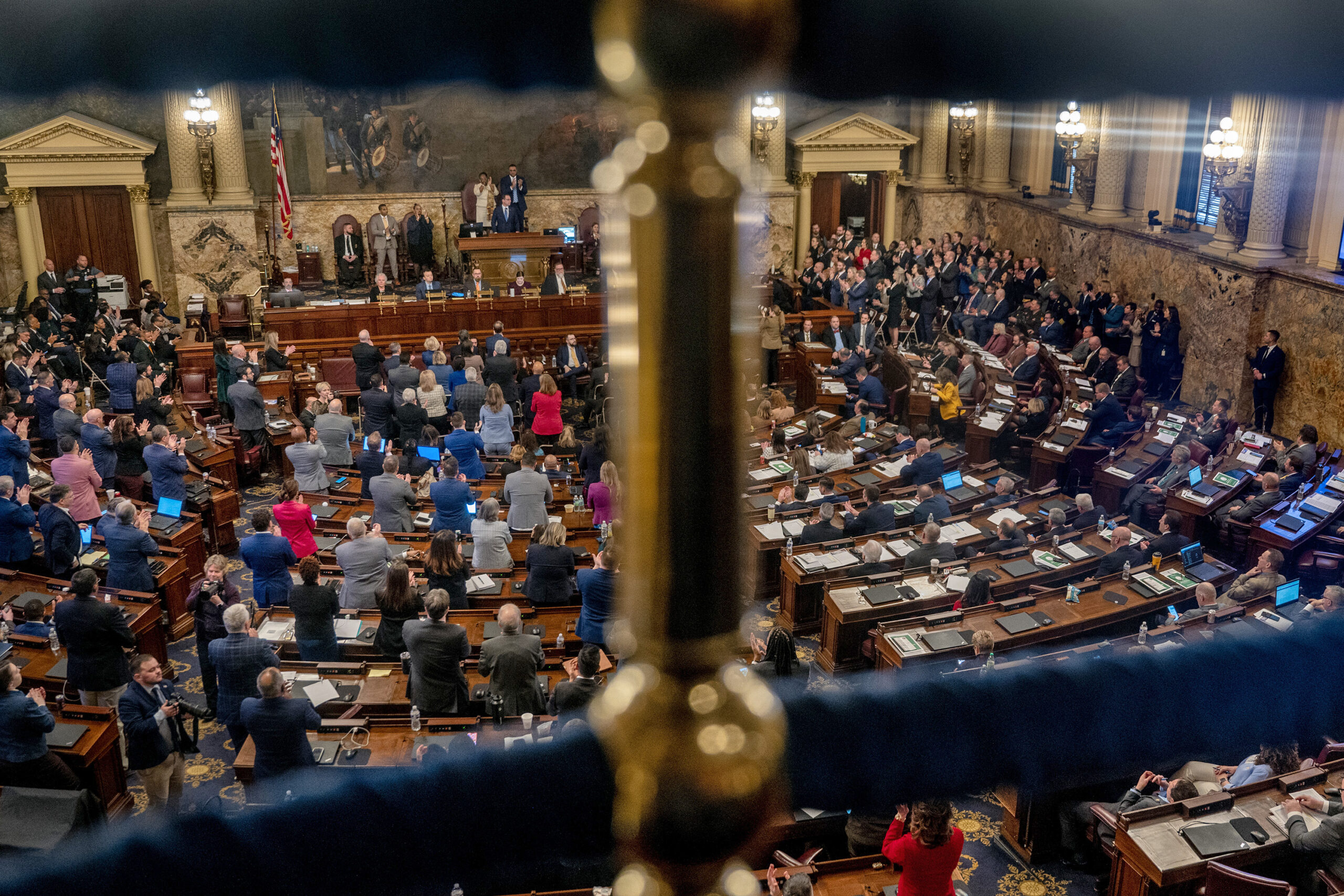
Democrats (left) stand to applaud a tax cut proposal while Republicans (right) remain seated as Gov. Josh Shapiro delivers his third budget address to a joint session in the House chambers at the State Capitol Tuesday, Feb. 4, 2025.
When Shapiro was asked how he intends to make sure the housing plan is implemented, he said he can take some actions through executive orders but “a lot does require the legislature to act and to work in concert with local government.”
“I hear in rural, urban, suburban communities, districts led by Democrats and Republicans, the need for more housing,” Shapiro said. “… And I would say to any lawmaker that doesn’t like my idea, ‘What’s yours?’ Because we can no longer wait. We have got to get this done. We’ve got to build more housing.”
$1 billion fund
In his budget address last week, Shapiro previewed his housing priorities, calling for a $1 billion fund, supported by the issuing of bonds, to pay for infrastructure projects that include housing.
Shapiro’s budget proposal includes no requirements on the proportion of funding that goes to each infrastructure need, leaving the possibility that the majority of funds could be spent on projects other than housing.
While Shapiro said Thursday that divvying up the $1 billion will be subject to negotiation with lawmakers, he said he hoped “the lion’s share of it would go to housing.”
Pennsylvania needs more housing
If Pennsylvania takes no action to build and preserve more housing, it will be short about 185,000 homes by 2035, according to the plan. To keep up with anticipated demand, the state needs to add 450,000 homes to its supply by then.
The housing plan has a stated goal of turning Pennsylvania into a leader in home construction.
Construction work on a home at Bancroft and Reed Streets in South Philadelphia, Pa. on Friday, May 1, 2020.
As it stands now, Pennsylvania is one of the states that have allowed the least new housing. It ranked 44th for the share of homes approved to be built from 2017 to 2023, the Pew Charitable Trusts said in a report released last year. Pew said Pennsylvania’s lack of housing supply is hiking prices for homeowners and renters.
Shapiro’s housing plan recommends that Pennsylvania:
Expand programs to repair and preserve existing homes.
Create a tax credit to incentivize home building in underinvested areas.
Invest in small residential developers who can help boost housing production.
Eliminate outdated or unnecessarystate development regulations.
Direct funding to help homebuilders pay land development costs, developers convert former commercial buildings into homes, and property owners create mixed-use developments that include housing.
Appoint a deputy secretary of housing and create a “housing one-stop shop” to help residents and builders access the state’s existing housing resources.
Protection for renters
The housing plan calls for Pennsylvania to bolster protections for households that either rent their homes or rent the land their homes sit on, including protections Shapiro called for in his budget address.
Suggestions include:
More eviction protections.
Restrictions on how much landlords can collect as a security deposit.
Explicitly banning landlords from denying housing to people because they use public assistance or any other lawful source of income. (New Jersey enacted a law last month that does this.)
Security for manufactured-home owners
Manufactured homes are single-family dwellings often built off-site and placed on a lot. These households own their homes, but many of them rent the land.
Manufactured homes represent one of the most affordable forms of homeownership. But homeowners are often left vulnerable because they have no other option than to pay increased rent costs if they want to keep the homes they own. Manufactured-home communities are increasingly being bought by private equity companies and other institutional investors, and rent hikes tend to follow.
The housing plan says Pennsylvania should:
Limit the rent increases that landowners can charge.
Make financing easier for buyers of manufactured homes.
Giveresidents of manufactured-home communities the right of first refusal when a landowner decides to sell.
Recent laws in New Jersey limit annual rent increases for manufactured-home lots and make it easier for residents to buy their communities.
Across Pennsylvania, 56,000 households live in manufactured-home communities, Shapiro said in his budget address last week.
Homebuyer help
The plan calls for Pennsylvania to pursue new ways to help residents become homeowners, including creating programs to reduce home-buying costs and allowing local governments to exempt first-time homebuyers from local realty transfer taxes.
It also calls for the state to impose a transfer tax when corporate investors buy single-family and certain other types of homes to help households compete for properties.
Untangling titles
To protect Pennsylvanians’ generational wealth, the plan calls for the state to allow transfer-on-death deeds to provide a streamlined process for passing down homes. This would help prevent cases of tangled title — or unclear legal ownership of property. This mostly occurs when a homeowner dies and the deed is not transferred to a new owner.
Tangled titles keep people from qualifying for help to repair their homes and can prevent them from being able to sell properties.
The plan also calls for funding for legal services to help low-income Pennsylvanians resolve tangled titles. In 2022, Philadelphia officials pledged to give $7.6 million over four years to legal-aid groups that are tackling this problem.
Rachel Gallegos, a divisional supervising attorney for the homeownership and consumer rights unit at Community Legal Services of Philadelphia, called Shapiro’s plan “ambitious.”
“And I like that,” she said. “I think it has to be in order to keep progress moving forward.”
The legal-aid nonprofit routinely helps low-income clients with tangled titles, and Gallegos said she was glad to see the plan call for additional support for the work.
“We want to preserve homeownership for our clients,” she said.
Sometimes Sheetz happens, and at 8:02 a.m. on Thursday it happened in Montgomery County, when the chain opened its first convenience store in what’s long been undisputed Wawa territory.
The store — which is directly across from a Wawa on West Ridge Pike near Lewis Road in Limerick Township — opened not with a Boom Boom, but with a whisper.
Unlike a Wawa grand opening — where fans often queue up well before the doors open and the line to get in wraps around the building — there was just David Swartz waiting outside for the opening, bundled up in his folding rocker chair.
Swartz, 36, of Collegeville, who arrived an hour before the opening, was surprised to find himself the only one in line, as were the gaggle of Philadelphia reporters who far outnumbered him and peppered him for interviews.
A self-identified “diehard Wawa fan,” Swartz said he came to Sheetz’s opening for the food.
“There’s nothing you can get here that isn’t delicious,” he said. “I love Wawa but they need different stuff and that’s what Sheetz is here to do, they’re here to deliver that.”
Slushies, plushies, and more
Once the doors opened, folks who’d been waiting in their cars started to file in, forming a line for the coffee, which was free all day (the Wawa across the street offered free coffee on Thursday, too). Other customers explored the touch-screen menus, checked out the prepared food offerings, and browsed the aisles.
Inside, Swartz poured himself a slushie and ordered a hot dog, nachos, and fish tacos with fries — at 8:15 a.m. He also picked up three Hello Kitty plushies for his girlfriend. Wawa, he pointed out, does not sell plushies.
“My girlfriend is going to be very happy when I come home with these,” he said.
Inside the store after being the first to enter, Dave Swartz of Collegeville organizes his plushie toys and frozen drink as the first Sheetz store opens in the Wawa territory Thursday in Limerick Township.
Elsa Ortiz, 54, drove an hour from Philadelphia to pick up a hoagie (or “Subz” as they call them at Sheetz) for her boyfriend.
“Sheetz is definitely better than Wawa for him,” she said. “Right now I’m neutral, but today I am a Sheetz girl.”
Ortiz said the store being across from a Wawa is very on brand for the Philadelphia region.
“The rivalry is just like Philly, with its rivalries and everything else,” she said. “Still, go Eagles! I’m still Eagles!”
There are some rivalries you can play both sides of, and some you can’t.
Shortly after 9 a.m., when giveaways for gift cards and Sheetz schwag began, the store became so packed with people it became a real Sheetz show and the line outside for freebies stretched down the building. The residents of the Delaware Valley may rep hard and local, but they also won’t say no to a free T-shirt.
The expansions
While opening a Sheetz across from an existing Wawa may seem like the new guy in town is throwing down the gauntlet, it’s actually a move taken out of Wawa’s own playbook. In 2024, when the Delaware County-based chain opened up its first store in central Pennsylvania — what was traditionally Sheetz country — it did so within eyeshot of an existing Sheetz.
For decades, the urban lore in Pennsylvania was that there was a gentleman’s agreement regarding unspoken boundaries between Delco-based Wawa in the southeastern corner of the state and Blair County-based Sheetz, in south-central Pennsylvania.
Amy Rudolph (seated) of Collegeville holds court with fellow grand opening patrons as she recounts her story of being #2 in line as the first Sheetz store opens in the Wawa territory Philadelphia suburbs Thursday, Feb. 12, 2026 in Limerick Township.
But that’s all it was — lore (New Jersey has its own devil, we had to come up with something) — and as both chains began rapid expansions in the 2010s, it seemed inevitable they’d cross over to each other’s markets at some point. In fact, Wawa and Sheetz have coexisted in several markets already for some time, including right here in Pennsylvania, in Berks and Lehigh Counties, according to Wawa spokesperson Lori Bruce.
Today, Wawa has 1,193 stores in 13 states and Washington, D.C., and more than 95 store openings planned for this year. Ten stores have gone up in central Pennsylvania in the last two years, with 40 more planned over the next five, Bruce said.
Sheetz, meanwhile, has more than 800 stores in seven states. Previously, its closest store to Philadelphia was in Berks County, but now that it has officially moved into the Philly suburbs, it doesn’t appear it plans to slow down. Sheetz stores have been proposed in Chester County and even in Delco, at Painters Crossing shopping center in Chadds Ford, just five miles down the road from Wawa’s headquarters.
Now that could get Sizzli.
A rivalry?
Representatives of both chains deny they are rivals and point out that they have worked together to support various nonprofits.
Adam Sheetz, executive vice president of Sheetz, said it has been a friendly competition for decades.
“They’re one of the best retailers in the country, certainly one of the best in our industry, and we have great respect for them and competing with them has just made us better over the years,” he said.
Bruce agreed.
“We’re fortunate to have always had a respectful and friendly relationship with the folks at Sheetz,” she said. “And, while we have always embraced healthy competition at Wawa, when we think about competitors, we tend to think about challenging ourselves to make sure we are meeting the needs of our customers and communities.”
Folks may eat on trash cans at Wawa, but you’ll never hear Wawa officials talking trash on Sheetz. Wawa fans, on the hand, are a whole other hoagie roll.
Craig Scott (left) of Wayne and Dave Swartz (right) of Collegeville have breakfast as the first Sheetz store opens in the Wawa territory in Limerick Township.
The low-stakes rivalry between the stores’ fans has resulted in memes, debates, op-eds, and even a forthcoming documentary, Sheetz Vs. Wawa: The Movie.
When news of the impending Sheetz opening spread last month, cheeky comments by Wawa fans on social media included “We are all protesting this,” “sheetz is temu wawa,” “Sheetz is fire, but Wawa is for life,” and “this is my heated rivarly [sic].””
But local officials said they didn’t hear of any pushback on the Sheetz.
Patrick Morroney, a Limerick Township supervisor, has never been to a Sheetz but said he’s pro-business and welcomed Sheetz opening a store in the community.
“I think that people are going to find their niche between Wawa and Sheetz,” he said.
Jamila Winder, chair of the Montgomery County commissioners, said she frequented Sheetz while going to Pennsylvania State University and having the company open a store in Montco is “nostalgic” for her.
“Even though Wawa has dominance here in Montgomery County and the region, we always welcome new businesses because that creates economic drivers, job opportunities for both, and it just gives people options to choose from,” she said.
The opening
During his remarks at the opening ceremony, Neil Makhija, vice chair of the county commissioners, took a different approach and leaned into the playful rivalry by putting on a Wawa hat while speaking to the crowd.
He called the opening a “complicated day” for him and many people in Southeastern Pennsylvania.
“I thought, ‘What is happening to our community? Do we need a stronger border security policy in Montgomery County? Should we build a wall and make Delco pay for it?’” he said to laughter from the crowd. “[But] here in Montgomery County we’re welcoming, we’re inclusive, and we’re hungry and I think we’re OK with a little competition.”
When Joe Pagliei moved to the Azalea senior living facility in September of 2023, word spread quickly. This was not just because he spent a season playing for the Eagles.
It was also because of his unabashed personality.
Pagliei would walk the halls of the Cinnaminson retirement home practicing his golf swing. If he lost a game of bingo, he’d throw the cards into the air and accuse his neighbors of “cheating.”
Every day, at 3 p.m., he’d sit at the bar, nursing a ginger ale, with copies of a book about his life stacked beside him. Before long, residents began to ask for some.
This wasn’t your average nonagenarian, after all. Pagliei spent parts of the 1950s and 1960s as a pro football player, first in Canada in the CFL, then in the NFL, and eventually, the AFL.
He played the 1959 season as a fullback and punter with the Eagles. Pagliei was the last cut in training camp before the 1960 season. The Eagles called him back, asking if he’d want to rejoin the team, but it was too late.
The fullback had already signed with the New York Titans, later to become the New York Jets. Pagliei ended up missing out on a championship.
“Big mistake,” joked his daughter Vicki.
It didn’t hamper Joe’s confidence. The former football player worked in auto sales and real estate for a few years, and became a jockey agent in 1970 out of Garden State Park Racetrack.
Joe Pagliei points to himself, wearing No. 32, in the 1960 Eagles team photo taken at Franklin Field.
When the track burned down in 1977, Pagliei headed to Atlantic City, where he became a casino host, crossing paths with everyone from Mickey Mantle to Joe Frazier to Sammy Davis Jr.
He moved to Mount Laurel with his wife of 62 years, Rita, and four children in 1991. He sold cars for a few years, retired in 2000, and moved to Azalea after Rita died in 2023.
At 91, Pagliei is believed to be the oldest living former Eagle. It is not a title he takes lightly. Last year, before the Super Bowl, his senior facility arranged for a visit from an Eagles-themed bus.
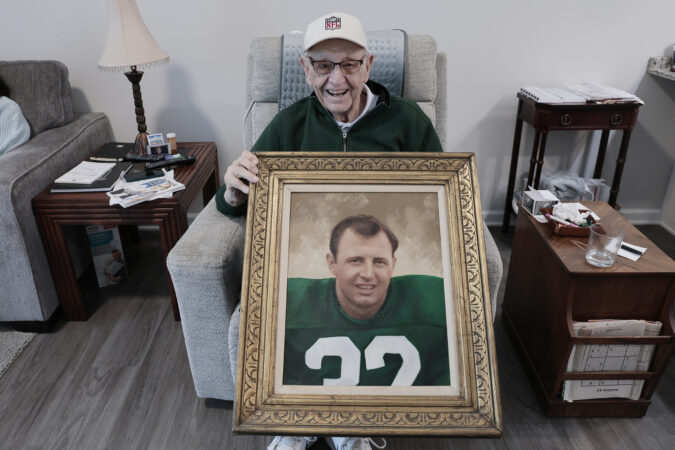
Dressed in his kelly green jersey, Pagliei signed one of the bus panels: “Joe Pagliei, #32.”
When he’s not lifting weights, or playing poker, he is watching Eagles games in his apartment, often with critiques of his own. Philadelphia will always be his favorite team, but he does have some misgivings about how he was used back in the day.
“I was awfully good to be sitting down,” the 91-year-old said. “Not enough [playing time].”
‘I’m going to make you famous, buddy’
Pagliei grew up in Clairton, Pa., a small town southeast of Pittsburgh, full of hard-nosed steel mill workers. His father, Alberto, emigrated from Italy and spent 48 years working as a janitor at the local plant.
The elder Pagliei, a pragmatic man who saved every dollar, didn’t see the benefit in his son joining the football team. He refused to let him play until the 11th grade.
Despite missing a few seasons, the younger Pagliei was not short on confidence. On the first day of practice, he walked straight up to his new coach.
“I said, ‘I’m going to make you famous, buddy,’” Pagliei recalled. “He said, ‘You’re full of [expletive].’ And I said, ‘Oh really?’
“I didn’t know the plays. I went out on a Wednesday. I ran two touchdowns. He said, ‘Wow.’ I said, ‘You just put my [butt] in there. Don’t worry about it.’”
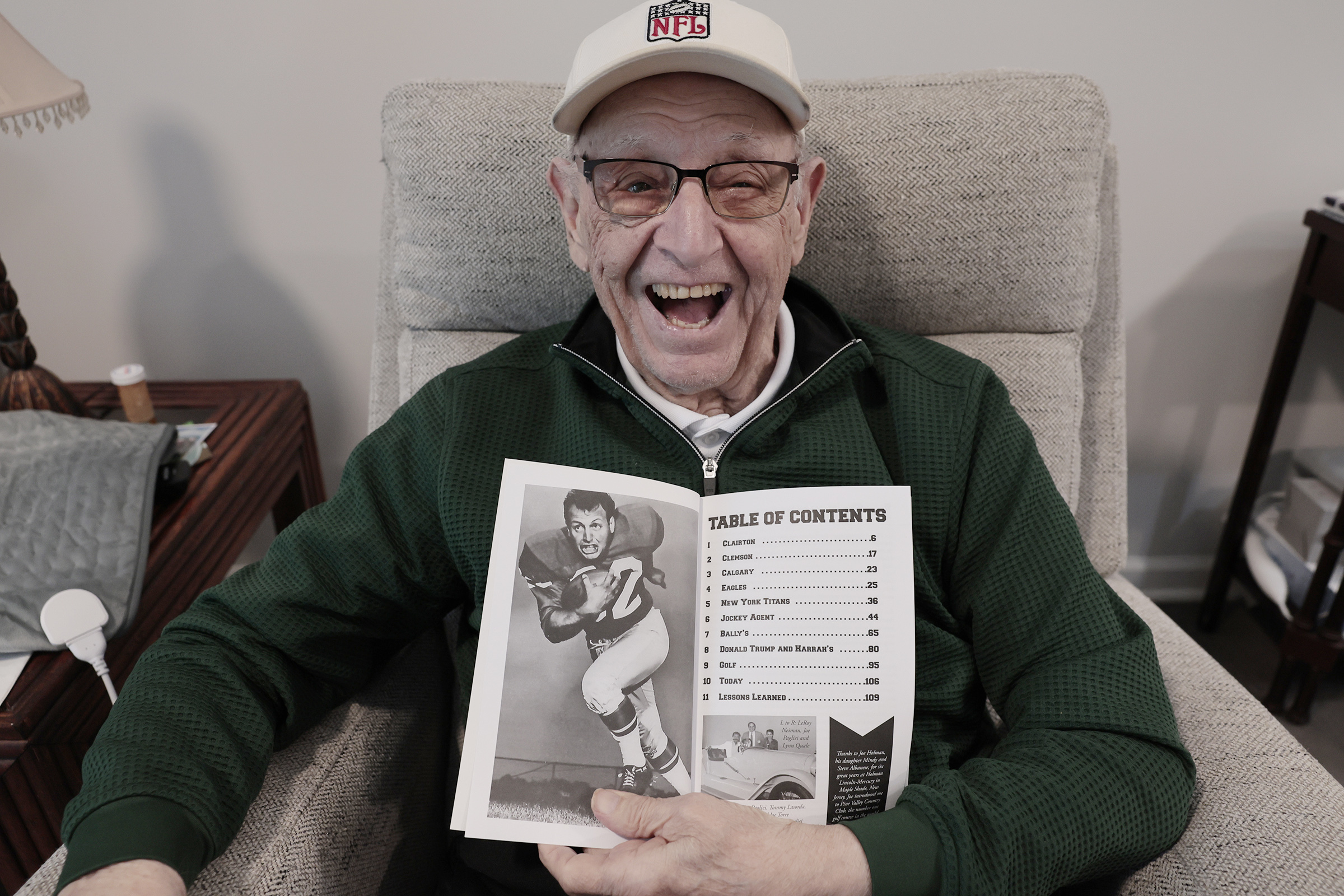
Famous might have been an exaggeration, but Pagliei did catch the attention of some big-name schools. According to his 2017 self-published book, The Roast Master, he received more than 100 recruitment letters.
The fullback chose Clemson University in South Carolina. His arrival on campus in 1952 marked the first time he’d ever traveled outside of Western Pennsylvania. He played both football and baseball, and separated himself on the gridiron.
Joe Pagliei came to football later than most, but he made up for lost time as a dual-position standout.
In 1954, he led the Atlantic Coast Conference in punting, averaging 37.8 yards on 26 kicks. In 1955, his senior year, he topped the conference again, averaging 39.1 yards on his punts. He also made a dual-threat impact for the Tigers on offense, rushing for 476 yards and catching 10 passes for 233 yards.
Clemson’s 1955 team program referred to the fullback as a “flashy performer,” a characterization that seemed apt, though perhaps insufficient in retrospect.
“I did a number on ’em when I went to Clemson,” Pagliei said. “I just ran everybody the hell out. They had me as number five. I said, ‘I’m number uno.’ They said, ‘You’re five.’ I became the best one.”
After going undrafted in 1956, Pagliei received free-agent invitations from the Green Bay Packers and Washington, but said neither came “with any form of guarantee.”
He ended up getting a better contract outside the NFL, with the Calgary Stampeders of the CFL, where he played the 1956 season. Pagliei was drafted into the U.S. Army in 1957.
He joined the football team on the base while serving at Fort Knox in Kentucky, and the Eagles offered him a contract for the 1958 season. Because of his military commitment, he was unable to suit up until May 1959, when he was discharged from the Army.
The Eagles had a deep backfield, and as Pagliei noted, he didn’t get much playing time (only two carries for minus-5 yards and two catches for 9 yards). He didn’t get much time as a punter, either, because he was the backup for Hall of Fame quarterback Norm Van Brocklin.
But Pagliei did emerge with one stat to be proud of. According to The Roast Master, on Dec. 6, 1959, in the middle of a rainy game against Washington, Van Brocklin suggested that Pagliei take the kick.
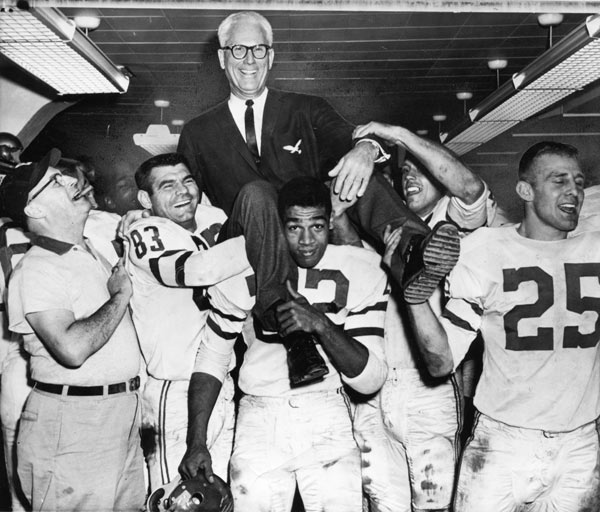
Joe Pagliei was not officially a part of Buck Shaw’s 1960 title team, but he was considered an honorary part of it by his former Eagles teammates.
He did, for 45 yards. It was the NFL rookie’s only punt of the 1959 season, giving him a yearly average of 45 yards (for his one attempt) while Van Brocklin had only 40.8 (for his 53).
“I always rubbed that in with Van Brocklin,” Pagliei wrote. “And he’d say to me, ‘You son of a [expletive]. One punt and you lead the team.’”
Pagliei again faced stiff competition in training camp the following year. He was cut on the day the Eagles took their team photo, Sept. 19, 1960, thereby capturing his final moment on the future championship-winning squad.
After he signed with the Titans of the AFL, the Eagles contacted Pagliei again. Fullback Theron Sapp had broken his leg in a preseason game and would be out longer than the team had expected.
They asked Pagliei if he’d like to return to Philadelphia, but he’d already signed his Titans contract. While missing out on history was bittersweet, the 91-year-old always felt like he was a part of the 1960 Eagles group.
Joe Pagliei (left) with Tommy McDonald (center) and Chuck Bednarik at an event honoring the 1960 team.
It included some of his closest friends. Defensive tackle Jesse Richardson was the best man at Pagliei’s wedding. Wide receiver Tommy McDonald was like a family member. McDonald’s wife, Patty, was the godmother to Pagliei’s daughter Lizanne and the confirmation sponsor for Vicki.
Pagliei left professional football in 1961 but continued to stay a part of that fraternity. His kids would play with McDonald’s kids, and linebacker Bob Pellegrini’s kids. The team always invited Pagliei to reunions and celebrations of the 1960 championship.
In 2018, after the Eagles won their first Super Bowl, former players and their families were invited to the NovaCare Complex to see the Lombardi Trophy up close.
McDonald had been diagnosed with dementia. He attended the event in a wheelchair, donning his gold Hall of Fame jacket. The former receiver’s recall was shaky, but when he saw Pagliei, his face lit up.
“He knew who my dad was,” Vicki said. “He didn’t know too many people, but he knew who my dad was. He used to call him his brother.”
The mayor of Azalea, senior living
The staffers at Azalea of Cinnaminson say that Pagliei is something akin to a mayor. He knows everyone in the building. He also knows everythinggoing on in the building, for better or for worse.
The 91-year-old goes to the gym once a day, where he rides a bike, and does “40 reps of each weight.” On Tuesday and Thursday nights, he plays poker, a game that he might take more seriously than any other.
Members of the 1960 Eagles NFL championship team pose for a team photo at Franklin Field, the site of their 17-13 win over Green Bay in the title game.
“I make a lot of money,” Pagliei said, pointing to a stack of bills totaling $21 on a nearby counter. “Big time. Big time.”
The former Eagle is 66 years removed from his last NFL season, but he has not lost his competitive spark. The Azalea staff learned this the hard way.
Gracie Pouliot, a guest services manager, has had to intervene in a few contentious games of bingo.
“He’s not a very good loser,” she said. “Everyone is cheating if he loses. He’s like, ‘This is [expletive]! They cheated!’
“And we’re like, ‘No!’ He’ll throw the cards. He just cracks us up. He’s so funny.”
Linda Bryant, a life enrichment assistant, said that Pagliei used to make fun of how she’d play pool.
“He was joking around,” she said. “‘You guys don’t know how to do it.’”
Bryant and Pouliot wouldn’t have it any other way. Pagliei might not be able to punt the ball, or run the length of a field, but he still has the spirit of a teenager.
Erin Mooney, executive director of the Schuylkill Center for Environmental Education, slipped out of a sweltering sauna last weekend wearing only a bathing suit and strode barefoot straight into the coldest day of the winter.
“I never thought that I would find myself in a bathing suit laying down in the snow on a 15-degree day, and I found myself doing that at the Schuylkill Center,” Mooney said.
It marked the opening weekend of a new experience that the Schuylkill Center, on Hagy’s Mill Road in Philadelphia, is offering along with a local sauna company, Fiorst — one that already has had solid booking off social media views, despite having just opened Saturday.
Visitors will have the chance to relax ina glass-walled, wood-fired sauna overlooking a snowy field and woods in Northwest Philly, paired witha cold plunge.
Mooney said the idea to host a mobile sauna on the preserve’s grounds grew from a desire to keep the center lively through winter and draw in new visitors. She was inspired by a sauna exhibit by the American Swedish Historical Museum in FDR Park and began looking for a way to bring that Nordic tradition of “hot and cold” to her own facility.
She spotted Fiorst, a mobile sauna venture run by Jose Ugas, on social media, reached out, and the two forged a near-instant partnership. They spoke on Jan. 30, a Friday; by the next Friday, a custom sauna unit from Toronto rolled onto the grounds.
By last Saturday, the fire was lit, and guests arrived.
“It was, you know, kind of kismet, in a way, we were able to have this shared vision,” Mooney said. “And with him doing this servicing of the saunas on site, it makes it so much easier for us.”
The interior of the Nordic-style sauna at the Schuylkill Center for Environmental Education.
How does the sauna work?
Nordic-style wood saunas are notable for their minimalist design and high heat, which participants couple with either a plunge into a cold shower, tub, or lake or a step outdoors.
Fiorst’s installation overlooks the center’s main wooded area, framing the winter landscape through a glass wall as guests sweat it out inside the sauna’s170- to 190-degree temperatures. Each 90-minute session allows participants to cycle at their own pace through intense heat and biting cold, a contrast Mooney found invigorating.
The sauna is modeled on a concept popular across Nordic countries, including Norway, Finland, Denmark, and Sweden.
Mooney said the project has already pulled in new visitors from neighborhoods like Fishtown or outside Philadelphia who might not typically visit for hiking or birdwatching.
She believes the sauna fills a niche for “clean, wholesome, healthy fun” that is alcohol-free.
However, unlike the typical Nordic experience of being nude during the sauna, the Schuylkill Center experience is strictly “bathing-suit friendly,” a choice tailored to American comfort levels.
The collaboration operates on a revenue split, with a charitable twist. During February, the center’s share of the proceeds goes to its Winterfest for Wildlife campaign to support the on-site wildlife clinic.
For now, the sauna remains a seasonal experiment, but it will stay in place as long as demand — and winter weather — holds up.
“I think it will stay seasonal,” Mooney said. “We live in a sauna already in the summer in Philadelphia.”
The sauna is open on weekends at the Schuylkill Center from 9 a.m. to 5 p.m. and is booked through the Fiorst website. The cost for a 90-minute session is $75. You can add a friend for $25. Private sessions of up to 16 cost $600. For now, bookings can be made only one week in advance.
The Schuylkill Center is expecting Valentine’s Day weekend to book quickly.
Jose Ugas (left), founder of Fiorst, and Erin Mooney, executive director of the Schuylkill Center for Environmental Education, at the sauna.
‘A moment of clarity’
Ugas, a bioengineer at Johnson & Johnson who lives in Whitemarsh Township, felt compelled to bring a Nordic-style sauna experience to the region after a triphe took to Sweden following the loss of his mother to brain cancer in 2023. There, friends introduced him to a traditional Scandinavian ritual: enduring searing dry heat inside a wooden sauna, followed by a plunge into icy water or a cold shower.
What began as a distraction soon crystallized into a moment of clarity, Ugas said.
“Just that time together and kind of going between the hot and the cold just was like a mental reset for me,” Ugas said.
Ugas, who will graduate with an MBA from Villanova University this spring, wanted to replicate the nature-immersive element that had grounded him overseas.
Hefound a Toronto company that builds portable glass-fronted wooden saunas andordered a custom unit equipped with a wood-fired stove, hot stones, steam, aromatherapy, and a cold-plunge tub. Ugas launched Fiorst in 2024, describing it as “nomadic” at first.
The venture first hosted sessions overlooking Valley Forge and at Fitzwater Station in Phoenixville. Ugas then established a more permanent site, which he calls Riverside, on River Road in Conshohocken where he still books sessions.
Ugas calls the partnership with the Schuylkill Center a natural fit given its location amid nature, merging his wellness goals with the venue’s environmental focus.
“At the core of our mission and their mission is to get people out in nature,” Ugas said.
So far, he has relied on social media to market the sauna, which has drawn hundreds of visitors to its locations.
The Nordic-style sauna at the Schuylkill Center for Environmental Education in Philadelphia.
‘Social sauna’
Serena Franchini, a nurse and founder of Healing Fawn Inner Child Work & Somatic Therapy, has taken sauna sessions at Ugas’ other locations. She sees it as a tool to help with nervous system regulation while offering an immersion in nature.
“I loved the idea that it was outside,” Franchini said.
She likes the relaxed atmosphere compared with some traditional saunas that often enforce strict time limits on heating and cooling cycles. Instead, she cycles between the sauna and cold-plunge tub at her own pace.
Franchini highlighted the mental wellness aspect of Ugas’ “social sauna” sessions, noting Friday night events as “skip the bar” alternatives that allow strangers to gather for a healthy, communal experience.
“It’s a great way for community to connect with people that are interested in the same things that you are,” Franchini said.
On Wednesday, an Inquirer investigation detailed how a local anti-violence group had to terminate a housing program, displace tenants, and stave off financial collapse, despite receiving millions of dollars in city, state and federal funds over several years.
City bureaucrats had raised questions about the stability of NOMO, which is short for New Options, More Opportunities Foundation, for years. But elected officials publicly promoted the group and funds kept flowing, which initially provided youth afterschool programs before taking on significant expenses to launch an affordable housing initiative.
The nonprofit became one of the city’s signature efforts to support anti-violence work. But records show earlier concerns about NOMO turned into reality as a financial crisis hit the organization in late 2024.
NOMO subsequently faced an IRS lien and five lawsuits over the last two years concerning hundreds of thousands of dollars in unpaid rent.
Although the group’s director says the nonprofit is now financially stable, it ended the housing program, laid off staff and curtailed its afterschool programming. And NOMO’s problems raise further questions about the city’s management of its anti-violence grants, meant to stabilize and grow similar grassroots groups.
Grant administrators noticed red flags early on — but kept funding the group
After NOMO received its first $1 million city grant in 2021, grant managers almost immediately flagged issues at the organization, records obtained by The Inquirer under the Pennsylvania Right to Know Law revealed.
One administrator warned the city about “significant weaknesses” with its financial controls, including the absence of audited financial statements and balance sheets. The administrator warned of a lack of oversight for spending decisions.
Yet the city kept pushing funding through.
Four years later, city officials still did not know who serves on NOMO’s board. Nevertheless, since 2020 the group has been awarded $2.4 million in city grants, another $2.9 million in grants funded by federal Temporary Assistance for Needy Families (TANF) money, and another $1.1 million in state public-safety grants.
NOMO’s Rickey Duncan surprises a woman with a new apartment in a 2022 file photo.
Tenants were displaced after NOMO’s housing program failed
NOMO was initially a small nonprofit focused on anti-violence programming. But when it sought a city Community Expansion Grant, its application included one sentence proposing a housing program — which soon became the group’s largest budget item.
Its annual lease obligations totaled $750,000, which included renting an entire newly constructed apartment complex near Drexel University’s campus at a cost of more than a half-million dollars annually. Records do not show any sign that city officials questioned the wisdom of the housing program or examined how it supported the organization’s core anti-violence mission.
NOMO launched the housing effort with an apartment giveaway, in which tenants were surprised with new homes and treated to shopping sprees. It earned positive media attention, and NOMO’s executive director said the program supported 23 young women, many of them single mothers.
Just a few years later, a landlord filed to evict NOMO from the building over $418,000 in back rent.
The city sought to direct $700,000 in federal rapid rehousing funds to NOMO to save the program, but the money came with restrictions that NOMO was unable to meet. NOMO gave up the apartments, and its tenants relocated to the homes of relatives or were placed into transitional housing services.
NOMO made other questionable spending decisions
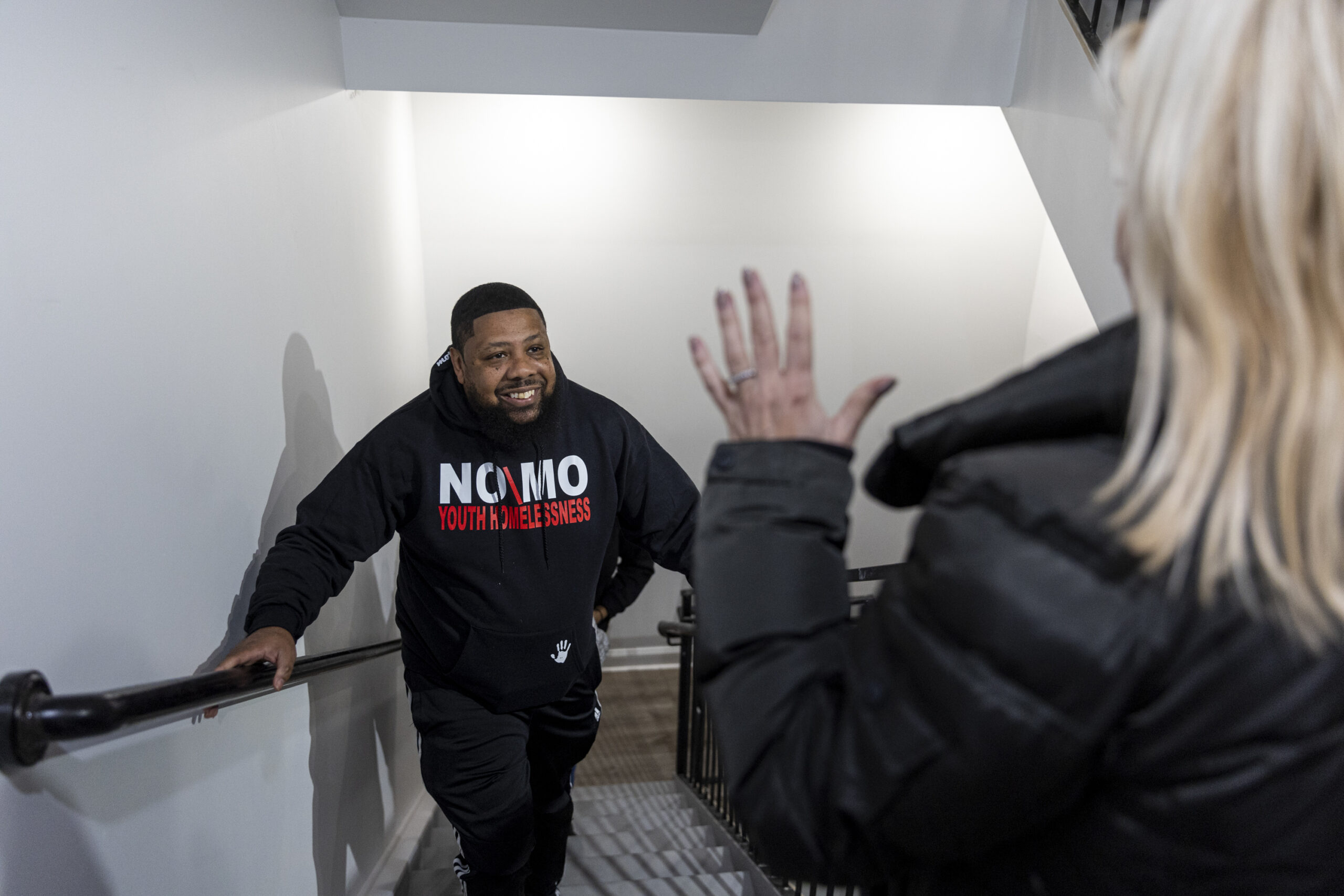
NOMO executive director Rickey Duncan tripled his own salary shortly after receiving the city grant and signed leases for new locations with large ballrooms. Duncan has said he envisioned that NOMO’s three youth centers in North, West, and South Philadelphia would become revenue generators for the nonprofit, serving as venues for baby showers, weddings, Eagles watch parties and other events.
Meanwhile, city grant administrators raised concerns as spending on NOMO’s core programming declined. Last year, as the group faced legal action over unpaid rent, Duncan sought reimbursement for a pair of Sixers season tickets. The city denied this request.
Students bounce a basketball in the ballroom at NOMO’s South Broad location in a file photograph.
NOMO laid off staff and curtailed operations last year
During the peak of NOMO’s financial crisis last spring, the city froze its funding after discovering a four-month-old federal tax lien. At the same time, the TANF funds ended. NOMO had to cut most of its staff and end its housing program.
Duncan says the group’s finances have stabilized since renegotiating its leases and cutting costs, and the lien was the result of an accounting error.
But the organization now serves about 140 children a year across its three youth centers — roughly the same as when it was operating in just one location and before the city spent millions of taxpayer dollars to expand NOMO’s reach.
Former Philadelphia Police Captain Nashid Akil, who ran a boxing program, Guns Down Gloves Up, in a 2022 Inquirer file photograph. Following an Inquirer investigation, Akil was fired and nine police were criminal charged with theft of city grant funds.
Problems dog Philly’s anti-violence grant program
NOMO’s main city funding source, the Community Expansion Grants, has had other high profile problems.
A 2023 Inquirer report found some of the groups that had been selected for funding were poorly equipped to manage the sudden cash infusions. A city controller report the following year corroborated many of these findings.
Mayor Cherelle L. Parker referred questions about NOMO to the city’s Office of Public Safety, which praised the group’s efforts.
Council President Kenyatta Johnson also praised NOMO in a statement responding to The Inquirer’s findings. He added that he expects the Office of Public Safety to “review these matters thoroughly, fairly, and professionally.”
“It is crucial that any concerns are taken seriously and examined through the proper channels, with facts guiding the outcome,” Johnson’s statement said.
ACKNOWLEDGMENT
The Inquirer’s journalism is supported in part by The Lenfest Institute for Journalism and readers like you. News and Editorial content is created independently of The Inquirer’s donors. Gifts to support The Inquirer’s high-impact journalism can be made at inquirer.com/donate. A list of Lenfest Institute donors can be found at lenfestinstitute.org/supporters.
Each night, Louis-Hunter Kean spiked a fever as high as 104.5. He would sweat through bedsheets and shiver uncontrollably. By morning, his fever wouldease but his body stillached; even his jaw hurt.
He had been sick like this for months. Doctors near his South Jersey home couldn’t figure out why a previously healthy 34-year-old was suffering high fevers plus a swollen liver and spleen. In early 2023, they referred Kean to Penn Medicine.
Louis-Hunter Kean visiting a winery in the Tuscany region of Italy in September 2021. He first spiked a mysterious and persistent fever about a year later in August 2022.
“These doctors are very sharp, and there are a lot of teams working on it,” Kean texted a friend after being admitted to the Hospital of the University of Pennsylvania (HUP) in West Philadelphia.
Was it an infection? An autoimmune disease? A blood cancer? Over the next six months, at least 34 HUP doctors — rheumatologists, hematologist-oncologists, gastroenterologists, infectious disease and internal medicine specialists — searched for an answer.
Kean was hospitalized at HUP five times during a six-month period in 2023. His electronic medical chart grew to thousands of pages.
Along the way, doctors missed critical clues, such as failing to obtain Kean’s complete travel history. They recommended a pair of key tests, but didn’t follow up to make sure they got done, medical records provided to The Inquirer by his family show.
Doctors involved in Kean’s care, including at Penn, prescribed treatments that made him sicker, said four infectious disease experts not involved in his care during interviews with a reporter, who shared details about his treatment. Penn doctors continued to do so even as his condition worsened.
Louis-Hunter Kean receives a kiss from bride Ashley Greyson at the October 2021 wedding of his close friend, Joshua Green. Green and Kean graduated from Haddonfield High School in 2007.
“No one was paying attention to what the doctor before them did or said,” Kean’s mother, Lois Kean, said.
“They did not put all the pieces together,” she said. “It was helter-skelter.”
Kean’s family is now suing Penn’s health system for medical malpractice in Common Pleas Court in Philadelphia. The complaint identifies nearly three dozen Penn doctors, accusing them of misdiagnoses and harmful treatments. These physicians are not individually named as defendants.
In court filings, Penn says its doctors did not act recklessly or with disregard for Kean’s well-being, and his case is not indicative of any systemic failures within its flagship hospital. A Penn spokesperson declined further comment on behalf of both the hospital and the individual doctors involved in Kean’s care, citing the pending lawsuit.
The puzzle of Kean’s diagnosis finally came together in November 2023 after a Penn doctor, early in his career, sought help from the National Institutes of Health (NIH).
An NIH doctor recommended a test that identified the cause: a parasite prevalent in countries bordering the Mediterranean Sea. Kean likely got infected while vacationing in Italy, four parasitic disease experts told The Inquirer.
The infection, which is treatable when caught early, is so rare in the U.S. that most doctors here have never seen a case, the experts said.
By the time Penn doctors figured it out, Kean’s organs were failing.
Louis-Hunter Kean and his then-girlfriend Zara Gaudioso at a friend’s wedding in Tuscany in September 2021. Kean and Gaudioso got engaged in early 2023. Gaudioso was smitten by Kean’s good looks and sense of humor.While vacationing in Italy in September 2021, Louis-Hunter Kean and his friends hiked in the foothills of the Apennine Mountains and visited Gran Sasso and Monti della Laga National Park.
A missed clue
When a patient has an ongoing and unexplained fever, an infectious disease doctor will routinely start by takinga thorough travel history to screen for possible illnesses picked up abroad.
A medical student took Kean’s travel history during his initial workup at HUP in June 2023. An infectious disease specialist reviewed the student’s notes and added a Cooper University Hospital doctor’s earlier notes into Kean’s electronic medical chart at Penn.
Those records show Kean had traveled to Turks and Caicos with his fiancée in May 2022. The next month, he took a work trip out West, including to California, where he visited farms, but didn’t interact with livestock.
This was not unusual for Kean, who worked with fruits and vegetables imported from around the world at his family’s produce distribution center on Essington Avenue in Southwest Philadelphia.
Kean’s fiancée, Zara Gaudioso, said she repeatedly told doctors about another trip: In September 2021, about a year before his fevers began, they traveled to Italy for a friend’s wedding in Tuscany.
The couple hiked remote foothills, danced all night in a courtyard, dined by candlelight surrounded by a sunflower farm, and slept in rustic villas with the windows flung open.
“We told everybody,” Gaudioso said. “A lot of Americans go to Italy — it’s not like a third-world country, so I could see how it could just go in one ear and out the other.”
But notes in Kean’s medical record from the Penn infectious disease specialist don’t mention Italy. Neither do the ones the specialist copied over from Kean’s infectious disease doctor at Cooper.
Kean “does not have known risk factors” for exposure to pathogens, the Penn specialist concluded, except possibly from farm animals or bird and bat droppings.
Still, the specialist listed various diseases that cause unexplained fever: Tick-borne diseases. Fungal infections. Tuberculosis. Bacteria from drinking unpasteurized milk.
The possible culprits included a parasitic disease, called visceral leishmaniasis, transmitted by a bite from an infected sandfly. It can lie dormant for a lifetime — or, in rare cases, activate long after exposure, so it’s important for doctors to take extensive past travel histories, parasitic experts say.
The parasite is widely circulating in Southern European countries, including Spain, Greece, Portugal, and Italy.
“Mostly, people living there are the ones who get it. But it’s just a lottery sandwich, and there’s no reason that travelers can’t get it,” said Michael Libman, a top parasitic disease expert and former director of a tropical medicine center at McGill University in Canada.
But few cases become severe. Hospitals in Italy reported only 2,509 cases of active infection between 2011 and 2016, affecting fewer than one in 100,000 people. Infections requiring hospital care in Italy began to decline after 2012, according a 2023 European study by the Public Library of Science (PLOS) journal Neglected Tropical Diseases.
Caught early, visceral leishmaniasis is treatable. Without treatment, more than 90% of patients will die.
In addition to fever, other telltale symptoms are swelling of the liver and spleen and low blood cell counts. Kean had all of those.
A missed test
The infectious disease specialist requested a test to examine tissue biopsied from Kean’s liver, which was damaged and enlarged. Lab results showed that immune cells there had formed unusual clusters — another sign that his body might be fighting off an infection.
In her notes, the specialist identified “visceral leish” as a possible diagnosis, which repeated — via copy and paste — seven times in his medical record. Her request to “please send biopsy for broad-range PCR” repeated five times.
That is a diagnostic (polymerase chain reaction) test that looks for the genetic fingerprint of a range of pathogens.
The test comes in different versions: One looks broadly for bacteria. The other is for fungi. The broad fungal test candetect leishmania, even though it’s not a fungus. However, it’s not always sensitive enough to identify the parasite and can produce a false negative, experts said.
The specialist’s chart note doesn’t specify which type she wanted done.
It’s not clear if anyone asked. The test wasn’t done.
Louis-Hunter Kean (right, with wine glass and tambourine) leads a wedding procession through the small stone village of Santo Stefano di Sessanio in Italy’s Abruzzo region in September 2021.
She did not order a low-cost rapid blood test that screens specifically for leishmaniasis by detecting antibodies made by the immune system after fighting it. She also didn’t order a leishmania-PCR, which is highly targeted to detect the exact species of the parasite.
Nor did the medical record show that the specialist followed up on the results of the broader test she requested, even though she saw Kean on nine of the 13 days of his first hospitalization at HUP in June 2023.
Penn has a policy that a lead doctor on the patient’s case is responsible for making sure that recommended tests get done. The specialist was called in as a consultant on Kean’s case. During that June hospitalization alone, his medical chart grew to 997 pages.
Patient safety experts have warned for years that electronic medical record systems — designed for billing and not for care — can become so unwieldy that doctors miss important details, especially with multiple specialists involved, or repeat initial errors.
A seemingly innocuous step in charting — copying and pasting previous entries and layering on new ones— can add to the danger, patient safety experts say.
That’s how the specialist’s mention of “visceral leish” and her test recommendation got repeated in Kean’s chart.
Marcus Schabacker, president of ECRI, a nonprofit patient-safety organization based in Plymouth Meeting, said “copy and paste” in electronic medical records puts patients at risk of harm.
“The reality is if you are reading something over and over again, which seems to be the same, you’re just not reading it anymore. You say, ‘Oh, yeah, I read that, let’s go on,’” said Schabacker, speaking generally about electronic medical record systems and not specifically about Kean’s case.
Louis-Hunter Kean plays guitar in his younger years. He loved music and shared eclectic playlists with his friends.
When treatments harm
Penn doctors believed Kean had a rare,life-threatening disorder, known as hemophagocytic lymphohistiocytosis (HLH), in which the immune system attacks the body. Instead of fighting infections, defective immune cells start to destroy healthy blood cells.
In most adults, the constellation of symptoms diagnosed as HLH gets triggered when an underlying disease sends the body’s immune system into overdrive. Triggers include a blood cancer like lymphoma, an autoimmune disease like lupus, or an infection.
Penn doctors across three specialties — hematology-oncology, rheumatology, and infectious disease — were searching for the cause within their specialties.
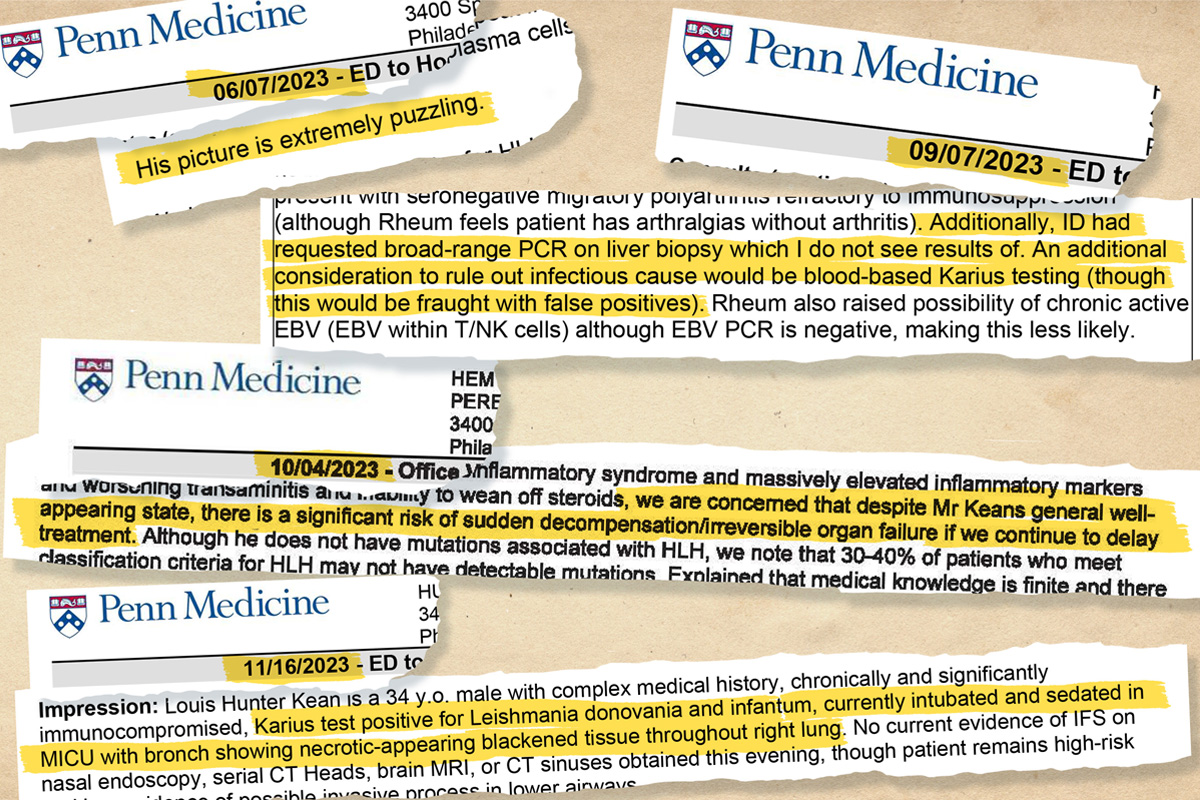
“His picture is extremely puzzling,” one doctor wrote in Kean’s chart. “We are awaiting liver biopsy results. I remain concerned about a possible infectious cause.”
As HUP doctors awaited test results, they treated Kean’s HLH symptoms with high doses of steroids and immunosuppressants to calm his immune system and reduce inflammation.
The treatments, however, made Kean highly vulnerable to further infection.And defenseless against another possible trigger of HLH: visceral leishmaniasis.
At the time, a Penn rheumatologist involved in Kean’s care before his first hospitalization warned about steroids “causing harm” to Kean if it turned out he had an infection. He wrote, “please ensure all studies requested by” infectious disease are done, medical records show.
Steroid treatments would allow the parasites to proliferate unchecked, experts said.
“It’s unfortunately exactly the wrong treatment for parasitic disease,” said Libman, the leishmania disease expert at McGill University.
As Kean grew sicker, he was readmitted to HUP for a third time in September 2023. He texted a friend: “I’m on more medications than I’ve ever been on and my condition is worse than it’s ever been.”
A sampling of Louis-Hunter Kean’s electronic medical records, which ballooned to thousands of pages over five HUP hospitalizations within six months in 2023.
Handoffs between doctors
No single doctor seemed to be in charge of Kean’s care, his family said. And the number of specialists involved worried them.
“Everyone just kept being like, ‘We don’t know. Go see this specialist. Go see that specialist,’” Kean’s sister, Priscilla Zinsky, said.
By fall 2023, rheumatologists hadn’t found a trigger of Kean’s symptoms within their specialty. They turned to doctors specializing in blood cancer.
During the handoff, three doctors noted that they didn’t see the results of the test requested by the infectious disease specialist back in June. They still thought it was possible that Kean had an infection, records show.
“An additional consideration to rule out infectious cause would be blood-based Karius testing (though this would be fraught with false positives),” wrote that doctor, who was still training as a hematologist-oncologist.
A supervising physician reviewed the Sept. 8, 2023, note and signed off on it. The medical records don’t show any follow-up with infectious disease doctors, and the test wasn’t done at the time.
In the coming days, blood cancer specialists struggled to find a link between Kean’s symptoms and an underlying disease.
They thought he might have a rare form of leukemia, but tests weren’t definitive, Kean texted friends.
Untreated HLH symptoms can lead to rapid organ failure, so doctors often start patients on treatment while trying to figure out the underlying cause, said Gaurav Goyal, a leading national expert on HLH, noting that it can take days to get test results.
“You have to walk and chew the gum. You have to calm the inflammation so the patient doesn’t die immediately, and at the same time, try to figure out what’s causing it by sending tests and biopsies,” said Goyal, a hematologist-oncologist at the University of Alabama at Birmingham.
Medical records show that Penn doctors feared Kean was at “significant risk” of “irreversible organ failure.”
They suggested a more aggressive treatment: a type of chemotherapy used to treat HLH that would destroy Kean’s malfunctioning immune cells.
In his medical record, a doctor noted that beginning treatment without a clear diagnosis was “not ideal,” but doctors thought it was his best option.
Four parasitic disease experts told The Inquirer that chemotherapy, along with steroids and immunosuppressants, can be fatal to patients with visceral leishmaniasis.
“If that goes on long enough, then they kill the patient because the parasite goes out of control,” Libman said, explaining that ramping up the HLH treatments weakens the immune system. “The parasite has a holiday.”
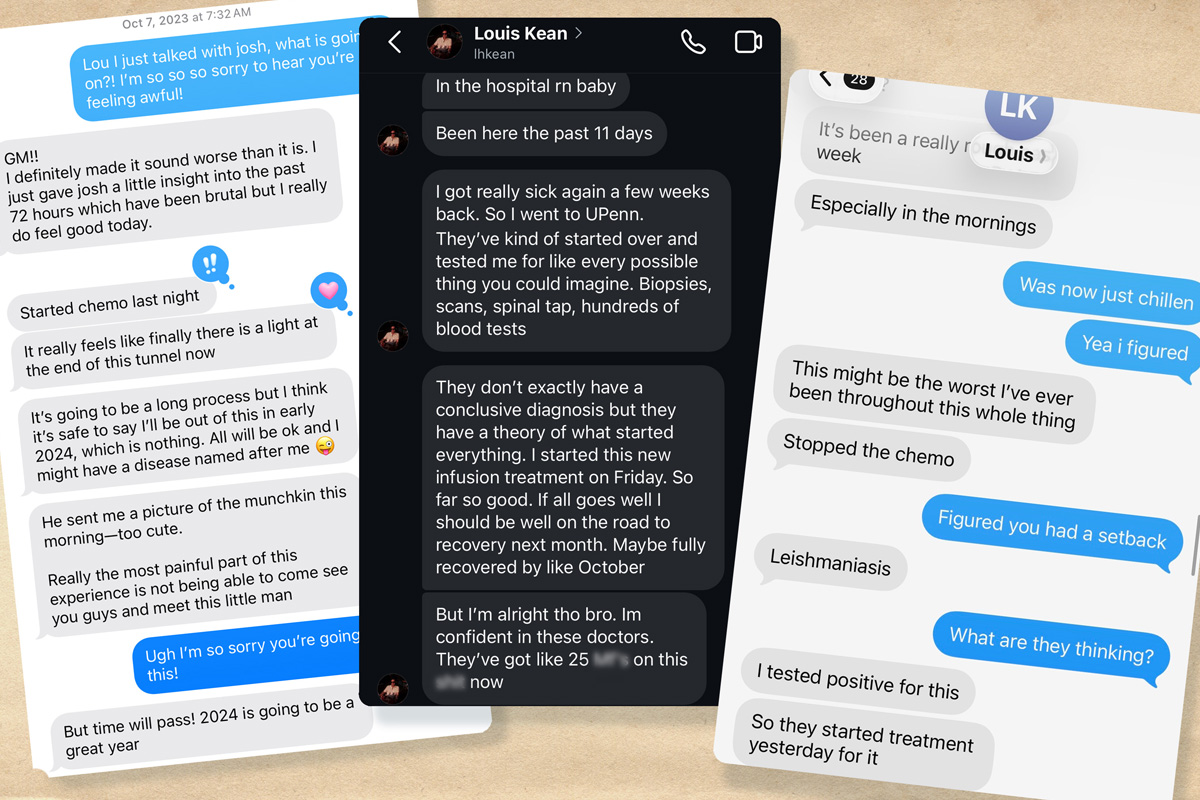
A sample of text messages from Louis-Hunter Kean to friends during separate HUP hospitalizations over a six-month period in 2023.
Chemo as last resort
Kean banked his sperm, because chemo infusions can cause infertility. He told friends he trusted his Penn team and hoped to make a full recovery.
“Started chemo last night. It really feels like finally there is a light at the end of the tunnel,” he texted a friend on Oct. 7, 2023.
“I’m gonna get to marry my best friend, and I think I’m going to be able to have children,” Kean wrote in another text to a different friend.
Kean spent nearly all of October at HUP getting chemo infusions. He rated his pain as a nine out of 10. His joints throbbed. He couldn’t get out of bed. He started blacking out.
Doctors added a full dose of steroids on top of the IV chemo infusion. By the end of the month, Kean told a friend he feared he was dying.
A year had passed since Kean first spiked a fever. He no longer could see himself returning to his former life — one filled with daily exercise, helping run his family’s produce store, nights out with friends at concerts and bars, and vacations overseas.
Lethargic and weak, he could barely feed himself. His sister tried to spoon-feed him yogurt in his hospital bed.
He started texting reflections on his life to friends and family, saying his illness had given him a “polished lens” through which he could see clearly. He wrote that their love felt “like a physical thing, like it’s a weighted blanket.”
“I’ve lived an extremely privileged life. I don’t think it’s possible for me to feel bad for myself,” he said in a text. “And I don’t want anyone else to either.”
Louis-Hunter Kean enjoying dinner out with his sister, Jessica Kean, in Manhattan in 2014. Friends and family described him as a “foodie” and health food advocate prior to the onset of his illness in August 2022.
Puzzle solved
One doctor involved in Kean’s care had seen him at Penn’s rheumatology clinic in early June 2023, just before his first HUP hospitalization. The doctor, a rheumatology fellow,urged him to go to HUP’s emergency department, so he could be admitted for a medical workup.
The fellowremained closely involved in Kean’s care, medical records show. Also in his 30s, this doctor shared Kean’s interests in music, fashion, and the city’s restaurant scene, according to Kean’s family.
“They had a rapport,” Kean’s father, Ted Kean, said. “Louis thought a lot of him, and he seemed to think a lot of my son.”
By early November 2023, the rheumatology fellow was extremely concerned, medical records show.
The chemo infusions weren’t helping. Kean still was running a fever of 103. The fellow wrote in his chart that he was worried Kean needed a bone-marrow transplant to replace his failing immune system.
And doctors still didn’t know the root of his symptoms.
The fellowcontacted the NIH, medical notes show.
An NIH doctor recommended a test to check for rare pathogens, including parasites that cause visceral leishmaniasis,according to family members present when the testing was discussed.
The NIH-recommended Karius test was the same one suggested two months earlier by the Penn hematologist-oncologist in training, but with no follow-up.
File of sign on front of Hospital of the University of Pennsylvania (HUP) taken on Tuesday, March 19, 2024.
On Nov. 16, the fellow got the results. He went to Kean’s bedside.
After five HUP hospitalizations over six months, a single test had revealed the cause of his illness: visceral leishmaniasis.
Kean cried with relief and hugged the fellow, joined by his mother and sister.
“‘You saved my life,’” Kean’s sister, Jessica Kean, recalled her brother telling the doctor. “‘Finally, we know what this is, and we can treat it.’”
Kean’s medical chart was updated to note that he traveled to “Italy in the past,” also noting he had visited Nicaragua and Mexico. A HUP infectious disease doctor consulted with the Centers for Disease Control and Prevention on antiparasitic medications.
Meanwhile, Kean’s nose wouldn’t stop bleeding. He felt light-headed and dizzy, with high fever. Even on morphine for his pain, his joints ached.
“I’ve been struggling, buddy,” he texted a friend on Nov. 20. “This might be the worst I’ve ever been.”
By Nov. 22, he stopped responding to text messages. He began hallucinating and babbling incoherently, family members recalled. “Things went downhill very, very quickly, like shockingly quickly,” his sister, Priscilla Zinsky, said.
When she returned on Thanksgiving morning, he was convulsing, thrashing his head and arms. “It was horrifying to see,” Zinsky said.
Her brother had suffered brain bleeds that caused a stroke. His organs were failing. He had a fungal infection with black mold growing throughout his right lung, medical records show.
Kean was put on life support, with a doctor noting the still-preliminary diagnosis: “Very medically ill with leishmaniasis.”
“Prognosis is poor,” read the note in his Nov. 29, 2023, medical records.
A few hours later, Kean’s family took him off life support. He died that day.
“All of his organs were destroyed,” said Kean’s mother, Lois Kean. “Even if he had lived, he had zero quality of life.”
Portraits of Lois and Ted Kean’s four children decorate a wall at their home in Haddonfield. Their son, Louis-Hunter, died after contracting visceral leishmaniasis, a parasitic infection he likely picked up in Italy. When caught early, it’s treatable with medication. It’s deadly without treatment.
It’s not clear why the parasites began to attack Kean a year after his return from Italy. Healthy people rarely develop severe disease from exposure to the deadly form of the parasite circulating outside the U.S., experts said.
Most people infected by a sandfly “are probably harboring small amounts of the parasite” in their organs, according to Naomi E. Aronson, a leishmania expert and director of infectious diseases at the Uniformed Services University of the Health Sciences in Bethesda, Md.
“Most of the time, you don’t have any problem from it,” Aronson said.
Children under age 5, seniors, and people who are malnourished or immunodeficient are most susceptible to visceral leishmaniasis. Aronson said she worries about people who might harbor the parasite without problems for years, and then become immunocompromised.
Libman, the parasitic expert from McGill, said he’s seen six to 10 patients die from visceral leishmaniasis because doctors unfamiliar with the disease mistakenly increased immunosuppressants to treat HLH during his 40 years specializing in parasite disease.
“That’s a classic error,” he said.
Kean’s case “should be a real clarion call” for infectious disease specialists and other doctors in the U.S., said Joshua A. Lieberman, an infectious disease pathologist and clinical microbiologist who pioneered the leishmania-PCR test at the Washington state lab.
“If you’re worried about an unexplained [fever], you have to take a travel history that goes back pretty far and think about Southern Europe, Iraq, Afghanistan, India, and maybe even Brazil,” Lieberman said.
In the wake of Kean’s death, his family was told that Penn doctors held a meeting to analyze his case so they could learn from it.
An infectious disease doctor called Zinsky, Kean’s sister, to let her know about the postmortem review and shared that doctors discussed that Kean had likely picked up the parasite in Tuscany.
“Why didn’t you guys have this meeting,” she asked, ”while he was alive?”
Editor’s note: This story has been updated to clarify that ECRI President Marcus Schabacker was not speaking specifically on Kean’s case.