The University of Pennsylvania Health System had an operating profit of $189 million in the first six months of fiscal 2026, up from $117 million in the same period a year ago, the nonprofit reported to bond investors Friday.
Operating income increased, even after Penn put $43 million put into reserves for medical malpractice claims. Two years ago, Penn had recorded charges totaling $90 million for the same purpose.
Here are more details on Penn’s results:
Revenue: Penn had $6.76 billion in total revenue, up nearly 12% even adjusting for the inclusion of Doylestown Health in fiscal 2026. Penn acquired Doylestown last April.
“We’ve had good volume growth over the prior year, particularly in our outpatient activity,” the health system’s chief financial officer, Julia Puchtler, said in an interview.
The system has also had an increase in the acuity level on the inpatient side, she said. That translated into more revenue.
Expenses: The $43 million malpractice charge boosted overall malpractice expenses through December to $125 million, from $69 million in the same period a year ago.
It’s not that Penn is seeing more claims, Puchtler said. “It’s really the average reserve per claim that we’re seeing accelerate,” she said.
Notable: Excluding Doylestown, Penn saw a 5.9% increase in patient volumes, Puchtler said. “That’s mostly outpatient,” she said. “Outpatient surgery, endoscopy, and some of our other infusion therapy are all increased over the prior year.”
Editor’s note: This article has been updated to reflect an additional medical malpractice charge in 2024, bring the total to $90 million.
The grandson of the inventor of Reese’s Peanut Butter Cups went viral after penning an open letter to Pennsylvania’s Hershey Company on Feb. 14. But it was far from a valentine.
Brad Reese, 70, accused the confectionery manufacturer of hurting the brand his grandfather H.B. Reese began a century ago, cutting corners with its chocolate quality. Within the week, Reese’s post has sparked discussions about brand integrity, ingredients, and legacy.
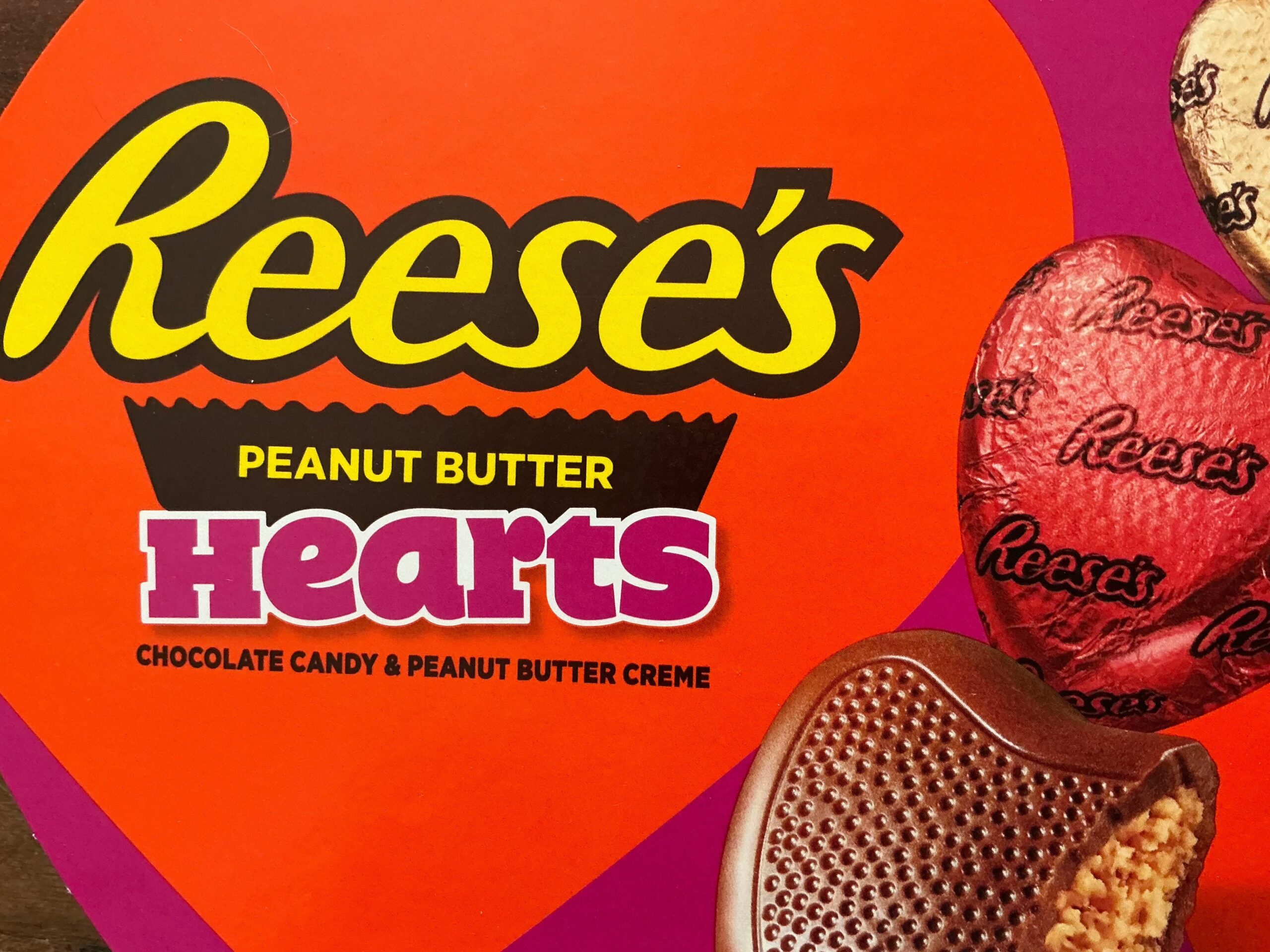
In a LinkedIn post, Reese said Hershey’s assortment of Reese’s products (including the valentine heart-shaped ones he had recently sampled) include different, cheaper ingredients, swapping milk chocolate for compound coatings and peanut butter for peanut butter créme.
“How does The Hershey Co. continue to position Reese’s as its flagship brand, a symbol of trust, quality, and leadership, while quietly replacing the very ingredients (Milk Chocolate + Peanut Butter) that built Reese’s trust in the first place?” Reese wrote.
Reese isn’t wrong. Several Reese’s products today — including the valentine’s hearts and the Easter egg-shaped versions — use chocolate-flavored coatings that cannot be legally called “milk chocolate,” a term that’s regulated by the Food and Drug Administration. It’s unclear exactly when the swaps occurred.
The flagship Reese’s Peanut Butter Cups continue to list milk chocolate and peanuts as the first two ingredients.
Still, the product line’s variance represents a shift across the candy industry as cocoa prices continue to rise, driven by a combination of factors, including climate-sparked changes in supply, tariffs, and labor shortages, the New York Times reports. Chocolate companies, including Hershey’s, have responded by making cost-effective ingredient swaps. The Times reported that several chocolate-forward Hershey’s candies no longer listed milk chocolate among their ingredients during last Halloween season.
Hershey doesn’t deny the swaps, but is defending its quality.
The company said in a statement Wednesday that Reese’s Peanut Butter Cups are made the same way they’ve always been, with house-made milk chocolate and roasted peanuts, but that ingredients for some other Reese’s products can vary based on demand.
“As we’ve grown and expanded the Reese’s product line, we make product recipe adjustments that allow us to make new shapes, sizes, and innovations that Reese’s fans have come to love and ask for, while always protecting the essence of what makes Reese’s unique and special: the perfect combination of chocolate and peanut butter,” the company said.
A package of Reese’s Hearts is shown on Tuesday, Feb. 17, 2026, in New Jersey. (AP Photo/Pablo Salinas)
A government database last updated in 2023 shows changes to the ratio of peanuts and milk chocolate used in Reese’s Peanut Butter Eggs over the years. Three years ago, the egg chocolates had more peanuts and milk chocolate than anything else. But the current formula lists sugar and vegetable oil first — and no milk chocolate.
Reese said he thinks Hershey has gone too far this time.
He picked up a bag of Reese’s Mini Hearts for Valentine’s Day, but threw them away after sampling.
“It was not edible,” Reese told The Associated Press. “You have to understand. I used to eat a Reese’s product every day. This is very devastating for me.”
Reese’s grandfather, H.B. Reese, spent two years at Hershey before leaving to form his own company, H.B. Reese Candy Co. in 1919. The company manufactured about 12 types of chocolate, made with ingredients that included real cocoa butter, fresh cream, and freshly roasted peanuts.
He invented Reese’s Peanut Butter Cups in 1928. They were a hit and had wrappers included the slogan: “Made in Chocolate Town, so they must be good.” H.B. Reese died in 1956. His six sons eventually sold his company to Hershey in 1963.
Now, Reese is waging war.
He redesigned his personal website to take on Hershey’s ingredient swaps. The lead photo on the homepage shows an orange cap with the phrase “MAKE REESE’S GREAT AGAIN” stitched on the front. He says the website is devoted to “protecting Reese’s brand integrity.” It includes a list of news coverage his LinkedIn call-out has received to date.
“Right now, the REESE’S story is diverging from what’s inside REESE’S products. And that divergence puts REESE’S and the legacy behind it, at risk,” Reese said on LinkedIn. “As the grandson of the man who created REESE’S Peanut Butter Cups, I’m not asking for nostalgia. I’m asking for alignment. For truth in REESE’S brand stewardship.”
The Imhotep Charter boys’ basketball team was in Boston a few years ago for a tournament when Andre Noble told his players that they were in his hometown.
“I said, ‘Wait. What?’” said Ebony Twiggs, whose son, Justin Edwards, was one of Imhotep’s stars. “I just thought he always lived here. I didn’t know he wasn’t from Philly.”
Noble reminded Twiggs of the people she knew from West Oak Lane. He had been at Imhotep for more than 20 years. And he was one of the city’s premier high school basketball coaches. He fit in. Of course he was from Philadelphia.
Noble, who can win a sixth straight Public League title and 13th overall on Sunday when Imhotep plays West Philly High, is one of Philly’s all-time coaches.
Unlike the rest, Noble didn’t spend his teenage summers playing at places like Chew, Tustin, and Myers. He didn’t win CYO titles, ride the trolley to watch doubleheaders at the Palestra, or find himself within six degrees of separation from someone who played on the 1954 La Salle basketball team.
Philadelphia has produced great players, coaches, and even referees. And the high school coaches, especially the ones who have won at the rate Noble has, often grew up here. They played for the city high schools, perhaps even stayed for college, and remained a tight-knit crew who stayed home to teach the game.
Speedy Morris still lives in Roxborough, Dan Dougherty was from Olney, Bill Ellerbee grew up on Uber Street, and Carl Arrigale is as South Philly as slowly driving past a stop sign. The guys on the Mt. Rushmore of Philadelphia high school coaches are from the neighborhood who coached kids like them.
Andre Noble has been at Imhotep for 20 years, but his hometown is Boston.
But Noble grew up in Boston’s Mattapan neighborhood and didn’t even play high school ball. He came to Philadelphia in 2000 after graduating from Lincoln University and taught math at Imhotep, which did not yet have an athletic program.
Noble planned to stay in Philly for a year before moving on. His plans changed, he stayed, and Imhotep became a basketball powerhouse.
The guy from Boston did what seemingly has never been done: become a great Philly high school coach as an outsider.
“I think by the time everyone figured out I wasn’t from Philly, it was too late,” Noble said. “The ball was already rolling down the hill. But I’m definitely a Philly basketball guy. It’s important to me.”
A special guy
Imhotep didn’t have a basketball team when Noble arrived. The school didn’t even have a building.
“We called them modulars, but everyone else said, ‘Yo, that’s the trailer school,’” said Noble, who is now the school’s CEO.
Two students in his algebra class — Briscoe Chew and Marlon Mills — told Noble at the end of the school year that they were transferring. Noble was stunned. Why? Imhotep doesn’t have sports, they told him. So Noble launched a basketball team and kick-started a league with the city’s other charter schools.
Noble didn’t have a playing background to lean on, so he picked the brains of coaches in the area. Rap Curry, Greg Dennis, and Clyde Jones became his mentors. He was on his way. His plan to leave Philly after a year was spoiled, so he began to scour the city for players. He watched games at youth programs in North Philadelphia and hung at playgrounds, hoping he could fill a roster at Imhotep.
“I knew he was from Boston, but then I started seeing him at 25th and Diamond or 33rd and Diamond,” said Kamal Yard, who runs Philly Pride, one of the city’s premier AAU programs. “I’m like, ‘Bro, what are you doing down here? Do you know where you’re at?’ But he was in the mix. He was in the hood. He was in the projects. Nobody goes to the back of the projects at 25th and Diamond, but he did it. He was meeting the kids. That was his intro to Philly, and he was onto something. He got immersed into it.”
Yard met Noble years earlier when they were both students at Lincoln. Yard played ball and Noble watched from the stands. The future coach was studying, Yard said. When students complained about the food in the cafeteria, Noble led the charge as a member of the student government. He led a boycott, filed a petition, called the state, and ordered a review.
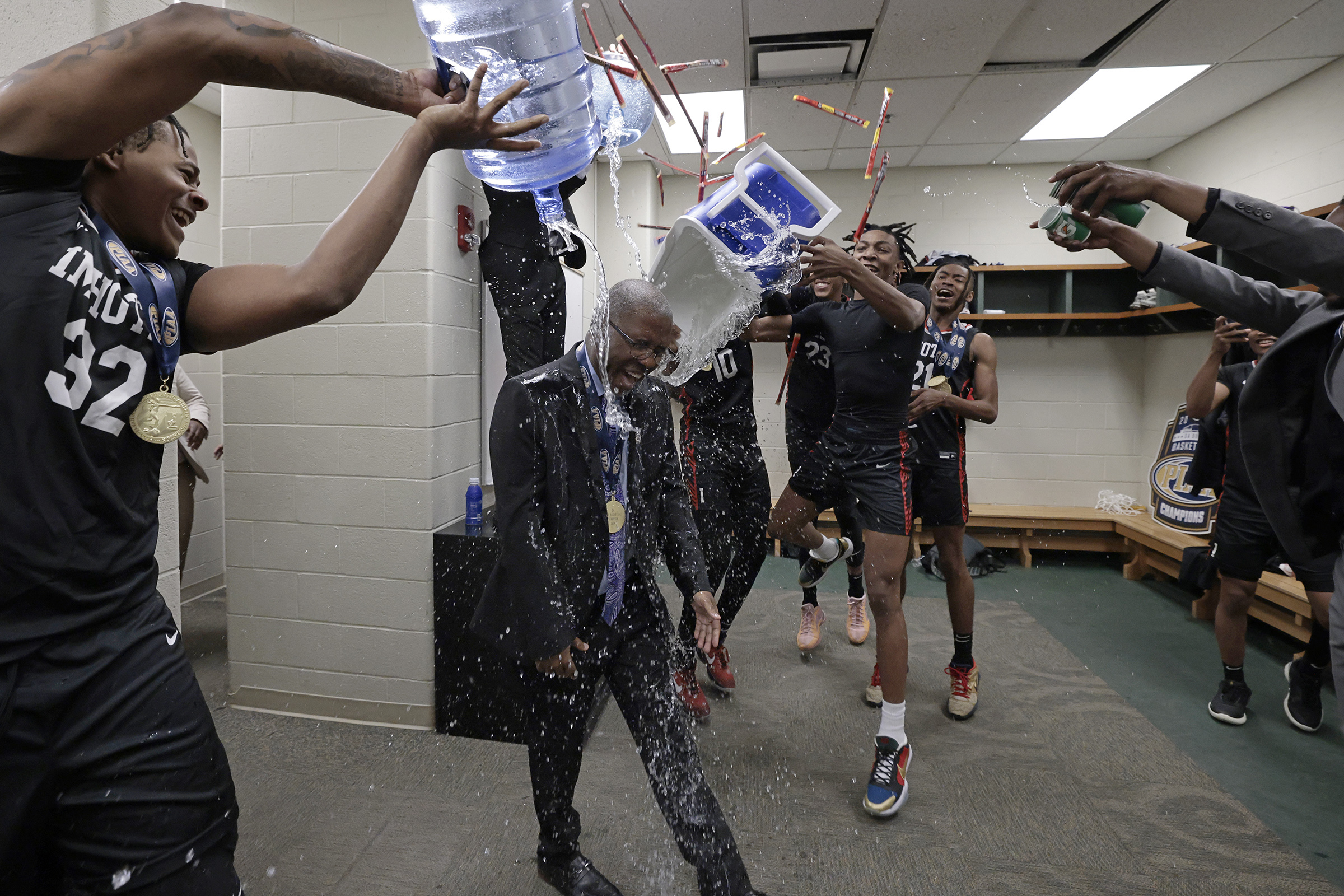
Imhotep players soak head coach Andre Noble after winning PIAA Class 5A boys basketball championship in 2024.
“You blinked and, man, we had a whole new menu,” Yard said. “But the whole point was that he was always about other people. So watching this transition, it’s no surprise. He’s a giver of people. He doesn’t look like a tough guy because he’s mild-mannered, but there’s a lot of toughness and resiliency in that frame. He’s as tough as they come.
“Brother Andre will go into the lion den with a tiki torch and a sword to go help a kid. He might come out scratched up, but he helped his kid. That’s Brother Andre.”
The Panthers, waiting for their gym to be built, practiced at a nearby recreation center and a middle school. It wasn’t ideal, but it worked. Imhotep won the Charter School league before moving in 2004 to the Public League. Five years later, Noble’s team won it all.
The Boston guy had built one of Philly’s finest teams.
“He’s a special guy,” said Fran Dunphy, the quintessential Philly coach. “The biggest asset he brings is just his genuine goodness. He treats the kids well, but there’s no question that he has an accountability for them and needs them to pay attention. They all seem to buy in. He’s remarkable for me.”
A teacher
Noble was a junior in college when he thought about how he was the only kid he grew up with preparing to get a degree. He wondered, how did that happen? And then he thought about his mom, a single parent who worked as an office manager and raised her sons — “Two knuckleheads,” Noble said — in a tough neighborhood.
“I called her and thanked her,” Noble said. “I knew it was that little lady who I thought was crazy but provided the foundation. She was a stickler, a disciplinarian. It was her way or the highway, ‘Hey, this is what you’re doing.’”
It was a big deal when Noble secured admission to the Boston Latin School, a prestigious school near Fenway Park. But his mother asked him to think about it before she sent in his paperwork. She asked her son, would he take his studies seriously? Would he be ready to work hard? Can he commit himself? Noble said he would.
Years later, he found out that his mom already had sent in the paperwork. But Della Noble wanted her son to feel a sense of ownership in his decision. She believed her son could do it. And now Noble empowers and supports the kids at Imhotep the same way his mom did. If a kid on his team wants to visit a college, Noble often is driving the car. If a kid has a problem in school, Noble’s door is open.
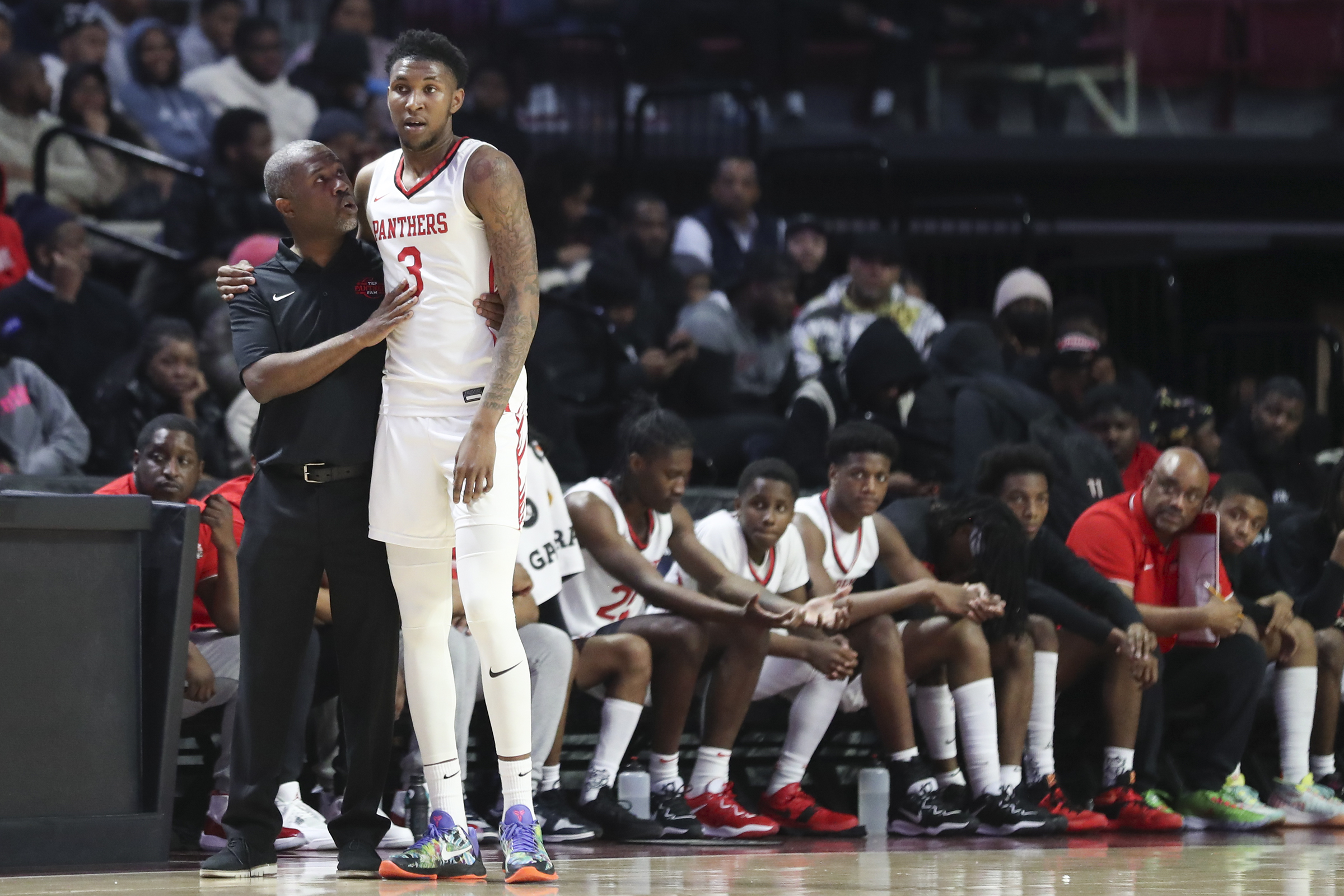
Imhotep’s Andre Noble (left) shown with Justin Edwards during the 2023 Public League championship game against West Philly. Edwards now plays for the Sixers.
“You realize that there’s way more important things in life,” Noble said. “If we can get them to be the best young men we can be, then the rest of their lives will be meaningful. There’s so many things you can teach through basketball.”
Becoming one of Philly’s all-time coaches is about more than just breaking a press or drawing up an inbounds play with seconds left. Noble proved that an outsider can do it, too.
“There’s a trust that he has with his players that we all try to search for in relationships with the kids,” Dunphy said. “I think he’s found that secret. To be honest with you, I don’t know if I ever sat down with him and said, ‘Yo, what is your secret?’ I think he would be so humble, and he’d say, ‘I don’t know. I’m just being myself.’ It’s what makes mentorship so important to all of us. You have to be there for the young people.”
Noble has surrounded himself with a crew of assistant coaches who grew up in Philly. He has embraced the city’s basketball history and has now spent more time here than he did in Boston. He’s an adopted Philly guy.
Charles “Shoob” Monroe, who organizes an annual showcase game for the city’s top high schoolers, said Noble knows more about old-school Philly basketball than people who actually lived here. No, he’s not from Philly. But Noble became a part of it.
“Someone always knows someone or knows someone who knows someone,” said Arrigale, who could win his 13th Catholic League title on Sunday when his Neumann Goretti squad plays Father Judge. “He didn’t really have that experience because no one played against him and things like that. But he’s been around long enough that he knows everyone now. He’s had a pretty good run over there.”
A father figure
Twiggs’ son now plays for the Sixers but once was a teenager who didn’t clean his room or finish his homework. And when that happened, Twiggs knew to call the guy from Boston.
“Justin would come home and be like, ‘You told on me,’” Twiggs said.
Twiggs, a single mother who worked two jobs to keep her son’s dream alive, said Noble was like “a father figure” to her son. He wasn’t from Philly but that was OK.
“Justin lacked that growing up,” Twiggs said of a male role model. “Having Brother Andre and the whole coaching staff just be so hands on with Justin took a lot of stress off for me.”
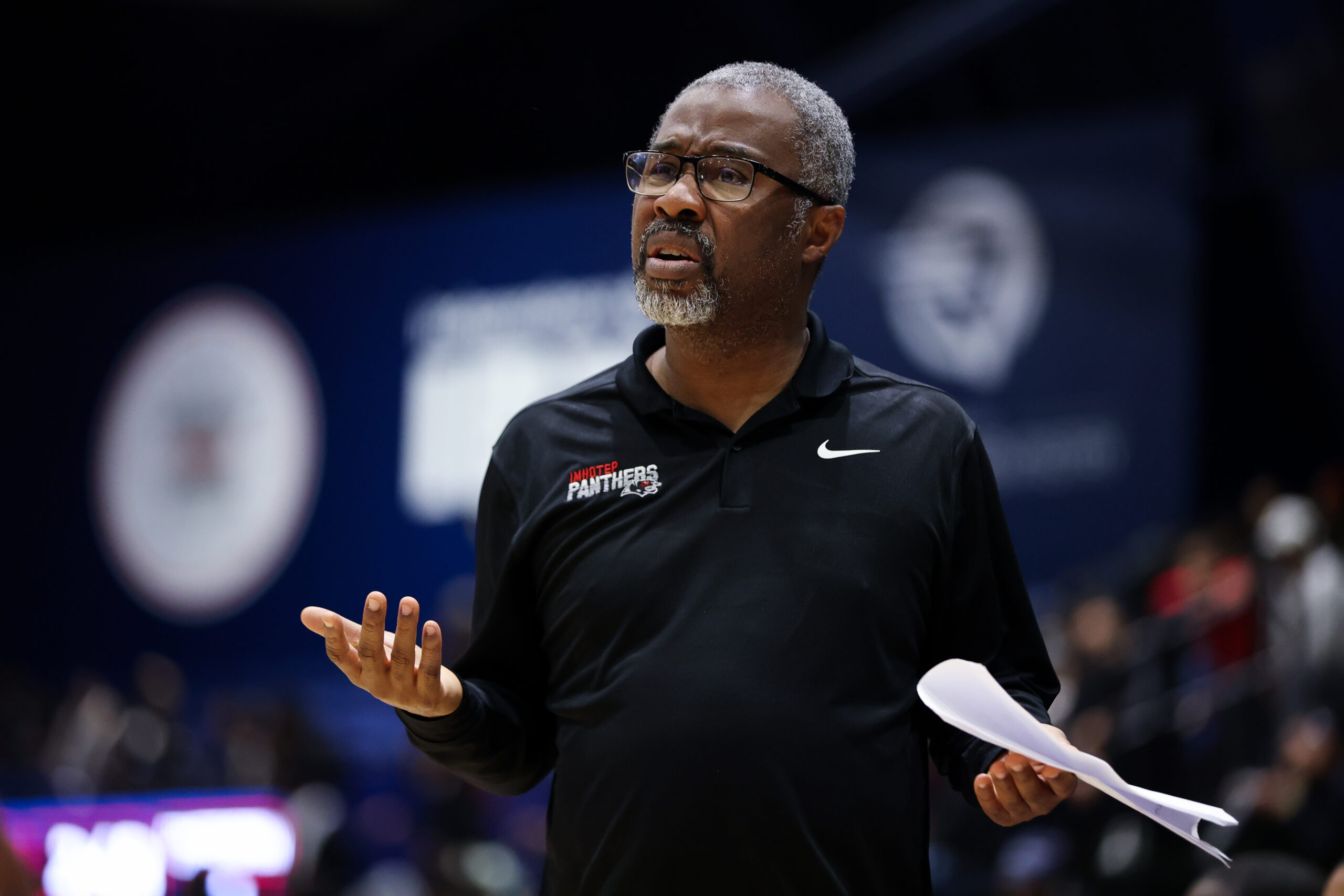
Andre Noble has enough accolades to coach in college. He’s instead decided to stay at Imhotep.
Edwards is one of the many players Noble coached who moved onto a Division I program. By now, the coach who didn’t play high school ball has enough accolades to coach in college. He’s instead decided to stay at Imhotep.
A few years ago, Mills’ son, Timmy, graduated from Imhotep. He brought his son to see Noble and tell the story about how two students triggered Noble to start a team. It was true, Noble said. And that helped the guy from Boston find a home in Philly.
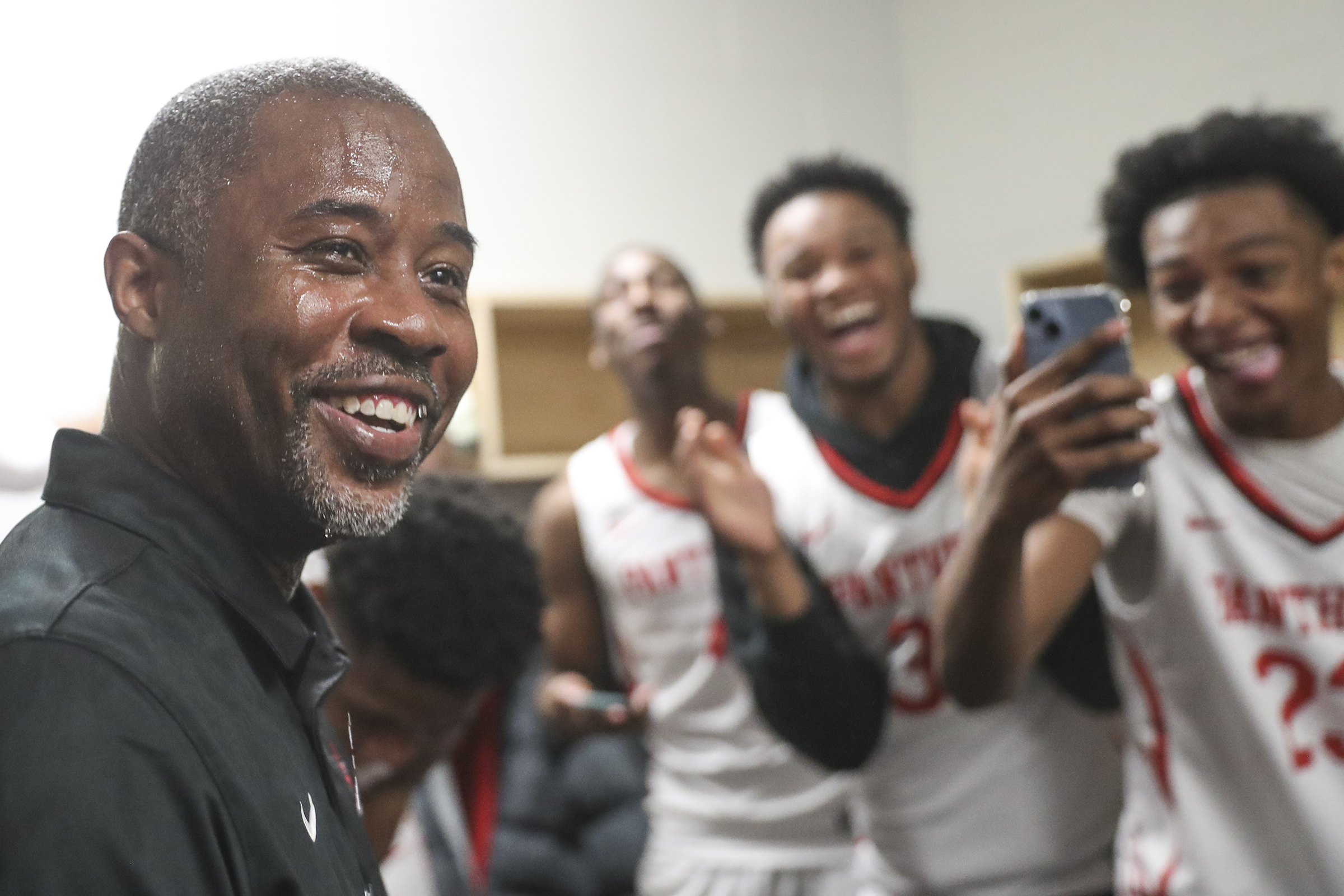
“I love what I get to do,” Noble said. “I love the school. I love serving this community. I don’t see myself anywhere else. I don’t rule anything out, but if I have the opportunity to coach and lead at Imhotep until the rest of my career, that would be a blessing. The one-year plan definitely didn’t work out. I failed in that.”
After a cold, snow-filled winter in Philadelphia, the city is finally getting its first glimpse at spring, thanks to the Phillies.
The Phillies’ 2026 spring training schedule kicks off Saturday afternoon against the Toronto Blue Jays in Dunedin, Fla., followed by their Clearwater debut Sunday at BayCare Ballpark, their Sunshine State home since 2004.
Fans will be able to tune in to more spring training games than ever. Between NBC Sports Philadelphia, the MLB Network, 94.1 WIP, and the Phillies themselves, there will be a broadcast for all but three games of this year’s 30-game Grapefruit League schedule.
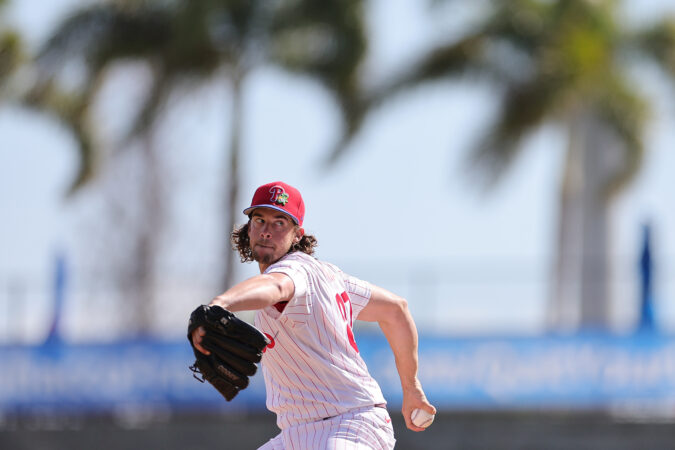
There’s also Aidan Miller, the No. 23 prospect in baseball. The 22-year-old shortstop is expected to start the season in Triple-A, but will get some playing time at third base during spring training, according to my colleague Scott Lauber. That would set up Miller for an early promotion if Alex Bohm gets off to a slow start.
As far as new faces, the most prominent is outfielder Adolis García, who is replacing Nick Castellanos and is just two seasons removed from hitting 39 home runs for the Texas Rangers.
Here’s everything you need to know to watch or stream Phillies spring training games:
What channel are Phillies spring training games on?
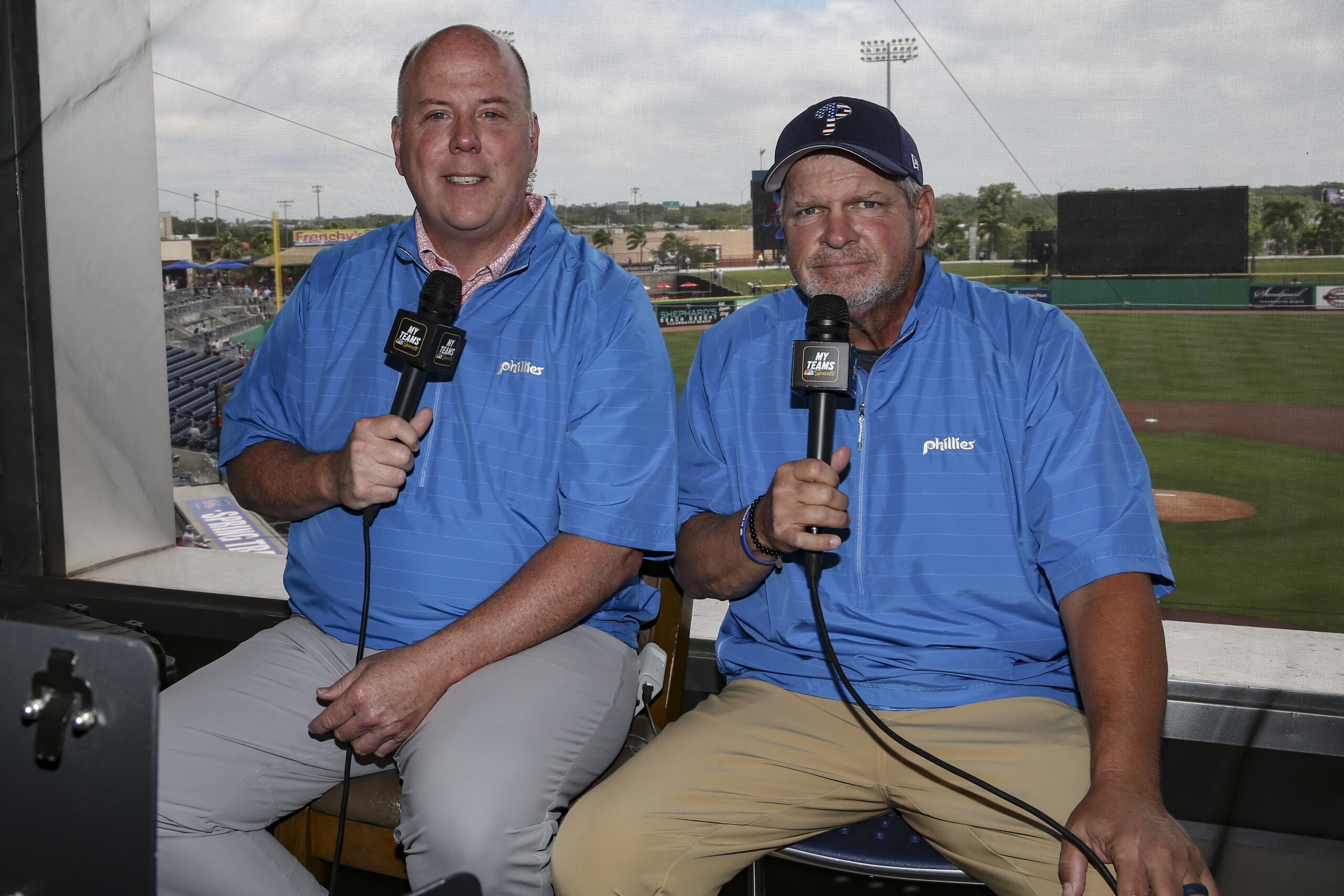
Phillies broadcasters Tom McCarthy (left) and John Kruk will be back again for NBC Sports Philadelphia.
The bulk of the Phillies’ televised spring training games will air on NBC Sports Philadelphia, which plans to broadcast 17 games — nine on the main channel and eight on NBC Sports Philadelphia+. That’s a big jump from last year, when it aired 12 games.
The schedule includes an exhibition game against Team Canada on March 4 serving as a warm-up for this year’s World Baseball Classic. The multicountry tournament begins on March 5 in Tokyo, and the Phillies will be well-represented — 11 players, including Bryce Harper and Kyle Schwarber, will leave spring training early to participate.
Returning for his 19th season as the TV voice of the Phillies is play-by-play announcer Tom McCarthy, who will be joined in the booth by a familiar cast of analysts that includes Rubén Amaro Jr., Ben Davis, and John Kruk.
MLB Network will broadcast six Phillies spring training games (though just two will be available in the Philly TV market due to blackout rules). ESPN won’t be airing any — the network is broadcasting just four spring training games on their main channel, and six more on its ESPN Unlimited subscription service.
Radio listeners can tune into 94.1 WIP to hear 10 weekend games. Play-by-play announcer Scott Franzke is back for his 21st season calling the Phillies, joined once again by a rotation featuring veteran analyst Larry Anderson and Kevin Stocker.
Cole Hamels will be back, but not Taryn Hatcher
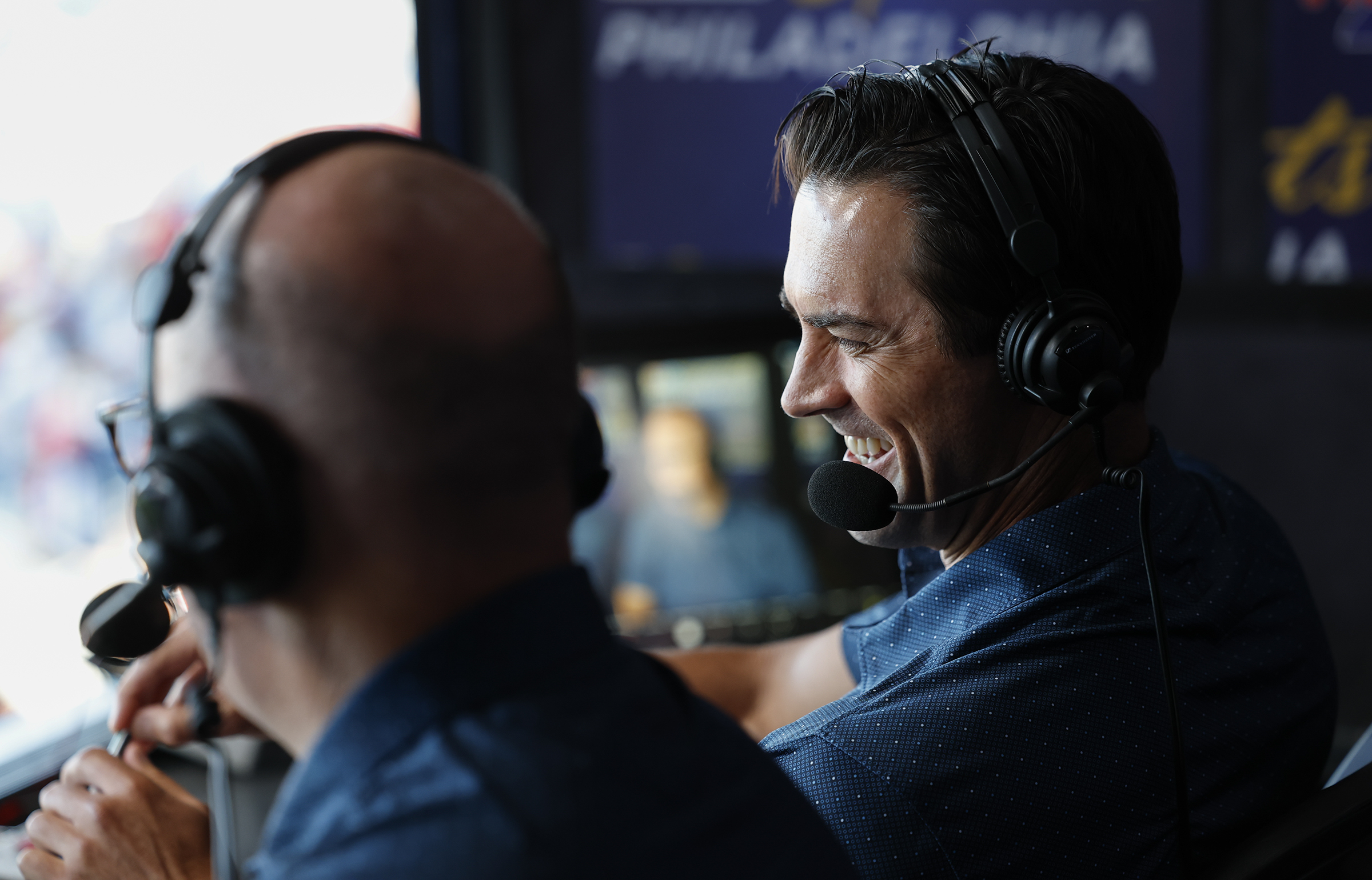
Former Phillies pitcher Cole Hamels (right) called nine games last season for NBC Sports Philadelphia.
A little bit of Hollywood will be back in the Phillies booth this season.
2008 World Series MVP Cole Hamels will call a few spring training games for the second straight season, beginning in the middle of March. Hamels was something of a natural in the booth last season, calling the nine regular-season games he worked a “crash course” in broadcasting.
“I tried to tell myself, ‘Don’t overtalk. Don’t be long-winded. Don’t just talk to talk,’” Hamels told The Inquirer in September. “I start watching the game and enjoying it, and I forget sometimes I have to talk.”
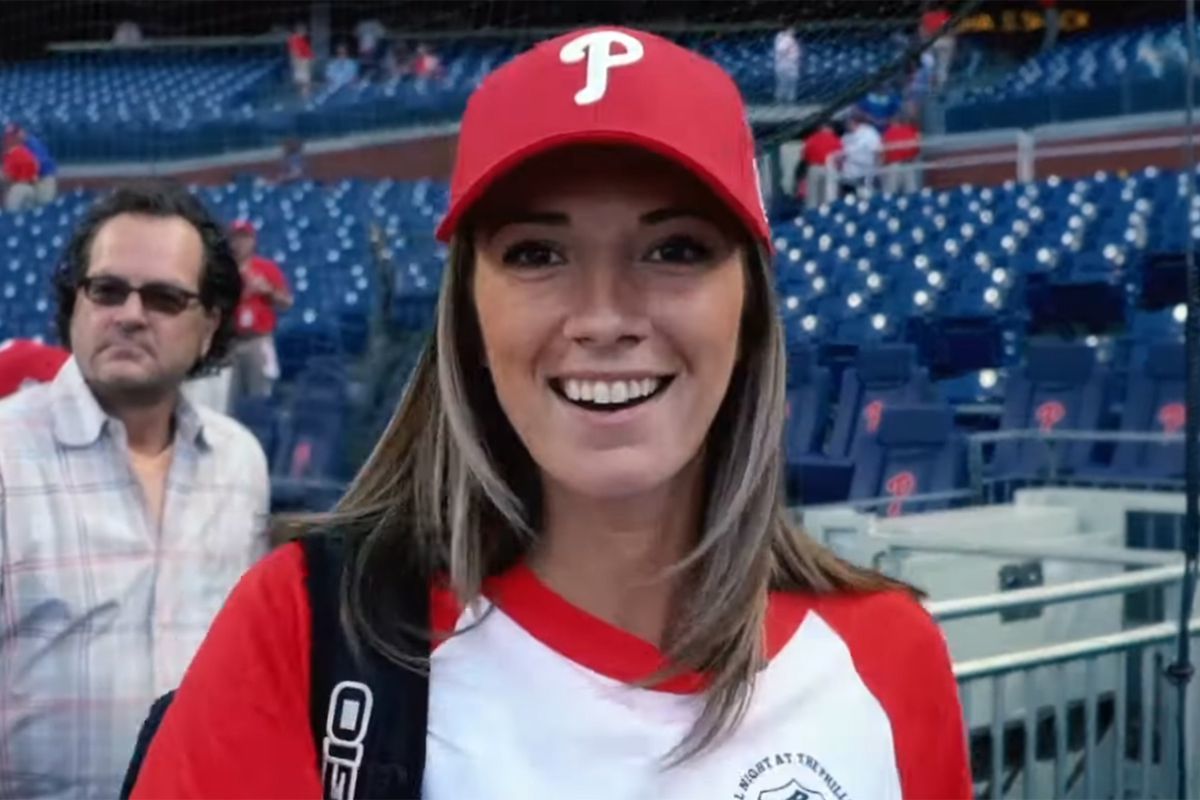
Taryn Hatcher, seen here during a 2019 media softball game.
One NBC Sports personality who won’t be back is Taryn Hatcher, who joined the network in 2018 and spent the past few seasons covering the game as an in-stadium reporter.
Hatcher’s contract wasn’t renewed at the end of the year and NBC Sports Philadelphia eliminated the position, according to sources.
You can also stream NBC Sports Philadelphia on Hulu + Live TV and YouTube TV, which will soon roll out a skinny sports bundle. And NBC Sports Philadelphia will stream its games on the NBC Sports app, but a subscription to a cable service is required.
One streaming service where you won’t find the network is Fubo, which hasn’t broadcast any NBC channels since November due to a carriage dispute. NBC Sports Philadelphia is also not available on Sling TV or DirecTV Stream.
For the third straight season, the Phillies will also exclusively stream a handful of spring training games from BayCare Ballpark for free on the team’s website.
The team will also provide an audio-only feed for a few midweek road games that aren’t airing on WIP.
Are there any new MLB rules in spring training?
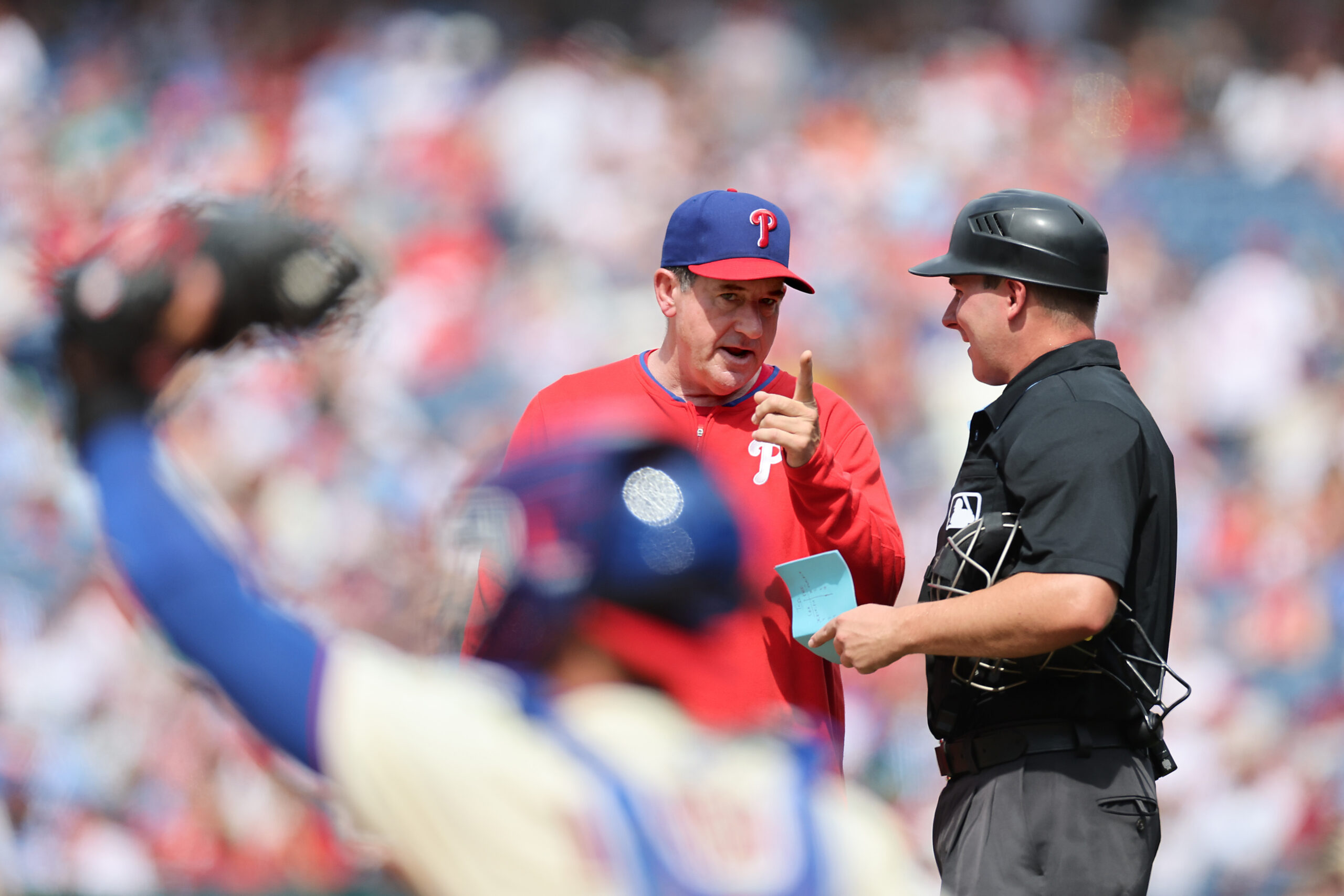
Umpires will have their balls and strikes face challenges this season.
There aren’t any new rules in play during spring training, but MLB is fully rolling out its automatic ball-strike (ABS) challenge system ahead of its launch in the regular season. The Phillies plan on giving it a healthy test drive.
The rules are pretty straightforward. Pitchers, catchers, or batters can challenge a ball or strike by taping their head immediately after the umpire’s call.
Each team starts the game with two challenges, which they only lose when a challenge is unsuccessful. If a team has no challenges remaining and the game goes into extra innings, they’re awarded one per inning until the game is over.
Phillies news and spring training updates
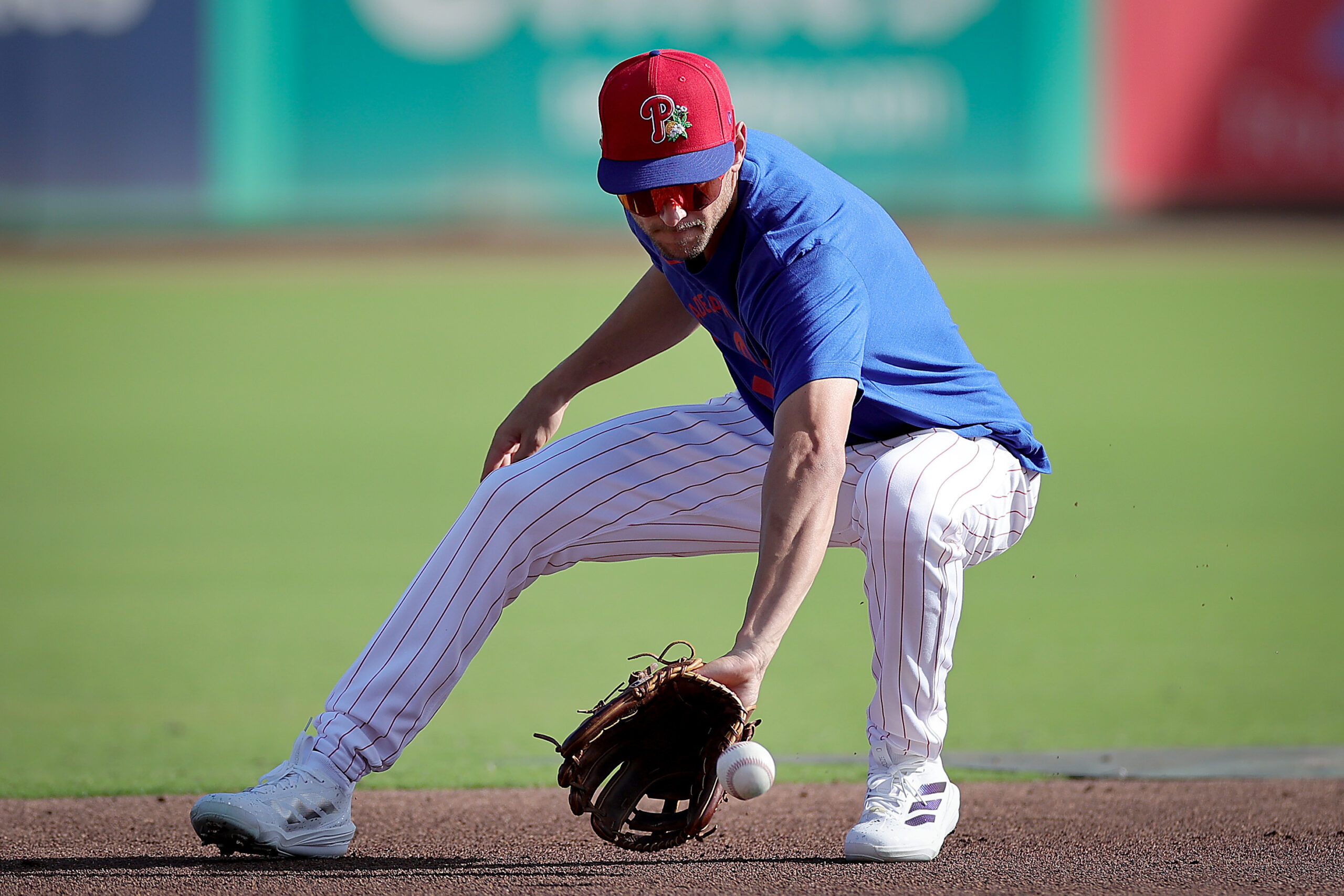
Trea Turner fields a ground ball during spring training Wednesday.
Trea Turner was still the fastest man in the league at 32. Here’s his secret.
The Phillies will open the season against the Texas Rangers at Citizens Bank Park.
The Phillies are scheduled to open the 2026 season on March 26 against the Texas Rangers at Citizens Bank Park, where the team will hang its 2025 NL East pennant.
In the everyday chaos that characterizes President Donald Trump’s America, the news cycle changes faster than most of us can keep up with it.
But can we please pause for a moment and consider the gravity ofwhat happened to Nekima Levy Armstrong at the hands of the U.S. government? She led a group of activists who interrupted a worship service in Minnesota on Jan. 18. The demonstrators went to Cities Church in St. Paul to stage a protest in support of immigrant rights.
The choice of venue was very much intentional: One of the leaders at the church is an administrator at a local U.S. Immigration and Customs Enforcement office. Four days later, Levy Armstrong, a half dozen other protesters, and two journalists were arrested.
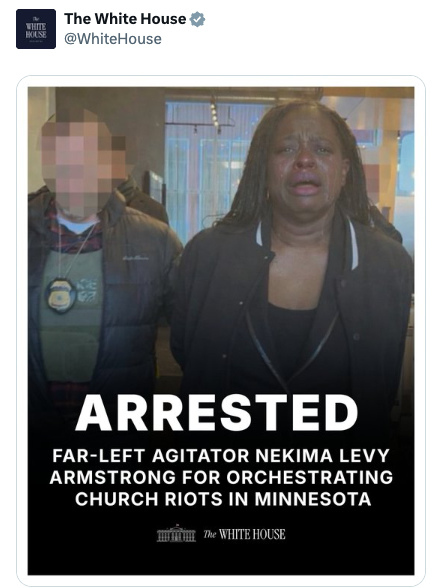
Afterward, while she was still in custody, Trump administration officials released an AI-manipulated image of her on X, the social media site formerly known as Twitter, on accounts for Homeland Security Secretary Kristi Noem and the White House.
The doctored image shows Levy Armstrong (no relation) with her mouth open as if she’s sobbing hysterically. Her face also appears to have been darkened. The photo caption reads: “ARRESTED far-left agitator Nekima Levy Armstrong for orchestrating church riots in Minnesota.”
It wasn’t a riot. Nor was she crying. But all that is beside the point. The Trump administration officials wanted to make her look bad, even if it meant reshaping reality to do so. What’s especially concerning is the dishonest way it went about it. According to photos and video of her arrest, Levy Armstrong maintained a mostly impassive expression on her face throughout the ordeal.
On Jan. 22, the White House posted an AI-altered image of Nikema Levy Armstrong on the White House’s official X feed. The altered image makes Levy Armstrong appear as crying, the original image shows no such emotion.
A lot of people might see the digitally altered image of her sobbing and assume that because it was posted on a verified social media channel from the highest levels of government, it is an accurate representation of what happened — when it’s anything but.
A New York Times analysis concluded that the photo had been manipulated — something the White House admits to doing, and is unrepentant about. The manipulated photo is a meme, according toWhite House spokesperson Kaelan Dorr, who doubled down on X, saying, in part: “Enforcement of the law will continue. The memes will continue.”
No one should be surprised at that reaction, considering how many questionable AI images Trump has shared. (And, although it wasn’t artificial intelligence, don’t get me started on his racist post about the Obamas earlier this month.)
He once posted an AI video of himself — with a crown on his head — flying a plane that dumps feces onto “No Kings” protesters. It was even more disturbing when he released a deepfake video of former President Barack Obama, who seems to live rent-free inside Trump’s head, being arrested in the Oval Office.
Imagine the uproar if another president had done such a thing. Many people have normalized this kind of corrosive behavior so much that Teflon Don usually gets off with a shrug. But those of us who care about accountability have to keep calling him out.
Dirty politics are one thing, but when Trump administration officials manipulated the photo of Levy Armstrong, a private citizen, it made my blood boil. It’s another reminder that there’s no bottom with Trump when it comes to how low he will go, and that’s really scary.
I recently had a chance to speak with Levy Armstrong, and can report that, despite the administration’s efforts, she is unbowed and unbroken.
She called the government’s use of the fake image “horrifying and deeply disturbing,” and insists “I was cool, calm, and collected” during the arrest.
“I guess because they didn’t see me broken, they needed to manufacture an image of me broken,” Levy Armstrong told me.
“This is not unlike what has happened historically to Black people with all of the Sambo imagery and the mammy imagery that’s out there, with exaggerated features and darkened skin,” she said. “That’s the same thing that I went through, and that’s what they did to me. Not to mention making me look hysterical.”
She added that “I felt caricaturized, just like our people have been during slavery and Jim Crow.”
While I had her on the phone, I also asked Levy Armstrong about the arrest of former CNN anchor Don Lemon, who covered the protest she organized.
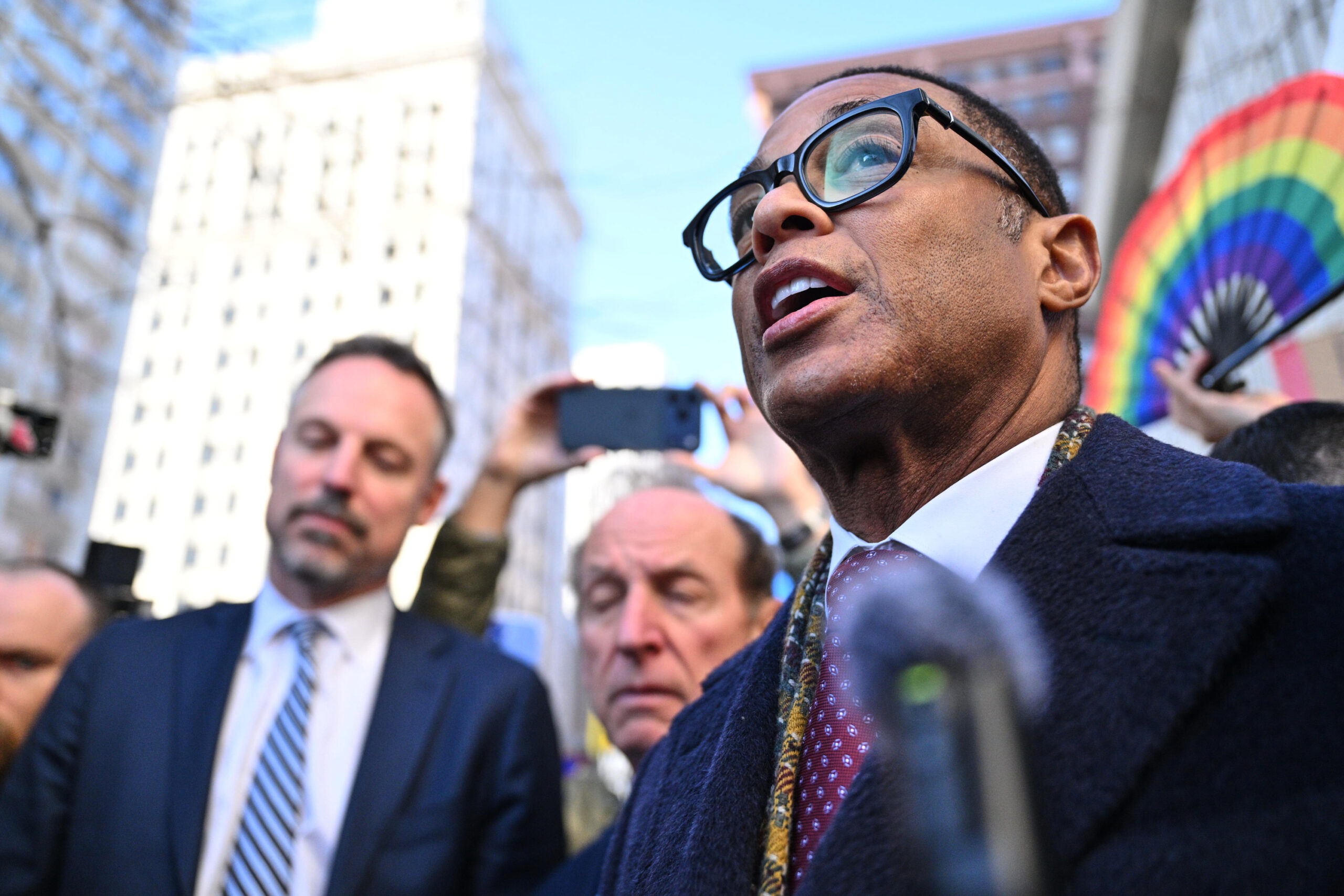
Journalist Don Lemon speaks to the media outside the U.S. District Courthouse in St. Paul, Minn., on Feb. 13.
Levy Armstrong disputes MAGA claims that Lemon was a participant in the demonstration, as opposed to being an observer. Levy Armstrong told me, “I just think it’s foolishness that they would try to rope him in as a protest organizer.”
“He’s not an activist. He’s not an organizer,” she pointed out. “He’s not a protester whatsoever.”
The former law professor said that referring to Lemon as an organizer was an excuse to attack him, as well as Georgia Fort, an Emmy Award-winning independent Black journalist based in Minnesota, who also faces federal charges after covering the protest.
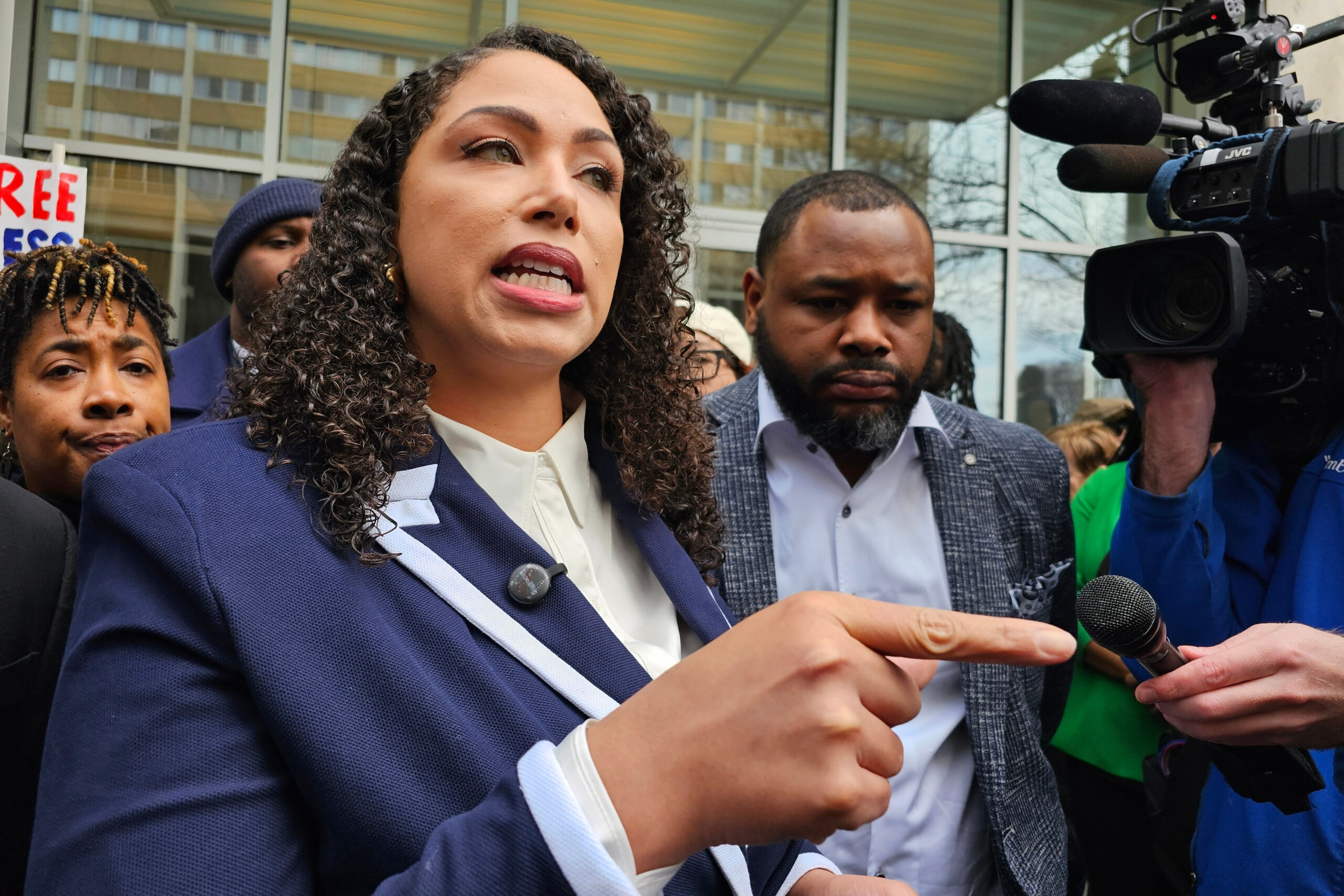
Minnesota-based independent journalist Georgia Fort speaks to reporters and supporters outside the federal courthouse in St. Paul, Minn., on Feb. 17, after pleading not guilty over her alleged role in a protest that disrupted a Sunday service at a Southern Baptist church in St. Paul.
I’ve covered many protests throughout my journalism career, and find what happened particularly upsetting. Republicans talk a good game about upholding the Constitution, but the arrests were clearly an attempt to keep journalists from exercising their First Amendment right to freedom of the press.
Meanwhile, no arrests have been made in the fatal shootings by Border Patrol and ICE, respectively, last month of Alex Pretti, an intensive care nurse, or Renee Good, a mother of three.
But Levy Armstrong has been charged for her role in a disruptive but peaceful protest inside a church during which no one was physically harmed. (And, yes, although they are rare, demonstrations in churches happen. During the civil rights movement, demonstrators would hold “kneel-ins” to protest segregated churches in the Jim Crow South.)
An ordained minister, Levy Armstrong told me she draws strength from such icons of the civil rights movementas Fannie Lou Hamer, Rosa Parks, and the Rev. Dr. Martin Luther King Jr., all of whom had suffered the indignity of being arrested while fighting for their basic human rights.
“Everybody needs to wake up,” she said. “This is not just about immigration. This is about our constitutional rights. This is about our democracy. This is about our freedoms.”
Freedoms we stand to lose if we allow the Trump administration to try and silence us the way it has attempted to do with Lemon, Fort, and Levy Armstrong, among so many others.
Levy Armstrong has nothing but praise for Philadelphia District Attorney Larry Krasner, who is vocal about prosecuting ICE agents who run afoul of the law. Her suggestion for concerned Philadelphians? “Get some whistles,” she said. “Get some people organized. Hold your elected leaders accountable.”
By 2019, after a decade of producing dozens of documentaries about Philadelphia history, the filmmakers at History Making Productions realized they had more than just the story of a city.
They had the story of America.
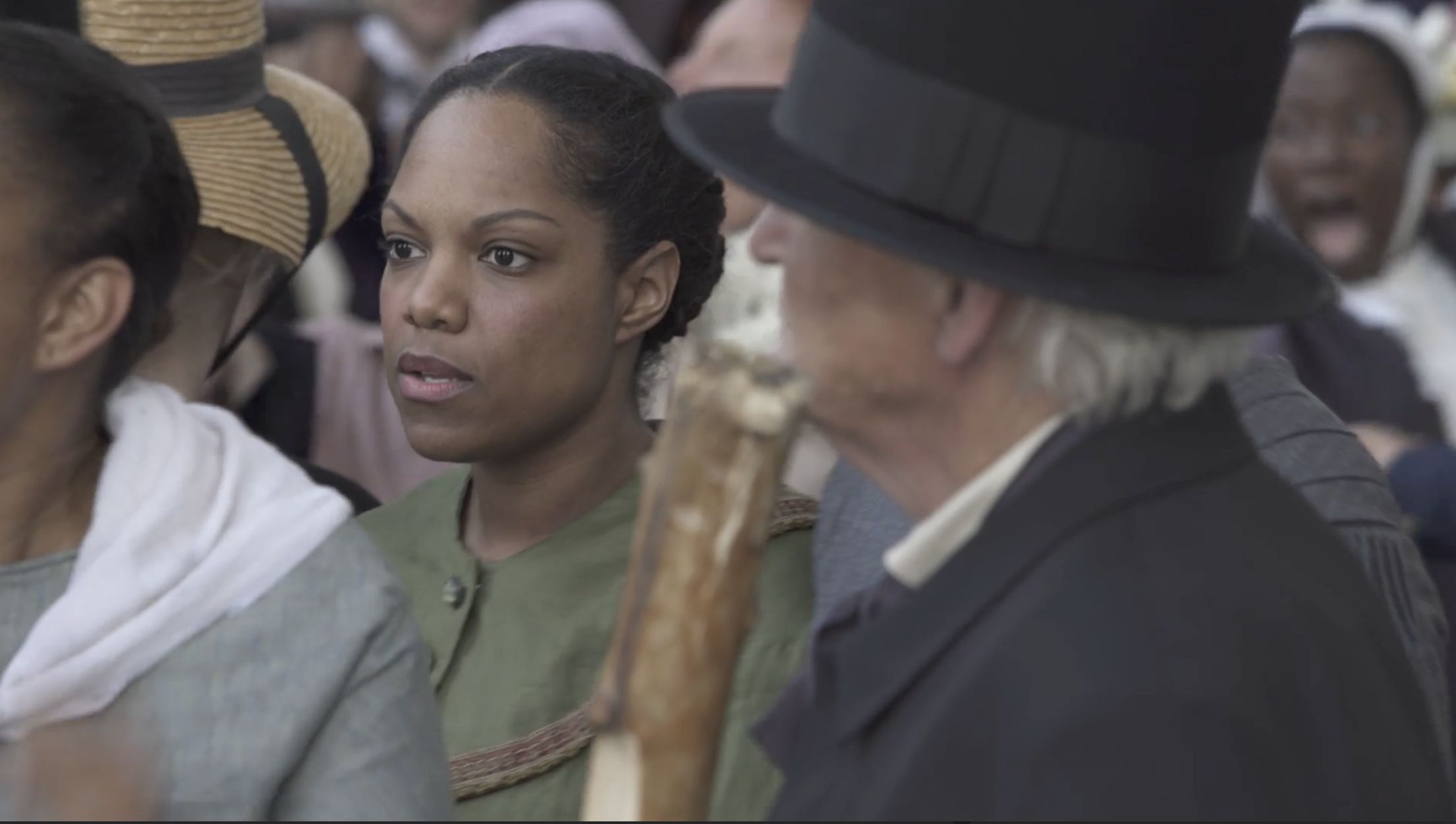
On Friday, the studio released its epic, new telling of that 400-year-old story: In Pursuit: Philadelphia and the Making of America. Directed by documentary filmmaker Andrew Ferrett and written by author and historian Nathaniel Popkin — and mixing modern footage with historical recreation and more than 600 on-camera interviews — the 10-episode series explores the history of America through the lens of Philadelphia, its birthplace.
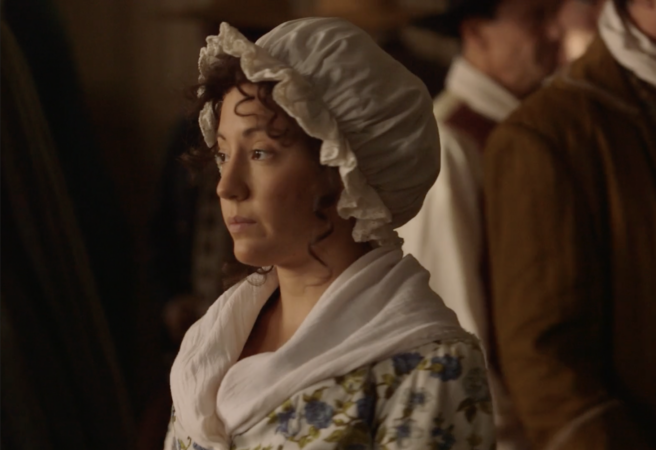
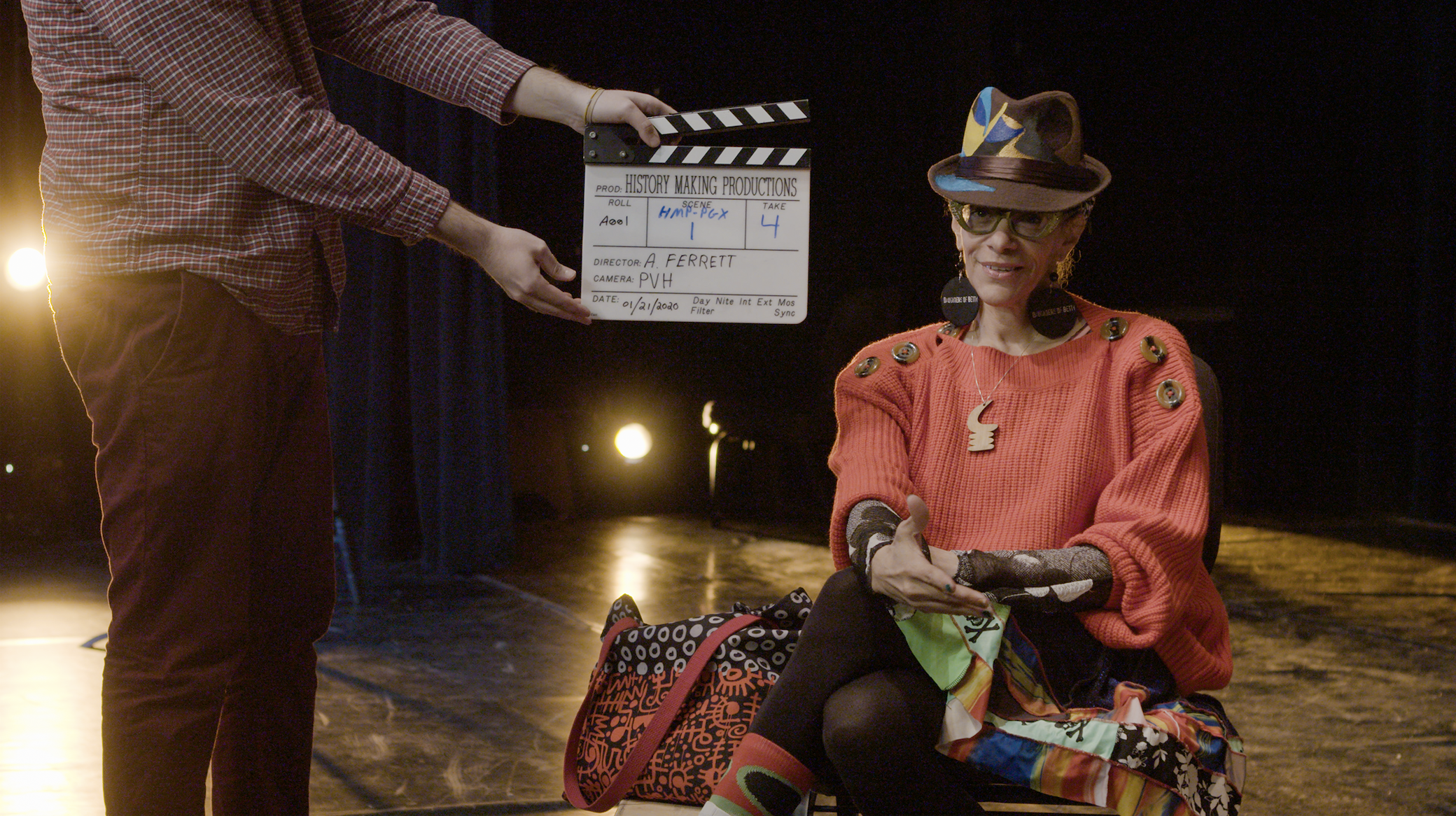
Belinda Davis as Sarah Forten in “In Pursuit: Philadelphia and the Making of America.”
Timed to coincide with the 250th anniversary of the Declaration of Independence in 2026, known as the Semiquincentennial, the series provocatively grapples with urgent questions, like how did the American experiment actually unfold? And how can it endure?
“Philadelphia is not just the birthplace of American democracy — it has been its proving ground,” said Sam Katz, series creator, executive producer, and founder of History Making Productions. “This series looks honestly at how ideals were formed, challenged, expanded, and sometimes betrayed, and why that history matters so urgently.”
‘A national moment’
Spanning 400 years of Philadelphia history, from its indigenous roots to the MOVE Bombing the series is equal parts entertainment and civic project. Funded by Katz and philanthropies like Pew Center for Arts & Heritage, Penn Medicine, and Lindy Communities, the series premiered at the National Constitution Center on Thursday.
Episode One is now streaming online. Katz and the filmmakers will host screenings and community conversations at Pennsbury Manor in Bucks County on Sunday, and another screening Feb. 26 at the Bok Building in South Philadelphia.
Throughout 2026, as the city and country celebrate the national milestone, a citywide “In Pursuit of History Film Festival” will promote each new installment with monthly screenings and public events. 6ABC will also air monthly hourlong shows to highlight new episodes.
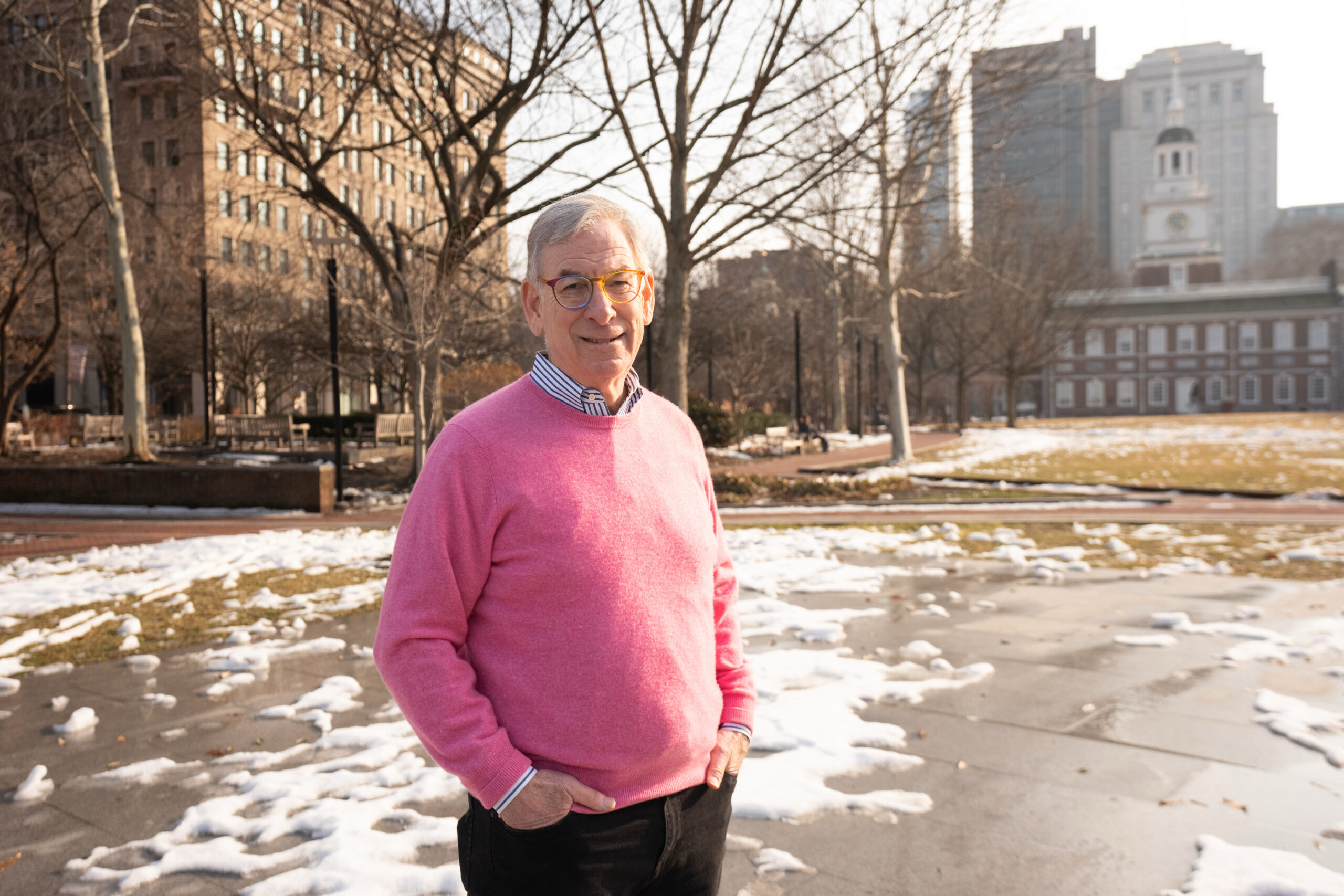
Sam Katz at Independence Hall, in Philadelphia, Tuesday, Feb. 17, 2026, in Philadelphia
From the beginning, the project was meant to get people talking about the true meaning of the American experience, and those it has left behind.
“We’re going to get partners all over the city, and we’re going to have screenings all over the place,” said Katz, the civic-leader-turned-producer. “We’re going to create opportunities for people to come and meet the filmmakers, or meet a historian or an artist, who will then lead a conversation. It really is an opportunity for Philadelphia to take stock of itself.”
Popkin, who co-founded Hidden City Daily, said the project tells the story of events that shaped a city and a country founded on ideals not yet fully realized — and now divided and tested as they’ve been in decades.
“The timing is perfect,” he said. “I think a film can really launch a lot of conversations. This is a moment for us as a nation.”
Fresh portals
Ferrett, who grew up in Bucks County, and has been directing and producing films at History Making Productions for more than 15 years, said the project revealed itself.
For earlier Philly projects — including The Great Experiment, an Emmy-award winning, 14-part docuseries spanning 500 years of Philly history, and Urban Trinity: The Story of Catholic Philadelphia — the filmmakers had amassed hundreds of unused hours of interviews with local and national historians, artists, and cultural leaders.
Over the years, much of it had to be left on the cutting room floor, including magical moments that he said opened fresh portals to Philly history, said Ferrett.
“We talked to pretty much anyone you can imagine who was either involved with studying Philadelphia history, or in the case of 20th-century history, a lot of witnesses to it,” he said.
Poet Ursula Rucker during filming of “In Pursuit: Philadelphia and the Making of America.” The new 10-part docuseries examines the history of America, through the story of Philadlephia.
Besides, he said, nowhere else could hold a better mirror to America, than the place of its birth.
“It really became obvious to us that what we have here is much more than a local history,” he said. “It’s a history of the whole United States because so many consequential moments that shaped the country’s history went through Philadelphia.”
History that feels alive
Setting out to tell the story anew, Katz raised money to shoot updated interviews and fresh historical recreations.
Meanwhile, history did not slow down, from the COVID-19 pandemic, to the killing of George Floyd, and the Black Lives Matter movements, to Trump, and immigration crackdowns.
“We were asking how do we deal with history while all this is happening,” Katz said. “We were writing about it right now.”
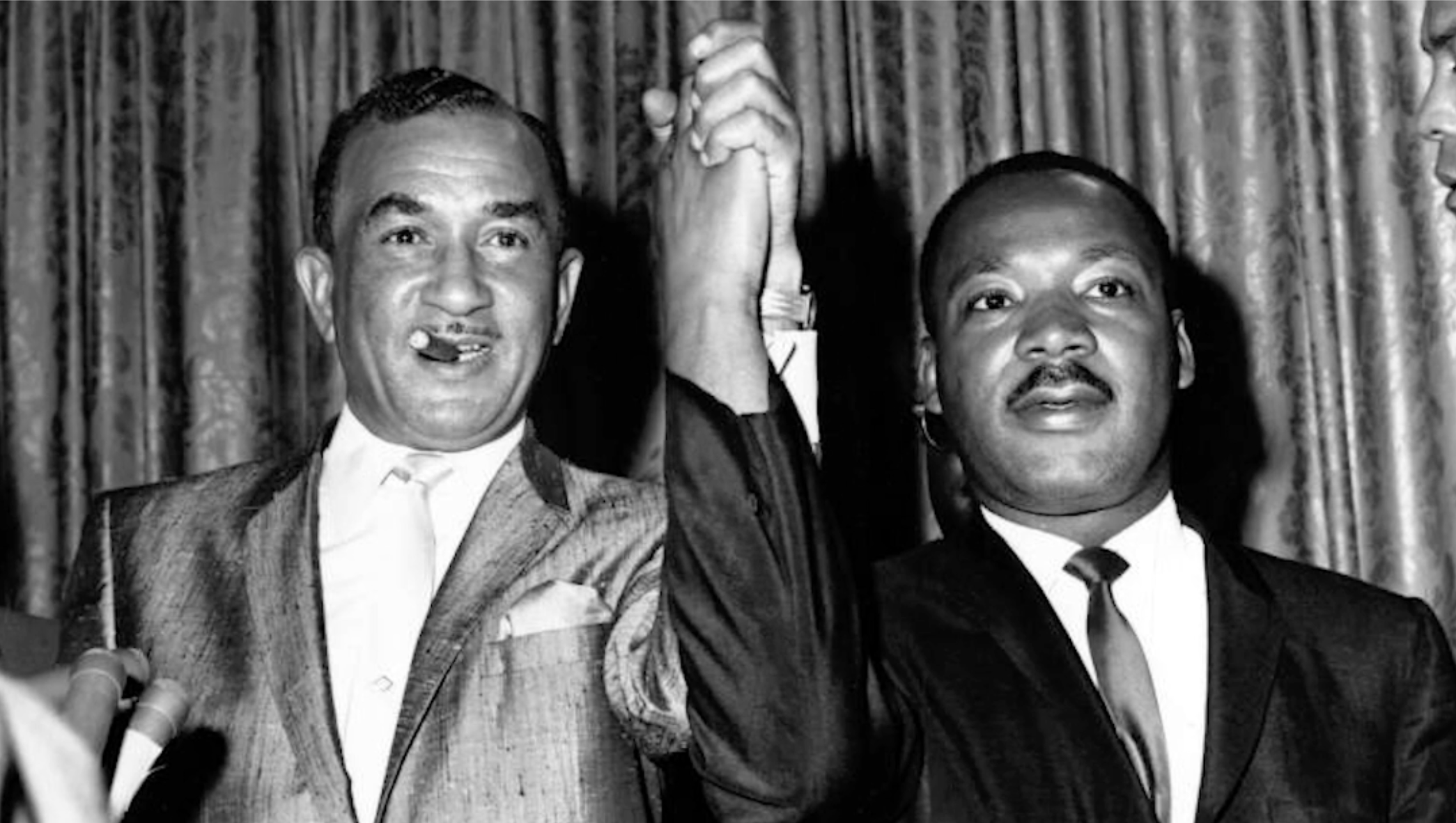
Cecil B. Moore and Martin Luther King, Jr in footage from “In Pursuit: Philadelphia and the Making of America.”
Narrated in a warm, resonant baritone by actor Michael Boatman, known for roles in shows Spin City and The Good Wife, In Pursuit is no dull, black-and-white history. The city feels alive, the stakes serious and undecided.
Threading modern day footage of bustling Philly streetscapes and soaring neighborhood shots with commentary and historical recreations imprints the series with a powerful immediacy.
The story stretches far beyond 1776, though the dramatic details of that sweltering summer in Philadelphia are recounted in episode three in gripping scenes of refreshingly believable historical recreations.
“We were able to shoot these lush and full reenactments,” said Ferrett, of all 10 episodes. “Sam was always like, ‘Where’s the dirt? I don’t want to see people with perfect teeth and smiling.’”
The start
Episode One, “Freedom (to 1700),” begins at the beginning, pulling no punches as it tells the story of the Lenape people, Philadelphia’s earliest Indigenous settlers — and of the generations of Dutch and other European colonists’ efforts to eradicate them through violence and disease.
It surprises even in the telling of William Penn, recounting how the rebellious aristocrat’s non-conformist ways landed him in jail more than once, before he founded a City of Brotherly Love meant to be a better world, and a testing ground of the most advanced ideals in Europe.
The episode also showcases what Ferrett describes as “deepeners,” when the story cuts away from the arc of history for moments of reflection from modern Philly voices.
“We all feel it here … it’s all in our bloodstream,” poet Ursula Rucker says in the episode. “What does this city mean to me? Everything. Everything.”
Think you know your news? There’s only one way to find out. Welcome back to our weekly News Quiz — a quick way to see if your reading habits are sinking in and to put your local news knowledge to the test.
Question 1 of 10
This iconic Philly sculpture has been temporarily removed from its perch at Sister Cities Park so it can be restored by original artist Robert Indiana’s foundation after years of UV and weather exposure.
CorrectIncorrect. XX% of other readers got this question right.
Indiana’s AMOR sculpture was removed on Wednesday for conservation and restoration. The sculpture was transported to Fine Finishes Painting Studio in Peekskill, NY, where conservators approved by the Robert Indiana Foundation will strip and repaint it. It’ll be back in May.
Question 2 of 10
After 96 years, Pat’s King of Steaks is changing how it makes cheesesteaks and is offering a new ingredient option. What is it?
CorrectIncorrect. XX% of other readers got this question right.
Owner Frank Olivieri said his father didn’t want seeded rolls. “But since my father unfortunately passed several weeks ago, I thought maybe it’s time to change up a little bit,” he said. Pat’s announced the “new school” seeded-roll option on Instagram as a limited-time offering, but Olivieri said it likely will be permanent. (Across the street, Geno’s still offers plain rolls only.)
story continues after advertisement
Question 3 of 10
What is the proposed replacement for the site of the Broad Street Diner, which continues to operate but has held demolition permits since 2022?
CorrectIncorrect. XX% of other readers got this question right.
On Tuesday, plans for a six-story Hyatt Studios hotel were posted on the Philadelphia Planning Commission’s website. The proposal includes 105 hotel rooms and 42 underground parking spaces. Hyatt Studios is a recently launched extended-stay brand of the larger hotel chain.
Question 4 of 10
A federal judge ordered the Trump administration to restore the slavery exhibits that were removed from Philly’s President’s House. In her 40-page opinion, Judge Cynthia M. Rufe compared the federal government’s removal to this novel:
CorrectIncorrect. XX% of other readers got this question right.
Rufe, a George W. Bush appointee, compares the federal government’s argument that it can unilaterally control the exhibits in national parks to the Ministry of Truth in George Orwell’s 1984, a novel about a dystopian totalitarian regime. The Trump administration has appealed. National Park employees began restoring the exhibit Thursday.
Question 5 of 10
Philadelphia bars Grace & Proper, Sonny’s Cocktail Joint, and WineDive, produce and serve this signature liqueur:
CorrectIncorrect. XX% of other readers got this question right.
Ginjinha, a classic sour cherry Portuguese liqueur, is enjoyed in its home country across sidewalk-facing counters and to-go windows. In the Philly area, you’ll be hard-pressed to find it at most establishments — except for the bars owned and operated by Chris Fetfatzes’ Happy Monday Hospitality: Sonny’s on South Street, Grace & Proper in Bella Vista, and WineDive in Rittenhouse.
Subscribe to The Philadelphia Inquirer
Our reporting is directly supported by reader subscriptions. If you want more journalism like this story, please subscribe today.
For the 800th episode of The Simpsons, the show showcased Philadelphia and parodied National Treasure. Which Philly-tied celebrity was not featured in the episode?
CorrectIncorrect. XX% of other readers got this question right.
When Homer Simpson and his family arrive in Philly, passing a welcome sign calling the city “The Big Scrapple,” a hotel concierge played by Kevin Bacon greets them. “We offer 24-hour room service from our full Boyz to Menu. If you need a wooder or any other jawn just ring the Patti LaBelle and we’ll send a jabroni right up,” he said. Quinta Brunson, Questlove, and The Roots were featured in the episode. Boyz II Men also contributed their own version of The Simpsons theme song for the episode.
Question 7 of 10
The Pennsylvania Restaurant and Lodging Association is pushing for Philly bars to stay open until 4 a.m. (instead of 2 a.m.), special for the FIFA World Cup. To change the closing time for bars, what would have to happen?
CorrectIncorrect. XX% of other readers got this question right.
Any changes to bar closing times would have to come from new legislation, as the Pennsylvania Liquor Control Board does not have the authority to change the liquor code to allow bars to sell alcohol after 2 a.m. No legislation on keeping Philly bars open later has been introduced yet.
Question 8 of 10
The nation’s oldest chartered hospital — Pennsylvania Hospital’s Pine Building — will become Philadelphia’s newest museum. It was originally founded by physician Thomas Bond and this historic figure:
CorrectIncorrect. XX% of other readers got this question right.
Benjamin Franklin and Bond established a medical institution to treat the physically and mentally ill for free. The hospital’s Pine Building, which started construction in 1755, will be converted to the Pennsylvania Hospital Museum, Penn announced on Monday. It’s scheduled to open to the public on May 8.
Question 9 of 10
While Morey’s Piers’ iconic Ferris wheel is undergoing much-needed renovations in the South Philadelphia Navy Yard, thieves snuck into a temporary work site at the Wildwood theme park to steal mechanical components valued at more than $175,000 from the beloved ride. How tall is the Ferris wheel?
CorrectIncorrect. XX% of other readers got this question right.
The Giant Wheel, a 156-foot LED-lit Ferris wheel and one of the tallest at the Jersey Shore, is disassembled, repaired, and repainted regularly, but this year’s renovation required transportation to the Navy Yard to work on its 16,000-pound centerpiece.
Question 10 of 10
Narberth artist Emily Stewart is making “ephemeral” public art out of this commonly accessible medium:
CorrectIncorrect. XX% of other readers got this question right.
Stewart is making intricate temporary sculptures out of snow, transforming her neighborhood into a temporary, open-air gallery. She carves sculptures and intricate figures out of the snow. She describes it as a way to foster community.
Your Results
You have skipped .
You scored XX out of 10.
The average reader scored XX out of 10
Seems like you’ve been skimming more than reading there, buddy. There’s always next week.
You’ve read some articles (or made some educated guesses) but we wouldn’t come to you first for our local news recaps. Better luck next week!
Do you work here? You’re a local news stan with the latest updates on Philly happenings. Your friends definitely ask you for summaries on what’s going on and it shows.
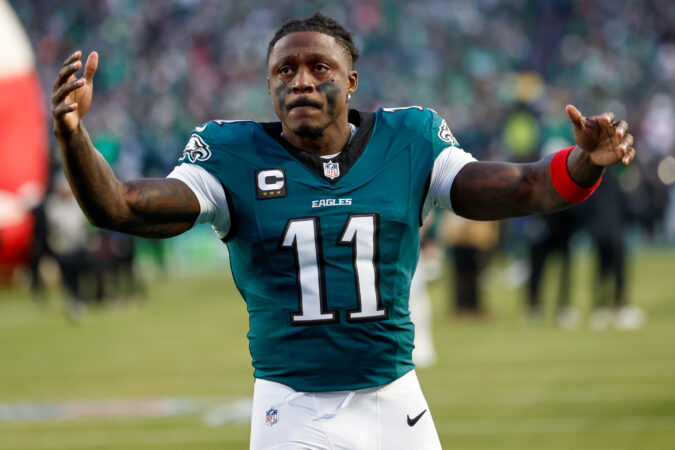
You have to start there. It is the independent variable. You have to define it in order to solve the rest of the equation. You can’t have an opinion on how the Eagles should proceed with their All-Pro wide receiver if you don’t first have an opinion on what they should do without him.
Feel free to take as much time as you need. Just make sure that you don’t dwell too long on the internal options. Right now, there aren’t any.
Aside from DeVonta Smith, the Eagles have exactly two pass-catchers under contract who had a target for them last season. Darius Cooper and Britain Covey combined for 11 catches on 112 yards. Other than that, your options are limited to 2024 sixth-round pick Johnny Wilson, who missed last season with a knee injury. The tight end room doesn’t even have anyone to turn on the lights.
So … what’s the plan?
The draft is not a serious option. Not where the Eagles are picking, at least. Last year’s draft yielded 11 wide receivers and tight ends who played at least 50% of their team’s snaps. Four of those players were selected before pick No. 23. Five others played for the Titans, Browns or Jets. Maybe they’ll be in a position to draft this year’s Emeka Egbuka (No. 19 to the Bucs in 2024). But they could just as easily end up with this year’s Matthew Golden (No. 23 to the Packers). The best way to get yourself in trouble on draft day is to try to solve this year’s problems.
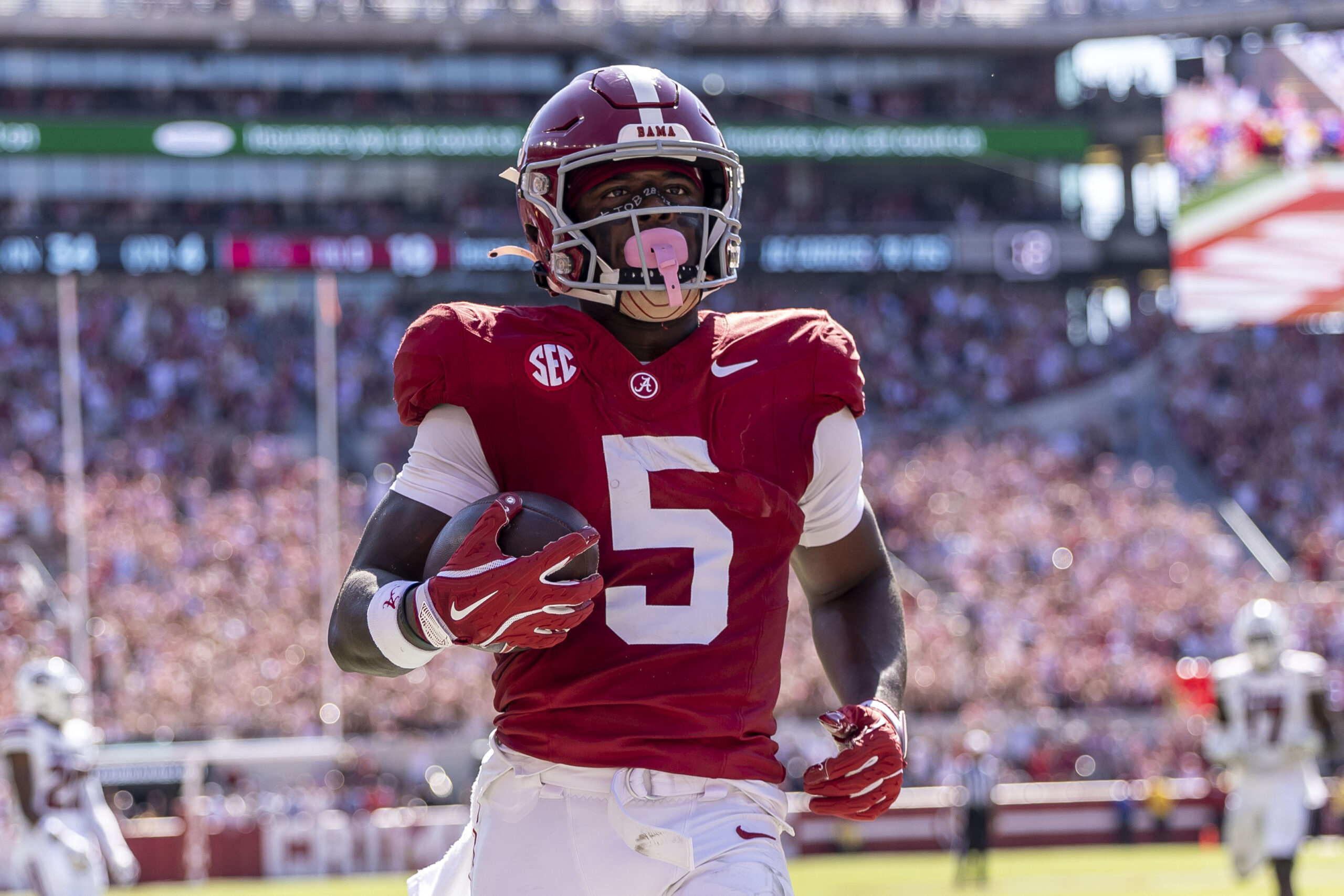
It isn’t outlandish to think Alabama wide receiver Germie Bernard might be capable of what Deebo Samuel did as a rookie when the 49ers drafted him in 2019.
That’s not to say they shouldn’t be looking. Nor that they won’t find some help. Alabama’s Germie Bernard would make a worthy target, even at No. 23. Whatever he measures at the combine, the game speed is there, as is the hybrid 6-foot-1, 204-pound frame. It isn’t outlandish to think he could do what Deebo Samuel did as a rookie after the 49ers drafted him at No. 36 overall in 2019: 57 catches, 802 yards, 14 carries, 159 yards. But to feel comfortable trading Brown, you need a lot more certainty than “isn’t outlandish.”
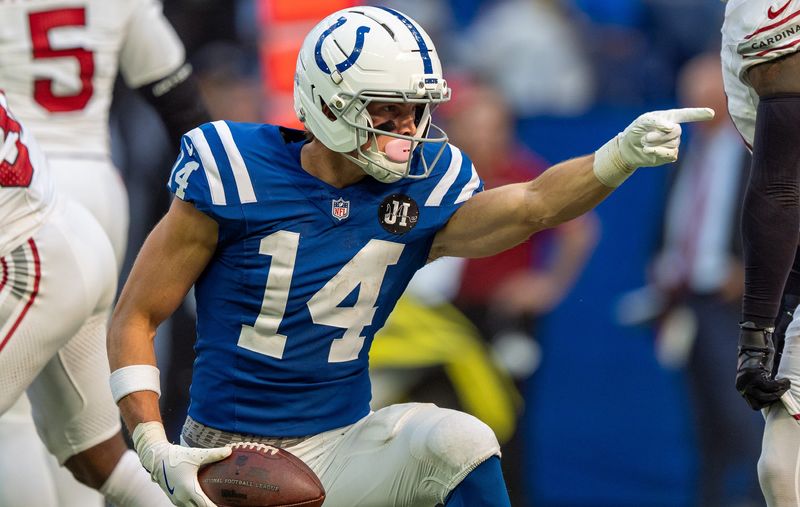
Free agents? Sure, let’s talk. Alec Pierce would be a no-brainer. At 25 years old, the Colts wideout caught 47 passes for 1,003 yards with Daniel Jones, Philip Rivers and Riley Leonard at quarterback. He isn’t anywhere close to Brown as a singular talent. Still, if you combine him with a draft pick like Bernard, he could be part of a radical and positive identity shift in both the short- and long-term.
Only one problem: The Eagles are one of 32 teams that can bid on free agents. A team like the Patriots can offer more cap room and a better quarterback and an acute need at the position. I’m skeptical the Eagles would win out.
The free agent crop is interesting even beyond Pierce and presumptive Cowboys franchisee George Pickens. Jauan Jennings and Mike Evans could replace some of Brown’s physicality in traffic and in 50/50 situations. Again, though, you have to wonder. Will players who have multiple options err on the side of a team with a run-heavy approach and Jalen Hurts at quarterback?
The conundrum is the same as it was three months ago, when the annual pre-trade-deadline nonsense reached its crescendo. The dream that the Eagles might part ways with their WR1 died in a head-first collision with reality. However disgruntled Brown was, however diminished his skills were, nobody else on the roster would have done enough in his stead to survive such a move. To suggest otherwise was to betray a fundamental misunderstanding of how this Eagles passing offense works. It would not have functioned without him.
Colts wide receiver Alec Pierce had his first 1,000-yard season with Daniel Jones, Philip Rivers, and Riley Leonard throwing to him.
True, the Eagles barely functioned with Brown. But that only matters if you think they should have given up on the season at the trade deadline. That’s what they would have been doing by trading Brown. Look at their track record without him. Brown missed four (meaningful) games in his first three seasons with the Eagles. The Eagles lost three of them, and they scored 15 points in the game that they won. In 2025, the Eagles scored 38 points against the Giants without Brown. They also threw the ball 20 times. Smith was the only wide receiver to catch more than one of them.
Plenty of NFL teams have managed to win without two WR1 types. But we’ve never seen Hurts have to do it. Right now, the Eagles don’t even have a WR2 who is better than replacement level. Keep in mind, the Eagles already have a hugely pressing need at tight end. They could need to spend big bucks to retain Jaelan Phillips, or to sign a replacement. In the draft, they will be hard-pressed to turn down an opportunity to add another offensive lineman to their feeder system.
The preponderance of the circumstances says the Eagles probably shouldn’t trade Brown. Life would be a lot easier if they didn’t need to. The onus is on the case for how they can do so and survive. If you can make one, I’m sure they’d love to hear it.
Price: $38,809 as tested. Black dual exhaust added $1,700; Performance Package, $1,500; fancy paint, $475; floor mats, $299.
What others are saying: “Highs: Genuinely rewarding to drive, one of the last manuals available, remarkably affordable. Lows: Noisy cabin on the interstate, we dare you to sit in the back, unexciting exhaust note,” says Car and Driver.
What Toyota is saying: “Level up your drive.”
Reality: Even funner, ‘til you get on the highway.
What’s new: The GR86 gets a new Yuzu Edition for 2026, with yellow paint and black seats. Otherwise it’s pretty much as before, since its redesign in 2022.
Up to speed: The 2.4-liter four-cylinder engine makes 228 horsepower and gets the little sports car to 60 mph in 5.4 seconds, says Car and Driver, and I believe it. I’d think it’s a little faster, but we’ll stick with the facts.
It’s truly a sporty car to drive. It’s fine for passing on Interstate highways and such but it’s really at home on the back roads, racing up hills and back down again.
Shifty: You can get a GR86 with a stick, but Mr. Driver’s Seat didn’t. The six-speed automatic transmission is a nice facsimile, with Park up in the right corner so it looks like it COULD be a stick. I actually spent a couple seconds looking for a clutch until I realized there wasn’t one.
The shifter then snakes through Reverse and Neutral to get to Drive, another bit of stick-shift cosplay.
The manual setting works nicely, and really makes the little car even that much more fun. Use the lever to augment the engine’s power for any country road antics and you’ll feel nicely rewarded.
On the road: Did someone say fun? The rear-drive GR86 has plenty of it, snaking through turns and sliding around corners even at fairly low speeds, so you can feel like it’s a blast even when not going much beyond 40 or 45 mph — although faster is funner.
Less fun is the time spent on the highway; I found myself getting a bit of a headache during half-hour trips on Route 202 between King of Prussia and West Chester.
Off the road, the GR86 is great companion for tight parking lots, thanks to a turning radius of 35 feet and change.
The interior of the Toyota GR86 is snug and retro fun, unless you’re sat in the back. Then it’s snug, retro, and not at all fun.
Driver’s seat: The cloth seats offer great support and are comfortable enough. They feel firm and a little crowded, so some people might not appreciate the big wings. The Lovely Mrs. Passenger Seat found them as nice as I did.
The manual controls adjust height, fore-aft, and backrest simply.
The gauges and steering wheel controls are old-fashioned, looking like last-gen Lexus dials, but I call old-fashioned a good thing these days.
Friends and stuff: There’s a rear seat but it’s pretty cruel. Guests would have been harmed in the making of this review.
I finally build up the nerve to try it out on Day 6. The ceiling is so low that I had to cant my head to the side. Foot room and legroom look impossible, but I could actually get my legs in there by setting the front seat a few notches up from normal. But when I did that and tried out the front, my legs were more cramped than on a Frontier flight.
I would say only put kids in the back. Or maybe kid, singular.
Cargo space is 6.26 cubic feet. (I didn’t round it because you’ll need every .01 cube.) The seat folds (all in one complicated-to-open piece) to create more luggage space.
In and out: In and ouch. It’s way down there and requires a bit of undignified squatting, twisting, ducking, and scooching.
Play some tunes: Sad. Tinny. Sound gets a C grade, probably one of the lowest I’ve ever assigned.
Last-gen controls. You definitely won’t be distracted playing around with the touchscreen, though there is one, because it’s 2026 and I think it’s law now or something.
Keeping warm and cool: The heater controls feature dials for temperature and fan speed and buttons inside the dials for blower choice. It’s such a small car that it runs hot; the seat heaters offer nice support when it’s not too cold out, but the switches are awkwardly built into the armrest.
Fuel economy: I averaged about 26 mpg in spirited drives around Chester County’s old country roads every chance I could get. I would actually park and wait for certain roads to clear and then go make the most of the exhaust note. I guess the dual exhausts are worth $1,700.
Where it’s built: Ota, Gunma, Japan
How it’s built: Consumer Reports predicts the GR86 reliability is a 4 out of 5.
In the end: Definitely lots of joy to be had here, and I could get behind buying a GR86. But with the Mini Cooper and Volkswagen GTI, you get fun and some practicality as well, plus the delight doesn’t diminish at highway speeds.
The new league year is right around the corner, and it’s almost time for the 2026 Eagles roster to start coming into focus.
But first, the annual NFL Scouting Combine.
It’s the next thing on the offseason calendar, and while the focus for much of the week will be on the athletes going through performance testing, when it comes to the Eagles, it should be a big week for news related to the team.
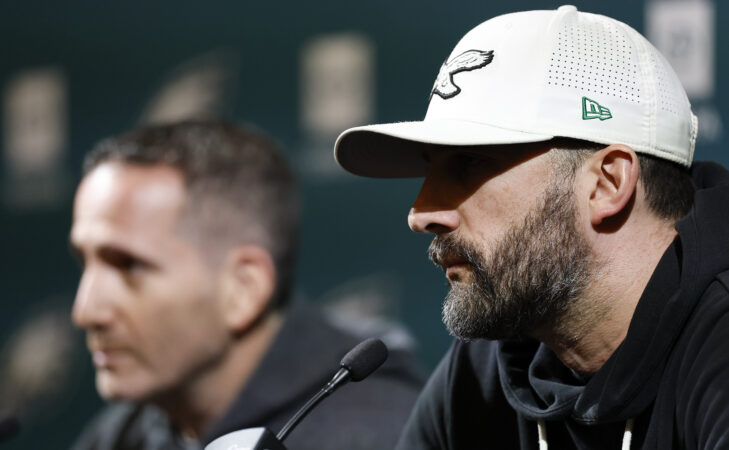
Reporters typically get to talk to Nick Sirianni and Howie Roseman around the combine, and there are certainly plenty of questions to ask this year.
Here’s a look at five of the most pressing Eagles topics the coach and general manager may be addressing soon:
Why did the Eagles choose Sean Mannion, and why did they assemble this staff around him?
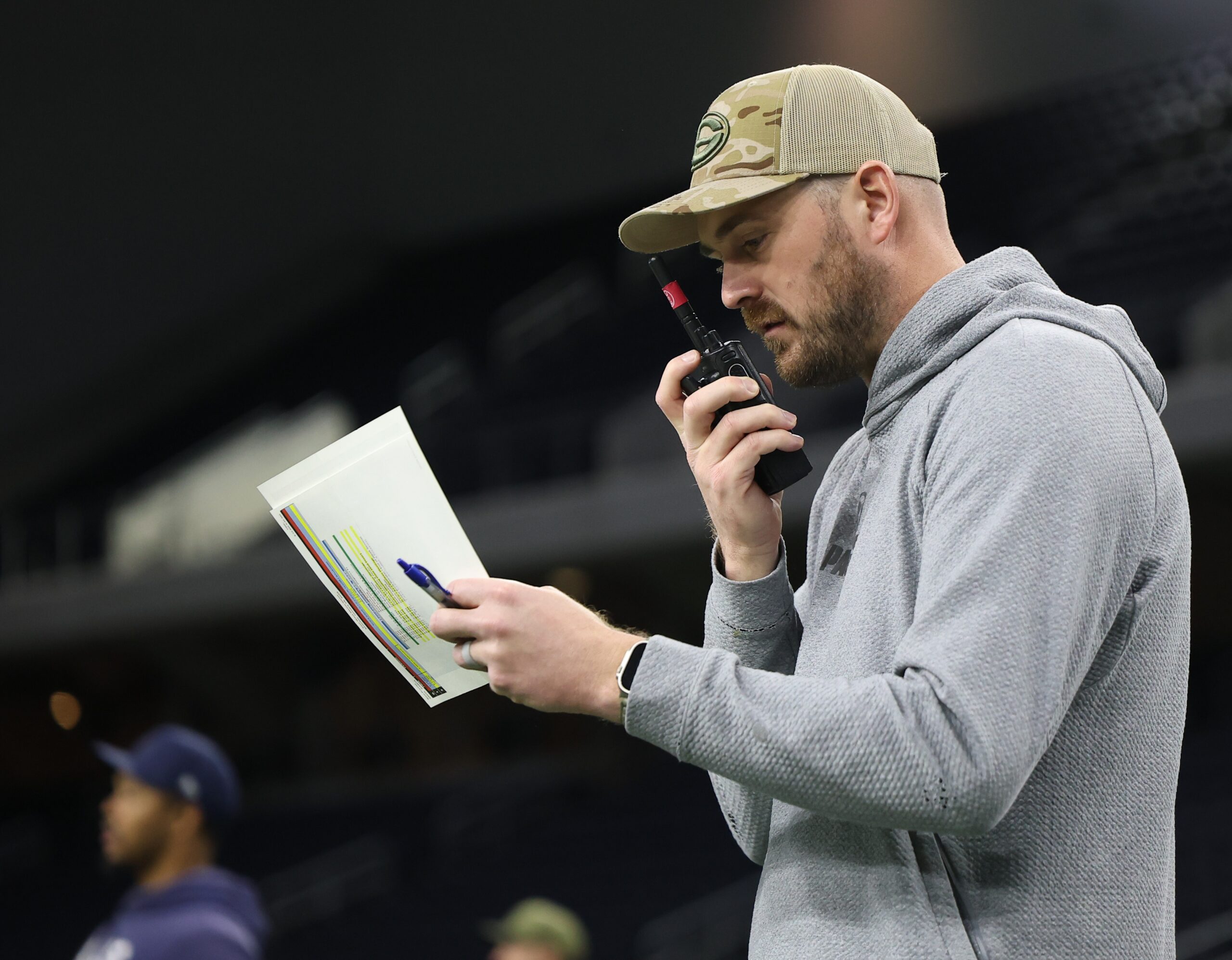
It’s been three weeks since the Eagles filled their vacancy at offensive coordinator by hiring Green Bay Packers quarterbacks coach Sean Mannion, a 33-year-old former quarterback with only two years of coaching experience. But we’ve yet to hear from Sirianni or Roseman, besides an initial statement released by the team, on why the Eagles hired Mannion, what they liked about him, and what hiring him means for the future of the scheme.
In the weeks since, the rest of the offensive coaching staff has been filled out. The Eagles hired one of their other coordinator candidates, former Tampa Bay offensive coordinator Josh Grizzard, as pass game coordinator. They hired Packers wide receivers coach Ryan Mahaffey to be the tight ends coach and run game coordinator. Longtime offensive line coach Jeff Stoutland left the team (more on that later), and he was replaced by Minnesota Vikings offensive line coach Chris Kuper.
The Eagles retained wide receivers coach Aaron Moorehead and running backs coach Jemal Singleton, sources told The Inquirer, and, according to CBS Sports, plan to shift Parks Frazier, last season’s pass game coordinator, to quarterbacks coach.
Sean Mannion will be calling plays for the first time under intense scrutiny in Philadelphia.
The new offensive coaching staff, under a first-year play-caller, is an amalgamation of coaches with different backgrounds. What will it mean for the scheme going forward?
Sirianni said after removing Kevin Patullo that the offense needed to “evolve.” He’ll soon have the chance to explain why and how this group can help it do that.
What happened with Jeff Stoutland?
The longest-tenured coach in the building, who has been widely regarded as the best offensive line coach in the sport, is no longer coaching with the Eagles.
Why?
The Eagles wanted Stoutland back as the offensive line coach, league sources said, but Stoutland, who also held the title of run game coordinator, wasn’t going to be as involved in the running game, and the Eagles are shifting schemes. Change is in the air. But Stoutland’s role in the running game decreased as last season went on, The Inquirer’s Jeff McLane reported recently on the unCovering the Birds podcast.
How did it get to this, and how much of an impact will his departure have on the offensive line moving forward?
Don’t expect Roseman to say anything that strays too far from his normal line when it comes to A.J. Brown and players like him.
Here’s what Roseman said at the end-of-year news conference on Jan. 15 when asked if he was open to trading Brown or if trading him was a nonstarter: “It is hard to find great players in the NFL, and A.J.’s a great player. I think from my perspective, that’s what we’re going out and looking for when we go out here in free agency and in the draft is trying to find great players who love football, and he’s that guy. I think that would be my answer.”
Still, Roseman likely will be asked about the star receiver’s future in Philadelphia in the coming days. It’s for good reason. Brown, of course, hasn’t been shy about his frustrations with the direction of the offense. But during Super Bowl week, Brown appeared on Micah Parsons’ podcast and spoke about his excitement for the future and the new offensive coaching staff. “Sometimes change is not a bad thing,” he said. He also called Philadelphia “home.”
Does wide receiver A.J. Brown have enough love for Philadelphia to remain an Eagle?
While he didn’t sound like someone who was about to ask for a trade, it’s still early in the offseason.
Brown’s future with the team impacts how the Eagles approach the draft and free agency, so a decision on whether the Eagles see him in their immediate plans probably is already made. It’s complicated, however, because of the salary cap implications. The cost to trade Brown before June 1 would be $48.939 million, according to Over the Cap. If the Eagles traded him after that, they would incur a dead cap charge of $22.09 million. Much more palatable, but still a lot of dead money.
It begs the question, too: Could the Eagles ever get good value in a trade for Brown?
Roseman probably won’t be showing his cards in the coming days, but it’s a topic he’ll have to address.
How much has the future outlook of the offensive line changed, and how will it impact the plans?
The offensive line took a big step back in 2025 thanks to a slew of injuries. Lane Johnson missed half the season. Landon Dickerson was never fully healthy and may never be again. Cam Jurgens played through back pain.
At the time of Stoutland’s departure, it wasn’t even a sure thing that Johnson and Dickerson would be back for the 2026 season. A unit that basically was plug-and-play has turned into a big question mark for the Eagles. How much longer will Johnson and Dickerson play? (Editor’s note: Johnson announced his return for 2026 on Thursday.)
Eagles offensive tackle Lane Johnson’s health and future were in doubt before he announced his return on Thursday.
Jurgens, meanwhile, shared a video this week on social media of him in Colombia undergoing stem cell treatments. Jurgens, via his agent, declined to comment further on what led him to go that route or how he is feeling. The center had back surgery after the Super Bowl last year and did not play to his 2024 level this past season.
This impacts how the Eagles approach the draft and free agency. They’re due to get an eventual replacement for Johnson in the door, but they now need to think about the future of the interior.
Who stays, who goes, and who could get extended or restructured?
It soon will be time for the Eagles to go shopping on the free agency market, but there are some players on the current roster in line to have their contracts extended or possibly restructured.
Let’s start with Jordan Davis, who broke out in 2025 and earned himself a new contract. The Eagles picked up Davis’ fifth-year option last year, but signing him to a new deal is almost too obvious because it would free up much-needed cap space for 2026.
Will defensive tackle Jordan Davis be first in line for a contract extension after a breakout season?
There’s also Jalen Hurts, whose cap number jumps from nearly $22 million in 2025 to nearly $32 million in 2026. It will be more than $42 million in 2027, more than $47 million in 2028, and a whopping $97.5 million in 2029. But Hurts has no guaranteed money beyond this season. A restructure or extension could be on the table sooner than later.
What about the free agents? Jaelan Phillips, for example, is one of the best edge rushers on the market, and the Eagles need some of those. Safety Reed Blankenship is slated to hit the market, and the Eagles need a safety.
Roseman may not tip his hand, but he’ll certainly be asked about all of it with free agency just a few weeks away.