2026 Audi S3 Prestige vs. 2026 BMW 228i xDrive Gran Coupe: Battle of the little racers.
This week: BMW 228i
Price: Starts at $41,600 for both the 2025 and 2026 model years. Advantage, BMW.
Conventional wisdom:Car and Driver liked the “Refined balance of ride and handling, eager powertrains, purposeful near minimalist interior design and materials,” but not the “compromised cargo and rear passenger space,” and that the “front and rear fasciae appear a bit forced on otherwise sleek bodywork.“
Marketer’s pitch: “Strikingly sporty.”
Reality: “Striking.” I was afraid of striking things as I tried to make simple adjustments.
Catching up: Last week Mr. Driver’s Seat enjoyed the Audi S3 — until he landed on the highway, or tried to squeeze in some luggage.
What’s new: The 2 Series received more horsepower and a new look for 2025, and carries on pretty much unchanged for 2026.
Competition: In addition to the S3, there are the Acura Integra, Cadillac CT4, and Mercedes-Benz CLA.
Up to speed: The 2 Series’ speed would be the first question mark. The 2.0-liter TwinPower turbo provides 241 horsepower, almost 100 fewer than last week’s Audi S3; would it keep up?
Yet the version tested gets to 60 mph in 5.1 seconds, according to Car and Driver, just 0.7 seconds slower than the S3. A more souped-up model with a 3-liter six-cylinder engine gets there in just 3.6 seconds.
Shifty: The seven-speed dual-clutch transmission is super smooth, worlds above any attempt from Kia or some other inexpensive offerings.
The slider PRND operator looks cool but doesn’t offer much feel or add any usable space. Shift via the steering wheel paddles.
On the road: Handling is quite nice, perhaps in part because of the M Sport Package, which adds adaptive suspension along with other decals and stuff, plus the aforementioned dual-clutch.
In the first of several “improvements” designed to make the interior feel more high tech, Sport mode requires finding the button on the console touch pad (no solid way to feel your way to it) and then pressing the large icon on the screen. So there’s two instances you’re looking away from the road while trying to operate the vehicle.
But at least compared to last week’s Audi S3, the BMW doesn’t rattle your brain on the highways at all.
The cockpit of the 2025 BMW 2 Series looks as inviting as ever but operation does not live up to expectations.
Driver’s Seat: The sport seats that come with the M Sport package are supportive and comfortable, and I never adjusted it beyond forward and backward. No annoying lumbar or grippy seat corners.
The materials all feel upscale, an improvement over the X2 SUV I tested this year. Everything about that small SUV felt cheap and plasticky.
The materials seem especially scuff prone, though. I brushed out the carpet and seats when I was done with my loan and it seemed the bristles and the plastic handle left marks on the seat and in the plastic door frame bottom. Be sure this fabric fits your lifestyle.
Friends and stuff: Sturgis Kid 4.0 laughed at how tight the rear seat was. He sat stretched into the middle just to make it workable.
He’s not wrong. My own head was squashed up against the ceiling in the corner, although foot room and legroom were pretty good. Entry and exit are challenging because the door is narrow and the seat actually sits up kind of high (not something I expected to write in this review). The middle seat is compromised by the hump and the console and the corner people trying to find a place for their heads.
Cargo space is 13.8 cubic feet, far higher than the S3.
Play some tunes: Sound from the Harman Kardon system might be better than I heard, but I could never find the audio tuning adjustment when I had CarPlay activated. It would only show up in the touchscreen when I left CarPlay off, so it was difficult to make the most of my favorite songs. B-, because why make it so hard?
BMWs once had a superb dial and button system for operating the infotainment, and some models still have it. It takes a bit of practice but you can really run it by feel after a while. Now it’s all about the touchscreen, with a roller dial on the console for volume.
Keeping warm and cool: The temperature controls appear as small +/- adjustments at the corners of the touchscreen. There’s no way to feel for them, and your eyes are off the road while you adjust.
But wait! There’s more! To make further HVAC adjustments, click on the tiny fan icon between them to open up all the controls. These are fairly clear, but I’ve already looked at the screen and away from the road twice now, just to cool off (or warm up).
Fuel economy: I neglected to note the fuel economy. (Hangs head in shame, then blames BMW for the confusion.) The window sticker says 30 mpg combined, but that seems optimistic.
Where it’s built: Leipzig, Germany. Germany is the source of 24% of the car’s parts. None of it comes from the United States or Canada.
How it’s built:Consumer Reports gives the 2 Series Gran Coupe a predicted reliability rating of 3 out of 5.
In the end: The 228i was definitely fun to drive, but too many drawbacks made me long for the real delight of the S3. Just pack ibuprofen for the highways.
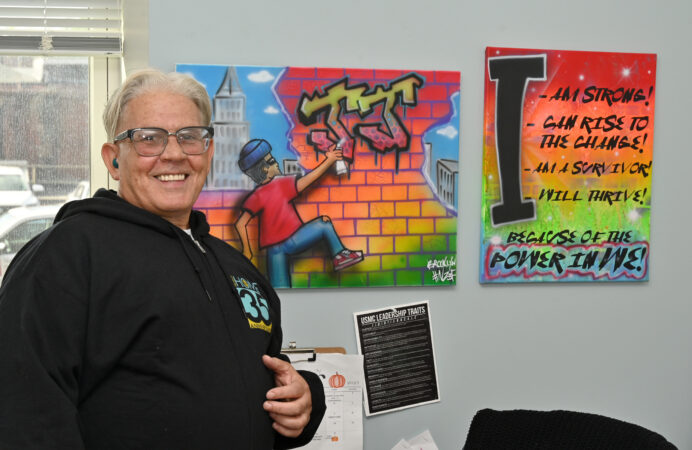
As charming and ebullient as Nephtali Andujar is (lots of hugs, compliments, and gifts of his homemade pottery), the 61-year-old is also pretty blunt about why people should give to Project HOME, one of the city’s largest nonprofit housing agencies.
Because of Project HOME, said Andujar, who spent years living on the streets, he is no longer desperate — desperate to get money to feed a heroin addiction, desperate to scrape $5 together to pay someone to let him drag a discarded mattress into an abandoned house for a night’s sleep out of the rain.
“It’s not just giving someone an apartment,” said Andujar, who sheepishly described a past that included stealing cars and selling drugs. “It’s the snowball effect.
“You are not just helping the homeless,” he said. “You are helping the city. You are helping humanity.”
In the agency’s name, the letters HOME are capitalized, because each letter stands for part of the multipronged approach that Project HOME takes in addressing homelessness and combating poverty for the 15,000-plus people it serves each year.
There’s H, for Housing — not only housing in the literal sense, but also in the teams of outreach workers who comb through the city’s neighborhoods looking for people like Andujar. One outreach worker found Andujar in 2021 at a critical moment in his life — clean, just out of the hospital for liver treatment, and back on the streets of Kensington ready to begin anew.
“We know we have to do the most we can to preserve these resources that we’ve come to rely on,” says Donna Bullock, president and CEO of Project Home.
For Andujar, it was a race. What would find him first?
Would it be heroin, as it had so often been in the past? It was tempting. It’s painful being on the street — cold, hungry and dirty, ashamed and alone. “When you do heroin, you don’t feel the cold. It kills the hunger,” he said. “When you use the drugs, you don’t have to suffer for hours. Heroin numbs you.”
Instead, though, it was the outreach worker — someone who had been through Project HOME’s recovery program — who plucked Andujar off the street in the nick of time and took him to a shelter.
A year later, that same outreach worker helped Andujar move to his own room at Project HOME’s Hope Haven shelter in North Philadelphia.
“You get tired of the streets. They were killing me,” Andujar said.
Next Andujar found Project HOME manager JJ Fox, who helped him get a birth certificate and other documents, and arranged for him to stay. But he needed more than a warm bed.
The problem with getting straight after a heroin addiction, Andujar explained, is finding a new purpose and direction. For so long, life was focused on a repeat cycle of getting the next fix and then becoming numb to pain while it was working.
So when he got to Project HOME, he needed a new direction, which is where both the O and E in HOME came in for Andujar.
“JJ Fox gave me direction,” he said, and so did Project HOME employment specialist Jamie Deni.
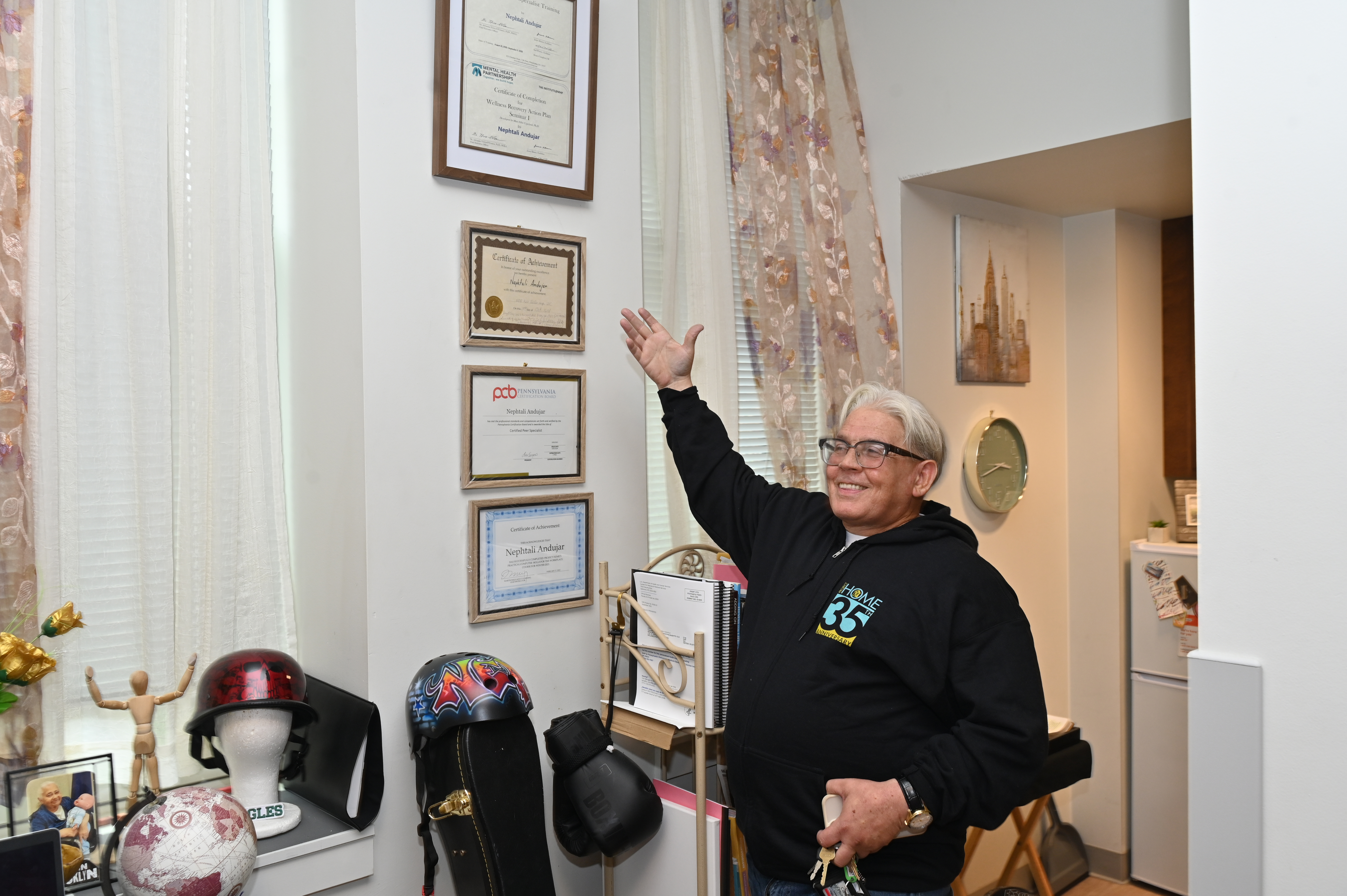
Training certificates cover a wall in Nephtali Andujar’s studio apartment in Project HOME’s Inn of Amazing Mercy in Kensington.
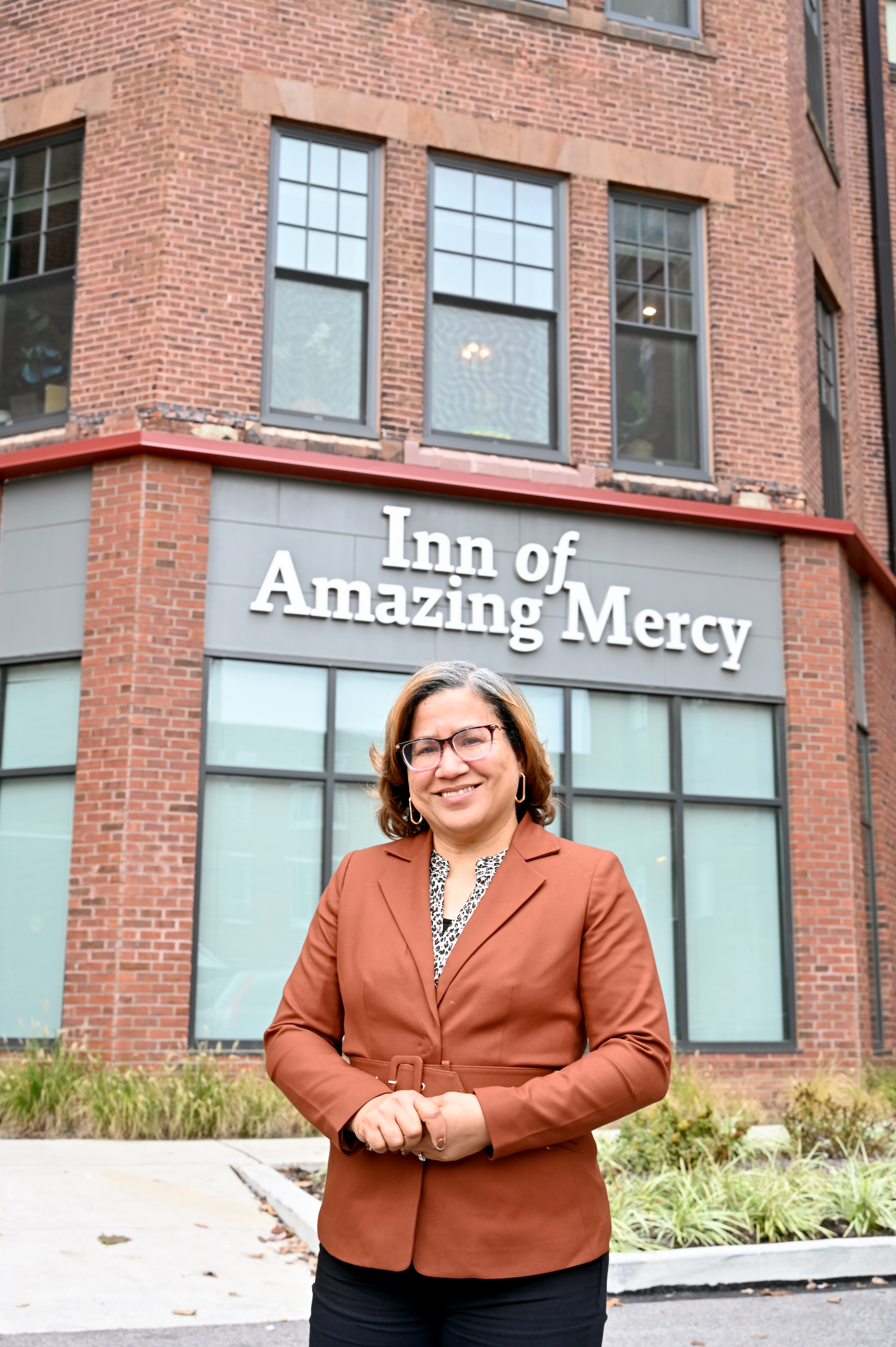
The “O” in HOME has to do with Opportunities for employment. Certificates cover one wall in Andujar’s studio apartment in Project HOME’s Inn of Amazing Mercy, a 62-unit apartment building and offices in a former nursing school dormitory in Kensington. He can point to his accomplishments in computer skills, barbering, and training as a peer specialist to help others the way the outreach worker helped him.
But Andujar is not in good health, as vigorous as he appears. His addictions will someday exact their price, even though with cirrhosis of the liver, he is already living years beyond what his doctor predicted.
Full-time work is not an option. So Andujar is part of the “E,” as in Education. Deni helped him get a grant to take art classes at Community College of Philadelphia. She helped him understand CCP’s education software so he could turn in his homework.
Project HOME offers classes in graphic design, music production training, ServSafe food handling, forklift and powered industrial trucks certification, and website building, among other courses.
The M stands for Medical. Project HOME doctors, nurses, and other health practitioners treat 5,000 people a year, both in a fully equipped health center and by sending medical teams into the streets, caring for people, literally, where they live.
“My dad always told me that you need three things — housing, food, and love. You get all that here,” Andujar said.
And for him, it goes beyond that. During a stable period in his life, Andujar had a partner and a child. His daughter is now 14 and living with her aunt in New Jersey. Her mother, who was also stable for many years, fell into addiction but is clean now. She is living in another Project HOME apartment.
Like Andujar, Omayru Villanueva, 49, another resident at the Inn of Amazing Mercy, recalls her first night of homelessness.
She remembered a cold slushy rain.
She remembered sweeping every corner of her house, determined to leave it clean, no matter what. Her husband had been convicted and jailed for a federal crime. She couldn’t make the payments on the house, so she sold or stored all of her belongings and prepared to leave.
On her last morning at home, she and her school-age twin sons walked out the door before the sheriff came. Her older daughter was able to find a place in a shelter. Her second daughter, just under 18, said she was living with a boyfriend, but it turned out that she had been trafficked.
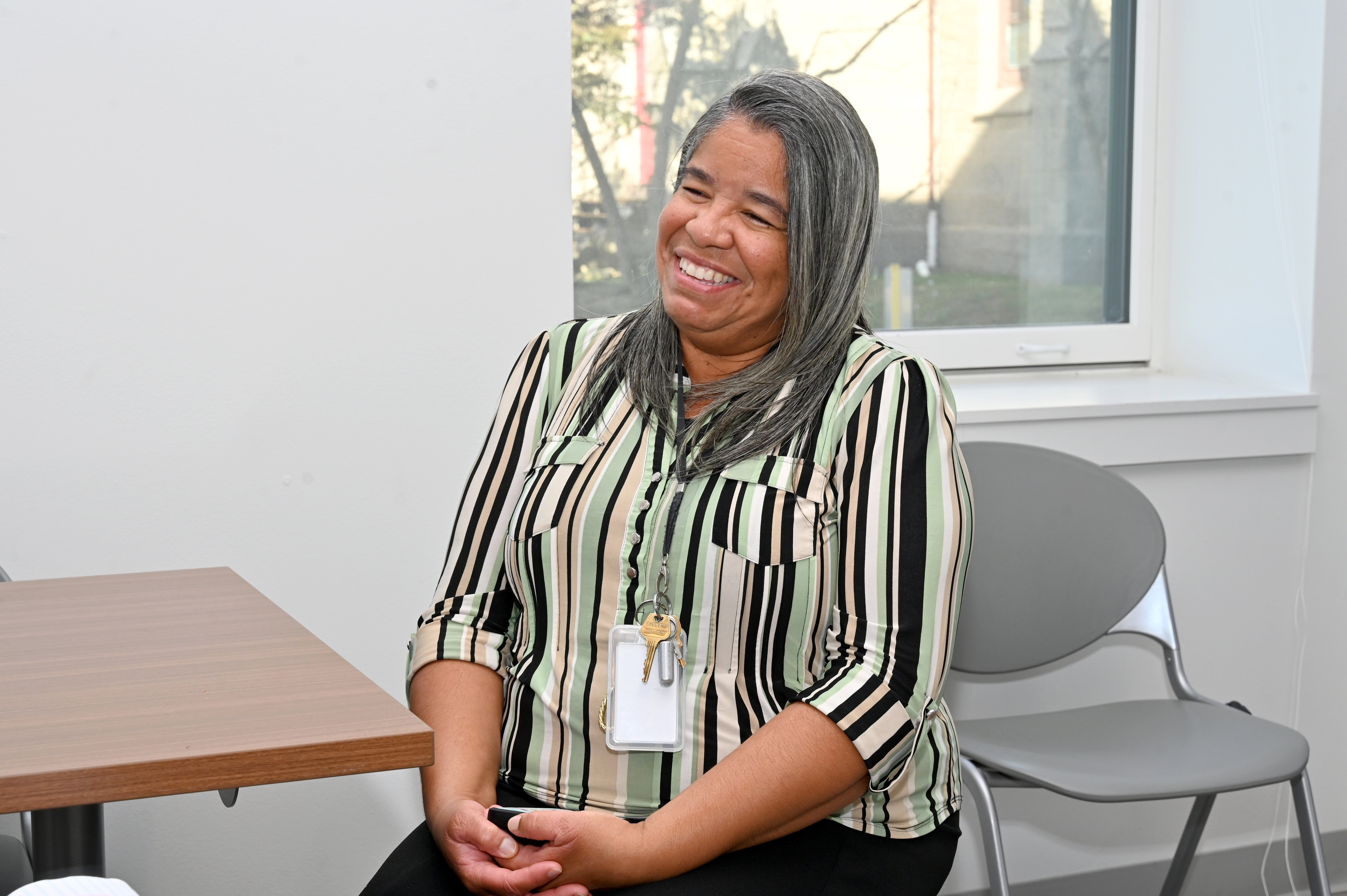
“There’s a sense of dignity and respect when you have your own place,” says Omayra Villanueva, another resident of the Inn of Amazing Mercy.
By that evening, Villanueva was desperate. She took her boys to a hospital emergency room. At least they could sit indoors while she figured out something. “I was crying inside.” Finally, she called a friend from church who took her and her sons in.
From there, they moved from shelter to shelter, and ultimately to a Project HOME apartment with two bedrooms.
“That night we had a pizza party. We were so happy,” she said. “There’s a sense of dignity and respect when you have your own place. You can take your worries away from having a place to live, and you can focus on other things.”
She remembered lying in her new bed, “thanking God and rubbing my feet against the mattress.” The next day, she woke up, opened the window, and listened to the birds. Then she asked her sons what they wanted for breakfast. “When you are in a shelter, you eat what they give you.”
Three of her four children, scarred from the experience, have also been homeless and living on the street. Her two sons, now 23, are in Project HOME apartments. Both daughters are now fairly well-established.
Villanueva appreciates the medical help she has been given at Project HOME, particularly for mental illness stemming from the trauma she has experienced with her ex-husband’s arrest and homelessness.
“Anybody can end up being homeless,” she said. “I wasn’t a drug addict. I wasn’t an alcoholic. It can happen to anybody.”
She thinks of her daughter, who has a house, a job, and a car. But if something happens to the car, her daughter won’t be able to get to work. She won’t be able to pay her mortgage, and she could wind up homeless. It’s that simple.
“It’s important to donate because people can help break the cycle of homelessness,” Villanueva said.
“It’s about housing and education. It’s about medical help. It’s about employment,” she said. “Project HOME helped me a lot.”
The truth is that every person in Project HOME has a story. Those stories keep Donna Bullock, president and chief executive, motivated to preserve and protect the agency founded just over 35 years ago by Sister Mary Scullion and Joan Dawson McConnon.
She worries about how the city will respond to federal executive orders amounting to the criminalization of homelessness. Will there be tightened requirements for agencies that provide shelter?
Project HOME is reimbursed for some of the medical care it provides, but Bullock worries that new rules involving Medicaid reimbursement will impact the agency’s budget, while cutbacks in services increase demand.
“It’s terrifying,” she said. “We know we have to do the most we can to preserve these resources that we’ve come to rely on.
“In this job, I’ve learned to appreciate the humanity of folks — the residents and the stories they tell and the contributions they make to our community.”
Sometimes, she said, Project HOME residents walking the path of recovery slip and fall away. Sometimes the results are tragic, the losses devastating.
“We’re experiencing all these moments — communal grief and communal celebrations as well. We talk a lot about how every journey of recovery is unique. Everyone walks their own journey. We can’t do the walk for you, but we can walk with you,” she said.
Bullock invites others to the journey, promising that when people give to Project HOME, they can be assured that their money is carefully managed. “We’re good stewards of the resources entrusted in our care. We know how to leverage the resources given to us.
“Folks expect a return on their investment, and the return is the difference in individual lives and also building a community,” she said. “Your investment is magnified 10 times over.”
This article is part of a series about Philly Gives — a community fund to support nonprofits through end-of-year giving. To learn more about Philly Gives, including how to donate, visit phillygives.org.
For more information about Philly Gives, including how to donate, visit phillygives.org.
About Project HOME
Mission: To empower adults, children, and families to break the cycle of homelessness and poverty, to alleviate the underlying causes of poverty, and to enable all of us to attain our fullest potential.
People served: More than 15,000 annually — with street outreach, housing, opportunities for employment, medical care, and education.
Annual spend: $49.06 million
Point of pride: Project HOME, which operates 1,038 housing units, broke ground in October for construction of 45 new apartments; also under construction are 20 respite beds. In the pipeline are an additional 44 apartments. Project HOME also operates the Honickman Learning Center Comcast Technology Labs, Stephen Klein Wellness Center, Helen Brown Community Center, and Hub of Hope.
You can help: Volunteers tutor students, serve meals, participate in neighborhood cleanups, and organize donation drives at their organizations for household items or other items useful to families or people still experiencing street homelessness.
Here are some ways that a gift can help the people we serve:
$25 provides warm clothing and new socks for a visitor at the Hub of Hope.
$50 supports a behavioral health counseling visit.
$100 provides a month’s worth of hygiene products and toiletries for a family.
$250 provides a welcome basket for a new resident complete with sheets, towels, and cooking supplies.
$500 supports five dental visits at the Stephen Klein Wellness Center.
$1,000 funds six weeks of summer camp at the Honickman Learning Center Comcast Technology Labs, keeping a child’s mind active during the summer and supporting moms who work.
$1,500 funds a certification program through the Adult Education and Employment program leading to employment readiness.
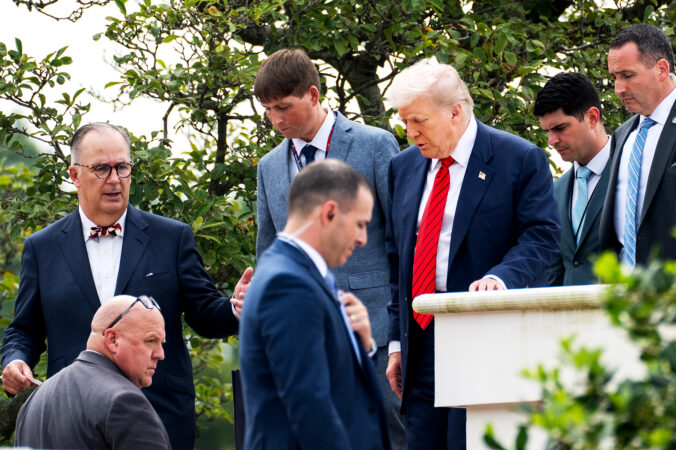
President Donald Trump has argued with the architect he handpicked to design a White House ballroom over the size of the project, reflecting a conflict between architectural norms and Trump’s grandiose aesthetic, according to four people who spoke on the condition of anonymity to describe internal conversations.
Trump’s desire to go big with the project has put him at odds with architect James McCrery II, the people said, who has counseled restraint over concerns the planned 90,000-square-foot addition could dwarf the 55,000-square-foot mansion in violation of a general architectural rule: don’t build an addition that overshadows the main building.
A White House official acknowledged the two have disagreed but would not say why or elaborate on the tensions, characterizing Trump and McCrery’s conversations about the ballroom as “constructive dialogue.”
“As with any building, there is a conversation between the principal and the architect,” said the official, who spoke on the condition of anonymity to discuss private conversations. “All parties are excited to execute on the president’s vision on what will be the greatest addition to the White House since the Oval Office.”
McCrery declined an interview request through a representative who declined to answer questions about the architect’s interactions with Trump in recent weeks.
Trump’s intense focus on the project and insistence on realizing his vision over the objections of his own hire, historic preservationists and others concerned by a lack of public input in the project reflect his singular belief in himself as a tastemaker and obsessive attention to details. In the first 10 months of his second term, Trump has waged a campaign to remake the White House in his gilded aesthetic and done so unilaterally – using a who’s-going-to-stop-me ethos he honed for decades as a developer.
Multiple administration officials have acknowledged that Trump has at times veered into micromanagement of the ballroom project, holding frequent meetings about its design and materials. A model of the ballroom has also become a regular fixture in the Oval Office.
The renovation represents one of the largest changes to the White House in its 233-year history, and has yet to undergo any formal public review. The administration has not publicly provided key details about the building, such as its planned height. The 90,000-square-foot structure also is expected to host a suite of offices previously located in the East Wing. The White House has also declined to specify its plans for an emergency bunker that was located below the East Wing, citing matters of national security.
On recent weekdays, a bustling project site that is almost entirely fenced off from public view contained dozens of workers and materials ready to be installed, including reinforced concrete pipes and an array of cranes, drills, pile drivers and other heavy machinery, photos obtained by The WashingtonPost show.
Plans for the addition as of Tuesday had not been submitted to the National Capital Planning Commission, a 12-member board charged by Congress with overseeing federal construction projects and now led by Trump allies. A preliminary agenda for the commission’s next meeting, scheduled for Dec. 4, does not include the ballroom project under projects expected to be covered at the meeting or reviewed by the body in the next six months. White House officials say that the administration still plans to submit its ballroom plans to the commission at “the appropriate time.”
The administration’s rapid demolition of the East Wing annex and solicitations from companies and individuals to fund the new construction have caused controversy over the project, which Trump believes the White House needs to host special events. Democrats, historical preservation groups and some architects have criticized the project’s pace, secrecy and shifting specifications. The White House initially said this summer that the ballroom would cost $200 million and fit 650 people, while Trump in recent weeks asserted that it could cost $300 million or more and would fit about 1,000 people.
McCrery has kept his criticism out of the public eye, quietly working to deliver as Trump demanded rushed revisions to his plans, according to two of the people with knowledge of the conversations. The president – a longtime real estate executive who prides himself on his expertise – has repeatedly drilled into the details of the project in their Oval Office meetings, the people said.
McCrery has wanted to remain with the project, worried that another architect would design an inferior building, according to a person with knowledge of his thinking.
McCrery, a classical architect and the founder and principal of McCrery Architects, had designed works like the U.S. Supreme Court bookstore and the pedestal for President Ronald Reagan’s statue in the U.S. Capitol. The ballroom was the largest-ever project for his firm, which has specialized in designing churches, libraries and homes.
Trump hired McCrery for the project on July 13. Eighteen days later, the White House announced the ballroom project, with officials promising to start construction within two months and finish before the end of Trump’s second term.
Trump also appointed McCrery in 2019 to serve a four-year term on the U.S. Commission of Fine Arts, which provides advice to the president, Congress and local government officials on design matters related to construction projects in the capital region.
Democrats have pressed the White House and its donors for more details on the planned construction and what was promised to financial contributors. The ballroom is being funded by wealthy individuals and large companies that have contracts with the federal government, including Amazon, Lockheed Martin and Palantir Technologies. (Amazon founder Jeff Bezos owns The Post.)
Several donors have cast the decision in statements as an investment in the future of a building that belongs to the American people, pushing back on the suggestion that their largesse sought to curry favor with Trump.
A donor list released by the White House of 37 businesses and individuals who underwrote the ballroom is not comprehensive, administration officials acknowledged, leaving open the possibility that millions of dollars have been funneled toward the president’s pet project with no oversight.
“Billionaires and giant corporations with business in front of this administration are lining up to dump millions into Trump’s new ballroom – and Trump is showing them where to sign on the dotted line,” Sen. Elizabeth Warren (D-Massachusetts) said in a statement last week. Warren andhercolleagues also introduced legislation that would impose restrictions on White House construction and require more transparency from donors.
The holiday season is officially upon us and with it, a slew offestive events. From Santa sightings to a cocoa crawl, here’s how and where to celebrate in and around Media.
Linvilla Orchards will transform for the holidays, complete with a Winter Makers Market on most Fridays, Saturdays, and Sundays throughout December. There will also be ice skating, live music, and visits with Santa. Plus, you can cut your own Christmas tree.
⏰ Through Sunday, Dec. 21, times vary 💵 Pay as you go 📍Linvilla Orchards, 137 W. Knowlton Rd., Media
Holiday Tree Lighting at the Promenade at Granite Run
See the tree lit and explore area small businesses, which will have tables set up for the occasion.
⏰ Saturday, Nov. 29, 5-6 p.m. 💵 Free 📍Promenade at Granite Run, 1067 W. Baltimore Pike, Media
Get into the holiday spirit with a free block party at Veterans Square, where attendees are asked to contribute goods to the Media Food Bank or an unwrapped gift for Toys for Tots. There will be a holiday costume contest at 4 p.m., followed by a fun run and walk at 4:15 p.m. Festivities conclude with Santa parading along State and Front Streets, complete with mummers, musicians, classic cars, and fire trucks.
⏰ Sunday, Nov. 30, 2:30-7 p.m. 💵 Free, donations to Media Food Bank or Toys for Tots encouraged 📍Downtown Media
The Festival of Lights returns to Rose Tree County Park.
Marking its 50th anniversary this year, the festival will be open nightly for a month, with food trucks, vendors, and live entertainment on Dec. 4, 6, 7, 13, and 14. The tree lighting takes place Dec. 4 at 5 p.m.
⏰ Thursday, Dec. 4-Saturday, Jan. 3 💵 Pay as you go 📍Rose Tree County Park, 1671 N. Providence Rd., Media
This annual tradition returns with an all-day celebration that includes the Reindeer Dash one-mile walk and run at 11:30 a.m. Participants are encouraged to dress for the season. From noon to 4:30 p.m., the Winter Village will take over the borough parking lot, complete with a pub, food vendors, and crafts. There will also be a Kwanzaa celebration, trolley rides, and caroling, capped by a fire truck parade with Santa that ends with the town’s tree lighting.
⏰ Saturday, Dec. 6, 9 a.m.-9 p.m. 💵 Pay as you go 📍 Swarthmore town center
Love holiday cookies but don’t love baking? Or just want to sample an array of treats? This annual event lets attendees pick and pay for the homemade cookies they want.
⏰ Saturday, Dec. 13, 9 a.m. 💵 Pay as you go 📍Middletown Church, 273 S. Old Middletown Rd., Media
Kate Brennan puts a modern twist on A Christmas Carol with this show centered on a woman who gets trapped in her apartment on Christmas Eve and ends up assessing how technology and devices both connect and disconnect us.
⏰ Thursday, Dec. 18, 12:30 p.m., and Friday, Dec. 19, 7 p.m. 💵 $21 📍Park Avenue Community Center, 129 Park Ave., Swarthmore
This tribute to Frankie Valli and the Four Seasons features classic hits and festive tunes, as well as audience participation.
⏰ Saturday, Dec. 21, 7 p.m. 💵 $41 📍The Media Theatre, 104 E. State St., Media
This suburban content is produced with support from the Leslie Miller and Richard Worley Foundation and The Lenfest Institute for Journalism. Editorial content is created independently of the project donors. Gifts to support The Inquirer’s high-impact journalism can be made at inquirer.com/donate. A list of Lenfest Institute donors can be found at lenfestinstitute.org/supporters.
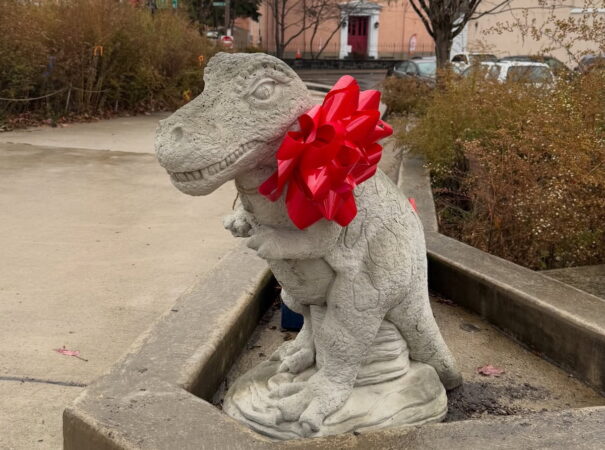
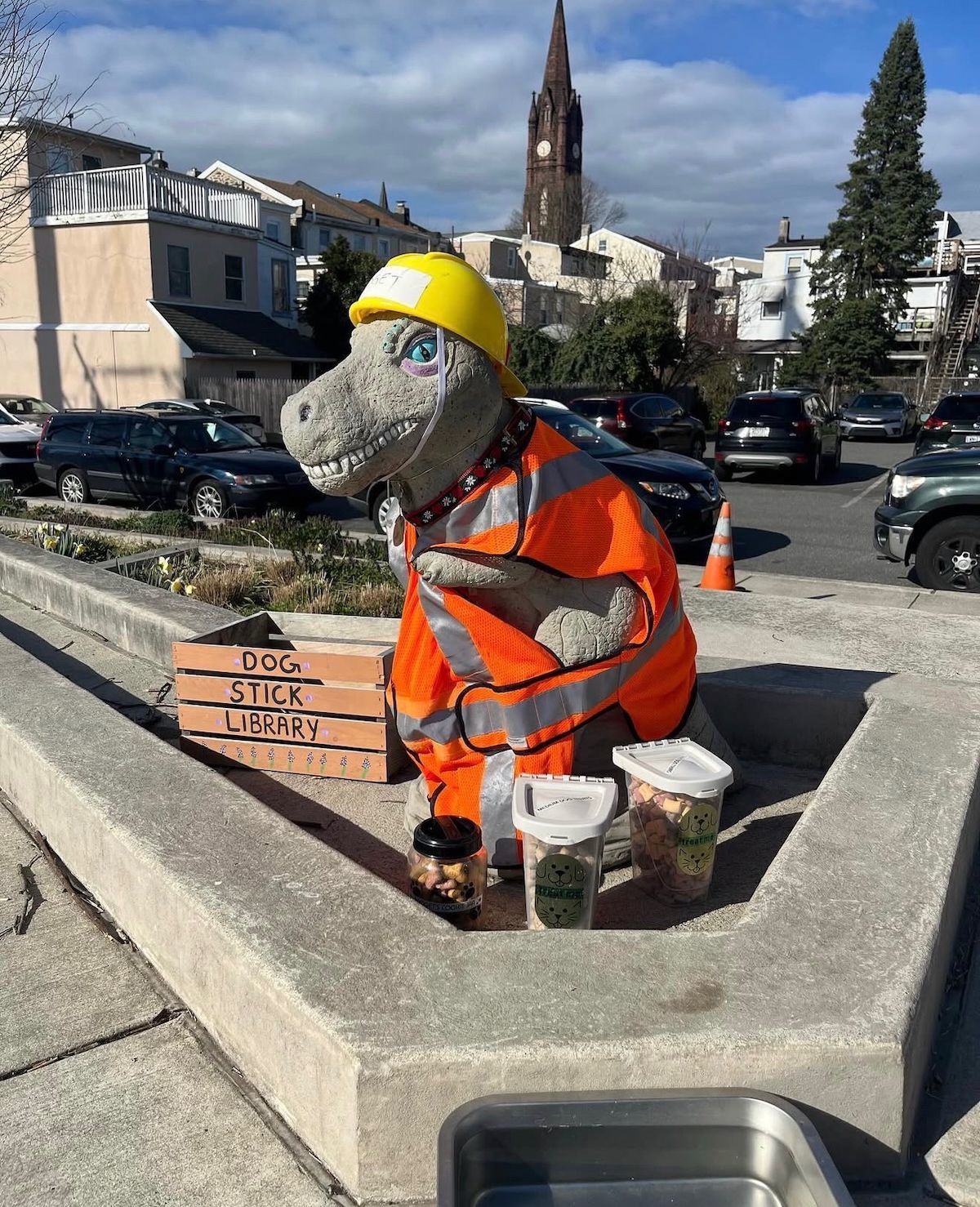
Bridget the Dino was a symbol for the neighborhood’s green spaces and neighborly affection, who oversaw the Manayunk Bridge Trail gardens.
When all hope was lost, the original owners of Bridget, and other neighborhood dinosaurs that have become a staple to Roxborough and Manayunk, saved the day.
Holod’s, the Lafayette Hill home and garden store, donated a brand new stone dinosaur to the Manayunk gardens at Dupont and High Streets, taking over Bridget’s yearslong watch as the garden guardian.
“After the heartbreak of seeing Bridget damaged, this unexpected act of kindness means more than words can say. The neighborhood love is real, and this Dino is already feeling it,” park organizers announced on Tuesday.
Now that the difficult task of placing a new 300-pound stone garden dinosaur is complete, the fun part comes: choosing a name for the new dino. When park organizers learned they would be getting a brand new dino, they decided they couldn’t just name the new statue Bridget, as she is “irreplaceable,” said park volunteer and Roxborough resident Juliane Holz.
“The community is so much a part of this that they can help us name this new one,” Holz said. “I like Manny. But we also have to decide whether she is a girl or a boy dino. I do like ‘Holly’ for Holod’s.”
Park organizers have already posted a list of suggested names for the new statue. This reporter is partial to “Yunker.”
Potential dinosaur names:
Manny (for Manayunk)
Archie (for the arch of the bridge)
Roxie (for the Roxborough side)
Schuylie (for the Schuylkill)
Ivy (garden vibes)
Rocky (Philly and Roxborough)
Ledger (bridge and connection vibes)
Petra (means “rock”)
Yunker (play on Manayunk)
Residents from Manayunk, Roxborough, and beyond can drop a comment below the park’s latest Instagram post to vote on one of the above names or suggest a new one.
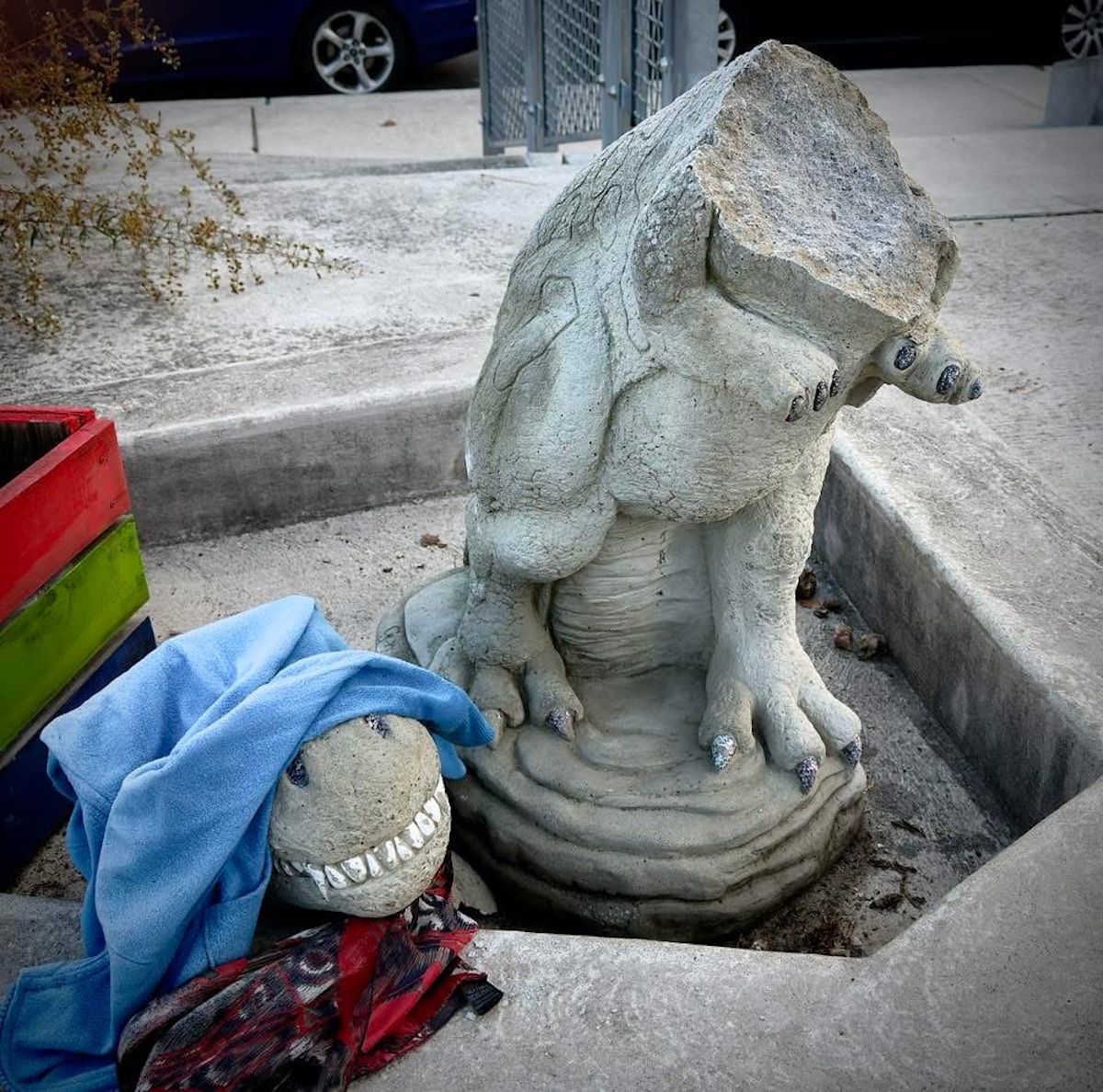
Last Sunday, a neighbor found Bridget’s head lying at the feet of her stone body after it was smashed between late Saturday evening and early Sunday morning. The vandalism came as a shock to the community that welcomed Bridget with open arms, as she grew into a beacon for the ever-growing green spaces that the families of Manayunk and Roxborough have come to revitalize.
Bridget the Dino, a beloved stone garden statue at the Manayunk Bridge Garden, had its head smashed off between late Saturday night, Nov. 22, and early Sunday morning, Nov. 23, 2025. The 300-pound stone statue would be hard to move, neighbors say, leading some to believe an adult purposefully broke the statue.
“It seems like something silly to be upset about, but someone put a lot of effort and money — these statues and improvements are not cheap — into making that bridge garden a really nice place,” Manayunk resident Annie Schuster said. “I hate the fact that somebody did that.”
Neighbors believe the cowardly act to have been perpetrated by an adult who intended to destroy the iconic statue. Holz believed the statue proved too heavy for someone to mistakenly bump into it. Police reached out to Holz and park organizers to let them know they will investigate the crime, Holz said.
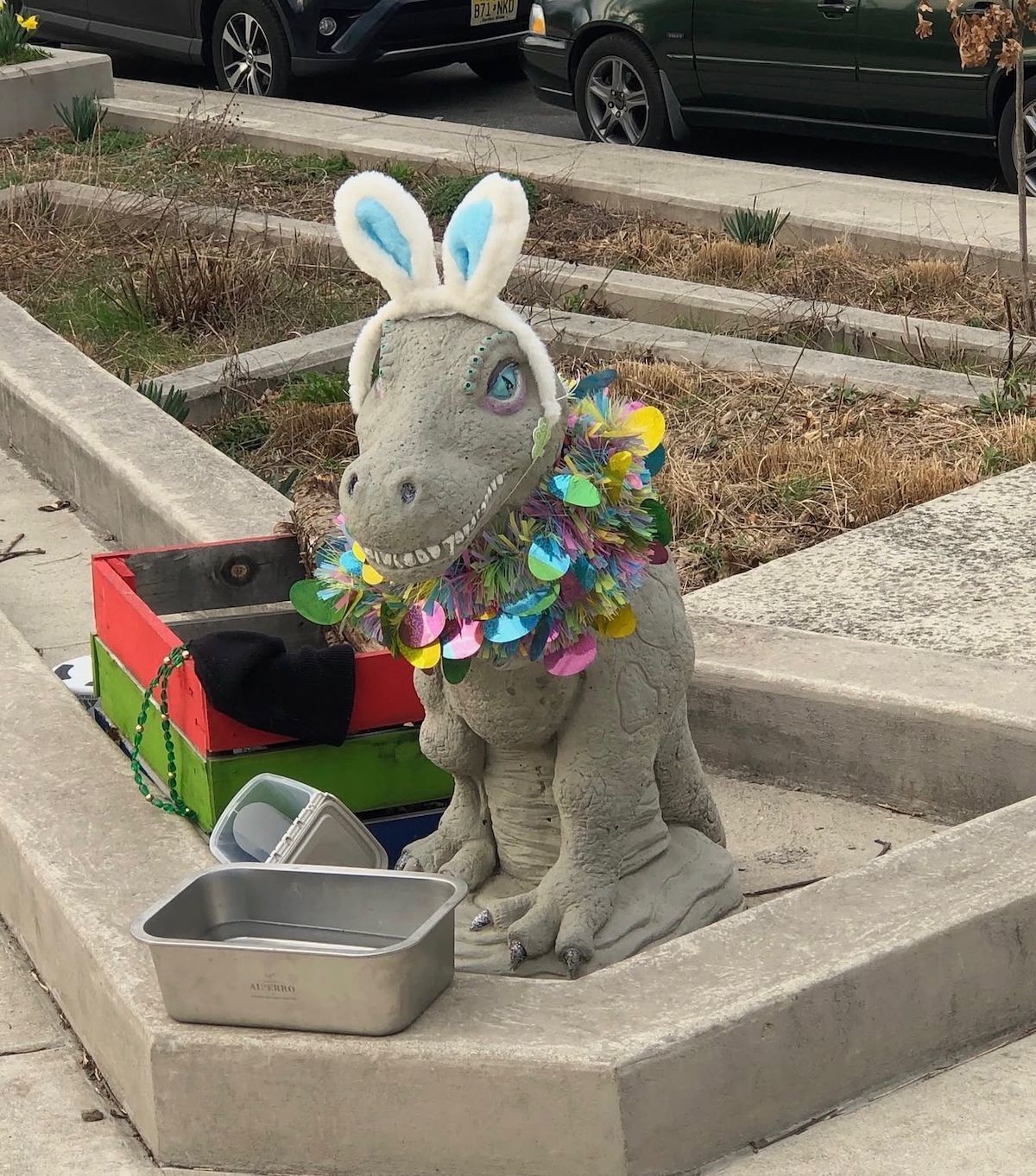
Bridget the Dino, a beloved stone garden statue at the Manayunk Bridge Garden, pictured in an Easter Bunny costume for Easter. The community often dresses up Bridget during different holidays and themed events. In November 2026, her head was smashed off her body.
Meanwhile, they’ll repurpose Bridget elsewhere among the garden beds and usher a new dinosaur dynasty with Holod’s latest statue. Holz said perhaps Bridget’s new iteration will be as a bird bath installation or an addition in a new sensory garden.
The Manayunk Bridge Garden is one of the many public spaces being transformed into neighborhood gardens and pedestrian thoroughfares. Since COVID-19 lockdowns, residents have donated their time, alongside the Roxborough Manayunk Conservancy, to making this place special for local families. Bridget and her new friend encapsulate all of that passion.
Bridget the Dino, a beloved stone garden statue at the Manayunk Bridge Garden, pictured in a construction worker’s uniform. The community often dresses up Bridget during different holidays and themed events. In November 2026, her head was smashed off her body.
“We are focused on improving the park’s ecology and creating opportunities for the community to enjoy and use the space. The gardens are stunning in autumn with their masses of purple asters and yellow goldenrod,” said Avigail Milder of the Roxborough Manayunk Conservancy.
Along with the welcoming stone dinosaur, volunteers have been planting native shrubs and herbaceous plants that bloom through spring and summer. A new sugar maple tree was planted for much-needed shade. And most recently, Opus Piano donated a mini grand piano to be enjoyed and played by all parkgoers.
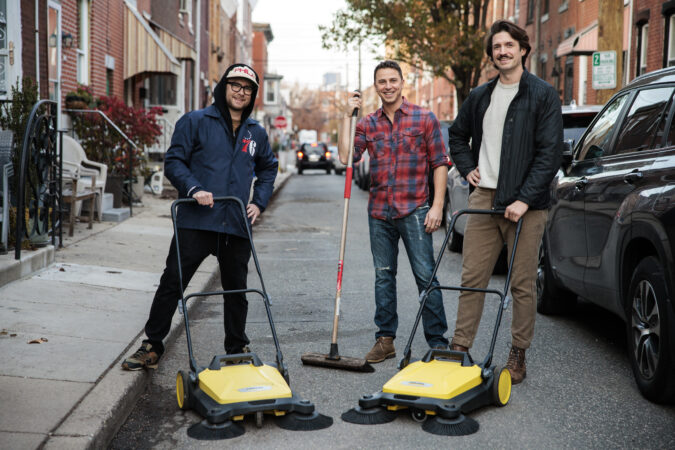
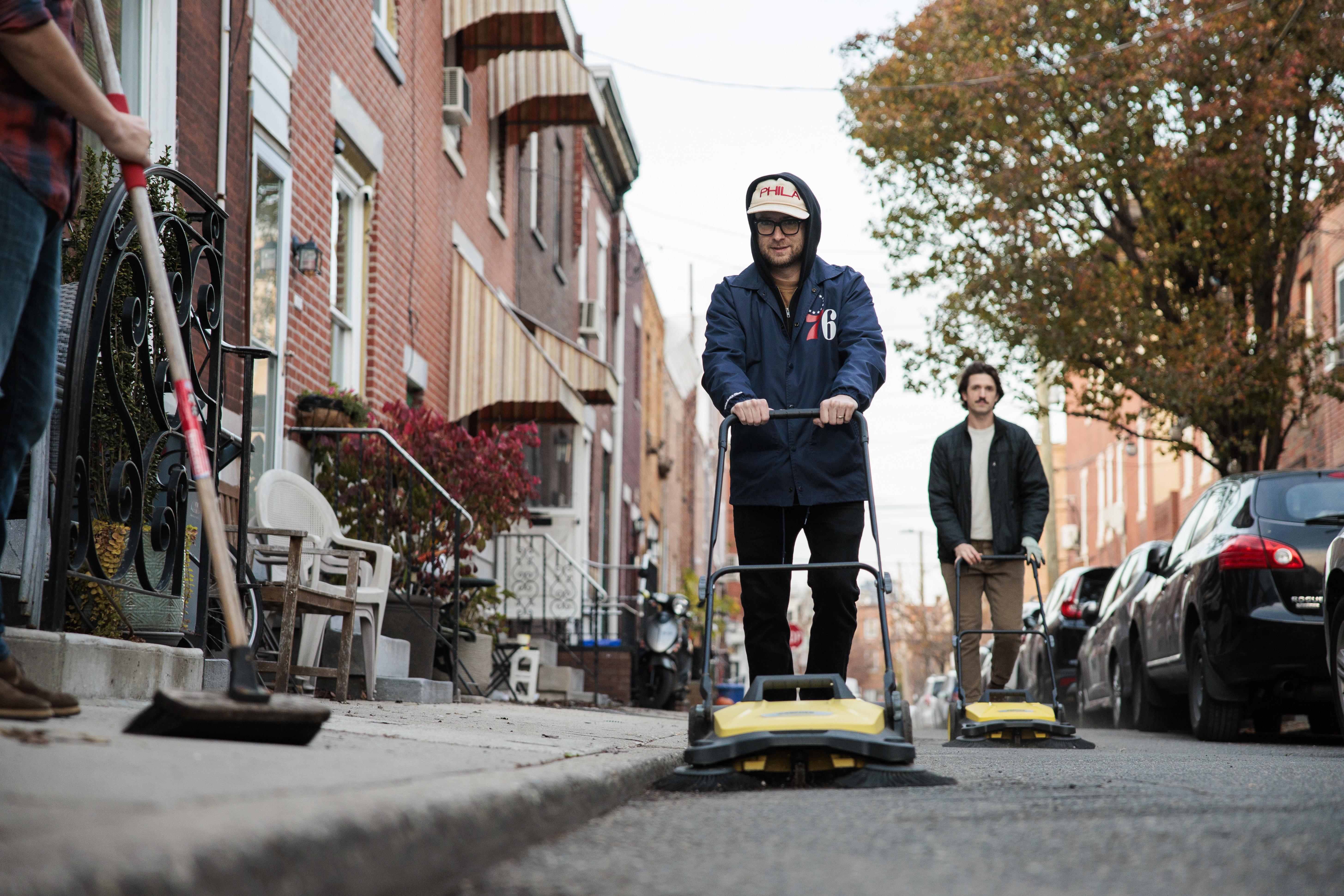
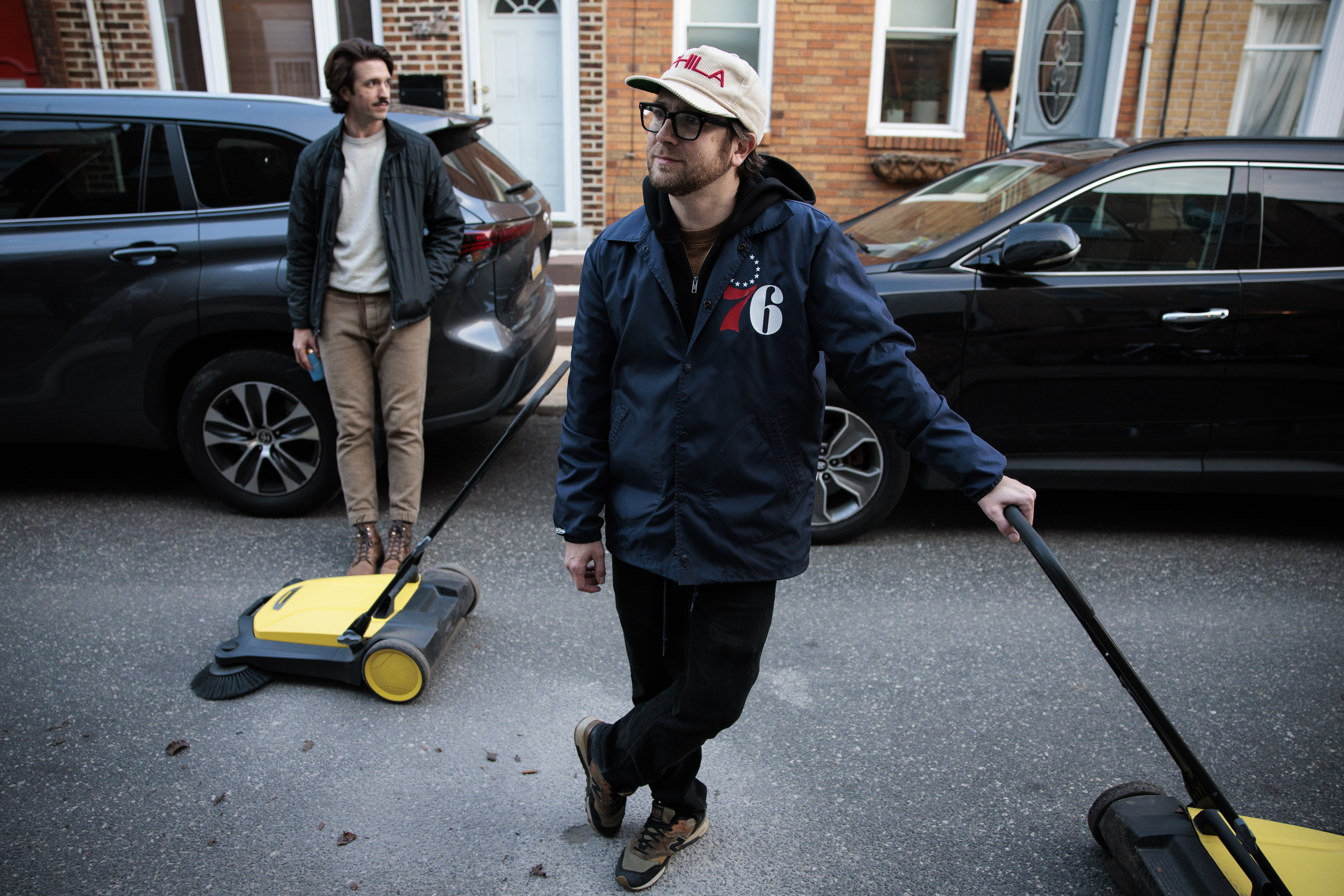
Just about every time Frederick Stahl, Matt Barber, and Anthony Masucci sweep their block of Iseminger Street in South Philly, someone stops them with a question or asks to take their picture.
That’s how I found out about these street-sweeping South Philly dads, when someone posted a photo of Stahl doing his thing on Facebook and a friend tagged me in the comments.
“This is the most fundamental level of environmentalism,” the photo was captioned.
At first, I had to squint my eyes. I couldn’t tell what Stahl was pushing. It looked like a street sweeper, but it was yellow and fun-sized. I’d never seen anything like it before, and I dropped my email in the comments, hoping to learn more.
And so, when Stahl and I finally connected this month — more than a year after that photo was posted — I went down to his block to check it out.
“I’d be remiss not to include two of my neighbors — Matt Barber and Anthony Masucci,” Stahl wrote to me prior to our meeting. “I actually moved to Iseminger in 2020, and it was their street sweepers that inspired me to get one myself.”
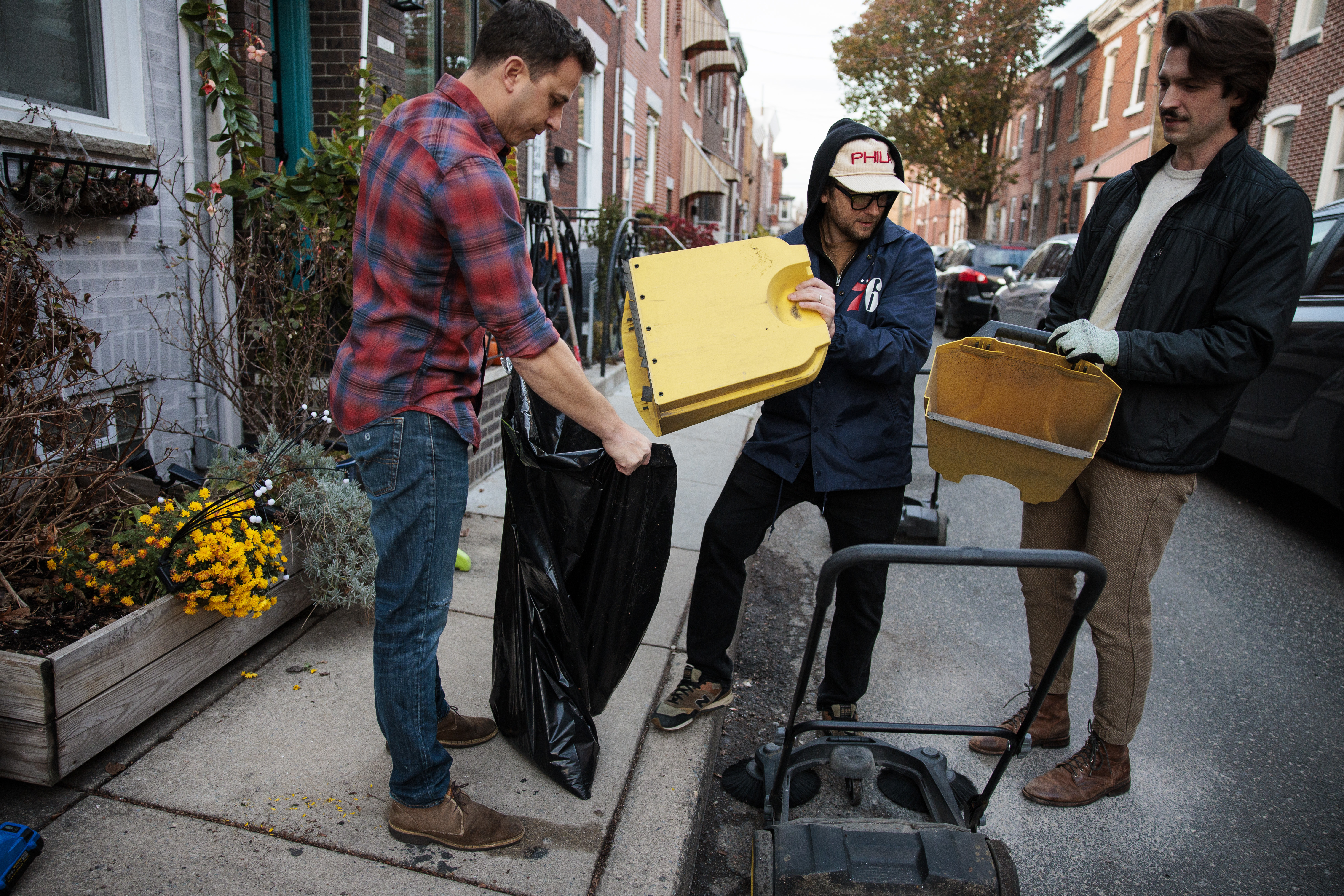
Matt Barber and Frederick Stahl (right) demonstrate how to use the Kärcher push sweepers on Iseminger Street.
On their classic South Philly block, which boasts a Tofani door or two and a street so narrow you’re inclined to suck your gut in while you’re driving down it, there are 18 kids under the age of 14 and eight under the age of 3, including Stahl’s 1-year-old son.
“Those are the ones that really touch the concrete,” he said of the little tykes.
The guys used to sweep the street with janitor brooms, “just so our kids could come out and play without glass around,” Masucci said.
“Neighbors would be like, ‘Oh, it’s nice, but it’s really dusty,’ and I’d be like, ‘God! There’s gotta be a better way,’” he said.
During the COVID lockdowns in 2020, when Masucci had some extra time on his hands, he went searching online and stumbled upon the website for Kärcher, a German company that sells cleaning equipment. The company’s S 4 Twin model, which claims to sweep large areas up to five times quicker than a push broom, seemed like it might do the trick.
“I found this thing and all of the marketing is for driveways, like old men kind of brushing their long driveways in the suburbs,” Masucci said. “I was like, ‘I think this would work fantastic. It’s like a little Zamboni. Let me see what we can do.’”
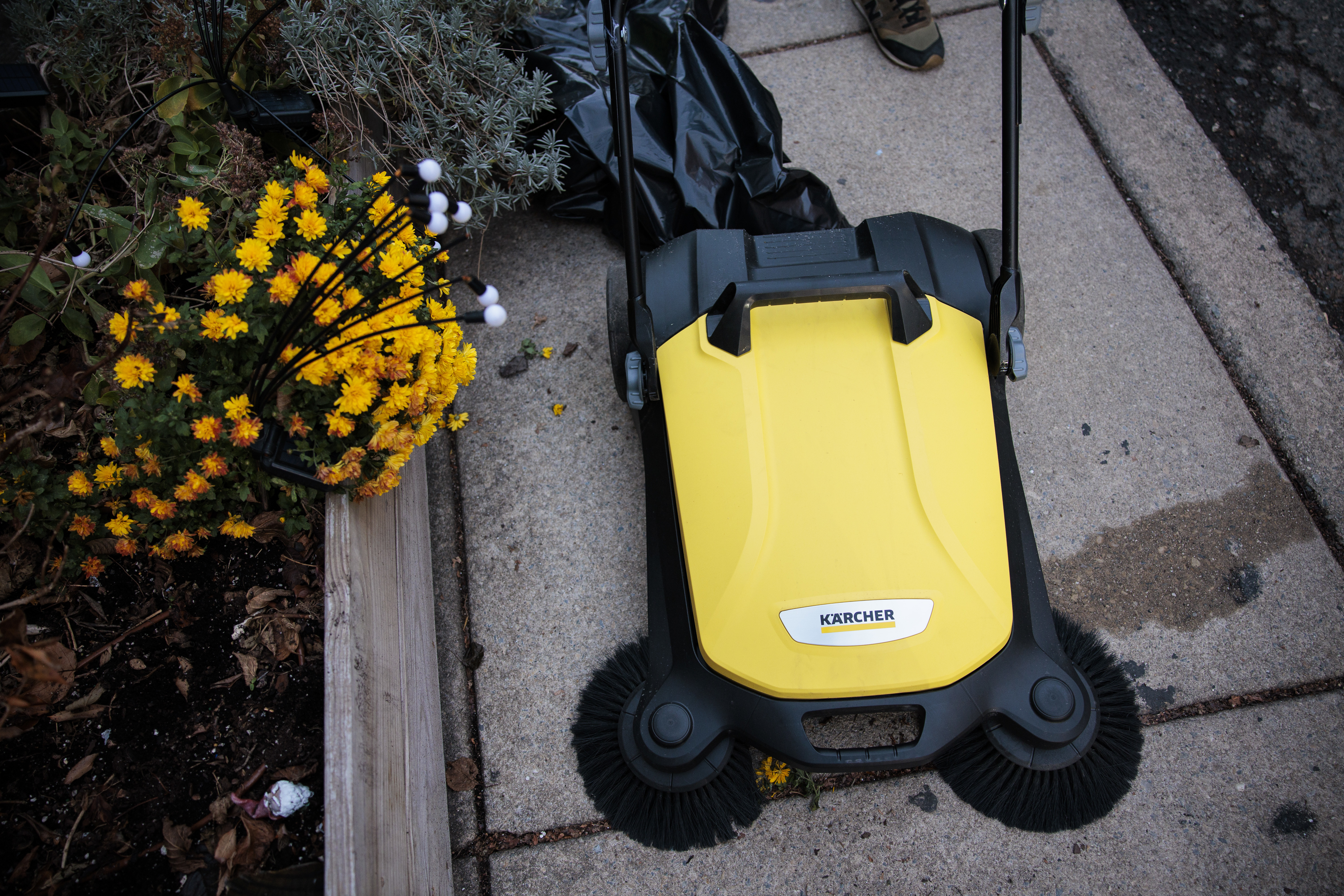
The Kärcher S 4 Twin push sweeper on Iseminger Street in South Philly.
Masucci purchased one — which typically retails for $189.99 but is currently on sale for $125.36 — and donated it to the block. Barber offered to keep it on his back patio.
“Anthony came through and made the dream happen and we put it together,” Barber said.
“It was like Christmas,” Masucci said. “Oh my God, the first time going up and down, we’re like, ‘It’s filled! It’s filled and it works so cleanly and easily!’”
The guys all grew up watching their dads mow the lawn every weekend, and even though they don’t have lawns to mow in South Philly, using the sweepers felt a little like that, they told me. Stahl even bought his own Kärcher when his little one was on the way.
“We love the community and you feel great coming out here and doing it so much more efficiently than brushing around,” Masucci said. “The kids run out. They wanna help you push it. Everyone runs out and wants to help you bag it up. So it becomes a community thing.”
Neighbors Frederick Stahl (left) and Matt Barber with their Kärcher push sweepers on Iseminger Street in South Philly.
Barber even gets the kids to pull weeds from the sidewalk and throw them into the street so he can sweep them up, promising them water ice from around the corner if they help out.
“I go, ‘Listen, weeds for water ice,’” he said.
Kärcher’s S 4 Twin unit is lightweight, foldable, has an adjustable handle, and uses no electricity or gas, so it makes no noise.
“It runs on human will,” Masucci said.
Its 5.25-gallon waste bin holds an impressive amount of debris and doesn’t blow up much dust. After the guys dumped it out following four passes along their street, the trash bag they emptied it into weighed about 15-20 pounds.
Neighbors Anthony Masucci (from left), Matt Barber, and Frederick Stahl empty the waste containers of their Kärcher units after sweeping their block.
“This bag will be so heavy at the end. I always feel like it’s a real proud moment,” Barber said.
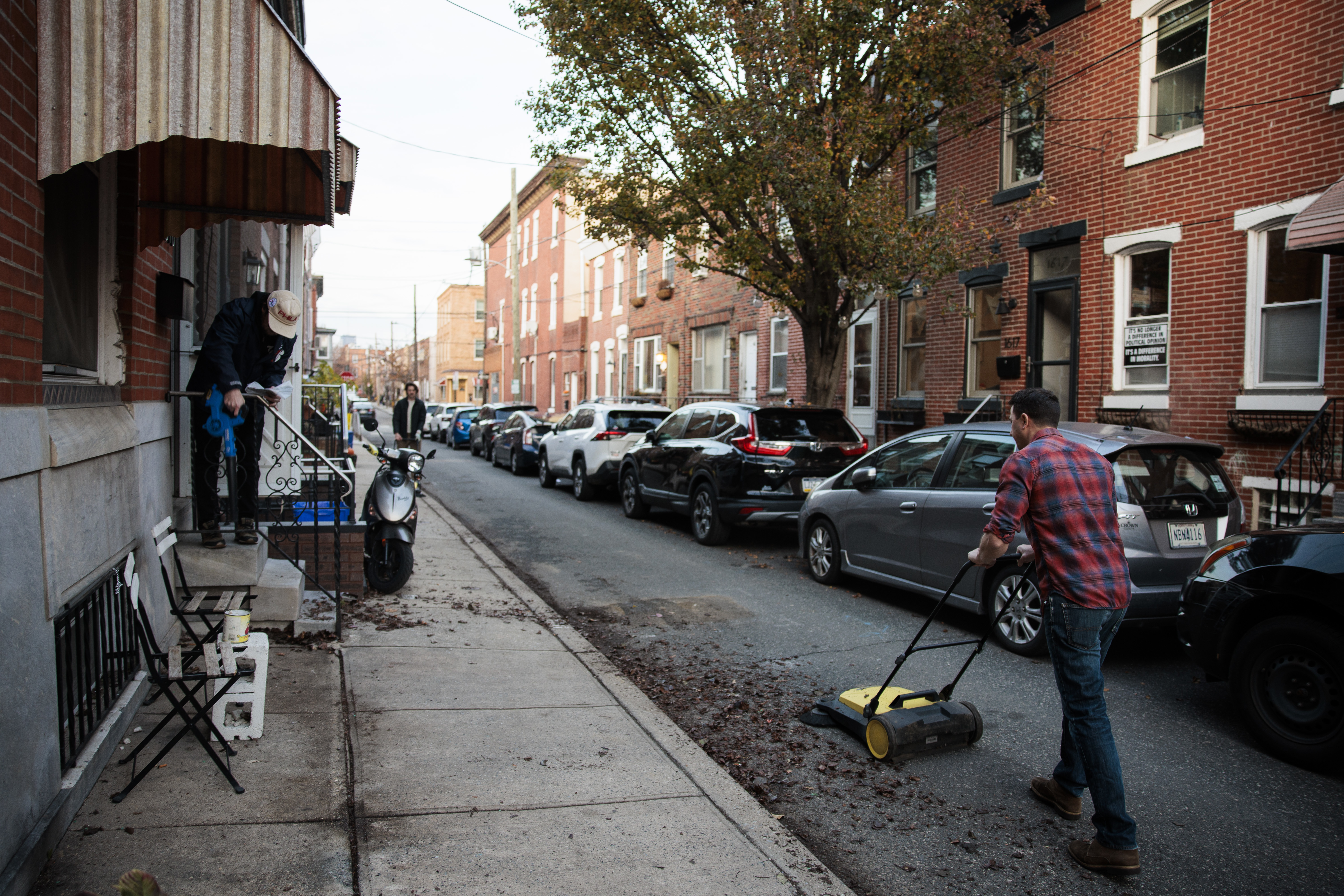
Mostly they’re sweeping up dirt, debris, broken glass, nails, and cigarette butts. It takes about 20 minutes and four or five passes to clean the block.
The day after trash and recycling collection is particularly bad — there’s some stuff that misses the truck or glass that gets broken on its way in — so they make sure to do it then.
Some items will get stuck in the Kärcher, like flattened water bottles and dog poop bags, so they still have to pick up that stuff by hand (with gloves on!) before they do a pass.
The few times they’ve been unable to repair the device, they said Kärcher customer service has been amazing and sent them replacement parts and even a whole new unit for free.
The Kärcher S 4 Twin push sweeper.
When the dads first started using the Kärcher, one of their neighbors on the block, a South Philly lifer who threw his cigarette butts in the street, raised an eyebrow.
“He was like, ‘Yo man, what, what are you doing? Why are you out here always cleaning the street?” Barber recalled. “I said, ‘I don’t know, man. I just consider it my backyard.”
Not long after, that neighbor stopped throwing his cigarettes in the street, they said.
“It’s little stuff like that. Maybe it’s always what they did and now hopefully we’re raising awareness,” Masucci said. “If you’re in the city and living here you can impact a lot. You do rely on public works, and if the street light goes out we can’t go fix that, but this is something you can do.”
Being stewards of their street has also bought them a lot of equity with their neighbors, they said. The block holds three major parties a year, including one where they chuck pumpkins off the roofs of their rowhouses, and they get little pushback from anyone.
“We can be up late, blast the music and throw those crazy parties. Everybody knows we’re gonna mess stuff up, but we’re gonna clean it up, because in the end, nobody cares more than us,” Masucci said.
Anthony Masucci demonstrates how to use the Kärcher push sweeper on Iseminger Street.
The men would love to see more people in Philly get Kärchers, perhaps through a citywide program, and so would I. Philly has a notorious litter problem — I don’t have to tell you that — but when people become invested in their neighborhood and cleaning their block becomes a fun, easy, community activity instead of just a chore, it’s much more likely to happen.
“They have all these initiatives to clean up Philly and I’m like, if every block captain was given one of these and they just let people take responsibility for their block, you’d probably see a bit of a difference in terms of the litter and cleanliness of South Philly,” Barber said.
Andrew Rick (center) in the pregame huddle with teammates before the Philadelphia Union's Major League Soccer (MLS) game against the Chicago Fire at Subaru Park in Chester, Pennsylvania on Saturday, August 23, 2025.Philadelphia Union
Which Union Players Should Stay or Go? Swipe and decide
Though the Union’s playoff run ended earlier than hoped for this year, it was still a successful season. Winning the Supporters’ Shield returned the team to MLS’s elite, and the squad saw some new names rise to prominence. But as always in soccer, there isn’t much time to reflect. The Union have to make their offseason roster moves quickly, then get to work preparing for next year. Here’s your chance to play sporting director and pick who should stay or go.
Our soccer reporter Jonathan Tannenwald also provides his analysis on how much of a roster overhaul the team needs. Make your pick for each player by swiping the cards below — right for Stay or left for Go. Yes, just like Tinder. Finding it hard to decide? We'll also show you how other Inquirer readers have voted so far and what we think the team will do.
Advertisement
Goalkeepers
As ever, Andre Blake leads the way, with Andrew Rick a strong backup behind him.
#18
Andre
Blake
Captain
Crowd says
Contract
Signed Thru: '26 Option: '27
Age
35
Inky Says Stay
The Union's No. 1 in net, and the best goalkeeper in MLS for nearly a decade. Neither of those things will change soon.
#1
Oliver
Semmle
Loaned out
Crowd says
Contract
Signed Thru: '25 Option: '26
Age
27
Inky Says Go
A loan out this year was the final proof that he wasn't good enough for the MLS level.
#31
George
Marks
Crowd says
Contract
Signed Thru: '26
Age
26
Inky Says Go
He did his job as an emergency signing when other backups were injured.
#76
Andrew
Rick
Home grown
Crowd says
Contract
Signed Thru: '28 Option: '29
Age
19
Inky Says Stay
The safest hands the team could ask for in a backup goalkeeper, as he showed again in the playoffs.
An era is ending with Mikael Uhre’s expected departure. Will the Union sign another Designated Player to replace him, and will the team let young prospects fill out the depth chart?
#7
Mikael
Uhre
DP
Crowd says
Contract
Signed Thru: '25
Age
31
Inky Says Go
It's been an open secret for weeks that his time is up. Here's hoping fans appreciate what he did.
#9
Tai
Baribo
Crowd says
Contract
Signed Thru: '25 Option: '26
Age
27
Inky Says Stay
He likes Philadelphia, and fans like him. Will contract talks produce a deal that keeps him in town long-term?
#20
Bruno
Damiani
DP
Crowd says
Contract
Signed Thru: '28 Option: '29
Age
23
Inky Says Stay
A relenteless worker not afraid to mix it up physically. But goals count the most, and there weren't enough this year.
#25
Chris
Donovan
Crowd says
Contract
Signed Thru: '25 Options: '26, '27
Age
25
Inky Says Go
He's been a good servant, but his skill set remains limited. Better to play the club's young prospects.
#32
Milan
Iloski
Crowd says
Contract
Signed Thru: '27 Option: '28
Age
26
Inky Says Stay
His arrival in the summer saved the season and launched a run to a trophy. Here's hoping for an encore next year.
#35
Markus
Anderson
Crowd says
Contract
Signed Thru: '26 Options: '27, '28
Age
21
Inky Says Stay
Regained the first team's good graces this year even though he didn't play much. He brings something different, and that's needed.
#55
Sal
Olivas
Home grown
Crowd says
Contract
Signed Thru: '28 Option: '29
Age
19
Inky Says Stay
He showed in his first-team cameos that he deserves more chances next year, and maybe did this year.
#77
Eddy
Davis III
Home grown
Crowd says
Contract
Signed Thru: '27 Options: '28, '29
Age
19
Inky Says Stay
He's still young, but deserves a shot next year to show if he can step up to the first team.
The holiday season is officially upon us and with it, a slew of festive events. From Santa sightings to a menorah motorcade, here’s how and where to celebrate around Cherry Hill.
Santa has returned to the Cherry Hill Mall, where he’s posing for photos throughout the holiday season.
Snap a photo with St. Nick during his ongoing residency at the mall, where he’ll be through Christmas Eve. Walkups are welcome, or you can sign up for a time slot here. Pets can also get in on the action on select days, but they must be on a leash, in a carrier, or held by their owner. Sign up for a pet time slot here.
⏰ Through Wednesday, Dec. 24, times vary 💵 $19.99-$59.99 📍Cherry Hill Mall, 2000 Route 38, Cherry Hill
If you’re looking to get in a little holiday decor shopping while also grabbing a photo with Santa, Spirit Christmas is hosting the big guy on Fridays, Saturdays, and Sundays, plus the week leading up to Christmas.
⏰ Through Wednesday, Dec. 24, days and times vary 💵 $19.99-$59.99 📍Spirit Christmas, 2234 Marlton Pike West, Cherry Hill
The rink will be open on select days through Feb. 22.
Marlton-based alpaca farm Morning Glori Farmette is hosting a pop-up shop in Cherry Hill, where you can shop handmade gifts and meet two of their resident camelids, Rocky and Crash.
⏰ Friday, Nov. 28, 9:30-11:30 a.m. 💵 Pay as you go 📍1504 Pleasant Dr., Cherry Hill
Catch holiday performances while shopping at the mall. At 6 p.m. on Dec. 3, the Pine Barons Chorus will perform everything from classic carols to current favorites. And at 5 p.m. on Dec. 17, Cherry Hill West’s Royal Purple Majesties club will perform throwback holiday tunes from the 1920s and 1940s from the likes of Nat King Cole and Frank Sinatra.
⏰ Wednesday, Dec. 3, 6 p.m. and Wednesday, Dec. 17, 5 p.m. 💵 Free 📍Cherry Hill Mall, 2000 Route 38, Cherry Hill
This year’s winter festival includes a craft market, a beer garden, fire pits, ice carving demonstrations, food, and live performances. It will be held rain or shine.
⏰ Sunday, Dec. 7, noon-4 p.m. 💵 Pay as you go 📍Croft Farm, 100 Bortons Mill Rd., Cherry Hill
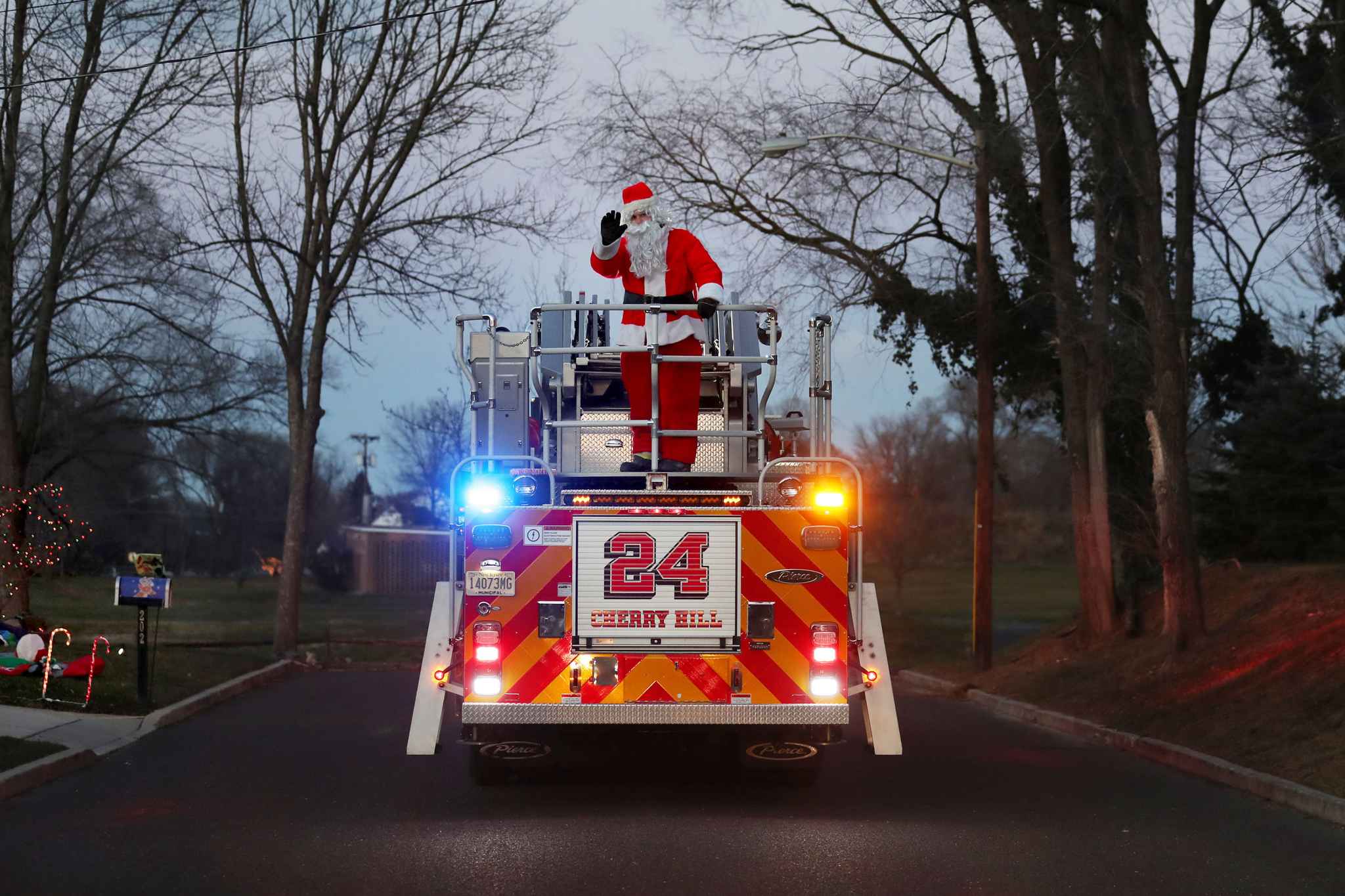
Santa will make visits to neighborhoods throughout town alongside the fire department. Visits are expected to start Dec. 13 and run through Dec. 21. An interactive map with details on the schedule will go live Dec. 1.
⏰ Saturday, Dec. 13-Sunday, Dec. 21, times vary 💵 Free 📍Cherry Hill Township
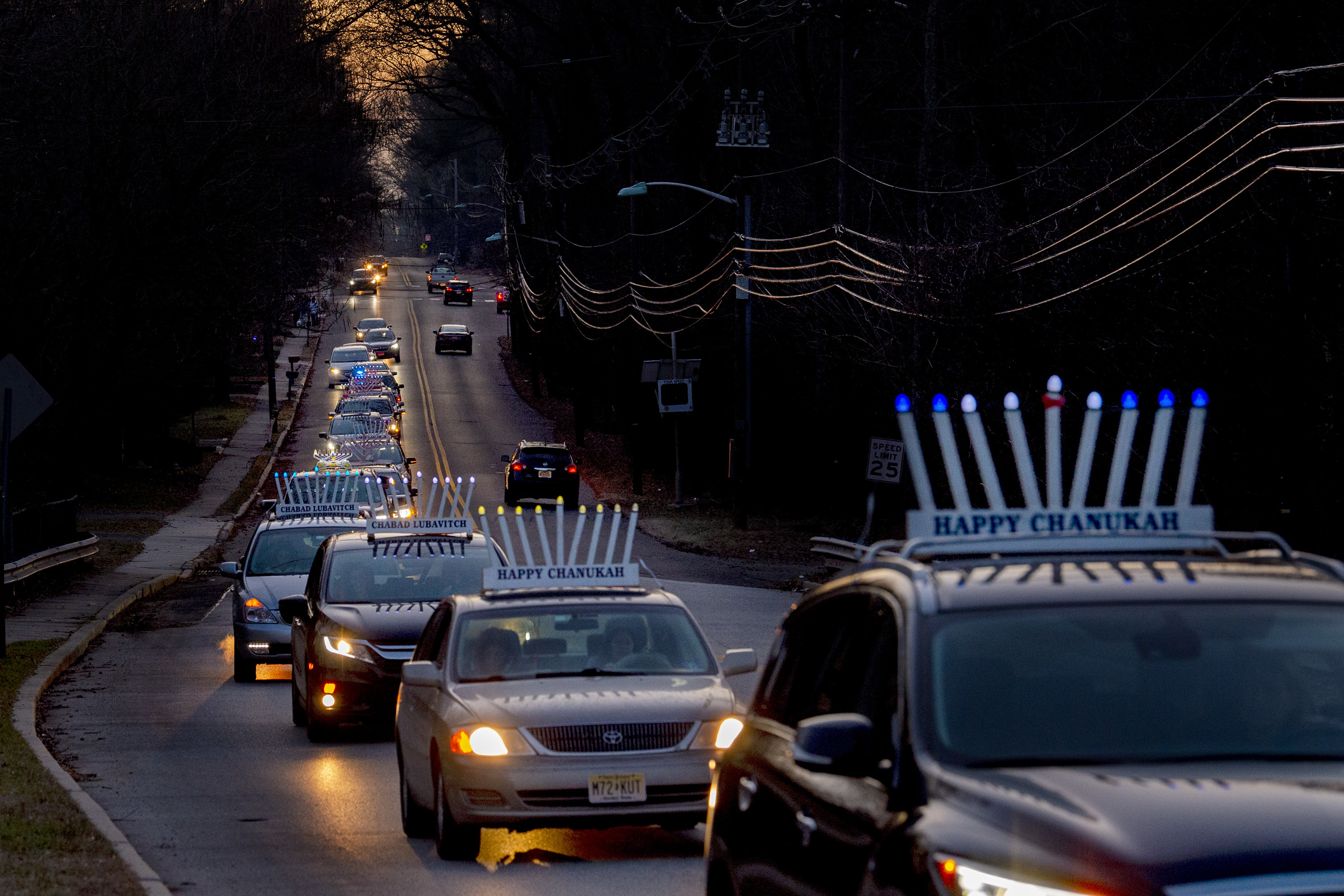
Now in its 16th year, cars adorned with menorahs will parade from Chabad in Cherry Hill to Barclay Farm Shopping Center, where the giant menorah will be lit. There will be latkes, donuts, music, and LED robots for the lighting.
⏰ Sunday, Dec. 14, parade starts at 4 p.m., giant menorah lighting is at 5 p.m. 💵 Free 📍Chabad of Camden and Burlington Counties, 1925 Kresson Rd., Cherry Hill
Snag last-minute holiday gifts at this two-day pop-up at the mall that features local small businesses.
⏰ Saturday, Dec. 20, 9 a.m.-10 p.m. and Sunday, Dec. 21, 10 a.m.-9 p.m. 💵 Pay as you go 📍Cherry Hill Mall, 2000 Route 38, Cherry Hill
This suburban content is produced with support from the Leslie Miller and Richard Worley Foundation and The Lenfest Institute for Journalism. Editorial content is created independently of the project donors. Gifts to support The Inquirer’s high-impact journalism can be made at inquirer.com/donate. A list of Lenfest Institute donors can be found at lenfestinstitute.org/supporters.
MONTOURSVILLE, Pa. — The rocky shores of Loyalsock Creek looked a bit drab to the untrained eye on a blustery, overcast November afternoon.
There were browns and grays, along with flurries of yellow and orange leaves across the turbid water when the wind whipped through the trees.
Sierra Weir, an artist from Pittsburgh, stepped gingerly across the mud and rocks. When she got to the water’s edge, Weir saw the landscape in a completely different way.
“It’s not as visually stunning as synthetic colors, but I would say the depth and variation within one tiny spectra is so much deeper,” she said. “I’ve gained such an appreciation for all the different ways brown can be brown.”
Sierra Weir of Pittsburgh was an artist-in residency of the Susquehanna River Watershed.
Weir, who has a background in biochemistry, is a pigment artist and community outreach coordinator for Three Rivers Waterkeeper, a nonprofit organization in Pittsburgh that advocates and protects the Monongahela, Allegheny, and Ohio rivers.
In June, the Pennsylvania Environmental Council, selected Weir and two others for its new artist-in-residency program, “Reflections through Art: Inclusive Access on Water Trails in the Susquehanna Basin.”
“It’s a new way to get people to engage with the environment,” Weir said.
Painter Spencer Verney of Coatesville was also chosen as a resident by the PEC. He focuses on preserved lands and protected waterways in historic settings. Meg Lemieur of Port Richmond was chosen to illustrate a map for the Swatara Creek Watershed.
“My art celebrates the diversity and amazing features of the natural world,” Lemieur told The Inquirer. “I’m definitely drawn to all the living animals, including animals of the watershed like turtles, owls, and gophers, but lately I’ve been getting more into flora and understanding plants.“
Tali MacArthur, a senior program manager for the PEC, said the residency program was created as another way to get the public involved in watershed conservation.
“There are people who don’t really see themselves as scientists or fishermen, but maybe they see themselves as artists, as musicians, or visual learners,” MacArthur said. “I’ve kind of been chasing this approach for some time now.”
The residency program was funded by the National Park Service’s Chesapeake Gateways Grant Program and the Pennsylvania Department of Conservation and Natural Resources Community Conservation Partnership Program.
When Weir was in college, in Ohio, she spent a year studying the pigments of Betta fish and contributed a sculpture based on the majesty of jeweled beetles. She’s also created various paintings made with natural pigments like goldenrod, black walnut, and pokeberry, which fade quickly.
“It’s in opposition to synthetic pigments, which are made from petrochemicals, and I do a lot of work to reduce pollutants,” she said. “This was a natural fit.”
Sierra Weir of Pittsburgh was an artist-in-residency of the Susquehanna River Watershed. She’s pictured along Loyalsock Creek in Montoursville.
Weir, 28, said her goal of combining art and waterways was to help people hone their “noticing skills” and provide new ways to engage with the environment and, perhaps, repair broken connections to the natural world.
“What I do is help people notice the relationship between water, earth, plants, and themselves and how inherently connected we are to this place,” Weir said. “We’re made of this same stuff, biologically and chemically.”
Sierra Weir of Pittsburgh was an artist-in-residency of the Susquehanna River Watershed.
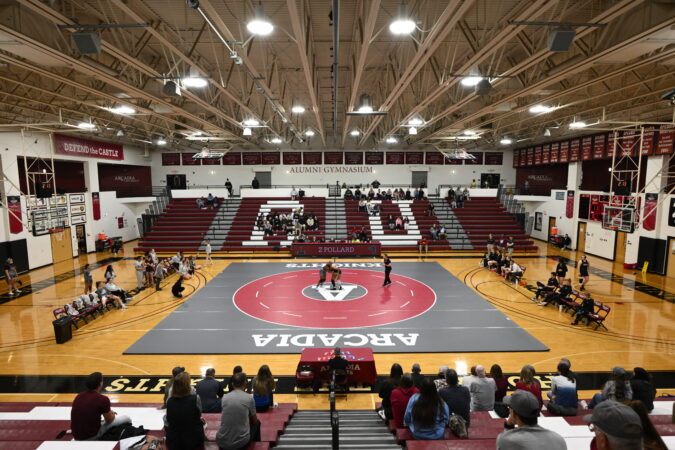
Last year, Arcadia University transformed a basketball gymnasium on campus into the home of its newest athletic programs: men’s and women’s wrestling.
“Compared to most wrestling rooms, we have a very open facility,” men’s coach David Stevens said. “We have three full-size wrestling mats and a turf field. We have treadmills, standalone bikes, and a weight room. [Arcadia] did a really good job of supporting us.”
As the facility was under construction, women’s coach Michael Childs gave prospective members of his 11-athlete squad an up-close look at the progress.
“I took [recruits] through a construction site with our facility that was being built,” Childs said. “There were certain days that they had to wear hard hats when they went through the building. I could show them pictures on my phone, and the education piece kind of sold itself. … The more difficult part was selling them a vision for the program.”
“Wrestling is very popular in the state of Pennsylvania and has very passionate fans, but countrywide, it is still a niche sport,” Childs said. “So introducing that to the Arcadia community in general and the administration, it’s been a growing year for us.”
Focus on ‘family’
The men’s roster features 32 wrestlers, primarily freshmen. The team leadership comes from a group of older wrestlers who entered the season nationally ranked.
Senior Caden Frost was ranked No. 15 in the 149-pound weight class, graduate student Logan Flynn (285) was No. 6, and senior Jacob Blair (133) was No. 8.
Blair and Flynn followed Stevens, their former assistant coach, to Arcadia from Delaware Valley University, while Frost transferred from New England College.
“It’s a lot of leading by example,” Blair said. “We’re trying to build something here with longevity and make an impact not only this year, but also down the road. We’re trying to create good team camaraderie and spirit because this is something none of us have ever experienced. We’ve never wrestled on a team with 25 freshmen.”
Arcadia wrestling is in its first season.
The Knights (1-3) secured their first team win on Nov. 8 over Eastern, 27-20.
Stevens believes the young roster will grow significantly over the course of the season, which begins in November and culminates with the NCAA championships in March.
“We tell every recruit that if you join this team, you become part of a family,” Stevens said. “We haven’t had the early success that we expected or that we wanted. But I think that’s what a family does, is that even through the hardships, we don’t give up on each other. We truly believe that we’re going to do something special here in our first year.”
The three leaders went undefeated in Arcadia’s most recent competition at Misericordia University.
“We talked about how you either have to buy in now or hop off,” Blair said. “But the fire under these guys is that they truly want to be here and want to be college wrestlers. They know it’s going to take hard work, because it’s a grueling sport, both mentally and physically.”
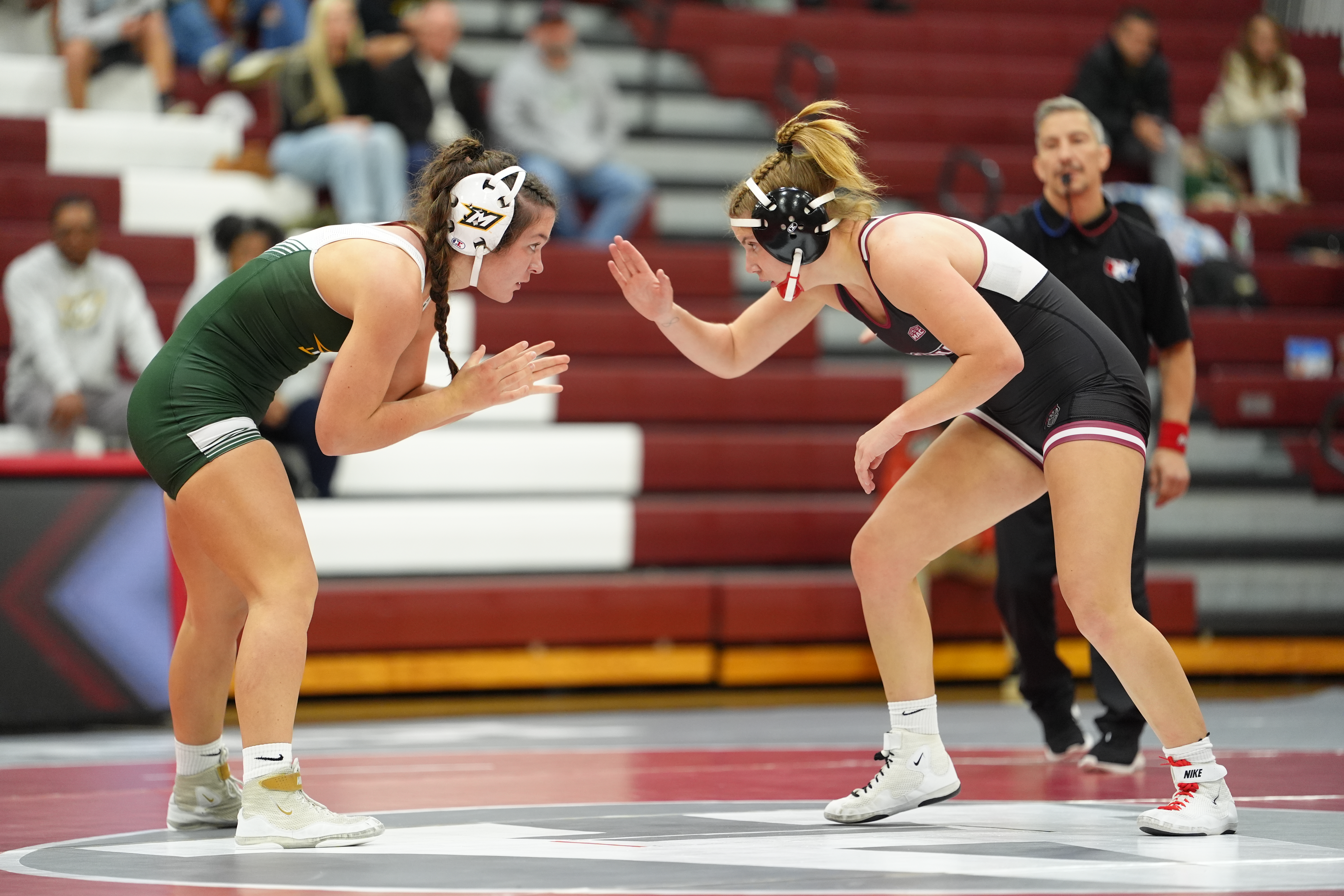
While the Arcadia women’s team (0-2) is a MAC member, there are fewer than 100 NCAA women’s wrestling programs nationwide. The limited number means that all programs, regardless of division, will vie for the same national championship.
In addition to helping freshmen adjust to the rigors of college athletics, Childs must also prepare his team to face some of the country’s top wrestlers.
“I think that the biggest challenge for us is bringing our student-athletes along to understand what this commitment is,” Childs said. “It’s not just your morning lifts and your daily practices. It’s a lifestyle. We’ll potentially be seeing world team members in competitions, All-Americans, and Olympians. So it’s really exciting, and it’s really challenging.”
Taylor McCue, a junior, is the only non-freshman on the Arcadia women’s wrestling roster.
Junior Taylor McCue is the only non-freshman on the women’s roster. From goal-setting meetings to decorating the locker room before competitions, the team is establishing its identity.
“The best thing that I can do for the success and growth of this program is to surround it with good people, and that’s what I’m trying to do,” Childs said. “We had our first tri-meet a couple weeks ago on our floor. After our event, we had a parent social, and over a hundred people were there. It was pretty cool to see.”
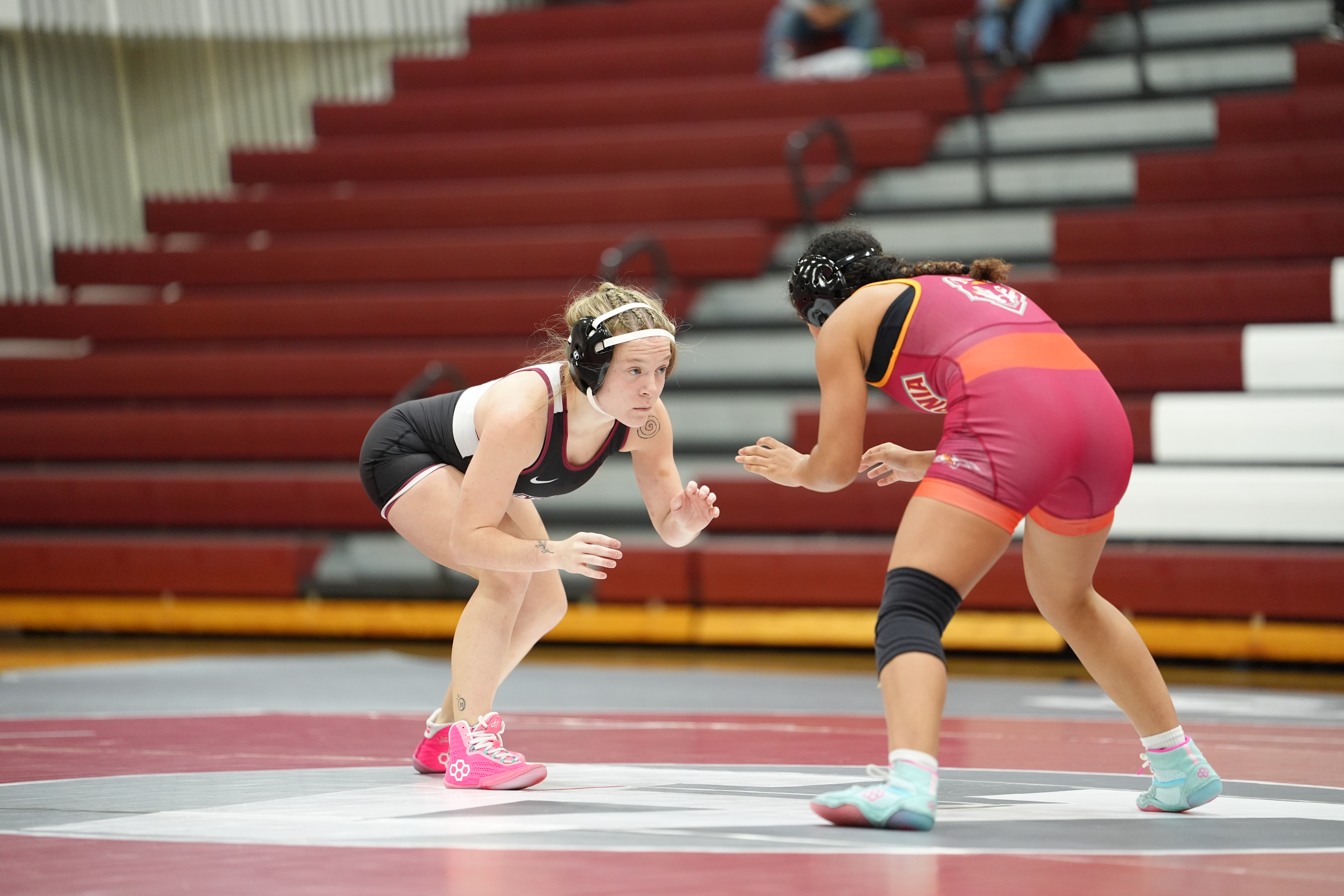
Freshman Molly Lubenow (right) in action for Arcadia.
A sport on the rise
Arcadia’s addition of a women’s wrestling program follows the rapid expansion of the sport nationwide. According to the NCAA, 17 schools began offering women’s wrestling programs in 2024-25 alongside its promotion to a championship sport.
The inaugural NCAA women’s wrestling championship will take place this spring.
Both Arcadia programs see themselves as leading the growth of wrestling. They also aim to bring national attention to the small university through success in Division III.
“Why I’m grateful to be at Arcadia is the support they give us,” Stevens said. “High school and even college programs are usually focused on other sports that more people are familiar with. But here at Arcadia, we feel like they’re really investing in us and giving us a great opportunity. This is a place that I want to continue to grow.”