Talk about a great kick off to the holiday shopping season.
“I’m honored, proud, and excited,” Ellen Shepp said Monday morning. “I mean … I’m really over the moon.”z
Walking into a great clothing store, New York Times cultural trend reporter Steven Kurutz said, is like being “transported to a different world.” It “will make you think about who you are — and may change that perspective in real time.”
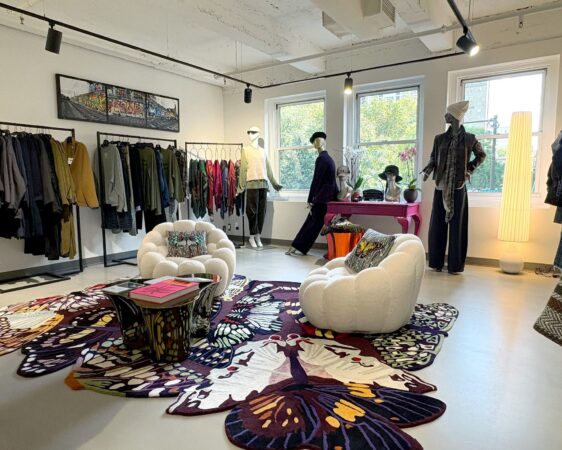
The interior of Joan Shepp at 1905 Walnut St. The 53-year-old store made the New York Times’ list of “50 Best Clothing Stores in America.”
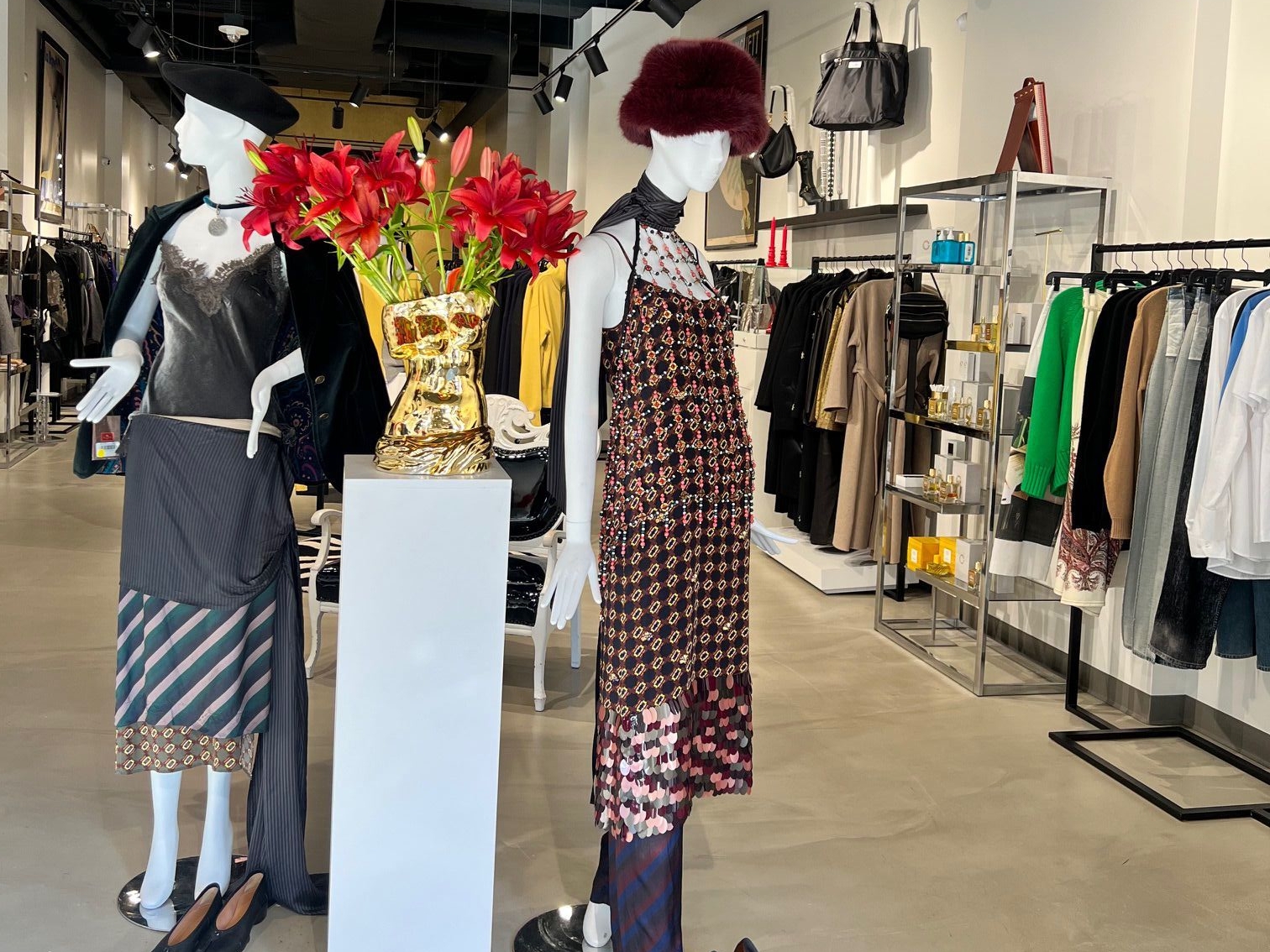
And yes, walking into Rittenhouse Square’s Joan Shepp does feel like stepping into a sartorial fairytale, which you can leave holding a Yohji Yamamoto hoodie that doubles as a dress, or a perfectly tailored asymmetrical shirt dress from Sacai New York.
Everything is dreamy, but nothing comes cheap.
Back in the 1970s, Shepp opened her store to challenge the way the suburban career woman dressed in Philly and introduced her to designer wear, from Yohji Yamamoto to Maison Margiela. One of the earliest entrepreneurs to embrace the store-within-a-store approach to retail, Shepp made space for collections like Yamamoto’s Y-3 and Donna Karan’s Urban Zen.
The clothing sold alongside furniture, bedding, and candles, making Joan Shepp one of the region’s earliest concept boutiques.
Joan Shepp founded the store in 1971. She was a 30-year-old single mother of two young children in need of a flexible work schedule that allowed her time for school pickup and drops, to help her daughters with homework, and make them dinner.
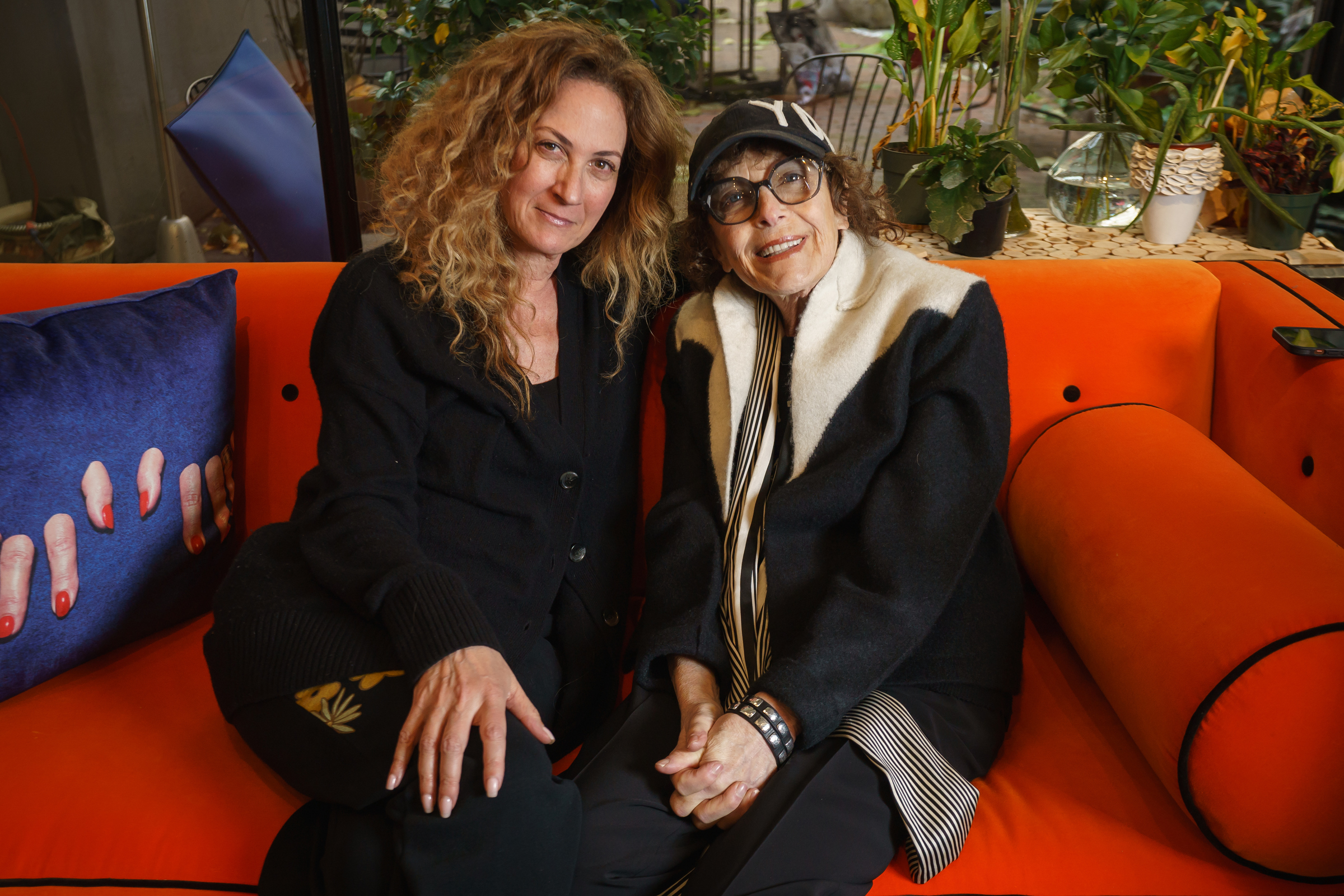
Joan Shepp and her daughter Ellen Shepp, shown here in their Center City store.
“I have so much fun finding things that are new,” she said to The Inquirer in 2022. “I listen to everyone who comes into my store. I watch them go through the racks. And whether/if they are a customer or a person who wants to open a store down the street, I can pick up on it.”
Hers is the only store on the Times list from the Philly region.
The closest is 7017 Reign in Fort Lee, N.J., described by the Times as an “under the radar, street and high fashion” specialty store. There are a handful of stores from downtown New York, but most are in the Midwest and California.
To produce the list, the Times team selected 120 stores, and then sent reporters, editors, and contributors to visit each of them, sometimes more than once.
A videographer visited Joan Shepp in early fall, shortly after the store moved to its new home at 1905 Walnut St.
Noting that Joan Shepp has been in business for more than 50 years — the specialty boutique is in the midst of celebrating its 53rd year — Kurutz wrote “Shepp has flavors of Barneys New York in its heyday.”
The Barney comparison wowed Ellen Shepp. Christmas had no doubt arrived early for the boutique owner and her team.
“The whole time they were like, ‘Listen we don’t know whether/if you made this list,’” she said. “They kept it a mystery until right this second.”
The biggest question of Christmas isn’t whether Santa Claus exists. It’s whether to display a real or a fake Christmas tree.
Though many households in the United States have switched to artificial ones, for the purists who splurge each year on the real thing, it’s time to start shopping.
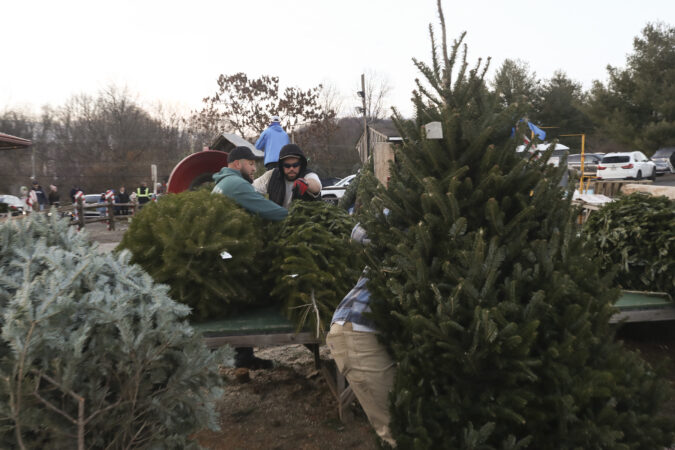
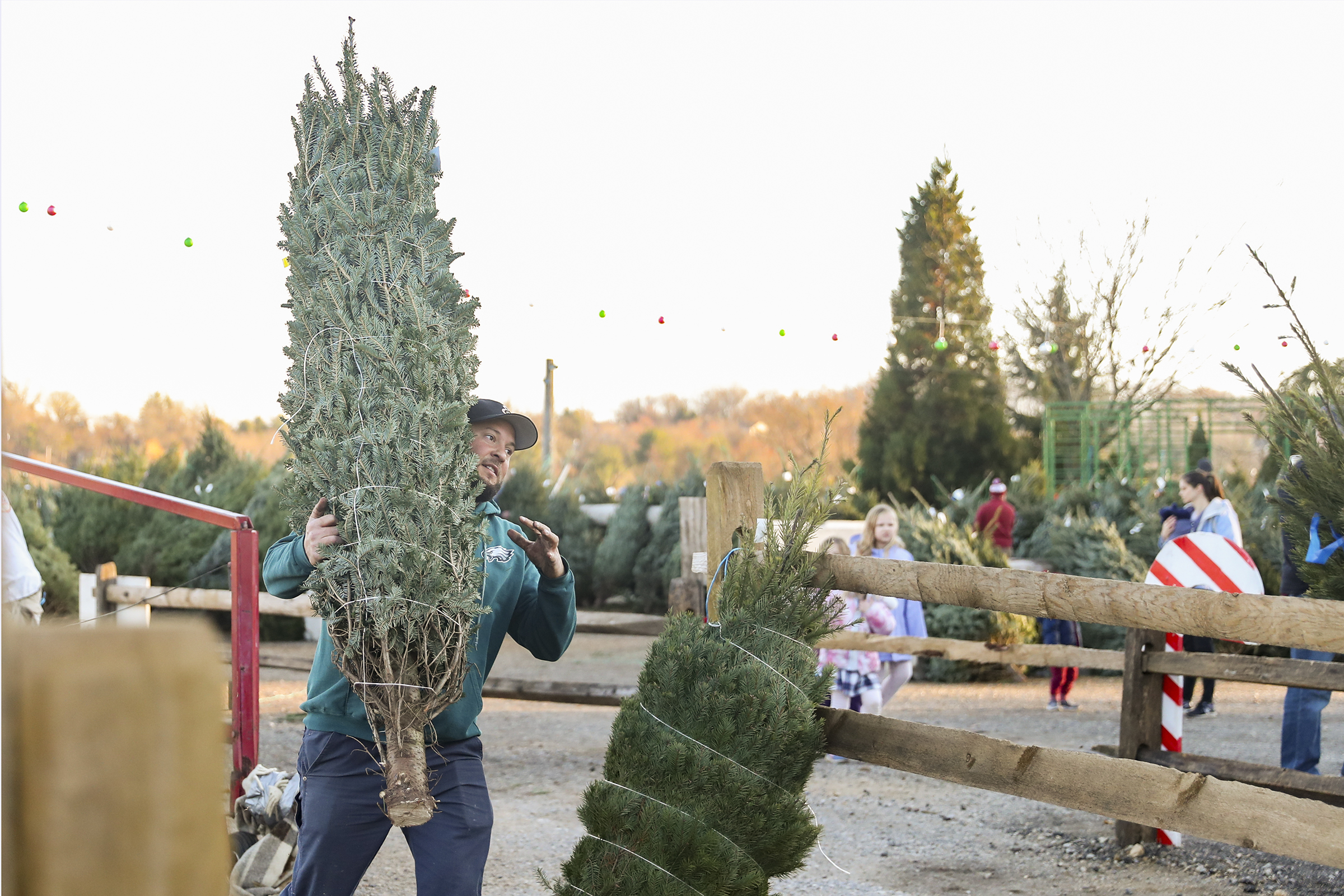
The Philadelphia region offers a number of farms where you can cut down your own tree or find a wide selection of pre-cut varieties — including delivery.
We’ve found farms across Pennsylvania and New Jersey, all within about an hour of Center City. And we’ve included a couple of options where you can buy a fresh-cut tree right in Philadelphia, too. Here’s where to get a real Christmas tree in the region.
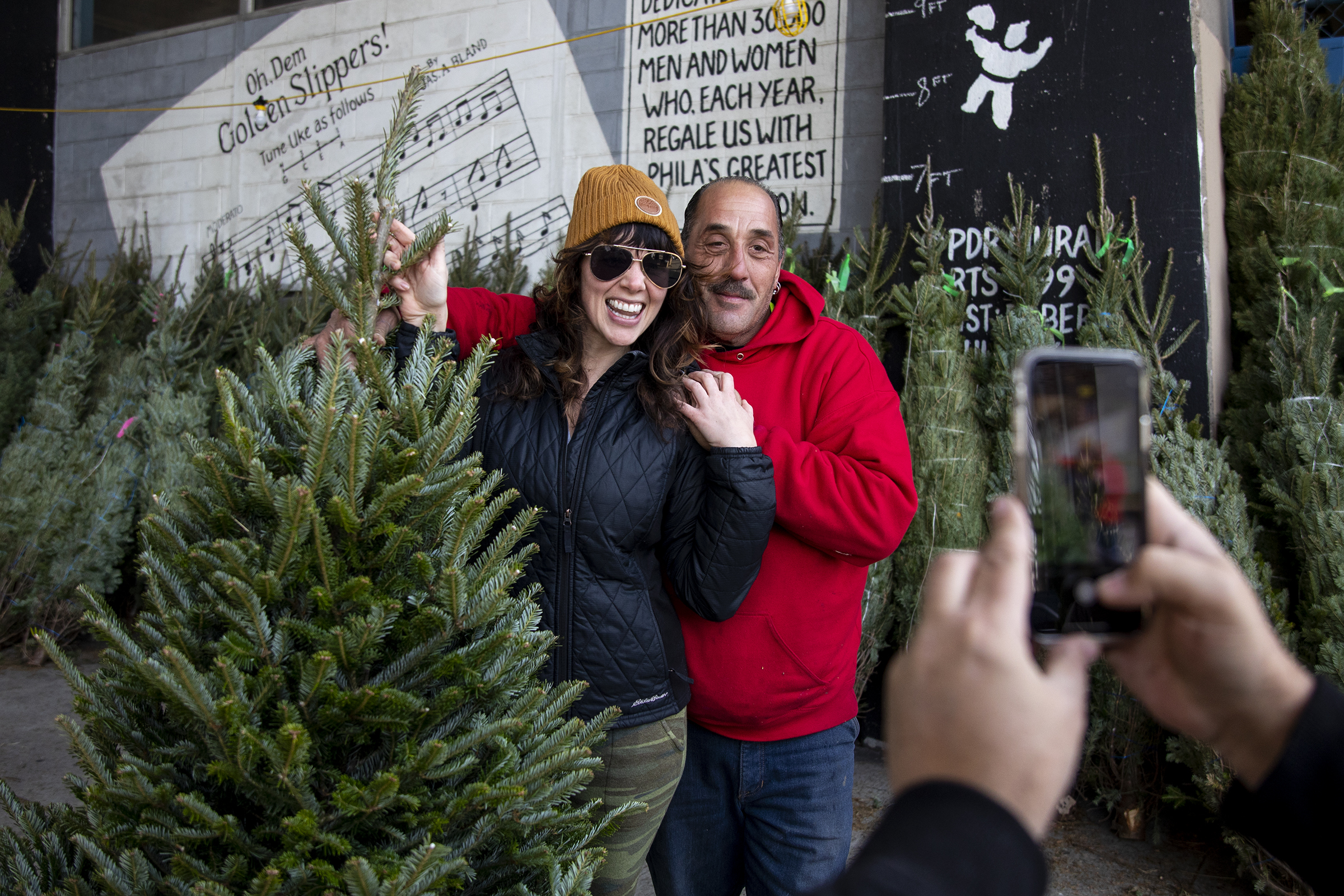
Rocky Yo-Mo of South Philadelphia, owner of Rocky YoMo’s Christmas Trees, takes a photo with Britni Volkman of South Philadelphia, with the tree she purchased in 2019.
Looking for fresh-cut Frasier firs in Philly? Check out Rocky YoMo’s selection in South Philly at Front Street and Washington Avenue. Payments are done in cash. If you don’t have a car, you can still pick a tree and get it delivered to your home for free.
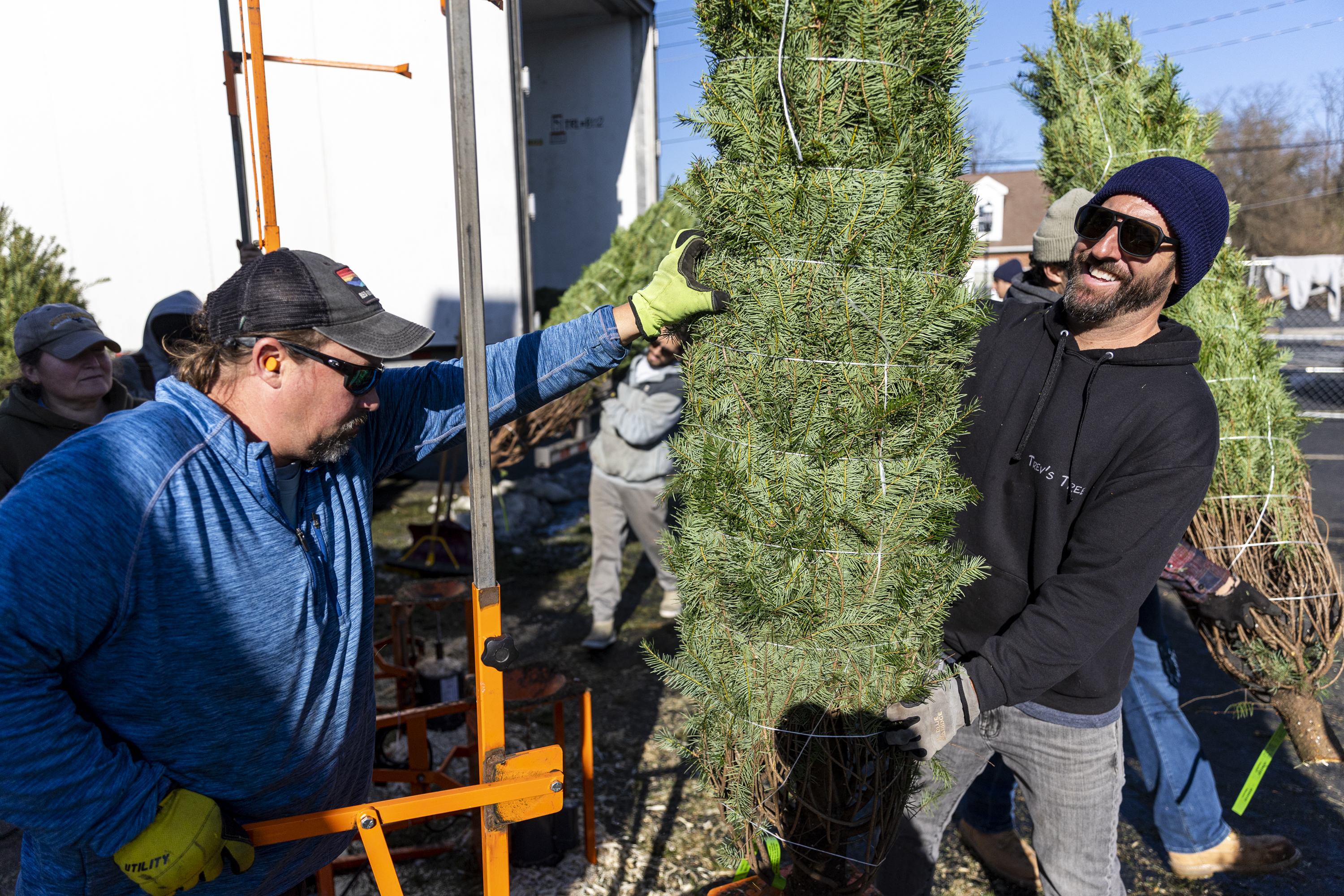
While most people buy their Christmas trees from nearby farms, this pop-up tree seller sources them from the places they’re native to. For instance, Trev’s Trees gets its Douglas firs from places like Oregon and Pennsylvania, its Fraser firs from North Carolina, and its balsams from near Lake Erie. This means you get high-quality pre-cut trees with ease. Typical sizes cost around $120 or less, but Trev’s also offers trees reaching 13- or 14-feet tall for up to $350.
The Christmas Tree Stand is a family business known for its delivery and setup services. They specialize in premium Fraser and Douglas firs, from cozy 3-foot apartment-friendly options to grand 15-foot showstoppers. Visit the Fishtown or West Chester locations to select your perfect tree, or schedule a Christmas tree delivery on the website. Next-day delivery options are available in most areas for orders placed by 4 p.m.
💵 $75 and up,📍Fishtown: 1727 N. Front St., Philadelphia, Pa. 19122 or 📍West Chester: 62 E. Street Rd., West Chester, Pa. 19382, ⌚ West Chester: Mon.-Fri., 1 p.m.-7 p.m., Sat.-Sun., 11 a.m.-7 p.m., or ⌚ Fishtown: Mon.-Fri., 4 p.m.-8 p.m., Sat.-Sun., noon-8 p.m. 🌐 thechristmastreestand.com
This Yardley farm offers a dozen varieties of trees. Swing by any day of the week, before 4:30 p.m., to choose your own tree for staff to cut, or select a pre-cut option. And if you need delivery, call to schedule. The farm makes fresh wreaths daily, too.
This Buckingham farm is entering its 62nd holiday season with a wide variety of trees. Visit the farm to pick a pre-cut tree or balled and burlapped tree and claim a free holiday mug while supplies last. Cut your own blue spruce, Fraser fir, white pine, or Norway spruce on the first two weekends of the season. There is also a holiday shop.
An hour west of Philadelphia is Clark’s Christmas Tree Farm, a 25-acre family business offering Douglas, Canaan, and Fraser firs, pre-cut or take a wagon out to cut one yourself. Prices are based on the tree height. Once there, you can check out the 3,000-square-foot gift shop, with more than 100,000 items including decorative ornaments like bearded dragons, horseshoe crabs, and dinosaurs.
Hop onto a wagon to the cut-your-own (saws provided) tree section of this 200-acre Chester County farm, which is open Friday through Sunday. Choose from a variety of firs, like Douglas, Frazier, and Canaan, as well as blue spruce and Norway spruce. Wreaths, decorations, and other items are available at the gift shop. Tree bailing and help loading your vehicle also offered, and pets on a leash welcome.
Take a tour across 55 acres, pick your favorite pre-cut or cut-your-own tree, and warm up with free hot cocoa. At any given time, at least four varieties of trees are for sale, as well as a selection of wreaths.
This family-owned business has two locations to cut your own tree plus a pre-cut tree lot. The West Chester farm offers Douglas firs averaging 7-feet tall, and the Cochranville location has trees up to 10-feet tall. The pre-cut lot in West Chester has Douglas and Fraser firs up to 12 feet available daily (Pre-cut lot: Mon.-Fri., 10:30 a.m.-9 p.m.; Sat.-Sun., 9 a.m.-9 p.m.) at 1301 West Chester Pike.
Cut your own Fraser, Douglas, Nordmann, concolor, or Canaan fir, or pick out a fresh-cut Douglas or Fraser fir at this Phoenixville farm. For folks looking for family-friendly activities, hayrides run every weekend 9 a.m. to 4 p.m. and Santa visits between noon to 3 p.m. on select weekends. Plus, enjoy a drive ($25-$30 per vehicle) or hayride ($15 per person) through the holiday light show a mile long across the 60-acre Christmas tree farm. There are so many lights that the owners lost count at well over 100,000.
Linvilla returns with free family hayrides to the Christmas tree fields, where you can cut your own trees daily (Mon.-Fri., 10 a.m.-4 p.m.; Sat.-Sun., 9 a.m.-4 p.m.). Most trees are Douglas firs ranging from 5- to 8-feet tall. Offering more varieties, Linvilla’s pre-cuts are also available daily with extended hours on Dec. 5 and Dec. 12. Be sure to stop by Linvilla’s Farm Market, where you’ll find baked goods, gift baskets, and more. Make it an all-day adventure by visiting the winter makers market (Fri.-Sun., through Dec. 21) and the ice-skating rink ($13 per person). Santa will also make appearances.
Corkum Tree Farm has delighted patrons for more than 30 years. Enjoy hot cider as you take your pick of cut-your-own Douglas fir, white pine, and blue and Norway spruce trees. There are four varieties of pre-cut fir trees to select from. Inside the barn, you’ll find fresh wreaths and holly and hand-knit hats, scarves, and mittens, and fair-trade ornaments. A second farm location offers choose-and-cut trees up to 14-feet tall.
💵 $13 per foot, $60-$200 for balled and burlapped trees,📍Main farm: 797 Bridge Rd., Collegeville, Pa. 19426, or 📍 Second farm: 3934 Mill Rd., Collegeville, Pa. 19426 ⌚ Main farm: Mon.-Tues., 10 a.m.-7 p.m.; Wed.-Thurs., 10 a.m.-8 p.m.; Fri.-Sat., 8 a.m.-8 p.m.; Sun. 8 a.m.-6 p.m., or ⌚ Second farm: Sat.-Sun., 9 a.m.-5 p.m., 📞 610-715-4640, 🌐 corkumtreefarm.com
About 30 miles from Center City, Hague’s offers cut-your-own Nordmann fir, Scotch pine, white pine, Eastern red cedar, white spruce, or blue spruce trees, and a variety of pre-cut trees. (Cut-your-own ends before 4:30 p.m. each day.) Be sure to shop the award-winning handmade wreaths and check out wreath-making and tree-decorating classes in the heated barn.
A fourth-generation, 160-acre farm, Westlake offers pre-cut and cut-your-own Canaan or concolor firs. Afterward, check out the Christmas Barn, where families can enjoy a complimentary visit with Santa (through Dec. 7), watch trains, and browse an assortment of ornaments and gifts.
You’d have to walk 13 miles to see every tree in this farm’s 16-acre field in Gloucester County. Cut your own with a provided saw or bring your own. All trees on the farm are available for purchase — all priced at $60 no matter the size. The farm strongly recommends that you arrive before 4 p.m.
Offering pre-cut and cut-your-own trees, Exley’s welcomes families to two locations for Christmas trees and holiday activities. On weekends at the Sewell farm, you can hop on a hayride to Santa Land and see holiday-themed houses. The Monroeville farm has a gingerbread house and other holiday attractions perfect for photo opportunities. Both farms feature visits with Santa on weekends.
💵 Depends on the size,📍 1535 Tanyard Rd., Sewell, N.J. 08080 or📍1512 Monroeville Rd., Monroeville, N.J. 08343, ⌚ Tues.-Sun., 9 a.m.-5 p.m. for pre-cut; Fri.-Sun. 9 a.m.-4 p.m. for cut-your-own, 📞 856-468-5949, 🌐 exleyschristmastreefarms.com
Pick a tree and enjoy a sleigh ride along a decorated path toward the Christmas trees at this small, family-owned farm in Gloucester County. Blue and Norway spruces and concolor and Canaan firs are available to cut yourself or get a pre-cut, with no tree more than 9 feet. Cash and Venmo only.
💵 $80 and under,📍 101 Idle Lake Rd., Franklinville, N.J. 08322, ⌚ Sat.-Sun., 10 a.m.-4 p.m., 📞 609-685-6234, 🌐 facebook.com
This article has been updated since it was first published. Former staff writers Grace Dickinson and Jillian Wilson contributed to this article, as did Steven White.
The Washington Post’s opinion section enlisted nine writers to share which American city they think deserves the title of the nation’s best sports city.
Los Angeles, Seattle, New York, Boston — even the likes of Kansas City and Cleveland got a mention. Which city was snubbed? Philadelphia.
Taking a look through the comments of their recent Instagram post promoting the list, not to mention the nearly 800 comments on the column itself, we’re not the only ones who raised an eyebrow at the exclusion of Philly from the list.
So we got nine of our own writers to argue why Philadelphia is the nation’s best sports city. Enjoy.
It means more to us
Mike Sielski, sports columnist
Philadelphia is America’s best sports city because sports — not national sports, not the Olympics, but the teams and athletes here — is the lingua franca of the town and the great connector of the city and its surrounding suburbs and communities. Do you flinch when someone says the name Chico Ruiz or Joe Carter? Do you smile at a random mention of Matt Stairs or Corey Clement? Then you know and love Philadelphia sports.
It’s America’s best sports city because Philadelphia is a provincial, parochial region where the love of and devotion to the teams’ histories and traditions are passed down from one generation to the next — a succession of unbroken bonds over a century or more. Did you sit out on your front stoop on a summer night and listen to Harry and Whitey call a Phillies game over the radio? Do you still sync Merrill and Mike’s broadcast to the TV telecast? Do you know who J.J. Daigneault is? Then you know and love Philadelphia sports.
It is America’s best sports city because you can walk down the street here after an Eagles loss or a Phillies loss or a Sixers loss and know that those teams lost just from the vacant looks on the faces of the passersby. Do you turn up the talk-radio station on those terrible Monday mornings? Do you remember where you were when Kawhi’s fourth bounce fell through the net? Then you know and you live and you die with Philadelphia sports.
Most of all, Philadelphia is America’s best sports city because people here care more and sports here matters more than it does anywhere else. If you don’t believe me, go ahead. Tell a Philadelphia sports fan that your city, your teams, your traditions are better. Go ahead. Dare ya.
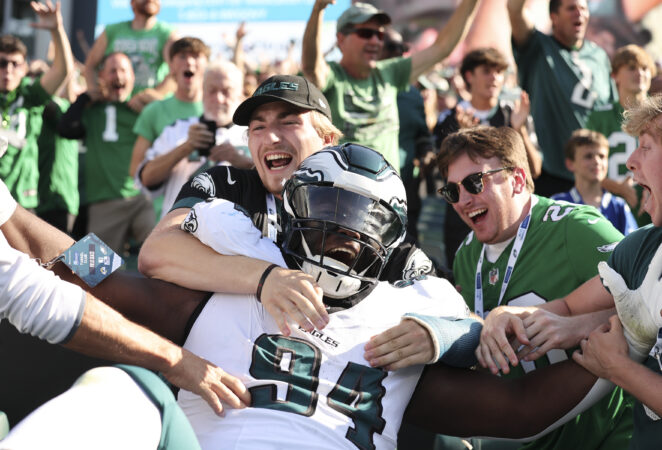
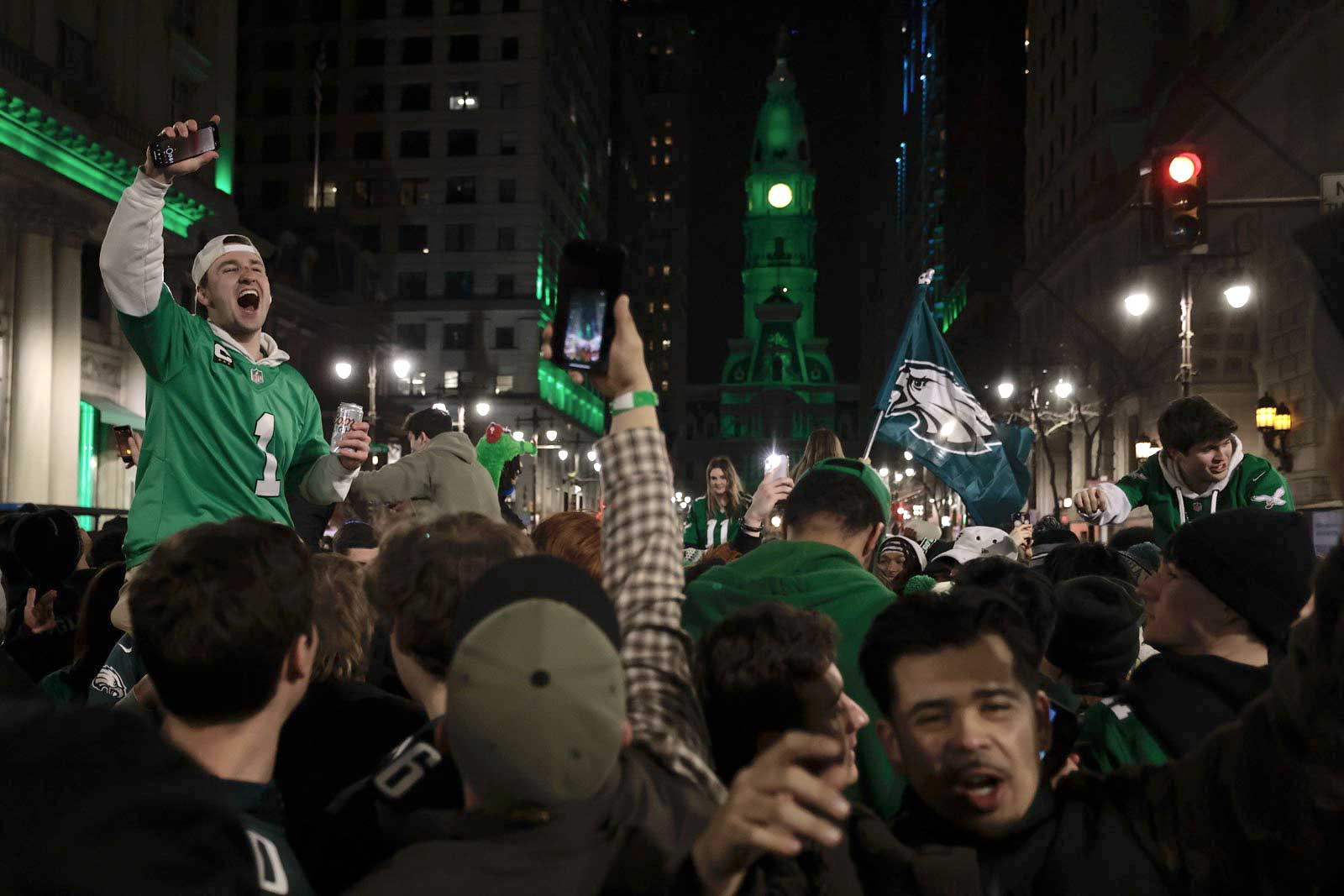
Philly fans celebrate the Eagles’ Super Bowl LIX win in near City Hall.
Nobody parties like us
Stephanie Farr, features columnist
Philadelphia is undoubtedly the best sports city in the United States and it has everything to do with our fans, who are as passionate and dedicated as they come. Here “Go Birds” is a greeting, talking trash is an art form, and being a part of it all is totally intoxicating, even if you’re completely sober (which, to be fair, most of us aren’t).
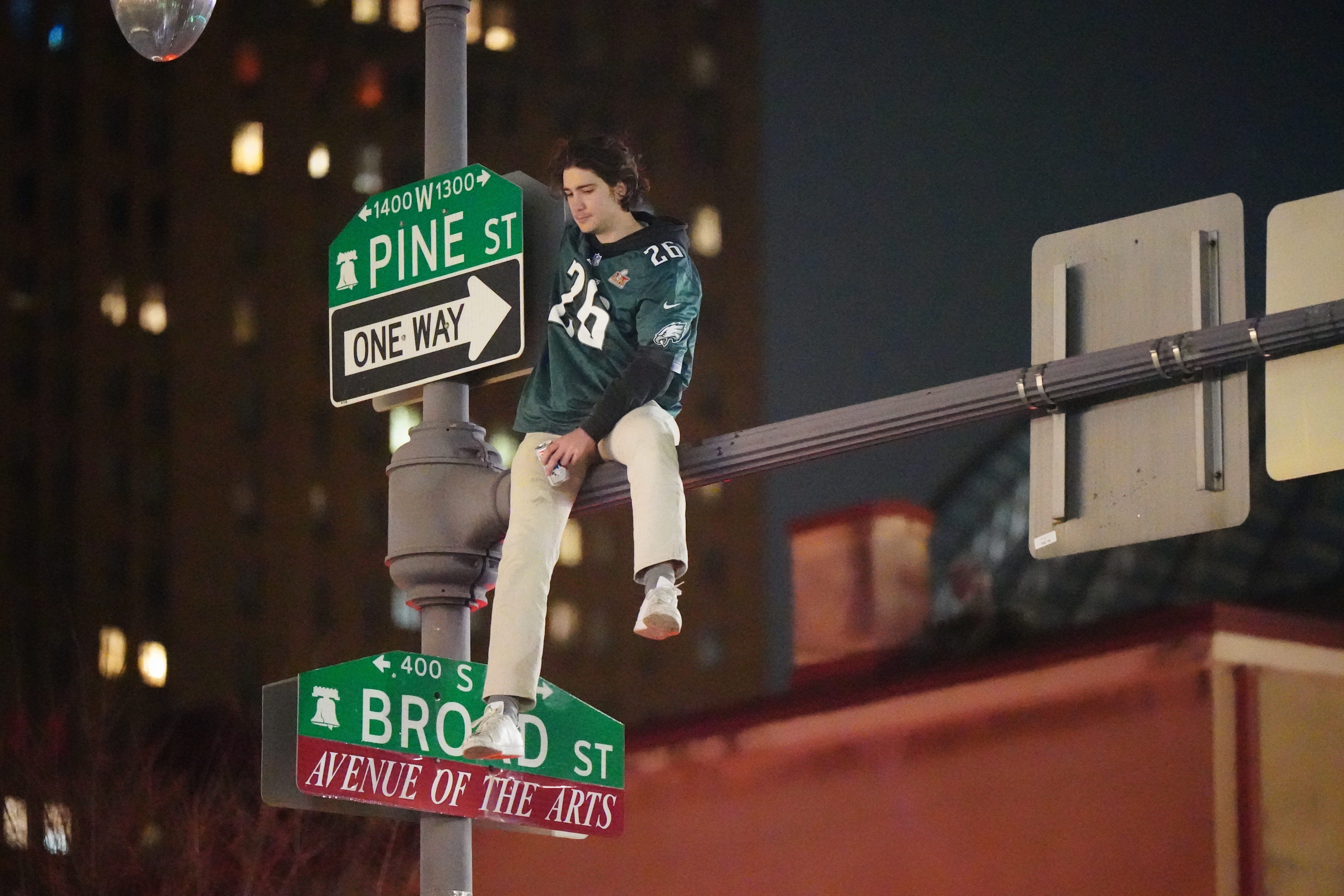
Nobody celebrates a major win like Philly — by partying in the street with Gritty and Ben Franklin impersonators, dancing with Philly Elmo and his drum line, and climbing greased poles. When the Phillies won the NLCS in 2022, I watched Sean “Shrimp” Hagan climb a pole and shotgun seven cans of Twisted Tea thrown to him by the crowd. To his credit, at some point Hagan realized he was too drunk to get down safely and waited for firefighters to bring a ladder.
“It couldn’t have happened without the crowd being so [expletive] Philly,” he told me. “What other city’s first thought when they see a guy on a pole would be to throw him a beer?”
Do our Bacchanalian celebrations border on absolute lawless anarchy? Yes, but if you want to live safe and know how something will end, go watch a Hallmark movie. This is Philly, where we are fueled by the raging fire of a thousand losses — even when we win — and we thrive off the unpredictability of life.
In my early 20s, I lived in Tampa for a brief stint. The downtown area is small enough that all of its neighborhoods are in proximity to each other. My apartment was in a section popular among locals for its dining and nightlife scene. But it was close enough to the hotel district to be in the eye of the storm when the Eagles came to town.
One Saturday evening in late October, we were sitting at a popular outside bar when the place was suddenly overcome by a wave of midnight green. Everywhere you looked, there were packs of Eagles fans who looked like they hadn’t seen the sun in two months. They swaggered through the place in their Brian Dawkins jerseys with zero regard for humanity. They ordered their Bud Lights in multiples of two and yelled Eagles chants at each other as horrified young women clung desperately to each other and wiped errant sloshes of domestic Pilsner off each other’s going-out clothes. A friend of mine stepped off the patio to have a cigarette. He returned with a stunned expression on his face. “An Eagles fan just peed on my foot,” he said with a mixture of anger and respect.
Tampa got the last laugh the next day when Matt Bryant kicked a walk-off field goal from 62 yards out. But I always think of that weekend when people ask me if Philly sports fans are as crazy as their reputation.
An Eagles fan sits on top of the traffic light post at the intersection of Broad and Pine Streets after the team won Super Bowl LIX in February.
There are a lot of different prerequisites that a city needs in order to consider itself a great sports town. For instance, it must be an actual city, one with history and character that stands on its own even without sports. Furthermore, a great sports town requires a certain level of market penetration. Sports must sit atop the pedestal in a way that it doesn’t in places like New York and L.A. There must be a critical mass of folks who are born and raised, which eliminates pretty much any city south of the Mason-Dixon and west of the Mississippi. The list is a short one. Boston, Chicago, Buffalo, Pittsburgh, Detroit, maybe Milwaukee.
From there, the thing that sets Philly apart is the people. They are a strange lot, prone to overexcitement and, every now and then, over-indulgence. But, man, do they care. You see it any time one of their teams hits the road. You hear it, too. There is an energy that is difficult to define but impossible not to feel. It’s the secret sauce of this place. And, yeah, it’s the best.
A veteran Eagles reporter wrote recently that last Sunday’s Eagles-Cowboys game was the Birds’ worst ever loss to their rival. They blew a 21-point lead, exposed some glaring flaws, and lost on a walk-off field goal. Fair point. But it was pushed back immediately on social media. You think this loss was bad? That’s what makes Philadelphia a great — maybe the greatest — sports city. We celebrate our wins like no other but we also wear our losses forever. This was a brutal loss but we still remember that botched chip shot on Monday Night Football in 1997. And that blowout loss in the playoffs while we were stuck inside during the Blizzard of ‘96. Oh yeah, remember what happened in 2010?
I don’t know if any city in the U.S. holds onto losses more than Philly. We do that because we care. We lose sleep when the Phillies blow a save, have a bad week if the Eagles lose, still can’t believe they didn’t call the Islanders offside, and are still waiting for Ben Simmons to dunk it. So yeah, that’s why it means more here when the teams do win. Because we care so much when they lose. You can have L.A., Seattle, and Kansas City. I’ll stay in Philly.
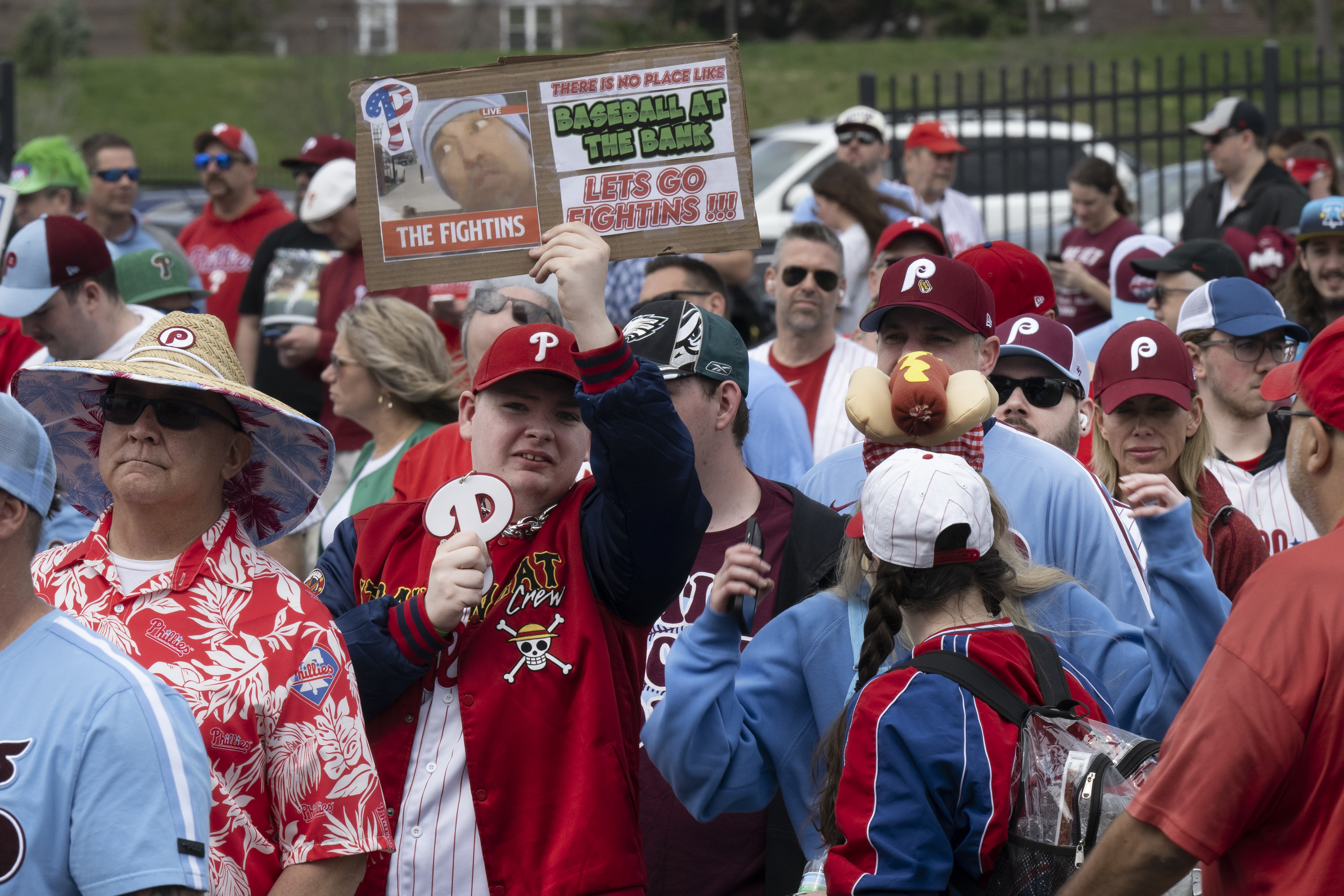
A Phillies fan holds up a sign paying tribute to another viral Phillies fan before the team’s 2025 home opener.
We feed off being underdogs
Julia Terruso, politics reporter
Look, I’m not pretending to be neutral here. I went to spring training in Clearwater in pigtails as a child. I fell in love at an Eagles tailgate and flew to London to watch the Phillies play the Mets on my honeymoon. But even non-Philadelphians would be out of their minds not to put us in the top three — let alone the top nine.
Rooting for the Phillies, Sixers, Eagles, and Flyers is a cross-class, cross-generation rite. We’re one of only eight U.S. cities with all four major teams, and our stadiums are actually accessible — yes, Los Angeles, I’m looking at you. Tickets are (mostly) affordable, the crowds are electric, and the fervor is real. We boo because we care. And unlike other cities, we don’t sneer at bandwagoners. The citywide greeting is “Go Birds,” and the uniform is fair game for the lifer who knows about pickle juice and The Process, along with the new Fishtown transplant who couldn’t diagram a wheel play but looks fantastic in kelly green — because everyone looks fantastic in Kelly green.
But the thing that really makes Philly a great sports town is our shared history of heartbreak and near-misses that drives us forward. We’re used to being underestimated. So go ahead, leave us off your list, WaPo. Underdogs run on disrespect, and we’ve got miles to go.
Stand on the South Street bridge at 7 a.m. and you’ll know the time of year, and that says it all. The rivers of medical professionals walking and biking back from their night shifts, and those heading to their morning duties, give it away in unison. Red caps? It must be October. Kelly and midnight green beanies? The NFL playoffs are coming. Blue or black starred jackets? The NBA playoffs are underway and our hearts will soon be broken, again.
I am a Philly transplant who comes from the tradition of European soccer, where rivalry between teams from the same city is the driver of passion. I always thought that there is nothing more electric than winning a derby game, and having your team crowned as the city’s best. But Philadelphia taught me that I was wrong. There is something more electric: a city united, together, declaring love to its teams in every nook and corner.
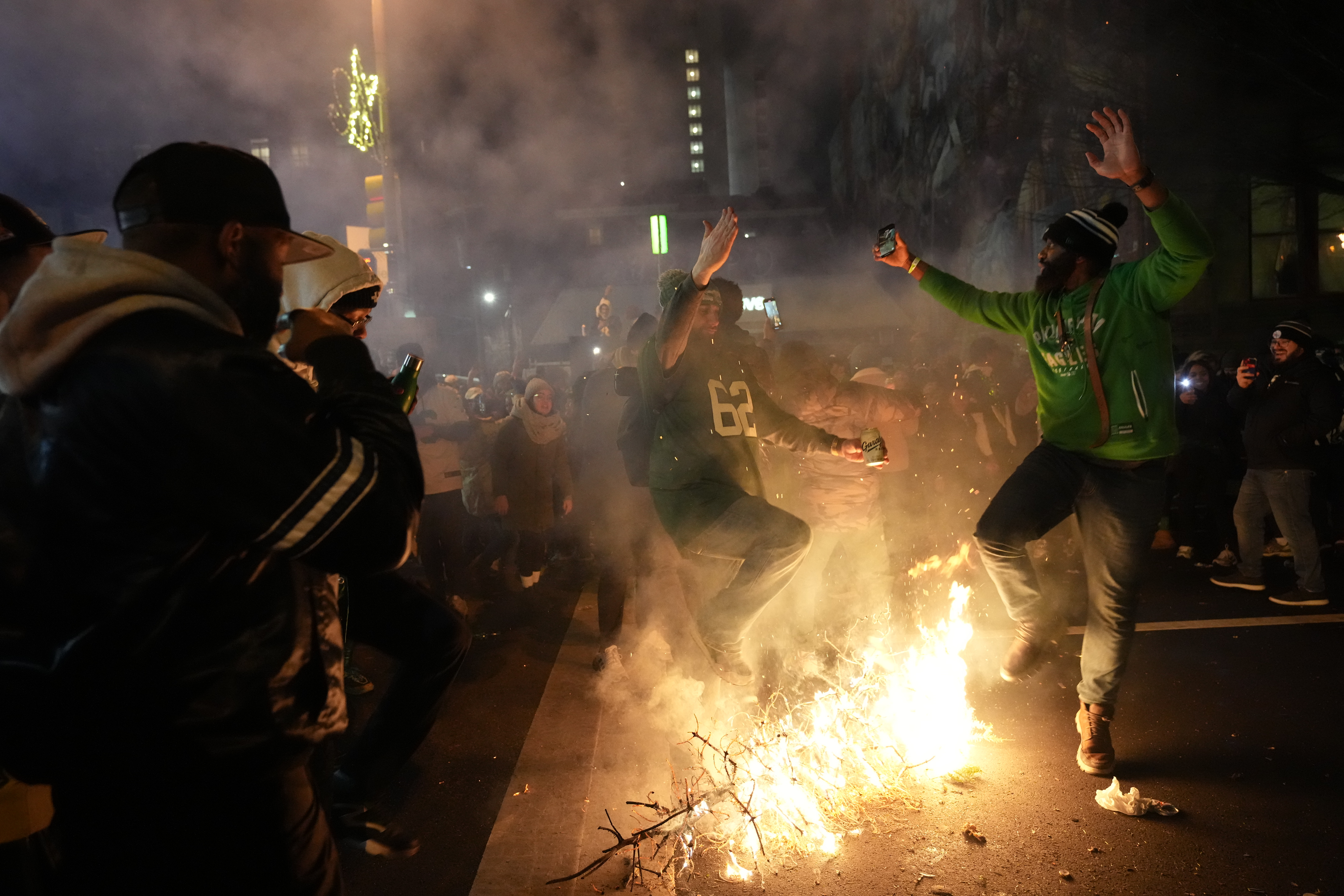
Jubilant Eagles fans dance around a fire on Broad Street after the Birds beat the Chiefs in Super Bowl LIX.
Philadelphia isn’t just the best sports city in America (“next year on Broad?”), it’s an organism that breathes sports fandom unlike any other place.
The days of throwing snowballs at Santa or batteries on a hated player are far gone. This is the city that gave a struggling shortstop who just arrived in town a standing ovation, that travels in droves so E-A-G-L-E-S chants come through the broadcast of every away game, and has a community of sickos who rode with its Sixers through one of the weirdest experiments in NBA history.
The electric energy isn’t confined to the city lines. It’s a moment that every Philadelphian cherishes. Don an Eagles hat in any other city in America, or even abroad, and you are more likely than not to lock eyes with a stranger passing by.
“Go Birds,” they inevitably say.
“Go Birds!” you respond.
Nothing beats that. And if you don’t like it. All good. We don’t care.
The Washington Post’s opinion section has been having a rough go of it. Which makes me wonder if this list, too, had to be cleared by the Amazon overlord, and maybe Jeff Bezos just hates Philadelphia?
I mean … Cleveland?
The size and scale of the two recent Eagles parades speak for themselves. The fact that there used to be a jail in the bowels of Veterans Stadium speaks for itself. Attending one Phillies playoff game at Citizens Bank Park would speak for itself. “Go Birds,” is a passing “hello” to a fellow Philadelphian in another town, a phrase of familial camaraderie. Due respect to Los Angeles, a city I love to be and eat in. But the sheer number of sports that happen in a place doesn’t make it a good sports city. That’s not human. People and passion make a place.
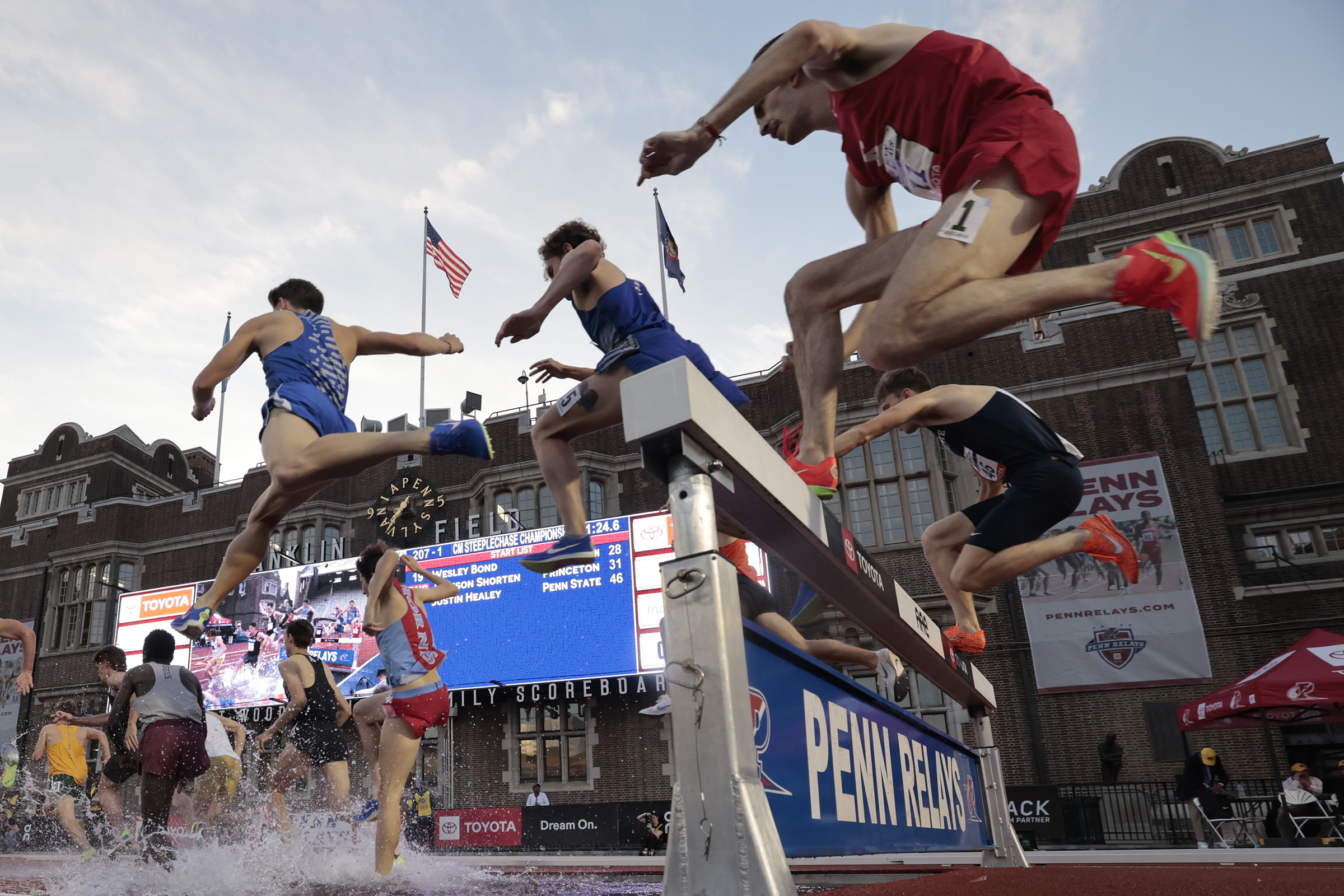
The Penn Relays at Franklin Field are one of just a few annual sports traditions in Philadelphia.
We have much more than pro sports
Tommy Rowan, cheesesteak/Philly history expert
A criteria would have helped, but really, any discernible or coherent formula would have really pulled that Washington Post list together. Here, instead, are three reasons why Philadelphia is one of the cornerstone cities in American sports …
History: The fabric of American sport was woven here. The Heisman Trophy is named after John Heisman, who played at Penn. The Phillies are one of the key reasons fans are allowed to keep foul balls that land in the stands. All because an 11-year-old Phillies fan didn’t blink when the team had him thrown in jail for larceny.
Tradition: We’re more than pro sports. We’ve hosted the annual Army-Navy game, and the Dad Vail Regatta, and the Penn Relays. Tennis found an American foothold at the Philadelphia Cricket Club.
Passion: Support is an undergarment. This city has passion. Fandom here is passed down from generation to generation, just like their houses. And sure they’re loud, and they generally take it the worst of any fanbafan base. But they’re vocal, they’re informed, and they care. These teams mean something to these people.
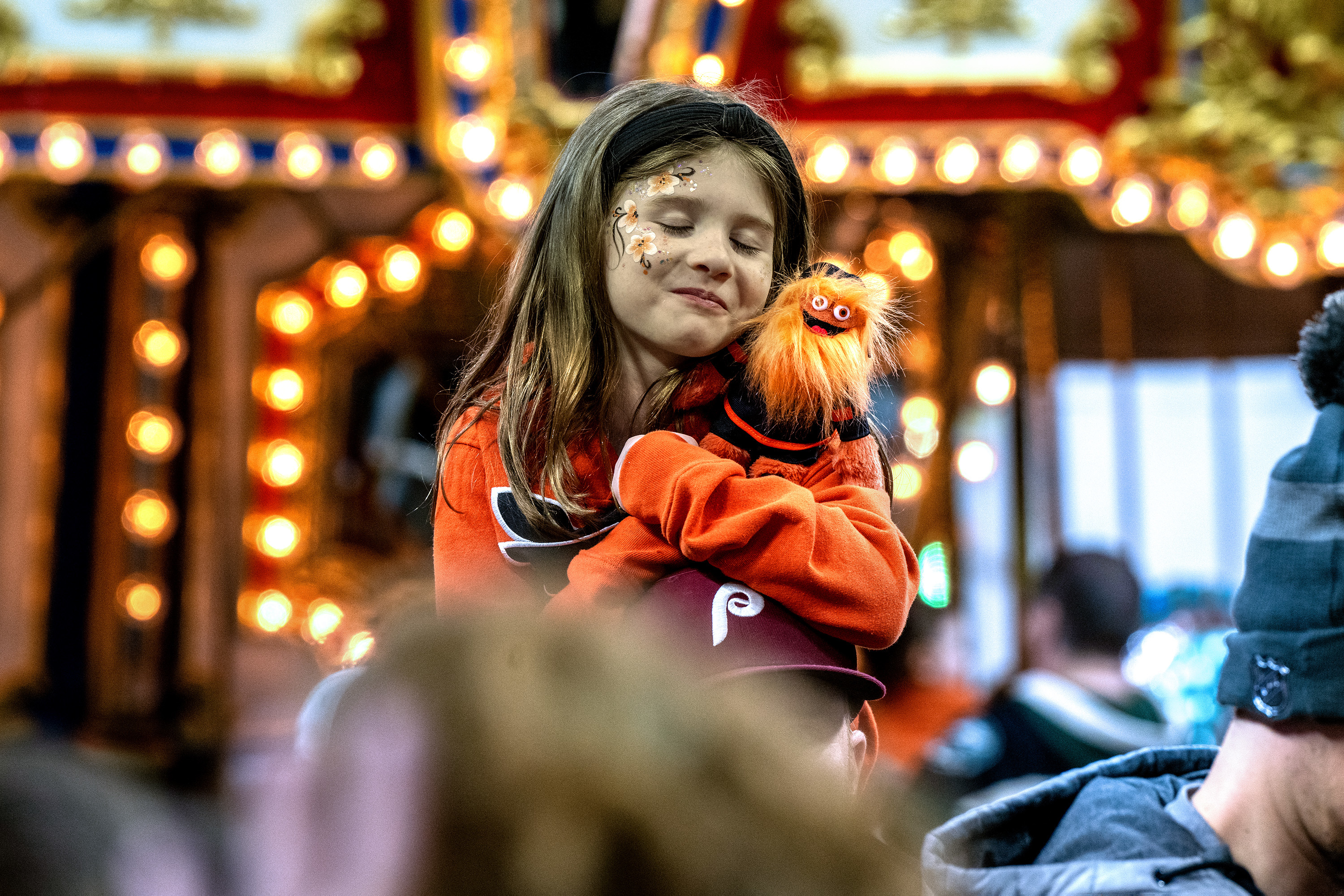
Sports fans start young in Philly, as fandom gets passed down from generation to generation.
We know our stuff
Ariel Simpson, sports trending writer
Oct. 9 was a tragic day for Philly sports fans. The Phillies season ended with a heartbreaking loss to the Los Angeles Dodgers, the Eagles suffered a devastating 34-17 loss to the New York Giants, and the Flyers dropped their season opener to the Florida Panthers.
That very next day, I wandered the streets of Philadelphia in what felt like a walk of shame. The heartbreak could be seen on each fan’s face as they still sported their favorite team’s colors. And when asked about the losses, each fan gave me a full breakdown of what needs to be done in order for the teams to be more successful.
That’s what makes Philly such a great sports city. Not only are the fans passionate, but they are knowledgeable when it comes to their sports teams. Sure, sometimes they may rush to call for a head coach to be fired or boo their own teams, but that’s only because they care so much.
They wear their heart on their sleeves and they expect more from each team. And when they do succeed, they show up and celebrate like no other. If you need an example, look no further than the city greasing its light poles in an attempt to stop fans from climbing them in celebration.
If you’re buying a home, refinancing your mortgage, or just want to know how much your home is worth, you’re probably going to need a property appraisal.
At its most basic, “an appraisal is an opinion of value for a home,” said Matthew Sestito, a Philadelphia-based appraiser who works throughout the five-county area for the national company Velox Valuations.
Lenders require borrowers to get them for mortgages and lines of credit against a home. Families get appraisals to assess the value of properties after a divorce or a loved one’s death.
Costs depend on the scope of work, the type of property, and the borrower’s bank, but appraisals can range from about $300 to thousands of dollars, Sestito said.
A lot of people don’t understand the appraisal process, he said, and they’re very nervous the first time an appraiser comes to their home.
“You don’t have to be nervous,” he said. “It’s an easy inspection.”
The Inquirer talked to Sestito, who has been a licensed appraiser since 2009, about what people should know about home appraisals. This interview has been edited for length and clarity.
When you do an appraisal, what factors do you take into account?
The basic number of bedrooms, bathrooms. And then the amenities: decks, patios, garages. And then the overall condition: updated kitchens, updated bathrooms. And so on.
Location is always the No. 1 thing in real estate. The market dictates what is desired. And then there’s submarkets to each market. And what each market is looking for varies.
And then there’s different price points. A bathroom in a million-dollar home is different than a bathroom in a $300,000 home.
What the market is telling us is what we use to determine our opinion of value.
What should homeowners expect when an appraiser comes to their property?
The length of an appraisal depends on the size of the home. For example, if I were to do a standard South Philly rowhouse with two stories, three bedrooms, it takes about 15 minutes.
I’ll take a picture of the front of the house, the street view. And then when I come in the door, it’s a photo of the living room, dining room, kitchen, back of the house, backyard, bathrooms, each bedroom, then the basement.
Then I’ll take some measurements: the width of the house, the length.
I’ll talk to the homeowner and ask them anything they’ve done to the house, updates like kitchens, bathrooms, flooring, windows.
And then I’ll explain to them that I’ll type the report, give it to the lender, and then it’s basically out of my hands after that.
One of the common questions is: Do I get a copy of the report? The answer is no, from me. I’m not legally allowed to give you a copy of the report if this is for a refinance or a purchase. The bank is the client who orders the report, and legally, whoever orders the appraisal is the owner of the appraisal.
If they want to release it to you, they will. I don’t think I’ve come across a bank saying, “No, you can’t have a copy of it.”
What types of property design choices and features matter for an appraisal?
It goes back to the market. But you can’t go wrong with updated kitchens, updated bathrooms, flooring, windows, roof, driveway.
Parking, especially in the city, is almost No. 1. If you have a spot to park, that’s like gold.
And then adding a deck, a roof deck, patio, all those things add value to the house.
It’s all determined by what the market will be willing to pay.
How should a homeowner prepare for an appraisal?
You know, make the house look presentable. You’re showcasing your house.
I always tell people clutter doesn’t matter. I look through the clutter. So if there are toys on the floor, I don’t even see them. But it’s better to clean up.
Turn all the lights on. It looks better in the photos.
Lenders are looking for any safety issues: missing handrails, broken steps, anything that could cause a health or safety issue, any mold. Get them taken care of, because they will call for that repair. Missing handrails in the basement is one of the biggest ones.
And not having smoke and carbon monoxide detectors. It just started recently within the past couple years that they started asking for those to be in the homes.
How do you choose and use comps (sales of comparable homes)?
Lining each comp up and seeing what each home has, how many bedrooms, how many bathrooms, and just comparing each home. If you have a three-bedroom house, I’ll start looking for three-bedroom homes.
I start out [looking] at [comparable homes that sold within] three months, then six months, then one year if need be.
Typically, within the city, you try to stay within a quarter mile. I’ll expand to a half a mile sometimes if I need comps. But you typically want to stay within a quarter mile of the home.
I’ll narrow it down to where I have some matches of the property that I’m trying to appraise. I look at a ton of houses every day.
What are common misconceptions people have about appraisals?
There are a lot of checks and balances when we hand in the report. The report runs through a computer software program. There are multiple reviewers. And they’re looking at everything. They’re asking why you didn’t use certain comps or why you did use these comps.
There are a lot of regulations that we have to follow. It’s not just as simple as taking photos and saying your house is worth this amount.
What happens if a house appraises differently than you expected?
There is a formal process. You can file an appeal and then you provide some comparables that you think the appraiser should have used. And there’s a review process.
Philadelphia didn’t take home any Nobel Prizes this year, but work illuminating how babies respond togarlic-flavored breast milk at Monell Chemical Senses Center did get recognized by its satirical counterpart, the Ig Nobel Prize.
Julie Mennella, a longtime scientist at the center in West Philadelphia, and Gary Beauchamp, Monell’s former director, won the prize earlier this fall for their 1991 study published in the academic journalPediatrics that disproved popular folklore around breastfeeding.
Their study examined whether eating garlic would flavor a mother’s breast milk and, if so, how a nursing baby would react to it.
At the time, breastfeedingwomen were often told to eat bland foods, for fear their babies would reject strong flavors. However, the study’s results showed the opposite: Babies savored the garlic-flavored breast milk.
“That simple, elegant study really showed how one of the first ways we learn about foods is through what our mothers eat,” Mennella said.
These early life experiences shape food preferences and influence cultural food practices around the world, she emphasized. Babies whose mothers come from cultures in which garlic is a defining flavor would have experienced garlic long before their first meal.
Mennella spoke with The Inquirer about the implications of her Ig Nobel Prize-winning work and her decades of research on flavor sciences and early nutritional programming.
The following conversation has been lightly edited for length and clarity.
What did you discover in your Ig Nobel Prize-winning study?
We found in this study that not only did the milk get flavored with garlic, but contrary to a lot of the folklore, the babies actually liked it. They nursed longer when the milk was garlic-flavored than when it was bland and devoid of garlic.
We went on to show that when women eat garlic, the flavor of amniotic fluid also gets altered.
Through these first exposures, babies are learning about what mom is eating, what mom has access to, and what mom likes before their own first taste of solid food.
What is the takeaway for breastfeeding mothers?
Eat the healthy foods that you enjoy because your baby’s going to learn about the food. Food is much more than a source of calories. In many cases, it defines who we are as a people.
What other flavors have you studied?
A wide variety of flavors, from vanilla to even alcohol if a woman drinks it, get transmitted and flavors the milk. If women smoke, the tobacco flavor does, too. So it’s not only what you eat, but what you breathe.
Why is it important for babies to learn about food this way?
There’s a great story about the European rabbit (an animal that nurses), where they tagged the mother’s diet with juniper berry. What they were able to show is that in a group where the mothers ate juniper berry during either pregnancy or lactation, once those young rabbit pups left the nest, they were more likely to forage on juniper berry.
So, she’s telling them, ‘These are the foods that are out there. I’m eating them. They’re safe.’ It’s really a very elegant, sustainable behavior, how moms transmit this information about the foods in the environment. She’s teaching her young and giving them an advantage early on.
How long do these flavors last in the milk?
Depending on the size of the chemical, some will get in fast. Garlic gets in a couple hours after the mom eats it, and then if she stops eating, it’s out of the milk like four or five hours later. The sensory experience of that baby is changing throughout the course of the day, day to day, depending on what she eats.
What research have you been up to since?
I’ve gone into so many different directions of looking at not only early flavor learning, but also nutritional programming. I also looked at the taste of medicine in children, looking at individual differences because taste is the primary reason for noncompliance. Children have a harder time because they can’t encapsulate the bad taste in a pill or tablet, so liquid medicines are particularly difficult.
One study where we looked at variation in the taste of pediatric Motrin (among adult participants) was really interesting. Some people experience a tingle when they taste it. Others don’t. It makes you think that how one child tastes Motrin isn’t like how another does. If you don’t experience the tingle, or this burning sensation, all you taste is a sweet liquid, and those are the children that may be at risk of over-ingestion.
What is your favorite project that you have worked on since the garlic study?
I serendipitously found that another flavor that gets transmitted is alcohol, and that became a whole new area of research.
We found that when women just have the equivalent of one or two glasses of wine or beer, not only did the alcohol get transmitted, but it flavored the milk. That became a lead article in theNew England Journal of Medicine.
At that time, there was talk about a folklore that women should drink when they’re breastfeeding, so they would make more milk. And contrary to that folklore, they actually made less milk.
How did it feel to win an Ig Nobel?
It was so nice to celebrate science. That’s really what that award does: It uses humor to teach about science.
Even after more than two decades of operating a financial advisory in the Philadelphia region, Joel Steele is inspired when clients tell him they want to donate money to charity.
“But the problem is that it’s gotten much more difficult to know if your donations are going to the people you are directly trying to help,” said Steele, co-owner and financial adviser with Steele Financial Solutions in Cherry Hill. “Charity scammers are running rampant.”
Solicitors are on the phone, at your door, in your email, and in your mailbox.
“We’re constantly inundated with people looking to take our money and put it in their pockets for the wrong reasons,” Steele said. “This has led many people to back off — in part or in full from — donating to charities.”
One way to reduce the chance of misappropriation is to contact the charity directly, Steele said. “Yes, it’s easier to put cash in a tin can or buy things from a stranger, but these are more likely to end up in that person’s pocket.”
Also, he recommends, when you donate directly to charities, get a receipt and check with your income tax preparer or review deduction guidelines to understand potential tax benefits.
Evaluating Giving Tuesday solicitations
Everyone knows about Black Friday shopping, and recent years have seen the additions of Small Business Saturday and Cyber Monday in the days after Thanksgiving.
In 2012, Giving Tuesday joined the lineup, promoted by the 92nd Street Y in New York and the United Nations Foundation. It caught on quickly, as more organizations joined in on the opportunity to fundraise.
Giving Tuesday encourages generosity, but it’s also a time for scammers to ramp up fraud tactics. Scammers may use fake charities or misuse real ones to take advantage of donors.
If you get direct mail or a call, text, email, or social media message asking you to donate to a nonprofit, pause for a moment to dig deeper.
Your heart immediately wants to say “yes,” said Katherina ‘Kat’ Rosqueta, founding executive director of the Center for High Impact Philanthropy at the University of Pennsylvania. But unless you have personally been helped by that nonprofit or know someone who was, it’s hard to know whether the nonprofit is actually making a difference.
“That’s where your head comes in,” Rosqueta said. Consider running a quick Internet search for the charity’s name, along with “scam” or “complaints” to see if there have been any negative feedback or investigations, she said.
Katherina Rosqueta is the founding executive director of the Center for High Impact Philanthropy at the University of Pennsylvania.
Of course, most donors want to do more than just avoid fraud.
“They want their donation to make a real difference,” Rosqueta said.
Her center at Penn created a “High Impact Giving Toolkit,” updated each year and available for free. It highlights vetted nonprofits and provides links to organizations like Candid, Charity Navigator, and BBB Wise Giving Alliance, where potential donors can learn about organizations’ programs, team, and finances.
“Once you feel confident about a nonprofit’s work, consider donating online through an official, secure nonprofit website that uses HTTPS encryption,” Rosqueta said.
“Avoid links in unsolicited emails or social media posts. Credit cards and checks offer better fraud protection than debit cards or wire transfers,” Rosqueta said.
How to make online donations safer
The key to understanding fraud is that most scammers prey on your emotions.
“Fear, urgency, and promise of a quick win are some elements that exist in so many scam scenarios,” said Christopher Blackmore of TD Bank in Mount Laurel, who works in customer education in financial crimes prevention.
Blackmore said most “bad actors” will reach out and provide a number to call, link to click, or instructions for payment. “The goal is to make scenarios seem so real that you feel you must reply or something will happen.”
Financial industries should never ask for login credentials, passwords, or one-time pass codes, Blackmore said. “Technology is making it very difficult to identify what is real vs. fake.”
A text, email, or phone call is a very quick and easy way to contact a lot of people quickly and ask for a donation.
“These tactics are known as phishing, vishing, and smishing,” Blackmore said. A newer tactic, known as “Quishing,” utilizes QR codes.
When a donation ask includes a request for payments using gift cards, wires, and cryptocurrency, that should immediately raise caution, Blackmore said.
Donors might want to consider a third-party platform like PayPal, which safeguards sensitive financial information.
“Donors should stay mindful online and keep an eye out for the warning signs of common scams, including being wary of unexpected messages from strangers,” said Nick Aldridge, Global CEO of PayPal Giving Fund.
“We always encourage supporting causes you care about through trusted channels like PayPal Giving Fund, the PayPal Cause Hub, and Venmo Charity Profiles,” Aldridge said.
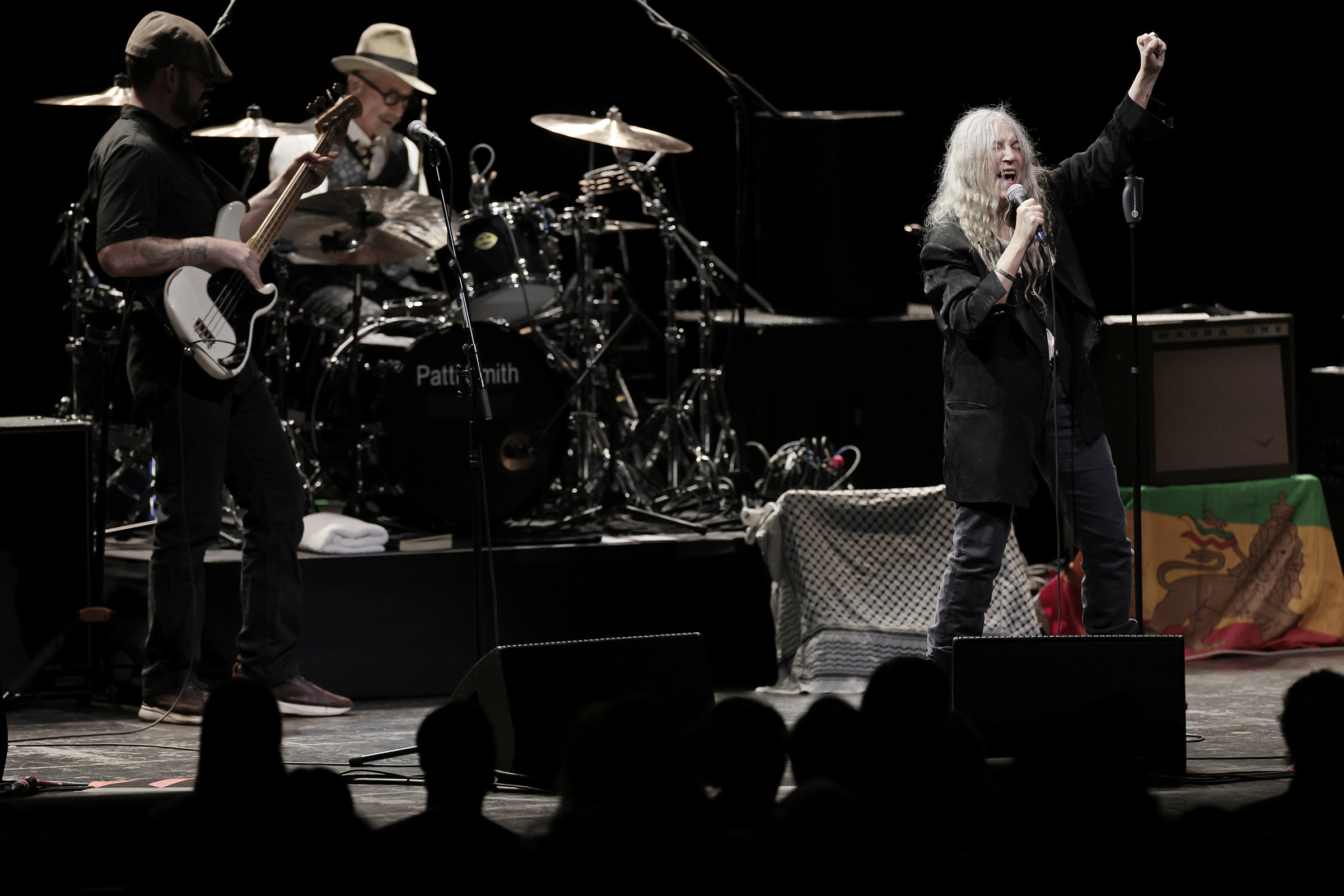
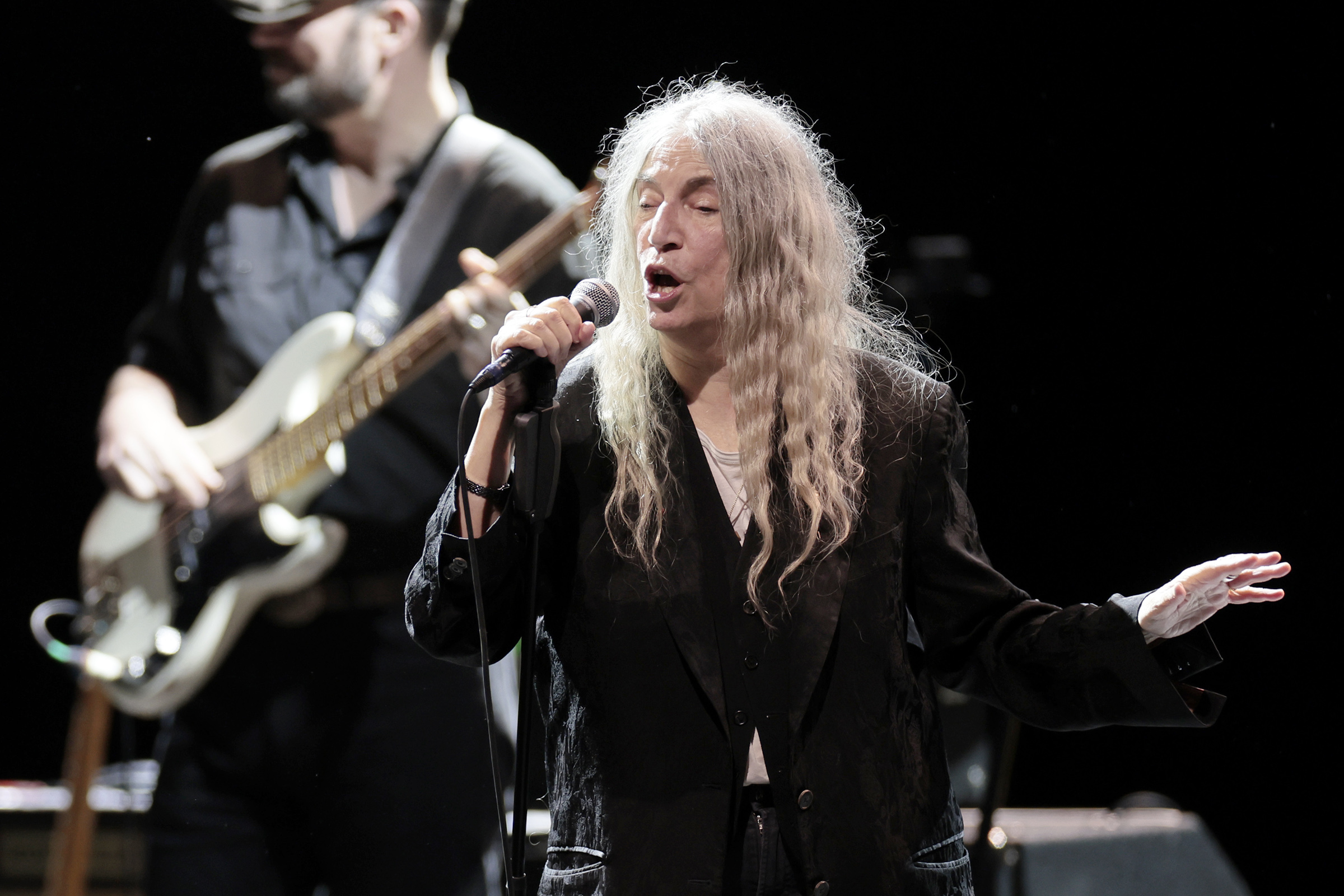
Patti Smith stood onstage at the Met Philadelphia on Saturday during her 50th anniversary tour for her 1975 album Horses. She recalled her elementary school report cards when she was growing up in Germantown in the 1950s.
“They would always say, ‘Patti Lee shows a lot of potential, but she daydreams too much,’” she said. “‘Will she amount to anything?’”
The revered punk poet and undiminished life force, who will turn 79 on Dec. 30, smiled and looked out at the cheering sold-out crowd, mirroring their affection.
“You are my answer,” she said.
Philadelphia was the final stop on the Horses tour, commemorating the majestic John Cale-produced album with an iconic cover photo by Robert Mapplethorpe that lit the fuse for a punk rock conflagration to come.
Smith came onstage dressed in black jeans and a suit jacket, accompanied by her band, with original 1970s members Lenny Kaye and Jay Dee Daugherty on guitar and drums, joined by her son, Jackson Smith, on guitar, and Tony Shanahan on bass and keyboard.
They started with “Gloria,” Smith’s reworked version of the 1964 Van Morrison-penned Them hit that began, as always, with the still startling declaration, “Jesus died for somebody’s sins, but not mine.” She then went on to take responsibility for her own actions, seeking rock and roll salvation on her own terms.
“My sins, my own,” she sang in a voice that has lowered in register in the last half century but lost none of its power. She often sounded as if she were channeling otherworldly spirits.
“They belong to me,” she sang.
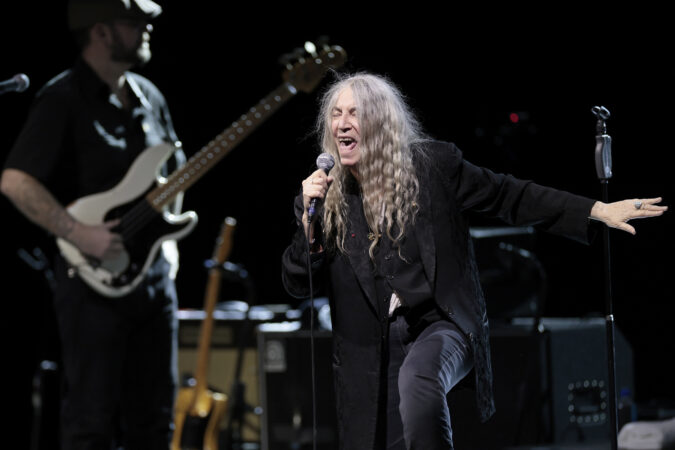
Patti Smith and her band perform “Horses” on its 50th anniversary at the Met Philadelphia on Saturday, Nov. 29, 2025.
The band steadily built to a roar, with Kaye and Shanahan chiming in along with the crowd on chanted vocals.
Track one, side one. “G-L-O-R-I-A!” — catharsis was already achieved.
The eight-song Horses was performed in its entirety, essentially straight through but with a few songs flip-flopped in order. “Free Money,” about dreaming of hitting the lottery and lifting her family up financially, preceded the epic improvised-in-the-studio “Birdland.” For that song, Smith put on glasses to read out the rapid-fire incantatory lyrics from one of her own books, as the song built to a crescendo.
There was little chitchat during Horses itself, save for a dedication of “Elegie” to Jimi Hendrix and a story about hanging out in the 1970s with the late Television guitarist Tom Verlaine at a Manhattan magazine shop called Flying Saucer News. The duo teamed to write “Break It Up,” a song inspired by Smith’s dream of coming upon a marble statue of Jim Morrison, “like Prometheus in chains, with long flowing hair,” lying in a clearing in the woods.
Horses built to a climax with “Land,” complete with its ecstatic “Do the Watusi” romp through Chris Kenner’s “Land of 1000 Dances” and a reprise of “Gloria.” Then, Smith took a break.
While offstage, the band served up a treat: a three-song tribute to Television, the Smith group’s “sister band” with whom it shared a four-nights-a-week residency at CBGB in New York in 1975. Kaye and Shanahan took turns on vocals on “See No Evil,” “Friction,” and “Marquee Moon,” and Kaye and Jackson Smith (who shone throughout the evening) paid aural homage to Verlaine and Richard Lloyd’s guitar interplay.
Patti Smith and her band perform “Horses” on its 50th anniversary at the Met Philadelphia on Saturday, Nov. 29, 2025.
The second half of the two-hour-plus show surveyed Smith’s five-decade post-Horses career, with ‘70s rock radio hits like “Dancing Barefoot” and her Bruce Springsteen co-write “Because the Night.” That was dedicated to her late husband, Fred “Sonic” Smith, and included an exultant, crowd-pleasing declaration that she was back onstage in the city that shaped her “because the night belongs to Philadelphia.”
“Ain’t It Strange” and “Pissing in the River,” two songs from 1976’s Horses follow-up Radio Ethiopia were included, both holding up well in stately versions. The latter included an origin story about Smith walking to school with her sisters and being afraid of high winds blowing them into Wissahickon Creek.
Smith explained that “Peaceable Kingdom” — a song that shares a title with a painting by Quaker artist Edward Hicks at the Pennsylvania Academy of Fine Arts — was written “for the Palestinian people” with Shanahan “with great hope” in 2003.
“Now,” she said, “we sing it with great sorrow.”
A slowed, and somber, segment of “People Have the Power,” her populist anthem penned with her late husband, was added onto the end of the prayerlike song.
For an encore, Smith brought out her daughter, Jesse Paris Smith — who will join the singer and author, Jackson Smith, and Shanahan at Marian Anderson Hall on Monday for a “Songs & Stories” performance that kicks off a book tour for her new memoir, Bread of Angels.
Together with Kaye, Smith sang “Ghost Dance,” a song from 1978’s Easter that she said the two wrote “with great respect and love for the Hopi tribe.” She urged that “we need to be diligent” in resisting “our present administration who show no empathy, respect, or love for our Native Americans.”
That was followed by the full-on, rocked-out “People Have the Power,” for which the band was joined by New Jersey guitarist and longtime Smith associate James Mastro.
But before leaping into her testament of faith in democratic ideals that name-checked the Declaration of Independence and Independence Hall, Smith had a few more words for the city where “I discovered art, and battled bullies.”
“I’m just so happy to be in Philadelphia,” she said. “In 1967, I had to leave Philadelphia to look for a job. I got on the Greyhound bus and went to New York City. I was 20 years old and I built a new life, … but it all began with that decision to get on that bus. And I might have left Philadelphia physically, but it’s always been in my heart.”
“People Have the Power” was reliably inspiring, stirring the heart with marching music fit for taking to the streets. But Smith took the extra step of adding a closer that she often covered in her mid-1970s Horses era: the Who’s “My Generation.”
“Hope I die before I get old,” she sang, gleefully echoing Pete Townshend’s 1960s youth culture mantra. But then, she added her own in-song commentary that playfully raised the possibility of future Horses anniversary tours just as thrilling as this one.
“And I am old!” Smith shouted. “And I’m going to get older! I’m going to live to a hundred and two!”
Songs & Stories with Patti Smith: Bread of Angels Book Tour at Marian Anderson Hall, 300 S. Broad St. at 7 p.m. Monday. ensembleartsphilly.org.
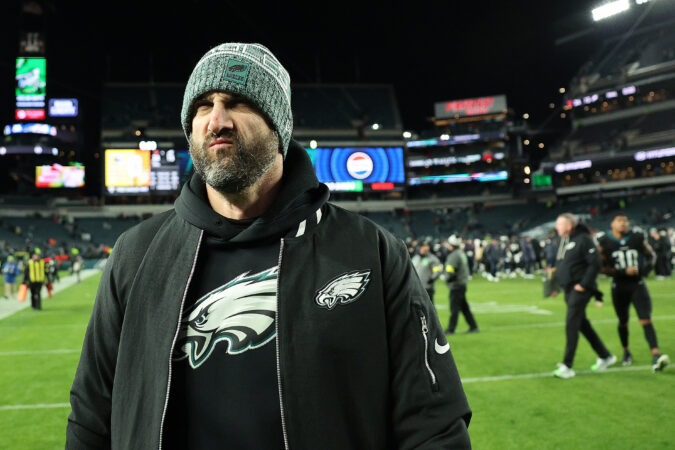
Over in the visitors’ locker room, the head coach had his shirt off. He was flexing and jumping and shouting and looking like a man who might soon be taken away by some folks in white gowns. Ben Johnson had every right to act a fool. He earned it. His team earned it. All anybody else could do was shrug.
“We’ve got great people in this team that I have a lot of faith and belief in,” Eagles tight end Dallas Goedert said after a disconcertingly definitive 24-15 loss to the Chicago Bears. “I think we still have everything we want ahead of us.”
It is getting harder for those of us outside the locker room to share in that belief. The Bears didn’t just beat the Eagles on Friday evening. They shook them to their core. They walked into Lincoln Financial Field on the day after Thanksgiving as a seven-point underdog with a rookie head coach and a second-year quarterback who might not be good and they walked out with a win that lifted them to the second-best record in the NFC and dealt a serious blow to the Eagles’ hopes of landing the conference’s top playoff seed.
The Bears will frame it as a statement victory. It felt more like a statement loss by the Eagles. They lost an important game in tough conditions against an opponent that entered the day having earned none of the benefit of the doubt. In short, the Eagles did exactly the opposite of what they had done, almost without exception, over their previous 32 games. They made it very clear that they were not the better team.
That’s a remarkable thing to write, considering the circumstances. The Bears entered the day with an 8-3 record that couldn’t be taken seriously. They’d played the second-easiest schedule in the NFL, the easiest in the NFC by far, with six of their eight wins coming against teams that ranked among the 12 worst in point differential. The other two victories came against winning teams who barely qualified as such: the 6-5-1 Dallas Cowboys and the 6-5 Pittsburgh Steelers. In fact, until Friday, the Bears had been outscored on the season.
“The sky is falling outside the locker room, we understand that, but I have nothing but confidence in the men in this locker room, players and coaches included,” said running back Saquon Barkley, who finished with 56 yards on 13 carries and has now gained 60 or fewer yards in nine of 12 games on the season. “It’s going to take all of us to come together, block out the noise.”
Until Friday, we could err on the side of nodding along to such sentiments. All season, as the Eagles have struggled to replicate last year’s dominance, they’ve insisted that their Super Bowl blowout of the Kansas City Chiefs was an exorcism of the demons of 2023. They swore they were a different team. They’d learned their lessons. Plus, they had an actual defense.
Neither of those things was evident against the Bears.
They allowed 281 rushing yards, their most since 2015 and the third-most in the last 50 years. They lost the turnover battle, in a fashion meek and mild, a fumble on a Tush Push and an ugly interception, both at the hands of the quarterback. Neither could be written off as the unfortunate byproducts of a warrior mindset.
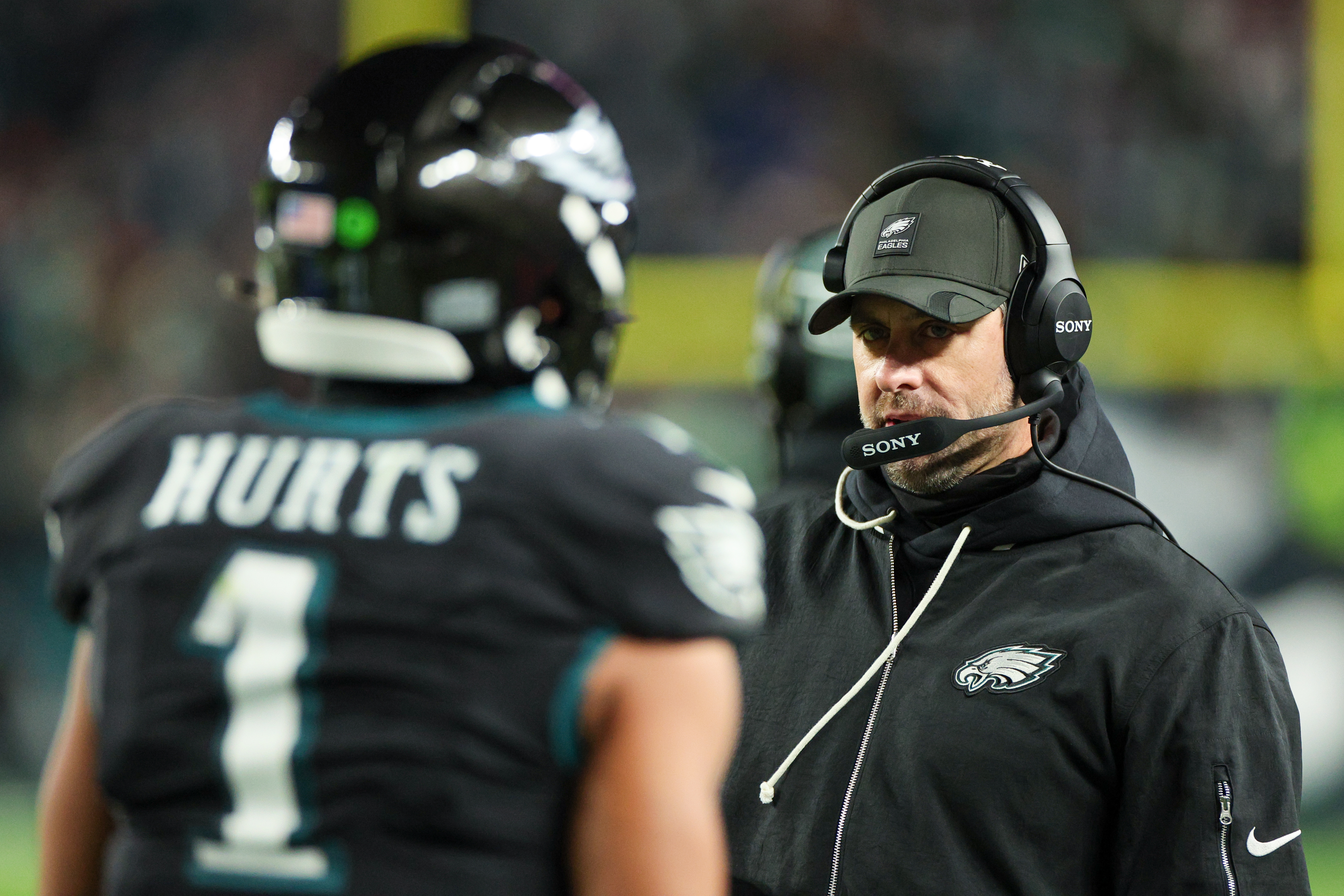
Eagles offensive coordinator Kevin Patullo and quarterback Jalen Hurts have failed to inspire confidence for much of the season.
Every quarterback has bad days. Where they differ is in their energy. Some quarterbacks are maddening, some erratic, some just plain dumb. Hurts at his worst looks listless. A nonfactor. Completely uncompetitive.
His coaches look that way, too. For most of the last month, Nick Sirianni and Kevin Patullo have looked like video game players who suddenly move the difficulty slider from All-Pro to All-Madden. Again, the computer won handily. The issue isn’t a lack of improvement. It’s that things are getting worse.
“It was both units, offense, defense, hats off to them,” Eagles coach Nick Sirianni said. “They played a good game; they coached a good game. They outcoached us; they outplayed us. That’s obviously something that I need to go through and watch, look through it, but to say I don’t want to — again, they ran for however many yards. We didn’t run for many yards. We lost the turnover battle. We lost the explosive play battle. All those things are going to dictate the win and loss.”
They didn’t just lose. They are at a loss. No answers. No ideas, even. This was the most concerning game of the Sirianni era, and it isn’t particularly close. Sure, 2023 was ugly. But at least it hadn’t happened before. The three scariest words in the world are “here we go again.”
If this Eagles season ends up where it is currently heading, the faces of the Bears will be the last thing they see on their final swirl around the toilet bowl. This was the kind of loss that can break a team through what it reveals. Until now, they’ve maintained an air of invincibility, a belief in the virtue of winning ugly. While the latter may be true, the Eagles looked entirely vincible on Black Friday.
They could write off their loss to the Denver Broncos as a game they should have won. Their loss to the New York Giants was a Thursday night fluke. After their loss to the Cowboys last week, they could cling to their one great quarter.
Their loss to the Bears? It felt like a culmination to all of that. The end of their suspension of disbelief. They are back in the same place they were when it all went up in flames. Talk has sufficed until now. Adversity is easy in its hypothetical form. Now, the Eagles must actually show us what they are made of.
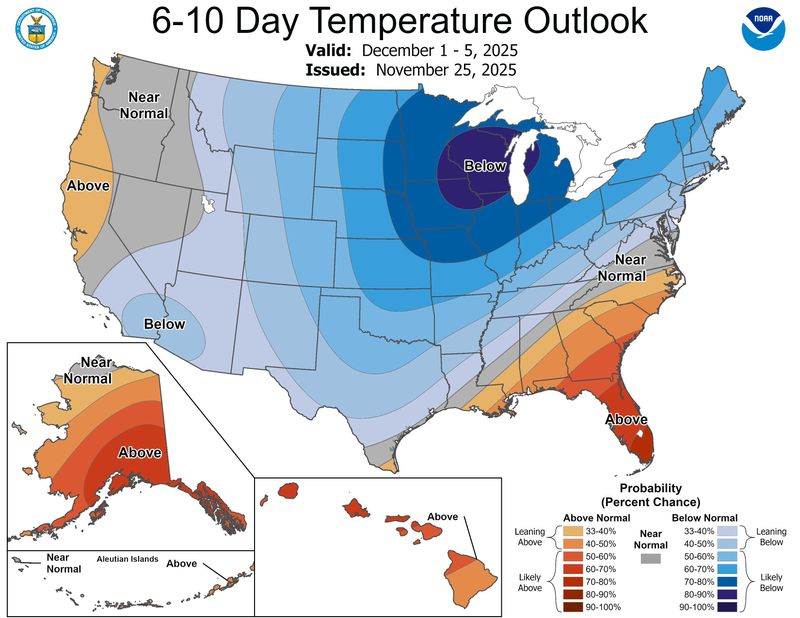
Meteorologists don’t have the specific forecast ready yet, but there is a growing consensus that December will be a frigid one for parts of the United States.
The National Weather Service’s Climate Prediction Center says colder-than-normal weather is most likely in the northern and northeastern United States, but some forecasters say a complex dance involving the polar vortex could send some of Earth’s most extreme cold toward the United States.
“My thinking is that the cold the first week of December is the appetizer and the main course will be in mid-December,” said climatologist Judah Cohen, a research scientist at MIT, in an email to USA TODAY.
Unusually cold temperatures are expected for most of the north-central U.S. by the first week of December.
Indeed, according to Cohen’s computer model, “which I can credibly claim as the world’s best — is predicting that the most expansive region of most likely extreme cold on Earth stretches from the Canadian Plains to the U.S. East Coast in the 3rd week of December.”
As for snow, that remains a wild card, as the weather systems that produce snow typically can’t be predicted more than a few days in advance. Suffice it to say that having cold air present is half of the battle.
Polar vortex on hold?
The main “polar vortex” load of very cold air will remain mostly locked up in Canada through the next 7-10 days, said Weather Trader meteorologist Ryan Maue in a Substack post. Maue continues to monitor the polar vortex intrusion risk into the Lower 48 into December.
Indeed, the complex dances of large-scale climate patterns far above our heads — which include the infamous polar vortex and a phenomenon known as “sudden stratospheric warming” — will determine the intensity and duration of the cold weather in the United States in December, Cohen said. But “I am conflicted about exactly what is happening with the polar vortex,” he admitted.
How cold will it get?
Although the most extreme cold won’t arrive until later in December, widespread and persistent below-average temperatures for this time of year can be expected for a wide expanse of the country from the western High Plains to the East Coast next week, with some near average conditions for the Southeast states and warmer over Florida, according to the National Weather Service.
The coldest anomalies for both highs and lows are forecast over the Midwest Monday Dec. 1 and Tuesday Dec. 2, with highs only in the 10s to middle 20s for many of these areas, and lows in the 0s getting down to northern Missouri and Illinois by Monday morning as the arctic airmass becomes established over the region.
Some subzero overnight lows are well within the realm of possibility from eastern Montana to North Dakota, the weather service said.
The holiday season is officially upon us and with it, a slew of festive events. From Santa sightings to a menorah lighting, here’s how and where to celebrate around Lower Merion.
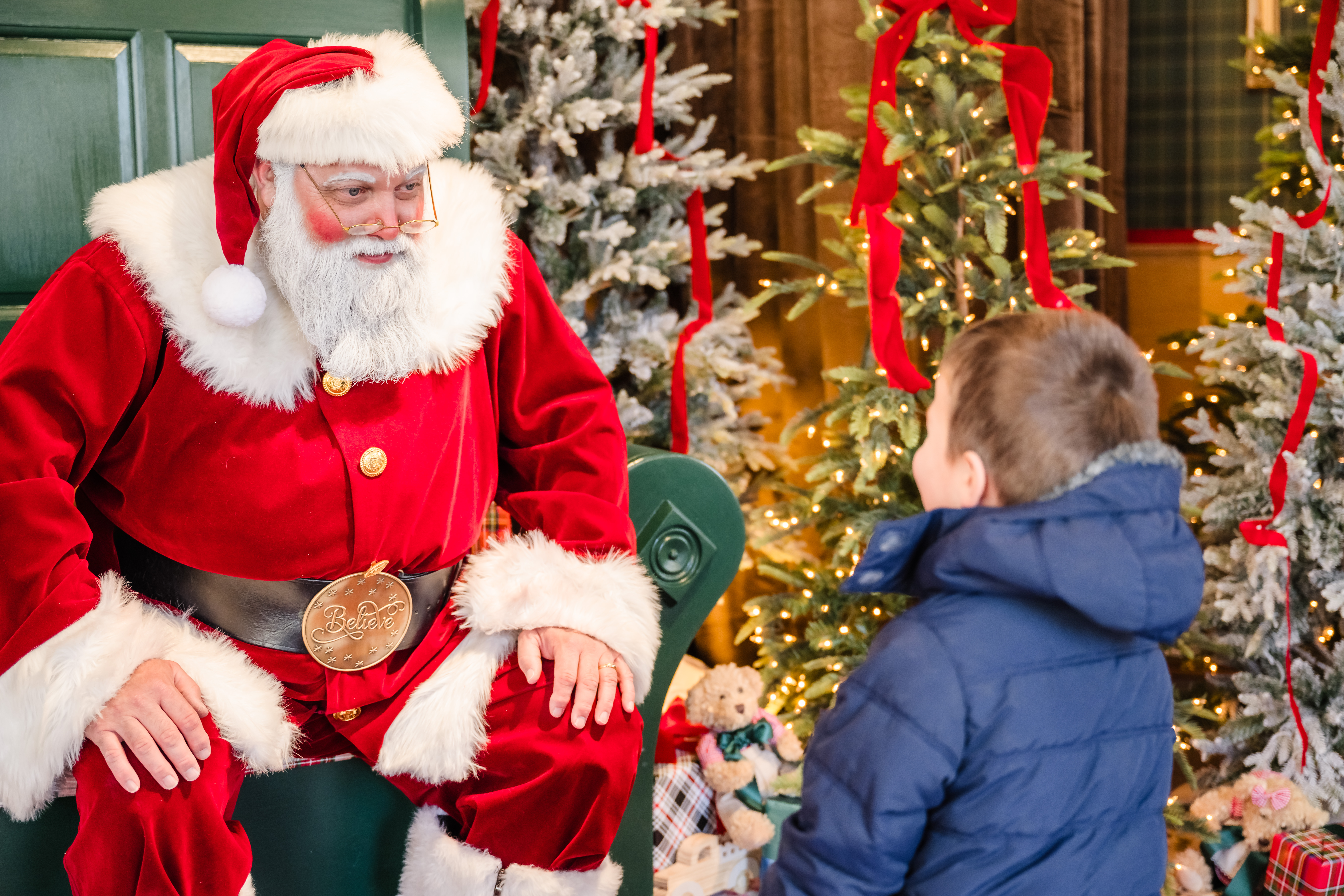
Santa will come to town on a fire truck for the tree lighting at Schauffele Plaza, where there will also be hot chocolate, cookies, and photo ops with St. Nick.
Catch a screening of the 1946 holiday classic starring Jimmy Stewart and Donna Reed. A cocktail is included with the ticket purchase for those 21 and over.
⏰ Thursday, Dec. 4, 7:15 p.m. 💵 $17.75 📍Bryn Mawr Film Institute, 824 Lancaster Ave., Bryn Mawr
Catch screenings of your favorite animated holiday classics The Year Without a Santa Claus, Frosty’s Winter Wonderland, and ’Twas the Night Before Christmas during two matinee showings.
⏰ Saturdays, Dec. 6 and 20, 11 a.m. 💵 $6.75-$7.75 📍Bryn Mawr Film Institute, 824 Lancaster Ave., Bryn Mawr
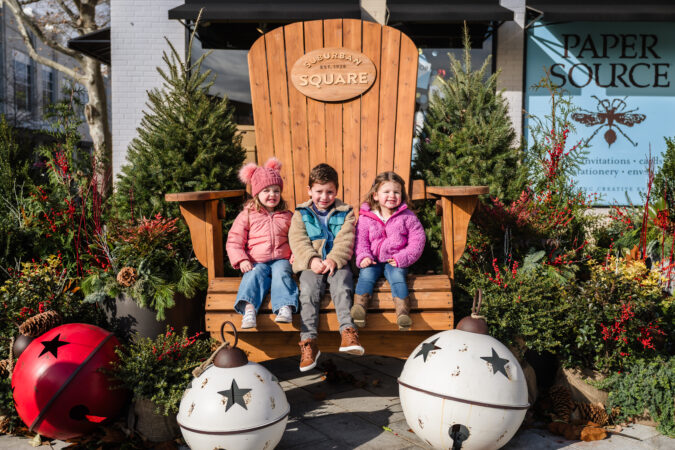
Santa will be at Suburban Square on select days this season.
Santa will be visiting Suburban Square and posing for photos three days in December, when there will also be carolers and live music. Little ones can also drop off letters to Santa.
⏰ Saturdays, Dec. 6, 13, and 20, 11 a.m.-2 p.m. 💵 Free 📍Suburban Square, Anderson and Coulter Avenues, Ardmore
Shop an array of vendors selling things like coffee, jewelry, florals, skincare, pottery, and food. You can also try your hand at wreath-making and roast s’mores over a fire. Advanced registration is encouraged.
⏰ Saturday, Dec. 6, 11 a.m.-4 p.m. 💵 Pay as you go 📍Riverbend Environmental Education Center, 1950 Spring Mill Rd., Gladwyne
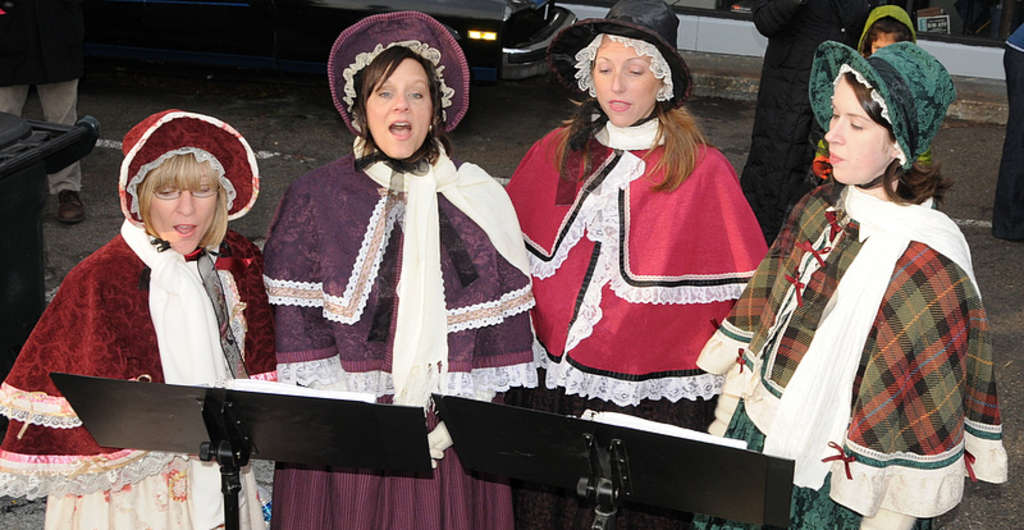
Wander around Narberth as it’s transformed into an 1840s Charles Dickens-themed London, complete with characters from A Christmas Carol. Period vendors, carolers, crafts, food, drinks, and a scavenger hunt round out the event.
⏰ Sunday, Dec. 7, noon-4 p.m. 💵 Pay as you go 📍Downtown Narberth
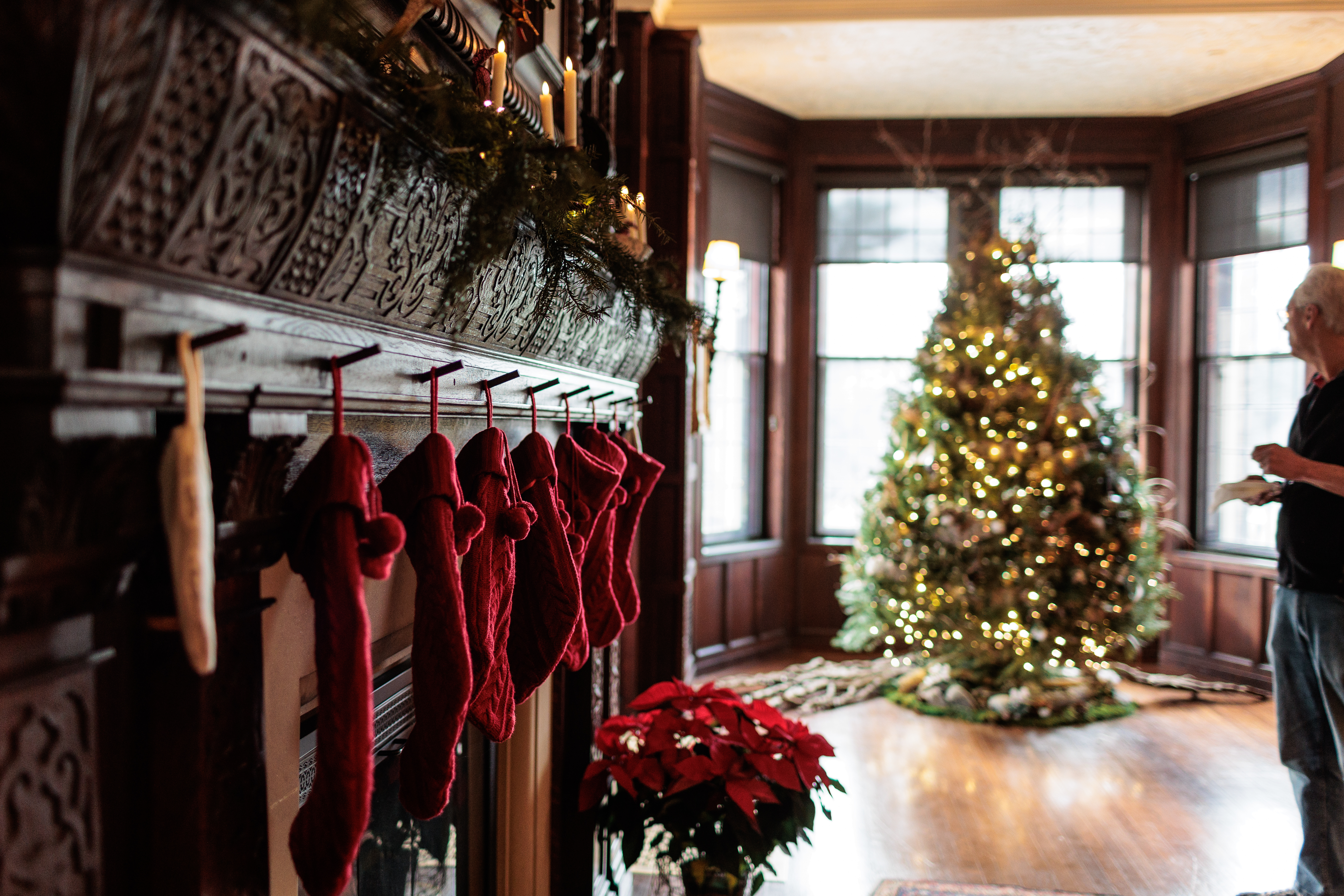
Take a look inside the main house at Stoneleigh as it’s decked out for the holidays.
⏰ Saturday, Dec. 13-Sunday, Dec. 14 and Saturday, Dec. 20-Sunday, Dec. 21, times vary 💵 $15 for Natural Lands members and $20 for nonmembers 📍 Stoneleigh, 1829 County Line Rd., Villanova
Celebrate the first night of Hanukkah with a lighting of the giant menorah at Suburban Square. There will also be food, drinks, and activities like donut decorating.
⏰ Sunday, Dec. 14, 5 p.m. 💵 Free 📍Suburban Square, Anderson and Coulter Avenues, Ardmore
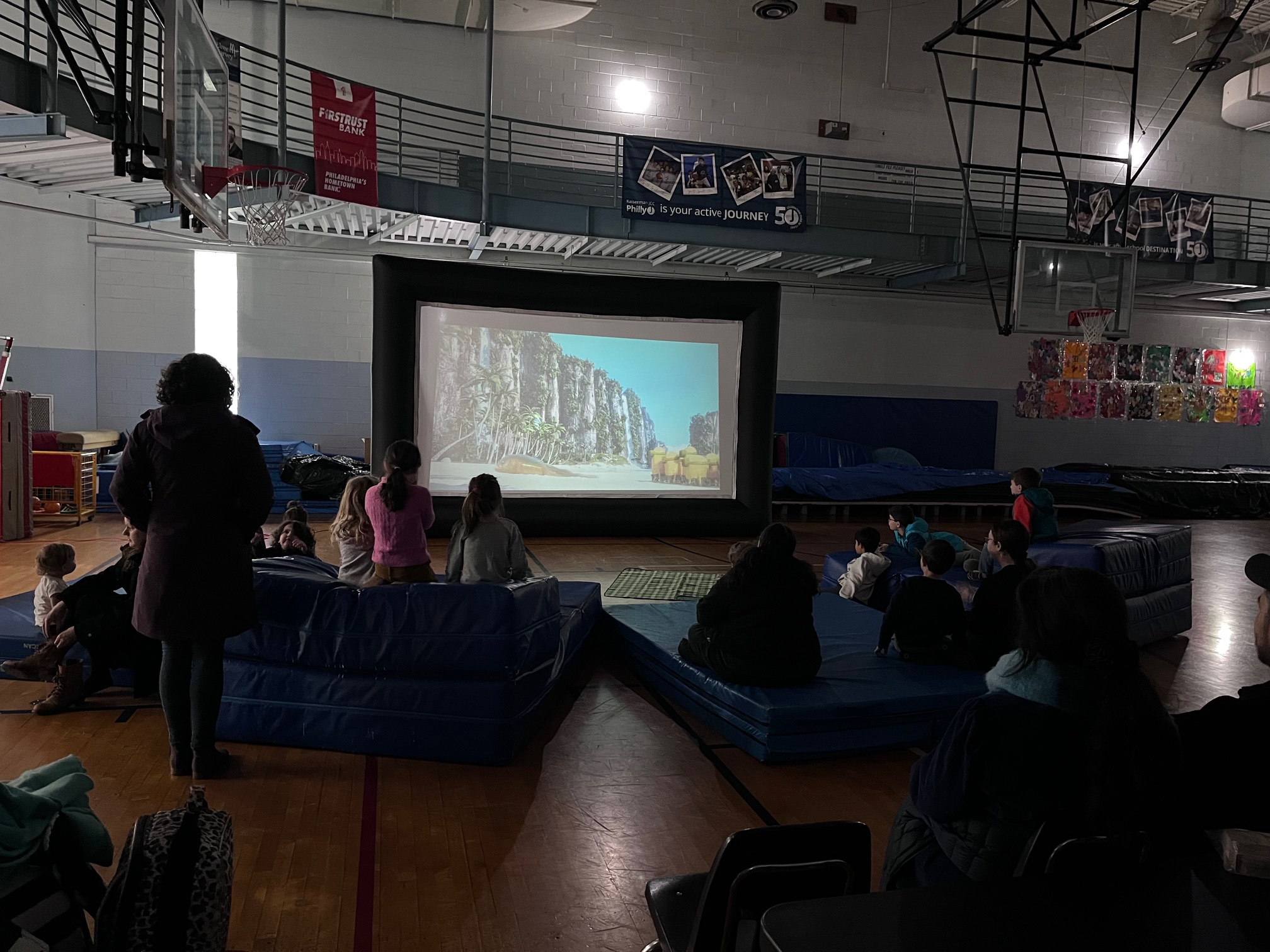
Enjoy a meal and a movie during this longtime tradition. There will be a family-friendly movie option (Happy Feet) as well as a dark comedy for adults (Bad Shabbos).
This suburban content is produced with support from the Leslie Miller and Richard Worley Foundation and The Lenfest Institute for Journalism. Editorial content is created independently of the project donors. Gifts to support The Inquirer’s high-impact journalism can be made at inquirer.com/donate. A list of Lenfest Institute donors can be found at lenfestinstitute.org/supporters.