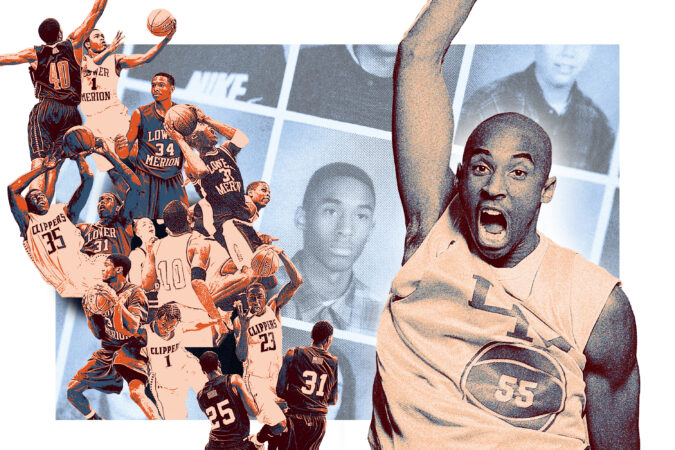
John Linehan and Kobe Bryant used to talk. A lot. This would not have been unusual for other AAU teammates, but these two were fierce high school rivals.
Linehan was a scrappy point guard for Chester. Bryant was a relentless shooting guard for Lower Merion. Both were competitive, almost to a fault, and in the days leading up to big games, they’d get chippy.
The week before the 1996 PIAA Class AAAA District 1 title game, for example, the players talked every day on bulky landline phones, with Bryant often calling Linehan at his home in Chester.
“I just said, ‘You know, John, I haven’t won a championship yet, and you have,’” Bryant told The Inquirer in 1996.
Linehan knew what his friend was doing. The future NBA star did the same thing a few weeks later, on March 19, a day before the teams met again in the state semifinal.
“He was trying to get me to trash talk,” Linehan said. “I think he needed a little edge. I didn’t want to give him too much. I was like, ‘Man, you crazy.’”
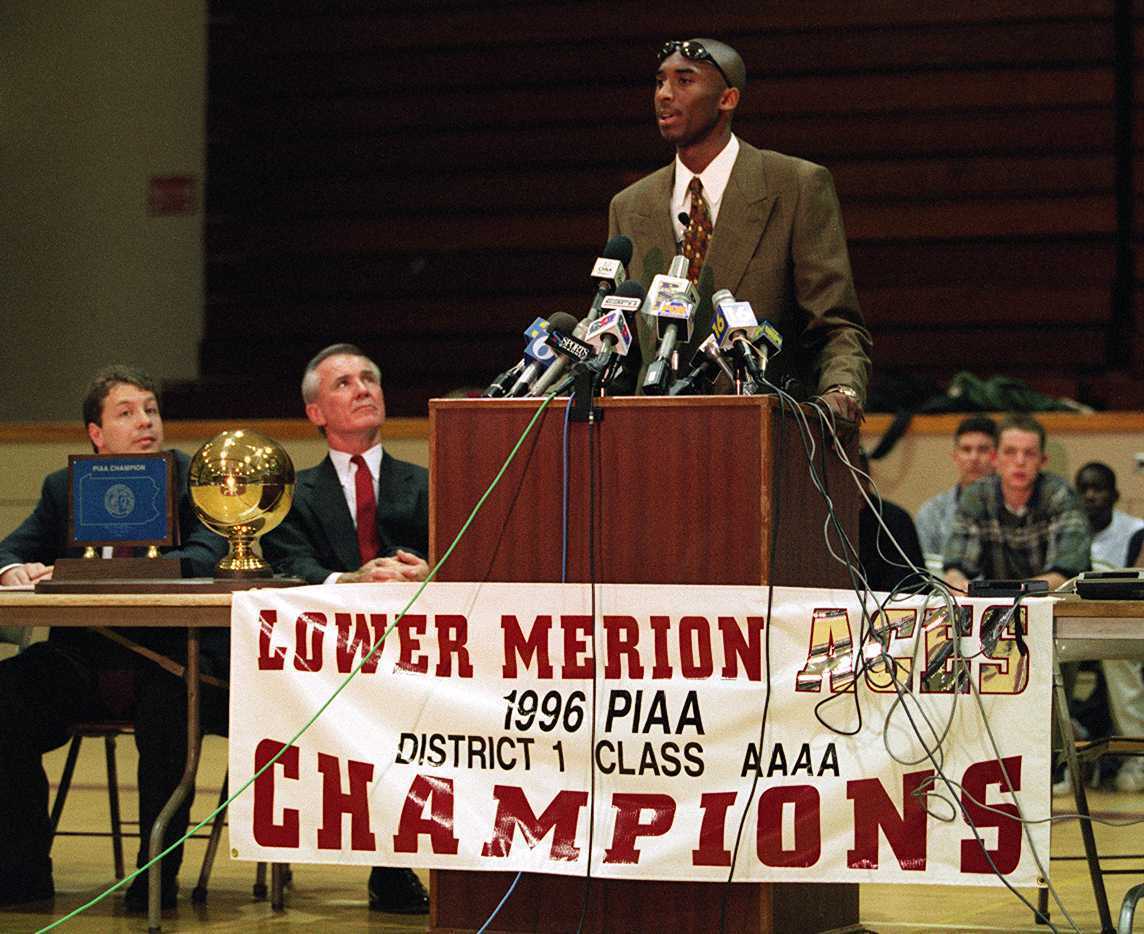
The late Kobe Bryant, a former Lower Merion basketball star, announcing he will go directly into the NBA draft out of high school.
Lower Merion wasn’t a basketball school when Bryant arrived in the fallof 1992. It paled in comparison to the local powerhouses like Simon Gratz, Coatesville, and Chester.
But Bryant changed that. Even in his freshman year, a season in which the Aces went 4-20, he brought a new standard, working out before class and introducing a level of toughness that was foreign to his teammates.
Bythe mid-1990s, Lower Merion was among the best high school teams in the Philadelphia area. Its players were more confident, celebrating after big shots, and talking loud on the court.
The Aces didn’t play as many games against Coatesville, a rising power led by Rip Hamilton. They couldn’t consistently measure themselves against Gratz, which didn’t participate in the PIAA playoffs untilthe 2004-05 season.
But they could against Chester. And so, a decades-long rivalry was born.
From 1996 through the mid-2010s, Chester and Lower Merion put on some of the greatest high school basketball games in the area. They’d often sell out venues like the Palestra and Villanova’s Pavilion. Some fans would even scalp tickets.
Their communities were almost diametrically opposed. Chester was predominantly Black; Lower Merion was predominantly white. Chester was plaguedby poverty; Lower Merion was considered affluent.
Chester, with its Biddy League, had a legacy of basketball greatness, and a steady pipeline of talent. Lower Merion had nothing comparable. But these differences melted away on the court.
And while the rivalry is not what it once was, it lives on today.
“The pride and the intensity and the history will never fade,” said Lower Merion coach Gregg Downer. “I mean, if we played them tomorrow night, that would be an intense game.”
The Bryant-Linehan era
When Downer was named head coach in 1990, he already was well-aware of Chester’s tradition. He’d played youth basketball growing up in Media and had heard about the stars who’d come out of the Biddy League.
It was obvious that his team would have to go through the Clippers to win any sort of accolade. But it wasn’t until Bryant’s arrival that Downer’s aspirations became a real possibility.
The shooting guard, who was the son of former 76er Joe “Jelly Bean” Bryant, was mature for his age. He’d demand more, mentally and physically, of older teammates. Doug Young, a former Lower Merion forward, remembered seeing Bryant leaving the locker room at 7 o’clock one September morning in 1993.
He’d been at the high school gym since 5 a.m., working out by himself. To the Lower Merion basketball team, this was a “crazy” concept, so Young and his cohorts decided to join him.
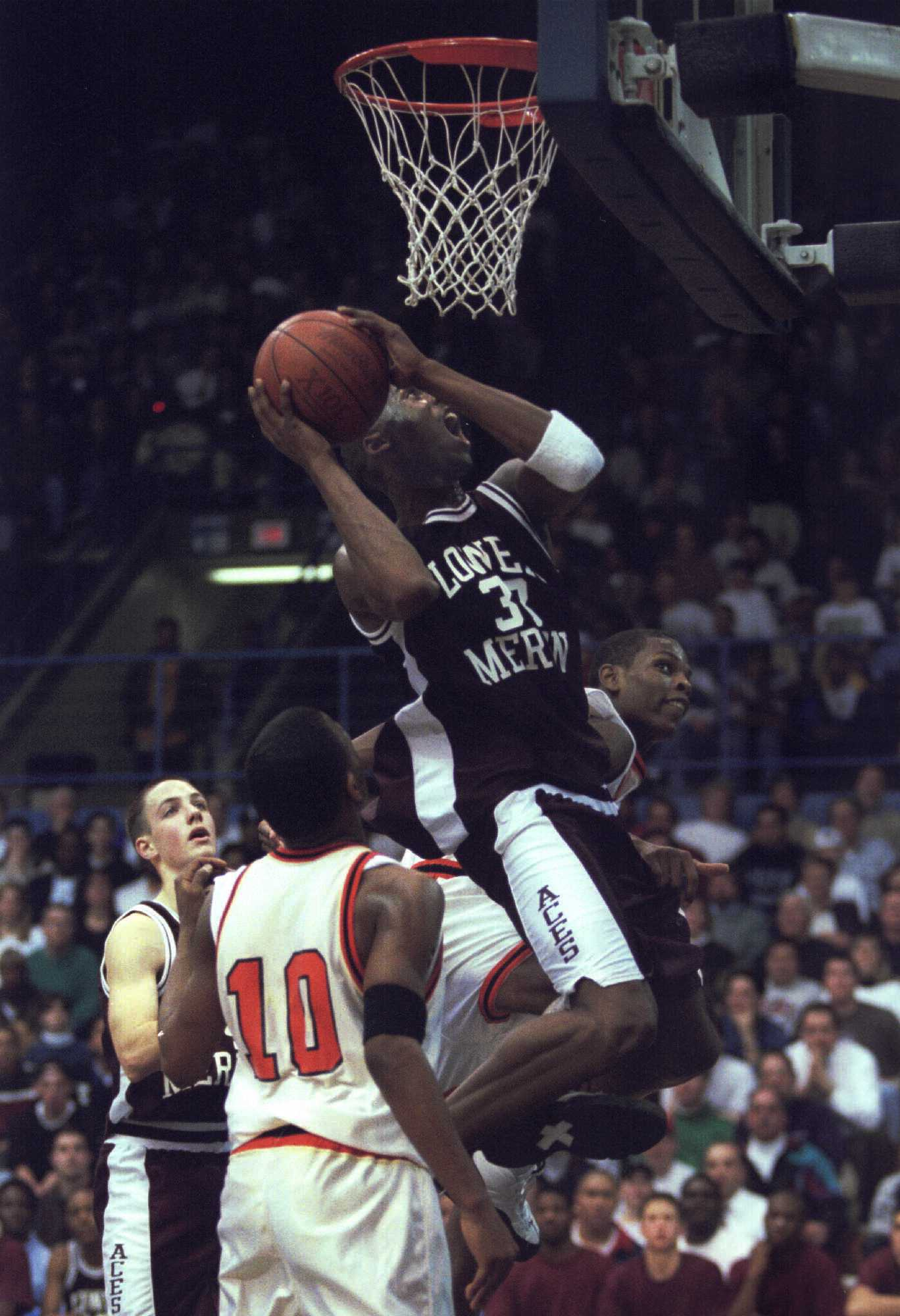
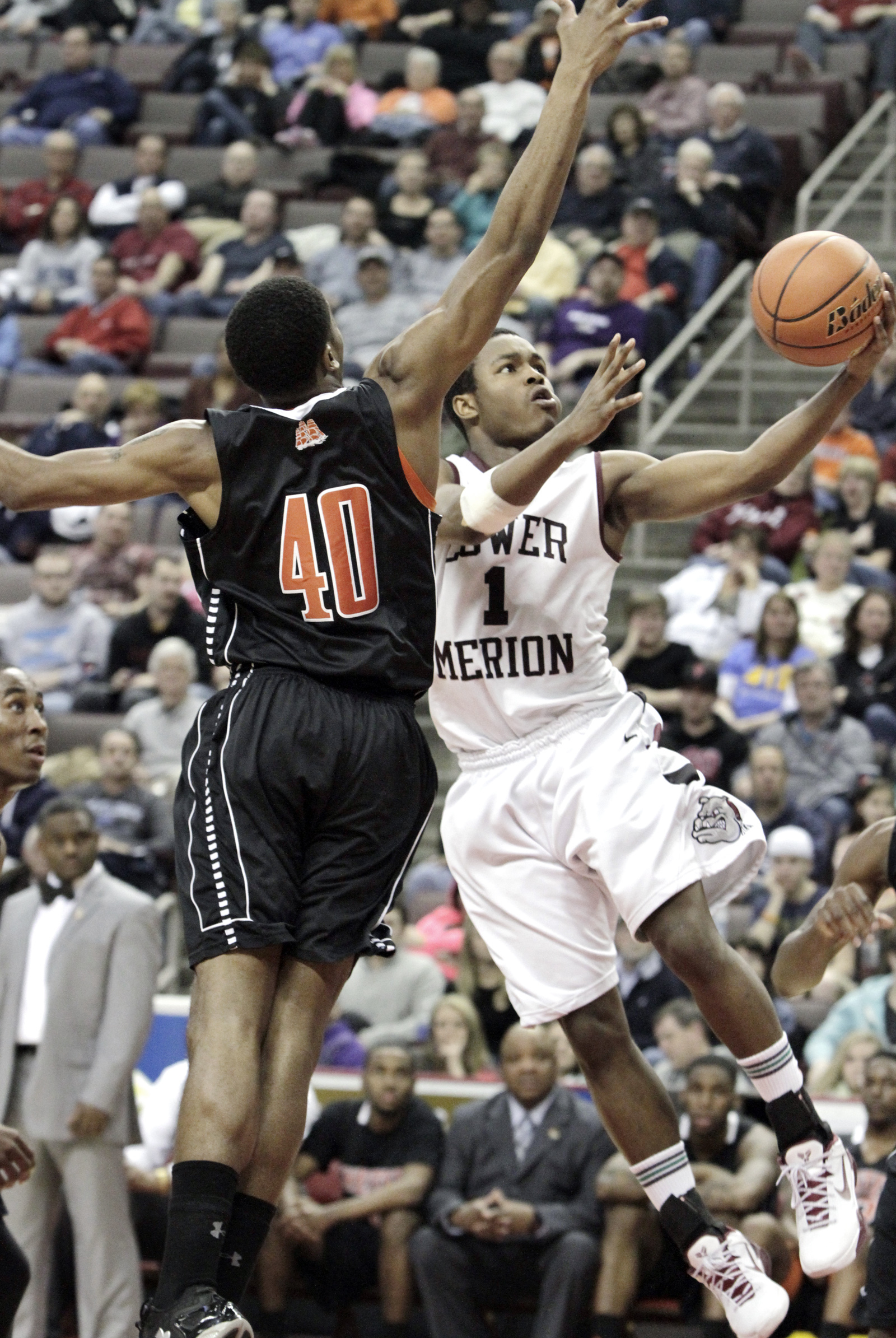
In the District 1 championship game against Chester, Kobe Bryant goes to the hoop over the Clippers’ John Linehan.
They arrived the next day at 5:06 a.m. The players knocked on the door. Bryant didn’t answer.
“He wouldn’t open it,” said Young, who graduated in 1995. “You’re either there or you’re not. We were six minutes late.”
His teammates waited outside until 6:30 a.m., when the school opened. They made sure to show up before 5 a.m. from that day on.
Downer was wired the same way. The coach — and his NBA-bound pupil — would push the team in practice. Losses were particularly tough. The players would go through endless sprints and rebounding drills that sent them running to the trash can.
It wasn’t fun. But over time, the method created a newfound tenacity.
“No one walked into high school saying, ‘Oh, yeah, I want to win a state championship,’” Young said. “But [Kobe] knew what that was. He was like, ‘I don’t know any other way. If we’re not going to win a championship, what the heck are we playing for?’”
Chester was always going to be an obstacle, so Downer tried to play into the battle. He’d use analogies for the tough, hard-nosed team, comparing it to an animal stalking its prey.
The coach began to screen movies to underscore this point. Together, in a Lower Merion classroom, Downer’s players watched Jaws and other tales of survival, like The Edge, a 1997 thriller about a plane that crashes in the Alaskan wilderness.
“This bear is stalking them, and the couple is saying, ’What are we going to do about this bear?’” Downer said. “And one of them says, ‘The only thing we can do is kill the bear.’
“And I remember being like, ‘We can do this.’ But the only solution is to — not to be overly graphic — but to kill them.”
(The bear in this analogy was Chester.)
He added: “We tried everything humanly possible to get through to this team.”
The first few games were ugly. In 1995, Lower Merion met the Clippers in the District 1 championship, only to lose by 27 points. But they came back with a renewed focus the following year, in 1995-96, going 25-3 in the regular season to earn a district final rematch against Chester.
The Aces showed up at the arena with “27″ printed on their warmup shirts. Bryant, armed with fresh bulletin board material from Linehan, dropped 34 points against the Clippers en route to a 60-53 Aces win.
The shooting guard scored 39 points later that month — with a broken nose — in a 77-69 state semifinal win over Chester. Lower Merion went on to beat Erie Cathedral Prep, 48-43, to win its first state championship since 1943.
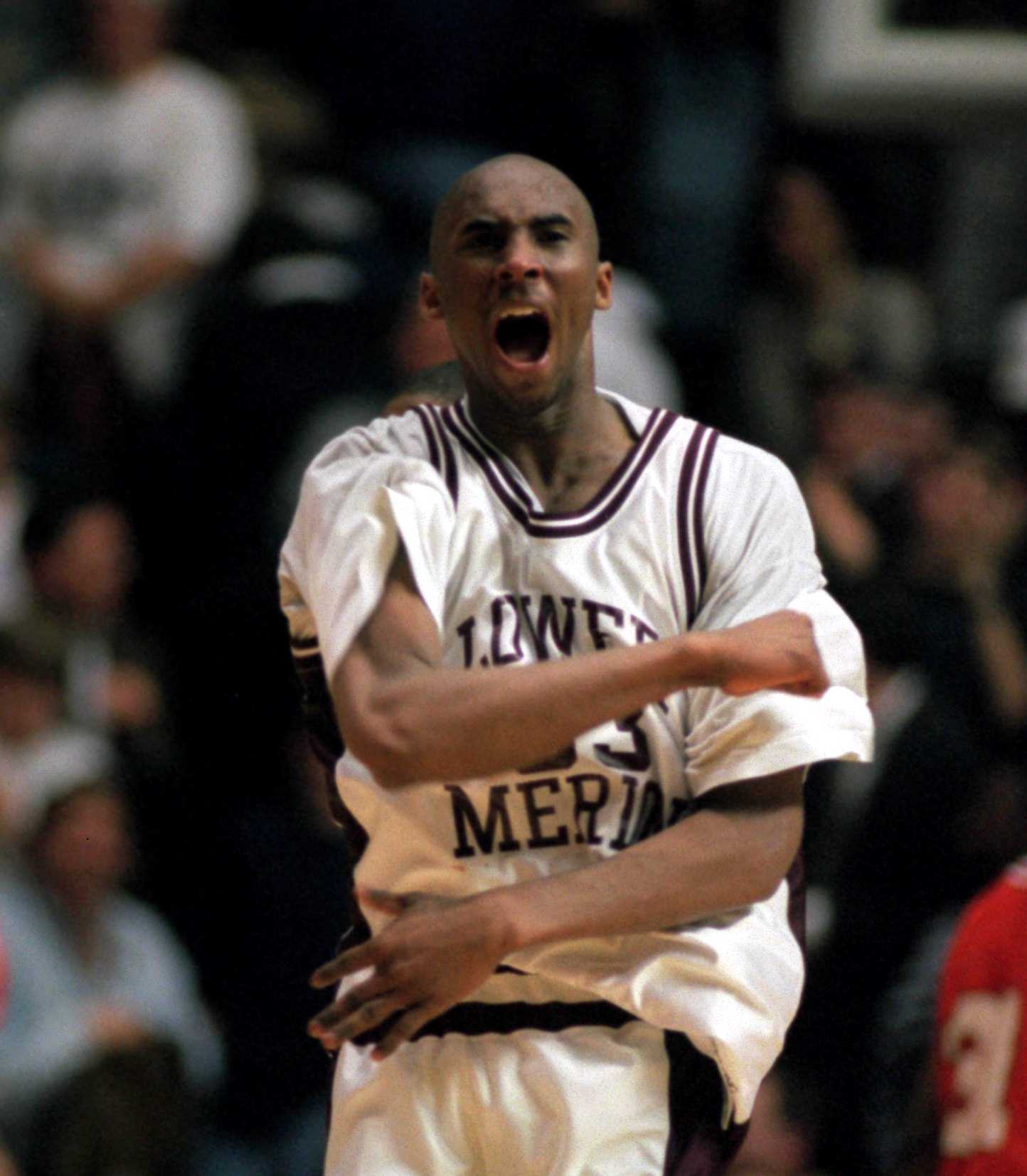
Kobe Bryant celebrates after defeating Chester at the Palestra in 1996 to advance to the state final.
To Linehan, the difference Bryant made was obvious. He joked that he’d “never heard of Lower Merion” before his friend arrived. But once he did, Chester realized it would have to go to great lengths to prepare for the phenom.
Ahead of a big game against Lower Merion in the mid-1990s, the coaching staff reached out to Clippers alumnus Zain Shaw. He played at West Virginia and in Europe and possessed some of the same characteristics as Bryant — a tall frame and an athletic build with strong ballhandling skills.
The Clippers invited Shaw to practice, where he played the role of Bryant (to the best of his ability).
“Kobe was so special, we had to bring in a pro to help us prepare,” said Linehan, who later starred at Providence.
But there was another impact the future Lakers star had, one that had nothing to do with his own prowess. Linehan noticed that Bryant’s Lower Merion teammates started to take on some of his qualities. Suddenly, they were playing brash, confident basketball.
“We didn’t have reason to believe, until Kobe got there, that we belonged on the court with Chester,” Young said. “The fear was real. Teams were afraid of Chester because they’d run you out of the building.
“The idea of Lower Merion being on the court in a meaningful game against [them] was such a crazy thought. But then, you started to believe.”
The buzzer-beater heard ’round Chester
Bryant never got over the rivalry, even after he embarked on his Hall of Fame NBA career in 1996. Sometimes, he’d call the coaching staff before big games against Chester, leaving expletive-laden voicemails to use as motivation.
The Lakers shooting guard also created an incentive structure for his former team.
“You couldn’t get a pair of Nike sneakers unless you qualified for the playoffs,” Young said. “If you don’t earn it, you don’t get it.”
He became especially involved in 2005-06. After a lull in the early 2000s, Chester and Lower Merion found themselves neck-and-neck again. The Aces were led by the duo of Ryan Brooks and Garrett Williamson, and the Clippers boasted a deep roster, headlined by Darrin Govens. All of them eventually played in the Big 5.
(Chester was so stacked that it brought a 1,000-point scorer off the bench in Noel Wilmore.)
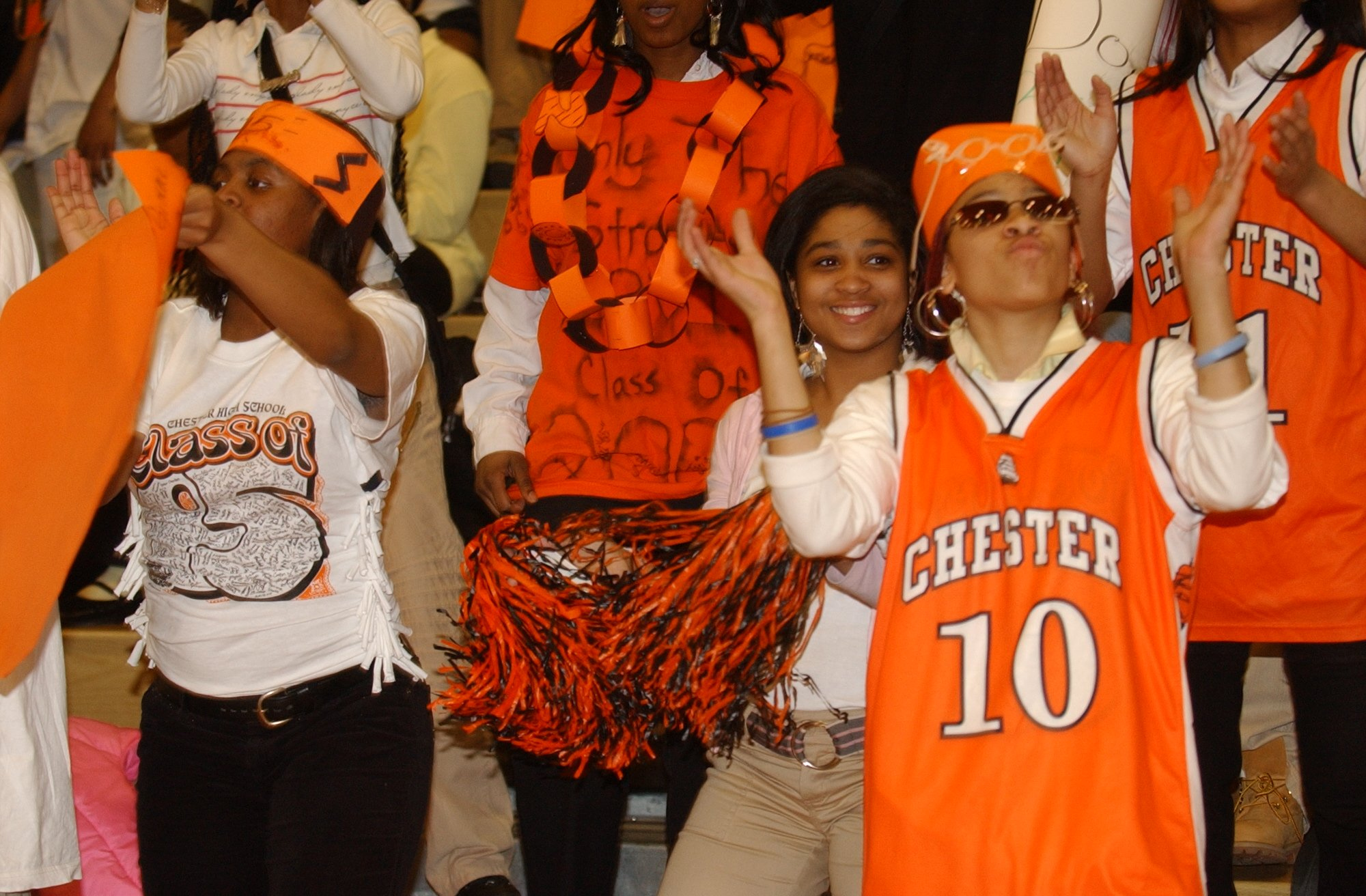
Students from the class of 2005 show their support as Chester and Lower Merion play in the state final.
The rivals met in the state championship on March 19, 2005. Despite strong performances from Williamson and Brooks, the Clippers pulled away in the second half thanks to a dominant third quarter from Govens. Chester won, 74-61.
The teams reconvened the following season with their competitive spark fully reignited. They faced each other three times that year. Chester took Round 1, a one-point regular-season victory on Dec. 27.
Round 2 was in the district final on March 3. Before the game, in front of a packed crowd at the Pavilion, Chester sophomore Karon Burton walked up to the layup line.
Lower Merion’s student section caught his ear with a chant about coach Fred Pickett’s stout stature.
The dig didn’t intimidate Burton. If anything, it fueled him. He grew up playing street ball in Chester and always loved trash talk.
Instead of cowering, like the crowd hoped, the sophomore delivered an unforgettable outing. The game went into overtime, and was tied at 80 with only a few seconds remaining.During a timeout, assistant coach Keith Taylor pulled Burton aside.
“He was like, ‘Hey, listen,’” Burton said. “They’re going to double Darrin. If you get that ball, do your thing.’”
Taylor’s words proved prescient. As Lower Merion’s defenders swarmed Govens, the Clippers inbounded the ball to Burton.
He took a pull-up jumper from beyond the arc and drilled it for an 83-80 win. The Chester fans stormed the court. Burton, who later joined Wilmore in the 1,000-point club, said he felt like a celebrity in his hometown.
“It was like watching a buzzer-beater in the NBA,” he said. “I just ran to my teammates, they picked me up. It was a crazy feeling.
“I’m a big Kobe fan, too. Kobe’s my favorite player ever. So when I came and I hit the game-winner on that team …”
Round 3 took place a few weeks later, in a state semifinal rematch at the Palestra on March 22. Bryant called Lower Merion’s coaches before the game.
“I don’t remember specifically what he said, but I’m sure there were a lot of [expletives] dropped,” said Young. “Like, ‘Don’t call me back if you don’t beat those [expletives].’ That was a line we heard from him a couple times.”
This one didn’t go Chester’s way. After trailing the Clippers, 47-37, at the end of the third quarter, the Aces came roaring back in the fourth and put up 33 points to eke out a 70-65 win.
The celebration in the locker room was cathartic. Water sprayed into the air. Players sat atop each other’s shoulders and turned the showers into a slip ‘n slide. Bryant called in, again, as other members of the 1996 team filtered through.
Darrin Govens scored his 1,000th point for Chester against Lower Merion in the state championship in 2005.
This was not how Govens wanted to end his high school career. And a few months later, when he arrived at St. Joseph’s on a basketball scholarship, he saw a familiar foe.
It was Williamson, his new Hawks teammate.
“We were sitting on the opposite side of the bench,” Govens said. “I didn’t want to sit next to him; he didn’t want to sit next to me. We’d kind of avoid each other and just head nod.
“Even in running drills, it was a competition. He looked to the left. I looked to the right. We tried to beat each other in sprints. But then we realized, ‘All right bro, we’re teammates now.’”
‘Hero status’
Chester had always rallied around its high school basketball team. Linehan said it was akin to playing for the Sixers. The teenagers were treated like professional athletes — especially those who had been a part of big wins.
The Clippers’ public address announcer, James Howard, called this “hero status.”
“All of a sudden, your money’s no good,” he said. “Barbers take care of you, make sure your hair looks nice before games. Free food. Little kids look up to you and ask for your autograph. That’s how it is.”
In Chester, there were plenty of heroes to draw from. There was Linehan, but also Jameer Nelson, who met a young Burton in the late 1990s. Nelson, a friend of Burton’s cousin, gave the aspiring basketball player a gift before he left for St. Joe’s: his MVP medal from the Chester summer league.
“He was one of the biggest guys in our city,” Burton said, “so it’s definitely something that I’ll always remember.”
By the early 2010s, when the rivalry was reignited for a third time, Lower Merion had built more of a basketball tradition. Aces guard Justin McFadden said he’d get stopped in Wawa before big games against the Clippers.
Chester celebrates its win over Lower Merion for the state championship in 2012.
“It became a community thing,” he said. “People would be asking, ‘What do you guys think about Chester? Do you think we can get it done?’”
In 2012, the schools met in the state championship for the first time since 2005. Junior forward and future NBA starter Rondae Hollis-Jefferson put up a double-double to lead the Clippers to a resounding 59-33 win over the Aces. It was their second straight title and their 58th straight victory.
A year later, after going 17-0 in the Central League, the Aces met the Clippers in the state final again. Chester had won 78 straight games against in-state opponents. Snapping that streak would be daunting, but Downer had a plethora of motivational tactics at his disposal.
Just as they had in the 1990s, The Aces again spent pockets of the season watching Jaws, The Edge, as well as an addition: Al Pacino’s “Inch by Inch” speech in Any Given Sunday.
“He would have that fired up on YouTube, ready to go,” McFadden said. “Looking back, [your reaction] is a chuckle, but in the moment, it worked. We knew that this was the hill that needed to be climbed.
“And every time they played that speech, we got goose bumps. We were ready to fire.”
Chester got out to an early lead, but Lower Merion rallied behind a 22-point, 11-rebound performance from B.J. Johnson, who later starred at La Salle. The Aces snapped the streak and won their seventh state title with a 63-47 victory.
Lower Merion’s Jaquan Johnson goes to the net as Diamonte Reason guards him in the Chester-Lower Merion state championship game in 2013.
The Clippers then were coached by Larry Yarbray. Pickett, who was diagnosed with cancer in2010, was in declining health. Just before he died in 2014, Downer decided to say goodbye.
He and his former assistant coach Jeremy Treatman drove out to Pickett’s home in Chester. They went to his bedside.
“And we talked,” Downer said. “And we held hands. It was a really touching moment for me. This is a man that carried Chester on his back. That tried to carry Lower Merion on his back. And I knew it was the last time I was going to see Fred.
“We walked out the door, and we told each other that we loved each other. And I never thought he would say that to me, or vice versa. But it was just kind of like, ‘You know what? We’ve had some amazing battles, and there’s a lot of respect there.’”
Keeping the tradition alive
In recent years, the Chester-Lower Merion rivalry has diminished.
There was a brief period when the teams were in different classifications. Both programs have lost players to private schools that can recruit, and the addition of the Philadelphia Catholic League to the PIAA has made the state playoffs more competitive.
One place the Aces and Clippers could meet is in the district tournament, where they reunited in 2024. But they haven’t played each other since. And Howard says the contests don’t have the same feel.
“Both teams have lost D-I talent,” he said. “It’s not as high-flying, above the rim, as it was in the past. But still a great game. Sold out at Lower Merion, and at Chester, same thing.”
The history will always be there, though, and Burton is doing his best to keep it alive. His 8-year-old son, Karon Burton Jr., is playing in the Biddy League. His father is his coach.
Sometimes, they go on YouTube and watch old Clippers games. Junior’s favorite, of course, is the 2006 district final.
Burton believes that his son has a promising future, but isn’t sure of where he’ll go to high school yet. He doesn’t want Karon Jr. to feel obligated to follow his father’s path.
But if it worked out that way, what a story that would be.
“I’d love to be the first father and son to have 1,000 points,” Burton said. “With the same name? That would be crazy.”
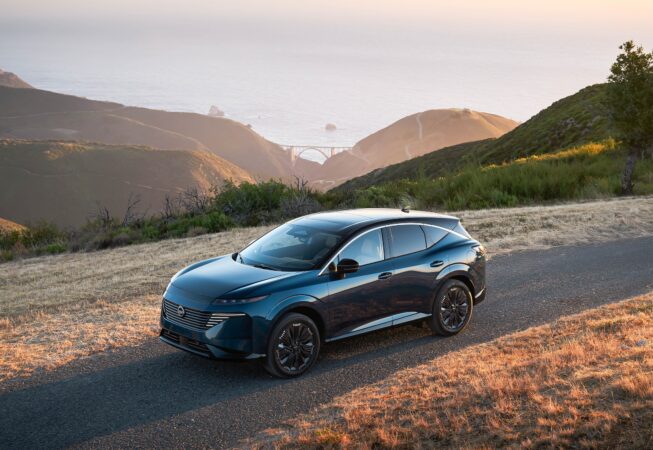
2026 Nissan Murano Platinum AWD vs. Volkswagen Atlas SEL Premium R-Line: Midsize SUV comparison.
This week: Nissan Murano
Price: $53,950 as tested
What others are saying: “Highs: Comfortable front seats; short stopping distances. Lows: Rough-shifting transmission, uneven power delivery, stiff ride, unintuitive controls,” says Consumer Reports.
What Nissan is saying: “Energetic elegance.”
Reality: I promise I checked Consumer Reports after I wrote the column.
What’s new: I was excited to have a Murano in my lineup because after all these years of columnizing, I would finally get to review one.
(Googles “Scott Sturgis” “Inquirer” “Murano.”) Well, huh. I drove 2015 and 2018 models.
Memorable, evidently.
This is not the same Murano, naturally. A redesign for 2025 gives the awkward old two-row, midsize SUV an awkward new look, along with a new engine and transmission.
Shifty: Hooray! A Nissan without a CVT! The Murano came with a 9-speed automatic, so I should be this delighted. But read on.
Up to speed: Gone is the V-6 that powered the old model. The 2.0-liter turbocharged engine creates 241 horses, which is not a ton for this size of vehicle. It gets the vehicle to 60 mph in 7.2 seconds, according to Car and Driver.
But the acceleration story has many more chapters. When I first pulled out of my neighborhood, the Murano seemed to alternate between lag and lurch. “OK, it’s cold,” I thought, offering the benefit of the doubt even while it was probably 85 degrees outside. “I’ll give it some time.”
But the unsteadiness continued. Sometimes SUVs and minivans can have an awkward accelerator-foot interface, so I looked into that. But, no, it felt comfortable.
“Aha! Here’s a drive mode selector,” I cried. “I’ll try that.” When I shifted to sport mode, it got sporty all right — in the way that your eighth-grade gym teacher forced you to run laps around the gym at 8 a.m. until you felt like throwing up. It was even rougher than before, although the roughness came at you faster.
“All right, I never do this,” I sighed and shifted into eco. Surprisingly, the power didn’t completely die out. The Murano felt smooth. Sure, it took a lot of foot stomping to get the Murano on highways and such, but the SUV delivered power much better.
On the road: Mode, schmode, driving the Murano was never more than OK. Country roads are blah; highways are a faster blah. There are just so many more enjoyable competitors to get around in.
The lane-keeping system drove me nuts for a few days, and the menus to adjust it are inscrutable. Press one of two little dotted lines on the steering wheel to change them. The screen says “OK Menu,” and there’s a tiny OK button next to a microphone/button, and that seemed to function at somewhat regular intervals. I’d need practice to do it again.
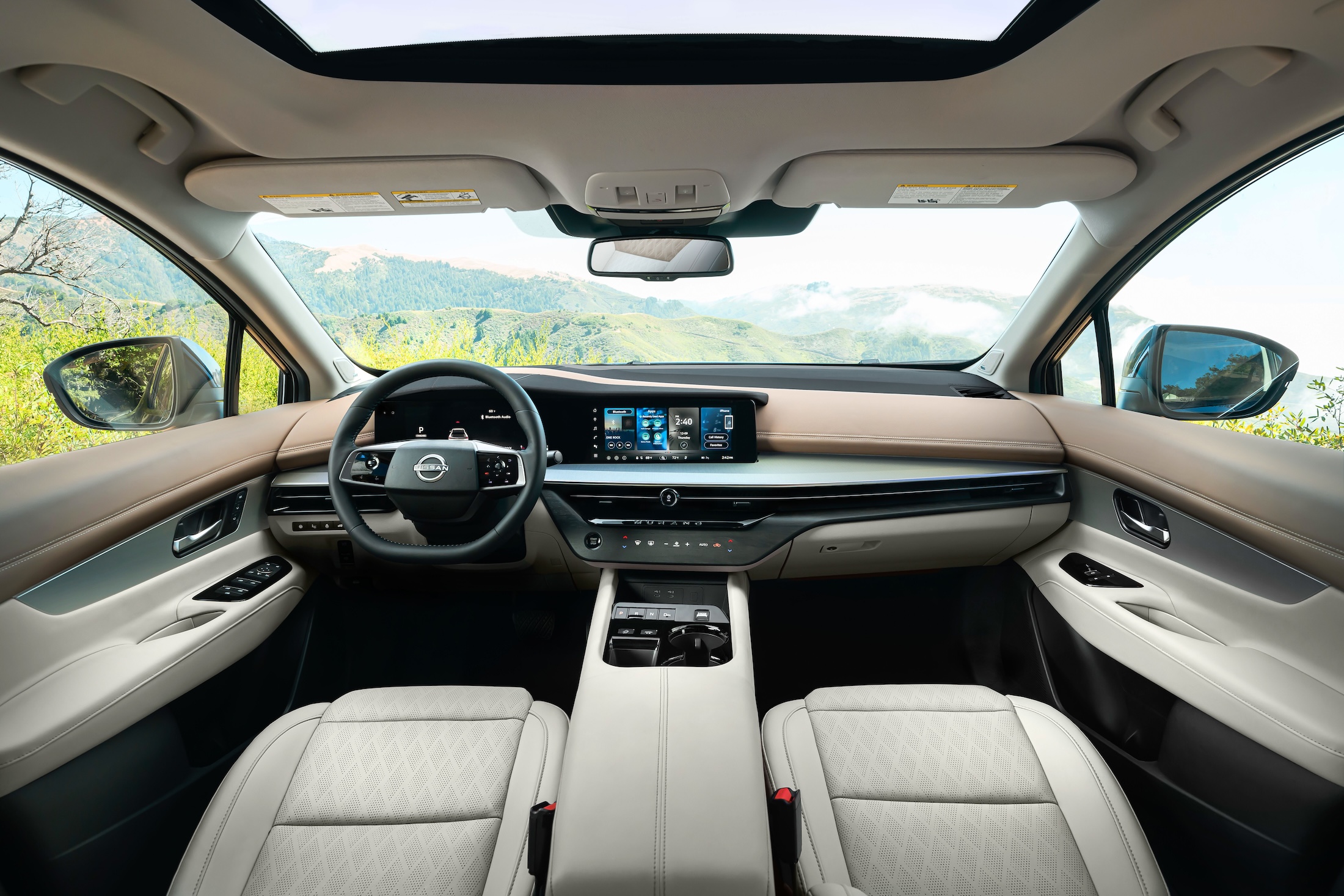
The interior of the 2026 Nissan Murano is elegant, as are many of Nissan’s offerings. Unfortunately its user-friendliness is lacking.
Driver’s Seat: The seat itself is on the plush side, roomy and wide. Nissan has long offered classy interiors even down to the Sentra (sorry, Versa, not you). Silver buttons and trim with nice colored material add to the upscale feel.
But here’s a better place to complain about the transmission controls. Why did some designer think a row of buttons at the front of the console would be a great idea? My phone and other items forever covered them. Also, they’re just not intuitive, so when you’re in a tight spot and have to maneuver forward and back to get out, it requires far more concentration than it should.
Friends and stuff: The rear seat is roomy, comfortable, nicely appointed, and well positioned. Heads, legs, and feet have no shortage of space, even in the middle seat.
Cargo space is 32.9 cubic feet in the back, and 63.5 with the rear seat folded.
In and out: The Murano rides at a height perfect for entry and exit without leg stretches.
Play some tunes: A single large volume knob is available outside the touchscreen. The 12.3-inch screen sounds like a good size, but it’s very short and wide, and a row of icons along the side and HVAC display along the bottom eat into the space.
Sound from the Bose Premium system is OK, about a B+ or so, and leaves me wondering what the not-premium system sounds like.
Keeping warm and cool: Going one better (or worse) than the popular ebony touch pads, which Mr. Driver’s Seat doesn’t love, the Murano offers a cheap-looking black plastic controller pad with temperature, fan speed, and source, and it requires a forceful push to engage your choices.
While you’re fighting with that, a teeny tiny display at the bottom of the touchscreen shows the changes. Let’s all say it in unison: “Eyes on the road!”
Fuel economy: I couldn’t get the trip display to do more than show me how each individual trip went, and the car said the best fuel economy was 22.8 mpg. So, the rest were worse. Let’s call it 20.
Where it’s built: Smyrna, Tenn. Half the parts come from the U.S. and Canada, including the transmission. The engine hails from Japan.
How it’s built: The Murano gets a predicted reliability of 3 out of 5 from Consumer Reports.
In the end: Nissan has a comfortable, roomy, attractive (on the inside) SUV here. If they can tweak the engine and suspension and start over with infotainment and HVAC controls, this could be a winner.
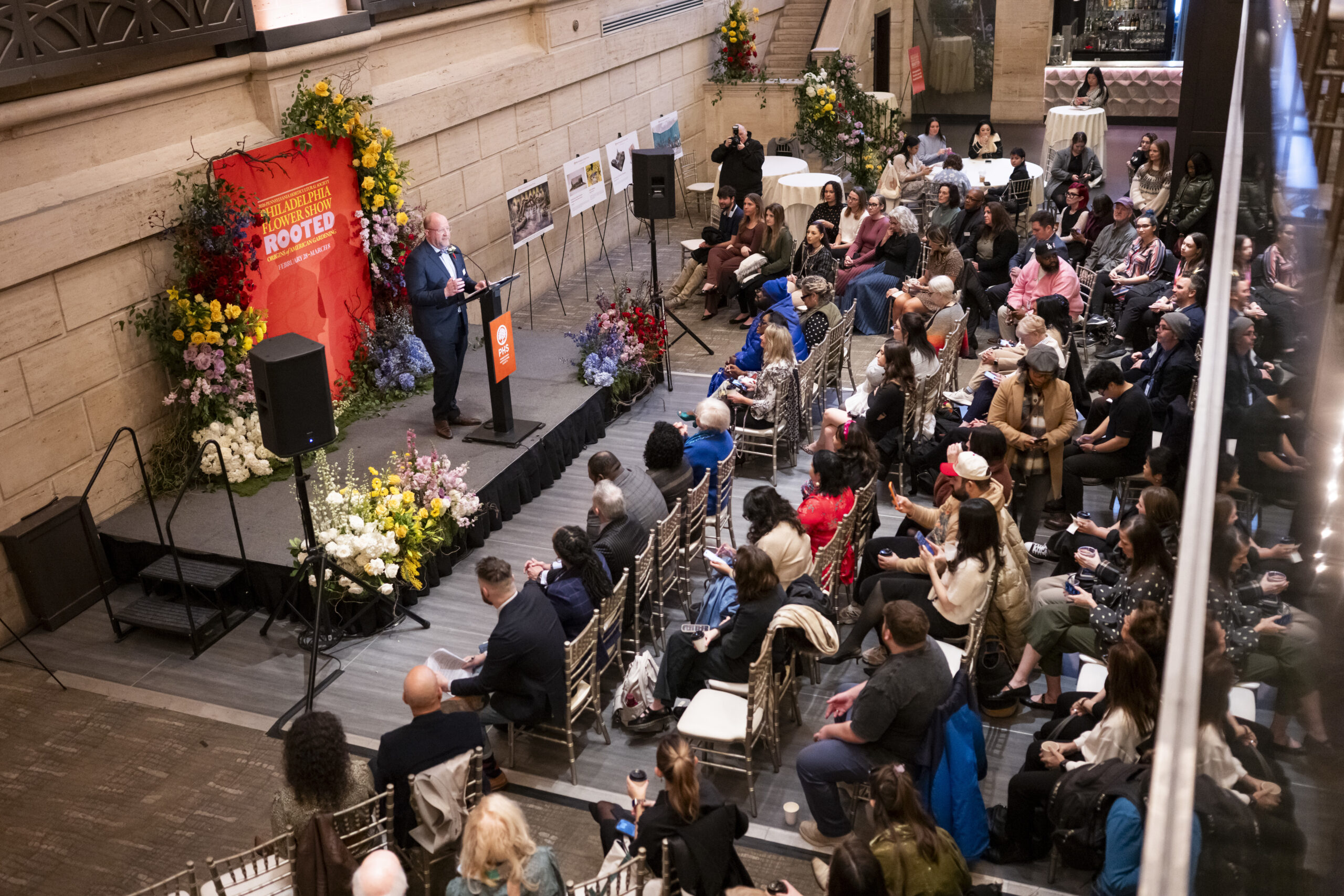
The show’s theme, “Rooted: Origins of American Gardening,” honors the people, places, and traditions that have shaped gardening — and invites visitors to consider where their own gardening stories began.
A rendering of the 2026 Philadelphia Flower show is on display during a press conference at Union Trust on Wednesday, Jan. 14, 2026. The theme of this year’s flower show is called ‘Rooted: Origins of American Gardening’.
“Gardening knowledge does not appear out of nowhere,” said Matt Rader, president of the Pennsylvania Horticultural Society, which hosts the show annually at the Pennsylvania Convention Center. “It’s shared, adapted, and passed forward. It reflects our culture, memory, ourselves, our experiences.”
On Wednesday, planners revealed first-look renderings of this year’s iteration of the Flower Show, the nation’s largest, and the world’s longest-running horticultural event, which runs Feb. 28 to March 8. At the event held at the historic Union Trust Building in Market East, built on the site of the inaugural Flower Show in 1829, officials honored the city’s role as the birthplace of democracy and America’s first Flower Show. The Horticultural Society will mark its 200th anniversary in 2027.
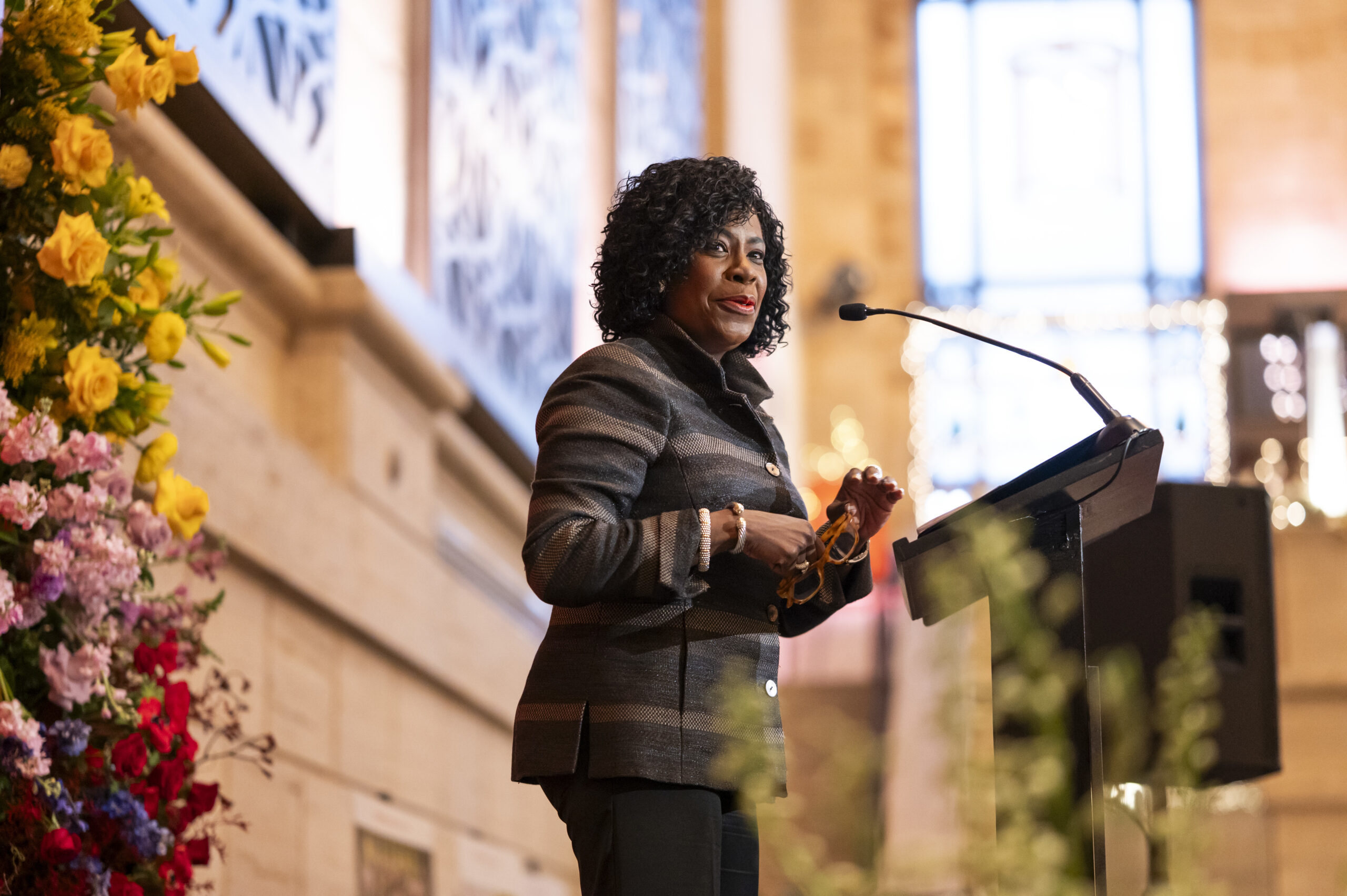
“It is fitting that we gather here as we prepare for an extraordinary moment in our history in 2026,” said Mayor Cherelle L. Parker. “The Flower Show offers a first impression of our city. It’s creative, it’s inspiring, and it’s deeply rooted in who we are as a people and a place.”
Mayor Cherelle L. Parker speaks at a press conference during an unveiling of the first look at the 2026 Philadelphia Flower Show, ‘Rooted: Origins of American Gardening’ at Union Trust on Wednesday, Jan. 14, 2026.
This year’s show represents the third in a series of themes exploring gardening over time. Earlier shows celebrated present-day gardening communities and envisioned bolder ones for the future.
“This theme is very much an opportunity to reflect on the origins of American gardening,” said Rader. “‘What is the story that we tell through gardening,’ and ‘how do we want to use it to shape Philadelphia, the country, and the world moving forward?”
The show will debut a reimagined Marketplace shopping destination, located in a new street-level space below the main exhibit halls. It will also feature an expanded Artisan Row, where guests can work alongside nearly 40 vendors and craftspeople to create everything from fresh floral crowns to dried bouquets and terrariums.
Popular attractions and events, like early morning tours, Bloom Bar, and “Fido Fridays,” where four-legged friends find time among the flowers, all return. The Flowers After Hours dance party, scheduled for Saturday, March 7, transforms the show into an enchanted, fairytale forest setting, with guests encouraged to wear “fantasy-inspired attire,” planners said.
With America’s 250th anniversary fast-approaching, planners felt it was the moment to “pause and acknowledge” the roots, traditions, and resilience of American gardening, said Seth Pearsoll, vice president and creative director of the Philadelphia Flower Show.
Those roots shape the show’s entrance garden, a sprawling, misty forest floor creation drawing on the diverse inspirations of American gardens, and featuring mossy stonework, Zen-like sculptural plantings, water displays, and crowned with a towering, twisting root structure.
“That garden sets the tone dramatically,” Pearsoll said. “We wanted it to feel timeless, grounded. We wanted to create a place to allow guests to slow down before moving forward.”
A participant creates pressed flower art following a press conference for the unveiling of a first look at the 2026 Philadelphia Flower Show, ‘Rooted: Origins of American Gardening’ at Union Trust on Wednesday, Jan. 14, 2026.
This year’s special exhibition, “The American Landscape Showcase,” celebrates the national milestone, also known as the Semiquincentennial, with four gardens highlighting how gardening has shaped communities and evolved over 250 years.
“It reflects the influence of shared knowledge, cultural traditions, and regional practices that continue to shape how we garden today,” he said.
Other gardens will feature exhibits from acclaimed international florists. Each year, thousands of exhibitors compete in more than 900 classes or categories, ranging from horticulture and arrangement to design and photography.
“Whether you come for the artistry, the education, the family experiences, or simply to be surrounded by some of the most gorgeous beauty in the middle of the winter, there’s a place for you here,” Pearsoll said.
Matt Rader, President of the Philadelphia Horticultural Society, speaks at a press conference during an unveiling of the first look at the 2026 Philadelphia Flower Show, ‘Rooted: Origins of American Gardening’ at Union Trust on Wednesday, Jan. 14, 2026.
With more than 200,000 guests expected at this year’s milestone show, the event represents the Horticultural Society’s biggest fundraiser, supporting its greening efforts across the city, said Rader.
“This is the home of American horticulture,” he said. “The Flower Show is our invitation to the world to join us here.”
We’ve asked where South Philly starts, and about the Eagles-Steelers divide, but now it's time to answer an even more controversial question: Where does South Jersey end and North Jersey begin?
It’s a toughie, even entire movies have tried to answer this question. Is it just Eagles country vs. Giants country? Or maybe area code based? Turnpike exits? Or just simple geography of towns and counties? We want to hear from you.
story continues after advertisement
Use the sliders below to draw the dividing line. Submit your pick and see how other Inquirer readers voted.
The Rest of New Jersey
Central Jersey
South Jersey
You think South Jersey includes south_city_marker.
If we averaged out the votes from Inquirer readers, South Jersey would include south_city_average.
We’re not done yet, though. Now you’ve told us where South Jersey starts, we have another question for you: If it exists, where does Central Jersey start?
selection_answer
Of those that voted, central_votes believe there is a Central Jersey. The average Inquirer reader placed north_city_average in North Jersey and central_city_avg in Central Jersey.
Thank you for taking our quiz. If you want to weigh in more (like Pork Roll or Taylor Ham) let us know!
Staff Contributors
Design, Development, and Reporting: Garland Fordice
Editing: Sam Morris
Copy Editing: Brian Leighton
Illustration: Julia Duarte
(()=>{var Ft=(t,e)=>()=>(e||t((e={exports:{}}).exports,e),e.exports);var at=Ft(p=>{var Ot={0:”Jan.”,1:”Feb.”,2:”March”,3:”April”,4:”May”,5:”June”,6:”July”,7:”Aug.”,8:”Sept.”,9:”Oct.”,10:”Nov.”,11:”Dec.”};function rt(t){return t===void 0&&(t=new Date),Ot[t.getMonth()]}var Ct={0:”Jan”,1:”Feb”,2:”Mar”,3:”Apr”,4:”May”,5:”Jun”,6:”Jul”,7:”Aug”,8:”Sep”,9:”Oct”,10:”Nov”,11:”Dec”};function ot(t){return t===void 0&&(t=new Date),Ct[t.getMonth()]}function S(t){return t==null}function lt(t){return typeof t==”number”&&isFinite(t)}function O(t){return lt(t)&&Math.floor(t)===t}var Nt=[“one”,”two”,”three”,”four”,”five”,”six”,”seven”,”eight”,”nine”],It=[“million”,”billion”,”trillion”,”quadrillion”,”quintillion”,”sextillion”,”septillion”,”octillion”,”nonillion”,”decillion”],it=[“th”,”st”,”nd”,”rd”,”th”,”th”,”th”,”th”,”th”,”th”],Dt=[11,12,13];function ct(t){if(S(t))return””;var e=+t;return O(e)?Dt.indexOf(e%100)>-1?it[0]:it[e%10]:””}var Bt=[“first”,”second”,”third”,”fourth”,”fifth”,”sixth”,”seventh”,”eighth”,”ninth”],Ht=new RegExp(/s+([^s]*)s*$/);p.apdate=function(t){return t===void 0&&(t=new Date),rt(t)+” “+t.getDate()+”, “+t.getFullYear()},p.apdatetab=function(t){return t===void 0&&(t=new Date),ot(t)+” “+t.getDate()+”, “+t.getFullYear()},p.apmonth=rt,p.apmonthtab=ot,p.apnumber=function(t){if(S(t))return””;var e=+t;return O(e)?e=10?t.toString():Nt[e-1]:t.toString()},p.aptime=function(t){t===void 0&&(t=new Date);var e,s,n=t.getHours(),r=t.getMinutes(),i=r===0;if(i){if(n===0)return”midnight”;if(n===12)return”noon”}return n0?n:12):(e=”p.m.”,s=n===12?n:n-12),i?s+” “+e:s+”:”+(r<10?"0"+r:r)+" "+e},p.capfirst=function(t){if(S(t))return"";var e=String(t);return""+e.charAt(0).toUpperCase()+e.slice(1)},p.intcomma=function(t){if(S(t))return"";var e,s=+t;return lt(s)?((e=s.toString().split("."))[0]=e[0].replace(/B(?=(d{3})+(?!d))/g,","),e.join(".")):t.toString()},p.intword=function(t){if(S(t))return"";var e=+t;if(!O(e))return t.toString();var s=Math.abs(e);if(s<1e6)return t.toString();var n=Math.ceil(Math.log(s+1)/Math.LN10)-1,r=n-n%3,i=e/Math.pow(10,r);return(i=Math.round(10*i)/10)+" "+It[Math.floor(r/3)-2]},p.ordinal=function(t,e){if(e===void 0&&(e=!1),S(t))return"";var s=+t;return O(s)?e&&s{F=F||window.PMNdataLayer,F?F.push({event:”misc_event”,eventAction:t,eventLabel:e}):window.location.hostname.includes(“localhost”)?console.log(“Analytics event:”,t,e,”(not actually being sent due to localhost)”):console.log(“Failed to push analytics event”,t,e)},E={event:(t,e)=>{$t(t,e)}};var et=async(t,e)=>(await fetch(`https://inq-junto.herokuapp.com/${t}`,{method:”POST”,headers:{“Content-Type”:”application/json”},mode:”cors”,body:JSON.stringify(e)})).json(),H=()=>{let e=document.querySelector(“.js-inno”).dataset.junto;if(e)return e;throw new Error(“no junto id found”)},v={getDefaultId:()=>H(),vote:(t,e=H())=>{et(“vote”,{poll:e,ballot:t})},results:async(t=H())=>await et(“results”,{poll:t})};var nt=1,st=[],R=class{constructor(e){this.el=e,this.contentPosition=”default”,this.possibleSteps=new Array,this.currentStep=null,this.offset=window.innerHeight*.9,this.instanceOfSteps=nt,nt++,this.setPossibleSteps()}start(){this.el.classList.add(“is-visible”),this.updateContent(),this.bindings()}setPossibleSteps(){this.el.querySelectorAll(“.js-steps-step”).forEach(e=>{e.dataset.step&&this.possibleSteps.push(e.dataset.step)})}bindings(){window.addEventListener(“scroll”,()=>{this.updateContent()}),window.addEventListener(“resize”,()=>{this.updateContent()})}updateContent(){this.updateCurrentStep()}updateCurrentStep(){let e;if(this.el.querySelectorAll(“.js-steps-step”).forEach((n,r)=>{n.getBoundingClientRect().top{let o=”is-“+r,c=”is-“+i;this.possibleSteps.indexOf(r){document.querySelectorAll(“.js-steps”).forEach(t=>{st.push(new R(t))})},start:()=>{st.forEach(t=>t.start())}};var je=at();var ut=()=>/Android|webOS|iPhone|iPad|iPod|BlackBerry|IEMobile|Opera Mini/i.test(navigator.userAgent);var Y=(t,e=null,s=null)=>{s||(s=document.querySelector(“head”));let n=document.createElement(“script”);n.type=”text/javascript”,n.src=t,e&&(n.onload=e),s.appendChild(n)},dt=()=>(window.PMNdataLayer?.[0]!==void 0&&window.PMNdataLayer[0])?.analytics?.user?.state===”Subscribed”,pt=()=>{let e=(window.PMNdataLayer?.[0]!==void 0&&window.PMNdataLayer[0])?.analytics?.user?.state;return window.location.host.includes(“zzz-systest”)||window.location.host.includes(“pmn.arcpublishing.com”)||window.location.host.includes(“stage.fusion.inquirer.com”)||typeof e>”u”},ht=()=>{let e=(window.PMNdataLayer?.[0]!==void 0&&window.PMNdataLayer[0])?.analytics?.user?.hasAdsFreeReading;return!!(e&&e==1)},V=()=>window.location.host.includes(“localhost”);var C=(t,e)=>{let s=[…t.querySelectorAll(“[data-populate]”)];t.dataset.populate&&s.unshift(t);let n=s.filter(r=>{let i=r.closest(“[data-populate-context]”);return!i||i==t});for(let r of n){let o=r.dataset.populate.trim().split(/s*,s*/).map(c=>c.split(/s*:s*/));for(let[c,d]of o){let l=c.split(“.”).reduce((u,b)=>u?.[b],e),f=l==null||l==null,m=d?.split(/s+/)||[“innerHTML”];for(let u of m)u.startsWith(“.”)&&r.classList.toggle(u.substring(1),f?!1:l),!f&&(u==”innerHTML”?r.innerHTML=l:u.startsWith(“@”)?r.setAttribute(u.substring(1),l):u.startsWith(“–“)&&r.style.setProperty(u,l))}}};var Rt=(t,e)=>{let s=[];return e.forEach(n=>{let r=new DOMPoint(n.getAttribute(“cx”),n.getAttribute(“cy”));if(t.isPointInFill(r))s.push(n);else return}),s},Yt=(t,e)=>{let s=[];return e.forEach(n=>{let r=new DOMPoint(n.getAttribute(“cx”),n.getAttribute(“cy”));if(!t.isPointInFill(r))s.push(n);else return}),s},g=(t,e,s)=>Rt(t,e).sort((o,c)=>s===”north”?o.getAttribute(“cy”)-c.getAttribute(“cy”):c.getAttribute(“cy”)-o.getAttribute(“cy”)).slice(0,2).map(o=>o.getAttribute(“data-name”)).join(” and “),k=(t,e,s)=>Yt(t,e).sort((o,c)=>s===”north”?o.getAttribute(“cy”)-c.getAttribute(“cy”):c.getAttribute(“cy”)-o.getAttribute(“cy”)).slice(0,2).map(o=>o.getAttribute(“data-name”)).join(” and “),G=(t,e,s)=>{let n=document.createElementNS(“http://www.w3.org/2000/svg”,”line”);return n.setAttribute(“class”,s),n.setAttribute(“x1”,0),n.setAttribute(“y1”,t),n.setAttribute(“x2”,531.5),n.setAttribute(“y2″,e),n},J={behavior:”auto”,block:”center”,inline:”center”},z=(t,e,s,n)=>{let r=(h,l)=>{let f=”http://www.w3.org/2000/svg”,m=document.createElementNS(f,h);for(let u in l)u===”href”||u===”xlink:href”?m.setAttributeNS(“http://www.w3.org/1999/xlink”,”xlink:href”,l[u]):m.setAttribute(u,l[u]);return m},i=t.querySelector(“defs”),o=r(“path”,{id:`${n}Path`,d:`M -20,${e} L 551.5,${s}`,stroke:”transparent”,fill:”none”});i.appendChild(o);let c=r(“text”,{class:`average-line-label average-line-label-${n}`});t.appendChild(c);let d=r(“textPath”,{href:`#${n}Path`,startOffset:”50%”,”text-anchor”:”middle”});d.textContent=`${n===”south”?”South”:”Central”} Average`,c.appendChild(d)};var x=document.querySelector(“.js-slider-section-wrapper”),T=document.querySelector(“.js-slider”),N=document.querySelector(“.inno-slider__map”),A=document.querySelector(“.js-slider-jersey-test-line”),D=document.querySelectorAll(“.js-slider-grabber”),y=document.querySelector(“.js-slider-jersey”),Vt=””,mt=””,X=”south”,I=!1,a=new Object,Gt=()=>{let t=!1,e=!1,s,n,r=515.91,i=700;D.forEach(o=>{let c=o.dataset.type;o.addEventListener(“mousedown”,d=>{I=!0,document.querySelector(“.js-slider-instructions”).classList.add(“is-hidden”);let h=()=>{t=!1,e=!1,o.style.cursor=”grab”,document.removeEventListener(“mousemove”,l),document.removeEventListener(“mouseup”,h)},l=f=>{if(!t)return;let m=f.clientY-n,u=12,b=950,j=w=>w>=u&&w<=b?w:w{document.querySelector(“.js-slider-instructions”).classList.add(“is-hidden”);let h=d.touches[0],l=()=>{t=!1,e=!1,o.style.cursor=”grab”,document.removeEventListener(“mousemove”,f),document.removeEventListener(“mouseup”,l)},f=m=>{if(!t)return;let b=m.touches[0].clientY-n,j=12,w=950,tt=M=>M>=j&&M<=w?M:M{document.querySelector(“.js-slider-instructions”).classList.add(“is-hidden”),Vt=y,X=”north”;let o={south_city_marker:g(y,document.querySelectorAll(“.inno-slider__city-points”),”north”),south_city_average:g(document.querySelector(“.js-slider-south-avg”),document.querySelectorAll(“.inno-slider__city-points”),”north”)};C(document.querySelector(“.step-group-0 .js-steps-steps”),o),W({area:”south”}),x.classList.remove(“is-picking”)}),T?.querySelector(“.js-slider-north-submit”)?.addEventListener(“click”,()=>{mt=y,X=”north”;let o=document.querySelector(“[data-step=’central_choice’]”).getAttribute(“data-central-pick”),c={north_city_marker:g(y,document.querySelectorAll(“.inno-slider__city-points”),”south”),north_city_average:g(document.querySelector(“.js-slider-north-avg”),document.querySelectorAll(“.inno-slider__city-points”),”south”),selection_answer:o.replace(“%%north_city_marker%%”,`${g(y,document.querySelectorAll(“.inno-slider__city-points”),”south”)}`).replace(“%%central_city_average%%”,`${k(document.querySelector(“.js-slider-north-avg”),document.querySelectorAll(“.inno-slider__city-points”),”north”)}`),central_votes:`${a.centralPercentage?a.centralPercentage?.toFixed():0}%`,central_city_avg:k(document.querySelector(“.js-slider-north-avg”),document.querySelectorAll(“.inno-slider__city-points”),”north”)};C(document.querySelector(“.step-group-1 .js-steps-steps”),c),W({area:”north”,central:!0}),document.querySelector(“body”).style.overflow=””,x.classList.remove(“is-picking”)}),document.querySelector(“.js-slider-north-start”)?.addEventListener(“click”,()=>{x.classList.add(“is-picking”),document.querySelector(“body”).style.overflow=”hidden”,Z(),document.querySelector(“.js-central-label”).classList.remove(“is-hidden”),T.scrollIntoView({behavior:”instant”})}),document.querySelector(“.js-slider-north-skip”)?.addEventListener(“click”,()=>{Z(“skip”);let o=document.querySelector(“[data-step=’central_choice’]”).getAttribute(“data-no-central-pick”),c={north_city_marker:g(y,document.querySelectorAll(“.inno-slider__city-points”),”south”),north_city_average:g(document.querySelector(“.js-slider-north-avg”),document.querySelectorAll(“.inno-slider__city-points”),”south”),selection_answer:o.replace(“%%north_city_marker%%”,g(y,document.querySelectorAll(“.inno-slider__city-points”),”south”)).replace(“%%central_city_average”,k(document.querySelector(“.js-slider-north-avg”),document.querySelectorAll(“.inno-slider__city-points”),”north”)),central_votes:`${a.centralPercentage?a.centralPercentage?.toFixed():0}%`,central_city_avg:k(document.querySelector(“.js-slider-north-avg”),document.querySelectorAll(“.inno-slider__city-points”),”north”)};C(document.querySelector(“.step-group-1 .js-steps-steps”),c),W({area:”north”,skipped:”skipped”,central:!1}),x.classList.add(“is-central-skipped”)})},U=()=>{A.setAttribute(“y1”,document.querySelector(“.inno-slider__circle-grabbers-left”).getAttribute(“cy”)),A.setAttribute(“y2”,document.querySelector(“.inno-slider__circle-grabbers-right”).getAttribute(“cy”)),ft()},ft=()=>{let e=y.getAttribute(“points”).split(” “).map(r=>{let i=r.split(“,”);return{x:parseFloat(i[0]),y:parseFloat(i[1])}}),s=[];X===”south”?s=[0,1]:s=[3,2],e[s[0]].x=A.getAttribute(“x1”),e[s[1]].x=A.getAttribute(“x2”),e[s[0]].y=A.getAttribute(“y1”),e[s[1]].y=A.getAttribute(“y2″);let n=e.map(r=>`${r.x},${r.y}`).join(” “);y.setAttribute(“points”,n)},W=({area:t,skipped:e,central:s})=>{T?.classList.add(“is-answered”),x.classList.add(`is-picked-${t}`),yt(),document.querySelector(“.js-south-slider-submit”).classList.add(“is-hidden”),document.querySelector(“.js-north-slider-submit”).classList.add(“is-hidden”),document.querySelector(“.js-slider-jersey”).classList.add(“is-set”);let n=[],r={};if(e||D.forEach(i=>{let o=i.dataset.type;n.push(i.getAttribute(“cy”)),I&&(r={…r,[`${t}-${o}`]:parseFloat(i.getAttribute(“cy”))})}),t===”south”)$.start(),document.querySelector(“.step-group-0”).querySelector(“[data-step=’south_choice’]”)?.scrollIntoView(J),I&&(v.vote({…r}),v.vote({[`${t}-line`]:n.toString()},”2025-south-jersey-line-tbd–STARTER-COMBINED”));else{let i=document.querySelector(“.step-group-1″);i.style.display=”block”,document.querySelector(“.step-group-0”).classList.remove(“is-hidden”),i.querySelector(“[data-step=’central_choice’]”)?.scrollIntoView(J),I&&(v.vote({…r,central:s}),v.vote({[`${t}-line`]:n.toString()},”2025-south-jersey-line-tbd–STARTER-COMBINED”))}},Z=t=>{mt||(x.classList.add(“is-picking-north”),document.querySelector(“.js-jersey-label”).innerHTML=”North Jersey”,T?.classList.remove(“is-answered”),yt(“restart”),document.querySelector(“.js-slider-north-jersey”)?.classList.remove(“is-hidden”),y=document.querySelector(“.js-slider-north-jersey”),t||D.forEach(e=>{currentY=e.getAttribute(“cy”),e.setAttribute(“cy”,Number(currentY)-50)}),U(),document.querySelector(“.js-north-slider-submit”).classList.remove(“is-hidden”))},yt=()=>{A.classList.toggle(“is-hidden”),D.forEach(t=>t.classList.toggle(“is-hidden”))},Jt=async()=>{let t=await v.results();a.results=t;let e={northLeft:Object.entries(t.ballot[“north-left”]),northRight:Object.entries(t.ballot[“north-right”]),southLeft:Object.entries(t.ballot[“south-left”]),southRight:Object.entries(t.ballot[“south-right”])},s=Object.entries(t.ballot.central).reduce((c,d)=>{let h=d[0],l=d[1];return{…c,total:c.total+l,central:h==”true”?c.central+l:c.central}},{total:0,central:0}),n=s.central/s.total*100;a.centralPercentage=n,Object.keys(e).map(c=>{let h=e[c].reduce((l,[f,m])=>({countNum:l.countNum+m,sum:l.sum+Number(f)*m}),{countNum:0,sum:0});return h.sum/h.countNum}).map((c,d)=>{a[Object.keys(e)[d]]||(a[Object.keys(e)[d]]={}),a[Object.keys(e)[d]].avg=c});let i=G(a.southLeft.avg,a.southRight.avg,”inno-slider__south-avg”);N.append(i),z(N,a.southLeft.avg,a.southRight.avg,”south”),document.querySelector(“.js-slider-south-avg”).setAttribute(“points”,`0,${a.southLeft.avg} 531.5,${a.southRight.avg} 531.5,1031.82 0,1031.82`);let o=G(a.northLeft.avg,a.northRight.avg,”inno-slider__north-avg”);N.append(o),z(N,a.northLeft.avg,a.northRight.avg,”north”),document.querySelector(“.js-slider-north-avg”).setAttribute(“points”,`0,0 531.5,0 531.5,${a.northRight.avg} 0,${a.northLeft.avg}`)},gt={init:()=>{Gt(),ft(),Jt()},restartCentral:()=>{Z()}};var zt=()=>{},vt={init:()=>{zt()}};var Wt=()=>{ht()&&document.querySelectorAll(“.js-adbox”).forEach(e=>{e.classList.add(“is-hidden”)})},St={init:()=>{Wt()}};var Xt=()=>{document.querySelectorAll(“.js-form”).forEach(t=>{t.addEventListener(“submit”,e=>{e.preventDefault(),Ut(t)})})},Ut=t=>{let e=t.dataset.id,s=new FormData(t),n=new Object;for(let r of s)n[`form-${e}-${r[0]}`]=r[1];v.vote({…n,[`form-${e}`]:Object.values(n).join(“///”)}),t.classList.add(“has-submitted”),t.querySelector(“.js-button-label”).textContent=”Form submitted!”,setTimeout(()=>{t.querySelector(“.js-form-button”).disabled=!0},500)},bt={init:()=>{Xt()}};var L,wt,Zt=()=>{L=document.getElementById(“js-inno-toast”)},Kt=t=>{if(!L)return;L.innerHTML=t,L.classList.add(“is-active”);let e=()=>{L.addEventListener(“transitionend”,Qt,{once:!0}),L.classList.remove(“is-active”)};clearTimeout(wt),wt=setTimeout(e,5e3)},Qt=()=>{L.innerHTML=””},q={init:()=>{Zt()},showToast:Kt};var B,At=!1,te=async()=>new Promise(t=>{setTimeout(()=>{console.log(“simulating createShareLink for localhost”),t(“https://inquirer.com/interactives”),ee()},100)}),ee=()=>{let t=document.querySelector(“.js-gift-toast-receiver”);!t||!(t instanceof HTMLElement)||setTimeout(()=>{let e=t?.querySelector(“span”);e&&(e.innerHTML=”Gift link copied to clipboard“)},20)},ne=()=>{let t=window.services?.createShareLink;t&&(B=t),V()&&(B=te),B&&re()},se=async t=>{let e=”text/plain”,s=async()=>{try{return await B(window.location.pathname)}catch{t.dataset.state=”error”,q.showToast(“Hmm, we couldn’t generate a gift link…”)}},n=new ClipboardItem({[e]:s()});await navigator.clipboard.write([n]).catch(r=>{console.log(r),q.showToast(“Couldn’t copy to clipboard, try again?”),t.dataset.state=”error”}),q.showToast(“Gift link copied to clipboard!”),t.dataset.state=”complete”},re=()=>{document.querySelectorAll(“.js-gift”).forEach(e=>{(dt()||V()||pt())&&e.classList.add(“is-available”)}),document.querySelectorAll(“.js-gift-button”).forEach(e=>{e instanceof HTMLButtonElement&&e.addEventListener(“click”,()=>{e.classList.contains(“disabled”)||(e.dataset.state=”loading”,At=!0,se(e),setTimeout(()=>{e.dataset.state=”ready”},2e3))})});let t=document.querySelector(“.js-gift-toast-receiver”);!t||!(t instanceof HTMLElement)||oe(t)},oe=t=>{new MutationObserver(s=>{for(let n of s){let r=[…n.addedNodes].at(0);if(!(r instanceof HTMLElement))return;At&&q.showToast(r.outerHTML)}}).observe(t,{subtree:!0,childList:!0})},Lt={init:()=>{ne()}};var ie=()=>{window.addEventListener(“message”,t=>{if(t.data[“datawrapper-height”]){let e=t.data[“datawrapper-height”];for(let s in e)document.querySelector(`#datawrapper-chart-${s}`).setAttribute(“height”,e[s])}})},ce=()=>{document.querySelectorAll(“.js-datawrapper-graphic”).forEach(t=>{Y(`https://datawrapper.dwcdn.net/${t.dataset.id}/embed.js`,null,t)})},le=()=>{window.addEventListener(“message”,t=>{let e=t.data;document.querySelectorAll(`iframe[src*=”${e.id}”]`).forEach(n=>{n.style.height=`${e.height}px`})},!1)},ae=()=>{document.querySelectorAll(“.js-pym-graphic”).forEach(t=>{if(typeof window{new window.pym.Parent(t.id,t.dataset.iframe)};typeof window.pym>”u”?Y(“https://pym.nprapps.org/pym.v1.min.js”,e):e()}})},qt={init:()=>{ie(),ce(),ae(),le()}};var P,ue=()=>{document.querySelectorAll(“.js-hover”).forEach(t=>{t.addEventListener(“click”,()=>{jt(t)}),t.addEventListener(“mouseenter”,()=>{jt(t)}),t.addEventListener(“mouseout”,()=>{xt(t)})}),window.addEventListener(“scroll”,()=>{P!==null&&de()})},de=()=>{(P>window.scrollY+100||P{xt(t)})},jt=t=>{t.classList.add(“is-visible”),P=window.scrollY},xt=t=>{t.classList.remove(“is-visible”),P=null},_t={init:()=>{ue()}};var _,K,Q=!0,pe=()=>{_=document.querySelectorAll(“.js-video-autoplay”)},he=()=>{window.addEventListener(“resize”,()=>{Et()}),window.addEventListener(“scroll”,()=>{Et()}),_.forEach(t=>{t.addEventListener(“volumechange”,e=>{t.muted!==Q&&!ut()&&(Q=t.muted,me())})})},Et=()=>{let t;_.forEach((e,s)=>{let n=e.getBoundingClientRect(),r=n.height/2;n.y-r&&(t=e)}),t!==K&&(K=t,_.forEach(e=>{e.pause()}),t?t.play():K=null)},me=()=>{_.forEach(t=>{t.muted=Q})},kt={init:()=>{pe(),_&&he()}};var Tt={init:()=>{gt.init?.(),vt.init?.(),St.init?.(),bt.init?.(),Lt.init?.(),qt.init?.(),_t.init?.(),$.init?.(),kt.init?.(),q.init?.()}};var fe=()=>{},Pt={init:()=>{fe()}};var ye=document.querySelector(“.js-inno”),Mt=()=>{Tt.init(),Pt.init()};ye?Mt():new MutationObserver((e,s)=>{if(document.querySelector(“.js-inno”)){s.disconnect(),Mt();return}}).observe(document,{attributes:!0,childList:!0,subtree:!0});})();
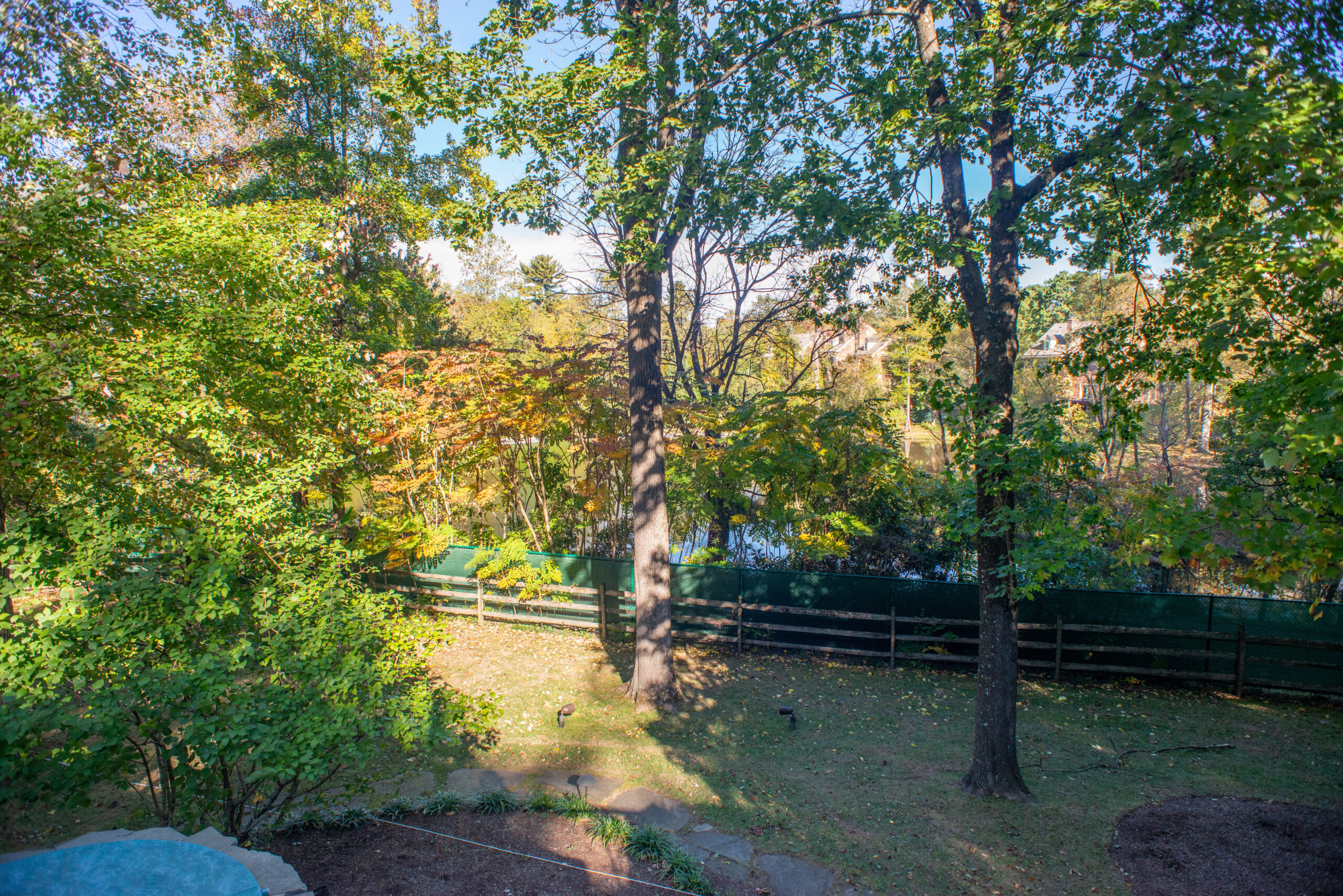
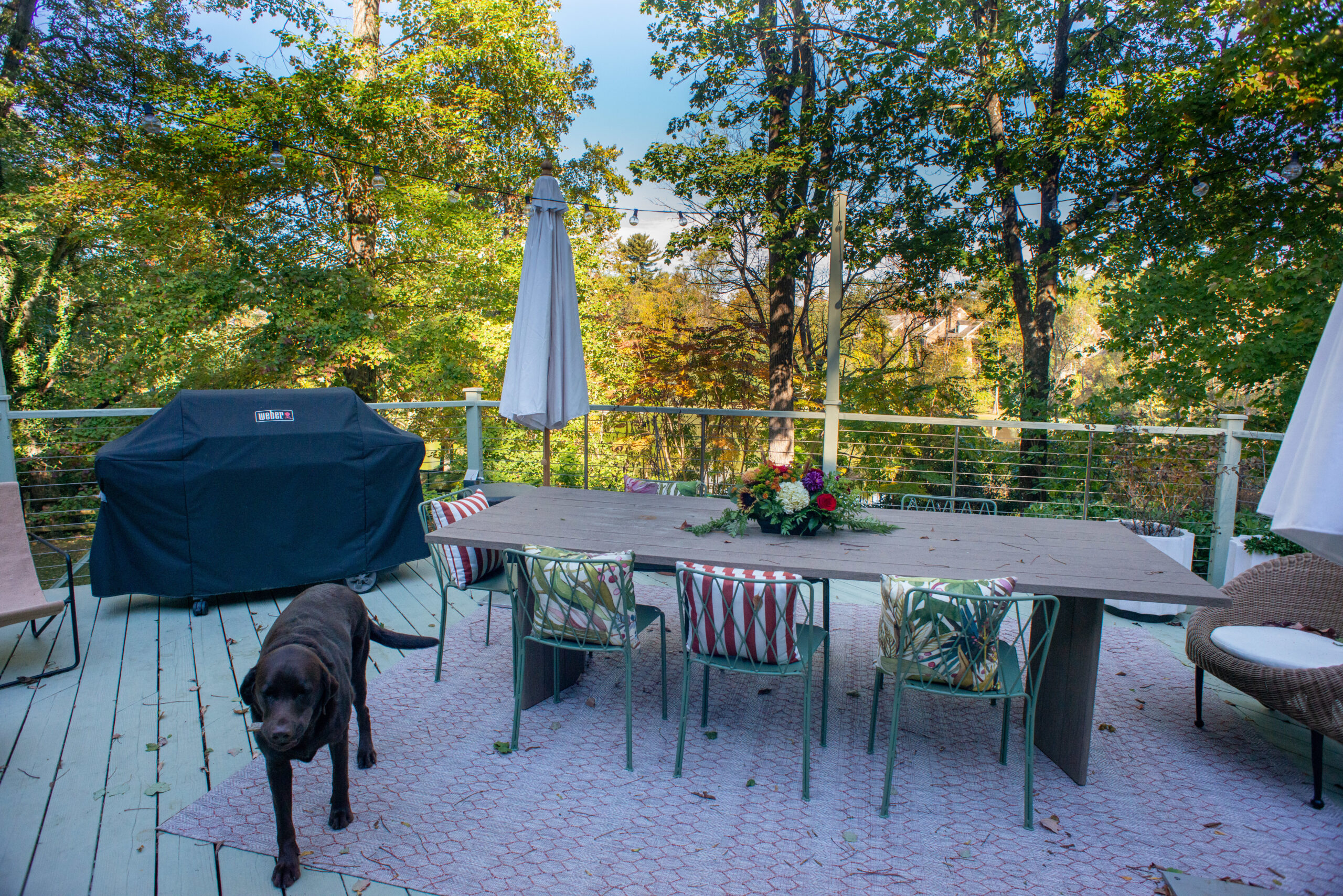
The Mediterranean-style stucco home in Montgomery County was ringed by maple and oak trees. A tri-level deck with a hot tub and covered porch faced a sylvan pond on an adjacent property.
Inside, the house had oak flooring, Amish-crafted red oak kitchen cabinets, two fireplaces, and a family room with a beamed cathedral ceiling.
The almost 5,000-square-foot home Casey Lyons and her husband, James, purchased in 2021 also had a basement with a sauna, gym, full bath, and a great room opening out into a patio where their two young sons could play.
On the second floor were four bedrooms and three baths and abundant closets fitted with drawers and shelving. Previous owners had installed a sophisticated sound system to play music.
The 1988 structure was dated, though. The kitchen had “peachy” squares of tile for a backsplash, Casey said. The 1½-acre property was attractively landscaped, but the outdoor decks were stained a worn rust color.
The home has a three-level deck in the backyard. It was painted green to play off the surrounding trees.
To give the first-floor living spaces a contemporary look, Casey reached out to interior designer Val Nehez through a mutual friend. Nehez remembers, “Casey asked me, ‘Can you make me love this house?’”
Nehez, owner of Studio IQL, and her senior designer, Ulli Barankay, were up to the challenge.
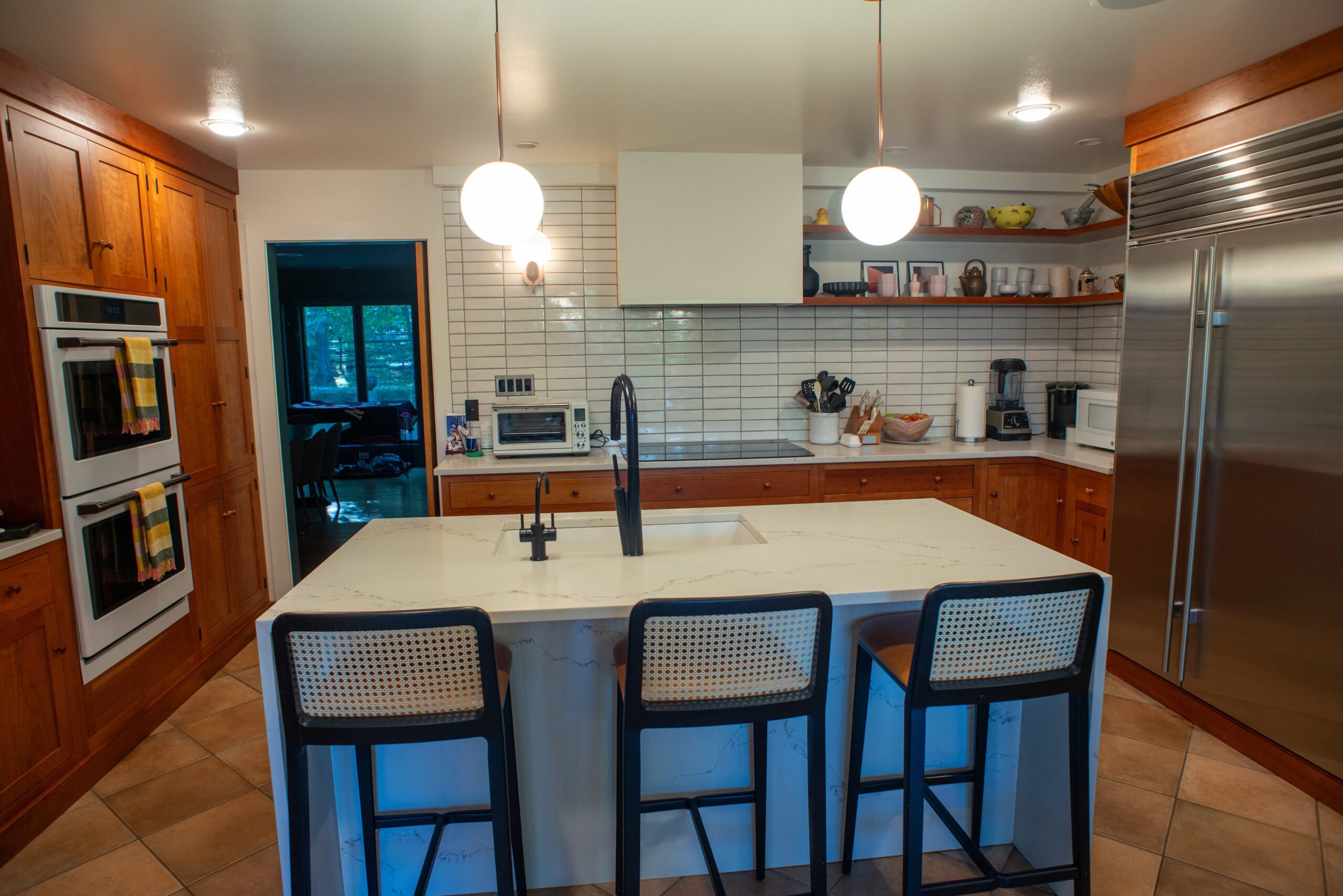
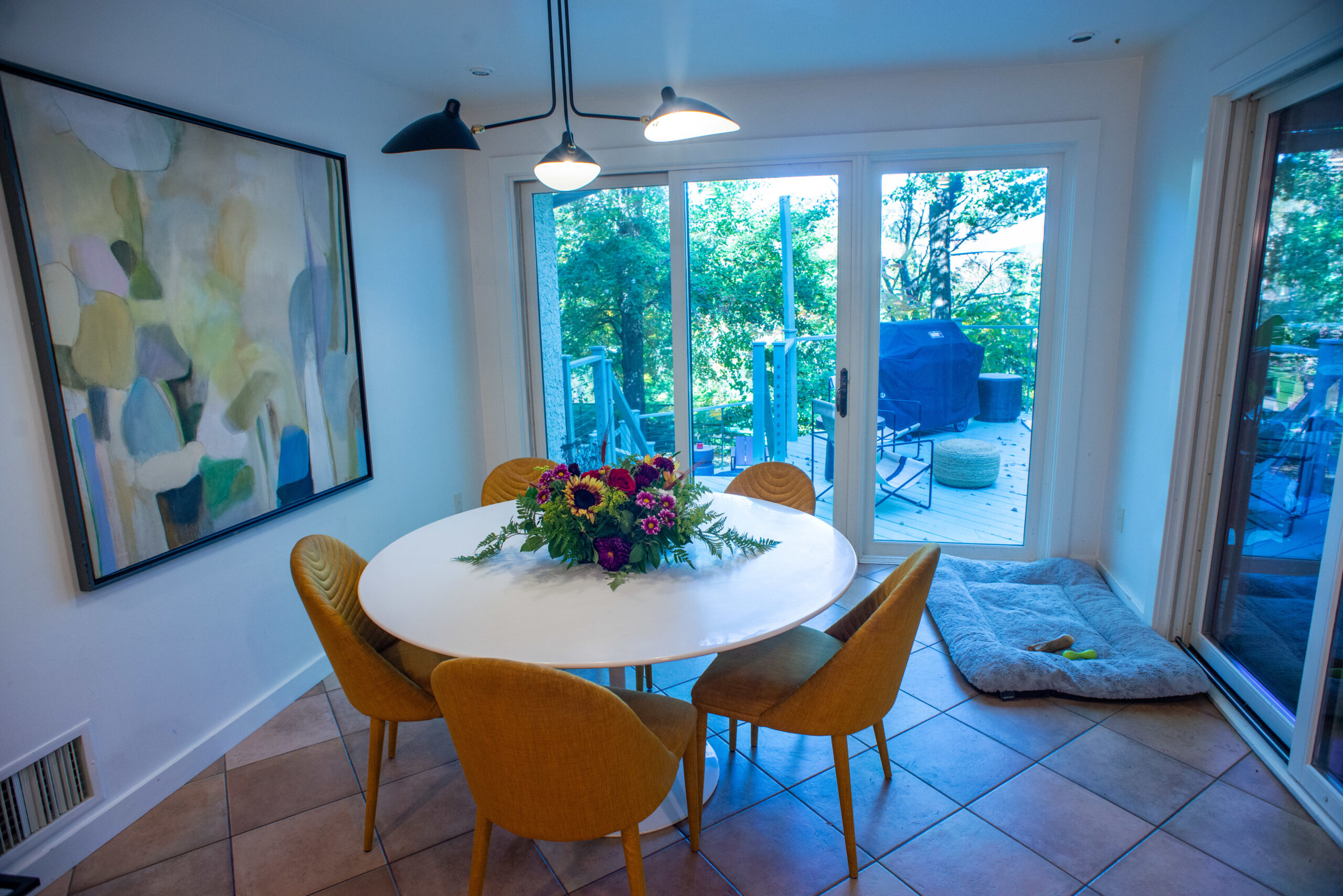
In the kitchen they kept most of the cabinetry but replaced one wall with white subway tile and open shelves. They installed a white marble island, new globe light fixtures, and curved black faucets. Mustard-colored chairs surround a white table.
“We turned a Lancaster County country kitchen … into a Southern California kitchen,” Nehez said.
With two active boys and a chocolate lab, Casey has to clean the chairs once a month. Still, she said, “I love the color.”
The renovated kitchen features white subway tiles and a marble island.Lyons loves the mustard color of the chairs in her kitchen.
In the center hall, red oak entry doors, adjacent closet doors, and the staircase were painted dark green to match the slate floor.
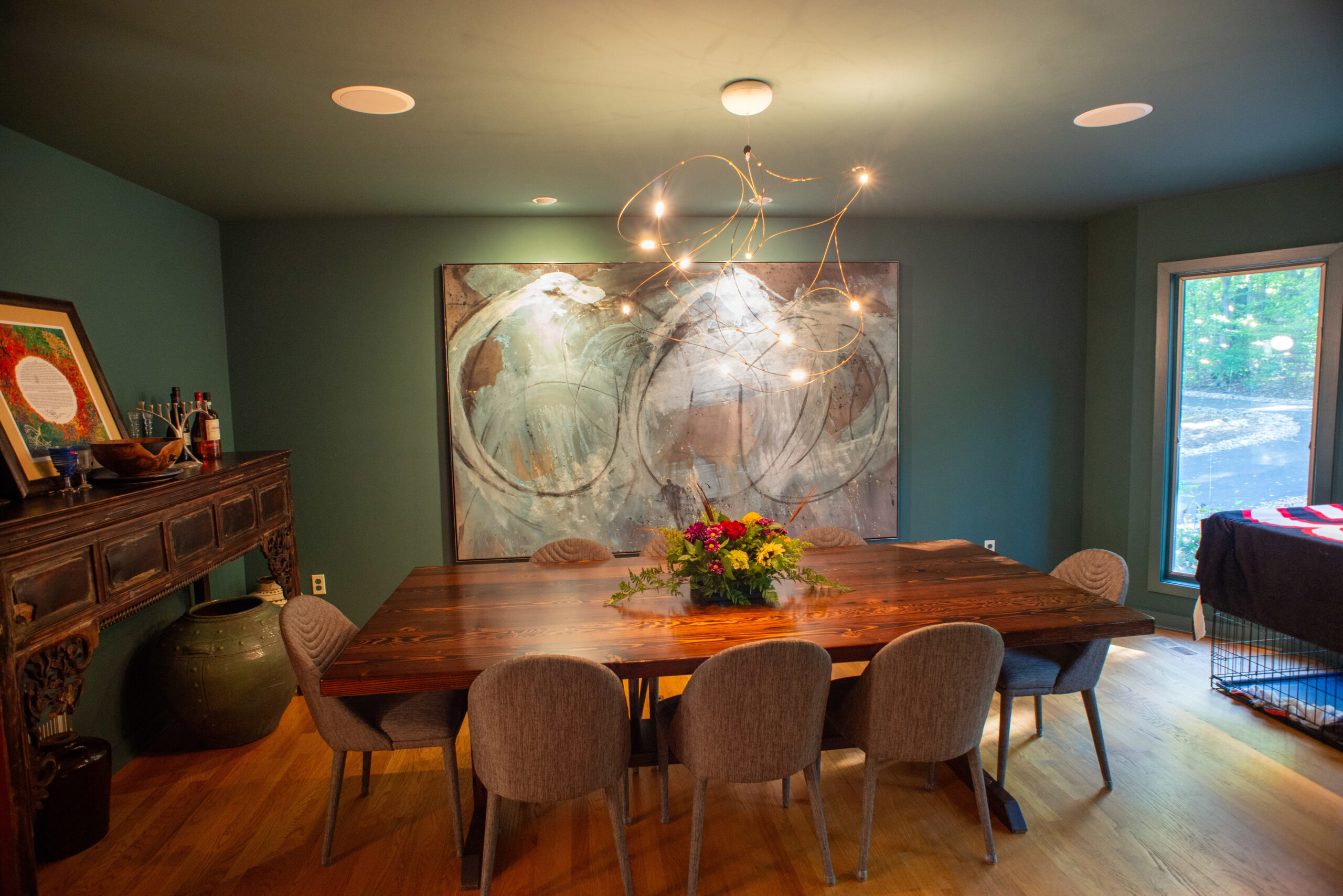
The dining room decor was inspired by a large abstract painting of white swirls on a green background from James’ family’s art collection. The walls are hunter green, and the “Flock of Light” curved metal chandelier from Design Within Reach complements the swirls in the painting.
Nehez found upholstered chairs for the walnut table, which Casey had custom-made by John Duffy, owner of Stable Tables in Flourtown.
For the formal dining room, Lyons chose a large abstract painting from her husband’s family collection and a “Flock of Light” chandelier.
The dining room’s vintage apothecary cabinet and heavily carved buffet had been in her previous home.
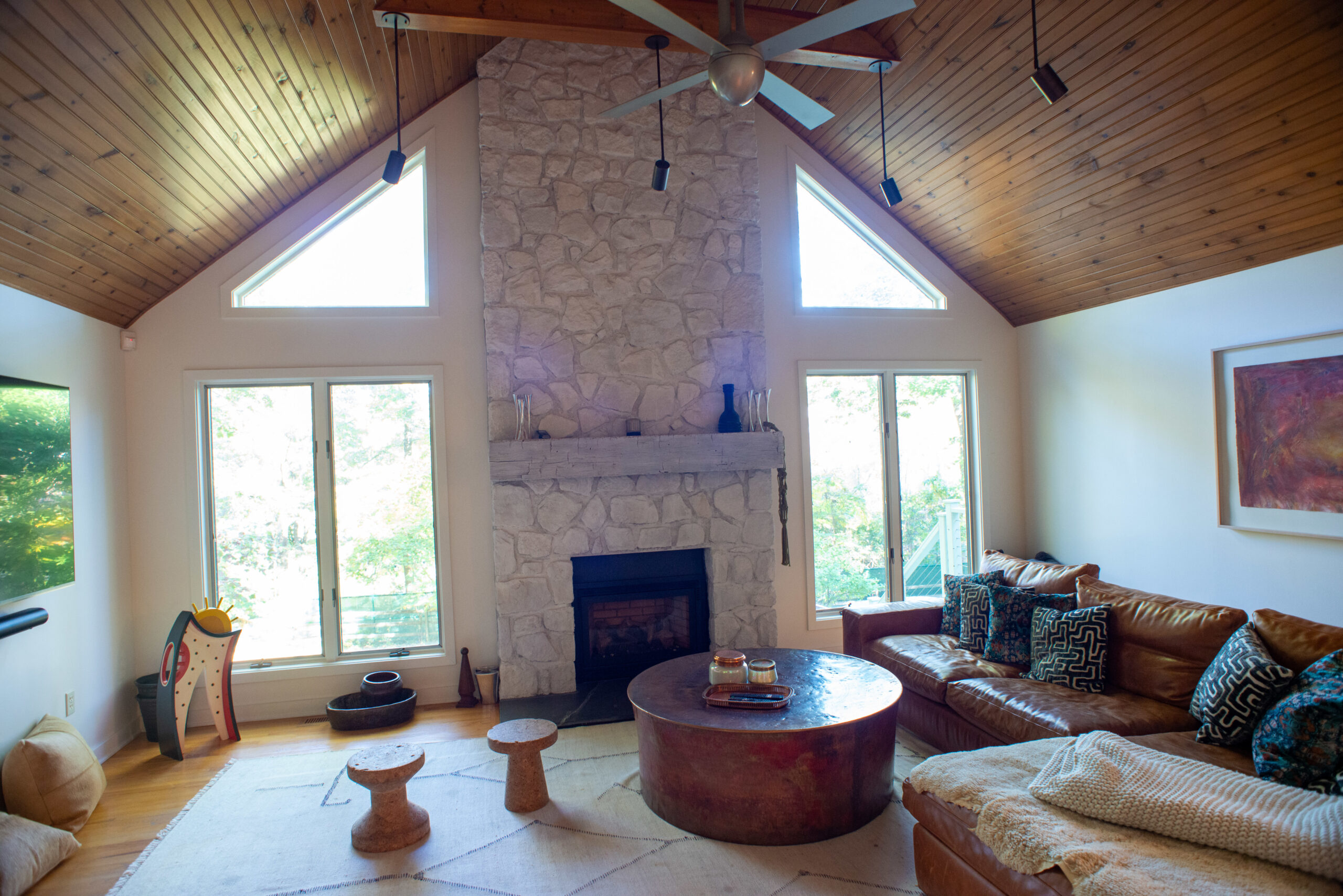
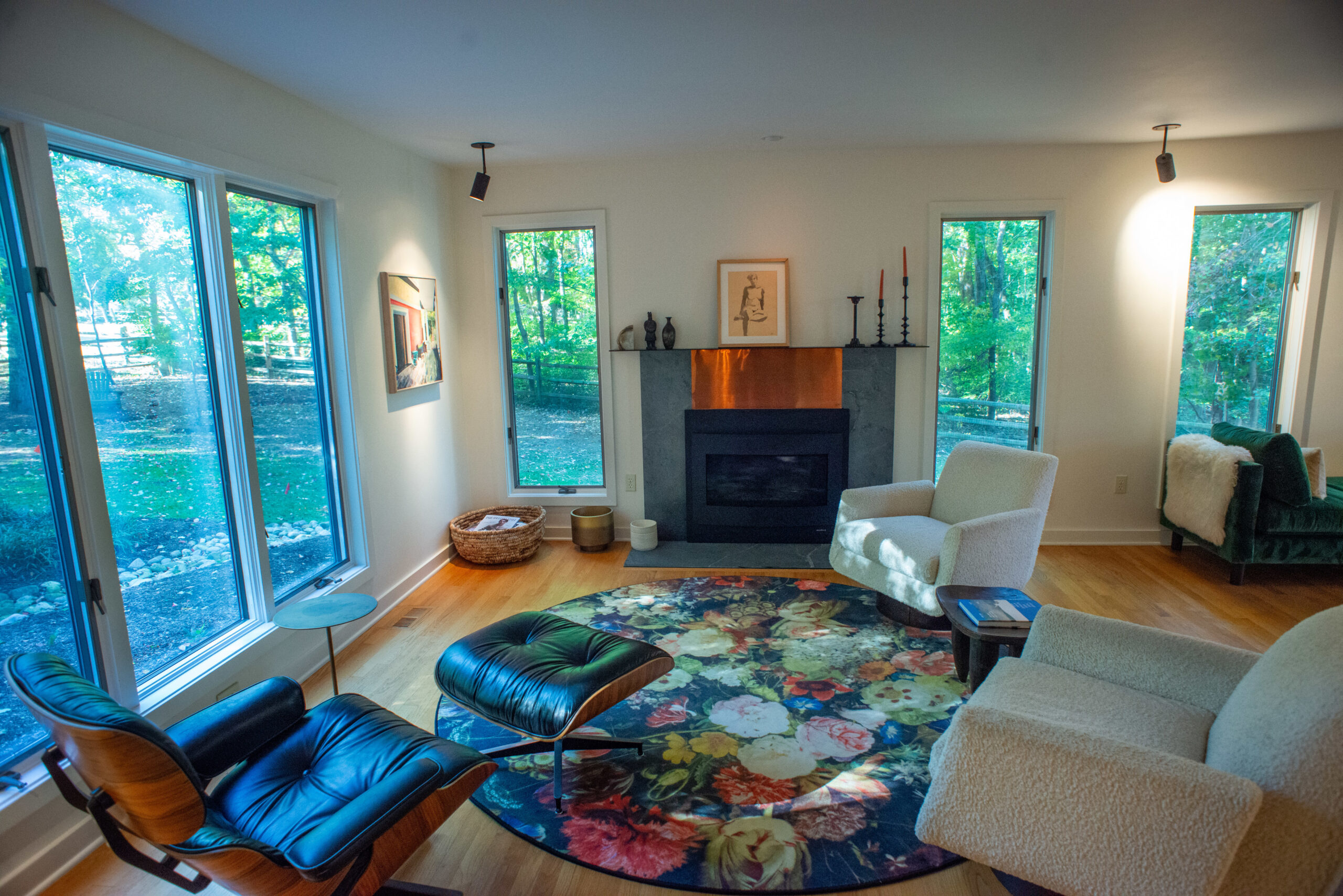
A copper plate and new mantle were added to the living room fireplace to make it more distinctive. The stone fireplace in the family room was whitewashed to blend with the white walls and emphasize the height of the cathedral ceiling. Furnishings include a tan leather sofa in the family room and white chairs, and a green velvet sofa and floral-pattern rug in the living room.
The fireplace stone in the family room was whitewashed to accentuate the tall ceilings.A copper plate and mantel were added to the living room fireplace.
Outside, the decking was painted a moss green to blend with the surrounding foliage. The back wall of the covered porch was covered with glazed green tiles. The porch features a maroon-and-white-striped sectional and blue, beige, and purple lantern-shaped lights. “It’s a beautiful place to sit” and admire the pond and the changing colors of the leaves in late autumn, Casey said.
Some furnishings came from Material Culture, an antique store in Germantown. Other items and lighting came from Minima, a contemporary lighting and furniture store in Old City. Nehez said items were selected to “reflect the owners’ taste.”
She and Barankay chose black porcelain fixtures for the powder room and wallpaper patterned with black and white zebras on a red background. In a happy coincidence, after the powder room remodeling was completed, the designers found a print of two zebras in the families’ art trove, which they hung in the hall nearby.
The view of the nearby pond from the deck outside Lyons’ home.Lyons’ dog, Joe, walks along the three-level deck.
As is their custom, with some exceptions such as the dining room painting, they waited until all the furnishings were in place to hang the art.
Finding the right piece to blend in, Nehez said, is “like finding the perfect pair of earrings after getting dressed.”
Since the remodeling Casey, her sons, and husband “have a space where we can cook, watch, television, and dance,” she said, in a home she now loves.
Is your house a Haven? Nominate your home by email (and send some digital photographs) at properties@inquirer.com.
The worst kind of mob is the one that is displacing its aggression. Then again, maybe every mob is that kind of mob. The more unhinged the vitriol, the more concentrated its direction, the more likely it is driven by fears and frustrations that are much more difficult to reconcile than the ones that have bubbled to the surface. The easier the target, the more likely it is the wrong one. Because the fixes are rarely easy.
Kevin Patullo isn’t the first person to experience the downside of this city’s manic emotional instability when it comes to professional sports. He might be the first one to have his house egged, and he almost certainly is the first one to have his image offered as a target by a golf simulator company. But the general phenomenon is something that we see any time a Philly sports team underperforms expectations to the extent that the Eagles offense did this season. Frustration is a lot easier to process if you can convince yourself that it would not exist but for the gross incompetence of one person. It is even easier when that person has a job that is relatively easy to replace.
My point here isn’t to shame anybody. Actually, my point is to lobby the Eagles to spend whatever it takes to hire Mike McDaniel as their offensive coordinator. It’s a move that would give them a radical upgrade in play-calling and game-planning expertise and that would give them a fighting chance at reinventing a scheme that has stagnated under Patullo and Nick Sirianni and may be obsolete due to some serious personnel regression. But I also feel a little bit guilty expressing an opinion that legitimizes or adds to the unrestrained and oftentimes unthinking pile-on of poor Patullo that we’ve witnessed here over the last month-plus. It should be possible to criticize and/or question a person’s professional performance without disregarding the person part of it, especially when that person is someone who lives among us in the community and whose kids attend our schools.
I’m not suggesting that everybody, or even most people, have crossed the line into gratuitous abuse/humiliation. It sure feels that way in the aggregate, though. I don’t have a personal relationship with Patullo. If I did, I would certainly apologize to him on the city’s behalf. I actually think most people would do the same if they randomly found themselves talking to him one-on-one, maybe in an airport bar, or at their kid’s CYO game. I suppose that’s another funny characteristic of mobs.
I wasn’t going to bring up any of this. Mostly because I don’t want a mob to come after me. I know I’ll be accused of saying something I’m not actually saying, a common mob tactic that serves to stake out a defensible rhetorical position and reframe an argument into one that can actually be won. So, although it won’t matter, I will say it again. I agree with a lot of the criticisms of the Eagles’ offense, and that Sirianni’s decision to make a change at offensive coordinator is both warranted and necessary.
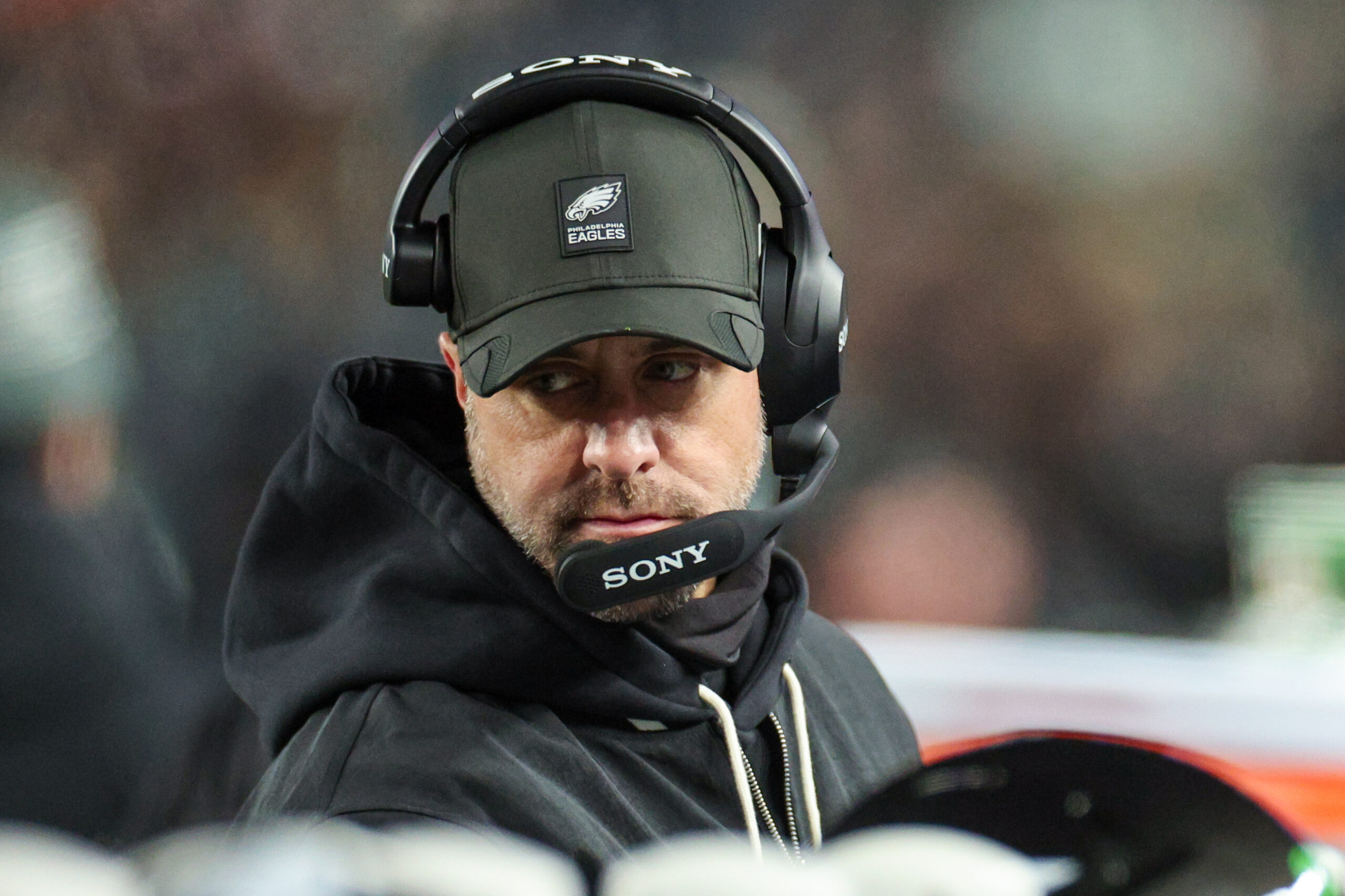
Kevin Patullo (center) talks with quarterback Jalen Hurts on Sunday in what was his final game calling plays for the Eagles.
That said, Eagles fans and media will be setting themselves up for a self-perpetuating cycle of offseasons like this one if they will not acknowledge the very obvious structural problems that exist well below the play-calling level on this Eagles offense. Even when this unit was at its best, it was trying to score points the same way it did under Patullo this season. The formula is the same as it was under Sirianni or Shane Steichen or Brian Johnson or Kellen Moore. The scheme and the personnel structure are built to stay ahead of the sticks with dominant run-blocking and to fill in the blanks with big plays from their elite talent at wide receiver and running back.
Listen to what DeVonta Smith said on Sunday when somebody asked him if the Eagles’ scheme needed to change after their season-ending loss to the 49ers.
“This the scheme that we’ve been in the whole time [since I’ve been here],” the receiver said. “Whatever anybody thinks, nothing changed. It’s the same scheme.”
Other players and coaches have said it countless times. Nobody seems to want to accept it. Yes, the Eagles have had four offensive coordinators in four seasons. And, yes, the offense was markedly worse this season than it was in the past. But it was the same scheme. It was the same philosophy.
The biggest difference between the Eagles offense this season and last season? On Sunday against the 49ers, Eagles running backs had eight carries that gained zero or negative yards. They had 20 such carries all last postseason, over four games. Eight on 30 carries against the dilapidated 49ers defense vs. 20 on 108 carries against the Rams, Packers, Chiefs, and Commanders last year.
Lane Johnson, one of the NFL’s ultimate warriors, is battling a foot injury that kept him from playing Sunday. Landon Dickerson basically shrugged when somebody asked him if he could get his body back to where it was last season. Cam Jurgens was pushed around all afternoon against the 49ers.
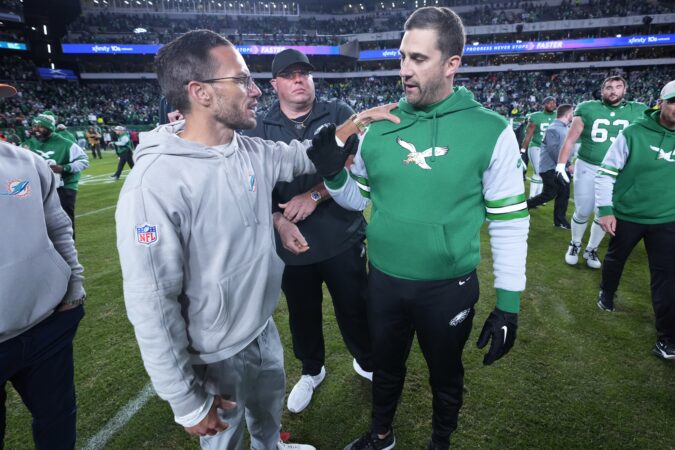
Mike McDaniel spent four seasons as Miami’s head coach and is a highly coveted candidate for several head coaching and offensive coordinator openings.
The Eagles’ only option is to bring in a fresh set of eyes and a proven track record of inventive run-scheming. They need to reinvent this offense, and McDaniel is the perfect mind to do it. Since he arrived in Miami in 2022, the Dolphins rank sixth in rushing average at 4.5 yards per attempt. He did this while also calling an offense that saw quarterback Tua Tagovailoa throw for 4,624 yards and go 11-6 in 2023.
There are all kinds of reasons to think it won’t happen. McDaniel is an eccentric personality who has spent the last four seasons with total control. Vic Fangio lasted less than one season as his defensive coordinator. McDaniel already reportedly has an interview scheduled with the Lions, who can offer him a good offensive line, excellent pass-catchers, and a running back that has the Devon Achane mold in Jahmyr Gibbs. That’s if McDaniel doesn’t land one of the remarkable nine head-coaching jobs that are currently open.
All the more reason for the Eagles to be aggressive. Howie Roseman and Jeffrey Lurie pride themselves on being ahead of the curve. They’d rather be a year early than a year late. Right now, it is getting late early. McDaniel or not, they need a new voice, an inventive mind, and a fresh set of eyes. Anybody else will end up right where Patullo is. And that’s not fair to anybody.
When 11-year-old Sam Salvo woke up on Christmas morning, he was surprised with tickets to the Eagles’ wild-card game. When he woke up on Monday morning, after the Eagles’ loss, he was all over the internet, thanks to his viral postgame rant.
“[When I got the tickets], I didn’t know who they were playing, but I was already excited,” Salvo said. “I thought they were going to win. I was like ready to do a backflip. I was so excited.”
Salvo remembers the excitement leading up to kickoff. Lincoln Financial Field, covered in Eagles green as fans piled in to watch the Birds take on the San Francisco 49ers, was ready to erupt. The Eagles took a six-point lead into the fourth quarter, but their Super Bowl defense ended early with a 23-19 defeat.
“It went from everyone being excited to be there, everyone getting ready for a dub,” Salvo said. “Then everyone got pretty sad really quickly. Everyone around me was sad.”
However, one fan in the crowd said something that resonated with Salvo: Win or lose, we’re the [expletive] Birds.
So Salvo left the stadium with his head held high, despite the crushing loss, and that’s when an opportunity presented itself. As he and his father walked toward the parking lot, they noticed 6abc reporter Briana Smith conducting interviews.
“When we were walking past the broadcaster, my dad was like, ‘No, I’m not trying to waste any time here,’” Salvo said. “And then I said, ‘I want to do it.’ So, I did it.”
The Blue Bell native stepped up to the microphone and let out what has become one of the most viral lines to come out of the Eagles’ playoff loss: I also want Kevin Patullo flipping burgers at the local McDonald’s.
“Whenever he’s an offensive coordinator,” Salvo told the camera, “it’s like he’s flipping burgers. … One half he’s cooking, and the other half is completely raw.”
The original post has more than a million likes. For Salvo, the attention was unexpected.
“Absolutely not [was I expecting it to go viral]. I had no idea,” the sixth grader said. “I was just hyped that I was on the news. Small win. But I never thought that I would expand this far.”
The video has gained more than 20 million views on Instagram alone — in fact, that’s just the original post, and does not count the tens of millions of views its received on other platforms and in other posts. Naturally, Salvo has become quite the popular kid.
“[After the game] I was thinking about how much the offense changed when Kevin Patullo came in,” Salvo said shortly after the news broke Tuesday. “So I just wanted to say anything about him that could get him fired. And it worked.
“I’m feeling good about it. Now we can hire a new offensive coordinator. If we could get Mike McDaniel as offensive coordinator, I think that would be great.”
Kevin Patullo lasted just one season as the Eagles offensive coordinator.
Salvo says he’s been bleeding green ever since his uncle gave him his first jersey … when he was born. Now, he also enjoys watching and analyzing games, listening to New Heights with Travis and Jason Kelce, and tuning into The Pat McAfee Show.
“He’s always been around grown-ups,” said his mother Zuzana. “So football Sundays have always been a huge thing. The talk and all that stuff has always been a big part of his life. You cannot stop that fire.”
Salvo’s passion for football is something he hopes to turn into a career down the line, if he doesn’t become a pro tennis player.
“I will absolutely try and be a football announcer,” Salvo said. “I don’t care if it’s college football, just any football.”
And as far as next steps for the Eagles this offseason, Salvo has a few more opinions on Eagles wide receiver A.J. Brown, whom he also said also needs to go during his viral interview.
“I’m not going to be mad if he stays, but I need him to show a little bit more effort,” Salvo said. “Because it’s been kind of annoying when we’ve been throwing him deep balls and he’s been showing no effort to even try and catch it.”
Brown, who had a heated exchange with Nick Sirianni during Sunday’s loss, has dodged the media twice since the end of the season.
It seems that Philadelphia’s reputation as a good place to start a business got a boost this past year.
The city ranked 13th among 350 “start-up ecosystems” worldwide in Startup Genome‘s 2025 Global Startup Ecosystem Report, which considers educational resources, labor, taxes, and funding opportunities.
The region attracted over $900 million in equity funding and acquisitions in 2024-25, according to the Greater Philadelphia Chamber of Commerce; expanded biotech and robotics facilities; and launched AI education initiatives — all supported by public-private partnerships and university-led R&D.
Chamber CEO Chellie Cameron said the Startup Genome ranking “affirms our region’s emergence as a global destination for innovation, business, and opportunity.”
From 2019 to 2024, the U.S. saw more than 21 million new business applications, marking the largest-ever spike.
Software giant Intuit recently reported that and “33% of U.S. adults plan to start a business or side hustle next year — a 94% year-over-year increase.” LinkedIn says the number of “founders” listed on the platform grew 69% last year.
Are you thinking of starting a business this year? Before you quit your job, here’s some practical advice.
Get your finances in order
When I started my business, I did so while having a full-time job. I worked a lot of hours. But that’s because I needed to build up an income stream to support me for when I eventually left the corporate world.
Smart entrepreneurs know their finances. They’re good at math or have advisers that help them. They recognize the importance of accounting.
“I got a freshman finance textbook, learned the terms, and then learned from other founders’ experiences,” Daltoso said. “I found mentors and professors who would help me at Penn. People can be incredibly helpful when you reach out.”
Sonura founders Gabriella Daltoso (left) and Sophie Ishiwari at the Hospital of the University of Pennsylvania in November.
Start-ups need capital, and for financing, it’s important to have a solid business plan with realistic projections of revenues and expenses. You need to establish relationships with banks, investors, family members, friends, venture capitalists, or anyone else that could be a source of financing. You should have enough money in the bank to support yourself and your family for at least two years because it will likely take that long to get your business cash positive.
James Massaquoi, a board member at the Seybert Foundation and former analyst at Philadelphia venture capital firm Osage Partners, emphasizes planning capital needs early, ideally before launching. Massaquoi urges founders to deeply understand their cost structure and assumptions before getting in too deep.
“Talk to bankers and other sources of capital before you really start the business, so it’s a conversation — not another checklist,” he said. “Spend more time modeling out costs than forecasting profits because costs fluctuate dramatically, especially in the first two years.”
Make sure your family is on board
Think you’re busy now? Wait until you start a business.
You will spend much more time launching, running, and growing your enterprise than you expect. You will work nights, weekends, and crazy hours. People will be happy for you and supportive, but in the end, it’s all on your shoulders.
This kind of stress could put a strain on your personal life. You will not succeed unless your family members understand this and are ready to support you.
“Work-life balance is really about how much work you need to do for this to be successful — and how much pressure you feel to make it succeed,” Massaquoi said.
Be realistic
Passion for your business venture is important, but profits are just as important. Your model needs to be satisfying a market need if it’s going to have a legitimate chance.
The typical life span of a start-up is two to five years, with 70% going out of business before reaching their fifth year. The odds are against you.
The ones that do survive fix problems and do so better than their competitors. They watch their pennies and are open to change based on what their customers need.
Take your business seriously
Talk to a tax and legal adviser and form a company — maybe a corporation, partnership, or limited liability company. Use these advisers to help you register your business with the state and the federal government.
Create a professional website. Establish a commercial mailing address (not your home) and a toll-free phone number.
Pay in your estimated taxes, and file your tax returns on time.
As you hire employees, create policies and procedures and try to offer the types of benefits that established businesses provide like health insurance, retirement plans, and flexible time off.
If you are truly running a business (and not just a hobby), you need to act like a business.
Lean on local resources
As a start-up founder in Philadelphia, you’re not alone. The area has a number of great resources to help your small business get funding and grow.
Also, surround yourself with as many experts as you can afford. Have a good accountant, lawyer, coach, and advisers on hand to help you make decisions. Build these costs into your business plan and projections because these people are critical for your business success.
“Your expertise isn’t having all the answers; it’s learning from anyone who’s willing to share,” Daltoso said. “It’s really important to hear everyone, synthesize what’s useful, and move forward with confidence.”
But Zillow’s ranking of the country’s 50 most-populous metros is based on housing market fundamentals that have nothing to do with one-off events. The company examined markets’ home value growth and competitiveness.
“Competition among buyers will be stiff, and sellers will have the upper hand in this year’s hottest markets,” Mischa Fisher, Zillow’s chief economist, said in a statement. “Shoppers will need to tap all the resources they can muster in these fast-moving markets, from their team of experts to tech aids to financial assistance, but successful buyers will quickly gain equity.”
In the Philadelphia area, the number of homes for sale last year was about 40% lower than the average pre-pandemic. And demand is outpacing supply. That has made local housing markets more competitive.
Two in five homes sold for more than the asking price from September 2024 to September 2025. And homes typically spent just 13 days on the market in the year ending in October 2025.
During that same period, 22% of listings had a price cut on Zillow. Among the 50 most-populous metros, this share ranged from 13.5% to 33%.
And Zillow estimates that Philadelphia-area home values grew by 3%. It forecasts that values will grow by another 1.7% over the next year.
window.addEventListener(“message”,function(a){if(void 0!==a.data[“datawrapper-height”]){var e=document.querySelectorAll(“iframe”);for(var t in a.data[“datawrapper-height”])for(var r,i=0;r=e[i];i++)if(r.contentWindow===a.source){var d=a.data[“datawrapper-height”][t]+”px”;r.style.height=d}}});
This is Zillow’s second recent recognition of the strength of local housing markets. Last month, the company revealed that Philadelphia was the only large city that made its list of the 20 most popular housing markets of 2025. That analysis included many more markets — not just the largest ones — and the list was dominated by midsize cities in the Midwest.
On Zillow’s list of the predicted hottest major metros of 2026, Hartford, Conn., knocked Buffalo, N.Y., from the No. 1 spot. Zillow had ranked Buffalo as the hottest metro two years in a row.
In Hartford, more than two-thirds of homes sold above the listing price on average between September 2024 and September 2025. That’s the largest share among major metros. The typical home for sale spent about a week on the market. And Zillow expects home values to grow by about 4% from October 2025 to October 2026.
The New York metro area, which includes parts of New Jersey and Pennsylvania, ranked third-hottest for 2026. Among major metros, it had the lowest share of listings with a price cut: 13.5%.
Sheetz’s encroachment into Wawa territory has an official ETA.
The Altoona-based convenience store chain is set to open its first Philadelphia-area store on Feb. 12 in Limerick Township, Montgomery County, according to Sheetz public affairs manager Nick Ruffner.
It will be located at 454 W. Ridge Pike, across the street from an existing Wawa.
Sheetz presented its site plans to Limerick’s board of supervisors about a year ago. The area was already zoned for this type of development, officials said at the time, and no other township permits were required.
“As Sheetz continues its expansion into communities near its existing footprint, we remain committed to being the best neighbor we can be and delivering the convenience, quality, and service Pennsylvania communities have come to expect from us for more than 70 years,” Ruffner said in a statement.
A Sheetz convenience store and gas station near Carlisle, Pa. in 2020.
For decades, Sheetz opened its convenience-store gas stations in the western and central parts of the Commonwealth, while Wawa added locations in communities near its Delaware County headquarters.
Over the years, both companies expanded into other states: Wawa has more than 1,100 locations in 13 states and Washington, D.C., while Sheetz has more than 800 stores in seven states.
In 2024, Wawa moved into Dauphin County, just 0.3 miles down the road from a Sheetz.
By this October, Wawa announced it had opened its 10th central Pennsylvania store. At the time, the company said in a news release that it planned to add five to seven new locations in the region each year for the next five years — to “reach new Pennsylvania markets along the Susquehanna River.”
For awhile, Sheetz, shown here in Bethlehem, Pa. in 2018, and Wawa expanded in different parts of the state, never overlapping into the other’s territory. That’s changed.
This fall, Sheetz presented Caln Township officials with a sketch plan for a store on the site of a former Rite Aid on the 3800 block of Lincoln Highway in Thorndale, according to the township website.
Sheetz’s namesake, Stephen G. Sheetz, died Sunday due to complications from pneumonia. The former president, CEO, and board chairman was 77.
“Above all, Uncle Steve was the center of our family,” Sheetz president and CEO Travis Sheetz said in a statement. “We are so deeply grateful for his leadership, vision, and steadfast commitment to our employees, customers, and communities.”