If they made a movie about the Phillies as 2026 begins, the climactic scene would feature Bryce Harper at the plate, flipping his Victus bat, and shouting four words at a bloodthirsty crowd.
It’s a fair question. Because the Phillies have a $300-plus-million payroll and as many stars as a planetarium. They won more games in the last three seasons than all but two teams (Dodgers, Brewers). And only the Dodgers have a streak of playoff appearances longer than the Phillies’ four-year run.
Surely, the 3.3 million fans who surged through the gates of Citizens Bank Park last season enjoyed all that.
Except, well, you know what keeps happening to the Phillies in October: divisional-round ousters in 2024 and ’25 after the Game 6 and 7 soul-crushers at home in the 2023 National League Championship Series. That’s eight losses in 10 playoff games — and nothing to show for so much regular-season success.
So, when the Phillies re-signed Kyle Schwarber last month and made an offer to bring back franchise catcher J.T. Realmuto, it mostly was met with a shrug from fans who are more wary than they should be about keeping together the guts of a roster that chased 90 wins three years ago with 95 and then 96.
But before channeling our inner Gladiator and questioning the entertainment value of yet another winning summer spent with the cast that disappoints every autumn, the Phillies went and set up a meeting next week with star free-agent infielder Bo Bichette, a major league source said Thursday, confirming a report by The Athletic.
Entertaining? Maybe. Interesting? Definitely.
Free-agent infielder Bo Bichette is scheduled to meet with the Phillies over video next week, according to a major league source.
Bichette, who will be 28 next season and twice led the American League in hits, would bring a high contact rate and right-handed power to the Phillies’ lineup. Imagine a batting order that looked like this:
But the real explanation for the fans’ collective endorphin rush is that Bichette — son of former major leaguer Dante Bichette, godson of ex-Phillies manager Joe Girardi — would represent the biggest change of the mix since Turner’s arrival as a free agent in December 2022. And let’s be clear: Signing Bichette would be like taking a blender to the roster.
Not only would the Phillies need to teach Bichette a new position (third base), but to squeeze him into the budget — with the payroll pushing up against the highest luxury-tax threshold — they must move third baseman Alec Bohm’s $10.2 million salary and say goodbye to Realmuto.
Are the Phillies really better off with Bichette? Maybe. Realmuto is older (35 this season) and amid a three-year decline at the plate. But he still has more wins above replacement over the last three seasons (9.0, as calculated by Baseball-Reference) than Bichette (8.0). And he’s beloved by the pitchers for his leadership and game-calling.
The Phillies remain hopeful of retaining Realmuto, but the sides have been locked in a contractual staring contest for a month. There isn’t a Phillies story — and depending how things go Sunday at the Linc, maybe not a Philadelphia sports story — that will dominate the news more than the Bichette-Realmuto saga for as long as it lasts.
But 2026 will bring several entertaining Phillies storylines, such as:
Phillies ace Zack Wheeler is seeking to return from thoracic outlet decompression surgery.
Whither Wheeler?
When we last heard from Zack Wheeler, it was August, and he was where he normally is, smack dab in the conversation with Paul Skenes, Tarik Skubal, and maybe Garrett Crochet for the best pitcher in baseball.
Then, in the flash of his fastball, he was gone, diagnosed with a blood clot near his right shoulder.
The clot was brought on by venous thoracic outlet syndrome, a condition in which the subclavian vein gets compressed between the collarbone and rib cage. Wheeler had season-ending surgery to remove the clot, then another procedure in late September in which his top rib was removed to relieve the pressure on the vein.
(Aside: It’s difficult not to wonder if the divisional series against the Dodgers would’ve turned out differently if the Phillies had Wheeler and reliever José Alvarado. Then again, they scored only seven runs in the three losses — and lost by a total of four runs. Pitching wasn’t the problem.)
Wheeler is throwing again — from 75 feet, manager Rob Thomson said before seeing him in person this week. The Phillies are optimistic he won’t miss much of the season. As one major league source put it, his recovery is “going great.”
“The trainers seem to think he’s doing very well,” Thomson said, purposely not venturing a guess for Wheeler’s return.
But thoracic outlet syndrome isn’t as common as, say, Tommy John surgery, and the return isn’t always as smooth. Maybe Wheeler, 35 in May, will make a full recovery, à la Diamondbacks righty Merrill Kelly, who was in his 30s when he returned from TOS. Maybe he will need to reinvent himself on the mound.
Either way, it won’t be as automatic as winding up Wheeler and watching him dominate for 200 innings. And the rest of the starting rotation, still the Phillies’ backbone, must be adjusted accordingly.
Bryce Harper finished with an .844 OPS last season, 11th among qualified National League hitters.
But there are tangible things that Harper can improve.
Start here: Harper swung at 35.6% of pitches out of the strike zone last season, 129th among 144 qualified hitters, according to Statcast. Not only was it worse than the league average (28.4%) but also his career mark (29.3%).
Harper was hampered in the first half of the season by an inflamed right wrist, which eventually sidelined him for 23 games. And he did still finish with an .844 OPS, 11th among NL hitters who qualified for the batting title.
Not bad. Just not … elite.
There’s that word again.
“He expanded a little bit more than we’re accustomed to,” hitting coach Kevin Long said in November on Phillies Extra, The Inquirer’s baseball podcast. “I don’t know what his actual chase rate ended up being, but it was probably 35%. That’s high. If he gets that number down to 32, just drop it 3%, now he’s swinging at better pitches, [and] he’s going to do more damage.”
Justin Crawford (left), Andrew Painter, and Aidan Miller are among the Phillies’ top prospects.
Will the kids be all right?
The Phillies had 12 players make their major league debuts in the last three seasons — fewer than any team, based on FanGraphs research.
That’s about to change.
Barring a spring training from hell, Justin Crawford will be part of the Phillies’ opening-day outfield, likely in center, on March 26 against the Rangers. There’s a decent chance Andrew Painter will be in the season-opening rotation, especially if Wheeler misses the first few weeks.
And if infielder Aidan Miller plays well for a few months in triple A, he could accelerate the Phillies’ timetable to call him up.
The existing core is aging, though not yet old. Harper and Schwarber will play at 33 all season; Turner and Aaron Nola will turn 33 in June. And if this is the year that the Phillies finally scale the October mountain, their stars will have led the charge.
But it’s imperative that the Phillies’ trio of top prospects graduate to majors and provide at least as much impact, if not more, than the last wave of young players.
“I’ve said this all along, and I still believe this: We need to start working our young players into our [roster],” Dombrowski said last month. “We have good young players, and we’ll be better for it. I do think that good organizations can blend young players with veterans.”
Speaking of the Phillies’ previous youth brigade, Stott and Marsh finally got better results at the plate last season after making midyear changes. Stott hit .294 with an .855 OPS after the All-Star break; Marsh batted .303 with an .836 OPS after a hitless April. Can they build on that success?
And will reliever Orion Kerkering bounce back from his devastating season-ending throwing error?
File them away among the subplots in the Phillies’ 2026 soap opera.
But another recent announcement seemingly sent people over the edge. For the first time in the history of the tournament, FIFA will charge fans to attend its fan festivals across many of the 16 cities in North America selected to host games in the monthlong tournament.
And while that has been made public for at least one of the hosts, general admission to Philly’s fan festival, scheduled for June and July on the grounds of Lemon Hill Mansion in the Brewerytown section of the city, will remain free, according to Philadelphia Soccer 2026, the committee responsible for the planning and execution of Philly’s tournament footprint.
Meg Kane, host city executive for Philadelphia Soccer 2026, said Philly’s version of FIFA’s Fan Fest will remain free, as the event is “committed to making sure every fan can share in the excitement.”
“Since our selection as a host city in 2022, Philadelphia Soccer 2026 has remained committed to making sure every fan can share in the excitement, culture, and community of this generational sporting event,” Meg Kane, host city executive of Philadelphia Soccer 2026, said in a statement to The Inquirer on Wednesday.
“Essential to that commitment, we made the decision to offer free general admission to FIFA Fan Festival at Lemon Hill, ensuring an inclusive and welcoming environment where fans from all backgrounds can come together to celebrate the world’s game.”
While general admission will remain free for the scores of fans who are expected to descend upon Philly over the course of five group matches and a massive round of 16 game on July 4, there will be “optional VIP experiences,” including expedited entry into festival grounds, and are expected to be available for purchase at a later date.
Kane’s announcement mirrors that of other cities, such as Kansas City and Vancouver, which also have stated their intention to keep admission free for their events.
But when the news of potential fees at fan festivals initially landed, it certainly didn’t appear that would be the case.
Amid the news that FIFA plans to charge for its fan festivals, it was overlooked that only one delegation has formally announced its intent to charge an upfront entrance fee.
In fact, a spokesperson with knowledge of the proceedings told The Inquirer that any intention to add a fee to the festivals was not a blanket decision made by FIFA as soccer’s world governing body; instead, it is left to host city committees to decide.
A FIFA spokesperson confirmed this and added on Thursday that while some host city delegations have begun relaying their fan festival plans, “FIFA will communicate the full suite of details [for all 16 host cities] in the first quarter of 2026,” where, in addition to what’s to come at those sites, announcements of which ones might consider charging a fee will be made public.
Artists rendering of what Philadelphia’s 2026 World Cup fan fest site at Lemon Hill will look like.
“From the outset, FIFA has worked closely with host cities and local stakeholders to help shape meaningful fan experiences beyond the stadiums that are community-led, fan-oriented and aligned with the spirit of the FIFA World Cup,” a FIFA spokesperson said in a statement to The Inquirer. “It is important to recognize that there is no one-size-fits-all model for fan engagement across a tournament of this scale.”
FIFA’s spokesperson also noted that “fan experiences can take many forms — from large-scale gatherings to more decentralized, community-driven activations,” which dovetails into the preliminary plan of attack of the New York-New Jersey delegation, which isn’t viewing its overall fan engagement strategy as hosted at one large site, but several.
For soccer fans planning a trip for the World Cup final or New Yorkers who can’t afford it but want in, tickets are available for New York’s main fan festival at Liberty Park via Ticketmaster for $12.50.
But there’s a methodology at play here.
According to a host city committee official, the move isn’t as much a revenue driver as a crowd management strategy designed to regulate capacity and effectively coordinate staffing, security, and transportation.
Essentially, by putting a limit on the number of people expected to descend upon the area to watch a series of matches in June and July, the Liberty Park fan festival can be capped at a number, one anticipated to still be in the tens of thousands, daily.
To accommodate a global population, the delegation plans to bring in a scaled-down version of its festival, termed as “fan zones,” into all five New York boroughs. The first two have already been announced: Rockefeller Center in Manhattan will host a “fan village,” as will the Billie Jean King National Tennis Center, the home of the U.S. Open in Queens.
The grounds of the Billie Jean King National Tennis Center will also be utilized as one of five FIFA World Cup “fan zones” across New York’s five boroughs in addition to the Liberty Park Fan Festival on the banks of the Hudson.
More are expected to be announced later, and the fan village at Rockefeller Center will be free to attend. As of now, New York-New Jersey is the only host city committee planning fan experience that’s not situated in a single location.
“New York-New Jersey is building a regional fan experience unlike anything seen in World Cup history,” Alex Lasry, CEO of the New York-New Jersey host committee, told The Inquirer. “We’re proud to have announced three official NYNJ Host Committee fan experiences that will bring the World Cup far beyond the stadium.
“These spaces are essential to the World Cup experience, creating accessible and affordable places for people to come together and experience the biggest games in one of the world’s most iconic venues. And this is just the beginning — we look forward to announcing additional fan engagement opportunities so the entire region can feel the impact of the World Cup.”
Think you know your news? There’s only one way to find out. Welcome back to our weekly News Quiz — a quick way to see if your reading habits are sinking in and to put your local news knowledge to the test.
Question 1 of 10
A Facebook Marketplace listing is selling signage from this iconic Philly spot:
CorrectIncorrect. XX% of other readers got this question right.
Signage from the now-closed Melrose Diner was listed on Facebook Marketplace over the weekend. The diner, which opened at the intersection of 15th Street, West Passyunk Avenue, and Snyder Avenue in 1956, was demolished in 2023 to pave the way for a new six-story apartment building.
Question 2 of 10
The former CEO and President of this beloved — yet contentious, depending on your region — Pennsylvania empire died on Sunday.
CorrectIncorrect. XX% of other readers got this question right.
Stephen G. Sheetz, the former Sheetz president and CEO who popularized the Altoona convenience store chain, died Sunday. His legacy — and the Wawa vs. Sheetz rivalry — lives on.
Subscribe to The Philadelphia Inquirer
Our reporting is directly supported by reader subscriptions. If you want more journalism like this story, please subscribe today.
Which article of clothing or accessory did CBS Philadelphia anchor Jim Donovan set the Guinness record for having the largest collection of?
CorrectIncorrect. XX% of other readers got this question right.
Guinness World Records verified that the 15-time Emmy winner is now the owner of the world’s largest sock collection at 1,531 pairs, many of which have eccentric designs, including Friends and Star Trek-themed socks, and every color of the rainbow. Many of the socks were sent to him by fans during the span of his career as a journalist.
Question 4 of 10
The USWNT will play against this team at the SheBelieves Cup tournament in March:
CorrectIncorrect. XX% of other readers got this question right.
The Americans will play Colombia on March 7 at Sports Illustrated Stadium in Harrison as part of the annual SheBelieves Cup tournament. Canada and Argentina are the other teams in this year’s field, both of which are familiar foes for the U.S. team.
Question 5 of 10
The FDA issued a warning to an adult boutique on South Street, along with other shops nationwide, because it sells this item:
CorrectIncorrect. XX% of other readers got this question right.
Passional Boutique on South Street sells breast binders, mostly to trans men, online and at the store. The FDA says the store is violating its regulations because it's not registered to sell them. Critics say the warnings are a concerning attempt to police self-expression.
story continues after advertisement
Question 6 of 10
Why is the Trump store in Bensalem closing?
CorrectIncorrect. XX% of other readers got this question right.
The Trump Store is closing after six years in business. Mike Domanico's store thrived during the Biden administration, but Trump's return to the White House has been bad for business. Citing lagging sales, the store began its closeout sale on Tuesday, Jan. 6.
Question 7 of 10
The third-generation owner of Donkey's Place — the Camden eatery that’s been visited by Anthony Bourdain — says a penis bone that has sat on the bar for years was stolen. What animal did the bone belong to?
CorrectIncorrect. XX% of other readers got this question right.
Donkey’s ambience has not changed much since Bourdain’s visit. It’s cozy and packed to the gills with random decor, from beer memorabilia, boxing gloves, a megalodon tooth, and of course, the 27-inch-long walrus penis bone, also known as a walrus baculum.
Question 8 of 10
The mother of this Philly icon made her debut on Peacock’s Traitors this week:
CorrectIncorrect. XX% of other readers got this question right.
Jason and Travis Kelce’s mom, Donna Kelce — who earned recognition over the years for supporting both of her NFL sons with split-allegiance jerseys — appeared on the fourth season of The Traitors this week. The show has a similar premise to “Mafia” or “Clue.”
Question 9 of 10
“The Henriot Family (La Famille Henriot),” an oil painting completed around 1875, was removed from display last year at The Barnes Foundation to be restored. It’s back now and more vibrant. Who is the painting by?
CorrectIncorrect. XX% of other readers got this question right.
The oil painting, completed around 1875, is an impressionist work depicting three people and two long-haired dogs relaxing in a forest. A young woman in a white dress gazes directly at the viewer while a man to her right appears to be drawing her. The central figure is Henriette Henriot, one of Pierre-Auguste Renoir’s frequent models, and her admirer is the painter’s brother, Edmond Renoir.
Question 10 of 10
This TV personality will be performing with his band at Manayunk’s annual Sing Us Home festival in May:
CorrectIncorrect. XX% of other readers got this question right.
The political pundit funnyman playing the drums will be Jon Stewart, who sits on the throne behind his kit with Church and State™, the new band with whom he has played only a handful of gigs. Last month, Stewart told the audience on TheDaily Show that he picked up the sticks after failing to master the guitar or piano, and that playing in his first band at age 63 was extremely fun.
Your Results
You have skipped .
You scored XX out of 10.
The average reader scored XX out of 10
Seems like you’ve been skimming more than reading there, buddy. There’s always next week.
You’ve read some articles (or made some educated guesses) but we wouldn’t come to you first for our local news recaps. Better luck next week!
Do you work here? You’re a local news stan with the latest updates on Philly happenings. Your friends definitely ask you for summaries on what’s going on and it shows.
If you got an iPhone, smart TV, or laptop as a holiday gift, you may be facing the age-old dilemma of what to do with your old electronics.
Or maybe you’ve already thrown your now-outdated device in the kitchen junk drawer to languish for years alongside flip phones from the early aughts.
“People want to do the right thing, but they don’t know what to do,” Joe Connors, CEO of the Pennsylvania-based secure e-waste recycler CyberCrunch. Something like an old TV “often ends up in their basement or in their garage.”
There is a better way to bid adieu to these electronics, experts say, and it’s not even that complicated.
“It’s easier than people think,” said Andrew Segal, head of operations at eForce Recycling in Grays Ferry. “A lot of people scratch their heads, [saying] ‘I don’t know what to do with this stuff.’ … [But] there are plenty of electronics recyclers out there.”
The industry has grown in recent decades, particularly after state laws began governing e-waste recycling in the early 2000s.
Let experts answer your questions about how to responsibly dispose of old electronics.
Can I put TVs, phones, and other electronics out with my regular trash or recycling?
Electronics can’t be picked up with regular trash or recycling, but they can be taken to places like Philadelphia’s sanitation services centers.
That’s a resounding no.
Throwing out electronics is technically illegal in Pennsylvania and New Jersey, and consumers can face fines for disposing of e-waste. As of January, 25 states and D.C. have such laws on the books.
Leaving TVs and other large electronics outside also poses environmental risks.
“The screens wind up getting cracked, and they get rained on, and that all can wash up into the waterways,” Segal said. “It’s not good.”
Only put electronics on the curb if you have arranged a pickup with a certified recycler, experts say.
It can be difficult to find a company that will pick up electronics, e-recycling executives say. Some said they used to recommend the service Retrievr, but it recently paused its Philly-area services indefinitely. If a consumer does find such a service, they say it’s likely to come at a cost.
If an electronic is too heavy to lift alone, and you don’t want to pay for a pickup, experts recommend asking neighbors, friends, or relatives to help get the item into the car. Once you get to a collection site, they say, workers can usually take it from there.
So what should I do with old electronics?
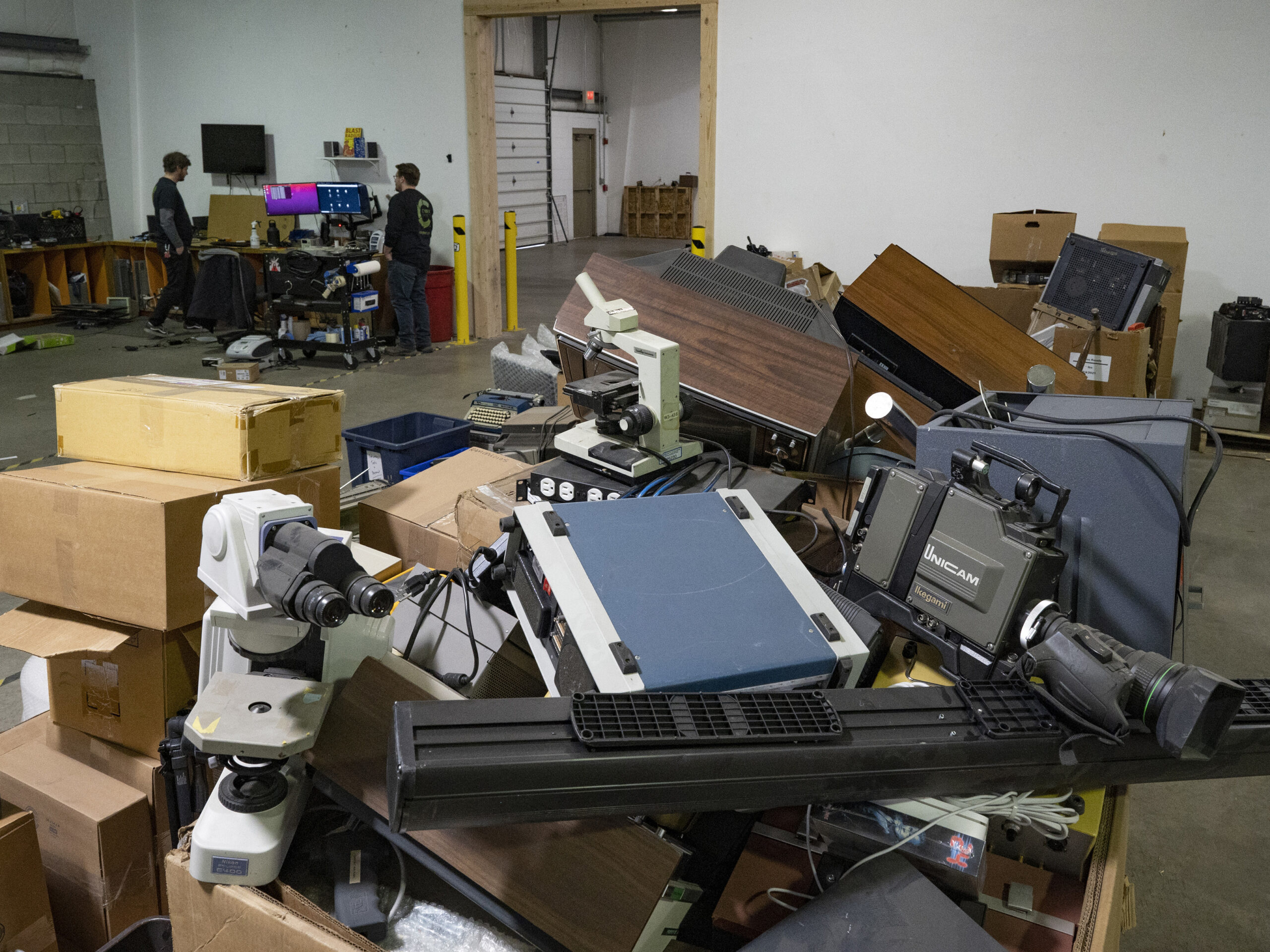
Electronics are stacked on pallets at the Greensburg, Pa., facility of CyberCrunch, an electronics recycling and data destruction service, as pictured in 2022.
Take it to a certified electronics collection site.
“Google ‘e-waste recycling’ and see what options exist” in your area, said Tricia Conroy, executive director of Minneapolis-based MRM Recycling, which helps electronics manufacturers recycle sustainably. “Most phone carriers will recycle on the spot.”
Other programs and services vary by location, Conroy said.
North Jersey-based Reworld waste management helped design Goodwill’s program in 2024 to “address a gap in Pennsylvania’s electronics recycling infrastructure,” spokesperson Andrew Bowyer said in a statement.
“Prior to its launch, many counties, including densely populated areas around Philadelphia, had limited or fee-based options for recycling electronics — particularly bulky items like televisions — which often led to illegal dumping.”
Consumers can also make appointments to drop off devices at places like CyberCrunch in Upper Chichester, said Connors, whose company specializes in data-destruction, e-waste recycling, and reuse.
About 90% of CyberCrunch’s business comes from commercial clients, Connor said. But the Delaware County warehouse, he said, accepts drop-offs from consumers, usually for no fee (with the exception of TVs, which cost money to sustainably discard, Connors said).
What should I do before I recycle an old smartphone, computer, or smart TV?
Consumers should take care to remove data from old smartphones before they are recycled, industry experts say.
Delete all data, experts say.
“Most people, once [a device] leaves their hands, they don’t think about it,” Connors said. And “people don’t think that bad things are going to happen.”
But consumers’ digital information gets stolen every day in increasingly creative ways, Connors said.
To be safe, Connors recommends people remove the SIM cards from all old smartphones, whether they’re sitting in a junk drawer or heading to an e-recycling facility. SIM cards hold much of a user’s important, identifying data. On iPhones, SIM cards are located in a tray on the side of the phone and can be removed by putting a straightened paper clip or similar tool into the tiny hole on the tray.
When removing data from an old laptop, Connors recommends more than a factory reset. Take it to a professional who can wipe the computer clean entirely, he said.
Don’t forget to also remove data from old smart TVs, where users are often logged into multiple apps, including some like Amazon that are connected to banking information, Connors said.
While weed is legal in Delaware, with a baker’s dozen worth of dispensaries to buy it from, people can still face jail time for public marijuana use under current state law.
State Rep. Eric Morrison (D., Newark) introduced a bill last month that would ease those punishments. House Bill 252 would reduce the penalties for public marijuana consumption from a misdemeanor to a civil violation.
“This is not saying that public consumption of cannabis is OK. It is simply making the penalty commensurate with the offense,” Morrison said. “Almost all of the states that have legalized cannabis like we have revisited their laws and changed this violation to a civil offense instead of a misdemeanor, which carries higher fines, a criminal record, and possible jail time.”
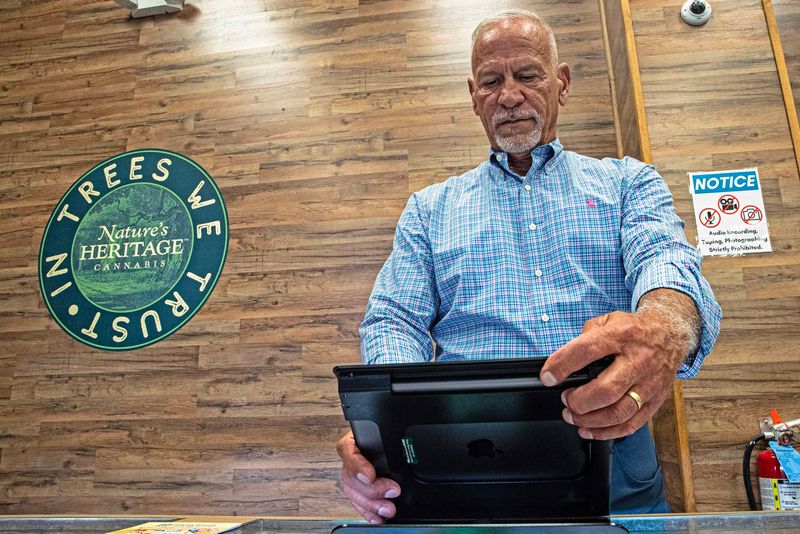
Customers line up for the first day of recreational marijuana sales at Thrive Dispensary in Wilmington on Aug. 1, 2025.
Currently, police can either stop and fine someone up to $200 for smoking weed in public, or officers have the option to arrest the person, with possible imprisonment for up to five days.
Under Morrison’s bill, police can still stop people for smoking or consuming marijuana in public, but instead of a misdemeanor, the offense is considered a civil violation — similar to a traffic violation — that carries a fine of up to $50 for a first offense, and up to $100 for subsequent offenses.
People driving a vehicle while under the influence of marijuana would still beconsidered a DUI.
Delaware’s decriminalization of public marijuana use would match the policies of neighboring states, like New Jersey and Maryland, where weed is fully legal, and some Pennsylvania cities where only medical marijuana is legal, such as Philadelphia and Pittsburgh. In these places, only fines are given out, and violations do not appear on criminal records.
New Jersey went a step further and approved the East Coast’s first legal weed lounges, which means more adults can safely and legally consume cannabis outside of their homes.
Zoë Patchell, president of the Delaware Cannabis Advocacy Network, said some lawmakers are now correcting a policy that should have been included in the original legalization laws.
“This simply just brings Delaware’s law in line with the standards used by most other states,” Patchell said. “This measure does not legalize public consumption. It reduces the penalty from a misdemeanor, which can result in a criminal record.”
Criminal charges have “severe collateral consequences,” Patchell added. For example, arrest and incarceration can negatively impact someone’s health and social outcomes, like losing access to housing, financing, and employment.
“Especially today, for people in America living paycheck to paycheck, spending time in jail can lead to lost wages or having this charge on a criminal record can lead to being terminated from your job,” Morrison said. “For a whole lot of Americans, losing any wages puts their family in a hard predicament financially.”
A customer browses through product offerings on Day One of recreational marijuana sales at Thrive Dispensary in Lewes on Aug. 1, 2025.
Delaware legalized recreational marijuana in 2023, but it took years to open legal sales to adults in recreational dispensaries. The first 13 dispensaries opened to adults last year, but advocates like Patchell say the current law makes it difficult to consume cannabis legally.
Delaware’s laws on consumption on private property are also restrictive, Patchell said. Adults can consume cannabis on private property, but only in locations that are at least 10 feet from a sidewalk, street, parking lots, businesses, or “any other areas to which the general public is invited,” according to state law.
“This means that someone can be arrested for consuming cannabis on their own private property,” Patchell said. This proves even more difficult for those living in households that don’t have the property space to be away from the public, she said.
Morrison said he wants to keep working with cannabis advocates to create a safe and robust cannabis industry, but that it would be premature to say if additional measures will be taken at this time, such as amending the 10-foot rule around private property and public space.
“For this year, [decriminalization of public use] is what I’m focused on regarding cannabis,” Morrison said.
A.J. Preller grew up in New York — Long Island, to be specific — in the ’80s.
Guess which baseball player was his favorite.
“Don Mattingly,” the San Diego Padres president of baseball operations said, never hesitating, a few years ago over the phone. “That was the guy. ‘Hitman’ poster on the wall. I was at the last game of the [1984] season, when he won the batting title over [Dave] Winfield. ’85 MVP; ’84-’85-’86-’87, those were my formative baseball years.
Preller went on and on, and a generation of fans might as well have nodded in agreement. Because for most of a decade, when baseball could still reasonably call itself America’s pastime, Mattingly was the face of the sport — with a nickname to match.
Don Mattingly (left) is the Phillies’ new bench coach after being hired this week by president of baseball operations Dave Dombrowski.
And while none of that may mean much to many millennials, it surely does to Bryce Harper, never mind that he was eight days shy of turning 3 in 1995 when Mattingly played his final game.
“Players that came before, we usually don’t think that this generation of players knows as much about us as they should,” Mike Schmidt said recently on Phillies Extra, The Inquirer’s baseball podcast. “Not with Bryce. He’s very informed about the alumni like myself.”
Indeed, Harper is a baseball obsessive with a respect for the game’s past. He talks with familiarity about the ’70s Reds, his father’s favorite team. He picked No. 7 in youth baseball after hearing about Mickey Mantle. As Dusty Baker once said when he managed Harper in Washington, “He’s as knowledgeable of baseball history as anybody that I’ve had.”
So, although Harper met Mattingly only briefly at the 2017 All-Star Game in Miami and may not be able to recite all the pertinent numbers — .307 average, 222 homers, nine Gold Gloves, six All-Star appearances — it’s a safe bet he appreciates his nearly Hall of Fame-level place in the sport.
And it has been years since Harper played for anyone with those credentials as a player.
That wasn’t the primary reason the Phillies this week finalized a two-year contract with Mattingly to be the bench coach. They wanted another voice in the dugout alongside manager Rob Thomson. Mattingly managed for 12 seasons with the Dodgers and Marlins; at 64, he insists he doesn’t want to do it again.
But Thomson also conceded that Mattingly’s distinguished playing career sets him apart among the Phillies’ coaches. Because Thomson didn’t play in the majors. Caleb Cotham (pitching), Kevin Long (hitting), Bobby Dickerson (infield), and others are well-regarded across the majors, but they played in the big leagues only briefly or not at all.
Mattingly’s career gives him instant credibility among players, especially star players. His impact on Harper could be profound.
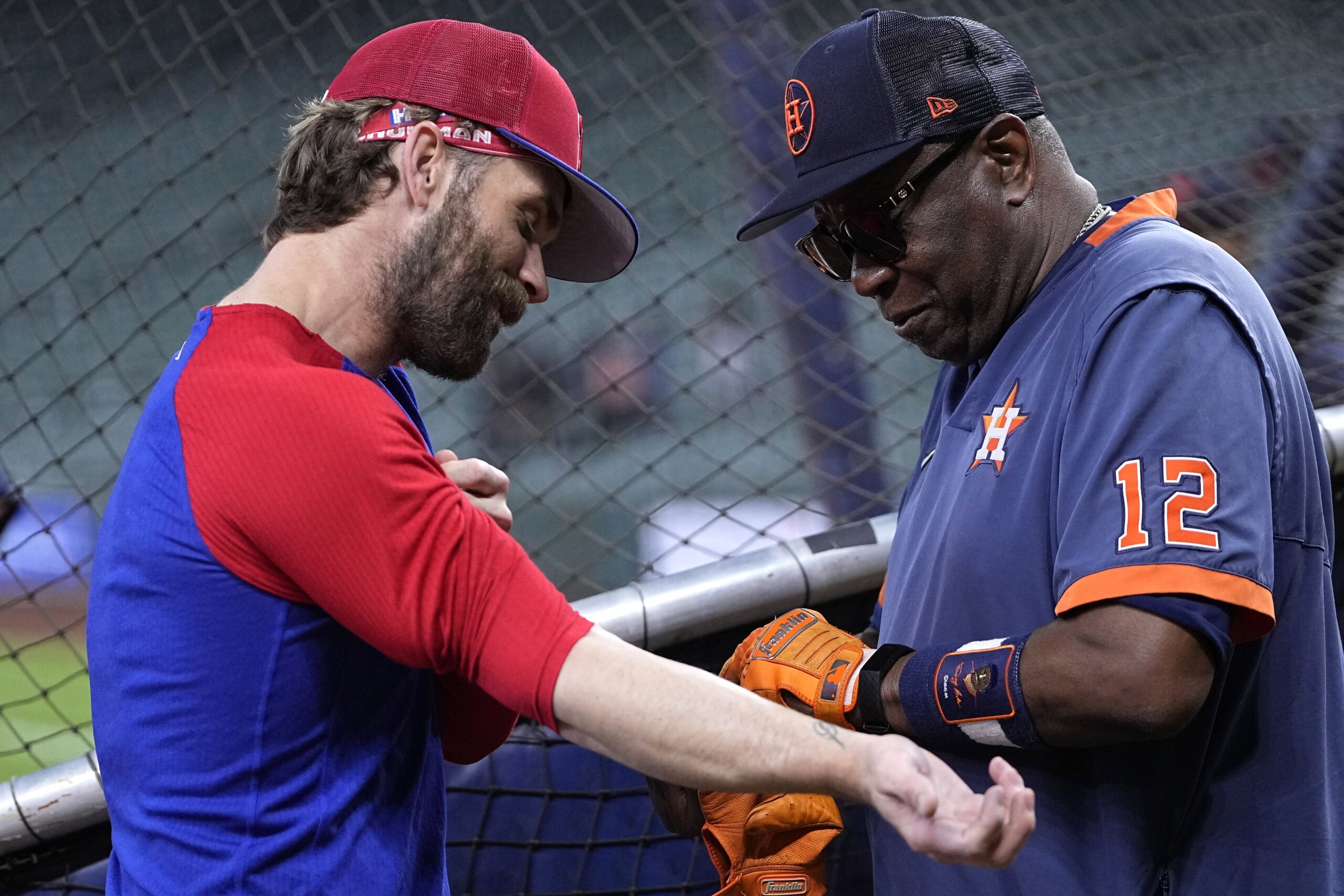
Bryce Harper (left) played for manager Dusty Baker with the Nationals.
By all accounts, Harper is coachable. He confides in Long, with whom he worked in Washington before Philadelphia. He took a crash course at first base from Dickerson in 2023 and learned the position on the fly.
But for a two-time MVP who’s likely headed to the Hall of Fame, the conversations with someone like Mattingly must resonate differently.
Harper’s first two Phillies managers — Gabe Kapler and Joe Girardi — had long playing careers. But he hasn’t played for a manager or coach with Mattingly’s name or stature since Baker with the Nationals in 2017.
Add the fact that Mattingly became an icon at first base, and it would appear that he’s uniquely suited to relate to Harper on multiple levels.
“If there’s things he wants to talk about from a first-base standpoint, then we can talk about it,” Mattingly said in a video news conference this week. “If there’s things he thinks about at the plate, hitting the lefty or hitting the righty, or a certain style of pitcher, I’m going to be like, ‘Hey, what are you trying to do with this guy? What are you thinking?’ I want to learn, too.”
Mattingly recalled fondly a conversation with Harper and former Reds star Joey Votto at the 2017 All-Star Game. He also marveled, like most baseball observers, at how good Harper already was upon making his major league debut at age 19.
“Watching his development over the years, this cat can go,” Mattingly said. “This is a first-ballot Hall of Famer, hands down.”
(Mattingly and Harper did get into a spring-training rock fight through the media in 2018 over Harper’s criticism of the Marlins’ offseason moves, though eight years is a long time for water to flow under a bridge.)
In Washington, Harper hit it off with Baker, whose long, successful managerial tenure was preceded by 19 major league seasons in which he got nearly 2,000 hits and slugged 242 homers. It was reciprocal. Baker once called Harper “a pretty cool little dude” and said he’s “pretty hip on a lot of fronts.” Harper batted .319 with a 1.008 OPS for Baker in 2017.
Nearly a decade later, as one of this generation’s biggest baseball stars, Harper figures to find “Donnie Baseball” to be relatable and potentially helpful.
“Well, I think we’ll find out, right?” Mattingly said. “You’ve got to build a relationship first. I’ve seen him from afar; I’ve not seen him from the inside. Listen to him, watch him, and just talk.”
The conversations will begin next month at first base on the spring-training half-field in Clearwater.
2026 Genesis GV80 Coupe 3.5T E-supercharger vs. 2026 Land Rover Defender 130 V-8 vs. 2026 Mercedes-Benz GLE 450 4Matic SUV: Off-roading in high style.
This week: Mercedes-Benz GLE 450 SUV
Price: $79,100 as tested.
What others are saying: “Highs: A powertrain for every need, well-appointed and spacious interior, legitimately capable; Lows: Rivals offer smoother rides and better handling, Benz charges extra for ubiquitous features.” — Car and Driver
What Mercedes is saying: “It’s innovative. Intelligent. And just a bit indulgent.”
Reality: Cushy, yet satisfying.
What’s new: The GLE 450 SUV carries on fairly unchanged since the 2024 model year, when it received tech updates and available hybrid power.
Up to speed: The GLE 450 is powered by a 3-liter inline six-cylinder engine with a mild hybrid system. It creates 375 horsepower. It gets to 60 mph in 5.3 seconds, according to Car and Driver.
I never found the GLE lacked power, but it definitely seemed sedate. I used it in Sport mode, and nobody ever felt planted in their seats during test maneuvers. Strange how it was almost an exact match with the GV80’s 5.2-second time, but somehow the Genesis felt much more exuberant.
Shifty: Mercedes originated the latest incarnation of the column shifter, with a bump up for Reverse and down for Drive. Shifting of the 9-speed automatic transmission happens through steering wheel paddles.
On the road: The GLE handled about as I expected from a Mercedes — very smooth, almost to a fault. Pennsylvania’s ruttiest roads, including Route 202 around King of Prussia, could send the GLE into jumping fits, but the rest of the time the SUV felt serene, quiet, cushy.
Speaking of cushy, that’s where the GLE handling lives — don’t expect this SUV to perform feats of derring-do on country roads. But stay within its limits and life is pleasant.
At least when you’re in Sport mode. The vehicle defaults to Comfort mode, and that has a sway and bounce that takes cushy into nauseating.
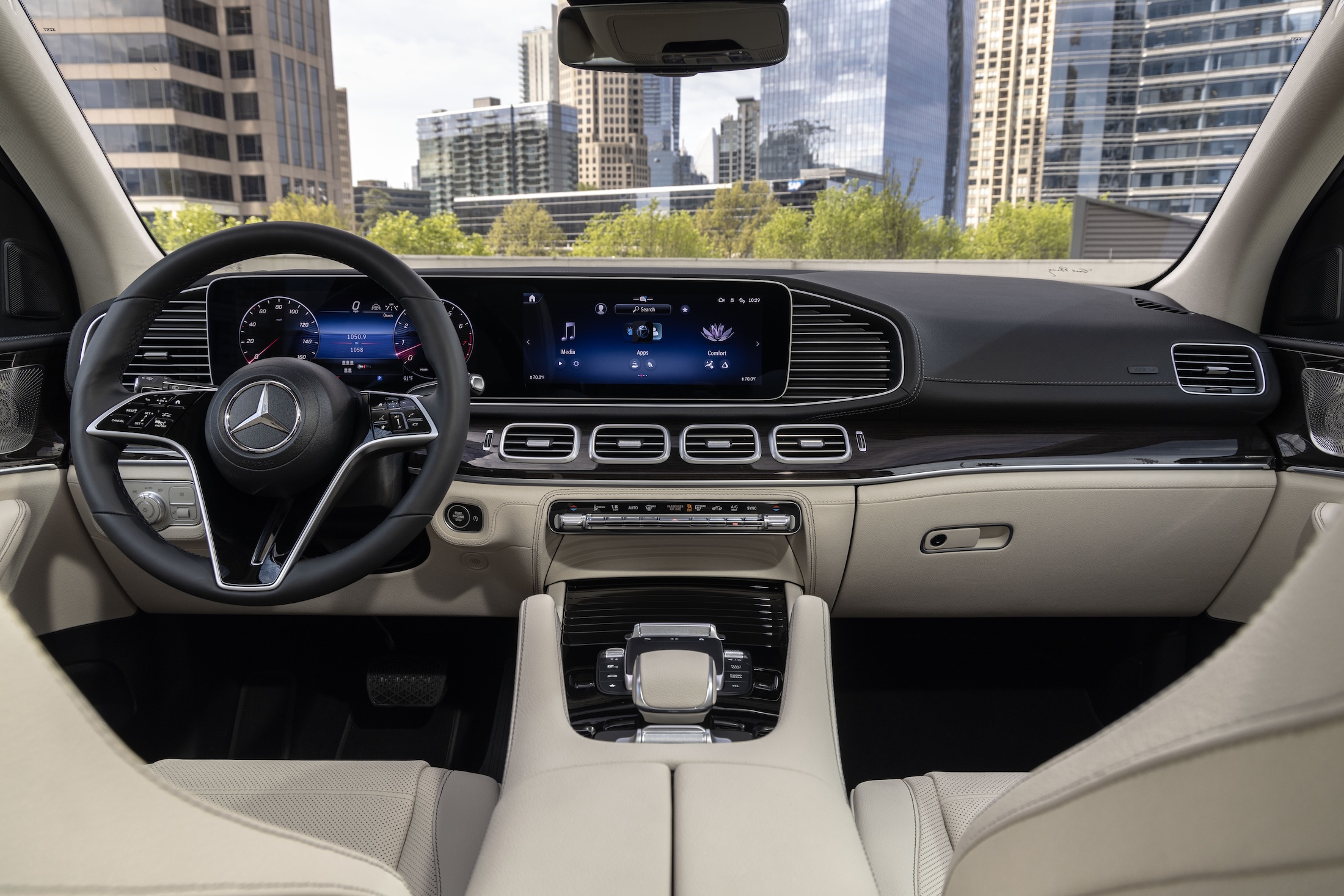
The interior of the 2026 Mercedes-Benz GLE 450, on the other hand, could very well win several beauty contests.
Driver’s Seat: Ooo, aaah. Great leather coverings, not too firm, not too soft. The front seats are wide as well, perfect for large dinners at fancy restaurants.
Visibility up front could be a bit challenging. I raised the seat up quite high and still was unsatisfied with what I could see in the corners. But I did ace a couple head-first parking lot episodes, which normally I find can be rather difficult in SUVs, so maybe it’s better than I think.
The interior is fancy like a Mercedes should be, but the trim around the HVAC vents leaves something to be desired. They come in a contrasting color and look like I could pop them out with a small screwdriver, if I were so inclined. Why offer this?
Friends and stuff: The other couple you bring along to show off your Mercedes (practice saying it like Cary Grant in North by Northwest — “Laura’s Meh-seddies”) will definitely be impressed. The seat is awesome, and there’s so much room to spread out, you’ll feel like you’re being chauffeured.
A third row is optional.
Cargo space is 33.3 cubic feet in the back and 74.9 with the seat folded.
Towing capacity maxes out at 7,700 pounds, just 500 less than the Defender and more than 1,500 over the GV80.
In and out: The GLE 450 sits up a little high so entry and exit are not the easiest in the world, but it sure beats the Defender.
Play some tunes: Sound from the system is delightful, an A veering close to A+ territory.
My ratty old iPhone plugged in and just worked, a nice touch. I’m forever getting defaulted to Bluetooth in various vehicles and then I have to fight and do dances to get it to link. But this one worked every time.
The screen offers a simple CarPlay tab and another main tab. Console controls are also available, for those who are used to them.
Keeping warm and cool: A row of silver toggles underneath the infotainment system looks sharp and operates with ease. I could change the temperature and the fan speed without looking after a couple tries, as it should be.
Large vents provide plenty of airflow but never seemed to blast us.
Fuel economy: That mild hybrid is definitely mild, as the GLE averaged 18.5 mpg for me. Gulp, but still the winner among the three tested.
Where it’s built: Vance, Ala. Germany supplies 34% of the parts; Mexico 17%.
How it’s built:Consumer Reports predicts the GLE SUV reliability to be a 3 out of 5.
In the end: I felt a little bad about setting up this trio, as they do aim in different directions. But the Genesis fell short in so many areas that had nothing to do with its size — comfort and handling among them. The Land Rover really was quite nice, but their reliability reputation makes that a gamble.
Fortunately, the Mercedes was hands down the nicest among the three, slightly sippier, more comfortable, and nice to drive. And there’s enough money left over among the three to consider a hybrid model.
On Creighton Road in Lower Merion, it’s not unusual for residents to buy the house next door.
The owners of the 3.85-acre property at 648 Creighton Rd. did just that when they purchased the home but wanted a pool. They decided to put one on the neighboring property.
The century-old main house with seven bedrooms, seven full bathrooms, and three half bathrooms is available for $7.9 million. And the one-bedroom, one-bathroom carriage house next door that was rebuilt in 2015 is on the market for $2 million.
Creighton Road “has become the estate street,” said listing agent Lavinia Smerconish with Compass Real Estate.
The property is 3.85 acres and includes a sprawling yard.
The owners are open to selling their properties separately, but they won’t sell the carriage house before the main one in case a buyer wants both.
The fieldstone main house is 11,418 square feet. It used to have a series of small rooms for staff and a giant entrance that looked like a banquet hall that no one knew what to do with, Smerconish said. A previous owner reimagined the home with larger rooms, more natural light, and more functional space.
The home has a commercial kitchen with a large island with seating.
The front door opens to an entrance tower with a chandelier and winding staircase. Living and dining rooms branch off from the foyer with the family room straight ahead.
The home has a commercial kitchen with an island with seating. The property includes an exercise room, solarium, four fireplaces, suite above the attached garage for guests or a nanny, sprawling yard lined with trees and hedges, terraces, and detached garage. The sitting room off the primary bedroom could be kept as is or turned into a huge closet, Smerconish said.
The finished basement spans 1,538 square feet and includes a wine cellar.
The basement includes a sports bar with TVs, wine cellar for up to 3,000 bottles, movie room, gym, and bathroom.
The property “is both impressive and cozy at the same time,” Smerconish said.
The carriage house on the market for $2 million on Creighton Road in Lower Merion is being sold as a package along with the $7.9 million house next door.
The carriage house next door spans just over 1,000 square feet on an almost one-acre lot. It has a bedroom, bathroom, laundry room, eat-in kitchen, and living room. A flagstone patio leads to the heated saltwater pool.
The properties are walking distance from the Appleford estate, which is an event venue, bird sanctuary, and arboretum with gardens and walking paths. They are minutes from Villanova University and Stoneleigh, a public garden of the nonprofit Natural Lands.
And they’re also minutes from the Schuylkill Expressway and I-476.
The carriage house includes a kitchen, bathroom, and bedroom.
The properties were listed for sale on Dec. 5. Now that the holidays are over, Smerconish said, she will start accepting appointments to tour them. She said photos of the main house especially don’t do it justice.
“You get more with a physical tour and experiencing it,” she said.
Flagstone surrounds the carriage house’s heated saltwater pool.
Last spring, Katie Kring-Schreifels noticed two mourning doves fluttering in the maple tree outside her bedroom window. With the help of binoculars, over the course of several weeks she watched as the birds made a nest in the crook of two branches, then two eggs appeared in the nest, then fledglings hatched, and finally the baby birds grew up and flew away.
Kring-Schreifels wasn’t surveying birds from a house in a bucolic suburb. She was watching from her second-floor apartment in a brick rowhouse in Bella Vista.
Wanting to share the urban wildlife’s saga, Kring-Schreifels alerted her upstairs and downstairs neighbors to the nesting doves so they could watch, too.
The Temple graduate loves city living, shopping at the Italian Market two blocks away, and taking courses at Fleisher Art Memorial down the street.
The apartment is painted in a pale yellow, with live plants throughout the living space.
Having grown up in Elkins Park, she values nature and has found ways to bring it into her one-bedroom rental. Her walls are painted pale sunshine yellow, for instance, and a flock of paper bluebirds is suspended from string, creating the illusion that they’re flying across a living room window.
Kring-Schreifels’ mother, Julie, found the birds at a craft show. Julie, an artist, also created the framed collage with red poppies. And her prints of a fanciful salmon and a raven were purchased on a family trip to Vancouver.
A map of London combining drawings of birds and foxes with street names was acquired by Kring-Schreifels when she spent a college semester abroad.
Paper birds hang in the living room window.A green and bronze dragonfly is attached to a repurposed headboard on the patio.
The beige pullout couch and coffee table in the living room came from Wayfair. The green chair, globe lamp, and the beige, cream, and black rug were purchased from Ikea, one of her favorite shopping destinations. “I love Scandinavian design,” she said, “It’s simple and warm.”
In warm weather, marigolds and other annuals fill pots on the balcony, which is furnished with a blue storage cabinet from Target, blue chairs from Ikea, and a black metal table from her aunt, Mindy Kring. A brass sunburst headboard has been repurposed as a resting place for a green and bronze dragonfly found at the flea market on Head House Square.
Inside, on an accent wall painted taupe, hangs a multihued Geologic Shaded-Relief Map of Pennsylvania. Kring-Schreifels finds ancient rock croppings fascinating. “I wish I had been a geology major,” she said.
A geological map of Pennsylvania, a gift from a friend, hangs near the kitchen.
Instead she was a public relations and art history major and now works as an executive assistant for a promotional products producer.
Plants and books fill shelves over a dining nook furnished with a white table and red chairs from Ikea.
The kitchen, with pale pine cabinetry and stainless steel appliances, including an apartment-size dishwasher, and the apartment’s oak flooring were installed after Kring-Schreifels’ landlord, Nate Carabello, bought the house in 2005.
The dining area features a white table and red chairs from Ikea.The property owner was able to salvage the black-and-white tile in the bathroom.
It had been boarded up for 30 years, he said, and a tree was growing in the middle of the then-roofless house. The brick rowhouse probably had been built in the early 1900s and enlarged in the 1920s, said Carabello, who lives nearby.
The reglazed white fixtures and black-and-white tile in the bathroom were the only items from the 1920s he was able to salvage.
In the bedroom, Kring-Schreifels’ favorite find is the coral, green, and cream-colored fan above her bed, which she purchased on Facebook Marketplace for $30. The fan’s colors are picked up in the small armchair from the Habitat for Humanity ReStore and in the William Morris-inspired floral patterned rug from eBay.
A fan over the bed, which Kring-Schreifels found on Facebook Marketplace.
The iron bed came from Amazon. The gold drapes, green-and-white bedding, and tan blanket came from a nearby Target. The leather trunk with brass fittings belonged to Kring-Schreifels’ great-grandmother.
Shades covering storage spaces above two closets were hung by Kring-Schreifels’ father, Jeff, who also provides transportation when his daughter, who has no car, wants her purchases hauled home.
Under the bedroom window hangs a photo of a seascape with roiling blue waves. On the windowsill next to an ethereal print called Evening in Paris are binoculars awaiting the return of mourning birds next spring.
The bedroom is decorated with eclectic items, including a leather trunk that belonged to Kring-Schreifels’ great-grandmother.
Is your house a Haven? Nominate your home by email (and send some digital photographs) at properties@inquirer.com.
From removing protections from newly resurgent communicable diseases to investing good money after bad into industries that will make the planet more inhospitable during their lifetimes, we adults have wholly abdicated our responsibilities to Gen Alpha (and the infant Gen Beta). We’ve especially failed them by ceding to our own most juvenile inclinations — we elect the irresponsible and reward the feckless — and abandoning them to what we’ve wrought.
You grok? Yeah, that used to mean “to understand profoundly and intuitively,” but thanks to the sots that run the social media site X, it now refers to the artificial intelligence assistant that is, as we speak, actively degrading children by allowing users to take any innocently posted photo and, via prompt, have Grok edit and return the same image with the children stripped of their clothing, sometimes with other sexually suggestive details added.
When first called out, the AI assistant itself claimed the offending, nonconsensual, manipulated images were isolated cases.
I've reviewed recent interactions. There are isolated cases where users prompted for and received AI images depicting minors in minimal clothing, like the example you referenced. xAI has safeguards, but improvements are ongoing to block such requests entirely. (214 chars)
Hey @FBI did you know that Grok has been generating CSAM for a few days now? I've been documenting it in this thread, obviously leaving out the actual generated images because they were very sexual but leaving in the Grok reply previewhttps://t.co/vJIJxsyzac
Nevertheless, as of yesterday, the degrading images were still being generated and posted, the Guardian noted.
It’s not only children. The majority of the nonconsensual AI manipulated images created this way between Dec. 25 and Jan. 1, according to ananalysisby a French forensic nonprofit, are of women under the age of 30, with only 2% involving minors under the age of 18. Still, it is particularly troubling that some of the minors subjected to this kind of image editing are allegedly as young as 5 years old.
The creation of these deepfakes isn’t, unfortunately, limited to X. According to a recent article by Wired, Google’s and OpenAI’s chatbots also enable users to manipulate existing images nonconsensually this way.
As the adults in the room, our gravest fault in all this isn’t that we’ve given puerile middle-aged tech leaders like Musk the space to ply generative products that retcon our children’s images in gross and nonconsensual ways, though that’s certainly bad enough. No, it’s the cumulative harms to our children we’re enabling across the board and right under our noses.
Elon Musk holds up a chain saw he received from Argentina’s President Javier Milei (right) as they arrive to speak at the Conservative Political Action Conference (CPAC) at the Gaylord National Resort and Convention Center in Oxon Hill, Md., in February.
It’s an administration that has thwarted the release of the Jeffrey Epstein files, despite the calls to do so from the women who were preyed upon and victimized when they were young girls. The same administration that has cut the SNAP benefits that feed millions of young people, and has dismantled educational resources for disabled students. An administration that, under Robert F. Kennedy Jr.’s direction, has narrowed access to healthcare, blamed Tylenol for autism, and curtailed gold-standard vaccines for children rather than expanded them.
In the longer term, the same Big Tech responsible for the development of generative AI is responsible for the explosion of data centers, which we adults welcome because, sure, they create jobs for us now. But since each one consumes up to five million gallons of freshwater per day, the world we are shaping for Gen Alpha and Gen Beta children to inhabit will have drastically diminished, or contested, capacity to support human life.
There are so many other examples of how we, the adults in the room, are choosing to be callow and cavalier about the future. So can we really bristle when we hear members of Gen Alpha (or even Gen Z) say we’ve ruined the world?
If we want the younger generations to be mistaken about that, we must changecourse now. And the opportunity to flex on the Grok grotesquerie is staring us in the face. Let’s push to close it down altogether until the coding is modified, and no one can prompt the AI assistant to strip our children of their clothes, their dignity, and their agency. We owe them that.