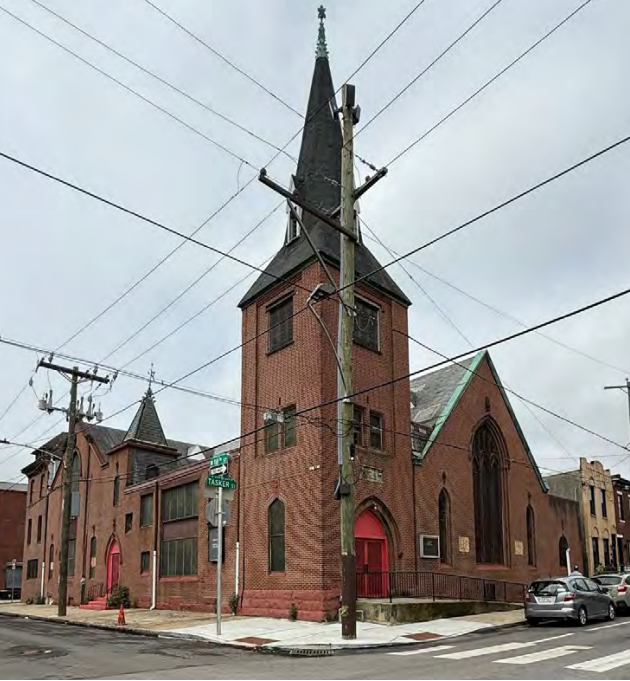
Dane Jensen isn’t a developer by training or profession, but he loves old buildings and he’s got big plans for the church at 1800 Tasker St.
The 138-year-old institution is a fixture in Point Breeze, but Second Nazareth Missionary Church’s shrinking congregation hadn’t been able to keep up with repairs. In 2024, as the church sought to sell, its leadership met with Jensen, who pitched them on his vision of a continuing life for the building as a communal space, if not a sacred one.
“A lot of adaptive reuse is taking these big institutional buildings and turning them into apartments and, to me, that loses some of the intent of the space,” Jensen said. “We are trying to preserve it as something where people can still gather and feel fellowship. Even without religious intent, it can still be a place where people can connect.”
Jensen bought the property in mid-2024 for $1.75 million, and he has begun renovations. He hopes to turn the church into a family-friendly restaurant, brewery, and event space, outfitted with an indoor playground, an idea he successfully pitched to Second Nazareth’s leadership.
“It’s a little scary to put that word out there because some people hear brewery, and they hear bar. They hear place to get drunk,” he said. “We envision it as a community space. During the day you can go grab a cup of coffee and do some work. In the afternoon, you can meet up with friends and have lunch, and, yeah, maybe you can grab a beer.”
Jensen isn’t imagining a traditional brewery, with giant silos and vats. He wants a place he will feel comfortable bringing his children, who are 4 and 7. That’s also why he’s been drawing up plans for play equipment inside the space.
The church is currently zoned for single-family use, like the rowhouses that surround it. But in 2019, City Council created historic preservation incentives to make it easier to repurpose churches that are on the Philadelphia Register of Historic Places.
That means Jensen can move forward, since the church was added to the register earlier this month. He won’t have to go to the Zoning Board of Adjustment or seek a legislative zoning change from Council President Kenyatta Johnson, who represents the area.
However, Jensen said he still plans to meet Johnson and arrange meetings with surrounding neighborhood groups known as Registered Community Organizations (RCOs).
“Needing to talk to your councilmember, needing to talk to your community through the RCOs, is incredibly valuable,” Jensen said. “We want to do that to make sure we’re not just coming in to extract value from the neighborhood. We really want to contribute in a real and meaningful sense. Hiring from the neighborhood feels really important.”
Jensen is applying for a sit-down restaurant and artisan industrial use permit. Other possible uses of the building include a bakery and a coffee roastery.
Whatever the final use, the historic church will require extensive renovation first. Currently, Jensen’s team is putting in steel reinforcements to brace the building. He plans to restore most of the stained glass, fix the leaky roof, and install fire safety and Americans with Disability Act infrastructure.
The church dates to 1886, when it was known as the Presbyterian Church of the Evangel. That denomination was in place for almost 100 years, but as that congregation shrank, the church sought a successor.
In 1978, the Second Nazareth Missionary Church took over the building and remained until 2024. In recent years, that congregation began facing many of the same challenges as their predecessors even as their membership was shrinking and repair costs were growing.
Jensen said he found notes from the waning days of the Presbyterian era that showed the leaking roof was a problem back then — a challenge that decades later, Second Nazareth was facing again.
The church as seen from the north side, in an image included in Dane Jensen’s nomination of the building to Philadelphia’s Register of Historic Places.
When the Historical Commission accepted Jensen’s 48-page argument for the building’s importance earlier this month, that triggered the 2019 law that made it easier to find new uses for historic “special use” properties — like churches or theaters — by granting them more flexible zoning. That means no trip to the zoning board, which can add over half a year to the development process and often more if neighborhood groups or councilmembers contest the board’s ruling in court.
“I’ve really fallen in love with the building throughout this process,” Jensen said. “I’m excited that I am in a position to try to get the building to a point that it can last another 140 years and still have people feeling togetherness in it.”
Nikka Landau and Peter Beaugard‘s townhome in the Graduate Hospital area serves three generations.
They moved there to be closer to both sets of parents, and their kids like the accessibility of the YMCA across the street, and its pool.
“It’s a great block,” Landau said, “lots of kids.”
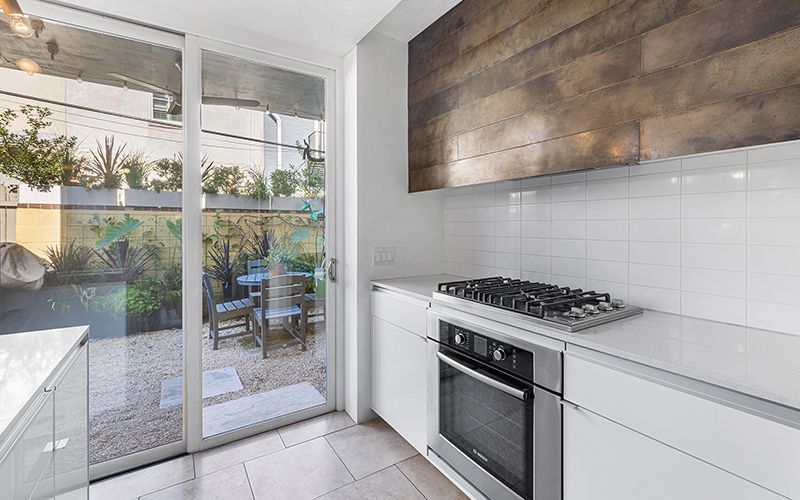
Kitchen
Landau, who manages communications for a nonprofit, and Beaugard, who is in fashion marketing, aren’t moving far away, just a few houses closer to her parents. Both grew up in the Philadelphia area, and had been living in Connecticut for several years before moving to Graduate Hospital in 2022.
The 1,830-square-foot, three-bedroom, 2½-bathroom house was built in 1920, and at some point was bought by two architects who redesigned it over a period of years.
“There was a lot of sensitivity to the design,” Beaugard said.
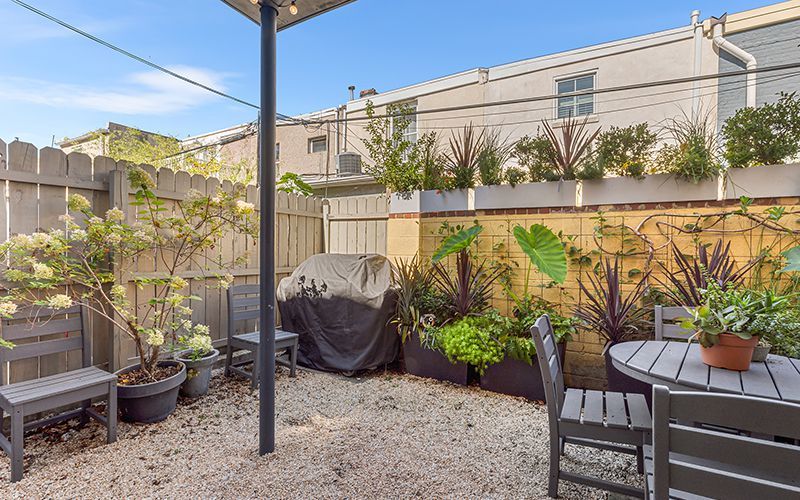
Backyard
Entry is through a vestibule, which has space for coats and bags. The first floor is open concept, with a sunken living room with high ceilings and large south-facing windows with built-in shelving.
The kitchen has quartz countertops, stone flooring, stainless steel appliances, a Wolf range, and a magnetic blackened steel wall. There is a private garden patio.
The second floor has two bedrooms, a full bath with cast iron tub, and a den. The third floor has the primary suite, and the bathroom has a marble-top vanity and a tiled shower.
Roof deck
The roof deck has unobstructed skyline views.
The house is in the Edwin M. Stanton School catchment area.
It is listed by Kyle Miller of Compass Realty for $795,000.
The killing of Kada Scott is tragic on many levels, but hopefully, some lessons can be learned to honor her life.
Scott’s death is all the more painful for her family and friends because it could have been prevented. That’s because it appears District Attorney Larry Krasner and the Philadelphia court system failed her.
The man accused of abducting Scott had been previously charged with assaulting an ex-girlfriend twice in the last year, but prosecutors withdrew the charges after the victim did not show up for court.
After Scott’s disappearance, Krasner’s office admitted its handling of the earlier cases was a mistake. If the district attorney’s office had instead prosecuted Keon King, 21, then perhaps Scott, 23, would still be alive.
“We could’ve done better,” Krasner said at a news conference Monday, echoing earlier comments from Assistant District Attorney Ashley Toczylowski, who said last week, “Everyone involved at this point, including the [initial prosecutor], agrees that we wish this happened differently.”
To be sure, hindsight is 20/20. But a review of King’s legal entanglements indicates a series of miscues may have enabled Scott’s death.
The case also offers a window into the challenges of filing domestic abuse charges, and underscores the need for prosecutors to be more aggressive in going after the accused while doing more to ensure the safety of victims.
For starters, King’s initial assault charges last November were handled by an inexperienced assistant district attorney who was juggling multiple cases. During that incident, prosecutors said, King grabbed an ex-girlfriend by the neck and tried to strangle her after she refused to lie on the bed with him, according to the affidavit.
But after initially cooperating with the authorities, King’s accuser stopped responding to calls from prosecutors. After she failed to appear at three court hearings, the district attorney’s office withdrew the case.
In January, King tried to break into the woman’s home, but fled before police arrived, according to an affidavit. He returned later in the day and dragged the woman by her hair, shoved her in a car, and drove away before dropping her off on the side of the road.
This time, the woman and her friend captured video of King trying to get into her home. He was arrested again and charged with kidnapping, strangulation, and other charges.
But once again, the victim and her friend refused to cooperate with prosecutors, so the charges were withdrawn in May.
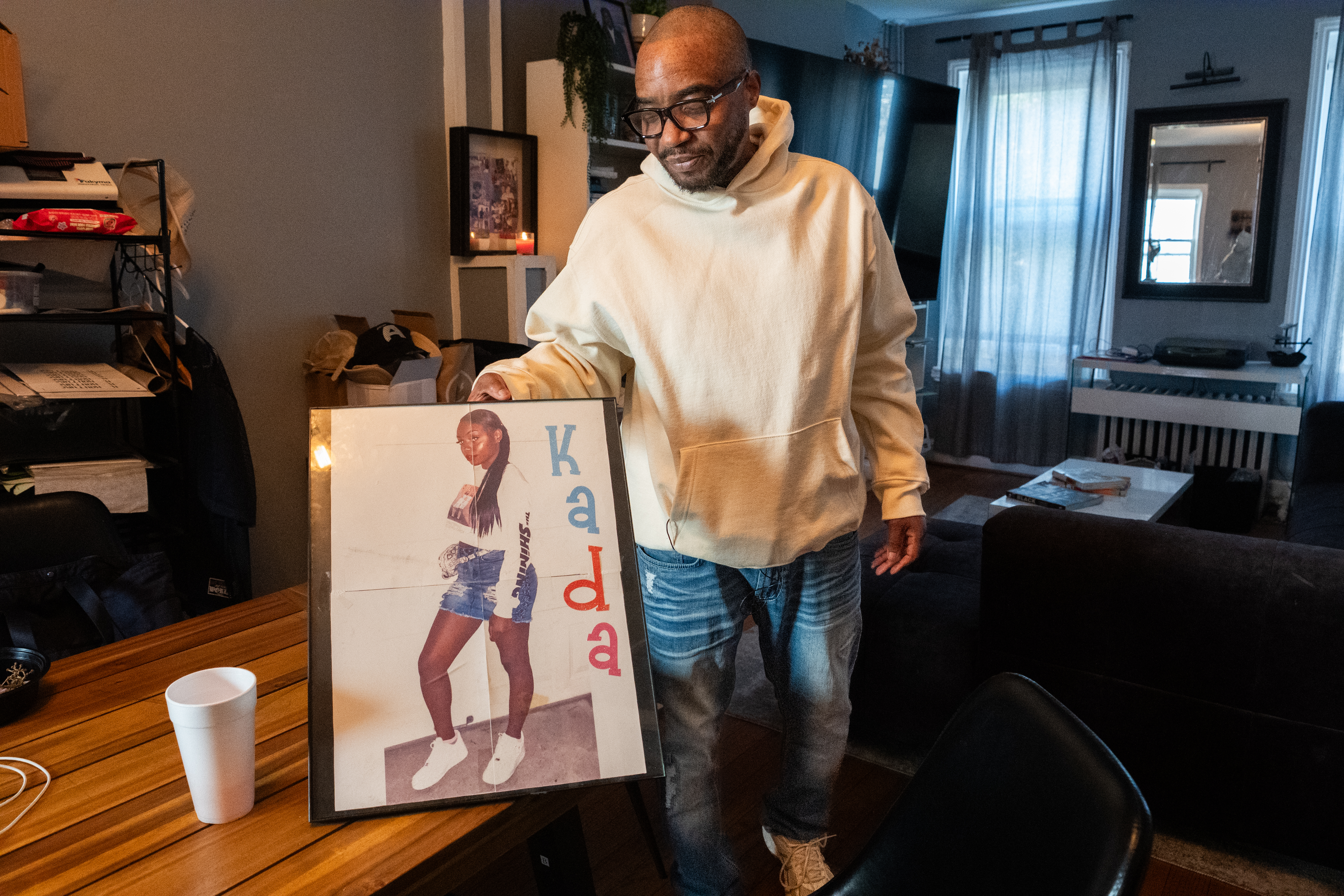
Kevin Scott, Kada Scott’s father, with a photo of his daughter.
This is not unusual, as victims of domestic violence often live in fear of the perpetrators. Reviewing the period between 2010 and 2020, researchers at the University of Pennsylvania found that 70% of victims of domestic violence cases failed to appear in Philadelphia’s courts.
A big part of the problem is that the accused are often out on bail and still threatening the victims. In King’s case, after the second set of assault charges, prosecutors requested bail of $1 million, but the magistrate lowered it to $200,000.
King posted the necessary 10% — or $20,000 — and was released in April.
Krasner blamed the magistrate for lowering the bail, but his office could have appealed the ruling.
There is a fine line in detaining suspects accused of crimes for months on end until a trial. But in domestic violence cases, the current system is not working and needs to be revamped.
Prosecutors and judges must do everything possible to guarantee the safety of victims. Victims need more support within the criminal justice system to ensure their safety.
More broadly, additional preventive steps are needed to reduce violence against women, including standing up to rape culture, empowering women, and teaching boys to respect women.
Black women disproportionately experience higher rates of domestic abuse, including rape and homicides, studies show, further underscoring the need for more awareness, training, and preventive measures.
In this instance, given that King had been charged once before, the magistrate and Krasner’s office dropped the ball.
And although the victim refused to testify, the district attorney’s office could have used the video evidence to move forward with King’s prosecution — though not having the witnesses testify certainly would have made for a tougher case.
To his credit, Krasner, a former defense attorney who faces reelection next month and has been criticized for being soft on crime, admitted his office was ultimately to blame.
Sadly, a young, vibrant woman full of promise has died, and another woman was previously assaulted and traumatized. Krasner said the public played an enormous role in Scott’s case, and asked for anyone with information to call 215-686-TIPS.
The only positive outcome will be to ensure justice is served, and a broken legal system in which victims are afraid to testify is fixed, so others do not experience the same horrific outcome.
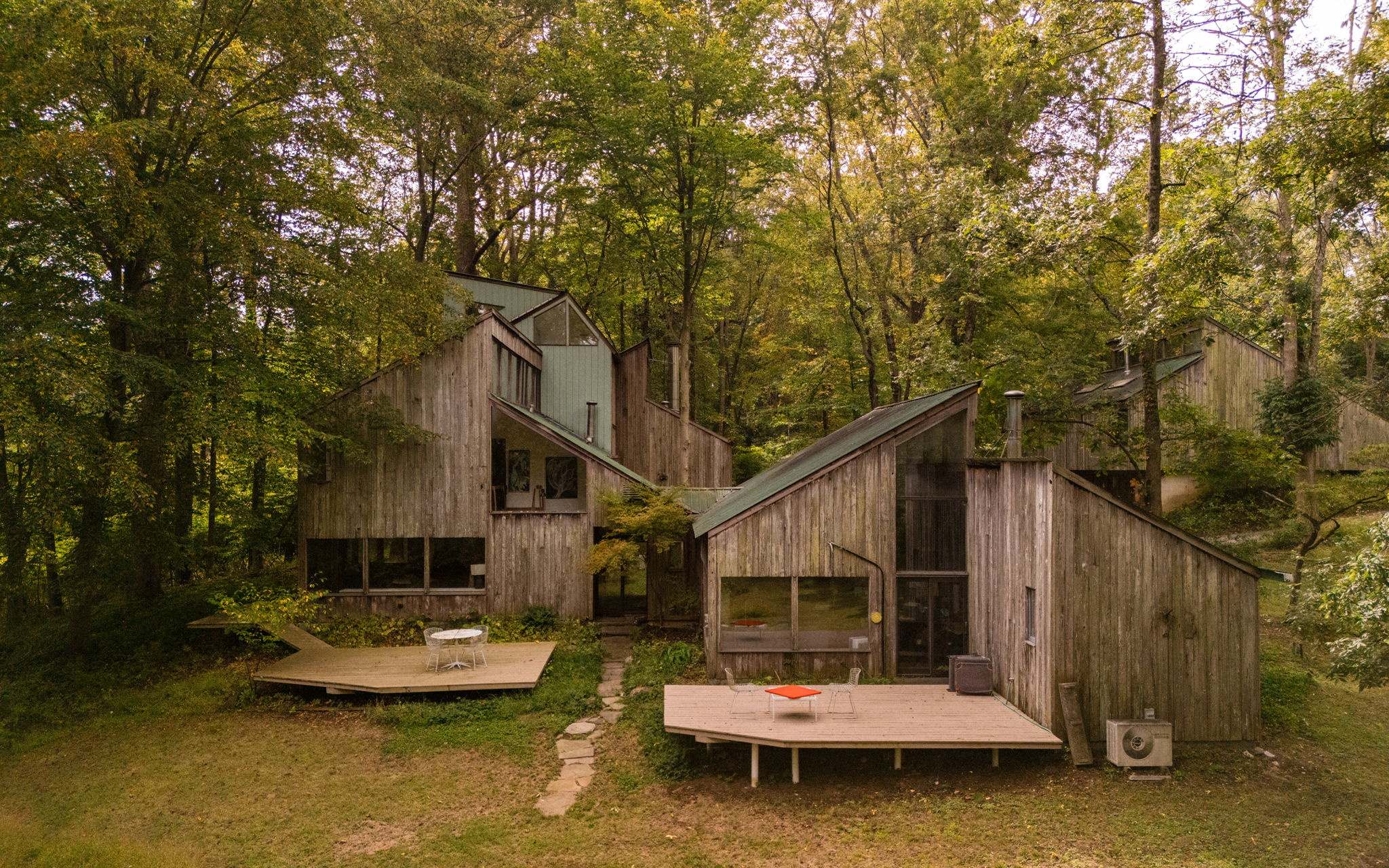
This Willistown Township home, for sale for nearly $2 million, was designed by Robert McElroy and has a wing that was devoted to his wife Annamaria’s art studio.
McElroy, who is credited with building more than 200 homes around the Main Line, designed and built this home for his own family in 1975, according to Marion Dinofa, Compass RE Realtor and modern home specialist.
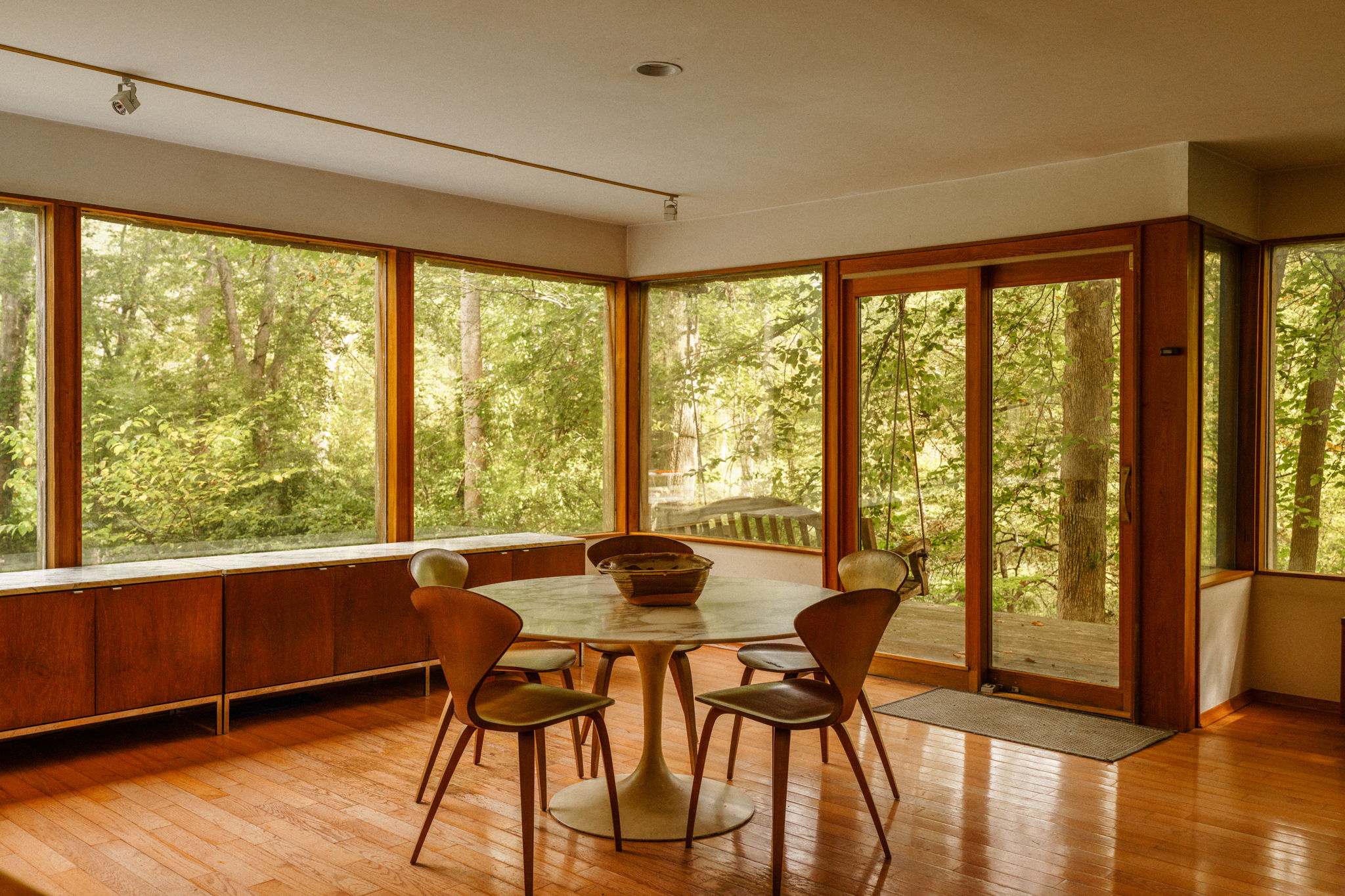
Tucked far off Rabbit Run Road in Willistown Township, McElroy’s three-bedroom, 3½-bath home features a contemporary design and floor-to-ceiling windows that let in abundant natural light.
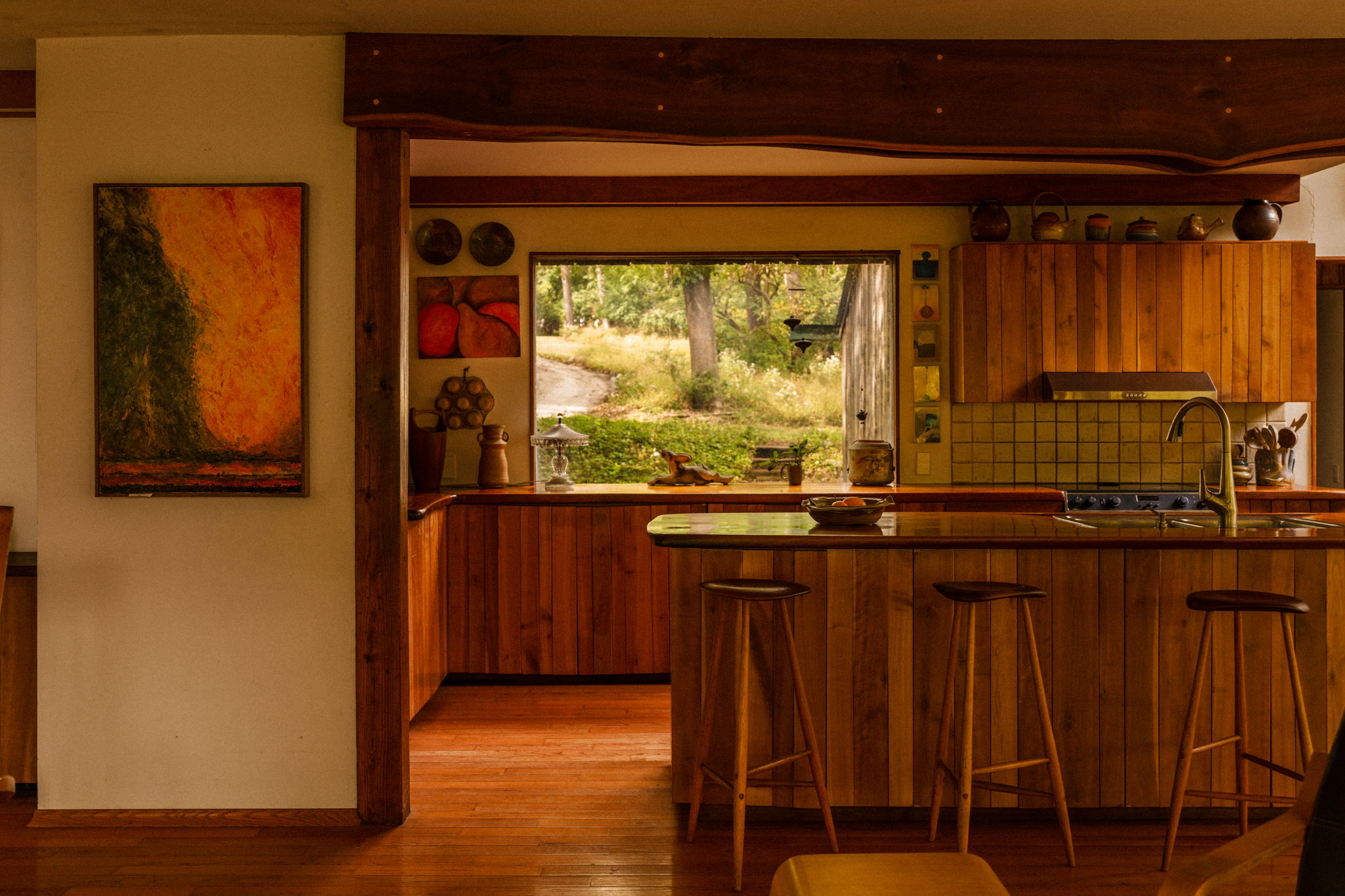
“I see a lot of really cool houses, but this one, almost more than any other house, is truly like you’re living in a work of art, between the craftsmanship of the woodworking, the views through the windows that are ever changing with the seasons, and the design of the home itself,” Dinofa said.
Wooden details make Robert McElroy’s former home in Willistown Township unique, said Realtor Marion Dinofa.
Almost every piece of wood in the home was crafted by Horace Hartshaw, who collaborated with the renowned sculptural furniture maker Wharton Esherick. This includes everything from the wood doors to the custom kitchen cabinets to the staircases, including a spiral one at its center.
McElroy wasn’t the only artist who resided in the home: His wife, Annamaria, a painter and sculptor, also left her mark, showcasing her artwork on the walls and using a wing of the home as her studio.
Dinofa noted that the house also includes a detached two-story garage that could be converted into more creative space.
The secluded home features custom wood features that were crafted by renowned artist Horace Hartshaw and lots of windows.
Between Robert’s vision and Annamaria’s artistic touches, their home “was a labor of love,” Dinofa said. “And it’s really well preserved. You can tell it hasn’t changed much.”
Annamaria and Robert lived at the home into their 90s, Dinofa said. They died in 2023 and 2024, respectively. Dinofa said the home is being sold by their daughter, Loretta.
Dinofa said she could see the property being bought by artists or by adventurous young parents who want to raise their children amid nature.
“It would be such a fun place for kids to play outside,” with a stream in the backyard and plenty of space to run around, Dinofa said. “I can only imagine the wildlife that they have viewed from that house.”
The University of Pennsylvania Health System, the Philadelphia region’s biggest provider of cancer care and a national leader in developing new treatments, is spending more than $500 million on two new cancer facilities in Philadelphia and central New Jersey to keep growing.
“What we’ve seen pretty consistently is that demand is there to meet any capacity increases,” Julia Puchtler, the health system’s chief financial officer, said in an interview about fiscal 2025 financial results.
Penn is not alone in its push to expand cancer services. Jefferson’s Sidney Kimmel Cancer Center, Temple’s Fox Chase Cancer Center, and the MD Anderson Cancer Center at Cooper are pushing into the suburbs to reach more patients.
The same thing is happening nationally as financially pressured health systems are looking for ways to increase revenue in a growing and lucrative market for cancer care.
Penn stands out locally for the scale of its investment in a strategy to deliver cancer care seamlessly across its seven hospitals and a growing network of outpatient clinics, with the expectation that patients will keep coming back for their ongoing health needs.
Penn sees an opportunity to expand its market share even more, as cancer diagnoses rise. The U.S. is expected to see a nearly 40% increase in cancer diagnoses between 2025 and 2050, according to the Philadelphia-based American Association of Cancer Research.
Experts attribute the rise to a wide variety of factors, from better early detection, to longer life spans, and to environmental exposures that are poorly understood.
Much of Penn’s investment is in outpatient facilities, including a $270 million center being built in Montgomeryville that will have radiation oncology and an infusion center. “More and more patients want to receive care closer to home,” according to Lisa Martin, a senior vice president at Moody’s Rating. “All of that is really what’s behind all of this investment.”
Cancer treatment overall is profitable. At Penn, cancer services account for up to 60% of the system’s operating margin by one simple measure that subtracts direct costs from direct revenue and excludes back-office expenses and other centralized costs.
Puchtler attributed the profitability of cancer care to the prevalence of drugs, such as chemotherapy, that Penn can buy at a discount, while getting the full price from insurers, and the higher percentage of younger cancer patients with better-paying private insurance than is typical for many healthcare services.
The expansion efforts are expensive in an industry where the consumers both benefit from advances and pay ever-rising healthcare costs. Proton therapy, in particular, costs more, but has not yet been proven to have better outcomes across a wide range of cancers.
The intensifying competitive landscape
Penn treats about one-third of adults with cancer in its market area, which stretches from central New Jersey to the Susquehanna, according to Robert Vonderheide, who is director of Penn’s Abramson Cancer Center and leads all of Penn’s efforts in oncology treatment and research.
Penn counted 47,053 new cancer patients in the 12 months that ended June 30, up 40% from five years ago, according to Penn. The system has 14 locations where patients can receive chemotherapy and even more radiation oncology sites.
Competitors are also trying to expand their reach, and Temple’s Fox Chase Cancer Center is succeeding.
window.addEventListener(“message”,function(a){if(void 0!==a.data[“datawrapper-height”]){var e=document.querySelectorAll(“iframe”);for(var t in a.data[“datawrapper-height”])for(var r,i=0;r=e[i];i++)if(r.contentWindow===a.source){var d=a.data[“datawrapper-height”][t]+”px”;r.style.height=d}}});
Fox Chase had 21,442 new patients in fiscal 2025, up 148% from 2020, the nonprofit said. Fox Chase has added suburban offices in Voorhees and Buckingham, Bucks County, and is expanding its infusion capacity at its main campus on Cottman Avenue. Fox Chase has a significantly smaller footprint than Penn, with six locations for infusions and four for radiation.
The MD Anderson Cancer Center at Cooper said it had 4,326 new patients last year, up 27% over the last five years. Cooper has taken the MD Anderson Cancer Center brand to the former Cape Regional Medical Center, which it acquired last year and which used to be part of the Penn Cancer Network. Cooper also offers cancer services at its new Moorestown location.
Jefferson Health’s Sidney Kimmel Cancer Center did not respond to requests for patient data, but has in recent years opened cancer center locations at its Torresdale and Bucks County Hospitals. Jefferson’s cancer center also attained the highest designation from the National Cancer Institute last year — the Philadelphia region’s third comprehensive cancer center, matching Penn and Fox Chase.
Lancaster County resident Susan Reese, 56, said she experienced smooth cooperation between her doctor at Penn’s Lancaster General Hospital and the team at HUP during her treatment for non-Hodgkin lymphoma.
“I never had any question in my mind that one doctor didn’t know what the other doctor was doing,” said Reese, who received CAR-T therapy at HUP in September 2022. Penn has since started offering CAR-T at Lancaster General.
After she relapsed in early 2023, she came back to HUP for a stem cell transplant. She could have gone to Penn State Health’s Hershey Medical Center for that. It’s significantly closer to her home in Willow Street, but she wanted to stay within the Penn system.
Reese’s experience of integration of services at HUP and Lancaster General is what Penn is aiming for in a territory that stretches from central New Jersey to central Pennsylvania.
Oncologist Robert Vonderheide, director of Penn Medicine’s Abramson Cancer Center, oversees all Penn’s cancer services and research.
Electronic medical records help with the integration needed to ensure the thousands of cancer patients Penn physicians treat annually get the most advanced care possible, according to Vonderheide, whose research focuses on cellular immunotherapies.
“We treat patients’ cancers now in a very precise way; the precise mutation, the precise type of chemotherapy, the precise dose” are the focus for doctors, Vonderheide said. “This is no longer appropriate for the telephone game. This has to be data-driven.”
Reese’s decision to stay within Penn is part of a broader trend of patients tending to receive all their care within one health system, according to Rick Gundling, a healthcare expert at the Healthcare Financial Management Association in Washington, D.C.
That’s particularly important in oncology, which typically involves multiple specialties, such as medical oncology, radiation oncology, and surgical oncology, he said.
“Seamless coordination across all those disciplines really makes it a better patient experience and clinical experience because it reduces delay, improves access,” Gundling said.
Taking advanced treatments from HUP to the network
Part of Penn’s strategy is to begin offering advanced services at locations beyond HUP. That’s where Penn pioneered CAR-T cell therapy, which harnesses the immune system to attack cancer, and for years that was the only place Penn offered it.
HUP still performed the bulk of the CAR-T treatments for blood cancers, 123 inpatient cases and 14 outpatient cases last year, but now CAR-T is also available at Lancaster General and at Penn’s Pennsylvania Hospital in Center City.
Fox Chase was the next biggest center in the region for the relatively new treatment that Penn scientist Carl June and his research teams helped develop. For the fiscal year that ended June 30, 2025, Fox Chase had 21 inpatient cases and 67 outpatient cases, the center said.
In the Penn system, certain kinds of bone marrow transplants also used to be available only at HUP. “Now we do them at HUP and Pennsylvania Hospital,” Vonderheide said.
Even the most complicated pancreatic surgeries are going to be done at Princeton, in conjunction with experts at HUP, Vonderheide said. Penn held a ceremonial groundbreaking Monday for the hospital’s $295 million cancer center.
Remaining only at HUP are bone marrow transplants that use another person’s cells to treat blood cancers, Vonderheide said. HUP performed 118 of those so-called allogeneic bone marrow transplants on the top floor of its $1.6 billion patient pavilion, now known as the Clifton Center.
Pennsylvania’s next-biggest provider of the treatment was Hershey Medical Center, near Harrisburg, with 71, according to state data.
window.addEventListener(“message”,function(a){if(void 0!==a.data[“datawrapper-height”]){var e=document.querySelectorAll(“iframe”);for(var t in a.data[“datawrapper-height”])for(var r,i=0;r=e[i];i++)if(r.contentWindow===a.source){var d=a.data[“datawrapper-height”][t]+”px”;r.style.height=d}}});
Penn started offering proton therapy at HUP in 2010, and expanded its availability in the last three years to Lancaster General and Voorhees, through a joint venture with Virtua Health. Those two centers only have one proton machine each, compared to five at HUP.
It’s a type of radiation that is designed to precisely target tumors and do less damage to surrounding tissues. That makes the treatment, which costs more, particularly helpful for children, and it is proving beneficial for treating certain neck and throat cancers.The use of proton therapy for the more common prostate cancer has been more controversial.
Penn’s fourth proton center, with two machines, is under construction and is expected to open at Presbyterian in late 2027. When that $224 million center opens, Penn will have more proton treatment rooms than the entire West Coast, said Jim Metz, chair of radiation oncology at Penn.
Currently about 10% of Penn’s roughly 10,000 annual radiation oncology patients are treated with protons, though it’s a higher percentage at locations with proton machines, Penn said.
Penn officials have noted that some cancer patients come to Penn for proton therapy. Even when it’s not appropriate for them, they tend to stay within Penn. “We have seen, when we build protons, our market share increases, ” Metz said.
Editor’s note: This article has been updated with more recent Fox Chase data.
Brian Dawson had just landed his dream job as Pennsylvania’s acting state librarian in 2015 when he came down with a cold.
He tried to power through the sickness. But after a couple of weeks, he still couldn’t seem to kick it.
Doctors at an outpatient clinic diagnosed Dawson with bronchitis and pneumonia, prescribed him antibiotics, and sent him home.
A couple of days later, he developed a sharp pain in his left eye, which doctors attributed to sinus pressure.
A few days after that, Dawson woke up in the middle of the night and told his wife he needed to go to the emergency room.
He was admitted with severe abdominal pain, blurry vision, and trouble walking. In the span of five hours, Dawson would become blind in his left eye and paralyzed from the chest down.
A doctor would tell him he had a rare autoimmune disease called neuromyelitis optica (NMO), and give him five to seven years to live.
“I was in a really good trajectory in life, and then I got sick and had to pick up the pieces,” said Dawson, who lives in Harrisburg.
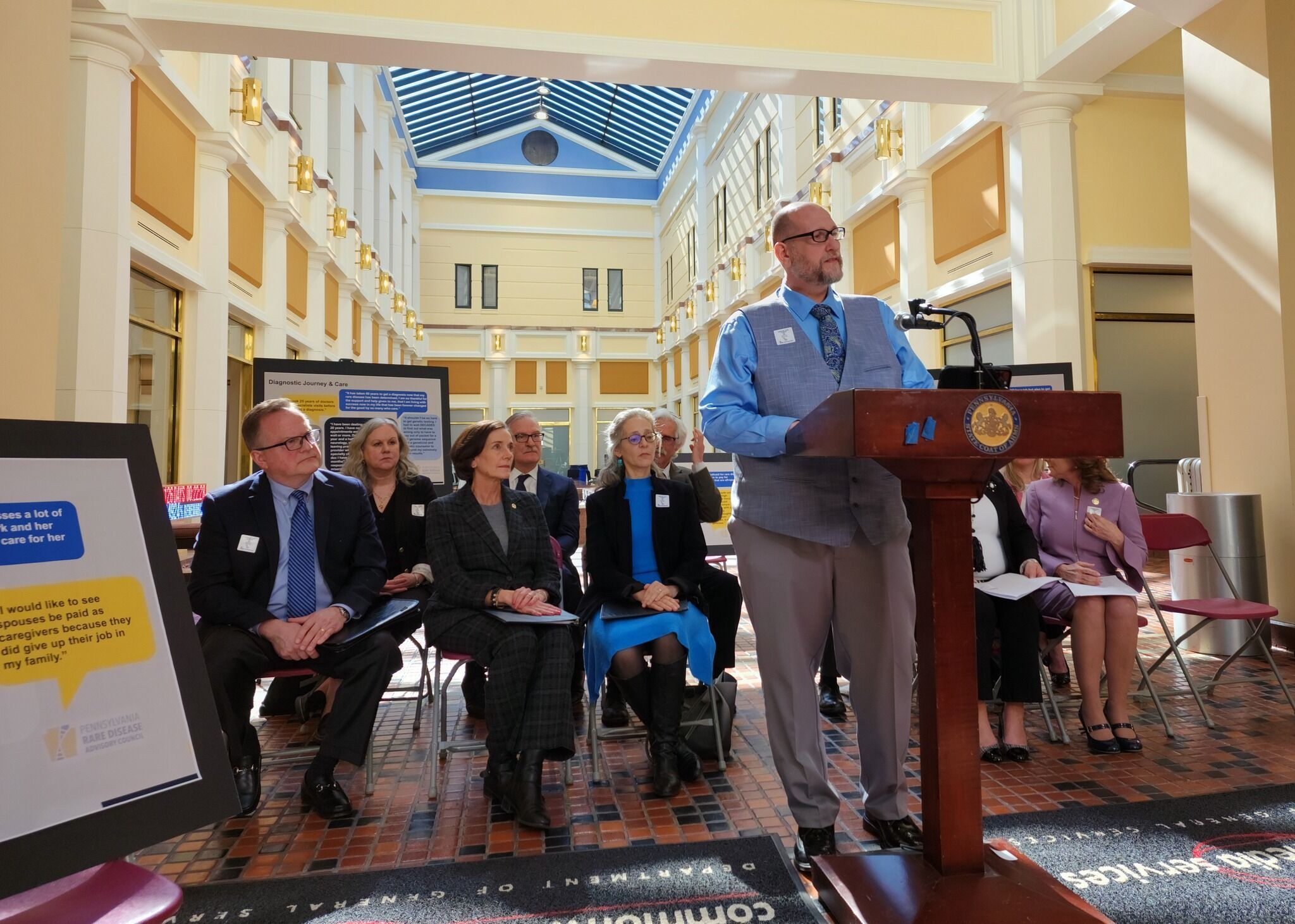
Dawsonsaw his own struggles reflected in a recent survey of1,214 rare disease patients in Pennsylvania that was spearheaded by the state’s Rare Disease Advisory Council, an advisory body to the General Assembly.
The results, published last month in the medical journal Public Health Reports, painted a “concerning” picture of their lived experiences, said Dawson, the council’s secretary.
For example, nearly half of the respondents waited more than two years for a diagnosis. Almost a third waited more than five years, and 37% received more than three incorrect diagnoses before their final diagnosis.
Many respondents reported high annual spending on costs related to their disease, reduced work and school hours, and difficulty accessing medication or services after diagnosis.
“There was a worse experience overall if there was a longer diagnosis [time],” said Jonathan Sussman, the lead author on the paper, who is working on his medical and doctoral degreesat the University of Pennsylvania’s Perelman School of Medicine.
Misdiagnosed
When Dawson’s symptoms progressed, doctors admitted him to the intensive care unit and started him on steroids.
His vision returned a couple of days later, but he was still paralyzed.
Imaging revealed that the majority of his thoracic spine — the middle section of the spine — was scarred, and his optic nerve was inflamed.
Two weeks into his stay, a neurology fellow walked into his room, “all smiles,” Dawson recalled.
The doctor said proudly they had figured out what he had, then leaned back on a red container on the wall, crossed his arms, and told Dawson that he had NMO.
That meant his immune system was attacking his optic nerve and spinal cord, the doctorexplained.
He said Dawson would probably be completely blind in about five years.
“A couple years after that, you’ll get a lesion high up on your spinal column or in your brain stem, you’ll be on a ventilator, and then pneumonia will probably kill you,” Dawson recalled him saying.
The doctor concluded by telling him how many years he likely had left to live, and then walked out of the room.
“The way I was told, it was horrendous,” said Dawson, who was then 42.
Afterward, the hospital discharged him to a rehabilitation facility where he relearned how to walk for about two months.
The next two years after that were a cycle of going on and off steroids with each relapse. He had recurring eye pain and blurriness, and pain in his legs that felt as though someone had poured searing hot coals inside them.
“You grieve for the life that you had, grieve for the things you used to be able to do,” Dawson said.
Dawson’s doctor put him on treatments like rituximab, an infusion meant to knock down his immune system, and gabapentin for nerve pain.
Dawson’s doctor put him on treatments like rituximab, an infusion meant to knock down his immune system, and gabapentin for nerve pain.
But nothing seemed to work.
In one argument with his neurologist, he told her, “we’re doing something wrong.”
In response, she said, “I don’t know what to do with you anymore,” he recalled.
After that, she referred him to a neurologist at Johns Hopkins, who determined from new blood work that he didn’t have NMO.
Almost three years after Dawson was misdiagnosed, the doctor gave him his correct diagnosis: MOGAD, or myelin oligodendrocyte glycoprotein antibody-associated disease. It was a rare autoimmune disease that was likely kicked off by the cold he had back in 2015.
MOGAD had the same constellation of symptoms as NMO, but required different treatment. It also wasn’t thought to affect a person’s life expectancy.
“This disease is not going to kill you. You’re going to grow old,” Dawson recalled the doctor saying.
Advocacy
Brian Dawson is a patient ambassador for the Sumaira Foundation and secretary of the Pennsylvania Rare Disease Advisory Council.
The recently published survey was Dawson’s way of collecting data to substantiate trends he had heard of anecdotally.
For example, 37% of survey respondents said they didn’t receive enough information at the time they were given a diagnosis, and 20.5% said they didn’t understand the information provided by their healthcare providers.
As a patient ambassador for the Sumaira Foundation, a Massachusetts-based patient advocacy group for rare neuroinflammatory disorders, Dawson tries to help newly diagnosed patients navigate their own diagnoses, knowing that health literacy can be an added challenge.
Another striking statistic to him was that half of the respondents spent more than $5,000 every year on their care, with others spending well over $10,000.
A quarter of respondents were also unable to access medications because of co-pay costs or a lack of coverage.
“Ninety-five percent of rare diseases don’t have an FDA-approved treatment. So a lot of times people are being treated off-label,” Dawson said.
That means patients face barriers like prior authorizations and “flat out denials,” he added.
Dawson himself just received a second denial from his insurance company for coverage of a medication he has been on for years, since it’s technically off-label for his condition.
He hopes the results of the survey can inform policy to reduce barriers faced by rare disease patients.
“There are people where it’s life or death for them dealing with some of the prior authorization stuff,” he said.
Recovering
When Dawson thought he only had five to seven years left to live, he “always heard the clock ticking,” he said.
“Sometimes you could get distracted and focus on that, but if you’re focusing on that ticking clock, you’re missing everything else,” he added.
He had hoped he could make his job as the acting state librarian into a permanent position, but with his health challenges, he had to let that dream go.
Dawson went back to his previous role as the director of library development under the next state librarian.
Dawson had hoped he could make his job as the acting state librarian into a permanent position.
For the next few years, he tried to focus on making good memories for his family and minimizing the disease’s impact on them, but the effects inevitably spilled over.
His oldest son quit a good job to move to Harrisburg to spend time with Dawson, thinking he only had a handful of years left.
With Dawson’s new diagnosis, “our life had changed all over again,” he said.
Now that he’s on the correct medication for his condition, Dawson is no longer experiencing the constant cycle of relapses.
However, he still battles fatigue and brain fog from his condition, and has to be cautious about infections, since his immune system might react unpredictably.
Brian Dawson, now 52, lives in Harrisburg.
Even with his longer life expectancy, there’s always a chance he could relapse and become blind or paralyzed again.
“I don’t hear the clock, but I know that reality is looming out there,” Dawson said.
Maura Manzo, founder and director of yoga studio Camaraderie in Ambler, previously owned the Yoga Home studio in Conshohocken but stepped away during the pandemic.
When she was looking to get back into the business, she chose Ambler.
“I was looking for a vibrant, walkable downtown, rooted in community,” Manzo said.
She was encouraged by the presence of a food co-op, Weavers Way, which “signaled to me that this is a community invested in sustainable, healthy living — values that align beautifully with a yoga community,” as well as the other businesses around.
“There’s a balance of restaurants, arts and culture, and shopping that creates a wonderful, rich community and attracts people,” Manzo said.
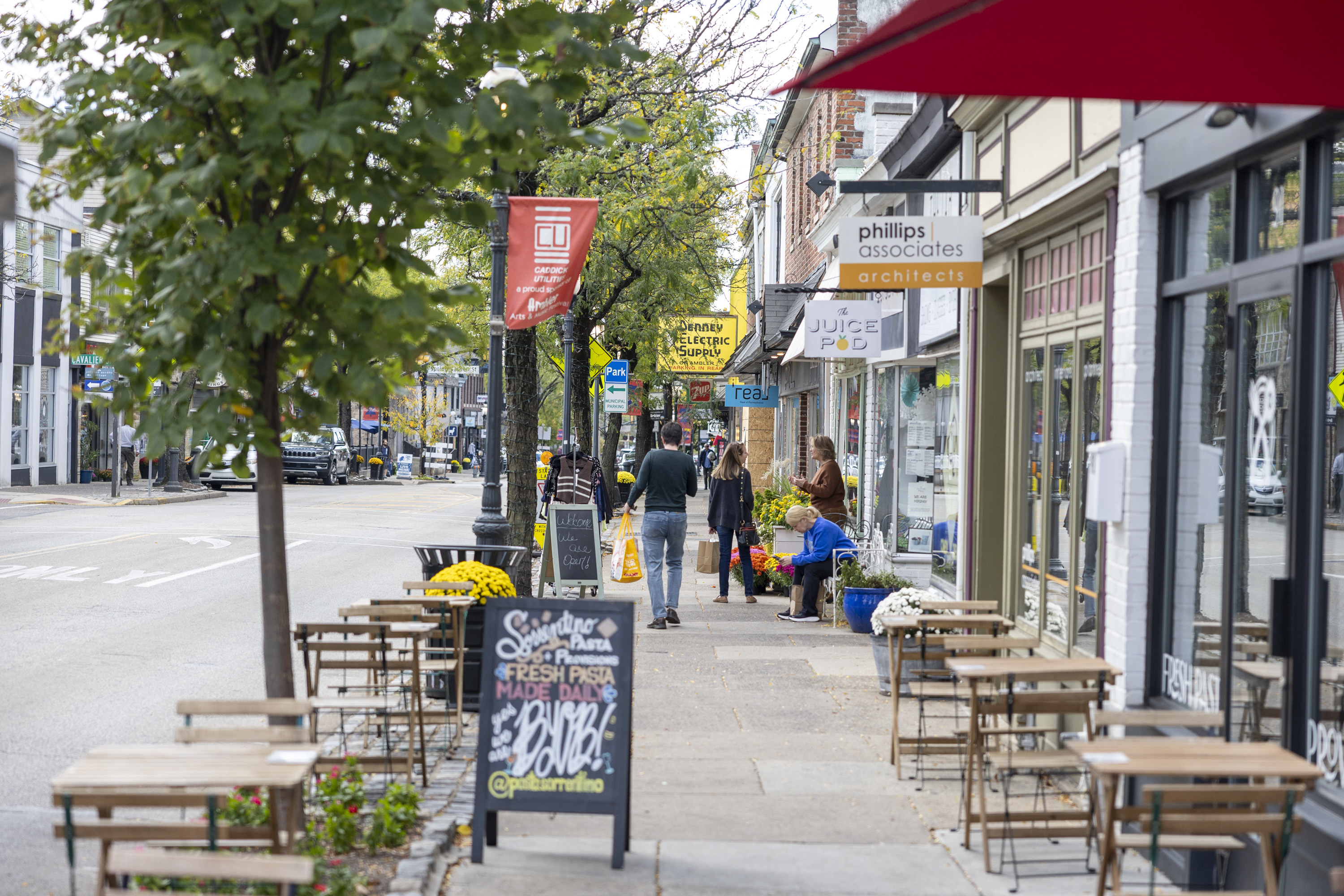
Centrally located in Montgomery County, the borough of Ambler has become home to an eclectic blend of retailers, restaurants, and services. Its downtown business district includes a spa, tuxedo rentals, a bakery, a tattoo parlor, hair salons, and restaurants from all different culinary genres.
People walk along Butler Avenue among various shops and restaurants in Ambler.
The borough started as a mill town in the 1700s and evolved into a factory town run by the Keasbey & Mattison Co. in the 1800s. Many of the original buildings from that period still exist in the downtown district.
The borough has been consistent in its preservation efforts. Recently an ordinance passed to be sure that any new construction reflects the existing architectural charm, said Ambler Main Street manager Elizabeth Wahl Kunzier.
Still, the area has continued to evolve, recently adding a food hall with 10 vendors, seeing the merger of two established Ambler boutiques into one new storefront, and promoting downtown events on social media. With the holiday season approaching, business owners are looking ahead to their busiest time of year and gearing up for a number of seasonal events.
“We have a pretty good organic social media reach,” Wahl Kunzier said. “It took a long time to get that where it is today, but given the nature of how the public gets information, it is very important to have a good following.”
Building momentum behind the scenes
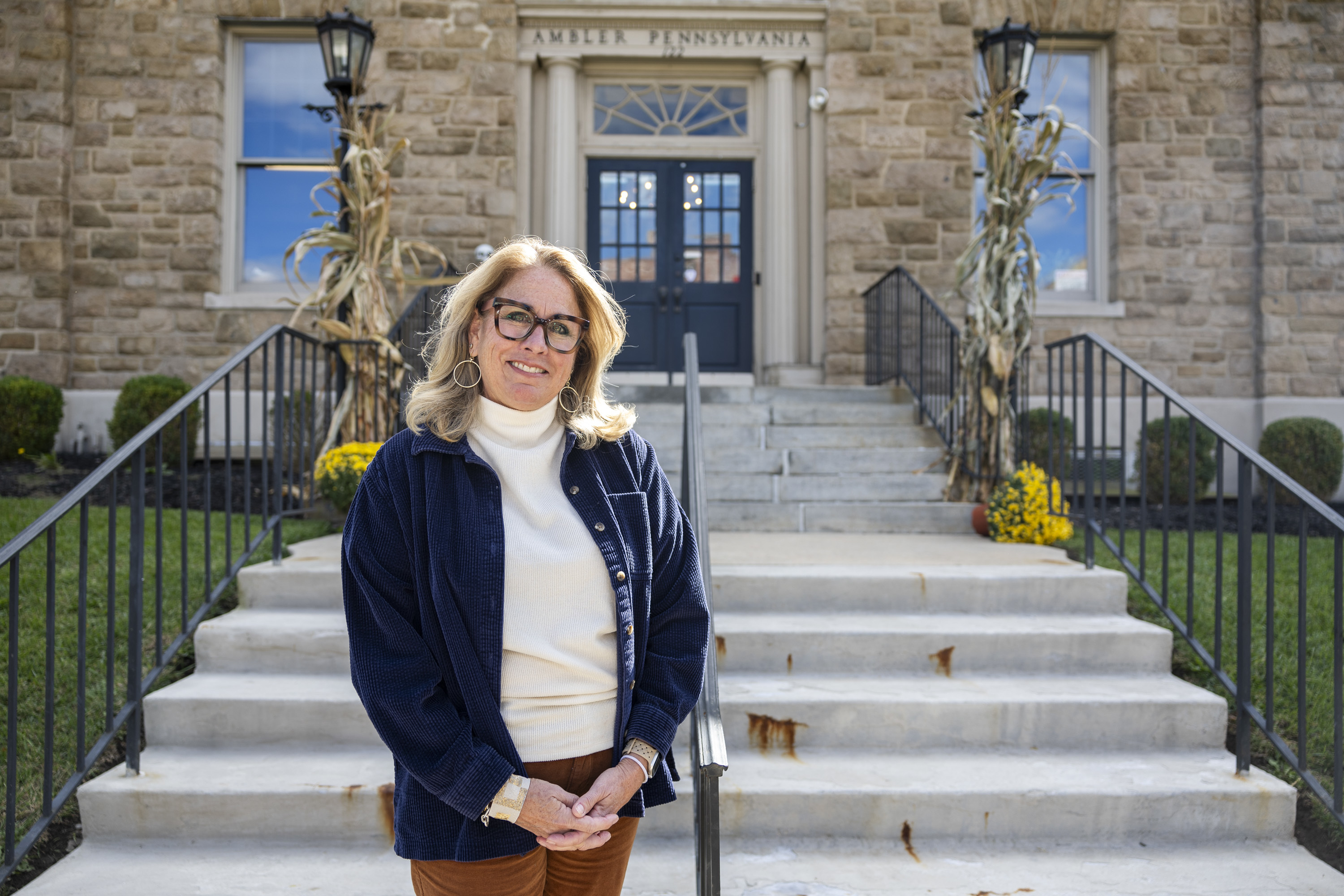
Elizabeth Wahl Kunzier, Ambler Main Street manager.
Wahl Kunzier serves as the marketing lead for Ambler Main Street — the name of the nonprofit that promotes downtown Ambler, even though many of its businesses are on Butler Avenue rather than Main Street. She monitors the businesses’ social media accounts daily to see what they’re advertising and share the information more broadly.
Her office also organizes special events such as a semiannual restaurant week and a holiday shopping weekend. And the borough hosts a Farmer’s Market every Saturday from May through the weekend before Thanksgiving at the old Ambler train station.
“I work with business owners brainstorming on everything from vacant storefronts to customized events to keep the foot traffic coming,” Wahl Kunzier said.
“They were a large family of small businesses that looked out for each other and supported one another while also having patrons who were cheerleaders of their businesses,” he said.
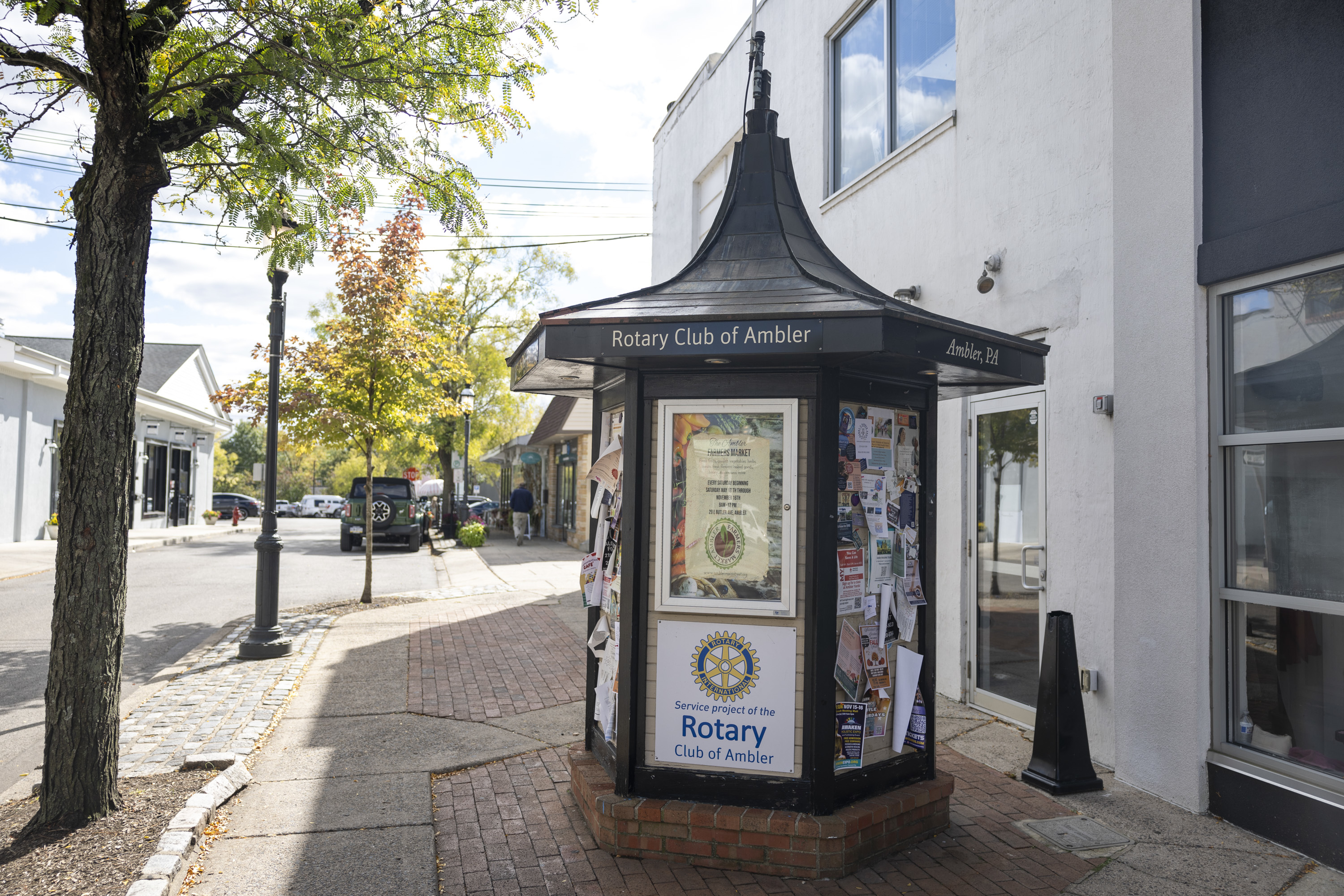
An event board with various posters and advertisements for Ambler businesses and events.
Located in a historic warehouse, Ridge Hall has 10 dining spots and a second-floor venue called The Mercantile.
DeCastro is optimistic this food hall and retail concept will do well in Ambler, which he described as “on the cusp of breaking through as a destination town.”
“Chestnut Hill, Doylestown, New Hope, and Phoenixville have become towns that you simply go to without a commitment. Unless you live in Ambler, it takes a commitment to drive into town,” DeCastro said. With Ridge Hall, “I wanted to create a destination that would entice people to stay for the day and return sooner rather than later.”
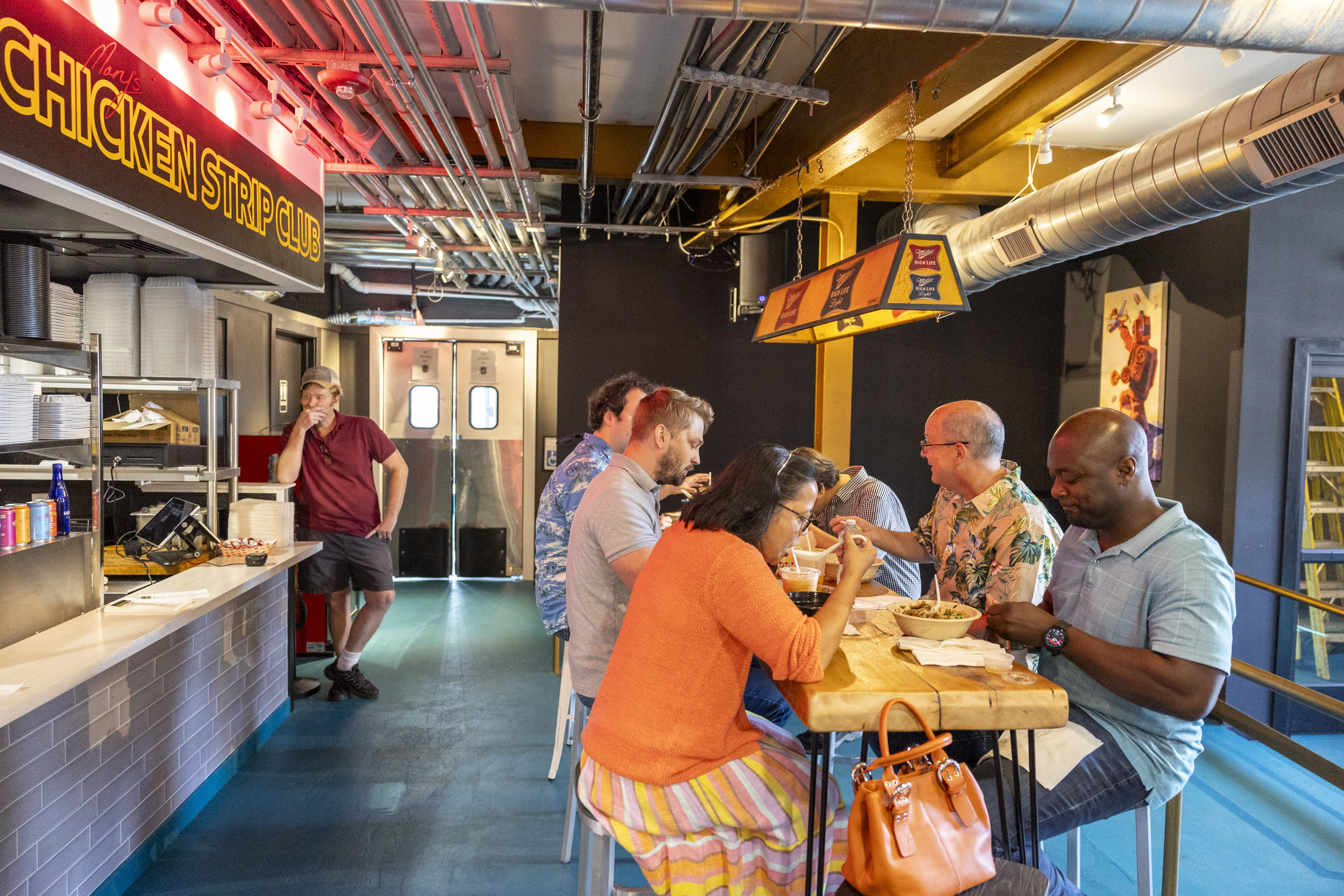
Customers dine at Ridge Hall in front of Mary’s Chicken Strip Club.
Some of the district’s established restaurateurs perhaps would argue that Ambler was already a destination.
At Sorrentino Pasta + Provisions, customers find fresh pasta, house-made focaccia, and imported Italian goods for sale. The restaurant is open for lunch Wednesday through Sunday and dinner Thursday through Saturday, and it’s a BYOB.
“Lunch is steady and a great opportunity to grab a table since it’s a little more difficult at dinner time,” proprietor Rich Sorrentino said. “We are extremely lucky to have the customers we do. Most are from the borough, but a surprising amount travel a bit to come join us.”
Geronimo’s Peruvian Cuisine, also a BYOB, offers signature dishes such as ceviche, lomo saltado, anticucho de corazón, arroz con mariscos, pollo a la brasa, and many other authentic Peruvian dishes, said co-owner Daniel Salazar. It’s open Wednesday through Sunday.
“Weekends are busy nights for us, we highly recommend calling the restaurant for a reservation,” she said. “Our goal here is to bring a cultural experience, to share a great cuisine that has history, flavor, and a little bit of mystery.”
A tale of two stores
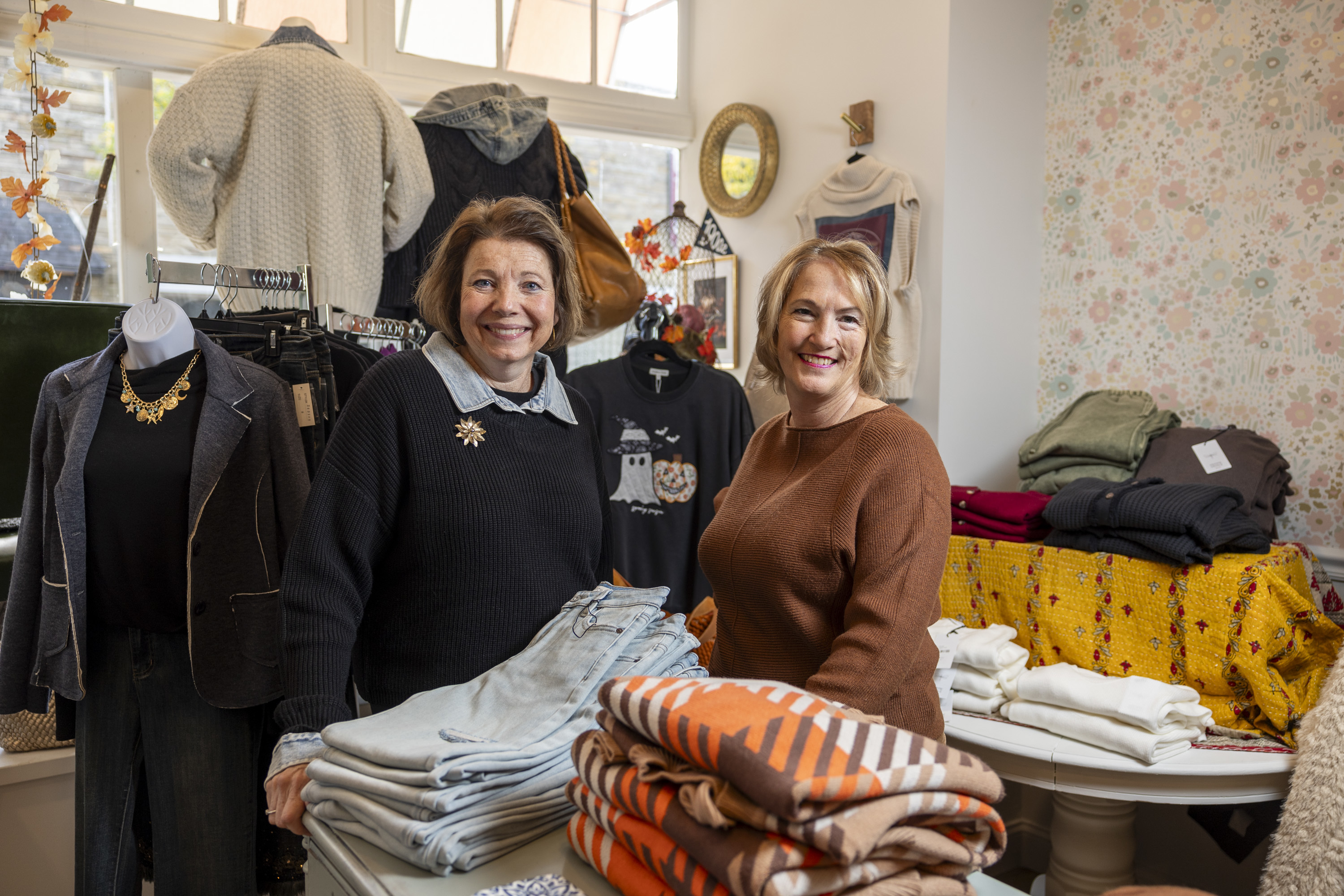
Jeanne Cooke (left) and Barb Asman in their combined store, which opened earlier this year, bringing together XTRA Boutique and Main Street Vintage.
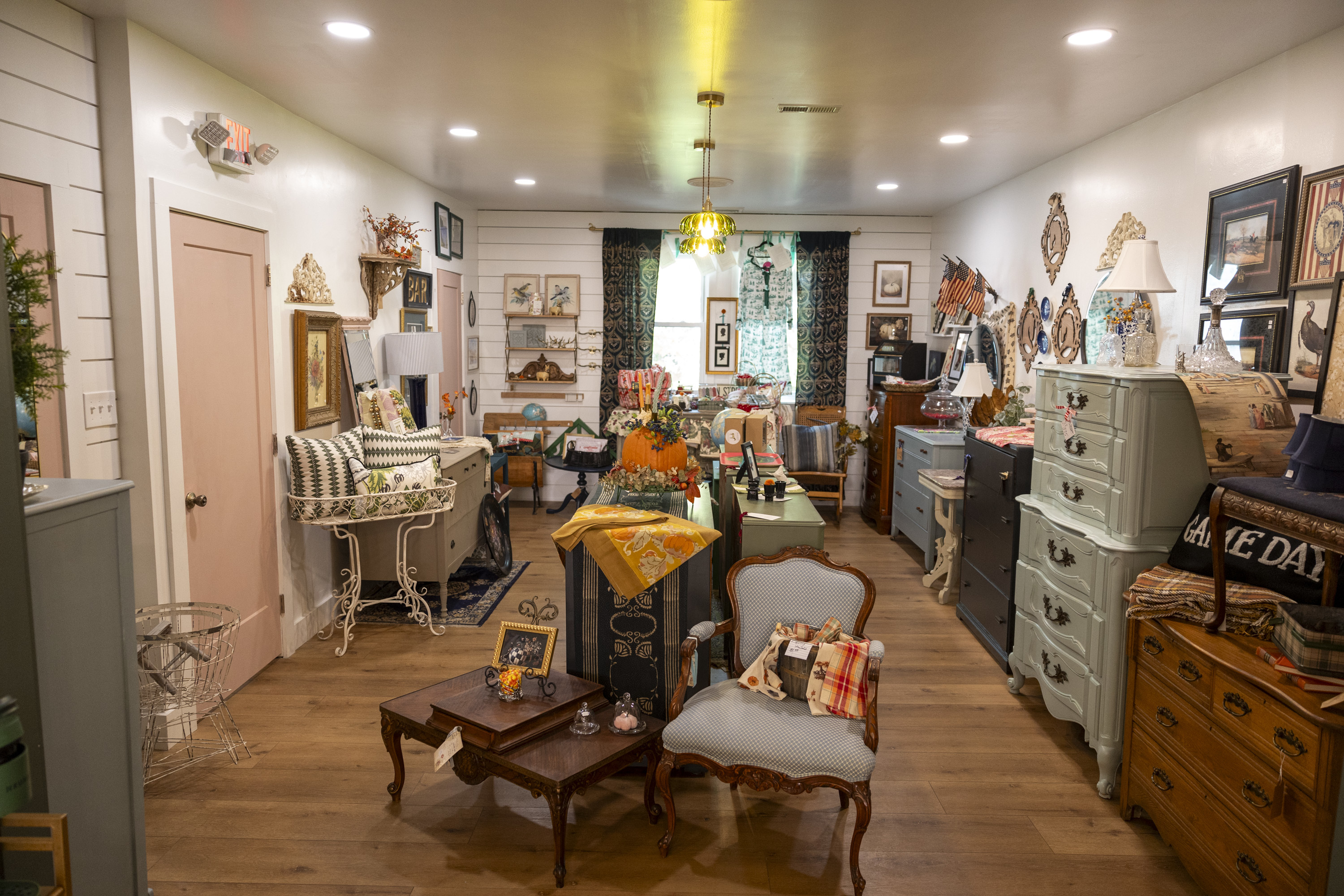
Jeanne Cooke, owner of Main Street Vintage, sold painted furniture, vintage wood furniture, new and vintage home accessories, and artwork at her Butler Avenue shop for years. Just down the street, Barb Asman’s XTRA Boutique was selling women’s clothing.
“Barb and I have been looking in windows in Ambler for years. We felt we needed more square footage to take our businesses to the next level,” Cooke said. “The merge was seamless. I guess because we talked about it for quite some time.”
The new experience is like shopping in a beautifully decorated home where you can buy all the furnishings. The two owners design the merchandising collaboratively, and the two businesses are intertwined.
The back of the store, where Main Street Vintage’s furniture and home decor are on display.
Asman said they are excited for what the future holds.
“I sometimes stand in the middle of the store and say: ‘Wow, this feels so good.’ It’s hard to put it into words,” Asman said. “It’s a really good feeling.”
The Eagles travel to face the Minnesota Vikings in a Week 7 matchup at U.S. Bank Stadium at 1 p.m. on Sunday. Here’s what you need to know about the game:
Vikings defensive coordinator Brian Flores is known for blitzing a lot.
When the Eagles have the ball
We’ve seen Nick Sirianni switch it up offensively coming out of mini-byes or byes before, with the emphasis often placed on the run game. The guess here is that he will take the same approach this season. The Eagles desperately need to get Saquon Barkley going on the ground. There have been glimpses in the last few games, but play caller Kevin Patullo hasn’t stuck with it enough for various reasons.
The Vikings’ run defense offers an opportunity to get on track (of course, so apparently did the New York Giants last week). They rank 24th in the NFL in expected points added (EPA) per rush and have allowed 132.2 yards a game. The Eagles haven’t won as much at the point of attack, but Minnesota is light on its defensive line. Landon Dickerson (ankle) could return at left guard, but playing at far less than 100% hasn’t helped.
The Eagles don’t major in under-center plays. They ranked 30th in snaps there. But I think we may see more of Jalen Hurts in that formation. It would conceivably help get Barkley downhill, and if successful, open up play action. They just can’t tip off defenses with their tendencies and may need to throw from under center a few times early on.
Vikings defensive coordinator Brian Flores is likely willing to give up yards on the ground because his No. 1 EPA-ranked pass defense has been stingy. Flores is a master of creating chaos. Yes, he blitzes a lot — a second-most 35.8% rate — but it’s his simulated pressures and disguised coverages that have given quarterbacks the most fits. The Eagles have struggled mightily against the latter two, partly because they’re often late to the line.
Flores leans heavily on zone coverages (77%) and employs a lot of two-high safety shells, often in Cover 2 or 6. The Eagles have seen zone more than ever and have had trouble working the intermediate part of the field.
Only 9.9% of Hurts’ attempts have traveled 10 to 19 yards, less than half the NFL average of 20.1%. Sirianni, Patullo, and Hurts have to do a better job of getting the ball to receivers A.J. Brown and DeVonta Smith in space. Eagles receivers are averaging only 4 yards after the catch, which ranks 32d — last — in the league.
Carson Wentz will make his second career start against his former team, this time with the Vikings.
When the Vikings have the ball
The Eagles will face former franchise quarterback Carson Wentz for the second time since he was traded in 2021. It didn’t go well for Wentz in the first round. Then, with Washington, he got overrun by the Birds’ pass rush and was sacked nine times and fumbled twice. He still holds the ball too long and wants to play the hero.
But the Eagles’ front isn’t as ferocious and he has a solid offensive line, assuming that most of the starters are playing. Christian Darrisaw and Brian O’Neill (sprained MCL) are plus tackles. Rookie left guard Donovan Jackson is back from a wrist injury, but backup center Michael Jurgens (hamstring) and O’Neill are questionable.
Wentz, despite his flaws, can still make throws many quarterbacks can’t. And he has arguably the best receiver in the NFL. Justin Jefferson will draw additional attention from Vic Fangio’s defense. Cornerback Quinyon Mitchell has followed top receivers this season, but his recent hamstring injury could hamstring Fangio’s coverage plans.
If opposite-side corner Adoree’ Jackson, who steps back into the starting role after Kelee Ringo’s benching, is matched up against Jefferson, Fangio will likely cloud his side. Jefferson alone, for context, has matched Hurts’ 10 intermediate-length completions this season for 205 yards. Jordan Addison is a potent No. 2 receiver.
The Eagles’ run defense has been leaky. They rank 20th in EPA per rush and 26th in success rate. With defensive tackle Jalen Carter (heel/shoulder) out last week, the Giants ran it down their throats. Minnesota running back Jordan Mason (4.7 yards per rush) has been effective in Aaron Jones’ absence.
It’s been an 11-man problem in stopping the run, but the Eagles have been susceptible on the edges. That isn’t just an outside linebacker issue, but a suspect pass rush that can be traced to the ineffectiveness of the Eagles’ edges. The current group, after Za’Darius Smith’s retirement, has just one collective sack.
Jalyx Hunt, Joshua Uche, Azeez Ojulari, and Patrick Johnson (owner of said sack) have gotten pressure at times, but if Wentz has an extra click in the pocket, you can be sure he’ll often find an open Jefferson downfield.
Eagles beat writers Olivia Reiner and Jeff McLane will provide a preview of the game before the Eagles face the Minnesota Vikings on Sunday.You can tune in here.
Extra point
I don’t know what to make of this Eagles team through six games. I thought there would be early-season struggles, and predicted a 4-2 start. I just didn’t think it would look like this. Fangio’s unit has not played well over the last five quarters, but the offense’s second-half malaise against the Denver Broncos led to a fourth-quarter meltdown. And losing Carter and Mitchell clearly affected the Eagles at the Meadowlands. It shouldn’t have looked that pathetic.
There are still concerns at corner, edge, and safety. And where has defensive tackle Jordan Davis been the last three games? But it’s the pains on the other side of the ball that are more disconcerting. I keep expecting talent to win out, but the Sirianni-Patullo-Hurts trinity has had more holes than holiness. I foresee a tough, grind-it-out outcome, so the game could go either way. But I have a hard time riding with Wentz.
When he looks up from assembling the Phillies’ roster, Dave Dombrowski watches sports. One thing recently caught his eye. The Golden State Warriors are poised to open the NBA season with four starters who are 35 or older.
“It’s never happened before,” he said.
Dombrowski, the team’s president of baseball operations, brought this up Thursday, midway through his 54-minute news conference in Citizens Bank Park, to make a point: Aging teams can contend for titles.
It’s relevant because if the Phillies achieve their offseason priority of re-signing free agents Kyle Schwarber and J.T. Realmuto, who will be 33 and 35 next season, at least four of the top hitters in the projected opening-day lineup will be 32 or older and locked up to multiyear contracts. It would be so uncommon that Schwarber joked about it several months ago.
“We would love to all finish our careers together,” he said. “But who would want to come out and want to watch a bunch of 40-year-old dudes play baseball? Right?”
Warriors fans might not mind the basketball version, but there’s a notable difference. Whereas Stephen Curry and Draymond Green won four championships together before teaming with Jimmy Butler and Al Horford, the Phillies’ core — Bryce Harper (33), Trea Turner (32), Schwarber, Realmuto, and pitchers Zack Wheeler (35) and Aaron Nola (32) — is still title-less.
The Phillies are coming off 96 wins, 95 last season, and 90 the year before. It would be irrational to blow it all up based on one bad week in each of the last three Octobers and impractical given all the long contractual commitments made by Dombrowski and owner John Middleton.
Phillies president of baseball operations Dave Dombrowski must balance blending an aging core with young players from the farm system.
But in addition to an eyebrow-raising challenge to Harper — “I guess we only find out if he becomes elite or if he continues to be good. … I’ve seen guys at his age that level off, or I’ve seen guys rise again. We’ll see what happens” — the takeaway from Dombrowski’s end-of-season gab session was that he realizes the need for an infusion of youth, even as the Phillies prepare a nine-figure offer to Schwarber and discuss how far to go to retain Realmuto.
To extend the NBA comparison, the Phillies must incorporate their Moses Moody and Jonathan Kuminga, the 23-year-olds among the Warriors’ graybeards.
“We have some young players that we’re going to mesh into our club,” Dombrowski said. “I’m not going to declare that anybody has a job. But there will be some people that we’re really open-minded to being with our big league club next year, coming out of spring training.”
Unsurprisingly, Dombrowski mentioned outfielder Justin Crawford and right-hander Andrew Painter. He also name-checked Otto Kemp, who made his major-league debut in June and could fit next season as a right-handed bench bat.
But Dombrowski said he “wouldn’t even preclude [infielder] Aidan Miller from being that type of guy” to contribute in 2026, an indication that the Phillies are ready to push down harder on the prospect pedal.
They were conservative this season, consistent with their recent philosophy. A recent Fangraphs study showed that only 24 players have made their major- league debut with the Phillies since 2022, the third-fewest in baseball after the Yankees and Braves.
The trend must change.
“It’ll be very interesting next spring training because those guys, they’re on the doorstep, and a couple of them are ready to go,” manager Rob Thomson said of Crawford, Painter, and Miller. “So we’ll see. I love young players because they always bring energy. But they have to perform, too.”
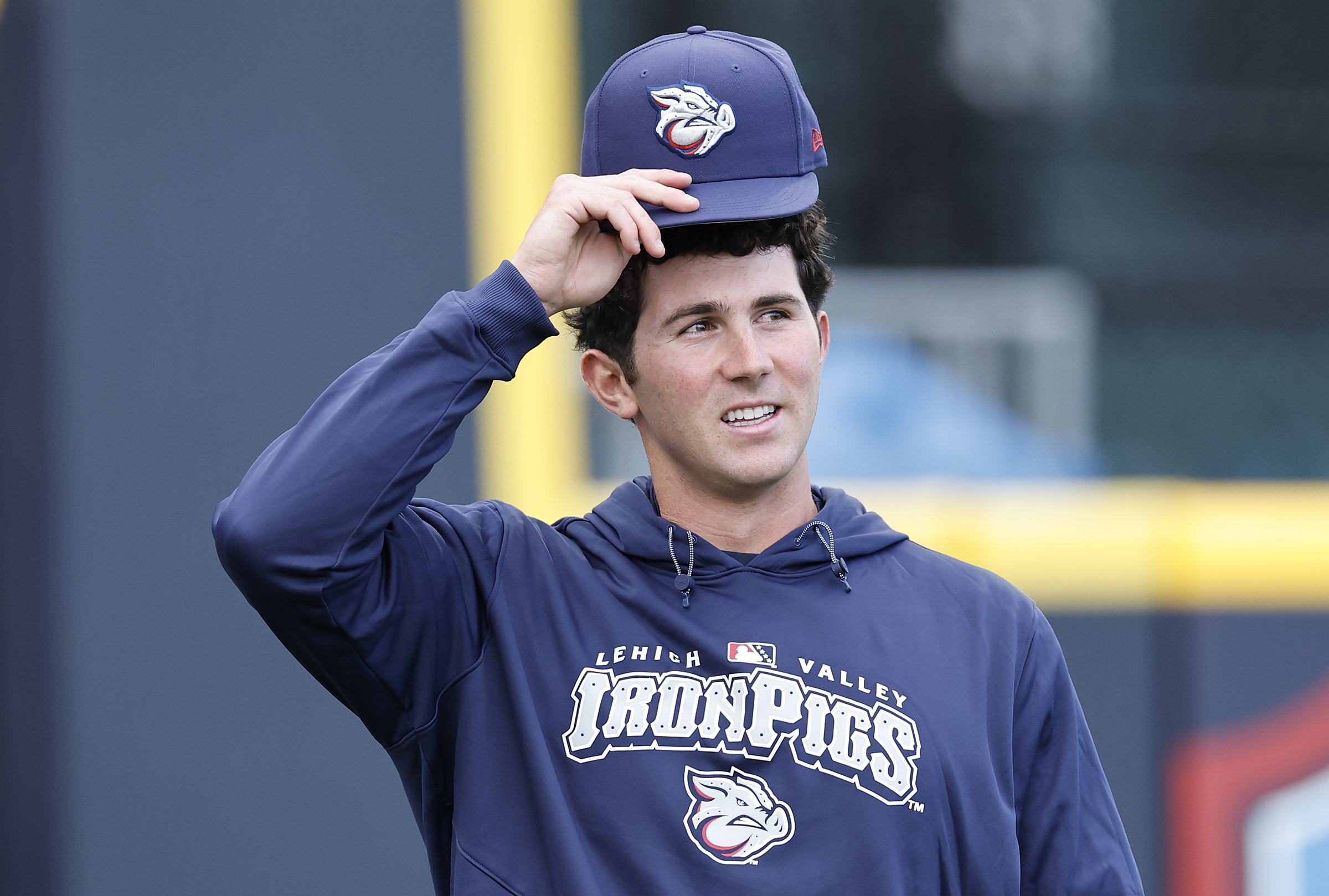
Phillies outfield prospect Justin Crawford won the triple-A International League batting crown with a .334 average.
Front and center, or stage left?
At times this summer, the Phillies got “very close,” a team source said, to calling up Crawford.
Instead, they left the 21-year-old in triple A.
Never mind that left fielder Max Kepler was drowning, with a .201 average and .661 OPS through July 25. Rather than releasing the $10 million veteran and replacing him with Crawford, the Phillies gave Kepler a longer rope. And after trading for Harrison Bader at the deadline, there wasn’t an opportunity for Crawford to play every day in the majors.
But Crawford reached base at a .411 clip for Lehigh Valley and won the International League batting crown with a .334 average. He stole 46 bases and led the farm system with 147 hits.
“I don’t know what else he really does at the minor-league level at this point,” Dombrowski said. “He’s led leagues in hitting. He steals bases. He’s a good energy guy. He’s a solid outfielder.”
Go ahead, then, and pencil in Crawford for a spot in the season-opening outfield.
Differences of opinion about Crawford once focused on his offense, notably his extreme tendency to hit the ball on the ground. Now, it’s more whether he’s best suited for center field or left.
Crawford got drafted as a center fielder and played there exclusively for three years. He shifted to left field more often late this season, especially once Johan Rojas got sent back to triple A. Crawford’s dad, Carl, played left field for 15 years in the majors.
Dombrowski might have hinted at the Phillies’ thinking by saying Kepler is “not going to most likely be back because he’s a free agent and we have Justin Crawford coming.” And Thomson said Crawford is “maybe a little better in left than he is in center,” based on internal reports.
Other team officials don’t fully concur.
Some Phillies officials believe Justin Crawford is best suited to play left field. Others think he can handle center.
“I see Justin as a center fielder,” minor-league director Luke Murton said. “We’re very confident in his ability to play center field. It’s just a matter of, he’s played less left field over the course of his career, so give him exposure to that so when the opportunity comes, if he has to go to the big leagues and play left field, then he’s prepared to do that.
“But I think, as an organization, we see him as a center fielder.”
It would simplify the outfield picture if Crawford is able to handle center field.
Bader, who stabilized center field after the trade, is expected to decline his $10 million mutual option. The Phillies would feel less urgency to bring him back in free agency off his career-best season at the plate.
And they could commit to Brandon Marsh, also a better defender in left field than center, as at least the lefty-hitting side of a corner outfield platoon, which would enable them to focus on finding a replacement for malcontented right fielder Nick Castellanos, all but certain to be traded or released.
Regardless, it will be Crawford’s time. At last.
“I don’t expect him to carry our club in the very beginning of the season, but you also don’t want to put him in where you think it would be a bit too much for him,” Dombrowski said.
“I don’t think that’s going to happen. He has never been overwhelmed when he’s been with us at any level, and we keep moving him up. You want to just see that he just continues to handle himself the same way that he has,” Dombrowski said.
Phillies top pitching prospect Andrew Painter struggled in triple A in his first season back from Tommy John elbow surgery.
‘He’s going to be fine’
Don’t look now, but there will probably be a spot for Painter in the season-opening starting rotation.
Really. It’s true this time.
In 2023, a few team officials predicted that Painter would make the team out of camp even though he was 19 and hadn’t pitched above double A. He injured his elbow and wound up needing Tommy John surgery.
Last winter, in outlining the plan to build Painter’s workload in his return to the mound, Dombrowski infamously said he could be ready for the majors by “July-ish.” Instead, the top prospect had a 5.40 ERA in triple A.
It’s doubtful, then, that Dombrowski will pin yet another timetable on Painter. But with Ranger Suárez headed to free agency and Wheeler recovering from thoracic outlet decompression surgery, Painter’s long-awaited debut could come early next season.
“I think he’s going to be better the second year out after the Tommy John [surgery],” Thomson said. “The command’s going to get better. The quality of stuff’s going to get a little bit better. He’s going to be fine.”
Rival talent evaluators generally agree. One NL scout said last month that he has “appropriate concern” about the decline in Painter’s command but is inclined to “cut him some slack” after not pitching for two years.
There were encouraging signs last month. In his second-to-last start, Painter tossed five scoreless innings. He shut out Syracuse for three innings before allowing three runs in the fourth in his final start.
Even if Suárez bolts, Cristopher Sánchez, Jesús Luzardo, Nola, and Taijuan Walker are rotation holdovers. The Phillies are optimistic that Wheeler will return. They can’t say for sure that he will still be elite.
Painter’s time is coming. Maybe even in April.
“He still throws his fastball in the upper-90s, touches 100, still has quality breaking stuff,” Dombrowski said. “Most importantly, he remained healthy. So, those things are the encouragement. He used to have great command. It wasn’t quite as good this year. And normally, when you trace back to a lot of people that have had Tommy John, that’s the last thing that comes back. We’re optimistic that he’ll be able to regain that.”
Phillies infield prospect Aidan Miller went 9-for-27 with two doubles and a homer in an eight-game triple-A cameo to end the season.
Miller time?
Murton was skeptical in spring training when minor-league baserunning coordinator Gary Cathcart recommended that Miller be among the players who got a green light to run.
“I was like, ‘Hey man, I don’t think Aidan Miller’s going to steal a ton of bases in the big leagues. That’s just me,’” Murton said. “He’s like, ‘Well, I think he’s going to.’ I’m like, ‘Yeah, I don’t.’”
Murton relented. A few months later, he marveled that Miller already swiped more than 20 bases. Miller finished with 59, including seven steals in eight games at triple A to end the season.
In hindsight, even Miller didn’t see it coming.
“Honestly, no,” he said last month. “I don’t really know if I’m faster this year. Maybe a little bit. But I think I’m just being more aggressive on the bases.”
Miller’s path to the majors might be accelerated, too.
After a slow start, he batted .356 with a 1.099 OPS in his last 36 games. If the Phillies trade Alec Bohm this winter, after dangling him in talks last offseason, Miller could be in the wings at third base, even though he has played shortstop so far throughout the minors.
“He’s played some second, he’s played some third, but he’s primarily been a shortstop, so we’d have to make sure that we properly prepared him to do that,” Dombrowski said. “That’s still a discussion that we’ll have to have. But he’s a really good player and a good athlete. And he can hit.
“If Miller’s coming up here, he’s going to be an everyday player at the beginning of his career. We’re not going to bring him up and not play the majority of time.”
Miller was scheduled to play in the Arizona Fall League, but the Phillies decided that it was better if he rested after a long season. Besides, he could be in for a big spring training.
If it seems fast, consider this: When Dombrowski ran the Red Sox, he called up Andrew Benintendi from double A in 2016 and Rafael Devers a year later after only six triple-A games, two fewer than Miller played this season.
Last week at the Vatican, two Villanova legends finally came together: Pope Leo XIV and former basketball star Maddy Siegrist.
Siegrist took a short trip to Rome to visit the big landmarks, including the Trevi Fountain and the Colosseum and spent a day with Villanova at an Augustinian conference, where she got to meet the pope.
Last year, the Villanova women’s basketball team took a group trip to Italy and the Vatican, but Siegrist, still in the middle of the WNBA season, couldn’t attend. This time around, after the Dallas Wings were eliminated from playoff contention, Chrissy Quisenberry, who helps organize alumni trips at Villanova, reached out to let Siegrist know they were planning another trip and that they might get an audience with the pope, also a Villanova graduate.
“People always joke because he [went to] Villanova, like, ‘Is he going to do the wedding?’” said Siegrist, who’s engaged to Stephen Perretta, an assistant women’s basketball coach at Drexel and the son of former Wildcats coach Harry Perretta. “When it did happen, I was like, ‘Oh my gosh, this is crazy.’ We have a family group chat of all my cousins and aunts and grandparents. I sent the picture, and they’re like, ‘Are you joking?’ It was kind of a last-minute trip, so I didn’t really tell anyone because I didn’t know — when they said audience, it could be 1,000 people outside, which would have been unbelievable, but I didn’t realize I was actually going to have the opportunity to shake his hand.”
The group attended mass at St. Peter’s Basilica and toured the catacombs before meeting with Pope Leo. Siegrist got a photo shaking the pope’s hand — which she did have to pay for, like a Disneyland ride photo — and said it was a bucket list moment, which “rejuvenated” her Catholic faith.
Pope Leo XIV wears a Villanova hat gifted to him during a meeting with an Italian heritage group in June.
Pope Leo frequently goes viral for his White Sox fandom and has been pictured in Villanova hats on multiple occasions since assuming his new role. But even with a group from Villanova in the building, Siegrist said he was careful to stay impartial.
“He’s not biased at all,” Siegrist said. “I’ve seen a few pictures of Villanova hats and stuff. I think he addressed that. Dr. [Barbara] Wall was on the trip, she was one of his professors, so that was pretty cool to be with her during that moment. He knew there was a small group from Villanova at the conference, I think about 20-25 people. Such a cool experience. I really don’t even remember what I said in the moment. You just get so starstruck. You’re so nervous.”