Tag: West Philadelphia

  • Philadelphia built a tool to track vacant properties, but L&I no longer uses it. Neighbors say they live in fear.

    Philadelphia built a tool to track vacant properties, but L&I no longer uses it. Neighbors say they live in fear.

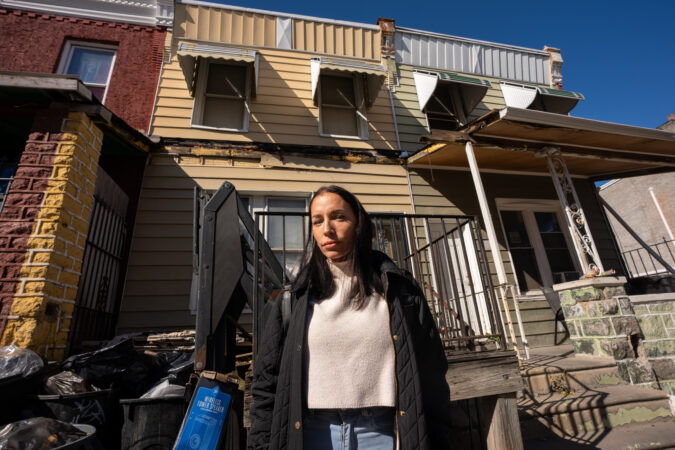
    Emily Phillips and her family never slam doors or walk too heavily inside their North Philadelphia rowhouse. They’re afraid of what too much movement could do to the vacant house next door.

    In early August, a back window and part of a wall came crashing down during harsh winds and rain. An inspector for the city’s Department of Licenses and Inspections declared the vacant rowhouse “imminently dangerous,” which means it is at risk of collapsing.

    “I never know when something’s going to actually happen,” Phillips said in late October. “We know it’s just a matter of time. … I’m so scared right now.”

    Across Philadelphia, families are living in a limbo of anxiety next to buildings that the city has determined are unsafe or imminently dangerous. The buildings at greatest risk of collapse are usually vacant.
    Renters Emily Phillips (left) and Dayani Lemmon examine the basement wall that their home shares with the abandoned and dangerous rowhouse next door.

    Philadelphians rely on the city to keep an eye on vacant properties that are or could become dangerous. And in 2016, the city rolled out a method for determining which properties were likely to be vacant. L&I’s commissioner at the time said the inventory tool was making the department more proactive in protecting the public from deteriorating vacant buildings.

    But L&I officials now say the department no longer uses the tool. They said the department mainly relies on residents’ complaints and its list of vacant property licenses — which L&I admits is a massive undercount — to monitor empty buildings.

    (function() {
    var l2 = function() {
    new pym.Parent(‘imm_dang_map’,
    ‘https://media.inquirer.com/storage/inquirer/projects/innovation/arcgis_iframe/imm_dang_map.html’);
    };
    if (typeof(pym) === ‘undefined’) {
    var h = document.getElementsByTagName(‘head’)[0],
    s = document.createElement(‘script’);
    s.type = ‘text/javascript’;
    s.src = ‘https://pym.nprapps.org/pym.v1.min.js’;
    s.onload = l2;
    h.appendChild(s);
    } else {
    l2();
    }
    })();

    L&I points out that property owners are responsible for securing vacant properties and repairing dangerous buildings, and the department steps in as resources and laws allow.

    Around the time Inquirer reporters spoke with Phillips, the city’s spreadsheet of likely vacant properties listed about 8,000 vacant buildings — a potentially serious threat to their neighbors. An Inquirer analysis of the city’s list of imminently dangerous buildings showed that 79% of those also appeared on the list of likely vacant buildings.

    Just under half of those vacant and imminently dangerous buildings were rowhouses, which are especially risky to neighbors because of shared walls. This risk is not borne equally by all of Philadelphia’s residents.
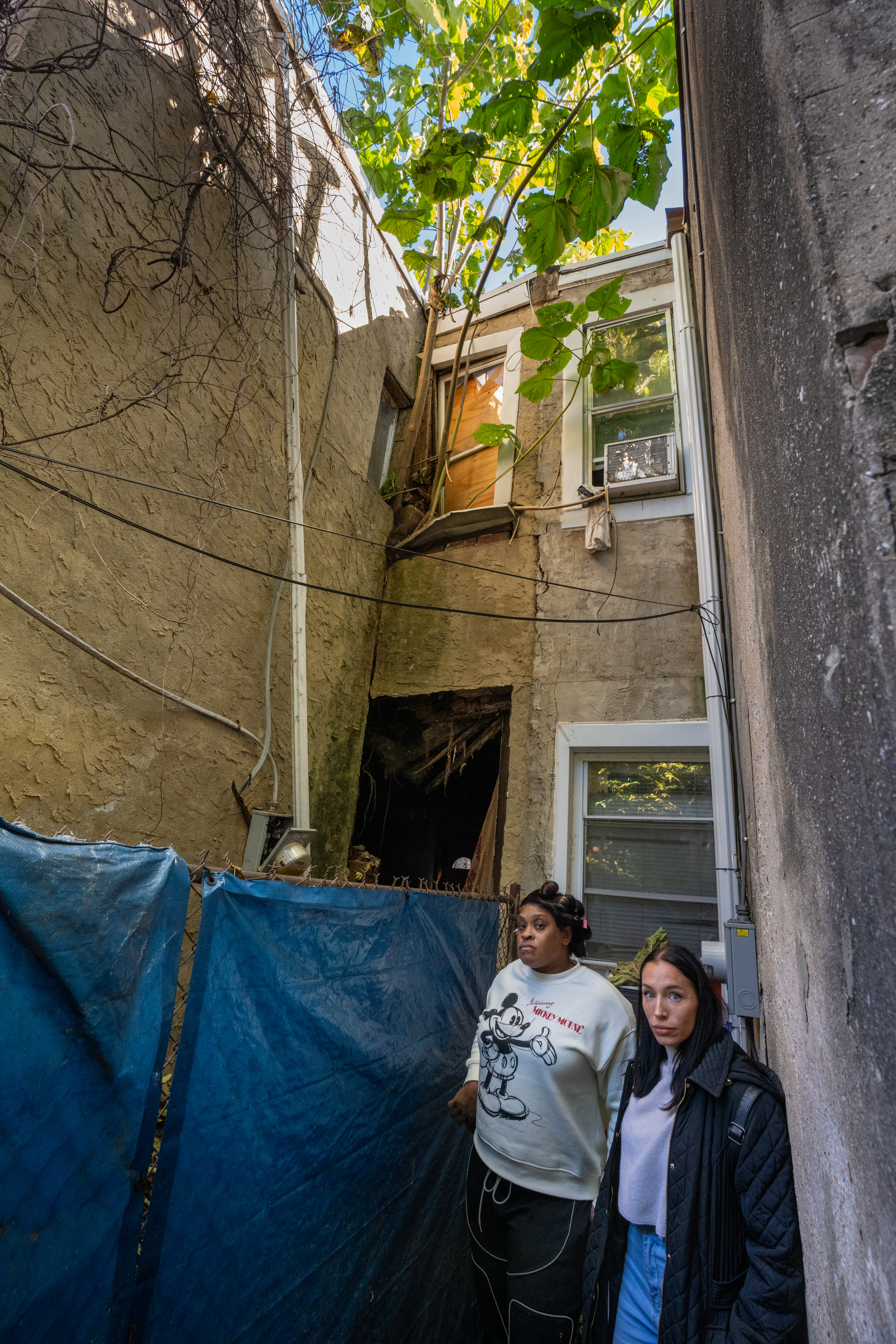
    Emily Phillips and her landlord, Samantha Wismann, stand next to a neighboring abandoned rowhouse, where part of a wall collapsed and a tree grows inside.

    Nearly eight in 10 of all such rowhouses are in the poorest 25% of the city’s zip codes. The zip code with the most such rowhouses — 19132, where Phillips lives — has a median income of $31,000, according to the latest Census Bureau data. Philadelphia’s median household income is $61,000.

    Seven in 10 vacant rowhouses that the city identified as imminently dangerous are in the 34% of the city’s zip codes that are predominantly Black. Roughly nine in 10 residents in 19132 are Black.

    Dianna Coleman, a community activist who lives in Southwest Philadelphia, called vacant properties “one of Philadelphia’s most pressing and overlooked crises.”
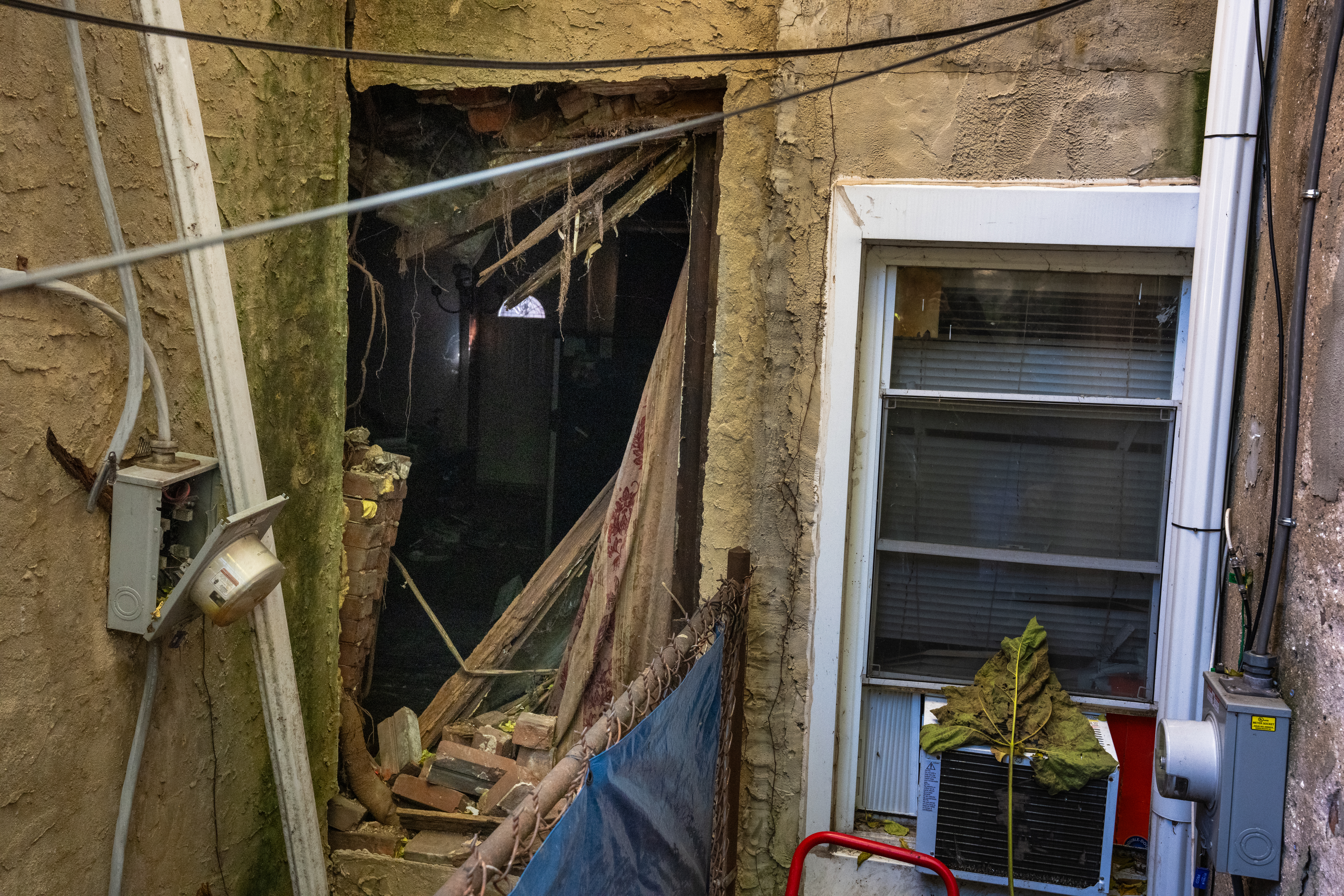
    This summer, a hole opened in the back of an abandoned rowhouse that is connected to a North Philadelphia house owned by Samantha Wismann.

    When Coleman and a group of residents in Southwest and West Philadelphia came together last summer to organize around quality of life issues, residents’ top concern was fixing vacant properties. They partnered with the grassroots social justice nonprofit OnePA and launched their first campaign — asking the city to deal with abandoned buildings and vacant lots.

    “While we recognize that the city has taken steps — demolishing some buildings, addressing some lots — the pace is way too slow, the resources too scarce, and the strategy too weak,” Coleman, cochair of OnePA West/Southwest Rising, said at a news conference this summer. “Unsafe buildings are left standing for years, growing more hazardous, pulling down property values, and pushing people out of their homes.”
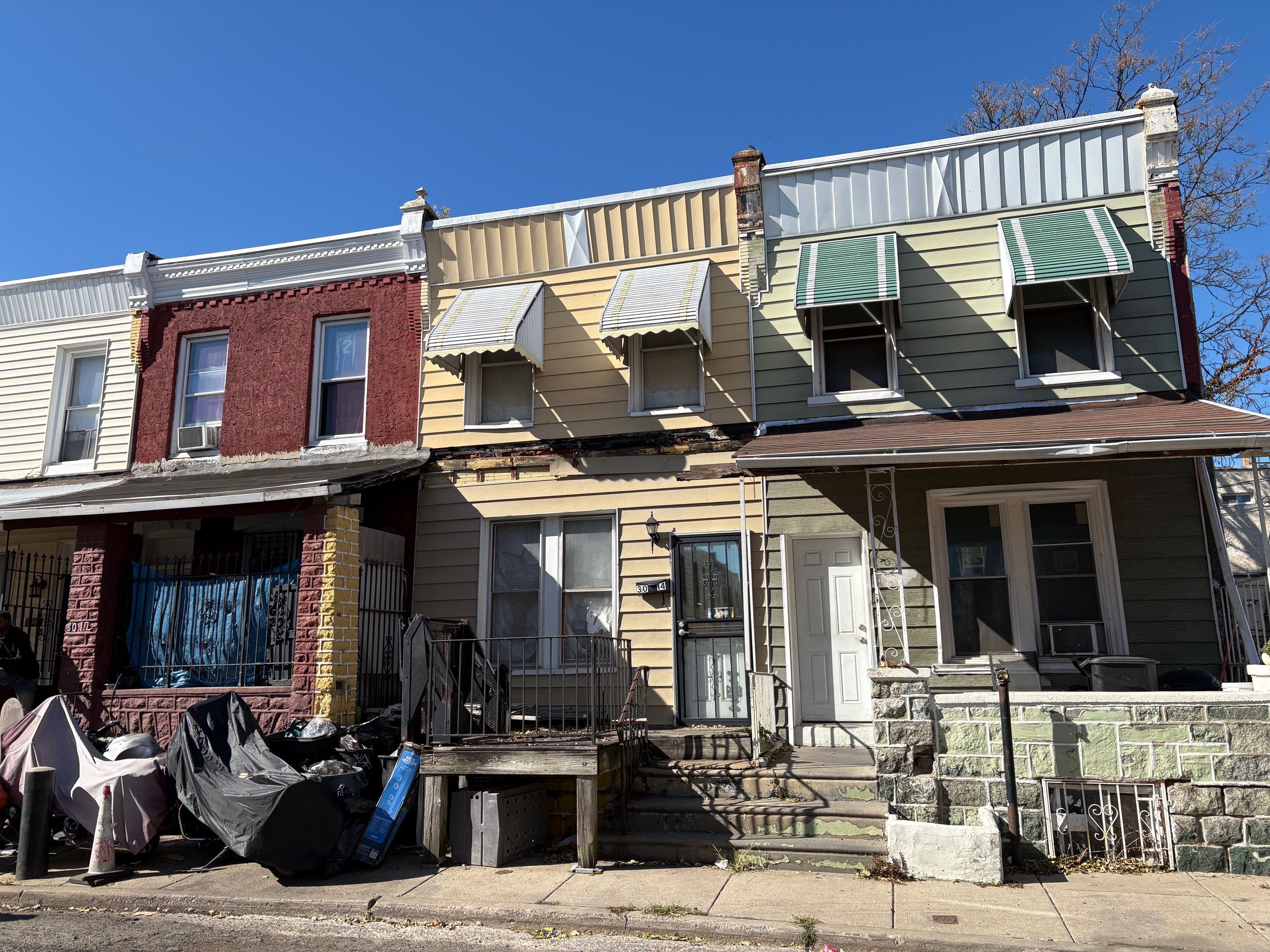
    The vacant rowhouse next to Emily Phillips’ North Philadelphia home had its collapsing porch roof removed, but the rest of the home remains in disrepair.

    The city’s questionable vacancy data

    About a decade ago, the city started using an algorithm that takes feeds from a variety of datasets (such as whether a property has had its water cut off) to determine whether a property is likely to be vacant.

    City officials celebrated the tool when it launched.

    “Protecting the public from deteriorating vacant, abandoned properties as they grow more and more likely to collapse is critical to L&I’s mission,” former L&I Commissioner David Perri said in a 2016 news release announcing the index. “The Vacant Property Model and dataset are making us more proactive and strategic in carrying out that mission.”

    But the reliability of the city’s list of likely vacant buildings and lots was recently called into question by individuals who have worked closely with the tool and collaborated with city officials in the past.

    For more than three years, Clean & Green Philly, a nonprofit that — until its closure earlier this year — used data to help Philadelphians deal with vacant properties in their neighborhoods, relied on the city’s tool in combination with other data to identify vacant properties in greatest need of addressing.

    But last year, founder Nissim Lebovits and the organization’s former executive director, Amanda Soskin, noticed something was wrong.

    For years, the city’s list of suspected vacant properties had hovered somewhere around 40,000 records — buildings and land combined. But then, according to Lebovits and Soskin, that number plunged to around 24,000 in June 2024.

    “And at first I was like, ‘OK. Something’s probably broken,’ and we looked into it,” Lebovits said. “And we realized that the city’s actual underlying datasets were no longer reporting the same number of vacant properties.”

    window.addEventListener(“message”,function(a){if(void 0!==a.data[“datawrapper-height”]){var e=document.querySelectorAll(“iframe”);for(var t in a.data[“datawrapper-height”])for(var r,i=0;r=e[i];i++)if(r.contentWindow===a.source){var d=a.data[“datawrapper-height”][t]+”px”;r.style.height=d}}});

    The spreadsheet was showing only about 14,000 records as of this June, according to Lebovits and Soskin.

    Then at some point between June and early November, the index grew to about 37,000 total properties.

    Inquirer reporters began investigating the connection between vacancy and structural deficiencies in buildings after the April collapse of an abandoned rowhouse in Sharswood. At that time, L&I offered the vacancy index while asserting it could not provide detailed information about the data and referring reporters to CityGeo, the department that developed and maintains the index.

    At no point during an hour-long interview with the department’s chief data officer in early June did city officials mention any concerns about the reliability of the data.

    Reporters learned about issues with the data when Lebovits and Soskin wrote an article for The Inquirer’s opinion section later that month detailing their concerns. They wrote that city sources told them the process of collecting and publishing vacancy estimates “was quietly discontinued after [Mayor Cherelle L.] Parker took office.”

    In an email, a CityGeo spokesperson said the city has not stopped updating the index, asserted that its accuracy depends on continued updates from various departments, and noted that CityGeo pauses updates “every few years” for “a month or so” to ensure the tool continues to work, most recently this past summer.

    The spokesperson did not respond to questions about why the index’s size had varied so greatly recently. Lebovits and Soskin told The Inquirer that nobody from the city reached out to them after their article was published.

    “My big takeaway here is that the lack of transparency around this dataset is a major liability,” Lebovits wrote in an email. “Having so little accountability regarding data production and quality seriously hampers any community groups trying to use these data and undermines the credibility of the City’s vacancy work.”
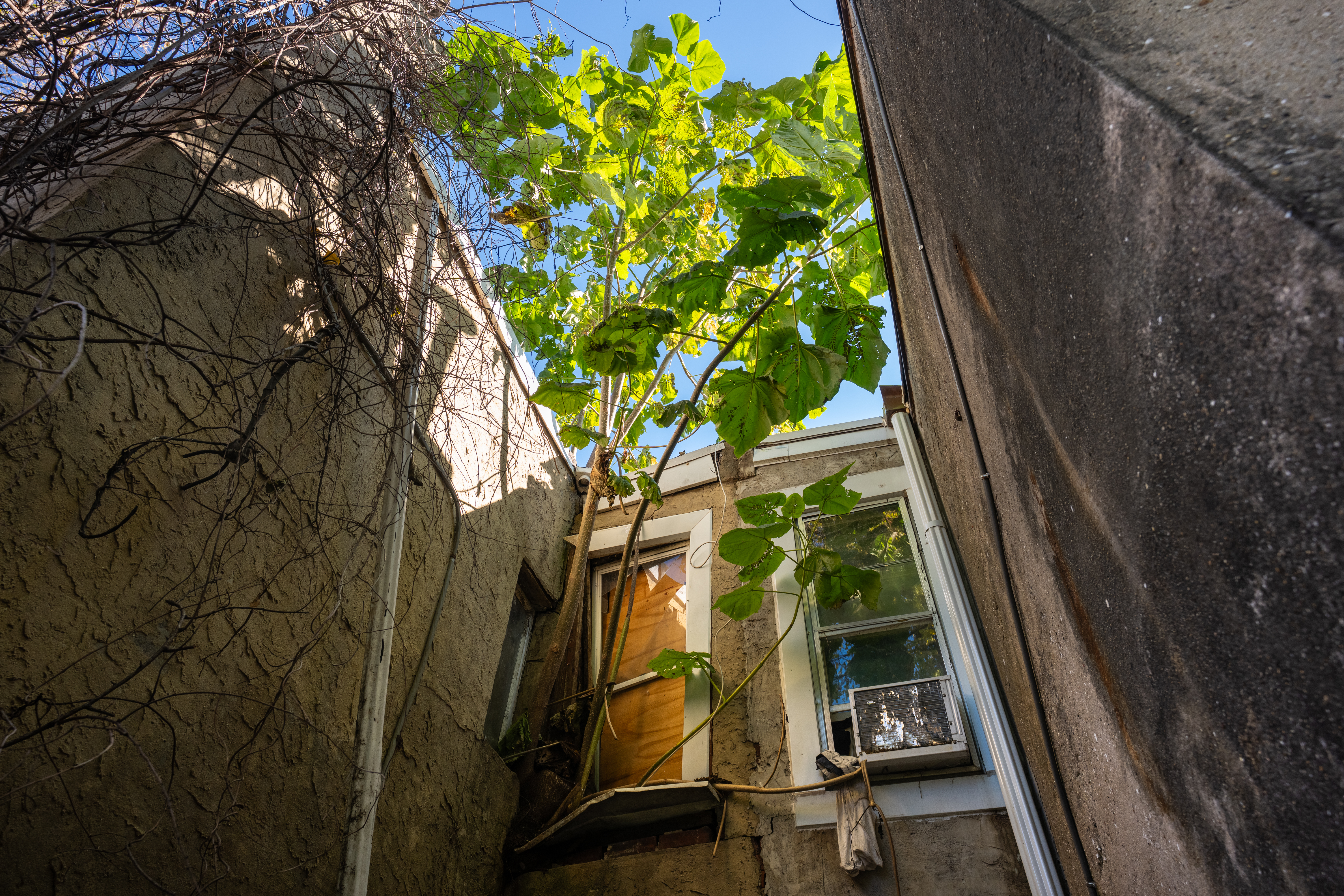
    The tree inside an abandoned North Philadelphia rowhouse towers above the roofs of the house and its neighbor, owned by Samantha Wismann.

    ‘Very, very scary’

    When Phillips’ landlord, Samantha Wismann, bought the house on North Woodstock Street in 2020, she didn’t know that its neighbor was vacant.

    Wismann noticed the house looked a little shabby, but it wasn’t until Phillips moved in the following year that the women saw no one lived there. They didn’t know how long it had been vacant, but they watched it quickly deteriorate.

    Most pressing back then was the collapsing porch roof, which was dragging down the roofs of the porches on either side of it.

    Someone eventually tore it down. But the rest of the home remains in disrepair.

    “It’s very, very scary,” Wismann said in October, “because eventually, if it’s not handled, it’s gonna come down.”

    Cracks snake between the homes.

    From the women’s backyard, through the door-sized hole in the back of the neighboring house, they can see past splintered beams and an abandoned refrigerator, beyond the staircase that leads to the second floor, and straight through to the front door.

    Then there’s the tree that’s growing inside the vacant house. It has pushed outward through bricks and plaster and busted a second-story window. The tree’s branches tower over the homes, and some have reached the window of the bedroom where Phillips’ grandchildren stay.

    L&I’s Contractual Services Unit is responsible for inspecting unsafe and imminently dangerous properties and administers the city’s demolition program. The unit has 10 members and openings for two more inspectors, said Basil Merenda, commissioner for L&I’s Inspections, Safety & Compliance division.

    “We’re out there doing our job,” he said. “We’re out there making sure that these unsafe and [imminently dangerous] properties are properly addressed through procedures and that public safety is always being maintained.”
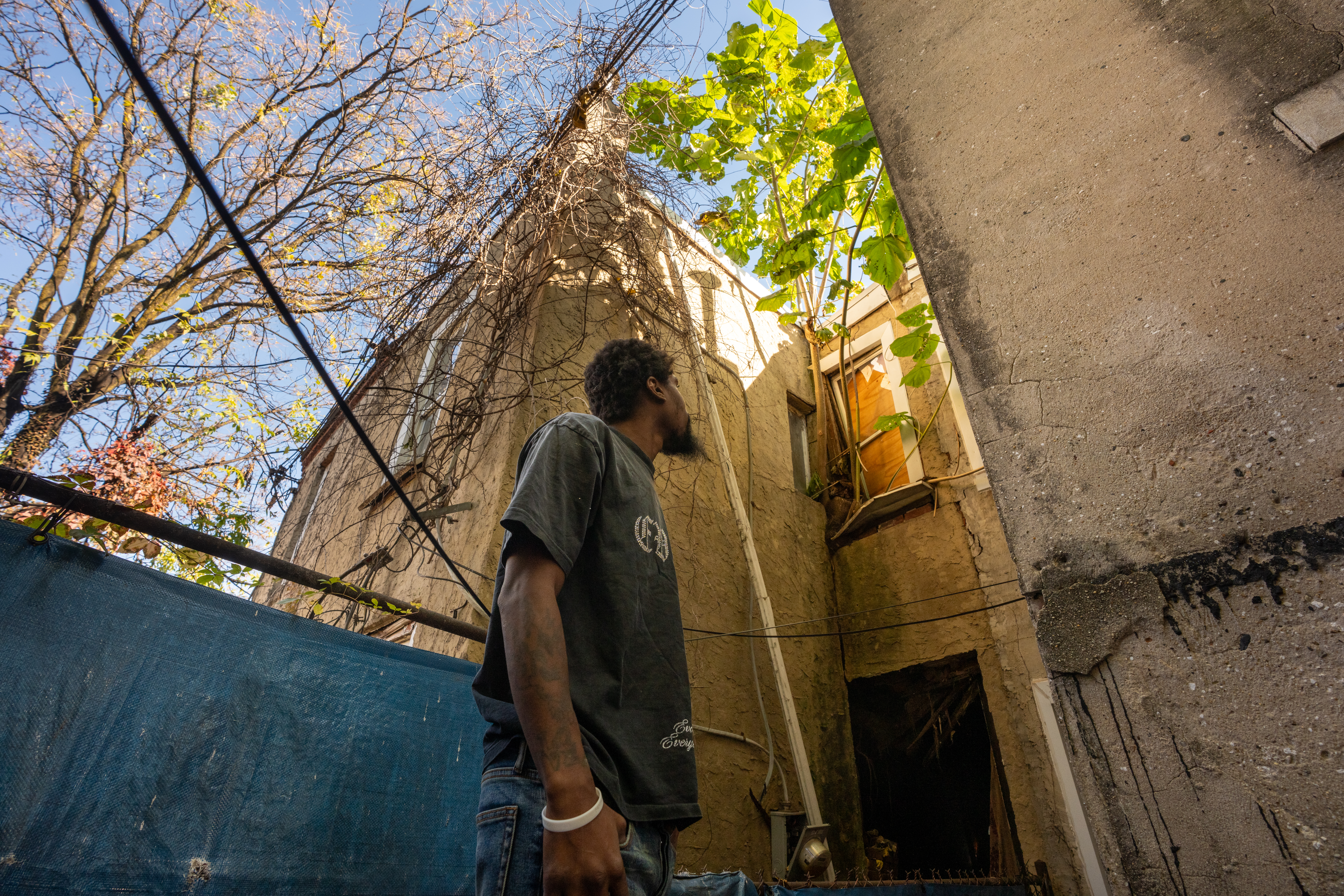
    Renter Dayani Lemmon looks at the abandoned property located next door to his home in North Philadelphia.

    But a 2024 report by the City Controller’s Office said the unit used to have 15 inspectors, which the office said was not enough to keep up with inspections of unsafe and imminently dangerous properties.

    Merenda said L&I is “making do with what we have” and mobilizes inspectors in other units when needed.

    After L&I declares a property to be unsafe or imminently dangerous, it must issue notices to the property owner, who is responsible for repairs. The department can take unresponsive owners to court and pursue demolition in emergency situations, such as when a property is likely to collapse, is next to an occupied building, and has recent structural failures, Merenda said. The city demolishes imminently dangerous buildings in order of the risk officials determine they pose.
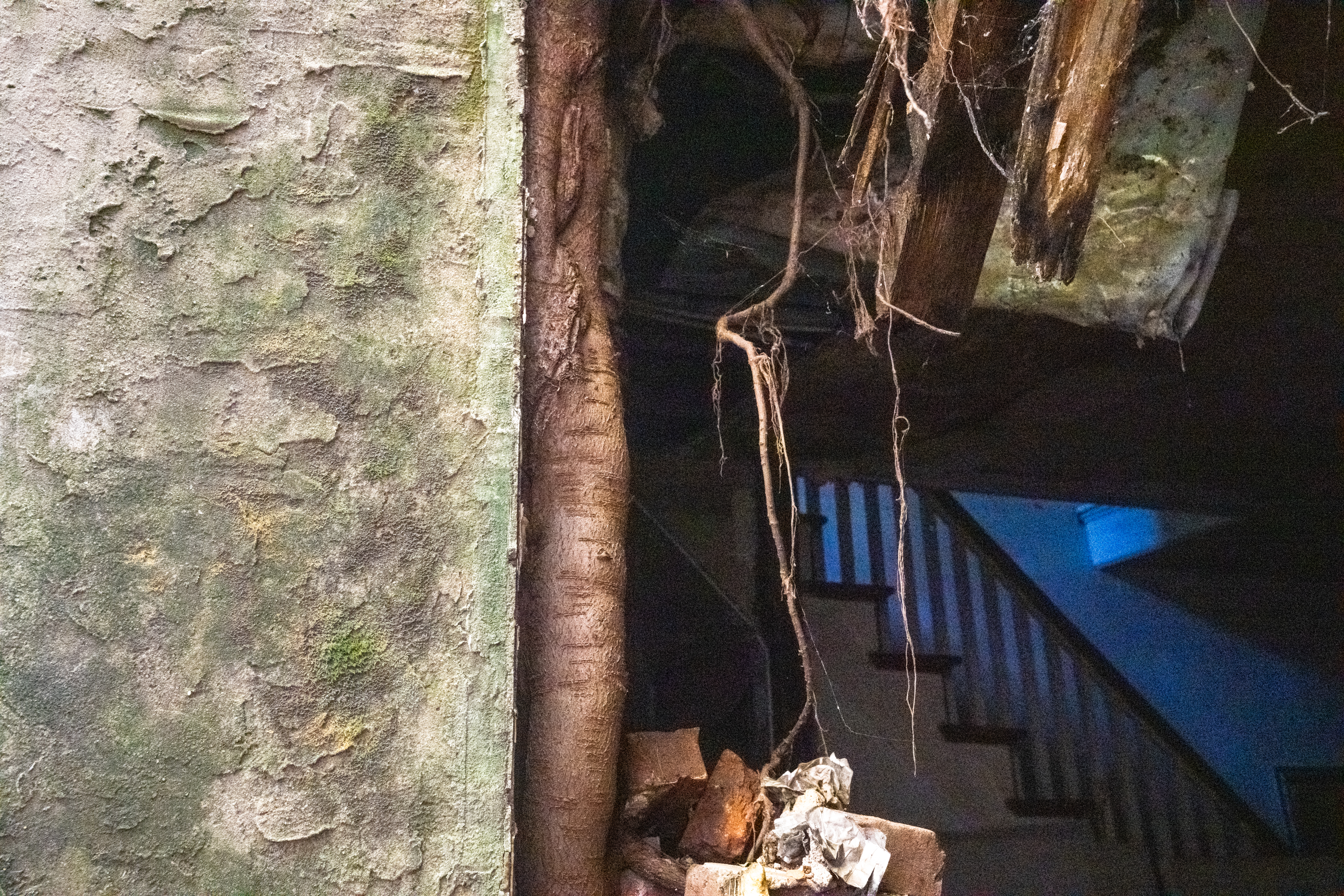
    A tree can be seen growing inside the vacant North Philadelphia rowhouse through a hole in the back wall, which partially collapsed this summer.

    The city charges owners for tear-down costs and places liens on properties if they do not pay.

    L&I was unable to say how many such tear-downs the department has conducted this year and referred questions about the cost of demolitions — and the proportion of those costs recouped from owners — to the city’s Department of Revenue. The revenue department did not provide any figures to The Inquirer.

    “In many, many cases, property owners surface at the last minute and request a continuance, request a temporary restraining order from us going in and demolishing the property,” Merenda said. “And you know, that’s the purview of the courts. It’s beyond us.”

    In the meantime, people living next to dangerous properties are left in the dark.
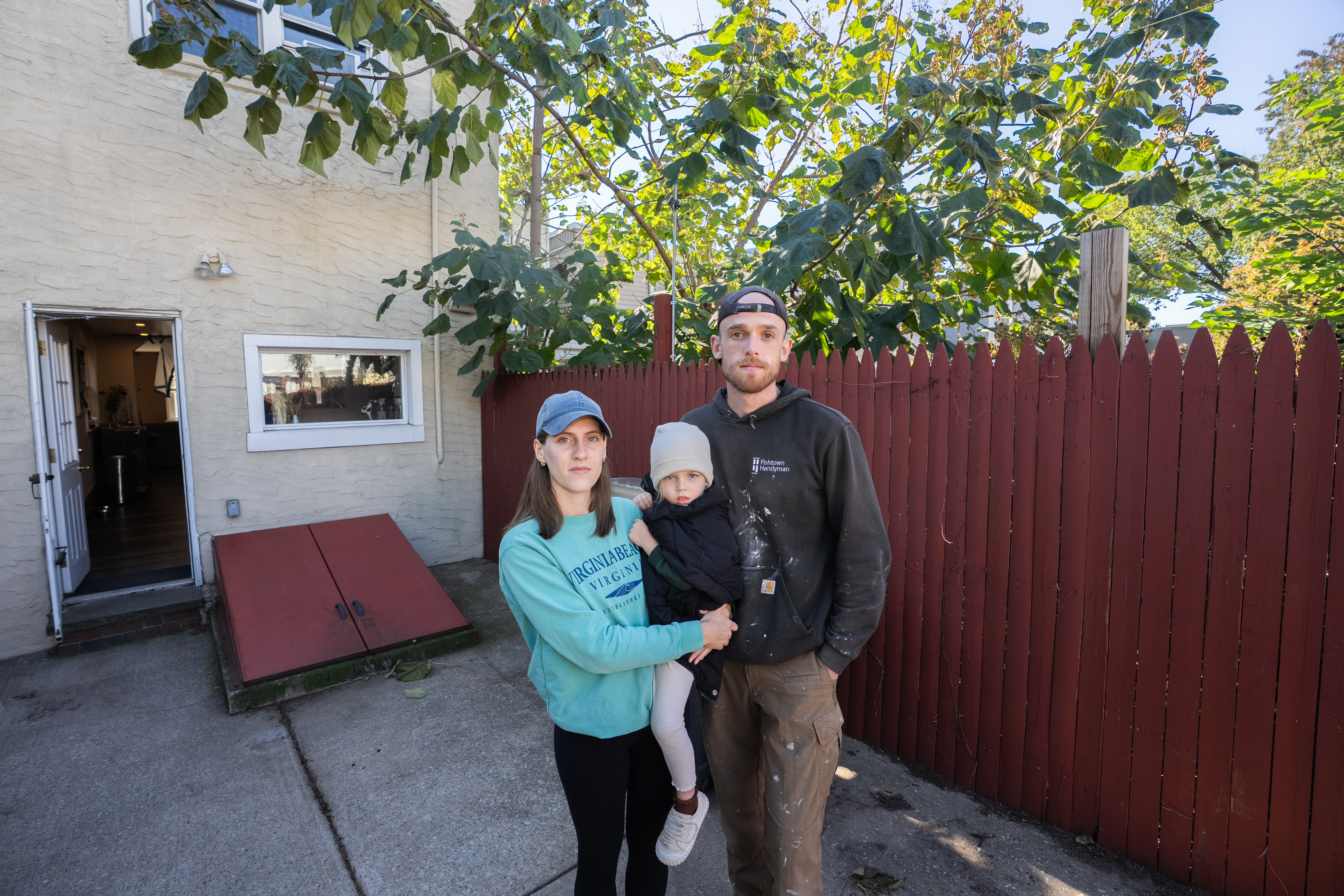
    Kate and Dan Thien and their daughter stand in the backyard of their Port Richmond home, the foundation of which is cracking because of weed trees next door.

    Frustrated with L&I

    After the back of the abandoned rowhouse on North Woodstock Street opened up this summer, Phillips led an L&I inspector through her home so he could see.

    “He went in the backyard, he looked over and was like, ‘My god!’” Phillips said. “I said, ‘Yeah, I can see right through their house.’ And he looked up and was like, ‘It’s a tree!’ I said, ‘Yeah, the tree is pushing the house out.’”

    The inspector put an orange “imminently dangerous” notice on a front window, and Phillips and her landlord thought they wouldn’t have to worry much longer. But days after the notice went up, it was ripped down.
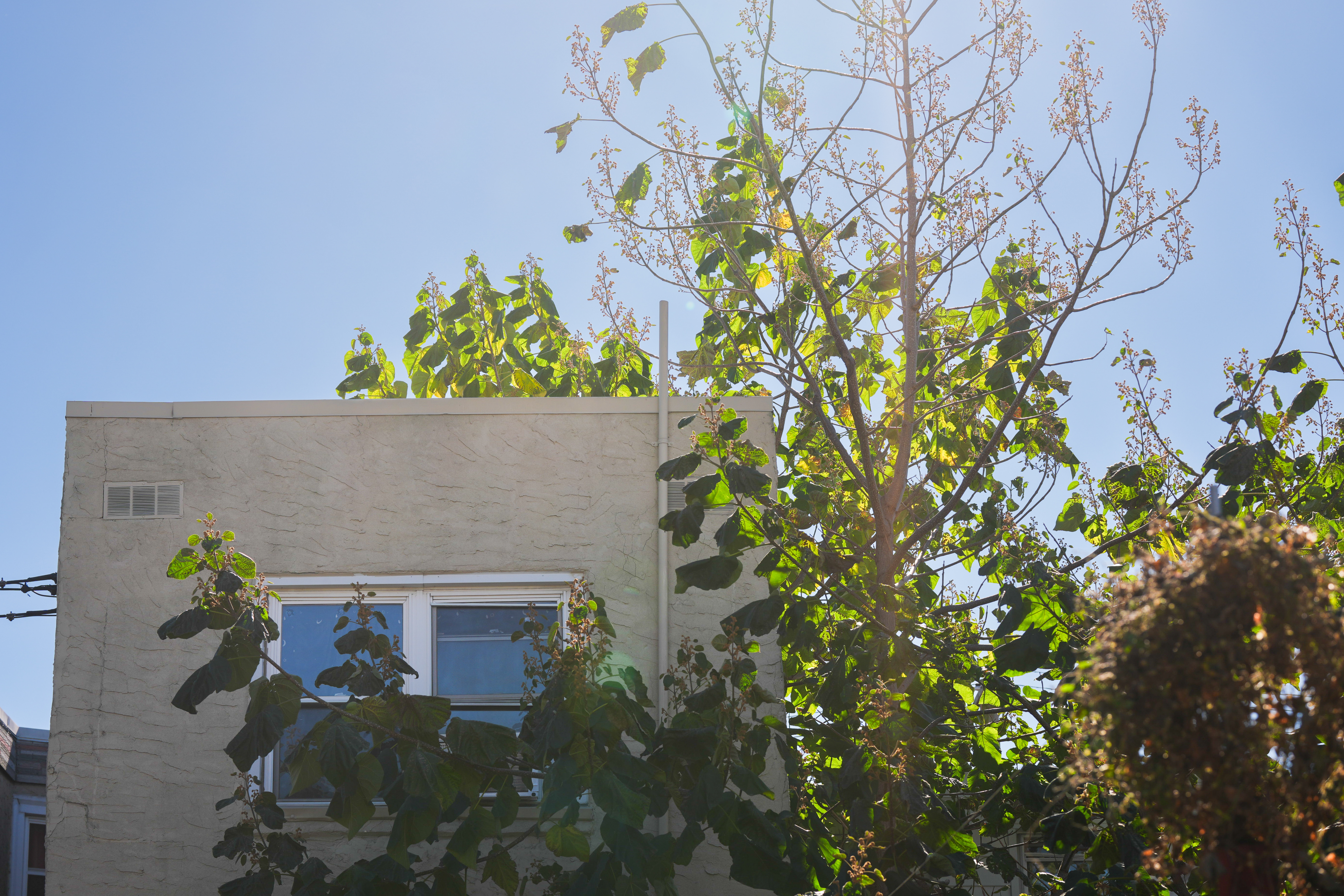
    Weeds from the neighboring vacant property surround Kate and Dan Thien’s home in Port Richmond.

    The property has attracted rats and mice. Water leaked into Phillips’ basement until her landlord reinforced the shared wall with concrete.

    For months, her landlord got no response from the city to her calls and emails asking for help.

    On Nov. 20 — 3 ½ months after the partial collapse — an L&I inspector visited the vacant rowhouse to post a “final notice” that the owner must repair or demolish the home or else the city will have it demolished.

    Kate and Dan Thien are trying to live with the vacant property next to their rowhouse in Port Richmond as they wait for the city to respond to their 311 complaints.

    When they bought their house in February 2024, they saw that the neighboring backyard was a mess, but they didn’t know the house was vacant.

    Renters who had lived in what is now the Thiens’ home had used and maintained the neighboring backyard. But it quickly became overgrown. Neighbors later told the Thiens that the home had been vacant for more than a decade.
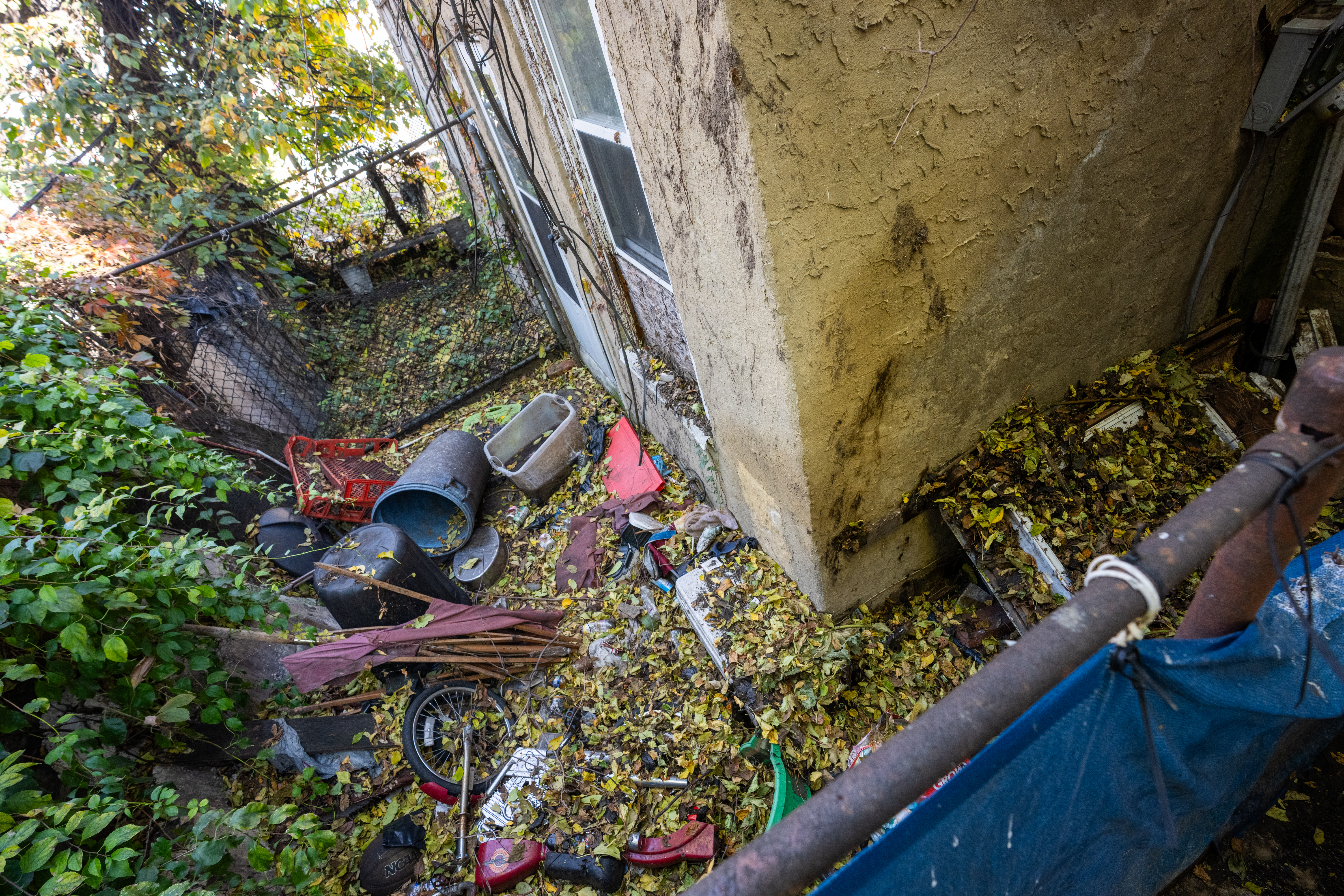
    The backyard of the abandoned North Philadelphia rowhouse is full of debris.

    “Pretty much the entire neighborhood knows about this house,” Kate Thien said.

    She and neighbors on the other side have filed complaints with the city. The property has racked up 19 violations since 2012. Public records show that the city cited the property for “high weeds” last fall and most recently inspected it last December. The property passed inspection.

    A year later, a weed tree’s branches stretch above and behind the Thiens’ two-story home. Tree roots are growing into their home’s foundation and cracking the concrete. Trees are “very rapidly growing” as Thien waits for the city to do something, she said. She worries about her home’s property value as the situation worsens.
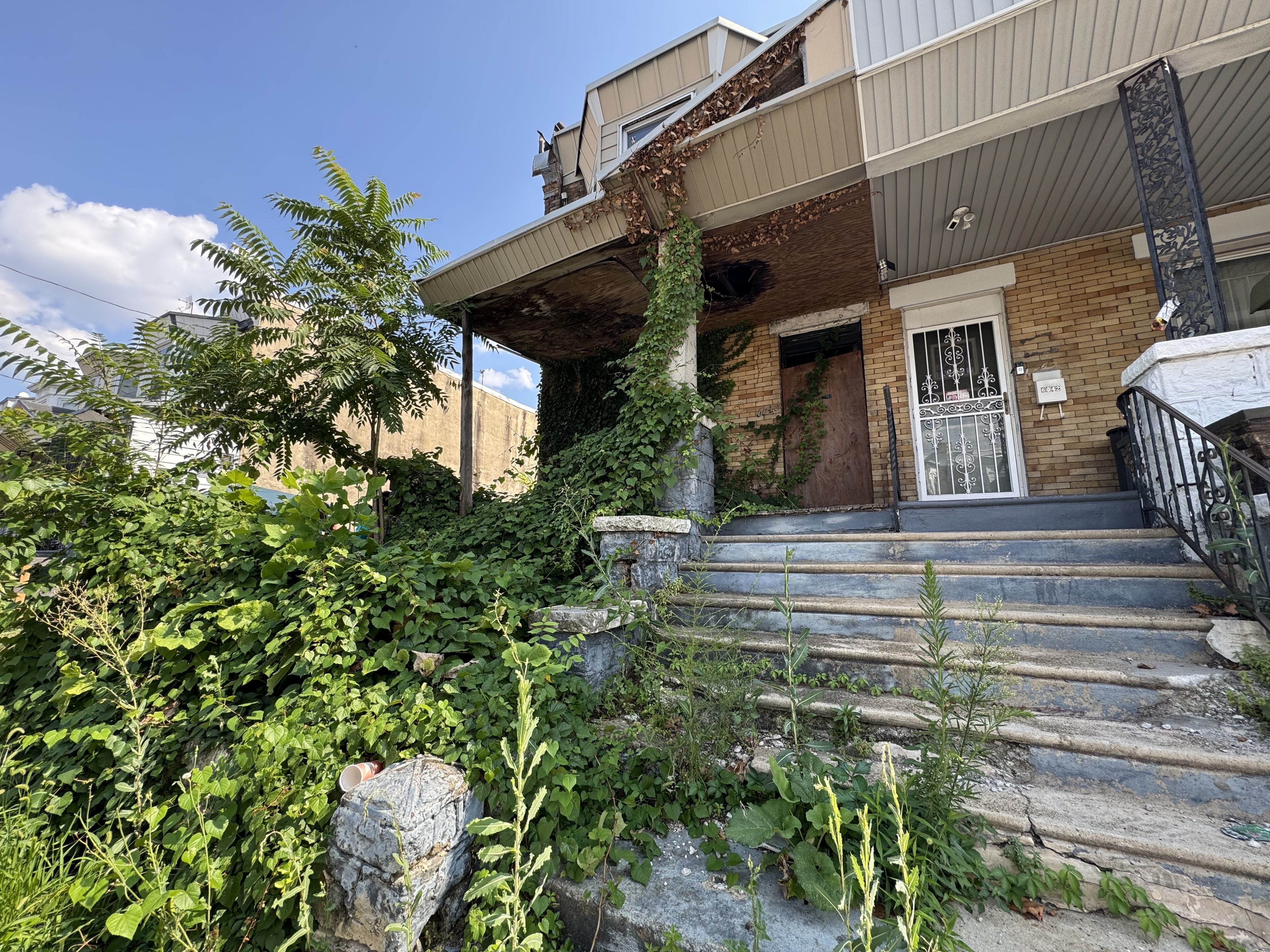
    This abandoned property on Spruce Street in West Philadelphia, pictured on July 30, was one of the houses on a list of problem vacant properties compiled by OnePA West/Southwest Rising.

    “It’s not going away,” she said.

    Annette Randolph and her husband, Dennis, live in a Point Breeze rowhouse next to a home that’s been vacant for more than a decade and that the city classifies as unsafe, a step below imminently dangerous. Four generations of her family have lived in her home. She hopes she’s not the last.

    A tree growing inside the vacant house burst through its back roof, next to a tarp-covered hole. Randolph has had to repair her own roof because of damage from next door. Water gets into her basement.

    The home’s legal owners are dead. A scheduled sheriff’s sale in 2011 for overdue property taxes gave Randolph hope for a resolution. But right before the sale, someone paid part of the tax bill to stop it.
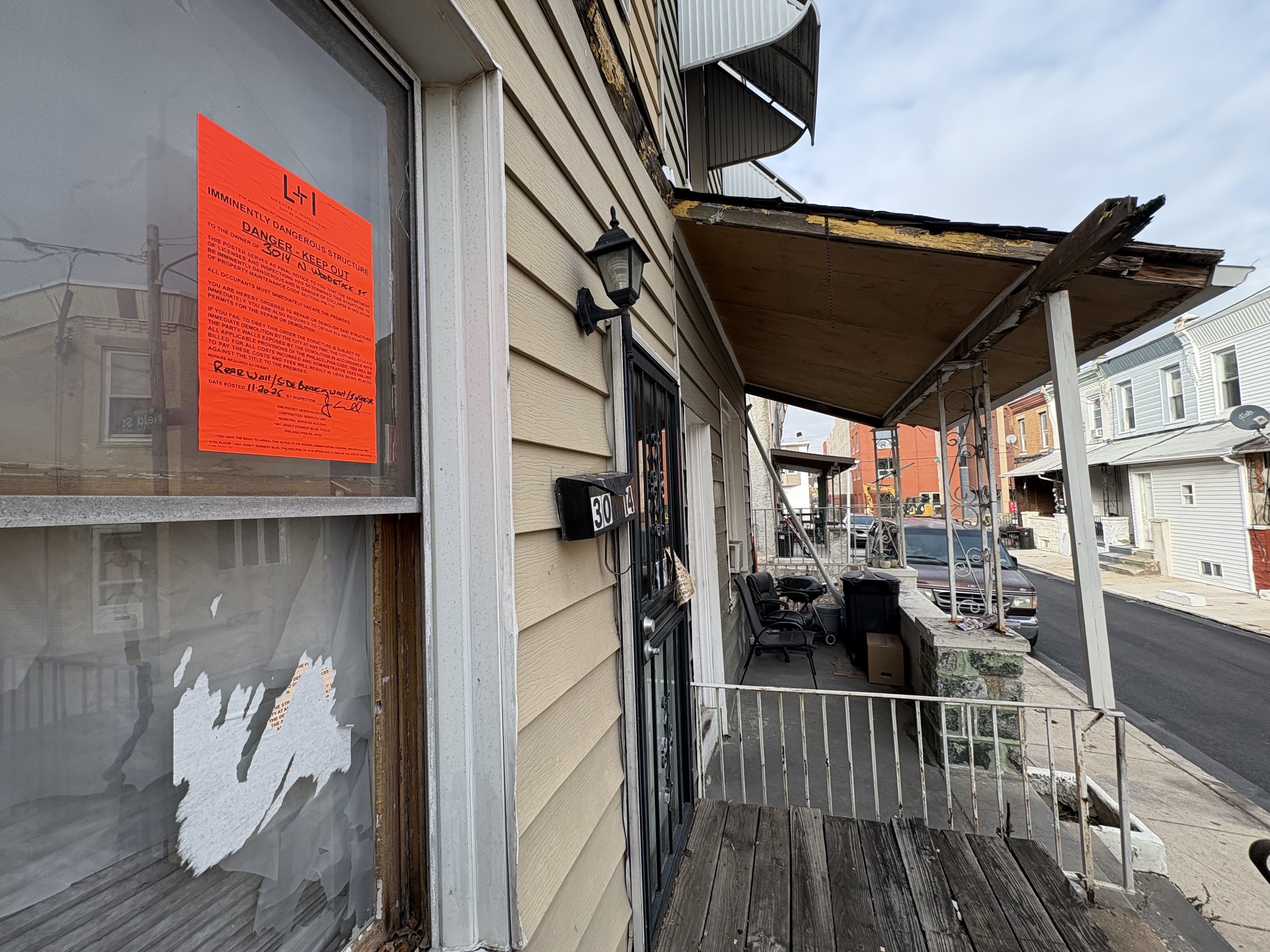
    On Nov. 20, an inspector with Philadelphia’s Department of Licenses and Inspections posted a final notice on the vacant North Philadelphia rowhouse that says owners must repair or demolish the home.

    Now, “for sale” signs hang in the front windows, and a contractor showed up last week. Randolph hopes any work on the house won’t damage the one she’s called home for 66 years.

    She has lost track of the number of times she’s called 311 about the situation. She’s felt helpless. When she needed new homeowner’s insurance, companies told her they wouldn’t insure her or would charge more because of the attached vacant and unsafe house.

    “L&I and the city I blame for allowing this type of stuff to happen,” Randolph said.

    Merenda said L&I hears neighbors’ complaints, “and we’re going to try to take action as efficiently and properly as possible.”

    “I want to make, during my watch, L&I more accessible, responsive, and accountable to the neighbors, stakeholders, contractors, developers, average citizens, the City Council,” he said.
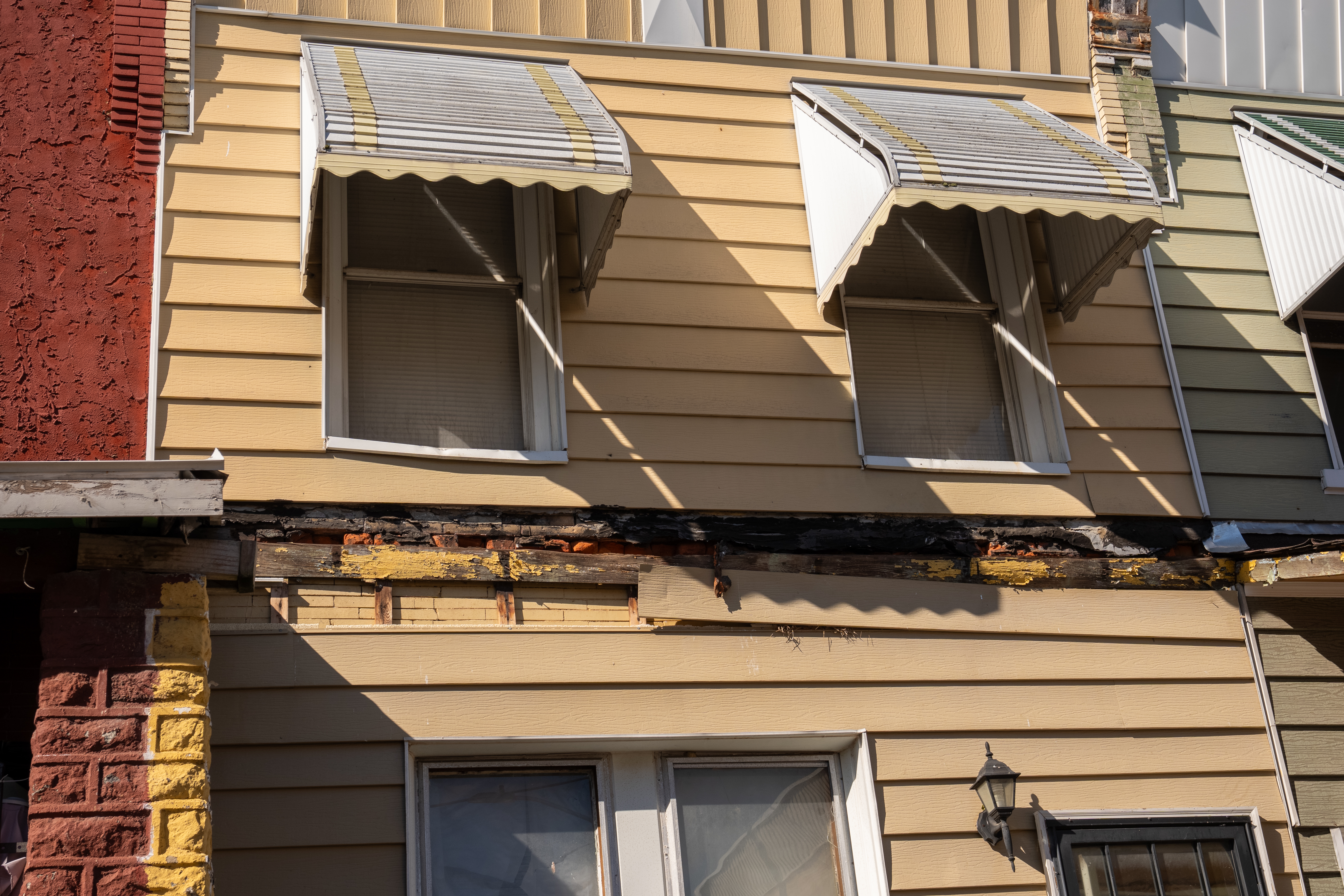
    A collapsing roof was removed but the rest of the vacant rowhouse was left to deteriorate.

    Neighbors band together

    In September 2024, OnePA West/Southwest Rising launched its campaign to get the city to deal with abandoned properties.

    The group created a list of 20 of the worst ones as submitted by neighbors. Among the vacant buildings, some had collapsing porches, one’s basement had flooded and damaged a neighbor’s house, and one’s walls were crumbling. Some had squatters, including a property where human waste was dumped in the backyard.

    City Councilmember Jamie Gauthier’s office got the group a meeting with staff at L&I this January.

    As a result, this summer, the group celebrated successes: five lots cleaned by the Pennsylvania Horticultural Society, three properties cleaned and sealed by the city, five properties whose owners the city took to court, and three properties that were repaired and returned to use.

    The group believes it was able to get L&I to act because it had the weight of a Council member behind it.

    “I do think L&I is overwhelmed. I don’t think they have enough staff to really stay on top of this,” said Eric Braxton, project director for OnePA West/Southwest Rising. “But clearly there are people in leadership that care about our communities and are trying to do the right thing.”

    Now the group plans to push for systemic change. It wants the city to make small repairs to stabilize vacant buildings and charge the owners.

    “There’s a gap in the system when it comes to dealing with unsafe abandoned buildings,” Braxton said. “The result of that is that those buildings just get worse and worse until they are imminently dangerous and have to be demolished.”


  • Quinta Brunson wants thousands of Philly kids to have free school field trips

    Quinta Brunson wants thousands of Philly kids to have free school field trips

    Quinta Brunson wants you to dig into your pocket to make free field trips possible for Philadelphia students.

    The actor, writer, and comedian — along with Philadelphia School District officials and the leader of the district’s nonprofit arm — announced the “Quinta Brunson Field Trip Fund” on Tuesday.

    District teachers and administrators will be able to apply for money for field trips by completing a short application subject to evaluation by an independent, internal group of educators. Field trip grants will be made twice a year.

    Brunson, of Abbott Elementary fame, grew up in West Philadelphia and spent time in district and charter schools. She named her smash-hit TV show, now in its fifth season, for Joyce Abbott, her sixth-grade teacher at Andrew Hamilton Elementary.

    Field trips — including ones Abbott’s class sold hoagies to pay for — were a seminal part of her Philly education, Brunson said in a statement.

    “They opened my world, sparked my creativity, and helped me imagine a future beyond what I saw every day,” Brunson said. “Going somewhere new shows you that the world is bigger and more exciting than you believe, and it can shape what you come to see as achievable. I’m proud to support Philadelphia students with experiences that remind them their dreams are valid and their futures are bright.”

    “Abbott Elementary” star Quinta Brunson watches the Phillies play the Atlanta Braves during a taping of the show in Philadelphia in August.

    Every Abbott Elementary season has featured a field trip episode, including visits to Smith Playground, the Franklin Institute, and the Philadelphia Zoo. Brunson’s fund “will remove the financial barriers that too often limit our children’s access to these enrichment opportunities,” officials for the Fund for the School District of Philadelphia said.

    The GivingTuesday launch kicked off with an unspecified donation from Brunson herself.

    Kathryn Epps, president and CEO of the Fund for the School District of Philadelphia, said getting students out of their classrooms is crucial.

    “We are honored to partner with Quinta to expand these experiences for children in Philadelphia’s public schools, helping them to envision and realize any future they desire,” Epps said.

    Tony B. Watlington Sr., Philadelphia School District superintendent, said he was grateful to Brunson.

    “We want our students to venture out and bridge what they’re learning in the classroom to engaging, real-world learning experiences,” Watlington said. “This commitment to equitably expanding opportunities for students to have experiences outside of their classroom will help accelerate student achievement and we are becoming the fastest improving, large urban school district in the nation.”

  • The Philadelphia scientists who studied garlic-flavored breast milk won a 2025 Ig Nobel Prize

    The Philadelphia scientists who studied garlic-flavored breast milk won a 2025 Ig Nobel Prize

    Philadelphia didn’t take home any Nobel Prizes this year, but work illuminating how babies respond to garlic-flavored breast milk at Monell Chemical Senses Center did get recognized by its satirical counterpart, the Ig Nobel Prize.

    Founded in 1991 by mathematician Marc Abrahams, the Ig Nobel Prize honors “achievements so surprising that they make people LAUGH, then THINK,” according to the Massachusetts-based organization’s website.

    Julie Mennella, a longtime scientist at the center in West Philadelphia, and Gary Beauchamp, Monell’s former director, won the prize earlier this fall for their 1991 study published in the academic journal Pediatrics that disproved popular folklore around breastfeeding.

    Their study examined whether eating garlic would flavor a mother’s breast milk and, if so, how a nursing baby would react to it.

    At the time, breastfeeding women were often told to eat bland foods, for fear their babies would reject strong flavors. However, the study’s results showed the opposite: Babies savored the garlic-flavored breast milk.

    “That simple, elegant study really showed how one of the first ways we learn about foods is through what our mothers eat,” Mennella said.

    These early life experiences shape food preferences and influence cultural food practices around the world, she emphasized. Babies whose mothers come from cultures in which garlic is a defining flavor would have experienced garlic long before their first meal.

    Mennella spoke with The Inquirer about the implications of her Ig Nobel Prize-winning work and her decades of research on flavor sciences and early nutritional programming.

    The following conversation has been lightly edited for length and clarity.

    What did you discover in your Ig Nobel Prize-winning study?

    We found in this study that not only did the milk get flavored with garlic, but contrary to a lot of the folklore, the babies actually liked it. They nursed longer when the milk was garlic-flavored than when it was bland and devoid of garlic.

    We went on to show that when women eat garlic, the flavor of amniotic fluid also gets altered.

    Through these first exposures, babies are learning about what mom is eating, what mom has access to, and what mom likes before their own first taste of solid food.

    What is the takeaway for breastfeeding mothers?

    Eat the healthy foods that you enjoy because your baby’s going to learn about the food. Food is much more than a source of calories. In many cases, it defines who we are as a people.

    What other flavors have you studied?

    A wide variety of flavors, from vanilla to even alcohol if a woman drinks it, get transmitted and flavors the milk. If women smoke, the tobacco flavor does, too. So it’s not only what you eat, but what you breathe.

    Why is it important for babies to learn about food this way?

    There’s a great story about the European rabbit (an animal that nurses), where they tagged the mother’s diet with juniper berry. What they were able to show is that in a group where the mothers ate juniper berry during either pregnancy or lactation, once those young rabbit pups left the nest, they were more likely to forage on juniper berry.

    So, she’s telling them, ‘These are the foods that are out there. I’m eating them. They’re safe.’ It’s really a very elegant, sustainable behavior, how moms transmit this information about the foods in the environment. She’s teaching her young and giving them an advantage early on.

    How long do these flavors last in the milk?

    Depending on the size of the chemical, some will get in fast. Garlic gets in a couple hours after the mom eats it, and then if she stops eating, it’s out of the milk like four or five hours later. The sensory experience of that baby is changing throughout the course of the day, day to day, depending on what she eats.

    What research have you been up to since?

    I’ve gone into so many different directions of looking at not only early flavor learning, but also nutritional programming. I also looked at the taste of medicine in children, looking at individual differences because taste is the primary reason for noncompliance. Children have a harder time because they can’t encapsulate the bad taste in a pill or tablet, so liquid medicines are particularly difficult.

    One study where we looked at variation in the taste of pediatric Motrin (among adult participants) was really interesting. Some people experience a tingle when they taste it. Others don’t. It makes you think that how one child tastes Motrin isn’t like how another does. If you don’t experience the tingle, or this burning sensation, all you taste is a sweet liquid, and those are the children that may be at risk of over-ingestion.

    What is your favorite project that you have worked on since the garlic study?

    I serendipitously found that another flavor that gets transmitted is alcohol, and that became a whole new area of research.

    We found that when women just have the equivalent of one or two glasses of wine or beer, not only did the alcohol get transmitted, but it flavored the milk. That became a lead article in the New England Journal of Medicine.

    At that time, there was talk about a folklore that women should drink when they’re breastfeeding, so they would make more milk. And contrary to that folklore, they actually made less milk.

    How did it feel to win an Ig Nobel?

    It was so nice to celebrate science. That’s really what that award does: It uses humor to teach about science.

  • Colman Domingo will deliver Temple University’s commencement speech next May

    Colman Domingo will deliver Temple University’s commencement speech next May

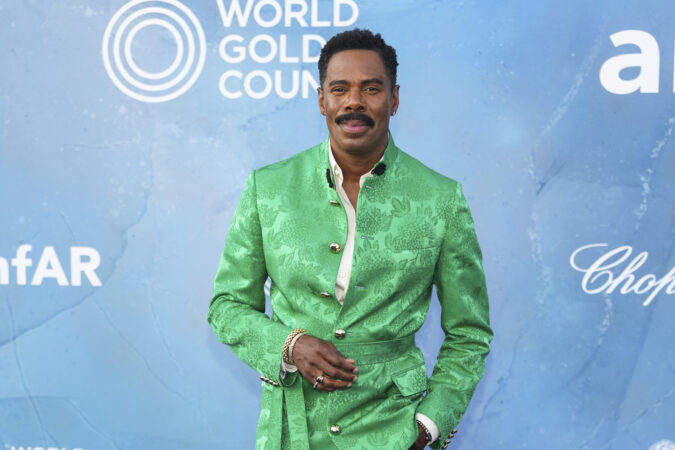
    Emmy Award-winning actor and self-confessed dandy Colman Domingo will deliver the commencement address at Temple University this spring, the university announced Thursday.

    Domingo, a native of West Philadelphia, will also receive an honorary degree during the ceremony that will be held at the school’s Liacouras Center on May 6, 2026. Domingo went to Overbrook High School before coming to Temple University in the late 1980s to study journalism.

    It was at Temple that Domingo developed a love for theater after a teacher told him he had a special gift. In 1991, with only 50 credits to go, he dropped out and moved to California to pursue a career in acting.

    Domingo said returning to Temple for the university’s commencement ceremony will be a full circle moment for him.

    “I am beyond grateful and humbled to receive an honorary doctorate from Temple University,” he said in a statement. “As a journalism student who struggled with the balance of working two jobs … this degree is very meaningful to me.”

    Domingo stars in the action movie The Running Man, in theaters now. He received consecutive nominations for the Academy Award for best actor in 2023 and 2024 and this year he was one of the co-chairs for the Met Gala, celebrating the opening of The Metropolitan Museum of Art’s groundbreaking fashion exhibit, “Superfine: Tailoring Black Style.”

    Domingo was named one of Time magazine’s 100 most influential people in 2024.

    Past commencement address speakers and honorary award recipients at Temple include fellow West Philadelphian Quinta Brunson, Bishop Desmond Tutu, and North Philly native basketball coach Dawn Staley, among others.

  • People who are self-employed could become exempt from paying a Philly business tax | City Council roundup

    People who are self-employed could become exempt from paying a Philly business tax | City Council roundup

    Philadelphia-based independent contractors and others who are self-employed could soon become exempt from paying certain business taxes as part of a measure aimed at easing tax burdens on small businesses.

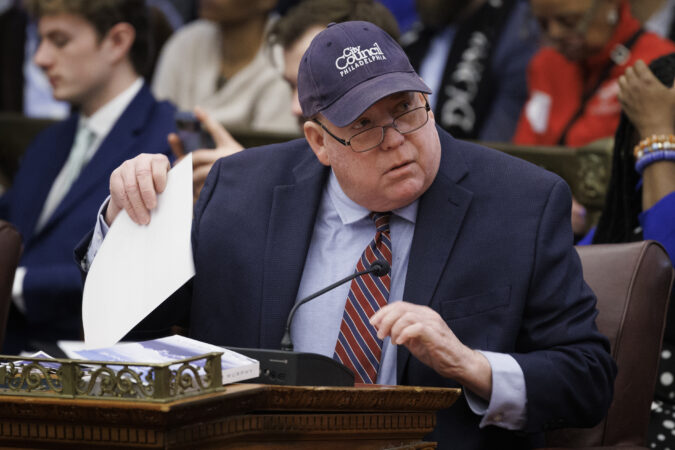
    City Councilmember Mike Driscoll, a Democrat who represents parts of Northeast Philadelphia, introduced legislation Thursday to carve out entrepreneurs, sole proprietorships, and businesses that have only one employee from having to pay the city’s business income and receipts tax, commonly known as BIRT.

    Also on Thursday, members floated legislation to address the rising cost of water bills and introduced a bill to make it easier for restaurants to secure outdoor dining permits.

    What was the meeting’s highlight?

    Relief for the small(est) businesses: The bill is likely to find support in Council, where lawmakers have been searching for ways to provide relief to small businesses after earlier this year eliminating a popular tax break that allowed companies to exclude their first $100,000 in income from business taxes in Philadelphia.

    That exemption effectively meant that thousands of small businesses did not have to pay the tax. However, Mayor Cherelle L. Parker’s administration in June successfully moved to eliminate the exemption, saying the city was likely to lose a court battle over the matter.

    The change came after a medical device manufacturer sued the city, saying the exemption violated state law, which includes a “uniformity” clause that prohibits municipalities from creating different classes of taxpayers.

    Now, thousands of businesses newly have to pay the BIRT beginning with 2025 tax bills that are due in April. If Driscoll’s measure is adopted, it would begin in the 2026 tax year, meaning that eligible business owners would see the exemption when paying taxes due in April 2027.

    He said the legislation addresses concerns from small businesses that the impending tax bills will be financially unsustainable for them.

    “A $50,000 business should not face a $3,200 tax hike,” Driscoll said. “That is not policy. That is displacement.”

    Driscoll said that the city’s law department approved his legislation and that he is confident it does not violate the uniformity clause.

    What else happened this week?

    Making water more affordable: Council will consider a package of legislation to address rising water bills. Councilmember Jamie Gauthier of West Philadelphia introduced three measures:

    • A bill that expands eligibility for payment assistance programs to people who earn up to 300% of the federal poverty level. (This year, the FPL is $32,150 for a family of four.) There is currently a tiered assistance structure for people who earn up to 250%.
    • A bill requiring that the city reduce a resident’s water bill if it rose because of a water meter failure that lasted more than a year.
    • A resolution to hold hearings on whether lawmakers can expand assistance programs to renters. The Philadelphia Water Department does not allow bills to be in renters’ names.

    A spokesperson for Gauthier said the package of legislation has 10 cosponsors — a majority of Council — making it likely to pass.

    Parker opposes incineration ban: A Council committee on Monday advanced a bill to ban the city from incinerating trash, over the objections of Parker’s administration.

    Currently, the city sends about two-thirds of the trash it collects to landfills and one-third to a waste-to-energy incinerator in Chester operated by Reworld, formerly known as Covanta.

    Both of those contracts expire June 30, and Gauthier wants to prohibit the Parker administration from signing a new deal.

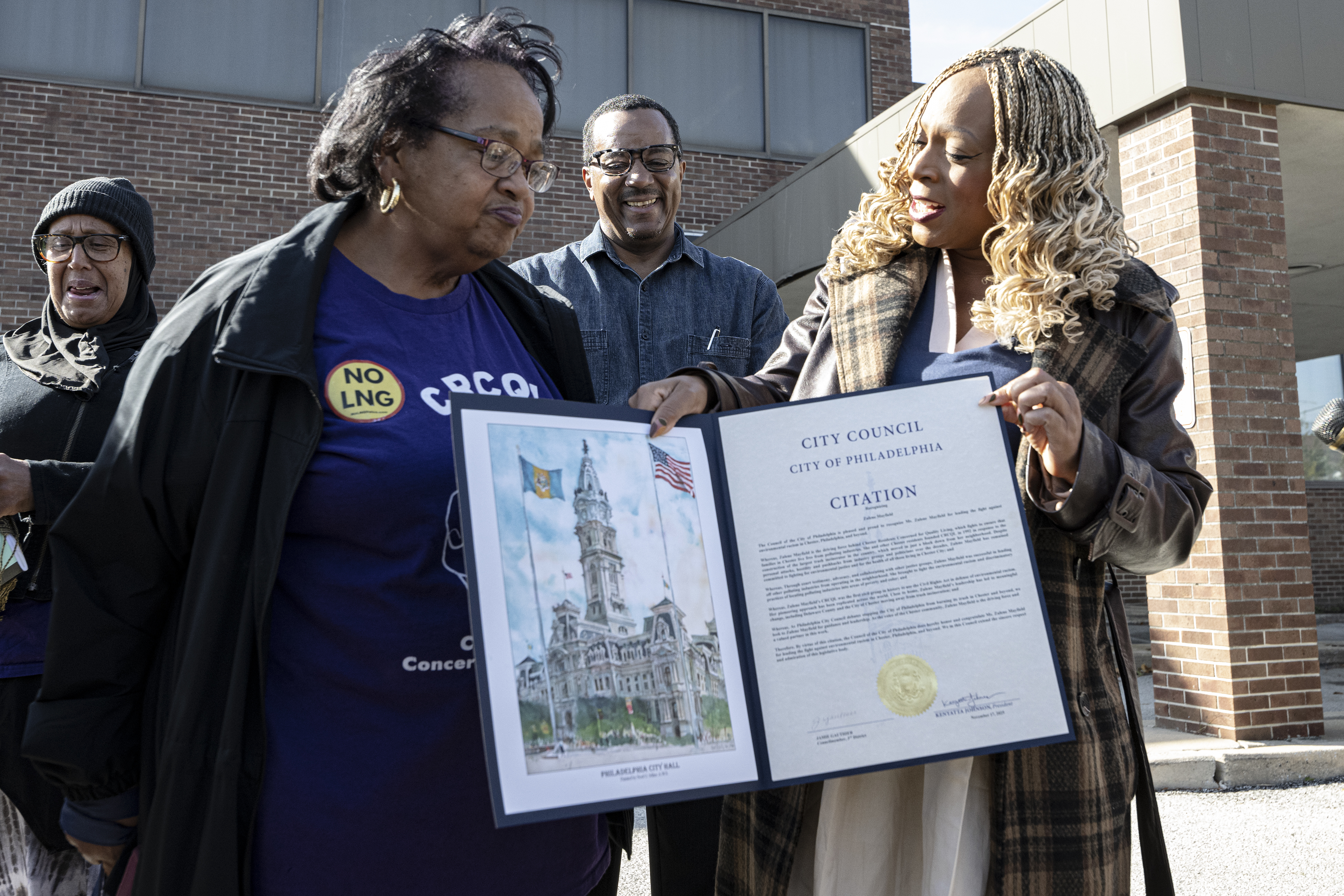
    Chester resident Zulene Mayfield, left, Philadelphia Councilmember Jamie Gauthier, right, and Chester Mayor Stefan Roots meet to discuss Gauthier’s “Stop Trashing Our Air Act,” which would ban the city from incinerating waste, during a visit with lawmakers and staff in Chester, Pa., on Friday, Nov. 7, 2025.

    On Monday, Chester officials pleaded with Philly to end its relationship with the facility, saying it contributes to high rates of illness.

    Reworld defended its record, saying it exceeds government regulations.

    Carlton Williams, who leads the Philadelphia Office of Clean and Green Initiatives, asked lawmakers to hold off approving a ban on incineration to allow the city time to study the issue.

    But the committee approved the measure, sending it to the full Council for a vote as early as Dec. 4.

    Dining out: Council is taking another crack at streamlining the city’s drawn-out permitting process for outdoor dining.

    The outdoor dining area at Booker’s Restaurant and Bar at 5021 Baltimore Ave. in 2021.

    Councilmember Rue Landau, who represents the city at-large, said it can take more than a year and a half for restaurants to get licensed if they are not in areas around Center City and a handful of commercial corridors in other neighbors.

    Beyond those locations, restaurants must get their district Council person to sponsor zoning legislation, which can take months.

    Landau introduced legislation Thursday to expand the “by-right” areas where sidewalk cafes can exist without special zoning. Where the areas are expanded to will be up to district Council members.

    Quote of the week

    Danny Garcia trains for an upcoming fight in August 2024.

    All in the family: Council members on Thursday honored boxer Danny Garcia, a North Philly native and an illustrious fighter who is retiring from the sport. He appeared in Council chambers to thank members and tell the city how much he loves it back.

    Staff writers Jake Blumgart and Beatrice Forman contributed to this article.

  • Creative resistance is as American as apple pie — especially in Philadelphia

    Creative resistance is as American as apple pie — especially in Philadelphia

    Art matters. And because it does, artists and art institutions have been targets of authoritarian regimes from Red Square to Tiananmen Square. Black Lives Matter Plaza, located near the White House, was removed in March. That same month, President Donald Trump issued an executive order targeting the Smithsonian Institution and interpretive signs at National Park Service sites, including the President’s House.

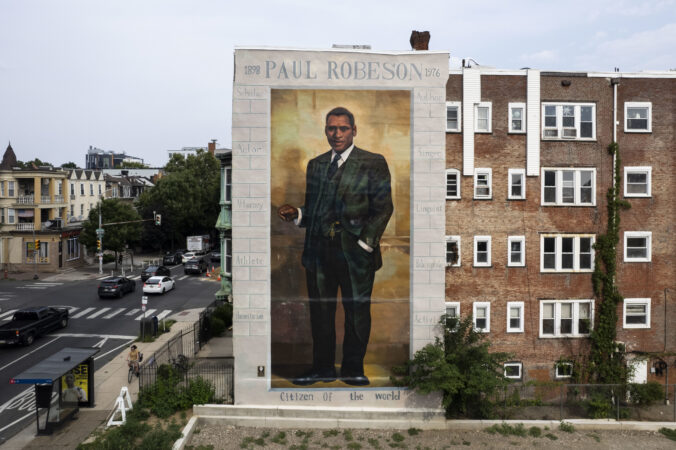
    Paul Robeson, athlete, singer, actor, and human rights activist, lived his final years in West Philadelphia. At a protest rally in London in 1937, Robeson said: “The artist must elect to fight for freedom or for slavery. I have made my choice. I had no alternative.”

    With democracy now under assault, “Fall of Freedom,” a national artist-led protest, has issued a call for creative resistance, of actions against authoritarian control and censorship, to take place in venues nationwide beginning Friday.

    “Fall of Freedom is an urgent reminder that our stories and our art are not luxuries, but essential tools of resistance,” Pulitzer Prize-winning playwright Lynn Nottage wrote in a statement. “When we gather in theaters and public spaces, we are affirming our humanity and our right to imagine a more just future.”

    Creative resistance is as American as apple pie, and this city is, after all, the birthplace of our democracy.

    The political cartoon “Join, or Die,” published in 1754 in the Pennsylvania Gazette, became a symbol of the American Revolution and stoked public opinion against Britain.

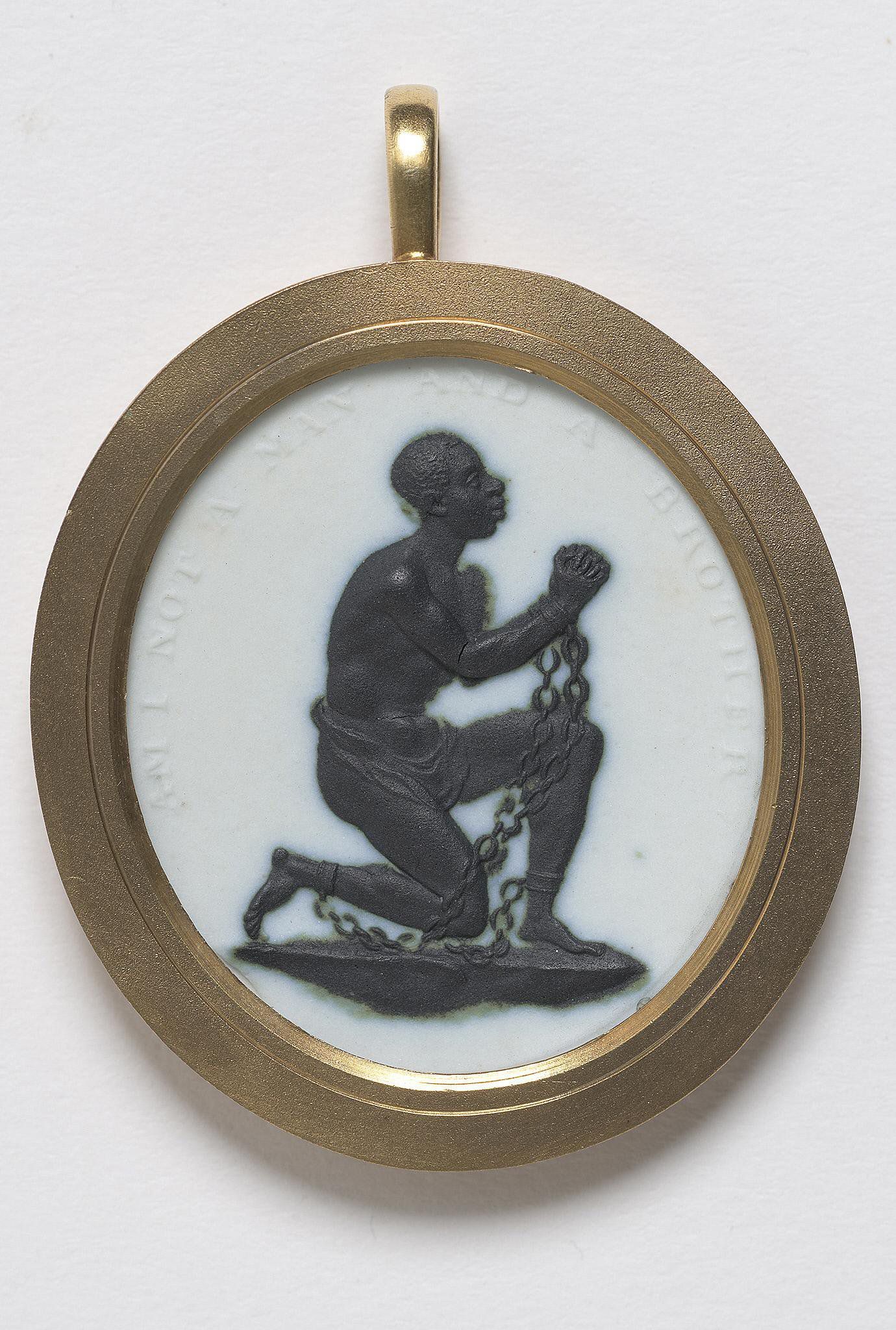
    During his tenure as president of the Pennsylvania Abolition Society, Benjamin Franklin helped distribute Josiah Wedgwood’s anti-slavery medallion “Am I Not a Man and a Brother.” In a letter to Wedgwood, Franklin wrote, “I am persuaded [the medallion] may have an Effect equal to that of the best written Pamphlet in procuring favour to those oppressed people.”

    Wedgewood medallion with the words “Am I not a man and a brother” in relief along the edge, ca. 1780s, from the collection of the Philadelphia Museum of Art. The museum’s education materials on the medallion stipulate that it was “modeled by William Hackwood and fabricated by Josiah Wedgwood in England in 1787 for the Society for Effecting the Abolition of the Slave Trade, this medallion functioned as a potent political emblem for promoting the abolition of slavery. It reached the United States in 1788, when Wedgwood sent a batch to Philadelphia for former enslaver and ‘cautious abolitionist’ Benjamin Franklin to distribute.”

    And indeed it did. Wedgwood’s engraving became the iconic image of the anti-slavery movement. It was printed on broadsides, snuffboxes, decorative objects, and household items. Abolitionist art was part of domestic life in Philadelphia.

    The American Anti-Slavery Society, whose founding members included Philadelphians James Forten, Lucretia Mott, and Robert Purvis, commissioned a copper token featuring a related “Am I Not a Woman and a Sister” design. Proceeds from the sale of the token were used to fund the abolition movement.

    Abolitionists used art to create a visual language of freedom. Artists created illustrations and paintings that showed “how bad slavery was.” There were theatrical performances and public readings of Harriet Beecher Stowe’s Uncle Tom’s Cabin, the best-selling novel of the 19th century.

    Robert Douglass Jr. studied at the Pennsylvania Academy of the Fine Arts. He is considered Philadelphia’s first African American photographer. Active with the National Colored Conventions movement, Douglass created a counternarrative to derogatory racial stereotypes. His daguerreotype of Francis “Frank” Johnson, a forefather of jazz, is in the collection of the Historical Society of Pennsylvania.

    On the heels of the Jazz Age, a group of religious activists formed the Young People’s Interracial Fellowship in North Philadelphia in 1931. The fellowship brought together Black and white congregations for dialogue, cultural exchange, and joint activism.

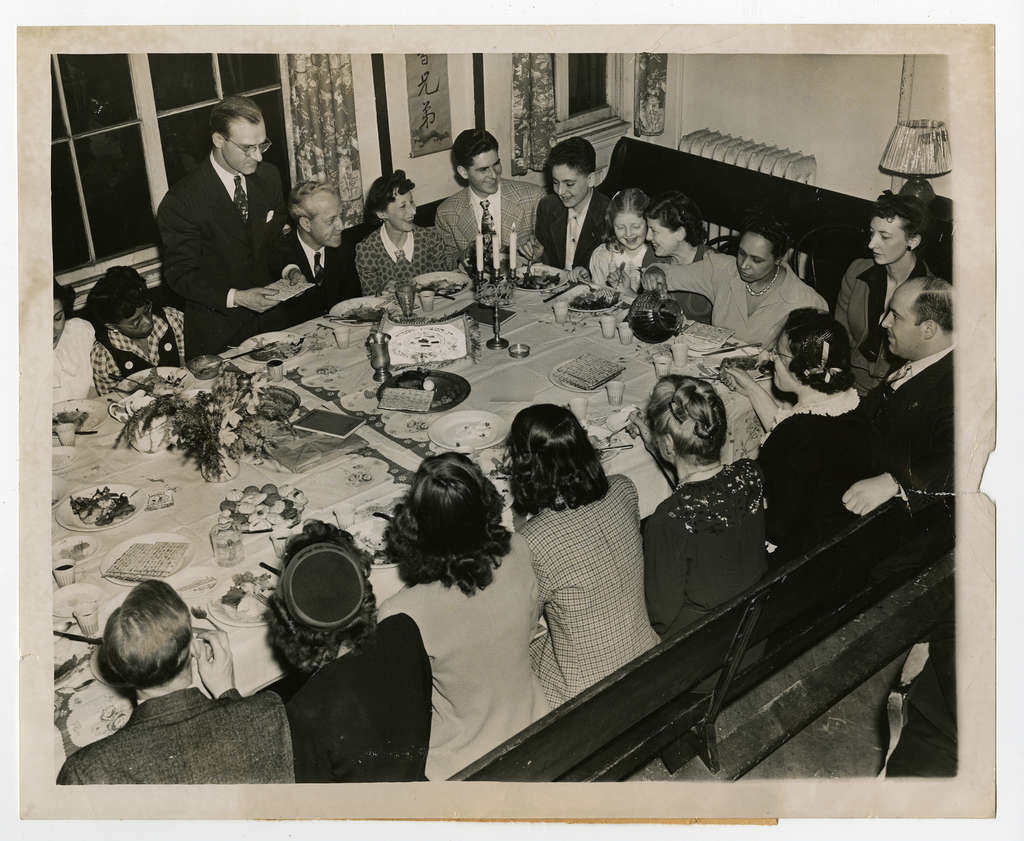
    A 1944 seder at Fellowship House.

    In 1941, the organization evolved into Fellowship House, whose mission was to resist racial discrimination through education, cultural programs, and community organizing.

    Notable cultural figures who spoke at Fellowship House include Marian Anderson, Dave Brubeck, and Robeson. In April 1945, seven months before the release of the short film The House I Live In, Frank Sinatra, the film’s star, stopped by Fellowship House to speak about the importance of racial tolerance. He told the young people that “disunity only helps the enemy.”

    The film’s title song, an anti-racism patriotic anthem, became one of Sinatra’s signature songs.

    Abel Meeropol, an educator, poet, and songwriter, composed both the film’s title song, “The House I Live In,” and the anti-lynching poem and song, “Strange Fruit,” which would become inextricably associated with one of Philadelphia’s jazz greats.

    Born on April 7, 1915, at Philadelphia General Hospital in West Philly, Billie Holiday, née Eleanora Fagan, is one of the greatest jazz singers of all time.

    No artist has met the moment with more courage than Lady Day, whose 1939 recording of “Strange Fruit” was named song of the century by Time magazine in 1999, and was added to the National Recording Registry in 2002.

    Strange Fruit is a timeless and empowering act of creative resistance.

    While Holiday is sui generis, jazz musicians were the vanguard of the civil rights movement.

    At so-called black and tan clubs like the Down Beat and the Blue Note, Black and white people intermingled on an equal basis for the first time.

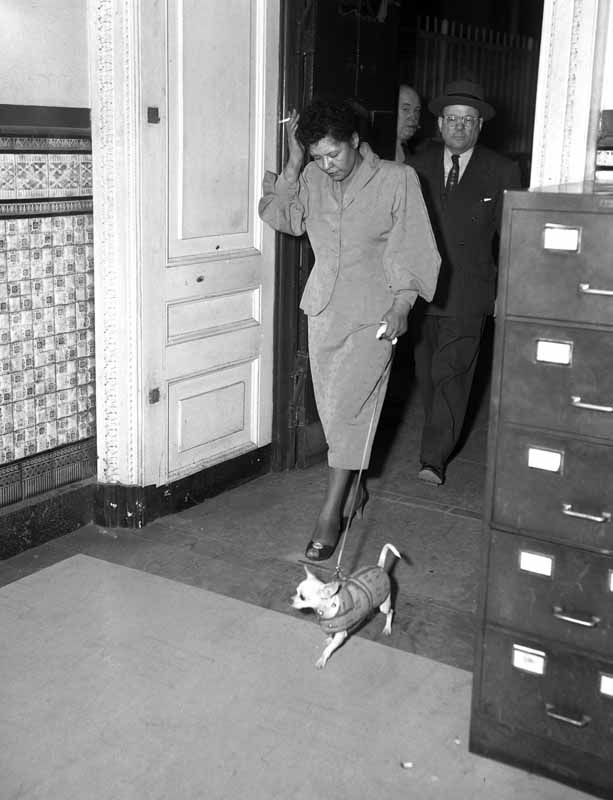
    Billie Holiday leaving City Hall in 1956 after her release following a drug bust. Police Capt. Clarence Ferguson walks behind her.

    Jazz clubs were constantly harassed by Philadelphia police led by vice squad Capt. Clarence Ferguson and his protégé, Inspector Frank Rizzo. The nightspots became battlegrounds in the struggle for racial justice. Jazz musicians’ unbowed demeanor fashioned a new racial identity.

    In remarks to the 1964 Berlin Jazz Festival, the Rev. Dr. Martin Luther King Jr. riffed on the importance of jazz and the jazz culture. He observed: “It is no wonder that so much of the search for identity among American Negroes was championed by jazz musicians. Long before the modern essayists and scholars wrote of racial identity as a problem for a multiracial world, musicians were returning to their roots to affirm that which was stirring within their souls.”

    “Much of the power of our Freedom Movement in the United States has come from this music,” he added. “It has strengthened us with its sweet rhythms when courage began to fail. It has calmed us with its rich harmonies when spirits were down.”

    At a time when our constitutional rights are being trampled and American history is being whitewashed, I am answering “Fall of Freedom’s” call — as a cultural worker and as a Philadelphian.

    Under the “Fall of Freedom” banner, and in collaboration with Scribe Video Center, I will lead a walking tour of Holiday’s Philadelphia.

    We will trace her footsteps through Center City and South Philly. We will visit the clubs where she sang, the hotels where she stayed, and the site of the jazz club immortalized in the Tony Award–winning play Lady Day at Emerson’s Bar and Grill. Along the way, we will also highlight places connected to Robeson.

    Courage is contagious. When we gather on South Broad, we are the resistance.

    Faye Anderson is the founder and director of All That Philly Jazz, a place-based public history project. She can be contacted at phillyjazzapp@gmail.com.

  • SEPTA trolley tunnel will stay closed until next week

    SEPTA trolley tunnel will stay closed until next week

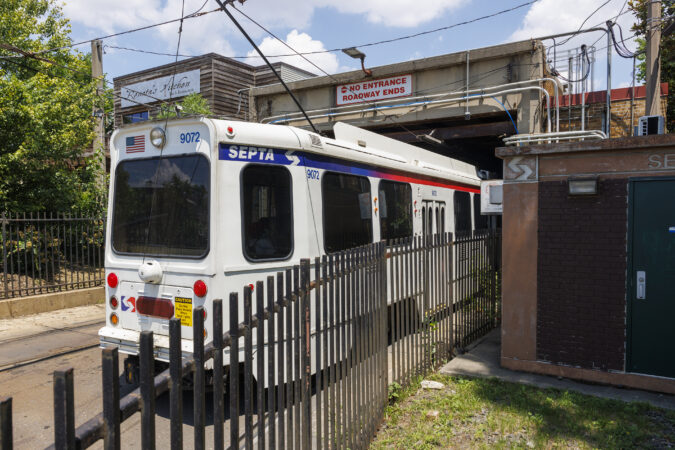
    Philadelphia’s trolley tunnel has been closed for most of the last two weeks as SEPTA contends with glitches in the connection between the overhead catenary wires and the pole that conducts electricity to the vehicle.

    The tunnel will remain closed at least until next week for repairs, and city trolleys will operate from West Philadelphia. Riders can take the Market-Frankford El to get to and from Center City to 40th and Market Streets.

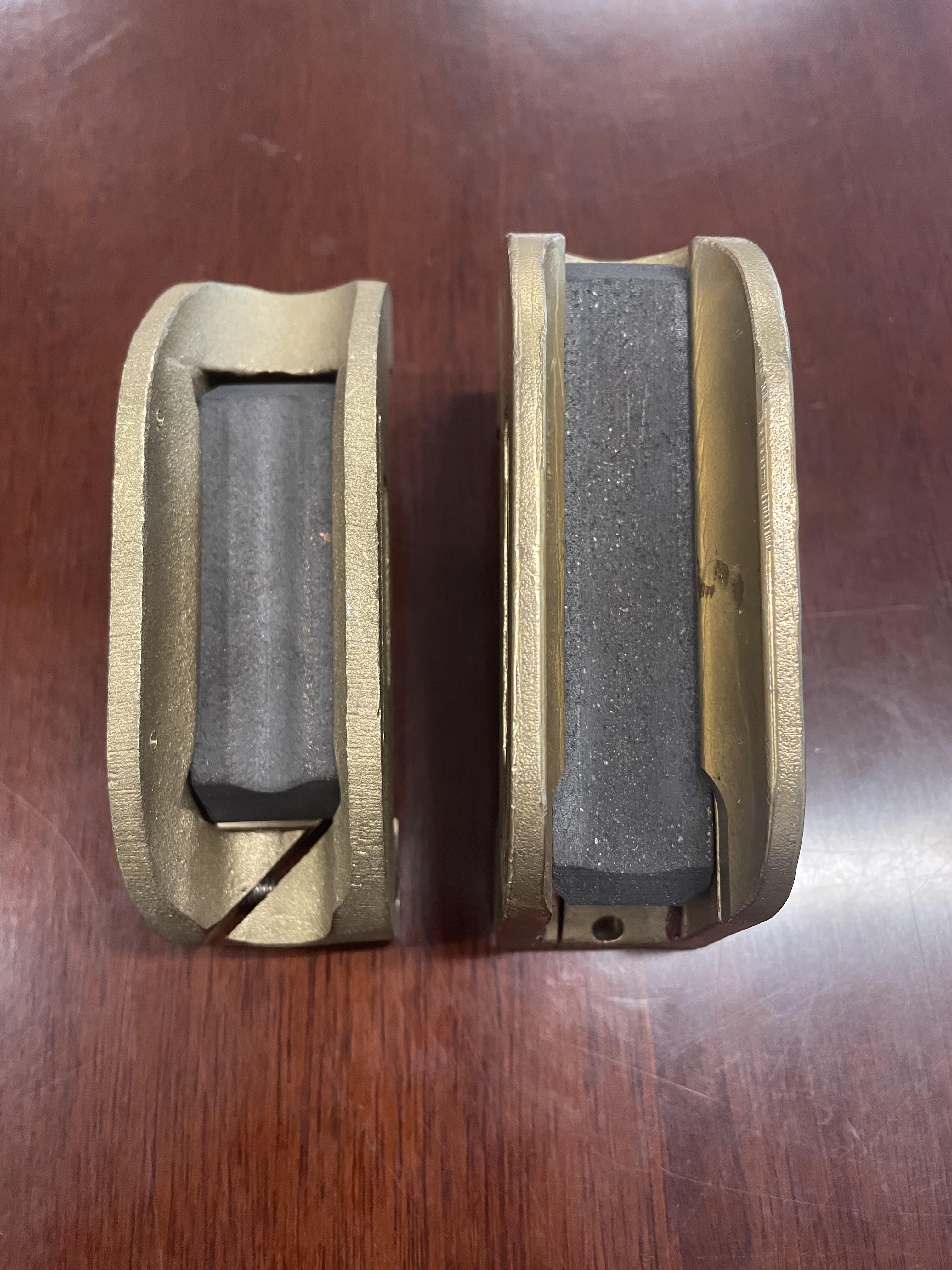
    At issue is a U-shaped brass part called a slider that carries carbon, which coats the copper wires above that carry electricity.

    “There’s a lot of friction and heat. The carbon acts as a lubricant,” said John Frisoli, deputy chief engineer for SEPTA.

    A 3-inch slider (left) and a 4-inch slider, which coats electric-powered wires with carbon to reduce friction. When they fail, trolleys are stranded.

    Earlier in the fall, SEPTA replaced 3-inch sliders with 4-inch models in an effort to reduce maintenance costs, but the carbon in the longer units wore out sooner than they should have, causing metal-on-metal contact between the trolley and the copper wires.

    Soon after, there were two major incidents when trolleys were stranded in the tunnels. On Oct. 14, 150 passengers were evacuated from one vehicle and 300 were evacuated from a stalled trolley on Oct. 21.

    SEPTA went back to the 3-inch sliders.

    On Nov. 7, SEPTA shut down the tunnel to deal with the issue, which had cropped up again, then reopened it on the morning of Nov. 13, thinking it was solved. But it discovered further damage to the catenary system and the tunnel was closed at the end of the day.

    “It’s just unfortunate that we’re dealing with the damage that decision caused,” said Kate O’Connor, assistant general manager for engineering, maintenance, and construction.

    The transit agency is running test trolleys and has found minimal wear of the wires rather than the extensive wear earlier, O’Connor said. Her department is working on a plan to replace wires by sections and will continue test runs until it’s determined the tunnel is safe for passenger traffic again, she said.

    “We have far more traffic in the tunnel than on the street — all five routes use it — and the overhead system there is more rigid,” O’Connor said.

    Trolleys have been unaffected traveling on the street. Jason Tarlecki, acting chief deputy engineer for power, said that the wires have “a lot more upward flexibility to absorb the shock,” he said, leading to less friction.

    The Federal Transit Administration on Oct. 31 ordered SEPTA to inspect the overhead catenary system along all its trolley routes.

    The directive came in response to four failures of the catenary system in September and October, including the tunnel evacuations.

  • West Philly affordable housing project could finally advance, almost 6 years after it was proposed

    West Philly affordable housing project could finally advance, almost 6 years after it was proposed

    An affordable housing project slated for a junkyard in Cedar Park took a step forward Wednesday, when a Philadelphia judge rejected a neighbor’s challenge. The courtroom victory brings the 104-unit, two-building project, which was conceived in 2020, closer to reality.

    Common Pleas Court Judge Idee Fox ruled that the new zoning of a triangular group of parcels on Warrington Avenue, which allows for buildings up to seven stories, was legal.

    Melissa Johanningsmeier, who lives next to the planned development, sued the city to stop the project in 2023, arguing that the building was inconsistent with the city’s goal of preserving single-family homes in Cedar Park.

    Johanningsmeier said in court filings she would be harmed by the parking, traffic, and loss of green space if the project were to proceed.

    The homeowner told Fox during a two-day October bench trial that there was widespread discontent with the project in the neighborhood.

    The judge seemed skeptical, as Johanningsmeier’s attorney didn’t provide witnesses or evidence to support claims of widespread backlash to the project that has been promoted by City Councilmember Jamie Gauthier.

    It was not for her to decide whether the project was the best idea, Fox said, but whether the zoning was constitutional.

    “If the community is unhappy with what’s being done, they have the right to express their concerns to the councilwoman at the ballot box,” Fox said.

    Junkyard controversy

    The project dates to 2020, when New York affordable housing developer Omni formulated plans to add 174 reasonably priced apartments to the West Philadelphia neighborhood.

    But the developer’s plans for the junkyard at 50th and Warrington met opposition due to the proposed buildings’ height — six stories — and parking spaces for less than a third of the units.

    Omni’s plan required permission from the Zoning Board of Adjustment to move forward, which was more likely to succeed with neighborhood support. So they compromised.

    A new design unveiled in 2021 pushed the buildings back to the edge of the site, to avoid putting neighboring homes in shadow. A surface parking lot would offer 100 spaces for the 104 affordable apartments.

    These concessions appeased almost all of the critical neighbors and community groups. Many of them supported Omni before the Zoning Board of Adjustment, which granted the project permission to move forward.

    But Johanningsmeier remained a critic. She lives on the border of the property and challenged the zoning board’s ruling in Common Pleas Court. Judge Anne Marie Coyle ruled in her favor, arguing the new building “would unequivocally tower over the surrounding family homes.”

    In the aftermath, Gauthier passed a bill to allow the project to move forward without permission from the zoning board. Johanningsmeier then sued over that legislation as well.

    Councilmember Jamie Gauthier in City Council in 2024.

    Affordable housing and fruit analogies

    The issue at the heart of the case was whether a zoning change to allow for large multifamily buildings was considered spot zoning on the small parcel, which Johanningsmeier’s lawyer argued was inconsistent with the types on buildings on surrounding properties.

    Just because the “mega apartment buildings” are for residential use doesn’t make the project similar to the surrounding zoning, which mostly allows single-family homes and duplexes, Edward Hayes, a Fox Rothschild attorney representing Johanningsmeier, told Judge Fox on Wednesday.

    “A cranberry and a watermelon are fruit,” Hayes said. “They are not the same.”

    And while affordable housing is a laudable cause, the attorney said, that doesn’t mean that the city should “shove it down the throat of a community” in the form of large buildings that are out of character with the rest of the neighborhood.

    An attorney representing the developer, Evan Lechtman of Blank Rome, told the judge existing buildings of similar height are nearby, across the railroad track in Kingsessing.

    “We are transforming a blighted, dilapidated junkyard into affordable housing,” the developer’s attorney said.

    Johanningsmeier’s lawyer, Hayes, declined to comment after the ruling, which could be appealed.

    Gauthier celebrated the outcome as a victory against gentrification.

    “Lower-income neighbors belong in amenity-rich communities like this one, where they can easily access jobs, healthcare, groceries, and other necessities,” said Gauthier. ”I hope the court’s ruling puts an end to gratuitous delays.”

    Housing advocates note that the years of neighborhood meetings and lawsuits over the project are an example of why housing, and especially affordable units, has become so expensive to build in the United States.

    In the face of determined opposition from even a single foe, projects can incur millions in additional costs.

    “It’s a travesty that one deep-pocketed opponent has been able to block access to housing for over 100 families in my neighborhood for years,” said Will Tung, a neighbor of the project and a volunteer with the urbanist advocacy group 5th Square. “It’s more expensive than ever to rent or buy here, and this project would be a welcome change to its current use as a derelict warehouse.”

  • A former Philly ward leader was sentenced to a year in federal prison for stealing $140,000 from the ward and his church

    A former Philly ward leader was sentenced to a year in federal prison for stealing $140,000 from the ward and his church

    A former West Philadelphia ward leader and onetime staffer for State Sen. Vincent Hughes was sentenced Wednesday to one year in federal prison for stealing more than $140,000 from his ward and a church where he served as a deacon.

    Willie Jordan, 68, had pleaded guilty to two counts of wire fraud over the summer. During his sentencing hearing Wednesday before U.S. District Judge Harvey Bartle III, Jordan said that he was sorry and that there were no excuses for his misconduct.

    “It was a bad decision,” Jordan said. “It was just wrong.”

    Bartle agreed, telling Jordan that although he appeared to have lived an otherwise noble life — dedicating his time and career to serving the public — stealing from institutions that sought to help people was inexcusable.

    “What’s so disappointing is you had a position of trust … and you abused that position of trust,” Bartle said. “And the amount of money you took were not insignificant sums.”

    Jordan for years was the unpaid leader of the 44th Ward in West Philadelphia and also a deacon at Mount Calvary Baptist Church in North Philadelphia. Prosecutors said that he had near-total control over the finances of both organizations, and that from 2020 to 2024 he took advantage of that status by writing checks to himself to cover personal expenses, including credit card and utility bills, purchases from airlines and furniture stores, and costs associated with a relative’s funeral.

    In all, prosecutors said, he stole more than $57,000 from the church and $85,000 from the ward, and often claimed the money was to reimburse the organizations for expenses they never incurred. To further conceal his wrongdoing, prosecutors said, he sometimes wrote false entries on checks’ memo lines, saying they were to pay for items such as Easter baskets or summer youth programs.

    Much of the fraud occurred while Jordan was working in Hughes’ office, prosecutors said, where he was a longtime top aide and had a six-figure state salary.

    Jordan’s attorney, Sam Stretton, said that Jordan retired from that job earlier this year amid the federal investigation into his crimes, and that he also is no longer a ward leader.

    Assistant U.S. Attorney Louis Lappen said in court that the repeated nature of Jordan’s wrongdoing, and his status as a well-paid public employee, made his crimes stand out.

    “He’s somebody who should have known better,” Lappen said.

    Stretton said Jordan “made a terrible mistake but is an otherwise good person.” He said Jordan has already repaid the $57,000 he stole from the church and is continuing to donate hundreds of dollars per month to help cover its bills and other expenses. Jordan also is continuing to make restitution payments to the ward, Stretton said.

    Several of Jordan’s relatives wept in the courtroom after Bartle imposed his sentence. The judge then paused and addressed Jordan again before adjourning the hearing.

    “You’re going to have to pay the price of your crimes, but there is life after prison, and I hope you will continue to be a useful and productive citizen,” Bartle said. “There is redemption.”

  • 3,000 protested conditions for Philly’s Black students in 1967. Here’s how these city kids remembered it.

    3,000 protested conditions for Philly’s Black students in 1967. Here’s how these city kids remembered it.

    The students walked together, chanting over the hum of Center City traffic, holding a homemade sign and shouting into a chilly November sky.

    “Hey hey!” they yelled. “Ho ho! Black history will never go!”

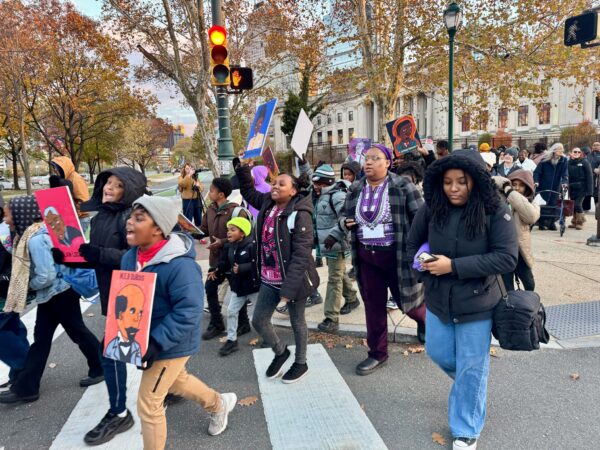
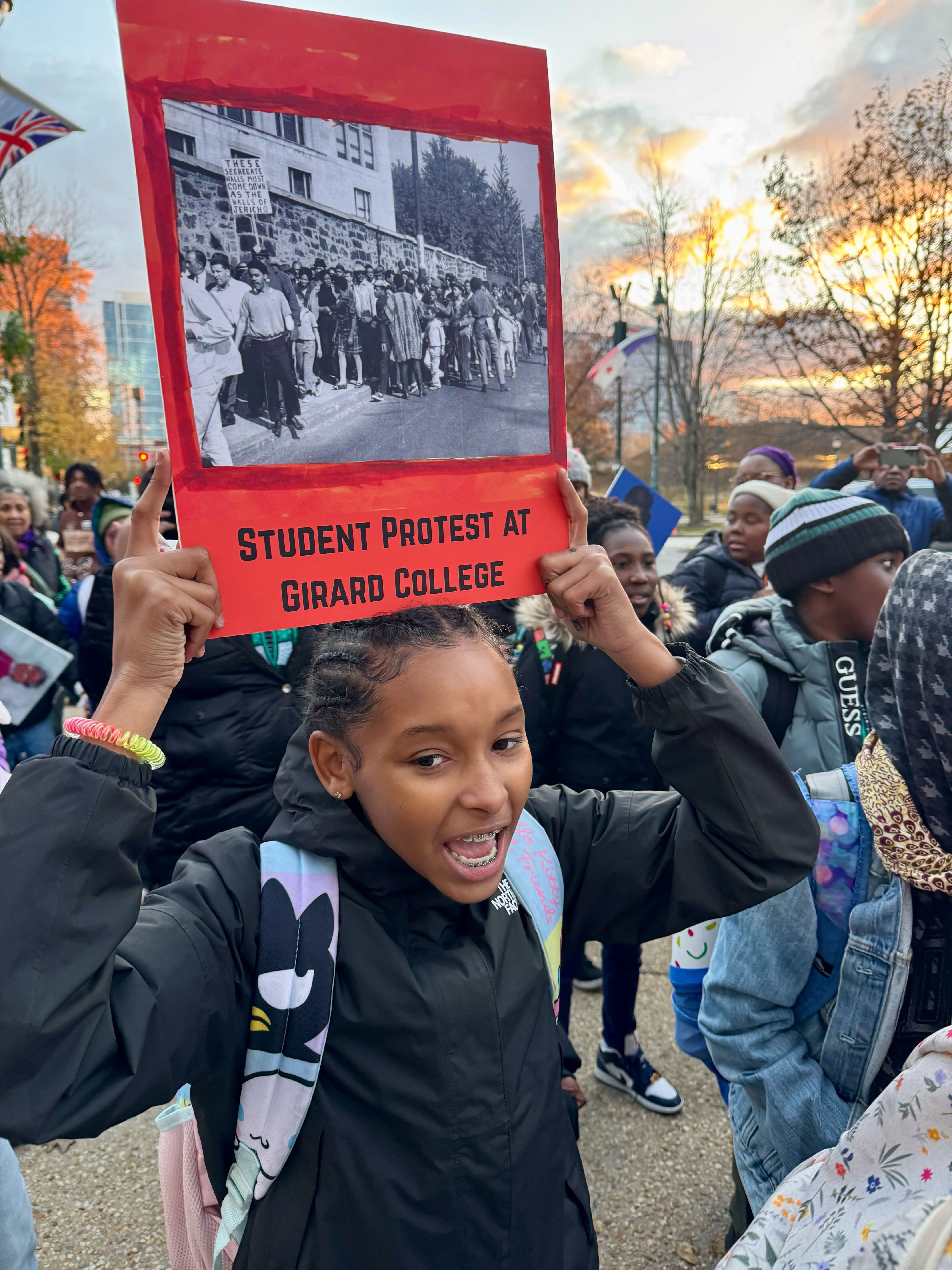
    Fifty-eight years to the day after 3,000 youth and their supporters walked out of Philadelphia School District schools to protest conditions for Black students, a clutch of kids from the Jubilee School held a march Monday to commemorate that landmark action, which historians say was a seminal moment both for the city and school integration across the country.

    Miles Matti, a fifth grader at Jubilee, a private school in West Philadelphia, walked with his brother, Theo, a third grader.

    “We’re doing it because those kids had every right to be heard,” said Miles, 10.

    Students from the Jubilee School walk to commemorate the 1967 Philadelphia student walkout, where thousands of Philadelphia School District students demanded better treatment of Black students.

    The timing of the celebration was important, organizers said — not just on the anniversary of the demonstration, but 20 years after Philadelphia became the first district in the United States to implement African American history as a graduation requirement.

    For months, Jubilee students studied the walkout. They conducted research, wrote poetry, made plans for honoring participants in the demonstration, and mapped a route — from the old School District of Philadelphia headquarters at 21st and the Benjamin Franklin Parkway, to the Free Library’s central branch, where there would be music and stories.

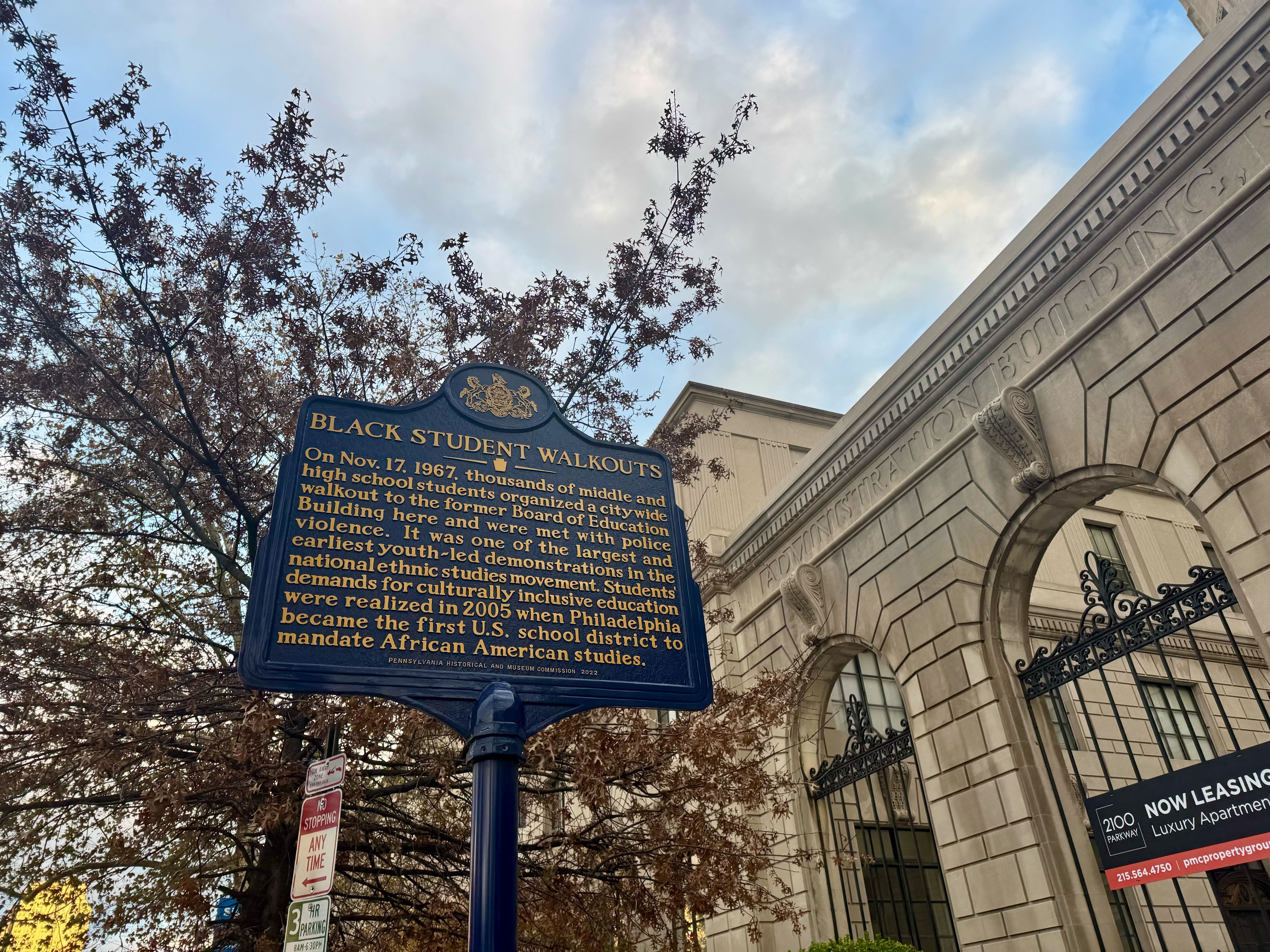
    The group honored four former Masterman students who, in 2020, won approval from the city’s Historical Commission to have a marker permanently erected outside the old district building noting the 1967 walkouts.

    Khaseem Bailey, a sixth grader with a strong voice and energy to spare, led the chants as the group, flanked by teachers, parents, and supporters, made its way down the Parkway.

    It was important to remember, Khaseem said.

    “They were marching for Black rights and student rights,” he said. “And so are we.”

    ‘It was not a flash mob’

    The Nov. 17, 1967, walkout took 10 years to plan, said Walter Palmer, now 91, and one of the chief architects of the event — a decade spent organizing, teaching nonviolent strategies, training students, pairing them with elders.

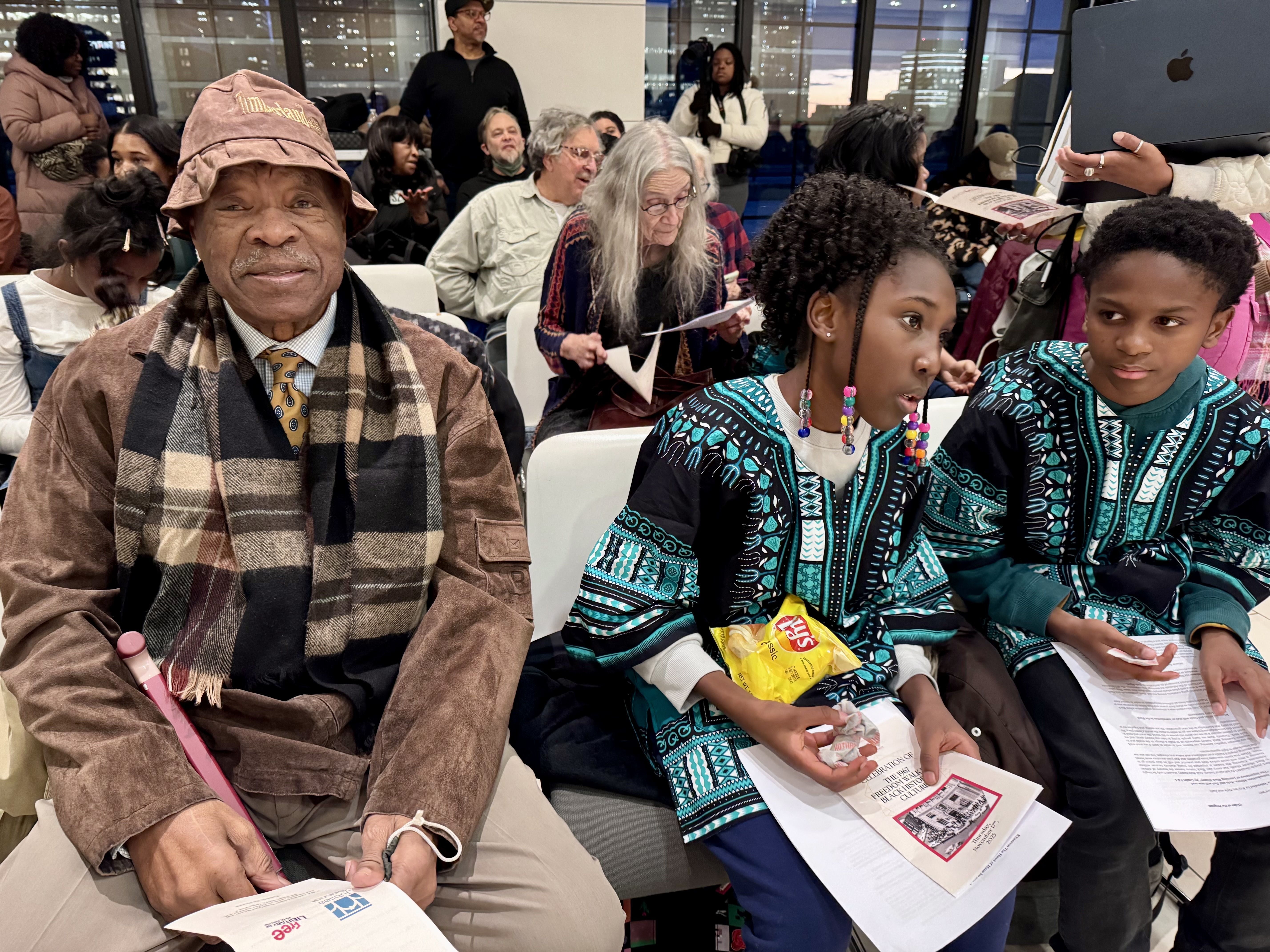
    Walter D. Palmer, who helped organize the 1967 Philadelphia student walkout, was honored at a program by students from the Jubilee School, sitting next to him.

    The time seemed right that November. By that point, Black students made up the majority of the district’s pupils, and they attended integrated schools, but conditions were unequal.

    “Black students were harmed for using African names, wearing African clothing,” said Palmer.

    Organizers came up with a list of 25 demands — from allowing students to wear their hair in Afros to infusing Black history in the district curriculum.

    “It was not a mistake,” said Palmer. “It was not a flash mob. There were no cell phones; there were no microphones. These young people, they were just hungry.”

    A historical marker commemorating the 1967 Philadelphia student walkout stands outside the former offices of the School District of Philadelphia, at 21st and Benjamin Franklin Parkway.

    Students pulled fire alarms and poured out of their schools, with many meeting at the School District of Philadelphia headquarters. Representatives were chosen to speak to then-Superintendent Mark Shedd, who took their requests seriously.

    Newspaper accounts described the demonstration as being like a “picnic,” but then-Police Commissioner Frank Rizzo called in 100 officers in riot gear. They began swinging at students and releasing police dogs.

    Fifty-seven people were arrested, and dozens injured, some seriously. The event made national headlines.

    Marilyn Kai Jewett, another walkout participant, told the students their celebration was especially timely.

    “We cannot let anyone whitewash our history,” Jewett said. “We are under attack. We cannot stop — we’ve got to fight until we die. The evil will not prevail. Goodness always prevails. Just keep doing what you’re doing.”