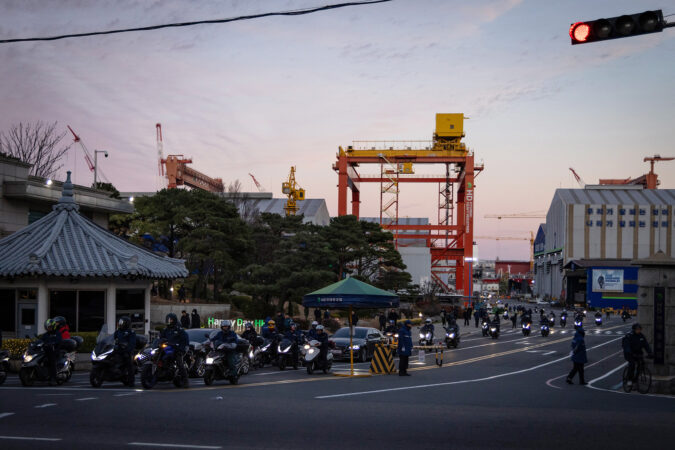
South Korea has promised to help “Make American Shipbuilding Great Again,” pitching its world-leading shipyards to President Donald Trump as a model to revive U.S. manufacturing and create desirable blue-collar jobs. But in reality, the sector is reliant on low-paid migrants and plagued by a high accident rate. Shipbuilding is among the country’s most dangerous industries, killing dozens of people each year, prompting more South Korean workers to shun those jobs — a growing problem for Lee Jae Myung, the nation’s leader.
“If we bring in foreign workers on around 2.2 million won ($1,500) a month to fill shipyard jobs, we have to ask what happens to domestic employment, and whether that truly helps the long-term development of the industry,” Lee said at a cabinet meeting Tuesday.
At first glance, the country’s shipyards are formidable: fast, cheap, and relentlessly efficient. Seoul made the industry an integral part of a $350 billion trade agreement with the U.S., and has also sought to leverage it into contracts for military vessels and permission to build nuclear-powered submarines. Yet a closer look reveals a more complicated picture. South Korea’s occupational fatality rate is almost 4 deaths per 100,000 workers, vs. an OECD average of roughly 3, according to International Labour Organization data compiled by Bloomberg. Risks are especially acute in shipbuilding, where the fatality rate in 2024 was more than four times the national average, government data showed.
The safety record helps explain why many skilled Korean workers have deserted the yards. To keep up production as big orders roll in, shipbuilders have turned to foreign workers, often using layers of subcontracting to keep costs low.
As of April 2025, more than 23,000 migrant workers hold the main work visas used in South Korea’s shipyards, industry data shows. The government has repeatedly eased strict quotas, now allowing foreigners to make up as much as 30% of the workforce in certain skilled shipbuilding roles — one of the highest rates of any sector. The data point to a central contradiction: The productivity Washington admires is sustained by jobs many Koreans no longer take, filled instead by workers with far fewer options to refuse them. This sits uneasily with Seoul’s $150 billion pledge to support a revival of U.S. shipbuilding and U.S. manufacturing jobs.
Modern servitude
“What worries me most is that we’re exporting a shipbuilding model whose reality is barely sustainable at home,” said Kim Hyunjoo, head of the Ulsan Migrant Center. “If this industry is being kept afloat by highly constrained foreign labor, it’s hard to see how that model can simply be transplanted to the U.S., where regulations and scrutiny are far stricter.”

Three years ago, while working at a shipyard in Ulsan, a sudden blast from a high-pressure spray machine knocked Sri Lankan worker Aslam Hassan to the ground, shattering his protective gear and shooting toxic paint into both eyes.
“As I fell, I thought, ‘So this is how I die, without even seeing my baby,’” said Hassan, who was working as a subcontractor at the time. His vision never fully recovered.
His experience reflects the dangerous conditions that underpin South Korea’s shipbuilding efficiency. Government data show nonaffiliated workers, including subcontracted and dispatched labor, make up about 63% of shipbuilding employment, far above the economy-wide average of roughly 16%.
“When you look closely at migrant worker visas, it feels like they were designed to create a kind of modern servitude,” said Hassan, who now works for an auto parts company after his injury. “During the contract period, we can’t move even in unfair conditions.”
Safety rules are enforced more strictly during regular shifts for directly employed workers, one migrant worker told Bloomberg News, asking not to be identified as he’s not authorized to speak publicly. More hazardous tasks are often pushed to subcontractors, who are called in early, late, or overnight, when oversight is looser.
Demand is growing as the industry enjoys a new boom that puts further strains on its workforce. Fresh orders last year reached nearly $36 billion for HD Korea Shipbuilding & Offshore Engineering Co., Hanwha Ocean Co., and Samsung Heavy Industries Co., accounting for about 20% of global new ship orders by volume, according to SK Securities.
Shipbuilding ties have also bolstered Seoul’s security goals. President Lee has received Trump’s conditional approval to pursue nuclear-powered submarines, a long-standing ambition. But the growing strategic role has raised the stakes.
Tensions have also become more acute in recent weeks, with Trump warning that the U.S. could again raise tariffs on South Korean goods, citing frustration over what he sees as slow or uneven follow-through on trade commitments. The threat has pushed senior officials back to Washington to explain delays and reassert Seoul’s promises.
Further straining ties is South Korea’s probe into a massive data breach at Coupang Inc., the Seattle-headquartered e-commerce firm known as the “Amazon of South Korea.” Vice President JD Vance has framed Seoul’s actions as an assault on the U.S. tech sector.
With the trade deal still very much up in the air, shipbuilding — as one of the highest-profile deliverables — is under the microscope. And any failure to deliver what has been promised could derail the entire agreement.
Ignoring rights
The sector’s heavy reliance on migrant workers on restrictive contracts is also likely to pose problems in any wholesale export of the model stateside, experts say. South Korea is painfully aware of Trump’s anti-immigrant drive after Hyundai and LG workers were detained in a massive Immigration and Customs Enforcement sweep at a battery plant in Georgia last year, just weeks after Lee first met Trump.
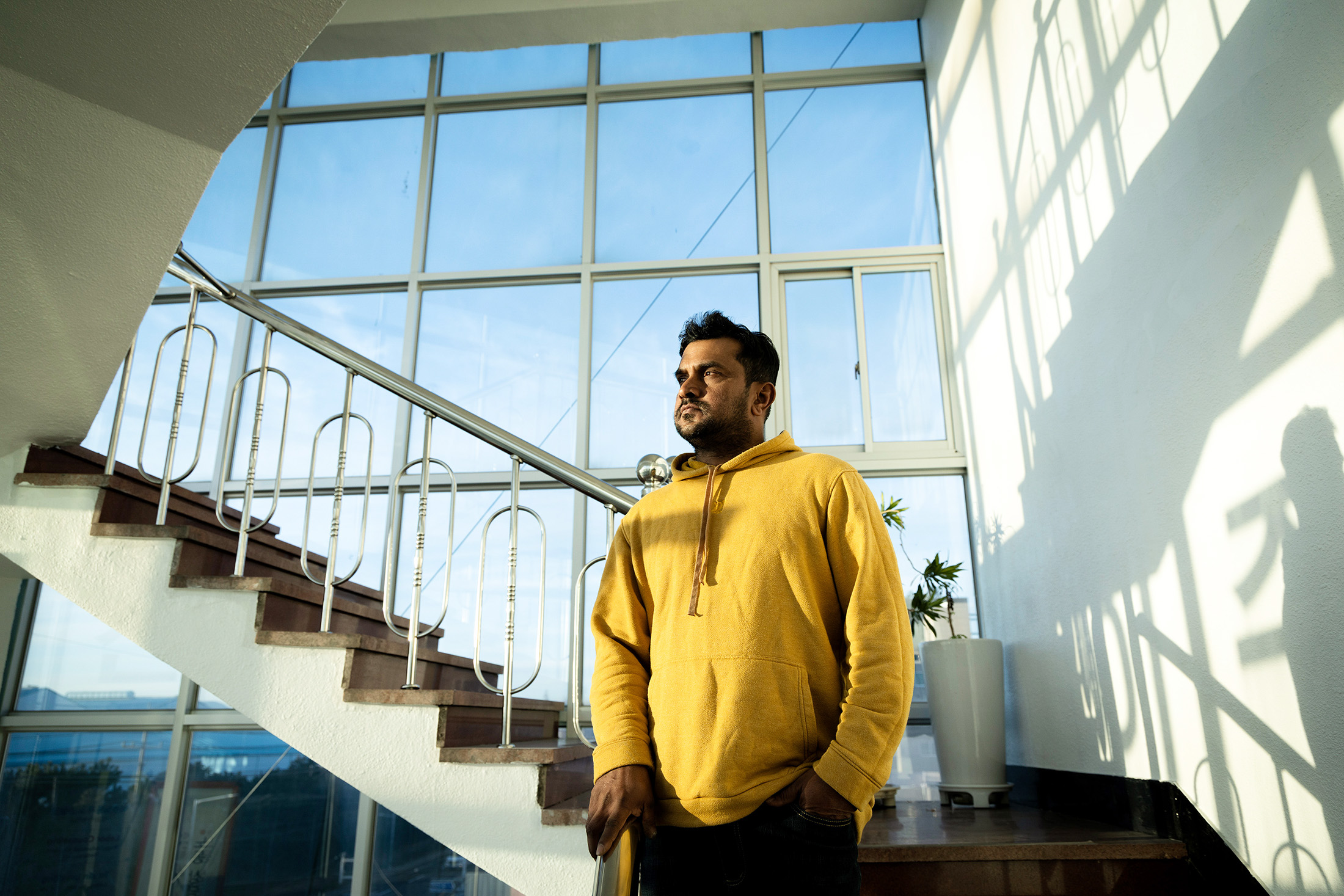
In the shipyards, many South Korean companies rely on a visa regime that binds overseas workers to a single employer, limiting their ability to change jobs, experts say. Sri Lankan welder Manoj Wijesekara paid a broker about 20 million won to secure a skilled-worker visa and a job at HD Hyundai Heavy Industries Co., hoping the move would allow him to support his two children.
When the pay turned out to be far lower than expected, Wijesekara resigned — only to discover that his visa effectively tied him to HD Hyundai, leaving him unemployed and at risk of deportation. He says the company misled him. The company says he resigned of his own accord. The dispute is pending before South Korea’s National Labor Relations Commission.
“I am terrified to speak out for fear of being deported,” said Wijesekara, who missed his mother’s funeral in November but said he was determined to hold his former employer to account. “People tell me it’s foolish to fight a company this big.”
But this broken labor model doesn’t just hurt migrant workers, said Kim Doona of Korean Lawyers for Public Interest and Human Rights, if it continues “it will hurt Korean shipbuilders.”
“Ignoring labor rights in an industry built on high-skilled work ultimately weakens global competitiveness,” she said. “Once companies fall short of international human rights standards and domestic labor laws, that risk can weigh on exports.”
Leave a Reply