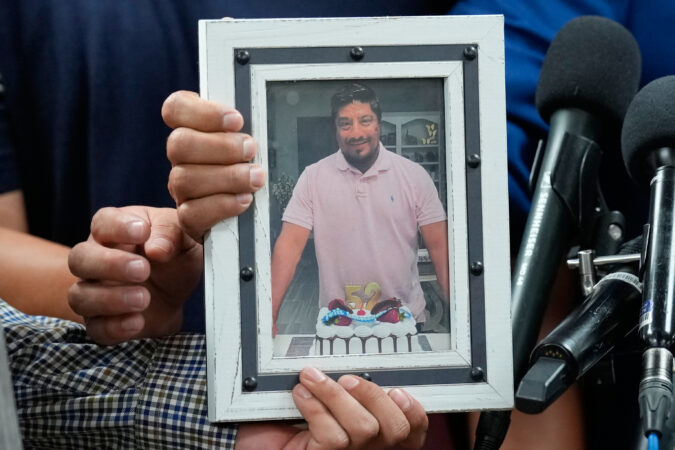
Lorenzo Salgado Araujo woke up at 5 a.m. Tuesday and started his day like almost every other one for the last 35 years since he came to Houston from Mexico and built his own American dream brick by brick — sending his three sons to top universities on the foundation he’d constructed through years of backbreaking labor.
His wife also got up to make him a hearty meal before he put on his work boots, fired up his van, and picked up three coworkers in Houston’s heavily Latino East End to build new homes on the city’s outskirts. But it proved to be Salgado’s last drive.
Just a short time later, the 52-year-old Salgado was lying face down outside of his van on a city sidewalk, surrounded by agents from U.S. Immigration and Customs Enforcement as blood poured from a bullet wound on the right side of his stomach. He was recorded screaming in pain: “Help me! They shot me! … ¡Me están matando!”
Translation: “They are killing me!”
He died a short time later in a nearby hospital. ICE said the fatal shooting occurred after officers tried to arrest Salgado in what it called “a targeted enforcement operation” — even though Salgado apparently had no criminal record and for more than a year had been steadily making progress toward securinga work permit that would resolve his immigration status.
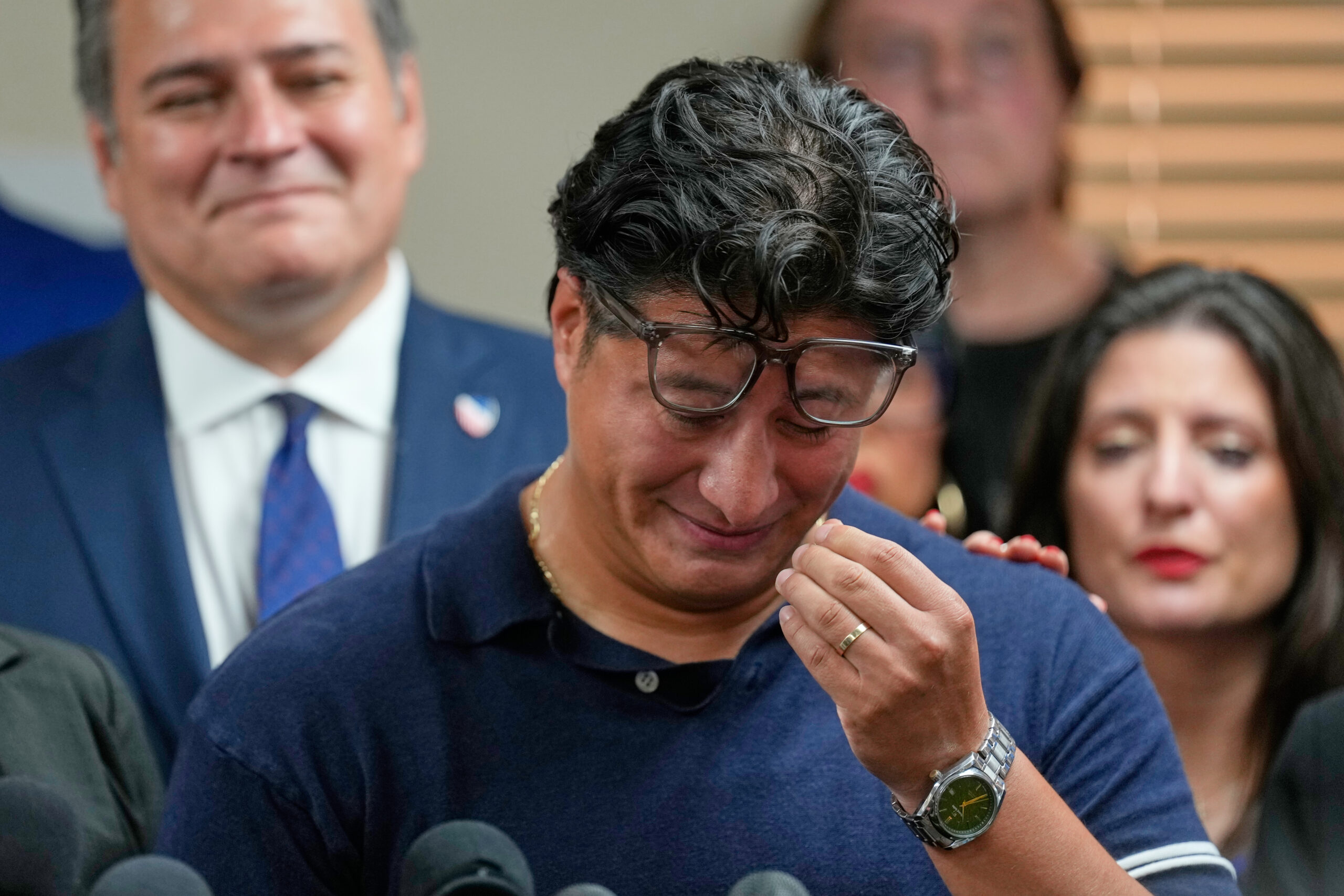
“We dotted every ‘i,’ crossed every ‘t,’ filled every document, attended every appointment,” his tearful son, 29-year-old teacher Ronaldo Salgado, said in a news conference on Wednesday. Afterward, the younger Salgado told the Bulwark: “I love our dad; he worked hard. He always told us that we needed to do well in school so we don’t end up like him in the sun.”
Ronaldo Salgado, son of Lorenzo Salgado Araujo, wipes away tears while speaking during a news conference Wednesday in Houston.
The killing of Salgado — family man, essential worker, and American dreamer who was doing everything the right way after joining the 1990s mass migration of undocumented Mexicans — is a crime against humanity that makes anyone who still has a functioning moral compass want to scream in outrage.
Still, what happened after Salgado was gunned down is deeply troubling in a different way. America seemed to mostly shrug at a killing no less senseless than this winter’s Minneapolis ICE fatal shootings of Renee Good and Alex Pretti, let alone other law enforcement murders like George Floyd in 2020, which sparked days of nationwide protest.
The implosion of now ex-Maine Democratic Senate candidate Graham Platner or Donald Trump’s inane prattle at a NATO summit took up most of the hour on cable-TV news, with reporting on yet another ICE killing squeezed in at the end. A fascist regime cutting down our law-abiding neighbors in the streets is becoming background noise.
Just how they want it.
To be sure, there are differences between what happened Tuesday in Texas and the Minneapolis killings that grabbed so much attention six months ago. A large activist community in the Twin Cities was out in the streets at the time of the Good and Pretti shootings, with whistles and cell phones, producing a flood of video evidence that exposed ICE’s lies and inspired massive demonstrations.
In contrast, Salgado was killed in a low-income neighborhood, and while there is video of the wounded laborer on the ground, there’s not yet been definitive footage revealing how or why he was shot. That doesn’t alleviate the nagging concern that the media and some corners of the public and the body politic care more when the victims are white U.S. citizens — which, if true, is morally unconscionable.
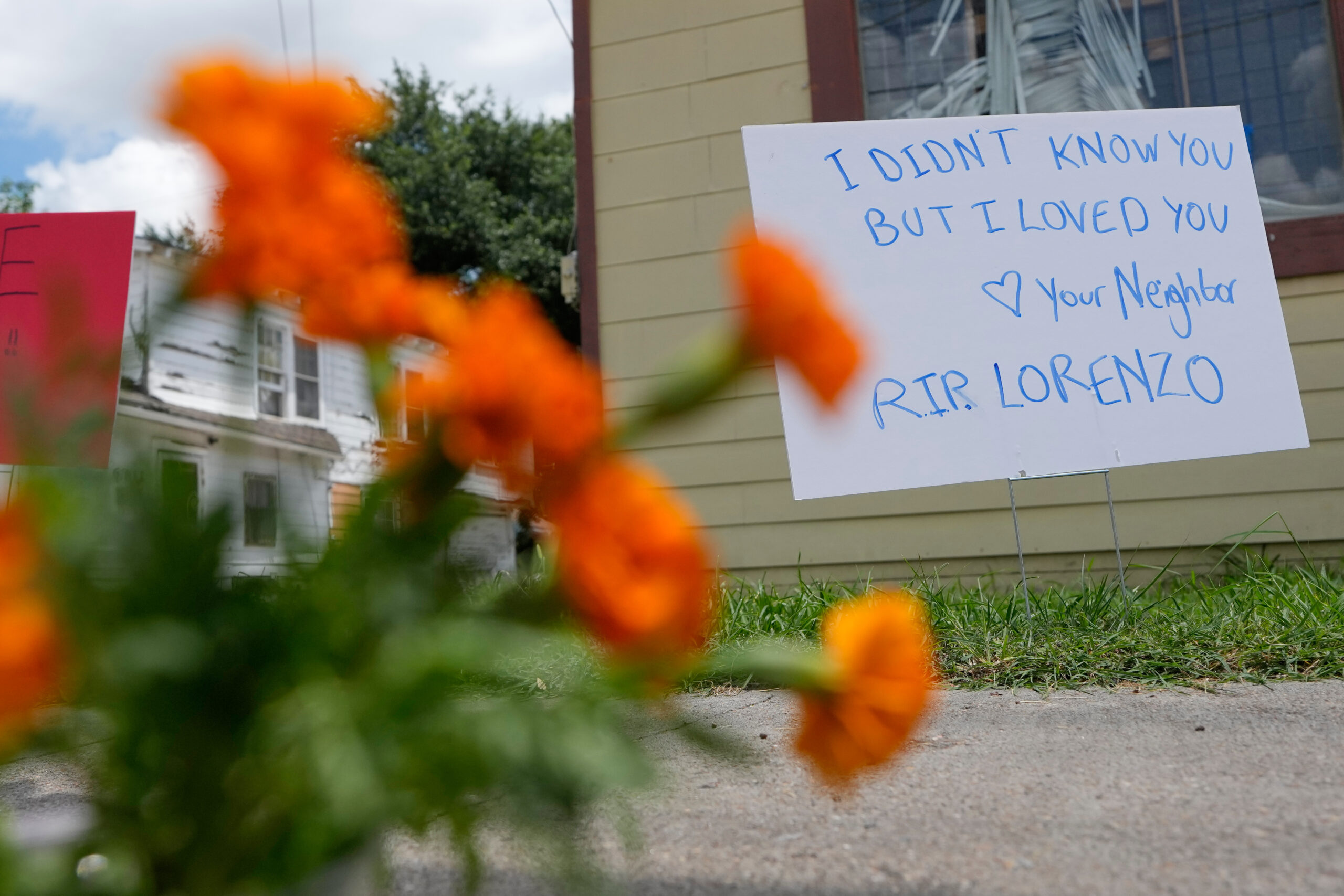
A makeshift memorial for Lorenzo Salgado Araujo, who was shot and killed by an ICE officer Tuesday, is shown Wednesday in Houston.
Americans should be alarmed at the bigger picture that’s slowly unfolding before us. After briefly pressing the pause button in the furor over the Good and Pretti killings — pulling back from its federal assault on Minnesota, firing the flamboyant and infuriating Greg Bovino and Kristi Noem, and drastically scaling back its plan for warehouse concentration camps — ICE is back, and more dangerous than ever.
After an era of waving a red flag before an activated, engaged, and angry citizenry it didn’t see coming, by naming operations like the “Catahoula Crunch” or “Charlotte’s Web,” and with Bovino mugging for the TV cameras, ICE has resumed working toward its inhumane target of one million deportations per year, but with a much lower profile.
There are thousands of new immigration agents on the streets, fueled by Congress giving two massive funding infusions totaling about $240 billion, and with Homeland Security and ICE under new management, they are hoping to terrorize immigrant communities without generating headlines or protests. “ICE is making record arrests right now,” Trump’s immigration czar, Tom Homan, told Fox News. “We turned the heat up …”
The New York Times reported last week that with no press releases or hoopla, daily immigration arrests had doubled over a five-day period to a total of roughly 10,000, or 2,000 per day, with immigrants arrested during required government check-ins, but also during traffic stops like the one in which Salgado was killed.
This is a human rights nightmare in the making. The stepped-up arrests are all but certain to lead to more dangerous and potentially fatal encounters like the one that occurred on Houston’s Canal Street, but the other impacts are equally pernicious.
Fear levels in big-city neighborhoods with large immigrant communities are spiking yet again — keeping countless kids home from school and essential workers off the job, crimping an already strained economy. The Trump regime’s squalid gulag archipelago of immigration detention centers — whose crisis of overcrowding had eased slightly with the spring enforcement slowdown — is seeing a surge again, and that will also lead to catastrophe.
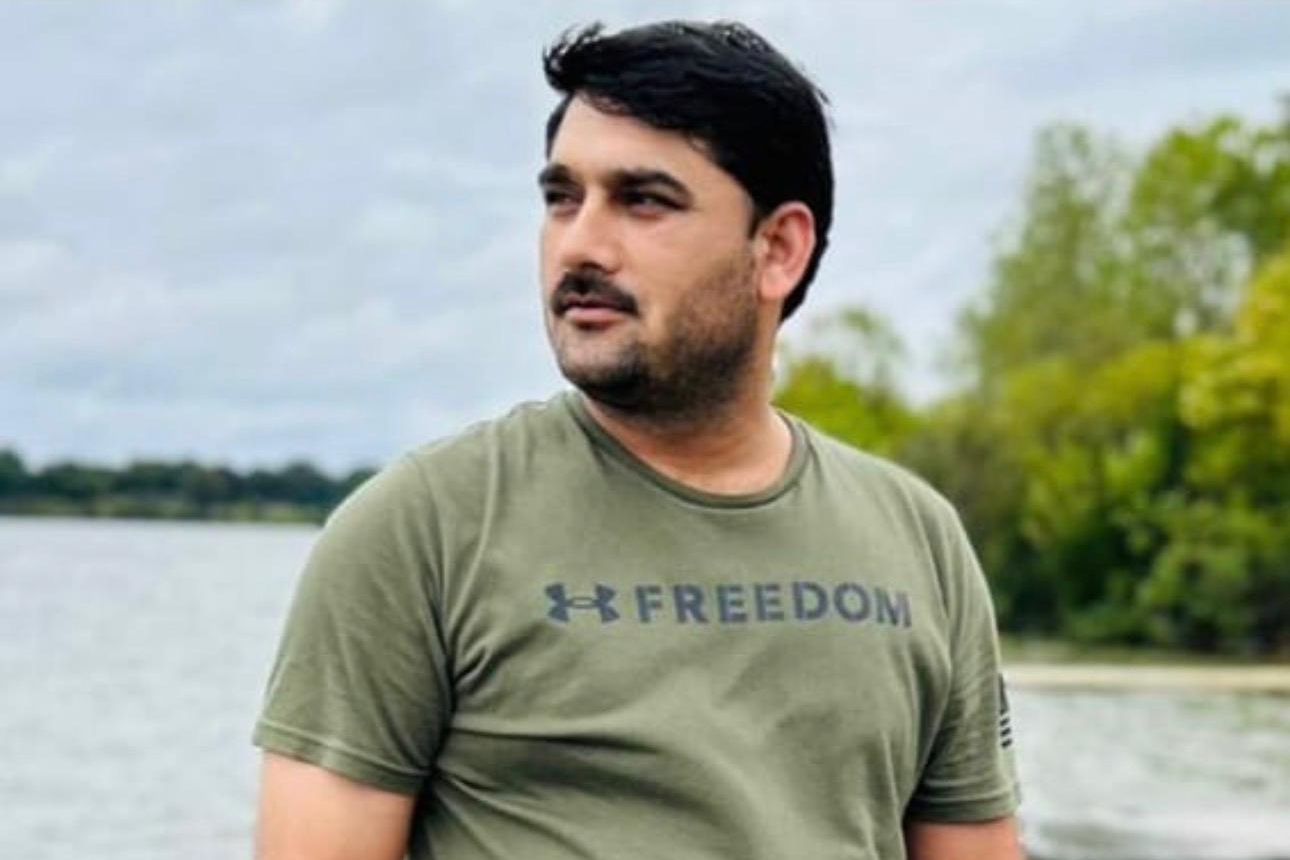
Afghan national Mohammad Nazeer Paktiawal, who died in the custody of U.S. Immigration and Customs Enforcement on March 14, is pictured in this undated family photo.
Detention deaths are soaring to record levels — more than 50 since Trump returned to office in January 2025. We are learning troubling details, for example, about the March death of an Afghan national who came to the United States after working with U.S. Special Forces and who died after just one day in ICE custody. Relatives of Mohammad Nazeer Paktiawal, 41, said he was not allowed to bring his asthma inhaler into detention; officials say he died of an “adverse drug reaction” that brought on an attack.
In Houston, there’s no evidence to support ICE’s initial claim that Salgado was resisting arrest, but — given what we are learning about the horrors of detention — it’s not surprising that immigrants facing an arrest are terrified at what might happen next. Meanwhile, ICE and other agencies are going to extreme lengths to avoid accountability.
In California, ICE — overflowing with our tax dollars — is spending an astronomical $1.5 billion to buy two large privately run immigration prisons from the corporation CoreCivic, for the purpose of preventing state and local inspectors from monitoring what happens there. WIRED recently reported that ICE’s internal watchdog agency is focusing its attention not on agent misconduct but on tracking down outside critics.
What are they trying to hide?
In the killing of Salgado, we don’t know the answer — yet. ICE claims Salgado, whom it dehumanized as an “illegal alien,” “weaponized his vehicle” and tried to run over the agent who was arresting him, and that the agent then fired the fatal bullet.
We don’t know if there’s any truth here. But what we do know is that in every similar situation during the Trump regime — including Good and Pretti and others like Chicago nonfatal shooting victim Marimar Martinez — the initial ICE version of what happened proved to be a lie, and often a brazen one. It takes a willing moral blindness to automatically accept ICE’s story about what happened to Salgado.
And yet, we are seeing that not only from the local FBI — which is not investigating the officer’s action, but the alleged crime of resisting arrest — but also from Houston Mayor John Whitmire, who said he trusts the federal government to do a thorough investigation, as if he’d been living in a cave these last 15 months.
In their anguished news conference on Wednesday, family members and local Democratic officials called for the release of any ICE body-cam footage and an independent investigation into what really went down in Houston’s Magnolia Park section.
They need our help, though. ICE’s new summer assault on immigrant communities, and its ability to get away with its many crimes, is counting on an exhausted or apathetic American public to not demand action as so many of us did with Pretti or Good or Floyd.
Please say his name — Lorenzo Salgado Araujo — and take to the streets and demand justice. His death is just as deserving of our time and our moral outrage, if not more so.
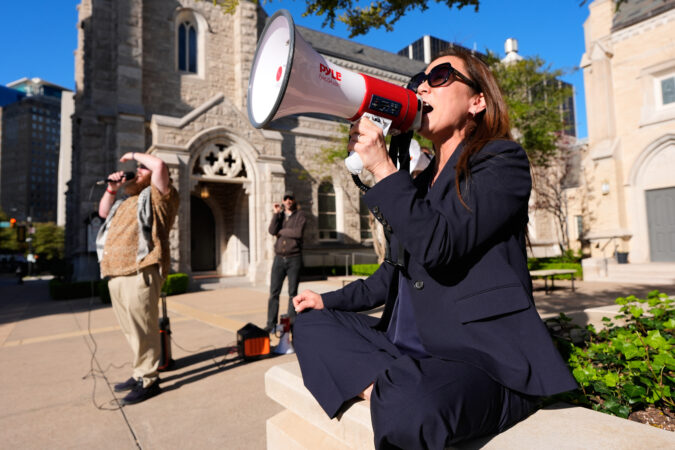
“This is the exact spot that Lorenzo took his final breath,” Cesar Espinosa, executive director of the immigrant rights group FIEL Houston, told the protest marchers. “And in the spirit of solidarity, I don’t know about you, but I say, if they come for one of us, they come for all of us.”
Over the last decade, I’ve grown used to waking up before dawn and writing about a soul-crushing defeat from the night before. Usually it’s on a Wednesday, but somehow Donald Trump is always involved. Monday’s 4-1 demolition of the U.S. men’s national soccer team by Belgium pretty much confirmed that I won’t live to see Americans win the World Cup in my lifetime, so it’s time for acceptance. But these last three weeks have been a blast, and the party isn’t over. Sometimes the tritest words are also the truest: Maybe the real World Cup was the friends we made along the way.
Future generations will remember America’s 250th for its state of denial
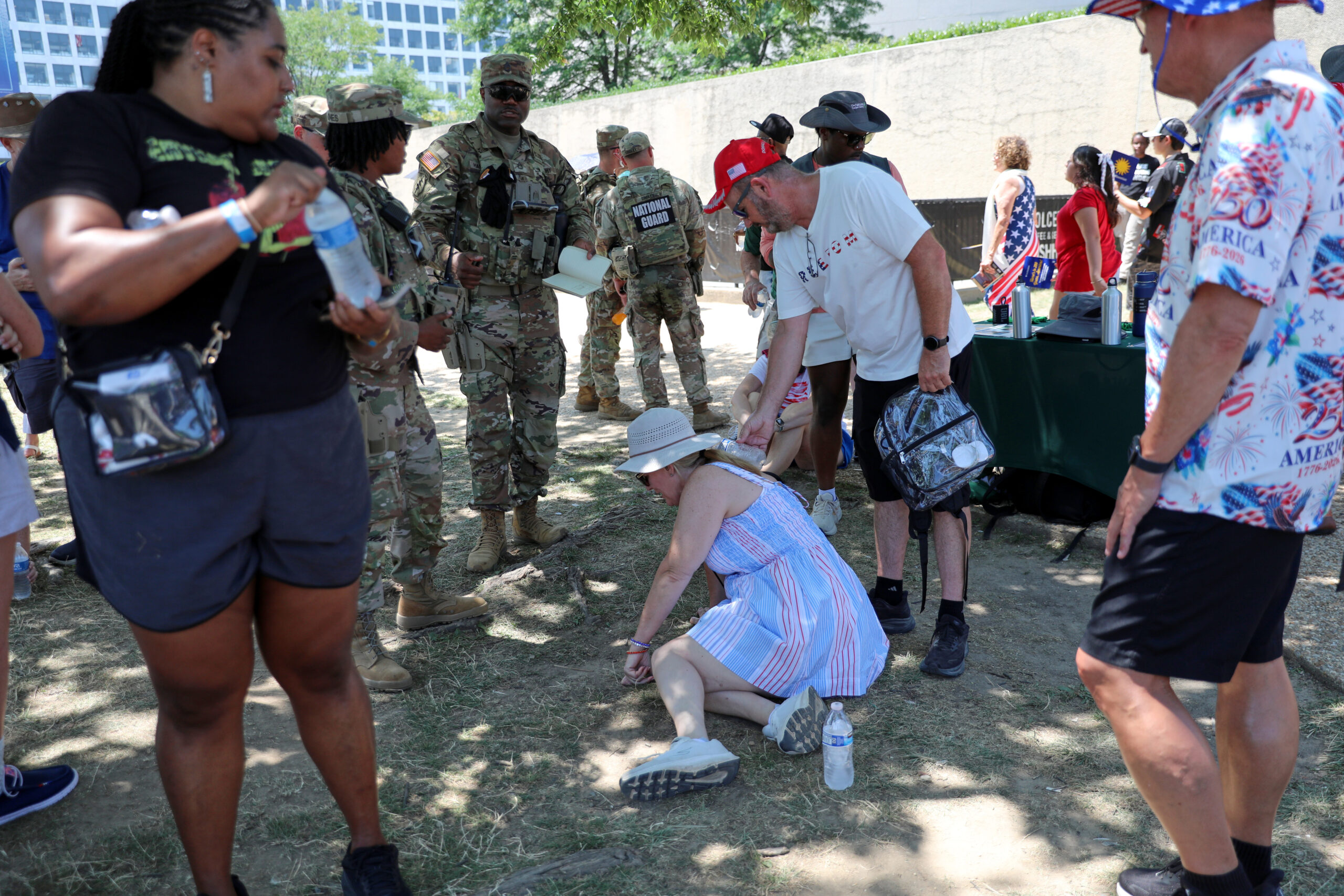
Visitors experiencing excessive heat sit on the ground at the National Mall in Washington during Independence Day events honoring the nation’s 250th anniversary on Saturday.
The long-awaited arrival of the 250th birthday of the United States inspired a lot of talk about everything that’s changed since July 4, 1776, especially as “the man on a hobby horse” sinks to the founders’ worst fears about democracy and demagoguery.
But historians of the future may dwell on another huge difference between the day the ink started drying on the American Declaration of Independence and July 4, 2026.
Thomas Jefferson — his work as chief author of the nation’s founding document wrapped up — bought a new thermometer that morning and recorded the temperature in Philadelphia three times in his diaries that day, including a temperate 1 p.m. reading of 76 degrees.
Jefferson’s thermometer might not have been up to the task of keeping up with Philadelphia’s climate 250 years later. On Saturday’s Semiquincentennial, temperatures maxed out at 101 degrees — the third straight day that the mercury reached that mark, which had never happened since records began in 1870. But with the fetid, humid air, it felt more like 110 degrees for anyone brave enough to celebrate America’s birthday outside.
Philly should have seen this train coming. I mean, literally. Two days earlier, officials just outside of Reading, nearly two hours northwest of America’s founding city, plowed ahead with a welcoming party for Union Pacific’s Big Boy No. 4014, the world’s largest operating steam locomotive — even as the railway relic ran an hour late, with some thermometers posting 106 degrees.
The result was what local officials called “a mass casualty event” — no one died, but rescue teams were summoned from neighboring counties to help revive more than 100 people suffering from heat exhaustion, in desperate need of water or an IV. Some 35 of the would-be train spotters were rushed to the hospital.
“It was a little bit chaotic,” an EMS director told the local TV station in Reading. “I don’t think anyone anticipated the weather or the volume of crowds.”
The scientific group World Weather Attribution, which tracks the impact of human-made global warming, said last week’s heat dome over the Eastern Seaboard was indeed a rare event, yet — without the contribution of burning fossil fuels to a warming planet — it “would have been so extreme as to be virtually impossible.”
Heat waves aren’t new. I was just 7 but still remember the July Fourth week of 1966 — exactly six decades ago — when it also topped 100 degrees. It’s one of the few things I remember from that grade-school time because it was so incredibly rare. Today, “once-in-a-century” heat waves are routine all over the planet. In June and looming again this week, Western Europe — where few homes are air-conditioned — has sweltered under temperatures that climate scientists weren’t expecting until around 2050.
This suffocating July Fourth could have been — to steal a phrase from the multiplex marquee — America’s “disclosure day,” exposing the truth of a threat to humankind that’s been hiding in plain sight. Instead, it was our “denial day,” led by our planet’s denier-in-chief, Donald Trump, whose 250th birthday card to America only read: “Don’t look up.”
The denial was immediate, as the president insisted — ignoring the experts who warned that the triple-digit temperatures and intense, gathering thunderstorms might spark a much bigger “mass casualty event” in Washington, D.C. — on going ahead with his bombastic and self-serving speech and a fireworks show that lasted well into the early morning hours of July 5.
Our modern-day seersucker-wearing mayor of Jaws might as well have told the broiled holiday weekend throng, “But, as you see, it’s a beautiful day, the beaches are open, and people are having a wonderful time” — as ominous John Williams music swelled in the background.
The denial was also metaphorical to the max — and not just when those predicted storms arrived and panicked MAGA Trump supporters were forced to take refuge at the National Museum of African American History and Culture, the history and culture their movement is so eager to erase.
In New York Harbor, U.S. Coast Guard vessels forced the storied environmental sloop Clearwater — which took part in the historic Bicentennial tall ships parade back in 1976 — to leave the July 4 Parade of Ships because of two anodyne political banners taped to its sails: “Save the Clean Water Act” and “Indigenous Rights, Racial Justice, Climate Solutions.” Don’t look up, not even at a tall ship.
Hours later, during the fireworks show, the Brooklyn Bridge caught fire, which had nothing to do with climate change, yet felt like a coded message from the overheated planet nonetheless.
But maybe we shouldn’t wade too deeply into the metaphors when the worst denial is the all-too-real policy stuff. Every day, some nightmare headline about killer floods or disappearing glaciers is met with some nonsensical action from the U.S. government based on Earth 2, where none of this is happening.
As the climate-change-intensified heat dome settled in over the Eastern United States, Trump issued pardons for nine people — and you really can’t make this stuff up — who’d been convicted of felony violations of the Clean Air Act by selling or installing devices for diesel trucks that defeated their emissions controls, because polluting our spacious skies is no longer a crime in Trump’s America.
America continues to get a whopping 82% of its energy from polluting fossil fuels, and that’s unlikely to drop over the next 30 months, regardless of how many Trump voters can cheat death on looming “mass casualty events.” But POTUS 47 warned voters he planned to set the world on fire if he returned to the White House.
What’s harder to understand, frankly, is why the people who should be fighting Trump on climate change are running away from the front lines. Yes, I’m talking about Democratic Party leaders who’ve tossed climate action down the memory hole in the 2026 campaign — either terrified that any mention of climate will undercut their single-minded focus on affordability, or distract from fighting Trump’s brand of autocracy.
And ditto for newsroom leaders who seem to have decided that environmental journalists are the first people to lay off, not to mention the other world chieftains who ought to be challenging Trump’s destructive policies, but are meeting the moment with a shrug. Even Canada’s center-left prime minister, Mark Carney, is now backing away from the aggressive climate action he once supported, claiming, “It’s too expensive.”
That’s a lot of malarkey, as the president who just four years ago passed the largest climate action bill in U.S. history might say. Clean energy continues to rise elsewhere in the world because the alternatives, like wind and solar, are ultimately cheaper and also a source of desperately needed job creation. The fossil-fuel-boosted heat wave of July 4, 2026, proved that inaction is a threat not only to our lives and our liberty but also to the pursuit of happiness. It’s hard to celebrate 250 years of American democracy when climate denial is exposing that system as so badly broken.
Yo, do this!
Did I mention the World Cup isn’t over? If you are a true fan of the Beautiful Game, you’ll brush off the quadrennial disappointment of the U.S. men’s team and get excited to watch one of the greatest generations of international soccer superstars we’ve ever seen. One of the more intriguing of the four quarterfinal matchups this weekend will occur when Harry Kane and his English squad face Erling Haaland and his Norwegian upstarts in the Miami heat. The match kicks off at 5 p.m. Saturday on Fox.
The new movie scene for the July Fourth holiday was a disappointment, so the heat wave was a perfect opportunity for revisiting the classics of the 1970s and ’80s with the generation that had not been born yet. We went back to the late Rob Reiner’s first great serious film, the coming-of-age saga Stand By Me. It’s hard not to feel nostalgia today for a time when 12-year-olds had to entertain themselves without iPhones and could disappear into the woods overnight, which felt less strange in 1986 when the movie was first released. It felt truly like a faint signal from a lost planet.
Ask me anything
Question: Talk about Mitch McConnell’s demise. — Wendy (@wensilver.bsky.social) via Bluesky
Answer: Well, Wendy, that’s not exactly a question, and while the New York Times is reporting that the Kentucky senator and former majority leader was unconscious and in cardiac arrest when paramedics found him on June 14, his staff insists McConnell is still alive. That hasn’t stopped conspiracy theories that McConnell is on life support until August, when his replacement, named by GOP lawmakers, could avoid a messy November election. I don’t know about that, and I agree that it’s very poor form to speak ill of the dead. So the fact that he’s still alive is an ideal moment to remind everyone that his hijacking of the U.S. Supreme Court and his cowardice during Donald Trump’s second impeachment both started America on the path toward tyranny. So get well soon, senator. You still have a lot to answer for.
What you’re saying about …
Last week’s question about whether you are happy or concerned about progressive Democrats doing well in the 2026 primaries brought a mix of interesting responses that aren’t easy to categorize. Most of you want Dems who will fight harder than the current crew. “I have been voting since 1968, always for Democrats, but seldom with enthusiasm,” wrote Stephen Boone. “Finally, in my old age, there are a few decent politicians. I want more AOCs! More Zohran Mamdanis! …” Others felt more cautious. Wrote Thomas Desmond: “I think the progressive candidates are fine in deep blue seats, but may not be a great idea in purple or light-red seats that could prove winnable this year.”
📮 This week’s question: It may be water under the bridge next week, but Donald Trump’s personal role in overturning the arguably wrongly given red card to U.S. star Folarin Balogun has sparked a heated debate. Was the red card an injustice to be reversed by any means necessary? Or did Trump’s involvement ruin the World Cup? Please email me your answer and put the exact phrase “Trump Balogun” in the subject line.
Backstory on Trump ruining the World Cup like everything else
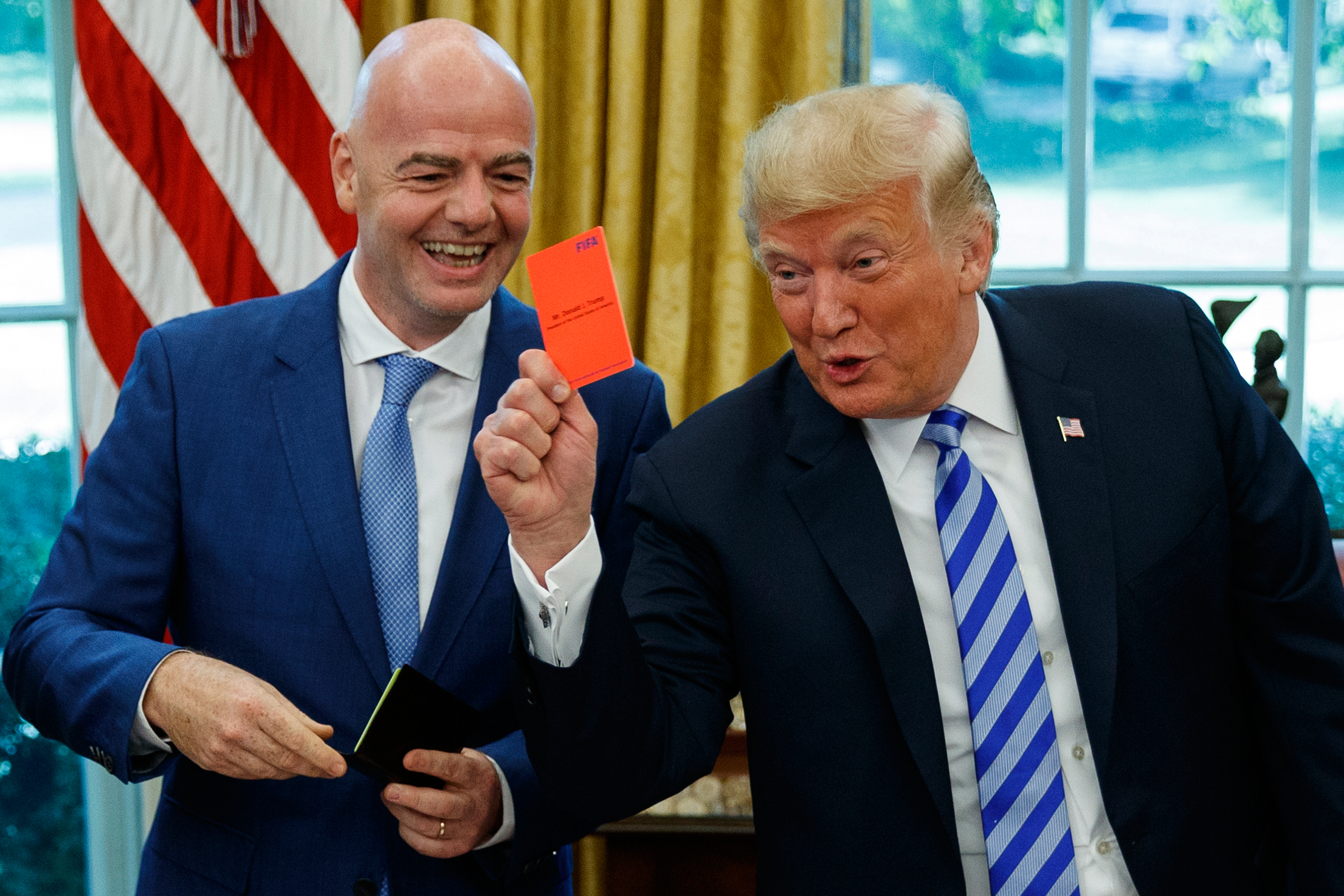
President Donald Trump holds up a red card during a meeting with FIFA president Gianni Infantino in the Oval Office of the White House in August 2018.
If the big-screen tragedy of the U.S. men’s soccer team’s same-as-it-ever-was Round of 16 exit from the 2026 World Cup on Monday night had a theme song, it should have been John Lennon’s “Instant Karma.” For its first four (mostly) exhilarating matches, the USMNT gave a nation that was desperate for both an escape from relentless bad news — but also a connection to a wider world — the good vibes it desired. It truly felt like the Americans could go further than ever before (in modern times) in the planet’s greatest sporting event. TV ratings soared. Watch parties were packed. A broken land was coming together.
To longtime soccer fans, the red card handed out last Wednesday to the U.S.’s top goal scorer, Folarin Balogun, for stepping (seemingly unintentionally) on the ankle of a Bosnian player during a 2-0 victory — a harsh punishment that meant not only his ejection from the pitch but a suspension for the upcoming Belgium match — was the essence of our love/hate relationship with soccer. It may be a beautiful game, but it’s the ugly calls that we debate for decades. For a non-soccer fan and malignant narcissist like Trump, for whom anything that goes against his desired outcome is proof of the world’s unfairness toward him, the looming loss of America’s star striker was an opportunity to act like the strutting strongman of a personalist dictatorship.
There were too many ironies to bear — especially the fact that Trump had just gone all the way to the U.S. Supreme Court to fight to strip U.S. citizenship from people like Balogun, who was born to British-Nigerian parents in 2001 during an American visit, and millions of other immigrants who aren’t as talented with their feet. But the other irony was that — like so many corrupt schemes, whether from the mafia or the Trump White House — the president’s soccer coup failed. It felt like Trump had attacked the positive zeitgeist around U.S. men’s soccer with a neutron bomb. Balogun rarely even touched the ball. We’ll never know how much of Belgium’s 4-1 rout of the mistake-prone U.S. was simply a European powerhouse outclassing the Americans, as has happened so many times before, and how much was Trump destroying the juju.
It did seem fitting that this sordid affair played out over the weekend of America’s 250th birthday, as it was more confirmation that Trump, in spite of what the hat says, actually has no clue what makes America great. If any one principle stood out from the founders’ 1776 and 1787 experiments, it is that the United States was to be based on fairness and following the rules, with no king imposing his will. The single greatest thing about America’s presidential elections was not who won, but the fact that the loser accepted the results, and there was a peaceful transfer of power — until Jan. 6, 2021. Likewise, nothing could ruin the often unbridled joy of the World Cup faster than a rigged competition.
I’m still looking forward to the next 12 days, to watching the pinpoint passing of Argentina’s Lionel Messi or the raw power of Norway’s Erling Haaland, and to seeing who can actually win the World Cup on the pitch, and not in a back room. We already know the tournament’s biggest loser: Donald Trump.
What I wrote on this date in 2014
Looking back on this Attytood blog post from 12 years ago today is a reminder of how debates can evolve over time. My short piece on July 7, 2014, was a riff on an op-ed that called newspapers’ online comment sections in those early internet years “a hate crime” that should be cordoned off because of the vitriol spewed at immigrants or others outside the traditional American hierarchies. Back then, I disagreed, taking the side of free speech absolutism. “These are people who shouldn’t be censored … just set straight,” I argued. “The one true powerful weapon against offensive free speech … is your free speech, and mine.” Time proved me wrong: The Inquirer now avoids comments on most articles, including my columns. It turned out that “the wisdom of the crowd” that newsroom reformers once hailed was fatally infected with racism, sexism, and other forms of hate.
Only one column last week, as I enjoyed the July Fourth holiday by spending time with family and watching countless hours of soccer. In that piece, I wrote about an American 250th birthday that should have been a meditation on what makes our nation great, and where we so desperately need to improve — but which Donald Trump used as an excuse to rob the cash register when no one was looking. The president’s staggering $2.2 billion-plus payday during his first full year back in office — accomplished with a mix of crypto flimflammery, informed stock trading, and dealings with foreign dictators — is a five-alarm fire for the rule of law.
One final thought about the 250th birthday of the United States as the moment recedes into the rearview mirror. It’s true that 2026 has been a lousy year, economically, for newsrooms, but you would never know that from reading The Inquirer’s remarkable coverage of such an eventful time. I’ve already praised our world-class World Cup coverage, but our overworked staff also went out and covered a July Fourth party that happened despite killer heat, biblical storms, and a plague of locusts (not really, but it felt that way). This included some real accountability journalism, such as the Trump regime’s efforts to twist the truth around George Washington and slavery, as well as questioning the cost of the big day for city taxpayers. It was also a reminder that Philadelphia has been a hotbed for journalism and the rugged practice of bringing the First Amendment to life since the early days of the republic. Help keep it going another 250 years by subscribing to The Inquirer.
By submitting your written, visual, and/or audio contributions, you agree to The Inquirer’s Terms of Use, including the grant of rights in Section 10.
It was right after birthright citizen Folarin Balogun tapped in another game-winning goal for U.S. men’s soccer in the World Cup Wednesday night that I had a moment of clarity about where things are in America as our nation turns 250.
I’d gone to Union Yards, the outdoorsy beer hall adjacent to Chester’s soccer palace, Subaru Park, not only to catch the game but also a vibe that I’d wanted to turn into this column.
The euphoria after Balogun’s goal — a red-bearded man in a colonial tri-corner hat and the two older veterans who’ve saluted through all of the prematch “Star-Spangled Banner” jumping to their feet, as a little girl in cornrows danced on a table — was the bucket-list moment I’d come there for.
I saw a beer-recipe melting pot of Americans cheering the immigrant-heavy rainbow coalition of U.S. soccer, showing yet again — just as we did in 1976, when I was 17 — that the people instinctively know how to celebrate what’s actually great about our country no matter how much our leaders try to muck it up.
I’d joked with my editors earlier in the week that I might lose my columnist license (not an actual thing, although maybe it should be) if my piece that runs on the weekend of the United States Semiquincentennial wasn’t a Big Think essay on what the American Experiment all means — to the extent that anyone can actually think through the fireworks, traffic jams, and 100-degree temperatures.
That’s when it hit me. That was exactly the column Donald Trump was counting on from me and every other opinion writer in America ahead of Independence Day. The 47th president needed a week when the pundits put on their wide-angle lenses and put away the magnifying glasses, while his “forgotten Americans” headed off to the beach or the fireworks show, or gorged themselves on six hours of World Cup soccer every day, and stopped watching the news.
An international jewel thief needs to create a distraction. Because if you’d been paying attention during the nation’s summer vacation week, you’d have seen that Trump is robbing us blind.
The July Fourth holiday gave the Trump regime an opportunity for the ultimate Friday news dump, the now time-honored tradition of releasing the worst stuff when people will be unplugged for a few days. In this case, the dump was a federally mandated financial disclosure form that revealed the stunning extent to which Trump has cashed in on his power and influence as president since taking office in January 2025.
The top-line numbers defy belief. Trump, who reported earning at least $622 million in 2024, his last year as an out-of-power businessman, revealed that he made at least $2.2 billion in 2025, and it’s hard not to see a lot of this as coming from turning the institution of the American presidency into a cash cow.
Consider the $636 million Trump made by releasing a so-called meme coin — an asset whose value is tied to nothing beyond its own hype — that depicted his fist-pumping reaction to the 2024 assassination attempt in Butler, Pa., and which was released literally hours before he took the oath of office again. Not only is this a staggering amount, but Trump pocketed this cash by fleecing thousands of middle-class folks who voted for him.
Publicly available information from last year showed that some 764,000 individuals who bought the Trump meme coin after its launch lost money. How many investors profited from the $TRUMP coin? Just 58 — and no one got nearly as rich as the man pictured on the coin.
Yet, Trump’s other sources of wealth are almost as troubling — especially the real estate and crypto deals with foreign nations that have an enormous stake in the president’s policy decisions. That’s especially true when the investment arm of the United Arab Emirates bought nearly half of the Trump family’s main crypto venture, World Liberty Financial, contributing to his at least $1.4 billion in crypto-related earnings. The U.S. and the UAE are (or were) key allies in the war-torn Persian Gulf.
But the important thing to understand about Trump’s money: It’s not a case in which the issue is that these deals are a lot shadier than the financial profiteering by, say, Jimmy Carter or Warren G. Harding or whomever. None of Trump’s 44 White House predecessors seriously profited from the presidency while they were still in office.
Carter put his peanut farm in a blind trust. On the flip side, Spiro Agnew pleaded no contest to a felony charge for accepting just a few thousand dollars in the White House — not billions. There is absolutely no precedent for Trump’s naked greed and for how he trades on his office for personal profit.
Yet, the president thinks that by declaring his crimes on a public document, voters will think it isn’t a crime — even if he releases that form over July Fourth to hedge his bets.
Indeed, the scale and scope of the president’s grift is vast and overwhelming, which is the point. I’m just now getting to a different Trump family scandal, in which the president approved a lucrative tungsten mining deal with Kazakhstan whereby his sons are key investors, propped up with up to $1.6 billion in loans from Trump’s Pentagon.
Trump took questions about his family’s 2025 cash bonanza as — and you can’t make this up — he prepared to fly for the first time in the $400 million luxury jet that was gifted by Qatar and which, after a brief stint as Air Force One, is slated to go to Trump’s presidential library (a.k.a. Trump) in 2029.
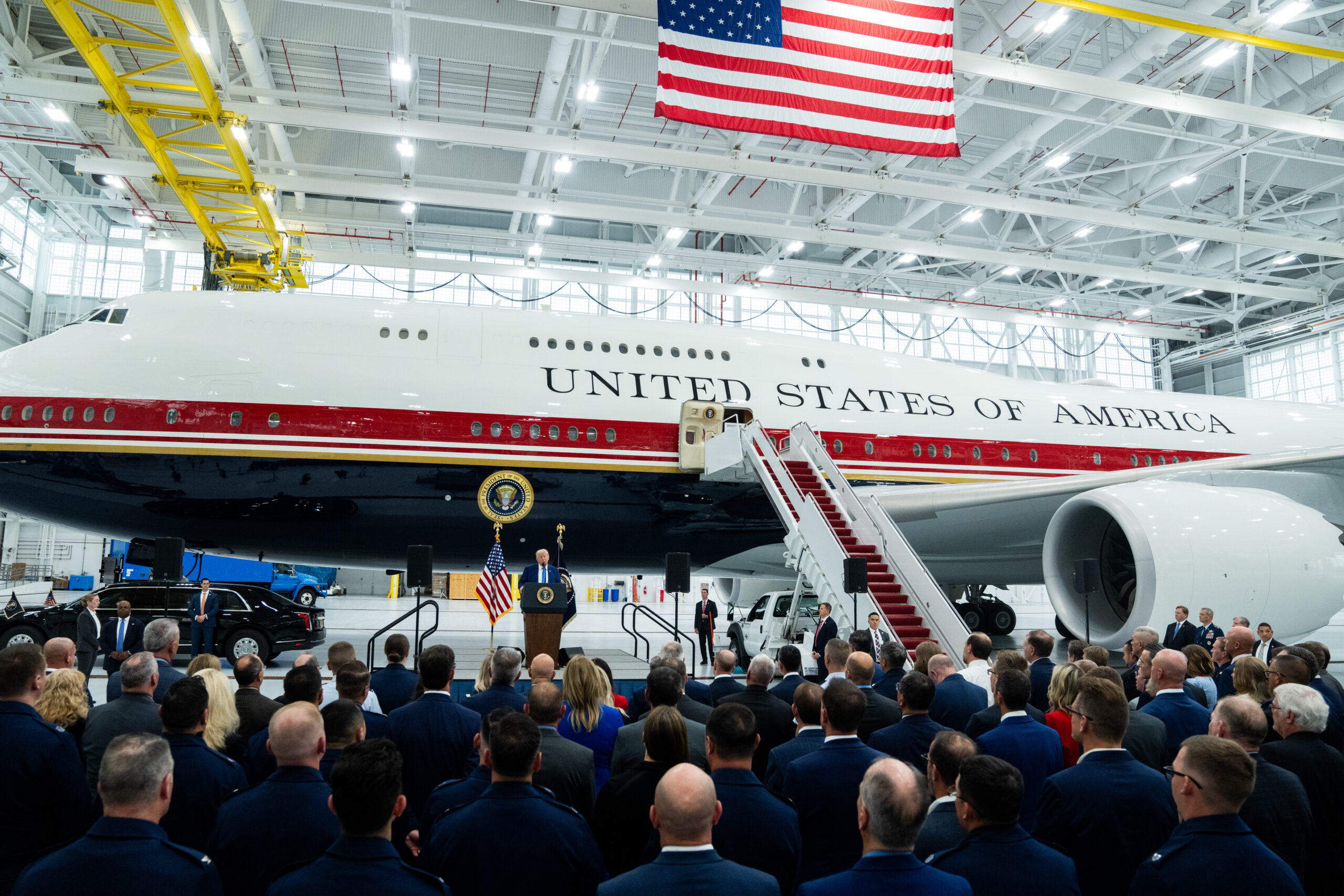
President Donald Trump delivers remarks next to the new red, white, and blue Boeing 747 jetliner donated by the government of Qatar that will be used as Air Force One, at Joint Base Andrews, Md., in June.
One of the many ironies here is that Trump is inadvertently doing America a July Fourth favor by highlighting a key part of the flawed wisdom of the nation’s founders. In declaring independence in 1776 and creating a government that aimed for people-powered democracy with checks and balances on unbridled autocracy, the mad scientists of the American Experiment also expressed their fears for our future.
“The only path to a subversion of the republican system of the Country is, by flattering the prejudices of the people, and exciting their jealousies and apprehensions, to throw affairs into confusion, and bring on civil commotion,” Alexander Hamilton wrote in 1790. “When a man unprincipled in private life, desperate in his fortune, bold in his temper … is seen to mount the hobby horse of popularity, he may ‘ride the storm and direct the whirlwind.’”
This Fourth of July week, I’ve been thinking a lot about the 1770s, but also the 1970s. For the second-half baby boomers like myself, it’s impossible not to experience the nation’s 250th anniversary without sepia-toned memories of July 4, 1976 — the U.S. Bicentennial.
Things were both so similar and so different.
Just as democracy stares into the abyss now, the assassinations, riots, and bombings of the late 1960s and early ’70s felt like the apocalypse to those who lived through it. But the Watergate scandal — yes, the very thing JD Vance and others on the far-right are dismissive of now — and the way courts and newsrooms and members of Congress responded had created a new hopeful yearning in the summer of 1976.
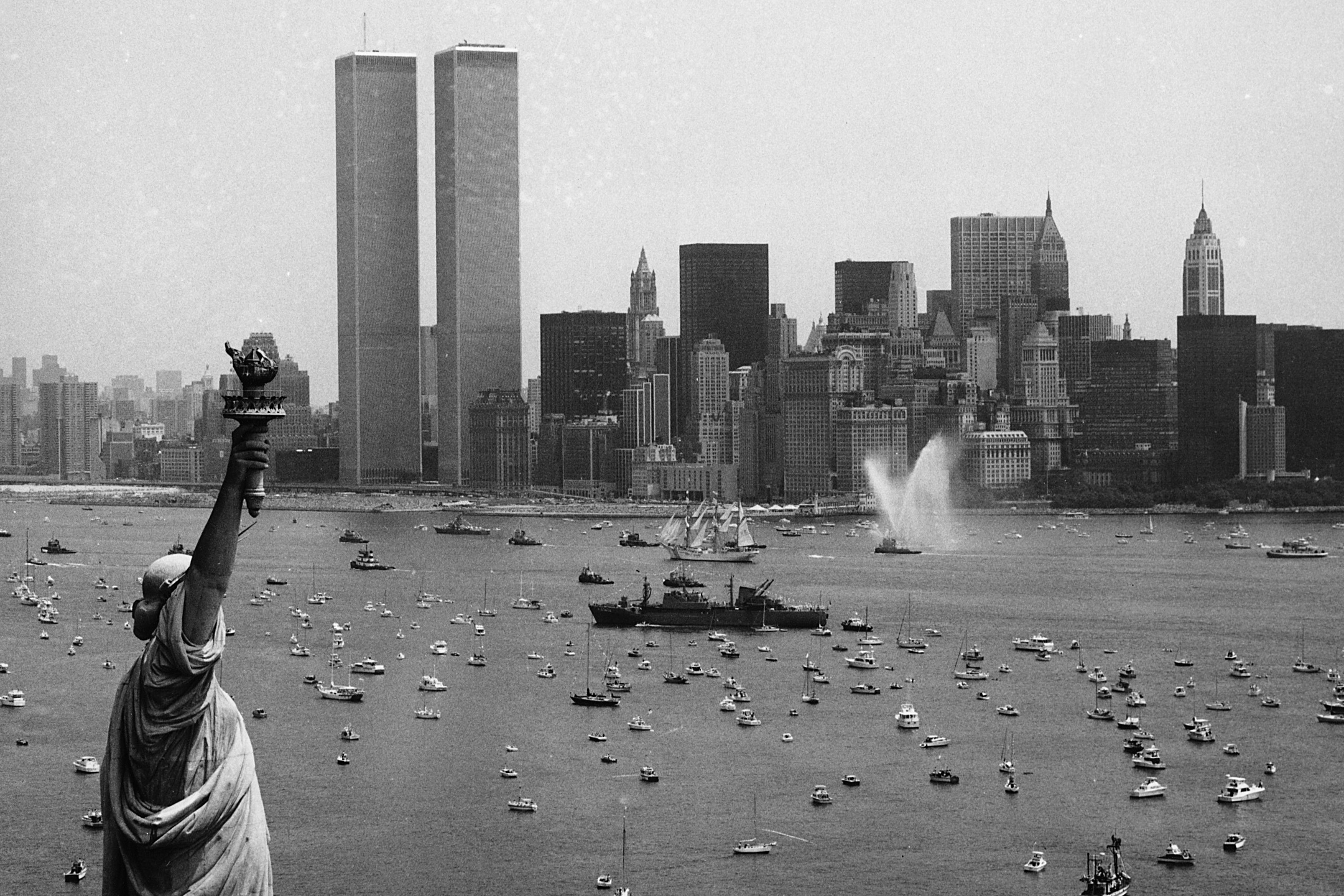
Ships participate in Operation Sail between the Statue of Liberty and the Twin Towers to celebrate the U.S. Bicentennial in New York on July 4, 1976.
That feeling is what made the day I enjoyed with my family as a 17-year-old a half-century ago — watching those glorious tall ships glide down the Hudson River from my dad’s high-rise office on 10th Avenue, then cramming into a subway to get to the fireworks over the Statue of Liberty — still bring back chills today. There was an unexpected sense of togetherness — and, naively in hindsight, that a storm had passed.
It’s different in 2026. The whirlwind that Hamilton warned us about is directly overhead, and the man is still riding, however clumsily, the hobby horse. The institutions that saved us ahead of 1976 are shells of their former selves, as if a neutron bomb had struck.
And yet, the fundamental essence of what can make America actually great someday remains intact: its people. This summer, millions of us are showing that Americans want things that can bring us together, and also to celebrate what makes us all different and all special, whether on a soccer pitch or a parade route laced with pink.
The question is, how do we take this positive energy and stop the whirlwind? How do we celebrate a 250-year slow-bending of the arc of the moral universe without losing our focus on the ongoing crime scene at 1600 Pennsylvania Avenue?
When the president’s Freedom 250 sets off 850,000 fireworks over Washington on Saturday, think of every single blast as about $2,000 that Trump pocketed for himself, and then it might be possible to comprehend the scope of his crime against our citizenry.
Don’t let the president hijack the Fourth of July to rob the focus from what matters most, the things we need to write and discuss and march against every week: his unprecedented criminality. The bombs are bursting in air, but only when weunleash our people power and seek justice will we see the dawn’s early light of a new nation again.
What amazes me about the fact that America turns 250 on Saturday is that I’ve been alive now for 27% of U.S. history. When I was 17 and watched the Bicentennial parade of tall ships down the Hudson River from my dad’s conveniently located Manhattan skyscraper office on July 4, 1976, I thought I was celebrating ancient history. I was wrong. In a big, diverse world, the United States remains a young adult among nations. Like most young adults, we have a lot of issues.
Trump thinks anything besides stealing the election is ‘a big yawn’
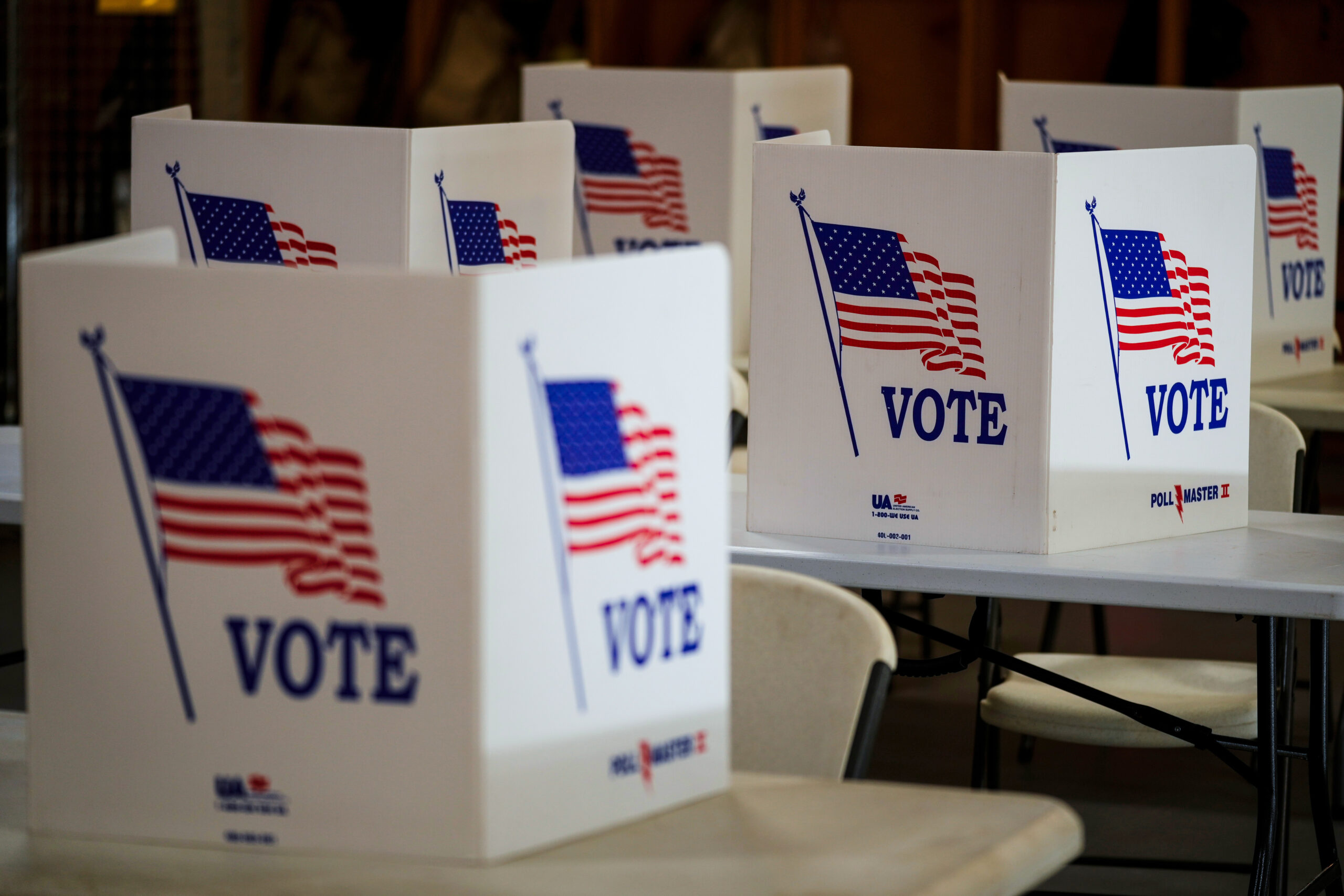
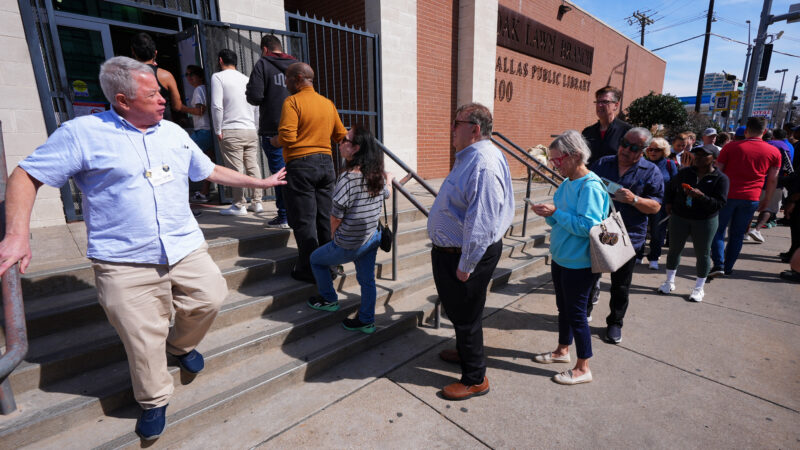
Voting booths are set up at a polling place in Newtown in 2024.
Donald Trump gets a lot of flak, and deservedly so, for telling so many lies. On Monday, he held an Oval Office press availability, and much of what he said — false claims that other nations don’t have birthright citizenship or mail-in voting — was flat-out untrue.
But nothing is scarier than when the 47th president speaks the truth about what’s really on his mind. Because the only thing that’s in Trump’s brain right now is stealing the November midterm election by changing the rules in his favor … or worse. If Trump’s vocal cords were not so weak and diminished, he’d have been screaming the quiet part out loud.
“Here’s what I would like to say,” Trump said of the still-unsigned housing bill, which passed in the House by a 396-13 vote. “It’s a yawn. Some people say it’s wonderful. To me, compared to the SAVE America Act, just about everything is a big yawn.”
In quainter times, Trump’s disrespect for the housing bill — a grab bag of measures all geared toward encouraging contractors to build more units, which would lower both purchase prices and rents — might be the political gaffe of the year. Currently, only 29% of Americans think it’s a good time to buy a house, and nearly two-thirds are more likely to vote for a Congress member who helped lower prices. Republicans who voted for the bill are desperate for a win.
Trump doesn’t care. He’s forgotten his “forgotten Americans” who think the rent is too damn high, not to mention the GOP members of Congress who’ve followed him off the cliff. But that’s not even close to the most alarming thing about Trump’s Oval Office moment of truth.
The president says the only thing he cares about — even with his conflict in Iran becoming another “forever war,” and with the economy down the toilet for everyone who’s not a tech trillionaire — is a bill that critics say would be a disaster for free and fair U.S. elections. One report found that some 12 million people who fairly and successfully voted in the 2020 presidential election don’t have the documentation — such as a birth certificate or passport — that the bill requires.
We don’t know how such a massive drop in turnout would change the election results, or whether a weakened Trump can pressure theGOP to find a way to pass a bill with zero Democratic support. But we do know this: The president’s maneuvers are not even the worst thing Trump has done this month on the steal-this-election front. Not by a long shot.
The Trump regime has been signaling for months that it sees the U.S. intelligence community — spy agencies like the CIA — not as a tool for finding out what comes next in the Persian Gulf, or if or when China is invading Taiwan, or when Vladimir Putin’s Russian empire will fall. No, Trump wants secret agents who can creatively invent theories of foreign-born election fraud that would demand a strongman response.
We saw this coming back in January, when the regime dispatched Trump 47’s first director of national intelligence, Tulsi Gabbard, to Fulton County, Ga., to oversee an FBI raid of voting materials from the 2020 election that Trump, with no evidence, continues to dispute. That link made it clear the regime is looking to create links to foreign actors.
When Gabbard left the administration this spring, Trump named a temporary replacement who can serve through the November election: Bill Pulte, who also continues to lead the Federal Housing Finance Agency. Pulte lacks a key prerequisite for his new job — any experience in intelligence whatsoever — but has the only quality that matters to Trump: undying loyalty. Pulte’s main focus in the housing job has been combing through the mortgage records of the president’s political enemies, looking for undotted i’s and uncrossed t’s that could be used to manufacture criminal charges from nothing.
In just a few days at intelligence, Pulte has not disappointed his boss. He showed up Monday and immediately began firing current staffers, with a rumored list of hundreds. The steep reduction in eyeballs on the world’s trouble spots is disturbing, but what’s even more alarming is the one person Pulte has hired.
The newsletter SpyTalk described Pulte’s new chief of staff, Christina Norton, as “a party-loving MAGA activist with no background in national security issues but who last year boasted of running ‘the largest election integrity operation the Republican Party has ever seen’ …”
The pairing of Pulte and Norton is an alarm bell that the national intelligence team under Trump will have one job: investigating fantastical “foreign election plots” that will be cited to justify radical measures like sending troops to polling places, seizing voting machines, or worse.
SpyTalk noted that Norton, in her active Instagram feed, “talks about supervising more than 200,000 Republican poll watchers ‘standing guard’ at polling booths and vote-counting stations across the country” during her 2024 stint at the Republican National Committee.
Yet, intelligence is just one of many tools in the federal government that the obsessive Trump is working to activate ahead of a November election that polls suggest will be a “blue wave” for Democrats hoping to retake Capitol Hill. Trump has issued several executive orders seeking to assert federal control over voting, which has been a state and local function throughout 250 years of American history.
That effort suffered a bit of a setback Monday, when the U.S. Supreme Court ruled that states can continue to count mail-in ballots that are postmarked before Election Day but arrive after the polls have closed. But that will not stop the Trump regime from politicizing the U.S. Postal Service ahead of November.
Last week, Postmaster General David Steiner told Congress that USPS plans not to deliver mail-in ballots in states that don’t turn their voter rolls over to the Trump regime, a demand many governors have resisted so far. “President Trump does not believe that elections he loses are valid,” Democratic Michigan Sen. Elisa Slotkin said after the hearing. “It’s all part of his authoritarian playbook.”
This all feels very familiar. In the lame-duck days after Trump’s 2020 election loss to Joe Biden, the 45th president — instead of packing up to return to Mar-a-Lago — got busy putting in a new team at the Pentagon, ordering the U.S. Department of Justice to probe alleged voter fraud, challenging vote count certifications in court, and urging state lawmakers to seat rival slates of electors. Most pundits laughed this off, but I wrote a column — “So, is President Trump staging a coup, or what?” — that ran on Nov. 10, 2020, nearly two months before the actual attempted coup on Jan. 6, 2021.
Now Trump is not only staging another coup, but he is yelling about it, in your face. There is nothing he won’t try over the next five months to prevent a Democratic Congress from investigating how he and his family have made billions of dollars off the American presidency.
When Trump says anything that’s not election meddling is a “big yawn,” this should be our wake-up call. The time for a full-court press — lawsuits, public hearings, and investigative journalism — can’t wait until after the election. The new putsch has already begun.
Yo, do this!
If you didn’t think I raced to download the new audiobook of Zayd Ayers Dohrn’s tale of growing up in the radical Weather Underground in the 1970s and ’80s — Dangerous, Dirty, Violent, and Young: A Fugitive Family in the Revolutionary Underground — then you must be new around these parts. Dohrn had already used his unique access to his parents — Bernardine Dohrn and Bill Ayers, revolutionary royalty — and their friends to tell a history of that era’s far left in 2022’s award-winning podcast, Mother Country Radicals. His new book aims to go deeper into the psychology of what it was like to be raised as a toddler on the run from the FBI, or whether bombings and bank robberies can change the world. That’s a question — also explored in this viral essay — with new resonance in the Trump era.
A few weeks ago, I suggested that folks see the new movie The Sheep Detectives. The film is already streaming on Amazon Prime (which produced it), and Sunday’s rare night off for the World Cup offered the excuse to finally watch. I can now highly recommend it. The movie — with an adapted script by the acclaimed showrunner of HBO’s Chernobyl, Craig Mazin — manages to merge police procedural cliches with moving thoughts about prejudice, existentialism, and what it means to belong to a flock. Even a flock of talking sheep.
Ask me anything
Question: Is Markwayne [Mullin, the Homeland Security secretary and former Oklahoma senator] the least qualified cabinet level official in American history? — Richard McGovern (@richardmcgovern.bsky.social) via Bluesky
Answer: Good question from Richard, a fellow long-suffering Philadelphia Union fan. Not because I know the answer, when there are rivals for the title like Donald Trump’s war-losing “Secretary of War” Pete Hegseth, to name just one. But Mullin is now behind a move so outlandish that it showed me I haven’t lost my capacity for shock after all. This weekend, Trump nominated a previously unknown former Oklahoma state trooper named Lance Schroyer to run U.S. Immigration and Customs Enforcement, a powerful agency with 22,000 agents and a budget of around $30 billion a year. It turns out that just recently, Schroyer was heading a security detail for Mullin in Washington, D.C., and has become a close enough friend that he is an occasional dinner guest. Yes, he hired his bodyguard to run the equivalent of a large corporation. Stay tuned for all of this to unravel.
What you’re saying about …
I guess we’re not as close as we thought, as very few of you were eager to share your July Fourth plans with me or discuss what America’s 250th birthday means at such a dark moment. The ones who did reply are looking forward to spending time with family and friends, but all that patriotic jazz, not so much. “Probably, we will have our usual picnic and take the grandkids to see the local fireworks, but I have no intention to watch any special programming or parades, etc.” Marianne Zollers wrote. “It will just make me sad. Such a different feeling compared with the Bicentennial which was such a joyous and happy occasion for my entire family.”
📮 This week’s question: One of the big stories of 2026 that’s finally getting a lot of attention is the success of more progressive Democrats, including democratic socialists, in key primary races against party moderates. Is this a good thing, lifting up candidates who’ll fight against Trump and for the working class? Or do you worry Republicans will capitalize against their opponents with more left-wing views? Please email me your answer and put the exact phrase “2026 progressive Democrats” in the subject line.
Backstory on crossing the World Cup off my bucket list
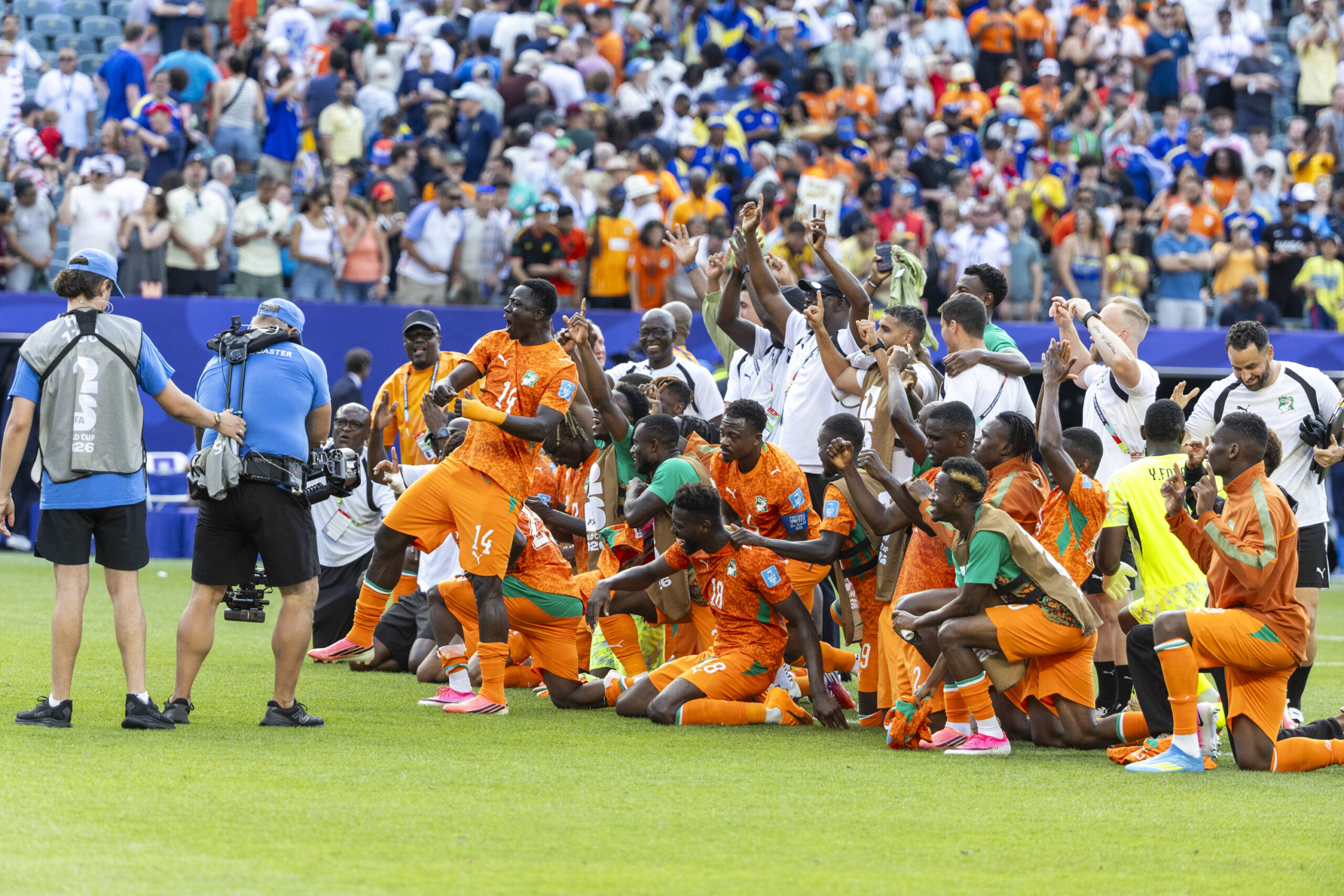
The Ivory Coast team celebrates their win in the middle of the field against Curaçao with a score of 2-0 for the FIFA World Cup at the Lincoln Financial Field in Philadelphia on Thursday.
I can’t say exactly when, but at some point during my first-ever in-person World Cup match between Côte d’Ivoire and Curaçao, watching from the thin air of the top deck of the temporarily renamed Philadelphia Stadium, it struck me: My decades-long dream of being there for the world’s greatest sporting event was not like what I’d imagined.
And yet, in some weird, quasi-religious acid test kind of way, it was even better.
I’ve been to countless sporting events going back to 1968, but never one where the vibe was basically: So happy to be here. I’ve certainly never been to a game where the PA announcer uttered something before the match about giving a big hand to both teams — and the sold-out crowd obliged. Fans would have burned down Section 220, Row 27, where I was sitting, if this had happened during an Eagles-Cowboys game. During a tense match with a place in the Round of 32 on the line, the gathering repeatedly did the wave and threw their vocal cords more behind the halftime singalong of the Bruce Channel 1961 oldie “Hey! Baby” than either of the two decisive goals by Côte d’Ivoire’s Les Éléphants.
Up in nosebleed country, many of the fans repped soccer jerseys, but they were for club teams like Liverpool or Christian Pulisic’s USA No. 10, joined by me in my Philadelphia Union T-shirt. We were Philly’s soccer aficionados, desperate to be a part of maybe the only time in our lives the World Cup would take place in the City of Brotherly Love. A match pitting the smallest nation to ever qualify for the FIFA tourney (Curaçao, population 158,000) and an African underdog was pretty much the only way to crash the party without a bank loan. (Full disclosure: I paid about $280 apiece for two seats on StubHub — much like buying a stock, it could have been more or less, depending on how one timed it.)
No, this wasn’t much like the Eagles games played here, where excitement merges with pins and needles of anxiety. On a picture-perfect late afternoon in June, bookended by the Philadelphia skyline and a lazy Delaware River, it felt more like a rock concert. It wouldn’t have seemed out of place if folks had started batting a beachball around at this soccer Woodstock. There was a mind-meld of the faithful, who saw FIFA and its commercialization as the devil, with the loudest boos for the TV-ad-laden “hydration breaks,” but with — I swear to God — a loud roar for the announcement of the attendance: 68,324. In a city where a 1976 Bicentennial match of some of the world’s best players took place in a mostly empty stadium, soccer is indisputably here to stay.
Fans walked out of Philadelphia Stadium beaming less over the final score and more about the instant karma of the afternoon. After years of tavern taunts and ridicule from sports-talk radio, localsoccer die-hards lived long enough to see America’s founding city become the world’s co-capital of the sport that, for its true believers, passes all understanding. It was all too beautiful. If I can somehow make it to Spain or Portugal or Morocco in 2030 (because, hey, I need a new bucket list now), I will be sure to wear some flowers in my hair. Soccer time will be a love-in there.
What I wrote on this date in 2019
I’ve been writing about the topic of journalism reform since the mid-2000s, or around the time it became clear to me and a lot of other folks that newsrooms needed to change or die. My fear, circa 2006 or so, was that we’d start seeing entire communities without newspapers or the accountability journalism that flows from that — which is exactly what happened in Youngstown, Ohio, when its paper closed seven years ago. I wrote: “The loss of the Youngstown Vindicator every morning doesn’t mean that the region’s 200,000 people will no longer be getting information. It just increases the likelihood they’ll be getting bad information — intentionally manipulated, and sometimes out-and-out fakery.”
Only one column this week, as I took a well-deserved day off to attend the World Cup. In that piece, I looked at the sorry state of justice in America on the eve of its 250th birthday, with an emphasis on the outrageous sentences — ranging from 30 to 100 years — handed down to left-wing anti-ICE protesters convicted of rioting in North Texas. The U.S. Department of Justice that pushed these virtual life sentences is also pardoning the right-wing rioters of Jan. 6, 2021, as well as billionaire fraudsters who donate money to MAGA players and causes. They’ve made a mockery of liberty and justice for all.
Let’s be honest: People — not to mention sheep (see above) — can’t get enough of a murder mystery, especially a real-life true crime. It’s been a while since a crime saga has riveted Philadelphia readers as much asthe stench of possible foul play that is growing at a home on West Chew Avenue in the city’s Olney section that police have branded a crime scene as they search for clues in the disappearance of two local women. Since the case broke open last week, nearly a dozen Inquirer reporters have produced riveting articles about the discovery of drugs, chemicals, and “a significant amount of blood” at the Horsch family residence, profiles of the two missing women — Amy McHale and Blair Tonzelli — and interviews with neighbors who talked about living next door to “a house from a scary movie.” The backstory here is that — whatever you may have heard about AI — it still takes a lot of human shoe-leather to get to the bottom of a story like this. Subscribing to The Inquirer is a twofer: You get to hurdle the paywall to read compelling journalism and feel good about being a supporter.
By submitting your written, visual, and/or audio contributions, you agree to The Inquirer’s Terms of Use, including the grant of rights in Section 10.
A few months back, the Donald Trump-fried chair of the Federal Communications Commission, Brendan Carr, urged broadcasters to air patriotic programming for America’s 250th birthday — including regular on-air recitations of the Pledge of Allegiance.
I couldn’t find any reports about TV or radio stations that have actually done this. Maybe they’ve figured out that the bit at the end — that stuff about “liberty and justice for all” — has been rendered into utter baloney by Carr’s strongman boss.
For anyone who still believes the myth that the United States’ criminal justice system is the envy of the world, I say: Let them come to Fort Worth. In northern Texas, a crime committed by one man with the “wrong” politics gave the Trump regime the ammunition it craved for a free-speech crackdown that makes a mockery of America’s birthday bash.
Ironically, it was on July 4, 2025, that a crew from the small but tight-knit left-wing community in the Dallas-Fort Worth (DFW) metroplex ventured 30 minutes south to the Prairieland Detention Center run by U.S. Immigration and Customs Enforcement to protest the squalid conditions and overcrowding there.
The protesters dressed in black; some brought fireworks or medical supplies. The evidence shows they committed some minor crimes — vandalizing a vehicle, for example. But when local police were called, one man — Benjamin Song, an ex-Marine known to local activists as “Champagne” — committed a serious offense, firing a gunshot that wounded a town police officer in the neck. The officer later acknowledged he was pointing his gun at a fleeing protester when Song fired his weapon.
The Prairieland incident came right as the Trump regime was striving to brand “antifa” — a loose ideology that fascism should be resisted by any means necessary — as some kind of highly organized terrorist cell. FBI agents fanned out across DFW, ultimately building a riot-and-terrorism case against nearly two dozen leftists, including the group — now known as the Prairieland 9 — that stood trial this winter at the Fort Worth federal courthouse.
Among the evidence prosecutors presented to bolster their contention that the protesters were part of some kind of terror cell included their black garb, their Signal chats in which they discussed plans for a “noise protest” at Prairieland, or their decision to bring medical supplies with them to the demonstration, which occurred at a time when anti-ICE protests were meeting violent responses. One of the alleged coconspirators wasn’t even at the protest; he’d moved a box of anti-fascist magazines before agents visited his home after his wife called from jail.
Tamera Hutcherson, a local activist who attended much of the trial as a paralegal for defendant Savanna Batten, told me by phone Saturday that the case against Batten “was based on the fact that she showed up to the protest wearing black, she had medical supplies on her, which included a tourniquet, and that she was there for a noise demonstration to set off fireworks.”
Batten, Song, and the other seven were convicted in March, and their sentencing was decided by the trial judge — Mark Pittman, a Trump appointee — and his colleague, Reed O’Connor, a federal jurist so well known for his right-wing rulings that the Trump regime and allies like trillionaire Elon Musk look for excuses to bring cases before him.
In this case, O’Connor was happy to say the quiet part out loud: that a repressive government is seizing on this case to send a message to anyone who wants to aggressively protest mass deportation or other abuses. He called the protest “an assault on democracy,” adding, “The need to deter this type of conduct is high.”
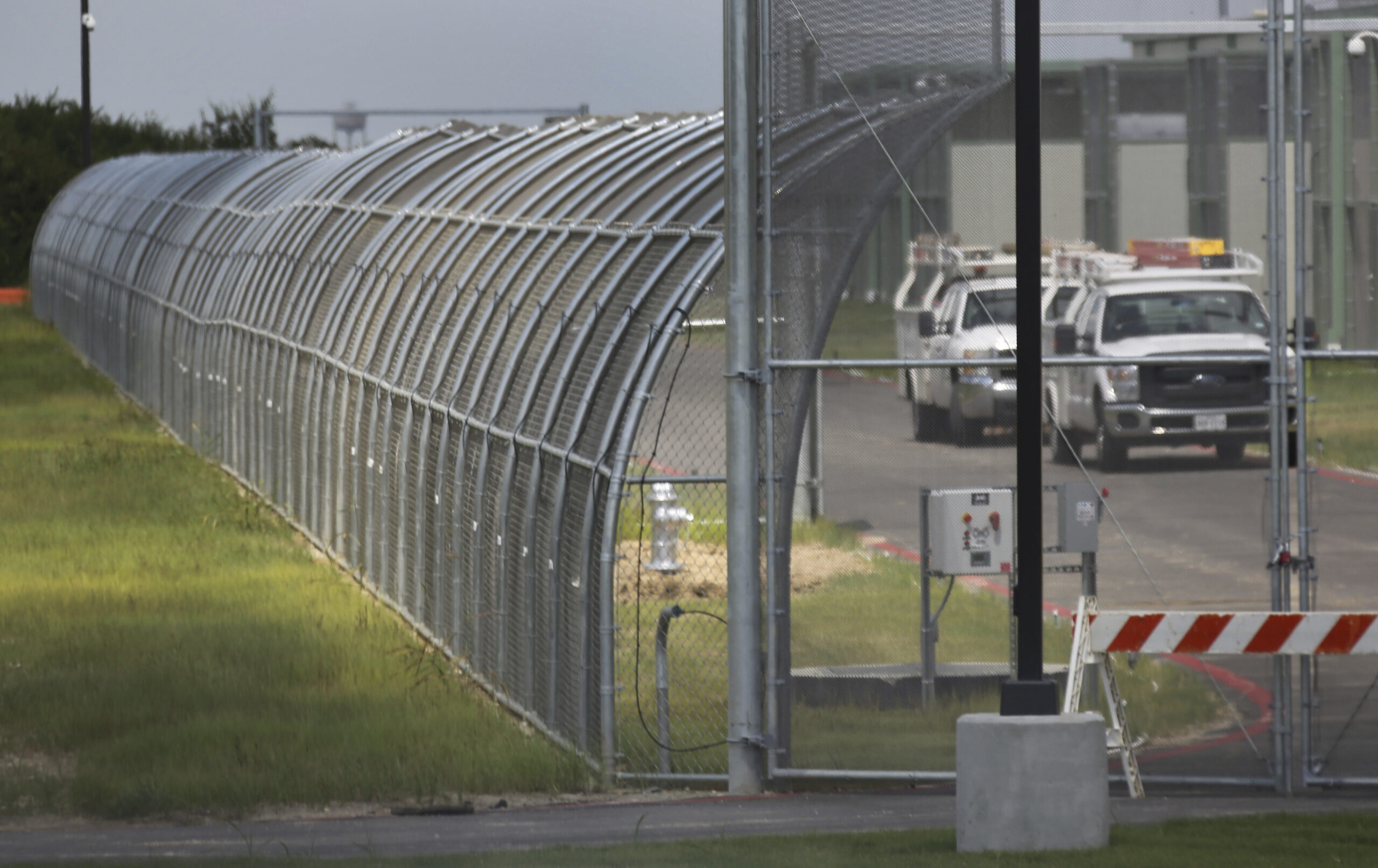
Trucks drive at the Prairieland Detention Center in Alvarado, Texas, in September.
Still, courtroom observers were stunned when the sentences came down. It wasn’t a total shock when Song, convicted of attempted murder, was given 100 years, but Batten, the black-clad medic, got 50 years — a virtual life sentence for dissent — as did several others. Daniel Sanchez Estrada, the magazine mover, got 30 years.
Hutcherson, who was in the courtroom for last week’s sentencing, called O’Connor’s comments “chilling … to have the judge say this out loud, it really sunk in.”
What’s sunk in is that the federal government is pouncing on the Prairieland 9 convictions to unleash a crackdown on left-wing protest that will make America’s past sins like the Palmer raids, McCarthyism, and the trial of the Chicago 7 look like child’s play.
In recent days, we’ve seen federal charges against the Minneapolis 15 protesters who monitored the Minnesota ICE raids in Signal chats, and an indictment against two Atlanta protesters against the “Cop City” police training center — even after a local judge had essentially laughed state charges against them out of his court. When a state prosecutor offered evidence of criminality that the Cop City demonstrators wore black clothes and masks, Judge Robert Flournoy said, “Oh, that sounds like ICE.”
There’s a lot going on here. The Trump regime — which last fall designated “antifa” (again, not an actual group) as a terrorist organization, abusing its vast post-9/11 powers as many of us feared it would — is aggressively clamping down on the First Amendment-protected right of dissent ahead of the November midterms, when its dictatorial-minded leader will stop at nothing to keep his party in power.
But these 50-year prison sentences, which carry the sauerkraut stench of German cooking, circa 1933, are also an exclamation point on the death of even pretending there is anything resembling impartial criminal justice in America. We are now a land where left-wing dissenters will spend decades behind bars reading about the latest millionaire fraudster or Republican apparatchik to get out of jail free.
Look, we’ve always been more than delusional about praising U.S. justice as the supposed envy of the free world despite the reality that rich kids or celebrities like the late O.J. Simpson who hire the best lawyers can walk free after people die, and white-collar crime is treated as a sport, while Black, brown, and poorer defendants form the backbone of one of the planet’s highest incarceration rates.
But the Prairieland most-of-your-life sentences didn’t happen in a vacuum. They are the counterweight to Trump’s Day One pardons for theroughly 1,500 right-wing rioters on Jan. 6, 2021, who stormed and vandalized the U.S. Capitol in an insurrection blamed for five immediate deaths, with more than 140 police officers injured.
At the same time the Prairieland 9 were getting frontier justice, the New York Times reported that Trump’s Justice Department quashed a criminal probe into the circumstances behind the president’s clemency for a multimillionaire named David Gentile. The private equity executive had been sentenced to seven years in prison and ordered to pay $15.5 million in restitution for a $1.6 billion scheme that defrauded small investors. Many lost their life savings — arguably a greater harm than anything that happened at the Texas ICE detention center.
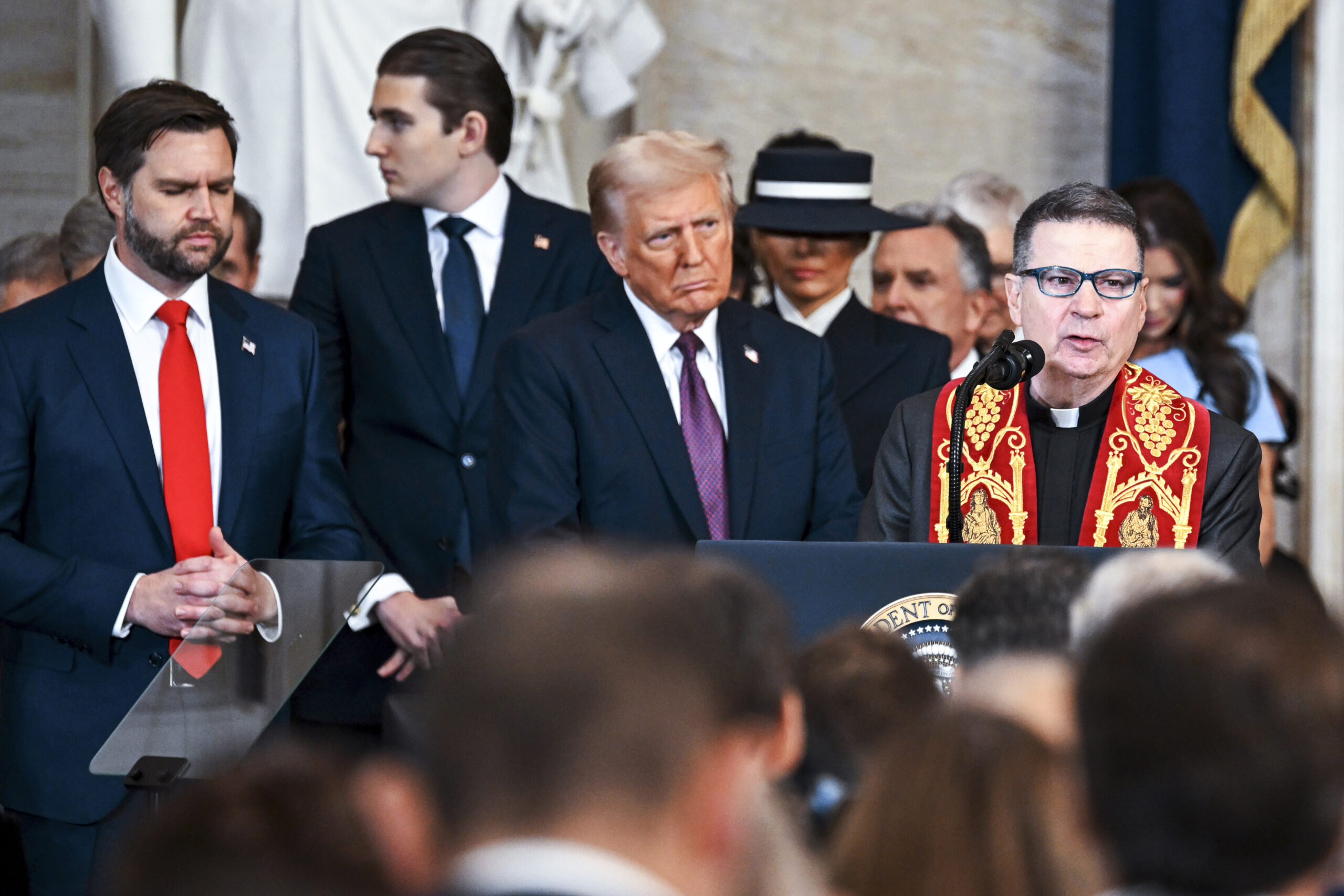
But Trump granted clemency to Gentile after just two weeks in prison. Prosecutors were looking into the relationship between Gentile and a retired priest from Queens who has become a top supporter and personal friend of Trump and who lobbied the president for Gentile’s release. But higher-ups reportedly told New York mid-level prosecutors to end their probe into questions like whether the priest was paid.
The Rev. Frank Mann speaks next to Donald Trump during Trump’s second inauguration at the U.S. Capitol on Jan. 20, 2025.
In a matter of months, Trump has exploited the existing cracks in the federal justice system to make it a blunt instrument of personalist dictatorship — a “purge” for his criminal friends or bad guys willing to make a donation, while depriving those who dissent of their liberty.
I’m just barely scratching the surface, as Trump’s injustice department also conducts high-profile investigations into law-abiding political opponents, including top Democrats or people likeformer FBI chief James Comey. Or consider this: No action has been taken against Jonathan Ross, the ICE agent who’s been publicly identified as the killer of unarmed Minneapolis motorist Renee Good. When a Syracuse, N.Y., woman ID’d Ross and asked why he had not been indicted in an Instagram post, federal agents entered a voting place where she was working as a poll worker and ordered her to take the inarguably true post down.
The nation’s founders, who declared American independence 250 years ago this week, strongly believed that justice was the backbone of their experiment in democracy. The Bill of Rights they’d enact in 1791 is largely about the right to a fair trial, avoiding unlawful searches and seizures, and the essential liberty of protesting an unjust government. More than two centuries later, the White House seems more governed by George Orwell’s 1984, as they criminalize left-wing “thoughtcrime.”
“I think it’s very symbolic … that this protest happened on theFourth of July,” the Texas activist Hutcherson told me. “This year is the 250th year of America being America. And when we think about the inception of this nation, it was because of protest; it was because of dissent. And so it feels very contradictory that because someone has leftist or anti-fascist views that now they can be deemed criminal or a terrorist to the U.S. government. You know, we’re not seeing the same energy given toward people that have right-wing views.”
The firecrackers of dissent that went off on Independence Day 2025 over an ICE gulag in Texas were much more of a tribute to what America was supposed to be than whatever Trump detonates over his morally empty National Mall on this July Fourth. In a United States with liberty for billionaires and justice for none, what are we even celebrating?
Some newsletters have a theme, and this week’s focus is a rare one: good news. Let’s start with the subject of a recent column: Izzy Aly, the 40-year-old Egyptian national from Orlando who’d been in U.S. Immigration and Customs Enforcement custody for nearly six months, amid allegations of neglect around his worsening health. Today, I can happily report that Aly is a free man: released from detention and back home in central Florida. But he still needs assistance for his legal bills and replacing what was taken during his time away; you can help out here.
Soccer, Obama, Knicks give a glimpse of the America we can be at 250
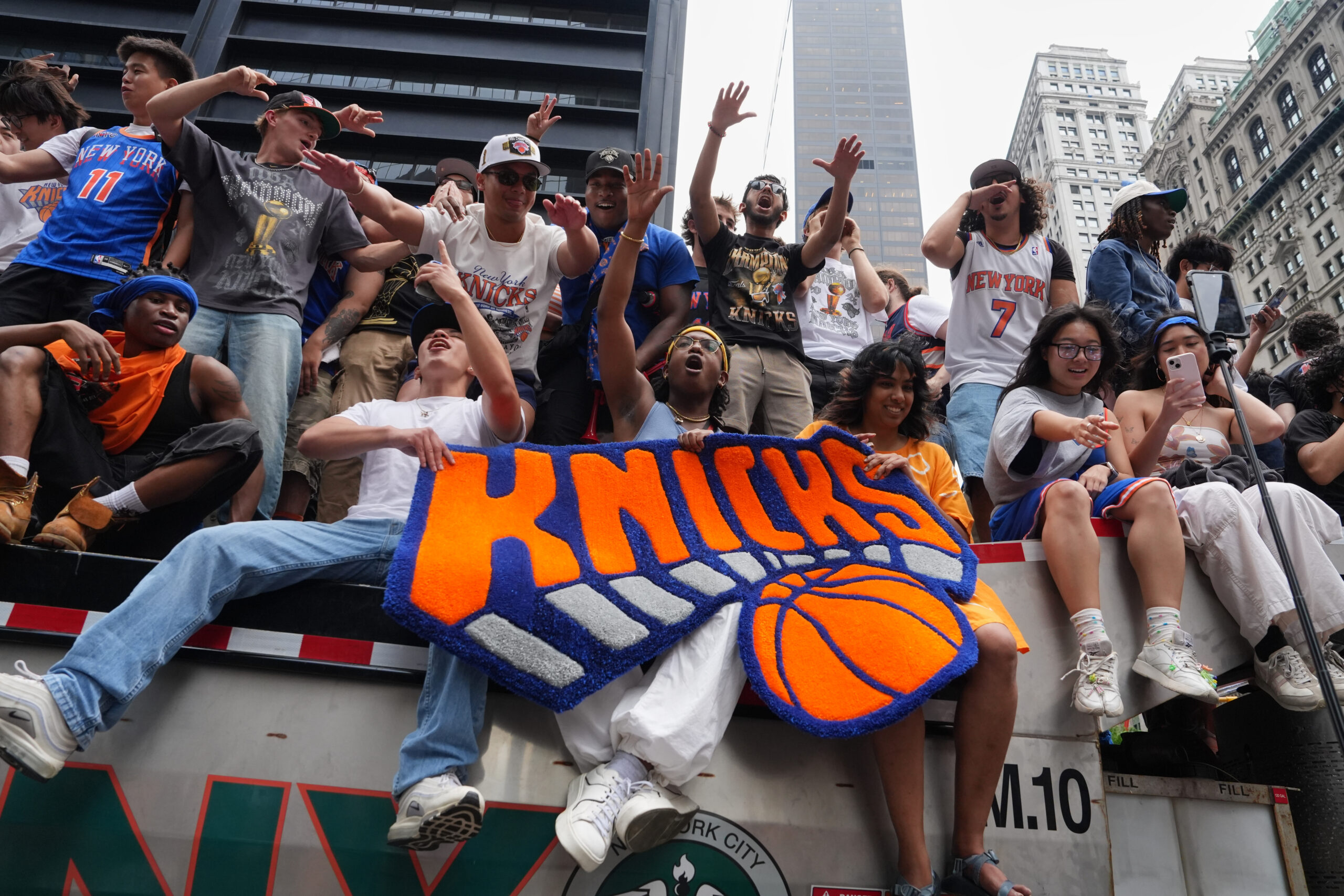
Fans celebrate during the New York Knicks’ NBA championship parade Thursday, in New York.
I’m old enough to remember when Lawrence, Kansas was the nightmarish vision of a dystopian U.S. future. The year was 1983, and the corn-fed university town seemed to producers the most fitting all-American location to decimate in a fictional Cold War nuclear apocalypse, ABC’s The Day After.
In 2026, Lawrence is not only still standing, but it’s putting the heart in the American heartland — making love, not nuclear war. And its obscure object of desire is, of all things, a soccer team from 5,000 miles away: the national squad from Arabic-speaking, predominantly Muslim Algeria.
When the Algerians chose Lawrence — about 40 minutes west of Kansas City, where two of its three World Cup matches are taking place — as its training base for the planet’s greatest sporting event, locals came out to greet the foreigners like rockstars.
“I was just so happy that they chose our hometown,” an older man, tearing up slightly, told an Algerian reporter in a video that went viral, as he waited in a rainstorm for the team to arrive. He said he knew three things about Algeria — that it touches the Mediterranean in the north, the Sahara Desert in the south, and that it fought for independence from France. “We don’t know too much, but we want to welcome them here.”
That they did in Lawrence. There are signs on all of the lampposts — “1,2,3, Viva l’Algérie!” — and an official welcome party featured the University of Kansas marching band nailing its cover of the Algerian national anthem while 800 Kansans saluted a rendering of the Algerian flag by local landscape artist Stan Herd. Herd told ABC News that what’s happening in his hometown is “not about football. It’s about cultures coming together. It’s about shared humanity.”
What’s happening in his prairie town is special yet not unique during the second-ever World Cup on U.S. soil. Greensboro, N.C. is festooned with the flags of the Norwegian team that’s training there (although the team chef did have to fly in the players’ halibut) while Chattanooga, Tenn. has gone gaga over sightings of the Spanish soccer superstars training in their city.
There’s a saying in soccer that if one team has all the momentum but then the other team nets a surprise goal on a counterattack, they’ve scored “against the run of play.” It’s hard to imagine anything more against the run of play than these outpourings of international love in states that have voted in the last three elections for the xenophobia of Donald Trump and his mass-deportation regime.
The affection for Algeria is especially remarkable in Kansas, where in 2012 Republican lawmakers enacted a largely symbolic ban against Sharia law in state courtrooms, and in 2017 a man claimed he’d murdered “two Iranians” — the victims were actually of Indian descent — after Kansas candidates ran scare campaigns warning that Muslim terrorism might come to Middle America.
Yet these World Cup welcomes in red America also seem to have captured what feels like a shift in karma that arrived just ahead of the summer solstice. Sure, the news on TV was still giving off bad vibrations — from the reality of a lost war in Iran to the cosmic metaphor of green slime in the Lincoln Memorial Reflecting Pool. But everyday people seem determined not to let our government drown us in their muck.
With the United States less than two weeks from its 250th birthday, regular folks seem eager, even desperate, to celebrate what is good not just about our nation but the bigger world that’s showed up in North America with a soccer ball and a smile.
There was a brief moment of epiphany last Thursday when I started to wonder if — in spite of everything, and there is a lot of everything — America was on the cusp of a Summer of Love, and a much more successful one than the original 1967 iteration.
I’d hopped in the car for the only place I ever go — the dog park — and the dedication ceremonies for Chicago’s Obama Presidential Center were on the radio. I heard the former first lady, Michelle Obama, uttering words that are never formed on the lips of the 47th president: “equality, empathy, honesty, inclusion, fairness.”
She said of her fellow Americans that “deep down in our hearts and souls we all know right from wrong. We know selflessness from greed, righteousness from injustice.” This was just four days, 900 miles, and about 2,000 light years from Trump’s beclowning of the White House grounds for the Caligula-style spectacle of a blood-soaked Ultimate Fighting slate of cage matches that ended with a horrific slur against — wait for it — Michelle Obama.
The Obama Presidential Center was one window into the Bizarro World where America’s leaders are still deeply invested in democracy. Another was unexpectedly taking place in New York City, where the first NBA championship in 53 years for basketball’s Knicks spread joy from Fifth Avenue to Howard Beach, with bond traders high-fiving cabbies as old-fashioned ticker tape rained down on the hoops heroes.
“Neighbors invited neighbors over,” first-year New York Mayor Zohran Mamdani said in his City Hall speech. “Strangers high fived one another in the street. Subway conductors sang their announcements and bus drivers danced behind the wheel. So often, when this city comes together, it is because we are forced to by a moment of tragedy or adversity. What a gift it is to be brought together by pure, unfiltered joy.”
Indeed, it was a remarkable day, with the Chicago and New York celebrations wrapped around a full day of World Cup matches as Americans cheered the best players from Europe, Asia, South America and Africa — some from nations that have been travel-banned and others that have been bombed by a Trump regime that just doesn’t get it.
Yet despite all of those things, it feels like America is having a People’s 250th birthday — one that doesn’t need Trump’s poisoned stamp of approval, or million-dollar donations from crooked corporations, or cage-fighting thugs, or rejects from the I Love the ‘90s Tour singing, or not singing, on the National Mall.
Millions of Americans are looking for a workaround — ways to voice hope over hate, seek joy instead of despair, and wave the U.S. flag while saluting the banners of Algeria or so many places where people may not look or talk quite like us, but share the same dreams. You could squint last week and see the America we are supposed to be at age 250.
Yo, do this!
The one story that truly epitomizes where we are at in the middle of the 2020s is the rise of Elon Musk as the world’s first trillionaire, even as he spews racist bile on his social-media platform X. The veteran writer Charlie Warzel, currently with the Atlantic, looks at the shaky vessel behind Musk’s surge in wealth: SpaceX, the rocket-and-satellite company that recently went public at a valuation that for a time topped $2 trillion — despite currently losing billions of dollars a year. He writes: “SpaceX is a rocket company, a complex financial instrument, a meme, a monument to a broken financial system.” Here’s a gift link for all of Warzel’s must-read essay.
One grossly underreported story that cuts especially hard here in Pennsylvania is the lingering health crisis in rural communities from the fracking boom of the 21st century. A journalist named Justin Nobel has been on the beat of exposing the health hazards of radioactive fracking waste for a decade now, and his latest report for the DeSmog blog from my long-ago western Pennsylvania stomping ground of Washington County is devastating. He finds waste with shockingly high levels of radiation right next to a popular hiking trail, and a possible link to the bone cancer that killed a local teen and devastated his family.
Ask me anything
Question: Is it possible to file against Todd Blanche now for disbarment and if so why is no one taking action or talking about it? — gordeaux (@gchdrake.bsky.social) via Bluesky
Answer: This is a great question, as I’d been thinking about this as the topic for a future column. Blanche, the current acting attorney general who before that was the Justice Department’s No. 2 and before that Donald Trump’s personal attorney, has been accused of a smorgasbord of potential legal misconduct, from his mishandling of the Epstein Files to his role in sending immigration detainees to a Salvadoran hellhole prison. State bar associations are absolutely empowered to investigate misconduct by Justice Department lawyers not only in D.C. but around the nation. But they have been frustratingly slow in doing so. How worried is Team Trump? A recently proposed Justice Department rule would allow the attorney general — right now, this is Blanche — to block state bar-association misconduct probes. Stopping this rule would be one small step in the looming battle for truth and reconciliation in America.
What you’re saying about…
I got a healthy response to last week’s question about whether readers have stayed on X (formerly Twitter) since an openly racist, anti-democratic and extremely wealthy Elon Musk bought it in 2022. Not surprisingly, many of you left after his purchase, or the 2024 election in which he heavily funded Donald Trump. “I absolutely think governments, organizations, media companies and really just about everyone should at a minimum do as I have done and stop posting there completely,” Linda Mitala wrote. But Patrick Roan is conflicted. “I have stayed with it because there are some really good people who have not completely left, including a few who are only on X, but are good and knowledgeable writers with enlightened points of view,” he offered.
📮 This week’s question: The looming Fourth of July is one of those round-number birthdays, America’s 250th. Are you planning to do anything special or different for this Independence Day? Or will you do less because Donald Trump is president? Please email me your answer and put the exact phrase “July 4 plans” in the subject line.
Backstory on the quiet outrage of soldiers occupying D.C.
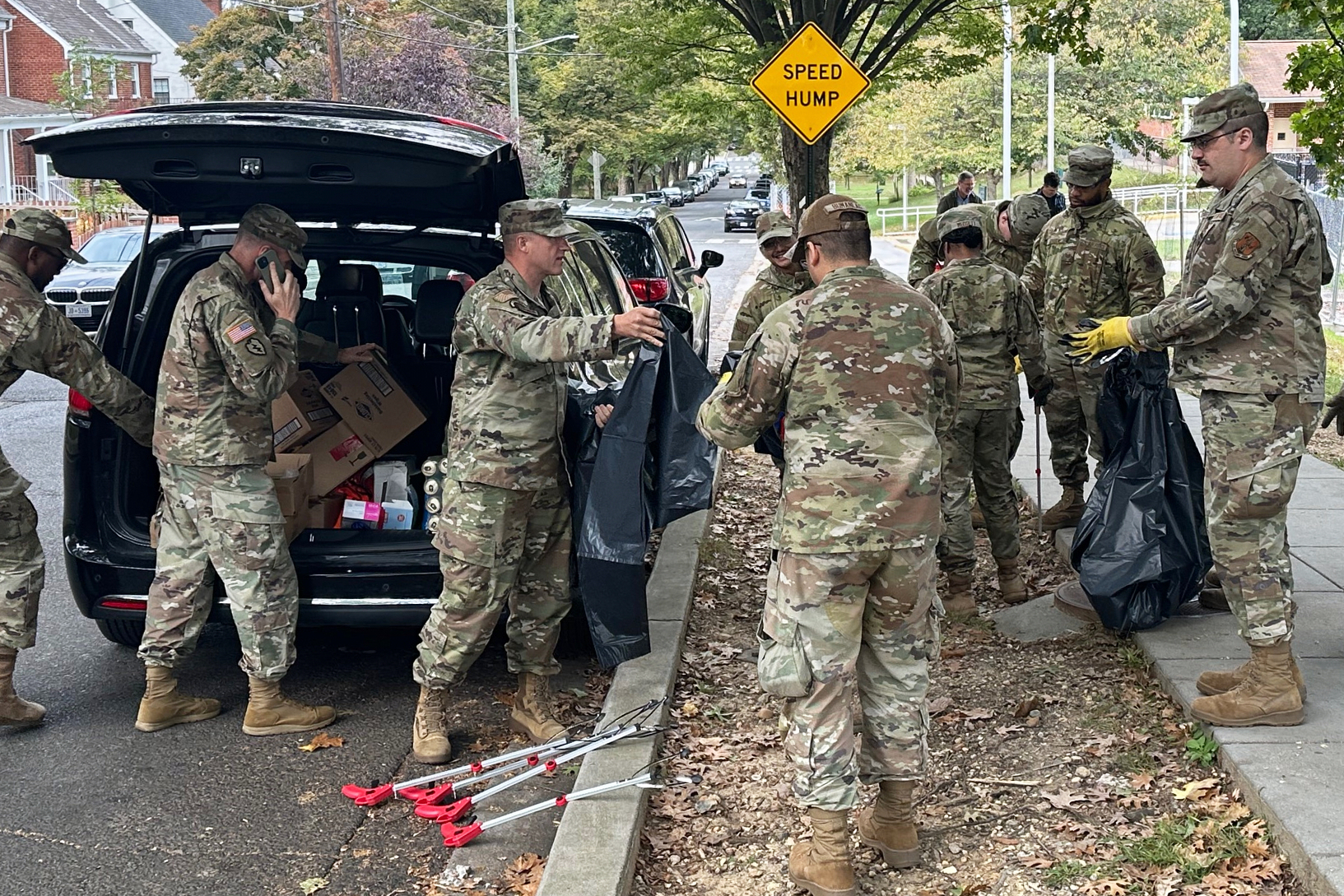
D.C. National Guard members take part in an October clean up of the park around Fort Stevens Recreation Center in the Brightwood section of Washington.
On Father’s Day morning this past Sunday, a longtime Washington, D.C.-based writer named Ian Livingston went out to get a breakfast sandwich. When he returned, he found a small platoon of National Guard soldiers, dressed in camouflage, patrolling an alley near his home. On a video that soon went viral, the troops smile slightly or ignore Livingston and his phone camera, which doesn’t make the scene any less disturbing. “Just a normal morning in our police state,” he wrote.
The normalcy is the problem. It’s been more than 10 months now since Donald Trump first took the extraordinary step of ordering the large National Guard deployment in the nation’s capital, with soldiers from the D.C. armory — authorized by Defense Secretary Pete Hegseth to carry weapons — soon augmented by detachments from red states, rising to an occupation force in the thousands. The move, which the president linked to a surge in “violent gangs, bloodthirsty criminals, and homeless people,” made a lot of headlines, then disappeared from the news. But soldiers haven’t disappeared from the streets. In fact, Trump recently authorized an increase to some 5,000 troops ahead of the July 4 festivities.
But what for? Researchers have found that the presence of the National Guard has had no apparent impact on violent crime rates — which were already at or near 30-year lows — although there has been a drop in “opportunistic crimes” like vehicle break-ins. But the legal parameters of their actual mission bar the troops from making actual arrests, although they can detain someone until district police show up. Typically, their squadrons have been spotted around D.C. picking up trash, although some are now deployed against the algae tourists of the Lincoln Memorial Reflecting Pool.
And at what price? The annual cost to taxpayers of the constant Guard deployment has been estimated at as much as $600 million — money that could otherwise be spent on things like actual solutions to the city’s chronic crisis of homelessness. The unbusy troops are, unfortunately, a magnet for America’s growing number of unhinged people, including the one who killed a West Virginia Guard member and seriously wounded another in a shooting last year. For most, the extended deployments mean unwelcome days away from family, actual work, and their hometowns.
But the real cost is a psychic one: the mental impact of living in an occupied city. Trump’s forever deployment of armed soldiers in our nation’s capital achieves some of the highest goals of his brand of strongman authoritarianism: a) a constant show of force aimed at demoralizing a population that’s increasingly unhappy with life under the 47th president and b) a threat that protesters should stay away from the White House and the Capitol when things really start to go south. We need to keep reminding ourselves what Ian Livingston conveyed tous this weekend: This is not normal. In the immortal 1971 words of singer Freda Payne, bring the boys (and the girls) home.
What I wrote on this date in 2020
This date six years ago was also nearly one month after the Minneapolis police murder of George Floyd, and America — and especially Philadelphia — was still dealing with the consequences. On June 23, 2020, I wrote about an Amnesty International report about police brutality in response to those protests, including the cops’ tear-gas assault on protesters blocking the Vine Street Expressway in Center City. ” We should be shocked that police forces in the United States are acting like the so-called ‘state security forces’ in an authoritarian banana republic,“ I wrote. ”Tear gas is banned in warfare under the United Nations, yet police commanders don’t think twice about lobbing it into crowds of Americans from Seattle to the gates of the White House.” Read the rest: “Amnesty International won a Nobel Prize for fighting torture. Next up: Philly police.”
Recommended Inquirer reading
Only one column last week as I enjoyed a Juneteenth/Father’s Day extended weekend. In that piece, I looked at the real reasons behind the federal conspiracy indictment against a group of an anti-ICE activists that some are already calling “the Minneapolis 15.” The charges — mostly centering on constitutionally protected free speech such as discussing their protests on the Signal app — are outrageous. But they also signal that the Trump regime is desperate to quash political dissent ahead of the November election.
The World Cup is a remarkable moment for sports, but also an incredible time for journalism, because the stories in the stands are often as compelling as what’s taking place on the pitch. At The Inquirer, the five-week tournament has been a great way to reveal how Philadelphia relates to the wider world. Last week’s match between Brazil and Haiti might have been a rout on the field, but sports columnist Mike Sielski took in the scene with Haitian fans who were just delighted their violence-wracked nation was having a moment on the world stage. Alex Coffey spent the weekend with four French fans who played hooky from their jobs back home to spend an unforgettable week in America’s founding city. Longtime soccer writer Kerith Gabriel hailed the city’s joy over the World Cup as “the escape we didn’t know we needed.” It’s easy to join this party in print for the last three unforgettable weeks of the World Cup: subscribe to The Inquirer today.
By submitting your written, visual, and/or audio contributions, you agree to The Inquirer’s Terms of Use, including the grant of rights in Section 10.
A man named Juston Marine had arguably the toughest job in America on Tuesday: “election navigator” in Dallas County, Texas, where a confusing, Republican-engineered change in voting rules for 2026 left many voters dazed, confused, and miles from the place where they were supposed to be casting ballots.
“There are a lot of infuriated voters,” Marine told a reporter for the Votebeat website as he struggled to do his job outside the Anita Martinez Recreation Center in West Dallas, where he encountered voters as they arrived at the large polling center. It seems this election worker heard a lot of words that aren’t found in the Bible, as he told every second or third voter that they were supposed to be somewhere else.
“I walked up here because I want to vote so, so bad,” Veronica Anderson told a reporter after traveling two and a half miles on foot to Dallas’ Martin Luther King Jr. Community Center, only to be told she could only cast a ballot at some other location she’d never heard of. She added that the rejection felt like “your self-esteem and everything is torn down.”
That level of despair is exactly what Donald Trump’s Republican Party is going for, as America this week kicked off an eight-month mad dash to a November midterm election that will be pivotal for the nation’s barely breathing democracy.
We’ll never know exactly how many intended votes weren’t cast on Tuesday at the site named for the civil rights legend credited for the 1965 Voting Rights Act, or other Dallas County polling places where scores of voters — primarily Democrats — were turned away from highly competitive primaries for a U.S. Senate seat and other key races.
Switch from vote-anywhere model to precinct-voting causes utterly predictable confusion in today's Texas primary.
And the poor Dallas County election workers have to deal with it.
It may have looked like chaos, but in many ways it all went down according to a Republican plan that will likely inspire further scheming from Trump and his MAGA minions as the general election draws closer.
With polls showing that an election held today — with the two-term president’s unpopularity at an all-time low — would result in a Democratic takeover of the U.S. House and possibly the Senate, perhaps in a landslide, Team Trump has spent months looking for any and every way to put its finger on the scale of democracy.
No one, other than some online Chicken Littles, believes Trump would go full banana republic and send in troops to cancel the 2026 midterms. But his attempted coup on Jan. 6, 2021, aiming to undo his 2020 loss, is an indication of how far this autocrat will go to retain power.
The Trump-led Republican scheme to make the 2026 elections less free and less fair started with a push for red states to do extreme gerrymandering, ripping up the maps drawn after the 2020 Census to make new districts crafted to maximize GOP power. (Texas was Ground Zero for this effort — more on this later.)
As the calendar flips toward the midterms and Republican popularity wanes, the push is likely to get more extreme. A legislative push for the so-called SAVE America Act, which would make voting harder with harsh ID requirements, has stalled, so Trump is now weighing an executive order to get the same results — which would surely trigger a legal fight — and possibly try to curb mail-in ballots, as well.
What just happened in Texas’ second-most populous county proved a case study in today’s brand of Republican voter suppression, so let’s unpack it.
Like much of what happens in a political party that still clings to the Big Lie of nonexistent voter fraud in that 2020 election that Trump lost, the problems in Dallas County all began with a conspiracy theory.
In this September 2021 file photo, Texas gubernatorial hopeful Allen West speaks at the Cameron County Conservatives anniversary celebration in Harlingen, Texas.
The county GOP leader in Dallas is a well-known conspiracy theorist, Allen West, an ex-congressman from Florida who moved to Texas and, for a time, ran the state Republican Party, where he adopted a slogan and a style from QAnon and seemed to favor secession, among other extreme views.
In 2024, West became chair of the Dallas County GOP and made election and voting machine conspiracy theories his prime focus, in a state where parties have a lot of say over how primaries are conducted.
What the local GOP pushed was for the county to count all of its paper ballots by hand — a laborious process that would also require abandoning the large countywide voting centers and a return to smaller neighborhood precincts. Ultimately, the ballot-counting idea proved not practical, but the switch back to local precinct voting stuck and was in effect Tuesday for both parties — even as Democrats struggled to inform their voters. (A similar change occurred in smaller Williamson County.)
Election experts note that the GOP generally opposes large centers where anyone in a jurisdiction can vote — much as it opposes early voting, mail-in ballots, or anything else that makes voting easier instead of harder, in an increasingly fragile democracy.
Voter suppression that unravels the gains from the 1965 Voting Rights Act — weakened and perhaps about to be gutted further by a right-wing U.S. Supreme Court — has been a Republican strategy for decades, but the Dallas debacle was a new low.
“The confusion is the point,” a Democratic Texas state lawmaker, Ana-María Rodríguez Ramos, posted on social media, noting further, “This is the GOP voter suppression that Dems must come together to overcome in November.”
Primary voters line up to cast ballots at a voting center in Dallas on Tuesday, March 3.
Ramos also noted one other wrinkle that happened Tuesday. Democrats and fair-voting advocates in both Dallas and Williamson Counties went to court during the day, seeking an emergency order to extend voting hours. That push initially succeeded, and in Dallas County, a judge ordered the polls open for two additional hours.
But Texas’ right-wing extremist Attorney General Ken Paxton — also a leading candidate in Tuesday’s GOP Senate primary — appealed the ruling and got the state’s conservative Supreme Court to rule in his favor. Votes that were cast after the original 7 p.m. closing time were segregated and may or may not ultimately be counted.
Not surprisingly, West actually bragged about what looked to many folks like a voting fiasco, blaming the Democrats for not being informed about the confusing rules change. “It’s apparent that Democrats struggled with grasping basic civics and their usual attempt at lawfare backfired,” the GOP leader said in a statement.
It’s clear that what we saw in Dallas — balloting drenched in conspiracy theories from start to finish, new rules with the sole purpose of making it harder to vote, and an increasingly conservative judiciary making the final call — was clearly a test case for the national election in November.
It’s not hard to imagine a scenario in which Republicans will manufacture conspiratorial doubt about some of the ballots cast in the fall — as just happened with those post-7 p.m. votes in Dallas — as a pretext for some grander and potentially cataclysmic effort to nullify Democratic victories in Congress.
But Texas also provided a window into how this MAGA scheme might not work.
Remember that extreme gerrymander the Lone Star State enacted last year, which aimed to create five additional Republican seats in Congress? Much of the plan aimed to capitalize on a dramatic shift toward the GOP among Texas’ large Latino population during Trump’s last two runs in 2020 and 2024.
But polls and now early voting have shown the Hispanic vote swinging back toward Democrats since Trump returned to office, thanks to the sluggish economy and the brutal manner of his immigration raids. On Tuesday, Democratic turnout in Texas soared to levels not seen since the high-profile 2008 battle between Barack Obama and Hillary Clinton, in what was a very good year for their party. Voter suppression can be swamped by voter enthusiasm.
But it shouldn’t have to be that way. The right to vote is the fundamental building block of the American Experiment in democracy, and folks shouldn’t have to walk clear across town or stay up all night to exercise it. Dallas was a warning shot for every citizen: Do not let this nightmare go national in November.
Why are Americans allowed to place bets on death and destruction?
An advertisement by the American company Polymarket shows Zohran Mamdani and Andrew Cuomo ahead of the New York City mayoral election on Nov. 4, 2025, in New York.
Donald Trump’s splendid and not-so-little war that started during a Saturday rush hour in Tehran and has spread like a coronavirus to numerous other countries is entering its fourth day on Tuesday — far too early for one of journalism’s oldest clichés: the “winners and losers” piece.
Except for these winners: a few “lucky” — if that word can even apply to such a ghoulish enterprise — gamblers who woke up Saturday morning and learned that the first deadly explosions across Iran had already made them a lot richer, regardless of who wins or loses on the battlefield.
The initial weekend of war wasn’t even over before we learned that Polymarket, one of the two leading prediction markets that are the inevitable next downward spiral of our national sports gambling addiction, was hit by suspicious trading by six individuals who showed up to bet big on when the war would commence.
One trader up for particular attention earned a reported $553,000 over the weekend by placing large bets on when Iran’s supreme leader, Ayatollah Ali Khamenei — killed in the war’s initial minutes, reportedly — would be deposed. The handle on that well-timed, if macabre, gambler? “magamyman.”
My man, you aren’t even trying to hide it.
Polymarket’s brush with possible insider trading on predictive bets over the Iran war that is now a reality came as its customers bet a stunning half a billion dollars on the long-rumored conflict.
Many of them, presumably, are just regular schlubs desperate to get ahead in a dog-eat-dog economy. But it’s also hard not to contemplate that some may have had real advance knowledge of Pentagon war planning that loose-lipped insiders were audibly discussing in Joe’s Stone Crab just hours before the first cruise missile was fired.
I know … it’s shocking that something in America’s death spiral of late-stage capitalism is actually a rigged game, right? Still, it’s hard to decide which is worse about this new low of predictive betting on a war that’s already killed scores of innocent schoolgirls and hospital patients, and at least six U.S. service members: the rank immorality of wagering on death and destruction, or the insider trading that corrupts this already unholy process even further?
Over the weekend, even with the main focus on the latest missile attacks and changing Trump regime explanations for this undeclared war, there was growing outrage over the popularity of predictive betting on the news, especially when the news is deadly. Or, there’s the word the chief U.S. government official tasked with regulating Polymarket, Kalshi, or their rival firms has used to describe what’s happening.
Michael Selig, the lawyer tapped by Trump last year to head the U.S. Commodity Futures Trading Commission (CFTC), which — controversially — regulates these prediction markets, seems less a regulator and more of a cheerleader, maybe as much as “magamyman.” As several states have pushed to regulate or ban predictive markets as akin to sports betting sites, also under its purview, Selig has worked hard to override them with a claim of federal supremacy.
“The CFTC will no longer sit idly by while overzealous state governments undermine the agency’s exclusive jurisdiction over these markets by seeking to establish statewide prohibitions on these exciting products,” Selig wrote in a Wall Street Journal op-ed.
It’s worth noting Selig’s moves came at the same time that six Democratic senators wrote the CFTC chair to urge him to ban gambling on outcomes that result in death or physical harm — inspired by outrage that people were betting on whether a NASA spacecraft would fail to launch, as well as predictions around the fate of the former Venezuelan strongman Nicolás Maduro, seized in January by U.S. troops. Not surprisingly, the high volume of Iran war betting has sparked fresh calls to ban predictive market betting altogether.
“Life stops being something we live, but something we sell and trade,” Connecticut Democratic Sen. Chris Murphy posted on X, before saying he is studying legislation to ban prediction markets. “It will breed both corruption [and] emptiness.”
Unlike sporting events, betting on political or social developments whose occurrence and timing are controlled and known by humans is incredibly prone to insider trading. In a case that seems to typify the fundamental flaw of non-sports prediction markets, and which Kalshi was forced to acknowledge in an internal investigation, an editor for the wildly popular YouTube star Jimmy Donaldson, better known as MrBeast, was caught betting $4,000 on predictions about what MrBeast would say in his next video.
Because betting on influencer video topics is how far off the deep end we are going here. The addictive nature of online sports betting, which was once mostly banned until elite schemers realized how much money was to be made from increasingly desperate people, was always pointing American society in this warped direction.
Zoom out and there’s a much bigger picture here: A society where the traditional pathways to prosperity are rigged for the Epstein class has created an entire ethos that seeks to match that level of wealth through unconventional not-40-hour-workweek paths, like online influencers, or by hitting the big one, whether that’s through buying a meme stock, betting on college basketball, loading up on the right crypto, or — now — gambling on stuff like when Israel is going to bomb women and children in Gaza.
It seems no one near the top of the American kleptocracy is immune to cashing in, including — sigh — Big Media. It was bad enough that CNN partnered with Kalshi to promote predictive odds on events like Tuesday’s Texas primary, but now the venerable Associated Press picked Monday — amid all the negative publicity about the Iran war wagers — to announce its own deal with the site.
Meanwhile, the only safe bet would be a prediction that no one in Washington, D.C., will be able to successfully stop this in the near future. It’s not only that reckless and potentially corrupt get-rich-quick maneuvers like crypto, artificial intelligence, and now these “exciting” predictive markets are simply in the Trump regime’s toxic money-grubbing DNA.
To seal the deal, Donald Trump Jr. joined the advisory board of Polymarket last August, and his venture capital firm, called 1789 Capital, has reportedly invested tens of millions of dollars in the firm, as well. In a remarkable coincidence, two federal investigations into predictive markets that began during the Joe Biden presidency were shut down around the same time.
Today’s dollars stained with blood from the Middle East are the, dare I say it, predictable result. Why merely wage war when you can also wager on it? Our leaders, whether in D.C. or our 50 statehouses, can’t shut down Polymarket, Kalshi, and all their imitators fast enough.
Yo, do this!
Escaping from a global crisis is always a good time to get back to the basics, and for boomers of a certain age, nothing is more fundamental than the power chords and pounding drums of Led Zeppelin. Listening to and thoroughly enjoying Andrew Hickey’s A History of Rock Music in 500 Songs’ two-part episode on how the most classic of all classic rock bands came together at the end of the 1960s made me discover that there’s also an acclaimed 2025 documentary, Becoming Led Zeppelin, streaming on Netflix. Let’s watch it together.
The rising thermometer this week should serve as your reminder that the arrival of March means it’s also time for some baseball that actually counts. The World Baseball Classic, the sport’s World Cup knockoff that comes every three years, starts Thursday and runs through the March 17 final in Miami — site of 2023’s thrilling conclusion in which Japan’s Shohei Ohtani struck out the USA’s (and South Jersey’s) Mike Trout. Some 10 Phillies are competing, including Bryce Harper, Kyle Schwarber, and Brad Keller — on this year’s Team USA — and Dominican Republic ace Cristopher Sánchez, so let the games begin.
Ask me anything
Question: So one school of thought is that they are already trying to steal the midterms; another is that they really can’t. Where are you on the spectrum from mildly worried to totally anxious about this? Especially with Pa. being rather swingy. — Penthesilea (@hansklocker.bsky.social) via Bluesky
Answer: Yes, this is something I’ve already thought about quite a bit, and my answer — for now, anyway — is pretty much smack in the middle of the spectrum. It’s clear Donald Trump intends to use every implement in the voter suppression toolbox — extreme gerrymandering, executive orders aiming to require voter ID, or banning mail-in ballots — that would warp the voting outcomes, without going full Mussolini and canceling the election altogether. But I don’t think that can work for him — partly because any orders will almost certainly be struck down in the courts, but mainly because it looks like a Democratic landslide too large to easily suppress is building momentum. Just look at Texas, where the scheme to gerrymander five new GOP seats depended heavily on Latinos continuing to shift Republican, when polls show the exact opposite happening. Of course, in 2020-2021, few folks thought he would go so far as an attempted coup (I did). Who knows how far he’ll go to maintain power this time around?
What you’re saying about …
Last week’s question about how to handle the new prediction markets — anticipating the mess that occurred with the wagers on the start of the Iran war — and the surge in sports betting drew a tepid response. But it was pretty unanimous that sites like Polymarket and Kalshi should, at the bare minimum, be regulated under state gambling laws, and not as commodities trades — if not banned altogether. Wrote Mary Clare Gumbleton, who would ban Polymarket and Kalshi: “It’s just unregulated corruption and an incredibly awful incentive to both lose your shirt (as it were) and game the system where a handful of corrupt people can make a lot of money.”
📮 This week’s question: There’s only one thing on everyone’s mind: That crazy war in the Middle East. Now that Donald Trump and Benjamin Netanyahu have started it, how on earth do we end it? Please email me your answer and put the exact phrase “Iran war end” in the subject line.
History lesson on when the Iran thing really started
A crowd of demonstrators tear down the Iran Party’s sign from the front of its headquarters in Tehran on Aug. 19, 1953, during the CIA-backed coup that ousted Prime Minister Mohammad Mosaddegh and his government. The operation cemented the rule of Shah Mohammad Reza Pahlavi for more than 25 years before the 1979 Islamic Revolution.
It’s been a while since the last history lesson in this space, but the poor quality of the TV punditry about the four-day-and-counting Iran war screams out for better information. A lot of the folks advocating for this war of choice in the Middle East argue that we didn’t start the fire, that the roots go all the way back to the 1979 Iranian Revolution. That’s the year when Americans who never paid much mind to foreign affairs were shocked to see huge throngs in the streets of Tehran chanting “Death to America” and taking 52 hostages at the U.S. Embassy.
What did we do to deserve this? Well …
For most historians, and for many Iranians, the year that matters is not so much 1979, but 1953. In a post-World War II geopolitical environment where many nations sought to break free of imperialism, Iran in 1951 democratically elected a surprisingly left-leaning prime minister, Mohammad Mosaddegh, whose main project was to nationalize the then-British-controlled oil industry. This sparked great alarm in London, where U.K. leaders spent months lobbying Washington to join them in an effort to depose Mosaddegh in a coup that would advance Western oil interests.
It’s a messy story. The United States wavered and even flirted with backing Mosaddegh for a time, according to histories of the period, but ultimately British leaders leaned on the Eisenhower administration and America’s ongoing anti-left “Red Scare” of that era to get the relatively new CIA and its man in Tehran — Kermit Roosevelt Jr., grandson of Teddy Roosevelt — on board with the plot. The Americans threw around money and anti-Mosaddegh propaganda, and eventually organized street protests ahead of the government’s ouster.
To be sure, there is a never-ending debate over whether the U.S. involvement was central or just a subplot to the coup that gave power to the shah of Iran, Mohammad Reza Pahlavi, who ruled the nation with ruthless brutality for the next 26 years. Certainly, the nation’s Islamic clerics — powerful then, as now — played a key part in ousting a secular government. But the American role was so great that Barack Obama apologized in his 2009 Cairo speech, stating as fact that the CIA played a key role in the “overthrow of a democratically elected Iranian government.”
Whether the U.S. led the coup or was a bit player, the Iranian people have never forgotten our involvement or our close ties to the eventually despised shah. “The rancor has never melted,” a 24-year-old Iranian woman told the Associated Press in 2023, on the 70th anniversary of the coup, as she compared the American meddling to being “like wishing for an earthquake to get rid of a bad neighbor.”
So did a state of war between the United States and Iran start in 1979, as some GOP lawmakers insist, or in 1953, or on Feb. 28 of this year? In arguably the world’s most violent neighborhood, the cycles of violence often seem to have no beginning and no end. An imperial America chose to jump into the middle of this mess 73 years ago, and now getting out feels more impossible than ever.
What I wrote on this date in 2016
He’s all but forgotten now, but up until his mysterious death 10 years ago, the flamboyant Oklahoma natural gas mogul Aubrey McClendon had reshaped the Pennsylvania landscape as king of the commonwealth’s fracking boom. The company that McClendon (known to sports fans as an owner of the NBA’s Oklahoma City Thunder) cofounded, Chesapeake Energy, promised riches to Pennsylvania landowners, but left a trail of lawsuits and pollution. Less than 24 hours after his indictment by a federal grand jury, McClendon drove at full speed into a bridge embankment and was killed instantly. I wrote: “In Pennsylvania, Aubrey McClendon is survived by a legacy mostly of conflict, of thick lawsuits, of protesters facing off against armed marshals, of lawmakers and a governor at war over the taxes that gas drillers never had to pay, of brackish water and leaking methane adding to the greenhouse gases that may someday strangle the planet — of a promise of buried treasure that wasn’t really all it was cracked up to be.”
America is now at war on two fronts. In one column, I tackled the ongoing conflict in the streets of America, and looked at the tragic death on a frigid Buffalo street of the Rohingya refugee, Nurul Amin Shah Alam — a disabled and nearly blind man who was arrested by Border Patrol agents, and then dumped at a closed coffee shop five miles from his family’s home. It was a low point that spotlighted the unrelenting cruelty of a xenophobic mass deportation crusade by the Trump regime that has brought a mounting death toll. On Saturday morning, I knocked out my instant reaction to the news that the Trump regime had joined Israel in an all-out attack on Iran, which was that the war is both unconstitutional without the consent of Congress and also a clear violation of international law.
In moments of national and global crisis such as this, it’s easy to forget that many of the political decisions that shape people’s everyday lives occur on the local level. Here in Philadelphia, the school district’s plan to modernize its schools while closing 20 older buildings came as a shock to city parents, and The Inquirer’s coverage, anchored by our Pulitzer Prize-winning city public schools reporter, Kristen A. Graham, has been all over this story. The newsroom has explained the plan in detail, and covered the community protests and the fights over individual buildings, as well as Philly’s move away from middle schools. One advocate told me The Inquirer’s aggressive coverage of the story is why two schools have now been removed from the plan. A healthy community is one that has a vibrant news media. You nurture a better Philadelphia when you support The Inquirer by subscribing.
By submitting your written, visual, and/or audio contributions, you agree to The Inquirer’s Terms of Use, including the grant of rights in Section 10.
Like Congress, many Americans — only 27% of whom, according to a poll last week, have great confidence in Donald Trump’s ability to make the right decisions about using military force — were likelysound asleep when the war started, perhaps dreaming of the normality of brunch or the dog park on an unseasonably warm Saturday.
Trump was not even in the White House Situation Room — the multimillion-dollar mancave that exists for a commander in chief to run our too-frequent military ops — but was instead ensconcedat his gilded Florida palace at Mar-a-Lago, addressing the nation in an eight-minute video after a Friday night of partying. His wild, uncoiffed midnight hair was crammed under a hat hailing the country whose founding principles he’d just demolished, “USA.”
It’s normal for invaders to attack under the cover of darkness, yet Saturday’s massive attack on Iran — launched jointly with our sister 2020s global pariah, Israel — occurred in bright morning sunshine in downtown Tehran, its streets packed with commuters and school buses at the start of the Arab world’s workweek.
It seems that this time, the dead-of-night deception was aimed at the American people, in an assault on everything the United States was intended to stand for.
While many words will be written or uttered in the coming days about who is winning this U.S.-Israel war of choice, the next military targets, the inevitable spike in the price of oil, and the fate of Iran’s tottering regime, there is one fact that matters more than any other.
This war — and, yes, it is a “war,” with an expected loss of American blood, as Trump himself acknowledged from Mar-a-Lago — is illegal.
Full stop.
Article 1, Section 8 of the U.S. Constitution, hashed out here in Philadelphia, could not be more explicit on that point, stating in plain 18th-century English that only Congress has the power “To declare War, grant Letters of Marque and Reprisal, and make Rules concerning Captures on Land and Water.”
America’s founders knew exactly what they were doing — seeking to prevent one unchecked or unhinged president from arbitrarily launching a lethal conflict that might be in his own best interest, but not the nation’s. “The constitution supposes,” James Madison wrote in 1798, “what the History of all Governments demonstrates, that the Executive is the branch of power most interested in war, and most prone to it.”
Trump has launched an illegal regime change war in Iran with American lives at risk. Congress must convene on Monday to vote on @RepThomasMassie & my WPR to stop this. Every member of Congress should go on record this weekend on how they will vote. pic.twitter.com/tlRi3Vz849
David Janovsky, acting director of the Constitution Project at the Project on Government Oversight, told Time magazine last week that any attack on Iran ordered by White House fiat would be flat-out unconstitutional.
“There’s no indication that there’s any sort of circumstance that would give the president the unilateral authority to order military action,” Janovsky said. “It’s true that presidents have some inherent authority to deploy the military as commander in chief, but that’s really limited to true emergency circumstances where there is an attack underway that needs to be repelled, or maybe an extremely clear imminent attack. But there’s no suggestion that that’s the case today — that would make the strikes illegal.”
And it’s not only unconstitutional. An aggressive and unprovoked war — which this unambiguously is — is also a blatant violation of international law and the post-World War II global order that we once encouraged with the United Nations, in the hope of preventing the emergence of some future tyrant. Who knew that the greatest threat to world security in the 21st century would come from the current holder of the coveted FIFA Peace Prize™ and the chairman of his own much-ballyhooed Board of Peace?
When the rise of our Cold War national security state after 1945 led to prolonged, unpopular, and undeclared wars in Korea and Vietnam, Congress passed the 1973 War Powers Act that meant to require consultation and its mandated involvement, a seeming solution that is now increasingly honored in the breach.
It’s worth noting that when the George W. Bush regime decided to launch a war of choice against Saddam Hussein’s Iraq in the early 2000s, its case was larded with lies, including a 16-word whopper that the president uncorked during his 2003 State of the Union address. But a generation ago, Bush, Dick Cheney, and their merry band of war criminals at least felt it was necessary to get a congressional authorization, and to spend months wooing the public and the pundits.
BREAKING:
51 Iranian children killed, 60 students wounded after joint US-Israel strikes hit girls' school in Iran. pic.twitter.com/p6134kaXvS
Trump had a similar chance to lobby the American people and the world in his State of the Union address last week, and he largely whiffed. He included only a brief and perfunctory recitation of the long-standing and, in fairness, justifiable grievances against Iran’s brutal repression of its own people, its nuclear ambition, and its backing of violent proxy groups.
To be sure, we should be alarmed about the destructive threat of nuclear bombs in the hands of unconstrained strongmen backed by religious fanatics — whether that’s in Tehran, Jerusalem, or Washington. And most of the world wants freedom for Iran’s long-repressed masses, but U.S. and Israeli bombs might be the worst possible way to make that happen.
Already, as I write this in the very early hours of the war, there are reports that the bombing of a girls’ school in southern Iran has killed as many as 85 people, most of them innocent children. We are spilling the blood of the very people we are promising to liberate. Are we really expecting to be someday greeted with rose petals?
Again?
Indeed, there are many painful echoes of Bush 43’s disastrous conflict with Iraq, including shameless lying by the commander in chief. Trump’s 3 a.m. claims that Iran poses an “imminent” threat to the United States and is close to developing ballistic missiles that can reach our shores are almost as ludicrous as his Big Lie about the 2020 election.
Just like early 2003, when Iraq opened up to outside weapons inspectors, but we invaded them anyway, Trump’s all-out attack came in spite of reports that Iran was making “significant” concessions at the bargaining table in Geneva, regarding both the nuclear program and the kind of big-money stuff like oil and minerals that warm the heart of our corrupt kleptocracy. All this after Barack Obama had a successful deal, negotiated with years of hard work, to halt Iran’s nuclear enrichment that Trump 45 came in and scuttled because ¯_(ツ)_/¯.
Trump seems to be bored with peace. For whom? For what?
President Donald Trump is presented with the inaugural FIFA Peace Prize by FIFA President Gianni Infantino during the 2026 FIFA World Cup draw at the Kennedy Center in December.
Sure, the Iran war is a massive distraction from Trump’s cratering poll numbers at home, but aggressive war is also just a thing strutting strongmen do to consolidate their illegitimate powers. Bush’s Iraq War was the last throes of a decaying democracy, while Trump’s actions are those of an unrestrained dictator — exactly the mad king that Madison sought to warn us about 228 years ago.
So now what?
“Trump has launched an illegal regime change war in Iran with American lives at risk,” Democratic Rep. Ro Khanna of California, a Bucks County native and atop critic of unchecked militarism, posted on X after the attack. He said he and his GOP renegade ally, Rep. Thomas Massie of Kentucky, plan to go ahead Monday with a vote to invoke the War Powers Act — even as the prospect of that vote may be why Trump pushed the button now.
Not only do the odds of success for Khanna and Massie seem dim, but the War Powers Act seems too late, yet also too little. In a nation that has pressed impeachment or resignation on four presidents, including Trump 45, Trump 47’s unlawful and murderous war on Iran already seems the worst abuse of presidential power in American history.
A cruise-missile assault aiming to change the government in Iran is, in reality, a desperate plea for regime change in Washington, D.C. Democrats, who could gain power in the House as early as this year thanks to GOP scandals and illness, must make clear that Trump’s impeachment and an end to American autocracy are their main priority.
For now, we have unnecessarily injected ourselves into a long-troubled corner of the world where there are almost no good guys, where theocratic dictators are unceasingly slaughtering the citizens of other theocratic dictators. Maybe that’s because, over the course of 250 increasingly tragic years, the United States has finally become exactly like them.
Like most of his Rohingya people — stripped of citizenship by Myanmar’s ruling junta and targeted by a brutal 2017 genocide — Nurul Amin Shah Alam and his family spent the last decade yearning to breathe free.
A nomadic quest for liberty took Shah Alam, his wife, and the two youngest of his six children through the crowded camps of Bangladesh, on a boat escape to Malaysia, and finally to apparent refuge in the United States on Christmas Eve 2024.
But the 56-year-old immigrant was almost never free on American soil.
In February 2025, just 53 days after his family arrived in the refugee hub of Buffalo, Shah Alam — nearly blind, apparently lost, and using a curtain rod as a walking stick — found himself in an encounter with Buffalo police. He was tased during a scuffle that ended with the refugee charged with felony assault.
After one year behind bars and a plea deal, relatives paid his bail on Feb. 19, and then waited for hours at the Erie County, N.Y., lockup, only to learn he’d instead been handed over to U.S. Customs and Border Protection (CBP) on an immigration detainer.
During a frantic, five-day search on the streets of one of America’s coldest big cities, Shah Alam’s family and supporters were stunned to learn that Border Patrol agents — apparently after learning the stateless refugee could not be legally deported — drove this disabled and nearly sightless man with no phone to a Tim Horton’s doughnut shop and dumped him there, five miles from his family’s home.
As reactions and questions continue to surface over the death of Nurul Amin Shah Alam, a visually impaired man who spent time in Border Patrol custody and was found dead Tuesday night, directions from the reported drop-off spot and where he was found place the two locations more…
“He never had freedom in his life,” Imran Fazal, a leader of the Rohingya diaspora in Buffalo who knows his family, told me by phone Wednesday night. “He came to this country because he wanted to experience freedom. He didn’t have that chance … He came to this nation that was supposed to save his life — and that nation destroyed his life.”
And now, abandoned on the subfreezing February streets of the snow capital of America. Because there is really only one point to the ethnic cleansing crusade that began with rabid Trump partisans waving their “Mass Deportation Now!” placards in a Milwaukee arena and ended with a cold, lonely corpse on Perry Street.
Somehow, in this downward spiral that has seen Americans grow accustomed to masked, heavily armed goons in tactical gear snatching day laborers or Uber drivers off once-placid urban streets, the abandonment and death of Shah Alam still hits like a gut punch to the soul of a once-welcoming nation. Yet, it somehow feels even more inhumane when viewed through the tortured prism of the Rohingya people, among the most persecuted ethnic minorities on earth.
Rohingya refugee children carry banners during a visit by U.N. Secretary-General António Guterres at the Ukhiya camp in Cox’s Bazar, in Bangladesh, in March 2025.
The roughly 1.4 million, mostly Muslim, Rohingya people in Myanmar, formerly Burma, have been targeted for repression by that nation’s Buddhist majority for decades, culminating in the stripping of their citizenship in 1982 and its military rulers driving hundreds of thousands across the border into Bangladesh during 2017’s brutal campaign.
In March 2022, during the Joe Biden administration, which was a brief window between the anti-refugee xenophobia of the two Trump presidencies, the U.S. government recognized the Rohingya as victims of genocide and, among other moves, expanded their resettlement opportunities in America. It’s estimated that at least 12,000 came to the United States during that short opening, and as many as 2,000 of them — perhaps lured by lower housing costs — have moved to Buffalo in the last couple of years.
It has not been an easy journey. Denied schooling in their native Myanmar and lacking a formal written script for their language, the majority of Rohingya who arrive in the United States are illiterate and unable to speak English.
The short, tragic American experience of Shah Alam reads like an allegory for the Rohingya plight on U.S. soil.
The version of what happened to him on the night of Feb. 15, 2025, as told to me by Fazal and also recounted by his family and lawyers in the media, is that Shah Alam, walking in his new neighborhood with the aid of that curtain rod and likely getting lost, took shelter under a porch perhaps without realizing he was on private property.
The woman who owned the property called the Buffalo police, who viewed the rod as a weapon and — when the non-English speaking Shah Alam failed to follow their commands — tased him and aggressively tried to arrest him. In a fight with the nearly blind immigrant whose awareness of the situation is in question, police said two officers suffered minor injuries. The ensuing criminal charges against Shah Alam — assault, trespassing, and possession of a weapon — were just the start of his Kafkaesque journey through American injustice.
Trump had just become the 47th president, and family members didn’t post bail at first, mainly because of fears the new regime would seek to deport him. Fazal said the already ailing Shah Alam lost considerable weight in his year behind bars, as much of the food didn’t meet his Muslim dietary restrictions.
Supported by the Rohingya diaspora community — Fazal said about 50 people attended one of his hearings — Shah Alam’s legal-aid attorneys eventually struck a misdemeanor plea deal. Then, on Feb. 19, family members arrived at the Erie County detention center expecting to take him home for a warm meal.
Breaking: A blind Burmese refugee named Nurul Shah Alam has been missing since Thurs. after Border Patrol agents dropped him off at a Tim Hortons, leaving him to walk home.
After a number of hours, Fazal said, the family called the police and said, “‘He was supposed to come here. He’s not coming.’ And they said, ‘You know, he was taken by the [U.S.] Customs and Border [Protection].’ And they said, ‘What?!’”
A CBP spokesperson told People magazine that Shah Alam was offered a “courtesy ride” from Border Patrol agents, “which he chose to accept to a coffee shop, determined to be a warm, safe location near his last known address, rather than be released directly from the Border Patrol station. … He showed no signs of distress, mobility issues, or disabilities requiring special assistance.”
In fact, Shah Alam — completely blind in one eye and with limited sight in the other, according to family members, who didn’t have a cell phone and had never used one — was five miles from his family’s current home. When his relatives and attorneys learned belatedly of the Tim Horton’s drop-off and could not find him, they filed a missing persons report that — in one final injustice — was, for a time, accidentally listed as resolved by an officer who mistakenly thought he was at an immigration detention site.
Instead, his body was found Tuesday night. The preliminary finding after an autopsy by the Erie County medical examiner is that Shah Alam died from medical causes and not from either exposure to the cold or intentional homicide. Nonetheless, his death is under investigation — yes, by the same Buffalo police who initiated this nightmare — and has sparked justifiable outrage from local officials like Buffalo Mayor Sean M. Ryan, who called the CBP actions “unprofessional and inhumane.”
That’s a gross understatement. It’s not just that Shah Alam’s abandonment and death is a new twist on the roughly 40 immigrants who’ve died in federal detention since the start of 2025 from a mix of medical neglect, suicidal despair, and at least one homicide, along with the eight people fatally shot by CBP or U.S. Immigration and Customs Enforcement (ICE). All of it is proof that Trump’s immigration policy is written with the blood of innocents.
We also need to ask ourselves how and why a nation that so blithely uses the Statue of Liberty for everything from car insurance ads to a morally empty 250th birthday party is now repressing some of the most mistreated humans on earth — people who honestly believed America would offer the freedom they were denied in their nation of birth.
It’s a moral abomination to see the Hmong people who risked everything to side with the United States in Southeast Asia now dragged from their homes in Minnesota, or the Venezuelans who fled a strongman dictator only to be branded as criminal gang members, or the Haitians who escaped relentless violence only to now huddle in fear in heartland Ohio.
And now the Rohingya, who were able to survive a genocide and inhumane refugee camps some 8,000 miles away, only to now find themselves in a country that is building concentration camps and forging a 21st-century Trail of Tears.
Fazal — a 30-year-old recent Buffalo State grad whose seven-year stateless flight to freedom passed through Bangladesh, Malaysia, Indonesia (where he was detained for 17 months in an immigration prison), Australia, and Papua New Guinea — told me he feels anger over Shah Alam’s death, but also guilt, because he has gained U.S. citizenship while Shah Alam did not.
“The system and the police should be accountable,” he said. “We need justice to be served.”
When this newest stain on human existence is finally over, there won’t be enough courtrooms to try every masked idiot who shot an unarmed protester, or beat up an immigrant and swore he “ran into a wall,” or slammed a brain-injured woman to the asphalt.
But years in prison would be too good for the soulless monsters who went on a doughnut run and left a good man to die. If there is any justice under God’s universe, they will be consigned for all ofeternity to a snowdrift as large as Lake Erie in an unending and fruitless quest for the warmth and liberty they deprived Nurul Amin Shah Alam.