Author: Joseph N. DiStefano

  • European cargo ships are rerouting to Philadelphia as Baltimore struggles to replace Key Bridge

    European cargo ships are rerouting to Philadelphia as Baltimore struggles to replace Key Bridge

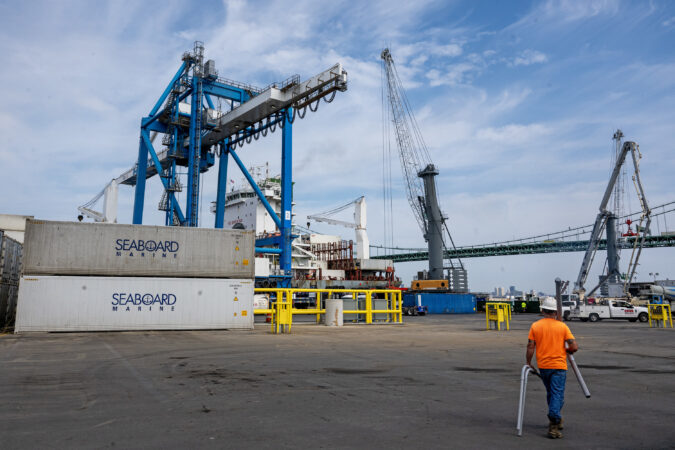
    Two top trans-Atlantic shippers are moving their cargoes to Philadelphia-area terminals, boosting longshore and trucking jobs, and ending Baltimore port calls as work drags on replacing the Key Bridge, whose collapse 21 months ago crippled ship traffic to that city’s harbor.

    A.P. Moller-Maersk, based in Denmark, and German-based Hapag-Lloyd AG, which each rank among the top five global container companies and operate hundreds of ships carrying millions of trailers, have switched a major route for their Gemini joint venture to the PhilaPort’s Packer Avenue Marine Terminal, effective Jan. 4, Philadelphia-based Holt Logistics told customers in a note Wednesday.

    “Rising tide lifts all boats, and that includes the waterfront labor, plus all the other ancillary support folks that run freight, handle it, and store it,” said Leo Holt, whose family operates Holt Logistics. “It’s a big win for Philadelphia, and a harbinger of good things to come.”

    Holt, based in Gloucester City, is expanding its container operations in the Port of Philadelphia on land acquired by state port agency PhilaPort in South Philly. That includes a new cold-storage warehouse. Plans are still in the works for 152 acres bought with state funds for more container and automotive storage.

    Philadelphia’s port handles wine, meat, furniture, car parts, drugs, and many other container goods. The region also exports drugs, steel, and machine and vehicle parts. Singaporean-owned Penn Terminals in Delaware County and the Port of Wilmington, Del., also handle containers.

    Philadelphia recorded the equivalent of 841,000 20-foot trailer equivalents (TEUs) through area ports last year and expects to report more for 2025, even before the new service and additional lines to Australia and New Zealand start next year. The agency’s goal is to boost that to more than 2 million a year with the planned expansion, said spokesperson Sean Mahoney.

    Philadelphia-area container shipping has nearly doubled since Jeff Theobold took over as PhilaPort executive director in 2016, while overall U.S. container volume has risen about 30%. Theobold plans to retire in June, two months after PhilaPort’s new cruise ship terminal is scheduled to open in Delaware County near Philadelphia International Airport. The agency is searching for a successor.

    Philadelphia “will replace Baltimore” on a major trans-Atlantic route used by Hapag-Lloyd and Maersk, according to a report in Freightwaves, which noted Baltimore container traffic fell from 1.3 million 20-foot-trailer equivalents in 2023 to around 700,000 last year, even before the switch. Each ship on the route carries 5,000 to 6,500 TEUs.

    The new route also moves container ships between Newark, N.J., terminals that handle New York cargoes; Norfolk, Va.; St. John in Canada; the British port of Southampton; the Netherlands’ giant Rotterdam port at the mouth of the Rhine; and the German ports of Wilhelmshaven and Hamburg.

    That adds Germany to the list of countries with direct service to Philadelphia, Mahoney said. There’s no guarantee that all the Baltimore cargoes will shift to Philadelphia.

    Philadelphia also expects more ships from Australia and New Zealand ports as two lines that service those countries via the Panama Canal have recently added Philadelphia as their Northern U.S. port, Mahoney said. Already those countries and other South Pacific ports make up close to one-quarter of the Philadelphia area’s container cargoes, making it the leading East Coast port for shipments from that region. PhilaPort expects the lines will attract cargoes now shipped to Baltimore, New York, or Norfolk.

    Newark is the largest port complex in the Northeast. Philadelphia competes with Baltimore and southern ports for container and automotive cargoes.

    Philadelphia has the fastest arrival-to-departure time of any North American port, reducing shipping costs, according to a recent report by a World Bank subsidiary. Holt attributes that to cooperation between unions including International Longshoreman’s Association, and Teamsters locals, port agencies, and owners such as PhilaPort, and his own organization.

    Next year Holt plans to add two more tall cranes to the small forest of ship unloading equipment it maintains in South Philly and Gloucester City.

  • This hot Philly software maker wanted a big Center City HQ but went remote ‘because SEPTA is so bad’

    This hot Philly software maker wanted a big Center City HQ but went remote ‘because SEPTA is so bad’

    For a little while, Philadelphia’s Fishtown Analytics looked as if it might put the city where the modern computer was born back on the tech map as a software headquarters.

    Cofounders Tristan Handy, Connor McArthur, and Drew Banin started their company in 2016. They created the Data Build Tool, which helps a range of employers — Philly firms like Gopuff, business software makers like GitLab, HubSpot, and New Relic, publisher Condé Nast, manufacturer Thermo Fisher Scientific, airline JetBlue — manage their proliferating databases out in the cloud of rent-a-servers.

    As the tool caught on, they talked of taking the company public, drawing investors and hundreds of software recruits to one of the city’s popular neighborhoods, proof that Philadelphia is a place tech leaders flourish.

    But that’s not quite how things worked out. In 2021 the start-up raised $150 million from Roblox backer Altimeter Capital and Silicon Valley giants Sequoia Capital and Andreessen Horowitz. The founders dropped the Fishtown name in favor of dbt Labs, for their software tool’s initials.

    Then in October, they agreed to a merger with a larger data-integration software company and sometime-partner, Fivetran, with headquarters in California. The 20-person Spring Garden Street office will remain.

    Handy agreed to talk with The Inquirer about what was, what might have been, and what’s next. He came to the interview wearing an Eagles No. 27 jersey. The conversation has been edited for length and clarity.

    Your deal looks a little like your former boss Bob Moore’s Crossbeam merger with French competitor Reveal?

    I talked to Bob about lessons learned. Bob is focused on his relationship with the Reveal founder. He says everything else is solvable, as long as the relationship between the founders is strong.

    Bob Moore has founded a string of Philadelphia software companies. Crossbeam, “LinkedIn for businesses,” raised $76 million in October 2021, from firms led by Silicon Valley venture capital giant Andreessen Horowitz.
    Are customers glad you’re consolidating or worried at losing a choice?

    We have a lot of customers we share with Fivetran. In general we are finding excitement, with a little initial trepidation.

    George [Fraser, Fivetran’s CEO] and I have spent a lot of time thinking about what our customers need to hear and to de-stress them. Generally the reactions are positive. It’s not uncommon we will hear from a customer: ‘I was thinking about what I was going to do with this set of data pipelines, and now we should talk about that.’ Which is part of the point of all this.

    We are still pre-closing. We need to seek [U.S.] Department of Justice input. We are waiting to see if we meet that test — if DOJ will care about us at all. The answer should be no.

    Does Philadelphia make enough software to be a ‘tech center?’

    All three of us cofounders came out of Bob Moore’s RJMetrics, and then our first employee, Erin Vaughan [head of customer services], came out of RJ. Bob sent me a note after that: ‘Maybe you should hire some other people.’

    A big part of the reason I started Fishtown Analytics was that in 2016, RJ was coming close to the end of its main chapter. I didn’t see other start-up opportunities locally that I was excited about. My wife had just gotten a job at CHOP. We weren’t moving. I had to figure something out.

    So you built it. Was Philly a good place to start and then grow?

    I just turned 45. A bunch of people I know have moved back to the area from San Francisco. A lot of times that is because you want to be close to family when you have kids or it’s a higher quality of life around here.

    We are at 915 Spring Garden St. The elevator is always broken. We are still about 20 people there — the same as when we raised money [in 2021].

    But my network is now nationwide. We are a distributed business with 730 people. And Fivetran has a big headquarters in Oakland, Calif.

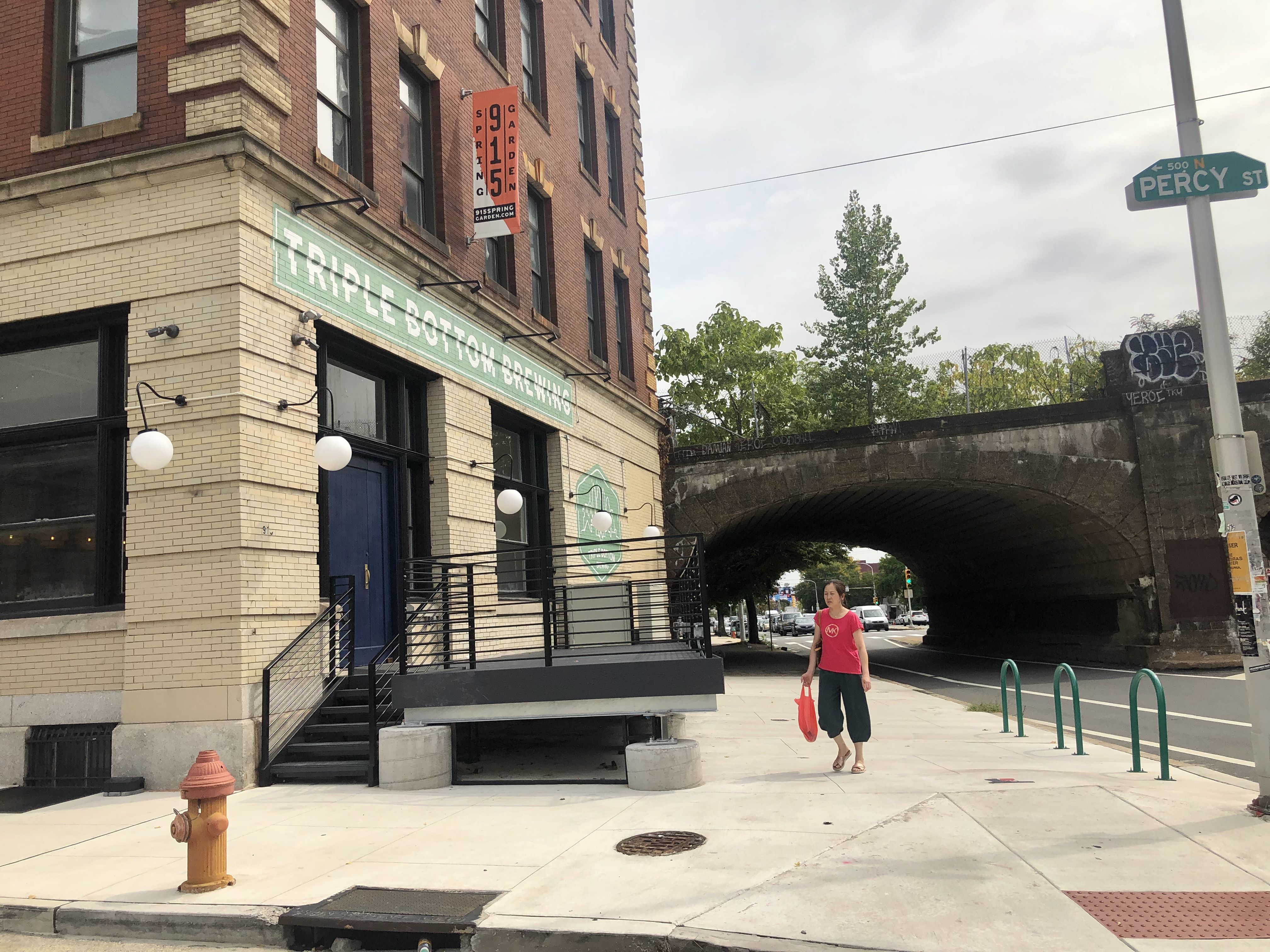
    dbt Labs employs more than 700, but most work remotely. Its headquarters, with 20 people including some of its founders and earliest employees, is upstairs at 915 Spring Garden St., a former Reading Railroad building whose first floor is home to Triple Bottom Brewing.
    Will the merger mean expansion and hiring, or consolidation and firing?

    Growth is good, and in general, we are not imaging cost-cutting targets. There is figuring out who occupies the leadership ranks. That is the main area where there might be some departures.

    It’s a consolidation move from a products perspective. Historically in our space, the products Fivetran sells and the products we sell have been sold together. Our customers have budget lines for that combination.

    Both companies are on track. Both companies were going to IPO at some point. This brings that date in closer. Combined, we have the growth and scale to go public. We just need to get through the integration and prove to everybody we have effectively combined these companies, and need a few quarters of numbers.

    Why did you drop ‘Fishtown’ from the name?

    Every sales call started out with ‘What’s Fishtown?’ Locally people have a lot of pride in Fishtown. But nobody else knew what it meant.

    Both companies are keeping their brands. We’ll figure out what to call the combination.

    Do you hire a lot of Philly engineers?

    We did originally. Our first class of data people we trained, there were two Penn people and a Princeton person. For a long time that was the plan: continue hiring incredibly talented people from these schools. But then we went in a different direction.

    Why, when Fivetran expanded in Oakland, did you not do the same in Philly?

    It’s real hard to do any kind of office-space culture for tech workers in Philly because SEPTA is so bad.

    As the people in the company start to age into having kids and move out to the suburbs, it is getting very challenging to come into the office. Even from the Main Line, the train is once an hour. That’s very hard.

    Bob Moore calls you a pillar of the Philly start-up ‘connectivity’ who helps other founders and causes. Are you planning to stay around?

    It’s conceivable I might start another thing.

  • Par Funding salesman Dean Vagnozzi sues, accusing feds of ruining his business

    Par Funding salesman Dean Vagnozzi sues, accusing feds of ruining his business

    Dean J. Vagnozzi, whose King of Prussia insurance and investment business was taken over by a court-ordered receiver in the federal investigation of the Par Funding Ponzi scheme, has sued the U.S. government, accusing federal officials of abuse of process, negligence, and unconstitutional search and seizure.

    In the lawsuit, Vagnozzi says he was a Par victim, his business wrongfully destroyed amid the investigation that led to criminal charges that have sent eight former Par Funding officials, debt collectors, and accountants to prison after they pleaded guilty to ripping off 1,600 people. Those clients included hundreds of Vagnozzi’s customers and members of his family, and the scheme ended up owing them $240 million.

    Vagnozzi attracted customers with radio ads urging investors to consider alternatives to the stock market. He paid civil settlements totaling $5.7 million to the U.S. Securities and Exchange Commission (SEC) and smaller amounts to state securities agencies to settle complaints for selling unregistered securities, including those of Par Funding, a cash-advance lender to businesses that had trouble qualifying for bank loans and others. Vagnozzi blamed the failure to register on bad advice from his longtime lawyer, whose insurers agreed to pay investors, Vagnozzi, and others $47 million to settle their claims.

    In contrast with the Par Funding operators, Vagnozzi has not been charged with crimes.

    The complaint

    Vagnozzi’s lawyer, George Bochetto, argued in the complaint filed Dec. 8 in federal court in Philadelphia that it was “egregious government overreach” for the SEC to allege illegal acts in a petition that convinced U.S. District Judge Rodolfo Ruiz to include Vagnozzi’s former business, A Better Financial Plan, alongside Par-related assets seized in a 2020 court order,

    The complaint contends that the SEC should have known the investment funds it initially accused Vagnozzi of setting up for Par founder Joseph LaForte to evade Pennsylvania investigators were actually started by Vagnozzi on his then-lawyer’s advice when Vagnozzi was unaware of the state’s investigation.

    The suit adds that Vagnozzi could have shown this, if the SEC had asked before acting, by citing correspondence and records, including the SEC’s own documents, which he submitted as case exhibits.

    The court issued a sweeping order based on the SEC petition. So “on Tuesday, July 28, 2020, a court-appointed receiver arrived unannounced at Vagnozzi’s office, ordered him, his son, his sister, his father-in-law, and the rest of his staff into the conference room, and told them to leave immediately. Vagnozzi’s business, ABetterFinancialPlan.com LLC, which he had carefully built over 17 years, was effectively shut down and placed out of business,” according to the lawsuit.

    The seizure of his company and accounts left more than a dozen employees out of a job and Vagnozzi unable to earn a living. His reputation was “irreparably harmed and his assets and businesses ruined,” the suit contends.

    When the company was seized, Vagnozzi’s businesses unrelated to Par Funding were collecting revenues at the rate of $4 million a year and growing, according to Bochetto.

    At that rate, Bochetto estimates Vagnozzi’s lifetime losses as a result of the SEC’s actions at more than $50 million.

    The SEC declined to comment on the litigation.

    Vagnozzi’s suit accuses Amie Berlin, an SEC lawyer who led the case for the agency’s Florida office, and other, unnamed federal agents of “malicious” infringement on Vagnozzi’s constitutional right against unreasonable searches or seizure. Berlin didn’t respond to a request for comment.

    Vagnozzi the victim?

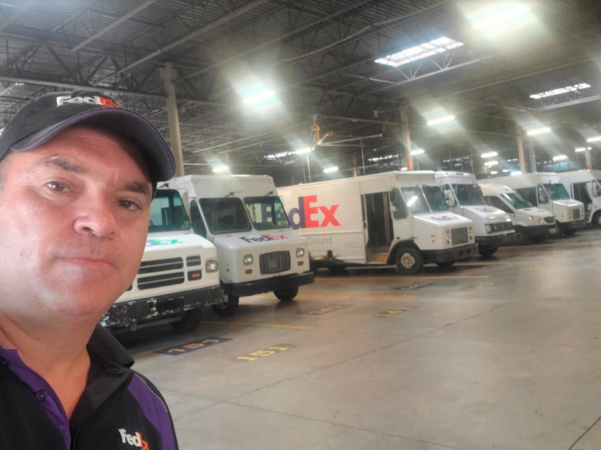
    After losing his company, Vagnozzi ran a Federal Express route for 2½ years and worked in sales for a home-improvement company. He has applied for reinstatement of his Pennsylvania insurance license, which was suspended in 2022 after his company’s seizure.

    According to the lawsuit, the SEC wrongly “assumed without legitimate basis” that Vagnozzi had been a “coconspirator” and a “criminal.” The suit also alleges that the SEC failed to give Vagnozzi “prior notice of the investigation and an opportunity to respond” before his business was shut down and his accounts frozen.

    The suit depicts Vagnozzi as a victim of Par, a firm whose associates included some that “turned out to be members of the Gambino crime family.”

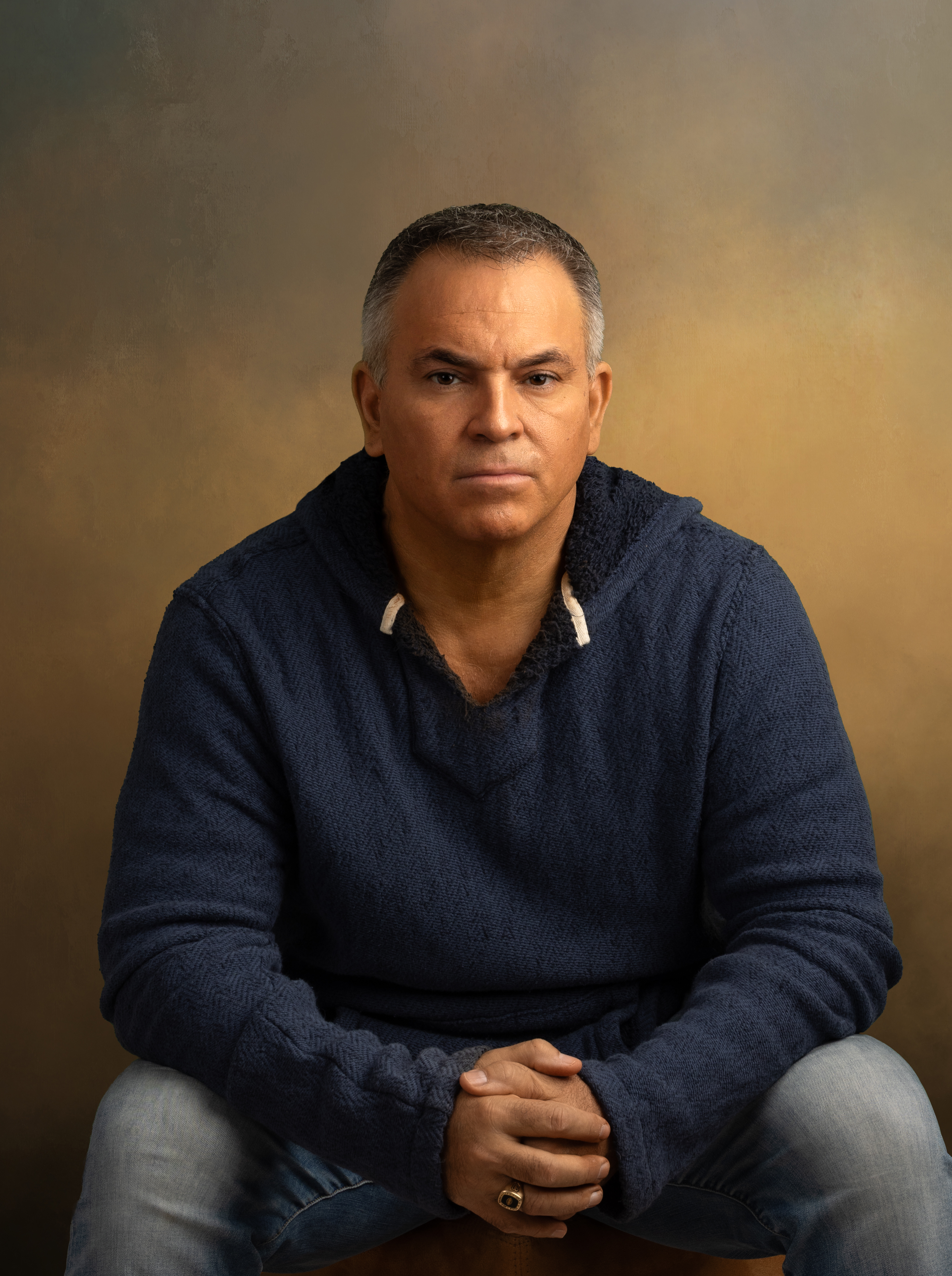
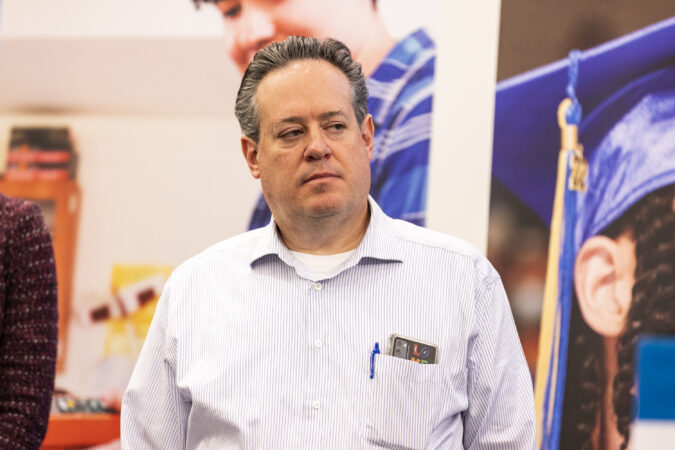
    Dean Vagnozzi had this photo taken in 2025 for use in a book he says he’s writing about his business and its closure by a court-ordered receiver amid a federal investigation of Par Funding, whose investments he sold.

    One of the eight people sentenced in the Par case, former collections head James LaForte, was identified in a separate New York indictment as a member of a Gambino mob crew. James LaForte has denied that allegation. A collector working for James Laforte was also named as a Gambino associate.

    “Vagnozzi, apart from having an Italian surname, had nothing in common with the criminals that ran Par Funding,” who “lied to, manipulated, and duped Dean into raising funds for Par Funding’s criminal enterprise, which he genuinely thought was a legitimate business,“ according to the complaint. He ”was not a fraudster nor [a Par] insider” but “an innocent victim of government overreach,” of his lawyer, and “of Par Funding’s fraud and deceit.”

    Vagnozzi earlier accused his longtime lawyer, John Pauciulo, of giving him bad advice contributing to Vagnozzi’s failure to ensure clients’ Par investments were registered with the SEC.

    Pauciulo has denied wrongdoing. He is the subject of a disciplinary board procedure based on his representation of Vagnozzi that could affect his law license.

    Some 1,600 investors, including hundreds of Vagnozzi’s former clients, have so far received about half their investment principal back from the court-appointed receiver that collected Par assets to repay them. Judge Ruiz last week agreed to release another 40%, bringing total payback to around $210 million. A third, smaller payout is expected as additional money is collected.

    “This case is truly about runaway regulators that well exceed the boundaries of due process and constitutional fairness,” Bochetto said in an interview Tuesday. He said there have not been a lot of successful complaints against the federal government for overreach but was confident the facts in the Vagnozzi case justified a court review.

  • Janney Montgomery Scott sheds investment bank under owner KKR and focuses on brokers

    Janney Montgomery Scott sheds investment bank under owner KKR and focuses on brokers

    Philadelphia-based Janney Montgomery Scott LLC has confirmed plans to exit the investment banking business and will focus exclusively on beefing up its wealth advisory business under its private-equity owner KKR, which bought Janney last year.

    The firm has made what CEO Tony Miller called “a strategic decision” to sell the last of its banking units.

    Investment bankers raise money for companies and governments by selling stock shares, bonds, and other financial instruments to investors, for a cut of the proceeds, a sometimes lucrative but hard-to-predict business. Research analysts help attract those clients by writing about their financial prospects.

    Wealth advisors, typically registered with the SEC or licensed through the industry group FINRA, are paid to guide clients’ investments, and may sell exchange-traded funds (ETFs), and other approved products. Business has soared with the U.S. stock markets in recent years. Miller, the Janney CEO, called investing in that business a better road to “long-term success.”

    Janney plans to sell its last bond and investment banking units, including staff in Philadelphia, at its TM Capital in Atlanta, and in other offices, to Ohio-based Huntington Bancshares and its financial institutions banking, research, and sales units to New York-based Brean Capital. Janney officials hope to close the deals in early 2026. The prices haven’t been disclosed.

    Janney, which recently added advisors in Texas among other states, will remain based in Philadelphia. The company employs around 900 in the region.

    Regional commercial banks and other small to midsize financial institutions were among the last industry groups Janney investment bankers and analysts covered. Just last month, Janney bankers announced that they had advised Georgia-based First Southern Bank on its unusual $51 million sale to member-owned Community First Credit Union of Jacksonville, Fla.

    Former Janney employees said Janney’s owners had the option of taking the time and money to build up the investment banking unit, such as regional brokerages Piper Sandler, Raymond James, and Baird & Co. have done in recent years, instead of cutting back and relying entirely on trading and investment volume that rises and falls with market prices.

    Until the late 1900s, Philadelphia was a financial center, and generations of investment professionals — at firms started by Stephen Girard, Jay Cooke, J.P. Morgan’s mentor A.J. Drexel, the predecessors of what’s now Morgan Stanley Wealth Management, the Butcher clan, as well as Janney and smaller firms — raised money for enterprises ranging from the Pennsylvania Railroad to Donald Trump’s ill-fated Atlantic City casinos. Janney notoriously fired critical analyst Marvin Roffman in 1990 at Trump’s insistence.

    Successful investment bankers were paid a percentage of the deals they closed, built Main Line and Shore estates, and established branches in other cities.

    But even locally based companies now bank with giant Wall Street firms. Janney’s wealth advisory office network, juiced by the relentless rise in the U.S. stock markets, has lately accounted for more than 90% of Janney’s revenue, with investment banking only a thin sliver, according to a statement the company gave The Inquirer.

    “The big investment banks are feasting on deals,” said Robert Costello, a veteran Philadelphia-area money manager. “But the small deals have been drying up, and if they are getting rid of the municipal-bond desk, there’s nothing left.”

    “It’s ‘another one bites the dust,’” said Ryan Connors, a Bucks County-based former Janney analyst who covers utility stocks for Northcoast Research.

    “Philadelphia is thriving as a city, but our business has left it,” Connors said.

    Yet investment research has survived the decline in regional investment banking, he added.

    When Connors left Boenning & Scattergood, a Philadelphia investment bank where he had been director of research before it sold and shut down in 2022, “they told us [stock] research was dying.”

    But Connors said research-based firms like his employer are doing well because hedge funds and other large investors have proven willing to pay for financial research.

  • Data centers to casinos, retired investor Ira Lubert says he’ll give until he’s dead — and after

    Data centers to casinos, retired investor Ira Lubert says he’ll give until he’s dead — and after

    When he turned 74 last year, Ira Lubert retired from the day job that had consumed him since the 1990s — raising more than $20 billion for the investment funds he set up with partners.

    A top IBM salesman and former IT exec before he set up his constellation of investment funds, Lubert is rich enough to focus on investing what he’s kept and giving the profits away.

    Lubert is a salesman, planner, and recruiter, not an investment genius, he said.

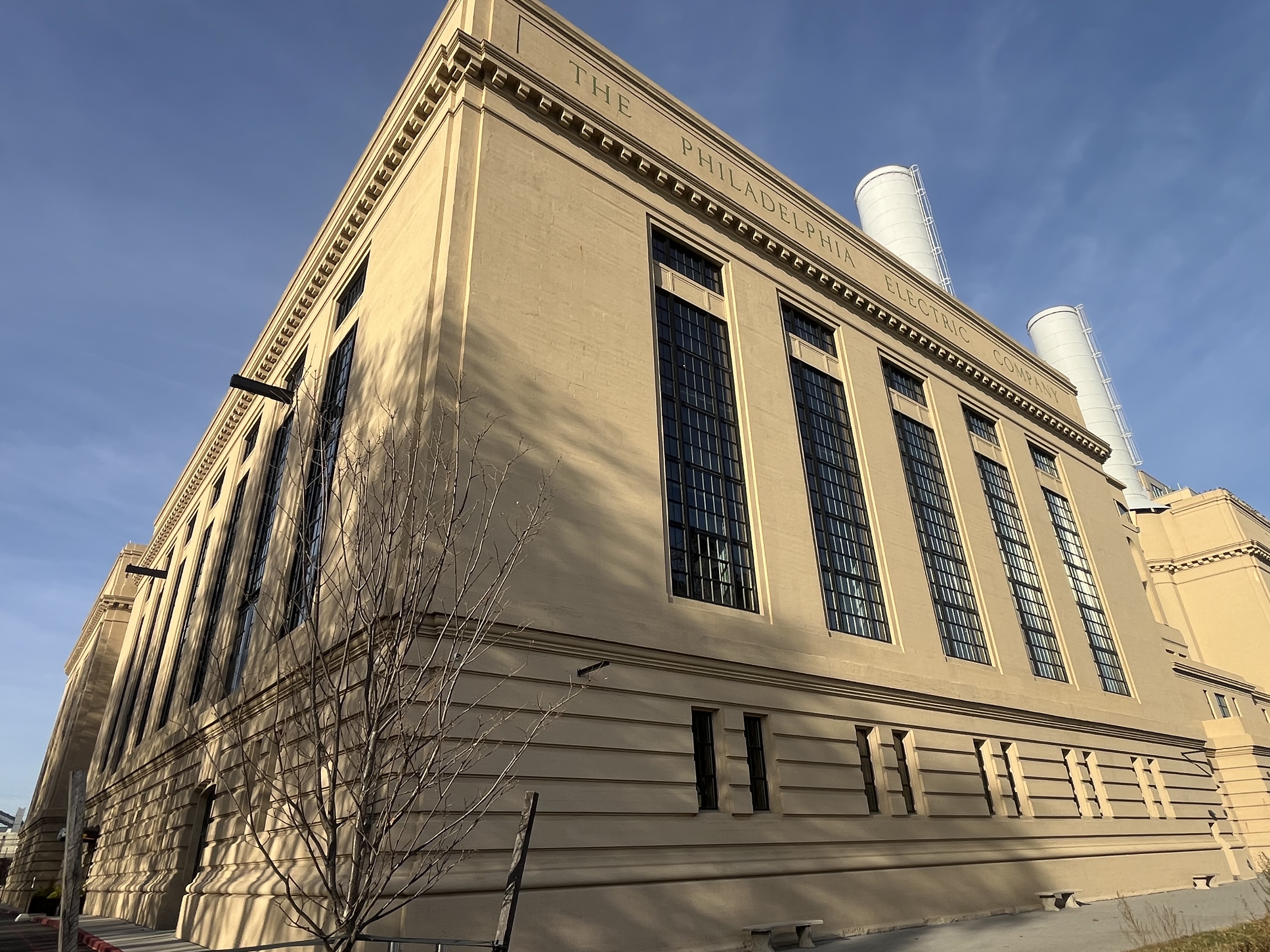
    “The key is to always hire people smarter than you,” he said at his family investing office at the Battery, the former electric generating station on the Delaware River that his real estate group, Lubert-Adler Partners, renovated into hotel suites, offices, recreation sites, and apartments. It opened in 2023.

    The Battery, formerly an electric generating station, was converted to apartments, offices, meeting spaces, and a hotel by Lubert-Adler Partners in 2022-2023.

    Those funds own or have financed hundreds of enterprises and properties around the U.S., including locally familiar Acme Markets, Five Below, and Philadelphia’s Aramark and Bellevue buildings. They have generated billions in net client profits, and a fortune in fees for Lubert and his partners, including hundreds of millions from his key early clients, Pennsylvania‘s state pension funds.

    Lubert built a business renting trailers to Penn State varsity wrestlers and grad student couples, before graduating in 1973 with a hotel management degree.

    After IBM, he spent the 1980s running big IT businesses, then the ’90s as top aide to Warren “Pete” Musser, Philadelphia’s best-known venture capitalist. He quit, Lubert said at the time, because he didn’t understand how to make money from the early internet (as it turned out, neither did Musser, or a lot of pro investors).

    Instead of just trusting his gut, Lubert then partnered with real estate veteran Dean Adler, investment banker Seth Lehr, venture accountant Howard Ross, turnaround ace Greg Segal, and other experts to run his funds, while he focused on convincing state treasurers and other big investors to bet on their projects. Like others, he was solicited by and gave to state officials’ campaigns: only in 2010 did the SEC curb firms paid to manage state and local funds from making political contributions.

    The funds include Lubert-Adler; LLR (military contractors and other private equity); LEM Capital (apartments); LBC Credit Partners (distressed debt); and bank, biotech, and other specialty enterprises, most of them owned by Pennsylvania’s pension funds since they started.

    Lubert also invested separately from his funds, on what he considered riskier projects, like the Valley Forge Casino Resort. And he lost money, for himself and private partners, during the data center frenzy of the early 2010s, long before the current AI boom.

    He was a Penn State trustee and chaired the board as his alma mater coped with the Paterno-era scandals, stepping down for the last time when he got a license to build the Happy Valley Casino near State College.

    In retirement, Lubert oversees his family office, Belgravia Management LP, named for the Locust Street building he and his partners renovated as their first operating base. He also oversees his charitable foundations, with assets over $100 million, that give away profits to Penn State, University of Pennsylvania and Jefferson hospitals, Project HOME, Jewish causes, and other nonprofits. He relies on a veteran staff of seven, plus advisers such as Philadelphia trust lawyer Lester Lipschutz.

    Lubert recently spoke with The Inquirer about his goals in retirement in light of his career. The conversation has been edited for brevity and clarity.

    Who drew you toward business?

    My grandfather, Isidore Brody, was an immigrant from Romania. Age 18, he came through Ellis Island and went to his aunt in Newton, N.J. My father grew up there; he had an appliance-repair business. But with my grandfather, it was a lot of businesses. He had a butcher shop, a liquor store, a Sunoco station. He had apartments, the largest had nine units.

    A couple days a week, I’d walk a mile to his house from school. He showed me a lot about business and real estate.

    Pro investors like to call their shots. Why let your partners pick investments?

    At age 47, my expertise was in raising capital. I wasn’t an engineer. I had tremendous respect for people [with specialized knowledge]. I wanted them to do their thing and then at a cocktail party they would be able to say ‘I founded Versa’ or ‘I founded LLR.’ Not ‘I work for Ira.’

    I get recognized because my name came out in the different funds. And they got bigger.

    Why did you buy high-return assets you didn’t put in clients’ funds?

    Not all investments were appropriate for them. But when I did buy something personally, we had to bring it to the fund compliance people to make sure there wasn’t a conflict of interest.

    You had a reputation for getting intense in meetings. Did you dial that back as you got bigger?

    I don’t believe I have an aggressive style. I am focused and disciplined. I don’t deviate from a plan. I look for partners who are honest, ethical, committed, and capable.

    Your son Jonathan is also an investor, now based in Florida. Will family members succeed you?

    I have it set up so when I pass, my net worth will go to donor-advised funds and charitable foundations.

    Philadelphia had big multi-company investors — the Fox brothers, the Perelmans, Ralph Roberts of Comcast. Did you learn from them?

    They were brilliant business people and entrepreneurs. I’m really different from those guys. They each had a major operating business that they started, then they sold it and used the money to start their funds. I just started funds from the beginning [in the late 1990s] and partnered with top talent.

    It was a great run. Now I really want to do this, while I have something left.

  • A bilingual credit union is opening in Philly, seeking ‘unbanked’ customers to buy homes, build family businesses

    A bilingual credit union is opening in Philly, seeking ‘unbanked’ customers to buy homes, build family businesses

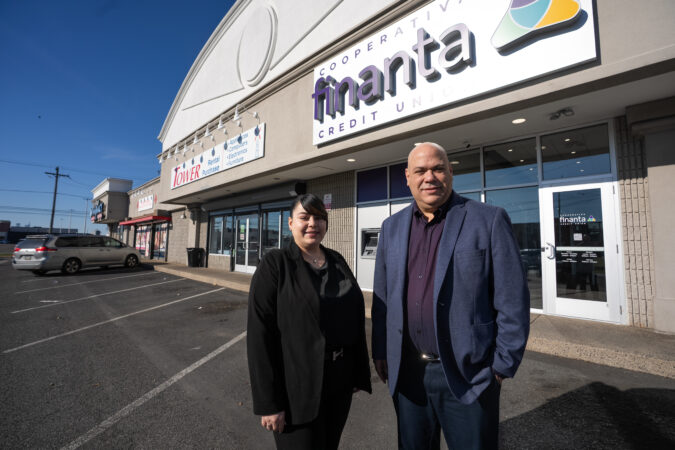
    At a former restaurant in a drive-up shopping strip on the edge of Port Richmond, a bilingual credit union has joined the neighborhood.

    The newest branch of federally-chartered Finanta credit union, which also calls itself Cooperativa Finanta, “is not just a banking place,” says Pedro A. Rivera II, Finanta’s board chair, president of Thaddeus Stevens College of Technology in Lancaster, and a graduate of Kensington High School.

    “We are focused on people that are unbanked: small business owners and workers who go to check-cashing agencies and use money orders and sometimes predatory [high-rate private] lenders,” said Daniel Betancourt, the credit union’s president and CEO.

    Finanta Federal Credit Union offers mortgages, personal and small business loans, Visa debit cards, and interest on deposits. And credit union staff help customers learn to use these products — in English and Spanish.

    Branch manager Iris Santiago signed off on one of its first home mortgages to cleaning-service co-owner Libra Rivera, on Wednesday. The credit union office at 2313 E. Venango St. officially opened Friday but began accepting deposits and booking loans earlier.

    Iris Santiago, branch manager, and Bart Rivera, assistant branch manager, at Finanta Federal Credit Union, in Philadelphia.

    Rivera said the concept takes him back to his North Philly youth, when he banked both the funds of the Amigos de Roberto Clemente youth track and field association and his newly minted teacher’s pay at the former Borinquen Federal Credit Union at Front and Allegheny, which shut in 2011.

    “It was the size of a rowhouse. You’d go in and connect to the tellers in a space where you could catch up what was going through the community and ask questions about percent yield, about how to leverage dollars in a place that was trusted,” Rivera said.

    He got that same feeling when he visited Finanta’s pilot branch in Lancaster after it opened in 2023. Rivera agreed to serve as Finanta’s chairman and went to work lining up support to speed its growth.

    Now, bolstered by private foundations and a state investment, Finanta is opening what it expects to be its largest branch in Port Richmond, with others to follow in Reading, Northeast Philly, Allentown, and other communities with large English-and-Spanish-speaking populations.

    The Lancaster branch signed up 2,000 members in three years. Betancourt expects as many in Philadelphia by next fall.

    This growth is not yet organic. Mackenzie Scott’s Yield Giving foundation in 2023 pledged $2 million a year for seven years to help finance loans. Santander Bank and M&T Bank each invested $1 million as part of their community-banking mandates.

    State House Appropriations Committee chair Jordan Harris, at the recommendation of state Rep. Jose Giral and state Sen. Tina Tartaglione, all Philadelphia Democrats, granted $4 million to build the Reading and Port Richmond branches.

    The credit union made its first mortgage this summer and offers home loans up to $400,000, enough to purchase homes in many but not all Philadelphia neighborhoods.

    The credit union also has made business loans to local firms like Puerto Rican bakery and restaurant El Coqui in Kensington. El Coqui had previously borrowed from the Finanta loan fund, which Betancourt also leads.

    Founded in 1996, the fund later merged with the larger Community First Fund of Lancaster and now lends in several cities under the Finanta name.

    The fund’s Philadelphia clients include developers such as HACE, projects such as Charles Lomax’s Village Square on Haverford in West Philly, and family-owned stores such as Silvia’s Bakery and Mucho Perú.

    Alicia Placeres, member sales representative, working at Finanta Federal Credit Union.

    A new credit union, open to everyone but anchored in the Latino communities, “is very much needed,” said Pedro Rodriguez, cofounder of Café Don Pedro coffee roasters in Brewerytown.

    He’s worried about loan volume amid the Trump administration’s push to arrest and deport immigrants. “They have people scared of their shadow,” he added.

    Others call the credit union a lifeline for people under pressure.

    “Our immigrants are very brave. A lot of the people who come to us are pursuing mortgages, pursuing small business loans, they say what’s going on is not unusual for them, and they are persisting” in building lives here, said Will Gonzalez, head of Ceiba, a Philadelphia-based economic-development advocacy coalition.

    Gonzalez has noted a drop this year — from almost one a day to less than two a month — in noncitizens filing for the first time to pay their income taxes with help from his agency, but those who have already been assigned IRS numbers have returned to file again even if their own immigration status is unresolved.

    “People are paying taxes because it’s the right thing to do,” Gonzalez added. “And because they want to borrow to put their kids in college and to buy a house. To do that, they know they need to show the lenders they have paid their taxes.” It’s a sign they see their long-term future in Philadelphia.

    He said the former Borinquen credit union was badly needed but was underfunded — “a little tree in a desert.” It operated from 1974 to 2011 until it was taken over by regulators and closed after suffering losses. A manager was sentenced to 7½ years in federal prison for stealing from the institution and members from 2006 to 2009.

    The Finanta credit union board Rivera heads, which oversees Betancourt and his growing staff, includes Mennonite Church USA moderator Elizabeth Soto Albrecht, Amalgamated Bank first vice president and 2016 Democratic National Convention CFO Jason O’Malley, and other professionals based in cities with large bilingual populations.

    For all his experience overseeing institutional budgets, Rivera said he and the other directors have had to learn banking in accordance with National Credit Union Administration guidelines.

    “I take my fiduciary responsibility seriously. We are now facing the regulatory expectations and demands of the banking world,” he said. “We know what is expected of us.”

    Gonzalez said Finanta’s focus on Pennsylvania cities with large and growing Latino populations makes it a natural support network.

    ”They are helping these communities build political and economic power,” he said. “They are in the right place at the right time.”

  • Pennsylvania’s $80 billion school pension fund gets a new director

    Pennsylvania’s $80 billion school pension fund gets a new director

    Uri Monson, Gov. Josh Shapiro’s longtime confidant and Pennsylvania’s budget secretary, is the new executive director of the $80 billion-asset Pennsylvania school pension and investment system, known as PSERS.

    The move puts Monson, a former top finance officer for the School District of Philadelphia and for Montgomery County government while Shapiro was its top elected official, atop the agency responsible for paying retirement checks to half a million current and retired school employees.

    Monson has shown “exceptional financial leadership and integrity,” Shapiro said in a statement, citing Monson’s bond refinancing work that shaved state interest costs and helped boost its credit ratings so they are no longer among the lowest of the 50 states.

    He is making the move to PSERS following a 135-day state budget impasse that resolved last month with a $50.1 billion budget deal between Shapiro and the divided legislature.

    Zachary Reber, a deputy secretary in Monson’s office with 30 years of state government experience, will become the state’s new budget secretary. Shapiro credited Reber as a top negotiator for the 2025-26 budget, helping clinch the deal with legislators.

    At PSERS, Monson will lead a staff of 350. The board picked Monson “because of his extensive public-sector financial experience,” board chair Richard Vague said in a statement that also said Monson’s hiring followed “a nationwide search.”

    The new executive director “understands both the financial demands of a pension system and the responsibility” to school staff and retirees, said vice chair Sue Lemmo, a retired teacher.

    Monson pledged to work with the board, staff, and other stakeholders — who include taxpayers and pension system members — to ensure “retirement security.”

    He holds both a master’s degree in public policy and a bachelor’s degree from Columbia University and a second bachelor’s from the Jewish Theological Seminary of America.

    PSERS is one of the most expensive state programs, consuming $5.5 billion directly from public revenues last year, including both state and local property tax funds, plus $1.2 billion routed through school workers’ paychecks.

    The system also collects profits from its wide-ranging investments, totaling $5.7 billion last year.

    The switch will likely mean a significant pay raise for Monson, who earned $211,000 a year as budget czar, the most of any Pennsylvania cabinet officer and more than the lieutenant governor.

    While working as the top budget officer in the state since 2023, Monson oversaw Shapiro’s annual state budget proposals, which guide spending for the next five years.

    Republican lawmakers criticized Shapiro’s 2025-26 budget proposal for counting on new revenue streams, such as marijuana taxes, that had yet to be approved by the General Assembly.

    Pennsylvania faces a tough fiscal outlook, as the state will spend more than it brings in this year, led by ballooning Medicaid expenses and pension costs.

    Monson’s predecessor at PSERS, Terrill Savidge Sanchez, was paid $317,000 in fiscal 2024. A longtime PSERS employee who also headed the smaller Pennsylvania state workers’ pension system (SERS), Sanchez announced her retirement earlier this year. Chief investment officer Ben Cotton stepped in as interim director after she left.

    Sanchez was tapped for the top PSERS job in 2022 after the departure of Glen Grell, a former state representative and lawyer who tripled his legislative paycheck by joining PSERS in 2015.

    Grell and other top staffers retired during a federal investigation into the system’s exaggerated earnings and secretive land deals, which was followed by changes in pension investment, financial reporting, audit, and travel practices.

    Monson worked closely with Shapiro, then a county commissioner, in Montgomery County’s 2013 decision to fire dozens of Wall Street money-management firms and turn its pension funds over to locally based Vanguard Group and SEI Investment Corp., cutting fees and reporting better returns over the next 10 years.

    As governor, Shapiro has not attempted such a purge, either at PSERS, where he controls three of 15 trustee seats, or at the SERS state employee pension system, where the governor appoints six of the 11 trustees.

    PSERS trustees on their own have scrapped hedge funds and cut back on private-equity funds in recent years, citing high fees and poor returns compared to the rising U.S. stock market.

    PSERS, like the state workers’ pension system, was among the first state pension systems to invest heavily in private assets in the late 1990s and 2000s.

    PSERS’s private investments underperformed U.S. stocks during the 2010s bull market. Those investment returns, plus rising retirements and pension underfunding in the early 2000s, required higher taxpayer payments in recent years to keep the fund from growing less solvent.

    Pennsylvanians now pay 34 cents into the PSERS plan for every $1 in school staff wages.

    Some owners of private money managers who solicit top leaders of PSERS and other state pension funds for investments are major political donors at the national level, though an SEC rule has barred them from collecting state and local pension fees after donating to state or local candidates.

    U.S. Sen. David McCormick (R., Pa.) was chief executive of hedge fund Bridgewater Associates when it was PSERS’s largest money manager. It oversaw about one-tenth of the state’s investments and collected more than $750 million in Pennsylvania investment fees over the 20 years before PSERS trustees voted to drop hedge funds in 2021.

    Staff writer Gillian McGoldrick contributed to this article.

  • Shwego helps home service companies get plumbers and painters to you faster

    Shwego helps home service companies get plumbers and painters to you faster

    Shwego is Philly-speak for “‘Should We Go?’ Go here, go there, go where you need to be,” said Sam Puleo, a former door-to-door sales manager who gave his software start-up that name.

    Launched last year, Fort Washington-based Shwego tracks trucks and tradespeople for a collection of home service companies: several plumbers, a painter, electrician, mover, air-conditioning and heating, and solar electric contractors. Most serve Philly’s rowhouse neighborhoods and suburbs, plus outposts from Brooklyn to Miami.

    Contrasting expensive, feature-laden enterprise packages from big Silicon Valley companies, Shwego says it offers “easy-to-use software to contractors for quoting, job scheduling, dispatching, invoicing, and payments.”

    “This app makes it so much easier to steer the ship. You can’t order pizza this fast,” said Ryan Larrimore, founder of Express Drains, an early Shwego client.

    Puleo said he and business partner Junny Kim, a past Accenture IT consultant, are in growth mode, meeting demand from small businesses looking for simple digital systems without the expensive features the Silicon Valley giants sell.

    They are family men who spend less time than they’d like at home. Puleo sold his digital marketing firm to focus day, night, and weekends on Shwego. Kim has kept his day job, running a Gong Cha bubble-tea franchise in Chalfont.

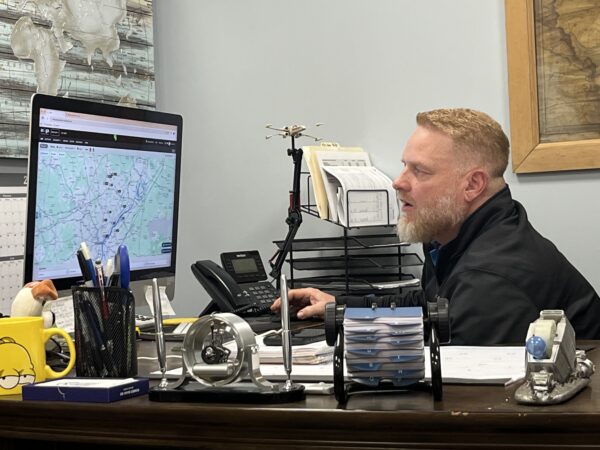
    Sam Puleo, cofounder of Shwego, in client Express Drains’ office in Warminster. Express Drains owner Ryan Larrimore is at left.

    Not ‘the dinosaur way’!

    Their first and so far biggest client is Larrimore’s Express Drains, which contracts with plumbers to unstop customers’ pipes.

    “Those guys streamlined my whole business,” he said at his Warminster office and truck-repair garage. “They save me hours every night. They made it so simple. With notes, like in grade school. We do a job, the pin goes off the map. New job comes up, we see who’s nearby that can do it faster. We know where guys are. It’s like now we are playing a chess game three moves ahead.“

    Larrimore and a partner started Express Drains in 2008 after they lost their jobs when package-delivery giant DHL shut the hub where they worked. They began with a set of Spartan tools, Larrimore’s Teamsters union severance, and a $20,000 loan from Philadelphia Police and Fire Federal Credit Union.

    “I felt like Indiana Jones, stepping onto that invisible bridge,” Larrimore said.

    The service caught on fast. “Six months later we were doing 25-30 calls a week, and we figured we could use another truck,” Larrimore said.

    Soon he was paying off truck loans, buying a $4,000 sewer camera — “Worth it!” — and training friends. Apartment building owner Allan Domb is a regular client.

    Larrimore hired workers he now pays more than $30 an hour. By last year, Larrimore had a problem other small businesses might like: Too much work.

    “We were doing 100 service calls a day,” he said. “Guys were working 10 hours a day running through the whole city. It was getting crazy.”

    Revenues totaled $3.6 million last year; an average job paid $180.

    But Larrimore’s management tools hadn’t kept pace. Orders went out on a single Gmail account to which all drivers had access. Updates were a challenge.

    Someone would accidentally delete a job, he said, which meant lost work.

    Financial records were kept on paper. “Saturday night, me and my wife would separate all the bills and put it into an Excel spreadsheet. Every Monday, I’d drop a printout on [clients’] desks, and they’d give me a check for the previous week.”

    Larrimore’s brother, Josh, disapproved. “I yelled at him: ‘You can’t do everything via email. This is the worst idea ever. This is the dinosaur way.”

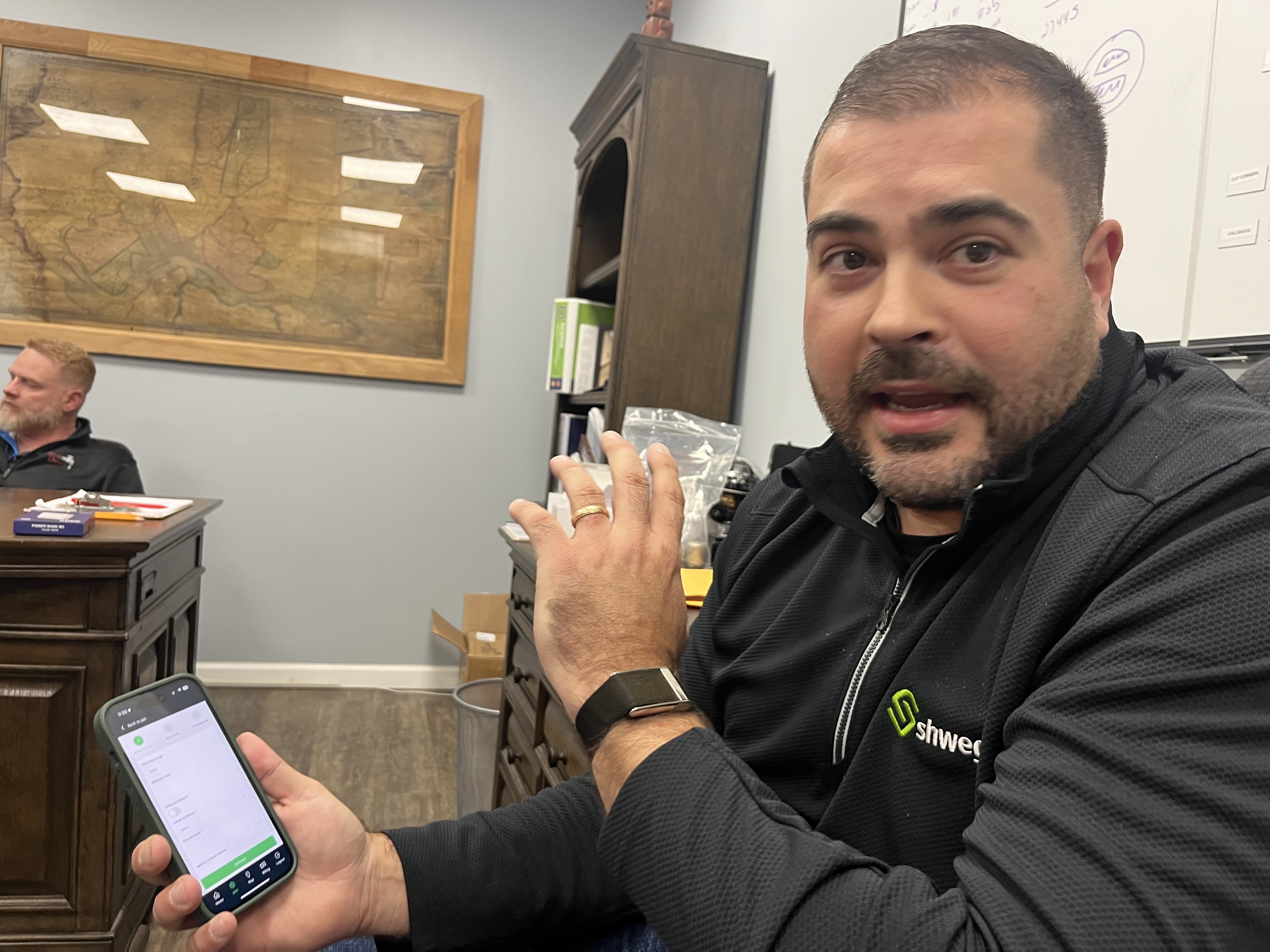
    Josh Larrimore (left), who works with his brother Ryan’s company, Express Drains, with Junny Kim, cofounder of Shwego, the app Express Drains uses to schedule dozens of drain-cleanings daily.

    Ryan Larrimore finally went shopping for business software — but warily.

    From ServiceTitan, the $800 million yearly sales Silicon Valley company whose software platform focuses on home-service providers, he got a quote of $5,000 a month, a big expense for a subcontractor with tight margins. Josh yelled at him some more.

    Larrimore connected with Shwego after a cold call from Puleo. “I was doing digital advertising for plumbers,” Puleo recalled. “I saw these guys got good reviews on Google.”

    Larrimore paid Puleo to update his website and online ads. On his next visit, Puleo asked, “What else do you need?”

    “I said, ‘Build me an app for dispatching,” Larrimore recalled. “He changed my life,” delivering the Shwego app for $1,100 a month.

    Simplify

    “Our number one thing is: Keep it simple,” Puleo said.

    Neither he nor Kim is a software engineer. Backed by a loan from a Lehigh Valley utility auditor, Puleo built the Shwego prototype using a Google app builder and tested it with Larrimore’s company in 2023: “I know enough to be dangerous.”

    Kim, he said, is the “logical and level-headed” partner, who oversees the five outside software developers who built the commercial app Shwego, rolled out in late 2024.

    Son of a doctor, Puleo graduated St. Joseph’s Prep in 2006 but dropped out of Temple University during what he now calls his “knucklehead” youth. After a disastrous foray into deregulated electricity brokerage (he pleaded guilty to a fraud count for his role in a 2012 price-changing scheme), Puleo went into natural gas sales, with the Pennsylvania Public Utility Commission’s blessing.

    When COVID rules stopped in-person selling in 2020, he started the digital-marketing firm, which he sold last year to a Lancaster company to concentrate on Shwego.

    Shwego is Philadelphia dialect for “Should we go?” according to cofounder Sam Puleo, who founded the business last year with partner Junny Kim to make software for what Puleo calls “blue-collar” clients that need similar solutions for scheduling, payments, and other basics.

    As an IT consultant, Kim, a Neshaminy High School and Penn State graduate, was on the road “90% of the year.” As his family grew, he sought to work for himself, close to home.

    Puleo met Kim through his office landlord. By the time they connected, Kim had already committed to running the bubble-tea store.

    Kim researched, like a good consultant: “The home-services industry is shrinking; prices are going up; there’s a lot of interest, even from private equity. And they are moving toward technology, then to AI.“

    They got a business license, bank account, and insurance. After a bad initial experience with software development, they hired professional programmers in Eastern Europe, where Puleo’s wife has family.

    Last Thanksgiving, with Kim’s store shut for the holiday, the pair met at 6:30 a.m. to begin final prep for taking the improved Shwego app live.

    “We burned the midnight oil” evenings and weekends, Kim said. “We probably speak to each other more than our spouses.”

    Last December, they put Express Drains on the new app, “just the basic bones,” as Kim put it.

    “It still looks the same now, like pins in a map. But we have added a lot of efficiencies and features,” Kim said. “Now we are ramping up to allow payments over mobile phones.”

    Next in line: adding QuickBooks integration and an improved calendar feature. Customers are asking for project management and inventory.

    Happy customers

    Shwego has a function for drivers to mark failed calls and route them back to the dispatcher, then move right to the next job.

    “We are making the product more streamlined and efficient,” Kim said. “Our main goal is to keep this product simple, so we don’t overwhelm clients” who are going electronic for the first time.

    “There’s a sense of satisfaction, fixing something,” Larrimore said. “It feels pretty good, and the customer’s happy.”

    Puleo said Larrimore has referred additional customers from the plumbers who hire his drain service.

    “I swear we have plumbers that still run paper,” Larrimore said. “You can hear it rustling when you talk on the phone. They are still stuck in their ways. I tell ‘em, ‘You should talk to Sam.’”

  • Latest Par Funding plan will give scammed investors nearly all their money back

    Latest Par Funding plan will give scammed investors nearly all their money back

    More than 1,600 victims of the Par Funding scheme will get nearly all their money back, despite repeated warnings from the U.S. Securities and Exchange Commission (SEC) that full reimbursement would be highly unlikely.

    The news comes 5½ years after a federal court-appointed receiver seized the Philadelphia loan company amid investigations that have sent its top officers to federal prison.

    “Sounds like Christmas to me!” said investor Joe Brock, a management consultant who invested $200,000 with Par.

    Starting in 2011, Par raised $550 million, telling investors it was lending to merchants at high interest rates for big profits. But Par insiders diverted over $200 million to themselves, and many of its clients couldn’t repay the loans. In March 2020, Par stopped paying investors back.

    In July 2020, the SEC filed a sweeping fraud lawsuit against the firm, its owners and pitchmen. Criminal charges followed in 2023. Eight people involved with the company have pleaded guilty and been sentenced to prison and fines.

    How much will investors get?

    The investors were repaid $111 million, just over half their missing $220 million, under an initial “distribution” of Par assets approved last December.

    Another $97 million will be on the way, pending approval by Florida-based federal Judge Rodolfo Ruiz, who has overseen the case since FBI agents raided Par’s Old City offices and detained founder Joseph LaForte on gun charges in 2020. The judge has declared Par a Ponzi scheme, designed to defraud, by using old investors’ money to fool new investors into falsely believing Par was profitable.

    A third, smaller payout may be arranged in the future, which could bring the recovery above the loss total, according to the new proposal.

    The plan was filed Friday to the judge.

    In July 2020, the FBI raided Par offices and founder LaForte’s Haverford home, and the SEC asked Ruiz to put the company into receivership to protect what was left of investors’ money and to investigate whether LaForte and his allies had stolen money from the company.

    The SEC also filed civil charges against founder LaForte, his wife, Lisa McElhone, chief financial officer Joseph Barleta, and four investment salespeople, accusing them of selling unregistered securities and failing to disclose LaForte’s prior federal fraud convictions.

    Federal criminal fraud charges followed against the three top Par officials, plus debt collectors James LaForte and Renato Gioe; an investment salesman, Perry Abbonizio, and two Colorado accountants who did Par’s taxes.

    The investors are getting their investments back, but not the promised interest. And the paybacks will be uneven.

    Under the terms of the proposal, investors in Par funds set up through Dean Vagnozzi, a former King of Prussia insurance agent who was Par’s most successful salesperson, are on track to receive as much as 98% of their total investment, or as little as 46%, depending on when they invested and how much was in Par.

    Some of the funds set up for Vagnozzi’s A Better Financial Plan invested partly in Par and partly in life-settlement contracts, insurance policies purchased from their owners at a discount so investors collect the proceeds when they die. Investors in those funds still hope to collect additional funds as the policyholders die.

    Where the recovered money is coming from

    The $110 million in the first distribution from the receiver was funded largely by money seized from Par and from founder Joseph LaForte, McElhone, and other Par officials.

    The $97 million in the second distribution included $36.5 million in Par funds that had been held in escrow while the receiver negotiated how much was owed to investors in the Chehebar family (some members spell it Shehebar), who own Rainbow Stores.

    Lawyers for the Chehebars argued that they had negotiated senior payment rights and should have gotten repaid before other investors. But the receiver said the Chehebars were actually “insiders” who worked closely with the LaFortes and didn’t deserve special treatment.

    The Chehebars agreed to settle for $3.1 million — or more if the receiver is able to pay all approved investor claims.

    Another $31 million for the payback has been collected from a settlement of lawsuits against John Pauciulo, salesman Vagnozzi’s longtime lawyer, whom Vagnozzi and others blamed for failing to warn that the Par funds ought to be registered with the SEC and to warn investors about LaForte’s criminal past.

    Insurers for Pauciulo’s former law firm, Eckert Seamans, agreed to pay $47 million, but part of that total was consumed in payments to lawyers and others with claims against Pauciulo.

    In hearings this fall, investigators for the Pennsylvania Disciplinary Board, an arm of the state Supreme Court, have argued that Pauciulo failed to properly advise his clients about the danger from investing in Par. A ruling is pending.

    Helping fund the planned second round of payments to Par investors was $10 million from the sale of LaForte’s former vacation home in Jupiter, Fla., one of the last of 25 properties seized by the receiver as proceeds of the Par founder’s fraud.

    The rest is funded by millions taken from Par and its investors and not paid out earlier.

    For a potential third distribution, the receiver and its consultants have identified several additional funding sources:

    • $11 million in still-uncommitted cash from the funds the receiver took from Par and its owners;
    • $10.5 million in a requested IRS refund of taxes Par paid on phony profits the company reported when it was trying to get more people to invest;
    • $1 million from the sale of three remaining properties at 20-22 N. Third St. in Philadelphia, the last of 20 city properties the receiver has used to raise cash for victims;
    • Up to $4 million that might still be collected from Par’s last borrowers, half of it from Kingdom Logistics, a Texas-based mining company.

    Investors also should receive some proceeds from the liquidation of the former Par Funding corporate jet, worth an estimated $6 million when it was seized by the FBI in 2020, and a Charles Schwab investment account, worth more than $13 million at that time. The government has a separate process for deciding how to pay back that money to investors.

    Expenses for the receiver’s lawyers and other professional services have cost around $100,000 a month, according to the receiver’s most recent quarterly reports.

    All the Par officials charged with crimes were sentenced, most of them earlier this year, after pleading guilty to criminal fraud and, in some cases, other charges.

    Besides fines, restitution and probationary periods, these are the prison terms for people involved:

  • French water giant Veolia buys King of Prussia waste recycler

    French water giant Veolia buys King of Prussia waste recycler

    Veolia, the French water and sewage giant with R&D labs in Trevose, has agreed to pay $3 billion for Philadelphia-based Enviri’s Clean Earth division, which treats contaminated materials for big manufacturers.

    Clean Earth, based in King of Prussia, serves manufacturers such as Boeing, Merck, computer-chip makers, and hospitals. Veolia operates local water utilities in towns across the U.S., including a slice of Delaware County and northern Delaware.

    Clean Earth employs around 1,800, and already uses Veolia incinerators to burn hazardous medical waste and other refuse. Enviri bought that business for $625 million in 2019. Veolia says it plans to cut $120 million in spending as it integrates Clean Earth, to make the deal more profitable.

    Combined with Veolia’s existing hazardous-waste business, Veolia says it will be among the largest businesses of its kind. Veolia also bought medical-waste companies in New England and California earlier this year, and it has incinerators in Texas, Illinois, and Arkansas.

    Clean Earth includes tar-contaminated soil collection treatment centers on the Schuylkill in Southwest Philadelphia; in Morrisville, Bucks County; and New Castle, Del.; and a hazardous-waste and chemical disposal site in Hatfield, Montgomery County, among 82 waste-management and 19 federally-permitted treatment sites, along with hundreds of trucks. Veolia has industrial facilities in Bridesburg and Pennsauken, among other area locations.

    Veolia will pay cash worth around $15.50 a share, or $1.3 billion, to Enviri shareholders for Clean Earth; plus $1.35 billion to pay down some of Enviri’s debt load; and around $400 million to help finance Enviri as it restructures as a smaller company and issues new shares. Both boards have approved the deal, pending a vote by Enviri shareholders next spring.

    The price to shareholders is a premium to Enviri’s recent share value, and triple what it was worth at its recent low in March. But it’s also less than the stock was worth as recently as 2022, before the company changed its name from Harsco and moved from central Pennsylvania to Philadelphia, where its leaders said it’s easier to recruit engineers and managers.

    The sale leaves Enviri with two remaining business lines: steel-mill slag management and railroad track equipment and maintenance. The latter business faces large environmental expenses, and Enviri had earlier tried to sell it.

    After selling Clean Earth to Veolia and reducing management costs, Enviri will spin off the remaining businesses into a new company, under the same name.

    Announcing the deal, Enviri chief executive F. Nicholas Grasberger also said he’ll be stepping down from the company’s top job, to be succeeded by Russell Hochman, a ten-year Enviri veteran who already serves as the company’s senior vice president, top lawyer, and compliance officer.

    F. Nicholas Grasberger, chairman & CEO of Enviri, at the company’s Philadelphia headquarters in 2023. He will be stepping down as the company sells its hazardous-waste division to France’s Veolia.

    The restructured Enviri will have more cash to invest in its businesses and lower finance costs, Grasberger said in a statement. He praised successor Hochman’s “deep business acumen and proven ability to navigate mergers and acquisitions, regulatory matters, and transformation efforts.”

    The boost in Enviri’s capital “will create enhanced opportunities” for both slag and rail, Hochman said in a statement.