Author: Joseph N. DiStefano

  • How Delaware helped keep OpenAI from turning into a typical for-profit company

    How Delaware helped keep OpenAI from turning into a typical for-profit company

    It’s been 10 years since OpenAI was set up as a nonprofit by Sam Altman, Elon Musk, and other software developers and investors, friends, and rivals who didn’t quite trust each other to run a traditional for-profit business with explosive potential.

    Chartered in business-friendly Delaware like most big corporations, OpenAI laid out its public purpose in a mission statement: “to ensure that artificial general intelligence — AI systems that are generally smarter than humans — benefit all of humanity.”

    A decade later, its best-known product, ChatGPT, claims more than 700 million weekly users.

    Delaware officials who monitor the state’s nonprofits took a particular interest as OpenAI became so valuable, and so contentious, that the San Francisco-based startup ballooned into an enterprise requiring multibillion-dollar investments and sought to restructure as a for-profit company.

    “We realized building [artificial general intelligence] will require far more resources than we’d initially imagined,” the company wrote in an open letter last year, explaining its plans. In fact, OpenAI had set up for-profit affiliates at least as far back as 2019.

    But the company said it needed more corporate flexibility if it was to bring in the billions needed to fund high-speed data centers full of Nvidia chips and other systems that could withstand intense AI searches and commands.

    Recent investments have boosted OpenAI’s value to around $500 billion. That’s more than Musk’s SpaceX or Jeff Yass-backed ByteDance (which owns TikTok) or any other private firm — underscoring the bonanza potential and the returns investors hope to realize.

    So it wasn’t surprising last year when OpenAI, which Altman runs, announced plans to raise billions of new dollars by ending its previous limits on investor profits — or that Musk, now owner of a competitor, X.AI, and others, promptly sued, challenging terms of their plan.

    That’s when Delaware Attorney General Kathy Jennings, and California Attorney General Rob Bonta, stepped up.

    Jennings and Bonta filed court papers challenging the proposed business structure — not to stop it, as Musk wanted, but to ensure that the public interest was somehow protected, so OpenAI wouldn’t stray from what the company has called its “save the world” mission.

    Critics, including some in Congress, have worried that ChatGPT is prone to surveillance abuse, crime and encouraging self-harm.

    The final plan, as OpenAI posted it last month, preserves the original company as the nonprofit OpenAI Foundation but moves its businesses to a new, largely investor-owned Delaware “public-benefit corporation.”

    A public-benefit corporation is a for-profit company but does not have the usual legal obligations to enrich investors before anything else, freeing directors to act in favor of public goals even if it hurts sales or profits.

    A public-benefit corporation provides “a clear and durable vehicle” for companies whose goals go beyond shareholder gains, says Lawrence Cunningham, who runs the Weinberg Corporate Governance Center at the University of Delaware. “I like seeing it used in that way here.”

    State intervention at the corporate-charter level “does not happen often” and usually involves questions about nonprofit hospitals’ business activities, said Mat Marshall, spokesperson for Delaware AG Jennings.

    Jennings hired lawyers from Manhattan-based Pillsbury Winthrop Shaw Pittman and financial analysts from Moelis & Co. to buttress the state’s fraud and consumer protection director, Owen Lefkon, in talks with OpenAI.
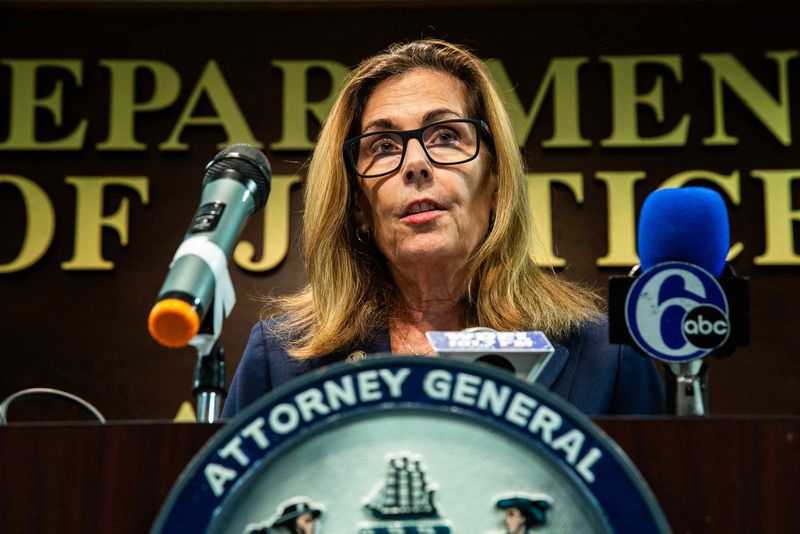
    Delaware Attorney General Kathy Jennings at a December 2024 press conference.

    What changes for OpenAI

    At first, OpenAI planned to pay off its nonprofit obligations by leaving those to a large charitable foundation and then move forward as a typical for-profit company, still professing public goals but responsible to private investors.

    Lawyers for the two states argued that the company’s public mission had to survive the restructuring.

    OpenAI “is the world leader in the artificial intelligence industry,” but it needs guidelines as it funnels massive information about science, medicine, and communities to private, commercial, and government users, and power to “hold OpenAI accountable” for the safety of those whose information is raw material for AI, Jennings said in a statement.

    The foundation also needed some way to keep control over the company, alongside its powerful new for-profit investors. The nonprofit has kept the power to name and remove board members for the business.

    OpenAI’s Safety and Security Committee will remain in place, with “authority to oversee and review the safety and security processes and practices of OpenAI” and the companies it controls, even halting new AI systems if it finds them dangerous, or taking time to resolve ambiguities.

    Zico Kolter, professor of machine learning at Carnegie Mellon University in Pittsburgh, will continue to head the safety committee, attend the corporation’s board meetings, and receive “all director information regarding safety and security.”

    And the states will be given “advance notice of significant changes” in governance.

    In a statement praising the new structure, OpenAI chair Bret Taylor, creator of Google Maps and a former Facebook and Twitter officer, acknowledged changing the plan in discussion with Delaware and California.

    He said the parent, now called the OpenAI Foundation, will own around one-quarter of the business group. Outside investors include Microsoft, Japanese investor Softbank, company employees, and other investors, with room for more.

    Besides keeping the business subordinate to the foundation’s mission, Taylor wrote that the foundation will set aside $25 billion: for “open-sourced and responsibly-built” health data sets to speed up diagnostics, treatments and cures; and to fund AI security to protect power grids, banks, governments, companies and individuals” from AI abuse.
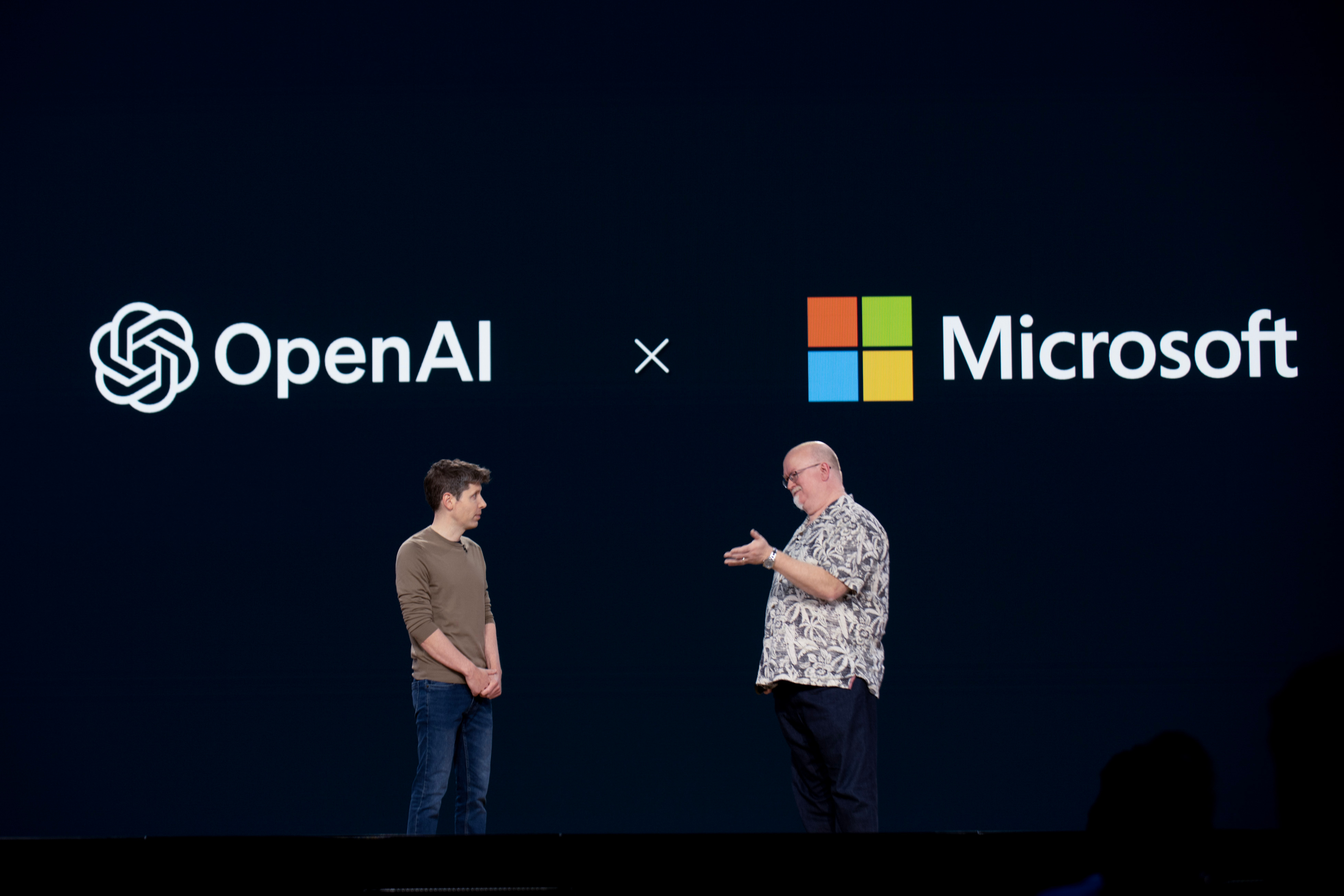
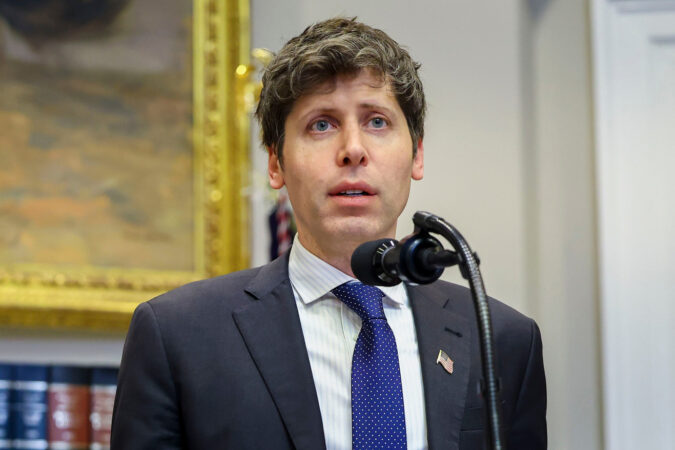
    Microsoft Chief Technology Officer of Microsoft Kevin Scott, right, and OpenAI CEO Sam Altman at the Microsoft Build event in Seattle in 2024.

    Microsoft shows its power

    Since the restructuring, Microsoft has revealed new details of its already-lucrative agreement with OpenAI, the noted Philadelphia-based accounting professor and researcher Francine McKenna and her investigative partner Olga Usvyatsky wrote last week in McKenna’s newsletter, The Dig.

    Microsoft has invested $11.6 billion in OpenAI over several years (and promised at least $1.4 billion more).

    Thanks to exploding OpenAI sales and additional private investments, Microsoft says its investment is now worth $135 billion. That’s more than 10 times what the company paid. Microsoft is the largest OpenAI shareholder, with around 27%. .

    Under a recent agreement following the restructuring, Microsoft said, OpenAI promises to buy another $250 billion in Microsoft Azure cloud networking and other services but also gains the right to form more partnerships with other companies.

    The companies also enjoy a revenue-sharing agreement — the first time that’s been disclosed, according to McKenna and Usvyatsky — though details will have to wait for future disclosure.
  • Philly-based DuPont spin-off hopes merger with global paint giant will boost sagging sales

    Philly-based DuPont spin-off hopes merger with global paint giant will boost sagging sales

    Axalta, the Philadelphia-based automobile paint and coatings maker, is set to be acquired by AkzoNobel NV, the Netherlands-based maker of Dulux and other paint and coatings brands, in an all-stock deal worth $6 billion.

    Both companies have plants in the Philadelphia area, among other locations worldwide.

    Axalta’s headquarters and central research lab is in South Philadelphia.

    AkzoNobel, which employs around 34,500, almost three times Axalta’s 12,600, last year promised to update its powder coatings plant near Reading. AkzoNobel also has a Sikkens vehicle refinishings plant near Malvern.

    “The last few years have been really challenging,” Axalta CEO Chris Villavarayan told investors in a morning conference call. “The market has gone sideways at best. Coatings demand is still below 2019 levels. At some point there’s going to be some kind of recovery.”

    He predicted that sales will benefit as soon as next year as auto, shipbuilding, and other cyclical markets rebound, and that the merger will help boost sales of both companies’ products, after cutting costs.

    AkzoNobel CEO Greg Poux-Guillaume will head the combined company, with sales totaling around $17 billion a year, across 160 countries. Poux-Guillaume said in the conference call that’s large enough to earn it a listing on the S&P 500, like rival PPG.

    Poux-Guillaume said the combined company will maintain Axalta’s main office in Philadelphia as a second headquarters.

    AkzoNobel shares slipped around 3% to $55 on Tuesday. Axalta shares closed down 0.64% to $28, well below the $30 to $40 range where the stock traded last winter.

    The deal, if completed on schedule by early 2027, ends years of Axalta merger talks that began soon after its 2013 spinoff from the DuPont Co., with Axalta periodically discussing possible deals with competitors including PPG and Kansai, as well as AkzoNobel. AkzoNobel’s Dulux is also a former DuPont brand.

    “The stars have finally aligned for this longtime proposed transaction,” said Georgina Fraser, a stock analyst at Goldman Sachs, during the companies’ conference call with investors.

    “The industrial logic has been very clear,” Poux-Guillaume said: combined, the company, whose new name hasn’t been chosen, can push more AkzoNobel products in the Americas and other areas where Axalta sales are concentrated, while Axalta paints can find bigger markets in Europe and Asia.

    Axalta CEO Villavarayan will serve as deputy CEO in charge of cost-cutting $600 million from current expenses by 2030. Villavarayan said the company would also spend $400 million a year on research and development, enough “to drive growth.”

    Rakesh Sachdev, a senior adviser at New Mountain Capital and Axalta’s chairman who served as interim CEO before Villavarayan took the job in 2022, will serve as chairman of the combined board, with four directors from each company and three outsiders. AkzoNobel shareholders will hold around 55% of the combined company’s shares.

    The Axalta Board is confident that this combination with AkzoNobel will create significant value for our shareholders,“ Sachdev said in a statement.

  • DuPont’s latest spin-off, Qnity, soars with demand from Nvidia and AI

    DuPont’s latest spin-off, Qnity, soars with demand from Nvidia and AI

    The latest DuPont Co. spin-off, Qnity, supplies Nvidia, the world’s most valuable company, and other Big Tech giants with high-tech materials to make the high-speed and artificial-intelligence systems that have drawn billions in new investments and sparked the data center building boom.

    Though DuPont is a larger company, Qnity, which started trading Nov. 1, is worth more on the stock market, a sign that investors expect its Big Tech customers — chipmakers like AMD and electronics giants like Samsung — will buy Qnity’s Kalrez sealants, Pyralux adhesives, and other products.

    And they expect it will do so faster than DuPont can boost sales to its remaining brands such as Tyvek and Corian.

    With expected sales of $7 billion next year, DuPont has a stock market value of about $16 billion. Qnity, with sales expected to approach $5 billion, is worth $20 billion. Both companies are profitable, but Qnity’s margins are bigger.

    Based a five-minute walk from DuPont headquarters in suburban Wilmington, Del., Qnity was given away to DuPont shareholders — one share for each two DuPont shares. The company employs around 10,000 at 39 factories and 17 labs worldwide, including 1,300 in the Wilmington area.

    It was the latest in a string of sales and spin-offs that have cut DuPont sales from $62 billion in 2017 — after Edward Breen of New Hope, now DuPont’s executive chairman, took over with a mandate to cut costs and boost shareholder payouts — down to an expected $7 billion next year.

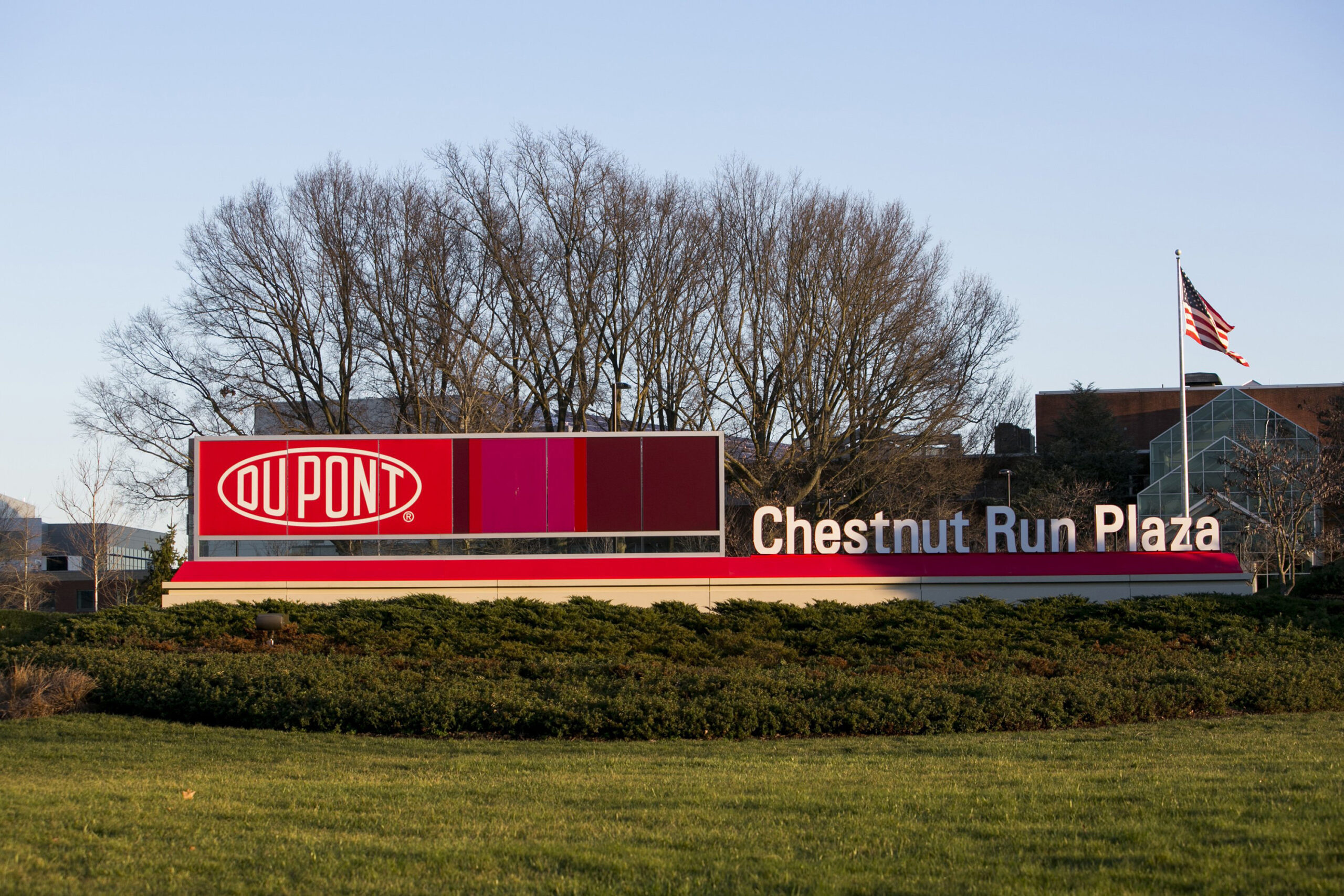
    DuPont’s Chestnut Run Plaza headquarters in Wilmington, Del. The company’s November 2025 spin-off, Qnity, is based at the south end of the campus.

    Qnity’s price quickly spiked from an initial $70 a share to around $100 in early November trading, and stock analysts predict it will go higher on relentless demand for AI and high-speed computer chips.

    The company’s name (pronounced CUE-nitty) was “inspired” by the letter Q’s role in electrical notation. It trades as Q on the New York Stock Exchange.

    Q is “the symbol for electrical charge and unity,” Qnity CEO Jon Kemp said in a meeting with DuPont investors.

    What does Qnity make?

    Qnity’s profit margin before financial expenses is a robust 30%, but analysts warn the chip business might not stay so profitable.

    “Wafer starts,” a count of how many new silicon pieces are being used to build new chips, rose roughly 5% this year. Qnity is growing faster than the industry because some of its products are in special demand, “fueled by the adoption of leading-edge technologies for AI applications,” Kemp told the investors earlier this year.

    Qnity’s “AI-driven technology ramps” include densely layered circuit boards that allow more computing power in a smaller space and barriers to keep data centers from overheating. The company also sells to aerospace, and military equipment and vehicle makers.

    At an August investor meeting, JPMorgan analyst Steve Tusa noted the soon-to-be-spun-off company’s reliance on AI growth. He asked whether the global slump in consumer electronics demand was likely to end, broadening the company’s growth prospects.

    Kemp, in response, acknowledged that consumer demand had been “weak,” noting that “all of the growth for the last several quarters is really coming from AI-driven applications.”

    Worth more in pieces?

    DuPont has sold or spun off many of its once-familiar products in recent years.

    In August, DuPont agreed to sell its Aramids fiber business, which includes Kevlar bulletproofing, to a private equity-backed firm for $1.8 billion. The company sold its remaining nylon lines and other polymer businesses for $11 billion in 2022.

    DuPont still makes Tyvek house and medical wraps, Corian counters, Molykote lubricants, FilmTec membranes, and medical-device packaging systems, automotive battery and aerospace parts, as well as water, gas, and mining products.

    In all, it’s a radical reduction from the 1950s, when DuPont was the most valuable company in the world, and owned major stakes in General Motors and other customers, or in the 1990s, when DuPont owned oil giant Conoco and attempted a drug-making joint venture with Merck.

    DuPont was dropped from the Dow Jones 30 industrial stock index in 2017. It remains one of the S&P 500 stocks, a list Qnity has also joined.

    The Qnity spin-off is just the latest in the dismemberment that began before Breen joined DuPont and became chief executive and chairman in 2015. Breen, who similarly broke apart the former Tyco International in the 2000s, came to DuPont at a time when some investors were discontented with low profit growth.

    As CEO, Breen led a merger with Dow Chemical, enacted in 2017. He gutted central staff including a large part of the company’s research establishment, then broke up DowDuPont into three successors, and kept selling or spinning off business groups.

    The result is a string of DuPont successor companies, most still based in the Wilmington area.

    They include Corteva Agrisciences, a 2019 combination of DuPont and Dow pesticide lines and genetically engineered seeds with offices at the old DuPont headquarters. The company expects more than $17 billion in sales this year.

    Corteva, whose U.S. operations are mostly in the Midwest, announced this month that it was moving corporate offices from the suburban Wilmington office park that also houses DuPont and Qnity to the former DuPont headquarters complex in central Wilmington.

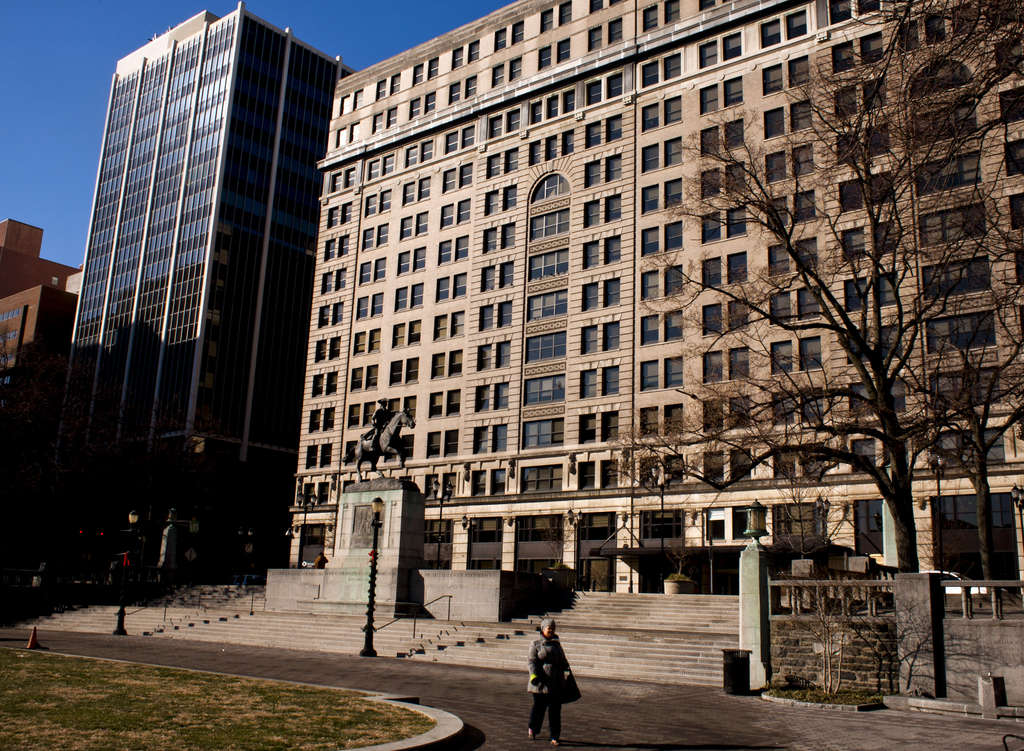
    The Rodney Square side of the former DuPont Co. headquarters in Wilmington is now home to its chemical spin-off, Chemours. The western end of the same campus will soon be home to offices of Corteva, which includes DuPont’s former pesticides business. This 2019 photo also shows a statue of independence leader Caesar Rodney, which was removed from its pedestal after protests in 2021.

    Another global leader in pesticides, Philadelphia-based FMC, owns some former DuPont products and the company’s Newark, Del., research farm.

    In 2020, DuPont sold its food and biosciences business to a smaller company, IFF, for $7.3 billion. Both companies had plants in the Philadelphia area.

    In 2015, before Breen joined DuPont, it spun off a group of its old chemical businesses, calling it Chemours. It has joined DuPont in settling some of the long-running chemical pollution claims for damages related to Teflon and other former DuPont products.

    In 2013, DuPont sold its automotive paints group, Axalta, to private-equity giant Carlyle Group. Carlyle took Axalta public the next year, making three times what it paid DuPont for the South Philly-based company.

    Axalta and Corteva shares have roughly doubled in value since DuPont spun them off, though the S&P 500 index is up more. DuPont itself trades at about the same price it was worth just before the Dow merger in 2017. Chemours shares are also roughly flat since it went public. (Update: Axalta announced its sale to rival AkzoNobel NV in November, 2025.)

    With its stock trading at a premium over DuPont’s, thanks to investor faith that digital demand will keep going up, Qnity has given shareholders more to celebrate — so far.

  • As data center water demand surges, rivals American Water and Aqua are merging

    As data center water demand surges, rivals American Water and Aqua are merging

    Camden-based American Water has agreed to buy its Bryn Mawr rival Essential Utilities and its Aqua water division in an all-stock deal that combines the two largest municipal water and sewage system companies in the U.S. into a single entity that aims to acquire more.

    The deal joins two companies that trace their roots to the late 1800s, Essential chairman and chief executive Christopher Franklin told investors Monday in a conference call.

    Joined under the American Water brand at its Camden headquarters, the enlarged company will be worth around $40 billion on the stock market, ranking with water and electric companies among the 10 most valuable U.S. utility stocks, American Water CEO John Griffith, said in an interview.

    “It’s going to be a real powerhouse, must-own” stock, said Griffith, a former investment banker who took over as American Water CEO last year and will head the merged companies.

    With around 10,000 total employees, the companies together serve around 5 million water and wastewater customers across 17 states, plus military bases in more than a dozen states, with Pennsylvania accounting for around one-third of the total.

    The two companies are “by far the two largest players in the regulated water utility industry,” said Ryan M. Connors, a veteran utility analyst now with Northcoast Research in Cleveland. Together they would be “a truly dominant” water utility, he said.

    Locally, American Water serves users in the Coatesville, Downingtown, Exton, Norristown, Phoenixville, and Plymouth Meeting areas, and in Burlington, Glassboro, Haddonfield, and other areas in South Jersey.

    Aqua has customers in communities throughout Philadelphia’s Pennsylvania and New Jersey suburbs.

    Franklin acknowledged that Essential’s share price has been trading “at a discount,” adding that sales and profits should grow more quickly under American Water.

    The companies are looking for a possible buyer for Essential’s Pittsburgh gas utility, Peoples, which Franklin bought for $4.3 billion in 2020.

    The partners will need approvals from shareholders and state utility regulators in at least five states, including Pennsylvania and New Jersey, to close the deal on schedule by early 2027. Connors said the combined company from its New Jersey headquarters needs to show it can continue Aqua’s success getting Pennsylvania regulators to approve water charges and plans.

    Franklin said that on Sunday, he told his predecessor, longtime Aqua CEO Nicholas DeBenedictis, about the merger. “He said, ‘It could have happened 20 years ago. These companies belong together.’”

    As a combined company, the leaders said it would be easier to finance the $28 billion in improvements needed over the next five years to upgrade systems.

    About two-thirds of that total will go toward routine upgrades and new technology. The rest includes environmental improvements, including the cost of complying with lead and copper limits, and cleaning water from potentially cancer-causing PFAS chemicals formerly leached into U.S. waters by chemical manufacturers and government firefighting gear.

    Franklin said the merger would make it easier to “keep customer rates affordable” as the business expands.

    As a larger company, the two CEOs said they also would be able to more easily service AI and high-speed data centers and other large new customers.

    Essential has committed to investing $26 million to supply 18 million gallons a day to International Electric Power’s 1,400-acre data center and nearly 1,000-megawatt natural gas and battery storage plant, which sit on former coal-mining lands in western Pennsylvania’s Greene County. Griffith said other large projects are under consideration.

    Though neither company ruled out back-office job cuts, offices in Bryn Mawr and Pittsburgh as well as the Camden headquarters will remain open. Griffith said he plans to honor union contracts with dozens of labor organizations, including locals of the Operating Engineers and Steelworkers.

    “This is really not a cost savings-driven transaction. Both American Water and Essential are growing in a robust way,” Griffith said.

  • Sixers and Comcast hope to open up a block of East Market for ‘pop-ups’ during the World Cup and America 250

    Sixers and Comcast hope to open up a block of East Market for ‘pop-ups’ during the World Cup and America 250

    The companies that own the 76ers and Flyers earlier this year made a high-profile commitment to help transform the long-distressed East Market Street corridor.

    The first development to come out of that promise? Perhaps a mini-soccer pitch. Or a pop-up beer garden.

    The teams recently hired a contractor to demolish buildings they own on the 1000-block of the beleaguered thoroughfare with the goal of eventually erecting a major development that could help revitalize the area.

    But, until then, City Councilmember Mark Squilla said Friday the teams and city leaders hope to “activate” the lots slated for demolition with “pop-up” opportunities related to the FIFA World Cup and the nation’s 250th birthday being hosted in Philadelphia next summer.

    “The goal was: If they could demolish it by then and fill it, we could program an open space on 1000 Market Street,” Squilla said, tossing out the soccer pitch and beer garden ideas as examples. “This will give us an opportunity to try to do something special for 2026 while we’re doing a longterm plan for East Market.”

    (function() { var l = function() { new pym.Parent( ‘sixersbuild__graphic’, ‘https://media.inquirer.com/storage/inquirer/ai2html/sixersbuild/index.html’); }; if(typeof(pym) === ‘undefined’) { var h = document.getElementsByTagName(‘head’)[0], s = document.createElement(‘script’); s.type = ‘text/javascript’; s.src = ‘https://pym.nprapps.org/pym.v1.min.js’; s.onload = l; h.appendChild(s); } else { l(); } })();

    Jacklin Rhoads, a spokesperson for the teams’ development venture, said Friday the demolitions come as the partners “continue to make progress towards future development on East Market Street.”

    “The demolition of these vacant storefronts improves the streetscape and will give us the ability to work with community partners to activate the site ahead of groundbreaking,” Rhoads said. “We are committed to working with the City to help jump start the revitalization of Market East and this is the next step in that process.”

    The teams’ commitment to work together as Market East boosters stems from the controversial and since-abandoned proposal by the 76ers’ owner, Harris Blitzer Sports & Entertainment, to build an arena in Center City.

    The basketball team had pitched that proposal as an opportunity to rejuvenate the blocks east of City Hall. But when the plan crumbled in January — in no small part due to opposition from the Flyers’ owner, Comcast Spectacor — the teams vowed to work as partners both on a new arena in the South Philadelphia stadium complex as well as on a joint development venture for East Market Street.

    The Sixers and Flyers recently hired a joint venture of New York-based Turner Construction Co. and Indiana-based AECOM Hunt to manage construction of the arena, which will be home to the city’s NBA and NHL teams and its planned, as-yet-unnamed WNBA team.

    And the teams have hired Philadelphia- and Norristown-based contractor Pride Enterprises Inc. to demolish the vacant storefronts they own on East Market Street in Center City.

    Tearing down and popping up

    Demolitions are so far only planned for part of the 1000-block, across the street from where the Sixers had previously envisioned building their new home.

    HBSE and Comcast Spectacor — a subsidiary of the Philadelphia-based entertainment, cable television, and internet giant — bought properties on East Market Street in a series of transactions totaling $56 million earlier this year. The buildings were formerly home to Rite Aid, Reebok, and other stores totaling 112,000 square feet.

    The properties currently slated for demolition are 1000-1024 E. Market St. That includes most of the former stores on the block’s south side. The teams also own 920-938 E. Market St., the western half of the adjacent block, but those properties are not currently planned for tear-downs.

    The teams’ plan to flatten the stores, making the space temporarily available for events related to the FIFA World Cup or the nation’s 250th anniversary next summer.

    Squilla said an East Market task force will be announced soon, and that group would have input on what happens at the site assuming it is demolished in time for the 2026 celebrations.

    After that, the teams will redevelop the properties, although plans aren’t finalized, Rhoads said. The teams declined to provide any details about the redevelopment project’s ambitions or scale.

    The city Department of Planning & Development did not respond to a request on the status of the development plans.

    The neighborhoods around East Market, a thriving department store district that has languished for decades, have recently begun to rebound with the development of hundreds of apartments and neighborhood retail to serve new residents.

    Stadium construction vets tapped for South Philly arena

    The new arena in South Philly will replace the Flyers and Sixers’ current home at the recently renamed Xfinity Mobile Arena, which was known as the Wells Fargo Center until this year.

    Currently, Comcast Spectacor owns the building, and the 76ers pay rent. For the next facility, the teams will be joint owners.

    The teams have tapped an outfit with ample experience in stadium and arena construction for the job. Over the past 20 years, Turner-AECOM Hunt joint ventures have built the Barclays Center in Brooklyn, the SoFi Stadium and Intuit Dome in Los Angeles, State Farm Arena in Atlanta, and Nissan Stadium in Nashville.

    In Philadelphia, they built the Eagles’ Lincoln Financial Field, the FMC Tower, the One uCity Square office building in University City, and the Chubb Center in Center City, the insurance company offices set to open next year.

    For the South Philly project, the partners, doing business as PACT+, have brought on Philadelphia-based union contractors to do much of the work, including Black-owned general construction company Perryman Construction, construction manager Hunter Roberts Construction Group, and Camfred Construction.

    The teams haven’t said how large the arena will be. HBSE and Comcast Spectacor in June hired a design team at the firm Populous and Moody Nolan.

    David Adelman, the Philadelphia student housing developer and investor who chairs the teams’ development venture, in a statement promised “the most technologically advanced and fan-focused sports and entertainment venue.”

    Adelman earlier said the new arena will open in 2030, and the WNBA team will play its first game there.

    The project “is a chance to build something that becomes part of Philadelphia’s fabric,” said Turner’s Philadelphia-based vice president, Dave Kaminski, in a statement.

    Jason Kopp of AECOM Hunt promised “cutting-edge amenities for athletes, performers, and visitors.”

    Although the teams are making moves related to the new arena, they don’t yet appear to have shared much of their plan with City Council President Kenyatta Johnson, whose 2nd District includes the South Philadelphia stadium complex.

    Building an arena at that location will likely require involve fewer legislative and bureaucratic hurdles than the 76ers’ abandoned Center City proposal. But in Philadelphia, Council members hold enormous sway over their districts, and the teams will likely need Johnson’s support if they want a smooth approval process.

    Johnson was asked Thursday what the teams need to do to meet their proposed timeline for opening the arena in 2030.

    “I have no idea,” Johnson told reporters. “That’s not even on my radar at the moment.”

    Staff writer Mike Newall contributed to this article.

  • As Trump limits federal college loans, a new private lender specializes in lending to families desperate for a student to graduate

    As Trump limits federal college loans, a new private lender specializes in lending to families desperate for a student to graduate

    Colleges and universities expect the Trump administration’s new limits on government-backed student loans will drive more families to higher-cost private lenders. John Witter, CEO of industry leader Sallie Mae, expects his company will attract around $5 billion in new private loans, thanks to lifetime limits on taxpayer-backed student borrowing in President Donald Trump’s Big Beautiful Bill.

    Investors, meanwhile, are betting that private college loans will balloon under the Trump rules. But less than half of families who apply qualify for mainstream lenders’ private student loans.

    So a group of executives who used to work at Sallie Mae, which is based in Wilmington, have organized a start-up company, GradBridge, to make loans at higher interest rates to students who max out on scholarships and government loans but still hope to finish college or graduate school.

    On Wednesday, GradBridge said it had raised $20 million to speed its growth before the new loan limits begin next summer.

    The money was raised from private investors led by Acorn Investment Partners, which is managed by Los Angeles-based Oaktree Capital Management. Oaktree’s investors include the Pennsylvania public schoolteachers’ (PSERS) and state workers’ (SERS) pension funds.

    GradBridge will be a “second-look” lender for families turned down by mainstream private college lenders, said Jen O’Donald, GradBridge founder and CEO.

    O’Donald, who lives in Chester County, is a former head of products for Sallie Mae and the mother of two college students. Her top lieutenants include chief financial officer Brian Carp and chief operations officer Lisa Kaplan, also Sallie Mae veterans. Advisers include Sallie Mae Bank’s former president, Paul Thome, and former chief credit officer Dan Hill.

    After Trump’s election last year, O’Donald said, she and former colleagues reviewed the “massive disruption” the Trump platform promised in college financing and looked for business opportunities.

    Even if only some of the changes were enacted, “only about 35% to 45% of private college loans get approved,” and many students’ families are not able to get a private student loan after they have exhausted federal grant and loan programs, she said in an interview.

    With the lifetime limits on student loans enacted by the Trump administration, O’Donald sees an “overwhelming shift” away from government programs to private loans over the next few years, as students grandfathered under earlier programs graduate and new students borrow up to the new program limits.

    GradBridge expects to get referrals from colleges and mainstream lenders of borrowers who don’t fit the high-end ability-to-pay profile.

    While mainstream lenders could charge an annual interest rate from the mid-single digits to as much as 18% a year, GradBridge might charge less-bankworthy borrowers an additional 3% or 4% on top of the mainstream rate, driving monthly payment up by $30 or $40 for every $10,000 owed.

    O’Donald said GradBridge offers an alternative to “credit cards, personal loans, parents’ 401(k) accounts, home equity loans” and other costly alternatives families use to help their children stay in college.

    Federal student loans are made to applicants who apply to government-approved, mostly four-year colleges, without the kind of traditional loan underwriting used to evaluate if borrowers are likely to repay home, auto, or small-business loans.

    Not surprisingly, those student loans suffer a high loss rate, the justification lenders used to get the government to agree to prevent federal student loan debtors from having their loans discharged in bankruptcy.

    But private lenders like Sallie Mae and GradBridge consider family income and other factors that affect whether the loan will likely be paid, O’Donald said.

    Most private college loans require adult cosigners. Because they rely mostly on family income to ensure they get paid back, lenders typically don’t worry about what majors or graduate degrees a borrower pursues, she added.

    “GradBridge’s approach addresses a real market gap” for students who “fall just outside of traditional credit underwriting models,” Yadin Rozov, Acorn’s chief investment officer, said in a statement.

    GradBridge employs around half a dozen people. It plans to increase to around 30 by 2027.

    O’Donald said the Wilmington area is a national center for student lending and a good place to hire for a loan start-up.

    Besides Sallie Mae, it is home to College Avenue, another student lender founded by Sallie Mae veterans; Navient, a student-loan servicing company; and other consumer payment companies.

    With college enrollments flat or declining, O’Donald said schools are eager to forge ties with private lenders.

    “The first big impact will be next summer,“ she said. ”It will take a few years before the full impact will be seen, but schools are starting to be concerned about how they will keep kids enrolled.”

  • Pennsylvania state government relies on H-1B workers. Trump wants to charge employers $100,000 for those visas.

    Pennsylvania state government relies on H-1B workers. Trump wants to charge employers $100,000 for those visas.

    Government contractors are among the big employers grappling with President Donald Trump’s plan to charge employers $100,000 for new H-1B visas, which allow hundreds of thousands of workers from foreign countries to work in the United States every year.

    Leading contractors such as Amazon Web Services at the federal level and Deloitte Consulting in Pennsylvania rely on H-1B visas to bring in foreign skilled professionals for their U.S. workforces.

    Once a supporter of the 35-year-old program, Trump said in a September executive order that he now agrees with critics that “systemic abuse” of the visas has displaced U.S. workers, “discouraging Americans from pursuing careers in science and technology,” and driving down wages. He announced a fee of $100,000 for new H-1B visas, which would significantly boost costs for government contractors and other employers that continue to use the visas.

    U.S. immigration officials issue up to 85,000 new H-1B visas a year. Generations of engineers and technical workers have moved to the United States to work for government agencies using these visas. Some remain as permanent residents and become citizens.

    window.addEventListener(“message”,function(a){if(void 0!==a.data[“datawrapper-height”]){var e=document.querySelectorAll(“iframe”);for(var t in a.data[“datawrapper-height”])for(var r,i=0;r=e[i];i++)if(r.contentWindow===a.source){var d=a.data[“datawrapper-height”][t]+”px”;r.style.height=d}}});

    About 50% of all U.S. H-1B visa holders arrive from India, and the percentage is higher in technical fields. More than 80% of Deloitte H-1B visa holders stationed in the Harrisburg area from 2022-2024 originated in India, according to federal visa data. These professionals earned a median of around $100,000 a year.

    Recruiters promoted the visas extensively in 2000 to help U.S. companies update systems under Y2K programs, said Akanksha Kalra, an immigration attorney in Philadelphia who has represented many H-1B visa holders. Since then the program became so popular among employers and applicants that H-1B visas have been awarded through a lottery.

    Here’s what you need to know about H-1B visas.

    Who are the largest employers of H-1B workers in Pennsylvania?

    Among Pennsylvania-based employers, Deloitte Consulting is by far the top H-1B contractor. More than 3,000 of the 9,930 H-1B visas the government granted in Pennsylvania last year were for Deloitte Consulting and its tax and accounting affiliates. The company ranked among the 10 largest H-1B visa users across the U.S. last year. Pennsylvania was a major Deloitte client, paying $260 million for its services to state health, labor, and transportation programs, among others.

    window.addEventListener(“message”,function(a){if(void 0!==a.data[“datawrapper-height”]){var e=document.querySelectorAll(“iframe”);for(var t in a.data[“datawrapper-height”])for(var r,i=0;r=e[i];i++)if(r.contentWindow===a.source){var d=a.data[“datawrapper-height”][t]+”px”;r.style.height=d}}});

    How long can people with H-1B visas work in the U.S.?

    Employers can apply to have H-1B visas extended for a total of six years, boosting the total of H-1B workers in the country at any one time to hundreds of thousands. Spouses of H-1B visa professionals often apply for H-4 work visas.

    Another program popular with employers, the Optional Practical Training work authorization, is available to foreign students entering the workforce, for up to three years; more than 400,000 were granted in 2024.

    Which states have the most H-1B workers?

    Six states — California, Texas, New York, New Jersey, Virginia, and Pennsylvania — account for more than half the 283,000 new and returning H-1B visas approved by the federal government for fiscal year 2024, the most recent data available.

    window.addEventListener(“message”,function(a){if(void 0!==a.data[“datawrapper-height”]){var e=document.querySelectorAll(“iframe”);for(var t in a.data[“datawrapper-height”])for(var r,i=0;r=e[i];i++)if(r.contentWindow===a.source){var d=a.data[“datawrapper-height”][t]+”px”;r.style.height=d}}});

    The largest H-1B employers include Amazon’s Virginia operations, whose clients include the Pentagon and other U.S. security, surveillance, and technology agencies; other Big Tech employers such as Meta, Oracle, and Google; banks such as J.P. Morgan and Goldman Sachs; and manufacturers, such as automakers General Motors, Ford, and Tesla. Hospitals use the visas to bring in doctors, universities for professors.

    How does Pennsylvania state government rely on H-1B workers?

    Besides Deloitte, the visas are popular among small firms that specialize in IT contracting for Pennsylvania state government, according to a check of information technology firms contracted to Pennsylvania state departments under the no-bid Information Technology Supplemental Assistance (ITSA) program, which started in 2010 as a way to add short-term technical project assistance.

    Payments to ITSA contractors rose from $24 million in 2010 to $188 million last year, spread among hundreds of mostly small and specialized firms, according to data The Inquirer obtained in a Right to Know request.

    In each year, more than half of ITSA spending went to firms that were granted at least one H-1B visa. Together ITSA firms were awarded 171 H-1B visas last year, not counting Deloitte.

    What do Pennsylvania officials say about Trump’s $100,000 plan?

    A spokesperson for Gov. Josh Shapiro’s administration said state officials are studying Trump’s proposal.

    State agencies don’t themselves sponsor H-1B visa applicants, and the state “does not have information hired by suppliers through the federal H-1B visa program,” said Dan Egan, a spokesperson for the state Office of Administration.

    However, OST Inc., the state contractor that oversees hundreds of information technology contractors to more than 30 Pennsylvania state agencies, requires them to report H-1B visa holders, as well as participants in other foreign guest worker programs such as the OPT visa. OST didn’t respond to inquiries.

    Is a scarcity of Pennsylvania tech talent forcing employers to bring in staff from abroad?

    The National Bureau of Economic Research says H-1B has reduced employment and wages for U.S. citizen data scientists but also cut technology costs, benefiting the economy. American workers have testified in Congress about being laid off by employers who hired visa holders.

    Pennsylvania legislators who held hearings on the ITSA program in 2017 did not dispute that the state faced a shortage of tech talent in the Harrisburg area. Contractors said the state should verify visa holders’ education and work experience to avoid overpaying.

    The Shapiro administration says it has created technology apprenticeship, internship, and fellowship programs that help Pennsylvanians without a college degree qualify for state tech jobs and help fill IT positions.

    Several publicly traded companies formerly based in central Pennsylvania, including TE Connectivity, Enviri, and Rite Aid moved their headquarters from the Harrisburg area to the Philadelphia metropolitan area in recent years. Each cited the difficulty finding American tech workers and managers willing to live in Central Pennsylvania.

    Why is Trump so interested in H-1B visas?

    In his Sept. 19 executive order, Trump noted that the visas are supposed to go to people who could do “high-skilled” jobs that Americans aren’t doing — but, he said, technology employers “have abused the H-1B statute and its regulations to artificially suppress wages” to the disadvantage of U.S. workers.

    That’s a switch for Trump, who last December defended H-1B. “I’ve always liked the visas. I have always been in favor of the visas. That’s why we have them,” Trump told the New York Post last December. “I have many H-1B visas on my properties. I’ve been a believer in H-1B. I have used it many times. It’s a great program.”

    How are business and labor reacting to Trump’s H-1B plan?

    Though labor groups have long called for employers who use H-1B staff to pay higher wages, the United Auto Workers and American Association of University Professors have joined in a lawsuit to stop Trump from imposing what they call an illegal fee. On Oct. 16, the U.S. Chamber of Commerce also sued, calling Trump’s action “unlawful.”