It’s school-opening season for the Philadelphia School District.
On Tuesday, officials cut the ribbon on a brand-new Thomas Holme Elementary, a K-8 school in the Northeast. That celebration came exactly a week after the district opened a new middle-school building, AMY at James Martin, in Port Richmond.
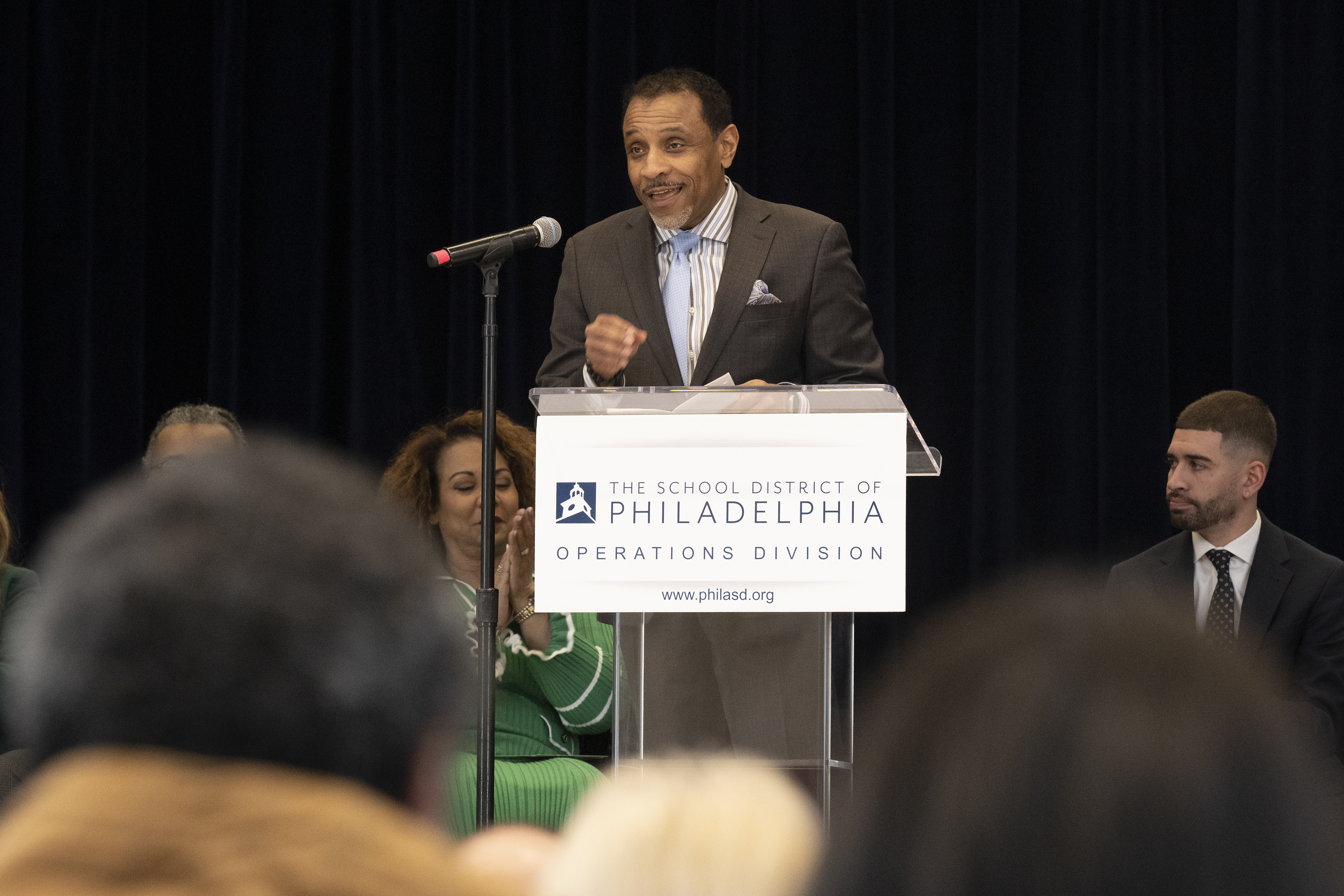
“I see a place where students will have access to a 21st century education,” Holme principal Micah Winterstein said during a ceremony attended by students, school district officials, and community members. “A place where they feel like school is where they belong, a place where they will have moments each day that inspire.”
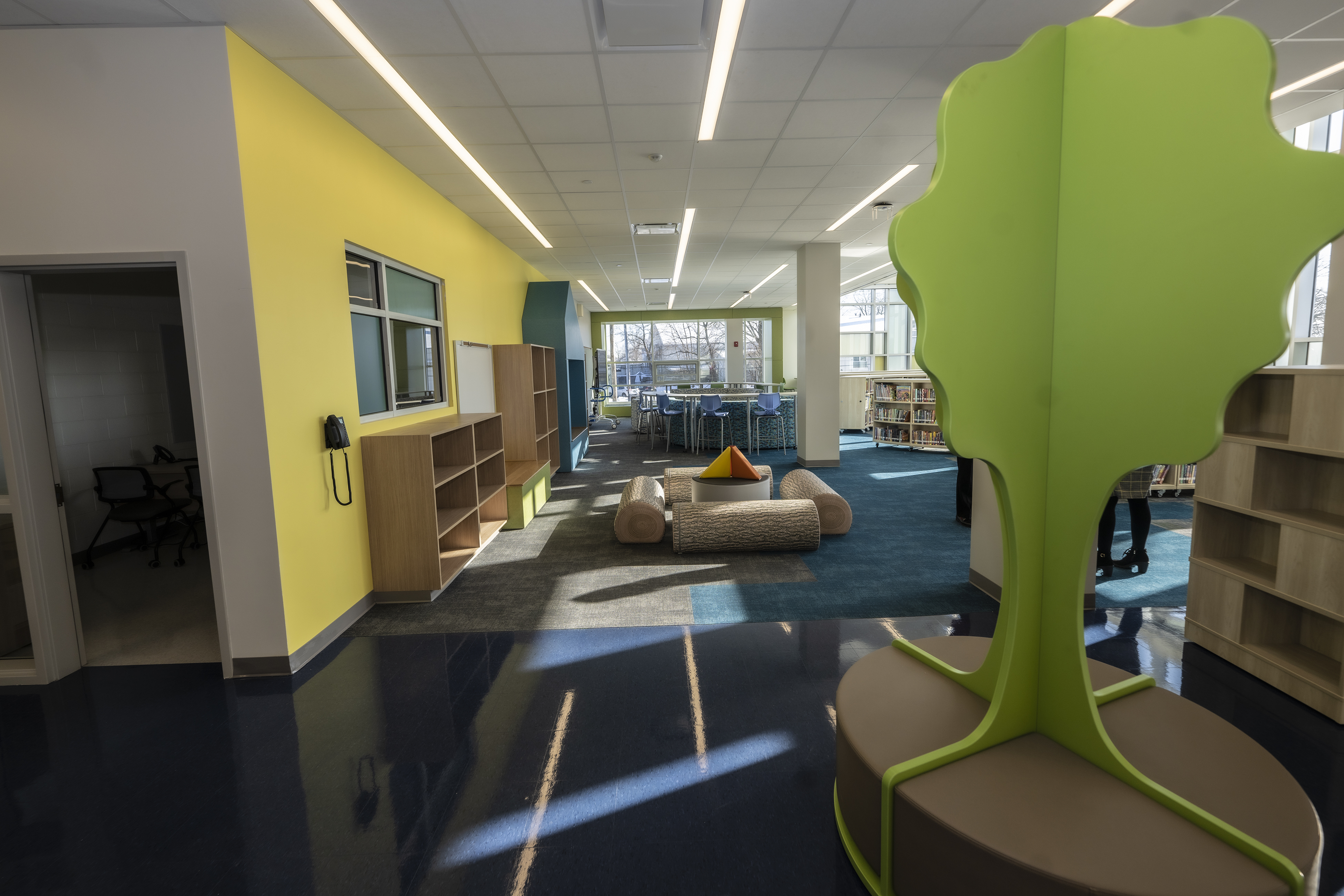
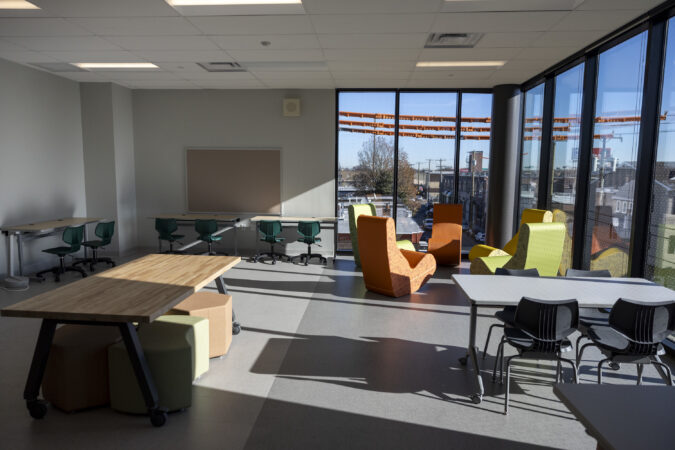
New furniture at the new Thomas Holme Elementary School.
Unlike many other sections of the city, where the district’s enrollment is shrinking, the Northeast’s school population is booming — its schools are overcrowded.
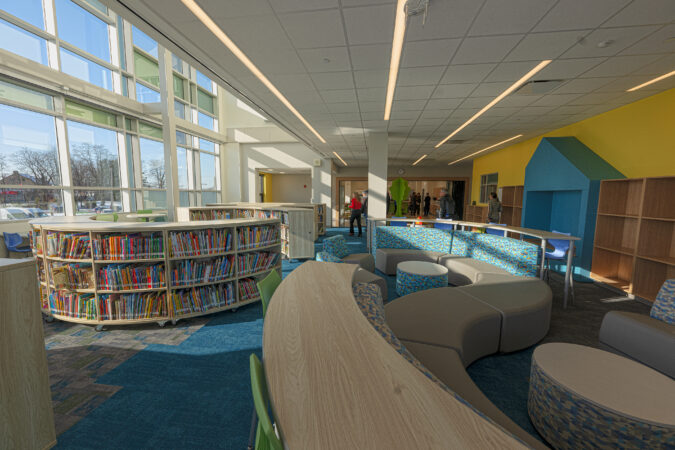
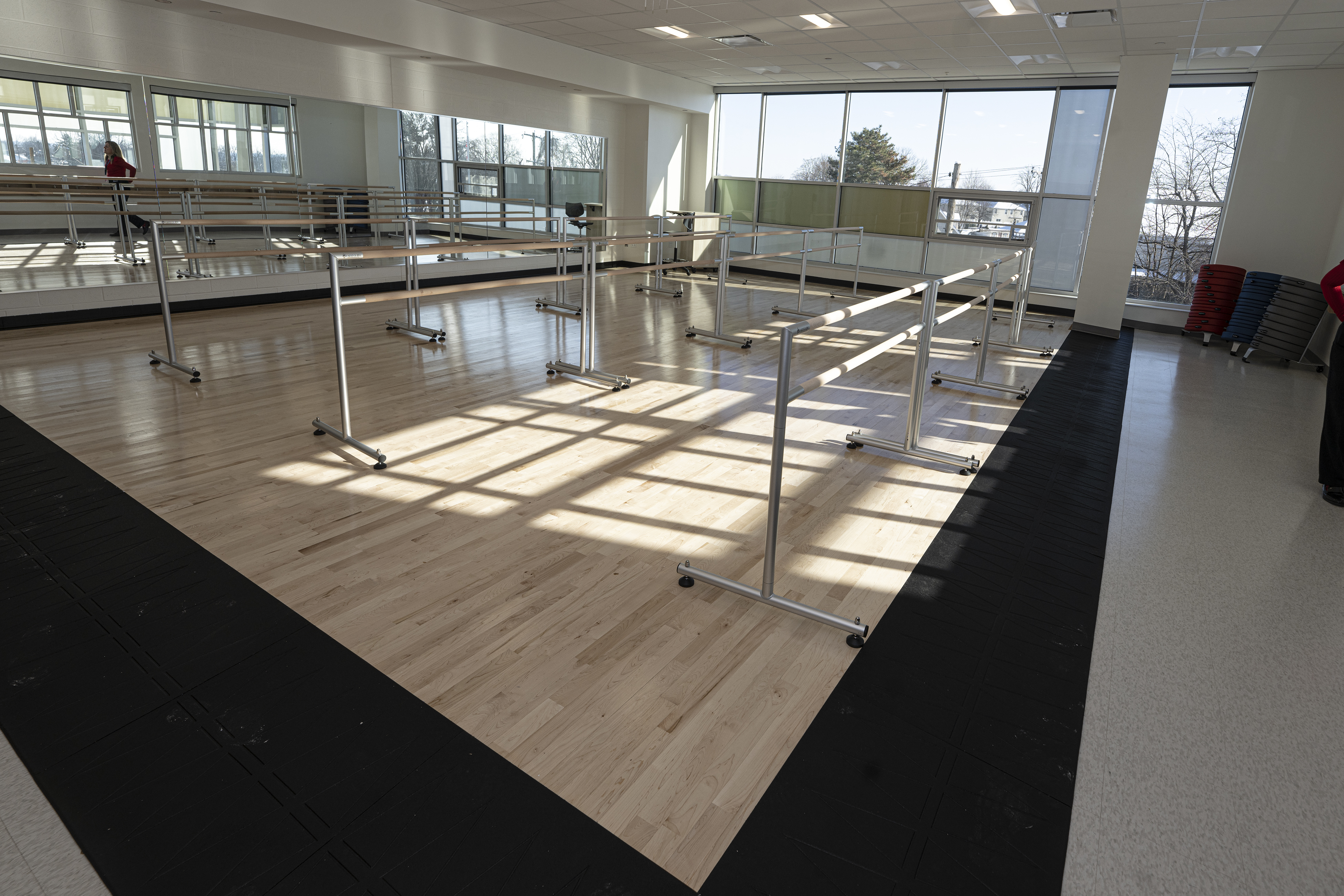
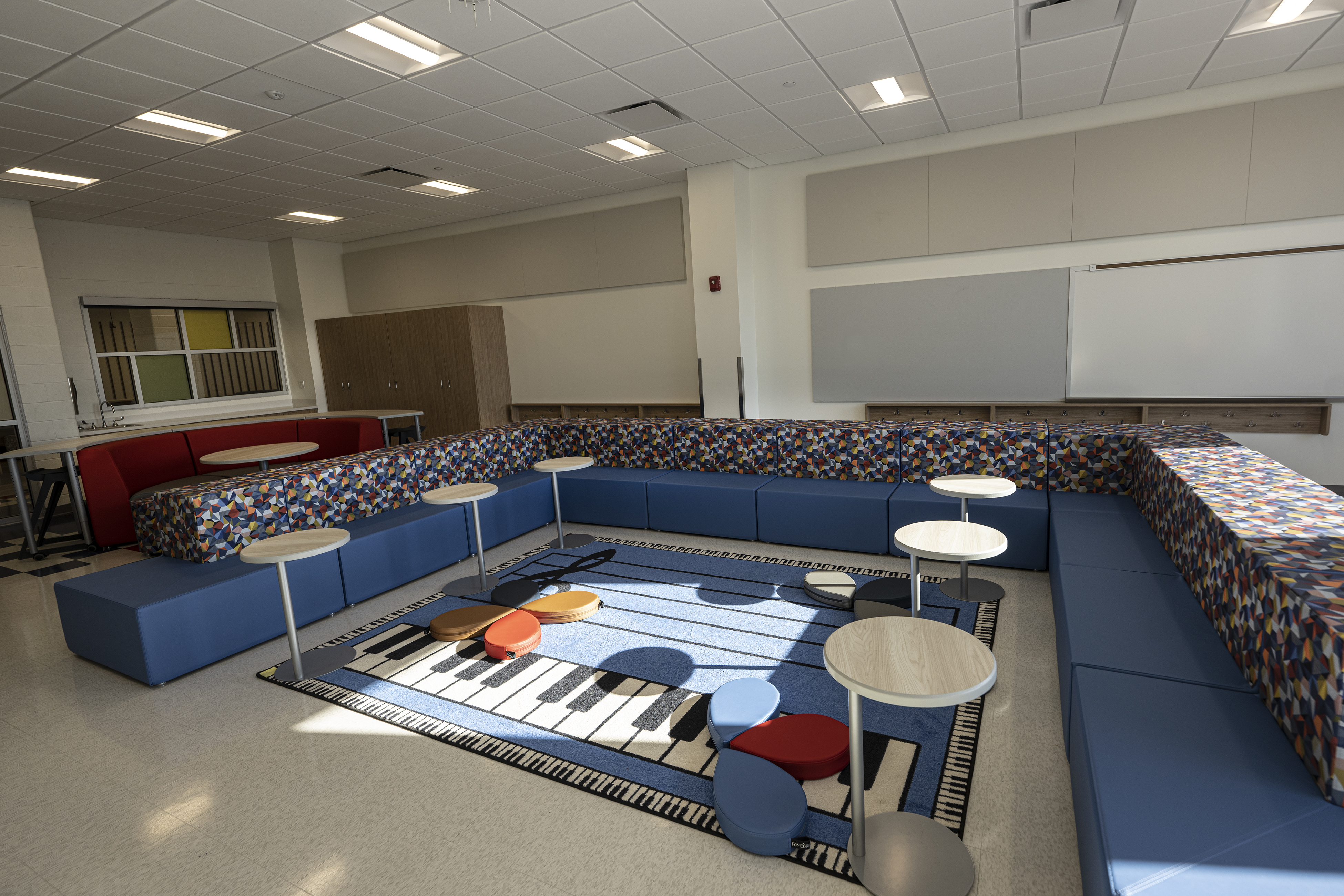
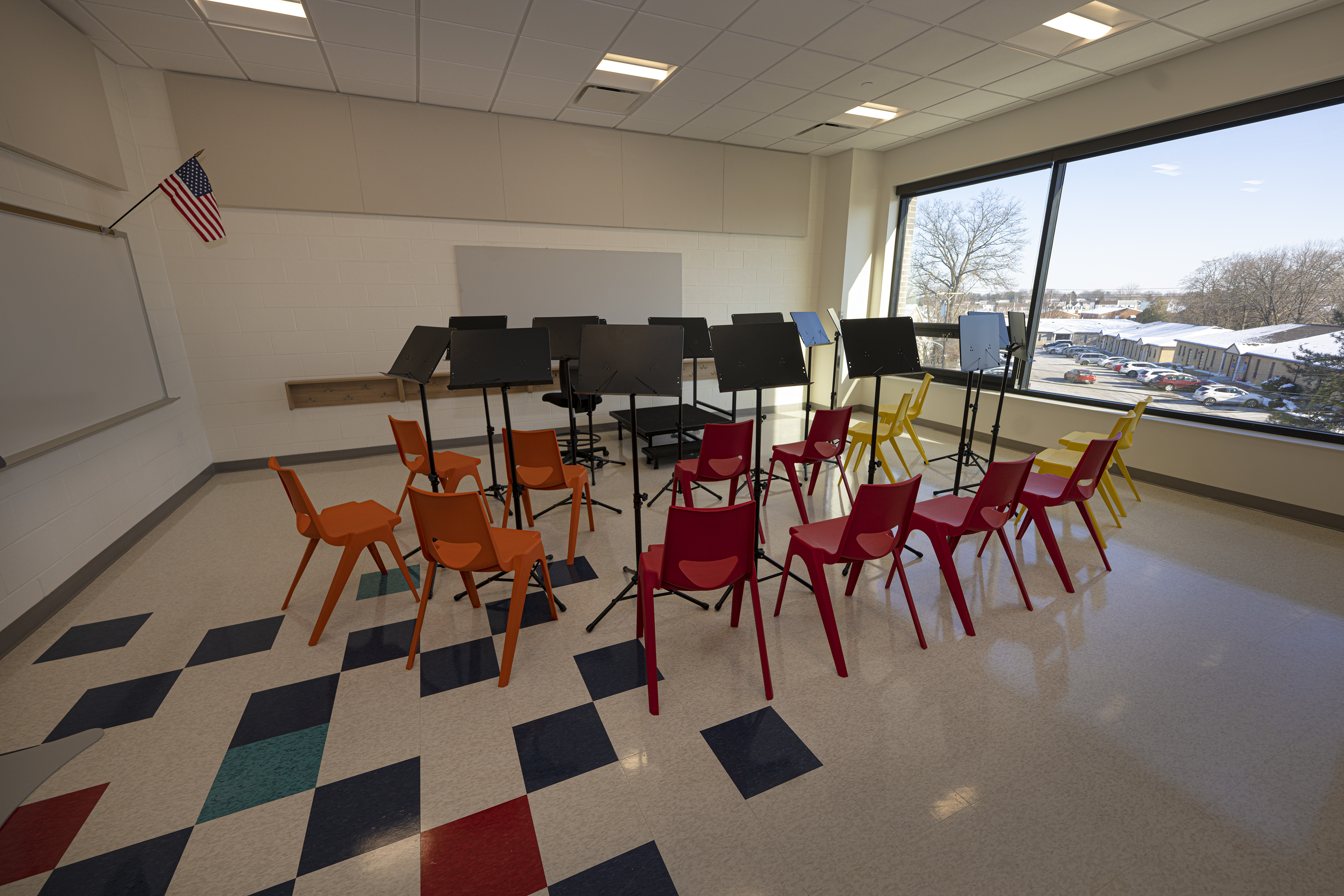
Holme, named for Pennsylvania’s first surveyor general, outgrew its old building, which was razed to make way for the new 141,000-square-foot structure. Designed with flooding natural light, welcoming learning spaces, and flexible spaces and furniture for more conversational teaching environments, the school includes state-of-the-art music rooms, a bright new gymnasium and stage, science classrooms, an interactive media commons, and a dance studio with a real hardwood dance floor.
A dance studio at the new Thomas Holme Elementary School has a real hardwood dancefloor.
“This is the shining star of the school,” said April Tomarelli, an educational facilities planner, during a tour of the sunlit dance studio.
Smaller details, like the dragon-shaped tiles in the cafeteria to match the school mascot, offer a homey touch, said April Tomarelli, an educational facilities planner, during a tour.
“Everything was done with intention,” Tomarelli said.
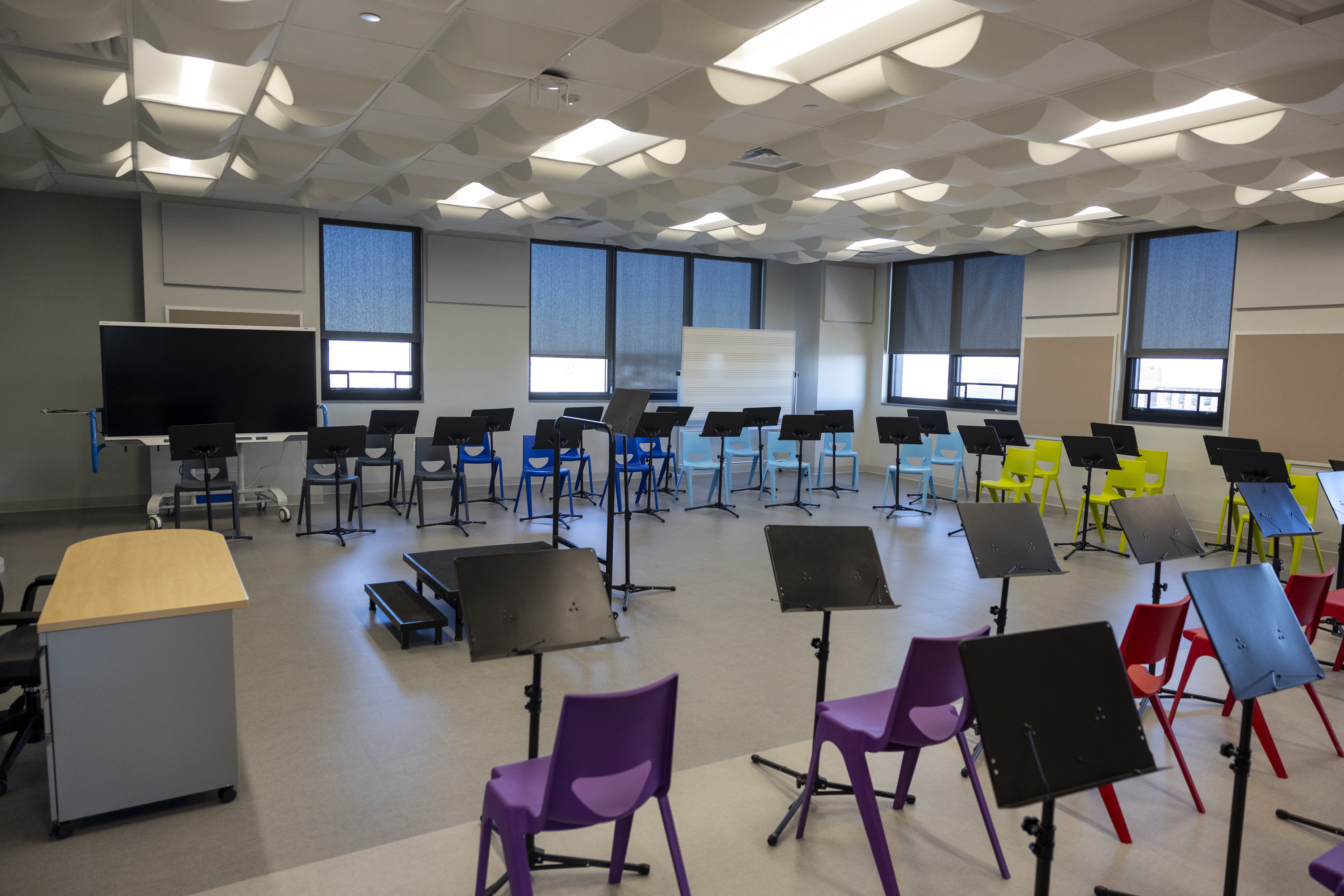
A music room at the new Thomas Holme School.
Students had a hand in the design of the new building — they weighed in on the facade, the playground, and the stormwater management system.
“This school comes from you,” said architect Troy Hill, who helped design the building for Blackney Hayes, adding that the students’ input included more learning spaces, outdoor classrooms, and a space for designing murals.
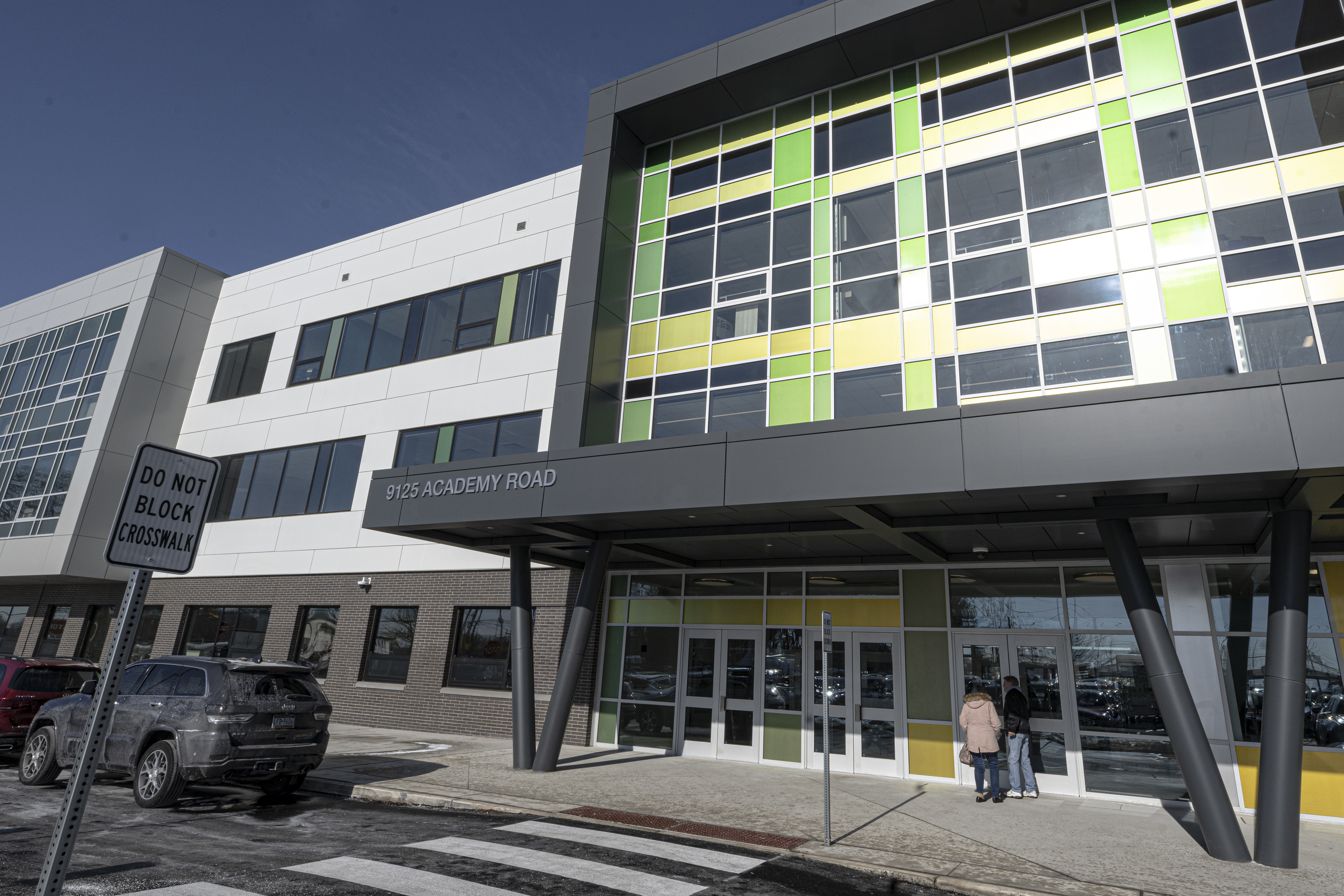
The outside of Thomas Holme School in Northeast Philadelphia.
The new Holme will open as the district nears completion of its long-awaited facilities master plan, which officials have said will call for some school closings and co-locations, as well as building renovations and new construction.
The average district school building was built 73 years ago, said Reginald L. Streeter, president of the board of education.
“Most Philadelphia children walk into schools older than their grandparents,” he said.
Philadelphia School District Superintendent Tony B. Watlington speaks during opening ceremonies for the new Thomas Holme Elementary School on Tuesday.
At the ribbon cutting, Superintendent Tony B. Wallington Sr. celebrated the fact that, like AMY at James Martin, the new Thomas Holme school was completed on time — and on budget.
“You’re in a school district that’s been excellent stewards of federal, state, and local tax dollars,” he said, adding that the district has its best investment-grade credit rating in 50 years.
The school library at the new Thomas Holme Elementary School.
The state-of-the-art school represents a step towards the district’s aspiration to be the “fastest-improving, large school district in the country,” he said.
“Not for bragging rights,” he said. “But because the children of Philadelphia deserve it so.”
Mike Greco, president of Penn Academy Athletic Association, which helped shepherd the project through the community, said he has two grandchildren who will be attending the new school in January. His two children had previously graduated from the old Thomas Holme, which was built in 1950.
“We needed this,” he said. “We need good things to happen everywhere in this city.”
With snow on the ground and temperatures below freezing, Philadelphia schools will open two hours late Monday.
“The safety and well-being of our students are our top priorities,” Superintendent Tony B. Watlington Sr. said in a message to district families. “We are encouraging students, families and staff to travel safely tomorrow morning.”
Students who arrive late because of weather challenges won’t be marked late, and weather-related absences will be excused if a parent or guardian sends a note.
All outdoor activities are also canceled, Watlington said.
“Parents and guardians should plan for possible delays with the district’s yellow bus services and on SEPTA’s subway, trolley and bus routes,” Watlington wrote. “If you anticipate delays or have questions or concerns, please reach out to your child’s principal or school.”
Archdiocesan high schools and parish and regional Catholic elementary schools in the city will also operate on a two-hour delay. (Catholic schools in suburban counties generally follow their local districts’ lead.)
Other area school districts that are opening on delayed schedules include, in Pennsylvania: Bensalem Township, Cheltenham, Coatesville Area, Downington Area, Great Valley, Lower Merion, Lower Moreland Township, Marple Newtown, Neshaminy, Norristown Area, North Penn, Pennridge, Perkiomen Valley, Pottsgrove, Southeast Delco, Souderton Area, Spring-Ford Area, Tredyffrin-Easttown, Unionville Chadds Ford, Upper Merion Area, Upper Moreland Township, Upper Perkiomen, West Chester Area, William Penn, and Wissahickon.
Area school with delays in New Jersey include: Bellmawr, Black Horse Pike Regional, City of Burlington, Burlington Township, Camden City, Clearview Regional, Clementon, Deptford Township, Eastampton, Lenape Regional High, Logan Township, Mantua Township, Medford Township, Mount Holly Township, National Park, Pemberton Township, Pitman, Rancocas Valley Regional High, Riverside Township, Shamong Township, Swedesboro-Woolwich, Washington Township, Westampton Township, and Winslow Township.
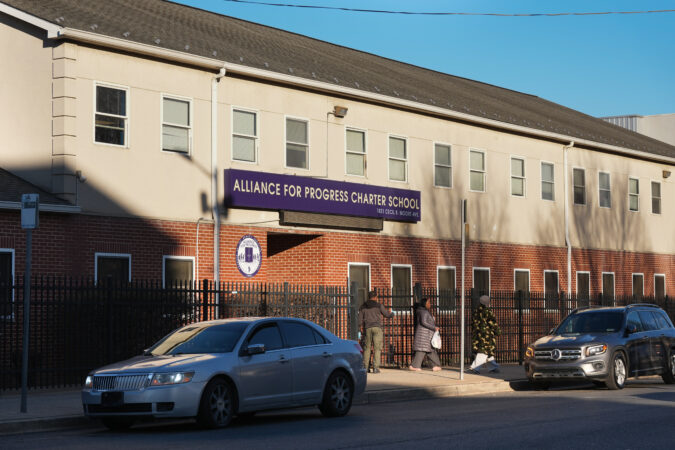
When Raheem Harvey discovered possible improprieties at his new employer, Alliance for Progress Charter School in North Philadelphia, he sounded the alarm.
Harvey, the director of business and compliance, notified officials earlier this year about what he saw as significant issues, he said: violations of state and local bidding requirements, a contract issued without board approval, and board members’ failure to disclose personal relationships with potential vendors.
He flagged a student enrollment problem and skipped payroll taxes.
Alliance for Progress’ leader and its board brushed him off, Harvey said in a recently filed whistleblower lawsuit. Ultimately, they disciplined him and, after threatening to demote him, he resigned.
School officials say Harvey’s story is untrue.
“We categorically deny all the allegations asserted by this disgruntled former employee,” Stacey Scott, CEO of Alliance for Progress, said in a statement.
Officials from the Philadelphia School District’s charter school office had no comment.
What are the allegations?
Harvey started working at Alliance for Progress, on Cecil B. Moore Avenue, in February.
By August, he began raising issues to his bosses, Harvey’s lawyers said in a lawsuit filed in Philadelphia Common Pleas Court.
They included a contract issued to a vendor for services related to a school playground — worth more than $75,000 — that was awarded without competitive bidding.
Alliance for Progress, Harvey said, “directly awarded the contract to a vendor whose principal is a personal friend of one of the AFPCS board members. The board member did not recuse himself from discussions or decisions related to the contract, despite the clear conflict of interest created by his close relationship with the vendor” — a violation of ethics rules, he said.
Harvey also said the school failed to follow state rules around enrollment procedures. Alliance for Progress says it provides enrollment preference for siblings of students. But, Harvey said, the school ignored him “and failed to apply its own sibling-preference policy to the sibling of a currently enrolled student. Instead, AFPCS placed the sibling on a waitlist and later pressured the child’s parents to withdraw the enrollment application.”
Scott, Harvey said, also violated federal privacy laws by providing someone outside the organization access to a student’s educational records — including academic and disciplinary records — without parental consent.
School officials also used Alliance for Progress credit cards to purchase food and other items through their personal accounts, according to the lawsuit complaint,“allowing them to aggregate rewards points and loyalty benefits that they did not return to AFPCS.”
Alliance for Progress also paid a retired employee for work with a paper check instead of going through its payroll system, the complaint alleges.
The school “issued payments in this manner to enable the retired employee to avoid paying taxes on the wages she received,” the lawsuit said.
‘Hostile and retaliatory’
According to Harvey, once he reported the compliance problems, Scott and other officials began targeting him — suggesting he was opening packages addressed to the school without authorization and purchasing office supplies without proper authorization.
Harvey was shut out of leadership meetings, the suit said, then reprimanded for failing to show up to a meeting, entering Scott’s office without permission, and placing an unauthorized order.
“Increasingly hostile and retaliatory conduct” was directed toward him, Harvey said. He was suspended for 10 days, and had his keys to the administrative offices taken away.
In September, a human resources official told Harvey “that he should forget about the compliance issues he had raised because they had been resolved” but provided no evidence. Harvey said she told him Alliance for Progress planned to demote him.
The school’s “wholesale failure to remediate the compliance concerns” and its “refusal to implement safeguards to protect him” from retaliatory treatment ultimately caused Harvey to resign on Sept. 30,according to the lawsuit.
Harvey is demanding reinstatement, plus back pay, benefits, seniority rights, and damages.
The vote does not bind the district to hand anything over, but it certainly opens the door to transferring properties in accordance with the wishes of Mayor Cherelle L. Parker, who has promised her administration will build or restore 30,000 units of housing during her first term.
Exactly how many vacant buildings the district is contemplating giving to the city is not clear; the board did not vote on a list of schools, though officials have said in prior months the number of surplus schools is about 20. A school board spokesperson has said the list is still subject to internal discussion.
The resolution only covers the district’s current closed buildings, not any that might be closed in the upcoming facilities master planning process expected to wrap up before the end of the school year.
Board president Reginald Streater has said the city partnership makes sense, and would allow the district to focus on education, while relying on the city’s real estate expertise. The buildings all have carrying costs too, which the city would assume.
Six board members voted for the resolution authorizing Superintendent Tony B. Watlington Sr. and the district’s legal department to begin talks with the city. Two board members — Crystal Cubbage and ChauWing Lam — voted no.
Lam’s hesitation came, she said at Thursday’s special action meeting, because of the district’s budget issues.
The vacant-building portfolio was recently valued at $80 million, Lam said.
The mayor’s housing goals are laudable, Lam said, but “given the district’s structural budget deficit, which includes spending nearly half of our fund balance this year to balance our budget, I encourage consideration of additional opportunities before rushing into an agreement as set forth in this resolution.”
Cubbage, too, said she worried that the resolution “limits us to exploring the conveyance of our school buildings to the city without financial compensation when we are facing a $300 million structural deficit and are constantly underresourced.”
Instead, Cubbage said, she wished the board would delve into actions that could give short- and long-term revenue and still accomplish Parker’s housing goals by selling the properties “with deep restrictions and affordability requirements.”
Board member Wanda Novalés supported the resolution, but noted that the district needs to get the whole picture — including enrollment projections and long-term capital priorities — before it moves forward.
“I support the resolution as long as it calls for a thorough business plan that clearly outlines the benefit to the School District of Philadelphia,” said Novalés.
Watlington, in a statement issued after the vote, supported the move.
“By responsibly evaluating how to put these unused properties back into productive use, the district can stay focused on educating children while supporting broader city efforts that ultimately aim to strengthen neighborhoods,” Watlington said. “This exploration aligns with our commitment to both fiscal stewardship and community partnership.”
Parker, in a statement issued earlier this week, said the transfer would mean the buildings would improve residents’ quality of life.
Officials “cannot let blighted buildings in the middle of residential neighborhoods lie vacant — many of which have been vacant for many years — from two years to over 30,” Parker said in the statement. “It’s unconscionable to me that we are in the middle of a housing crisis and we have government buildings sitting vacant for years or even decades. That cannot continue.”
Chief Deputy Mayor Vanessa Garrett Harley said in a statement that the city looks forward to working with the board on this issue.
“This action will help the city to more effectively move blighted properties to productive use, addressing a longstanding concern of neighborhood leaders and residents across the city, and contribute to the mayor’s goal of creating or preserving 30,000 units of housing,” Garrett Harley said.
A potential buyer for at least one vacant school
Several speakers suggested it was a bad move to simply give buildings to the city.
Cecilia Thompson, a former school board member, said she’s OK with selling schools to the city. But “can we sell it to the city for market value, and not a dollar or something nominal, just to say it was a sale? Just to be respectful … for the worth of the properties?”
Several members of the community made it clear that there are potential buyers.
Angela Case, a staffer at West Oak Lane Charter, indicated that the school wants to buy Ada Lewis Middle School in East Germantown.
(Lewis is a prominent part of the potential portfolio — a large building on a sprawling campus and, this fall, the site where Kada Scott’s body was discovered.)
“Our school is growing, but our current space is limited,” Case said. “Ada Lewis would give our students safe classrooms, outdoor areas and room for strong academic enrichment programs. It would also return a vacant property to a productive use, and benefit the surrounding community.”
Prior to the vote, the board heard from registered speakers, including some from West Oak Lane Charter School who want their school to be able to purchase the vacant Ada Lewis Middle School building.
The board, with some absences, then moved into the “Goals and Guardrails” portion of its meeting, where district leaders shared 2024-25 Keystone and NOCTI scores. Algebra and biology Keystone scores stayed mostly flat compared to 2023-24, while literature scores dropped 2.9%. Board members Whitney Jones and Wanda Novales each asked for more detailed data from the district.
// Timestamp 12/11/25 6:20pm
Novales adjourns the meeting
Novales summarizes what the board learned from today’s Goals and Guardrails meeting: Keystone scores remained stagnant last year, with literature scores decreasing, she said. And many CTE schools have made gains.
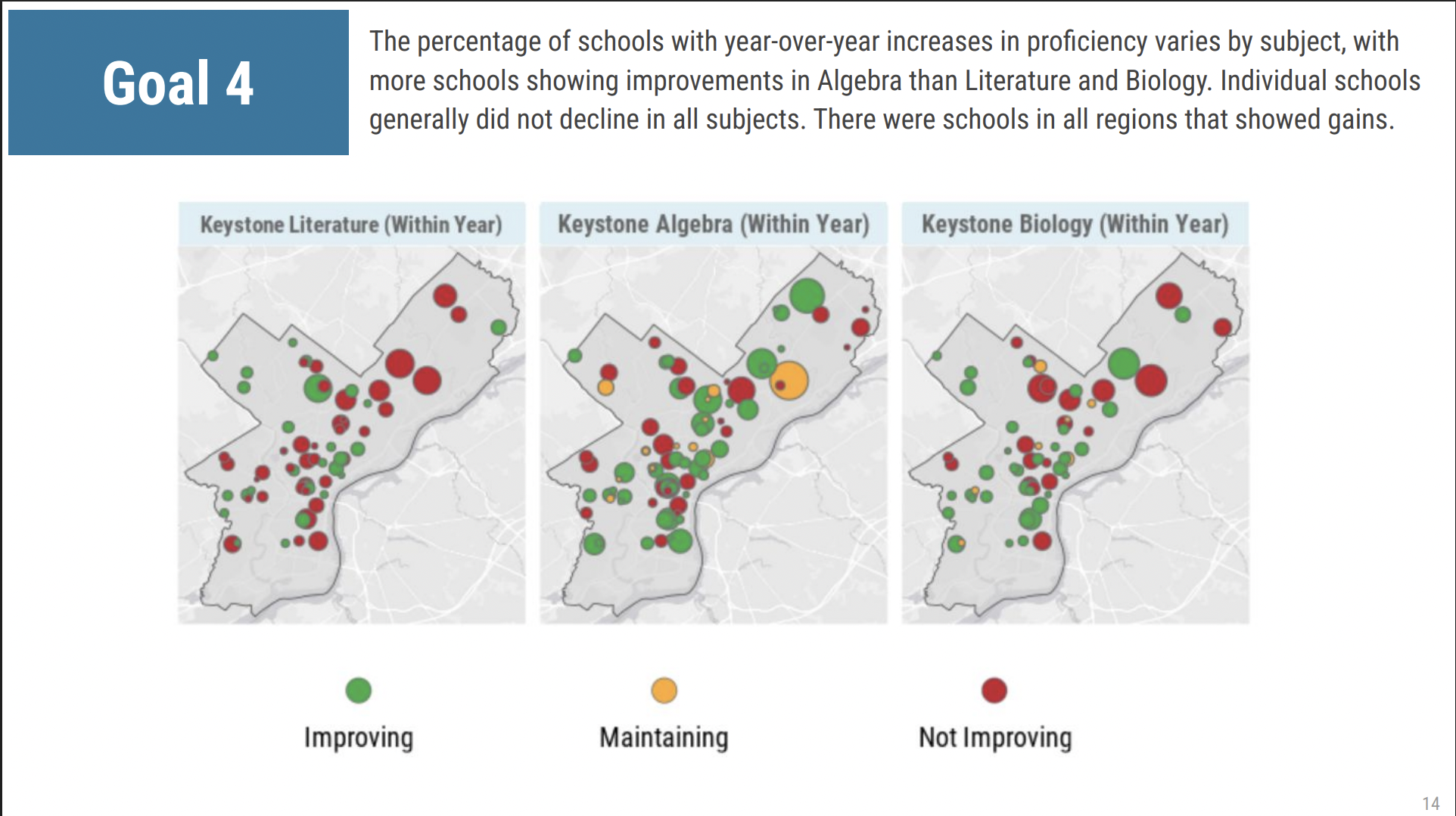
In future monitoring sessions, she said, the board will want to see the data broken down by various demographics, and more specific data about the percentages of schools seeing gains and decreases in Keystone scores. This data will give the board “a more complete understanding of what’s going on in the district.”
Novales then adjourned the meeting.
This is our final scheduled public school board meeting of 2025. See you in 2026!
// Timestamp 12/11/25 6:07pm
Board member Novales asks for more specific data: What percentage of schools saw gains and decreases in Keystone scores?
Board member Wanda Novales asks the district: What percentage of schools made gains in Keystone scores? And what supports are we offering our lowest-performing schools?
Watlington asks each of the individual networks of schools to be read — along with their Keystone score results and changes — with the associate and assistant superintendent of each network recognized.
Novales says she’s interested in even more specific data: What schools made gains, not just networks? What percentage of schools made gains, what percentage saw a decrease in scores, and what percentage stayed the same?
Watlington asks research chief Wolford to pull that together for a future meeting.
// Timestamp 12/11/25 6:05pm
Board member Joan Stern urges to district to think about the role creative and agricultural jobs play in the economy
Board member Joan Stern questions how the district is thinking about “the role of the creative economy in the city and in the region” in career and technical education.
“I would like to know what the focus is on developing careers in that part of the economy,” she said, highlighting the role of agriculture in particular.
Dawson says they are “intentional and methodical” about how they approach extracurriculars and nurturing students’ interests outside of the careers they may pursue.
We want to “help them to build themselves out of poverty and have an opportunity for a livable wage not only for them but their families and that can be sustained over time,” Dawson said.
Watlington adds in: “We don’t want to graduate a majority of young people that take minimum-wage jobs.”
“Our children can learn anything,” Stern said, adding in: “They should not be treated as though they are always going to be doing the pouring of the cement as opposed to the design of the airport.”
// Timestamp 12/11/25 5:55pm
Board member Lam wants to know: How do we keep literature scores from continuing to slip?
Board member ChauWing Lam asks: What is the relationship between the technical education and the core education for NOCTI at CTE schools?
Mastbaum Principal David Lon answers that the programs work together “hand in glove” and they work to prepare students for the tests they’ll need to take to graduate.
She also said she found the geographic clustering of Keystone interesting. “There’s not really a concise pattern across the three subjects in terms of what happened last year and what happened this year.” She wants to know: What is our strategy for stopping the decline of literature scores?
“We recognize that that is a concern for us,” Dawson said about the dropping ELA scores. But they did just roll out a new curriculum, he said, and teachers are still acclimating.
“We recognize as we say all the time, more work needs to be done to ensure our students are academically successful the first time they sit in that course,” he said.
Lam acknowledges that these test results are from last year. She asks: Are there any early indications yet that we’re seeing a rebound?
Tonya Wolford, the district’s research chief, says they are processing data and hope to have more information later this month or in January.
// Timestamp 12/11/25 5:46pm
Board member Whitney Jones asks district to dig deeper into the data
In responding to a question from board member Whitney Jones, Watlington says they do need to take a harder look at the data broken down by race, gender, economically disadvantaged students, English language learners, and other demographics.
“You can’t move the overall district without moving kids of color,” he said.
// Timestamp 12/11/25 5:35pm
Success isn’t linear, Watlington says: ‘No, I’m not satisfied’
Watlington says that people ask him all the time: Are you satisfied?
“No, I’m not satisfied,” he said. Far too many kids can’t read and do math on grade level, he said. But the district didn’t get here quickly, and it can’t fix it quickly. Success isn’t linear.
“The district is making significant progress,” Watlington said. We’re not blaming historical underfunding or “this political partisan nonsense.”
Deputy superintendent tells the board: ‘We have a lot of work to do in our high schools’
“We’re going to recognize that we have a lot of work to do in our high schools,” deputy superintendent Dawson said. “We see it, we own it, and we recognize it.”
How will the district improve math, ELA, and science performance? Dawson explains: more high-impact algebra tutoring, a fellowship for algebra teachers, and creating math pathways to allow more students to take Algebra 1 in eighth grade. Plus, a new science curriculum this year.
“We’re hearing great feedback from the teachers, from our students, and from principals” about the science curriculum, Dawson said.
Deputy Superintendent Jermaine Dawson speaks at the School District of Philadelphia’s New Hire Orientation on Aug. 7, 2025.
On career and technical education, Dawson said the district will increase the number of guest speakers, company tours, and job shadowing and internship opportunities; create regional events like career fairs; implement new professional development; expand the middle school CTE program; and more.
Analyzing the district’s career and technical education programs: 39% are aligned to high-wage, in-demand occupations; 32% are aligned to high-wage, in-demand industries, but not aligned to occupation; and 29% of programs are unaligned to high-wage, in-demand occupations.
There are 41 programs in the district across 11 clusters.
This may mean some programs that are currently offered in the district may go away, Dawson said. Some new programs may be launched.
// Timestamp 12/11/25 5:15pm
Mastbaum principal speaks to success with improving NOCTI scores at his school
Principal David Lon from Mastbaum High School has seen tremendous growth at his school, a career and technical education school in Kensington.
Mastbaum has deliberately moved to a NOCTI focus. There’s been pedagogical work in the area students struggle most in: the NOCTI writing portion, Lon said.
There are quarterly benchmark exams, professional learning communities to reinforce data analysis and vocabulary best practices, and more.
There’s also a focus on culture-building, Lon said. Students are taught that the NOCTI is more than just another test; it’s important to their future. There are town halls and pep rallies, and a NOCTI breakfast the morning of the test.
“Before they go into the test, they are literally surrounded by the love and support of their community,” Lon said.
“We can directly tie student performance on the test-to-life outcomes,” Lon said. Students who score advanced get free college credits; those who are competent or advanced get extra points on the city test that can lead to good-paying jobs.
Mastbaum CTE staff are stars, Lon said. Counselors play a big role. Mastbaum had 32.4% point growth in NOCTI pass rate.
Principal David Lon at Mastbaum High School in December 2022.
// Timestamp 12/11/25 5:10pm
Percentage of students passing the NOCTI has increased
For the NOCTI, a nationally-recognized career and technical education exam, the percentage of 12th grade students who passed increased to 59.7% in 2024-25 from 56.9% in 2023-24.
Students in most areas — health, construction and manufacturing, education — increased participation and pass rates on NOCTI exams.
// Timestamp 12/11/25 5:06pm
District highlights the changes to student proficiency in the three Keystone subject areas
On the algebra Keystones, students scoring proficient or advanced increased slightly, from 15.1% to 15.5%, comparing 2024-25 to 2023-24.
Biology Keystones remained flat — 22.7% of students passed.
Literature Keystone proficiency decreased to 34.9%, a 2.9 percentage point drop.
This slide was shown during the Goals and Guardrails portion of the Philadelphia school board meeting on Dec. 11, 2025.
// Timestamp 12/11/25 5:04pm
Deputy superintendent highlights the 2024-25 highlights
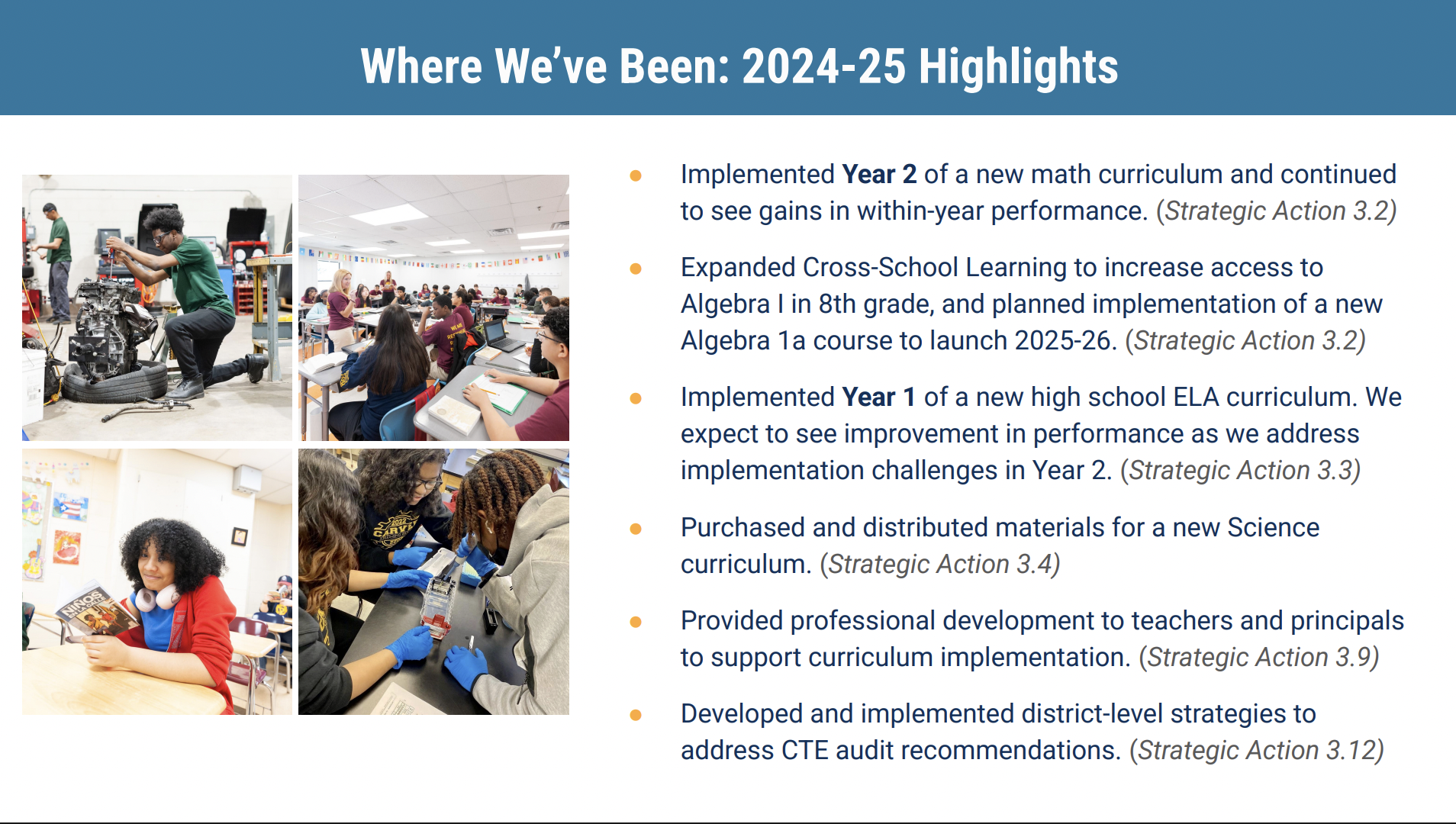
Jermaine Dawson, deputy superintendent, is talking about 2024-25 highlights: It was the second year of a new math curriculum, the first year of a new ELA curriculum, and they purchased a new science curriculum (which is being rolled out this year).
This slide was presented during a Goals and Guardrails meeting of the Philadelphia school board on Dec. 11, 2025.
// Timestamp 12/11/25 4:54pm
Special action meeting ends, and Goals and Guardrails portion begins
And here ends the special action meeting.
Now we’re into progress monitoring/Goals and Guardrails.
The board will be monitoring goals around Keystone and NOCTI (career and technical education) exams tonight. Streater and a few other board members have to leave to conduct interviews for student board representatives, they noted.
// Timestamp 12/11/25 4:52pm
Board passes resolution, authorizing district to explore transferring vacant school buildings to the city
The resolution passes, six to two. Crystal Cubbage and ChauWing Lam voted no.
President Streater says this is an ‘exploratory resolution’ that he supports
Reginald Streater, board president, reiterated: No properties are being given to the city with a yes vote to this resolution.
Resolutions are the most effective way to convey what might be coming, Streater said. This is an “exploratory resolution.”
“I don’t see anything wrong with exploring this, and bringing the public along in a very public way,” Streater said, adding that he would be “derelict in his duty” if he didn’t explore this.
// Timestamp 12/11/25 4:50pm
Board member Cubbage says she ‘cannot support this resolution in its current form,’ while board VP Andrews says she will vote yes
Board member Crystal Cubbage said she applauds the mayor’s housing initiative, but “I cannot support this resolution in its current form,” because it limits the district to giving buildings to the city without financial gain, against a backdrop of coming financial issues for the district. Other options should be explored, including selling buildings to interested parties that are not the city.
Sarah-Ashley Andrews, the board vice president, will vote yes, but said any agreement “must deliver clear benefits to our children.” Opportunities to stabilize and grow the district’s tax base would help the district.
// Timestamp 12/11/25 4:48pm
School board discusses the resolution around what to do with vacant school buildings
Board member ChauWing Lam says she “fully supports” the idea of working with the city and addressing what should happen with the portfolio of buildings. But, Lam said: I have a concern that in adopting such a resolution, it limits the district’s options.
The portfolio of vacant buildings was recently valued at $80 million by the city, Lam said. “Given the disrict’s structural budget deficit, I encourage consideration of additional opportunities before rushing into an agreement as set forth in this resolution.”
Board member Wanda Novales notes that these buildings belong to the district, and any agreement must benefit district students.
Board member Joan Stern underscores that this resolution does not transfer any properties to the city. It explores what to do with the properties, some of which have been vacant since 2007. “It is critical for us to know what our costs are, what our liabilities are, what our exposure” is, Stern said.
“We are trying to do this in the context of our facilities plan,” Stern said. “I would like very much for everyone to keep in mind that this is a step for us to take that will provide us with the facts and the diligence necessary to decide on the fate of these properties.”
// Timestamp 12/11/25 4:42pm
Councilmember Thomas shares concerns, through aide, about the ‘lack of communication’ around resolution to transfer properties to the city
Zach McGrath, legislative aide to City Councilmember Isaiah Thomas, is reading a letter from Thomas.
Thomas is concerned about “a lack of communication” around the plan to possibly transfer properties to the city.
Thomas wants a separate, independent authority to manage buildings for the city and district. He and others learned about this plan from The Inquirer, which he finds troubling.
He says: We can’t find ourselves in a situation like Germantown High. The school was closed, abandoned for some time, and then after years, developed into apartments people in the neighborhood largely can’t afford.
// Timestamp 12/11/25 4:45pm
// Timestamp 12/11/25 4:37pm
Retired teacher questions the board’s authority to ‘just give away real estate’
Lisa Haver, retired teacher and a founder of the Alliance for Philadelphia Public Schools, asks the board: “Does this board have the authority to just give away real estate? That would be an abdication of the board’s responsibility of this district.”
The board is supposed to operate independently, not as an intergovernmental board, Haver said.
Haver says: Essentially, it sounds like the mayor wants the district to give her buildings, and the board is playing ball.
// Timestamp 12/11/25 4:35pm
Another West Oak Lane Charter School community member asks the board to allow the school to buy Ada Lewis building
Angela Case, a member of the West Oak Lane Charter School community, asks the board to allow the school to buy the Ada Lewis Middle School building.
“Our school is growing, but our current space is limited,” Case said. “Ada Lewis would give our students safe classrooms, outdoor areas,” and more. It would also mean a positive use of a vacant property, Case said. “This is an investment in our children, families and a better future for Philadelphia.”
// Timestamp 12/11/25 4:32pm
The Cloudens speak to the board about student achievement and vacant buildings
Horace Clouden, a retired district worker, said there’s a “crisis in K-8,” both in public and charter schools, in student achievement.
“If you give away buildings that could be crucial to the development of the children, it could be criminal,” Clouden said.
Clouden tells the board they should repurpose closed schools to solve for student placement.
Mama Gail Clouden, who is married to Horace Clouden, said it must be difficult for the board and superintendent to hear parents discuss significant issues with their children, month after month. Leaders are getting awards “but these children that are suffering are saying something different,” Mama Gail said.
“Everybody’s making money off these children,” Mama Gail said. “The least of these are losing the most. You are in a position to fix this.”
Leah Clouden, Mama Gail and Horace Clouden’s daughter, said “the plan to warehouse students is in full effect.”
“Giving away 20 properties for housing is insane,” Leah Clouden said.
University City High was “given away for pennies on the dollar,” Leah Clouden said.
// Timestamp 12/11/25 4:26pm
Parent shares issues with curriculum sharing between the district and the Catholic church
Anne Dorn, a district parent, is talking about issues with curriculum shared between the district and the Catholic church.
“Fear not” the elephants in the room, Dorn said.
// Timestamp 12/11/25 4:22pm
West Oak Lane Charter School parent praises the school
Daniel Wideman, a parent and board member at West Oak Lane Charter School, is praising the school, which has changed his and his child’s lives.
“As a community, we have grown out of our building at West Oak Lane, and we need change,” Wideman said. The charter would like to buy Ada Lewis Middle School.
Kenderton Elementary parent says she is suing the district over her child’s IEP
Sashai Rivers, a parent of two children at Kenderton Elementary, said her son was bullied and antagonized by students and staff. She removed her kids from the school, but said her child’s IEP was ignored. “I’m currently being ignored by all parties at the school district,” Rivers said.
Rivers said she is suing the district.
// Timestamp 12/11/25 4:17pm
A retired educator, a student, and a charter school staff member each address the board about a variety of issues
Elijah Mahaffey, a former student at George Washington High, said he was bullied at the school. “Nobody would help me,” he said.
Deanna Lewis, of Lab Charter, is drawing attention to Black-led and Black-founded charter schools. Lab recently got a $500,000+ grant to bring computers to the community. “We’re deeply committed to our academic mission, and to support our community with care,” Lewis said.
// Timestamp 12/11/25 4:13pm
Former school board member wants students with special needs to be considered in school closing decisions
We’re onto speakers now.
Cecelia Thompson, a former school board member, wants to know what provisions will be made for students with special needs in school closing decisions.
And when it comes to possibly transferring closed schools to the city, she asks: Can we sell them to the city “for market value, and not $1? Just to be respectful, I guess, for the worth of the properties?”
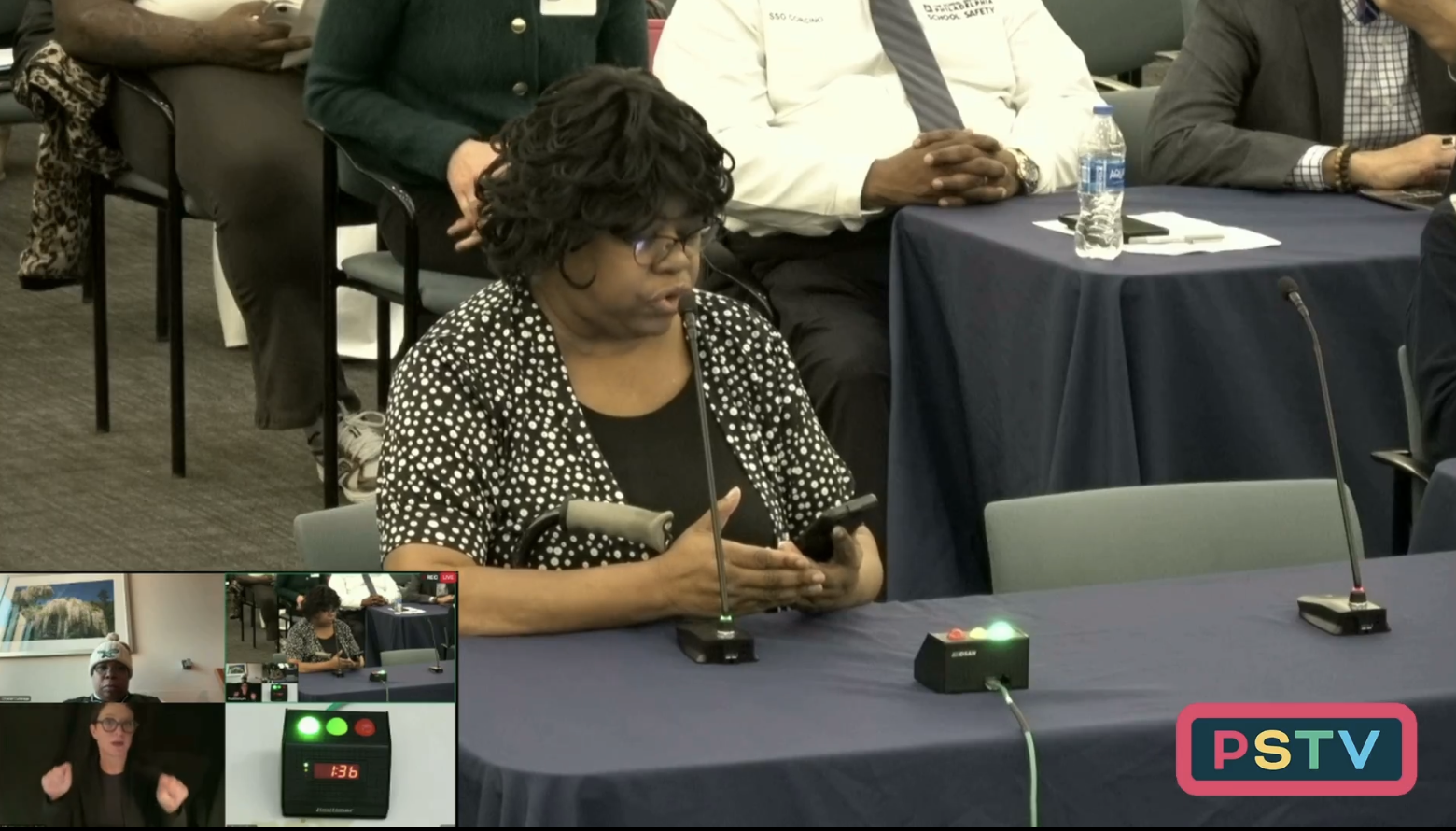
Former Philadelphia School Board member Cecelia Thompson spoke to the board during a special action meeting on Dec. 11, 2025.
// Timestamp 12/11/25 4:09pm
Pre-submitted written testimony addresses Ada Lewis Middle School
Of note: One piece of written testimony submitted today concerns the closed Ada Lewis Middle School, likely to be considered in any list of vacant schools transferred to the city. A member of the West Oak Lane Charter School community suggests the Ada Lewis building be sold to West Oak Lane Charter.
Eight board members are present at today’s meeting. Joyce Wilkerson is absent.
// Timestamp 12/11/25 4:06pm
The board held an executive session earlier today
The board discussed developments in the People for People and KIPP North Philadelphia vs. Joyce Wilkerson case in executive session today, Streater said, as well as real estate matters one can assume are related to the special action item.
Board president Reginald Streater is outfitted in kelly green, and notes that he still has faith in the Eagles.
The only item on the agenda: a resolution authorizing Superintendent Tony B. Watlington Sr. and the district’s legal team to discuss possibly transferring about 20 vacant district buildings to the city.
Philly school board to host special action meeting with Goals and Guardrails presentation
// Timestamp 12/11/25 3:50pm
The Philadelphia school board is set to host a special action meeting — its last scheduled meeting of the year — starting at 4 p.m.
Following the special action meeting, the board will hold its regularly scheduled Goals and Guardrails meeting, during which Watlington will share end-of-year Keystone and NOCTI performance for 2024-25.
A judge said this week that arguments questioning the legality of Joyce Wilkerson’s seat on the Philadelphia school board had merit, and directed the board to halt nonrenewal proceedings for two charter schools.
Philadelphia Common Pleas Court Judge Christopher R. Hall granted a preliminary injunction to People for People Charter School and KIPP North Philadelphia Academy on Monday, saying that a lawsuit against the school board can continue because lawyers had presented sufficient evidence.
The charters claim that board member Wilkerson — who is perceived to be anti-charter schools — tainted the votes against them this year and should not be on the board.
City Council declined to approve Wilkerson last yearas a school board member, but Mayor Cherelle L. Parker asked her to serve until she named areplacement.
People for People’s initial lawsuit complaint, filed in September, said that Wilkerson is an “illegally and unlawfully seated member of the BOE” and that her participation in the nonrenewal deliberations tainted and ultimately invalidated them.
The city and the board have said that the city’s Home Rule Charter allows Wilkerson to continue to serve — without Council approval — until a replacement is named.
Reginald Streater, the school board president, said the ruling overshadows the underlying issues.
“The board’s decision to begin the process of nonrenewal was on the merits of each board member’s independent assessment of the schools’ outcomes,” Streater said in a statement. Board members’ concerns were aired publicly over months.
Any delay slows the board’s ability to give the schools full hearings, with testimony and the ability to present evidence, he said.
“Our schools, families, and children deserve resolution,” Streater said. “We remain committed to transparency and to continuing this work in the best interest of the community.”
(Nonrenewal does not equal closure, though it is the first step on that path. It triggers an extensive nonrenewal hearing, after which an officer makes a recommendation; then the board votes again on whether to non-renew the school.)
Lawyers for the charters argued that Wilkerson essentially poisoned the votes, and the judge wrote in his order that there was enough evidence to move forward with the injunction.
“This leaves the question whether Ms. Wilkerson’s participation in the pertinent BOE meetings without color of right tainted its vote [on the charter nonrenewals]. Plaintiffs have shown it likely did,” Hall wrote.
Hall’s order means that nonrenewal hearings cannot proceed, but the board had not yet scheduled them.
What was Wilkerson’s role on the People for People and KIPP votes?
Wilkerson, Hall noted in his order, “was the first to press” to issue a nonrenewal notice to the schools at a June board meeting, and in August called for a vote on the nonrenewal notice.
The KIPP North Philadelphia nonrenewal vote passed unanimously; board member Whitney Jones was the onlyvote against the People for People non-renewal.
But Wilkerson, a former school board president and School Reform Commission chair, was not the only board member with concerns about the two charter schools.
Board member Cheryl Harper said People for People is “failing our children. How long do we allow them to keep failing our children? I have an issue with these schools not being able to succeed for our children.”
Board vice president Sarah-Ashley Andrews cited issues with KIPP North Philadelphia’s “failure to deliver for our students,” specifically calling out its academics and suspension rates.
Streater, the board president, called KIPP’s performance “unacceptable.”
What’s next?
Thecourt case will now proceed, andis likely to drag on for months.
But Hall’s legal ruling on Wilkerson’s school board seat could mean open season for other parties that are unhappy with decisions the board has made and are willing to challenge those rulings legally.
As to whether Wilkerson will remain on the board, Parker has staunchly stood by her in the past.
When the People for People suit was first filed, a member of her administration said she stood by Wilkerson as “an official member of the Philadelphia Board of Education” who “has the full support of Mayor Cherelle L. Parker.”
What was the reaction?
Mark Seiberling, a lawyer for People for People, said the ruling was an important one.
“We are pleased with Judge Hall’s thoughtful and well-reasoned decision following a lengthy hearing at which multiple witnesses from the School District of Philadelphia were called to testify,” Seiberling said in a statement. “We look forward to Ms. Wilkerson’s replacement being nominated and confirmed in accordance with Philadelphia’s Home Rule Charter.”
Alternative Middle Years at James Martin, in Port Richmond, is all but finished and ready for students to occupy after winter break.
Community members, district officials, and dignitaries gathered Tuesday to take tours and trumpet the new construction, a bright spot in a district grappling with a large stock of aging and sometimes environmentally troubled buildings.
“This is what growth looks like,” said Paula Furman, AMY at James Martin’s principal. The middle school educates 200 students in grades 6, 7, and 8.
Superintendent Tony B. Watlington Sr. and Debora Carrera, the city’s chief education officer, applaud a student performance Tuesday at AMY at James Martin, a new middle school in Port Richmond.
Sarah-Ashley Andrews, the school board vice president, noted that of the district’s roughly 300 buildings, more than 200 were built before 1978.
“Projects like this underscore why continued investment is essential,” said Andrews.
On time, on budget
Inside, the 88,000-square-foot, four-story structure at Richmond and Westmoreland Streets just off I-95 is a marvel: all light and flexible seating, makerspace, “digital flex lab” (think: computer lab), and “gymnatorium” (spiffy gym and auditorium). It has modern science labs, dedicated spaces for instrumental and vocal music, and a killer view of Center City from its rooftop outdoor classroom.
The outdoor space with a view of the Center City skyline at the new AMY at James Martin school.
The school replaces an 1894 structure razed to make way for new construction. It is the Philadelphia School District’s sixth new building in 10 years.
“It is kind of crazy, just the giant leap forward that students will be taking, just in terms of furniture, not to mention the technology,” said Melanie Lewin, a district school facilities planner who led tours of the new building. AMY at James Martin students, who have been temporarily learning in classrooms at Penn Treaty High School, used to learn in a 19th-century building; they’re relocating to a building with built-in charging outlets and “noodle chairs” that let them fidget securely while in class.
The instrumental music classroom at the new Amy at James Martin School in Philadelphia.
“This school was not just built to look fantastic,” Watlington said. “I want everyone to know that it was built on time and on budget. That is no easy feat when the price of everything is going up — inflation, tariffs, everything.”
Some neighbors showed up at Tuesday’s ribbon-cutting to celebrate. But the process was controversial at first — some protested the loss of the old AMY at James Martin historic site.
City Councilmember Mike Driscoll alluded to the past pain on Tuesday.
“It’s been a struggle, I’ll admit that,” Driscoll said. But, he said, the new school is lovely. “When you see the plans on paper, it doesn’t do it justice.”
A looming facilities master plan
AMY at James Martin’s opening comes with the district approaching a crossroads: Officials are awaiting a years-in-the-making facilities master plan, the first in decades.
While schools in the Northeast and in a few other spots are overcrowded or nearing capacity, schools in many parts of the city are dramatically underenrolled.
Custom cushioned seats in a classroom at the new Amy at James Martin School in Philadelphia.
Officials have said that some schools will likely cease to exist as part of the process, now expected to culminate early next year with Watlington making recommendations to the school board for grade reconfigurations, closures, co-locations, significant renovations, and new construction.
AMY at James Martin, in its current form, is likely to come in under the district’s minimum recommended school size, at 200 students. The school’s capacity is 500, officials said.
But Casey Laine hopes the school count grows by two in January.
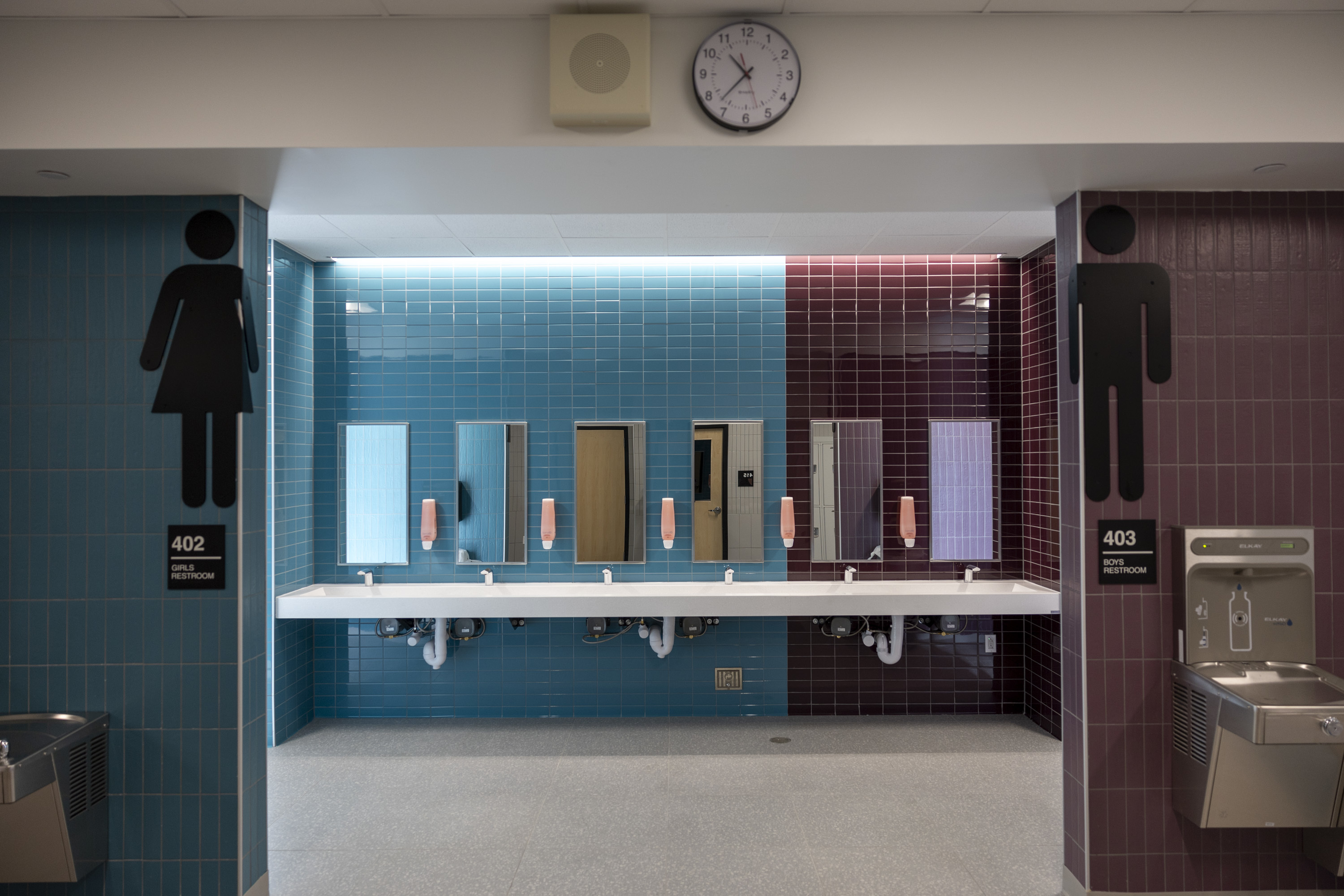
One of the bathrooms for students at the new Amy at James Martin School in Philadelphia.
Laine, who lives around the corner from the new AMY at James Martin and attended Tuesday’s ribbon-cutting, is the mother of a sixth and seventh grader who currently attend Bridesburg Elementary.
She’d like her kids, a son and daughter, to transfer to AMY at James Martin if possible.
“This is beautiful,” Laine said. “I’m so excited.”
The Philadelphia school board on Monday signaled its intentions to play ball: Later this week, it will hold a special action meeting to vote on a resolution authorizing Superintendent Tony B. Watlington Sr. and his team to consider handingover a portfolio of unused school buildings to the city.
Watlington, the resolution states, “recommends that, in the best interests of the district and its students, the district explore and pursue negotiations with the city to potentially convey certain vacant and surplus district property.”
Parker, in a statement, said the process was about “public health and public safety” and the school buildings can be used to improve residents’ quality of life.
Officials “cannot let blighted buildings in the middle of residential neighborhoods lie vacant — many of which have been vacant for many years — from two years to over 30,” Parker said. “It’s unconscionable to me that we are in the middle of a housing crisis and we have government buildings sitting vacant for years or even decades. That cannot continue.”
School board president Reginald Streater said that no decisions are final and that public deliberation will still happen at the special meeting at 4 p.m. Thursday. But, he said, the move makes sense with “the board moving toward being much more willing to be intergovernmental partners” with the city.
“Many of these properties have not been used in the last decade or more, and they require a significant amount of upkeep and maintenance,” Streater said. “These properties are unused, for the most part, and unnecessary for K-12 education.”
The district is in the business of running schools, Streater said.
“I do believe that the city possesses considerably more expertise and capacity than the district does regarding property development,” Streater said. “We are an education institution. To build the capacity to do such things is out of our wheelhouse, and economic development would take us out of our lane.”
According to the language of the resolution, the district is urging Watlington to consider all angles — bond obligations, property conditions, financial protection of the district, any legal processes that would need to happen, and more.
The action comes as something of a surprise, happening just a week after what was to be the final voting meeting of the year. Streater said he did not want to add it as a walk-on resolution to the December school board meeting, but wanted to give members of the public time to understand it and provide testimony, if desired.
Giving unused school buildings to the city could further academic outcomes, the school board president said.
“It’s possible,” Streater said, “that conveying these vacant and surplus properties to the city for redevelopment and revitalization could help stabilize and grow the city and district’s tax base … and consequently positively impact future revenues to the district and educational experiences for students.”
Asked for a list of the unused buildings the resolution would cover, school board officials said more internal evaluation is needed before such a list is released.
The possible transfer of district properties to the city comes as officials debate the specifics of one of Parker’s signature initiatives.
The mayor wants to spend $800 million on her housing initiative, Housing Opportunities Made Easy, or H.O.M.E. In a rare sign of division, Council last week allotted more housing funds to the city’s poorest residents over the Parker administration’s objections.
Because of Council’s move, more legislation is now needed to advance H.O.M.E. It will not come until January at the earliest.
Thomas, chair of Council’s education committee, has long been pushing for a school facilities plan.
“It’s unclear to say what this step forward means, but I want to understand how it fits into a larger plan for Philly’s educational institutions,” Thomas said in a statement.
“Without getting into hypotheticals, and due to a lack of communications with City Council, there are a lot of moving pieces and still many questions about what this means and what is the overall plan for the future of our school buildings,” Thomas said.
The massive construction project rose outside Room 221, where 22 curious second graders peered outside their classroom daily, noting daily progress with great interest.
Sometimes, the kids at Fanny Jackson Coppin School, on South 12th Street in South Philadelphia, cheered for the workers, spurring them on as the summer heat gave way to chillier temperatures.
But they had so many questions: “What colors are for the building, and how many colors are you going to use? Red or pink?” and “How does the building not fall down?” and “When will you stop making it taller and taller?”
Teacher Kate Atkins collected the 7- and 8-year-olds’ queries, compiling them in a letter she left at the job site with her phone number. “We think you should come and tell us about construction because it is getting better and better,” the kids wrote.
Jack Delaney, the project manager on the job site, found the letter. He was charmed; he reached out to Atkins.
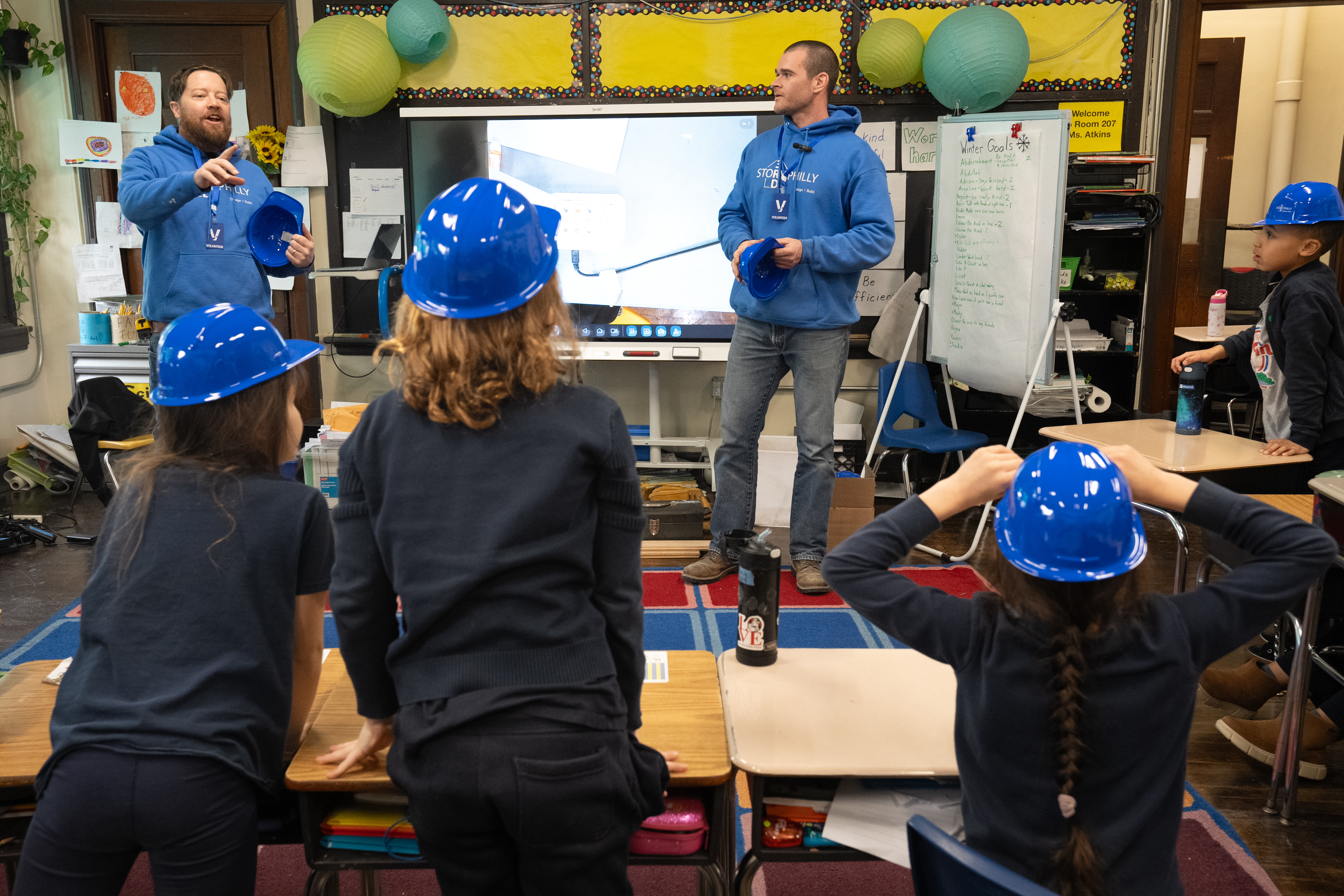
Zach Winters, cofounder and partner at 3rd Story Philly, second grade teacher Kate Atkins, center, and Jack Delaney, right, Project Manager at 3rd Story Philly, talk with students at Fanny Jackson Coppin School, in Philadelphia, December 05, 2025.
And on a frigid Friday, Delaney and Zach Winters, construction manager and a cofounder of 3rd Story Philly, the development and construction company working on the house project, walked into Room 221 with tools to show and energy appropriate for a roomful of enthusiastic second graders.
For 50 minutes — a long time for second-grade attention spans — the students talked about tools and examined pictures of the project in progress. They donned their own hard hats. But mostly, they gleaned information.
Zach Winters, cofounder and partner at 3rd Story Philly, left, and Jack Delaney, Project Manager at 3rd Story Philly, right, talk with students at Fanny Jackson Coppin School, in Philadelphia, December 05, 2025.
Here are some of Room 221’s greatest hits:
Question: Why did you decide to make the house bigger by making it taller instead of making it wider?
Answer: “We build additions on top of existing homes or sometimes behind existing homes, because there’s not a lot of space in the city,” Winters said. “We make the house bigger by going up.”
Q: Do you ever worry that you’re going to fall off the building?
A: “Yes, I do,” Winters said. “You should always be worried that you’re going to fall off something high. We try to be very careful. We try to stay away from the edge of the building. If we’re close to the edge of the building, we put on safety harnesses, so if we were to fall, that could catch us. But, yes, I’m worried, and my wife worries, and my mother worries.”
Students Landon Watkins, center, and Leo Horn, right, try on hard hats at Fanny Jackson Coppin School, in Philadelphia, December 05, 2025.
Q: How much will the house cost to build?
A: The project is a full remodel, with third- and fourth-story additions, basement excavation, and two roof decks.
“Often today, we are building a new construction at around $200 to $250 a square foot,” Winters said. “And it depends on how fancy the building is. A project like this is close to a half-million dollars. That’s a lot of money — but it’s a lot of house.”
Q: How long will it take to finish the house?
A: “Eight months to a year,” Delaney said.
“That depends on how many problems we have. Sometimes, it rains for a week, and we have to get the roof done,” Winters said. “Sometimes, it gets really cold, and the masons can’t work.”
The Coppin kids did not let Delaney and Winters off easy.
“Will it be done by Christmas?” one student said. No, Delaney and Winters said. The job started in March. It won’t finish until next year.
“Maybe you should try to finish it by Hanukkah,” another student said.
Q: (To Delaney) Do you do any drywall?
A: “I don’t, but the drywallers do,” Delaney said. “They are very strong. They hold up giant sheets of drywall.”
Winters interjected: Delaney knows how to drywall, but that’s not his job right now.
Delaney smiled.
“I get to say, ‘Hey, you go do the drywall,’ and then I run away,” he said.
The kids loved the level Delaney showed them. They had excellent guesses about how many bricks were used on the project.
“Four thousand million,” one girl shouted.
(Close — it’s 17,500.)
At the end of the visit, Atkins had a question for the kids.
“Who might want to work in construction someday?” she asked.
Nearly every hand shot up.
Delaney and Winters looked triumphant.
“We’ve got a labor shortage now,” Winters said. “Let’s go!”
Zach Winters, cofounder and partner at 3rd Story Philly, talks with students at Fanny Jackson Coppin School, in Philadelphia, December 05, 2025.
Craig Romanczuk’s voice barely gets above a whisper these days.
But speaking at all feels like a miracle, he said.
Five months ago, the retired Philadelphia police officer, a Philadelphia School District safety officer of nearly 20 years, was shot 11 times while driving in a marked patrol car. He almost died.
Life is crowded with medical appointments, surgeries and therapies now. But Romanczuk takes it in stride, with the kind of gruff and jovial banter born of his one-of-nine-kids-growing-up-in-Kensington roots and the near-death experience that still feels very close.
After almost dying, “you appreciate your family, your brothers and your sisters,“ said Romanczuk, pausing. ”Even though they’re still jerks. Now you get a chance to tell them that they’re jerks and you still love them.”
‘Officer, can you help me?’
It was two hours past midnight, a warm June evening, when Romanczuk wrapped up his patrol assignment, checking on a Kensington high school building just before 2 a.m.
It was a night like many others — after graduating from North CatholicHigh School, Romanczuk joined the police force at 19, spending his career in the 3rd district, in South Philadelphia, and finishing it in the 19th, in West Philadelphia. After he retired in 2004, his sister encouraged him to take the school police officer test. He spent years as an officer in schools, then took a patrol job in 2017, driving around the city to check on school buildings between 10 p.m. and 8:30 a.m.
On June 29, Romanczuk took Front Street to North Columbus Avenue on his way back to a district garage after theKensington High School for the Creative and Performing Arts job. He was stopped for a red light near the Dave and Buster’s when a car pulled up to him.
“The man said, ‘Officer, can you help me?’” Romanczuk remembered. A driver exhibiting road rage had been following the man since they were both driving on I-95, he told Romanczuk, who agreed to assist.
District safety officers are not armed; Romanczuk said he planned “to say, ‘Yo guy, knock it off, go the other way.’“
He opened his car door, stepping out onto the street. He didn’t even have time to say a word; bullets started flying immediately.
Romanczuk was shot 11 times — in the shoulder, in the armpit, through the bicep. One bullet cut across his chest, striking the cell phone in his pocket. One pierced his neck, breaking his collarbone, damaging his Adams apple and his vocal cord. One exited out of the left side of his face, breaking his jawbone and taking nearly all of his upper teeth with it. One hit the side of his face, going through the roof of his mouth and coming out of his nose.
He was wearing a bulletproof vest, but was still injured enough to nearly bleed out.
“It isn’t like a movie,” said Romanczuk. “You feel the bullets break your bones, you feel them going through your body. That’s the pain I felt. I thought, ‘I hurt too much, I’m not going to live through this.’”
Somehow, Romanczuk managed to get back into his car, an attempt to elude the shooter.
“I put the car in drive and I felt more bullets hitting the car seat. I was thinking, ‘Why am I being shot? I didn’t do anything. He’s not mad at me,’” he said. “It’s like the Hallmark movie – you think of your kids. I thought, ‘Tell them that I love them.’”
His car hit a tree. His last memory is staggering out of his patrol car.
‘This ain’t heaven’
A Philadelphia Parking Authority tow truck sat across the street, its operator watching the whole scene unfold. The tow truck driver called 911 and a buddy of his who was a school police lieutenant. City police responded, ready to scoop Romanczuk and take him to the hospital, when a fire department paramedic unit drove by.
The paramedics got Romanczuk to Jefferson. He remained unconscious for two weeks.
When he eventually woke up, he thought he was dead.
“I’m looking around, I’m on the ninth floor in a dark room. I said, well this ain’t heaven. This must be purgatory. A nurse leaned over and I went, ‘Lucifer?’ I went, ‘Where am I?’ He said, ‘Jefferson.’ I said, ‘is that hell?’”
It turns out it wasn’t hell. Romanczuk remained in Jefferson until the end of July, then spent a month at Jefferson Moss-Magee Rehabilitation Hospital in Center City, astonishing staff with his progress. He received a hero’s send-off on his release.
School Safety Officer Craig Romanczuk displays the donuts brought by son Erik Romanczuk as he is celebrated by fellow safety officers, school district officials, his care team and hospital staff Thursday, Aug. 28, 2025 as he leaves Jefferson Moss-Magee Rehabilitation Hospital. Romanczuk has been undergoing since June, when he was shot 11 times after a road rage incident when he stopped to offer assistance while heading home following an assignment. Romanczuk served close to 30 years as a Philadelphia police officer before joining the district’s Office of School Safety almost 20 years ago. He has served both as a patrol officer and been assigned to schools. Erik is a Philadelphia police sergeant.
Romanczuk is full of effusive praise for the staff at Jefferson. He’s not a hero, he said.
“The doctors and God are,” he said. “I think God was working through the doctors. They were so skillful.”
Politicians like to take credit for improving homicide rates, Romanczuk said.
“But it’s not the politicians, it’s the doctors,” he said. “They’re so good at saving people.”
‘He will do this again’
Romanczuk could not speak at all for weeks. Now that extensive therapy has allowed him to regain a quiet voice, he wants to use it.
“I think he should spend the rest of his life in prison,” said Romanczuk. “I believe if they let him out, he will do this again somewhere.”
Romanczuk worries that prosecutors leading the case against Giansteban and other alleged criminals do not think enough about the victims of violence.
He will continue to show up at Giansteban’s court appearanceswhen he can, Romanczuk said, to make his voice heard and remind people what he has suffered.
And he’ll continue to be grateful for being around to crack jokes.
Romanczuk is able to live alone at his house in the Northeast, “with my sister yelling at me, and my son,” he joked. (His son is also a city police officer.)
Until the shooting, Romanczuk had no plans to retire, but his massive injuries forced his hand. The steady stream of visits from his colleagues and his family and friends buoyed him, he said.
“I love my co-workers and my family,” he said, “and I got 20 more years to tell them so.”