Ocean City Council on Thursday night declared a local emergency over beach erosion, and urged state and federal officials to help.
The resolution comes after the community suffered severe erosion during two recent storms. Hurricane Erin in August and a nor’easter in October battered the city’s beaches, scouring out cliffs of sand.
“This could be a tool to help our legislators who are fighting to fund a U.S. Army Corps of Engineers beach replenishment project,” Mayor Jay Gillian explained.
Gillian said city officials spoke with Republican U.S. Rep. Jeff Van Drew and shared ideas to deal with the erosion. This year marked the first year since 1996 that Congress approved zero federal dollars for beach projects in New Jersey.
A New Jersey Department of Environmental Protection (DEP) assessment of the damage from the October nor’easter found that the city experienced erosion between 1st and 11th streets, with new dune scarping or loss in that entire stretch.
Some of the scarping — vertical sandy cliffs caused by storms —exceeded five feet in height.
High waves caused additional damage under the boardwalk at 5th and 6th Streets, according to the DEP.
“Ocean City is currently experiencing critical and accelerating beach erosion, including significant dune loss, destruction of protective berms, and threats to both public and private property,” the resolution states, “placing the city in an emergency state of vulnerability ahead of the winter storm season.”
The resolution said beach width and height had already been compromised before the storms.
Further, it said, the city “lacks the financial resources to independently implement large-scale beach replenishment, dune restoration, or long-term protective measures, and requires urgent and immediate assistance and funding,” from state and federal sources.
Officials say Army Corps replenishment efforts have already been delayed without any clear timeline to continue.
The resolution was sent to Gov. Phil Murphy, and multiple U.S. and state legislators, as well as multiple county, state, and federal departments.
“Ocean City stands ready to work collaboratively with all levels of government to protect the lives, homes, economy, and natural resources of its residents,” the resolution states, “and requests that this growing crisis be met with the urgency and seriousness it warrants.”
Ocean City is not alone in having felt the wrath of the storms without any funding help in site. The continued federal shutdown has only resulted in more delays in seeking money.
Coming after Hurricane Erin, the October nor’easter erased sand and seriously compromised dune systems, the DEP said in its preliminary assessment of the storm.
“Moderate to major erosion” was reported on Long Beach Island and from Strathmere to Cape May, and “moderate to minor” erosion from Brigantine through Ocean City, according to that assessment.
Although Erin stayed well offshore when it struck in August, the winds and waves it generated caused at least minor erosion on 85% of all Jersey beaches, according to the department’s analysis.
That included “moderate” sand losses in Avalon, Ocean City, Strathmere, and North Wildwood.
Contributing to the sand losses resulting from the nor’easter was the fact that the beaches already had endured consecutive days of onshore winds on four occasions since Aug. 18.
A portion of the popular Schuylkill River Trail in Center City has been closed and fenced off indefinitely after a “chasm”-sized sinkhole formed under the asphalt.
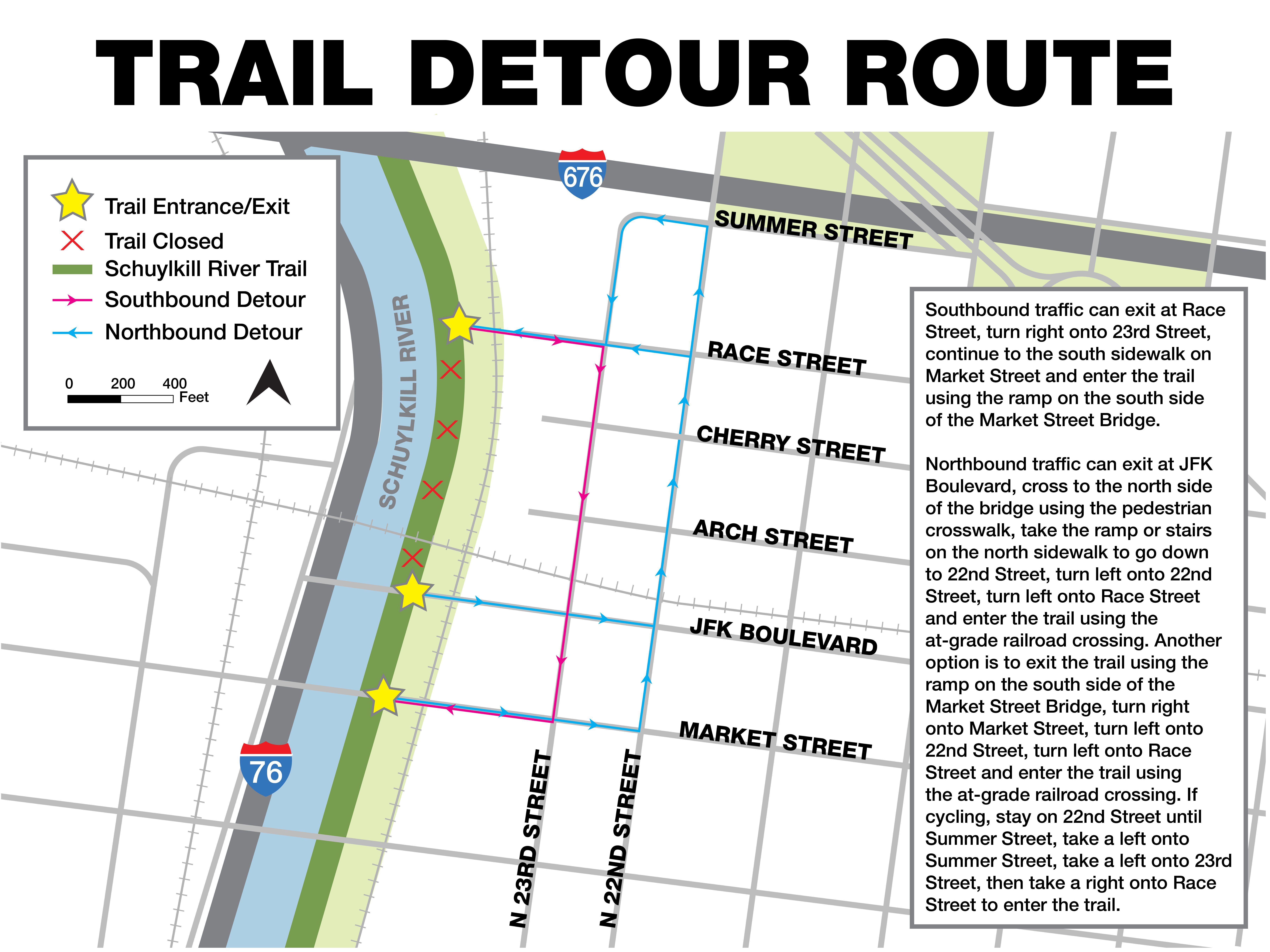
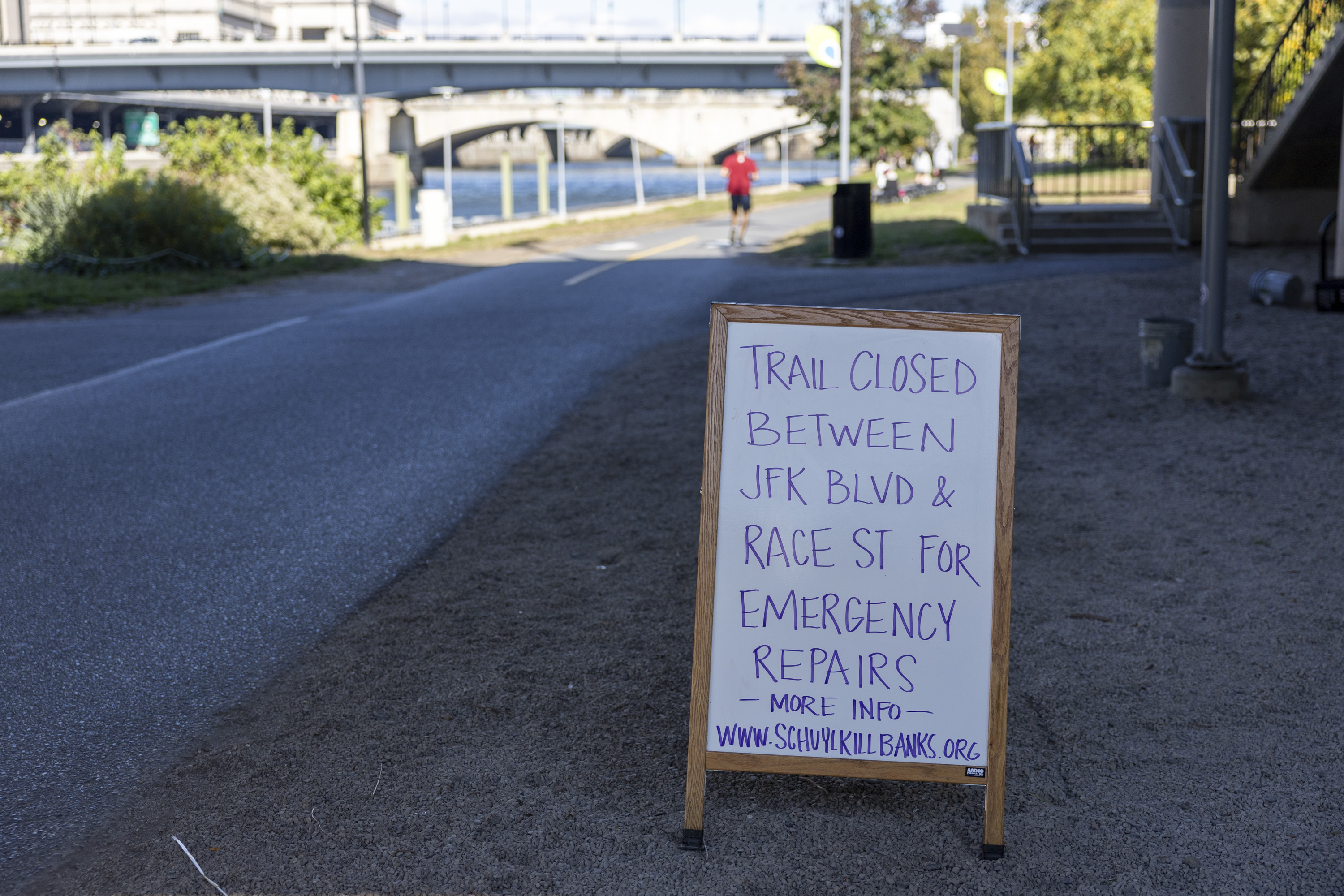
The trail is closed between Race Street and JFK Boulevard, just north of the SEPTA Bridge, according to the Schuylkill River Development Corp. (SRDC), a nonprofit that has helped revitalize the section of the trail known as Schuylkill Banks.
The SRDC said that it is working with Philadelphia Parks and Recreation, the Philadelphia Water Department, and engineers “to figure out what caused the large cavity to form and what is needed to make the necessary repairs.”
It has posted a map of a detour that can be used until repairs are made.
A map of a detour for the Schuylkill River Trail closure between Race Street and JFK Boulevard, which closed for emergency repairs after a sinkhole appeared Oct. 23, 2025
.
Joseph Syrnick, president and CEO of the SRDC, said the hole first came to the attention of his staff when a trail user reported it last week. At first, it appeared to be only a small hole, Syrnick said.
“By the time we got to it, it was about the size of a cantaloupe,” he said. “And then within a short time, it opened up the size of a small pumpkin. We immediately barricaded it off and made it safe.”
Syrnick said the hole was covered with plywood and cones were placed around it to block access by trail users. Crews began to explore the hole more thoroughly.
“We stuck our heads down there through the hole the size of the pumpkin, and saw a huge void. It’s like 8 by 10 [feet]. You could park a car down there — almost. So this has obviously been going on for a long time and luckily we caught it before it collapsed.”
Syrnick called it a “chasm” under the asphalt.
On Friday, SRDC hired an engineer, and then brought in the water department. The decision was made to block off the trail completely.
Although part of the trail remained covered, it took until Monday to put fencing and signs in place, completely sealing off any access.
“Theoretically, it could have collapsed,” Syrnick said.
Syrnick did not have a time frame for when the trail would reopen. He said his team needs to find the cause first. A repair could mean minor or major construction.
A sign warning people that part of the Schuylkill trail is closed for repairs between JFK Boulevard and Race Street after a sinkhole was discovered.
“I think we’re lucky finding this in the middle of fall, heading in the winter,” Syrnick said, “which is way better than finding it in the middle of spring, heading in the summer.”
Brian Rademaekers, a spokesperson for the water department, said it is working with SRDC to investigate the cave-in along the trail at Arch Street.
Rademaekers said crews will use dye to trace the source in an effort to determine a possible cause. He said that the nontoxic dye may cause discolored water in the Schuylkill, but that it is not a threat to people or wildlife.
“Once the results from this testing are evaluated,” Rademaekers said, “the PWD will work with SRDC to determine next steps needed to reopen the trail. Trail users should follow signage and advisories issued by the SRDC.
Rademaekers said the water department would not likely have an update on the situation until at least Friday.
An independent monitor has asked federal officials to ensure consumers don’t get stuck with the bill if the electric grid can’t handle power needs of a massive data center planned for Bucks County.
The monitor, Joseph Bowring, filed comments with the Federal Energy Regulatory Commission (FERC) last week, asking that a Sept. 23 transmission service agreement between Peco and Amazon Data Services be rejected.
The agreement is regarding the 2 million-square-foot “digital infrastructure campus” Amazon plans for the Keystone Trade Center, an 1,800-acre property once owned by U.S. Steel, according to Falls Township. The data center, meant to handle computing needs of the wildly increasing demand for AI, has been heralded by Pennsylvania Gov. Josh Shapiro and the Trump administration.
But Bowring, the independent market monitor for the region’s grid operator PJM, questioned the agreement, which is designed to protect power customers from economic risks associated with the cost of upgrading systems to handle the new load.
In the agreement, Peco sought to ensure, among other things, that consumers don’t get stuck with the bill for grid upgrades if Amazon never builds the data center.
However, Bowring said that the agreement does not “address the key question of whether there is sufficient capacity to serve the identified large new data center load without imposing significant and unacceptable reliability- and capacity-related cost impacts on all PJM customers.”
He’s not alone in concerns about the cost data centers could impose on homeowners and other power customers. Many have already seen utility bills rise rapidly in the past few months.
PJM, Peco, and the grid
Montgomery County-basedPJM manages the electric grid for all or parts of 13 states and the District of Columbia. PJM is responsible for maintaining grid reliability, coordinating electric flow, and assessing capacity. It is the largest regional transmission organization in the U.S.
The data center lies in Peco’s service territory within the PJM grid.
The capacity and reliability of electrical grids across the United States has emerged as a major issue as data centers rush to go online.
David Mills, chair of the PJM Board of Managers, wrote in an August letter to stakeholders that PJM is forecasting peak load growth of 32 gigawatts by 2030. Of that, 30 gigawatts is projected to come from data centers.
Grid operators and power companies like Peco are scrambling to evaluate whether they can provide continuous electricity with the massive new loads without expensive upgrades such asnew transmission lines and substations — costs that advocates fear will be passed onto consumers.
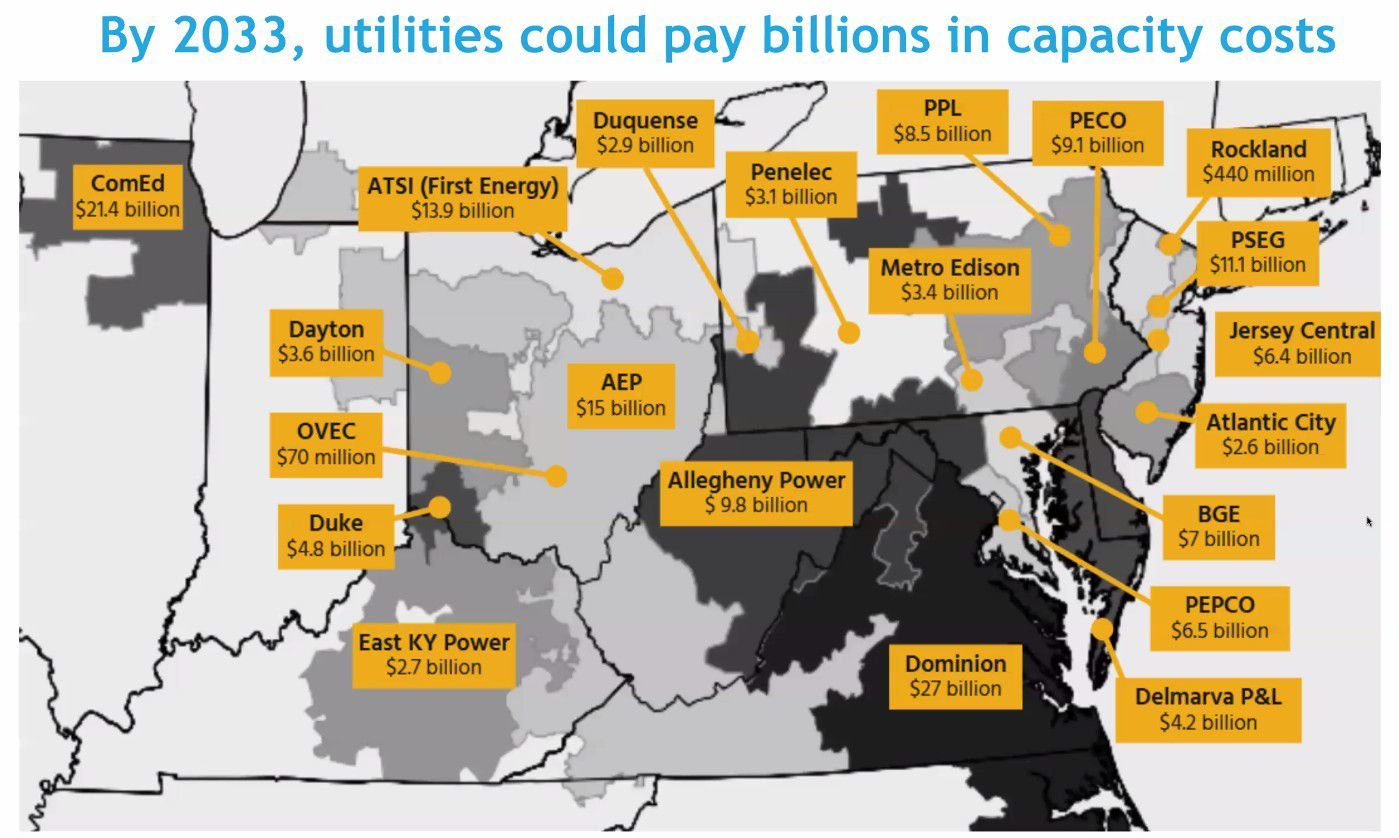
Map produced by the National Resources Defense Council estimates electricity capacity costs to utility companies based on PJM forecasts through 2032.
Protecting consumers
Making sure power consumers don’t get stuck with the cost of upgrades has been a key point of consumer advocates.
Bowring wrote that while the agreement does include some important provisions to protect energy customers from risk, it does not go far enough.
“The Market Monitor recommends that the agreement not be approved unless Peco can demonstrate that the referenced new data center load can be served reliably and economically,” Bowring wrote to FERC.
The company plans to invest at least $20 billion in the construction of data center complexes in Pennsylvania, in what officials called the largest private-sector investment in the state’s history. The second complex would be built alongside a nuclear power plant in Luzerne County.
Both would require enormous amounts of power.
For example, FERC has already rejected one Amazon “behind-the-meter” power connection of 480 megawatts for the Luzerne County data center. That’s more power than is consumed by some small cities.
Bowring addressed the data centers during a summit on PJM at the National Constitution Center in September that was attended by multiple governors, including Shapiro.
“PJM has a problem: Capacity,” Bowring said at the summit. “There’s no extra capacity, and there’s lots of data centers that want to join. … It cannot be handled by the market as it exists.”
PJM has said it does not have the authority to deny the interconnection of new data center loads even if it does not have the capacity. Bowring disagrees but is asking FERC to clarify the matter.
Peco’s ‘extensive planning’
Greg Smore, a Peco spokesperson, said the utility is working with Amazon.
“We have done extensive planning to ensure we can deliver the energy needed to power this data center through our transmission and distribution system,” Smore said. “That data center, like any other large customer, is responsible for procuring electric supply, through an energy supplier or the existing PJM energy market.”
Smore said that knowing there’s “an adequate supply of energy to serve all our customers at a reasonable price is a real concern.”
So Peco, which is owned by Exelon, is working with stakeholders, he said, to add more generation to the grid while ensuring reliability and help address rising energy supply costs.
He said the agreement with Amazon “protects all customers in Southeastern Pennsylvania from bearing greater transmission service costs if the data center does not make the sizable contribution to our system costs that would be expected.”
Advocates fear costs to public
The nonprofit Natural Resources Defense Council (NRDC), an environmental advocacy group, estimates Peco could pay $9.1 billion in costs by 2033 related to the need for greater capacity.
“The projected demand from data centers is vastly outstripping the amount of new supply in PJM,” said Claire Lang-Ree, an advocate with NRDC.
“It will cause power bills to rise and stay high for the coming decade, mainly through capacity cost increases,” Lang-Ree said.
The NRDC estimates cumulative costs could result in a $70 monthly rise in average electric bills in coming years across the PJM grid.
In addition, she said it would lead to a decline in reliability and an increased risk of blackouts for the general public. And, she said, the power demand could undermine states’ clean energy and air quality goals.
“It’s really hard to overstate what’s at stake here,” Lang-Ree said.
Clara Summers of Consumers for a Better Grid, a nonprofit watchdog, said states should impose tariffs to be paid by data centers to support the large power loads they require and ensure that costs of new utility infrastructure doesn’t fall unfairly on consumers. And data centers should provide their own electric supply.
Summers likened not taking action to allowing the wealthiest acquaintances at a restaurant gathering to order the most expensive food, then, “dining and dashing.”
“Unless something is done, everyday people will be left holding the check for some of the wealthiest companies in the world, and that’s unacceptable,” Summers said.
This story has been updated to reflect comments from Peco.
Megan Heiken recently bought a home near the former Pennhurst State School and Hospital, once a center for people with developmental disabilities that now operates as a popular haunted Halloween attraction.
A new plan to convert Pennhurst into a massive data center has outraged and mobilized local residents, as well as people in neighboring communities in an area known for rolling hills, farms, and an overall rural character.
Heiken launched an online petition urgingher Chester County neighbors and East Vincent Township officials to “work together toward a solution that preserves the Pennhurst property, honors its history, and protects the environment and quality of life for all who live, work and visit here.”
The petition had 1,825 signatures as of Friday.
“I made this move to be out in an area with more space, more nature,” Heiken said. “The fact that the owner just wants to plow it over and swap in a data center is kind of alarming.”
Her sentiments are widely shared. The board of supervisors and planning commission in East Vincent have hosted public meetings on the issue that stretched for hours as residents from Spring City to Pottstown voiced objections.
Data centers require a large-scale way of cooling computing equipment and are often dependent on water to do that. The amount of water they use can be about the same as an average large office building, although a few require substantially more, according to a recent report from Virginia, which has become a data center hub.
Steve Hacker, of East Vincent, told the board that his well had already gone dry, as has his neighbor’s, even before a data center has been built. He’s concerned about where the data center would get its water.
State legislators and local governments are scrambling to rewrite local laws as most have no local zoning to accommodate data centers or regulate them.
window.addEventListener(“message”,function(a){if(void 0!==a.data[“datawrapper-height”]){var e=document.querySelectorAll(“iframe”);for(var t in a.data[“datawrapper-height”])for(var r,i=0;r=e[i];i++)if(r.contentWindow===a.source){var d=a.data[“datawrapper-height”][t]+”px”;r.style.height=d}}});
1.3 million square feet
Pennhurst‘s owner has not yet filed a formal application to develop the site, but an engineering firm has submitted a sketch of a preliminary plan to East Vincent Township to develop 125 acres for use as a data center.
The land is owned by Pennhurst Holdings LLC, whose principal is Derek Strine.
Strine deferred comment to a spokesperson, Kevin Feeley.
“Pennhurst AI is aware of the concerns expressed by the residents of East Vincent Township, and we are committed to working through the Township to address them,” Feeley wrote in an email. “What we propose is a facility that would be among the first of its kind in the United States: a state-of-the-art data center project that would address environmental concerns while also providing significant economic investment, jobs, and tax rateables as well as other benefits that would directly address the needs of the community.”
Feeley said Pennhurst AI plans to continue “working cooperatively with the Township.”
The sketch calls for five, two-story data center buildings, a sixth building, an electrical substation, and a solar field. Together, the buildings to house data operations would total more than 1.3 million square feet.
The plan states that a data center is an allowable use within the Pennhurst property because the land is zoned forindustrial, mixed-usedevelopment. Township officials have agreed a data center would be allowed under that zoning.
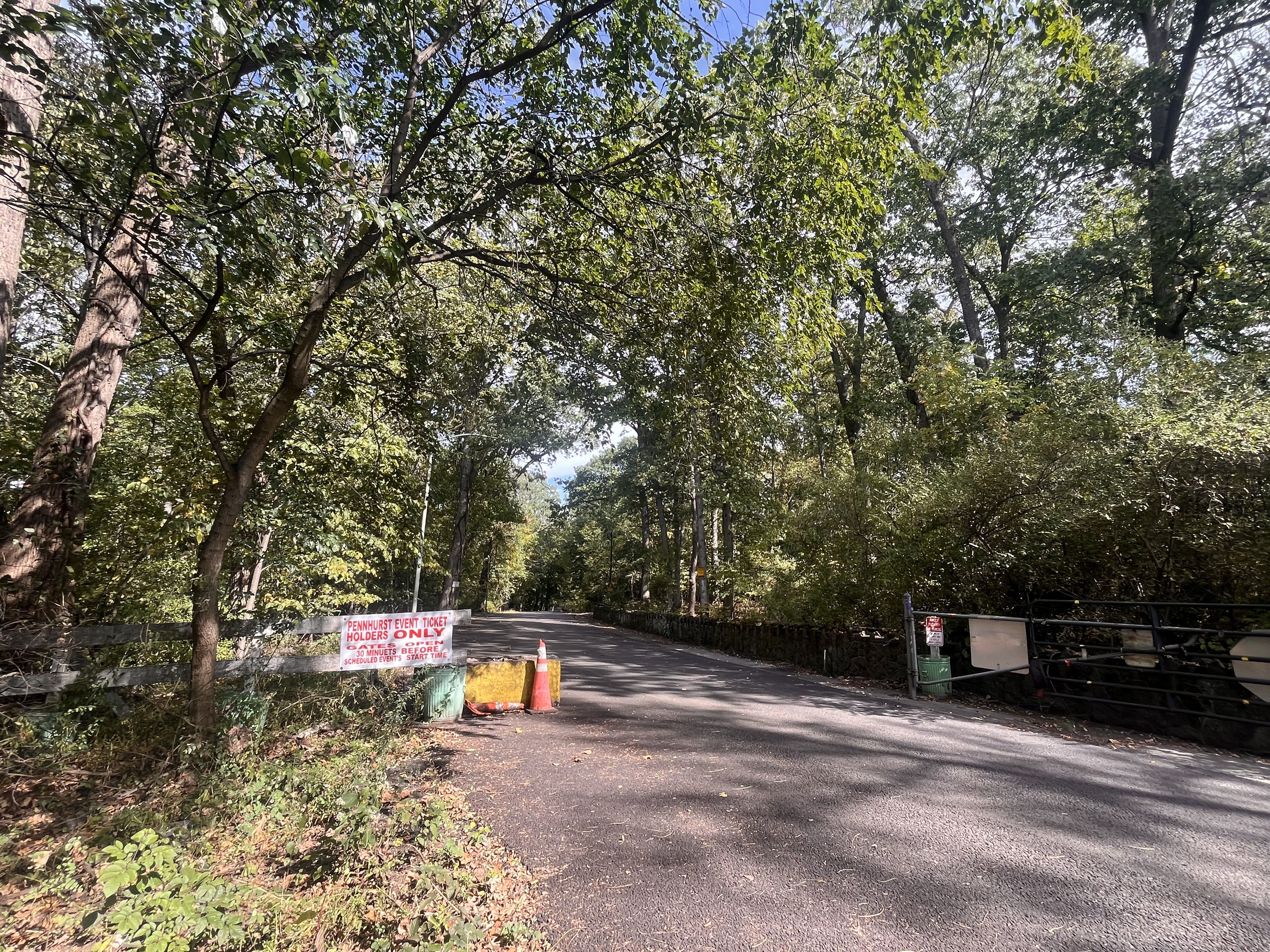
The grounds are bordered by Pennhurst Road to the west. The Schuylkill lies down a steep gorge to the east and north. The property is near the border of Spring City, which is just to the south.
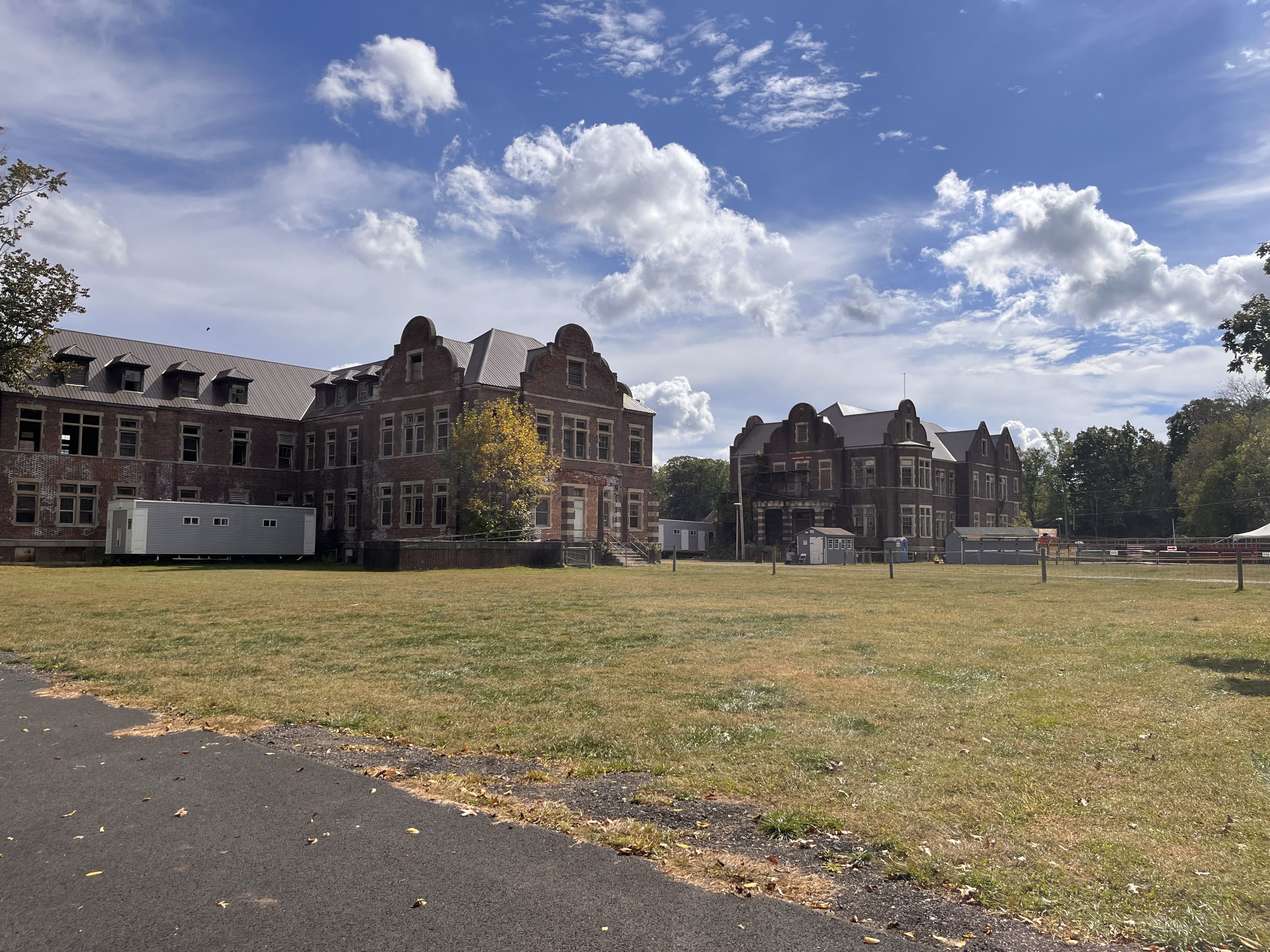
A view of the entrance to the Halloween attraction at the former Pennhurst State School and Hospital grounds in East Vincent Township, Chester County.
What’s Pennhurst?
Pennhurst State School and Hospital, known today as Pennhurst Asylum for its Halloween attraction, has had a long and troubled history. It opened in 1908 to house individuals with intellectual and developmental disabilities. It became severely overcrowded by the time it closed in 1987.
A 1968 documentary Suffer the Little Children highlighted abusive and neglectfulpractices, and resulted in legal actions and a landmark disability rights ruling in 1978 that declared conditions as “cruel and unusual punishment.”
The last patient left Pennhurst in 1987, and the facility sat abandoned until it was purchased in 2008 and converted into a Halloween attraction despite protests from various advocacy groups.
The Halloween attraction has continued and operators say it shows sensitivity toward those once housed at Pennhurst. Separately, visitors can take historical tours of the exteriors of 16 buildings and learn about people who lived and worked there. The site also has a small Pennhurst history museum.
A view of the vacant buildings on the former Pennhurst State School and Hospital grounds in East Vincent Township, Chester County.
Contentious meetings
In recent months, East Vincent officials have raced to draft an ordinance that would govern data centers by limiting building heights, mandating buffers, requiring lighting, noting the amount of trees that can be cut down, and other restrictions.
At two contentious meetings in September, residents and the board of supervisors argued about the draft ordinance’s specifics. Residents said the ordinance did not incorporate some community-suggested safeguards aimed at preserving the township’s rural character.
Residents asked how much water the data center would consume, how much power it would need, and how much noise it would generate.
Pennhurst’s zoning was changed in 2012 from allowing onlyresidential development to permitting industrial and mixed-use buildings. Township Solicitor Joe Clement told residents that it is difficult for the municipality to argue that a data center would not fit within that zone.
“If there’s a use that is covered by the zoning ordinance, we can’t stop that use,” board vice chairMark Brancato explained at a Sept. 18 meeting.
Officials said the draft ordinance was not specifically aimed at the Pennhurst site but was meant to broadly govern any data centers proposed in the township.
“What we’re trying to do is to come up with a set of reasonable guidelines, guardrails, and conditions in the new zoning ordinance that will … provide as much protection as we possibly can for the residents,” Brancato said. ”We are committed to protecting and preserving the rural character of the township.”
Township meetings, some of which have lasted hours, have been marked by raised voices and emotional appeals.
“Our whole community is kind of anxious about the thought of this new data center,” Gabrielle Gehron, of Spring City, said during one meeting. “I’m confused about whether we are or not doing something to prevent that from happening.”
Pa. State Rep. Paul Friel, and State Sen. Katie Muth, both Democrats from East Vincent, have spoken at meetings. Muth noted that Strine received a $10 million grant and loan package from the state in 2017 to prepare the site for “a large distribution facility” and other industrial structures, new office development, and the renovation of six existing buildings for additional commercial use, amid ample open space, according to a funding request provided by the governor’s office.
Muth fears Strine is paving a path to clear the data center for development and sell the property — after benefiting from tax dollars.
“These are not good things to live next to,” Muth said of data centers.
The board tabled the draft ordinance on Sept. 22 after receiving legal advice that they still had time to incorporate more residents’ concerns.
Beyond Pennhurst
Other municipalities in Pennsylvania face a similar issue: Most don’thave existing zoning for data centers. However, state law mandates that municipalities must provide zoning for all uses of land — just as state and federal officials are ramping up plans to embrace the centers.
Plymouth Township is dealing with pressure as Brian J. O’Neill, a Main Line developer, wants to turn the Cleveland-Cliffs steel mill into a 2 million-square-foot data center that would span 10 existing buildings. The Plymouth Township Planning Commission voted against the project given resident backlash. The plan goes to the zoning board later this month.
And Covington and Clifton Townships in Lackawanna County in the Poconos are also dealing with zoning issues and widespread opposition regarding a plan to build a data center on 1,000 acres.
A crew working at a Philadelphia warehouse Tuesday was well on its way toward building 120 combination shade stations and planters to be installed this summer on sidewalks in the Kingsessing, Point Breeze, Grays Ferry, and Haddington neighborhoods.
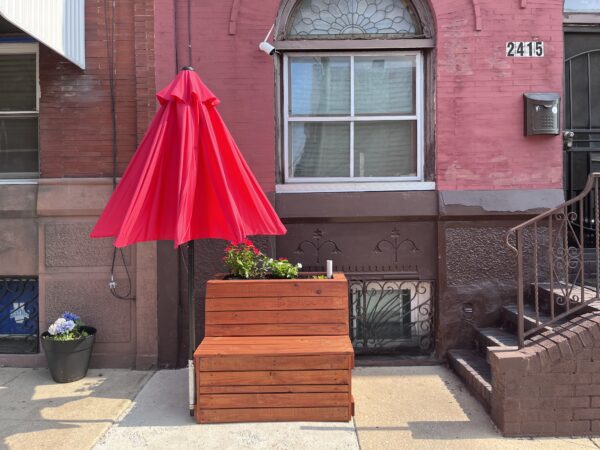
The stations, many of which have already been installed, are built of pressure-treated lumber and come with a bench, umbrella, and decorative planter.
“This idea started as a job creation and heat mitigation program but turned into a broader set of things,” said Franco Montalto, a Drexel engineering professor who directs the program. “We found that a lot of people like these planters. They create social opportunities, and they are an aesthetic improvement.”
The shade can’t come soon enough. Temperatures are forecast to reach 97 on Friday, setting up a dual summer ick for Philadelphians: high heat, high humidity. Together, they’ll combine to make it feel like 106.
This week’s heat wave comes on the heels of data showing Philadelphia ranks as the sixth highest U.S. city for the number of people experiencing an “urban heat-island effect” of more than 9 degrees compared to those living in nonurban areas. It is also one of the few cities that have neighborhoods exceeding 12 degrees of heat island effect.
!function(){“use strict”;window.addEventListener(“message”,(function(a){if(void 0!==a.data[“datawrapper-height”]){var e=document.querySelectorAll(“iframe”);for(var t in a.data[“datawrapper-height”])for(var r=0;r<e.length;r++)if(e[r].contentWindow===a.source){var i=a.data["datawrapper-height"][t]+"px";e[r].style.height=i}}}))}();
Where it’s hottest
The data from the nonprofit Climate Central provide a model for which city neighborhoods are most vulnerable during heat waves because of the density of sidewalks, streets and buildings, along with the lack of tree cover.
Parts of Center City rank among the top for a heat island effect of more than 12 degrees. Center City, however, certainly has residents but is mostly a large swath of offices and retail and not representative of the city’s true residential neighborhoods.
Those highly residential areas, such as Fairmount, Spring Garden, North Philadelphia, East Schuylkill, Southwest Center City, Point Breeze, Kensington, Bella Vista, and Southwark, all bake up to 10 degrees higher than surrounding neighborhoods outside the city, the data suggest.
City officials have said previously that temperatures in some neighborhoods, such as Hunting Park, can rise even higher, leaving medically vulnerable residents at risk. This year, Mayor Jim Kenney’s administration launched a 10-year Philly Tree Plan that calls for planting thousands of trees to increase the city’s canopy to 30% as a way of tackling the disparity.
In general, areas of the city near big parks, with more detached homes and more tree canopy fare much better. Pennypack, West Oak Lane, Overbrook, Olney, Frankford, Bustleton, Northeast Philadelphia, East Falls, and Manayunk all experience a heat-island effect of less than 7 degrees.
(function() {
var l2 = function() {
new pym.Parent(‘heatisland26’,
‘https://media.inquirer.com/storage/inquirer/projects/innovation/arcgis_iframe/heatisland26.html’);
};
if (typeof(pym) === ‘undefined’) {
var h = document.getElementsByTagName(‘head’)[0],
s = document.createElement(‘script’);
s.type = ‘text/javascript’;
s.src = ‘https://pym.nprapps.org/pym.v1.min.js’;
s.onload = l2;
h.appendChild(s);
} else {
l2();
}
})();
Philly’s islands of heat
Climate Central did not base its study on actual temperatures, but rather on modeling that combines data from satellite imagery, impervious land cover, green space, building footprints, transportation, and census tract population data.
Scientists use the data to model which tracts would likely be warmer than others. For example, buildings, roads, and other infrastructure absorb and reemit the sun’s heat more than forests and rivers. Dark surfaces, such as black asphalt roofs, reflect less light and retain more heat. As a result, certain areas can become hotter during extreme heat relative to suburban and rural areas, according to the U.S. Environmental Protection Agency.
The heat-island effect strikes a mix of neighborhoods:
For example, a neighborhood in the eastern part of North Philadelphia has an urban heat-island effect of more than 11 degrees. The population is 12% Hispanic, 16% Black, 44% white, and 23% Asian.
A cluster of streets in Kensington has a heat-island effect of 10 degrees, according to the Climate Central data. The neighborhood is 51% Hispanic, 25% Black, and 19% white. But a cluster in South Philly that’s 73% white, 10% Hispanic, 13% Asian and 2% Black sees the same 10 degree effect.
One of the least impacted parts of the city, West Oak Lane, with a 6.6 degree heat-island effect, is 94% Black. And people living in mostly white Bustleton experience the same effect.
The data, however, differ from Philadelphia’s Heat Vulnerability Index, which is used to indicate neighborhoods most at risk during extreme heat events. The city’s index takes into account more than just temperature. It looks at social, economic and health factors such as age, education, language barriers, percent of people living in poverty, race and ethnicity, and social isolation. It looks at the number of people who have asthma, heart disease, and other health issues.
For example, the Climate Central data give a census tract in North Philadelphia a heat-island effect of 7.75 degrees, which is not among the highest in the city. But the city assigns the same tract a “very high” score on the Heat Vulnerability Index. The neighborhood is 95% nonwhite, many live below the poverty line and have obesity and hypertension.
“Every day is a learning experience,” said Omar Sewell, 42, of South Philadelphia, who is working under a Drexel-led program to build shade stations for city sidewalks. Sewell spoke at the program’s rented warehouse in Kingsessing on Tuesday.
Finding shade
Jennifer Brady, a former EPA staffer who conducted the analysis for Climate Central, said it makes sense that Center City would show a high degree of heat-island effect because of the population density, paucity of trees, tall buildings, and infrastructure that absorbs heat and reduces airflow.
The impact of heat on people in Center City might be much less than in other neighborhoods, Brady said. That’s because people in Center City tend to be wealthier with the means to escape or have easy access to air-conditioned apartments, offices, stores, or shaded square.
“There are other neighborhoods that are not only high risk, but you can’t walk three or four blocks to find any kind of cover or shaded area,” Brady said. “That’s not accounted for in the data. That’s something not explicitly in these numbers, but is an important consideration when you’re thinking about people being able to escape from the heat.”
So, lower-income residents of color tend to bear the brunt of extreme heat’s impact. In 2020, for example, the Hunting Park Neighborhood Advisory Committee surveyed residents about how they cope with heat and asked how many had air-conditioning. Out of 563 who answered, only 100 had air-conditioning.
To help residents cope, the city operates scores of cooling centers, which can include air conditioned buses.
Back at the Drexel program, Oman Sewell, 42, of South Philly was working in a warehouse in Kingessing that Montalto’s program rents to build the shade-giving planters. The planters are placed with guidance from of local community organizations. It’s the fourth year of the program, which is funded by the William Penn Foundation and started with planter installations in Hunting Park.
Sewell started working in June under the tutelage of architect Angelo Zaharatos, founder of Arxis League, a New York-based design group. Sewell was busy Tuesday helping assemble the planters after having made many of the cuts on a miter saw.
Sewell is enthusiastic about the program and credits Zaharatos with daily uplifting readings that might come from, say, Marcus Aurelius, a Roman emperor and philosopher.
“Every day is a learning experience,” Sewell said. “It opens your mind, showing you can actually uses these building blocks and turn the skills into something you can use the rest of your life.”
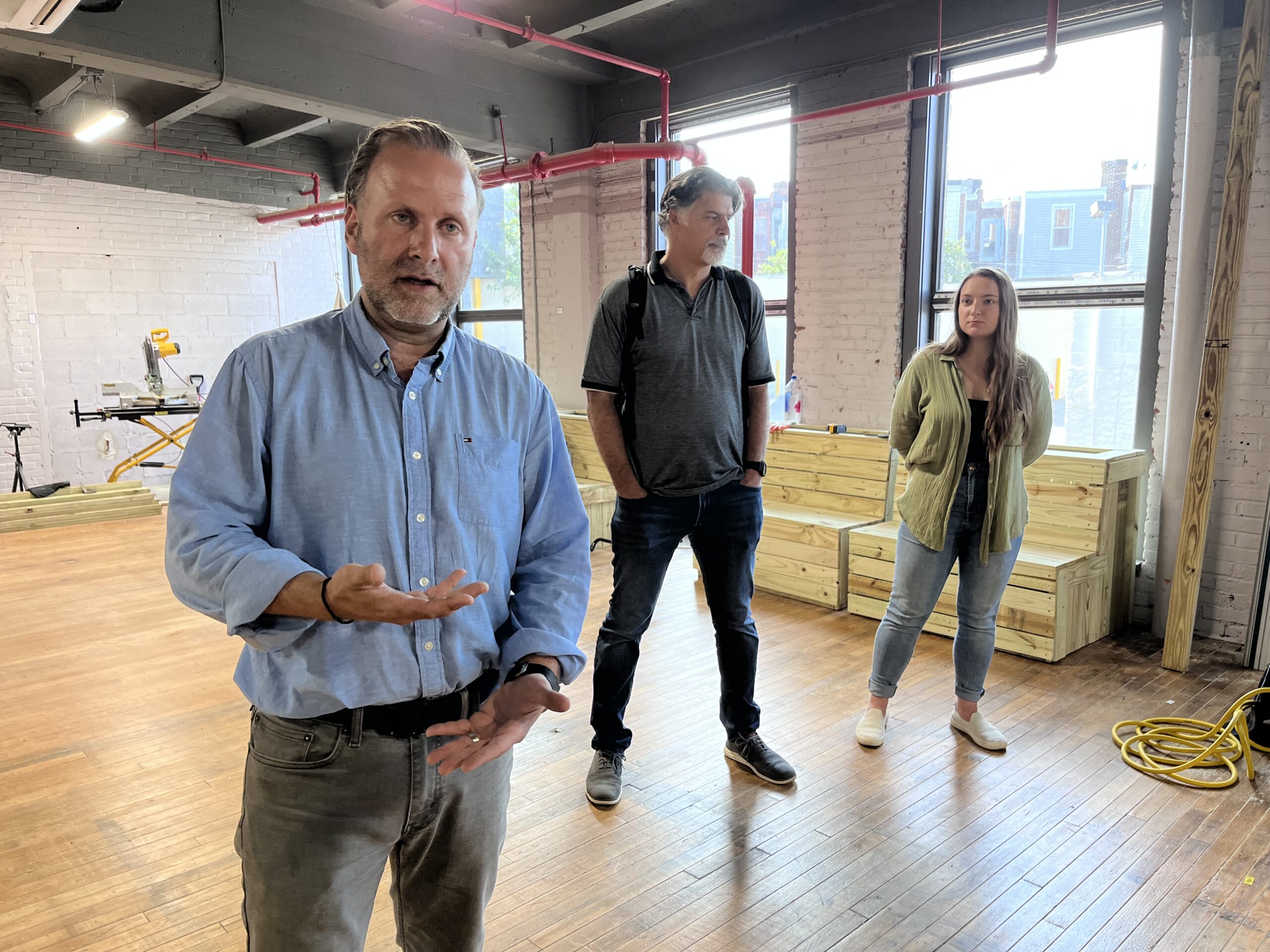
Architect Angelo Zaharatos explains how shade-giving planters are built at a warehouse in Philadelphia’s Kingsessing neighborhood. Drexel professor Franco Montalto (middle) oversees the program. Nikki Pearl (right) manages it.