PB Bankshares, the holding company for Presence Bank, has been merged into Norwood Financial Corp., the holding company for Wayne Bank.
“We are pleased to welcome PB Bankshares’ shareholders, customers and employees to our Norwood family,” Jim Donnelly, president and CEO of Norwood, said in Monday’s announcement. “We expect this combination will allow us to offer expanded products and services to the communities in our combined market areas.”
Norwood’s Wayne Bank, based in Honesdale, had $2.4 billion in assets at the acquisition. Wayne Bank was founded in 1871, and Norwood Financial Corp, the holding company, was created in 1996. It has grown to 15 offices in Northeastern Pennsylvania and 12 in the Southern Tier of New York.
PB Bankshares had $467 million in assets from its Presence Bank when the deal closed.
Presence Bank first opened in 1919 in Coatesville, Chester County, as Coatesville Federal Savings & Loan Association, and in 2021 was renamed Presence Bank.
Over the years, the bank added branches in Oxford, Chester County, and in New Holland and Georgetown, both in Lancaster County. Presence Bank also has an administrative office in Lancaster and a loan office in Harrisburg.
Norwood has said the strategic combination allows the company to expand its footprint “into higher growth markets in Central and Southeastern Pennsylvania” while “enhancing Presence Bank’s capacity to provide exceptional service and solutions to its existing customers.”
Janak M. Amin, president, CEO, and director of PB Bankshares, is now executive vice president and chief operating officer for Norwood and Wayne Bank.
“We will be able to provide more products and services to our customers given Wayne Bank’s strength in retail banking,” Amin said.
He added that Wayne Bank’s larger capital base will allow Presence Bank to “take better care of commercial customers with growing needs and the increased lending limit will allow us to retain and attract more customers.”
A 40-year-old man has been charged by the Gloucester County Prosecutor’s Office with the shooting death of a woman Saturday morning in Paulsboro.
Authorities say Ramon Luis Acevedo of Paulsboro shot the woman in the head while she was at a home on Elizabeth Avenue. They say he also shot a minor who fled.
Acevedo was charged with first-degree murder and second-degree aggravated assault after the prosecutor’s office said he called 911 on Saturday. During the call, authorities allege, Acevedo identified himself and said he shot both people.
Police found an adult female dead in a bedroom at the home. The minor received medical treatment for a gunshot wound.
Acevedo said in a statement to police that he intentionally shot the woman, according to the prosecutor’s office. He then accidentally shot the second person after being startled while holding a handgun, according to the statement.
Neither victim has been identified by the authorities.
Acevedo faces a sentence of 30 years to life for the charge of first-degree murder, 5 to 10 years for second-degree aggravated assault, and 5 to 10 years for possession of a weapon for an unlawful purpose.
Brian Lovenduski was strolling with his leashed miniature pinscher, Ziggy, through a Center City plaza Monday evening — just another routine walk for the pair.
“Just enjoying the Christmas lights,” said Lovenduski, who had David Bowie’s Diamond Dogs pulsing through his earbuds. “And then, before I knew it, I turned around and a pit bull had latched onto Ziggy’s leg.”
Lovenduski recalled the horrific attack that followed at 12th and Chestnut Streets in front of dozens of bystanders. He was bitten and Ziggy was left seemingly near death — until the small dog rallied and fought back for his life against the much bigger, more powerful pit bull.
Miguel Torres, a spokesperson for the Philadelphia Police Department, said Saturday that the pit bull is believed to have been involved in a trio of attacks in Center City that took place in the week after Christmas. The pit bull is believed to be owned by a homeless person, police said.
Owners of two victimized dogs say they have not only been traumatized by the attacks, but face tens of thousands of dollars collectively in vet bills.
Brian Lovenduski was walking his leashed miniature pinscher, Ziggy, Monday in Center City when they were attacked by a pit bull, which is believed to have carried out two other recent attacks.
Ziggy’s attack
Ziggy was the second dog attacked by the pit bull.
The 4.5-minute attack left Ziggy with a long row of stitches and an amputated leg. Lovenduski was bitten on the hand as he tried to ward off the pit bull.
Lovenduski said he grabbed the pit bull by the collar and pulled its head to his chest to wrest him away from Ziggy. Dozens of people gathered, with some shouting instructions, but not intervening. At one point, Ziggy went limp.
“I was worried that I’m watching my dog die in front of me, and I can’t save him,” Lovenduski said. “And then suddenly, Ziggy in his little, little, fiery body sprung back to life and started biting the pit bull on the ears, over and over and over. There was blood everywhere.”
Lovenduski continued to strike the pit bull on the head and finally it released Ziggy. A nurse from Jefferson Hospital came and helped seek medical treatment.
Eventually, Ziggy was treated at Philadelphia Animal Specialty & Emergency on Washington Avenue in Point Breeze.
“He is little by little, starting to learn how to balance himself upright on three legs,” Lovenduski said of Ziggy. “I’m still in shock. But Ziggy’s will to live is inspiring me.”
Lovenduski estimates he faces $11,000 in medical expenses, and expects that could grow. He has set up a GoFundMe account to raise money for the bills.
Ziggy, a miniature pinscher, was attacked by a pit bull while being walked by owner, Brian Lovenduski on Dec. 29, 2025. It was one of three known attacks by the pit bull.
The attack on Stella
The first known attack by the pit bull occurred on Dec. 26 as J. Bazzel was walking his 11-month-old sheltie Stella at Juniper and Chestnut Streets.
Bazzel said he saw a homeless woman sitting on the corner under a blanket with a pit bull to the side. He’d seen the dog before and usually gives it “a wide berth.” He believes the woman also travels with a man.
He crossed over Juniper, near the Wanamaker Building, and was startled to hear Stella suddenly yelp.
“I looked down, and saw that the dog had, very quietly, ran over, grabbed Stella’s front left leg and wouldn’t let go of it. My dog was yelping and crying in pain. I started yelling for help.”
Bazzel said a man came over and jumped on the back of the pit bull and started striking it in the head. Bazzel worked his gloved fingers into the back of the pit bull’s jaw and applied pressure until it released Stella.
Stella, an 11-month-old sheltie, is seen here recovering from surgery after she was attacked by a pit bull Dec. 26 in Center City. Police believe the pit bull is responsible for three recent attacks.
“The guy who was holding back the pit bull yelled at me to run,” Bazzel recalled. “And I scooped Stella up.”
Bazzel brought the bleeding puppy to the VEG Emergency Vet center, where staff helped.
“I had blood on me, I had excrement on me,” Bazzel said. “The folks at VEG were just amazing. They quickly got the door. They escorted me right back. They got her on a table. They started taking care of me and her because I was out of breath.”
Eventually, Bazzel got Stella to Philadelphia Animal Specialty & Emergency. There, a surgeon pieced together Stella’s crushed foreleg, keeping it together with a plate. Stella also needed a skin graft.
“She’s with me every single place I go,” Bazzel said of Stella. “She’s my emotional support. She’s my best friend. It just breaks your heart to see what she’s going through.”
Bazzel is hoping the dog’s foreleg will be saved, but is still waiting to see if it heals. He said the medical bills total about $9,000 so far, and he expects it could run thousands more by the time treatment is over. He has also set up a GoFundMe account.
The third attack occurred 7 a.m., Dec. 31, as a 74-year-old man was walking his dog at 19th and Walnut Streets, according to police.
There, a homeless person, described by police as a white male wearing a black coat and dark blankets, was lying on the ground with a pit bull.
The pit bull then rose to bite both the man and dog. The man drove himself to a hospital for treatment.
The city’s Animal Care and Control Team is aware of the situation, said ACCT Philly executive director Sarah Barnett.
But, stopping the pit bull is a process.
“We can’t just take someone’s dog; the process takes so long and it’s not victim friendly,” Barnett said.
The steps involve filing dangerous dog charges, taking the owner to court, and waiting over 30 days. This process is more complicated when the owner is unhoused, she said.
After three attacks, Barnett conceded there’s a chance that the pit bull attacks again.
“It wouldn’t surprise me if someone’s dog gets attacked and they do something horrible like shoot it,” Barnett said. She encouraged people to instead call the police if they think they have spotted the pit bull.
“Be aware of your surroundings and don’t just assume the dog is only in Center City,” she said.
This story has been corrected to say that Stella was initially bought to VEG Emergency Vet center, not Vedge the restaurant.
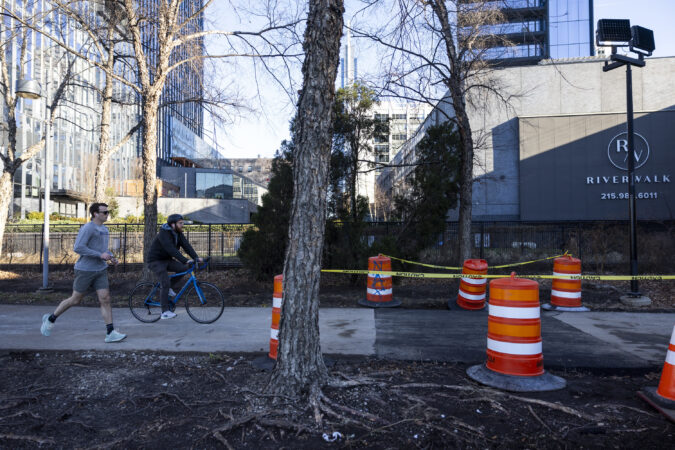
A segment of the Schuylkill River Trail that has beenclosed since October because of a sinkhole has been repaired, and reopened just in time for Christmas Eve.
Joe Syrnick, executive director of the nonprofit Schuylkill River Development Corp. (SRDC), said Wednesday afternoon that repairs finished earlier in the day.
But, he said Wednesday, the weather cooperated enough this week that a crew was able to complete the work over a few days, “as a holiday present for our trail users.”
This week, the hole was filled and paved. It reopened about 1:30 p.m. Wednesday after the paving had cooled.
“It’s open and people are already using it,” Syrnick said. “People are happy.”
Some cleanup is still needed around that area, he noted, and fencing needs to be removed. That should be finished by Friday or Monday, Syrnick said.
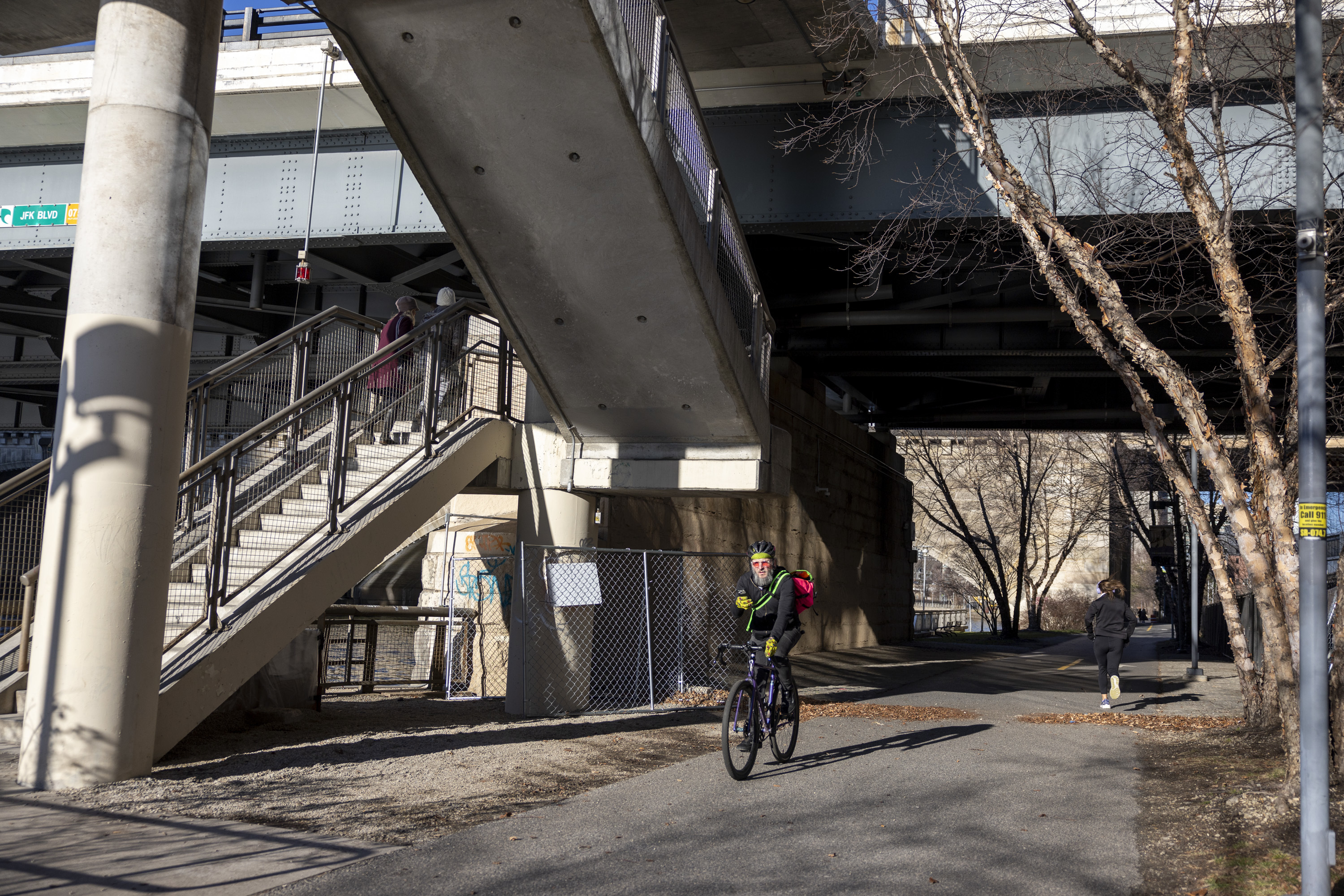
The Schuylkill River Trail is now open between JFK Boulevard and Race Street in Philadelphia, Pa., on Wednesday, Dec. 24, 2025.
The sinkhole occurred between Race Street and JFK Boulevard, just north of the SEPTA Bridge, after it formed beneath the asphalt. The trail runs along Schuylkill Banks, a portion of the Schuylkill River Trail.
The SRDC works with the city to revitalize the Schuylkill corridor from the Fairmount Dam to the Delaware River, the eight-mile stretch known as Schuylkill Banks.
The sinkhole repair presented a problem that stemmed from a steel bulkhead that was built for the trail in 1995. The bulkhead helped extend land farther into the river and create more parkland.
But gaps developed in a seal between the bulkhead and concrete sewer infrastructure. Those gaps allowed soil to seep away with the tide, eventually washing away enough to create a sizable hole.
Syrnick said the SRDC and the Philadelphia Streets, Parks and Rec, and Water Departments worked together to come up with a solution.
So workers had to seal the gaps.
The weather was clear enough this week that crews were able to pour concrete to fill part of the hole and backfill it before paving it Wednesday.
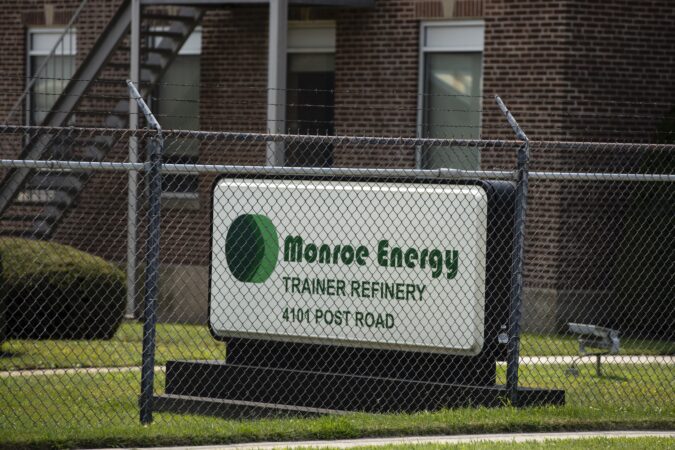
Hundreds of thousands of gallons of gasoline leaked over a period of months at a Monroe Energy petroleum tank farm in Aston, Delaware County, according to company and state officials.
The leak was first identifiedin August, and it was traced in December to a one-quarter-inch hole in the bottom of a tank. It totaled about 9,000 barrels, or 378,000 gallons, at the Chelsea Pipeline Station and Tank Farm.
The facility contains 12 aboveground tanks and is operated by MIPC LLC, a subsidiary of Monroe Energy. It is about five miles north of the company’s Delaware River refinery, which is in Trainer, Delaware County.
The Pennsylvania Department of Environmental Protection (DEP) said Tuesday it has ordered that some nearby homes with wells within 1,000 feet of the facility’s western border be provided bottled water if requested. And it ordered that the company “begin an interim cleanup plan and thorough investigation.”
MIPC said in a statement that it had notified local, state, and federal authorities. It said that on Dec. 13 crews determined that the source of the spill was traced to one tank.
It further said that an EPA-approved lab it had contracted tested residential wells, “and all results have shown no petroleum related compounds.”
MIPC said that the tanks are routinely inspected and that the company is conducting daily testing of monitoring wells along its fence line and inspecting local waterways.
“No further releases have been found,” the statement said.
“We sincerely apologize for any concern that this may be causing our neighbors,” the statement continued. “MIPC is committed to ensuring that the entire affected area is remediated and returned to its original condition.”
Adam Gattuso, a Monroe Energy spokesperson, said the leak is “considered one cumulative event, over the course of several months.”
He said that if people are within 1,000 feet of the facility’s western border and have a potable groundwater well and would like bottled water delivered to their home, the company would do so within 24 hours. He said the company will soon mail letters to those residents.
DEP Secretary Jessica Shirley said in a statement Tuesday that “swift action by the company is necessary to fully investigate the extent of damage and address the community’s needs.”
According to the DEP order, the first report of an issue came over the summer at the facility, where a series of aboveground tanks are part of a pipeline network.
The company notified county officials on Aug. 19 of hydrocarbons found in a storm sewer at the facility. It said no leaks were found, but there was “sheening” on the water.
MIPC did not know the source of the gasoline on the water and said it would continue investigating.
On Sept. 3, the company notified officials it “had discovered water with petroleum odors discharging from a concrete drainage pipe” leaking unleaded gasoline at a rate of five gallons per minute.
The DEP ordered MIPC to treat and discharge the contaminated water.
The agency said the company’s investigations from September through November found no signs of additional leaking.
The DEP had not heard from MIPC regarding any leaks until Dec. 5, when the company reported to the U.S. Environmental Protection Agency’s National Response Center “that the amount of gasoline released may be significant and was impacting soil and groundwater.”
It notified officials that the source of the leak had been found in the tank.
As a result, the DEP has ordered MIPC, in addition to supplying bottled water, to identify residents with private wells within 1,000 feet of the facility that spans Bethel, Upper Chichester, and Aston Townships.
And it ordered the companyto sample private wells for petroleum, submit a plan to detect potential vapors near homes, schedule environmental investigations, submit a remedial plan, and communicate with officials and the public.
As of yet, the DEP has not cited any violations or issued any fines.
Editor’s Note: This story has been updated to include additional information about water bottle availability for residents.
The lower Schuylkill winds 36 miles from Phoenixville in Chester County to its tidal meeting point with the Delaware River at Philadelphia’s Navy Yard, sheltering more than 40 species of fish along the way.
In Center City, the river doubles as a striking urban backdrop, bordered by a trail that can draw thousands of hikers and cyclists daily.
This year, the waterway is vying for the title of Pennsylvania’s River of the Year, an annual competition spotlighting the state’s most significant waterways.
Online voting, which began Dec. 9, runs through Jan. 16, giving Pennsylvanians the chance to select the 2026 winner from three contenders: Chillisquaque Creek, the Conestoga River, and the lower Schuylkill in the Philadelphia region.
The River of the Year program is administered by the Pennsylvania Organization for Watersheds and Rivers, with funding from the Pennsylvania Department of Conservation and Natural Resources (DCNR).
The contest is meant to draw public attention to rivers and their environmental importance. The winning river’s nominating organization receives a $15,000 DCNR grant to fund yearlong celebrations, including paddling events and community activities. The DCNR produces a commemorative poster in honor of the river.
Jackson Quitel, river programs coordinator for the nonprofit LandHealth Institute, said his organization nominated the Schuylkill along with a plan to educate the public “in the many wonders in this unique body of water.”
“While the Schuylkill River is widely known, not many people are aware of the immense recreational activities and ecological wonders that are present on the river today,” Quitel said.
The LandHealth Institute helps increase awareness of the river through guided walks, fishing, and kayaking, taking more than 500 people out on the water in 2025. If the Schuylkill wins, Quitel said, it would allow the group to double its reach.
Joe Syrnick, executive director of the nonprofit Schuylkill Development Corp., which helped develop the Schuylkill Banks trail along the river, called the river “a great asset to the region.”
“It would be nice to see it get the recognition it deserves,” Syrnick said.
Once a vital waterway for the Lenni-Lenape, the river later endured severe pollution from upstream coal mining and industrial waste, eventually rebounding through years of efforts, including the protections of the federal Clean Water Act.
The Schuylkill became the nation’s first municipal‑scale water system through Fairmount Water Works and continues to provide drinking water to 1.5 million people through two intakes along its banks.
The Schuylkill River Trail, a continuous corridor running alongside most of the lower Schuylkill, has broadened access to the river’s views for residents, giving them more insight into a river many were once cut off from.
Most recently, the Schuylkill Banks section in Center City debuted a new $48 million cable‑stayed, pedestrian‑only bridge, anchoring a trail extension known as the Christian to Crescent Trail Connector. The 2,800‑foot segment delivers sweeping, unobstructed views of the river.
The DCNR describes the lower Schuylkill as an “urban oasis surrounded by bustling roads and a backdrop of a gorgeous skyline.”
Pennsylvania has 25 rivers. Of those, six are federally designated as wild and scenic and 13 are state-designated scenic rivers.
Contest nominees can also include tributaries within river watersheds. For example, Chillisquaque Creek is a 20 mile-long tributary of the Susquehanna River’s west branch. It flows through Northumberland and Montour Counties.
The Conestoga, meanwhile, feeds Chesapeake Bay.
Overall, Pennsylvania has 85,000 miles of waterways, which is the highest stream density in the continental United States.
A sinkhole that shut down a segment of the popular Schuylkill Banks trail in Center City in October remains unrepaired, though work could begin early in the new year — if weather allows.
Joe Syrnick, executive director of the Schuylkill River Development Corp. (SRDC), a nonprofit that has driven the revitalization of the section of the Schuylkill River Trail known as Schuylkill Banks, said he expects repairs to start soon, though he could not offer a firm timeline.
The trail has been closed between Race Street and JFK Boulevard, just north of the SEPTA Bridge, after a “chasm”-sized void opened beneath the asphalt.
According to Syrnick, the city Streets Department will handle the repairs. The hole presented a challenge, Syrnick said, because of its size and position next to the river.
A representative for the Streets Department could not be reached Monday for comment.
Syrnick explained that the sinkhole has been far from a simple fix.
“It took a while to figure out the problem and develop a solution,” Syrnick said. “There were several dye tests and a drone flight into the sewer channel and visual observation from topside.”
The problem stems from a steel bulkhead that was built for the trail in 1995 to extend land farther into the river and create more parkland, he said.
Gaps developed in a seal between the bulkhead and concrete sewer infrastructure. It’s unclear, Syrnick said, whether those gaps occurred at the start or developed over time.
Regardless, the gaps allowed soil to seep away as the tide ebbs. Over the decades, enough soil was washed away “to create a sizable hole,” he said.
The gaps had to be sealed before anything else could be done.
So the job became more than just filling a hole. Recent progress has been halted by weather, especially recent cold and snow.
“City workers need two to three days of moderate temperatures and no rain to pour the concrete and let it cure,“ Syrnick said. ”After that, the hole has to be backfilled and paved.”
However, holidays also present a staffing issue, Syrnick said.
“In a perfect world,” he said, “the trail would be open by New Year’s or a short time after.”
With First Day hikes surging in popularity, Pennsylvania and New Jersey are rolling out a full slate of outings to welcome 2026 — from daybreak rambles to sunset treks, and nearly every hour in between for those easing into the new year.
Many of the guided hikes require advance registration and fill quickly.
The Jan. 1 hikes are offered through the Pennsylvania Department of Conservation and Natural Resources (DCNR) and the New Jersey Department of Environmental Protection (DEP). Some are guided by rangers, others by volunteers.
Another option: Join the Friends of Ridley Creek State Park in Media, Delaware County, for a 3.5-mile loop featuring creek views and a stop at historic hilltop Russell Cemetery.
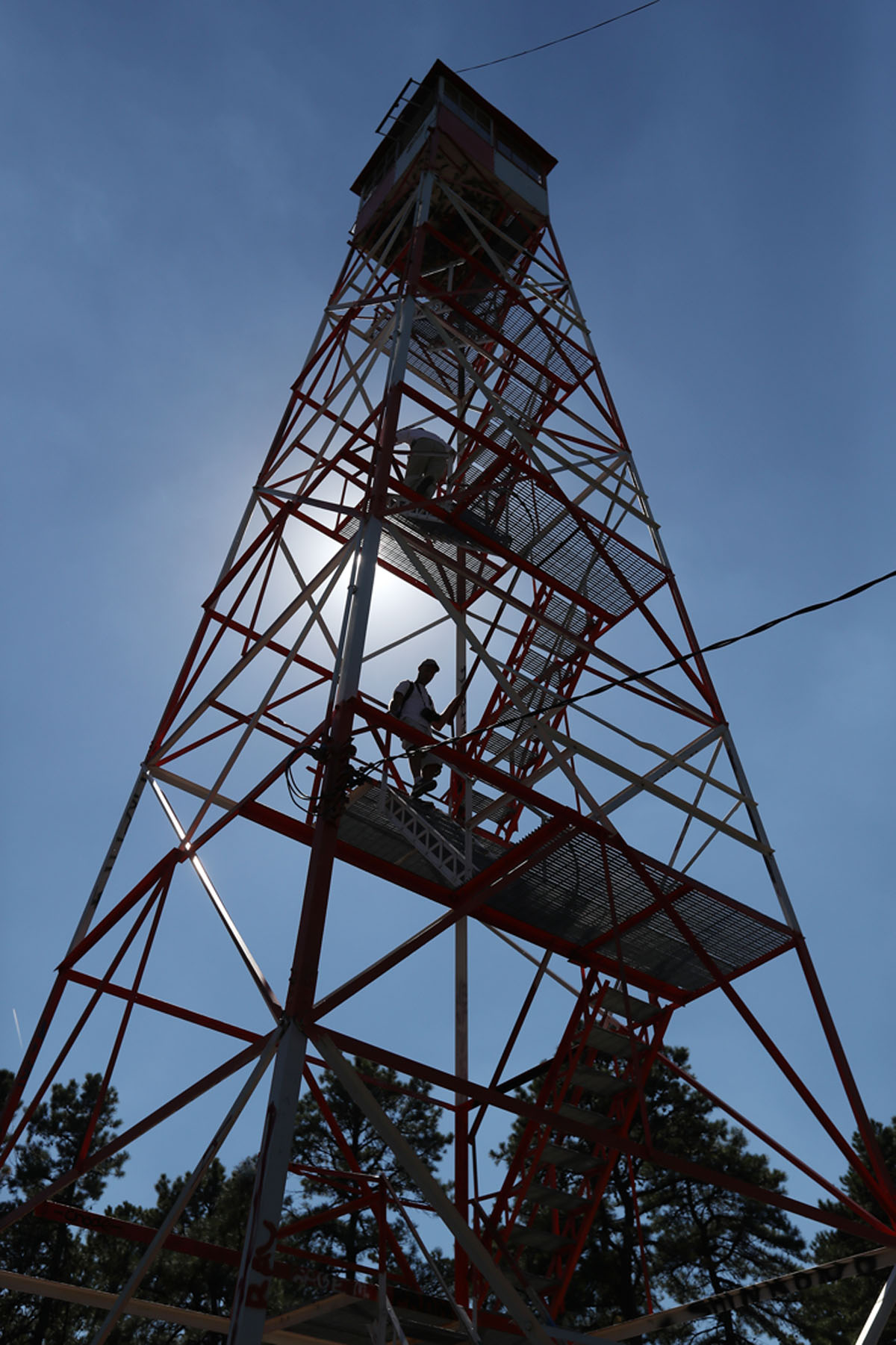
Or, for a spectacular bird’s-eye view of the Pinelands at daybreak, you can tackle a 2.5-mile round trip, starting at 6 a.m., to Apple Pie Hill in Wharton State Forest, where hikers climb the 79 steps of the fire tower at sunrise. The only drawback: The hike has become so popular that the DEP holds a lottery at 1 p.m. on Dec. 31 to select participants.
Apple Pie Hill Tower offers a dramatic view of the Pinelands.
First Day Hikes began in Massachusetts in 1992, and went nationwide in 2012 under an effort by the National Association of State Park Directors.
Ian Kindle, environmental education regional program coordinator for DCNR’s Bureau of State Parks, said the hikes in Pennsylvania started not long after that. But, he said, they have become increasingly popular since the pandemic, when many people took to the outdoors.
“I think people have really taken to the idea of making getting outdoors on the first day of the year a tradition.” Kindle said. “I know that some of the first ones I led at Delaware Canal State Park, we could have 100, 150, and upward of 200 people, which is a challenge to lead.”
Last New Year’s Day, 2,488 people — and 224 dogs — participatedin Pennsylvania. They gathered for 74 hikes at 47 state parks and one state forest, accumulating 6,478 miles.
Cheryl and Gary Moore, of Bucks County, ride their horses over the Schofield Ford covered bridge in Tyler State Park in Newtown, Bucks County in this 2021 file photo.
The two most attended hikes were at Beltzville State Park in Carbon County in the Poconos (175 people) and Tyler State Park in Bucks County (170 people).
This year, DCNR has organized 60 free guided hikes in 49 state parks and three forest districts, choosing to make the walks more focused.
Kindle said an “almost full moon” hike is set for Delaware Canal State Park in Yardley, Bucks County, at 4 p.m. He noted a two-mile hike around Militia Hill at Fort Washington State Park in Montgomery County.
The hikes include: walks at 10 a.m., noon, and 2 p.m. through historic Revolutionary-era Batsto Village in Wharton State Forest; a more rigorous six-mile hike at Brendan T. Byrne State Forest on the Cranberry Trail that includes Pinelands cedar swamps and Pakim Pond; and a two-mile hike at Washington Crossing State Park in Mercer County where you can learn about the famed feat by the Continental Army that routed the Hessians at Trenton.
Tourists arriving in Philadelphia next year may find it easier and far more inviting to stroll through what is now a tucked-away stretch of Old City.
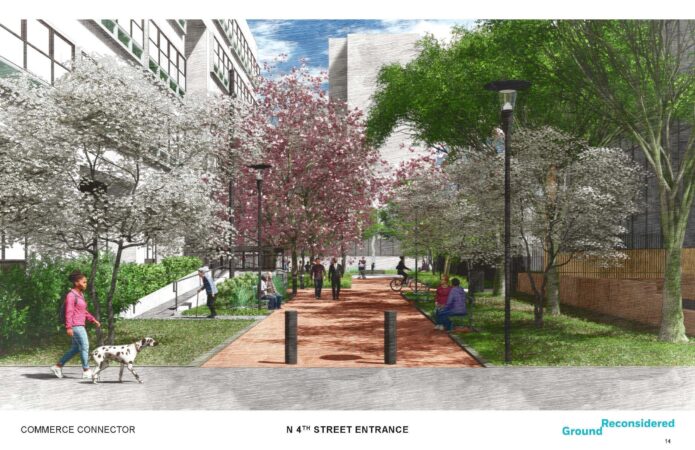
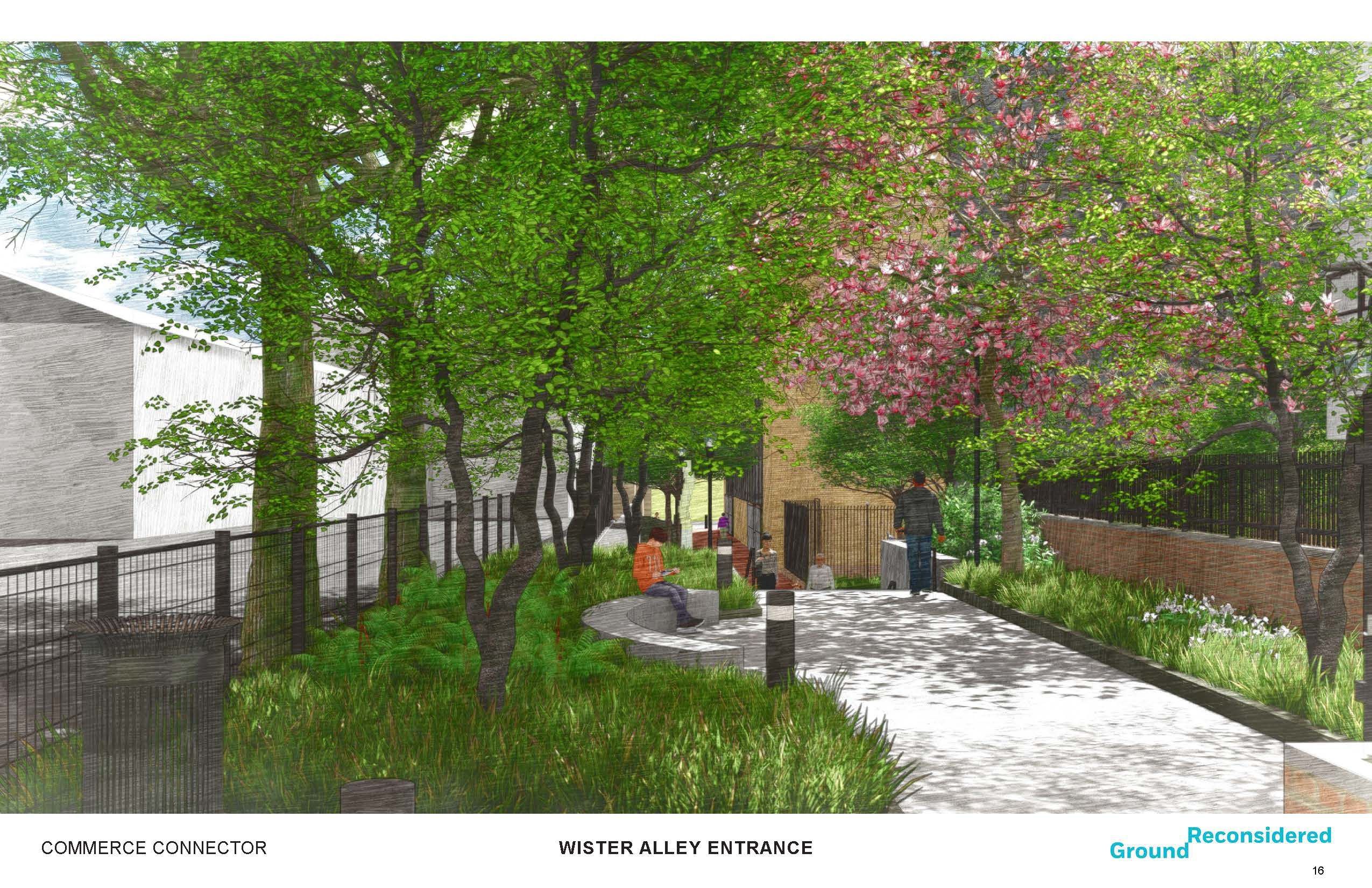
On Wednesday, the city launched construction on what officials call the Commerce Connector, a pedestrian path designed to guide visitors from the Independence Visitor Center to Carpenters Hall along a brick‑lined walkway adorned with seating and ornamental plantings, while bypassing a congested area.
The city has allocated $2.7 million toward the project.
The project is spearheaded by the nonprofit Independence Historical Trust in collaboration with the city; Old City Green, a neighborhood beautification group; and Old City District, a business support organization.
Bill Marrazzo, chair of Independence Historical Trust, called the connector “an important step forward.”
“The Commerce Connector enhances the visitor journey between some of Philadelphia’s most treasured sites while also improving everyday walkability for residents and workers,” he said in a statement.
A rendering of a new connector pathway planned in Old City.
The bigger picture
The connector is part of a larger effort by the city and nonprofits, led by Independence Historical Trust, to craft a broader vision for the city’s historical area. Some will be complete by the Semiquincentennial, and others might not.
That vision, which could take $100 million to implement, calls for more walkable and bike-friendly streets, new plazas, additional green spaces, and easier navigation to cultivate a sense of cohesiveness they say is lacking.
The Historical Philadelphia Vision Framework plan aims to create ways for people to “wayfind” easy-to-follow, less car-centric routes through Independence National Historical Park, Old City, and other historic or local neighborhoods.
The current redo of Market Street in Old City, now under construction, is part of that. It will include a new Tamanend Plaza at Second and Market Streets, and a “road diet” to accommodate bike lanes. Workers were busy Thursday putting down blocks for the new plaza.
Work is also underway by the National Park Service at the Declaration House at Seventh and Market Streets, where Thomas Jefferson stayed while he wrote the famed document, and at the Benjamin Franklin Museum off Chestnut Street, both part of Independence National Historical Park. Also, the 25,000-square-foot, Greek Revival-style First Bank of the United States is undergoing $27 million in work, timed to reopen as a new park attraction for the Semiquincentennial.
What’s the route?
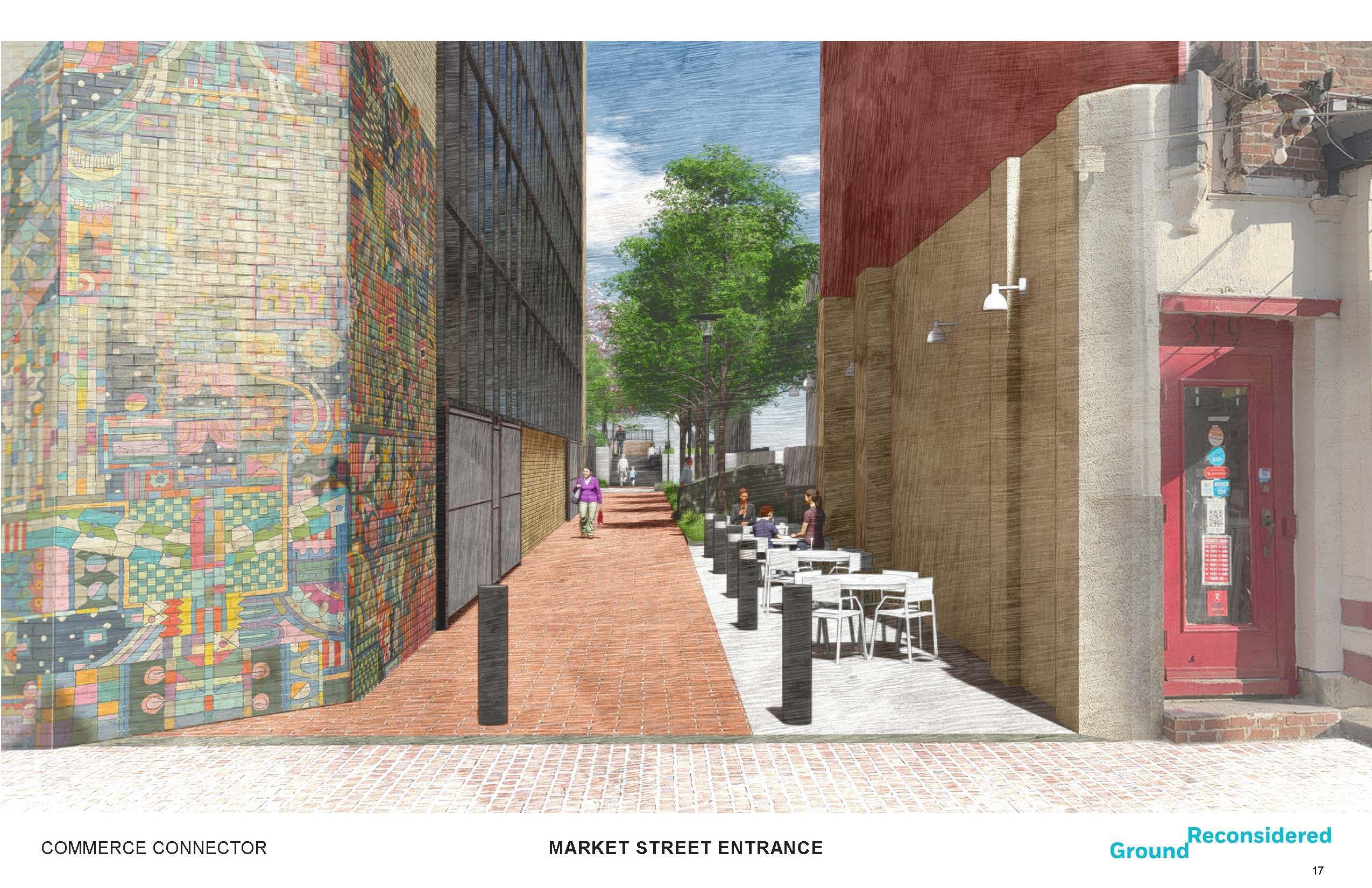
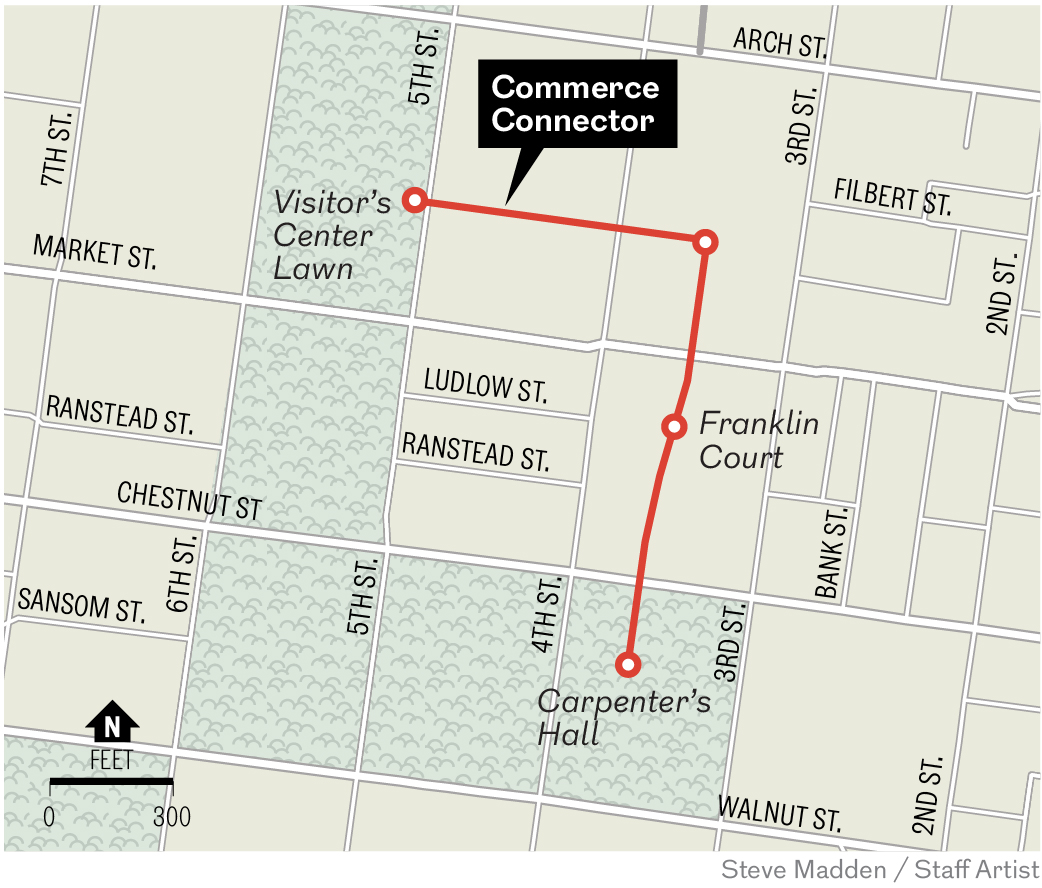
The roughly 2,000-foot-long Commerce Street foot path will lead travelers from the edge of the visitor center’s lawn at Fifth Street, east across Market Street, and onto Commerce Street, now an unmarked alley that runs parallel to Market Street. From there, they will continue east before turning right onto another alley, which leads to Market Street.
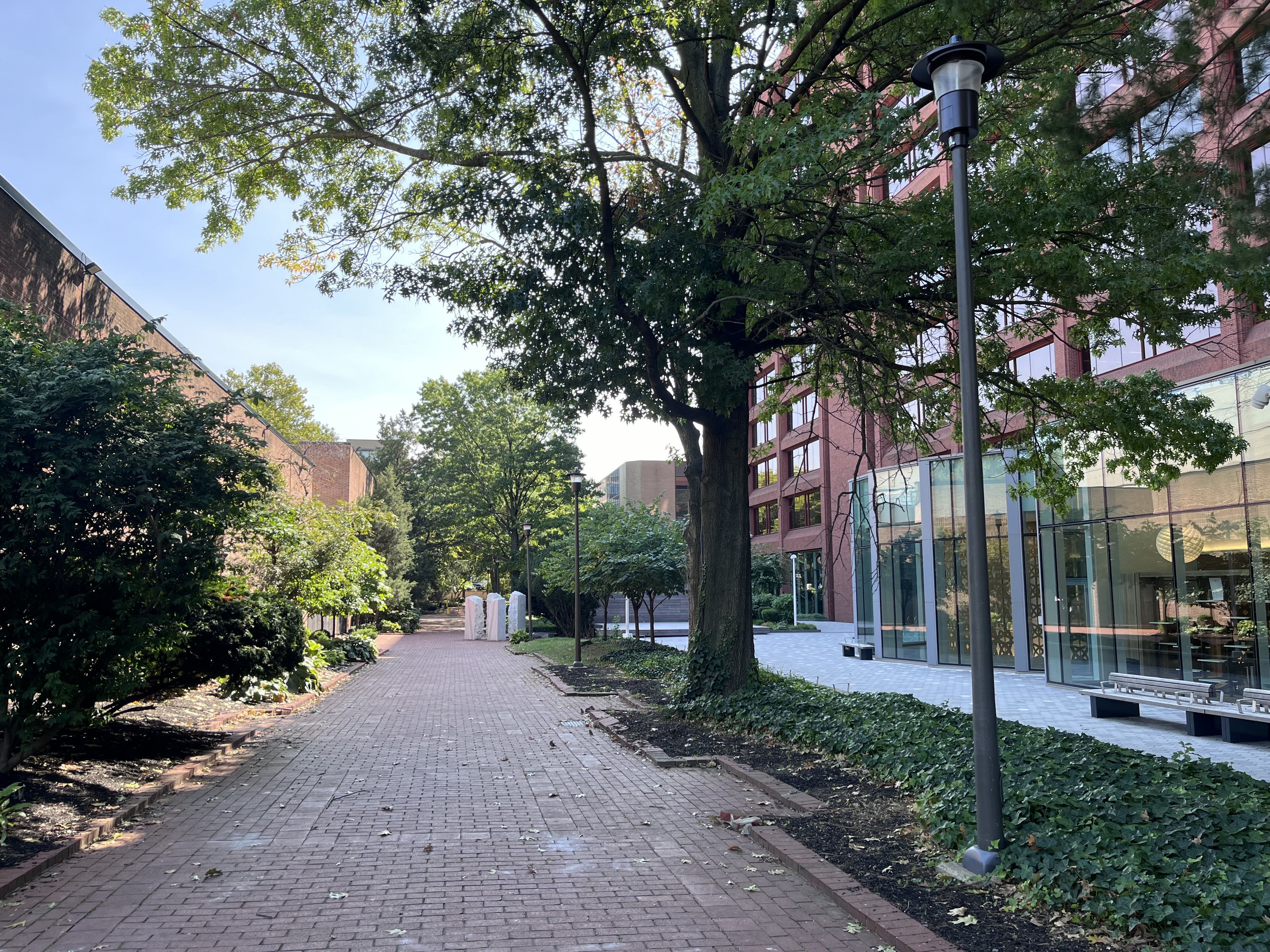
A 2024 view of Commerce Street, an alley that starts on Fifth Street, midway between Arch and Market Streets. Commerce Street would become a way to connect Independence Visitor Center with Carpenters Hall under a plan led by Independence Historical Trust.
After crossing Market, they will cut through Franklin Court, cross Chestnut Street, and arrive at Carpenters Hall.
Once at the hall, visitors can branch out into the wider Independence National Historical Park and other notable areas.
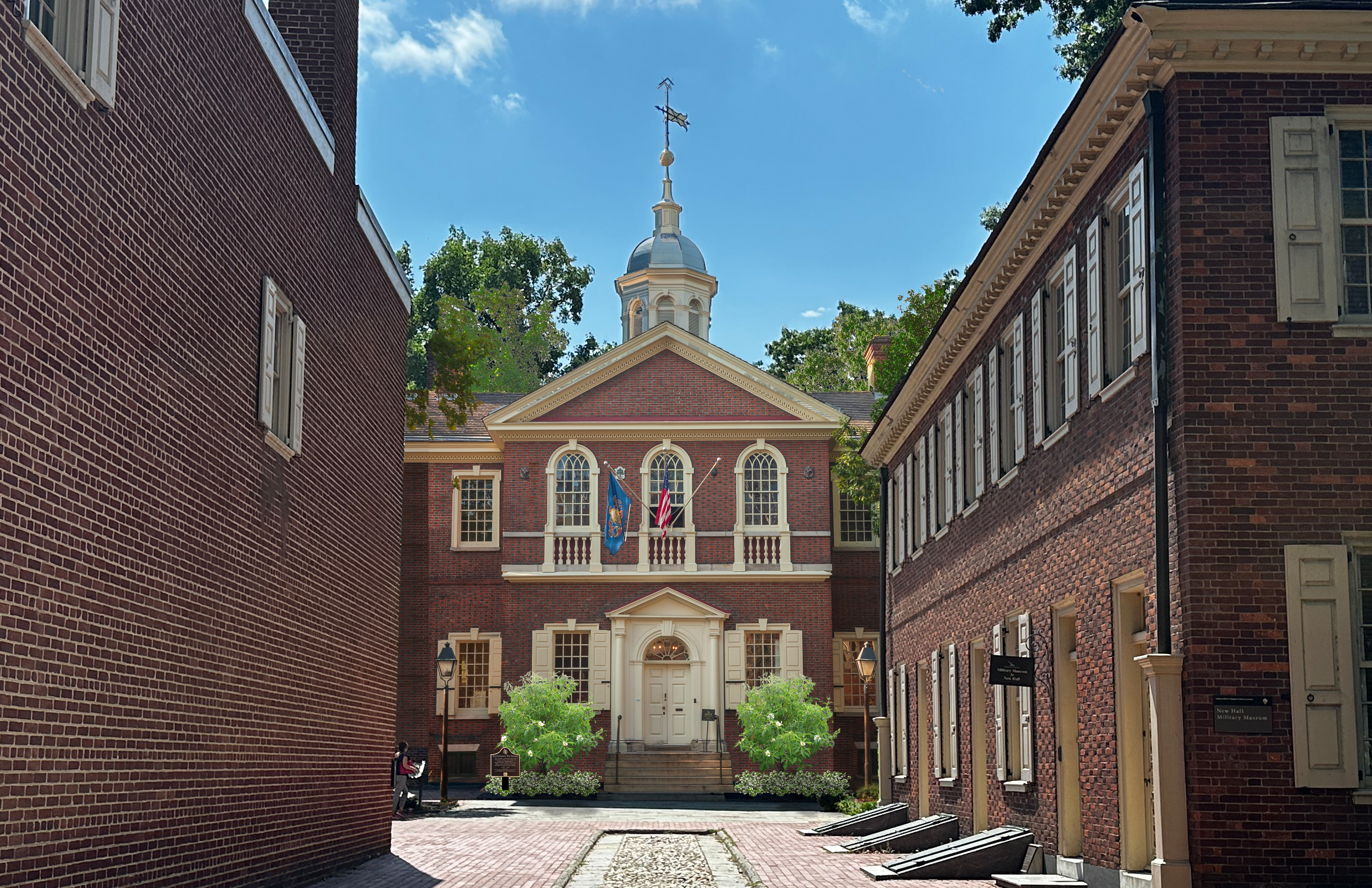
Officials emphasize that the connector will deliver a mostly traffic‑free passage to Carpenters Hall in time for an anticipated surge in tourism tied to the 250th anniversary of the Declaration of Independence. Carpenters Hall was the site of the first Continental Congress in 1774.
A rendering of a new connector walking path being built in Old City.Commerce Connector pedestrian route through Old City.
Other enhancements
Officials say existing paving, benches, lighting, and plantings are all in poor condition.
The redesigned corridor will get new furnishings, better lighting for security, ornamental trees and bushes, and other enhancements to make it more inviting. It would include a “gathering area” and new entrances.
To slow traffic for pedestrians, a speed bump mid-block on Fifth Street would connect Independence Visitor Center and the alley. Another mid-block bump on Fourth Street would help pedestrians cross Market Street to Franklin Court.
Fourth Street would get a bike lane.
New signs would note area history.
The path would also help connect people to Christ Church Burial Ground, Commodore Uriah Phillips Levy Park, and the Faith and Liberty Discovery Center.
Construction is expected to be complete before July Fourth, ahead of the nation’s Semiquincentennial.
Carpenters Hall.
“The Commerce Connector reflects our commitment to making Old City safer and easier to navigate for everyone,” said City Councilmember Mark Squilla, who helped secure funding.
Job Itzkowitz, executive director of Old City District, said the connector “strengthens the backbone of Old City by transforming an underused passageway into a vibrant, welcoming public space” that will make it easier for residents and tourists to move between iconic city sites.
Old City Green launched the early planning efforts for the corridor and will continue to help maintain the path.
“By introducing new plantings, shade, and thoughtfully designed landscape elements, we’re creating a greener and more accessible environment for everyone who walks through this historic neighborhood,” said Joe Schiavo, vice president of Old City Green.
Residential waste, construction and demolition debris, as well as sewage treatment plant sludge, were dumped for decades at the 30-acre Boyertown Sanitary Landfill in northern Montgomery County until it was capped in 1987.
As state and federal officials mull whether to add the landfill to the national Superfund list, a well used by nearby Gilbertsville Elementary School has tested positive for human-made polyfluoroalkyl substances, known as PFAS.
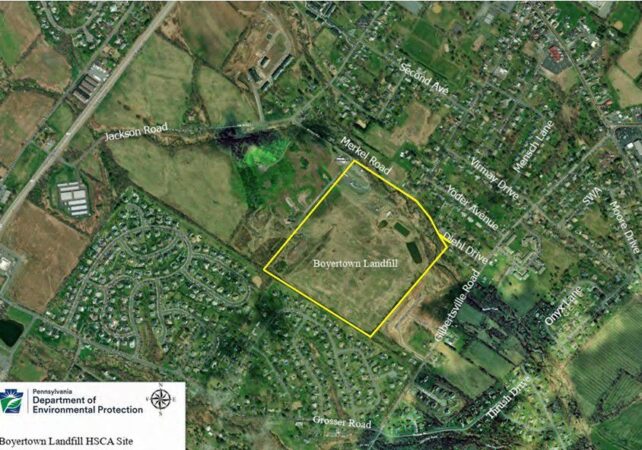
The school is about 3,000 feet from the landfill property border and is within the Boyertown Area School District. Minister Creek passes through the property, and two residential neighborhoods are nearby.
Scott Davidheiser, the district’s superintendent, sent a letter to staff and students’ families Monday alerting them to the test results, which were made known during a Pennsylvania Department of Environmental Protection (DEP) public information session on the landfill on Dec. 10.
Gilbertsville Elementary tested at an annual average of 6.7 parts per trillion (ppt) for PFAS. That falls under acceptable limits by current state standards of 14 ppt.
However, it would exceed federal maximum contaminant level standards of 4 ppt set to go into effect in 2031 if not addressed.
Davidheiser’s letter said the district “remains committed to safety in all areas, including water safety.” The districthas hired Suburban Water Technology Inc. to develop a water safety planto lower annual average PFAS levels to within federal standards.
District officials plan in January to discuss a plan to lower the levels.
<iframe title="Boyertown Sanitary Landfill and PFAS contamination" aria-label="Locator map" id="datawrapper-chart-1kgam" src="https://datawrapper.dwcdn.net/1kgam/1/" scrolling="no" frameborder="0" style="width: 0; min-width: 100% !important; border: none;" height="581" data-window.addEventListener(“message”,function(a){if(void 0!==a.data[“datawrapper-height”]){var e=document.querySelectorAll(“iframe”);for(var t in a.data[“datawrapper-height”])for(var r,i=0;r=e[i];i++)if(r.contentWindow===a.source){var d=a.data[“datawrapper-height”][t]+”px”;r.style.height=d}}});
What are PFAS?
PFAS are a group of chemicals manufactured by industry for use in consumer products since the 1940s. There are thousands of different PFAS, some of which have been more widely used and studied than others.
Exposure to them hasbeen shown to impact the health of humans and lab animals, but the extent is still being studied.
Standards for maximum acceptable levels of the compounds in drinking water have created confusion in recent years.
The EPA was slow to set standards, so states began setting their own. Pennsylvania set different levels to start in 2024 for various types of PFAS:14 ppt forperfluorooctanoic acid (PFOA) and 18 ppt for perfluorooctane sulfonic acid (PFOS).
However, the EPA, under the Biden administration, then set the first federal standards, which would supersede state standards. The rule said that PFOA and PFOS can’t exceed 4 ppt. And, it set standards for other compounds within the PFAS family. The regulations were set to go into effect in 2027.
However, the EPA, under the Trump administration, rolled back some provisions by announcing it would keep the standards for PFOA and PFOS, but delay enforcement until 2031. And, it said it would reconsider the limits on the other compounds.
As a result, the PFAS level at Gilbertsville Elementary School’s current level would exceed the federal level if not brought down by 2031.
What’s the Boyertown Landfill?
Officials with the state Department of Environmental Protection and U.S. Environmental Protection Agency have been deciding since 2023 whether the Boyertown Landfill, in Douglass Township, should be named a Superfund site after test samples showed PFAS in nearby private wells.
The landfill and surrounding property are owned by the Boyertown Sanitary Disposal Co. It is set on a wider 60-acre parcel at 300 Merkel Roadin Gilbertsville. The property contains raw and pretreated leachate storage lagoons, buildings housing leachate pretreatment facilities, and stormwater management basins and swales.
The unlined landfill stopped accepting solid waste in 1985. It had accepted municipal waste, office trash, and construction debris. It took in significant amounts of municipal sewage treatment plant sludge and industrial waste.
In last week’s informational session, the DEP said water sampling around the area of the landfill in 2024 and 2025 showed multiple locations containing various PFAS compounds.
State officials said they have installed carbon-activated filtration systems in residential wells within a half-mile of the landfill that tested above 4 ppt, according to an account of the meeting in Pottstown’s local newspaper, The Mercury.
The newspaper reported that the DEP, however, will not provide similar assistance to Gilbertsville Elementary School because it is part of a small public water system and is required to remediate contamination.