Author: Ariana Perez-Castells

  • Philadelphia Whole Foods workers filed for a union a year ago. Here’s what’s holding up their contract.

    Philadelphia Whole Foods workers filed for a union a year ago. Here’s what’s holding up their contract.

    Nearly a year after Philadelphia Whole Foods workers voted to form a union, becoming the first group in the grocery chain to do so, their union’s ability to move forward and negotiate a contract is locked in a procedural standstill.

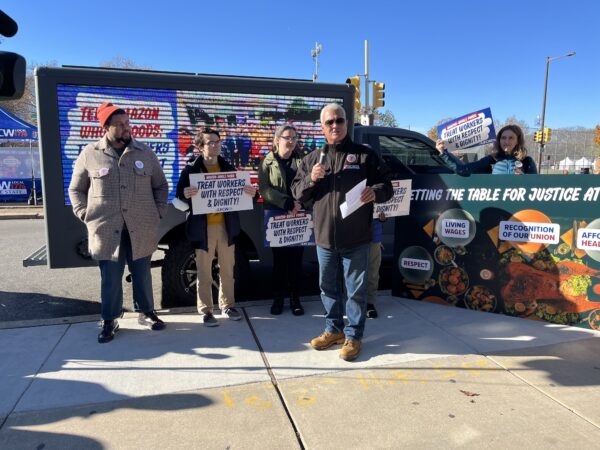
    The Monday before Thanksgiving, workers and supporters gathered outside the Pennsylvania Avenue store, holding signs that read “Amazon-Whole Foods: Treat workers with respect & dignity!” Nearby, an inflatable “fat cat,” used by labor organizers and often denoting a person who uses wealth to exert power, stood tall outside the Whole Foods store.

    Edward Dupree, who has been employed at Whole Foods for over nine years and works in the produce department at the Philadelphia store, told the crowd that in the 1970s, unionized grocery employees could maintain a middle-class family, but today workers are facing rising housing and healthcare costs as well as uncertainty in the economy.

    “There’s been a concerted effort by billionaire business class — folks like [Amazon and Whole Foods owner] Jeff Bezos — to crush working class power by fighting unions like this,” said Dupree. “For 50 years, we’ve seen the worsening of living standards in tandem with the drop of unionization rates. It’s been long due for us to stand up for one another and fight back for a better future.”

    Workers at the Philadelphia grocery store filed a petition to unionize with the National Labor Relations Board in November 2024 and made history in January as the first company store to successfully vote to unionize.

    Employees want the company to begin negotiating a first contract, but for now, the case is at a standstill. Whole Foods has challenged the union election, and resolution of the issue lies with the National Labor Relations Board, which for months has been without the required quorum to make a decision since President Donald Trump fired a board member.

    “We want Whole Foods to do what they’re obligated to do. What’s right to do is sit down and bargain a contract,” said Wendell Young IV, president of UFCW Local 1776, the union that Whole Foods workers elected to join. “We understand there’s a give and take in that process, but that’s from both sides. They’re refusing to even sit down and begin those discussions for a contract.”
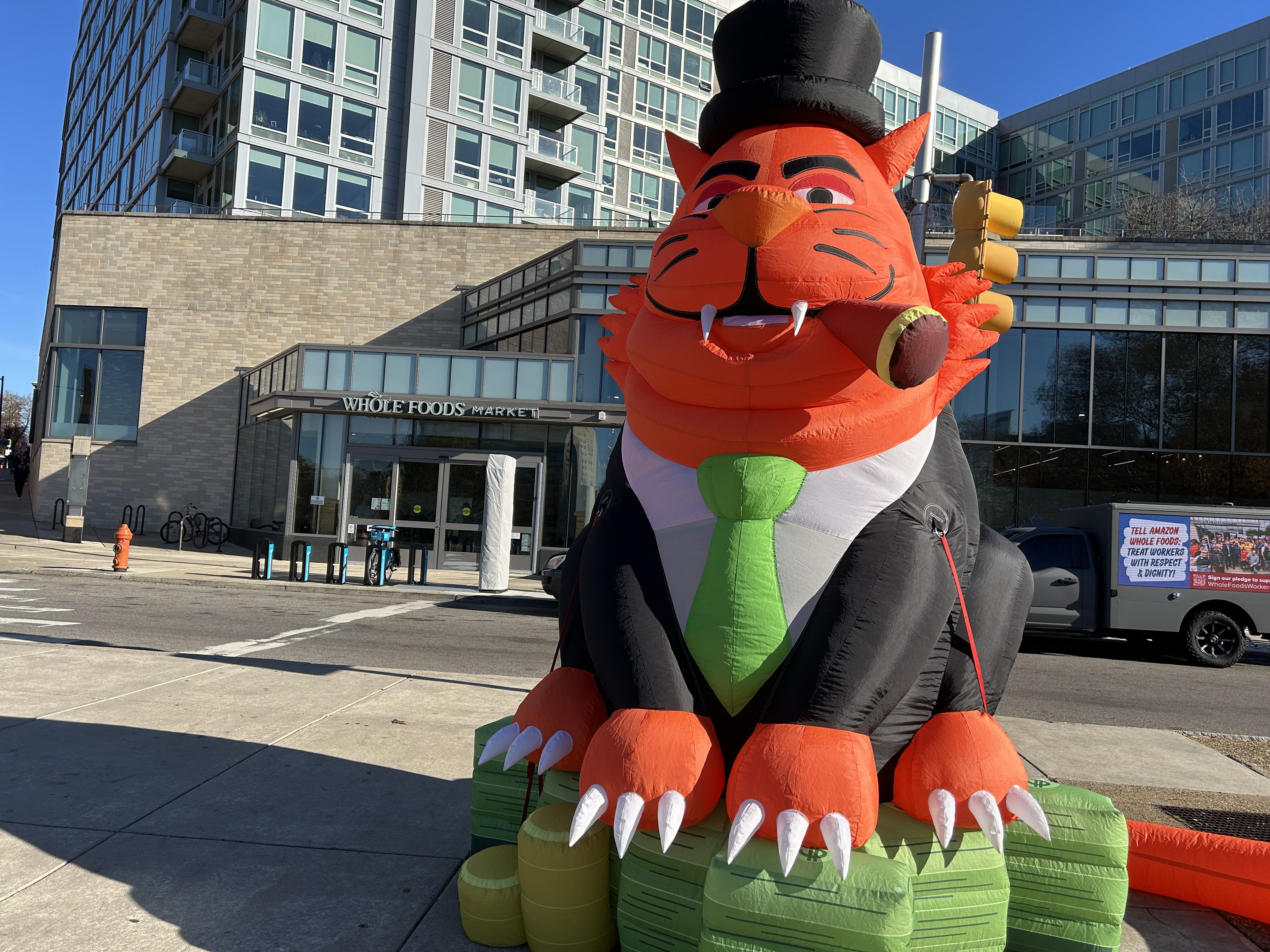
    An inflatable fat cat is seen outside the Whole Foods at 2101 Pennsylvania Ave. on Nov. 24, marking a year since workers first filed their intention to form a union with the National Labor Relations Board.

    Why is the Whole Foods case at a standstill?

    Whole Foods raised multiple objections to the worker union election earlier this year including alleging that the union promised employees would get a 30% raise if they voted for a union.

    In May, the National Labor Relations Board’s regional director dismissed the challenge by Whole Foods, but the company asked for that decision to be reviewed. The union, for its part, has tried to block that review, but the board can’t make a decision either way without the required quorum.

    “As previously stated, we strongly disagree with the regional director’s conclusion, and as demonstrated throughout the hearing earlier this year, including with firsthand testimony from various witnesses, the UFCW 1776 illegally interfered with our team members’ right to a fair vote at our Philly Center City store,” a spokesperson for Whole Foods Market said via email.

    A union spokesperson said via email that they must wait until the board again has at least three members to review the case and added, “We expect that we will be successful at that time.”

    Young, the president of the union local, has said in the meantime that the company is hiding behind the situation at the NLRB “to refuse to bargain.”
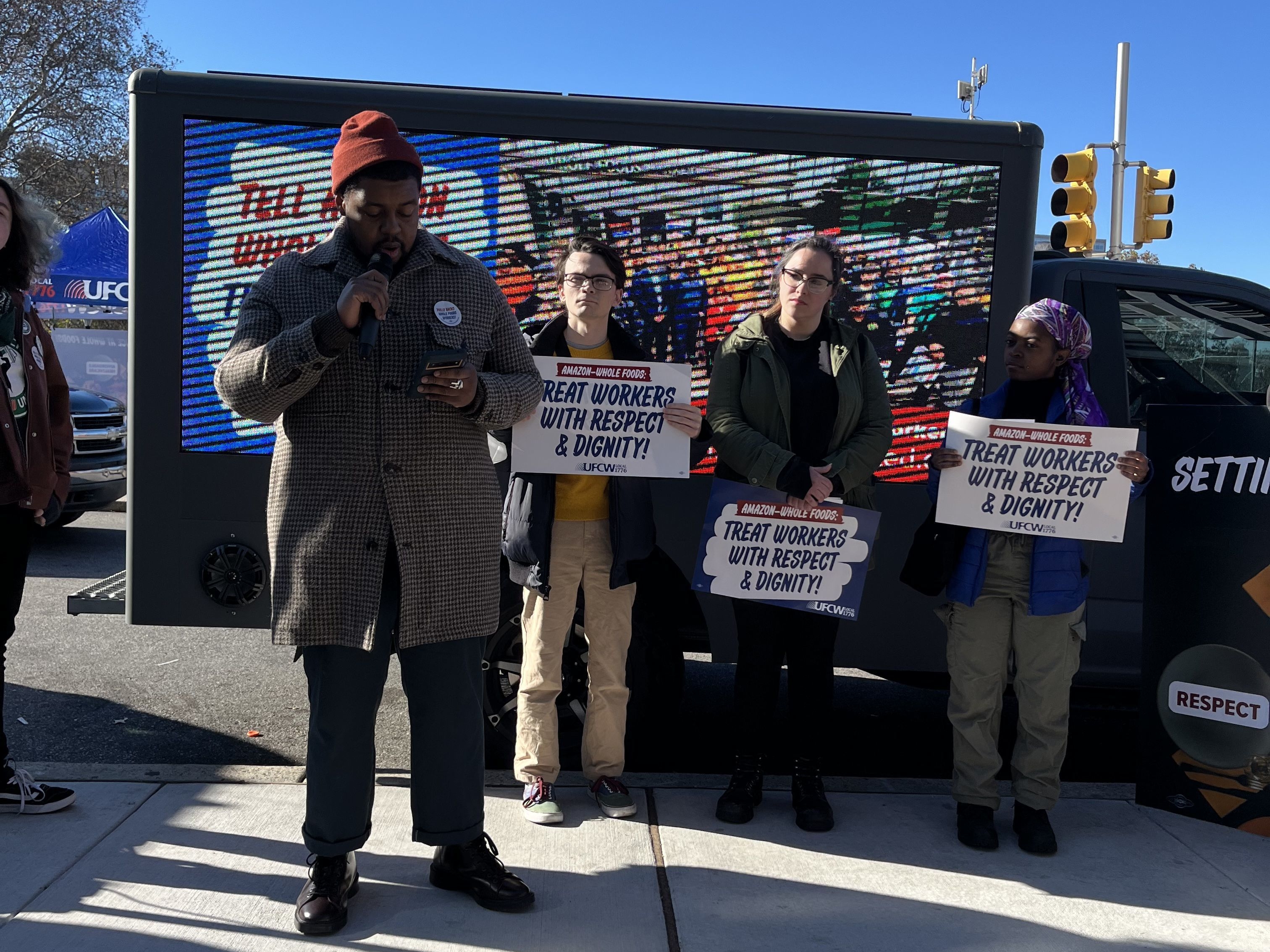
    Edward Dupree, a Whole Foods worker, gathers with colleagues and supporters outside on Nov. 24 asking that the company come to the bargaining table and negotiate a first contract.

    In the 1960s and into the 1970s, when it was not uncommon in the U.S. to see grocery workers strike or threaten to, Republicans and Democrats in office understood that unions were a permanent part of the economy, said Francis Ryan, a labor history professor at Rutgers University who has been a member of UFCW local 1776. The NLRB “provided some balance between the company and the union,” acknowledging that both parties “had an important role to play in our society,” he said.

    “What we have in more recent years is a much more polarized political context, where the National Labor Relations Board is sometimes stocked with people who are aggressively anti-union,” said Ryan.

    The Trump administration firing an official at the NLRB and not replacing them “is a deliberate attempt to make the process of collective bargaining and also organizing much more difficult,” said Ryan, adding that this is playing out in the case of Whole Foods.
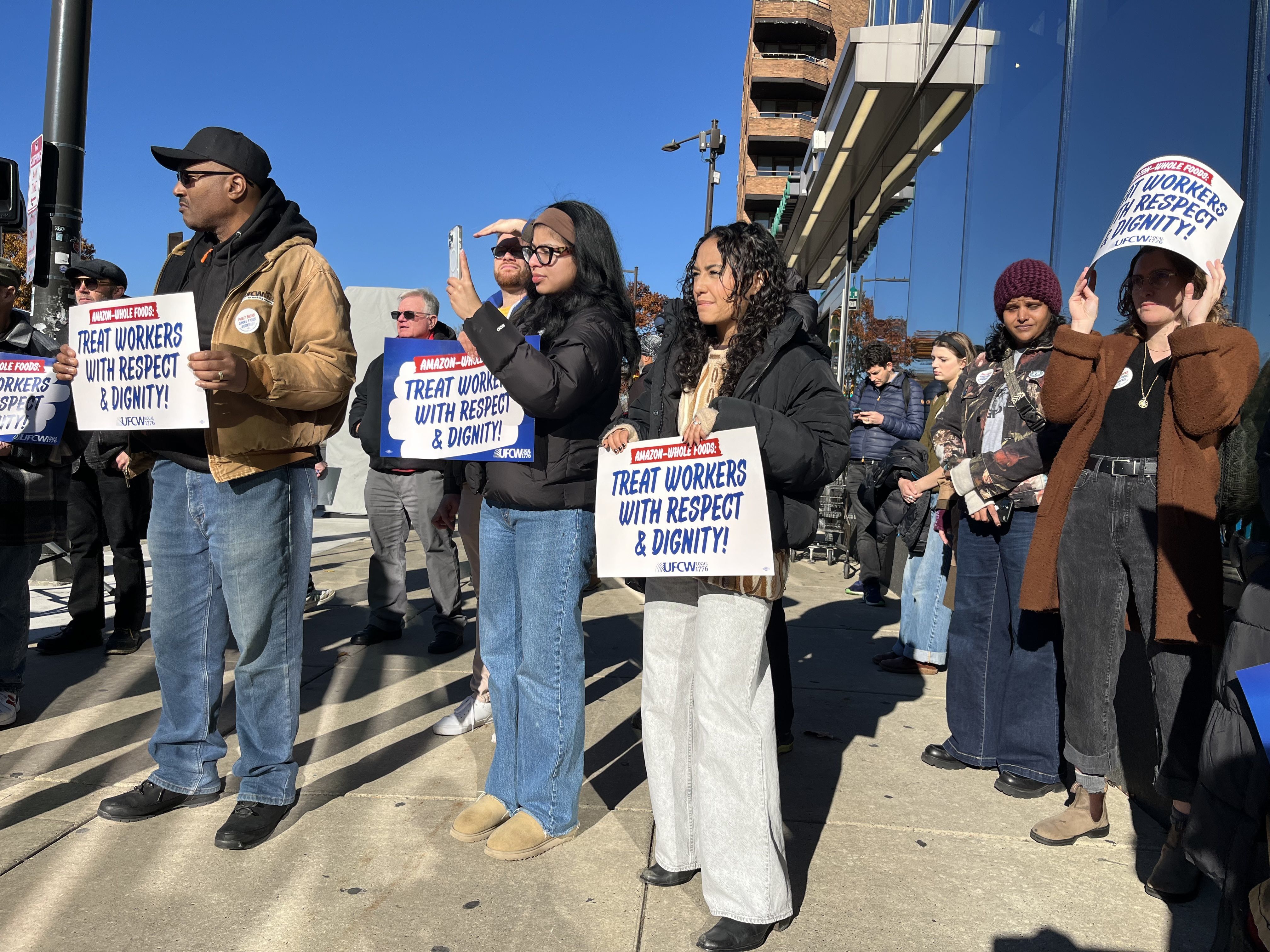
    Whole Foods workers and supporters outside the Center City grocery store on Nov. 24.

    UFCW Local 1776, which Whole Foods workers in Philadelphia elected to join, represents thousands of workers across Pennsylvania and neighboring states in drugstores and food processing facilities, among other areas of work. The union represents grocery employees at ShopRite, Acme, and the Fresh Grocer.

    Under the ownership of Amazon, the quality of work life at Whole Foods has deteriorated, said Young, adding that the company has unrealistic expectations and doesn’t compensate workers fairly in terms of wages, healthcare, retirement security.

    “These people have no say in any of that — and that’s what led them to organize,” he said.

    Whole Foods has said employee benefits include 20% off in-store items, as well as a 401(k) plan that offers a company match. The company also says it evaluates wages to ensure it is offering a competitive rate.

    The number of unionized workers at grocery stores grew in the 1950s and 1960s in large part because areas of the U.S. were becoming more suburban and adding new grocery stores in the process, according to Ryan.

    “You had thousands of workers in these new supermarkets that were unionized, and they made the retail clerks union one of the largest unions in the United States by the time you get to the 1970s — and Philadelphia was one of the real centers of supermarket unionization.”

    It wasn’t unusual in the 1960s and 1970s for someone to make a living as a supermarket worker, although it was not uncommon for workers to have more than one job, said Ryan. In some cases, workers would stay at a grocery store for decades, he says, where they made decent wages and had a stable job indoors, adding that between 1965 and 1975 the wages of retail workers in Philadelphia nearly doubled.

    Since then, it’s become much harder to make a living overall in the service industry, says Ryan.

    But having unionized grocery stores amid other nonunion stores today can help shape the economy of the industry, says Ryan. A business that wants to maintain a nonunionized workforce might try to pay their workers the same starting rate that union workers make in wages, for example.

    Unionized grocery stores “have a hidden-planet kind of role: They have this gravitational pull on the industry that actually raises conditions for everyone,” Ryan said.

    While the Whole Foods store in Philadelphia is the first of the company’s locations to vote to form a union, others seem to be following.

    “We now have active organizing going on, not only in other Whole Food stores in the area and around the country, but other grocery stores,” said Young.


  • Nobody likes rejection. Here’s how to soften the blow, per a new Temple study.

    Nobody likes rejection. Here’s how to soften the blow, per a new Temple study.

    Not all rejections are the same.

    How they’re communicated matters, according to a recent study by Sunil Wattal, associate dean of research and doctoral programs at Temple University’s Fox School of Business.

    Wattal found that users of an online forum, Stack Overflow, were more likely to return after their submissions were rejected if they had received a detailed reason for their rejection.

    Stack Overflow has been known for “treating its contributors harshly” because of its “rigorous quality control,” the study said, but in 2013, its rejection notice language changed to be more explanatory. Wattal compared the before and after and found that new users were more likely to return when they knew more about why their submission was rejected.

    Wattal’s findings were recently published in the study “Not Good Enough, but Try Again! The Impact of Improved Rejection Communications on Contributor Retention and Performance in Open Knowledge Collaboration.” The coauthor of the study is Aleksi Aaltonen of the Stevens Institute of Technology in Hoboken.

    While Wattal’s study focused on rejection in one online platform, he says the findings could apply in many other settings. The Inquirer spoke with him about the implications for rejection in the workplace. The conversation has been edited for length and clarity.

    What was your main finding?

    We found overall that the platform was better off — that Stack Overflow is better off — because it increased the quantity of the postings but did not decrease the quality. So there was no significant impact on the quality of posting. The net effect is the platform gained more content without really losing any quality.

    So you found that people returned more often if they were told why they were being rejected.

    Yes, the likelihood of returning was much higher if they were told more clearly why they were being rejected.

    Obviously nobody likes rejection, but sometimes, if they feel that they know the reason why it was rejected and they get a sense that they were being treated fairly, I think that kind of softens the blow in a way.

    What can your findings tell us about communicating rejection in the workplace, such as not getting hired or getting laid off?

    You see rejection in all kinds of different applications — in business, in society. Rejections are everywhere.

    E-commerce sites like Amazon, Etsy, eBay, every now and then, they encounter a product which doesn’t comply with either the ethical standards or for some other reason, and they have to take down some of those listings. Or even in companies, somebody thinks they come with a great idea, and their boss just says, No, this is not great.

    Even in those cases, I think it really helps if you give them an explanation of why their idea was rejected, and it encourages them to come back in the future and still be engaged with either the organization or the website.

    In customer service, sometimes people have to hear a “no,” that their complaint isn’t legitimate, or they’re not getting that refund. In those cases, communicating well and giving a more informative explanation of why they’re being denied is always a good idea.

    In your study with Stack Overflow, that platform wants users to keep coming back to the website to contribute to the online forum, so there’s a vested interest in sending a rejection notice that would get people to return. In business, what kind of incentive does an employer have to explain a rejection?

    In the case of, say, for example, job postings, maybe that applicant was not a good fit with that particular posting, but they could still be valuable to the company in a different role.

    It’s not a good idea, basically, to burn bridges, and it doesn’t cost a whole lot to be nice or to give a decent explanation. In terms of the cost-benefit analysis even, it’s always a good idea to give a more informative explanation just to maintain the relationship.

    Does it matter whether it’s a human that’s delivering a rejection notice, versus a computer or automated response, in terms of the outcome?

    There’s a lot of work going on right now about exactly these things, like: How do people feel about interacting with computers when computers make decisions that affect their lives in some way? I’m not sure exactly if anybody has studied rejections by computers, but I would expect that there would be some difference in the way people take rejection from humans versus computers.

    Some companies use applicant tracking systems for hiring, which screen applicants and filter candidates out. And we know that some applicants never hear back about their application. Can your study tell us anything about the effect of ghosting?

    Especially in some cases where companies receive tens of thousands of applications [for just a few open roles], probably, from a very myopic perspective, they don’t care about a lot of them. But again, from an overall brand perspective, it doesn’t take a whole lot to send out that rejection in a timely way, in a way that seems fair, to explain why it was rejected — maybe there were other better applicants, or it was not the right fit. People want to know so that they can maybe improve in the future.

  • Trail project planned near King of Prussia Mall gets new funding

    Trail project planned near King of Prussia Mall gets new funding

    A trail planned in Montgomery County is getting new funding to take the project to the next step.

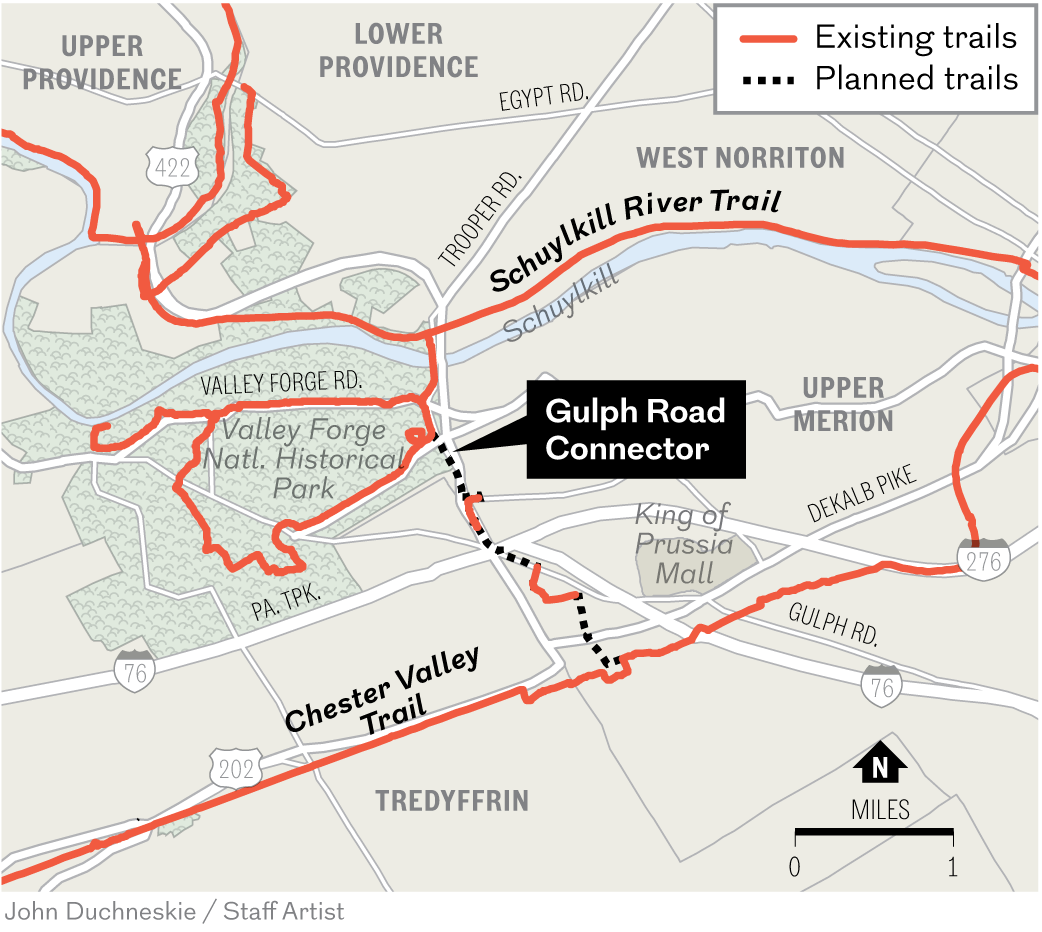
    The “Gulph Road Connector,” as it is currently called, is slated to connect to the Chester Valley Trail near the King of Prussia Mall, cross through Valley Forge National Historical Park, and link with the Schuylkill River Trail when completed.

    The project was recently awarded a three-year $326,900 grant from the William Penn Foundation, which will begin in January, said Eric Goldstein, president and CEO of the King of Prussia District, which is leading the project. The official name of the trail has not been determined.

    The influx of funds is slated for education, advocacy, and marketing, said Goldstein, who noted that the foundation is supporting “efforts to build a coalition of advocates” for the trail. The money will not be used for design or construction.

    Segments of the planned 2.8-mile trail connector are in stages of design and construction, with some already built, Goldstein said.

    “What we’re trying to do is ultimately fill in the blanks to make the 2.8-mile section complete,” he said.

    Goldstein said the new funds will allow the King of Prussia District to work with different partners along the trail. The aim is to build a coalition and raise awareness of the proposed trail, which ideally would lead to more grant money down the line for design and construction, he said.

    Map of the planned Gulph Road Connector trial near King of Prussia.

    The new funding is “the impetus for this trail to start moving toward completion,” said Molly Duffy, executive director of the Valley Forge Park Alliance, a partner organization in the trail’s development.

    There is no estimate yet for the total cost of the project, Goldstein said.

    The project is part of the Circuit Trails, a regional network that aims to have more than 850 miles of trails through nine counties. Once the trail is built out, Goldstein said, he expects it will be managed by multiple entities, depending on the section.

    He hopes to be able to complete the trail in the next 10 years.

    Some parts of the trail are “enormously complex,” he noted, adding that pedestrian bridges over sections of highway would require complex engineering and be costly — which requires raising funds.

    While the trail is expected to be used for recreation, it could also be an option for commuting to work.

    “The second audience of this proposed trail network is employees that work in Upper Merion Township that are seeking alternative modes of transportation to get to and from work,” he said.

    The trail also could make Valley Forge National Historical Park more accessible by ways other than driving, Duffy said.

    “We want people to be able to get here,” Duffy said. “Knowing where this is — in this super densely populated suburban area — we know that there’s this missing link, really, between these two major trails that, once built, will literally connect thousands and thousands of people who live in the area, work in the area, are visiting the area.”

  • Thousands of Penn graduate student workers could soon strike

    Thousands of Penn graduate student workers could soon strike

    Graduate student workers at the University of Pennsylvania have voted to strike if their union calls for it, as they work toward a first contract with better pay and benefits.

    The graduate students, who research and teach at the university, voted to unionize last year, after two decades of organizing attempts.

    The union’s total membership is about 3,400, and 2,416 participated in the strike vote. Of them, 92% voted in favor of calling a strike if needed to reach an agreement.

    “As the city of Philadelphia’s largest employer and a world-class research institution, Penn must do better by the workers that ensure its continued success,” Katelyn Friedline, a bargaining committee member and Ph.D. student, said at a news conference earlier this month.

    The union, Graduate Employees Together-University of Pennsylvania (GET-UP) is part of the United Auto Workers (UAW), which represents groups of university workers across the country, including Penn postdoctoral researchers and research associates who voted to unionize in July.

    The strike vote comes amid a wave of labor actions across Penn and other campuses. During contract negotiations in 2023, Temple University graduate workers went on strike for 42 days. The same year, Rutgers University educators, researchers, and clinicians walked off the job for a week.

    Since 2023, resident assistants at Penn, Temple, Drexel University, and Swarthmore College have also unionized. This month, graduate student workers also voted to form a union at Pennsylvania State University.

    GET-UP has been bargaining with Penn since October 2024, but sticking points include wages, healthcare coverage, and more support for international student workers.

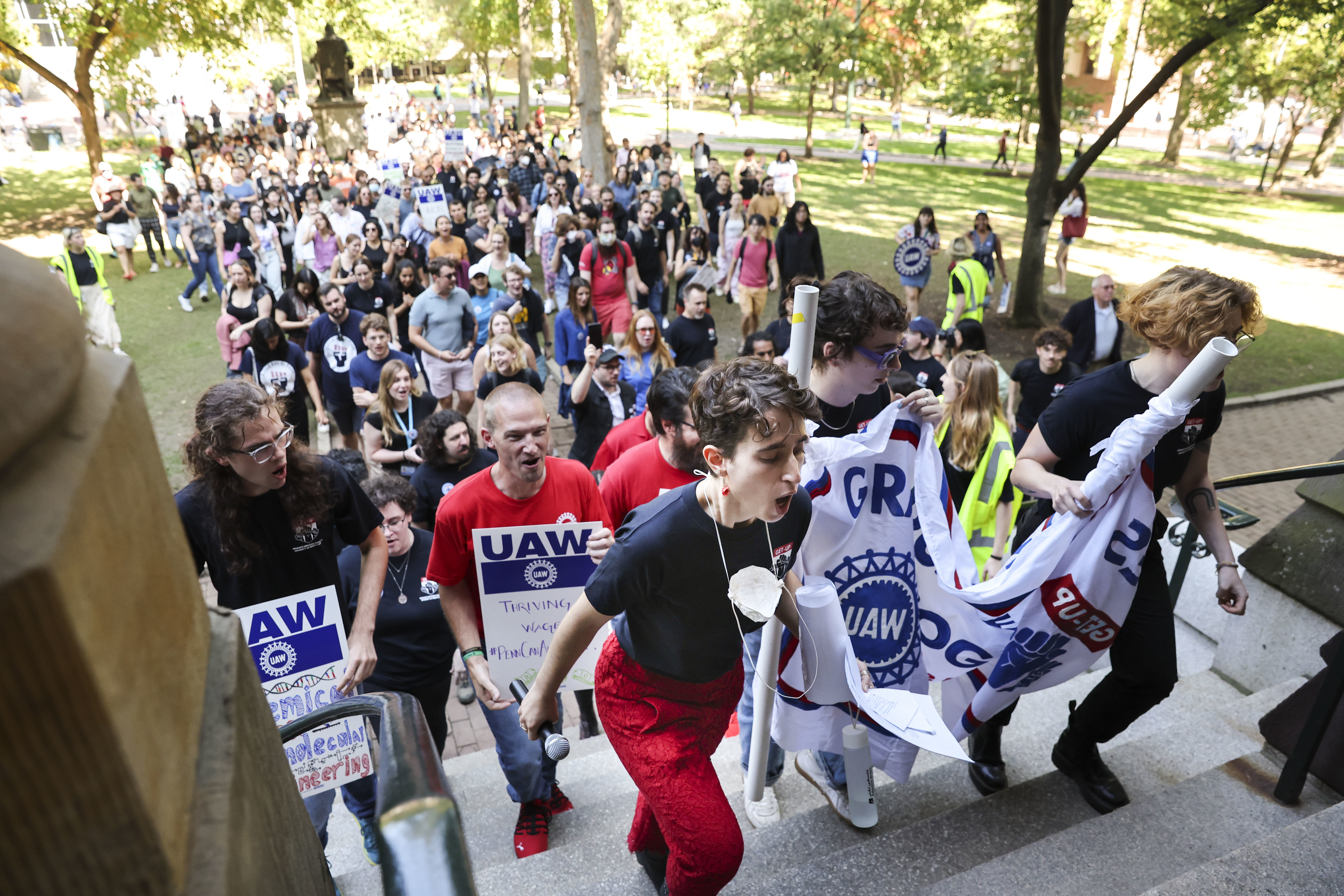
    Hilah Kohen, a Ph.D. student in comparative literature, and hundreds of supporters march into College Hall during a GET-UP rally in October 2023.

    A strike would be disruptive, said Sam Schirvar, a Ph.D. candidate in history and sociology of science, and would be a “last resort” for the union.

    “A work stoppage would really inhibit the basic teaching and research functions of Penn, and would make it very difficult for it to operate as it does as an academic institution,” said Schirvar, who has been organizing with the union for over five years.

    A university spokesperson, Ron Ozio, said via email on Thursday that Penn has been bargaining in good faith with the union.

    “We believe that a fair contract for the union and Penn can be achieved without a work stoppage, but we are prepared in the event that the union membership votes to authorize a strike,” said Ozio.

    What are graduate workers asking for?

    “There’s still a lot of room between the kinds of things that we’re calling for and the kinds of things that management is proposing,” said Schirvar.

    Wages

    The majority of the bargaining unit is made up of Ph.D. students who are paid an annual stipend, while workers pursuing master’s degrees receive hourly pay.

    Stipend workers make a minimum of about $39,000 annually, and hourly workers have no university minimum, Schirvar said.

    In its most recent proposal, the university offered $19 an hour for hourly employees and a minimum of $44,000 for the annual stipend starting in July 2026. The union is asking for a minimum wage of $37 an hour for those paid hourly and $55,500 for those on an annual stipend upon ratification of the contract.

    “While we’re asking for these things because it would make meaningful and life changing differences in our own individual lives, it also helps keep Penn a competitive, world-class institution,” said Friedline.

    Healthcare improvements

    The union is asking for the university to cover the full cost of health insurance for graduate student workers including dental, vision, and dependent coverage. The university already pays full healthcare benefits for graduate student workers, and some dental reimbursements depending on their department, said Friedline.

    Support for international students

    The union is also asking for more protections for international student workers on visas, who represent roughly a third of the bargaining unit, said Friedline. That support is important at this time, Friedline said, “amidst a national anti-immigrant political climate.”

    The union wants Penn to reimburse up to $3,000 of immigration expenses, bar immigration enforcement agents from entering nonpublic areas of campus unless legally required to, and alert the union if access is granted for a search or arrest warrant.

    Guruprerana Shadadi, a second-year Ph.D. student in the computer science department and an international graduate worker from India, said he had to cover the costs of moving to the U.S. before getting his first paycheck from the university, which included visa expenses.

    “I was lucky enough to be able to afford this, but I know several international graduate workers who found it extremely hard to go through this process,” he said. “Receiving a livable wage and higher stipends would go a long way for international students who literally have to start from zero to set up their lives here when they move to the United States.”

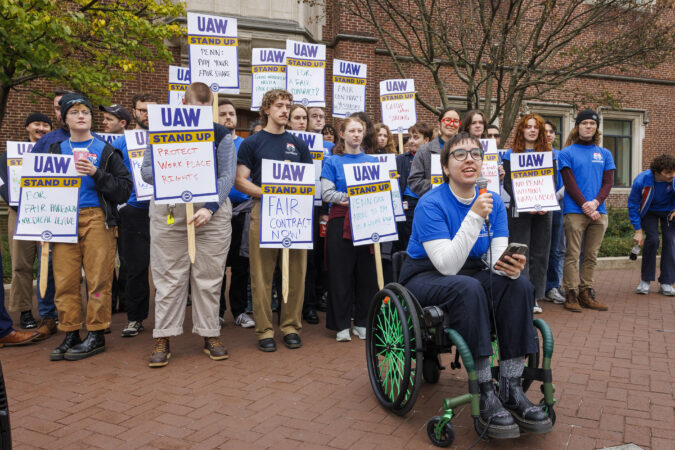
    University of Pennsylvania graduate students held a news conference and rally calling for a strike vote Nov. 3.

    Vacation days

    The union is asking for 20 paid vacation days and 20 sick days in a year. University leadership has said that this proposal exceeds what full-time staff get in their first few years. The university has proposed five paid days off per fiscal year and noted in a proposal that workers can “request flexibility in scheduling” when sick.

    Penn doesn’t currently have a centralized paid time-off policy for graduate student workers, and employees may be grading student work, preparing teaching materials, or working in a lab during the university’s academic breaks, said Schirvar.

    Why are graduate students organizing now?

    The academic job market has changed in recent decades, said Adrienne Eaton, a distinguished professor in the Rutgers School of Management and Labor Relations. In the past, graduate student workers might have been more willing to get paid less, knowing that time would ensure they could get good jobs later on.

    “You could kind of sacrifice those wages, that salary for a while, because you were pretty sure that when you finished, you were going to be able to get a tenure track job — and that just hasn’t been true, probably more like 20 years, depending on what field you’re in,” she said.

    Meanwhile, the cost of living has risen, said Eaton. “Those stipends that used to be kind of OK, I think, have gotten to be viewed as much more inadequate.”

    Whether or not Penn graduate workers actually strike, Eaton noted that passing a strike authorization vote typically sends a message.

    “It’s a leverage tool in bargaining to kind of let the employer know we’re serious about this, and you need to be serious about what you’re doing at the bargaining table,” she said.

  • Plymouth Meeting Mall slated to be sold to Philly developer

    Plymouth Meeting Mall slated to be sold to Philly developer

    The Plymouth Meeting Mall may soon change hands.

    The mall’s current owner, PREIT, plans to sell the property to LA Partners, previously known as Lubert Adler Real Estate Funds, PREIT leadership confirmed Thursday, noting that the sale is still pending. PREIT did not disclose the price of the sale.

    PREIT, which is based in Philadelphia, also sold the Exton Square Mall to Abrams Realty & Development in March. PREIT also owns the Cherry Hill and Moorestown Malls.

    LA Partners executive chairman Dean Adler told the Philadelphia Business Journal, which first reported on the pending sale, that he expects to invest over $100 million to redevelop the mall. Early plans include adding residences.

    PREIT CEO Jared Chupaila said in a statement that the sale reflects the company’s “commitment to disciplined balance sheet management and liquidity generation.”

    “We believe LA Partners is uniquely positioned to build on the multipurpose hub we have laid the groundwork for, which has long served as a central part of Plymouth Township and the surrounding communities,” said Chupaila.

    PREIT has faced financial challenges in recent years. The business has filed for bankruptcy twice since 2020, and most recently emerged from bankruptcy as a private company in 2024 helmed by a group of investment firms.

    The Plymouth Meeting Mall, for its part, has tried to undergo a makeover in the last few years, following the 2017 closure of its anchor, a 215,000 square-foot Macy’s. Amid PREIT’s plans to “diversify the tenant mix” at the mall, nearly half the tenants there were either dining or entertainment businesses in 2018.

    Lubert Adler’s other properties include the Bellevue in Center City, which recently underwent extensive renovations, and the Battery, a former power plant in Fishtown redeveloped into a multipurpose complex.

    A spokesperson for LA Partners did not immediately respond to a request for comment Thursday.

    Peter Abrams, managing partner for Elkins Park-based Abrams Realty & Development, said the Plymouth Meeting Mall site “is the best-located large parcel of real estate in the Delaware Valley.”

    “There’s a lot of dead and dying malls in this country, and some of us, like myself and Dean Adler, understand the opportunity and aren’t afraid of the challenges, which are many,” said Abrams, who is behind proposed development plans at the Exton Square Mall.

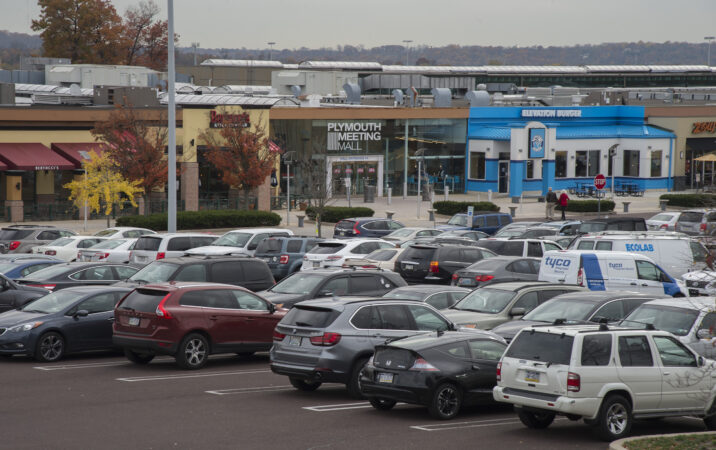
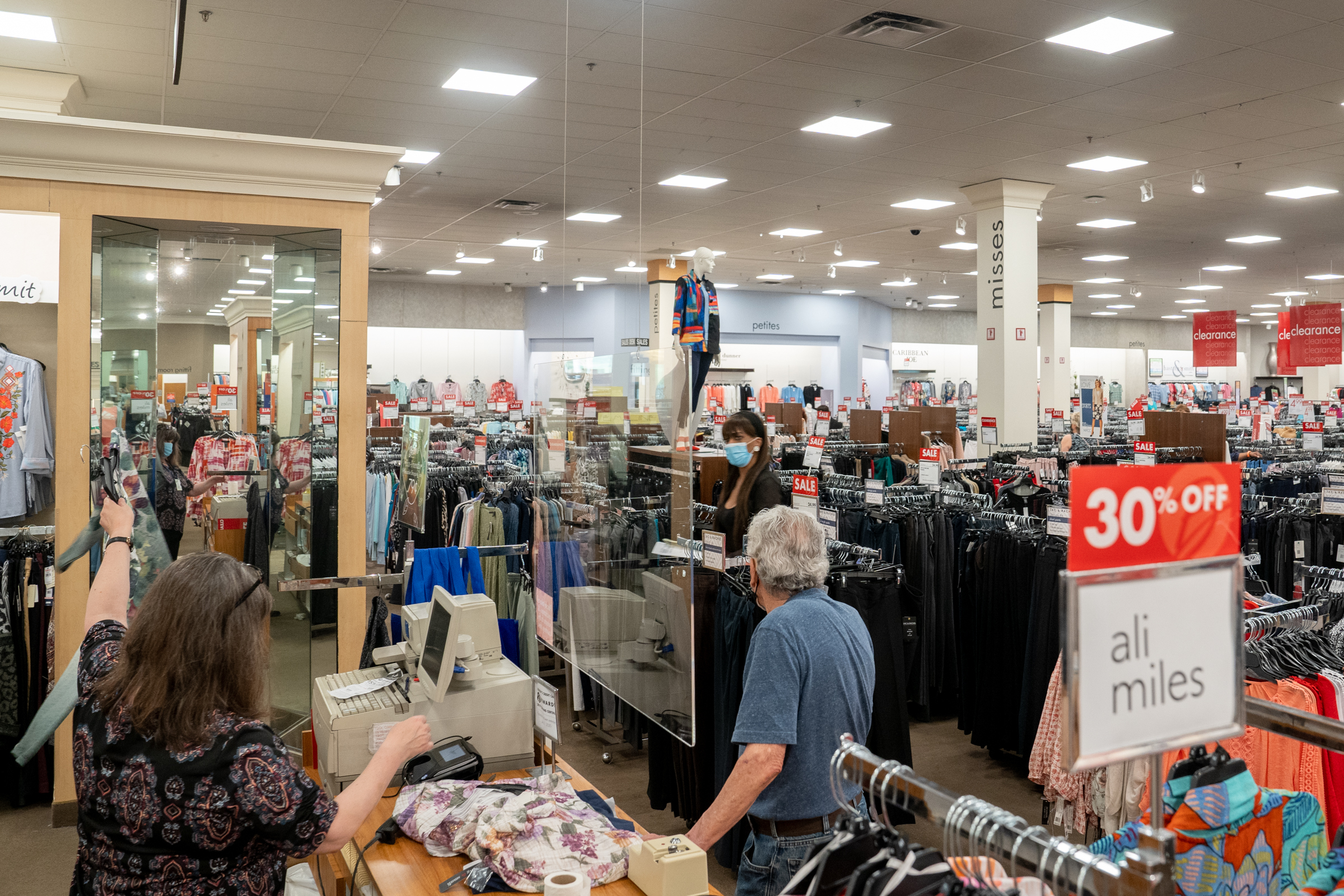
    Boscov’s at Plymouth Meeting Mall on June 6, 2020.

    How did PREIT get here?

    At the time of PREIT’s bankruptcy filing in 2020, the business managed 4.7 million square feet of space in the region as the largest mall owner in the Philadelphia area.

    Consumers had already been shifting toward e-commerce before the pandemic. But as COVID forced nationwide shutdowns in 2020, some of PREIT’s tenants were forced to close, couldn’t pay rent, or didn’t want to, intensifying issues for the mall owner.

    Prior to the pandemic, PREIT sold off malls and tried to transform others by adding supermarkets, movie theaters, and apartments.

    Through the most recent bankruptcy process, PREIT shed $800 million in debt and gave up its stake in the Fashion District in Center City. When it emerged from bankruptcy last year, PREIT owned 13 malls across Pennsylvania, New Jersey, Maryland, and Virginia.

    It’s a time of struggle and transition for many malls across the country, including several in the region that have survived beyond their heyday. In the Philadelphia suburbs, plans are in the works to redevelop mall sites including the Exton Square Mall and the former Echelon Mall in Voorhees.

  • Remote work is on the decline in 2025, but these Philadelphia business leaders are sticking with it

    Remote work is on the decline in 2025, but these Philadelphia business leaders are sticking with it

    Debra Andrews’ marketing firm, Marketri, gets mail and phone calls out of a Market Street address in Center City. But none of her employees work in the Philadelphia area. Neither does she.

    When she started the business in 2004, having a small office in Doylestown gave the new firm a feeling of “legitimacy,” she says. But she gave up the space in 2008 when she learned the building would be converted into homes.

    “I only really at that time had one employee based in Philly and decided, well, let’s just do this remote,” said Andrews. Now she has 15 employees working across 11 states.

    The share of employees working remotely in Philadelphia has declined, according to U.S Census data, and several large employers in the region have been pushing for more in-office time. But for employers that have remained remote, some are finding that it can provide positive returns.

    For Andrews, offering remote work has allowed her to hire the best person for a role regardless of where they live, but it doesn’t mean workers get to set their own hours — they’re expected to be on from roughly 8:30 a.m. to 4:30 p.m. in their time zones, she says.

    “We run very much like a normal business, we just happen to work from our homes,” said Andrews.

    ‘An empty building is not a problem’

    Coming out of the pandemic, some businesses in the area have downsized their leased office space. Both Philadelphia and the suburbs are experiencing high office vacancy rates.

    The National Board of Medical Examiners (NBME), which has been based in Philadelphia for over 100 years and owns a building on Market Street, redesigned its space to have more collaborative areas and fewer offices, as the organization committed to allowing more remote work. It’s also leased part of the building.

    “An empty building is not a problem — it’s a challenge to solve. It’s not a reason to bring people back,” said Janelle Endres, NBME’s vice president of human resources.

    The nonprofit creates tests for healthcare professionals, and employs about 575 people, most of whom are in Pennsylvania, Delaware, New Jersey, and Maryland. Prior to the pandemic, NBME offered a hybrid work model to most employees, and it has since “doubled down” on remote work, said Endres, adopting a “remote first” approach in 2024 — as many other employers were stiffening or increasing their requirements for in-office work.

    Staff was as productive or more so when working remotely during the pandemic, and employees appreciated the setup, Endres said. Going back to pre-pandemic work norms could have created “an employee satisfaction problem,” she said.

    Some 60% of NBME employees are eligible for remote positions and choose to work remotely. Others chose to be hybrid.

    “Nobody’s raking in big bonuses here, so we have to think about: What are the things that really set us apart and make us a unique employer?” said Endres. “Work-life balance and flexible schedules [are among] those things.”

    In exchange for flexibility, Endres said, “We expect that you will contribute in really strong ways, that you’ll perform well, that you’ll give back just as much as we’re giving.”

    “Give the people what they want, and they’re going to be like, ‘I better do a good job. I don’t want to lose this job,’” Endres said.

    But committing to a remote workplace didn’t mean “everyone’s just automatically happy,” said Endres. The organization plans some in-person days throughout the year as well as digital programming to foster culture, said Jenna Mierzejewski, manager of employee experience.

    Endres acknowledged that NBME has encountered some instances where an employee seems underproductive or distracted: “We say that’s a management challenge. That’s not a remote-work challenge.”

    Remote work ‘before it was cool’

    Casey Benedict, CEO and founder of Maverick Mindshare, says her agency has been remote since “before it was cool.”

    She has a P.O. Box in Malvern so she doesn’t have to list her home address as her business location. Beyond privacy, it’s also for professionalism, she said.

    “It’s to create a little bit of a buffer between home life and business life,” said Benedict, who leads an agency focused on influencer marketing that has been remote since it launched in 2010.

    Casey Benedict, CEO and founder of Maverick Mindshare, works from her home office.

    She wants her staff to feel like they can attend to their personal needs, whether that’s picking up a child from the bus stop or going to a doctor’s appointment, says Benedict. She has three employees who are “core to the organization.”

    “They can fully show up when they have more ownership and more control over the other parts of their lives that may pull them away from their desk,” she said.

    Allowing that kind of flexibility avoids conflict, she says. And, it pays off for the company.

    “The result is my team really does overdeliver and they enjoy what they do,” said Benedict. “They bring so much of themselves into it because they know that the structure is set up in a way to support them fully.”

    Losing the commute

    Three years before the pandemic started, three of Wendy Verna’s employees asked if they could work remotely. They told her there wasn’t enough in-person collaboration to make the commute to their South Street office worthwhile, she said.

    Verna, president and founder of marketing firm Octo Design Group, initially said no. But six months later, they started trying out remote work.

    “It wasn’t working for me,” said Verna, a self-ascribed “type A” person who likes to get out of the house and go to work. But she stuck with it because her employees were happy, and the remote setup worked for the company.

    Ultimately she figured out why she was miserable leading a remote team. “It was a control thing for sure,” she said. “I felt like, if I don’t know where you are, what are you doing?”

    She has established clear expectations for what remote work should look like at her firm. Cameras should be on for video calls, and employees should be ready to work during business hours, she says. And if employees plan to be out of town, they should let Verna know so she can determine how in-person tasks get done.

    “They’re at home, but they cannot look like they rolled out of bed, because it’s just not my brand,” said Verna.

    Verna is in the office three to four days a week, but 98% of the time, her five full-time employees, who live in the Philadelphia area, work remotely.

    Wendy Verna’s employees asked her to go remote three years before the pandemic. While she still goes to the office often, her employees spend most of their time working remotely.

    While she and her company have adjusted, Verna is still concerned about what employees lose by working remotely.

    A commute can be useful to prepare for the workday in the morning or process the day in the evening, she says. During pandemic-related office closures she would walk around the block a few times before and after work to get a similar effect.

    “When they sign off and you’re working from home, you run downstairs, well, all of a sudden, you’ve got chicken in the oven,” said Verna. “You don’t have time for that kind of debrief to yourself.”

    She’s also concerned about how the remote lifestyle will affect young people looking for jobs, saying, “You’re only as good as your network.”

    “This remote work is eliminating role models, and is eliminating mentors,” Verna said, “because I can’t mentor you behind a screen.”

  • Women hold 9 CEO positions at Philadelphia’s top 100 public companies

    Women hold 9 CEO positions at Philadelphia’s top 100 public companies

    Women filled more of the top leadership positions at large public companies in the Philadelphia area in fiscal year 2024 than they did the previous year. But workplace parity remains to be achieved.

    “We’re showing measurable but slow progress,” said Meghan Pierce, president and CEO of the Forum of Executive Women, which this week released its annual report measuring women in CEO positions and on corporate boards. “As we look at this data year to year, we are definitely discouraged by how slow progress is.”

    The Forum counted women in leadership positions in fiscal 2024 across the region’s largest 100 public companies by revenue, using data from U.S. Security and Exchange Commission filings.

    Pierce says the forum is using its platform to highlight some factors holding women back in the workforce, such as the lack of paid family leave in Pennsylvania and lack of pay transparency. These are “structural issues that might prevent someone from getting to where they deserve to be,” she said.

    Who are the region’s female CEOs?

    Still, the number of women CEOs in the Philadelphia area more than doubled last year, from four in 2023 to nine last year.

    Three were on the list last year:

    • Ellen Cooper at Lincoln National Corp.
    • Denise Dignam at Chemours Co.
    • Susan Hardwick of American Water Works Co.

    Hardwick, however, recently retired and was succeeded by John Griffith.

    The newcomers are:

    • Lori Koch of DuPont de Nemours Inc.
    • Winnie Park of Five Below
    • Mojdeh Poul of Integra LifeSciences Holdings Corp.
    • Suzanne Foster of AdaptHealth Corp.
    • Natalia Shuman of Mistras Group Inc.,
    • Nicholle Taylor of Artesian Resources Corp.

    Carole Ben-Maimon, of Larimar Therapeutics, was included on the list last year and remains CEO of that company, but Larimar is no longer among the top 100 local public companies by revenue.

    Getting more women in to CEO roles, Pierce said, will require “making long-term investments in women and putting them in the pipeline for those top jobs.”

    More female board members

    On the boards of 100 Philly-area businesses in 2024, women occupied 15 more seats than the previous year, bringing women’s representation on boards up to 30%.

    Despite that progress, six companies still have no women on their boards, an increase from three last year. That number has not increased since 2013.

    “We have to call that out,” said Pierce. “A company with no women on their boards is troubling for us.”

    In 2013, 35 of the 100 companies didn’t have women on their boards.

    window.addEventListener(“message”,function(a){if(void 0!==a.data[“datawrapper-height”]){var e=document.querySelectorAll(“iframe”);for(var t in a.data[“datawrapper-height”])for(var r,i=0;r=e[i];i++)if(r.contentWindow===a.source){var d=a.data[“datawrapper-height”][t]+”px”;r.style.height=d}}});

    A “troubling” decline in DEI reporting

    This year’s report noted that fewer area companies had chosen to report their DEI policies, racial and ethnic makeup of their boards, and/or of their workforce. In 2023, 87% of the region’s top 100 companies had shared at least some of this information, but that dropped to 62% a year later.

    Pierce said this is “troubling.” She said she expects that number to continue dropping amid President Donald Trump’s curtailing of DEI efforts, “just given the environment that we’re operating in — but maybe I’ll be pleasantly surprised.”

    The Trump administration has called for the end of federal DEI programs, and offered universities greater access to federal funding if they agreed to make certain changes, including removing gender and ethnicity from admissions decisions.

    A recent Gallup and Bentley University report also indicates that fewer people believe DEI should be a top business priority. This year, 69% of people thought DEI was “extremely or somewhat important for businesses to promote,” down from 74% in 2024, the report said.

    Editor’s note: A previous version of this story contained a percentage that could not be verified. It has been removed.