Author: Denali Sagner

  • Eight happy hour deals to try in Media this winter

    Eight happy hour deals to try in Media this winter

    With early sunsets persisting for the next few weeks, the 4 to 6 p.m. hour can feel pretty grim. If you’re looking for a drink-sized pick-me-up or a discount on some tasty bites, there are plenty of places in and around Media to choose from. Here are eight restaurants in the Media area doing happy hours right now.

    Departure (2 S. Orange St., Media)

    Internationally inspired restaurant Departure is serving hits from around the globe. Their happy hour includes select wines for $7, beers for $4 to $6, house martinis for $9, mixed drinks for $7, and featured specialty cocktails for $11. Small bites also abound. Think tandoori chicken dumplings for $8, jerk shrimp for $10, or hummus for $5. Happy hour is available Monday through Friday from 4 to 6 p.m.

    Maris Mediterranean (214 W. State St., Media)

    Maris is the new kid on the block in Media’s dining scene. The Mediterranean restaurant opened on State Street in November and has been serving up fresh seafood and Greek-style dishes since. Maris’ happy hour deal includes buck-a-shuck oysters, half-priced calamari, and half-priced spreads. Drink options include $4 Miller Lites, $10 glasses of wine, and $10 “bartender’s choice” cocktails. Happy hour is Monday through Friday from 4 to 6 p.m.

    Buck-a-shuck oysters at Maris Mediterranean Seafood in Media, Pa. Maris offers happy hour Monday through Friday from 4 to 6 p.m.

    Spasso Italian Grill (1 W. State St., Media)

    Spasso Italian Grill is a Media icon. The beloved restaurant serves up Italian comfort classics, from wood-fired pizzas to homemade pastas and hearty salads. Spasso’s happy hour menu features a wide-ranging list of beers for $4 to 5, wine by the glass for $8, mixed drinks for $7, and martinis for $8. Pick from the $8 small plates menu, including arancini, meatballs, and tomato bruschetta, or try a pizza or heartier dish, like eggplant parmesan or steamed mussels, for $13. Happy hour is Monday through Friday from 4 to 6 p.m.

    Ariano (114 S. Olive St., Media)

    Ariano is a cocktail bar and restaurant in downtown Media specializing in Southern Italian cuisine. The restaurant is offering both an early and late happy hour through Jan. 18. Every day from 4 to 6 p.m., enjoy $4 off wines, cocktails, pizza, and appetizers and $2 off draft beers. On Friday and Saturday, get the happy hour deal from 8 to 9 p.m.

    Old State Tavern (38 State Rd., Media)

    The Old State Tavern has taken the moniker “Media’s best neighborhood bar.” The laid-back bar is a local favorite, complete with darts, a pool table, bar food, and lots of beer. Take 50 cents off domestic beers and $1 off craft beers during happy hour, which takes place Monday through Friday from 4:30 to 6:30 p.m.

    la Padella (100 State Rd., Media)

    Media’s la Padella is home to comforting Italian dishes, steaks, chops, and desserts. Their happy hour menu features $7 starters, from mussels to fried ravioli and truffle fries. House wines and cocktails like the Tuscan Sunrise or Penn Martini are also $7, and a rotating selection of draft beers is $1 off. Happy hour runs from 3 to 5 p.m., Tuesday through Sunday.

    Stephen’s on State (105 W. State St., Media)

    Stephen’s on State prides itself on high-quality, fresh steaks and an “exquisite” ambiance. Looking for something more casual than a full steak dinner? Pull up a seat at the bar for happy hour, Monday through Friday from 4 to 6 p.m. Get your first two drinks half-off (excluding top shelf liquor), and try some bites like the cheesesteak nachos for $7, jumbo wings for $8, or margherita flatbread for $8.

    La Porta Ristorante (1192 Middletown Rd., Media)

    Located off Middletown Road, La Porta Ristorante is a family-owned restaurant serving wood-fired pizzas, pastas, and Italian-inspired small plates and mains. Happy hour is available at the bar, Monday through Friday from 4 to 6 p.m. Order a Stella Artois for $3.50, liquor drinks for $4, or wine by the glass for $5.50. Small bite options include scotch eggs for $5, mussels for $8, bacon-wrapped bleu cheese-stuffed dates for $6, and deviled eggs for $5.

    This suburban content is produced with support from the Leslie Miller and Richard Worley Foundation and The Lenfest Institute for Journalism. Editorial content is created independently of the project donors. Gifts to support The Inquirer’s high-impact journalism can be made at inquirer.com/donate. A list of Lenfest Institute donors can be found at lenfestinstitute.org/supporters.
  • Bart’s Bagels is opening a third location, in Bala Cynwyd

    Bart’s Bagels is opening a third location, in Bala Cynwyd

    Bart’s Bagels is coming to Bala Cynwyd.

    The New York-style bagel shop, which currently has locations in West and South Philadelphia, is bringing its fresh bagels, smoked meats, egg sandwiches, and unique schmears to 273 Montgomery Ave.

    The Main Line outpost is expected to open this summer.

    While the new storefront marks a major expansion for the local bagel shop, it’s also a homecoming for cofounders and brothers Brett and Kyle Frankel, who grew up in Bala Cynwyd.

    “We know the area very, very well,” Brett Frankel said.

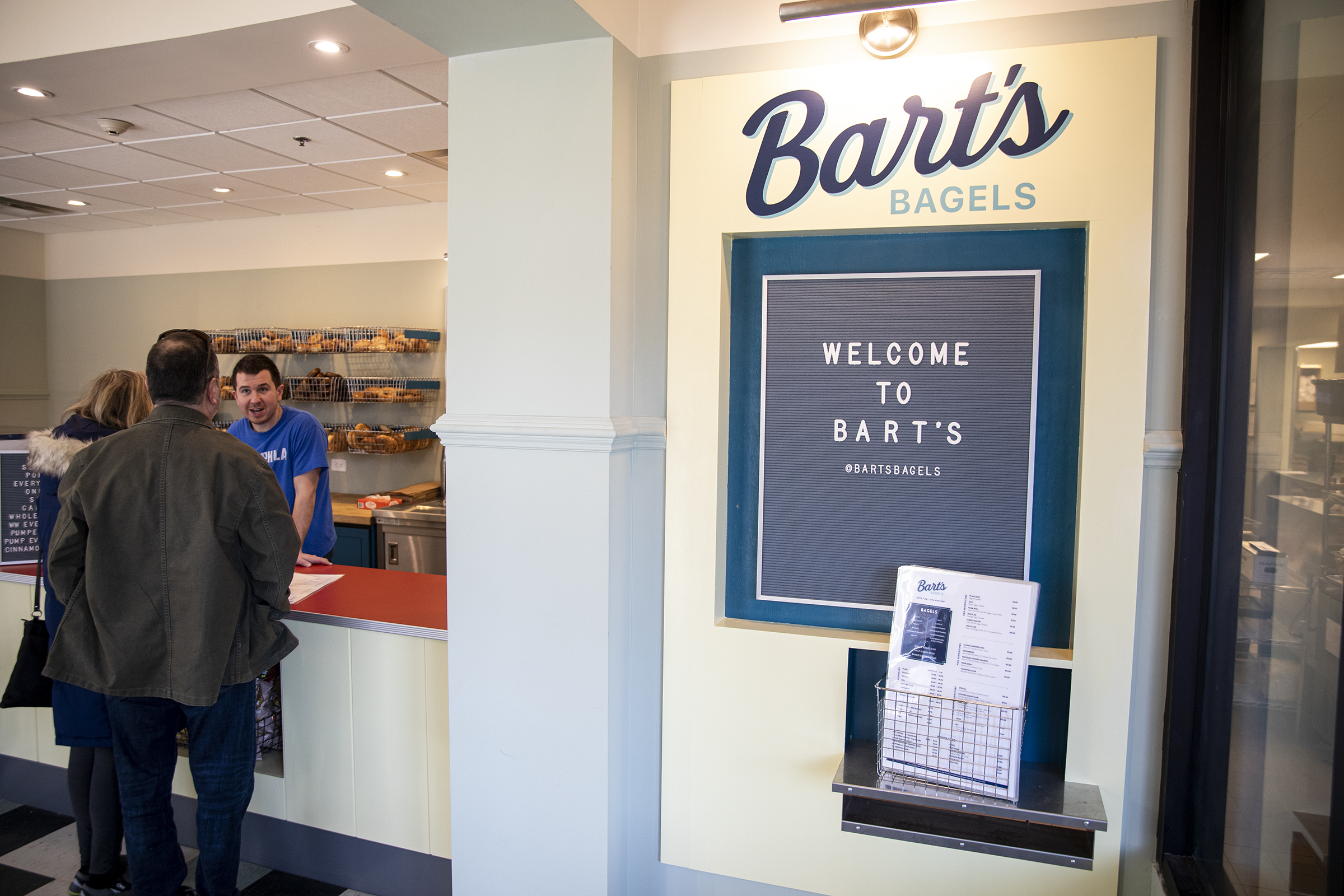
    Brett Frankel, co-owner of Bart’s Bagels, helps customers at Bart’s Bagels on Wednesday, Jan. 22, 2020. Bart’s is expanding to Bala Cynwyd later this year.

    Brett, 34, and Kyle, 41, both Lower Merion High School graduates, grew up a five-minute walk from their newest location. Brett Frankel says he remembers hanging out at the soon-to-be Bart’s Bagels storefront after middle school, back in the days when it was Bravo Pizza.

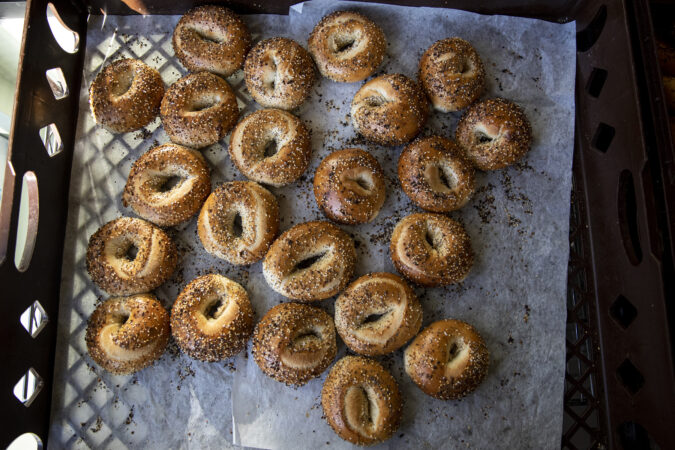
    Main Line patrons will be able to expect all of the same kettle-boiled bagels and fixins’ that Bart’s is known for, from pumpernickel bagels to pastrami smoked salmon and beet-horseradish cream cheese.

    While Bart’s city-based locations are grab-and-go only, there will be a few seats in the new Bala Cynwyd shop.

    The unique part of Bart’s, Brett Frankel said, is that patrons can see bagels being made in front of them through the open kitchen.

    “You’re kind of immersed in it,” he said.

    The Frankels say their love for good bagels was forged through regular trips to New York’s Upper West Side to eat at the famed Zabar’s and H&H Bagels.

    Looking to get their fix closer to home, Brett Frankel taught himself how to make bagels while working as a business analyst for a software company. He traveled to Denver, New Jersey, and Detroit to learn the ins and outs of the bagel industry.

    Bart’s started as a wholesale operation in late 2019, selling to Di Bruno Bros., Middle Child, Elixr Coffee, White Dog Cafe, and other local restaurants. The Frankels brought chef Ron Silverberg on board, and they opened the first Bart’s in West Philly in January 2020. Their South Philly location opened in July 2024.

    Bart’s is not the only new bagel place coming to Lower Merion this year.

    PopUp Bagels, the viral bagel chain known for its “grip, rip, and dip” model, is opening in Ardmore’s Suburban Square early this year.

    This suburban content is produced with support from the Leslie Miller and Richard Worley Foundation and The Lenfest Institute for Journalism. Editorial content is created independently of the project donors. Gifts to support The Inquirer’s high-impact journalism can be made at inquirer.com/donate. A list of Lenfest Institute donors can be found at lenfestinstitute.org/supporters.
  • Billionaire Jeff Yass is behind a plan to revitalize downtown Gladwyne

    Billionaire Jeff Yass is behind a plan to revitalize downtown Gladwyne

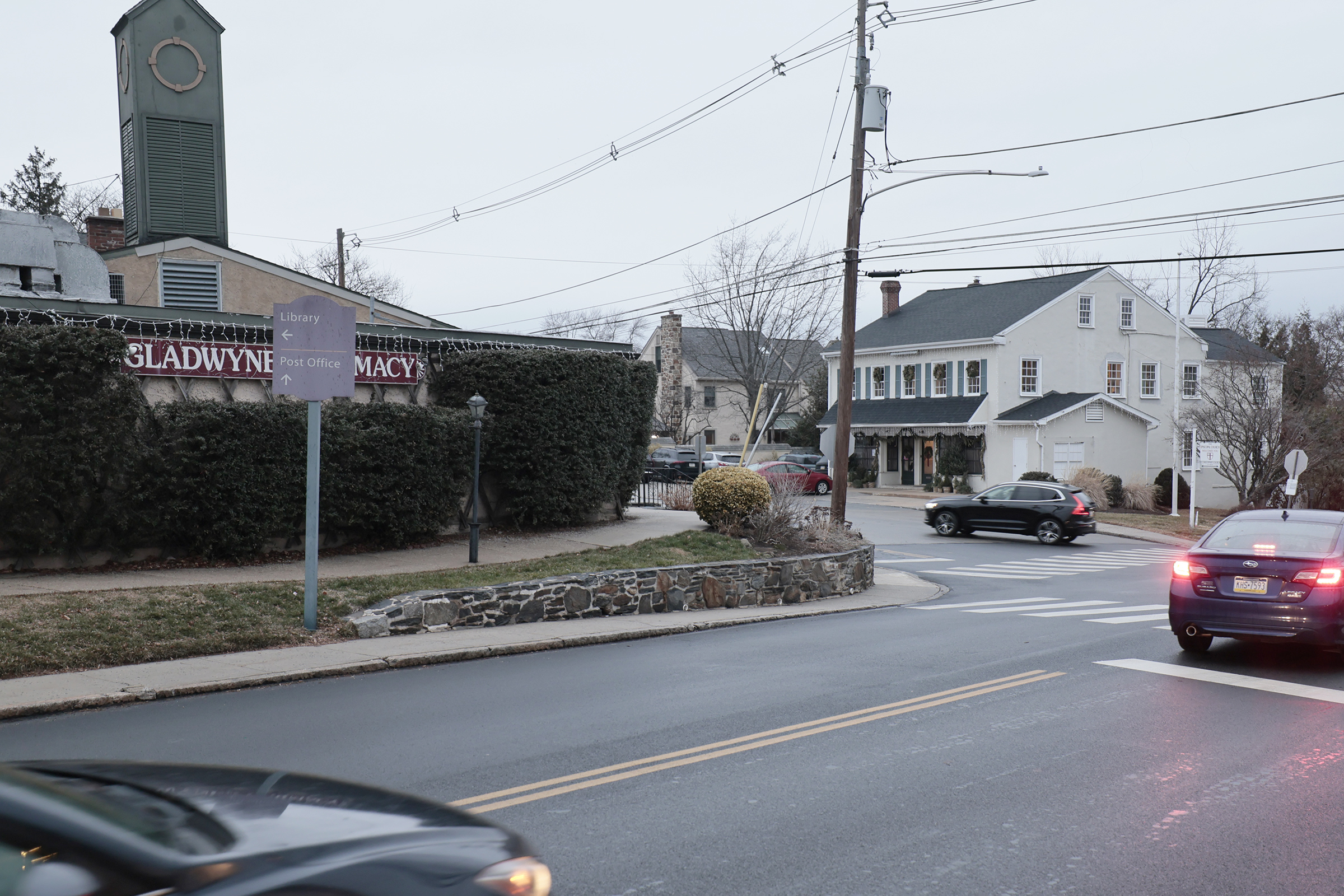
    Jeff Yass, Pennsylvania’s richest man, is behind a plan to redevelop much of downtown Gladwyne.

    Standing before a packed school auditorium, Andre Golsorkhi, founder and CEO of design firm Haldon House, unveiled the long-awaited redevelopment proposal for Gladwyne’s village center.

    Haldon House is working with Yass and his wife, Janine, on redeveloping a half-dozen properties in Gladwyne with historic architecture, green spaces, and new businesses. Golsorkhi called the proposal a “community impact project” for the Yass family, which has spent over $15 million acquiring the properties.

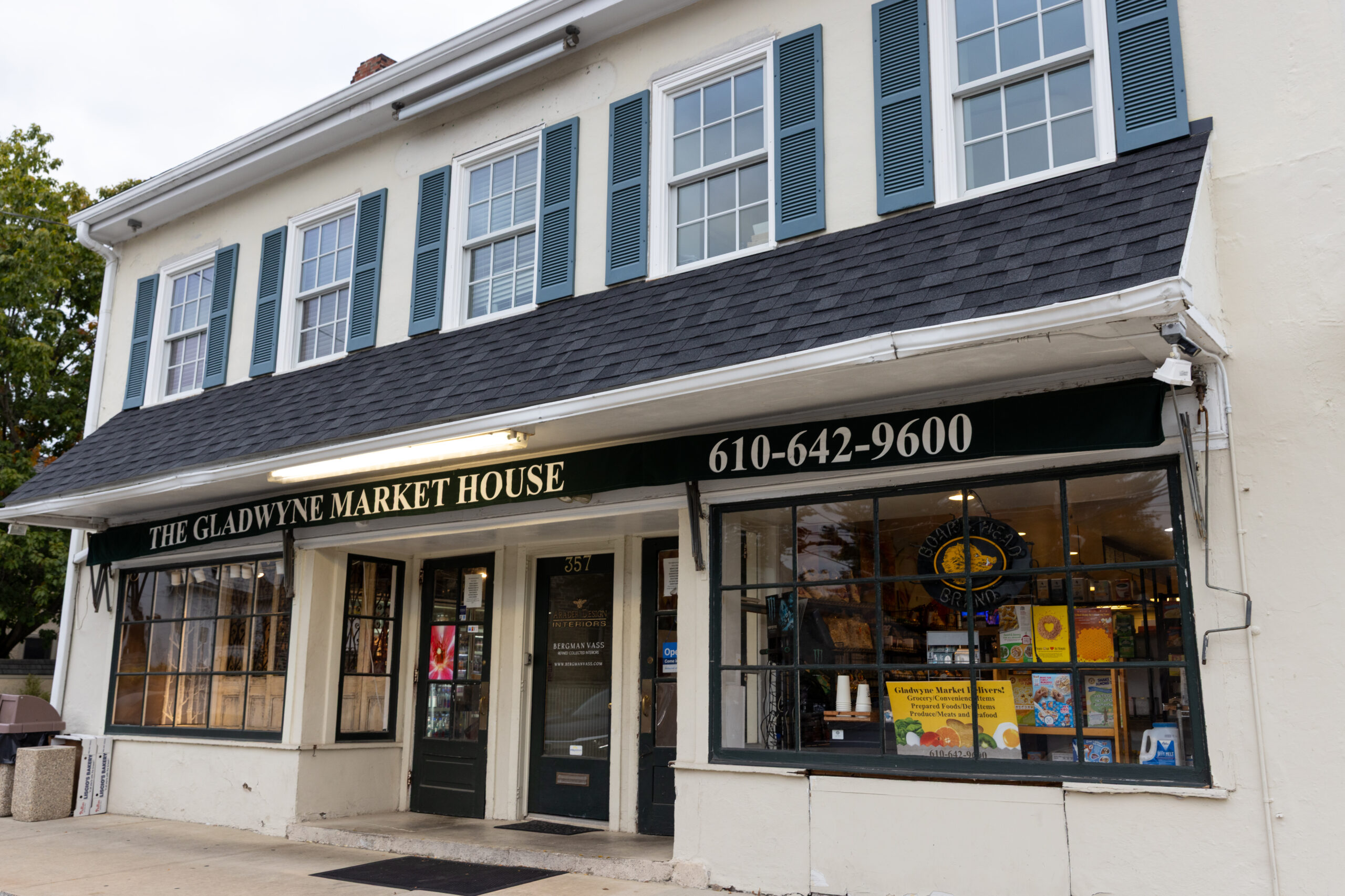
    Gladwyne village has long been home to small businesses, namely OMG Hair Salon, the Gladwyne Pharmacy, the Guard House, and Gladwyne Market. OMG Salon and the Gladwyne Market shuttered last year after the developers acquired their storefronts, sending ripples, and rumors, through the Main Line community. House values for the 4,096-person village are among the highest in the state, with a recent median sales price of $2.3 million, according to Realtor.com data.

    For the first time, Golsorkhi last week brought his development plans and his partnership with the Yass family to the public. He was met with both applause and skepticism from attendees. Some expressed optimism about the proposal, while others questioned why the developers would pour millions into a project with no apparent financial gain.

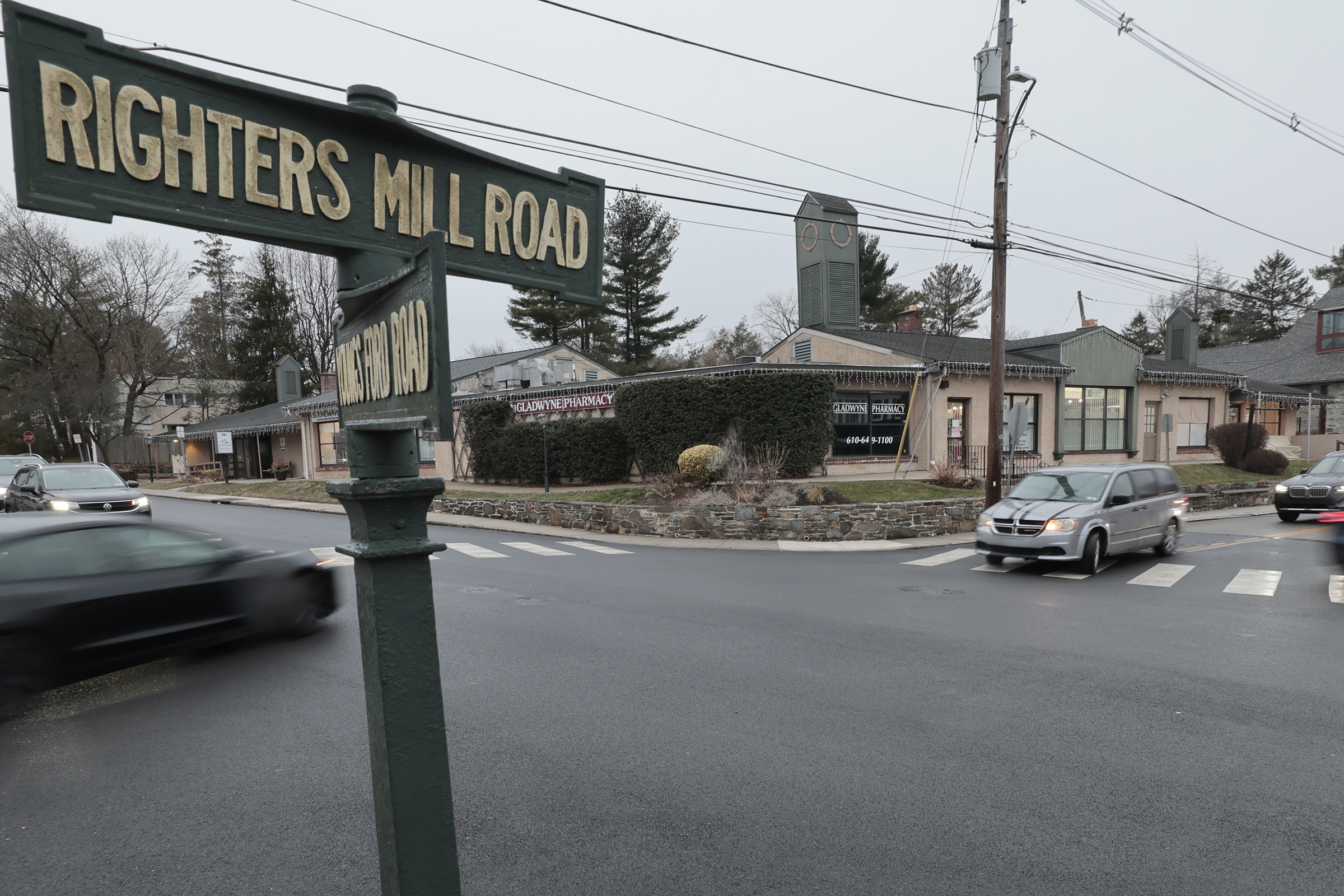
    The Village Shoppes, including the Gladwyne Pharmacy, at the intersection of Youngs Ford and Righters Mill Roads in Gladwyne on Friday, Jan. 9, 2026.

    Gladwyne ‘needs a revitalization’

    Haldon House’s proposal, as outlined by Golsorkhi, involves retaining much of Gladwyne’s historic architecture while bringing in new retailers, opening up green space, and increasing connectivity in the village’s downtown core.

    The developer plans to expand local café Homeroom and keep the Gladwyne Pharmacy while courting new businesses that “fit the character and are contextually relevant to the town.” There are no plans for residential development, national chain stores, or high-rise buildings.

    “This is a place that we grew up, that we love, that we care for tremendously, that has been protected for all the right reasons, but it has also not evolved,” Golsorkhi said. “It needs a revitalization.”

    Golsorkhi and his wife, Autumn Oser, the co-owner of Haldon House, are from the Gladwyne area.

    Yass is a billionaire, conservative megadonor, and founder of the Bala Cynwyd-based Susquehanna International Group. The Yass family has lived in Haverford for more than 40 years.

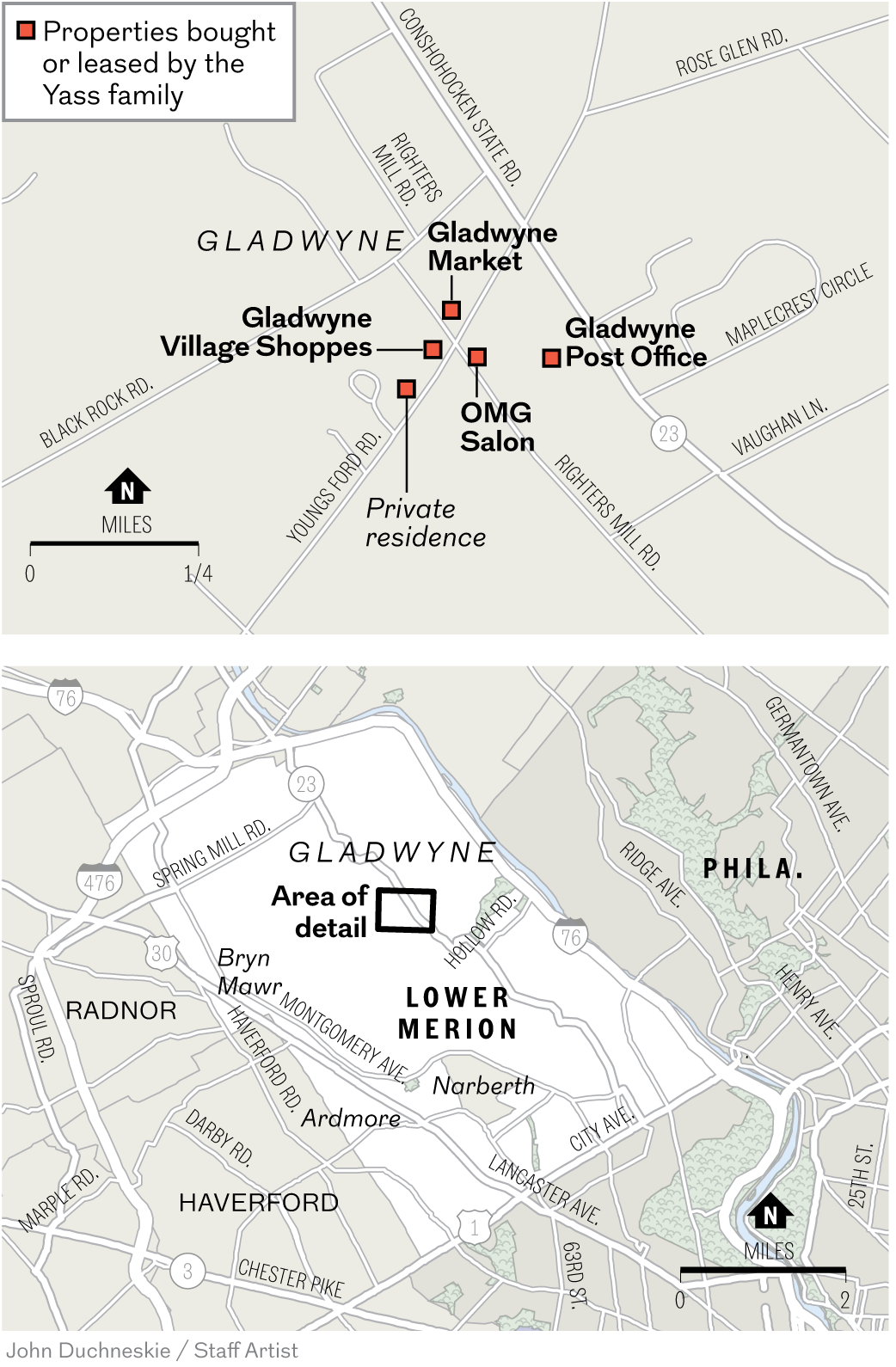
    Properties in Gladwyne acquired by the Yass family as part of their proposed revitalization project.

    Haldon House and the Yass family have purchased multiple properties at the intersection of Youngs Ford and Righters Mill Roads, including the former Gladwyne Market building, the Village Shoppes, a residential property on the 900 block of Youngs Ford Road, and the Gladwyne Post Office, according to Golsorkhi. They’ve also leased the former OMG Salon at 351 Righters Mill Rd.

    Citing the rumors that percolated in community after the shuttering of Gladwyne Market, Golsorkhi said there’s been “a lot of justified, warranted concern.”

    Gladwyne Market shuttered in October after its building was purchased by developers Haldon House and the Yass family.

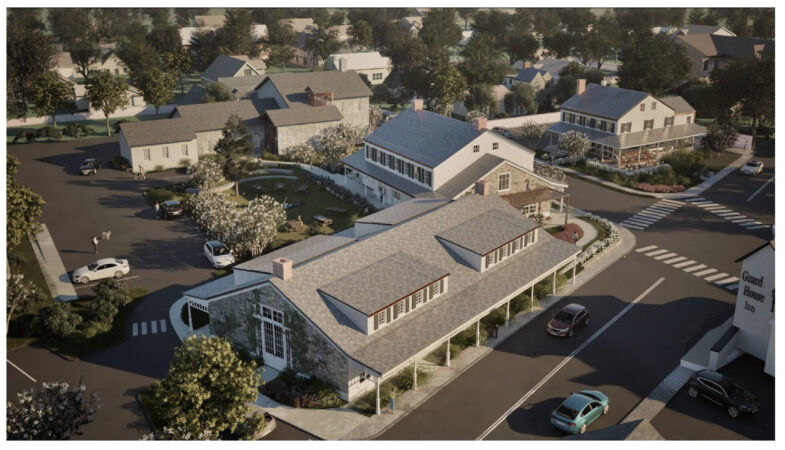
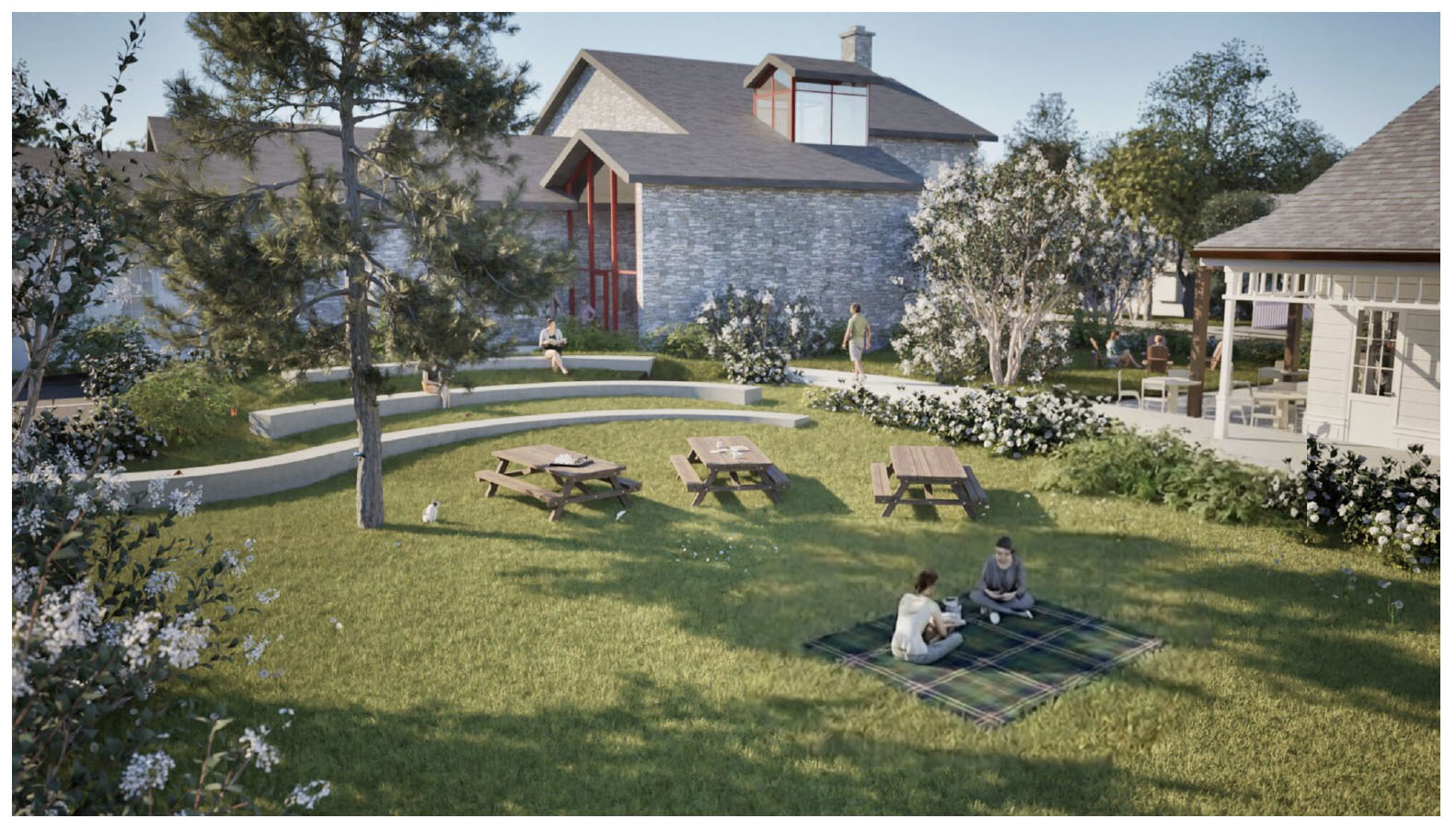
    Renderings of the proposal show the village’s core buildings retaining their late-1800s architecture, with new wraparound porches, ivy-covered stone walls, Adirondack chairs, hydrangeas, and “Gladwyne Square” branded signs.

    Golsorkhi said in an email that the developers were prepared to assume the costs and it was too early to specify how long the project would take.

    In addition to keeping Homeroom and the Gladwyne Pharmacy in place, the developers plan to put a “casual, but elevated and approachable” restaurant in the former Gladwyne Market site. They‘ll recruit independent retailers like bakeries, boutique fitness studios, and ice cream parlors. They also intend to expand the village’s open green space with picnic tables, open lawns, and venues for community events.

    Renderings of a proposed revitalization project in Gladwyne. Design firm Haldon House is working with longtime resident Jeff Yass to redevelop the Main Line village while preserving its historic architecture, developers told residents on Jan. 8.

    Golsorkhi said they would take a “forward and involved approach” with new and existing tenants, from designing storefronts to offering input on products to stock.

    They have worked closely with Gladwyne Pharmacy to help “reimagine” the “design and experience,” with “no expectation of return,” Golsorkhi said, adding that the pharmacy has “built up merchandise and square footage over time that isn’t necessarily best serving the business or the community.”

    “We’re doing that because we believe that the consistent experience and character of Gladwyne is really important,” he said.

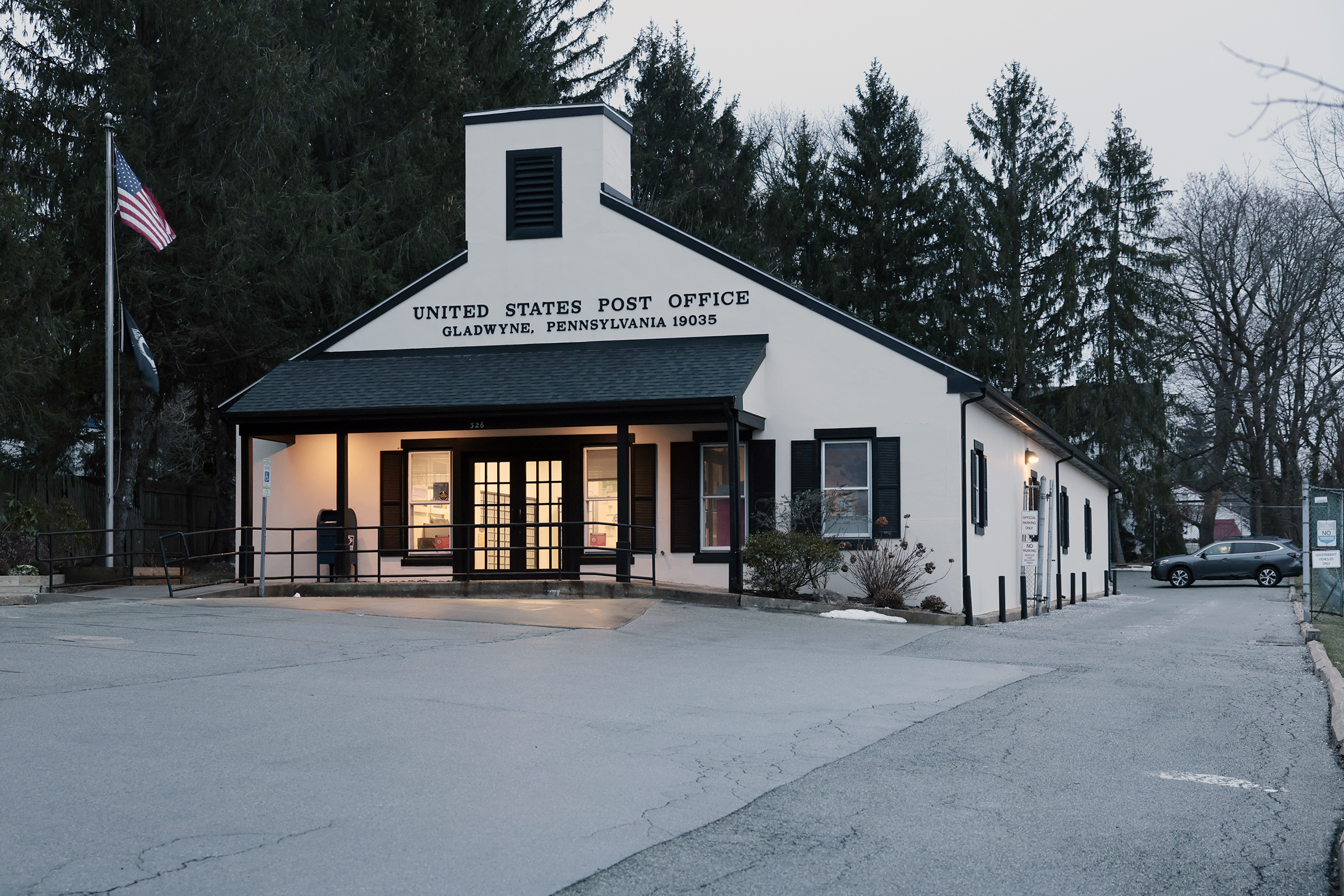
    Golsorkhi told attendees at the meeting on Thursday that while they have “no particular intentions” for the recently purchased Gladwyne Post Office, it was “retiring its services” and there was potential to create a new, centralized storefront where residents could access USPS, UPS, and FedEx services.

    Paul Smith, manager of public affairs and communications for the Postal Service in the Philadelphia region, said the Gladwyne post office was not retiring its services. In early 2024, Gladwyne and other local post offices moved their letter carriers to a large delivery center in Wayne, where they pick up mail and distribute it to their routes. Gladwyne’s post office is still used for retail transactions, mailing items, and for P.O. box holders.

    Golsorkhi clarified in an email that he understood the post office’s changes. In case services are further reduced in the future, he said, “we want to be sure we’re ahead of it by considering what shipping hubs and/or shipping services we can bring to the village to ensure continuity of mailing services, while also augmenting USPS with other carriers.”

    The Gladwyne post office at 326 Conshohocken State Road in Gladwyne on Friday, Jan. 9, 2026.

    Excitement for some, skepticism for others

    Haldon House and the Yass family’s recent acquisitions left some business owners feeling slighted.

    OMG Salon owner Maurice Tenenbaum said the building’s owners more than doubled his rent last fall, forcing him to give up the salon space.

    Pete Liccio, owner of the now-closed Gladwyne Market, said in an October interview that he had also felt pushed out.

    At Thursday’s meeting, some residents said Gladwyne was ready for a revitalization, from new restaurants to more pedestrian-friendly infrastructure.

    “What I’m seeing here is a center of gravity and an identity for Gladwyne that’s well-deserved and long been needed,” one attendee said.

    Others expressed concern.

    “I just wonder what the end game is. There’s always a price for this, having someone come in and say, ‘I’m going to make your community really, really cool and don’t worry about the money,’” another Gladwyne resident said during a question-and-answer segment.

    “[This is an] investment and a philanthropic effort …,” Golsorkhi said. “I understand and I recognize that that is a challenging thing to sort of believe.”

    The Village Shoppes, including the Gladwyne Pharmacy (left) and the now shuttered Gladwyne Market (right) at the intersection of Youngs Ford and Righters Mill Roads in Gladwyne on Friday, Jan. 9, 2026.

    This suburban content is produced with support from the Leslie Miller and Richard Worley Foundation and The Lenfest Institute for Journalism. Editorial content is created independently of the project donors. Gifts to support The Inquirer’s high-impact journalism can be made at inquirer.com/donate. A list of Lenfest Institute donors can be found at lenfestinstitute.org/supporters.
  • Ardmore Lululemon burglarized for second time in two years

    Ardmore Lululemon burglarized for second time in two years

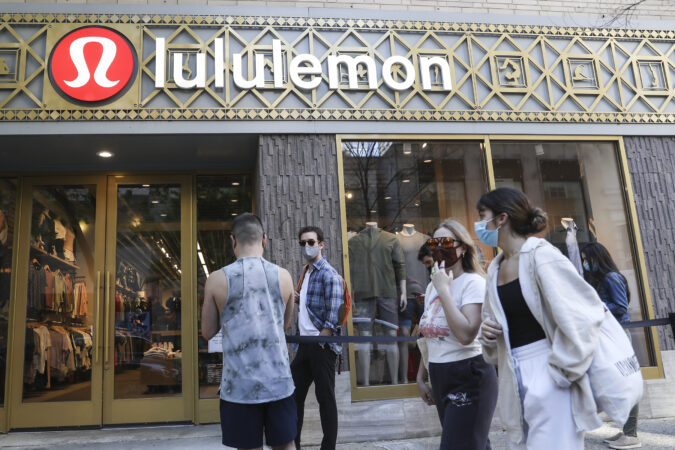
    Two burglars broke into Lululemon at Ardmore’s Suburban Square shopping center early Tuesday morning, according to the Lower Merion Police Department.

    In surveillance footage shared by 6abc, two masked suspects are seen using a sledgehammer to smash one of the storefront’s glass doors. The men grabbed an unknown amount of merchandise from the men’s section, including coats, Lower Merion Police Sgt. Ian Thornton said. One man ran out of the store before coming back in to grab more merchandise.

    Authorities told reporters the men loaded the merchandise into a U-Haul, which was last seen on Bryn Mawr and Woodbine Avenues.

    An investigation is underway.

    Lululemon is a high-end athletic-wear retailer with eight stores in the Philadelphia region. The company did not respond to written questions about the Tuesday morning burglary.

    Lower Merion Police Superintendent Andy Block told 6abc that Lululemon merchandise is a “highly sought-after item.”

    The Suburban Square store was targeted in May 2024 during a string of robberies at Lululemon locations in Ardmore and Center City.

    This suburban content is produced with support from the Leslie Miller and Richard Worley Foundation and The Lenfest Institute for Journalism. Editorial content is created independently of the project donors. Gifts to support The Inquirer’s high-impact journalism can be made at inquirer.com/donate. A list of Lenfest Institute donors can be found at lenfestinstitute.org/supporters.
  • Lower Merion swore in five new commissioners this week. Here’s who they are.

    Lower Merion swore in five new commissioners this week. Here’s who they are.

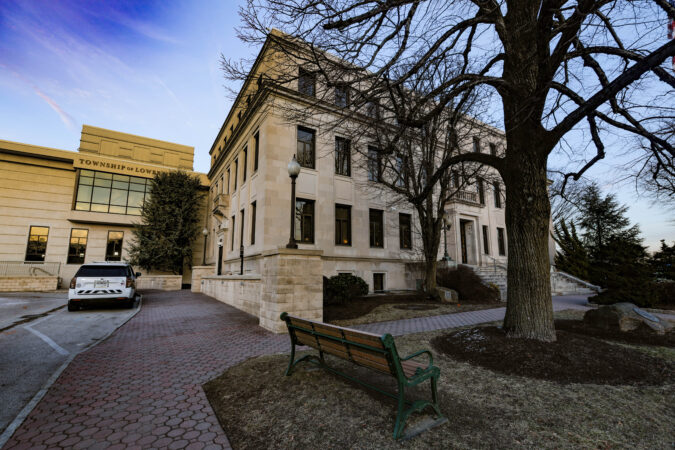
    Lower Merion swore in five new commissioners on Monday, kicking off the board’s 126th year of governing the Montgomery County township.

    Between rounds of applause and family photos, commissioners outlined the major challenges, and opportunities, the body will face in 2026. Board members highlighted recent accomplishments — creating a process for establishing board priorities, restricting gas-powered leaf blowers and plastic bags, advancing capital projects, hiring a police superintendent, supporting the development of affordable housing, and reversing the post-pandemic decline in police staffing levels.

    Yet they also underscored that much awaits the new board, including negotiating two collective bargaining agreements, overseeing Main Line Health’s redevelopment of the St. Charles Borromeo Seminary property, and addressing a difficult fiscal reality (the board last month authorized an 8% property tax increase, citing the “mistake” of having kept tax rates stagnant for over a decade).

    “We’re solving problems, we’re moving forward, and we’re even having a little fun,” said commissioner V. Scott Zelov, who was sworn in for his sixth term.

    Zelov on Monday night became the eighth commissioner in Lower Merion history to serve for at least 20 years, board President Todd Sinai said.

    Sinai, who was first elected to the board in 2017, was unanimously reelected board president. Incumbent commissioner Sean Whalen called Sinai a “stalwart leader of this board,” praising Sinai’s leadership through economic ups and downs.

    Jeremiah Woodring, also an incumbent commissioner, was unanimously elected vice president. Sinai described Woodring as “thoughtful and inquisitive,” “balanced,” and “diplomatic.”

    Jana Lunger was sworn in as Lower Merion tax collector.

    Here’s a who’s who of the five newly elected Lower Merion commissioners, all of whom replaced outgoing commissioners who chose not to run again in 2025.

    Michael Daly, an attorney and the former president of the Gladwyne Civic Association, was sworn in to represent Ward 2, which includes Gladwyne and Penn Valley. Daly has lived in Lower Merion for around 15 years with his wife and three children, all of whom are products of the Lower Merion School District. In his law practice, he focuses on defending class action lawsuits and complex litigation. In a candidate interview earlier this fall, Daly said he’s focused on quality of life issues, including walkability, public parks, and safe streets. He replaced outgoing commissioner Joshua Grimes.

    Charles Gregory, a longtime township employee, will represent Ward 4, which encompasses Ardmore and Haverford. Gregory, who was born and raised in Ardmore, worked for Lower Merion Township for 23 years until 2024. He’s the former president of the Lower Merion Workers Association and a Boy Scout troop leader. During a candidate forum, Gregory said he believed he could “make a difference from a blue collar aspect.” Gregory replaced outgoing commissioner Anthony Stevenson.

    Christine McGuire is a forensic psychologist and business owner who will serve Rosemont and Villanova in Ward 6. McGuire lived in Gladwyne for nine years before moving to Villanova around three years ago. In a candidate forum, McGuire said she has been active in the Gladwyne Civic Association and in the parent group that studied Lower Merion’s school start time change. As the owner of a psychology practice, she said she understands “what a budget is and that you have to work within the budget and not look at it like a blank check.” She replaced outgoing commissioner Andrew Gavrin.

    Craig Timberlake, an Ardmore resident who was instrumental in the 2025 redevelopment at Schauffele Plaza, will represent Ward 8’s South Wynnewood and East Ardmore. Timberlake moved to Ardmore around 15 years ago from Maine. He says he was drawn to Ardmore’s high-quality schools, walkable neighborhoods, and transit options. He believes the township should incentivize “smaller,” “incremental,” and locally funded development and decrease speed limits to protect pedestrians. Timberlake is a project manager at OnCourse, an education technology platform. He replaced Shawn Kraemer, the board’s outgoing vice president.

    Shelby Sparrow, the former president of the Penn Wynne Civic Association and a longtime community organizer, will represent Penn Wynne and Wynnewood in Ward 14. Sparrow’s priorities include ensuring the community is engaged in Main Line Health’s redevelopment of the St. Charles Borromeo Seminary property; addressing pedestrian safety; and encouraging sustainability and park stewardship. She was previously the director of development for St. Peter’s Independent School in Center City. She replaced outgoing commissioner Rick Churchill.

    Sinai and Zelov, who were reelected in November, were sworn in, and sitting commissioners Woodring, Whalen, Daniel Bernheim, Louis Rossman, Ray Courtney, Maggie Harper Epstein, and Gilda Kramer were welcomed back.

    This suburban content is produced with support from the Leslie Miller and Richard Worley Foundation and The Lenfest Institute for Journalism. Editorial content is created independently of the project donors. Gifts to support The Inquirer’s high-impact journalism can be made at inquirer.com/donate. A list of Lenfest Institute donors can be found at lenfestinstitute.org/supporters.
  • The story behind a colonial-era grave site hidden in residential Cherry Hill

    The story behind a colonial-era grave site hidden in residential Cherry Hill

    Giancarlo Brugnolo moved to Cherry Hill’s Woodcrest neighborhood in 2014, but it wasn’t until last year that he heard about the centuries-old cemetery just a stone’s throw away from his house. When friends first mentioned it, he assumed they were joking.

    “I was like, ‘What are you talking about? What graveyard?’” he remembers saying. “We live in a residential neighborhood, there’s no way there’s a graveyard.”

    Yet tucked away under sassafras trees and in the shade of neighboring houses, members of one of South Jersey’s first colonial families are laid to rest.

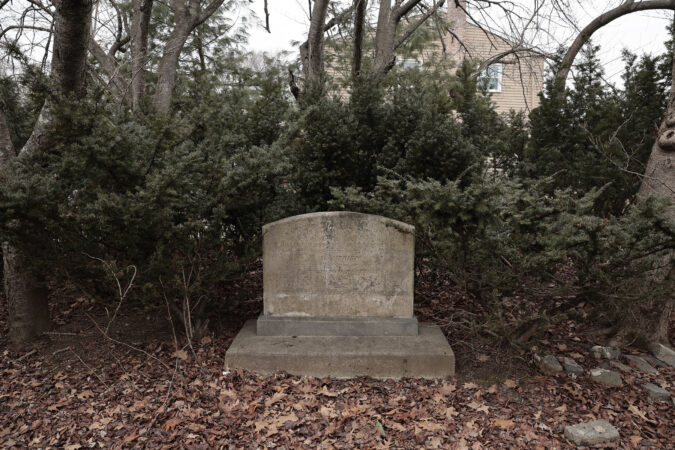
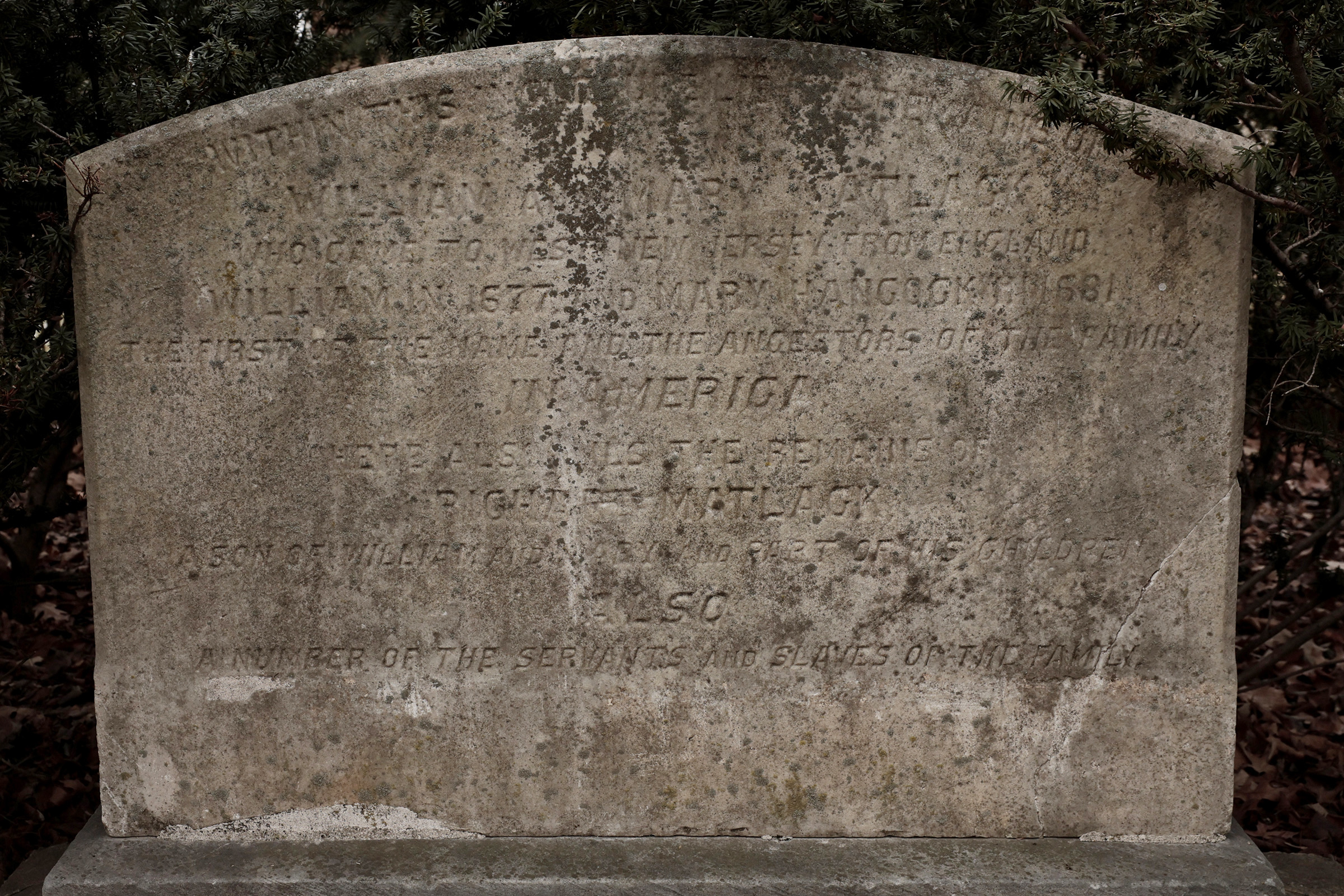
    The Matlack Family Cemetery is located on the 500 block of Cherry Hill’s Balsam Road. At the small grave site lie the remains of William and Mary Matlack, some of their descendants, and an unspecified number of servants and enslaved people. William Matlack is believed to have died in 1738, at around age 90, and Mary Matlack in 1728, at around age 62.

    Wanting to know more about the cemetery, Brugnolo took his question to Curious Cherry Hill, The Inquirer’s forum for answering local questions. Who was the Matlack family, and how did their grave site end up in a residential neighborhood?

    » ASK US: Have something you’re wondering about in Cherry Hill? Submit your Curious Cherry Hill question here.

    William Matlack, a carpenter, came to New Jersey in 1677 from Cropwell Bishop in Nottinghamshire, England. He traveled to the Americas on a ship named the Kent as an indentured servant to Thomas Ollive and Daniel Wills. Wills was appointed as the commissioner of West Jersey and sent to make deals with the Lenni-Lenape people who had long lived on the land. Many of the Kent’s travelers, including Matlack, were Quakers. The ship traversed the Atlantic Ocean from England, ultimately heading up the Delaware River to present-day Burlington County. Matlack is said to have been the first European settler to put his foot on the shore of what is now the city of Burlington (however some historians believe Swedes settled there a half-century earlier).

    At the time Matlack and Wills arrived in South Jersey, the spot was “a bleak haven” from their English homes, covered in dense forest and impenetrable at night, according to a 1970 article in the Courier-Post. Yet South Jersey stood out as a “long-sought destination thousands of miles from the brutality of bigots” in England who persecuted them for their Quaker practices.

    Matlack owed Wills four years of servitude and, in 1681, was granted 100 acres of land in return. While working for Wills, Matlack helped build two of the first houses and the first corn mill in the area.

    The headstone in the Matlack Family Cemetery on the 500 block of Balsam Road in Cherry Hill.

    Matlack would become the patriarch to one of the largest families in colonial South Jersey. In the early 1680s he married Mary Hancock, who had recently come to New Jersey from England with her brother, Timothy. At the time of their marriage, William Matlack was 34 and Mary Matlack was 16. The Matlacks lived between two branches of Pennsauken Creek in present-day Maple Shade. William Matlack would come to own around 1,500 acres of land across South Jersey. The couple had six sons, three daughters, and an estimated 40 grandchildren.

    Though Quakers became one of the first religious movements to reject slavery, many Quakers in early America, including the Matlacks, enslaved people. Research turned up little information about the enslaved people buried at the Matlack grave site. Birth and death records for enslaved people were often poorly kept in the age of chattel slavery, making it difficult to conduct genealogical research and historical inquiries into the lives of people held in slavery.

    We do know, however, that slavery was pervasive in Philadelphia’s suburbs during and after the colonial era. Despite abolitionist activism, much of which was driven by Quakers in the Philadelphia region, thousands of people remained enslaved in New Jersey through the turn of the nineteenth century. New Jersey was the last Northern state to officially abolish slavery in 1866, when Gov. Marcus Ward signed a state constitutional amendment outlawing the institution. The amendment followed the 1865 ratification of the 13th Amendment to the U.S. Constitution, which New Jersey had initially rejected.

    The Matlack Family Cemetery is a small graveyard in a residential neighborhood.

    One well-known descendant of the Matlacks was Timothy Matlack, a politician and delegate to the Second Continental Congress who inscribed the Declaration of Independence. In Facebook groups and blog posts, dozens of residents of the Mid-Atlantic region say they are descendants of the first New Jersey Matlacks — likely claims given the expansive Matlack family tree, but difficult to prove.

    William and Mary Matlack were not originally buried at the Balsam Road site, according to archival materials from the Rancocas Valley Chapter of the National Society of The Colonial Dames of America. They were initially buried on their son Richard’s farm near Springdale and Evesham Roads and were moved to the Balsam Road grave site in the late 1800s.

    The grave was discovered by a Girl Scout troop on a camping trip in what was then an apple orchard, according to a Courier-Post article from 1990. The housing development surrounding the grave site went up in 1972, but the graveyard was left in tact due to its historical value. Today, it’s owned and maintained by the township.

    This suburban content is produced with support from the Leslie Miller and Richard Worley Foundation and The Lenfest Institute for Journalism. Editorial content is created independently of the project donors. Gifts to support The Inquirer’s high-impact journalism can be made at inquirer.com/donate. A list of Lenfest Institute donors can be found at lenfestinstitute.org/supporters.
  • Media-based painter Rinal Parikh is redefining Indian folk art with contemporary themes and local imagery

    Media-based painter Rinal Parikh is redefining Indian folk art with contemporary themes and local imagery

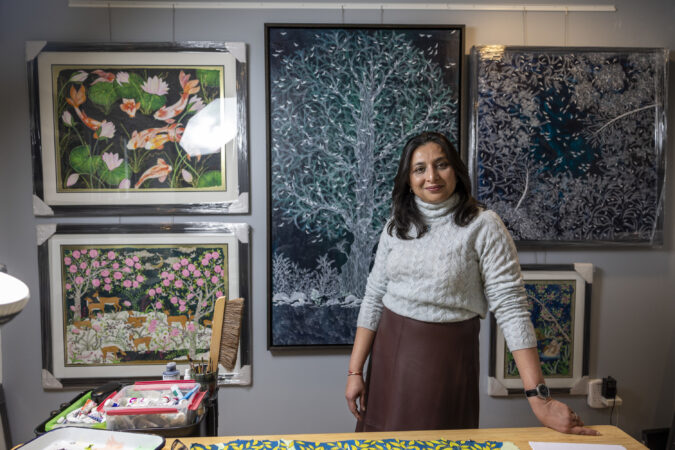
    As a blanket of snow and sleet melted into the grass and an early winter fog hung over the Delaware Valley last month, Rinal Parikh’s art studio was a tranquil portal to the outside world.

    In her studio, lofty windows look out onto a sprawling backyard. The walls are adorned with Parikh’s paintings, both completed and in progress, and its shelves are stacked with art supplies and mementos.

    “What inspires me is my surroundings, and I’m blessed with an amazing backyard,” Parikh said, looking out the window. “That is my main inspiration.”

    Parikh is a Media-based painter and biochemist by trade whose art blends traditional Indian folk styles with contemporary themes. Her art, rich in texture, color, and meaning, uses a collection of materials, from sand and fabric to glass, beads, and stucco. She paints with acrylic and watercolors, and creates detailed drawings with thin brushes. Her work fuse her upbringing in India with her current life in Media, an amalgamation of past and present, of here and there.

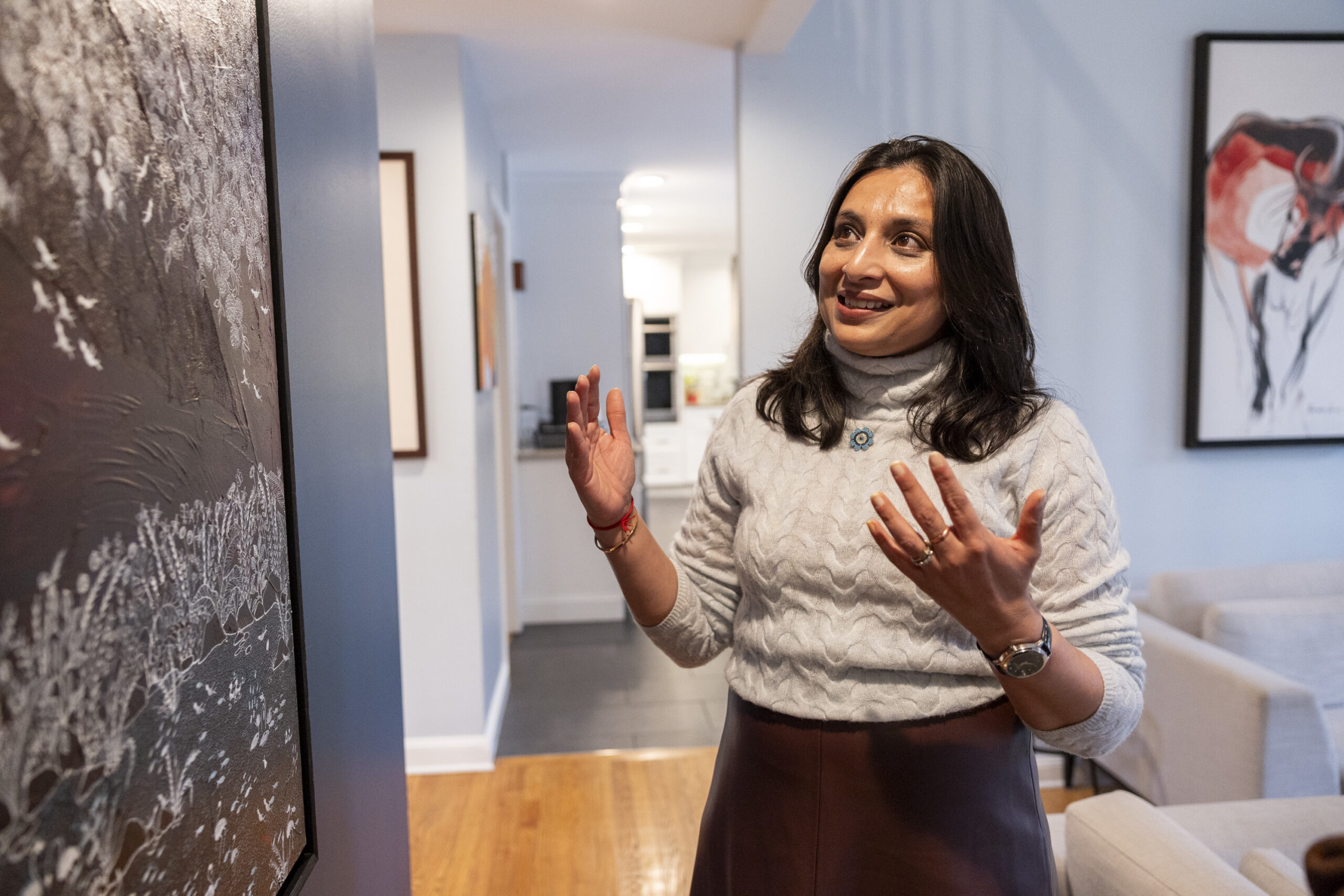
    Rinal Parikh, 43, Media-based artist, talking about her art work in her home in Media, Pa., on Tuesday, Dec. 23, 2025.

    Parikh, 43, took a circuitous route to becoming an artist. She moved to Philly in 2005 from Gujarat, India, to follow her husband, Bhavin, who had immigrated a few years earlier (the day of our interview was the 20th anniversary, to the date, of her arrival in the U.S.). She enrolled in a masters in molecular biology program at Drexel University, a step toward her Ph.D., and got a job in a lab at Penn Presbyterian Medical Center.

    A few years after her move, Parikh’s first son was born with health complications. With no family close by, Parikh quit her job to focus on taking care of her son. He’s now a healthy teenager, she notes.

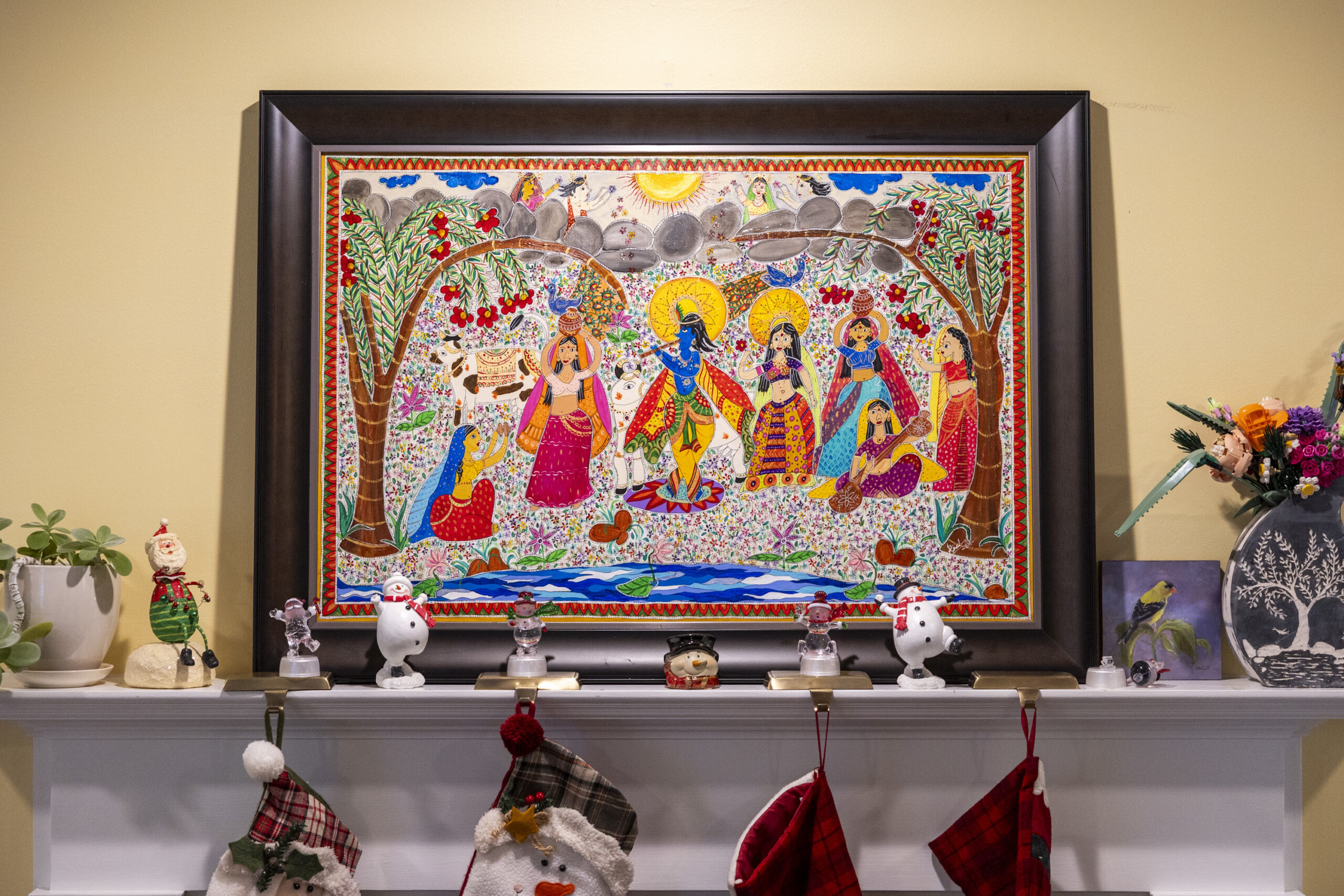
    Seeing that Parikh was missing out on work, her husband made a suggestion: Why not paint something for their new house? That first painting, “Krishna-leela,” now hangs in the Parikhs’ living room, an eye-catching depiction of the Hindu deity Krishna.

    Rinal Parikh’s painting “Krishna-leela” is displayed at home in her formal living room in Media, Pa., on Tuesday, Dec. 23, 2025.

    When her son was 9 months old, Parikh stopped by an art fair at the Creative Living Room, a community arts center in Swarthmore. She struck up a conversation with some of the women there. A few days later, they called with a question: Would she like to do a solo show?

    “I didn’t even know what that means,” she said.

    Nonetheless, she agreed. She worked tirelessly for three months to make 20 pieces. She didn’t know where to buy art supplies, so she imported them from India (someone would later point her toward the now-closed Pearl Art & Craft Supplies on South Street). In fall 2009, she displayed her paintings for the first time as a professional artist — and sold her first painting, too. The rest, she said, is history.

    Parikh melds together three types of Indian folk art — Warli, Madhubani, and Kalamkari. Warli is a tribal art that depicts day-to-day life in a mural-like format. Madhubani uses geometric patterns and typically reflects celebrations of life. Kalamkari, Parikh said, is “very refined,” a style of art that uses a fine brush to create delicate and detailed line drawings. All three art forms have traditionally been practiced by women.

    Parikh feels like she speaks “a global language.”

    Though her paintings take inspiration from the traditional Indian folk style, the scenes depicted are not just of India. They’re often of the Philly area, and of the flora and fauna in her backyard.

    “I still practice Indian folk art, but the subject matters are very ‘now,’” Parikh said. “The language is still very traditional, but the conceptualization, the visualization, is much more contemporary.”

    A painting called “Home” painted by Rinal Parikh, 43, displayed in the family room of her home in Media, Pa., on Tuesday, Dec. 23, 2025.

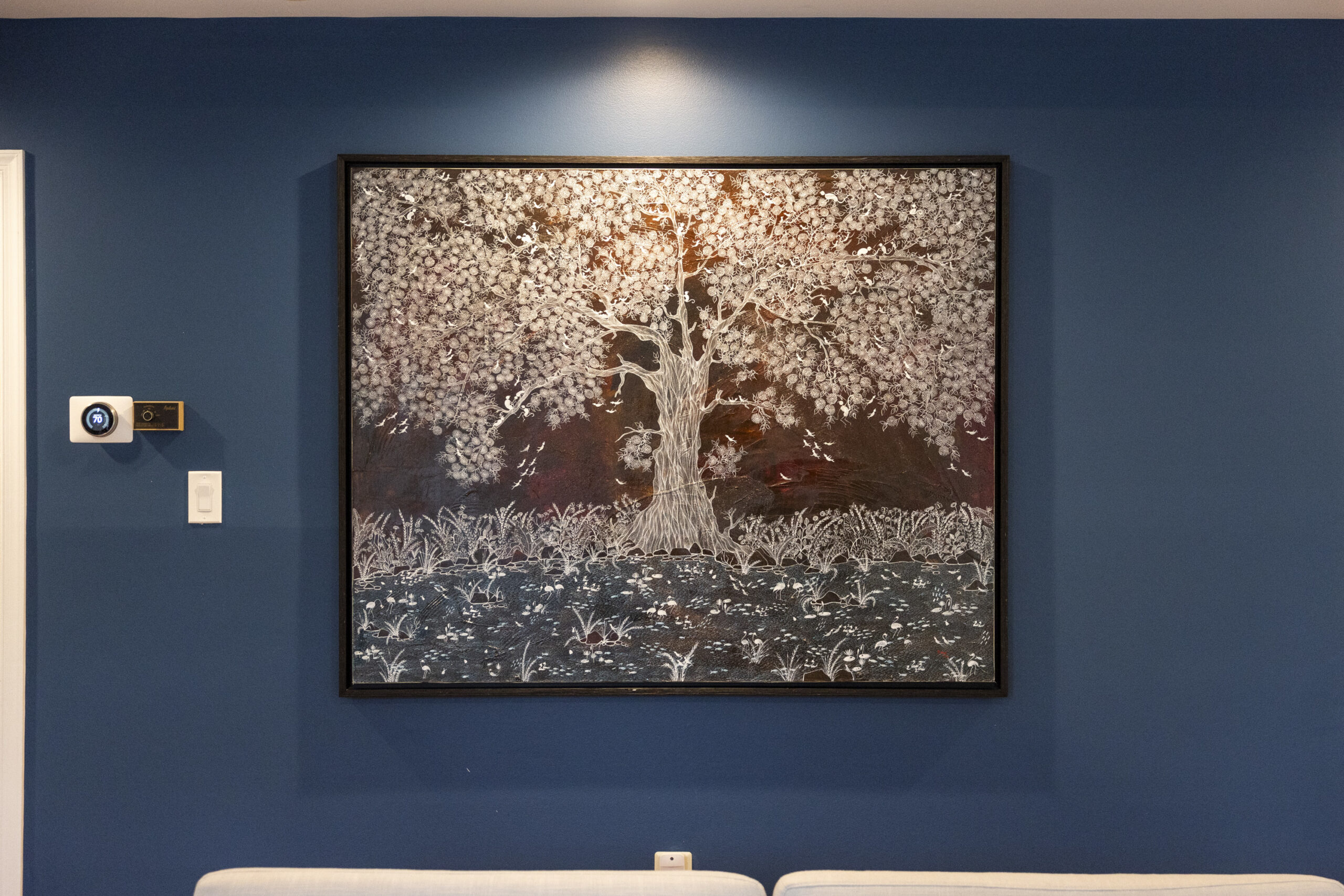
    In her family room hangs “Home,” a 2021 Warli painting of a tree. The background is complex in both texture and color, with blues, browns, and purples peeking out. Hanging from the tree are monkeys, which Parikh said captures the energy of having two boys, now 17 and 12, in the house. (They’re very good kids, she clarifies.)

    “I observe my surroundings, I experiment with styles, I do a lot of repetitive patterns, and I tell my story,” she said.

    Since jumpstarting her art career, Parikh has become involved in the region’s growing art community. She’s the marketing chair for the Rittenhouse Square Fine Arts Show and is involved with the Community Arts Center of Wallingford.

    She said she understands the anxieties of young artists and wants to support the organizations that nurture their careers.

    “I was supported by the community, and I want to do the same thing.”

    Parikh’s art can be found on her website and her Instagram page.

    This suburban content is produced with support from the Leslie Miller and Richard Worley Foundation and The Lenfest Institute for Journalism. Editorial content is created independently of the project donors. Gifts to support The Inquirer’s high-impact journalism can be made at inquirer.com/donate. A list of Lenfest Institute donors can be found at lenfestinstitute.org/supporters.
  • Looking for New Year’s resolution inspiration? Here’s your Lower Merion guide.

    Looking for New Year’s resolution inspiration? Here’s your Lower Merion guide.

    It’s the first week in January, which means the gym is packed and the health food section at the grocery store is more picked over than usual, as many of our friends and neighbors vow to start the new year off on a healthier foot.

    Around 3 in 10 Americans made New Year’s resolutions in 2024, according to the Pew Research Center. At the top of the resolutions list were aspirations related to diet and exercise, finances, relationships, and hobbies. The percentage of resolution makers was even higher among young adults (ages 18 to 29), around half of whom committed to dropping, or picking up, a habit when the clock struck Jan. 1.

    Here’s how to get started on a New Year’s resolution in Lower Merion. If you haven’t picked a resolution yet, take this as some inspiration to get going.

    Try a new workout (for free)

    “Exercise more” is often at the top of New Year’s resolution lists. While a walk around the block or a visit to the gym is a reliable way to get back into the swing of things, fitness studios across the Main Line are offering free trials, from Tai Chi to yoga sculpt.

    Get your first class free at Pure Barre in Wayne, a workout studio chain that fuses yoga, Pilates, and ballet to strengthen and tone. Try your hand at Tai Chi at the Bryn Mawr Presbyterian Church on Tuesdays at 10:30 a.m. or on Zoom. Your first Tai Chi class is free. BodyX Kitchen & Fitness Studio, a boutique studio in Bryn Mawr with group fitness classes, personal training, and healthy cooking classes, offers a free week of fitness classes to all new participants. If you’re interested in CrossFit, Ardmore’s CrossFit Main Line offers a free trial for new participants. The gym also has locations in Wayne and Plymouth Meeting. And if you want something more personalized, Train and Nourish, a women’s-only personal training studio in Ardmore, offers free consults for new clients.

    Get thrifty

    As economic concerns loom and the “thrifting” boom persists, many shoppers are looking to secondhand and consignment stores for household items, clothing, furniture, and other unique finds.

    As John Romani, owner of Sales by Helen, a Philly-based estate sale giant, told The Inquirer early last year, the Main Line abounds with great secondhand shops. Romani recommends Bryn Mawr Hospital Thrift, a top spot for furniture, high-end clothing, art, and collectibles, and Ardmore’s Pennywise Thrift Shop, which has a rotating inventory, low prices, and some luxury brands. Romani also has high praise for thrift stores in Wayne and Berwyn, including the Berwyn Goodwill and Neighborhood League in Wayne.

    Romani’s tips? Use your phone to look up items, seek out high quality, and be assertive.

    Go analog, and get off that phone!

    By now, we’re all familiar with the intoxicating pull of the smartphone. Adults and children are spending more time on their phones, a phenomenon that’s been linked to troubling mental and physical health consequences, especially for young people.

    The explosion in screen time has prompted a counter-wave of interest in “analog” activities, from knitting and painting to journaling and board games.

    The Main Line Art Center in Haverford offers art classes and workshops for adults. Take tapestry weaving or portrait painting, learn to make jewelry, or try your hand at pottery.

    Looking for a book club? Ardmore’s Mavey Books has book clubs for adults and teens. The Lower Merion Library System also hosts book clubs across its locations, including in Ardmore, Belmont Hills, and Penn Wynne. Ludington Library has a book club dedicated specifically to LGBTQ+ stories.

    The Lower Merion Library System also hosts board game cafés, family puzzle nights, film discussions, and art events (you can see their full calendar here).

    Declutter your house by donating

    After all holiday presents are unwrapped and the last Christmas cookies are eaten, it’s customary to look around and think: “How did I accumulate so much stuff?“ If you’re looking to declutter, nonprofits in and around Lower Merion are accepting gently used clothing, furniture, kitchen tools, and other items.

    Our Closet In Your Neighborhood (OCIYN), a program of Jewish Family and Children’s Service of Greater Philadelphia, accepts casual clothing and shoes for men, women, and children of all sizes. OCIYN is a free mobile program that provides Philly-area residents with food, clothing, and access to services and benefits. Those looking to donate clothes to OCIYN can contact Skylar Fox, program manager, at 267-273-5537 or sfox@jfcsphilly.org.

    Cradles to Crayons is a national nonprofit with a Philadelphia-area presence that provides clothing, shoes, books, school supplies, and hygiene items to kids in need. The nonprofit has a small collection site at Church of the Redeemer in Bryn Mawr and a larger site at the Haverford YMCA. Cradles to Crayons accepts new youth socks and underwear, new arts and school supplies, new hygiene items, unopened diapers, pull-ups, and diaper wipes, and new or gently used clothes and shoes in youth and adult sizes. See the full list of collection sites here and donation guidelines here.

    This suburban content is produced with support from the Leslie Miller and Richard Worley Foundation and The Lenfest Institute for Journalism. Editorial content is created independently of the project donors. Gifts to support The Inquirer’s high-impact journalism can be made at inquirer.com/donate. A list of Lenfest Institute donors can be found at lenfestinstitute.org/supporters.
  • White Christmas in Philly? Probably not. But snow is expected Friday.

    White Christmas in Philly? Probably not. But snow is expected Friday.

    Philadelphia is unlikely to have a white Christmas, but snow is on the horizon for the weekend.

    The National Weather Service on Wednesday afternoon issued a winter storm watch for much for eastern Pennsylvania and New Jersey. The watch will be in effect from Friday afternoon through Saturday morning.

    From Friday into Friday evening, forecasters are “near 100% confident” that most of the Philly area will get some form of winter precipitation, according to the National Weather Service. But exactly what type of precipitation, how much, and the precise timing remains uncertain.

    “We’re likely going to see an impactful winter storm,” said Eric Hoeflich, meteorologist with the National Weather Service in Mount Holly.

    Philadelphia may get between 1 and 4 inches of snow Friday into the night, according to the National Weather Service. Light precipitation could linger into Saturday morning.

    Forecasters expect between 1 and 3 inches of precipitation in northern Delaware, far southern New Jersey, and Southeastern Pennsylvania. Eastern Pennsylvania and much of New Jersey may see 4 to 7 inches. Actual precipitation totals and types, however, may vary. Some areas could get snow, sleet, freezing rain, or plain rain depending on temperatures and timing.

    Ahead of the expected weekend storm, Philadelphians are unlikely to be greeted with snow-dusted streets on Christmas morning.

    After sun and high temperatures in the 40s on Wednesday, Christmas Day may also bring above-average temperatures, with highs forecast in the mid-40s and a potential for light showers in the morning.

    It will be “not great weather, but not bad either for late December,” according to forecasts from the National Weather Service.

    Friday’s winter weather event would mark the second measurable snowfall of the season in Philly. The snowstorm that swept across the Philadelphia region on Dec. 14 dumped 4.2 inches of snow at Philadelphia International Airport. Some suburban communities in Bucks and Chester Counties recorded over 8 inches.

    If you’re planning to travel on Friday evening, expect impacts to your plans, as roads may get snowy and icy.

    Flying out of PHL and want to know how things are looking at the airport? Check out The Inquirer’s end-of-year PHL tracker to see how delays and cancellations are stacking up.

  • Lower Merion commissioners approve 8% tax hike, citing ‘looming cliff’ after 13 years of no increase

    Lower Merion commissioners approve 8% tax hike, citing ‘looming cliff’ after 13 years of no increase

    Lower Merion residents will see an 8% increase on their property tax bill in 2026, a move commissioners say is a necessary remedy to the “mistake” of keeping tax rates stagnant for over a decade.

    The township board of commissioners on Dec. 17 approved an 8% property tax increase for next year. The increase will bring the property tax millage rate from 4.462 mills to 4.819 mills. The median single-family homeowner in Lower Merion will pay around $1,386 in real estate taxes, a $103 increase from 2025.

    The 8% tax increase approved by commissioners is lower than the 9.5% increase proposed by staff and supported by board President Todd Sinai. The board landed on the 8% hike after a protracted discussion about how much of an increase residents could, and should, shoulder in 2026.

    Commissioners acknowledged the “sticker shock” of the tax hike but said years of stagnant tax revenue had put the township in an impossible position. Real estate taxes did not increase for 13 consecutive years in Lower Merion, from 2011 to 2024. The township voted to raise taxes by 6.5% for 2025, the first increase in over a decade.

    “Those years of no tax increase have proven to be a mistake, given that each year we were presented with a structural deficit and a looming cliff,” Commissioner Ray Courtney said. “By holding out on increases as long as we did, we have painted ourselves into a corner.”

    Under the proposed 9.5% tax hike, Lower Merion projected $83.8 million in general fund expenditures in 2026 against a revenue of $79.3 million. With the 8% tax hike passed by the board, revenue will be lower and the township will have to lean more heavily on its general fund reserves to cover the deficit.

    Around half of Lower Merion’s revenue comes from real estate taxes, yet township residents continue to pay taxes calculated on property values established in 1998, the last time Montgomery County conducted a property reassessment.

    The decades-old property values have kept tax revenue low, relative to the high market costs of a home in Lower Merion. The median sale price for a home in Lower Merion was $803,500 in 2024, according to data from Montgomery County.

    Notably, only 10% of Lower Merion residents’ property taxes goes to the township. Around 12% goes to Montgomery County and 78% goes to the school district.

    Montgomery County will be increasing taxes by 4% in 2026.

    In a Nov. 7 report addressed to the board of commissioners, Township Manager Ernie McNeely wrote that, while Lower Merion has weathered the post-pandemic economy with relative success, its general fund has run a deficit multiple times since 2020.

    McNeely’s report points to three major burdens on Lower Merion’s budget in 2026: healthcare premiums, staffing costs, and the Solid Waste Fund.

    The township is expected to see a 20% increase in healthcare premium costs in 2026. McNeely’s report said the increase is due, in part, to the costs associated with nondiabetic weight-loss drugs and other “specialty pharmaceuticals.”

    Lower Merion Township’s employment vacancy rate is also expected to fall in 2026. While a lower vacancy rate is good for departments needing to fill positions, each percentage-point improvement in the employment vacancy rate costs the township $520,000. On top of the falling vacancy rate, over 35% of township staff are set to receive a salary boost in 2026.

    And the town’s Solid Waste Fund is in dire straits. Even with the 5% solid waste fee rate hike planned for 2026, the fund is set to face a $700,000 deficit. Rising costs for disposal, equipment, and personnel, as well as a declining regional market of mills able to purchase paper recycling material, were identified as the main reasons for cost increases.

    The major challenges outlined by McNeely are set to the backdrop of persistent inflation, which is putting cost pressures on local governments.

    This suburban content is produced with support from the Leslie Miller and Richard Worley Foundation and The Lenfest Institute for Journalism. Editorial content is created independently of the project donors. Gifts to support The Inquirer’s high-impact journalism can be made at inquirer.com/donate. A list of Lenfest Institute donors can be found at lenfestinstitute.org/supporters.