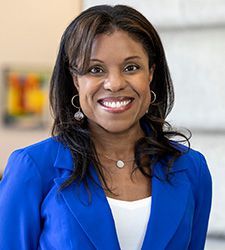
Ursinus College president Robyn E. Hannigan, who was in her fourth year at the small liberal arts school in Collegeville, was abruptly removed from the job Thursday and her Ursinus webpage was removed.
”I met with the board this morning,” said Hannigan, 60, who was reached by phone. “I was let go. It’s the board’s decision. It’s not for cause. The board wanted to go in a different direction.”
She declined to disclose what the board told her at the meeting.
In a statement, the college said it was a board decision “made in the best interests of the college’s long-term success.”
Joseph DeSimone, chair of the college’s board of trustees and a 1986 Ursinus grad, declined in an interview to say why the board chose to part ways with Hannigan, saying it was a personnel decision. The leadership change is happening just as the college is about to celebrate homecoming weekend.
The move comes after the college experienced a 10% decline in first-year enrollment this fall and a 6.4% decline in overall enrollment, which stands at 1,406.
The college also was coping with financial challenges, in part because of the enrollment decline, but also because the retention rate last year for returning freshmen was 77%, six percentage points lower than the school’s average, Hannigan told the student newspaper, the Grizzly, in an interview published Oct. 2.
“We have a structural deficit, which means that we’re not living within our means and our revenues are not enough to cover our expenses,” she told the Grizzly. “So we have to fix that.”
She told the student newspaper that Ursinus took steps last year to “right the ship” financially and launched APEX, a program designed to better align academics with experiential learning and career prep. That is expected to bring enrollment back up, she said.
The college is offering students up to $2,000 for internships, team-based career coaching and advising, and a week for first-year students devoted to real world problem-solving.
The college plans to hold a town hall for faculty and staff at noon Friday.
“This decision should not reflect in any way on the strength of the college and its direction,” Hannigan told The Inquirer. “It is the nature of the business that we are in.”
The news stunned the campus community.
“I was just baffled,” said senior Renee Washart, editor in chief of the Grizzly. “I did not see this coming at all.”
She said she met with Hannigan on Monday, as she does once every month in her role as editor, and there was no indication of the change.
“She was talking about future plans for Ursinus,” said Washart, a chemistry and English major from Frederick, Md.
Washart said she was in class when an email came to campus about the change in leadership and her phone “started blowing up.” Her professor, she said, was hearing it for the first time, too.
Hannigan, an academic in the sciences who holds several patents, said that she was under a contract that goes for “another couple years” and that she would be on leave for a few weeks while a separation agreement is worked out.
DeSimone, a professor of Translational Medicine and chemical engineering at Stanford University, said in an announcement to the campus shortly before 11:30 a.m. that Gundolf Graml, the provost, will serve as interim president.
“The board has full confidence in Dr. Graml to ensure continuity of operations and to advance the college’s strategic priorities,” the college said in a statement. “The college’s mission, values, and commitment to our students remain unchanged.”
In an interview, DeSimone said there were no current plans to launch a search for a new president and that Graml and the executive team were well positioned to lead the college forward. Applications and donations are up, he said.
Hannigan came to Ursinus in July 2022 from Clarkson University in Potsdam, N.Y., where she was the provost. She was the first permanent female leader of Ursinus and the first of Native American descent.
In a 2022 interview with The Inquirer, she said she was a first-generation college student whose parents scraped to save enough to pay for her first year of college and whose older brother chose to forgo college so that she could go.
She grew up in New Jersey and received a bachelor’s degree in biology from the College of New Jersey, a master’s in geology from SUNY Buffalo, and a doctoral degree in earth and environmental science from the University of Rochester.
Hannigan described her departure from Ursinus as “a friendly separation.”
“The college has been doing great work in trying to turn around and do what it needs to do to thrive in the future,” she said.
One University of Pennsylvania faculty member was called into a university office to answer for assigning “a pedagogically-relevant reading about conflict in Palestine,” others for political posts on personal social media accounts.
One faced questions for wearing a stole with the Palestinian flag at an off-campus event.
These are among “unfounded accusations of antisemitism” that Penn’s chapter of the American Association of University Professors said faculty and students have endured in the last year. Chapter representatives accompanied faculty to meetings at Penn’s Office of Religious and Ethnic Interests, which called the faculty in for questioning, according to a statement the group released Wednesday.
The religious and ethnic interests office oversees the implementation of Title VI of the Civil Rights Act, which prohibits discrimination based on race, color, national origin, or shared ancestry. It was formed following accusations of antisemitism on campus in the aftermath of Hamas’ Oct. 7, 2023, attack on Israel, when Penn was roiled by dueling complaints of unfairly treating Jewish and pro-Palestinian members of its community.
Then-Penn president Liz Magill resigned in December 2023 following a bipartisan backlash over her congressional committee testimony regarding antisemitism complaints, and the following spring, pro-Palestinian protesters erected an encampment on the College Green that ultimately was dismantled by police.
Since January, President Donald Trump’s administration has targeted universities that it asserts have failed to respond adequately to antisemitism complaints, and the group of Penn professors said they are worried that the university is following the president’s lead.
“We are concerned that Penn’s own Title VI office may be responding to these external pressures in a manner that risks chilling faculty speech and potentially discriminating against faculty in violation of the law,” the group asserted in a statement published on its website Wednesday. “… Faculty members, who in some cases had already been subject to targeted harassment, felt that they were expected to take unsubstantiated accusations of antisemitism at face value and to express contrition or offer some concession to their unidentified accuser, or face the possibility of disciplinary action.”
Penn did not respond to a request for comment. Neither did the religious and ethnic interests office.
Penn announced the creation of the office in September 2024, noting it was the first of its kind nationally and saying it would ensure a consistent response across all of its schools.
“Over the past year, our campus and our country witnessed a disquieting surge in antisemitism, Islamophobia, and other forms of religious and ethnic intolerance,” J. Larry Jameson, who was then interim president and was named president six months later, said at the time. “The Office of Religious and Ethnic Inclusion (Title VI) is being formed to confront this deeply troubling trend, and to serve as a stand-alone center for education and complaint resolution.”
The office formally opened in December with the foundational goals of educating, investigating, mediating, and evaluating. Its codirectors are Steve Ginsburg, who had served over a decade as an executive of the Anti-Defamation League, and Majid Alsayegh, founder of Alta Management Services LLC, which helped clients with criminal justice reform. The office’s chief investigator is Deborah Frey, who previously served as an assistant U.S. attorney in the Eastern District of Pennsylvania, working on discrimination complaints.
“Because of our own lived experiences as targets of bigotry, we know this work is not going to be easy,” Ginsburg had told Penn Today. “These issues are complex and require deep thought and sensitivity for those who are impacted.”
Faculty and students were not named in Wednesday’s statement and declined to comment through an AAUP executive committee member out of fear of retribution or harassment. The AAUP did not disclose the number of faculty and students involved.
But the reports “come almost exclusively from faculty who are Palestinian, Arab, Muslim, and/or Black,” the group said, giving rise to concerns about potential discrimination.
The faculty and students referred to in the letter were not sanctioned or punished for their activities, but the mere act of being called in and questioned has “a chilling effect” on research, teaching, and speech, said the AAUP executive committee member, who asked not to be identified because the chapter wanted to speak with one voice.
“For instance, in one meeting, a faculty member whose peer-reviewed research was subject to a complaint was pressured to make a modification to the presentation of that research, although their work had the support of their colleagues and dean,” the AAUP chapter said.
In that case, the faculty member had been called in because the research “referenced a third-party resource that a complainant claimed, without evidence, promoted hatred of Israel and of Jews in the United States,” the letter stated.
The chapter called on the office to “clarify and modify its procedures to ensure the transparency, consistency, and fairness essential to carrying out the office’s mission.”
And it asked the office to respond to a series of questions, including about the criteria it uses to decide whether to pursue a complaint.
Alycia Marshall, who has been serving as interim president of Community College of Philadelphia since April, was unanimously endorsed for the permanent role Tuesday.
The board of trustees, at an 8 a.m. meeting, approved making an offer of employment to Marshall, who had served as provost and vice president for academic and student success at CCP for nearly three years before stepping into the interim role.
Marshall was among four finalists for the job.
“Congratulations,” Board Chair Harold T. Epps said to Marshall during the Zoom meeting, which lasted about 10 minutes. “You have earned it through a very tough and challenging process. …We look forward to working with you.”
Epps cited Marshall’s “stellar work” through the interim period as a factor in the board’s decision and said she had “the full confidence” of the board.
“I’m a little bit emotional,” Marshall said at the meeting. “I’m very excited. I’m honored. I’m deeply humbled, pleased, ecstatic, and looking forward to the road ahead and the journey ahead.
“I am fully committed to this institution, to our students, most importantly, and to the college community.”
Alycia Marshall
Epps said contract negotiations with Marshall would begin immediately to lead the college, which had an enrollment of 12,400 credit students and 1,381 noncredit students last spring. No terms or salary of her employment were released.
Philadelphia Mayor Cherelle L. Parker congratulated Marshall in a statement.
“The Parker administration supports CCP, Dr. Marshall, and the board in its mission,” she said.
Maria Baez, student government president, was on the search committee and said while she liked all four candidates, Marshall was her first choice.
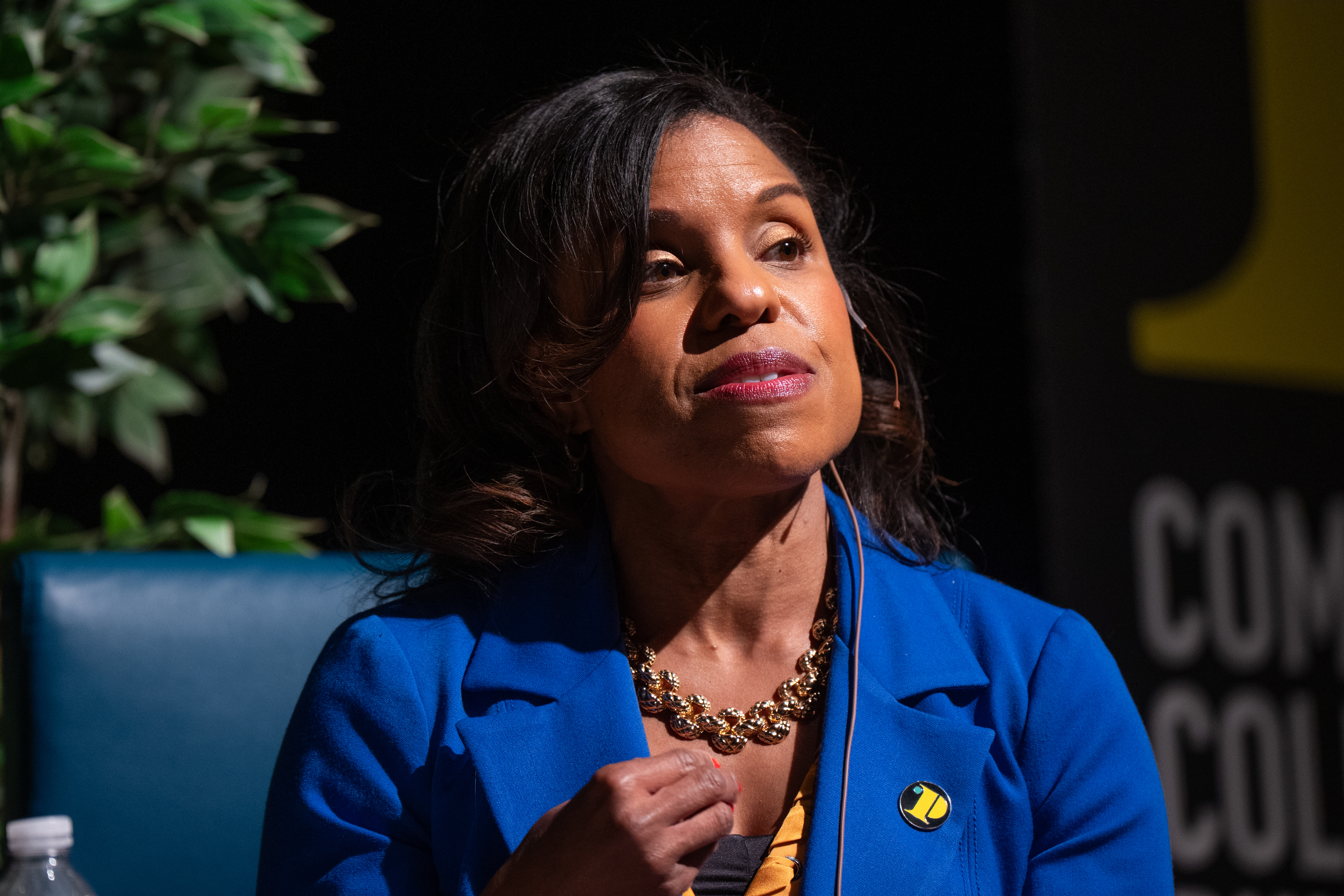
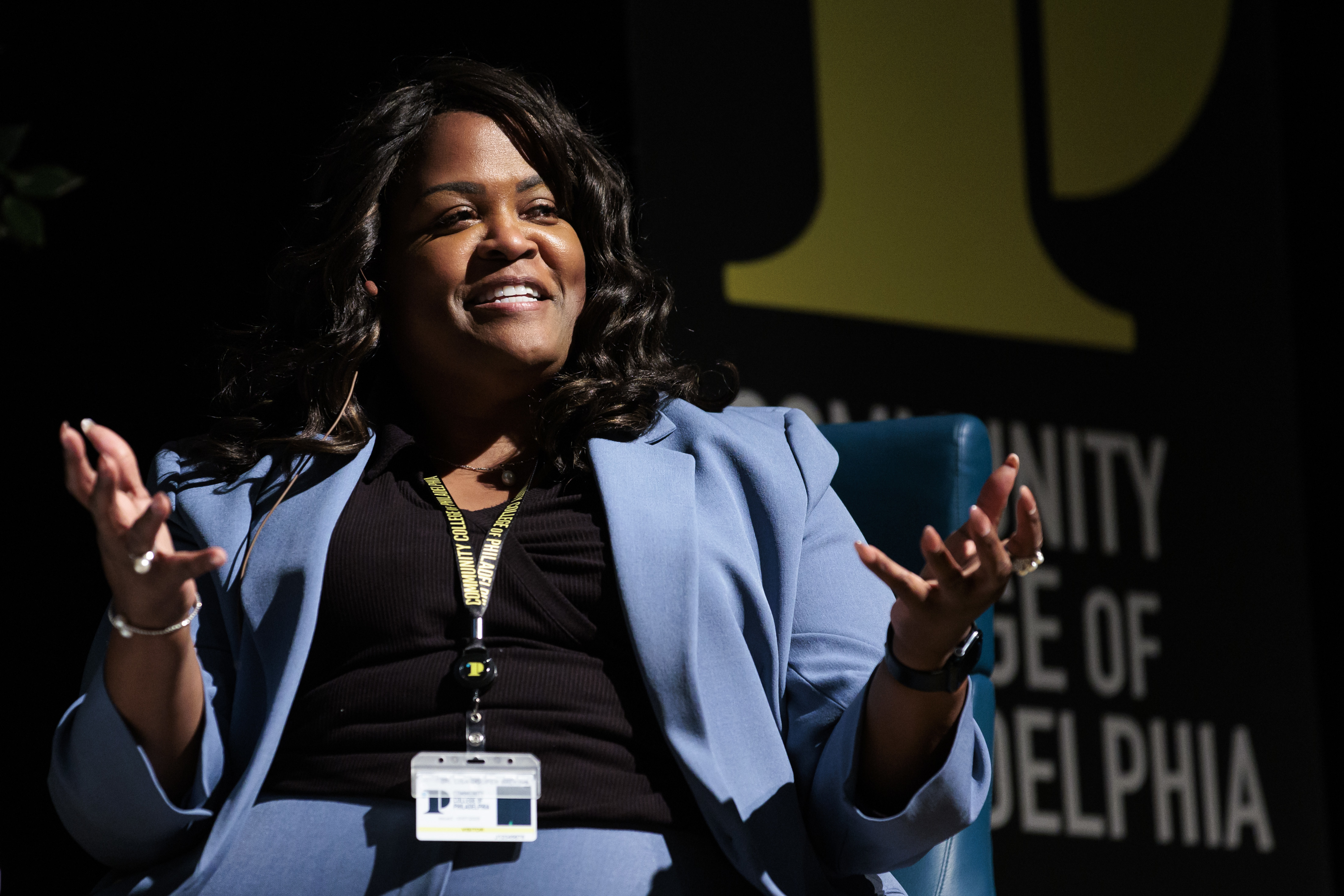
Alycia Marshall speaks at a Community College of Philadelphia forum where she appeared as one of four finalists for president. She got the job Tuesday.
“As a student, I see her passion for the students,” Baez said. “I see how connected she is with the students. Her heart is for the students.”
Junior Brainard, co-president of the faculty and staff union, said: “As a union, we are looking forward to Dr. Marshall finally making good on the agreement we signed back in March,” referring to a contract agreement. “That includes SEPTA passes for all students, smaller class sizes, and improvements to health, safety, and working conditions that will be figured out through various committees.”
During a finalist forum, Marshall addressed free SEPTA passes for students. While the college couldn’t offer the benefit to all students — it would cost about $2 million — a pilot will begin in the spring at the college’s West Philadelphia site, she said.
Brainard said the college has to do better. The pilot only serves half the students at the West Philadelphia site and just 3% of the student body, he said.
Marshall said in an interview Tuesday afternoon that the goal is to find alternative funding sources and expand the program to the entire college.
She said among her priorities will be increasing and strengthening transfer partnerships, with the recently announced program with Cheyney University, an historically Black college in Delaware and Chester counties, as a model.
“Many of our students have transportation issues and perhaps reasonably cannot drive the 25 miles to Cheyney University,” she said. “So Cheyney at CCP is going to provide opportunities to complete a bachelor’s while staying on our campus. It’s symbolic of where I would like to work together with faculty, staff and the administrators and the board … on really strengthening those pathways.”
She cited workforce development and strengthening partnerships with K-12 schools, too, including expanding dual enrollment opportunities and reaching into areas of the city that the college currently is not penetrating enough.
When Marshall was named as interim, Epps cited her “academic and organizational leadership, along with her extensive expertise in STEM, her focus on mentoring and serving underrepresented student populations.”
Marshall, 51, received her bachelor’s in mathematics from the University of Maryland Baltimore County, her master’s in teaching from Bowie State University, and her doctorate in mathematics education from the University of Maryland.
A native of Maryland, she started her career as an adjunct professor at Anne Arundel Community College in Maryland, near Annapolis, and later became a full tenured professor and chair of the mathematics department.
She was promoted to associate vice president there and founded the African American Leadership Institute and spent a total of nearly 23 years at the Maryland community college. She’s also a rising presidents fellow with the Aspen Foundation, a nonprofit aimed at creating thought leaders in their fields to address critical challenges.
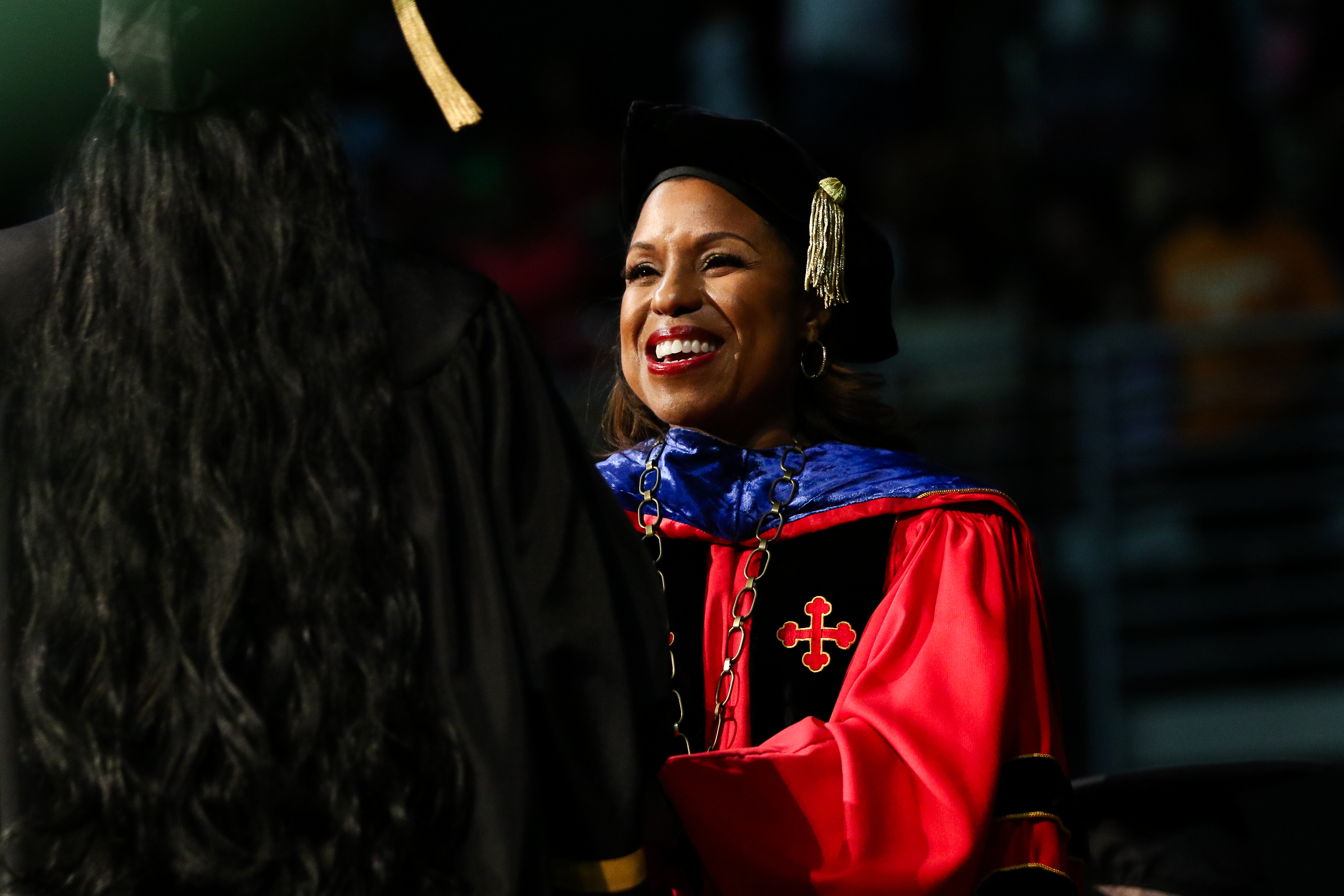
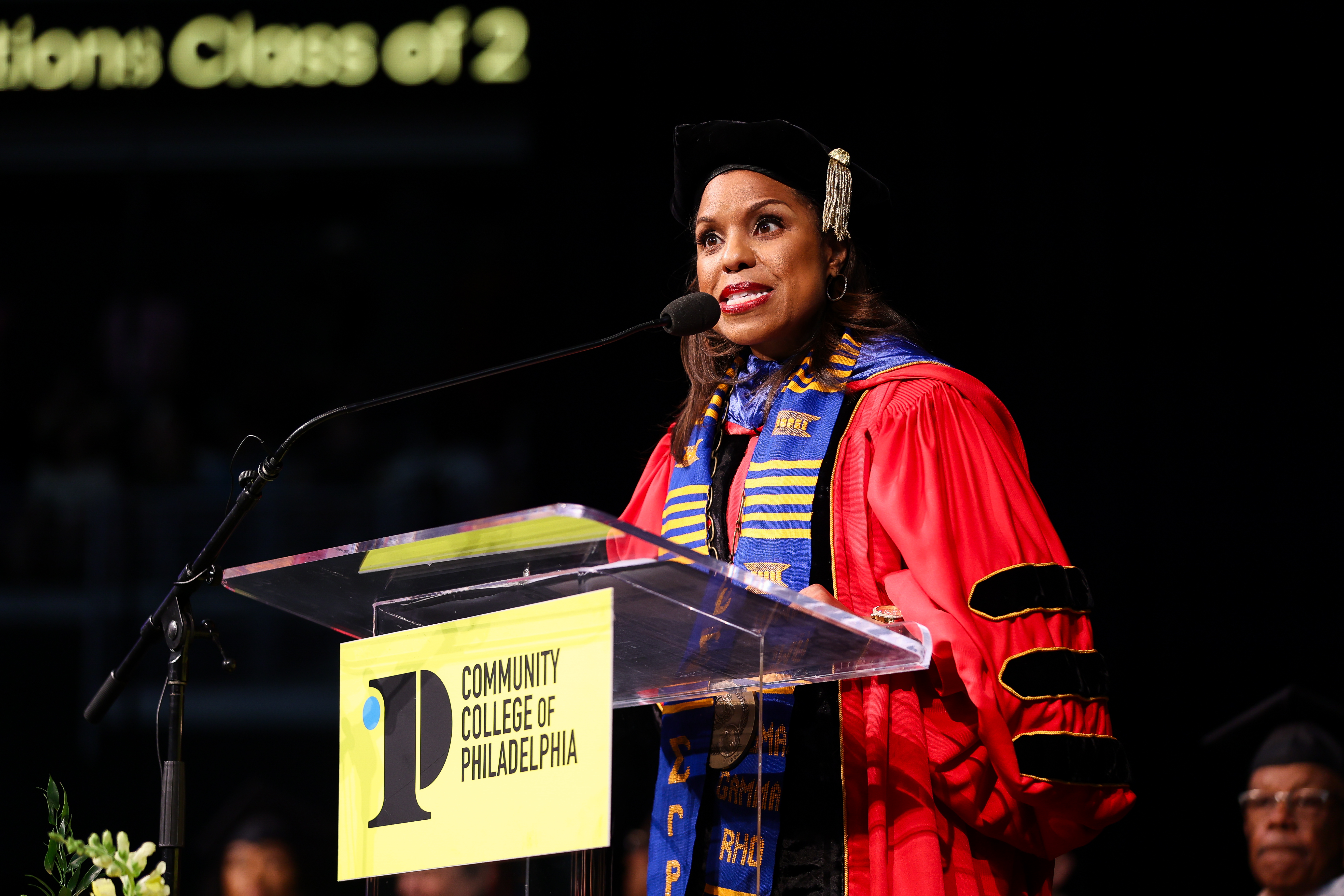
Alycia Marshall, then interim president of Community College of Philadelphia, speaks at commencement in May.
At a campus interview session for the job, Marshall said she would lead both internally and externally, focusing on faculty and staff satisfaction as well as building relationships with funders and donors.
She said she has already met more than 20 City Council members and state legislators.
Marshall acknowledged that an employee satisfaction survey she commissioned when she became interim president showed low morale and promised to address it “through ensuring transparency and frequent communication.” The results of that survey haven’t been publicly released.
Marshall said that over the last six months, she learned to be comfortable not knowing what will happen next. After a board meeting earlier this month, a consultant who is the liaison to the presidential search committee said on a still-active microphone that Marshall had not been well-received on campus.
Marshall said at the interview session that she did not agree with that and that she has developed relationships with people across the college.
“If you have worked directly with me, you will know I am here for the students and I am here to support faculty and staff,” she said.
Marshall, who maintains a residence in Maryland, said she would move to the city full time if selected for the job.
The other finalists for the job were: Jesse Pisors, former president of Pasco-Hernando State College in Florida; Jermaine Wright, vice president for student affairs at City University of New York-Lehman College; and Lisa Cooper Wilkins, vice chancellor of student affairs at City College of San Francisco.
The Community College of Philadelphia’s Board of Trustees is preparing to select a new president, possibly as soon as Tuesday morning.
A special meeting has been scheduled for 8 a.m. on Zoom “to approve an offer of employment to a presidential candidate,” according to the board’s website.
The selection follows daylong interview sessions with the four finalists, who came to campus earlier this month and met with faculty, staff, students, and board members.
“Each comes with their strengths and weaknesses,” said Sandra Gonzalez-Torres, CCP’s director of articulation and transfer, who attended meetings to hear all four candidates. “At this time, the college really needs strong leadership that will guide us to a strong future. The college needs strong fundraising and ways to support our students in retention and graduation.”
Two have limited experience as a college president, including the interim CCP president. Three are candidates of color. One candidate has extensive fundraising experience, and another is a native Philadelphian who once worked at the college and has a background in counseling.
Candidates addressed the college’s low morale and said they had the skills to help it heal following the forced departure of former president Donald Guy Generals after 11 years in the post.
Lisa Cooper Wilkins, a finalist in the Community College of Philadelphia’s search for a president, speaks at an interview forum last week.
Lisa Cooper Wilkins touted more than 25 years of higher education experience, from faculty member to dean to her current position as vice chancellor of student affairs at City College of San Francisco — where she has worked since 2020.
“I consider myself to be a very collaborative leader and one that leans into communication as one of the primary strategies to work effectively across constituencies,” said Cooper Wilkins, a first-generation college student who grew up in a single-parent home.
Cooper Wilkins, who previously worked at San Joaquin Delta College and the University of the Pacific, cited her background in counseling as a plus. She described herself as a “very calming presence,” which could be helpful in leading CCP out of a tumultuous time.
She is the only candidate who is a native of the Philadelphia region, having attended the Philadelphia High School for Girls and later CCP.
Cooper Wilkins also served as a dean at CCP from 2008 to 2010, during which time she said she made a point of visiting the regional centers. She said she would continue to devote time to them if she became president.
“I’ve worked at institutions where, unfortunately more often than not, they feel like an afterthought,” she said.
She also wasassistant director and senior counselor for student support services at Drexel University in the mid-1990s.
Cooper Wilkins acknowledged that her fundraising experience has been “limited” but that she had some experience during her time at CCP.
She received her bachelor’s degree from Goucher College, master’s degrees from Marymount College and Villanova University, and her doctoral degree in higher education administration from George Washington University.
Alycia Marshall
Community College of Philadelphia interim President Alycia Marshall speaks at commencement in May.
Alycia Marshall, who has been serving as interim president since Generals’ departure, leaned heavily on her experience in the role and how she stepped in to keep the college running smoothly just weeks before commencement.
“Having someone who is understanding about the particular state that the institution is in, who sees where the opportunities are, who is supportive and about ensuring a culture of inclusivity, of collaboration … would be a critical piece” for the next president, she said during an interview session.
Marshall, who wasthe college’s provost and vice president for academic and student success for nearly three years before becoming interim president, said she would lead both internally and externally, focusing on faculty and staff satisfaction as well as building relationships with funders and donors.
She said she has already met more than 20 City Council members and state legislators.
She acknowledged that an employee satisfaction survey that she commissioned when she became interim president showed low morale and promised to address it.
“Things that would be a priority to me [are] insuring transparency and frequent communication,” she said.
A native of Maryland, Marshall started her career as an adjunct professor at Anne Arundel Community College in Maryland, near Annapolis, and later became a full tenured professor and chair of the mathematics department. She was promoted to associate vice president at the Maryland community college, where she spent 23 years and founded the African American Leadership Institute.
Marshall said that over the last six months she learned to be comfortable not knowing what will happen next. After a board meeting earlier this month, a consultant who is the liaison to the presidential search committee said on a still-active microphone that Marshall had not been well-received on campus.
Marshall said at the interview session that she did not agree with that and that she has developed relationships with people across the college.
“If you have worked directly with me, you will know I am here for the students and I am here to support faculty and staff,” she said.
Marshall received her bachelor’s in mathematics from the University of Maryland, Baltimore County, her master’s in teaching from Bowie State University, and her doctorate in mathematics education from the University of Maryland.
Jesse Pisors
Jesse Pisors, a finalist applying to be president of the Community College of Philadelphia, speaks at an interview forum on Oct. 9.
Jesse Pisors most recently served as president of the 10,000-student Pasco-Hernando State College, a community college in the Tampa Bay area, but resigned after less than 18 months on the job.
“The political situation in Florida had devolved to a point where I felt I would not be able to continue to be effective as president,” Pisors told the audience at one campus meeting.
He acknowledged about a half percentage point drop in retention.
“That is exactly why one of our top 10 priorities in the strategic plan … had improving retention,” he said. “We were working on that.”
But he said he’s still proud of his time there, noting the creation of a strategic plan and an increase of more than 8% in full-time equivalent enrollment.
Citing the need for CCP to bring in more money at a time when public funding is tight, Pisors touted his experience in fundraising and marketing, noting his previous positions as a vice president at Texas A&M University-San Antonio and the University of Houston. He also had served as executive director of development and alumni relations at the University of Pittsburgh.
Though he is the lone white candidate, he noted that he had served as a principal of a school in Mexico is fluent in Spanish, and is married to a native of Mexico.
Pisors has 27 years of educational leadership experience, from kindergarten through the college level, which he said gives him “wide exposure” and broad “understanding.”
“Community colleges kind of live in the middle,” said Pisors, who got his bachelor’s in history from Oral Roberts University, a master’s from Oral Roberts, and his doctoral degree in higher education administration from Texas Tech University. “They reach back into high school. They reach forward into universities.”
Jermaine Wright
Jermaine Wright, a finalist for the presidency of the Community College of Philadelphia, speaks during his interview session with faculty, staff, students, and board members on Oct. 13.
Jermaine Wright, who is vice president for student affairs at City University of New York-Herbert H. Lehman College, said he was drawn to CCP by its mission and its students who have a similar background to his.
He said he’s a first-generation college student and an immigrant who became a naturalized citizen. His father worked as a porter. and his mother and grandmother cleaned office buildings.
“I am CCP,” said Wright, who has worked at Lehman for five years and previously held administrative positions at Southern Connecticut State University and City University of New York. “CCP is me.”
He cited his experience in workforce development and work in programs that help underrepresented students succeed.
Asked to describe his vision for the college, he cited increasing enrollment, finding different funding streams, ensuring academic excellence, and creating a more inclusive campus environment.
But he cautioned that any new vision would have to be developed with faculty and staff to get full support.
He also cited experience in fundraising and said success can be achieved by knowing where people are and meeting them there.
“We need to have constant face time,” he said.
Wright said he wouldn’t mind if members of the board of trustees showed up at the college a lot.
“That means they care just as much as I do,” he said.
Once an adjunct lecturer at Rutgers-Newark, Wright got his bachelor’s degree from Binghamton University, a master’s from CUNY, and his doctoral degree in public administration from Rutgers-Newark.
It was a tough two-and-a-half-week period: Students accused of impersonating ICE agents. One student accused of shooting and killing another. A student stabbing a former student 13 times. And a student falling from a light pole during a post-Eagles celebration and dying from his injuries.
These high-profile incidents involved Temple University students and three of the four occurred on or near campus, posing another test for new president John A. Fry.
Some say they are gratified that the administration communicated swiftly and thoroughly about the incidents, which wasn’t always the case in the past.
“That’s been really great to have such a quick turnaround time,” said Ray Epstein, president of student government. “Even if it is the middle of the night, we are getting an email immediately.”
After Chase Myles, a 20-year-old student from Maryland was shot and killed atabout 11 p.m. Feb. 6, Fry notified the campus in an email at 3:46 a.m., and just hours later was on a plane back to campus from an alumni event in Florida so he could be on the ground to talk to the victim’s parents and help coordinate the response.
By contrast, it took nearly twice as long for the university to get out an email about the shooting death of Samuel Collington outside his off-campus residence in November 2021 even though that happened in the daytime. The email did not come from then-president Jason Wingard, but rather from then-safety chief Charles Leone. The attack put the campus on edge and stirred fear in the Temple community among students, parents, and staff — and social media posts circulatedwith the hashtag “Where’s Wingard,” who laterresigned after less than two years on the job.
Donna Gray, Temple’s campus safety services manager for risk reduction and advocacy services, greets Temple president John A. Fry during his first day of work Nov. 1.
That incident ― which happened as part of an attempted robbery and carjacking ― was different in that it involved random violence by a stranger in the neighborhood.
But even the Temple police officers’ union, which has been critical of university leadership in past years, has noted Fry’s efforts in dealing with the recent multiple incidents.
“He seems to be handling it well,” said Sean Quinn, president of the Temple University Police Association. “Without a doubt, as soon as these things happen, he’s right on top of it.”
“It is up to us to tell the bad news first, personally to all of our community,” he said. “Number two is just to keep a steady stream of communications following that even when there is not a whole lot to say. It’s worth checking in.”
Parents on the university’s family council said they are confident in the university leadership’s handling of the incidents, too.
“It seems like there are the right people in place,” said Allison Borenstein, a Temple alumna whose son, a sophomore, attends the university. “They handled it well, and I think they are on it.”
Borenstein, an event planner at a synagogue who lives in Cherry Hill, noted such incidents could happen near any college campus and said she feels that Temple sometimes gets an unfair rap.
“There’s nothing that the school could have done in advance,” she said.
Emma Legge, an alumna and parent of a senior who lives in New York, said she feels she is kept informed, and she checks in with her son after receiving a communication.
“I do feel as a parent that Temple is doing what it can within the city of Philadelphia to manage what happens,” said Legge, who got both her bachelor’s and master’s degrees at Temple and met her husband, also a twice Temple alumnus, there. “I have a lot of confidence in the university and the people who are on board.”
Philadelphia Police Commissioner Kevin J. Bethel and Jennifer Griffin, Temple University vice president for public safety, after graduation ceremonies for the Police Academy Class #402, new officers of the Philadelphia Police Department and Temple University Police Department, at Temple’s Performing Arts Center in June.
That includes Jennifer Griffin, vice president for public safety, she said.
“I feel very reassured by the measures police are undertaking to be involved in the neighborhood and be involved with students,” said Legge, who works in student affairs administration at a New York college.
Griffin said after the recentincidents, she met with the student safety advisory committee and its members saidthey appreciated the accurate and timely information, which she said she has always aimed to provide since starting at Temple about two and a half years ago.
“We hope it decreased anxiety,” she said.
Of Fry, she said, “I thought he handled all the incidents with thoughtfulness and decisiveness and direction that I would expect from somebody with his level of experience.”
The police union has been critical of Griffin, even calling for her to resign or be fired over staffing issues. University leadership has backed Griffin.
Quinn said the union now is trying to work things out, noting that the university is amid a police staffing study conducted by an external company.
“I just don’t want to come to work every day feeling like I’m butting heads,” he said. “I actually would like to work with whoever I have to work with to see if we can accomplish things.”
Fry said he expects to have the results of the staffing study in a couple months. He said he’s pleased with the work campus police do, noting he had gone on ride alongs with them and wants to make sure they have enough help.
Ray Epstein, Temple student government president.
While Epstein, the student government president, endorsed the university’s handling of communication about the recent shooting, she said it also should have issued an alert after a report about a student placing hidden cameras in a fraternity bathroom in late November and recording people without their knowledge. Instead the campus learned of it through social media earlier this month, she said. The student has been arrested and charged in that case.
“I was not sure when or if the fraternity/university would ever disclose this incident, but I wanted to inform everyone in case this was never announced,” someone posted on a Temple Reddit page, with court documents about the case.
“Maybe it’s perceived by campus safety as not being an ongoing threat,” Epstein said. “I’d argue that it is because when these things happen in a house, you can’t possibly know until an investigation is concluded who all was involved.”
Griffin countered that the investigation was handled swiftly, the individual was identified and arrested, and there was no ongoing threat to the community. A Temple alert is sent when there is an immediate threat to the community, she said.
In this case, people who lived in the house notified law enforcement after the equipment was found, the equipment was taken and the individual who put it there was identified, she said.
“The people who called in the cameras were cooperative,” she said. “It was an isolated incident at an off-campus residence … and student affairs reached out to those who were impacted.”