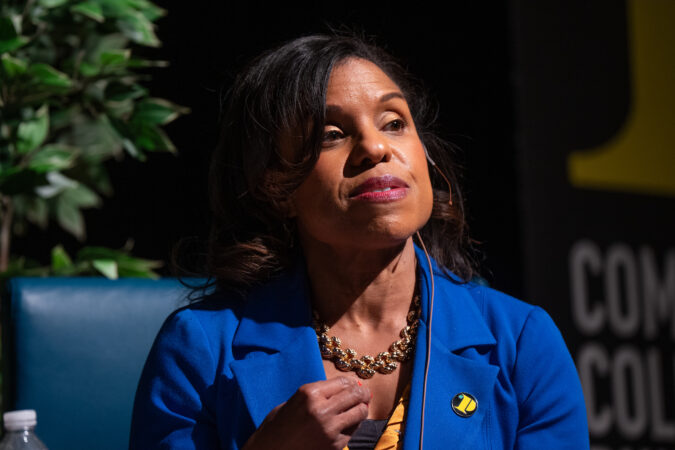
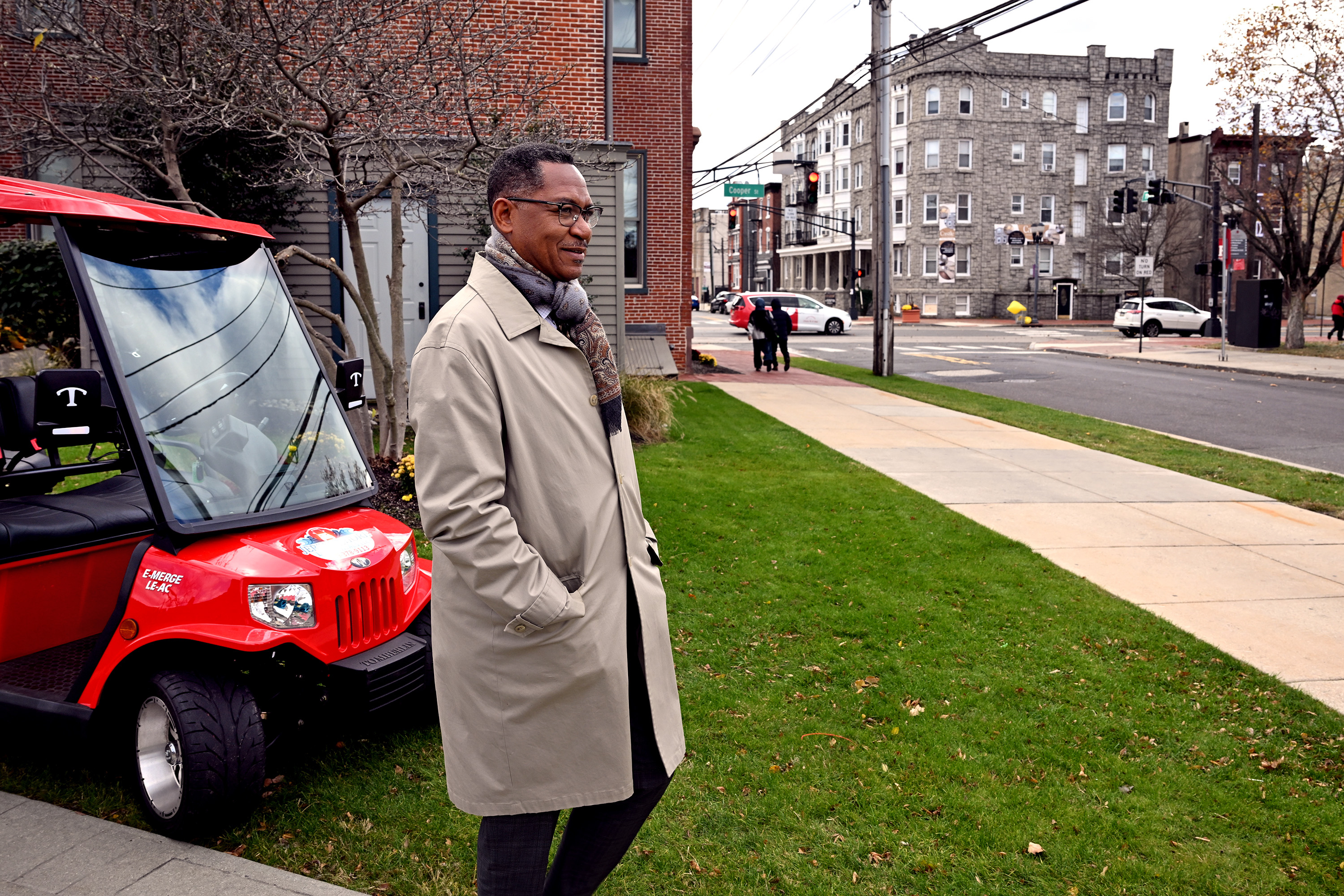
Alycia Marshall will earn $295,000 as the new president of the Community College of Philadelphia under terms of a contract approved by the board of trustees Friday.
Marshall, 52, had been serving as interim president since April when longtime president Donald Guy Generals was forced out. Her salary is similar to what Generals earned before he left.
In October, the board selected Marshall for the permanent post from among four finalists and said it would negotiate a contract with her.
The new contract, commencing Jan. 1, is for three years and six months and after that would renew on an annual basis.
“This is a great birthday present,” Marshall said following the unanimous vote on her contract at the brief board meeting. “Today is my birthday. Thank you so much for your support. … It’s been a pleasure serving as the interim and I’m excited to move into the next chapter.”
Under the contract, she will be eligible for a bonus of up to 15% of her base pay annually and will receive a $2,000-per-month housing allowance and a $650-per-month car allowance.
Marshall, who has maintained a residence in Maryland, is required to move her primary residence to Philadelphia within six months under the contract terms. She would face termination if she failed to do so, the contract states. Marshall has said she intended to move to Philadelphia if she got the permanent job.
Marshall had served as CCP’s provost and vice president for academic and student success for nearly three years before stepping into the interim role at the college, which had an enrollment of 12,400 credit students and 1,381 noncredit students last spring.
She received her bachelor’s in mathematics from the University of Maryland Baltimore County, her master’s in teaching from Bowie State University, and her doctorate in mathematics education from the University of Maryland.
A native of Maryland, she started her career as an adjunct professor at Anne Arundel Community College in Maryland, near Annapolis, and later became a full tenured professor and chair of the mathematics department. She was promoted to associate vice president there and founded the African American Leadership Institute and spent a total of nearly 23 years at the Maryland community college.
Pennsylvania’s fledgling State Board of Higher Education on Thursday rolled out itsfirst strategic plan, setting goals addressing affordability, increased degree attainment, the state’s workforce and economic development needs, and the fiscal health of colleges.
The board voted unanimously to post the 10-year plan for public comment.It will consider adoption in February.
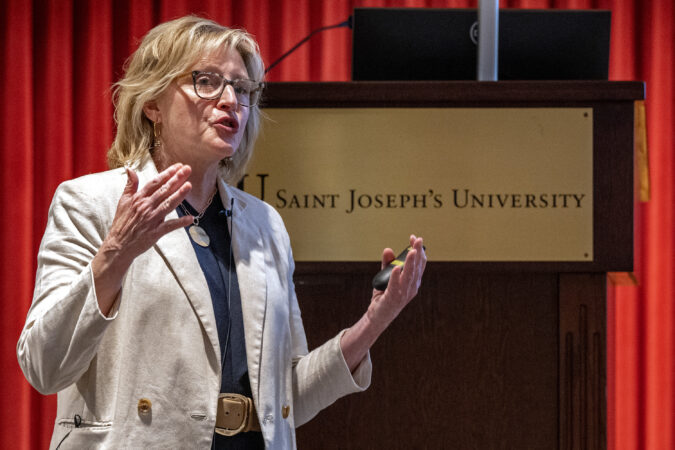
“The plan will strengthen partnerships, break down silos, and enable effective reinvestment in the sector,” Cynthia Shapira, chair of the board, said in a statement introducing the plan.
It comes as the sector faces perhaps its greatest challenge in decades. Both private and public universities have been losing enrollment as the number of high school graduates falls — with another dip beginning next year and a 12% decline expected in Pennsylvania by 2037. Public trust in colleges has faltered, while concerns about cost and student debt have mounted.
They are also facing scrutiny from President Donald Trump’s administrationand a forecasted gap in workers who require a postsecondary credential in essential areas, such as healthcare, teaching, and advanced manufacturing.
The Pennsylvania State System of Higher Education, which oversees the state’s 10 universities, endorsed the plan’s emphasis on collaboration across private and public colleges and universities.
“Within our own system, we have learned that when universities work together, they can innovate, overcome challenges and better serve students and the Commonwealth,” the system said in a statement. Shapira is also the chair of PASSHE’s board.
The 21-member higher education board includes college presidents, administrators, legislators, and students.It was formed in 2024 by the governor and General Assembly to help public and private colleges work more cohesively and better serve students and the state’s workforce needs. The plan rollout follows public hearings that drew comments from more than 1,200 people, the board said.
The plan outlines the challenges facing the higher education sector including another coming decline in the high school population, financial constraints, and the lack of coordination among institutions. Student debt averages more than $40,000 per student in Pennsylvania, the plan notes.
“Multiple comparative state-level analyses … place Pennsylvania at or near the bottom in terms of affordability, attainment, and state investment per capita,” the report stated. “Adding to these challenges are a large and growing postsecondary workforce credential gap, and a range of closures and mergers that threaten to reduce access to postsecondary education.”
In the Philadelphia region, Cabrini University and the University of the Arts closed in 2024 and Rosemont College announced earlier this year that it would cease operations in 2028 and that Villanova University would purchase its campus. Salus University was merged into Drexel University. Six of Pennsylvania’s state universities were merged into two entities in 2022, and St. Joseph’s University absorbed the University of the Sciences the same year.
Other local colleges have struggled with enrollment declines and deficits. Temple University, for example, has gone from more than 40,000 students in 2017 to less than 30,000 this year.
What are the specific goals in the plan?
The new plan set six goals:
Increase postsecondary attainment.
Ensure affordable pathways to postsecondary credentials.
Support the economic development needs of the state.
Support the workforce development needs of the state.
Ensure accountability and efficient use of state funds.
Strengthen the fiscal health and stability of the higher education sector.
How will the board work toward those goals?
To meet the goals, the board proposes a “strategic communications plan” that touts the benefits of postsecondary education and how it impacts employment outcomes.
It also emphasizes expanding funding for dual credit programs and enrollment in those programs to streamline the path from high school to college and allow students to accumulate more credits before they graduate high school. In addition, the plan proposes studying how to improve retention rates and focusing on reenrolling adults who started college but didn’t finish; there are more than 1.1 million Pennsylvanians with some college experience.
Among its plans for addressing affordability are support of policies that “expand financial aid and forgive debt for in-demand, high-quality credentials,” take advantage of new federal Pell grants for workforce programs, and boost access to “open educational resources” to reduce the cost of course materials.
The report also discusses the intent to “maximize the impact of research universities,” recruit out-of-state students to broaden the talent pool, and increase access to paid work experiences for students.
To promote fiscal health, the plan recommends identifying and promoting best practices for fiscal efficiency and cost savings, and developing resources and an advisory group to help financially struggling colleges.
“If institutions decide to close or merge, tools and expertise to assist in this process will help maximize savings, retain access to critical academic programming, and mitigate negative effects on students and communities,” the plan states.
Another advisory group is recommended to help communities where colleges close maintain access to postsecondary education.
What comes next?
After the public comment period and the plan’s final adoption, the board intends to report annually on progress toward the goals and to consider revisions to the plan every five years.
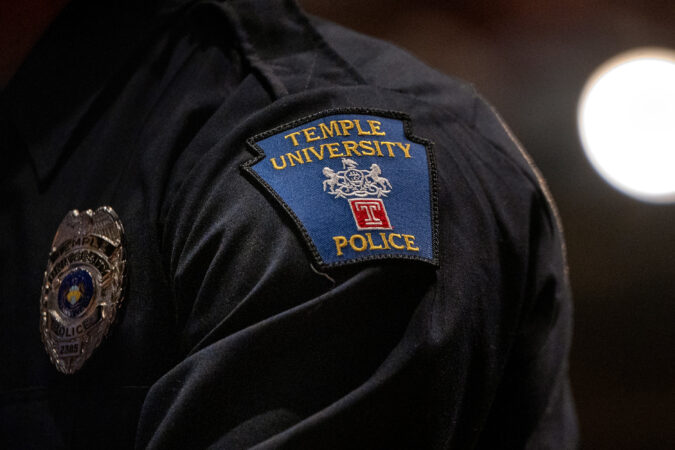
Temple University plans to increase its patrol officer ranks by 58% over five years after a study assessing staffing levels showed the school was below the middle tier of a framework that rates law enforcement agencies.
The university currently has 77 sworn officers — 50 of them patrol officers — and president John Fry pledged to add 29 patrol officers, one detective, six sergeants, and one lieutenant. That would increase the overall number of sworn officers to 114.
Temple president John Fry said safety was his first priority. Now he plans to increase patrol officers by 58% over five years.
No target has been set for how many officers will be hired per year, but those discussions are underway, said Fry, who named public safety a top priority when he started in November 2024.
The university’s declaration comes amid a particularly difficult time for police hiring, with departments nationally — including the Philadelphia Police Department — continuing to face shortages. Temple has been working for several years to attract more officers, including increasing salaries and benefits, adding signing and retention bonuses and higher contributions to retirement accounts, and hiring an associate director to focus solely on hiring, recruitment, retention, and training. The department also moved to 12-hour shifts to give officers more days off.
Yet, the number of sworn officers has decreased from 81 in March 2024 to the current 77, despite additional hires being made, including four new officers from the Temple University Municipal Police Academy in October.
“We must, and we will, deploy ever more compelling and creative incentives to make Temple’s Department of Public Safety a destination employer for law enforcement in our region,” Fry said. “Our plan is to look closely at what we are doing in the areas of recruitment and retention over the next several months and see what improvements can be made.”
Temple plans to hire former Philadelphia Police Commissioner Charles H. Ramsey’s 21CP Solutions company to assist, including with how best to recruit and retain more officers, Fry said. The university had hired Ramsey to assess safety following the shooting death of student Samuel Collington in November 2021 and has implemented almost all of the 68 recommendations from his report released in April 2023.
The staffing study was one of the final recommendations that Temple had to complete.
Former Philadelphia Police Commissioner Charles Ramsey speaks at a press conference on the Temple safety audit his firm completed in April 2023.
New bike patrol officers
In addition, Philadelphia Police Commissioner Kevin Bethel has committed to providing six bike patrol officers and a sergeant assigned to Temple, beginning Jan. 5. That’s up from the current four officers and supervisor, who were not always the same personnel.
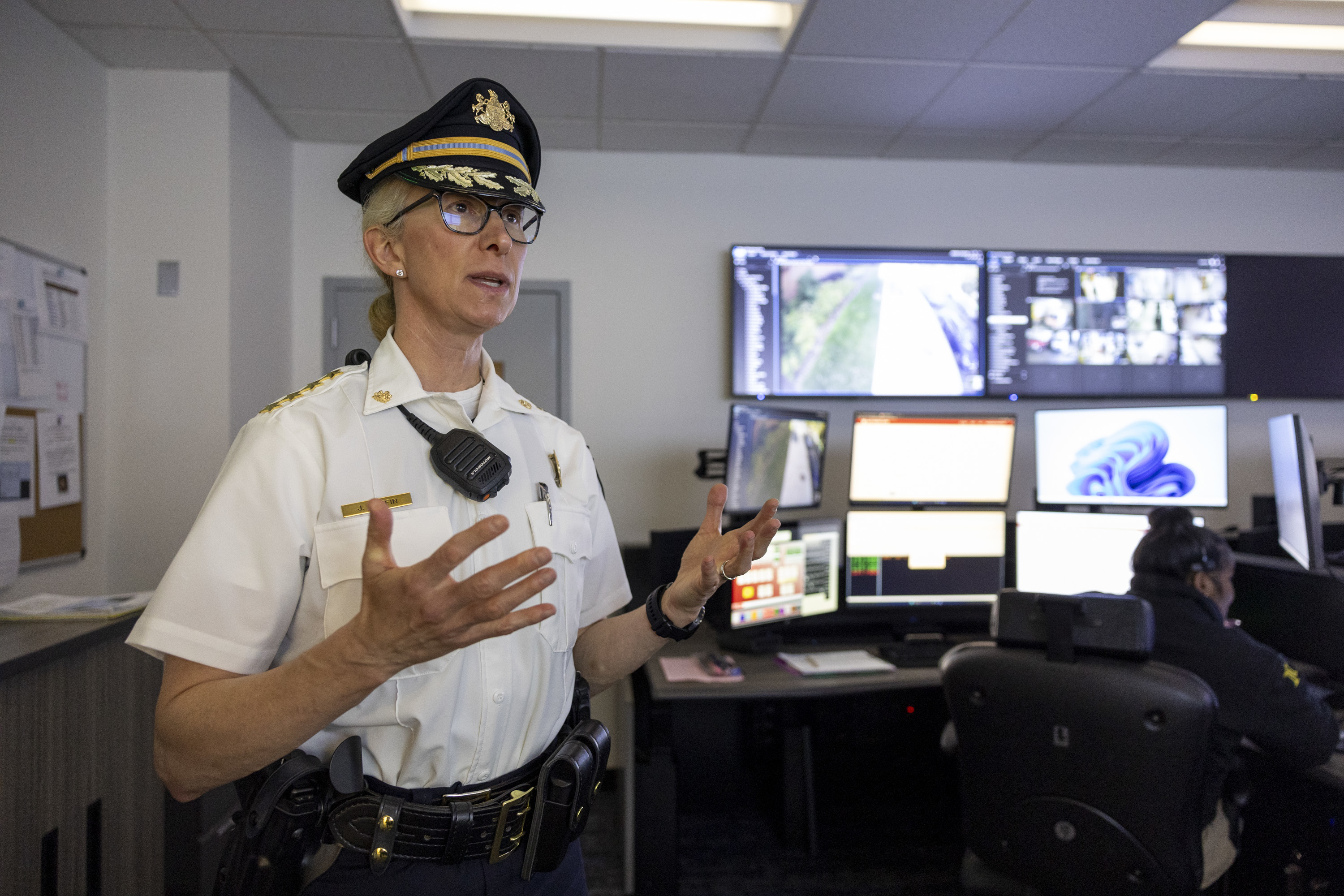
“The ability to have relationships and collaborations … will be better because it’ll be a consistent group,” said Jennifer Griffin, Temple’s vice president for public safety.
“The ability to have relationships and collaborations … will be better because it’ll be a consistent group,” Jennifer Griffin, vice president for public safety at Temple University, said about the city’s six bike patrol officers that will be dedicated to Temple.
Members of the Temple University Police Association, the officers union, have complained for years of inadequate staffing. In a social media postabout a year ago, the union said the department had lost more than 50 officers since 2022.
But Andrew Lanetti, president of the union, said he is pleased with the direction outlined by Fry.
“From our talks here in the past few days, I am happy with where we’re going in the future,“ he said. ”I believe this is going to be a very positive experience and it’s going to help our community a lot.”
University and union officials already have been discussing ways to recruit and retain more officers, and a more positive working relationship between the union and the university could help move the needle on hiring and retention.
“We’re going to work together and our goal is all the same,” Griffin said. “We want a safer Temple and a safer community.”
Budget woes
The move also comes as the university attempts to close a budget deficit, made worse this fall when the school missed enrollment projections for its main campus that translated to about $10 million in lost revenue.
“It will be a challenge,” Fry said of the new police officer hiring, “but it’s a priority, so we will meet that challenge.“
He said money for the new staffing will be built into the university’s five-year budget plan.
Temple last February hired safety and security consulting companies Healy+ and COSECURE, ancillary businesses of the Cozen O’Connor law firm, to conduct the staffing study. They used a tiered framework “to assess the capacity and effectiveness of law enforcement agencies,” Temple said. The university declined to release the full report, citing its proprietary information.
“Temple is positioned below the middle tier of the framework, meaning the department is presently staffed to meet the essential public safety and emergency response needs of our community,” Fry said. “However, additional personnel would allow the department to organize and coordinate its activities to focus on additional proactive and community engagement activities that would position it higher in the consultant’s framework.”
With the additional police officers that Temple plans to hire, the school would rise from just below the third of five tiers in the consultant’s rating system to the second tier, Fry said. The second tier, he said, connotes “higher levels of proactive enforcement, more presence, more mitigation strategies, and then more outreach, more community engagement.”
Public safety is extremely important as the university plans to release its strategic plan and campus development plan early next year and as Fry seeks to spur economic development along the Broad Street corridor, from Temple’s new Terra Hall location in Center City to the health campus in North Philadelphia.
“There’s going be a campus development plan, which clearly is going to put more activity on this campus, which means we’re going to have to support our police,” Fry said.
Potential investors, he said, are watching.
“When they’re about to commit significant investment, they want to know the area is safe,” he said.
‘Hold ourselves accountable’
Former Temple president Jason Wingard pledged to increase the police force by 50% the month that Collington was killed, and those numbers never materialized. In fact, the number of officers dropped.
Fry said what is different this time is that he has specified the exact numbers that will be added over a distinct time frame.
“This is not something we’re just sort of speculating about,” he said. “This is based on a professional study. … We’ll be able to hold ourselves accountable.”
The university already has made a host of changes that were recommended by Ramsey in the 2023 report. They include more foot patrols and security cameras and increased technology in the communications center.
The university in 2024 touted a decrease in aggravated assaults, robberies, and thefts in its patrol zone. Despite improvements, Temple has continued to face safety challenges in its North Philadelphia neighborhood, including large groups of juveniles that sometimes gather on or near campus — a challenge in other areas of the city, too.
And a student was shot and killed by another student near off-campus housing inFebruary.
Temple University will offer a voluntary retirement program for faculty, the school announced Wednesday.
The move comes as the university attempts to close a budget deficit that stood at $27 million earlier this year but that worsened when the school did not meet projected enrollment targets for its main campus — which president John Fry had said translated to $10 million less in revenue.
“It is important for us to explore strategies that will allow the university to make meaningful changes, as this is key to optimizing the budget and improving our financial results moving forward,” Fry and interim provost David Boardman said in a message to the campus community.
The university did not say how many faculty it hopes will take the offer, but those who are 62 years and older and have at least 10 continuous years of experience are eligible. They must be tenured, tenure-track, or appointed as non-tenure-track under a contract that expires after June 30.
Temple did not immediately provide the number of eligible faculty.
The move also will allow the university to hire new tenure-track faculty over time, Fry and Boardman said.
Fry said the university would fund the program with federal COVID-19 stimulus funds that came in a onetime tax credit reimbursement to businesses that kept employees during that period. Temple last offered faculty a voluntary retirement program in 2023.
Pennsylvania State University last year offered buyouts to its faculty and staff on its Commonwealth campuses as it made plans to close seven of those campuses. More than 380 employees — 21% of those eligible — took the buyout in June 2024.
Also on Wednesday, Temple announced it had tapped Rob Reddy, formerly the vice president for enrollment management at St. Louis University, to serve as interim vice provost for enrollment management. He will begin Jan. 1
Reddy replaces Jose Aviles, who left Temple last month for a new enrollment job at Rutgers University. He has three decades of experience in admissions, financial aid, and veterans’ relations, Boardman said in an announcement to the campus community.
“Rob comes to us with deep experience in the field and a reputation for taking on challenging assignments,” Boardman said.
He previously served as assistant vice chancellor of enrollment management and dean of student financial services at Northeastern University.
The university intends to launch a search for a new enrollment leader in the spring, Boardman said.
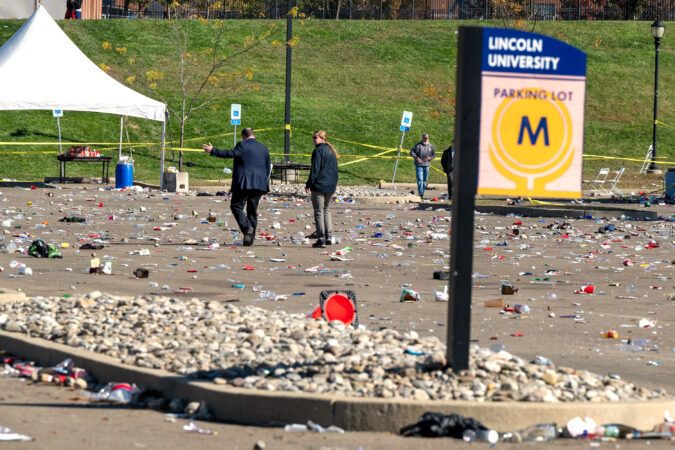
AfterLincoln University’s homecoming in October ended with seven people shot, including one killed, the rural Chester County township where the school is located plans to pass new regulations on large events.
Several officials in Lower Oxford Township said there have been ongoing problems with parking, trash on neighbors’ lawns, disturbances and, in some cases, crime when the 1,650-student university hosts events. After the Oct. 25 shooting, when thousands of people gathered for homecoming, emergency personnel had to use all-terrain vehicles to transport patients on stretchers because ambulances could not access the campus, given how many cars were parked around the venue, they said.
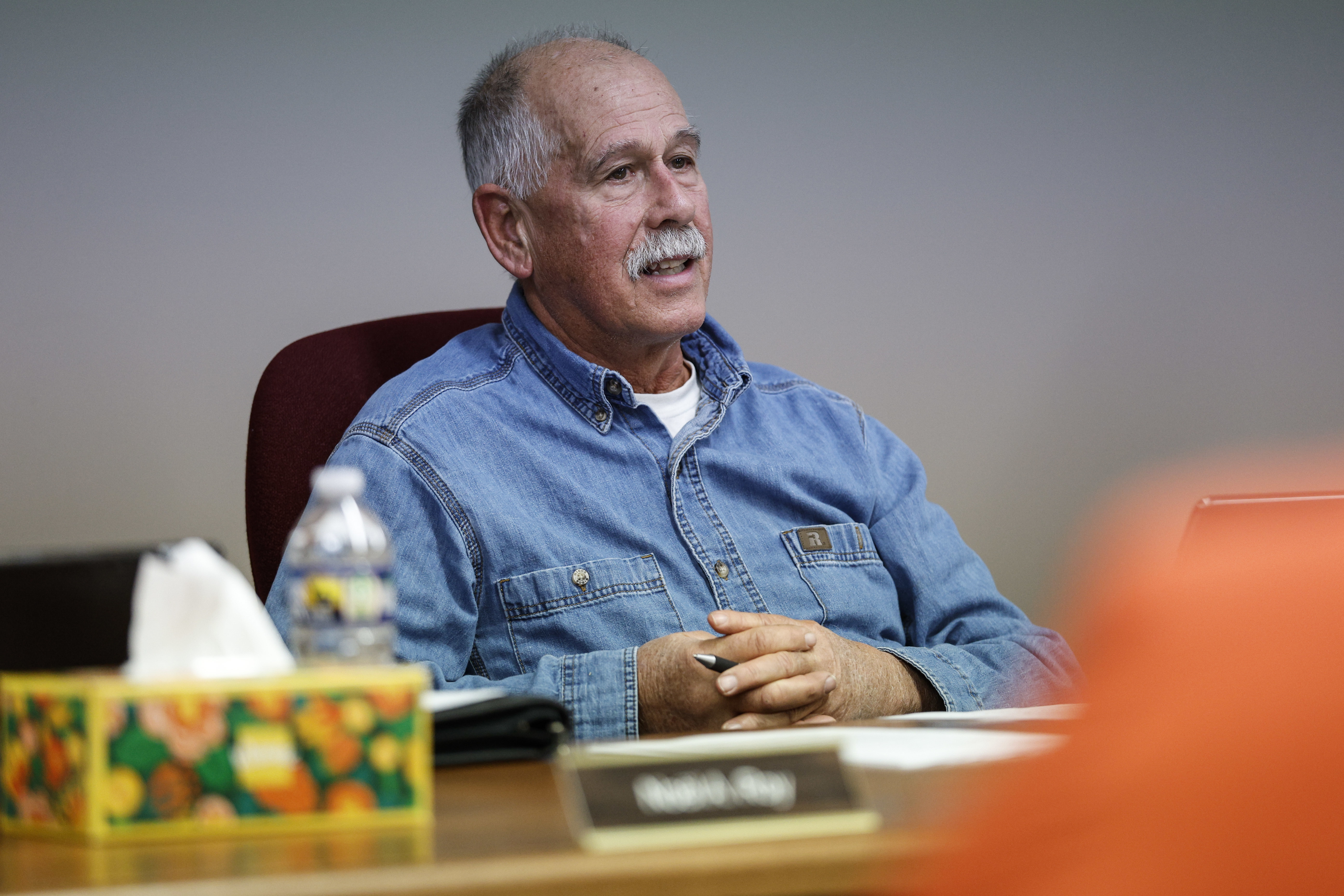
“We have had meetings with people at Lincoln,” said township supervisor Noel Roy, who oversees emergency management. “They’ve been somewhat reluctant to do what needs to be done to try and control the situation.”
Lincoln University has declined to answer specific questions from The Inquirer, but President Brenda Allen at a board of trustees meeting last month acknowledged that changes were needed, especially around the school’s large events, and that the school has to do a better job of collaborating with the township.
“Our top priority remains the safety of our students, faculty, staff, alumni, and community,” the school said in a statement to The Inquirer Thursday. “The university continues to refine our safety measures and protocols.”
At a township supervisors meeting this week, university officials pledged to work with the township.
Lower Oxford Township officials meet and discuss a potential large event ordinance following the homecoming shooting at Lincoln University.
“We want to come together because we are a part of this community as well,” said Venus Boston, Lincoln’s general counsel.
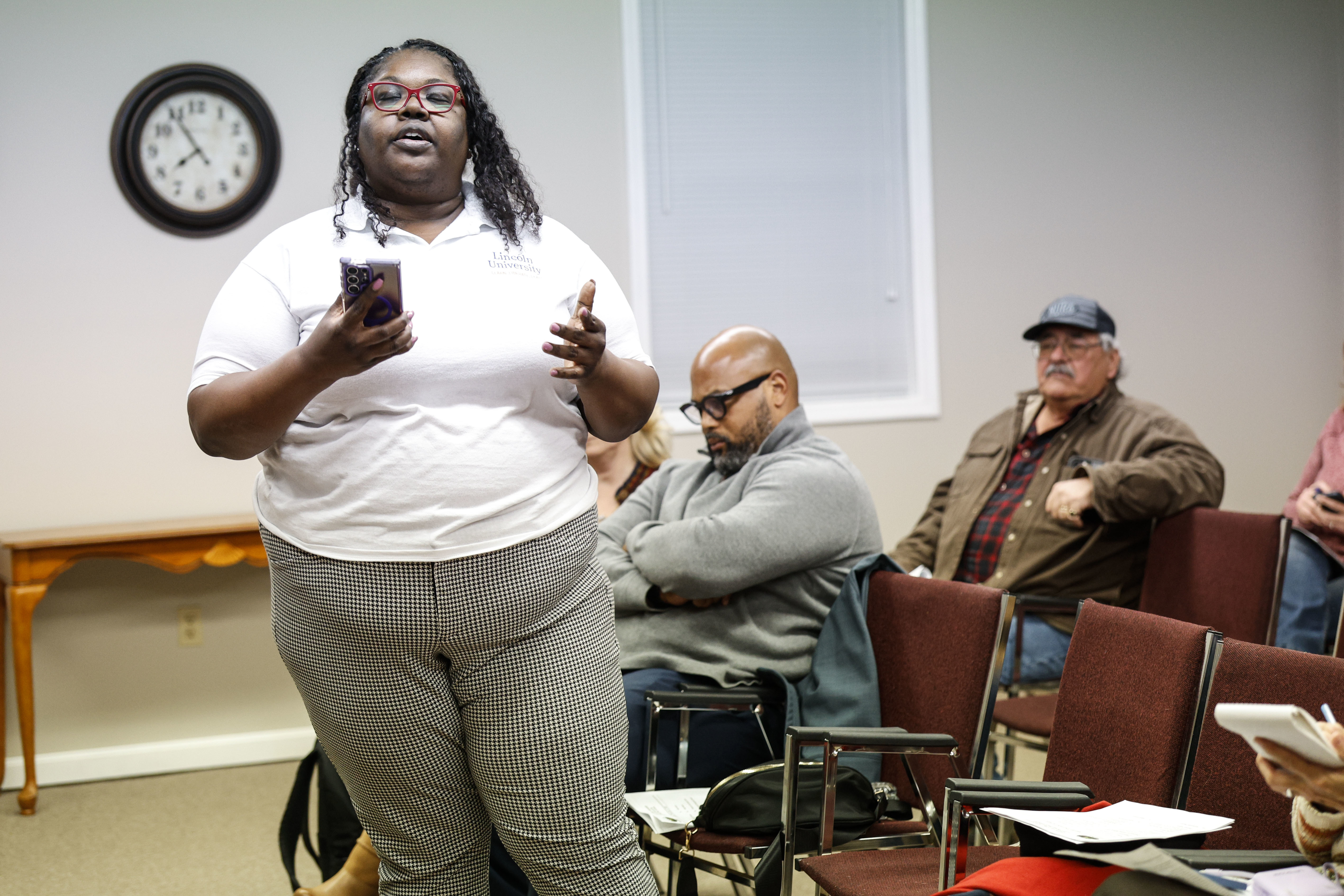
Yeda Arscott, Lincoln’s associate vice president of facilities and program management, told supervisors the university is considering several steps to improve safety, including ending all outside events at dusk, eliminating open invitations, requiring guest registration, and canceling large events such as Spring Fling. The school also is looking at parking and safety protocols, she said.
Yeda Arscott, associate vice president director of facilities and program management at Lincoln, speaks at the Lower Oxford Township meeting and shares actions the university is considering following the homecoming shooting.
“This shows real commitment,” said Arscott, who lives five minutes from Lincoln, “but real safety requires joint planning between the township, Lincoln, other major businesses, our neighbors, and emergency services.”
Township and Lincoln officials said they plan to meet privately to discuss solutions.
“Our goal is to work with Lincoln to make this better,” said Kevin R. Martin, chairman of the board of supervisors. “We need to think this through, but we also have a sense of urgency because it does affect our community.”
Kevin R Martin, chairman of the township supervisors, said the township wants to work with Lincoln on improvements.
Chester County Commissioner Josh Maxwell said county officialsand the university also will meet in January to discuss best practices for emergency services and student and community safety.
“It’s important that the kids feel safe,” said Maxwell, who also is an adjunct professor at Lincoln. “No one wants this to ever happen again.”
The shooting remains under investigation.Jujuan Jeffers, 20, of Wilmington, was killed, and six others, ages 20 to 25, including a student, were also shot. Zecqueous Morgan-Thompson, 21, of Wilmington, was charged with possessing a concealed firearm without a license. Neither Jeffers nor Morgan-Thompson have any known connection to Lincoln.
Arscott also urged township leaders to “broaden the conversation beyond event permits” and look to address the problem of gun violence.
“We were a victim, too,” Boston said.
“We were a victim, too,” said Venus Boston, Lincoln University’s general counsel.
Tensions with neighbors
The proposed township ordinance would require those seeking to hold special events to apply for a permit 30 days in advance and outline how they will control the number of guests, traffic, alcohol, and security, said township solicitor Winifred Moran-Sebastian. The township couldapprove or reject applications.
Township supervisors last spring passed a parking ordinance to cope with access problems created during past large events at Lincoln, but parking at homecoming still led to issues for emergency responders.
Several residents who attended this week’smeeting were skeptical of Lincoln’s intent to make improvements and called for larger fines than the $1,000 proposed in the ordinance.
Vanessa Ross lives about a half a mile from campus and said she was afraid for her family the night of the homecoming shooting. She spoke at the Lower Oxford Township supervisors meeting.
“I feel my life is in jeopardy with how things are being currently managed,” said Lincoln neighbor Celestine Getty, fearing what could happen if vehicles were unable to get to her house in the event of an emergency.
Vanessa Ross, who has lived about a half mile from Lincoln for 14 years, said crime and disruption have happened at large Lincoln events for half those years.
“There is no excuse whatsoever why the college cannot increase their police force and install the metal detectors that are necessary,” she said. “I can’t even go see Barry Manilow in Philadelphia without going through a metal detector.”
Founded in 1854, Lincoln is known as the first degree-granting historically Black university in the nation. Its 429 acres are nestled in a township of farm fields with a little over 5,000 residents, the majority of them white. Racial tensions have come into play over the years, with township residents saying they have been unfairly accused of racism for raising safety issues.
Allen, the Lincoln president, has not pointed to racism as a factor in the conversations about safety, said Boston, the university’s solicitor.
A storied institution with recent safety issues
Lincoln has a storied history. The first presidents of both Nigeria and Ghana are Lincoln graduates, as are Philadelphia Mayor Cherelle L. Parker, former U.S. Supreme Court Justice Thurgood Marshall, and poet Langston Hughes.
The school hasreceived $45 million in gifts fromphilanthropist MacKenzie Scott, ex-wife of Jeff Bezos. And Allen, who in 2020 had survived an internal battle to oust her and had her contract extended to 2030, was named a top historically Black college leader by a national nonprofitin 2021.
But over the last decade, the university has struggled with safety issues.
In spring 2023, two women were shot and injured on Lincoln’s campus during its annual Spring Fling event. In 2022, a student was fatally stabbed during a fight inside a dorm by the sister of a student. During an on-campus dance in 2018, 15 students were taken to the hospital following a brawl in which a security officer was assaulted. In 2016, there was a robbery and shooting on Lincoln’s campus following homecoming. And in 2015, Lincoln tightened security after shots were fired in a dorm.
Some residents said it’s time for the township to put in additional controls.
“We can no longer wait and see or hope the university will simply do the right thing,” said Andrew Cope, who lived near Lincoln for nearly two decades and still owns property there. “The pattern is too long, the consequences too severe, and the community’s trust too damaged.”
Carmina Taylor, former president of Lincoln parents association, addresses the Lower Oxford Township supervisors.
Carmina Taylor, who led Lincoln’s parent association from 2013 to 2016, said she has had longstanding safety concerns.
When a student was killed in the dorm in 2022, Taylor told The Inquirer she had previously sounded the alarm: “I had said, ‘If Lincoln doesn’t do something, we’re going to have a death on campus.’”
The university’s response to the homecoming shooting, said Taylor, who got a master’s degree from Lincoln in 2011 and whose son graduated from Lincoln in 2016, is “beyond fluff.”
“Until someone does something from the outside to bind them,” she said, nothing will change.
Security expert Brian Higgins said measures, including controlled entrances and screening of guests with hand-held wands, metal detectors or bag checks, are typically used for large crowd events. He acknowledged that imposing strict guest screening may not create the welcoming, upbeat environment characteristic of college homecomings.
“But in light of what happened, it’s very prudent to do so,” said Higgins, president of Group 77, a public safety and security consulting firm, based in the New York metro area.
Higgins, whosecompany has colleges among its clients, said drones increasingly are being usedas part of safety monitoring at large events. Traffic control measures and the setting of crowd size limits are other issues the school should consider, he said.
Anthony Floyd, a former police chief at Lincoln and a Philadelphia city police officer for about 20 years, said the university’s police chief and president should attend every township meeting and work more closely with the township on addressing safety issues.
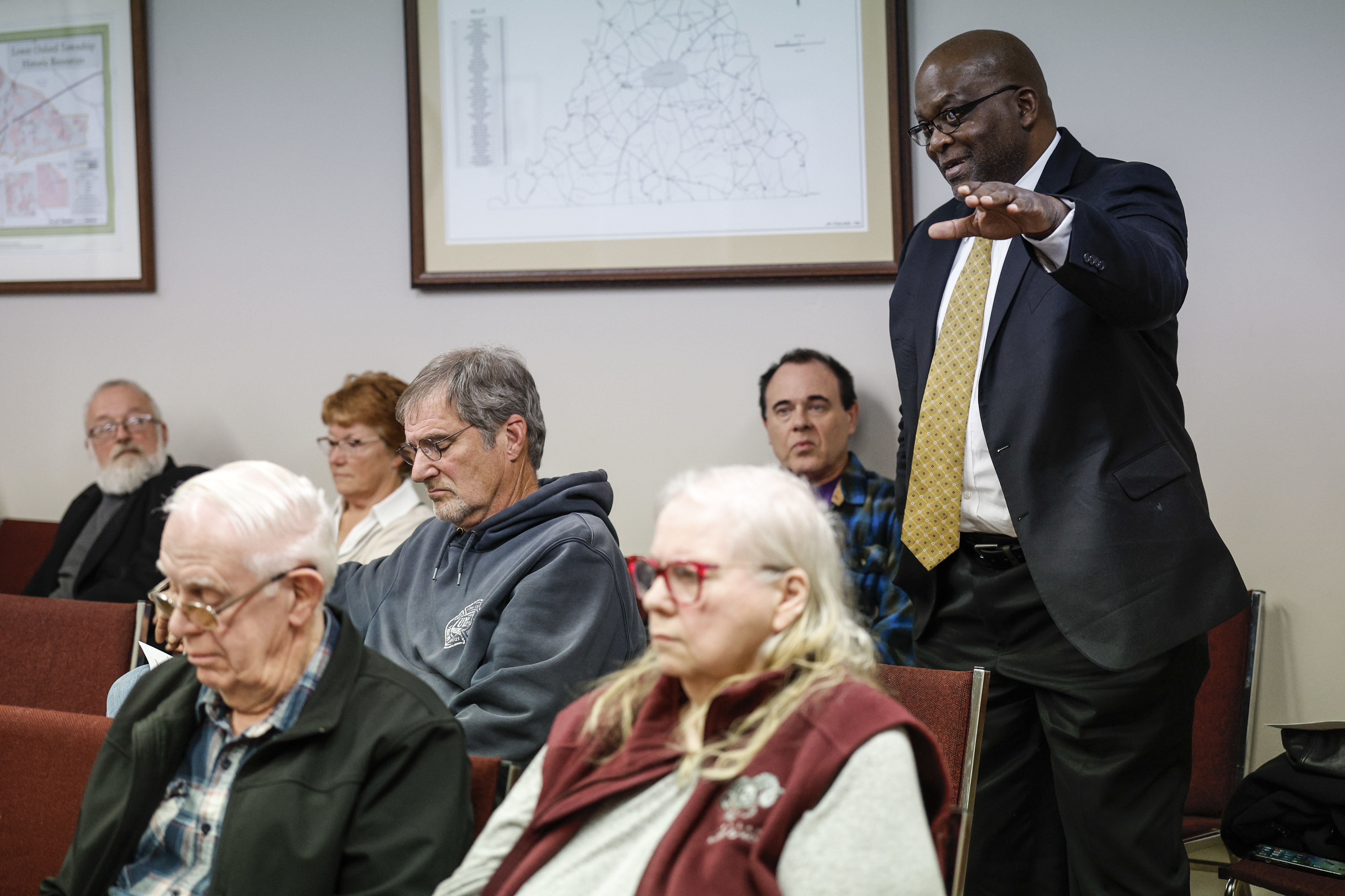
Anthony Floyd Jr., who was police chief at Lincoln in 2013 and also had been a Philadelphia city cop, told the supervisors at the meeting that better coordination is needed between the community and the university. The school’s police chief and president should attend the supervisor meetings every month, give updates on safety and security, and be held accountable, he said.
Lincoln says it’s working on changes
Last month at a Lincoln board of trustees meeting, Allen, the president, said the campus had been focused on restoring a sense of safety for students and making sure they and staff had counseling support. Allen, a 1981 Lincoln graduate who has led the school since 2017, said the university was examining “safety protocols, parking, traffic, registration for guests,” and the process for inviting guests as part of its review process.
Lincoln University President Brenda A. Allen (left) announces plans for an after action review following the homecoming shooting.
Allen said the university is seeking feedback from the student government association and faculty and staff.
Roy, one of the township supervisors, saidparking restrictions put into place earlier this yearwere not heeded, and the township had to tow 60 cars the night of the homecoming shooting.
“Every time they towed a car, another car would pull into that space,” he said.
An event that would draw 10,000 people to a township with half that population and no police force is concerning, said Moran-Sebastian, the township solicitor. Lower Oxford relies on Pennsylvania State Police for law enforcement. For the homecoming event, the university requested state police, but only got two, Arscott, the facilities’ head, said.
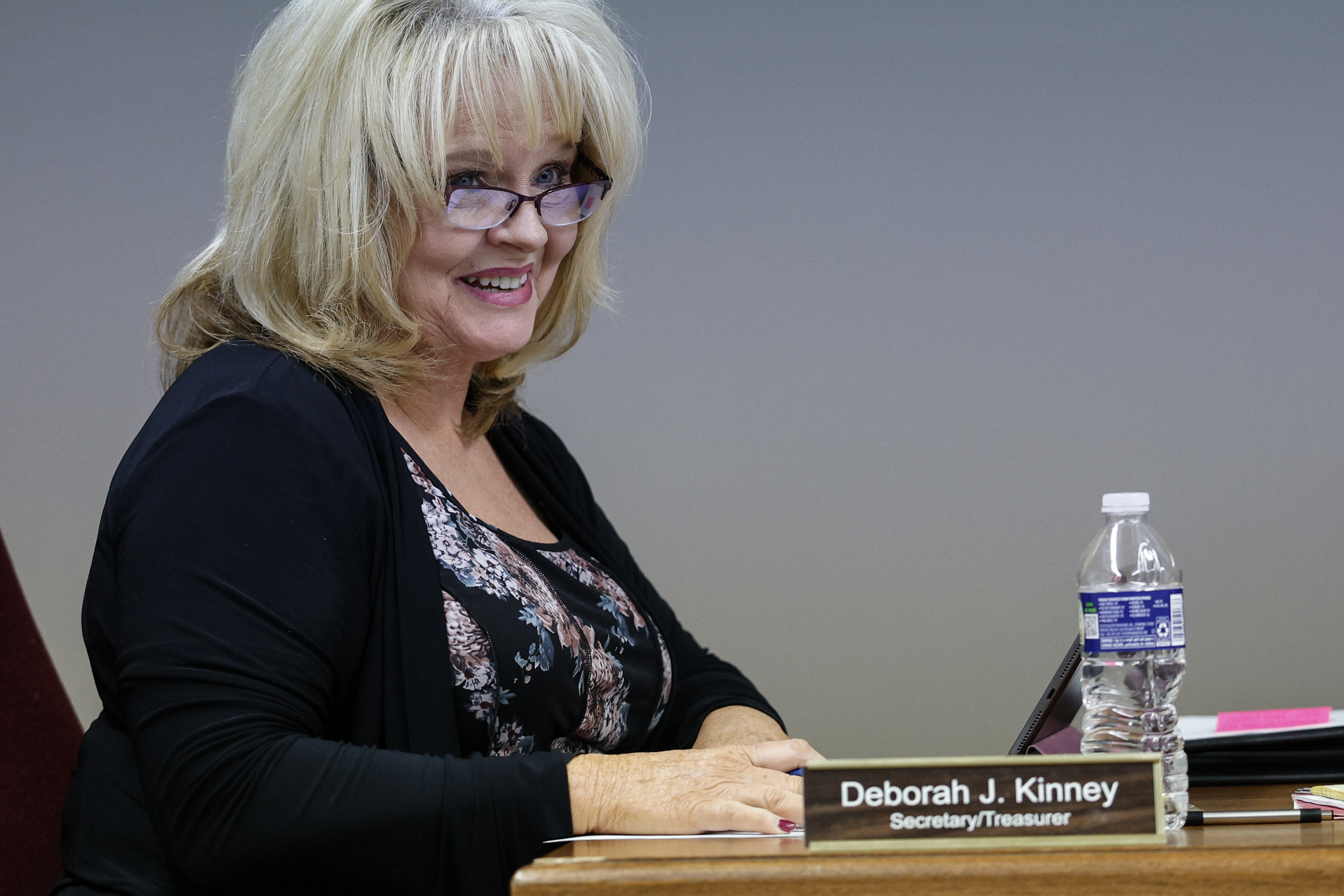
Deborah J Kinney, secretary/treasurer and code enforcement officer, listens during the Lower Oxford Township supervisors meeting.
Township officials have been frustrated with the responses from Lincoln in the past. When a meeting was held in November 2024 to discuss parking-related problems during the previous Spring Fling event, Allen said she didn’t need the township’s help, said Deborah Kinney, township secretary/treasurer and codes enforcement officer. Kinney said she had suggested an event process that would have included a plan for parking.
“So we decided we needed to be proactive on our end, not just for our residents but for their students,” Kinney said. “It’s not the students. It’s the outside influences that are coming in to these events.”
She also said that in 2024, Lincoln accounted for 183, or 26%, of the township’s emergency calls.
Winfred Moran-Sebastian, Lower Oxford Township solicitor, outlines the proposed ordinance to regulate large events in the township. The ordinance is still under draft.
Veronica Carr, a 2016 Lincoln alumna, said she had been concerned about safety when she was a student, and conditions seem to have gotten worse. She did not attend homecoming.
Carr, who works for an African American heritage consulting firm and lives in North Carolina, said she is concerned that two people have been killed on the campus in less than four years.
Jose A. Aviles, who abruptly resigned last month as Temple University’s head of enrollment, has taken a leadership role at Rutgers University.
Aviles has been named senior vice president for enrollment management and student success at New Jersey’s flagship university.
“Dr. Aviles’ commitment to data-informed, student-centered leadership will be pivotal to strengthening student recruitment, expanding access and enhancing student success metrics,” Rutgers said in its announcement.
At Rutgers, the overall enrollment neared 71,500 this year, up 3.2%.
When Aviles announced his exit from Temple, he told The Inquirer he was leaving for “a life-changing opportunity.”
Aviles, who served as Temple’s vice president for enrollment and student success for 2½ years, joined the North Philadelphia school in 2023, after about six years at Louisiana State University.
In that experience at LSU, he has a tie to Rutgers’ new president, William F. Tate IV, who led the Baton Rouge university from 2021 to this July, when he took the helm at Rutgers.
Aviles left Temple with recent successes under his belt; he had recently been promoted from a vice provost to a vice president.
“Jose has reimagined enrollment management at the university over the last couple of years, helping move us to a modern, technology- and data-driven approach that has delivered results,” Temple president John Fry and interim provost David Boardman said to the campus community last month.
They noted the university achieved growth in first-year enrollment the last two years, with this year’s group reaching a record high of 5,379.
The university also under Aviles’ tenure started the Temple Promise program, which makes tuition and fees free for first-time, full-time college students from low-income families who live in Philadelphia, and the Temple Future Scholars program, a mentoring and college-readiness initiative.
While Temple’s first-year class was strong, the school fell short of its initial overall enrollment projection by about 700 students, which translates to about $10 million in lost revenue.
The university had been estimating it would enroll a total of 30,100 to 30,300 students, which would have been its first enrollment increase since 2017.
Instead, enrollment came in at 29,503, down about 500 from last year and further declining from its high of more than 40,000 eight years ago. (That does not include enrollment on its Japan and Rome campuses, which increased. Including those campuses, Temple’s overall enrollment was over 33,000, a slight increase from last year.)
There have also been concerns about sophomore retention and a higher percentage of third- and fourth-year students not returning.
The University of Delaware on Tuesday appointed Laura A. Carlson, who had been serving as interim president, to the permanent post, effective Jan. 1.
Carlson came to the school in 2022 as provost after spending 25 years at the University of Notre Dame. She stepped into the interim presidency in July after former president Dennis Assanis announced he was stepping down last June with less than two months notice.
The university did not conduct a national search but rather engaged a consultant to help the school evaluate the qualities needed for the next president and assess Carlson’s ability to fit the role.
“Dr. Carlson has demonstrated a deep commitment to the advancement of our university and a clear passion for the success and wellbeing of our students, faculty, staff and alumni,” Terri Kelly, board of trustees’ chair, said in a statement.
As provost, Carlson, whose specialty is psychology, expanded courses offered in winter and summer sessions to give students the ability to graduate more quickly and prioritized bringing ideas from faculty and staff to fruition, the university said.
She’s a cum laude graduate of Dartmouth, where she got her bachelor’s in psychology of language and obtained her master’s from Michigan State University and her doctorate from the University of Illinois, Urbana-Champaign.
“I have fallen in love with UD, and I am deeply committed to its purpose and people,” Carlson, 60, said in a statement. “Together we can make the University of Delaware a place where we inquire with impact, create with connections, innovate with intention, grow with purpose, welcome with promise, educate with outcomes, work with trust, and belong with joy.”
A Pennsylvania State University faculty group has taken the next step to form a union across the system’s campuses, which eventually could represent some 6,000 faculty.
Officials from the Penn State Faculty Alliance and the Service Employees International Union said they had filed Tuesday with the Pennsylvania Department of Labor after having obtained at least the required signatures of 30% of eligible faculty.
The next step would be an election, and if approved by a majority, a union would be formed and contract negotiations could begin. How long it takes to schedule an election depends on whether the university opposes the move.
“It would be the largest single union election in the public sector in the history of the Commonwealth if not the last 50 years,” Steve Cantanese, president of SEIU 668 said at a news conference held at the Capitol building Tuesday in Harrisburg.
The announcement comes about a month after graduate student workers at Penn State voted to unionize, with 90% in favor. That vote came nearly a year after the Coalition of Graduate Employees at Penn State filed the required signature cards with the labor board. Their vote came amid a wave of graduate union workers’ efforts to unionize.
Penn State is the only state-related university of the four in the Commonwealth without a faculty union. Faculty concern about the university’s decisions began to accelerate during the pandemic and have continued to mount amid budget cuts and the decision in May to announce the closure of seven of the school’s Commonwealth campuses. A seeming lack of shared governance, salary, and workload inequities across campuses, and transparency are among other concerns cited by faculty involved in the effort.
“Penn State faculty are filing for a union election to bring transparency to their workplace, to bring job security to their workplace, to have an opportunity to have a greater voice at their workplace, to have some economic security at their workplace,” Cantanese said.
Julio Palma, associate professor of chemistry at Fayette, one of the campuses selected for closure, said faculty tried to fight the Commonwealth campus closure plan but didn’t have enough power.
“We organized,” he said. “We held rallies on campus. We talked to our elected officials. Nothing moved the needle.
“If we had a faculty union, we wouldn’t be in this situation… We need a faculty union now.”
Cantanese said SEIU reached out to the university in the hope that it will welcome faculty’s efforts to unionize.
Penn State in a statement said it would review the petition when it is received.
“Penn State deeply values the teaching, research, and service of our faculty, who play a critical role in fueling the success of our students and advancing our mission,” the school said.
Faculty at the press conference said a union is needed.
“As a teacher, I know that my working conditions are my students’ learning conditions,” said Kate Ragon, an assistant clinical professor of labor and employment relations at University Park, Penn State’s main campus. “We want a voice in the decision-making that affects us, affects our students, and affects our work.”
The three other state-related universities in Pennsylvania ― Temple, the University of Pittsburgh, and Lincoln ― already have faculty unions. Temple’s has existed for more than 50 years, and its graduate student workers have been unionized for about 25 years. Lincoln’s formed in 1972. Pitt’s is more recent. It was established in 2021.
Faculty at Rutgers, New Jersey’s flagship university, are unionized, too. So are the 10 universities in the Pennsylvania State System of Higher Education.
Faculty in the alliance have said they hope to secure better wages and benefits, job security protections, and a greater role in decision-making. When they announced plans to form a union last March, they said they wanted full and part-time, tenure, and nontenure faculty to be included as members and believed all campuses would be involved except for the medical school faculty at Hershey.
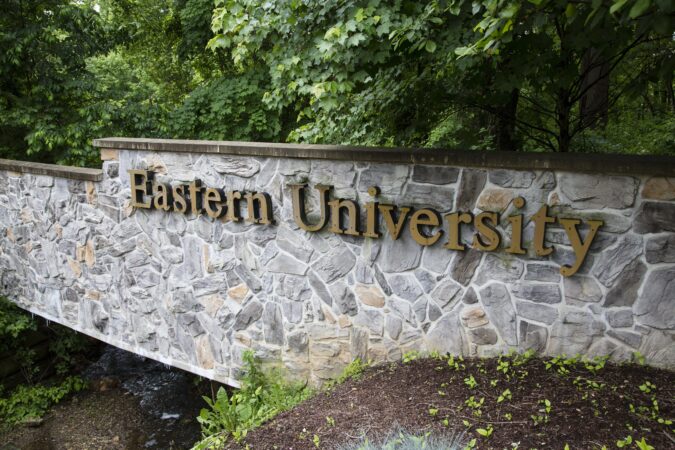
Eastern University has entered an agreement to buy nearly half the Valley Forge Military Academy property, which is less than a mile from the Christian university’s St. Davids campus in Delaware County.
The planned purchase, announced by Eastern on Tuesday, includes 33.3 acres encompassing the football stadium, track, and athletic field house, as well as multiple apartment buildings that will be used to house students. Eastern had been leasing the athletic properties from the academy since 2021. The purchase also includes additional fields, buildings, and a pickleball court, the school said.
The academy announced in September that it planned to close at the end of the 2025-26 academic year amid declining enrollment, financial challenges, and lawsuits over alleged cadet abuse, but that its college would continue to operate on the main campus. The boarding school announced last month it would go virtual after Thanksgiving and resume in-person classes on the 70-acre campus in January.
Eastern’s current campus is 114 acres, so the addition of the Valley Forge property will substantially increase its footprint.
“For Eastern, expanding our campus through this new property is a pivotal step in EU’s growth and vision for a flourishing future,” said Eastern president Ronald A. Matthews. “… We will be able to provide the space for our expanding student body to call Eastern’s campus ‘home.’”
The sale is subject to approvals and regulatory requirements and is expected to be completed over the next five months, the school said.
“Valley Forge Military Academy & College has enjoyed a mutually beneficial relationship with our neighbors at Eastern University for many years,” academy president Col. Stuart B. Helgeson said in a statement.
Eastern’s enrollment has continued to grow over the last six years, reaching nearly 10,000 students this fall, up 14% from last year. The growth is largely fueled by its low-cost, online “LifeFlex” programs, including a $9,900 master of business administration. But on-campus enrollment also has been rising in part due to the addition of new athletic and arts programs, the school said. Its football team is competing in the NCAA Division III championships on Saturday.
For years, Rutgers-Camden faculty and staff have complained that the school does not get its fair share from the main campus in New Brunswick.
Faculty in the past have asserted that their salaries are inequitable to counterparts on Rutgers’ other campuses — there’s a process in place to address that — and Chancellor Antonio D. Tillis has cited inadequate investments in campus facilities.
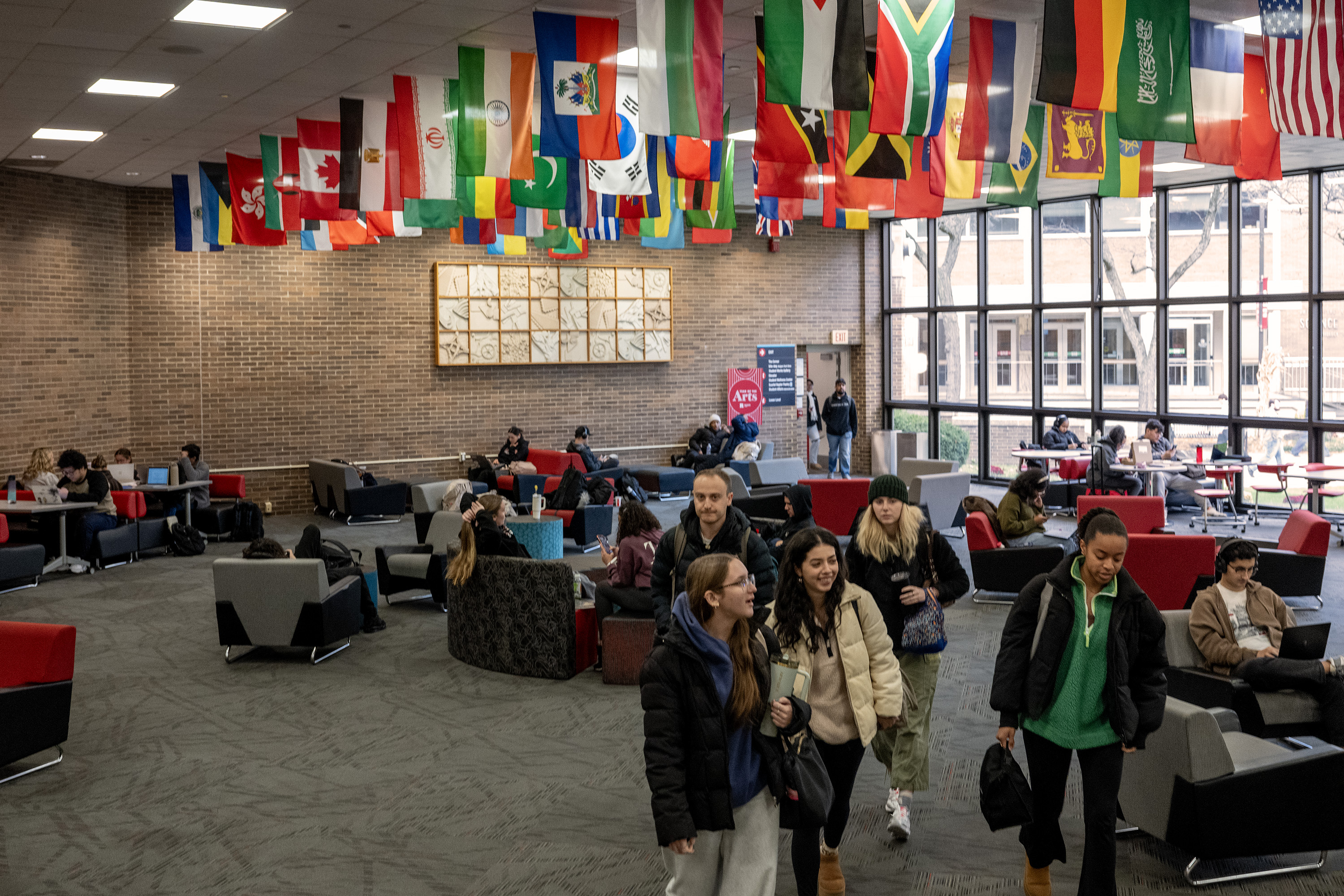
The Campus Center (student center) on the Rutgers-Camden campus with flags of students’ home countries.
“Since I’ve taken this job, I’ve had people say to me ‘Don’t invest in Camden,’” said Tate, a social scientist who grew up in Chicago and came to the job at Rutgers after serving as president of Louisiana State University. “I don’t think they know who they are talking to. … Do you think I have forgotten who I am?”
Tate, who became president in July, pledged during his inauguration speech to make the school a stronger competitor regionally.
“We’re going to build that Big Ten brand in Camden,” he said, referring to the NCAA athletic conference whose members are major research universities. “Look out Philadelphia, we’re coming for opportunity.”
His comments come as Rutgers-Camden is about to celebrate its 100th anniversary and as Tillis, in his fifth year, is nearing the end of his initial contract and aiming to receive a renewal.
Tillis touts 97% occupancy this year in the school’s residence halls, the highest since before the pandemic and up from 84% last year, and a boost in international students even while international enrollment declined 17% nationally, amid federal government policies including a pause of student visas earlier this year.
The Campus Center at Rutgers-Camden has a display showing some of the school’s 100-year history.
The school is also climbing in U.S. News rankings from 148th nationally among both public and private universities in 2021 — the yearTillis came — to 97th this year. It also rose from 18th to ninth in social mobility, meaning it enrolls and graduates large proportions of disadvantaged students.
“Rutgers Camden has just punched above its weight for such a long time and now the fruit are beginning to bear,” he said.
But Tillis’ relationship with some faculty has remained strained. Arts & Sciences faculty voted no confidence in him four months after he took the job and after he removedthe Arts & Sciences’ dean.
Since then, concerns have persisted about pay equity forRutgers-Camden professors compared to counterparts on the other Rutgers’ campuses, in New Brunswick and Newark, and what several faculty said was Tillis’ unwillingness to consult and communicate with faculty.
“There has been a real lack of communication between the chancellor and his office and the faculty, which has made it really hard to understand some of the decisions that have been made in regard to our budget cuts and campus priorities,” said Emily Marker, president of Rutgers-Camden chapter of the AAUP-AFT, the faculty union.
“If he were to be renewed, we would really hope that the communication, the consultation with and involvement of the faculty would improve in campus governance,” Marker said.
Tillis acknowledged a rough entry in part because of the pandemic but said from his perspective, things are better with faculty. He said he hosts regular “coffee with the chancellor” meetings where faculty and staff can come and talk to him.
If he gets a new term, Tillis said he would aim to grow enrollment, increase Rutgers-Camden’s share of out-of-state students from about 20% to 30% to generate more revenue, enroll more students from Camden, and increase internship opportunities.
There are plans to lease the former Camden Free Public Library building, a historic landmark on Broadway, and convert it into a center for the arts, including a bistro and wine bar.
Rutgers-Camden’s overall enrollment stands at 5,822, up 2.6% from last year. Overall, Rutgers’ enrollment neared 71,500 this year, up 3.2%.
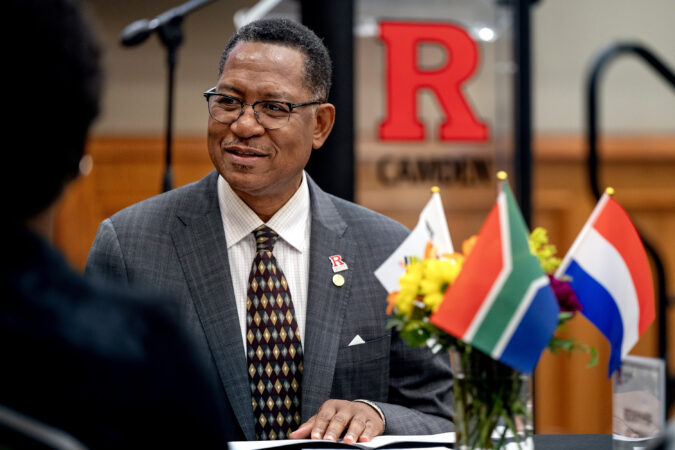
Rutgers-Camden junior Mohammed Al Libaan Kazi, a transfer student from India, walks toward the stage to speak during a luncheon for international students hosted by Chancellor Antonio D. Tillis. International enrollment increased 6% on the campus this year.
At Rutgers-Camden, international student enrollment climbed 6% to 312, largely fueled by a jump in freshmen. That’s even though about 30 students deferred enrollment due to the visa holdup, said Carol Mandzik, director of international programs.
Tillis said the school has been recruiting more heavily from Nigeria and Ghana.
“I chose Rutgers-Camden because it’s close to Philadelphia,” said Bao Mai, 18 a freshman from Vietnam, who wanted what a big city has to offer.
But Mai, who spoke at an international student luncheon hosted by Tillis, said he also chose it because he likes the “small campus vibe” and array of business programs.
Tillis also has pledged to bring in more students from Camden. This year, there are 80, up from 53 last year.
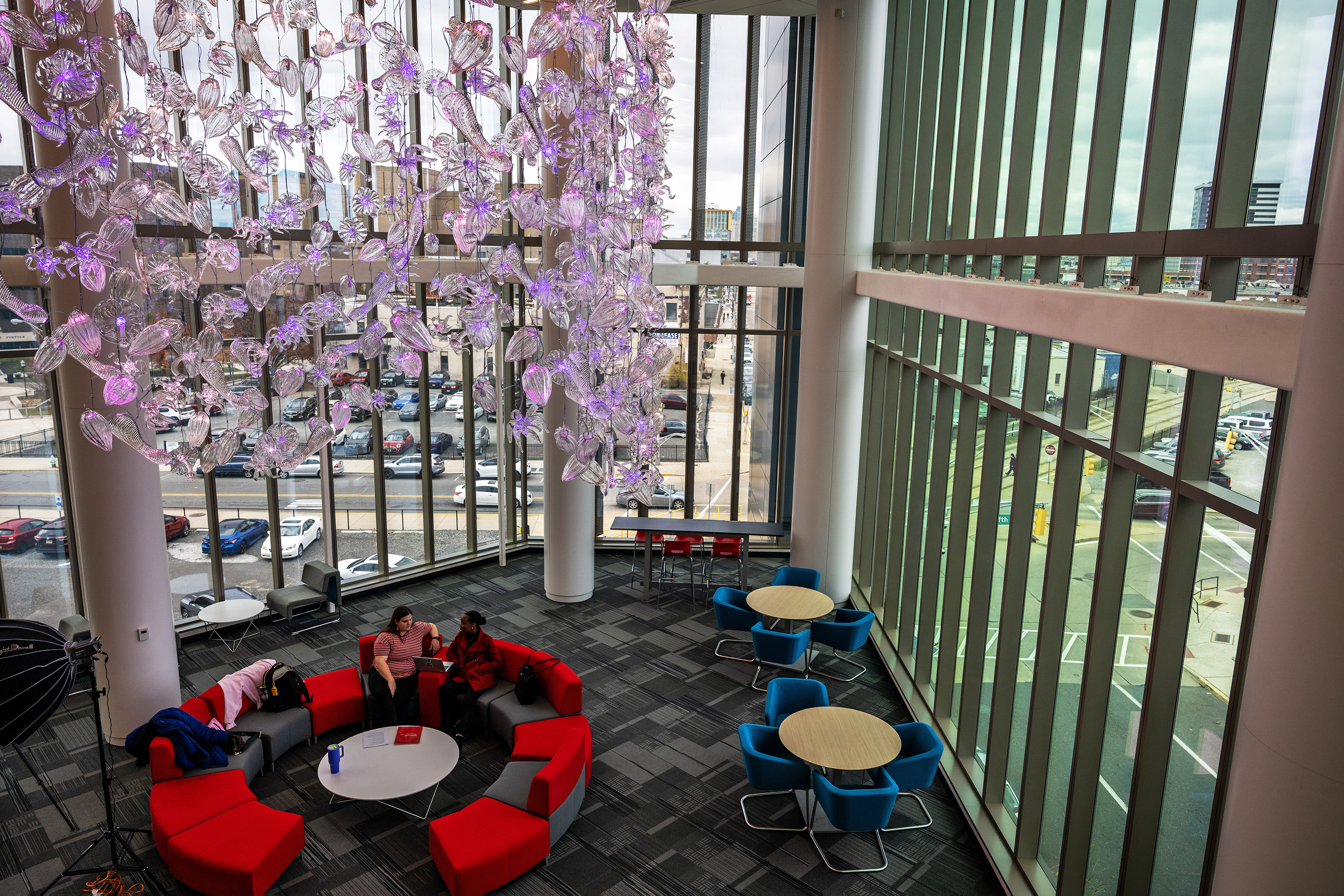
The atrium lobby of the Nursing and Science Building on the Rutgers-Camden campus.
He said he asked the admissions team to create more opportunities for students from Camden to come on campus so they begin “to feel as if the campus is theirs because it’s right in their backyard.”
The school, which is designated as a minority-serving institution — meaning at least 50% of students are minorities — also plans to begin to offer in-state tuition to students from Philadelphia and northern Delaware, Tillis said. Prospective students from Philadelphia who chose not to enroll cited the price tag, he said.
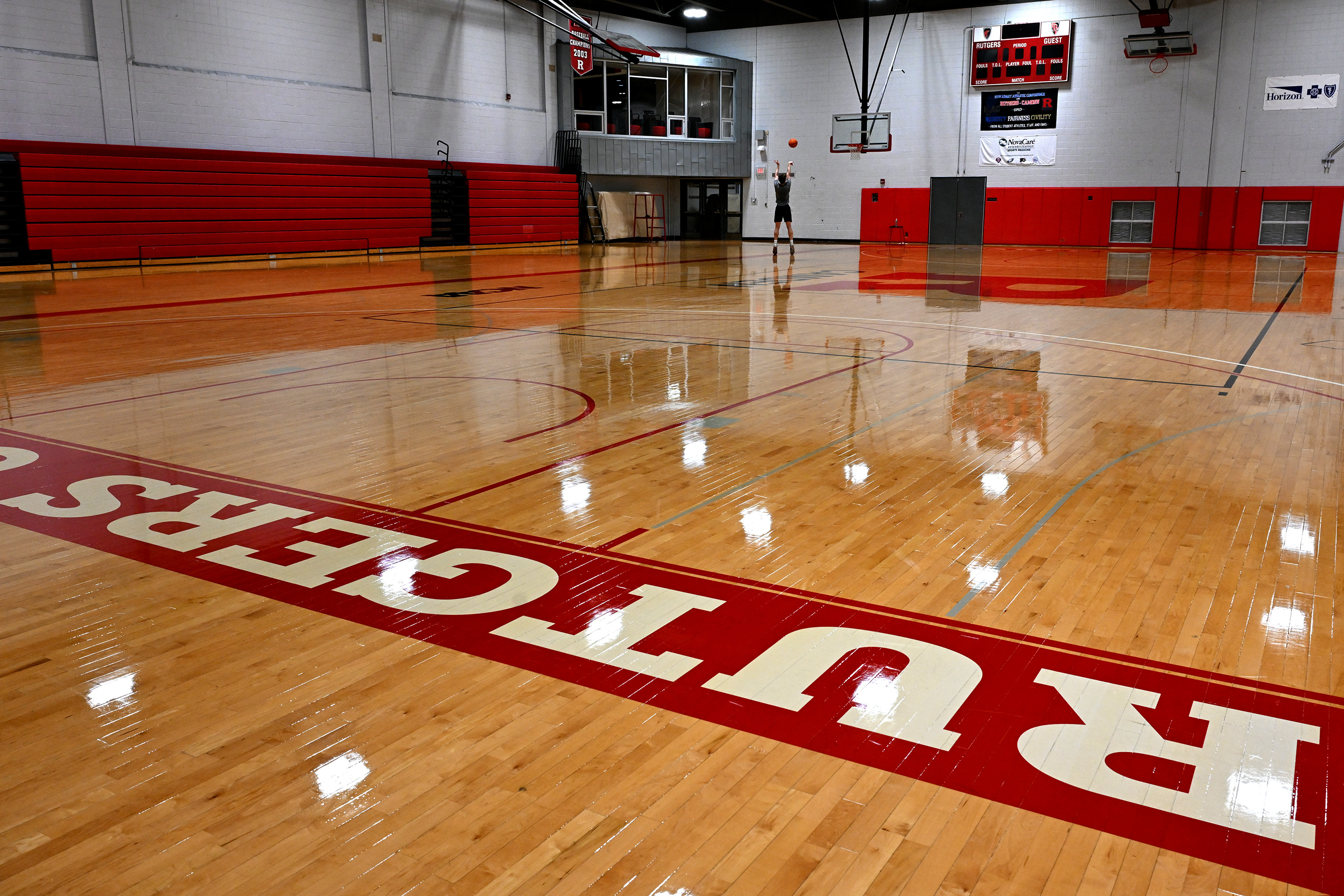
Rutgers-Camden sophomore basketball forward Robert Peirson from Toms River practices in the gym in the Athletic & Fitness Center.
Fostering campus culture
More than 710 students are living in the residence halls this year, representing the highest occupancy since 2019, Tillis said.
“Our campus is trying to create a sense of residential culture … even for our commuter students,” Tillis said, so that “they don’t just come here, go to class, and then go home.”
window.addEventListener(“message”,function(a){if(void 0!==a.data[“datawrapper-height”]){var e=document.querySelectorAll(“iframe”);for(var t in a.data[“datawrapper-height”])for(var r,i=0;r=e[i];i++)if(r.contentWindow===a.source){var d=a.data[“datawrapper-height”][t]+”px”;r.style.height=d}}});
The school held a welcome back barbecue during move-in and brought back homecoming last year; there was homecoming before the pandemic but not to the same degree, Tillis said.
The school also has spruced up residence halls and added evening events such as arts and theater performances, he said. There are little things, too, like plans to install hammocks on the quad.
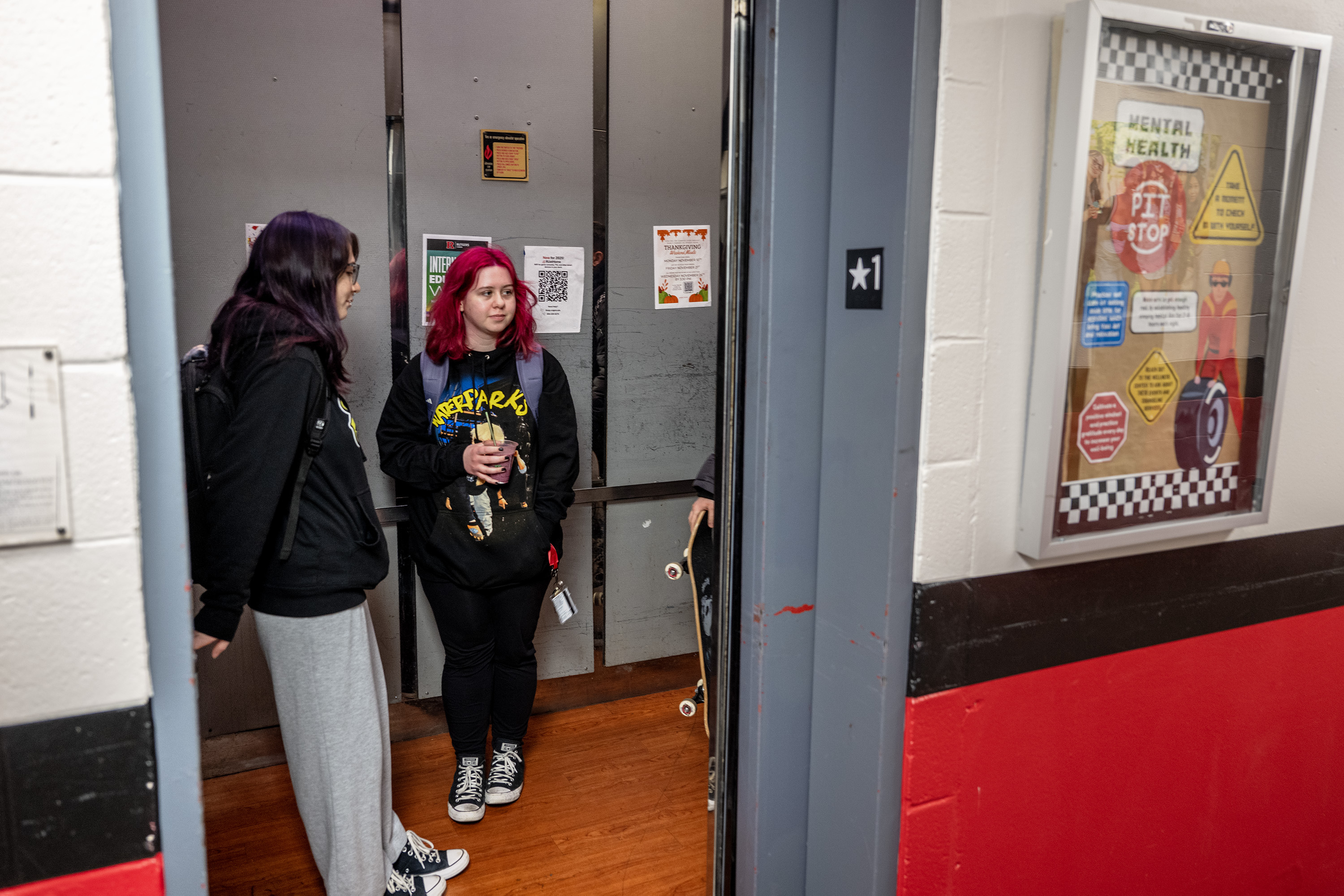
Freshmen Ollie McDermott (left), a psychology major from Buena and Remi Zebedies (right) an art therapy major from Mays Landing take an elevator in their residence hall at Rutgers-Camden.
Ollie McDermott, 22, a freshman psychology major from Buena, had decided against college, but McDermott’s stepfather, who recently graduated from Rutgers-Camden, convinced McDermott to try it.
“I’m kind of glad I did,” McDermott said. “I love it here.”
McDermott convinced a friend, Remi Zebedies, 19, an art therapy major from Mays Landing who also had been leaning against college, to try it, too. They became roommates.
The campus has enough beds to accommodate this year’s students, but if growth continues, it may need more housing, Tillis said. He’d like to open a residential space for students with children and/or spouses.
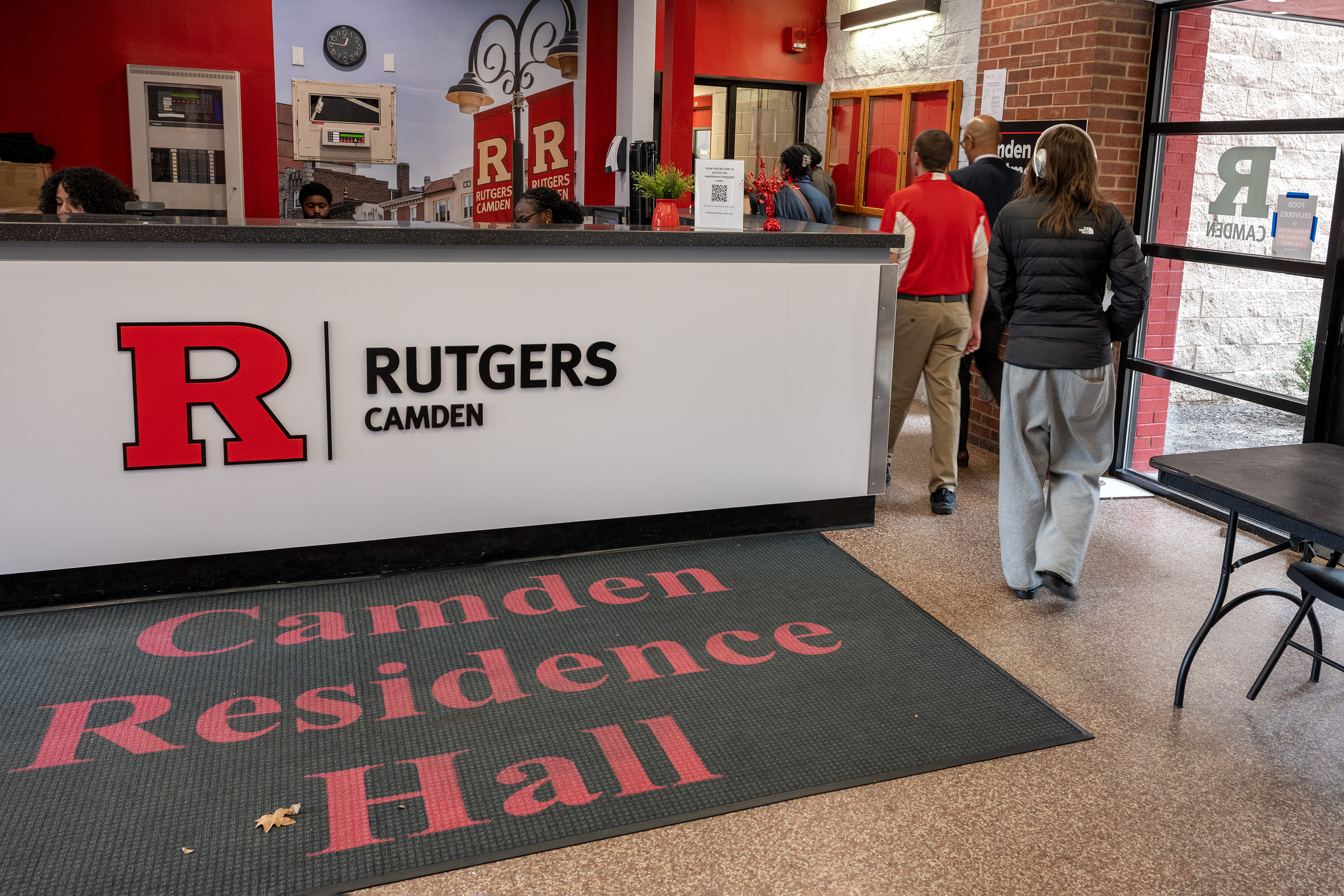
The lobby entrance between the Towers and Apartments resident halls at Rutgers-Camden.
Working on graduation and retention rates
In the school’s strategic plan approved in 2023, Tillis set improvement in graduation and retention rates as primary goals.
The school’s retention rate from first-year students to sophomores has increased from 71% in 2021 — the year he came — to 73.4% this fall. The six-year graduation rate decreased from 63.6% in 2021 to 61.5% in 2024. (The school said that 2025 data had not been verified and that the 2024 dip reflects lingering pandemic-related challenges.)
Tillis also discussed the Cooper Gateway Project, which will renovate four properties to add event halls, a new space for Arts & Sciences, and pedestrian walkways and courtyards. It’s expected to be completed by early 2027.
A new athletic field house also is in the works, and there are plans for a new building for business students to live and learn in, he said.
Pay equity was a sore spot with faculty for years, despite the process put in place under which they could be compared to peers at the New Brunswick and Newark campuses.
The university said in a statement that since 2021, the vast majority of faculty who petitioned for equitable pay got increases. The requests are reviewed by a committee of faculty experts who look at the professor’s classroom instruction, research, and scholarly activity.
Rutgers-Camden graduate student Funmi Adebajo, from Nigeria, speaks during a luncheon for international students hosted by Chancellor Antonio D. Tillis.
Tillis said sometimes faculty were seeking to compare themselves to peers who were not really comparable.
Marker, the Rutgers-Camden AAUP-AFT president, said through a grievance, the union negotiated a change to the process that will make it harder for Tillis to overrule recommendations by the committee.
In the last cycle, the vast majority of professors with equity claims received “meaningful” pay adjustments, said Marker, an associate professor of European and Global History.
As for the comments about Camden by Tate, the new Rutgers president, Marker said she is hopeful they lead to action.
“If it actually results in a massive investment in Camden, in our students, in our faculty, in our facilities, I would be delighted,” she said. “But we’ll see. That has really not been the orientation of any of the central administrations since I was hired in 2017.”
Rutgers-Camden Chancellor Antonio D. Tillis walks rather than rides in the offered golf cart to a luncheon he hosted for international students.
Tillis said he is hopeful that Rutgers-Camden will get more support under Tate. He got to know Tate in 2020 when they were both in a program at Harvard for new presidents and chancellors.
“We have a beautiful campus, but it’s stuck between the 1950s and the 1970s,” he said. “Certain types of innovative spaces for 21st century instruction needs to happen.”