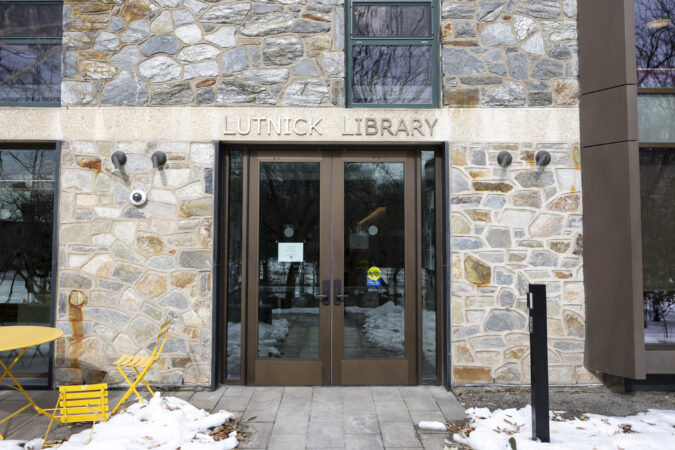
Author: Susan Snyder

  • Howard Lutnick’s name is on the library at Haverford College. Will that change after his appearance in the Epstein files?

    Howard Lutnick’s name is on the library at Haverford College. Will that change after his appearance in the Epstein files?

    As U.S. Commerce Secretary Howard Lutnick’s relationship with Jeffrey Epstein gains new scrutiny, questions have emerged on Haverford College’s campus about how to address their mega-donor’s involvement.

    Lutnick, a 1983 Haverford graduate who has donated $65 million to the college and whose name is on the school’s library, had contact with the late financier as recently as 2018, long after Epstein pleaded guilty to obtaining a minor for prostitution and soliciting a prostitute, according to documents released by the Justice Department. And during congressional testimony this week, he said he visited the sex offender’s private island with his family in 2012. That’s even though Lutnick previously said he had not been in a room with Epstein, whom he found “disgusting,” since 2005.

    At Haverford, where the library at the heart of campus is named after Lutnick, two students have floated a proposal to remove Lutnick’s name from the building and wrote a resolution that could be discussed at a forthcoming student-led meeting, according to the Bi-College News, the student newspaper for Haverford and Bryn Mawr Colleges. Fliers that say “Howard Lutnick is in the Epstein Files — What Now?” have been posted around campus, according to the publication.

    And in an email to campus Thursday, Wendy Raymond, president of the highly selective liberal arts college on the Main Line, said she and the board of managers are monitoring the situation.

    “We recognize that association with Epstein raises ethical questions,” she wrote. “While Secretary Lutnick’s association with Epstein has no direct bearing on the College, as an institution, we are committed to our core values and cognizant of broader ethical implications raised by these disclosures.”

    Commerce Secretary Howard Lutnick listens during an event with President Donald Trump in the Oval Office of the White House earlier this month.

    A Commerce Department spokesperson told the Associated Press last month that Lutnick had had “limited interactions” with Epstein, with his wife in attendance, and had not been accused of “wrongdoing.” Lutnick told lawmakers this week: “I did not have any relationship with him. I barely had anything to do with him.”

    Lutnick, formerly chairman of Cantor Fitzgerald L.P., a New York City financial firm that lost hundreds of employees in the 9/11 World Trade Center attacks, served on Haverford’s board for 21 years and once chaired it. In addition to the library, the indoor tennis and track center bears the name of his brother Gary Lutnick, a Cantor Fitzgerald employee who was killed on 9/11, and the fine arts building carries the name of his mother, Jane Lutnick, a painter. He also funded the college’s Cantor Fitzgerald Art Gallery.

    In making a $25 million gift to the college in 2014 — which remains tied for the largest donation Haverford has received — Lutnick told The Inquirer the college had helped him during a particularly difficult period. He lost his mother to cancer when he was a high school junior, and one week into his freshman year at Haverford, where he was an economics major, his father died as the result of a tragic medical mistake.

    The then-president of Haverford called Lutnick and told him his four years at Haverford would be free.

    “Haverford was there for me,” Lutnick said, “and taught me what it meant to be a human being.”

    Lutnick’s gift was used to make the most significant upgrades to the library in 50 years. Lutnick left Haverford’s board in 2015.

    He was confirmed as commerce secretary a year ago, after President Donald Trump took office for the second time. Since the Epstein documents were released, Lutnick has faced bipartisan calls to resign.

    Some in the Haverford community have spoken out online about Lutnick’s ties to Epstein.

    “How soon can we petition to make Magill Magill again,” one alum, who said they were at Haverford when Lutnick attended, wrote anonymously on a Reddit thread, referring to the library’s prior name. “More urgently, does Haverford plan to express compassion and support for the survivors and publicly condemn Lutnick for his involvement?”

    The Haverford Survivor Collective’s executive board, a group founded in 2023 and led by Haverford students and survivors of sexual assault, also called on the college to “re-examine” its ties to Lutnick.

    “At what point will the College confront its relationship with this individual?” the group asked. “At what point will it say, unequivocally, ‘enough is enough’? At what point does a reluctance to do so extend beyond mere negligence into a moral failing?”
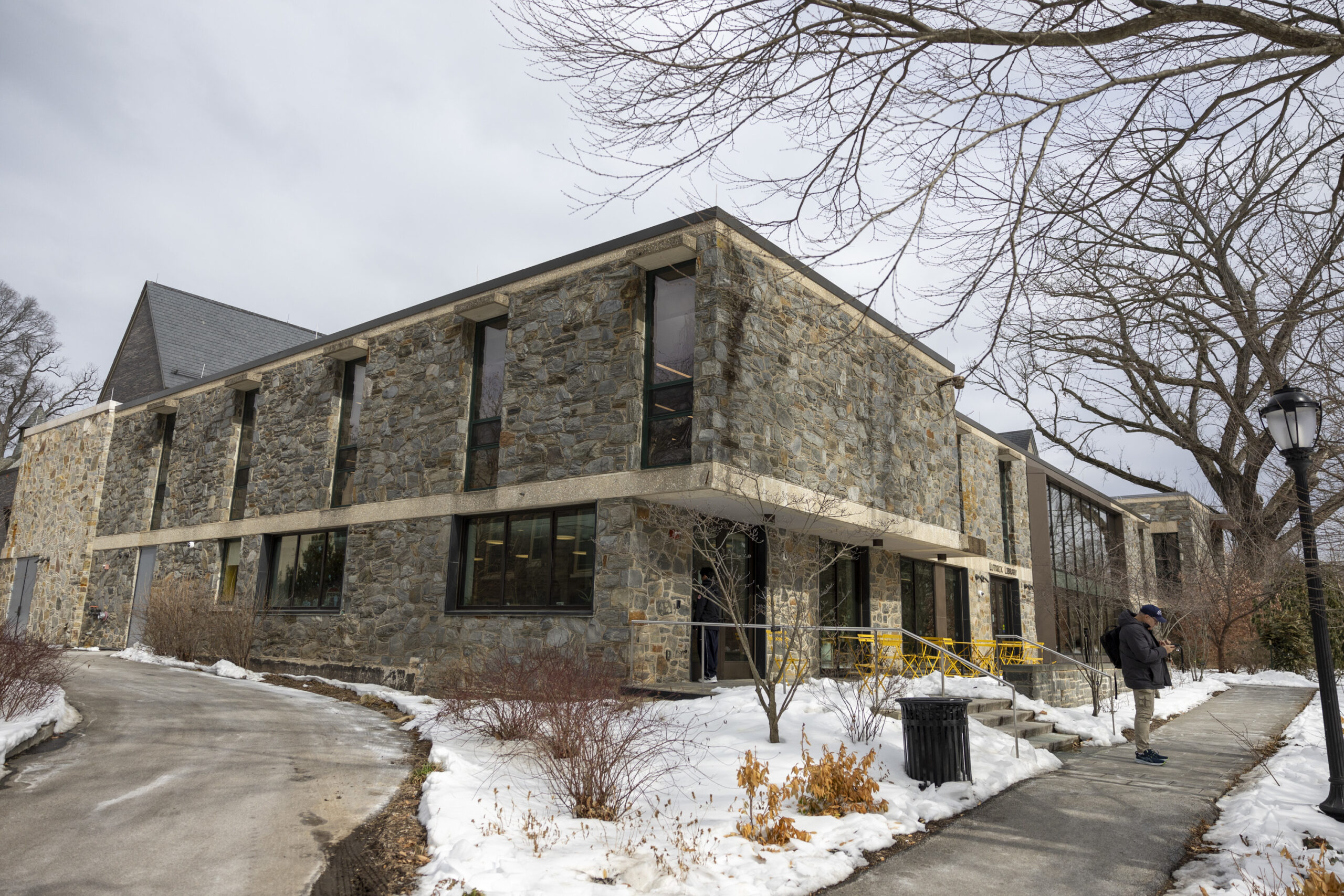
    The outside of the Lutnick Library at Haverford College

    Push to rename the library

    Earlier this month during a Plenary Resolution Writing Workshop — part of Haverford’s student self-governance process — students Ian Trask and Jay Huennekens put forth a resolution that would change the name of the library, the student newspaper reported.

    At plenary sessions, which take place twice a year in the fall and spring, the student body discusses and votes on important campus issues. On March 23, a packet of plenary resolutions will be released to the student body, with the plenary session scheduled for March 29.

    “We feel that it is important that the college reflect the values of the student body, and that those values do not align with the Trump administration or the associates of Jeffrey Epstein,” the students told the Bi-Co News.

    Attempts to reach Trask and Huennekens were unsuccessful.

    If the student resolution passes, it would go to Raymond for signing.

    But even then, it’s no easy feat to remove a name from a college building. There would be a review process involving the board of managers that could take a while.

    Under Haverford’s gift policy, the school can rename a building if “the continued use of the name may be deemed detrimental to the College, or if circumstances change regarding the reason for the naming.”

    Raymond would have to convene a committee, consider that committee’s recommendations, and make her recommendation to the external affairs committee of the board of managers and its chair and vice chair. The external affairs committee then would make its recommendation to the full board of managers.

    At nearby Bryn Mawr College, it took years before M. Carey Thomas’ name was removed from the library. Thomas, who was Bryn Mawr’s second president, serving from 1894 to 1922, was a leading suffragist, but also was reluctant to admit Black students and refused to hire Jewish faculty.

    In 2017, then-Bryn Mawr president Kim Cassidy issued a moratorium on using Carey’s name while the college studied how to handle the matter. A committee in 2018 decided students, faculty, students, and staff should no longer refer to the library using Thomas’ name, but decided to leave the inscription and add a plaque explaining the complicated history.

    The college faced continued pressure from students to take further action and removed Thomas’ name in 2023.

    Other colleges have taken similar actions. Princeton University in 2020 stripped former President Woodrow Wilson’s name from its public affairs school and presidential college.

  • Moore College will consider opening undergraduate programs to men

    Moore College will consider opening undergraduate programs to men

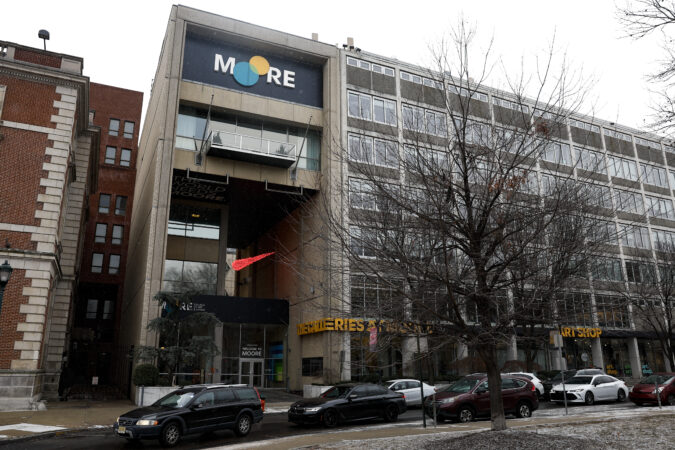
    Moore College of Art and Design will consider opening its undergraduate programs to men for the first time in its 177-year history.

    The Philadelphia school, which touts its role as “the first and only historically visual arts college for women in the nation,” cited the need to make arts programs more accessible in the region and the expected national decline in the available pool of high school graduates.

    The college, which enrolls about 500 students, will study and discuss with its community the prospect of admitting men over the next four months and make a decision by June, the school announced in emails to alumni, faculty, and students Monday. If the school decides to admit all genders, the first class admitted would be for 2027.

    “We will explore all of this together in an inclusive way for students, faculty, staff, and alumni,” wrote Moore president Cathy Young and Frances Graham and Art Block, chairs of the school’s board of trustees and board of managers, respectively. “Your voices are essential. No decision has been made at this time. The boards want your feedback.”

    Moore College of Art and Design president Cathy Young.

    If Moore goes coed, Bryn Mawr College would be the only remaining women’s school in the Philadelphia region. (In Allentown, Cedar Crest College remains primarily a women’s college.)

    Several other colleges in the region that were formerly for women have gone coed over the last decades, including Rosemont on Philadelphia’s Main Line in 2008, Immaculata University in Chester County in 2005, and Chestnut Hill College in Philadelphia in 2003.

    Nationally, the number of women’s colleges has been declining from a high of over 200 to just 31 as of 2022, according to a 2025 report by the Pew Research Center.

    It wouldn’t be the first change in Moore’s admissions policy in recent years.

    In 2015, Moore began admitting “all qualified students who live as women and who consistently identify as women at the time of application.”

    Then in 2020, Moore also began accepting nonbinary and gender-nonconforming students. Since then, the number of those students has been growing. They made up 6% of the first freshman class under the new policy in 2021. By fall 2022, they accounted for 21%, and by fall 2023, 26%. Last fall, that grew to one-third of the freshman class.

    Moore’s graduate programs and most of its continuing education programs already include men.

    Moore officials said they are making the decision from a position of financial and academic “strength.” The school has had operating surpluses for the last 24 consecutive years, a school spokesperson said. Many small schools have faced financial strain in recent years, but Moore fared among the top small private colleges in the Philadelphia region for financial health in a 2024 Inquirer review.

    Moore’s net tuition climbed from $10.8 million to $12.7 million in fiscal 2024 and to $16.5 million in fiscal 2025, financial records show. The school also saw a big gain in private gifts and grants last year to $2.2 million, up from $885,383 the year before.

    This year’s enrollment is the school’s second highest behind fall 2024, when the college accepted 112 students from the University of the Arts, which abruptly closed in June 2024. The school also took 12 students that year from the Delaware College of Art and Design, which closed that year, too.

    Moore opened a new residence hall in Rittenhouse Square last fall, which is just a seven-minute walk from campus and will allow the school to guarantee students housing for all four years.

    In announcing the possibility of accepting all genders, Moore officials noted UArts’ closure and the end of degree-granting programs at the Pennsylvania Academy of Fine Arts.

    “There is a void in Philadelphia’s higher ed creative landscape, and that begs the question: Shouldn’t all creatives, regardless of gender, have access to Moore …” they wrote. “The answer doesn’t have to be “yes,” but it is our responsibility to explore it.”

    College surveys of applicants have shown that the school’s status as a women’s college isn’t a big draw. Only 6% cited it as important to their decision out of 885 survey respondents over the last dozen years, the school said. Meanwhile, a quarter said it was one of the important reasons they didn’t choose Moore.

    Moore officials also cited the expected drop in the high school graduate population beginning this year because of declining birth rates. A decline of 10% is expected by 2037, they noted.

    “There are simply fewer students,” they wrote. “No responsible institution can ignore factors like these. And we won’t.”

    They said they will discuss ways “to preserve and activate in new ways” Moore’s history and legacy as part of the exploration.

    Between February and April, Moore plans to host about 20 sessions for faculty, staff, and alumni to share their thoughts, as well as providing an opportunity for online comments.

    Staff writer Harold Brubaker contributed to this article.

  • Could the Philly region become the ‘eds, meds, and defense industrial base’ region?

    Could the Philly region become the ‘eds, meds, and defense industrial base’ region?

    As Chris Scafario sees it, Philadelphia’s reputation as an “eds and meds” region, referring to its plethora of colleges and hospitals, could grow a third leg.

    It could also become the defense industrial base region, said Scafario, CEO of the Delaware Valley Industrial Resource Center.

    President Donald Trump wants to increase defense spending, with $1.5 trillion proposed for 2027. This could mean more research and workforce development training opportunities — and local universities are positioned to take advantage of it, Scafario said.

    Chris Scafario, CEO of the Delaware Valley Industrial Resource Center

    “A lot of that investment is going to be targeted toward university and innovation-based relationships because they need help getting stuff done,” said Scafario, who is talking to local colleges to help get them ready to capitalize. “They need access to brilliant people, whether they’re faculty or the faculty’s work products, the students.”

    The move comes as colleges face potential cuts in research funding under the Trump administration in other areas, such as the National Institutes of Health. Both Princeton University and the University of Pennsylvania in the last month announced cutbacks to cope with potential financial fallout from federal policies.

    Scafario’s center, which is based at the Navy Yard and was founded in 1988, aims to foster economic development and local manufacturing.

    The Philadelphia region has been involved in defense contracting on and off for years, with major hubs in naval and aerospace manufacturing, and local universities say they worked with the Department of Defense in the past. Rowan University in New Jersey says it has $70 million in defense-related research projects underway.

    But Scafario sees the opportunity for major expansion.

    Drexel University, Temple University, Penn, Rowan, and Villanova University, which is already a top producer of naval engineers, are among the schools that are “in a great spot to leverage the opportunities that are going to be coming through the defense industrial base,” Scafario said. “In the next year, people are going to start realizing that we are meds, eds, and a defense industrial base region. It’s going to bring a lot of investment, a lot of economic opportunities, and some really, really great employment opportunities in the region.”

    The Philadelphia region could become a national anchor for shipbuilding or other maritime industrial-based activities, he said.

    Scafario hopes to bring colleges together with other partners for more discussions in the spring when the timeline for those federal investments starts to become clearer, he said.

    Amanda Page, Warfighter Technologies Liaison for the Delaware Valley Industrial Resource Center

    Colleges could help with efforts to accelerate production capacity of naval ships and work on initiatives such as how to make submarines less traceable and more durable. Or they could help improve medical equipment and training for the battlefield. The treatment standard in the military used to be the “golden hour”; now it’s about “prolonged field care,” said Amanda Page, a retired active-duty Army medic who serves as warfighter technologies liaison for the center.

    “Medical personnel need to be prepared mentally, physically, emotionally, and electronically to keep those patients for 96 hours,” Page said. “That’s going to require a ton of research and technology.”

    Page was hired by the center in October to help build relationships between the center, the Department of Defense (which the Trump administration has rebranded the Department of War), local higher education systems, and the city.

    “I’m super excited about what it will bring to the region and what the region can prove to the Department of War about its legitimacy,” she said, “as a manufacturing and technology powerhouse.”

    Local colleges say they are reviewing potential collaborations.

    “There are a lot of opportunities we are looking at,” said Aleister Saunders, Drexel’s executive vice provost for research and innovation, declining to provide specifics for competitive reasons.

    In addition to opportunities with the Navy and the Navy Yard, he noted major local companies involved with aerospace and aviation, including Lockheed Martin and Boeing. There are also opportunities around materials and textiles with the Philadelphia-based Defense Logistics Agency Troop Support, which provides many of the supplies to the military.

    “Those are really valuable assets that we should find a way to leverage better than we are,” he said.

    Key opportunities are available in advanced manufacturing and workforce development, he said.

    “There could be folks who are already working in manufacturing who need [upgraded skills] in advanced manufacturing techniques,” he said.

    Temple University president John Fry said increasing research opportunities and impact — the school’s research budget now exceeds $300 million — is a priority in the school’s strategic plan. Temple offers opportunities around medical manufacturing, healthcare, and health services, he said.

    “The key to doing that is going to be partnerships,” he said.

    Josh Gladden, Temple’s vice president for research, said he has met with folks from Scafario’s group and they are talking about some opportunities, but declined to discuss them because they are in early development.

    He noted that the Navy is interested in working with Temple’s burn unit.

    Temple has also been getting to know the workforce needs of businesses at the Navy Yard and looking at how to align its educational programs, Fry said.

    “Those are relationships I would love to pursue,” he said. “Part of our mission is to develop the future workforce and grow the regional economy, and that’s one way of doing it.”

    Rowan has been a longtime research partner with the U.S. military, said Mei Wei, the school’s vice chancellor for research.

    “It’s encouraging to know there could be more funding available for research,” Wei said. “These projects give our undergraduate and graduate students the opportunities they need to develop their research skills with close guidance from our faculty and our external partners.”

  • Former Villanova professor says she was fired after accusing the law school of racial discrimination

    Former Villanova professor says she was fired after accusing the law school of racial discrimination

    A former Villanova professor says in a federal lawsuit filed this week she was fired from the Catholic university after accusing its law school of racial discrimination involving one of her students.

    Stephanie Sena, who had been an anti-poverty fellow in the law school and taught at Villanova for more than 20 years, was dismissed in 2024 for what the school said were “student complaints,” according to the lawsuit.

    But Sena’s lawyers say the dismissal was due to her filing an ethics complaint against the school for racial discrimination for comments that administrators made around a decision not to give her student a financial award that would have alleviated her debt, citing a speech the student made at a law school symposium.

    The student, Antionna Fuller, accused Villanova of racial discrimination and failing to appropriately support her with financial aid during a 2021 symposium speech at the university, titled “Shifting the Poverty Lens: Caritas in Focus.” Sena hosted the symposium, during which Fuller also publicly asked for an apology from Villanova.

    “How can you say caritas [which means love and charity in Latin] and Black lives matter with no thought to a Black life in front of you, systematically oppressed by your hands?” Fuller said, according to a video of the speech. “It’s not only hypocritical, but it’s embarrassing. We cannot talk about oppression and white supremacy without acknowledging its very presence here.”

    Her speech drew a standing ovation, but later caused consternation among law school leadership.

    Sena found out that law school dean Mark Alexander, in a letter to the scholarship committee, asked that Fuller not receive the debt relief award because she “maliciously maligned” the law school, according to the suit.

    Sena‘s lawsuit alleges that then-law school vice dean Michael Risch said after the student’s speech that the student was “lucky” to have gotten into the law school and that she would not be there if she were white.

    Villanova said in a statement Wednesday that Sena’s lawsuit “lacks merit” and that the university “will vigorously defend against these baseless allegations.”

    “We look forward to presenting the actual facts surrounding the plaintiff’s separation from Villanova. To be clear, Villanova University does not tolerate discrimination or retaliation of any kind, and the allegations in Plaintiff’s lawsuit are contrary to our written policies and conflict with the core values of our University.”

    Sena, 46, of Media, declined to comment.

    Fuller, 29, who now lives with her mother in the South, said in an interview Wednesday that she feels both relieved and anxious about seeing the issue aired publicly.

    “I am happy, at least relieved, that truth is coming out,” said Fuller, who graduated summa cum laude from the University of South Carolina and got her Villanova law degree in 2022. “I’ve been in such an isolated place and just carrying this trauma for so long.”

    She said she sought therapy after the reaction she got to her speech from Villanova administrators and last year wrote a book, I Almost Sued My Law School, about her journey as a first-generation, low-income Black student. She no longer wants to practice law, she said, and is still figuring out her next steps.

    But she said she was grateful to Sena, whom, during the symposium speech, she called “my hero, advocate, and my friend.”

    “She was the first person to publicly stand up for me,” Fuller said.

    Stephanie Sena stands at site of an encampment along Kensington Avenue in 2021.

    Fallout from symposium speech

    Sena, a longtime activist who has worked to help people experiencing homelessness and opened a homeless shelter in Upper Darby in 2022, was fired in 2016 from her job as an adjunct professor at the Pennsylvania Academy of the Fine Arts after defending students who accused a classmate of rape. She sued PAFA and the case ended in a confidential settlement.

    She also led activists in lawsuits against the city in 2021 over its intentions to remove homeless people in a Kensington encampment. In 2023, the head of Norristown’s municipal council planned to bus homeless people to Villanova’s campus because of Sena’s advocacy for the homeless in Norristown. Villanova at the time was criticized for not defending Sena and making a stronger response.

    Sena was hired to teach at Villanova in 2003 and began to work at the law school in 2020, serving as a full-time faculty member and anti poverty fellow. She was also an adjunct professor at Villanova’s Center for Peace and Justice.

    In her lawsuit against Villanova, Sena asserts that law school leadership met with her in 2022, several months after Fuller’s symposium speech, and asked her if she had known what Fuller planned to say. Matthew Saleh, former assistant dean for admissions, told her it would be harder to attract Black students to the school because of the speech, according to the suit. Risch, the vice dean, made the comment about Fuller not being at Villanova if she had been white, the suit says.

    Saleh, who now is the senior associate dean of enrollment management and financial aid at Rutgers’ law school, said in an interview that he does not recall making that comment and that he doesn’t think it’s even the case that Fuller’s speech would hurt recruiting.

    “That would not have even come to my mind,” he said. “I couldn’t reasonably see a way that it would impact recruiting.”

    Sena “objected to the race discriminatory and retaliatory comments” made to her in that meeting, according to the suit.

    In October 2023, she complained again about the comments in an email to two administrators who headed diversity, equity, and inclusion at Villanova, according to the lawsuit complaint. Then came the award committee meeting on Jan. 30, 2024, where the dean in a letter argued against Fuller’s receiving the award, according to the suit.

    Students who were in the award committee meeting and were upset about the law school dean’s reaction approached Sena and asked what they could do, according to the suit. Sena said the students, who are not named in her lawsuit, could contact the diversity, equity, and inclusion office and file a climate complaint.

    Sena, according to the suit, complained again one day after the award committee meeting that Villanova “had engaged in a dangerous pattern of race discrimination” and filed an ethics complaint with the university. She also expressed her concerns in an email to faculty and in a meeting with a law professor, who told her the students had committed an ethics violation by revealing confidential details of the awards meeting they were in, according to the suit.

    After filing the complaint, Sena said in her lawsuit, she was “treated differently,” “unjustly criticized,” and “blamed for issues outside her control.”

    In June 2024, human resources informed her that she was under investigation after students said she had pressured them to file complaints against the deans, which Sena denied, the suit said.

    She was fired July 30, 2024, even though, the suit said, she had no prior performance or disciplinary issues and had received awards and promotions. She is seeking damages including economic loss, compensatory and punitive, and attorneys’ fees and costs.

    An apology and acknowledgement

    During the symposium, Fuller had said she wished Villanova would apologize and acknowledge what happened. She said that the school had given her $15,000 in financial aid toward her annual $65,000 cost, but that she subsequently learned other students had gotten more, even though her mother worked multiple jobs as a nurse’s aide to support the family.

    “I was confused,” she told the audience. “How can a student with seemingly the most need graduate with the most debt?”

    She learned of a free-tuition public interest scholarship that Villanova awards to incoming students and sought it after she was enrolled, she said. She was turned down repeatedly, she said, even though Villanova had recently awarded its largest group of the scholarships.

    “Am I invisible?” she asked. “To walk into this law school building every day, to be surrounded by wealth and prestige, while struggling and burdened with debt, and while expected to perform like those who are not feels inhumane.”

    She said during the speech she would graduate with almost $200,000 in student debt. Villanova officials, she said Wednesday, later accused her of exaggerating because she was including her undergraduate debt, too, and maintained that the total was really $160,000 — $126,000 of which was from the law school.

    Fuller said Wednesday she had apologized to law school leadership, hugged them at graduation, and thought everything had been resolved. She said she was surprised to hear that the dean wanted to block her access to the debt award, she said.

    “My intent wasn’t to harm, attack or mislead,” Fuller wrote in her book, “but to share my personal experience — my fears and financial anxieties — as part of the larger conversation about finding solutions to reduce poverty, which the conference was centered around.”

    Staff writer Abraham Gutman contributed to this article.

  • Penn’s October data breach impacted fewer than 10 people, despite hackers’ claims it was 1.2 million

    Penn’s October data breach impacted fewer than 10 people, despite hackers’ claims it was 1.2 million

    The data breach that anonymous hackers claimed had compromised data for 1.2 million students, donors, and alumni at the University of Pennsylvania actually impacted fewer than 10 people, according to a legal filing in a proposed class action lawsuit against Penn over the breach.

    A Penn source confirmed Tuesday that fewer than 10 people received notifications that their personal information had been affected in the Oct. 31 incident.

    “Penn conducted a comprehensive review of the downloaded files to determine whose information may have been involved,” the university said in a statement. “That review is now complete. Penn sent notifications to the limited number of individuals whose personal information was impacted as required by applicable notification laws.”

    A second data breach weeks later involving Oracle E-Business Suite was much more widespread and affected more than 100 companies. Penn’s notifications to impacted individuals in that incident were more widespread, though the school hasn’t released the number.

    In the first case, Penn quickly said it could not verify the hackers’ claim about the number of people whose records were obtained. The incident drew widespread attention because the hackers sent an offensive email, which claimed to be from Penn to alumni and students.

    “We have terrible security practices and are completely unmeritocratic,” the email read. “Please stop giving us money.”

    The school hired cybersecurity specialists to help investigate the breach, which accessed systems related to development and alumni activities. Penn said at the time it was taking steps to prevent future attacks and would be instituting mandatory training.

    A series of proposed class-action lawsuits were filed in U.S. Eastern District Court following the hack, alleging that Penn failed to protect users’ sensitive data and in turn allowed it to fall into “the hands of cybercriminals who will undoubtedly use [the information] for nefarious purposes.”

    A federal district judge consolidated 18 lawsuits in December into a single proposed class-action case, but eight members of the Penn community who filed lawsuits dropped out in recent weeks.

    The exodus of plaintiffs is the result of Penn’s disclosure to attorneys involved with the litigation that fewer than 10 people were impacted by the breach, and none of those who sued were among them, attorneys for the plaintiffs said in a Monday court filing.

    The small impact of the breach could be detrimental for the cases if they continue on their own, the attorneys said. They proposed incorporating the remaining cases with the Oracle-breach litigation that is ongoing in Western Texas District Court.

    Another faction of attorneys involved in the case disagree.

    A judge is expected to decide which attorneys will lead the litigation and coordinate among all the litigants, a decision that could determine whether the case will be heard in Philadelphia or Texas.

  • Princeton president says school will make cuts given ‘political threats’ to finances and endowment projections

    Princeton president says school will make cuts given ‘political threats’ to finances and endowment projections

    Princeton University’s president, in a message to campus, said the school will take the unusual move of consolidation and cuts, given federal policy changes and “political threats” to its financial model, as well as lowered expectations about future endowment returns.

    “Changed political and economic circumstances require that we transition from a period of exceptional growth to one defined by steadfast focus on core priorities,” Christopher Eisgruber wrote Monday in his annual message to campus. “That shift is necessary for multiple reasons, including because it will help Princeton to stand strong for its defining principles and against rising threats to academic freedom.”

    The Ivy League university, he wrote, “will have to look for areas where we can consolidate or cut, both to offset rising costs (including salaries and benefits) and to support the investments required for teaching and research excellence.”

    Eisgruber’s announcement came days after the University of Pennsylvania announced it would institute another round of budget cuts in response to actions by President Donald Trump’s administration that threaten future funding and revenues, and because of rising legal and insurance expenses. The Trump administration has placed new caps on loans that graduate students can take out, temporarily paused student visa interviews, and sought to cut research funding to universities. Some colleges, including Penn and Princeton, also will see their endowment taxes rise.

    Penn’s schools and centers were directed to cut 4% from certain expenses in the next fiscal year and keep in place financial cutbacks instituted last year, including a staff hiring freeze and freezes on midyear adjustments in staff salaries. Schools and centers also were asked last year to cut 5% of certain expenses, and the new 4% reduction would be on top of that.

    The new Penn cuts come even though university officials said finances look better than they anticipated a year ago.

    At Princeton, university officials also asked units across the school to make 5% to 7% cuts to their budgets over the last year, given an increase in the endowment tax that Princeton faces and federal threats to research funding. Eisgruber noted that the proceeds from its $36.4 billion endowment and sponsored research grants make up 83% of Princeton’s revenue.

    The university’s endowment tax is scheduled to rise from 1.4% to 8% in 2026-27. (Penn’s tax on its $24.8 billion endowment is rising from 1.4% to 4%.)

    Now, “more targeted, and in some cases deeper, reductions over a multiyear period” are likely required, Eisgruber wrote.

    Last year, things were different.

    In his 2025 message, Eisgruber noted that the school was “in the midst of an 18-month period in which the University will open more than a dozen substantial new facilities and spaces that enhance the University’s mission.”

    Those include a new health center, a commons with a library, an art museum, student housing, and buildings that house an environmental institute and science and engineering programs.

    “Princeton will continue to build, but more slowly in the years to come,” Eisgruber said in this week’s message. “Princeton will continue to evolve, but in the future it will more often have to do so through efficiency and substitution rather than addition. That will be a major change for most Princetonians, in comparison to not only the past five years but the last three decades.”

    Princeton’s long-term endowment return assumptions have been lowered to 8% from 10.2% three years ago, Eisgruber wrote.

    The university’s endowment returns in the three years following 2021 were “the second worst in more than four decades, better only than the returns in the years surrounding the Global Financial Crisis in 2008-09,” Eisgruber wrote. Two of those years saw negative returns.

    Princeton spends about 5% of its endowment each year to support operations.

    “An 8 percent return rate will require us to get the payout rate down below 5 percent even to cover payout plus inflation,” Eisgruber wrote.

  • Montgomery County family awarded $7.8M  verdict in Bloomsburg U hazing death

    Montgomery County family awarded $7.8M verdict in Bloomsburg U hazing death

    A Luzerne County jury on Wednesday awarded a $7.8 million verdict to the family of Justin King, a Montgomery County resident and Bloomsburg University student who died in a 2019 fall after a night of drinking at a fraternity rush party.

    The fraternity, Kappa Sigma, and dozens of individual defendants previously reached confidential settlements with King’s mother, Carol King, who brought the complaint in 2021, said the family’s lawyers Helen Lawless, Benjamin Present, and Mark Fuchs of the Kline & Specter law firm.

    But the sorority, Alpha Sigma Tau, whose members’ house was used for the event, chose to go to court, and now it faces paying $3.5 million, including delay damages, the lawyers said.

    “I’m pretty happy about the verdict from the standpoint of its holding the national organization responsible for the actions of what happened,” said Carol King, of Gilbertsville in Montgomery County. “There is no bringing him back, and I will always have a hole in my heart for him. But this gets me closer to doing what I wanted to do, which is find some sort of justice for Justin.”

    The sorority in a statement said it was disappointed that it was held partially liable for King’s death.

    “We fundamentally disagree with this outcome and believe it both wrongly holds innocent parties responsible for circumstances beyond their control and establishes a deeply concerning precedent that violates settled Pennsylvania law,” Jordan Feldhaus, CEO of the sorority, said in a statement.

    The sorority is considering its legal options, Feldhaus said.

    King filed the lawsuit against the fraternity, sorority, and 36 of their members, alleging that they plied her son, then an 18-year-old freshman at Bloomsburg — now part of Commonwealth University — with liquor as part of an initiation process.

    He was given liquor, including a mixture with vodka known as “jungle juice” or “blackout water,” participated in a “crate race” — a game involving large amounts of alcohol consumption over little time — and later fell down a 75-foot embankment, where he was found the next morning, according to the wrongful-death lawsuit. King had a .22 blood alcohol content, which is nearly three times the legal limit, his lawyers said.

    Bloomsburg was not sued.

    “They took action in this case, unlike the national sorority office,” said Lawless, one of King’s lawyers.

    Bloomsburg permanently revoked the fraternity’s recognition, and the chapter was later expelled from the campus. The sorority was suspended for four years.

    Police had not filed charges in the case, and Columbia County Coroner Jeremy Reese had ruled King’s death accidental.

    The verdict assigned 35% of the fault for the death to the sorority, 35% to the fraternity, 24% to King, and 1% each to six fraternity members, King’s lawyers said.

    That means the sorority would be responsible for $2.73 million, but the delayed damages raise that to more than $3.5 million, King’s lawyers said.

    “The jury’s award makes clear that national Greek organizations cannot turn a blind eye to rampant drinking and policy violations on college campuses,” King’s lawyers said. “It speaks volumes that the six individual fraternity members each received only 1% of the causal fault. The jury understood where the culture at Bloomsburg came from, and they understood this case was about corporate responsibility.”

    Carol King said she understood the jury’s decision to assign some of the fault to her son.

    “He was drinking,” she said.

    King had been at Bloomsburg only three weeks before attending the Sept. 13, 2019, party. He had been recruited to join the fraternity through a flier distributed in freshman dorms.

    The lawsuit contended that the defendants violated the anti-hazing law enacted after the 2017 death of Tim Piazza, a Pennsylvania State University student who died after attending a booze-fueled fraternity party where he fell down stairs.

    The sorority, according to King’s lawyers, was found liable for negligence as well as for violating the Anti-Hazing Statute.

    Since her son’s death, Carol King, a retired corporate human resources director, said she has been speaking out about hazing to raise awareness and pursuing the legal action in her son’s case.

    “It was never about the money,” she said. “It was about them taking responsibility,”

  • Penn says its finances are stronger than anticipated. More budget cuts are still coming.

    Penn says its finances are stronger than anticipated. More budget cuts are still coming.

    The University of Pennsylvania will institute another round of budget cuts in response to Trump administration actions that threaten future funding and revenues, and because of rising legal and insurance expenses.

    That is even though officials said finances look better than they anticipated a year ago, though they did not provide specific numbers.

    Penn’s schools and centers have been directed to cut 4% from certain expenses in the next fiscal year and keep in place financial cutbacks instituted last year, including a staff hiring freeze and freezes on midyear adjustments in staff salaries. Schools and centers also were asked last year to cut 5% of certain expenses, and the new 4% reduction would be on top of this.

    The university did not detail which expenses would be cut, but it is likely that discretionary funds for things like travel and entertainment would be targeted.

    Penn leaders cited changes in student loan programs and visa policies, an increase in the endowment tax, and potential losses in research funding as reasons for continued financial restraint. Legal, insurance, and employee-benefit expenses also are rising faster than revenues, said Mark F. Dingfield, executive vice president, and John L. Jackson Jr., provost.

    “Taken together, these conditions reinforce our responsibility to continue careful financial management to stabilize our finances for the long term,” the leaders wrote. “It is important to note that this planning effort is just that — an effort to plan deliberately and collaboratively against a changing financial landscape.”

    Penn, which is the city’s largest private employer, with about 53,000 employees across the university and its health system, is expected to set tuition and fees and discuss its budget at board of trustee meetings in March.

    Penn’s legal expenses have increased as the university responds to the Trump administration’s demands and investigations, including an ongoing Equal Employment Opportunity Commission lawsuit seeking in effect personal contact information for Jewish faculty and staff. And the school faced additional costs related to a data breach in November.

    School officials noted that Penn has not enacted some of the deeper cuts instituted by its peer schools. Columbia University in May laid off 180 people following the loss of government research grants. Stanford said in August it would lay off more than 360 staff as part of budget cuts. Duke also instituted voluntary buyouts and layoffs last year. And Brown University, amid a $30 million deficit last year, planned for dozens of layoffs.

    But Penn said it had to take steps to prepare for the ongoing impact of federal policies.

    The tax on Penn’s endowment earnings will rise to 4% in 2027, up from the 1.4% the school has been paying since 2022. In 2024, Penn — which has a $24.8 billion endowment — paid $10.4 million in endowment tax. The increase is not as steep as the 14% to 21% that federal lawmakers had included in earlier budget versions, but it will still financially impact the school. The tax is applied to net investment income.

    Penn also stands to lose about $250 million if President Donald Trump’s cap on indirect cost reimbursement from the National Institutes of Health, currently the subject of litigation, is allowed to proceed.

    Concerns, too, remain about Trump’s policies regarding international students. In the last year, the administration for a period paused student visa interviews, sought to bar international students from Harvard, and promised to “aggressively” scrutinize Chinese students over whether they will be permitted to study here.

    It is unclear what long-term impact those policies may have on international enrollment. International student enrollment at U.S. colleges declined 1% from fall 2024 to fall 2025, according to the Institute of International Education. The number of international graduate students declined 12%.

    Penn also is bracing for the effects of the federal government’s decision, among other policy changes, to place new caps on loans that graduate students can take out.

  • Temple has released its plan for the next decade. See what the North Philadelphia university has in mind.

    Temple has released its plan for the next decade. See what the North Philadelphia university has in mind.

    Temple University on Wednesday released its plans for the school’s future, including a new 1,000-bed residence hall, STEM complex, quad with green space, and more attractive and defined entrances to its North Philadelphia main campus.

    That’s just part of the 10-year strategic plan, which will take the more than 33,000-student university through its 150th anniversary in 2034 and includes supports for students and learning, a campus development plan, and a new vision for Broad Street both near and beyond its campus.

    It emphasizes the student academic experience, with plans to elevate its honors program to an honors college, implement systems to identify and help students who are at risk of failing early on, increase online offerings to accommodate non-traditional students, and require career development and experiential learning for all students.

    And the 20-year campus development plan, which is part of the strategic plan, also reiterates President John Fry’s desire to create an “innovation corridor” stretching from the recently acquired Terra Hall at Broad and Walnut Streets in Center City to Temple’s health campus, a little more than a mile north of main campus on Broad Street.

    Temple is in the quiet phase of a $1.5 billion capital campaign — its largest to date — to raise money for faculty support and student financial aid, but also for initiatives outlined in the plan.

    “What we’re trying to do is build on the momentum we think we have right now as already one of the most consequential urban research universities that wants to go to the next level,” said Temple President John Fry.

    “What we’re trying to do is build on the momentum we think we have right now as already one of the most consequential urban research universities that wants to go to the next level,” Fry said in an interview before trustees approved the plan Wednesday. “This is a very ambitious plan that I think honestly will be a very big lift for us. But I think it’s achievable.”

    Interim Provost David Boardman, who led the strategic planning effort, emphasized that the top priority is student success and new buildings and development are meant to support that.

    “That, more than anything, is the heart of what we do,” Boardman said. “This is about providing meaningful research … It’s about us becoming the most important academic institution and partner in this community and really partnering for the future of Philadelphia and the region and the Commonwealth.”

    David Boardman, Temple University’s interim provost

    The planning effort, which included input from more than 2,000 Temple faculty, staff, students, and community members, started as an update of the 2022 plan that Fry initiated after becoming president in November 2024. But Temple officials realized a new plan was needed, Fry said.

    More greenery for campus and Broad Street

    Fry envisions more green space for recreation and events and for making North Broad Street more aesthetically pleasing.

    “It is a really harsh streetscape,” Fry said. “It’s really not inviting. Traffic is moving very quickly. …That street needs to be calmed down, and the best way … is to create medians, plants — both sides of Broad Street — making it a much more civilized area than it is now.”

    The effort, he said, is modeled after the recently announced $150 million streetscape plan to make the Avenue of the Arts in Center City greener. Temple also is involved with that through its ownership of Terra Hall, which will become Temple’s Center City campus, he said.

    “But we can’t do that without other public and private partnerships,” he said. “It’s beyond the institution’s capacity to fund that.”

    To start, Temple will fund “significant greening” around the entrance to the under-construction Caroline Kimmel Pavilion for Arts and Communication, he said. More green work is planned at Burk Mansion at Broad and Oxford, which Temple owns, as development occurs there, he said.

    With a large green lawn and courtyards, a quad is planned for the campus center, surrounded by Paley Hall, Tyler School of Art, the Charles Library, and the biology life sciences building.

    Temple in December purchased the former McDonald’s site at 1201-1219 N. Broad St., by Girard Avenue, which is adjacent to the Temple Sports Complex. Fry envisions using that property to create a major campus gateway.

    “Right now, you don’t really know when you come onto the Temple campus,” he said. “We would like Broad and Girard to announce you’re starting to enter Temple’s campus district.”

    More on-campus student housing

    Temple wants more on-campus residential space to improve the student experience and safety, Fry said.

    “We think we’re at a minimum several thousand beds short of where we need to be,” he said. “A stronger residential experience really does make for a much more fulfilling undergraduate experience. The more kids living on campus, the more dense campus is, I think the better we’re going to do on safety.”

    The plan calls for beginning to build a 1,000-bed residence hall along Broad Street on the former Peabody Hall site, south of Johnson and Hardwick Halls, in 2027. That would increase the current 5,000-bed capacity on the main campus by 20%. When that opens, Temple would upgrade Johnson and Hardwick, which have another 1,000 beds, he said.

    The Annenberg Hall/Tomlinson Theater building, which will relocate to the new arts and communication building in 2027, could also be converted into more residential space if needed, Fry said.

    An emphasis on STEM

    Temple intends to upgrade facilities for science, technology, engineering and math.

    “We just don’t have the research space, the wet lab space in particular, to accommodate the work that our faculty are doing,” Fry said.

    Several buildings, including the biological life sciences facility, will be renovated, and the school plans a new STEM building, perhaps behind the engineering building, or the conversion of an existing facility, Fry said. The decision on whether to build new will come within six months, he said.

    Temple needs to close some current science facilities to gain more space, he said.

    The Beury building, next to the Bell Tower and across from the new Barnett College of Public Health, will begin to be demolished this summer, he said.

    “Think of that as sort of the first down payment on this quad,” he said.

    That would be the first step toward developing an innovation district, Fry said. While not on the scale of University City’s, it would be “a very good attempt to begin to build that capacity in North Philadelphia,” he said.

    Terra Hall will nurture an arts hub, and both would contribute to creating an innovation corridor, he said.

    The plan also calls for a new ambulatory care center to better serve North Philadelphia. Fry said those plans are in very early stages.

    “A lot of outpatient care is occurring within the hospital right now,” Fry said. “It’s not great for patients… It also puts a real strain on our capacity to serve people who need inpatient services.”

    A new academic home for star students

    Temple aspires to make its honors program into an honors college, like Pennsylvania State University’s popular Schreyer Honors College, though with different parameters.

    Boardman said that effort would require major fundraising. Currently, the program exists within the college of liberal arts and enrolls more than 2,200 students.

    Elevating it to a college would require more programming, study-abroad and research stipends, experiential learning opportunities, and an option for those enrolled to live together in a residential community.

    Temple’s college would consider more than grade-point averages and SATs for admission, Boardman said. Various talents and leadership potential would be considered, with interdisciplinary studies and public service infused, he said.

    Staff writer Peter Dobrin contributed to this article.

  • Federal commission says Penn employed ‘intensive and relentless public relations campaign’ to avoid complying with subpoena

    Federal commission says Penn employed ‘intensive and relentless public relations campaign’ to avoid complying with subpoena

    The federal commission seeking personal contact information for faculty and staff at the University of Pennsylvania has accused the school of engaging in an “intensive and relentless public relations campaign” to avoid complying with the subpoena.

    The U.S. Equal Employment Opportunity Commission, in a court filing Monday, defended its subpoena seeking potential witnesses and victims of antisemitism at the university and said the request is not unusual for such investigations. The commission is seeking employees’ names, home addresses, phone numbers, and email addresses to further an investigation it began in 2023 over the school’s treatment of Jewish faculty and other employees regarding antisemitism complaints following Hamas’ attack on Israel.

    The commission’s request has spurred a backlash from student and faculty groups, including Penn’s chapter of the American Association of University Professors and the Penn Faculty Alliance to Combat Antisemitism, arguing that the information should not be turned over. Penn has refused to provide the information, prompting the EEOC to file the lawsuit in November.

    Penn’s response to the lawsuit, along with filings by other groups, “forecast highly speculative and deeply nefarious outcomes should the EEOC’s subpoena be enforced,” the commission said. “This dark prognosticating has been predictably (and immediately) reported in national, local, and campus outlets.”

    The university, in a filing earlier this month, said the commission’s request was “disconcerting” and “unnecessary” and could pose a threat to employees.

    “The EEOC insists that Penn produce this information without the consent — and indeed, over the objections — of the employees impacted while entirely disregarding the frightening and well-documented history of governmental entities that undertook efforts to identify and assemble information regarding persons of Jewish ancestry,” the university wrote in its filing.

    The commission argued in response that Penn’s assertion of potential danger to employees is “untethered from both the law and the reality of these proceedings.”

    “The EEOC seeks only to investigate allegations of serious, widespread antisemitic harassment in Respondent’s workplace,” the commission argued.

    The commission, the group said, is only seeking information on faculty and staff “who complained of antisemitic harassment, who belonged to Jewish affinity organizations, or who worked in the Jewish Studies Program.” They could have knowledge of potential problems, the commission said.

    Penn can provide the contact information without listing the employees’ organizational affiliations, the commission said.

    Penn did not immediately comment on the latest EEOC filing.

    Penn has said it provided over 900 pages of materials to the commission and offered to send notices to all employees about the EEOC’s request to hear of antisemitism concerns with the commission’s contact information, so they could reach out themselves if interested in participating.

    But the commission called that offer “unworkable” and said it “would undermine the integrity of the agency’s investigation.”

    “Messages from EEOC to employees filtered through an employer always risk creating confusion, fear, and mistrust among recipients,” the commission said.

    That path could increase the possibility of retaliation against employees for cooperating with the investigation, the commission argued.

    The university has challenged the validity of the EEOC’s charge, asserting that the commission has not identified a “single allegedly unlawful employment practice or incident involving employees.” It also “does not refer to any employee complaint the agency has received, any allegation made by or concerning employees, or any specific workplace incident(s) contemplated by the EEOC,” the university said.

    While EEOC complaints typically come from those who allege they were aggrieved, this one was launched by EEOC Commissioner Andrea Lucas, now chair of the body, on Dec. 8, 2023, two months after Hamas’ attack on Israel that led to unrest on college campuses, including Penn’s, and charges of antisemitism. It was also just three days after Penn’s then-president, Liz Magill, had testified before a Republican-led congressional committee on the school’s handling of antisemitism complaints; the testimony drew a bipartisan backlash and led to Magill’s resignation days later.

    Lucas, according to the EEOC complaint, made the charge in Penn’s case because of “probable reluctance of Jewish faculty and staff to complain of harassing environment due to fear of hostility and potential violence directed against them.“

    The commission in its filing Monday said its practice is within its regulations.

    “This charge alleges a time frame, an unlawful employment practice (hostile work environment), the individuals potentially affected by that alleged unlawful employment practice (Jewish employees), and the publicly available sources,” the commission said.

    The commission also criticized Penn’s concerns about potential leaks of employees’ contact information through the EEOC, noting the data breach that occurred at Penn last year, exposing employees’ information.

    “Its concerns about the security of EEOC’s IT systems are disingenuous,” the commission said.